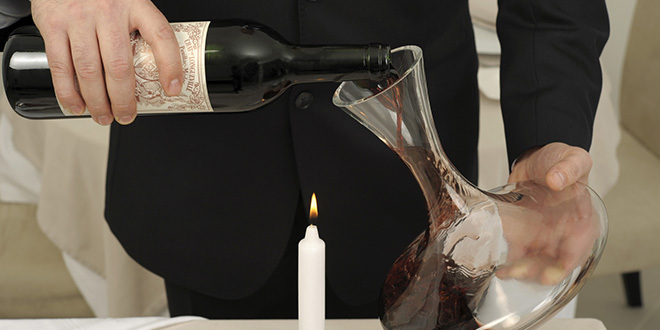
Just say no? Deconstructing decanting

Does decanting eliminate the natural oxidative curve of a bottle of wine? Does it make a wine taste $20 better? Photo: FOOD-pictures/Fotolia.com

Does decanting eliminate the natural oxidative curve of a bottle of wine? Does it make a wine taste $20 better?
Photo: FOOD-pictures/Fotolia.com

The wine drinking experience is afforded more pleasure by decanting a bottle of wine. Decanting means aeration and separation of liquid from sediment. Plain and simple. Most wine drinkers have always bought into this belief. Does that still hold true today?

The debate rages high. Eric Asimov from the New York Times suggests he’s of the camp that takes the middle ground. “Many good red wines are not and continue to produce sediment, so once they reach middle age, decanting these wines, very carefully, remains advisable. I like to decant young reds that might be tannic or tight, like those made from Nebbiolo or Cabernet Sauvignon. Even young red Burgundies can benefit from decanting, though Burgundians might roll their eyes.” True middle ground comes by way of, ironically, Decanter Magazine. “Most modern-day wines do not require decanting, though even young wines may benefit from aeration.”

The famous Bordeaux house of Château Margaux states that “the main reason for decanting red wines is to separate the wine from the sediment that may have formed in the bottle over the years. This sediment consists mainly of the tannins that have been made insoluble by the chemical reactions responsible for the ageing process.” They, like so many other Bordeaux stalwarts, remain entrenched in the world of decanting.

Will Lyons of the Wall Street Journal concurs. “All wine that will throw sediment should be decanted; this includes red Bordeaux, Rhône, Rioja, vintage Port and heavy grape varieties such as Cabernet Sauvignon and Syrah. Also—and this is open to discussion—young wines. In my experience, exposure to air unfurls the complex layers of flavor in young fine wine.” Chris Kissack fervently believes in the decanting process. “Decanting wines is not just for show, and even in this modern age of industrial, fined and filtered wines, some will still benefit from spending some time in a decanter.”

Consider these questions. Does decanting eliminate the natural oxidative curve of a bottle of wine? Does it make a wine taste $20 better? Is decanting elitist, obnoxious and unreachable for the average consumer? Cerebral decanting is another matter. Don’t hate a bottle of wine because it’s not been decanted. Hate it because it’s a bad bottle of wine.

And then there is hyper-decanting. This by way of Digital Deconstruction:

Gerardo Diaz is the Manager and Sommelier at Barque Smokehouse in Toronto. He is adamantly anti-decanting. Here is his well-thought out take:

Decanters come in various shapes and sizes, from functional to ornate to downright ugly. Decanters have played a role within the wine world for thousands of years. They have had many uses over time but for me, they have simply fallen out of practice and are representative of an archaic time, when wine was not made to be drunk immediately. This magnified by the fact that the technology of making wine back then was sub par in comparison.

Wine was held in amphorae, then in glass, metals or earthenware. These were the holding compartments for the fermented grape juice, then transferred off to decanters in order to minimize the amount of sediment within in the decanter/glass. It was used to aerate tighter wines and soften the tannins. Time has changed.

Decanters have become nothing more than a symbol of the past. With modern-making techniques and current trends, people want to be able to drink their choices immediately, and winemakers are following suit.

Wine is not what it used to be. Often over oxidized, aged for many years, with more vintage variation, etc… Nowadays when wine is bottled, it is what it is and does not change that much. As a matter of fact, aeration tends to do worse than better. People seem to believe that decanting hours prior benefits the wine. Quite the contrary. With modern wine techniques and just common sense, the aromatic compounds can only go far, that is to say that with time they will diminish as the minutes/hours go by. Decanting can be used for only two things, well aged wine and natural wines. But more now than ever, wines are not being made to age. They are being made to feed the immediate masses, the ever-growing population, but more so an ever-growing wine drinking population.

Tannins have a bad rep when speaking about wine, some say yay, other say nay. They provide structure, the very backbone to a wine. The added texture is the single most important thing in wine for me and acts as a natural preservative. Decantation is believed to soften these tannins that can be gripping, ever so drying, and to some, a turn off. This popular belief is misconstrued. Softening of the tannins takes place in the winery, with the winemaker. Decanting will only alter perception, kind of like a placebo effect. Yeah, decanters are a placebo effect.

I personally dislike decanters except for the two stated reasons, and even then, natural wines that almost exclusively lack preservations (sulphites), never need more aeration. The wine is what it is and will last a long time opened in bottle.

Good to go!

Three-chord wines, hold the rants

Wine on the rocks

Here are six rock ‘n’ roll wines, in four-four time, ready and willing to ease your mind.
Photo: Pavel Drozda/Fotolia.com

as seen on canada.com

The world’s most famous wine critic is not happy. His claim of “wannabe” scribes hell-bent to focus on obscure wines most consumers can never find has raised a maelstrom of retort. Robert Parker published a diatribe last month about “a vociferous minority” of “euro-elitists” vying for journalistic market share “perpetrating nothing short of absolute sham on wine consumers.”

Them’s fightin’ words. No, not that rant by Robert Parker about Robert Griffin III. Wine critic Robert Parker Jr. railed against a bevy of unnamed bloggers on the natural, honest and low-alcohol wine supporting bandwagon. His claim? Natural wines will be exposed as fraud. Parker’s would-be assailants are an outspoken generation who would seek to bring down those classic grapes capable of ripe extraction and elevated levels of sugar and alcohol, namely Cabernet Sauvignon, Pinot Noir and Chardonnay. The intensity-loving reviewer has positioned himself as the establishment, a victim agonizing over the sanctification of “godforsaken grapes,” like Blaufränkisch and Trousseau.

Alder Yarrow of Vinography took exception and proposed a cage match. His column: Debating Robert Parker At His Invitation. Rebecca Gibb’s take: Should Robert Parker Have Listened to Disraeli? Jamie Goode put in his ever-wry two cents: Novelty at the expense of quality? This after Jancis Robinson chimed in with Bottle fight: Novelty v classic wines. Talia Baiocchi had this to say: The Robert Parker Tirade, Continued. Eric Asimov brought it down to a New York state of mind with Why Can’t You Find That Wine? Meanwhile, Steve Heimoff took the other side: There are some kinds of blogs we just don’t need.

There isn’t a writer in the bunch I wouldn’t read, can’t learn from or don’t find funny, but the need to chime in on what is obvious and already understood leaves me dumbfounded. In wine, as in life, there are some things that just are what they are, like them or not. Mr. Parker, you carved your niche. Those who lay with you ate cake. The model worked. It held water and was extremely successful for a long time. You are this week’s Napa Wine Writers Symposium keynote speaker, where you will feel the love. No one will ask, what have you done for me lately? You created the establishment and are of course trying to protect the status quo. You’ve been ridiculously prolific. Integral to the high-frequency, high-end wine buyer. And you are just a writer. Really. So what if the dogs are seeing signs of Queegish dotage. You named no names in your rant, so who exactly did you mean to insult? The world is your oyster. What’s with the bitching?

https://twitter.com/KortvB/status/436175029676421120

Perhaps Parker touched an insecure spot, the one where self-doubt creeps in. The one that drives writers to defend themselves, even if the attack is not a personal one. The need to tear him down is strange at best. It smells of poli-campaign slander. If he’s no longer relevant, as a vehement bunch seem to scream and shout, why bother? Why is the wine writing community one where sides desperately need to be taken? To both sides I caution the high road. Let writers write and if you think they are wrong or have nothing to say, ignore them. Like a tree falling in the forest, is an unread writer ever really heard?

It’s understood that controversy sells and lively discourse is healthy. In this case it has produced more than a novella of interesting reads. The current generation of critics, bloggers and reviewers is replete with some stupidly smart writers who have chosen wine as their raison d’écrire. That they chime in and offer their take on everything from varietal obsessions to tasting bans and producer/journalist relationships is certainly fascinating. Arguing the merits of varietal worthiness is fine. Discussing the pros and cons of esoteric versus classic wines on restaurant cards is relevant. Throwing sticks onto the ice, choosing teams and starting fights simultaneous to the debate loses sight of the original topic. I am not suggesting a wine writer’s love in but would more levity and space not foster an environment where the wines themselves matter more than the people who talk about them?

Tasting, talking about and writing up wines seems the course to stay, whether it be reviews on varieties never heard of or an obnoxiously fat glass of buttery Chardonnay. Richard Auffrey fights the good fight but still takes a stab at the beast. The always dry W. Blake Gray floats on in his singular, ethereal way, and by doing so, gets it right. He wants you to know I’ll have some Roussillon, hold the Rivesaltes. With Tuba and Alto Sax. Perhaps Gray would agree with me. If I need a dose of scathing criticism or irony I’ll turn on Bill Maher, or put on a Bill Hicks Rant in E-Minor.

Music and wine can work magic when paired together. Jamie Goode has been exploring the possibilities. Sometimes it’s just a matter of breaking wine down to the base, choosing grapes from places where they are made in straightforward and simply powerful ways. Likewise, clicking an uncomplicated, three-chord arrangement on YouTube or the I-pod can really change the outlook of a day. Here are six rock ‘n’ roll wines, in four-four time, ready and willing to ease your mind.

Clockwise from left: Alamos Torrontés 2013, Lar De Paula Crianza Tempranillo 2008, Sophora Sparkling Cuvée, Grant Burge 5th Generation Shiraz 2012, Thorn Clarke William Randell Shiraz 2010, and Poderi Colla Dardi Le Rose Bussia Barolo 2008

Clockwise from left: Alamos Torrontés 2013, Lar De Paula Crianza Tempranillo 2008, Sophora Sparkling Cuvée, Grant Burge 5th Generation Shiraz 2012, Thorn Clarke William Randell Shiraz 2010, and Poderi Colla Dardi Le Rose Bussia Barolo 2008

Alamos Torrontés 2013, Salta, Argentina (81539, $13.95, WineAlign)

From Salta in north west Argentina, what is so appealing about this well-priced bottling is the salinity and outright humidity it always displays. Torrontés gives so much away aromatically, by way of flowers and the verdigris of mountain ferns. This Catena entry-level wine achieves all of the above and for a song. This Alamos is medicinal, reeks of orchids sweating in a greenhouse and teases with white pepper. It’s short and quick but efficient. Excellent value.  88  Tasted January 2014  @CatenaMalbec  @MalbecLife

Lar De Paula Crianza Tempranillo 2008, Rioja, Spain (358770, $16.95, WineAlign) From the VINTAGES Feb. 15, 2014 Release

Entry-level Rioja was nothing but a house party. Was surely rocking a year ago but now a fading, dry cake of rusticity, with the slightest hydration of charred sour cherry. Solid Crianza, though short-lived, with some bitter notes and good acidity in tight corners. Where once it “said move it, groove it,” now it laments “baby, don’t you lose it.”  87  Tasted February 2014  @HHDImports_Wine

Sophora Sparkling Cuvée, New Zealand (353656, $19.95, WineAlign) From the VINTAGES Feb. 15, 2014 Release

Frothy, gregarious sparkler from New Zealand with extraordinarily large bubbles, a soft downy texture and a cottony nose. Gentle spice, sweet easy bake brioche and juicy grapefruit is inviting, if advanced by mechanical means. Mellow, smooth, pure and clean with no obvious toast, soap or bitters. Well-priced, drink now fizz.  89  Tasted February 2014  @Select_Wines

Grant Burge 5th Generation Shiraz 2012, Barossa, South Australia, Australia (Agent, $20.00, WineAlign)

High powered, ocean size aromas here, expressing the power and pomp inflection of the Barossan attitude. Very berry and not alcohol shy though it’s a gathered heat and nothing shocking. Swirl this wave of big juice for long enough and though it will feel “like a tooth aching a jawbone,” it’s fleeting and releases to a softer finish. Still, a Shiraz more John than Jane.  88  Tasted January 2014  @GrantBurgeWines  @TrialtoON

Thorn Clarke William Randell Shiraz 2010, Barossa, South Australia, Australia (922773, $43.95, WineAlign) From the VINTAGES Feb. 15, 2014 Release

Surreal, impossibly dense and terrifically complex Barossa Shiraz, full of dark fruit blues and hard-rocking rhythms. Metallic zinc tincture, causing heavy breathing, steaming like a locomotive with “no way to slow down.” Steals words and all sensitivity from teeth and gums. Such a big expression but certainly not one of the all-time one-dimensional losers. So much more than jammy fruit. To put aside and revisit in 20 years.  91  Tasted February 2014  @pontewine

Poderi Colla Dardi Le Rose Bussia Barolo 2008, Piedmont, Italy (596890, $49.95, WineAlign) From the VINTAGES Feb. 15, 2014 Release

Pure Nebbiolo currency, bankable Barolo. This ’08 confirms the old-school austerity of the Colla caste and genre. Parlous handsome perfume, stark, raving Barolo, exact and definitive in angular tannin. Racy, deep and unctuous, nowhere even close to settled or responsive.  There is a lurking depth of flavour not yet willing to cooperate. My kingdom for your Bussia graces.  92  Tasted February 2014  @glencairnwines

Good to go!