Tasting Italy 500 wines at a time

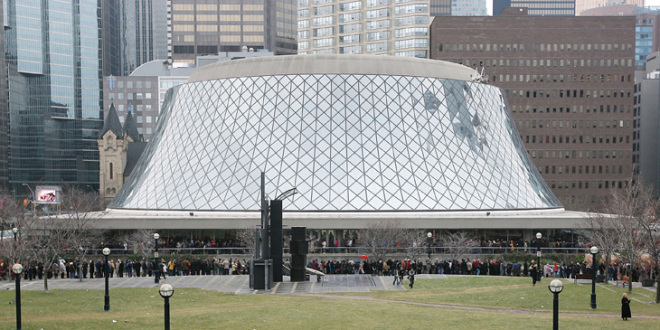
Toronto’s Roy Thomson Hall (photograph by Peter J. Thompson, National Post)

as seen on canada.com

A tasting of wines from Italy is a huge event and though its girth had shed some earlier weight, by Canadian standards it prevails as an epic tasting. On Monday November 4th, 2012 the Italian Trade Commission, under the auspices of the consulate general of Italy Toronto, presented the 17th Annual Wine Tasting at Roy Thomson Hall. The ITC is the government agency that promotes the internationalization of Italian companies. The tasting event is a boon for the Italian wine industry which collectively holds an 18 per cent market share and $219 million in sales, making them the leader of imported wines in Ontario.

Trade Italy is a rock ‘n roll outfit that traverses Canada on an eight-day whirlwind tour. Stops in Vancouver, Calgary, and Montreal fill out the schedule. The Toronto show included tables of good eats; Italianate charcuterie and cheeses to compliment the nearly 500 wines poured by more than 70 producers from as far North as the Alps to the tip of the boot in Sicily. Honourable mention goes out to Authentic’s Frank Rey, he of magical spider arms and cat reflexes to keep up with bartender speed so the masses might get their taste of the ethereal Ornellaia 2009 (95).

While it would have made for an Omerian tale to have tasted everything on offer, the sheer mass of it all (wines, wine agents and tasters) made for more of a Joycean, Ulysses, stream of consciousness affair. A certain level of linear focus was required and so my Odyssey was bent on revisiting classics and the discovery of unusual nooks and crannies from deep within the Italian landscape. Here are my top three highlights from the epic event.

Top three highlights from “A tasting of wines from Italy”

Castello Di Gabiano

Monferrato, Piemonte

Monferrato Rosso Gavius 2008 of 85% Barbera and 15% Pinot Nero and its organoleptic characteristics is subject to a variety of oak treatment, unlike the more entry-level La Braja. The Gavius goes gravelly and gangly and the Pinot adds a breadth of Brett in a very minor key. Greets you with gritty acidity. A great slice of Gabiano’s game.  88

Barbera D’Asti Superiore Adornes 2007 is Barbera and nothing but Barbera emerging from an 18-month slumber in wood. High altitude attitude, cool at its centre, warm, low and slow on the long trip down. Oh, baby Barbera.  91

Gabiano Riserva A Matilde Giustiniani 2006 adds a wee bit of indigenous Freisa into a Barbera already living the chill life. Fully resolved tannins here, less acidity and fully floral violet aromas. From the high slopes of a minuscule DOC, fully justified fruit is calm and collected in its golden years.  90

Monferrato Bianco Riserva Chardonnay 2010 blows my mind. Step aside Cervaro, this beauty walks an impossibly fine line between sharp citrus, orchard fruit, piercing minerality and a tropical, honey viscosity. At once fresh and searing, then again mellow and mellifluous. Terrific length. Italian Chardonnay gets no better than this.  92

Michele Satta

Toscana

Bolgheri Piastraia 2008 holds on tightly to its heartstrings and offers little at this time. A tale of beauty and beast; majestic colour but bearing dangerous teeth. A four by 25 mix of Cabernet Sauvignon, Merlot, Syrah and Sangiovese, the Pia wants to sing like Toscano but her voice is suppressed by tannins fierce and biting. Revisit the songstress in five years when her voice and craft have refined beyond idol times.  90

Toscana Il Cavaliere 2006 “is a brand new funky president” possessed of Satta’s inimitable perfume, not unlike Pegau. Satta’s funk is more like a grunting cinghiale roaming the vineyard’s innards. The brown, earthy animale sure ain’t honey but it’s music to my ears, or perfume to my nose. Behind the musk is fantastic deep berry and plum fruit and a wall of invigoration.  93

Bolgheri I Castagni 2006 turns a corner of modernity, whispers cinghiale but is more of an elegant, black cherry driven coastal expression of Cabernet Sauvignon with hits of Syrah and Terdolego. Tobacco, tea and black pepper make for points of interest.  91

Tenuta Rocca

Monforte D’Alba, Piemonte

Barbera D’Alba Roca Neira Superiore 2006 is a 12,000 case, 100% Barbera knockout. Black cherry and Cassis liqueur cordial as if decadent Châteauneuf or Paulliac. Presented by the efficacious and hypnotizing Elene Ercole who explains that Rocca is a modern operation with one foot in tradition and the other stepping into the future of Piemontese wine. A tiny oxy note shows the Neira’s age and avant-garde nature.  91

Langhe Ornati 2006 blends 35% Nebbiolo and 30% Cabernet Sauvignon into Barbera for full Super-Piemontese effect. Though Elena scrunches her nose just a tweak at this moniker mention, the modern styling and remarkably approachable soft, silky smooth fruit speaks to an IGT mentality. Long Langhe, loveable and fluid.  90

Barolo 2007 of graceful elegance and velvety mouthfeel is a sight to behold. Diaphanous tendrils swirl in eddies in the glass. Tenuta Rocca suggest that to maximize enjoyment of their wine you need leave them in the “same horizontal position as when it arrives in its case until the moment of consumption.” I will do my best.  92

Barolo San Pietro 2007 from Monforte will move to Serralunga but for now the warm and balanced vintage gives the world an exemplary expression of modern Barolo. With no disrespect for the sumptuous and ancient rune that are the wines of Settimo, Rocca’s ability to reign in Nebbiolo fruit with such intensity has me hooked. The San Pietro’s complex character of gaseous plasma, spiralling helices of energy and outright ultra-violet radiance is exquisite. Cherry, leather, spice, vanilla and chocolate are all there.  Spongy Barolo.  94

Good to go!

Wine is the new coffee

Photographs by peshkova (left) and Igor Klimov, Fotolia.com

Photographs by peshkova (left) and Igor Klimov, Fotolia.com

as seen on canada.com

Coffee, the object of reverential and religious affection. Prayed to by the addict, the aficionado, the connoisseur. They sniff, they swirl and they savour their brews like First Growth Bordeaux or 50-year old Auslese.

If  Starbucks acted as harbinger to the North American phenomenon and found itself relegated to chain status then the torch has been passed. Proof lies in the extreme world that is the specialty coffee industry. Ezra Braves, owner of two Toronto boutique coffee destinations called Ezra’s Pound, recently commented , “we’re not re-inventing the wheel, but we just really embrace the cafe culture here.” Today your cup of Joe will likely be organic, fair-trade, responsibly grown, bio dynamic, Eco-friendly, a bag of ethical beans, bird-friendly, shade-grown and even triple-certified. It’s no wonder your red wine smells and tastes like coffee. It’s hip, it’s trending and it sells.

Wine geeks and critics have spent the last 10-15 years coming to terms with so much of their wine smelling and tasting of coffee, or variations thereof. The consumer can’t get enough of the stuff, even if they’re not sure why. The question is increasingly becoming one of secret consternation for the masses. Are wine makers infusing red wines with essence of, or actual brewed coffee?

The answer is no but more red wines than not these days will whiff or indicate a flavour profile that might include black coffee, espresso, cappuccino or mocha java. The use of new French oak and sometimes barrels that have been deliberately charred will impart coffee characteristics into red wine.

Bio dynamics and sustainable practices are now mainstream in the world of wine but in contrast to the coffee universe, many vineyards don’t necessarily feel the need to shout it out. The subliminal or vainglorious addition of coffee notes is far more effective for a ka-ching effect at the cash register. Modern vintners have so many progressive and manipulative techniques at their disposal so making “coffee wine” has become commonplace.

Iconic red wines from Bordeaux, the Rhône Valley, Napa Valley and Burgundy are heavily influenced by the barrels that house megalitres of famous juice, but for the most part, the premier or grand cru grape ferment is up to the splintered task. Value wine faces a much greater challenge.  Still, there are terrific examples out there that find the correct balance of fruit, oak and acidity. Here are five arriving VINTAGES releases that gracefully walk that fine line.

VINTAGES November 10th, 2012 Release

The grape: Malbec

The history: Blender of Bordeaux and ‘black” knight of Cahors in southern France

The lowdown: Mom and pop Mendoza outfit sells to big corporation but maintains parochial integrity

The food match: Pot Roast, roasted root vegetables

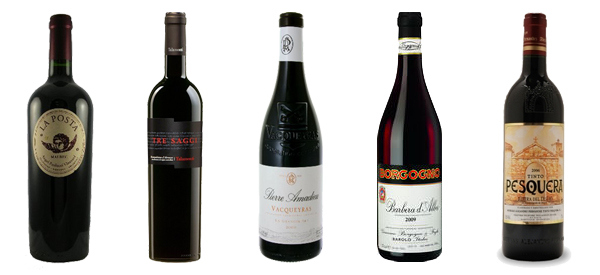
La Posta Angel Paulucci Vineyard Malbec 2010 (75515, $15.95) faintly hits at a mocha milkshake mentality. Smoking cedar boughs inside and blossoming purple Jacaranda outside. Volcanic and pitchy like Cahors or Etna. Mocha flavour finish brings it all full circle.  88

The grape: Montepulciano D’Abruzzo

The history: Not to be confused with Tuscany’s Vino Nobile Di Montepulciano, this one comes from Abruzzo

The lowdown: MD’A’s are making use of new oak like never before. Crowds of new wine lovers are embracing the sweet and concentrated elixirs as go to value drinkers

The food match: Spaghetti with Veal Ragu, reggiano parmesan

Talamonti Tre Saggi Montepulciano D’Abruzzo 2008  (204016, $15.95) is representative of the new age in Italian wine. A crooning Tommy that resides “here in my deep purple dreams.” Rich, lush, deep violet berry, oak-inspired MD’A. So much wine for $16 if a bit scary to a fruit dinosaur.  88

The grapes: Grenache and Syrah

The history: Typical southern Rhône blend, 80% G and 20% S

The lowdown: The Amadieu family has a storied history in the region dating back to the 1920’s, and are the owners of this incredible Cru vineyard

The food match: Hand Made Ravioli, mushroom filling, white truffles

Pierre Amadieu La Grangelière Vacqueyras 2010 (76398, $19.95) first seeps as a black and red fruit Texas tisane but before long the toasted oak turns the tea to coffee with a hint of balsamic wood. Complex from AA to ZZ but not over the top. Some astringent, chalky tannin and talcy acidity is conquerable because the fruit is so lush. “Have mercy, a haw, haw, haw, haw, a haw.”  89

The grape: Barbera

The history: One of Barolo’s historic houses, this Barbera represents an avante-garde shift for the house style

The lowdown: Modern but nothing revolutionary about it. Nothing but a little bit of oak

The food match: Osso Bucco, gremolata, polenta

Giacomo Borgogno Barbera D’Alba Superiore 2010 (285486, $19.95, SAQ 10388088, $19.40) screams simply wow, this is not what I expected from the ancient winery. When I think of Borgogno I envision Barolo circa 1985, red rose rusty and opaque like weak tea. This one is purple pretty, black cherry pie yet retains a dry Piemontese attitude in search of braised shanks. Best Barbera.  90

The Splurge

The grape: Tempranillo

The history: Alejandro Fernandez has convinced the world that entry-level can mean $27

The lowdown: This could be Ribera Del Duero’s finest Crianza

The food match: Braised Lamb Shank, shiitake mushrooms

Alejandro Fernandez Tinto Pesquera Crianza 2009 (341461, $26.95, SAQ 10273109, $26.35) is the shocking blue Venus of Ribera Del Duero, round, voluptuous, smooth and let me tell you, “she’s got it.” Licorice liqueur, blue plum, citrus and laser acidity for a red wine. Always spot on.  90

Good to go!

Four fall back wines for Daylight Savings

Photograph by Albo, Fotolia.comas seen on canada.com

The wine glasses will have retired when the clocks fall back to standard time at 2:00 o’clock in the morning on Sunday, November 4th. An hour no longer needed and cast off, a casualty of war. He may not have invented it, but we have Benjamin Franklin to thank for being the first to indicate the need for the phenomenon. In the United States, a federal law standardized the yearly start and end of daylight saving time in 1918, for the states that chose to observe it. It was mandatory during WWII and today most states continue to observe the so-called, energy-saving measure. Canadians abide, Quel shoc!, save for Saskatchewan which is on DST year round. What’s that all about?

The M.C. Escher tessellating question is this. Is DST an energy conservation proposition or a Saturday night wine suck? It’s both, actually. Like the Escher model, fine wine is a linear, interwoven tapestry without any gaps or overlaps. The fact that DST is part of a never-ending loop likens it to Groundhog Day and the redundant nature of the ritual zaps life, if only for one night, as if there were no tomorrow.

My advice is to make sure your fridge and racks are stocked with whites and reds possessive of good legs that fall back in the glass. Wines of character and depth to carry you through to Sunday’s raffish onset of darkness. On the bright side, that lost hour does mean that when Sunday morning comes you won’t be confronted by first light purdah masked of a folderol, cimmerian shade. Here are four wines to aid in the transition back to standard time.fallbackwine Four fall back wines for Daylight Savings

The grape: Pinot Grigio

The history: 100% PG from the Friuli Isonzo DOC region (in northeastern Italy near the Slovenian border) produced by the cooperative, Cantina Produttori Cormòns

The lowdown: Tightly wound clusters cause varietal deformity due to the pressure they exert on each other. Intense PG at a great price

The food match: Barque Rub Roast Chicken Wings and Thighs

Cormòns Pinot Grigio 2010 (734038, $14.95) is slick stuff, like vitreous and porous silica gel without the talc. Acacia blossom perfume and agave scherzo symphony in a glass. High praise indeed for lowly PG but go Friuli my friend and note the difference. The conically tapered glass bottle adds to the magic and the profile. By way of Mr. C. for my card at Barque88

The grape: Chardonnay

The history: Burgundy’s great varietal goes haywire along Niagara on the Lake’s old Stone Road

The lowdown: This racy white has just enough brake to watch its speed

The food match: Homemade Tagliatelle, brown butter, parmesan and sage

G. Marquis The Silver Line Chardonnay 2011 (258681, $16.95) streaks across and plays a lick on atomic 16 rails at breakneck speed, all the while jonesing for of a slice of custard pie. “It’s sweet and nice” with lead, nuts and spice. The G. might stand for grateful or great, as in value.  88

The grapes: Grenache, Syrah & Mourvèdre

The history: Gigondas sits one step down from Châteauneuf-du-Pape in the southern Rhône pecking order

The lowdown: Not nearly as serious as the likes of Brusset, Perrin or Montmirail but look at the price

The food match: Boneless Roast Quail, king oyster mushrooms, fresh thyme

Domaine Santa Duc Les Garancières Gigondas 2009 (234989, $17.90, was $27.95) is Grenache-centric so soft, modern and approachable is its MO. The S and M adds just enough volcanic disturbance, smoke and herbal spew to keep it real. Notes of arpeggios and glissades. At the reduced fare its reductive attributes smooth and flesh out hither and yon at the same time. Simmering raspberries with the intention of becoming jam is a delight to sniff and dip a spoon into.  89

The grape: Malbec

The history: From the emerging Uco Valley in Mendoza where the varietal seems to turn from  red to black

The lowdown: Showing very well for an under $20 Malbec with five years of age under its bottle buckle

The food match: Grilled Barese Sausages, tomato jam, smokey bbq sauce

Trapiche Fincas Las Palmas Malbec 2007 (186668 $17.95) with its vanillin, razor-sharp contour of energy is  rich and powerful for the price. The style is big, blowsy and not without a smokey, blackberry charm. A slight electric loss and corresponding increased valence shows that the clock is ticking fast, but for now the pleasure is all ours.  89

Good to go!