
Selection de Grain Nobles of Domaine Schoffit
Like so many Alsace winemakers, the Schoffits were and continue to be torch bearers who made wine to remember generations. Though their history traces back more than four hundred years, the modernity of their oeuvre is a case of futuristic pioneering. That path is laid crystal clear by a tasting and a learning about their wines in discourse through the precocious young lens of Alexandre Schoffit.
During a week in Alsace we tasted many wines 25 years and older. At that age there can be no guessing. At Schoffit we were presented wines that fell into the four to fourteen range. No longer primary and not yet secondary, the assessments of adolescence can be difficult, confusing, beyond comprehension. The relationship between many wine’s character with its aromatics and flavours is usually that of gristle and fat on the bone of meaning. But not Domaine Schoffit. There is no gap between the structure and the wine.
The Harth Lieu-dit is the Alsace home vineyard and grounded muse for the varietal wines of Domaine Schoffit. Eleven hectares of Pinot Gris, Riesling, Gewürztraminer, Pinot Blanc, Sylvaner, Chasselas and Pinot Noir make up the core of the domain’s 100,000 bottle production. The alluvium, permeable pebble soils in Colmar and France’s most generous amount of sunshine provide the sustenance. Robert, Bernard and now Alexandre Schoffit are the facilitators of clockwork winemaking, on time, always with a shine.
If Harth is the guts, the glory comes from the volcanic sharp hillsides of the Grand Cru Rangen de Thann, acquired by Bernard in 1986. This is the only siliceous rocks and lava base in all of Alsace. It is here by the monopole and medieval church Clos St. Théobald that the foundation of the Schofitt legend lives. Rangen might borrow from the German, meaning “row.” Legend has it Saint Théobald brought the finger of the Archbishop from Bubbio, Italy because the ring was promised to the monks. The saint fell asleep in the vineyard and passed on. Another story tells of Hercules having been the one to sleep in the vineyard because the Rangen wine was so strong. His mace graces the label on the Schoffit coat of arms. Today the church and the monopole memorialize St. Théobald and his name.
From as far back as 1041 records discuss the 3rd incarnation of the monks who worked the vineyards on the treacherous slopes. Rangen Riesling and Pinot Gris need cellar time, to pay hommage to the provider’s history and to create one of its own. Grand Cru from these vines lives a life of its own. Notes Alexandre Schoffit, “in the Rangen we are not avoiding malolactic fermentation, but if it happens we are not bothered by it.” The monks knew of the connection between the Thur River’s dark waters and what happens to these wines after long rests in the cellar. “If you know the Rangen, you can tell it by the colour.”
Schoffit’s other Grand Cru is located in the Sommerberg, between the towns of Niedermorschwihr and Katzenthal. The granite hillsides are the proviso for mineral moxie and the resolution to provide what Riesling demands. Only le roi of Alsace grape varieties is made in Sommerberg. The crumbling granitic bedrock is ideally suited for the racy wines it begets.
Related – Walking an Alsace mile in their Riesling shoes
Riesling is royalty in Alsace and at Domaine Schoffit, it is king. When he introduces his family’s Pinot Gris, Alexandre Schoffit explains, “the wines are a little more simple; full-bodied, concentrated.” This attitude is prevalent across the region though some winemakers seem to love all of their children equally. Others, like Alexandre and like Jean Boxler (Domaine Albert Boxler) clearly put Riesling on the throne.
Pinot Gris is a different sort of child to raise. As a rule in Alsace and especially on the volcanic or granitic steep slopes, it must go deeper than Riesling, must burrow even further into the fissures of rock for nutrients. In Pinot Gris the mineral extraction and grape tannin suppress any thoughts of cloying or insipid sweetness.
In June of 2014 I sat down with Alexandre Schoffit at the winery in Colmar to taste 14 of his wines, along with Montreal’s Fred Fortin, Sommelier au Restaurant Laurea and New York’s Jonathan Ross, Sommelier at #ElevenMadisonPark. A tour of the facility showed us the stark minimalism and puritanical cleanliness that defines the three generations of winemakers at the domain. The wines echo their attention to detail, their storied history and a focus on keeping up with advancements of the times. Here are the notes from Domaine Schoffit.
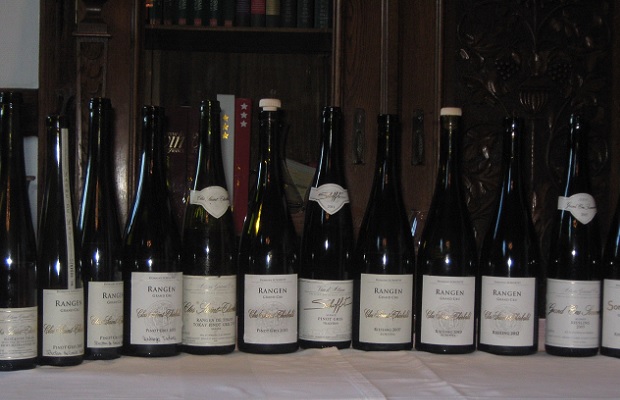
Domaine Schoffit, Colmar
Chasselas Vieilles Vignes 2012 (Agent, $25.00, WineAlign)
Cropped at 40-50 hL/l because they are careful not to let it get out of control. According to Alexandre Schoffit this number is like 20 hL/L for any other grape variety. Chasselas here for easy drinking, with mildly sweet (4.7 g/L) flavours that express green herbs and vegetables. Round (12.8 per cent abv) and sound Chasselas, helped by the balance of the vintage. Though not exceptional in acidity (4.4 g/L) this is not the hallmark of the grape. A wine that is almost entirely exported to foreign markets.
Riesling Lieu-Dit Harth Tradition 2012,
From the winery’s home Colmar vineyard composed of gravel and sandstone, this has open-knit fruit of early morning flowers. An apricot tang, ripeness and just a few shades away from bone-dry (7 g/L RS) and yet in a balanced (7.2 g/L TA) dry style. To taste this is as traditional as Alsace Riesling can be. Proper, as expected.
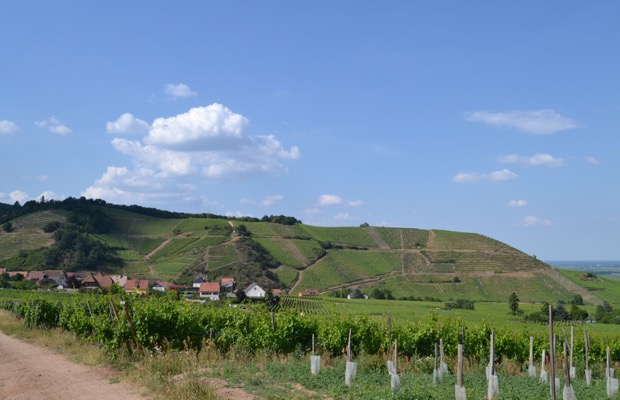
Sommerberg (c) Cassidy Havens, http://teuwen.com/
Riesling Grand Cru Sommerberg 2011
From granitic soil, the first reaction is to the beguiling strike of a match, the split to fissure of rock, the firing of a gun. The impression that begins is not just one of smell, but deeper, as if a deafening sound. This and the brisk surround of near-extreme acidity (7.7 g/L). Only 800 bottles a year are produced of this startling Riesling, a rare production for a wine of so much stone and that searing, direct energy. Clean as Riesling can and ought to be.
Riesling Grand Cru Sommerberg 2005
During a week in which many 2005’s are laid out on tasting tables, here is another spot on example. “The vintage makes the wine,” insists Alexandre and this Sommerberg drives the point. The age has had very little evolutionary effect on the aromatics. The lapidarian has perhaps had its stone face suffused by a fleshy permeate, Jacked by a temporary balladeering smother, though it will undoubtedly re-emerge hard-core lithic further on down the road. Typical, it seems, of granite-based Alsatian Riesling. Begins in matchstick, enters lanolin, beeswax and wooly sphericity at eight to ten years of age, then returns to flint later in life. Acidity is the catalyst in this development. “And if we are fools in love, then a happy fool I would rather be, and I’ll be glad to learn from you,” though I know Sommerberg has nothing to learn from me. Racy Riesling, seemingly understood but never really known. “Well that’s the magical kind cause its flowing all the time.”
Riesling Grand Cru Rangen De Thann Clos St. Théobald 2012 (Agent, $60.00, WineAlign)
Here the volcanic axiom. Not the one that includes magnetic reversals, dinosaur populations and the stock market, but yes, the one concerning global rhythms. The 2012 global and Alsace vintage heat sees Rangen yield at just under 40 hL/L, with soaring aromatics in a wine that will lack the stuffing for longevity. Simpler and so lifted in florals while herbiage balms and bombs the (“Schistes” label-designated aridity) in salinity and fruit driven to immediate assets. The Clos St. Théo’s young acidity is so much rounder than ’10 and ’07, though still very disciplined. Purely and effortlessly representative Rangen to enjoy while the others sleep.
Riesling Grand Cru Rangen De Thann Clos St. Théobald 2010 (Agent, $60.00, WineAlign)
The label is also known as the “Schistes,” indicating a new de facto dry style and another example to speak about the Schoffit purity, clarity and precision. A whiff of smoke pursues the ethereal in this terrific and exemplary 2010, like the 2000’s of a decade earlier, balanced and elevated by a low and slow evolution. The schist soil impart brings a lime acidity in piercing precision. The near-optimum vintage is taken full advantage of, perfect to show off the Schoffit style. The only imperfection is the lack of economics, a result of the yields (under 30 hL/L). Never mind the wash, this has aridity and salinity in frozen waves, immense like a raging river’s falls suspended in animation. Rangen Riesling is as dramatic an expression as any in the world and this ’10 perches amongst the top of the class. Drink 2018-2030.
Riesling Grand Cru Rangen De Thann Clos St. Théobald 2007 (Agent, $60.00, WineAlign)
The ’07 Rangen is not showing age with the same advancement as the Sommerberg but the idea is just the same in that the roundness or richness has stepped in to soften the volcanic salinity and mineral mouthfeel. The rigid attributes persist but currently reside in a purgatorial state of temporary stoicism. The dry finish is the locus point to indicate (five more years) time is needed to see past the salty breakwater and to reach the true meaning in its character. Also, because this ’07 has been through malolactic, unlike the Sommerberg, yet the consequences are not a question of compromise for balance. Drink this from 2019-2027.
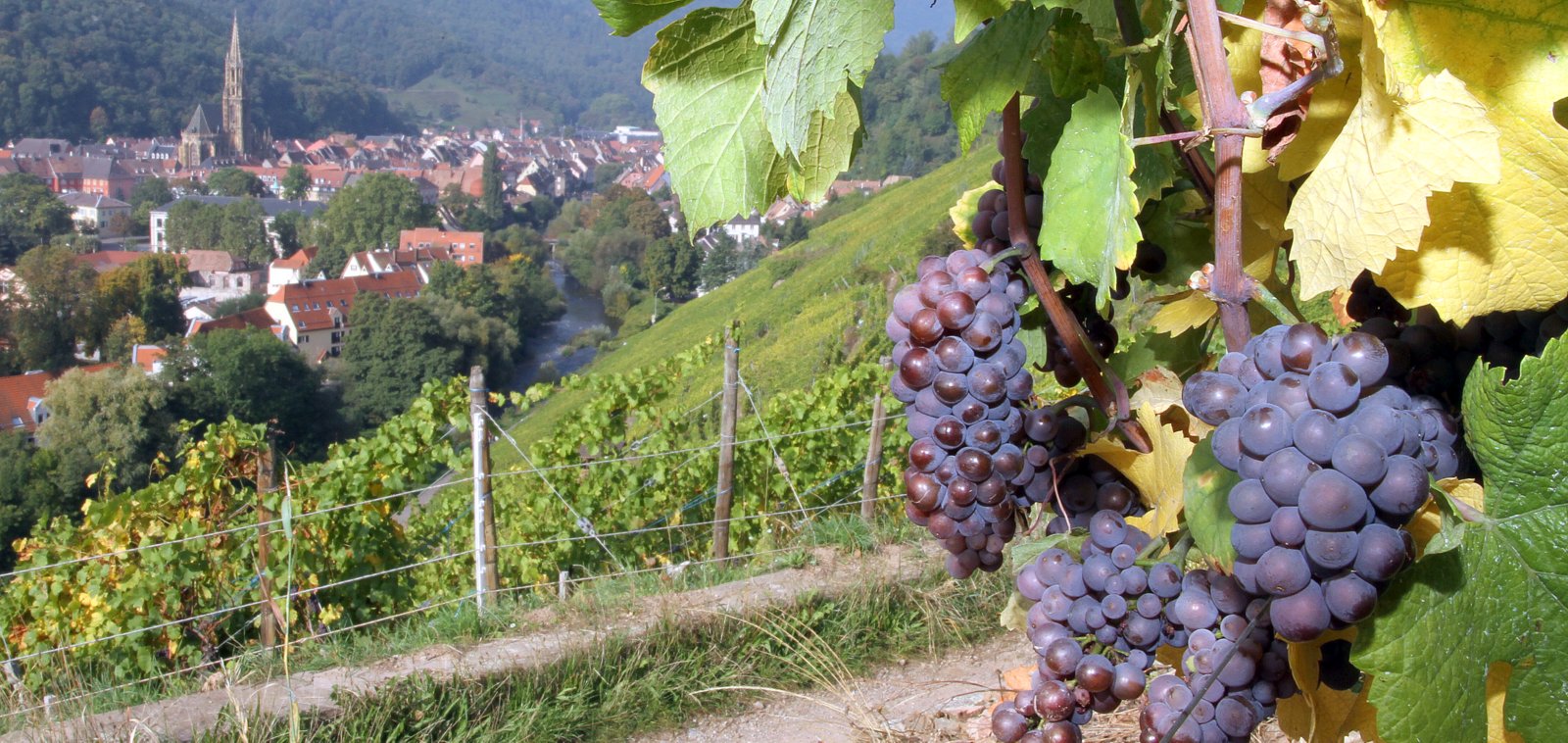
Quelques grappes du futur Pinot Gris Grand Cru Rangen Clos Saint-Théobald 2013
(c) https-::www.facebook.com:schoffit:
Pinot Gris Tradition 2011
Here the Schoffit proclivity towards the potency of Pinot Gris as a straightforward and heady white. The sugar (13.1 g/L) is felt and yet its strength is conveyed by elasticity, bespoken towards needing to give this a few years to settle. Propellant wound acidity (5 g/L) keeps the proportion in flavours of peach, pear and the appendix of savour. Drink this paradigmatic Pinot Gris from 2016-2020.
Pinot Gris Grand Cru Rangen De Thann Clos St. Théobald 2010
In this volcanic soil plussed Pinot Gris the anxiety is palpable. The sugars are derived from orchard fruit at a ripeness pulled by acerbity (9.5 g/L) in clairvoyance of that volcanic mind, skewed and eschewed through utter dramatic density. A good bitterness prevails over the tension with a finish in citrus intensity. Moments of delicacy give a peek to where this will go, that and the incredulous observation on how remarkable 37 g/L of residual sugar is tempered along. Drink from 2018-2025.
Pinot Gris Grand Cru Rangen De Thann Clos St. Théobald 2000
So here is what 14 years provides from the depths of a steep volcanic slope high atop the Rangen. Like a burning candle meets crème brûlée, the wax smouldering, the sugars caramelizing, the symbiotic augmentation crystallizing in natural sweetness, in seamless fusion. This represents the reason we take time to look at and see what happens to Pinot Gris, from altitude-afflicted vines with volcanic interruption and through the neurasthenia of originally-picked unsullied, purest fruit. The cleanest botrytis. Rapturous PG. Drink now through 2025.
Pinot Gris Grand Cru Rangen De Thann Clos St. Théobald Vendanges Tardives 2010
Quite clean and lean for VT out of that exaggerated hyperbole of a terroir-driven vintage. The richness and fullness is on the palate at this early stage in its development. Very full (approximately 50-60 per cent) botrytis affected grapes in a repeat recording for hygienic, pellucid and precise. The aromas are from white fruit, flowers and tender apricot. The acidity (5.8 g/L) is unexceptional, observed in relation to a lower block’s fruit (on the middle slope) which is naturally lower in acidity and less concentrating (128 g/L) to the grapes. While the verve may have wandered away in marronage, the delicacy here stands apart. Drink sooner rather than later.
Pinot Gris Grand Cru Rangen De Thann Clos St. Théobald Sélection de Grains Nobles 2007
From a vintage of concentration for SGN. A very smokey note bristles with the highlight of lit beeswax intensity. Telescoped and rapt aromas of peach and apricot turn syrupy on the palate. This SGN is extremely young at heart and bounds about like a whelp of limitless innocence and energy. If the highest pinot in volcanic absorption could be measured in Alsace, this Rangen might top the bimetal thermometer. Fills the fullness and complexity kettle yet somehow, miraculously remains light on its feet. With “hair of gold and lips like cherry it’s good to touch the green, green grass of home.” This is oozing (265 g/L) dessert wine, sticky, infiltrating the pores of fingers the moment it leaves the glass. The finish is marked by citrus (9.5 g/L) and the classic Schoffit lit wick. From George Jones to a Scony Mack kind of SGN, like the back of a woman’s knee.
Pinot Gris Grand Cru Rangen De Thann Clos St. Théobald Sélection de Grains Nobles “Larme de Lave” 2007
A mere 500 plus bottles (with sugar at 510 g/L) are produced of this SGN which I believe will live forever. “This bottle is made to show what can be done,” says Alexandre Schoffit. “It’s more than a dessert wine. It’s a meditative wine.” When it pours into the glass it takes a moment to settle into itself. That’s how viscous it is. Moves beyond pure apricot, into the essence of a multitude of fruits. Picked hand by hand, seeking only the botrytis-affected berries. The unadulterated soul of natural grape sugar. Few words can express the need to ceremonialize its incredulity. With alcohol at 4.9 per cent and a potential of 37.2, the Lave will live more than 100 years, of that we can be sure.
Gewürztraminer Grand Cru Rangen De Thann Clos St. Théobald Sélection de Grains Nobles 2006
Richer, with an early increase in caramel, colour and in warm concentration. There is licorice (no, really) on the nose and also pine. “A really complicated vintage,” explains Alexandre. This has a drier sensibility as compared to the Pinot Gris, with dried fruit flavours of mango and apricot. An oily, petrol note adds to the confusion and a hard-pressed, on the spot ability to pick this out blind as Gewürztraminer would certainly be a reality. Orange peel and slate fall in late. The residual momentum (162 g/L), acidity (8 g/L) and alcohol (11.7 per cent) may be misfit bedfellows but messing with what the vintage and the slope gives would be a bite upon the hand that feeds. It is what it is, you can’t change it. This is the fragmentary varietal character of the Rangen.
Good to go!


 Godello