All suss terroir

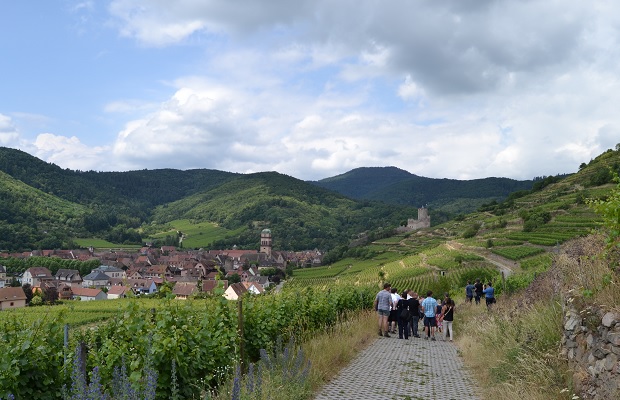
Niedermorschwihr and Sommerberg Grand Cru Vineyard, Alsace

Niedermorschwihr and Sommerberg Grand Cru Vineyard, Alsace

It has been more than 15 months since I returned from a pivotal, seminal and transmogrifying week in Alsace. The thoughts transposed to words continue to flow freely and with crystalline clarity. This may be the curtain call on that trip. Or not.

Type in the words “Alsace” and “philosophy” into a Google search page and the results will tell a Grand Cru story. The Alsace home page launches from terroir. It has to. Every winery, trade, marketing or governing organization’s website is ingrained to emphasize the rubric, to explain the true essence of Alsace wine. The local philosophy, indicating the cerebral and the spiritual component for producing exceptional wine, is both necessary and fundamental. There is nothing remotely parenthetical about the notion of terroir, not in Alsace.
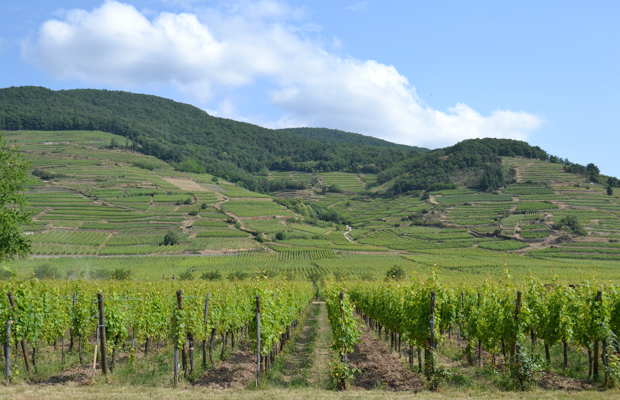
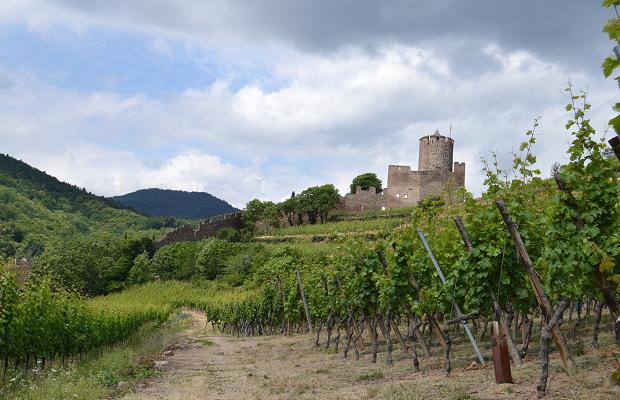
Schlossberg Grand Cru, Kientzheim, Alsace

Schlossberg Grand Cru, Kientzheim, Alsace

Related – In a Grand Cru State of mind

As wine geeks we are constantly seeking it out and sometimes we imagine it, chat it up when it’s not really there. After we are immersed in Alsace, we cannot deny its existence. Terroir, defined as “the complete natural environment in which a particular wine is produced, including factors such as the soil, topography and climate.” Or, goûts de terroir, as intaste of the earth.” Wherever wine is made around the world, soil is always as important, if not more important than any facet of the winemaking oeuvre. In Alsace, it is religion. I suss it, you suss it and in Alsace, they might say, “we all suss terroir.”

Alsace presents as a long strip of stupidly beautiful, verdant vistas, wedged between the faults and valleys forged with the Vosges Mountains on its west side and the Germany buffering Rhine River to the east. To consider its location as a province of France, drive 500 kilometres east of Paris and draw a line south from Strasbourg, to Colmar and to Basel. Wars have seen to make sure the region can never be too comfortable with its identity, causing an ever-annoying oscillation in governance.
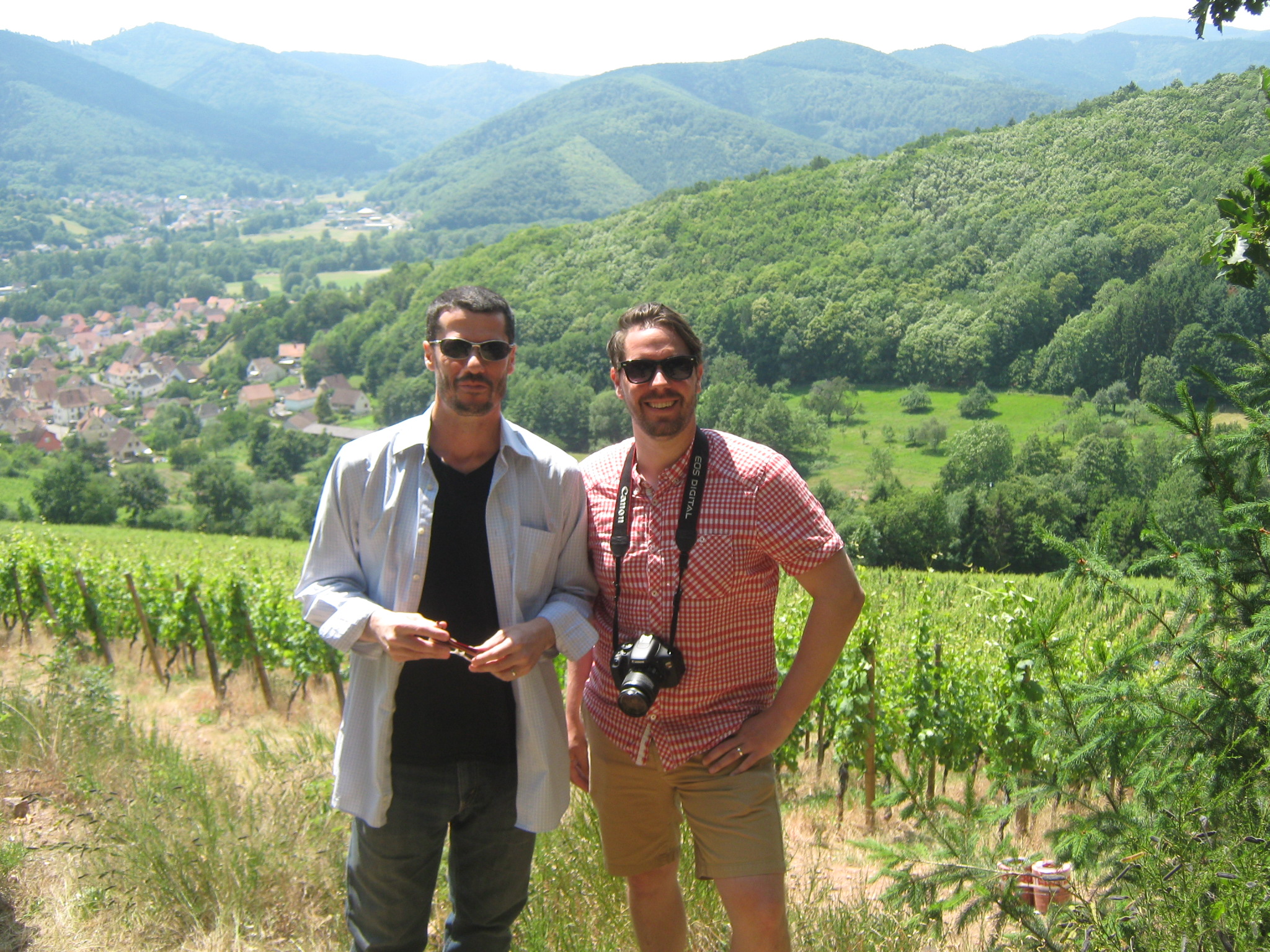
Godello and Restaurant Laurea Montreal's Fred Fortin

Godello and Restaurant Laurea Montreal’s Fred Fortin

Alsatians are the possessed refugees of Europe, tossed around like orphaned children from one foster family to another. That they can be so comfortable in their own skin is to accept their conceit as a French paradox, through ignoring its Franco-Germanic past, its passage back and forth between hands and its current state as a region governed by France. The confluence of cultures and of shared borders (and airports) would think to cause a crisis of identity. The names of towns and villages may act out a who’s who or what’s what of French sobriquet and German spitzname. None of that matters. The people, the places, the food and the wine are purely and unequivocally in ownership of their own vernacular, dialect and culture: Alsatian.
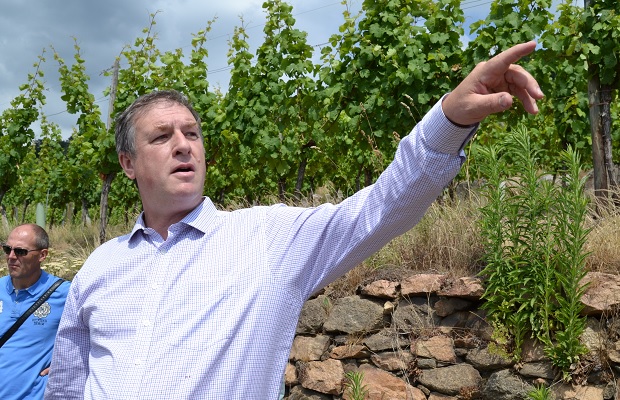
Phillipe Blanck in the Schlossberg Photo (c): Cassidy Havens, http://teuwen.com/

Phillipe Blanck in the Schlossberg
Photo (c): Cassidy Havens, http://teuwen.com/

Related – A Blanck slate in Alsace

When a winemaker wants to lay an insult upon you he will say something like “oh, that’s so Anglo-Saxon.” Ouch. He will mean it, for sure, but he will also grace you with a wink and a smile. He likes you and he respects your choice to come from far away to learn something of his wines. And you like him. The winemaker will also complement you when your palate aligns with his, when your thoughts intuit something about his acuity and his groove. His flattery will be genuine. The winemaker will pour old vintages and without a hem or a haw. She will share generously, not because she wants to sell more, but because she wants better people to drink her wine.

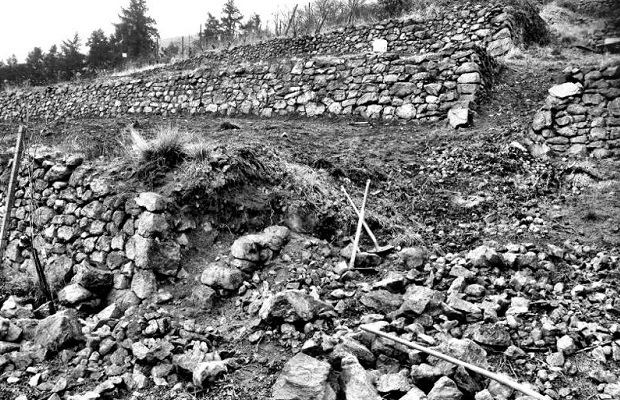
To ascertain a grip on the Alsace codex it must begin in the vineyard. The steep slopes, zig-zagging ridges and fertile valleys are composed of highly intricate, alternating and complex geological compositions. The landscape switches repeatedly from clay to marl, from calcaire (limestone) to schist, from volcanic to granitic rock. Each vineyard and even more parochial, each plot contributes to define the wine that will be made from that specific micro-parcel. The wine grower and winemaker’s job is to treat the soil with utmost respect. To plow the land, to add organic material, to refuse the use of fertilizers and to spray with solutions composed of non-chemical material.

Organic and biodynamic viticulture is widespread across the globe but Alsace is a leader in the practices, particularly in the latter’s holistic, asomatous way. Though more than 900 producers make wines, including many who do not partake in a bio-supernal and subterraneal kinship with the vines and the earth, the ones who do are fanatical about their winegrowing ways. Alsatian winemakers bond with their fruit, by employing the Austrian philosopher Rudolf Steiner’s teachings as a predicate from which to apply spiritual connections to the physical act of tending vines.
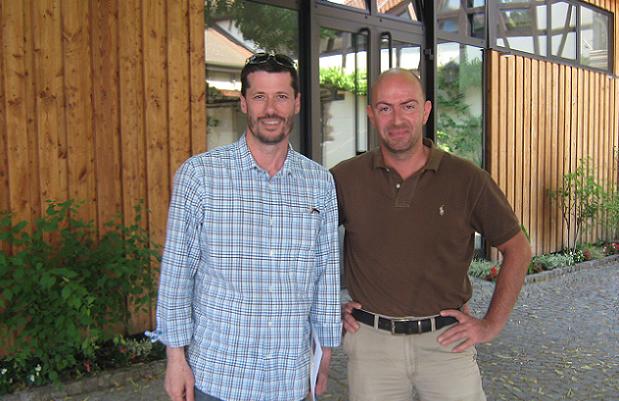
Godello and Christophe Ehrhart, Domaine Josmeyer, Kientzenheim

Godello and Christophe Ehrhart, Domaine Josmeyer, Kientzenheim

Related – It was Josmeyer’s imagination

The belief is that great wine can only be made from healthy, natural and disease resistant plants. Steiner’s studies on chemical fertilizers looked into the effect on plants growing near bombs in the earth. The growth was observed to be abnormal and unhealthy. Christophe Ehrhart of Domaine Josmeyer compared this to humans, who eat too much salt and thus need to drink too much. I tasted more than 150 naturally made wines from biodynamically farmed soils. The proof of quality and complexity is in the glass.

The winemaker of Alsace shows a respect for the earth that might be seen as a verduous variation on the teachings of theologian, philosopher, physician, medical missionary and humanitarian Albert Schweitzer. The Alsatian-born Schweitzer gave to the world his theory on the “reverence for life,” a term he used for a universal concept of ethics. “He believed that such an ethic would reconcile the drives of altruism and egoism by requiring a respect for the lives of all other beings and by demanding the highest development of the individual’s resources.” The biodynamic approach, through its human to vegetable relationship, echoes the concept. Careful care not to disrupt the balance of nature allows the vines to develop the strength to survive and to flourish in less than optimum climatic conditions, especially during times of drought. The quality of grapes and in turn, the complexity of wine, is the result.
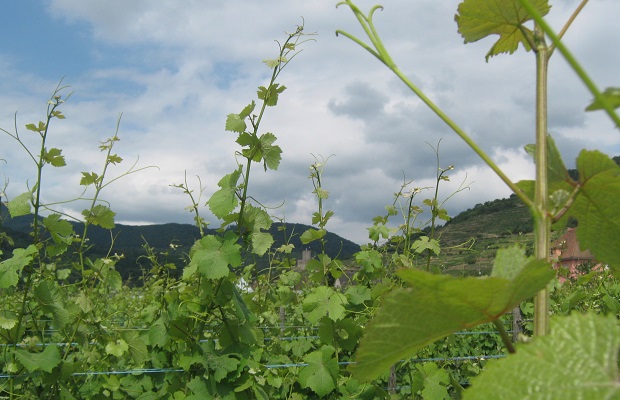
Grand Cru Riesling, Alsace

Grand Cru Riesling, Alsace

The focus on soil and terroir is ultimately disseminated into the idea of tasting minerality in wine, a most contentious aspect of the wine tasting and writing debate. Nary an expert will admit that the impart of trace minerals can be ascertained from a wine’s aroma and most believe that it can be found in taste. An American geologist debunked the mineral to taste theory at the annual meeting of the Geological Society of America held in Portland Oregon. “The idea is romantic and highly useful commercially, but it is scientifically untenable,” wrote Alex Maltman, a professor at the Institute of Geography and Earth Sciences at Aberystwyth University. Maltman’s claim is simple. Vines absorb minerals from the earth but the amount is far too small for human detection.

Christophe Ehrhart of Domaine Josmeyer in Wintzenheim agrees to disagree. Ehrhart concedes that the quantitative number is small (only three to five percent) for a vine to derive its personality, divined though the earth’s brine. The remainder is a consequence of photosynthesis. Ever the spiritual and natural advocate, Christophe borrows from the writings of David Lefebvre. The journalist and wine consultant’s The minerality from David Lefebvre tells the story of why natural wines without sulfur express minerality. Lefebvre makes clear the argument that naturally-farmed (biodynamic and/or, but necessarily organic) vines are qualitatively richer in (salt minerals) than those raised with chemicals. “All fermentation, from milk to cheese, from grape to wine, is accompanied by the appearance of the component saline, one could say mineral, in the taste of the fermented product.” Chemicals and fertilizers inhibit growth and vigor, ostensibly wiping out an already minuscule number. If food is available at the surface, vine roots will feed right there. They will then lose their ability to create the beneficial bacteria necessary to metabolize deep earth enzymatic material. They essentially abandon their will to fight for nutrition deep within the fissures of the rock. Lefebvre’s conclusion? “All biocides and other products that block mineralization, such as SO2, inhibit the expression mineral.”

At the end of the day Lefebvre is a wine taster and not a scientist and the argument must be considered within the realm of the natural world. “The taste of stone exists in Alsace, Burgundy, the Loire (all France) when the winegrower uses organic farming and indigenous, winemaking yeasts.” American made wine rarely does this, though change is occurring. Ontario winemakers are different. Taste the wines of Tawse or Southbrook and note the difference. Or, taste the difference a vegetable, like a tomato, or a piece of fruit, like a peach tastes when picked straight from the garden, or orchard, as opposed to the conventional piles of the supermarket. There can be no argument there.

Wihr au Val Photo (c): Cassidy Havens, http://teuwen.com/

Wihr au Val Photo (c): Cassidy Havens, http://teuwen.com/

A week tasting through nearly 300 wines in Alsace may sound exhausting when in fact it is an experience that had me constantly, “as the expression goes, gespannt wie ein Flitzebogens,” or as it is loosely employed from the German in the Grand Budapest Hotel, “that is, on the edge of my seat.” I watched Wes Anderson’s film on the Air France flight over from Toronto to Paris and enjoyed it so much that I watched it again on my return. That kind of spiritual, dry European humour is not unlike that of the fraternity of Alsatian winemakers and how they discuss their wines. From Olivier Zind-Humbrecht to Pierre Blanck, to MauriceBarthelmé and to Jean-Pierre Frick there is an Edward Norton to Bill Murray, Tom Wilkinson to Harvey Keitel, Adrien Brody to Ray Fiennes affinity. Or perhaps it’s just me.

Alsace is distinguished by a very specific set of vinous attributes. No other area in France is as dry and only Champagne is further north in latitude. The aridity of the summer months, followed by the humidity of the fall fosters the development of a beneficial fungus called Botrytis cinerea, the fungus better known as noble rot, which concentrates the sugars and preserves acidity. Pierre Gassmann of Rolly Gassman says all of his wines are noble rot wines, but he calls them Riesling.

The uninitiated into the wines of Alsace think it is one big pool of sickly sweet and cloying white wine. If perhaps this were, at least to some extent, once true, it is no longer. The progressive and philosophically attentive producer picks grapes (especially the particularly susceptible Pinot Gris) before the onset of botrytis. If a dry, mineral-driven style is the goal, picking must be complete before what Phillippe Zinck refers to as D-Day. Pinot Gris goes over the edge in an instant, even more so because of the advancing maturation due to the warm temperatures induced by Global Warming.
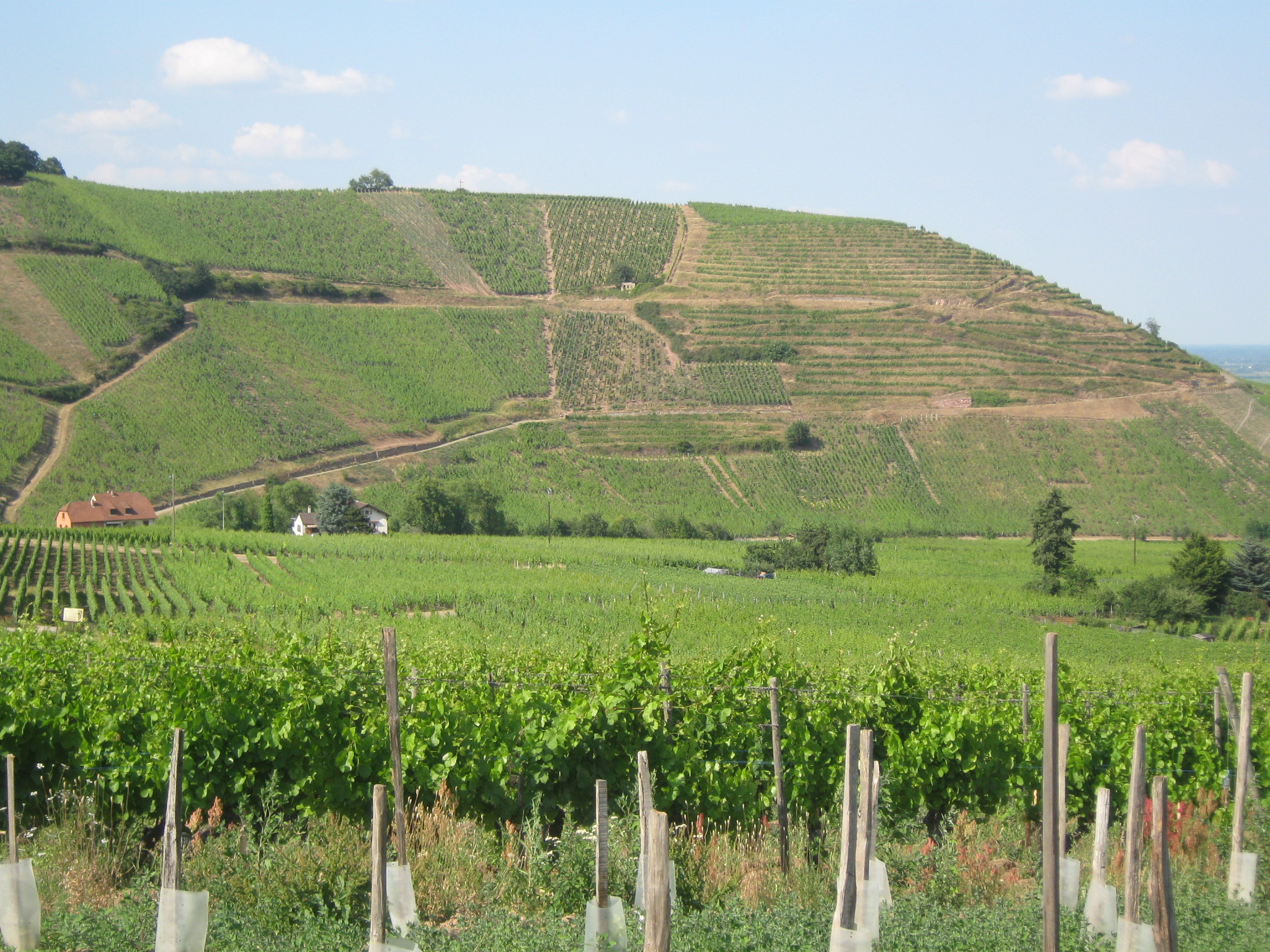
Sommerberg Grand Cru

Sommerberg Grand Cru

The global wine community’s ignorance to the multeity of Alsace wines, “as mutually producing and explaining each other…resulting in shapeliness,” needs addressing and so steps in the valedictorian, Christophe Ehrhart. The Josmeyer viniculturalist devised a system, a sugar scale to grace a bottle’s back label. Whites are coded from one to five, one being Sec (Dry) and five Doux (Sweet). The codification is not as simple as just incorporating residual sugar levels. Total acidity is taken into consideration against the sugar level, like a Football team’s plus-minus statistic. In Alsace the relationship between sugar, acidity and PH is unlike any other white wine region. Late Harvest (Vendanges Tardives, or Spätlese in German) is Late Harvest but Vin desprit sec or demi-sec in Alsace should not generally be correlated to similar distinctions in Champagne or the Loire. In Alsace, wines with vigorous levels of acidity and even more importantly PH bedeck of tannin and structure. Perceived sweetness is mitigated and many whites, though quantified with residual sugar numbering in the teens, or more, can seem totally dry.

Returning to the idea of increasingly warmer seasonal temperatures, the red wines of Alsace have improved by leaps and bounds. “We could not have made Pinot Noir of this quality 20 years ago,” admits Maurice Barthelmé. Oh, the humanity and the irony of it all.
The Vineyards of Domaine Albert Mann photo (c) https://www.facebook.com/albertmannwines

The Vineyards of Domaine Albert Mann
photo (c) https://www.facebook.com/albertmannwines

Related – Giving Grand Cru Pinot Noir d’Alsace its due

This sort of quirky response to nature and science is typical of the artisan winemaker. There is more humour, lightness of being and constater than anywhere else on this winemaking planet. There just seems to be a collective and pragmatic voice. Maurice makes a 10,000 case Riesling called Cuvee Albert, “because I have to make a wine for the market.” Yet Maurice is also a dreamer and a geologist. To him, “Pinot Noir, like Riesling, is a mineralogist.”

Domaine Albert Mann’s Jacky Barthelmé: “Before Jesus Christ was born we have had vines here in the Schlossberg. So it is a very old story.” The Alsace vigneron is only human and works in a vinous void of certitude. They do not fuck with their land or attempt to direct its course. The young Arnaud Baur of Domaine Charles Baur insists that you “don’t cheat with your terroir or it will catch up with you. You will be exposed. You can make a mistake but you will still lose the game.” What an even more wonderful world it would be if he only understood the complexity in his multiple entendre.

Philippe Blanck is a philosopher, a dreamer, an existentialist and a lover. He is Descartes, the aforementioned Bill Murray and Bob Dylan rolled into one, a man not of selection but of election. He is both prolific and also one who buys the whole record catalogue, not just the hits. He opens old vintages freely and without hesitation. When asked how often does he have the opportunity to open wines like these he answers simply, “when people come.”
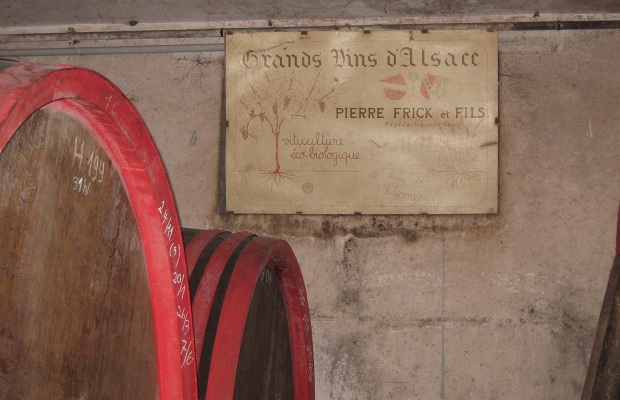
Pierre Frick et Fils

Pierre Frick et Fils

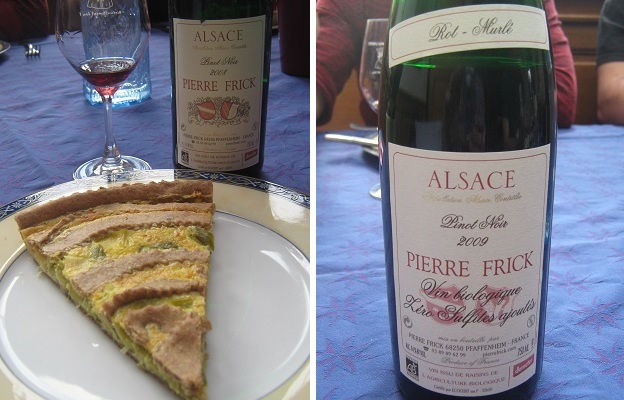
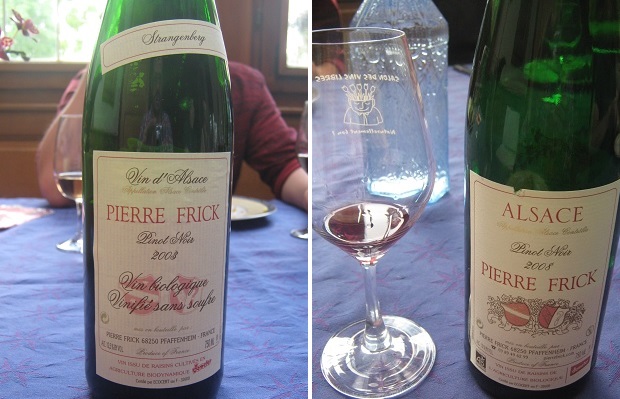
Then there is the far-out Jean-Pierre Frick, the man who let a 2006 Auxerrois ferment for five years before bottling it in 2011. “After one year I check the wine and he is not ready. I see him after two years and he says I am not ready. So I wait. After five years he says, I am finished. So I put him in the bottle.” On his Riesling 2012 he says, “This is a wine for mouse feeding.” Upon cracking open his remarkable, natural winemaking at its peak 2010 Sylvaner he chuckles like M. Gustave and smirks, “he is a funny wine.”

Few wine regions tell their story through geology as succinctly and in as much variegated detail as Alsace. The exploration of its Grand (and other vital) Cru (for the purposes of this trip) was through soils (or not) variegated of clay, sandy clay, marl, granite, volcanic rock, limestone and sandstone. To complicate things further, a Cru can be composed of more than one type of terra firma and still others have more than one arrangement within the particular plot. All very complicated and yet so simple at the same time. The Crus tasted came from the following:

Schlossberg Grand Cru, (c) Cassidy Havens, http://teuwen.com/

Schlossberg Grand Cru, (c) Cassidy Havens, http://teuwen.com/

  1. Granitique/Granite (Brand, Herrenreben, Kaefferkopf, Langenberg, Linsenberg, Schlossberg, Sommerberg)
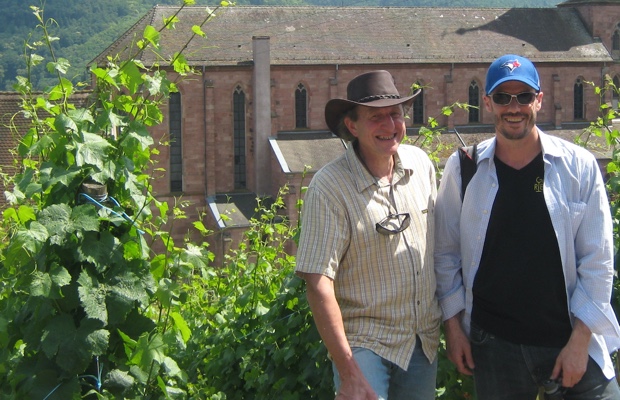
Henri Schoenheitz and Godello

Henri Schoenheitz and Godello

Domaine Schoenheitz Linsenberg Riesling 1990, Ac Alsace, France (Winery, 196618, WineAlign)

During a picnic, on a plateau up on the Linsenberg lieu-dit set above the Wihr-au-Val, this 24 year-old bottle acts as a kind of Alsatian Trou Normand. A pause between courses, which involves alcohol and you need to ask for its proof of age. Culled from deep dug vines out of stony and shallow granite soil. Soil rich in micas with a fractured basement. From a dream vintage with marvellous semi-low yields and a student of south-facing, self-effacing steep steppes. A sun worshipper prodigy of winemaker Henri Schoenheitz, a child of terroir du solaire. Rich and arid in simultaneous fashion (the RS is only 8-10 g/L), the years have yet to add mileage to its face and its internal clock. It may ride another 15, or 20. Drink 2015-2030. Tasted June 2015  @VinsSchoenheitz

Schoenheitz Picnic, Wihr-au-Val

Schoenheitz Picnic, Wihr-au-Val

Domaine Albert Boxler Pinot Blanc Reserve 2013, Ac Alsace, France (SAQ $27.70 11903328WineAlign)

From fruit drawn off the granitic Grand Cru of the Brand but not labeled as such. Laser focus (what Jean Boxler wine is not) and texture. Possessive of the unmistakable Brand tang, like mineral rich Burgundy. The minerality ann the acidity from the granite are exceptional in a wine known as “Pinot Blanc Reserve.” As good a developing PB are you are ever likely to taste. Drink 2015-2019.  Tasted June 2014

Domaine Albert Boxler Riesling Old Vines Sommerberg Grand Cru 2013, Ac Alsace, France (SAQ, 11698521WineAlign)

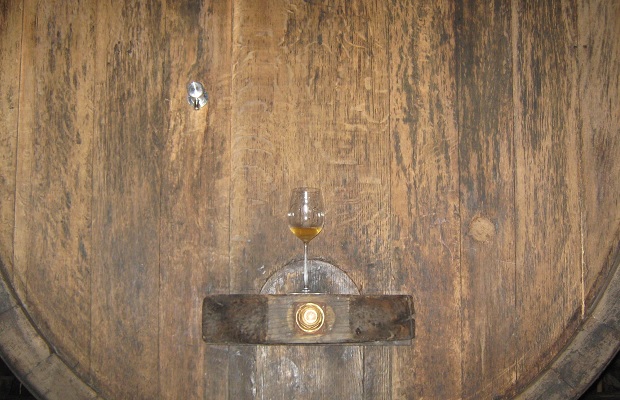
A direct expression of winemaker (since 1996) Jean Boxler and his 150 year-old casks. This is Riesling suspended in the realm of dry extract, texture and a precision of finesse rarely paralleled in Alsace. It reads the truth of facteur for Sommerberg, its face, slope and pitch. Exceeds the clarity of the younger parcel in its contiguous continuance of learning, of pure, linear, laser styling. There is more maturity here and the must had to have been exceptional. “The juice must be balanced when it goes into the vats or the wine will not be balanced,” insists Jean Boxler. And he would be correct. Drink 2016-2025.  Tasted June 2014
Domaine Albert Boxler

Domaine Albert Boxler

Domaine Albert Boxler Tokay-Pinot Gris Sommerberg Grand Cru 1996, Ac Alsace, France (Alsace)

From volcanic and granitic soils together combining for and equating to structure. A matter concerning “purity of what you can do from a great ground,” notes Master Sommelier Romain Iltis. Perception is stronger than reality because despite the sugar, the acidity reign to lead this to be imagined and reasoned as a dry wine. Ripe, fresh, smoky, with crushed hazelnut and seamless structure. Stays focused and intense in mouthfeel. Takes the wine down a long, long road. Quite remarkable. No longer labeled “Takay” after the 2007 vintage. Drink 2015-2026.  Tasted June 2014

  1. Calcaire/Limestone (Engelgarten, Furstentum, Goldert, Rosenbourg, Rotenberg, Schoffweg)

Domaine Albert Mann Pinot Gris Grand Cru Furstentum 2008, Alsace, France (Winery)

The Marl accentuated Hengst and its muscular heft receives more Barthelmé limelight but the always understated Furstentum Grand Cru is a special expression of the variety. As refined as Pinot Gris can be, with a healthy level of residual sugar, “like me” smiles Marie-Thérèse Barthelmé. The sugar polls late to the party while the acidity swells in pools, but the finish is forever. “Pinot Gris is a fabulous grape but we serve it too young,” says Maurice. “It needs time to develop its sugars.” Truffle, mushroom, underbrush and stone fruit would match well to sweet and sour cuisine. Flinty mineral arrives and despite the residual obstacle, is able to hop the sweet fencing. The potential here is boundless. Drink 2018-2026.  Tasted June 2014  @albertmannwines
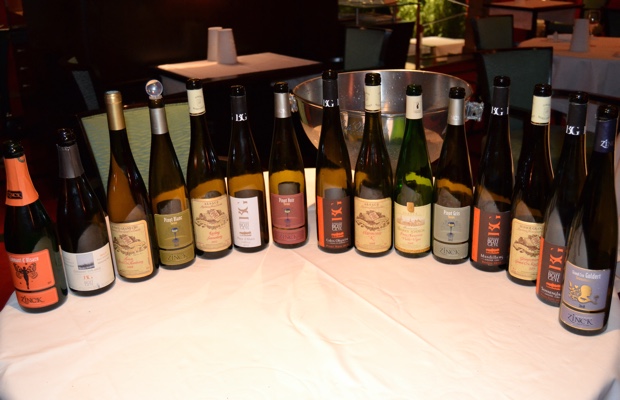
Dinner wines at La Table du Gourmet, Riquewihr

Dinner wines at La Table du Gourmet, Riquewihr

Domaine Paul Zinck Gewürztraminer Grand Cru Goldert 2010, Alsace, France (Agent)

From the village of Gueberschwihr and from soil composed of sandstone, chalk and clay. The vines average 50 years in age and the wine saw a maturation on the lees for 11 months. Philippe Zinck notes that “the terroir is stronger than the variety.” If any grape would stand to contradict that statement it would be Gewürztraminer but the ’10 Goldert begs to differ. Its herbal, arid Mediterranean quality can only be Goldert talking. Though it measures 20 g/L of RS it tastes almost perfectly dry. It reeks of lemongrass, fresh, split and emanating distilled florals. This is classic and quintessential stuff. Drink 2015-2025.  Tasted June 2014  @domainezinck  @LiffordON

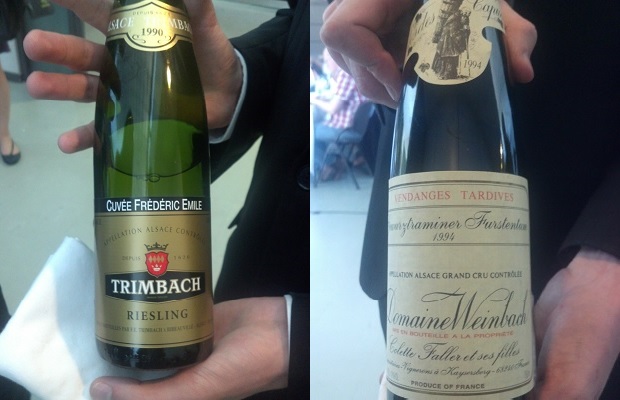
Domaine Zind-Humbrecht Gewürztraminer Vendanges Tardives Goldert Grand Cru 1985

Tasted from magnum at Les Millésimes Alsace, a wine described by Caroline Furstoss as “unusual for late harvest,” because the terroir is simply stronger than the variety. Another economically non-viable low yield LH, “from a vintage more on the reductive than the oxidative side.” Even at 30 years it requires aeration and time to open up. Travels from spicy to smoky with that air. There is a density in bitterness, an attrition miles away from resolve and a promise for rebate, if further patience is granted. The spices inherent are ground, exhumed and combine with the base elements to rise atomically. A spatially magnificent wine of sugars not yet clarified and an acquired taste not quite elucidated. A taste of an ancient kind. Drink 2015-2035.  Tasted June 2014

  1. Marno-Calcaire/Marl-Limestone (Altenberg de Bergheim, Clos Hauserer, Eichberg, Hengst, Kappelweg de Rorschwihr, Mambourg, Mandelberg, Osterberg, Pfersigberg, Sonnenglanz, Steingrubler)

Marcel Deiss Schoffweg “Le Chemins Des Brebis” 2010, Bergheim, Alsace, France (Agent, $60.95, WineAlign)

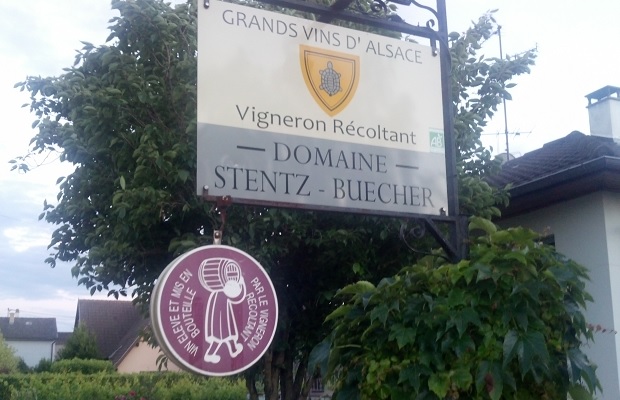
A pulsating and metallic, mineral streak turns the screws directly through this spirited Bergheim. From Schoffweg, one of nine Deiss Premier Crus planted to Riesling and Pinots. A pour at Domaine Stentz Buecher from fellow winemaker Carolyn Sipp simulates a trip, to stand upon a scree of calcaire, the earth below a mirror, reflecting above a multitude of stars. “He’s a character,” smiles Sipp, “and perhaps even he does not know the actual blend.” The amalgamate is surely Riesling dominant, at least in this impetuous ’10, a savant of fleshy breadth and caracoling acidity. The Schoffweg does not sprint in any direction. It is purposed and precise, geometric, linear and prolonging of the Deiss magic. This is a different piece of cake, an ulterior approach to assemblage, “a bigger better slice” of Alsace. It should not be missed.  Tasted June 2014  @LeSommelierWine

Marcel Deiss Mambourg Grand Cru 2011, Bergheim, Alsace, France (Agent, $114.95, WineAlign)

In a select portfolio tasting that includes a trio of highly mineral yet approachable 2010’s (Rotenberg, Schoffberg and Schoenenbourg), the ’11 Mambourg stands out for its barbarous youth. It seems purposely reductive and strobes like a hyper-intensified beacon. Rigid, reserved and unforgiving, the Mambourg is also dense and viscous. Acts of propellant and wet concrete circulate in the tank, compress and further the dangerous liaison. This is a brooding Deiss, so different than the jurassic citrus from Rotenberg, the terroir monster in Schoffberg and the weight of Schoenenbourg. In a field of supervised beauty, the Mambourg may seem like punishment but there can be no denying the attraction. Five years will alter the laws of its physics and soften its biology. The difficult childhood will be forgotten. Drink 2019-2026.  Tasted June 2014  @LeSommelierWine

Marcel Deiss Langenberg “La Longue Colline” 2011, Bergheim, Alsace, France (Agent, $48.95, WineAlign)

Rogue Alsace, classic Deiss five varietal field blend specific to one hangout. The steep, terraced, granite Langenberg, terroir from Saint Hippolyte. Deiss coaxes, expects and demands precocious behaviour from four supporting varieties to lift and place the Riesling, with the intent being a result in “salty symphony.” This is approachable, something 2011 could not have been easy to accomplish. The accents are spice, sapidity and acidity, from the granite, for the people. Isn’t this what a mischievous brew should be about? Drink 2015-2022. Tasted June 2014  @LeSommelierWine

Léon Beyer Riesling Cuvée Des Comtes D’Eguisheim 1985, Alsace, France (316174, $50.00, WineAlign)

I wonder is any Alsace Riesling sublimates history, religion and occupation more than Cuvée Des Comtes D’eguisheim. It breathes the past; of popes, Augustinians of Marbach, Benedictines of Ebersmunster, Cistercians of Paris and Dominicans of Colmar. From the limestone-clay for the most part of the Grand Cru Pfersigberg and only produced in exceptional vintages. In 1985 low yields, same for botrytis and then 29 years of low and slow maturation. In 2014, is the herbal, aromatic, limestone salinity a case of vineyards, grape or evolution? All of the above but time is in charge. It has evolved exactly as it should, as its makers would have wished for. It is ready to drink. The defined minerality, with fresh lemon and a struck flint spark has rounded out, without the need for sugar. Drink 2015-2017.  Tasted June 2014  @TandemSelection

Charles Baur Riesling Grand Cru Eichberg 2009, Ac Alsace, France (Winery)

Arnaud Baur understands his place and his family’s position in the Alsace continuum. “You can make a mistake and you can still lose the game.” His use of entendre is subconsciously brilliant. In 2009 the warmth went on seemingly forever and so Baur did not even bother trying to make a dry Riesling.  “We really respect the vintage,” says Arnaud. Meanwhile at 18 g/L RS and 7.0 g/L TA the balance is struck. Many grapes were dried by the sun, ripeness was rampant, flavours travelled to tropical and acidity went lemon linear. The 14.2 per cent alcohol concludes these activities. Matched with foie gras, the vintage is marinated and married. There is certainly some crème fraîche on the nose and the wine plays a beautiful, funky beat. As much fun and quivering vibration as you will find in Alsace Marno-Calcaire. Drink 2015-2024.  Tasted June 2014
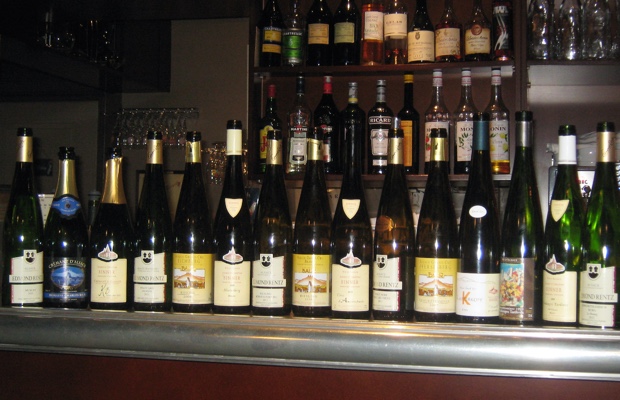
Dinner wines at L'Epicurien, Colmar

Dinner wines at L’Epicurien, Colmar

Charles Baur Gewürztraminer Grand Cru Pfersigberg 2007, Ac Alsace, France (Winery)

A good vintage for Riesling and considering the heat, an even better one for Gewürztraminer. The vineyard offers 50-70cm of clay atop Jurassic yellow limestone where roots can penetrate the rock. They suck the life into this enzymatic white. This, of digestibility, “a wine you don’t want to drink two glasses of, but three.” Delicious, clean, precise Gewürz that Mr. Baur recommends you “drink moderately, but drink a lot.” Arnaud is very proud of this ’07, for good reason. Two actually. Balance and length. Drink 2017-2027.  Tasted June 2014

Domaine Albert Mann Pinot Gris Grand Cru Hengst 2013, Alsace, France (SAQ $41.50 11343711, WineAlign)

Tasted not long after bottling, the yet labeled ’13 is drawn from a vintage with a touch of botrytis. “We don’t sell too much of this,” admits Maurice Barthelmé. Along with the sweet entry there are herbs and some spice, in layers upon layers. Almost savoury, this interest lies in the interchange between sweet and savour, with stone fruit (peach and apricot) elevated by a feeling of fumée. A playful, postmodernist style of short fiction. Drink 2017-2024.  Tasted June 2015  @albertmannwines  @Smallwinemakers

Domaine Albert Mann Pinot Gris Grand Cru Hengst 2008, Alsace, France (SAQ $41.50 11343711WineAlign)

In 2008 the brothers Barthelmé used the Hengst’s strength and the vintage to fashion a remarkable Pinot Gris. It is blessed of antiquity, like concrete to bitters, with power, tension and a posit tub between fruit and sugar. At 34 g/L RS and 7.6 g/L TA there is enough centrifuge to whirl, whorl and pop, culminating in a healthy alcohol at 14 per cent. Quite the reductive Pinot Gris, to this day, with a sweetness that is manifested in mineral flavours, glazed in crushed rocks. “It smells like mushroom you threw into a dead fire,” notes Fred Fortin. This is the bomb. Needs four more years to develop another gear. Drink 2018-2033.  Tasted June 2015  @albertmannwines  @Smallwinemakers

Domaine Albert Mann Gewürztraminer Grand Cru Steingrubler 2008, Alsace, France (Winery)

From marly-limestone-sandstone, “a fa-bulous terroir,” says Maurice with a smile. The “stone carrier wagon” is mostly calcaire, especially in the middle slope. This has a roundness, an approachability. It really is clean, clean, Gewürztraminer. It’s erotic, gorgeous, certainly not slutty or pornographic. The colder limestone preserves the freshness, with a need for magnesium, to cool the factor further and to develop the terpenes. Gelid and stone cold cool wine. Drink 2018-2035.  Tasted June 2015  @albertmannwines  @Smallwinemakers

Bott Geyl Riesling Grand Cru Mandelberg 2010, Alsace, France (Agent)

The Mandelberg receives the early morning sun and so this Grand Cru is an early ripener and the first of the Bott-Geyls to be picked. The added warmth of 2010 introduced noble rot into a vineyard that often avoids it so the residual sugar here is elevated to an off-dry (even for Alsace) number of 30 g/L. The rush to pick in this case preserved the natural acidity, allowing the flint to speak. Additional notes of cream cheese and formidable dry extract have helped to balance the sweetness. Truly exceptional Riesling from Christophe Bott-Geyl. Drink 2015-2025.  Tasted June 2014  @bott_geyl  @DanielBeiles

  1. Calcaro-gréseux/Limestone-Sandstone (Bergweingarten, Zinkoepfle)

Pierre Frick Sylvaner Bergweingarten 2010, Alsace, France (Winery)

The vines of southeast exposure are in the 35 year-old range for this Vin moelleux, “young vines” says Jean-Pierre Frick. “I am a defender of Sylvaner.” This ’10 is freshly opened, as opposed to the ’09 poured after sitting open a week. That ’09’s healthy amount of noble rot is not repeated in this ’10, what Frick refers to as “a funny wine.” A two year fermentation and a potential for 17 per cent alcohol (it’s actually in the 14-15 range), a touch of spritz and no sulphur means it goes it alone, natural, naked, innocent. It’s a passionate, iconoclastic Sylvaner, distilled and concentrated from and in lemon/lime. It may carry 53 g/L of sugar but it also totes huge acidity. Enamel stripping acidity. Full of energy, that is its calling, its niche, its category. The honey is pure and despite the level of alcohol it’s as though it has never actually fermented. Natural winemaking at the apex, not out of intent but from a base and simply purposed necessity. Drink 2015-2025.  Tasted June 2014  @LeCavisteTO
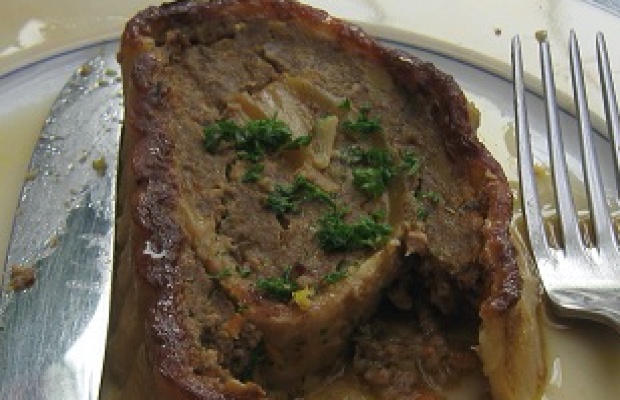
Fleischanaka at Domaine PIerre Frick

Fleischanaka at Domaine PIerre Frick

  1. Sablo-Argileux/Sandy-Clay (Schlossberg)

Domaine Albert Mann Riesling Schlossberg Grand Cru 2008, Alsace, France (SAQ 11967751 $48.25, WineAlign)

What a fantastic expression of the Schlossberg, like a cold granite countertop. A Riesling that tells you what is essentiality in granite from what you thought might be the sensation of petrol. Full output of crushed stone, flint and magnesium, but never petrol. Now just beginning to enter its gold stage, just beginning to warm up, in energy, in the sound of the alarm clock. “You can almost see the rock breaking and the smoke rising out,” remarks Eleven Madison Park’s Jonathan Ross. A definitive sketch with a 12 g/L sugar quotient lost in the structure of its terroir. A Schlossberg a day keeps the doctor away. Drink 2015-2025.  Tasted June 2014

Related – Arch classic Alsace at Domaine Weinbach
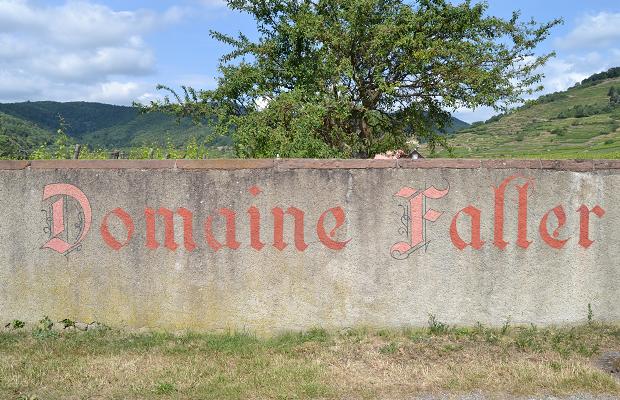
Domaine Weinbach, (c) Cassidy Havens, http://teuwen.com/

Domaine Weinbach, (c) Cassidy Havens, http://teuwen.com/

  1. Argilo-calcaro-gréseux/Clay-Limestone-Sandstone (Goldert, Vorbourg)

Pierre Frick Auxerrois Carrière 2006 (Embouteille en 2011), Alsace, France (Winery)

“He has fermented five years,” says Jean-Pierre Frick, stone faced, matter of factly. “That’s how long he took.” Here, one of the most impossible, idiosyncratic and unusual wines made anywhere in the world. On on hand it’s a strange but beautiful experiment. On another there can be no logical explanation as to why one would bother. The third makes perfect sense; allowing a wine to ferment at its own speed, advocate for itself and become what it inherently wanted to be. Auxerrois with a little bit of sweetness (16 g/L RS) and a kindred spirit to the Jura (and with a potential of 15 per cent alcohol). This is drawn from the lieu-dit terroir Krottenfues, of marl-sandstone soils in the hills above the Grand Cru Vorbourg. Tasting this wine is like slumbering through a murky and demurred dream. Drink 2015-2021.  Tasted September 2015

Pierre Frick Auxerrois Carrière 2006 (Embouteille en 2011)

Pierre Frick Auxerrois Carrière 2006 (Embouteille en 2011)

  1. Argilo-calcaire/Clay-Limestone (Eichberg, Engelberg, Kanzlernerg, Pflaenzerreben de Rorschwihr, Steinert)

Paul & Phillipe Zinck Pinot Blanc Terroir 2011, Alsace, France (BCLDB 414557 $15.79, WineAlign)

From 35 year-old vines on Eguisheim’s argilo-calcaire slopes with straight out acidity, trailed by earth-driven fruit. Less floral than some and pushed by the mineral. A difficult vintage that saw a full heat spike to cause a mid-palate grape unction. Pinot Blanc with a late vintage complex because of that sun on the mid slope. Drink 2015-2017.  Tasted June 2014  @domainezinck  @LiffordON

Paul & Phillipe Zinck Pinot Gris Terroir 2012, Alsace, France (Agent, $22.99, WineAlign)

From chalk and clay soils surrounding the Eichberg Grand Cru, this is a decidedly terroir-driven style and far from overripe. In fact, Philippe Zinck is adamant about picking time, especially with Pinot Gris. “The most tricky grape to harvest in Alsace,” he tells me. So hard to get serious structure and many growers are duped by high brix. Philippe tells of the 24-hour varietal picking window, the “D-Day” grape. Zinck’s ’12 is pure, balanced and bound by its earthy character. Drink 2015-2017.  Tasted June 2014  @domainezinck  @LiffordON

Pierre Frick Muscat Grand Cru Steinert Sélection de Grains Nobles 2010, Alsace, France (Winery)

“I like acidity, whoo-ahh,” says Pierre Frick, dry as Monsieur Ivan. The sugar on top of acidity here, it’s exciting. This one is a gift from nature, for culture. So interesting, a dream, a story. This has a citrus sweetness, telling a story never before experienced. There’s a depth of reduced apricot syrup, pure, natural, holy. “Tell no one. They’ll explain everything.” Drink 2015-2040.  Tasted June 2014

  1. Volcano-gréseux/Volcanic sandstone (Kitterlé, Muenchberg)

Pierre Frick Pinot Gris Sélection de Grains Nobles 1992, Alsace, France (Winery)

From Argilo-Calcaire vineyards flanking the Rot Murlé, at a time when a minor amount of sulphuring was employed (1999 was their first sulphur-free vintage). Was Demeter certified, in 1992! This is all about intensity and acidity. An incredibly natural dessert wine, upwards of 150 g/L RS but balanced by nearly 10 g/L TA. The power is relentless, the finish on the road to never-ending. Drink 2015-2022.  Tasted September 2015

Domaine Ostertag Tokay Pinot Gris Grand Cru Muenchberg 1996, Alsace, France (Agent, $65, WineAlign)

From clay and limestone, fully aged in barrel, taking, sending and stratifying in and away from its own and everyone else’s comfort zone. Only the best barrels would do and yet the quality of the wood thought aside, this is Ostertag’s unique and fully autocratic take on Tokay-PG. Stands out with a structure wholly singular for the overall prefecture, with a twenty year note of white truffle, handled and enhanced by the wood maturation. Yellow fruits persist as if they were picked just yesterday but the glass is commandeered by the complex funk. It’s nearly outrageous, bracing and yet the flavour urged on by the aromatics return to their youth. To citron, ginger and tropical unction. This is oscillating and magnificent. Drink 2015-2026. Tasted June 2014  @TheLivingVine

  1. Argilo-Granitique/Clay-Granite (Kaefferkopf, Sonnenberg)

Audrey et Christian Binner Grand Cru Kaefferkopf 2010, Alsace France (Winery)

A blend of Gewürztraminer (60 per cent), Riesling (30) and Muscat (10) that spent two years in foudres. Christian has no time for technicalities, specs and conventions. “I just make wine.” At 13.5 per cent alcohol and 20 g/L RS the expectation would be vitality and striking lines but it’s really quite oxidative, natural and nearly orange. “But it’s OK. It’s the life,” he adds. An acquired, unique and at times extraordinary taste, complex, demanding, like Frick but further down a certain line. “For me, to be a great Alsace wine, it must be easy to drink. You have to pout it in your body.” Drink 2015-2019.  Tasted September 2015

Related – Walking an Alsace mile in their Riesling shoes

  1. Volcanique/Clay-Granite (Rangen)

Related – Colmar and the volcano: Domaine Schoffit

  1. Marno-Calcaire-gréseux/Marl- Limestone-Sandstone (AltenbourgKirchberg de Ribeauvillé)
  1. Volcano-sédiment/Volcanic Sediment (Rangen)
  1. Graves du quaternaire/Alluvial (Herrenweg de Turckheim)

Related – The cru chief of Alsace: Zind Humbrecht

Olivier Humbrecht and Godello PHOTO: Cassidy Havens, http://teuwen.com/

Olivier Humbrecht and Godello
PHOTO: Cassidy Havens, http://teuwen.com/

  1. Roche Volcanique/Volcanic rocks (Rangen de Thann)
  1. Marno-gypseux/Marl-gypsum (Schoenenbourg)
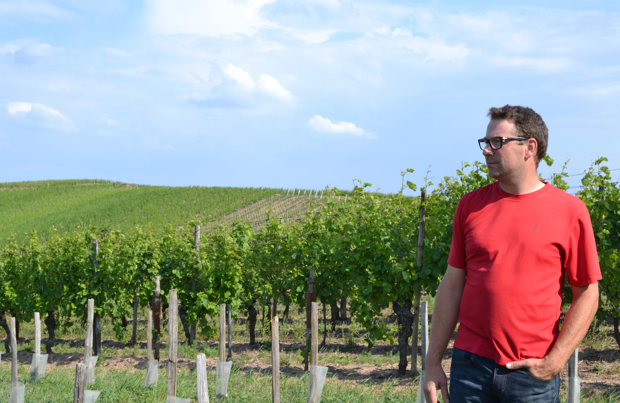
Jean Boxler, June 2014

Jean Boxler, June 2014

You see, no wine is poured, tasted and deliberated over without the introduction of the soil (or lack thereof) from which it came. To confine any study to just the Grand Cru would do the entire region an injustice. Though the original 1975 appellative system set out to define the plots of highest quality and esteem, many wines not classified GC are fashioned from terroir comingling with, surrounding, located next or adjacent to a vineyard called Grand Cru. Serious consideration is being given by CIVA and the winemakers to establish a Premier Cru and Villages system. While this will certainly increase levels of definition and understanding for Alsace, it may also disregard some quality wines, not to mention further alienate some producers whose artisanal and progressive wines go against the norm. A further consequence may result in elevating some average wines currently labeled Grand Cru into undeserved stratospheres.

Related – Trimbach, rhythm and soul

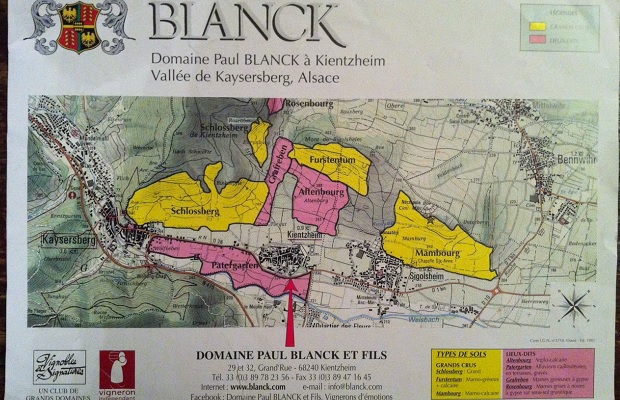
The Grand Cru story is heavy but not everything. Rarely has there been witnessed (outside of Burgundy) the kind of symbiotic relationship between vineyard and village. Perfect examples are those like Schlossberg and Furstentum with Kintzheim, Sommerberg and Niedermorschwihr, Hengst and Wintzenheim, Brand and Turckheim or Steingrübler and Wettolsheim. Domaine Weinbach’s cellars sit across and just down the road from both Kitzheim and Kayserberg. Albert Boxler’s cellar is right in the fairy tale town of Niedermorschwihr, just like Albert Mann’s location in Wettlosheim.

It is time, finally and thankfully, for a return to the reason for such a rambling on. With respect to the “cerebral and the spiritual component for producing exceptional wine” being “necessary and fundamental,” examples tasted in June of 2014 indicate that the notion of terroir grows from nature and is nurtured by the vigneron. These 25 wines surmise and summarize, either by connecting the dotted lines of constellatory figuration or by Sudoku interconnectivity, the imaginable chronicle that is Alsace.

Good to go!

http://www.winealign.com/profile/2058-mjg

Arch classic Alsace at Domaine Weinbach

Domaine Weinbach, (c) Cassidy Havens, http://teuwen.com/

Domaine Weinbach, (c) Cassidy Havens, http://teuwen.com/

Domaine Weinbach

The great estates of the world do not endure for lifetimes, generations and centuries without an innate endowment to carry on, no matter the circumstances. Through tragedy there is always a prevail. There just has to be. I did not get the chance to meet Laurence Faller. I am sure that I would have loved to. Having tasted some of her wines at the domaine where she nurtured and finished them is at least a small concession. When I visited Weinbach last June, I did have the opportunity to meet her mother Colette Faller and I am lucky to have done so.

Catherine Faller, (c) Cassidy Havens, http://teuwen.com/

Catherine Faller, (c) Cassidy Havens, http://teuwen.com/

Related – In a Grand Cru state of mind

Thanks to Catherine Faller, who gave generously of her time and her family’s wines, the visit in the winery’s caves and up on the Schlossberg Grand Cru opened up the portal into Domaine Weinbach, Kayserberg and Alsace. Tradition and progress at Domaine Weinbach carries forward in the hands of winemaker Ghislain Berthiot, who worked with Laurence for 11 years. Here are the six wines tasted in June of 2014 and their notes.

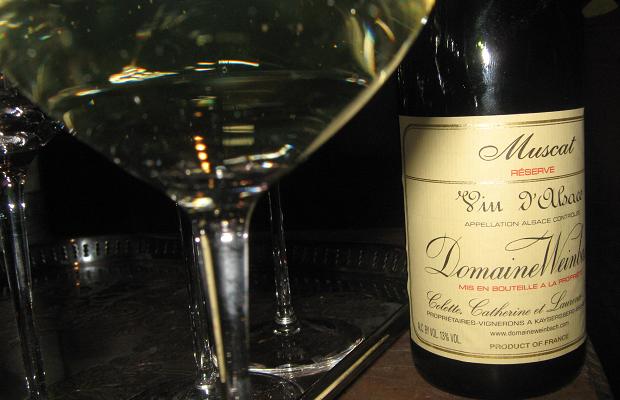
Domaine Weinbach Muscat Réserve 2013

Domaine Weinbach Muscat Réserve 2013

Muscat Réserve 2013, Alsace, France (SAQ 10273521 $45.00, WineAlign)

True belief denotes Muscat as the launching point for any Alsace tasting, but nowhere does the ontology mean more than at Domaine Weinbach. The vintage cements the doctrine. Darts straight back to the nadir of taste and smell, to the points of the tongue and inner nose unable to elude such an attack. From vines of the Clos des Capucins, soil composed by marno-calcaire at the foot of the Altenbourg Grand Cru. Low-yields (28 hl/L) drive acidity and fruit purity atop cut and cutting apricot crossed with the essentia of a grape. Here is an apéritif extraordinaire, cocktails and caviar, crunchy canapé and pure distillate. Opens the doors to Weinbach perception. Drink 2015-2025.

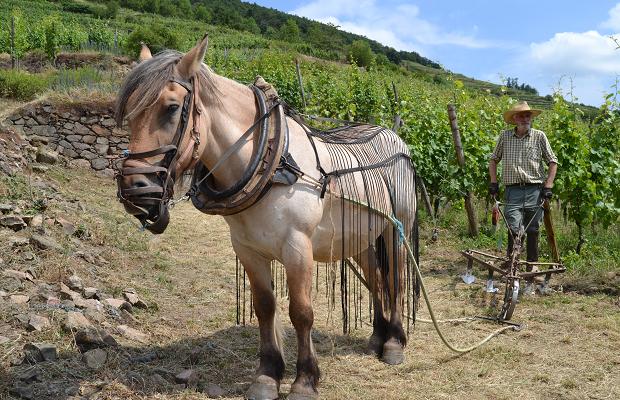
Schlossberg Horse, (c) Cassidy Havens, http://teuwen.com/

Schlossberg Horse, (c) Cassidy Havens, http://teuwen.com/

Riesling Grand Cru Schlossberg Cuvée Sainte Catherine 2013, Alsace, France (Agent, $66.00, WineAlign)

From a difficult vintage with rain at harvest. A large crew was needed in mid-October to get the pick done with haste. This ’13 is essentially being given away, so it’s a gift to the world, in a sense. The fruit comes from some of the oldest Riesling vines, situated half way up the granite Schlossberg slope. Tasting this in 2014 is 12-15 years premature. Such an infant this Schlossberg, so very primary, as if by tank, as if by womb. Assumes the role of the richest of Weinbach’s Riesling aridity, exercised by the most established finesse. Peaches are exorcized in attack and persistent. Currently mired in a micro-oxidative state. You can sense it working, churning, moving in animation.  If a taste of 2005 is any indication, it will be 2022 before this wine will begin the Cuvée Sainte Catherine reveal. Look for the open window to fall between 2025 and 2030.

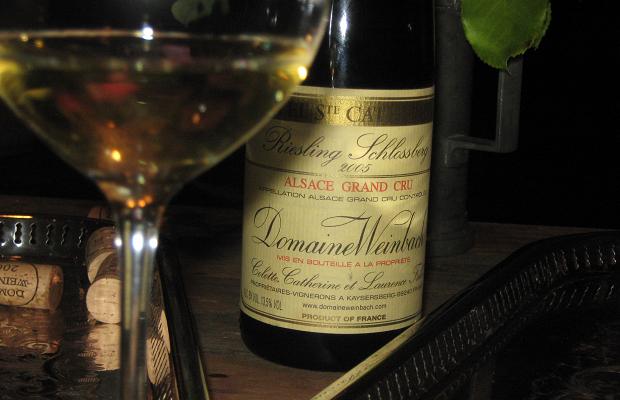
Domaine Weinbach Riesling Grand Cru Schlossberg Cuvée Sainte Catherine 2005

Domaine Weinbach Riesling Grand Cru Schlossberg Cuvée Sainte Catherine 2005

Riesling Grand Cru Schlossberg Cuvée Sainte Catherine 2005, Alsace, France (Agent, $66.00, WineAlign)

Here the rich and panegyrical Riesling from the first biodynamically farmed vintage at Domaine Weinbach. The old vines from the Grand Cru’s mid-slope averaged 60 years in this ’05, a wine that managed the best southern exposure to great effect. “You can have a whole lot of fantasy when it comes to food” with this Riesling vintage says Catherine Faller. That’s because there is a magnified, munificent and magnificent toast in this ’05, like some older Burgundy. The spice notes are right on the tip of the tongue with all the necessary sapidity of youngish Alsace, wise and wistful. Now having just entered the secondary window, this wine is such a perfect portal for the gauging of aging, itself looking for ideal consumption between 2020 and 2025. Full reward offered to those with further patience.

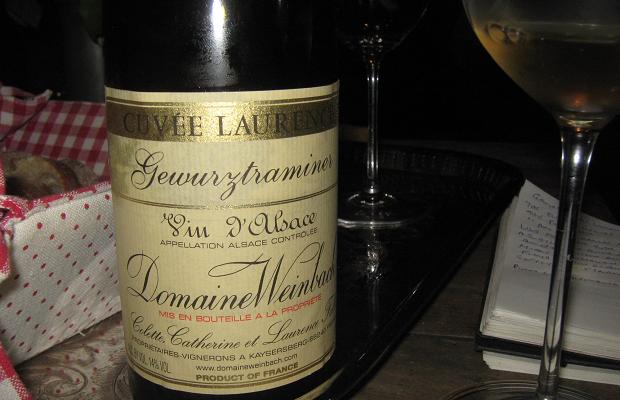
Domaine Weinbach Gewürztraminer Cuvée Laurence 2011

Domaine Weinbach Gewürztraminer Cuvée Laurence 2011

Gewürztraminer Cuvée Laurence 2011, Alsace, France (Agent, $68.00 (B.C.), WineAlign)

From an altitude of 225 to 250 metres and out of the marly limestone soil beneath the lieu-dit of Altenbourg, located at the base of the great Grand Cru Furstentum vineyard. In conjunction with the micro-specific sub-Mediterranean climate and the Indian Summer of the 2011 vintage, the results here are of the elegant kind. The total effect upon carefully judged fruit and in the late Laurence Faller’s Gewürztraminer magician’s hands, this “foie maker” is lifted, exotic and ethereal, like exceptional, fermented Yuzu. A subtle and quiet entry gives to a confident middle and a demanding, spicy finish. Lets go and slides softly into ethereal flavours. Catherine Faller’s eyes light up when she imagines a Cuvée Laurence pairing with “blood orange duck.”

Schlossberg Castle, (c) Cassidy Havens, http://teuwen.com/

Schlossberg Castle, (c) Cassidy Havens, http://teuwen.com/

Pinot Gris Altenbourg Quintessence De Grains Nobles Cuvée D’or 2010, Alsace, France (Agent, 375 mL $539.00, WineAlign)

Domaine Weinbach created the moniker “Quintessence” when it was coined to describe the 1983 cuvée. The nickname is apt for the rapt selection of rare pearls from the lieu-dit Altenbourg. The marl, limestone and sandstone Clos is a gentle slope between 225 and 250 metres high, just beneath the limit of the Grand Cru Furstentum. In a late harvest SGN like this one from the low yielding 2010 vintage, at a sky-high residual of 200 g/L you would think sweet to the back of the brain. You would be right but each time that intensity is carefully brought back from the brink by formidable, if unctuous Pinot Gris acidity, a bubble within a bubble, never bursting, always teasing. The concentration and purity here are magnificent, the flavours hanging in extract of endless, suspended animation. A wine to sip, to share and to save for senectitude.

Large Foudres at Domaine Weinbach, (c) Cassidy Havens, http://teuwen.com/

Large Foudres at Domaine Weinbach, (c) Cassidy Havens, http://teuwen.com/

At the Millésimes Alsace, the professional trade fair for Alsace wines, one of Laurence Faller’s great legacy wines was poured.

Domaine Weinbach Gewürztraminer Furstentum Grand Cru Vendanges Tardives 1994

Domaine Weinbach Gewürztraminer Furstentum Grand Cru Vendanges Tardives 1994

Gewürztraminer Furstentum Grand Cru Vendanges Tardives 1994, Alsace, France (SAQ, 11521362 $132.00 (2012), WineAlign)

The wine was presented in Colmar by Sommelier Caroline Furstoss who began with the soulful tribute of “Laurence is felt in this wine.” Deduction, by salience and sobriety of grace, is considering the Faller’s ’94 a pure expression of the Furstentum terroir. Noted are the aromas of quince, apricot, their blooms and a grain of spices. Though already twenty years in, it remains conspicuously fresh. The richness and concentration are at such a high level. Flavour begins with a marmalade in defiance of confection and has no end. Though the vintage is decadent, warm and unctuous, there is always balance. Has a tannic impression and smells like flowers from warmer France. Furstoss reminded everyone that it is “an expression of a daughter.” Impeccable balance.

Kaysersberg, from the Grand Cru Schlossberg, (c) Cassidy Havens, http://teuwen.com/

Kaysersberg, from the Grand Cru Schlossberg, (c) Cassidy Havens, http://teuwen.com/

Good to go!

http://www.winealign.com/profile/2058-mjg

A Blanck slate in Alsace

Paul Blanck et fils Photo (c): https://www.facebook.com/Domaine.Paul.Blanck

Paul Blanck et fils
Photo (c): https://www.facebook.com/Domaine.Paul.Blanck

Philippe Blanck‘s wines are his tabula rasa; Riesling, Muscat d’Alsace, Pinot Blanc, Sylvaner, Chasselas, Pinot Auxerrois, Pinot Gris, Gewürztraminer and Pinot Noir. They are like children, young and innocent in their infancy, uncomplicated canvases, unaware of what complexities may befall them. Blanck begins with quires like Aristotle’s “unscribed tablets” and transforms these epistemological blank slates through nurturing, experience and perception. His wines are those of expression, not impression.

Domaine Paul Blanck announces to the world they are “Vignerons d’Emotions depuis 1610 en Alsace.” They embody “family spirit” with the objective “to create wines of pure pleasure for wine-lovers throughout the world.” Thirty different wines are produced from the property, separated into three main types. First there are the fruit driven wines to “enable the wine-lover to discover the aromatic finesse of the Alsace grape varieties.” Second are the wines with mineral characteristics, “the single vineyards and grands crus which express the plenitude of limestone, the sweetness and firmness of clay, the harmony of manganese and the racy bouquet and power coming from silica.” Then there are “les nectars,”  the late harvest and “grains nobles” issued from overripe grapes “which are mysterious, opulent, complex and exuberant.”

The English philosopher John Locke brought forth the nature versus nature proposal of the blank slate as “a tacit theory of human nature, namely, that human behavior is caused by thoughts and feelings.” The application of the premise to wine is viable because of the naked stage at which a yet fermented grape exists.

During the grape’s life cycle, genealogy and climate shape its development. But even after it is plucked from the vine it still carries no true identity, in so far as what it will become as a wine. This is the point where nature gives way to nurture. Environment now acts as the catalyst to shape the wine’s life. Wine does not evolve because of natural selection. It evolves at the hands of the winemaker.

The tabula rasa theory works with respect to wine with the only exception being “when innate characteristics are considered because “innate ability and blank slate are two totally opposing ideas, so how can they coexist?” Wine is a blank slate before it is crushed and sent to ferment. Its en route ability to acquire knowledge is anything but innate. Domaine Blanck’s wine is different. It’s tactility defines how it develops and ages. The Blanck 1983 Muscat proves the point. It’s mien is almost impossible to comprehend. Experience imprints knowledge.

Blanck the Darwinian is the keeper of blank slates baring little resemblance to those of his contemporaries. Not because their development incorporates the concepts of heredity, genealogy and culture. It is here within that the Blancks share a commonality with other traditionalists. Where Philippe’s take differs is in the anti-Descartes approach to making wine. Alsace is certainly a wine region with a storied history. It’s a place where sixth and eight and tenth generation winemakers have been passed down the torch of practice and the tools to work with varietals and their idiosyncratic tendencies. For this learned reason and because he approaches l’élevage with feelingPhilippe Blanck’s wines need to be assessed with a combination of art and science.

While it may seem absurd to think about Philippe Blanck‘s wines, or any winemaker’s for that matter as evolved and developed in direct connectivity to musings and dissertations, spend three hours tasting with him. You too will walk away with a poet’s perception, a musician’s intuit and a writer’s reverie. Philippe Blanck makes full use of human intellect and empirical familiarity to help realize his wine’s potential.

The Gewürztraminer Bird of Alsace, Domaine Paul Blanck

The Gewürztraminer Bird of Alsace, Domaine Paul Blanck

Philippe makes the wines with his brother Frédéric, “the artist, the solitary one.” Philippe self-describes himself as the “people person.” The domain is not organic but “we are close. Plowing is the key to organics, and grass, and compost. It’s enough.” No chemical products are used, unless it’s entirely necessary, like in 2006 and 2012 when botrytis ran rampant. “If you want to have low yields, why have fertilizers?” Blanck notes the importance of building up resveratrol in the grapes, essential for disease resistance and vine health.

The Blanck portfolio includes Les Classiques, single, classic-varietals with less than five g/L of residual sugar. Then there are Les Cépages Oubliés, a category which defines a series of wines, but not what they are capable of becoming. They are in fact a set of outliers, a group of grape varieties having fallen from vogue, kept alive by vignerons like Paul Blanck et fils. The varietal eccentricity of Chasselas, Sylvaner and Auxerrois. Les Vins de Terroir come from lieux-dits, spend one year in vats and another one to two in bottle. Les Grands Crus need six to seven years to reach potential but as Blanck exclaims, “after two or three years of cellaring the wine is exploding.” Les Nectars include Les Vendanges Tardives (late harvest) and Les Sélections de Grains Nobles.

Philippe Blanck, Domaine Paul Blanck

Philippe Blanck, Domaine Paul Blanck

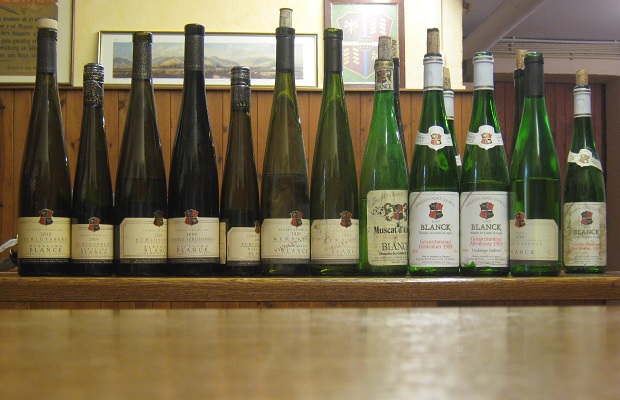
In June of 2014 I sat down with Philippe Blanck at the winery in Kientzheim to taste 17 of his wines, along with Montreal’s Fred Fortin, Sommelier au Restaurant Laurea, New York’s Jonathan Ross, Sommelier at  and Chicago’s Doug Jeffirs, Director of Wine Sales for Binny’s Beverage Depot.  Philippe pulled out 10 bottles with at least 15 years of age on them, including an ’83, two ’85’s and an ’89, because “how often do you have the opportunity to open wines like this?” Philippe’s response? “When people come.”

Related – Giving Grand Cru Pinot Noir d’Alsace its due

Here are notes on 14 wines tasted that day in June. The other three are Pinot Noir, published (as noted within the link), back in September.

Tasting with Philippe Blanck, Domaine Paul Blanck

Tasting with Philippe Blanck, Domaine Paul Blanck

Pinot Blanc Classique 2013

Has an unoaked Chardonnay approach, from early-ripening fruit vinified in a clean, fresh style. The soils are gravel, sand and south-facing clay and limestone. The vintage is what Alsatians would call classic; consistently cool with low yields. Aromatic purity, of citrus and flowers move to a solid and slightly weighty bitter mid-palate, then give way to a sliding scale finish.

Auxerrois Vieilles Vignes 2010

This grape variety from Luxembourg came to Alsace in the 18th century. Blanck leaves it for one year on the lees, to add richness and to bring out aromas from gentle oxidization. The wine is then left in bottle for three more years before release. The oxygen-free environment couples with the earlier air transfer to complicate matters in beautiful didacticism. The aromatics are massively tropical and the wine is imperfectly clean. Full and fleshy, accessible but intensely cerebral. Auxerrois in awe of what must be.

Pinot Blanc 1989

This from granite soils, full of mineral and white tannin, yet never saw a moment in barrel. The location is the Grand Cru Furstentum, in a windy area, perfect for Pinot Blanc. Has that sense of Burgundian metallurgy, that texture and that buttery malo feel. “This is a paradox without being a paradox” says Blanck, because the tannins are in the vineyard. Even in hue you get a sense of the botrytis. “She’s a beautiful blonde,” quips Philippe, she’s “the sensuality of humanity,” adds Ross. Here Pinot Blanc lets it be, amazes with a pure, silky, textural feeling and a cleanse of the mouth. “All these years I’ve been wandering around, wondering how come nobody told me” there could be Pinot Blanc like this. Now I’ve got a feeling I’ll find more.

Riesling Grand Cru Schlossberg 2010

This is what Philippe Blanck calls “a flagship wine.” From a cold vintage with excruciatingly low yields. The Schlossberg gives mineral and more mineral; Kaysersberg migmatite, granite of Thannenkirch, potassium, magnesium, fluorine and phosphorus. Blanck’s Riesling distills its rock heredity in classicism and minimalism. Matured on its lees in large oak barrels for 12 months, this is possessive of a roundness despite the vintage, with Sémillon like wax and back-end intensity. It should be considered a two to three-year Riesling, maxing out at the six to seven-year range.

Pinot Gris Grand Cru Schlossberg 1998

The bottle had been open 10 days so we were tasting this just for fun, for experience. Philippe did not see the purpose in a formal tasting note. With allegiance to the informal tasting note, the presented wine conjured up one word: Incroyable. So very alive in depths despite the heart worn on its sleeve. Flowers seemed to suddenly enter the room as its complexities were revealed. I could only ask how this could not work itself into my passive consciousness, this wine that had shed its skin and borne its naked ass to the world for so long. It had nothing to hide and nothing left to prove.

Philippe Blanck in the Schlossberg Photo (c): Cassidy Havens, http://teuwen.com/

Philippe Blanck in the Schlossberg
Photo (c): Cassidy Havens, http://teuwen.com/

Riesling Grand Cru Schlossberg 2009

Tasted from a 375 mL bottle, under screwcap. A crystalline expression, touched by silky tannins, citrus angles and dry, chaste class. The vintage has bestowed it with a broad mid-palate, excellent structure and admiral length, all in admonition of its preparation. The ’09 Schlossberg will live long, in ways that a current look at the ’03 is showing, by gaining tropical flesh and a meringued texture as it ages.

Riesling Grand Cru Schlossberg 2003

At nearly 11 years of age this archetypal Blanck confab to Alsace Grand Cru clambake sips swimmingly youthful and offers the first and most near-recent look at the house style. Restraint, beauty and intensity are summed up in citrus, mineral and granitic tannin. Quite a quenelle or three of creamy, sherbet-like texture fills the centre of the gelid exterior. Will develop to maturity with another 11 years and a retrospective look back at that time will reveal the glory of the Blanck Schlossberg narrative.

Riesling Grand Cru Schlossberg 1994

Popped from a 375 mL bottle, the ’94 is the first to be propelled by petrol. Twenty years ago it came from the Schlossberg’s crenelated granite summits with the simple thought of “gonna be a blank slate, gonna wear a white cape.” Two decades on it’s a national symbol of a father to son enfeoffment, a Riesling of handed down knowledge and analysis. Now in phase two of the atomic launch, it’s also quite sexy, skirting flesh, cut above the knee and showing magical, mineral flanks. A sweet bitterness prescribes its packed and protracted punch. This 1994 shows signs of a melting, leading it into the finest years of its life.

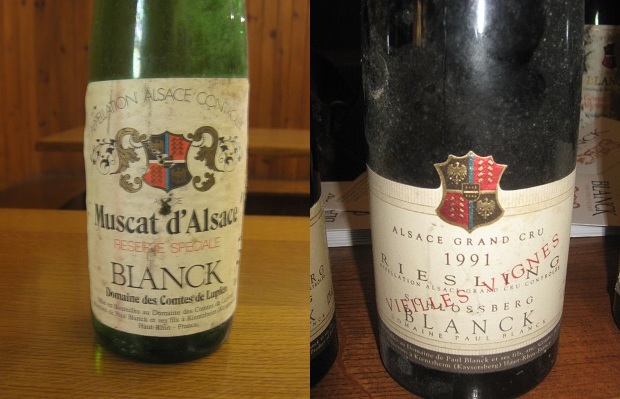
Riesling Vieilles Vignes Grand Cru Schlossberg 1991

From a tough vintage, especially considering the trilogy of exceptional wines made in 1988-1990. The yields were frighteningly low (less than 20 l/hL) but this, in Blanck’s estimation, “is a poetic wine.” The oeuvre here is all about tannin and acidity, from granite (of course), which is what gives it the intangible quotient of age. The ultramafic rock, igneous and nurturing in origin, intrusive by nature. Drink it any earlier, says Philippe and “you miss the culture and the experience.” There’s a mineral funk here, like a crust upon the granite, a slice of stinky wet rock, chiseled off and dissolved into the wine. This Schlossberg lacks the flesh and the naphtha of the 1994, nor will it suddenly discover it. Time to drink up.

Riesling Grand Cru Wineck-Schlossberg 1992

Wineck-Schlossberg gets its name from the ruined 13th-century Wineck Castle, between the villages of Ammerschwihr and Katzental, three km’s south of the Schlossberg. The soil is granite, like the Schlossberg, so it’s the same, but different. The advanced decomposition means more granitic fine material, a geological phenomenon that seems to make for a finer and more palpable mineral texture in this Riesling. Yet it seems more terpenic, with a level of orchard fruit in both aroma and flavour not present in the Schlossberg Rieslings. A calm and purposed ’92 from Blanck.

Domaine Paul Blanck st fils

Domaine Paul Blanck st fils

Riesling Grand Cru Furstentum 1993

Switching geological gears here, this is Riesling from limestone, obviously a different animal. Philippe Blanck does not offer his understanding of what calcaire does for Riesling as much as he muses on the poetic and the abstract. “This is a wine that gives an understanding that is just about being.” The existentialist take is curious, coming from a winemaker who speaks more like Donne or Baudelaire than Nietzsche or Dostoevsky. The investigation requires more precision and a foray into the gestalten, something that is made of many parts and yet is somehow more than or different from the combination of its parts. There is a feeling of miel in this ’93, the first in the line-up to give that sweet feeling. The Furstentum shows Philippe as a dreamer and a lover. He and this Riesling are a matter of election, not selection. This wine is the exception to the Blanck rule.

Muscat d’Alsace Réserve Spéciale 1983

From Altenbourg, a lieu-dit located at the base of the Furstentum vineyard. Here is Blanck’s “fairy tale,” a wine you would have always heard about but never had a chance to taste or likely ever seen. The terroir is limestone mixed with clay and you will have to excuse my Alsatian, but a single sniff and taste releases the expression, “are you fucking kidding me?” This 31-year old Muscat is an impossibility, a first time feeling, a never before nosed perfume. Speaks in a limestone vernacular, of grapes given every chance to survive long after their innocence had been lost. A forest herb, tree sap, evergreen resin, lemongrass and bitter orange coagulation rises from its viscous mist. The acidity has lost nothing on the fruit, acts in perfect foil and leaves you with a sense of loneliness that is just beautiful.

Paul Blanck Muscat d'Alsace Réserve Spéciale 1983 and Riesling Vieilles Vignes Grand Cru Schlossberg 1991

Paul Blanck Muscat d’Alsace Réserve Spéciale 1983 and
Riesling Vieilles Vignes Grand Cru Schlossberg 1991

Gewürztraminer Grand Cru Furstentum 1985

Elegant and refined but decelerated in the old ways, “my father’s and uncle’s way,” admits Blanck. Here a wine defined by aromatics and tangible consciousness. Spices abound, of the far east, tomato pulp, tarragon, sage, tangerine, mint and eucalyptus. It’s balmy with a streak of cool garrigue. It’s Gothic in its green grandiosity. So, it reflects pure Furstentum Alsace, back to the doyen, to the territory of the wise.

Gewürztraminer Altenbourg Vendanges Tardives 1985

Nearly 30 years have condensed and melded this late harvest wine together. This represents the Blanck intangible revenge. The series of sneaks. It’s a veritable, tropically creamy and alcoholic shake of coconut, pineapple, guava and mangosteen. Mixed in are herbs and spices. In their infancy, wines like this are a “big blank slate every day.
Big blank canvas staring at me every day.” With time they creep into my consciousness. The ’85 VT is silky, evolved and very much alive. It’s so deep and so pure it absorbs every colour of visible light expect what is to come, so it reflects back the purity of the past. Might require a spoon to enjoy to the fullest.

Good to go!
 

Giving Grand Cru Pinot Noir d’Alsace its due

The Vineyards of Domaine Albert Mann<br /> photo (c) https://www.facebook.com/albertmannwines "Pinot Noir, like Riesling, is a mineralogist."

The Vineyards of Domaine Albert Mann
photo (c) https://www.facebook.com/albertmannwines
“Pinot Noir, like Riesling, is a mineralogist.”

You won’t find a rare or carefully considered older vintage of Pinot Noir tasted and discussed at a Millésimes Alsace Master Sommelier class. Nor will it be featured in a magazine article’s varietal spotlight on the great wines of the region. The world may ignore the potentiality and the well-established roots of the expatriate Burgundian in Alsace, but there are winemakers who know. The future of the grape with a long history is already entrenched in the Alsace progression.

Pinot Noir is the only red grape variety authorized in Alsace. The official marketing and regulatory board for the region, Le Conseil Interprofessionnel des Vins d’Alsace (CIVA) recognizes the trenchant antiquity. “What is today considered a novelty in the region is in reality a legacy of the past that is becoming increasingly successful.” According to the Wine Society, the oldest recorded grape variety in Alsace is in fact Pinot Noir, predating Riesling by at least seven centuries.” That exaggeration aside, records dating back to the 16th century indicate that the grape variety was stored in Abbey caves and poached in tithes by the Church.

Out in the diaspora the affirmation of what best indicates Burgundy is the requiem for respect. Oregon, Central Otago and certain pockets of (cooler) California are well into their seasons of repute. Yet sometime around 10-15 years ago the $60 Sonoma Pinot Noir became serious fashion. Thanks to darlings like Kosta Browne, the sky became the limit, in California and elsewhere. A host of producers joined the ranks of the rich and famous. Looking back now, the black cherry bomb initiative temporarily cost the New World its mojo.

Those growing pains have worked to great advantage. Today you have to be better and fashion elegant Pinot Noir to attract an audience and become a hero. This goes for Sonoma County, Napa Valley, Santa Maria Valley, Santa Barbara, the Willamette Valley, Marlborough, Martinborough, Nelson and Otago. This applies to the Okanagan Valley and South Africa too. Niagara and Prince Edward County have followed suit. Vignerons like Norman Hardie, Thomas Bachelder, Moray Tawse and Harald Thiel understand what needs. Their wines have ushered in a $40-plus Pinot Noir era in Ontario. But Alsace? Please. Today a reckoning about Pinot Noir incites nothing but a series of car wrecks along the wine route from Thann to Marlenheim.

Burgundy and Bordeaux do not accept varietal expatriate inclusions. So, why should Alsace? For one, global warming. Say what you will about that load of scientific horse crap but the biodynamic culture that permeates much of Alsace is in tune and well aware of temperature change and ripening schedules. More and more growers are picking their whites earlier, to preserve freshness and acidity, not to mention the conscious decision to cheat botrytis and elevated residual sugar. Embracing Pinot Noir is on many of their minds. Some are ahead of the curve and have already made some exceptional wines. Many examples from the first eight years of the 21st century are showing beautifully in 2014. Phillipe Blanck poured a very much alive 1991. How many Alsace wineries can lay claim to one of those in their cellars?

It’s common knowledge to an Alsatian cognoscenti that white wines drive the mecca. Riesling, Pinot Gris and Gewürztraminer and their associations with the Grand Cru and lieu-dits are the it vines. Vendanges Tardives (VT or, Late Harvest) and Sélection de Grains Nobles (SGN, or selection of noble berries) sit on thrones of glory. Even traditional varieties like Auxerrois and Muscat continue to outshine and suppress the possibilities for Pinot Noir.

Pinot Noir has yet to receive any proper respect both in and outside of Alsace. Can there be justice served in a wine region where a noble variety must share nomenclature with a bottom feeder like Pinot d’Alsace, which is not really a Pinot at all. The scavenging white blend draws attention while making unsubstantiated use of the Pinot prefix. Pd’A need only contain a small percentage of any type of Pinot (Blanc, Auxerrois, Meunier or Noir) in conjunction with other white Alsatian varieties. According to wikipedia:”Lack of acidity and complexity often prevent Alsatian Pinot Noir from achieving anything more than pleasant, easy drinking, quality levels.” Them’s fighting words.

That faux Pinot sideshow is really a whole lot of nothing. The real terror is that if you grow exceptional quality Pinot Noir on Grand Cru terroir in Alsace you can’t label it as such. If you produce Riesling in the Hengst, you are good to go. If you grow Pinot Noir in any of the storied “male horse,” vineyards, the resulting wine, with respect to the variety, is only considered lieu-dit and must be labeled as such. This is the Alsace Grand Cru taboo.

As part of his recent three-part report on Alsace, British journalist Tom Cannavan covers some of the wines of the Grand Cru Hengst. Cannavan so rightly notes that “the problem is, not only is Pinot Noir ineligible for Grand Cru status, but the name Hengst cannot even appear on the label.” He did sample some basic Pinot examples and wondered aloud about the injustice being a non-sequitur. He missed the boat. Case in point Domaine Albert Mann. Back that up with Pinot Noir made elsewhere by Pierre Blanck, Jean-Pierre Frick and Mélanie Pfister, among others.

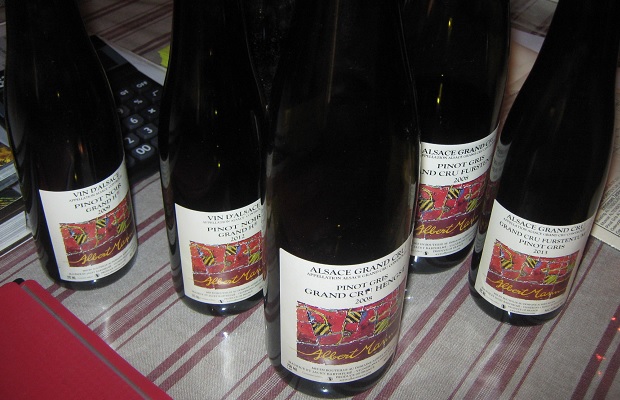
Maurice and Jacky Barthelmé of Domaine Albert Mann shirk the system with the use of a simple letter, an “H” or a “G” in place of Hengst and Pfersigberg. Philippe Blanck of Paul Blanck & Fils does the same thing with an “F” for Furstentum. It’s a wink-wink, say-no-more kind of approach. A grand parade of life-giving packaging. The brothers Barthelmé and Mr. Blanck know what excellence lies in their Pinot Noir holdings and understand the bright red future for Alsace. “Pinot Noir, like Riesling, is a minerologist,” insists Maurice. Don’t think of the brothers as pioneers so much as pragmatists. CIVA has surely taken note and despite the resistance to add Burgundy to the charges, change is inevitable. The Pinot Noir eyes never lie.

Here are two dozen Pinot Noirs tasted in Alsace during a week in June.

Domaine Albert Mann

@Smallwinemakers

Diversity of the parcels of land, disseminated and however subtly intertwined, which are the particularity of the domaine

François Bruetschy

Pinot Noir (and Pinot Gris) of Domaine Albert Mann

Pinot Noir (and Pinot Gris) of Domaine Albert Mann

Pinot Noir Clos De La Faille 2012

Though geologically speaking this Pinot Noir out of 1997 plantings in calcaire and redstone soils is a fault on the hill of nature, as a wine it shows no discernible impropriety. This represents a tectonic shift for Alsatian Pinot Noir, a lithe and floral wine of articulation and an eye opener to prepare for the intensity of Mann’s Grand letters. It’s a lightly woven, silky soft Pinot, with a furrowed brow and the necessary Mann clarity of responsibility. Density is through a looking-glass, a gateway to Alsace and what future varietal decorum may be achieved.

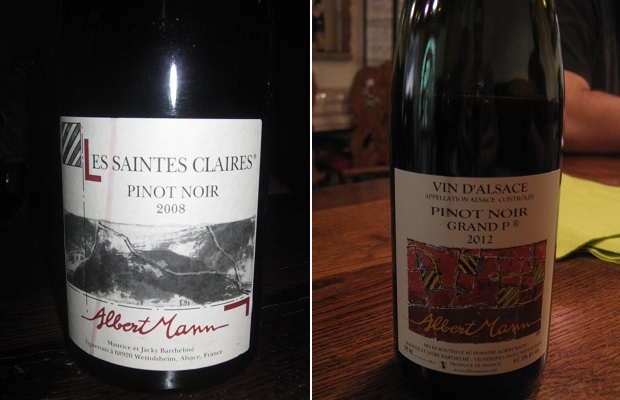
Pinot Noir Les Saintes Claires 2012

From calcareous soil and still the Albert Mann zealous clarity, with similar intensity and protracted density. There is a lacuna permeated by a hint at black cherry but the ken is never fully realized. At 13 per cent abv and with a set of fine, sweet tannins (even more so than La Faille), these 20 year-old vines have procured a piled Pinot Noir.

Pinot Noir Les Saintes Claires 2010

A top-notch (though cool and late harvested from a small crop) vintage for Mann (and Alsace) Pinot Noir, here the calcareous parcel at Sigolsheim above an old monastery called “Les Clarisses.” Some early rot and bottle reduction have both been stabilized as the wine peels off the rust and goes mellow, in full humanizing and sensual mystery. “How great the wine is when you can see the vintage, ” chimes Maurice. Controlling the effects of both nature and fermentation seems no biggie to the brothers Barthelmé. The act is of such minor tragedy, the climax characterful and sacred. A tingle of eastern spice twitches over bright fruit and a certain florality, materializing what can only be described as obvious commitment. It’s all about the journey.

Domaine Albert Mann Pinot Noir Les Saintes Claires 2008 and Grand P 2012

Domaine Albert Mann Pinot Noir Les Saintes Claires 2008 and Grand P 2012

Pinot Noir Grand “P” 2012 (Tasted from a 375 mL bottle)

From a blend of plantings (1975 and 2004) in Wintzenheim limestone-sandstone soils on the Grand Cru Pfersigberg. Whole bunch pressed grapes (60 per cent) saw a range of oak; 25 per cent new, 50 one-year old and 25 older barrels. A light filtration was used to combat some reduction. This P is a touch ferric, not unlike Volnay but also because of the vintage. The vines in ’12 were subject to cool, then humid, then dry weather. The flux makes for a full floral display, from iron through to roses, but the wave stays linear and rigid. In its youth, the P is calm and on a level plain along its ECG-considered PQRST journey. It will soon spike past Q, up to R and then settle in for the long haul. Will hit its glide at S and T at the end of the decade.

Pinot Noir Grand “P” 2011

From what Maurice Barthelmé describes as a “paradoxical vintage” that started out dry and turned rabidly humid. This has huge personality, less refinement but more delicacy than the Hengst. Once again it’s a touch reductive and that tenuity is in the form of cured meat. The style here emulates Burgundy more than any of the P’s, much more than the H’s and worlds beyond the Failles and the Claires. The iron gait exceeds ’12 with a railroading layer of grand P funk. A chain of earth-resin-tannin has “got the knack,” jumps up, jumps back, does the locomotion with “a little bit of rhythm and a lot of soul.” The 2011 Pfersigberg is unlike any other Alsatian Pinot. It requires plenty of air and even more time to unwind. Look for it to become a classic 20 years after release.

Pinot Noir Grand “P” 2009 (Tasted from a 375 mL bottle)

In the ’09 you can smell how five years of bottle time (slightly accelerated by the small format) brings Pfersigberg Pinot fruit into a Grand Cru station. This is in the zone and just about as perfect an example can be to represent the young cottage industry that is Alsace Pinot Noir. Five more years would send it into philosophical complexity. The classic “P” reduction is there, with amazing structure from the palate. Wonderful funk, the proverbial Brett-esque creature of Pfersigberg, along with cherry and resin of pine. Wonderful animal.

Pinot Noir Grand “H” 2012 (Tasted from a 375 mL bottle)

From a south-facing plot in Wintzenheim on the Grand Cru Hengst. The soils are deeper, the clive made of consolidated clay or marly limestone and sandstone. All aspects of the Pinot Noir here are enriched by the density of nutrition; extract, spice and tannin. Any thoughts of overripe character in any way are thwarted a circular saw of energy that cuts through the cake, breaking it down with extreme prejudice. Tasted at 9:00 am this is a wake up call of the highest order. Notes Maurice Barthelmé, “this must be planted in calcaire soil.” Strike another notch on the Grand Cru petition.

Pinot Noir Grand “H” 2009, 

Typically Hengst, with a whiff of reduction, though never as pronounced as the Pfersigberg. In the ’09, which was a star-caste vintage, the “H” stands for high. As in hue, extract and phenolics. It could be imagined that Syrah were blended in (Maurice said it) and like its namesake (German translation), “Hengst is a stallion.” The reduction is (sic), as Eleven Madison Park’s Jonathan Ross noted, “favourable flavour. A creaminess comes from grape tannin, not oak.” This is meaty Pinot Noir, seeking out rare flesh, in beef or game. It will travel well and live for a decade or more.

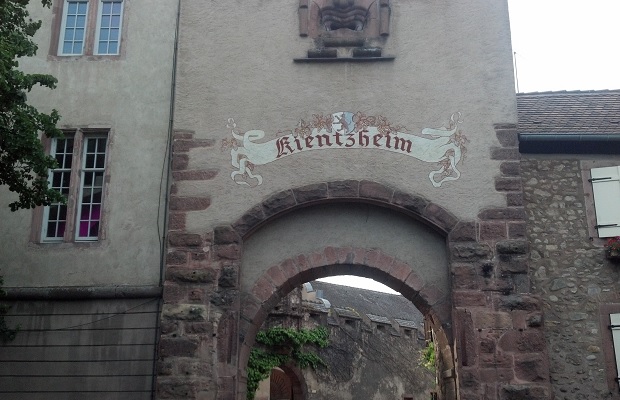
Kientzheim, Alsace

Kientzheim, Alsace

Pinot Noir 2008

This vintage preceded forward seasons that brought out warm, fully ripe and optimal phenol-realized fruit. From Maurice Barthelmé’s vineyard, between Mambourg and Furstentum, in Kientzheim. Clear, clean and precise. This was perhaps a bit ambitious in its oak soak from a year that Maurice considers “difficult and early,” but the parcel never lies and what a parcel it is. “Pinot Noir, like Riesling, is a mineralogist, ” says Barthelmé. This is Mann’s purest Pinot, if a touch under ripe, but that is the key. Whole bunch pressing and the oak envelopment has created a round flavour lock and Maurice feels he needs 10 more years to master this technique. Though this may have been the early stages in the development of the Mann Pinot candidacy, by 2018 it will reign in Alsace.

Paul Blanck & Fils

@rogcowines

“We’re looking for authenticity. Not wines of impression, but wines of expression.

Philippe Blanck

Phillipe Blanck, Domaine Paul Blanck & Fils

Philippe Blanck, Domaine Paul Blanck & Fils

Pinot Noir 2012

From granite and gravel soils, the former bringing a bitter component, the latter what Philippe Blanck calls “a facile aspect.” Dark fruits, like black cherry and plum are flecked with pepper and cloaked in a silky robe. “Almost a sort of texture wine,” considers Blanck. The bitterness is beautiful and offers a window of proof towards the ageing capabilities of Pinot Noir in Alsace. “Everybody has an idea of what is a Pinot Noir in the world,” says Philippe. “This is a classic one. And they age crazy.” Classic vintage too. From now and for 10 years.

Pinot Noir 1991

From 20-year old vines (at the time) and a low-yielding (20 hl/ha), cold vintage. The wine was not filtered and 13 years on remains very much alive. Retains the unmistakable smell of Fragaria Vesca, fraise de bois, the herbaceous and wild alpine strawberry. Mix in a metallic, iron and wine tinge and still viable tannins and you’ve got yourself a wonderfully aged Alsace Pinot. An example to encourage a future for the grape variety in Alsace. “So may the sunrise bring hope where it once was forgotten.” Blanck said “nothing to prove, just to experiment. Some wet, moldy berry in here.” Roasted game lends a note as well to this upward, over the “mountain wine.”

Pinot Noir “F” 2009 

The F is for Furstentum, the Grand Cru on the northern slopes of the Weisbach valley split between the communes of Kientzheim and Sigolsheim. The soil is marl. Philippe Blanck insists “we’re looking for authenticity. Not a wine of impression, but a wine of expression.” Here is cherry set on high, bright and exploding, with savoury wild herbs and direct linear of acidity. Authentic yes, silky no. Can age for 10 more years and somewhere along that line the direction will find a more approachable intersect.

Domaine Pfister

Pinot Noir 2009

From a vintage Le Conseil Interprofessionnel des Vins d’Alsace (CIVA) called “precocious” and of irresistible wines. Mélanie Pfister’s ’09 comes from the calcareous Clos Bamhauer, went through two weeks maceration in Inox and then spent a slow 18 months in Burgundy barriques. Incredibly fragrant, with a rich density and a charge of wood spice. Its black cherry waft brings Burgenland to mind, that and the elastic, silty grit by way of some vines grown on gravelly soil. What sets it apart from everywhere else not called Burgundy is the lack of any sort of varnished note. Purity prevails.

Domaine Zind-Humbrecht

@TrialtoON

Pinot Noir 2012

To Olivier Humbrecht, the location and managing the ripeness of Pinot Noir is key. “You can’t hide green character in Pinot Noir,” he asserts. Fruit comes from the Heimbourg vineyard, from west-facing slopes out of marl and limestone. This is a cooler, later ripening position with a draught between the hills. At 13 per cent alcohol it is pleasantly ripe but not as rich and intense as 2009. Still ripe enough for positive and effective phenols. Tannins are present and accounted for, wrapping a veil over the chalky, chewy, slighted coated fruit. The mineral is felt in texture coming from what is a simple, proper and elegant palate.

Domaine Pierre Frick

“Wine is not intellect, it’s emotion.”

Jean-Pierre Frick

@LeCavisteTO

Pierre Frick Pinot Noir 2008 and 2009

Pierre Frick Pinot Noir 2008 and 2009

Pinot Noir Rot-Murlé 2009

This block is literally le muret rouge or, the red stone wall. From brown, ferric (ferrugineux), hard calcaire soils. In 2008 you could not write organic on the label (this changed with the 2012 vintage) so Frick sub-labeled the bottle Vin Biologique Zéro Sulfites Gioutés. Natural wine. Rustic, full of horns on acidity. The combination of clay, marl and the fact that the plot benefits from extended late-afternoon sun all lead to vigor, rigor and rigidity. This is Jean-Pierre Frick’s thickest and most Romantic brushstrokes. Richly textured like a Gaugin portrait of the The Schuffenecker Family. Post-impressionist Pinot Noir.

Pinot Noir 2008

From the Strangenberg lieu-dit, a hill parcel known as la colline aux pendus. Soil composition is hard, durable brown calcaire. After a quick whiff of farm droppings blow off, Jean-Pierre Frick’s Pinot Noir reveals a bright, light and feminine side. It is now blessed by gentle, resolved tannins. The generous spirit, kind heart and gentle soul of this Pinot offer nothing but calm pleasure. Its coat has not even a trace of primer. It is simply thoughtful and considerate. The iron minerality persists but with static and clinging trace fibers. A wine perfectly suited for a middle course at today’s table.

Pierre Frick Pinot Noir Strangenberg 2003 and Pinot Noir 2008

Pierre Frick Pinot Noir Strangenberg 2003 and Pinot Noir 2008

Pinot Noir Strangenberg 2003

Sub-label notes this ’03 as Vin Biologique Vinifié Sand Souffre. Years before it was fashionable or righteous to farm and vinify organically and without sulphites, Jean-Pierre Frick was looking to the stars. The Strangenberg is a very dry part of Alsace, Mediterranean in climate. This is earthy Pinot, like reds from Corbières or Sardinia, with its mutton-funky and roasted game aromas. Here is proof that non-sulphured wine can age, with the simple equation of fruit, acidity and tannin. It’s actually hard to believe so much tannin can emit from the collines of Haut-Rhin in Pinot Noir. Crazy actually. There is an underdeveloped green note along with some roasted and cooked flavours so peak has been reached. When left for 30 minutes in the glass the tannins begin to dry out. Like southern French and Italian reds, another 10 years would bring caramel, soy, figs and raisins. Either way. now or then, this Frick will also be interesting.

Domaine Schoenheitz

Pinot Noir Linzenberger 2013 (Barrel Sample)

Spent six months in one-year old (Allier forest) barrels. Bright, tight, full-on red cherries. A quick, fun, pure expression, clean and full of cherry. A two to three-year Pinot Noir.

Pinot Noir Sainte Gregoire 2012

From the Val Saint Grégoire lieu-dit, the historic name of the Valley of Munster (before the Protestant reform). The soil is decomposed granite rich in micas. Leans warm and extracted but with a high-toned, spiced coat tension. A generalization would place it more New World than Old, verging to black cherry, though again, the spirit is high. In contrast the yields were low (17 hl/ha) from the Cru, let alone the top-level of output from such a low yielding vintage. “When nature isn’t generous the yields go down fast,” confirms Dominique Schoenheitz. Good balance and well-judged.

Gustave Lorentz

@AmethystWineInc

Pinot Noir La Limité 2009

From the lieu-dit Froehn on the edge (the limit) of the Grand Cru Altenberg de Bergheim. Such a spicy florality and the underlay of calcaire from what is ostensibly hard limestone and Jurassic Lias marls meet one another in a geological confluence of fossils, red ferruginous soil and hard rock. A slow 12-month accumulation to fermentation has brought this Pinot Noir to land’s end. It bares un uncanny resemblance to the Prince Edward County Pinot Noir ’12 by Norman Hardie. Over exposure to sun, wind and everything else nature delivers gives this wine its vigor, its core strength and its vibrant personality.

Edmond Rentz

Pinot Noir Piece de Chene 2011

The Rentz take on Pinot Noir grows up in oak for 14-18 months, from a mix of new and used (no older than four years) barrels. The style is decidedly rich Pinot of a sweet tooth with a soft spot for quality chocolate. Spice supplements of orange and cinnamon, along with ethical acidity bring forth a wine bien charpentée, agreeable and ready for PDQ consumption.

Domaine Paul Zinck

@liffordretail

Pinot Noir Terroir 2012

Flat out fresh, mineral Pinot Noir. Only 100 cases were produced from a chalk and clay single parcel, on the Grand Cru Eichberg. GC yes to Phillipe Zinck, “but not official.,” Very little barrel influence here, in fact two-thirds of the Terroir was fermented in stainless steel, “to keep the mineral.” The cherry scents has tinges of plum, licorice and black olive, but just around the periphery. It’s otherwise bright and fresh with a quiescent streak throughout. Excellent.

Domaine Boyt-Geyl

Pinot Noir Galets Oligocène 2010

From the village of Beblenheim, this Pinot Noir gets the moniker from deposits of Oligocène of the tertiary period consisting of conglomerated rock on a base of marl. Jean-Christophe Bott considers the low-lying grapes of this terroir on lower slopes to be Grand Cru (in quality). Picked early to avoid resinning, cooked or jammy flavours, the wine was matured in (one year-old) barriques for 14 to 18 months. Quite earthy and spiced explicitly by cinnamon, though delicious, this is Pinot that flirts with what Bott wants to avoid. Served with a good chill it harmonizes its intent.

Good to go!
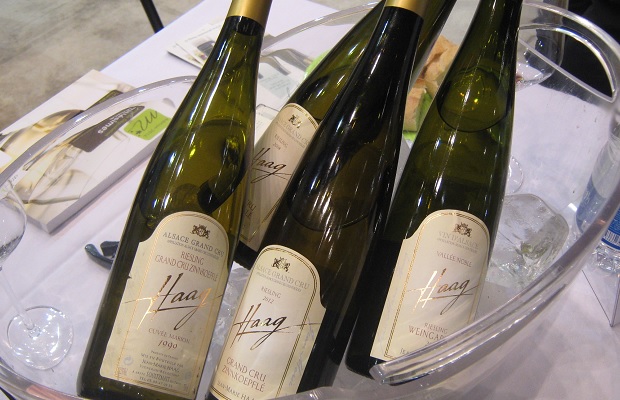
 

In a Grand Cru state of mind

Grand Cru Riesling, Alsace

Grand Cru Riesling, Alsace

I have been in Alsace now just over 48 hours and already feel as though I have been introduced to a lifetime of wine. Yet with every taste of the Alsace pansophy I am reminded just how long the unfathomable road to the region’s enlightenment remains to be. The combination of nuance, complexity and acuity of the Alsatian wine spirit may have no equal. Some highlights of the first two days in Alsace with SOPEXA and CIVA.

Domaine Steuntz-Buecher

Domaine Stentz-Buecher

What a way to be introduced to Alsace in 2014. Les diVINes d’Alsace, an organization of 70 industry women and Domaine Stentz-Buecher rolled forth a genealogical pedigree of Alsace past and present with food station matching in the winery’s garden and in the barrel rooms. First Crémant, then whites of many incarnations; Pinot Gris, blends, Gewürztraminer and many, many Rieslings. The final prize at the end of a long scroll of grand achievements were Grand Cru Riesling from the vintage 2000. The eight acted out a Grand Cru finale of generous spirit via and the women of

Louis Haller Brut Crémant D'Alsace / @diVINeSDaLSACE

Louis Haller Brut Crémant D’Alsace / @diVINeSDaLSACE

Les vigneronnes Mélanie Pfister and Carolyn Sipp introduced the three year-old organization, the winemakers, winemaker’s wives and sommeliers that form the membership of l’Association des Femmes de la Vigne & du Vin d’Alsace. “We are feminine but not feminism,” quipped Sipp. The idea began in 2009, following in the footsteps of similar women in the Rhône, Bourgogne and the Southwest of France. Women who have banded together to promote their region’s wines.

Laurence Hauller showed the 100 per cent Chardonnay Louis Hauller Crémant d’Alsace, a fine, subtle, stylish, finessed and elegant interpretation of Chardonnay that is a different sort of Alsace discrimination. Eliane Ginglinger presented her bone dry, citrus in laser focus Ginglinger Riesling Vieilles Vignes 2012. Myriam Haag offered up Domaine Jean-Marie Haag’s Riesling Grand Cru Zinnkoepfle 2011, an enervating wine with richness bled from rocks and a finishing noble bitterness. Myriam Schmitt brought her Domaine François Schmitt Riesling Grand Cru Pfingstberg 2012 that though in sweet emotive intention remains buoyant in the persevering air of aridity. It defines the transformative trend towards Dry Alsatian Riesling. Josiane Griss of Domaine Maurice Griss’ Riesling Sonnenberg 2010 if asked the question, “how long have you been a Riesling” would surely answer simply, “from creation.”

Grand Cru Riesling 2000

Grand Cru Riesling 2000

The Riesling Grand Cru from 2000 were a varied and electric bunch. The Caves François Schmitt Riesling Grand Cru Pfingstberg 2000 is a baby still and in hallmark readiness of its necessary terroir. The Domaine Sipp-Mack Riesling Grand Cru Rosacker 2000, also young and primary teases and feigns late harvest but don’t be fooled by its sunshine. This chew of salted stones has a long, long finish. the show stealer was the Magnum of Riesling Grand Cru Kaefferkopf 2000 by Vins Jean-Baptiste Adam. Incredibly atomic with a vineyard flinty stink that exhumes and exudes the benevolent bitterness of time. Wildness and purity.

Godello and Pierre Gassman of Rolly Gassman

Godello and Pierre Gassmann of Rolly Gassmann

The main event of Monday, June 16th was the Millésimes Alsace, the professional trade fair for Alsace, Wines. Nearly 90 exhibitors showed off their terroir, in Crémant d’Alsace, Riesling, Pinot Gris, Gewürztraminer, Pinot Blanc, Sylvaner, Auxerrois, Muscat and Pinot Noir. A morning Master Class seminar featured eight world-class Sommeliers leading the room through seven “typical” Alsace wines. Maison Rolly Gassmann’s Riesling Kappelweg de Rorschwihr Vendanges Tardives 2000 is late harvest mineral expression in bitterness unchained yet restrained.

Trimbach Cuvée Frédéric Emile 1990 and Domaine Weinbach Gewurztraminer Furstentum 1994

Trimbach Cuvée Frédéric Emile 1990 and Domaine Weinbach Gewurztraminer Furstentum 1994

The afternoon Master Class covered older vintages. Trimbach Riesling Cuvée Frédéric Emile 1990 lays in an evolution that has come to a balance in weightlessness. Domaine Weinbach Gewürztraminer Furstentum 1994 has a tannic impression and smells like flowers from warmer France. Caroline Furstoss reminded everyone that it is “an expression of a daughter.” Impeccable balance.

Mélanie Pfister

Mélanie Pfister

The third of a most excellent Alsatian vintage trilogy was represented by Domaine Pfister’s Riesling Grand Cru Engelberg 1990. With a clotted cream note the wise Cru remains youthful and nearly primary.

The wines of Jean-Marie Haag

The wines of Jean-Marie Haag

Domaine Jean-Marie Haag’s Riesling Cuvée Marion 1999 showed rich, viscous complexity with the sensation of star anise and menthol.

Kuentz-Bas Riesling 1983 and Domaines Schlumberger Riesling Grand Cru Kitterlé 1945

Kuentz-Bas Riesling 1983 and Domaines Schlumberger Riesling Grand Cru Kitterlé 1945

The high point of the day came with a rare and beautiful chance to taste the Domaines Schlumberger Riesling Grand Cru Kitterlé 1945. The heart and the hearth. Just the thought of producing this wine at that time is unfathomable. There are no superlatives to do it justice. This must end on that note. More on the Kuentz-Bas Riesling 1983 another day.

Good to go!