De Rigueur Sicilia en Primeur 2025

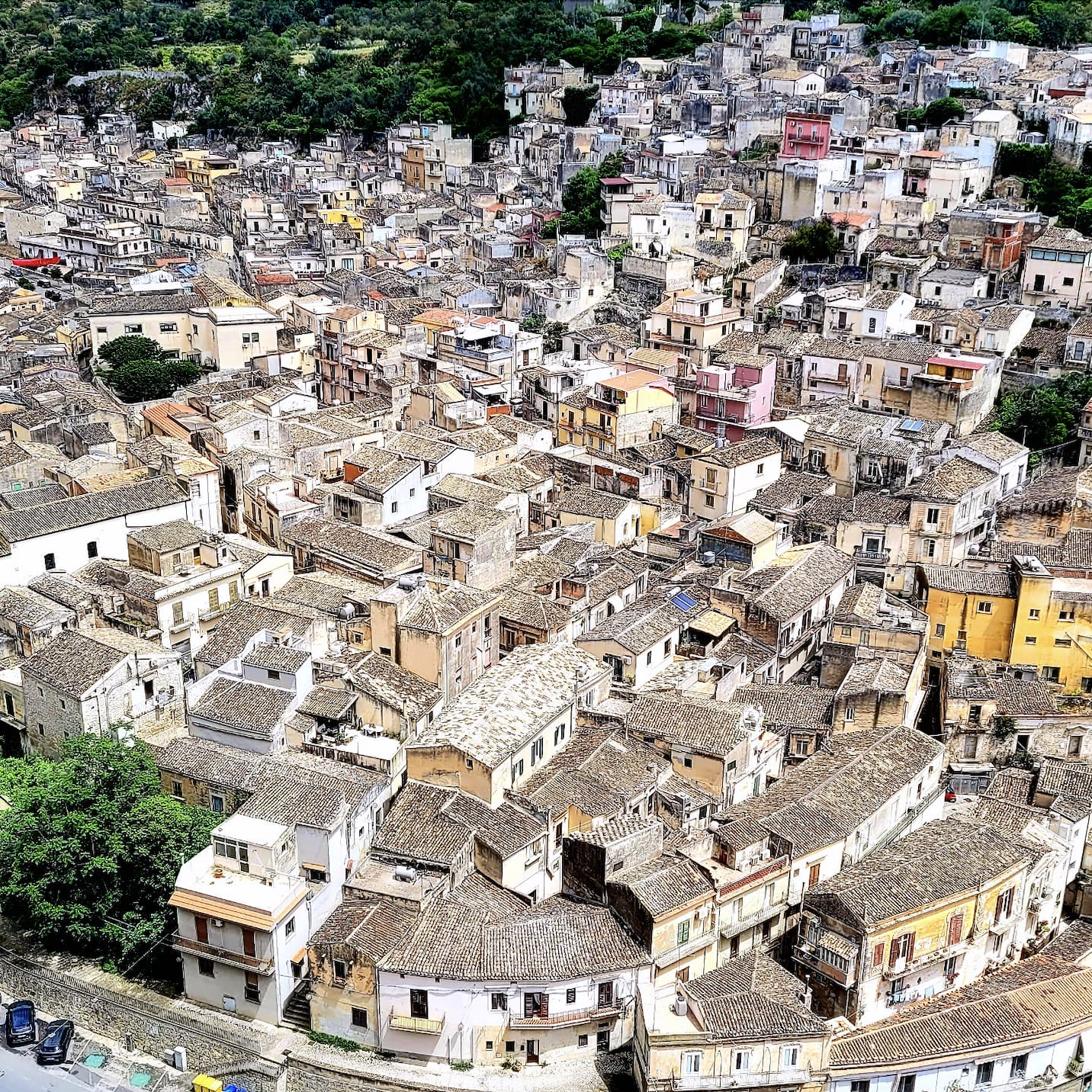
Modica

From May 6th through 10th, 2025, the 21st Sicilia en Primeur signalled the annual return of Assovini Sicilia’s proper, correct and yes, also decorous event. Journalists from all over the world arrived by invitation only for a week during which de rigueur was encouraged and for best results, most definitely required. A strict precision needed in adhering to the dictates of weather, cultural fashion, tasting and taking in the final night gala at a luxurious palazzo. The 21st edition’s title “The Culture of Wine in Sicily: A Thousand-year Story that Looks to the Future,” was defined by Mariangela Cambria, President of Assovini Sicilia as “the culture of wine today also translates into a culture of travel.” This is why the abiding delegation of 100 journalists were focused on this essential part of this journey, with their charge to bring the message back home. They came from Italy and many parts of Europe (France, Poland, Sweden, Germany, Norway), also from non-EU countries (Canada, USA, Japan, China, South Korea, Israel, Brazil, and the United Kingdom). Together they engaged in a collective etiquette to celebrate Sicilian wine, food and culture, inclusive of gorging on piping hot finger foods between en primuer tastings at lunch under a hot Modica sun because in Sicily, eating Arancini with your hands is de rigueur.

Neapolis Archaeological Park

As always the Sicilian Ante-Antreprima sees groups of international journalists making pilgrimages to wineries geographically positioned within a particular quadrant on the largest Mediterranean island. In 2025 Godello joined Zedcomm’s Lucia Boarini and JustSicily’s Marcos del Rio, along with journalists Fernanda Roggero (Sole 24 Ore), Christer Byklum (Mywinesandmore), Giuseppe Lauria (Weinwisser), David Ransom (The Connected Table) and Matthias Stelzig (Weinwelt) for an Enotour around the area of Noto. The group took in the ancient urban ruins of the Neapolis Archaeological Park, the seaside village of Marzamemi, Noto city (Including a caffè and dolce at Corrado Assenza’s Caffè Sicilia) and a stay at the beautifully charming and calming Villa Giulia Hotel. Visits were paid at Zisola, La Giasira, Ramaddini, Feudo Maccari and Planeta. When all was said, tasted, travelled, assessed, satiated and done, the group then joined the rest of the journalists fresh off of their own tours for the two-day Sicilia en Primeur at the Castello dei Conti di Modica.

Godello in Noto

Assovini Sicilia was founded in 1998 by Giacomo Rallo, Diego Planeta and Lucio Tasca and today has 101 member companies producing approximately 900 labels. After a day of technical tasting everyone convened at the Teatro Garibaldi in Modica for more de rigueur talks, including a discussion about “the culture of wine understood as informed and conscious drinking,” led by Dr. Sara Farnetti, Ph.D in Pathophysiology of Metabolism and Nutrition. Master of Wine Andrea Lonardi spoke on the “S factor: The uniqueness of the Sicilian wine continent.” Words from Dario Stefàno, President of the Wine and Oil Tourism Centre (Lumsa University) and Antonello Maruotti, Professor of Statistics (Lumsa University) concerned “The south innovating through events, e-commerce and new hospitality models for wine tourism.” Then finally it was Alessio Planeta, President of the SOStain Sicilia Foundation, speaking about “the sustainable future of Sicilian wine.”
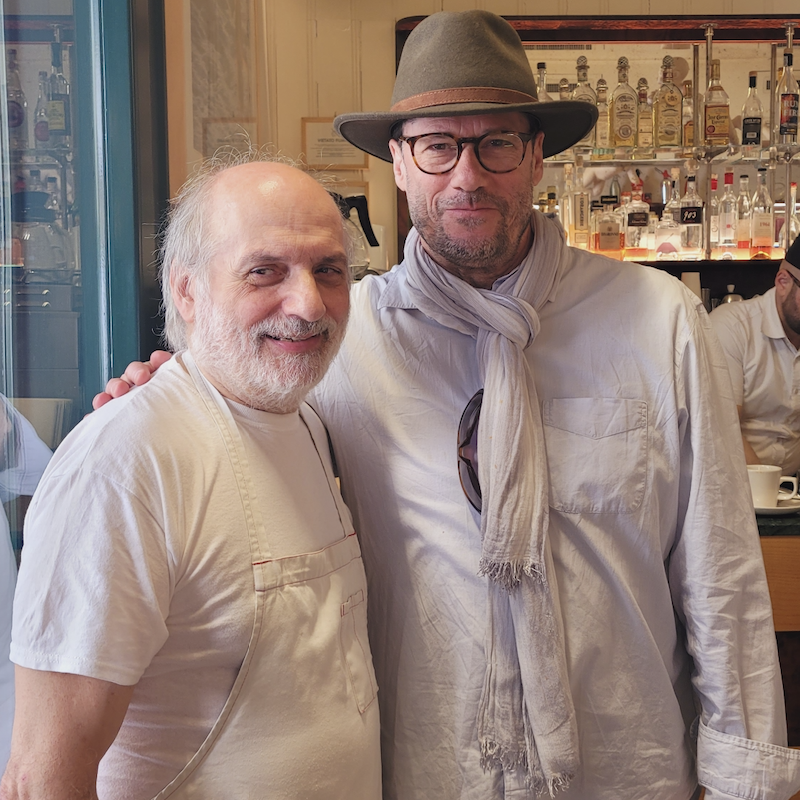
With Corrado Assenza – Caffè Sicilia, Noto

The event concluded on the 10th of May, again at the Castello dei Conti, with tastings of wines from the 57 Assovini Sicilia producers. As always Godello wishes to thank the professional and gracious organization of Zedcomm’s Cecilia Zanasi, Delia Demma, Martina Romeo, Lucia Boarini and Michele Marmino; JustSicily’s Giusi Macchiarella, Giuliana Palazzolo, Giuliana Licata di Baucina, Silvia Mantegna, Marcos del Rio and Federica Matranga; Assovini Sicilia’s Liliana Rosano. These are Godello’s 188 tasting notes from Noto visits at Zisola, La Giasira, Ramaddini, Feudo Maccari and Planeta, along with the wines tasted at Castello dei Conti.
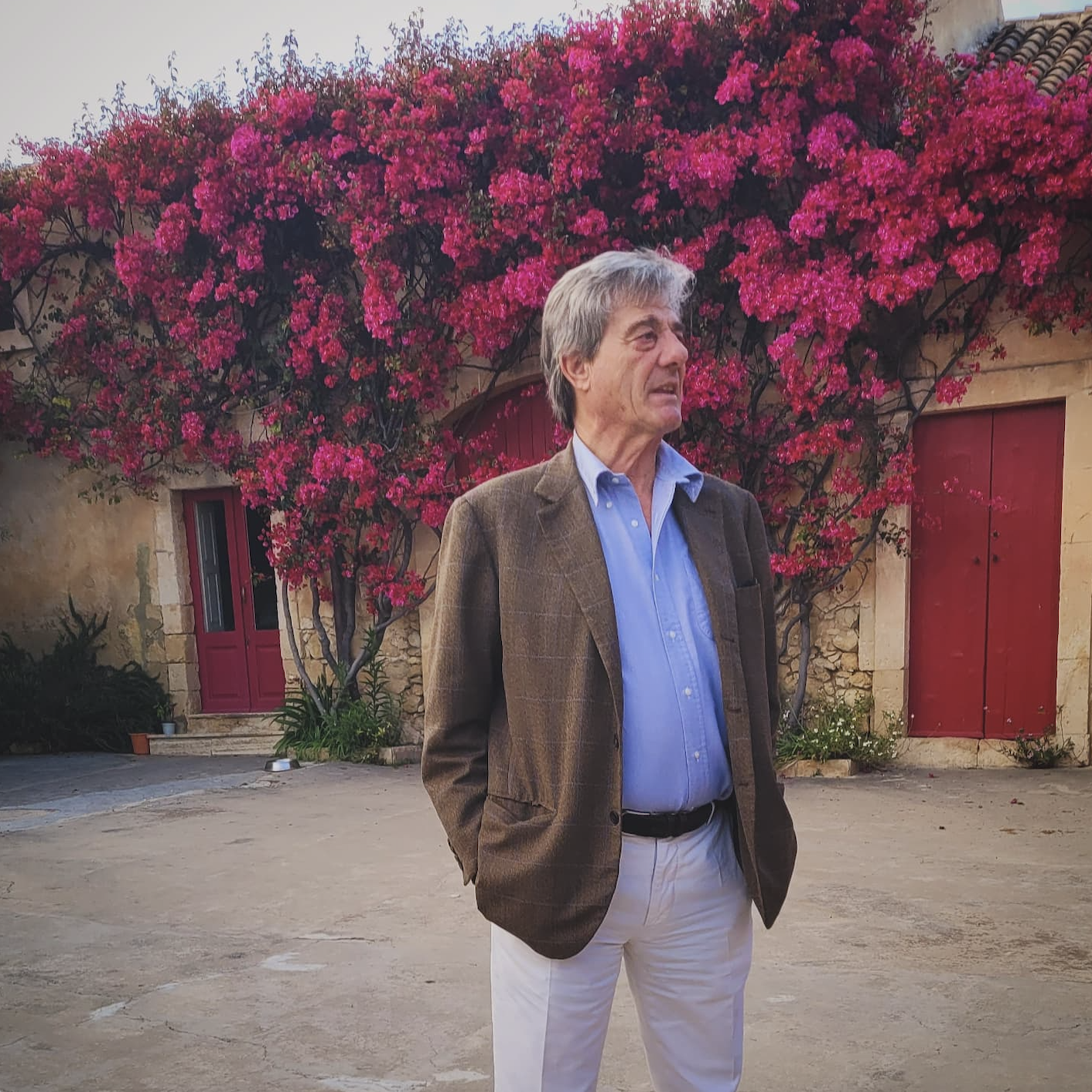
Filippo Mazzei at Zisola

Zisola

Filippo Mazzei and family have spent 20 years managing the biodiversity of Zisola, where lemon, pink grapefruit, clementine and almond trees line the vineyard. These are white soils though in Sicily they do not reflect the sun and raise temperatures, as they do in Tuscany. “This kind of soil can keep humidity for a long time,” explains Mazzei. “Even in July and August we don’t have A/C at Zisola.” The first plantings were 20 hectares of nero d’Avola plus one each of  syrah and petit verdot. Later on grillo and catarratto, all within six to seven kms of the sea and three to Noto. There are now 25 total hectares of vines and the fermentation cellar was built in 2004.
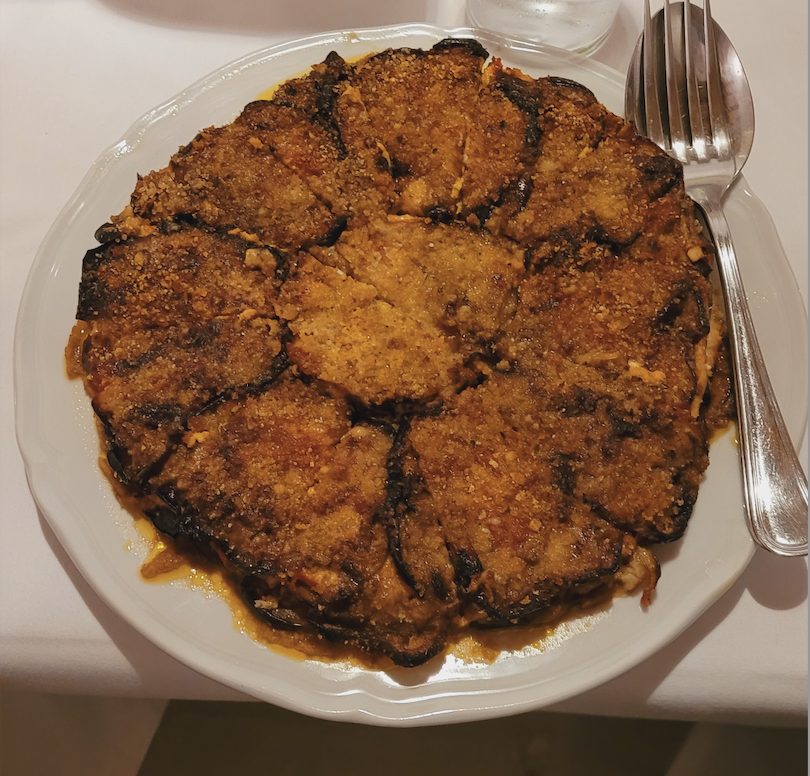
Zisola’s Parmigiana di Pesce Spada

A visit to Zisola will surely include a walk through one of Sicily’s great vineyard blocks followed by a tasting of highest calibre wines. A word of encouragement will say that three dishes might also show up on the table. Parmigiana di Pesce Spada, Penne con Finnochietto and Gelo di Limone. Should you be so lucky, karma would not be a b@%&h. Karma would be calm, neutral, reasonable and generous.

Zisola Azisa Grillo Sicilia DOC 2024

Zisola is not a place where there is a tradition for white wine and there is just one hectare of grillo planted. The name is an extension from Azisa which can translate as “beautiful.” A small percentage is fermented on skins for 36 hours, “to increase body” says Filippo Mazzei. Balances well with the freshness and waxy-aerosol style for a white that screams citrus with a combination of lemon and especially clementine. Surely owing to the plethora of fruit trees growing about the vines. A rarity for Zisola, not only Sicilia and truly a saisfying wine. Drink 2025-2026.   Tasted May 2025

Mazzei Zisola Bianco Contrada Zisola 2023, Terre Siciliane IGT

The most unique of the Zisola wines is this white catarratto made like a red, fermented on skins for three months in “cocciopesto” (as opposed to calling it what we know as amphora), a medium specific to the area. The third vintage for a sku started with the purchase of the vessels in 2021 and each are completely different, a matter of happenstance and not conscious changes or alterations. The 2023 is bloody delicious, suggestively salty, in delivery of an agreed upon “guarantee” of verticality, crazy complexity and something peculiar. Hard to describe and yet also a factor of Alberello (bush) vine training. The grillo is so very clementine but catarratto is more lemon, pink grapefruit and a finishing kiss of almond. Aging should bring about real curious transformations. Drink 2025-2029.   Tasted May 2025

Mazzei Zisola Bianco Contrada Zisola 2022, Terre Siciliane IGT

A glimpse into how catarratto can begin to age and truthfully (yet also technically) nothing has yet happened. A citrus explosion, lemon first and last with great freshness and intensity. Clean and though it may be a new breed of Noto white wine it already shows an ensconced maturity with a precocious character belying its years.  Last tasted May 2025

The second vintage of a 100 percent catarratto from plants that went in back in 2015 on white calcareous soils. Only bush vines and at first made into a blend with grillo. The change was made to do some skin contact and aging in amphora. Really that simple and that is the advantage, no overdoing or distraction in trying to impress. But this does just that, with vibrancy and succulence. Really taut, lemon tight, nearly but not quite piercing. Will change after three years and get honeyed. Reminds of really young Hunter valley sémillon. Top echelon decisions and so bravo Filippo Mazzei and team. Drink 2024-2028.  Tasted May 2024

Zisola Sicilia Noto Rosso DOC 2022

The flagship, calling and business card from 80 percent of Zisiola’s 25 planted hectares, a nero d’avola made in the freshest of Sicilian styles. Clocks in at 12.5 percent, picked early (September 8th) for brightness and well-captured high(ish) acidity. You can feel a bit of wood (from one-third new) and there is no doubt that 20 years into this Mazzei tenure what now matters has been figured out to make nero in the way it should be made. Climbs to the current peak and while better wines are sure to come, this 2022 hits the proverbial and varietal nail on the head.  Last tasted May 2025

Zisola is a project for Filippo Mazzei that began with a 700 km drive around Sicily accompanied by Diego and Alessio Planeta. Noto was chosen because of the biodiversity of the flora, to Filippo not unlike Tuscany. He also fell in love with the old Baroque town and could see a comparison between nero d’avola and sangiovese. “The decision was made based on a feeling.” The 2022 is so much fresher than the nero of 15 years ago, not to mention the balance accrued by way of alberello trained vines. Open up the dictionary and here it is. Drink 2024-2027.  Tasted May 2024

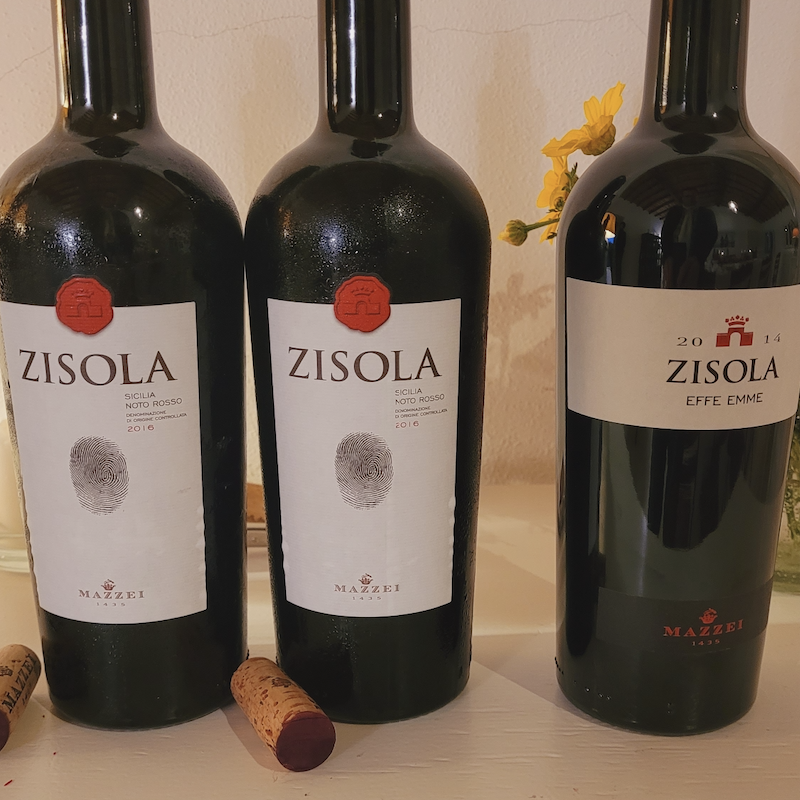
Mazzei Zisola Sicilia DOC Noto Rosso 2016

Seven years later and keep in mind that Zisola is the nero d’Avola made in the largest quantity and not the Rosso destined for extended aging. But in can and 2016 is a perfect example of potential. The lustre and energy are waning though there is little secondary character, just now softening with amiable pleasantries on offer.  Last tasted May 2025

Tasted with Filippo Mazzei in Palermo, Noto Rosso is nero d’avola from the Cantina in Sicily owned and operated by the Castellina in Chianti estate that produces Fonterutoli. A stainless ferment is followed by 50 per cent aging in stainless and 50 in 2nd and 3rd passage oak barrels, It’s a perfectly rich and plummy nero with great red liquorice tang and a distinction to celebrate pure, honest commerce. Very nero, very Noto. Drink 2018-2021.  Tasted May 2018
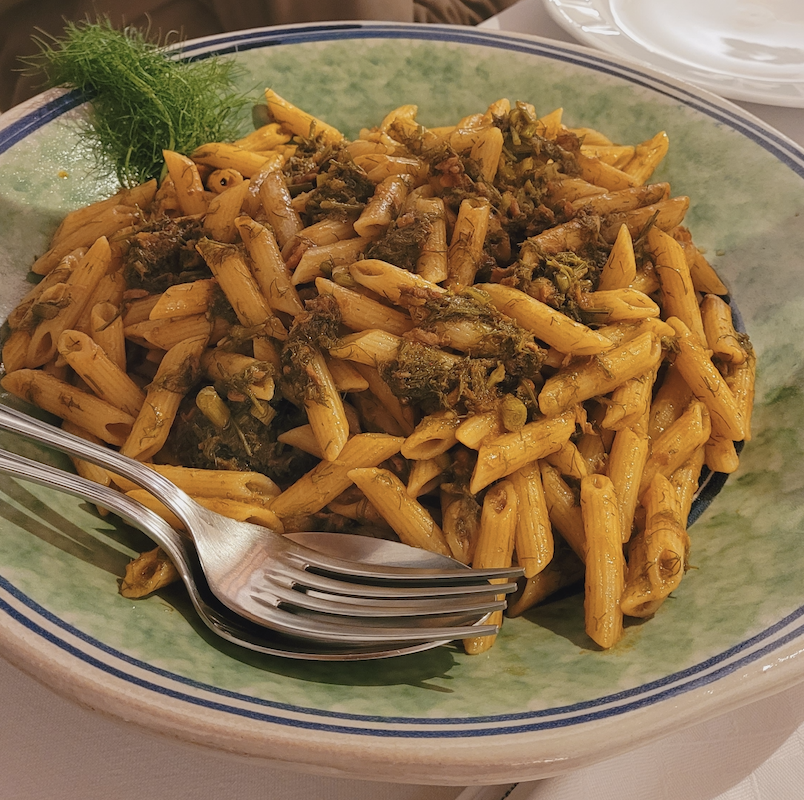
Zisola’s Penne con Finnochietto

Zisola Effe Emme Petit Verdot Sicilia DOC 2021

Effe Emme is varietal petit verdot from just one hectare planted, the album rock radio red of Zisola and monogram for Filippo Mazzei. He might prefer to see this PV stitched as if by tailored cloth but the spicy aromas, exotic bouquet and volatility suggested frankly indicate something more progressively oriented. The wood is generously, suggestively and importunely employed to exaggerate notes for extended play. Requires some further aging to settle the barrel and finish the score.  Last tasted May 2025

Varietal petit verdot planted in 2004, only 1.5 hectares, just about at the very beginning of Zisola. Incredibly chalky to say that it really speaks for the calcaire but time has come to effect changed so that the vines have come into balance. As petit verdot Effe Emme is not as dark and concentrated as it once was. Really showing its colours, what it is, a child of limestone soils. “Effe Emme,” F.M., long-play radio, well-spoken, one who tells things as they are, Filippo Mazzei. Drink 2024-2027.   Tasted May 2024

Zisola Effe Emme Petit Verdot Sicilia DOC 2014

Second look ten-plus years forward for petit verdot that would have come off of not yet 10 year-old vines at Zisola. Showing most of its age, a smoky varietal red with truffle and a held reserve of concentration and persistent local Balsamico. Violet aromas as well, they are the beauty of perfume while the wine drifts into liquid chalkiness. On the decline but interest still holds and will do so for another 12-18 months.  Last tasted May 2025

A 100 per cent petit verdot, 4,000 bottles made, big structure and at 15 per cent a massive wine. Needed to be held back an extra year and still needs two more years in bottle to soften, release and re-integrate. Big boned, spicy, wood massive and intense. Hematic with welling black fruit. Drink 2020-2027.  Tasted May 2018
Zisola Doppiozeta Sicilia Noto Rosso DOC 2021

Doppiozeta is at least twice as concentrated and focused as compared to the nero d’Avola “classico,” Cru in origin on the more calcareous soils of the estate, picked just two days after the bulk of the nero and yet acidity is not insignificantly higher. Owing to the limestone but also 50m higher in elevation which surely brings just that extra amount of wind. The style of Doppiozeta is ever evolving and this 2021 marks a height of freshness and drinkability, but with a seriousness and focus to share space with top quality nerello mascalese, sangiovese and nebbiolo. Would give the ’21 another year to realize its true potential.  Last tasted May 2025

Yes another fine Doppiozeta nero d’avola from the Mazzei family and their Sicilian estate. Crispy exterior, chewy interior, spice and herbs as accents, salt and pepper seasoning, chalky tannic, reasoned and knowably fine. Consistently well raised, made and delivered, signed and sealed as a really good wine. The freshness is always there and the acidity so ideally suited to grape and style. Drink 2025-2030.  Tasted May 2024

Zisola Doppiozeta Sicilia Noto Rosso DOC 2017

Many hot vintages have powered through Italy as of late, including 2017 and yet Sicily was not that way, not in Noto, not anywhere. And so there is a fine and persistent freshness to Doppiozeta for ’17. A seductive sweetness from a time when the nero d’Avola was made in a more extracted, concentrated and barrel-aged way. Nevertheless in 2025 the wine is showing with distinction. Drink 2025-2027.  Tasted May 2025

Mazzei Zisola Achilles 2021, Terre Siciliane IGP

Just one hectare of syrah as part of the original plantings at Zisola for one of three ultra distinct varietal reds. The most hematic meets sanguine is in a way the closest cousin to all that famous Mazzei sangiovese made way up yonder in Tuscany. In other words the syrah here seems to take on a mineral-elemental feel as notable as any red wine in Sicily. Deeply serious, concentrated and in 2021 also structured, namely because of the season. Also uniquely southeastern Sicilian and yes a few years having passed in bottle has resulted in some movement, though barrel and secondary notes are both just barely detectable. Drink 2026-2031.  Tasted May 2025
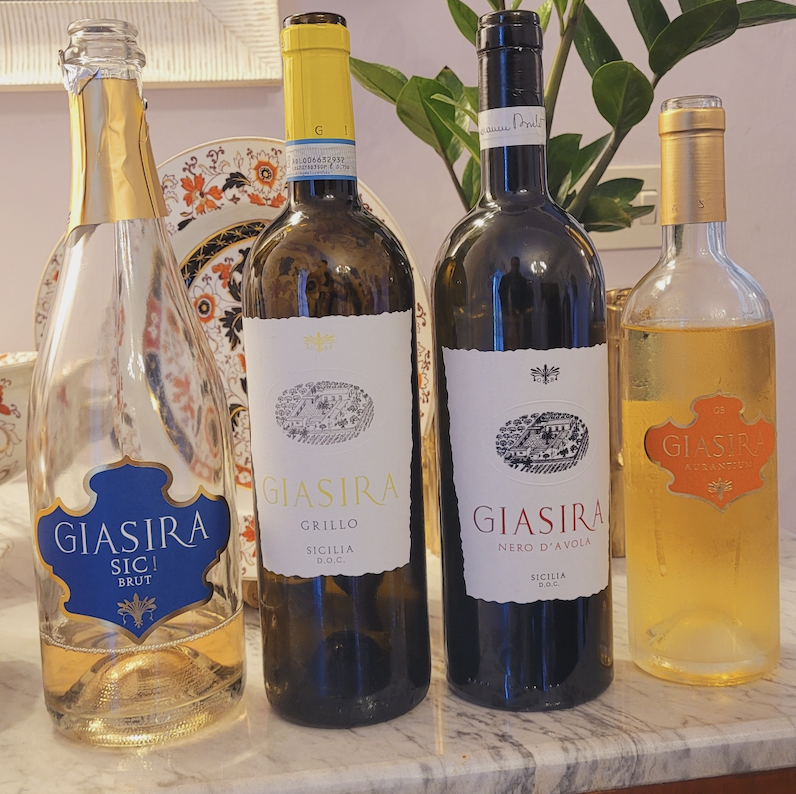
La Giasira

La Giasira is Piedmontese Giovanni Boroli and his wife Veneta Isabella dating back to to 2004. The estate is 130 hectares with 13.5 under vines, of grillo, moscato, catarratto, nero d’Avola and nerello mascalese. They produce 60,000-70,000 bottles annually from vines grwoing in 10-30 cm of soil atop pure limestone bedrock. Tilling happens maybe once a year on this site at 250m above the Telaro Valley (within the Noto Valley), 20 km to both Noto and Modica, equidistant between the Ionian Sea and Sicilian Channel.

La Giasira Bianco 2024, Terre Siciliane IGT

A blend of chardonnay, moscato bianco and catarratto, picked earlier than just about ever, begun in the last week of July. From serious calcareous soils for just 5,000 bottles of Noto area clarity fermented and aged in just Inox tank. Aromatic, all in citrus and freshness captured despite or maybe thanks to the early pick. Bit of almond both floral and raw, the scents of roses and blossoms from clean start to salty finish. Drink 2025-2027.  Tasted May 2025

La Giasira Grillo Sicilia DOC 2023

The grillo stands apart and alone in style when tasted side by each with the catarratto and bianco blend. Here the focus is all fruit, lemon and stone fruit, ripe and fleshy, juices running for a very full and refreshing expression. A capture of southeastern Sicilian sunshine, many heat days accumulating in this juicy grillo. Pour it cold and drink it long. Drink 2025-2027.  Tasted May 2025

La Giasira Keration 2023, Terre Siciliane IGT

Varietal catarratto made with specifically catarratto lucido, just 8.000 bottles (of 60,000-ish total) from the thin soils above limestone bedrock at Giasara. Just stainless steel for six months and three in bottle ahead of release. Noticeably different to the Bianco blend, a decrease in floral citrus and jasmine, an increase in fruit (including the smell of spun sugar) and accompanying viscosity. Immediate level of gratification from a wine with luxe mouthfeel. Drink 2025-2028.  Tasted May 2025

La Giasira Keration 2022, Terre Siciliane IGT

Tasted side by side with the 2023 and the consistency is more than obvious, namely by mouthfeel and viscous feel. A citrus yet reminding of bergamot in curd or granita form. Really persistent white, lingering for a minute with a moment of almond at the finish. More sapid than salty, even more so than the still truly fresh 2023. Drink 2025-2027.  Tasted May 2025

La Giasira Rosato 2024, Terre Siciliane IGT

Made with 100 percent nerello mascalese from the early pick of vines planted back in 2006. If it smells and tastes like mascalese than it must be mascalese, of roses and tart red berries, here salted and finishing at rhubarb. Rosé that quenches by doing what it should for a simple and specific purpose. Ends on a sapid botanical note. Drink 2025-2027.  Tasted May 2025
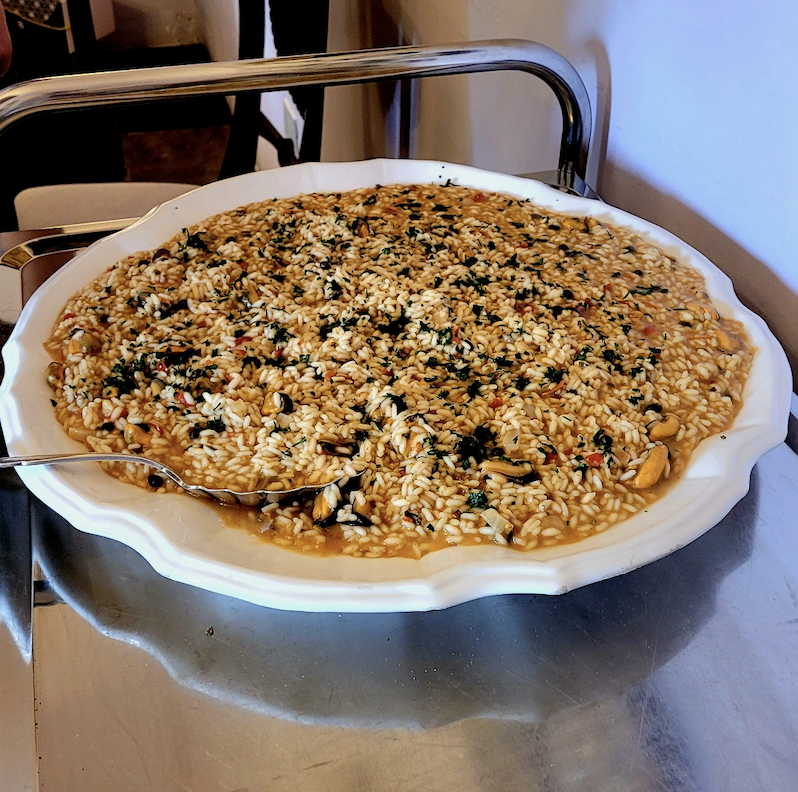
Unbelievable Risotto con Pesce at La Giasira

La Giasira Morhum 2023, Terre Siciliane IGT

Morhum is 100 percent nerello msacalese off of hybrid Cordone Speronato/Guyot trellised vines planted in 2006, aged nine months in (25 hL) botte grande. Several intensities noted, first floral and then an implosive tart palate style with more than impressive controlling acidity. Surely picked early extending forth to fineness and a finesse wound up in the tension. Tannins are fine and also wound tight for a light yet currently aggressive nerello mascalese. Drink 2026-2029.  Tasted May 2025

La Giasira Nero d’Avola Sicilia DOC 2021

One of ten small production skus, here at 6,000 bottles of nero d’Avola raised on Cordone Speronato trellising and the serious calcareous geology at Giasira. Spends 12 months in botte grande, followed by six months in bottle ahead of release. Current vintage and so six months is more like 30 to mature a tannic nero d’avola ready and drinking in balance, just as its 13.5 percent alcohol frame would want. Forget the big, wooded and thick nero you may know and see the nebbiolo meets pinot noir forest for the Noto nero trees. The conceptual origin is kind of obvious, that being Piemonte so that here you might almost believe this to be a cool climate red. For Giasira the pick is later than most of the rest of the farm, in the last 10 days of September. There is some verdancy but it works and in all the right ways, finishing with good and proper tension. Drink 2025-2028.  Tasted May 2025

La Giasira Nero d’Avola Sicilia DOC 2018

More than a notable amount of persistent freshness yet now a whole lot of exotic spice going on. Getting cardamom and cinnamon (but no clove) from a nero d’avola now at the epitome of “morbido,” in this case smooth as opposed to soft. The nose shows development if not age in terms of oxidation or secondary character. More maturity on the palate with dried bokser pod and carob. In other words classic for nero d’Avola from a warm climate made just six years ago with more wood and concentration, though nothing like some other very wooded peer examples. Drink 2025-2027.  Tasted May 2025

La Giasira SIC! Spumante Metodo Classico Brut Rosato, Terre Siciliane IGT

Just nerello mascalese aged 24 months and finished below Brut with what feels like just a few grams of residual sugar. Quenching and not so serious while in delivery of great satisfaction. The clarity is palpable for such a clean sparkling wine. Taste this nerello bubble with a risotto blessed with fresh mussels and capers for a true gustatory experience. Drink 2025-2027.  Tasted May 2025

La Giasira Passito di Noto Sicilia DOC 2022

A passito from grillo not produced in every vintage, citrus zesty and aerosol though teasingly dry on the nose before unveiling its sweetness and tang on the palate. Lemon gelée with the bite of granita and truth be told the limestone of Giasira’s soils surely effect the dessert wine as much as the dry whites and reds. Nice botanical edgy finish too. Drink 2025-2030.  Tasted May 2025
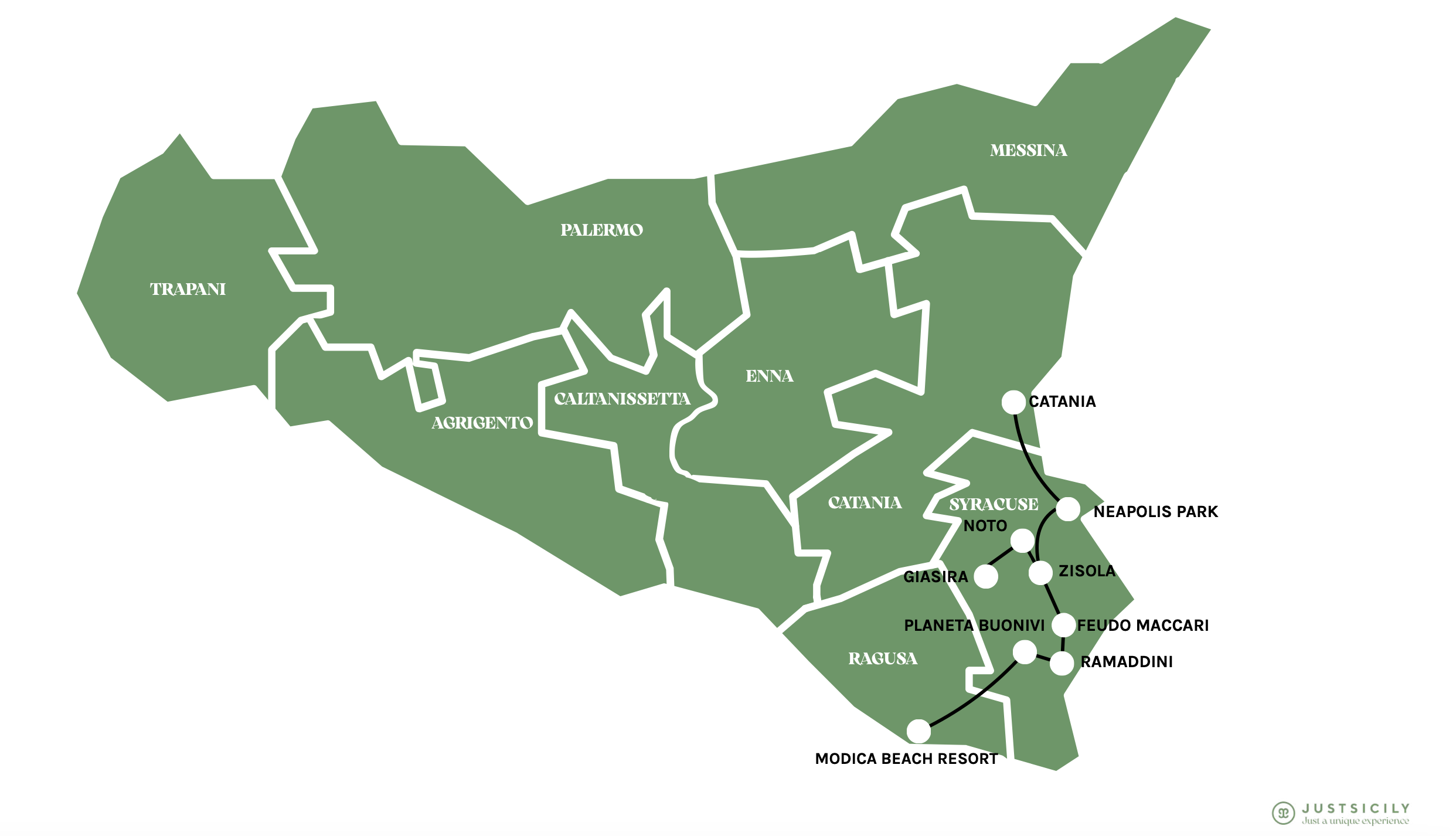
Sicilia en Primeur Enotour 11 – Noto

Ramaddini Perla Marina Vino Spumante Brut, Terre Siciliane Bianco IGT

Charmat method sparkling wine made with the local moscato di noto, soup sugary, neutral and vague selvatica meets macchia aromas. Sweet but in a typical Brut way and number with more than vague bitters at the finish.  Tasted May 2025

Ramaddini Grillo Nassa Sicilia DOC 2024

Nassa, a fishing reference for the catching of fish (owing to the nearby seaside), a 100 percent grillo grown in the Rammadini Contrada up in the hills four kilometres away from the cantina and five from the sea at Marzamemi. Lemon through and through, pith and seeds included for a bitter tonic of grillo, yellow and also green. High vigour and yields make for an insipid, vapid and diluted white wine.  Tasted May 2025

Ramaddini QuattroVenti 2024, Terre Siciliane Bianco IGT

A blend of chardonnay and catarratto aged in wood and the notes waft out immediately, like smoke from a chimney. The aromas are problematic, as a baked potato which indicates the challenge of diethyl acetate. The palate does not improve much and the vanilla overpowers the fruit.  Tasted May 2025

Ramaddini Nero d’Avola Sicilia DOC Noto Nere 2022

A varietal nero d’Avola aged in 70 percent steel and (30) barriques as smoky and vanilla-toasty as the whites. Surely some residual sugar fills in the holes and mellows the greenness in the wine. Waxy, sappy and syrupy.  Tasted May 2025

Team JustSicily

Ramaddini Syrah Sicilia DOC Noto Nere 2022

Purely syrah as smoky and toasted as the nero d’Avola to a point where distinguishing one from the other is like trying to identify the difference between identical twins Richard and Geoff Saunders back in high school. I wonder if the syrah can write nero d’avola’s Math exam and nero can go sub in for a date with syrah’s girlfriend? But seriously there is nothing to distinguish this as Sicilian syrah, nor is their any charm, or joy to be found.  Tasted May 2025

Ramaddini Patrono Nero d’Avola Riserva Sicilia DOC 2021

Longer wood aging and the signature varietal nero d’avola that takes Rammadini’s work to the next level. Not necessarily a wine that speaks to more attentive farming but instead to more attention in the cellar. The philosophy concentrates on how the wines are made and aged with the most focus on Patrono and it shows. The notes of vanilla, lavender, red berry and white chocolate shake exert themselves with impunity. You can age this for a few years and see it mellow into a soft, creamy, thickened and emulsified red. Drink 2026-2028.  Tasted May 2025

Ramaddini Al Hamen Passito di Noto Sicilia DOC

Strange mix of marmalade and diesel in a moscato passito as botanical as it is gaseous. If apricot was a metal and orange slices were urinal pucks. Flawed.Can’t fathom what happened here.  Tasted May 2025

Feudo Maccari

Feudo Maccari

The Sicilian exploration of Tuscany’s Moretti family of Tenuta Sette Ponti. As with several other Noto area estates, Maccari was set up 25 years ago  on 200 hectares with 65 planted to vines, most trained to Alberello (medio).  Much like the others the location is heavily influenced by limestone soils set halfway between the Ionian and Mediterranean seas. There are predominantly nero d’Avola and grillo, but also seven hectares of syrah. The company also farms 11 hectares on L’Etna (called Etnae), namely in the Contrada Santo Spirito.

Feudo Maccari Anima Lucente Etna Bianco DOC Contrada Santo Spirito 2024

Anima Lucente is the only Maccari Etna Bianco, made with 85 percent carricante and (15) minella grown in a 700m, 60-plus year-old “garden vineyard,” on Passopisciaro bush vines. Natural ferment, half in steel and half in ”blanched” second passage French wood. Just bottled a few weeks ago and already the wood is easily integrated, subtly specialized without so much as a toasty, vanillin or buttery trace. Racy Etna Bianco from head to tail, judged, interpreted and translated as a garden blend should. Quite edenic for the ilk and of dreams realized. Not the most complex, nor does it need to be but it’s so hard not to be seduced through to the mineral-metal finish. 10,000 bottles produced. Drink 2025-2029.  Tasted May 2025

Feudo Maccari Anima Vulcano Etna Rosso DOC Contrada Santo Spirito 2022

Red counterpart to the white Anima Lucente, moving from luminescent to charcoal volcanic in Rosso that spends only a reasonable and amply fortifying eight months time in barrel. Perfectly professional, seasoned, stylized and straight up the middle road taken for the DOC and more importantly but also specifically the contrada of Santo Spirito. Speaks in the clearest double “S” vernacular, explains and delivers just what is expected and frankly wanted from a contrada-specified Etna Rosso. Acids are in synch with the rusty grit split between fresh and dried elements. Stamp of guarantee. 3,000 bottles. Drink 2025-2029.  Tasted May 2025

Feudo Maccari Animardente Etna Rosso DOC Contrada Santo Spirito 2022

Slightly higher elevation also from the Passopisciaro contrada of Santo Spirito, here at 750m and same vine age in and around 60 years. This time the qualifying suffix “ardente” refers to passion or a burning for something, that surely being the raising of impressive Rosso from out of the Etna lava stone flows. The reference also elicits the heat and colour of the magma fused with the current orange-hued basalt. A more serious Etna Rosso of depth and tannic intensity, doubly structured and needing time. The botanical feels mixed with structural elements more than grip the palate, hold on tight and show no immediate sign of letting go. Give this two more years. 3,000 bottles. Drink 2027-2032.  Tasted May 2025

Feudo Maccari Animantica Etna Rosso DOC Contrada Santo Spirito 2022

From the owners of Tuscany’s Tenuta Sette Ponti. Animantica, a compounded abbreviation of anima and mantica, i.e. “soul and divination.” A spiritual combination for the smallest of Etna Rosso productions from Contrada Santo Spirito. Exhibits the freshness and accessibility of Anima Vulcano juxtaposed against the tannic frame and freight of Animardente but the expression is subtle, restrained and without the ardent flaunt of necessity. The vines here are 100-plus years pre-phylloxera grown in the “garden vineyard,” inclusive of some (white) minella. Rosso as graceful as any on the Etna and therefore fully qualifying as mountain wine. The tannins are suave and fluid to see a “divinazione” of 10 years or more. Just 800 bottles. Drink 2027-2036.  Tasted May 2025
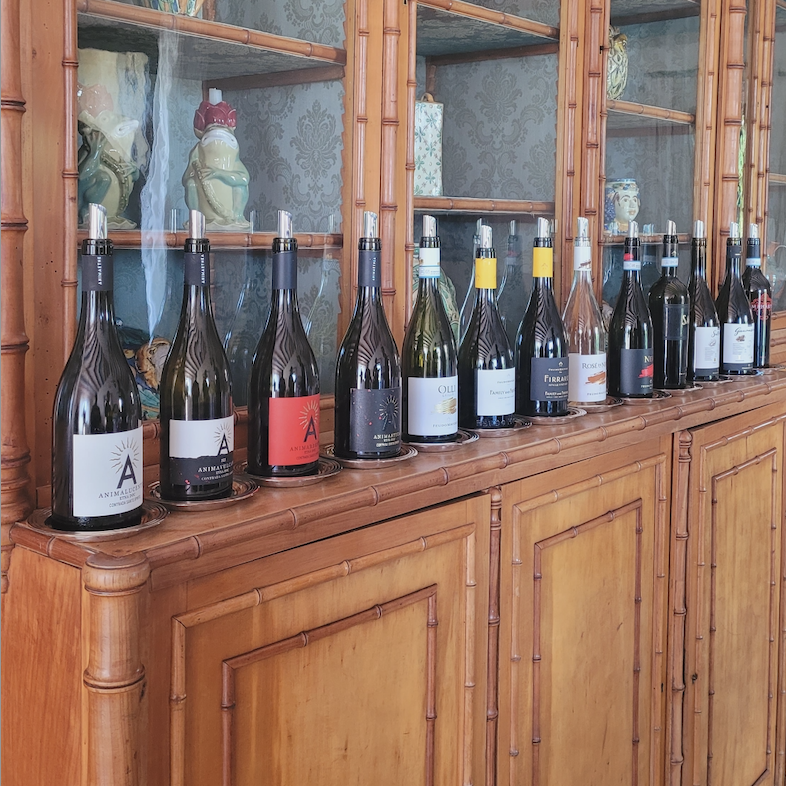
Feudo Maccari Grillo Sicilia DOC Olli 2024

Olli, part of grillo read backwards and a local name for the grape. A reminder how it arrived as a cross between catarratto and zibibbo, developed by Baron Antonio Mendola of Favara. Clean, fresh, ripe and accessible to all, for all the correct reasons and any time at all. Yellow fruit and flowers, some sapidity and the easiest drinking white anywhere from Sicily. Vines averaging 20 years bring the knowhow and concentration. Drink 2025-2026.  Tasted May 2025

Feudo Maccari Family and Friends 2023, Terre Siciliane Bianco IGP

The wine once made for, you guessed it, family and friends that first became a commercial label with the 2012 vintage. Vineyard is now more than 20 years old with grillo vines growing in sand and limestone. The label advocates “only the best grapes” and the amenability meets style of this varietal wine suggests that to be the honest truth. A lemon intensity in concentration and bursting fleshy segments are juicing through the entirety of the wine. Again a sapid (as opposed to salty) element, not quite botany or “macchia” but savoury nonetheless. Hides the 14.5 percent alcohol frame with ease. Drink 2025-2027.  Tasted May 2025

Feudo Maccari Vigna Firraru Family and Friends 2023, Terre Siciliane Bianco IGP

The most important grillo comes from the black-soiled clay vineyard above the cantina, a.k.a. Fabbro, from Sicilian dialect the name Firraru describes the colour of that terroir. Alberello vines are 20 years of age (as with all the grillo plantings) and now having come into their zone. A ferric element emerges as per the soil to separate this grillo from the other Family and Friends varietal white. Even more sapid, metallic surely and length increases. The French wood, richness and generous alcohol all impress while doing their part in well rehearsed integration. Drink 2025-2028.  Tasted May 2025

Feudo Maccari Rosé di Neré Sicilia DOC 2024

More than obviously stuck to Provençal style guns with a Rosato made with nero d’Avola softly hued, pale and simple. Just two hours of skin contact plus five months of aging in steel. A lees effect, however soft and in restraint though consistently designed and presented with the Feudo Maccari sapidity up front. Showing some true to from nero notes, of ripe berries and sweet herbal savour. Well made and reachable for all. Drink 2025-2026.  Tasted May 2025

Feudo Maccari Sicilia DOC Neré 2022

A mix of nero d’avola vines young and old, of 10 and over 30 for the signature varietal business card of a red wine. Dusty and notable Balsamico with a local nickname for the most important variety, not only for Noto but all of Sicily. Neré is more restrained and quaffable than ever before, with crusted, skin musky fruit and high acidity. A wine to chill and spill without thinking too much on anything at all. Drink 2025-2026.  Tasted May 2025

Feudo Maccari Sicilia DOC Saia 2022

Saia comes from Arabic, a word making reference to centuries old rainwater collecting irrigation canals and the first label produced by Feudo Maccari in 2002. These are the oldest estate bush vines, now more than 30 years of age with the eyes, canes and fruit of experience. More obvious depth and layers to nero d’Avola as Saia, a treasure trove and trough filled with fruit and accompaniments in complexity. A nero adorned but also soft with some pruning of the fruit while still amply structured. Not grippy or with tension per se but in control and able to age. Drink 2025-2029.  Tasted May 2025

Feudo Maccari Nero d’Avola Sicilia DOC Sultana 2022

A single vineyard nero d’avola from white limestone soils of 20-plus years that sees 10 months in tonneaux, coming out in the 15 percent alcohol range. Just one hectare like Guarnaschelli and aromatically speaking the most mineral-elemental and therefore salty nero d’avola for Feudo Maccari. Genuine depth and ideal push-pull posit tug between fresh and dried elements with a chalky understreak that speaks to the brown skeletal soil and its limestone content. A wine made in the vineyard, as they say, exaggerating and celebrating the local Balsamico and singular savoury improvisations. “Autentico.” Just 1,000 bottles made. Drink 2026-2033.  Tasted May 2025

Feudo Maccari Nero d’Avola Sicilia DOC Guarnaschelli 2022

A single vineyard nero from black volcanic soils of some 60 years that sees 10 months in tonneaux, coming out in the 15 percent alcohol range. Just one hectare like Sultana and the terroir directs the result. Greater intensity and grip but also a converse style due to the ulterior elements that come from basalt as opposed to limestone. There is a richness to the mix of dried and fresh fruit, Balsamico and macchia, a layering that continually delivers more and more. The clarity and finesse from Guarnaschelli do well to balance and smoothen both the new wood and elevated level of alcohol. Just 1,000 bottles made. Drink 2027-2035.  Tasted May 2025

Feudo Maccari Syrah Sicilia DOC Mahâris 2022

From seven hectares of syrah, the second label produced at Feudo Maccari, first vintage 2005. The name refers to Arab watch towers along the sea coast and it is the wine “that symbolizes the meeting of different styles and cultures.” In other words syrah brought to Sicily and how it has prospered, with FM being one of the pioneers in terms of scale and time having worked with the French variety. Then again the legend of Marcus Aurelius, Syracusa and the variety have by now become one to make this one of the island’s own. The 2022 is full and wooded, seasoned to the hilt and within good reason because this is what the grape wants from Noto. Fruit and structure are tied by sweet acidity as much as they are by tannic freight. Full wine and one to impress. Drink 2026-2032.  Tasted May 2025

With Santi and Alessio Planeta in Noto

Planeta

Diego Planeta. Pioneer, visionary and a man who considered the entire island an agricultural playground where anything was possible. The Planeta family has Spanish origins and roots dating back five hundred years. Diego Planeta was the former president of the Settesoli Cooperative and founder of Planeta winery. His passing in 2020 left an irreplaceable hole but 15 cousins, including Alessio, Francesca and Santi Planeta are the beneficiaries of their uncle’s plans and legacy. Five family members run the day-to day operation and more than 200 vinicultural, viticultural, administrative and marketing artisans share in the collective vision. Today they work, farm sustainably and reap the benefits of five distinct estates but more than that they bring the fruits of these locations to the world. No other producer in Sicilia does this, not with the scope and breadth they do.

Noto is the birthplace of nero d’Avola, graced with calcareous soils like Jerez and Champagne, not really comparable to anywhere else. Noto is close to Vittoria in how the wines come to be but it’s a mobile texture, silken and with velvety tannins. The soft hills of Buonivini are blessed by soft breezes arising from the meeting of two seas, ideal for nero d’Avola and moscato, but also almonds, carobs and olives, symbolic plants of the Mediterranean location. The three vineyards are agliastro, buonvini and zuppardo on 45 hectares, acquired piece by piece, today producing the DOC wines Santa Cecilia, Moscato di Noto and Passito di Noto.
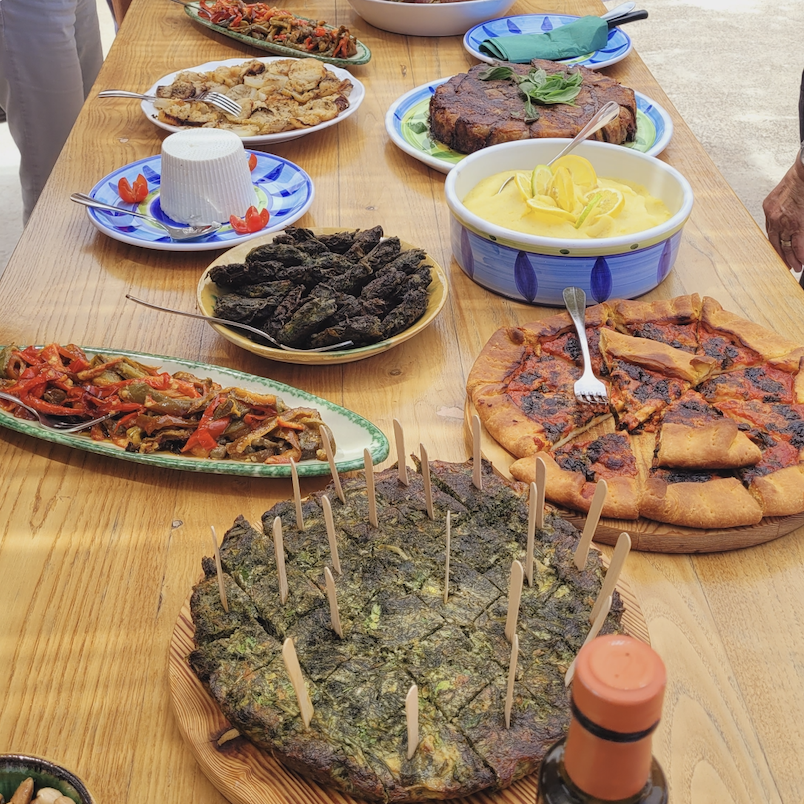
Country lunch at Planeta, Noto

Planeta Noto DOC Allemanda 2024

Always the (totally) dry moscato from Noto, white grape that has been a focus for Planeta not quite but almost since the beginning. From the Bounivini – Agliastro vineyards built of lime, soy marl and whitest of white chalk. A low production vintage because of drought and small berries though the aromatic variety translates as high and expressive as ever. Freshness and botanicals meet at the middle where citrus predominates. No questioning the quality and intensity for what must be viewed as a singular style and effect of white wine. Never searing and of a sapid notion that seems too bely the calcari, but that is exactly why this moscato works as a dry white wine. If you like top echelon dry palomino then this will induce interest along a similar line. Drink 2025-2029.  Tasted May 2025

Planeta Noto DOC Allemanda 2020

A fine Sicilian vintage with ideal climatic conditions and looking back four years you get some evolution in the way you might think about what happens with dry sémillon or riesling. Now an arriving mix of honey and petrol to compliment the concentrating mandarin and lime blossom notes. In a way it feels like a sweetness is developing but that is a faux reality because there is literally no sugar in this moscato. Testing 2020 in 2025 seems just about right – another year and things will really go secondary. Drink 2025-2027.  Tasted May 2025

In the Noto cellar with Alessio Planeta

Planeta Noto DOC Allemanda 2014

More than 10 years have passed and forget secondary because tertiary has come to town. Fully developed maturity between the honey and petrol, sapidity strong and metal savoury, everything having coalesced into a finished and now finishing wine. This is where moscato will go, here with distinction because of how clean and competent it bagged character all those years ago. Drink 2025.  Tasted May 2025

Planeta Nero d’Avola Noto DOC Controdanza 2021

The first vintage of this specialized dance in Noto was 2016 and here five years later we begin to see the balance and personality really showing forth. Also from where and how the heavy presence of white limestone grabs ahold of nero d’Avola’s soul and hauls it straight down to the ground. All the carob and some liquorice define the flavours of Controdanza for a full and satisfying experience, replete with fine acidity and elastic intensity. Drink 2025-2028.  Tasted May 2025
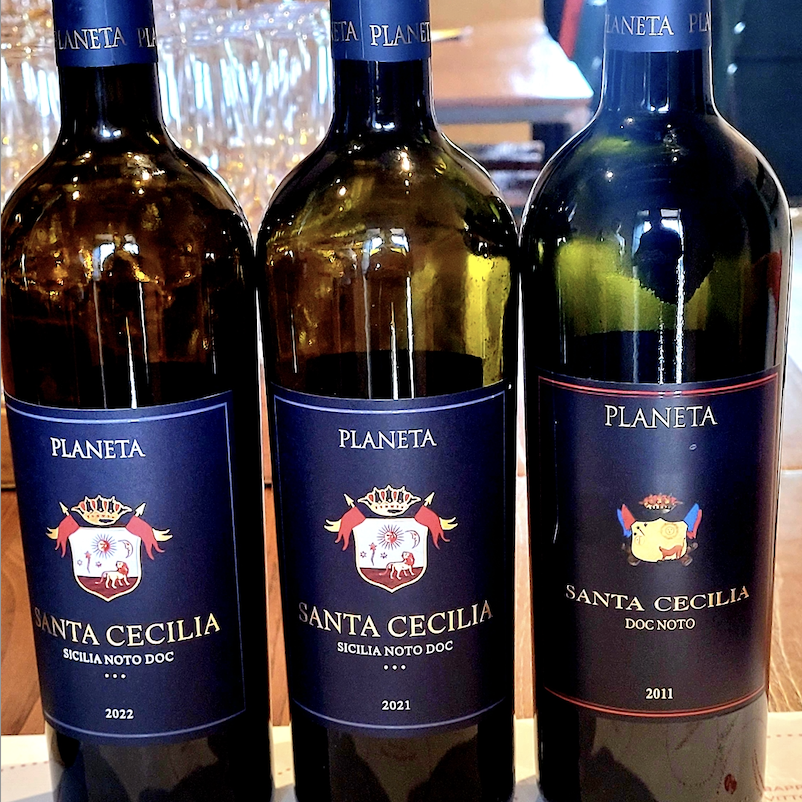
Planeta Santa Cecilia Noto DOC 2022

A preview yet to be released but a finished wine bottled a year ago. The first vintage (as a reminder) was 1997 and 50 percent is aged (12 months) in new wood, the rest of the nero d’Avola in used barrel. Two parcels of the Zuppardo and Agliastro they are, both contributing to the mille-feuille layers that deliver wave after wave of varietal flavour, character and soul. They are the most importantly identified white (calcareous) soils chosen for this flagship varietal red in the Planeta world. Santa Cecilia owns a chalkiness in its tannic profile that feels singular, non-inimitable and willing to take 10-15 years to fully transform. The 2022 is a prime example of a latest vintage produced serving as its best. Drink 2027-2035.  Tasted May 2025

Planeta Santa Cecilia Noto DOC 2021

Not much movement as of yet, save for a moment of carob, naturally honeyed with caramel and earthiness. Speaks to ripeness as much as maturity. The acids from 2021 are at the fore right now, loudest of clamour and opening the window for clarity and the complex fruit component coming into focus. Yes there is a minor feeling off secondary character but just in infancy to suggest three more years in this stage.  Last tasted May 2025

Such a fine iteration of nero d’avola as Santa Cecilia, a 2021 more mature and open than before but is that not what it should be? Fruit so naturally curated, sweet and generous to speak of a great potential and long future. Fine acidity as well while also necessary and yet as the wine sits on the palate those credible and knowable quality of nero tannins remind of Cecilia’s past. Anyway this is both handsome and beautiful, vulnerable and strong. Fluid and confident, loving and powerful, with a spoonful of Noto nourishment to last a very good long time. Drink 2025-2034.  Tasted May 2024

Planeta Santa Cecilia Noto DOC 2011

Now well into secondary with plenty of tertiary having come to take over the personality of Santa Cecilia 2011. Still there is some freshness of fruit and especially how acidity affects the development of original elements transforming into later life pleasure. Now showing as a perfectly gorgeous 13-14 year-old nero d’Avola from a second stage understanding within the overall Planeta idiom.  Last tasted May 2025

Santa Cecilia from 2011 is a special nero d’avola, balanced in silent but sweetly deadly acquiescence of Noto’s white chalky soils. Her tannins are abundant and smooth, running in one direction and so it’s a wonder how un-evolved and yet so involved this nero d’avola is equipped to believe about and with great kindred spirit with itself. That it presents this youthful and yet to advance is a thing magical and sincere. Inner strength is one thing but outward beauty is the real deal. Or is it the other way around? Either way they combine for one of Cecilia’s greatest acuity and remainder of structure. Drink 2018-2026.  Tasted May 2018 and April 2022
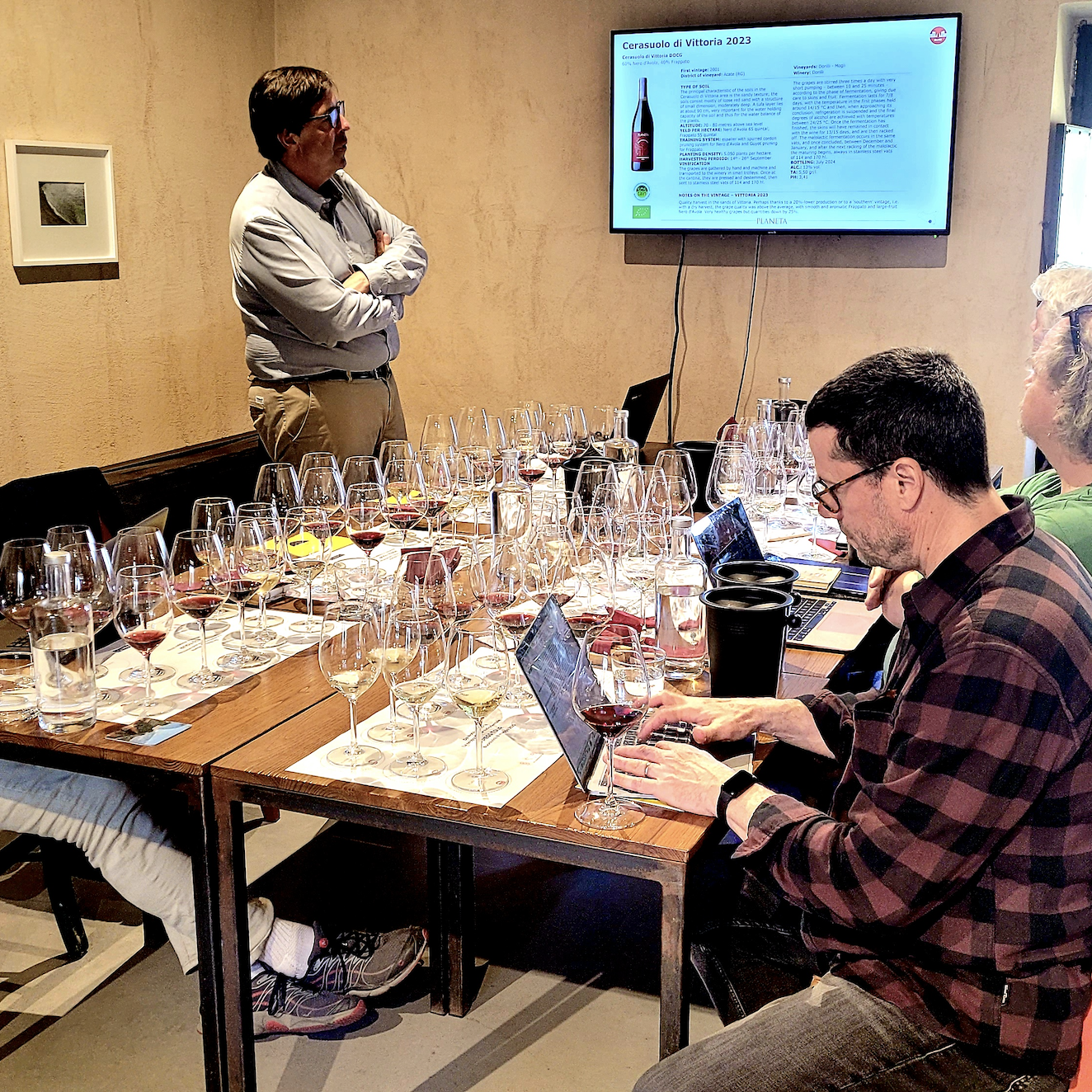
Tasting at Planeta, Noto


Planeta Frappato Vittoria DOC 2024

Great freshness and red berry fruit define frappato for Vittoria, “a grape that is magic and if you plant it outside of Vittoria it is not so interesting,” explains Alessio Planeta. “In my opinion.” The aromas and flavours of the grape are expertly preserved, here bursting and the herbal or savoury aspect is so much sweeter from Vittoria, noting like basil or chervil. What matters is the soil’s origin, that being marine and when the grape is frappato the handling simplifies so that the freshness, fleshiness and simple beauty is exulted. This may be simple but it’s also brilliant. Low alcohol (12.5 percent) and above average pH matched by just below tart acidity to result in fragrance and balance. Drink 2025-2028.  Tasted May 2025

Planeta Frappato Vittoria DOC 2023

The first vintage of Planeta’s Cerasuolo Di Vittoria was 2001 from the area of Acate and vineyards of Dorilli and Mogli. Acidity just a bit higher than varietal frappato and pH conversely lesser. The effect of nero d’avola leads to this wine’s balance between fresh fruit and linear structure. Quantity was down 20-ish percent in 2023 and concentration feels elevated, corresponding to healthier levels of quality and tannic structure. Not always a 60-40 nero d’avola to frappato but that does seem to be the comfort zone, although Alessio Planeta is not adverse to a much higher number for the nero. I mean this is just perfectly balanced, juicier than ever and subtly structured for a five-plus year run. Drink 2025-2030.  Tasted May 2025

Planeta Cerasuolo di Vittoria Classico DOCG Dorilli 2022

Dorilli is the single-vineyard nero d’Avola residing at the pinnacle of Cerasuolo for Planeta. Brighter and upwardly airy to ethereal than ever before, here with a 10 percent increase of the nero d’Avola from the classico Cerasuolo and yet alcohol, acidity and pH are almost always aligned within a tightly defined spectrum. This regardless of how much of each grape are employed which tells us that soils and place, clay-limestone soil and Vittoria are the greatest determining factors for results. That being lithe, fresh and frankly also exciting. Cru Beaujolais lovers must not turn away from Cerasuolo, not when it is made in this style. Drink 2026-2032.  Tasted May 2025
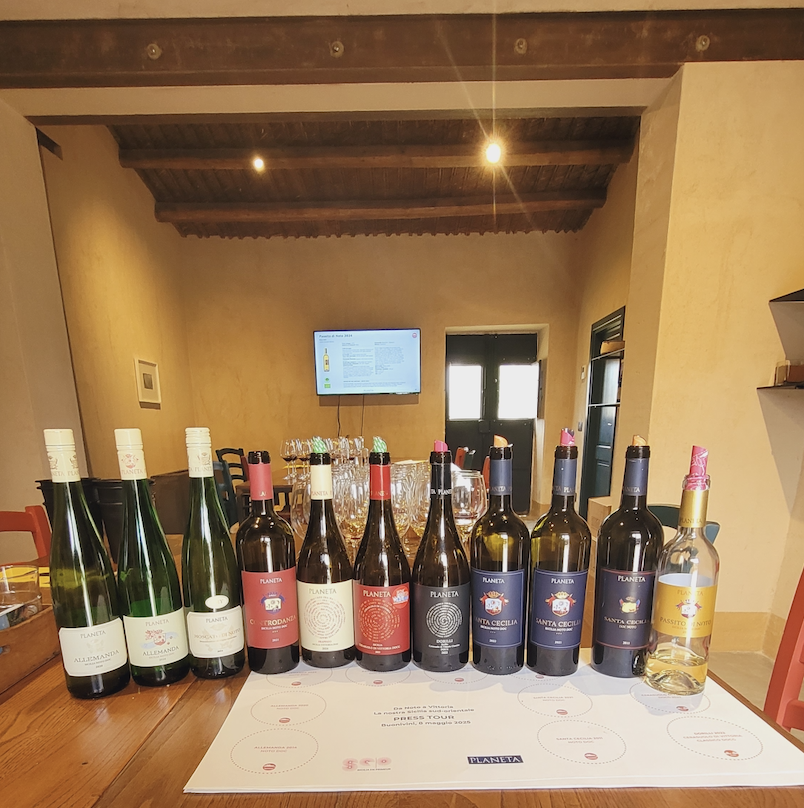
Planeta Passito di Noto DOC 2024

From Noto’s Buonavini winery/vineyard and also that of Agliastro and their whitest of white limestone terroir. Lemon and mandarin incarnate in any way your imagination can conjure, from curd through gelée to granita. Pure and focused, clean and all about the fruit. The best thing you could do is put a glass of this Passito next to a plate of Sicily’s finest master pastries made by Corrado Assenza at Café Sicilia. Drink 2025-2032.  Tasted May 2025

Planeta Nocera Sicilia DOC 2023

A world unto itself with few peers making the yeoman work of nocera production and yet this grape holds plenty of potential. It may be ancient and perceived as rustic but in the hands of Planeta it’s tamed and gifted as something easy, satisfying and quite complex. You can drink this with ease and without tension, its fruit more musky and leathery than say frappato but with nary a meant of drying, tough chew or earthiness. This 2024 is youthful and got right for a varietal teaching moment that also delivers a true sense of pleasure matched by pace.  Last tasted May 2025

One of the very few pleasantly made varietal nocera on the island and the only one presented here at the ’24 Anteprima. Surely found to exist along similar lines to nero d’Avola, with a touch more rusticity, also chewy liquorice and leathery fruit character. The 2023 is a good if not high acid nor rather tannic vintage, assembled and delivered for earlier drinking than some. Drink 2024-2026.  Tasted May 2024
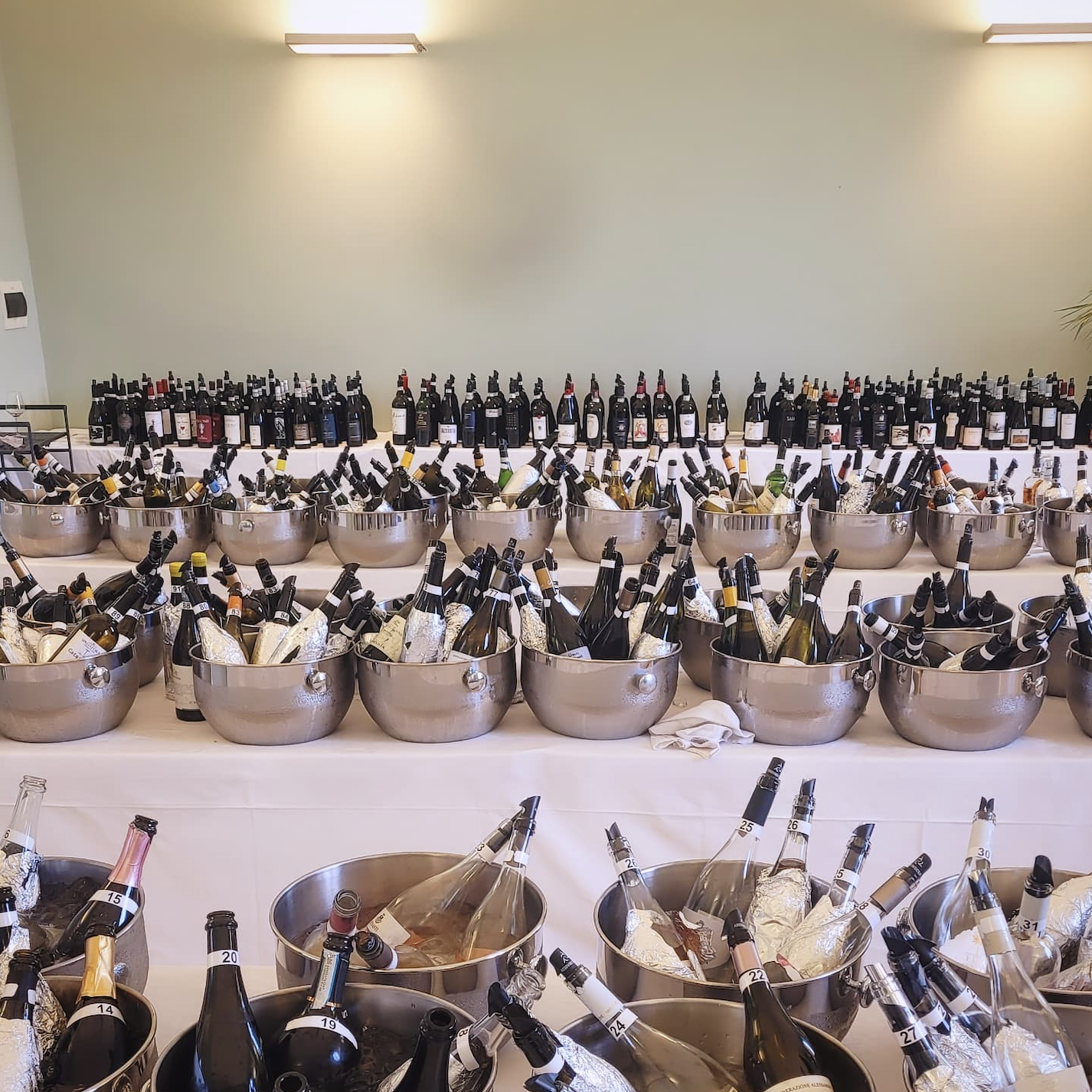
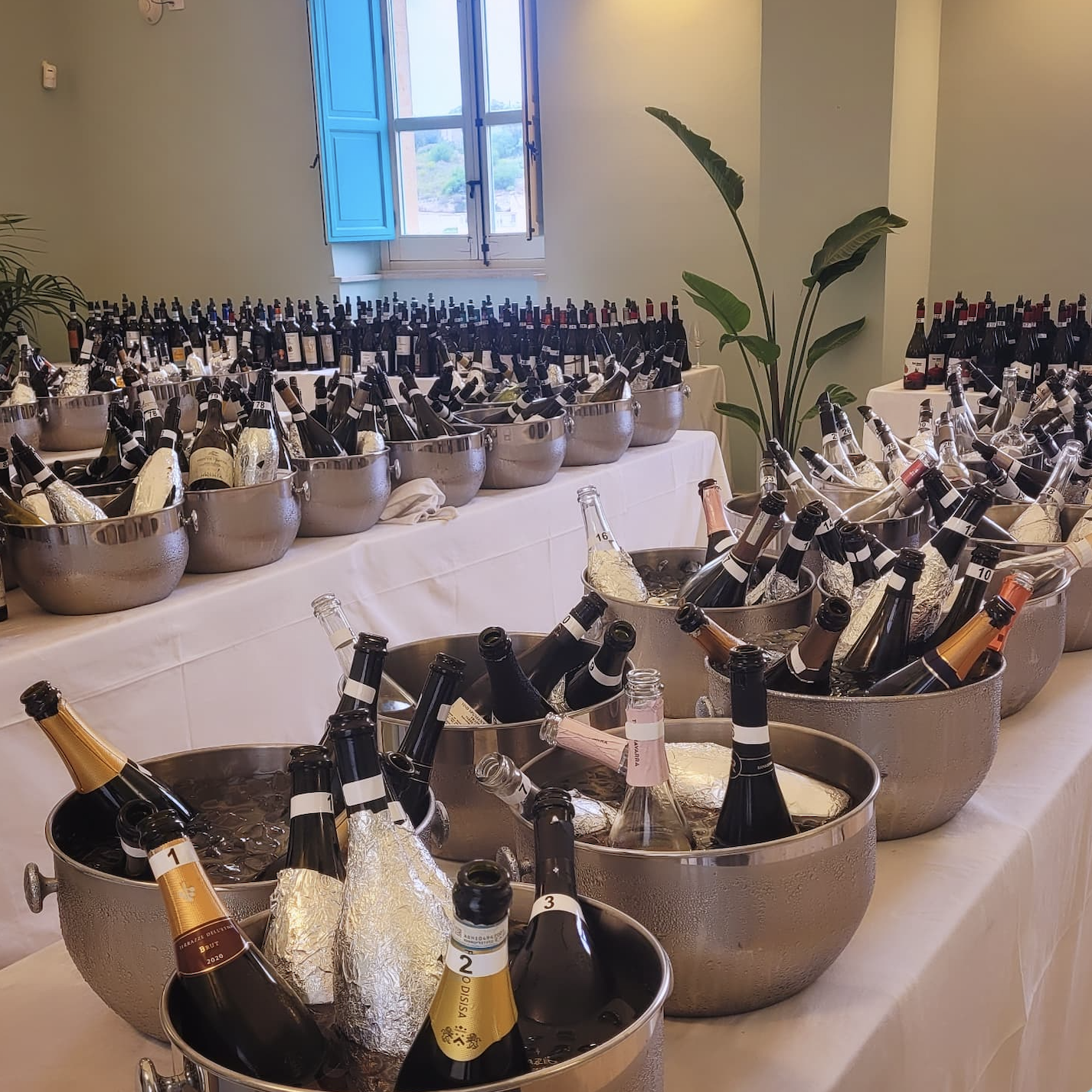
All the wines of Sicilia en Primeur

Sparkling

Alessandro di Camporeale Método Classico 2020

Solo catarratto, vibrant, exciting, exploding, 36 months on the lees. Crazy flavours on your palate. Ginger and smoulder. Drink 2025-2026.  Tasted May 2025

Alessandro di Camporeale Método Classico 2017

This is the second vintage and for a catarratto that spent 72 months on the lees it’s actually mind-blowing. The wine is crisp, crunchy, salty, expansive, vertical and frankly exceptional. Next up 96 months? Drink 2025-2030.  Tasted May 2025

Cantine Fina Pas Dosé 2019

A proper smoulder leads off for this 70 percent chardonnay and (30) pinot noir blend finished clean and unadulterated. No dosage? No problem because of the toasty, umami-savoury, macchia-laden, of plants identified and also those not. Palate exhibits some peanut shell which speaks to a momentary temperature drag in the processing but with all the exotics running amok there is terrific interest nonetheless.  Last tasted May 2025

A mix of chardonnay and pinot noir, 70 and 30. Toasty style, sharp and focused, 36 months on the lees to give it aromatic volume from the get go. Certainly not an oxidative style, far from it and the middle ground for Bruno Fina’s sparkling program that began with 24 months and has progressed to 60 on yeast time. More volume on the palate and even fleshiness than expected to suggest that Fina is a natural at making sparkling wines. No wood – only stainless steel. Experimentation has come thus far and perhaps wood aging is coming in the future. Wishing for more length but the linger is full and positive. Drink 2024-2027.  Tasted May 2024
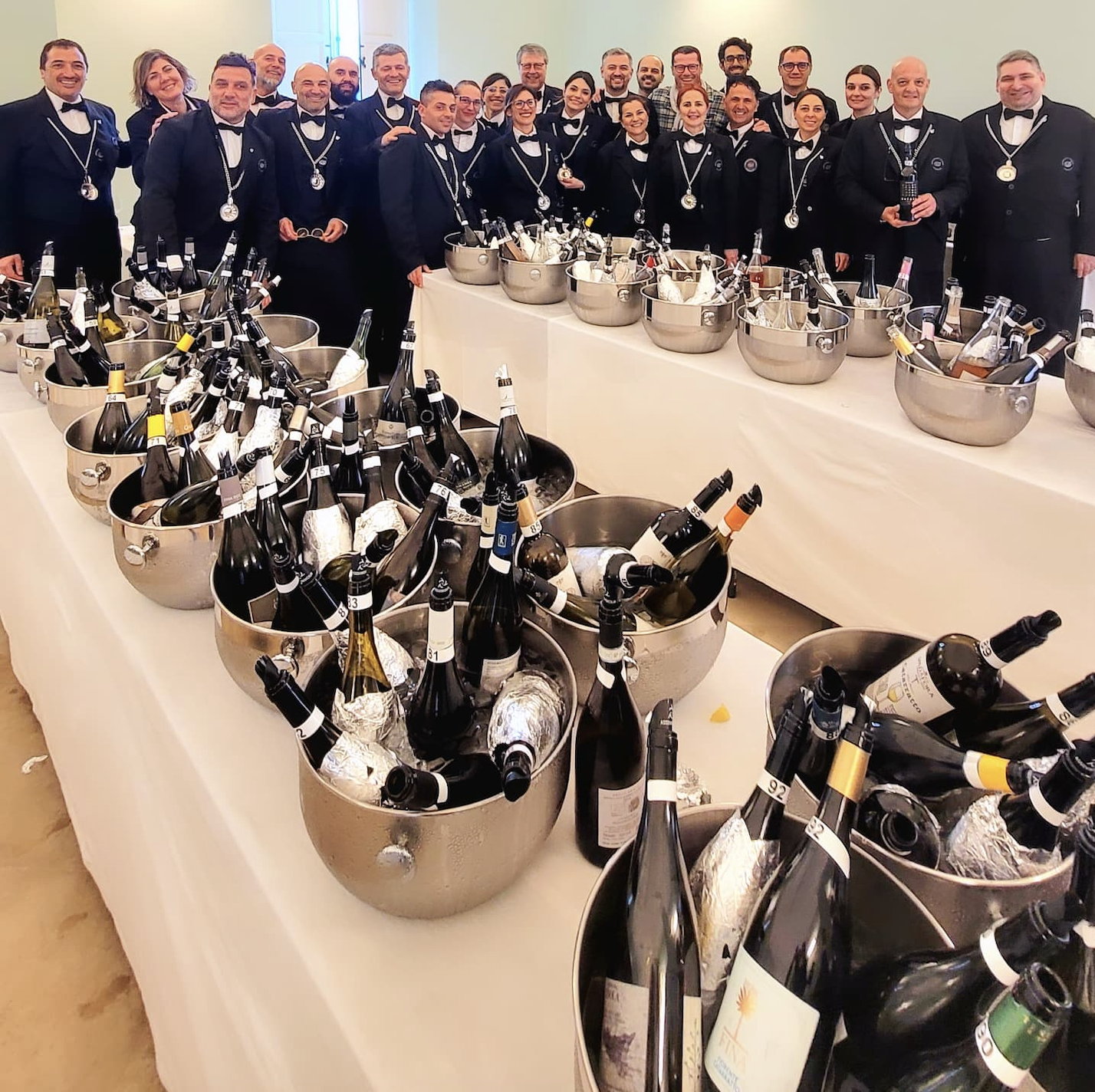
With the Sommeliers of AIS Sicilia

Fazio Brut Blanc de Blancs Erice DOC

Concentrated and pulpy fruit forward fizz from chardonnay picked at higher ripeness than most. Feels like Cuvé Close style, big fruit and carbonation doing their best to get together. Simple and juicy-frothy with neither issue nor complexity. Drink 2025-2026.  Tasted May 2025

Feudo Dsisa Rene’ Sicilia DOC 2017

Über reductive and reactive chardonnay sparkling not perfectly clean. Not quite bitterness in the flavours but more like toasted almond skin. Medium toast and mid-level persistence. No excitement or positive linger neither. Drink 2025-2026.  Tasted May 2025

Principe di Butera Metodo Classico Nero d’Avola Pas Dosé 2019

A classic method sparkling wine 36 months on the lees, charged and excited, rich and buttressed for full mouthfeel with bubbles that elevate the game. Harvested in the second part of August also off of plants that were first planted 27 years ago. The higher parts richer in limestone are used for the Pas Dosé and those in the valley clays more for Brut. Drink 2025-2028.  Tasted May 2025

Principe di Butera Metodo Classico Nero d’Avola Rosato Extra Brut 2019

A 24 months on lees after a couple of hours on the skins for Extra Brut with some sugar but nothing gratuitous and vines growing in the lower parts where limestone gives way to clay. Smooth, really with uplifting acidity and rusty red fruit character. Professionalism incarnate and ideal stylish personality for Sicilian sparkling wine. Drink 2025-2028.  Last tasted May 2025

Not labeled as such and this is the first vintage release but the vintage is in fact 2019. Twenty four months on the lees and this being the beginning to introduce the wine but subsequent vintages that will likely age longer. Extra Brut so right around 6-7 g/L with explosive acidity so the balance is spot on. Orange and lemon, no pith and less bitters to speak of. Really clean and good length.  Tasted May 2023
Tenuta Ferrata Etna DOC Spumante 2021

Fine fizz work with the local nerello mascalese stripped of skin muskiness and replaced with a volcanic savour so distinctly if discreetly basaltic in nature. What should sparkling wine from L’Etna do? This actually, with linger and persistence. Grows on the palate and finishes with edible fungi, umami in nature, all in all a positive result for those who are carriers of that “other” positive sensory gene. Drink 2025-2028.  Tasted May 2025

Tenute Nicosia Sosta Tre Santi Etna Brut DOP “Sessantasei” Método Classico 2018

Quiet, admittedly demure entry, of nerello mascalese and the trenchant intention to develop all three essential tenets of sparkling wine. Aromas, textures and flavours are all slowly and incrementally enhanced by serving a long time period upon the lees. In the vicinity of six years for this bubble and dio mio, man how things have come to a combination of curiosity and softness. Spicing yes, but texture is key, mouth-filling, reaching all corners and edges through a lengthy journey resulting in rolling waves, oscillations and blanketing couverture. Substantial sparkling with grace. Drink 2025-2028.  Tasted May 2025

Terrazze Dell’Etna Blanc Brut 2020

Reductive and flinty bubble unique to Etna with a can’t miss the chardonnay character. A sharp and crunchy bite into a just picked yellow apple. Balanced and softening on the palate for one of the most tenable blanc sparkling wines ever to try from a mountain producer. Drink 2025-2027.  Tasted May 2025
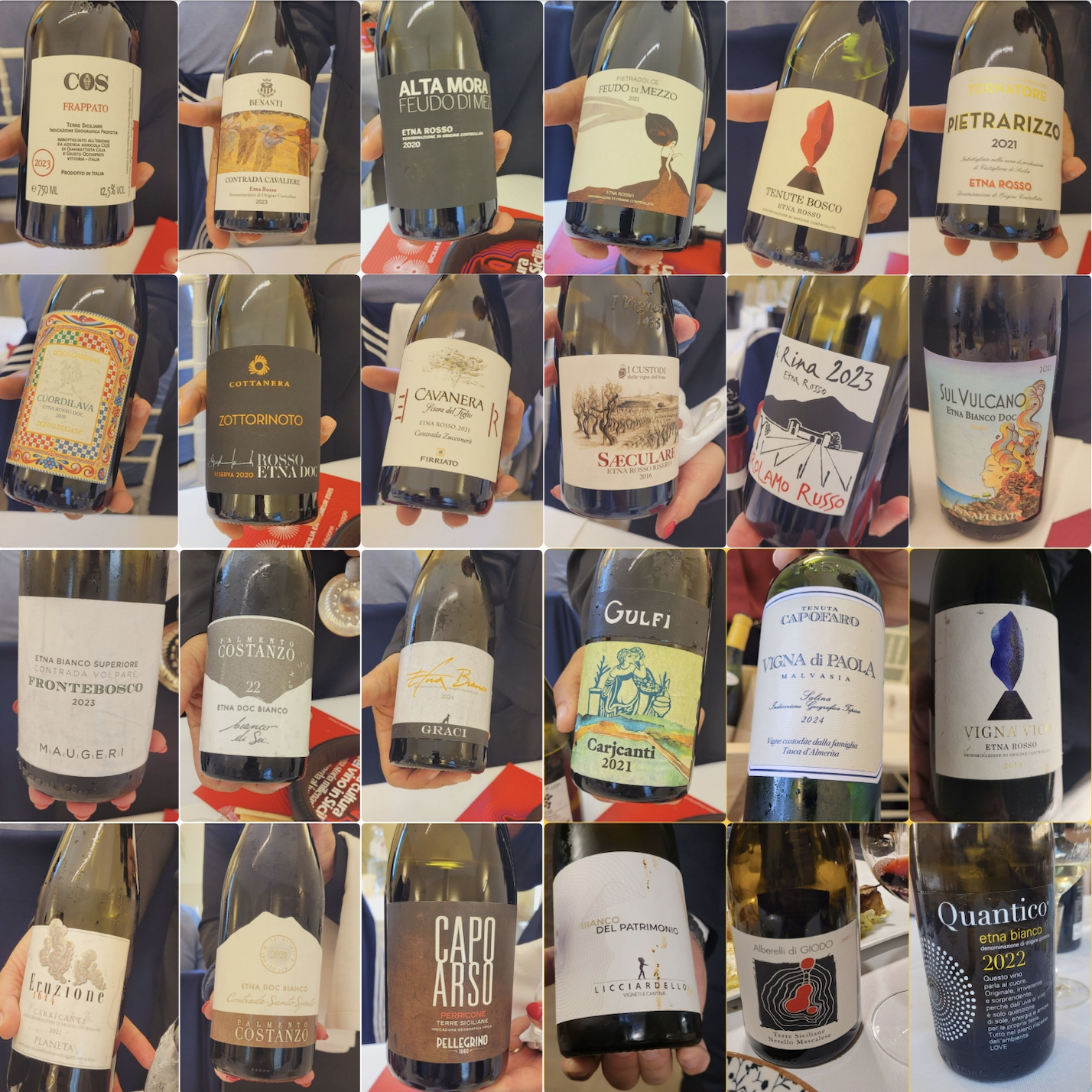
Rosato

Benanti Etna Rosato DOC 2024

High aromatic substance, tree fruit blossoms, fruit forward with concentration. Stone fruit, nerello mascalese skin muskiness, though never pungent. Caught at reputable ripeness for Rosato, its verdancy a matter of natural extension, acidity never sharp, nor failing. Palate luxe and soft though the savour persists and it all falls into place for the category. Drink 2025-2026.  Tasted May 2025

Cantine Fina Rosato Hanami 2024, Terre Siciliane IGT

Rosé of merlot and syrah, lithe and salty, a vague earthy funk that comes from a mix of soil and how these grapes interact as such. First vintage was 2019 and the path is getting clearer. The tang is extremely high which makes for a slightly vivid example out of this vintage. Drink 2025-2026.  Tasted May 2025

Cottanera Etna Rosato DOC 2024

As straightforward, generous and fruit-centric as Etna Rosato can be, open for all blush needs. Summer is a glass as they say and no, Etna Rosé was not like this just 10, or perhaps even five years ago. Yet here they are and come to the world with all the fulfillments the genre could offer. Plenty good and good for plenty of reasons. Drink 2025-2026.  Tasted May 2025

Feudo Montoni Rosé di Adele Nerello Mascalese 2024, Terre Siciliane IGT

Intense nerello mascalese aromatics, of floral red berry bloom perfume and into savoury flavours, of all that lives and breathes in a natural Sicilian world. Perhaps a smaller crop and size of berry is the reason for these results but regardless the concentration alters the ’24 course of a Montoni Rosato. Would love to sip this alongside any of the many eggplant preparations by Montoni’s Melissa Muller. Drink 2025-2027.  Tasted May 2025

Girolamo Russo Etna Rosato DOC 2024

Finely composed and balanced Rosato from Giuseppe Russo, ideally mixing ripe nerello mascalese with sweetly captured acidity. You can sip his 2024 and feel the composure straight away, plus enough generosity and grace befitting of all the wines in the strongest of portfolios. Here Rosé is a gift because the fruit is precious in that it should rightly have become Rosso. Drink 2025-2027.  Tasted May 2025

Planeta Rosé Sicilia DOC 2024

A mix of nero d’Avola with syrah and sauvignon blanc for more spark and sharpness which Rosato by Planeta most definitely has. Crisp bites, herbal, some macchia and provider of thirst quenching abilities. Drink 2025-2026.  Tasted May 2025
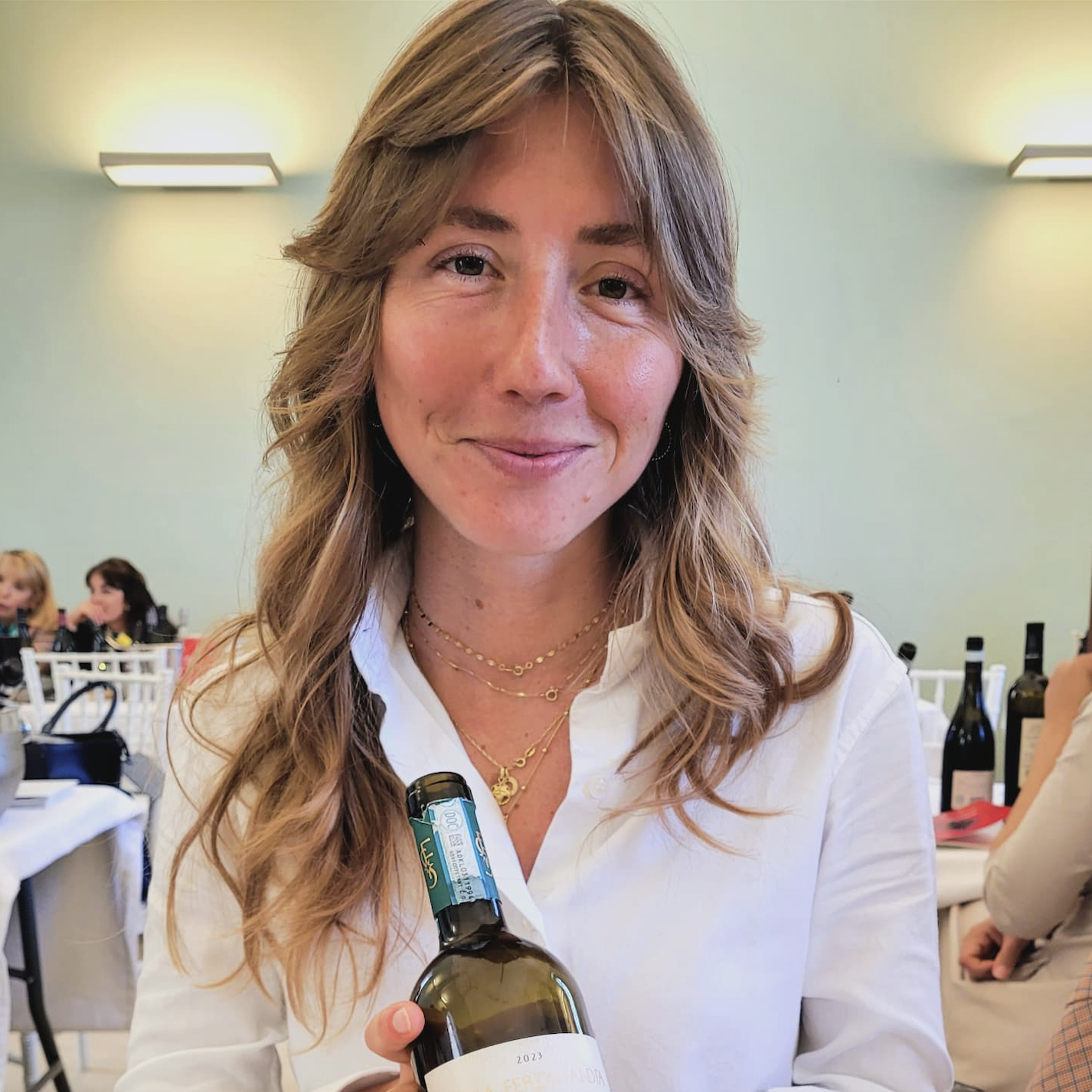
Cecilia Carbone – Serra Ferdinandea

Serra Fernandinea Rosato Sicilia DOC 2024

It rained on the 9th of May and then not again until the 19th of August. Picked between the 11th and 14th of August (with Ferragosto in between) and with this in glass most will have no idea it’s even Rosé. Vin gris is the look but not the intention because when you press nero d’Avola it’s a matter of minutes between this and colour. Remember the owners are Provençal and in southern Sicily the same effect is desired. That would be lithe, salty, fresh and with unlimited spirit. The spirit and nature of the place. As this does and is just that. First scent speaks to Rosato of a distinct and singular nature, like a marine breeze blowing in and through the macchia-mediated and reconciled fruit of the vine. Of nero d’avola used for all essential Rosé purposes under the southwestern Sicilian sun. Not entirely sure if the yields were lower in 2024 (they likely were) but the high levels of concentration and sneaky controlled energy put this in a new echelon for a Serra Ferdinandea Rosé. Would make for both a curiosity and a scientific test to age this two years and see what new impact comes about. Only the independent variable of time changes and the conclusion should rightly seek and mount higher ground. Drink 2025-2027.  Tasted twice, May 2025

Tenute Navarra Rosemosse 2024, Terre Siciliane IGT

Full outward wave of red berry fruit, a capture of frappato in fizz, its mousse creamy and soft. Strawberries in cream, a shortcake because of some faux autolysis and pretty much just really simple. Holds a place for reasons like Valentine hearts and others that represent an amenability to all. Drink 2025-2026.  Tasted May 2025

Terra Costantino Etna Rosato DOC deAetna 2024

Fine mix of fruity and also savoury elements, all understated and trickling forward, low and slow. If a fruit were needed to be invoked it would be white cherries, conjured from a quick soak and maceration before stripping away nerello mascalese skins while capturing both their perfumes and a modicum of their structure. For Etna this is the Provençal style albeit with volcanic properties instilled and made whole by natural processes. Come for the fruit, stay for the minerals. Drink 2025-2027.  Tasted May 2025
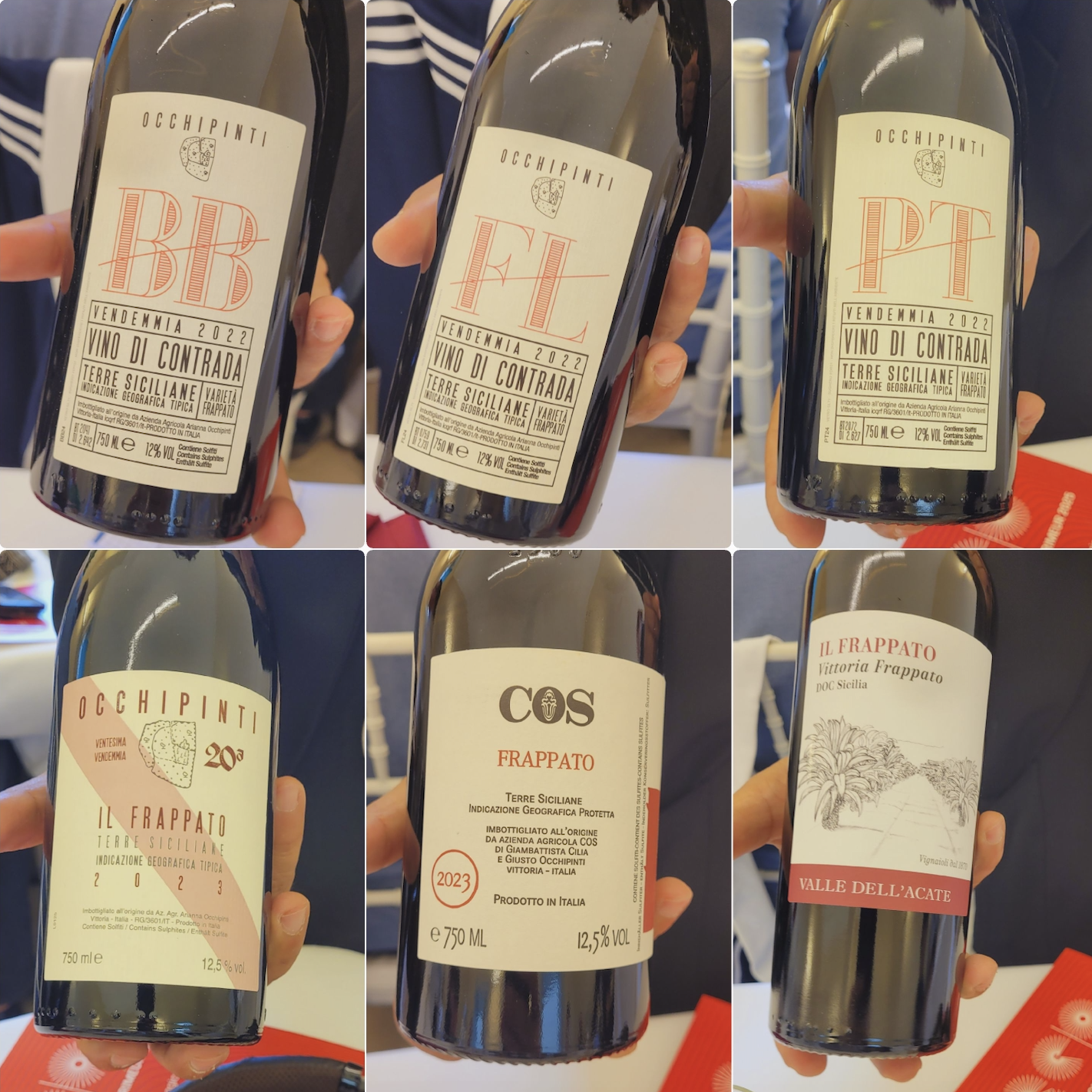
Rosso

Arianna Occhipinti BB Frappato Vino di Contrada 2022, Terre Siciliane IGT

BB, a.k.a Bomboliere feels like the OG for a contrada-designate frappato in the Vittoria occupied Occhipinti world, a varietal expression from the home front with more experience and acumen to treat all things equal, they being available and worthy of leaning against and leading towards ultimate balance. As here from a fine and rocking 2022, crunchy exterior and chewy interior, a Balsamico crust and mix of fruits captured within. Though the Villages frappato is the most accessible it is this BB that ranks as the most well-rounded and if there is any austerity it won’t cause any psychosocial pain. Yet BB is tannic enough to age, stirs up emotion and is truly representative as a best of all worlds wine, more so than either the FL or PT. Drink 2025-2033.  Tasted May 2025

Arianna Occhipinti FL Vino di Contrada Frappato 2022, Terre Siciliane IGT

Not all of Arianna Occhipinti’s three contrada originating frappato are created equal and FL (Fossa di Lupo) is the one with most up front and forward extending fruit. The fruit comes from just 15 year-old alberello frappato out of Arianna’s original six hectare vineyard. This from the outstretched arm of generosity, more like the Villages label than either the BB or the PT. More obvious as frappato and still there is some structure, high acid pulse, saltiness and earthy to funky beats. Likely owing to this soils of brown sand over limestone rock. Then again FL is cleaner and more understandable with varietal clarity, that which speaks to terroir, obviously and without equivocation. Drink 2026-2030.  Tasted May 2025

Arianna Occhipinti PT Vino di Contrada Frappato 2022, Terre Siciliane IGT

One of three contrada frappato for Occhipinti and immediately obvious how different (at least this PT, or Pettineo) is from the Villages label. Structured with impunity and its immunity keeps maturity at bay. Hard to believe how tight an expression this is when you consider the grape, but this contrada means serious terroir business. Of crucial significance is the fact that the less than one hectare parcel is home to the oldest (60-plus years) frappato vines in all of Vittoria. The vines grown on fine orange sand over tufa (a porous limestone) and the grapes are harvested ahead of both BB (Bombolieri) and FL (Fossa di Lupo). There is a volatility in PT that for some will be challenging to understand, though should patience be exercised than all will eventually be resolved and subsequently revealed. Drink 2027-2032.  Tasted May 2025

Arianna Occhipinti Frappato 2023, Terre Siciliane IGT

Frappato the solo artist is Arianna Occhipinti’s “Villages” red, a mix of contrada fruit for her classic or classico expression marking the entry point into her multifarious varietal world. The most crunchy and yet juicy frappato imaginable, high in intensity come to the world with open arms and in turn the world should embrace this wine. If your goal is either to introduce this most getable of grapes and/or a keen desire to enter the varietal gates then Occhipinti’s is the one. Come on in. Drink 2025-2029.  Tasted May 2025

Arianna Occhipinti Grotte Alte 2020, Cerasuolo di Vittoria Classico DOCG

Were Grotte Alte tasting blind you would not be judged for thinking you might have Brunello di Montalcino in your glass and from a producer with ancient wisdom crossed and forward thinking. A true terroir-driven Balsamico marks the entry and the construction is a bit severe which means the tannins are austere. Volatility swirls like sangiovese but here are nero d’Avola and frappato co-mingling in their rarefied air. Some will find the grip and the volatile elements severe and yet others will check their egos to wait and allow these grapes to be ratified and conjoined after years of settling and care. Choose the latter and great reward will follow. Drink 2027-2033.  Tasted May 2025

Cantine Fina Vitraolo Vino Rosso 2023, Terre Siciliane IGT

A purely Sicilian red wine, something of history, culture and remembrance, of freshness and sheer drink-ability. Tart for certain, that and a chewy character but without weight or density. The fiercest passion in an authentic, austere and rustic red. This despite a challenging vintage of heat, humidity and low yields. Drink 2026-2029.  Tasted May 2025
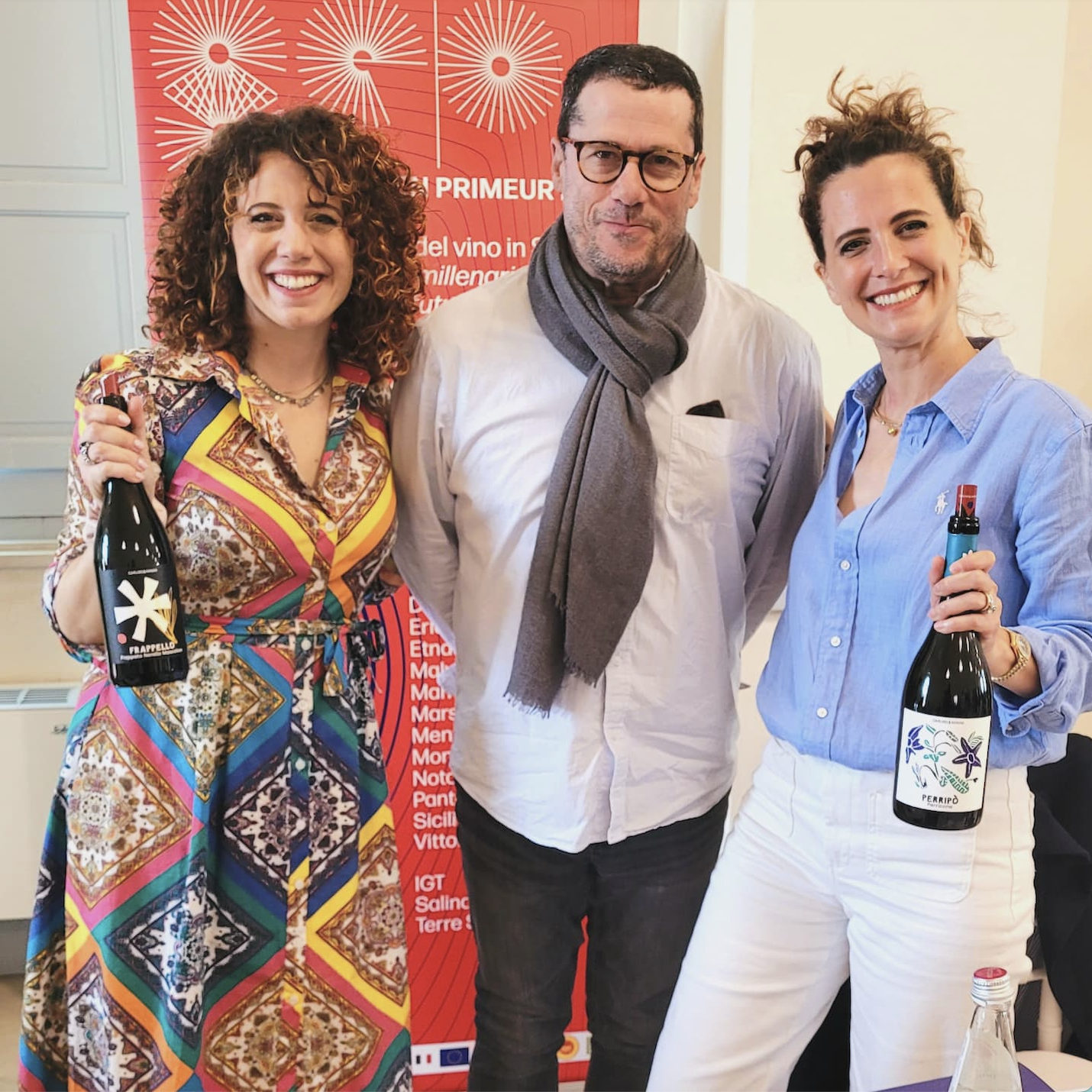
With Giovanna and Rosanna Caruso – Caruso e Minini

Caruso & Minini Perricone Perripo’ 2022, Terre Siciliane IGP

The pretty dabs of perricone perfume come easy out of the dialectical sounding and expressive Perripo’ because, well clarity and purity. Plump and juicy raisin to plum with more freshness than leathery feels and sneaky structure partially shrouded beneath. Proper varietal effort, vintage fun, in and out, especially with fine and gifting 2022 as the source. Really something unique, finishing at a local Balsamico, especially like mint. Drink 2025-2028.  Tasted May 2025

Caruso E Minini Frappello 2023, Terre Siciliane IGT

A blend of frappato and nerello mascalese, first vintage was 2004, now 20 years later, same strong colour contrast from the first to less out of the last. Tannins are the opposite and so the wine has remained the same. Gustatory in every way, “the wine for everybody,” says Giovanna Caruso. From a vintage “non facilisimo,” she says because of heat but Caruso E Minini’s growing zone sees strong winds to help maintain freshness in spite of the temperatures. Full and satisfying with really sweet acidity. Drink 2025-2027.  Tasted May 2025
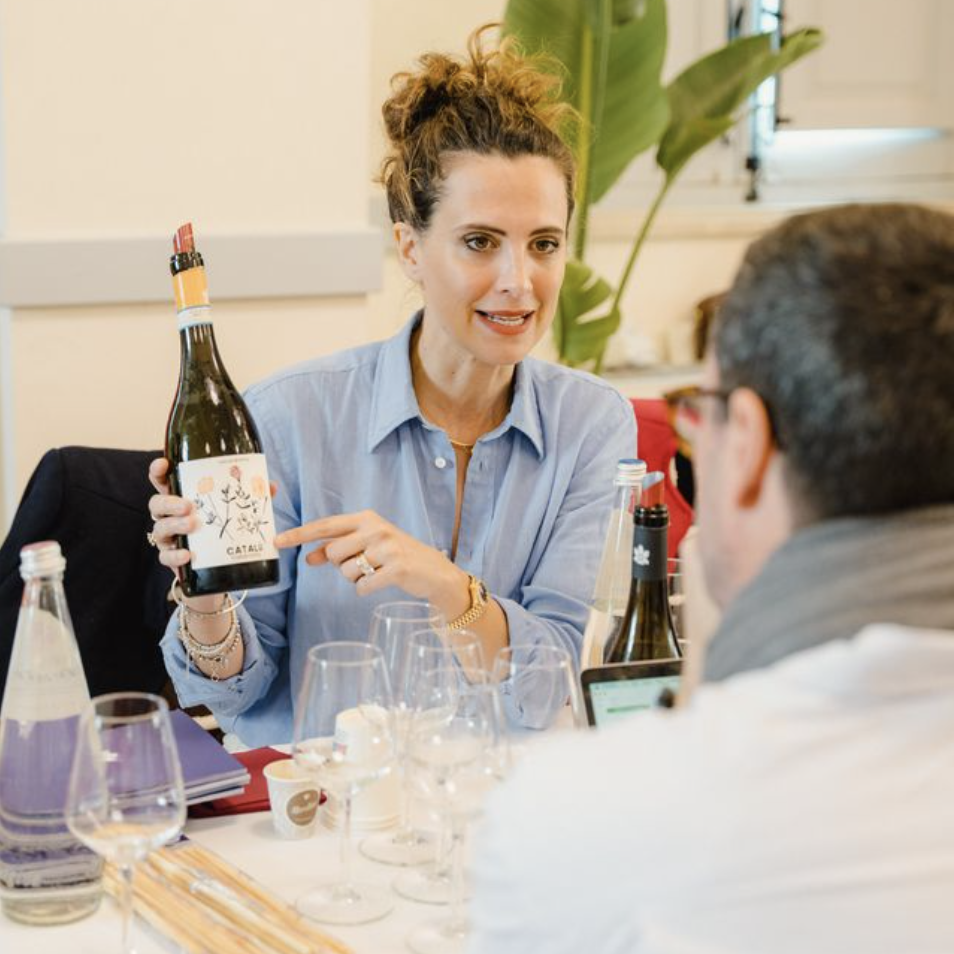
Tasting with Giovanna Caruso – Caruso e Minini

Caruso E Minini Nero d’Avola Sicilia DOC Vuvalà 2022

The solo nero d’avola from western Sicily where strong winds and sea air make for some of the saltiest on the island. Persistent keeper of faith and fruit freshness when it really wants to dry out and head into the local Balsamico. It does not but stays a most hospitable marine airy course. The vines also grow in round stones (very similar to Rhône Galets) which keep the soils cool. Delicious and dreamy for nero. Drink 2025-2027.  Tasted May 2025

Caruso E Minini Nino Rosso 2015, Terre Siciliane IGT

Four grape blend made in appassimento, a.k.a Amarone style in honour of grandfather and his red suspenders. Persistent and somehow still showing some fresh fruit despite the austerity and aridity created by the methodology. A juicy explanation to remind just how fine things can be when attention to detail and passion put collective hearts into making a wine. The mix is nerello mascalese, perricone, frappato and nero d’avola for just 7,636 bottles produced. Drink 2025-2030.  Tasted May 2025

Cos Frappato 2024, Terre Siciliane IGT

Beautifully clean, fragrant and fruit blossom perfumed frappato of immediate and seductive engagement. A whirl of controlled volatility, sweet acidity and carry over to palate flavours in mimic of the florals up front. All the fruit that could be desired, of a focus and a finesse to bely any pre-conceptualized DOC limitations and simply a varietal red you will want to taste and drink on a consistent basis, by the glass, to share with others and as a varietal teaching moment for what is possible. Drink 2025-2028.  Tasted May 2025

Cos Cerasuolo di Vittoria Classico DOCG 2022

Unexpectedly, remarkably and acceptingly fruit forward Cos Cerasuolo for which 60 percent nero d’Avola and (40) frappato occupy the same place and time. Sharing the stage of open generosity and to elicit immediate gratification. Welling with fruit (as opposed to bursting), expressive of skin muskiness and layered for notable purpose. That is to gift the DOCG by way of introduction and without challenge, neither by grip nor out of austerity. Drink 2025-2027.  Tasted May 2025
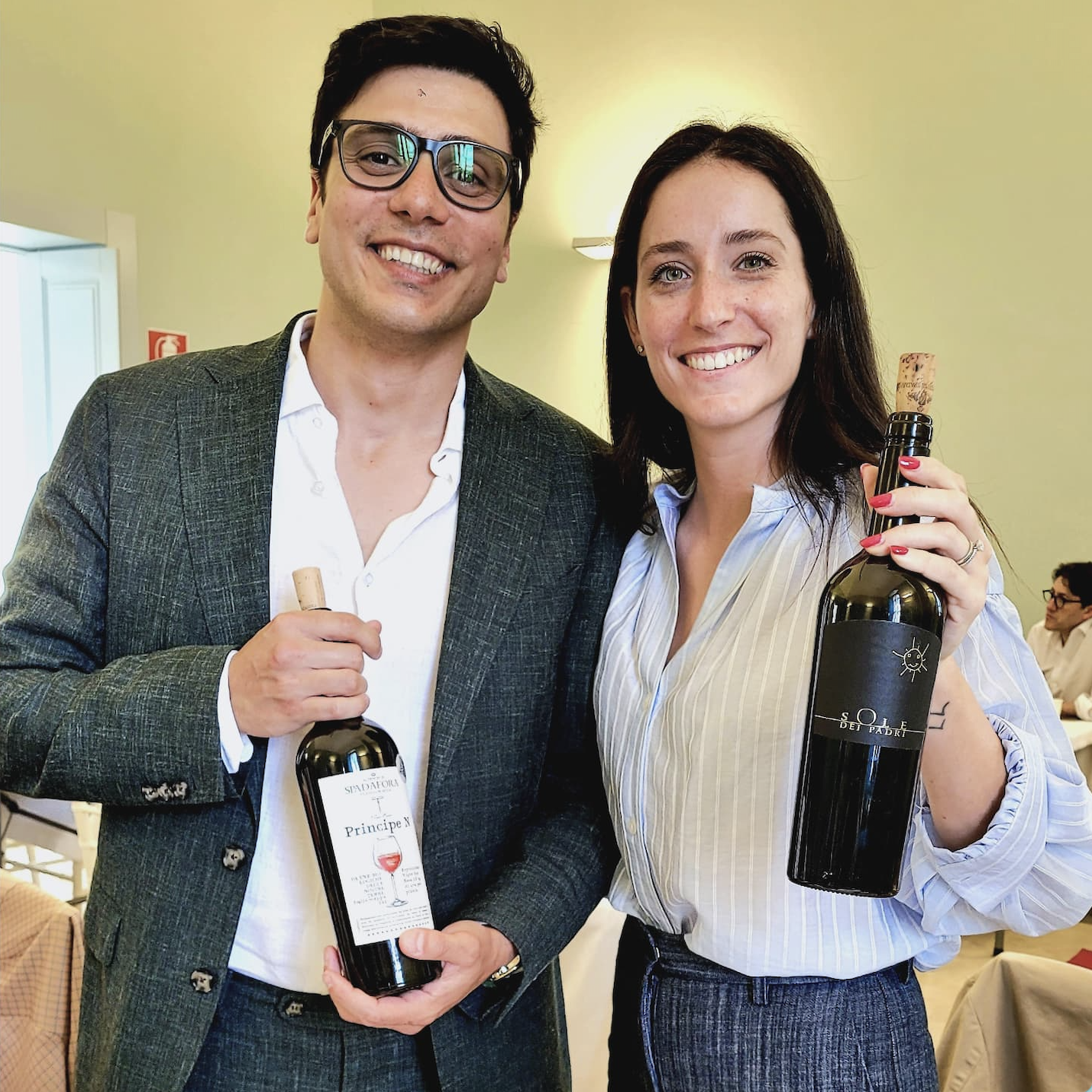
Gabriele Di Paola and Enrica Spadafora – dei Principi di Spadafora

Dei Principi Di Spadafora Vignaioli In Sicilia Principe N 2022, Terre Siciliane IGT

Only nero d’avola from concrete followed by steel though still not quite as expressive as it should be because of having just being bottled. From Spadafora’s central location towards the western half of Sicily of classic nero fruit from red through black, high acidity, intensity and spirit. Can’t wait to see what happens after another year (and even better two-plus) in bottle. Drink 2027-2031.  Tasted May 2025

Dei Principi Di Spadafora Sole dei Padri 2012, Terre Siciliane IGT

The first vintage of a signature red one year in bottle, only syrah from the highest vineyard on top of the hill at 450m. Very exposed with direct sun which would have been a challenge for nero and so, syrah. Richness at the height for grape and style, woody still and this is 2012 but freshness will persist and the wine will integrate. This may sound absurd but truth is truth and Spadafora likes old wines. As will you.  Last tasted May 2025

Sees one year in barriques and the rest in tank, bottled in July of 2022. Lengthy aging but just a short wood stay so don’t come expecting heavy vanilla, lavender or other French barrel notes. Come instead for the florals, spices, spiciness, liquid pepper, but no smoke. Chalky, tannic and all soil-related, created and driven. Can last for another 10 years. Clean and varietally obvious though not the iodine-meaty syrah kind. Perfume and texture are everything. Balsamico and mint at the finish. ”La terra,” shrugs Francesco Spadafora. Drink 2024-2034.  Tasted May 2024

Firriato Perricone Ribeca Sicilia DOC 2019

Singular styled perricone, about face and in complete opposition to those from both central and western Sicilia. Here more related to macchia and Balsamico, brushy, herbal, botanical, verdant and dusty. A stand alone and idisosyncratic varietal red that teaches so much about the triad of place, style and effect. You only need to taste to believe and be aware that this is the sort of Sicilian red to surely show up in masterclasses through time. Drink 2026-2029.  Tasted May 2025

Gulfi Cerasuolo di Vittoria Classico DOCG 2020

The aromas are all fruit skins, of 70 percent nero d’Avola and (30) frappato musky and dried fruit grippy. The aging time in bottle has done the work to bring this Cerasuolo into the initial stages of secondary character which means the ideal drinking window is right where you stand with bottle in hand. With thanks to steel and neutral oak there is just enough freshness and vibrancy to make it work. Drink 2025-2027.  Tasted May 2025
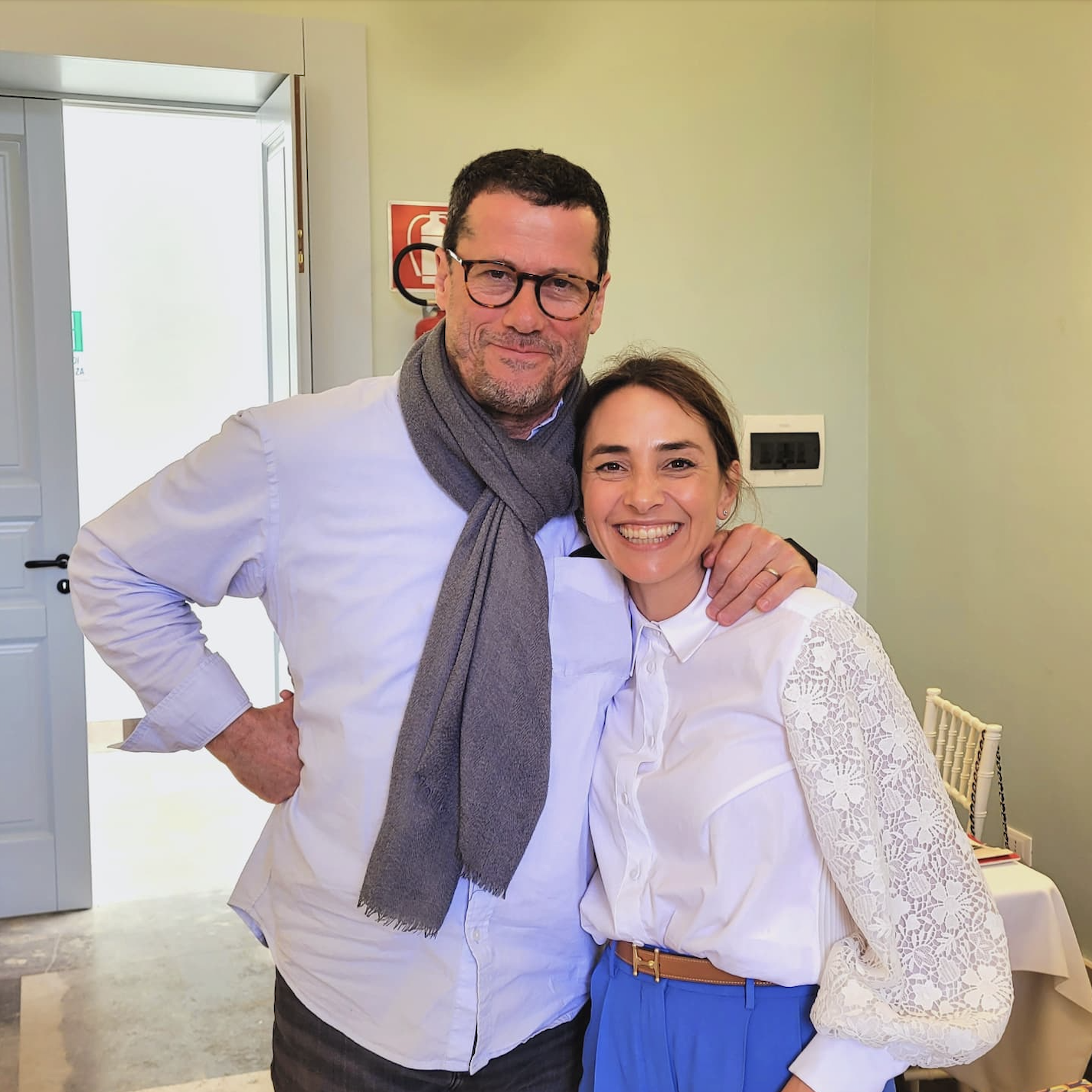
With Anna Ruini – Pellegrino 1860

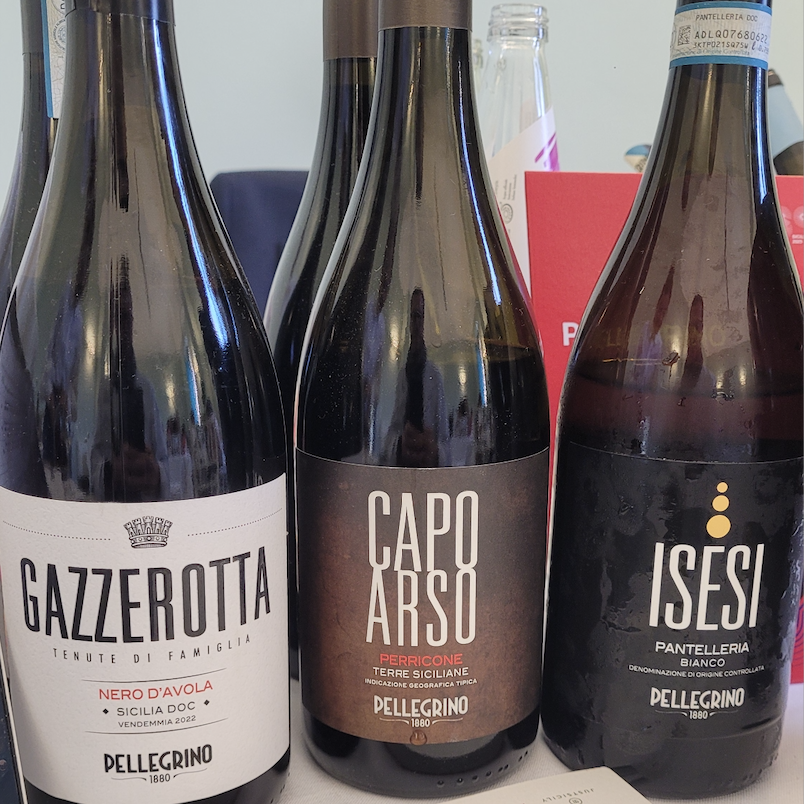
Pellegrino 1880 Perricone Capoarso 2022, Terre Siciliane IGT

And then, and now welcome to perricone from western Sicily at the hands of a producer with a long and winding history of research, development and investigation into varietal wines. Here this combination of spice masala and richness, low and slow developed flavours and macchia. A savoury event run through and many complexities to discover.  Last tasted May 2025

A varietal perricone, a.k.a pignatello, always strong and spicy, best raised in richer soils. Pellegrino’s is simply, unequivocally and unmistakably true to the variety, of a rustic edge and yet here undeniably pure as it not only should, but will be. Not a tannic example, nor is it particularly long, but it does what wants and needs. Drink 2024-2026.  Tasted May 2024

Pellegrino 1880 Nero d’Avola Sicilia DOC Gazzerotta 2022

From Pellegrino’s main estate near to Mazara del Vallo and Campobello di Mazara with views across the sea to Pantelleria. Rich, chalky and seriously spicy nero at the height of intense heights. A wine that needs time to settle into its skin and be good to itself. One made for good times ahead. And BBQ. Just sayin’. Drink 2026-2029.  Tasted May 2025

Planeta Eruzione 1614 Nerello Mascalese 2021, Terre Siciliane IGT

To be sure a different vintage than Feudo di Mezzo 2023, with two years in bottle and yet elevation (between 840 and 890m) does everything to create, install and define freshness for nerello mascalese aboard L’Etna. Time, barrel and place have come together and the volcanic sense of earth and rock is inseparable from the varietal fruit, even from a 2021 that in some other cases is having a time maintaining its distinction. Eruzione is a lone wolf, a nerello as if by blood dripping from the animal’s mouth. Drink this with iron-rich meat – Fegato, either as Pâté or skewered and grilled. Drink 2025-2031.  Tasted May 2025

Planeta Nero d’Avola Sicilia Menfi DOC Plumbago 2022

If only because tasting with the team at Planeta is equal parts revelation and comedy, it’d hard not to think about and invoke finning things. Like “I want you to cut down the mightiest Plumbago in the forest…with a herring!” But not too big. But this is the biggest of the Plumbago because the vintage gave great heat and therefore the Plumbago shrubbery could not help but take over the entirety of the savoury elements in this nero d’Avola. Full on Menfi Balsamico, or an otherwise named local macchia, like fragrant hay, a.k.a. Plumbago. Drink 2025-2031.  Tasted May 2025

Principi di Butera Inzolia Serò Sicilia DOC 2018

Varietal insolia and from the central Sicilian producer having long ago made the decision to see a white variety that should and can age. Made in a reductive way, now into full on flint and smoulder, a lit paraffin note meeting something petrol-like in the wild ways of sémillon. Surely as curious as it is inviting and while by itself there is this feeling of curiosity it’s all in fine and helpful fun to enjoy when the timing is right. Which can be said for 2018 right now and so a good choice to pour at Sicilia en Primeur 2025.  Last tasted May 2025

A new soil which is both a blessing and a curse, a pain and a joy to work with. Quality comes from lower yields and specific soils. Here insolia grazes into hyper-metallic and mineral territory, protected from the heat of the sun, in avoidance of saturated copper, sunflower and gilded gold. Very short skin-contact and nurturing care turn insolia into this, sapid and even salty, expressive of the calcareous soil and the sea breezes coming from a mere eight kilometres away. Drink 2019-2023.  Tasted May 2019
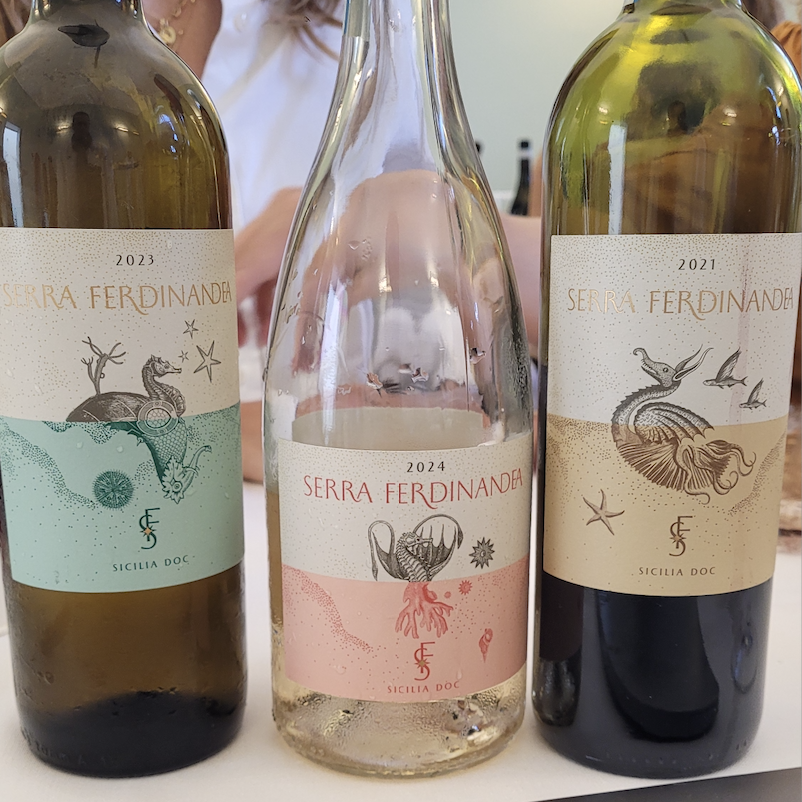
Serra Ferdinandea Rosso Sicilia DOC 2021

Still from a time when the team was working with young vines and not yet having reached the point where they could express the true nature of Serra Ferdinandea. Of syrah set to elevation and nero d’Avola, the latter planted in the windiest and driest place. This for fruit meeting backbone and the hope they will find each other, layer, integrate and create spemthing special in their shared space. The style is invoked even if the full finesse is not yet found. Oh so close to what really matters and whole bunches used in 2022 will help encourage this next level of reality. Rosso at stage one is primary, a work in progress and a harbinger for what is to come. Just a bit woody and chalky-grainy at this time. Drink 2026-2028.  Tasted May 2025

Tasca d’Almerita Tenuta Regaleali Rosso Del Conte 2020, Sicilia Contea Di Sclafani DOC

One of Sicily’s most famous red blends with a track record for aging, of nero d’Avola and perricone out of Tasca’s grand Vigna San Lucio. The large block was first identified and isolated in 1959, now 60 years into its tenure. Aging is multifold, in chestnut barrels, Slavonian cask and small French wood. This 2020 is officially the 50th anniversary of the Rosso del Conte label with one of the most developed richness of them all, all the while maintaining its recognizable grace and every subtle aspect its always meant to express. Poise and focus but also impressive fitness. Will age two decades. Drink 2026-2036.  Tasted May 2025
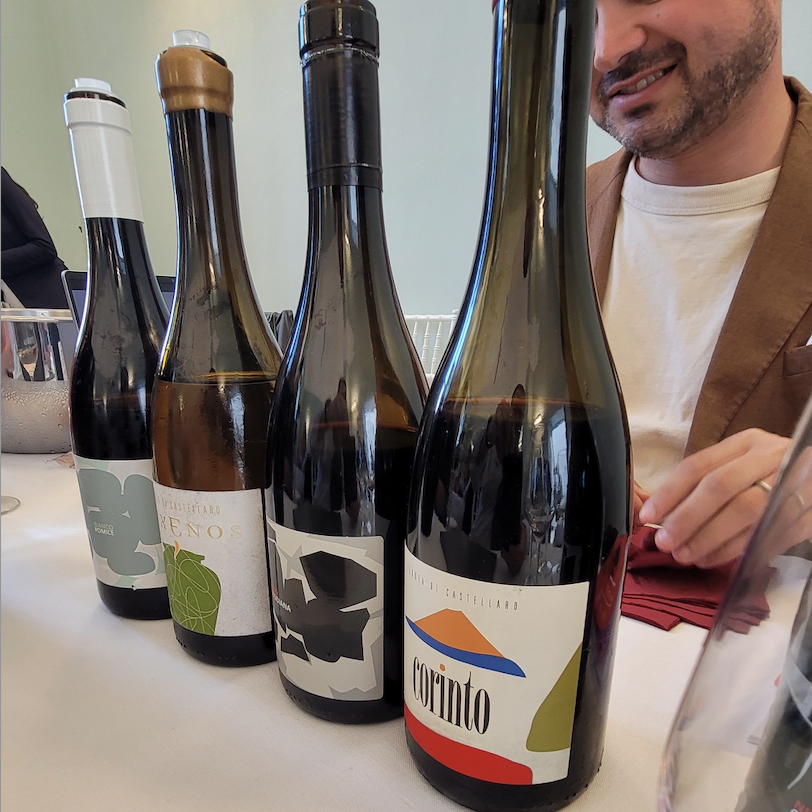
Tenuta di Castellaro Nero Ossidiana 2022, Terre Siciliane Rosso IGT

From Massimo Lentsch’s Lipari Island winery with the seedless grape corinto (well actually one central seed) which means high acidity, low pH and also tannin. Not to mention lessening of alcohol that barely reaches 13 percent. A spoonful of nero d’avola augments but changes the sharp and basaltic obsidian nature of the wine. Sees 18 months in cask and you can serve this lightly chilled. This due to the relative low tannic profile and elevated acidity which also means juicy, summery and fresh. Don’t let the colour fool you. Drink 2025-2028.  Tasted May 2025

Tenuta di Castellaro Corinto 2021, Terre Siciliane Rosso IGT

Pure corinto, seedless and more straightforward than Ossidiana but both are made for drinking cool, fresh and long. A bit more rusticity and also richness because there is some (third passage) tonneaux aging involved in the maturation. More tannin but still nothing austere or causing any real tension. Just 3,000 bottles made of this unique Lipari red. Drink 2026-2029.  Tasted May 2025

Tenute Navarra Disiato Frappato Sicilia DOC 2024

Riper fruit, dark and later picked, rusty edging for black cherry style. Easy style of frappato but surely readied sooner and with more colour needs than fruit substance as compared to many. No sense holding onto any of these bottles. Drink up. Drink 2025-2026.  Tasted May 2025

Vall Dell’Acate Frappato di Vittoria Frappato 2024, Sicilia DOC

Extremely fruit evident and forward, distinctly frappato as its varietal source, a dictionary entry and open window into its Vittoria world. Crunchy red, of pomegranate, cranberry and red crabapple, tart and juices flowing for thirst quenching activities. Open the wine glossary to “F,” scroll down to frappato and this wine may very well be there to explain what it is you are tasting. Drink 2025-2027.  Tasted May 2025

Vall Dell’Acate Frappato Vigna Bidone Sottana – Vino di Contrada Vittoria Frappato DOC 2024

The single vineyard slash contrada wine is a different beast as compared to the Vittoria DOC “Villages” label because it really is a tannic beast. The fruit chosen must surely be blessed with a certain ability to work with austerity and depth in its tannins. Vigna Bidone Sottana is both harder to approach and currently unclear to comprehend. A crusted exterior holds importance within, of fruit and acidity in layered composure and intendment, each working through machinations together and for a later, greater purpose. Needs a year, better yet two to come together and begin to express itself. Drink 2027-2032.  Tasted May 2025
Bianco

Alessandro di Camporeale Catarratto Monreale DOC Mandranova 2020

From the cru called Mandranova in Monreale and a a little portion of tonneaux used to induce flesh but also texture and expand the possibility for some time in bottle. Ambitious to a degree but there is no taking the place out of the wine. Stone fruit pulpy, sapid, sweetly herbal and with citrus meandering through lemon, lime and mandarin. Check back in two years. Drink 2025-2028.  Tasted May 2025

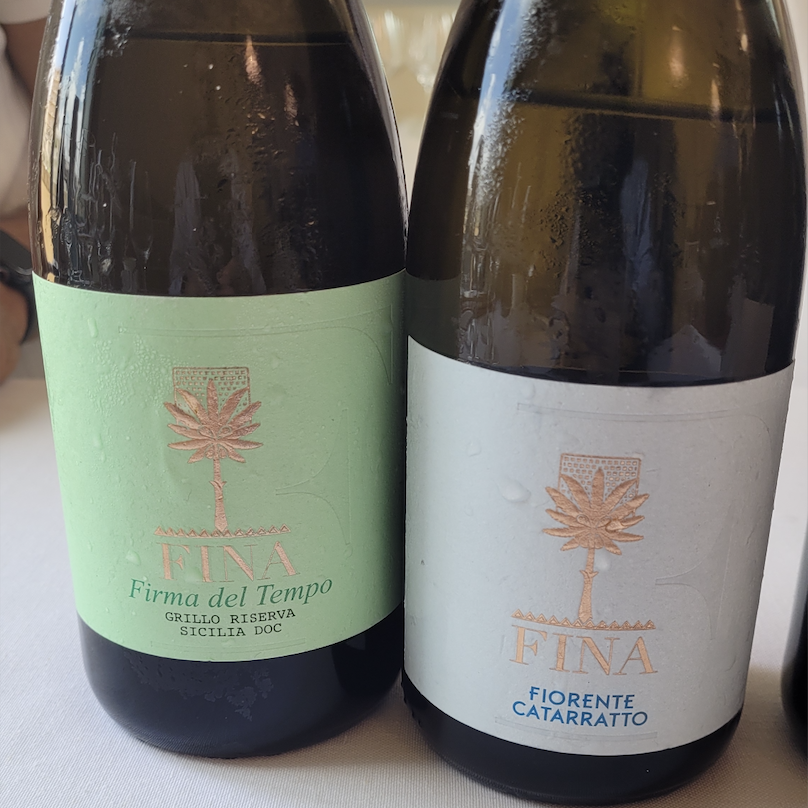
Cantine Fina Catarratto Fiorente 2024, Terre Siciliane IGT

From the most northern zone for Fina and yet distinctly western Sicilian in origin, style and effect. A bounce back vintage for the winery and ideal for the grape to express its sense of place. Crunchy and salty, mineral and satisfying. Drink 2025-2028.  Tasted May 2025

Tasting with Sergio Fina – Cantine Fina

Cantine Fina Grillo Firma del Tempo Sicilia Riserva DOC 2023

A stand out and alone grillo because Riserva and therefore we intuit part of the ferment being sent to wood. An ambitious way to approach the variety, to give it the chardonnay touch for a fuller, richer and even buttery expression. French barrel but still there is the marine saltiness and sandy soil inscriptred sapid character. You can take grillo out of Trapani but you can’t take Trapani out of the grillo. Drink 2025-2029.  Tasted May 2025
Cantine Fina Grillo Kebrilla Sicilia DOC 2024

The second of two grillo, also raised partially in steel and part in French wood. The younger and fresher one, with green apple bite, more sapidity, less wood and similar styling. Crunchy and with green Chile capsicum bite on the back end. Just a bit overdone yet without the concentration of Riserva. Drink 2025-2027.  Tasted May 2025

Caruso e Minini Grillo Lillo Sicilia DOC 2024

Hard not to see this as vehemently Western Sicilian grillo, from the sea and the winds for a slice of experience but also one that assimilates some skin musky aromatics to enhance the grillo fruit. Ideal mix of salinity and sapidity with some metal at the finish. Never a wrong time for a sip of Lillo. Drink 2025-2027.  Tasted May 2025

Giovanna and Rosanna Caruso – Caruso e Minini

Caruso e Minini Catarratto Catalù Sicilia DOC 2024

Not only unique for catarratto but authentic and existing right at the heart of the concept of ARCA, “associazione regionale catarratto autentico.” The story of grape coming from place with its marine airy and salty entry morphing through rusty fruit, citrus, fennel and finally into a sapid, botanical finish. Drink 2025-2028.  Tasted May 2025

Dei Principi di Spadafora Vignaioli in Sicilia Catarratto 2024, Terre Siciliane IGT

The catarratto is timeless and you can drink it any time of the day. Literally and expalins Enrica Spadafora, “in our area the freshness of the land is what determines what comes from the grape and place.” A bit tannic however, sneakily so and things will change if you allow them to. Drink 2025-2028.  Tasted May 2025

Dei Principi di Spadafora Vignaioli in Sicilia Don Pietro Monreale Bianco 2024

Only catarratto which qualifies as a varietal wine for the Monreale denomination, no longer inclusive of grillo, from concrete to steel in terms of fermentation and maturation. The feeling of skin contact is palpable even though it is just four days because a salve texture and tannic profile settle into the palate. Still the acidity and freshness are preserved for a balanced varietal wine. Drink 2026-2029.  Tasted twice, May and June 2025

Dei Principi di Spadafora Vignaioli in Sicilia Principe G 2021, Terre Siciliane IGT

Just grillo and six months on lees for body and spirit with time having brought about some maturing notes to create great varietal curiosity, like preserved pears or peaches and a settling on the palate. Persistent but not of a waxing energy per se. Plenty of texture and flavour to mull over, on and about. Drink 2026-2029.  Tasted May 2025

Feudo Montoni Inzolia Sicilia DOC Fornelli 2024

A rebound vintage but at Feudo Montoni consistency is king because Fabio Sireci will never force a square peg into a round hole. The 2024 season was an easier fit to produce varietal wines as he sees fit, here with that great mix of the salty and the sapid. Just spot on and poured at the right temperature inzolia is just so, so good. Drink 2025-2028.  Tasted May 2025

Feudo Montoni Catarratto Sicilia DOC Masso 2024

Sharp catarratto, cut through fruit and palates like a knife, a specific mineral that of course is a bit saline but in catarratto it’s really all about sapidity. Fabio like his whites with some austerity and this is the white that has the most, with bitter almond notes come out in the aroma, as marzipan at the finish. This can age, you better believe it. Drink 2026-2031.  Tasted May 2025

Feudo Montoni Grillo Sicilia DOC Timpa 2024

More aromatic than catarratto, not quite moscato floral but scenting yellows and whites, a honeysuckle imagined with lemon citrus blooms. Still ’24 grillo is taut with vague austerity (thought not catarratto austerity) and as with all the Montoni whites the grillo too is so very linear and vertical. Drink 2025-2029.  Tasted May 2025

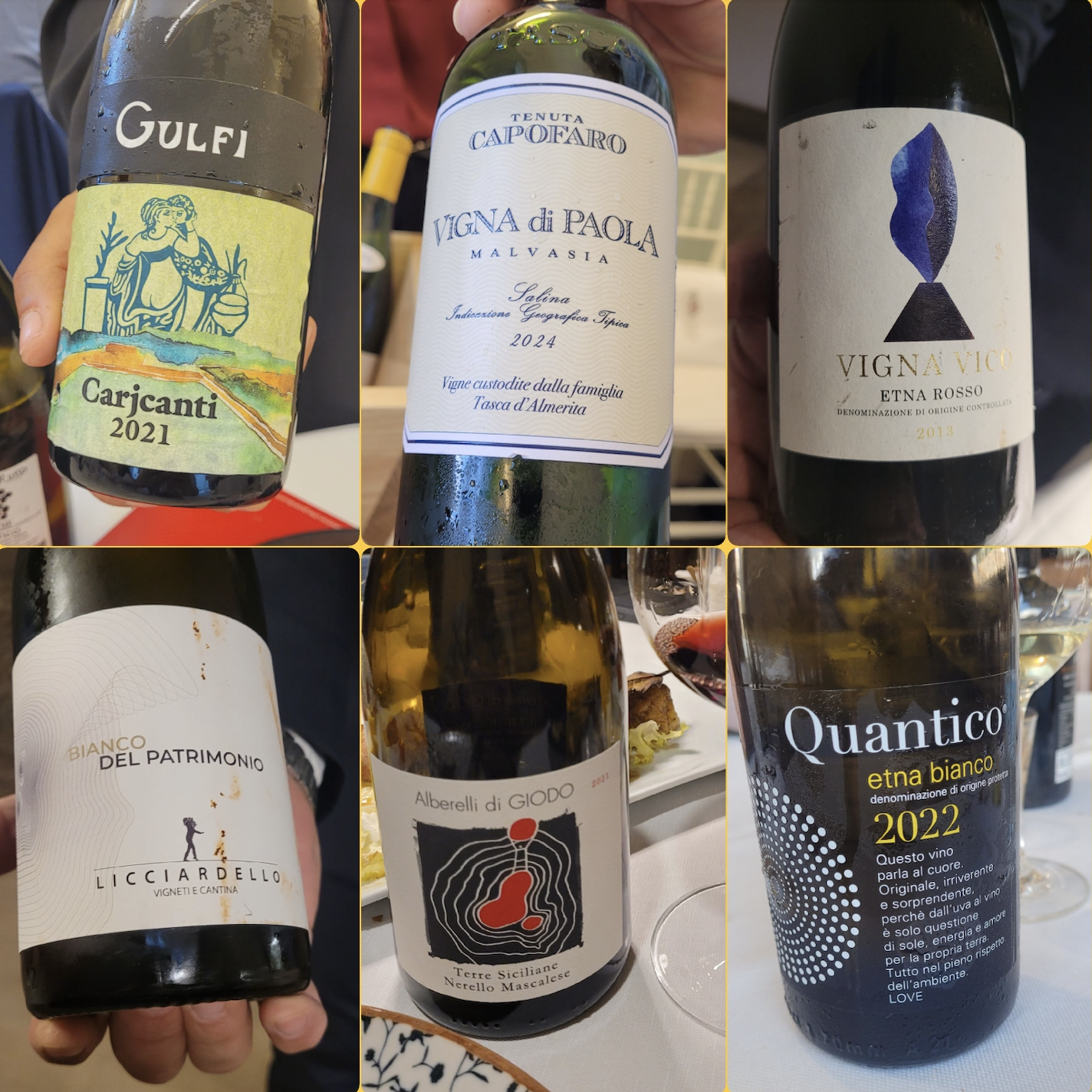
Gulfi Carjcanti 2021, Terre Siciliane IGT

From the wine with the dialectical name for carricante and a beautifully bittered tincture that speaks to sunshine for fruit first and volcanic feels second. They come together but will only improve their relationship with tome in bottle. Drink 2026-2029.  Tasted May 2025
Pellegrino 1880 Grillo Sicilia Superiore DOC Senarià 2023

Senarìa means “cold” for a clone of grillo planted in 1980 ’s since been propagated by Pellegrino for more hectarage. The only grillo produced as a superior in Sicily with age and clonal specificity creating the identifiable DOC. Almost like serious chardonnay in style and effect, a Burgundian bite and crispy character that’s part unexpected and part intense. The richness comes from the palate, as it should for a two-part experience growing and will continue to grow in stature. Drink 2025-2028.  Tasted May 2025

Pellegrino 1880 Isesi Pantelleria Bianco DOC 2022

A Bianco in which zibbibo is the key with altitude and exposition to the winds being the catalyst. Different plots in several contrada are chosen as contributors of their varietal fruit expressed as a white wine that should and will age for years. Falls into the semi-aromatic, cousin in style to moscato sort of way and the tannins lay really low. They are the underscore, the horizontal backbone that fruit but also acidity glide over and develop their motion. This is a wine of journey, never static and one to look forward to tasting when it passes five to ten years of age.  Last tasted May 2025

Pellegrino 1880 Vergine Marsala Riserva DOC Single Barrel Nº 018 2005

Vergine means marsala fortified with soy alcohol and as Riserva (2005) it means more than 20 years of aging. Mainly grillo with (30 percent) catarratto and inzolia, limited production, 2,163 bottles and finished at 19.5 percent alcohol. The sugars developed could imagine honey, brown sugar or maple syrup but they are so much more complicated and therefore unnamed. Also fruit like apricot and pineapple but think moire exotically or better still just admit that something unusual and ethereal is happening. The palate is dry as the desert, the flavours, brown butter nutty, intense and spicy. This is not a dessert wine by any stretch of the imagination but something much more gustatory and ready to receive culinary inspiration. Drink 2025-2040.  Tasted May 2025

With Planeta winemaker Patricia Tóth

Planeta Eruzione 1614 Carricante 2022, Sicilia DOC

At a time it was the high elevation and now it’s really more about the established appellative functionality that dictates the specific DOC labelling of Eruzione 1614. There are varietal carricante on L”Etna and there is Eruzione, a Bianco as definitive to tell an old story and relay the message of soil, stone and place. The 2022 is exceptional, rising and seemingly hovering above the ground, something very hard to do for fruit grown on volcanic terroir! Yet here is this levitating Etnese, a Bianco of weightlessness and incredible acidity. Will drink well for five years, in another terrific alternate state for five more and then who knows what magic through five more after that. Drink 2027-2037.  Tasted May 2025

Planeta La Segreta Bianco Sicilia DOC 2024

Ninety percent of the blend is three-fold, of grillo, grecanico and chardonnay, plus 10 percent “others” which includes the aromatic viognier. All adds up to one of Sicily’s most drinkable whites and there can be no argument there. Cool, chill, kick back, sip and relax. Here, there and everywhere. Put on the Beatles or whatever makes you tick. Just drink it. Drink 2025-2027.  Tasted May 2025

Planeta Chardonnay Sicilia Menfi DOC 2023

Warmth begets riches and yet 2023 is not the warmest of Ulmo vintages but chardonnay has so much experience, developed vine age and proven track record to get into this full and substantial place. Without fail and the fans of this large production Sicilian pioneer will again be granted their wish. Chardonnay is big and it is grand, with the benefits of barrel and sun, all in balance. Drink 2026-2029.  Tasted May 2025
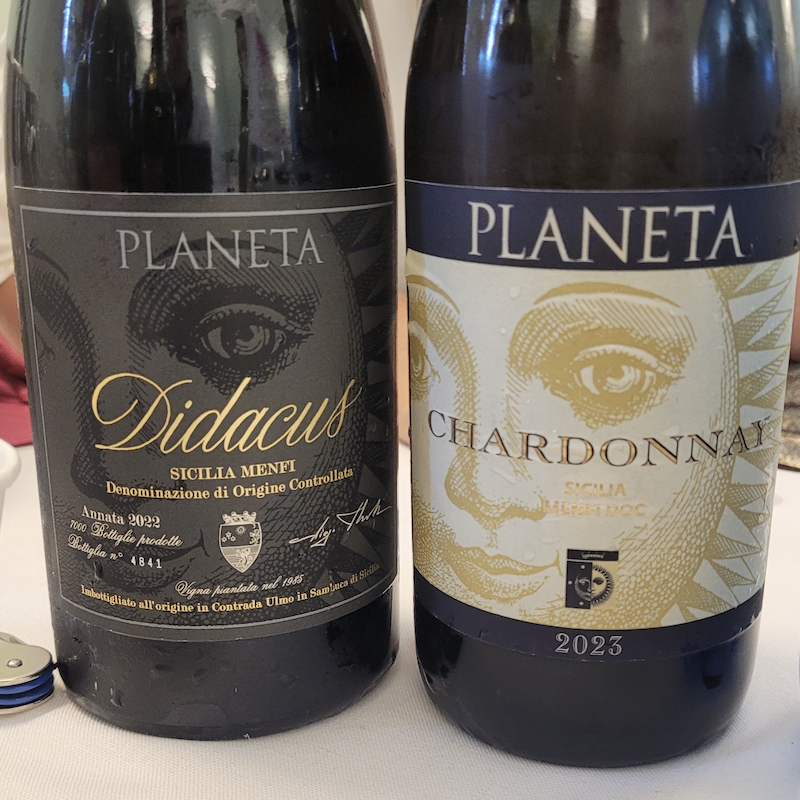
Planeta Chardonnay Sicilia Menfi DOC Didacus 2022

For Didacus chardonnay rises to the island’s highest level because it receives the respect and elévage it so deserves. Hard to find a vintage as firm and as tight as 2022, weather related of course with heat units having come fast and intense, but also elongated through to the earliest pf picking times. That would be the first week of September and thankfully so because acidity keeps the dream alive. Didacus is drinking at peak right now – do not sleep on it’s power or potential and find a way to get there now.  Last tasted May 2025

Production began in 1995 while the vines are now nearly 45 years of age. In the southwest part of Sicily, in the Ulmo area around the village of Menfi where a corridor of wind, “our favourite friend,” tells Santi Planeta, blowing through between the lake and the sea. Through vines growing between 100 and 450m, breathing cool life, especially in the summer. The 2022 vintage saw plenty of rain though not concentrated at any particular time and so the constant events of moderation were something remarkable considering how often extreme climate events are increasingly more prevalent. The coming vintage of 2023 and 2024 will be affected by them, mostly because there was no rain. This chardonnay is impeccably balanced between fruit and acidity, acidity and texture, texture and tannin. The progression is seamless, the result precise and anyone who does not the recognize the experience and continued work put in may not be paying close attention. That’s fine but know just how special a (relatively) large production, semi-cool climate chardonnay this truly is. Planeta’s year-to-year consistency is truly impressive. Drink 2024-2028.  Tasted at i4C, July 2024

Serra Ferdinandea Bianco Sicilia DOC 2023

A 50-50 split between grillo and sauvignon blanc from a season with drama because of early heavy rains and yet there no Perenospera (mildew) developed up on the vineyard’s hills. In this vintage the directness and linearity of the sauvignon takes control but this is also the style, from clean maceration for a capture of saline intensity to keep fleshy and golden maturity at bay. The grillo plays along but never speaks up or steps out of place. Drink 2025-2027.  Tasted May 2025

Tasca d’Almerita Tascante Chardonnay C’Eragià 2022, Sicilia DOC

Etna chardonnay made with French wood completely un-toasted out of Rampante where a chardonnay vineyard already existed when Alberto Tasca bought the estate. The wood is virtually unnoticeable, lemon attacks the palate and the energy is simply great. Graceful while volcanic spirit adds the intangible pizzazz. Drink 2026-2029.  Tasted May 2025

Tasca d’Almerita Fondazione Whitaker Grillo Mozia 2024, Sicilia DOC

Grillo from Mozia island off the coast of Trapani and Marsala, the only important variety and 40 year-old vines for the most unique expression of the grape. An ancient expression if you will and quite possibly the saltiest of them all. Some will find this sharp and austere but there is sneaky richness and intensity that belies the sear and strike of the grillo. Drink 2026-2029.  Tasted May 2025
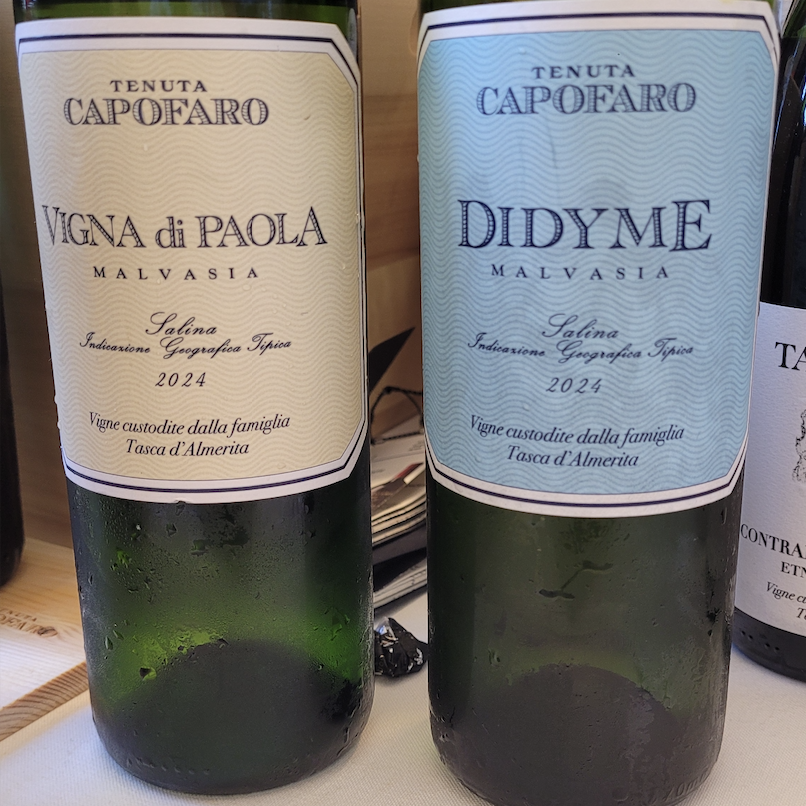
Tasca d’Almerita Tenuta Capofaro Malvasia Vigna di Paola 2024, Salina IGT

Saltier and more vertical of the two Salina malvasia, less fleshy but also juicy character, instead a more briny caper measure and mix of marine elements. Volcanics come into the soul of this malvasia with impunity and the mineral austerity is nothing short of intense. If Didyme intoxicates it is this Vigna di Paola that takes full control of your senses. Drink 2026-2029.  Tasted May 2025

Tasca d’Almerita Tenuta Capofaro Malvasia Didyme 2024, Salina IGT

Iron volcanic sands make for vines and grapes that develop a relationship only Salina will own, different even than Lipari and in terms of malvasia there is nowhere else in the varietal diaspora where it comes way like this. A mineral that gets in you, an intoxicant that runs through the veins and causes a true stoning. Imagine capers and ricotta, shrimp and lime. It’s all there in sweet, salty and semi-aromatic intensity. Drink 2026-2029.  Tasted May 2025

Tenuta di Castellaro Bianco Pomice 2024, Terre Siciliane Bianco IGT

A blend of malvasia (della Lipari) and carricante as an extremely youthful and so in certain ways playing the part of a 2024 preview although it’s a finished wine. There really is nothing like this, nine months on lees with bâttonage every month. Consider this as “Etna Bianco plus” with more marine influence, a spirited buzz about it and a fleshiness matched by this mix of flint and isle mineral feel. Just bloody delicious. Drink 2026-2029.  Tasted May 2025

Tenuta di Castellano Eúxenos 2022, Terre Siciliane IGT

Just malvasia di Lipari, ”lightly” fermented on skins in one cacciopesto amphora, a lightly permeable type for just 1,800 bottles. Simulates an imagining of a history of sunken greek amphora and so a message is felt and transmitted for making a wine that just needed to be made in reference to the lore. Ultra textural and a fascination with fate that requires one to abandon a perspective firmly embedded within a knowable methodology of winemaking culture. Drink 2026-2029.  Tasted May 2025

Tenuta Regaleali Catarratto Sicilia DOC Buonsenso 2024

Intensity and concentration of sweetly herbal and salty fruit with persistence as much as any varietal wine in Sicliy. Happens to be catarratto, one so full, expansive and linear. Drink 2025-2028.  Tasted May 2025
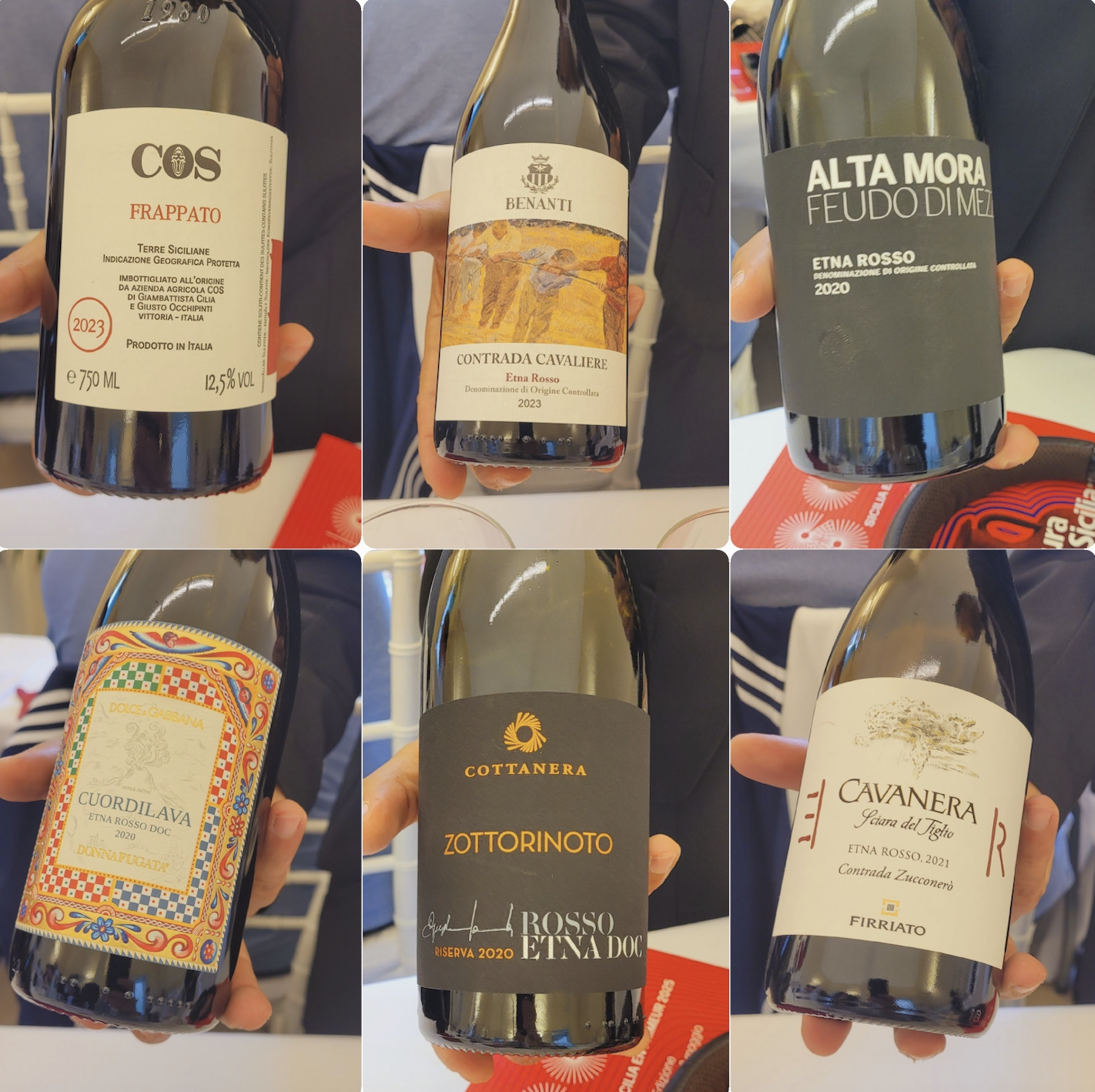
Etna Bianco

Benanti Etna Bianco DOC Contrada Cavaliere 2023

Cavaliere as a contrada white is getable and found in mid course for carricante of middle weight, fleshiness and structure. In other words a balanced Etna Bianco that has arrived early and readied for consumption ahead of the other single place wines. The metallic notes are purely basaltic and while fruit is plenty pleasant it’s not really the lead driving factor. Cavaliere is specific and noted for that. Drink 2025-2028.  Tasted May 2025

Benanti Etna Bianco DOC Contrada Rinazzo 2023

Rinazzo as a contrada Etna Bianco is surely more reserved and stoic especially as compared to (Cavaliere), as if it were let’s say Vaucopins and Cavaliere were Beauroy. Unnecessary wine region comparisons aside there is a richesse and a golden sun meets volcanic mineral accumulation to set Rinazzo aside. Definitely its own Bianco, at once structured and then feeling mature. Feels like a wine having arrived and yet not quite there. Makes for another great and curious Etna Bianco study in contrada-designed peculiarities. Drink 2025-2030.  Tasted May 2025

Benanti Etna Bianco DOC Contrada Monte Serra 2023

There is Cavaliere, Rinazzo and then there is Monte Serra. Hard to imagine three Etna Bianco from the same producer could each act so different. Monte Serra is the reductive and hard to access carricante, stuck in the basalt, shut tight and currently immovable. Not exactly expressive nor seemingly looking to act so any time soon. Would give this a year to sort out its thoughts and reconcile its differences between parts. That said the distribution of weight in Monte Serra’s design creates a sense of stability and harmony in its architecture. Thinking further we’d all consider waiting two years to see a release of the magic and fantasy. Drink 2026-2031.  Tasted May 2025

With JustSicily’s Federica Matranga

Cottanera Etna Bianco DOC 2024

First ’24 out of the gates, clean, open, fragrant and fresh. Apple juiced and as readied in simplicity without fuss, obfuscation or muss, in as much as it seems possible from Etna Bianco. The time to drink is now. Drink 2025-2026.  Tasted May 2025

Cottanera Etna Bianco DOC Contrada Calderara 2023

Next level interest and complexity comes from this Etna Bianco out of the Contrada Calderara where reds shine and whites like this are golden proud. Equanimous mix of stone fruit and volcanic savour come together and do so with seamless ease. For someone who wishes to experience the next level above and beyond regional or say “Villages” Etna Bianco it is this carricante that will help show the way. Drink 2025-2029.  Tasted May 2025

Cusumano Alta Mora Etna Bianco DOC 2023

Rich, luxe et volupté carricante for the sort to seduce and reel in hundreds of new varietal consumers. Also that which should surely please many who have already attended the party. More than ample freshness, crisp bites, orchard fruit, mineral sparks and finishing bitters. Drink 2025-2027.  Tasted May 2025

Donnafugata Etna Bianco DOC Sul Vulcano 2022

Oh so specific style of Etna Bianco from carricante tucked into the volcano and scenting like a garden wet with rain. As if petrichor soaked into basalt, effusive and smelling like nothing ever before, especially when the Ginestra joins the mix. Crunch and sway, crisp apple bites and varietal oscillations. Top vintage for this Donnafugata Etnese white, clean and yet leesy, complex and inviting. Drink 2025-2029.  Tasted May 2025

The team of Generazione Alessandrio

Generazione Alessandro Etna Bianco DOC Trainara 2023

Of 85 percent carricante and (15) catarratto near Lingualossa which being on the eastern slope increases the marine influence. Push-pull posit tug between the volcanic and the botanical or perhaps they are actually one in the same. Clean and focused Etna Bianco in any case. Drink 2025-2028.  Tasted May 2025

Girolamo Russo Etna Bianco DOC Nerina 2024

Rich and fulsome, as concentrated as Nerina will ever be and surely a factor of tight, small and low yielding bunches. These as a sub-factor from a condensed vintage of heat units and less water accumulated in each berry. Nerina as Etna Bianco 2024 travels right up the rising angles of the palate, gets into that nook at the top of the jaw before receding into full golden fleshiness. Drink 2025-2028.  Tasted May 2025

Girolamo Russo Etna Bianco DOC Feudo 2023

Feudo as the cleanest of Russo’s carricante, crisp and of a contrada clarity for whole rounded expressiveness. Good clean lees living from 2023 Feudo with segments of lemon and white grapefruit providing a plethora of fresh citrus flavour. Nothing herbal or savoury about it, just the facts, of fruit and mineral.  Last tasted May 2025

New Bianco for Giuseppe Russo, a selection of 100 percent carricante from three hectares within the Feudo di Mezzo vineyard and contrada. Feudo is not San Lorenzo but it is something remarkable in its own right. More botanical and phenolic but also a level of citrus preserve not noted anywhere but Feudo. Crazy level of implosive citric intensity and taut character. The behaviour is so different to San Lorenzo with flavours that mean business in the most impressive way imaginable. Intensity off the charts, concentration so impressive, energy that builds and builds. Drink 2024-2029.  Tasted May and September 2024

With Giuseppe Russo and Alberto Graci

Graci Etna Bianco DOC Muganazzi 2023

Graci’s Muganazzi is a true blue contrada Bianco from stone, of mountain reduction by way of its processes. The palate gets past the wall of aromatic sound to tell us what we need to know, or at least part of what the future holds. This is serious and protractive carricante, cased in a hard protective shell, waiting to be released. Crispy and encrusted but time will do what’s necessary. There is a great an substantial amount of fruit which is what matters most. And of course the volcano. Drink 2027-2033.  Tasted May 2025

Graci Etna Bianco DOC Arcurìa 2023

Apposite to Muganazzi is Arcurìa, a contrada carricante with more immediate flesh and plenty of backbone in support. Arcurìa is also the truly leesy Etna Bianco, built on the yeasty stuff and more akin to wooded Chablis than almost any other. This reminds of Fourchaume if such a comparison could be tolerated, but either way the wine is built to last. Drink 2026-2031.  Tasted May 2025

I Custodi delle Vigne dell’Etna Bianco DOC Ante 2021

Smoky from its reductive and flint stone struck moments, the fruit not only behind but well back with volcanic sand after a rain wedged expressively in between. Everything about Ante screams volcanic Etna, in stone, rock, sand, mineral and elemental style. A must try to begin believing. Drink 2027-2032.  Tasted May 2025

I Custodi delle Vigne dell’Etna Bianco DOC Imbris 2020

I Custodi is the kind of place to raise cariccante and Imbris the kind of label to speak in Etna Bianco clarity. The cool-climate factor and style might make you think the area is cold as hell but oh,no,no,no and Imbris is a kind of rocket man. The 2020 holds such a beautiful combination of lees driven fruit and volcanic mineral so there is no doubt a new age is upon this estate. The wines have been working towards this moment and here they are. Beautiful and inviting, welcoming and fine.  Last tasted May 2025

Varietal carricante at 800m fermented in steel, put to barrel and then one year in bottle. So much corporeal flesh on the body of a seriously developed Bianco. Has come into a fine place but my goodness so much texture, citrus and length. Drink 2024-2027.  Tasted May and September 2024
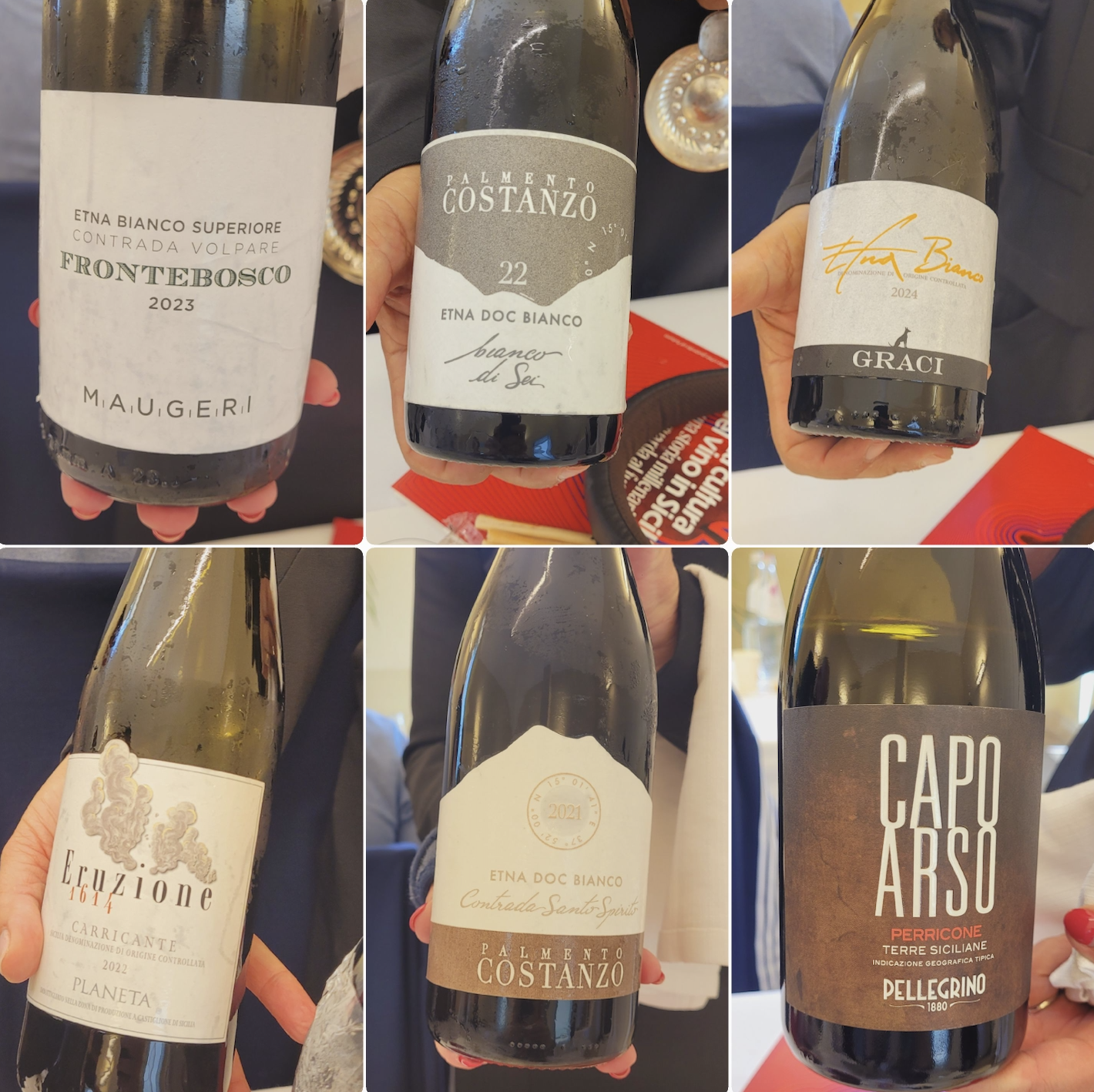
Maugeri Etna Bianco DOC Superiore Contrada Volpare 2023

Confident, cool and still presently stoic holding on to a controlled, yet to open the gates and be released intensity. Perfectly clean lees living within a structure of carricante built for pleasure and also aging. Really fine work from Contrada Volpare with many years of expressive reveal still to come.  Last tasted May 2025

Youthful is the understatement and Volpare the name, so say it loud. This is indeed singular Etna Bianco, as they should be but some are in a league of their own, as Mugeri’s eastern wines clearly are. The estate has taken it to the next level with an ascension of elevated mountain fortuity but also depth determined by terroir which can only be transmitted when agriculture abides. Abides because the maker makes it happen and Volpare delivers generously while also with precision and finesse. Leave this for 18 months or more to settle the relationship between rocks and acidity. After tasting Frontebosco and also Frontemare you realize the latter is the true catalyst to propel this cuvée selection. Drink 2026-2032.  Tasted September 2024

Maugeri Etna Bianco DOC Superiore Contrada Volpare Frontebosco 2023

Seemingly an understatement made but its only by the music this Etna Bianco will be free. No doubting more finesse, focus and precision from the carricante out of the vineyard facing the forest, an herbal cooling coming in, upping the botanical feels, its development low, slow and perhaps still far away. The taut nature of Frontebosco means the requiem to await what’s coming should be at least a year. Last tasted May 2025.

Versante est which separates Mugeri from not just the north but also the south and the future will surely look to this area for greatness. Not only Volpare contrada but a section within, here called Frontebosco, as in facing or in front off the forest and so the herbals here within are assumed to be elected by the nearby woods. Makes for freshness but also a fruit fleshiness that the more general Volpare does not show. A full, substantial and impressive Etna Bianco that might just appeal to everyone. Superiore indeed. Drink 2025-2033. Tasted September 2024.

Maugeri Etna Bianco DOC Superiore Contrada Praino Frontemare 2023

From the first to the sea we now receive the carricante out of the vineyard facing the Ionian, a stiff breeze blowing through, keeping the sails taut and the speed up, all the while a finish line yet far away. More lees coming from Frontemare mixing with sea spray for an Etna Bianco tight as they come, yet airy and rising. Would wait two more years for parts to come together and waves to calm down. There will be smooth sailing ahead.  Last tasted May 2025

Frontemare, “facing the sea,”as opposed to Frontebosco, “facing the wood.” As such this would be east facing from Etna’s east sector and so the block with the view creates a unicorn of an Etna Bianco as fascinating as it seemingly gets. The most crisp, crunchy, fresh and intense of Mugeri’s whites, citrus squeezed throughout and long as the zig-zagging wind of a single road down to Catania and into the sea. Just wow, with layers upon layers to unreel, unfurl and unroll for a long aging period ahead. Drink 2026-2034.  Tasted September 2024
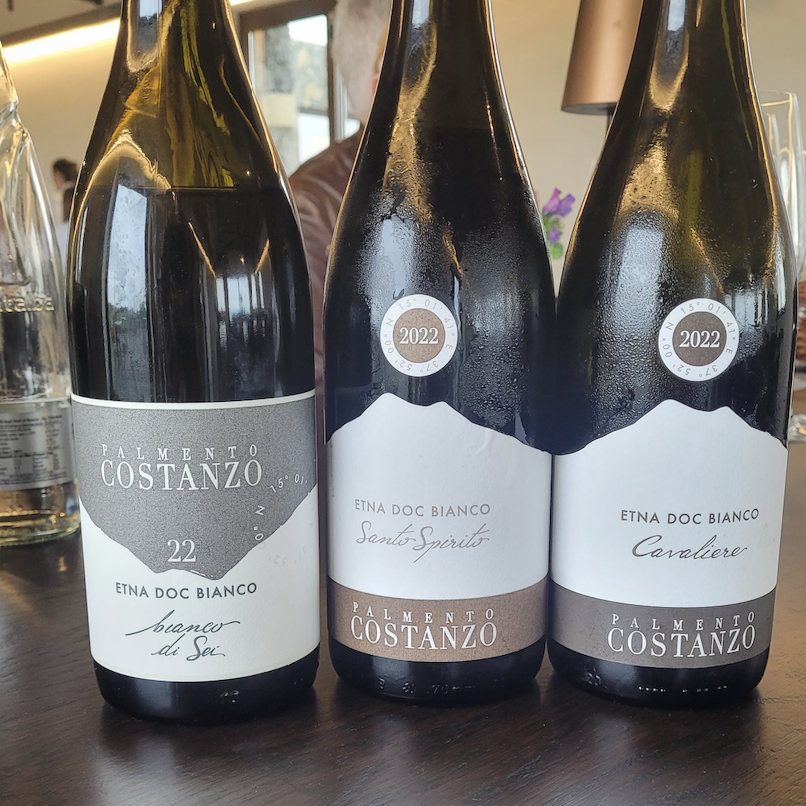
Palmento Costanzo Etna Bianco DOC Bianco di Sei 2022

Perfectly expressive carricante from 2022 for a vintage not always caught at optimum, however the Costanzo team’s relentless.  Last tasted May 2025

A cuvée of all parcels from different contrade, including the homefront Santo Spirito, along with Cavaliere. On average 90 percent carricante with (10) catarratto. Only raised in stainless steel, persistently fresh and if any region in the world might be compared with it would be Chablis AOC, direct, salty, smart and widely purposed.  Tasted September 2024

Just have to say wow because Bianco di Sei comes equipped with a level of intensity that was not quite expected from 2022. Not so much a volume or an explosion aromatically speaking but an extreme set of eccentricities that crash aboard the palate. Likely needing some rest and down time to integrate because the level of extract here (including volcanic activity) is simply off the charts. Etna incarnate, pointed and exciting. Drink 2025-2029.  Tasted May 2024

Palmento Costanzo Etna Bianco DOC Contrada Santo Spirito 2022

In reality these last three or four years have always been warm but ’22 was frankly very good, warm yet without any real challenges. What drives this carricante is an unwavering focus and persistence, a balance from start to finish without dips or oscillations. The relationship between Costanzo and Santo Spirito in Bianco is seamless, now seven years into their partnership.  Last tasted May 2025

High level aromatic volume and concentration from Santo Spirito ’22 and we know right away that this wine knows exactly who it is, where it comes from and where it wants to go. Volcanic salts are also present on the nose from a Bianco of great stage presence and such a smart textural weave that gains every bit of the palate’s confidence. The connection is prescient, reaction calming and conclusion poignant. This is how you make and present Contrada-specific Etna Bianco. Drink 2025-2033.  Tasted September 2024

Palmento Costanzo Etna Bianco DOC Contrada Santo Spirito 2021

High spirit from the Contrada specific blocks to speak on behalf of local saints and soils. Volcanic vernacular, citrus and herbal, gelid cool, leesy clean and indefatigably healthy. Fine carricante for 2021 and a vintage that is sometimes confounding. Not here in an expressive and beautifully made example. So very 1879 in terms of volcanics and therefore Santo Spirito tells the story.  Last tasted May 2025

Note the colour of the lava soil on the label, lighter brown for Santo Spirito, from the contrada vineyard at 700m on the northern slope that comprises one out of three “islands within the island” of L’Etna. Still just an infant, implosive and insular, wound so tight, yet to explode. Give this another year, just as the first taste had indicated for months prior.  Tasted September 2024

A fine vintage and and even finer Contrada, that being Santo Spirito where carricante (and 10 percent cattarrato) are given every soil, geological and micro-climatic advantage. There is an accumulation of ripeness and stone cool mineral groove from location and acumen that make this move with incremental ability. It will slowly define itself over along period of time that will be fascinating to watch every step of the way. Drink 2025-2032.  Tasted May 2024

Palmento Costanzo Etna Bianco DOC Contrada Cavaliere 2022

The most recent bottling for the cru Bianci and this out the contrada vineyard down slope from Palmento Costanzo. Perhaps not the tension of Santo Spirito and surely more richness yet still the balance between fruit and the structural parts. Cavaliere is remarkable for its quality consistency year in and year out. Unwavering Bianco. Drink 2025-2028.  Tasted May 2025

Palmento Costanzo Etna Bianco DOC Contrada Cavaliere 2021

Very different to Santo Spirito, riper and richer, more cumulate golden sun, lees still a major factor in the overall expression. Just a touch of reduction, tart with tight lines and increased juxtaposition between stylistic parts. Not as focused as Santo Spirito but surely seductive and generous.  Last tasted May 2025

Note the colour of the lava soil on the label, darker brown for Cavaliere, from the contrada vineyard at 700m in the southwest “island” of L’Etna. A different expression to that of Santo Spirito, volumetric in terms of aromatics and less austere or rather locked tight. Here more sapid and botanical, less basaltic salinity and fleshier early on. More fruit forward, pulpy stone fruit like, amenability run higher and the Contrada-designate Bianco to drink while waiting for Santo Spirito to mature. Drink 2024-2027.  Tasted September 2024

Pietradolce Etna Bianco DOC Archineri 2023

Archineri as a Bianco is really open and expressive, delicious and generous from the word go and ready to please. Clean lees, a cool basaltic factor and white peachy stone fruit. The citrus is a bit neutral yet surely supportive and helpful in the overall feel of the wine. Really good quality and clean winemaking results in a wholly accessible and aiming to please white from L’Etna. Drink 2025-2027.  Tasted May 2025
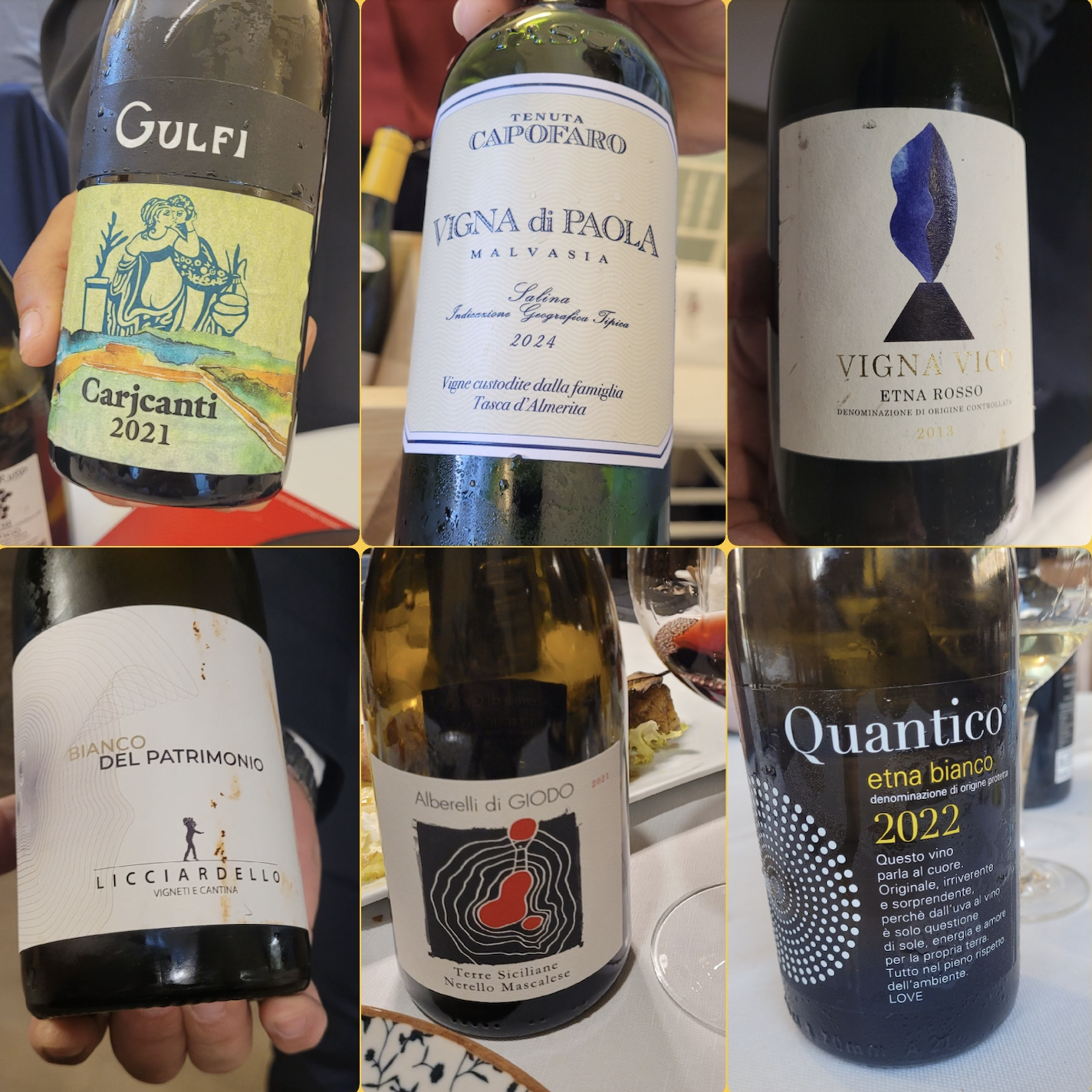
Tasca d’Almerita Tascante Etna Bianco DOC Contrada Sciaranuova 2022

Lees shows to be so integral and essential in the early development of Tascante’s Etna Bianco 2022 from the very important Contrada Sciaranuova. There is a play of current confusion while this youthful because the parts inside are bigger than the house that fits them. Expanding from within and needing more room to grow, to shed its weight even after eight months time.  Last tasted May 2025

Vinified and aged in Slavonian Grandi Botti, “to preserve the verticality and freshness of the carricante” explains Tasca d’Almerita agronomist Michele Brusaferri. Plays hard to get and acts demure inside the halls of its aromatic silence but you know that the elevation and fine basaltic soil are the portents of Tascante’s main Contrada Sciaranuova that will see to conditions for change. Though soft you feel the wood, present with confidence yet the thread of cool, herbal and botanical rins from Buonora into this Bianco. Fruit will soon peek through and announce a scintillant’s arrival, blossoms too, namely orange and then to salty lime later on. Just takes some air, agitation and swirl to coax out the excitement and up into the stratosphere. Turns out to be crunchy and seriously salty Etna Bianco, like flakes of Maldon or Slovenian platinum for what can best be described as living the high seasoned life of Etna Bianco. Structure is there and so this should age quite well. Drink 2025-2031.  Tasted September 2024

Tasca d’Almerita Tascante Etna Bianco DOC Buonora 2024

Both the good hour and bonaire as from the French and carricante just about as fresh as you will ever experience. Fresh and fleshy, fleshy and delicious, delicious and satisfying. Just what you desire on the 12th of May at 650m above sea level aboard L’Etna. Drink 2025-2028.  Tasted May 2025

Terra Costantino Etna Bianco DOC deAetna 2023

The term “deEetna” comes from a Latin pamphlet dated to 1494 expressing the sacredness of the oenological universe. Terra Costantino’s is one of the finer examples for 2023 by way of a blend led by carricante plus (15 percent) catarratto and (5) minnella. Ripening to fruition happened in the last ten days of September off of vines averaging 20 years. Yes to the palpable feeling of gainful concentration in juxtaposition to a fine and chiseled example with more wiry flesh hanging tuat on the mineral frame. Really well composed. Drink 2025-2029.  Tasted May 2025

Tornatore Etna Bianco DOC 2024

The straightest and fullest of Etna Bianco expressions with all in clean lees bulking up the substantial aspects of the wine. This is the entry point, the gate for which to walk through into the ever expanding idiom that is Etna Bianco. Start here and then explore the rest.  Last tasted May 2025

The vintage is represented in a most viscous way. Almost an oily character to 2024, indicative of the variable vintage with September having delivered some much needed warmth and sunshine for full phenolic grape development. A sapid iteration, botanical notes pervading and in the end it is texture that drives this Bianco machine. Drink 2025-2028.  Tasted March 2025

Tornatore Etna Bianco DOC Pietrarizzo 2022

Full on sun cumulate carricante from Pietrarizzo for what is surely as ripe and calculated an expression as they come. Full advantage taken of 2022 fruit for all that can be wanted from a Contrada Bianco example.  Last tasted May 2025

Pietrarizzo is both available and confident, not idiosyncratic like Zottorinotto and also richer of fruit. There is an herbal and botanical way about this cru Bianco with splashes of catarratto bringing seasoning to the carricante. A bit spicy and even humid though the fruit is the thing and the volcanics an accent making for even more spice entertained. Such a solid Contrada based Bianco. Drink 2024-2028. Tasted and September 2024

Tenute Tornatore Etna Bianco DOC Zottorinotto 2021

No comparison between Pietrarizzo and Zotorinotto, first of course because of location but in this case also dramatically caused by vintage. The 2021s are not holding up with the same stage presence as wished for last year and the year before. In fact they’ve transformed into this idiosyncratic space. No different here with a carricante of reductive meeting wet stony elements. Feels like some diesel creeping in, not petrol per se (akin to TDN) and smoky rather than smouldering. A bit of a strange advance with likely something new again on the horizon.  Last tasted May 2025

Of Tornatore’s cru-designated Bianci it is Zottorinotto that acts the most reductive and hard to crack. Great shell of protection and disguise, needing agitation and better still time. That said the 2021 is also fully formed, developed and very much ready to get at – make sure to aerate, decant if you can and allow the pleasures to be released. Drink 2024-2026.  Tasted May 2024
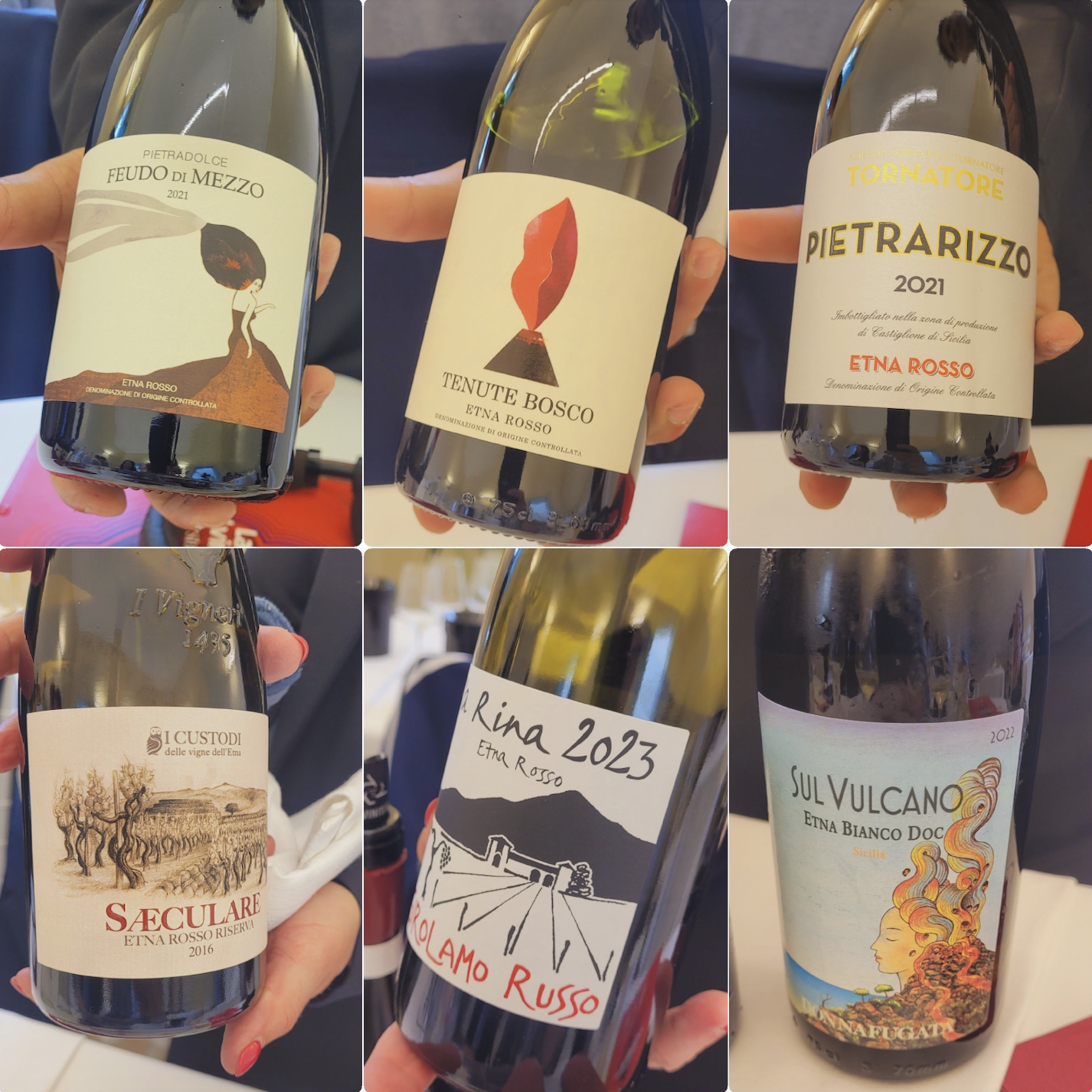
Etna Rosso

Benanti Etna Rosso DOC Contrada Monte Serra 2023

Strong aromatic presence and pulse for Monte Serra 2023, mildly and effectively reductive holding parts known and unknown. Not to say the aromas are stifled because they burst if within a bubble and yet to explode without. The epitome of nerello macalese filling our hopes, thoughts and dreams with anticipation. Cuts from stone some dreams of its own and though restrained it keeps a watch over the distance with a look to the future. Monte Serra is always an Etna Rosso with the grip and structure to look farther on, to hold back the fruit and preserve it for later days. The 2023 is balanced and prepared for longevity – that much is clearly true and in view. Drink 2027-2032.  Tasted May 2025

Benanti Etna Rosso DOC Contrada Cavaliere 2023

Tasting Monte Serra and Cavaliere 2023 side by side reveals much about place of origin because while the former looks farther on, the former engages today. A nerello masaclese that makes us see where we’ve both been, reaches us with immediacy and in turn we pay close attention. So much fruit interned so early, so little time to realize just how much is right there in this glass. It’s just that not opening and consuming bottles in the present will be hard to avoid. Drink 2025-2029.  Tasted May 2025

Cottanera Etna Rosso DOC 2023

Knowable bricks and mortar nerello mascalese as Etna Rosso and dictionary entry for the DOC. Sweet vintage fruit, competently concentrated, simply and effectively structure. Does what needs and does it very well. Drink 2025-2027.  Tasted May 2025

Cottanera Etna Rosso Contrada Feudo di Mezzo DOC 2021

Feudo di Mezzo of clout, expressiveness of largesse from the fullness of its old vines nerello mascalese fruit. Still a bit of a reductive nut to crack, a force field to break through, a softening needed to find full pleasure in the wine. A 2021 neither too hard nor to soft, the Goldilocks vintage as they say though the pressure is still applied. This FdM should come into its best years in six months or so. Drink 2026-2031.  Tasted May 2025

Cottanera Etna Rosso DOC Contrada Zottorinoto 2020

Give Zottorinoto an extra year an it will express itself with utmost generosity and here the Contrada’s Rosso is more than ready to go. Fruit sweeping and swelling across the plate, acids mellowed and tannins as well. As drink now a Rosso for the Contrada, as compared to any or all of this ilk on the mountain. Drink 2025-2027.  Tasted May 2025

Cusumano Alta Mora Etna Rosso DOC Feudo di Mezzo 2020

Dusty and Balsamic terroir expression, especially for Etna Rosso and also Feudo di Mezzo. A high acid style to compliment and even more so extenuate the circumstance of nerello mascalese. A specific style as well and one that garners attention, namely because its persistence and length are really quite outstanding.  Last tasted May 2025

Middle ground traveled and promise delivered for the large Feudo di Mezzo as Contrada sizes come, with fruit able to defend itself against generous wood though all parts launch a collective attack on the senses and palate. Big Rosso for Etna, strong boned and willed with the intention to impress. Drink 2025-2028.  Tasted September 2024

Donnafugata Etna Rosso Courdilava Dolce & Gabbana DOC 2020

Red stone fruit skin’s aromatic musk, pulpy to chewy within and fresh enough to keep a leathery character at bay. More tannin than expected and in fact they build quickly – this despite some four plus years having had the chance to settle the score. Still quite grippy and with a level of tension needing to subside. Impressive Etna Rosso. Drink 2026-2029.  Tasted May 2025

Donnafugata Etna Rosso DOC Fragore Contrada Montelaguardia 2021

Noticeable ulterior as an expression of Etna Rosso in comparison to the Dolce & Gabbana Donnafugata label. A fullness of nerello mascalese pressed, dressed and prepared for success. Clearly one to serve up and explain the nature but also importance of a single contrada wine, lacking for nothing and of layers far from being shed. Give time because otherwise this wine will attack with impunity and not let go. Drink 2026-2030.  Tasted May 2025

Firriato Cavanera Etna Rosso DOC Contrada Zucconerò Sciara del Tiglio 2021

Grainy if fine in that respect from specialized and decomposed volcanic sands that lend a very specific profile to Etna Rosso. Also quite ripe and so the palate holds a liquorice, leathery fruit chew character which speaks to drinking sooner rather than later. No doubt a singular wine and one that screams for best food accompaniment. The duck at Cavanera Wine Resort is ideal. Drink 2025-2028.  Tasted May 2025
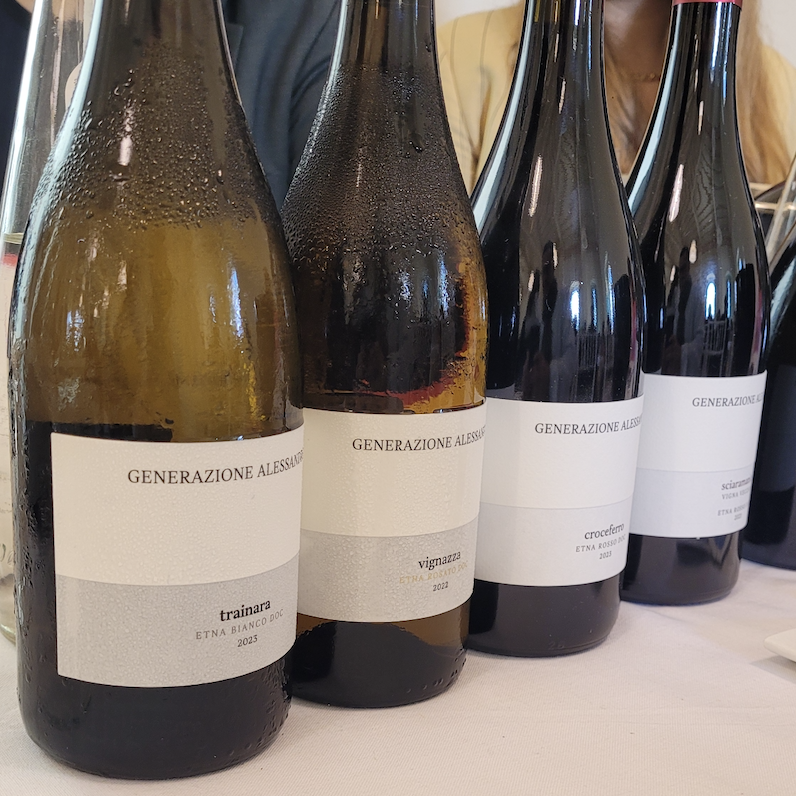
Generazione Alessandro Etna Rosso DOC Croceferro 2023

Only nerello mascalese off of the northeastern slope of Etna and the place where the iron cross, therefore Croceferro sits in the vineyard. A rich and tannic nerello with a tease of immediate gratification but the austerity in this tannins reminds that time will be the operative and necessity for best results. Drink 2026-2029.  Tasted May 2025

Generazione Alessandro Etna Rosso DOC Scaramantica Vigna Vecchia 2021

Oldest vines are 80 years of age and nerello macacesle is joined by several others for a true Etnese field blend. Increases the fruit immediacy with concentration but even more so the tonic profile with fine-grained ruling and austerity that requests time, plenty of time. Seriously structured Etna Rosso no matter how you slice it. Drink 2026-2029.  Tasted May 2025

Girolamo Russo Etna Rosso DOC San Lorenzo 2022

Open for business, fruit and acids intertwined at their combined sweet heights. Good palate spiciness and a riveting sense of energy. Liquid chalky tannins still in transformation, likely to finish their movements in another year or so. But don’t hesitate as San Lorenzo is drinking beautifully right now.  Last tasted May 2025

The gifts of San Lorenzo are of a slow release ilk the other cru and vineyards of Girolamo Russo are not, but this from 2022 is so full of riches it brings early joy. A great pleasure to have a glass even now with gregarious perfume and readied flavours, of red berries, liquid chalky to candied palate swaths and immediacy from this bottle of wine. San Lorenzo shows off the most glyercol and silken texture – it’s almost candied but of course it’s not. Spicy on the back side, sneakily structured and all the while with a glass we’re feeling fine. Can only improve and integrate with a couple of years time. Drink 2025-2030.  Tasted May and September 2024

Girolamo Russo Etna Rosso DOC San Lorenzo Piano delle Colombe 2022

If San Lorenzo is drinking at early peak right now then Piano delle Colombe should rightly be close behind. Yes in one sense and that would be more intensity of fruit concentration but then again no, because of this landslide of grippier tannin. There is no argument about seeing 2022 as a top Etna Rosso vintage and still the wood on 2022 Piano delle Colombe persists without melting or dissolving in. Some might find a bit too much while others will beg to strongly differ. The 2022 is right there where elements should rightly want to connect, intersect and layer. Perhaps not right away but in time, which will only embolden this Rosso with the wisdom and grace it is destined to express. Wait and anticipate seeing its reflection in the snow covered mountain. Drink 2026-2032.  Tasted May 2025

Girolamo Russo Etna Rosso DOC A Rina 2023

Put a ring around A Rina because no other Russo Rosso comes into view any sooner. None exhibit this level of juicy, luxe and getable richness and none shall pass, not for any reason at all. A Rina is a full and substantial nerello mascalese out of 2023, with the most liquidity come after dissolving grains of tannin for earliest drinking. No reason to wait. Drink 2025-2028.  Tasted May 2025

Graci Etna Rosso DOC 2023

A reminder about origin, they being estate vineyards at 650-750m and aging of 18 months in concrete though this ’23 feels as though at least one big barrel was involved. Not quite as linear and serious an Etna Rosso as the previous 2022 surely was and still is. Youthful yes but more chew than crispiness in 2023, ripeness and sweetness in acidity. No reduction, open for business and read to rock. Drink 2025-2028.  Tasted May 2025

Graci Etna Rosso DOC Arcurìa 2022

Spicing, spacing and perfume define Arcurìa with equal an opposing reflections for signs of Etna Rosso perfections and imperfections. Arcurìa from 2022 is showing quite the amount of barrel at this early stage, notes indicative of spice and challenge. Fruit is up to the task, metered, rising and falling in waves, there to speak of the open and closed spaces. All this to say the journey will end up in reflection in regards to a Rosso drinking forward for eventual gratitude. Drink 2026-2031.  Tasted May 2025

Graci Etna Rosso DOC Arcurìa Sopra Il Pozzo 2020

The piece of Arcurìa needing two extra years of aging and settling time is Sopra Il Pozzo, ad esempio a me piace il sud. Or the north as it applies to this slope of L’Etna and this piece is expressive of the sweetest spicing over fruit as any on the mountain. Yes the southern section is also liked but here Pozzo is an Etna Rosso of wood that needs to melt in, puddle below and allow a rising of fruit. That it will with the nerello mascalese climbing the firm backbone of this 2020 with fine and upstanding repose. Impressive and structured for a very long life still laid out ahead. Drink 2026-2034.  Tasted May 2025

I Custodi delle Vigne dell’Etna Rosso DOC Aetneus 2020

Fascinating study in Etna Rosso because these from I Custodi are different, stand out and alone nerello mascalese with (20 percent) nerello cappuccio. More than just the cappuccio but soil and location add up and amount to what’s in this glass. A certain kind of dried fruit, rich and leathery, studied and mature, weighty but without density. Now a settled wine with heavy mineral presence, a volcanic factor specific to I Custodi and when mixed with the winemaking style it all comes out a very certain way. Do you like it? Try it and find out. Drink 2025-2028.  Tasted May 2025

I Custodi delle Vigne dell’Etna Rosso DOC Saeculare 2016

The consistency of style from one I Custodi Etna Rosso to another is remarkable, to a wine, in all the wine. Yes the 20 percent nerello cappuccino is partly responsible for the semi-rustic, chewy dried fruit character but look further, or rather deeper into fine decomposition of basaltic soil. Location of course but whether you have 2020 or this 2016 in glass they all seem to be at nearly the same maturity. As here with Saeculare although it’s particular grip and structure see it age longer than Aetneus and this is prime time for tasting and in turn drinking this label. It will seem mature to some but know that this is the way and style of the house. Drink 2025-2027.  Tasted May 2025

Palmento Costanzo Etna Rosso DOC Nero di Sei 2021

Fine verticality even from Rosso di Sei because, well 2021 and also the lava. Feels firmer than eight months ago and as a result may live even longer.  Last tasted May 2025

Nero di Sei 2021 comes quicker to the point with near-immediate gratification because of vintage and also by way of the team allowig and even encouaging this to happen. Or abided more like it, with red berry fruit aromas that nerello mascalese can gift when the conditions are right. This is not to say that 2021 will fade into early light because it is in fact equipped with volume, concentration and backbone. A truly exceptional vintage that will appeal to all. Drink 2025-2030.  Tasted September 2024

Palmento Costanzo Etna Rosso Doc Contrada Santo Spirito Pre Phylloxera 2021

Not that the wine isn’t tight but my goodness how the tension is matched by fine verticality from Rosso with an intensity of volcanic chalkiness so specific to Santo Spirito’s 1870 lava. When vines are pre-phylloxera they have a true connection to the actual eruption and basalt because the lava had barely cooled when the first grapes appeared on the vines. A “no lo so” factor in this nerello mascalese character cools the Rosso so that herbal and stony notes prevail and persist, long after the wine has passed over the palate. A remarkable wine (isn’t it always) and another near perfect vintage. Drink 2027-2037.  Tasted May 2025

With Fosca Tortorelli

Pietradolce Etna Rosso DOC Barbagalli 2020

Grand and expressive, epically proportioned, factor of a remarkable vineyard brought to life through the coursing of its nerello mascalese. Hard to imagine an Etna Rosso so fine and linear could be considered crushable but this is Barbagalli and its vines more experienced than just about any aboard L’Etna. Crushable as a fleeting feeling but everything is truly in place, all parts inclusive of fruit, minerals, elements and constructions right where they should formulate. The last of the wine is no such thing because the weights, measures and taciturn moments linger for seemingly ever. Wowed and energized by Barbagalli. Drink 2027-2039.  Tasted May 2025

Pietradolce Etna Rosso DOC Archineri 2021

A different and singular animal for Pietradolce is Archineri, chewier and more palate workable than the rest of the Rosso portfolio. Lots of wood still noted on the 2021, changes yet to take effect, not here, not anywhere. Not tight as much as unable to come to be on the other side. Remains to be seen where this road will lead. To be honest it’s a bit resinous but youth is rebellion and maturity will come to experience.  Drink 2027-2030. Tasted May 2025

Pietradolce Etna Rosso DOC Rampante 2021

Effusive perfume from Rampante 2021, more floral than Pietradolce’s other reds, tannins sweeter and less austere. An approachable character though we know that structure is built for a long and full experience. The most immediately recognizable balance and still time will be kind to this Rosso. Air is on side now, time as well for 10 years forward. Drink 2025-2033.  Tasted May 2025

Pietradolce Etna Rosso DOC Feudo di Mezzo 2021

Some dried fruit and a maturity in the feels of Feudo di Mezzo 2021 but oh my goodness what a charming, graceful and lovely bit of nerello mascalese love in this bottle. Opens slowly and I also feel like their is some sort of obfuscation but the truth is the truth and FdM ’21 is in a very good and right place. Drink this while Rampante and Archineri work through their challenges. Drink 2025-2029.  Tasted May 2025

Pietradolce Etna Rosso DOC Santo Spirito 2021

From the opening salvo Santo Spirito is notable for its restraint and a closed aromatic tilt still very much a factor involved. Like Archineri, floral along with Rampante and so residing either in-between or as a combination of the two. A Rosso of layers, stepping stones taken up towards its eventual plateau. The barrel is melting here so slowly, the fruit fills full and substantial, the power less than intense and the energy still rising, Wait some more and then some more after that. Drink 2027-2031.  Tasted May 2025

Planeta Etna Rosso DOC Feudo di Mezzo 2023

First vintage as a solo Feudo di Mezzo and labeled this way. Not that this Contrada ever creates the darkest nerello mascalese but 2023 is at the peak of lithe, airy and transparent. The vintage takes over from the Contrada with ever-persistent and linear consistency controlling its volcanic destiny. Without density or extravagance, not in any shape or form but instead a fineness that seeks no desperate gratification. Will it age? Of course it will. These are really old vines growing in volcanic rocks, though if perhaps not for decades.  Tasted a second time, May 2025

Full and substantial Etna Rosso for Planeta and 2023, a challenge accepted and met, the effect positive and gaining. Spicing is essential, cumulative macchia also a matter of great importance with layers yet to be peeled away. The reveal is coming, let’s say after another 12-18 months, at which time we will speak of fruit leading and tannin trailing. Grande. Drink 2026-2030.  Tasted May 2025

Tasca d’Almerita Tascante Etna Rosso DOC Contrada Pianodario 2020

Varietal nerello mascalese only grown at 790m in Contrada Pianodario raised for one year in large Slavonian cask. This Etna Rosso is exactly what nerello mascalese is today. It may take a consumer three of four times and vintages before they get it but once they do they will never go back. High acid, transparency, brightest of red fruit, no rusticity and refined tannins. Delicate and at the same time serious. Just keeps getting better each time.  Last tasted May 2025

Lighter of body but not aroma as it now enters with the volume turned up, a feeling of idiosyncrasy and high-level curiosity. Wild and exotic spicing owing to a 17th century lava flow now in a state of degradation to make certain the nerello mascalese growing in its sands are the recipient of its mineral profile.  Tasted September 2024

High-toned, spirited and transparent nerello mascalese from Tasca’s L’Etna Tascante out of Contrada Pianodario. Red berry shine, acids excited and fruit a willing participant. Tarragon and Basil herbal, so very basaltic stony and truly a wine of place. Crunchy and ever so slightly resinous with balsamico mixing into the sweetness of fruit and acidity. Drink 2024-2029.  Tasted May 2024

With Sofia Ponzini – Tenute Bosco

Tenute Bosco Etna Rosso DOC 2022

Spiced and lifted aromatics create an effect to deliver Etna Rosso with linearity, grace and stature. Scan a room and you will not miss this nerello mascalese because its confidence, poise and presence stand out in a crowd. Beautiful in a post classic way, part demure and beyond a doubt unmissable. Barrel that needs to settle down and in will do so in two years time and see five-plus years of ideal drinking after that. Brava Sofia, as always. Drink 2027-2032.  Tasted May 2025

Tornatore Etna Rosso DOC 2022

Straight shooter this Etna Rosso, accessible and amenable to all, now and for all the right reasons. Fruit first, ripe and delicious, aromatically charged and energizing the entirety of the wine. Rosso for Rosso’s sake, crunchy and palatable with great toothsome character, A guarantee and stamp of quality in the most professional of Etna Rosso ways. Unwavering consistency from Tornatore. Drink 2025-2028.  Tasted May 2025

Tornatore Etna Rosso DOC Pietrarizzo 2021

Etna Rosso as Pietrarizzo is nothing short of expressive, energetic and impressive. Fruit comes in waves, in and out of every pore and this “etichetta” exhibits finer and sweeter acidity than so many peers. Commercially viable for a lifted Etna Rosso to explain much about the mountain’s nerello mascalese. Quite fine, true substantial and very composed.  Last tasted May 2025

If Tornatore’s classico Etna Rosso is the most understandable and straightforward 2021 DOC entry point there could be than we should expect Pietrarizzo to hyperbolize that idea. Exaggerate and also exist in a vacuum where great acidity and sneaky formidable structure combine for all that could be wanted and needed. Such is the case and with the estate’s glide into maturity because ripeness happens and getting to the point always in season. Fine work, as always, expected and desired. Should be ready, fully and completely in the late winter months. Drink 2025-2029.  Tasted October 2024

Tornatore Etna Rosso DOC Trimarchisa 2018

A cumulative experience in Etna Rosso, fruit three ways, acids and tannins in and out off every layer, a wine to imagine all the mountain can deliver. Tart, tight and substantial, all the nooks filled with elements fruity and minerally volcanic. As they should be. Drink 2026-2029.  Tasted May 2025

Good to go!

godello

Modica

Instagram

Facebook

A September to remember in Bordeaux

Château Montrose

As you will see over the coming 20,000 words in this report, the trip summarized is not your average, every other week excursion to another wine region in Europe. No, this lengthy article will in fact describe a personal opus, an epic, once in a lifetime journey to Bordeaux. A five-day fantasy traipsing through the clay and gravels on both banks of the Gironde Estuary to come away fed, nurtured, nourished and experienced in the history, breadth and depth of the place. May as well just list the properties straight away because the itinerary is what need be considered legendary. In Pauillac – Château Mouton Rothschild, Château Latour, Château Pichon Baron, Château Haut-Batailley, Château Lynch Bages and Château Pontet-Canet. Saint-Julien – Château Léoville Poyferré and Château Lagrange. Saint-Estèphe – Château Cos d’Estournel, Château Phélan Ségur and Château Montrose. Margaux – Château Margaux and Château Brane-Cantenac. Pessac Léognan – Château Les Carmes Haut-Brion and Château Haut-Bailly. Saint-Émilion – Château Bellefont-Belcier (Vignobles K), Château Cheval Blanc, Château Pavie-MacQuin, Château La Confession and Château Troplong Mondot. Pomerol – Château Clinet and Château La Croix St. Georges. Visits, meals and great wines shared with two prominent négo0ciants – Nathaniel Johnston & Fils and Compagnie Médocaine des Grands Crus. A sum total of 22 properties with more than 50 estates’ wines poured and tasted. 

Just a boy and a 1966 Haut-Bailly

Selective histories and size matters

We begin with the large, rich and famous. With the 1924 vintage, a then 21 year-old Baron Phillip de Rothschild launched the program of having each bottle of Château Mouton Rothschild’s label designed by a different (and very famous) artist. The estate is comprised of 700 hectares in Pauillac, also in ownership of 40 with Château Clerc-Milon. At Mouton 80 percent is cabernet sauvignon, with (16) merlot and (4) cabernet franc. Mouton Cadet was created in the 1940s. Château Phélan Ségur was originally owned by and Irishman and purchased in 2018 by a wealthy Belgian who made his fortune in containers (Europe and Africa). There are 114 hectares total, 40 of vines split up into four plots, two up to the furthest northern edge of Saint-Estèphe and two further south nearer to the Gironde estuary. Incidentally no relation to Calon-Ségur. The newest ownership at Château Montrose dates to 2006, by Martin and Olivier Bouygues who came from Telecomm and poured significant investment into the property. 

The view from Château Pichon Baron

Château Batailley is at the southern border of Pauillac, across the road from Lynch-Bages, abutting Saint-Julien and it is the tower that marks the entry into the appellation. It was acquired by the Cazes family in 2017 with Jean-Charles now at the head. The name Batailley comes from the fight during the 100 years war between the French and the English. The chateau was separated in 1942 and the western part became Batailley, nearly 100 years after the 1855 classification. Was owned by the Bourie family and is now the only classified (5th) growth that became one before being split in two. Speaking of classifications, no discussion considers a paradox as great as that of Château Haut-Brion and Château Les Carmes Haut-Brion. One is classified while the other is not and yet the latter sits on a property occupied by the former but is arguably one of the finest terroirs in the entirety of Bordeaux. One only has to taste the last five vintages of that Grand Vin to wonder how it can possibly not be qualified as a classified growth. The modern turning point for it’s current status and affairs can be traced back to 2010 when its was purchased by Patrick Pitcher. Another Péssacc-Léognan estate is Château Haut-Bailly with vines dating back to the 1400s and today’s über modern facility was built by the Wilmer family, bankers from Buffalo (New York) who purchased the estate 20 years ago. The property is home to some of the first vines planted after Phylloxera, some now as old as 120 years. 

Louis Gaspard and Godello at Cos d’Estournel

Bordeaux’s total plantings are approximately 100,000 hectares and in Saint-Émilion the average vineyard holding is between five and six. That makes Vignoble K’s Château Bellefont-Belcier seem large at 23. Still that size is just half of Château Quintus with their 45 hectares – that puts it in large company. In Saint-Émilion the land decides the classification, not the estate which is the rule in the Médoc and across appellations on the Left Bank. If you add land in Saint-Émilion you have to make a different label and vinify in a separate cellar. Vietnamese-born Peter Kwok has started at Château Haut-Brisson, moved through Pomerol and Castillon and now owns Château Bellefont-Belcier along with Château Tour-Christopher. Each of the estates are a small unit, independent and self-functioning. 

The village of Saint-Émilion

It was December 15, 1998 when the Château Cheval-Blanc estate was sold to LVMH Chairman and Belgian Businessman Bernard Jean Étienne Arnault. He is the founder, chairman and CEO of LVMH Moët Hennessy Louis Vuitton, the world’s largest luxury goods company. The land has likely been producing wine since before the 100 Years War, possibly as early as the 1400s. It had been purchased and designated as a chateau in 1832, which in terms of historical Bordeaux is relatively late. The owner was ahead of his time having designed drainage systems from the 1830s to the 1850s to deal with the heavy clays. The name Château Pavie Macquin comes from a combination of the place and the legend Albert Macquin, an agricultural engineer who popularized grafted plants which would save the vineyard after it was ravaged by phylloxera. Pavie Macquin was classified as the first Grand Cru Classé Saint-Émilion. “If you underscored the classification,” says current generation proprietor Cyrille Thienpont. “then the explanation was bad.” The last classification brought together Pavie Macquin and Pavie Macquin-Decesse, not just Pavie Macquin and Pavie. Château Troplong-Mondot is owned by an insurance company called SCOR.

Union des Grands Cru de Bordeaux President Ronan Laborde of Château Clinet

From the 11th until just a century ago the L’Eglise de Pomerol was located right at the site where Union des Grands Cru de Bordeaux President Ronan Laborde’s Château Clinet sits today. Pomerol’s size is 815 hectares shared between 120 producers and bottlers though some do sell in bulk to Bordeaux wine merchants. You can’t age or bottle wines outside of Pomerol and agents must also buy finished wines to label it as such. The word Clinet comes from the name of a seeded fruit that existed in the time of Christ, as did vines in the area. Most production is much smaller as compared to Saint-Émilion and the Médoc, the exception being Pétrus at 35,000-40,000 bottles and prices are highest in the appellation. The two complimentary varieties of merlot and cabernet franc dominate though Clinet farms 25 percent of their vines to cabernet sauvignon. Vines planted in 1950 that survived the (-20 degrees celsius) 1956 February freeze are still in production, in top shape, give small berries and are rarely susceptible to mildew. Laborde notes a true salty-mineral quality in Clinet’s cabernet sauvignon.

With Alice Leuret and Guillaume Pouthier, Château Les Carmes Haut Brion

Heterogenous terroirs, varietal adjustments and climate events

Using the name Bordeaux and the word elevation in the same sentence may seem like an oxymoron but all things being relative the search for subtleties begins with the unseen changes in landscapes. A “butte” is as small a mountain as you might find and yet still proffer up an indication of elevation. “Cos” is a small hill from Old French, though no Google search (without a qualifier) will tell you that. The name Cos (with the S pronounced) refers to a “hill of pebbles” in Gascon dialect and the name Cos d’Estournel was given in 1810 by Louis-Gaspard d’Estournel. At Château Les Carmes Haut-Brion seven of the 15 “city” hectares are defined as a “Cos.” In the 16th century this was the site of Château Haut-Brion. At the time the owner gifted the property to the order of the Carmelites Blanches. There may or may not have already been a “Cos” then.  In Pauillac soils are arid, of sand and gravels and just a small amount of limestone and clay at the 26m high “mountain of Pauillac.”

Château Pichon Baron’s Pauillac terroir includes clay and also chalk beneath which makes for two-way conversions of both water retention and drainage. Château Phélan Ségur’s northern blocks are truly gravelly overtop heavy clay subsoils, more clay than those closer to the Gironde. The clays are really helping with the challenge of extreme heat days (18 of them over 40 in the summer of 2023) by maintaining water and freshness. At Château Tronquoy the soils are really gravelly with larger stones like Châteauneuf-du-Pâpe, a truly unique terroir for Saint-Estèphe. More clay composition at the surface in the Tronqouy soils as opposed to sister property Montrose (and also Dame de Montrose) where that clay lays lower, below the sand and gravels. Château Les Carmes Haut-Brion’s city vines do not cool down like the 35 hectares found in the countryside though they are are still within the limits of Pessac-Léognan. The Bordeaux city vineyards are generally three degrees warmer, especially at night and the Grand Vin is produced from these vines. The blue clay here is special, much less “sticky” than Pauillac and integral to the ripening and development of the cabernet franc. Horses are used in the vineyards to reduce the amount of tilling, tractor and machinery disruption. 

Saint-Julien terroir at Château Lagrange

Château Montrose is 85 hectares planted closest to the estuary of vines that in terms of vigour are truly self-regulating. No bunch thinning is necessary, especially for highly concentrated cabernet sauvignon. This part of Saint-Estèphe on average runs a week to 10 days behind for harvest times. There are 40 hectares, 21 under vine, 19 still to be planted, 65/35 cabernet sauvignon and merlot. Studies in dug hole pits has convinced the team to add a small portion of petit verdot, to make up two percent of the overall mix. Redevelopment has been ongoing seen 2017 though the Bourie has already reconstructed the winery. Château Haut-Batailley in Pauillac started covering between rows with cover crop between in 2020. 

Godello in Saint-Émilion

In the area of the Saint-Émilion chateaus occupied by Quintus, Pavie and Ausone the soils are mainly clay-loam with limestone near or on top of the surface. At Château Bellefont-Belcier terraces have been constructed because of the higher limestone content. The vineyards of Château Cheval Blanc are a result of how the tertiary period left behind a salty limestone plateau which extends from Cognac through the Right Blank along the Gironde Estuary to central France. The retreating river left behind gravels that were dragged over each other and so Cheval Blanc is a heterogenous terroir that is a mix of sand, clays and gravels. CFO and commercial director Arnaud de Laforcade talks about “the big principle” when he says “we accept and celebrate the variability between plots to create the character of Cheval Blanc.” The cabernet franc and malbec planted at Cheval Blanc was a Right and Left Bank mix but that changed after Phylloxera with the switch to merlot. Much of Pomerol, including the soils of Château Clinet are clay with gravels layered on top.  It is well known that merlot is the child of cabernet franc but only recently another genetic parent was (re)discovered through a variety called Magdeleine Noire des Charentes, named after the birds that arrived first to eat mature Bordeaux grapes.

Harvest at Château Latour

Arnaud de Laforcade pontificates about cultivational philosophy. “We need to rely on ourselves and so all propagating and massal selection is done on the estate – kept to the estate.” A block of 1930 merlot is still in production and in fact any block that makes it into the Grand Vin can’t be uprooted. Of great importance is soil health. “Even if vines are based on poor soils, they shouldn’t be dead soils.” Cover crops are key, to maintain harmony, despite the competition. Clover’s penetrating roots are good for aeration and reduce the need for tilling. White radish for the bees, re-seeded every Spring. Only a shallow till is done in the Fall but not under the vines for fear of increasing humidity and inciting mildew. Trees are planted on rootstocks and pruned in line with the vines. All these tools are current ones and could very well updated in 30 years, possibly less. Bottom line is monoculture is no longer acceptable. Organics and biodynamics are encouraged but the reality is that no solutions are 100 percent perfect. “People who say they will be mildew free because of all these methods are dreamers,” is de Laforcade’s conclusion.

Cabernet Sauvignon in the gravels of the Médoc

Different soils and sub-soils within the 45 hectares at Quintus lead to an agricultural approach that is almost “Bourguignons,” meaning a rank and file of estate, village and cru. Same applies to Château Pavie and Château Ausone. No wonder the hills and areas occupied by these estates are sometimes (quietly) referred to as the “Burgundy of Saint-Émilion.” Château Pavie Macquin’s terraced vineyards planted to 80 percent merlot and (20) cabernet franc are marked by a three-toned mix of clays; white at the top, mixed in the middle and brown down below. Pavie Macquin faces the village of Saint-Émilion with 15 hectares at the border which means the clays are laid overtop limestone. At the top the clay measures 14 cm and at the bottom the clay layers with limestone and “tender” limestone. A breezy place which means less mildew and disease pressure but also later harvests compared to the plateau of Saint-Émilion. 

The Saint-Émilion vineyards of Château Troplong Mondot

Chief Executive Officer of Château Troplong-Mondot Aymeric de Gironde introduces the non-eroded soil. “The real specificity is in the clay,” he explains. “It has been measured in square meters per gram.” An original clay, created at the same time as the rocks. The plateau is neo-clay, created by the disintegration of the limestone. Troplong-Mondot  is original clay, not sin, a perfect pocket like Pétrus and so much more dense than that of their immediate neighbours. Its so dense it’s hard as rock. “At Troplong-Mondot natural density comes for free,” laughs de Gironde but he’s dead serious. “Here we don’t have to do much at all, if anything we have to be careful not to extract too much power.”  The soils remind of Macigno del Chianti or better yet Formazione di Silano so prevalent in creating structured Chianti Classico sangiovese. “We’re now the first to harvest in the area,” says Aymeric. “We cultivate the differences of parcels and build the wines by blending.” The mix is 85 percent merlot, (13) cabernet sauvignon and (2) petit verdot. He has been with TM for six years. “Tasting 1998 and 2004 were great indicators to me for what to do in the vineyard.” On the property of Château Phélan Ségur a weather warning system is in place and the estate heads up a Saint-Estèphe program to release weather balloons in the face of hail storms. Hard not to be reminded of Angelo Gaja who more than 20 years ago was sending helicopters equipped with weather altering technology into the skies above Barbaresco. In the Médoc hailstorms are increasingly problematic and when they strike they can be devastating to a season’s crops. 

Changing fermentations, elévage and varietal designs

Château Mouton Rothschild’s approach is unique because alcoholic and malolactic fermentation are completed simultaneously over three weeks. Aging is one year in barriques, followed by 50 percent new beyond.  There were 92 different block vinifications during the 2022 harvest at Château Montrose. Malolactic begins directly after the alcoholic fermentation – they are contiguous, not simultaneous.  At Château Les Carmes Haut Brion the new chapter is written through winemaker Guillaume Pouthier’s infusion methods whereby whole berries and whole bunches are layered mille-feuille style for a new kind of submerged cap way of keeping juice at the top and the most gentle way of breaking down skins without any crush. At Château Cheval Blanc the prefernce is to do all fermentations in concrete vats, remove the skins at the initial alcoholic fermentation and not to handle things simultaneously. The cellar master’s job is to make everything “fine,” not more. 

Harvest team at Latour

Château Phélan Ségur’s yeast program pays homage to its bacterial history – isolated yeasts strains are propagated from l’Enclos, the heart of the vineyard and historical Phélan plot, then used to ferment only that plot, in that vintage. “The initial results were exceptional , tells Managing Director Veronique Dausse, “and so in the subsequent vintage it was done with other plots in the north.” After three years of comparing to commercial yeasts the realization was had that vintage does not effect outcomes and that indigenous yeasts create more consistent typicity, so long as a cocktail of yeasts are employed from plot to plot, as well as no cross contamination between fermentations. Some merlot in the south have been added this year to be part of the experimentation. 

Lunch at Pichon Baron

At Château Margaux less and less merlot is being used and so new plantings are mostly cabernet sauvignon but increasingly also cabernet franc. Not yet certified but fully organic practices have been followed since 2019. Depending on the vintage Château Les Carmes Haut-Brion’s new oak usage is 70-80 percent. Château Bellefont-Belcier’s technical director Emmanuelle Fulchi d’Aligny insists on cellar conditions that are clean, clean, clean and low, low, low fermentation temperatures. The wine was classified in 2006, ferments are partially pressed, free-run juice is key, concrete tanks stabilize the wines and they use just 30 percent new oak. Troplong-Mondot’s Aymeric de Gironde uses cold macerations and one-third pumpovers through the course of a day. 

Please don’t call them “Second Wines”

“Calling them second wines is a mistake,” insists Château Haut-Brion’s Guillaume Alexandre Marx, “and it always has been.” All one has to do is consider the farming. “It’s the same as it is for the Grand Vin. Several “other” wines were tasted at chateaus along both the Left and Right Banks and while terms like second and third were conjured, the nomenclature has long since drifted away from these kinds of notions. Today they encompass labels like Château Lacoste Borie, Duluc De Branaire Ducru, Le Dragon De Quintus, Les Forts de Latour, Les Tourelles de Longueville, Les Griffons de Pichon Baron, Pauillac, Verso, Echo de Lynch Bages Famille J M Cazes, Pavillon de Léoville Poyferré, Les Fiefs de Lagrange, Pagus De Lagrange, Les Fleurs du Lac, La Dame de Château Montrose, Margaux de Château Margaux, Pavillon Rouge de Château Margaux, Margaux de Brane Henri Lurton, Baron de Brane Henri Lurton, Le “C” des Carmes Haut-Brion, Haut Bailly II, “G” d’Estournel, “Lions de Sudiuraut,” Les Tours de Belcier, Mondot de Troplong Mondot, Le Petit and Indie de Monbadon. There are dozens more but these are but the examples tasted in the last year.

Château La Croix St. Georges

Older vintages and 150 tasting notes

The collective theme of the last 15 months seems to have focused on maturing, yet far from tiring Bordeaux vintages. Many pours have come from the 2014, 2012 and 2011 vintages. Less than heralded ones it has oft been noted though today the three are drinking beautifully. Hard not to be privy to the notion that the chateaus pouring these wines are in that requiem period of needing to sell some cases sooner rather than later, but the other truth is when wines are showing well they open more doors more than close them.  Skeptics would say the opposite but truth is truth and the ’11s and ‘14s especially are in a special place. The terroir is truly there. How do we know? Freshness and transparency. Is that not exactly what to expect from a high quality wine of Bordeaux? At a Domaines Clarence Dillon tasting in Toronto last year Guillaume Alexandre Marx chose 2012 because “it is a vintage I love and it has now entered into it’s drinking window.” Coincidentally speaking the vintage is also one that equates quality with quantity, meaning they are sure to impress and there is still some product to be sold. Other vintages are either not ready, are much scarcer or just don’t meet the quality. Old Bordeaux are the sort to hover right there with rhythmic, syncopated and metronomic pace. Wines that maintain composure with aromatic perfume and the sweet development of acidity while tannins are essentially and fully resolved.

Looking out over Pauillac from Château Lynch-Bages

In September 2023 the vintages being poured were mainly 2019 and 2018, though a few 2021s and  2020s as well, while the overall range was greater than what is generally offered out of most regions worldwide. The 18’s are Bordeaux of a warm vintage (though ’19 and ’20 took it further) but there is just something about the wines on the 9’s, especially on the Left Bank. Lush, enveloping productions, in Pauillac so luxuriant they gloss over aesthetic differences between varieties and seamlessly ties them together. For Saint-Julien the wines are chewy, both the wood and also tannin are grand, though also sweet, enticing and overall quite amenable. As for Saint-Éstephe well the wood is big, grip is formidable and tannins remain mired in the gravel and clay, not nearly wanting to release the fruit for accessible play. But the concentration and precision are wholly impressive and the impression left is serious indeed. Not a complicated year but the wines are stiff, know how important this life is and what it will be. A top ranking vintage for Bordeaux as a rule but for Saint-Estèphe the glory is real. For Péssac-Léognan a crazy concentrated and also spicy vintage, of savour, county character, salt and pepper seasoning. Beautiful rusticity, fine chalky tannins and length down a long gravel road. 

In Saint-Émilion there is this mouthful of fruit freshness, sharp and pointed acidity that culminates in major tannin adding up to seriously proper tension. The cabernet franc leads, fills, expands and creates what can only be described as an explosion upon the palate. When merlot hits right it transmits as contained and controlled power, especially from the generously wooded 2019s but my goodness the saline freshness, chalky quality and silken tannin wrap up the fruit with a ying-yang of nurture and grip. As for Pomerol, more variegation but every layer is deeper and richer than the last. If 2018, 2020 and 2021 build and build then 2019 is compact, not dense but composed of many films upon films and there is this pressed leathery fruit aspect indicated by the aromatic wealth. People will swoon and die for this kind of luxe Pomerol and the tannins are dutiful, carrying the weight and extending the life of 2019 for what will be many years to come. All this to say stock up on 2019. The following are 150 reviews for wines tasted in Bordeaux back in September 2023, along with three previous 2022 visits from producers and négociants in Toronto. 

Pauillac

Château d’Armailhac 2017, AC Pauillac

A blend of 67 cabernet sauvignon with (22) merlot, (7) cabernet franc and (4) petit verdot. Warm vintage and dry for the most part but June saw some rain so Bordeaux fared quite well as compared to many parts of Europe. Early flowering and equally early harvest meant concentrated and quick to ripen grapes. You can feel some desiccation but freshness still finds a way to persist. As per 2017 the acids are sharp, pointed and intense. Not a dusty Pauillac per se but one that castes a long shadow with high tones. Ready to drink, requiring food that seeks acidity and good for a few years yet. Drink 2023-2027.  Tasted September 2023

Château Clerc Milon 2016, AC Pauillac

Both winter and spring were wet but then the faucets turned off, all the way to harvest and through 2017. More than half the annual rainfall came in that spring and yet the vintage is looked at overall as being a dry one. The mix in 2016 is 55 percent cabernet sauvignon, (29) merlot, (13) cabernet franc, (2) petit verdot and (1) carmenère. The merlot grows on cooler ground near the Gironde and it falls into line between the dominant sauvignon and the cumulative support of the herbal, pyrazine, tannic and toasty group. No doubt this is about as rich, luxe and substantial as it gets for Clerc Milon. Berries and espresso coagulate and coexist in a vacuum of sweet acidity and also tannin. Still tight and dropping hints of grip, power and force, yet to dissolve or dissipate, not even in the slightest. Big and stylish. Is it a C-M for the ages? Quite possibly, allegedly and ostensibly. Drink 2025-2033.  Tasted September 2023

Château Mouton Rothschild 2015, AC Pauillac

No doubt an excellent vintage, even or especially by Château Mouton Rothschild standards with the all important balance between heat units, water and elongation for even ripening and ultimately balance. The 2015 is cabernet sauvignon dominant at 82 percent with (16) merlot and (2) cabernet franc. Just a pup this full, concentrated and mighty Pauillac but also so elastic, pliable, supple and surely generous. The acids are in utter control, an encapsulation of a vintage that wants to give but knows better and so it plays hard to get and we exercise patience. This is the Bordeaux equivalence of the Italian croccante, as a crisp, almost crunchy and markedly stony red. The soil tells the true story and then there is this matter of power matched equally by restraint for harmony of Mouton style. Never precious, always elegant, classic and stylish, great beauty incarnate without trying to impress, not even for a moment. Will age ever so slowly over three decades and likely live for another three or more, above and

Château Latour 2018, AC Pauillac

No fruit from Latour’s L’Enclos are used for the second and this third wine, only the more recently acquired plots in other parts of Pauillac. In this vintage a higher amount (12 percent) of petit verdot joins the cabernet sauvignon and merlot, bringing more peppery spice to the very fruity, especially for the vintage blend. As fresh as has been tasted for 2018 and drinking really well straight away. That said the structure is more than adequate and five more years easy remain for this level and epoch of consumption. Thirty minutes of air brings out more and more fruit. Drink 2023-2029.  Tasted September 2023

Château Latour Les Forts de Latour 2017, AC Pauillac

Certainly much more taut and also firmer than the ’18 Pauillac with both the warmth and also the acid capture of the 2017 vintage. A more savoury Latour as well with just splashes of petit verdot and cabernet franc as salt and pepper seasoning to the nearly two-thirds cabernet sauvignon with merlot. Minty Pauillac this Les Forts, cool and juicy but as mentioned, still really tight. Classy wine all around with a more linear construct that will seek three more years of development. Dusty cocoa and espresso at the finish. Drink 2024-2032.  Tasted September 2023

Château Latour

Château Latour Grand Vin 2011, AC Pauillac

The Grand Vin in 2015 is almost exclusively cabernet sauvignon (at 97.1 percent) with (2.6) and merlot and a quick splash of petit verdot. It’s clearly a more varietal focused Grand Vin than most, celebrating L’Enclos of Latour at the eastern and southern end of Pauillac. Vines that share terroir with Leoville Las Cases and here it just feels like perfection is the goal. OCD and non-compromised focus to make the purist, most complete Pauillac that is possible. This may have been one of the lesser heralded vintages in Bordeaux but as Latour it remains locked in tight, far from letting go and sure of its constitution, but also ambition. There are no flaws in this wine, the suit is tailored, the hair perfectly coiffed and the etiquette on point. Drink 2026-2038.  Tasted September 2023

Château Pichon Baron Pauillac 2019, AC Pauillac

Not considered a “third wine” for Château Pichon Baron but one composed by selected plots of Pauillac. Primarily merlot (80 percent) with 20 cabernet sauvignon. More than ample and substantial vintage for such a wine and in fact this is likely just about as rich and luxe as it gets for Pauillac. Chalky, liquid grainy and still churning through its inner workings for a CBP3 to drink just about as soon as you are wanting to enjoy one. Good acidity as well, semi-sweet and flirtatious. Drink 2023-2027.  Tasted September 2023

Château Pichon Baron Les Tourelles de Longueville 2019, AC Pauillac

Deuxième Vin du Château. Majority of cabernet sauvignon at 63 percent, from the terroir west of the state near Château Batailley. The merlot component is 32 percent, followed by (4) cabernet franc and (2) petit verdot. Certainly more grip and intensity as compared to the Pauillac but no less fruit in fact more plushness and layering are involved. The tannins here are just a bit austere and currently demanding so give this another year or two before readying glasses, a tasting and dinner that involves this ’19 Tourelles. Drink 2025-2032.  Tasted September 2023

Château Pichon Baron

Château Pichon Baron au Baron de Longueville Grand Vin 2018, AC Pauillac

A challenging vintage for many but this is a glorious 2018 from the word go, perfumed and Pauillac pretty as per what Château Pichon Baron just has to be. Since 2012 the wine is shortened as simply Château Pichon Baron to eliminate any confusion with the property that includes the Comtesse. From terroir that includes clay and also chalk beneath which makes for two-way conversions of both water retention and drainage. A crunchy Pauillac, like a mouthful of berries and gravel to indicate how far away this wine is from integrating and fully liquifying into its sure to arrive silky smooth mouthful and mouthfeel. Tannins are full and still in their infancy but the fruit is exceptional for the vintage. Drink 2026-2039.  Tasted September 2023

Château Pichon Baron Les Griffons de Pichon Baron 2016, AC Pauillac

Griffons is sold through the Place de Bordeaux négociants with more cabernet sauvignon (the young vines not suitable for Pichon Baron) as opposed to Les Tourelles de Longueville which is a parcel selection, mainly of merlot. Dark fruit, richer than many second wines and a true mini Pichon with truer to life chalky structure. Grippy and intense, full throttle and as Bordeaux very much a serious wine that falls into a fine line designed and led by the Grand Vin from Pichon Baron. Very fine. Drink 2024-2030.  Tasted September 2023

Château Pichon Baron au Baron de Longueville Grand Vin 2014, AC Pauillac

Must be be said that this ’14 is showing with remarkable freshness while also full concentration that now slides and glides over the palate. Aromatically on par, as luxe and smooth with blessedly immaculate acidity, all aligned to speak for a maligned vintage that is high time it were universally declared as exceptional. Longevity makes up a great part of the equation and while nine years is a sneeze for top end Bordeaux it should never be taken for granted. The preserved freshness, an absence of crispy or crunchy bites and instead just this ease up on the palate. Adds up to a wine of distinct and philanthropic expression. Drink 2023-2036.   Tasted September 2023

Château Pichon Baron au Baron de Longueville Grand Vin 2009, AC Pauillac

A wine that the team says was always approachable from the very beginning. There is just something about the 9’s in Bordeaux and especially Pauillac. The Abbey Road of Bordeaux, expressive of persistent peak freshness at this 13-14 year mark and will continue to show a similar ilk plus remarkable longevity for that many years more. Lush, enveloping production, a Pauillac so luxuriant it glosses over aesthetic differences between the wine’s varieties and seamlessly ties them together. Nary a moment’s secondary character and from a consciously cerebral point of thought this makes little to no sense. Yet there are times when vintage, appellation, estate and the universe conspire in the most magical of ways. “He say one and one and one is three” and so 2009, Château Pichon Longueville Baron and Pauillac “come together, over me.” Drink 2023-2036.  Tasted September 2023

Château Haut-Batailley Verso 2022, Pauillac

Most perfumed recent bottling in fact the aromatic concentration is the best of a string of vintages between 2017 and this 2022. Pine evergreen again but most floral as well. Palate concentration as well, richly textured, layered and substantial from start to finish. Great variegate red fruit and without a doubt one of the finest Verso from Haut-Batailley from the Cazes family since taking control of these vineyards in 2017. Drink 2025-2030.  Tasted September 2023

Château Haut-Batailley Verso 2021, Pauillac

Only in this vintage we find cabernet sauvignon at 40 percent with more (60) merlot and it really shows in the doubling down verdancy of the wine. Pine forest and solvent, roasted and toasted elements, some weedy-vegetal aspects and even a bit of reduction. Tart, tight, intense and far from relenting, either by austerity or chains of tannic command. Wait two years to allow some wood integration and the promise of a fleshing by the fruity parts. Drink 2025-2029.  Tasted September 2023

Château Haut-Batailley Verso 2020, Pauillac

The first vintage made by current technical director Julien Galland and a notable change in style from what came before. More up front fruit and roundness, not soft because how can it be and the toasty elements are in line with the three previous vintages. Warm vintage but no 2018 here, yet somewhat weedy in that there is always a level of verdancy in these Verso labels. Chewy, with liquorice and some partially dried, leathery fruit. Well made for sure. Drink 2024-2028.  Tasted September 2023

Château Haut-Batailley Verso 2019, Pauillac

Clearly a next step up in understanding of what this fruit means at Haut-Batailley with great help from the generosity and ease of 2019. Increased richness, concentration and layers of structure create a new oeuvre for a Pauillac that now begins to mean serious business. The nose is exuberant in delivery of much warmth, umami and spice before morphing into major stage presence with respect to mouthfeel. Minty cool savour again and some toasted elements. A thread of barrel style really runs through these three wines between 2017 and 2019 but the last one also happens to brings the fruit. Drink 2024-2029.  Tasted September 2023

Château Haut-Batailley Verso 2018, Pauillac

A per the vintage the results across Bordeaux and even within Pauillac are variable, here with a slight stemmy character that comes across in variegate reds and greens. Much richer and developed on the palate with wood well integrated, spices running amok and a fine chalkiness. Very different to the 2017, lower in acid and yet the smoky, roasted fruit and toasty elements are consistent. Quite complex for 2018 and still rising towards its crescendo. Drink 2024-2028.  Tasted September 2023

Château Haut-Batailley Verso 2017, Pauillac

The first vintage under the auspices of the Cazes family after purchasing the property in March of 2017. Only cabernet sauvignon (60 percent) and merlot, palate soft but with those perfectly elevating ’17 acids and wood that still sits up front with the fruit. Righteous verdancy, savoury and cool, of mint and a moment’s note of eucalyptus. Smoky in this regard and into roasted nightshades from a Pauillac that holds no cabernet franc. Unique 2017 in all respects, with good energy and toasty red fruit. A curious case of beginner’s experience. Drink 2023-2026.  Tasted September 2023

Château Haut Batailley Grand Vin 2022, AC Pauillac

Spends 16 months in (65 percent) new barrels from six different coopers. The richest of all the Batailley wines, bar none, incredibly tannic and indelibly stamped with these vines and this appellation like no other. So many unresolved issues here, tannins so implosive and insular coiled so tightly around the fruit. Rich and generous but you’d hardly know it when you feel the extenuating circumstances of major structure. Drink 2027-2035.  Barrel sample tasted September 2023

Château Haut Batailley Grand Vin 2021, AC Pauillac

The aim is 65 percent cabernet sauvignon with merlot and when the 2019 petit verdot plantings come into play they will take up approximately four percent of the blend. The 2021 is a bit of a verdant one, with fruit variegate between reds and some greens, liquorice and plum, evergreen savour and leathery fruit. Chalky in 2021, some tannic austerity and time needed to resolve all the parts. Drink 2025-2030.  Tasted September 2023

Château Haut Batailley Grand Vin 2020, AC Pauillac

The first vintage of the Grand Vin made by current technical director Julien Galland is a major step up from the Verso label with a fine perfume and a most impressive level of concentration on the palate. An almost chewy Pauillac, of liquorice and so many red fruit aromas but even more so flavours. Impressive showing and a really stoic, partially impenetrable, far from showy and yet truly generous Batailley. Drink 2025-2032.  Tasted September 2023

Château Haut Batailley Grand Vin 2019, AC Pauillac

The best of recent vintages (perhaps until the ‘22s come along) because fruit generosity is at the peak and balance is far more obvious amongst all the parts. Perfumed in ways that neither 2017 nor 2018 were able to accomplish and no trail away or off as it pertains to the texture and stage presence of the palate. Smooth and silken, tightly grained, compact and in charge. Really well made and true to the holy trinity of vintage, terroir and appellation. Drink 2025-2033.  Tasted September 2023

Château Haut Batailley Grand Vin 2018, AC Pauillac

Whereas the finest fruit from 2017 was surely allocated to the Grand Vin it seems like 2018 was more of a split. This because of the challenge of vintage, hot and bothered and so there is a close affinity with the younger Verso sibling. Thicker on the palate, rich with a wood-influenced mix of chocolate and café. Some stem-weedy character is consistent with the Verso and here also some heat on the finish. Drink 2024-2028.  Tasted September 2023

Château Haut Batailley Grand Vin 2017, AC Pauillac

The first year of the Haut-Batailley Fifth Growth classified Pauillac under the guise of the newly owned Cazes family. The typical spice in both aroma and also on the palate that is both Batailley and also Pauillac. You can sense the vintage acids straight from the nose whereas the mouthfeel sparks in fits because of the reaction between terroir and season. Quite fine for 2017 and chalky, tart and tight as well. This will continue to age and drink well. Major step up from the Verso bottling. Drink 2024-2029.  Tasted September 2023

Château Lynch Bages Echo de Lynch Bages Famille J M Cazes 2016, AC Pauillac

The second wine of Lynch Bages has been named thus since 2008 though it existed for three decades before that. Like Ormes de Pez this is a very good Left Bank vintage and so Pauillac is also a place of great potential. Still a very young wine though minty and cooler with sweet acids singing in their vocal range of increased verbosity and generosity. This E de LB will do nothing but please beginning this year and will stay the course for a few more. The real secondary notes will likely begin in 2025 or 2026. Drink 2023-2030.  Tasted September 2023

At Château Lynch Bages with Jean-Charles Cazes

Château Lynch Bages 2014, AC Pauillac

Here again comes the sleeper vintage, unassuming and under the radar, now coming into its own across the Left Bank. A Bordeaux that speaks in a local vernacular, liquid chalky and grainy, still churning through inner workings and coming together for pleasure and beauty. Yet another estate pouring 2014 and for good reason because perhaps any time ahead of now the vintage may not have shown as well as it is now. Skeptics would say the opposite but truth is truth and the ‘14s are in a special place. The terroir is truly here. How do we know? Freshness and transparency. Is that not exactly what to expect from a high quality wine of Pauillac? Drink 2023-2029.  Tasted September 2023

Château Lynch Bages 2003, AC Pauillac

Memory recalls and speaks of a very warm Bordeaux vintage but appellation matters and for Lynch Bages the northerly Pauillac location fared very, very well. No tertiary as of yet, only the maturing mid-points of secondary life. Hovering right there with rhythmic, syncopated and metronomic pace. Maintains its composure with aromatic perfume and the sweet development of its acidity while the tannins are essentially and fully resolved. Ideal to drink now as a mature Pauillac and should stay in this zone for up to five more years. Drink 2023-2026.  Tasted September 2023

Château Lynch Bages 1995, AC Pauillac

Mon dieu what a spicy nose on the Lynch Bages 1995! Limestone chalky mineral bites as well, with cinnamon, nutmeg, clove and still thriving acidity. Served as a pairing with salty (extra vielle) Mimolette and the old hard orange cheese works magic with the spice cupboard of the LB95. Yes the wine is also rich and chocolaty but the lack of tertiary qualities and persistence of freshness are what makes for the extraordinary match. Classic Bordeaux abilities and experience on full display with cool northerly Pauillac character. Drink 2023-2028.  Tasted Sepetmber 2023

Château Pontet-Canet 2014, AC Pauillac

The second last vintage where a second wine was produced as that was eliminated after the 2015 vintage. Biodynamic since 2004, Demeter certified since 2010. This being the 5th vintage and here again the window for tasting 2014 from Pauillac because they are simply wines that needed time. As do all but the near nine year mark seems to be the sweet spot and this perhaps even a bit further ahead having been poured from a half bottle. Love the perfume and the acidity, both sweet and vibrant, up there at the height of appellative heights. No stringency but there is some power and the finish is a pure, contiguous continuation of a primed and balanced expression. Still just a wee bit of unresolved chalkiness at the finish so there is some work yet to be done. Drink 2023-2032.  Tasted September 2023

Saint-Julien

Château Léoville Poyferré Pavillon de Léoville Poyferré 2017, AC Saint-Julien

Second wine of Château Léoville Poyferré that used to include fruit from the Moulin Riche vineyards but is now exclusively from Poyferré estate. The blend in 2017 begins with 58 percent cabernet sauvignon, followed by (27) merlot, (9) cabernet franc and (6) petit verdot. Two weeks of harvest began on September 20th and while this does not come crashing over the palate or clamp down with a wall of tannin it does instead fill and grip like one wishes it would. This after six years from harvest and with settled balance. A fine wine in a fine place wth sweet balsamic acidity and just that right amount of polish. Drink 2023-2027.  Tasted September 2023

Château Moulin Riche 2016, AC Saint-Julien

A late or maybe better said classic harvest, from October 5th to 20th with nearly two-thirds cabernet sauvignon plus (26) merlot and (11) petit verdot. A vintage so very rich in wood, texture and spice. Carries a lot of wood and does so very well but the ambition mimics or rather falls into line with the Grand Vin of Château Léoville Poyferré. No cabernet franc and it shows, with an absence of pyrazine and roasted nightshade but instead more decadent chocolate ganache and fine, fine coffee. Finishes long and strong. Should very well last a good bunch more years. Fulsome and a Bordeaux on the edge of Saint Julien with focus and trenchant purpose. Drink 2023-2029.Tasted September 2023

Château Léoville Poyferré 2015, AC Saint-Julien

Harvested in classic timely fashion, from the 24th of September through October 10th and the blend is eerily similar to the ’16 Moulin Riche. The difference being there is some cabernet franc (3 percent) with (6) petit verdot. This is indeed a St. Julien that saw, soaked up and made use of its barrels, in the most substantial and luxe way. Chewy appellative wine, spiced and more floral than expected. Acids are exceptional for 2015 and tannins are certainly no slouch. A big LP pressed to both sides, each running longer than 40 minutes. Drink 2025-2034.Tasted September 2023

Château Léoville Poyferré 2014, AC Saint-Julien

The blend is 60 percent cabernet sauvignon, (35) merlot, (3) cabernet franc and (2) petit verdot. The underrated and understated vintage strikes again though it feels like St. Julien matures a little bit quicker than Pauillac. There are some leathery and drying fruit secondary notes with the very beginnings umami of truffle and cèpe. In lovely condition and ready for consumption. Drink 2023-2028.Tasted September 2023

Château Léoville Poyferré 2010, AC Saint-Julien

Warm vintage and while it really shows it’s also quite floral, lifted and refined. ’Twas an 18 day harvest culminating on October 18th with the finished blend at 56 percent cabernet sauvignon, (34) merlot, (7) petit verdot and (3) cabernet franc. So much wood and hard to believe how little this has matured but also how much the structure needs to allow fora settle. A truly magnanimous and blanketing vintage, a flannel of warmth and nurture for a wine’s thick and unctuous texture. Return in 18 months to two years to see what’s what and where it’s at. Drink 2024-2034.Tasted September 2023

Château Lagrange

Château Lagrange Les Fiefs de Lagrange 2019, AC Saint-Julien

The second wine of Château Lagrange that came about because until 1982 all the best plots created the grand vin. A second wine needed to be created for the remainder of the grapes, thus the first vintage was 1983. The next stage happens with Mattieu Bordes and his wish to separate the plots themselves, for the first and second wines. And so there is more Les Fiefs made and the average vine age pulled for this wine is 30 years-old, with some 55-60 year-old vines participating in the final blend. Lowest blocks below the slope are here, more importantly because of the composition of those soils. A high caste, highly thoughtful and thorough Les Fiefs that made up 70 percent of the vintage’s total production. The blend in 2019 was 53 percent cabernet sauvignon, (44) merlot and (3) cabernet franc. True red fruit 93vintage, of the sweetest acids, now wholly approachable and in a great window of accessibility and responsibility. Freshness persists, hot vintage or not (aren’t they all) and easily the finest second wine Lagrange has ever produced. Drink 2023-2029.   Tasted September 2023

Château Lagrange Grand Vin 2019, AC Saint-Julien

Smaller quantity because more Les Fiefs (with a higher amount of merlot) was made out of 2019 and so this 40 percent of production was a blend of 80 percent cabernet sauvignon with (18) merlot and (2) petit verdot. Another 2019 that can actually be consumed now or maximum two years from now. Should but will almost for sure go another 15 years. A chewy ’19 and both the wood and also tannin are grand, though also sweet, enticing and overall quite amenable. A special third growth wine to be frank and sure, not to mention great value as compared to others in Saint-Julien that cost 2.5 or three times the price. Brilliant stuff that’s affordable and happy to please. Drink 2024-2035.  Tasted September 2023

Château Lagrange Grand Vin 2018, AC Saint-Julien

Very warm vintage (though ’19 and ’20 took it further) and so expect richness, concentration and also layers of tannin. Truthfully speaking the acidity climbs the ladder and perches at this very high level to match, buoy and elevate that fruit. A vintage of small berries with 45 percent skins and (55) juice that could not be heavily extracted. Which it was not and so there really is very little austerity, though there is tension and grip. This was the highest level of VA ever (so only at 0.59 g/L) but compared to the 0.4-0.5 usual number it is noted indeed. Th alcohol is 14.76 but it feels like 14, or even less. Especially if the wine is just so slightly chilled and because the wood on Lagrange never interferes with its bright and pure red fruit. So feel free to give them a bit of a chill. Less wood (at only 60 percent new) and it shoes in the best, fresh and easiest going way. By the way the blend out of 2018 was 67 percent cabernet sauvignon with (28) merlot and (5) petit verdot. Drink 2024-2032.   Tasted September 2023

Château Lagrange Les Fleurs du Lac 2016, AC Bordeaux

A second wine to the top white Médoc made by Château Lagrange and here at seven years of age. The blend is 60 sauvignon blanc and 20 each sémillon and sauvignon gris, in delivery of citrus namely but more than one variety and at this point quite fleshy and gelid. Showing some maturity but how could it not and there is some exoticism and fantasy here. That includes mango and passion fruit but the wine shows its lees with distinction. Acids are present and persistent though nothing that could be called excitable. Pretty solid second wine in white clothing. Drink 2023-2025.   Tasted September 2023

Château Lagrange Grand Vin 2010, AC Saint-Julien

Huge perfume from this 75-25, cabernet sauvignon-merlot Lagrange which was (at the time) the second highest amount of cabernet sauvignon in a grand estate wine. There is some pine evergreen in this vintage and tasted blind I would suggest a cooler vintage, perhaps 2014 but there is more concentration and a tighter grain of tannin. Amazing freshness and persistence so despite some ‘10s being mature and advanced this is really fresh. Liquorice, a meatiness almost charcuterie but not quite and plenty of fresh fruit. Drink 2023-2029.   Tasted September 2023

Château Lagrange Grand Vin 2003, AC Saint-Julien

An older vintage of Château Lagrange composed of 57 percent cabernet sauvignon with (33) merlot and (10) petit verdot that has more than stood the test of time. Especially because 2003 was warm but this is as about as fresh a vintage wine, especially for Saint-Julien, as there surely was ever made. The red fruit, the liquorice like the 2010 and more elasticity here. Incredible that it has remained this fresh, vital and energetic. Truthfully. Drink 2023-2027.   Tasted September 2023

Saint-Estèphe

Château Cos Labory 2018, AC St Estèphe

The last acquisition by Michel Reybier (owner of Châteay Cos d’Estournel) and a property of 35 hectares with southwest slopes (as opossed to those of northeast at Cos). “The idea,” explains Géraldine Giroux “is never to swallow Labory into d’Estournel but to commit to keeping and making it a terroir driven wine that will compliment.” The 2018 is a gritty, tough, grippy and well, classic Saint-Estèphe of a linear and upright style. The purchase happened in April of 2023 so the wine is still very much one of its previous owners, they being the three brothers and custodians of the estate. Production will be kept at 80-90,000 bottles with the style moving into one that will be modernized, more easily accessible and less oak-aged. Plenty sturdy this ’18, local, parochial and austere. Needs two years to arrive at its first destination. Drink 2025-2031.  Tasted September 2023

Duck, Château Cos d’Estournel

Château Cos d’Estournel 2014, AC St Estèphe

Indelibly stamped with its particular Saint-Estèphe DNA and to be honest at nine years of age still an impenetrable and immovable force. An earliest stage of development, crawling through infancy, likely because there was much less rain in this part of Bordeaux and so picking choices/times were more about the team’s discretion. Freshness persists, as do spice notes and tobacco. Balanced yet tight, not rigid but instead elastic despite its impenetrability. Silken, like liquid cocoa, high-toned, with a surety of confidence and high quality fruit. The purity makes us trust what it will become and how this ’18 will slowly evolve over the next two decades. Drink 2025-2038.  Tasted September 2023

Château Le Crock 2017, Saint Estèphe

From a property purchased in 1903 by the family that owned Poyferré, meaning the sister after the estate was split from Léovile Las Cases post French Revolution. Minty cool, tart, tight and burgeoning with 2017 acidity. Not as fine as either Moulin Riche and obviously not close to Château Léoville Poyferré but the quality, winemaking and yeoman work are perfectly commendable. Le Crock should be there to pair with what’s in your pot. Drink 2023-2026.   Tasted September 2023

The gravels of Phélan Ségur

Château Phélan Ségur 2022, AC Saint-Estèphe

Barrel Sample – Hard not to hear the excitement over the 22s and though this is an en primeur tasting it is is already blended from a neutral barrel. Divine attention and distinction here and worthy of being praised as the best Château Phélan Ségur there has likely ever been made. At least in very modern times and a wine that is the result of new ownership, direction and experimentation, especially indigenous yeast strain work. Lots of wood yes but also fruit off the charts, a sexy swarthiness, sweet acids and equally elegant tannins. This will woo, attract and impress but please, allow it to settle in. Drink 2026-2038.  Tasted September 2023

Château Phélan Ségur 2021, AC Saint-Estèphe

A challenging one but oh so very perfumed, spiced to the hilt and aromatically chalky. Some verdancy, a real savoury element but not like the umami of 2014. Unique vintage, three quarters cabernet sauvignon with (21 percent) merlot and (4) petit verdot. Pine or cedar boughs, take your pick but evergreen is a thing. Really young and far from showing any maturity, to no surprise but my this is a tight but surely focused Bordeaux. Says colleague John Szabo M.S., “très flatteur.” Drink 2025-2034.  Tasted September 2023

Château Phélan Ségur 2020, AC Saint-Estèphe

It seems already that 2020 shares some affinity with 2015 in that beauty, warmth, substantial fruit and accessibility are all apart of this beautiful package. Just a bit more than half cabernet sauvignon wth (42 percent merlot) and (2 each) petit verdot and cabernet franc. Not as warm a vintage and maybe not quite ready but it’s surely getting close. Carries that Château Phélan Ségur feeling that is not just Saint-Estèphe but truly speaking of and from this two-toned terroir. Drink 2025-2031.  Tasted September 2023

Château Phélan Ségur 2019, AC Saint-Estèphe

The blend in 2019 is 56 percent cabernet sauvignon with (42) merlot and (2) cabernet franc and while there is a tightness that persists there is no lack for heavy fruit and fuel. The wood is big, grip is formidable and tannins remain mired in the gravel and clay, not nearly wanting to release the fruit for accessible play. But the concentration and precision are wholly impressive and the impression left is serious indeed. Not a complicated year but the wine is stiff and knows how important it is and what it will be. No gamble here – age this 10-12 years and it will become as fine a Château Phélan Ségur as ever, especially in this new Belgian ownership-led era that began just a year earlier. Drink 2025-2036.  Tasted September 2023

Château Phélan Ségur 2018, AC Saint-Estèphe

The blend in 2019 is 57 percent cabernet sauvignon with (43) merlot straight away and of the last five vintages this is expressive of the least amount of fruit concentration. As such the wood shows greater and with more chocolate, espresso and spice. Huge wine but not across all of its constituent parts, but time is surely needed to see it soften. Food wine as well, a must because the fruit deficiency will require salty protein. A leathery and cedar-woody Château Phélan Ségur but they are all their own children so treat this with as much love as all the rest. Drink 2025-2029.  Tasted September 2023

The Canadians with Château Phélan Ségur Managing Director Veronique Dausse

Château Phélan Ségur 2017, AC Saint-Estèphe

The blending is always more or less 55 percent cabernet sauvignon and (45) merlot. A precise, direct and understood Saint-Estèphe as the story is told and explained by Château Phélan Ségur. High aromatic concentration and intensity but also wood that has yet to fully integrate into the heavy fruit elements of this still fresh and pulsating wine. Acids are felt on a palate that sends you back for a perfume in reprise, with violets and a whiff of unlit if also sweet tobacco leaf. The most complex of the three wines tasted together (with ’15 and ’14) because it’s both beautiful and austere. Needs just another year, whereas the ’14 asks for two and the ’15 already easily ready to go. Drink 2024-2033.  Tasted September 2023

Château Phélan Ségur 2015, AC Saint-Estèphe

A normal vintage with a bit more cabernet sauvignon (at 57 percent) and a finish to harvest after the most beautiful August and September. Fulsome and substantial Saint-Estèphe, accessible even now so therefore an earlier to drink vintage that attracts plenty of international attention. Still the DNA indeed links it to both 2014 and 2017 to tell us that vineyards and terroir are ultimately what make this wine. Drink 2023-2028.  Tasted September 2023

Château Phélan Ségur 2014, AC Saint-Estèphe

In 2014 the blend was more cabernet sauvignon dominant at 65 percent but harvest had to happen late to make sure ripeness gained as much as possible. Quantity declines but 2014 is the sleeper vintage, especially in this appellation and the wine is still shy, closed and yet to truly emerge. Tannic and a bit austere with some verdancy though it’s a really unique and grippy kind of savoury. A Château Phélan Ségur of true umami, unique and intriguing, a wait and see what it still may become kind of Bordeaux. Give it another year, preferably two. Drink 2025-2031.  Tasted September 2023

Château Montrose

Château Montrose La Dame de Château Montrose 2012, AC Saint-Estèphe

Back in 2012 the blend was 76 percent merlot and (24) cabernet sauvignon, the merlot coming from the western terraces and also those closest to the river. Not considered a second wine but a separate entity, mainly because it is one of those rare high-end merlot dominant wines on the West Bank. Horsey with Brettanomyces present which was likely a vintage specific thing and now that the aromas are well into the secondary it really stands out. Great texture, riveting actually if also making for some hard and brittle moments but the palate does not express the fault as much. Will be a difficult wine for some because of the funk though many will enjoy the 50-60 day aged prime rib aspect to the wine. Would have shown its best a few years back though complexity is more than exemplary. Drink 2023-2025.  Tasted September 2023

Château Montrose La Dame de Château Montrose 2017, AC Saint-Estèphe

A merlot (49 percent) and cabernet sauvignon (43) with (4 each) cabernet franc and petit verdot form what was simply, unequivocally and surely a lovely vintage, especially in Saint-Julien and here in Saint-Estèphe. Might have been hot in Italy and warmer in Bourgogne but not in Bordeaux. All that said this ’17 is really pretty, so very floral of iris and violet, blue to black fruit as per this appellation and the chalkiness has now come into this most ideal liquidity. A sharp, simply beautiful, elegant and palate skimming Dame of true glissade. Drink 2023-2027.  Tasted September 2023

Château Montrose 2019, AC Saint-Estèphe

Top ranking vintage for Bordeaux as a rule but for Saint-Estèphe the glory is real. A passionate Grand Vin in total control of its senses and emotions, the florals adding red roses to the violets and then also some red fruit to complete the whole spectrum possible. As upfront and immediately gratifying as a Montrose could possibly be and yet the reigns must be pulled back because getting ahead would be wrong. That said there is more beauty and accessibility on the palate while the acids strike that amazing accord between sweetness and tight intensity. They are in control along with lace-pulled tight tannins that loosen and then tighten again. They tease and then pull back so that the palate and senses are managed, encouraged to not be too excited and look to the future. The ’19 Montrose expresses no highs or lows and is simply a semi-salty wine of perfume, colour, self-reflection and response. Drink 2026-2039.  Tasted September 2023

Château Montrose 2012, AC Saint-Estèphe

The eleven years have brought about the early workings and meanderings of secondary character and there is some funk involved, if fractious as compared to La Dame. Here cabernet sauvignon at 62 percent leads, with (32) merlot, (4) cabernet franc and (2) petit verdot. The Grand Vin comes from the central terraces of the estate between the plots on the river and the merlot to the east. True blue florals and that classic blue to black Saint-Estèphe fruit. Still quite tannic though they are softer and sweeter than they must have been, even just two or three years ago. In the end it’s hard not to see this 2012 as beauty incarnate. Drink 2023-2032.  Tasted September 2023

Château Tronquoy 2019, AC Saint-Estèphe

Used to be Château Tronquoy-Lalande but the L was dropped in 2019. Different winemaking team but sharing information, research and philosophy with older sibling (and same ownership) Montrose. Soils are really gravelly with larger stones like Châteauneuf-du-Pâpe, a truly unique terroir for Saint-Estèphe for wines that punch well above their (lack of) classification. Monsieur Tronquoy was a royalist and thus the new packaging-labelling plays on the national blue colour. The blend in 19 is 50 percent merlot, (44) cabernet sauvignon and (6) petit verdot. More clay composition at the surface in the Tronqouy soils as opposed to sister property Montrose (and also Dame de Montrose) where that clay lays lower, below the sand and gravels. Freshness and major perfume, a gloriously floral Saint-Estèphe from the most generous of vintages. Violets and roses, berries and currants, just a mess of flowers and fruit. Not without a chalky tannic presence so another year will help bring it all together. Like a Premier Cru Santenay as a Bordeaux from clay that really comes to play. Highest end production resulted in 90,000 bottles out of 2019. Drink 2024-2028.  Tasted September 2023

Château Ormes De Pez 2016, AC Saint Estèphe Cru Bourgeois

The land was purchased in 1942 by Jean-Charles Cazes’ grandfather, after first investing and farming in 1939. Having just tasted the 2009 Château Ormes de Pez this 2016 comes with acquired knowledge. Knowing now what was not known before, that being excellence will most surely come 13-14 years post vintage, when that year was a top quality one. A king harvest, fresh as can be for a decade and a half and so the dusty and tannic nature of this ’16 is nothing to fear. The wine will begin to settle soon and reveal the great fruit of the season. High acid and leathery, balsamic quality and chalky, high in energy and also truly concentrated. Full, complete and of major potential. Drink 2025-2033. Tasted September 2023.

Château Ormes De Pez 2009, AC Saint Estèphe Cru Bourgeois

Not every chateau will have crafted and created such aromatic delicacy and satiny texture out of very good 2009 vintage but this by Château Ormes De Pez is one such example. An impressive back vintage showing for the property acquired by Jean-Charles Cazes’ grandfather in 1942. Drink 2023-2026.  Tasted September 2023

Cellars at Château Margaux

Margaux

Château Margaux Margaux de Château Margaux 2017, AP Margaux

First vintage was 2009 and today it’s the third of four wines made at Château Margaux, all created with estate fruit. Big fruit concentration and a notable chalkiness, limestone aromatic and also texturally speaking. Chewy Margaux, of two-toned liquorice and then what just feels like how we imagine graphite to translate into Bordeaux. Again it is 2017 that delivers great acidity while the substantial fruit variegates, mostly in fresh notes but with moments of leathery dried and skin musky as well. Third wine perhaps but truly persistent and leaving a lasting impression. The blend is 64 percent cabernet sauvignon, (32) merlot and (4) petit verdot. 13.5 percent alcohol. Drink 2023-2027.  Tasted September 2023 

Château Margaux Pavillon Rouge de Château Margaux 2015, AP Margaux

The getable season, especially now in an eight year past vintage state, fruit still as fresh as can be. That said the wood in dark chocolate and macchiato tones delivers full blanketing coverage while also locking this 2015 in a state of immovability. Will become something so very fascinating as a mature 2015 with notes that imagine stewed plums and shoe polish but again there is the current if always in flux state of affairs for a wine that will change quite a lot over the next five years. 14 percent alcohol. Drink 2023-2029.  Tasted September 2023

Château Margaux 2011, AP Margaux

Twelve-plus years forward and talk about tight, but also precision and passion. High acid vintage and more merlot than more recent times so expect a verdancy and also a softness in the fruit that variegates into the next level organza of the cabernet sauvignon. The 2011 has yet to truly advance further forward into secondary territory but the hints are there and the moment seemingly imminent. The vintage is linear, upright and minty cool, here in Margaux as it was similarly in Pauillac, but what separates in this appellation are the florals, violets namely and also Cassis. Long and persistent Margaux, rich if elastic. 13 percent alcohol. Drink 2023-2036.  Tasted September 2023

The tower at Château Brane Cantenac

Château Brane-Cantenac Margaux de Brane Henri Lurton 2021, AC Margaux

Referred to as the third wine for Château Brane-Cantenac but really more like a licensee level of quality, for opening today and tomorrow. Mostly young vines and from everywhere, meaning it’s the only one of the three that is a selection. No matter because is carries the DNA of the place and at this stage in the estate’s evolution is part of the newer winemaking and agriculture. More cabernet in this vintage and there are faint memories of a vintage’s tannins and truly a wine deigned for by the glass pours, always representative of Margaux. Drink 2023-2026.  Tasted September 2023

Château Brane-Cantenac Margaux de Brane Henri Lurton 2020, AC Margaux

The third wine from Château Brane-Cantenac meant for restaurants with the DNA and current quality of the estate’s evolution. Mostly young vines fruit but what is essentially a selection of all the plots and blocks. Makes use of the “plateau,” an area closer to the D2 where vines produce fruit that can be consumed early. The round introduction and with an extra year of age it really is in that ideal window. Higher percentage of merlot while this 2020 carries more tannin than the 2021 and so this extra year really matters – but the wine will drink well for another three years. Drink 2023-2026.  Tasted September 2023

Château Brane-Cantenac Baron de Brane Henri Lurton 2021, AC Margaux

Barone is the second wine for Henri Lurton and his Château Brane-Cantenac, aged in barriques, 20 percent new for approximately two years. Coming from two terraces, three and five (primarily) levels of the plateau not only recognized by the estate but also other Margaux estates that share these levels of terroir. This from 2021 is remarkably substantial of fruit, much more so than the Margaux de Brane but they are both easy and lovely wines. The tannins are quite fine here and the quality high from a really perfumed Margaux of that classic purple fruit. Only this appellation carries this quality and character, neither red, nor blue nor black but a mélange of all three. Drink 2023-2028.  Tasted September 2023

Château Brane-Cantenac Baron de Brane Henri Lurton 2020, AC Margaux

More cabernet sauvignon from 2020 and therefore a real grip, restrained power and extraction matched or fold by richness. Might only be three or four percent but trust that it makes a difference. The tannins in this second wine for Château Brane-Cantenac are in charge and there is more tension than 2021 which goes against the fresh maturity of the wine. This specific plateau parcels’ blend looks at terraces three and five and makes them sing in harmony, though another year (or two) would be helpful to settle the grip (which to someone who has been there reminds of 1996), bring things together. Drink 2023-2029.  Tasted September 2023

Château Brane-Cantenac Grand Cru Classé Henri Lurton 2021, AC Margaux

A whole other matter above and beyond the 2021 Margaux de Brane and Baron de Brane, third and second wines respectively for Château Brane-Cantenac. The Margaux DNA and tannin come from terroir is up front, in charge and so very serious for the estate. Fine, fine grains in chains of structure dictate the whole but the parts really begin with perfumes that are purely, expressly and for some, ostensibly Margaux. Liquid chalky already and more than hinting at the beauty and balance that are surely positioned at the not too distant horizon. Truly pretty, perfumed and charming Margaux, wise and knowing what needs to happen, which is great harmony before too long. Drink 2025-2034.  Tasted September 2023

Château Brane-Cantenac Grand Cru Classé Henri Lurton 2020, AC Margaux

This previous to (2021) vintage of the Château Brane Cantenac is a bit more closed and grippy but also less perfumed as compared to that following Grand Vin. That said the DNA combination of Margaux perfume and a palette of cool fruits mixed into a beautiful purple florality bring a quality of fruit that is more than just a little bit distinct. Nothing vegetal or earthy about this, nor could there be, especially considering the appellation. The winemaking fully respects what must be done, to extract gently (if with more vigour than the 2nd and 3rd estate wines) because the top plots and blocks supply the necessary drupe and fodder for top quality, harmony and balance. Reps the property with distinction and also finesse. This needs three more years to integrate and show its best. Drink 2026-2036.  Tasted September 2023

Château Marquis de Terme – Cuvée 1762 2018, AC Margaux

Pricing matters and it should be noted that the 2018 Château Marquis De Terme 2018 is $80 at the SAQ and the 2019 available at the LCBO is $86.85. This may be considered a “lesser” vintage (and 2019 is certainly a top quality one) but there can be some amazing diamonds in the proverbial Bordeaux rough when scores and/or hype are downgraded. Especially if a 4th Growth like this Margaux is expressive of low-level duff and earthy flavours. Which is the case here and it is recommended to both decant and allow time in the glass to urge forward, coax and draw out the famous Margaux perfume. Who could not love a high acid vintage and one equipped with sneaky structure? This is the Marquis’ quiet stature and joker of a playing card, to deliver subtlety and potential when many think it’s just not there. This will surprise many naysayers and at the price represents about as low risk a purchase as there is in growth Bordeaux.  Last tasted January 2024

Hard to deny the Margaux style and content with a perfumed and silky Bordeaux that deals in appellative realities. Liquid chalky tannins for a classified growth right in the centre of that appellation and a wine that refers to the year when the Marquis de Terme first began to produce a cuvée. True cabernet sauvignon based Margaux, very much in common with Brane Cantenac but also Rauzan-Ségla and Château Margaux. A finessed 2018 from a warm vintage, focused and just as precise as exception would demand. Put it aside for two more years before knowing that the brightness and freshness of its charm will surely come forth. The blend is 77 percent cabernet sauvignon with (18) merlot and (5) petit verdot. Drink 2025-2033.  Tasted September 2023

City vineyard at Château des Carmes Haut Brion

Pessac Léognan

Château Les Carmes Haut-Brion Le “C” des Carmes Haut-Brion 2019, Pessac-Léognan

Not made from the city Clos vineyard but from the 35 hectares in the countryside of Pessac-Léognan. A mix of 60 percent cabernet sauvignon, (38) cabernet franc and (2) pest verdot made with a maximum of 30 percent whole bunch, only on the cab but also on a portion of the cabernet franc and the petit verdot (in warm vintages), as this surely was. A crazy concentrated and also spicy vintage. Two years in (30 percent new) wood plus six months in concrete vat. A lovely combination of 13 percent alcohol restraint and high (3.6-3.7) pH for a wine of salt and pepper seasoning, Pessac savour and country character. Beautiful rusticity, fine chalky tannins and length down a long gravel road. Will age quite well, likely beyond expectation. Drink 2024-2030.  Tasted September 2023

Château Les Carmes Haut Brion Grand Vin De Graves 2018, AC Pessac Léognan

Extremely different vintage but not like ’17, here with much darker, riper and developed fruit. Freshness would have to have been a challenge but at 13.5 percent alcohol and high pH there comes this ulterior freshness with texture imposed by great and forceful will. More active infusion earlier on because there was so much colour and extraction on hand from a vintage where the blend was nearly the same as that of 2017. That being 38 percent cabernet franc, (35) cabernet sauvignon and (27) merlot. There really is no other chateau that creates this style, a mix of salt and pepper seasoning over blue to black fruit and in 2018 the whole bunch inclusion was 60 percent. If you are buying high end Bordeaux from 2018 then Château Les Carmes Haut-Brion is the place to be, though it’s likely sold out wherever you may live. Just about nothing else in the Left Bank finds this level of quality, balance and success. The whole bunch “infusion” methodology controls the heat and excess of the vintage to deliver finesse, precision, restraint and honesty. Drink 2025-2038.  Tasted September 2023

Château Les Carmes Haut Brion Grand Vin De Graves 2017, AC Pessac Léognan

In 2017 the whole bunch number was 45 percent for 42 percent cabernet franc, (35) cabernet sauvignon and (23) merlot. The second vintage of winemaker Guillaume Pouthier’s infusion methods whereby whole berries and whole bunches are layered mille-feuille style for a new kind of submerged cap way of keeping juice at the top and the most gentle way of breaking down skins without any crush. More reductive a vintage but subtly so and some amphora (10 per cent) is involved as well. The spongy blue clay and gravel top soil puts this is true blue aromatic status and a state of blissful violet perfume, but also light. Those ’17 acids are even higher here from the city vineyard than even Pauillac and Saint-Julien, rising to a crescendo where cabernet franc truly sings and tells a Pessac-Léognan story from within the Bordeaux city limits. With a little bit of noted, accepted and desired greenness it requires saying. As balanced as 2017 is want and will ever hope to be. Drink 2024-2033.  Tasted September 2023 

Château Haut-Bailly

Château Haut-Bailly Haut-Bailly II 2021, Grand Vin De Bordeaux, Pessac-Léognan

Haut Bailly II began in 2018 and the third wine is called HB, allowing for a selection to be made for the II. Late-ish harvest from September 27th to October 11th for a blend of 70 percent merlot, (25) cabernet sauvignon, (3) cabernet franc and (2) petit verdot. A self-professed “come a long way” vintage that would not have made it this far without the attention and protection paid to the vines. A vintage of “reaction and adaptability,” because nature threw curveballs, even more so than it had in recent weather times. Frost namely and the loss of quantity, coupled with realizing that quality is everything comes to allow create this rich and powerfully restrained Pessac-Léognan. A true second wine, savoury, verdant, red fruit namely of plum, then liquorice and finally pomegranate, acids kept while pH riding high. Well thought out, designed and structured for a half life as compared to the Grand Vin that delivers substance and purity in its own, downright way. Drink 2024-2028.  Tasted September 2023

Lunch at Haut Bailly

Château Haut-Bailly Haut-Bailly II 2020, Grand Vin De Bordeaux, Pessac-Léognan

No salt and pepper from cabernet franc and petit verdot in 2020 but instead a direct messaging from (54) merlot and (46) cabernet sauvignon. A strong, firm, dusty and grippy example from a vintage of near excess but also one that allowed a winemaking team with all the finest implements to fine tune, chisel and tool the inner workings and outer-plating of an estate’s second wine. This would in fact be the cat’s meow for many an estate’s first from a 2020 that delivers far more texture and chalky inner belly than the following 2021. More grip is persistent and longevity looks into the next decade. There is a mineral aspect in this (and to an extent also the 2021) that suggests a calcium carbonate component in the clay soil. Drink 2024-2032.  Tasted September 2023

Château Haut-Bailly 2021, Grand Cru Classé, Pessac-Léognan

As with the II the 2021 is a child of a (these days) later harvest from September 27th to October 11th for a blend of 65 percent cabernet sauvignon, (22) merlot, (10) petit verdot and (3) cabernet franc. Frost and other extreme weather demands meant only one thing: Put in the maximum vineyard work to prepare the vines for quality over quantity in ways other easier seasons may not request. The DNA of a contiguous Haut-Bailly vineyard will come through regardless of which grape leads but a cabernet sauvignon dominant Grand Vin means ulterior aromatics, textures and flavours – not to mention tannins. These are three times over, first in red fruit perfumes, followed by refined liquid chalky textures and finally those super fine tannins. Very mineral – strikingly so, for Pessac-Léognan and frankly all of Bordeaux. There is a stability, persistent consistency and pervasive thoughtfulness to a mindful wine like the 2021. It stands to as one of the region’s best. Drink 2025-2037.  Tasted September 2023

Château Haut-Bailly 2020, Grand Cru Classé, Pessac-Léognan

Like the 2021 this 2020 is led by cabernet sauvignon at 52 percent but more merlot interacts and the seasoning comes from (3 each) cabernet franc and petit verdot. Deeper and darker fruit for sure, more extraction, concentration and also trenchant intention. Grippier tannins, bigger and broader of shoulders and the wine is far, far away from entering its settled, integrated and fleshy zone. For now there is much to go on, certainly to let the imagination run wild and yes, reinvention is the foundation from which this 2020 seeks excellence, approval and distinction. There is great promise here but be patient because structure holds no punches and time heals all rifts. Drink 2026-2040.  Tasted September 2023

Matthieu Laborde, Château Lagrange

Haut-Médoc

Château Lagrange Pagus De Lagrange 2020, Haut-Médoc

A warmer vintage, even besting 2018 and a blend of 58 percent cabernet sauvignon with (42) merlot. Different set of aromatics than Saint-Julien for sure, here floral and simple with very little oak aging. Just a month or three in older barrels (they are only used for up to four years at Lagrange and then sold to (owners) Santori in Japan for Whisky). Fresh and fruity with good acid and also temper. Lovely, easy and all the while with the expertise, technology, cleanliness, clarity and perfection seeking ideology of GM and winemaker Mattieu Bordes at Lagrange. Drink 2023-2026.  Tasted September 2023

Château du Taillan 2018, AC Haut-Médoc Cru Bourgeois Exceptionnelle

Ranked as Cru Bourgeois Exceptionelle in 2018, one of the top 13 Cru Bourgeois which competes against the 1855 Cru Classification. Owned by five sisters and one of the five, that being Armel Cruzes is the winemaker. A terroir that is mainly clay with merlot at the lead (70 percent) plus (20) cabernet sauvignon and (10) cabernet franc. ‘Tis is truly pleasurable Bordeaux, perfumed, liquid chalky and a lovely mix of fresh finesse and mature charm. Just that fine bit of swarthiness and grip at the back end. Give it one year and enjoy for five more, at the base minimum. Drink 2024-2028.  Tasted September 2023

Médoc

Château Cos d’Estournel “G” d’Estournel 2019, AC Médoc

G is for Goulée and this is not a second wine but rather a label for a vineyard in the northern side of Médoc close to the Gironde. Fruit comes first while dusty tannins and high acidity range in ways the Grand Vin from Saint-Éstephe does not. Plum peppery on the palate, sumptuous and also a high-toned balsamic sensation gained. The mid-palate could do well with more substance but then again not because the Médoc honesty is enough to put this and us in a playful mood. Drink 2023-2026.  Tasted September 2023

Château Castera 2016, AC Médoc Cru Bourgeois

The oldest property in the northern part of the Médoc, dating back to the 13th century, a big thing to say and possibly even true. Just smells like cabernet sauvignon, marked for the place, knowable and obvious beyond reproach. The said the blend has 65 percent merlot with (5 each) cabernet franc and petit verdot. Not quite half new wood and yet it takes centre stage with the sauvignon. This may be seven years old but it could use a few more – although the hither tannins and thither austerity will outlast what freshness of fruit would like to do the same. Drink 2025-2027.  Tasted September 2023

Bordeaux Blanc

The current vintage of the Blanc is full of fruit east and west meaning more than the orchard but also that which is rich, exotic and quixotic. Gooseberry and passion fruit come to the imagination and even the sharp acidity of kiwi. Pretty sharp and pointed White Bordeaux, beautifully balanced between fruit and acids, extract and tannin, juicy forwardness and trenchant structure. That extract is truly impressive and the tannin at the tops for seeing this wine age well for another decade at the very least. 1,000 cases are produced. Drink 2023-2033.  Last tasted September 2023

Pavillon Blanc is Château Margaux’s “baby,” a wine with a 300 year history with records indicating that red and white grapes were picked separately. Named Pavillon in the 1920s and not a second wine like the Rouge. Essentially varietal sauvignon though there are 100 vines of sémillon in just a few parcels. A continuance like few others and only 10-12,000 bottles are made. A matter of flint be design, of smoulder through elemental chemistry and something riper than what is normally thought of as sauvignon. These were Mr. Pontallier’s wishes, with a mineral finish to create a “vin de garde.” Liveliness, vibrancy and length all guarantee this dream.  Tasted September 2022

Château Suduiraut Vieilles Vignes Grand Vin Blanc Sec 2021, Bordeaux Blanc

First vintage was 2020 which is admittedly the more premium vintage of the top dry white produced off of Sauternes terroir. The bottom line is how the terroir has proven and is éefitting going back more than 20 years for dry white wines. Of course as a rule the lion’s share of sémillon goes to sweet Sauternes and sauvignon blanc to table wines but the blend here is actually higher in sém. Average vine age is 65 years for a production of 2,000 bottles. Hard to find a more premium white from and old and classic terroir in the Pauillac area. The acidity and salinity are interchangeable and matched dutifully while also impressively to extract and tannin. A very serious and precise wine that stands firm and upright, extends in linear fashion, grips the palate and unwaveringly so. Drink 2024-2029.   Tasted September 2023

Château Tronquoy Blanc de Tronqouy 2019, AC Bordeaux Blanc

“Typically” Saint-Estèphe though not legally allowed to be labeled as such and one of the only Blanc parcels in the appellation. Tronquoy is on the top of this “hill” planted to 80 percent sémillon and (20) sauvignon gris. No blanc. Planted 16 years ago (2007) and a unicorn in the middle of their red vineyard. Fermented and then also aged for 12 months in barrel in what could surely be called a Bourgogne style but this kind of wine is just now or recently coming into its own. The acids are higher and more in charge than expected and the wine is not nearly so fat or densely textured. Expressive and captures attention with high extract and also tannin. Some tension and definitely fantasy here, no malolactic having occurred and a white that should age well for five to seven years. Perhaps longer. Only 4,000 bottles produced. Drink 2023-2028.  Tasted September 2023

Château Lynch Bages Blanc De Lynch Bages 2022, Bordeaux Blanc

Bordeaux Blanc from just outside the appellation of Pauillac but labeled as Bordeaux because there is no white appellation in the Médoc. Based on sauvignon blanc with (22) sémillon and (11) muscadelle for a steely, fresh and salty example. A touch waxy, certainly full of yellow citrus out of a fresher climate furthest away from the river. Cooler climate that is, less ripening but the high acidity and energy are what drives the white machine. Drink 2023-2026.  Tasted September 2023

Château Brane-Cantenac Henri Lurton Blanc 2022, Bordeaux Blanc

A tiny production of only 3,600 bottles and all allocated to one négociant, from a block close to the cantina, first made in 1999. The appellation could perhaps be considered as Haut-Médoc but only because it comes from a cooler spot on clay between gravelly blocks but it is in fact labeled as simply Bordeaux Blanc. True and rich, aged in big barrels with plenty of bâttonage for sauvignon blanc and (30 percent) sémillon. Quite rich and opulent, creamy with a salty streak and in retention of better acids than might have been expected. Savoury honeyed and a white caramel while elastic and lengthy in ways the BB stylistic does not always accede. No there is not a lot of this wine made anywhere in the appellations and so the rarity increases the perception of excellence but this spicy little number is balanced and makes an impression indeed. It’s always such a pleasure to taste high quality Bordeaux Blanc. This is everything 99 percent of California white wines wish they could be. Drink 2023-2029.  Tasted September 2023

Vines at Château Cheval Blanc

Château Cheval Blanc Le Petit Cheval 2021, Bordeaux Blanc

The best kept secret in Bordeaux is the white wine from Château Cheval Blanc, a volumetric and fleshy white that spent 22 months in wood. Nothing sharp or austere, from plots on newer plantations in the vineyard purchased in 2006, once planted to merlot. This may not be the most archetypal Bordeaux Blanc but give it ten more years and surely that will change. Opulent Blanc in fact, inoculated and controlled to the finest science, sometimes stirred, sometmes not but surely fattened and fleshed by the barrels, including some big demi-muid vessels that also micro-oxygenate and make this wine as round and fruit-centric as could be wished. Meanwhile the energy is impressive, parts in shadows slowly emerging and it may just be the most chiaroscuro white wine anywhere, in Italy or France. It’s both anaesthetizing and hypnotizing, able to age, flavoured and textural of a truly fine caramel. Still the suggestion has to be made to drink this as fresh as possible, for best results. Drink 2023-2030.  Tasted September 2023

Château des Clauzots Bordeaux Blanc 2021, AC Graves

Important to know that Graves is one of the largest appellations in Bordeaux, starting in the north with Pessac-Léognon’s gravels. Thirty kilometres south of Sauternes is where Clauzots is located, a gravelly terroir with limestone, ideal for sauvignon blanc in Saint-Pierre-de-Mons. This is 70 percent SB with (25) sémillon and (5) sauvignon gris. No wood, six to eight months on lees and what is just fresh, no premature oxygenated and sweetly herbal Bordeaux Blanc. Citrus profile and quite a juicy little number. Drink 2023-2026.  Tasted September 2023

Château La Maroutine Bordeaux Blanc 2022, AC Bordeaux

Old vines at 40 years of age in the Premières Côte de Bordeaux that have been in the family since the French Revolution. The blocks are in Saint Germain de Graves in the south part of the Entre De Mers appellation. Half and half sauvignon blanc and sémillon, no wood, short aging on lees. Simple, fresh and smart if also juicy stone fruit with a squeeze of citrus. There is a tisane element and also notes botanically tonic. Higher pH, less in terms of salinity and simple. Correct. Drink 2023-2024.  Tasted September 2023

Sauternes

Château Pichon Baron “Lions de Sudiuraut” 2022, AC Sauternes

The blend is 54 percent sauvignon blanc and (45) sémillon aged 50 percent in vats and 50 in barrels (20 percent new) for six months. This dry table wine from the Sauternes area is unique and remarkably tannic though the extract is modest by comparison. Light grapefruit, more like pomelo and a bite into a pear while only deep concentration into imagination could conjure blanched nuts or earthiness. Fresh and lively enough while best pursued and consumed as early as possible while the freshness of the fruit is in line with the concentration. Drink 2023-2026.  Tasted September 2023

Château Suduiraut 1er Grand Cru Classé Sauternes 2013, AC Sauternes

The vines are 35 years old and proximate to Château d’Yquem, mainly sémillon with (10 percent) sauvignon blanc. Dates back to the Count Blaise de Suduiraut who restored and replanted the vineyard after it was destroyed by the Duke d’Epernon in the 1600s. A sandy-clay soil of 92 hectares within the 200 that comprise Suduiraut. Ages for 18 to 24 months in French cask. The spice and also elastic spiciness on the fruit is extraordinary and the volume is equal to the task. Apricot, lemon and orange-red tea flavour a gelid and pliable texture without any drying or leathery aspect. A good botrytis year and this is not only pure but so cool. Drink 2023-2033.  Tasted September 2023

Château Bellefont-Belcier Technical Director Emmanuelle Fulchi d’Aligny

Saint-Émilion

Château Bellefont-Belcier Les Tours de Belcier 2019, AC Saint-Émilion Grand Cru

The second wine of Château Bellefont-Belcier, best when chosen in the vineyard though further decisions are surely to have been made in the cellars. This vintage predates current technical director Emmanuelle Fulchi d’Aligny and this is also one of Saint-Émilion’s most amenable, ripe and generous wines. The cabernet franc is quite mature and fulsome, obvious in its varietal character and perhaps not climbing the highest peak, yet still acting as a vertical wine. Crunchy and knowable, a really fine example of a second wine from a very specific terroir. Drink 2023-2026.  Tasted September 2023

Château Haut-Brisson 2020, AC Saint-Émilion Grand Cru

From 18 hectares spread around the Bellefont-Belcier area/side of Saint-Émilion, 90 percent merlot with (10) cabernet franc. An opaque Right Bank red coming off of gravels, clay and some sand but not the limestone as with some of the area’s terraces and nearby slopes. A lighter soil resulting in a lighter merlot that shows its verdancy and sharp red fruit without hidden imagery or pretension. Savoury in minty cool and piqued bites of red fruit and spice. Not much structure at first though the tannins do sneak up, while really fresh and with good if never wild spirit. Drink 2023-2026.  Tasted September 2023

Château Tour Saint-Christophe 2020, AC Saint-Émilion Grand Cru

The estate purchased by Vignobles K’s Peter Kwok who originally came from Vietnam by way of Hong Kong and one of the more impressive clay and limestone terraced vineyards in Saint-Émilion. The property lies over the hill (and as the terroir goes) so very far away from Bellefont-Belcier in that it makes its presence known with so much more strength and vigour. It can’t and will not hide and while winemaker technical director Emmanuelle Fulchi d’Aligny had only come on board for the blending there is no doubt here fingerprints are here, if only because the cuvée allows and encourages the terror to speak with utmost clarity. Et voilà, a huge identity that this who knows will recognize it immediately. Top cabernet franc expression, freshness and so far away from round and fat. Typical, especially aromatically speaking and then quelled surprise on the palate. A wine of Saint-Émilion identity from these terraces and soils. A wine of this kind of richness and tension is important but wait for Emmanuellle to take it further. She undoubtedly will. Drink 2025-2032.  Tasted September 2023

Château Bellefont-Belcier 2020, AC Saint-Émilion Grand Cru

Impressive capture of 2020 with more than ample fruit and also acidity because the wood is restrained in a well-managed style. This is cabernet franc from Saint-Émilion in a nutshell, a bubble of terroir where clay, sand and gravels conspire to create a pretty serious if elegant example. A wine of exhalation because it breathers easy no matter the warmth and alcohol potential of the vintage. Comes across at 14.5 percent so for those who look for richness and more full-bodied Right bank Bordeaux then this is a perfect place to realize those dreams. Really well made with Emmanuelle Fulchi d’Aligny’s imprint in the blending only but that will change when the 2022 comes around. Drink 2025-2033.  Tasted September 2023

Château Cap d’Or 2019, Saint-George, AC Saint-Émilion

From the rarest appellation of Bordeaux with only 192 hectares of vineyards. Also happened to be the first place where the Romans planted vines in the area of the Gironde. The “golden cape,” of south exposure in this satellite appellation that was created in 1932. The same properties of Cap d’Or and also St. George estates were purchased in 2014 by Jean-Philippe Janoueix of La Confession and La Croix St. Georges. A different vintage to ’18 in that while ripe and substantial this does not express as much flesh and up front fruit. Feels tighter and less gregarious, not yet ready to express what there will surely highlight when time allows for that to happen. Wait a year or more. The blend is 80 percent merlot with (10 each) cabernet sauvignon and franc. Drink 2024-2028.  Tasted September 2023

Dinner at La Confession

Château Cap d’Or 2018, Saint-George, AC Saint-Émilion

From the rarest appellation of Bordeaux with only 192 hectares of vineyards. Also happened to be the first place where the Romans planted vines in the area of Gironde. The “golden cape,” of south exposure in this satellite appellation that was created in 1932. The estate was purchased in 2014 by Jean-Philippe Janoueix of La Confession and La Croix St. Georges. Much richer than you think, clay and mineral chalky with thanks to limestone and from a warm vintage though time has been kind and the wine is really opening well. Fruit is tops and standing on the tips with tension beginning to fall away. Generally speaking the blend is 80 percent merlot with (10 each) cabernet sauvignon and franc. Drink 2023-2025.  Tasted September 2023

Château Cap Saint George 2019, Saint-George, AC Saint-Émilion

From the rarest appellation of Bordeaux with only 192 hectares of vineyards. Also happened to be the first place where the Romans planted vines in the area of Gironde. The “cape,” of St. George, without the “S” to remind of the British connection. From a south exposure in this satellite appellation that was created in 1932. The St. George estate was purchased in 2014 by Jean-Philippe Janoueix of La Confession and La Croix St. Georges. Like the Cap d’Or the general blend is 80 percent merlot with (10 each) cabernet sauvignon and franc. Deeper, richer and more structured wine than the Cap d’Or, tannins grippier and everything tighter, chalkier, more fine-grained and further away from opening. Drying quite a bit at the finish. Wait two years at the very least. Drink 2025-2030.  Tasted September 2023

Château La Confession Famille Joseph Janoueix Propriétaire 2019, AC Saint-Émilion

Made from two thirds merlot and one third cabernet franc from only five hectares very close to Pomerol. The brand was created in 2001 and then Jean-Philippe Janoueix’s first vintage was 2007. A dynamic brand that has been developed by JPJ and here in 2019 the terroir comes to full and substantial fruition. A true blue vintage for these vineyards and this appellation on a collision course that culminates here with a very special mix of the two right bank grapes. Such a mouthful of fruit freshness, sharp and pointed acidity that culminates in major tannin adding up to seriously proper tension. This fills, expands and creates what can only be described as an explosion upon the palate. Magnanimous wine that will soon begin to express itself under total control. Drink 2025-2035.  Tasted September 2023

Château Cheval Blanc Premier Cru Grand Classé A 2011, AC Saint-Émilion

Classic, meaning one that allows the vintage to binate and express itself. Dry start, slightly warmer than average, later season with botrytis pressure and as a total result a season of variability and spontaneity. Selection was key, to eliminate rot and while quantity was down, quality high when good choices were made. Far from the most opulent Cheval Blanc, cool savour and florals that remind of iris or violet but nothing in the face or exceptionally out of place, or character. Concentration yes but no density, nor are there any stops, fits or starts. Youthful and aromatic though there is some movement in the flavours. A plum pudding developing, again the savour that reminds of mint family herbals but also an unknown umami, perhaps even truffle. Harmonious wine, softening and nurturing, surely a result of a soft, powdery soil akin to tufo, overall a wine that is the epitome of what is often referred to as “lovely.” Drink 2023-2029.  Tasted September 2023

Château Pavie-Macquin

Château Larcis Ducasse Famille Gratiot-Araume 2018, AC Saint-Émilion 1er Grand Cru Classé

A joint between Nicolas Thienpont and this their 17th vintage for a classic Saint-Émilion on the hill shared by Pavie of mixed clay layers with hard calcaire in a very specific cool soil for merlot and 14-16 percent cabernet franc. Reeks of white mineral stone and perhaps not as unctuous and luxe as the Pavie (and Macquin) wines but the line extends deep into a vanishing point for true mineral perspective. Less than 10 hectares provide ripe fruit that cuts through the rocky quality with streaks of blues and purples. In a very good place at this near five year mark and showing no signs of slowing down. Very classy and well put together. No pretension, just real and understated. Drink 2024-2033.  Tasted September 2023

Vines at Pavie Macquin

Château Pavie-MacQuin Famille Corre-Macquin Propriètaire 2018, AC Saint-Émilion Premier Grand Cru Classé

The first vintage made by Nicolas Thienpont was 1995 for a Saint-Émilion that received classification in 2006. Grafted plants helped keep material in the vineyard after Phylloxera and today the three clays of white, red and brown plus two types of limestone (hard and “tender”) all layer throughout the blocks for this very juicy and mineral Right Bank wine. The dominant merlot is met with cabernet franc for a few reasons, namely aromatic complexity but also palate expansion and textural elaboration. Opens up and variegates with thanks to the grape and perhaps the future might see more splashes to fulfill the wants and needs of its legion of fans. Big wine, big vintage and big results, all within balance. A truly likeable wine that will never disappoint. Drink 2026-2037.  Tasted September 2023

Aymeric de Gironde, Chief Executive Officer Château Troplong-Mondot

Château Troplong Mondot Premier Grand Cru Classé 2020, AC Saint-Émilion

It might be thought that following up 2019 would be a most difficult, if not impossible task but shed the temptation to make comparisons because all Troplong Mondot wines of the last six years need be assessed and enjoyed each on their own merit. A truly grounded and intense 2020, high caste, vibrant and a dancer, not light but yes graceful on its feet. The saltiness on this 2020 from the combination of limestone and (35 percent hard clay rock in the vineyards) translates to fine tannin and a finish that is pure chalk. Perhaps not to live as long as 2019 with as much pure joy through the decades but that finish will never be anything but a true chalky display, of sensation and emotion. Drink 2025-2036.  Tasted September 2023

Château Troplong Mondot Premier Grand Cru Classé 2019, AC Saint-Émilion

First vintage where the malolactic fermentation was done 100 percent in tank before being racked to barrel. Some simultaneous spontaneity overlapping with alcoholic fermentation but more often than that there will be control to have them happen one after the other. The fact that 35 percent of the vineyards at the top of the hill are filled with the hardest clay anywhere in Bordeaux, coupled with limestone all over creates the most mineral quotient around. This transmits as contained and controlled power, especially from the generously wooded 2019 but my goodness the saline freshness, chalky quality and silken tannin wrap up the fruit with a ying-yang of nurture and grip. Whether you are familiar with, an expert on or just arriving at a Troplong Mondot Grand Cru Classé for the first time – it just doesn’t matter. This 2019 will blow your mind. Drink 2025-2039.  Tasted September 2023

Château Troplong Mondot Mondot de Troplong Mondot 2018, AC Saint-Émilion Grand Cru

The only wine made as a varietal one, that being merlot to celebrate the chalkiness of the limestone soil. No new wood yet 60 percent used barrel and the rest remains in stainless steel tank. This ’18 is the second vintage of this iteration, before being a true second wine of all the fruit that did not make it into the top wine. Just smells calcareous and the palate delivers this minty cool sensation with a calcari saltiness, silken texture (including the tannins) and absolute class. So drinkable and kept back until it’s ready to drink so therefore the current vintage on release is 2020. The fact that it’s 14.5 percent alcohol is not a factor because pH is perfectly low, in and around 3.42. Precise, clean and no guesswork here. Clarity for merlot incarnate. Drink 2023-2027.  Tasted September 2023

Château Troplong Mondot 2017, AC Saint-Émilion Grand Cru

Sounds like a broken record yet here we are again with a terrific example of 2017 Bordeaux, a vintage maligned early if just because of the scare by an April frost. In fact the syncopation between fruit and acidity equals quality in an effortless symbiosis and 2017 shows the experiential joy Bordeaux has discovered in modern times. This Toplong-Mondot is just that as it enters the sweet zone right here and now at the six year junction. The tannins are nearly resolved or at least shed of any austerity while the acids are simply plugged in, rock and roll, like the Who in 1971, bursting with energy. Sip enough 2017 in 2023 and 2024 and you too won’t be fooled again. “A change, it had to come. We knew it all along. We were liberated from the fold, that’s all.” Freshness wins in the end. Drink 2023-2028.  Tasted September 2023

Château Troplong Mondot 1998, AC Saint-Émilion Grand Cru

A vintage when (at that time) consulting oenologist Michel Rolland was for some reason or another unavailable and the team picked (cough, cough) early, or at least earlier than would have been dictated. And so…the rest is history and freshness. Yes, a good to great vintage has now been the secret out of the bag for at least a decade and this ’98 is drinking beautifully in 2023. A Premier Grand Cru Classé of charm, nurturing to the palate, attentive, regal and distinctive. The umami of the vineyard’s hard clay rocks is spoken through merlot with its two cabernet counterparts. That stony argille is bled into the blood of this very particular hill of Saint-Émilion by way of perfectly ripe fruit picked just when it needed to be so that it could still be enjoyed today. Drink 2023-2028.  Tasted September 2023

Château Pailhas Vieilles Vignes 2018, AC Saint-Émilion

Family estate in the village of Saint Hippolyte and essentially a Villages wine from a limestone and small gravels terroir. Mix of 80 percent merlot with (20) cabernet franc, hot vintage and seriously fruit expressive. Half and half concrete plus barrel aging for a year, perfect gateway drug into the Grand Vin possibility and still very youthful for 2018. Punches above its weight in that and other regards, especially the fineness of tannin. Should age well for six to eight years. Drink 2025-2030.  Tasted September 2023

Château Église d’Armens 2018, AC Saint-Émilion Grand Cru

Owned by Domaines Comte de Malet Roquefort and also produced by the same technical team as Château La Gaffèliere. Big and heavy extraction and so the tannins but also the malic acidity is a bit pushed. Not much joy here it would seem.  Tasted September 2023

Saint-Émilion

Lussac-Saint-Émilion

Château Haut La Grenière 2020, AC Lussac-Saint-Émilion

Vines getting into their golden age (at 35 years), taking merlot (75 percent), (20) cabernet franc and (5) cabernet sauvignon into experienced and well documented territory. Warm vintage with a truly rich aromatic profile, immediately seductive and surely enticing. Silky smooth and with well integrated if generously issued and incorporated concrete plus stainless stainless aging. Tons of fruit, fresh and that charcuterie feel. Drink 2023-2025.  Tasted September 2023

Pomerol

Château Clinet 2021, AC Pomerol

Just bottled in July and this is the first opening of a finished bottle. Nothing extreme about the weather conditions with lower alcohol than recent vintages, at 13 percent which is just unheard of in these days. Less merlot and the cabernet sauvignon commits at 25 percent, higher ever in modern times at Clinet. Youthful is the understatement and this ’21 needs minutes of swirling and even some agitation to release its aromatic grace. Man this is tightly wound and just as the berries tasted on the sorting table just now at the ’23 harvest revealed there is a salty-mineral quotient in the wine. Precise and focused as much as any Pomerol, chilled and of a sleek design, like an Italian race car or charcuterie slicer. Spices are so integrated, graphite is in and if there are verdant notes they are sweetly savoury and the finish never wavers from the direct line taken at the moment the lights tuned from red to green. “We have always wanted to make a wine showing the specificity of the location.” The words of Clinet’s and the Union des Grands Crus de Bordeaux’s Ronan Laborde. Drink 2026-2040.  Tasted September 2023

Château Clinet 2019, AC Pomerol

The 2019 is poured last in a mini flight with 2017 and 2021 because it is the highest in alcohol, written at 14.5 percent (though is actually 14.65 to be exact). That’s the vintage and the colour straight away tells the story of concentration while the cabernet sauvignon component is 20 percent. Approximately 80 percent new wood but this fruit is pristine and fulsome so receiving that much wood was far from an issue. More variegation but every layer is deeper and richer than the last. If 2021 builds and builds then 2019 is compact, not dense but composed of many films upon films and there is this pressed leathery fruit aspect indicated by the aromatic wealth. You can actually smell berries of several genus and the cabernet sauvignon brings the Cassis. Hard to say whether this is expressive of more finesse and precision than the 2021 but what it surely delivers is extreme philanthropy. People will swoon and die for this kind of luxe Pomerol and the tannins are dutiful, carrying the weight and extending the life of 2019 for what will be many years to come. Drink 2024-2039.  Tasted September 2023

Château Clinet 2017, AC Pomerol

Similar vintage to 2021 though higher in alcohol and while there were Spring frosts around there were none here in this part of Pomerol. Enough water, never too much heat and harvest in the third week of September. The blend is 92 percent merlot with (8) cabernet sauvignon and this fruit is just so perfectly and naturally sweet. Of corse four settling years makes a huge difference and the new oak is less than 2021 (and other recent years), here at 70 percent. The juiciness is off the charts, the acidity so bloody fine, as are the tannins, for Clinet just as tight and embracing in equal terms. So obviously picked at exactly the correct maturity. This ’17 builds and builds, just now approaching its first stages of maturity but the finish indicates some still unresolved moments. About two years away it would seem. Drink 2025-2035.  Tasted September 2023

Château Clinet 2016, AC Pomerol

Exceptional vintage for both quality and quantity, led as always by merlot but Clinet is one of the more cabernet sauvignon supportive houses on the Right Bank of Bordeaux. To define the estate style a 20 percent (more of less) mix helps to deliver the terroir. Good acidity persistence for a ’16 just now looking to get things moving forward and so the window is opening to let some air in and fill the room with freshness. That fresh character is über persistent, urged on by the inventiveness of the vintage acids to establish a fine Clinet, super-focused and more than generous. Drink 2023-2034.  Tasted September 2023

Château Clinet 2005, AC Pomerol

Seems like a truly mature Clinet at first but within minutes there is a re-grouping of the aromatics and the wine’s finer senses for a renewed freshness coming from an aromatic burst. Still you can’t miss the Pomerol umami in truffled and cèpe moments as sweet as they are pungently earthy. Holding very well, a swath of chocolate ganache and the operative word is holding because the wine as reached its apex. Calm, gentle, graceful and clearly a style from another time while distinctly proper in retrospective view. Drink 2023-2026.  Tasted September 2023

Château La Croix St. Georges Famille Joseph Janoueix Propriétaire 2019, AC Pomerol

A tiny production of 1,500 bottles from winemaker and proprietor Jean-Philippe Janoueix is from Pomerol surrounded by neighbours that include Le Pin. An about face example as compared to La Confession that may lie within the auspices of St.-Émilion but for all intents and purposes could also be thought upon as Pomerol. Rich and opulent but so under control and in balance, not to mention high, haughty and contemplative level elegance. Such a baby and taking every advantage of the vintage which must be looked at as exceptional. The finesse and precision here is more than obvious, in fact it’s downright laser focused. Mon dieu this works the glass, palate and senses with outright trenchant ability, acumen and ultimately elastic tension. Drink 2026-2039.  Tasted September 2023

Château Lafleur Des Rouzes 2020, AC Pomerol

Classic Pomerol blend at 80 percent merlot with (20) cabernet franc, 16 months in 70 percent, three levels of mixed wood. Dark fruit, quite dark actually, with wood a factor, a big factor. A cool, savoury, brushy aromatic profile and minty, certainly a cause of a specific terroir. This is north Pomerol on the border with Lalande de Pomerol, not far from Clinet. Plenty of interest to be sure. Drink 2025-2031.  Tasted September 2023

Château Petit-Village Le Petit 2020, AC Pomerol

Le Petit is the second wine of Château Petit-Village, an estate with ties to the knights and Frères Hospitaliers of Saint-John of Jerusalem, first to cultivate vines in Pomerol. Merlot at 75 percent with (18) cabernet franc and (7) cabernet sauvignon coming from deeper gravels with sand, clay and what’s called crosse de fer (iron pan). A small property that was once owned by Guillaume Clarke and family of Médocaine on the plateau of Pomerol in a triangle angled by Château Le Pin, Château Pétrus and Château Le Conseillante. Lost in the shadows of these famous estates but deserving of being raised up. A varietal wine of 100 percent merlot, acids piquing and carrying the wine forward to a focused finish. Fresh, full of fun, creativity and while the wood is very much in charge there is an Amaro-herbal quality that truly drives the wine – with that acidity in full flash and fantasy. Drink 2025-2033. Tasted September 2023.

Lalande-de-Pomerol

Château Ame De Viaud – Cuvée des Capucins 2020, AC Lalande-de-Pomerol

A ferric quality with pyrazine and charred/roasted nightshade flavours. Nothing truly exemplary for Pomerol and satellites and something overly mature about the whole affair.  Tasted September 2023

Tearrces at Château Bellefont-Belcier

Castillon Côtes de Bordeaux

Château Le Rey Les Rocheuses Parcelles no. 5 et 6 2020, AC Castillon Côtes de Bordeaux

From Castillon with an area of limestone and then another with deep clay. Two wines are produced, one from each terroir and this is the limestone, housed in a Bourgogne-shaped bottle. Sees 12 months in (10 percent new) oak, made with 80 percent merlot and (20) cabernet franc. Les Rocheuses, a “rocky area” which happens to be limestone. A more serious wine as compared to its clay terroir-raised Les Argilleuses which is looked at for fruit, fun and early consumption. Les Rocheuses is rich and also startling, lightning of reflexes and so bloody tart. Blood orange, high acidity, peppery going down and impressively long. Tannins yes but they are not too forceful. Drink 2024-2027.  Tasted September 2023

Château Le Rey Les Argilleuses 2022, AC Castillon Côtes de Bordeaux

Just bottled in March which was just a short elévage away from harvest because the purpose is to share a bottle with friends. The clay-based terroir delivers this very fruity but also peppery and almost chalky-spicy Bordeaux. This is easy and so very licensee friendly that with a chill will not hide the liveliness and the berries are all over the palate. Would you know it’s Bordeaux, perhaps not but does it really matter? Not for a moment. Drink 2023-2025.  Tasted September 2023

Domaines Janoueix

Château De Monbadon, Indie de Monbadon 2021, AC Castillon-Côte de Bordeaux

Monbadon refers to a fortress in the time of the Northmen, Normandy vikings that protected Paris from other northern Vikings. The fortress was built by the British who were born in France and spoke French, specifically the grandson of William the Conqueror. Indie is the knight that built the fortress. There were 25 hectares and Jean-Philippe Janoueix kept but 10, here for a second wine that is 55 percent cabernet franc (locally referred to as bouchet) with 45 merlot. Elévage in amphora, concrete and 500L cask. Organic property and a truly aromatic style with some piques and valleys, from terroir with both clay and limestone. A well balanced mix of the two if leaning chalky and the 25 year-old vines are in their prime. Loving the green and the freshness of red fruit. With the Indie there is every reason to believe that this Monbadon is something you can put a little bit of a chill upon to make it drink with the most elegance and also joy. Tannin but nothing so demanding. Don’t forget, “where there’s smoke there’s Indie.” Drink 2023-2026.  Tasted September 2023\

Jean-Phillipe Janoueix

Château De Monbadon 2021, AC Castillon-Côte de Bordeaux

A fresh vintage with great acid, tension and freshness for the cabernet franc and merlot blend from Jean-Philippe Janoueix’s newly acquired and minted fortress and vineyards of Monbadon. Longer elévage in barriques (more of it new as well) and also amphora. Decisions are made in the cellar as to what goes to Indie and also to this to seek more grip and structure. No great departure from the Indie because the terroir (clay and plenty of limestone) plus agriculture (organic and a search for quality) are the same. Further exaggeration of the pyrazine, verdancy, red fruit and increased tension in this more important or shall we say serious of the two wines. Chill this as well though wait two years before beginning to drink the bottles. Drink 2024-2027.  Tasted September 2023

Château Rochers de Joanin 2019,  AC Castillon Côtes-de-Bordeaux

Now nearby to Saint-Émilion with 80 percent merlot and (20) cabernet franc though just 20 percent barrel and quite a tannic Bordeaux from a rich and generous vintage. Fine grained tannin that makes the fruit seem the same and so there is some austerity in the second half of the wine. Just a touch drying for the vintage, still needing some time. Drink 2024-2026.  Tasted September 2023

Côtes de Bordeaux

Château Puygeraud Héritiers Famille Thienpont 2018, AC Francs Côtes de Bordeaux

Cyrille’s grandfather Nicolas on his father’s side (whose father was George Thienpont) is now in charge of this top estate located in Francs Côtes de Bordeaux on the outskirts of Saint-Émilion. The family name is from Belgium, meaning “10 pounds.” Mainly merlot with 10-15 percent cabernet franc. A soft and juicy satellite Bordeaux with full flavours and at this point, in spite of the warm vintage, fully resolving into softening tannins. A lovely drop in all respects. Drink 2023-2026.  Tasted September 2023

Château La Prade Nicolas Thienpont 2018, AC Francs Côtes de Bordeaux

A family estate belonging to Cyrille’s father Nicolas Thienpont in Sainy-Cibard on a limestone plateau beneath the clays, purchased in 2000. Like all the family’s wines it is merlot that anchors with approximately 15 percent cabernet franc to develop aromas, expand flavours and chill the tannin. Only 3,000 cases are made for a Francs Côtes de Bordeaux with a distinct calcareous chalkiness while also easy going in its just now beginning to mature style. Drink 2023-2027.  Tasted September 2023

Château Alcée Nicolas Thienpont 2018, AC Castillon Côtes de Bordeaux

From three hectares acquired by Nicolas Thienpont in the Côtes de Castillon near the Monbadon Castle. Another limestone plateau with clays on the hillsides, now 6.5 hectares and in this wine a matter of varietal merlot. Pure mineral merlot and verdant, an elemental savour that takes its character from white rock more than red clay but the latter does resolve through the stone to bring enough juiciness. Base and necessary though it should be noted that this is a satellite appellation Bordeaux for lovers of the region as a whole. More freshness than either of the Francs Côtes de Bordeaux estate wines and likely to age a little bit longer. Might even wait a year to open the first bottles. Drink 2024-2028.  Tasted September 2023

Château Puygeraud Bordeaux Blanc Héritiers Famille Thienpont 2018, AC Francs Côtes de Bordeaux

From an appellation where both sweet and dry whites can be made, here in a sauvignon blanc with (10 percent) sémillon. Light, linear, flinty and with true barrel spirit yet not at all fleshy and round. More to the Bordeaux Blanc point then most with a gooseberry and grapefruit mix, though no red tart citrus component. A bit tannic and truly dry. Drink 2023-2025.  Tasted September 2023

Château Les Charmes-Godard Nicolas Thienpont 2018, AC Francs Côtes de Bordeaux

Fermented and aged in large (500L) barrels, 15 percent new year by year. A mix of 63 percent sémillon with (21) sauvignon blanc and (6) sauvignon gris. More serious, fleshy, fat and round as compared to the Puygeraud Bordeaux Blanc with orchard fruit struck by flint and a finish of savoury white caramel. Chewy white this time around and even more tannic, not to mention higher in extract as well. The sémillon takes centre stage and makes its presence well known. Rich, juicy and substantial. This well age well – it has come to this point from 2018 without stress or blemish so four more is more than a reasonable possibility. Drink 2023-2027.  Tasted September 2023

Côtes-de-Bourg

Château Relais de la Poste 2020, AC Côtes-de-Bourg

Post as in an old post office on the Right Bank where limestones mix with gravels for merlot with (10 percent each) cabernet sauvignon and cabernet franc. Stony and gravelly smells with well ripened fruit that stands up to be counted. Classic Right Bank beauty with dark red-black fruit and a fine chalkiness. Moment of pancetta. Acids do their yeoman work. Really good wine from a solid terroir. Drink 2023-2027.  Tasted September 2023

Bordeaux

Château La Maroutine 2019, AC Bordeaux

Family estate to 1789 in Saint Germain de Graves, specifically Côtes de Cadillac though not labeled as such. Based on merlot with (20) percent cabernet sauvignon, now wood and while fruit rises high it does so with some horsey character. The funk is not terroir but winemaking and in this bottle it is problematic. High in Brettanomyces and so both texture and tannin harden and tighten.  Tasted September 2023

Tasted in Toronto back in 2022

With Ivanhoe Johnston of Nathaniel Johnston Négociants

Duluc De Branaire Ducru 2016, 4e Cru, AC Saint-Julien, 2nd wine of Château Branaire-Ducru

Not as much range as Château Branaire-Ducru, nor the full density of top Saint-Julien yet steady in terms of style. Perfectly mid-weight and from a top vintage in terms of classicism and balance. “What Bordeaux should aim for,” explains Ivanhoe Johnston. Showing some truffled maturity and Johnston adds that “a second wine like this should be available and ready to serve.” It does just that by gifting pleasure and soliciting opinion – one that agrees with the goal, cause and effect. Drink 2022-2026.  Tasted July 2022

Château Lacoste Borie 2016, AC Pauillac, 2nd wine of Château Grand Puy Lacoste

The second wine of Château Grand-Puy-Lacoste, yet another matter connected a top quality vintage in the mid-term of its activities. Fineness and balance from a deuxième well travelled and quite quick to arrive at subtle truffled secondary character. Also notable for its earth-driven set of circumstances, aromatics well concentrated and expressive of moderate alcohol (at 13.5 percent). The nose is stronger than the palate in that regard and the wine equalizes as a factor of the two. The palate holds that bend but not break, stretched elastic kind of feeling, with chalkier tannin as compared to say a Duluc by Branaire-Ducru. Sturdier structure here for longer aging juxtaposed against a reality so very upfront to characterize the overall fairness of this wine. The 75 percent cabernet sauvignon has much to do with this, but no doubt also a factor of Pauillac being the more structured appellation. Drink 2022-2028.  Tasted July 2022

Château D’Aiguilhe 2012, AC Côtes De Bordeaux Castillon

A systematic vineyard blend made up of 80 percent merlot and (20) cabernet franc, showing well with a push-pull, fruit-acid relationship. Unique vintage with this sort of freewheeling acidity mixed with present maturity stemming from high cumulate concentration. A metered matter of truffled infusion, really dark fruit, tar, iodine and fruit hematoma. Also fragrance, a juicy perfume and truly all that could be wished for out of a ten year-old Côtes De Bordeaux Castillon. The mid-palate is now just a bit stretched, to no great surprise, further reflected in the quick to resolve finish. Drink 2022-2024.  Tasted July 2022

Château Les Carmes Haut Brion Grand Vin De Graves 2016, AC Pessac Léognan

A massively concentrated, palate expanding and expressive Pessac-Léognan with one foot firmly planted in the Left Bank and the other pointed towards the Right. This 2016 is the first of its own kind, initializing the “infusion’ method, gently pressed, making use of a consistently wet and submerged cap. Perhaps a nod to Piemonte but not an exact iteration of “cappello sommerso” fermentation style. Built upon 40 percent each cabernet franc and merlot with (20) cabernet sauvignon, all parts in synch if not quite ready to open up. Acids and tannins are firm and tight, both equipped to handle the qualitative level of 2016 fruit. All are in view and just another one or two years will see to the first great moments. Compare Les Carmes to Haut-Brion at three or four times the price to see that clarity and equality are real. Drink 2024-2031.  Tasted July 2022

Château Troplong Mondot Premier Grand Cru Classé 2018, AC Saint-Émilion

The first vintage post Michel Rolland era, moving away from über ripeness and into greater freshness. So, now quite a new, updated and contemporary expression of the unique Saint-Émilion terroir. Also what négociant Ivanhoe Johnston refers to as “a new human interpretation,” with a new consultant (Thomas Duclot) on board. Hotter vintage, especially compared to 2015 yet most certainly a fresher wine. Terrific perfume, even if it’s still in a state of demure so use imagination to unlock doors of both perception and possibilities. The emotion is more than aromatics because purity and finesse are special. A renewed style and perigee beginning but we get a pretty good sense of what this is all about. By the time 2019 rolls around our minds and palates will surely be blown.  Drink 2022-2033.  Tasted July 2022.

Château Troplong Mondot Premier Grand Cru Classé 2015, AC Saint-Émilion

The 2015 is a wine that provides a high amount of alcohol (at 15.5 percent) from a warm, though not sweltering vintage. The Troplong-Mondot ace in the hole are its special soils, the Bordeaux equivalent of Silex if you will, high in calcium carbonate and so this is Saint-Émilion with a greater percentage of cabernet sauvignon. The hill ripens later than many parts of the Right Bank appellation which means even in hot seasons the hang time extends and therefore phenolics are well developed. A dense, concentrated and flavour-packed 2015 of an intensity knowable and impressive as this era of Troplong-Mondot. Drink 2022-2030.  Tasted July 2022

With Thomas Burke, Commercial Relations Manager, Château Margaux

Château Margaux Pavillon Rouge 2009, AC Margaux, 2nd Wine Of Château Margaux

A rue savoury character now, fennel or sage, but a Pavillon Rouge that has a-romanticized of a slow Bordelais confit. A double decant and the wine is aided by a further 30 minutes in the glass. Keep in mind that a few decades ago this fruit would have been used for the Grand Vin but prices of land and production were not what they are today. Quality runs high to justify changes and decisions made 13 years prior. Drink 2022-2034.  Last tasted September 2022

Persists as a wine of intellectual perfume and expressionist tannin. While the bouquet is quick to open you can’t help but wonder how much more it will bloom when the integration touches the apex and works in perfect union with the velvet elegance of that plush tannin. The wine never forgets to remind you of the earth from whence it came and the natural funk that always pervades its air. The length is unwavering and linear to a vanishing point perspective.  Tasted March 2018

From a wine that “used to be a tool,” comments Paul Pontallier to a “second wine” out of an incredible vintage “at least as good, or better than the four previous vintages of the first wine.” Them are fighting words and no sooner are they more truthfully spoken then over a swirling glass of the wine that has improved the most at Château Margaux. The Pavillon Rouge ’09 is indeed the best in modern times, in part due to immaculate selection and because it makes up just one third of the total red grape production at Margaux. In the 1980’s it was the opposite but with a third wine now pushed to the European and Japanese restaurant market beginning in this vintage, Pavillon is now a grand brand, in a connected and assiduous way as never before. There are 100 lesser ’09 Bordeaux that fail to assimilate the wood and the crush of density, not to mention the tannin and Expressionist brushstroke. Pavillon manages a suppression of the admiral elements, including the scientific ones. The fruit is deeper, riper, with more brooding levels of pectin and anthocyanin. An earthy funk makes a late appearance on a finish of extended length to indicate where this Pavillon will range, forward 25-30 years and back to a 1989 type of history.  Tasted April 2014

Château Margaux, Grand Vin Du Château Margaux 2004, AC Margaux

Tasting a Pavillon Rouge five years this ’04’s junior is an invitation to prepare the palate for the Grand Vin and one nose into this Margaux and you know the table is set up for near perfection. The accents, accoutrements and accessories are aromatically heightened yet this 2004 is anything but a showy vintage. Still exists and persist as a promising and that is not something usually said about an 18 year-old wine. It’s on the ideal trajectory and despite some hints at secondary character the freshness leads the experience. Damp earth, clay-crusted truffle and crisp morning forest air are all part of the journey. Sweetness of fruit, acids hyper real and just the way they need to be, wood tannins just about having melted away. In a really fine place right now. Drink 2022-2033.  Tasted October 2022

Château Margaux, Grand Vin Du Château Margaux 1989, AC Margaux

In retrospect a glass of 1989 Château Margaux is what the evolution of this estate’s wines just are. The palate weight and rigid texture are still recessing up which says that primary fruit has not left the bottle. It’s astounding and the vibrations continue, alerting the senses to the energy of this 1989’s acids. Then there is the alignment with the tannins, almost ideal, or at least as close as it gets. In fact it would be hard to imagine a better combination of invigoration and balance. Innervision churning meets extraversion refinement. Advanced and precocious while the omnipresence of measurable phenolics and elements of concentration solicit great emotion. A wine that is perfect in in finest moments. Drink 2022-2044.  Last tasted October 2022

You never want to say that a vintage was perfect but in this case, the vintage was perfect. It seems impossible but the tannins are both present and even a bit drying so at least for this bottle there will be so much residual fruit at the end of the tunnel. Only those tannins seem altered from four years ago because the fruit and the flowers are exactly the same. What rises above, around and in darts between is the fineness and intensity of implosive acidity. Structure in this 1989 is forged by bars of steel as reinforced spikes in the concrete. It may never truly break down.  Tasted March 2018

The 1989 Château Margaux wears the response to a mondo Bordeaux axiom on its sleeve. Are First Growth wines made for people who want darts of instant pleasure?” Twenty years earlier and now like the 2009, here is a quintessential and exemplary vintage, from day one of bud break to the last day of harvest. Its appraisal as anything but incredible is to assassinate it as if it were the Franz Ferdinand of Bordeaux. The examination 25 years later sees a mellow funk meet a peerless and sublime perfume. A wine cast in utmost density, complexity and length. It noses strength, warmth verging on heat but only for a fleeting moment, to gain attention. The iconic wine has reached the first major peak, up a ways from base camp. In this second phase of young adulthood it looks with conceit to the top of the mountain, seeing 25 to 50 more years on the climb. Mr. Pontallier regrets he won’t be around to taste this wine at full maturity. Moi aussi. The fruit lingers in its full, original state, from the moment it passes lips and for minutes onward. Violets trump roses. Château Margaux 1989 is from a vintage that offers the blessing of ethereal balance. Hear her sing, “Ich heisse Superfantastisch!”  Tasted April 2014

Domaines Clarence Dillon in Toronto November 2022

With Guillaume Alexandre Marx , Commercial Manager and Jean Philippe Delmas, GM of Château Haut Brion

Château Quintus 2012, AC Saint-Émilion Grand Cru

Quintus, as in “fifthly,” denoting that which has to do with fives. Going back to 2012 this would be the second vintage of the now cabernet franc dominated right banker with a red currant profile for a wine that is Haut-Brion’s fifth child. Knows where it stands in the pecking order behind top growths HB and La Mission Haut-Brion under the auspices of Domaines Clarence Dillon and out of the merger between the former Château Tertre-Daugay and Château L’ArRosée. It was actually merlot based back in 2012 (at 80 percent) and it shows in the savoury, minty cool verdancy that still today directs its behaviour. Also suave and of a vague sweetness for a wine that today seems like it was always wise beyond its years. Drink 2022-2026.  Tasted November 2022

Château Quintus Le Dragon De Quintus 2012, Saint-Émilion Grand Cru

As much a “Villages” expression as it is a second wine from a property sectioned and delegating fruit purposefully this way. Takes its name from the dragon statue that towers above the terroir of Saint-Émilion, perched high upon the promontory where the estate is located. A more stretched and elastic iteration of merlot and Quintus from that era with freshness just about as impressive as the more prominent sibling is showing at this stage. A transformative viewing in retrospect that speaks to great work put in early in this estate’s tenure. Obviously a pursuit of Saint-Émilion quality and not something most people might be aware of. Drink 2022-2024.  Tasted November 2022

Château La Mission Haut-Brion Grand Cru Classé De Graves 2012, AC Pessac Léognan

All five Bordeaux grapes interact and intertwine for what was clearly set up in the most generous of 2012 ways from that high (15 percent) alcohol vintage. Now fully settled into its skin, flesh and big bones for a Bordeaux truly representative of the musculature and power that Pessac-Léognan will show, compounded in a bigger vintage. In a great plcae at the 10-year mark in fact it probably won’t ever get better than this. There is a slight mustiness on the palate so just that hint of fault but seeing past it is not a challenge with so much wine on offer. Darkest of fruit, day for night, in violet light and tragically hip. Drink 2022-2028.  Tasted November 2022

La Chapelle De La Mission Haut Brion Grand Cru Classée 2012, AC Pessac-Léognan

A bit stoic and not quite as open-knit or expressive as the 2012 La Mission. Chewier, with grainier tannin after texture also variegated as perceived in mouthfeel though the strength and also power of the warm vintage is duly noted. A child of that time with elevated alcohol and bigger bones than most, still compact and sturdy. Just opening slightly yet still concerning itself with integration practices because the wood is in charge, of chocolate mainly and those tannins still bear their teeth. Eventually the suave personality emerges, with the sourness of tamarind and currants that (20-ish percent) of merlot and splashes of cabernet franc provide to the sweet Cassis of cabernet sauvignon. Drink 2022-2027. Tasted November 2022

Château Haut Brion Premier Grand Cru Classé 2012, AC Pessac-Léognan

Highly perfumed vintage, much more so than La Mission or La Chapelle de la Mission, namely because of highly impressive stature borne from top drop concentration. An extraordinary spice masala of aromas and each nose brings a return to violets and roses. Impeccable balance between fruit and structure, first and foremost because of terroir but also the mastery of pre-aging assemblage. The spices have integrated and aged well, now revealing new aromas, secondary ones but in a gastronomical, as opposed to a dried way. The wine has evolved, morphed into something mature but not what would be considered evolved. An Haut-Brion that will not really be looked at in terms of secondary character until it’s 20th birthday, especially because some austerity persists in the tannins, causing some shy or reticent character. Drink 2022-2033.  Tasted November 2022

Clarence Dillon Clarendelle Red 2012, AC Bordeaux

Impressively perfumed – not Haut-Brion aromatic intensity but in the arena for sure. Still some fresh red fruit after 10 years and the key to unlock the door is on the table. Like all the 2012s in the Clarence Dillon portfolio there is power and grip and also a spice cupboard filled to the brim. More acceleration here to be sure and the wood has begin to separate even while it has dissipated. Som time in glass really speeds up the secondary stance, making for curiosities but also causing age to creep in. Soy and mint, still some elegance, led by merlot and a fine expression for the variety. Drink up.  Tasted November 2022

Good to go!

godello

Château Montrose

Twitter: @mgodello

Instagram: mgodello

WineAlign