Is writing making a mess of wine?

Rave Review

Rave Review

Wine today is suffocated by an industrial and disproportionate number of writers, critics, reviewers and judges. There are so many voices vying for airtime, filling up virtual white pages with their comments, feelings and dissertations. There are homers and there are curmudgeons. When in balance, both keep the ship afloat, but more often than not the questions begs. Which ones are causing the wreck? The answer is both. The problem is not the intent but rather the execution.

You may have noticed that when I write about wine, which is pretty much all of the time, I use a whole lot of words. A mess of vocabulary. An inordinate amount of adjectives. A boundless number of references to music, song and pop culture. It’s how I roll. And it has got me thinking, again.

Tis’ about that time of year. A period for reflection and review, not on what was so great in the previous vintage but about the things that will be critical going forward in this new one. Please excuse the interlude while I hang suspended within the interval of hermeneutic, contemplation and debate. Reading books on anthropology, art world shenanigans and a post-holocaust personal journey are seeping into my thoughts like Sémillon into Sauvignon Blanc and the varietal blend is coming up complicated.

Related – Wine: It’s a matter of tasting notes

Old guard tasting notes are losing their relevance and not because they are wrong or inaccurate. They just don’t speak to wine in the 21st century. They don’t tell a story and they surely don’t have any fun. So what? Imagine taking a video of yourself working on your computer, browsing the internet, reading and interacting on social media. What would you see? A world of links and associations. A world where thoughts and comments bounce around like children in a jumpy castle. This is the realm of the new tasting note. This is what wine can do for you in the 21st century. It can lead you forward and take you back. Most of all it can really tie your life together.

Related – Three-chord wines, hold the rants

Then the whining. The constant shrill voice of conceit mixed with complaint. The words minced to poison with a hunger to attack. Paragraphs penned to warn of apocalypse and to relegate decent writers to the scrap heap and back to the depressing nine to five. Writers reacting only to what others do without creating anything of their own. Comedians of the wine world lashing out, ranting, shouting “got ’em, need ’em, hate ’em.”

These attitudes and still the truth is not to be ignored. Reading a wine through a tasting note is like kissing a woman through a veil. “Translation is a kind of transubstantiation,” where one wine becomes another and another. You can choose your philosophy of critiquing just as you choose how to live. The freedom to personalize or substantiate thoughts on structure sacrifices the detail to meaning and meaning to preciseness. The winemaker is the writer or poet, moving from vines to vinous language. The critic moves in the opposite direction, or should, by attempting to read between the lines, to identify what can’t be seen, to interpret the mysterious implications of smell, taste and texture.

The lede firmly and flatly backs the headline, states, if asks, “is writing making a mess of wine?” Yes, that is a double entendre, a loaded gun of meaning and hypothesis, a million dollar question. While we want to know who’ll stop the rain, we also desperately need to understand the meaning of wine. So we put it down in words. We explain how wonderful life is with wine in the world. We also break it down, grape by grape, to a point where it often lies broken, disassembled, deconstructed, left for naked. What is it for? Are wine writers leaving behind a city of ruins?

Have they decided and determined that the winemaker’s works can be used to make a point? A point that belongs to the critic? Has the wine writer taken away the artist’s right to be, has the intent been obscured, or worse, the opposite and turned it into a curator’s right?

There are wines that claim you and wines that warn you away. Maybe the writers are just looking for wine that would teach them everything, like searching for one language, just as some would look for one woman’s face. The combined fugitive pieces of wine and its critics pose “questions without answers.” They must be asked very slowly.

To the beleaguered point five wines are here venerated and disfigured, assessed and cut to size. They are sniffed and sipped, thought of in song and regurgitated on the page. Do they lift or bury their maker’s plan? You be the judge.
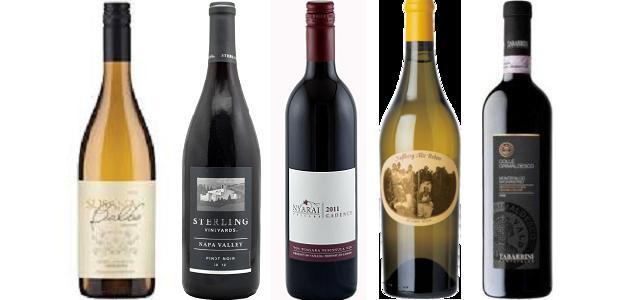
From left to right: Susana Balbo Signature Barrel Fermented Torrontés 2014, Sterling Vineyards Pinot Noir 2012, Nyarai Cellars Cadence 2011, Wieninger Nußberg Alte Reben Gemischter Satz 2012, Tabarrini Colle Grimaldesco Montefalco Sagrantino 2009

From left to right: Susana Balbo Signature Barrel Fermented Torrontés 2014, Sterling Vineyards Pinot Noir 2012, Nyarai Cellars Cadence 2011, Wieninger Nußberg Alte Reben Gemischter Satz 2012, Tabarrini Colle Grimaldesco Montefalco Sagrantino 2009

Susana Balbo Signature Barrel Fermented Torrontés 2014, Uco Valley, Mendoza, Argentina (384339, $17.95, WineAlign)

Here, from Dominio del Plata, an experiment with clear merit. The attributes are so sizeable, with weight depth and no compromise. The dramatic effect works to ignore the “clouds of mystery pourin’ confusion on the ground.” The floral aromatic integrity of Torrontés is upheld within the leaden shackles of the wood, as is the savour. This is a honeyed white, suckling and mellifluous, like fully extracted ripe Sémillon, from and with the benefit of a warm vintage. Puts the fun back into varietal revival by way of a giant leap up from the thin, medicinal water clogging the arteries of South American white wines so often put to market. Here is a Torrontés to stop the rain.  Tasted January 2015  @ddpwinery  @ProfileWineGrp

Sterling Vineyards Pinot Noir 2012, Napa Valley, California (424179, $19.95, WineAlign)

There are so many reasons not to find a thrill in this regional blend of Pinot Noir fruit but none of them stick. Sweetness, simple syrup silky fruit, brown sugar, every red and purple berry in all varieties of fields (plus ripe plums) and warm to temperate alcohol (14.5 per cent declared) all combine for full California sunshine effect. All this and I just can’t turn away. With all the excess fruit, texture and multiplicity in good times, how can I? I ask this Pinot, “how come you, how come you dance so good?” The answer lies in the feel and the ability to turn a Noir trick or two. Not to mention a rolling of barrels and Napa Valley stones through its very core. Well done.  Tasted January 2015  @sterlingwines  @Diageo_News

Nyarai Cellars Cadence 2011, VQ Niagara Peninsula, Ontario (Winery, $21.95, WineAlign)

Steve Byfield’s crimson blend of Cabernet Franc (42 per cent), Merlot (33), Cabernet Sauvignon (20) and Syrah (5) is at once so very Niagara while acting out anomalously in the 2011 vintage. Ripe, extracted fruit appears warm-vintage drawn, with its coated layers of primer, brushstroke and plummy stone fruit. The warmth is tempered by savour, oranges, figs and psalms. Its ability to find cadence and cascade keeps it “cool in the shade.” The varietal combining is delineated in balance, “sliding mystify, on the wine of the tide.” This effort, with its new name, could become one of the king’s amongst Ontario blends.  Tasted January 2015  @NyaraiCellars

Wieninger Nußberg Alte Reben Gemischter Satz 2012, Vienna, Austria (Agent, $40.00, WineAlign)

Here, the intensity of multi-varietal wine defined. From next to the Danube, out of the Ulm Vineyard, on a very steep southern slope on the eastern part of the Nussberg. The composition is nine-fold; Weissburgunder, Neuburger, Welschriesling, Grüner Veltliner, Sylvaner, Zierfandler, Rotgipfler, Traminer and Riesling. The aridity (1.3 g/L RS) is visionary. Beneath the vineyard there is coral from the tertiary period and in this wine you can hear the Geiger counter amplifying the faint eupnea of fossilized shells, thousands of years ago. Its resinous, sappy and majestic floating flowers are like “potions in a traveling show.” The layering is heavy (14.5 per cent ABV) and variegated, like sands and snails in a bottle or a vessel filled with an alcohol made from nature’s natural and fermenting bounty; carboniferous forest cosmology and the unpronounceable names of exotic fruit. Then there is the wooden smoulder, the white rock solder, the pine and the scene where “I sat on the roof and kicked off the moss.” The Gemischter Satz is granular but in liquid form, marbled and with a lovely wisp of oxidation. It exudes lemon custard and tonic in a wild yet beautiful breath of sauvage. It is your song. Tasted January 2015

Tabarrini Colle Grimaldesco Montefalco Sagrantino 2009, Docg Umbria, Italy (403139, $49.95, WineAlign)

Here thickness is applied in every way imaginable. Sagrantino from the maw of the beast; raw, big-boned, musky, chewing sinew and spitting out teeth. Though fierce and ancient, eliciting vegetal scents as if Pliny’s natural history were scoured for every trace of pungent plants grown in iron rich earth, it is also the most modern expression of Umbria, or all of Italy even. In so many ways it’s pretty Gestanko, composted and of an incomparable spume. But it also desensitizes and endears in a soulful, ethereal way “like scattered leaves,” blowing in a stiff breeze. It folds back the skin of time, in waves of heat and at times is so very sweet. Bring this to the apocalyptic marshmallow roast. Leaves the red wine city in ruins and in the dust. Sagrantino at 16.5 %. Burn, baby burn.  Tasted January 2015  @TrialtoON  @TABARRINI

Good to go!

Holiday wine gems hit November shelves

I\'ve made this list, checked it twice and formulated plenteous if euphuistic tasting notes on 10 meaningful and expensive wines to look for this holiday season

I’ve made this list, checked it twice and formulated plenteous if euphuistic tasting notes on 10 meaningful and expensive wines to look for this holiday season
Photo: ElenaR/Fotolia.com

as seen on canada.com

I will gladly be first in line to bust the myth that says wine must be expensive to be good.

Much time and energy is spent seeking out wines that over-deliver, especially those well-made, honest and outright delicious ferments that clock in at under $20. The caveat here is the time of year when the exception to that value rule is personified by the need for luxuriance, surfeit and speed. The December holidays are embroidered of an entirely different import. Folks just seem to want to join the appliqué party, to take advantage of the generosity of the season, to drink the good stuff. Champagne, certainly, but also big wines, the kind that stick to your teeth for a week.

Related – Wine Chat: Top 3 Wine Myths and more from the November 23rd, 2013 VINTAGES release

Gift giving is the other rampant and obvious part of December. No one wants to look cheap, ungrateful and thoughtless when gifting a bottle to an employee, a friend or a loved one. So I’ve made this list, checked it twice and formulated plenteous if euphuistic tasting notes on 10 meaningful and expensive wines to look for this coming weekend. Be proactive, track down one of these wine gems and prepare to channel your inner St. Nick, or if you like, your Ded Moroz, La Befana, Tomte, Jolasveinar or Pere Noel.

From left: TALBOTT LOGAN SLEEPY HOLLOW VINEYARD CHARDONNAY 2011, URBINA GRAN RESERVA ESCECIAL 1994, SELLA & MOSCA MARCHESI DI VILLAMARINA ALGEHRO 2008, and PALLADINO BAROLO PARAFADA 2008

From left: TALBOTT LOGAN SLEEPY HOLLOW VINEYARD CHARDONNAY 2011, URBINA GRAN RESERVA ESCECIAL 1994, SELLA & MOSCA MARCHESI DI VILLAMARINA ALGEHRO 2008, and PALLADINO BAROLO PARAFADA 2008

TALBOTT LOGAN SLEEPY HOLLOW VINEYARD CHARDONNAY 2011, SANTA LUCIA HIGHLANDS, MONTEREY COUNTY, CALIFORNIA, USA (716290, $27.95)

Slow glazed, golden cream velvety nose, of a demurred beauty’s proportion, arced yet elongated. An island of Chardonnay enchantment, where the wood is soft, “there is no suffering” and sweet lemon sherbet flows. Frank yet curtailed extraction, good acidity and a relaxed Surfer Rosa tension. That soft buttery oak only comes through on the finish, which drifts and lasts.  91  Tasted Oct. 25, 2013

URBINA GRAN RESERVA ESPECIAL 1994, DOC RIOJA, SPAIN (355743, $46.95)

Will not be your wine of the year but you absolutely must give it a try. Holding strong 19 years on, surely something to hang a hat on. There is some must, but it’s as much attributed to a classic, 90′s Tempranillo temperamental style as it is to the barrel and the bottle. Some prune and lingering alcohol detracts from the now waning fruit. That Rioja character, once obvious, now harder to recognize, maintains its weight and import. Some grain and chalk lingers due to oak that has not fully worked its way in and out. Wonderful study if not pure or gorgeous and alone.  90  Tasted Oct. 25, 2013

SELLA & MOSCA MARCHESI DI VILLAMARINA ALGEHRO 2008, DOC ALGHERO, SARDINIA, ITALY (954081, $46.95)

A Cabernet Sauvignon with an undeniably high level of unconventionally modern and stylish set of aromas. A very specific Italian smell mostly absent today, pushing the question “has it gone for good, or is it coming back around?” Acetate, wet hay and dried brick funky monkey that could endanger and render it non-negotiable, but it manages to walk the safer side of a fine line. Like great old school Brunello, herbaceous, tarred and feathered, stuck with thorns of roses and a waft of vanilla cherry coke, cough drop alcohol. Shouts Sardinian somewhereness in a way that is just so appealing. The iron, the sanguine, the Italian, the fireside, it’s all there. Sure it’s nearly balsamic but it will likely stay exactly this way for years.  93  Tasted October 25, 2013

PALLADINO BAROLO PARAFADA 2008, PIEDMONT, ITALY (280412, $68.00)

This just has the look, the look of love. “A look that time can’t erase.” Nebbiolo you can see right through, this impossible light, this impossible life. Tea, tar and roses. A mineral spring, iron-earth field, where the game runs wild. You can relate to this Barolo, love it, relish it now but it will give pleasure for years. Not necessarily 25 but certainly 10-15. “Well, it takes my breath away.” Great vineyard.  94  Tasted October 25, 2013

M. CHAPOUTIER LES BÉCASSES CÔTE-RÔTIE 2010, AC, NORTHERN RHÔNE, FRANCE (280420, $82.95)

Strictly beautiful Syrah. The offspring of the Côte Rôtie’s two necessary points of view. First, the schist, silt and shingle of the Brune. Second, the silica and limestone of the Blonde. In combination they produce an iron-rust wine of a ferruginous nature, in colour and in aroma. Seeping, exotic Rooibos tea, Provençal tapenade and smouldering flowers send smoke signals clear as day. Smells so rich though it’s full of grace and bathed in ultra-elegance.  94  Tasted October 25, 2013

From left: CATENA ZAPATA NICASIA VINEYARD MALBEC 2009, CHÂTEAU DE BEAUCASTEL CHÂTEAUNEUF-DU-PAPE 2011, MASI MAZZANO AMARONE DELLA VALPOLICELLA CLASSICO 2006, MASI CAMPOLONGO DI TORBE AMARONE DELLA VALPOLICELLA CLASSICO 2006, and ORNELLAIA 2010

From left: CATENA ZAPATA NICASIA VINEYARD MALBEC 2009, CHÂTEAU DE BEAUCASTEL CHÂTEAUNEUF-DU-PAPE 2011, MASI MAZZANO AMARONE DELLA VALPOLICELLA CLASSICO 2006, MASI CAMPOLONGO DI TORBE AMARONE DELLA VALPOLICELLA CLASSICO 2006, and ORNELLAIA 2010

CATENA ZAPATA NICASIA VINEYARD MALBEC 2009, LA CONSULTA, UCO VALLEY, MENDOZA, ARGENTINA (132357, $87.95, SAQ 11443860, $80.25, BCLS 461707, $89.00, ANBL 098709088658, $100.98)

This Nicasia is the more monstrous of the two Catena single vineyard Malbecs coming to VINTAGES. So set in the future of its dreams and as a result hard to assess what it means to drink right now. A mountain of licorice, anise and Andean aromatics, in Jacaranda and Lupine, gorgeous in giant alpine bloom. Rich, unctuous, magnetic and in perpetual unfolding motion. If the chalk and circumstance come on too strong you might switch to the La Gualtallary Adriana Vineyard, for she is quieter, more accessible, wanting love earlier and unconditionally. Still the structure of the Nicasia cannot be denied, especially if it is allowed five plus years in time and space. Will be unbelievably memorable in 15. Mean it!  94  Tasted October 25, 2013

CHÂTEAU DE BEAUCASTEL CHÂTEAUNEUF-DU-PAPE 2011, AC, SOUTHERN RHÔNE, FRANCE (711317, $89.95, SAQ 11352335, $90.25, BCLS 277988, $92.00)

This refreshing and right proper vintage of Beaucastel dramatizes the Rhône epitome of elegance. Sure, the Kirsch and the ripping ripe berries are there but they are stirred, not shaken. Confident, full of tart, hubristic and racy energy, this CdP is great, hopping fun. Has an underlay of classic rocky and subtle pernicious tones. Pure pleasure, good chain of command, tannic as it needs to be.  94  Tasted October 25, 2013

MASI MAZZANO AMARONE DELLA VALPOLICELLA CLASSICO 2006, DOC, VENETO, ITALY (215764, $99.95)

If a wine clocking in at 16 per cent alcohol by volume can be considered elegant and restrained and if that’s even possible, the Mazzano is the one. Though there is nothing outright prune, dried raisin or fig paste about it, this single-vineyard Amarone is enormously tannic. Any attempt at cracking its hard shell inside of 15-20 years should be thought of as counter-productive. Smells like the aforementioned fruit just picked at maximum ripeness so there is nothing cooked, roasted or overdone here. You simply have to wait for tertiary complexity to see what it will become. I sense great. Near-perfect vintage.  96  Tasted October 25, 2013

MASI CAMPOLONGO DI TORBE AMARONE DELLA VALPOLICELLA CLASSICO 2006, DOC, VENETO, ITALY (548677, $99.95)

Speaks in similarly heavy and futuristic tones but is not nearly as demanding and obtuse as brother Mazzano. Reduced red plums, riper, drier raisins and licorice here, sweeter and rounder, though that’s just a  tête-à-tête relative observation. Will require 10-15 years patience for the purpose of proper scrutiny and the definite probability for enjoyment.  94  Tasted October 25, 2013

ORNELLAIA 2010, DOC BOLGHERI SUPERIORE, TUSCANY, ITALY (722470, $189.95, SAQ 11973238, $185.00, ALTA. Devine Wines, $209.99, B.C. Marquis Wine Cellars, $190.00)

The label, celebrating the iconic IGT’s 25th anniversary, intimates the kitsch of say, Marilyn Merlot. Not exactly fitting for this perennial lady-killer from Bolgheri. Does it make you think about what it was like when you were young? Peering past appearances, cracked pepper highlights the turned up to 11, ever-present alcohol nose. The enormity of this Ornellaia is obvious and currently overwhelming. Pitchy, black as night, and bent of collector Napa-like extraction. Not exactly a red berry vintage for Mr. Brightside from Bolgheri, this has chalk, grain, funk, dark blackberry, kirsch, anise and mephitic fight. It’s a hugely serious, dank and brooding Cabernet-controlled Tuscan. The ’10 is “burning down the highway skyline, on the back of a hurricane.” Killer on the teeth, the mouth and the tongue. Twenty-five lashes for every vintage.  94  Tasted Oct. 25 and Nov. 3, 2013

Good to go!

Four fall back wines for Daylight Savings

Photograph by Albo, Fotolia.comas seen on canada.com

The wine glasses will have retired when the clocks fall back to standard time at 2:00 o’clock in the morning on Sunday, November 4th. An hour no longer needed and cast off, a casualty of war. He may not have invented it, but we have Benjamin Franklin to thank for being the first to indicate the need for the phenomenon. In the United States, a federal law standardized the yearly start and end of daylight saving time in 1918, for the states that chose to observe it. It was mandatory during WWII and today most states continue to observe the so-called, energy-saving measure. Canadians abide, Quel shoc!, save for Saskatchewan which is on DST year round. What’s that all about?

The M.C. Escher tessellating question is this. Is DST an energy conservation proposition or a Saturday night wine suck? It’s both, actually. Like the Escher model, fine wine is a linear, interwoven tapestry without any gaps or overlaps. The fact that DST is part of a never-ending loop likens it to Groundhog Day and the redundant nature of the ritual zaps life, if only for one night, as if there were no tomorrow.

My advice is to make sure your fridge and racks are stocked with whites and reds possessive of good legs that fall back in the glass. Wines of character and depth to carry you through to Sunday’s raffish onset of darkness. On the bright side, that lost hour does mean that when Sunday morning comes you won’t be confronted by first light purdah masked of a folderol, cimmerian shade. Here are four wines to aid in the transition back to standard time.fallbackwine Four fall back wines for Daylight Savings

The grape: Pinot Grigio

The history: 100% PG from the Friuli Isonzo DOC region (in northeastern Italy near the Slovenian border) produced by the cooperative, Cantina Produttori Cormòns

The lowdown: Tightly wound clusters cause varietal deformity due to the pressure they exert on each other. Intense PG at a great price

The food match: Barque Rub Roast Chicken Wings and Thighs

Cormòns Pinot Grigio 2010 (734038, $14.95) is slick stuff, like vitreous and porous silica gel without the talc. Acacia blossom perfume and agave scherzo symphony in a glass. High praise indeed for lowly PG but go Friuli my friend and note the difference. The conically tapered glass bottle adds to the magic and the profile. By way of Mr. C. for my card at Barque88

The grape: Chardonnay

The history: Burgundy’s great varietal goes haywire along Niagara on the Lake’s old Stone Road

The lowdown: This racy white has just enough brake to watch its speed

The food match: Homemade Tagliatelle, brown butter, parmesan and sage

G. Marquis The Silver Line Chardonnay 2011 (258681, $16.95) streaks across and plays a lick on atomic 16 rails at breakneck speed, all the while jonesing for of a slice of custard pie. “It’s sweet and nice” with lead, nuts and spice. The G. might stand for grateful or great, as in value.  88

The grapes: Grenache, Syrah & Mourvèdre

The history: Gigondas sits one step down from Châteauneuf-du-Pape in the southern Rhône pecking order

The lowdown: Not nearly as serious as the likes of Brusset, Perrin or Montmirail but look at the price

The food match: Boneless Roast Quail, king oyster mushrooms, fresh thyme

Domaine Santa Duc Les Garancières Gigondas 2009 (234989, $17.90, was $27.95) is Grenache-centric so soft, modern and approachable is its MO. The S and M adds just enough volcanic disturbance, smoke and herbal spew to keep it real. Notes of arpeggios and glissades. At the reduced fare its reductive attributes smooth and flesh out hither and yon at the same time. Simmering raspberries with the intention of becoming jam is a delight to sniff and dip a spoon into.  89

The grape: Malbec

The history: From the emerging Uco Valley in Mendoza where the varietal seems to turn from  red to black

The lowdown: Showing very well for an under $20 Malbec with five years of age under its bottle buckle

The food match: Grilled Barese Sausages, tomato jam, smokey bbq sauce

Trapiche Fincas Las Palmas Malbec 2007 (186668 $17.95) with its vanillin, razor-sharp contour of energy is  rich and powerful for the price. The style is big, blowsy and not without a smokey, blackberry charm. A slight electric loss and corresponding increased valence shows that the clock is ticking fast, but for now the pleasure is all ours.  89

Good to go!