Point, Dog Point

The wines of Dog Point Vineyard

The wines of Dog Point Vineyard

Dog Point Vineyard sits at the confluence of the Brancott and Omaka Valleys in Marlborough, New Zealand. Owned and operated by Ivan and Margaret Sutherland and James and Wendy Healy, the Wairau Valley vintners farm clay-loam soils sustainably and with organic, viticultural practices.

Sutherland and Healy are the men responsible for the success of the first iconic New Zealand brand, Cloudy Bay and together they left to form Dog Point in 2004. The name is in reference to the earliest European settlement of Marlborough, the sheep, their herders and the marauding dogs who prowled the scrub-covered hill overlooking the Wairau Plains. The early settlers called it Dog Point.
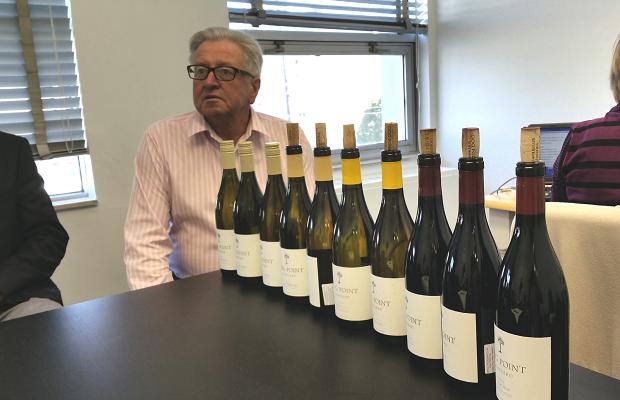
James Healy

James Healy

Dog Point produces Sauvignon Blanc which ranks amongst, if not tops the long list of New Zealand’s output, for quality, ubiquity and consistency.  The single-vineyard Section 94 Sauvignon Blanc takes the varietal intensity to another, barrel-influenced level. Chardonnay and Pinot Noir are made in a uniquely Dog Point style, neither emulating nor simulating Burgundy. This is the essence of the winery’s modus vivendi.

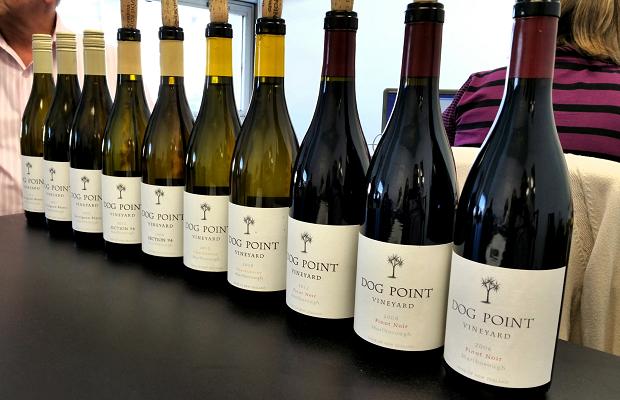
James Healy and viticulturist Nigel Sowman brought Dog Point’s wines to Toronto last week, to celebrate their 10th anniversary. I sat down with them at WineAlign, along with Trialto Group’s Richard Dittmar and fellow WineAligners Sara d’Amato and Steve Thurlow. Here are the notes on the 10 wines poured.
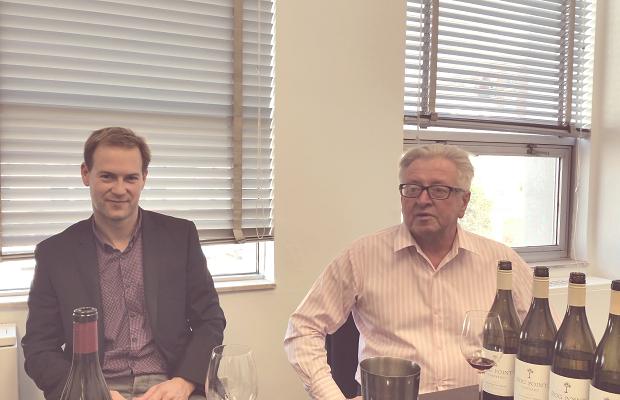
Nigel Sowman and James Healy

Nigel Sowman and James Healy

Dog Point Sauvignon Blanc 2014, Marlborough, South Island, New Zealand (677450, $24.95, WineAlign)

What James Healy calls “the generic Marlborough style,” with flint and ever-present though much faded reduction, grapefruit and lime. The vintage (2014) was not cold at all so it lacks the verdure. There is subtle, gentle clementine and palate viscosity. The acidity is all about bringing balance. So fresh, spritely, lime-juicy and always essential.

From my earlier note of March 2015:

So orderly and aligned, from ripe picked fruit with fervent acidity and all proportions in perfect working order. Four months settling in bottle has only worked to reinforce positive opinions. Grassless and flinty but no discernible elemental vagary, certainly no sulphur. This Sauvignon Blanc may just be the most consistent in every vintage, not only stylistically but also for the hedging of probability bets for guaranteed Marlborough quality. This is a superb vintage for the pied-à-terre phraseology. Like school in fall, winter and spring, the Dog Point is all class.

From my earlier note of November 2014:

The prototypical Marlborough Sauvignon Blanc hitting all the classic numbers is right here in the Dog Point 2014. Low pH, high acidity, minuscule residual sugar and elevated aromatics. It’s ripe but ripped by citrus juice and zest. Like cubes of honeydew, bitter winter melon and dried lemongrass soaking in and flavouring a dish of briny scallop carpaccio with coarse sea salt and capers. The sapidity is palpable, the excesses vivid. I would avoid too much variegated gastronomy when sipping this wine. Opt for simpler fare because its talents would otherwise be mimicked and suppressed.

Last tasted May 2015

Dog Point Sauvignon Blanc 2011, Marlborough, South Island, New Zealand (677450, $23.95, WineAlign)

Certainly showing some secondary characteristics in evolution and yet the composition is as close as a first cousin to the current 2014, with more than just thanks in part to identical yeasts. This has lees, “a feature of the 2011 wines,” notes James Healy. Time has magnified the flint but it has also stretched and elasticized it. The struck aromatic glint has passed and will continue to bob in slow motion. Dog Point in presentation of how and why Sauvignon Blanc can be enjoyed with age, over time.”Ain’t no reason to go up, ain’t no reason to go down. Ain’t no reason to go anywhere.” The late palate is lime, as per usual, but also lemon, in ’11, with a paraffin coating. “Time passes slowly and fades away.” Three to four more years for this SB. Drink 2015-2019.  Tasted May 2015

Dog Point Sauvignon Blanc 2008, Marlborough, South Island, New Zealand (677450, $23.95, WineAlign)

It must be said straight out that a wine such as this wins hearts and points for its longevity, if nothing else. The kudos is warranted tenfold especially because it’s a Sauvignon Blanc and one that has emerged unscathed and even star bright. From a warmer year and extended growing season. Bigger bunches resulted, like in 2014 and this has evolved with considerable spice, as if, but not by wood, yet less developed than the petrol and lanolin slinging ’11. This is a wine that unequivocally proves that Sauvignon Blanc can age, gracefully and properly. Has an almost indiscernible flinty reduction, which means it never really had it in any concerning level in the first place. A vintage-specific white, with Chenin-like feigned sweetness and lactic feel. Marvellous to note that the final taste can be nothing but Sauvignon Blanc so in the end, the flavour profile wins out. Drink 2015-2017.  Tasted May 2015

Dog Point Sauvignon Blanc Section 94 2012, Marlborough, South Island, New Zealand (325977, $42.95, WineAlign)

The Section 94 is, in the estimation of James Healy, “a particularly good Sauvignon Blanc block.” Planted in the 1990’s, the now wise old plot is churning out exceptional fruit with cold, cold acidity. Says Healy, with respect to the vintage,” we didn’t want to muck around with malolactic,” so the fruit notches naturally in barrel, with indigenous yeasts. “They won’t stop prickling for over a year,” adds Healy. Bottled at about 18 months, this is a wine given the full solids treatment and is more than obviously a major step up in Sauvignon Blanc complexity. Offers a feel like pebbles bobbing and popping around in the clot of the wine. Wood spice and so much grapefruit are the grumous layers, along with lactic, citric acidity. Time has thus far been very kind, the matchstick reduction now really subsiding in this subsidized white. Drink 2015-2019.  Tasted May 2015

Dog Point Sauvignon Blanc Section 94 2008, Marlborough, South Island, New Zealand (325977, $42.95, WineAlign)

It is interesting to note that 2012, from a cold vintage, has evolved with a lactic palate and yet this ’08 seems so very fresh. Petrol and developed, thickened honey in wax are the bees knees in here. While a touch lactic in its own right, the tapestry weaves into second, third and fourth layers. A Sauvignon Blanc that really offers the best of all worlds. The leesy, lactic-secondary and flint-tertiary feel is round and in surround. This is the most Bordeaux white of all in the DP-SB continuum, with presence, savoury herbiage and pointed, sumptuous flavours. Grapefruit and bitter, beautiful tonic orbiculates the finish. The unanimous conclusion is of a wine that is very much like Champagne, without the bubbles. Drink 2015-2020.  Tasted May 2015
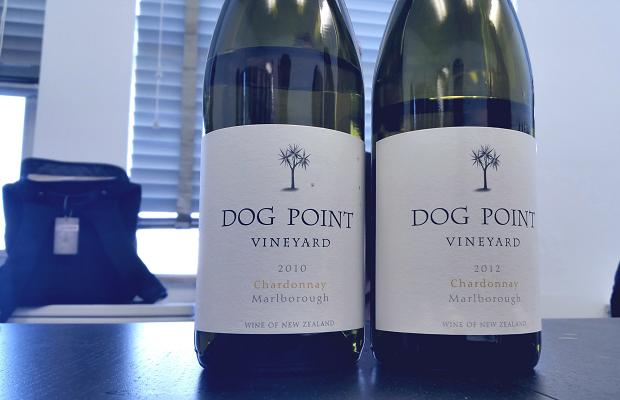
Dog Point Chardonnay

Dog Point Chardonnay 2010 and 2012

Dog Point Chardonnay 2012, Marlborough, South Island, New Zealand (238568, $39.95, WineAlign)

The barrel, in and out of reduction, defines the yet early life stage of the ’12 Chardonnay. The count is 15 per cent new with heavy toast “because we just like that heavy toast flavour, just not too much of it,” notes James Healy. Fully malolactic, but a very late one, this slow-cooked Chardonnay, with matching matchstick acidity. In expression it is of a very cool-climate style with tons of lime and emulsified to a gemstone melt, green goddess consistency. A wine that could be a cousin to, share spirit with Paul Pender’s Vinemount Ridge Quarry Road, of “emerald shine, the gemstone tannic scrape.” The Dog Point etymology is two-thirds Mendoza clone and one-third Dijon 95, the former needing sugar to get ripe, but it provides the citrus and the acidity for the palate. Drink 2017-2020.  Tasted May 2015

Dog Point Chardonnay 2010, Marlborough, South Island, New Zealand (238568, $39.95, WineAlign)

Remarkably similar to the later 2012, tasted side by side, here with toast, nuts and grapefruit. It may be just a touch warmer, with more fruit yet still cool by nature. The ’10 is not as green, not as salient in polished stone feel, with less weight and girth. The sugars and bitters are increasingly integrated and push more direct, unbiased pleasure. Just a strike of flint ties it to the sibling Sauvignon Blanc. “Statues made of matchsticks, crumble into one another.” Marlborough Chardonnay is better than you think, love minus zero, no limit. It’s true if it’s been said. “She doesn’t have to say she’s faithful, yet she’s true like ice, like fire.” The Dog Point ’10 persists, bobs, rhymes, talk in and out of line. It finishes strong, in grapefruit, without sophistry or equivocation. Drink 2015-2018.  Tasted May 2015

Dog Point Pinot Noir 2012, Marlborough, South Island, New Zealand (329672, $49.95, WineAlign)

From vines now coming of age (12-13 years old) and an increase in stem inclusion (20 per cent). Ripeness consistency was achieved with the aid of shoot cutting/thinning. All this to arrive at the Dog Point Pinot’s place in its necessary evolution. A wine of black cherry and roses, dark, dusty, ripe, in depth of earth, concentric circles of fruit and acidity. Great length.

From my earlier note of April 2015:

Perfectly bright Pinot Noir while simultaneously deep, dark and recondite. Energetic in spirit, ripe and packed with barbed, piquant fruit sewed in threaded badges of spice. Perfumed as if by cinnamon and displacing rose petals. Like the scent of a crystal clear summer’s night, all warm, dry and of dried strawberry juice cracked paint. Grounded and fulfilling, of its own holes, in the mouth and finishes with a feminine touch. A thoroughbred, a filly, that trots on an on, long after it has crossed the finish line. Drink 2016-2021.

Lasted tasted May 2015
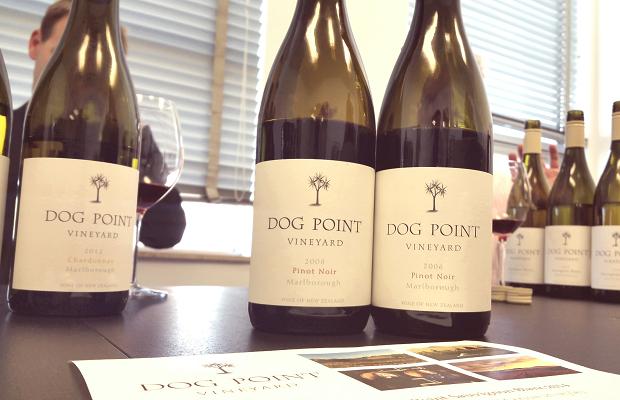
Dog Point Pinot Noir

Dog Point Pinot Noir 2008 and 2006

Dog Point Pinot Noir 2008, Marlborough, South Island, New Zealand (329672, $49.95, WineAlign)

Just a small amount of stem inclusion, a practice that will increase in subsequent vintages, helps to define structure and to a lesser extent, aromatics and taste. Yet the effect is has on tempering and mitigating sweetness is overt and protrusive. “That whole ripe stem thing…it’s a dog’s breakfast, ” says James Healy. Both he and vineyard manager Nigel Sowman have accepted and embraced the necessity of stem inclusion but as Sowman notes, “is there such a thing as a ripe stem, because you’re after sap, not astringency.” The stems here have balanced out the really ripe, jammy fruit. This ’08 is all about florals, of many flowers that offer invitation to then investigate the Pinot Noir morphology. This has turned to liqueur yet still cracks, pops and finishes with bitter, tangy and swelling cranberry. Drink 2015-2018.  Tasted May 2015

Dog Point Pinot Noir 2006, Marlborough, South Island, New Zealand (329672, $49.95, WineAlign)

In 2006 stems were not yet part of the practicum and though the wine remains very much alive it has lost a modicum of structure and a minor key of balance. The highest degree (though certainly not over the top) of paint, varnish and veneer emanates from the edges of the jammy fruit. This youngest and lower on the amicable scale for a Dog Point Pinot Noir is both sweet and sour. The depth (mostly due to very young vines) pales in comparison with even ’08 and the flavours are disparate but what is there is fun and so very Pinot Noir. Can be nothing but and is really the most Burgundian of the three (’06, ’08 and ’12) tasted. That said, it’s not necessarily a good thing because Dog Point does and should try to avoid emulation. The final assessment and most poignant note concerns how barely evolved this nine year-old Pinot sits. Tasted blind you would be hard pressed to guess closely at its age. “If we had an ’06 vintage today we would make better wines,” admits James Healy. A touch of cola and a grapefruit note hit the finish. A Dog Point thing. Drink 2015-2020.  Tasted May 2015

Good to go!

http://www.winealign.com/profile/2058-mjg

Winter white out wine, beer and food conditions

White wine in the snow

The weather will step aside in April. Until then, satiate yourself.
Photo: Sergio Di Giovanni/Fotolia.com

as seen on canada.com

The winter that never ends. White out conditions, snow squalls, wind advisory and chill warnings. Everything just feels heavy. The OPP’s request? Just stay home, Ontario. Prepare for the worst, hunker down and warm the belly with full-bodied wines, strong mocker, beer and hearty winter meals. The weather will step aside in April. Until then, satiate yourself.

Here are six strength fortifying libations to ride the final wave of winter’s brutal conditions.

Clockwise from left: Innis & Gunn Irish Whiskey Finish, 13th Street White Palette 2011, Ara Single Estate Pinot Noir 2011, Planeta Chardonnay 2010, Bachelder La Petite Charmotte Nuits Saint Georges 2011, and Antinori Pian Delle Vigne Brunello Di Montalcino 2008

Clockwise from left: Innis & Gunn Irish Whiskey Finish, 13th Street White Palette 2011, Ara Single Estate Pinot Noir 2011, Planeta Chardonnay 2010, Bachelder La Petite Charmotte Nuits Saint Georges 2011, and Antinori Pian Delle Vigne Brunello Di Montalcino 2008

Innis & Gunn Irish Whiskey Finish, Scotland, United Kingdom (279349, $3.25)

Stout matured over American Oak Heartwood and infused with Irish Whiskey. A Cimmerian entry in hue and hunger peels back to a curious lightness of being. The wood tends to an Arabian mocha aroma, the whiskey to molasses and gingerbread baking spice. The 7.4 per cent alcohol is integrated though an incendiary smoky magic weighs in to toast biscuits and braise a beefy pot au feu. “The Smoky Life is practiced everywhere,” in the I & G. A beer of good charm, smooth, silky, singing in melodic grace and with confidence.  90  Tasted March 2014  @InnisandGun

The grapes: Riesling, Sauvignon Blanc, Gewürztraminer and Chardonnay Musqué

The history: Niagara winery founded in 1998. Chablis native Jean-Pierre Colas joined 13th Street as winemaker in 2009. Co-owners of the winery, the Whitty family has been farming fruit in Niagara for well over 100 years

The lowdown: Much of the fruit comes from the estate’s Creek Shores appellation vineyards, sedimentary, well-drained lighter soils on a landscape highly dissected by its many streams.

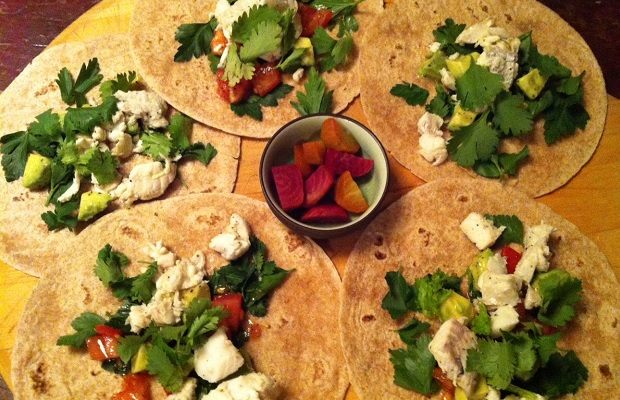
The food match: Fish Tacos

13th Street White Palette 2011, VQA Niagara Peninsula (207340, $15.95, WineAlign) From the VINTAGES March 15, 2014 release

JP’s who’s who bottle of white grapes, a mad scientist’s blend, the flask filled with Riesling, Sauvignon Blanc, Gewurztraminer and Chardonnay Musque. A re-release and much improved with a year’s extra weight, its “got your body right now.” Fortified by a carapace of grape spirits and purposeful in a white meritage sense of community, plus citrus, pith and a far-reaching, right correct absinthian length. You better you bet.  88  Tasted October 2013  @13thStreetWines

Fish Tacos Photo: Michael Godel

Fish Tacos
Photo: Michael Godel

The grape: Pinot Noir

The history: From Marlborough on the western side of the Waihopai Valley. The name is both the indigenous Maori word for “pathway” and Latin for “altar”

The lowdown: “With rugged mountains on either side and two icy rivers cutting through, it’s a pretty extreme place. The very definition of raw, cool climate conditions.”

The food match: Potato Frittata with Feta and Green Onions

Ara Single Estate Pinot Noir 2011, Marlborough, New Zealand (361279, $23.95, WineAlign) From the VINTAGES March 15, 2014 release

Immediate impressions are of a user-friendly Pinot Noir in conceit of black cherry, chocolate and blueberry spice. These are surface notes quickly displaced by an adventurous senses of living on the edge. The wine dips into a brine and lithic earth saturated by glacial melt. This is a different sort of Marlborough Pinot that speaks a modern english, if too young to be understood. “I’ve seen some changes but it’s getting better all the time.” Will try the Ara again in a year or two and likely say I melt with you.  89  Tasted February 2014  @AraWine_UK

The grape: Chardonnay

The history: Planeta first made this wine 20 years ago in 1994. It has become “the image illustrating the changes taking place in Sicilian wines.”

The lowdown: From Ulmo (calcareous with sections of deep vegetable matter) and Maroccoli (medium clay soil rich in limestone) vineyards in the area of Sambuca di Sicilia. Powerful Chardonnay.

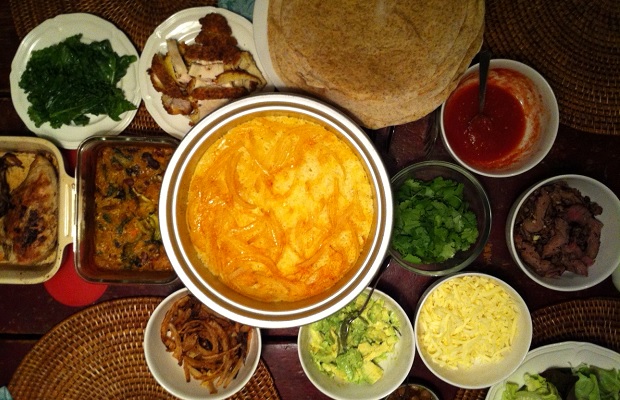
The food match: Taco Night

Planeta Chardonnay 2010, Sicily, Italy (109652, $38.95, SAQ 00855114, $39.15, WineAlign) From the VINTAGES March 29, 2014 release

Wantonly lavish, heavy and tropically delicious. If ever there were a red wine substitute this is the one for the wishful thinker. Tasting this Sicilian is like liquid breathing sweet and salty, drawn butter. It’s a glass of dessert Chardonnay, dichotomous and oxymoronic in congealed warmth like cold-stabilized, oxygen-rich, perfluorocarbon. The tropical warmth is a combination of honey and lemon-glade, like Savennières with an unexpected aged Jura, oxidized, herbal angle. There can be no arguing the complexity of this Sicilian dream. Extreme humidity, with a bitter middle streak and ground nut flavours.  90  Tasted March 2014  @Noble_Estates  @PlanetaWinery 

Taco Night Photo: Michael Godel

Taco Night
Photo: Michael Godel

The grape: Pinot Noir

The history: Thomas Bachelder, flying winemaker, architect of the Bachelder Project, of trois terroirs, in Niagara, Oregon and Burgundy

The lowdown: “Burgundy is my favourite place to make wine,” admits Thomas Bachelder. “The large négociant control all (44) 1er cru vineyards so there are not a lot of small growers working with Beaune fruit.” Enter terroirman.

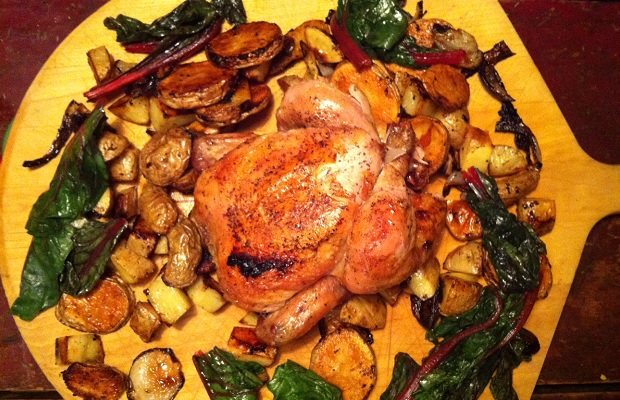
The food match: Roast Chicken, Potatoes, Swiss Chard

Bachelder La Petite Charmotte Nuits Saint Georges 2011, Burgundy, France (357228, $49.95, WineAlign) From the VINTAGES March 15, 2014 release

Is so floral, mineral, intense and hypnotic it might be dubbed the Serpent Charmer. Iron and wine indeed, the iron of Nuits, the perfume of Beaune. This provocative bottling represents the third year of production, is conspicuous in Anis de Flavigny and an underlying gate. If montagnes is the harming one, this is the charming one. These are all from the same barrels, so what really affects the wines the most? Land and hand.  93  Tasted November 2013  @Bachelder_wines

Roast Chicken, Potatoes, Swiss Chard Photo: Michael Godel

Roast Chicken, Potatoes, Swiss Chard
Photo: Michael Godel

The grape: Sangiovese Grosso

The history: The family has been in the wine business since Giovanni di Piero Antinori joined the Florentine Guild of Vintners in 1385. The Antinori estate is responsible for some of Tuscany’s most famous wines; Solaia, Tignanello and Guado al Tasso.

The lowdown: As stalwart a Brunello as any, Pian Delle Vigne is not immune to critical conjecture. Applying kudos to any big house in this polarizing vintage will raise an eyebrow or two. Why not Antinori?

The food match: Herb Crusted Pork Tenderloin

Antinori Pian Delle Vigne Brunello Di Montalcino 2008, Docg, Tuscany, Italy (651141, $59.95, Nova Scotia 1006431, $64.80, WineAlign) From the VINTAGES March 15, 2014 release

Goes at it older, bolder, tried and truer than had recently been the case, especially in 2007. Leather, cherries, seeping tea and peppery, earthy, funky dates. Purity of fruit, obviousness in Sangiovese Grosso aromatics and it is only when you taste that you are dealt with the full effect of its power and girth. Quite viscous on the palate, tough, gritty chain of tannin and qualified, felicitous bitters on a very long finish.  Best Pian delle Vigne in some time, at least back to 2001.  93  Tasted November 2013  @AntinoriFamily

Good to go!

Big houses, bigger wines, big-ish prices

Canadian money

The earnest call across the country to free my grapes continues though regrettably, stiff resistance stifles the cause.
Photo: ulga/Fotolia.com

as seen on canada.com

If you live in Canada, purchasing wine ties you directly to a monopoly. There are exceptions, though still imperfect ones, like the free market culture of Alberta and the developing tiered system in British Columbia. The earnest call across the country to free my grapes continues though regrettably, stiff resistance stifles the cause.

Manitoba and BC allow direct to consumer inter-provincial wine imports. Consumers can order from out of province and receive direct shipments so long as the wine  is 100 per cent Canadian. Nova Scotia has passed enabling legislation that will follow a similar path. If you reside in Quebec or a fortiori, in Ontario, having wine shipped to you remains taboo. The alternate recourse of consignment wines available for purchase through local importers is an irregular option and having to buy by the case designs no compass of mass appeal.

Spend even a fraction of the time I do in trying to seek out the best values, at the best prices and in the categories that cater specifically to personal tastes and you will understand how difficult it is to be satiated in such a constricting climate. I am not the only one seeking out red wines made in the vineyard, through minimalist oak intervention, unhindered by residual sugar, produced by passionate and honest winemakers who are vigilant with the softest of hands.

Who does not want their wine to have mass in it, as in life? Who would reject an elixir drawn from iron-rich earth, boiled through limestone and warmed to a rosy madder? Who can deny the pure joy culled from a wine that might steal the words from the mouths of poets?

In Canada, unearthing such gems requires intestinal fortitude, especially considering the search is mapped out in government-controlled stores. Stock norms do not include wines made from lesser-known grapes, from regions and appellations less frequented. It takes time, effort and most of all, patience. Life can get in the way of the endless and unavailing chase; work that pays, kids, weather, fatigue. Sometimes it just makes sense to abide and even embrace the easier, well-worn path. This is where the bigger wineries step in, toting larger case loads and a middle-of-the-road, radio bathos experience.

There are varietal vicissitudes to ferret out from varieties you might have chosen to avoid. New World Pinot Noir and Chardonnay. Zinfandel. Rhône blends. Sangiovese blended with Cabernet Sauvignon. Tempranillo. All these grapes are often mistreated, modernized, smothered in oak and homogenized so that their indigenous origins are blurred into a bar of mass-produced chocolate. Occasionally they are done right by their makers.

In what has been such relentless cold, snow and ice, now into the oppressive dog days of winter, don’t think of drinking commercial wine as copping out. The big houses can be your friend, so loosen up and trust me when I tell you I’ve worked very hard to weed out the chaff and promise only to recommend the whole wheat. Here are seven current releases that made the pecuniary cut.

From left: Mission Hill Reserve Pinot Noir 2011, Clos Du Val Zinfandel 2011, and Robert Mondavi Chardonnay 2011

From left: Mission Hill Reserve Pinot Noir 2011, Clos Du Val Zinfandel 2011, and Robert Mondavi Chardonnay 2011

Mission Hill Reserve Pinot Noir 2011, VQA Okanagan Valley British Columbia (545012, $24.95, WineAlign) From the VINTAGES Feb. 15, 2014 Release

Here’s a juicy plum wine with noticeable warm alcohol that goes subterranean and won’t make you homesick for alien Pinot Noir. Athletic red with a quick first step and nerve, running a west coast offence, scoring points.  Char in licorice and a grid-iron, “uptight, uptight” bitter tendency but is a most saucy rendition. Extra point from clean, easy sweet tannins. Good length. Pinot on the radio. Really attractive price puts it at the head of its class.  90  Tasted February 2014  @MissionHillWine

Clos Du Val Zinfandel 2011, Napa Valley California, USA (590216, $24.95, WineAlign) From the VINTAGES Feb. 15, 2014 Release

Every so often a grape variety confounds and astounds, like this pretty in zinc Zinfandel. Almost mute as far as Zin goes, this CdV ”set out on the heels of the unknown.” Times like these normally produce lumbering, high-octane interpretations but this radical face is the Simon and Garfunkel of the variety. Singing with soft harmonies and composed as if by a deft balladeer. Flair comes from Spanish-like modernity – a good thing for Zin. Less bramble, more Ribera. Less reduction, more Montsant. Smooth as silk, reeking in vanilla, raspberry and symptomatic by a kiss of mineral. If but for one hollow mid-verse this would truly sing but that really is no big thing.  90  Tasted February 2014  @ClosDuValNapa

Robert Mondavi Chardonnay 2011, Napa Valley, California, USA (310409, $25.95, WineAlign)

One of the more quintessential, mid-range, rich and opulent Napa Chardonnays that steps out of the lobster butter dish in 2011. Apple-tinged terpenes show their presence, along with tarragon and a bag of just opened good and plenty. Piquant, poignant vintage, peppery and acting cooler than I ever remember it to be. Whether by chance or by choice, this is a welcome direction though I doubt its kind will soon be seen again.  89  Tasted January 2014  @RobertMondavi

From left: Umberto Cesari Liano Sangiovese/Cabernet Sauvignon 2009, Wairau River Reserve Pinot Noir 2010, Grant Burge The Holy Trinity Grenache/Shiraz/Mourvédre 2011, and Beronia Viñas Viejas 2010

From left: Umberto Cesari Liano Sangiovese/Cabernet Sauvignon 2009, Wairau River Reserve Pinot Noir 2010, Grant Burge The Holy Trinity Grenache/Shiraz/Mourvédre 2011, and Beronia Viñas Viejas 2010

Umberto Cesari Liano Sangiovese/Cabernet Sauvignon 2009, Igt Rubicone Emilia-Romagna, Italy (225086, $29.95)

Decidedly modern in many ways; oak impart, varietal alliance and braggadocio. The nose speaks highly of unsettled alcohol and alchemy. Big on black cherry and earthy with a welcoming and necessary roasted rare and still kicking game component. The mellow support of Cabernet Sauvignon is kicked upside the head by full throttle, oak-laden Sangiovese. Though hot and bothered, there is a keen sense of acumen on display by the Emilia-Romagna team at Umberto Cesari.  89   Tasted January 2014  @UmbertoCesari

Wairau River Reserve Pinot Noir 2010, Marlborough, New Zealand (361253, $29.95, WineAlign) From the VINTAGES Feb. 15, 2014 Release

Wonderful value in premium Marlborough Pinot Noir. Alluring sylvan aromatics, in a potpourri of violet, rose, plum and strawberry. Sharp, cranberry-pomegranate-cherry fruit flavours, the grain of red fife, and eye-popping acidity. An earthy terroirist, layered and delicious. Warm but not alcohol driven, touched by oak but not shaken and with just one coat of paint.  91  Tasted February 2014  @wairauriver

Grant Burge The Holy Trinity Grenache/Shiraz/Mourvédre 2011, Barossa, South Australia (Agent, 236257, $29.95, WineAlign)

The right Rhône immediacy of the 2011 Barossa vintage gets its hooks right in. Snapping with a direct blow uppercut to the jaw, this Grenache, Shiraz and Mourvédre blend goes right for the jugular with passion, not sugar. It’s a tricky mix, angular yet smooth, floating like a butterfly and stinging like a bee. Terrific charred, meaty flavours mixed with juniper and black raspberry, savoury spice and a chain of tannic length. Will age with metronome precision over a period of 10-15 years.  91  Tasted January 2014  @GrantBurgeWines

Beronia Viñas Viejas 2010, Rioja, Spain  (Agent, $30.00, WineAlign)

This 100% Tempranillo is Beronia’s enigma. Sourced from 40-plus year-old vines and housed for 14 months in new French oak. The Van Morrison bottling, if you will. Forget thoughts of a gnarly, tar and brambly red. This one is compliant and inviting. Cherry cheesecake gives it a dessert-like funk, with a baking spice and savoury plum pudding chaser. Vanilla is the unifying factor, the glaze, the icing on the cake, thanks to those new barrels. “You say “France” and I’ll whistle.” This is a pleasure to taste and ready for consumption.  90  Tasted January 2014  @BodegasBeronia

Good to go!