Top 10 wines for May Day

PHOTO: FABIOBERTI.IT/FOTOLIA.COM

as seen on canada.com

If April was the cruelest month (and in 2013 it certainly seemed like it was), May has just got to be better. A good, proper and solid bottle of wine would go a long way towards fashioning sunny and warmer days. Wine stores can seem like a waste land, filled with a sea of monochromatic bottles from which it’s impossible to choose from. You might ask your local product consultant, “what branches grow out of this stony rubbish?”

Related – More Spring wine releases

Fear not, for the answers to your mayday distress calls are answered. Here are ten current releases to pour at tonight’s May Day table.

Clockwise from left: Angels Gate Sauvignon Blanc 2011, Lionel Osmin Mon Adour Madiran 2008, Smoke & Gamble Reserve Cabernet Merlot 2010, Wittmann Riesling Trocken 2011, Domaine Du Petit Métris Les Fougeraies Savennières 2009, The Good Earth The Good Wine Betty’s Blend 2011, Il Marroneto Brunello Di Montalcino 2007, Hidden Bench Terroir Caché Meritage 2009, Rainoldi Crespino Valtellina Superiore 2006, and Loan Wines Unwooded Special Reserve Semillon 2004

Angels Gate Sauvignon Blanc 2011 (277590, $13.95) in comely, pale gold flesh and peach blossom nose is well designed if not grape-specific “correct.” And I thank her for that. Leads like a Jack Johnson ballad, gathering then tempering the vintage’s acidity and finishing with a soulful refrain. Outright proper Beamsville Bench white wine, even if it bears little resemblance to the Loire or Marlborough. Good on her, this angel, “she gives me kisses on the lips just for coming home.”  88  @angelsgatewines

The Good Earth The Good Wine Betty’s Blend 2011 ($17.95, 327791) led by Bench earth that simply knew is front ranked by Chardonnay trailed by reserves of Riesling and Sauvignon Blanc. Crafted from a ukase towards “petite lot, low yield” production, this laundered and commendable blend is tart in a sour key way. Fleur de sel and aquatic chalk add seasoning and texture. An umami latté.  87  @goodearthtweets

Loan Wines Unwooded Special Reserve Semillon 2004 (301127, $15.95) from Australia’s Barossa Valley is nearing fruit nugatory at nearly 10-years old. Lands right where aged Semillon should be, dry as the desert and tonically restorative. The colour of crystal gold and soda suppressing, spirited if not so sound fruit. Continues to speak in stinging tongues. I wouldn’t overlook its history.  89  @LeSommelierWine

Lionel Osmin Mon Adour Madiran 2008 (246850, $17.95) is no shrinking violet, in pitch, weight, cassonade (14.5 per cent abv) and tannin.  Tannat of an acute purple demanding in ocytone to match its spices and baked heat. A thick and syrupy southwestern French river of tar. Balks at brother Malbec and asks, “who’s the boss?”  89  @OsminCie

Smoke & Gamble Reserve Cabernet Merlot 2010 (332825, $18.95) just makes you want to head on down to Norfolk on Lake Erie’s north shore and set up camp. Roast some game by the campfire echoed by this satellite St. Emilion-styled blend’s aromas of licorice, smoldering cedar stick and plums poaching in the earth and acidity of the wine.  Gotta love the fitting rustic and campy label.  88  @DoverVineyards

Wittmann Riesling Trocken 2011 (320366, $20.95) may just be the driest Rheinhessen ever released. While there are no bubbles this Qualitätswein is like soda under immense pressure, inculcate of so much tension and threatening spontaneous combustion. Profound gold bouillon colour and the right amount of jolt to match the sec. Will magically quench any thirst, not leaving you hung out to dry.  88  @sir_neville

Domaine Du Petit Métris Les Fougeraies Savennières 2009 (319855, $23.95) screams “I am Chenin Blanc,” in honey on the pedal and maximum mineral metal. Aggressive, pursuing machine “stealing honey from a swarm of bees.” Petrol stinky, tangy thick, sticky with honey oozing everywhere, in comb and sweet-smelling suckle. Seriously huge and flashy. Will be stunning when it settles down.  92  @Savennieresaoc

Rainoldi Crespino Valtellina Superiore 2006 (316331, $31.95) is composed of 100 per cent Chiavennasca (Nebbiolo) from Lombardy. Grace, flowing ruby robe, striking. Lit by cherries bathing in a silica and gravel mineral bath, tightly wound in a swirling pensieve of real vinous thought. Elevated by cool, altitudinous breezes and gothic, statuesque like a Mantegazza. Northern, alpine and proud.  93  @VinumValtellina

Hidden Bench Terroir Caché Meritage 2009 ($32.95, winery only) is akin to a Canadian dining experience; like the highest quality smoked meat sandwich, or rare, lean game, fruit purée and demi-glacé. All in a wine. From my previous note: “Occupies hallowed Beamsville Bench middle ground between the beastly corpulence of 2008 and the rich, voluptuous 2010. Puzzling blend. Approachable and formidable. I sip and sip and sip her majesty in spite of her necessary acidity and tenacious tannin. “I want to tell her that I love her a lot but I gotta get a bellyful of wine.”  92  @HiddenBench

Il Marroneto Brunello Di Montalcino 2007 (190108, $46.95) in a tight, rusty-red dress flirts like a good ’07 should, sets her table with a bouquet of roses, dried fruit and herbs. She’ll be a star in five years,  reprising her role in alluring, candied rose perfume, cherries and fine leather.  92  @ConsBrunello

Good to go!

Come together, over wine

Stratus Vineyard
Photo: Stratus Wines

as seen on canada.com

Intensity is in the air. The artists are at work, blessed with a geographical, geological and climatic canvas unique to the planet. They share arts and letters, compare and contrast methods, style and results. The sense of community is palpable, obvious and quite frankly awesome. They are Ontario winemakers and they are coming together. Right now.

Somewhereness

Somewhereness is not just a buzz word, it’s the operative word. The notion is attributed to Wine Spectator Magazine editor Matt Kramer and the application has been conceived, depending on your take, by osmosis, by derivative extension or through extrapolation, by the original six founding member wineries of Stratus, Charles Baker, Tawse Winery, Norman Hardie Winery, Flat Rock Cellars and the Malivorie Wine Company. The group has now grown to 12 Ontario winemakers, embracing Cave Spring Cellars, Hidden Bench Winery, Southbrook Vineyards, 13th Street Winery, Thomas Bachelder and Hinterland Wine Company. That this forward and fast thinking gang, collectively conspicuous like another famous gathering of Canadian artists, has embraced Somewhereness, mandated, habituated and held it dear in unequivocal belief, speaks of their collective consciousness. Terroir feeds their raison d’être,” imprinted with a vineyard’s sense of place, its soil, climate, seasons, vintage variations — and its maker’s methods.”

Mr. Kramer said “Somewhereness is more than just an event. It allows us to recognize the particular beauty of a place. Since Ontario’s wines have just such a particular beauty, the Somewhereness celebration makes sense in a single sip.” It was also Mr. Kramer who said that Somewhereness is something you can’t take, nor is it something that you can really define, or figure out its source. Somewhereness is not something undefined, like umami, nor is it akin to karma, or zeitgeist. It’s very real. In the soil, the vines, the fruit and in the wine. The sparkling, white and red wines of Ontario are obvious and recognizable. They should never be mistaken as having been made anywhere else.

Recognition

A concept like Cool Chardonnay takes it to the road to spread the prophecy and also plays host to events that attract dignitaries from around the world. More organizations like i4C are needed to spread the Ontario gospel. The next summit of #i4C2013 (third annual) will take place this coming July 19-21. Still, something is missing. Industry folk share an understanding, celebrate internally and not unlike any well-organized clique, pat one another on the back. But what about the local consumer? Do they realize they’re missing out on the illustrious muckle right under their noses? There’s the rub. It’s not just Americans and Europeans who are ignorant to the exceptional quality of Ontario wine. Abeyance be gone, these next few years have the potential to cement an industry’s power. Only a minority has even the slightest clue that liquid gold is mined out of the peninsula’s glacial clay and limestone. The time is ripe to tell the world the story of Somewhereness. The embryo is about to grow in a major way. Financial reward is within reach. So how to alert the world?

Education

When Canadian agencies send wine abroad, its best foot must be put forward. West coast wine writer Anthony Gismondi made this point to Canada’s quintessential wine ambassador, Janet Dorozynski:

More than anything, retail stores that specialize in cool climate wines are necessary to force feed confidence to the buying public. Shops devoid of cloying Cabernet Sauvignon, Malbec or Shiraz that cloud the wine IQ of young minds. I’m guessing you don’t see Gamay as a great hope for the future of sales out of this province. You are not the only one. If Riesling, Chardonnay and Pinot Noir are considered essential varieties for success, how can Gamay be excluded from hanging out at the top of the list? Only three were poured at Somewhereness, two of which were from Malivoire. Tawse, Stratus and Cave Spring should all have been pouring theirs. Consider this statement. “Wines produced between 41˚ and 44˚ north are more aromatic, lighter in body and higher in acidity than their warm-climate cousins.” If that does not shout Gamay, please tell me what does. The #GoGamayGo troupe is in full tweeting mode:

Simply put, more Gamay (Noir) needs to be planted in Ontario’s vineyards. OK, so the name isn’t the sexiest. Could you call it Niagara Noir? I don’t think so. Gamay and its small berries (especially from new clonal plantings) are ideally suited to the climate and the wines are drop dead delicious. The bandwagon is growing, with zealots like @thespitter, @winetrackmind, @BillZacharkiw@mkaisersmit@TheGrapeGuy@zoltanszabo and @johnszabo leading the charge.

Caretakers of the Earth

Indeed, Ontario is a special place to grow grapes. Our 12 winemakers feel this way about their wines, noting they offer “deeper refreshment, exquisite harmony with food, and great ageing potential. Welcome to the coolest fine wine region on earth. Our wineries sit on a fortuitous composition of earthly constituents: some 12 meters of glacial clay and silt capped by a few feet of clay and limestone-laced topsoil. Clay limits a vine’s ability to produce large crops. Instead we get tiny berries in small yields, giving us high concentrations of sugars, acids, minerals and wantonly exotic flavour compounds.”

On Tuesday, April 16th the group of 12 poured their best at the MaRSDiscovery District. A warm thank you goes to Cool Chardonnay, i4C VIP Concierge Trisha Molokach for helping to set the Somewhereness table. Here are eight shining examples of the coolest wine made on earth.

From left: 13th Street Cuvée Rosé NV, Cave Spring Cellars Riesling ‘CSV’ Estate Bottled 2009, Malivoire Wine Company Gamay ‘Courtney’ 2011, Hidden Bench Terroir Caché Meritage 2009, Charles Baker Riesling ‘Picone’ 2011, Norman Hardie County Chardonnay 2011, Hinterland Wine Company Rosé 2010 Method Traditional, and Tawse Pinot Noir ‘Lauritzen Vineyard’ 2010

13th Street Cuvée Rosé NV ($24.95, winery only) is autolytic, Brut-finished, traditional method sparkling that has that something in her style. Pinot Noir and Chardonnay emitting so much strawberry energy you might find yourself lost in the fields forever. But there is more than that, “something in the way she woos me,” maybe the rhubarb replay, or the tarragon, or the faint tang of cheese. You gotta like the Jean Pierre Colas style and to like her, you need to like her style.  89  @13thStreetWines

Cave Spring Cellars Riesling ‘CSV’ Estate Bottled 2009 ($29.95, winery only) comes from the oldest, lowest-yielding vines at the estate grown on the limestone, Beamsville Bench terrace. A three month rest on its lees imparts honey on the nose though the palate is dryer than off-dry. Mineral, pop-driven even. A hoovering, wizened Riesling, puckering, turning inward, yet to hydrate. Unique for Escarpment ’09 and will realize a quenching later than most. I for one will put this aside and revisit at the end of the decade, when “golden slumbers fill your eyes.” 89  @CaveSpring

Malivoire Wine Company Gamay ‘Courtney’ 2011 ($29.95, winery only) spent 14 edifying months in French oak and will live adroitly for another five years as a result. So much plum inherent in all its faculties, berries and currants too. The winemaker star of  Shiraz Mottiar is rising higher into the cool climate stratosphere with each passing vintage. His wines walk a haute couture runway of class and style.  91  @MalivoireWine  @ShirazMottiar

Hidden Bench Terroir Caché Meritage 2009 ($32.95, winery only) occupies hallowed Beamsville Bench middle ground between the beastly corpulence of 2008 and the rich, voluptuous 2010. Puzzling blend. Approachable and formidable. I sip and sip and sip her majesty in spite of her necessary acidity and tenacious tannin. “I want to tell her that I love her a lot but I gotta get a bellyful of wine.”  92  @HiddenBench

Charles Baker Riesling ‘Picone’ 2011 ($35, winery only) trembles with nervous energy and will need some bottle time to shed its shocking, A16 soda popping feeling. Right now “he got joo joo eyeballs.” Give it a year, or even two for the Vinemount Ridge clint (citrus and flint) to come together in a fit of focused, piercing acidity. This is Baker’s sharpest, knife-edge Riesling in the block and while I never thought it possible, this one is sure to outshine 2009. For Charles Baker “one and one and one is three.”  93  @cbriesling

Norman Hardie County Chardonnay 2011 ($35, winery only) is not merely a window into the vintage but the portal. Bright, golden fruit, freakish level of mineral and longer than the old Greer Road. Norman will always have ’08 but the newbies will be lucky to discover 2011. Who wouldn’t fall for its charms. When it comes to this Prince Edward County Chardonnay, “one and one don’t make two, one and one make one.” I call that a bargain.  92  @normhardie

Hinterland Wine Company Rosé 2010 Method Traditional ($37, winery only) is imbued faintly and sweetly in pink hue and lithe bubble. The grace and ease of Prince Edward County is forgotten when the wine hits the tongue and attacks with force. A peppery anesthetization ensues, followed by a soma-like, numbing sensation. She’s no cheap date, gives you no money, “but oh, that magic feeling.” Like a two-side playing of Abbey Road, she reels you in slowly, works to a feverish pitch and drifts off slowly into dream. A bit exhausting but worth the trip.  90  @hinterlandwine

Tawse Pinot Noir ‘Lauritzen Vineyard’ 2010 ($44.95, winery only) from the Vinemount Ridge is dry and cut with spice, a favourite for winemaker Paul Pender. The sour acidity from fruit such as cranberry and pomegranate are here in deep, concentrated and naturally sweet tones. Niagara limestone casts a Burgundy mineral shadow and the wine is iron tough yet silky due to the warmth of the vintage.  91  @Tawse_Winery

Good to go!

A wine’s a wine for Robbie Burns

A glass of Scotch whisky is pictured on a portrait of Robbie Burns.
PHOTO: PAT MCGRATH/POSTMEDIA NEWS

as seen on canada.com

“Go fetch to me a pint o wine,
And fill it in a silver tassie.”

He was lionized as the Ploughman’s Poet, the Bard of Ayrshire, writer, lyricist and favourite son of Scotland. Robert “Rabbie” Burns, Robden of Solway Firth, is the most famous Scot ever, no matter how many times Braveheart replays on TV. William Wallace got nothin’ on Robbie, who penned “Scots Wha Hae” and “Auld Lang Syne.” And yes, the bard liked his wine.

Robbie Burns day falls on Friday, January 25th, commemorating the writer’s birth date in 1759. Revelers will listen to pipers, sip wee drams of Scotch and scarf down balloons of Haggis. The Irish will join the party, if only for a day, donning the plaid and pouring a stout or two. This is the Scottish beer I plan to crack open on Friday.

Innis & Gunn Rum Finish (224881, $3.35) offers the thought of dried apricots, soaked and swelling, drizzled with agave and then stewed with black licorice and carob. Bold Scot this Innis, “well acquainted with the touch of the velvet hand like a lizard on a window pane.” Holy malted milk Batman! Just slightly chilled, this Edinburgh elixir hints at sweet and stout. Happiness is a warm Gunn.  90

If it must be Scotch for you on Friday, look to Margaret Swaine for advice. The Robert Burns World Federation noted that Rabbie “would be astonished at his fame today,” and I would add that he might be rolling about in his proverbial grave at the thought of pairing fine wine with his countrymen’s modern-day celebrations. Let’s be honest here. Scotch and beer don’t speak to every Scot on the planet and certainly not to the rest of us who want to partake in the festivities. So, out on another limb I go. Failing the sudden import of Campbells Bobbie Burns Shiraz, here are four wines to raise a glass to the poet on January 25th.

Raise a glass to Robbie Burns

The grapes: Gaglioppo, Greco Nero, Nerello Cappuccio, Magliocco and Sangiovese

The history: Mostly indigenous varietal blend from Calabria at the toe of the Italian peninsula

The lowdown: Exotic and unusual, a red wine unlike anything you will have ever tried

The food match: Traditional Haggis

Odoardi Savuto 2006 (303057, $13.95) is something I have never nosed before. Truffles, mushroom, soy sauce, balsamic, caramelized onion and an Arran-esque sherry cask note to boot. Juicy toffee candy apple, coffee, earth, tobacco and fruit leather. So unusual and absolutely worth the $14 flyer.  87

The grape: Moscato Bianco

The history: A versatile varietal that produces a number of wine styles and sweetness levels. In Piedmont it is light, sparkling and sweet

The lowdown: Weighs in at a mere 5.5% abv, like beer, perfect for a Burnsian night

The food match: Champit Tatties

Ricossa Antica Casa Moscato D’Asti 2011 (72272, $15.95) effervesces ever so slightly and whiffs white flowers. Sweet and honeyed, nearing a golden amber reminiscent of a Highland Whisky. Marmalade, waxy lemon and candied ginger are present and the wine is never cloying. Studious prototype.  89  @SelectWines_BC

The grape: Merlot

The history: Kitschy label originated in St. Helena, California. Often donated to charity auctions

The lowdown: A wine you might want to hate but it’s astonishingly beautiful and complex

The food match: Lamb, Barley, Wilted Greens and Roast Roots

Marilyn 25 Anniversary Merlot 2009 (306738, $39.95, B.C. 491357, $41.99)  may be to some a “wee, sleekit, cow’rin’, tim’rous beastie” but it’s really more man than a mouse. Firm and taut yet rounded and full-bodied, this is voluptuous and irresistible stuff. Hang out with Marilyn and you might get to meet the kind of people Maf met. Some do like it hot and with a noticeable smokey peat, alcohol note, hot is what you get. A bombshell.  90  @MarilynWines

The grape: Riesling

The history: From John Howard on the Niagara Peninsula

The lowdown: Deeper than many of its peers, probably because “we kept them outdoors for a few days longer”

The food match: Cranachan

Megalomaniac Coldhearted Riesling Icewine 2008 (243519, 200 mL, $29.95) is a wonderful rendition of winter harvest Ontario Riesling. Candied peach, succulent orange marmalade and vanilla conjoin with Speyside-like lavender and a red, red rose. Grape as barley, wine as deep elixir. A fascinating conundrum. Icewine possessed of a Riesling riddle, wrapped in a brave mystery, inside a coldhearted enigma, “that’s sweetly played in tune.”  92  @megalomaniacwns @ProfileWineGrp

Good to go!

Solar flares and justice for wine

canada.com

While the move is just a baby step towards free wine trade in this country, the federal government is stepping away from the inter-provincial wine business. The repeal of a 1928 Prohibition law is hardly earth shattering news but it is a positive gesture and an ideological note aimed at the provinces to consider a similar and progressive course.

Shout out to the Henderson sisters, Courtney and Erin, for voicing their opinion, minus the grating, wine geek whine, concerning the passing of Bill C-311. Without this all important first chess move there is no future on the subject. The provincial monopolies are adamant that direct shipping of wine across borders will remove up to $300 million per year from the tax coffers. The law reform now opens the debate to prove that theory wrong.
The law allows you to order a firearm and have it shipped to your door, by courier. That’s what Sandra Oldfield of British Columbia’s Tinhorn Creek Winery did. Not a prosecutable offence! Cautiously optimistic kudos goes to an Ontario commission currently addressing wine shipping regulations. Arthur Kirkland would note “at this point, I would just like to say that what this committee is doing in theory is highly commendable. However, in practice, it sucks.” Arthur, let’s hope you’re wrong.
Now I turn my attention to the sun which continues to unleash its power upon the earth in the form of solar flares. Sun-kissed wine values continue to flourish at price points affordable to all.
The grapes: Carignan, Grenache and Syrah

The history: From the largest Appellation d’origine contrôlée in Languedoc-Roussilon

The lowdown: A microcosmic tour of southern France in a single bottle of wine

The food match: Fresh ground brisket, flat-iron and chuck sliders with cheddar, bacon and tomato jam

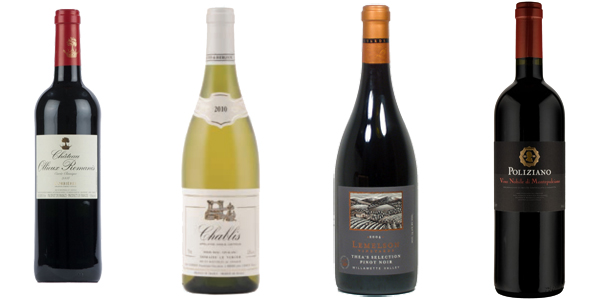
Chateau Ollieux Romanis Cuvée Classique Corbières 2009 (VINTAGES 281162, $15.95, SAQ 10507163, $17.65) betters le nez de Cyrano by a Pinnochio. Might just be the wood talking but the depth and girth is uncanny. Carignan, a.k.a., the hunchback of red French grapes, carries the load. It’s beauty is unearthed by the royalty of 30% Grenache (acidity) and 30% Syrah (tannin). A bouquet garni wafts through the Romanis cathedral and the orchestra’s A Day in the Life note holds on for the bows. Midi IVR* at its finest.  89

The grape: Chardonnay

The history: Oak plays no role. Think rocks, minerals and sharp fruit instead of butter and toast

The lowdown: If it’s not Premier Cru, Chablis is often disappointing. Geoffroy makes good from non-classified, less than estimable vineyard fruit

The food match:

Alain Geoffroy Domaine Le Verger Chablis 2010 (181289, $18.95) built of a “cold steel rail” is not accidentally, tragically on the verge of maximum dryness. Three pistols strong and searing Burgundy, mouth-puckering with green apple chalk.  Brings “on the brand new renaissance” so I wish you were here. Hip IVR* performance, vintage in, vintage out.  89

The grape: Sangiovese

The history: Producer of pedigree remembers its past but has a foot firmly cemented in the present

The lowdown: The Poliziano VNM had been closer to the $30 mark since 2004. This is a great vintage IMHO. Don’t miss it.

The food match: A great steak (Porterhouse or Rib-Eye) on the BBQ with Kosher salt, pepper and extra-virgin olive oil.

Poliziano Vino Nobile Di Montepulciano 2007 (988055, $25.95) should never be ignored. Does VNM get any better than this? Circumnavigates the Tuscan code, both ancient and modern. Assigns meaning to anagogic red fruit and flashes like a solar flare. Puzzling paradox of transparency and rich tinct. Chianina Bovi strength will need aeration or five plus years to relax.  90

The Splurge Wines

The grape: Chardonnay

The history: Ed Spragia was the winemaker at Beringer. His personal Chardonnay is biscuitous but good CVR**

The lowdown: This release adds an emphatic notch on the side of fair pricing

The food match: Steamed P.E.I. Lobsters and a twice-baked potato

Sbragia Home Ranch Chardonnay 2009 (52720, $34.95) from on the range in the Dry Creek Valley, “where seldom is heard a disparaging word.” Water-buffalo type comes out to play with buttered corn and elegant oak integration as the muted smell of smoked casks. A nearly $10 price reduction stares down in the face of the California price-fixing, conspiracy theorists.  89

The grape: Pinot Noir

The history: Transplanted Burgundian style shows most true to form in Oregon’s Willamette Valley

The lowdown: This is Lemelson’s most elegant bottling

The food match: Braised, plum glazed and crispy roasted pork bellies

Lemelson Thea’s Selection Pinot Noir 2009 (278721, $36.95) is a beautifully balanced effort. Coal smoke, meed, griottes and comestible tree fruit fragrance. Thyme and sage rubbed through fingers.  Sweet, resinous low country heartbreak.  90

Good to go!