
Anagogic #pec morning begins here #carryingplace #princedwardcounty
The mission is to gain a yet ascertained understanding. The intendments of geology and geography in Prince Edward County are already laid clear and discussed globally, at least by the wine interested, but what of a deeper, more detailed look? What about the moraines? What I really need to know is how a scant fraction of producers are able to produce so much promise? It must be the ridges.
On the Niagara Peninsula The Vinemount Ridge lies just above and south of the brow of the Niagara Escarpment. Its unique aspects play a vital role in determining some of the most complex Riesling and Cabernet Franc in the world. While not visually as dramatic in PEC, the ridges are no less important to viticulture. Driving the corrugations of Prince Edward County, along the Greer, Danforth, Closson and Lighthall roads, I follow the sight lines. With subtle aspects emanating from the northwest or northeast, the ridges along these roads angle east and west, each with their own gentle but effective slope falling ever so gracefully down to Lake Ontario. The significance is not lost on my mission.

Prince Edward County – East, (c) http://www.geologyontario.mndmf.gov.on.ca/mndmfiles/pub/data/imaging/ARIP172/ARIP172.pdf
Glenn Symons of Lighthall Vineyards tells me that certain parts of his vineyards can reach temperatures that are eight degrees higher than others. The shallow soils are a result of the stratified ice-contact deposits of sand and gravel that occur in this, one of three Prince Edward County esker ridges, trending northeast to southwest in the Cherry Valley area. Battista Calvieri of Hubbs Creek Vineyard notes that his (Lindsay formation from the middle Ordovician period) Danforth Ridge property provides 20 of 40 plantable acres ideally suited to Burgundian grape varieties. Plant at high density and the ridge takes care of the rest. At the Old Third, Bruno Francois walks me through his Pinot Noir and Cabernet Franc vineyards on the Closson Road. Here the ridge falls more dramatically down towards a forest below.
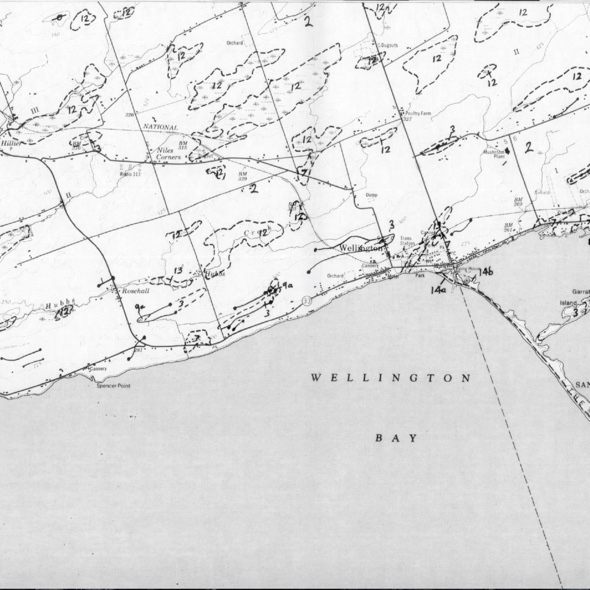
Prince Edward County – West, (c) http://www.geologyontario.mndmf.gov.on.ca/mndmfiles/pub/data/imaging/ARIP172/ARIP172.pdf
The quaternary geology of the County accounts for glacial, till, glaciofluvial, glaciolacustrine and eolian deposits. The soils are “composed mainly of fine-to medium-crystalline limestone with shaly partings and sublithographic to finely crystalline no dular and shaly limestone. These bedrock formations are the main topographic control, being at, or very near (within 1 m), the surface throughout most of the map-area.” It all adds up to minerality in the wines and nowhere does the geology matter more than on the ridges.
Related – I’m a little bit County
To habituate a time and be privy to the transformation of a people and a place into something special is a rare form of curious, mysterious and spiritual entertainment. How neat it truly is to be witness to a generation awash in tempo collective, in watershed historical. There are many reasons why folks are making the move to Prince Edward County, why grapes are being cultivated, nurtured and paid conspicuous attention. The rise of the County is happening.
My friends and neighbours John and Amy moved out five years ago. They left the big smoke behind, settled in a beautiful house with acreage to die for on the water. They walk and they breath. Long ago an old Montreal family friend opened one of the first wineries in the County. Thanks to David Lawrason I was able to taste through some old vintages of Long Dog last summer. What a peek back to better understand today. A long time friend of my wife recently moved out and opened a restaurant in Bloomfield. Kin Cafe makes a terrific sandwich. Two more friends have put their house up for sale in Toronto and are heading to the County. Is there room?

A #wellington Saturday night @DrakeDevinn quickie #drakedevonshireinn #pec
The answer is yes. Drive in from points north, from Brighton and down the Loyalist Parkway or from Belleville down Highway 62 and the wide open space will hypnotize you. Suddenly you find yourself in Hillier, Wellington, Bloomfield, or Milford. Then, moments later, once again farmland and the gaping sprawl of agrarian living. Truth be told, elevated levels of civilization, hipster happenings, fine gastronomy and modish behaviour have infiltrated the County. That said, the real story is in the ground.
Related – Take them home, County wines
Artists discovered PEC long ago. Ontario’s most thriving community dots the towns, barns and houses on the hills all over the County. Winemakers have followed. A Burgundian climate and geology were the original draw, and still are. The winter of 2015 and a devastating May frost conspire to be the kill of many hopes, but all is not lost and to persevere is to believe in the dream. Climate change and an undiscovered global truth about the County’s greatness are not just stuffing in a piped future. Bests are happening now. Great men and women are putting passion and acumen to work. Prince Edward County’s time is upon us.
Can it be such a coincidence why visiting foreign journalists of humanistic luminosity and their hyperboles of rumination have anointed Prince Edward County with what are effectively statements and essays of religious zeal? No, it is not. The soil, ridges, choice of plantings, winemaking and finally, the 21st century climate are the storm towards which perfection is aimed and eventually heading.
Related – You can lead a county to the city
Comity in the County is no joke. A harmonious thread weaves through and ties an inherent commonality together. Stylistically diverse yet magically aligned, up on the slopes of ridges or down in the valleys. This is how I would describe the wines of Prince Edward County. Walk along the Closson, Greer and Danforth roads or down in the Cherry Valley and see what the fuss is about. On an early October weekend I visited eight properties and while that was certainly 10 less than what I would have liked, the cross-section provided ample understanding, plenty of fodder and more than a tease for the next visit.

It’s decorative gourd season mother… #cherryvalley #pec #clinician
This first part report on the County focuses on six properties. Part two will cover the wines of The Old Third tasted with winemaker Bruno Francois at the Cool Climate Chardonnay conference in July and at the winery on this trip. I will also offer notes on the various older vintages I tasted back in June.
Lacey Estates
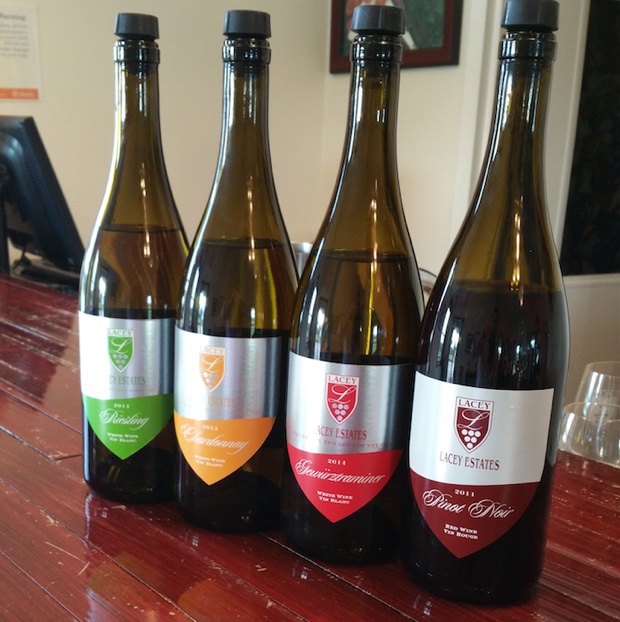
Lacey Estates Line-Up
Lacey Estates Riesling 2014, VQA Twenty Mile Bench, Niagara Peninsula, Ontario (Winery, $18.95, WineAlign)
With fruit culled from Bench lands on the Niagara Peninsula, the Lacey take on Twenty Mile Bench Riesling is on the light, piercing and linear track of typical. Like a younger, more naive and slightly jittery version of Flat Rock’s Estate take, this is a very tightly wound white, citrus-shaken from head to toe and full-on arid. As direct an example of pick, transport, crush and let sleeping dogs lie as is ever witnessed. A mess of butter chicken would help batten down its hatches. Drink 2015-2017. Tasted October 2015
Lacey Estates Gewürztraminer 2014, VQA Prince Edward County, Ontario (Winery, $19.95, WineAlign)
Lacey has prepared a dry Gewürztraminer with classic varietal tendencies, from rose to lychee by way of nuts and bitter pith. The sapidity is derived from the Closson Road Hillier clay-loam, blanketing the texture and the aromatics with a fuzz, like tiny hairs on a peach. Though still languishing in a proleptic state, the length on this wine indicates a good five years of pleasure ahead. Drink 20160-2020. Tasted October 2015
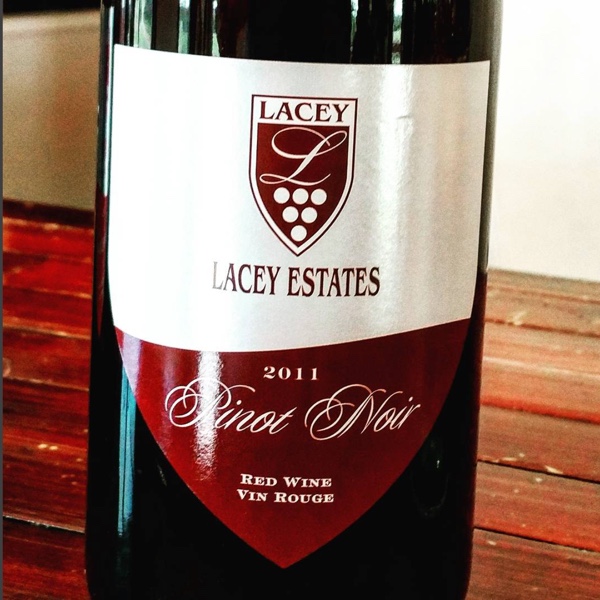
One more prime #pec Pinot site. Lithe @LaceyEstates804 ’11 with the seven-year itch. ’13 from barrel progessing and professing further #PECwine #clossonridge
Lacey Estates Pinot Noir 2011, VQA Prince Edward County, Ontario (Winery, $22.00, WineAlign)
From a County Pinot Noir block on a plateau of the ridge set aloft the Closson Road, Kimball Lacey’s fruit is a prized commodity, albeit still very young. This vintage is not a weight-bearing one but it offers incite and prognostication. A lovely litheness is embattled by a talkative bitterness and a spectrum of red fruit whorls in circumfuse; cranberry, raspberry, strawberry and pomegranate. All are dispersed and interspersed by citrus. A primary Pinot Noir, with silken dreams and a softening when it may come together. Two to three years should bequeath good behaviour on the 1200 some odd bottles. Drink 2017-2020. Tasted October 2015
Lacey Estates Chardonnay 2013, VQA Prince Edward County, Ontario (Winery, $22.00, WineAlign)
It may strike as a derivative Greer-Closson County Chardonnay with Closson Chase and Norman Hardie as precursors but if Lacey’s 2013 is Fairport Convention to Chuck Berry, The Beatles and Bob Dylan, so be it. Older (4th, French) seasoned barrels bring pique, texture and balance. This is Chardonnay of spine and a touch of limestone funk. Very much a wine positioned on the stony tang of Prince Edward County and possessive of solid, three minute pop-song length. Kimball Lacey is on to something and the ’13 vintage coupled with the Closson Ridge is the right studio to make his music. Before too long the cries will say “why Mr Lacey, why d’you do the things you do? It’s true no one here understands now, but maybe someday they’ll catch up with you.” Drink 2015-2019. Tasted October 2015
Grange Of Prince Edward
Grange Pinot Gris Select 2013, VQA Prince Edward County, Ontario (Winery, $19.95, WineAlign)
Where there’s smoke there’s hue and with impart by 15 hours skin contact prior to pressing, that colour and those aromatics are the result. Four weeks on the lees followed by four months in neutral oak bring distinct Caroline Granger character, in Pinot Gris unction and a mineral mile. Also on the naturally oxidative side of the Closson Road and Hillier clay-loam. Drink 2015-2016. Tasted at Agrarian Restaurant, October 2015

Grange Of Prince Edward Lot 3 Traditional Method Brut, VQA Prince Edward County, Ontario (Winery, $29.95, WineAlign)
The Lot 2 Traditional Method Brut was aged 18 months sur lie and here in the third trimester the complexities are taken months further, to a moment in largely uncharted Prince Edward County territory. This tempo-lapse methodology is highly intriguing, especially in consideration of the occurring happenstance breach of the autolytic-oxidative continuum. In three there is liquorice and scraped orange skin breaths inhaling and exhaling through sensations of tart and in tin. The yet young oxygenation seems to disregard the yeast at this stage, leaving behind a vapour trail of Closson exhaust. It’s both exhilarating and wearying. Absorbed to say the least, still, “I’m wonderin’, I’m wonderin’,” where this will go. Were it a blush Brut it would surely be a shocking pink. Drink 2015-2019. Tasted October 2015
Grange Of Prince Edward Sparkling Riesling 2010, VQA Prince Edward County, Ontario (Winery, $24.95, WineAlign)
The reasons for re-tasting wines are multi-fold but none are more important than learning what you did not know. The batch may be different and any additional lees-affected time would certainly bring about a new wave of complexity. Though assiduously more Riesling than Sparkling, the age has amplified the Mosel temper and yet as bubbles it seems so very primary, with terpene and flint in mid-strike fashion. Stones, stone fruit, lemon pith and peach subdue the sugar and the commonality with the Lot 3 Brut narrates a house style story. “Like leaves, when autumn falls, turn gold, then they hit the ground.” The thrill of it all, in the county, of country life. Sparkling Riesling playing roxy music. Just a bit more balance to the bitters would eventuate bucolic living. Drink 2015-2020.
From my earlier note of December 2012:
Seems more late harvest, Spätlese over Sparkling. Nectarous juice with a squeeze of suspended honey and a light citrus spritz. Waited for the sear but it didn’t arrive. Good Riesling though.
Last tasted October 2015
Grange Of Prince Edward Pinot Noir Diana Block, VQA Prince Edward County, Ontario (Winery, $35.00, WineAlign)
Ripe and bright to a major degree with tannin at the controls. Still in two meanings, unmoving and perpetual. Acidity circulates, percolates, invigorates. Pinot Noir with a slight fever and an even bigger temper, stuck in primary, yet ready to relent. Remarkable and confidently not yet entered stage two of life but the silky texture is caressing and the forbidden fruit is ripe for the picking. So close to approachability, with just the liquorice and the volatility needing to step aside. The methodology of a 28-day primary fermentation, followed by 30 months in neutral French oak is the culprit. Structure can be a bitch. Diana will be worth the wait. Few Ontario Pinot Noir have ever shown such rural planning, architecture and potential. Count them on two hands. Drink 2017-2022. Tasted October 2015

My kingdom for her majestic lees @grangewinery #carolinegranger #pecwine
Grange Of Prince Edward Cabernet Franc Northfield, VQA Prince Edward County, Ontario (Winery, $35.00, WineAlign)
Caroline Granger’s approach to Cabernet Franc is a natural ferment, earthy cure, holistically organic and eco-rich consanguinity. No other varietal hook-up happens like it does with the expatriate Loire currant clipper. Granger’s affinity with the grape is on intensate display with Northfield, especially in the cured, soil funky heat of 2010. Like the Diana Pinot Noir, primary fermentation occurred in stainless steel for 28-days and it was then aged 24 (as opposed to 30) months in neutral French barriques. The extreme unction, steroidal liquorice and streaky garrigue talk about the past and open up windows to the future of this wine. They are one in the same, spoken on behalf of longevity. This is essential for great Cabernet Franc, even in the midst of hyper tones and acquired tastes. Well done. Drink 2015-2018. Tasted October 2015
Lighthall Vineyards
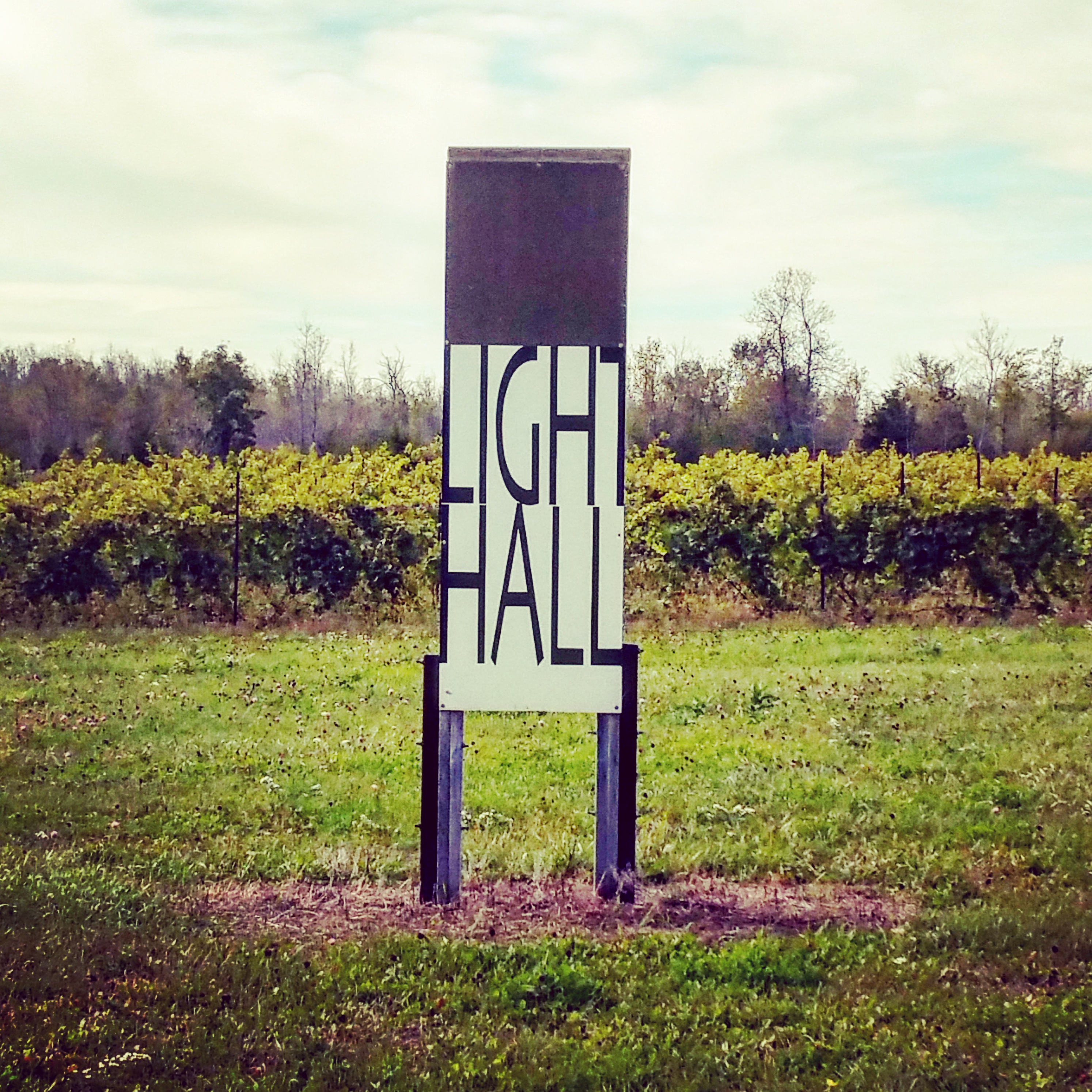
Leave the @lighthallvyard on for 2014’s Chard & Pinot. Rooms of their own #vintageofthedecade #aheadbyacentury
Lighthall Progression Sparkling Vidal 2013, VQA Prince Edward County, Ontario (Winery, $20.00, WineAlign)
Progression is 100 per cent Sparkling Vidal by Glenn Symons, a.k.a. “Ward 5 Brut.” It brings stonk and soul together. Re-fermented in April and tasted in October, Progression marches forward and retreats, in re-emerging aromatics and of a deconstructed narrative. Singular in its fretting, of nervous energy and in keys altered by capo restrictions, Vidal has never played a tune like this before. Better growing periods and PEC areas are the sheet music, wi nemaking with atmosphere the arrangement. Progression is progressive, it celebrates musicality and it sells records. It also sells out, literally, not figuratively. Drink 2015-2018. Tasted October 2015
Lighthall Sparkling Rosé ‘The Fence’ 2014, VQA Ontario (Winery, $25.00, WineAlign)
This is Glen Symon’s first Sparkling Rosé, a 100 per cent Pinot Noir from estate vineyards, refermented using the Charmat method. Intensely fizzy, in toto fruity and actually gives off a Pinot Noir vibe. Something racy, spicy and wild runs rampant, rendering this blush bubble in an Ontario class of its own. It’s like 1980’s alt-dance fizz, with a New Order or B-52 thing going on. It just seems to do the “she-ga-loo, shy tuna, camel walk, hip-o-crit, coo-ca-choo, aqua velva, dirty dog and escalator.” Has the direct beat, retro and futuristic at the same time. Dance this mess around, in sweet and savoury tones, warm, day-glo, slow and gyrating. Drink 2015-2016. Tasted April and October 2015
Lighthall Chardonnay 2014 (tank sample)
The child of a fortuitous vintage and magical ferment. The wine hit 25 degrees and finished malolactic fermentation in two weeks. One third barrel, one third tank and one third a combination thereof. A perfect trilogy, same limestone pierce as always but with a new order texture and aromatics filling the room. Like 1987, of substance, in transitions, from ceremony to everything gone green. A storm of amalgamation. Really a new benchmark for Glenn, Lighthall, Cherry Valley and Prince Edward County. Tasted October 2015
Lighthall Pinot Noir 2014 (barrel sample)
Best fruit ever. Malo done, only one year in (20 per cent new) oak and yet to feel the preservation effect of sulphur. Living a rich aromatic lifestyle with pollen in the air. Has the tannin to support its excesses (it spent one week plus three on the skins). Should lead to 400 cases and should retail for $35, though Glenn will probably charge $30.
Lighthall Pinot Gris South Bay 2014 (tank sample)
From Huff vineyard fruit, a rich, unguent emanation that shows slightly oxidative (pre-sulphuring). Has a chèvre-Chenin Blanc attitude that will turn to mellifluous honey with time.

Lighthall Muté 2011
Lighthall Muté 2014 (tank sample)
Here is unfermented Vidal, a vin liquoreux that wants to draw comparisons to sherry, straw wine, Rancio, Vin de Paille, you name it but with apologies back and forth, this is in a league of its own. A fortified wine with a distillate added to bring it up to 17-18 per cent alcohol. Distinctly orange in flavour, oxidative and yet religiously addicted to site. There will be 100 cases produced at $30 for a 500 mL bottle.
Hubbs Creek Vineyard
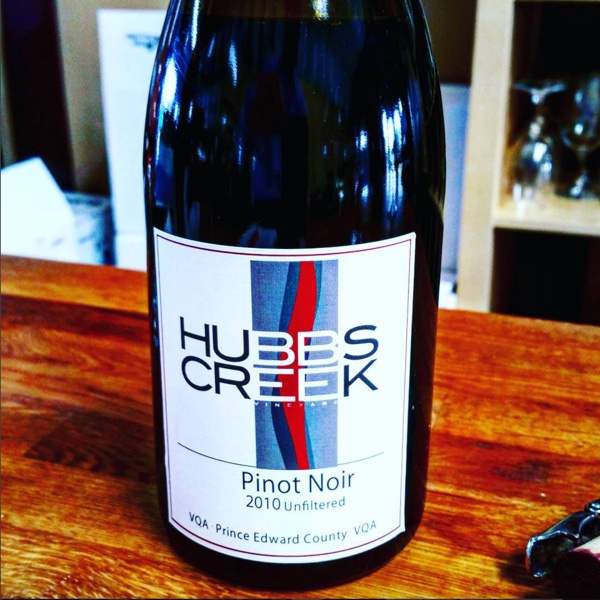
A library browse with Battista @HubbsCreek #sevenyears #PECwine
Hubbs Creek Vineyard Chardonnay 2014, VQA Prince Edward County, Ontario (Winery, $27.95, WineAlign)
This is Battista Calvieri’s first County Chardonnay from his estate’s seven year-old vines. A minor barrel ferment (15-20 per cent) in French oak and the remainder in stainless steel seeks and finds Chablis. The wood needs two more years to dissipate, find inner-vision and expand in the mouth. The length is already outstanding, before which burst forth exploding pockets of spiced, warm drawn butter with nary an oleaginous feel. The HCV inaugural release is emulsified Chardonnay of silken protein, with pretty drops of vanilla and purity out of a Danforth Ridge vineyard ear-marked for quality varietal pleasure. Drink 2017-2021. Tasted October 2015
Hubbs Creek Vineyard Pinot Noir Unfiltered 2010, VQA Prince Edward County, Ontario (Winery, $28.95, WineAlign)
Now in bottle four years, this sophmore Pinot Noir shines bright as the day it first passed into glass. From fruit really carefully nurtured off nine to ten year old vines, there is no sign of oxidation or advancing maturity. That is nothing short of incredible. Goes from fresh strength to strength in and by tannin. There is great spice (white pepper and dried red peppercorn) and two additional years should bring this to fruition. A minor note of late fall boletus mushroom talks up Burgundy. The HCV Danforth Ridge is clearly a top Pinot site in the County (along with slopes on the Greer and Closson roads). Planted to high density the results are proven in wines like this 2010. Drink 2015-2019. Tasted October 2015
Closson Chase
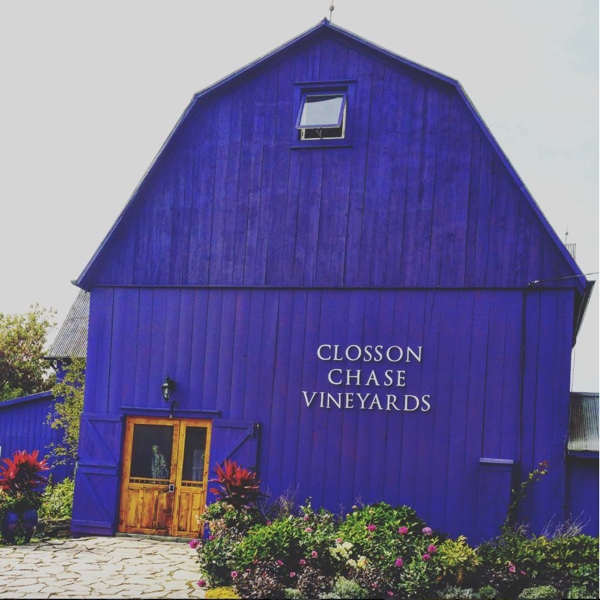
Quick crush of Le Clos ’13 @ClossonChase Purple barn but Pinot all gone #chardonnay #pinotnoir #ccv #clossonchasewinery #clossonchasevineyard
Though I did not taste this in the County, I have been pouring it at Barque Smokehouse since early summer. I am including my March review of the CCV Chardonnay 2103 for perspective.
Closson Chase Vineyard Chardonnay Closson Chase Vineyard 2013, VQA Prince Edward County, Ontario (148866, $27.95, WineAlign)
This CCV Chardonnay is one of departed winemaker Deborah Paskus’ final acts at Closson Chase. It will forever be noted as a legacy-cementing, swan song of career excellence. Crafted by Paskus and bottled by the next one, current winemaker Keith Tyers, the 2013 CCV is simply a tour de force. No such combination of richness, tropicality and pure grape tannin has ever infiltrated this Chardonnay, from this vineyard. I’m not sure there is a comparison in Ontario, at this level of excellence and at this price. A wine of pure impression, with Montrachet-like structure and Folatières-like precision. Seemingly capacious, its facile legerity is hypnotizing, quantitatively escalating in assembly of aromas, flavours, through texture and finally to longevity. The wine spent 16 months in a mere (17.25 per cent new) oak. That it notes 12.5 per cent alcohol on the label is next to impossible. The substance is just too buttressed to be so tender and effete. Impeccable balance, refinement and mineral finish. This is Chardonnay to confuse the world’s fine white collectors, to wreak havoc at international tastings for five to 10 years. Only 712 cases are available and at $27.95, is down $2 in price from the 2012. Best ever, hands down. Drink 2017-2023. Tasted March 2015
Closson Chase South Clos Chardonnay 2013, VQA Prince Edward County, Ontario (Winery, $39.95, WineAlign)
The South Clos is a richer wine in so many ways, detains the barrel with utmost retention and exaggerates the notion of peaches and their stones. Fully opulent, fleshy to the nth degree and marked by a peppy, peppery bite. This flagshig Chardonnay in the CCV stratum should, by all accounts be the unparalleled success story from the 2013 vintage. The specific southern most portion of the vineyard and barrel select accumulation provide it with the tools and the ammunition. So, as good a Chardonnay as it is, why does it recoil from a winemaker’s legacy defining moment? It is because a final act succeeds as the sum of great parts. The CCV Chardonnay is that summation. Le Clos, without team support, howls alone. If the expertly reasoned and balanced CCV was the last great work of Deborah Paskus, the South Clos is her last stand. It is loaded with and weighted down by excess, in orchard fruit, by blanched nuts and in kernel skin. It is very much a Chardonnay of heavy contact. It is a night scene filmed in daylight, a clichéd melodrama, day for night. It should best be enjoyed while the sun still shines. Drink 2016-2019. Tasted October 2015
Hinterland Wine Company

Hinterland Les Etoiles 2012, VQA Prince Edward County, Ontario (Winery, $39.00, WineAlign)
An axial split between Pinot Noir and Chardonnay balances this traditional method Sparkling wine, specific to and what can only, obviously be from Prince Edward County. Acidity defines its existence in every facet of its being. A rich star to be sure, from a warm vintage, free from frost and more importantly, immune to mould. Jonas Newman talks of the methodology, in growing low to the ground. As the sun goes down, the canopy shades the fruit, slowing down the ripening, extending the season, developing the sugars, the complexities and preserving the acidity. At 6 g/L RS, with limestone communication and that sassy acidity, Les Etoiles in ’12 is pure County Sparkling. It exudes untamed apple and unnamed acidity. The Hinterland acidity. It strikes early and often. Just add warmth, stir and voila. Terrific year. Drink 2015-2021. Tasted October 2015
Hinterland Les Etoiles 2009, VQA Prince Edward County, Ontario (Winery, $39.00, WineAlign)
The effect of three additional years on the lees (this bottle was disgorged on July 7, 2015) can’t be overestimated. In fact, tasting this ’09 Etoiles is like coming upon a new wine altogether. Its assessment is approached with only a present state in mind. The level of fine accumulation after (five years) is like stumbling upon a most convenient truth. Aromatic intricacy is the product of settling ramification. Think baking biscuits, early morning roses, cake yeast, oxidative orchard fruit skins, anise Taralli, ginger and preserved lemon. The ’09 remains opulent and yet nothing means nothing without first knowing that acidity persists as everything. This is Sparkling with an expansive mouthfeel and a burst of helium. Though in the autumn of its life it falls under the category of wow. Drink 2015-2018. Tasted October 2015
Hinterland Blanc de Blancs 2011, VQA Prince Edward County, Ontario (Winery, $39.00, WineAlign)
If Les Etoiles is Hinterland’s Message in a Bottle and the easy drinking, baby maker Ancestral is alright for you, then the Blanc de Blancs could rightfully be the band’s instrumental Reggatta de Blanc. As a Sparkling antithesis to Les Etoiles it exudes much more limestone, in its lactic bleed, its piercing ooze and through the outright white lightning strike that pops in the mouth. Take away the Pinot Noir and a certain level of earthy tension seems to disappear, replaced by a different set of nervy parameters that County Chardonnay protracts in Sparkling wine. Picked on September 18th and 19th, i.e., a normal year, the B de B helps to transition the epistle spoken by the star towards the accessibility of the softer ballads and hits. It’s a bit of a middle child bottle of bubbles and though it sings without words, its meaning is clearly heard. Drink 2015-2021. Tasted October 2015
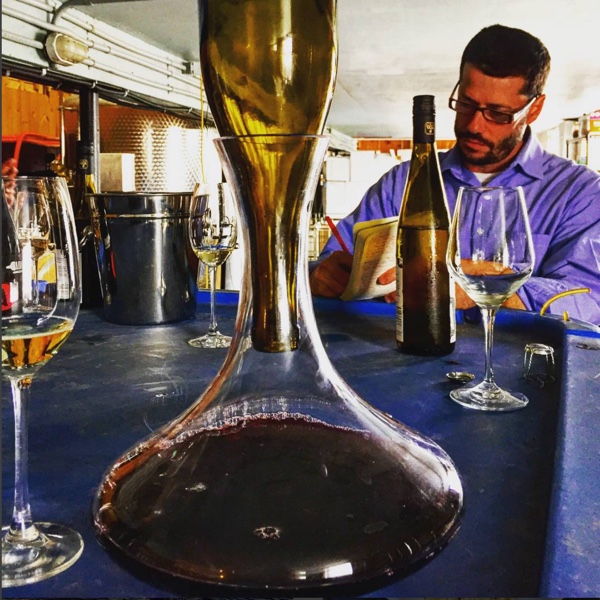
Notes on #Gamay in shape like Will, shaped by Jonas @northshoreproj #sandstonevineyard #wilms
Jonas Newman is crafting wines for Hockley Valley’s Mario Adamo under the Adamo Estates Winery label. The first releases are borne of fruit out of some of Niagara’s great vineyards; Wismer-Foxcroft, Château des Charmes-St. David’s Bench and 13th Street-Sandstone.
Adamo Estate
Adamo Estate Riesling Wismer-Foxcroft Vineyard 2014 , VQA Twenty Mile Bench, Ontario (Winery, $19.95, WineAlign)
Part of the Adamo Grower’s Series wines, of big, juicy fruit and deliberately sweet at 27 g/L RS. A Kabinett Mosel styled Riesling not just for show but because “this is where the ferment wanted to stop,” says Newman. Fruit is culled from the part of the vineyard that determines such a style and direction. This is classic Twenty Mile Bench Riesling (one step removed from the W-F made by Ilya Senchuk at Leaning Post) that acts neither dry nor sweet but rather feigns aridity in toothsome clothing. Drink 2015-2018. Tasted October 2015
Adamo Estate Gamay Noir 2014, VQA St. David’s Bench, Ontario (Winery, $19.95, WineAlign)
Jonas Newman’s first kick at the St. David’s Bench Gamay gutbucket is just that, raw and spirited in style. The clay and inherent ferric, metal sear resonates from the Château des Charmes vineyard. Considering CdC’s Gamay is as good as it gets for the money and from such farming in Ontario, what a fortuitous and gracious place to start for the Adamo family. Early energy, funky fruit and punchy acidity trill up the amplification. This is punch drunk fun Gamay, very Cru is style and pump per up in volume. It’s no Gamay Muzak, “pump it up, until you can feel it.” Gotta believe Elvis would have liked this Gamay. Drink 2015-2016. Tasted October 2015
Adamo Estate Pinot Noir Lowrey Vineyard 2013, VQA St. David’s Bench, Ontario (Winery, $19.95, WineAlign)
Jonas Newman walks out onto hallowed Ontario Pinot Noir ground and offers his two Lowrey Vineyard cents. From the Grand Cru site where Thomas Bachelder, Ilya Senchuk and Wes Lowrey make three of the province’s most important Pinot Noirs, a fourth camarade has entered as the new kid on the block. This is no ordinary plot and the direction of the rows, the angle of the slopes and the venn diagram of overlapping St. David’s Bench and Niagara Peninsula appellative lines may be blurred. Make no mistake. Lowrey fruit is Lowrey fruit and in the hands of a winemaker like Newman, expect more excellence. The fruit is very young in here (three years in this 2013) so the level of inherent virtue is tempered as if by grains of salt. Jonas made this in a “deliberately big, unctuous style,” barrel aged for 10 months in 50 per cent new French Oak, “not built to last.” Big it is and yet pretty, with heaps of Bing cherry equally opposed by till, gravel and heavy clay. A two to three year structure is appropriate considering the age of the fruit. Drink 2015-2018. Tasted October 2015

Adamo Pinot Noir Lowrey Vineyard 2013
North Shore Project
North Shore Project Gamay Willms Vineyard 2014 (Winery, $24, WineAlign)
This is Will Predhomme’s extended foray into crafting cool climate Ontario wines with Jonas Newman, a project that began with Syrah and Rosé from Lake Erie North Shore vineyards. The fruit for this Gamay is sourced from the Sandstone Vineyard in the Four Mile Creek sub-appellation of Niagara-on-the-Lake. Planted in 1983, it is owned and farmed by friends of 13th Street winery, Erv, Esther and Eric Willms. This Gamay is so Will, bright, energetic, positive, right there with you, all the way. Jonas gave it a bit of debunging for a hint of oxidation, a good move on his part to counteract the high level of excitement and anxiety it currently displays. Should be released in time for Christmas. Drink 2015-2019. Tasted October 2015 @northshoreproj @WillPredhomme
Good to go!
Twitter: @mgodello
Instagram: mgodello
WineAlign: Michael Godel


 Godello