Wine dividends, medals and twisted corks

Around this time last year the LCBO boasted about record profits, sales increases and an unprecedented $1.55 billion dividend flipped into the provincial government’s coffers. My May 17, 2012 column noted the 4.7 billion reasons to love the LCBO. The 2012 transfer was up 9.9 per cent over 2011.

Amorim and O-I’s HELIX cork PHOTO: O-I

as seen on canada.com

As of this morning, the new statistics are out and while the spin  plays a familiar proselytizer’s refrain, the numbers might seem to tell a different story. According to the LCBO press release,  ”operational efficiency and growth through store network improvements were key factors in LCBO’s 2012-13 financial results. It was LCBO’s 18th straight year of record sales and 19th consecutive record dividend.”

Here are the numbers, though ”these financials have yet to be audited.”

  • Net sales of $4.892 billion, up $182 million (3.9 per cent) from 2011-12.
  • Transfer of an all-time high $1.7 billion dividend, not including taxes, to the Ontario government. $70 million (4.3 per cent) more than in 2011-12.
  • Net income rose $53 million to $1.711 billion, up 3.2 per cent.

Don’t be misled because the beer, wine and spirits superstore is no shrinking violet. There can be little argument that the numbers remain anything but staggering but it can be suggested that growth may be entering a somewhat stymied period. The Ontario government saw their stipend reduced from just about 10 per cent to slightly more than 4 per cent, according to these latest figures. The total sales percentage increase was also slower than the previous year. Could this be an area of concern when considering the health and viability of the provincial liquor monopoly? An upcoming December 2013 auditor general’s report, if it indeed includes the LCBO, may soon shed new light.

Meanwhile, Wine Align this morning began a search for Canada’s top wines at the inaugural National Wine Awards of Canada being held in Niagara. With the support of host partner Wine Country Ontario#NWAC13 is hosting a wide selection of the country’s leading wine writers and tasters, gathered together to evaluate well over 1,000 wines grown in Canada and to award Platinum, Gold, Silver and Bronze medals in some two dozen categories.  Wines from British Columbia, Alberta, Ontario, Quebec and Nova Scotia will be assessed using the same 100-point system employed at WineAlign. Full results will be published on Wine Align in September. Here is the official medie release:

http://www.marketwire.com/press-release/-1802537.htm

Anthony Gismondi and David Lawrason, Wine Align National Wine Awards of Canada 2013 Photo: http://www.winealign.com

The winning wines will be showcased in a special feature section of the National Post’s Financial Post Magazine.  A staggering number (1100 wines) are to be poured, swirled, sniffed, tasted and evaluated by 17 wine critics representing six Canadian provinces.

Wine Align has taken the reigns from the competition previously known as the Wine Access Canadian Wine Awards.  Further groundbreaking is taking place across the pond. A New Twist On Cork has been unveiled “with the launch of a twistable and re-sealable version that could do away with the corkscrew.” The Helix cork is being unveiled this week at Vinexpo in Bordeaux. The “new cork and bottle has a thread finish, which allows drinkers to twist the stopper open and closed again, creating on airtight barrier.”

Portuguese cork manufacturer Amorim and US bottle maker O-I have teamed up to create the new technology, aimed at the $10-20 niche in the bargain wine market. The cork is made from agglomerated, or granulated material and is surely meant to take the screw cap industry to task.  The Helix will attempt to gain control of a divided industry. On one side, the wineries and buyers who support cork closures with a die-hard insistence that wine needs to breath and age via a real cork closure. On the other, the proponents of the screw cap, winemakers and consumers who point out that cork taint (TCA) ruins approximately 5% of all wines bottled under cork and also who insist that cork does not actually allow wine to breath.

This according to British wine writer Jamie Goode: “It certainly looks pretty striking. A key issue will be whether or not it is adopted by leading wine brands, which could help launch it in the eyes of consumers (who are traditionally quite cautious about wine packaging), and of course whether it is affordable enough for a tight-margin wine market. Also, will it need a capsule to make it tamper-evident? Without a capsule, it looks really good.” The immediate future certainly looks interesting.

Good to go!

You can lead a county to the city

South Bay Winery vineyard in Prince Edward County PHOTO: POSTMEDIA NEWS

as seen on canada.com

It’s time to discover the wines of bucolic Prince Edward County in south-central Ontario, a place possessed and structured of a learned and cultured essence. If you were born in PEC you likely never left and if you did, probably returned. Then there are those who migrated in search of an anti-metropolitan lifestyle. The landscape is encompassed by water, dotted with folkloric towns, farms and cottages. Wine destination comparisons might be made; to Niagara, to Muskoka, the Finger Lakes, the North Fork of Long Island, to parts of California. No definitive connection is obvious. After tasting through the formidable pours at County in the City last Thursday at the Berkeley Church in Toronto, it became abundantly clear that the wines are unique in and amongst themselves and also bound together as one. The refrain holds true. It must be the rocks.

The grape growers, winemakers and 30 some odd wineries in PEC are no longer a gaggle of obscure, off the beaten path, parochial folk. Their serious VQA wines are establishing footholds in our metropolitan markets. The County’s adage may well be, “you can lead a farmer to grapevines,” a sure statement of the obvious. This event proved you can also lead them to the city.

Photo: Wine Align

Photo: Wine Align

“The County” as it is affectionately known is Ontario’s newest and suddenly dynamic wine appellation. It’s climate and geological make-up has been compared to Burgundy, the world’s benchmark region for growing and producing Chardonnay and Pinot Noir. Chardonnay is clearly the County’s signature variety, its staff of life, but the excitement extends well beyond that comfort zone. Cabernet Franc, Pinot Gris, Vidal and especially sparkling wines are making inroads along with Pinot Noir and Chardonnay. But what about Gamay? Casa Dea’s Paul Battilana crafts a Sparkling Rosé from estate grapes. Chadsey’s Cairns and Troumpour’s Mill both make solid Gamay Noir. Battilana makes a still Gamay, as does Hillier Creek Estates. Time for others to join the #GoGamayGo party.

Prince Edward County wineries are increasing their collective engagement in many ways. The PEC chapter of the Ontario Wine Society held their inaugural event April 27th, 2013, County Character at Hillier Town Hall. PEC winemakers have joined the progressive wine on tap program too, like Rosehall Run, Norman Hardie and sparkling wine specialist Hinterland Wine Company, who is kegging Charmat, Prosecco-style bubbles for Barque Smokehouse.  The coming months offer many opportunities to taste the County. The Terroir festival in late May is an annual showcase of the area’s rocks, soil and new release wines, put on by the Prince Edward County Winegrowers Association. Wassail takes place in late fall/early winter, celebrates the harvest and the laying of the vines to rest. The summer of 2013 will be a great time to visit PEC and follow its wine trail.

Here are nine wines of note tasted at Wine Align‘s County in the City at The Berkeley Church.

From left: Sandbanks Rosé 2012, Casa Dea Estates Winery Cabernet Franc 2009, Lighthall Gewürztraminer 2011, Huff Estates Cuvée Janine Sparkling Rosé 2010, Exultet Chardonnay ‘The Blessed’ 2011, and Closson Chase CCV Pinot Noir 2010

Sandbanks Rosé 2012 (244616, $12.95) whispers summer by the lake in the face of a fading pastel, pink sunset. A magical and inexpensive combination of subtle strawberry, cream and bright acidity. Who would ask for more?  87  @SandbanksWinery

Keint-He Vineyards Voyageur Vidal 2012 ($17, winery only) is a warm and aromatic expression having taken full advantage of the vintage. Yellow and orange flesh melon abounds in sweetness tempered by just enough limestone influenced acidity. Incredibly easy to drink. Breathes new life into white wine.  88  @KeintheWinery

Casa Dea Estates Winery Cabernet Franc 2009 (241612, $18.95, winery) coaxed maximum density from the vintage in fleshy, black cherry and yet is anhydrous from chocolate dust. Chalk up another redacted red from Casa Dea, in the same vein as the plush, ruby ’09 Pinot Noir. All of Paul Battilana’s wines are priced and offered like an open door. Mi Casa Dea et su Casa Dea.  88  @PECWinemaker

Norman Hardie Pinot Gris 2012 ($25, winery only) bottled one week ago, is not as you might think, in shock. A cleanse of pure pear purée with an open invitation for immediate gratification. Mellifluous and with no discernible A16 whatsoever. This one’s good to go. Who comes by chance will be the more easily let go. “Lay down my darling,” this PG ain’t for keeping.  91  @normhardie

Lighthall Gewürztraminer 2011 ($25, winery only) succeeds because less is more. Less lychee, more lightness of being. This is Glenn Symons’ 2nd vintage from the famed Wismer Vineyards in Niagara (Jordan). Refuses to club you over the head with “correctness.” Despite the lack of oily, nutty and tropical girth it’s suffused with crisp pleasure.  90  @lighthallvyard

Huff Estates Cuvée Janine Sparkling Rosé 2010 ($29.95, winery only) from 100% Pinot Noir grapes is a phenomenal, inaugural genesis effort. More sanguine in colour than one would imagine, this sparkler is wonderfully sweet but also “turns sweat, turns sour.” Pinot Noir is always potentially so dramatic but who knew it could be like this, like blood swirling in the glass. “Bottled in a strong compression,” with black raspberry, noticeable yeast and impressive finesse.  Out of the cage.  91  @HuffEstatesWine

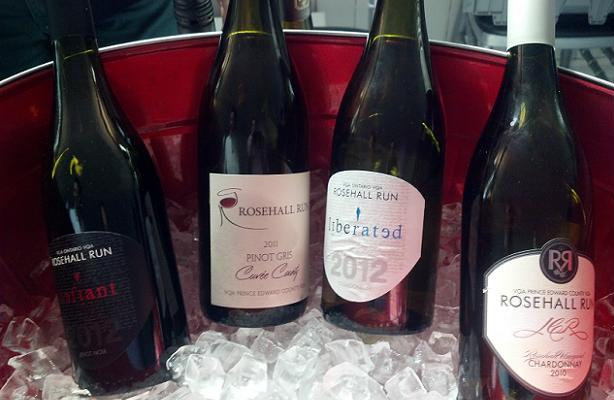
Rosehall Run Wines Photo: Michael Godel

Rosehall Run Wines
Photo: Michael Godel

Rosehall Run ‘The Swinger’ Syrah 2011 ($34.95, winery only) gets my attention not just because it’s the only commercially planted and bottled Syrah in PEC but because it stands in front of the orchestra. I gotta believe winemaker Dan Sullivan cares deeply about this wine from fruit sourced on Dick Singer’s Fieldstone Vineyard. Nothing fatuous about its smoky, tart cranberry, Sangioveseness kissed by the salty waves of an unseen ocean. The Swinger “ain’t no cherry bomb,” waits for no one, with its tobacco voice, gravel, rocks and sand. Like a sweet little bullet from a pretty blue gun.  90  @Rosehall_Run

Exultet Chardonnay ‘The Blessed’ 2011 ($35, winery only) is exemplary even if it may not be proprietor Gerard Spinosa’s favourite vintage. Commands an ineffable presence in gold sheen and parses meaning through balance and poise. The new oak is very noticeable but the ’11 acidity is grand. Their integration is seamless, the wine shines and a few years time will only increase its lustre.  92  @ExultetEstates

Closson Chase CCV Pinot Noir 2010 (310474, $39.95, winery) has improved dramatically over the course of a year, now red verging to black fruit, if only for a fleeting moment of temporary insanity, in a Sonoma state of mind. Silky smooth, “the textures coat my skin.” Though I have seen “the best (Pinot Noir) minds of my generation destroyed by madness,” this CCV uses a cured bresaola flavour and a vivid flower scent to invigorate, ground the humidity and the “earthy beet.” Musical, earthy beat, as in All Cats are Grey meets Howl.  92  @ClossonChase

Good to go!

Cloudy with showers, more wine expected

Barque Smoked Miami Beef Rib PHOTO: JILL CHEN/FREESTYLEFARM.CA

as seen on canada.com

This one’s for the floodwaters ravaged and oppressed in cottage country and to a much lesser extent, the city dwellers, this morning’s sunshine respite notwithstanding, faced with a few more days of wet April doom and gloom. There is always wine to cheer you up. County in the City presented by Wine Align  is a must not miss event tonight at the Berkeley Church.

For the rest of you keeping score at home, here are five sure bet $20 wines guaranteed to get you through the last week of April showers.

From left: Clos De Nouys Demi-Sec Vouvray 2011, Huff Estates Pinot Gris 2011, Clifford Bay Pinot Noir 2010, Stratus Vineyards Wildass Red 2011, and Eos Estate Winery Petite Sirah 2011

The grape: Chenin Blanc

The history: From one of the oldest Loire wine-making estates (Pierre Chainier) in the Vouvray A.O.C.

The lowdown: Loire Chenin Blanc ranges from dry to sweet and creamy sparkling. This is designated semi-dry but it tends dry because of a strong limestone mineral component

The food match: Basque Pintxos

Clos De Nouys Demi-Sec Vouvray 2011 (322669, $19.95) has already begun to stun in citrine and a petrol whiff plays the stage while the other aromas wait in the wings. Earthy for a white wine, a vin tuffeau-jaune if you will, no doubt imparted by the creamy, calcareous-argillaceous limestone soil. Sweet pear and the stuff of almonds lurk in the shadows. To taste there is little cloying danger and even a touch of cheese rind. It’s really quite dry, like Großes Gewächs German Riesling, but its balance is impeccable.  91  @imbibersreport

The grape: Pinot Gris

The history: Prince Edward County born and bred proprietor Lanny Huff teams with Burgundy born winemaker Frédéric Picard

The lowdown: Really a white and sparkling specialist (though they do grow Merlot), Huff’s Pinot Gris is a character study unlike any other PEC peer

The food match: Agedashi Tofu

Huff Estates Pinot Gris 2011 (134221, $19.95) initiates contact in a fusty, gamy way, not unlike some of my favourite reds in Montalcino and Châteauneuf-du-Pape. But this is Alsatian-styled Pinot Gris we’re talking about here. Fortunately a huff and a puff blows the dank aside and it gets peachy in West Indies pepper sauce after that. Lots of piquant character in this Prince Edward County charmer.  90  @HuffEstatesWine

The grape: Pinot Noir

The history: From the eponymous body of water at the eastern entrance of the Cook Strait and the Tasman Sea, separated by the White Cliffs from the more famous Cloudy Bay

The lowdown: From grapes grown in the Awatere Valley, this is essentially cool climate Pinot Noir and it shows

The food match: Barque Smoked Miami Beef Rib

Clifford Bay Pinot Noir 2010 (309500, $19.95) with its bright lights, big acids is spanking, aromatically clean. Raspberry fruit driven, big barking red dog, tart balanced (13.5 per cent abv) and full of pluck and punch. Would go nicely with the Barque of smoked meats.  89  @cliffordbaywine

The grapes: Cabernet Franc, Merlot, Cabernet Sauvignon, Syrah and Tannat

The history: The Wildass line of wine from Stratus Vineyards seems to say “always look on the bright side of life.”

The lowdown: Laid back brand in appearance from J.L. Groux and team but this assemblage is no couch potato

The food match: Whole-Wheat Penne, spring greens, sausage

Stratus Vineyards Wildass Red 2011 (86363, $19.95) is a trailing vine of sweet ever-bearing, toffee coated candy strawberry. A wolf steppin‘ out of its Niagara comfort zone, reminding me of a red wine made by The Foreign Affair, in dried fruit (not jam) as if it were made in the appassimento method. It’s simply J.L. coaxing maximum concentration from vines in a balanced vintage and frankly this is better than most Veneto Valpolicella at the same price. This Wildass is “like a true nature’s child,” born to be wild.  89  @Stratuswines

The grape: Petite Sirah

The history: Also known as Durif, a black-skinned variety developed by Dr. Durif, a French nurseryman living in the south of France in the late 1800’s

The lowdown: California has embraced the grape and although it remains much maligned, when acidity and balance play their part, it can be so much more interesting than Cabernet Sauvignon, especially in Paso Robles

The food match:  Beef Shanks braised in red wine

Eos Estate Winery Petite Sirah 2011 (317677, $19.95) is certainly Cabernet-like with its rich berry fruit forward first step but it never goes over the top. The alcohol (13.9 per cent) remains in check, it’s minty and eucalyptus cool and white pepper gives it good bite. Exotic, smokey edge.  90  @EOSwinery

Good to go!

A wine pentathlon

Casa Loma in Toronto PHOTO: ALISONHANCOCK/FOTOLIA.COM

as seen on canada.com

Wake up and smell the grapes. Put those lame excuses on the shelf and get over yourself. Time to cease and desist the dissing and dismissing of Ontario wine. I used to be like you but now I participate any chance I get, by invitation or by uncorking at dinner, to sample, savour and immerse myself in Canadian and more specifically, Ontario wine.

“5-Star” at Casa Loma (Photos: Michael Godel)

I was there when thirty wineries from The Niagara Peninsula, Prince Edward County and Lake Erie North Shore regions were assembled on Wednesday, April 10th, 2013 in Toronto’s Casa Loma by The Ontario Wine Society. No fewer than 127 wines (plus a few under the table ringers here and there) were poured at the “5-star” event that focused on the signature, cool-climate varieties produced in Ontario. Sparkling wines shared company with Chardonnay, Pinot Noir, Riesling and Cabernet Franc. I loved the pentalpha conceptualization, realized by a narrowing of the field to a focus of five. Working endurance wine tastings tugs on the olfactory and taste bud strings, demanding maximum mettle, so this was a welcome format.

The Ontario Wine Society is a necessary and viable provincial institution. The not-for-profit society was formed in 1991 and continues its mandate to discover, appreciate and support local wines. The industry knows to thank and give back to the OWS and other organizations who likewise set out complimentary mandates to champion local greatness. Like the VQA leader with respect to growth and sustainability Wine Council of Ontario (WCO) and the oenological education leader Cool Climate, Viticulture and Oenology Institute (CCOVI) at Brock University, the OWS is all about championing greatness stemming from our vineyards.

Shout out goes to OWS President Ken Burford and Vice-President Sadie Darby for orchestrating the oeno-pentathlon. The feat was neither small, nor insignificant. The local tastings ramp up in a big way in April and May with events like County in the City,  County CharacterCounty Terroir, The Niagara Food and Wine Expo and culminating in June with the inaugural National Wine Awards of Canada (formerly the Canadian Wine Awards) presented by Wine Align.

From left: Flat Rock Cellars 2008, Southbrook Vineyards Triomphe Chardonnay 2011, Stanners Pinot Noir 2010, Vineland Estates Elevation Riesling 2008, and Tawse Cabernet Franc Van Bers Vineyard 2009

Many of the wines presented had been previously reviewed so with such a big line-up to get through I did not always re-taste, including the following:

Rosewood Estates Natalie’s Süssreserve Riesling 2010 (258806, $14.95) 88

Flat Rock Cellars 2008 Riddled ($24.95) 87

Green Lane Old Vines Riesling 2010 (283432, $29.95) 91

Bachelder Saunders Vineyard Chardonnay 2010 (324103, $44.95) 91

Coyote’s Run Estate Winery Rare Vintage Pinot Noir 2010 ($44.95) 91

Here are eight highlights from the OWS Casa Loma tasting, to the tune of Riesling, Chardonnay, Cabernet Franc and Pinot Noir.

Southbrook Vineyards Triomphe Chardonnay 2011 ($21.95, 172338) binds FSO2 with jack or durian, febrile fruit. For now hard to figure, like a grey rose or a Pink Floyd. Offers up a creamy warmth in resonant echoes but amplified as if still trapped inside the barrel. The best days remain ahead for this certified and biodynamic Chardonnay, which in two to three years time will “come streaming in on sunlight wings.” 89  @SouthbrookWine

Tawse Riesling Quarry Road Vineyard 2012 ($23.95, winery only) picks up where the piercing ’11 left off and should be enjoyed in near time while that prototypical QRV fleshes out. This vintage is all about the here and now, citrus bright, immediately inviting, a slice of limstone pie with clay icing. While some age on Riesling is certainly and always welcome, this one begs to be looked at in the present. 90 @Tawse_Winery  @DanielatTawse

Lighthall Vineyard Chardonnay 2010 ($25, winery only) has that crazed look in its eye, as does vintner Glenn Symons when he talks about it, knowing full well this Prince Edward County juice is a bursting and rising, rocket launching supernova. Steely like Chablis, sharp and shimmering in defiance to the heat of the vintage, the LVC is a dartle to the collective consciousness of the County. Startling revelation. It’s all about the rocks. 91  @lighthallvyard

Lighthall Vineyard wines

Stanners Pinot Noir 2010 ($30, winery only) combines 60% (horizontal) County fruit with 40 per cent (vertical) Niagara (Lincoln Lakeshore) grapes in balance and with finesse. Simply apply the distance formula to figure out the length of the hypotenuse. Bridging the kilometres that lie between, though inadmissible to some, comes by way of a deft winemaker’s vision and touch. Plum good, mineral rich and perceptibly tannic without breaching a threshold of varnish. Cherry toffee speaks of the sunshine and indicates time is of the essence. Will look forward to full-on County issue for 2013 in the hands of Cliff and Colin Stanners. 89  @StannersWines

Vineland Estates Elevation Riesling 2008 ($30, winery only) poured as a youthful and “hello” pleasant surprise though it’s just beginning to display secondary character. Has shed its CO2 ferment skin without compromising the inherent citrus zest. Nectar lit by just emerging perky propellant and the ubiquitous, underlying of St. Urban’s stones all combine forces to a life of amarita. All this to make believe 2028 will be just another year in its evolution. 92  @VinelandEstates  @benchwineguy

Flat Rock Cellars Gravity Pinot Noir 2010 ($30, 1560winery) reels in Twenty Mile Bench fruit in a warm vintage as well if not better than any of its peers. Founder Ed Madronich is clearly slope and soil obsessed and this Pinot Noir is a study in topography and geology. To paraphrase Madronich, it’s  “more Pommard than Volnay, in a deeper and more masculine way than the Estate bottling.” Pinot barrels most representative of the Gravity style were chosen for the final blend, in this case noted by woodsy black cherry and spiced root vegetable. “Get a little savagery in your life.” 90   @Winemakersboots  @UnfilteredEd

Hidden Bench Estate Pinot Noir 2010 ($38, winery only) takes my previous impressions to a higher plane. Standing correct by calling it a “a vintage relative release” but it’s so much more than “a quaffable, generous fruit sui generis.” Beets turn into plums. Opaque hue reminds of graceful Nebbiolo with a dancer’s legs in aperture. Wins in judicious use of French wood. Tannins persist in the rear-view mirror. Big ’10 that speaks of another level in Beamsville Pinot Noir. “Think about it, there must be higher love.” 91  @HiddenBench  @BenchVigneron 

Tawse Cabernet Franc Van Bers Vineyard 2009 ($49.95, winery only) from the Creek Shores Appellation is proof that a well rounded grape has no point. The Van Bers is winemaker Paul Pender’s purlieu, edgy, outlying, unconcerned with the norm or the banal. Makes full use of a cool vintage with heart-stopping acidity and eye-popping verve but not without delivering Soul, in the form of flowers and a fruit basket to your doorstep. “It’s like thunder and lightning.” Capers, camphor and a knock on wood add R & B complexity. 91  @Paul_Pender

Good to go!

Power shift: Wine in Ontario

Photograph by Aaron Lynett, National Post

Photograph by Aaron Lynett, National Post

as seen on canada.com

It’s been a long time, a long time coming
But I know a change gonna come, oh yes it will”

…A climate for change hovers in the frigid late November air. Sam says, “don’t fight it, feel it.” An unprecedented level of lobbying, legislative tabling and transparent discourse looks to reshape the landscape for the future of Ontario’s wine industry. The Ontario Wine Council just initiated a bold venture called MyWineShop aimed at revolutionizing the retail industry in Ontario. Their manifesto?

“What if you could build your dream wine shop in your neighbourhood?” Now’s your chance to envision an Ontario with greater consumer choice.
mywineshop.ca

In June the federal government passed Bill C-311, opening the door for the provinces to overturn restrictions on shipping wine across their Canadian borders.

Just last week, Nova Scotia followed BC’s lead by introducing the Free My Grapes bill, a set of provincial legislative amendments which will permit direct to consumer wine shipping into that province. Ontario’s laws remain staid silent on the inter-provincial importation of wine and according to lawyer Mark Hicken, that silence indicates a soon to be opening door.

Wine sales continue to grow, the LCBO has many fans and I included have lauded their efforts. Still, the crowd is growing thicker, speaking out, demanding change. Private wine stores exist in British Columbia, Alberta, Manitoba and Nova Scotia. Critics want to know this. Why not Ontario?

With billions of wine dollars on the table and the window of opportunity seemingly imminent, it is with great interest that we follow the players, their agendas and their alliances. Here are twelve influential leaders who will help to define and decide the future of wine sales in Ontario.

Tim Hudak, Leader of the Ontario Conservative Party

Despite a less than impressive showing in the last provincial election, Dalton McGuinty’s departure and a leader-less Liberal government paves a new road to Mr. Hudak’s future. Adding beer and wine to corner stores in Ontario was a misguided and misdirected attempt at liquor reform but Hudak “didn’t reject the idea outright.” This indicates more than a potential partnership for a plan to introduce private wine retail in Ontario. Sure, the Conservatives first need to steal a majority, but a dwindling economy and renewed fear of long-lasting recession might just be the impetus for a Thatcherian foray and a partial crumbling of the LCBO wall.

Kathleen Wynne, leadership candidate for the Ontario Liberal Party

A discussion that involves Hudak would not be complete without mentioning Wynne. According to Scott Stinson, a front-runner to succeed Dalton McGuinty as leader of the party looks to be the long-time Cabinet minister and MPP for Don Valley West  (along with former Windsor MPP Sandra Pupatello). Good luck to either, as they will first be faced with the difficult task of leading the faltering Liberals and following what would be a miracle win, trying to withstand the wine storm brewing in Ontario.

Phillip Olson, Chair, LCBO

Olson has been Chair since March 2007 and his position was recently renewed in March 2012 for another two-year term. As head of one of the world’s largest buyers and retailers of beverage alcohol, Olson has seen the LCBO through its golden era. In fiscal 2011-12, LCBO sales topped $4.7 billion and it delivered a $1.63 billion dividend to the Ontario government, not including taxes. The LCBO now faces a tsunami of developing support to privatize the industry. Olson and team can look forward to a heavyweight battle for market share.

Hillary Dawson, President, Wine Council of Ontario

While the WCO’s mission is to promote the growth and sustainability of Ontario’s VQA wines, it is Dawson at the helm brandishing the brand new initiative. MyWineShop is turning heads and unequivocally is the boldest move yet by an Ontario coalition with aspirations to overhaul the wine world in Ontario as we know it.

Brian Schmidt, Vineland Estates Winery, President & Chair, VQA Ontario

As the head of VQA, winemaker Brian Schmidt is instrumental in maintaining and ensuring the exceptional quality of Ontario wine. VQA Ontario exercises delegated authority to administer and enforce the VQA Act and its associated regulations. Along with brother Allan, Schmidt is the candidate most likely to press for a change to rules regarding VQA wine format designations. VQA wines that use the appellation of origin “Ontario” may now be packaged in containers other than glass bottles but not wine bearing more specific claims of origin regulated by VQA. Securing that approval from VQA Ontario, the LCBO and the AGCO would have huge ramifications, including allowing for wine served from kegs in Ontario restaurants.

Bill George Jr., Chair, Grape Growers on Ontario

The GGO represents Ontario’s over 500 growers of 15,000 acres of processing grapes, including 176 wineries in the Province’s four viticulture areas: Niagara Peninsula, Pelee Island, Lake Erie North Shore and Prince Edward County.  Bill George Jr. leads an organization that connects growers to the public, the media and the wineries on matters of viticulture, in particular the growing demand for high quality grapes. As an industry partner, the GGO has participated in the creation of over 1,300 additional jobs in the last four years through programs implemented by the Wine Council of Ontario and other industry partners. VQA wine sales at the LCBO have more than doubled over the past five years to over $110 million annually and now make up about 40 per cent of total Ontario wine sales. Good quality grapes, grassroots work and connectivity. This is the work of the GGO.

Moray Tawse, Owner, Tawse Vineyards and Marchand/Tawse

Though his day job as Co-Founder and Vice President of Mortgage Investments at First National Financial Corp. is his bread and butter, Moray Tawse is most passionate about his role as owner of Ontario’s most progressive vineyard. Tawse was the 2012 Winery of the Year award winner for an unprecedented third year in a row at the Canadian Wine Awards. So Tawse goes, so goes the Ontario wine industry.

Bryan McCaw, President, Wine Align

Wine Align is an online service that makes it easier to make smart and informed buying decisions at the LCBO. It boasts the most comprehensive database linked to the LCBO. Many of Ontario’s top critics are on board. Wine Align has entrenched itself in the heart of wine purchasing in Ontario. Yesterday McCaw tweeted “we had a record number of visitors to @WineAlign yesterday (7,900). We’re now getting more in a day than we use to get in an entire month.”

David Lawrason, Toronto Life, The National Post and Wine Align

Lawrason is the most affable guy you would ever want to sit in a room with and taste wine. It is hard to imagine another Canadian wine scribe that covers as much ground, from coast to coast, as David Lawrason does. He is tireless, relentless, opinionated, diplomatic, accurate and concise. His conclusion about privatization? “Alcohol is legal, and so the citizens have every right to sell it themselves, and certainly to select which brands are available, and to shop for it when and where they chose.” Peerless authority on all things wine.

Beppi Crosariol, The Globe and Mail

Certainly less political than his peers, Crosariol concentrates on the wines. As the critic for the largest national audience, his focus stays the course of wine recommendations and where to find them. No other  Canadian writer can reach as many people or influence sales (particularly in Ontario) like the Globe and Mail’s man.

John Szabo, M.S., The National Post and Wine Align

John Szabo has the torch in his grasp and is running with it. His influence is on the verge of omnipotence in Ontario’s world of wine. It is hard to think of anyone who will have more to say and be heard by a larger audience, when the levee of Ontario wine restrictions break. Szabo wrote a lengthy, informative and remarkably diplomatic dissertation on the subject of the LCBO monopoly and what it would mean to introduce private wine stores in Ontario. Though he walked a fine line and succeeded in stressing a need for privatization, he managed the piece with an ambassador’s precision. Still, he finished off by saying, “I hope I don’t get put on an interdiction list for writing this.”

Rick VanSickle, WinesInNiagara

Nobody and I mean nobody works more tirelessly to champion Ontario wines, at field level and in print. Though he has been advocating for the overhaul of the system longer than most, save for Lawrason, Margaret Swaine and Michael Vaughan, VanSickle has recently increased his tone and his voice to push for change. It would be hard to imagine elevated discourse and debate without VanSickle in the fray.

Good to go!