Godello’s Ontario wines playlist

Writing about Canadian wines has been intrinsically inspired by music because quite frankly, one is always connected to the other. The wines of Ontario have always been at the head of this coupling and the relationship is borne more or less of its own accord. Music came first of course because before wine there was this gangly Toronto teenager every Saturday morning at 8:59 am sitting on the curb in front of Vortex Records at Dundas and Mutual Streets waiting for Bert Myers to open his shop so that kid could be the first in. The 1,600 vinyl record collection still gets plenty of spin time, as does Spotify and Google Music. The CDs? Not so much. Invariably a glass of wine is in hand, more often than not with an Ontario VQA designation in tow.

Canadian music has been great for as long as I have been listening. When did Ontario wine get here too, or the question begs, how? Not by virtue of any particular ethos through customs and traditions going back over many generations of wines. No, success and cumulative proficiency exists by dint of these wines without any forced supervision. They are governed by themselves and indeed across the entire industry. Done are the blanketing days of spare and powerful Ontario wines that were often too spare, so that the ribs of tannin showed through in painful obviousness. Today the contigious embracing of cool climate idiosyncrasy, fringe exceptionality and a unique Somewhereness makes Ontario the envy of the developing wine world.

Niagara-on-the-Lake, Ontario

My writing about wine an occupation whose reality is examined to points of madness, of long, run-on sentences, often at odds with grammatical winemaking realism. My tireless, tiring sentences and phrasing can at times offer a feeling that is potentially endless. Often I like my music to be the same in a Genesis-Frank Zappa-Pat Metheny like continuum but that too is changing. The young pop meeting hip-hop stars that my children listen to are growing on me. As are the unknown, the indie and the tireless players. And they need our help. The wineries too. Just ask Neko Case. “For every piece of music you stream/use for free today, please pay for one if you can. Music and art seem as effortless and breathable as air because an army of humans lovingly make it and propel it for the good of all.” Support local and order your next case of wine from an Ontario winery.

Compiling any wine list is never easy. Not when the subject matter is the most fleeting of consumables, a drink ever-changing, almost never tasting the same twice and destined for eventual failure. We know by instinct that wines cast the shadow of their own destruction before them and are designed from the first with an eye to their later existence as ruins. Wine critics can only regard what is in the glass by what sensory enjoyment or displeasure is activated at that exact time. In most cases there are no second chances. Music is different, timeless, often repetitive and can always be given a second chance.

Music and wine can work magic when paired together. Sometimes it’s just a matter of breaking wine down to the base, choosing grapes from places where they are made in straightforward and simply powerful ways. Likewise, clicking an uncomplicated, three-chord arrangement on YouTube or Spotify can really change the outlook of a day. With a glass of wine in hand there’s a familiar internal silence when sublime music plays, is performed, gifted. The following wines combine lyricism with melody. They write the songs.

Sparkling Wine

Ontario’s sparkling wine oeuvre has transformed into something unstoppable, immoveable and utterly impressive. Truly. Examples tend to be sharp, of lean and intense fruit, with more toast and edges than other Canadian counterparts. The climate is ideal for making bubbles of all ilk; traditional method, cuvée close, ancestral, charmat and pétillant naturel, a.k.a. pét-nat. For every occasion and at all times, especially with music blaring, or soothing softly, as you wish. There are no wrong pairings for Ontario sparkling wine.

Hinterland Lacus Pétillant Naturel 2017, VQA Ontario ($24.00)

Hinterland’s Lacus is gamay noir made in a fully accumulated yeasty style, re-fermented in bottle and yet wholly antithetical to the Jonas Newman’s sweeter Ancestral. Lacus could mean “lake” or “cistern,” perhaps in nod to all the meandering, surrounding and irregularly patterned water in the County, or perhaps it might mean “award,” as should be what we all get in tasting this delightful sparkling wine. Different and comforting, textural and exceptional in varietal, land and stylistic usage. Utterly versatile and electric as need be. Elevates pétillant naturel wine into the real world for many to enjoy. Drink 2019-2023.  Tasted June 2019

Pairs with The Tragically Hip’s My Music at Work

Why? The opening lines say it all, for what’s happening today.

Everything is bleak
It’s the middle of the night
You’re all alone and
The dummies might be right
You feel like a jerk
My music at work
My music at work


Henry Of Pelham Cuvée Catharine Carte Blanche Estate Blanc De Blanc 2014, Traditional Method, VQA Short Hills Bench, Niagara Escarpment (315200, $44.95)

The vintage tension is felt right from the aromatic get go and there can be no doubt that you are nosing Niagara’s most accomplished sparkling wine. Lime and wet concrete, fennel pollen and Baked Alaska. All tolled a terrific entry and no downturn into ginger and savoury crème brûlée followed by a moment of silence and contemplation. Use this for all, whenever and wherever. It will work for everyone, including those who will appreciate the faint sweetness to balance the year’s anxieties. Drink 2019-2026.  Tasted November 2019

Pairs with Alessia Cara’s Scars to Your Beautiful

Why? H of P’s Cuvée Catharine is also a wine of hope, youth and beauty. A wine from our very own backyard, just like the the singer from Brampton. The first line helps.

But there’s a hope that’s waiting for you in the dark

Riesling

It seems that in Ontario riesling is perpetually on the rise and the reasons why are as varied as the artistry it’s equipped to display. It has been 40 years since the Pennachetti family of Cave Spring Vineyard and German vintner Herman Weis planted riesling in St. Urban Vineyard on what is now Vineland Estates. My how things have changed. The trending line ascends as the general public comes around and warms to the versatile grape so popularity is not just in the hands of geeks, oenophiles and connoisseurs. Ask your favourite sommelier, product consultant or wine writer. Riesling’s neighbourhood is beginning to gentrify in a big way but it’s also expanding experimental and ancestral horizons. Varietal power, finesse and omniscient existentialism for a signature and singular Ontario purpose is perpetual and unwavering. Versatility goes with eccentric, electric and eclectic tunes so get your funk, funky and funkadelic groove on.

Adamo Estate Riesling Wismer Foxcroft Vineyard 2017, VQA Twenty Mile Bench (11236, $19.95)

Grower’s Series as in purchased fruit raised by serious Ontario grape farmers, in this case the Wismers and their expansive and generous Twenty Mile Bench-Foxcroft Vineyard. In Shauna White’s hands this Wismer fruit is ripe, developed and open-knit for skies the limit flavour potential. Cut your teeth on this juicy somnambulist riesling of citrus, peach, yellow plum and wide-eyed excitement. Drink 2020-2024.  Tasted March 2020

Pairs with The Weeknd’s Blinding Lights

Why? The song is new but timeless, retro, thrown back to the mid 1980s with synth rhythms like Take on Me by A-Ha. Adamo’s riesling sleep walks, blinds us by its light and connects rieslings going back through time to today.

Oh, when I’m like this, you’re the one I trust
Hey, hey, hey

Cave Spring Riesling Adam Steps 2017, VQA Beamsville Bench ($24.95)

Adam Steps is the riesling positioned up the middle lane, with more sugar than the Estate and near equal to CSV, with acidity higher than the former and similar to the latter. It’s the fatter, juicier, more generous one and in many ways much like the Feinherb’s of Germany. This is a very forward vintage with elevated levels of all its typical character, including tropical notes of guava and pineapple. May not be the longest age worthy AS but it is a most pleasing one. Drink 2019-2022.  Tasted February 2019

Pairs with Drake’s Passion Fruit

Why? You might think this would pair better with sauvignon blanc but Adam’s Steps smells just as tropical and well, the first line.

Ayy, y’all get some more drinks goin’ on, I’ll sound a whole lot better

Ravine Vineyard Riesling Patricia’s Block 2018, VQA St David’s Bench ($35.00)

From the botrytis block and you can feel, sense, and taste it very much so in this vintage. This in spite of a 30 per cent number out of a year when humidity and brix did not quite jive in terms of penultimate timing. Tart, leesy and so bloody sensorial. Drink 2019-2021.  Tasted September 2019

Pairs with DJ Shub’s Indomitable

Why? The indigenous electronic music of PowWowStep is so riesling, so Ravine and so Patricia. “I want Canadians to see that pow wow culture is beautiful in both imagery and spirit,” explains DJ Shub. “I also want young Native kids to know that they can find support and happiness in their lives, even if they can’t see it right in front of them.”

Chardonnay

In Ontario, raising chardonnay is about growing grapes and making wines in places previously discounted. There is no secret that Ontario winemakers have worked tirelessly to develop the ability and the acumen to make world-class chardonnay. Always reinventing itself and potential fulfilled, chardonnay, the slow train coming. Few ideals or notions are hotter these days than those relating to cool climate viticulture and the selvage regions from where such wines are produced. As for music and chardonnay? The great singer-songwriters and bands of course; the classics, icons and archetypes.

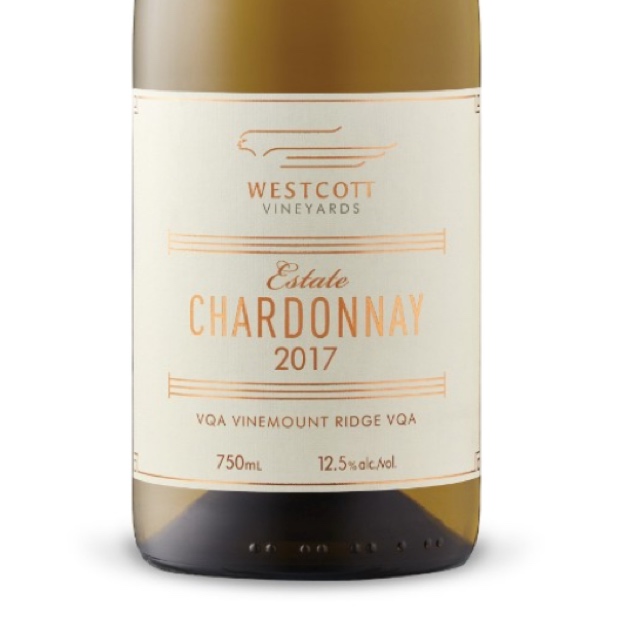
Westcott Vineyards Estate Chardonnay 2017, VQA Vinemount Ridge (424507, $27.95)

This 2017 from Westcott is really just what you might imagine were you to close your eyes and draw a triangle in your mind from the Vinemount Ridge, to judiciously oaked chardonnay and through to Westcotts’s manifesto. Niagara chardonnay should be about farming and this most certainly is, but also a microcosm of place, again of truth, but like all good, great and ethereal chardonnay must be. The florals are high for the place and the texture like organza, filament and lace. The obtuse vintage be damned it is this team that has found the right path and the way to varietal understanding. This teaches us about the ridges and benches but also about cool climate chardonnay. Thanks for this. Drink 2019-2025.  Tasted October 2019

Pairs with Bruce Cockburn’s Wondering Where the Lions Are

Why? Like the song everyone always wants to hear him play, timeless, so Canadian and one that teaches so much about being us. The dictionary and playlist wrapped into one with a chardonnay that speaks to all of us in a cool climate vernacular.

Sun’s up, mm-hmm, looks okay
The world survives into another day
And I’m thinking ’bout eternity
Some kinda ecstasy got a hold on me

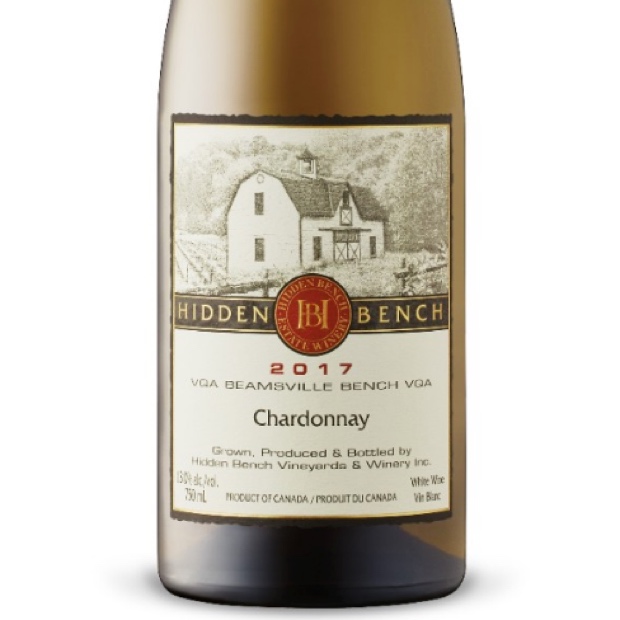
Hidden Bench Estate Chardonnay 2017, VQA Beamsville Bench, Niagara Escarpment (68817, $29.95)

You may consider this 2017 (estate) chardonnay from Hidden Bench the transition, meaning it demarcates the passing of the varietal torch, from Marelize Beyers to Jay Johnston. And indeed there is a little bit of each winemaker’s finesse, grace and cumulative style. Perhaps a step away from richesse with a step forward in structure. That means the linearity and subtlety speaks ahead of the developed flavours and so a longer primary period will allow this to drink consistently for nearly five years. After that it will develop more flint and smoulder, if less golden sunshine richness. These are of course details in minutia and shadows to discover. Drink 2020-2027.  Tasted February 2020

Pairs with Leonard Cohen’s Everybody Knows

Why? Everything about Cohen’s music lives in shadows and everybody knows that a Hidden Bench chardonnay does the same. Even if the plague is coming fast, from one great to another, everybody knows.

Everybody knows,
Everybody knows,
That’s how it goes,
Everybody knows

Le Clos Jordanne Le Grand Clos Chardonnay 2017, VQA Niagara Peninsula ($44.95)

Welcome back, to that grand vineyard place that we’ve talked about. Down on the farm near the water where chardonnay was purposed grown and put in the hands of a young Thomas Bachelder. The results were dramatic and now that unparalleled fruit is back in the monk’s world, he wiser and more experienced than ever. The transition is spooky seamless and the awe in hand providing breathtaking posits in moments more than fleeting. Behold the presence of orchards and their just ripened glow of fruit with sheen so fine. Let your glass allow the ease of the aromas and flavours to fall in and emit with conscious movement, without conscience or effort. That’s the 2017 Grand Clos. Chardonnay that is. Drink 2019-2026.  Tasted November 2019

Pairs with Rush’s Limelight

Why? Le Clos Jordanne is back in the limelight and on a literal level, the return of this iconic Ontario chardonnay by Thomas Bachelder is about living as a performer, on a stage, with all eyes upon them. A wine with a higher purpose.

Get on with the fascination
The real relation
The underlying theme

Rosé

Who needs only light, southern French styled Rosé when you can also have full fruit, plenty of colour and a healthy dose of personality? In many cases the nearly pale and vin gris examples still persist and excite but there are those bled and rendered, heavily hued and teeming with fruit. Ontario made Rosé is more diverse, complex and multifarious than ever before. In terms of working for the consumer that means more choice and that’s a beautiful thing. Whether you are making yours to be a crowd pleaser with a heathy dose of residual sugar or dry as the desert, the unequivocal voice of necessary conscience will always whisper “balance in Rosé is key.” Like Canadian music which also pairs well with bottles of blush.

Leaning Post Rosé 2018, VQA Niagara Peninsula ($20.95)

Hmmm…salty. Lovely lithe and spirited Rosé here from the LP boys, redolent of fresh-picked strawberry, Maldon sprinkled and just herbaceous enough to care for signature red grape varieties ideal for the quick, calm and easy blush bleed. The sour edge just adds to the mystique and the by the boatload charm. Just right. Drink 2019-2021.  Tasted February 2019

Pairs with Shawn Mendes’ Stitches

Why? Don’t want to get too serious with Rosé so a little pop music with a slightly salty and bitter sound seems like just the plan.

And now that I’m without your kisses
I’ll be needing stitches

Malivoire Rosé Moira 2019, VQA Beamsville Bench ($24.95)

Production is “as much as I can get from that site,” tells Shiraz Mottiar, so maximum 800 cases. As always the aridity and the salinity continue to rise, the acids, minerality, near brininess and ultimate stoic balance so secure at the top of the game. Such a high acid vintage for everything but certainly that includes Rosé, yet still the least amount of skin-contact of the three Malivoire blush. Acids just don’t correlate to hue and flesh. Thank pH for the needle’s movement in how this translates from vintage to vintage. Drink 2020-2024.  Tasted January 2020

Pairs with Justin Bieber’s Intentions

Why? Moira just gets to me and a glass always leads to creativity. The Ontario Rosé muse unparalleled.

Shout out to your mom and dad for making you
Standing ovation, they did a great job raising you
When I create, you’re my muse
The kind of smile that makes the news

Gamay

Not that there is ever a bad time to partake in the wonders of gamay, but with the mercury rising, spring is the right time to be with the gamay you love. If you’ve never experienced the nuanced pleasure of great gamay, whether it be from Beaujolais in Bourgogne’s southern reaches or from Ontario’s cool-climate hinterlands, its prime time you did. The gamay produced in Ontario can run the gamut from light, fruity and joyful to dark, serious and structured. Winemakers are on their gamay game and the quality has never been better. The kind of songs to match gamay need to exhibit intrinsic purity and also variance so be picky and intentional here.

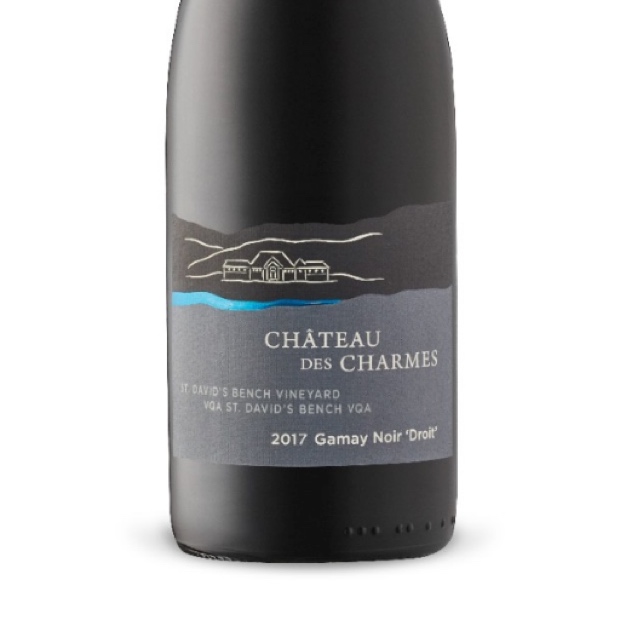
Château Des Charmes St. David’s Bench Vineyard Gamay Noir Droit 2017, VQA St. David’s Bench, Niagara On The Lake (346742, $19.95)

Quite a reductive and structured gamay with healthy extraction and great vintage fruit. Resides in the black raspberry realm with a balancing sheet of strawberry roll-up. Nothing shy about this, in a ripest of St. David’s Bench vein and so much could be taught about Ontario gamay through the work of this maker. Drink 2019-2023.  Tasted October 2018 and March 2020

Pairs with Neil Young’s Homegrown

Why? Both Château Des Charmes and gamay strike me as the epitome of homegrown and the St. David’s Bench estate is simply the Neil Young of Ontario.

Homegrown’s
All right with me
Homegrown
Is the way it should be
Homegrown
Is a good thing
Plant that bell
And let it ring

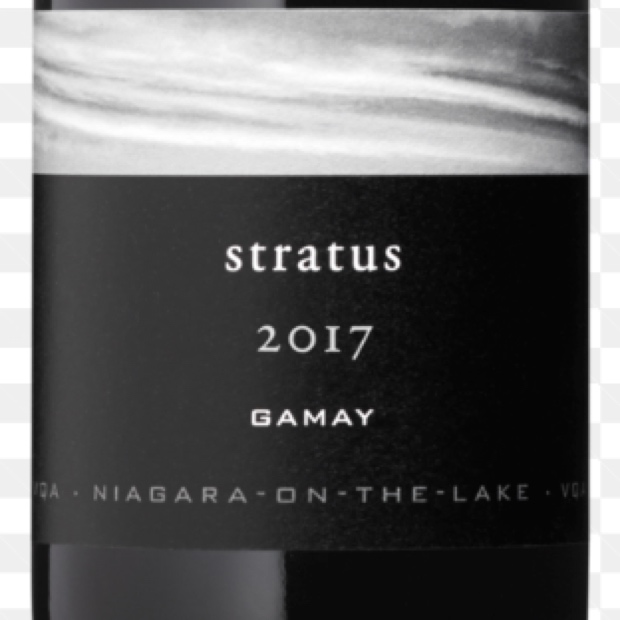
Stratus Gamay 2017, VQA Niagara On The Lake ($29.20)

Gamay gets neither more ripe nor extracted in Ontario and yet there’s a step back dance grace about this singular ’17. If ever the word Cru might come to mind when nosing and tasting local gamay this would be one, specific to a time and a place. Wild cherry, black cherry and concentrated cherry syrup are the big, bigger and biggest attributes, all cut through by a knife’s edge acidity. Wild gamay of grip, with very good length. Drink 2019-2023.  Tasted February 2019

Pairs with Robbie Robertson’s I Hear You Paint Houses

Why? To be honest lyrically this song has nothing to do with Stratus or gamay but it features Van Morrison and that’s pretty much the reason. Robbie and Van together is like Stratus and gamay.

I hear you paint houses
Right down to the wire

Pinot Noir

Thoughts about pinot noir always articulate an opinion. Smells like cherries, shows earth and mineral notes of/from clay and limestone. Texture is specific to the village where it is grown. In Ontario there are pinot noir crus few would ague against the probability that in most vintages quality will be a guarantee. Crus like Lowrey Vineyard on the St. David’s Bench, top blocks in Prince Edward County, several vineyards up on the Beamsville Bench, Wismer-Foxcroft, much of the Twenty Mile Bench and Four Mile Creek. The naysayers who continue to doubt whether pinot noir is a viable signature grape in this province are not paying close enough attention to the signs, portents and in conclusion, the results. As for the songs it plays and sings? Gotta be both old and new, retro and still avant-garde, crooning while ambient, poppy yet just a bit unusual and always stuck in your head.

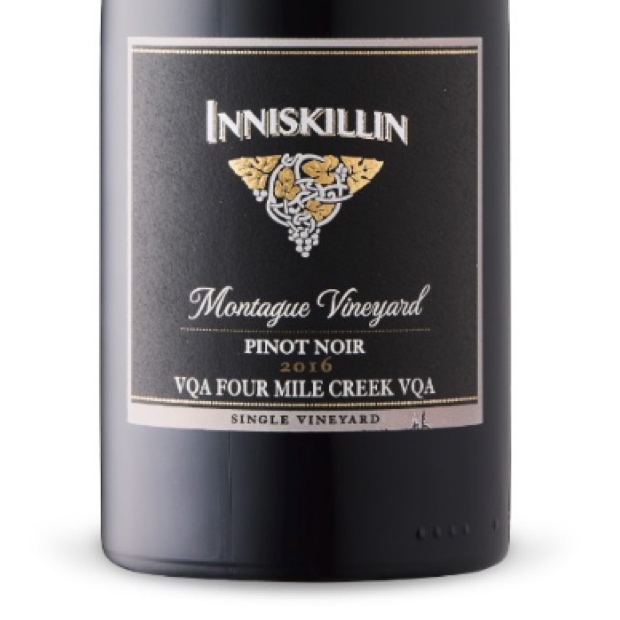
Inniskillin Montague Vineyard Pinot Noir 2017, VQA Four Mile Creek, Niagara Peninsula ($30.95)

From a vintage both turned on and stood on its head with cool and wet summer conditions followed by unprecedented heat in September. The resulting look at pinot noir means strawberry like you’ve never noted before and Montague’s certainly jamming with concentration. Sweet fruit carries just enough varietal tension and depth to keep it grounded in the clay-earthy realities of Niagara. Not like Montague’s past perhaps but great fun nonetheless. Drink 2019-2023.  Tasted November 2019

Pairs with City and Colour’s Hope for Now

Why? Dallas Green’s voice, of sweet tension, like Ontario pinot noir and Montague’s clay-earthy reality.

What will it take to live as if I would not another day?
To live without despair, and to be without disdain
How can I instill such hope, but be left with none of my own?
What if I could sing just one song and it might save somebody’s life?

Rosehall Run JCR Pinot Noir 2017, VQA Prince Edward County ($39.00)

A bit high-toned, magically spirited and rebelliously volatile. Earthy and lithe in fruit though quite raspberry-pomegranate and exciting for those who like it not only lightning searing, but intensely meaningful. Hard not quiver with impatience at the thought of this treat before me and what such a singular pinot noir will become when it matures. Drink 2019-2023.  Tasted blind at NWAC19, June 2019

Pairs with Joni Mitchell’s A Case of You

Why? PEC pinot noir, this vineyard and that winemaker. Musically structured like a song from Blue, chord and tempo changes, magically spirited and intensely meaningful. Thank you Dan Sullivan.

You taste so bitter
And so sweet, oh
I could drink a case of you darling, and I would
Still be on my feet

Congrats to Cliff and Colin @stannerswines for their The Narrow Rows Pinot Noir 2017 Gold Medal performance @judgement.of.kingston 2019. We the judges deliberated long and with great care to come to this well-deserved conclusion.

Stanners Vineyard Pinot Noir The Narrow Rows 2017, VQA Prince Edward County

A super-saturated, honed and zeroed in upon place in a vineyard ripeness with a touch foxiness. Reality from limestone bled into fruit wavering on a spectrum where berry fruit

sits on one end and earthy beetroot all the way over on the other. Touches both and then properly meets in the middle. Cherries are red, herbs are green and tension stretches a wire between two poles. Tomato water and tomato leaf with fresh basil. That’s just matter of fact and a good struck balance in combination. You almost feel it’s at once too ripe and then a bit green but those moments are fleeting and so the summation in accumulation is the thing; must, seeds, stems and the work of kind, nurturing and gentle hands add up to great delicacy. It’s local and it’s so bloody good. Delicious even. Unlike any pinot noir ever made previously in Ontario. Drink 2019-2023.  Tasted blind at the Judgement of Kingston, November 2019

Pairs with Ron Sexsmith’s Gold in Them Hills

Why? Pinot is a song of hope, crooned by a Canadian treasure. Colin Stanners may as well be the Ron Sexsmith of Prince Edward County, shy and brilliant, reserved and funny.

But maybe it’s the perfect day
Even though the bills are piling

There’s gold in them hills
So don’t lose heart
Give the day a chance to start

Cabernet Franc

At the brazen and confident right of Ontario’s most important varietal reds is cabernet franc, a Bordelais grape that paints a more palatable picture than those brushed by both merlot and cabernet sauvignon. Transparently honest and forthright by nature, brassy and highly energetic, righteously indignant like a young band with a big sound and no shortage of swagger. Frank Ontario red, frankly speaking.

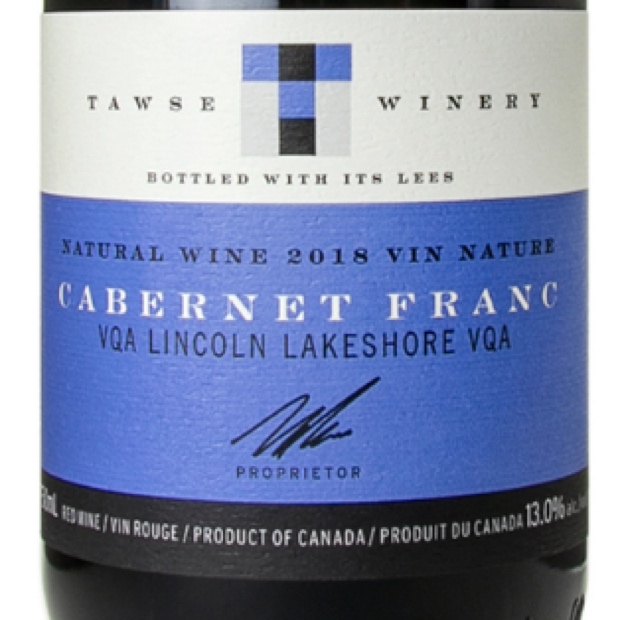
Tawse Natural Wine Cabernet Franc Redfoot Vineyard 2018, VQA Lincoln Lakeshore, Niagara Peninsula ($28.95)

There’s a symmetry in this cabernet franc and as it is the natural one in the Tawse stable, it’s actually the connection between vineyard and varietal that brings about the a ha moment. Redfoot has to date been the gamay block for natural executions and cabernet franc has been a Laundry Vineyard affair. The dots are connected through the Lincoln Lakeshore lexicon from one to the next, first in grape and then in winemaking, or lack thereof. This Vin Nature is both the least “natural” of all the Tawse tries while at the same time most like the Laundrys of past vintages, though it’s really somewhere in the circulative middle of a stylistic that includes the Grower’s Blend. In fact there’s no great departure from those cabernet francs so why not make them all this way? If the results are same dark fruit, same blushing acidity, same piquancy, same herbal undertones and nearly the same clarity of structure, why not risk it across the board? Could drink this with abandon. Drink 2019-2022.  Tasted September 2019

Pairs with The Arkells Knocking at the Door

Why? “There’s a fearlessness to it that I think a lot of sports fans and teams want to feel,” said frontman Max Kerman. The song has been anthemic at hockey games and women’s marches. Paul Pender’s natural wines do something eerily similar and reach a very large audience.

That’s me, I’m knockin’ at the door
I’m thirsty
For more, for more, for more
That’s me, I’m knockin’ at the door
I’m knockin’ at the door
That’s me

Southbrook Saunders Vineyard Cabernet Franc 2018, Beamsville Bench, Niagara Peninsula ($28.95)

Nothing if not classic Bench-raised cabernet franc with crunchy fruit, dark red and savoury plus that unmistakeable current of dark currant and capsicum. There’s no mistaking the origin or the execution, nor the varietal expressiveness. Transparent, honest, real and blessed of so much purposeful character. May not charm everyone from the word go but a couple of years will sort them out. Drink 2020-2024.  Tasted December 2019

Pairs with Arcade Fire’s The Suburbs

Why? The bounce in this song reminds of cabernet franc’s varietal dance, crunchy, savoury and honest. That’s just how Ann Sperling interprets fruit from Saunders Vineyard, tripping over piano keys and a background of strings making ambient sounds, rising to a crescendo.

Sometimes I can’t believe it
I’m moving past the feeling
Sometimes I can’t believe it
I’m moving past the feeling again

Good to go!

godello

Twitter: @mgodello

Instagram: mgodello

WineAlign

Coppo: Feet on Canelli ground since 1892

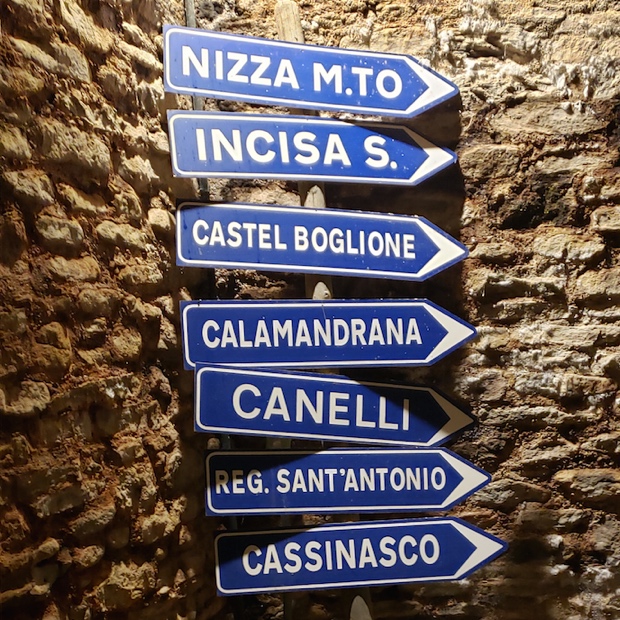
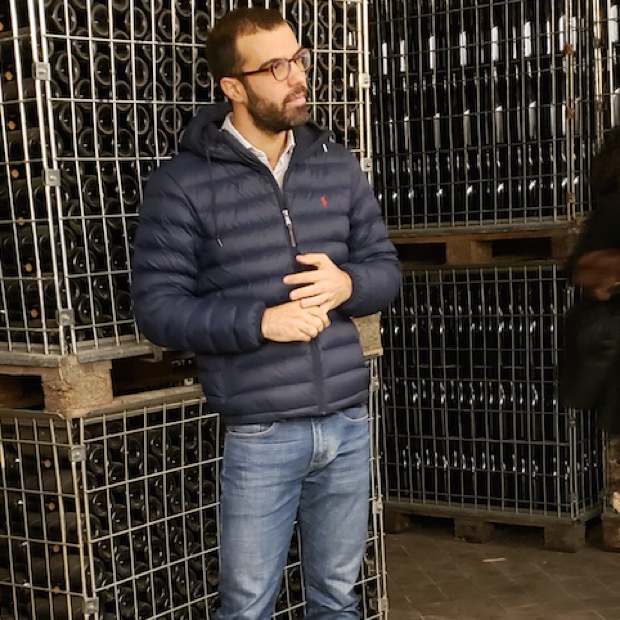
Luigi Coppo is grounded in tradition, family, heritage and by a contiguous connection through generational continuance. That much is clear. I’ve met with and tasted Coppo’s wines three times over the last three years; during Barolo’s Collisioni Festival, July 2017, at Relais San Maurizio in Santo Stefano Belbo, December 2018 and most recently at the family’s Canelli estate in December, 2019. Since 1892 Coppo has been nestled in the favourable company of fellow producers Gancia and Bosco, together forming a link between these three most historical wineries in Canelli. Coppo’s Barbera d’Asti and in particular their Pomorosso cru from Nizza Monferrato’s hills are intimately integral charges and while it may have long been established, the advancing Luigi Coppo led Sparkling wine program will push further than merely rivalling the best of Alta Langa. Lookout Franciacorta. Take heed Champagne. And though these estate masterpieces in constant progress will duly impress sommeliers and collectors worldwide, Luigi Coppo still pulls for the workhorses and insists that “Moscato d’Asti is definitely the heritage of our hills.” That amongst their 56 farmed hectares surely counts for something. This is the actuality and presence of Luigi Coppo in Piemonte: Determined, ambitious and yet always cognizant of his roots. All the Coppos in fact; Gianni, Paolo, Luigi, Roberto and Piero. Feet on Canelli ground since 1892.

Luigi Coppo

Related – Three DOCG pillars of Asti: Secco, Dolce, Moscato d’Asti

Much has changed since Luigi’s great-grandfather Piero started the estate in 1892. Today production is 500,000 bottles annually. In another three-pronged producer connection Coppo can make Barolo here in Canelli, along with Scarpa and Bersano. And in 1977 it was Carlo Gancia who as the first in Italy to do so, returned from Champagne to employ moscato in traditional method bubbles. Luigi Coppo is also making use of the Canelli tufo azzuro soils, a mix of blue clay and limestone so ideal for growing grapes to turn them into many variations of sparkling wine. He too embraced the new Alta Langa appellation, beginning in 2010. A specific area was identified, chardonnay and pinot noir were planted and the 30 month lees aging methodology was put into place. Following the dreams of Grandfather Luigi who desired to produce a Bourgogne-style in Piemonte, chardonnay was planted 35 years ago. After nonno passed away in 1994 Luigi’s father Paolo decided to keep the dream alive. Monteriolo sees nine months on lees in barriques; big, buttery, modern and luscious.

Related – Living wine in the moment at Scarpa Winery

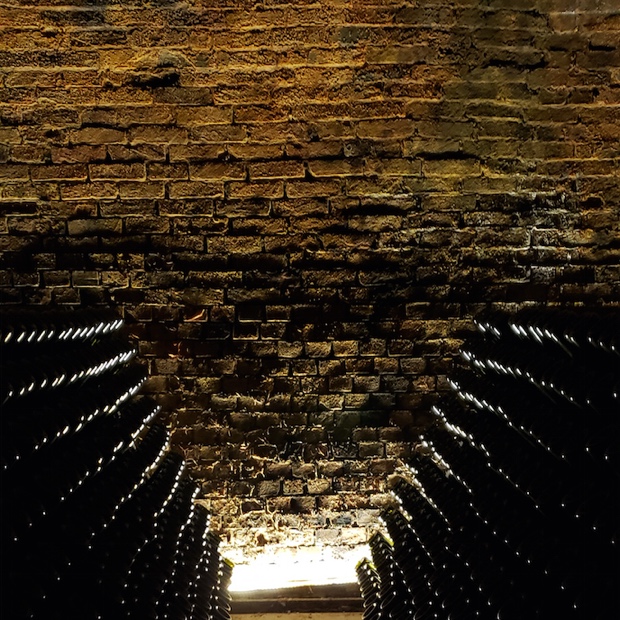
The Nizza Classico barbera come from several Monferrato villages while the Pomorosso cru, first made in 1998 sees new French oak for 14-18 months. Moscato d’Asti gets stelvin closures, the wines that age for five to six months are sealed under Diam and real corks for anything longer. The natural barrel cellar was finished in 1970, 42m below ground level. As for the heritage one, says Luigi, “Moscato loves altitude compared to barbera. It’s now time to talk about Moscato d’Asti as a serious wine because it’s very difficult to make. We don’t add sugar or carbonize and it is a vintage wine. These are the three natural and honest things about moscato.”

Related – Rock steady Bersano

What do Coppo’s wines do for us? How are they helpful and perhaps even life-affirming? The truth lies in Luigi Coppo’s humanity and dedication to the things that matter. Something has to save us from ourselves, especially in times such as these, from being inside our heads. Luigi’s wines are the sort to make our wisdom bearable, to rescue us, if nothing else from the ever-bearing fever of begotten biological and ecological destiny. These are the five wines tasted at Coppo.

Coppo 1892 Luigi Coppo Brut Metodo Classico 2016, Vino Spumante Di Qualita DOC, Piedmont, Italy ($40.00 – Estimate)

Traditional method varietal pinot noir in sparkling form, 24 months on its lees and no wood aging. Gainfully fresh and joyous, just a pinch of dosage and regaled, mainly by strawberry but also a sweetly savoury push. Crushable bubbles in the parlance of our times. Drink 2019-2021.  Tasted December 2019

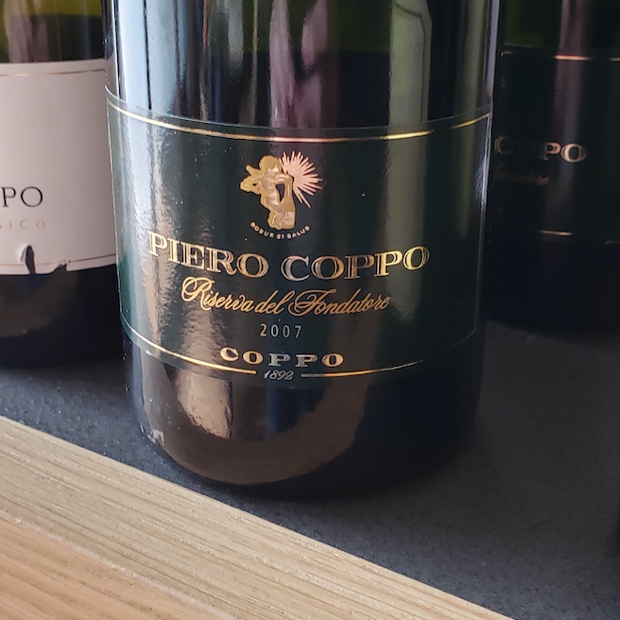
Coppo 1892 Piero Coppo Riserva Del Fondatore 2007, Vino Spumante Di Qualita DOC, Piedmont, Italy ($220.00 – Estimate)

A 60-40 split of pinot noir and chardonnay that was at a near to previous time a varietal wine of the first but with 90 months on the lees and more complex notions conceived it was necessary to bring the latter into the mix. This was disgorged in July 2017. The tartufo bianco in this wine is simply uncanny. That and a toasty precision as if by a Japanese chef’s hand, a toasted piece of perfect white bread to the edges in 100 per cent equality by golden caramelization. Sandwich a piece of reverse seared Kobe rib-eye in between two buttered slices with a side of potato chips and creamy cole slaw and Coppo’s your uncle. Mimic with foie gras if you must. Up to you. Drink 2019-2026.  Tasted December 2019

Coppo 1892 Monteriolo 2017, DOC Piemonte, Piedmont, Italy ($92.00 – Estimate)

A father and an uncle’s chardonnay dedication to their father with a Bourgignons style and philosophy. This just released ’17 saw nine months on lees in French barriques. Toasty in a “Batard” Italianate way, nearly gingered and a low-yield meets high concentration and alcohol (though maxing out at 13.0 per cent) and purposefully ripe. The hot year took away some control and thus the warm biscuit and accentuating spice notes. A little caramelization and while the joy will be a year or so away it will be a shorter lasting period, albeit a highly anticipated and relishing one. Verdant finish with a scape of citrus zests. Drink 2020-2024.  Tasted December 2019

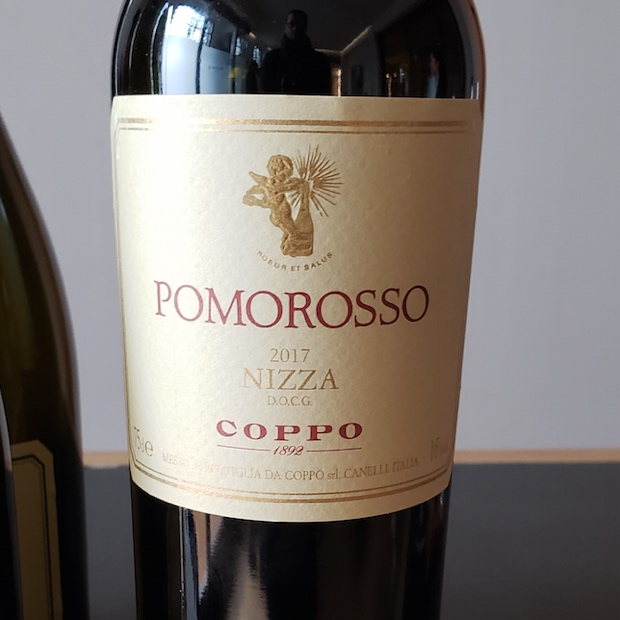
Coppo 1892 Barbera D’asti Nizza DOCG Pomorosso 2017, Piedmont, Italy ($74.95 – Estimate)

A blend of areas, Nizza Monferrato, Castelnuovo Calcea and Agliano Terme, first produced in 1984. “If you want to make Nizza all of your vineyards have to face south,“ explains Luigi Coppo. The exposures gather three levels of sunlight and with 15 days of fully extractive macerated practices the tannins are necessarily pulled to their limit. With varietal acidity set to a natural high there is a three-pronged effect that expresses three separate platitudes and layers for long-term effect. Add the warmth of ’17 and the degree of difficulty and margin for error is very stringent. Castelnuovo Calcea was the last to pick and still only at the end of the first week of September. There’s a phenolic-minor note from the vintage that’s ostensibly unavoidable in a composition like this and yet the richness and structure are non-compromised. Tough to follow the ideal 2016. Drink 2021-2028.  Tasted December 2019

Coppo 1892 Moscato d’Asti DOCG Moncalvina “Canelli” 2018, Piedmont, Italy ($23.20 – Estimate)

“Moscato loves altitude as compared to barbera,” tells Luigi Coppo, “and now is the time to think about Moscato d’Asti.” Luigi says it’s a serious wine because it’s difficult to make. No sugars are added or carbonization performed and it’s a vintage wine. These are the three tenets that matter most. From Canelli vineyards between 200-280m and the classicism of construct and effect is pure magic in proper and precise, sleight of hand ability. That’s what it needs to be, no more, no less. Naturally sweet, a pinch of salt and all the orchard fruit; apple, pear, lemon and orange. All together in balance and gift with tannin on a real dry finish. Drink 2019-2023.  Tasted December 2019

Good to go!

godello

Twitter: @mgodello

Instagram: mgodello

WineAlign

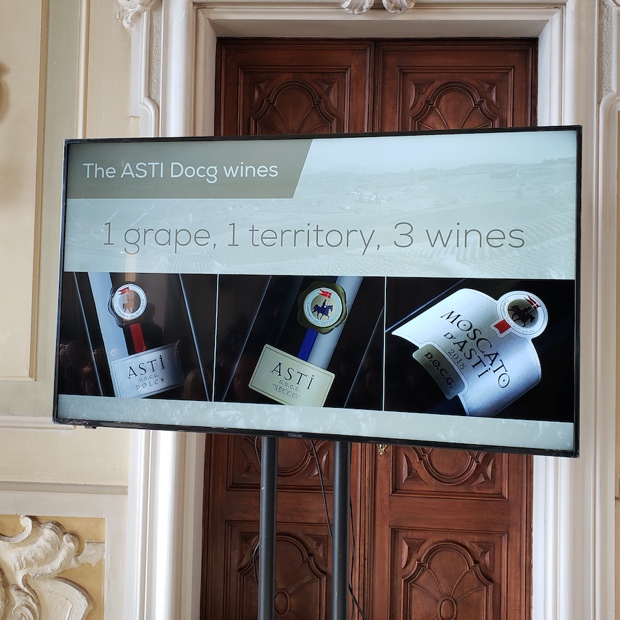
Three DOCG pillars of Asti: Secco, Dolce, Moscato d’Asti

For a wine region to succeed it must exercise sustainable principles and do so by meeting the needs of the present without compromising the ability of future generations to meet theirs. Investment argues for three main pillars: economic, environmental, and social, a.k.a. people, planet and profits. In scientific terms sustainability refers to an ecosystem’s ability to exist constantly at a cost within a universe that evolves towards thermodynamic equilibrium within a state of maximum entropy. A modern vernacular would speak of the coexistence between humans and their host biosphere. A transfer of these ideological theories into wine-speak says that in Asti the growers, producers and their appointed Tutela dell’Asti DOCG chaperones have collectively agreed to set the appellative wines of Asti Secco DOCG, Asti Dolce DOCG and Moscato d’Asti DOCG as representative of their present and future. Three pillars of Asti.
“Born in 1932, the Consortium for the Promotion of Asti has a clear mission: to perform all the necessary actions to protect, promote and enhance the value of Asti and Moscato d’Asti, in Italy and the world.” The sustainable manifesto is clear and one day spent inside the offices of the Consortium will instruct and explain all you need to know about economic, social, environmental, export, security and what Italians refer to as disciplinare policies. Regulations regarding vineyard yields, levels of alcohol, sugar, extract and bars of pressure are so defined as to ensure current production and sales viability but also explicitly what the next generation will need to carry the work forward.
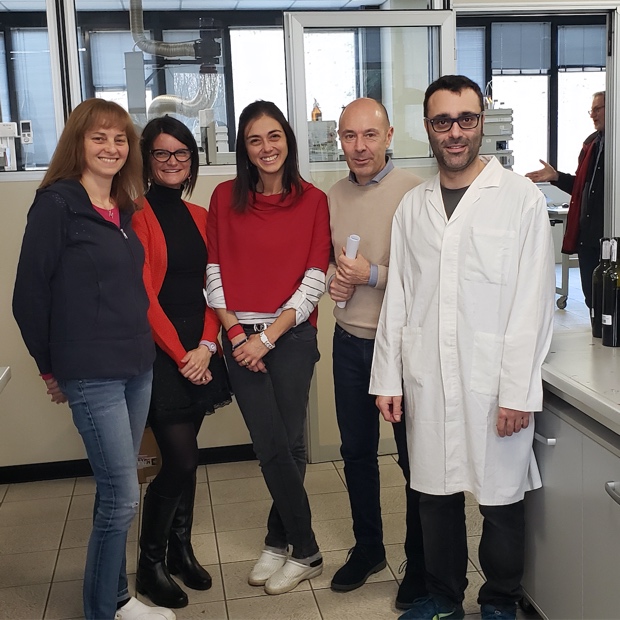
Guido Bezzo and the Asti lab crew

The Consortium’s Laboritorio Analisi for the Tutela dell’Asti DOCG is one of the most advanced and technologically impressive anywhere, with the mechanization capable of carrying out a diverse set of analyses. Under the guise of Guido Bezzo, who incidentally also happens to be a virtuoso trumpeter, the lab exerts its expertise far beyond pedestrian testing of alcohol, sugar and varietal purity. It delves deeper than mere organoleptic conclusions. The lab’s research works to investigate the impact analysis results for one 750 mL bottle of Asti wine covering categories that includes a mind-boggling set of parameters: Climate change; Reduction of the ozone layer; Toxicity and carcinogenic effects on humans; Particulate/smog caused by emissions of inorganic substances; Ionizing radiation effects on human inorganic health; Photochemical ozone formation; Acidification; Terrestrial, aquatic and marine eutrophication; Ecotoxicity in freshwater aquatic environments; Soil transformation; Resource depletion in water, minerals and fossils. Heady stuff indeed.
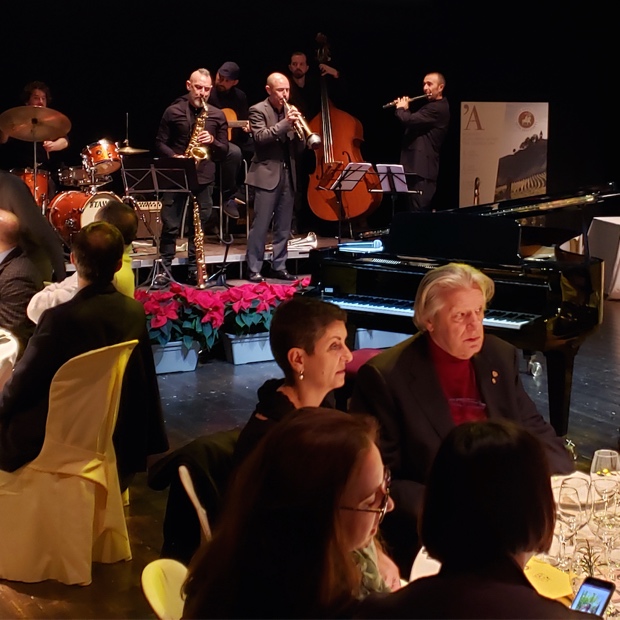
Dinner at Teatro Alfieri, Asti with President of the Consorzio Moscato d’Asti DOCG President Romano Dogliotti

La Caudrina’s Romano Dogliotti is President of the Consorzio dell’Asti DOCG and like so many Langhe winemakers, he is intrinsically tied to tradition but with a decisive openness to new technologies. In line withy many of his compatriots, Dogliotto’s Moscato d’Asti is made by putting yeast and moscato grape must in an autoclave. The must ferments at low temperature in this reinforced fermentation vessel until about half the natural sugar is consumed, then the wine is quickly passed through a micron filter to arrest the fermentation. The result is Moscato d’Asti at five and a half degrees of alcohol by volume and enough residual sweetness to conjure the feeling of eating ripe orchard fruit. In Asti the moscato comes out three ways: Secco, Dolce, Moscato d’Asti.
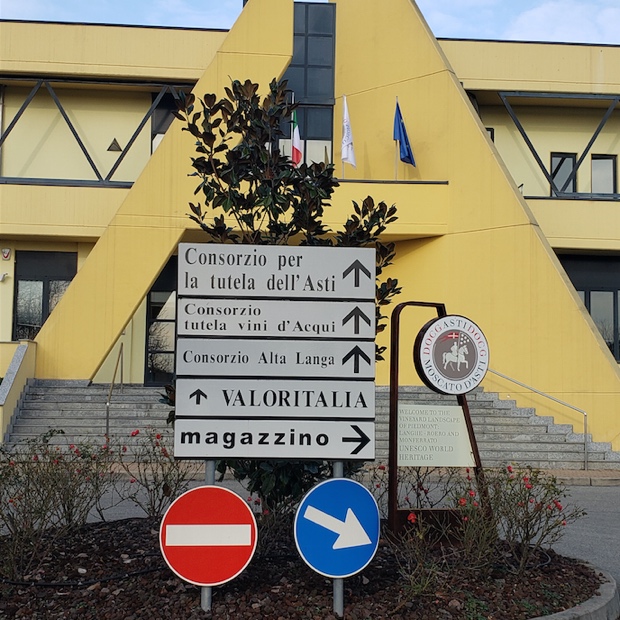
There are 10,000 hectares of vineyards for these lightly sparkling, off-dry to sweet Asti white wines and the Consorzio is entrusted to promote and protect the wines in the appellation. They are widely imitated and so undertaking legal action and registering trademarks in every country is a necessary side-hustle of the job. In terms of producer requests, all changes and modifications applied for must be approved by the consortium. An integral aspect of the work involves field, vineyard as well as laboratory research.
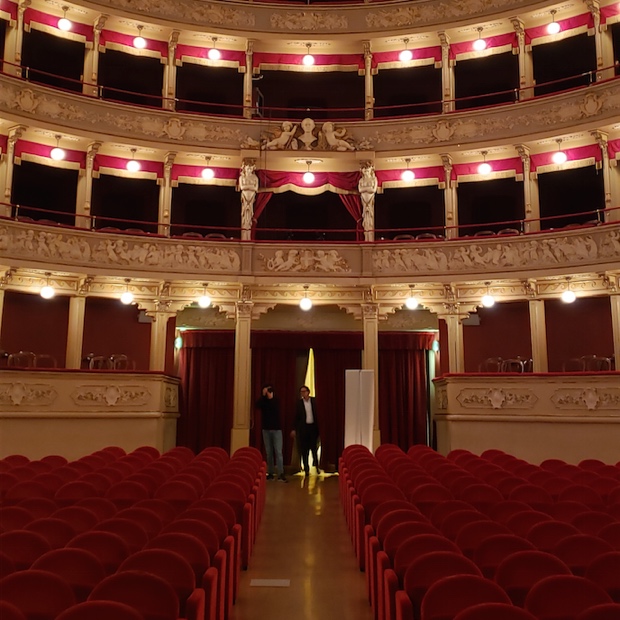
Teatro Alfieri, Asti

Asti covers parts of 52 communes, three provinces; Asti, Cuneo, Alessandria and three territories; Langhe, Roero and Monferrato. The vineyard landscape of these three famous Piedmontese areas were recognized by UNESCO as a World Heritage Site in 2014, Un territorio Patrimonio dell’Umanità. Sedimentary soils that date back 10-15 million years predominate. One is the Pliocenic basin of Asti to the northeast. The to the west around Canelli there are Serravallian (Middle Miocene) soils, stratified layers of blue clay, sand and lime. Many believe this to be the best composition for Moscato d’Asti. To the east in the area of Strevi the ground is Tortonian (late Miocene), younger at five to 10 million years, with more clay and more lime in deeper layers and colour. 
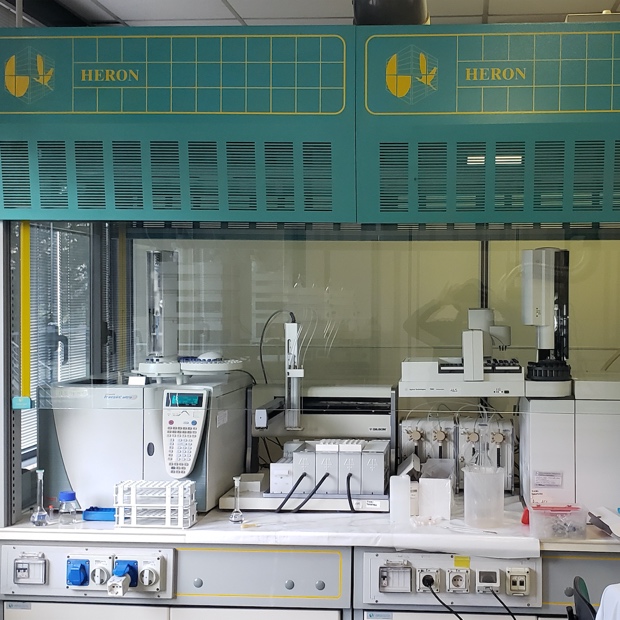
Laboritorio Analisi for the Tutela dell’Asti DOCG

The crux of the varietal situation is twofold, at once for vineyards subsisting at the foot of the Alps and also drawing energy being proximate to the sea. Seventy-five per cent of the vineyards are directly protected by the mountains. As seemingly everywhere, climate is changing here too. In the last 15 years average temperatures have increased by one degree. In the past 58 years the average increase has been by two. More important are temperature abnormalities. The centrepiece moscato bianco is a very sensitive grape and easily subjected to diseases. A study of 15 experimental vineyards continues to assess the vintages and the shifting climatic effect on the wines.

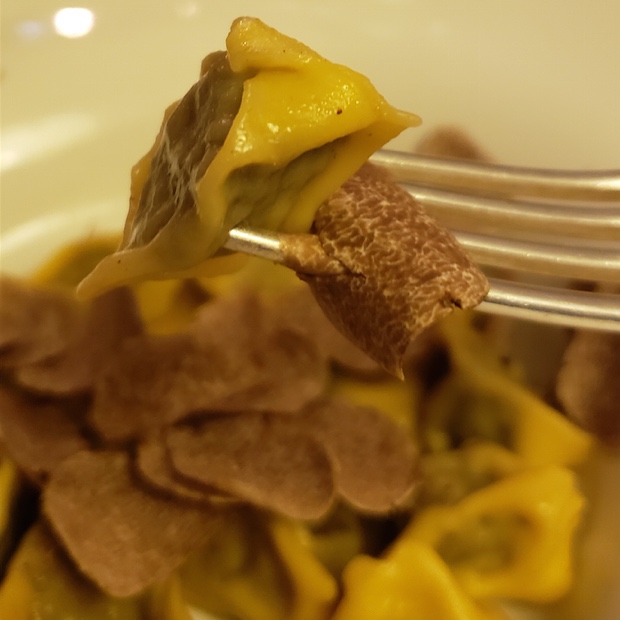
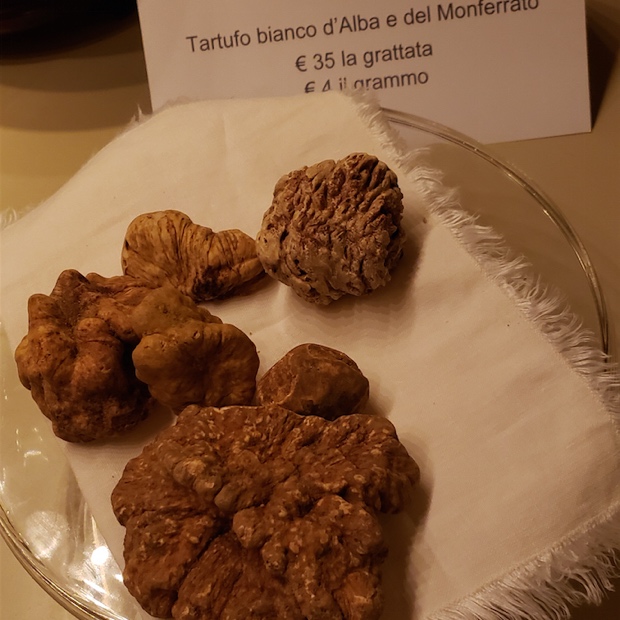
Agnolotti al tartufo bianco, Ristorante Cascinale Nuovo (Isola d’Asti – http://www.walterferretto.com)

Guyot training is appropriate for poor quality soils and lower yields. Broken down by altitude, 44 per cent of the vineyards are at 250-300m and 30 per cent at 300-450m. In terms of slope, 2,770 of 9,700ha have a gradient higher than 30 per cent, 336 ha with a gradient of more than 50. “Heroic agriculture” is the moniker bestowed. “The Sorì vineyards.” No mechanization is employed and a certain crucial must is picking times, especially in terms of the preservation of moscato bianco’s aromatic compounds.  Yields per hectare are set at 9.5 tonnes for Asti and Moscato d’Asti, the approximate price at 1.1 Euro.

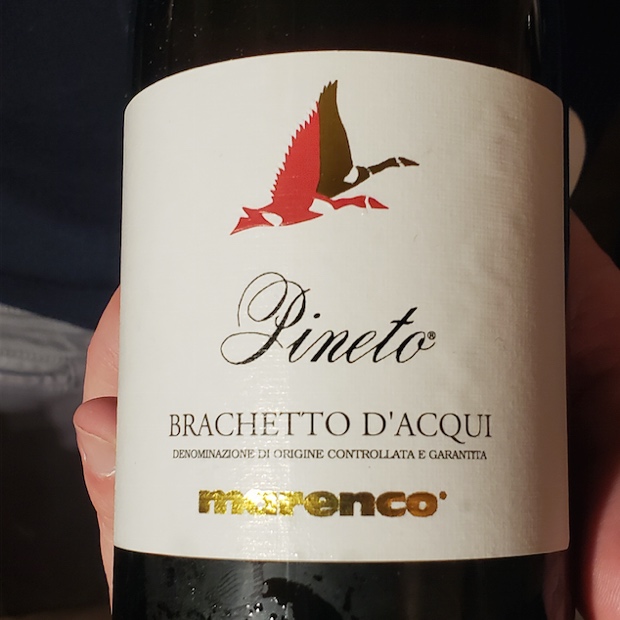
With Andrea Costa, Vini Marenco

The 60,000 tonnes kept at negative four degrees in summer costs dearly in equipment and energy. It is widely believed that juice can stay in tank for up to two years without losing aromatic concentration. Fermentation takes place at 20 degrees in pressure tanks developed by Italian sparkling wine pioneer Dr. Federico Martinotti, director of the Research Institute for the Wine of Asti, who patented the method in 1895. Martinotti is credited with creating the method of developing the bubbles inside of tanks. The juice can stand pressures of more than 10 bars. Yeasts must be stopped abruptly (in a matter of a few hours) to avoid off odours and flavours, i.e rotten egg and cooked cabbage. Centrifuge and filters are used. In the past pasteurization at 50 degrees was the norm but now micro filtration screens out the yeast (at 0.2 microns) and stabilizes the wines. Agronomist/viticuilturalist Daniele Eberle also explains how Fratelli Gancia used the same techniques that the French used here in Piemonte in the late 1800s. The city of Canelli, cultural home of Asti holds the highest concentration of companies that make all the equipment necessary for bottling Spumante wines.
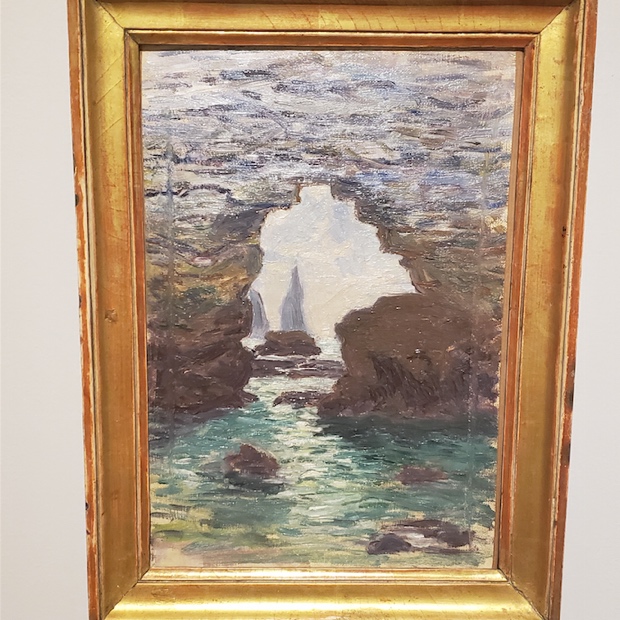
Étretat – Claude Monet, Palazzo Mazzetti

These are the disciplinare for the three appellation wines:

  • Asti Dolce DOCG: 6-7 per cent alcohol by volume, 90-100 g/L residual sugar and Sparkling at maximum 4-5 bars of pressure
  • Moscato d’Asti DOCG: Minimum 4.5 up to 6.5 per cent alcohol by volume, 120-130 g/L residual sugar and Sparkling at maximum 2.5 bars of pressure 
  • Asti Secco DOCG: Minimum 11.0 per cent alcohol by volume, 17 g/L residual sugar and Sparkling at 3-3.5 maximum bars of pressure
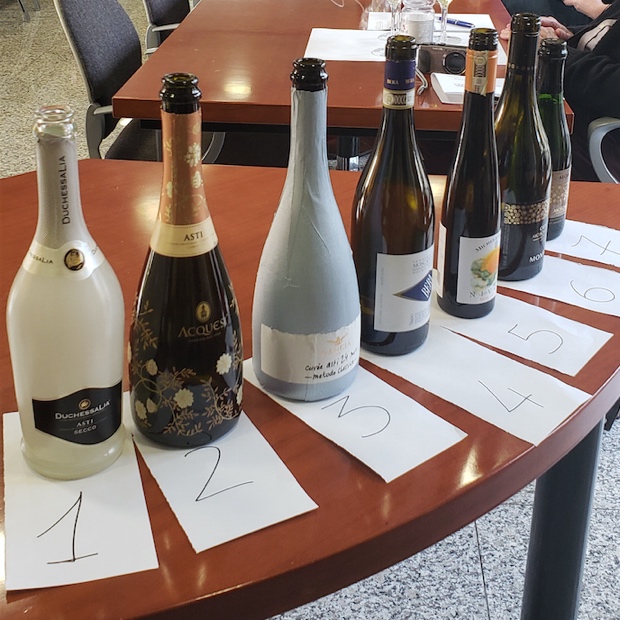
Massive thanks to Mariana Nedic, Marina Nedic, Ana Murguia and the staff at IEEM Communications. Looking back at December travels and work assignments in Italy I now find myself focusing in on the new and forward thinking Moscato d’Asti stories in the heart of Piemonte. Tough wines to produce but these traditional producers have to do it. It Is their heritage, imperative and pleasure. At the Consorzio dell’Asti in Isola d’Asti the steps and stages of Asti’s gently sparkling wines gave way to a blind tasting of the following seven. 
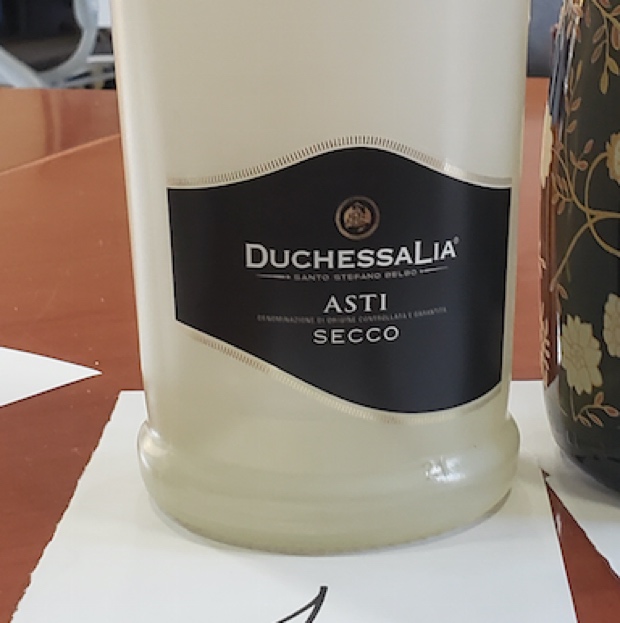
Blind Tasting

Duchessa Lia Asti Secco DOCG Santo Stefano Belbo, Piedmont, Italy

Lime and a soapy entry but on the drier side, likely Asti Secco. Feels like 15 g/L of sugar with gentle and supportive acidity. Somewhere between peach and pear, clean and perhaps too much so. Certainly a fine mousse and persistence. A new style from which the aromatics are diminished and yet the gain in versatility in this case indicates one done well. Does well to avoid the potential of bitters marking the finish. Alcohol is at 11.0 per cent and sugars could be as high as 17 g/L though this seems lower in the 10-12 range. Drink 2019-2021. Tasted blind at the Asti DOCG consortium, December 2019
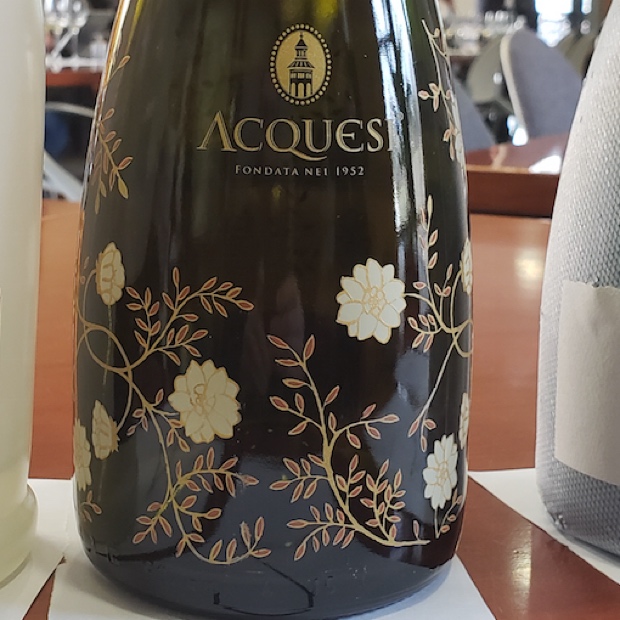
Acquesi Asti Dolce DOCG, Piedmont, Italy ($13.95)

Asti Dolce for sure, crazy sweet and reminiscent of a lime creamsicle. Aromatic but not overtly so, all controlled by the sugars and so very cloying. Exceptionally foamy, creamed and whipped in mousse. Perfectly suited to flavour a zabaglione to work alongside hazelnuts baked into a soft, crumbly cake. Alcohol at 7.0 per cent and sugars at 90-100 g/L. Drink 2019.  Tasted blind at the Asti DOCG consortium, December 2019

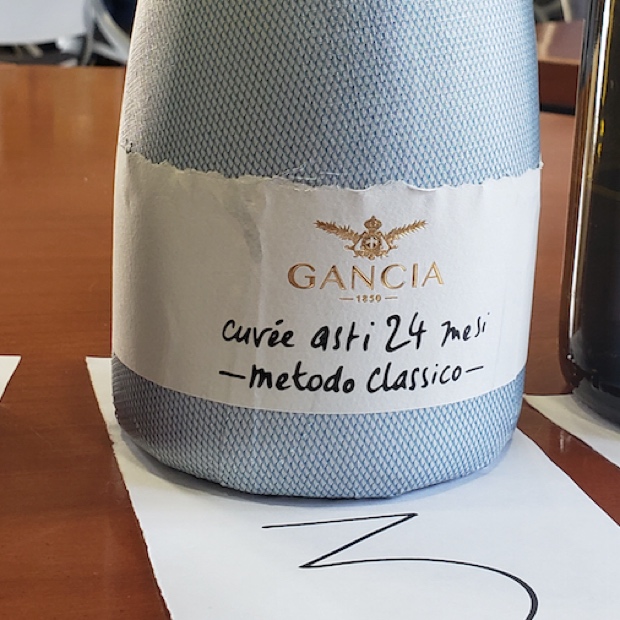
Gancia Asti Secco DOCG Cuvée Asti 24 Messi Método Classico 2012, Piedmont, Italy

A wine that owes to the experience of Carlo Gancia in Canelli. Wildly aromatic, a Langhe experiential moment straight away conceived and delivered. A Piedmontese traditional method bubble that is clearly more complex than kin simplicities. Bottle fermented and made from grapes harvested in 2012. Recently disgorged so at least six years on the lees technically Asti Dolce but really no affinity because the secondary and even tertiary aromas are in. Baking scents and oxidative meets caramelized notes are part of the mix, as is this ginger-orange créme brûlée with a healthy compliment of torched sugar flavours. A complex mess of aromatics, next level texture and most of all, multi-developed levels and layers of sweetness. Drink 2019-2022. Tasted blind at the Asti DOCG consortium, December 2019

Bèra Moscato d’ Asti DOCG 2019, Piedmont, Italy ($29.30)

Now into Moscato d’Asti with the most classic presentation, aromatically effusive, effective, generous and free. The sweetness in such a moscato is so very stone fruit based and subjected to a perfectly ripe squeeze of more than one citrus. Lemon, lime and orange without forgetting the smells of their blossoms. Quite correct and more so, leaving an impression that is not soon left for dust. From fruit grown in Meviglie at the limit of Neive. Drink 2019-2021.  Tasted blind at the Asti DOCG consortium, December 2019
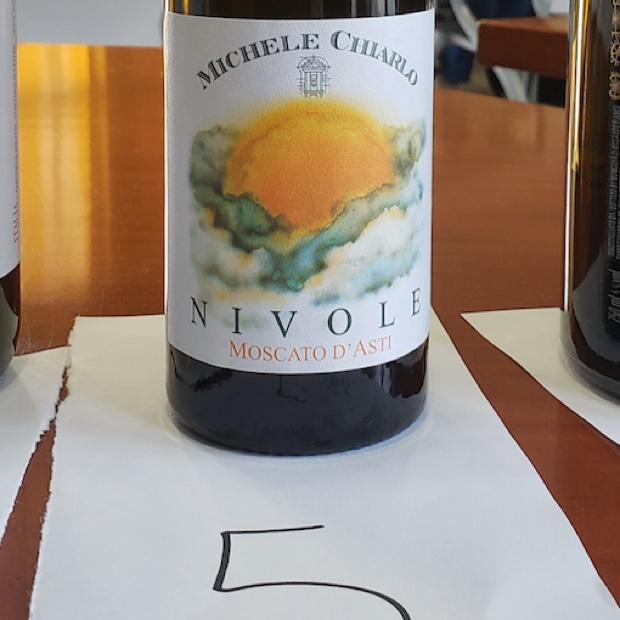
Michele Chiarlo Moscato d’Asti DOCG Nivole 2018, Piedmont, Italy (650440, $9.75, 375ml)

Waxy, aerosol citrus and perhaps a year older with prevalent if weighty acids that settle this Moscato d’Asti into a secondary period. Both aromatics and freshness are diminished though so seem the sugars so the balance is still well-afforded. Ultimately a perfect example of the ripe peach scents so expected from Moscato d’Asti. Drink 2019-2021. Tasted blind at the Asti DOCG consortium, December 2019
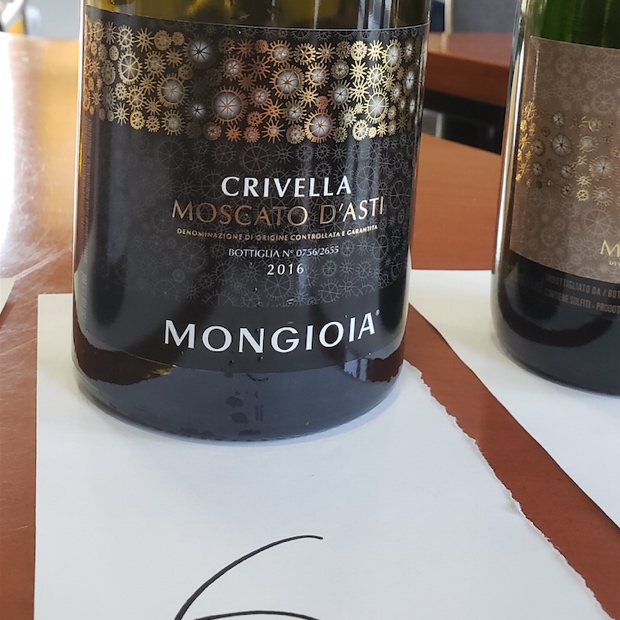
Mongioia Moscato d’Asti DOCG Crivella 2016, Piedmont, Italy

Quite toasty and though no wood was used it shows a remarkably semi-oxidative and lightly caramelized character that brings colour, cooked apple and creamy nectarine mousse. It has certainly come to a more interesting and charming place with just a moment’s liquorice and this white fig flavour. Worth some fun and giggles with persistent acids. Fruit from steep vineyards in Santo Stefano Belbo in the province of Cuneo at the border of Asti. Drink 2019-2020.  Tasted blind at the Asti DOCG consortium, December 2019
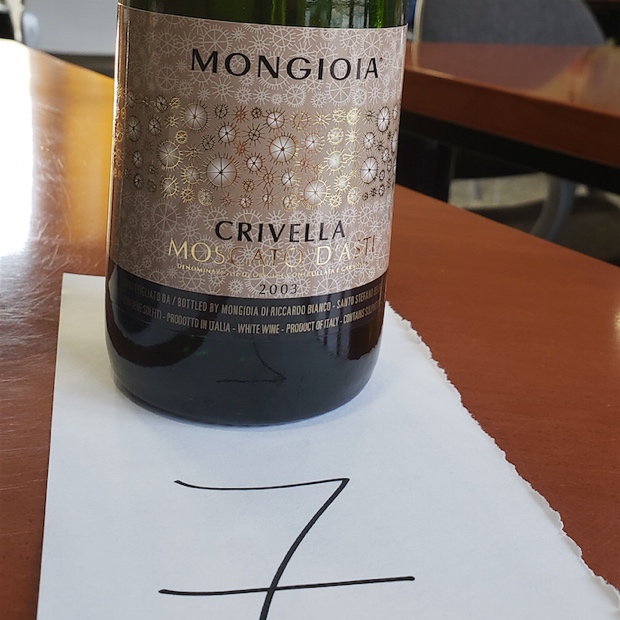
Mongioia Moscato d’Asti DOCG Crivella 2003, Piedmont, Italy

Quite the advanced Moscato d’Asti here at the edge of tumbling down from the Sorì. Oxidative and fully caramelized notes, with preserved lemon, torched orange and candied ginger. The sugars are accentuated as a result of the diminishing acidity. Still a joyous showing for a 16 year-old moscato. Fruit from steep vineyards in Santo Stefano Belbo in the province of Cuneo at the border of Asti. Drink 2019.  Tasted December 2019
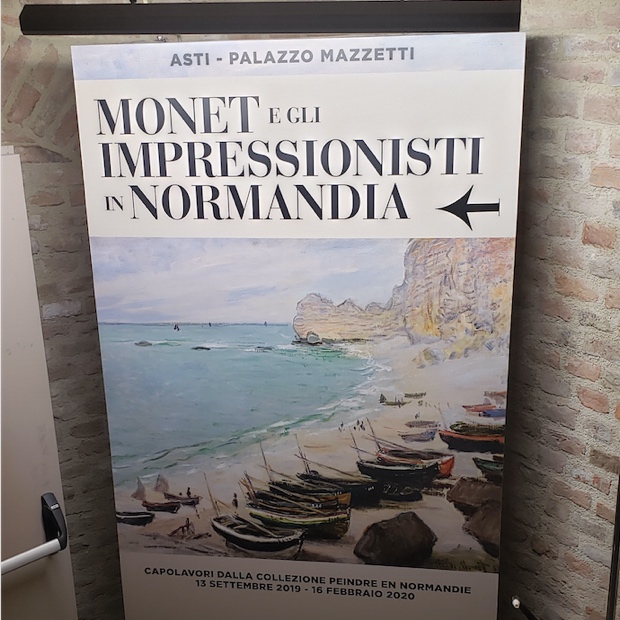
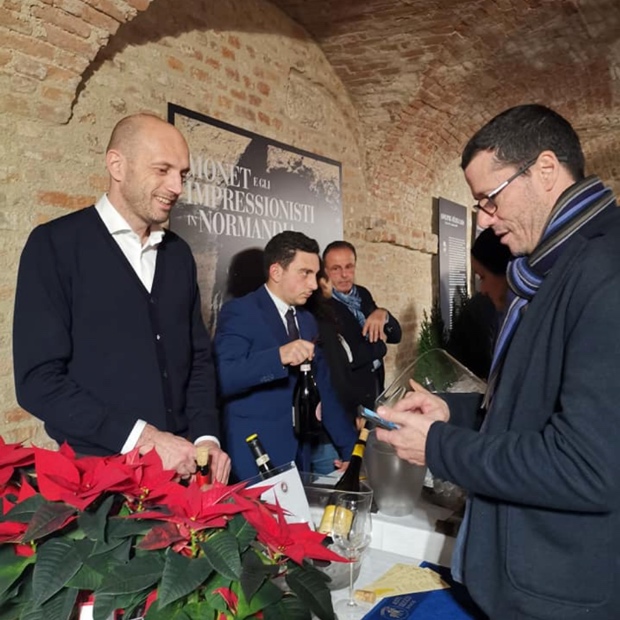
Tasting next door to Monet

After the Masterclass and blind tasting we transferred to Asti and convened in Palazzo Mazzetti for a walk-around with the producers in the company of a small but exquisite exhibit, “Monet e gli Impressionisti.” These winemakers are finding new success by making use of advanced technologies, higher altitudes, specific soils and identifiable crus. These are the Moscato d’Asti I tasted and the world may know they are to be reckoned with.

Azienda Agricola Cerino Moscato d’Asti DOCG 2019, Piedmont, Italy

A curious and interesting moscato this one, fresh enough and so very basil herbal, then white flowers and lime. A touch refined in white sweetness, also tart, long and elastic. Unique and quite fine. Drink 2019-2020.  Tasted December 2019
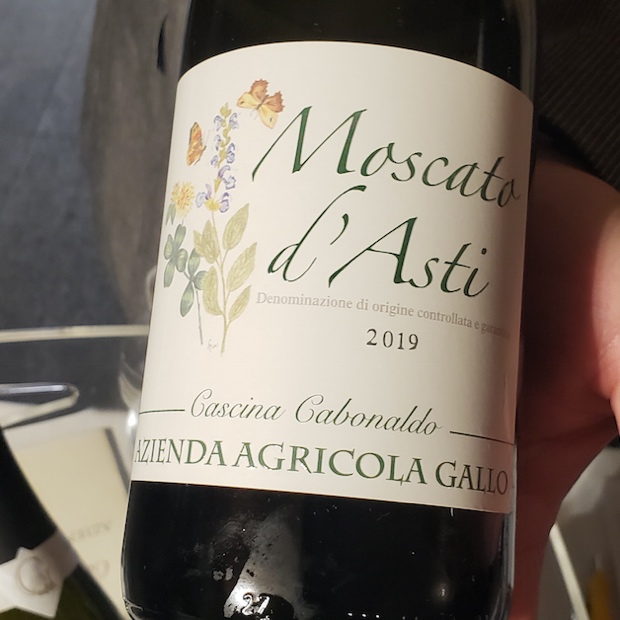
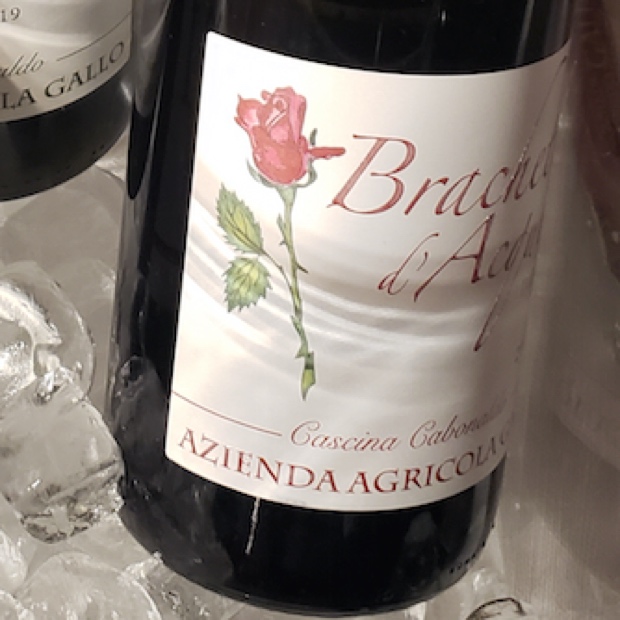
Azienda Agricola Gallo Cascina Cabonaldo Moscato d’Asti DOCG 2019, Piedmont, Italy

Located in Montabone, halfway between Canelli (to the west) and Acqui Terme (to the southeast). The vineyards at 320m help strengthen the haughty aromatics, even while this moscato acts pale and sallow though clearly fresh, clean and seemingly simple. Nothing wrong with that in fact this is one of the easiest feats of drinking amenability. Direct, correct and highly effective. Drink 2019-2020.  Tasted December 2019
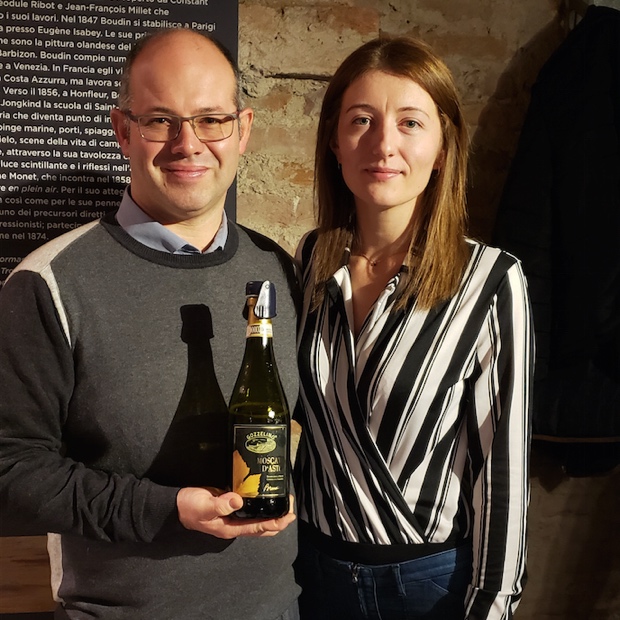
Lorenzo Gozzelino and Silviana Ignat

Azienda Agricola Gozzelino Sergio Moscato d’Asti DOCG 2018, Piedmont, Italy

Righteous, energetic, ripe and frantic moscato is exemplary as such because it enlivens the heart and enlightens the mind. Big, bouncy, bountiful and welling with blossom aromatics leading to rich, striking, full flavour. Lemon and apricot develop a marmalade of unction, glycerin and natural texture. This fruit from Gozzelino’s vineyards is top notch. Drink 2019-2022.  Tasted December 2019
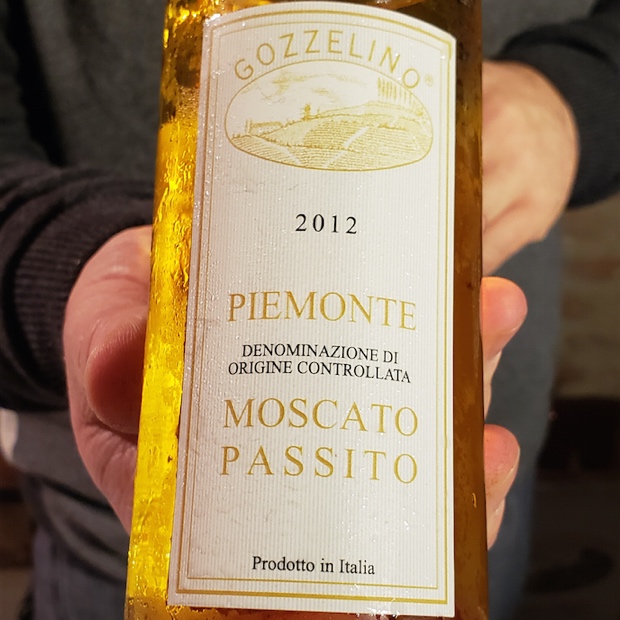
Gozzelino Moscato Passito DOC Piemonte 2012, Piedmont, Italy

Following the manual picking of withered Moscato grapes in November they are pressed and put in refrigerated vats under controlled fermentation. In dessert wine terms for moscato in Piedmont this is the truth, spirited and flashy. Pineapple with an adage of savour in pencil lead and sage of a texture in silken layers. Brazil Nuts are all over the finish as a nougat or an ulterior marzipan. Textbook stuff. Drink 2019-2027.  Tasted December 2019
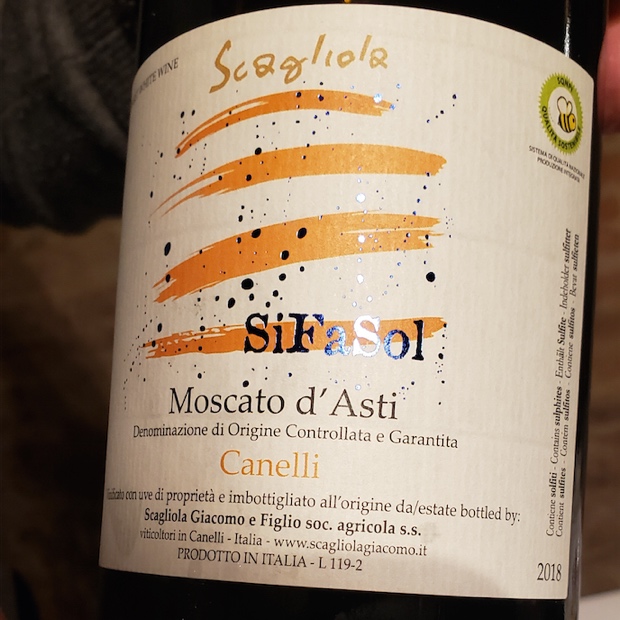
Azienda Agricola Scagliola Giacomo E Figlio Moscato d’Asti DOCG Sifasol 2018, Piedmont, Italy

Located in Canelli here’s a sweetly viscous moscato very lime-driven from calcareous terroir. High quality acidity off the sorì (top portion) from south-facing vines 70 years of age. High level scents of orange blossom, apricot and sage, so typical of Canelli. Really balanced moscato in every respect. Drink 2019-2022.  Tasted December 2019
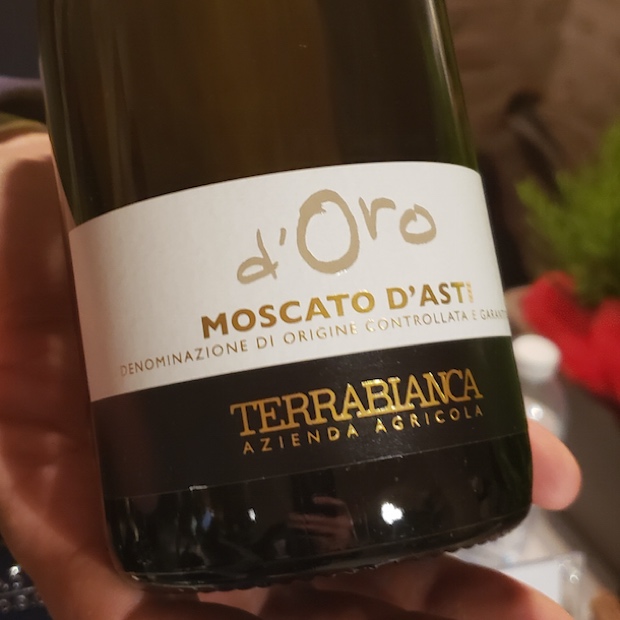
Azienda Agricola Terrabianca Moscato d’Asti DOCG 2019, Piedmont, Italy

Azienda Agricola Terrabianca di Alpiste Federico e Andrea is located in Mango at 520-550m, one of the highest points in the Langhe and not far from Castagnole. This for moscato is surely something other, something curious, sweetly magical. Hard not to love a glass. Drink 2019-2021.  Tasted December 2019
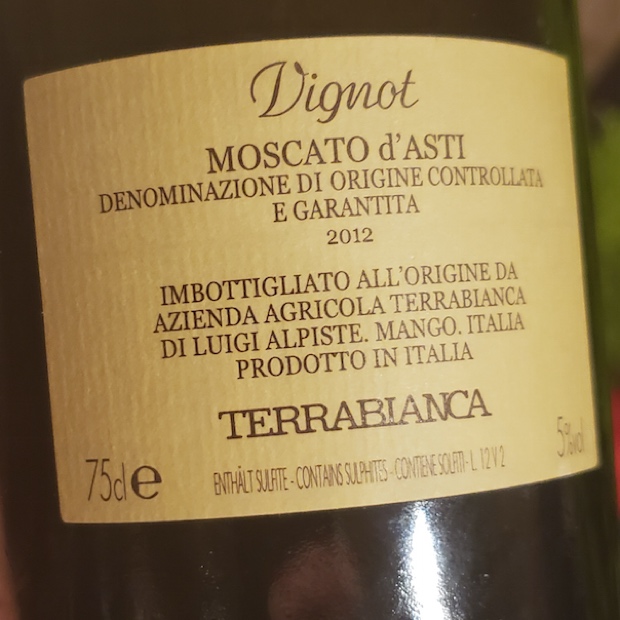
Azienda Agricola Terrabianca Moscato d’Asti Vignot DOCG 2019, Piedmont, Italy

Terrabianca’s Vignot cru moscato is from Canelli off a south exposure for vines of 65 years-old. One of the richest Moscato d’Asti wines you will ever indulge in the fine, smooth and feathery way of lemon curd, but also paraffin waxy and spiked by a limoncello spirit. Zested, striking, maximizing varietal and stylistic enjoyment. Clearly a cut above and so very singular. Drink 2019-2024.  Tasted December 2019

Ristorante Cascinale Nuovo (Isola d’Asti – http://www.walterferretto.com)

Azienda Agricola Terrabianca Moscato d’Asti Vignot DOCG 2012, Piedmont, Italy

A rare opportunity to taste the possibilities in aged Moscato d’Asti, here from Terrabianca’s south-facing Vignot cru in Canelli off of vines of 65 years of age. Vines that soak up maximum sun, not just to promote an oriented sweet richesse but also the ability to age. Now having developed honey and the early stages of petrol and persistent tonal depth. Spurts of lemon are the near-term projection with a real smoulder on the vaporous horizon. Really smart stuff in a world of similitude occupied by the likes of riesling and sémillon. Drink 2019-2021.  Tasted December 2019
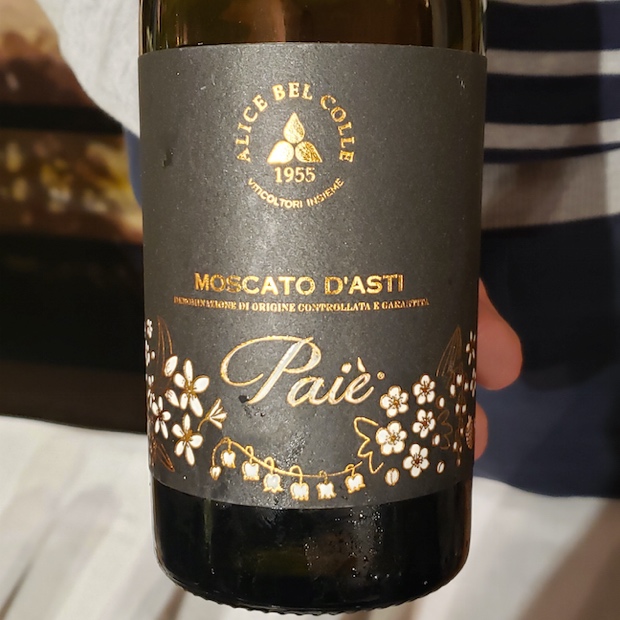
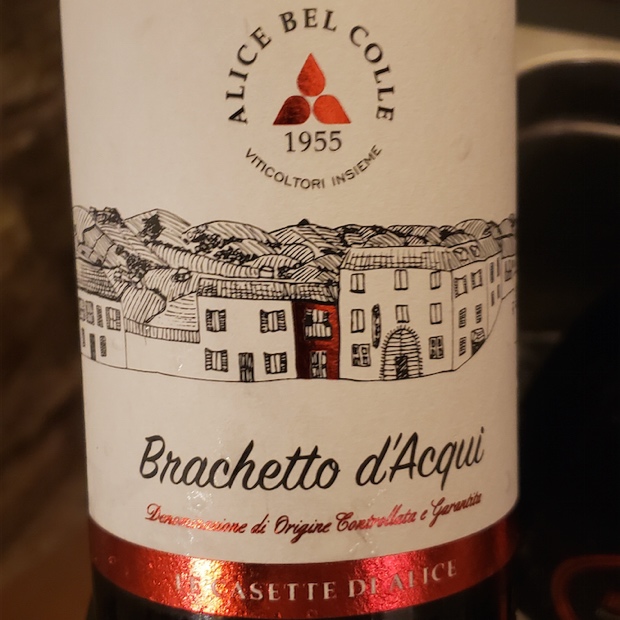
Cantina Alice Bel Colle Moscato d’Asti DOCG Paiè 2018, Piedmont, Italy

From the hills of Alto Monferrato in and about turn of face with 100 per cent of the moscato grapes subjected to a passito methodology of drying for a few months before turning into sparkling wine. Finishes at 5.5 per cent alcohol and 150 g/L of residual sugar. “It is a new way of showing Moscato d’Asti,” tells the spokesperson on behalf of the choir for 100 members. There can be no argument there. Royally sweet and unequivocally in hyperbole of all the aromatic and fruit concentrated aspects of the Md’A style. Truly haughty and heightened in caricature respect. Is it too much? Drink 2019-2022.  Tasted December 2019
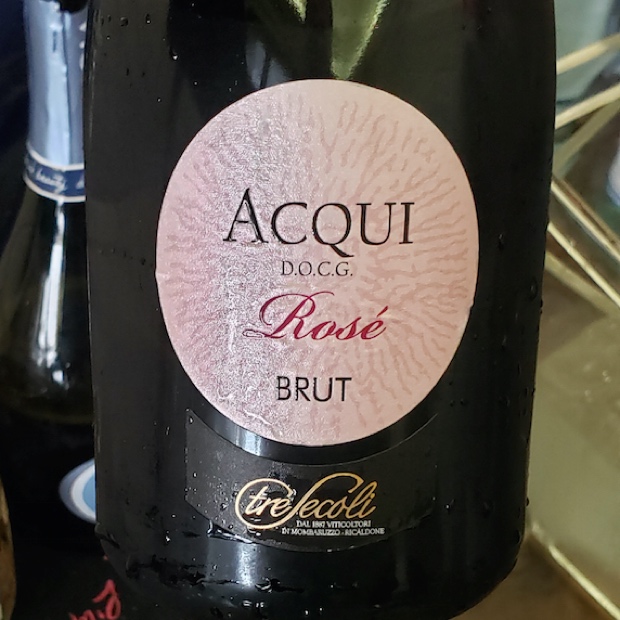
Cantina Tre Secoli Moscato D’asti DOCG 2018, Piedmont, Italy

Located in Canelli Tre Secoli’s moscato is so correct. Combines the full frontal aromatic attack with an easing into back end creaminess and big orange citrus flavour. Perfectly ripe and intentional mild sparkling wine with moments occupied by lemon, lime curd and apricot marmalade. Drink 2019-2020.  Tasted December 2019
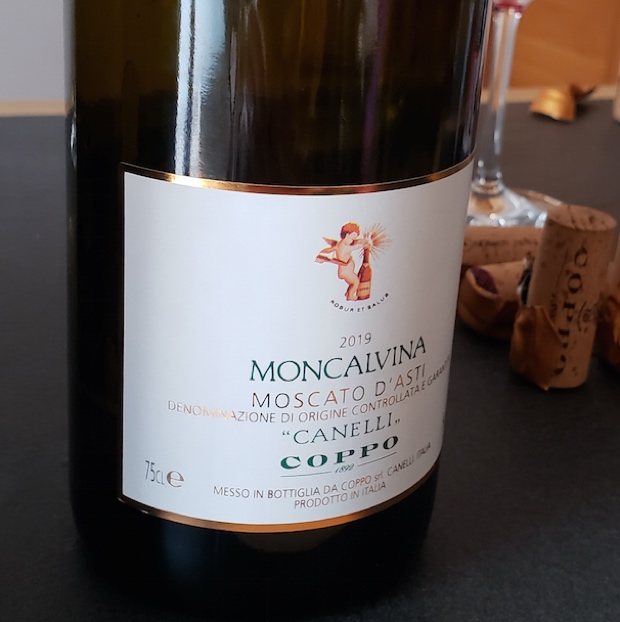
Coppo 1892 Moscato d’Asti DOCG Moncalvina “Canelli” 2018, Piedmont, Italy ($23.20 – Estimate)

“Moscato loves altitude as compared to barbera,” tells Luigi Coppo, “and now is the time to think about Moscato d’Asti.” Luigi says it’s a serious wine because it’s difficult to make. No sugars are added or carbonization performed and it’s a vintage wine. These are the three tenets that matter most. From Canelli vineyards between 200-280m and the classicism of construct and effect is pure magic in proper and precise, sleight of hand ability. That’s what it needs to be, no more, no less. Naturally sweet, a pinch of salt and all the orchard fruit; apple, pear, lemon and orange. All together in balance and gift with tannin on a real dry finish. Drink 2019-2023.  Tasted December 2019
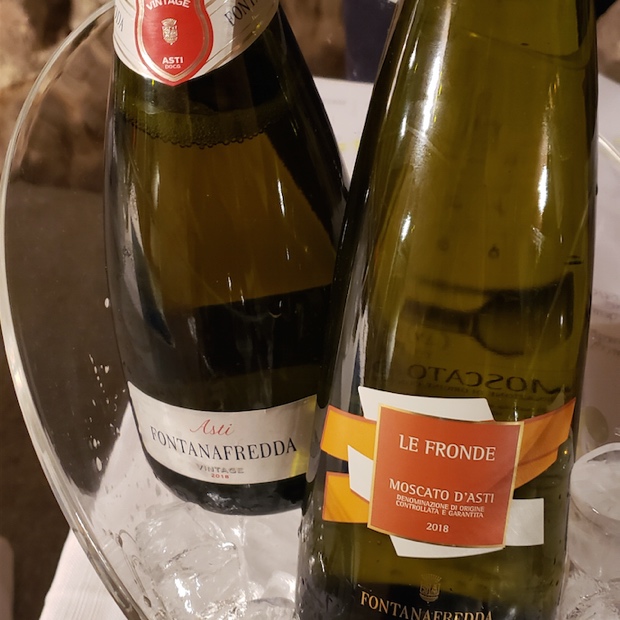
Fontanafredda Asti DOCG 2018, Piedmont, Italy

Intense and sharp, mildly herbal and heavy into the citrus to contrast and compliment the heavy sweetness. Some finishing bitters add a feeling of complexity. Drink 2019-2020.  Tasted December 2019

Tartufo Bianco, Ristorante Cascinale Nuovo (Isola d’Asti – http://www.walterferretto.com)

Fontanafredda Moscato d’Asti DOCG Le Fronde 2018, Piedmont, Italy

Here lies Moscato d’Asti at the furthest edge of sweetness and creamy consistency. After the pleasant aromas of peaches and crème frâiche come the stirring moments of a dull anxiety. That feeling of imbalance marks the finish. Drink 2019.  Tasted December 2019

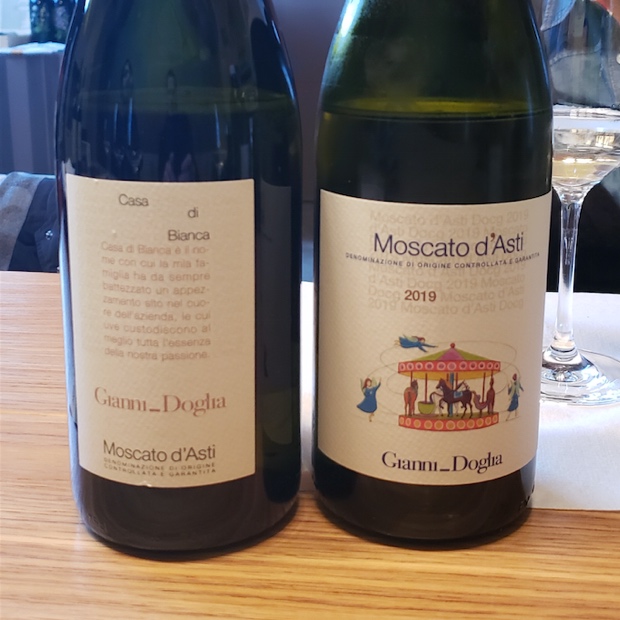
Gianni Doglia Moscato d’Asti DOCG 2019, Piedmont, Italy ($20.00 – Estimate)

The 25th anniversary bottling that combs all the moscato vineyards on the estate though truth be told they all produce quite different wines. “Gianni’s dream was to produce the best moscato ever,” tells sister Paola. The clarity and clean, clean living is evident and with thanks to upstart acidity to balance the sugars. A soil-driven expression of moscato for a fresh and crunchy result. Peaches meet white balsamic for some genuine complexity. Eight to ten bottlings are made each year from wine that sits suspended at one degree in juice format inside steel tanks. At this time of year there is no danger of fermentation. A wine of 5.0 per cent alcohol. Drink 2019-2020.  Tasted December 2019
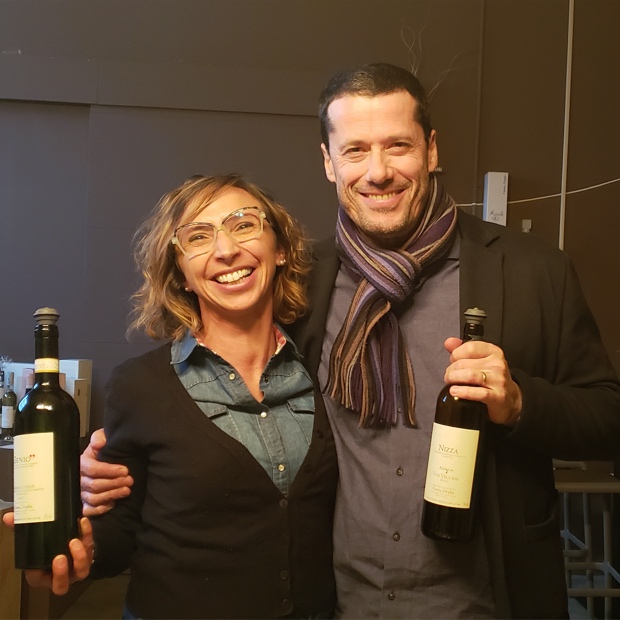
Gianni Doglia Moscato d’Asti DOCG Casa di Bianca 2018, Piedmont, Italy ($20.00 – Estimate)

A single-vineyard moscato from 35 year-old vines and the plot Gianni’s grandfather just knew grew the best vines and so Gianni first decided to separate it from the pack in 2012. And so this particular moscato sees eight or nine months on the lees and finds a next level of complexity for the stylistic and the tradition. Gives a yeasty note on top of green apple, melon, orange blossom and fine herbs. The acidity is greater and so energy is exercised in perpetual motion. The alcohol result is just slightly higher at 5.5 per cent. A wine completely unique in this world that may just deliver some petrol and paraffin with a few years time. Drink 2019-2023.  Tasted December 2019
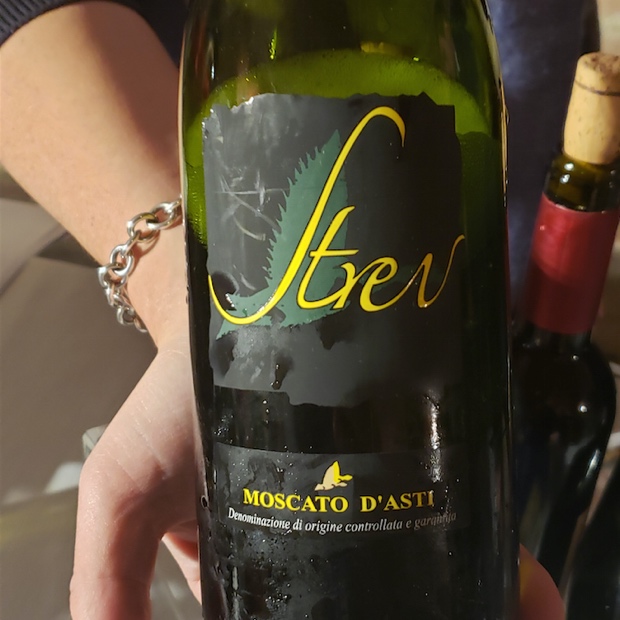
Marenco Moscato d’Asti DOCG Strev 2018, Piedmont, Italy

From Strevi in the province of Alessandria equidistant from both Alba and Asti to form a correct isosceles. Strev is the moscato work of Andrea Costa, winemaker Patrizia Marenco and team. Several vineyards in the area are suited to aromatic varieties because of soil composition (white clay, marl and limestone) off of cooler hillsides at 300-320m. Most important is the diurnal shift between day and night temperature. This is the epitome of aromatic preservation on the lemon-lime-orange freshness scale with good acids and next level goodness. Drink 2019-2021.  Tasted December 2019
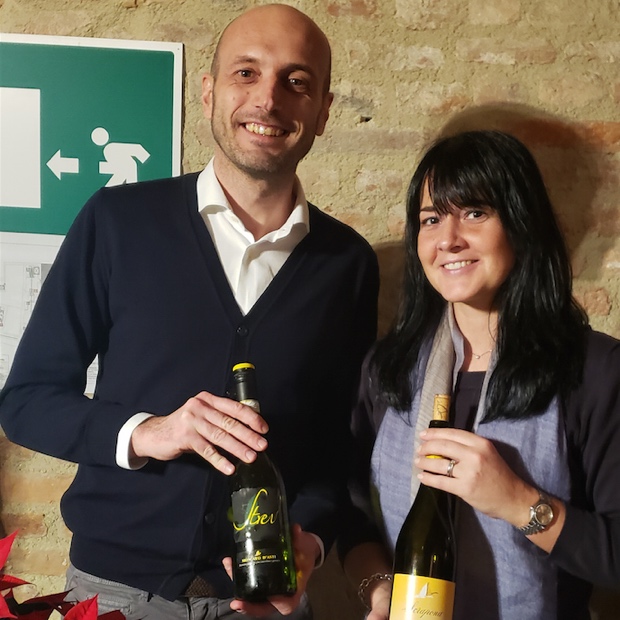
Andrea Costa and Laura Kaminsky, Vini Marenco

Marenco Moscato d’Asti DOCG Scarpona 2016, Piedmont, Italy

Andrea Costa has a boyish grin and wink in his eye when he delivers this three year-old moscato into my glass and for good reason. This is the revolution in moscato d’asti, the one made so bloody intriguing surely due to innovation projects both in the vineyards and cellar. There’s an affinity here with Collio friulano and sauvignon, namely because of the elasticity and surely the transferrable aromas, in a marine-mountain sandwich effect or what we expect from typical Moscato d’Asti. Moves through passion fruit and mineral-flinty-elemental strikes, so much so the sugars are forgotten. Smouldering, so curious and of more depth than many. Drink 2019-2022.  Tasted December 2019
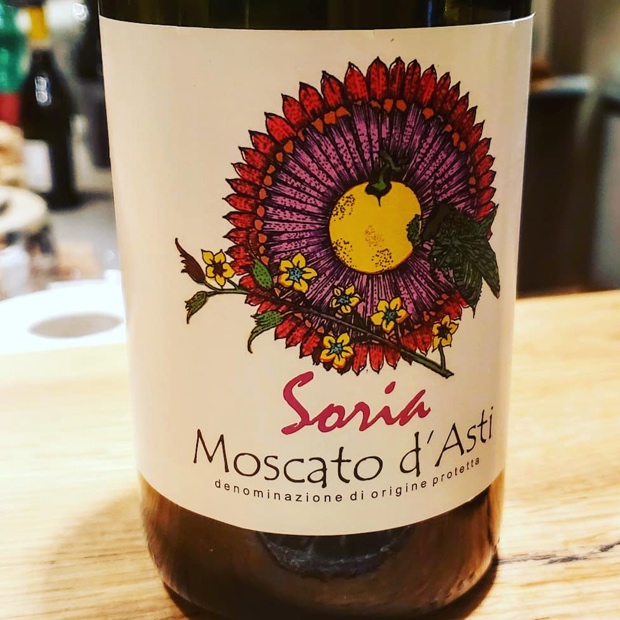
Matteo Soria Moscato d’Asti DOCG Soria 2019, Piedmont, Italy ($16.00 – Estimate)

Bottled last week, barely moved in, likely not yet settled into its new digs. Made up of 75 per cent 2019 (as per appellation rule) plus a mix of the three previous vintages. Crisp, cleaner and waxier than the ’16 with sharper acidity and leaner flavours. Heavily aromatic and even a bit herbal but just so linear, searing and lightning quick in reflex motion. That said the ripeness is just a tad short of ideal and so Matteo seems to have gone straight to freshness and intensity. It was the correct choice with a little help from the last three vintage friends. All about finding more aromas. Drink 2019-2022.  Tasted December 2019
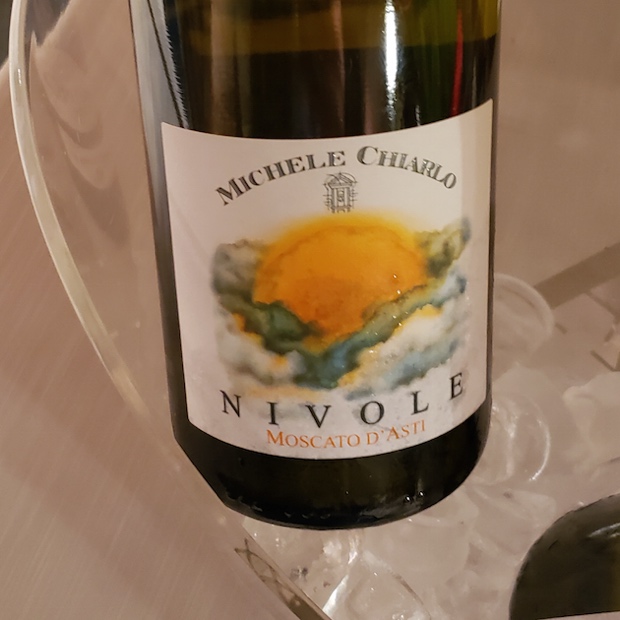
Michele Chiarlo Moscato d’Asti DOCG Nivole 2019, Piedmont, Italy (650440, $9.75, 375ml)

Waxy, aerosol citrus and perhaps a year older with prevalent if weighty acids that settle this Moscato d’Asti into a secondary period. Both aromatics and freshness are diminished though so seem the sugars so the balance is still well-afforded. Ultimately a perfect example of the ripe peach scents so expected from Moscato d’Asti. Drink 2019-2021.  Tasted December 2019
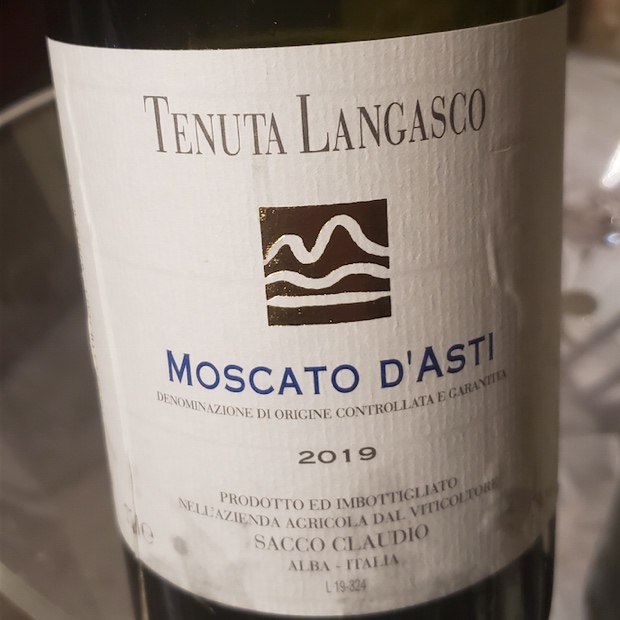
Tenuta Langasco Moscato d’Asti DOCG 2019, Piedmont, Italy

Very accomplished moscato from Langasco out of Madonna di Como in the hills surrounding the city of Alba. As aromatic as should be, could be, would be or might ever be desired. You can’t miss the blossoms, peach and citrus, then juiced for maximum effect. The parts are all arranged one, two, three together. Very special. Drink 2019-2022.  Tasted December 2019
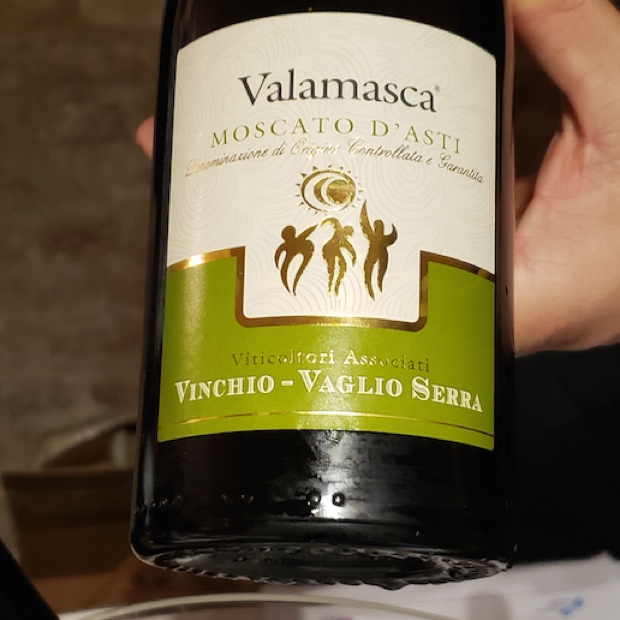
Viticoltori Associati Vinchio E Vaglio Serra Moscato d’Asti DOCG 2019, Piedmont, Italy

A perfectly reasoned and seasoned Moscato d’Asti, blossoms blooming and varietally profiled through their aromatic presence. Very lemon and honeyed as if by Passito but the concentration goers it natural and alone. Clean, caressing and just lovely. Drink 2019-2020.  Tasted December 2019

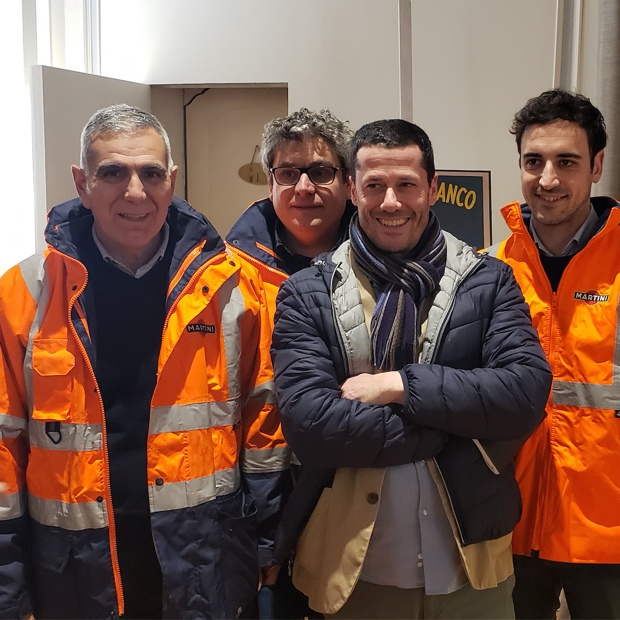
With the Martini Boys

Viticoltori Associati Vinchio E Vaglio Serra Moscato d’Asti DOCG 2018, Piedmont, Italy

Persistently stable, crunchy and crisp moscato from the great cooperative, high in acids and big, brilliant flavours. Grand squeeze of lime juice and has lost nary an aromatic or textural step due to an extra year in bottle, in fact the freshness is on pare if not trying to edge past and exceed the newer 2019. Really fine 2018. Drink 2019-2020.  Tasted December 2019

Good to go!

godello

Twitter: @mgodello

Instagram: mgodello

WineAlign
Rock steady Bersano

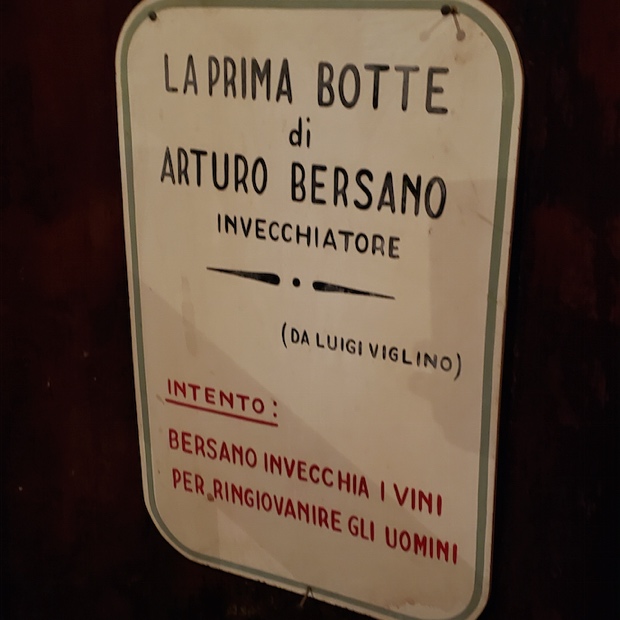
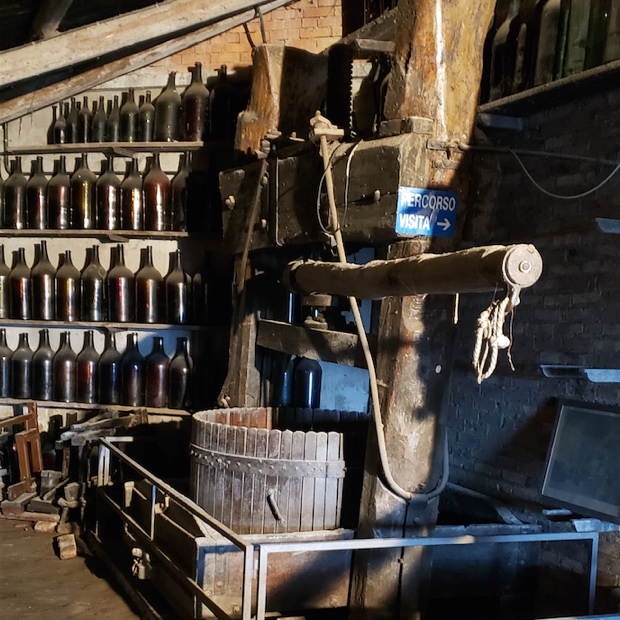
You’ve got to visit the cantina of Bersano Vini in Nizza Monferrato, if for no other reason than to wander through the on-site, outdoor Museo Bersano delle Contadinerie which houses implements and machinery from peasant life and transportation in the seventeenth and eighteenth century. All the brainchild of Arturo Bersano and in his successor’s words the installation is “a memory of what made our wine great. The cellar, farming tools, wine presses and a collection of old wine prints. Bersano – winemaker, scholar, poet. His anxiety of research, patient and cautious, dictated by a deep passion for the land and for work, has been able to condense in the Collections and in the Museum of the Peasants, the most suffered and joyful testimonies of the wine-peasant civilization.” All of that and of course to taste a portfolio in Monferrato’s widest breadth, consistently exceptional of quality and for consumer value across the board. Rock steady Bersano.

Related – Living wine in the moment at Scarpa Winery

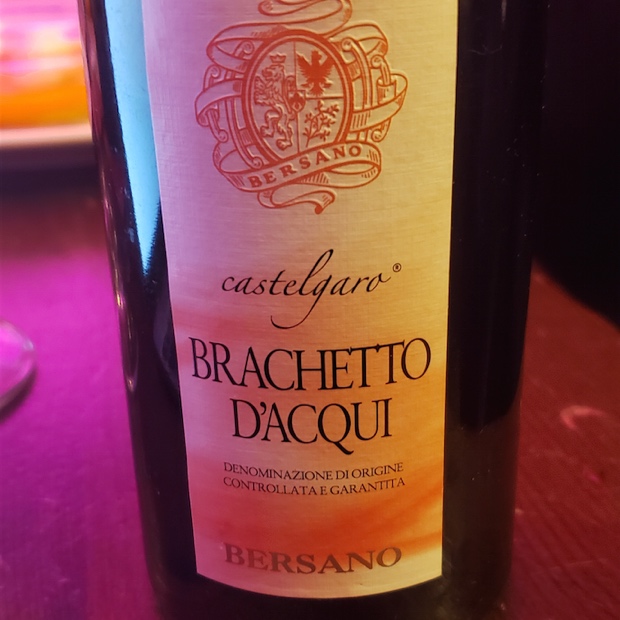
The humble beginnings were early, first decade times in the 20th century. They say 1907 to be exact but surely somewhere between 115 and 120 years later the estates cover 230 hectares, the largest single entity as such in the Monferrato hills. The original and most historic property is Cremosina, once the seat of a great Palazzo (dei Conti della Cremosina) and now home to Barbera d’Asti vineyards. Bersano farms nine estates and two single vineyards in these hills: Cremosina (Nizza Monferrato), Generala (Agliano Terme), Prata (Incisa Scapaccino), Badarina (Serralunga d’Alba), Castelgaro (Baretta – Acqui Terme), Pallavicini (Mombaruzzo), Buccelli (Nizza Monferrato), Serradivaglio Vineyard (Incisa Scapaccino), San Michele (Nizza Monferrato), Monteolivo Vineyard (Castelnuovo Belbo) and San Pietro Realto (Castagnole Monferrato). Today these estates are in production of 90 per cent of what constitutes the Bersano portfolio: Three whites from cortese and arneis, seven sparkling wines from cortese, moscato, brachetto and pinot noir, 13 reds from barbera, grignolino, ruché, nebbiolo and dolcetto.

Related – You say you want a Barbera d’Asti revolution

Pinta Piedmontese

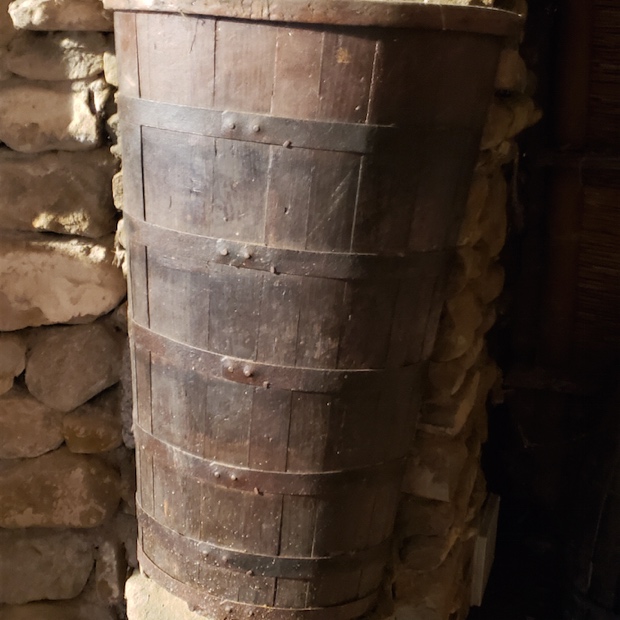
Of great historical interest is the presence in Bersano’s cellar of what Arturo designed and called the “10VT.” The Pinta Piedmontese was a 12.5 litre transportable for the times vessel and four Pinta could be filled from one 50L barrel, half the size found in the cellars of Marchesi di Barolo. This last historical barrel called the 10VT is now housed in the upper floors of Bersano’s Nizza property to avoid flooding. At any given time there can be 80,000L aging ion Slavonian oak casks in this cellar, “of all grandi botti sizes,” 50-60 years of age and from 47 to 107 hL. In fact, no two are the same, perhaps in shape but not in terms of volume. Only 10 per cent of all wines see barrique, they being Nizza Barbera and Barolo Cru.

Related – Barbera d’Asti Del Monferrato E Nizza Monferrato

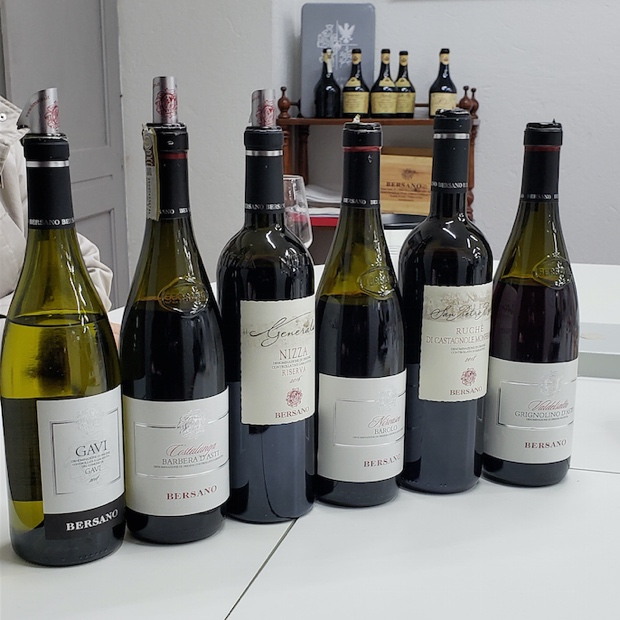
I have had the pleasure of tasting Bersano wines on many occasions in Toronto and over the past three years I’ve done so four times in Piemonte. The first was at Collisioni Festival in 2017 and then in 2018 on several occasions with winemaker Roberto Morosinotto, namely at the Cascina San Pietro where ruché, barbera and grignolino grow in the Monferrato hills. Then in 2019 on this visit at the Cantina in Nizza and in 2020, at Nebbiolo Prima and Grandi Langhe in Alba. These are the six wines tasted in Nizza with Bersano’s Carmen Pergola and the Consorzio Barbera d’Asti e Vini del Monferrato’s Valerio Bertolino.

Bersano Gavi Di Gavi DOCG 2018, Piedmont, Italy ($21.19)

A fresh and sweetly herbal cortese for a smooth and balanced Gavi of straightforward execution and finesse. Relevant acidity keeps everything set up for levels most simple wines just don’t have access to be there. A very fruity vintage with a crushed almond oil extract, perfectly correct and positioned. Drink 2020-2023.  Tasted December 2019 and February 2020

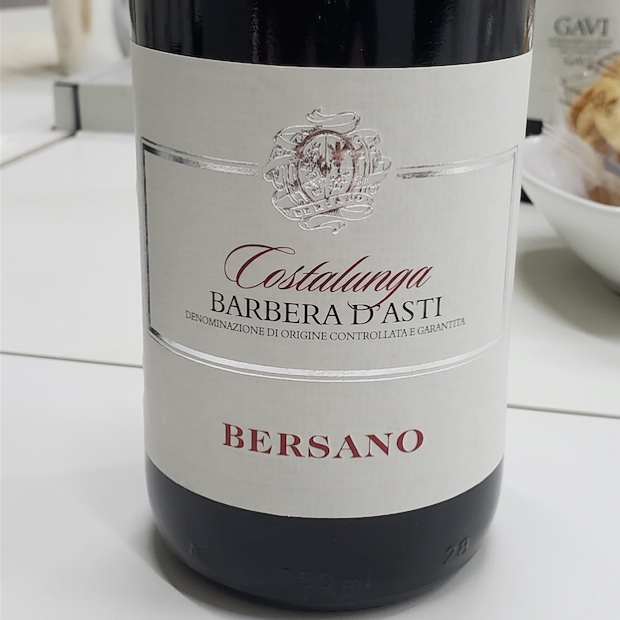
Bersano Barbera d’Asti DOCG Costalunga 2017, Piedmont, Italy (348680, $14.10)

Taken from four estates and without a doubt the most versatile, inexpensive and properly delineated barbera d’asti for the territory to express what needs to the world. Dark fruit, high acidity, classically trained in large Slavonian oak and just exactly what to expect. Never asks too much and delivers across the board amenability. The value is exceptional. Drink 2019-2021.  Tasted December 2019

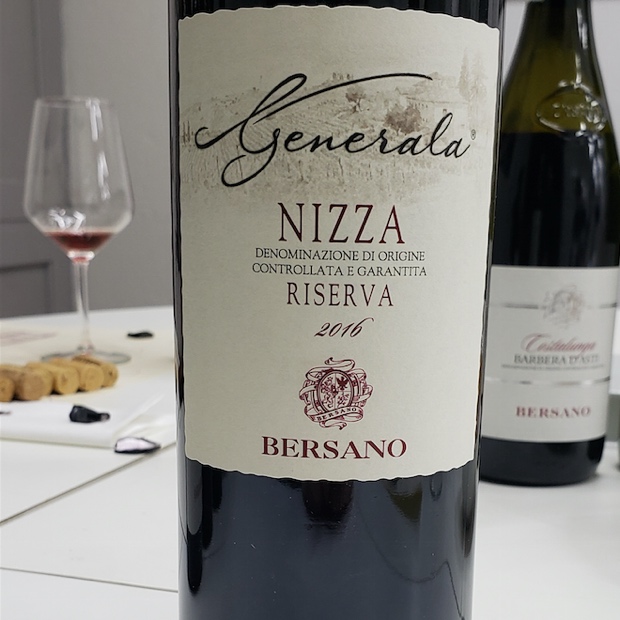
Bersano Barbera d’Asti Nizza DOCG Riserva Generala 2016, Piedmont, Italy (Approx. $52.00)

Drawn from fruit off of the Generala estate and though a recently awarded appellation there is great history in the grapes and the place. Nine months in large Slavonian cask plus nine months in 500L French tonneaux make for a very amenable barbera with a prominent personality. Big on cherries and wood spice, balsam and dried herbs. Dark and even a bit mysterious, cool, almost mentholated and structured for age. Glycerin texture and an oil extract not atypical for the get together of grape, place and elévage. Top vintage for this particular and relatively ambitious wine. Drink 2021-2026.  Tasted December 2019

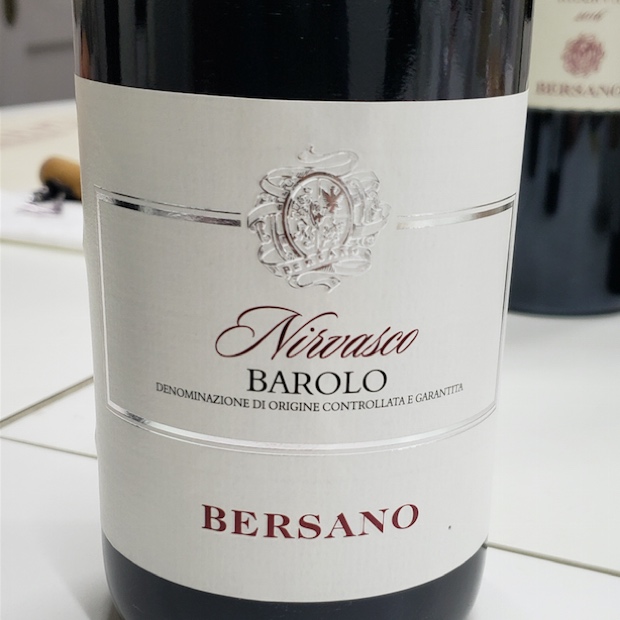
Bersano Nirvasco Barolo DOCG 2014, Piedmont, Italy (713628, $34.95)

The grapes in Barolo come from three areas, Serralunga (Badarina) along with Monforte and La Morra. Aged in large Slavonian casks for three years, easily recognizable as nebbiolo, not just in hue but surely in aromatic rose to tar profile. Classic really and also dried fruits, but especially this wild strawberry note. Dry and then dried cherry, wild and free on the palate. It’s very classic, clean, crisp and easy to get with. Make great use early while other tannic nebbiolo work their way through adolescence. Winemaker Roberto Morosinotto has done all the work for you and serves it up at the right time to drink. Clean and uncomplicated. Drink 2019-2023.  Tasted December 2019

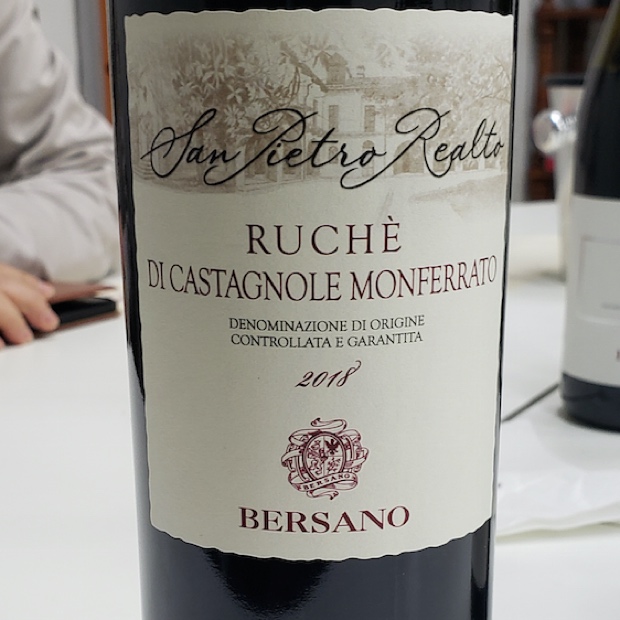
Bersano Ruché Di Castagnole Monferrato DOCG San Pietro Realto 2018, Piedmont, Italy (Approx. $22.00)

Fruit is grown on the San Pietro estate to the east of Monferrato and the unmistakeable and specific cherry with cherry stone note is uncanny, not to be missed. A sandy soil with calcaire and small stones of steep slopes make for an aromatic note that stands alone. The herbal amaro play is on the sweet side and what this really wants and needs is a game bird, roasted and savoury of local herbs. You might think gamay meets frappato or somewhere in between but no, this is singular. This is the red wine for Szechuan food. Truly. Drink 2019-2022.  Tasted December 2019

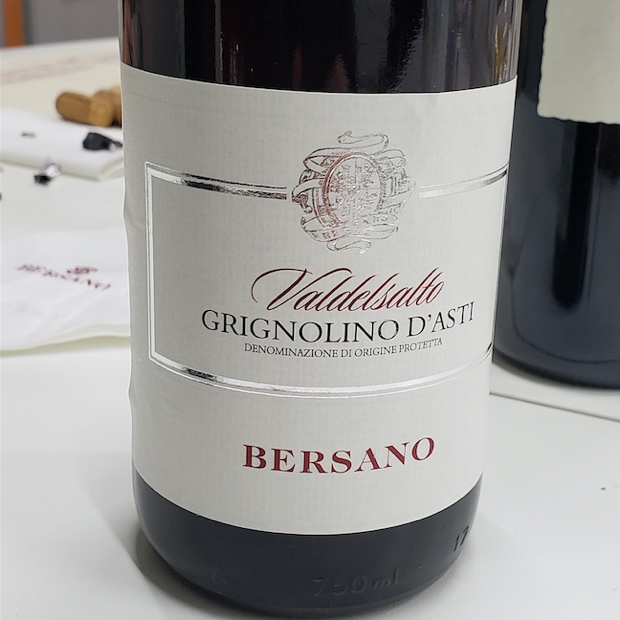
Bersano Grignolino d’Asti DOCG Valdelsalto 2018, Piedmont, Italy (Approx. $22.00)

Coming from the same estate as the ruché, meaning San Pietro in the eastern hills of Monferrato. Beautifully effusive and luminous, light in appearance and weight but do not be fooled into thinking it’s light. Castagnole is the origin and the grape is considered the wine of the family. Fresh, young and the summer wine. OK so light it is but salty, mineral, taut and complete. What else do you need? The kind of wine that never makes you tired and is utterly representative of the place. Drink 2019-2021.  Tasted December 2019

Good to go!

godello

Agnolotti del Plin, Caffe Roma – Enoteca con Cucina, Costigliole d’Asti:

Twitter: @mgodello

Instagram: mgodello

WineAlign

Living wine in the moment at Scarpa Winery

There are mornings when the conditions are ripe: A mind at ease, a calm and benign wind, an empty highway, a good companion. On the fifth day in Piemonte straddling the passover from November to December these were the conditions and so the first pour at Scarpa Winery was captured in full attention. Not lost in any particular thought there was a perceptible air of quiet, a quivering in the air and very, very quietly the barbera fell into the glass with the slightest burble as if the liquid whispered “shoykill, shoykill.” With very little to distract this breakfast pour had more to do with time than space. The movement was sublime, it was beauty, of time passing, for grapes in a way no longer alive drawn from vines still very much so. This ephemeral configuration of a year’s cycle for making wine encapsulated in movement and the moment. In wine this is how we must see things and live our lives, perched between what is beautiful and what has passed.

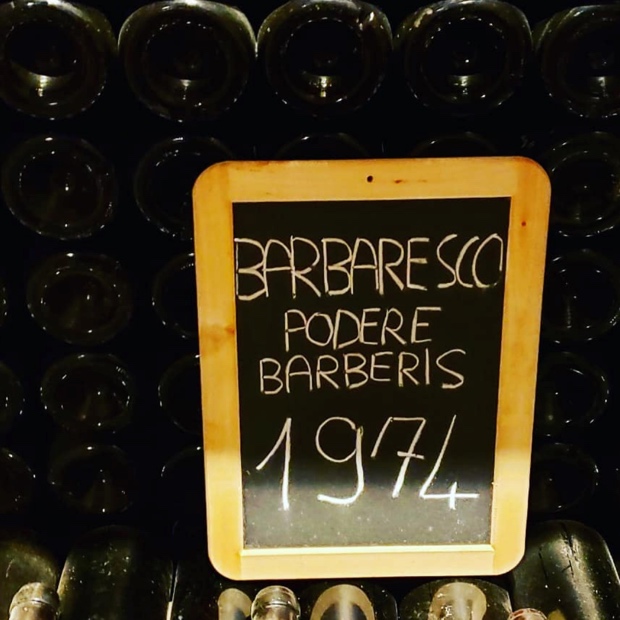
Living wine in the moment at Scarpa Winery. The idea that in life we are tracking what is gone or in the past is not lost when you consider how no other Nizza Monferrato producer both waits to release wines and also holds back library vintages for future release. No other estate will make you feel this longing, this sense of contemplation and aesthetics, of thinking about the past. A walk past the cages of older wines is the precursor but their stacks of 1982, 1987, 1990, 1995 at al are there because they will be sold to consumers who will drink them. Every other winery walk through shows old vintages as museum pieces. Not Scarpa. They live wine in the moment, irregardless of age, no matter the reason.

Andrea Roccione

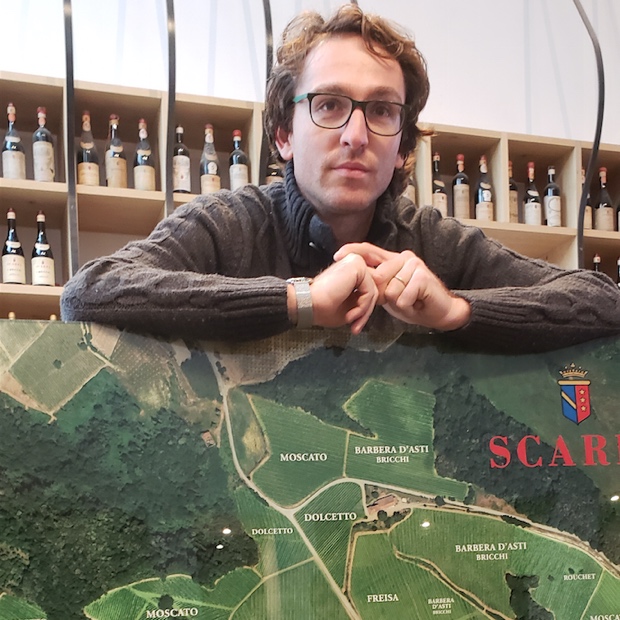
My chaperone was none other than Valerio Bertolino of the Consorzio Barbera d’Asti e Vini del Monferrato and our hosts were Andrea Roccione, Gregorio Ferro and Riikka Sukula. The building that houses the cantina is 119 years of age with 1966 being the first year of current operative production, though there is a bottle of 1949 Barolo on site. Harvest lasts six to seven weeks, from Moscato d’Asti in late August through to Nebbiolo in mid-October. The total production is 100,000 bottles. In 2018 six further hectares were acquired which should increase production by 30,000 bottles. Most everything is macerated and fermented in steel with aging times anywhere from six months to a year. The exceptions are barbera and nebbiolo in La Bogliona, Barolo and Barbaresco. As for museum pieces, Il Filtro Sacci Olandese still hangs, a typical instrument for filtering moscato in the 1900s. The Dutch (sack) filter that looks like a set of inverted bagpipes ceased to be part of production in 1959.

Tasting, assessing and writing about Scarpa wines is exactly the kind of assignment that I believe sits at the antipodes of human understanding. I recently tasted with Andrea over three occasions: At the winery during this December visit, over lunch in Alba and at Grandi Langhe in January 2020. These are the notes on the 11 wines.

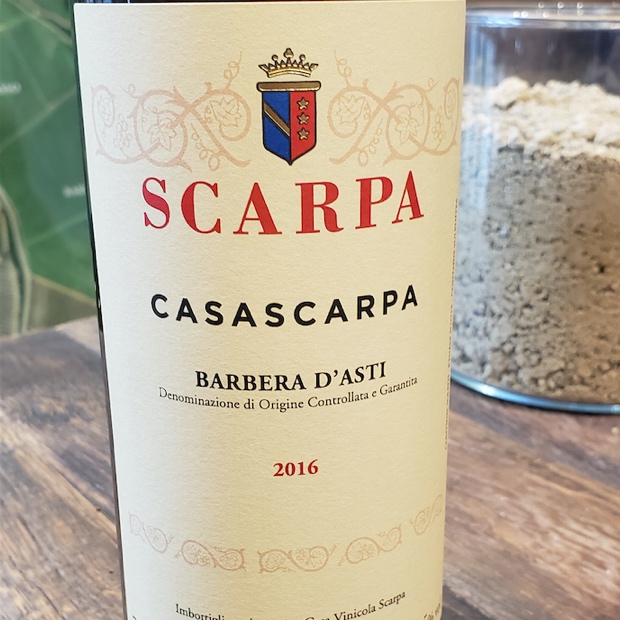
Scarpa Barbera d’Asti DOCG Casascarpa 2016, Piedmont, Italy (Approx. $22.00)

Taken from vineyards all from the Monferratto estate of 26 planted (on 50 hectares), mostly located in Asti Alessandria. The ideal amalgamation and from an ideal vintage, everything ripening in synch and all coming together in balance. The freshness comes at the three year mark and that can’t be argued. The acidity melting into high level fruit is ideal in a secular wine for the ages. Drink 2019-2026.  Tasted December 2019

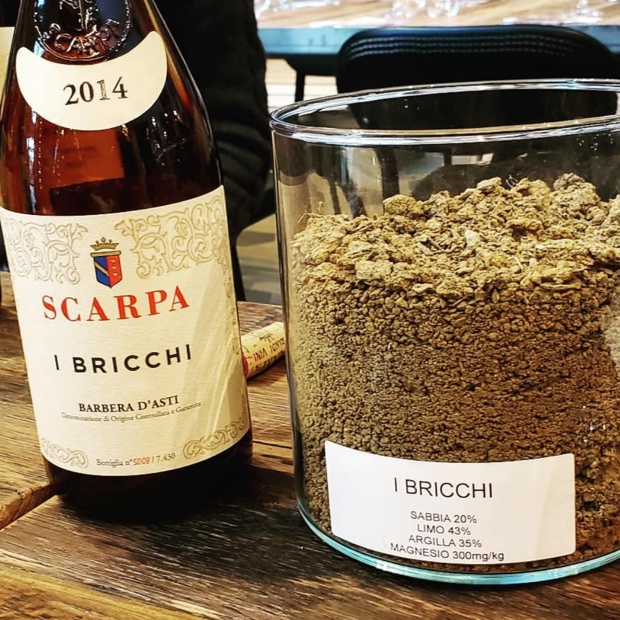
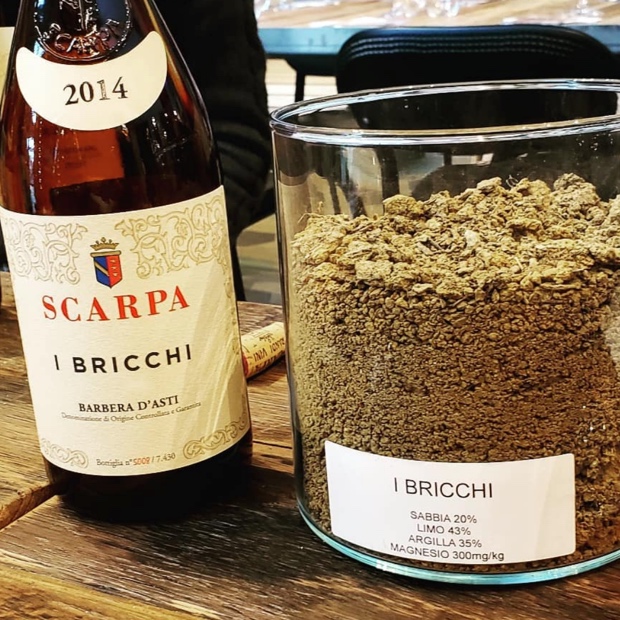
Scarpa Barbera d’Asti DOCG I Bricchi 2014, Piedmont, Italy (Approx. $50.00)

From the brownish clay of the single vineyard and the barbera that positions itself between the estate Casa Scarpa and the Bogliona single cru bottling. Challenging vintage with near ideal fruit and above the norm acidity. Dark fruit actually set against a sky of Asti lightning and barbera thunder. Aching for food with the highest impression of passion and feeling. Singular barbera of Asti designation and off of a very steep slope. Drink 2020-2029.  Tasted December 2019

Scarpa La Selva Di Moirano 2013, Monferrato Freisa Secco DOC, Piedmont, Italy (Approx. $32.00)

Not the youngest but the best freisa currently on the market. A varietal of demanding tannin that settles after five years but won’t likely improve much further after that point. A dry and still version using a conceptual style fast fading from production. Scarpa is one of the keepers, even now from just 1.5 hectares planted. Sharp red berries and a clementine meets blood orange halfway citrus acidity. Another crazy useful gastronomic wine with a finish of zesty tonic. Drink 2020-2023.  Tasted December 2019

Scarpa La Selva Di Moirano 2003, Monferrato Freisa Secco DOC, Piedmont, Italy

Freisa in dry form is not necessarily the norm and the vineyard was slightly larger than it is now (1.5 hectares) as a portion was over-grafted to barbera. This turns back the clock of freshness preservation and overturns the table so to speak and the culpability for speaking its mind to say “I can age.” This from a crazy hot vintage and if you need proof that wines from this territory can maintain acidity and freshness all you need to do is taste this 16 year-old freisa. Some dried fruit but so very notable for high tones, a salty streak and great persistence. Drink 2020-2023.  Tasted December 2019

Scarpa Barbera d’Asti Superiore DOCG La Bogliona 2011, Piedmont, Italy (Approx. $80.00)

A powerful vintage widely considered as a great one and also from I Scarpese as such, from lighter, rich in magnesium sandy soils. How this translates is in a particular saltiness that compares to few others and there are many salty wines of this earth. Two years in large French cask and another two in bottle before being allowed out into the world, with ’13 being the current release. Not a Riserva so it is made in every vintage. A cru. An important and essential cru. Fruit of many ilk including dark berry, plum and cacchi. Fresh as the day it was conceived albeit with many developing complexities and more than a magnesium shake of intrigue. Grains of sand, tannin and time, all dropping slowly through the glass. Approximately 14,000 bottles are produced. Drink 2020-2032.  Tasted December 2019

Scarpa Barbera d’Asti Superiore DOCG La Bogliona 1996, Piedmont, Italy (Approx. $80.00)

At 23 years you just have to launch yourself headfirst into the blood orange. That this piece of barbera wow factor happened before the year 2000 is the thing, especially because climate was very different. Rain fell often and slowly through the year, as opposed to the deluges of globally disaster-orchestrated today. Higher acidity simply speaking and this of the great lean, salty and direct-fitted pieces of barbera composure. Still fresh with dried fruits and low alcohol (at 13.0 per cent declared) but who knows which way the marketing directed labelling in those days? More than a lovely look back. Educational, instructional, cerebral and mind-bending from the lesser appreciated Piedmontese sector. Drink 2019-2024.  Tasted December 2019

Scarpa Rouchet 2016, Monferrato Rosso DOC, Piedmont, Italy (Approx. $56.00)

Rouchet is made from ruché grapes but cultivated outside of the production zone and so the kitschy French spelling tells the wink-wink, nudge-nudge tale. Classic varietal expression, bright and rich, very floral aromatic and the steely version here is effusive, effective and expressive. Such a promising vintage for age ability. Drink 2021-2027.  Tasted December 2019

Scarpa Rouchet 2007, Monferrato Rosso DOC, Piedmont, Italy

This elderly one reveals an old school ruché with more secondary notes then either barbera or freisa show at such a stage in their age. There is tar and earthiness, wet forest and real herbology; rosemary and lavender plus a graphite note. Like old cabernet sauvignon! The wood obviously does the talking but both acidity and tannin remain sharp, pointed and full of prescient tang. This one is sadly not for sale. Drink 2019-2021.  Tasted December 2019

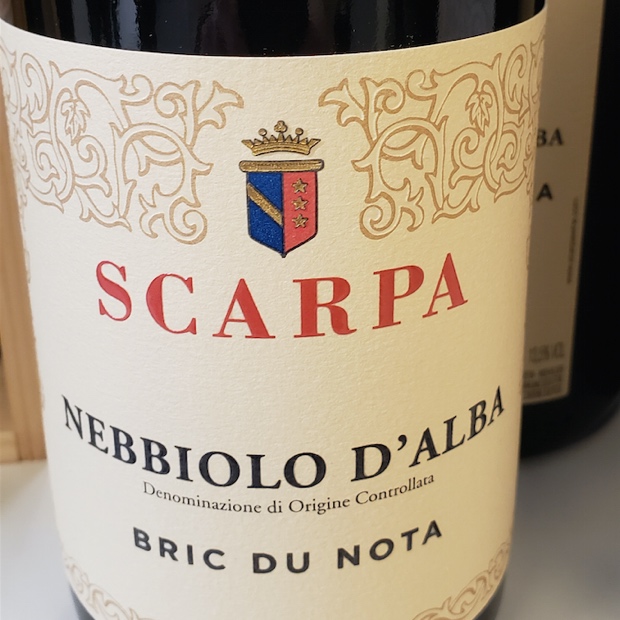
Scarpa Nebbiolo d’Alba DOC Bric Du Nota 2017, Piedmont, Italy

From two parts of a 2.5 hectare vineyard just outside of Monteu Roero, the highest wine-producing village in the Roero. A soil presence of fine-grained sand for an exacting expression of Roero nebbiolo. Launches with the typically traditional Scarpa design and the exceptionality is 36 months in large Slavonian cask for a later and mellower release than many. Quite formed and refined while constantly regenerating its energy in the glass. Fine tannic refrain and purpose. As goes Scarpa, in every incantation, in every wine. Drink 2021-2026.  Tasted January 2020

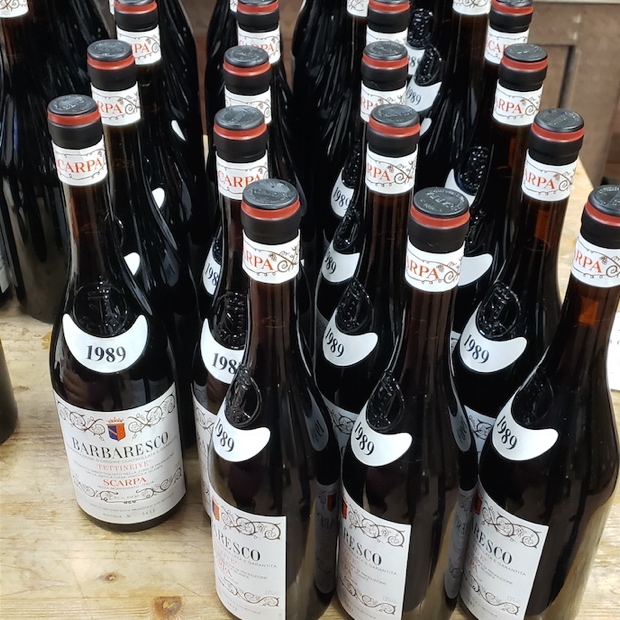
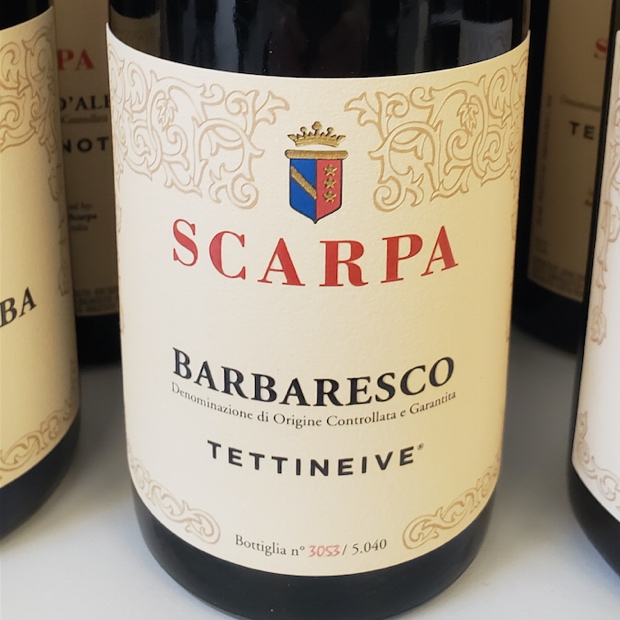
Scarpa Barbaresco DOCG Tettineive 2016, Piedmont, Italy

Tettineive is “the rooftop of Neive,” a Piedmontese dialectical reference to a small collection of hills. Grapes come direct from the town. Here is the cool, silky smooth nebbiolo in Barbaresco clothing, transparent on the road to ethereal. There is indeed a crunchy feeling in this fruit circulating inside a tension filled housing. Very solid construct and highly recommended for a 10-15 year run. Drink 2021-2029.  Tasted January 2020

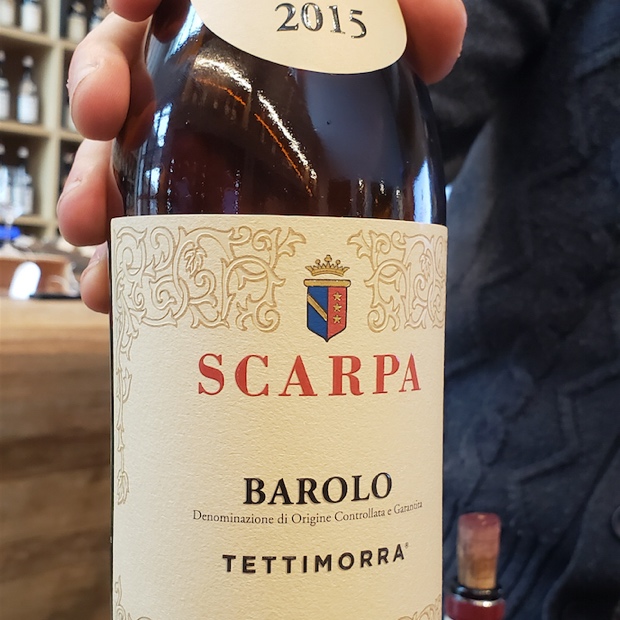
Scarpa Barolo DOCG Tettimorra 2015, Piedmont, Italy (Approx. $52.00)

Fantasy name, not a vineyard, indicating La Morra and the top of that place. The grapes are purchased though as of ’18 there will be nebbiolo coming off of owned vineyards. Rich and heady nebbiolo with an earthly construct and high acidity. Tannins are very grippy, very firm and very in control. Three years in two types of wood, large Slavonian and smaller French cask, then one year in bottle. Such a baby. Approximately 4,500 bottles are produced. Drink 2022-2029.  Tasted December 2019

Good to go!

godello

Twitter: @mgodello

Instagram: mgodello

WineAlign
Love in the time of a pandemic: Marchesi di Barolo

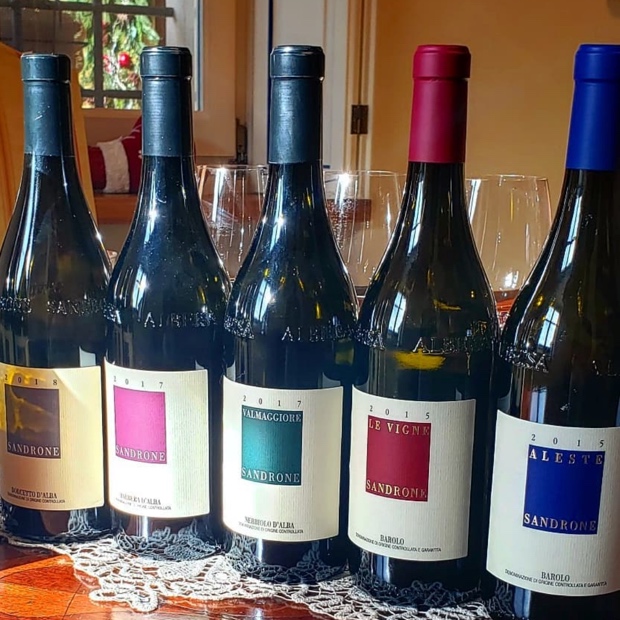
Trying to find birth year wines has been a fruitless and frustrating search and I’ve been at it for 20 years. That and the current situation in Italy is one of the major reasons why my December trip to Piemonte was more than successful, it was in fact a sign. On that I’ll get to in a moment because there is something more profound, a sentiment that struck as most significant in the moment and even more so in a retrospective look back. The hospitality and the outright determination to go to extreme lengths for the purpose of making personal connections is what drives the Piedmontese mentality. I made six appointments over three days in advance of that trip and all six producers wrote back saying they would be delighted to receive me though each were compromised by the pulls of events and commitments that would make it difficult to be there when I arrived. After the three-day tour was done, all six had found a way; Barbara Sandrone, Marina Marcarino, Milena, Francesca and Isidoro Vaira, Chiara and Giorgio Boschis, Angelo Gaja, Anna and Valentina Abbona.

Abbona Sandwich; Anna, Godello, Valentina

Related – Pull up a chair with Angelo Gaja in Barbaresco

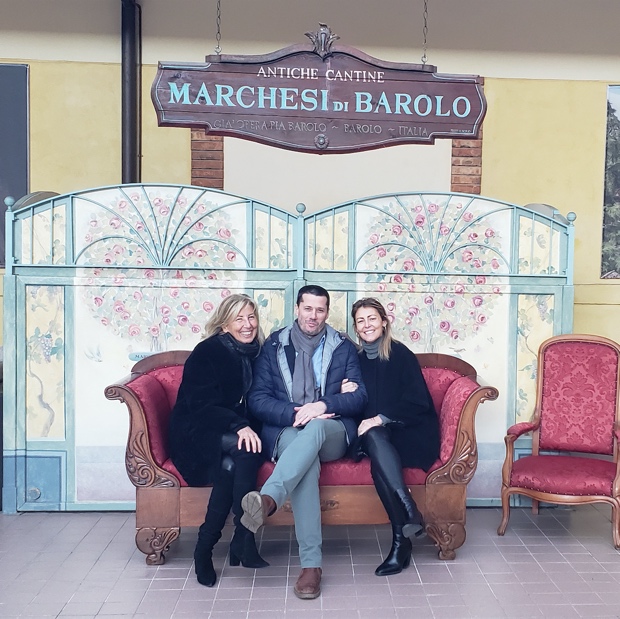
I first met the Abbona family in July of 2017. It was Anna Abbona’s birthday and in their dining room that night Ernesto opened a 1958 at the ripe old age of 58 (though it would turn 59 later that year). Simply stated, in the words of the Abbona family, “a special evening, special friends, special vintage.” That is their story, of generosity, open arms and always, love. I don’t really know how they do it, always on and very present, but they do, for everyone, all around the world and especially in their home. As I stood in the cellar on December 1st, 2019 they proved me right again when out of nowhere Valentina appeared, straight from Rome, en route to another pressing appointment, to spend some time talking and sharing the Marchesi di Barolo spirit.

Wine transport in the 19th Century

Related – Barolo’s Sister and Brother Boschis

As the incumbent owners of the historic Barolo estate the Abbona family takes their custodianship very seriously. Researching and studying its history and provenance is at the fore of their concern. While running through the ideology of present day elévage we pause to consider such a construct. The “babies” are still fermented in concrete vats but many of the wines now begin their journey in stainless steel. Concrete is used for holding wines going back a few vintages and for those that have already seen their assemblage. Which brings us to the new barrel concept, which is a really quite an old one, dating back to the time of the last Marchesa, Giulia Vittorina Falletti Colbert. The wood of this barrel is modelled like the shape of a river boat or canoe, meant for wine to travel downstream and used exclusively back in the 1800s. The idea of the Botti della Marchesa has been resurrected and is now used for special cuvées.

“Botti della Marchesa,” the Marchesa’s Barrel

Related – November 30th in Piemonte: Sandrone and Punset

One more bit of information to share. The Marchesi di Falletti was considered historically to be the first to cultivate nebbiolo at the beginning of the 19th century. In 1895 Pietro Abbona joined his father’s vineyard not far from Barolo Castle and eventually purchased the historic cellars from the Falletti family. Four and five generations later; Ernesto, Anna, Valentina and Davide.

Related – Gone Vajra in Piemonte

The Abbona family has been running the historic cellars of the Marchesi di Barolo since 1929 which means we have entered the decade that will culminate in their 100th anniversary as proprietors of the most important estate. I’ve been to a party in their home and so I can only imagine what that celebration will be like. Long ahead of that event of the century will be the celebration that takes place when Italy and the world are set free from the disaster that has gripped, stymied and ravaged so many families. You can count on the Abbonas to be there when the day arrives, to open their doors and arms, to have loved in the time of and surely to love after the pandemic.

While in the tiny hamlet of Castiglione Falletto I wandered into Le Mura di San Rocco, the Enoteca run by Dario Destefanis. I noted many old vintages but nothing from 1966. I inquired with Dario and he said if I were to come back a day or two later he would pull some from his cellar and procure them for me. I did return and he sold them at the cost of a current vintage. They were ostensibly a gift, from the Marchesi, through the purchaser who stored them for five decades in perfect provenance and then bequeathed them to Dario. The Abbona family had a hand in this transaction, however unknowingly and for that and to them I will always be thankful. The Marchesa and the Marchesi di Falletti. The connection is not lost on me.

So much joy to make a return visit to Marchesi di Barolo in the village of Barolo. To taste so many wines and to be offered the special vintage of 1990. Grazie to the Abbona family and to Laura. Until next time. So many notes and memories are now ready to be shared. These are the lucky 13 wines tasted that day in December.

Marchesi Di Barolo Bric Amiel 2018, Langhe DOC, Piedmont, Italy

A blend of arneis, chardonnay and sauvignon blanc created by siblings Valentina and Davide Abbona. Top of the slope and honey because the Bric is a place where the bees liked to hang around. Only the fourth incarnation of this simple, refreshing and crisp white. Honey will be a part of this zesty lemon and lime wine’s near future. That much I think is guaranteed. Drink 2019-2021.  Tasted December 2019

Marchesi Di Barolo Arneis 2018, Roero DOC, Piedmont, Italy

No longer the white to draw the birds away from munching away on the nebbiolo here is arneis richer than many and of a proper mineral equality. There is something peach salty about this direct expression. Impressively seamless in its fruit to acid construct. A well made white of next level proportion. Drink 2019-2021.  Tasted December 2019

Marchesi Di Barolo Bossèt 2017, Dolcetto d’Alba DOC, Piedmont, Italy

A dolcetto that combs and brings the best of two worlds, the joy of drinking young and fresh but also a modicum of structure that will make for some added interest in a few years time. That’s noted by the white peppery tone at the back, not wood induced but just the true nature of a grape grown in a specific place. Quite heady for dolcetto with the body of knowable finesse. This dolcetto will win over a whole new category of consumers. They only need to get into the game. Drink 2019-2022.  Tasted December 2019

Marchesi Di Barolo Pieragal 2017, Barbera d’Alba DOC, Piedmont, Italy (485904, $40.95)

Planted straight across the road from the winery in a block that was always nebbiolo but financial frugality is not always put first. The game elevated in this barbera is a structural one and also one dictated by weight, but also density. French barriques does the work and the fruit obliges. A swirl of vanilla and dark berries whelm the ease so the indicative ideals say wait and then wait again a while longer. Barbera structured is a specifically splendored thing. Drink 2021-2025.  Tasted December 2019

Marchesi Di Barolo Barbaresco Riserva DOCG 2014, Piedmont, Italy

Only Slavonian cask and no French wood for nebbiolo in Barbaresco form. The vineyards are classically parochial “terre bianche,” white calcareous soils so prevalent around the appellation. The fruit is well developed and rustically edgy, a purple fruit compote with some dried elements. One of those wise nebbiolo that has reached an advanced level of it’s ilk and yet is wise enough to know how to pause there going forward for an equally comfortable period of time. Drink 2019-2025.  Tasted December 2019

Marchesi Di Barolo Barbaresco DOCG Serragrilli 2018, Piedmont, Italy

Serragrilli is the fresher and more approachable nebbiolo in Barbaresco clothing with easier tannins and yet still the classicism of Barbaresco ability. A note of liquorice and tar, plus the roses (candied and dried) of nebbiolo fame. Drink 2020-2023.  Tasted December 2019

Marchesi Di Barolo La Tradizione Barolo DOCG 2015, Piedmont, Italy (168179, $43.95)

The most generous nebbiolo from arguably the more generous of vintages is all about fruit, in ability, compatibility and respectability. Fully ripened in two respects with intoxicating phenols stealing the proverbial aromatic show. Perfectly reasoned, seasoned and effectuated nebbiolo. Drink 2021-2026.  Tasted December 2019

Marchesi Di Barolo Barolo DOCG Del Comune Di Barolo 2014, Piedmont, Italy ($72.00)

A return to some thoughts that make us think of older ways and remind of tradition that can never be forgotten. That’s the savoury quality of this cool vintage Barolo, a nebbiolo that speaks a truth many have left for dead. You can count on the Abbona family to let a vintage and its vineyard fruit talk the talk of a vernacular that can’t help but be uttered. Wild and shearing acids keep the fruit at bay, with laurel and whey, in an herbal-cool mention. The fruit will come back and emerge unscathed in a few year’s time. The fine tannin has spoken of that guarantee. Drink 2022-2028.  Tasted December 2019

Marchesi Di Barolo Barolo DOCG Coste di Rose 2014, Piedmont, Italy

Surely the most delicate and fragile of the three cru Baroli from the Marchesi and the one to treat with nurture over nature. The fineness of all parts known and unknown are genuine, honest and even a bit naïve but it’s also precocious beyond its years. The vintage asks quite a lot from such a nebbiolo usually reared in delicasse so expect some dried fruit and so many roses. More rose petals than you can count at a Marquesa’s wedding. From an Arenaria sandstone site up from Bussia aged one-third in barriques and two-thirds in large Slavonian oak casks. Drink 2022-2035.  Tasted December 2019

Marchesi Di Barolo Barolo DOCG Cannubi 2014, Piedmont, Italy ($84.95)

A soil structure somewhere between Coste di Rose and Sarmassa, marking the Barolo twain with a breath of fresh air and plenty of grip into structure. The second Cru nebbiolo Barolo is the bed that’s not too hard and not too soft, the one the tired and weary travveller would surely choose to lay down for a rest. Fruit is richer and more dense than Coste di Rose but ethereal as compared to Sarmassa. Of the three this Cannubi carries the most pronounced acidity and one to usher the fruit across two decades, plus the one we are leaving now. Like the others it rests in one-third French barriques and two-thirds in large Slavonian oak casks. Drink 2023-2039.  Tasted December 2019

Marchesi Di Barolo Barolo DOCG Sarmassa 2014, Piedmont, Italy (337048, $84.95)

Stony soils with large calcareous rocks in a sun-trapping amphitheatre is the locale that forms the near-feral and quasi-animale Sarmassa Cru nebbiolo. Very impressive bone structure and far more elegance than Sarmassa likely to probably puts inside its pockets. The acidity is one of great fashion and taste. The complexity of pronouncement is exceptional for 2014 so expect decades of transformation to bely any negative press about this vintage. Sarmassa will prove every naysayer wrong. Patience will speak to this truth. As with both the Coste di Rose and Cannubi this bigger Barolo spends its rest in one-third in French barriques and two-thirds in large Slavonian Grandi Botti. Drink 2025-2039.  Tasted December 2019

Marchesi Di Barolo Barolo Riserva DOCG 2011, Piedmont, Italy

Persistently impossible in its youthful state of ’11 grace and if nothing else were said that might just be enough. There’s an affinity with what we expect Sarmassa to smell like, with rich, grippy tones and an unquenchable thirst for knowledge and desire. Showing the dark wood tones of the time and a high edgy quotient of an acid-tannin spectrum. So warming, baking spiced matched by cool herbal aperitíf and balanced at a higher perch of precipice. Still a tannic beast, yet unrelenting and clearly level-headed enough to intuit more time will be needed to enter a state of Riserva grace. Drink 2021-2028.  Tasted December 2019

Unexpected late in the year taste of nearly 30 year-old nebbiolo was one of 19 in ’19 that blew my mind

Antiche Cantine Dei Marchesi Di Barolo 1990, Barolo Riserva, Piedmont, Italy

A grande dame or marchesa in the parlance of these woods, a nebbiolo of persistence, resilience and strength of character. Initiates contact with the past and a contract with tradition by way of the things that matter most. Family for one, roots dug into the earth second and the vineyard’s tongue, if it were able to speak. The overall gist in the parlance is heard and even understood although the dialect is hard to decipher if you are not of this place. This 1990 is found to be of high though level tempered energy and then with an ear, a nose and a soul so close to the earth. Smells like the soils amalgamated, preserved and demonstrated through the tempered liquor of a wise old 29 year-old nebbiolo. So much more than a piece of the past, this is an auguri gathering of storytelling, kin, culture and DNA. You must pay thanks for a chance to taste a thing such as this. Drink 2019-2033.  Tasted December 2019

Good to go!

Godello

Twitter: @mgodello

Instagram: mgodello

WineAlign
November 30th in Piemonte: Sandrone and Punset

In quieter, happier and still innocent times there were days when you could freely take a Saturday morning drive down the A33 from Asti, skirt past Alba and into the sleepy environs of Castiglione Falletto. On that last sunny one of November I did just that to pay a visit with Barbara Sandrone. Later that day I moved north to Barbaresco to do the same with Marina Marcarino at Azienda Agricola Biologica Punset. I am thinking of them both and their families at this most challenging time of the past 75 years. Their estates are so very different and yet both Barbara and Marina are two of Piemonte’s strongest women, fearless in their pursuit of excellence, integrity and their respective family’s dreams to tell exacting stories of very specific places.

With Marina Marcarino

Sandrone in found south down the slope and slightly to the west of the tiny hamlet of Castiglione Falletto, also the name of the commune in the Province of Cuneo. The town of Barolo is further afield south down SP3 Via Alba. Barbara’s family wines are made by her father Luciano, pioneer, founder and visionary, along with her uncle Luca. Luciano founded the winery in 1978 after working at Borgogno and being the cellar master in charge at Marchesi di Barolo. One of the winery’s most progressive concepts is actually a retro one. They concern Barolo that are neither selections nor Riserva but rather of intuition, “to free nebbiolo’s innate resistance to time.” Sibi et Paucis, “a few who are the favoured,” in that a small percentage of the three seminal nebbolo bottlings are held and stored in the winery’s cellar. “The harmony of wine expressed through passion and patience” is Sandrone’s credo and it is the Valmaggiore, plus Le Vigne and Aleste Barolo that are released six, 10 and 10 years forward (respectively) to supply restaurants with a desire to sell old vintages, but don’t necessarily have the space to store them. Here are the five wines I tasted that morning at Sandrone. Thank you Barbara and I hope you and your family are well.

With Barbara Sandrone

Sandrone

Sandrone Dolcetto d’Alba DOC 2018 ($29.95)

The keys to the dolcetto city are granted when fruit, freshness and high level acidity coordinate as they do in bringing 10 different plot expressions together from Monforte and Barolo. High level excitability in control and though it has a short life expectancy (three to four years) there is charm and there is balance. Drink 2019-2022.  Tasted November 2019

Sandrone Barbera d’Alba DOC 2018 ($44.95)

From the area very close to Grasso at the top of the hill at 450m. Dark black cherry and weight from a hot vintage and so the wind and the aerification up at this great Langhe height has kept the wine fresh and breezy. Works well to accede and succeed going forward. Crisp for barbera d’alba. Drink 2019-2024.  Tasted November 2019

Sandrone Nebbiolo d’Alba DOC Valmaggiore 2017 ($59.95)

Comes from sandy soils in Roero, the youngest and more openly friendly of the three brothers, along with Le Vigne and Aleste. One year in tonneaux and one year in bottle. Chalky and largely chunky but always the acidity and the charm. Solid as it can possibly get for the appellation, a mid-term traveller with everything under control. Drink 2019-2023.  Tasted November 2019

Saturday morning @sandroneluciano on a perfectly November Piedmontese day. Grazie Barbara. Yours, your father’s and your family’s wines take care to do what’s good and beautiful and right.

Sandrone Barolo DOCG Le Vigne 2015 ($159.95)

A formidable construct forms the outline and strengthens the bones of Sandrone’s Le Vigne. This nebbiolo strikes the heart with what just seems like the crux-filling soul of these nebbioli standing at its own attention with intention and promise. The inner sanctum of succulence and intentionally high-strung parts moves the dial in the direction of forever with time-stopping ability. There seems no way forward now while at the same time the earth revolves because you just know it does. But you can’t feel it. What you can feel is yourself breathing and Le Vigne is teaching you through the moment. Drink 2023-2035.  Tasted November 2019

Sandrone Barolo DOCG Aleste 2015 ($179.95)

Aleste goes deeper and more introspectively into the clay and limestone with this uncanny ability and intuitiveness to mimic its compact terroir. You can imagine the nebbiolo here softening in cold, wet months and hardening when dry and warm. The tannic structure is not that of Le Vigne and in a way (if I can be allowed to say) there is more Luciano Sandrone’s youth years in Aleste and more morbido times of wisdom in Le Vigne. There can be no reason to consume cases of Aleste any earlier than the age of 10, or even 15. It’s packed so tight and without holes in its armour for to ensure longevity with the greatest Baroli and that includes the most historical, traditional and famous. What a moment this wine gives and will bring to those who make one their own. Drink 2025-2040.  Tasted November 2019

Azienda Agricola Biologica Punset

After a brief stop for lunch in Castiglione Falletto I made my way back up the Autostrada, took the SP3 Barbaresco off-ramp, crossed over the Tanaro, turned towards Castagnole Lanze and headed for Neive. In the hills above the village is Azienda Agricola Biologica Punset. The literal meaning is “beautiful hill” or “peak,” a name derived from dialectical Piedmontese legend which tells of this nickname given by the Count of Neive. Punset is run by fifth generation winemaker Marina Marcarino, organic instrumentalist, agricultural trailblazer and arguably the Langhe’s greatest disco dancer. Marcarino made a decision to farm organically in the 80s when commercialism, conventionalism and conservatism were the rampant norm. She was the witch of Barbaresco, feared and surely admired though many did not yet understand the breadth of her powers.

Today’s world of natural wine has got nothing on Marina Marcarino. She was into the match long before today’s winemakers were even out of huggies. Marina explains what her wishes are going forward. “What I would like for the future? Being able to communicate my experience as an example of personal achievement to the new generations, spurring them to get into the game.” Never before have philosophies like this meant so much. Most recently Marcarino has devoted an incredible amount of time and effort as President of the L’Associazione Produttori Vini Albesi. Dear Marina, I trust you are staying positive through these troubling months and I have an important request. When we all come through this, please save the next dance for me. These are the nine wines tasted with Marina on that day in late November.

Punset Neh! Langhe Bianco DOC 2018 ($18.95)

Ne’? is the “Piedmontese” way of ending a sentence, like ‘eh in Canada. A 50-50 arneis and favortita mix, salt missive over fruit and extremely fresh. The aperitíf white that connects dialectal territory with those in the diaspora that want a taste. Drink 2019-2021.  Tasted November 2019

Punset Neh! Langhe Rosso DOC 2017 ($18.95)

Mainly dolcetto (70 per cent) with barbera and nebbiolo. Not much of the latter but necessary to widen the expression of the Langhe. Here it’s an explanation point, not a question, as in a confirmation of the exclamatory Piedmontese expression. Bright red amalgamated fruit with proper acidity and the ability to work alongside anyone and all. Drink 2019-2022.  Tasted November 2019

Punset Arneis Langhe DOC 2018 ($26.95)

The gastronomic DOC Langhe with 100 per cent arneis and right from the top you can tell the difference. Not just the increase in limestone mineral push but also texture and even structure. Liquid salty wave, creamy without abandoning roots and reason. Lingers longer than most arneis and you’re very pleased to have it hang about. Besides it’s more a winter white than a summer one. Drink 2019-2024.  Tasted November 2019

Punset Dolcetto d’Alba Langhe DOC 2017 ($21.95)

The luxuriously natural dolcetto, richly phenolic and rustic, lactic and reasonably so. A pure varietal expression, true to place and to form. Great fruit and essential first course red. Drink 2019-2023.  Tasted November 2019

Punset Barbera d’Alba DOC 2018 ($24.95)

From two vineyards, one planted in 1996 and one in 2003. Rich and spicy with some of the varieties’ greatest clarity. Very few comes across with this sort of red fruit. Maintains the fragrance and the “frankness” of the variety. No French oak, no confiture. “It’s the easiest wine for us because we do nothing,“ shrugs Marina Marcarino, expect for picking at the right times and pressing gently. That and cement. Drink 2019-2023.  Tasted November 2019

Punset Langhe Nebbiolo DOC 2017 ($31.95)

From the tiniest production made from the youngest vines from times when there is more vegetation and verticality for health. This practice started about 20 years ago, which harks to a very specific pruning system and because Guyot is tough on the vines. They are nurtured like the children they are and the results are in the natural order of things and in the personality of this genuine Langhe. It’s volatile you should know. It’s also biodynamic, dynamic and beautiful. Drink 2019-2023.  Tasted November 2019

Punset Barbaresco DOCG Basarin 2014 (302786, $66.95)

Very traditional nebbiolo coming from the southeast part of Marina Marcarino’s vineyards, very steep, the rock bed 8m deep. Classic nebbiolo with classic tannins, 40 days on skin, softly removed. Slavonian 2500L and no less than two years refining time, 14 months of that in the wood. Emits a not to be missed scent of menthol and faint herbs mixed with fennocchio, It’s the vineyard talking and though we would want to there’s nothing more to specifically name, so just chalk it up to memories created, of another time and in this same place. Drink 2022-2033.  Tasted November 2019

Punset Barbaresco DOCG Basarin 2013 (302786, $66.95)

If 2014 in general was not considered a great vintage it might as well have been so here, of mild temperatures and not so wet. Fresh and excitedly savoury with a mint-vegetative note but it matters little because this ’13 is different and was built with bigger structure, not the power of some and many, though surely these never are. The aroma is very similar and so we deduce that this is what Punset Barbaresco smells exactly like. Something growing in the vineyard, or maybe something deep and well within the ground, or even in the air. It’s just what it smells like. An aroma divine. Drink 2022-2033.  Tasted November 2019

An afternoon tasting through the Neive wines of Italy’s first organic wine producer. Marina Marcarino began her impassioned and unwavering journey in 1982 ~ Shout out to @nicholaspearcewines for getting these gems to Ontario.

Punset Barbaresco DOCG Campo Quadro Riserva 2012 ($71.95)

A cru Barbaresco, meaning squared, and the place is just like a painting. Carries a double entendre and as Marina Marcarino explains, there “probably is a third meaning that we don’t know.” Take in the math of 12,000 square metres and 12,000 bottles of wine produced, making use of 70 per cent of the potential. Different aromatics than the very traditional, non-Riserva Barbaresco, deeper and richer, more sweet red fruit and less savour. A bigger vintage, with a similar fermentation and aged in French barriques and botti. Some spice for sure, with 36 wood aging a major part of the profile, followed by 36 further months in bottle. Great structure, wild ride, all in total control. Drink 2022-2033.  Tasted November 2019

Good to go!

godello

Castiglione Falletto from Via Alba

Twitter: @mgodello

Instagram: mgodello

WineAlign

Avoid the LCBO. Buy local. Support wine agents. Start now.

This public service message will be brief. My colleague and great friend John Szabo M.S. has already made the pronouncement in his weekly VINTAGES round-up over at WineAlign. I only wish to reiterate and help show you the way. Wine is woven into the fabric of our lives and the time is impressed upon us to change what, how, from where and why we make our purchases. In these unprecedented times we the people must act to plank the COVID-19 curve and we must do so together. We must stay home. We should not be making trips to the LCBO.

Related – Buyers’ Guide to VINTAGES March 21st, 2020

The LCBO is not an essential service. Their employees should not be put in the uncompromising position of working through the pandemic while their head offices remain shuttered tight. Hospitality giants choose to save lives and act as heroes by closing their doors for the common good. Even if it means going out of business. If the LCBO will not do the right thing then the people of Ontario need to act for them. The alternatives for finding booze are too numerous to count, safer and by trusting the word of writers, restauranteurs and sommeliers you will open your eyes and palates to the world class wines, beers and spirits found right here in your backyard.

Please see attached a Press Release from the Wine Marketing Association of Ontario, VQA Wines of Ontario and Wine Country Ontario announcing that over 95 Ontario VQA wineries are offering free shipping to Ontario residents, with most of them extending this offer until Easter Weekend, including April 13th, 2020.

https://www.newswire.ca/news-releases/over-95-ontario-vqa-wineries-offer-free-shipping-to-ontario-residents-870436522.html

Please follow this link to see this list.

https://winecountryontario.ca/wp-content/uploads/2020/03/VQA-Wineries-Free-Shipping.pdf

To see which Ontario importing wine agencies are offering free shipping on cases (and mixed cases) of wines in their portfolio from across the globe, please click here.

Related – Wine Agents Offering Free Shipping in Ontario

One more thing. During these suffocating, devastating and potentially bankrupting times for the local hospitality industry it would be a business-saving adjustment if our restaurants could sell wine and beer to go along with their take-out and delivery sales. Please sign the petition to lobby our politicians.

Related – Allow Ontario Restaurants to include wine, beer, cider, spirits in take-out & deliveries

Good luck to all, stay inside, stay healthy and stay safe. I am looking forward to sharing a lesser distancing glass of wine with each and every one of you when we all emerge together, better than we were before, on the other side.

Good to go!

godello

Twitter: @mgodello

Instagram: mgodello

WineAlign

Gone Vajra in Piemonte

Stained Glass Window by Padre Costantino Ruggeri and Vajra’s Inox Tanks

Head west from the village of Barolo, climb the SP3 up to 400 metres above sea level and you will arrive in Vergne, the highest village of the regal Piedmontese appellation. This is where the most forward thinking, visionary and traditionally romantic estate of G. D. Vajra is found. Vajra is the house that Aldo and Milena Vaira built, are in the continued process of building (literally) and produce wines along with their children, Francesca, Giuseppe and Isidoro. On a recent December 2019 trip to Piemonte I drove down the A33 from Asti through Alba, skirted Barolo up the SP3 to spend a few hours with Isidoro and Francesca Vaira on a soggy Sunday morning. Vajra’s wines have been trending big time, gaining ground, rising in prominence and spreading fast. I knew it was time to find out why things have gone Vajra.

Family, roots and vineyards. Having talked and tasted with Francesca and Isidoro @vajra_barolo there can be no doubt many words and feelings will follow. Their’s is a story of resilience and constant renewal.

If you engage in obsessive study or even share a casual interest in religious iconography and emblematic ordnance then the term Vajra will no doubt be recognizable. Vajra, a symbolic ritual tool or object used in Buddhism, Hinduism, and Jainism to represent the unyielding power of spirit. Vajra, the symbol of the Vajrayāna school of Buddhism, a type of club with a ribbed spherical head, the “diamond thunderbolt.” The family may not adhere to the far eastern credo or for that matter even mention any possibility of connection, but a listen to their story and a study of their life’s work can be looked at in the emblematic light of ideals relating to indestructibility and irresistible force. An explanation is forthcoming and in due course.

Dude’s getting married next week. No wonder Isidoro Vaira is a happy man.

It’s only one week before his wedding and Isidoro generously takes the time to meet. He begins with a winter’s tale, extolling the virtues of snow cover, which incidentally arrived to the slopes in December and early January, then subsequently disappeared for the remainder of the mild 2020 winter. The Piedmontese saying goes like this. Sotto la neve, il pane, orunder the snow, the bread.” Snow is better than water because it holds more oxygen and encourages the plants to draw more nutrients from the soil. This is an example of generational knowledge because as Isidoro reminds us, when you spend time with your father and the elders “you learn the importance of nature.”

sotto la neve, il pane

under the snow, the bread

Aldo Vaira began this six decades old journey in 1970 with a 0.3 hectare plot at Bricco Viole. The first vintage was 1972, of no ripeness and fruit sold away. He thought “with this money I don’t pay for my work,” and so began to bottle for himself. By 1986 Aldo was farming seven hectares but on the 29th of May the storm of the century killed everything, save for 300 bottles worth of fruit. He was in his mid-30s, with one child already born and two more to come over the next four years. It was what we call the point of calling it quits or forging ahead with no turning back. Milena stepped up, in fortitude, conviction and an ultimatum issued to her husband. Aldo responded, made a life decision and ploughed ahead.

The Vairas began anew, hailstorms occurring five to seven times each decade be damned and dug their heels into the Vergne terra firma.  With experience as a teacher and having built a winery Aldo became affectionately known as Dutur, a dialectical Piedmontese term of endearment which could allude to the word doctor but also as a part of the Italian word for producer, or produttore. Francesca tells me that 1986 is the vintage form which “you could have (or begin) your dream, by being resilient, persistent and move forward.” She shrugs. “It had to be a priority.” And so from 1986 on the Viaras completely changed direction and course.

Thirty-three years have beget great success. Francesca explains the impetuses for how her family goes about their lives. “What we have learned from our parents is not just life and to make wine but a social motivation to have the life of the people. Imagine a life without these things; music, art, books and wine. It’s not possible.” The goal is to make connections. “We need to make wine to make people happy. Our prices are very democratic.” There are always new considerations, like the “diversification of risk” and it has become the ingrained philosophy, in terms of wines and varieties but also the idea of a two-month long picking time. Always diversity, all the time. One step inside the winery and the light shines in. The stained glass windows that adorn the fermentation room are a reflection of everything that is embodied by the Vajra oeuvre.

They hang in their stark and prolate ways as a severe yet arrant contrast to the line of steel tanks below. When Aldo and Milena went to visit the artist at Canepanova Convent in Pavia he answered the door dressed as a Franciscan Monk with a blue hat. A crazy man in a crazy beautiful studio. Padre Costantino Ruggeri was in fact a real monk, ordained a priest in 1951 by Cardinal Schuster in the Cathedral of Milan. That meeting yielded no conclusion for a commission, or so thought the Vairas, that is until the Father showed up with the first installation, in 1989. He was given no instruction or direction. The rest as they say is history and the works are nothing short of magnificent. They succeed, in Ruggeri’s words, “in that moment of light and mystery the stained glass window captures (the infinite) and introduces it naturally into the temple, as a total dimension that is divine as well as human.” The metal that holds the glass is effected a piombo, aplomb, vertical, exact. No two pieces are the same.

What congruence links a Ruggeri stained glass to other masterpieces of art? Gazing upon the padre’s windows elicits a feeling of consonance and beauty is easy to find. They are arranged exactly as they should be, that much is clear. Their power is felt because of their interaction with their cold and utilitarian surroundings. They hold our gaze and work together with us, inexplicably and without reservation. Their universal appeal transfers energy, pivots, solicits our personal and singular nature so that we share in their consonant form.

On June 24th 2007, his last sculptural work representing “Franciacorta’s Facets” was presented in Adro, his birthplace. On the following day, June 25th 2007, Costantino died at the hospital of Merate, near the convent of Sabbianello, where he had spent the last weeks of his life. The spirit of his work carries on at Vajra where 160 different fermentations are carried out because explains Francesca “harvest is the only time of year when you can really learn. If you have to ask for permission then you are not a true artist.” Just like Father Costantino who created without asking.

“Always think of the cherry. The grapes will follow,” reminds Isidoro. Organics. Methodologies. Patience. Picking decisions are made day by day, by brother Giuseppe and by Aldo. For them 2018 was a great nebbiolo vintage, of cold nights and warm days with humidity. The high risk of rainstorms at harvest made for some sleepless nights and the weather was tough on the skins of the grapes. So 100 pickers were employed, to ensure quality but Vajra’s altitude and attitude makes them one of the last to pick so the harvesters were available. They finished on October 22nd and in 2019 on the 23rd. 

On that day in December Francesca poured seven of her family’s wines, including riesling, dolcetto, freisa, barbera and nebbiolo. These are my notes.

G.D. Vajra Riesling Pétracine 2018, Langhe DOC ($55.95)

The law changed to be able to plant in 1985 and a new opportunity arose in 2018 for a vineyard with sandy soil beneath the clay. Going back the first planting came from a Geisenheim clonal selection and planted at the top of the hill above the cru Fossati. The second vineyard is from Marcel Deiss clonal selection material, just outside the Barolo production area. Here a combination of the two, and the first wine that got together was 2011. There’s weight, energy and balance to this riesling and it is so very real. Remarkable verve and youthful freshness and the impression of great aridity. It is in fact quite dry. Drink 2021-2029.  Tasted December 2019

G.D. Vajra Coste & Fossati 2018, Dolcetto d’Alba DOC ($31.95)

From two old cru Barolo vineyards, Coste di Vergne and Fossati, close by to one another at the top of their shared hill. De-stemmed and crushed separately, of vines 40 years in age. If there is dolcetto that carries the structure to age you best believe this is the one. Tannic in its youth, a house with the potential to grow roses in one year and then violets in another. Modern and grounded, better with fresh eggs and delicate proteins, certainly the romantic tartufo Piemondtese. Already teasing something floral but still in a shell and cast under a spell. Wait two years or more. Drink 2021-2027.  Tasted December 2019

G.D. Vajra Barbera d’Alba DOC 2017 ($31.95)

Like the dolcetto, barbera is drawn off of two vineyards with tow soil types, from Bricco delle Viole and in Serralunga d’Alba, Bricco Bertone. An east-west expression, at once rich and luxurious and then inward, implosive and almost intolerant. Could only be barbera with its sweet fruit and dark berry compote but it’s a variety that needs time, it needs the bottle and then, the glass. Somehow bright through all the dark fruit, like the singular stained glass that allows light to shine in.  Drink 2022-2028.  Tasted December 2019

G.D. Vajra Kyè 2015, Freisa Langhe DOC ($60.95)

Like the French “C’est qui?” this dialectical freisa is actually two syllables, key-eh, and you cannot define this wine with anything or any other freisa. Darker, woolly and a bit of wild, feral and animale beauty. Like somewhere between red Sancerre and Faugères but bigger, more power and also more control. Herbaceous, iron-clad and hematic. Mimics blood-red preparations of proteins; duck breasts, rack of lamb, venison. Also Rhône-ish and laying somewhere between barbera and nebbiolo. Make your head spin with comparisons when none are correct. There is evidence of climatic cut and biodynamic preparations. Earthy, rich and poignant. Drink 2022-2029.  Tasted December 2019

G.D. Vajra Langhe Nebbiolo DOC 2018 ($34.95)

The Baroli are made from vines minimum 10 years old and the younger vines are used for this Langhe, which includes fruit from Bricco Bertone just outside the territory. Creeps up with its structure, nothing powerful or demanding but nebbiolo architecture nonetheless. Cherries, pencil lead and mountain herbs. Keeps the vineyard faith and accumulates even as it opens which tells us it is also youthfully closed. The potential is two years and thence forth. Tasted from two bottles opened a day apart, the first ready and willing, the second yes at first and then making a request for time. Drink 2022-2030.  Tasted December 2019

G.D. Vajra Barolo DOCG Coste Di Rose 2015 ($101.95)

A very sandy decomposed peculiar site and soil type rich in Arenaria (sandstone) with the presence of sandstone rocks of quite decent size. The first vintage is this 2015 and from vines 30 years old going up the hill from Bussia. Delivers very pretty fruit of sneaky structure and intent. The rose floral gift of a vineyard, part apposite and part complimentary to Bricco delle Viole. It’s a ventilated place translating to a great freshness in the wine. Drink 2021-2029.  Tasted December 2019

G.D. Vajra Barolo DOCG Bricco delle Viole 2015 ($113.95)

An about face in style and character with more dimensions accessed and so many aromatics acquiesced. Vines are 40-80 years old and the handling involves a diversification of treatments; longer maceration and fermentation, up to 45-60 days. A tight, compact and fine-grained construct with so much taken from the beneficial skins and the assistance of a submerged cap (a merso) during that fermentation (in stainless steel), followed by at least 24 months in large casks, some 25hL and some 50 hL. Some tonneaux but just as an addendum. Such a tactile nebbiolo, fruit of presence and intricacy out of a Cru that is felt as much as it is nosed or tasted. It’s not just a matter of nebbiolo and Barolo but a thing of great importance, mainly tradition and family. Drink 2023-2034.  Tasted December 2019

Good to go!

godello

Stained Glass and Inox Tanks

Twitter: @mgodello

Instagram: mgodello

WineAlign

Malivoire gets Mottiar and Mottiar

Back in January a group of Ontario-centric, local-fanatical and intrepid Toronto-based journos made the annual trek around the QEW horn and down into the Niagara Peninsula’s land of plenty. The Friday night destination was Fallsview Casino for the annual Niagara Icewine Festival, annual gala of wine and dine stars. We dressed to the occasion; John Szabo M.S., Jamie Drummond, Malcolm Jolley, Sara d’Amato and Godello. You can read up more about that essential event in Sara’s roundup over on WineAlign.
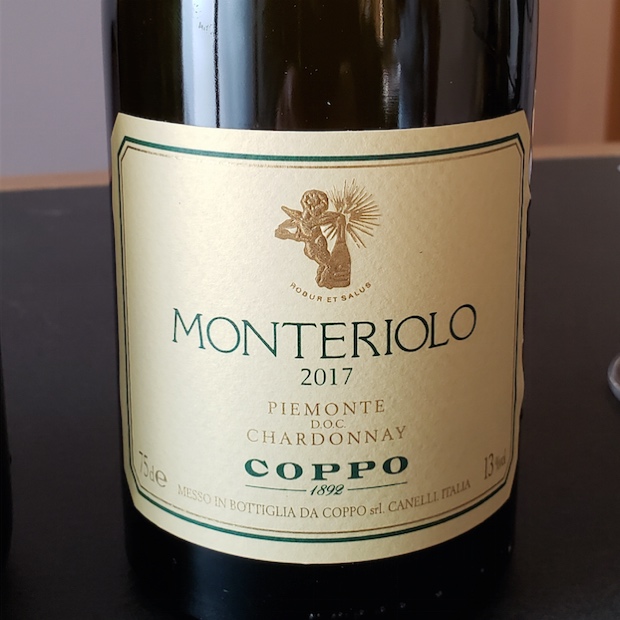
Godello, Sara d’Amato and John Szabo M.S.

Related – Buyers’ Guide to VINTAGES January 25th, 2020

On the morning after we five and the Wine Marketing Association of Ontario’s (WMAO) Magdalena Kaiser paid a visit with winemaker Shiraz Mottiar of Malivoire, a Beamsville Bench producer moving from strength to strength and purveyor of Bench wines simply getting hotter and hotter. Or, as it is said, Mottiar and Mottiar. Malivoire’s are some of Ontario’s most thoughtful varietal wines occupying all the necessary levels and tiers; estate bottlings, small lots and single-vineyards. The whites focus on chardonnay and melon de bourgogne, the reds in gamay and pinot noir. The ace in the hole concerns the province’s finest grouping of Rosé and in fact the Moira Vineyard gifts arguably the best in Ontario. That vineyard along with the winemaker’s home Mottiar block are inching upwards into Premier Cru territory.

Shiraz Mottiar is a thoughtful man of grace, empathy and conviction. He’s also an experimenting scientist with an artist’s brush touch, at the leading edge of his work through wild ferments, whole bunch fermentation, stem inclusion and carbonic styling. He pushes boundaries, slides into percentages many would fear to tread and his wines always come out clean. He has the magic touch and everyone knows it. And he makes wines everyone can afford. You could build an entire cellar by way of Malivoire’s multi-varietal work and the many tiers they fashion from drink now, through mid-term aging and those that will go long. I’ve tasted a few older Malivoires lately and have been blown away by their longevity.

Meeting the Bench man of great insight for a morning’s barrel through the @malivoire oeuvre ~ All carefully, thoughtfully and properly conceived. New marketing and labels pretty sharp too.

The group tasted through 10 examples with Shiraz and these notes reflect that gathering, along with two tasted at the Icewine Festival and one older Melon from last summer. The notes on the 2019 Pinot Noir and Gamay barrels tasted through are restricted to internal rumination and imagination but know this. When those wines hit the bottle they will re-write the varietal script for Ontario. Wait for them.

Malivoire Bisous Rosé, VQA Beamsville Bench, Ontario ($29.95)

The latest disgorgement of Bisous Rosé from Bench pinot noir still sees 24 months of lees aging but now strikes drier than expected. There’s crème fraîche and strawberry tang, more angst than before, crunchy fruit and well-propositioned delineation.  Last tasted January 2020

This ambitious dry Rosé from Malivoire is all about the kisses, not so much in a tuck you in at night sort of way, but in a greet you at the beginning of the night peck on both cheeks. It’s really quite down to earth this Bisous, taken from the rich limestone chalky and cakey soil up on the Beamsville Bench. Twenty-four months of lees aging deliver a strong message of texture but not enough to harden what is ostensibly soft and hugging, traditional method sparkling wine. Now in bottle 18 months this has settled into a comfortable and familiar ambient space, “it’s like heaven to me I must confess.” I’ll be happy to steal my kisses from you, Bisous. Drink 2017-2020.  Tasted December 2017

Malivoire Melon 2019, VQA Beamsville Bench, Ontario ($21.95)

Just about to be bottled (Tuesday January 14th). Picked late because the acids extended longer than usual and 10 per cent of the fruit comes from winemaker Shiraz Mottiar’s home vineyard. Sugary (not sugared) melons, undeniable and absolute salty and marine shell-like melon de bourgogne notations. The specificity of citrus with ever-present neutral grape spirit streak of embracing acidity. Woke melon, wake-up call to more please. Imagine the possibilities with an increased sur-lie styling. More plantings and potential yields could make this happen. Will receive one last sulphuring before bottling. Drink 2020-2024.  Tasted January 2020

Malivoire Melon 2013, VQA Beamsville Bench, Ontario

Impeccable balance and extension have come to this in what is the freshest white you could want at six years of age and almost no cost towards getting it here. Melons and lemons and plenty of unction. An argument for this grape, that beautiful Bench and the amount of time invested. Drink 2019-2021.  Tasted September 2019

Malivoire Rosé Moira 2019, VQA Beamsville Bench, Ontario ($24.95)

Production is “as much as I can get from that site,” tells Shiraz Mottiar, so maximum 800 cases. As always the aridity and the salinity continue to rise, the acids, minerality, near brininess and ultimate stoic balance so secure at the top of the game. Such a high acid vintage for everything but certainly that includes Rosé, yet still the least amount of skin-contact of the three Malivoire blush. Acids just don’t correlate to hue and flesh. Thank pH for the needle’s movement in how this translates from vintage to vintage. Drink 2020-2024.  Tasted January 2020

Malivoire Vivant Rosé 2019, VQA Beamsville Bench, Niagara Escarpment, Ontario (498535, $19.95)

The production can max out at 1,300 cases and yes there is more vivant life, energy and expression than the Moira. Different fruit makes for different strokes yet same folks will love what’s going on. Sharp, high acid vintage, sapid, salty and fine. Drink 2020-2023.  Tasted January 2020

Malivoire Chardonnay Estate Grown 2018, VQA Niagara Peninsula, Ontario (573147, $19.95)

A blend of fruit from three farms, though mostly Moira in origin. Rich and developed vintage, fruit considered and managing to climb up another rung to imagine fruit from all over, orchards everywhere. Nothing buttery about this chardonnay, just crisp, cracking, “aggression played with,” Shiraz style. More oxygen at the juice level, half fermented in old barrels, through April/May. It’s ideal at this cost and you can’t do much better in Ontario. Approximately 2,500 cases made, a VINTAGES Essential. Drink 2020-2023.  Tasted January 2020

Malivoire Mottiar Chardonnay 2017, VQA Beamsville Bench, Ontario ($34.95)

To be released imminently, meaning Spring at some point. A block picked early at high acid and low pH, whole cluster fermented, natural fermentation and only 10 months in barrel. For chardonnay it was a vintage for freshness, quite wet throughout but hot and ideal through harvest. The adapted vines caught up, came to speed and delivered high quality. This is a prime example of what is possible when minor miracles come about and for a Mottiar chardonnay that means stoicism, structure and length. Very balanced and poised MC. Drink 2020-2025.  Tasted January 2020

Malivoire Pinot Noir Moira 2018, VQA Beamsville Bench, Ontario ($34.95)

A short amount of time in barrel (only five to six months), needing a modicum of structure strengthening and keeping freshness intact. High fruit pectin from what is ostensibly a top Rosé block though not a top red made from pinot noir site. As straightforward and easily understood pinot noir as the Bench will ever give. Such a high-end entry point for varietal and place. Drink 2020-2022.  Tasted January 2020

Malivoire Pinot Noir Mottiar 2018, VQA Beamsville Bench, Ontario ($34.95)

The fruit is just juicier, sweeter, more mature and expressive than Moira but also equipped with a next level structure that elevates the Bench game. The one sitting on the darker savour side as opposed to the red popping one. A healthy stem inclusion raises the tension though truth be told you just can’t escape from the beauty of this vintage, the flowers that emit and the pleasure you just get from what can’t help but simply be. Pretty wine from a pretty time. Drink 2020-2023.  Tasted January 2020

Malivoire Small Lot Gamay 2018, VQA Niagara Peninsula, Ontario ($21.95)

Gamay as we know and love, peppery and jolting, embracing and inclusive for all to find joy. From a Malivoire site up aboard a ridge that may not have always been the best site for planting but is increasingly rising into the golden age of gamay reality. More plantings are not merely trend follows but knowing the next 10-20 years of good sites for good wine. Juicy stuff, invigorating and affirming. Drink 2020-2023.  Tasted January 2020

Malivoire Analog 2018, VQA Niagara Escarpment, Ontario ($34.95)

Semi-carbonic, whole cluster fermented cabernet franc with (the same) in gamay and then some pinot noir. A blend of Wismer and Bench fruit, “tuffeau reverb” and dialled up to “11.” Less than 200 cases made of this most curious and never before connected three-pronged blend, like a Euro receptacle for power plugged in with northern North American grooves. An as is red blend with a bit of sweetness for sipping purpose while rocking out .“Why not just make 10 louder?” Drink 2020-2023.  Tasted January 2020

Malivoire Wismer Cabernet Franc 2017, VQA Twenty Mile Bench, Niagara Peninsula, Ontario ($26.95)

Quite the juicy little cabernet franc number with all the notes sung as expected, some savoury, some sweetly peppery and some just red fruit juicy. Red citrus, red current and red liquorice. Easy and nary a heady or anxious moment. Drink 2020-2021.  Tasted January 2020

Malivoire Stouck Farmstead Red 2017, VQA Lincoln Lakeshore, Ontario ($29.95)

The Farmstead carries forward from the red blend previously known simply as Meritage, of 60 per cent merlot and (40) cabernet sauvignon. Still so very youthful, quite reductively protected and mired behind a varnished and savoury candied shell. There’s a litany of high quality 2017 Stouck Vineyard fruit lurking behind and also stuck behind a veil of oak curtains, of French and also American in origin. Acts as if Niagara in Rioja clothing by way of Bordeaux styling. Perhaps confusing in youth that will reveal all charms and dignities, not to mention Lincoln Lakeshore nobility when some mid-range years have melted past. Drink 2022-2026.  Tasted January 2020

Good to go!

godello

Twitter: @mgodello

Instagram: mgodello

WineAlign