We’re going to begin the last week of March with a quartet of white wines as a prayer for the hopes of warmer weather. A bottle full of fresh and sprite grapes to be brought into the temple as a gift to lay down at the altar, sacrificial ferments meant to appease the harbinger gods of Spring. A prayer on the back of a wine angel to usher us out of the cold, to drink in long time missing, rarefied air.
Is this plea just a bit too Exodus 40:6 for you? “And thou shalt set the altar of the burnt offering before the door of the tabernacle of the tent of the congregation.” Maybe too much like an American World War Two patriotic song? “And our trust in the Lord, we’re comin’ in on a wing and a prayer.” Do you read this and think, “See the rich man lost and lonely, watch him as he dines, sitting there just testing all the wines…” Does this make you roll your eyes due to a kitsch allergy? “Our wine, which art in heaven, hallowed by thy legs…For thine is the Chardonnay, the Merlot and the Cabernet. Forever and ever. Amen.”
An assembly of really good white wine seems as good a plan as any to beg for Spring weather, prosaic waxing or not. Let’s just make a plan. Open a bottle of white wine a day for four days, or open one and wait four days. Then look out the window. If I were a betting man I’d say Spring will have sprung.
From left: Casal Di Serra Verdicchio Dei Castelli Di Jesi Classico Superiore 2011, Coopers Creek Select Vineyards Dillons Point Sauvignon Blanc 2012, Estate Argyros Assyrtiko 2011, and Tawse Robyn’s Block Chardonnay 2010
Casal Di Serra Verdicchio Dei Castelli Di Jesi Classico Superiore 2011, Doc Marche, Italy (268169, $17.95, WineAlign) From the VINTAGES March 29, 2014 Release
What once was, though no longer is a single (Montecarotto) vineyard designated Verdicchio, the exceptional quality of the grapes remains obvious, front and centre. A five months lees meets yeast cold soak and a distant, though influencing stone’s throw from a (somewhat) far away coast combine for complex effect. A brilliant platinum hue and loaded stony, mineral relish is piqued by a pinch of salinity. The overall elaboration is urged along by lime citrus in zest, aromatic bitters and evolving fruit entering a nut stage. Very, very Verdicchio. 89 Tasted March 2014 @UmaniRonchiVino@Noble_Estates
Coopers Creek Select Vineyards Dillons Point Sauvignon Blanc 2012, Marlborough, New Zealand (66092, $19.95, WineAlign) From the VINTAGES March 29, 2014 Release
There is just something about Sauvignon Blanc from vineyards on or near the shore of Cloudy Bay. Alan and Petrina Shutkowski’s plot in Morgans Road joins ranks the likes of the original and iconic Cloudy Bay and te Pā as purveyors of distinct and inadmissible fruit. Rises to a next level concentration and exceptional length. Larger scale producer does upscale SB at a large-scale price with distinction. A thing that sings long and in the right green grass key. Avoids the sickly, herbal sweetness of overbearing aspara-gooseberry and bell pepper. Incredible acids and just the right kind of salivating, mouth-watering verve and tang. Just a pinch of grapefruit pith joins in to magnify the bitters in all the right ways. Tasted March 2014. 91@CoopersCreekNZ
Estate Argyros Assyrtiko 2011, Santorini, Greece (366450, $22.95, SAQ 11901091, $24.50, WineAlign) From the VINTAGES March 29, 2014 Release
A 100 per cent Assyrtiko from a 150 year-old, Cycladic Phylloxera sanctuary vineyard. Separates itself from other Santorini adelphoi by ageing 20 per cent of the inoxydable, ancient-minded grapes in French barrels. An Assyrtiko that can’t help be anything but stony, atomic driven goodness. Volcano flow and spew, with more texture than most, its elevated price a necessary reflection of a tertiary expertise. Elevated aromatics, locked in tight by the barrel and matched by extreme flavours, so primary, raw, powerful, relentless and grippy. A remarkable white wine that impresses with a sensation of mouth rope burn full of complex, seafaring knots, this Assytiko will age for 15 years in the cellar and develop into something ethereal. Will melt away in dreamy waves when it settles together. Myth will beget legend, legend will beget truth. 93 Tasted March 2014 @KolonakiGroup
Tawse Robyn’s Block Chardonnay 2010, VQA Twenty Mile Bench, Niagara Peninsula,Ontario (662841, $45.95, SAQ 11031443, $48.00, WineAlign) From the VINTAGES March 29, 2014 Release
This current visit to the ever-ambrosial Robyn’s Block 2010 is unlike any that have come before. Seemingly lignified at present, a stranger in town, in an unexpected, dumb phase stalled as if by agostamento. Twenty Miles of limestone lurk and a green gem’s goddess figure hides behind the looking-glass. This regnant Robyn pleads “take away my inhibitions, take away my solitude.” While not the most flattering of her evolutionary positions, a retinue of resurgent fruit will lead to Robyn’s exodus. A few years patience and this cool climate Chardonnay will regain her warm, tropical smile, to shine again. 92 Tasted March 2014 @Tawse_Winery
Andrew Wiggins, #22 of the Kansas Jayhawks, drives upcourt as Marcus Smart, #33 of the Oklahoma State Cowboys, defends during the Big 12 Basketball Tournament quarterfinal game at Sprint Center on March 13, 2014 in Kansas City, Missouri.Photo: Jamie Squire/Getty Images
Choosing wines from a wall of brace and girder filled options presents as much a degree of difficulty as picking winners from an NCAA March Madness bracket. When it comes to teenage basketball, do you stay the favourite course and go with all number one seeds? Should you think underdog, like Coastal Carolina Chanticleers or the Albany Great Danes? Who will be this year’s 2013 Florida Gulf Coast Eagles? Or the other 2013 final-four sleepers from Wichita State? Or Virginia Commonwealth in 2011? Butler, Davidson, George Mason, Kent State, Indiana, Loyola Marymount, Villanova, this list goes on. Who can forget the Jimmy V. coached 1983 North Carolina State Wolfpack?
When you consider what wines to open alongside the march to the Final Four, or what to drink in March, are you thinking Cinderella story or go to, can’t miss favourites? Being partial to the underdog, the lesser known, smaller lot, less marketing backed bottle is not only smart but worth the risk. Winning the pool because you chose the right lower seed and picking out a wine gem from a sea of same-old, same-old is a winning combination. Here are six unsung heroes, dark horse wines to seek out this March. Get a little madness in your life.
Clockwise from top left: Casa Do Valle Grande Escolha 2012, Maison Adrien Vacher Les Adrets Altesse Roussette De Savoie 2012, Rockway Vineyards Small Lot Reserve Red Assemblage 2011, Niagara Peninsula, Tawse Gamay Noir 2012, Prà Soave 2012, and Le Clos Jordanne Le Clos Jordanne Vineyard Pinot Noir 2011
Casa Do Valle Grande Escolha 2012, Vinho Verde, Portugal (276220, $15.95, WineAlign) From the VINTAGES March 1, 2014 Release
Up a buck but for its nerve, ball fake, back-door cut and caution thrown to the wind, deserves to be so. Fast breaking mineral Vinho Verde without the hot spring, travertine effervescence. Rocks upon rocks, torched by the sun and set beneath a ripe apple orchard. A good bitterness, blanched nuts and lime in full-toasted flavour. Not your avô’s VV and that’s a good thing. Progress matters. 89 Tasted February 2014 @winesportugalCA
Maison Adrien Vacher Les Adrets Altesse Roussette De Savoie 2012, Savoie, France (365163, $16.95, WineAlign) From the VINTAGES March 1, 2014 Release
Expectations run high for this montane white to be light, ethereal and delicately floral. To the contrary, the Savoie Altesse/Roussette (sort of like saying Bourgogne Blanc/Chardonnay) is at first an offensive foul, a bit stinky, sweaty and humid, like the efflux of a runny, unwashed rind cheese. Auto emissions too, acquired aromas for sure, with more mineral to taste, along with funky apples on steroids. Thoroughly invigorating. Can you get on board? 89 Tasted February 2014 @ProfileWineGrp
Rockway Vineyards Small Lot Reserve Red Assemblage 2011, Niagara Peninsula (321893, $16.95, WineAlign) From the VINTAGES March 29, 2014 Release
Backs up the 2010 with another vintage that offers talented local ”Meritage balance for under $20.” The blend of Cabernet Franc, Cabernet Sauvignon and Merlot is a Nik Stauskas-like pure shooter, a thing of BEEF: Balance, eyes, elbow, follow through. Solid extract winged by top-notch acidity and nicely packaged with waves of fruit. The extraction may not allow this modestly priced red to age without some deconstructing so enjoy the fresh and vibrant fruit now and for two or three more years. Will really work with game nights. 88 Tasted February 2014 @Rockway Vineyard
Tawse Gamay Noir 2012, VQA Niagara Peninsula, Ontario (322545, $18.95, WineAlign) From the VINTAGES March 29, 2014 Release
The Tawse 2012 Gamay is a roaming shark with a Hammerhead-butt of (the serious side of) varietal aromas; tar, char and cherry pie. Capable of scoring points in the paint, a double-double even, like the twin tower Brampton brothers at New Mexico State. A very humid ’12, as per the vintage, with full-on flavour and in avoidance of the floor’s splinters. Forsakes the shaken and reductive instability of some young Tawse (big reds in barrel) for easy buckets kissed off the glass. For now and with every meal, including breakfast. Tang, inhibition, ball-stripping, #GoGamayGo. 89 Tasted February 2014 @Tawse_Winery
Prà Soave 2012, Veneto, Italy (74534, $19.95, WineAlign) From the VINTAGES March 1, 2014 Release
Enter screw cap, exit the designation Classico. Pra Soave the man repossesses its self-respect and re-brands itself under the name “Otto.” This Garganega ventures into rangy, rambunctious, starburst territory. The tang pitches in many tones, there is texture to chew and it travels to lengths not typical for entry-level Soave. Bold Venetian. Madness even. “And I remember how we’d play simply waste the day away,” something the Otto will gladly encourage. The only Soave you might consider eating on a plate but Otto insists “couldn’t enjoy it any more, Mom. Mm, mm, mmm.” And one! 89 Tasted February 2014 @TheVine_RobGroh
Le Clos Jordanne Le Clos Jordanne Vineyard Pinot Noir 2011, VQA Niagara Peninsula, Twenty Mile Bench (33902, $45.00, WineAlign) From the VINTAGES March 29, 2014 Release
Extremely good showing for this stalwart in what is becoming a classic Twenty Mile Bench vintage. Cran/Raspberry earthy-straw scents layered in a cake of overlapping, alternating flavours in raspberry (again) and quality chocolate. More intensity than the other ’11 LCJ’s at this early stage, simultaneously concentrated and light, like a ball-distributing point guard with 20-20 vision. Increased oak in dribble drive motion really ties the spiced flavours together, without sacrificing freshness. This will improve for five years, if not more. Winemaker Sébastien Jacquey must have called on his muse for this LCJ because “some kind of madness has started to evolve,” and from here on in this Pinot will solicit a “need to love.” 92 Tasted February 2014 @LeClosJordanne
The winter that never ends. White out conditions, snow squalls, wind advisory and chill warnings. Everything just feels heavy. The OPP’s request? Just stay home, Ontario. Prepare for the worst, hunker down and warm the belly with full-bodied wines, strong mocker, beer and hearty winter meals. The weather will step aside in April. Until then, satiate yourself.
Here are six strength fortifying libations to ride the final wave of winter’s brutal conditions.
Clockwise from left: Innis & Gunn Irish Whiskey Finish, 13th Street White Palette 2011, Ara Single Estate Pinot Noir 2011, Planeta Chardonnay 2010, Bachelder La Petite Charmotte Nuits Saint Georges 2011, and Antinori Pian Delle Vigne Brunello Di Montalcino 2008
Stout matured over American Oak Heartwood and infused with Irish Whiskey. A Cimmerian entry in hue and hunger peels back to a curious lightness of being. The wood tends to an Arabian mocha aroma, the whiskey to molasses and gingerbread baking spice. The 7.4 per cent alcohol is integrated though an incendiary smoky magic weighs in to toast biscuits and braise a beefy pot au feu. “The Smoky Life is practiced everywhere,” in the I & G. A beer of good charm, smooth, silky, singing in melodic grace and with confidence. 90 Tasted March 2014 @InnisandGun
The grapes: Riesling, Sauvignon Blanc, Gewürztraminer and Chardonnay Musqué
The history: Niagara winery founded in 1998. Chablis native Jean-Pierre Colas joined 13th Street as winemaker in 2009. Co-owners of the winery, the Whitty family has been farming fruit in Niagara for well over 100 years
The lowdown: Much of the fruit comes from the estate’s Creek Shores appellation vineyards, sedimentary, well-drained lighter soils on a landscape highly dissected by its many streams.
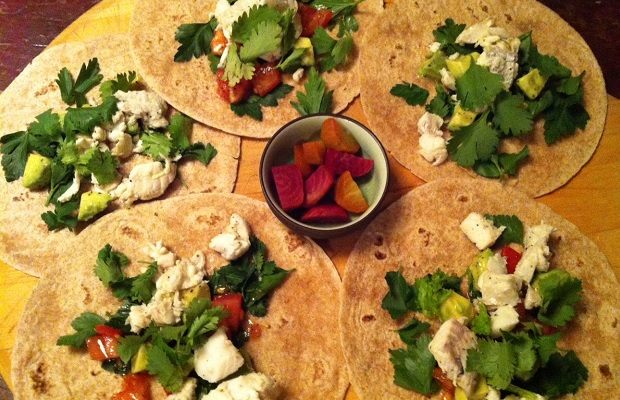
The food match: Fish Tacos
13th Street White Palette 2011,VQA Niagara Peninsula (207340, $15.95, WineAlign) From the VINTAGES March 15, 2014 release
JP’s who’s who bottle of white grapes, a mad scientist’s blend, the flask filled with Riesling, Sauvignon Blanc, Gewurztraminer and Chardonnay Musque. A re-release and much improved with a year’s extra weight, its “got your body right now.” Fortified by a carapace of grape spirits and purposeful in a white meritage sense of community, plus citrus, pith and a far-reaching, right correct absinthian length. You better you bet. 88 Tasted October 2013@13thStreetWines
Fish Tacos Photo: Michael Godel
The grape: Pinot Noir
The history: From Marlborough on the western side of the Waihopai Valley. The name is both the indigenous Maori word for “pathway” and Latin for “altar”
The lowdown: “With rugged mountains on either side and two icy rivers cutting through, it’s a pretty extreme place. The very definition of raw, cool climate conditions.”
Ara Single Estate Pinot Noir 2011, Marlborough, New Zealand (361279, $23.95, WineAlign) From the VINTAGES March 15, 2014 release
Immediate impressions are of a user-friendly Pinot Noir in conceit of black cherry, chocolate and blueberry spice. These are surface notes quickly displaced by an adventurous senses of living on the edge. The wine dips into a brine and lithic earth saturated by glacial melt. This is a different sort of Marlborough Pinot that speaks a modern english, if too young to be understood. “I’ve seen some changes but it’s getting better all the time.” Will try the Ara again in a year or two and likely say I melt with you. 89 Tasted February 2014 @AraWine_UK
The grape: Chardonnay
The history: Planeta first made this wine 20 years ago in 1994. It has become “the image illustrating the changes taking place in Sicilian wines.”
The lowdown: From Ulmo (calcareous with sections of deep vegetable matter) and Maroccoli (medium clay soil rich in limestone) vineyards in the area of Sambuca di Sicilia. Powerful Chardonnay.
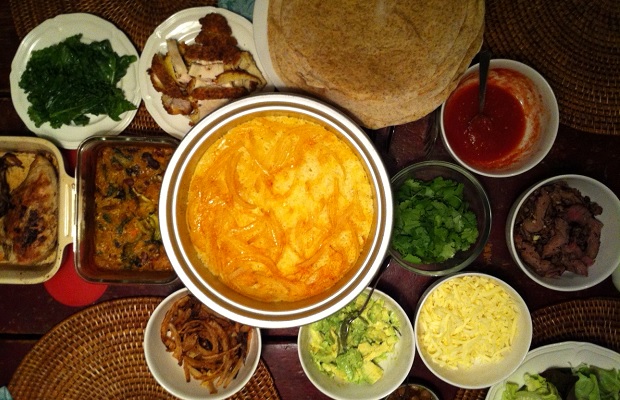
The food match: Taco Night
Planeta Chardonnay 2010, Sicily, Italy (109652, $38.95, SAQ 00855114, $39.15, WineAlign) From the VINTAGES March 29, 2014 release
Wantonly lavish, heavy and tropically delicious. If ever there were a red wine substitute this is the one for the wishful thinker. Tasting this Sicilian is like liquid breathing sweet and salty, drawn butter. It’s a glass of dessert Chardonnay, dichotomous and oxymoronic in congealed warmth like cold-stabilized, oxygen-rich, perfluorocarbon. The tropical warmth is a combination of honey and lemon-glade, like Savennières with an unexpected aged Jura, oxidized, herbal angle. There can be no arguing the complexity of this Sicilian dream. Extreme humidity, with a bitter middle streak and ground nut flavours. 90 Tasted March 2014 @Noble_Estates@PlanetaWinery
Taco Night Photo: Michael Godel
The grape: Pinot Noir
The history: Thomas Bachelder, flying winemaker, architect of the Bachelder Project, of trois terroirs, in Niagara, Oregon and Burgundy
The lowdown: “Burgundy is my favourite place to make wine,” admits Thomas Bachelder. “The large négociant control all (44) 1er cru vineyards so there are not a lot of small growers working with Beaune fruit.” Enter terroirman.
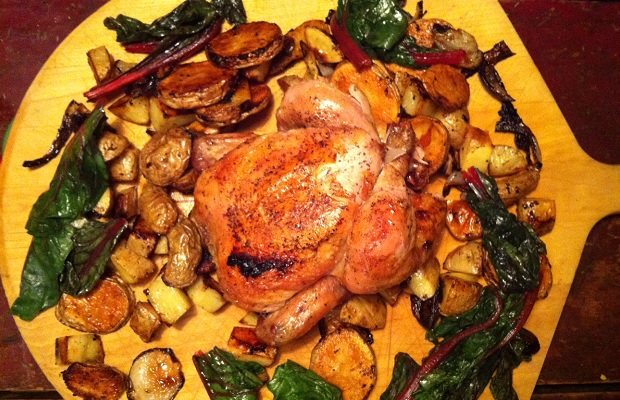
The food match: Roast Chicken, Potatoes, Swiss Chard
Bachelder La Petite Charmotte Nuits Saint Georges 2011, Burgundy, France (357228, $49.95, WineAlign) From the VINTAGES March 15, 2014 release
Is so floral, mineral, intense and hypnotic it might be dubbed the Serpent Charmer. Iron and wine indeed, the iron of Nuits, the perfume of Beaune. This provocative bottling represents the third year of production, is conspicuous in Anisde Flavigny and an underlying gate. If montagnes is the harming one, this is the charming one. These are all from the same barrels, so what really affects the wines the most? Land and hand. 93 Tasted November 2013 @Bachelder_wines
Roast Chicken, Potatoes, Swiss Chard Photo: Michael Godel
The grape: Sangiovese Grosso
The history: The family has been in the wine business since Giovanni di Piero Antinori joined the Florentine Guild of Vintners in 1385. The Antinori estate is responsible for some of Tuscany’s most famous wines; Solaia, Tignanello and Guado al Tasso.
The lowdown: As stalwart a Brunello as any, Pian Delle Vigne is not immune to critical conjecture. Applying kudos to any big house in this polarizing vintage will raise an eyebrow or two. Why not Antinori?
Antinori Pian Delle Vigne Brunello Di Montalcino 2008, Docg, Tuscany, Italy (651141, $59.95, Nova Scotia 1006431, $64.80, WineAlign) From the VINTAGES March 15, 2014 release
Goes at it older, bolder, tried and truer than had recently been the case, especially in 2007. Leather, cherries, seeping tea and peppery, earthy, funky dates. Purity of fruit, obviousness in Sangiovese Grosso aromatics and it is only when you taste that you are dealt with the full effect of its power and girth. Quite viscous on the palate, tough, gritty chain of tannin and qualified, felicitous bitters on a very long finish. Best Pian delle Vigne in some time, at least back to 2001. 93 Tasted November 2013 @AntinoriFamily
The study was prefaced through the idea that “compounds of plant origin and food components have attracted scientific attention for use as agents for cancer prevention and treatment. Wine contains polyphenols that were shown to have anti-cancer and other health benefits.” Put two and two together and voilà. The group investigated the “effect of wine on proliferation and survival of human non-small cell lung cancer (NSCLC) cells and its effects on signaling events.” The findings are nothing short of astonishing.
The operative observation here is that low doses (read: moderate consumption) of wine may have anti-cancer and chemo-preventive properties.” White wine’s cancer fighting properties exist (at two per cent concentration) though they are not in the same league as Red wine (five per cent). Or, you need to (very rough math) drink 250 per cent more white wine to reap similar benefits. Such a quagmire.
Evangelia Litsa Tsiani, associate professor of community health sciences at Brock University added “our next step is to use doses of wine that correspond to moderate wine consumption in humans – one to two glasses per day – and examine the effect on tumor growth in mice.”
We already know that the Brock University Cool Climate Oenology and Viticulture Institute’s lecture series (now in its seventh season) has had a major impact on the global grape industry. Dr. Belinda Kemp, CCOVI Scientist, Oenology noted that “they’re a great resource for the wine industry and wine researchers anywhere in the world.” I wonder if the department has plans for a wine and health benefits lecture during its eight season. Hint, hint.
The ancients, or late Bronze Age people’s such as the Egyptians, Arameans, Assyrians and Babylonians used the natural world to prevent sickness and disease. Archaeologists recently discovered wine in an Israeli wine cellar, dating back to 1700 BCE. Think the Greeks invented wine? This discovery is 1,262 years older than the Parthenon. That’s nearly as old as the Pyramids. Wine and health relations go back to a time when a woolly mammoth still walked the earth, a time when The Hammurabi code was written. The premise? A commitment to protection of the weak from being brutalized by the strong. Just like wine.
In an attempt to justify what may be construed as profligate connections, the fact of the matter remains. With each passing study conjured up and proven by internationally recognized educational institutions, the health benefits of wine continues to develop as a thing of undeniable valence. Take honest wine with food, take it regularly and live longer. Here are 10 current releases to help keep the wolves of virus and disease at bay.
From left: Dante Robino Bonarda 2011, Domaine Des Amadieu Cuvée Vieilles Vignes Cairanne Côtes Du Rhône Villages 2011, Bodegas Olarra Anares Reserva 2006, Fantinel Sant’helena Pinot Grigio 2012, and Mike Weir Limited Edition Riesling 2012
Dante Robino Bonarda 2011, Mendoza, Argentina (277640, $14.95, WineAlign) From the VINTAGES March 1, 2014 Release
Sourced from the Santa Rosa sub region of Mendoza. From sandy soils and built upon a brooding, musty set of wood-influenced aromatics that put the lurking fruit to test. Painfully dry with pronounced flavours of red licorice, sour black cherry, spice and baked figs. Gains richness as it breathes and then the drying tannins take over. Quite an effort for $15. Worth a look for something different and in spite of the idiomatic value it speaks. 88 Tasted February 2014 @DanteRobino
Provenant de la sous-région de Santa Rosa de Mendoza. De sols sableux et construit sur un ensemble de moisi couvaison des composés aromatiques du bois d’influence qui mettent le fruit qui se cache à l’épreuve. Péniblement sec aux saveurs prononcées de réglisse rouge, griotte, d’épices et de figues cuites. Les gains richesse comme il respire, puis les tanins de séchage prendre le dessus. Tout un effort pour 15 $. Cela vaut le coup pour quelque chose de différent et en dépit de la valeur idiomatique elle parle. 88 Dégusté Février 2014
Domaine Des Amadieu Cuvée Vieilles Vignes Cairanne Côtes Du Rhône Villages 2011, Rhone, France (354233, $18.95, WineAlign) From the VINTAGES March 1, 2014 Release
Paying a bit of extra attention to lower-priced, high alcohol Rhônes can offer rewards. There is much metal and merit in this Cairanne. At the price it imitates the grandeur of more expensive villages, like Châteauneuf-du-Pape and to a more realistic extent, Vacqueyras. Hued in drupe, holly berry pitch, saturated in berries, spiked by berry liqueur and seeping along with spices and extracts. Outwardly generous in flavour, knowing well that “while we’re on the way to there, why not share.” All in all he ain’t heavy, he’s my brother. 89 Tasted February 2014 @Amadieu_G
Payer un peu d’attention supplémentaire à bas prix, Rhônes forte teneur en alcool peut offrir des récompenses. Il ya beaucoup de métal et de mérite dans cette Cairanne. Au prix il imite la grandeur de villages plus chers, comme Châteauneuf-du-Pape et dans une mesure plus réaliste, Vacqueyras. Hued en drupe, houx hauteur de baie, saturé dans les baies, dopés par baie liqueur et infiltration avec des épices et des extraits. Extérieurement généreux en saveurs, sachant bien que “pendant que nous sommes sur le chemin de là, pourquoi ne pas partager.” Dans l’ensemble, il n’est pas lourd, il ya mon frère. 89 Dégusté Février 2014
Bodegas Olarra Anares Reserva 2006, Rioja, Spain (244723, $19.95, WineAlign) From the VINTAGES March 1, 2014 Release
Perhaps it’s just as a comparison to the rest of this Spanish armada fiasco I am in the throes of tasting but this Tempranillo with minor support from two G’s, Garnacha and Graciano, really has got a hold on me. I grant that it’s a bit faded and heading to melted toffee but at $20 and with the idea to enjoy it now, the wild raspberries, gariga and spicy wood notes are a treat. Savoury, licorice, roast tomato and grilling baby veal flavours will help with a slow braise of the animal’s tougher cut. 90 Tasted February 2014
Peut-être c’est juste que la comparaison avec le reste de cette armada fiasco espagnol je suis dans les affres de la dégustation mais ce Tempranillo avec le soutien mineur de deux G, Garnacha et Graciano, vraiment a obtenu une prise sur moi. Je reconnais que c’est un peu défraîchi et la position de caramel fondu mais à 20 $ et avec l’idée de profiter de ce moment, les framboises sauvages, gariga et des notes de bois épicés sont un régal. Salés, réglisse, rôti de tomate et griller saveurs bébé de veau aideront avec un lent braise de coupe plus difficile de l’animal. 90 Dégusté Février 2014
Fantinel Sant’helena Pinot Grigio 2012, Collio, Friuli, Italy (310144, $19.95, WineAlign) From the VINTAGES March 1, 2014 Release
High quality Pinot Grigio from Friuli, with an Alps to Adriatic micro-climate ideally suited to both warm and cool the needs of the variety. You might ask, what difference does that make? Plenty. So much more distinct than reputation would hold and anything but just a Northern Italian white. Lit candle waxy and spiced in Sandalwood, with a lemon peel feel, cool climate salinity and gravelly, silt-inflected Spring run-off. The world’s fleet of Pinot Grigio “have been through hell and high tide,” but thanks to Friuli, the grape keeps its respect. Full flavoured, with smithy verve, punchy, more than practical. 90 Tasted February 2014 @ProfileWineGrp
Mike Weir Limited Edition Riesling 2012, VQA Beamsville Bench, Niagara Peninsula, Ontario (229286, $22.95, WineAlign) From the VINTAGES March 1, 2014 Release
The off-dry nose is an anomaly and I’m very curious to see where this goes. Persists very sweet to taste, without enough acidity, unfortunately, though the tropical flavours are boisterous and plentiful. This is a more than admirable attempt at a Kabinett style done right by a Mosel intimacy and attitude, though it’s lacking in body and structure. Still, it will age longer and develop more secondary characteristics than many a Niagara Peninsula Riesling, especially for the price. Worth tracking a case of 12 for five to 10 years. 89 Tasted February 2014 @WeirWine
Le nez de demi-sec est une anomalie et je suis très curieux de voir où cela va. Persiste très doux au goût, sans suffisamment d’acidité, malheureusement, bien que les saveurs tropicales sont bruyants et copieux. Il s’agit d’une tentative plus admirable à un style Kabinett bien fait par une intimité Moselle et de l’attitude, si elle fait défaut dans le corps et la structure. Pourtant, il va vieillir plus longtemps et développer des caractéristiques plus secondaires que beaucoup de Niagara Peninsula Riesling, surtout pour le prix. Suivi d’un cas de 12 pour cinq à 10 ans la peine. 89 Dégusté Février 2014
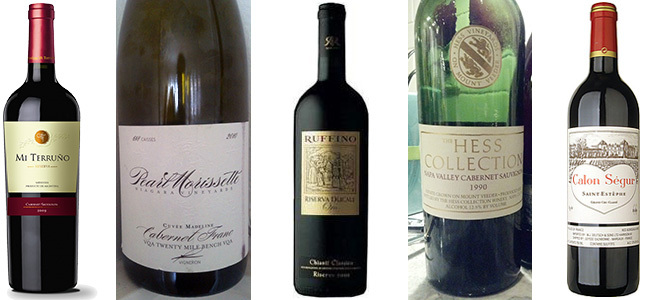
From left: Southbrook Triomphe Cabernet Sauvignon 2012, Trimbach Réserve Riesling 2010, Le Clos Jordanne Village Reserve Pinot Noir 2011, Marchand Tawse Meursault 2011, and Kistler Mccrea Vineyard Chardonnay 2011
Southbrook Triomphe Cabernet Sauvignon 2012, VQA Niagara On The Lake, Ontario (193573, $22.95, WineAlign) From the VINTAGES March 1, 2014 Release
Southbrook’s seminal Cabernet has become that kind of go to, reliably delicious and affordable red, not unlike Sterling’s Napa bottling that emerged in the late 1990’s. That this can happen in any vintage out of the Niagara Peninsula is really quite amazing. Even more incredible is that here in 2012, it’s almost too much of a good thing, too hot, too sweet. Still, only Triomphe smells like this and on that note I must give it my thumbs up. The Peninsula’s earth, the purity of that warm, rich ’12 fruit, a touch of disco, that Sperling perfume. The palate is explicitly sweet, on that I’m sure most would agree but the wood is an afterthought. Alcohol is in check, berries are ripe, tannins are refined, ready to resolve slowly, efficiently and with pleasure. Direct, solid and righteous, despite the sugar high. 89 Tasted February 2014 @SouthbrookWine@TrialtoON
Trimbach Réserve Riesling 2010, Alsace, France (995316, $27.95, WineAlign) From the VINTAGES March 1, 2014 Release
Such a dry and powerful Alsatian example. Tight, angular, typically piercing and even more citrus-driven than ever. Jacked up, better than your average Joe Riesling. As a textbook example from a place where the variety rules, it tells “me that this world is no place for the weak.” Still, I find the Reserve bottling a bit overpriced, not having as much personality such as the cost-equivalent Zind-Humbrecht Herrenweg de Turckheim. Another Trimbach that’s just “gotta have no illusions” and look sharp. 90 Tasted February 2014 @trimbach@WoodmanWines
Un tel exemple alsacien sec et puissant. Tight, angulaire, généralement perçant et même plus agrumes axée que jamais. Mis sur cric, mieux que votre moyenne Joe Riesling. Comme un exemple classique d’un endroit où les règles de la variété, il dit “moi que ce monde n’est pas un endroit pour les faibles.” Pourtant, je trouve la Réserve embouteillage un peu trop cher, ne pas avoir autant de personnalité tels que le coût équivalent Zind Humbrecht Herrenweg de Turckheim. Un autre Trimbach qui est juste “Gotta Have pas d’illusions” et regardez pointu. 90 Dégusté Février 2014
Le Clos Jordanne Village Reserve Pinot Noir 2011, VQA Niagara Peninsula, Ontario (33894, $30.00, WineAlign) From the VINTAGES March 1, 2014 Release
Something’s missing, or rather something is happening here. The LCJ omnipresent warm Pinot coat of harm is conspicuous in its absence, or has it been reigned in? This 2011 is so much more friendly, more soft-spoken, expertly judged and picked ripe fruit richer than before. Plenty of tang and tannin but the pronouncement is in a savoury basil/chervil kind of way. Not just another high made by just another crazy guy. A most excellent, bright, Roxy Village Reserve, full of atmosphere and ambient music. 91 Tasted February 2014 @LeClosJordanne
Il manque quelque chose, ou plutôt quelque chose qui se passe ici. Le manteau chaud omniprésent LCJ de Pinot de préjudice brille par son absence, ou at-il été régné en? Ce 2011 est beaucoup plus convivial, plus à la voix douce, experte jugé et ramassé des fruits mûrs plus riche qu’avant. Beaucoup de saveur et de tanin mais la déclaration est dans un savoureux basilic / cerfeuil sorte de façon. Pas seulement un autre haut fait par juste un autre gars fou. Un excellent, clair, roxy Village Reserve, plein d’atmosphère et musique d’ambiance. 91 Dégusté Février 2014
Marchand Tawse Meursault 2011, Burgundy, France (285866, $66.95, WineAlign) From the VINTAGES March 1, 2014 Release
Winemaker Pascal Marchand possesses post-modern abilities to coax the most richesse from out of the basic of basic appellations in the Burgundian universe. This ’11 elevates an umbilical villages to exalted heights and it has really settled into its skin since I last tasted it in May of 2013. The land is speaking and oozing in a primordial drenching. The tang and verve melts in the mouth, like foiegras cotton candy. What sets it apart is the end game mellow melding of pronounced flavours left to free fall effortlessly into a black hole of critical mass. 92 Tasted May 2013 and February 2014
Vigneron Pascal Marchand possède des capacités post-modernes pour amadouer le plus Richesse de l’extérieur de la base des appellations de base de l’univers bourguignon. Cette ’11 élève un villages ombilical à des hauteurs exaltées et il a vraiment installé dans sa peau depuis que j’ai goûté en mai 2013. La terre parle et suintant dans un trempage primordial. La soie et la verve fond dans la bouche, comme le foie gras de barbe à papa. Ce qui le distingue est la fin du jeu fusion douce de saveurs prononcées de gauche à la chute libre sans effort dans un trou noir de masse critique. 92 Dégusté mai 2013 et Février 2014
Kistler Mccrea Vineyard Chardonnay 2011, Sonoma Mountain, Sonoma County, California (353706, $92.95, WineAlign) From the VINTAGES March 1, 2014 Release
The vineyard speaks first, has the microphone, tells of its volcanic, limestone story going back to 1988. Talks in a Chablis whisper which may come across as narcissistic or somehow simple, but surely deserving to receive the benefit of the doubt. The kind of toast that has you reaching for the last jar of homemade berry jam. Lemon/lime reduction, as a gelée, consommé or demi-glace of fine Chardonnay whiffed by subtle smoke and non-discernible fat. The most subtle of all the Kistlers. 93 Tasted February 2014 @TheVine_RobGroh
Le vignoble parle d’abord, a le microphone, raconte sa volcanique, calcaire histoire remontant à 1988. Pourparlers dans un murmure Chablis qui peut apparaître comme narcissique ou en quelque sorte simple, mais sûrement digne de recevoir le bénéfice du doute. Le type de pain que vous a atteint pour la dernière pot de confiture de petits fruits maison. Citron / réduction de la chaux, comme une gelée, consommé ou demi-glace de fin Chardonnay whiffed par la fumée subtile et graisse indiscernable. Le plus subtil de tous les Kistlers. 93 Dégusté Février 2014
The world’s most famous wine critic is not happy. His claim of “wannabe” scribes hell-bent to focus on obscure wines most consumers can never find has raised a maelstrom of retort. Robert Parker published a diatribe last month about “a vociferous minority” of “euro-elitists” vying for journalistic market share “perpetrating nothing short of absolute sham on wine consumers.”
Them’s fightin’ words. No, not that rant by Robert Parker about Robert Griffin III. Wine critic Robert Parker Jr. railed against a bevy of unnamed bloggers on the natural, honest and low-alcohol wine supporting bandwagon. His claim? Natural wines will be exposed as fraud. Parker’s would-be assailants are an outspoken generation who would seek to bring down those classic grapes capable of ripe extraction and elevated levels of sugar and alcohol, namely Cabernet Sauvignon, Pinot Noir and Chardonnay. The intensity-loving reviewer has positioned himself as the establishment, a victim agonizing over the sanctification of “godforsaken grapes,” like Blaufränkisch and Trousseau.
There isn’t a writer in the bunch I wouldn’t read, can’t learn from or don’t find funny, but the need to chime in on what is obvious and already understood leaves me dumbfounded. In wine, as in life, there are some things that just are what they are, like them or not. Mr. Parker, you carved your niche. Those who lay with you ate cake. The model worked. It held water and was extremely successful for a long time. You are this week’s Napa Wine Writers Symposium keynote speaker, where you will feel the love. No one will ask, what have you done for me lately? You created the establishment and are of course trying to protect the status quo. You’ve been ridiculously prolific. Integral to the high-frequency, high-end wine buyer. And you are just a writer. Really. So what if the dogs are seeing signs of Queegish dotage. You named no names in your rant, so who exactly did you mean to insult? The world is your oyster. What’s with the bitching?
Perhaps Parker touched an insecure spot, the one where self-doubt creeps in. The one that drives writers to defend themselves, even if the attack is not a personal one. The need to tear him down is strange at best. It smells of poli-campaign slander. If he’s no longer relevant, as a vehement bunch seem to scream and shout, why bother? Why is the wine writing community one where sides desperately need to be taken? To both sides I caution the high road. Let writers write and if you think they are wrong or have nothing to say, ignore them. Like a tree falling in the forest, is an unread writer ever really heard?
RMP: "My basic philosophy is live and let live." #WWS14
It’s understood that controversy sells and lively discourse is healthy. In this case it has produced more than a novella of interesting reads. The current generation of critics, bloggers and reviewers is replete with some stupidly smart writers who have chosen wine as their raison d’écrire. That they chime in and offer their take on everything from varietal obsessions to tasting bans and producer/journalist relationships is certainly fascinating. Arguing the merits of varietal worthiness is fine. Discussing the pros and cons of esoteric versus classic wines on restaurant cards is relevant. Throwing sticks onto the ice, choosing teams and starting fights simultaneous to the debate loses sight of the original topic. I am not suggesting a wine writer’s love in but would more levity and space not foster an environment where the wines themselves matter more than the people who talk about them?
Alder Yarrow and Robert Parker shook hands. Smiles, no punches. #WWS14
Tasting, talking about and writing up wines seems the course to stay, whether it be reviews on varieties never heard of or an obnoxiously fat glass of buttery Chardonnay. Richard Auffrey fights the good fight but still takes a stab at the beast. The always dry W. Blake Gray floats on in his singular, ethereal way, and by doing so, gets it right. He wants you to know I’ll have some Roussillon, hold the Rivesaltes. With Tuba and Alto Sax. Perhaps Gray would agree with me. If I need a dose of scathing criticism or irony I’ll turn on Bill Maher, or put on a Bill Hicks Rant in E-Minor.
RMP: "I just don't think by and large most people like negativity. I’m a glass half full guy." #wws14
Music and wine can work magic when paired together. Jamie Goode has been exploring the possibilities. Sometimes it’s just a matter of breaking wine down to the base, choosing grapes from places where they are made in straightforward and simply powerful ways. Likewise, clicking an uncomplicated, three-chord arrangement on YouTube or the I-pod can really change the outlook of a day. Here are six rock ‘n’ roll wines, in four-four time, ready and willing to ease your mind.
Clockwise from left: Alamos Torrontés 2013, Lar De Paula Crianza Tempranillo 2008, Sophora Sparkling Cuvée, Grant Burge 5th Generation Shiraz 2012, Thorn Clarke William Randell Shiraz 2010, and Poderi Colla Dardi Le Rose Bussia Barolo 2008
Alamos Torrontés 2013, Salta, Argentina (81539, $13.95, WineAlign)
From Salta in north west Argentina, what is so appealing about this well-priced bottling is the salinity and outright humidity it always displays. Torrontés gives so much away aromatically, by way of flowers and the verdigris of mountain ferns. This Catena entry-level wine achieves all of the above and for a song. This Alamos is medicinal, reeks of orchids sweating in a greenhouse and teases with white pepper. It’s short and quick but efficient. Excellent value. 88 Tasted January 2014 @CatenaMalbec@MalbecLife
Lar De Paula Crianza Tempranillo 2008, Rioja, Spain (358770, $16.95, WineAlign) From the VINTAGES Feb. 15, 2014 Release
Entry-level Rioja was nothing but a house party. Was surely rocking a year ago but now a fading, dry cake of rusticity, with the slightest hydration of charred sour cherry. Solid Crianza, though short-lived, with some bitter notes and good acidity in tight corners. Where once it “said move it, groove it,” now it laments “baby, don’t you lose it.” 87 Tasted February 2014 @HHDImports_Wine
Sophora Sparkling Cuvée, New Zealand (353656, $19.95, WineAlign) From the VINTAGES Feb. 15, 2014 Release
Frothy, gregarious sparkler from New Zealand with extraordinarily large bubbles, a soft downy texture and a cottony nose. Gentle spice, sweet easy bake brioche and juicy grapefruit is inviting, if advanced by mechanical means. Mellow, smooth, pure and clean with no obvious toast, soap or bitters. Well-priced, drink now fizz. 89 Tasted February 2014 @Select_Wines
Grant Burge 5th Generation Shiraz 2012, Barossa, South Australia, Australia (Agent, $20.00, WineAlign)
High powered, ocean size aromas here, expressing the power and pomp inflection of the Barossan attitude. Very berry and not alcohol shy though it’s a gathered heat and nothing shocking. Swirl this wave of big juice for long enough and though it will feel “like a tooth aching a jawbone,” it’s fleeting and releases to a softer finish. Still, a Shiraz more John than Jane. 88 Tasted January 2014 @GrantBurgeWines@TrialtoON
Thorn Clarke William Randell Shiraz 2010, Barossa, South Australia, Australia (922773, $43.95, WineAlign) From the VINTAGES Feb. 15, 2014 Release
Surreal, impossibly dense and terrifically complex Barossa Shiraz, full of dark fruit blues and hard-rocking rhythms. Metallic zinc tincture, causing heavy breathing, steaming like a locomotive with “no way to slow down.” Steals words and all sensitivity from teeth and gums. Such a big expression but certainly not one of the all-time one-dimensional losers. So much more than jammy fruit. To put aside and revisit in 20 years. 91 Tasted February 2014 @pontewine
Poderi Colla Dardi Le Rose Bussia Barolo 2008, Piedmont, Italy (596890, $49.95, WineAlign) From the VINTAGES Feb. 15, 2014 Release
Pure Nebbiolo currency, bankable Barolo. This ’08 confirms the old-school austerity of the Colla caste and genre. Parlous handsome perfume, stark, raving Barolo, exact and definitive in angular tannin. Racy, deep and unctuous, nowhere even close to settled or responsive. There is a lurking depth of flavour not yet willing to cooperate. My kingdom for your Bussia graces. 92 Tasted February 2014 @glencairnwines
Friday is Valentine’s Day, again. May as well be Groundhog Day, only the movies aren’t as good. You do know that songs about Valentine’s Day rarely look at the bright side of life. Case in point David Bowie, Linkin Park, Marilyn Manson and even Jewel. Last year I played the cruel card against a worthy Valentine’s adversary, the wine in the pink pajamas, Rosé. Like it or not, I’m sticking to the 2013 pronouncement, “just say no to pink wine for Valentine’s.”
I can and will pick wines for any and every occasion, from the Ice Storm to the Super Bowl, from Halloween to sipping along with Rock and Roll. Valentine’s Day receives no exemption but there can be no sugar coating cupid’s get in the mood juice by way of the pink stuff. Blush and bride do not connect as the greatest Valentine’s Day pairing. A real man will drink Rosé any day of the year, just not tomorrow. February 14th is so hyper-candied that ingredients like salinity, minerality, positive bitterness, animale and tannin are essential in the name of balance. Just don’t pair your dry red wine with chocolate.
The wines I’ve picked out for her, for him and for each other all exhibit at least a few complex characteristics. They also hail from nooks in the world a patron saint of lovers might find a respite away from the demands on his match-making time. Here are five wines that say “you can kiss my sweet pink wine, Valentine.”
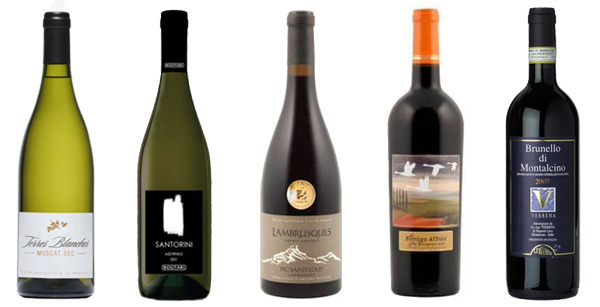
From left: Terres Blanches Muscat Sec 2012, Boutari Santorini 2012, Domaine Lambrusques Esprit Sauvage 2011, The Foreign Affair The Conspiracy 2012, and Verbena Brunello Di Montalcino 2008
White for her
Terres Blanches Muscat Sec 2012, Pays D’oc, Languedoc-Roussillon (Midi), France (653188, $13.95 WineAlign) From the VINTAGES Feb. 15, 2014 Release
Dry Muscat can be dull as paint drying and though this entry-level rarity (for Canada) is a bit aromatically quiet for the species, the palate really shines. This must be the place to explore the dry example of the variety. A naïve melody with “feet on the ground, head in the sky.” Will appeal to fans of Unoaked Chardonnay and white Rhône blend rangers. Tasty bits of clementine, nougat and anise. The good bitters of a cocktail coming up to room temperature. Good tangy finish that goes on for quite some time. We’re talking head of the class. 88 Tasted February 2014
White for him
Boutari Santorini 2012, Santorini, Greece (47985, $15.95, WineAlign) From the VINTAGES Feb. 15, 2014 Release
The soda, stones and salinity of Assyrtiko from Santorini can be a trifecta of allegorical wonderment. This one has all that but it is the lemon drop nose that leads so in that sense it’s more basic than others. That said it is a perfect pale-bronzing entry into Thira’s Cycladic, Aegean world. At this price there is more pith and bitter nut oils but the wine remains lively. Add to that the savoury garrigue of the island’s low-bush vineyards and a slow-flowing note of warm lava. Not surprising given the above average temperatures of 2012, leading to a reductive note. Still, Assyrtiko always thrills. 89 Tasted February 2014 @Boutari@DrinkGreekWine
Red for her
Domaine Lambrusques Esprit Sauvage 2011, Pic Saint Loup, Languedoc-Roussillon (Midi), France (354142, $17.95, WineAlign) From the VINTAGES Feb. 15, 2014 Release
This Languedoc-Roussillon red blend wheels out a quirky beat but is so generous of flavour it will have great appeal, if not to the masses. Unmasked by wood or cane, it almost seems to apologize for being so tasty. Pic St. Loup may not be a household name and though it “started off with nothing,” this village might tell the Esprit Sauvage “you’re proud that you’re a self-made man.” Confident in bracing tannin and acidity though they steal away like a Xeroxed, three-minute George Harrison pop song. At the end of the day I’m happy to be stuck in Midi with a Pic St. Loup. 89 Tasted February 2014
Red for him
The Foreign Affair The Conspiracy 2012, VQA Niagara Peninsula, Ontario, Canada (149237, $19.95, WineAlign) From the VINTAGES Feb. 15, 2014 Release
Quickly reminiscent of its 2011 predecessor but also different, in a basking, vintage-related warmth and reductive currency. This could not have been an easy wine to temper in 2012 considering the ripasso methodology. Just softened plum is painted all over its sheen with the poaching aromas steaming away. Grilled, melting licorice, caramelizing and disapparating before your eyes. Not to mention a French vanilla creamy garagiste waft, like nuts and bolts ice cream. But I will admit the tang, acidity and tenacity increases with each sip and swirl. Such a unique bottling to Ontario. Is there anything else like it not from Lake Erie North Shore? 89@wineaffair Tasted February 2014
Red for each other
Verbena Brunello Di Montalcino 2008, Tuscany, Italy (165126, $39.95, WineAlign) From the VINTAGES Feb. 15, 2014 Release
A conundrum here. On one hand this Verbena is ready to take up residence in the modern world. On the other, there are hallmark ancient Sangiovese Grosso varietal and Montalcino cellar smells. Leather, game, seeping, weeping cherries, dried flowers, cave must and animale. The game really stands out and though it’s neither mutton nor bretty funk, it’s got musk. Angular yet sweet tannins envelop flavours of roasted plum and licorice. Copiously endowed with intense, dense, chewy fruit so expect this to last for 10-15 years. Makes for great value in Brunello out of a trying but thankfully not flamboyant vintage. 92 Tasted February 2014 @ConsBrunello
If you live in Canada, purchasing wine ties you directly to a monopoly. There are exceptions, though still imperfect ones, like the free market culture of Alberta and the developing tiered system in British Columbia. The earnest call across the country to free my grapes continues though regrettably, stiff resistance stifles the cause.
Manitoba and BC allow direct to consumer inter-provincial wine imports. Consumers can order from out of province and receive direct shipments so long as the wine is 100 per cent Canadian.Nova Scotiahas passed enabling legislation that will follow a similar path. If you reside in Quebec or a fortiori, in Ontario, having wine shipped to you remains taboo. The alternate recourse of consignment wines available for purchase through local importers is an irregular option and having to buy by the case designs no compass of mass appeal.
Spend even a fraction of the time I do in trying to seek out the best values, at the best prices and in the categories that cater specifically to personal tastes and you will understand how difficult it is to be satiated in such a constricting climate. I am not the only one seeking out red wines made in the vineyard, through minimalist oak intervention, unhindered by residual sugar, produced by passionate and honest winemakers who are vigilant with the softest of hands.
Who does not want their wine to have mass in it, as in life? Who would reject an elixir drawn from iron-rich earth, boiled through limestone and warmed to a rosy madder? Who can deny the pure joy culled from a wine that might steal the words from the mouths of poets?
In Canada, unearthing such gems requires intestinal fortitude, especially considering the search is mapped out in government-controlled stores. Stock norms do not include wines made from lesser-known grapes, from regions and appellations less frequented. It takes time, effort and most of all, patience. Life can get in the way of the endless and unavailing chase; work that pays, kids, weather, fatigue. Sometimes it just makes sense to abide and even embrace the easier, well-worn path. This is where the bigger wineries step in, toting larger case loads and a middle-of-the-road, radio bathos experience.
There are varietal vicissitudes to ferret out from varieties you might have chosen to avoid. New World Pinot Noir and Chardonnay. Zinfandel. Rhône blends. Sangiovese blended with Cabernet Sauvignon. Tempranillo. All these grapes are often mistreated, modernized, smothered in oak and homogenized so that their indigenous origins are blurred into a bar of mass-produced chocolate. Occasionally they are done right by their makers.
In what has been such relentless cold, snow and ice, now into the oppressive dog days of winter, don’t think of drinking commercial wine as copping out. The big houses can be your friend, so loosen up and trust me when I tell you I’ve worked very hard to weed out the chaff and promise only to recommend the whole wheat. Here are seven current releases that made the pecuniary cut.
From left: Mission Hill Reserve Pinot Noir 2011, Clos Du Val Zinfandel 2011, and Robert Mondavi Chardonnay 2011
Mission Hill Reserve Pinot Noir 2011, VQA Okanagan Valley British Columbia (545012, $24.95, WineAlign) From the VINTAGES Feb. 15, 2014 Release
Here’s a juicy plum wine with noticeable warm alcohol that goes subterranean and won’t make you homesick for alien Pinot Noir. Athletic red with a quick first step and nerve, running a west coast offence, scoring points. Char in licorice and a grid-iron, “uptight, uptight” bitter tendency but is a most saucy rendition. Extra point from clean, easy sweet tannins. Good length. Pinot on the radio. Really attractive price puts it at the head of its class. 90 Tasted February 2014 @MissionHillWine
Clos Du Val Zinfandel 2011, Napa Valley California, USA (590216, $24.95, WineAlign) From the VINTAGES Feb. 15, 2014 Release
Every so often a grape variety confounds and astounds, like this pretty in zinc Zinfandel. Almost mute as far as Zin goes, this CdV ”set out on the heels of the unknown.” Times like these normally produce lumbering, high-octane interpretations but this radical face is the Simon and Garfunkel of the variety. Singing with soft harmonies and composed as if by a deft balladeer. Flair comes from Spanish-like modernity – a good thing for Zin. Less bramble, more Ribera. Less reduction, more Montsant. Smooth as silk, reeking in vanilla, raspberry and symptomatic by a kiss of mineral. If but for one hollow mid-verse this would truly sing but that really is no big thing. 90 Tasted February 2014 @ClosDuValNapa
Robert Mondavi Chardonnay 2011, Napa Valley, California, USA (310409, $25.95, WineAlign)
One of the more quintessential, mid-range, rich and opulent Napa Chardonnays that steps out of the lobster butter dish in 2011. Apple-tinged terpenes show their presence, along with tarragon and a bag of just opened good and plenty. Piquant, poignant vintage, peppery and acting cooler than I ever remember it to be. Whether by chance or by choice, this is a welcome direction though I doubt its kind will soon be seen again. 89 Tasted January 2014 @RobertMondavi
From left: Umberto Cesari Liano Sangiovese/Cabernet Sauvignon 2009, Wairau River Reserve Pinot Noir 2010, Grant Burge The Holy Trinity Grenache/Shiraz/Mourvédre 2011, and Beronia Viñas Viejas 2010
Decidedly modern in many ways; oak impart, varietal alliance and braggadocio. The nose speaks highly of unsettled alcohol and alchemy. Big on black cherry and earthy with a welcoming and necessary roasted rare and still kicking game component. The mellow support of Cabernet Sauvignon is kicked upside the head by full throttle, oak-laden Sangiovese. Though hot and bothered, there is a keen sense of acumen on display by the Emilia-Romagna team at Umberto Cesari. 89 Tasted January 2014 @UmbertoCesari
Wairau River Reserve Pinot Noir 2010, Marlborough, New Zealand (361253, $29.95, WineAlign) From the VINTAGES Feb. 15, 2014 Release
Wonderful value in premium Marlborough Pinot Noir. Alluring sylvan aromatics, in a potpourri of violet, rose, plum and strawberry. Sharp, cranberry-pomegranate-cherry fruit flavours, the grain of red fife, and eye-popping acidity. An earthy terroirist, layered and delicious. Warm but not alcohol driven, touched by oak but not shaken and with just one coat of paint. 91 Tasted February 2014 @wairauriver
Grant Burge The Holy Trinity Grenache/Shiraz/Mourvédre 2011, Barossa, South Australia (Agent, 236257, $29.95, WineAlign)
The right Rhône immediacy of the 2011 Barossa vintage gets its hooks right in. Snapping with a direct blow uppercut to the jaw, this Grenache, Shiraz and Mourvédre blend goes right for the jugular with passion, not sugar. It’s a tricky mix, angular yet smooth, floating like a butterfly and stinging like a bee. Terrific charred, meaty flavours mixed with juniper and black raspberry, savoury spice and a chain of tannic length. Will age with metronome precision over a period of 10-15 years. 91 Tasted January 2014 @GrantBurgeWines
This 100% Tempranillo is Beronia’s enigma. Sourced from 40-plus year-old vines and housed for 14 months in new French oak. The Van Morrison bottling, if you will. Forget thoughts of a gnarly, tar and brambly red. This one is compliant and inviting. Cherry cheesecake gives it a dessert-like funk, with a baking spice and savoury plum pudding chaser. Vanilla is the unifying factor, the glaze, the icing on the cake, thanks to those new barrels. “You say “France” and I’ll whistle.” This is a pleasure to taste and ready for consumption. 90 Tasted January 2014 @BodegasBeronia
As a Super Bowl libation of choice do you consider wine a foray into the arena of the absurd? If so, you may be right, but you may be wrong. The Super Bowl is absurd. So, what are the odds that wine figures into your Super Bowl gathering? You might just be surprised.
I have participated in the same season-long NFL pool for the past 27 years. It was a “fax” pool in the 90′s and persists as an early days of the internet, send your picks in by e-mail endeavour. I’m still waiting for our administrator to make use of a free internet betting site but then again, there is a certain kind of comfort in the naiveté of low stakes, old-school pool participation. Meanwhile, I wouldn’t watch a single snap without something riding on the games. With apologies to my Peyton Manning-worshipping son, the NFL is just not that interesting and it’s a brutal sport.
Think about it. The game itself is a barbaric testosterone display of gladiator proportions, a war waged by freak of nature behemoths intent on killing one another between the blow of every whistle. Watch an NFL game and you’ll see that a player remains down and hurting after almost every play from scrimmage. When an elite athlete stays down, trust me, he’s hurt. Something has pulled, torn or broken nearly every time you see it.
Then there are the costs; production, hosting, advertising and tickets. According to the Philadelphia Business Journal, “At $4M for Super Bowl ad, it’s ‘almost impossible’ to see return on investment.” The cost to Jersey City for hosting “is a tax on our resources to some degree,” said Mayor Steve Fulop. According to NewJersey.com, “the police presence alone will cost city taxpayers several hundred thousand dollars.” The market for ticket prices opened at $4,000 but now they are just giving them away, with $3,088 being the current average price as of Tuesday afternoon, this according to the Bleacher Report. If you think the prices are too high, you have no business going to the Super Bowl. In 2013 Beyoncé was not paid for performing at the halftime show, though she was awarded $600,000 for “production costs.”
Is this shaping up to be the saddest Super Bowl ever? Joshua M. Brown sure thinks so. “This Sunday, Super Bowl XLVIII (48) will be played in an open-air stadium, built atop a New Jersey swamp, in 2 degree weather, while pretending it’s actually taking place in New York.” So, now does it seem like such a far-fetched idea to drink wine while watching the Super Bowl? Sure, 99 per cent of the American Football hypnotized viewers will have a beer or 12 on Sunday. Hopefully a few thousand will be creative enough to get up from the couch and source something local and craft-related. I will be bringing fine-ish wine to the grid iron festivities. There are well thought out, dedicated and purposed reasons for my choices.
The original elite athletes on this planet were from ancient Greece. Though they may not have tossed around or beat each other silly over an oblong-shaped ball covered in pigskin, they personify the term ‘forbearer’ for real sport. Besides, real men drink Greek red wine.
@zoltanszabo@johnszabo Real men drink Montenegrin & Macedonian, not to mention Naoussan & Thessalian..this is going in my Super Bowl column
Wine produced in a region defined by its volcano is also a must. Nowhere does the vinous world bequeath an emphatic lava flow of energy and verve like Etna. Football is a mob mentality game of raw and pure emotion, much like the terroir-driven Nerello Mascalese and Nerello Cappuccio from Sicily.
Zinfandel is a natural for the Super Bowl. Bold, deep, dark, rich and striking. The brambly flavours scream rough and tough. Zinfandel always lives on the edge. It will also stand up to and support the fatty, greasy and cheesy gamut of flavours on the SB coffee table.
A classic Cabernet-Merlot blend is a must for all the red meat that will be consumed on Sunday. Don’t bother with the modernity or overpricing of soft, voluptuous and velvety Bordeaux or Napa. This game and your aged beef require some grit. If you live in Canada, go local, as in Okanagan Valley or Niagara Peninsula.
For the sensitive and cerebral man, the Peyton Manning armchair quarterback if you will, look for a well-aged and thoughtful white wine. Hunter Valley Semillon comes to mind. The last time the Seattle Seahawks played in the Super Bowl was 2006. That strikes me as a good vintage to help settle the score.
Here are my five wine picks for Super Bowl 2014 and some music to match.
From left: NICOSIA FONDO FILARA ETNA ROSSO 2010, THYMIOPOULOS VINEYARDS YN KAI OUPAVÓS XINOMAVRO 2010, MCWILLIAM’S MOUNT PLEASANT ELIZABETH SEMILLON 2006, RAVENSWOOD OLD VINE ZINFANDEL 2010, and MALIVOIRE ‘STOUCK’ CABERNET/MERLOT 2010
Wines from Sicily’s Mt. Etna region and the indigenous variety known as Nerello Cappuccio may seem like a space oddity to many but those who have opened their hearts and minds to the volcanic wonders float “in a most peculiar way.” This Rosso carves a bowie-knife line of lava mineral and Mediterranean salinity right through with bang on acidity and vitality of red fruit. A minor detractor in that it’s a bit saturated, muddled and earthy for Etna, but it brings the mountain down to the tasting room. Licorice, cirasu, plum and the dried grape feeling of zibbibbu. Contagious in spirit. 90 Tasted January 2014
THYMIOPOULOS VINEYARDS YN KAI OUPAVÓS XINOMAVRO 2010, Unfiltered, Naoussa, Greece (360750, $19.95, WineAlign)
Magnificent Macedonian, built upon the unheralded yet stalwart variety Xinomavro. Pure, sweet-smelling gardenia and the refuse of ancient rolling stones express every bit of sun and wind-swept, low bush vines goodness. Purposefully and thankfully unfiltered, so that all the delicious sweet and sour cherry and great biting but sweet tannin are left in. Purity, good sugar/alcohol heights without oak corruption. Earth possessive of mythic undercurrent, sage, wealth of knowledge, sweet anise and hyssop. Scents of game on the grill. Amazing complexity and length. While tasting this Xinomavro it made me “feel so hypnotized, can’t describe the scene.” Get your rocks offto the Greek. 91 Tasted January 2014 @thymiopoulosvin
MCWILLIAM’S MOUNT PLEASANT ELIZABETH SEMILLON 2006, Hunter Valley, New South Wales, Australia (724492, $19.95, WineAlign)
Such a rare occasion to peer into the portal of aged Hunter Valley Semillon so expectations run high along the lines of gain the ridge and peer out over the great expanse. Emerging classic secondary notes, in tropical low-bush, caramelizing tangy fruit meets sweet hive sticky fashion but, and I take care to be sure, the fruit suffers under a yoke of petrol and a scraping of rocks. The lemon is faint, the fruit disappointingly fading. Listen closely to her voice, “I can’t sing, I ain’t pretty and my legs are thin.” Sure, acidity steals the show but at what cost? Still, a study in Semillon is always a positive so the cellar aging and delayed release must be appreciated. Oh, well. 89 Tasted January 2014 @McWilliamsWines
RAVENSWOOD OLD VINE ZINFANDEL 2010, Sonoma County, California, U.S.A. (673798, $21.95, WineAlign)
Consistency thy name is Ravenswood in the key of Zinfandel. From typically gnarly old vines scattered around Sonoma County and so young at heart. As solid as a wine can be when blending from so many sites. Vanilla is its calling card, flavouring the pool of berry syrup along with a tobacco-like smokey accent. Good tartness balances the rich fruit. At only 5g/L of residual sugar, this Zinfandel reaches sugar mountain with natural sweetness so, “ain’t it funny how you feel when you’re finding out it’s real.” Bring on the big game chili and beef stew. 89 Tasted January 2014
MALIVOIRE ’STOUCK’ CABERNET/MERLOT 2010, VQA Lincoln Lakeshore, Ontario (321836, was $29.95, now $24.25, WineAlign)
This Niagara Bordeaux-inspired blend comes from a legendary vineyard in the making. Cabernet Sauvignon, Cabernet Franc and Merlot all ripen and develop phenolic pitch with Findhorn-like, remarkable quality. How and why it ended up on the VINTAGES Bin-End list is beyond explanation. It was a must buy before, now it’s a steal. From A long and ‘wine-ding’ tasting road: ”From down on the Lincoln Lakeshore is a pitchy rendition with a pronounced roasted espresso note. Seems to me the motherly, Cabernet Franc’s genes have imparted their wisdom into this (63%) Cabernet Sauvignon dominant beauty with big Cassis fruit. Chic, juicy, with a filled in mid-palate and stiff structure. Grab a glass, “leave your cares behind, these are the good times.” 91 Tasted March 2013 @MalivoireWine
Winemakers in the most famous regions of Spain and Italy have gone pro in the practicum of wine that speaks loud and clear. If there is a downside it is the blurring of lines and overlapping of circles, where regions set far apart show similar, if near identical characteristics in their wines. How does this happen? How can winemaking trump terroir?
The simple answer is wood. Barrel usage is a global affair, with wineries scouring oak forests the world over to age their wine. French oak is most used and whether you make wine in central Italy or northern Spain, the oak you employ may result in more than just the commonality of wood. If your processes are tied by similar or even identical ties, your wines may taste eerily like one another, if not outright like kissing cousins.
Despite the oligopoly of technique and the lack of winemaking individuality gone viral in this generation, there are three things that continue to work in favour of regional character. The first is obvious. Soil. Or, more importantly, the components, the rocks and minerals that fleck the earth. Secondly, attitude. Call it conceit if you like but when a winemaker has the guts to make wines we like to call grippy, you can’t help but stand up and take notice. Third and so important to the consumer, is price. Spending $15-30 on wines from the most historic locales such as Burgundy and Bordeaux is almost always nonsensical and a waste. No where else in the world offers grip, pomp and pride like Spain and Italy and in that go to mid-price range.
A pentavalent and benevolent group fits this requiem for commercial gain. Rioja, Ribera del Duero and Priorat from Spain. Chianti and Abruzzo in Italy. A Venn diagram of commonality can be agglomerated from their proclivities. It is in these fab five Old World wine regions where a twain of ancient and state of the art collide. Here are seven gripping wines from Spain and Italy.
From left: CEPA 21 HITO 2010, ÉBANO CRIANZA 2008, and RESALTE DE PEÑAFIEL PEÑA ROBLE RESERVA 2004
Ribera Del Duero
The history: Located in north-central Spain, on a plateau, 90 minutes from Madrid. Ribera, or “river bank,” extends from both sides of the Duero. The Denominación de Origen (D.O.) of Ribera del Duero dates back to 1982.
The lowdown: Highest average elevation in Europe for growing red wine grapes. Summers are hot, winters are cold, rainfall is minimal. Lower vineyards are alluvial with sand and reddish clay. Higher ones built of limestone, marl and chalk. Tempranillo in the main grape. Finest recent vintages include 2004, 2009 and 2012.
Oh the shaken, modern humanity. Nothing shocking here, this 100 per cent Tempranillo parfait of silky chocolate, mixed berries, vanilla and wood chips. Finds parity in biting red cherry flavour. Though it may as well be any ambiguous, heterogeneous or hermaphroditic $30 IGT, its price puts it at the front of the line. Fun to drink, high-toned, textured and structured, though its origins are not at once obvious. Will evolve felicitously for five to seven years. 89 Tasted December 2013 @DrinkRibera
ÉBANO CRIANZA 2008, Ribera Del Duero, Spain (355099, $21.95, WineAlign)
Amid a sea of Spanish reds, this Ribera stands alone as the most modern on the table. Dusty, trenchant dark chocolate, mocha crema, thick, syrupy, rehydrated plum fruit. Accented by both white and black pepper, anise and a late lash of astringent tannin. Abrasive as a pleading Waits croon, this Crianza is “better than a cup of gold. See only a chocolate Jesus can satisfy my soul.” Another Ribera with qualities akin to present day, Sangiovese dominated Chianti Classico. Immaculate confection. 89 Tasted December 2013 @EuroVinatage
RESALTE DE PEÑAFIEL PEÑA ROBLE RESERVA 2004, Ribera Del Duero, Spain (355107, $31.95, WineAlign)
Typically modern version with just the right amount of age. Interesting to see nearly 10 year-old Ribera, with so much obvious oak and modernity retain its fruit lushness and presence after such a chunk of time could have stripped away its freshness. Candied violets and pansy, peppery nasturtium and marble slab, rocky road ice cream. Oak nearly integrated but persistent in chalky texture. Confounding bareback ride on a wild 100 per cent Tempranillo horse that bucks as if Bordeaux or Rhône varieties would seem to bolster the whole. 90 Tasted December 2013
From left: CIRELLI MONTEPULCIANO D’ABRUZZO 2012, CASTELLO DI QUERCETO CHIANTI CLASSICO 2011, PLANETS DE PRIOR PONS 2009, and ONTAÑÓN RESERVA 2004
Abruzzo
The history: Central Italy, stretching from the heart of the Apennines to the Adriatic Sea.
The lowdown: Mostly mountainous and wild terrain. The four DOC produced in Abruzzo are the Contro Guerra, Trebbiano d’Abruzzo, Montepulciano d’Abruzzo and Montepulciano d’Abruzzo Colline Teramane. Montepulciano is the most planted red variety. Finest recent vintages include 2006, 2009 and 2010.
Winemaker superstar to be Francesco Cirelli does what more should do. Age organic grapes of purity and pristine quality in clay Amphore. The natural empathy and wisdom of crop rotation (for more than just grapevines) drives the logic and proportion of Cirelli’s wines. This Md’A smirks and balks at thoughts of it as entry-level, though it concedes to the moniker ’poster child’. From 15 year-old vines set in sandy clay soils near Atri in the Colline Teramane zone. The fruit is like raspberry felt, lifted, spritely, gregarious and inviting. The wine never plunges into bitterness, nor does it depend on any crutch to remain upright and weightless. 90 Tasted September 2013 and January 2014 @TheLivingVine
Chianti
The history: In central Tuscany. The two Chianti zones, Denominazione di origine controllata (DOC) and Denominazione di Origine Controllata e Garantita (DOCG), produce the largest volume of DOC/G wines in Italy.
The lowdown: Chainti Classico must have a minimum 80 per cent Sangiovese, the main variety of the region. Other indigenous grapes include Canaiolo and Colorino, bur Cabernet Sauvignon and Merlot are also used. Soils vary from marl of layered sandstone, to chalk and clay, blue-grey sandstone and clay-limestone. Finest recent vintages include 2006, 2007 and 2011.
Heather meadow Sangiovese, emotive of old school Chianti Classico aromas, notably tea, new leather and sour cherry. Texturally succulent and lush, like mini-modern Sangiovese Grosso. Nearly syrupy and 90′s-styled by a heavy-handed, wood-soaked guilty conscience. The kind of CC to “waste away the weekend with perfect regard for how cavalier we used to be.” 89 Tasted December 2013 @ChiantiClassico@ProfileWineGrp
Priorat
The history: In Catalunya, northeast Spain. The most recent regulations of the DOQ were defined in 2006.
The lowdown: Dominated by hillside vineyards with poor soils, the dark slate called Licorella and low-fielding old vines. Garnacha and Carinena are the most planted, but also international varieties such as Cabernet Sauvignon, Merlot and Syrah. Finest recent vintages include 2004, 2009 and 2012.
PLANETS DE PRIOR PONS 2009, Priorat, Spain, (314559, $24.95, WineAlign)
Clearly contemporary, voluptuous Garnacha blend, in symmetry with foil Carinena, In support are small amounts of Cabernet Sauvignon (10 per cent), Merlot (five) and Syrah (five). Chalk, grain and chocolate intensity, scents of dusty mulberry, menthol tobacco, eucalyptus and licorice. Works its international styling to great effect, if a bit heavy, woody and hollow up the middle. Lags just behind the stellar 2008 and yet this ’09 will have many a follower. Just a bit more structure would make it a prize. 89 Tasted December 2013
Rioja
The history: In northern Spain, on both sides of the River Ebro. The oldest Designation of Origin in Spain (DOCA), established in 1926.
The lowdown: Confluence of Atlantic and Mediterranean climates, with soils ranging from chalky-clay, to ferrous-clay and alluvial. Tempranillo is the most planted (red) grape. Finest recent vintages include 2005, 2005, 2010 and 2011.
The animal that is an ’04 Rioja Reserva is a VINTAGES darling. Here is yet another example in a long line-up spread out over several months of releases. 2004 palate fatigue should certainly have set in but for this youthful yet learned Ontañón. The dichotomy is not lost with much wood to be nosed though it’s neither abstruse nor resinous. More like a smoking cedar plank beneath the rendering weight of a slow-roasting porcine slab. Tangy cherry, sour plum and really stretched length. Mineral finish. Brillo Tempranillo with a touch of Graciano. 91 Tasted December 2013 @TandemSelection
A year ago today the lead to my January 15th, 2013 column spoke succinctly to the mantra. “A glass or two of wine might just be the thing to help ward off the common cold and the flu.” In that rant some substantiating evidence was laid out in support of drinking wine (in moderation) to help fight off the nasty bugs of winter. A year on my conviction does not waver. Wine can help cure what ails. A wine prescription for cold and flu has been a curiosity read for many over the past 365 days. Ridiculousness? Perhaps. Personal hermeneutic? Yup. Something to consider? Definitely. Words to live by? You be the judge.
In that article I talked about wine’s antioxidant properties (called flavonoids) and compounds that attack bacteria, like resveratrol and polyphenols. All in the name of trying to immunize the body against hundreds of common viruses. What I failed to discuss was the positive mental health of a lifestyle that includes wine. Wine drinkers, at least the ones I spend time with here in Ontario, are happy people. Friendly folk, community-driven, supportive, neighbourly. Wine brings everyone together. It’s really something to see and be a part of.
In Argentina, Bodega Norton has forged and maintained some of the longest contracts with growers in comparison to anywhere in the vinous world. Vines, mountains, rivers, roots and the hands of workers are all treated with respect, professionalism, honesty and commitment. Norton’s wines are accessible and affordable, including the flagship Privada, described by winemaker Jorge Riccitelli with the fanciful comment “you can feel the grapes inside your mouth.” I sat down with Mr. Riccitelli on Monday, November 11th, 2013 at The Ritz-Carlton Hotel in Toronto. The hour with Mr. Riccitelli sent me away with one profound thought. When you take care of your people, your team and the tonic you produce, health and happiness are not far behind. The tasting with Jorge was the stuff of pure joy. A visit to Norton must surely follow.
Michael Godel and Jorge Riccitelli
A recent mini spat slash argument in Toronto Life on the subject of 0rganic and biodynamic wines helps to push the point. In response to an inflammatory comment noting the ”pseudo-scientific claptrap of biodynamic agriculture” the cosmogonal-minded Bench Vigneron Harald Thiel retorted, “the primary difference between organic and biodynamic production practices is the “cosmic and stellar” forces that biodynamic producers believe differentiate their wines.” To each his own says Thiel. I’m quite certain that Harald would concur that drinking wine can help bolster the immune system but going the natural route, in theory, will boost defences multi-fold.
Some take it to the extreme like Alain and Philippe Viret, winemakers who go beyond being organic and even biodynamic. They practice cosmoculture. Their vineyard is studded with menhirs and ‘planetary beacons’ in order to connect with celestial and earthly energies. It embraces Maya and Inca agricultural and spiritual concepts.
Alexandra Marnier Lapostolle is a flying ambassador who believes in the credo. At an October Trialto Group lunch at Luma Restauarant, the eerie connection between the restaurant group’s acronym and the act of natural winemaking was not lost on me. The devastation of Chile’s black frosts were being discussed and the magnificent Ms. Lapostolle-Marnier pushed the sapient necessity of O & B practices to a group of diners/tasters. “Being organic and biodynamic, the vines are heartier, able to handle the frost’s potential damage, budding time and produce healthy vines.” Casa Lapostolle also has scientific data to prove that organic and biodynamic vines mature 10 days ahead of the others.
PHOTO: Michael Godel Trialto Lunch at O & B’s Luma Restaurant
No one works harder or believes in the O & B philosophy to achieve wine nirvana more than Paul Pender of Tawse Winery. Everything Mr. Pender makes comes from fully certified and sustainable vineyards. I tasted through 25 barrels with Paul last Friday. His 2013 Chardonnays will be amongst the best we have ever seen on the Niagara Peninsula. The group of 2012 Cabernet Franc, Merlot and Cabernet Sauvignon are all showing lush, deeply resonant aromatics, all pies of one fruit or another and with minimal oak intrusion. More pudding proof will come from the most recent tightly planted Pinot Noir, in the Tintern Road Vineyard from the Vinemount Ridge appellation. At only three years of age, the juice from those healthy vines already emit an aura of verve, wisdom and viability.
Not all of the wines reviewed here come from O & B vineyards but each and every one can contribute to your mental and physical health. Wine is your friend. When approached, integrated and embraced in the right way it can help to promote a healthy lifestyle. The defence rests.
From left: NORTON RESERVA MALBEC 2010, CENTUNO NERO D’AVOLA 2010, LA CARTUJA TINTO 2012, LAPOSTOLLE CUVÉE ALEXANDRE APALTA VINEYARD CABERNET SAUVIGNON 2011, and TAWSE GROWER’S BLEND CABERNET FRANC 2011
NORTON RESERVA MALBEC 2010, Mendoza, Argentina (17061, $17.95, WineAlign)
As Malbecs come and go, group themselves into dime a dozen pigeon holes and fall from serious wine grace, this stalwart stays the course. Norton’s Reserva bottling has a proven track record for consistency. My most recent ’02′s spoke of strength, longevity and balance. In 2010, true to form, violets lead the arrangement of multi-floral scents and a kinder, gentler, sweeter set of tannins promote connectivity. Restrained and calm, this Norton forgoes the jams and jellies of other moderately-priced Malbecs and carries with it a smooth, long finish. 90 Tasted November 2013 @BodegaNorton
Though not exactly a chick magnet or my Sicilian dream, this Nero D’Avola is chock full of animal magnetism. It reeks of four-legged musk, circus mammal and deep-sea predator. Despite the oppressive mob of animale there is also lush berry to attract more than just the curious imbiber. A dense fruit roll up, unfurling, spewing earth, prune and coal. Will petition the non-sectarian toper. 88 Tasted December 2013 @Eurovintage
LA CARTUJA TINTO 2012, Priorat, Spain (358861, $18.95, WineAlign)
This symbiotic blend of 70 per cent Garnacha and 30 Carinena rolls out the red carpet straight from the heart, not unlike Terrabianca’s 70/30 Sangiovese/Cabernet Sauvignon Tuscan Campaccio. Only here the value is palpable, especially for Priorat. Fueled by blazing red cherry and plum. Vivacity with bright fruit seeped in acidity but also a coated note, though not of over-oak, that paints the tongue red. A rumbling layer of licorella slate lies atop eruptive rock and beneath a rolling thunder of boulders. This is high-octane Spanish winemaking, a red velvet car that doesn’t “even touch the break.” 89 Tasted December 2013
“We don’t want too ripe, jammy or confiture,” pleads Alexandra Marnier Lapostolle. While this Super-Chilean is certainly full-bodied, it remains a finessed red and silky in every way. Leans IGT, as opposed to Bordeaux or warmer climate (California). Stupidly easy to drink, built for resto luxuriousness and really is a terrific value. A choir of dark fruit aromatics, sung like songs by the birds of the vineyard and a late sensation of charcoal and char are expressed in this Cabernet of fashion and caste. 90 Tasted twice in August and October 2013 @LapostolleWine
From selected prime Cabernet Franc vineyard sites across the headland, the Grower’s Blend reaches near maximum potential in 2011. An immediate sense that “leaves are falling all around” in a composted layering of earth, cedar, savoury produce and sweet herbiage. A tart tincture spikes and sauces the fruit, straight from the “darkest depths of Mordor.” Winemaker Paul Pender’s perfume permeates the mess, lifting the CF to great Niagara heights. Ramble on Grower’s Blend. 90@Tawse_Winery@Paul_Pender Tasted October 2013