B.C. wine: From Vancouver to your table

Vancouver’s Blood Alley PHOTO: SINIDEX/FOTOLIA.COM

as seen on canada.com

On a recent West Coast swing I sampled wines from British Columbia’s Okanagan Valley without ever leaving the city of Vancouver. A bicycle was all I needed to find Salt Tasting Room in Blood Alley. A couple of telephone calls to L’Abattoir and Fable Kitchen quickly and effortlessly landed me in the wine program hands of Robert Herman and Kathy Schleyer/Ron MacGillivray, all ready and willing to introduce me to a thing or two about B.C. wine. The Okanagan Valley’s indelible stamp is now etched upon my wild yeast, fermented brain.

PHOTO: Michael Godel English Bay Inukshuk

A well-known California wine writer recently lashed out against the city’s wine scene with this soul-searching, pharisaic headline. British Columbia: Okay Wines, Retarded Wine Culture. I feel for the author, who in his own right is possessive of a tremendous palate, for he could not locate a knowledgeable sommelier or a decent glass of B.C. wine anywhere in the city. But I suppose I shouldn’t blame him for never having solicited any advice from Anthony GismondiDJ Kearney, Jessica Bryans, Rhys Pender, Treve Ring, Frank Haddad, Kurtis Kolt, Andrea Vescovi, Lindsay Ferguson, Jay Whiteley, Barbara and Iain Phillip, Mark Taylor and Lynn Coulthard. Just a few names for next time. Nor can I hold him accountable for never having made it out to Penticton, or Kelowna. Two weeks later the Wine Blogger’s Conference in Penticton remained surreptitiously out of reach. I too am guilty of not being able to plan a side trip to the Okanagan during my quick western jaunt and yet I had no trouble unearthing several watering holes with more than a willingness to keep me in the B.C. wine loop. “It ain’t no big thing but it’s growin’.”

PHOTO: Michael Godel Second Beach, English Bay

Unlike Ontario, British Columbia has finally begun to emerge from the dark ages of wine legislation and pre-prohibition rules. Thanks to MP Dan Albas and the #freemygrapes movement, Ontario wineries (and others in Canada) can now ship their bottles to B.C., free from persecution. Private wine shops like Kitsilano Wine Cellar have begun to allot space to Ontario but the choices are few and far between. Blue Note agency’s Patrick Ellis is working towards more free movement of wine from Ontario to B.C.  Despite the prevailing tailwinds, shipping wines west to east remains taboo. Christy Clark will be handing out B.C. wines to fellow premiers at this week’s annual meeting. The ball is in your court Kathleen Wynne. People are talking.

The LCBO is so un-flush with B.C. wines the back-up is downright constipating. The monopoly threatens, the wall’s eastern bloc shows few faults and still B.C. wines (privately) flow east. Why? It’s the right thing to do. My table is set and ready for B.C. wine to be written all over it.

PHOTO: Michael Godel Summer table

Here are notes on eight Okanagan Valley wines tasted at Salt and on a hotel balcony overlooking phantasmagorical English Bay.

Salt Tasting Room, 45 Blood Alley, Gastown, Vancouver, BC V6B 0C4 (604) 633-1912

It’s 11 a.m. on a Tuesday, I’m in unfamiliar territory and Colin greets me with a turntable and Another Side of Bob Dylan. I know I’ve come to the right place. A half hour in I am turned over to Sommelier and General Manager Kyle Gartlan-Close, clearly a pragmatist when it comes to the wines of British Columbia. I sense he’s still waiting for the renaissance to happen and the local wines on his list must adhere to what are clearly his high standards of quality. I tasted 15 wines over a 90-minute stretch at the tasting bar. Not all were hits but Salt was clearly the portal to crawl through and cross over into Vancouver’s wine scene. All prices are B.C. at the winery, unless otherwise noted.

From left: Tantalus Old Vines Riesling Natural Brut 2010, Thornhaven Tortured Grape 2012, Pentâge Winery Sauvignon Blanc Semillon 2011, Poplar Grove Chardonnay 2011, 8th Generation Vineyard Riesling 2012, Synchromesh Pinot Noir Rosé ‘Palo Solara’ 2011, and Joie Farm Pinot Blanc 2012

Tantalus Old Vines Riesling Natural Brut 2010 ($35) at 11:00 am on the nose spins effortlessly out of the vinyl gate along with Dylan’s The Girl From North Country. No shrinking violet, this inaugural Brut, méthode Champenoise sparkler. Straining yeast, naphtha and prickling pear go crazy in acerbic pith. No Peggy Day neither, though “she stole my poor heart away.” Score one for Godello’s cellar.  90  @tantaluswine

Thornhaven Tortured Grape 2012 ($17.90) melds a kitchen sink of Okanagan Chardonnay, Riesling and Muscat. Slides down the pipe with edacious oomph, in a good way. The label’s eerie graphic might shock but this is no hollow or shallow white, but rather a hallow ode to blending with great floral intensity.  But, may I ask, who crop-thins with a scythe?  87  @ThornhavenWines

Pentâge Winery Sauvignon Blanc Semillon 2011 ($20) is classically styled white Bordeaux divided between 65 per cent SB and 35 Sem, though it’s true to its roots and rocks, speaking uniquely of its place. Glides coolly and reggae rhythmically in cohorts with Bob’s Kaya, is perfumed by humid sea salt and oyster shell. SB imparts near tropical fruit and Sem brings terrific texture. Goes to show you “can’t run away from yourself.”  88  @PentageWinery

Poplar Grove Chardonnay 2011 (338434, $27.95, B.C. 732958, $21.90) from Hot weekend wines and cool Chardonnay sees minimal (15 percent new French) oak influence and while there is a ripe coconut tang, a sense of creamy butter and a spike of citrus, there really isn’t too much of anything at all. Tasted this fresh Okanagan a second time in Vancouver, alongside Another Side of Bob Dylan at Salt Tasting Room, I decided I could drink a barge full of the stuff. “All I really want to do, is, baby, be friends with you.”  90  @poplargrovewine

8th Generation Vineyard Riesling 2012 ($20.90) from Okanagan Falls bolts rapido from the gate with the ripest fruit (pear, plum) and though there is citrus, it’s really quite semi-dry. At 12.9 per cent alcohol and 24gr/L of residual sugar this may as well be Mosel Trocken Spätlese. Fantastic presence and awesome winemaking from Bernd and Stefanie Schales. Got me by the vines and will be on my table. 92  @8th_Generation

Synchromesh Pinot Noir Rosé ’Palo Solara’ 2011 ($18.90) from an east-Kelowna vineyard is made using the traditional saignée method. The result is a cottony texture and clinquant cantaloupe hue. An alkali, dry Provence notion is raised dutifully by bright but savoury fruit notes, like rhubarb and watermelon. Only 150 cases produced and true to serious Rosé everywhere.  90 @SynchromeshWine

Okanagan Crush Pad Gamay (on Tap) rolls melodically around the mouth in fresh fruit flavours so it must be Piano Man time. Solid black cherry core, good extraction, simple structure and no hard lines combine for basic but beneficial keg effect. “La la la, di da da. La la, di da da da dum.”  87  @OKCrushPad

Joie Farm Pinot Blanc 2012 ($23) found at Kitsilano Wine Cellar elevates a yeoman’s grape to mountain heights. Okanagan acidity injects life to do away with “useful” and score a notch for necessary. Like Gamay, Pinot Blanc should receive more planting consideration in B.C.  Zesty, invigorating and refreshing. A tumbler of delectation when matched with a view of English Bay.  89  @JoieFarm

Good to go!

Gimme Shelter Island, Fenway Park and North Fork wine

Toronto Blue Jays at Fenway Park, Boston, Mass.
June 27, 2013
Photo: Michael Godel

as seen on canada.com

There is nothing quite like a good road trip. No matter the intended destination, a journey through heartlands, heaving cities and bucolic paths stir, enrich and develop the final stew. A roadhouse in Syracuse, N.Y. The Blue Jays at Fenway Park in Boston, Mass. The Cross Island Ferry to Orient, N.Y. Shelter Island, N.Y. Sag Harbor, Montauk, Amagansett, East Hampton and Wainscot, N.Y. The East Island Golf Club and Greenport, N.Y.

All stops contribute towards what will eventually become a wine region’s interest in laying up the riches of the mind. The eastern tip of Long Island mesmerizes as a sandy headland of bluff and dune begging into the Atlantic. Shelter Island is equally if not doubly halcyon in pace and though tiny in mass, seems enveloped in rainforest-like green and canopy. I traveled across and back, circumnavigated its perimeter and sat motionless on its beaches for hours. Time standing still.

PHOTO: Michael Godel
Shelter Island

Though other visits on the North Fork Long Island wine trail offered a taste of local flavour, the exception and lost time came from a small family operation in Southold. Here are my notes on nine heart struck wines not yet widely discovered.

PHOTO: Michael Godel
Michael and Christine

Mattebella Vineyards

46005 Route 25 (Main Rd)
Southold, NY 11971

North Fork wines have yet to storm cellars and tables beyond metropolitan New York, but it’s not for lack of quality or concupiscence. Case in point Mattebella Vineyards. Drive up the gravel driveway, turn past the herb garden, overgrown fennocchio and try to figure out which quaint little building is the tasting room. Crawl inside, pull up a bench and spend two hours sampling, contemplating and discussing with Christine Tobin what just may be the least known, most complex set of wines you would least likely expect to discover. Walk away feeling a part of the famiglia. Cottage industry incarnate. “We’re so chill here” says Chris. Goosebumps.

Christine Tobin holds the fort while Florida to Southold and back commuter husband/winemaker Mark is away on business. The couple purchased the 1997 planted vineyard in 2005. Their photo resides in that dictionary entry titled “labour of love.” Low density, French existentialist-style, 2200 plants per acre viticulture cursed by an oft-inhospitable, maritime climate is what Chris calls a “lottery ticket” of vines. Chardonnay not to be considered as Mâconnais or Meursault. Bordeaux blends not to be measured by either bank of the Gironde. These wines are expressions of this terroir, this spit of sandy soil a stone’s hurl from the Sound. The Magic of Findhorn.

PHOTO: Michael Godel
Mattebella Vineyards

Famiglia Chardonnay 2009 ($17) is the child of a wet and cold growing season yet composes itself with help from a persistent toast quotient that speaks of new oak. Tart green apple and juicy acidity beg for fatty fare; braised pork belly, buttery, braised rabbit or rillettes of either. Tree fruit brings game, brightly, like tangerine.  88

Famiglia Chardonnay 2010 ($19) spent 18 months in (20 per cent) new oak barrel.  Warmer, tame and propitious with a squeeze of lemon and a dusting of scorched earth. Butternut, in squash and roasted almond as if it were waving to Sebastopol, but only to shout, “hey, we are North Fork Chardonnay.” 90 

Reserve Chardonnay 2010 ($25) squared up the new oak barrel ferment for a butter and marmalade spread so rich and continental I could drink it for breakfast. The toast meets oceanic salinity intimates spa mineral, beach shell and fine stone. Deft winemaking has given this absolute steal structure and length.  91

Rosé 2011 ($18) seeks dry Provence and as far as the savoury strawberry/rhubarb is concerned, in that it succeeds. “A little more stark than in ’12,” concedes Chris, but the length follows a tine and it should never be envisaged as simple and sugary. Amazing what Merlot can concede here for Rosé.  88

Rosé 2012 ($18) is a fleshier, rounder style, savoury still and with more Cab Franc bell pepper. The rhubarb gives way to strawberry gelée and the complexity quotient warms up with a crumble of chèvre.  87

Famiglia Red NV ($18) serves a consistency of style for table wine purpose. A union from many plots and clones that sees some oak and more stainless. Raspberry, currants and tobacco smoke stand out. Perfectly reasonable Vino di Tavola.  86

Old World Blend 2007 ($35) murmurs in melodious tones flecked by iron and anise, like tender-aged IGT. From 667 cases, with black cherry, charcoal and plums rolling away. Tannins have a few lashes left in them. There is something Henry of Pelham ’07 Cab-Merlot about this Matebella. Heading soon to toffee and über relaxed REM sleep. A red to share with “a perfect circle of acquaintances and friends.” What the tasting room felt like on this day.  89

Old World Blend 2008 ($30) produced 489 cases of gorgeous, lush, velvety crimson fruit despite the wet vintage. Whatever underground anxiety may once have unsettled this Lou meets Nico meritage is now long gone. Deft winemaking here. When you’ve got Merlot, you make Merlot. When you’ve got Bordeaux grapes, you make Bordeaux. But this is pure North Fork. “I’ll be your mirror, reflect what you are, in case you don’t know.”  91

Old World Blend 2009 ($35) is the child of a tempestuous vintage, marred by a pittance of fruit set, no need for any drop and therefore only 220 cases produced. This one’s got the funk, smoking coal, pipe tobacco and licorice. Tight, focused and with a quick dissertation heard from the Petit Verdot. Tobin’s consistency of style shows once again, despite the rigours of fighting inconsistent vintages.  92

PHOTO: Michael Godel
Island’s End Golf Club, Greenport, N.Y.

Good to go!

Hot weekend wines and cool Chardonnay

Malivoire Wine Company
PHOTO: STEVE ELPHICK, MALIVOIRE.COM

as seen on canada.com

My skies of late have espied no dark clouds and no rain. While torrential storms and unprecedented flooding hit Toronto last week I was fortunate to be basking in six days of Vancouver sun. I returned home to those same kind of skies, only now the mercury has climbed north of 30 degrees Celsius and the humidity well beyond the perspiration line.

There are two things you need to beat this kind of summer heat. Wine and wine. Start with Rosés and crisp, refreshing, aromatic whites. My current release recommendations also include a few reds (for the grill) and most are so hot that you’d better act fast because blink and they will be gone.

The second is to seek out Chardonnay. Cool, cool Chardonnay. This weekend I will be gathering with wine lovers making a pilgrimage to Ontario’s Niagara Peninsula to celebrate Cool Chardonnay, three vinifera and exceptional cuisine packed days (July 19-21, 2013) in my backyard’s great wine region. The international cool climate celebration is known as #i4c2013, an unprecedented gathering “spent exploring seductive shades of the most planted grape on earth.” The event’s mantra is simple. “40,000 acres can’t be wrong.” Cool Chardonnay will be three days of wine tasting and food pairing bent on altering and furthering the perception of the grape and just how incredible it can be in the hands of the cool climate winemaker. More than 120 wines from 60-plus wineries worldwide will be represented, including the greats from Niagara, Prince Edward County and British Columbia’s Okanagan Valley.

To celebrate the re-birth of cool, seek out any of these suggested wines and raise a toast to the cool climate winemaker, the gift of their land and the fine Chardonnay made by their hands.

Clockwise from left: Château Des Charmes Chardonnay Musqué 2010, Poplar Grove Chardonnay 2011, Flat Rock Pinot Noir Rosé 2012, Domaine Corne-Loup Tavel Rosé 2012, Chateau D’Angles Le Clape Rosé 2012, Rolly Gassmann Auxerrois Rotleibel de Rorschwihr 2007, Stratus Tollgate Fumé Blanc 2009, and Sister’s Run Shiraz Epiphany 2011

The Chardonnays

Château Des Charmes Chardonnay Musqué 2010 (318303, $16.95, B.C. 230961, $18.99) intensifies in juicy, bright, nearly candied fruit cut by sour patch and blanched nut. Clean, cool Chardonnay and right on. My earlier note, from ‘It’s Only Rock ‘n Roll’ (but I like wine) is the unoaked result of aromatic Clone 809 combed from the heavier clay-based soils from the St. David’s Bench Vineyard and the silty, mineral rich soils from Seven and Seven Vineyard. Tropical, strutting stunner with “a thousand lips I would love to taste.” Tell Ms. Musqué if you can’t rock me, nothing can.  90  @MBosc

Poplar Grove Chardonnay 2011 (338434, $27.95, B.C. 732958, $21.90) sees minimal (15 percent new French) oak influence and while there is a ripe coconut tang, a sense of creamy butter and a spike of citrus, there really isn’t too much of anything at all. Tasted this fresh Okanagan a second time in Vancouver, alongside Another Side of Bob Dylan at Salt Tasting Room, I decided I could drink a barge full of the stuff. “All I really want to do, is, baby, be friends with you.”  90  @poplargrovewine

Bachelder Wismer Chardonnay 2010 (345819, $44.95,) is so sumptuous, presumptuous and precocious. Ahead of the curve, effortless and full of 20 mile mineral length. The ripe green apple never quits. My earlier note from Top juice flows at Cuvée 25th anniversary from the Twenty Mile (Vineland) Bench is the most righteous, understated charred butterscotch remoulade sauce of dreams. Richly textured and built upon a sneaky, slow and stretched breath of wild yeasts. A creeper, gatherer and traveler of both knowledge and persistence. The journey with Thomas Bachelder as related by partner Mary Delaney, from out of Quebec, by way of Ponzi and Lemelson in Oregon and to Niagara is the stuff of dreams. Tasted twice same night and hypnotized both times.  94  @Bachelder_wines

The Rosés

Flat Rock Pinot Noir Rosé 2012 (39974, $16.95) achieves pink Pinot nirvana by way of foxy strawberry, vanilla crème, and orange rind. Peppery red currants bring balance, some sizzle and spice.  88  @Winemakersboots

Domaine Corne-Loup Tavel Rosé 2012 (71209, $17.95) is the hot weather cold maker, big in ripe, strawberry fruit, citrus and red apple. Imagine a glass’ glistening condensation by the seawall on a hot afternoon, the wine deliquescing like dew, Hemingway open at page one.  89

Chateau D’Angles Le Clape Rosé 2012 (323386, $15.95) goes classic holy trinity Midi in Mourvedre, Syrah and Grenache. Creamy, frosty and savoury in strawberry, rhubarb, balmy tarragon and shrubbery. Finishes with salinity pressed like a salt herring.  91  @chateaudangles

The Aromatic Whites

Rolly Gassmann Auxerrois Rotleibel de Rorschwihr 2007 (328872, $19.95) elevates the grape to great heights. Gold carat, rich golden marmalade and aromatics simulating Sauternes. Pencil leads apricot and clementine in this life-sustaining sap. Has lived well and will live long.  90

Stratus Tollgate Fumé Blanc 2009 (335711, $24.95) gives a goblet of lavish, good pleasure in honey and near Gewürztraminer, lychee-ish tropical fruit. Not so smoky but pulchritudinous in yellow candy apple and its fumé comes from a scotch oak flavour. Replicates upon itself in rich and viscous waves. Total and utter unique Ontario white.   89  @Stratuswines            

Charles Baker Riesling Picone Vineyard 2010 (241182, $35.20) from the Vinemount Ridge appellation can’t help but froth forth in soda and A16 out of such a warm vintage but still, only CB perfumes like this. Ahhh, that Baker perfume. No level of encomium can express the intoxicating effect of Picone, vintage in, vintage out. So much apple, great acidity but more nut warmth than ’09. Shuns lassitude and shines bright.  90  @cbriesling

The Reds

Sister’s Run Shiraz Epiphany 2011 (269464, $16.95) is mineral prone like the northern Rhône in iron and bloody intense in sanguine rush. Not sure I could drink too much but it’s a study for sure.  Long on blueberry, pencil and though McLaren Vale issue, it seems reminiscent of older, Great Western Seppelt Shiraz, circa 2000.  89

Malivoire Cabernet Franc 2011 (310383, $24.95) reaches deep into the well to draw up an elixir of incredible luxuriance bolstered by a tart and tight, ripe red currant depth. Layered by Christmas and Black Forest cake with a sour black cherry glaze and a garth of earth and bushes.  91  @MalivoireWine

Good to go!
Finding the wine pulse of the Finger Lakes

Grape crush at Shaw Vineyards

Grape crush at Shaw Vineyards
Photo: Shaw Vineyards

as seen on canada.com

New York’s Finger Lakes is the largest wine growing region in the state, located along and adjacent the south-north flows of Keuka, Seneca, Cayuga and Canandaigua. The pastures perched nearly 1000 feet high upon the plateaus terraced upwards from their shores teem in colour and fertility; in red cherry, in knobbly purple asparagus, in wild, green grasses and grapevines.

Though pastoral and eerily quiet, the Finger Lakes area is anything but boring or benign. It necessitates some required reading and historical courting. That begins with Elmira’s own Mark Twain and without question a visually stunning and cerebral cortex stimulating visit to the Corning Museum of Glass. The collection of royal and ancient glass, interactive exhibits and live demonstrations are mind-blowing and utterly unique. Best of all, the @corningmuseum is run like a business and a cooperative, free from the suffocating, bureaucratic strings of government interest. Employees are young, near-hipster, informed and confident, with and without attitude.

Drive north from Corning in the late afternoon sun and see deer grazing in farmer’s fields. Walk the pier at the southern tip of Seneca Lake and go old school dining. Watkins Glen State Park is the site of a set of waterfalls so gorgeous you will imagine yourself anywhere but in the heart of New York. Oft-referred to as the Grand Canyon of the East (a stretch for sure), it truly is something else.

https://twitter.com/mgodello/status/352941041390845953

The caveat to this report begins with an admission of remission to the wineries, distilleries and breweries not visited on account of not being located on the western trail of Route 14 up Seneca Lake. Certainly remiss to have missed visiting the iconic Dr. Frank, the emerging star Anthony Road, Two Goats Brewing and Finger Lakes Distilling. A pang of regret lingers for lost time spent underwhelmed at Magnus Ridge. The 1970’s tasting room and stemware felt like a mirror that adds 30 lbs and who can concentrate on MOR Riesling, Pinot Gris and Lemberger while the vineyard manager (at least that’s the part he seemed to be playing) sweats, rehydrates and flashes a never-blinking, hairy eyeball your way. I felt like Pudd’nhead Wilson, tasting through wines as Cauliflower, “nothing but cabbage with a college education.” I suppose a rain check benefit of the doubt should be extended, considering the owners were away in Florida.

A 10 deep tasting at Fulkerson Wines showed off every style under the FL sun and that was only a small percentage of what could have been sampled. Dry Rieslings, in particular the William Vigne showed best. Gruner Veltliner 2012 and Pinot Noir 2010 ponied up the highest level of intrigue to walk out with a bottle of each. Still, the excess of portfolio dilutes and commercializes the exercise.  Riesling and Cabernet Franc are and should be the region’s signature wines. Dabbles in Chardonnay, Gewürztraminer, Pinot Noir, Merlot and Brut-style bubbles are all to be encouraged.

“High and fine literature is wine, and mine is only water; but everybody likes water.”

The sense of community and cohesion that to me defines Ontario’s wine industry, especially in Niagara, is here not at once obvious. Many vintners make reference to the oenology research and development department at Cornell University and so it seems to be both the region’s patriarch and unifying factor. Next weekend’s Finger Lakes Wine Festival would likely go a long way to impress upon a taster a truer sense of famiglia. A myriad of wine making and production styles mark the region’s 100 plus wineries and two Seneca Lake houses struck me as buoy markers for the past and as harbingers for the future of viticulture in Yates County. Hermann J. Wiemer clearly sets the Finger Lakes standard while unheralded Shaw Vineyards shines as the hidden gem. Though polar opposites in attitude and execution, together they mark the Finger Lakes twain. They to me present a model to compare and contrast the stylistic spectrum of wine production found in the Finger Lakes.

Hermann J. Wiemer Vineyard

Dundee, NY, http://wiemer.com/, @HermannJWiemer

Hermann J. Wiemer Vineyard

PHOTO: wiemer.com
Hermann J. Wiemer Vineyard

To those who say that the concept of terroir is bullshit, the principals at Wiemer scream to disagree. They believe so strongly in micro-climates and site specific growing areas that they designed the greatest ever wine map of their vineyard holdings and hung it in the tasting room for all to see. “Seneca Lake is the conduit between the sun and soil, giving its blessing and transforming the land fortunate enough to be near it to become terroir.” Wiemer has set the modern era bar for excellence and international approval in the Finger Lakes. Their Riesling speaks of the soil, shale and bedrock below, their facility of grace, elegance and architectural fine lines. Sustainability and biodynamic practices are more than buzz words. I’ve never seen so many ‘regulars’ paying a visit to say hello, taste through the portfolio and walk away with so much product. Wiemer has it figured out – their finger is pointed directly upon the pulse of the lakes. Co-owner Oskar Bynke lead me through the distinguished line-up.

Hermann J. Wiemer Vineyard wine map

PHOTO: Michael Godel
Hermann J. Wiemer Vineyard wine map

Rosé Cuvée NV ($12.50) argues old-school values by blending vintages and does so in sheer modernity from Pinot Noir, Cabernet Franc and a quick date with Chardonnay. Suggests a dry, southern French attitude.  87

Dry Riesling 2012 ($18.50) seems near-Kabinett to nose but is really what Oskar calls “Trocken Spätlese,” or dry, late-harvest. A smack dosage of tree fruit in hyper-ripe tone gets upside and personal with your sense of smell. Terrific entry into the world of Wiemer Riesling.  89

Riesling Reserve 2012 (not yet released) tasted from a tank sample increases in viscous velocity and fueled tension. With this one “I think it’s gonna be a long, long, time ’til touchdown brings me ’round again to find” the reserve ready to offer Riesling gratification. In terms of this grape, in this part of the world, this one’s a rocket man90-91

Dry Riesling Magdalena Vineyard 2012 (not yet released) from tank ramps up the citrus and petrol and at an increased level of concentration. Magdalena comes from a more Northern site, away from the sheltered warmth of the lake. Cooler in dimension, not unlike the laser-pitch of Beamsville’s Thirty Bench Steelpost. This is dazzling juice, with diamond clarity and pure, cool-climate fruit.  91-92

Semi-Dry Riesling 2012 ($17.00) summers in warmer climes, snacks on ripe, tropical fruit and lays down for a siesta. Closest of the line-up to a true Mosel Kabinett, minus the slate, mineral and flint. Flirty and foxy, “a cute little heartbreaker.” Lady of the house.  88

Hermann J. Wiemer wines, from left: Dry Riesling 2012, Gewürztraminer 2012, Cuvée Brut 2006, Cabernet Franc Reserve 2009, Bunch Select Late Harvest Riesling (TBA) 2008

Hermann J. Wiemer wines, from left: Dry Riesling 2012, Gewürztraminer 2012, Cuvée Brut 2006, Cabernet Franc Reserve 2009, Bunch Select Late Harvest Riesling (TBA) 2008

Late Harvest Riesling 2012 ($24.50) emulates the Spätlese thematic and unlike its Ontario counterparts is really not like dessert wine at all. Has enough atomic weight to match food of spice and capsicum-laced ethnicity while still remaining earthbound. A honeyed accent speaks for the bees. Delicate and floral on the lighter (5.6 per cent alcohol) side of vinous life.  90

Gewürztraminer 2012 ($25.00) from the oldest plantings in the region is as good as it gets in North America. No, really. This is the best expression to date. Impeccable balance, nary a bitter note and all the varietal components are there. Rosewater, South-Asian tree fruit, almond blossom, citrus and density. Dry and dewy. Delish.  91

Cuvée Brut 2006 ($32.00) disgorged in 2013 is tightly wound around itself, magnetic, animated, indefatigable bubbles. Yeasty bread speaks of the Champenoise, as does the arid Tarlant Zero tart apple style. Good fizz.  90

Cabernet Franc 2010 ($23.00) spends time in neutral barrels so a scant trace of vanilla succumbs to ripe cranberry, red rose and July Chemung cherries. Peppery without ringing a bell and current but not tart currant. For pleasure in the here and now.  88

Cabernet Franc Reserve 2010 ($28.00) deepens the focus. Fermented in individual 100 gallon lots and aged for 10 months in new and older French oak barrels. More bite, grit and conversation here. “The average man don’t like trouble and danger,” but I’ll chew on this CF any day.  A Huckleberry Finn to the normale‘s Tom Sawyer.  90

Bunch Select Late Harvest Riesling (TBA) 2008 ($95.00, 375 mL) does German Trockenbeerenauslese like no one else on this side of the pond. As a dessert wine it walks that fine sugary line, refusing to sacrifice acidity for love. An expertly extracted and refined sweety that holds “the ends out for the tie that binds.”  Just a drop will do you.  Cash money.  93

Shaw Vineyard

Himrod, NY, http://shawvineyard.com/

Steve Shaw has been involved in Finger Lakes viticulture for 40 years. In appearance, he and his winery seem the antithesis of their state-of-the-art brethren down the road. But don’t be fooled by appearances. Serious winemaking and an experimental scientist’s work is at hand. Shaw is part J. L. Groux (Stratus Vineyards), Arlo Guthrie and Jim Clendenan. His wines currently on the market have been aged low and slow. “I know we are a little off the radar compared to other Finger Lakes wineries, but we kind of like it like that” he says. “We are working hard to offer a nice line up of aged and age worthy wines for the wine drinkers that want something a little different.” Shaw chooses not to focus on the over-discussed. He is unconcerned with disingenuous wine speak. He needs not linger over the merits of indigenous yeasts and pseudo bio-dynamics. He avoids bâtonnage, is frank about the necessity of sulphuring and concerning a winemaker’s duty to resist overburdening wine with heavy oak distraction. His reds reach healthy brix levels and they are encouraged to speak their mind. They are pure expressions of Seneca and Keuka Lake grapes and are truly made in the vineyard. He notes, “our unique approach to wine making uses gentle extraction methods with both our red and white wines.”

Kubota

PHOTO: Shaw Vineyards
Kubota

Chardonnay 2005 ($15.00) was whole cluster pressed and barrel aged in (two to three year-old) French oak for approximately 24 months. Reminiscent of older Chablis, in green apple, citrus and ever so slightly blooming cheese.  Lithe and ready to desist. Catch a Lake Trout, grill and match.  87

Sauvignon Blanc 2011 ($19.00) was hand-picked at optimal varietal ripeness and flavor, whole cluster pressed and shocked with an initial cold ferment. Shaw then went Dr. Frankenstein on his juice by choosing to leave it on the fine lees for over one year to help develop complexity and mouthfeel. Singular to itself, incomparable to Loire, Marlborough or Stellenbosch for that matter. Possessed of a perfume, like honey-fragrant dogwoods, like marshy white cranberry. “Nothing in the world smells like this” SB. “Smells like, victory.”  90

Riesling 2008 ($17.00) developed some Botrytis (noble rot), was whole cluster pressed, cool fermented,  properly sulphured and left on fine lees for 36 months. Riesling vinified by a rogue master’s attitude. Exculpates sweetness and humidity, turns arid and is metered by citrus cohones and prickly petrol. Crazy cool.  91

LiBella Pinot Grigio NV ($15.00) blends the cool ferments of 2011 (60 per cent) and 2012 (40) and also receives the Shaw proprietary lengthy 12-24 months of fine lees contact. Similar in aromatic profile to the Chardonnay but with a richer palate. Certainly not your Alto Adige PG, nor Veneto neither. All Finger Lakes.  85

Pinot Noir Reserve 2008 ($30.00) was unfiltered, unfined and subjected to a lengthy cold soak. Whole berry fermentation, repeated punch downs and gentle, low pressure pressing has allowed for what Shaw sees as a “fuller, more complex flavor and surprising aromatics.” Spent 36 months in French oak searching for and discovering the holy trinity balance between alcohol, fruit and acidity.  89

Keuka Hill Reserve 2007 ($30.00) looks to the Gironde with 40 per cent Cabernet Sauvignon, 30 Cabernet Franc and 30 Merlot. Deft and coddling vinification processes were employed as they are with all of Shaw’s reds. A lengthy 48 months in French oak barrels has done the tannin softening and perfused this Bordeaux blend with a complex, Old World style. A glass of warming, resolved and velvety carmine ink.  91

Cabernet Sauvignon 2007 ($35.00) saw very similar treatment and also spent 48 months in primarily French oak barrels but also some Pennsylvania oak, resulting in already soft tannins and subtle aromatics. Another one of Shaw’s gracefully-aged experiments “more interested in laying up the riches of the mind” than burdening the taster with mocha jam and crème anglaise.  89

Cabernet Franc 2007 ($35.00) slumbered cryogenically for 48 months in primarily French and with some American oak. The variety’s kinship with the climate and a winemaker’s keen understanding of crop reduction makes for a more aromatically profuse wine and so I prefer it over the Cabernet Sauvignon. Avoids the grape’s natural vegetative tendency and finds natural balance. Has retained more bite and looks to have plenty of life ahead.  90

Shaw Vineyard Riesling 2008

PHOTO: Michael Godel
Shaw Vineyard Riesling 2008

Good to go!

Working wines for the Canada Day weekend

Barque Breakfast, eggs, pulled pork, potato pancakes, guacamole
PHOTO: JILL CHEN/FREESTYLEFARM.CA

June has been long, wet, arduous and full of promise. Exhausting too. It began with a cooking ordure show for 1,300 Ultimate athletes. There have been food and wine tastings all over Ontario. The palate may never experience this level of fatigue as it does at the end of June. Think about how the Wine Align team feels!

Last week I attended the Stop Night Market, an unforgettable food and beverage extravaganza that rivals any outdoor gastro-experience you are likely to find, anywhere. The unparalleled $50 all you eat and drink ticket from the best of Toronto’s best aside, the SNM helped to solidify the STOP’s position as a leader in community food programs.  The next night I attended Sip and Savour Ontario in the Fermenting Cellar located within the historic Distillery District. Wine and food pursuers lapped up Ontario wines in every incantation matched by seriously excellent small edibles. Sip & Savour Ontario is dedicated to bringing education, support and accessibility of Ontario’s local wine, culinary and agricultural industries to the public, all in support of Houselink.

This coming Friday, June 28th has been declared #CanadianWineDay (or #CdnWineDay) so get out there and sample whatever you can find out of our wine regions, from coast to coast. Make sure to tweet what you tasted.

Time for a brief respite. Canada’s wine and food industry peeps and tweeps have been working overtime, taking care of business, working for the weekend.  What we all need is an extended rest, out in the air, down by the bay, surrounded by family and friends, with a good glass of wine. Here are 10 current releases, ready and willing to work for your long weekend.

Clockwise from top left: Benjamin Bridge Nova 7 2012, Villa Tonino Grillo 2010, Lone Birch Pinot Gris 2012, Rosewood Estates Sémillon 2011, Domaines Schlumberger Kessler Pinot Gris 2008, Caves D’esclans Whispering Angel Rosé 2012, Vineland Estates Pinot Meunier 2011, Jean-Ernest Descombes Morgon 2011, Stratus Tollgate Merlot 2010, and Château La Nerthe Châteauneuf-du-Pape 2010

Clockwise from top left: Benjamin Bridge Nova 7 2012, Villa Tonino Grillo 2010, Lone Birch Pinot Gris 2012, Rosewood Estates Sémillon 2011, Domaines Schlumberger Kessler Pinot Gris 2008, Caves D’esclans Whispering Angel Rosé 2012, Vineland Estates Pinot Meunier 2011, Jean-Ernest Descombes Morgon 2011, Stratus Tollgate Merlot 2010, and Château La Nerthe Châteauneuf-du-Pape 2010

The Sparkling

The grapes: Muscat, Perle of Csaba

The history: Traditional Champagne style bubbles from a Nova Scotia pioneer out of the Gaspereau Valley

The lowdown: Think Moscato D’asti from Piedmont mixed with the Hungarian Vinifera derived grape. The remarkably low 6.5 percent alcohol aims to please and refresh every palate on a warm Canada Day weekend

The food match: Barque Breakfast, eggs, pulled pork, potato pancakes, guacamole

Benjamin Bridge Nova 7 2012 (256289, $25.95, Nova Scotia $24.99) while nowhere near Champagne in proximity nor character holds a perfume immediate in marmalade, candied orange peel, lit wick and melting paraffin. To taste it sweetens up a sun-setting, waning day with a convexity of creamy rhubarb, orange sherbet, strawberry and pink grapefruit. Like a song in 6/4 compound, musical meter. With so much going on this is certainly a bridge to somewhere and it’s “gettin’ there fast.” 90  @Benjamin_Bridge

The Whites

The grape: Grillo

The history: Native and classic Sicilian varietal, dating back to B.C.E times though it now only comprises 3 per cent of the white grapes planted in Sicily

The lowdown: Boundless personality of a white wine from the thick-skinned and bold grape built for the blazing Sicilian sun and arid Mediterranean climate

The food match: Chickpea, Parmesan & Fennel Salad

Villa Tonino Grillo 2010 (289579, $14.95) owns a melon’s ripe musk melding to fermenting aroma, matched by a warm, juicy and mouth-watering texture. Blanched nut, coconut and lime zest party on the beach with steaming decapod crustaceans. Grillo, grilling and the sur beating up the sea wall would do just fine.  89  @RegazziWines

The grape: Pinot Gris

The history: Family owned & operated winery, located in the Yakima Valley of Washington State

The lowdown: Just a bit more than 4,000 cases produced and has only been in bottle for three months

The food match: Pacific Rim Chowder

Lone Birch Pinot Gris 2012 (324905, $15.95) gives away a whole lotta’ love for 16 bones. Rich, ropy mandarin and orange melon acidulated with a shot of white pepper coolant. LB, “you’ve been cooling and baby I’ve been drooling.” Dizzying on the tongue, gone bananas and twiddling on every bud.  90 @WINESofWA

The grape: Sémillon

The history: Beamsville’s Rosewood Estate has been pouring their heart, soul and honey (not literally) into this  varietal’s future

The lowdown: Most often employed in combination with Sauvignon Blanc to forge the dry white wines of Bordeaux and more famously, the dessert wines from Sauternes and Barsac. Rosewood is leading the North American charge. #StandSémillonStand

The food match: The Spoke Club‘s Crab Salad + Braised Pork Belly with spring onion and sea buckthorn

Rosewood Estates Sémillon 2011 (177758, $17.95) is the leader of the pack. The honey is uncanny. From an earlier note: “is frighteningly honeyed and its blatant acidity brings out all the right zest notes in the seafood. Major (three times) cropping from a “disease control vintage” by Orwinski who “knows the vineyard. It really is his home.” He’s still chanting “drop the crop!” in his sleep. The citrus and soda are glaring, exciting and invigorating in ’11, as is the aforementioned honey, the trump card keeping the Sémillon from being confused for Riesling.  Fascinating study.”  91  @RosewoodWine

The grape: Pinot Gris

The history: Alsace family estate winery dates back to 2010.

The lowdown: Grand Cru Pinot Gris. Kessler has been sold under its own name since 1830

The food match: Citrus Smoked Salmon Salad, goat cheese mousse, pickled strawberry, baby frisée

Domaines Schlumberger Kessler Pinot Gris 2008 (249623, $25.95) wants to tell you she’s late harvest but you know better. “You might say you can only fool yourself.” Golden gorgeous, silken pear custard and southern hemisphere, capsicum spiked fruit. Walks on little feat but ultra-marathon runs a sweet to dry crescendoing gamut.  92  @drinkAlsace

The Rosé

The grapes: Grenache, Rolle, Cinsault, Syrah, and Mourvedre

The history: From the Côtes de Provence, the brainchild of Bordeaux royalty Sacha Lichine (Chateau Prieure Lichine) and Patrick Leon (Baron Phillipe de Rothschild)

The lowdown: As classic a southern French Rosé as you are likely to find, gaze upon or taste, anywhere

The food match: Buttermilk Pancakes, bacon

Caves D’esclans Whispering Angel Rosé 2012 (325076, $19.95) of calm, pale arctic char hue and creamy alabaster porcelain skin is a most statuesque and regal RoséWild herbs and country spice walk along a dry road in this most excellent pink drink.  89  @WhisperingAngeI 

The Reds

The grape: Pinot Meunier

The history: This is the third vintage for Vinleand Estates and the rare planted (approximately 1.5 acres) cousin of Pinot Noir

The lowdown: Winemaker Brian Schmidt is exploring the “potential of this unique varietal within the dynamic frame of Niagara. More reliable and consistent that it’s often “psycho” mirror image, Pinot Noir.”

The food match: Steak & Frites, Marinated Skirt Steak, Smoked Pepper Relish

Vineland Estates Pinot Meunier 2011 (225508, $17.95) offers a simple twist of fate from the vinous research control centre in Niagara. Has now gone well beyond experimentation, this 2011 tingles to the bone with pronounced floral waves and a sweet, tangy, concentrated cherry core. Solid focus and structured to please.  Piques a familiar rich scent of leather. Drank it “as the evening sky grew dark.”  88  @benchwineguy

The grape: Gamay

The history: Cru Gamay from Morgon. After Brouilly, Morgon is the largest winemaking area in Beaujolais. From the Georges Duboeuf stable

The lowdown: Straddles a serious and commercial line but the consistency of this Gamay is not to be disputed

The food match: Fried Green Tomatoes, corn salsa, feta

Jean-Ernest Descombes Morgon 2011 (946186, $17.95, SAQ 856898, $19.30, B.C. 866673 $21.99) is simply rich and decadent in raspberry, a bit cakey and jammy for the appellation yet structured and stylish. Barbera-like with tar, roses, fennel and balancing tannin.  89  @Dandurandwines

The grape: Merlot

The history: From master and mad scientist J.L Groux, winemaker at marketing and class organization extraordinaire Stratus Vineyards

The lowdown: When Stratus rolled out the Tollgate line I was skeptical. Where the Wildass group might hit you upside the head (in a good way, of course) the Tollgates earn their stripes with finesse and elegance. Created primarily for the restaurant industry. An ode to agricultural activity of Upper Canada

The food match: Panko-Custed, Pulled Slow-Cooked Beef Chuck, horseradish aioli, charred brussel sprouts

Stratus Tollgate Merlot 2010 (344101, $24.95) is a picture of modernity, warm and a touch oxy. Raspberry jam, dusty mulberry. Indicative of how special 2010 was for Merlot in Niagara. Really well made, built of a confident structure, mindful of an incandescence in finesse. Linear experience, with no breaks or pauses. Solid red.  88  @Stratuswines

The Splurge

The grapes: Grenache, Syrah, Mourvèdre and Cinsault

The history: From the Rhône Valley in Southern France, Château La Nerthe was born in the 12th Century around the time vines were first planted in the stone-strewn soil of Châteauneuf-du-Pape (literally the “Pope’s new castle”)

The lowdown: While the wines of Châteauneuf-du-Pape are anything but cheap, they more often than not offer the best high-end wine values in the world. This is one of the best.

The food match: Braised Duck Leg, duck fat potatoes, ontario cherries

Château La Nerthe Châteauneuf-du-Pape 2010 (735407, $43.95) exudes a bigger, bolder cherry and Kirsch liqueur than from memory, indicating both a flamboyance of the vintage and a torrent to a long future. A swirl of black cassock cooling the candied, cherry blossom centre is met by a wall of harsh tannin with a lash of tang pushing back the fruit. Will be stellar in five, or more likely ten years on. Love this house.  92 

Good to go!
See the humanity in real value wine

Glass of red wine PHOTO: FONS LAURE/FOTOLIA.COM

as seen on canada.com

There is no secret that Canadians and especially the wine consumer from Ontario, desperately want more choice. We want private wine shops that can specialize in niche products. We want all Canadian grapes to be granted passports to travel freely from province to province. We want access to real wines made by passionate human beings. We don’t want plonk.

Twice a month I taste through in excess of 100 hundred wines scheduled for release through VINTAGES, the fine wine and spirits division of the LCBO. On some days the wines, as a group, seem merely “better than dough.” On other days they cause one or more of my colleagues to say things like “this is the worst red wine day of my life.” The public knows that we have lagged for many years in wine retail. The public is ahead of the LCBO think tank on this.

Fortunately, or not, depending on how bright a side of life you look, more often than not I can look through and beyond the barbaric fringes and pick out a few primitive, unfettered warriors from the monopolistic offering. Once in a while the sea of humanity reveals itself and many wines shine, express their terroir, their somewhereness, their completeness. Here are nine estimable examples ready for immediate enjoyment, now in a store near you.

Clockwise from left: Delas Frères Saint-Esprit Cotes Du Rhône Rosé 2012, Le Gravillas Plan de Dieu Cotes Du Rhône Villages 2010, Marechal Brut Crémant De Loire, Domaine Des Aubuisières Cuvée De Silex Vouvray 2011, Domaine Schlumberger Les Princes Abbés Pinot Gris 2010, Château Lyonnat 2006, Château La Grange De Bessan 2009, Sigalas Santorini Assyrtiko 2011, and Bonaccorsi Viognier 2010

Delas Frères Saint-Esprit Cotes Du Rhône Rosé 2012 (224964, $13.95) is all sun and strawberry, almond and grapefruit tree scents after dark, so much spirit in the night. Salinity, markedly well-made and Muga-like. “Stand right up now and let it shoot through you.”  87  @HHDImports_Wine

Le Gravillas Plan de Dieu Cotes Du Rhône Villages 2010 (264648, $14.95) is simply a ton of wine for $15. That said, it takes extraction to the maximum and is yet blessed with a graceful level of gravitas. I wouldn’t want to drink too much of this, or any other similarly concentrated and heavily fruit- endowed Rhône but there is enough mineral and tar character to keep Le Gravillas honest.  88

Marechal Brut Crémant De Loire (141077, $15.95) foams frothy forth alive and expansive out of a yeasty starter, spins lightly on its A16 axis and revolves tightly wound around a citrus spindle. A working class Marechal, real and made for the people. Perhaps not La Grande Illusion but a wine that will “show the common humanity present across these divisions.” About as good as Méthode Traditionnelle sparkling Loire Chenin Blanc can be and priced to fly.  89

Domaine Des Aubuisières Cuvée De Silex Vouvray 2011 (57042, $17.95, SAQ, 858886, $17.60) speaks sedimentary cryptocrystalline vernacular to narrate its Loire Chenin Blanc story by way of a ripe apple and blooming rose style. Off-dry and dehydrated by the chert, that defining, dusty silex soil. There should be land-driven $18 wine available, always and everywhere.  89  @LoireValleyWine

Domaine Schlumberger Les Princes Abbés Pinot Gris 2010 (21253, $19.95, SAQ, 913897, $22.85) returns the storied Alsatian to top form after a confounding ’09. Cool climate, perfervid pear considers dressing up in lime-spiked papaya but chooses to turn on its heel to put on a sequin-dotted silk dress. Spot on, shimmering scintillant.  90  @drinkAlsace

Château Lyonnat 2006 (243774, $19.95) built upon 85 percent Merlot, 11 per cent Cabernet Sauvignon and four percent Cabernet Franc has ancient and learned Right Bank morphology written all over its sweet, scorched earth perfume. Has entered the zone, in toasted cedar and grilled beef on the bone integration but caramel and kindling are just around the corner. Get in while the coals are smoking. Reminds me of the good oak days.  89

Château La Grange De Bessan 2009 (321331, $19.95) is a poster child for affordable, humanistic Médoc, Left Bank, hyped vintage Bordeaux. Mutton on the reductive nose does not impose a run and hide. Purple flowers, parquet smoke and dark chocolate co-mingle with iron, calcium and limestone. Meat-friendly, complex, well-structured.  90  @BordeauxWines

Sigalas Santorini Assyrtiko 2011 (74781, $21.95) must be a fairy tale, a Boucles d’or narrative of structure and complexity from the first swirl and sniff. Airy, saline, built of rich, gold guts. Perfectly ripened orchard fruit and fresh-squeezed grapefruit. Taste it and there’s a joyous dance, a kefi bursting inside, like great Champagne but minus the bubbles.  92  @KolonakiGroup

Bonaccorsi Viognier 2010 (318121, $23.95) from Santa Barbara’s Happy Canyon is bottled, golden Californian sunshine, rich, unctuous and tanned. Will be accused of being obnoxious, bellicose, even Sisyphean, but she and I don’t care. Spicy, candied yellow apple, sappy, honeysuckle scent meets an efflux of buttery cashew, like toasted Chardonnay crossed with aged Chenin. Grand Cali Viognier.  91  @jbonaccorsi

Good to go!

Mother’s Day barbecue wines

Barque Smokehouse Dry-Rub Ribs PHOTO: JILL CHEN/FREESTYLEFARM.CA

as seen on canada.com

One year ago to the day, I extolled the virtues of Chardonnay and why it was the wine of choice to drink with mom on Mother’s Day. I would be skirting the channeling of my inner, anti-ABC if that universal variety was left out this coming weekend so click here for an unoaked beauty in stores right now.

Related – more current releases

The sudden dramatic shift in the weather has had an immediate and necessary impact, with all points leading to barbecue. In order to please everyone involved, including mom, dad and carnivorous kin, a range of wines will be needed this coming Sunday afternoon. Being the wine consuming and recommending diplomat that I am, here are four white, rosé and red wines to share time in the proverbial sun and to assist with what comes from the kitchen, off the grill or out of the Mother’s Day smoker.

From left: Muga Rosé 2012, Colaneri Estate Riesling ”Stellucha” 2009, Balbas Reserva 2001, and Domaine Thomas & Fils Cuvée Grand Chaille Sancerre 2011

The grapes: Garnacha, Tempranillo and Viura

The history: Rioja winery so famous for its rich, red wine tradition

The lowdown: Perennial quality in Spanish rosé always priced to please

The food match: Barque Smokehouse Smoked Shrimp, Smoked Salmon, Bacon and Eggs Tapas

Muga Rosé 2012 (603795, $12.95) offers up honest to goodness, straightforward value. Pale pink grapefruit, gentle spice and dried roses marked by juicy acidity. “It can’t be too grand,” just as it shouldn’t be. No dinosaur here, no disguise, no bones, just simple, tasty and amenable. Afternoon sipper.  87  @bodegasmuga

Barque Smokehouse Smoked Shrimp, Smoked Salmon, Bacon and Eggs Tapas (Photo: Jill Chen/freestylefarm.ca)

The grape: Riesling

The history: Winemaker Andrzej Lipinski is a Niagara pioneer in Appassimento-styled wines, made by adding modified kiln-dried grapes to the ferment

The lowdown: Was worth the price of admission at $15.95 upon release. Now it’s a steal. This is quite full-bodied for Riesling but low in alcohol (11.3 per cent)

The food match: Scallop Ceviche, grapefruit, orange, pickled wild leek, basil, olive oil

Colaneri Estate Riesling ”Stellucha” 2009 (279778, $13.15) is built on 70% (John Howard) Beamsville Bench and 30% (estate) Niagara-on-the-Lake fruit. Exceeds expectations, acting as bridge from day to night. Works the midnight sky in a passion momento while a “shimmering crescent moon recedes into working dawn.” Faint apple, peach pit, high in citrus and a fulgor accent of lit kiln. Time has been and will continue to be a friend to this lily of the midnight sky.  89 @ColaneriWinery

Scallop Ceviche, grapefruit, orange, pickled wild leek, basil, olive oil (Photos: Michael Godel)

The grapes: Tempranillo and Cabernet Sauvignon

The history: Founded in 1777, this may be the oldest winery in Ribera Del Duero with the most modern approach to winemaking

The lowdown: A $20 bottle of wine in a $40 suit. This is without a doubt the best deal in Spanish wine since the December 7th, 2001 VINTAGES release of the Montecillo Gran Reserva 1991 at $18.95

The food match: Chicken Breast and Top Sirloin Shish Kebabs, cremini mushroom, wild leek pesto marinade

Balbas Reserva 2001 (85183, $20.95) while mature is so alive and grooved by a Beckian beat you would be hard pressed to blindly consider it 12-years old. Deep purple fruit with a hint of caramel, cedar and cigar. Qué onda Duero? I’ll tell you what’s happening. Aged Ribera, structured, in balance and very much alive for $21. Makes me want to “sing a banda macho chorus.” Screaming value.  91  @DrinkRibera

Chicken Breast and Top Sirloin Shish Kebabs, cremini mushroom, wild leek pesto marinade

The grape: Sauvignon Blanc

The history: True SB from the southern Loire Valley run by a ninth generation husband and wife team, Jean and Ginette Thomas

The lowdown: Limestone, clay and silica form a flint and sand mixture known as silex, making these Loire vineyards one of the premier growing soils in the world

The food match: Barque Smokehouse Dry-Rub Ribs

Domaine Thomas & Fils Cuvée Grand Chaille Sancerre 2011 (320242, $28.95) begs for significance and presents a ritual immersion by virtue of its base representation of ideal Sauvignon Blanc. Walks the flint and rocks of two Loire vineyards, marries them, then talks the caulk and chalk of those sites. If just a touch reserved at the moment, the Grand Chaille will grow out of its acidic twang five years forward to realize itself as excellent Sauvignon Blanc.  92 @LoireValleyWine

Good to go!

Go leeks go

Wild leeks, left, and Roast Chicken with Leeks PHOTO: MICHAEL GODEL

as seen on canada.com

Foraging for wild edibles in Ontario’s forests can be a bit of a cat and mouse affair. Fiddle heads unfurl to become ferns in the blink of an eye. Morels and other fungi pop from the loam, air-dry, wither and petrify well-nigh faster than they can be spotted and cut away.  A fragile spring ephemeral’s fleeting emergence is quickly curtailed by nature’s short season, much like this year’s edition of NHL hockey. The Toronto Maple Leafs are certainly destined to follow nature’s folly but that one character win may be all that is needed to sustain and re-energize a hockey-crazed Leafs nation.

The Blue and White (and to a lesser extent, the Ottawa Senators) are the “it plant” right now, the wild leeks of hockey. The playoffs always swell with controversy, like the argument over the pillaging of forests for commercial use. Despite a growing polemic swirl over their use in restaurant kitchens, the eastern part of North America has turned into wild leek heaven. Unfazed chefs will only concern themselves as to whether or not leeks in late spring should be relegated to pickling.

A bit of etymology for you. Allium tricoccum are garlic-like, savoury, herbal and piquant bulbs prized for their subtle pungency and gastronomic versatility. From the Scottish word ramps or ramshthe Old English hramsa and  the Proto-germanic hramsaz. Also known as ramson (latin) or ramuscium and “chicagoua,” an American aboriginal name for wild leek. Leeks grow in the northeast, mainly in New England, west to Michigan, north to Ontario and also east to Quebec and New Brunswick.

Lake Simcoe Wild Leeks (Photos: Michael Godel)

So what’s the problem? Quebec considers les poireaux des vignes a vulnerable plant and feels their removal is damaging to a forest’s’ ecosystem. A few years back it became illegal to harvest them for commercial use. Endangered and protected in Quebec, but not in Ontario. Harvest Ontario and companies life Front-Door Organics believe the practice is sustainable and if done right there is the possibility for regeneration. Some stick to a 20% removal rule, some 5%. Some take only the leaves, some also remove the purple petiole (stem), others the bulbs but not the roots. Still others go right down to the roots but leave the hardened tuber below. There really is no proof as to what ultimately damages or saves the plant’s community. Discretion is key.

I am blessed and fortunate to have access to a private forest carpeted with millions of wild leeks. I dig up perhaps two hundred each year, moving from clump to clump, carefully selecting one here and there. I move throughout the entire forest, careful not to leave any distinguishable trace or bare patch. Selective thinning is about as far as I take my harvest.

What I have successfully experimented with is the idea that ramps can be cultivated in their native habitats. I have transplanted them to my Toronto backyard in four consecutive years and they have returned each time. Some have even divided and multiplied. It’s an amazing thing to see, my own homemade mesic woods complete with the true harbingers of spring.

Here are four quick wild leek dishes and four current release wines to match.

From left: GreenLane Estate Unoaked Chardonnay 2011, Vineland Estates Chenin Blanc 2011, Domaine Allimant-Laugner Crémant d’Alsace Rosé and Tyrrell’s Brookdale Semillon 2012

Fresh Linguine, padano parmesan, wild leeks

GreenLane Estate Unoaked Chardonnay 2011 (329409, $17.95) out of Niagara’s Lincoln Lakeshore is really good juice. Piques thoughts of juicy, just picked apples, green and white flesh melon. A waterfall of viscid acidity marked by chalk and stone supports my bent for this appellation and the unplugged Chardonnay revolution. Double “L” is the spot for this style and 2011 delivers.  90  @GreenLaneWinery

Fresh Linguine with Wild Leeks

Jamaican Yam, Parsnip and Yukon Gold Potato Mash, wild leeks

Vineland Estates Chenin Blanc 2011 (227033, $18.95) is possessed of a manly musk and the scent of a lit wick. Warm, waxy, lanolic acid bite, long, stratified and along with the bottling by Cave Spring, this is the epitome of Chenin Blanc astride the Niagara Escarpment. The wine occupies white fruit, flowers and honey territory too. Layered in stratum and sub-stratum, like an onion, or a wild leek.  90  @benchwineguy

Root Vegetable Mash with Wild Leeks

Roast Chicken, white wine, tomato, parsley, wild leeks

Domaine Allimant-Laugner Crémant d’Alsace Rosé (319939, $19.95) from 100% Pinot Noir announces its versatility from sip number one. Lucent and vivid Alsatian sparkler, crisp, creamy distilled raspberry, red apple and vanilla pureé. Good verve, nuance and I love the understatement. All you really need on the patio, with mom next weekend and with a piquant wild leek preparation. 89  @NLaugner

Eggplant, fiddleheads, basil, wild leeks

Tyrrell’s Brookdale Semillon 2012 (269316, $19.95) is vividly green, as in young and inexperienced and not yet ready to tell you its story. From the outset it asks for five plus patient years so it may flesh out and open its library doors. Though only in hints, there is green plum, craggy salinity, zinging spice and stonking lanolin spiked by lemon juice and zest. Put some away and wait.  91  @TyrellsWines

Good to go!

You can lead a county to the city

South Bay Winery vineyard in Prince Edward County PHOTO: POSTMEDIA NEWS

as seen on canada.com

It’s time to discover the wines of bucolic Prince Edward County in south-central Ontario, a place possessed and structured of a learned and cultured essence. If you were born in PEC you likely never left and if you did, probably returned. Then there are those who migrated in search of an anti-metropolitan lifestyle. The landscape is encompassed by water, dotted with folkloric towns, farms and cottages. Wine destination comparisons might be made; to Niagara, to Muskoka, the Finger Lakes, the North Fork of Long Island, to parts of California. No definitive connection is obvious. After tasting through the formidable pours at County in the City last Thursday at the Berkeley Church in Toronto, it became abundantly clear that the wines are unique in and amongst themselves and also bound together as one. The refrain holds true. It must be the rocks.

The grape growers, winemakers and 30 some odd wineries in PEC are no longer a gaggle of obscure, off the beaten path, parochial folk. Their serious VQA wines are establishing footholds in our metropolitan markets. The County’s adage may well be, “you can lead a farmer to grapevines,” a sure statement of the obvious. This event proved you can also lead them to the city.

Photo: Wine Align

Photo: Wine Align

“The County” as it is affectionately known is Ontario’s newest and suddenly dynamic wine appellation. It’s climate and geological make-up has been compared to Burgundy, the world’s benchmark region for growing and producing Chardonnay and Pinot Noir. Chardonnay is clearly the County’s signature variety, its staff of life, but the excitement extends well beyond that comfort zone. Cabernet Franc, Pinot Gris, Vidal and especially sparkling wines are making inroads along with Pinot Noir and Chardonnay. But what about Gamay? Casa Dea’s Paul Battilana crafts a Sparkling Rosé from estate grapes. Chadsey’s Cairns and Troumpour’s Mill both make solid Gamay Noir. Battilana makes a still Gamay, as does Hillier Creek Estates. Time for others to join the #GoGamayGo party.

Prince Edward County wineries are increasing their collective engagement in many ways. The PEC chapter of the Ontario Wine Society held their inaugural event April 27th, 2013, County Character at Hillier Town Hall. PEC winemakers have joined the progressive wine on tap program too, like Rosehall Run, Norman Hardie and sparkling wine specialist Hinterland Wine Company, who is kegging Charmat, Prosecco-style bubbles for Barque Smokehouse.  The coming months offer many opportunities to taste the County. The Terroir festival in late May is an annual showcase of the area’s rocks, soil and new release wines, put on by the Prince Edward County Winegrowers Association. Wassail takes place in late fall/early winter, celebrates the harvest and the laying of the vines to rest. The summer of 2013 will be a great time to visit PEC and follow its wine trail.

Here are nine wines of note tasted at Wine Align‘s County in the City at The Berkeley Church.

From left: Sandbanks Rosé 2012, Casa Dea Estates Winery Cabernet Franc 2009, Lighthall Gewürztraminer 2011, Huff Estates Cuvée Janine Sparkling Rosé 2010, Exultet Chardonnay ‘The Blessed’ 2011, and Closson Chase CCV Pinot Noir 2010

Sandbanks Rosé 2012 (244616, $12.95) whispers summer by the lake in the face of a fading pastel, pink sunset. A magical and inexpensive combination of subtle strawberry, cream and bright acidity. Who would ask for more?  87  @SandbanksWinery

Keint-He Vineyards Voyageur Vidal 2012 ($17, winery only) is a warm and aromatic expression having taken full advantage of the vintage. Yellow and orange flesh melon abounds in sweetness tempered by just enough limestone influenced acidity. Incredibly easy to drink. Breathes new life into white wine.  88  @KeintheWinery

Casa Dea Estates Winery Cabernet Franc 2009 (241612, $18.95, winery) coaxed maximum density from the vintage in fleshy, black cherry and yet is anhydrous from chocolate dust. Chalk up another redacted red from Casa Dea, in the same vein as the plush, ruby ’09 Pinot Noir. All of Paul Battilana’s wines are priced and offered like an open door. Mi Casa Dea et su Casa Dea.  88  @PECWinemaker

Norman Hardie Pinot Gris 2012 ($25, winery only) bottled one week ago, is not as you might think, in shock. A cleanse of pure pear purée with an open invitation for immediate gratification. Mellifluous and with no discernible A16 whatsoever. This one’s good to go. Who comes by chance will be the more easily let go. “Lay down my darling,” this PG ain’t for keeping.  91  @normhardie

Lighthall Gewürztraminer 2011 ($25, winery only) succeeds because less is more. Less lychee, more lightness of being. This is Glenn Symons’ 2nd vintage from the famed Wismer Vineyards in Niagara (Jordan). Refuses to club you over the head with “correctness.” Despite the lack of oily, nutty and tropical girth it’s suffused with crisp pleasure.  90  @lighthallvyard

Huff Estates Cuvée Janine Sparkling Rosé 2010 ($29.95, winery only) from 100% Pinot Noir grapes is a phenomenal, inaugural genesis effort. More sanguine in colour than one would imagine, this sparkler is wonderfully sweet but also “turns sweat, turns sour.” Pinot Noir is always potentially so dramatic but who knew it could be like this, like blood swirling in the glass. “Bottled in a strong compression,” with black raspberry, noticeable yeast and impressive finesse.  Out of the cage.  91  @HuffEstatesWine

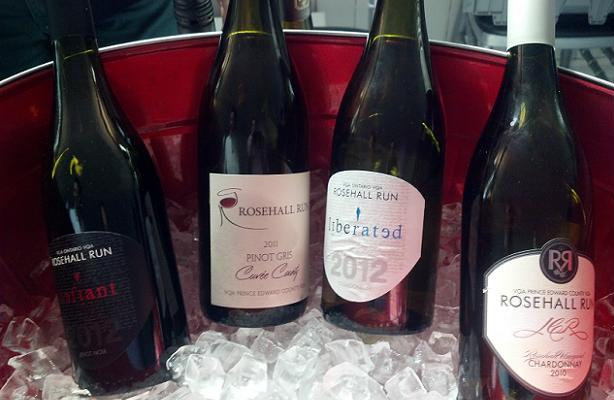
Rosehall Run Wines Photo: Michael Godel

Rosehall Run Wines
Photo: Michael Godel

Rosehall Run ‘The Swinger’ Syrah 2011 ($34.95, winery only) gets my attention not just because it’s the only commercially planted and bottled Syrah in PEC but because it stands in front of the orchestra. I gotta believe winemaker Dan Sullivan cares deeply about this wine from fruit sourced on Dick Singer’s Fieldstone Vineyard. Nothing fatuous about its smoky, tart cranberry, Sangioveseness kissed by the salty waves of an unseen ocean. The Swinger “ain’t no cherry bomb,” waits for no one, with its tobacco voice, gravel, rocks and sand. Like a sweet little bullet from a pretty blue gun.  90  @Rosehall_Run

Exultet Chardonnay ‘The Blessed’ 2011 ($35, winery only) is exemplary even if it may not be proprietor Gerard Spinosa’s favourite vintage. Commands an ineffable presence in gold sheen and parses meaning through balance and poise. The new oak is very noticeable but the ’11 acidity is grand. Their integration is seamless, the wine shines and a few years time will only increase its lustre.  92  @ExultetEstates

Closson Chase CCV Pinot Noir 2010 (310474, $39.95, winery) has improved dramatically over the course of a year, now red verging to black fruit, if only for a fleeting moment of temporary insanity, in a Sonoma state of mind. Silky smooth, “the textures coat my skin.” Though I have seen “the best (Pinot Noir) minds of my generation destroyed by madness,” this CCV uses a cured bresaola flavour and a vivid flower scent to invigorate, ground the humidity and the “earthy beet.” Musical, earthy beat, as in All Cats are Grey meets Howl.  92  @ClossonChase

Good to go!

Come together, over wine

Stratus Vineyard
Photo: Stratus Wines

as seen on canada.com

Intensity is in the air. The artists are at work, blessed with a geographical, geological and climatic canvas unique to the planet. They share arts and letters, compare and contrast methods, style and results. The sense of community is palpable, obvious and quite frankly awesome. They are Ontario winemakers and they are coming together. Right now.

Somewhereness

Somewhereness is not just a buzz word, it’s the operative word. The notion is attributed to Wine Spectator Magazine editor Matt Kramer and the application has been conceived, depending on your take, by osmosis, by derivative extension or through extrapolation, by the original six founding member wineries of Stratus, Charles Baker, Tawse Winery, Norman Hardie Winery, Flat Rock Cellars and the Malivorie Wine Company. The group has now grown to 12 Ontario winemakers, embracing Cave Spring Cellars, Hidden Bench Winery, Southbrook Vineyards, 13th Street Winery, Thomas Bachelder and Hinterland Wine Company. That this forward and fast thinking gang, collectively conspicuous like another famous gathering of Canadian artists, has embraced Somewhereness, mandated, habituated and held it dear in unequivocal belief, speaks of their collective consciousness. Terroir feeds their raison d’être,” imprinted with a vineyard’s sense of place, its soil, climate, seasons, vintage variations — and its maker’s methods.”

Mr. Kramer said “Somewhereness is more than just an event. It allows us to recognize the particular beauty of a place. Since Ontario’s wines have just such a particular beauty, the Somewhereness celebration makes sense in a single sip.” It was also Mr. Kramer who said that Somewhereness is something you can’t take, nor is it something that you can really define, or figure out its source. Somewhereness is not something undefined, like umami, nor is it akin to karma, or zeitgeist. It’s very real. In the soil, the vines, the fruit and in the wine. The sparkling, white and red wines of Ontario are obvious and recognizable. They should never be mistaken as having been made anywhere else.

Recognition

A concept like Cool Chardonnay takes it to the road to spread the prophecy and also plays host to events that attract dignitaries from around the world. More organizations like i4C are needed to spread the Ontario gospel. The next summit of #i4C2013 (third annual) will take place this coming July 19-21. Still, something is missing. Industry folk share an understanding, celebrate internally and not unlike any well-organized clique, pat one another on the back. But what about the local consumer? Do they realize they’re missing out on the illustrious muckle right under their noses? There’s the rub. It’s not just Americans and Europeans who are ignorant to the exceptional quality of Ontario wine. Abeyance be gone, these next few years have the potential to cement an industry’s power. Only a minority has even the slightest clue that liquid gold is mined out of the peninsula’s glacial clay and limestone. The time is ripe to tell the world the story of Somewhereness. The embryo is about to grow in a major way. Financial reward is within reach. So how to alert the world?

Education

When Canadian agencies send wine abroad, its best foot must be put forward. West coast wine writer Anthony Gismondi made this point to Canada’s quintessential wine ambassador, Janet Dorozynski:

More than anything, retail stores that specialize in cool climate wines are necessary to force feed confidence to the buying public. Shops devoid of cloying Cabernet Sauvignon, Malbec or Shiraz that cloud the wine IQ of young minds. I’m guessing you don’t see Gamay as a great hope for the future of sales out of this province. You are not the only one. If Riesling, Chardonnay and Pinot Noir are considered essential varieties for success, how can Gamay be excluded from hanging out at the top of the list? Only three were poured at Somewhereness, two of which were from Malivoire. Tawse, Stratus and Cave Spring should all have been pouring theirs. Consider this statement. “Wines produced between 41˚ and 44˚ north are more aromatic, lighter in body and higher in acidity than their warm-climate cousins.” If that does not shout Gamay, please tell me what does. The #GoGamayGo troupe is in full tweeting mode:

Simply put, more Gamay (Noir) needs to be planted in Ontario’s vineyards. OK, so the name isn’t the sexiest. Could you call it Niagara Noir? I don’t think so. Gamay and its small berries (especially from new clonal plantings) are ideally suited to the climate and the wines are drop dead delicious. The bandwagon is growing, with zealots like @thespitter, @winetrackmind, @BillZacharkiw@mkaisersmit@TheGrapeGuy@zoltanszabo and @johnszabo leading the charge.

Caretakers of the Earth

Indeed, Ontario is a special place to grow grapes. Our 12 winemakers feel this way about their wines, noting they offer “deeper refreshment, exquisite harmony with food, and great ageing potential. Welcome to the coolest fine wine region on earth. Our wineries sit on a fortuitous composition of earthly constituents: some 12 meters of glacial clay and silt capped by a few feet of clay and limestone-laced topsoil. Clay limits a vine’s ability to produce large crops. Instead we get tiny berries in small yields, giving us high concentrations of sugars, acids, minerals and wantonly exotic flavour compounds.”

On Tuesday, April 16th the group of 12 poured their best at the MaRSDiscovery District. A warm thank you goes to Cool Chardonnay, i4C VIP Concierge Trisha Molokach for helping to set the Somewhereness table. Here are eight shining examples of the coolest wine made on earth.

From left: 13th Street Cuvée Rosé NV, Cave Spring Cellars Riesling ‘CSV’ Estate Bottled 2009, Malivoire Wine Company Gamay ‘Courtney’ 2011, Hidden Bench Terroir Caché Meritage 2009, Charles Baker Riesling ‘Picone’ 2011, Norman Hardie County Chardonnay 2011, Hinterland Wine Company Rosé 2010 Method Traditional, and Tawse Pinot Noir ‘Lauritzen Vineyard’ 2010

13th Street Cuvée Rosé NV ($24.95, winery only) is autolytic, Brut-finished, traditional method sparkling that has that something in her style. Pinot Noir and Chardonnay emitting so much strawberry energy you might find yourself lost in the fields forever. But there is more than that, “something in the way she woos me,” maybe the rhubarb replay, or the tarragon, or the faint tang of cheese. You gotta like the Jean Pierre Colas style and to like her, you need to like her style.  89  @13thStreetWines

Cave Spring Cellars Riesling ‘CSV’ Estate Bottled 2009 ($29.95, winery only) comes from the oldest, lowest-yielding vines at the estate grown on the limestone, Beamsville Bench terrace. A three month rest on its lees imparts honey on the nose though the palate is dryer than off-dry. Mineral, pop-driven even. A hoovering, wizened Riesling, puckering, turning inward, yet to hydrate. Unique for Escarpment ’09 and will realize a quenching later than most. I for one will put this aside and revisit at the end of the decade, when “golden slumbers fill your eyes.” 89  @CaveSpring

Malivoire Wine Company Gamay ‘Courtney’ 2011 ($29.95, winery only) spent 14 edifying months in French oak and will live adroitly for another five years as a result. So much plum inherent in all its faculties, berries and currants too. The winemaker star of  Shiraz Mottiar is rising higher into the cool climate stratosphere with each passing vintage. His wines walk a haute couture runway of class and style.  91  @MalivoireWine  @ShirazMottiar

Hidden Bench Terroir Caché Meritage 2009 ($32.95, winery only) occupies hallowed Beamsville Bench middle ground between the beastly corpulence of 2008 and the rich, voluptuous 2010. Puzzling blend. Approachable and formidable. I sip and sip and sip her majesty in spite of her necessary acidity and tenacious tannin. “I want to tell her that I love her a lot but I gotta get a bellyful of wine.”  92  @HiddenBench

Charles Baker Riesling ‘Picone’ 2011 ($35, winery only) trembles with nervous energy and will need some bottle time to shed its shocking, A16 soda popping feeling. Right now “he got joo joo eyeballs.” Give it a year, or even two for the Vinemount Ridge clint (citrus and flint) to come together in a fit of focused, piercing acidity. This is Baker’s sharpest, knife-edge Riesling in the block and while I never thought it possible, this one is sure to outshine 2009. For Charles Baker “one and one and one is three.”  93  @cbriesling

Norman Hardie County Chardonnay 2011 ($35, winery only) is not merely a window into the vintage but the portal. Bright, golden fruit, freakish level of mineral and longer than the old Greer Road. Norman will always have ’08 but the newbies will be lucky to discover 2011. Who wouldn’t fall for its charms. When it comes to this Prince Edward County Chardonnay, “one and one don’t make two, one and one make one.” I call that a bargain.  92  @normhardie

Hinterland Wine Company Rosé 2010 Method Traditional ($37, winery only) is imbued faintly and sweetly in pink hue and lithe bubble. The grace and ease of Prince Edward County is forgotten when the wine hits the tongue and attacks with force. A peppery anesthetization ensues, followed by a soma-like, numbing sensation. She’s no cheap date, gives you no money, “but oh, that magic feeling.” Like a two-side playing of Abbey Road, she reels you in slowly, works to a feverish pitch and drifts off slowly into dream. A bit exhausting but worth the trip.  90  @hinterlandwine

Tawse Pinot Noir ‘Lauritzen Vineyard’ 2010 ($44.95, winery only) from the Vinemount Ridge is dry and cut with spice, a favourite for winemaker Paul Pender. The sour acidity from fruit such as cranberry and pomegranate are here in deep, concentrated and naturally sweet tones. Niagara limestone casts a Burgundy mineral shadow and the wine is iron tough yet silky due to the warmth of the vintage.  91  @Tawse_Winery

Good to go!