At a loess for words. Exceptional multi-vintage #grunerveltliner tasting with thanks to @austrianwine
On Tuesday, October 27th, 2015 Grüner Veltliner supervened in Toronto. It was long past due for the community of Sommeliers, Media and Austrian advocates to convene for the purpose of a vertical tasting followed by an Austrian wine bar of product currently available in Ontario. An ausbreitung of the highest Grüner order. I was fortunate to be a part of the Spoke Club fest and thought it high time I said something about it.
The Austrian Wine Fair comes to Toronto’s St. James Cathedral, Library & Snell Hall on April 14th, 2016. The Austrian Wine Marketing Board and 30 Austrian vintners will be showcasing 165 wines, to media, trade and in partnership with WineAlign, to an evening reception for consumers.
The Schedule
Tutored Tasting for Sommeliers and Media, 11 AM – 12:30 PM.
Austrian Wines – A Taste of Culture, consumer tasting 4:30 PM – 6:30 PM. Only $55 for WineAlign members (regular cost is $60). Reserve your tickets here.
WineAlign’s John Szabo, MS has this to say. “Austria has a terrific culture of wine, producing and drinking. Beyond the world’s best Grüner Veltliner, you’ll also find astonishing Riesling, as well as more exotic white grapes with singular flavours. But it’s the Austrian reds – Blaufränkisch, St. Laurent & co. – that may shock you most, in tune with the zeitgeist of the modern drinker. I look forward to reconnecting with the folks who make them.”
For more information contact Birgitta Samarvarchian, toronto@advantageaustria.org, 416 967 3348. The closing date for registration is April 13, 2016.
Traditionally known for its white wines, few realize that one third of Austria’s vineyards are planted to red. At the Austrian tasting an educational seminar will feature flights of the three red aces, the indigenous grape varieties Zweigelt, Blaufränkisch and St. Laurent, plus a rare flight of Austrian Pinot Noir. Two years ago I concurred:
“The whites, mainly centered around the signature variety Grüner Veltliner, showed the mineral and salinity so necessary to the grape’s success. Reds made from Zweigelt and Blaufränkisch are Austria’s trump card, ready and willing to take on the world’s reds imbued of elegance and finesse.”
Back to that October tasting. Outside of making the trip to Vienna and forging an itinerary that includes no less than a dozen high profile producers who generously agree to crack open some older vintages, what other setting could present Grüner Veltliner in such light? The age ability recognition factor knocked another one off the bucket list and opened new doors to perception. If for no other reason, and there are many, he Austrian tasting coming to Toronto should not be missed.
On the road w: @zoltanszabo & @tonyaspler we concur. Expert overture @austrianwine #grunerveltliner via @johnszabo
Flight #1
Stift Göttweig Grüner Veltliner Göttweiger Berg 2014, Kremstal, Austria
Freshness, with a minimal amount of Co2, herbal certainly, with pears and stones. The fruit finale is up, up and away. Very flavourful, almost tropical Grüner.
Fritsch Grüner Veltliner Ried Steinberg Ruppersthal 2014, Wagram, Austria
Has a candied meets medicinal nose and more than its share of mineral to taste. Lingers with a sweetness that is not sugar. It’s a tang derived from grape tannin.
Weixelbaum Grüner Veltliner Reserve Ried Wechselberg 2013, Kamptal, Austria
Very ripe, so tropical to nose and smells like candy floss, like enticing spun sugar. Mouthfeel is more like unoaked Chardonnay. Global entry strategy for Grüner to take the market by fresh storm turns exit strategy without reason.
Edlmoser Grüner Veltliner Ried Himmel 2013, Wien, Austria
The mineral expression of the young Grüner. Elemental and metallic. Good range of motion, right side of the mineral tracks. Really fine tracking and length.
Liegenfeld Grüner Veltliner Ried Himmelriech 2013, Burgenland, Austria
Full-ish and bullish, especially in flight comparison. Quite the fruit monster here, with a sugarless sour candy sensation and savoury linger. An eastern European cough candy with enough subtlety to keep it from crossing any uncomfortable lines. The outlier.
Flight #2
Holzapfel Grüner Veltliner Smaragd Ried Achleiten 2012, Wachau, Austria
A tiny bit of botrytis giving off a mushroom and truffle note, perfect at this stage for a ’12 though it will likely increase going forward, possibly at the compromise of the stellar fruit and even deeper mineral passion play. This is an intense wine with acidity that may be waning but the wine cuts a deep and serious bowie wound. The lees really rules and reigns in the rest. Turns to cider after 10-15 minutes. Changes. “Oh, yeah, Mmm. Still don’t know what I was waitin’ for. And my time was runnin’ wild.”
Domäne Wachau Grüner Veltliner Smaragd Ried Kellerberg 2012, Wachau, Austria
Quite stoic, clear, clean, steely, like unoaked Chablis. Wondering where the lees are in this, how much and for how long because it has that distinct mineral tang that lees will give to a wine made like this. Exemplary but simple. Though the acidity is low so it finishes fat. Still, proper and simple.
FJ Gritsch Mauritiushof Grüner Veltliner Smaragd Ried Singerriedel 2012, Wachau, Austria
This has the candied nose, the tropical fruit and the lactic feel. Quite a mouthful of same flavours in repeat on top of the aromatics and an overall layered tang. Like those white blends again.
Leth Grüner Veltliner Ried Scheiben “1ÖTW” 2012, Wagram, Austria
Powerful loess in concentration, smells like scraped wet soft tuff-like rocks, almost powdery and not a fruit-driven Grüner. Better acidity than some and finishing bitters. The first to do so.
Allram Grüner Veltliner Reserve Ried Gaisberg “1ÖTW” 2011, Kamptal DAC, Austria
Age is creeping in, with a petrol and tannic note that take this into steep slope, white stoicism. The slate is really in, the acacia barrel giving a near-nutty note and certainly white flower distillate. Like eau de vivre. Got a spark.
Gas and stone again, with more verve and life. The first to give soil funk without sweetness or botrytis. A slight Co2 note, a spark, very mineral character. Old vines give concentration, rocks do tannin and acidity lingers nicely. Got stein. Old Riesling reduction and energy equals implosive energy. Flight #2 really speaks to the loess and here is it definitely on high.
Flight #3
Rudi Pichler Grüner Veltliner Smaragd Ried Wösendorfer Hochrain 2008, Wachau, Austria
A fine slow decline in grace, elegance, bald, striking. Here the reason not to fear and for any and all decisions to protract age from Grüner. There has been no discernible deterioration and without a doubt the cleanest fruit in its original state. No flaws. So in that sense an ageless wonder. Strikes as so much younger; colour, aroma, flavour, tannin and linger. Ageless.
Brundlmayer Grüner Veltliner Reserve Ried Lamm 2007, Kamptal DAC, Austria
Certainly showing age here, through all its components and has a sugary gaseous feel. Says Trocken so I wonder what the RS really is. Mineral and acidity are in great interplay. Good length. Really smart and necessary look into aged Grüner. Reductive torque from a top vineyard. The French paradox in analogy is Sémillon.
Hiedler Grüner Veltliner “Familienreserve” 2006, Kamptal, Austria
There was some dirty fruit here, past its prime, late harvest certainly, smelling of tropical fruit past ferment and into decay. But, there is acidity so there is life. Lots of bitters. Some volatility. In a way, The Frick of Austria. Heavy lees, acacia barrels. No fining, no filtration, some biodynamic principals applied to grape growing.
Malat Grüner Veltliner “Das Beste vom Veltliner” 1999, Kremstal, Austria
I find this so much fun at 16 years of age with burnt orange, caramel, white pepper, spices, and an elemental, aerified glory that is some kind of serious inhalant and intoxicant. Late harvest again, clementine segments of flavour, with citrus acidity and great mental acuity. Great bitters. This is on par with some aged Alsace, somewhere between Riesling and Gewürztraminer. Weighs in and integrates its 19 g/L of RS with distinction.
Flight #4
Herbert Zillinger Grüner Veltliner Reserve “Radikal” 2013, Weinviertel DAC, Austria
Oxidative, spontaneous ferment, leading to tang upon tang. The methodology has led to tannin in layers, some orange segment and bitters. Acidity is not striking and its aridity means drink this early.
Geyerhof Grüner Veltliner “wildlux” 2013, Kremstal DAC, Austria
I get terpenes, like cool-climate Chardonnay, well, more cool than Chardonnay and then it gains in salinity, sea salts, brine, groove but not necessarily mineral. Has real verve, life and yet again, not for age. Known for their natural winemaking.
Zillinger Johannes Grüner Veltliner “Numen” 2013, Osterreich, Austria
Amphorae wine, old vines, certainly oxidative, thick texture from lees, but there is acidity. Orange again and edgy, with a piercing limestone tang that runs directly through. Numen “natural spirit inhabiting a place or just natural genius (of spirit).” No external intervention.
Sepp Moser Grüner Veltliner Ried Schnabel “Minimal” 2013, Weinland, Austria
Here is the Alsatian Grüner, natural and with the addition of slow micro-oxidation of old barrels. Eighteen months seems almost on the lee side of time, as we find so much preserved lemon and a lack of Grüner impression. Certified biodynamic. “Will not meet the expectations of wine consumers today.” Dill pickle meets a tomato of volatility.
Wimmer-Czerny Grüner Veltliner “Pur” 2012, Wagram, Austria
Hard to believe this is only 2 g/L of RS. Real Muscat character in aromatics and again terpenes but with a naturally oxidative bent.
One in the April 2nd, VINTAGES release
Loimer Grüner Veltliner 2014, Dac Kamptal, Austria (142240, $21.95, WineAlign)
Flat out delicious Grüner Veltliner with a nice split between fruit and mineral, mas o menos, neither really leading the other. Citrus and a bit of an airy, gravel feel. Drink 2016-2019. Tasted March 2016 @LeSommelierWine@FredLoimer
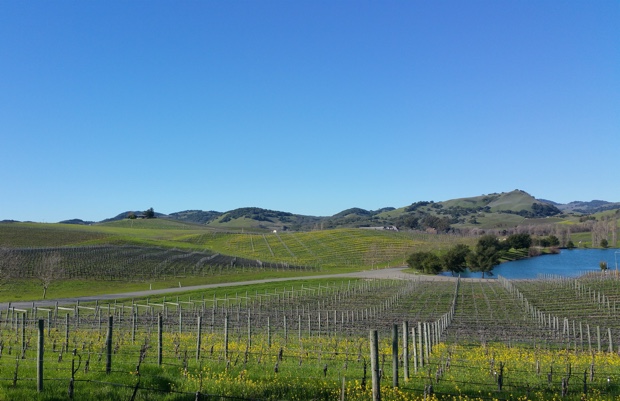
In February, Cuvaison Estate Wines in Carneros, The California Wine Institute and Napa Valley Vintners welcomed a group of curious Canadians for a walk in the fields and a comprehensive tasting. Some older and old-ish bottles were opened in the session with Cuvaison’s winemaker Steve Rogstad, Groth’s Suzanne Groth, Schramsberg’s Hugh Davies and Trefethen’s Loren Trefethen. Journalists and sommeliers are always pleased to see some (bottle) age in a tasting.
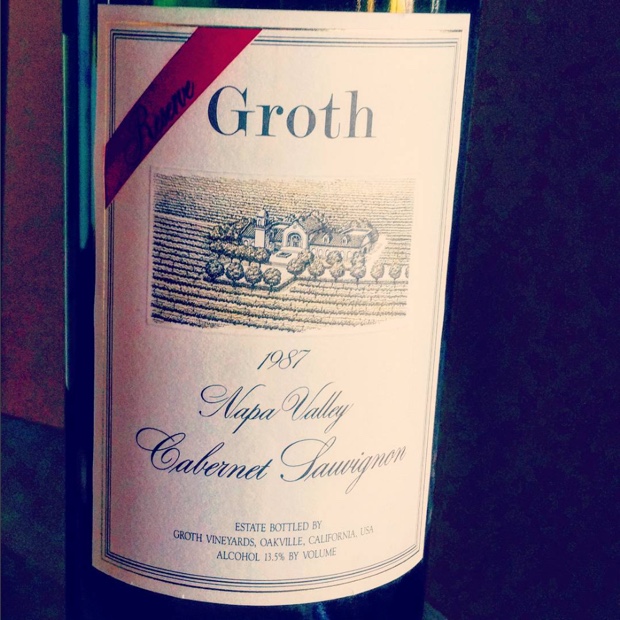
Youthful ingress into back pages of @GrothWines nearly three decades past @NapaVintners @CalifWines_CA #napavalley
We drink wine to experience moments that do not occur in other situations, settings or with other beverages. When we taste older wines we look into the past and pause, for thought and for who might have had a hand in this glass, back then, for us to wonder about now. To dislike older wines is to arraign a censuring of the past and a refusal to let it testify on its own behalf. The dismissal of aged wine is an act of complacent idleness. It is spiteful, incurious and therefore inept. It may seem pedantic to harp on the anti-older wine curmudgeon but let’s face it. The act of self-moralizing without admitting to being a moralist is just not cool.
In 1981 Napa Valley became the first Califronia-designate American Viticultural Area to hold such a distinction. You have to pay a visit not only to comprehend its beauty but also its stature. In terms of size it is just 30 miles long and a few miles wide, is planted to a mere five per cent for viticulture and represents just four per cent of California’s wine grape harvest. And it’s a mammoth in the global wine industry.
Cuvaison, Carneros, Napa Valley
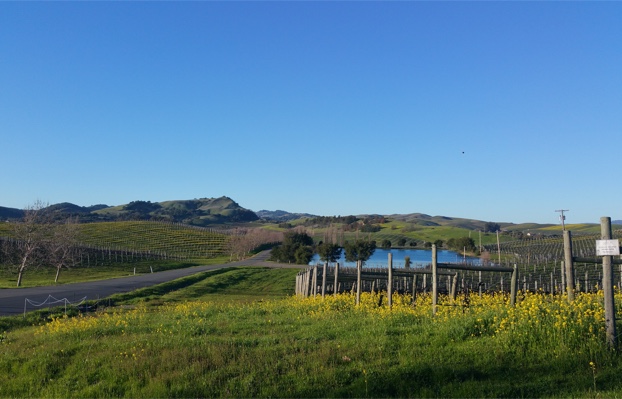
Los Carneros is the largest AVA and the only appellation located at the crossroads of two major wine regions, the Napa and Sonoma Valleys. The area is influenced by the maritime breezes and fog from its southern border with the extension of the San Francisco Bay. Cuvaison is a Pinot Noir and Chardonnay specialist taking full advantage to use that cool fog for its rolling hills perched above San Pablo Bay. Time spent in Carneros with winemaker Steve Rogstad and President Jay Schuppert leads to a coveting, of its undulating vineyards and its tasting room warmth. A room with a view and an uncanny ability to turn all into calm.
A great Manitoban tastes at Cuvaison
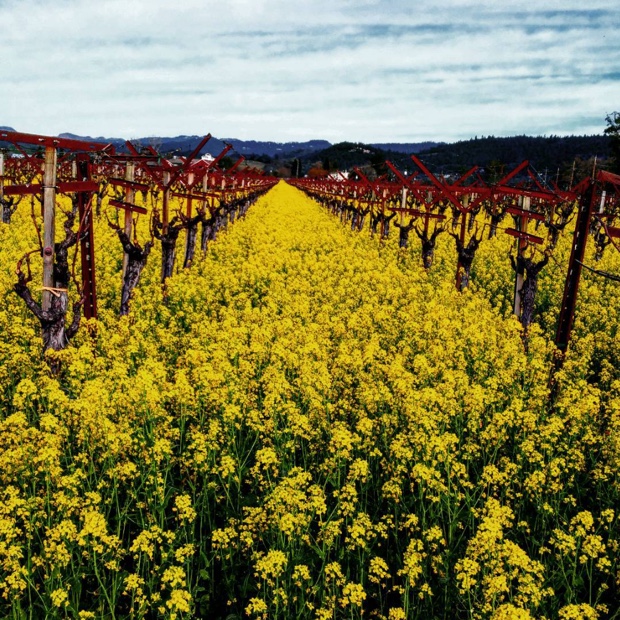
A motley Canadian crew of Quebeckers, Ontarians and one great Manitoban saunter through the winter mustard with Schuppert and Rogstad who explains that the plant material in Napa Valley then (twenty-five plus years ago) was not what it is today. There was so much virus so ripeness conversion was very different. Today with everything being so clean, ripeness is less of a challenge.
Though this is one of the first stops on the compressed and consigned three-day Napa Valley tour, the thematic is already unfolding like the bedtime transformation inside a sustainable, high-tech, architecturally modish, 800 square foot, pre-fab home. Napa Valley’s chief concern, like the home’s comfort, efficiency, giving back to the grid and common sense, equates to ripeness. It’s what everyone is after. It’s what matters. If a grape completes its phenolic journey and achieves optimum ripeness, related to and specific to site, then the mission is complete. What follows is less important.
Though the quest for ripeness is easily assessed in 2016, especially because the last four Napa vintages have seen to produce perfect fruit, there is something to be said for what happened back in the day. Napa Valley garnered attention long before the vines were this clean of disease and virus. Ripeness was a virtue and still is, but today’s definition has little or nothing to do with what passed for fulfillment in the 8o’s and 90’s. Today’s wines are bigger, darker, deeper, higher in alcohol, hedonistic and lush. They are not this way because of stylistic divergence. They are this way because that’s what the weather and the vines are giving. My recent visit confirmed this sense of clarity.
We tasted eight comparative wines with Hugh, Steve, Suzanne and Loren. Here are my notes.
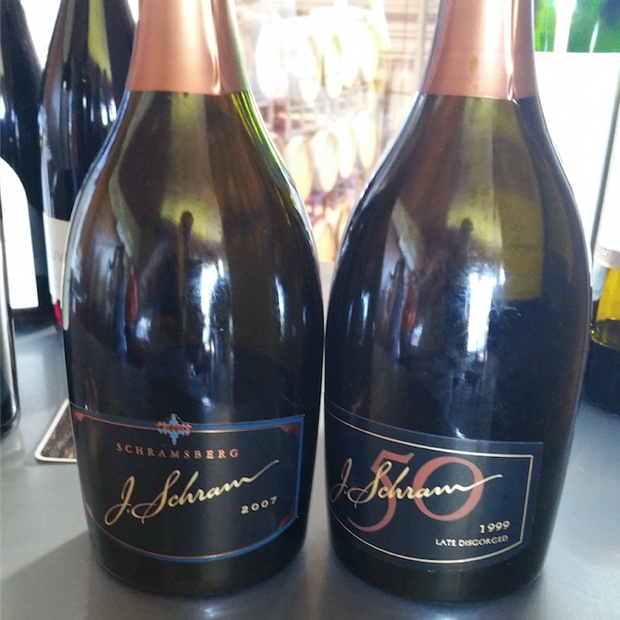
Schramsberg Sparkling J. Schram 50th Anniversary Late disgorged 1999, Napa Valley, California (Winery $175 US, Agent)
In celebration of Schramsberg’s golden anniversary, 50 years after Jack and Jamie Davies revived the historic Schramsberg estate for the purpose of making the nation’s first Chardonnay and Pinot Noir based, bottle-fermented sparkling wines. A North Coast (57 per cent Napa, 25 Mendocino, 15 Monterey and 13 Sonoma) blend of 74 per cent Chardonnay and 26 Pinot Noir. Seventeen years have come to ginger, cumin, coriander and galangal in laminous, oxidative ingenuity, wholly arid in kicking up the aromatic dust. Flavours of pressed lemon, bitter brioche and then tannin, yes tannin. From a protracted year, picked as late as October 19th, disgorged in August of 2014 at a dosage of (very necessary) 11.5 g/L RS. Blessed with high natural acidity of 9.8 tA. How can I not concur with Hugh Davies. “What we’re really showing here is Napa Valley Chardonnay.” Drink 2016-2031. Tasted February 2016 @Schramsberg@TheVine_RobGroh
Schramsberg Sparkling J. Schram 2007, Napa Valley, California (Winery $120 US, Agent)
A Blanc-domainted sparkling dedicated to Schramsberg’s founder Jacob Schram, gathered from the very best base wine lots of approximately 250 that simmer each year. North Coast (65 per cent Napa, 19 Sonoma, nine Mendocino and seven Marin) Chardonnay (84 per cent) and Pinot Noir (16) from significantly low pH, high habitual acidity and healthy dosage define the signature sparkler in the arsenal of winemakers Sean Thompson and Hugh Davies. Spent seven years on the lees and was disgorged less than a year ago. So similar to 1999 but obviously brighter, though the profile is a microcosmic version. With citrus more pronounced, by lime and grapefruit in addition to the lemon. I wonder if they might fully dissipate with time. Not as dense and pressed but again, thank/blame time and/or vintage relations, not to mention evolutionary stresses. Earlier dosage is certainly a factor. This 2007 is a more moderate bubble from a vintage finished by the end of September. Drink 2016-2024. Tasted February 2016
Steve Rogstad
Cuvaison Pinot Noir Estate 2009, Los Carneros, Napa Valley, California (Agent, $42.95, WineAlign)
Very expressive Pinot Noir that within the context of tone I find the VA noticeably elevated, as are the aromas of fennel and a transition from balsamic to soy. Quite advanced while aerating brings out a floral foil, namely violet. A sweet and tart palate comes with a bite of what seems ironically like mustard seed, thoughtfully Japanese in origin and condiment. This would pair well with the eclectic flavours of teppanyaki. Drink 2016-2018. Tasted February 2016 @cuvaison@LiffordON
Cuvaison Pinot Noir Spire 2013, Los Carneros, California (Agent, Winery, $52.00 US)
Part of winemaker (since 2002) Steve Rogstad’s Single Block Series, from a drought vintage’s fruit aged for 16 months in French oak puncheons. Fresh and bright, within and without, from a solid black cherry core to framed by the same. Cool from San Pablo Bay fog, savoury and dusty with cocoa to long espresso. Typical Carneros ripe and pure Pinot Noir to the nth degree. Drink 2016-2022. Tasted February 2016
Groth Cabernet Sauvignon Reserve 2012, Oakville, Napa Valley, California (Agent, $179.95, WineAlign)
Tasted alongside the alluring 1987 with Suzanne Groth. Extremely primary and struck as if by cool fog and mineral mist. Unmelted and unshaken tempered chocolate to be sure, cracked and fissured into shards. The flavours welcome Cassis and graphite with quite the lightning on the tongue. Enervating Cabernet, pulsating and tingling. Should age long but not quite like the 1980’s. Contains 12 per cent Merlot and saw 22 months in 100 per cent oak, but notes Suzanne, “other than that everything is completely different.” Drink 2018-2032. Tasted February 2016 @GrothWines@TheVine_RobGroh
Groth Cabernet Sauvignon Reserve 1987, Oakville, Napa Valley, California (Agent, WineAlign)
Not so much the look but it is the feel that is fuelled by dill weed and a touch of mushroom soy. Almost inconsequential older aromas are dissed by the positivity of flowers, some dried into potpourri while other’s drape sprung and stoic in the hanging pot’s balance. A slice of dried orange sits on the wrought iron porch table. Here is the wonder of 28 year-old Cabernet that persists as a pleasure to drink, not because it’s exciting but because its lovely and alive. Blessed with a truffled finish. Quite amazing actually. A child of a small crop and very healthy year, with 10 per cent Merlot, 22 months in 100 per cent French oak and the nerve to emerge like this in 2016, which is quite incredible. Made at a time when the fruit was protected from burn. “Definitely tastes like Cabernet from the 1980’s.” Drink 2016-2018. Tasted February 2016
Trefethen Family Vineyards Cabernet Sauvignon Oak Knoll District 2001, Napa Valley, California (Agent, Winery $60 US)
From one of Napa Valley’s lithesome and adroit plots, the gravelly soils in the northwestern quadrant of Trefethen’s estate vineyard. Fifteen year-old Cabernet in a demurred state of grace, pausing, reflecting its own incredible condition. Cool and stretchy, still so primary, kernel coated in chocolate and dark berries. Mineral too with a few plus a couple of years to go. A creature conditioned by a soil’s alluvial fan giving courage and strength. Drink 2016-2021. Tasted February 2016 @trefethenfamily@Vinexxperts
Trefethen Family Vineyards Cabernet Sauvignon Oak Knoll District 2012, Napa Valley, California (Agent, Winery $60 US)
Forceful, almost brooding, with a plethora combined of chocolate and savour, from mint and with a touch of eucalyptus. Wonderful fruit components are accented by spice. Here the accumulated knowledge of re-planted vineyards has come to this in which elegance meets power and with your next great meal in mind. Loren Trefethen notes the use of double T trellising so that the grapes are subjected to a dapple light effect with which they are neither tanning nor shaded. Certainly some levied tones that will need to settle. Fascinating wine of geology, vineyard management and a redux return to an older way of fashion. Drink 2018-2029. Tasted February 2016
You need only spend a few days in Napa Valley to gain a basic understanding of what drives the machine. Immerse yourself into three or four structured tastings and hear the mantra repeated. Listen to the winemaker and the viticulturist talk about the growing seasons and intuit the very basic premise, the essential doctrine and the constitutive aspect on everyone’s mind. Ripeness.
The 2011 vintage was an unmitigated disaster. Cold, rain and low brix levels made for less than stellar Napa Valley reds and whites. At the time it wasn’t so much swept under the rug as much as shrugged off. Still some very good wines were made. Even today critical proponents of cool-climate and understated wines will champion the elegance and proportion of 2011 Napa reds, especially the Cabernets. Talk to or listen to a local winemaker speak and know they will (mostly) all agree to disagree with those ideas. There was little to no phenolic journey fully completed in 2011. Relativity is the general, special and principle quizlet to compare and contrast Napa Valley wines. The next vintage afforded the opportunity to put 2011 behind them. The proximate three relegated 2011 to the footnotes of history.
What followed 2011 was drought, extended drought, difficult times drought. Grapevines do quite will when they struggle, provided their keepers have equipped them with the organic and self-preserving tools to survive without water. While the rest of the state suffered, Napa Valley grapevines produced exceptional fruit. From 2012 to 2015 the pilgrimage to maturity happened with ease. Quality over quantity? Sometimes both. In 2012 there was a huge crop from an incredible growing vintage. Along with 2013 they are being heralded as two of the best vintages in the last 30 years.
If a tutored Napa Valley tasting is centred around Cabernet Sauvignon and parent grape variety Sauvignon Blanc then the mind may wander into comparative territories with Bordeaux clearly on the analogous radar. Cabernet defines Napa Valley, hook, line and sinker. Nearly everyone grows it, bottles it and employs it to define who and what they are. The numbers corroborate the abstraction. Cabernet is still the king. The interesting diversion is Sauvignon Blanc. In the context of Bordeaux it is not a diversion at all but Napa growers and producers are infatuated with it. It makes for good but rarely great wines. Chardonnay has proven its Napa Valley pedigree. So why Sauvignon Blanc?
If Bordeaux epitomizes a mono-worshipping culture then deconstructing Napa Valley reflects the effort of extricating monotheism out of a polytheistic context. But Napa is not Bordeaux and also avoids the affectation and mannerisms of monotheistic worship, something that is very specific to Bordeaux and even more so to other ancient wine-producing regions. In Napa there is great interest and time set aside for Chardonnay but also some love Pinot Noir and Zinfandel. Cabernet Sauvignon leads with authoritarianism on a chilling scale and Sauvignon Blanc exists in a polar opposite vacuum. Nothing is inexpensive to grow and most markets expect to pay a premium for quality. Demand will perpetually support Cabernet, Merlot, Chardonnay, Pinot Noir and Zinfandel. Sauvignon Blanc above $20 and not from Bordeaux is different. It is Napa’s greatest curiosity, made with great care and thrown caution to the marketplace wind. And it sells. Looked at from both sides clarity is noted in the adage that Napa Valley is not Bordeaux.
Berry to bottle
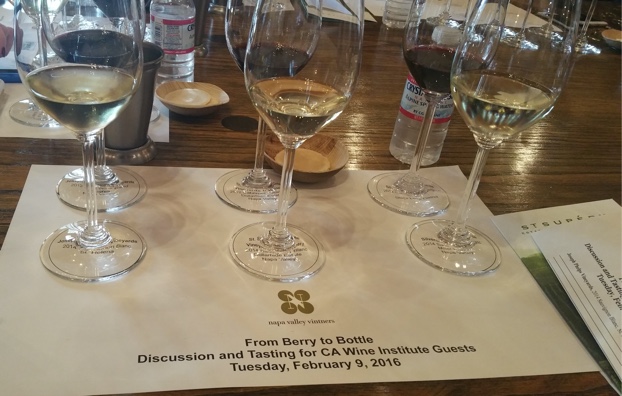
On February 9th, 2016 nine Canadians sat down to taste with the principals of three Napa wineries, Joseph Phelps, St. Supery and host Silverado Vineyards. Karen MacNeil is a wine author, journalist, educator and consultant. MacNeil moderated a two-varietal tasting with Bill Phelps (President of Joseph Phelps Vineyards), Emma Swain (CEO at St. Supery), Russ Weis and John Emmerich (GM and winemaker at Silverado). From berry to bottle was organized by the California Wine Institute and Napa Vintners.
“Dirt is once again the sexy part of the business,” began MacNeil’s presentation. “Place is the core construct and inescapable construct.” The hills, slopes, ridges and valleys of the Valley are indeed intricate and the soil sets as diverse as you are want to find anywhere. Napa Valley contains 33 soil series with more than 100 soil variations and half of the soil orders that exist within the world can be found in the Napa Valley. At the end of the day ripeness follows. At all other times it leads. We tasted six wines that day. Here are the notes.
Cabernet Sauvignon and Sauvignon Blanc
Joseph Phelps Sauvignon Blanc 2014, St. Helena, Napa Valley, California (Agent, $59.95, WineAlign)
Graced by and driven for texture, with lees, out of second fill barrels and finished struck across a scraped mineral tang. Highly refreshing compression of density and weight. Long linger of stone fruit, primary peach and secondary apricot. Non-discernible citrus. Phelps has been producing this wine since 1975 from the home ranch vineyard, typically in increments of 2500 cases. If Sauvignon Blanc were made in Alsace, this is what it would be like. Unpronounced acidity and a floral note pay thanks to integrated Musque clones Bill Phelps says are integral to the mix. Drink 2016-2019. Tasted February 2016 @josephphelps@LiffordON
Joseph Phelps Insignia 2012, Napa Valley, California (710400, Agent, $299.95, WineAlign)
The 2012 Insignia had me at first whiff. At first sip I could not be reached. Massive aromatics blast from this formidable Insignia, clearly noted with immediate clarity as a proprietary blend for the ages. The current torrent is so plugged in and highly climatic, like a visibly sparking conduit, storm and fire all wrapped into one electric happening. The peaks, valleys, waves and intonations are bred of perfectly ripe fruit sets traveling as one in perfect syncopation. The ripe, chain-link tannins will take this very, very far. This is as fine a California wine as I have ever tasted. The first vintage was 1974. All five bordeaux varietals are represented which is not often the equation. In 2012 the blend is 75 per cent Cabernet Sauvignon, 10 Merlot, 10 Petit Verdot with bits of Malbec and Cabernet Franc. Drink 2018-2045. Tasted November 2015 and February 2016
St. Supery Estate Vineyards and Winery Sauvignon Blanc Dollarhide Estate 2014, Napa Valley, California (Agent, Winery, $35 US)
An altitude effected, single-vineyard, warm days, cool nights Sauvignon Blanc so much more in residence of varietal hyperbole, from grass to gooseberry, apple terpenes and finishing spice. Highly emotional SB of San Pablo Bay cooling and antithetical drought thanks to Sierra Nevada snowpack, or lack thereof. Stainless on lees stirred weekly bolstered in texture by 18 per cent barrel fermentation. Aussie expat winemaker Michael Schultz controls this big, vivid and vital style. Drink 2016-2019. Tasted February 2016 @StSupery@vonterrabev
St. Supery Estate Vineyards and Winery Cabernet Sauvignon Dollarhide Estate 2012, Napa Valley, California (Agent, Winery, $100 US)
Dollarhide was a cattle farm, a 1530 acre enormity of a ranch, now one of the more impressive Napa vineyards of altitude, micro-climate and heterogeneous soil series. The 2012 is a 100 per cent Cabernet Sauvignon cornered from the finest (number eight) 30 year-old vines parcel, planted in 1982. It is youthful and even a bit reductive, with dark red fruit and cooler savoury curation. Possessive of some black olive and mint-like coolness. Sweet tannins and espresso, specified and agreed from all French oak, left to decide a hillside expression. A fine chocolate finish is far from bitter with paid homage to that parcel which is a combination of volcanic and ancient sea sediment. Large shells have been found in the vineyard at 1200 feet. Tres cool. Drink 2018-2027. Tasted February 2016
Silverado Vineyards Sauvignon Blanc Miller Ranch 2014, Napa Valley, California (Agent, Winery, $35 US, WineAlign)
Fruit from vines burrowed into seep soil on a Yountville site between Hopper Creek and the Napa River (though 5 per cent is from Soda Creek Vineyard). A small elbow (four per cent) of Sémillon injects a shot of vitality into the arm of Sauvignon Blanc. For winemaker Jon Emmerich Miller Ranch in a climate sweet spot, a go between in which cool evening and morning temperatures mitigate the sweat of warm sunshine. Its home soils are blessed with terrific water capacity. No de-stemming is performed and the wine sees a long, cold (up to two months) fermentation. All in the name of aromatics. And so the Silverado home ranch Sauvignon Blanc lies somewhere in between the excitable and the elegant. Quite Bordelais but also grapefruit refreshing, with a slight spritzy tingle. Drink 2016-2018. Tasted February 2016 @SilveradoSOLO@KylixWines
Silverado Vineyards Cabernet Sauvignon Solo 2012, Napa Valley, California (Agent $119.00, Winery, WineAlign)
From heritage Cabernet Sauvignon vines recognized by the University of California, Davis, in other words, a clone unto itself. The home ranch estate vineyard was planted in 1968 and over two decades the vines adapted to Silverado’s steep, shale soils and mutated. Through meticulous field selections an entirely new clone of Cabernet Sauvignon emerged. Here is one of only three Cabernet Sauvignons to attain this status and the only one from Stags Leap District. Who knew such magic lurked in the Napa hills? The stuff of Roald Dahl imagination. This is a dusty and grounded red, of chaparral in arid, arenose, hillside forest floor character. Higher tones (there is a bit of VA) leaps with this SOLO’s Cabernet metamorphosed self, in a semblance of the clone it used to be. It honours a perfect growing season. From General Manager Russ Weis: “In Stag’s Leap we are not looking for something mouth-filling as much as mouth coating.” Drink 2019-2028. Tasted February 2016
If reporting on the VINTAGES wine release wheel were considered as a species of religious writing, say like Marilynne Robinson in her Emersonian Gilead, then the bi-weekly offer would be like the morning, a splendid dawn passing over each of our houses every two weeks on its path to Ontario wine stores. We the consumer roll out of sleep and into the constant, grandly announced VINTAGES light and we just turn over in it.
So every VINTAGES release is in fact the selfsame release, materializing every two weeks and within which everything turns to light. Or like Keats, “therefore, on every (wine), are we wreathing.” The $15 Chenin Blanc, the $24 Méthode Cap Classique and the $58 Pinot Noir, all from South Africa. The $18 and $27 Syrahs, from Chile and France. The $29 Kiwi Sauvignon Blanc and the $32 Sonoma Pinot Noir. The $40 Spanish Tempranillo, the $47 Châteauneuf Du Pape and the $57 Haut Médoc. There are many others that might be invited up to the sanctuary in one of the most unconventional conventionally popular wine programs of the 21st Century. Limits must be imposed for reasons 0f space and clarity and so these are the 10 wines on the March 19th altar.
Vinum Africa Chenin Blanc 2013, Wo Stellenbosch, South Africa (739995, $15.95, WineAlign)
Flinty, reductive, lemon scented and weighty Chenin Blanc with just the right amount of strength. A Winery of Good Hope product of master blending by winemaker Jacques de Klerk. Always great value. Drink 2016-2019. Tasted March 2016 @WineryGoodHope@Noble_Estates @WOSACanada@WOSA_ZA
Fathoms of red fruit, tones to match and the unwavering smoky beat of slow meat roasts and smoulders beneath herbal branches. Black olives, their brine and aromatic bark are thrown into the pit. Pitchy tannin and then finally, after the smoke clears, that fruit, unquestioned in its ripeness. A well-crafted and priced Colchagua Syrah that finishes with heaps of tar and tannin. Drink 2016-2020. Tasted March 2016 @WinesofChile@DrinkChile@KirkwoodDiamond
Graham Beck Premier Cuvée Brut Blanc De Blancs 2010, Robertson, South Africa (907568, $23.95, WineAlign)
Robertson Chardonnay with a purpose, a Champenoise intent and success by way of controlled and slow-evolving micro-oxidation. The autolytic effect is one of slow release, the oxidative lean just a tease at present. There is near-ethereal weight (or lack thereof) on the palate and the citrus injects drive and meaning into airy mousse. Some bitters, pith and stone fruit pit add complexity. Drink 2016-2022. Tasted March 2016 @GrahamBeckWines@Vinexxperts@WOSACanada@WOSA_ZA
Château De L’ou Infiniment Syrah 2012, Igp Côtes Catalanes, Roussillon, Midi, France (440610, $26.95, WineAlign)
Massive, brooding, full on chocolate Syrah with enough structure to house an addition with no further need for supports. The cantilever of fruit, wood and grain is synched to impossibly obscene. Can a wine be so bloody versed in the ways of modern Syrah architecture and still achieve balance? With tannin and length to match the effective conclusion here would seem to say yes. That’s the objectivity of assessment. Will it please? You get to answer that. Maybe wait a year to find out. Drink 2017-2022. Tasted March 2016 @ChateaudeLou@Vins_Roussillon
Clos Henri Sauvignon Blanc 2013, Marlborough, New Zealand (675629, $28.95, WineAlign)
Full on flavour wildly maxed out, all in Sauvignon Blanc, with bright acidity, ripe fruit and a mineral quality. Beautiful from start to finish. carrying itself with class and focused, positive direction. Grapefruit is juicy, lemons are preserved and lime is sweet. Very nice. Should age into honeyed territory. For now serve this darjeeling limited SB as a refresher to passengers settling in their cars. Drink 2016-2021. Tasted March 2016 @ClosHenri@ChartonHobbs@nzwine
La Crema Pinot Noir 2013, Sonoma Coast, California (732040, $31.95, WineAlign)
The brightest red cherries infiltrate the notes in every aspect of this Sonoman crafted from vines in Sonoma Coast, Russian River Valley, Los Carneros and Green Valley. Then exhilaration of a great Pinot Noir vintage comes across with mid-palate spice and late structure bite. You can’t deny the quality of 2013 fruit nor can you argue what the winemaker has left for it to pursue. Really good length lines the immediate to near future time frame. Drink 2016-2019. Tasted (from both 375 mL and 750 mL) March 2016 @LaCremaWines@sonomavintners@bwwines@thesirengroup
Muga Selección Especial Reserva 2010, Rioja, Spain (712067, $39.95, WineAlign)
A rich, concentrated and effectively tangy Tempranillo, full of cedar, leather and baking spice. The Muga Seleccion Especial straddles the north/south, old school/new class line better than any with one foot mired and the other wired to new social convention. The flavours are flirtatious and yet markedly sunken into the sands of Riojan time. Many grains gather, sift and re-collect to speak of history and filter progress. This drink now Tempranillo will give five years more of elementary pleasure. Drink 2016-2021. Tasted March 2016 @bodegasmuga@RiojaWine_ES@Vinexxperts
Château Mont Redon Châteauneuf Du Pape 2011, Ac Rhône, France (959627, $46.95, WineAlign)
Ripe and warm though structure from the outset is a thing in 2011. Mount Redon celebrates firm fruit, tannin and acidity no matter the level of phenolics so in 2011 the all in mentality will carry the torch and send this deep into the next decade. The level of concentration and intention is less than massive but there is decadence to be sure. This is a balanced Chateauneuf with temperament and understanding resting comfortably on its side. Drink 2019-2029. Tasted March 2016 @MontRedonWines@VINSRHONE@RhoneWine@FWMCan
Château Coufran 2005, Ac Haut Médoc, Bordeaux, France (446666, $56.95, WineAlign)
Bang on righteous, well made and properly preserved Haut-Medoc that while not inexpensive is a must buy for those who can afford and want to drink older Bordeaux. There is some earthy complexity and cheveux de cheval but there is plenty of brightness and unshaken personality. Does not swagger but rather dances. A show piece for the dinner table without having to raid someone else’s cellar. Drink 2016-2020. Tasted March 2016 @imbibersreport@BordeauxWines
Hamilton Russell Pinot Noir 2013, Wo Hemel En Aarde Valley, Walker Bay, South Africa (999516, $57.95, WineAlign)
It’s a funny direction to go, having tasted the 2014 HR back in September, six months ahead of this 2013, but one whiff and I get the feeling the order was pre-ordained for a reason and a purpose. This 2013 needed the extra time. It must have been a demanding drop in its early youth, as it still is, but the fine-grained fruit and even finer tannin can now speak its Hemel-en-Aarde vernacular mind. Only that valley brings this type of sweetness, not sweet, but sweetness. The red fruit, painted ochre and then mineral, juxtaposed, intertwined and bled from the earth. Though the days of $40 and $45 are gone, the price is justified for such Grand Cru South Africa. Drink 2016-2020. Tasted March 2016 @OliveHR@TrialtoON @WOSACanada@WOSA_ZA@hermanuswine
“Sun come up it was blue and gold.” #cuvee2016 #pictureinaframe #niagarafalls
The Ontario wine industry has powered through many big weeks during the tenure of its young but wise, short howbeit concentrated history. None seemed larger than the first week of March, beginning with Taste Ontario at the Royal Ontario Museum and ending with the 28th edition of Cuvée at the Scotiabank Convention Centre in Niagara Falls.
And now #cuvee2016 @CCOVIBrockU #vqa @winecountryont #scotiabankconventioncentre
In between and as a preamble to Ontario’s annual gala celebration there was the presentation of the Tony Aspler Cuvée Award of Excellence, presented by Mr. Aspler to viticulturist Lloyd Schmidt, for advancing viticulture in Ontario by accessing the best vinifera varietals from nurseries around the world and fighting bureaucracy to do it.
Tony Aspler Cuvée Award of Excellence winner for 2016 viticulturist Lloyd Schmidt and Tony Aslper (c) Brock University
Father and son grape growers Howard and Wes Lowrey from St. David’s were honoured with the Cuvée Vineyard of Excellence Award sponsored by BASF Canada Inc. The 2016 category was best red vinifera and the Lowrey’s were recognized for their Cabernet Sauvignon vineyard. The winner is chosen by an expert panel that makes field visits throughout the growing season to monitor quality.
Cuvée Vineyard of Excellence Award winners Wes and Howard Lowery are flanked by grower Matthias Oppenlaender and Julia Harnal, BASF Canada Inc. (c) Brock University
The VQA Promoter’s Awards are designed to recognize exceptional contributors to Ontario’s wine industry. The honours were endowed as follows. For Education, Peter Blakeman of The Canadian Food and Wine Institute at Niagara College. The Promoter-at-Large, Norm Hardie of Norman Hardie Wines. In the LCBO category, Nina Hofer, Product Consultant. In Hospitality, Peter Elmhirst of Elmhirst Resort. For Lifetime Achievement, Peter Gamble, formerly of Hillebrand, VQA, Stratus and Ravine, now consulting winemaker at Benjamin Bridge, Lightfoot & Wolfville and Versado Wines.
Proceeds from the Cuvée Grand Tasting go to support the Cuvée Legacy Fund established after the 2015 event. The fund has already awarded $15,000 in academic scholarships and contributed $13,000 toward industry-driven research projects. At the awards ceremony, the 2015 scholarships were also handed out.
Cuvée 2016 was orchestrated by Brock University’s Cool Climate Oenology and Viticulture Institute who will also play host to the Expert’s Tasting of Ontario wines in April. At this year’s reception 52 VQA wineries each poured one carefully selected wine for the Grand Tasting and were joined by 13 culinary partners. Earlier that week, Taste Ontario was hosted by VQA Wines of Ontario and Wine Country Ontario. Upwards of thirty producers contributed more than 125 wines to the media and trade event.
Taste Ontario reds
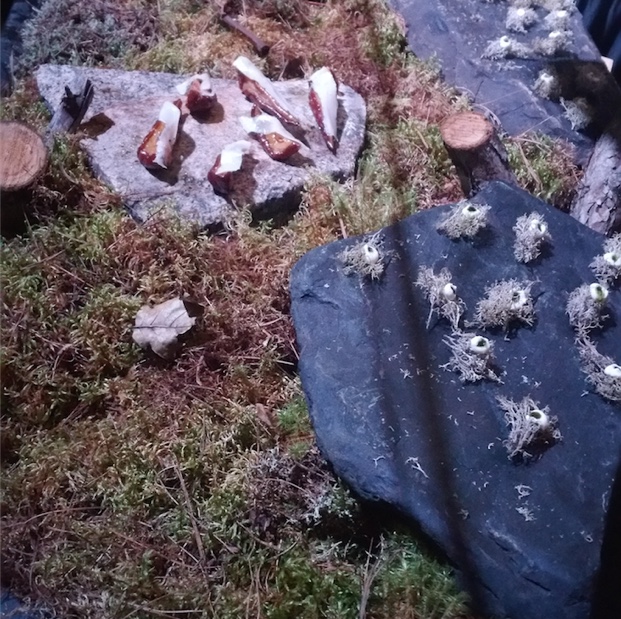
The food establishments on hand were granted the space and signage to show off and showcase their talents. Having their names projected onto the walls around the perimeter of the room made it very easy to locate who was placed where. The wineries received no such similar sort of spotlight signage so happenstance played a significant role on what got tasted. Still it was nice to see a Toronto neighbourhood friendly face in Ossington joint Actinolite Restaurant with chef Justin Cournoyer acting out his special brand of an Ontario forest passion play.
Forest flavours of Actinolite
The pork belly ‘Lollipops’ from Vintage Inn – Escabeche by Chef Chris Smythe, Korean fried chicken by Garrison House Chef David Watt and Duck Mu-shu from Golden Lotus Restaurant’s Chef Sing How were exceptional. Also on hand was omnipresent Niagara events food contributor Artisan Ontario presented by Chef Mark Hand and Mario Pingue. I somehow missed out on Backhouse Chef Ryan Crawford’s burrata and braised beef short rib ravioli tasting plates. No chef had a longer line-up all night long.
Pork belly ‘Lollipops’ from Vintage Inn – Escabeche Chef Chris Smythe
Insofar as an assessment of Ontario wines is concerned, from a varietal point of view, Riesling and Chardonnay have not relinquished any stronghold on their domination, nor should they any time soon. I can’t help but feel and notice that winemakers continue to reach for the big red machine and wish upon an intangible Bordeaux star when they should be concentrating on fresh, gulpable Cabernet Franc and Gamay. They should also take some chances with these necessary, best Ontario option red varieties. Press less, reveal freshness and let natural ferments find low-alcohol impressions of impossible, ethereal beauty.
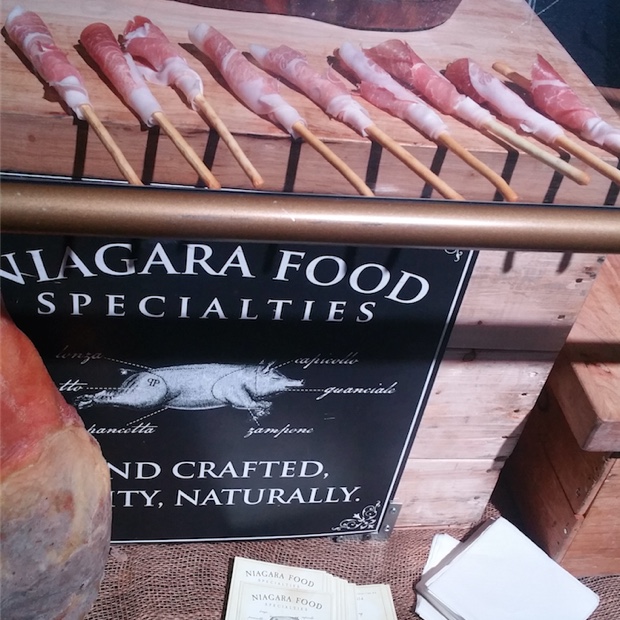
Pingue Prosciutto
At Cuvée there was no shortage of Riesling, Chardonnay, Pinot Noir and big red blends. Where was the Cabernet Franc? Kudos to Brian Schmidt of Vineland Estates for his varietal choice, albeit in a perfect little tidy $15 package. It was the only one. That is a travesty. Kacaba’s 2013 Cabernet Franc was a Platinum Award winner at the 2015 WineAlign Awards of Canada. They can’t be blasted for pouring their 2012 Syrah and you can only pick on but others should have seized the opportunity. J-L Groux of Stratus Vineyards offered up his 2013 Gamay from magnum. Brilliant! Where was the rest of Ontario’s Go Gamay Go arsenal? Varietal lampoonery I tell ya.
Perhaps I can be accused of filtering my view of the evening through the oculus of an infundibuliforms installation. Just maybe I’m a wee bit harsh in my assessment of choices made but there were several wines poured at Cuvée that we’ve seen many times before. While the inevitable will influence choices because of inventories and the bottom line, the event is not about finding buyers. The purpose and long-term vision should focus on teaching, on educating and ultimately on celebrating what Ontario does best. Not just what, but where. Choosing what to pour must come out of a disseminated varietal necessity so that sub-appellations can be further defined and understood.
My top ten wines tasted at the two bookending events were these.
Cattail Creek Small Lot Series Old Vines Riesling 2014
Cattail Creek Small Lot Series Old Vines Riesling 2014, VQA Niagara On The Lake, Ontario (Winery, $21.95, WineAlign)
A Cattail Creek joint starring Roselyn Dyck and consulting winemaker Steve Byfield, from a block of Clone 21 (Weiss) Riesling planted in 1976, one of the oldest in Ontario. This OV loitered in subdued maturation because of a brutal winter, a cold spring and a cool summer. A beautiful fall abrogated what came before and brightened the possibilities. Dyck and Byfield took full advantage, channeled their inner Mosel science of the mind, dialled back the sugar and submitted to the vintage’s desires. The result is a scintillant of Riesling with texture and acidity getting together to”grab a piece of something that you think is gonna last,” reelin’ in the year and shining like new. Steely Riesling at its Niagara flats finest, short of bracing and far from cloying. Though a long ways from the Bench, put this ’14 in the vineyard cru discussion with Picone, St. Urbain, Carly’s Block, Triangle, Steelpost and CSV. Drink 2016-2020. Tasted March 2016 @CattailWinery@TerroirLover
If the 2013 from Fielding Estate helped decipher the code of the how, where and why of Peninsula Viognier, this follow up 2014 speaks at the symposium. Sourced from the Four Mile Creek sub-appellation, a locale fast becoming the consensus ground zero for the option, this single-vineyard is farmed by grower Rick Smith. Low-cropped and hand-picked, this is the cleanest Viognier in town.The spice kick starts au fait late, sneaks up the backside and boom. Gotcha! Winemaker Richie Roberts has a vested investigated interest in this white variety amongst Niagara choices deeply pondered and painstakingly explained. Some off-roading chances taken going forward will elevate this wine into territory occupied by the excellent and the outstanding. Drink 2016-2020. Tasted March 2016 @FieldingWinery@RichieWine
Henry Of Pelham Speck Family Reserve Chardonnay 2014, VQA Short Hills Bench, Niagara Peninsula, Ontario (Winery, $29.95, WineAlign)
Vintage in and out this is the manifestation of an unequivocal Niagara icon for Chardonnay. An unwavering, stylistically consistent, best fruit first cuvée from Pelham’s oldest (1988) estate vineyards in the Short Hills Bench. Quite reductive and dramatic Chardonnay in 2014 with multi-macerated flavours. Needs some time for the barrel and the malo to get together with tangy, soil-driven fruit. A bit clunky at the present time. Should be fascinating to watch it develop, oscillate, flip-flop and ultimately settle into something fine over five years time. Drink 2016-2021. Tasted February 2016 @HenryofPelham@SpeckBros
Call this an experiment if you will and while winemaker Regan Kapach was blessed with a perfect ferment (and one that would not, could not be repeated in 2014 and 2015), don’t believe for a moment that divine skill was not integral to making this wine happen. Like an early 1990’s MTV production of Neil Young, David Bowie and Nirvana all wrapped up into one unplugged special, here is what happens when unfined, unfiltered and unsulphured jam as one. One major “un” omission, or inclusion in this case is French oak, the catalyst and the glue to keeping this freak of Chardonnay nature together. True, this is the one grape that can handle such a hands off winemaking process, but in Ontario? Not so simple. From the Little Vineyard up on The Bench, the Tenacity is not so much. It’s dreamy, creamy, lightly toasty and full of gelato texture and flavour. It glides and slides, lifts and cleanses. It’s a beautiful impossibility. Drink 2016-2019. Tasted March 2016 @16milecellar
Rosehall Run Ceremony Blanc De Blanc Brut, Prince Edward County, Ontario (Winery, $34.95, WineAlign)
A little ceremonial joy in the division here with Dan Sullivan taking some fizz chances to create a new PEC sparkling order. A multiple vintage cuvée from estate grown fruit of weight, substance, tang, drive, a shot put of citrus, servitude to PEC Chardonnay, certitude to B de B style and structure. Just enough pierce to go through and come out clean, even in the face of oxidative time, on the other side. Dips into the well of Champagne to recover its fearless tactility. These are bubbles that “travel first and lean towards this time.” Timing is everything. Drink 2016-2021. Tasted February 2016 @Rosehall_Run@sullywine
Oh, the accessibility of Quarry Road in 2012. Still totes the emerald shine, the gemstone tannic scrape and yet the flesh is rendered rich, ripe, ratcheted and riled up. This has tonality like never before, layered and strudel buttery. At this point the vines for Quarry are 17 years of age, sophic and erudite, compounded by the organic, biodynamic and prudent pruning practices that have cemented its vigour. The clay-limestone, fresh-mineral, push-pull is a veritable careening of expression. Though its longevity may not pile towards a compressed future like that of ’09 or ’11, the earlier and often response will act both as Chardonnay charming and Quarry Road magnetizing. For the next five years it will be very hard to turn away. Drink 2017-2020. Tasted April 2015 @Tawse_Winery@DanielatTawse
Cave Spring CSV Blanc De Blancs Brut 2008, Beamsville Bench, Ontario (237198, $39.95, WineAlign)
As expected the Cave Spring 2008 Chardonnay Sparkling solicits thoughts and ideas centred around age. It elicits a complexity response and one taste means a succumbing to the contagion of its vitality. With its autolytic character shining bright, Cave Spring’s BdeB acts out a fantasy up on a silver screen. Another seven year itch is realized in guaranteed Ontario age ability. Has acted way past simple citrus and yet remains a little closed, just now entering the window of showmanship. Another year or two and this will vie for an Oscar. The bubble program production is unparalleled at Cave Spring, perhaps more than any studio in Ontario. Tasted February 2016 @CaveSpring@TheVine_RobGroh
Creekside’s website waxes about the vintage, noting “the 2012 growing season felt like it had been imported up from California.” This is a type of pragmatic truth (as opposed to correspondent or coherent) because it is useful in applying winemaker Rob Powers’ gathering of phenolic ripeness in lieu of extraneous matter to make this Broken Press. When perfect provisos give you perfect fruit you listen to the winds of the vintage and just go with it. Viognier conditions the mess of richness with more pragmatism in 2012, lifting the aromatics and hooking the rug, up and away from drought conditioning. This BP dips into the earth of the northern Rhône to recover its fearless tactility. And so you feel the autumn’s moderate, crucial rainfall in this wine, its warm days and cool nights. The harvest on October 2nd from the St. David’s Bench Queenston Road Vineyard amounted to nine barrels, eight older French and one new Hungarian, leading to 210 cases. This is the best Syrah from QRV made to date. It will live long because of that aforementioned pragmatic truth. Drink 2016-2024. Tasted March 2016 @CreeksideWine@hobbsandco@AMH_hobbsandco
Oh yes the vineyard speaks, like previous vintages but with clenched teeth and a hyperbole of natural yeast and soil funk. The most charcuterie salts and dehydrates from the middle sibling in 2013, with wisdom and a tale of future memories created in the here and now. Then you will return, to this time that will be its past, when things were so different and the assessment a figment of later imagination. At least three years (and possibly five) will pass before things are set straight for this past to be revealed. The level of smarts and savvy riches are amplified in the Réserve 2013. It is the strongest reminder that reconciliation takes time. Drink 2016-2022. Tasted June 2015 @QueylusVin
Beautifully floral Lowrey from Thomas Bachelder, squeezed with restraint and pressed for pitch perfect Niagara Pinot fashion. Lowrey at its elegant best, ripe red though on the edge of anxious, eyes rolling and persuasions lolling though just shy of any sentimentality. Another layer of lovely infiltrates a taster’s psyche, grabbing hold of the heartstrings and then relents, lets go, stays on the righteous path of peurility. The ’13 Lowrey Vineyard gifts such texture and tannins that flirt with danger. It is a wine of life-affirming footnotes. I ask of it, “oh ye teasing beautiful Pinot Noir. When can I drink of thee?” Soon, but not yet. There is no greed from this vineyard and in these hands. As always, Thomas does the right thing. Drink 2017-2022. Tasted March 2016 @Bachelder_wines@LiffordON
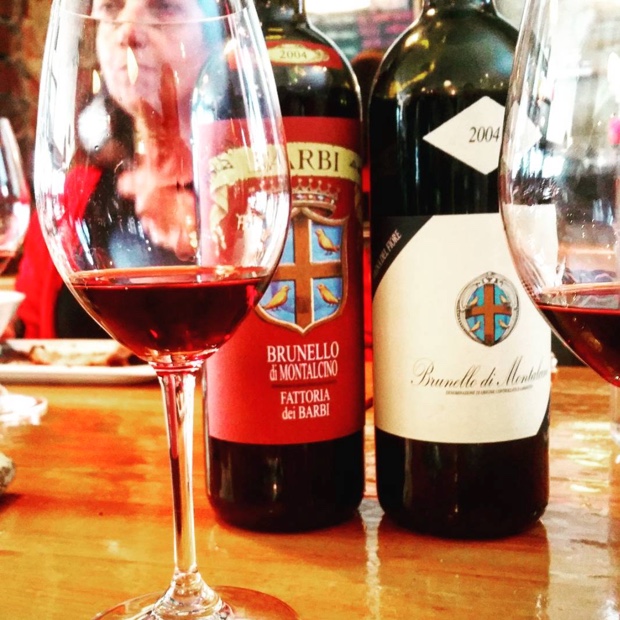
They diverge and divulge so much @FattoriaBarbi @Noble_Estates @mrkcstr Raffaela Guidi Federzoni #brunellodimontalcino #2004 #vignadelfiore #riserva
As we head into the March break, here is a little something to think about in advance of next weekend’s VINTAGES March 19th Italian themed release. The offer is substantial and it comes on the heels of last week’s brilliant display of Sangiovese Grosso at the Art Gallery of Ontario for the recent coming of Benvenuto Brunello 2016.
Two of my favourite actors (Lee Marvin and Jeff Bridges) played pivotal roles in John Frankenheimer’s adaptation of Eugene O’Neill’s famous play. The Iceman Cometh is set in 1912 America with hard characters who live a pipe dream in their collective search for political and religious salvation. In one way or another they seek the sentimental reminiscences of their glory days and form a covenant to return to them tomorrow. The Iceman represents a sort of messiah meets grim reaper, killing the fantasy of the “tomorrow movement,” offering not salvation, but death.
So what does this have anything to do with Italian wine? Pretty much absolutely nothing, except for the plain and simple analysis about the Italians on offer for March 19. I recommend some beauties so don’t think that the death or the apocalypse of Italian wine is upon us. In fact, the greater category is booming, selling more product in Ontario and Canada as a whole then it ever has. Last month’s Vancouver International Wine Festival laid testament to the fact.
No, it’s just that so many of the reds and whites in the themed release walk a straight, boring and predictable path right down the middle of the road. Italy’s vast pool of talent would love to send us the best of the best, at $15, $50 and $150, if only the monopoly would receive. And so my friends, today I choose to consider the LCBO as the Iceman, all in good fun, of course. Who takes me seriously anyway? Certainly not me, fool as I am.
Here we have six stars from the VINTAGES release and six ethereal Brunelli still ringing in my ears and singing in my mouth. Sangiovese with the uncanny and impossible ability to linger for four days. There were many more worth mentioning because when you are holed up in a room full of Brunello, life is perfectly grand.
Where for art thou Brunello?
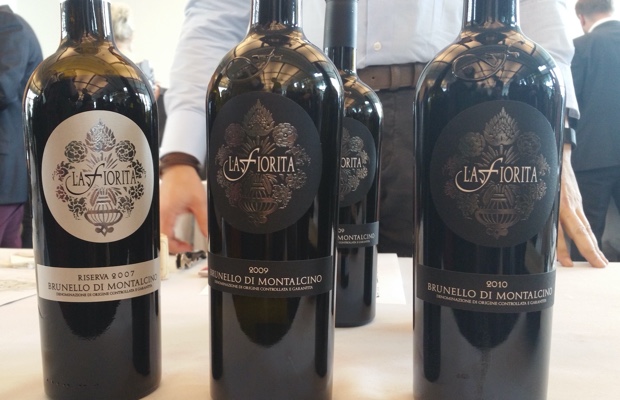
La Fiorita Brunello di Montalcino
La Fiorita Brunello Di Montalcino 2009, Tuscany, Italy (Agent, $65.00, WineAlign)
La Fiorita’s 2009 normale is a special bottle of Brunello from a best of all worlds vintage. It exhibits the charms and shares the gifts of a posit tug between firmness and elegance. At this seven-year stage it evidences the first signs of secondary character, with spices dissolved in mulled liqueur and a new fathom of depth perceived. The measure of intensity is not one of dank, darkness or even pitch but rather profundity. The translation reads as both Sangiovese chapter and verse. Excellent 2009 example just beginning to drink as it should. Drink 2016-2023. Tasted March 2016 @vadoapiedi
Col D’orcia Poggio Al Vento Brunello Di Montalcino Riserva 2008, Tuscany, Italy (0965525,$129.00, WineAlign)
Only 8,000 bottles were made of Col D’Orcia’s always formidable and classically structured Brunello. Elegance offers a glimpse of hopeful emergence even while its firmness is still fully intact. The added determination and epic struggles of the vintage translate to a singular Sangiovese type of funk from a vineyard, like so many other south-facing Montalcino slopes, of what may just be the greatest physical involuntariness in the world. The fruit and texture are delicate, of a veritable Tuscan gastronomy, pure vernacular and of a leathery lightness of brogan being. The youth in this Brunello is palpable, nearly awkward but certainly not backward. It is progressing as it should, lentamente, lentamente. Three more years minimum is needed to coax it out of its coriaceous hide. Drink 2019-2028. Tasted March 2016
Fattoria Dei Barbi Brunello Di Montalcino Riserva 2004, Tuscany, Italy (Agent, $100.00, WineAlign)
The Riserva contains no single vineyard (Vigna del Fiore) fruit and is composed of a selection dictated by different vineyard qualities, not necessarily all on equal footing and all brought in to be vinified separately. As per the directive, an average of three years is spent in oak, followed by a transfer into stainless tank. The aim is a traditional, classic, typical, true masculine expression of Sangiovese Grosso. With the firm intent kept in mind, the 2004 is unstirring, closed, macho and fist clenched, even after all these years. An hour later it extends an outstretched finger or two of kept fruit and bred in the bone funk in your direction, but no more. This Riserva is gripped by a fine dust and even finer, senescent and patrician grains of tannin equal in quantity to the stars in the sky. If 2004 is not one of Barbi’s better to greater vintages for Riserva the constellations will have to be re-drawn. To me this represents a foregone conclusion to purchase, further cellar briefly and open when the skies are blue. Drink 2018-2029. Tasted March 2016 @FattoriaBarbi@Noble_Estates
Fattoria Dei Barbi Brunello Di Montalcino Vigna del Fiore 2004, Tuscany, Italy (Agent 93609, $100.00, WineAlign)
The Vigna del Fiore single-vineyard designate Sangiovese tells an engraved, emblematic and heraldic Montalcino story. First made in 1981, the infamous Barbi Grosso was originally crafted as a celebration for Francesca Colombini’s 50th birthday. Previous to that inaugural release the grapes from the most southeastern part of the property were used in the blend of the Brunello Riserva. Inferential importance exists within the context of familial connectivity in this Blue label Barbi. Ancestral lineage matters, as does the nurturing femininity of the undertaking. Spends its first, early developing year in older French barriques, followed by two years in traditional, regionally employed (700L) traditional Slavonian oak. If the 2004 (or subsequent vintages) are perceived as expressive of an international style, chalk that up to effete but so much vineyard and next stage, secondary through tertiary evolution agrees to confound. The ’04 lays in soft exude with the wise smell of its original, naturally curated state, of cherries, roses and earth. Today the texture floats in the optimum buoyant air above a contiguously circled round globe, begs for and speaks of aged Tuscan cheese, like Brillo Pecorino DiVino or Toscano Stagionato. The next few years will be the best. Drink 2016-2020. Tasted March 2016
La Mannella Brunello Di Montalcino 2010, Docg Tuscany, Italy (279083, $47.95, WineAlign)
Tasted alongside La Mannella’s 2010 Riserva this seems tame, elegant and baby-faced in comparison but it is no shrinking Sangiovese Grosso violet. No, sir. Assessed on its own it is in itself a wholly complex and beastly thing. The tonality is stratospheric, with a distant, amplified and magnified set of cherry to leather parameters. Very floral and blessed by holy drops of liquor. All that said, this 2010 Brunello of basic and modest means can be approached in the here and now provided a good decanting is strictly followed. Drink 2016-2022. Tasted March 2016 @LaMannella@Nicholaspearce_
Oh #brunello where art thou? You are here @PodereLeRipi listening to the vines @agotoronto #benvenutobrunello #brunellodimontalcino #50thanniversary #italiantradeagency
Podere Le Ripe Lupie Sirene Brunello Di Montalcino Riserva 2009, Tuscany, Italy
A classy and classic, traditionally-styled, pure and ripe Sangiovese. Cherries, leather, sweet liqueur and anise confer in perfume. What a revelation, with late spice and a chocolate-laced finish. Lovely and really fine. The right stuff and though on the sweet side, that should dissipate with five to eight years in bottle. Drink 2017-2024. Tasted March 2016 @PodereLeRIpi
Lovely dry, dusty, musty and prickling Sardignian, properly Grenache rustic and approaching a level of divine. Cannonau of chew, leather, carbon fruit sketch, arid and rehydrated in residual freshness endowment. Get behind all $18 of this honest weighted red and put your char on. Drink 2016-2020. Tasted March 2016 @AntichiPoderi
Terredora Di Paolo Loggia Della Serra Greco Di Tufo 2014, Docg Campania, Italy (983197, $19.95, WineAlign)
Herbal is the understatement, saline the connecting cable, texture the conduit for extreme unction. Cumulatively intellectual qualities that endow this Greco di Tufo with more sumptuousness than it had achieved in recent times. Aromatic wealth comes by way of citrus preserved, pressed and layered. The overall impression is warmth, stress without breakdown and excessive personality. Still somehow its strikes as endemic, ancient, weird and wonderful. Drink 2016-2019. Tasted March 2016 @Terredorawines@HalpernWine@Reg_Campania
Il Molino Di Grace Il Margone Chianti Classico Gran Selezione 2010, Tuscany, Italy (435115, $39.95, WineAlign)
In a VINTAGES feature of more MOR Italy then should be rolled out in one media tasting, at least here we have multiple semblance of personality. Not quite sure we’ll call to celebration $40 of dynamism but there are inherent deep invested Sangiovese characteristics nonetheless. Tight angles, rigid corners and a Brunello-Sangiovese-like liqueur. Grosso in as much as CCR can be, with some dedicated rusticity and tannins still in action. Dries out nicely on the finish. Put some away for a 2020 rainy day. Drink 2018-2024. Tasted March 2016 @Ilmolinodigrace@chianticlassico
Donatella Cinelli Colombini Brunello Di Montalcino
Donatella Cinelli Colombini Brunello Di Montalcino 2008, Brunello Di Montalcino, Tuscany, Italy (431718, $56.95, WineAlign)
A vintage perceived as tough, difficult, demanding and volatile is just now entering the zone of changing perceptions. It has taken all this time to realize its abilities. Longevity for one. Beauty behind the mask, the other. Concentration is not so much ripeness and richness but of deeper meaning than that. Nothing here sits on the surface. Peel away a layer of orange, spice bark and bulb husk to taste from the inner fruit. From the core. “There is fire, there is life, there is passion, fever and fury.” That is Brunello. The tannins persist with near nastiness but there is so much to look forward too. Wait two more years. Drink 2018-2028. Tasted March 2016 @news_donatella@ConsBrunello@LeSommelierWine
Giuseppe Quintarelli Rosso Ca’ Del Merlo 2007, Igt Veneto, Italy (722470, $99.95, WineAlign)
Rich Ca’ del Merlo from Quintarelli heeded with volatility and consumption. Veneto of war and peace, light, bracing, angular, seeping, steeping, macerated, tea leave studded and tannic for further thought. In this 2007 it is hard to not get caught up in the amalgamation’s bright sweep. Corvina, Corvinone, Rondinella, Cabernet Sauvignon, Nebbiolo, Croatina and Sangiovese, like reading Tolstoy, all together “alive, and very much so.” Will live for quite some time, but wait two years before embarking on the journey. Drink 2018-2030. Tasted March 2016 @RegioneVeneto@LiffordON
Takes the purity of 2011, furthers the integration and mimics the precision, then pumps up the volume. Takes a breath and then, with soluble efficiency it refines the intricately woven lines a few steps furtrher, if that is even possible. I will say that the tannins are a bit tougher in ’12, with a tight string wound depressively around the fruit’s long and elegant tendrils. Fruit is the determinate factor, pure, blossoming and fragrant. It adds up to a consensus of one thought, that this vintage is yet another legend in the making, a fine and linear Ornellaia that should travel 30 plus years, perhaps longer. What liqueur, such botanicals and endless valleys passing through fertile hills. Drink 2019-2045. Tasted November 2015 @Ornellaia@AuthenticWineON@AuthenticWine
The British, reports Aaron Saltzman, are developing a taste for fine Canadian vintages, and not just Icewine. “It’s a niche market, but it’s being received quite well.” Even though Icewine still accounts for 75 per cent of sales in England (1.2 out of a total 1.59 million Canadian dollars), in 2015, Canada sold $168,500 worth of table wine to the U.K. That number was five times lower in 2013, at $34,889.
In Decanter Magazine’s April 2016 issue they discuss “The best Pinot Noirs in the world (outside Burgundy).” Five from Canada are nominated out of more than 80 total. Ian d’Agata included the Bachelder 2013 Lowrey Vineyard, along with two others from Ontario, Flat Rock Cellars Gravity 2012, Twenty Mile Bench and Norman Hardie Winery, Cuvée L 2012, Prince Edward County. The two recognized from the Okanagan Valley in British Columbia are Meyer Family Vineyards 2013, McLean Creek Road Vineyard and Tantalus Vineyards 2012.
The Canadian wine renaissance is attributed to high-end, artisan winemakers like Norman Hardie and Thomas Bachelder. That’s the cool factor. The truth of the matter is that Canadian winemakers have realized and capitalized on the significance and exceptionality of their terroirs in regions such as Niagara, Prince Edward County and the Okanagan Valley. Journalists and buyers from around the globe know it and have begun to spread the Canadian gospel.
Dr. Jamie Goode has had a profound effect on alerting fellow Brits to the Canadian thing and that ambassadorship has filtered through to the wine shop owners and trickled down to the consumer. Much of the education is attributed to Dr. Janet Dorozynski, Global Practice Lead for Canadian Wine, Beer and Spirits, Foreign Affairs and International Trade Canada in Ottawa. Dr. Dorozynski has brought the wines and their makers to England and pried open the doors to perception.
Last week I tasted through a hundred or more Ontario wines at Taste Ontario and at Cuvée 2016 in Niagara. Those notes are coming soon. For now let’s concentrate on the VINTAGES March 19th release. Here are some of the Canadian wines up for grabs.
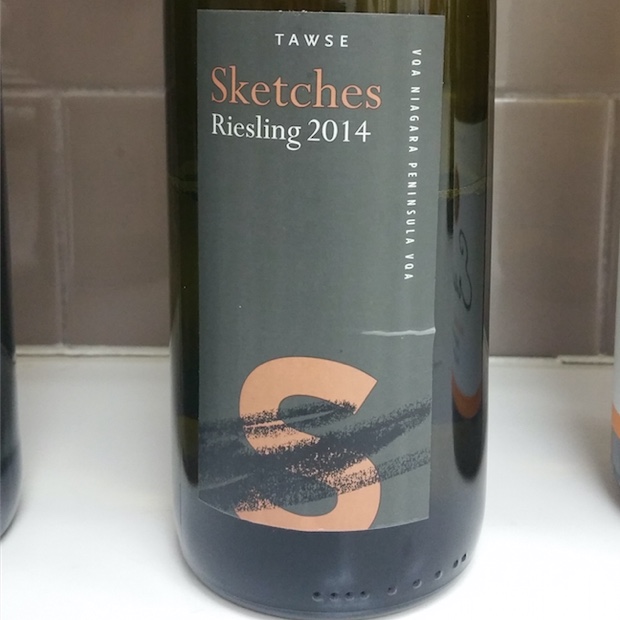
Really striking Sketches Riesling here in 2014, aromatically wild and full of complex flavours. So representative, lemony beyond lemon and full of juicy acidity. Almost too much of a good thing but it should settle a bit and replace some of that stark contrasting acidity with copacetic sweetness. Great fruit in 2014. Drink 2016-2019. Tasted March 2016 @Tawse_Winery@DanielatTawse
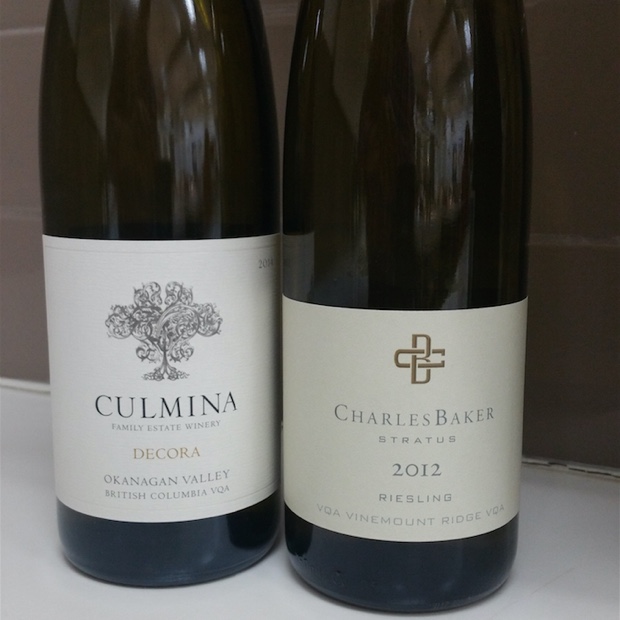
Culmina Decora Riesling 2014, BC VQA Okanagan Valley, British Columbia (444836, $24.95, WineAlign)
Judging from the ripeness, strength, density and effective grape tannin this may as well be noted as pulchra, decor, charissima, that is, powerful, beautiful, charming. All three are apropos in this really forward and mineral tangy Riesling. Could this come from anywhere but the Okanagan Valley? Should develop with intellect into a honeyed, elastic expression. Drink 2016-2022. Tasted November 2015 and March 2016 @CulminaWinery@winebcdotcom
Riesling squared- Culmina Decora 2013 and Charles Baker Picone 2012
Henry Of Pelham Estate Cabernet/Merlot 2012, VQA Short Hills Bench, Niagara Peninsula, Ontario (395855, $24.95, WineAlign)
Exceeds elegant expectations with poise and presence, a Bordeaux blend so refined it pleases. Effectively restrained and remedies with tonic. Circulating acidity ranges while chocolate whips, but wholly within reason. Spice accents assist in the celebration (why not?) to effectuate this red’s firm grip and grasp of Claret reality. Drink 2015-2020. Tasted blind at WWAC15, August 2015 and March 2016 @HenryofPelham@SpeckBros
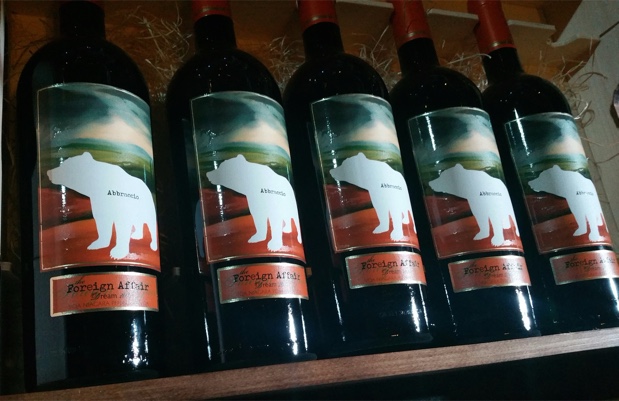
The Dream is a ripping, layered and well executed appassimento from Barclay Robinson. Much oak influence but with that fencing there is more than the spice is right. Sweetness is valued in the context of ripeness, acidity and burgeoning tannin. Here we find a big wine and well within the parameters of the sensibility. Tasting and thinking on the dried and rehydrated grape approach can leave you “lost in the dream, or just the silence of a moment, it’s always hard to tell.” With the ’12 Abbraccio, “Il Sogno” shares the passion for the planning and shows that “love’s the key to the things that we see.” And a little bit of unknown appassimento magic. Drink 2017-2020. Tasted March 2016 @wineaffair@BarclayRobinson@EpicW_S
A vintage that begged to be protected in the vineyard, meaning no leaf plucking and no thinning. A most excellent goal of (0.691895068 kg / m2), or 2.8 tons an acre was realized, as opposed to one in 2010. Heavy vigor slowed down the ripening (leaving that kind of tonnage on the vine), to an elongated balance. Comes from terroir Baker nods to as “a barren tundra,” which you don’t get down the hill. In 2012 there was no waste, no rot, no problems. Its residual climbs to 15 g/L but you’d never know it. There is a confit of citrus, a mellifluous sensation of preserved lemon. Total count is 600 cases. From my earlier, March 2014 note: “Baker’s iconic child yet breathes in unsettled, spumous emission from out of a warm vintage. So primary and such a hard act to follow. Vanguard Vinemount Ridge, arid as the desert and citrus, carbonic tight. Treated with cool, cooler and colder methods to seek result and strike balance in an opulent, lees-appertained, tangy finish. A Picone that says I don’t live today, so it is told and canvassed, “uh, get experienced, are you experienced?” Last tasted March 2016 @cbriesling@StratusWines
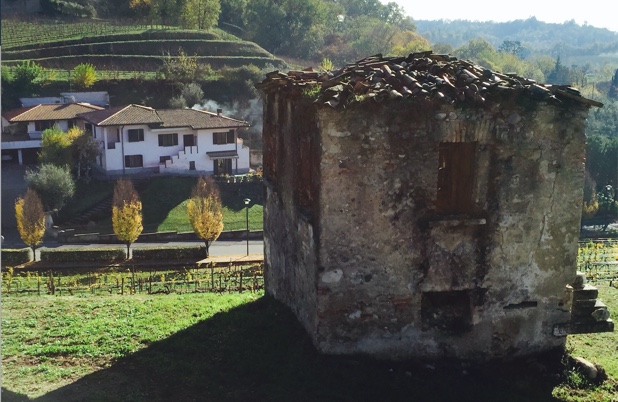
Foggy morning walk through November Chardonnay @bellavistavino #franciacorta #lalbereta
In wine, assessment is a slow business because one stops so often to take note and to take notes. Wine demands the activity of putting down into the well a number of tangent travelled thoughts. If ever the creative well should run dry, simply venture across the pond to spend some time in a place like Franciacorta. Witness the water table rise.
L’Albereta Relais & Châteaux
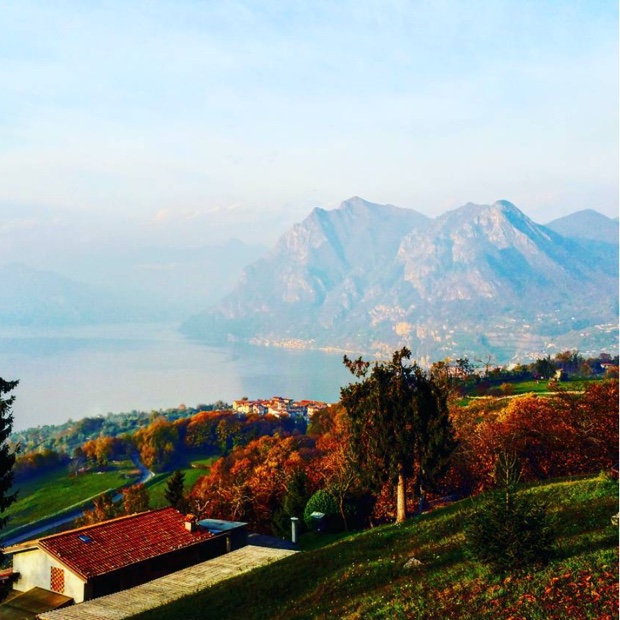
November is a sublime time to visit the province of Brescia and the cellars of Franciacorta. The villages of Erbusco and Iseo decelerate with approaching dormancy and only the distant mountains are blanketed by the snows of winter. The recently completed vintage is safely tucked away, slumbering peacefully in ancient caves. Early morning fog begs to be habituated and when the sun shines Erbusco beckons with its hidden monuments, stashed away secrets and treasures buried around every corner. The Friday market at Iseo bustles and passively hustles. The Oglio River lies to the west, while Lago Iseo winds in the undertow of the snow-capped Dolomite Mountains on the jagged tablature horizon.
L’Albereta
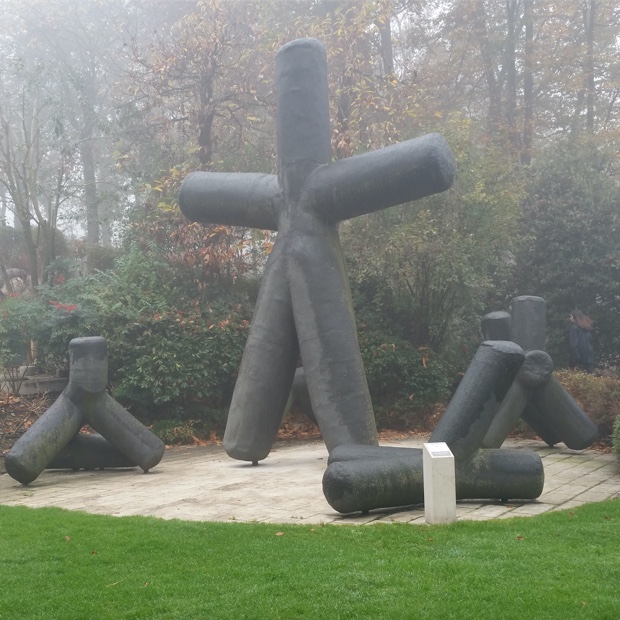
On the grounds of L’Albereta a sculpture garden blends into the landscape and it can be imagined camouflaged, though always available for discovery hundreds of years from now, even if the architecture has been completely altered.
Prosciutto, burrata and @BellaVistaVino @franciacorta the most perfect welcome in @albereta #erbusco
Created to celebrate the third millennium, the Parco delle Sculture is a genuine open-air museum where thirteen contemporary art sculptures wind their way across 61,000 hectares of parkland, from L’Albereta to the nearby “Bellavista” and “Contadi Castaldi” wineries, in an intriguing dialogue with nature.
A section of the L’Albereta sculpture garden
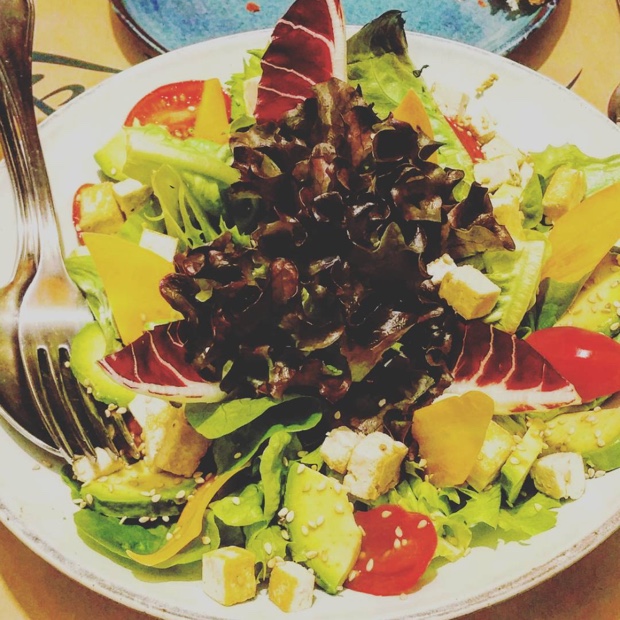
VistaLago Bistrò, L’Albereta
Such a salad speaks volumes. So much more to come from the @chef_lucatelli arsenal #benessere
Notes on Bellavista and Contadi Castaldi
With help from @BellaVistaVino and @contadicastaldi notes with dinner @LAlbereta #bistrovistalago #erbusco #franciacorta
Market day in Iseo
Friday market at #iseo #carciofi #franciacorta
The island of Monteisola on Lago Iseo
View from Cure post sublime hike up #monteisola #lakeisland #brescia #lombardia #monasteriasansalvatore
Looking for lunch in all the right places
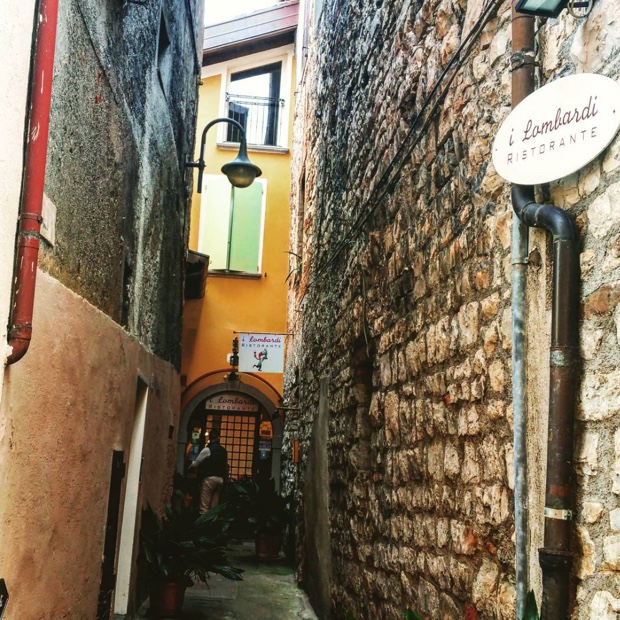
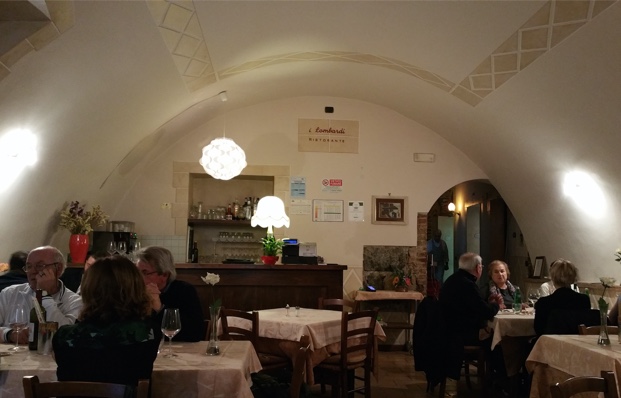
Finding lunch in hiding places. Menu fisso 10€- pasta:carne:insalata:vino:acqua:cafe #iseo #lagodiseo #lombardia #ilombardiaristorante
Prix Fixe
I Lombardi Ristorante, Iseo
We need this in Ontario
Every bookstore should have a bar in the back #iseo
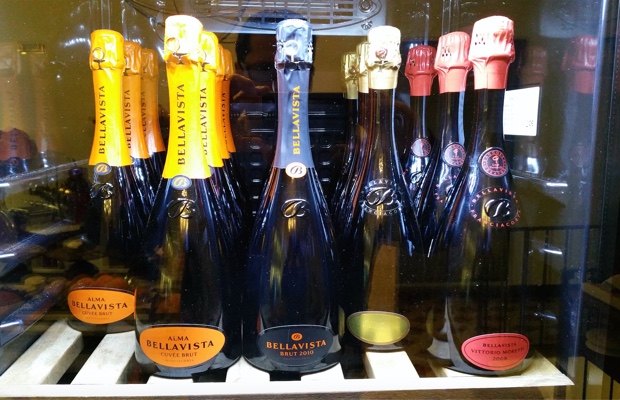
Bellavista wines at L’Albereta
Bellavista Franciacorta, L’Albereta
Gambero Rosso Welcome Dinner at Leon Felice, L’Albereta Relais & Châteaux
by Executive Chef Fabio Abbattista
With Luigi Salermo, Marco Sabellico, Lorenzo Ruggeri and Tiina Eriksson, our hosts from Gambero Rosso.
From a 5.45 hectare vineyard, in homage to the friars of Mount Orphane dating back to 1449, Chardonnay meant to age with ancient tradition always tucked safely into the slow release, micro-oxyganted back pocket. Scents of lemony green and rose. Wood relations are important, fig and lactic notes apparent and this is stretched but weighty, very elastic Chardonnay. If the verve seems to be waning it must be understood that this wine begins, travels and ends this way. Bellavista is the chosen one to make wine from “a unique and unrepeatable section of vineyard, the expression of an ancient tradition.” Drink 2015-2022. Tasted November 2015
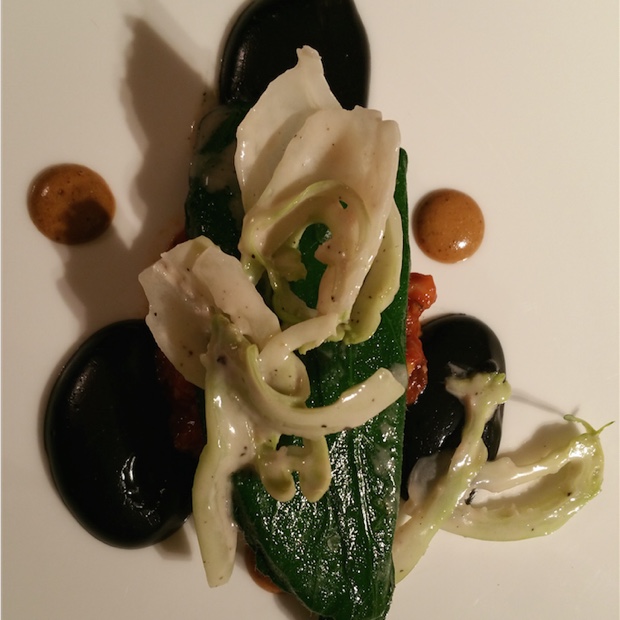
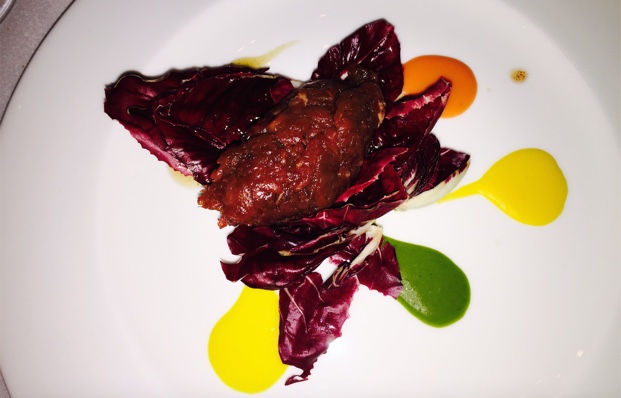
Cappelletti with burnt wheat, rabbit and anchovy butter
Cappelletti al grano arso, coniglio e burro di acciughe
A demi-sec produced using exclusively Chardonnay grapes from at least 30 different vineyards located on high hillside plots with ideal south exposures. Over 30 per cent of the fermentation takes place in small white oak casks. A balanced, pure, creamy, mellifluous honey dessert wine of a sweetness that hides in shadows. The question begs. How can this be demi-sec? Drink 2015-2018. Tasted November 2015
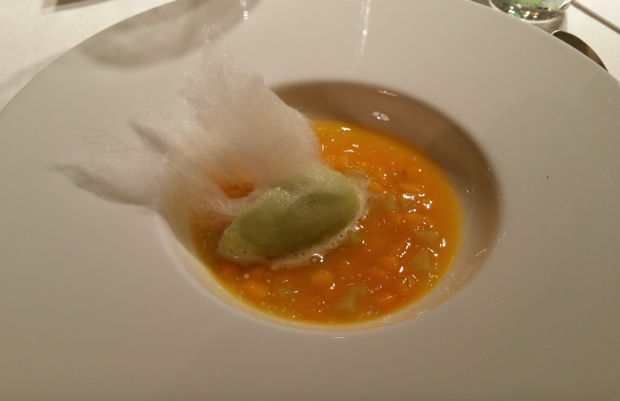
Green apple sorbet, celery and passion fruit nectar
Sorbetto mela verde, sedano e Nectar
In the evening
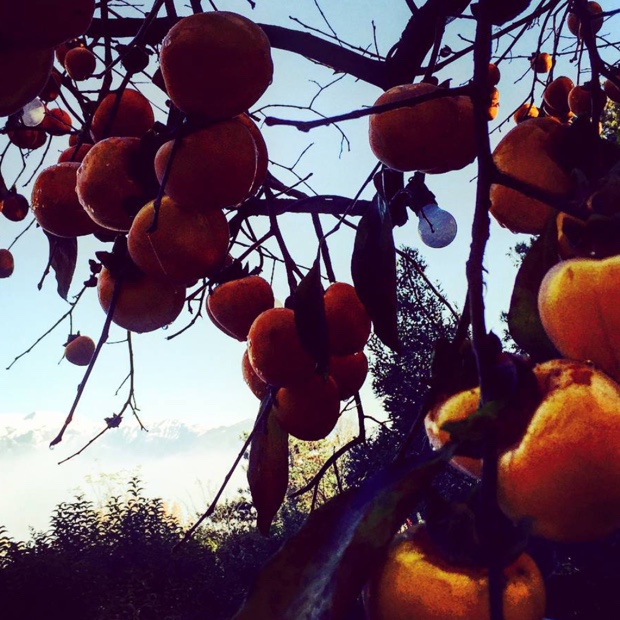
Persimmon and Dolomites. Must be #franciacorta #lalbereta #relaischateaux
In the morning
Yesterday is wiped away by a day that begins this way #breakfast #lalbereta
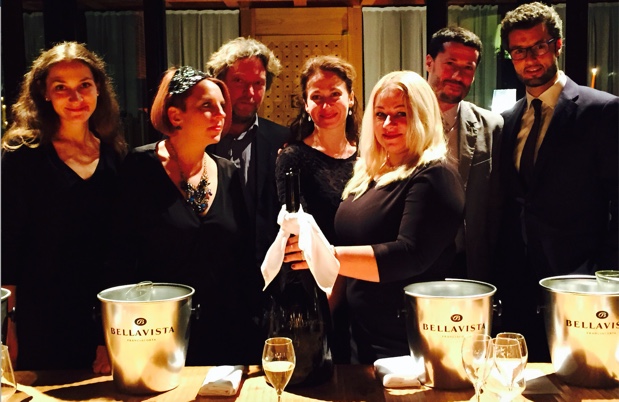
Bellavista Gala
The purpose of the event was a journey of oenological discovery (Meraviglioso), music and gastronomy at the hands of Chef Vittorio Fusari.
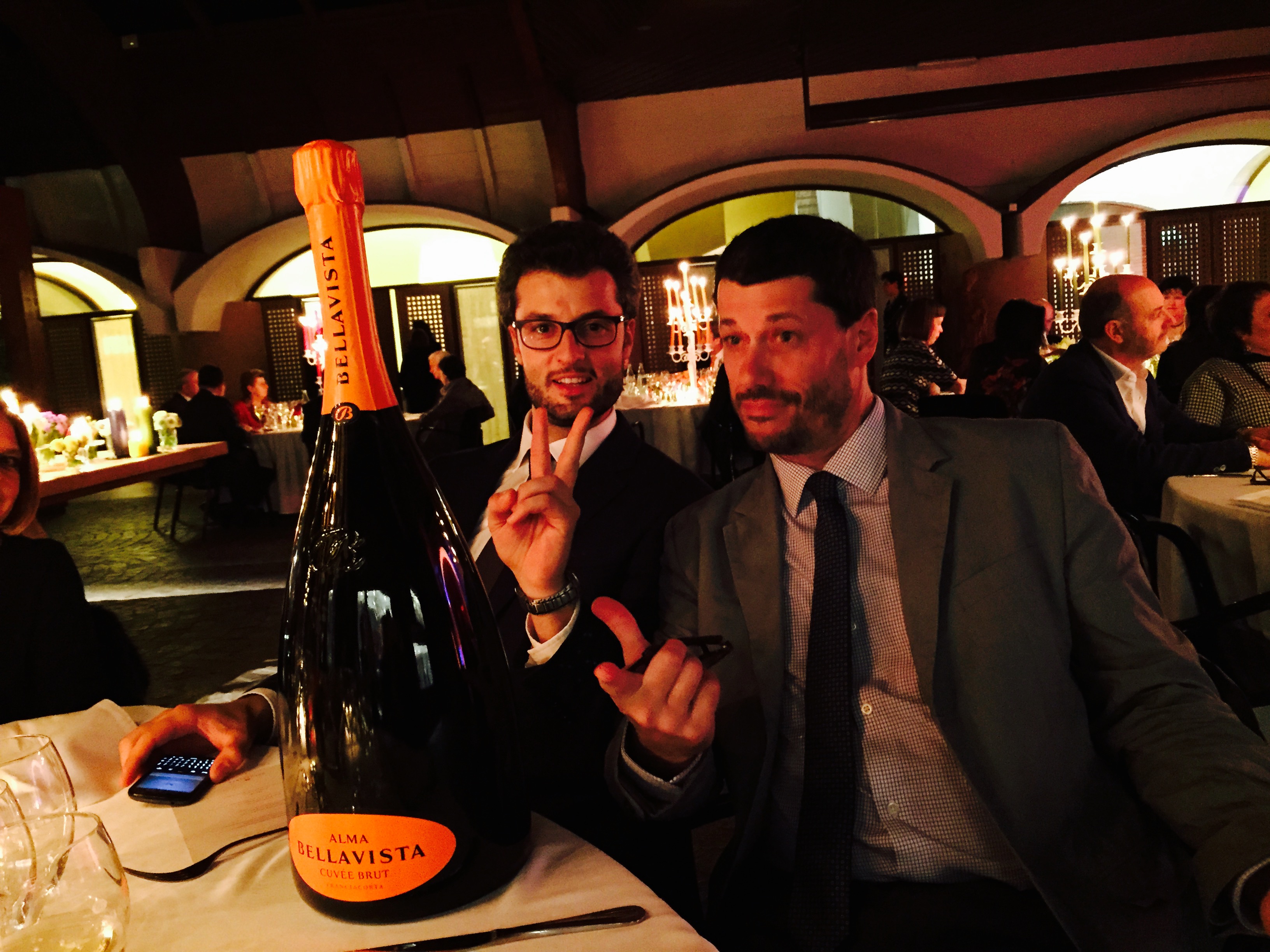
Lost in a @BellaVistaVino dream that has just begun
In anticipation of Meraviglioso
Grazie mille @bellavistavino @gambero_rosso for welcoming us to your special #franciacorta celebration ~ @mgodello @winealign
Riserva Vittorio Moretti Magnum 2008, Franciacorta (Winery)
Puff pastry potatoes with caviar, red onion cream, sardines, julien and parsley
It was a simple wine back then. Good luck and providence in this part of the world have made this wine so special. In 1995, it rained for 40 days. I know. I was in Italy for 17 days in August that summer. In September botrytis developed but low temperatures ending up concentrating the grapes flesh and thickened the berries over a course of five to six days. Harvest saw brown grapes and 12,000 bottles made were made. That it has survived for so many years is not surprising. It is impossible. The link goes to Mattia having seen an Yquem harvest in the 1970’s. How long to keep? Until 2075. “So I’m very hopeful for this wine.” When my father moved from his house in 2005 he asked me to take his “cellar.” Of the 17 bottles, there was a 1970 labeled Chablis. Burgundy. No producer. I brought it home and thought waiting even one more day would be one more day to long. It was perfect, alive, on the straddled line of oxidative, had been there and might stay there for 20 more years. Like this 1995. Ethereal. Rich, elegantly, gently sweet, so fine. Why not see what 20 more years can do. Drink 2015-2035. Tasted November 2015
Wines of South Africa announces the 2016 WOSA Sommelier Cup. The triennial contest pits your knowledge of South African wines against that of other sommeliers from across the Canada, and, if you make it to the finals, from across the world.
Who’s eligible: sommeliers anywhere in Canada. You need to be currently working in a restaurant or wine shop to enter.
Second, Tweet or post on Instagram about 5 different South African wines, using the hashtag #CAPESOMM. Now you’re entered!
B. On April 18th 2016, at 1pm EST, we’ll administer an online multiple choice test. Questions will be about the South African wine: the terroir, history, geography, cuisine…all the things that have gone into making South African wine stand out. The exam will be timed, to discourage open book “research.”
C. The ten top scorers will enter round two. They’ll each receive 2 bottles of South African wine, all from a specific region or variety. The challenge: drink them! (well, taste them) and write tasting notes for each, plus an essay: explain to other sommeliers what sorts of wines that region does best, and why. Keep it short: 400-500 words.
The essay deadline is May 27th. Three winners from the essay contest will be chosen for a final, live, blind tasting and theory competition to take place mid-late June. WOSA will cover flights (final city location tbd depending on 3 finalists home location) accommodation and meals.
D. The winner, however, gets even more, and will go to South Africa to compete with winners from around the world. All those winners will get to enjoy the Cape for a week, touring the major wine regions to put the final touches on your knowledge for the final competition. The trip will be from September 17th through the 24th, with the final on September 23rd. All major expenses – flights, accommodation, meals, etc. – will be covered.
Dates to remember:
April 18th: 1st exam
May 27th: Essay submission
Mid-June: Final competition
September 17-24th: South Africa
Entrants who pass the first exam will be asked to keep the June and September dates open. WOSA retains the right to reproduce and distribute essays, in whole or portion.
Bella Vista Chardonnay, Lago Iseo and the Dolomite Mountains
As seen on WineAlign – Franciacorta and the Meraviglioso of Bellavista
Where can you find snow-capped Rhaetian Alps, double morainic amphitheatres, glacial lakes, ancient vineyards and one of the best kept Sparkling wine secrets on the planet? At the end of a day not in Franciacorta I could do well with a glass. Bubbles from north eastern Italy, where traditional method Sparkling wine of Chardonnay, Pinot Nero and Pinot Bianco come together masterfully to create Franciacorta. Satèn, Brut and Rosé, for Millesimato, Riserva and now the new elaboration, finalmente, some kind of wonderful, Meraviglioso.
Large formats and the furnace @contadicastaldi @franciacorta #gamberorosso #moretti
The month of November bids up translation to such an Italian vernacular as it is a wonderful time to visit Lombardy and the cellars of Franciacorta. A time before the snows of winter fall, long after the stems have turned to brown, the grapes picked, crushed and fermented, at a time when the vintage’s base wines rest comfortably in the caves of the region’s 110 wineries. You can take an early morning walk through a Chardonnay block and note the gentle south-east exposure slope engulfed by fog thick as porridge in the greater provincial Brescia world demurred a whiter shade of pale. On sunny days summon up a cool, crisp stroll through courageous Pinot Noir up on a hill above the village of Erbusco, with the Oglio River to the west, Lago Iseo and the snow-capped Dolomite Mountains rising in the deep distance. The vines stand stark, stripped and undraped, like petrified wood monuments, now only possessive of memories.
Standing with giants @BellaVistaVino Winemaker Mattia Vezzola and Vittorio Moretti.
It is here where Lombardic legacies are cemented in this northerly Italian region, after 450 years of recorded Sparkling wine history. Newly appointed President of the Consorzio Franciacorta and Bellavista Winery proprietor Vittorio Moretti has recently bottled something no self-respecting vigneron on this fizz fermenting planet has ever had the enterprise or perspicaciousness with which to follow through. Not in Franciacorta and certainly not in Champagne. Moretti and his enologist/chef du cave partner of 30 years Mattia Vezzola gathered the wines of six great vintages (1984, 1988, 1991, 1995, 2001 and 2002) spread across three decades together in one singular, bold, ultra-elegant and exacting impossible cuvée. Meraviglioso.
Pouring Meraviglioso
Bellavista Studio Meraviglioso Vendemmia 2004, 6000 mL, Docg Franciacorta (WineAlign)
Poured from a Methuselah and can only be produced every 30 years. This is the first vintage. Studio equals a test product. This is something wholly other. The holy coming together of acidity (energy) and texture (elegance) From the best harvests of the last 30 years. Sparkling as the interaction between studying and working. One or the other alone will not achieve the culture of this wine. Middle rope lined by fine sea salt flecked by dried thyme. So refined. Gentlest mousse and forming the most amazing rim. As the winemaker notes, “it’s very exciting that technology must reside in the traditional. Idea must reside in craftsmanship. Manual work enables the soul.” Drink 2015-2045. Tasted November 2015
The best way to make a sensory profile last is to model it after someone. Choosing great vintages, as here with ’84, ’88, ’91 ’94, ’01 and ’04 is to offer a shared sensory profile and characteristics, along with the value of patience, something that lasts over time. This blend of vintages, which includes 1984 speaks to a winemaker’s emotion. “Nothing makes more sense than passion.” Will this leave a different mark on Spumante wines? “We wish that every of the 30,000,000 bubbles is a moment of happiness for each of you. Long term Franciacorta will have to take direction from this wine.” Words of proprietor Vittorio Moretti. The Studio (test) 2004 here transmogrifies into another turn of phrase, twirl of body, as told from marble. Watch the bubbles rise from the centre and widen to the edges, slowly, purposefully, without distraction. You can hear a pin drop with this wine sitting in glass. A wine to connect a string of great vintages, spanning decades, interlacing hands, sweat and passion, from contributors who are all represented in this bottle. They are all remembered, their lives, their wishes, their shared culture. Finesse, energy, mousse, elegance and length. For whom the Sparkling wine tolls. Drink 2015-2050. Tasted November 2015
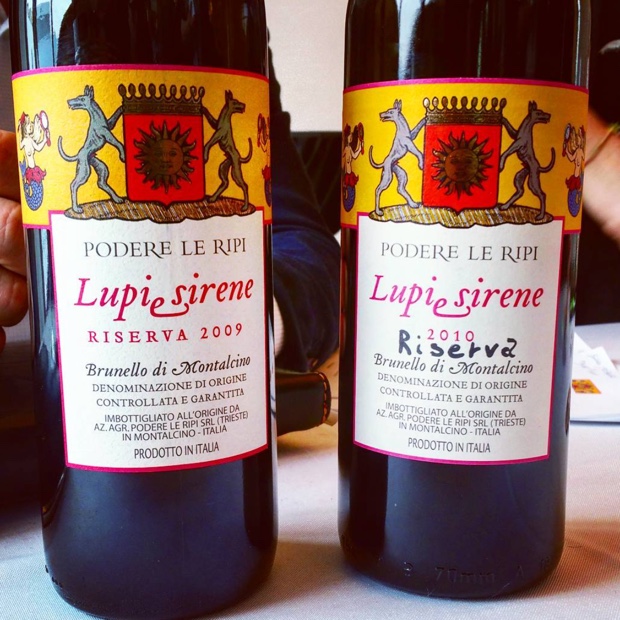
The playful and calculated wine pays respectful homage to a wine region immortalized, like warriors in stone, by classic authors; Pliny, Columella and Virgil. In the 16th century Lombardian physician Gerolamo Conforti encouraged a healthy lifestyle and widespread consumption, defining Franciacorta bubbles as “mordaci” or, lively and bubbly.
Temperatures at ripening are much higher as compared to Champagne. The mountains are a major part, as a barrier to the southern winds to preserve acidity. Franciacorta producers have the historic sparkling traditions of Champagne to compete against a crowded global market. That said, they have little interest in comparing their ancient method Sparkling wine to those from other regions, nor does it matter whether their roots were laid down prior to or subsequent from more famous peers. What matters is progression, innovation and resolution. Meraviglioso adheres and abides to Franciacorta’s deferential past. It also revises the scripture and reinvents the future.
Vigna Leone, Bellavista
The historic concept directs the winemaker to make wine that is fresh with acidity on the palate, but not felt in the stomach. Wines that are easy to digest. Wines to drink for all of eternity. Between 6.7 and 7.5 TA is the number on the base wines. This differs from Champagne in alcohol because the Champenoise reach a maximum level which is the minimum for Franciacorta and acidity is exactly the obvious. Everyone these days talks about terroir, which is important, but they seemed to have forgotten about genes.
Mattia Vezzola and Francesca Moretti
The area’s modern era dates back to 1961, with 11 producers, 29 hectares of vineyards and a production of 2000 hectolitres of Pinot di Franciacorta. DOC status was granted in 1967, with nine pioneering agriculturalists in the mix. In 1990 the creation of the consortium for the protection of Franciacorta wines was accomplished with 29 producers as members. Now, after nearly 50 years of officially recognized production Franciacorta is poised to become the next big thing. Fizz is in demand worldwide and compared to other high quality traditional method sparkling wines, Franciacorta is well positioned. Pinot Noir has a role to play and perhaps everything to do with that. Chardonnay and its essential Blanc de Blancs sparkling oeuvre has managed bubble expectation and dominated output since time immemorial but the sweeping cloud of global warming is changing everything.
Erbusco, Brescia, Lombardy
A portal into the Franciacorta compass dial only 15 years ago sees Chardonnay picked on average around August 15th. Cyclical weather patterns notwithstanding, temperature increases of nearly five degrees Celsius mean that in order to maintain freshness and protect necessary acidity these days the grapes are picked two weeks earlier. Short of washing this planet clean as the bible says or continuing to hot wire reality, something has to give.
Even while Chardonnay’s phenolic journey is finding its way to completion, some things can’t help but get lost in accelerated heat unit translation. Any winemaker worth their weight in viniculture excellence knows that the real future lies in the embrace of complex behaviour inherent within the later ripening condition of thin-skinned Pinot Noir. Chardonnay will not be abandoned any time soon but ripping up some of the dominant vineyard holdings and switching to Pinot Noir is in the cards.
Bellavista
On my late November trip the epiphanies came fast and furious when Franciacorta opened its arms to receive journalists from around the globe. My WineAlign colleague Treve Ring and I were introduced to Bellavista Vino and Contadi Castaldi pours at L’Albereta Relais & Chateaux and it was for me an initiation into a personal paradigm shift, in a dream that had just recently begun. Tasting the range on premises at Contadi Castaldi from Blanc de Blancs through Blanc de Noirs and into Pinot Nero aided in clarifying the varietal shift. The entire visit was qualified by Gambero Rosso’s principals Luigi Salermo, Marco Sabellico, Lorenzo Ruggeri and Tiina Eriksson, with their ushering of seminal tastings, including a Bellavista horizontal of 1987’s in 750 mL, Magnum, Jeroboam (3L) and Methuselah (6L), along with a Salmanzar 9L bottle from 1989. This line-up made for a rarest of opportunities, tasting chance of a lifetime.
Bellavista horizontal
Treve and I tasted a number of Franciacorta examples during our visit and we have also been able to sample imports in British Columbia and Ontario.
The Bellavista Horizontal
The purpose of this extraordinary tasting is to assess how this wine changes its sensory impression depending on the size of the vessel it was bottled in. Though it once contained 30,000,000 bubbles, now 28 years later, perhaps the number is just 13. Well, from now on I’m clearly only buying my sparkling wine in minimum 3L formats.
The wines were tasted in 1991 and 1998. This is the third and last chance to taste these large formats. From 1987, in 750 mL, Magnum, Double Magnum and Methuselah. The 9L bottle is a 1989 (because there are no more ’87’s in that format).
Five little ducks all in a row @BellaVistaVino #anothersongaboutthefizz #franciacorta #largeformats #1987 #1989
1987 (750 mL)
Composed of 80 per cent Chardonnay and 20 Pinot Nero, the harvest it refers to is 1987 though it is not a vintage wine. Runs straight to a marzipan and honey with lanolin dressing, marked by orange rind and spice that needles into the olfactory nerve. Has aged well and would call it oxidative (at least this bottle). The hue has obviously changed. Was disgorged yesterday (November 27th) so there was no need for added liquor. Truth be told it has not developed into a tertiary, overly mature, oxidative step, but it has sublimated in micro-oxygenation.
1987 (Magnum – 1.5 L)
Sensory activation. Zero oxidation, prominent acidity and underlying nutty comprehension. No honeyed and waxy filming, a seeker yet to find any true tertiary life. In elegance now and with imaginations of 10 more years this way. Any yet only the Magnum. Come back to it after ten minutes and the citrus is palpable. Finding a layer of preserved lemon 15 minutes later. Its next stage becomes more apparent with time, by size and in relation to what comes after.
1987 (Double Magnum – 3 L)
Completely different once again, now reductive, stinky, full of a preserved rage and with just two minutes in glass begins to soften and ready itself. A heap of aggression plus 28 years of time have blessed it with all the tools it needs. So alive, without the nutty accent but certainly in possession of the inside shaving of the barrel. Barrel peels, not fruit. More mineral here. Much more. Also tropical, like ginger and cardamom. The most interesting of the three by kilometres. The real access is toast and flint. This is the real deal. Rich and mature, not piercing and now accessible. Incredible length. Close to the edge in a mythical land, of impressions neither flora nor fauna, but of atmosphere.
1987 (Methuselah – 6 L)
The first wine to show similarly to another, this rocks out flinty and reductive like the 3L. The energy is consistent, but here the spice is magnified and the nutty sense that showed in the Magnum has come forth. This seems to combine the pique aspects of both the 1.5 and the 3. A best of all worlds bottle plus what it brings that neither had. Absolute freshness. Does not evolve in the glass in its first few minutes as the others that came before. It evens glistens unlike the others, as if it knows how complex, special, live and alive it is. This is the bomb for sure. Dart straight through the heart. Crazy exceptional Sparkling wine.
The big pour
1989 (Salmanzar – 9L)
Absolutely, unequivocally, indisputably no evolution. If this dos not drive the point that if you want to age Sparkling wine you must bottle it in the largest format possible, then nothing will. At least do away with 750 mL bottles. Large format is not about pageantry. It is about age. The taste is very different than all the 1987’s. So much more acidity and vitality and it is wondered aloud that more Pinot Noir must be in the mix. The citrus is at the forefront and all over the hairs of this wine. Twenty six years in a 9L bottle is like five, certainly not 10.
It should be interesting to try and assess, which is a major act of liberty in assumption, to assume with accuracy how format affects age. To close one’s eyes tight and place a number on each wine, to where it has evolved and why. 750 mL left its post five years ago. Magnum is in the window as we speak and will not be perceived with evolutionary certainty to its tertiary development for two of three more. Double Magnum is still three to five years away from even that beginning. Methusaleh sits in a window of seven to 10 years and the 9L 1989 certainly 10-15. Perhaps as far away as 20. Truly.
Apropos alms giving Cuveé, in regards to balance, offering a broad swath and sweep of creamy, soft spoken bubbles. Produced from one half of the estate’s harvest selections, out of 107 plots ranged over 10 different Franciacorta municipalities. A child of both horizontal and (reserve wines) vertical blending. Composed of (80 per cent) Chardonnay, (19) Pinot Nero and (1) Pinot Bianco. Known to its makers by an “affectionate” term for the land that produces wonders, this may be the most calming of the Bellavista portfolio. Drink 2015-2019. Tasted November 2015
This Sparkling blend of Chardonnay dominant with support from Pinot Nero is the welcome mat, regional conduit and arms open wide portal into the impressing preoccupation of Franciacorta. From vines of healthy altitude on south/south-easterly exposures and an average age of over 25 years. A sussurrare measure of and not much more than 30 per cent of the juice ferments and matures in small white oak casks for no less than seven months. When we talk of the natural balance in nature, we may as well be referring to an arid, saline, citrus and ontological yeast-filled Franciacorta such as this Brut. Compressed from a vintage with legs, creamy texture and dreamy ideas. Sparkling wine of soft bubbles, lace curtains and plentiful energy. The dictionary opens with this, a wine personified as a “villa delle delizie.” Drink 2015-2022. Tasted November 2015
Red chicory hue in a blend where Chardonnay (62 per cent) dominates Pinot Nero. Rosé of truth, unable to fib, a bit risqué and anything but rustic. Magnetic, full of multi-variegated citrus, magnified, petrified, magnetized, its Chardonnay and Pinot Nero polarized. The latter so important, like recherché of the occult and suggesting that its part should be increased. Like a tidal wave of blanc de noirs aromatics boarding at once. Rosé as the last train home. Drink 2015-2022. Tasted November 2015
Like the Betella Blanc de Blanc, this is quite direct, but in a much different way. It’s funky reductive and yet super, hyper transparent and understood. Wound tight with racy acidity and spumes of an aridity that steals saliva and is nearly heart-stopping. These blush bubbles are savoury in a way the Chardonnay just can’t seem to herbalize and bracing in a way that does not fully compute. Exciting and tart if noticeably out of balance. Tasted December 2014
This 100 per cent Chardonnay is so direct, so grounded, so black and white. Just a hint of funky earth and a swath of painted lees but otherwise fruit entrenched in traction and fermentation in beautiful suspended animation. Defines modernity in Franciacorta, a still frame of concentrated, dry bubbles, life affirming and void of any extraneous conditioning. No add-ons, just straight up sock it to me Sparkling wine. Tight, bracing and built for serious fun, without ceremony or pageantry. So effective and so well constructed. Tasted December 2014
First introduced in 2007 after thirty years of Franciacorta’s salt pillar house’s trials, errors and magic. Chardonnay (75 per cent), Pinot Nero (15) and Pinot Bianco (10) are sourced from 134 vineyards, vinified separately and blended with the conceptualization towards “idem,” of being the same. Reserve juice from great vintages (at least 20 per cent) reinforces and elevates the cuvée, followed by 28 months on the lees. A stoic and somewhat tensely defined traditional method Sparkling wine with plenty of autolytic yeasty feel despite the modest time. Terrific, expansive and circulating mousse buoyed by unparalleled Franciacorta acidity. More Pinot Nero would really give it depth and breadth. Drink 2016-2020. Tasted January 2016
Disgorged February 2015. The opposite of the thoroughbred that is the Pinot Noir. Satisfying, saturated, stretched and churned though Brut in style. The soul of Contadi Castaldi even in a world in which the winemaker is want to make more masculine, Pinot driven wines. A caressing wine, gentle and creamy. Full mouth. Round putty smooth in spite of and in line with such stretched acidity. Drink 2015-2020. Tasted November 2015 @contadicastaldi@Cavinona
The Contadi Brut is a much more direct, linear, in your cerebral cortex cement of a Franciacorta. Still in assumption of a lightly bruised and oxidative bent though the fruit is anything but mealy and the appetite yet whets. The apple in the eye is green, the grass greener still. In here “green grow the rushes go.” This sparkler seems to still be working, pushing itself and evolving. It begins in earnest and never ceases to cycle. It’s a bit exhausting and leaves a trail of exhaust. In demand of much attention it may never leave you to find and achieve that state of REM. But it is that vapour trail that will see it go deep into the night. Drink 2015-2022. Tasted July 2015
Statuesque, rustic, ancient ruin of Franciacorta, on a clear day, of tall grasses, oxidative apples and slices of hard Lombardian cheese. A total, classical, storied package of gastronomy in a bottle. Not so much Rosé as much as bubbles with a fostered history of age. Arid as the desert and piercing from acidity. This will be misunderstood by some, reveled in by others. Drink 2015-2020. Tasted July 2015
Fashioned with essentially an equal proportion of Pinot Noir. A specificity to Franciacorta where Chardonnay is clearly pegged as feminine and Pinot Noir masculine. The winemaker demands this move, to power, vitality and how a cuvée’s direction is acclimatized from picking on acidity and through to firm, direct expression. Very balanced wine. Drink 2015-2019. Tasted November 2015
Only 9,000 bottles are produced of this ultra niche product. Part of the move in concept and passion to masculine, powerful and vital Pinot Noir. A bull of bubbles and extremely long, trailing a tail of star fire. Brut to the most natural degree. Lime and direct energy. Tight as a fist. This is Thibault to the Contadi Castaldi Blanc de Noirs Romeo. Drink 2015-2022. Tasted November 2015
A Franciacorta blanc de blancs with a settled elegance in its stride and the persistence of far eastern aromatics. Though Satèn can contain up to 50 per cent Pinot Bianco, Ricci Curbastro’s is exclusively made from Chardonnay and at this stage even less atmospheric than the freshest examples. A pinch of ginger and a dash of lemongrass mark the aromatic territory. Preserved lemon fills the palate with residual fruit. This 2011 is in its drinking window right at present, its 40 month (48 from harvest) autolytic yeast lees having done the yeomans texture work in completion for the overall expression. Drink 2016-2018. Tasted January 2016 @Ricci_Curbastro
At the end of a day not in #franciacorta I could do well with one of these @contadicastaldi