Walking an Alsace mile in their Riesling shoes

Riesling, (c) Cassidy Havens, http://teuwen.com/

Riesling, (c) Cassidy Havens, http://teuwen.com/

Riesling happens. It brokers the nescient consumer with the gift of grape enlightenment. It plants an organoleptic ear worm, urging a leap of faith to discover, to seek out the world’s most versatile, divergent and tractile wine. Riesling comes in so many shapes and sizes and that is why it is so difficult to offer up one’s trust, because if you don’t know,  you never know what you are going to get. Dry, sweet, late harvest, dessert, racy, round, or a combination of it all?

Related – In a Grand Cru state of mind

Alsace is distinguished by a very specific set of vinous attributes. No other area in France is as dry and only Champagne is further north in latitude. In typical climatic years, the aridity of the summer months, followed by the humidity of the fall fosters the development of a beneficial fungus called Botrytis cinerea, better known as noble rot, which concentrates the sugars and preserves acidity. The catch is that not every vintage works to guarantee the pourriture noble. When conditions are prime, some producers insist on picking before it sets in. Others think of it as gold. Pierre Gassmann of Rolly Gassman says all of his wines are noble rot wines, but he calls them Riesling.

A trip to Alsace and a week of tasting with producers opens the door to Riesling perception. I begin my Haut-Rhin road to Riesling perspicacity with and the women of . Twenty-eight are poured, including eight from the exceptional 2000 vintage. The full day that follows at Millésimes Alsace with SOPEXA and CIVA enriches the trenchancy to act as Riesling 101 for the winemaker visits to come.
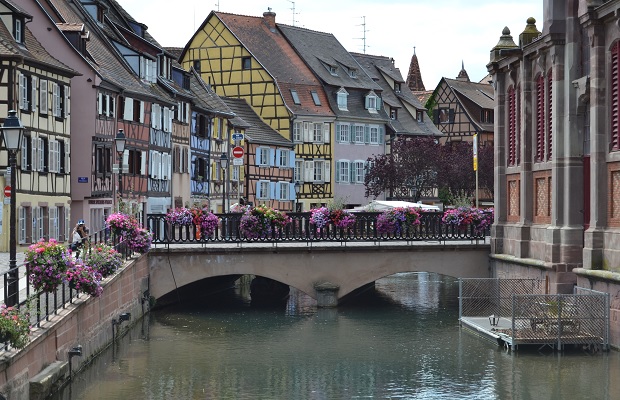
Colmar, Alsace, photo (c) Cassidy Havens, http://teuwen.com/

Colmar, Alsace, photo (c) Cassidy Havens, http://teuwen.com/

To set the record straight, there has always been dry Riesling made in Alsace. There have also been white wines made in blatantly off-dry styles. Bringing the two poles together in seamless coordination is no easy task. The duality in character of combining straightforward, linear acidity and bright, sometimes exotic fruit is a concept, though in sweet emotive intention, that remains buoyant in the persevering air of aridity. It helps to define the transformative trend towards dry Alsatian Riesling.
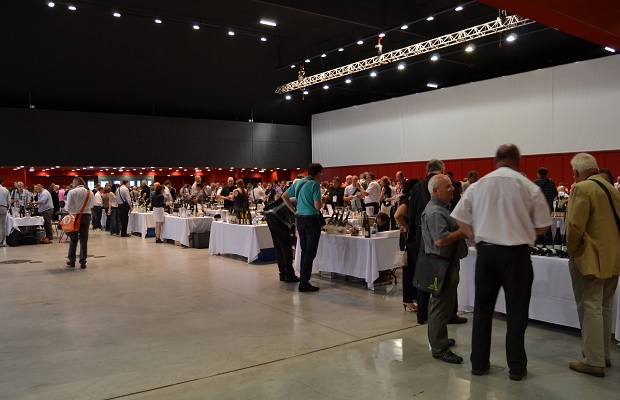
Millésimes Alsace 2014, photo (c) Cassidy Havens,  http://teuwen.com/

Millésimes Alsace 2014, photo (c) Cassidy Havens, http://teuwen.com/

Here are Rieslings from a wide range of Alsatian Grand Cru and lieu-dits (single vineyard, named), in 31 flavours.

Maison Rolly Gassman

Riesling Réserve Millésime 2012 (61715, Wineworld Importers & Exporters Ltd, WineAlign)

“All are noble rot wines, but we call them Riesling.” This is the irony from the mouth of Pierre Gassman, especially in consideration of this, the driest in his portfolio. For so many Riesling, 12 g/L of residual sugar would ring like a morning alarm but the Réserve Millésime, a limestone chalky and buzz tangy Riesling, acts as if it’s super dry. This is the 9-plus g/L of acidity talking and the calcaire soil, though some clay gives it weight and grounding. A Gassman Riesling as dictionary entry to define the dichotomous behaviour of Alsatian Riesling. A perfect example that should taste sweet but does not. An impossible yet beautiful act of vinous science.

Riesling Silberberg De Rorschwihr 2010 (WineAlign)

The Silverberg is the “silver mountain,” a Grand Cru not unlike Zind-Humbrecht’s Clos Windsbuhl and located at Gassman’s home base, the Haut-Rhin village of Rorschwihr. This has to be the producer’s most impossible Riesling. The lab results of 16 g/L sugar, 13 g/L acidity, 2.86 pH and 14 per cent alcohol mean that it is not really wine at all. But it is, a linear drip of liquid silver with a direct hit of lemon-lime-orange-grapefruit solution carried within a membrane of viscous honey. Specs be damned, this is bone dry with a speeding, direct citrus laser hit. Riesling with its very own Gassman dialect known as the muschelkalk sound.

Riesling Kappelweg de Rorschwihr Vendanges Tardives 2000

If you’ve ever had the good fortune to spend any quality time with Gassman’s wines you will cop no advanced character from this late harvest mineral expression in bitterness unchained, yet restrained sumptuous VT. A clear entry pauses to smell the quince, apricot and white flowers. The ultimate resolve is a long aftermath tinged by an (80 per cent of the vines, highest in the Gassmann holdings) noble bitterness. The vines are also some of the oldest, dating back to 1942. Oiled density and excellent length define this Riesling though it’s hard to figure whether or not it acts like a reduction sauce or a spiked tipple. One does not taste and mull a VT like this without pause or cause to wonder. Not an easily understood wine by any stretch of reality so book a flight of fancy and enjoy the ride. One of many exceptional Rieslings from the 2000 vintage in which cloying is simply not an issue. Hard to imagine more versatility from this level of residual sugar to work alongside hors d’oeuvres, fish and the cheese plate.

Riesling Kappelweg de Rorschwihr Vendanges Tardives 2010

Kappelweg offers up fruit in matronly, door is always open generosity and maximum concentration as much as any terroir in Alsace. From 50 per cent noble rot affected at a resounding yet justly calculated 42 g/L residual sugar number, this baby-faced, early rock ‘n roll Riesling gives off its habitual white flower scent. A product of blue clay (closer to the sea) and a of a botrytis mined with calcaire in mind. “When you have Kappelweg, you have noble rot,” resigns Pierre Gassman. With a Gasmann Riesling “it’s one for the money, two for the show.” With Kappelweg it’s “three to get ready, now go, go, go!” The king of Riesling in blue suede shoes.

Riesling Pflaenzerreben de Rorschwihr 2000

The Pflaenzerreben translates as ‘plants de vignes’, or even more simplified as the ‘vineyard’!  From the Rorschwihr blue clay with silt and Muschelkalk limestone soils, the ’00 is still a baby. Yellow flowers blow from a complex nose, along with waxy, medicinal tones. The aromatics are high, which helps to subdue the noticeable (19 g/L) sugars. More aid comes by way of the Calcaire tannin and a six to eight-hour slow pressing, “ensemble,” notes Pierre, with no separation and a resulting “tout doucement” clear juice. The wonders of 2000 emit from the Gassman oeuvre.

Riesling Pflaenzerreben de Rorschwihr 2010

Here is Riesling that resides on two sides of the notorious Alsatian, sugar-acid ubiquitous fence. Pflaenzerreben reads like a veritable ECG. There is both citrus-spiked negative deflection as well as a sweet (16 g/L) elegance in positive deflection. The calcaire chalk posits the tug, the struggle between the poles. He/she admits “once a man, like the sea I raged, once a woman, like the earth I gave.” In the end this cinema show of a Riesling has “in fact more earth than sea.” One of the Genesis Rieslings of Alsace.

Domaine Maurice Griss

Riesling Sonnenberg 2010

An all rock, all out mineral wild thang from Josiane Griss, As dry as it gets (5 g/l sugar), as piercing as can be handled (10 g/l acidity) and in a state of aerified (12.8 per cent) alcohol. From granite terroir, near the top of a south-facing slope with high sun exposure. Though ’10 was not a particularly warm vintage, the high tartaric levels and late picking, slow developed berries post glorious September has everyone talking classic, for the ages. Impeccable balance here and a fortuitous match to Tarte flambée with salmon, leeks, basil pesto and cream. If asked the question, “how long have you been a Riesling,” the Sonnenberg would surely answer simply, “from creation.”
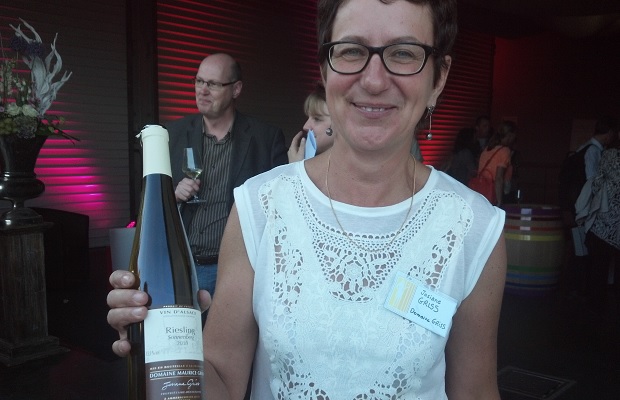
Josiane Griss with Riesling Sonnenberg 2010

Josiane Griss with Riesling Sonnenberg 2010

Domaine Pfister

Riesling Tradition 2012

Though Pfister continues to forge this Riesling from six micro-plots in the Silverberg lieux-dit, the name Tradition takes over, as a stylistic ode from 8th generation winemaker Mélanie Pfister to her father André. Built upon a solid permeate in limestone, the residual is dastardly low, in the 7th generation vintner’s way. Beautifully dry, somewhat misunderstood in its youth, in need of time.
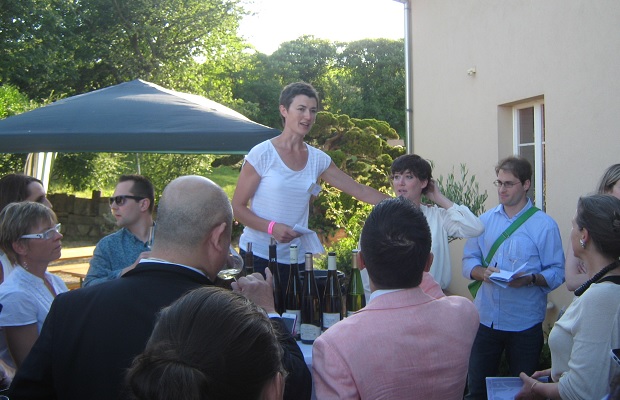
Mélanie Pfister introducing the wines for Divines d'Alsace

Mélanie Pfister introducing the wines for Divines d’Alsace

Riesling Grand Cru Engelberg 2012

The “Angel’s Hill,” a south-facing and third most northern Grand Cru in Alsace. The Pfister take is reserved with extreme umbrage, an arid tug between brix and acidity, a fragment of what it may become, a portal into a Riesling analect. There are ripe phenols to be sure and a gentle, lingering calm. This will need years to develop. Right now it’s all lemon, lime and flinty stone with no periodic oscillation.

Riesling Grand Cru Engelberg 2011

Here comes the Pfister mindset out of a warm vintage, picked early in September. Go figure the still bracing acidity trumps it’s still beating heart. A slight sense of sweetness lies therein but the obvious minimalist tradition persists. Lacks the length of ’12 and offers nearer gratification. This is an example of why acidity is not the number one catalyst for success and for aging, so ’11 will both be like and unlike ’12.

Riesling Grand Cru Engelberg 2010

The ’10 is altogether different. There is petrol on top, pumping invisible ozone with an elemental intention. The welkin adds richness and viscosity, though for Pfister that is merely relative as compared to say…Gassmann. The ’10 is a fastball and it is hard not to get caught looking. Vinified bone dry (2 g/L) and due to the difficulty of the vintage, Mélanie left it on the lees for two years. The result is a perceived sweetness chaperoned by texture. Will require 10 years minimum.

Riesling Grand Cru Engelberg 2000

Beautifully dry, primary still, laden with citrus. Though not as gorgeous as some, this bridges the gap and emphasizes the Pfister Engelberg opus. It is amazing that it is yet to show any discernible evolution and every indication says it will live on forever. Or at least 15-20 more years.

Riesling Grand Cru Engelberg 1990

Here lies the crux of the Pfister vinous chrestomathy, like a literary work that cannot, in principle, ever be considered finished. From the third in a trilogy of great vintages, the ’90 has ego to spare, remaining so young and unresolved. The aroma profile is floral, almost medicinal and with a pronounced clotted cream note, the wise Cru remains youthful and nearly primary. Five minutes in glass does bring texture and an aged cheese taste, like Tomme fermière des hautes Vosges.

The wines of Domaine Pfister

The wines of Domaine Pfister

Caves François Schmitt

Riesling Grand Cru Pfingstberg 2012

The Grand Cru lies at an altitude ranging between 250 and 350 metres. The sub-soil is made up of calcareous sandstone and micaceous sandstone (Muschelkalk at the base and Bundsandstein at the top). Vines were first planted in the 1950’s. Paradis is a historical plot of land at the very heart of the vineyard, on one of the steepest areas. The ’12 Paradis by father and son François and Frédéric enters a sweetness zone without a sacrifice or surrender in loyalty to linear acidity. Peregrine fruit, in full feathery display is enraptured by tartaric of the highest degree. There is citrus atop rocks, a persistence and a perseverance that never relents.

Riesling Grand Cru Pfingstberg 2000

The ’10 GCP is yet a baby and in hallmark readiness of its necessary terroir. The petrol note remains a faint feign though its imminent presence is known. Such intense aridity, citric perforations, notes of wet concrete, highborn bitterness and unerring balance. Strength is supplied by sandstone and limestone. As much of a treat in classic 2000 Riesling as one might ever hope to be poured.
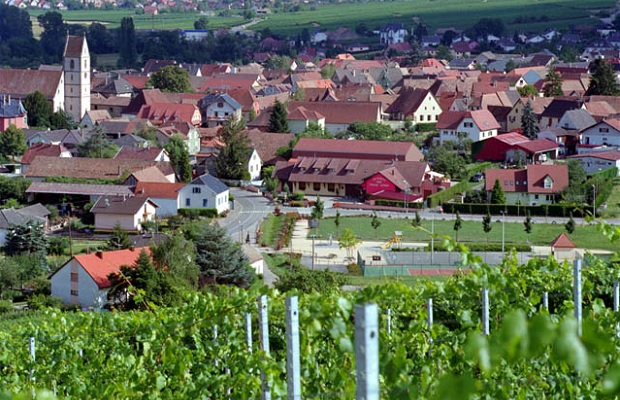
Cave François Schmitt, http://www.francoisschmitt.fr/

Cave François Schmitt, http://www.francoisschmitt.fr/

Vins Jean-Baptiste Adam

Riesling Grand Cru Kaefferkopf 2010

The radiation here is mind-blowing. The citrus dartle, the rows and columns of acidity in geometrical patterns, the angles obtuse and abstruse. Such a tense and immature Riesling with a late gas attack and oxygen depleted atmosphere. Wow is the operative word though it remains to be seen if this will ever latch on to any gravitational pull or circle the cosmos for eternity. This Kaefferkopk dances in the dragon’s jaw, lies “up among the furs where it smells so sweet,” and it’s got me wondering where the lions are. Wow.

Riesling Grand Cru Kaefferkopf 2000

Tasted from magnum. Incredibly atomic with a vineyard flinty stink that exhumes and exudes the benevolent bitterness of time. Has that vineyard dirt aroma and the wisdom of age. Something about this screams terroir, through earth caked stones, struck matchstick, wildness and purity.

Ginglinger-Fix

Riesling Vieilles Vignes 2012

The domain is family run since 1610 and biodynamic since 2009. Pheromones have been used since 1996 and they were one of the first villages to do so. Proudly announced as “vendanges à la main,” or, hand-picked grapes. This VV ’12 is bone dry, citrus in laser focus and a product of the calcaire solis with a pink quartzite quarry behind the village. The multitude of rock gives lightness in texture to this ’12 of wizened vines. This is a great example of Alsace Riesling emulated by VQA Bench Riesling in Niagara.

Riesling Goldert Grand Cru 2012

Here is rich example made by Éliane Ginglinger in Voegtlinshoffen. The Grand Cru vineyard gives as mush calcaire tang as any in the region, feigning oxidation but it’s really a most pronounced salinity. A piquant and forward Riesling with a whiff of violet. Further along in development than many ’12’s, the Goldert will be ready for prime time in two to three years.

Riesling Goldert Grand Cru 2011

The single-vineyard focus in ’11 is striking but not as piercing as some. The elegance factor here is a breath of Eguisheim air. Increased in poise, savoury accents and a florality that brings to mind chamomile tisane. At 13.5 per cent alcohol there is strength in balance.

Riesling Goldert Grand Cru Vendanges Tardive 1998

A late harvest VT scaled astern to a mere 14 g/L in sugar. Has developed such a deep golden hue, this muliebrity representative who proclaims sapidity in staunch mineral behaviour. Remarkably elegant and crisp for her age, the Goldert VT shows nothing particularly sweet about her. No conceit either, intense yes, but very fresh. Were I a proclaimer I would surely sing “I would walk 500 miles and I would walk 500 more, just to be the man who walked a thousand miles to fall down at your door.” I’m gonna be wanting another go at this ’98 next time I find myself in Alsace.

Domaine Jean-Marie Haag

Riesling Weingarten 2010

From a south-facing slope and sandstone soil, Haag’s Weingarten shows good potential for aging. “A grower’s vintage,” notes Myriam Haag. “A winemaker’s vintage,” one that required acumen and experience. There is a dry elegance about this grainy white, an imperial brackishness and a sense of  “écrou bougie,” or candle nut. Will age and needs to.

Riesling Grand Cru Zinnkoepfle Cuvée Marion 1999

Shows rich, viscous complexity with the sensation of star anise and menthol. There is a fumée discernment, an oily, nutty and spicy feel.  Singular and enticing, like a chestnut dessert, layered with mousse, sabayon and toasted dust.

Riesling Grand Cru Zinnkoepfle 2011

Luxuriance abounds from this ’11, elevating the oft-pierced variety to levels of lavishness and prodigality. Though it takes wing in petrol, it’s really just the spoken texture and flavours of the bleeding rocks. Bitters abound too but is this not what you want from Grand Cru Riesling? Fine, ritual, yet highly modern stuff.

Riesling Grand Cru Zinnkoepfle 2012

An enervating wine with richness bled from rocks and a finishing noble bitterness. The orchard fruit here is very ripe, more so than much of the 100+ Rieslings tasted over the course of a Colmar week. Marked by green apple, citrus and a middle-slope calcaire limestone (with sandstone on the edges) pierce. Such direct freshness and palate texture from that silty rock. A slow release wine, similar to the Zinnkoepfle 2008, a Riesling now in its secondary stage of development.
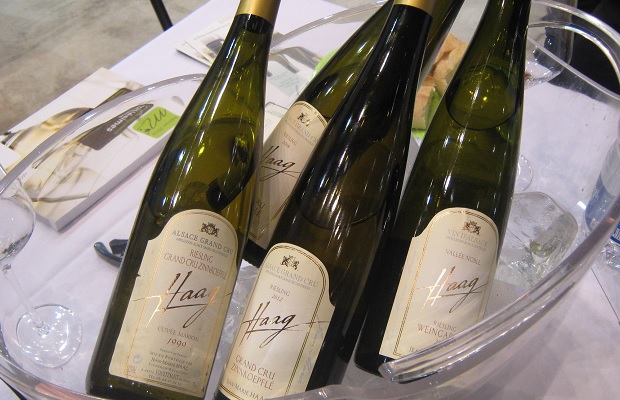
The wines of Domaine Jean-Marie Haag

The wines of Domaine Jean-Marie Haag

Domaine Valentin Zusslin

Riesling Grand Cru Pfingstberg Vendanges Tardives 2000

Here the noble rot has produced a Riesling thick in gluck and bright, golden sunshine fruit. Clearly protected from rain and wind by the Massif forest above, the 2000 has not yet relinquished the warmth in the bottle, along with a confected concoction of marmalade and blanched nuts. Though it has been bequeathed a slight mineraliztion with 14 years time, there is weariness to the fruit. Now is the window for maximum enjoyment.

Domaine Sipp-Mack

Riesling Grand Cru Osterberg 2012

The Osterberg Grand Cru is situated in Ribeauvillé and the Riesling is characterized by a stratified tartaric acidity. The ’12 is neither linear nor round, but layered instead and is a pure analogue of that rich style, with a slight residual subsidy. Extended hang time seems the bent so ripeness follows. The fruit is bulky and beefy though in a white veal way. If overall there is a curtailment in grip and outright anxiety the ’12 Osterberg will age unhurriedly for 10 years.

Riesling Grand Cru Rosacker 2000

The comparison with the other seven GC 2000’s on the table is hard to avoid so this one would make me think it leans late harvest. The Rosacker too is young and primary, teases and feigns VT but don’t be fooled by its unctuous sunshine. The dry quotient is extreme, despite the nuts. It is viable and rocketing in an elemental chew of salted stones. The finish is long and beautifully bitter.
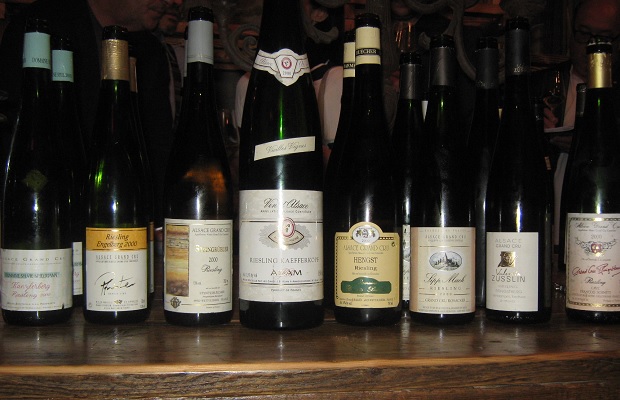
2000 Rieslings

2000 Rieslings

Domaine Barmès-Buecher

Riesling Grand Cru Hengst 2000

Under the direction of winemaker Geneviève Barmès, energy is the primary distinction of the domain’s wines, exemplified by this all out mineral Hengst. Carrying forth a tradition initiated by Francois (Geneviève’s late husband), biodynamic farming brings out an autonomy to define that energy and here specifically a stark, terrific bitterness so prevalent from the Hengst Grand Cru. Not so much a study in bright fruit, the flesh is one of stone texture, flinty accents and an awe-inspiring, old school funk. Very serious Riesling. Not for the faint of white.

Domaine Stentz-Buecher

Riesling Grand Cru Steingrubler 2000

The Steingrubler soils are some of the most complex and variegated in all of Alsace. Marno-calcaires and argilo-sableux incorporates calcaires oligocènes and smaller areas of fine granite. The smorgasbord of terroir makes for an elemental potpourri impart, a bitter limestone tablet dissolving as it rolls through a gasoline alley. The bitters are everywhere, in underlay, in overlay, in granitic streaks. Having entered secondary life, this 2000 is “goin’ home, running’ home,” back to where it was born. It may be said that this particular Riesling represents its terroir as much as any that can be assessed. A steward of place.

Good to go!
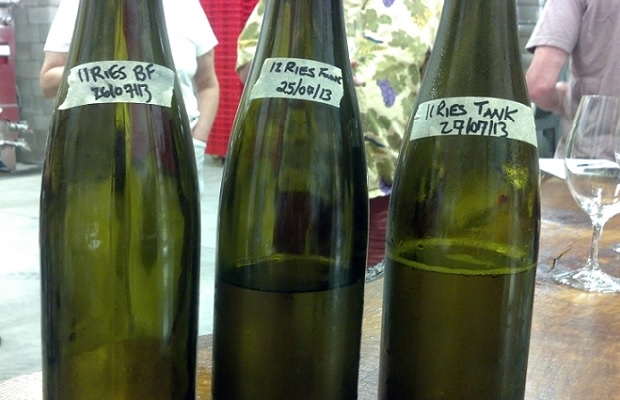
 

The pearls of Morissette’s wisdom

Pearl Morissette Riesling samples

Pearl Morissette Riesling samples

So you make wine from Ontario-grown grapes and it fails VQA inspection. The economic impact is potentially crippling. Here’s the short story. The sale of an Ontario VQA-certified bottle of wine sends approximately 15-20 per cent of the profit to the province. Without the stamp the tax cost is upwards of 50. There is no money to be made if your wine has not been blessed by VQA. Here is the long version:

The total Landed Cost (what the winery keeps) is calculated based on this:
Basic Price (retail price)  
minus Environmental Tax fee (same for VQA and non-VQA)
minus Bottle Tax/Levy (same for VQA and non-VQA)  
minus LCBO Wine Levy (applied to non-VQA only, yet minimal – $1.15 for $26btl)
minus LCBO mark-up (which is completely different between VQA and non-VQA – $0 for VQA, $8.5039 for a non-VQA wine based on a $26)
For a $25.20 ($25 + bottle deposit) bottle of wine, this is what the winery (Total Landed Cost in VQA language) keeps:
VQA retail: $20.56
VQA licensee: $20.56
non-VQA licensee: $12.44
These numbers come from a calculator, designed by VQA and the LCBO themselves that gives you the breakdown, once you enter the retail price.

François Morissette has that crazed look in his eye. The Quebec native faces the professional fight of his young winemaking life and has no intention of backing down. There will be no compromise of the viniculture oeuvre. Morissette’s day in, day out plight has been instigated by the Vintners Quality Alliance (VQA), the regulatory board that determines whether or not a wine made in Ontario gets its stamp of approval. It has already happened four times. VQA has rejected his Rieslings.

The pearl Morissette Cuvée Blackball Riesling 2011 is a $26 (retail price including bottle deposit) non-VQA bottle of wine and so the winery’s profit (before operating and production costs) is $12.98. Do the math. Sounds like a loss leader to me.

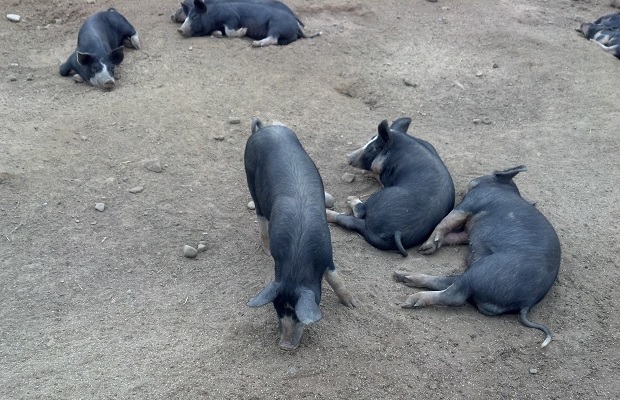
Pearl Morissette pigs

Pearl Morissette pigs

Morissette makes the wines at Pearl Morissette out of the Twenty Mile Bench in Jordan, Ontario. He’s opinionated and sometimes just plain pissed off. There are those who surely consider him a rogue, a dissident and an SD but at the end of the day, just how is he so different from his Niagara brethren and sistren? He is a farmer and a purveyor of fermented grapes. Granted his methods are progressive and experimental but the goal is the same as any honest and passionate winemaker. François Morissette wants to make memorable wine. Last July François Morissette told me “it’s not that we don’t want to make natural wines. We want to make wines with the least amount of impact.”

In July of 2013 at the i4C Cool Chardonnay Conference in Niagara, Francois expounded on some of the more important facets of making wine in Ontario. “Climate is the number one terroir driven aspect. The clone is nothing without the rootstock. They are inextricably linked.” He is a man who believes wholeheartedly in natural acidity. “You will have riper fruit on dry matter.” These are the ideas of a “rebel,” of a winemaker willing and ready to push the envelope. “I cannot ever apply what I learned in Burgundy as a farmer to Niagara. It’s a totally different animal.” These are the words of “pot-stirrer” Francois Morissette.

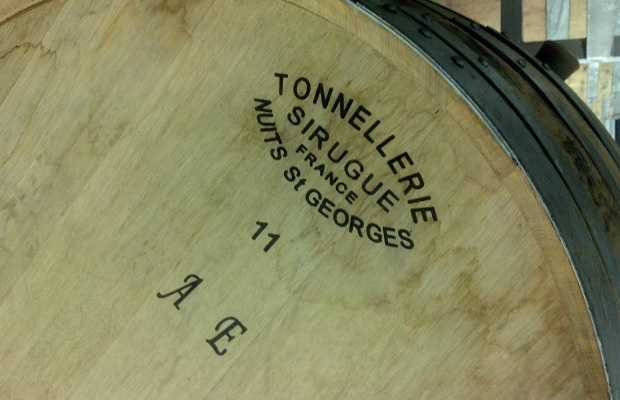
Foudre at Pearl Morissette

Foudre at Pearl Morissette

Today, Monday, May 26th, François and his girl Friday Svetlana Atcheva will once again go before the powers that be at VQA.  In their meeting with Executive Director Laurie Macdonald they will argue that their four-time rejected Riesling is bio-chemically sound, that it is a wine with no technical faults. The question of penalizing innovation will be raised, albeit in the spirit of cooperation. They will assert that the level of residual sugar (which the VQA panel seems to feel is “atypically” too low) and perceived sense of dryness must not be the focus. Morissette and Atcheva will explain to the panel that their Riesling is not oxidized but that the use of wood foudres (in addition to typically employed stainless steel tanks) allows for a gentle yet natural, controlled oxygen transfer. Ms. Macdonald will be asked the question on everyone’s mind. “How can an organization that reigns over such a young wine region be so sure what is correct and what is not?” What they should really say is “who are you to play God with wine?”

The sensory evaluation panel and decision makers maintain the necessity that “VQA wine grapes meet standards such as minimum ripeness levels (degrees brix) attained through careful viticultural practices.” This statement suggests that the Pearl Morissette Riesling fails to meet the criteria laid out by the decided governance. Does the system not sound like it is seeking conformity in the name of typicity? I spoke with Atcheva last Monday at the Generation Riesling tasting and she adamantly refutes the VQA position on Pearl Morissette’s wines. Skin ripeness, not sugar levels, indigenous yeasts, minimal interventionist winemaking and most of all quality should be the determining factors to passing their Ontario wine to VQA status. François just wants to be free to sell his wines to whoever he pleases without being shackled to taxes and bureaucracy. “My preference would be for 1,000 people to buy one bottle. But that takes time.”

Atcheva spoke at length this past weekend with a senior LCBO product consultant who elaborated on the selection process for the VQA panel. Up until a few years ago panel members were chosen based on their tasting experience. Today seniority lands spots on the tribunal. Work an LCBO cash for fifteen years and you too can decide the financial future of an Ontario winery.

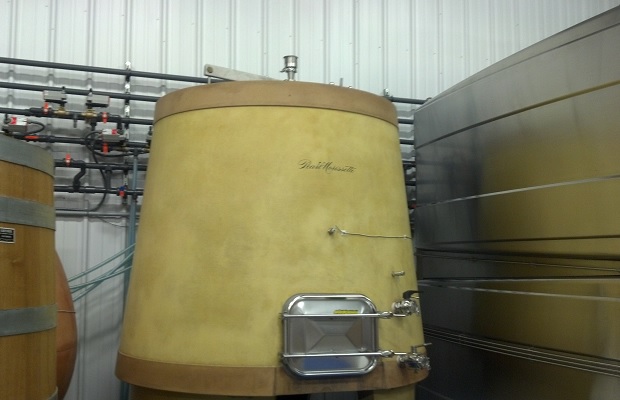
Conrete Egg Fermenter

Conrete Egg Fermenter

For a full account on VQA evaluation processes and the rejection of Morissette’s wines, read Rick VanSickle’s article, The ‘black-balled’ Riesling from Pearl Morissette in Niagara and the storm that’s brewing over VQA rejection: Let’s talk about it. Another response by Tim Reed Manessy brings the VQA system’s shortcomings into proper focus. Behind the ‘Black Ball’ is Manessy’s take on his blog, Somm on the Run.

Hinterland's Jonas Newman, François Morissette, Montreal Gazette and Chacun Son Vin's Bill Zacharkiw, WineAlign's John Szabo M.S. , Wine Country Ontario's Magdalena Kaiser Smit and Assistant Winemaker Ryan Corrigan tasting Cabernet Franc

Hinterland’s Jonas Newman, François Morissette, Montreal Gazette and Chacun Son Vin’s Bill Zacharkiw, WineAlign’s John Szabo M.S. , Wine Country Ontario’s Magdalena Kaiser Smit and Assistant Winemaker Ryan Corrigan tasting Cabernet Franc

Through the generosity of François Morissette, Naomi Laurie, Ryan Corrigan, Cameron MacDonald and Svetlana Atcheva I have had the opportunity to taste, consider and assess the wines of Pearl Morissette out of tank, barrel, concrete egg fermenter and bottle on several occasions in the past year. Here are my notes on many of those moments.

Riesling Cuvée Blackball 2010, Niagara Peninsula, Ontario ($26)

This introduction to the experimental oeuvre of François Morissette holds attention and water. The delve into texture shaping by way of progressive malolactic fermentation during primary fermentation is a stirring exercise in character building. The ’10 is a conjoined cuvée of two, one of which contained 20% botrytis affected grapes. It spent eight months on fine lees in stainless steel and finished so very dry, at 1.27 g/L residual sugar. Biochemically correct, reeking and bleeding of the Peninsula’s veins, Blackball was submitted for VQA approval four times and rejected because it “lacked varietal typicity.” Perhaps it was the lack of human intervention, the anti-Bonzai approach, that doomed this diffident Riesling. Perhaps the texture should take it on the cheek for its brilliant disguise, for changing the subject and forcing the taster to open their mind and act innocent for a moment in time. The Blackball has that effect. Sadly, it too will be typical one day.  Tasted July 2013

Riesling Cuvée Blackball 2011, Niagara Peninsula, Ontario ($26)

The 2011 Cuvée Blackball picks up where the ’10 left off. When tasted from a stainless steel, not yet labeled sample in bottle back in July of 2013 it showed high acidity and citrus but also a bottle-shock musky note. Nearly one year later the wine has fleshed into that sought after experimental texture, as if it were aged in foudres. It’s flexibility was encouraged by three months of aging on its fine lees. The ’11 is the jumping off point and the bridge towards understanding where the Riesling program is heading. Others will follow. “There’s no real reference for these wines,” admits Morissette and that’s the clue to understanding why haste judgments are passed. Fear of the unknown empowers tradition to stagnate and end up getting left behind.  Tasted July 2013 and May 2014

Riesling Cuvée Blackball Barrique 2011, Niagara Peninsula, Ontario ($29)

The craving for texture led François Morissette to employ small barrels to ferment a small (68 case) amount of 2011 Riesling, in this instance eight year-old neutral barriques. Close-minded, new world wine geeks might fear anarchy but ask any winemaker from Pfalz and they would say, “tell me something new.” The succor is so benign and simultaneously, subtly huge. The increased lees contact on small volumes of wine promotes corpulence and viscidity. The methodology results in more fruit presence; in pear and yellow plum, not to mention that unmistakable Niagara citrus. This ’11 has the most levels of expression. There is nothing revelatory or regulatory about it, beyond the fact that it works and that it would stand out as an excellent example in a flight of Trocken Riesling. The ’11 exemplifies the flesh versus acid continuum. The freshness of this Riesling has emerged, thanks to meticulous sorting, ne0-liberal winemaking and the use of a -1°C fridge. François Morissette does not like to race against time. His Riesling speaks volumes about that.  Tasted July 2013 and May 2014

Riesling Cuvée Blackball Barrique 2012, Niagara Peninsula, Ontario ($29, WineAlign)

When tasted in July of 2013 the ’12 Barrique had only been in bottle for three days so the musk was quite front and centre. Aged in foudres (neutral, old wood casks) it held much latitude at such a young age with notes of herbiage (mint, tarragon), nary a drop of residual sugar and a wholly unique type of dry acidity. “It will not always show this way,” commented Morissette. Tasted 10 months later I can say this. The ’12 Riesling Barrique avoids excessive malic and tartaric acid, not to mention any amount of volatile acidity. It is viable, vital and technically sound. “This is a wine that will take time,” pleads François . “I care about texture, not about varietal character.” Though perplexing and untamed, the wine has undeniable body and that noble bitterness in its unsung tang. It is the anti-Riesling hero, full of experiential conceit and needs to be revisited often, to see where it will go.  Tasted July 2013 and May 2014

Riesling and The Lamb Lies Down on Broadway

Riesling and The Lamb Lies Down on Broadway

Rosé Cuvée LPR 2012, Niagara Peninsula, Ontario (Sold out, $25)

Stylistically speaking, the bottles (and kegs) that emerged from the 225L hemorrhaging of Cabernet Franc from both oak and concrete vessels have no reference point. In fact, the advertence is one created by Francois Morissette. The flexible disposition is difficult to pinpoint and without trying to sound blowsy in assessment, this goes places yet visited by bone-dry Rosé. If it were the only wine made on premises the barn doors would always be banged upon. A most current wine, exigently red and almost indiscernible as Cabernet Franc. It suffers no stenosis and does not live a single green day. Another VQA rejected wine, the LPR walks down a boulevard of broken dreams and it sings, “I walk a lonely road, the only one that I have ever known.”  Last tasted November 2013

Pinot Noir 2011, Niagara Peninsula, Ontario (Sold out, $36)

With utmost integrity Pearl Morissette chose not to vinify Pinot Noir from the fruit of the 2008, 2009 and 2010 vintages due to unacceptable levels of sour rot. With the 2011 harvest came inspiration. It was noted that local tree fruit farmers make use of the practice of storing their harvested fruit at 1° Celsius in a large refrigerator. This pseudo-cryogenic cooling practicum worked to halt the progression of the dreaded rot. Buying time allowed the crew to clean sort without having to worry about a single berry contaminating the lot. So what? So a pure, clean Pinot Noir was the result. Tasted four months after bottling, the modest (12.7 per cent alcohol) and vinified so dry (2 g/L residual sugar) ’11 held barking fruit on a tight leash and a moonscape of dusty, grainy tannin. Nine months later (to the day) the sensory evolution became as if cherries, strawberries and the tension in seeking ripe perfection were wine.  Tasted July 2013 and April 2014

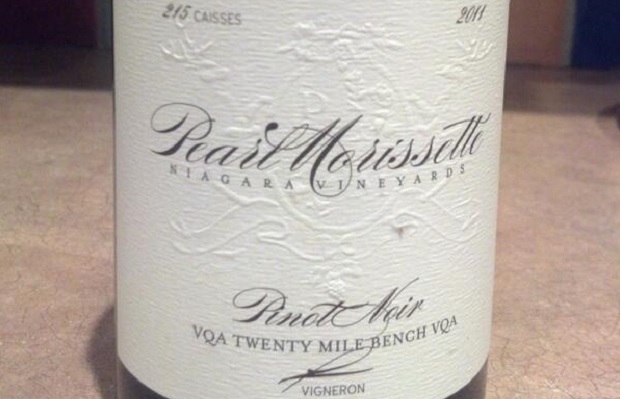
Pearl Morissette Pinot Noir 2011

Pearl Morissette Pinot Noir 2011

Cuvée Madeline Cabernet Franc 2010, VQA Twenty Mile Bench, Niagara Peninsula, Ontario  (winery, $38, WineAlign)

François Morissette’s 2010 is a pioneering example towards defining Bench appellation Cabernet Franc isomeric reactions. Relationships between grapes of a growing area and their ultimate destination in bottle. An affair of veraison, leaf drop, frost, hand harvesting, whole cluster sorting and berry oak fermenting. Indigenous yeast, punch downs and overs for phenolic skin extraction and polymerization. Neutral oak and sulfur dioxide to provide antimicrobial and antioxidant protection. An eighteen month somniac’s rest, fine lees and no filtration. The structural arrangement in cohabitation of radicals and ions leads to such a Cabernet Franc. Fully expressive of an endemic, very ripe, vegetal varietal vicissitude that is both inbred and necessary. Currants and peppered berries of power and grit. Dry (2 g/L residual sugar), plump (13.7 per cent alcohol) and scarce (618 cases made). Reflective of the warm 2010 vintage and will always act in stark contrast to the elegant 2011. Tasted July 2013 and March 2014

19th Street Cabernet Franc 2011, VQA Twenty Mile Bench, Niagara Peninsula, Ontario  (winery, $38, WineAlign)

First tasted from a barrel sample in July 2013. “From what is turning out to be a very elegant vintage, the 2011 Cabernet Franc is early proof that on the Twenty Mile Bench “we can turn a vineyard very quickly, in three years we can turn a vine.” This is significant in consideration that in Europe, vine age is always key.” Now in bottle the aromatics are hyper-pronounced and though the tannins are less rigid, less exerting and less demanding, they are not nearly ready to throw in the towel. Longevity will define ’11 and it will be the genesis of Pearl Morissette’s CF program used to compare future vintages. “The day of judgement’s come,” and you can bet that the wine’s been “resting, for this testing, digesting every word the experts say.” With the ambient transition of a hairless heart, the 2011 Cabernet Franc segues from anxiety to counting out time.  Tasted May 2014

Chardonnay ‘Dix-Neuvième’ 2009, VQA Twenty Mile Bench, Niagara Peninsula, Ontario (limited library, $40, WineAlign)

Was the ’09 DN this lush and so pretty last summer? Was it bronzing as if sun-kissed and so delicate? Tasted alongside Chef Cameron MacDonald’s White Bean Cassoulet, duck and pork neck wrapped pate it sings in a Lindley-esque falsetto. From my earlier, July 2013 note: “Tragically singular in expression, regardless and in spite of the terroir, mixes metaphors and pulls it off. “Takes arms against a sea of troubles,” by convincing ADHD fruit of an uncertain vintage to settle, play nice and “by opposing, end them.” Now entering the load out zone, this Hamlet cuvée is “the first to come and the last to leave, working for that minimum wage.” A sentimental ballad here to stay, be remembered and to set the stage for all dix-neuvième to come.”  Last tasted May 2014

Chardonnay ‘Dix-Neuvième’ 2010, VQA Twenty Mile Bench, Niagara Peninsula, Ontario (sold out, $35, WineAlign)

Having had the opportunity to taste the 2010 Cuvée Dix Neuvieme on several occasions over the past 10 months, every layer and fibre of its being has ingratiated itself to me. The tropical, solar 2010 vintage required that steps were taken to preserve freshness for when the final blend was to be assembled. A small portion of the juice was fermented separately in stainless steel tank and then injected into the 18-month, neutral barrel mass. The ’10 is full of verve, rigor and grinning elegance. It speaks of a salinity so typical for PM Chardonnay which comes from the usage of lees. This is what could be referred to as a “tannic” white. While it lacks the intensity of the bookending vintages on either side, as a middle sibling it is the glue and the rock that speaks diplomatically and most eloquently for the family.  Last tasted May 2014

Chardonnay ‘Dix-Neuvième’ 2011, VQA Twenty Mile Bench, Niagara Peninsula, Ontario (303602, $35, WineAlign)

A child of a hot and dry summer, a stress-free winter slumber and a non-invasive spring awakening.  Sets out lean, tight and mean, but the dry extract invites spicy, stone fruit and an emergence of tropical lushness. Can there be another specimen that so rightfully defines Pearl Morissette, the top of the Bench or Niagara as a whole in 2011?   Tasted July 2013

Barrel and Tank Samples tasted July 2013 and May 2014

19th Street Cabernet Franc 2012

Tasted in July 2013 from one of two barrels, it’s not so (amazingly reductive) and redolent of the most earthly currants. From a very immense year, in primary quality, barely evolved. Blessed with such ripe tannins this will have even bigger structure. Francois declares “I’m now a believer that Cabernet Franc is the most important grape to grow in Ontario (on this side of St. Catherines). Nine months later, with the wine still sitting on its primary lees and not yet racked “it’s so torqued,” notes John Szabo. “We made a monster CF without cream,” adds François . Pure, énorme, immovable yet so stable. There was a nearly volatile spike during fermentation and malo but it’s done. A death metal beast.  Tasted July 2013 and May 2014

19th Street Cabernet Franc 2013

From juice housed in concrete, wood and open top fermenters this occupies impossible Cabernet Franc colour territory. Sweaty, chalky and bloody, it’s a bit reductive in extract and intensity. Lifted florally and very savoury, this is quintessentially Cabernet Franc in character. Crunchy tannins come late in magnanimous fashion.  Tasted May 2014

Chardonnay 2013

Tighter than it looks, sitting on its lees, pushing the envelope. In a German 2,500L barrel it’s rounder and softer. In second fill Alsatian Foudre it gains tang, spirit and backbone. From the Koscis Vineyard’s heavy red clay there is less texture and mid-palate. Out of a smaller (228L) barrel the wood is felt in fluidity, structure and creamier, clearer fruit. The largest barrel adds (10 per cent) new oak and finishes the ferment the earliest. It brings textural tack and a chewy finish. “New oak doesn’t make it better. It energizes the wine,” says Morissette. Overall this will be a rich, ripe-fruit based opulent Chardonnay, high in potential (13+ per cent) alcohol with a remarkable sweetness despite little or no residual sugar.  Tasted May 2014

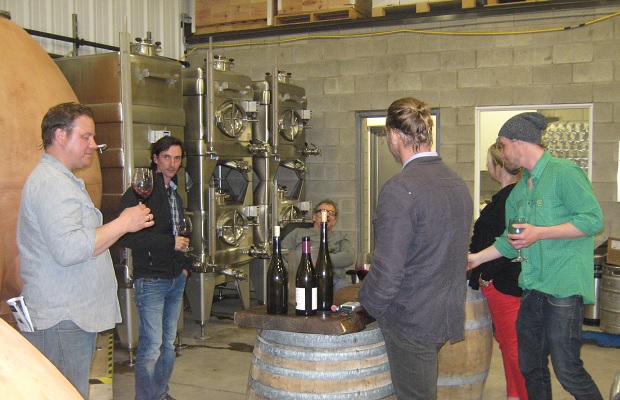
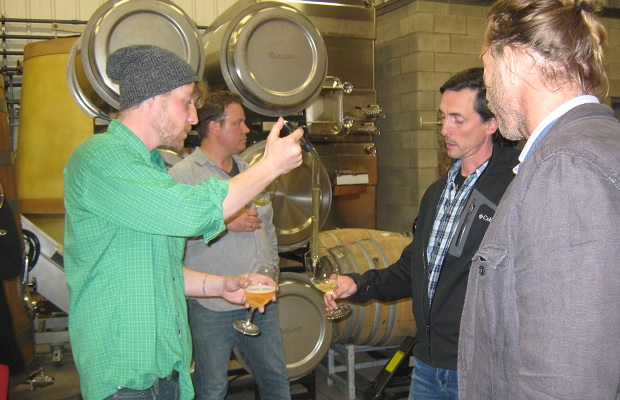
Chardonnay from barrel with Ryan Corrigan, Jonas Newman, Francois Morissette and John Szabo

Chardonnay from barrel with Ryan Corrigan, Jonas Newman, Francois Morissette and John Szabo

Rosé 2013

If this Cabernet Franc is flirting with an acetic danger it is not enough to scare me away. Certainly edgy and there is a chance it may be pushed to the fringe, hippest markets but that also may just be a necessity if it is once again rejected as VQA. And it should not be.  Tasted May 2014

Bill Zacharkiw making notes at Pearl Morissette

Bill Zacharkiw making notes at Pearl Morissette

Gamay 2013

In July 2013 Francois Morissette made this statement. “If we can’t make Gamay in a Cru Beaujolais Style, I’m not interested.” In May 2014 his ’13 Gamay causes Bill Zacharkiw to comment with blatant honesty, “just line up at the tank. Forget the bottle.” From 100 per cent whole clusters sent to cement fermenters. Once again the hue is just impossible. Sulphur-free, this walks a fine and perfect line of Cru banana Gamay. Pushes the Gamay envelope in that it’s gulpable but with a duress to remind you not to overdo it. A Gamay with a chamber of 32 doors. In it “I’d rather trust a man who doesn’t shout what he’s found.” François Morissette.   Tasted May 2014


Good to go!
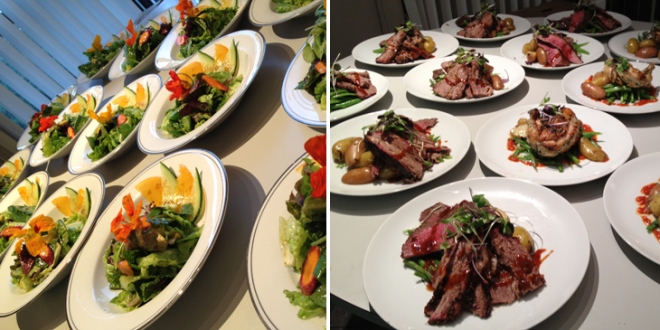
From Cinquante to wine with Canada-U.S. hockey

Canada\'s Marie-Philip Poulin (L) celebrates with Canada\'s Meghan Agosta-Marciano.

Canada’s Marie-Philip Poulin (L) celebrates with Canada’s Meghan Agosta-Marciano.
Photo: ANDREJ ISAKOVIC/AFP/Getty Images

as seen on canada.com

I hope the Canadian men’s hockey team watched the women this afternoon. Lesson number one: Play to the last friggin’ millisecond. Canada versus the United States is hockey incarnate. The games are always exciting.

When we gathered for that first historic Salt Lake City Gold Medal game in 2002, we drank cinquante. Mario would have wanted it that way. For the 2010 Vancouver golden goal win we convened with Steam Whistle. That historic Sunday in February was my first time out of the house after a right AC (acromioclavicular) joint shoulder rebuild. Hockey injury, of course. Wine did not factor into those generation defining Olympic hockey games. Back in 2002 names like Lemieux, Sakic, Fleury, Brodeur, Hull, Leetch, Modano and Roenick were toasted with beer, though back then the brands were not so craft related. In 2010 it was all Sidney Crosby and had I been acquainted at the time with the wonders of Sparkling wine from Nova Scotia, Benjamin Bridge would surely have been flowing.

Meanwhile, Super Mario turned out to be a serious wine collector so I wonder what Le Magnifique will be opening this Friday at noon. Team Canada architect Steve Yzerman is also known to follow the way of the grape and though he won’t be sipping Napa Cabernet with the other brass during the game, I’ve a feeling there’s a ’97 waiting in his hotel room should Canada prevail over their arch rivals.

Hockey stick and wine bottles

Hockey stick and wine bottles

The great Rhône wine scribe George Heretier posed the all-important debate, ”who says wine and hockey don’t make a good match?” If you want to exercise the powers of superstition, pulling out those two winning vintages will call upon the hockey gods to carry our Canadian men to gold. That and a Loonie buried beneath the surface at centre ice.

Here are eight great Canadian 2002 and 2010 wines to crack open and sip along with another Canada-U.S. classic hockey meeting.

Clockwise from left: Southbrook Vineyards Cabernet Franc ‘Watson Vineyard’ 2002, Henry of Pelham Family Estate Winery Speck Family Reserve Cabernet Merlot 2002, Rosewood Estates Winery Sémillon 2010, Southbrook Triomphe Cabernet Sauvignon 2010, Burrowing Owl Syrah 2010, Huff Estates Cuvée Janine Sparkling Rosé 2010, and Stratus White 2010

Clockwise from left: Southbrook Vineyards Cabernet Franc ‘Watson Vineyard’ 2002, Henry of Pelham Family Estate Winery Speck Family Reserve Cabernet Merlot 2002, Rosewood Estates Winery Sémillon 2010, Southbrook Triomphe Cabernet Sauvignon 2010, Burrowing Owl Syrah 2010, Huff Estates Cuvée Janine Sparkling Rosé 2010, and Stratus White 2010

Southbrook Vineyards Cabernet Franc ‘Watson Vineyard’ 2002 ($30, winery) From A long and ‘wine-ding’ tasting road

Shows amazing longevity and freshness. Proof of the Peninsula’s magic to state ”you will never never never know me.” Simply solid red.  91  Tasted March 2013  @SouthbrookWine

Stratus White 2002, VQA Niagara Peninsula (660704, $44.20, WineAlign)  From Select tasting through years of the Stratus Red and White

Performs a demi-sec act which is not such a stretch, considering the late harvest actualities of the Gewürztraminer and the Riesling within. Could pass for dessert-like, cool-climate French (Jura) though after the chimerical declension it’s still nothing but a Chardonnay-galvanized meritage. Like warm honeycomb buttering steamed crustaceous matter. That Stratus White medicine, in rose potpourri and honey completes the classic scene within the portal.  93  Tasted September 2013  @Stratuswines

Stratus White 2002

PHOTO: Michael Godel
Stratus White 2002

Henry of Pelham Family Estate Winery Speck Family Reserve Cabernet Merlot 2002 ($50, wineryWineAlign) From A long and ‘wine-ding’ tasting road

From the Niagara Peninsula shows toffee and concentrated, oxidized fruit. That said, it has aged well and still offers intellectual spirit in dried fruit and potpourri. Great old tune to Dance, Dance, Dance along to.  89  Tasted March 2013  @SpeckBros

Rosewood Estates Winery Sémillon 2010 (177758, $17.95, WineAlign) From Showcase Showdown: Rosewood Sémillon

Shows little procrastination with a superfluity of lemon, lime and paraffin but like all great Sémillon, the wine needs time. A block of wax keeps the honey down but look for a mellifluous ooze three years on. Glittering sheen, diamond-like focus and crusted by an accent of lemon zest. Krystina Roman will lead this grape to stardom. “Come on you stranger, you legend, you martyr, and shine!” Top white. Shine on you crazy Sémillon.  90  Tasted October 2012 and May 2013  @RosewoodWine

Southbrook Triomphe Cabernet Sauvignon 2010, VQA Niagara On The Lake, Ontario (ON, VINTAGES Essential, 193573, $22.95, WineAlign) From: Good Look Ahead at Canadian Wines For Thanksgiving

Drifts effortlessly along in an extreme brightness and lightness of being. A perfumed exotic beauty that displays definitive Cabernet Sauvignon character. Tea, tobacco, Cassis, vanilla, dark berries, proper acidity, good grip and length. Dictionary entry for the vintage, the Niagara-on-the-Lake appellation and the genre. No other sub-$25 Ontario Cab does the warm vintages (’02. ’05, ’07 and ’10) with this kind of grace and power. From and kudos to winemaker Ann Sperling.  91  Tasted September 2013  @SouthbrookWine

Burrowing Owl Syrah 2010 (73072, $41.95, B.C. $39.99, Alberta $44.99, WineAlign) From: Nine big November best buy wines

This Syrah will cure so many ails. Vouchsafe for a pepper-laced, plasmic mouthfeel, a maroon liquid pewter party of rocks and stones in the mouth. Playful and childlike, digs a pony, playing and offering really good fun. Does its own Okanagan thing becuase “ev’rything has got to be just like you want it to.”  92  Tasted October 2013  @BurrowingOwlBC

Huff Estates Cuvée Janine Sparkling Rosé 2010 ($29.95, winery only, WineAlign) From: You can lead a county to the city

100 per cent Pinot Noir grapes is a phenomenal, inaugural genesis effort. More sanguine in colour than one would imagine, this sparkler is wonderfully sweet but also ”turns sweat, turns sour.” Pinot Noir is always potentially so dramatic but who knew it could be like this, like blood swirling in the glass. “Bottled in a strong compression,” with black raspberry, noticeable yeast and impressive finesse.  Out of the cage.  91  Tasted May 2013  @HuffEstatesWine

Stratus White 2010, VQA Niagara Peninsula (660704, $44.20, WineAlign)  From Select tasting through years of the Stratus Red and White

sends me immediately towards Bordeaux, in neo-marmalade, but also buoyed in perfume and body by 25 percent Viognier. “This variety worked so well in the vineyard in 2010,” notes Groux. Niagara honey and near-botrytis via Semillon and Sauvignon Blanc void of grass, full of vigor. A sharp note, neither metallic nor mineral, but a combination of the two is present in this so very concentrated ’10. Of a warm vintage (self-explanatory) fully picked by October 23. Though loaded with early Spring maple sap, foie gras and appley terpines, its sharp and framed by “tannic” tang and protracted length.  92  Tasted September 2013

Good to go!

13 Canadian wines that rocked in 2013

Here are 13 Canadian wines that rocked in 2013

Here are 13 Canadian wines that rocked in 2013.
Photo: valeriy555/Fotolia.com

as seen on canada.com

It has been a remarkable year in the evolution of the Canadian wine industry. Some will rant and others argue over the lack of cohesion and togetherness when the idea of a Canadian wine culture is discussed. What is of greater interest, at least in terms of the year in retrospect, is the wines themselves. When the wines are assessed and considered in part or as a whole, who would dare to say there are no great wines being produced?

I have personally tasted nearly 1,000 Canadian wines in 2013. This thanks to friends, colleagues, events, winery visits, LCBO media and vintner tastings, restaurant wine lists and agents. Not to mention the necessary organizations such as The Ontario Wine Society and the Wine Council of Ontario.

There was Cuvée 2013 and the Expert’s Tasting at Brock University. Somewhereness, County in the City, The Riesling Experience, Cool Chardonnay and Taste Ontario 2013 were just a few of the many events to discover the wonders of Ontario and Canadian wine. A summer visit to the west coast opened a window to the wonders of the Okanagan and B.C. Wine.

This was a very difficult list to narrow down. It is based on wines tasted but not necessarily released in 2013, though I did try to focus on more current selections. In the end, these choices are meant to offer both a cross-section and a definitive compilation of what Canadian winemakers do best. That is producing unique, cutting edge and brilliant takes on cool climate grapes. They also match beautifully with the songs referenced in their tasting notes. Here are 13 Canadian wines that rocked in 2013.

From left: CHÂTEAU DES CHARMES CHARDONNAY MUSQUÉ 2010, 8TH GENERATION VINEYARD RIESLING 2012, FIELDING ESTATE CABERNET FRANC 2011, QUAIL’S GATE PINOT NOIR 2011, and HUFF ESTATES CUVÉE JANINE SPARKLING ROSÉ 2010

From left: CHÂTEAU DES CHARMES CHARDONNAY MUSQUÉ 2010, 8TH GENERATION VINEYARD RIESLING 2012, FIELDING ESTATE CABERNET FRANC 2011, QUAIL’S GATE PINOT NOIR 2011, and HUFF ESTATES CUVÉE JANINE SPARKLING ROSÉ 2010

CHÂTEAU DES CHARMES CHARDONNAY MUSQUÉ 2010 (318303, $16.95, B.C. 230961, $18.99, WineAlign)

The song: The Rolling Stones, If You Can’t Rock Me

Intensifies in juicy, bright, nearly candied fruit cut by sour patch and blanched nut. Clean, cool Chardonnay and right on. My earlier note, from ‘It’s Only Rock ‘n Roll’ (but I like wine) is the unoaked result of aromatic Clone 809 combed from the heavier clay-based soils from the St. David’s Bench Vineyard and the silty, mineral rich soils from Seven and Seven Vineyard. Tropical, strutting stunner with “a thousand lips I would love to taste.” Tell Ms. Musqué if you can’t rock me, nothing can.  90  Tasted April 2013  @MBosc  From: Hot weekend wines and cool Chardonnay

8TH GENERATION VINEYARD RIESLING 2012 (B.C., $20.90)

From Okanagan Falls bolts rapido from the gate with the ripest fruit (pear, plum) and though there is citrus, it’s really quite semi-dry. At 12.9 per cent alcohol and 24gr/L of residual sugar this may as well be Mosel Trocken Spätlese. Fantastic presence and awesome winemaking from Bernd and Stefanie Schales. Got me by the vines and will be on my table. 92  Tasted July 2013  @8th_Generation  From: B.C. Wine: From Vancouver to your table

FIELDING ESTATE CABERNET FRANC 2011  (36194, $21.95, WineAlign)

Sets the pepper mill on speed dial and certainly knows the inside of a barrel but what more could you possibly ask for? Unabashed, unbridled purple goodness. From my earlier note: “…has to be the best yet from Richie Roberts.  From a 35-acre Grand Cru (Five Rows) vineyard in the making in the heart of the warmest Niagara locale (St. David’s Bench). Zanthoxylum, capsicum and pencil shaving. Ropy grain, chewy, sylvan charm. On the card at Barque 90  Tasted March 2013  @FieldingWinery  From: Masters wines in purple, yellow and green jackets

QUAIL’S GATE PINOT NOIR 2011 (585760, $26.95, WineAlign)

With a flat-out ambrosial aromatic entry bequeaths extremely ripe, fleshy red stone fruit and a hit of java, hold the crema and the splinters. Toss in some cool eucalyptus to that tincture, perhaps, like De Loach Van Der Kamp. Intimates a Sonoman dream in confected perfume unlike any Okanagan predecessor. This is flamboyant stuff for OV, toothsome, and were it from California I might think it OTT but from B.C., not so. Expertly judged fruit/acid balance and such plush texture. Gobs of fruit with just enough grit to keep it real. “The clamorous owl, that nightly hoots and wonders at our quaint spirits.” 91  Tasted July 2013  @Quails_Gate  From: A midsummer night’s chill red wine 

HUFF ESTATES CUVÉE JANINE SPARKLING ROSÉ 2010 ($29.95, winery only, WineAlign)

The song: Genesis, In The Cage

100 per cent Pinot Noir grapes is a phenomenal, inaugural genesis effort. More sanguine in colour than one would imagine, this sparkler is wonderfully sweet but also ”turns sweat, turns sour.” Pinot Noir is always potentially so dramatic but who knew it could be like this, like blood swirling in the glass. “Bottled in a strong compression,” with black raspberry, noticeable yeast and impressive finesse.  Out of the cage.  91  Tasted May 2013  @HuffEstatesWine  From: You can lead a county to the city

From left: NORMAN HARDIE COUNTY PINOT NOIR UNFILTERED 2012, PELLER ESTATES CABERNET FRANC ‘SIGNATURE SERIES’ 2010, PEARL MORISSETTE CUVÉE DIX-NEUVIEME CHARDONNAY 2011, and BURROWING OWL SYRAH 2010

From left: NORMAN HARDIE COUNTY PINOT NOIR UNFILTERED 2012, PELLER ESTATES CABERNET FRANC ‘SIGNATURE SERIES’ 2010, PEARL MORISSETTE CUVÉE DIX-NEUVIEME CHARDONNAY 2011, and BURROWING OWL SYRAH 2010

NORMAN HARDIE COUNTY PINOT NOIR UNFILTERED 2012 (125310, $35.00)

Cuts a rug with immense, stepping out juicy behaviour. It’s both turntable old-school, astatic in smooth groove rotation, but also digitally forward thinking towards a perdurable future. The nose is Norm’s most intense floral burst to date, with incredible brightness and sparkling acidity in the key of fresh plum. This brings to mind indelible Burgundy, enveloped in PEC’s warm ’12 blanket. Hardie’s measure of consistency abides in a Pinot of parity and undemanding polish.  93  Tasted October 2013  @normhardie  From: Top wines shine at Taste Ontario 2013

PELLER ESTATES CABERNET FRANC ‘SIGNATURE SERIES’ 2010 ($40.20, winery only, WineAlign)

The song: Frank Zappa, Joe’s Garage

Has got the funk in dark and dank waves. Top-tier barrel selection out of Four Mile Creek, this one is tight, tense and ready to jam with “a Stratocaster with a whammy bar” in Joe’s garage. Saw through to 100 per cent Malolactic fermentation after 20 months in barrel. If you are jonesing for Cab Franc, don’t miss this player.  91-92  Tasted March 2013  @PellerVQA  From: A long and winding tasting road

PEARL MORISSETTE CUVÉE DIX-NEUVIEME CHARDONNAY 2011 303602, $40.00, WineAlign)

A child of a hot and dry summer, a stress-free winter slumber and a non-invasive spring awakening.  Sets out lean, tight and mean, but the dry extract invites spicy, stone fruit and an emergence of tropical lushness. Can there be another specimen that so rightfully defines Pearl Morissette, the top of the Bench or Niagara as a whole in 2011?  93  Tasted July 19, 2013  @PearlMorissette  From: Nine big November best buy wines

BURROWING OWL SYRAH 2010 (73072, $41.95, B.C. $39.99, Alberta $44.99, WineAlign)

The song: The Beatles, Dig a Pony

This Syrah will cure so many ails. Vouchsafe for a pepper-laced, plasmic mouthfeel, a maroon liquid pewter party of rocks and stones in the mouth. Playful and childlike, digs a pony, playing and offering really good fun. Does its own Okanagan thing becuase “ev’rything has got to be just like you want it to.”  92  Tasted October 4, 2013  @BurrowingOwlBC  From: Nine big November best buy wines

From left: STRATUS WHITE 2006, HIDDEN BENCH TÊTE DE CUVÉE CHARDONNAY 2009, BACHELDER WINES PINOT NOIR LOWREY VINEYARD 2011, and BENJAMIN BRIDGE BRUT RESERVE MÉTHODE CLASSIQUE 2007

From left: STRATUS WHITE 2006, HIDDEN BENCH TÊTE DE CUVÉE CHARDONNAY 2009, BACHELDER WINES PINOT NOIR LOWREY VINEYARD 2011, and BENJAMIN BRIDGE BRUT RESERVE MÉTHODE CLASSIQUE 2007

STRATUS WHITE 2006 (660704, $44.20, WineAlign)

Was a “great recovery year,” after the winter damage of ’03, ’04 and ’05. A cool vintage, which required careful picking. The Sauvignon Blanc driven ’06 has the highest melon component, not to mention Boxwood. Yet that rose/floral/honey medicinal note is even stronger. Not over the hill at all and developing a graceful white wine character. Very French with late acidity and verve. Remarkable. Love this one. “This is a style of aged wine where I want to go,” says J-L. Nutty finish.  93  Tasted September 2013  @Stratuswines  From: Select tasting through the years of Stratus Red and Whites

HIDDEN BENCH TÊTE DE CUVÉE CHARDONNAY 2009 ($45, winery only, WineAlign)

From Big wines from California and the Bench from HB’s oldest, most highly regarded and meticulously maintained vines shows ravishing and refined restraint in elegance. Warm pineapple and mango coagulation jarred by the vintage’s piercing acidity and immense length. Head of the class, rings the bell, nails the lecture.  93  Tasted March and May 2013  @HiddenBench  From: Around the world in eight Chardonnays

BACHELDER WINES PINOT NOIR LOWREY VINEYARD 2011 (361816, $44.95, WineAlign)

The Song: Bruce Sprinsgteen, Blinded by the Light

Defies logic in laying out the welcome mat. Fleshy St. David’s fruit, relentless aromatics, a glue of tannins pushing on the pedal. From my earlier note in Top wines shine at Taste Ontario 2013 “springs eternal from an ocean of cranberry and an island of spice. The somewhereness of this St. David’s vineyard can’t be denied, and in the hands of Thomas Bachelder the extraordinary happens. I am simply blinded by the light, by the weight and the weightless gravity. By a sweetness that just isn’t sweet, like exotic red fruit that knocks you sideways upside the cerebral cortex. Not to mention an iron madness that “plays that song with the funky break.”  94  Tasted Oct. 10 and Nov. 6, 2013  @Bachelder_wines  From: Vineyards, winemakers and their sense of place: Bachelder and Leaning Post

BENJAMIN BRIDGE BRUT RESERVE MÉTHODE CLASSIQUE 2007 (275396, $74.95, NSLC 1012526, $74.79, WineAlign)

The song: The Jam, Town Called Malice

Peter Gamble struck gold with this Gasperaux Valley, Nova Scotia Sparkling Wine project. This Bridge comes from ”radically and frighteningly low yields” (3/4 ton per acre, as opposed to the new 6 ton world of Champagne). The ’07 is spun so fine and endowed with a prominent and great leesy nose, along with baking biscuits and lemon purity. To taste there is zest, white pepper and ultimately this is streamlined and refined. A Gamble style that will integrate in ’08 the idea of emulating grower’s Champagne. One will find no holes and no holds barred, in tension and in ease. Like Iggy Pop, Paul Weller, Brandon Flowers and David Bowie rolled into one, a thin white duke with a lust for life in a killer town called malice. Eight some odd cases of the 2005 are still floating around in the monopoly’s system so keep an eye on the labels. You just might get lucky. Price tag, $75? Cost, “priceless.”  93  Tasted November 2013  @Benjamin_Bridge  From: Crack open these Canadian made apolitical wines

Good to go!
You can lead a county to the city

South Bay Winery vineyard in Prince Edward County PHOTO: POSTMEDIA NEWS

as seen on canada.com

It’s time to discover the wines of bucolic Prince Edward County in south-central Ontario, a place possessed and structured of a learned and cultured essence. If you were born in PEC you likely never left and if you did, probably returned. Then there are those who migrated in search of an anti-metropolitan lifestyle. The landscape is encompassed by water, dotted with folkloric towns, farms and cottages. Wine destination comparisons might be made; to Niagara, to Muskoka, the Finger Lakes, the North Fork of Long Island, to parts of California. No definitive connection is obvious. After tasting through the formidable pours at County in the City last Thursday at the Berkeley Church in Toronto, it became abundantly clear that the wines are unique in and amongst themselves and also bound together as one. The refrain holds true. It must be the rocks.

The grape growers, winemakers and 30 some odd wineries in PEC are no longer a gaggle of obscure, off the beaten path, parochial folk. Their serious VQA wines are establishing footholds in our metropolitan markets. The County’s adage may well be, “you can lead a farmer to grapevines,” a sure statement of the obvious. This event proved you can also lead them to the city.

Photo: Wine Align

Photo: Wine Align

“The County” as it is affectionately known is Ontario’s newest and suddenly dynamic wine appellation. It’s climate and geological make-up has been compared to Burgundy, the world’s benchmark region for growing and producing Chardonnay and Pinot Noir. Chardonnay is clearly the County’s signature variety, its staff of life, but the excitement extends well beyond that comfort zone. Cabernet Franc, Pinot Gris, Vidal and especially sparkling wines are making inroads along with Pinot Noir and Chardonnay. But what about Gamay? Casa Dea’s Paul Battilana crafts a Sparkling Rosé from estate grapes. Chadsey’s Cairns and Troumpour’s Mill both make solid Gamay Noir. Battilana makes a still Gamay, as does Hillier Creek Estates. Time for others to join the #GoGamayGo party.

Prince Edward County wineries are increasing their collective engagement in many ways. The PEC chapter of the Ontario Wine Society held their inaugural event April 27th, 2013, County Character at Hillier Town Hall. PEC winemakers have joined the progressive wine on tap program too, like Rosehall Run, Norman Hardie and sparkling wine specialist Hinterland Wine Company, who is kegging Charmat, Prosecco-style bubbles for Barque Smokehouse.  The coming months offer many opportunities to taste the County. The Terroir festival in late May is an annual showcase of the area’s rocks, soil and new release wines, put on by the Prince Edward County Winegrowers Association. Wassail takes place in late fall/early winter, celebrates the harvest and the laying of the vines to rest. The summer of 2013 will be a great time to visit PEC and follow its wine trail.

Here are nine wines of note tasted at Wine Align‘s County in the City at The Berkeley Church.

From left: Sandbanks Rosé 2012, Casa Dea Estates Winery Cabernet Franc 2009, Lighthall Gewürztraminer 2011, Huff Estates Cuvée Janine Sparkling Rosé 2010, Exultet Chardonnay ‘The Blessed’ 2011, and Closson Chase CCV Pinot Noir 2010

Sandbanks Rosé 2012 (244616, $12.95) whispers summer by the lake in the face of a fading pastel, pink sunset. A magical and inexpensive combination of subtle strawberry, cream and bright acidity. Who would ask for more?  87  @SandbanksWinery

Keint-He Vineyards Voyageur Vidal 2012 ($17, winery only) is a warm and aromatic expression having taken full advantage of the vintage. Yellow and orange flesh melon abounds in sweetness tempered by just enough limestone influenced acidity. Incredibly easy to drink. Breathes new life into white wine.  88  @KeintheWinery

Casa Dea Estates Winery Cabernet Franc 2009 (241612, $18.95, winery) coaxed maximum density from the vintage in fleshy, black cherry and yet is anhydrous from chocolate dust. Chalk up another redacted red from Casa Dea, in the same vein as the plush, ruby ’09 Pinot Noir. All of Paul Battilana’s wines are priced and offered like an open door. Mi Casa Dea et su Casa Dea.  88  @PECWinemaker

Norman Hardie Pinot Gris 2012 ($25, winery only) bottled one week ago, is not as you might think, in shock. A cleanse of pure pear purée with an open invitation for immediate gratification. Mellifluous and with no discernible A16 whatsoever. This one’s good to go. Who comes by chance will be the more easily let go. “Lay down my darling,” this PG ain’t for keeping.  91  @normhardie

Lighthall Gewürztraminer 2011 ($25, winery only) succeeds because less is more. Less lychee, more lightness of being. This is Glenn Symons’ 2nd vintage from the famed Wismer Vineyards in Niagara (Jordan). Refuses to club you over the head with “correctness.” Despite the lack of oily, nutty and tropical girth it’s suffused with crisp pleasure.  90  @lighthallvyard

Huff Estates Cuvée Janine Sparkling Rosé 2010 ($29.95, winery only) from 100% Pinot Noir grapes is a phenomenal, inaugural genesis effort. More sanguine in colour than one would imagine, this sparkler is wonderfully sweet but also “turns sweat, turns sour.” Pinot Noir is always potentially so dramatic but who knew it could be like this, like blood swirling in the glass. “Bottled in a strong compression,” with black raspberry, noticeable yeast and impressive finesse.  Out of the cage.  91  @HuffEstatesWine

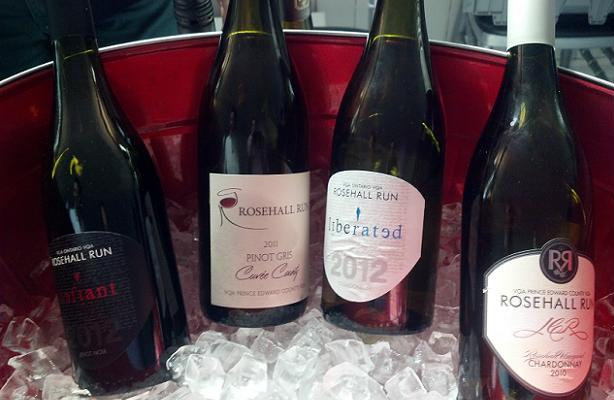
Rosehall Run Wines Photo: Michael Godel

Rosehall Run Wines
Photo: Michael Godel

Rosehall Run ‘The Swinger’ Syrah 2011 ($34.95, winery only) gets my attention not just because it’s the only commercially planted and bottled Syrah in PEC but because it stands in front of the orchestra. I gotta believe winemaker Dan Sullivan cares deeply about this wine from fruit sourced on Dick Singer’s Fieldstone Vineyard. Nothing fatuous about its smoky, tart cranberry, Sangioveseness kissed by the salty waves of an unseen ocean. The Swinger “ain’t no cherry bomb,” waits for no one, with its tobacco voice, gravel, rocks and sand. Like a sweet little bullet from a pretty blue gun.  90  @Rosehall_Run

Exultet Chardonnay ‘The Blessed’ 2011 ($35, winery only) is exemplary even if it may not be proprietor Gerard Spinosa’s favourite vintage. Commands an ineffable presence in gold sheen and parses meaning through balance and poise. The new oak is very noticeable but the ’11 acidity is grand. Their integration is seamless, the wine shines and a few years time will only increase its lustre.  92  @ExultetEstates

Closson Chase CCV Pinot Noir 2010 (310474, $39.95, winery) has improved dramatically over the course of a year, now red verging to black fruit, if only for a fleeting moment of temporary insanity, in a Sonoma state of mind. Silky smooth, “the textures coat my skin.” Though I have seen “the best (Pinot Noir) minds of my generation destroyed by madness,” this CCV uses a cured bresaola flavour and a vivid flower scent to invigorate, ground the humidity and the “earthy beet.” Musical, earthy beat, as in All Cats are Grey meets Howl.  92  @ClossonChase

Good to go!

A wine prescription for cold and flu

Resveratrol molecule
PHOTO: LISHA/FOTOLIA.COM

as seen on canada.com

A glass or two of wine might just be the thing to help ward off the common cold and the flu. OK, 15 minutes of daily exercise will help too. And Vitamin C, Echinacea, lemon ginger tea, chicken soup and washing your hands… and did I mention wine? Research indicates that it interferes with viral replication. Very personal hermeneutic public service announcement? Maybe. Perverse mantra of belief? Perhaps.

There are researchers and doctors who believe that certain chemical compounds in wine can help immunize the body against 100’s of common viruses. The antioxidant properties, called flavonoids, lower blood pressure and absorb harmful toxins in the body, including the nasty stuff in nasal passages. Though red wine generally contains more positive attributes like resveratrol and polyphenols (compounds that also attack bacteria), it’s effectiveness may be negated because, not unlike dairy, it can increase the production of mucus. The solution? Go white, but don’t mix it with medication.

But it’s cold outside, you say, and you don’t want to drink benumbed white wine on a frigid winter night. The esteemed NY Times wine critic once wrote, “Not so cold…doctor’s order. Good white wine shouldn’t be too cold.” The question is, what kind of white wine serves well, not so chilled. The answer lies in body, balm and colour, in opulent, canorous and warmer-hued wines. But mostly it’s about the aromatics. Look for clement whites with hyperbolic, expressive aromas. Seek out varietals such as Gewürztraminer, Viognier, Roussanne, Marsanne, Altesse, Colombard, Chenin Blanc, Pinot Gris/Grigio, Scheurebe, Riesling and Chardonnay. Whites made from grapes endowed with the most exaggerated scents; of spring flowers, citrus, tropical and stone fruit.

Here are five mellow whites to seek out this week for when the mercury falls on a frosty winter’s night.

Five mellow white wines

The grape: Chardonnay

The history: Formerly Macon-Farges Paul Talmard, now produced by Mr. Talmard’s daughter Mallory and son-in-law Benjamin

The lowdown: The Mâconnais may be lower down on the Burgundy totem pole but quality is at an all-time high

The food match: Roasted Butternut Squash, maple syrup, toasted pistachios

Mallory & Benjamin Talmard Mâcon-Uchizy 2010 (733956, $14.95) forsakes oak for crystalline lucidity, green apple mineral punch and a late-night pistachio snack. Considered a lamb to some by Burgundian standards, but “as the neons dim,” this Chardonnay turns “to the coat of white.” A Genesis of great #ffffff value.  88  @TalmardMallory

The grape: Roussanne

The history: 100% Stainless Steel fermented Rhône ranger out of Mendocino by way of the Parducci family

The lowdown: The rarest of VINTAGES California sightings for this Southern Rhône varietal and only 225 cases produced

The food match: Roast Halibut, tabbouleh, beet hummus,

McNab Ridge Shadow Brook Farms Roussanne 2009 (312892, $18.95) waves the elderflower wand and casts a code white spell. Florally over the top, almost violent or even combative but what’s wrong with that? Balanced by a sweet shadowfall of peach marmalade. For something other, range to this Mendocino Rhône.  89  @McNabWines

The grape: Gewürztraminer

The history: A signature bottling for founder George Weiss

The lowdown: From Okanagan vineyards in both Kelowna and Kaleden at an average of 21 Brix. Their ’11 Pinot Gris and Unwooded Chardonnay were also terrific

The food match: Za’atar Crusted Roast Chicken, saffron rice, peach preserve

Gray Monk Gewürztraminer 2011 (321588, $19.95) articulates stone fruit from white peach to nectarine and citrus from clementine to mandarin. Does lychee, rose and pink grapefruit on a quieter note. White pepper and spice (cardamom, coriander) dust this dry yet profuse specimen. If only we would see their Siegerrebe here in Ontario.  88  @GrayMonkWinery

The grape: Pinot Grigio

The history: Three generations, forty years, from Tauriano di Spilimbergo within Friuli

The lowdown: This PG comes from Collio grapes near the Slovenian border

The food match: Roasted Brussel Sprouts with Toasted Almonds and Pomegranate Seeds

Fantinel Sant’Helena Pinot Grigio 2011 (310144, $19.95) shines copper in humid hue and is both herbal and cerebral for Pinot Grigio. A dashboard confessional suggesting tarragon, sage, capers, Acacia Flower and Adriatic salinity. A portrait for “cold nights and fires and white wine,” the only gift I need, though it may not strike the faint of PG hearts.  90  @ProfileWineGrp

The Splurge

The grape: Riesling

The history: The Berres family has lived and worked in Ürzig’s vineyards since 1510

The lowdown: Late harvest Riesling at its best, in vintage, quality and price. This vineyard is the “spice garden” of Ürzig, an amphitheater formed by a dramatic bend in the river Mosel. Loved the Kabinett too.

The food match: Panko Fried Shrimp, sweet, sour and spicy glaze

C.H. Berres Ürziger Würzgarten Riesling Spätlese 2010 (301952, $24.95) casts a whiter shade of pale, and trips the shining, soda light fantastic. Dances the spicy fandango perversely across the tongue and after just one sip that tongue has “turned cartwheels ‘cross the floor.” Dry, saline, seltzer up the nasal passage, sweet, exotic tropical fruit past the taste buds and a lengthy held note plays on.  91  @imbibersreport

Good to go!

Wine and remembrance

<em>File photograph, National Post</em>

File photograph, National Post

Wine, wit, and beauty still their charms bestow,
Light all the shades of life, and cheer us as we go.”

On Sunday Canadians gestured in solemn contemplation to the fallen, lest we forget and celebrated heroes. We also gave the thumbs up to a local champion. Congratulations to Moray Tawse, Paul Pender and their team for being chosen Canada’s number-one winery for the third straight year in a recent Wine Access magazine poll.

Pender’s vision for Tawse, while wholly modish in tune, remains deeply rooted in an “antediluvian” wisdom with respect to making wine. The same cannot be said for a mess of ethanolic ferment proliferating present day LCBO shelves. Off I go towards yet another personal hermeneutic. This fall I have nosed, tasted, sampled and jotted down notes on more than 1000 wines. More than half have weighed in above 14% alcohol by volume. One in four have pushed the 15% abv envelope and beyond.

Biblical thought says there was a time when “wine” was simply the juice of pressed fruit, non-fermented, void of alcohol, the “pureblood of the grape.”  As Ben Franklin noted, before the flood the Antediluvians Were All Very Sober. They may as well have been drinking unadulterated milk.

Then, according to theological theory, along came Noah, vintner number one. The post-deluge patriarch purportedly discovered that if you let natural yeasts run wild they would turn grape juice and sugar into mocker, “strong drink.” Researches say that ancient barm barely peaked at 12% abv.

Thousands of years passed and nothing really changed, save for theories on the Babylonian effect of wine upon a godless and anarchistic populace. Today the real Babylon resides in extreme ripeness hyper-extending to alcohol levels once thought impossible. Cooler heads do sometimes prevail, perhaps not exactly to antediluvian standards, but at least with a degree of sanity. The great Chilean poet wrote, “let the simple man remember, to think of the soil and of his duty, to propagate the canticle of the wine.” Here are four current releases to stem the tide of vinous revelation.

Related – More from the VINTAGES November 10th, 2012 Release

Château Peyros Tannat/Cabernet 2007 (208249, $14.95) shocks as a direct current of dry, dusty and impenetrable “out of the sight” fortress of pitch. Alternatively, Supper’s ready with figs dipped back in black chocolate, roasted chestnut, truffle and the mind blow of seven trumpets getting “right down inside your soul.” Yowza and at a respectable 13.5%.  88

Vieil Armand Médaille Gewurztraminer 2010 (260158, $17.95) is a classic. Gewurz as gewurz, off-dry, lychee floral, tropical spice, crisp and fresh. No bitter pith.  88

Coyote’s Run Red Paw Vineyard Pinot Noir 2010 (79228, $24.95) shies away from the Burgundian mushroom, Epoisses and bourse, not to mention the Beaune-like price of the sister Black Paw. Yet like a good villages Pinot, the Red Paw weighs in at 13% abv framed by cocoa dust, red earth, density and girth. Swelling and a bit dirty like a proper Martini tsunami.  89

Regali La Lus Albarossa 2008 (291575, $24.95) can be nothing short of an ancient miracle. A Nebbiolo and Barbera hybrid, Albarossa is the Baco Noir or Cinsault of Monferrato. A whisper of vanilla oak imparts elegance into the finest leathery hide. Good on the Banfi conglomerate for this uniquely homogeneous half-blood.  89

Good to go!

The 2012 harvest and six current Ontario releases

Backyard Tomato, Basil and Nasturtium

as seen on canada.com

Ontario wine lives well, but the playing field is rapidly changing. Greatness, albeit in fits and spurts, can comfortably be adduced from vineyards going back to at least 1998. I’ve no intention of raining on recent parades but 2012 is shaping up to be something extraordinary. A collective level of confidence and consciousness, meted by a hot, dry summer will surely translate to a banner year for Ontario wines. Niagara’s Man Friday suggests we’re  “heading for a concentrated and ripe (but small) grape Harvest for 2012.” That said, if the tweets and comments coming from the winemakers out of Niagara and Prince Edward County are any indication, some “best ever” bottlings are on the horizon…

Some “best ever” bottlings are on the horizon:

Dan Sullivan, Rosehall Run:

“Fast, furious and fantastic- if the weather holds a little longer this year’s harvest will be a grand-slam in quality!”

Paul Pender, Tawse:

“Harvest has begun in earnest. 16 tonne of premium organic Chardonnay picked and processed.”

Richie Roberts, Fielding Estate:

“Picking Beamsville bench old vine Sauv Blanc today. Coming off with beautiful acid and flavour. Giddy up.”

Brian Schmidt, Vineland Estates:

“We have had an incredibly HOT and dry year.. Weights are quite low but quality is very high.”

Marlize Beyers, Hidden Bench:

“Sparking cuvée pick done and pressed, looking good by the numbers but tasting even better.”

Kevin Panagapka, 2027:

“Crazy early year.. Sparkling in the bag, Pinot next on the radar.”

In the meantime…

While we wait patiently for 21st-century master strokes of vinous genius, here are six current releases to fill your stems.

2027 Falls Vineyard Riesling 2011 (294041, $18.95) from the racy Vinemount Ridge finds Mr. Panagapka in Single-Vineyard heaven. May not be a Genesis ode to a Pat & Lyle ambient masterpiece but the VINTAGES release happens to be on the 32nd anniversary of  Bill Evans’ passing. Flint, lemon yellow sintered micro crystal, bone-dry, brisk acidity. One for the vine. I thought I recognized the 2027 “by the way he fell, and by the way he stood up, and vanished into air.”  89

Lailey Vineyard Chardonnay 2010 (193482, $19.95) looks buttercup yellow and casts a pungent spice note, a trompe d’ail. Resolves quickly into ubiquitous balance and elegance, subtle beauty, body then melting to a creamy, slightly bitter finish. Almost great and one of the best to date.  88

Vineland Estates Elevation Riesling 2011 (38117, $19.95) reserves the right to live off the land with local knowledge and extreme confidence. Riesling made in the vineyard like no other. Off-dry, lingering lemon/lime and utopian acidity. Who knows what minerality lurks in the vineyard of St. Urban? The Escarpment knows.  88

Featherstone Cabernet Franc 2010 (64618, $16.95) of rooted mahogany and well-deep, depth of fruit is solid as a rock. Lends credence to naming 2010 as Ontario’s best Cab Franc vintage ever, as previously noted. Excellent value here.  88

Henry of Pelham Reserve Pinot Noir 2007 (268391, $24.95) is the bomb. Effectively Cali-candified, it floats in the rarefied air of upper echelon Canadian Pinot. All is resolved at this juncture; fruit, acidity, tannins. A note of rare, roasted game bird keeps it real. Impressive.  89

Norm Hardie County Unfiltered Pinot Noir 2010 (125310, $35.00) may just be the most beautiful purple meets ruby-red Canadian Pinot I have ever laid my eyes on. Vibrant red berries, wildflower blooms and scraped vanilla beans. Warm cereal cooking on a campfire. Then the fruit is turned upside down by carbonate limestone. Wait five years for the mineral to meld into magic.  91

Good to go!

20 August, four plates, seven wines

Wine and food are always on the brain. Twenty-four seven. Produce picked from an Ontario backyard will seek out, then effortlessly accrete with Niagara and Prince Edward County grapes. Meats off the barbecue or out of the smoker are rapt to deeply cut, sub-tropical reds, voices possessive of a pantheistic tenor. Here are seven wines and four food ideas to wend pleasure your way for the last two weeks of summer.

Related – Going Rhône for the dog days of August

The grape: Pinot Gris

The history: Fielding Estate’s top tier, Rock Pile Pinot Gris is a benchmark for Ontario

The lowdown: Winemaker Richie Roberts’ second vintage for his estate bottling of the varietal. Seems to be his Alsatian baby

The food match: Butter Greens, homegrown tomatoes, edible flowers and mustard vinaigrette

Fielding Pinot Gris 2011 (251108, $21.95) casts a copper penny penumbra where sweet lime and simple, prickly pear syrup buffets shake and bake. The catalyst tang of pit fruit would see this developing to honey, spice and Madeira, not unlike last night’s Trimbach 2008. My preference is for fresh PG so drink up, with eggs and sausage. Time waits for no one. “Drink in your summer, gather your corn.”  88

The grape: Chardonnay

The history: First planted vineyard in the Edna Valley of California’s Central Coast

The lowdown: A host of under $20 quality Chablis on the market is proof that unoaked Chardonnay is not only viable, but sustainable. California needs to follow suit

The food match: Pan-Roasted Herb, Lemon and Garlic Marinated Chicken, green beans, piri-piri sauce

Chamisal Unoaked Stainless Chardonnay 2011 (289223, $25.95) is an affidavit of California’s agrestal fruit quality and complexity so why more vineyards can’t lay off the manipulations and bottle this style is beyond me. Animated green apple, lime and orange zest are the spark for clean, resolute Chardonnay. Yum.  90

The grape: Riesling

The history: From Germany’s venerable Mosel Saar Ruwer region

The lowdown: Designated Prädikatswein, the highest level of German quality category

The food match: Blue Plate Special: Veal, pork and beef meatloaf with spicy bbq glaze

Dr. Loosen Blue Slate Riesling Kabinett 2011 (160846, $19.95) noses sweet, red apple, wet granite and Dr. My Eyes see a blue hue, like the shadowy, filtered light on mid-winter ice and snow. Meritorious fruit grown out of Devonian seabeds saturates juice before using. Tight grip of acidity and WASP terroir shows there is nothing loose about the good doctor’s Riesling.  89

The grape: Pinot Noir

The history: Dorothée, we’re not in Burgundy anymore

The lowdown: Calera has been lauded for some serious, single-vineyard Pinots. This one is sourced  from seven vineyards in San Luis Obispo, San Benito, Santa Clara and Monterey counties

The food match: Grilled Wild B.C. Salmon

Calera Pinot Noir 2009 (933044, $31.95) of wet Pacific clay colour is light and retains a wisp of Central Coast smoke and tar in its profile. No candy factory here, which is a good thing. I’m hopeful the restrained style will help to usher is a new Cal-era for Pinot. Earth shattering bottle? No. Greatest Pinot value? Not so much. Good juice? Absolutely.  89

The grape: Montepulciano

The history: From the Abruzzo region of east-central Italy, not to be confused with the southern Tuscany village of  Montepulciano

The lowdown: Two years ago these wines were not even on the radar. Now some of the best <$15> values on the planet

The food match: Barque’s Smoked Beef Brisket

Caldora Colle Dei Venti Montepulciano D’Abruzzo 2009 (289629, $15.95) does not hide the rendering new oak influence to resemble an extra-large cup of Starbucks bold. MD’A of a dichotomous nature, Dominican and birch elegant, arboreal, fruity. Very vanilla.  88

The grape: Aglianico

The history: At its best in Campania but also flourishing in Basilicata and here, in Molise

The lowdown: Arguably the best producer in the newest region in Italy, located on the big toe of Italy’s foot

The food match: Grilled Flank Steak with warm tomato jam

Di Majo Norante Contado Riserva Aglianico Del Molise 2009 (967208, $15.95) is stark, raving modern. A wash of Rothko Black on Maroon colour of “oppressive, almost frightening, grandeur.” Heavily pedimented Aglianico, tasting of black licorice in fiery, Sambuca form.  88

The splurge

The grape: Sangiovese Grosso

The history: Sangiovese of irreverent ilk, from Montalcino in southern Tuscany

The lowdown: Not a sneeze of a price but still of the mortal world. An example for near-immediate enjoyment

The food match: Grilled Lamb Kebabs

Verbena Brunello Di Montalcino 2007 (165126, $37.95) seems at first bewitched by iron and animale but magically gives way to a twinkling, lulu Tabitha nose. A fleeting spell is cast to induce an impulse buy. If you want to experience Brunello, start here, find reverence for its narcissistic beauty and watch it be “turned to a flower.” Supper’s ready and waiting for the Verbena .  90

Good to go!

The Wine Diaries: new world reds

Photo: REX

http://blogs.canada.com/2012/06/27/the-wine-diaries-new-world-reds/

The term “new world wine” refers to wine produced in countries that have transplanted European vinifera to establish an industry where one did not originally exist. The United States, led by California comes to mind as the leader in this category. Australia sits alone within a second tier while New Zealand, South Africa, Washington and Oregon are the major players close behind. Ever-improving Canada is on the move.

Many wines that are currently unavailable in Canada will one day knock at the door. Voices of discontent are out there and I hear them. Change is inevitable, and optimistically speaking, will come sooner rather than later. In the meantime, like the dutiful children and newcomers we are, we submit to and embrace what is on offer. An imperturbable level of varietal diversity and quality will unearth something out there for everyone.

U.S.A. – California

J. Lohr South Ridge Syrah 2010 (948240, $19.95) from Paso Robles along California’s Central Coast is shiny, happy Syrah. Attenuated body accented by citrus and trace pepper.  “Gold and silver shine.”  87

Laird Cabernet Sauvignon 2008 (50096, $57.95) out of Napa Valley pours like syrup of supersized black and boysenberry concentrate. Massive fruit here, making for a big wine in search of red flesh on closing night.  89

Mahle Wind Gap Syrah 2007 (242776, $59.00) defines the grape for Russian River Valley. The tar, roses and smoked meat from this coulée in Sonoma County tutor California in Northern Rhône speak. Darker than a power outage with a gamey and sanguine finish.  90

Outpost Howell Mountain Zinfandel 2009 (253377, $69.00) is top-tier Napa Valley Zinfandel. The dark flesh of fowl comes to mind, especially Duck with a chocolate mint Nahuatl mōlli. A foxy, violet voice is to be expected out of  the likes of Barolo or Barbaresco, but here Zinfandel tramples me flat.  92

Redemption Zin Zinfandel 2007 (224147, $22.95) might seem magnetic but a plum, raisin, sweet and sour profile is not what Dry Creek Valley normally produces. Fruit too long on the vines?  85

Rutherford Ranch Cabernet Sauvignon 2009 (73817, $19.95) offers grateful Napa Valley pleasures so power to its large scale fruit gathering and consumer friendly production. “Walking in the tall trees, going where the wind goes, blooming like a red rose.” Grandiflora not dead. A sunshine daydream.  87

Simi Cabernet Sauvignon 2008 (25221, $24.95) does Alexander Valley like it should. A spiced, caramel coffee cake with a soft, oozing core. Nothing offensive here, just solid Sonoma juice.  87

Sonoma-Cutrer Grower-Vintner Pinot Noir 2008 (140723, $29.95) crawls Russian River Valley Pinot to a varietal P but smoke masks the fruit “like a forest fighting for sunlight.” Can’t blame it on the carpet fires of 2007.  86

Stag’s Leap Wine Cellars Artemis Cabernet Sauvignon 2007 (708982, $46.95) has Napa Valley pedigree but high steps the oak steeplechase brimming with nearly burnt coffee and 76% orange, dark chocolate. Over the top and unrelenting but history will offer some assistance for future enjoyment.  88

U.S.A. – Oregon

Maysara Estate Cuvée Pinot Noir 2008 (65680, $39.95) from McMinnville (who, what, where?) claims biodynamic status and “s’got such a supple wrist.” A quiet wizard, void of scents and smell, save for a pinball of earth bouncing off leather.  May speak up in time.  87

Argentina

Alta Vista Premium Cabernet Sauvignon 2009 (129957, $14.95) ordinarily regards Mendoza by a male-dominated genome. Sausage fest as South American Cabernet, hidebound and specific to grilled meat.  85

Santa Julia Magna 2009 (93799, $14.95) is more ambitious Mendoza in its blend of half Cab and Malbec with a smattering of Syrah. A bit wild and uncorked, like a dog driving a car.  86

Chile

Concha Y Toro Marques De Casa Concha Carmenère 2010 (169862, $17.00) drinks chalky like green tea ice cream, not so unusual for Carmenère out of the Rapel Valley. A bit confused, murky as Lake Rapel, “light like a feather, heavy as lead.” Fruit of the marl.  87

Montes Alpha Cabernet Sauvignon 2009 (322586, $19.95) does Bordeaux and the world’s most popular red grape proud on a consistent basis. This one is the funky by-product of a chocolate chunk cookie baked by the sun. The argilaceous Colchagua Valley earth scorches the grapes and the wine is forever warm.  87

Santa Ema Reserve Merlot 2009 (642538, $16.95) is a bold effort out of Maipo. A Plug tobacco block effected by the humidity of a smoke shack, spicy clove heat and abrasive atmospheric pressure.  Massive Merlot but out of whack.  85

Australia

Chapel Hill Shiraz 2009 (743989, $25.95) takes South Australia’s McLaren Vale to an extreme wedding. Irrigous, cave aromas where melting minerals co-mingle with very ripe berries in your Dixie Cup. A tannic beast too. Walking through that cave while the eerie sound of “going to the chapel and we’re gonna get married” plays somewhere in the distance.   86

Hope The Ripper Shiraz 2008 (686865, $21.95) springs eternal with dreamboat berry and flower scents despite the ambiguous ‘Western Australia’ designation. Perhaps not the “best thing that I’ve ever found” but hope floats so I foresee the sweet smell of success for the Ripper.  87

Kaesler Stonehorse Shiraz/Grenache/Mourvèdre 2008 (6551, $20.95) out of Barossa comes down in price by $2 from the ’07. This SGM is always a Rhône on ‘roids but the minty kick and analgesic mouth clout win points.  88

Penfolds Bin 389 Cabernet/Shiraz 2008 (309625, $39.95) bears the omnipresent Penfolds perfume. Soupy syrup from South Australia, Refined but so concentrated. You will have to wait 10+ years for this to settle and be nice.  89

Tattiarra Culled Barrel Shiraz 2009 (271379, $39.95) shows off Heathcote within Victoria’s scant cooler take on the unchained, grievous grape down under. An otherwise repeat performance. “Change, ain’t nothin’ stays the same.”  87

Zonte’s Footsteps Baron Von Nemesis 2008 (212936, $17.95) is the Barossa vineyard’s inaugural vintage. Its nemesis is an instant bitter note from these vines, olive heavy footed, steps heard coming from a mile away. Will walk along with fatty meats.   86

New Zealand

Greystone Pinot Noir 2009 (271312, $37.95) owns the title of the South Island’s strongest smelling Pinot. Huge Waipara nose followed by a residual, Sherry sweetness, acidity and tannin to boot. “Oi, oi, oi!”  90

Trinity Hill The Gimblett 2009 (280263, $35.95) exudes the North Island’s youthful exuberance. Bordeaux blend of Merlot, Cabernet Sauvignon, Cabernet Franc, Petit Verdot and Malbec. Snug and chunky with a juniper stringency melded into lime, sugar syrup. A red wine Gimlet out of Hawkes Bay.  87

South Africa

Ernie Els Big Easy 2010 (220038, $19.95) from the generic tagged Western Cape is round, charming and swings with an effortless grace. The kitchen sink of grapes seem to cancel each other out and the wine finishes flat, hooking one into the drink. I love Ernie but really?  85

More notes from the VINTAGES June 23, 2012 release:

Five red wines to buy now for the coming long weekend

The Wine Diaries: Around the world in 20 whites

The Wine Diaries: Chardonnay close to the edge

Euro wine Rihanna need remember by name

The Wine Diaries: MMVA’s sparkling wine showers

IVR* – Vintage Direct Intrigue-to-Value Ratio

CVR** – Vintage Direct Curiosity-to-Value Ratio

Good to go!