Post ProWein tasting crawl trough the Ahr, Mosel, Nahe and Rheinhessen

In March of 2024 Godello reprised a Düsseldorf redux by attending the annual ProWein Wine Fair and then hitting the road for a three-day, four region transversal of German wine-growing regions. Prowein, Messe Düsseldorf and the German Wines Institute brought international journalists through the Ahr, Nahe, Mosel and Rheinhessen. The producers visited were Weingut J.J. Adeneuer (Bad Neuenahr-Ahrweiler); Weingut Forster (Rümmelsheim), Schlossgut Diel and Piri Naturel Christine Pieroth (Burg Layen) and Weingut Anette Closheim (Langenlonsheim); Four producers from Der Ring 1899, a.k.a. the Bernkasteler auction company hosted the group at Die Mosel Vinothek und Winebar, Traben-Trarbach; Weingut Franzen (Bremm), Weingut Walter (Briedel), Weingut Rebenhof (Hochheim am Main) and Weingut Erben Von Beulwitz (Mertesdorf); Last stop was with Weingut J. Neus (Ingelheim am Rhein) in Rheinhessen and finally the press tour concluded with a fascinating Rheinhessen tasting at the Ingelheim Vinothek, presented by Sommelier Shanna Reis. Special thank you goes out to Christiane Schorn, Senior Manager Press & PR, ProWein, Michael Mandel, Messe Düsseldorf and Carola Keller, Marketing Manager, German Wines (DWI). These are the estates, their makers and notes on a collective 80 wines tasted between the 12th and 14th of March.
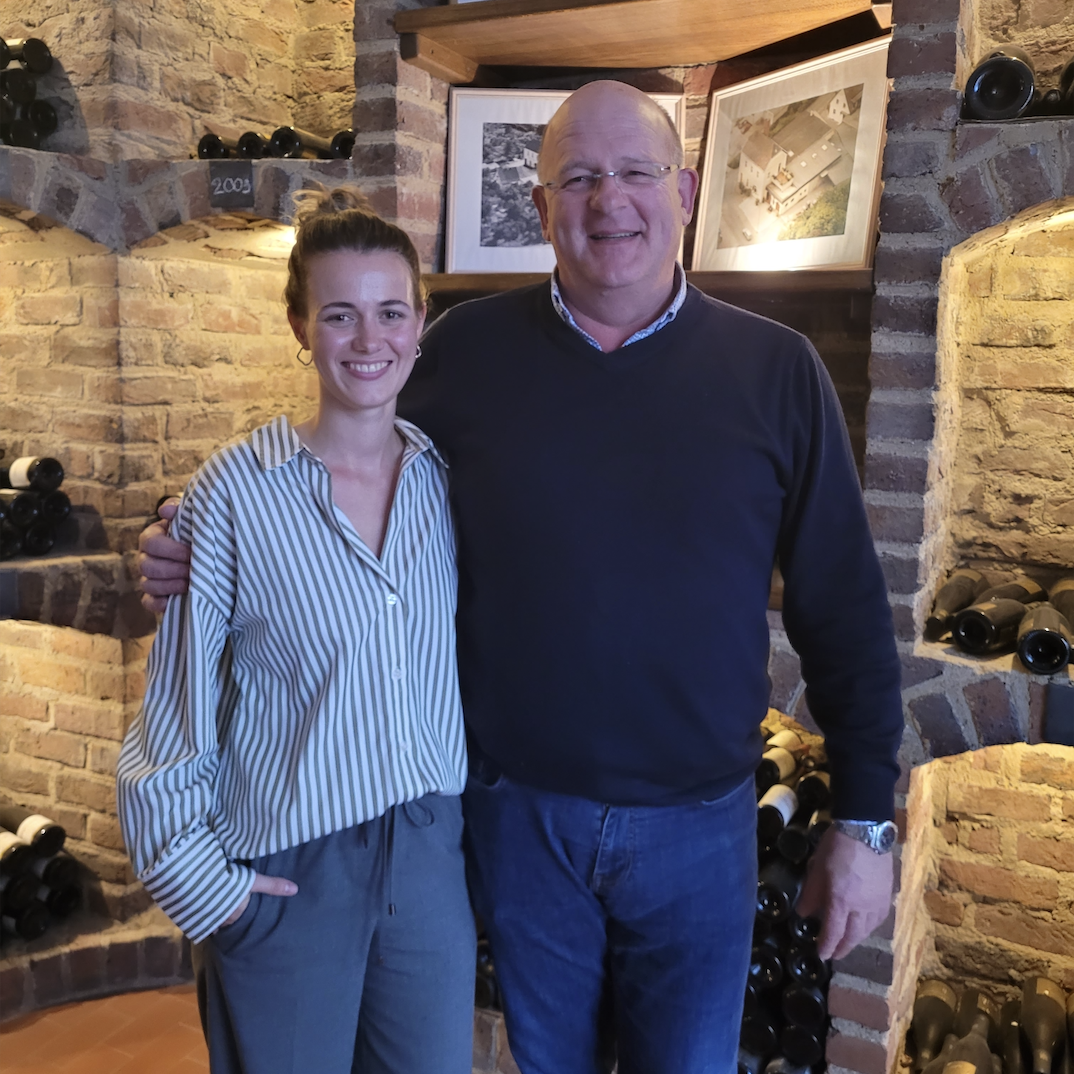
Marc Adeneuer with daughter Francisca – J.J. Adeneuer

Ahr Valley

Weingut J.J. Adeneuer –  Bad Neuenahr-Ahrweiler

Weingut J.J. Adeneuer Blanc De Noir Purist 2022, Ahr Valley

Saignée method Blanc de Noir, reduced from the Grosses Gewächs spätburgunder, finished at three g/L of RS. Simple, fresh and dry. Quite pure as Rosé with a mild pith bitters finish. Drink 2024-2025.  Tasted March 2024

Weingut J.J. Adeneuer Weissburgunder Purist 2022, Ahr Valley

Juts a month on the lees for pinot blanc, now a year in bottle, more about texture and mouthfeel than primary fruit. About as crisp and clean as it gets but again with a mild lime pith bitter finish, much like the Rosé. Length adds to the refreshment of the wine. Drink 2024-2025.  Tasted March 2024

Weingut J.J. Adeneuer Spätburgunder 2022, Ahr Valley

Mildly reductive and also a factor of Ahr Valley terroir, making pinot noir flinty and taut while still this youthful. As with all the Adeneuer pinots they all fall in at 13 percent alcohol, the wood factor only from Bourgogne forests and just 10 percent new. A mix of red berry fruit, more flint stone character and the faintest touch of red fruit but also almond bitters. Would never see this as jammy and chilling it down for maximum freshness is wholly encouraged. Drink 2024-2026.  Tasted March 2024
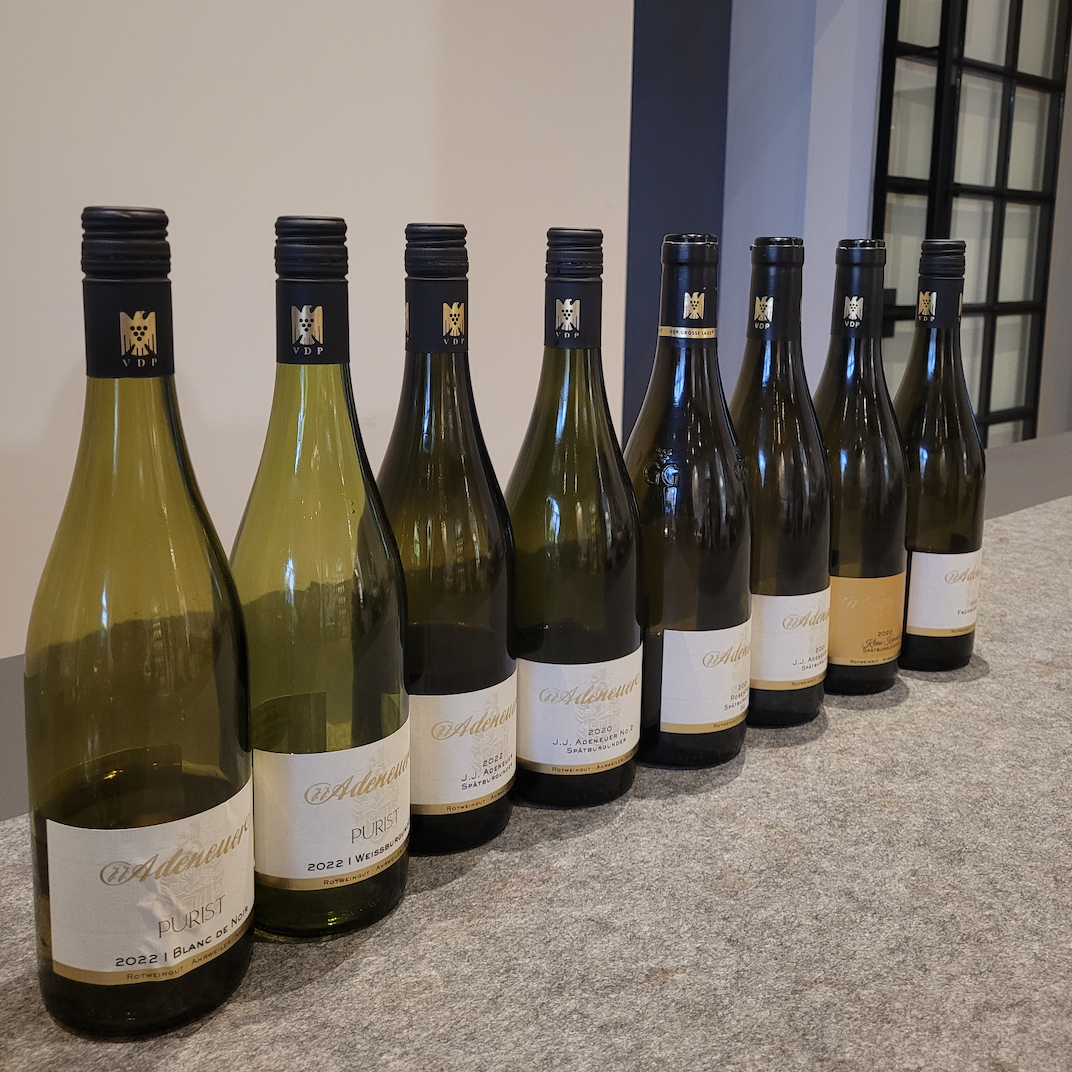
Weingut J.J. Adeneuer Spätburgunder No. 2 2020, Ahr Valley

A pinot noir from after the floods of 2021 and normally bottled after 12 months. Circumstances meant that after the barrels were saved the vintage had to remain in wood for 18 months, only able to be bottled after the clean-up. Caused the alcohol to finish at 13.5 percent instead of the usual 13 and there is more texture as a result. Feels like a bigger and creamier pinot noir with tang and more red berry plus a toastier quality than that of the coming ’21s and ‘22s. Drink 2024-2026.  Tasted March 2024

Weingut J.J. Adeneuer Spätburgunder No. 1 2021, Ahr Valley

A later harvest, two weeks later the 2018-2020 but also the flood vintage when on the night of July 14th and into the 15th the waters filled the cellars and basements plus halfway up the ground floor of the winery. The No. 1 always remains 18 months in barrel, fruit coming from the lower Ahr Valley vineyards in three villages. The soils are 60 percent volcanic rock and the basaltic reek is felt in palpable aromatic display. Much more lactic and blood red citrus style plus this porcine smokiness, like Speck bacon. More structure and only GG plots are used – three of them. Drink 2025-2029.  Tasted March 2024

Weingut J.J. Adeneuer Spätburgunder Kleine Kammer 2022, Ahr Valley

J.J. as in Johannes Josef (ancestor from the 18th century, dating to 1776). Kleine Kammer, meaning “small (fermentation) chamber.” This Adenauer pinot noir comes off of soils of only pure slate with sandy loam, the second choice from a GG site, a terraced plot measuring only 0.68 hectares in size. The rule in Germany for GG is such that you can’t use a site’s name twice, thus the fantasy name. Vines are 50-60 and 80-100 years of age with the younger vines giving fruit for this wine. Ages in 1,800 to 2,000L barrels, namely Taransaud. No real toast to speak of, nor new wood feels or bitters in any notable way. Classic slate example that expresses its terroir and since 1776 as a Monopole. from vines with deep roots that never see their berries get sunburnt. A beauty and grace about this, quite getable and with sneaky structure. Made with the Kastenholz clone, grandchild of a pinot noir original. Drink 2024-2028.  Tasted March 2024

Weingut J.J. Adeneuer Spätburgunder Rosenthal GG 2021, Ahr Valley

J.J. Adenauer is now Marc Adeneuer with daughter Francisca and together they farm 13 of 540 hectares in the region, third most from the fourth smallest region in Germany. A red wine specialist with 90 percent red grapes, mainly pinot noir while the rest is weissburgunder and now just starting with chardonnay. Basically a place where Bourgogne grapes thrive. Rosenthal is mainly sandy loam and graywacke soils to gift pinot noir with a purity, crispiness and liveliness. You simply will not find more fresh fruit purity from any of the other Adeneuer pinot noirs. Comes from 2.5 hectares in the GG vineyard and the acid structure here is sensational – the catalyst and reason why this will age longer and slower than the other wines. This was the flood vintage too so kudos to the estate for sticking with it and creating this delight of a pinot noir. Drink 2025-2031.  Tasted March 2024

Weingut J.J. Adeneuer Frühburgunder 2022, Ahr Valley

Varietal frühburgunder, fresh and clean, clean, clean. Floral, without musculature, gamay like and though labeled at 13 per cent it’s really 12.7. Chill this and put away the serious talk. More than go gamay go – it’s fly frühburgunder fly. Approximately 1,500 bottles produced (plus 500 of the GG). Drink 2024-2025.  Tasted March 2024
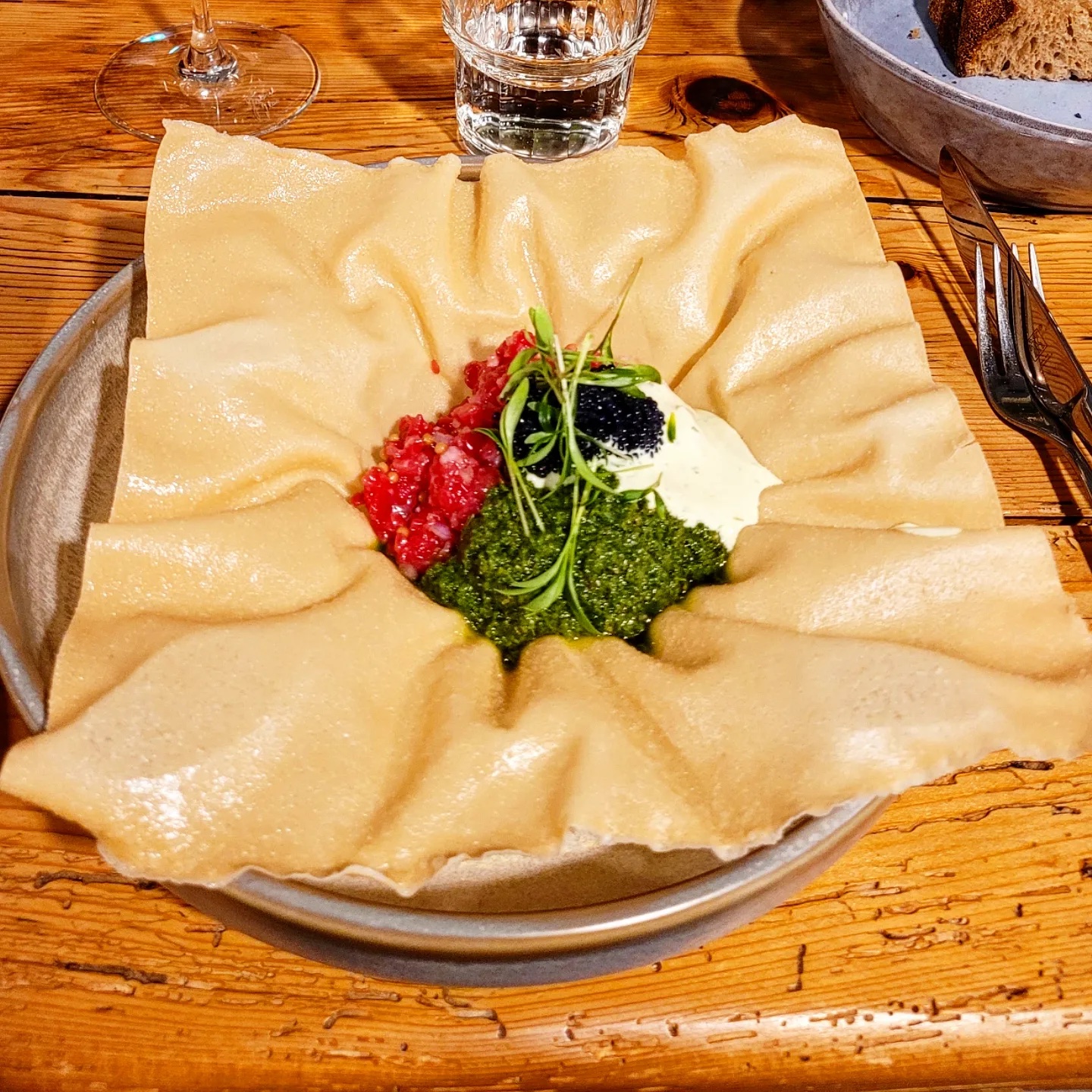
Beef Tartar – Kräter Sauce, Pinienkerne, Koriander, Chips – Die Mosel Vinothek und Winebar, Traben-Trarbach

Mosel

Der Ring 1899 at Die Mosel Vinothek und Winebar, Traben-Trarbach

Weingut Franzen – Bremm

Weingut Franzen Riesling Der Sommer War Sehr Groß 2022, Gutsweine, Mosel

A dry Mosel riesling which means 10.2 g/L of RS, 7.3 TA and finished at 11 percent alcohol. “Winegrowing on a razor’s edge” for a riesling “summer project” begun in 2011, “a cuvée that presents the cross-section of our vineyards and combines all the advantages of the individual locations in one wine.” Spontaneous ferment, as with all the wines, not far from Cochem where the steepest vineyard in Europe slopes to 68 degrees. A riesling of what feels like crazy conversion rates coming from red slates and seasoned with many spices. You would literally have no idea there is any sugar in this wine and the length is exceptional. Drink 2024-2027.  Tasted March 2024

Weingut Franzen Riesling Bremmer Calmont Großes Gewächs 2022, Lagenweine, Mosel

Bremmer Calmont delivers far more spice and power than the Franzen blend, here off of pure slate on a 65-degree slope which happens to be one of the steepest vineyards in Europe. Calmont is about as dry as riesling gets and its scintillant-mineral quality delivers true Großes Gewächs distinction. Extreme aridity perceived matched by intense sapidity that only this specific Mosel red slate provides. A riesling of trenchant intention, compact and stone cold concentrated. Serious wine. Drink 2024-2029.  Tasted March 2024
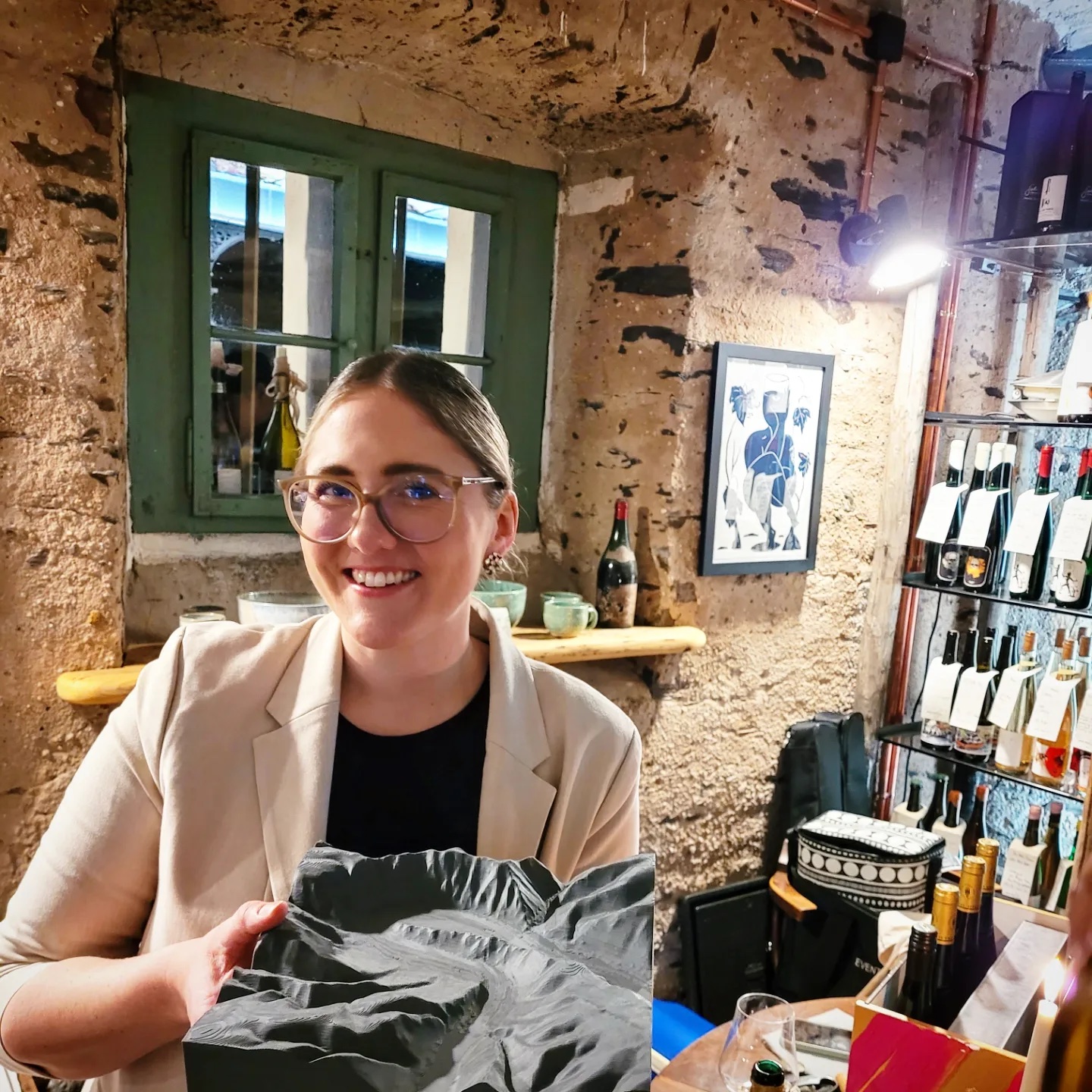
Angelina Franzen – Weingut Franzen

Weingut Franzen Riesling Calmont Trocken 2021, Lagenweine, Mosel

Dry riesling from the steepest 65 degree vineyard of oxidized red Devonian slate and quartzite raised only in steel. The specs are 8.5 g/L of residual sugar matched by 7.6 g/L of acidity with 11.0 percent alcohol and as far as vintages are concerned this would be one to really age. Namely because of palate density but also because the acidity is as fine and finessed as it gets for this composition. May not pierce your riesling heart, or soul but it will age well. Drink 2024-2030.  Tasted March 2024

Weingut Franzen Riesling Fachkaul Großes Gewächs 2020, Große Lagen, Mosel

Fachkaul is the parcel which forms a kind of mini-amphitheater-shaped bowl where at the end of the 1990s Kilian Franzen’s father Ulrich restored and replanted the vines. The epitome of Killian and Angelina’s story, a Calmont tale fraught with adversity, challenges and heartache, but this small (1.6-ish hectare) plot means everything. Mineral that matters, red slate and the steepest slope where all that is important, essential and profound result in singular riesling. Not quite as dry as the Bremmer but higher in acid, more stark, expletive and magical. Sapid lime intensity, long, significant, precise, consequential and just recently bottled in January. Drink 2025-2032.  Tasted March 2024
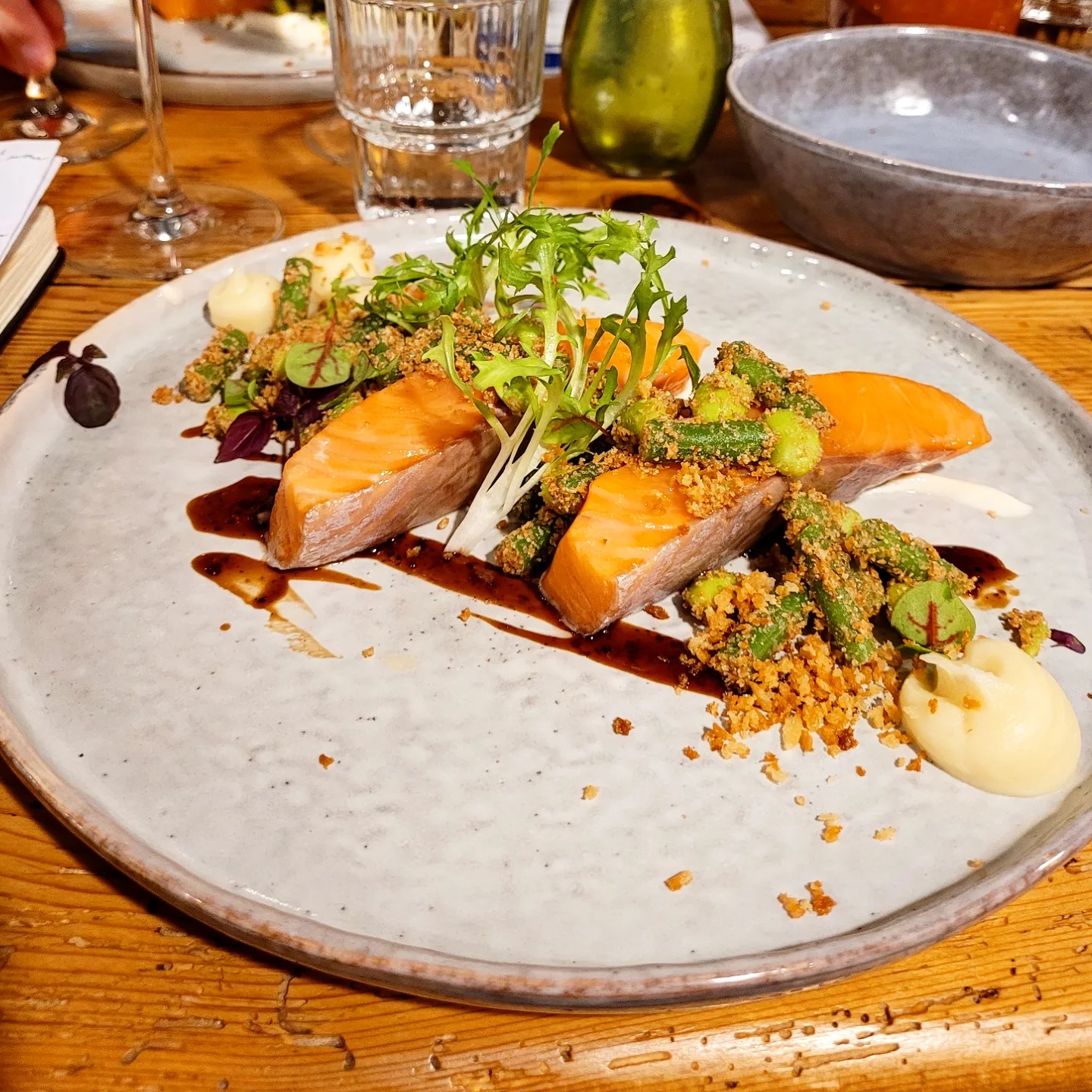
Lachs – Tofu Puree, Edamame, Bohnen, Dijon Sauce – Die Mosel Vinothek und Winebar, Traben-Trarbach

Weingut Franzen Riesling Fachkaul Großes Gewächs 2017, Große Lagen, Mosel

In a perfect place at this six to seven year stage, from one of the warmest seasons with lots of rain at harvest. Picking began in the second week of September and required many passes in the vineyard with a stringent selection to create (an overall) 15 skus for 11 hectares. The work of Killian and Angelina, students from Geisenheim who began this journey of family necessity at the ages of 23 and 20. A softer Fachkaul but that is the maturity speaking for riesling of a sapid tug on red slate, one and a half hectare mineral-varietal heartstrings. Quite remarkable and with three great years still laid out ahead. Drink 2024-2027.  Tasted March 2024

Weingut Franzen Riesling Sterneberg Großes Gewächs 2020, Große Lagen, Mosel

Killian and Angelina Franzen’s best plot in the Neefer Frauenberg is called Sterneberg. Vines were planted in 1938 on grey slate for a different, next level mineral quality and quotient for Mosel riesling. These are own-rooted vines, old, experienced and wise, their resulting dry wine coming away like the desert because sugar and acids near-equal come together seamlessly. The most viscosity and texture of the Franzen rieslings, from a hot vintage and so concentration, unctuousness, flesh, pulp and glissade are all at peak performance. Glorious and confident, outspoken but only to make sure we understand its origins and Franzen abides by its voice. Drink 2024-2033.  Tasted March 2024

Gerrit Walter and Angelina Franzen

Weingut Walter – Briedel

Weingut Walter Riesling Trocken 2022, Gutsweine, Mosel

From Briedel, next village out of this tight turn in the Mosel from Pünderich where Clemens Busch farms their riesling. The Walter Trocken is just 6.5 g/L of residual sugar pretty much hidden by 6.9 of TA. Six to eight hours of skin contact for a phenolic, taut, lime doused example off of the grey slate of the Briedel Vineyard. Solid effort and notably modern. Drink 2024-2025.  Tasted March 2024

Weingut Walter Riesling Feinherb Briedeler 2022, Ortsweine, Mosel

Villages quality wine from Briedel, not as dry as the Trocken with three times the residual sugar, here at 10 g/L. A floral-herbal expression, fresh, light and modular. The acidity functions to make the malleable wine travel to the back palate and structure is formed because of this movement and interaction. Very well made Feinherb style by Gerrit Walter for simple pleasure, especially with a piece of cheese or beef tartare with pine nuts and a high acid mustard sauce . Drink 2024-2026.  Tasted March 2024
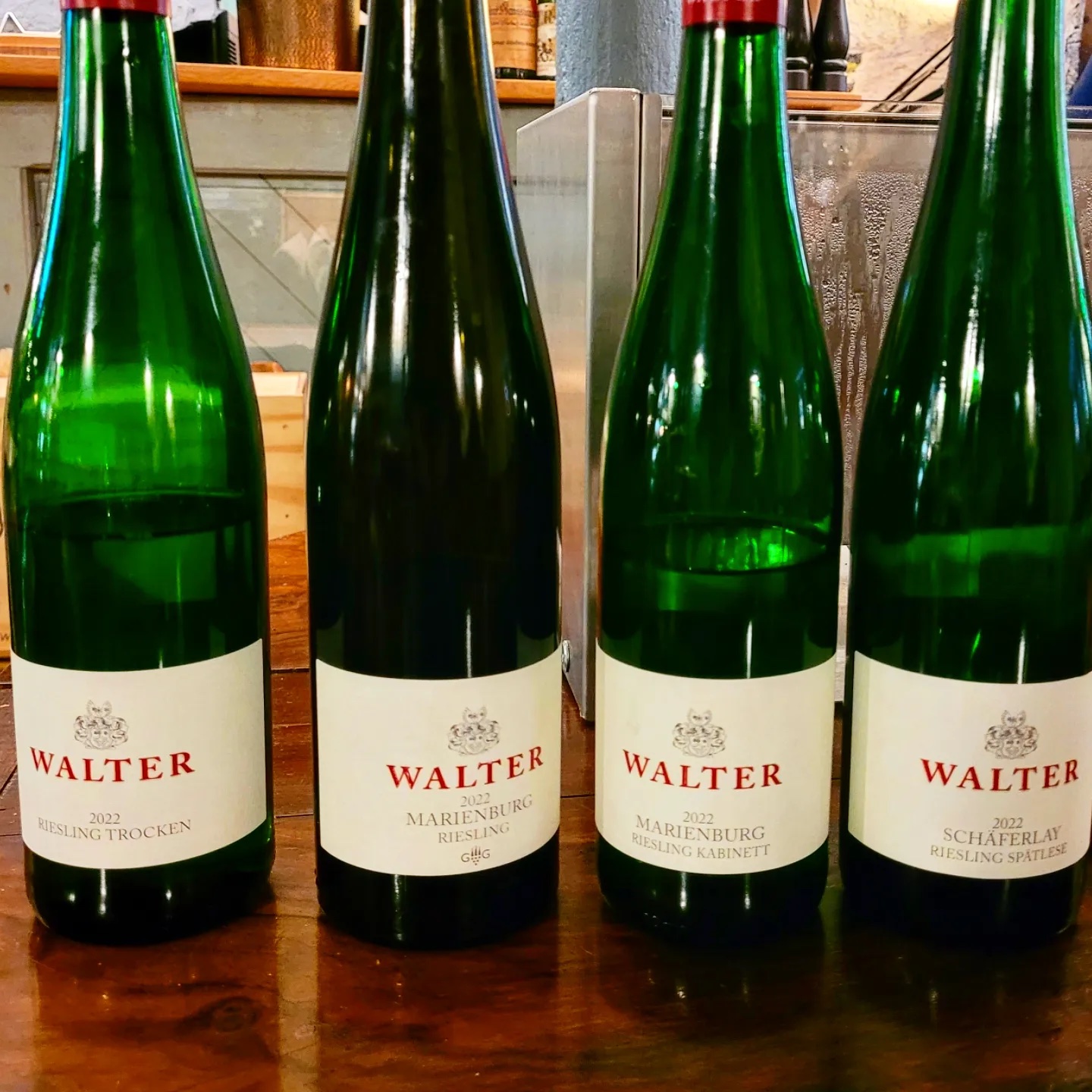
Weingut Walter Riesling Pünderricher Marienburg Großes Gewächs 2022, Mosel

Gerrit Walter is the next generation producer of this GG riesling out of Briedel’s grey slate vineyard. Sees a longer maceration of 12-15 hours, comes away super dry (3.1 g/L), matches the Trocken’s acidity and finishes at a Mosel high 12.6 per cent alcohol. This is not about fruit but rather the type of mineral focus that comes from Marienburg, with increased seasoning, spice, elements and tonic-edgy florals, though it is not the most phenolic of rieslings. Cracker example, truly dry and in command of the palate. Drink 2024-2028.  Tasted March 2024

Weingut Walter Riesling Kabinett Pünderricher Marienburg 2022, Lagenweine, Mosel

One of two recognizable styes of riesling made by Gerrit Walter to carry on with Mosel tradition even while he and many young generation winemakers are turning to drier and drier. This from an early harvest resulting in 45 g/L of residual sugar, far from searing 8.0 TA and low-ish alcohol at 8.6 percent. There is more fruit here in a light, refreshing yet in its own way also intense style that the estate has been making for 10 years. “Kabinett means light, vibrant and elegant,” explains Gerrit and his Pünderricher is without any real skin contact, but the tangerine-orange peel aroma really kicks things off. The length is indeed outstanding. Drink 2024-2029.  Tasted March 2024

Weingut Walter Riesling Kabinett Marienburg 2016, Lagenweine, Mosel

When talking about his 2022 Pünderricher from Marienburg Gerrit Walter noted that “Kabinett means light, vibrant and elegant,” three things this 2016 most surely had been. Not anymore because age has exaggerated the aromas if also softened the palate flavours. This divergence has resulted in maturity and a dispersion of parity. There is some interest for this fine if past prime look at a Marienburg riesling.  Tasted March 2024

Weingut Walter Riesling Spätlese Briedeler Schäferlay 2022, Lagenweine, Mosel
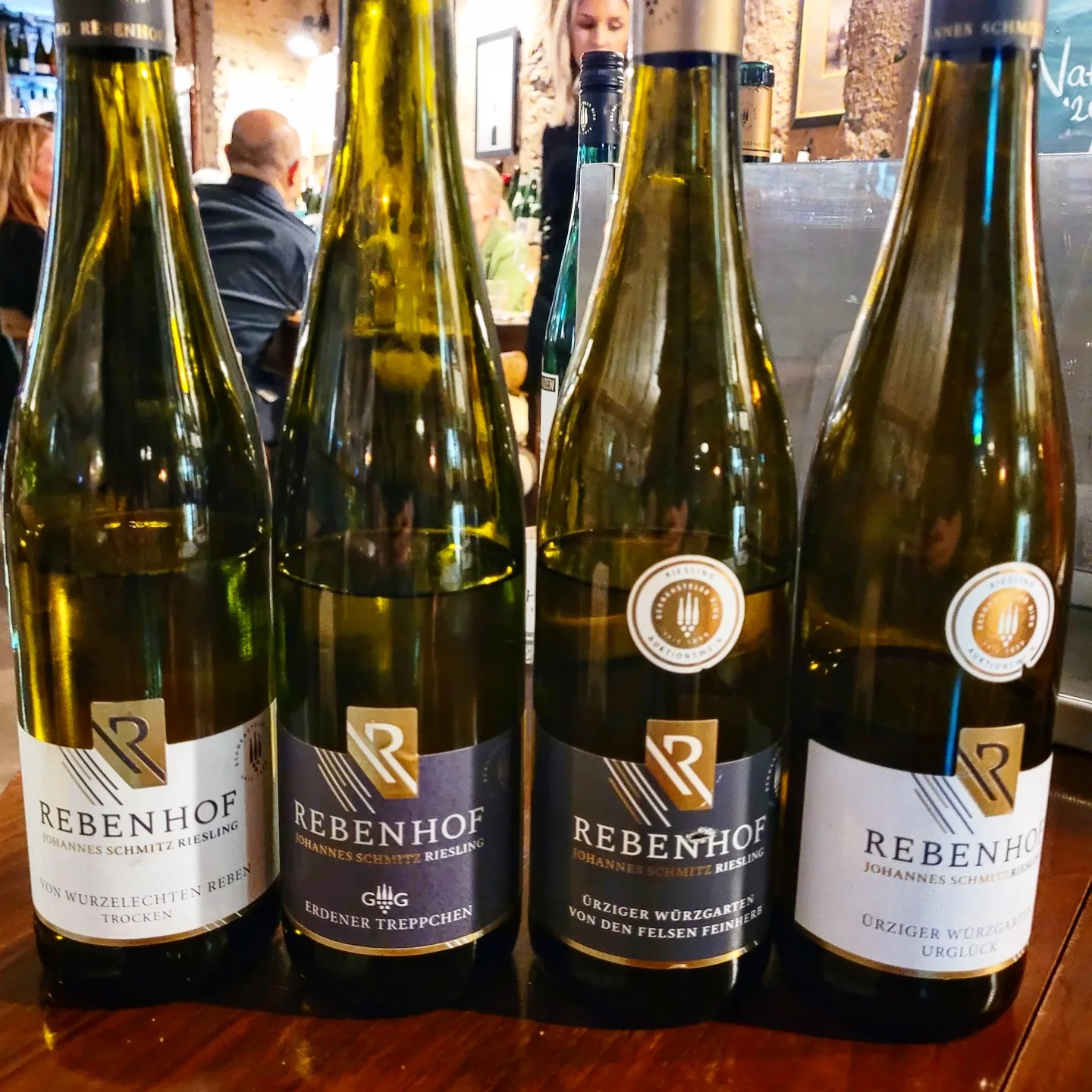
No botrytis came about for Walter’s late harvest riesling with 63.2 g/L of RS, higher 9.3 at TA and 8.6 percent alcohol. Elegant, concentrated and optimum if unassuming ripeness for this lime cordial, mineral salts and cracker acidity style. In fact the blade swipe makes for an intensely serious and stood up to be counted riesling that demands attention. Serious but as mentioned also elegant which is a very good combination. Drink 2025-2031.  Tasted March 2024

Weingut Rebenhof – Hochheim am Main

Weingut Rebenhof Riesling Kabinett Trocken Ürziger Würzgarten Von Wurzelechten Reben 2022, Hochheim am Main

Ürzig is a village in the Bernkastel district of the Mosel and the Ürziger (vineyard) is a place of red slate, often lending a spicy or salty character to the riesling grown there. Wurzelechten basically means “own or unrooted,” a significant case because there are between 50-60 hectares of un-grafted vines in all of Germany, about half of them planted between 1910 and 1935. Topsoil must exist over stoney soils for Phylloxera to attack and the slate in this part of the Mosel is not one of those locations. Rebenhof’s Kabinett is the truest form of Trocken and one of the zestiest you are ever likely to encounter. Matching sugar and acidity numbers create the equilibrium, both at 6.8 g/L with alcohol right there in the median sweet spot at 11 percent. Tons of lime, mostly zest and the intensity never relents. Still there is a fulsome aspect and so time should soften the attack and coax out some flesh. Unique riesling in any case. Drink 2025-2029.  Tasted March 2024

Weingut Rebenhof Riesling Großes Gewächs Auktionswein Erdener Treppchen 2020, Hochheim am Main

A riesling with the Auktionswein classification which means it its part of the Bernkasteler Ring E.V., which is the oldest wine auction company in Germany. A Großes Gewächs (a mark of quality by top producers from best sites making dry wines) from the iron-rich, red slate soils of the Erdener Treppchen (village of Erden in the Mosel’s Bernkastel area). The 2020 is a wine of dichotomies, still on the dry side but with elevated numbers as compared to the Ürziger. Here riesling is at once salty but the acid presence (as a quotient of this vineyard’s minerals) creates an opposing sense of sapidity. Diversity from start to finish, a wine of waves and oscillations, multifold mineral movements and a gelid texture to the palate. Higher alcohol contributes to the elevated weight. Drink 2024-2028.  Tasted March 2024

Weingut Rebenhof Riesling Spätlese Ürziger Würzgarten Von den Felsen 2018, Hochheim am Main

A new style of Spätlese riesling, well ahead of its time from 2018 out of the Ürziger Würzgarten with just a bit more than one-third of the residual sugar of the Kabinett. Here at 29.5 g/L and higher alcohol (11.0 percent) than might have been thought. This modern approach makes for a sapid riesling despite the sweetness, quite phenolic, ripe and grippy, rich and creamy yet intensely mineral. A lime cordial meets sherbet style with backbone, attitude and potential. Drink 2025-2031.  Tasted March 2024
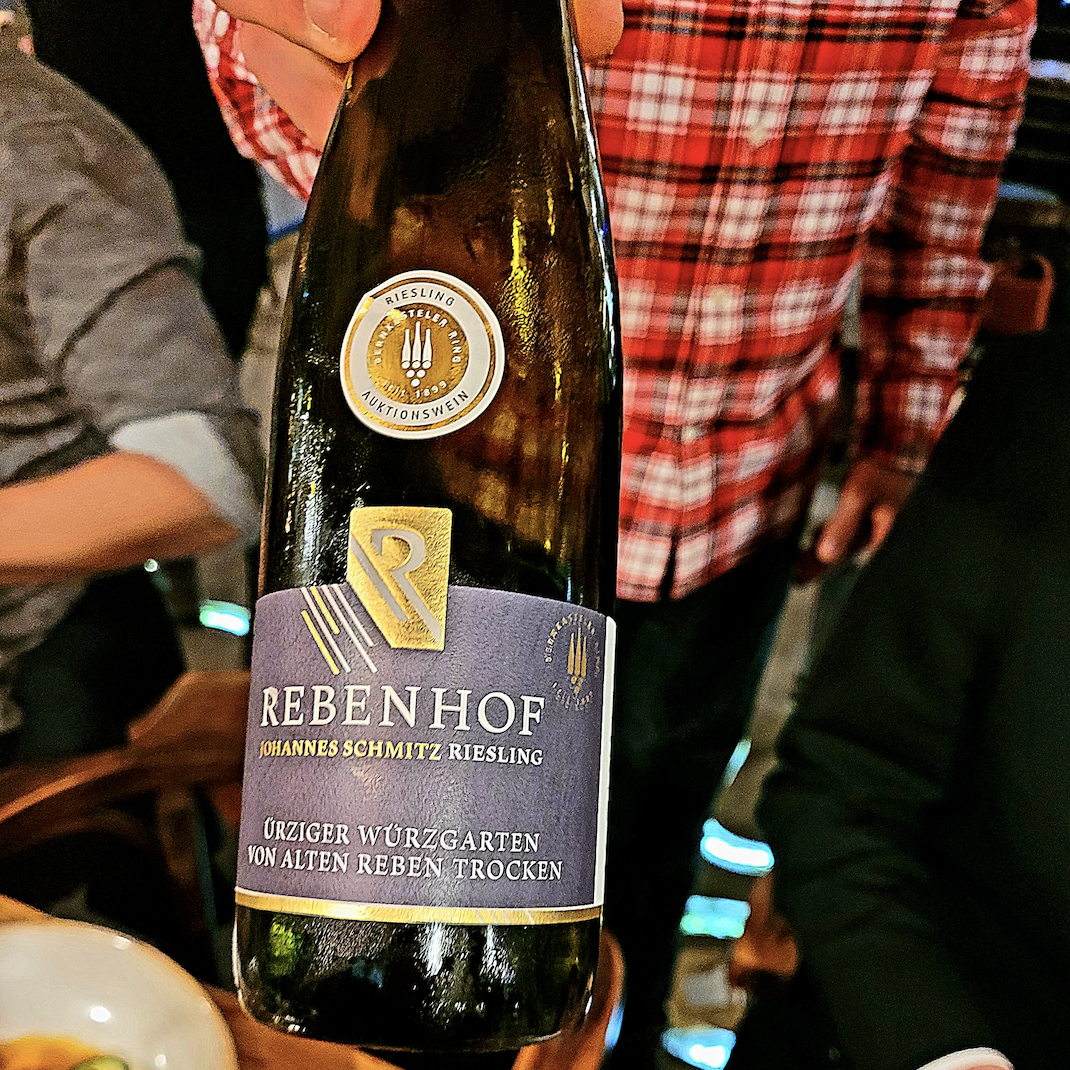
Weingut Rebenhof Riesling Kabinett Auktionswein Ürziger Würzgarten Urglück 2022, Hochheim am Main

Fabulous nose with exceptional aromatics mark the entry of this very sweet riesling made in a singular Kabinett style. A riesling of nectarine and peach stone, creamy like the Spätlese but more bodied and emulsified as texture with acidity really buoying the fruit. The method, application and intention might suggest a challenge but Rebenhof does their best work when sugars are elevated because that is how they see riesling and its capabilities. Drink 2024-2030.  Tasted March 2024

Charlie and Caroline Weis – Weingut Erben Von Beulwitz

Weingut Erben Von Beulwitz – Mertesdorf

Weingut Erben Von Beulwitz Riesling Kaseler Nies’chen No. 15 Im Steingarten 2023, Mertesdorf, Mosel

Caroline Weis describes the steep and exposed Nies’chen vineyard as the “mountain,” an extreme and specific Steingarten site with blue slate and sparse stony topsoil. It is anything but a “garden” of a vineyard to farm. Labeled Trocken and while anything but severely dry it is the intensity of this riesling’s acidity that plays tricks upon both the nose and palate. The TA is in fact higher (at 7.9) than the sugar (at 7.5 g/L). The new (and local) winemaker Phillip Steffes likes this style, more open than rigid and definitely sapid without any gratuitous generosity. Drink 2024-2027.  Tasted March 2024

Weingut Erben Von Beulwitz Riesling Großes Gewächs Trocken Mertesdorfer Herrenberg No. 14 2022, Mertesdorf, Mosel

As with the Nies’chen there is slate in the topsoil of the Mertesdorfer (Mertesdorf Village) Herrenberg but more blue on the lower slope, as opposed to black at the “mountain” top. Also a dry riesling though even more so (at 5.5 g/L) in this Großes Gewächs edition with an acidity number (at 6.7) that dominates to make this feel like one of the most arid Mosel rieslings around. A modern and modish take that commands attention, broadens the mouthfeel and so that fruit-mineral swirl becomes one of serious breadth. A credible example with acidity that is not sharp, but certainly powerful, impeccable balance and high level age-worthiness in the Trocken idiom. Drink 2025-2032.  Tasted March 2024
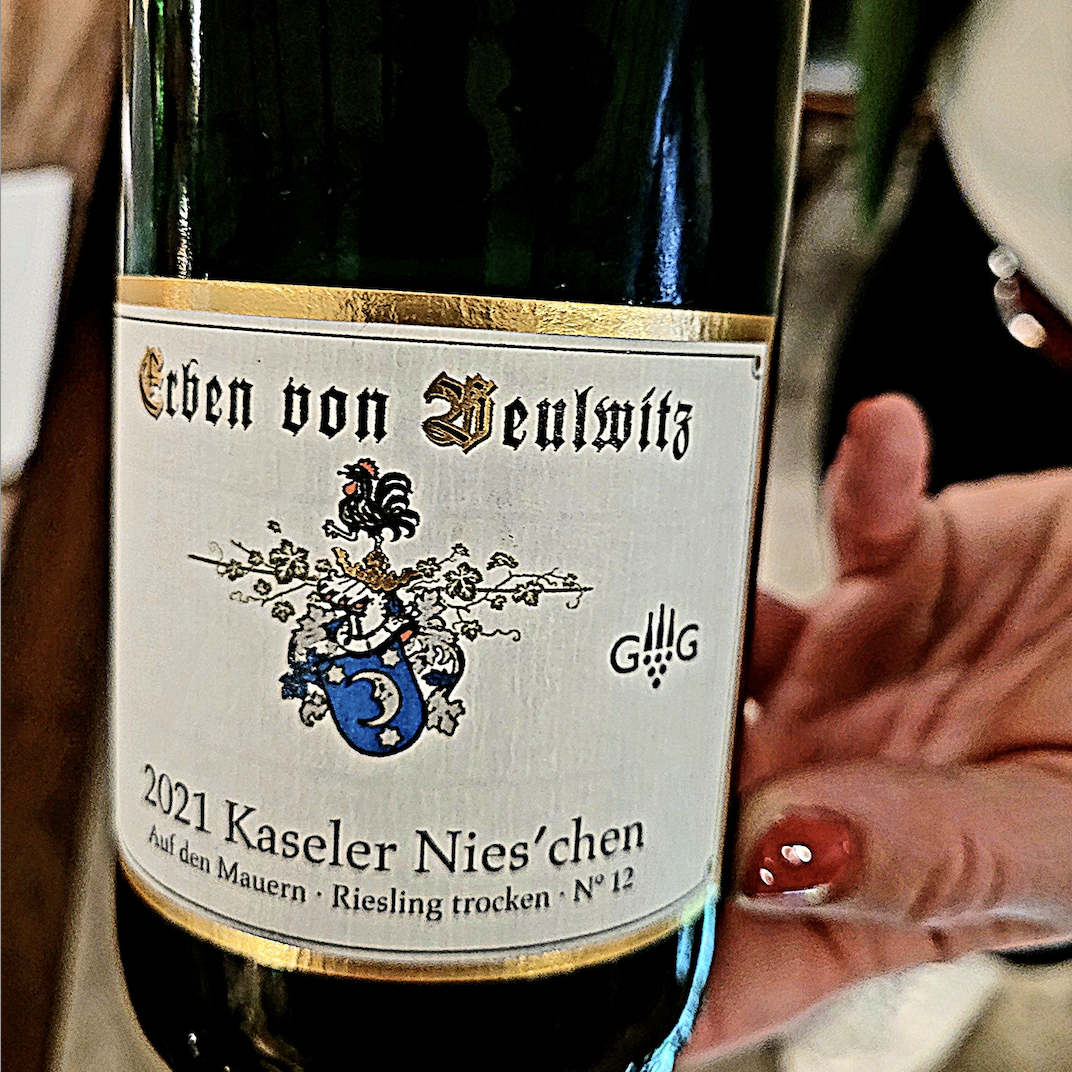
Weingut Erben Von Beulwitz Riesling Großes Gewächs Trocken Kaseler Nies’chen No. 12 Auf Den Nauern 2021, Mertesdorf, Mosel

Auf Den Mauern is a 60 percent steepness portion of the Nies’chen Vineyard and considered to be the most important riesling section where high slate walls support the slope. Though this does come across as dry there is more sugar (at 8.6 g/L) and also acidity (7.2) as compared to the Herrenberg. What stands out now is the saltiness in a way only this riesling from Erben Von Beulwitz is want to show. A different expression results, also because it’s still young, reductive and yet to open. Caroline Weis notes its 10-year potential and truth be told there will be two more years of waiting before any significant changes begin to occur. It could be suggested to open bottles at the 2,4, 6, 8, 10 and 12 year marks to see the evolution. It was a rainy summer of 2021 in this part of the Mosel and so things slows down for riesling. Drink 2026-2034.  Tasted March 2024
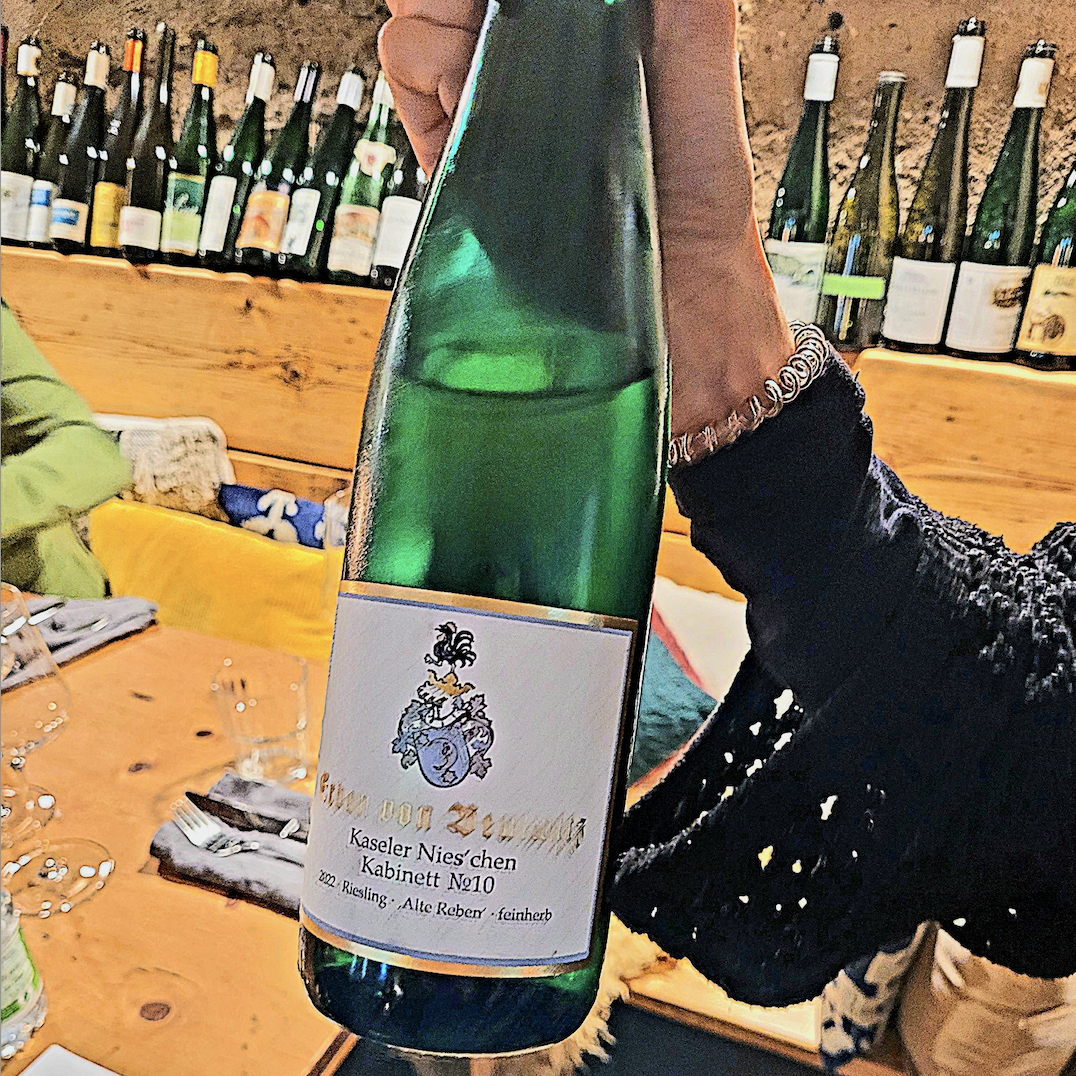
Weingut Erben Von Beulwitz Riesling Kabinett Feinherb Kaseler Nies’chen No. 10 2022, Mertesdorf

Classic Mosel style in the ways of the 90s and 2000s and “Dad’s favourite,” tells Charlie Weis. The kind that expertly balances high sugar and acid, layered like mille-feuille pastry, light on its feet and melting with ethereal ability in the mouth. Creates a symbiotic relationship with the Spätlese, the other Herbert classic styled riesling. The combination of 150 years of history and a family’s efforts since 1982 are what make a riesling like the Kaseler Nies’chen No. 10. Drink 2024-2029.  Tasted March 2024

Weingut Erben Von Beulwitz Riesling Spätlese Alte Reben Kaseler Nies’chen No. 6 2023, Mertesdorf, Mosel

Now into late harvest territory, old-school if you will, “Dad’s riesling” admits both Caroline and Charlie, Weis daughters and face of the estate. What a contrast to the Trocken, fruity, pulpy and forward, blast from the past though a very recent one to be honest. No holding back, zero reduction and ready to please. The specs are 95.0 g/L of residual sugar, 9.1 TA and 7.1 percent alcohol. Classic in so many respects, namely the tart stone fruit, sweetness elevated by the specific kind of acidity and good energy all-around. A clean and protected riesling that should have no problem living a long and productive life. Drink 2024-2033.  Tasted March 2024

Weingut Erben Von Beulwitz Riesling Auslese Alte Reben Auktionswein Kaseler Nies’chen 2015, Mertesdorf, Mosel

Tasted side by side with the 2020, a wine so incredibly youthful it seems years too early to be tasted. This 2015 is just beginning to show the first early stage of maturity, an Auslese from a hot summer with heavy rains. This fortunately stopped and the harvest saw cooling temperatures with beneficial drying winds. The end result was small berries and low yields for highly concentrated riesling fixing high quality Auslese. The acidity is still ripping through, keeping the sugars low and at bay, way down below. Kaleo rhythm, pure Mosel aromatic if perhaps the melodic-Icelandic gelid coolness, and “whoa, we get what we deserve.” Drink 2024-2031.  Tasted March 2024
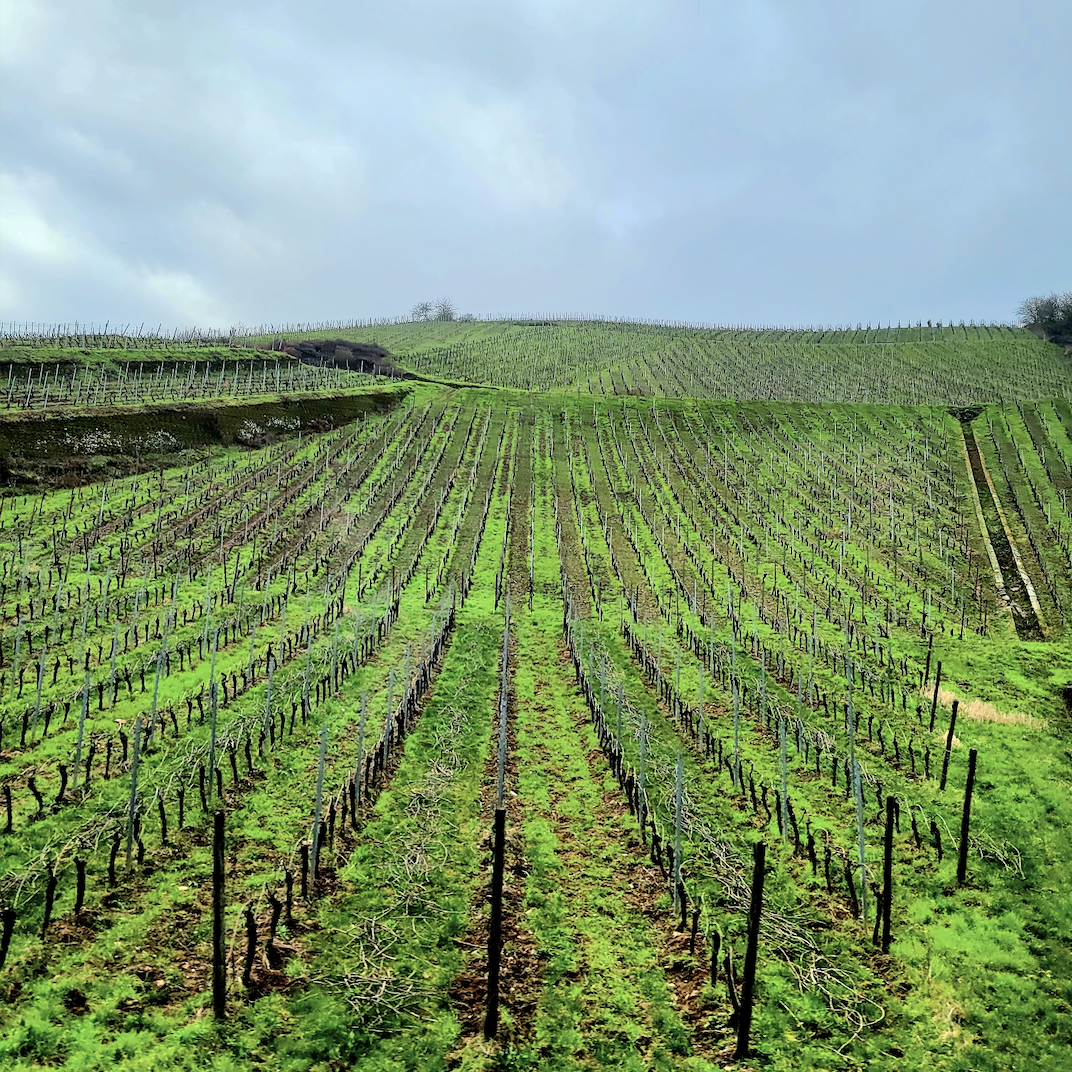
Nahe Vineyard

Nahe

Weingut Forster – Rümmelsheim

Weingut Forster Sekt Brut Nature Chardonnay and Weißburgunder 2016, Nahe

The 2016 Sekt of zero dosage spent 90 months on the lees. Still showing good freshness and aromatics are more than joyous. The wine turns quite botanical and it’s all sweet herbs throughout the second half of this unique sparkling wine. Drink 2024-2026.  Tasted March 2024

Weingut Forster Weißburgunder Dry 2023, Nahe

Fermentation is 70 percent in stainless and (30) in wood. A few hours of skin contact, bâttonage and lees contact for a few months. Organic, with neutral yeasts in the steel and spontaneous in the barrels. Low sulphur, vegan and unfined. Just grapes, no additions, proper ripeness, tasting like fruit and admittedly never creamy, oaky or gratuitously soft. Clean, satisfying, of medium acidity and surely just a matter of healthy grapes out of a good pinot blanc vintage. Well thought out, environmentally and sustainably conscious white wine. Drink 2024-2025.  Tasted March 2024

Weingut Forster Riesling KABInett 2023, Nahe

A German word play, the use of KABI in bold, as in “I’d like to have a Kabi, short for Kabinett.” One of the first riesling harvested at lower sugar and higher acidity though like all Kabinetts the residual sugar is essential, though here it’s in the lower range at 36.2 g/L. A cool climate vineyard that is now warming to be able to make this style in the Nahe, plus Laura Forster wanted this style to be made, especially because of the low alcohol. Only the third vintage, a fine mix of peach and lime, richness and tang. Well balanced though not one to age like many from the Mosel. Only 3,000 bottles made. Drink 2024-2027.  Tasted March 2024

Weingut Forster Riesling vom Kies Dry 2022, Nahe

From gravel (kies) soils and the aromatic profile is not only so opposite to the Schiefer but to 99 percent of rieslings made in Germany. A botanical tonic and a cheese rind that really expounds on the idea of this being a natural wine. Yes the soil comes through but also the vinification process, of 10-12 hours of skin contact, first press juice only, spontaneous fermentation in steel, finished at Christmas. Very dry, lime finish and just a bit “horsey.” Drink 2024-2025.  Tasted March 2024
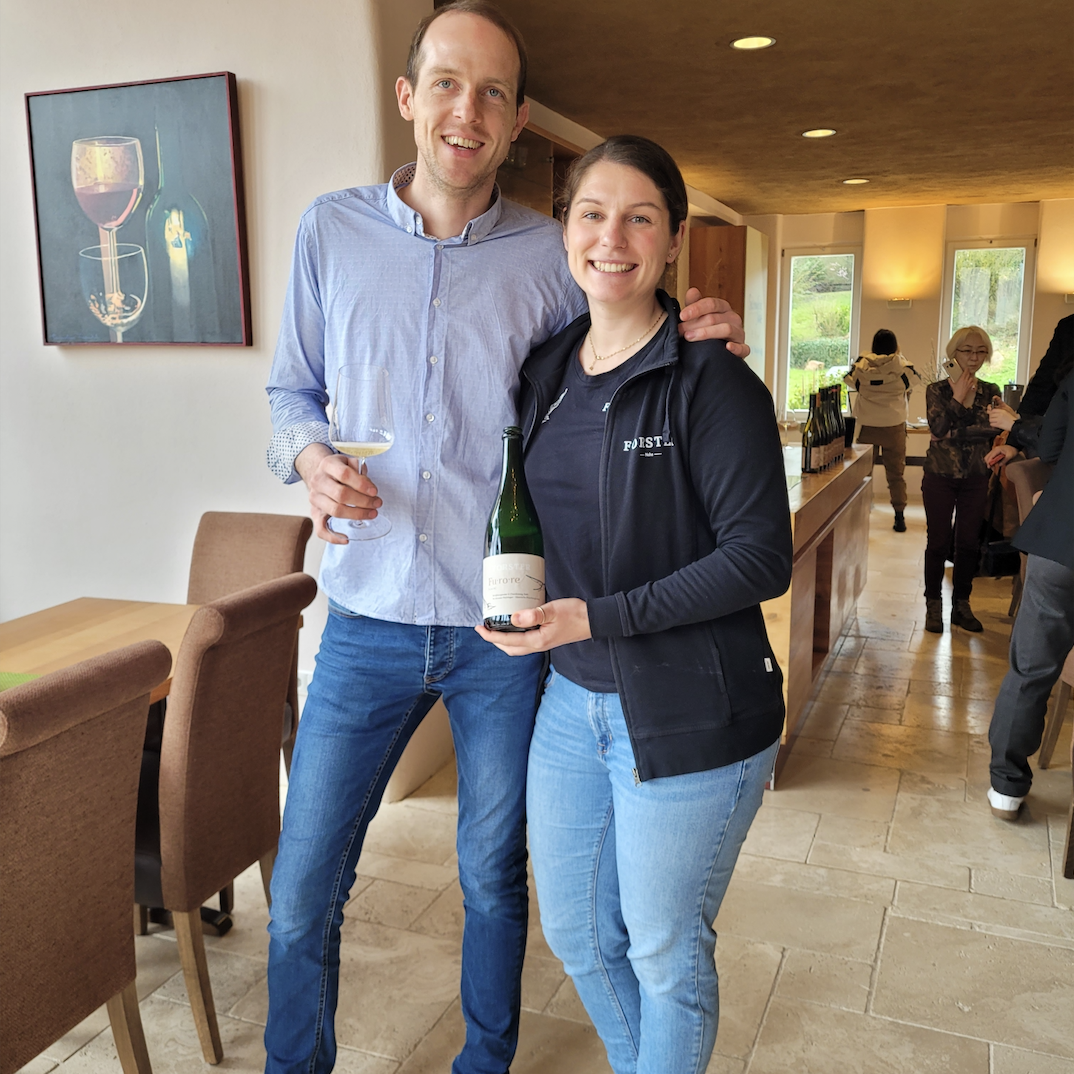
The Forsters

Weingut Forster Riesling vom roten Schiefer Dry 2022, Nahe

From red slate soils, same fermentation-vinification process as the Kies (granite) riesling. Less lactic and more phenolic, dry as can be and in better balance with thanks to the soil. Still it is the mix of style, use of compost, organics and low intervention, including sulphuring that creates this very natural scenting, a notably earthy and cheese rind notated riesling. Drink 2024-2026.  Tasted March 2024

Weingut Forster Riesling Burg Layer Schlossberg Dry 2018, Nahe

Warm, south facing red slate hill, 52 degrees of steepness, right behind the winery. Warm vintage though cooler than 2019, higher in sugar though still just about bone dry at 2.9 g/L. Also higher in alcohol at 13.5 with more flesh and body and the balance afforded this clean riesling from clearly healthy soils is just right there where we want it to be. Tannins and structure aided by long lees aging (up to a year) in stainless steel. Freshness fully captured, longevity a true matter of potential and acidity still a great catalyst for all that is happening and will continue to develop in the wine. Drink 2024-2028.  Tasted March 2024

Weingut Forster Riesling Burg Layer Schlossberg Dry 2019, Nahe

Mild though detectable TCA. Warm, south facing red slate hill, 52 degrees of steepness, right behind the winery. A complete and utter apposite vintage to the cooler 2018, here warm and dry, the sugar under 1.0 g/L and the acids also a point lower. Alcohol 1.5 less at 12 and overall the balance afforded by 2019 was surely more of a challenge. Warm nights up to harvest sacrificed some acidity and so structure overall here, included tannin is lessened. Just not as balanced and without the top energy of 2018 but still well and naturally made. Drink 2024-2025.  Tasted March 2024
Weingut Forster Grauburgunder Réserve Dry 2022, Nahe

Short 12 hour but effective skin contact for pinot gris, fermented in 500L tonneaux, 12 months of lees contact and healthy alcohol at 13.5 though less than much warmer vintages. Grows on the red slate soil of the Rotenberg (red mountain), sun richness and good metallurgy in the aromatics. Juicy, fleshy and just enough acid to keep things moving swimmingly along. Great diversion from a sea of pinot grigio ubiquity. Drink 2024-2026.  Tasted March 2024

Weingut Forster Frühburgunder Burg Layer Johannisberg 2022, Nahe

A single vineyard red from the rare variety (only 440 hectares planted in all of Germany), a cru frühburgunder not oft seen in the Nahe. Early ripening grape planted by Johannes Forster’s father 20 years ago. Softer tannin structure as compared to spätburgunder and grown in the cooler site where the riesling for Kabinett also grows. Some whole bunch, fermented on skins for four weeks and yes just enough tannin has come through. Some aging in low toast new barrels, a bit more structure than some though it stays below the threshold of too much extraction and tannin. Just a bit of spice and again gamay or perhaps even pelaverga is the mind’s launching point. Just a hair ambitious for what the grape is want to deliver. Drink 2024-2026.  Tasted March 2024

Weingut Forster Spätburgunder Kies 2022, Nahe

Grown on the Kies (granite) soil, four weeks of skin fermentation, very little wood usage, soft but still just enough grip to effect structure. Similar natural feel like many of the rieslings and more viscous mouthfeel than the frühburgunder, liquid chalky and again the cheese rind note, Also a verdancy and red citrus tang, desiccated roses and minty cool savour at the finish. Tannins are just a bit hard, chalky-grainy and friable. Drink 2024-2026.  Tasted March 2024
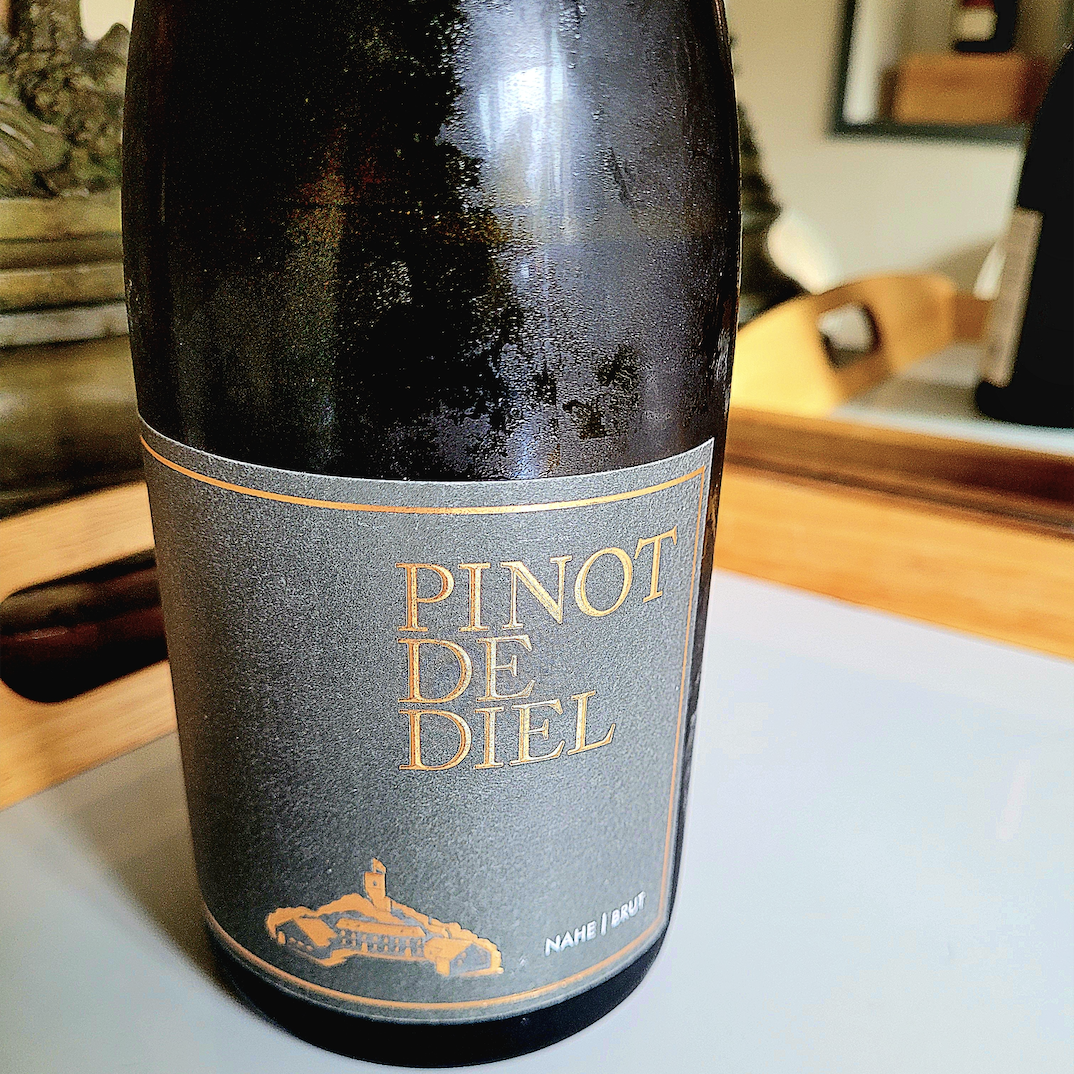
Schlossgut Diel – Burg Layen, Nahe

Schlossgut Diel Pinot De Diel, VDP.Sekt, Nahe

A vibrant mix of pinot noir and pinot gris from Caroline Diel, seventh generation winemaker at Burg Layen which came into the possession of the Diel family in 1802. The base wine is 2020 fruit with some residual 2019 involved, two years on the lees and of an aperitivo intent. Easy drinking and on the dry side which feels like another Brut Zero style is well within Diel’s capable reach. Like a bite into a tart and juicy green apple with a drip of red fruit and a fairly tart finish. Satisfying bubble all around. Drink 2024-2026.  Tasted March 2024

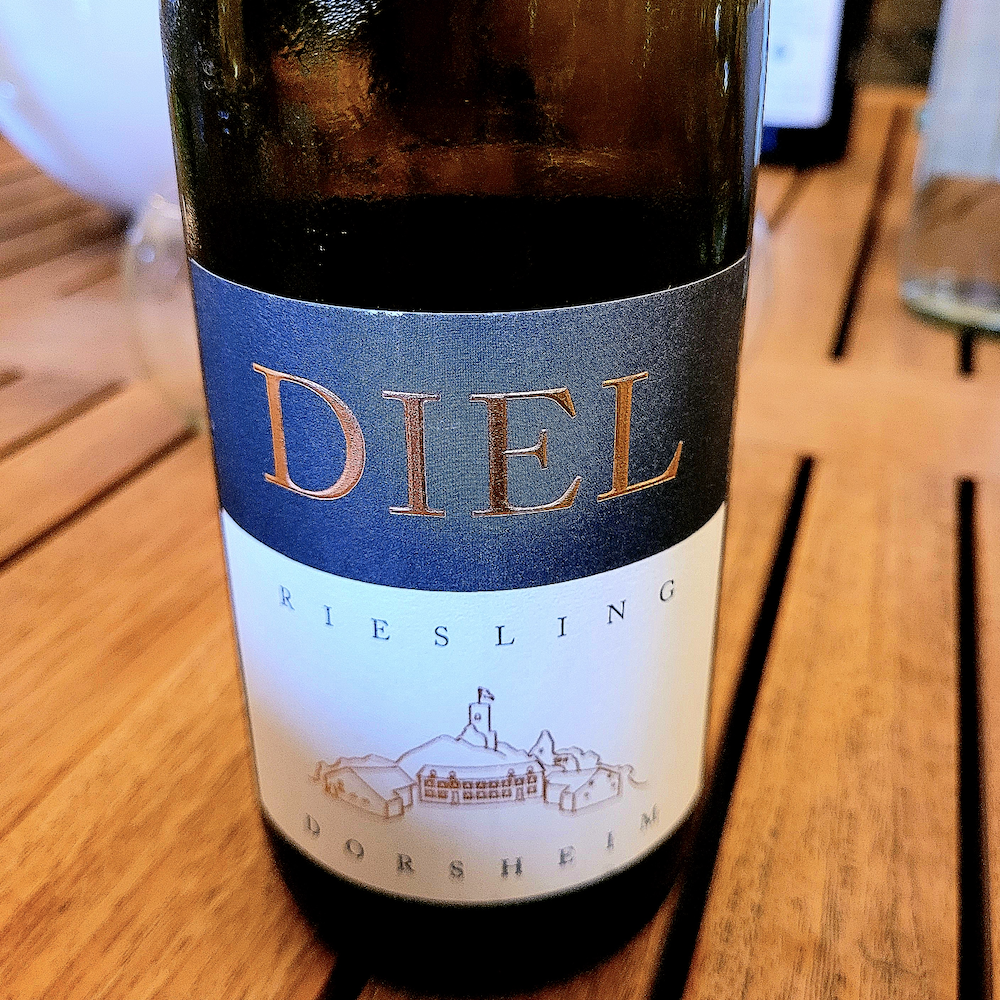
Schlossgut Diel Dry Riesling Dorsheim 2017, VDP.Orstwein

Villages organized riesling from neighbouring village Orstwein with seven-plus years of age, dry and now pretty much in the perfect zone. Has aged beautifully, sitting up vertical and straight, giving generously with a clear and present amount of grace in restraint. The balance between extract and tannin, fruit and acid is simply structured, allegedly and unequivocally spot on. Drink 2024-2027.  Tasted March 2024
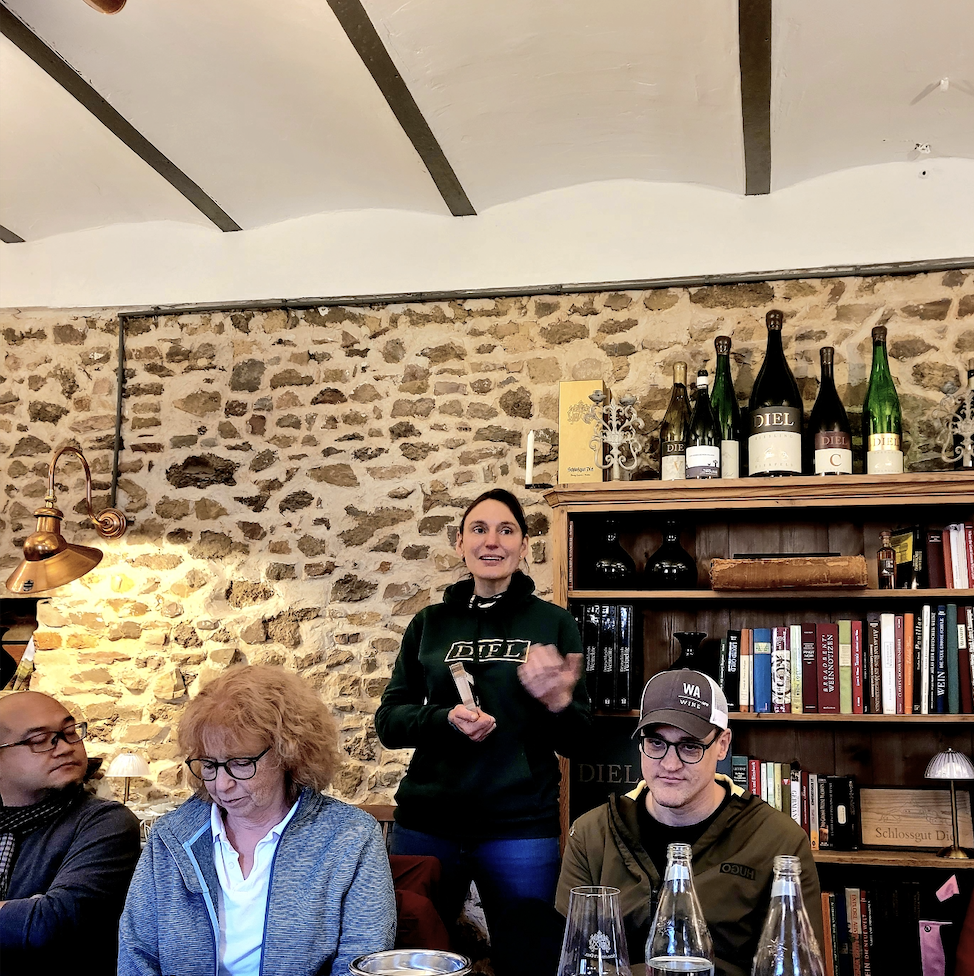
Caroline Diel – Schlossgut Diel

Schlossgut Diel Cuvée MO Brut Nature 2014, VDP.Sekt Prestige

“I believe sparkling wine does not need any dosage,” and Caroline Diel followed this when she joined the family in 2007, continuing what started going all the way back to the 2004 beginning of this project. Cuvée MO Brut Nature is ninety months on the lees, made with pinot noir and chardonnay. Developed richness for a sparkling wine made at the time in an oxidative style,. Showing aldehydic notes, of brioche to the end of a smoky and really old style of Champagne. Should actually stay this way for a few more years to come. Drink 2024-2027.  Tasted March 2024

Schlossgut Diel Pinot Noir Réserve 2020, Nahe

Most of the vines were planted in the mid to late 90s by Caroline Diel’s father Armin. Approximately 20 percent whole cluster, the rest hand de-stemmed, all vineyards in the cuvée fermented naturally and kept separate. A year and a half in barrel, spontaneous malolactic settling, racked now and then and no filtration. Rich fruit, high acid, truly complex aromatics, meaty perfume, full, juicy, lively and finally a truly substantial finish. Neither derivative nor imitative. This is Caroline’s mid-level pinot noir for a 7th generation winemaker who would go on to do the 2022 harvest at Romanée Conti. Mid-level will surely rise up to even greater heights. Drink 2024-2028. Tasted March 2024
Schlossgut Diel Dry Riesling Pittermännchen GG 2022, VDP.Grosses Gewächs

The tiny one hectare cru Pittermännchen is a name that dates to the middle ages with a connection to the people of Köln and Düsseldorf. Grand cru site of weathered grey (Devonian) slate atop Rotliegend conglomerate that dates back several million years. The geo-agricultural texture is small decomposed particles as opposed to the larger stones of the Mosel. Expressive flint stone aromatics undeniably soil related and not much fruit to discuss, save for some variegate currants but you really have to conjure imagination. There is a mille-feuille density to this riesling that peels away and delivers waves in layers without boundaries. Complexities are revealed without pause and dryness results because purity and grip replace the necessity for sugar-acid balance. So stony, long and our palates are held captive. Top shelf riesling within the idiom. Drink 2026-2033.  Tasted March 2024

Schlossgut Diel Riesling Kabinett Goldloch 2022, VDP.Grosse Lage

When she returned to the family in 2007 Caroline Diel’s first order of business was to not use herbicides “and it was a disaster,” she remembers, “not being prepared with staff, machine and experience.” Good things take time and now organic certification will come in 2024. The 2022 vintage was not the hottest but was an extremely dry one that saw vines on steep hillsides have to work hard to resist the dangers. Healthy vines can in fact digest the climatic extremes and this riesling of Kabinett style is a testament to facing the challenges head on. The gravelly bedrock of Dorsheimer Goldloch is of the Permian age and its rieslings are juicy as it gets, fruit forward and truly antithetical to the über mineral of the Pittermännchen. Makes sense that Kabinett is the choice for this naturally sweet meeting equal factored acidity that connects for a kick mix of sweet, salty, sapid and savoury. A quotient of 42 g/L of RS so hidden by the acids, grip and energy of the wine. Drink 2024-2031.  Tasted March 2024
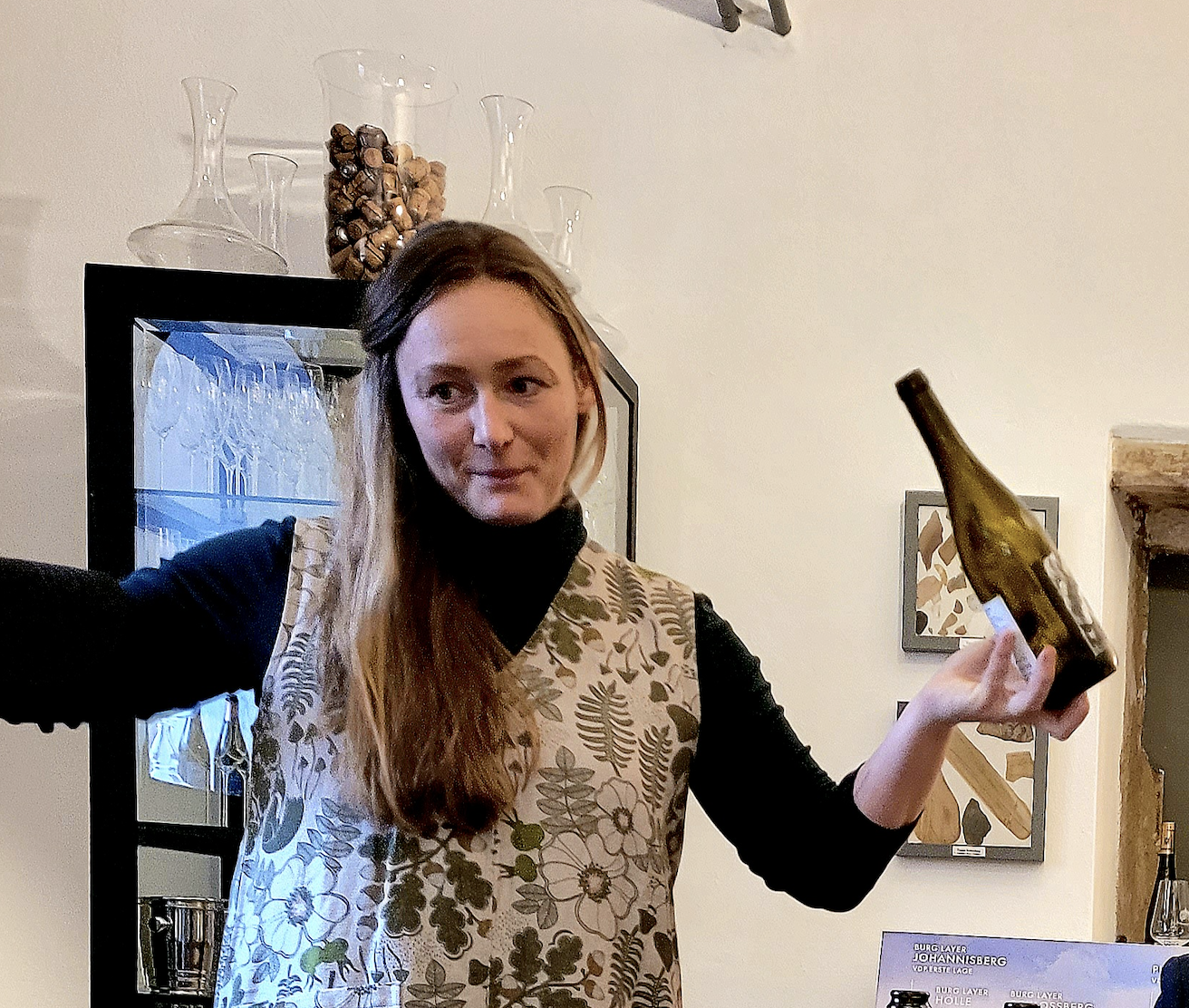
Christine Pieroth – Piri Naturel

Piri Naturel Christine Pieroth – Burg Layen, Nahe

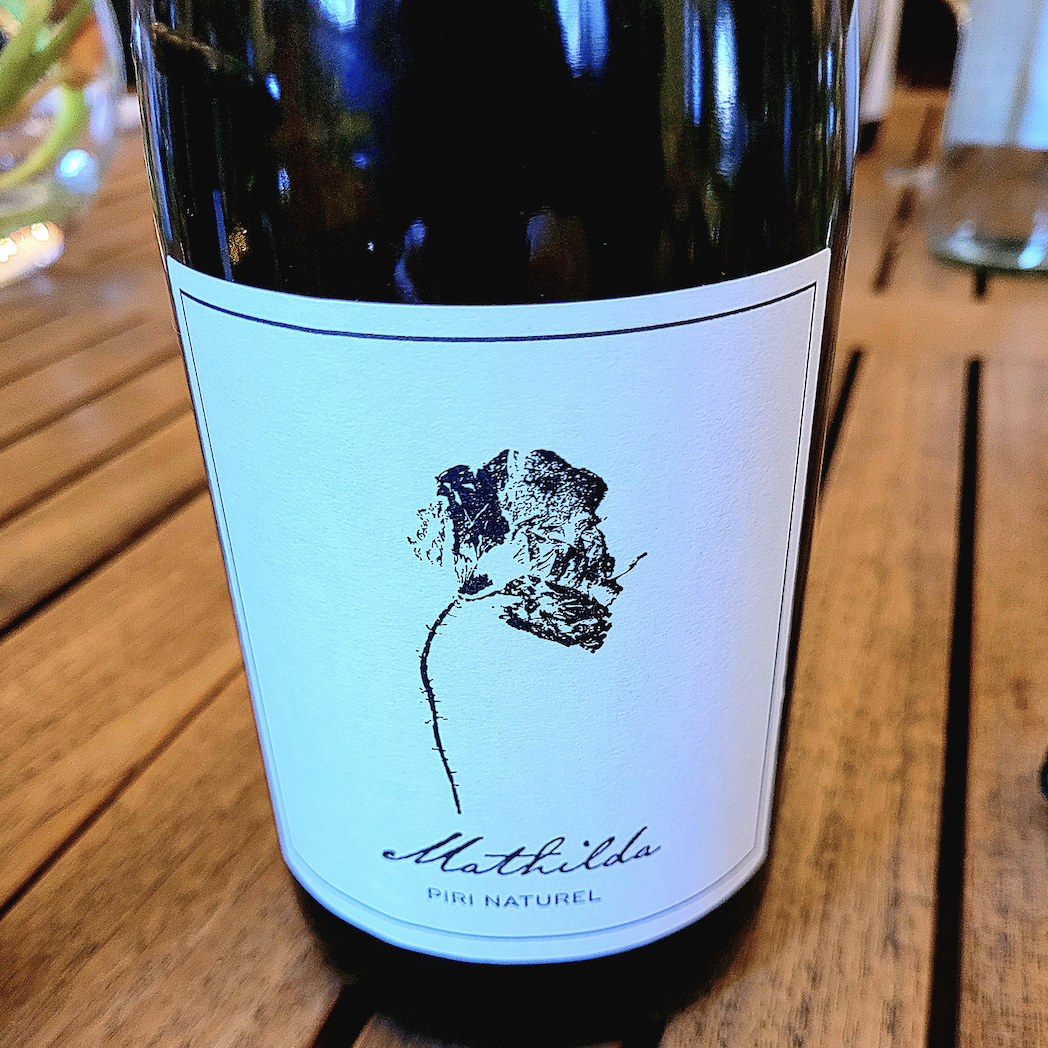
Piri Naturel Christine Pieroth Mathilda 2021, Nahe

Christine Pieroth is 7th generation for a winery dating back to 1789. Mathilda is a blend of sylvaner, riesling and kerner, made for simple drinking pleasure. Bottled under screwcap to capture the natural effervescence, skin contact and cloudy character for a characterful example of what a nurturing and deft touch can do for grapes that just want to be together. Clean and well made without any pretence, trend or commercial design. Natural for the simple reason of pour me a glass. Drink 2024-2025.  Tasted March 2024

Piri Naturel Christine Pieroth Riesling 2021, Nahe

Christine Pieroth studied at Geisenheim and worked in the Okanagan. Her philosophy is really quite direct. “Agriculture is really separated from nature.” Piri Naturel is riesling grown on granite-based, (ancient) sandy seashore pebbles called the Kieselstein. Macerated on the skins for one day, to capture the cool climate region, especially with riesling, then ages two years on full lees in big Stückfässern. “One of the vintages (2021) with the highest acidity I’ve ever experienced” she remembers. Beautiful purity captured without oxidative or any idiomatic orange ornateness. Brilliant riesling work in the style for those who like and want, but also those skeptical of what this kind of wine can be. Acids are captured, tamed and on time release. Drink 2024-2028.  Tasted March 2024
Piri Naturel Christine Pieroth Ponderosa 2021, Nahe

A family nickname for the vineyard and incidentally also the Matsutake mushroom, a.k.a. Armadillo Ponderosa. Comes from a schist slope that changes colour from top to bottom, here for a single vineyard though it can’t be labeled this way. Not filtered and so it can’t have a classification. “In the last year I’m turning things upside down” says Christine Pieroth. Ponderosa is 90 percent pinot gris with (10) pinot noir treated to carbonic maceration and my if this isn’t the pink juice you really want to drink. Pink grapefruit, jelly belly, pomelo and guava, dry and tropical, crunchy and tart though never searing. Drink this with a grilled striploin – seriously. Forget Rosé or chardonnay – the acid structure, grip and tannins will do well especially, with a marbled cut. After all it is called Ponderosa. Drink 2024-2027.  Tasted March 2024

Piri Naturel Christine Pieroth Pinot Blanc 2019, Nahe

Piri farms 7.5 hectares for an average of 80,000 bottles, mostly estate. Permaculture and regenerative farming are practiced with organics as the basis for everything, including no fining or sulphites. The pinot blanc is from 70 yer-old vines, “a very special vineyard, planted by my grandpa,” tells Christine Pieroth. Red schist soil to gift passion and texture to pinot blanc that sees three years in oak, all the while on its lees. No complication, a wine of perfume and nuance, abstract expressionist style, an incredible natural sweetness. A unicorn wine, infinite in ways that can and also can’t be described. The most alcohol of Christine’s wines at 13.5 percent but acidity and spices share the stage and spread the wealth. A slight amount of oak flavour, but fermentative notes have all resolved. Drink 2024-2027.  Tasted March 2024
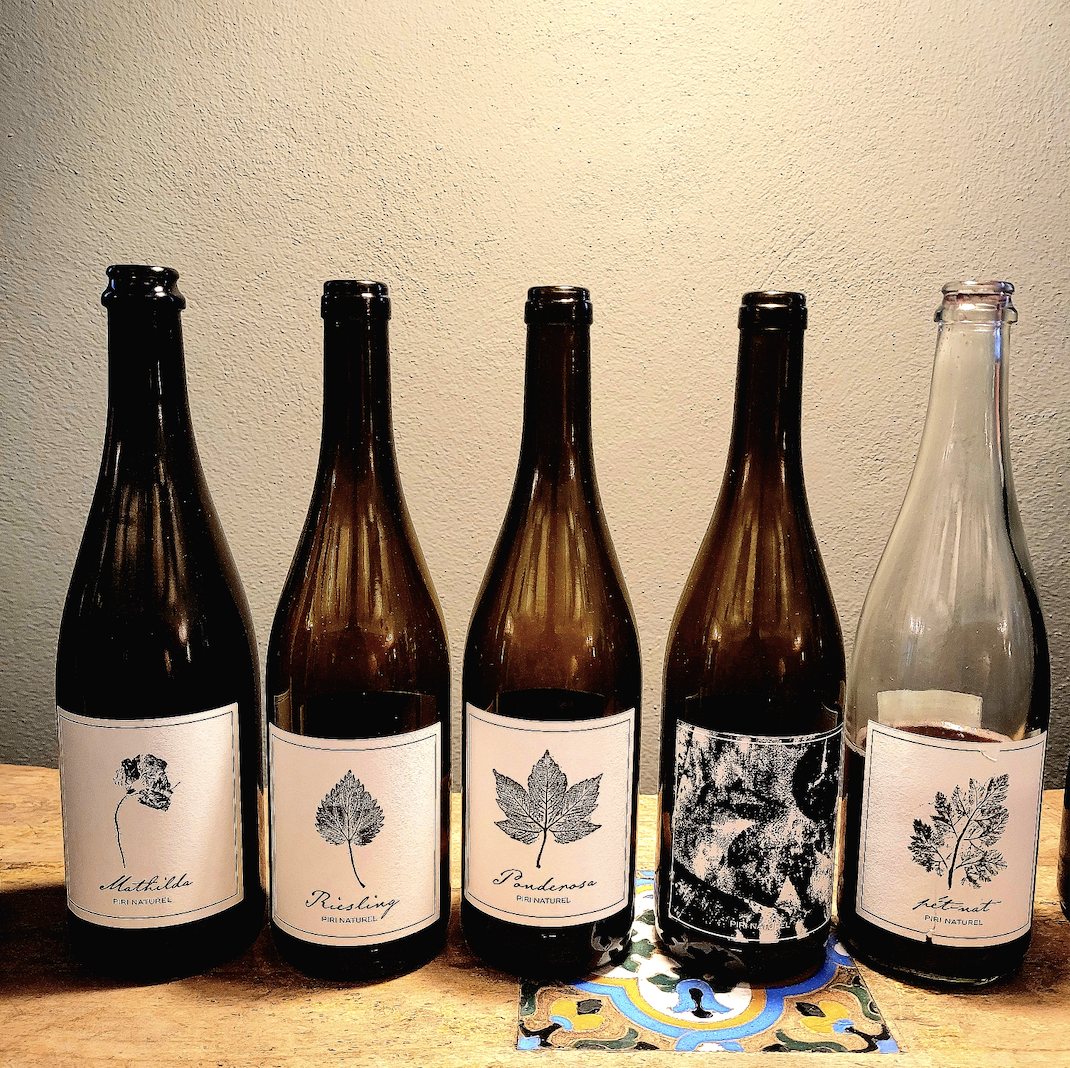
Piri Naturel Christine Pieroth Pét-Nat 2021, Nahe

A Germanic-styled Pétillant-Naturel in the Lambrusco idiom, bone-dry, made from Piwi grapes planted 20 years ago. They being dornfelder and regent (the piwi variety). Talk about foresight and seeing the challenge ahead of the curve. Leesy and cheesy, the most reductive and natural of all Christine’s wines. The kids will love this.  Tasted March 2024

Weingut Anette Closheim – Langenlonsheim

Weingut Anette Closheim Calardis Blanc Dry 2023, Nahe

Calardis is a Piwi variety crossed with bacchus (as opposed to sauvignon blanc or cabernet sauvignon especially) and this is just the second vintage of trying it. Quick  on skins, fermentation and just bottled in February. Picked on the 22nd and 23rd of September after a picture perfect season. A muscat aromatic way about this unique hybrid example, light, fresh, clean and this elastic push-pull between fizzy and botanical. Bit of white peach and peach pit too. Finished at 12.5 percent alcohol with 4.7 RS and 5.8 TA. Drink 2024-2025.  Tasted March 2024

Weingut Anette Closheim Riesling With Friends Dry 2022, Nahe

For friends who are or may not be friends with riesling, but they can be. Acts dry but there is 7.0 g/L of residual sugar and a near equal amount of acidity. Entry riesling in style, juicy, high citrus, only steel raising and uncomplicated. Lime in every way, especially the juice and the zest. Bit of a Mojito you might say. Drink 2024-2025.  Tasted March 2024

Weingut Anette Closheim Riesling Fifteen Dry 2022, Nahe

From Langenlonsheim, Nahe. A long and narrow, “street village” a.k.a. the Naheweinstraße that lines the Nahe. Anniversary riesling of the label, a blend of two single vineyards, planted in 1963 and 1965, red limestone and Nahe gravel. Vinified separately in old wood and in the 2022 there is some residual sugar because one half did not quite finish its fermentation. Seems like rising pH numbers in a vintage like 2022 is the reason for lower acidities and while riesling still seems immune you can’t say the same about pinot grigio and pinot noir which are hitting numbers at or exceeding 3.5. Quite a balanced riesling, a bit higher in RS than the “With Friends” but also more vibrant, less rounded and more quenching. Drink 2024-2026.  Tasted March 2024

Weingut Anette Closheim Riesling Pastorei Dry 2018, Nahe

The last vintage of this near 40 year-old south facing riesling vineyard which has since been re-planted to chardonnay because it’s just too warm a place and 2018 was such a vintage. Finished at 13.5 percent which is about as high as you’re going to accept from riesling, with acidity at a healthy 6.3 though anything but creating a searing experience. Lime juicy, ripe and reduced, like a creamy cordial, sapid as it gets, sweetly botanical upon the finish. Drink 2024-2026.  Tasted March 2024
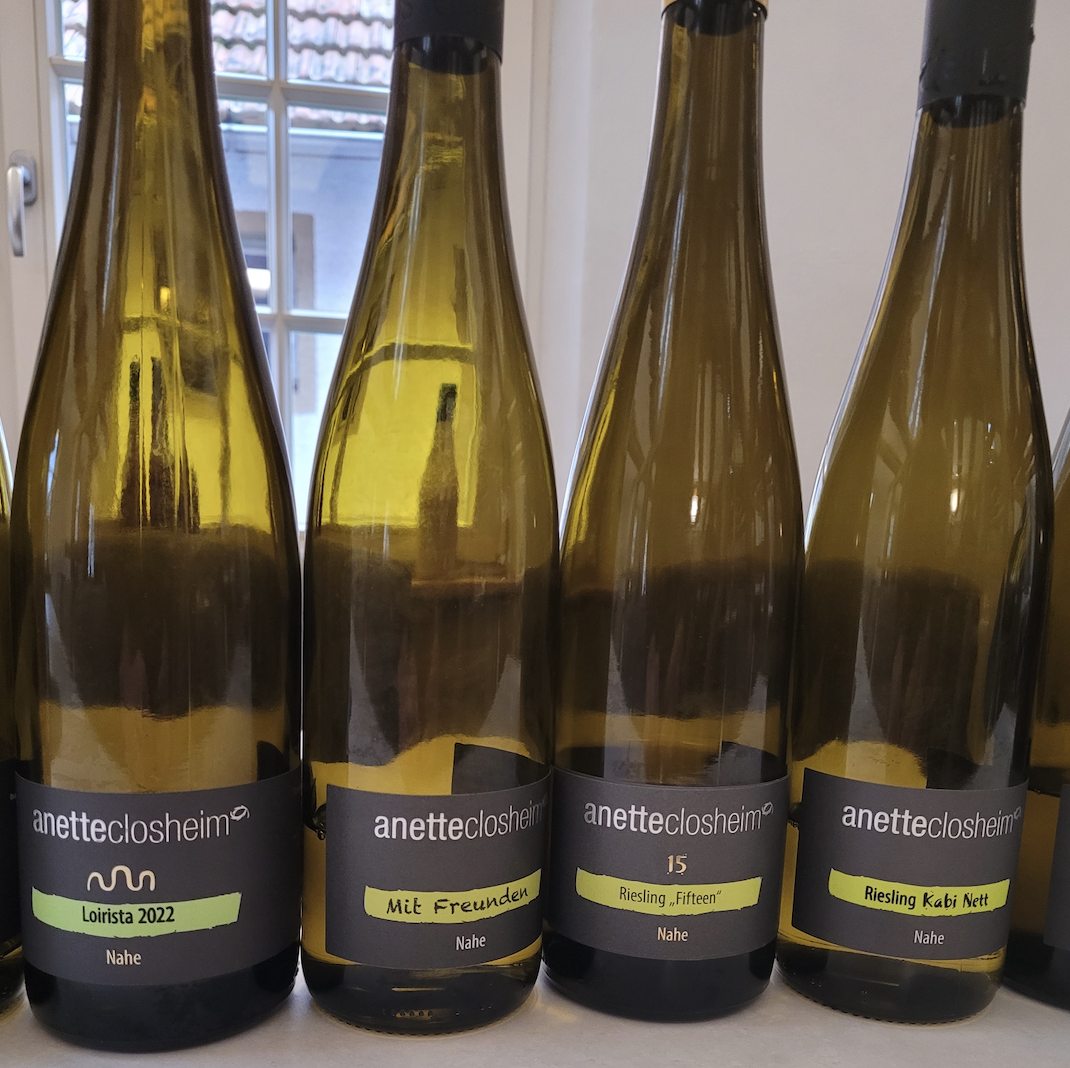
Weingut Anette Closheim Riesling Kabinett Löhrer Berg Medium Sweet 2022, Nahe

From the right side gravel soils for a different mineral experience and while sugar (at 36 g/L) runs high in the Kabinett style you can’t deny how forceful the (8.1) acidity really is. A good if not highest level vineyard site, vines 10-12 years of age, nectarine and lime, well integrated and such a grippy wine. Will hit its balanced stride in a year or two. Drink 2025-2028.  Tasted March 2024

Weingut Anette Closheim Sauvignon Blanc Maturis Dry 2022, Nahe

Single vineyard sauvignon blanc called Maturis, as in ripe, well matured and experienced. The clones are mostly from Alto Adige but also some from France, the vines now 16-18 years of age, in seven vineyards, picked across a week’s time. Verdant, botanical and there is a CO2 buzz on the palate. Lime intensity with just six percent wood aging. One of the most unique SBs ever tasted, like green eggs and ham. Tonic fuelled finish. Drink 2024-2025.  Tasted March 2024

Weingut Anette Closheim Sauvignon Blanc Lorista Dry 2022, Nahe

Higher, drier, similar acidity to the Maturis and now the barrel aged version, with the latest picked grapes (near to the end of September) and a much preferred iteration for Langenlonsheim. From a quickly settled, cloudy and protected pressing that clarifies itself and delivers this amazing richness in spite of the austere aridity. The acidity feels closer to riesling for the Lorista and yet there is some roundness, a creamy consistency based on lime because of the wood. Really unique for the variety, made with the Leimbourg (LB) 36 clone out of Alto Adige. Drink 2024-2026.   Tasted March 2024

Weingut Anette Closheim Pinot Noir Dry 2020, Nahe

Pretty big pinot noir, not exactly traditional German spätburgunder, from German research clones with bunches of small berries and space. Results in more airflow, less botrytis and good ripeness. Low yielding and good colour. Stays on the skins for 16-18 days and then wood for 14-16 months, mainly from François Frères, 25-35 new, plus second, third and fourth fill. Dark berries, sweet savour (with help from 30-40 percent stems added back) for a level of verdancy expected and well integrated. Solid work here. Drink 2024-2027.  Tasted March 2024
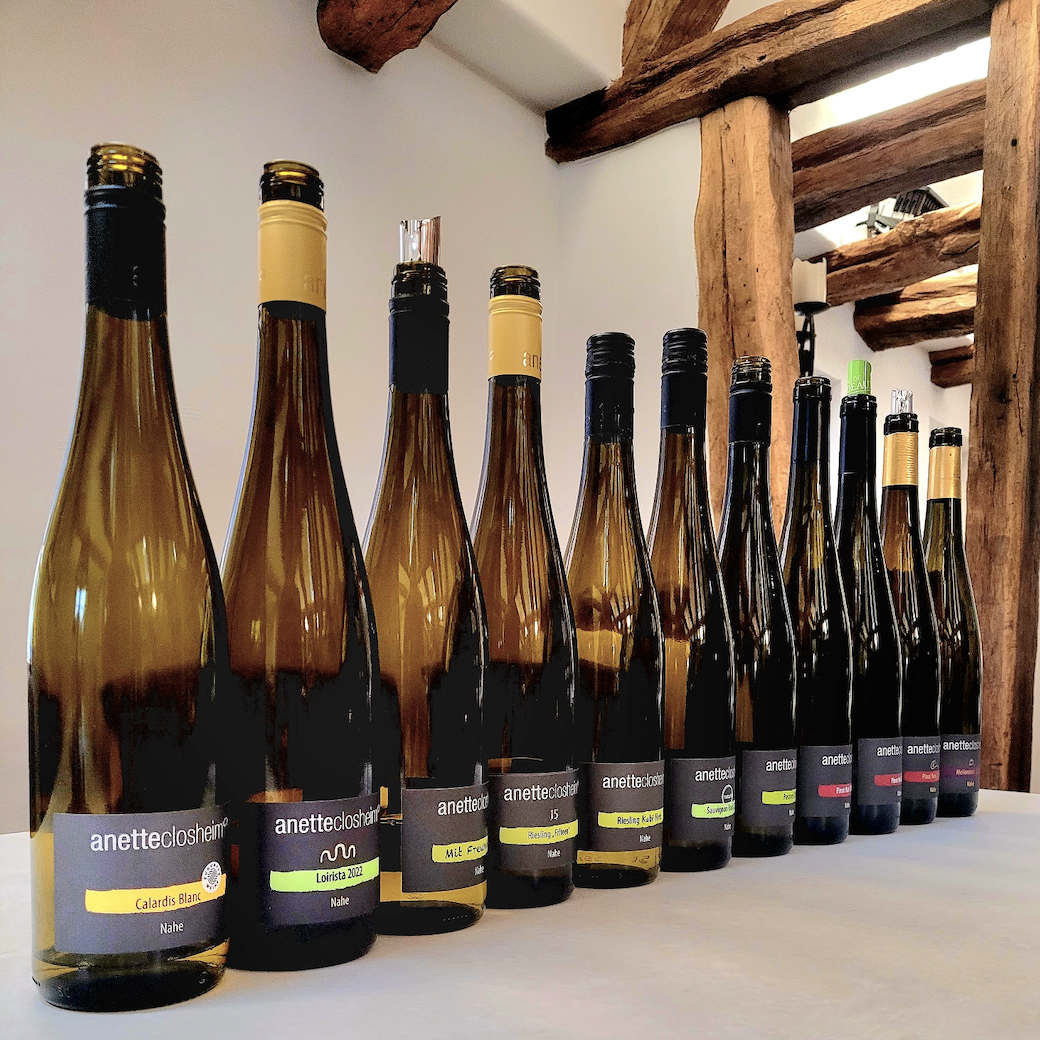
Weingut Anette Closheim Pinot Noir Dry 2016, Nahe

Considering the ripeness, well integrated chemistry and complexity of 2020 it should be really fascinating to look back at 2016. Still peppery reductive and surely a matter of vintage meeting winemaking that both changed within two years after this one. Quite a bit lower in alcohol, here at 13 percent and a perceivable verdant-savoury accent with no shortage of salt and pepper seasoning and added spice. Beyond the reduction this is showing really well, with cool freshness and what could be called a classic German vintage. A pinot noir naked to the world of beauty and that could not be hidden. First vintage was 2008 and since 2012 the same two vineyards have been making this wine. Drink 2024-2025.  Tasted March 2024

Weingut Anette Closheim Pinot Noir Dry 2019, Nahe

Higher percentage of stems (over 50) as compared with 2020, with moderate alcohol (at 13 percent like 2016). Now things are really interesting, also more new oak involved and clearly the thought was that this combination of ripeness and moderation could handle more structure and anti-jam developing fruit. Which turns out to have been the correct move because the wood is hidden, the succulence raised and the overall effect one of best balance. Truly well made, judged and effected pinot noir. Drink 2024-2027.  Tasted March 2024

Weingut Meilenstein 2020, Nahe

Meilenstein, meaning milestone and a wine that marked a big step from a wine that used to be based on point noir with st. laurent. A richness and a pyrazine quality, mildly smoky and really warming on the back end going down. A mix of 65 percent cabernet franc, (25) merlot and 10 acolon (a crossing of dornfelder and lemberger). A quarter new wood and 24 months for a spicy red blend with good energy. It’s woody and a bit awkward still but another year or so will do well to get it into a good place. Drink 2025-2028.  Tasted March 2024
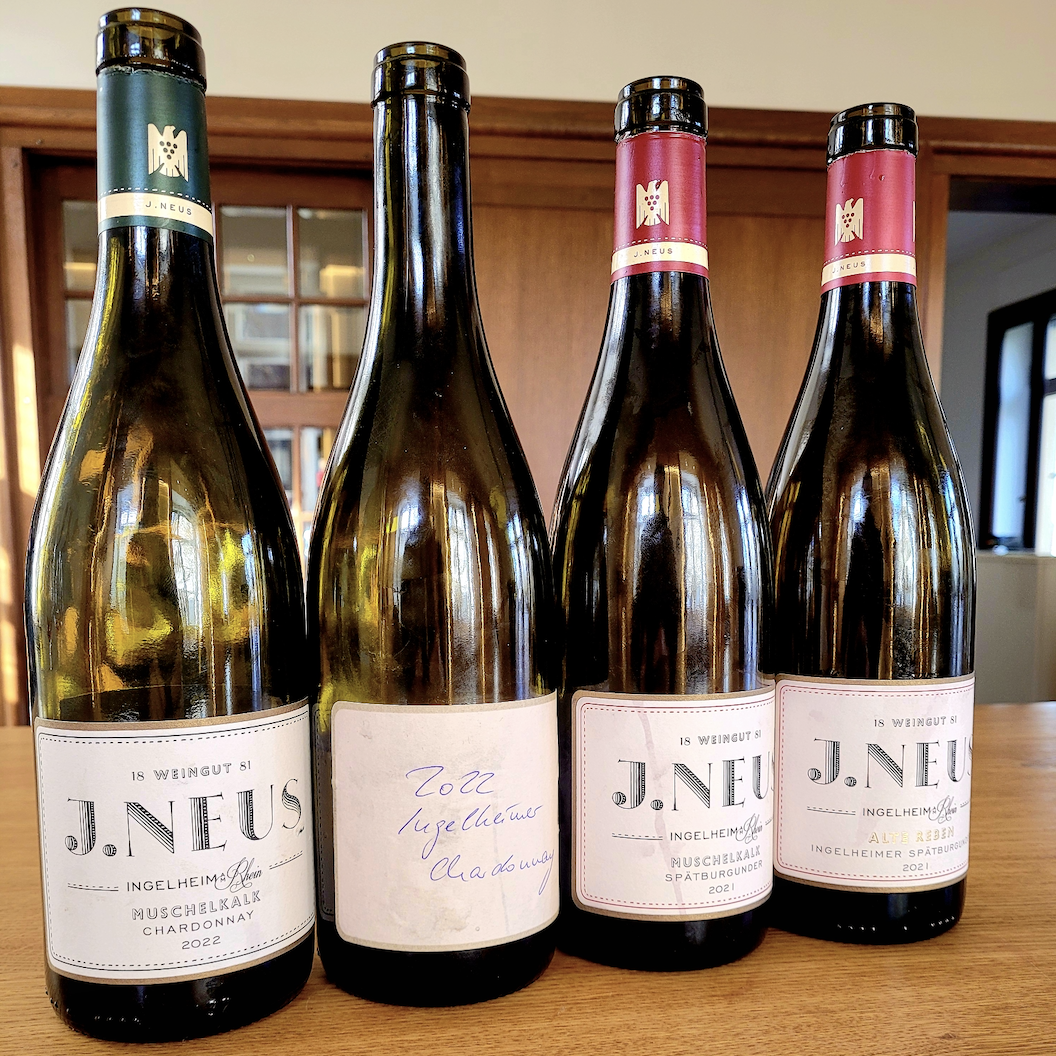
Rheinhessen

Weingut J. Neus – Ingelheim Am Rhein

J. Neus Chardonnay Muschelkalk 2022, Ingelheim Am Rhein, Rheinhessen

Chardonnay is increasingly important at J. Neus and while pinot noir represents 70 percent of the portfolio it is this kind of entry-level varietal wine that speaks to what is possible. All chardonnay is barrel fermented and aged in 500L tonneaux and some German wood. Simple but proper, subtle in all the important ways, especially texture. Impressive work for a barrel fermented and aged, full malolactic chardonnay. Good crunch, energy, vitality and persistence. Pure chardonnay expression, the new Rheinhessen personified for what white wine can be, especially in and around Ingelsheim. Drink 2024-2026.  Tasted March 2024

J. Neus Chardonnay Ingelsheimer 2022, Ingelheim Am Rhein, Rheinhessen

Ingelheim is the village and this is currently the higher tier chardonnay though a third is on the way so it will soon fall into the middle. Certainly shows more newer tonneaux and compactness on the aromatic front, less forthcoming and yet clearly more stylish. Smells richer and more expensive, transitions with tighter grain and intensity, fills the spaces in between with riper, woven and textured fruit. Then it’s all chalky limestone strikes with spice over the last moments of the wine. Vanilla rests and settles on the finish. Drink 2025-2029.  Tasted March 2024

J. Neus Spätburgunder Muschelkalk 2021, Ingelheim Am Rhein, Rheinhessen

The introductory pinot noir with a great part of it made with Neus clone grapes, genetically selected by Josef Neus who came from the Mosel and started the winery in 1881. Full on berry aromas in red but also blues, still quite primary as if it just recently come out of its fermentative machinations. So fruit forward and floral, truly unique oi the world of pinot noir and the vintage must have more than something to do with this result. Drink 2024-2026.  Tasted March 2024

J. Neus Spätburgunder Alte Reben Ingelheimer 2021, Ingelheim Am Rhein, Rheinhessen

Eminently and immediately notable to recognize more reduction, flint stone and less fermentative aromas as compared to the entry level Muschelkalk spätburgunder. The wood lends an early and persistent toasty quality while dried herbs and botanicals remind of the phenolics that a Neus pinot noir has been showing for a decade. That said the style has for sure softened and refined over the last seven years to arrive at this well founded time in its tenure. Many people will be surprised at this high level of Rheinhessen quality. Drink 2025-2028.  Tasted March 2024

J. Neus Spätburgunder Pares GG 2021, Ingelheim Am Rhein, Rheinhessen

A hot summer though the Grosses Gewachß spätburgunder are made from fruit grown in the coolest spots and picking was done in mid September ahead of the rains. Lively and spicy aromatics with acidity showing up even before a sip is taken. Red fruit of many ilk, from stone through citrus and yet the palate is quiet, namely because Pares is a much more mineral example than the other GG called Horn. Again the refinement compared to vintages such as 2014 shows the progression and evolution of Neus’ work with pinot noir. Approximately 3,000 bottles are produced between the two GGs. Drink 2026-2031.  Tasted March 2024

J. Neus Spätburgunder Horn GG 2021, Ingelheim Am Rhein, Rheinhessen

One of two single vineyard sites (along with Pares) on the Meinsebach side of the river and Ingelheim village. Horn is the warmer of the two sites and so the great immediacy of the Pares acidity gives way to greater depth of gratifying fruit maturity on Horn. More stone and less citrus but really the differences are subtle even while the breadth here surely elevates this unique GG. The vineyard faces southwest and texture really concentrates in a pinot noir that still shows off sweet acidity with top level spiciness and energy. Ripest stems are added back and again it just feels like this process has been refined over the last seven years to come to this really stylish point. Drink 2026-2032.  Tasted March 2024
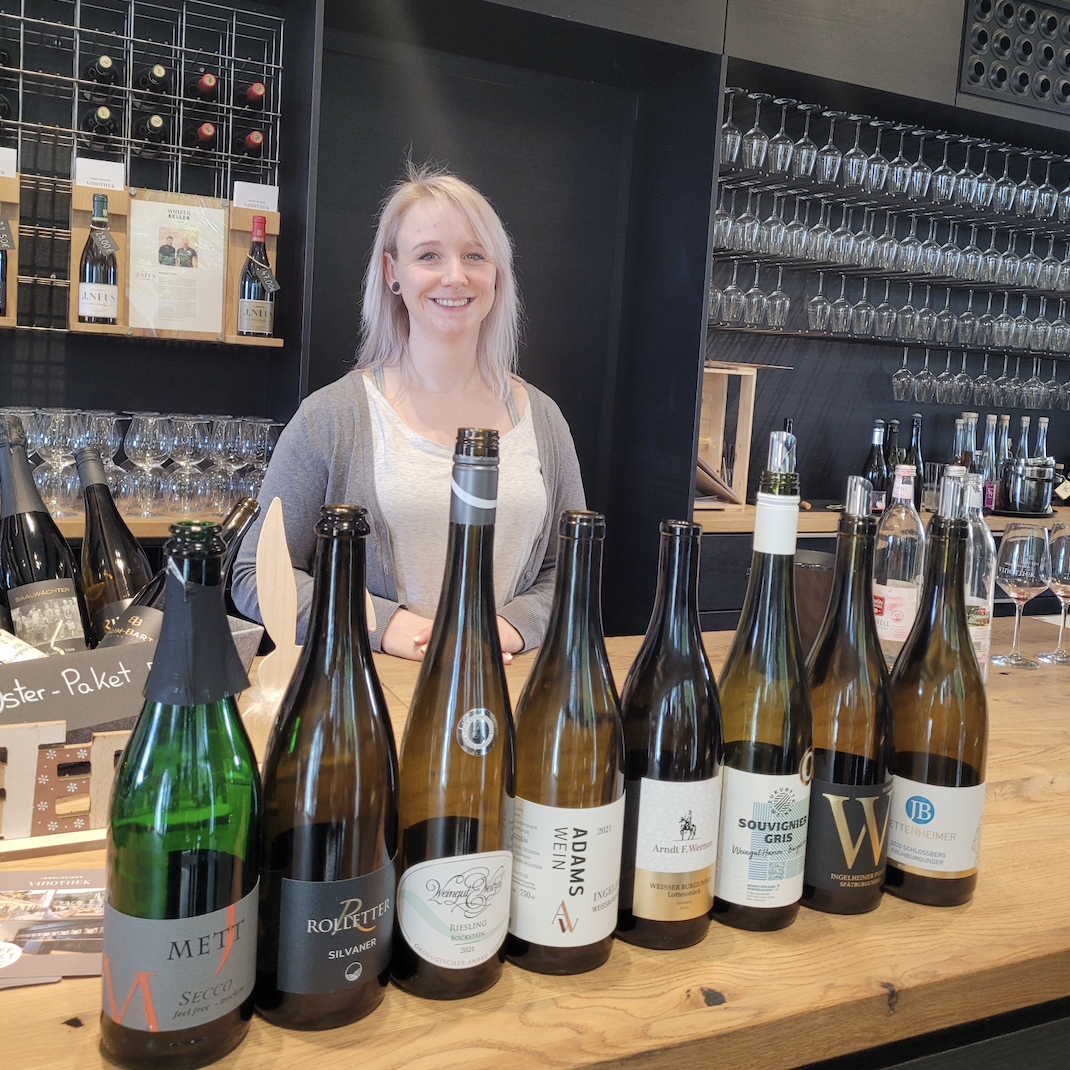
Shanna Reis – Ingelheim Vinothek

Rheinhessen tasting at the Ingelheim Vinothek with Shanna Reis

Organic Weingut Weitzel Riesling Spätlese Trocken Bockstein 2021, Rheinhessen

The work of Elke & Eckhard Weitzel with riesling of late harvest (somewhere between Kabinett and Spätlese) designation though also classified as dry. A bit of an oxymoron but this is in fact of a much lower residual sugar content for a late picked riesling. Lacks the energy and drive in the sugar-acid relationship of true or classic late harvest and so the simplified style drinks easily with straight lines and one-dimensional lime. Drink 2024-2025.  Tasted March 2024

AdamWein Weißburgunder Trocken Ingelheim 2022, Rheinhessen

Simona Adam is the winemaker, having taken over from her parents nearly 10 years ago. Creamy wood on the nose and even more so on the palate. Spice and pencil lead first, followed by lactic peach and vanilla after. A shot of tonic at the finish for a nicely complex if easy drinking white. Drink 2024-2026.  Tasted March 2024
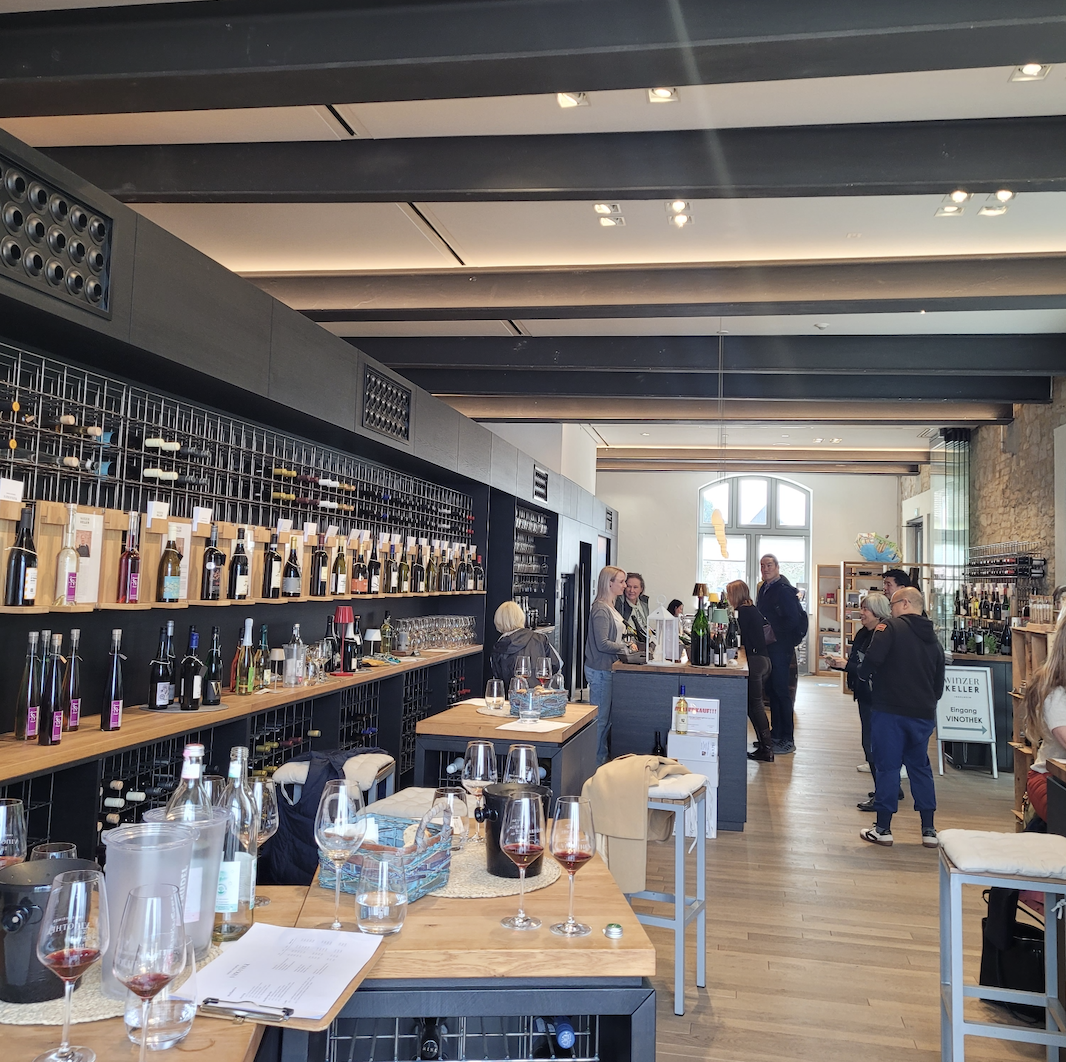
Ingelheim Vinothek

Weingut Arndt Werner Weißer Burgunder Trocken Lottenstück 2022, Rheinhessen

One of two local organic wineries doing weißburgunder (though for the consumer confusingly labeled “Weißer Burgunder) and a much fruitier, almost fruit punch, up front and round style of pinot blanc. Lower in acid and really just about the fruit. It’s weisser, meaning whiter, so the question is, how much more white can this pinot be? The answer is none more white. Drink 2024-2026.  Tasted March 2024

Weingut Hamm-Burgkirsch Souvignier Gris Weiss Trocken Zunkunftswein 2022, Rheinhessen

A Piwi grape, German cross between seyval blanc and zähringer created in 1983 by Dr. Norbert Becker. Strange that it was originally thought to be a cross between cabernet sauvignon and bronner and maybe because the grapes are quite dark pink in colour. The idea is sauvignon gris meets viognier and the style is not far from that type of union. The palate is more tropical and unctuous than what the nose might have indicated but there is a pungency and passion fruit-like note that advances aromatically after a sip is taken. Some sweetness and good acidity. Could really see people enjoying this. Drink 2024-2025.  Tasted March 2024
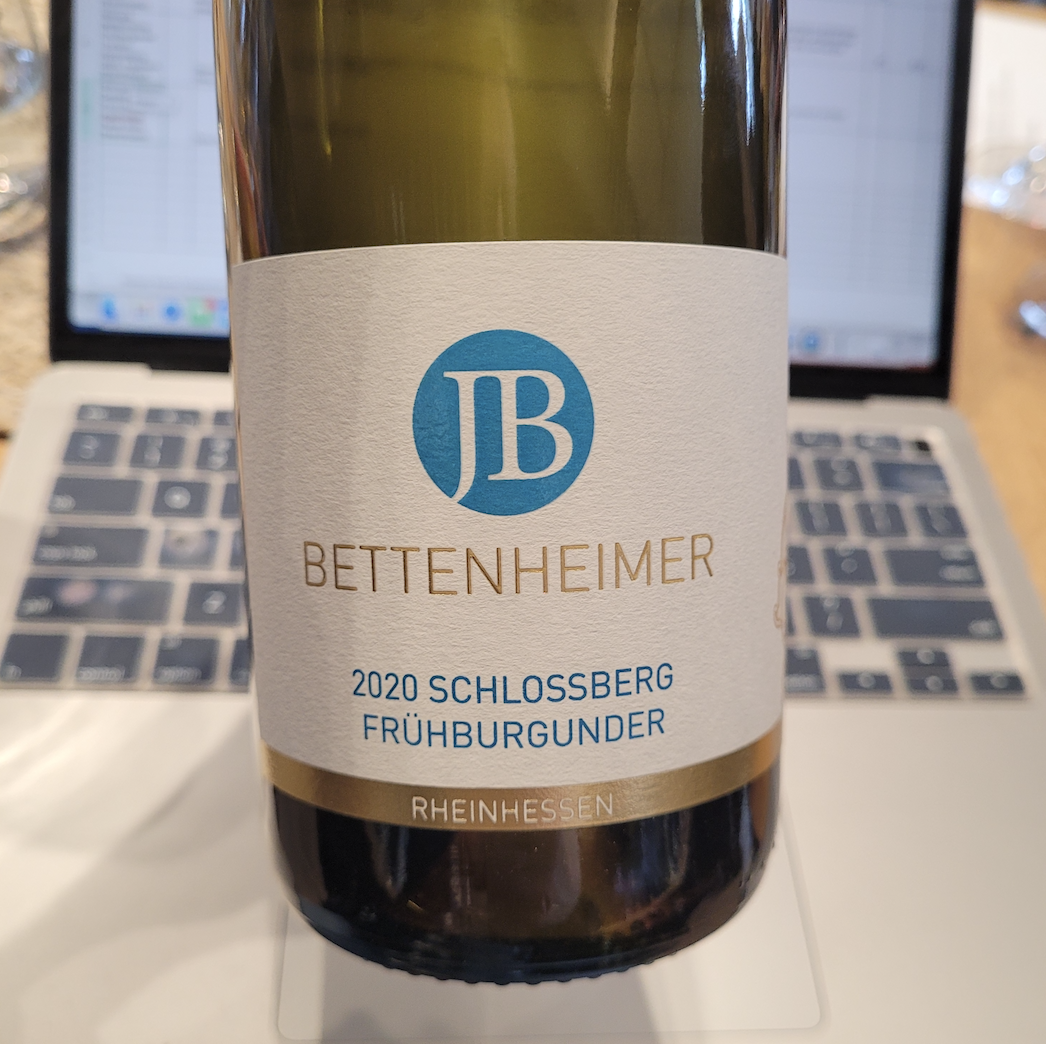
Weingut Bettenheimer Frühburgunder Trocken Schlossberg 2020, Ingelheim, Rheinhessen

Germany’s most interesting grape and perhaps its red future is frühburgunder, a.k.a pinot noir précoce or pinot madelaine, a cultivar that needs to be treated without great oak or pressed ambition. This is neither lithe nor heavy but some not so perfect wood makes the texture quite pasty and it settles uncomfortably on the palate. Some green tannin as well – pressed just a bit heavy it feels. Drink 2024-2025.  Tasted March 2024

Weingut Wasem Doppelstück Pinot Noir Trocken Ingelheimer Pares 2020, Rheinhessen

Some micro oxidative notes at this three-plus year stage though also a taut and compact sensation both on the nose and palate. Rich glycerin and viscous, plenty of cherry and cherry stone bitters for complexity but also a harshness at the finish. Doppelstück is a barrel name where more than one family makes wines but this pinot noir is made by two sisters of the family’s next generation – Doppelstück, meaning twice as big as a regular sized barrel. Very promising varietal wine, just a bit heavy pressed at this stage in its tenure. Drink 2024-2026.  Tasted March 2024
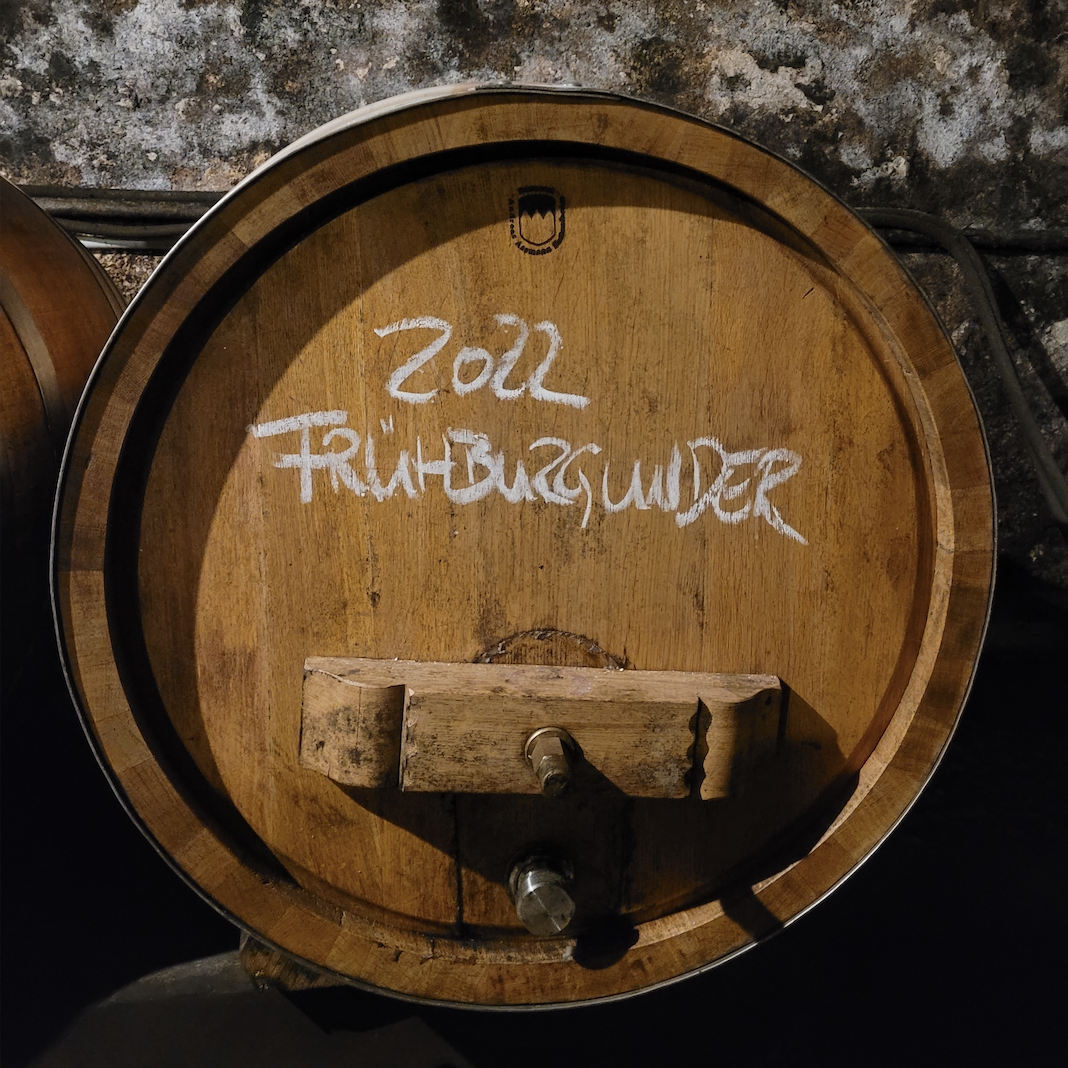
Menk Frühburgunder Trocken 2021, Ingelheim, Rheinhessen

Fresh and energetic frühburgunder with a briny note but some nice fresh raspberry fruit with leafy accents. Palate is a bit syrupy while overall acidity and drive are quite good. Drink 2024-2025.  Tasted March 2024

Baum-Barth Ingelheimer Frühburgunder 2021, Rheinhessen

Good ripe fruit, a bit oxidative but the bottle has been open for a few days. That said the tannic structure and energy are clearly based on an uptick of quality and overall intensity is really fine. Drink 2024-2025.  Tasted March 2024

Sebastian Münster Frühburgunder Cosmographia 2020, Ingelheim, Rheinhessen

Fine and well made frühburgunder with a lactic way about it and fruit really well connected to the structural aspect of the wine. A bit of red fruit paste and austere tannins so there is potential and the pressing was done with some fine restraint. No overriding green tannin but a tisane quality is part of the deal. Drink 2024-2026.  Tasted March 2024

Good to go!

godello

Twitter: @mgodello

Instagram: mgodello

WineAlign

Thörle Riesling, Truly Rheinhessen

Some of Germany’s finest #riesling coming to @TerroirTalk May 29th #thorle #Terroir2017 #christophthorle #saulheim #rheinhessen #terroirsymposium #holle #agotoronto

I first met Christoph Thörle when Wines of Germany rolled their Next Generation Germany roadshow through Toronto in May of 2014. I know that he knew based on my reactions to his Rheinhessen rieslings that we would need to rekindle the relationship at a later date. That opportunity came again in May of 2015, albeit briefly but it was this past March of 2017 that the true immersion took place. Even then it was too quick and too short. But that’s OK because Christoph and his brother Johannes have really only just begun their lifelong journey of winemaking and understanding in Saulheim.

Related – Godello’s March through Prowein, The Ahr Valley and The Rheinhessen

On day three of ProWein I jumped on the großer Magie Bus with 17 international journalists and headed for the Ahr Valley, followed by the Rheinhessen. We stopped in for a visit with Christoph Thörle at Weingut Thörle in Saulheim, the most progressive winery he started with his brother in 2006 after taking over from their parents. Thörle concentrates on natural ferments and they farm organically without certification. The vineyards are planted to 50 per cent riesling, 25 pinot noir and 25 mixed varietals; including silvaner and pinot blanc. The estate structures are narrow and long, mimicked in the vineyards, a leftover from Napoleonic times. This history must be kept in mind because there are so many different terroirs that all need to be kept separate. Fossilized oysters and mussel shells are found in the limestone, plus there is clay, iron-oxide, loam and yellow sands. The blocks roll out on wave-like, hilly landscapes over land that was once submerged beneath an ocean.

Godello with Christoph Thörle at Ball’s Falls, Ontario

The Thörle brothers make full use of their mixed vines ages and variegated terroir qualities to craft a range of riesling from Villages through Premier Cru and into Grand Cru level wines; Trocken, Feinherb, Kabinett, Spätlese and single-vineyard GGs from Hölle and Schlossberg. Their bottles of Weissburgunder and Spätburgunder are anything but afterthoughts and with climate change gaining speed, pinot noir will only increase in importance, not just at Thörle but across the Rheinhessen.

Two class @terroirtalk #riesling fellas, @RavineVineyard Sultan of St. David’s @marty_werner and the Rheinhessen’s Souverän of Saulheim #christophthorle #terroir2017 #terroirsymposium

Christoph came back to Ontario this past May as a special guest speaker of the Terroir Talk Symposium. In advance of that Monday congress we spent a day in Niagara tasting at Flat Rock Cellars with cellar master Allison Findlay and then at Henry of Pelham with Daniel Speck, Ryan Corrigan of Rosewood Estates and Suzanne Janke of Stratus Vineyards. Terroir afforded the opportunity to revisit two of Christoph’s rieslings, the Kabinett and the Schlossberg GG. Back in March I tasted 11 wines at Thörle. Here are the notes.

The mythology of #thorle #riesling in Beerenauslese and Trockenbetenauslese #weingutthörle #gabsheim #rheinhessen #holle

Thörle Riesling Feinherb 2016, Rheinhessen, Germany (420091, Agent, $18.95, WineAlign)

Off-dry riesling does not always have to be bottled as such but in the Rheinhessen and at Thörle the category of Feinherb is anything but an afterthought. This started as a side fermentation in its first years but is now an important wine in the estate’s multi-tiered processes. The cuvée is gathered from younger vines plus one barrel of premier cru Saulheim fruit. A slight skin maceration (12-18 hours) is employed which helps to temper the tartaric acid though this will be swapped for whole bunch fermentation in warmer years. Hides some of its sugar, especially on the nose which is quite floral, of white flowers and honeysuckle. Honey and wax with sweet herbs bring all into playful light to taste, with plenty of sweet lime and lik-a-maid sour touches. For every Indian Food list in the world. Drink 2017-2020.  Tasted March 2017  thorle_c  thorleestatewinery  univinscanada  @thoerle  @UNIVINS  @germanwineca  @gen_riesling  

Thörle Riesling Saulheim 2015, Rheinhessen, Germany (WineAlign)

The Trocken and Feinherb bottles aside, this riesling denoted as Saulheim is the signature Thörle product and with succinct style represents this corner of the Rheinhessen, a renaissance region in west-central Germany, due south of Rheingau and southwest of Frankfurt. The fruit sources are several parcels and soils around the village, from vines 28-37 years old and an élèvage in 50 per cent old oak barrels. The avoidance of oaked flavours is part of the ultimate goal, that and balance in a riesling seemingly quite dry. A slight petrol aroma (perceived, or not, towards its future) submits to pure, crisp orchard fruit. Some glycerin and a mineral saltiness will aid in developing these notes over time. As opposed to other regions in Germany and their four levels of quality definitions, the Saulheim here sits between a villages and a Premier Cru, as it is written on the label and as it is defined by its soils. Drink 2017-2020.  Tasted March 2017

Thörle Weissburgunder Saulheim 2015, Rheinhessen, Germany (WineAlign)

Weissburgunder from Saulheim is dubious here as a very dry pinot blanc, presented in that between villages and cru level. The Thörle oeuvre is all about combing and combining soils, “to show the other grapes of Germany,” and expressly important for Rheinhessen. The ’15 went into 500L French Beaune (Allier) Tonneaux. A hot summer so clearly lifts ripeness but says Christoph, “we left it a little bit shorter under the flame.” The oak is 30 per cent new and it really hides it, despite the lower acidity but the wood helps to usher it along and replace the tannins not always originally there. The net function is one third naturally unforced malolactic and good crisp orchard fruit with crunch and persistence. Drink 2017-2019.  Tasted March 2017

Thörle Riesling Hölle 2015, Rheinhessen, Germany (WineAlign)

Hölle is a single-vineyard of high limestone at 35 degree steepness and housing 42 year-old vines, planted by Christoph’s grandfather. Minimal air flow in this valley during the day makes for a warm, still place. So dried fruit results; peach, apricot and plum. I find this streaking in liquid limestone chalk, glistening in glycerin consistency, nearly bone dry and popping in pearls of fine acidity. So focused and precise. This shows precocious acumen, wisdom and patience. Both the fruit and the mineral are never shadowed or will one defeat the other. Let it rest a year or two because the secondary notes will blow you away. Drink 2018-2026.  Tasted March 2017

Thörle Riesling Schlossberg 2013, Rheinhessen, Germany (WineAlign)

Schlossberg is a vineyard in the north of the (Saulheim) village, closer to the Rhine, on clay, iron-oxide and further down, limestone. With converse effect (in relation to Hölle) this higher and cooler spot carries with it more wind and airflow. This and the tenet of a cool 2013 vintage results in quite the floral riesling but it’s also noted by the hint of smoke, flint and therefore, great potential development. The nose is full of flowers to suggest glycerin and petrol even if it’s not quite yet in tune. The body is graced by more structure and variegated soil tang. It’s not dry but it acts dry without austerity or unnecessary intensity. More roundness, body and soul. Drink 2019-2028.  Tasted March 2017

Thörle Spätburgunder Saulheim 2015, Rheinhessen, Germany (WineAlign)

Spätburgunder Saulheim is villages level, aged in 20 per cent (225L) barriques and 80 per cent old barrels for 12 months. It’s a blend of three vineyards, 30 year old and 15 year old vines. Typical for northern Rheinhessen pinot noir, with no stem inclusion, done in open top fermenters and with no added yeast. It’s a palpable mouthful of glycerin fruit, morello cherry, raspberry and a touch of sweet orange. Made in a reductive style, in avoidance of volatile acidity. Quite silky with a liquid limestone, dusty chalk feel. Much prettier and brighter than most and just enough fine grain tannin to make it last five plus years. Drink 2018-2022.  Tasted March 2017

Thörle Spätburgunder Hölle 2014, Rheinhessen, Germany (WineAlign)

Hölle is pinot noir at the Grand Cru (Grosses Gewächs, Großes Gewächs, or GG) level, from the middle part of the slope where plantings owe their history to the 1971 German clone. The élèvage is 20 months in 50 per cent new barrels, similar to the Saulheim but fortified by an extra year in respect to the single vineyard. The cherries and the raspberry repeat but in a deeper liqueur with bigger grains of tannin. Though a comparison is fruitless this is the most NSG of the German pinot noir. Smoky, meaty, and blessed with full on density in structure that will allow it to travel long. Drink 2019-2025.  Tasted March 2017

Thörle Riesling Kabinett 2015, Rheinhessen, Germany (WineAlign)

Thörle’s estate level Riesling Kabinett 2015 comes from young vineyards and is harvested at the beginning of October. It’s a matter of natural fermentation in the cold cellar (at a maximum 22 degrees) and takes 8-10 weeks, then cooled further at seven to eight per cent alcohol. Green tinged, green citrus, crisp and fresh like a bite out of both a green apple and a ripe peach. Pure and refreshing Kabinett to drink by the bucketful, on the beach or wherever works, from now through its 10th birthday. Drink 2018-2024.  Tasted March 2017

Thörle Riesling Spätlese 2015, Rheinhessen, Germany (WineAlign)

The Spätlese was harvested two to three weeks after the Kabinett and with no botrytis, in other worlds, fully healthy grapes. Looking at it now it shines lucent in a yellow-orange hue. The aromatics and flavours repeat what the colour tells them to. A bit less gregarious than the Kabinett, the nose hints at stone fruit and also a smoky, flinty note. More citrus to taste than you’d expect but this added complexity goes along with ripe peach, apricot, passion fruit and even methinks some guava. So focused, of clean lines, pure, precise, linear and inwardly intense. Drink 2019-2027.  Tasted March 2017

Thörle Riesling Beerenauslese Hölle 2011, Rheinhessen, Germany (WineAlign)

Only 350 bottles were produced of the 2011 Riesling Hölle BA (Beerenauslese), an intense Rheinhessen late harvest with “not only a little botrytis but the perfect weather for sweet wine.” Rain in September and the intangible brought on the botrytis and then warm weather persisted through the harvest. The residual number 150 is the minus for sugar but this reached 186 g/L. So much stone fruit with good acidity. Apricot, longan and mangosteen but also this sweet basil note. A wine of clarity, the freshest botrytis, so juicy and as clean a BA as you are ever going to taste. A bit of spice at the end shows further complexity. I’d like to see three years of development so that these notes all contrive to morph and begin anew. Drink 2020-2036.  Tasted March 2017

Thörle Riesling Trockenbeerenauslese Hölle 2011, Rheinhessen, Germany (WineAlign)

The Hölle TBA 2011 is a minuscule 180 bottle single-vineyard production and the vintage was simply perfect for the effort. The process involved the collection of a few berries at a time over the course of three weeks, started in the fridge and was then pressed when the amount of approximately 100L could be obtained. “This is the king’s discipline for creating such a riesling” explains Christoph Thörle. Thick like honey, full of unctuousness and viscosity. It is expressly noticed how the colour and the development have not advanced considering the six year mean. The exoticism is what separates this, with fruits far east, creamy and perfectly easy to assimilate, in flavour, consistency and understanding. Sweet herbology, of thai basil and thyme and candied mandarin rind. Here, a piece of history and legacy from Christoph and Johannes. Drink 2021-2041.  Tasted March 2017

Good to go!

Godello

Twitter: @mgodello

Instagram: mgodello

WineAlign

Eleven fifteen

"We ate flank" "You ate flank?" "We ate flank."

“We ate flank”
“You ate flank?”
“We ate flank.”

It may just be my favourite time of day. The flurry begins at seven. It takes four hours to shake off the rust, clear the morning ill, brush away the demands piled up since the night before and effectively settle the morning score. By a quarter past the hour calm begins to set in. 11:15. And now, a bit of Torah, Bible and liturgy.

The imagery of sweet rock ‘n roll, Revelations style is synonymous with the farthing, quartern, mid-morning, all change of pace: The Seventh Trumpet. The day after the Shofar has sounded to end the holiest of holy Jewish days, a sonorous wind-blown through the ram’s horn, a call to lead a flock home and into a new year. Is there a connection between the purpose of the blowing of the Shofar on Rosh Hashanah (and Yom Kippur) and the end of satan’s authority at the Seventh Trumpet?

The seventh angel sounded his trumpet, and there were loud voices in heaven, which said:

“The kingdom of the world has become
    the kingdom of our Lord and of his Messiah,
    and he will reign for ever and ever.”

The Shofar. Old Testament instrument as central element of the Rosh Hashanah liturgy. The summoner to assemble before the Lord, a sound for battle and the announced coronation of a new king. New Testament return of Christ in the clouds to gather God’s people via rapture, sound the Lord’s wrath of battle cry and Christ’s returning as the King of the world. Seems obvious enough but where is the eschatological connection: How does the Jew’s attempt to summon God’s past and promised redemption share common ground with the Christian’s call to Satan?

https://www.youtube.com/watch?v=tFGYEkUQ0eY

A rabbinic tradition may indicate that the shofar is sounded on Rosh Hashanah to confuse Satan (or some he who shall not be named evil tempting spirit). The multiple blows and shrieks invoke the idea (and promise) that the Messiah had arrived and thus putting an end to the pernicious authority. Revelations agrees. “It is time for the dead to be judged. To reward your servants, the prophets, the saints, and all who fear your name, both unimportant and important.”

There’s an angel standing in the sun, 
and he’s crying with a loud voice, 
“This is the supper of the mighty one”, 
Lord of Lords, 
King of Kings, 
Has returned to lead his children home, 
To take them to the new Jerusalem.

Nah. It’s simply a matter of judgment and kingship. Like suggesting wines from a VINTAGES release. October 15th is but two days away. At 11:15 am you may just be arriving at your local LCBO in search of a few bottles. Here are 11 recommendations.

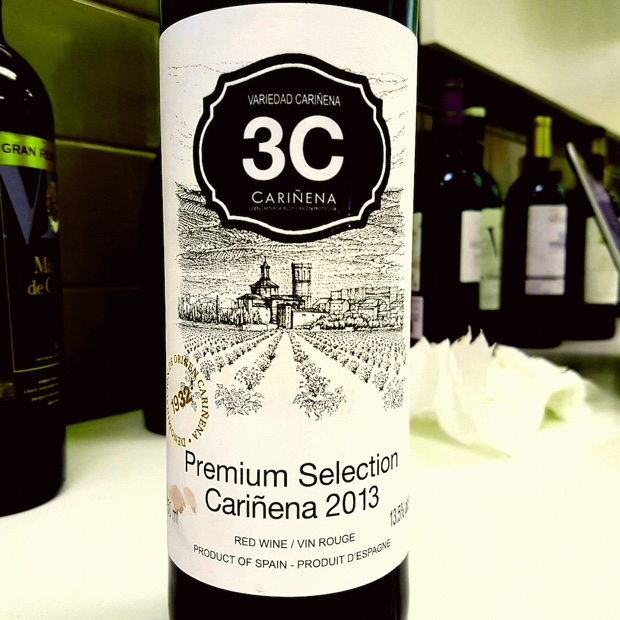
3c

3c Premium Selection Cariñena 2013, Do Cariñena, Spain (461350, $14.95, WineAlign)

The grape the place come across with classic Cariñena firmness and regional culture out of the impressive Grandes Vinos e Vinedos cooperative. You may recognize Spain’s third largest cooperative as the producer of Beso de Vino garnacha. The 3c is juicy and gregarious like so many garnacha but here as cariñena, with moderate alcohol, acidity and amenable tannin. This represents very good value for the price, as well as the brusque and breviloquent Aragonese appellation. Drink 2016-2019.  Tasted September 2016  @VinosCarinena  @Noble_Estates

Fielding Estate Bottled Riesling 2015, VQA Beamsville Bench, Niagara Peninsula, Ontario (251439, $19.95, WineAlign)

The Bench can’t help but determine the style but what winemaker Richie Roberts is able to gather and concede is what needs from the vintage. The brutal winter and subsequent mild, calm and elongated season means that acidity can be tempered, sugar should play a small role and fruit will lead the way. In this riesling it does, with help, let and place from the support staff. Really juicy, slightly tart, citrus-spiced and purely Bench styled. Proper. Drink 2016-2020.  Tasted September 2016  @FieldingWinery  @RichieWine

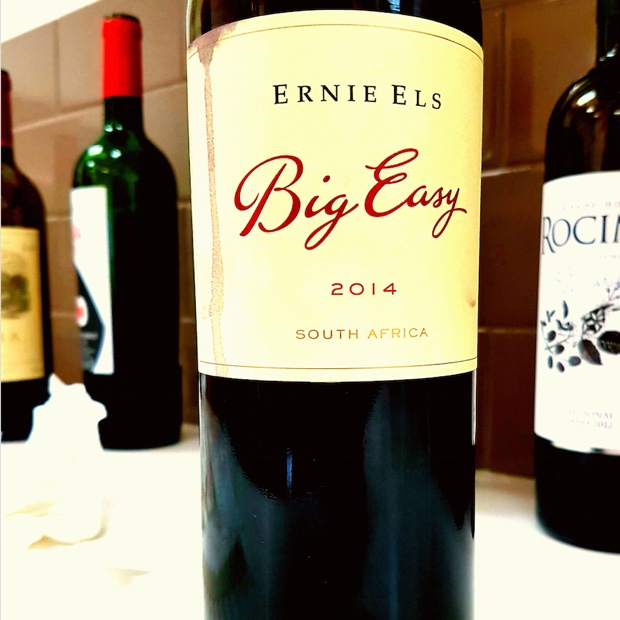
easy

Ernie Els Big Easy 2014, Wo Western Cape, South Africa (220038, $19.95, WineAlign)

This latest Big Easy swings harder than the previous 2013, a wine that quietly emulated its founder’s approach. This 2014 displays more grit, firm grip and big dog length. This is no three-wood off the tee, lay up or fat part of the green safe play. This goes straight for the pin, over water, false fronts be damned and defiant to danger all around. It’s exciting and full-throttle, high acid and risky. But the reward is now, busily bursting with energy, not mired in tannin and ready to play. Makes for great TV. Drink 2016-2018.  Tasted September 2016  @ErnieElsWinery  @TheBig_Easy  @VintageTrade  @_AlexHamilton_  @WOSACanada  @WOSA_ZA

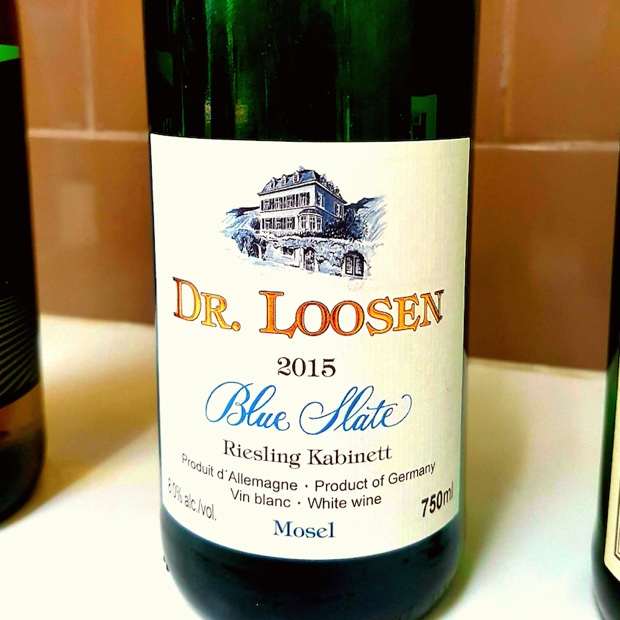
loosen

Dr. Loosen Blue Slate Riesling Kabinett 2015, Prädikatswein, Mosel, Germany (160846, $22.95, WineAlign)

Tremendous verve, vitality and energy from buoyant and round acidity brings immediate balance to sweet citrus and tart tropical fruit. This Mosel ripper has a tender side and will sooth many a savage beast. Kind of like Elvis. If you want to turn someone onto riesling this is a wonderful place to start. So good and worth protecting. “Well, you can do anything but stay off of my blue” slate riesling. Drink 2016-2024.  Tasted September 2016  @drloosenwines  @Select_Wines  @germanwineca

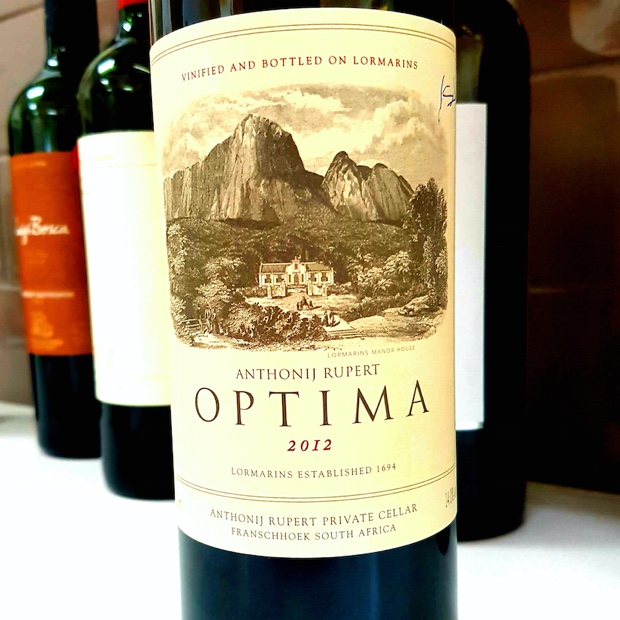
optima

Anthonij Rupert Wines Optima L’ormarins 2012, Franschhoek, South Africa (455915, $24.95, WineAlign)

Franschhoek Bordeaux stylistic defined in affordability by structure and for dark, depth of fruit. Espresso dusty and soil imparted make for the specific Anthonij Rupert departure. The headline reads: Unheralded and righteous outfit makes red blend to go the distance. Drink 2018-2024.  Tasted September 2016  @AnthonijRupert  @Vinexxperts  @WOSACanada  @WOSA_ZA

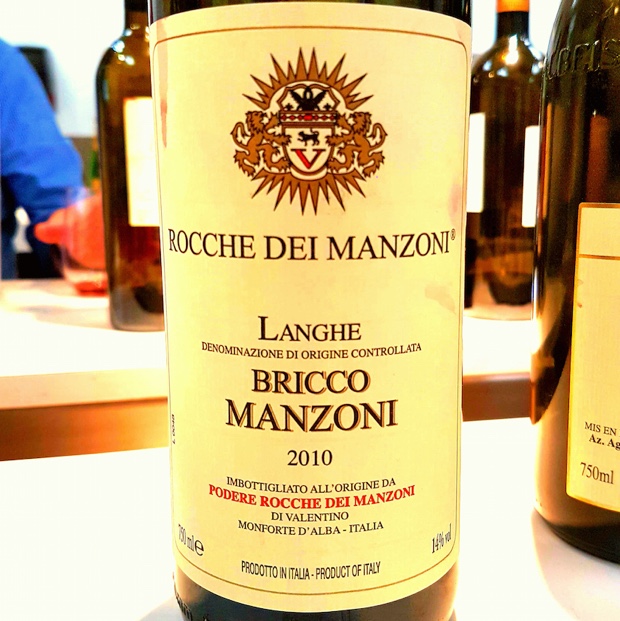
manzoni

Rocche Dei Manzoni Bricco Manzoni Langhe Rosso 2010, Doc Piedmont, Italy (459651, $38.95, WineAlign)

And then there were three; Barolo, Barbaresco and Langhe. Here a serious perfume and brooding emits from Manzoni’s Langhe Rosso, a back to the genesis of roots nebbiolo highly skilled and deep into the motherlode of many equally appointed Barolo. “Ah well if you knew then, just what you know today,” the divergent paths of Langhe and Barolo may have been very different. Even if some of the Bricco Manzoni’s parts may walk at large the tannin is in your face and ready to rumble. There is a sweetness about the fruit and an oaky layering but darkness never descends upon this wine. It remains bright and alive. It will live for a decade or more. Drink 2018-2030.  Tasted September 2016  @RoccheManzoni

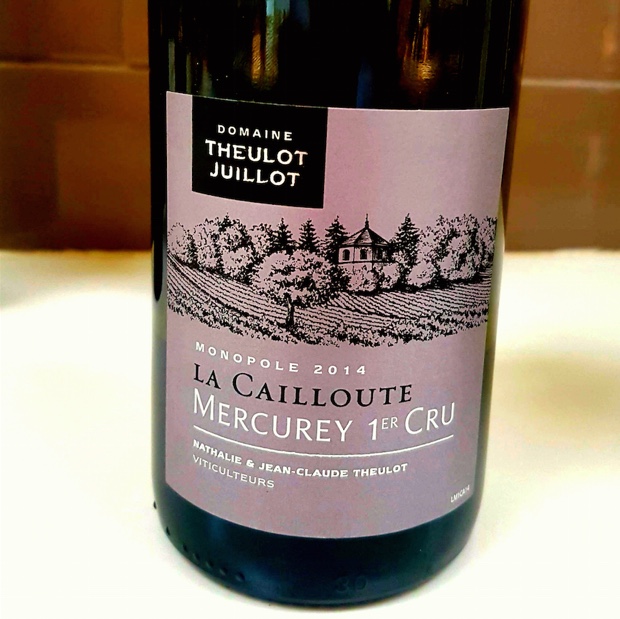
juillot

Domaine Theulot Juillot Mercurey Premier Cru La Cailloute 2014, Burgundy, France (473793, $39.95, WineAlign)

The beautiful dichotomous relationship between ripe and juicy opposite firm and sweetly tannic is met in this functional Mercurey, a premier cru of upbeat excellence. Very representative of place because of the grip but it goes light years beyond the lithe and the under-performed. You could pour this for Burgundy label chasers and they would cry sweet Nuits St. Georges. Raspberry and strawberry with plenty of umami minerality and that firm tannin up the back. Really tempurpedic acidity never reacts and always supports. This is a 10-15 year Mercurey. No fooling. Drink 2018-2029. Tasted September 2016  @vinsdebourgogne  @BourgogneWines

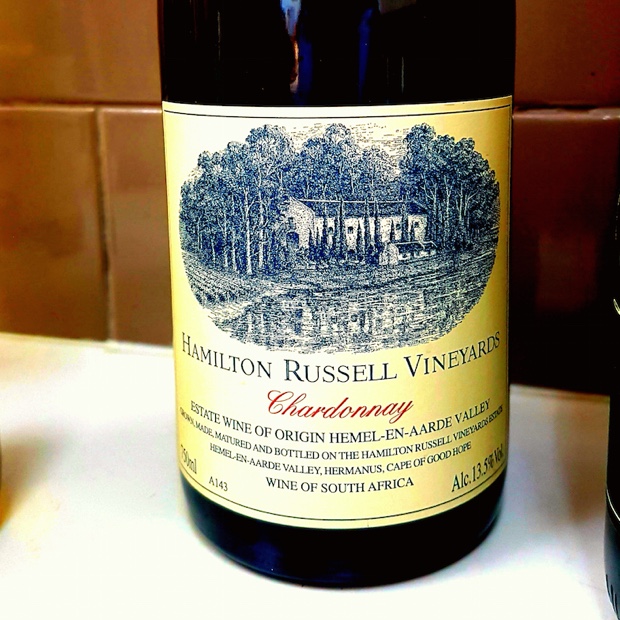
ham-russell

Hamilton Russel Vineyard Chardonnay 2015, Hemel-en-Aarde Valley, South Africa (931006, $42.95, WineAlign)

The pattern repeats in HR’s 2015 chardonnay, up there with the Cape’s most elegant and wholly indicative of the Hermanus oeuvre. Ripeness, just a hint of the barrel and windy sunshine locked up in chardonnay that could not come from anywhere but the Hemel-En-Aarde Valley. The finish allows for some noted sensations indicative of yeast, warm bread, drawn butter and a golden bathed afternoon. A time to linger and make a polite request of this chardonnay to indicate best show times in the near to not-to-distant future. Though tempting to drink now this will improve and up the elegance factor. Drink 2018-2023.  Tasted September 2016  @OliveHR  @WOSACanada  @WOSA_ZA  @hermanuswine

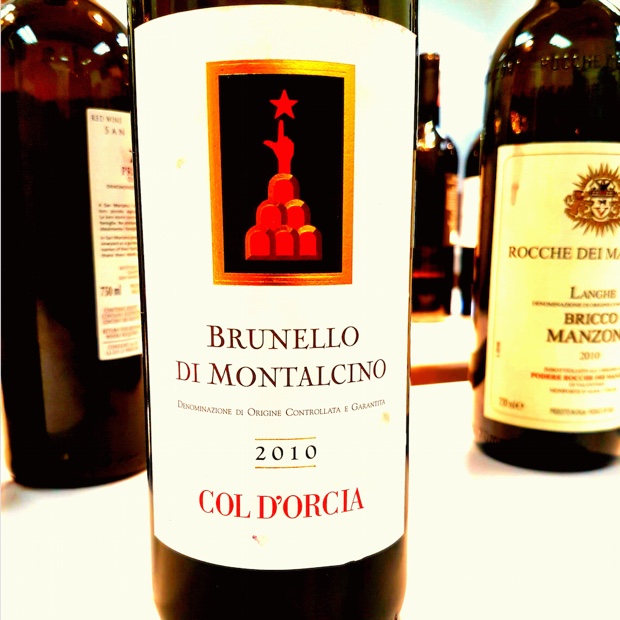
orcia

Col D’orcia Brunello Di Montalcino 2010, Tuscany, Italy (306852, $49.95, WineAlign)

Largesse and a firmess of being as per the house style are rampant in Col D’Orcia’s 2010, a wine that reminds me of 1998 and 2000. A wine that will seem lean, mean and terrifying in its youth but will prove everyone wrong when it hits the 12-15 year stride. This is a monster bringing leather and chocolate to the table. It is nearly unapproachable at the present time but you can imagine and embrace the possibility of potential. Drink 2020-2035.  Tasted September 2016  @Coldorcia  @ConsBrunello  @DionysusWines

gagliardo

Gianni Gagliardo Barolo 2011, Piedmont, Italy (713602, $54.95, WineAlign)

Instinctive, intrinsically essential nebbiolo without any equivocation whatsover. The fruit at the core is the crux and the catalyst to aseemble the forces of Barolo entrance strategy. The floral freshness in potpourri does not concede any more quality than right here. Suave, gentle, restrained and yet so forthright, generous and inviting. The grip is right at the back, in the mouth and on the brain. Diligent, purposed and highly intelligent nebbiolo with decades of future ahead. Drink 2019-2039.  Tasted September 2016  @giannigagliardo  @WineLoversAgncy

ridge

Ridge Geyserville 2014, Alexander Valley, Sonoma County, California (723072, $63.95, WineAlign)

A deep and thoughtful vintage for Geyserville, from plenty of sunshine, deep aridity and top notch acidity. The fruit is wondrous, full of berries in all shades and even some black currants. Shadowing with less chocolate than some this is all about fruit with tannin to structure it for a long haul. So very Geyserville and nothing but pure pleasure in bottle. Drink 2019-2027.  Tasted September 2016  @RidgeVineyards  @VinoTorino  @rogcowines  @sonomavintners

Good to go!

Twitter: @mgodello

Instagram: mgodello

WineAlign

Ten best buys for June 25th

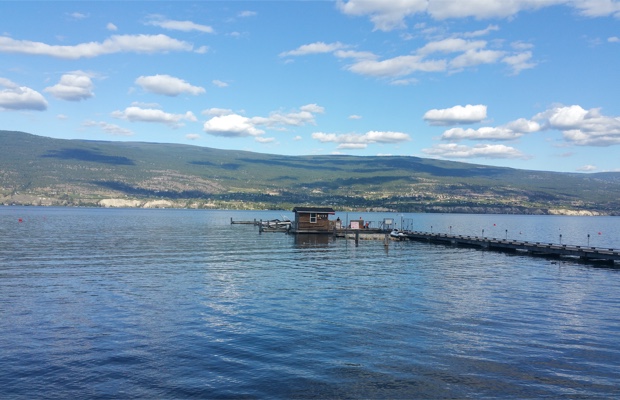
Summerland, Okanagan Valley, British Columbia

Summerland, Okanagan Valley, British Columbia

The Okanagan has my full, immediate attention, that and 1,525 wines from across Canada at the great show. We call them the WineAlign National Wine Awards of Canada, a.k.a. The Nationals and I will be judging all week from this glorious set of benches and hills in the golden west. Until next week, here are 10 picks from the June 25th VINTAGES release…Godello.

Jardin

Jardin Inspector Péringuey Chenin Blanc 2014, Wo Stellenbosch, South Africa (443473, $15.95, WineAlign)

A reductive chenin blanc with a distinctive struck stone aroma. With two minutes air the chenin begins to assert itself and from its Stellenbosch origins. Grest preserved and compressed citrus, lively acidity, soul from soil tang and terrific intensity. Length extrapolated from price of a better than good equation. Drink 2016-2019. Tasted June 2016  @Jordan_Wines  @AbconWine  @WOSACanada  @WOSA_ZA

Domaine Les Yeuses Les Épices Syrah 2013, Igp Pays D’oc, Languedoc-Roussillon, France (177584, $15.95, WineAlign)

Consistently one of the greatest Syrah values on the planet, Les Yeuses smells like the Northern Rhône with familial ties in the Swartland. Smoky and meaty, spiced with all hues of peppercorn, deep and variegated. A remarkably complex syrah for a pittance. Like cassoulet, “it’s a little bit of this and a little bit of that.” Even better with a whole roast; duck, chicken or hip of beef. Drink 2016-2019.  Tasted June 2016  @les_yeuses  @cartowines  @LanguedocWines

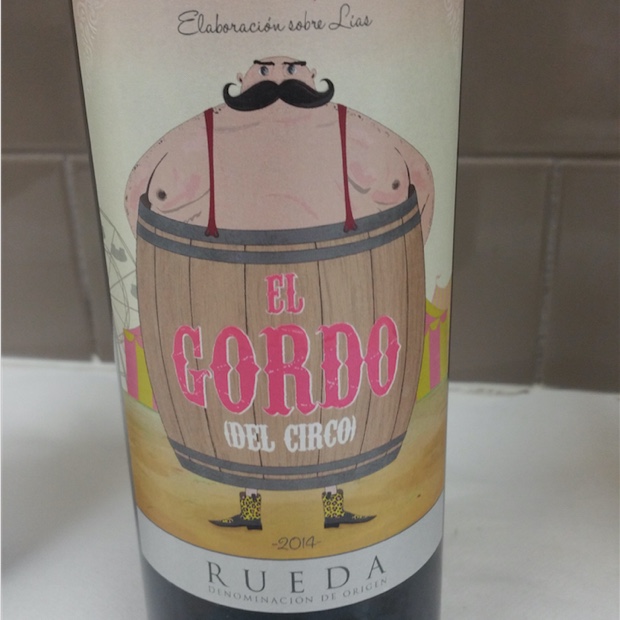
El Gordo

El Gordo Del Circo Verdejo 2014, Do Rueda, Spain (441220, $17.95, WineAlign)

The ballad of El Gordo is a soft and fuzzy peach big star. Yes this tastes just alot like the candy but with sweetness replaced by savour. This carries a country riff and electric tang of commercial, albeit alternative broadcast feel. El Gordo is El Goodo, verdejo to sip when “it gets so hard in times like now to hold on.” Rueda for the people, like a #1 record that stands the test of time even if it never really sold all that well. Drink 2016-2018.  Tasted June 2016 @RutaVinodeRueda  @WineLoversAgncy

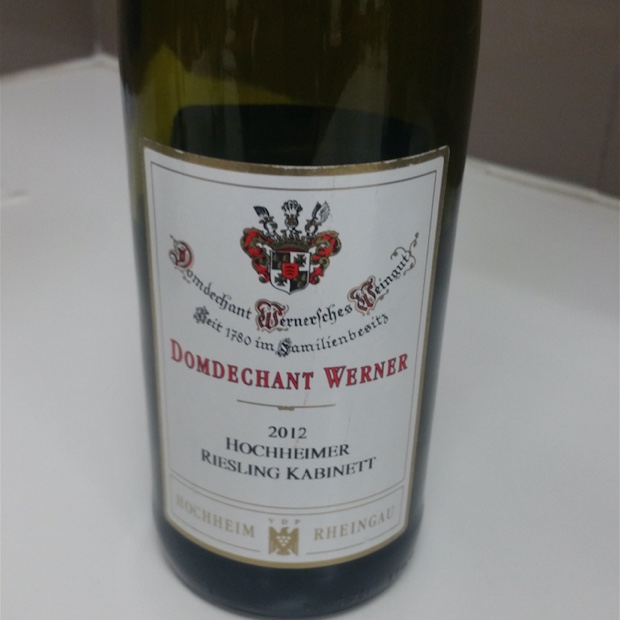
werner

Domdechant Werner Hochheimer Riesling Kabinett 2012, Rheingau, Germany (722413, $21.95, WineAlign)

A terrific off-dry riesling with intense tart flavours and omnipresent circulating acidity. A range or stone fruit invades the aromatics; peach, apricot and nectarine. Tropical yes but grounded, struck flinty and so full of energy. One sip and feel the energy buzz, the lightning strike, the rush of adrenaline. Amazing. Drink 2018-2025.  Tasted June 2016     @HHDImports_Wine  @germanwineca

cahors

Château Eugénie Cuvée Réservée De L’aïeul Cahors 2013, Ac Southwest, France (295949, $22.95, WineAlign)

This is a striking malbec with bursting aromas, mostly floral but also of an inhalant that elicits modern sangiovese, from grosso to Gran Selezione. It is rare for malbec and also Cahors to be imagined as born in an ancient cellar yet having come to fruition in a modern vineyard. This cuvée is a major step up from the house’s basic malbec, with deep, profound fruit and restraint found. Barrels and soil funk are certainly part of the mix, but so is traditional acumen. Beautifully crafted and structured red that will benefit from two years settling. Drink 2018-2025.  Tasted June 2016   

HB

Hidden Bench Estate Riesling 2014, VQA Beamsville Bench, Niagara Peninsula, Ontario (183491, $23.95, WineAlign)

The thing about a Hidden Bench riesling is its ability to mark a bench twain. Neither dry and stark nor sweet and unctuous, the balance struck is a factor of the house. This 2014 carries the strong torch of energy and vitality but it seems a bit more arid and direct than before. The lemon condense is at an all time high, the major zest and minor pith as important as the juice. Would like to see this find some age. Drink 2016-2021.  Tasted June 2016  @HiddenBench  @BenchVigneron

tawse

Tawse Laundry Vineyard Cabernet Franc 2012, VQA Lincoln Lakeshore, Ontario (130997, $31.95, WineAlign)

The richest and deeply phenolic Laundry Vineyard cabernet franc, likely to date, from fruits of labour expressed with plum, red currant, Ontario strawberry and raspberry compote, so much so that it warms the heart. Wood is but a blanket to keep the draught out, nothing more and it will slowly peel away as the years roll on. The spice in here is so beautifully baking with home kitchen delight. The sweetness is pure extraction, dry and rehydrated. Paul Pender’s management in Laundry ’12 is one of his finest works to date. You could absolutely drink this now and also watch it slowly turn over 10 years time. Might it have been the last? Drink 2016-2022.  Tasted June 2016  @Tawse_Winery  @DanielatTawse  @Paul_Pender

Cuvée Du Vatican Châteauneuf Du Pape 2012, Ac Rhône, France (719120, $38.95, WineAlign)

Though you know it’s going to be a big Rhône red it hits you anyway, with waves over the head by ripeness and mineral intensity. While balance is a four letter word in wines like this, you have to grow up and mature a bit to appreciate the nuance hidden in the brawn. There is nothing shy about Châteauneuf-du-Pape these days and especially in bottles like this, of unabashed hedonism and enthusiasm. This Sixtine will drink as it precociously does like this for a decade because the structure and the burly bones will take long to break. Drink 2017-2024.  Tasted June 2016  @VINSRHONE  @RhoneWine

Domaine Michel Juillot Mercurey Les Champs Martin 1er Cru 2012, Ac Burgundy, France (455089, $45.95, WineAlign)

This is a most beautifully volatile pinot noir that represents more than virility and exceptional quality for the village. Mercurey can be tough as nails and while the undercurrent here is firm, rigid and unbreakable, the roses are nothing short of flattering, hypnotizing and intoxicating. What this Mercurey lacks in preciousness it more than makes up for in talent, strength of character and trailing length. Drink 2018-20225.  Tasted June 2016  @TheCaseForWine   @BourgogneWines  @bourgognespress  

Bott

Domaine Bott Geyl Schoenenbourg Grand Cru Riesling 2012, Ac Alsace, France (456970, $50.95, WineAlign)

Incredible richness seeps from Christophe Bott-Geyl’s Schoenenbourg riesling, with alternating layers of aridity and tannic sweetness. So different from Bott-Geyl’s Mandelberg, in which early morning sun and hastily picked fruit resolves a more unctuous, nearly tropical expression. Here out of marl-gypsum you note the scratched and scraped stone, the liquid left behind as whitewash residue, the sugar playing upon that rock, devouring the mineral, defining the wine. It’s all quite remarkable. The Schoenenbourg lingers forever. Drink 2016-2022.  Tasted June 2016  @bott_geyl  @VinsAlsace  @AlsaceWines  @drinkAlsace  @VinsAlsaceQc

Why wouldn't you grill #asparagus and why wouldn't you use @barquebbq rubs?

Why wouldn’t you grill #asparagus and why wouldn’t you use @barquebbq rubs?

Good to go!

Twitter: @mgodello

Instagram: mgodello

WineAlign

Facebook

All in the Primum Familiae Vini

Primum Familiae Vini tasting at Toronto's Four Seasons Hotel, April 23rd, 2015

Primum Familiae Vini tasting at Toronto’s Four Seasons Hotel, April 23rd, 2015

Can there be a more visceral wine experience than tasting some of the world’s greatest wine estates and all the while their principals just seem to only talk about history and family? Makes me think about parents, grandparents and children. About accomplishments, passing torches and smelling roses. Or something like that.

Perhaps it was the news of Etienne Hugel’s passing that was the impetus for me to relive this day, where giants gathered and mere mortals did their best to take in the magnitude of such a coterie of distinction. That afternoon gifted me and others their five minutes with Mr. Hugel, the epitome of Alsatian, a tireless ambassador for the Hugel brand, Alsace wines and the Primum Familiae Vini congregation of producers. Or maybe it was just the right time, a crossroads one year later where the confluence of circumstance and thought conjoined to let the notes come out.

Primum Fam

Tastes of PFV

As a stark contrast to the increasingly agitating globalization of wine, the Primum Familiae Vini members stand out as leading wine families whose aim it is “to defend and promote the traditions and values of family owned wine companies, and ensure that such ideals survive and prosper for future generations.” The PFV is an international association of some of the world’s finest wine producing families from France, Germany, Italy, Portugal and Spain. Created in 1992, membership into the organization is by invitation only, with a maximum of 12 highly respected families contributing generations of expertise.
PFV

PFV

The PFV estate principals arrived in Toronto for an April 23rd, 2015 Press Lunch at the Four Seasons Hotel organized by wine ambassador Christophe Brunet. On hand were Hubert De Billy, Etienne Hugel, Laurent Drouhin, Egon Müller, Miguel Torres, Priscilla Incise della Rocchetta, Thomas Perrin, Allegra Antinori, Julien Beaumarchais de Rothschild, Pablo Alvarez and Rupert Symington. Each arrived to represent eleven of the world’s leading families that at the time of the tasting, made up the association: Marchesi Antinori, Château Mouton Rothschild, Joseph Drouhin, Egon Müller Scharzhof, Hugel & Fils, Champagne Pol Roger, Famille Perrin, Symington Family Estates, Tenuta San Guido, Miguel Torres and Vega Sicilia. Each family owns vineyard estates, is one of its country’s most prestigious producers, and enjoys an international reputation for its wines. Each year in turn, a member of the association is elected President. The 2014/2015 President was Alessia Antinori, while in 2015/2016 she was succeeded by Miguel Torres.

PFV wines

PFV wines

Primum Familiae Vini supports charitable causes, hosting gala dinners to raise funds for a local charity by auctioning a PFV Collection Case. The beneficiaries have primarily been focused on helping disadvantaged children, the handicapped and specialist hospitals including. Some of these beneficiaries have been Childhood Brazil, Brasil, San Patrignano Charity, Italy, Grapes for Humanity, USA, Somdetya Charity Fund, Thailand, Kidney Dialysis Foundation (KDF), Singapore, The Public Welfare of Bunkyo Ward, Tokyo and the The Toronto Foundation for Student Success. In total, over $325K has been raised.

Pablo Alvarez, Vega Sicilia with Godello and Larent Drouhin, Maison Joseph Drouhin

Pablo Alvarez, Vega-Sicilia with Godello and Larent Drouhin, Maison Joseph Drouin

As you well know it’s all about the wine and the tasting note for Godello. The art of composing snapshots of wines tasted is a cathartic experience and the only way to bring about closure. It is a necessary process, cannot and will not be abandoned. The scores attached can stay put or go away. Neither relevant nor essential, scores are merely road signs on the exegetical path through wine. Once you pass them by their use is no longer needed.

My notes for the wines tasted are long and prosaic, even longer than most that I write, which says something about the profundity of such a tasting. That it took me the better part of a year to finalize my thoughts is not surprising. Until now I found no way to serve proper justice to these wines.

Primum Familiae Vinum

Primum Familiae Vini

Famille Hugel Riesling Jubilee 2010, Aoc Alsace, France (731448, $55.00, WineAlign)

The Jubilee’s style mirrors a reflection, of name, its maker and in the ripples it will gently spread as it progresses through time. Riesling that will eventuate to luxe, calme et volupté, like coming home after 50 years, resolved of sin, “in this year of jubilee each of you shall return to his property.” Hugel’s Jubilee is sourced from family-owned vines on the steep slopes of the Grand Cru Schoenenbourg above the village of Riquewihr. Terroir of great variegation; Keuper, marl, dolomite and gypsum, quaternary siliceous gravel, Vosges sandstone, Muschelkalk and periphery Lias marl limestones. The vintage is special, with no allowance for yields to climb and rife with sought after Riesling attributes. That of tannic intent, coursing coarseness of mineral condensation and repossessing acidity wrapped up in an enigma. Going forward it will gently give back but also remain rigid, slightly hidden, at times dormant, until such time when paraffin and honey take over. One of the finer Riesling cuvées of Alsace. Drink 2018-2022.  Tasted April 2015  @FamilleHugel  @HalpernWine  @AlsaceWines  @VinsAlsace  @drinkAlsace

Super #champagne overture. I will always surrender. @Pol_Roger #sirwinstonchurchill 2002 #primumfamiliaevini

Super #champagne overture. I will always surrender. @Pol_Roger #sirwinstonchurchill 2002 #primumfamiliaevini

Pol Roger Cuvée Sir Winston Churchill Vintage Brut Champagne 2002, Champagne, France (SAQ, 12027016, $247.25,  WineAlign)

From one of the great Champagne vintages of the last 20 years, the 2002 ode to the British Bulldog is full of French vigor and supernatant rationalism. In 2015 its hue is golden gingered and the fine mousse causes sensory skips in the heart’s beats. These bubbles pay attention and tease the most sensitive olfactory nerve endings. The brioche baking and crumbs toasting are still just mere twinkles in the aromatic eye. The year 1996 is on many tasters’ minds and this wine has no qualms telling a direct lineage tale. Can there be more proof than what is spoken in the structure of this young wine? The bitters are forged from compression, without weight and void of oppression. A pleasure to taste, this Champagne is a deactivated refugee from an ancient European dominion. It’s hard to imagine it ever being anything but elegant and cool. Drink 2016-2027.  Tasted April 2015  @Pol_Roger  @Champagne  @HalpernWine

Scallop, kumquat, baby leek, caviar #fourseasonstoronto #julienlaffargue #primumfamiliaevini with #drouhin #chablis grand cru les clos 2012 and #egonmuller #riesling #scharzhofberger kabinett 1994

Scallop, kumquat, baby leek, caviar #fourseasonstoronto #julienlaffargue #primumfamiliaevini with #drouhin #chablis grand cru les clos 2012 and #egonmuller #riesling #scharzhofberger kabinett 1994

Drouhin Chablis Grand Cru Les Clos 2012

Joseph Drouhin Chablis Grand Cru Les Clos 2012

Joseph Drouhin Chablis Grand Cru Les Clos 2012, Burgundy, France (SAQ, 10998708, $88.00, WineAlign)

Drouhin’s Les Clos is Chablis incarnate. It delivers the importance of form and structure, with the incantatory power of storytelling to foresee the eventuality of its Moirai. It possesses the staying power to reveal the truth and reward with the fullness of gratification. Imagine pears, some dried and some fresh, pulverized and turned into gold stone. That is Les Clos. Barrels used are one to four years old and since 2004 there is no stirring of the lees. This determination arranges to opt for longevity of structure over immediacy in elegance. The enclosure is lacy organza, the interior filled with ripe fruit. Time (60 minutes) induces a mine of mineral wealth emergence, of shifting plates and rising outcrops from the quarry underfoot. Patience is required to bring all the moving parts in line. Drink 2017-2027.  Tasted April 2015  @JDrouhin   @BIVBChablis @BourgogneWines  @FWMCan  @Dandurandwines

Keep the car running. Magic 1994 #riesling from #egonmuller #primumfamiliaevini #scharzhofberger #rieslingkabinett

Keep the car running. Magic 1994 #riesling from #egonmuller #primumfamiliaevini #scharzhofberger #rieslingkabinett

Egon Müller Scharzhofberger Kabinett Riesling 1994, Mosel, Germany (SAQ, 12587945, $79.75, WineAlign)

It must first be said that after 90 minutes in the glass the orange blossoms open in the early morning to release their spring fragrance into the room. In a conference room at Toronto’s Four Seasons Hotel. Now I don’t really know if the Scharzhofberg vineyard was actually planted by the Romans or if it was occupied by eighth century Trier St Marien ad Martyres monks. If following the French Revolution it was in the possession of the Duchy of Luxembourg I couldn’t say. I can equivocate, with irrefutable conviction that tasting Egon Müller’s 1994 twenty one years after its release confirms the vineyard’s reputation for housing irreverent Riesling. The arcade fire of remarkable hue, life-affirming aromatic energy and sky-lift brilliance is palpable. At 20 plus years the ideology, eventuality and passionate progression of purely distilled Mosel fruit is realized. Currently suspended in jet-trail animation, the sugars over gas of this Kabinett are quantitatively resilient. The relationship has seen a symbiotic feeding for longevity. Riesling of stoicism, classic prevalence and perfect balance. The specific Scharzhofberg tang has been revised to elevate a new order derivative recorded in every pure note. “There’s a weight that’s pressing down, late at night you can hear the sound.” Time held will move forward ever so slowly. Keep the car running. Drink 2015-2034.  Tasted April 2015    @germanwineca

Miguel Torres Mas La Plana 2010

Miguel Torres Mas La Plana 2010

Miguel Torres Mas La Plana Cabernet Sauvignon 2010, Penedès, Spain (129676, $59.00, WineAlign)

The Torres Mas La Plana explains to the world why Penedès is one of the most important Cabernet Sauvignon outposts on the planet. In deference to its moniker, flat is not the operative word. With such lifted exuberance, richness and depth of fruit, it must be dared said that Bordeaux wisdom speaks from its Spanish roots. If Mas La Plana can always be good, this vintage is great. The layering of wood over Penedès soil gives it spice and subterranean pungency; cinnamon, clove, truffle and morel. This wine is now an internationally-styled giant, an expatriate made French wine with Spanish flair. Layered, structured and so much special fruit. All about the fruit. Drink 2016-2023.  Tasted April 2015  @TorresWines  @dopenedes

The reds of lunch. #vegasicilia #moutonrothschild #sassicaia #solaia #chateaudebeaucastel #maslaplana #primumfamiliaevini

The reds of lunch. #vegasicilia #moutonrothschild #sassicaia #solaia #chateaudebeaucastel #maslaplana #primumfamiliaevini

Château De Beaucastel Châteauneuf Du Pape 2005

Château De Beaucastel Châteauneuf Du Pape 2005

Château De Beaucastel Châteauneuf Du Pape 2005, Rhône, France (711317, $89.95, WineAlign)

Expectations are high for 2005 and the opening notes of warmth, amenity and avail confirm the dream. Soon thereafter the Beaucastel plays hard to get, walks away and closes down. At this 10 year juncture its evolution is only matched by its elegance, especially considering the initial arterial ardor in mimic of the vintage. Resurfacing to conjure up character in aromatics, mint, eucalyptus, garrigue, coal and tar evince this pure Châteauneuf Du Pape. A wine of global receptiveness, the 2005 rendition tames the conception. There is very little about its personality that is parochial but rather it represents what it means to be a star, everywhere, omnipresent, for everyone. After 60 minutes it actually closes down again. This will be one of the longest lived Beaucastels. Drink 2017-2045.  Tasted April 2015  @Beaucastel  @RhoneWine  @VINSRHONE  @ChartonHobbs

Antinori Solaia 2007

Antinori Solaia 2007

Antinori Solaia 2007, Igt Toscana, Italy (987586, $249.95, WineAlign)

Tasting the 2007 Solaia feels like looking directly skyward into the high noon sun with a semi-peeled orange in one hand, juices dripping, zest split and fragrant. Flowers bloom all around, cypress trees stand as sentries, sentient and giving off a savoury musk. The rosemary joins in, as do the lavender and the fennochio, because there is a breeze. Then there is only the pitchy darkness, the iron and the animale. This Solaia exudes sunshine, creme caramel and maturity. As per the style, especially in warmer vintages, Solaia always speaks of early evolved character though you know it will last for a very long time. This I have come to know, expect and believe. Drink 2015-2022.  Tasted April 2015  @AntinoriFamily  @HalpernWine

Braised Bison Shortrib, spring carrot, pommes dauphines @FSToronto #solaia 2007 #moutonrothschild 2005 #vegasiciliaunico 2004 #primumfamiliaevini #julienlaffargue #fourseasonstoronto

Braised Bison Shortrib, spring carrot, pommes dauphines @FSToronto #solaia 2007 #moutonrothschild 2005 #vegasiciliaunico 2004 #primumfamiliaevini #julienlaffargue #fourseasonstoronto

Sassicaia 2009, Doc Bolgheri Sassicaia, Tuscany, Italy (480533, $199.95, WineAlign)

Now increasingly accessible, the ripe and ferric Sassicaia ’09 continues to roar but the gamy musk of the wild beast is on the subside. The tannins have begun to relent and yet no holes, empty spaces or time-outs are to be found. With 60 minutes of air time the fruit speaks of plum hyperbole and dried flowers fill the air. Ten more years lay comfortably ahead. Drink 2015-2025. Last tasted April 2015     @Smarent

Sassicaia 2009

Sassicaia 2009

From my earlier note of November 2012:
The raven brunette is anything but sappy or syrupy yet is impossibly viscous. Hints at ripe berries growing in the crags of maritime gravel and the most expected hits of sanguine, animal musk. A huge wine in the making, the adolescent hunter Sassicaia off-roads up a steep incline to go tell it on the mountain of tannin. Disappears into parts unknown and will only reappear as a mature adult. Look to 2025 and it may say “the perspective to say the very least, changes only with the journey.”

No cartoon. The real deal. Gehry lines. #chateaumoutonrothschild 2005 @PFvini #firstgrowth #paulliac #bordeaux #onceinalifetime #primumfamiliaevini

No cartoon. The real deal. Gehry lines. #chateaumoutonrothschild 2005 @PFvini #firstgrowth #paulliac #bordeaux #onceinalifetime #primumfamiliaevini

Château Mouton Rothschild 2005, Ac Pauillac, Bordeaux, France (SAQ 10654286, $965.00, BCLBDB, 649582, $1895.00, WineAlign)

Where to begin? That Cabernet Sauvignon can so facilely lay down the law, with deputy Merlot and deputized Cabernet Franc in support, that it can syncopate and elucidate the infinite, of soil information into warmth and depth, that is does so in such a wondrous way, well, that is the crux. Mouton of incredulous form, of a liqueur that is wholly unique, even to Bordeaux. An intoxicant and yes, funky, a distilled terroir, compressed, eschewing the fractional and essaying to integration. Reduced, layered and yet bereft of cheese, cloy or cake. Healthy as a community of organisms can be, wealthy in its archetypal discretion and drawn of an architectural line to ritualize structure. Precise, innate, insistent and balanced. The cleanest, purest and ripest fruit from 10 years ago had always and continues to cut an exegetical rug on one of the greatest dance floors of wine. An age exemplary Mouton in requiem of Italian sculptor Giuseppe Penone’s label design. After 60 minutes it neither closes nor shrinks away. Open for business. Drink 2015-2045.  Tasted April 2015  

Vega-Sicilia Único 2004

Vega-Sicilia Único 2004

Vega-Sicilia Único 2004, Ribera Del Duero, Spain (702852, $475.00, WineAlign)

In a room full of Primum Familiae Vini no iconic red stands out with more singular parlous deference than the 2004 Unico. Sitting next to Pablo Alvarez and seeing his immediate reaction speaks volumes about its place in time and how it is showing. Alvarez does not smile so much as he simply acknowledges the work put in. Unico is correct and it is priceless. Is Alvarez making a comparison in his mind? Is he thinking 1970 or perhaps 1994? It does not matter because this blend of Tempranillo (87 per cent) and Cabernet Sauvignon (13) obviates derivative characteristics and so exhibits a kind of synoptic insatiability. Its persona is simply me, myself and I. The liqueur is not Bordeaux or IGT. The aromatics are exotic to the nth degree. The succulence and sucking inward grape tension is old and wise but the wine has 30-40 years of undetected evolution ahead. There is no need for a longevity prayer, just let it be. My ears hear “mais qu’est-ce que c’est bon!” perhaps from Alvarez, or maybe it came from Laurent Drouin to my left. The youthful Unico is like Les Enfantastiques, it has the “no se que” and we can call it terroir, from place, soil, climat and culture. Something that advances this early and yet has gone nowhere should be impossible. The precocious wisdom is beyond years, has reached a point at 10 that is palpable and yet so far from what it may become. It should be left alone for five more to find out. Drink 2020-2055.  Tasted April 2015  @Tvegasicilia  @DORibera

1977 @grahams_port...Oh to live to 111 and re-taste in 2077. @PFvini #symington #symingtonfamilyestates #rupertsymington #port #vintageport #primumfamiliaevini

1977 @grahams_port…Oh to live to 111 and re-taste in 2077. @PFvini #symington #symingtonfamilyestates #rupertsymington #port #vintageport #primumfamiliaevini

Graham’s Vintage Port 1977, Douro, Portugal (706663, $109.00, WineAlign)

The year 1977 was a huge one for the Douro and this Peter Symington vintage interpretation echoes the overemotionalism. The pitchy rim seems to be writhing, the aromatics roiling and my first thought is one of a houseguest that wishes he could escape an over vivid host. Vegetative freshness calms the savage beast; bouquet garni, garrigue and savoury herbiage from high yielding fruit. If cherries were roses and vice versa, they too would deter and distract. This VP has presence and distinction. It changes tempo, wades in the waters of age and treads with minimum effort. The toasted nut component is subtle, more than many and certainly in comparison to the modern era of Graham’s and others. The dry florals whiff as if the petals never dropped or ever will. The perfume drives upwards, to the ethereal. Nice little piece of Vintage Port history. Drink 2015-2022.  Tasted April 2015  @grahams_port  @winesportugalCA

Good to go!

Twitter: @mgodello

Instagram: mgodello
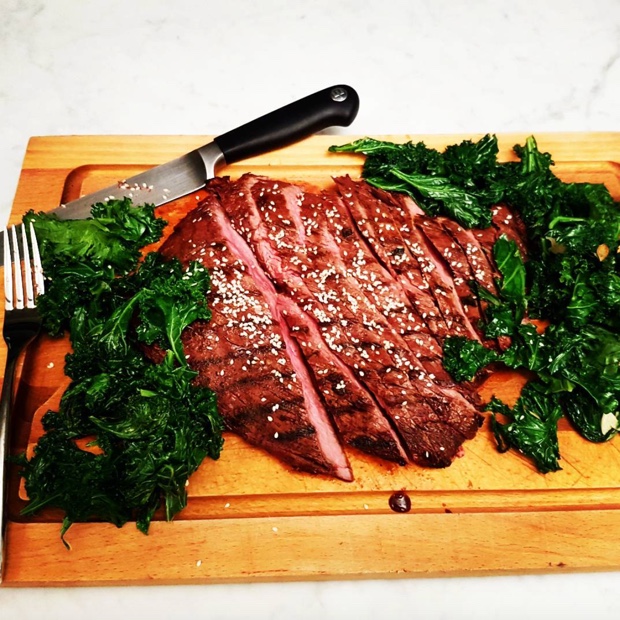
WineAlign: Michael Godel

Facebook

Seven inexpensive must try whites

Linguine, garlic, olive oil, sage

Linguine, garlic, olive oil, sage

Aromatics, spice, flowers in distillate of petals, viscosity, texture and the dichotomous, symbiotic posit tug between fruit and mineral. Are these not the explorations acceded in the neverending search for estimable white wine? Here, from a deep pool agglomerated by the VINTAGES June 13th, 2015 release are those attributes found in varietal determination; in Traminer, Viognier, Pinot Bianco, Assyrtiko and Riesling.

Two Ontario stalwarts have recently been reviewed and heretofore positioned in this posting format. They both hail from the most righteous and excellent growing sub-appellation known as the Twenty Mile Bench. The Flat Rock Cellars Chardonnay 2012, VQA Twenty Mile Bench, Niagara Peninsula (681247, $18.95, WineAlign) flat-out rocks. The Jay Johnston Chardonnays “they dig a funky spiel, they’ll make some spiel.”

Rockway Vineyards Small Lot Riesling Block 150 183 2013, VQA Twenty Mile Bench, Ontario (Winery, $19.95, WineAlign) will become a “rock, rock, rock, rock, rock ‘n’ roll” Riesling. It just wants to have fun and get some kicks.

As for the following five old world superstars from Italy, France, Greece and Germany, well they just know a thing or two about antiquity, acumen, eccentrically distributed stresses and just doing it right. Enjoy the sunshine folks, get out there and pour some whites.

From left to right: Flat Rock Cellars Chardonnay 2012, Rockway Vineyards Small Lot Riesling Block 150 183 2013, Villanova Traminer Aromatico 2014, Laurent Miquel Nord Sud Viognier 2013, Le Monde Pinot Bianco 2013, Argyros Assyrtiko 2014 and Max Ferd. Richter Wehlener Sonnenuhr Riesling Kabinett 2013

From left to right: Flat Rock Cellars Chardonnay 2012, Rockway Vineyards Small Lot Riesling Block 150 183 2013, Villanova Traminer Aromatico 2014, Laurent Miquel Nord Sud Viognier 2013, Le Monde Pinot Bianco 2013, Argyros Assyrtiko 2014 and Max Ferd. Richter Wehlener Sonnenuhr Riesling Kabinett 2013

Villanova Traminer Aromatico 2014, Doc Friuli Isonzo, Italy (411314, $13.95, WineAlign)

“Just as the sand made everything round, just as the tar seeps up from the ground,” this Gewürztraminer ringer is a bitter dancer, ever turning, metallic and exotic. An orange grove of aromatics, longan, lychee, mango and guava in four-part harmony, like fleet foxes, overtly tropical and melodic. A waxy skin coats the palate and herbals too, so oily, nutty, very, very nutty. Much exuberance and personality while it holds its notes and then finishes on plain, quick and painless. Drink 2015-2017.  Tasted June 2015

Laurent Miquel Nord Sud Viognier 2013, Vin De Pays D’oc, France (673236, $14.95, WineAlign)

Another terrific value in Midi Viognier. Such a clash of energies and riotous expression. Floral, tangy and juicy with spice notes and quite a colossal yet composed mouthfeel. The spice recycles into the acidity and persists through a held finish. Has presence of mind and body to punch way above its weight and price. Cuts right through the crap. “The South is up but the North is down,” so here in the Midi, all is in balance. Drink 2015-2019.  Tasted June 2015  @LaurentMiquel  @LiffordON

Le Monde Pinot Bianco 2013, Doc Friuli Grave, Italy (372417, $16.95, WineAlign)

Really expressive Pinot Blanc that pins a direct impression and leaves behind a lingering floral elegance. While typically tangy-mettalic as per the Friuli mirror conspiracy, white wine predicament corporation, this one treks to new territory for the variety, “pour voir plus clair,” into orange blossom and lemon curd, to peach tree and crisp freshness. Viscous and juicy, piquant and on the wilder side of le monde varietal spectrum. Thievery from Friuli, of hearts and palates. Drink 2015-2018.  Tasted June 2015

Argyros Assyrtiko 2014, Santorini, Greece (387365, $19.95, WineAlign)

Every release of the Argyros Assyrtiko is like a new Greek morning. Sunspot aridity, citrus salinity and innate volcanic ability define the wine’s blinding brine and naturally occurring bitter ooze. One sip and ” can’t you hear that rooster crowing? Rabbit running down across the road.” Can you not imagine the stone crag, the whitewashed mineral cliff, the late afternoon sunshine gazing into the shimmering Aegean from an Oia perch?

From my earlier note of April 2015:

The most distinct, pure and crisp expression of Assyrtiko comes from this Argyros bottle, magnified with more platinum rock bonding in ’14 than even in the previous few vintages. Exotic evolution has arrived early in this stoic and timelessly chronic Assyrtiko with dramatic fleshing, a hint of hloro tiri and ashen black sand grit. A volcanic goddess in patina hued dress, very mineral, very direct, that drives straight for the lumbar zone. Saline, full of shells and mollusc brine. Anything grilled on charcoal, of white flesh, whether porcine, foul or sea sweet will shine alongside, as it always does. Drink 2015-2019.

Last tasted June 2015  @KolonakiGroup  @DrinkGreekWine

Max Ferd. Richter Wehlener Sonnenuhr Riesling Kabinett 2013, Mosel, Germany (998120, $21.95, WineAlign)

When a Mosel Riesling sings in a high tenor voice the impression is wheedling and the stoic, stony flint echoes from and for So2 is par for the commanding Wehlener Sonnenuhr course. The poured elemental strike causes wheezing and coughing when the wine is this young, also due to aridity and stones infiltrating every atomic pore. Yet the tropical, seemingly mature palate with blanketing creamy mango is a reminder of the impossibly, beautifully dichotomous relationship that, when gathered and surrounded by popping acidity, can only mean one thing. Classic Mosel Kabinett. This rocks and rips it up in every way, Riesling purported to “walk on out unto the sky.” Gains a little richer aspect with each pass. Never relents, taking neither breath nor break. Awesomeness from a great vineyard, with texture, a long and bitter finish. Drink 2017-2025.  Tasted June 2015    @HHDImports_Wine

Good to go!

https://twitter.com/mgodello
http://www.winealign.com/profile/2058-mjg

I shall be Riesling

13th Street June's Vineyard Riesling 2013 - VINTAGES March 21, 2015 release

13th Street June’s Vineyard Riesling 2013 – VINTAGES March 21, 2015 release

Last weekend, in a packed Carriage House at Vineland Estates Winery I tasted through 19 Rieslings from the Escarpment, Vinemount Ridge and Twenty Mile Bench sub-appellations of the Niagara Peninsula. It got me thinking, again. Thinking about Riesling. Thinking about drinking more Riesling. Thinking about how my life is not complete, without Riesling.

Riesling at the Carriage House, Vineland Estates Winery - March 7, 2015

Riesling at the Carriage House, Vineland Estates Winery – March 7, 2015

More about that #CAPSCAN15 and Wine Country Ontario tasting at a later date. For now the delve need be into the history of Riesling and how it has had a profound effect on the world of fine wine. I have written about Riesling as much or more than on any other grape variety. In March of 2013 my column, 100 kilometre wine for spring stated firmly “can there be a more versatile white grape? From natural, mineral spring, bone-dry to concentrated, candied sweet, this grape runs the diversity gamut like no other.” In Niagara, “‘The Bench’ is home to a mineral wealth of local Riesling, singular in composition not only by way of a global comparison, but also from plot to plot, soil to soil and vineyard to vineyard.”

I see my light come shining
From the west unto the east.
Any day now, any day now,
I shall be released.

In June of 2013 Are you wine experienced? was a post written about the Brock University Cool Climate Oenology and Viticulture Institute’s Riesling Experience 2013, an international celebration of style, structure and purity. At that time Mike Di Caro and I talked about Ontario Riesling and we agreed that sugar levels are both arbitrary and unpredictable so Niagara’s best is and should be of the dry variety.

In June of 2014 I wrote about Germany in Talkin’ ’bout my Generation Riesling. The theme of the show was the ever elusive Trocken Riesling and how “the new German wine label no longer feels the need to inform the consumer of every aspect contained within the wine’s birth certificate.” In August of that same year I penned Walking an Alsace mile in their Riesling shoes, a full-on summary of a June visit to Alsace with 31 tasting notes on, wait for it, Riesling.

So, with the VINTAGES March 21st, 2015 release just over a week away, I shall be Riesling.

From left to right: Dr. Hermann Erdener Treppchen Riesling Kabinett 2010, Fielding Estate Riesling 2014, Flat Rock Cellars Nadja’s Vineyard Riesling 2013, 13th Street June's Vineyard Riesling 2013, Vineland Estates Elevation St. Urban Vineyard Riesling 2012 and Trimbach Riesling 2012

From left to right: Dr. Hermann Erdener Treppchen Riesling Kabinett 2010, Fielding Estate Riesling 2014, Flat Rock Cellars Nadja’s Vineyard Riesling 2013, 13th Street June’s Vineyard Riesling 2013, Vineland Estates Elevation St. Urban Vineyard Riesling 2012 and Trimbach Riesling 2012

Dr. Hermann Erdener Treppchen Riesling Kabinett 2010, Pradikätswein, Mosel, Germany (402420, $17.95, WineAlign)

Here the wild, out there, cosmic side of Mosel Riesling is on display, amplifying peach and lemon notes through aromatic grunge filters, like a medicative tonic. The palate is sweet and spritzy, even oxidative and this is textured with heavy, monumental levels of pure Riesling noise. The acidity is marked by citrus in every incantation. Though this may be the kind of Mosel you’ve “just never tried, it’s still the place.” Not so much a dinosaur but a junior, a wild Kabinett for very little cost and from an increasingly endearing vintage. Tasted March 2015  @WinesofGermany

Fielding Estate Riesling 2014, Estate Bottled, VQA Beamsville Bench, Niagara Peninsula, Ontario (251439, $18.95, WineAlign)

The Richie Roberts take on Riesling brings Beamsville to the populace, combining the natural acidity of the variety with the micro-saddle-plot-climat ipseity that the sub-appellation provides. This early to market ’14 is quite tropical, offering an en primeur portal into what invariably will follow. Fresh, juicy, accessible and in near-perfect balance. Slate, calcareous bleed and fruit generosity make for one tidy, markedly gratifying Riesling.  Tasted March 2015  @FieldingWinery  @RichieWine

Niagara Riesling Royalty at the LCBO Lab - March 6, 2015

Niagara Riesling Royalty at the LCBO Lab – March 6, 2015

Flat Rock Cellars Nadja’s Vineyard Riesling 2013, VQA Twenty Mile Bench, Niagara Peninsula  (578625, $19.95, WineAlign)

A year has turned a once frantic Nadja into a yet excited but in control Twenty Mile bencher. Acidity has circled the flock of juices; the sweet and the stony, to graze together. While ’12 expressed a texture to see it grace ages, here the up front verve makes for a more direct impression. There is no immediate hurry but the ginger on the lime indicates can earlier finality.

From my earlier note of February 2014: From a sample just pulled from the tank. Jay Johnston’s concept for Nadja is to create many fermentations together, using 2000L tanks and some barrels. The ferments are arrested when they achieve balance and then blended. Nadja still has her young fizz on and she’s exaggerated in Metallica meets a wondrous kind of sour. Already showing an unfurling of (mostly citrus) fruit but also spice and hurried depth. Frantic Riesling, will she “stop to warm at karmas burning, or look ahead, but keep on turning?”

Lasted tasted March 2015  @Winemakersboots  @UnfilteredEd  @brightlighter1

13th Street June’s Vineyard Riesling 2013, VQA Creek Shores, Niagara Peninsula, Ontario (147512, $19.95, WineAlign)

Continues to throw its weight about and has now engaged a phase of typical J-P Colas redolence and pungency. Strict adherence to Creek Shores citrus minerality injects the June for future time-lapse release, an internal ooze that will take years to push its way upwards to the surface.

From my earlier note of December 2014: 2013 was a perfect follow-up for Niagara Riesling, after a vintage where so many exceptional wines were made. The ’12 June’s by Jean-Pierre Colas was his best and with this repeat performance in ’13, the consistency of June’s vineyard is further cemented. Once again, the citrus injection is a Creek Shores thing, a vehemence not matched by other sub appellations. Where ’13 differs is its weight. There is a textural density improved upon and at the same time dragging on the freshness of the fruit. The trade-off will mean less immediate gratification in lieu of more flesh and bone for a longer period of aging. Given at least five years rest, the 2013 June’s Riesling will discover a Ribeauvillé like future.  @13thStreetWines

Last tasted March 2015

Vineland Estates Elevation St. Urban Vineyard Riesling 2012, VQA Niagara Peninsula, Ontario (38117, $19.95, WineAlign)

The layering is nothing short of remarkable, like the rings that tell the history of a tree. In its youth the upper vertex where effluvium and concentration meet is painfully obvious but when it comes to Riesling, breath is meant to be taken away. The prose is already written, running on adrenaline, unparalleled, if not yet understood.

From my earlier note of November 2014: Who has not waited for Elevation to hit out of the 2012 vintage? Straight up it must be noted that this will rank over and above the best from the St. Urban Vineyard. The ’12 Elevation will not only find long-term success among the great values in Bench Riesling, it will go down as one of the best ever, at any price. The vintage impart is a natural for this wine. At the moment it is the most primary of all because of the layers that texture bring. The Elevation will go thirty years and climb higher and higher into the stratosphere, gaining flesh and personality. The already seamless gathering of fruit and mineral is palpable. And still a reminder, the price is $20. This is a Schmidt gift to Ontario, for anyone and everyone to be one of the lucky ones. To purchase in increments any less than a case may be considered a crime against Riesling.  @VinelandEstates  @benchwineguy

Last tasted March 2015

Trimbach Riesling 2012, Ac Alsace, France (734517, $21.95, WineAlign)

To Jean and Anne Trimbach and most Alsatians, this Riesling from their ‘Classic’ range may represent the best that basic can be but when it travels oversees it gains a stature well beyond its humble roots. Here is another one of the those dictionary entry wines meant to depict and define. Quite simply emblematic Alsace. Built with acidity to envelop sweetness, marked by herbiage that is alive and fresh. Weight and density draw from Ribeauvillé rocks. Parity is realized in osmosis by fruit and mineral. As always, there is the tannic underlay, the length and the purposed bitter finish.  Tasted March 2015  @trimbach  @WoodmanWS

Good to Go!

http://www.winealign.com/profile/2058-mjg

September 27th at VINTAGES rolls into October 2nd with Taste Ontario

Taste Local, Love Local Photo (www.lcbo.com)

Taste Local, Love Local
Photo (www.lcbo.com)

This coming weekend’s VINTAGES release will parlay values from around the globe into the meeting place of Ontario stores. Many of the bargains tie directly into a PB and J campaign, a parochial bandwagon advertising juggernaut. The LCBO and Wine Country Ontario‘s #Tastelocal, #Lovelocal and #LCBOGolocal slogans are currently omnipresent, fast forwardly gaining both steam and traction with restos, critics and consumers.

The late, great VINTAGES wine facilitator David Churchill once told me that putting together Taste Ontario was one of the LCBO’s great endeavors. David said the work and time that VINTAGES allotted the event was extraordinary and great care was always afforded the exercise. Next week the chance to taste the most current, largest and impressive cross-section of Ontario wines in one setting will happen with the annual Taste Ontario gala event. When Wine Country Ontario comes to town and joins forces with VINTAGES, it is the writers, sommeliers and restaurant wine junkies who collectively jump trains, catch flames and do what they do. This in the name of getting to know Ontario wines.

On September 27th VINTAGES will release the following 17 wines, though most will already be on shelves before you skim through this tasting note report with all the brevity you can afford. This week’s recommendations come by way of one Sparkling, four Chardonnay, two Riesling, three Pinot Noir, a Sangiovese, a Malbec, a Veneto, a Zinfandel, one Rhône and two Bordeaux blends.

From left to right: Delmas Cuvée Tradition Brut Blanquette De Limoux, Château Des Charmes Paul Bosc Estate Chardonnay 2012, Kistler Chardonnay Les Noisetiers 2012, Burrowing Owl Chardonnay 2012, Errázuriz Wild Ferment Chardonnay 2012, Henry Of Pelham Estate Riesling 2012

From left to right: Delmas Cuvée Tradition Brut Blanquette De Limoux, Château Des Charmes Paul Bosc Estate Chardonnay 2012, Kistler Chardonnay Les Noisetiers 2012, Burrowing Owl Chardonnay 2012, Errázuriz Wild Ferment Chardonnay 2012, Henry Of Pelham Estate Riesling 2012

Delmas Cuvée Tradition Brut Blanquette De Limoux, Ac, Languedoc-Roussillon, France (179978, $19.95, WineAlign)

Organic and Biodynamic sparkler with a personality all its own. Made primarily from the local grape variety Mauzac (with some Chardonnay and Chenin Blanc), Blanquette is the dry and sylvan style of Limoux. The “little white one” is a lovely little lemon curd Blanquette pulsating in spatially atomic subtlety. Aerified notes hint at sulfur but the breeze is so minor so as not to obstruct the citrus and crucible of candied ginger.  Green apple flavour delights with really good gin and tonic (juniper), lime bitters and a muddle of basil. Pertinent and invigorating example.  Tasted September 2014  @AOCLIMOUX  @RareEarth_Wines

Château Des Charmes Paul Bosc Estate Chardonnay 2012, VQA Niagara On The Lake, Ontario (179978, $21.95, WineAlign)

Much oak and buttery crustaceans in this need to relax and settle into a self-induced state of Chardonnay. Quite lactic but that’s not a detractor; it’s a textural overlay that with time will turn lacy, organza even. I would imagine the wrong kind of attitude will not see the acidity for the forest and instead feel that malic is short for malicious behaviour. On the contrary. This is a very good vineyard giving fruit of the right St. David’s kind. With five years it will prove its merit and play matronly with that fresh catch on your plate.  Too big and clunky you say? Put it down. Let it breathe. Take a good inhale/exhale yourself. From my earlier, August 2014 note: “It would be a shame to have missed the found ardor in this tractile, careening Chardonnay. Chances have been taken in 2012, from a vineyard near and dear to a proprietor’s heart and perhaps even his soul. Picked bright and early, vinified bone dry and sent to a Burgundian school, the Paul Bosc Vineyard Chardonnay suffers from ESS (early stricture syndrome) because it (and particularly its shaken lees) have yet to settle. The barrel is confusingly, hardly noticeable and so the ’12’s awkwardness must then be attributed to a milky, marmalade and blues-influenced free-form run. It’s as if the crowd is waiting for one (Garcia-Saunders) song to end and another to begin. The new “anyway you do” slang take on an old blues riff may be misconstrued but, when all is said and done, that’s alright mama, there’s jam and space for your kind too.”  Last tasted September 2014  @Mbosc

Kistler Chardonnay Les Noisetiers 2012, Sonoma Coast, California (251223, $75.95, WineAlign)

Expansive, all over the coast display of Kistler ambition and conceit. Fully ripe and not shy to swim with splinters. Lemon meringue pie, baked Alaska and tarte au citron on one gorging dessert plate. Then the flavours kick in. A lemon Negroni (is there such an animal?) and lemon Hollandaise atop white aspagarus. Decadent, even for Kistler, without the poise and subtlety of the single-vineyard bottlings.  A full on glass of California sunshine. From my earlier, (tasted three times), July 2014 note: “Long distance runner built for endurance, a cool customer able to withstand the heat from a season’s relentless, though moderate, gentle sun, from start to finish. No shortage of ripe fruit and certainly not wanting for the micro-oxygenated slow release of a prized barrel. This might be the two-bit Kistler bottling but it offers up exemplary Sonoma fruit with the temperament and conceit of high caste Burgundy. The style is culled from two poles and pulls in two directions.  At once sharp and piquant, then golden and in mirth. All in all it’s exactly what should be wanted for the buyer who wants what it has to give.”  Last tasted September 2014

Burrowing Owl Chardonnay 2012, BC VQA Okanagan Valley (208694, $33.95, WineAlign)

Intimates warm sunshine but can’t hide from its cool nights. An element of periodic surprise wafts straight up and grabs the little nose hairs by the tips, tugs and then let’s go. Hatchoo. Wisps green apple skin, daikon radish and a metal tang. Full on fruit-mineral-earthy expression. Big Chardonnay as ripe as its gets for the Okanagan but carries a hefty (though you might ponder an inordinate exorbitance of 14.5 per cent abv) with relative ease. Goes on at length, about what, I do not yet know, but I’m willing to hang in there for 5-7 years to find out.  Tasted September 2014  @BurrowingOwlBC

Errázuriz Wild Ferment Chardonnay 2012, Casablanca Valley, Chile (738393, $22.95, WineAlign)

The wild ferment Francisco Baettig oeuvre brings into focus a nicely balanced and intimately-integrated-aligned Chardonnay. There is wildness in the form of a toasted bread, rich enzymatic energy and a leather strapping, bullied brawn. The countrified personality is tempered by a roundness, thus limiting its ability to display like an alpha male. Though not delicate or elegant by any stretch, this is Chilean power unleashed and reigned in. It represents really good value.  Tasted September 2014  @errazurizwines  @Dandurandwines

Henry Of Pelham Estate Riesling 2012, VQA Short Hills Bench, Niagara Peninsula, Ontario (557165, $17.95, WineAlign)

Classic Short Hills Bench Riesling, magnified by and exemplified in the vintage. Soda enriched fresh juice, bursting berry nose, off-dry palate. Meets all expectations for the realms of juicy and savoury. One of the best yet from H of P at this price. Great value.  Tasted September 2014  @HenryofPelham

From left to right: Wegeler Rüdesheimer Berg Schlossberg Riesling Kabinett 2012, Kim Crawford Small Parcels Rise & Shine Pinot Noir 2012, Hamilton Russell Pinot Noir 2012, omaine Marchand Grillot Morey Saint Denis 2012, Viticcio Chianti Classico 2011

From left to right: Wegeler Rüdesheimer Berg Schlossberg Riesling Kabinett 2012, Kim Crawford Small Parcels Rise & Shine Pinot Noir 2012, Hamilton Russell Pinot Noir 2012, omaine Marchand Grillot Morey Saint Denis 2012, Viticcio Chianti Classico 2011

Wegeler Rüdesheimer Berg Schlossberg Riesling Kabinett 2012, Prädikatswein, Rheingau, Germany (378083, $24.95, WineAlign)

From the steepest Rheingau vineyard named after the nearby castle (Schloss) ruin “Ehrenfels” which was built in 1211. The stony terroir for this definitive Riesling is quarzite from the Taunus region with layers of slate. Oh, this has the sultry charm of most excellent Kabinett. Aerified to the stratosphere, dry, toasty and buoyant. The soda blows away into the sky with just a vigorous swirl and the aromas turn to fruit and to stone. Rocking great intensity of many fruits, of trees and of natural grape sugar (in the 80-90 g/L residual range) that is everywhere and nowhere. Acidity is linear and impossibly round at the same time. Typically low in alcohol (around 8 per cent by volume), this rude boy is a crazy Kabinett. It’s like a Barbadian songstress rated “R.” You may ask it “is you big enough?” It will answer, I’m as good as it gets.  Tasted September 2014

Kim Crawford Small Parcels Rise & Shine Pinot Noir 2012, Central Otago, New Zealand (35337, $29.95, WineAlign)

Rich, ripe black cherry and just a hint of earth. Some cola but of the cherry kind. Tart yet sweet, hot and roomy. Built of a scrupulous structure where tannin and astringency bend in many ways.  Does its yoga poses with reluctance then hits the gym. Confounding for Central Otago with what may perhaps be a great future ahead but for now, really wonky. Where is this going? To the dark side, to return in five years and to offer good value in aged CO Pinot Noir.   Tasted September 2014  @kimcrawfordwine  @CBrandsCareers

Hamilton Russell Pinot Noir 2012, Wo Hemel En Aarde Valley, Walker Bay, South Africa (999516, $44.95, WineAlign)

he right and fantastic Pinot Noir stuff from the winemaker with the King Midas (or in this case the Queen Modjadji) touch. The Walker Bay Burgundian specialist fashions some most elegant Chardonnay and Pinot Noir. It seems that every vintage is turned to gold, or brings rain when there is drought. The 2012 is marked by bright cherries and really pungent, compressed earth. Fantastically ripe but just before the fall. Pleasure of the incarnate kind. The coat of South African red wine arms is animatedly there but it’s contained, restrained, elegant and yet still powerful. Long, fashionable flow with no visible finish line. This will age for a minimum 10 years and get that smoky glaze and glare.  Tasted September 2014  @TrialtoON

Domaine Marchand Grillot Morey Saint Denis 2012, Ac, Burgundy, France (210906, $54.95, WineAlign)

Here the entry is musty, blows off considerably and leaves the leaf and sweet fruit from strawberry and raspberry. For the spell it’s clean, crisp, pure and inviting. Roses and red fruit, violets and violent rocks careening with a rushing spring river. Those musty notes do persist again, blanketing the dolce, disguising that red fruit. Sharpness stings like Kiwi. Packs a punch of tannin, a bitter, mineral rangy streak that elevates the middle hallows and sends this MSD into really lengthy elasticity. Creamy vanilla comes to the palate with herbal undertones, like Lavender ice cream. This is old school with a modern twist. A really fine example. Tasted twice, September 2014, including blind at the WWAC14  @AmethystWineInc

Viticcio Chianti Classico 2011, Docg, Tuscany, Italy (283580, $24.00, WineAlign)

Big, bad and brooding. Black fruits are intense but surprisingly not overbearing or huge in demanded extract. Chalky, tannic, acidic, long. This is neither average nor to be ignored. It’s in the 13.5 per cent proper Chianti wheelhouse and marches in hipster stride without ever acting obnoxious. Some sanguine activity, along with iron and tension. The real deal. Not the brightest Chianti in the hills but one of a raw, unleashed power.  Tasted September 2014  @chianticlassico   @MajesticWineInc

From left to right: Versado Malbec 2013, Luigi Righetti Campolieti Ripasso Valpolicella Classico Superiore 2012, Seghesio Zinfandel 2012, Domaine Brusset Tradition Le Grand Montmirail Gigondas 2012, Creekside Laura’s Red 2011, Château Léoville Las Cases 2006

From left to right: Versado Malbec 2013, Luigi Righetti Campolieti Ripasso Valpolicella Classico Superiore 2012, Seghesio Zinfandel 2012, Domaine Brusset Tradition Le Grand Montmirail Gigondas 2012, Creekside Laura’s Red 2011, Château Léoville Las Cases 2006

Versado Malbec 2013, Luján De Cuyo, Mendoza, Argentina (317008, $25.95, WineAlign)

The rocks beneath the earth precede the rich, dark fruit. After the berries and the candy beets and the spices subside the flowers grow and take over the room. The vintage brings more layers than before. Malbec of character and belief, even a touch of good VA, a coat that only the Southern Hemisphere can provide. It is not usually present in Mendozan Malbec so it’s really a breath of fresh paint here in the Versado. Great purity. Protracted length. Most expansive and intriguing vintage to date. The Reserva will be killer. Tasted September 2014  @VersadoWine

Luigi Righetti Campolieti Ripasso Valpolicella Classico Superiore 2012, Doc, Veneto, Italy (695890, $18.95, WineAlign)

Classic really. Juicy must, musty juiciness. Earth and fruit. Fruity earth. Simple but so effective. Never gets beyond itself or out of its mind. Just the right amount of funk. Maybe the best yet. Great value.  Tasted September 2014  @Smallwinemakers

Seghesio Zinfandel 2012, Sonoma County, California, USA (942151, $29.95, WineAlign)

Rich plum and spicy Zinfandel. Young and tightly wound on a spindle. Needs time to unravel and reveal its charms. In a varietal sense this vintage of the Seghesio has got everything Zin needs and more. More specifically, the definition is out of a cooler vintage, with clear, well-delineated fruit and acidity. Sharp,spicy, focused and full, without ever acting hot, or bothered.  Tasted September 2014  @seghesio

Domaine Brusset Tradition Le Grand Montmirail Gigondas 2012, Ac, Rhône, France (960104, $29.95, WineAlign)

A thick, baking cake of a Gigondas, full of expected dark red Rhône fruitiness, but all in balance. Soapy sandalwood and chalky tannins. Quite grainy. Big, brawny and teeth staining, its “teeth ready, sharpened to bite.” It’s warm but not too hot. Cool centres, some spice and garrigue. Nothing to run away from. Though firm and loyal in the tradition of place, this has rolling stones in its blood so it will age gracefully in a well respected, cool, calm and collected manner. Will grow and grow on you as you work with it. This will age forever as there is just so much fruit. Hedging my bets on 25 years, safe to say.  Tasted September 2014  @rogcowines

Creekside Laura’s Red 2011, VQA Niagara Peninsula, Ontario (117960, $19.95, WineAlign)

The most dead red Laura to date, juicy and earthy, like a licorice, plum and pomegranate demi-glace. Really expressive of earth and fruit.  Traditional house blend of Cabernet Sauvignon, Merlot, Syrah, Malbec and Petit Verdot. A no coat unfastened Niagara, consumer-friendly but also swelling with stuffing. “The light is red. The camera’s on,” the strokes are rich in energy though the tannins dry out a touch. Drink now and for two more years.  Tasted September 2014  @CreeksideWine

Château Léoville Las Cases 2006, Ac St Julien, 2e Cru, Bordeaux, France (566661, $299.00, WineAlign)

The LLC Grand Vin vineyard is very close to the Gironde river, creating a micro-climate that tempers the vines in climate control and matronly comfort. Cabernet Sauvignon and Franc develop here as well as anywhere in the world. Here is an interesting retrospective look at this formidable St. Julien, now having reached the tender and yet developed age of eight. Earthbound distance fruit by way of a chocolate (real dark) truffle and layers of soul stew. Still chalky and tannic, there is enough fruit to keep this going for a decade and a half, or more. Licorice, Cassis and graphite. Wow. Very broad across the late palate, indicating an integration that has begun to realize the potential of this wine. A very good vintage looking back, not one for the ages, but certainly expressive and rich.  Tasted September 2014  @Noble_Estates

Good to go!

https://twitter.com/mgodello
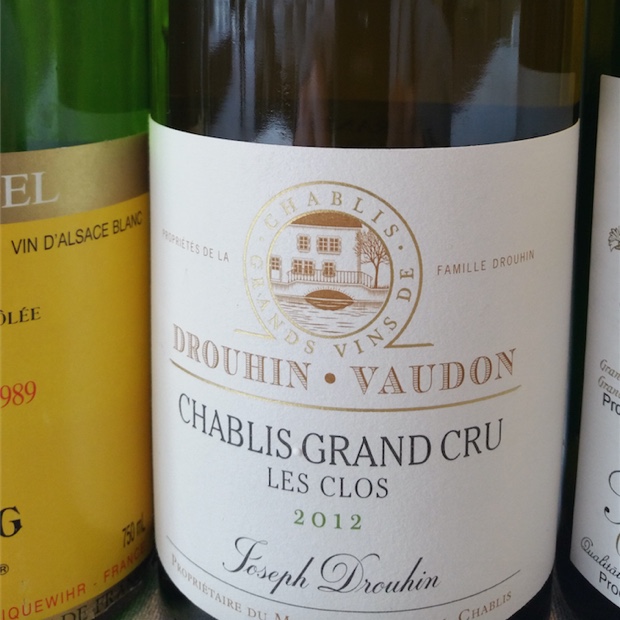
 

Is $17 your wine sweet spot?

Anyone who has stood staring at a wall of bottles can relate. Those moments in the liquor store, trying to pick a bottle of wine, not being able to make a decision.
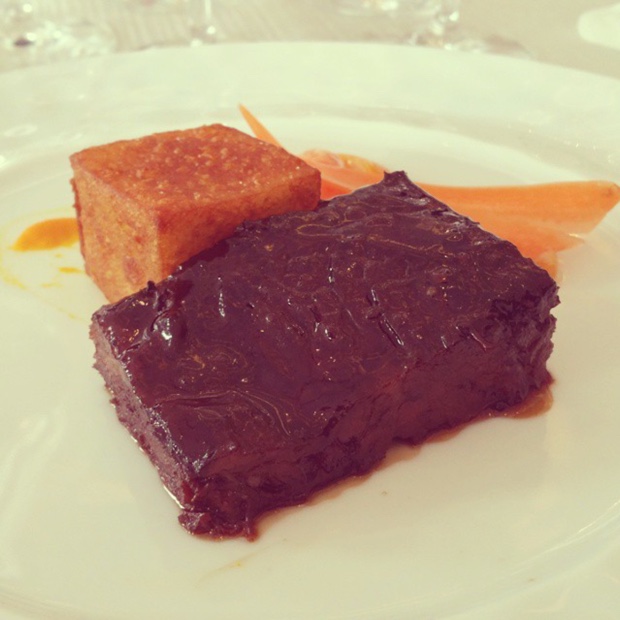
PHOTO: TATTY/FOTOLIA.COM

as seen on canada.com

Anyone who has stood staring at a wall of bottles can relate. Those moments in the liquor store, trying to pick a bottle of wine, not being able to make a decision.

Related – Nine big November best buy wines

Most buyers have a price point in mind. Under $15, $15-20, $20-25, $25-50 and sky’s the limit. The WineAlign Wine Awards focus on finding values in these price ranges. As one of the WineAlign critics, I am part of a team that tastes and subsequently recommends what to buy and what to avoid. Over the past week I have posted nearly 70 tasting notes and reviews for the VINTAGES, November 9th release. Some of the wines are also available in other provinces.

Life is indeed too short to drink bad wine. As always, I encourage reading, tasting and as much trial and error as time mixed with budget constraints allow. If I can help make the purchasing less painful, here then are ten current release wines available right now at or near that $17 sweet spot.

From left: VILLA WOLF WACHENHEIMER RIESLING 2011, ROSEWOOD MEAD ROYALE HONEY WINE 2008, HINTERBROOK SAUVIGNON BLANC 2011, and ROCKWAY SMALL LOT RESERVE WHITE ASSEMBLAGE 2012

VILLA WOLF WACHENHEIMER RIESLING 2011 (366047, $13.95, SAQ 10786115, $14.30)

A basic and purposeful Riesling from Dr. Loosen, medicinally perfumed, waxy and in part reminiscent of calcium citrate. At $13 it may speak quickly and arrive at an abrupt halt but it’s sweet, salty and effective.  87  Tasted October 4, 2013

ROSEWOOD MEAD ROYALE HONEY WINE 2008 (296178, 500 mL, $14.95)

From honey bees to world class wine “Files in at 12.5% abv in a vintage where honey outsells water. Well-balanced, this is the dessert wine of the bees’ mile-high club. Whiffs of the flowers they feed upon with a touch of ginger and lavender. The honey comb pool beneath the (aged Gouda) cheese is worth the price of admission.”  88  Tasted October 2012  @RosewoodWine

HINTERBROOK SAUVIGNON BLANC 2011 (359372, $16.95)

Constrained and exacting Sauvignon Blanc. Pale, cloaked, lithe and balmy. Shows good tang and juicy acidity, assisted in kind by breezy, long and even-tempered fruit. Looks away from the dearly Sauvignon Blanc bereft, of blanched green vegetable, grass and Niagara gold. Builds to a mouth tingling grapefruit finish. The right grape (like red counterpart Cabernet Franc) to foster down at the Lincoln shore.  88  Tasted October 4, 2013  @Hinterbrook

ROCKWAY SMALL LOT RESERVE WHITE ASSEMBLAGE 2012 (359315, $16.95)

Though Chardonnay dominates the blend (75 per cent) it is not the aromatic master of its domain. The Gewurztraminer (15) and Riesling (10) are more than bit players, imparting medicinal, floral and tropical smells. A white blend with the leesy tang a la Loire or Alsace, figuratively rendering captain Chardonnay as a dispensable member of the team. Does not really make much sense but Niagara white assemblage is a funny business and takes years to master. Just ask J-L Groux.  86  Tasted November 5, 2013  @RockwayWine

VINTAGE INK MARK OF PASSION MERLOT/CABERNET 2011 (250209, $17.95)

Noticeable coarse ground dried clay and spice note, then rehydrated, soluble and integrated into ripe damson and licorice. Intense for the vintage and the price, if a bit like a lick of the inside of a copper pipe. Leaves a scar and a lasting impression.  87  Tasted November 5, 2013

From left: CHILENSIS LAZULI 2010, FAMILLE PERRIN LES CORNUDS VINSOBRES 2011, SANTA VENERE GAGLIOPPO ROSSO CLASSICO CIRÒ 2009, and DE CHANCENY EXCELLENCE BRUT VOUVRAY

CHILENSIS LAZULI 2010 (348128, $17.95)

It’s easy to get lost in the depths of this Maule Valley ink, to be “drowned in out in that deep blue sea.” The pitch of a moonless sky. The animal musk of a muscular, four-legged mammal with horns. The growl of a grizzly bear and the bite of a cobra. These are the traits of an $18 Chilean red blend that pulls no punches and tips the scales above its weight. A crushed Lapis intensity singing the blues like a Clare Valley demasiado caro. Buy a few and put them away to see if five years will honour the effort.  91  Tasted November 5, 2013  @ViaWines

FAMILLE PERRIN LES CORNUDS VINSOBRES 2011 (566844, $17.95, SAQ 2010 11095981, $20.65, NLLC 8909, $20.47)

On one hand this Vinsobres might be given mini Beaucastel due because of its alpine, alluvium flaunting and marine molasses, haunting and violent Rhône aromas. On the other hand, that’s a stretch. Savoury redolence from long-stemmed berries and licorice work favourably but there lacks the framework and layering to sublimate more than the obvious. Tastes great but pontificating forward, what will it look like? Hold the galets. It’s $18. Great value.  89  Tasted November 5, 2013

SANTA VENERE GAGLIOPPO ROSSO CLASSICO CIRÒ 2009 (52332, $17.95)

Cheery, cherry fresh, uncomplicated and juicy Gaglioppo as a bite of ripe, just picked plum. A moment of anxiety keeps the fruit honest and will allow this Calabrese to offer food-paired pleasure, like ripe cherry tomato, soft cheese and fresh basil.  88  Tasted November 5, 2013

DE CHANCENY EXCELLENCE BRUT VOUVRAY (352237, $20.95)

Anything but obvious Sparkling Chenin Blanc.  Extreme arid behaviour and highly seasoned by grapefruit, lemon curd, ginger and horseradish. Exciting example to Jones over a staid set of forbearers, a bubbly bottle of “white lightning ‘stead of mountain dew.”  91  Tasted October 4, 2013  @LoireValleyWine

Good to go!

Nine big November best buy wines

The Canadian wine harvest is essentially done. The vines have turned, in cycle as per their natural perforce and in colour.Photo: Phil_Good/Fotolia.com

as seen on canada.comLike it or not, the first week of November demands that we begin planning for the holiday season. The wine industry’s senses in Canada are highly acute to the preparations, as witnessed by the unparalleled number of tastings, travel, discussions, wine competitions and awards.

Our provincial liquor boards are especially proactive, wasting no expense to roll out glossy magazines and the proverbial red carpet for a host of high-end, super rich and ripe wines. When the clock strikes Christmas, anything that presents to the consumer that necessary combination of excellence and value will have long been sold through.

The Canadian wine harvest is essentially done. The vines have turned, in cycle as per their natural perforce and in colour. Another signal to seek advice from the wine retinue and to stock up for winter.

To get you headed down the white, yellow, red and black brick road to wine Oz, here are nine serious wines being released this coming weekend, to cellar and to share in these last frantic weeks of 2013.

From left: BELLINGHAM THE BERNARD SERIES OLD VINE CHENIN BLANC 2012, PRINZ VON HESSEN ROYAL RIESLING KABINETT 2011, and HIDDEN BENCH CHARDONNAY 2011

BELLINGHAM THE BERNARD SERIES OLD VINE CHENIN BLANC 2012 (12724, $22.95, SAQ 11154911, $24.75)

Though I was as first confused by the metal guts and bolts of this supertramp of a Chenin Blanc, in a short time I came to understand the greatness of its seasoned ways. From Niël Groenewald’s altitudinous bush vines, I put away the question, “who put Chardonnay in my Chenin Blanc” and replaced it with “don’t criticize, they’re old and wise.” His vines and their wisdom. Lemon drop, candied flower, buttered breakfast apples and apple pie. Can look into the pensieve and smell it in the morning from when I went to school.  91  Tasted October 4, 2013  @BellinghamWines

PRINZ VON HESSEN ROYAL RIESLING KABINETT 2011 (345769, $26.95)

An atomized and candied Kabinett brought into balance by zippy, ranging aromatic peaks. Porcupine tree of atmospheric disturbance, proving yet again that with German Riesling, “the more I get to know the less I find that I understand.” Royal flushed sweet entry, mid-palate plunging cliff jump and in the end a rising launch into the stratosphere of mouth watering acidity.  92  Tasted October 4, 2013

HIDDEN BENCH CHARDONNAY 2011 (68817, $28.95)A study in Beamsville Bench equitable tension, from its wagered ripe fruit in optimum extraction, to a responsible and fundamental barrel absorption. Woody but not wooden, woolly yet not woolen, would be greatness and not what would’ve been. Fine lines, linen and lace. A wine that echoes, acts and appears as an honest product of its makers. Further definitive stuff from Marlize Beyers, Harald Thiel and Hidden Bench.  91  Tasted July 20 and October 4, 2013   @HiddenBench  @BenchVigneron

From left: PEARL MORISSETTE CUVÉE DIX-NEUVIEME CHARDONNAY 2011, NORMAN HARDIE UNFILTERED NIAGARA PINOT NOIR 2010, and BURROWING OWL SYRAH 2010

PEARL MORISSETTE CUVÉE DIX-NEUVIEME CHARDONNAY 2011 303602, $40.00)

A child of a hot and dry summer, a stress-free winter slumber and a non-invasive spring awakening.  Sets out lean, tight and mean, but the dry extract invites spicy, stone fruit and an emergence of tropical lushness. Can there be another specimen that so rightfully defines Pearl Morissette, the top of the Bench or Niagara as a whole in 2011?  93  Tasted July 19, 2013  @PearlMorissette

NORMAN HARDIE UNFILTERED NIAGARA PINOT NOIR 2010 (208702, $39.00, SAQ 11638481, $38.75)

That Norman Hardie can make Pinot Noir in Prince Edward County that could never be confused with any other makes it that much more incredulous to nose this Niagara cousin and know it can only be his. A barb on the very verge of ripe, tart cranberry and as smoky a nose as Hardie’s Pinot wants to be. Strawberry and raspberry red beret. Ashes to ashes but not funk to funky, we know Hardie is a Pinot junkie. Still, this is a warm and melodious Pinot with only one coat of primer. Impressive.  91  Tasted October 4, 2013  @normhardie

BURROWING OWL SYRAH 2010 (73072, $41.95, B.C. $39.99, Alberta $44.99)

This Syrah will cure so many ails. Vouchsafe for a pepper-laced, plasmic mouthfeel, a maroon liquid pewter party of rocks and stones in the mouth. Playful and childlike, digs a pony, playing and offering really good fun. Does its own Okanagan thing becuase “ev’rything has got to be just like you want it to.”  92  Tasted October 4, 2013  @BurrowingOwlBC

From left: CLOSA BATLLET GRATALLOPS 2007, CHÂTEAU LE CAILLOU 2006, and JIM BARRY THE MCRAE WOOD SHIRAZ 2008

CLOSA BATLLET GRATALLOPS 2007 (156398, $49.95)

Stupid gorgeous Priorat and though inaccessible to most of us mere mortals, if you were to shell out $50 in November for one wine, this has to be considered. A blend of 65 per cent Cariñena, 22 per cent Garnacha, with a smattering of Syrah and Merlot. Pure purple pitch, an early summer Catalonian garden in bloom, air warm, breeze light. Wow. Blows high priced Napa and over the top Châteauneuf-du-Pape out of the water. The oak is so beautifully integrated.  94  Tasted October 4, 2013

CHÂTEAU LE CAILLOU 2006 (45682, $49.95)

She’s so very pretty, this righteous and bankable “girl with the right allocations.” She’s a lovely slice of layer cake, alternating in coffee, toffee, vanilla cream and mineral rime. Though her tannins are still grainy, her fruit lingers on. She’s “a girl with a smooth liquidation…a short skirt and a lonnnnng…. lonnng jacket.” Le Caillou continues to bite but she’s not huge, and that’s just right.  92  Tasted October 4, 2013  @VinsdePomerol

JIM BARRY THE MCRAE WOOD SHIRAZ 2008 (737817, $59.95)

So, this 17th vintage tips the brix/alcohol scale in dangerous liaisons but it’s really quite a scorching, gorgeous number. A bomb to be sure, with layers and layers of the most savvy and sygian fruit. A realm of balance is achieved by way of a probing groove. Baking spice, blueberry pie, very peppery, tight, intense, tense, cohesive and righteous.  92  Tasted October 4, 2013  @Jimbarrywines

Good to go!