Wine: It’s a matter of tasting notes

Message in a bottle PHOTO: VIPERAGP/FOTOLIA.COM

as seen on canada.com

There’s a new message in the bottle. A growing, grumbling movement suggests that wine consumers have little use and perhaps even less tolerance for wine tasting notes. The concept of keeping score to endorse a wine’s value is always one that sparks hot debate but trending now is a derision towards what some see as a gross abuse of language, as it pertains to writing about wine. In a sudden and dramatic shift, writers are voicing their strong and in many instances, indignant opinions. Scribes are up in arms, mad, barking, “We’re not going to take it anymore.” Critiquing the critic is the new hot, and bothered. So much for the high road.

So, what’s the big deal? What’s the real problem here? Are we to be convinced that the average wine drinker has really become turned off by a heinous and excess use of speech? Are “thrown nouns” disrupting the ability to experience a more “nuanced understanding” in your wine? Has wine writing gone over the top and into the arena of the absurd? The Wine Diarist wants to know if you Care For A Word Salad With Your Wine? His take, “in general, tasting notes suck.” Have a lesser breed of wine writers confused, ostracized and alienated the wine buying public? Should the notions of professionalism and credibility seriously be brought into question?

Eric Azimov of the New York Times has gone so far as to distill wine into two words, sweet and savoury. He writes, “it’s one or the other.” Azimov feels that tasting notes are turning people off wine. My fellow Postmedia Chats colleague Rod Phillips is one who believes that tasting notes should be void of nouns, such as apples, sedimentary rock or bull’s blood. Phillips is adamant that notes be restricted to the concepts of balance, terroir, intensity, weight, sweetness and tannins. Others cringe at the overuse of adjectives, like supple, scrumptious or generous.

Should tasting notes stick to the direct and simple, like “the wine is flawed,” or “the wine is correct?” Is the sole purpose to describe a wine as light, medium or full-bodied? Is the balance between sweetness and acidity all that really matters? A well-respected writer, David Schildknecht comments, “The ubiquity of the descriptor does not make it inappropriate.” Jamie Goode writes that, “Tasting notes are the stock in trade of wine writers and critics.” So much of it may be crap but you’ve got to write about something. There’s the rub. Writers and critics. Perhaps it’s time to decide who you are, to choose who to follow and who to ignore. Many wine writers have been hurled onto the quadrae like slabs of meat, or cadavers, to be cut, dissected, broken apart. Why the schadenfreude? Why the sudden and furious need to chastise and belittle? It must be those useless, verbose and ridiculous tasting notes. Total bullshit. Utter poppycock.

Michael Godel Photo: Marc Rochette/www.marcrochette.com

Michael Godel
Photo: Marc Rochette/www.marcrochette.com

What about that high road less taken? Decanter Magazine’s Andrew Jefford writes, “Tasting notes are the kerosene of wine criticism: they have powered its ascent, and keep it aloft.” In his article Whither Tasting Notes? he also concedes that “A well-written tasting note has practical worth, in that it communicates a sensual experience via metaphorical and analytical means, and puts that experience in its appropriate context.” And yet, Ron Washam the Hosemaster of Wine so rightly reminds us that “In real life, wine ‘experts’ never ever talk about wine the way tasting notes do. Try describing a wine in (Robert) Parkerese at a wine judging and you’re likely to get waterboarded with Prosecco.” From Alder Yarrow, Is the Wine Writing World Out of Touch?, “Of course, most people writing about wine aren’t writing for the average wine drinker.”

Look, an astronaut can cover and alter the lyrics to David Bowie’s A Space Oddity aboard the International Space Station. Writers have forever been stepping beyond the comfort zone, like Hunter Thompson making a mockery of the Kentucky Derby, or George Plimpton playing Quarterback for the Detroit Lions. A wine writer can’t have a little fun?

I have no pretensions that my tasting notes might move, enlighten or teach and it’s no secret that I do not take myself seriously, especially when I write about wine. My M.O. is a lighthearted one but it is built upon a work ethic of incessant tasting, a burrowing tour of language and a whole a lot of pop culture. Music, especially lyrics that elicit word associations when tasting wine, are infused into my tasting notes. Why bother, you ask? What can anyone learn from that? The answers are simple. Read between the lines. Seek some entertainment value. Appreciate the written word, enjoy the wine. Wine makes me think, my brain forms associations and I put them to paper. I like the exercise, literally. My writing strikes a chord with some, hatred with others. That’s life. The variety helps to add colour and spice to rooms anointed with 100 wines.

Wine Tasting Photo: Michael Godel

Wine Tasting
Photo: Michael Godel

When 33 Ontarians (and two ringers) were poured at the Brock University Cool Climate Oenology and Viticulture Institute’s Expert’s Tasting back in March, I wrote, “Right in my wheelhouse and on so many levels.” This was because the tasting was orchestrated alongside the songs and lyrics of music, my music. Everyone enjoyed the cross-cultural referencing that day. The tasting was humbling, educational and a whole lot of fun.

The art of transcribing sensory experiences is natural, base, cathartic and necessary. Writing, whether it be about sculpture, painting, movies, sports or wine, aims to tell a story. I am careful to credit where a wine comes from, its history, its land and its maker. I am always cognizant that it has been given life at the hands of someone who cares deeply about the natural and living process. These necessary and critical points are never taken for granted.

I was fortunate to have been properly and ritually immersed into wine during the summer of 1987. Three weeks ago the Art History department and University of Toronto community lost a great mind and teacher. Prof. Jens T. Wollesen passed away on April 22, 2013. I have Professor Wollesen to thank for introducing me to the world of Chianti Classico, Vino Nobile di Montepulciano and Brunello di Montalcino. The 1982 Tuscan vintage was very good, not the classic that was 1985, but I had little to complain about while sipping them in the Enoteca La Fortezza di Montalcino with Prof. Wollesen. Professor’s tutelage laid down a foundation for wine discovery and the dizzying setting overlooking the Val d’Orcia opened up my pen to a world of thoughts. The next 25 years are history.

Good to go!

Mother’s Day barbecue wines

Barque Smokehouse Dry-Rub Ribs PHOTO: JILL CHEN/FREESTYLEFARM.CA

as seen on canada.com

One year ago to the day, I extolled the virtues of Chardonnay and why it was the wine of choice to drink with mom on Mother’s Day. I would be skirting the channeling of my inner, anti-ABC if that universal variety was left out this coming weekend so click here for an unoaked beauty in stores right now.

Related – more current releases

The sudden dramatic shift in the weather has had an immediate and necessary impact, with all points leading to barbecue. In order to please everyone involved, including mom, dad and carnivorous kin, a range of wines will be needed this coming Sunday afternoon. Being the wine consuming and recommending diplomat that I am, here are four white, rosé and red wines to share time in the proverbial sun and to assist with what comes from the kitchen, off the grill or out of the Mother’s Day smoker.

From left: Muga Rosé 2012, Colaneri Estate Riesling ”Stellucha” 2009, Balbas Reserva 2001, and Domaine Thomas & Fils Cuvée Grand Chaille Sancerre 2011

The grapes: Garnacha, Tempranillo and Viura

The history: Rioja winery so famous for its rich, red wine tradition

The lowdown: Perennial quality in Spanish rosé always priced to please

The food match: Barque Smokehouse Smoked Shrimp, Smoked Salmon, Bacon and Eggs Tapas

Muga Rosé 2012 (603795, $12.95) offers up honest to goodness, straightforward value. Pale pink grapefruit, gentle spice and dried roses marked by juicy acidity. “It can’t be too grand,” just as it shouldn’t be. No dinosaur here, no disguise, no bones, just simple, tasty and amenable. Afternoon sipper.  87  @bodegasmuga

Barque Smokehouse Smoked Shrimp, Smoked Salmon, Bacon and Eggs Tapas (Photo: Jill Chen/freestylefarm.ca)

The grape: Riesling

The history: Winemaker Andrzej Lipinski is a Niagara pioneer in Appassimento-styled wines, made by adding modified kiln-dried grapes to the ferment

The lowdown: Was worth the price of admission at $15.95 upon release. Now it’s a steal. This is quite full-bodied for Riesling but low in alcohol (11.3 per cent)

The food match: Scallop Ceviche, grapefruit, orange, pickled wild leek, basil, olive oil

Colaneri Estate Riesling ”Stellucha” 2009 (279778, $13.15) is built on 70% (John Howard) Beamsville Bench and 30% (estate) Niagara-on-the-Lake fruit. Exceeds expectations, acting as bridge from day to night. Works the midnight sky in a passion momento while a “shimmering crescent moon recedes into working dawn.” Faint apple, peach pit, high in citrus and a fulgor accent of lit kiln. Time has been and will continue to be a friend to this lily of the midnight sky.  89 @ColaneriWinery

Scallop Ceviche, grapefruit, orange, pickled wild leek, basil, olive oil (Photos: Michael Godel)

The grapes: Tempranillo and Cabernet Sauvignon

The history: Founded in 1777, this may be the oldest winery in Ribera Del Duero with the most modern approach to winemaking

The lowdown: A $20 bottle of wine in a $40 suit. This is without a doubt the best deal in Spanish wine since the December 7th, 2001 VINTAGES release of the Montecillo Gran Reserva 1991 at $18.95

The food match: Chicken Breast and Top Sirloin Shish Kebabs, cremini mushroom, wild leek pesto marinade

Balbas Reserva 2001 (85183, $20.95) while mature is so alive and grooved by a Beckian beat you would be hard pressed to blindly consider it 12-years old. Deep purple fruit with a hint of caramel, cedar and cigar. Qué onda Duero? I’ll tell you what’s happening. Aged Ribera, structured, in balance and very much alive for $21. Makes me want to “sing a banda macho chorus.” Screaming value.  91  @DrinkRibera

Chicken Breast and Top Sirloin Shish Kebabs, cremini mushroom, wild leek pesto marinade

The grape: Sauvignon Blanc

The history: True SB from the southern Loire Valley run by a ninth generation husband and wife team, Jean and Ginette Thomas

The lowdown: Limestone, clay and silica form a flint and sand mixture known as silex, making these Loire vineyards one of the premier growing soils in the world

The food match: Barque Smokehouse Dry-Rub Ribs

Domaine Thomas & Fils Cuvée Grand Chaille Sancerre 2011 (320242, $28.95) begs for significance and presents a ritual immersion by virtue of its base representation of ideal Sauvignon Blanc. Walks the flint and rocks of two Loire vineyards, marries them, then talks the caulk and chalk of those sites. If just a touch reserved at the moment, the Grand Chaille will grow out of its acidic twang five years forward to realize itself as excellent Sauvignon Blanc.  92 @LoireValleyWine

Good to go!

Go leeks go

Wild leeks, left, and Roast Chicken with Leeks PHOTO: MICHAEL GODEL

as seen on canada.com

Foraging for wild edibles in Ontario’s forests can be a bit of a cat and mouse affair. Fiddle heads unfurl to become ferns in the blink of an eye. Morels and other fungi pop from the loam, air-dry, wither and petrify well-nigh faster than they can be spotted and cut away.  A fragile spring ephemeral’s fleeting emergence is quickly curtailed by nature’s short season, much like this year’s edition of NHL hockey. The Toronto Maple Leafs are certainly destined to follow nature’s folly but that one character win may be all that is needed to sustain and re-energize a hockey-crazed Leafs nation.

The Blue and White (and to a lesser extent, the Ottawa Senators) are the “it plant” right now, the wild leeks of hockey. The playoffs always swell with controversy, like the argument over the pillaging of forests for commercial use. Despite a growing polemic swirl over their use in restaurant kitchens, the eastern part of North America has turned into wild leek heaven. Unfazed chefs will only concern themselves as to whether or not leeks in late spring should be relegated to pickling.

A bit of etymology for you. Allium tricoccum are garlic-like, savoury, herbal and piquant bulbs prized for their subtle pungency and gastronomic versatility. From the Scottish word ramps or ramshthe Old English hramsa and  the Proto-germanic hramsaz. Also known as ramson (latin) or ramuscium and “chicagoua,” an American aboriginal name for wild leek. Leeks grow in the northeast, mainly in New England, west to Michigan, north to Ontario and also east to Quebec and New Brunswick.

Lake Simcoe Wild Leeks (Photos: Michael Godel)

So what’s the problem? Quebec considers les poireaux des vignes a vulnerable plant and feels their removal is damaging to a forest’s’ ecosystem. A few years back it became illegal to harvest them for commercial use. Endangered and protected in Quebec, but not in Ontario. Harvest Ontario and companies life Front-Door Organics believe the practice is sustainable and if done right there is the possibility for regeneration. Some stick to a 20% removal rule, some 5%. Some take only the leaves, some also remove the purple petiole (stem), others the bulbs but not the roots. Still others go right down to the roots but leave the hardened tuber below. There really is no proof as to what ultimately damages or saves the plant’s community. Discretion is key.

I am blessed and fortunate to have access to a private forest carpeted with millions of wild leeks. I dig up perhaps two hundred each year, moving from clump to clump, carefully selecting one here and there. I move throughout the entire forest, careful not to leave any distinguishable trace or bare patch. Selective thinning is about as far as I take my harvest.

What I have successfully experimented with is the idea that ramps can be cultivated in their native habitats. I have transplanted them to my Toronto backyard in four consecutive years and they have returned each time. Some have even divided and multiplied. It’s an amazing thing to see, my own homemade mesic woods complete with the true harbingers of spring.

Here are four quick wild leek dishes and four current release wines to match.

From left: GreenLane Estate Unoaked Chardonnay 2011, Vineland Estates Chenin Blanc 2011, Domaine Allimant-Laugner Crémant d’Alsace Rosé and Tyrrell’s Brookdale Semillon 2012

Fresh Linguine, padano parmesan, wild leeks

GreenLane Estate Unoaked Chardonnay 2011 (329409, $17.95) out of Niagara’s Lincoln Lakeshore is really good juice. Piques thoughts of juicy, just picked apples, green and white flesh melon. A waterfall of viscid acidity marked by chalk and stone supports my bent for this appellation and the unplugged Chardonnay revolution. Double “L” is the spot for this style and 2011 delivers.  90  @GreenLaneWinery

Fresh Linguine with Wild Leeks

Jamaican Yam, Parsnip and Yukon Gold Potato Mash, wild leeks

Vineland Estates Chenin Blanc 2011 (227033, $18.95) is possessed of a manly musk and the scent of a lit wick. Warm, waxy, lanolic acid bite, long, stratified and along with the bottling by Cave Spring, this is the epitome of Chenin Blanc astride the Niagara Escarpment. The wine occupies white fruit, flowers and honey territory too. Layered in stratum and sub-stratum, like an onion, or a wild leek.  90  @benchwineguy

Root Vegetable Mash with Wild Leeks

Roast Chicken, white wine, tomato, parsley, wild leeks

Domaine Allimant-Laugner Crémant d’Alsace Rosé (319939, $19.95) from 100% Pinot Noir announces its versatility from sip number one. Lucent and vivid Alsatian sparkler, crisp, creamy distilled raspberry, red apple and vanilla pureé. Good verve, nuance and I love the understatement. All you really need on the patio, with mom next weekend and with a piquant wild leek preparation. 89  @NLaugner

Eggplant, fiddleheads, basil, wild leeks

Tyrrell’s Brookdale Semillon 2012 (269316, $19.95) is vividly green, as in young and inexperienced and not yet ready to tell you its story. From the outset it asks for five plus patient years so it may flesh out and open its library doors. Though only in hints, there is green plum, craggy salinity, zinging spice and stonking lanolin spiked by lemon juice and zest. Put some away and wait.  91  @TyrellsWines

Good to go!

The Wine Diaries: Napa Valley’s Peter Franus

Vineyard in Napa Valley, California PHOTO: FRIDAY/FOTOLIA.COM

as seen on canada.com

Peter Franus is a man at ease, comfortable within his own grape skin. His Ontario chaperon, the still markedly too legit to quit Mark Coster of Profile Wine Group showed the California winemaker around town, stopping to taste through the vintner’s portfolio at Barque Smokehouse. Franus has quietly cemented an iconic legacy by crafting a diverse resumé of corporeal wines in Napa Valley for more than 25 years.

A native of Greenwich, CT, the affable Franus comes across as an über-gentleman. He rarely produces more than a 1000 cases of any of his wines, from Bordeaux varieties, Zinfandel, Rhônes, Chardonnay, Sauvignon Blanc and even Spanish Albariño. His wines may not be Frisky Zebra-priced or fashioned for everyman but his laid back demeanor and sentimental passion are quintessentially Californian, like that of a successful 1970′s singer-songwriter. If I had to make a comparison, I’d lean more Jackson Browne than Don Henley.

Of the 10 disparate yet maze connected wines in the Franus portfolio, the most impressive for me is likely the least talked about. I am admittedly a sucker for Rhône in the diaspora so there is no surprise what happy thoughts his SGM put in my brain. I would be remiss to not make mention of the Sauvignon Blanc, blessedly balmy and herbal, subtle and never over-assertive in blanched green vegetable, passion fruit and grassy, gooseberry notes. Three wines crested and stood out as the most compelling. Here are their tasting notes.

From left: Red Wine, Red Hills Lake Country Red 2008, Zinfandel Brandlin Vineyard 2010, and Cabernet Sauvignon Napa Valley 2008

Red Wine, Red Hills Lake Country Red 2008 ($39.95) composed of Syrah (85 per cent), Grenache (10) and Mourvèdre (5) comes from Fore Family Vineyards fruit on the top of 3000 foot Cobb Mountain. A fiery paradox of climate met by altitude works a strange magic on the grapes. It’s no mistral but rather some sort of wine weather occult. This SGM is highly influenced by a very tempest of dramatic temperature changes, from solar radiation to cool, tempering Pacific breezes and at great heights. Exhibits the hills’ red earth, in colour, in fragrance and in rich berry flavour. I’m grateful for this SGM blend, cool and hot at the same time, “almost ablaze still you don’t feel the heat.”  93

Zinfandel Brandlin Vineyard 2010 ($46.95) from the slopes of Mt. Veeder gets a little 2+2+2 help from friends Charbono, Mourvèdre and Carignane and rested for 21 months in Burgundian Coopers. Anything but heavy-handed, it shows no signs of balsamic or toffee scars, despite the August heat spike, shriveled berries and low yield. This Brandlin “hits you over the head with pleasure,” says Franus, from a mountain that’s “as close to heaven as your going to get.” This PF Zin is PFG, if I do say so myself.  91

Cabernet Sauvignon Napa Valley 2008 ($54.95) holds out back to a time when every mancould savour this kind of wine. A Napa style made “in the warmth of the sun where sweet childhood still dances,” once again with finesse, restraint and an understanding of the place. Made in a style Franus calls “my signature of balance, harmony and elegance.” From a meticulous selection of grapes out of three vineyards, Truchard (muscle), Rancho Chimiles (acidity, florals) and Stewart (ties the room together).  Yes Peter, this is delicious.  90

Roast Chicken, Potatoes and Herbs (Photo: Michael Godel)

Good to go!

Top 10 wines for May Day

PHOTO: FABIOBERTI.IT/FOTOLIA.COM

as seen on canada.com

If April was the cruelest month (and in 2013 it certainly seemed like it was), May has just got to be better. A good, proper and solid bottle of wine would go a long way towards fashioning sunny and warmer days. Wine stores can seem like a waste land, filled with a sea of monochromatic bottles from which it’s impossible to choose from. You might ask your local product consultant, “what branches grow out of this stony rubbish?”

Related – More Spring wine releases

Fear not, for the answers to your mayday distress calls are answered. Here are ten current releases to pour at tonight’s May Day table.

Clockwise from left: Angels Gate Sauvignon Blanc 2011, Lionel Osmin Mon Adour Madiran 2008, Smoke & Gamble Reserve Cabernet Merlot 2010, Wittmann Riesling Trocken 2011, Domaine Du Petit Métris Les Fougeraies Savennières 2009, The Good Earth The Good Wine Betty’s Blend 2011, Il Marroneto Brunello Di Montalcino 2007, Hidden Bench Terroir Caché Meritage 2009, Rainoldi Crespino Valtellina Superiore 2006, and Loan Wines Unwooded Special Reserve Semillon 2004

Angels Gate Sauvignon Blanc 2011 (277590, $13.95) in comely, pale gold flesh and peach blossom nose is well designed if not grape-specific “correct.” And I thank her for that. Leads like a Jack Johnson ballad, gathering then tempering the vintage’s acidity and finishing with a soulful refrain. Outright proper Beamsville Bench white wine, even if it bears little resemblance to the Loire or Marlborough. Good on her, this angel, “she gives me kisses on the lips just for coming home.”  88  @angelsgatewines

The Good Earth The Good Wine Betty’s Blend 2011 ($17.95, 327791) led by Bench earth that simply knew is front ranked by Chardonnay trailed by reserves of Riesling and Sauvignon Blanc. Crafted from a ukase towards “petite lot, low yield” production, this laundered and commendable blend is tart in a sour key way. Fleur de sel and aquatic chalk add seasoning and texture. An umami latté.  87  @goodearthtweets

Loan Wines Unwooded Special Reserve Semillon 2004 (301127, $15.95) from Australia’s Barossa Valley is nearing fruit nugatory at nearly 10-years old. Lands right where aged Semillon should be, dry as the desert and tonically restorative. The colour of crystal gold and soda suppressing, spirited if not so sound fruit. Continues to speak in stinging tongues. I wouldn’t overlook its history.  89  @LeSommelierWine

Lionel Osmin Mon Adour Madiran 2008 (246850, $17.95) is no shrinking violet, in pitch, weight, cassonade (14.5 per cent abv) and tannin.  Tannat of an acute purple demanding in ocytone to match its spices and baked heat. A thick and syrupy southwestern French river of tar. Balks at brother Malbec and asks, “who’s the boss?”  89  @OsminCie

Smoke & Gamble Reserve Cabernet Merlot 2010 (332825, $18.95) just makes you want to head on down to Norfolk on Lake Erie’s north shore and set up camp. Roast some game by the campfire echoed by this satellite St. Emilion-styled blend’s aromas of licorice, smoldering cedar stick and plums poaching in the earth and acidity of the wine.  Gotta love the fitting rustic and campy label.  88  @DoverVineyards

Wittmann Riesling Trocken 2011 (320366, $20.95) may just be the driest Rheinhessen ever released. While there are no bubbles this Qualitätswein is like soda under immense pressure, inculcate of so much tension and threatening spontaneous combustion. Profound gold bouillon colour and the right amount of jolt to match the sec. Will magically quench any thirst, not leaving you hung out to dry.  88  @sir_neville

Domaine Du Petit Métris Les Fougeraies Savennières 2009 (319855, $23.95) screams “I am Chenin Blanc,” in honey on the pedal and maximum mineral metal. Aggressive, pursuing machine “stealing honey from a swarm of bees.” Petrol stinky, tangy thick, sticky with honey oozing everywhere, in comb and sweet-smelling suckle. Seriously huge and flashy. Will be stunning when it settles down.  92  @Savennieresaoc

Rainoldi Crespino Valtellina Superiore 2006 (316331, $31.95) is composed of 100 per cent Chiavennasca (Nebbiolo) from Lombardy. Grace, flowing ruby robe, striking. Lit by cherries bathing in a silica and gravel mineral bath, tightly wound in a swirling pensieve of real vinous thought. Elevated by cool, altitudinous breezes and gothic, statuesque like a Mantegazza. Northern, alpine and proud.  93  @VinumValtellina

Hidden Bench Terroir Caché Meritage 2009 ($32.95, winery only) is akin to a Canadian dining experience; like the highest quality smoked meat sandwich, or rare, lean game, fruit purée and demi-glacé. All in a wine. From my previous note: “Occupies hallowed Beamsville Bench middle ground between the beastly corpulence of 2008 and the rich, voluptuous 2010. Puzzling blend. Approachable and formidable. I sip and sip and sip her majesty in spite of her necessary acidity and tenacious tannin. “I want to tell her that I love her a lot but I gotta get a bellyful of wine.”  92  @HiddenBench

Il Marroneto Brunello Di Montalcino 2007 (190108, $46.95) in a tight, rusty-red dress flirts like a good ’07 should, sets her table with a bouquet of roses, dried fruit and herbs. She’ll be a star in five years,  reprising her role in alluring, candied rose perfume, cherries and fine leather.  92  @ConsBrunello

Good to go!

You can lead a county to the city

South Bay Winery vineyard in Prince Edward County PHOTO: POSTMEDIA NEWS

as seen on canada.com

It’s time to discover the wines of bucolic Prince Edward County in south-central Ontario, a place possessed and structured of a learned and cultured essence. If you were born in PEC you likely never left and if you did, probably returned. Then there are those who migrated in search of an anti-metropolitan lifestyle. The landscape is encompassed by water, dotted with folkloric towns, farms and cottages. Wine destination comparisons might be made; to Niagara, to Muskoka, the Finger Lakes, the North Fork of Long Island, to parts of California. No definitive connection is obvious. After tasting through the formidable pours at County in the City last Thursday at the Berkeley Church in Toronto, it became abundantly clear that the wines are unique in and amongst themselves and also bound together as one. The refrain holds true. It must be the rocks.

The grape growers, winemakers and 30 some odd wineries in PEC are no longer a gaggle of obscure, off the beaten path, parochial folk. Their serious VQA wines are establishing footholds in our metropolitan markets. The County’s adage may well be, “you can lead a farmer to grapevines,” a sure statement of the obvious. This event proved you can also lead them to the city.

Photo: Wine Align

Photo: Wine Align

“The County” as it is affectionately known is Ontario’s newest and suddenly dynamic wine appellation. It’s climate and geological make-up has been compared to Burgundy, the world’s benchmark region for growing and producing Chardonnay and Pinot Noir. Chardonnay is clearly the County’s signature variety, its staff of life, but the excitement extends well beyond that comfort zone. Cabernet Franc, Pinot Gris, Vidal and especially sparkling wines are making inroads along with Pinot Noir and Chardonnay. But what about Gamay? Casa Dea’s Paul Battilana crafts a Sparkling Rosé from estate grapes. Chadsey’s Cairns and Troumpour’s Mill both make solid Gamay Noir. Battilana makes a still Gamay, as does Hillier Creek Estates. Time for others to join the #GoGamayGo party.

Prince Edward County wineries are increasing their collective engagement in many ways. The PEC chapter of the Ontario Wine Society held their inaugural event April 27th, 2013, County Character at Hillier Town Hall. PEC winemakers have joined the progressive wine on tap program too, like Rosehall Run, Norman Hardie and sparkling wine specialist Hinterland Wine Company, who is kegging Charmat, Prosecco-style bubbles for Barque Smokehouse.  The coming months offer many opportunities to taste the County. The Terroir festival in late May is an annual showcase of the area’s rocks, soil and new release wines, put on by the Prince Edward County Winegrowers Association. Wassail takes place in late fall/early winter, celebrates the harvest and the laying of the vines to rest. The summer of 2013 will be a great time to visit PEC and follow its wine trail.

Here are nine wines of note tasted at Wine Align‘s County in the City at The Berkeley Church.

From left: Sandbanks Rosé 2012, Casa Dea Estates Winery Cabernet Franc 2009, Lighthall Gewürztraminer 2011, Huff Estates Cuvée Janine Sparkling Rosé 2010, Exultet Chardonnay ‘The Blessed’ 2011, and Closson Chase CCV Pinot Noir 2010

Sandbanks Rosé 2012 (244616, $12.95) whispers summer by the lake in the face of a fading pastel, pink sunset. A magical and inexpensive combination of subtle strawberry, cream and bright acidity. Who would ask for more?  87  @SandbanksWinery

Keint-He Vineyards Voyageur Vidal 2012 ($17, winery only) is a warm and aromatic expression having taken full advantage of the vintage. Yellow and orange flesh melon abounds in sweetness tempered by just enough limestone influenced acidity. Incredibly easy to drink. Breathes new life into white wine.  88  @KeintheWinery

Casa Dea Estates Winery Cabernet Franc 2009 (241612, $18.95, winery) coaxed maximum density from the vintage in fleshy, black cherry and yet is anhydrous from chocolate dust. Chalk up another redacted red from Casa Dea, in the same vein as the plush, ruby ’09 Pinot Noir. All of Paul Battilana’s wines are priced and offered like an open door. Mi Casa Dea et su Casa Dea.  88  @PECWinemaker

Norman Hardie Pinot Gris 2012 ($25, winery only) bottled one week ago, is not as you might think, in shock. A cleanse of pure pear purée with an open invitation for immediate gratification. Mellifluous and with no discernible A16 whatsoever. This one’s good to go. Who comes by chance will be the more easily let go. “Lay down my darling,” this PG ain’t for keeping.  91  @normhardie

Lighthall Gewürztraminer 2011 ($25, winery only) succeeds because less is more. Less lychee, more lightness of being. This is Glenn Symons’ 2nd vintage from the famed Wismer Vineyards in Niagara (Jordan). Refuses to club you over the head with “correctness.” Despite the lack of oily, nutty and tropical girth it’s suffused with crisp pleasure.  90  @lighthallvyard

Huff Estates Cuvée Janine Sparkling Rosé 2010 ($29.95, winery only) from 100% Pinot Noir grapes is a phenomenal, inaugural genesis effort. More sanguine in colour than one would imagine, this sparkler is wonderfully sweet but also “turns sweat, turns sour.” Pinot Noir is always potentially so dramatic but who knew it could be like this, like blood swirling in the glass. “Bottled in a strong compression,” with black raspberry, noticeable yeast and impressive finesse.  Out of the cage.  91  @HuffEstatesWine

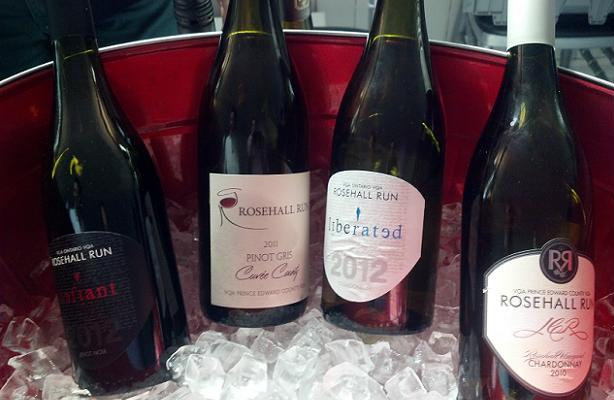
Rosehall Run Wines Photo: Michael Godel

Rosehall Run Wines
Photo: Michael Godel

Rosehall Run ‘The Swinger’ Syrah 2011 ($34.95, winery only) gets my attention not just because it’s the only commercially planted and bottled Syrah in PEC but because it stands in front of the orchestra. I gotta believe winemaker Dan Sullivan cares deeply about this wine from fruit sourced on Dick Singer’s Fieldstone Vineyard. Nothing fatuous about its smoky, tart cranberry, Sangioveseness kissed by the salty waves of an unseen ocean. The Swinger “ain’t no cherry bomb,” waits for no one, with its tobacco voice, gravel, rocks and sand. Like a sweet little bullet from a pretty blue gun.  90  @Rosehall_Run

Exultet Chardonnay ‘The Blessed’ 2011 ($35, winery only) is exemplary even if it may not be proprietor Gerard Spinosa’s favourite vintage. Commands an ineffable presence in gold sheen and parses meaning through balance and poise. The new oak is very noticeable but the ’11 acidity is grand. Their integration is seamless, the wine shines and a few years time will only increase its lustre.  92  @ExultetEstates

Closson Chase CCV Pinot Noir 2010 (310474, $39.95, winery) has improved dramatically over the course of a year, now red verging to black fruit, if only for a fleeting moment of temporary insanity, in a Sonoma state of mind. Silky smooth, “the textures coat my skin.” Though I have seen “the best (Pinot Noir) minds of my generation destroyed by madness,” this CCV uses a cured bresaola flavour and a vivid flower scent to invigorate, ground the humidity and the “earthy beet.” Musical, earthy beat, as in All Cats are Grey meets Howl.  92  @ClossonChase

Good to go!

Cloudy with showers, more wine expected

Barque Smoked Miami Beef Rib PHOTO: JILL CHEN/FREESTYLEFARM.CA

as seen on canada.com

This one’s for the floodwaters ravaged and oppressed in cottage country and to a much lesser extent, the city dwellers, this morning’s sunshine respite notwithstanding, faced with a few more days of wet April doom and gloom. There is always wine to cheer you up. County in the City presented by Wine Align  is a must not miss event tonight at the Berkeley Church.

For the rest of you keeping score at home, here are five sure bet $20 wines guaranteed to get you through the last week of April showers.

From left: Clos De Nouys Demi-Sec Vouvray 2011, Huff Estates Pinot Gris 2011, Clifford Bay Pinot Noir 2010, Stratus Vineyards Wildass Red 2011, and Eos Estate Winery Petite Sirah 2011

The grape: Chenin Blanc

The history: From one of the oldest Loire wine-making estates (Pierre Chainier) in the Vouvray A.O.C.

The lowdown: Loire Chenin Blanc ranges from dry to sweet and creamy sparkling. This is designated semi-dry but it tends dry because of a strong limestone mineral component

The food match: Basque Pintxos

Clos De Nouys Demi-Sec Vouvray 2011 (322669, $19.95) has already begun to stun in citrine and a petrol whiff plays the stage while the other aromas wait in the wings. Earthy for a white wine, a vin tuffeau-jaune if you will, no doubt imparted by the creamy, calcareous-argillaceous limestone soil. Sweet pear and the stuff of almonds lurk in the shadows. To taste there is little cloying danger and even a touch of cheese rind. It’s really quite dry, like Großes Gewächs German Riesling, but its balance is impeccable.  91  @imbibersreport

The grape: Pinot Gris

The history: Prince Edward County born and bred proprietor Lanny Huff teams with Burgundy born winemaker Frédéric Picard

The lowdown: Really a white and sparkling specialist (though they do grow Merlot), Huff’s Pinot Gris is a character study unlike any other PEC peer

The food match: Agedashi Tofu

Huff Estates Pinot Gris 2011 (134221, $19.95) initiates contact in a fusty, gamy way, not unlike some of my favourite reds in Montalcino and Châteauneuf-du-Pape. But this is Alsatian-styled Pinot Gris we’re talking about here. Fortunately a huff and a puff blows the dank aside and it gets peachy in West Indies pepper sauce after that. Lots of piquant character in this Prince Edward County charmer.  90  @HuffEstatesWine

The grape: Pinot Noir

The history: From the eponymous body of water at the eastern entrance of the Cook Strait and the Tasman Sea, separated by the White Cliffs from the more famous Cloudy Bay

The lowdown: From grapes grown in the Awatere Valley, this is essentially cool climate Pinot Noir and it shows

The food match: Barque Smoked Miami Beef Rib

Clifford Bay Pinot Noir 2010 (309500, $19.95) with its bright lights, big acids is spanking, aromatically clean. Raspberry fruit driven, big barking red dog, tart balanced (13.5 per cent abv) and full of pluck and punch. Would go nicely with the Barque of smoked meats.  89  @cliffordbaywine

The grapes: Cabernet Franc, Merlot, Cabernet Sauvignon, Syrah and Tannat

The history: The Wildass line of wine from Stratus Vineyards seems to say “always look on the bright side of life.”

The lowdown: Laid back brand in appearance from J.L. Groux and team but this assemblage is no couch potato

The food match: Whole-Wheat Penne, spring greens, sausage

Stratus Vineyards Wildass Red 2011 (86363, $19.95) is a trailing vine of sweet ever-bearing, toffee coated candy strawberry. A wolf steppin‘ out of its Niagara comfort zone, reminding me of a red wine made by The Foreign Affair, in dried fruit (not jam) as if it were made in the appassimento method. It’s simply J.L. coaxing maximum concentration from vines in a balanced vintage and frankly this is better than most Veneto Valpolicella at the same price. This Wildass is “like a true nature’s child,” born to be wild.  89  @Stratuswines

The grape: Petite Sirah

The history: Also known as Durif, a black-skinned variety developed by Dr. Durif, a French nurseryman living in the south of France in the late 1800’s

The lowdown: California has embraced the grape and although it remains much maligned, when acidity and balance play their part, it can be so much more interesting than Cabernet Sauvignon, especially in Paso Robles

The food match:  Beef Shanks braised in red wine

Eos Estate Winery Petite Sirah 2011 (317677, $19.95) is certainly Cabernet-like with its rich berry fruit forward first step but it never goes over the top. The alcohol (13.9 per cent) remains in check, it’s minty and eucalyptus cool and white pepper gives it good bite. Exotic, smokey edge.  90  @EOSwinery

Good to go!

Come together, over wine

Stratus Vineyard
Photo: Stratus Wines

as seen on canada.com

Intensity is in the air. The artists are at work, blessed with a geographical, geological and climatic canvas unique to the planet. They share arts and letters, compare and contrast methods, style and results. The sense of community is palpable, obvious and quite frankly awesome. They are Ontario winemakers and they are coming together. Right now.

Somewhereness

Somewhereness is not just a buzz word, it’s the operative word. The notion is attributed to Wine Spectator Magazine editor Matt Kramer and the application has been conceived, depending on your take, by osmosis, by derivative extension or through extrapolation, by the original six founding member wineries of Stratus, Charles Baker, Tawse Winery, Norman Hardie Winery, Flat Rock Cellars and the Malivorie Wine Company. The group has now grown to 12 Ontario winemakers, embracing Cave Spring Cellars, Hidden Bench Winery, Southbrook Vineyards, 13th Street Winery, Thomas Bachelder and Hinterland Wine Company. That this forward and fast thinking gang, collectively conspicuous like another famous gathering of Canadian artists, has embraced Somewhereness, mandated, habituated and held it dear in unequivocal belief, speaks of their collective consciousness. Terroir feeds their raison d’être,” imprinted with a vineyard’s sense of place, its soil, climate, seasons, vintage variations — and its maker’s methods.”

Mr. Kramer said “Somewhereness is more than just an event. It allows us to recognize the particular beauty of a place. Since Ontario’s wines have just such a particular beauty, the Somewhereness celebration makes sense in a single sip.” It was also Mr. Kramer who said that Somewhereness is something you can’t take, nor is it something that you can really define, or figure out its source. Somewhereness is not something undefined, like umami, nor is it akin to karma, or zeitgeist. It’s very real. In the soil, the vines, the fruit and in the wine. The sparkling, white and red wines of Ontario are obvious and recognizable. They should never be mistaken as having been made anywhere else.

Recognition

A concept like Cool Chardonnay takes it to the road to spread the prophecy and also plays host to events that attract dignitaries from around the world. More organizations like i4C are needed to spread the Ontario gospel. The next summit of #i4C2013 (third annual) will take place this coming July 19-21. Still, something is missing. Industry folk share an understanding, celebrate internally and not unlike any well-organized clique, pat one another on the back. But what about the local consumer? Do they realize they’re missing out on the illustrious muckle right under their noses? There’s the rub. It’s not just Americans and Europeans who are ignorant to the exceptional quality of Ontario wine. Abeyance be gone, these next few years have the potential to cement an industry’s power. Only a minority has even the slightest clue that liquid gold is mined out of the peninsula’s glacial clay and limestone. The time is ripe to tell the world the story of Somewhereness. The embryo is about to grow in a major way. Financial reward is within reach. So how to alert the world?

Education

When Canadian agencies send wine abroad, its best foot must be put forward. West coast wine writer Anthony Gismondi made this point to Canada’s quintessential wine ambassador, Janet Dorozynski:

More than anything, retail stores that specialize in cool climate wines are necessary to force feed confidence to the buying public. Shops devoid of cloying Cabernet Sauvignon, Malbec or Shiraz that cloud the wine IQ of young minds. I’m guessing you don’t see Gamay as a great hope for the future of sales out of this province. You are not the only one. If Riesling, Chardonnay and Pinot Noir are considered essential varieties for success, how can Gamay be excluded from hanging out at the top of the list? Only three were poured at Somewhereness, two of which were from Malivoire. Tawse, Stratus and Cave Spring should all have been pouring theirs. Consider this statement. “Wines produced between 41˚ and 44˚ north are more aromatic, lighter in body and higher in acidity than their warm-climate cousins.” If that does not shout Gamay, please tell me what does. The #GoGamayGo troupe is in full tweeting mode:

Simply put, more Gamay (Noir) needs to be planted in Ontario’s vineyards. OK, so the name isn’t the sexiest. Could you call it Niagara Noir? I don’t think so. Gamay and its small berries (especially from new clonal plantings) are ideally suited to the climate and the wines are drop dead delicious. The bandwagon is growing, with zealots like @thespitter, @winetrackmind, @BillZacharkiw@mkaisersmit@TheGrapeGuy@zoltanszabo and @johnszabo leading the charge.

Caretakers of the Earth

Indeed, Ontario is a special place to grow grapes. Our 12 winemakers feel this way about their wines, noting they offer “deeper refreshment, exquisite harmony with food, and great ageing potential. Welcome to the coolest fine wine region on earth. Our wineries sit on a fortuitous composition of earthly constituents: some 12 meters of glacial clay and silt capped by a few feet of clay and limestone-laced topsoil. Clay limits a vine’s ability to produce large crops. Instead we get tiny berries in small yields, giving us high concentrations of sugars, acids, minerals and wantonly exotic flavour compounds.”

On Tuesday, April 16th the group of 12 poured their best at the MaRSDiscovery District. A warm thank you goes to Cool Chardonnay, i4C VIP Concierge Trisha Molokach for helping to set the Somewhereness table. Here are eight shining examples of the coolest wine made on earth.

From left: 13th Street Cuvée Rosé NV, Cave Spring Cellars Riesling ‘CSV’ Estate Bottled 2009, Malivoire Wine Company Gamay ‘Courtney’ 2011, Hidden Bench Terroir Caché Meritage 2009, Charles Baker Riesling ‘Picone’ 2011, Norman Hardie County Chardonnay 2011, Hinterland Wine Company Rosé 2010 Method Traditional, and Tawse Pinot Noir ‘Lauritzen Vineyard’ 2010

13th Street Cuvée Rosé NV ($24.95, winery only) is autolytic, Brut-finished, traditional method sparkling that has that something in her style. Pinot Noir and Chardonnay emitting so much strawberry energy you might find yourself lost in the fields forever. But there is more than that, “something in the way she woos me,” maybe the rhubarb replay, or the tarragon, or the faint tang of cheese. You gotta like the Jean Pierre Colas style and to like her, you need to like her style.  89  @13thStreetWines

Cave Spring Cellars Riesling ‘CSV’ Estate Bottled 2009 ($29.95, winery only) comes from the oldest, lowest-yielding vines at the estate grown on the limestone, Beamsville Bench terrace. A three month rest on its lees imparts honey on the nose though the palate is dryer than off-dry. Mineral, pop-driven even. A hoovering, wizened Riesling, puckering, turning inward, yet to hydrate. Unique for Escarpment ’09 and will realize a quenching later than most. I for one will put this aside and revisit at the end of the decade, when “golden slumbers fill your eyes.” 89  @CaveSpring

Malivoire Wine Company Gamay ‘Courtney’ 2011 ($29.95, winery only) spent 14 edifying months in French oak and will live adroitly for another five years as a result. So much plum inherent in all its faculties, berries and currants too. The winemaker star of  Shiraz Mottiar is rising higher into the cool climate stratosphere with each passing vintage. His wines walk a haute couture runway of class and style.  91  @MalivoireWine  @ShirazMottiar

Hidden Bench Terroir Caché Meritage 2009 ($32.95, winery only) occupies hallowed Beamsville Bench middle ground between the beastly corpulence of 2008 and the rich, voluptuous 2010. Puzzling blend. Approachable and formidable. I sip and sip and sip her majesty in spite of her necessary acidity and tenacious tannin. “I want to tell her that I love her a lot but I gotta get a bellyful of wine.”  92  @HiddenBench

Charles Baker Riesling ‘Picone’ 2011 ($35, winery only) trembles with nervous energy and will need some bottle time to shed its shocking, A16 soda popping feeling. Right now “he got joo joo eyeballs.” Give it a year, or even two for the Vinemount Ridge clint (citrus and flint) to come together in a fit of focused, piercing acidity. This is Baker’s sharpest, knife-edge Riesling in the block and while I never thought it possible, this one is sure to outshine 2009. For Charles Baker “one and one and one is three.”  93  @cbriesling

Norman Hardie County Chardonnay 2011 ($35, winery only) is not merely a window into the vintage but the portal. Bright, golden fruit, freakish level of mineral and longer than the old Greer Road. Norman will always have ’08 but the newbies will be lucky to discover 2011. Who wouldn’t fall for its charms. When it comes to this Prince Edward County Chardonnay, “one and one don’t make two, one and one make one.” I call that a bargain.  92  @normhardie

Hinterland Wine Company Rosé 2010 Method Traditional ($37, winery only) is imbued faintly and sweetly in pink hue and lithe bubble. The grace and ease of Prince Edward County is forgotten when the wine hits the tongue and attacks with force. A peppery anesthetization ensues, followed by a soma-like, numbing sensation. She’s no cheap date, gives you no money, “but oh, that magic feeling.” Like a two-side playing of Abbey Road, she reels you in slowly, works to a feverish pitch and drifts off slowly into dream. A bit exhausting but worth the trip.  90  @hinterlandwine

Tawse Pinot Noir ‘Lauritzen Vineyard’ 2010 ($44.95, winery only) from the Vinemount Ridge is dry and cut with spice, a favourite for winemaker Paul Pender. The sour acidity from fruit such as cranberry and pomegranate are here in deep, concentrated and naturally sweet tones. Niagara limestone casts a Burgundy mineral shadow and the wine is iron tough yet silky due to the warmth of the vintage.  91  @Tawse_Winery

Good to go!

Time to buy these great wines

PHOTO: DRAMARGAR/FOTOLIA.COM

as seen on canada.com

Smaller investments lead to bigger fortunes. This is the credo that works for me when it comes to wine. I practice what I preach and taste as many wines as possible, to determine the personality of my palate, to make informed, diagnostic and visceral decisions when it comes to purchasing for my cellar.

Related – More Current Release Wines

Admittedly, I am offered many opportunities to taste wine. They are out there for you too, whether you live in Ontario, Alberta, Nova Scotia or British Columbia. Wine events are happening almost daily, in event venues, in restaurants, in wine shops and at your local monopoly. Get out there and taste Canada. Put a little money and time into your wine future. Take a course. Taste often and always. Training and immersion is key. Taste!

In the meantime, one of my many jobs is to help with buying strategies. Some recent releases are out there for the taking. I have also discovered a remarkable (soon to arrive in Canada) New Zealand producer, thanks to the generosity of the Speck Family (Henry of Pelham, Ontario) and Family Wine Merchants.  Their Icons of Wine, The Inaugural Family Wine Merchants Portfolio Tasting in Toronto was held on April 15, 2013 at Arcadian Lofts. The Sauvignon Blanc, Pinot Gris and Pinot Noir from the Marlborough winery called Te Pā are a revelation. In anticipation of a spring concert of Prince Edward County wine events and new tastings, here is a terrific Pinot from the man himself, Norman Hardie. All in all, here are five new wines to look for, right now and in the near future.

From left: Santi Vigneti Di Monteforte Soave Classico 2011, Villa Cafaggio Chianti Classico 2009, Norman Hardie Unfiltered Pinot Noir 2011, Henry of Pelham Pinot Noir ‘Speck Family Reserve’ 2009, and Te Pā Winery Pinot Gris 2012

The grapes: Garganega and Trebbiano

The history: Produced in the Veneto region of northern Italy and owned by Lamberti S.P.A., an Italian chemical company

The lowdown: Really remarkable Soave at an entry-level price speaks for itself, despite the odd marriage between winery and massive chemical overlord

The food match: Cauliflower Soup with Coconut, Turmeric and Lime

Santi Vigneti Di Monteforte Soave Classico 2011 (316067, $14.95) is spangled of a mineral green and gold like lichen and moss on rocks long dripped on by a spraying waterfall. Fettered elegance, waxy like aged Semillon and positively exclusive of balm, oil, cloy or bitter peat. Smooth, direct, agreeable white.  88 @pmacanada

The grape: Sangiovese

The history: Property in Panzano (Greve) in Chianti that dates back hundreds of years, when it was called “Cahago”, which means “enclosed, cultivated field”

The lowdown: Open the dictionary and search “Chianti Classico.” CC defined

The food match: Spaghetti, 2012 harvest Roma tomato, basil sprouts, Parmigiano-Reggiano

Villa Cafaggio Chianti Classico 2009 (176776, $19.95, SAQ, 571539, $24.60) whispers come-hither, pour a glass of me. You will not be disappointed. Straddles the Chianti meridian, offering up the best of both worlds; a tough, tannic and gritty stalking wolf and an alluring, silky modern fox. Iron and saltpeter meets dark chocolate filled with raspberry liqueur. Blessed with a piacevole retrogusto. “There’s still time for the midnight wine. Life just as it happens going down the line.”  90  @VillaCafaggio  @VinexxCanada

The grape: Pinot Gris

The history: Long established Marlborough, New Zealand property with vineyards right by the waters of Cloudy Bay at the Wairau Bar, though they’ve only recently begun to bottle under their own label

The lowdown: If Te Pā can find a way to get their wines into VINTAGES stores, they could be priced as low as $18.95. If that happens I will buy them by the case and hand them out on Halloween as adult treats

The food match: Za’atar Spiced Rabbit Gözleme

Te Pā Winery Pinot Gris 2012 (coming soon, $31.95) from a single vineyard made up of three plots and only the best fruit is chosen for the final blend. Hurtles like a ballistic missile fueled by bombarding and bombastic pear fumes, not to mention pungent capsicum. Was “headed for the overload” when suddenly it spun around by way of a dramatic yet finessed, flinty mineral chord change, like a “D” dropped into a Keith Richards’ open “G”. Gets your rocks off. The Sauvignon Blanc popped my eyeballs straight from their sockets. This Pinot Gris is even finer.  92  @nzwine  @winemarlborough

The Splurges

The grape: Pinot Noir

The history: Norman Hardie needs little introduction. He is the reason Prince Edward County Pinot will secure a place on that grape’s world stage

The lowdown: The 2011 vintage will go down as a classic for PEC. The tens have mass appeal, the nines turned out to be stellar but it is the elevens that gather the best of both worlds; ripeness and acidity. Stock up

The food match: Capercaillie and coniferous forest from Fäviken

Norman Hardie Unfiltered Pinot Noir 2011 (125310, $35.00) paints the County red in layered and structured brushstrokes. Ripe, bright cherry tonality in super-heightened, mesmeric sensuality. Accented by weeping rock, black earth and that cherry. Would not figure this to be Norm’s most rugged or gregarious and yet it holds more heft than it looks. Currently in a great place and will live longer than any other.  92  @normhardie  @TastetheCounty

The grape: Pinot Noir

The history: Established in 1988, Henry of Pelham Estate Winery is run by the late Paul Speck Sr.’s three sons, Matthew, Daniel and Paul. H of P amalgamates iconic Niagara pedigree with forward thinking and familial kinship

The lowdown: While there is little doubt that winemaker Ron Giesbrecht’s greatest success is and has been cemented in his Cabernet-Merlot, Chardonnay and Riesling, his soft spot has got to be for this Speck Family Reserve Pinot

The food match: Tomato Dijon Tart

Henry of Pelham Pinot Noir ‘Speck Family Reserve’ 2009 (657874, $40) has arrived in its happy place. The escarpment abutting, protected position and sheltered warmth away from the lake makes the Short Hills Bench a valued Pinot site. Crushed red berries, exaggerated florals and less earth/funk than many peers lead to the SFR’s singular sagacity. Fine-grained chalky tannins befitting the vintage will see this linger with pleasure for another five years. Yet another fine example of ’09 Niagara Pinot clarity forged by skilled and experienced hands.  91  @SpeckBros

Good to go!

A wine pentathlon

Casa Loma in Toronto PHOTO: ALISONHANCOCK/FOTOLIA.COM

as seen on canada.com

Wake up and smell the grapes. Put those lame excuses on the shelf and get over yourself. Time to cease and desist the dissing and dismissing of Ontario wine. I used to be like you but now I participate any chance I get, by invitation or by uncorking at dinner, to sample, savour and immerse myself in Canadian and more specifically, Ontario wine.

“5-Star” at Casa Loma (Photos: Michael Godel)

I was there when thirty wineries from The Niagara Peninsula, Prince Edward County and Lake Erie North Shore regions were assembled on Wednesday, April 10th, 2013 in Toronto’s Casa Loma by The Ontario Wine Society. No fewer than 127 wines (plus a few under the table ringers here and there) were poured at the “5-star” event that focused on the signature, cool-climate varieties produced in Ontario. Sparkling wines shared company with Chardonnay, Pinot Noir, Riesling and Cabernet Franc. I loved the pentalpha conceptualization, realized by a narrowing of the field to a focus of five. Working endurance wine tastings tugs on the olfactory and taste bud strings, demanding maximum mettle, so this was a welcome format.

The Ontario Wine Society is a necessary and viable provincial institution. The not-for-profit society was formed in 1991 and continues its mandate to discover, appreciate and support local wines. The industry knows to thank and give back to the OWS and other organizations who likewise set out complimentary mandates to champion local greatness. Like the VQA leader with respect to growth and sustainability Wine Council of Ontario (WCO) and the oenological education leader Cool Climate, Viticulture and Oenology Institute (CCOVI) at Brock University, the OWS is all about championing greatness stemming from our vineyards.

Shout out goes to OWS President Ken Burford and Vice-President Sadie Darby for orchestrating the oeno-pentathlon. The feat was neither small, nor insignificant. The local tastings ramp up in a big way in April and May with events like County in the City,  County CharacterCounty Terroir, The Niagara Food and Wine Expo and culminating in June with the inaugural National Wine Awards of Canada (formerly the Canadian Wine Awards) presented by Wine Align.

From left: Flat Rock Cellars 2008, Southbrook Vineyards Triomphe Chardonnay 2011, Stanners Pinot Noir 2010, Vineland Estates Elevation Riesling 2008, and Tawse Cabernet Franc Van Bers Vineyard 2009

Many of the wines presented had been previously reviewed so with such a big line-up to get through I did not always re-taste, including the following:

Rosewood Estates Natalie’s Süssreserve Riesling 2010 (258806, $14.95) 88

Flat Rock Cellars 2008 Riddled ($24.95) 87

Green Lane Old Vines Riesling 2010 (283432, $29.95) 91

Bachelder Saunders Vineyard Chardonnay 2010 (324103, $44.95) 91

Coyote’s Run Estate Winery Rare Vintage Pinot Noir 2010 ($44.95) 91

Here are eight highlights from the OWS Casa Loma tasting, to the tune of Riesling, Chardonnay, Cabernet Franc and Pinot Noir.

Southbrook Vineyards Triomphe Chardonnay 2011 ($21.95, 172338) binds FSO2 with jack or durian, febrile fruit. For now hard to figure, like a grey rose or a Pink Floyd. Offers up a creamy warmth in resonant echoes but amplified as if still trapped inside the barrel. The best days remain ahead for this certified and biodynamic Chardonnay, which in two to three years time will “come streaming in on sunlight wings.” 89  @SouthbrookWine

Tawse Riesling Quarry Road Vineyard 2012 ($23.95, winery only) picks up where the piercing ’11 left off and should be enjoyed in near time while that prototypical QRV fleshes out. This vintage is all about the here and now, citrus bright, immediately inviting, a slice of limstone pie with clay icing. While some age on Riesling is certainly and always welcome, this one begs to be looked at in the present. 90 @Tawse_Winery  @DanielatTawse

Lighthall Vineyard Chardonnay 2010 ($25, winery only) has that crazed look in its eye, as does vintner Glenn Symons when he talks about it, knowing full well this Prince Edward County juice is a bursting and rising, rocket launching supernova. Steely like Chablis, sharp and shimmering in defiance to the heat of the vintage, the LVC is a dartle to the collective consciousness of the County. Startling revelation. It’s all about the rocks. 91  @lighthallvyard

Lighthall Vineyard wines

Stanners Pinot Noir 2010 ($30, winery only) combines 60% (horizontal) County fruit with 40 per cent (vertical) Niagara (Lincoln Lakeshore) grapes in balance and with finesse. Simply apply the distance formula to figure out the length of the hypotenuse. Bridging the kilometres that lie between, though inadmissible to some, comes by way of a deft winemaker’s vision and touch. Plum good, mineral rich and perceptibly tannic without breaching a threshold of varnish. Cherry toffee speaks of the sunshine and indicates time is of the essence. Will look forward to full-on County issue for 2013 in the hands of Cliff and Colin Stanners. 89  @StannersWines

Vineland Estates Elevation Riesling 2008 ($30, winery only) poured as a youthful and “hello” pleasant surprise though it’s just beginning to display secondary character. Has shed its CO2 ferment skin without compromising the inherent citrus zest. Nectar lit by just emerging perky propellant and the ubiquitous, underlying of St. Urban’s stones all combine forces to a life of amarita. All this to make believe 2028 will be just another year in its evolution. 92  @VinelandEstates  @benchwineguy

Flat Rock Cellars Gravity Pinot Noir 2010 ($30, 1560winery) reels in Twenty Mile Bench fruit in a warm vintage as well if not better than any of its peers. Founder Ed Madronich is clearly slope and soil obsessed and this Pinot Noir is a study in topography and geology. To paraphrase Madronich, it’s  “more Pommard than Volnay, in a deeper and more masculine way than the Estate bottling.” Pinot barrels most representative of the Gravity style were chosen for the final blend, in this case noted by woodsy black cherry and spiced root vegetable. “Get a little savagery in your life.” 90   @Winemakersboots  @UnfilteredEd

Hidden Bench Estate Pinot Noir 2010 ($38, winery only) takes my previous impressions to a higher plane. Standing correct by calling it a “a vintage relative release” but it’s so much more than “a quaffable, generous fruit sui generis.” Beets turn into plums. Opaque hue reminds of graceful Nebbiolo with a dancer’s legs in aperture. Wins in judicious use of French wood. Tannins persist in the rear-view mirror. Big ’10 that speaks of another level in Beamsville Pinot Noir. “Think about it, there must be higher love.” 91  @HiddenBench  @BenchVigneron 

Tawse Cabernet Franc Van Bers Vineyard 2009 ($49.95, winery only) from the Creek Shores Appellation is proof that a well rounded grape has no point. The Van Bers is winemaker Paul Pender’s purlieu, edgy, outlying, unconcerned with the norm or the banal. Makes full use of a cool vintage with heart-stopping acidity and eye-popping verve but not without delivering Soul, in the form of flowers and a fruit basket to your doorstep. “It’s like thunder and lightning.” Capers, camphor and a knock on wood add R & B complexity. 91  @Paul_Pender

Good to go!