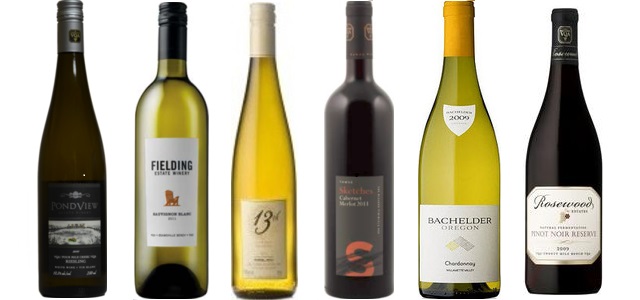
The Stratus-Momofuku continuum

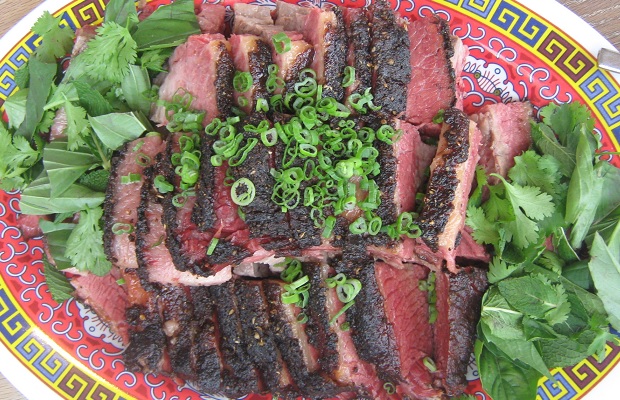
Momofuku Daisho Toronto's Beef Brisket (McGee Farms, ON)

Momofuku Daisho Toronto’s Beef Brisket (McGee Farms, ON)

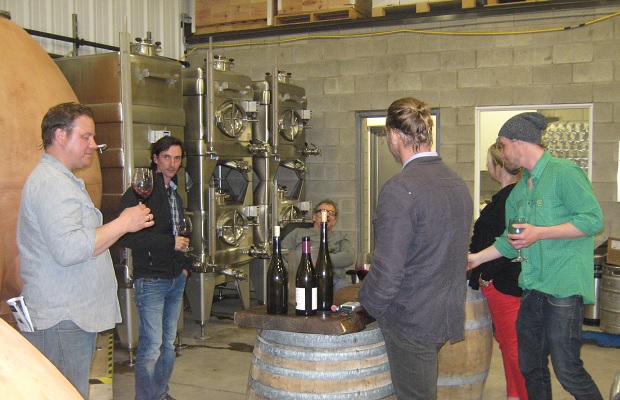
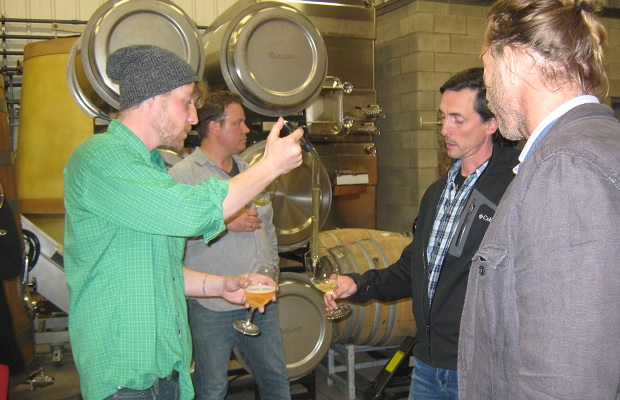
The wines of Stratus Vineyards and the cuisine of Momofuku Toronto. On Monday, May 26th and for the second straight year they conspired together in a beautiful collision of mutual beneficence. The single varietal mad science of winemaker J-L Groux and the singular, multifarious snacks of Momofuku Daishō. The food and wine play leaves wine writers satiated, thankful and speechless.

Stratus Single Varietal Tasting at Momofuku Daisho

Stratus Single Varietal Tasting at Momofuku Daisho

Related – Stratus and Momofuku: Modernity Incarnate and Select tasting through years of the Stratus Red and White

This 2014 media lunch dubbed Stratus, the right to free assemblage forged yet another treat of the highest order, once again with the necessity in participation of Charles Baker, Suzanne Janke and Sarah Walker of Stratus, along with Momofuku Beverage Director Jonathan Gosenhauser, Service Director Steve De Sousa, Assistant FOH Manager Nicholas Papadatos and the Daishō team.
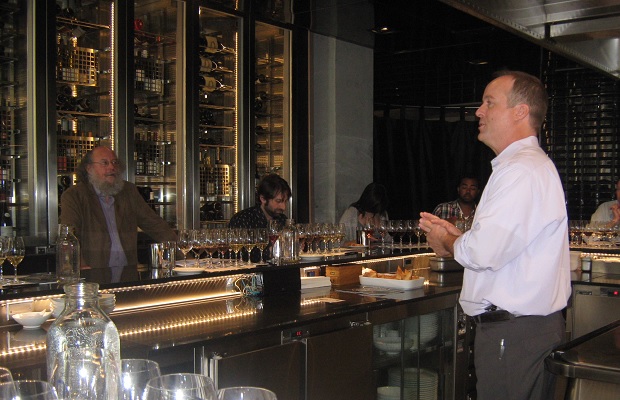
An introduction by Charles Baker of Stratus Wines

An introduction by Charles Baker of Stratus Wines

Wildass Rosé 2013, Niagara On The Lake, Ontario (Winery, $16.95, WineAlign)

At 13.9 per cent the kitchen sink blend is unwittingly light on its feet, with uplifting floral and stony scents. The patronage seems as though it could be a shot (or more) of an aromatic white addition like Viognier. This ’13 is a new approach to the Wildass Rosé, a metallic meets orange and berry citrus flavour explosion. Will be an August VINTAGES release at this modest and honest tag, certainly more accessible than in years past.
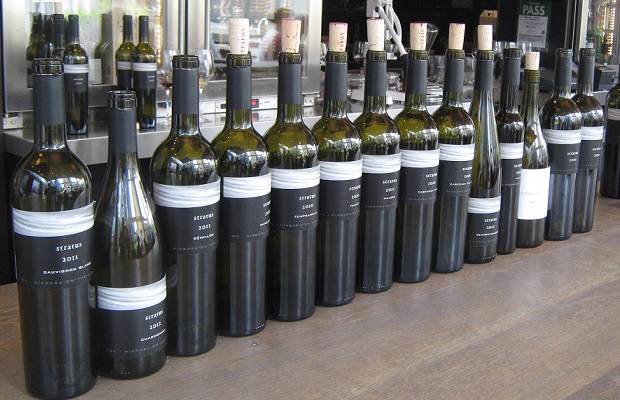
Stratus at Momofuku Daisho

Stratus at Momofuku Daisho

The single varietals

Sauvignon Blanc 2011, Niagara On The Lake, Ontario (Winery, $29.00, WineAlign)

Technically Niagara Lakeshore but labeled Niagara on the Lake, winemaker J-L Groux insists this is the anti-New Zealand Sauvignon Blanc, a truism to get behind in this ’11’s more tropical style. “Depending on the year we adapt to the climate,” so here J-L’s classic boxwood seeking stands out. The combination of picking time and barrel aging on the lees has everything to do with style. The Stratus hangs (picked October 11th) and hangs out (641 days in French oak). Shows off the most metal mineral that Niagara can give to the variety, from a season with a totally rainy spring and fall but a torrid summer in between. “On whites it was certainly a better year to work with,” though the lack of acidity is due to a wet fall. It’s high-octane, “I’m not running after alcohol. I’m picking on aromatics. If I’m making barrel aged Sauvignon, I have to be patient, otherwise it’s not worth putting in barrel.” Nutty, toasty and full. The middle reaches for the end in an elastic and stretched full chain and connection. Rounder as opposed to acidic, it’s character comes by way of a periodic, numbers game in aromas. Zero hay, high phenols, very ripe.

Chardonnay 2012, Niagara On The Lake, Ontario, (Winery, $48.00, WineAlign)

A change in direction is duly noted with J-L Groux’s 2012 Chardonnay, from fruit picked six weeks earlier than in 2010. The program is scaled back and the wine is more “typical” of the region, in weight, in barrel effect and in alcohol. Still quite defined by natural yeasts that “sometimes go a bit wild, but I’m getting better at it,” concedes the clinician of vinous letters. Those feisty microbes are difficult to work with, like dealing with a wine that lacks natural clarity. “You have to shut down the bacteria, teach the yeast to stop stealing the lees. In 2013 I really got it.” The ’12’s altered course is welcome and encouraged and the world should wait with bated breath for what ’13 will bring. Here the complexity of aromatics is matched only by the intensity of tropical fruit. Has balance and a soft, round feel. Again, more texture and aromatics than natural acidity. Classic J-L style. “It’s not about trying to imitate anyone. It’s about making the most interesting and most complex Chardonnay in Niagara.”

Sémillon 2011, VQA Niagara On The Lake, Ontario, (Winery, $32.00, WineAlign)

The warmth of those July and August days has brought a combination of grapefruit and honey to the 2011 Sémillon, a highly aromatic vintage. Typically you don’t have very high acidity with this variety and though this was a difficult vintage to work with, here it teases late harvest, straight from the hip. The in-glass progression scales back and walks the wire with semi-high (6.9) acidity. “With illusions of someday, cast in a golden light,” the ’11 Sémillon will need time to marshal the erudition of (627 days) in barrel. At present the tragically declared fact that 24.6 brix equates to 11.6 per cent alcohol might just be lauded as another conversion rate, ahead by a century.

Sangiovese 2010, Niagara On The Lake, Ontario, (Winery, $42.00, WineAlign)

A variety that can be picked much earlier than others, like Cabernet Sauvignon and Cabernet Franc. Do the aromatics do Sangiovese? Yes, but in a mutated, concentrated and highly floral, expressive way. Clean, clear and embossed by surprising freshness and purity. The notes of typicity involve red fruits and a scorch of the earth. Handsome Sangiovese actually, anything but rustic and of a middle fleshing that threshes to mulct a citrus note on the end. This effort shows the most promise of the three expatriates (along with Tempranillo and Tannat) vying for J-L Groux’s new slang, varietal attention.

Tempranillo 2010, Niagara On The Lake, Ontario, (Winery, $42.00, WineAlign)

Were Rioja to come and take over Niagara this introduction would succeed in fulfilling expectations but not necessarily dreams. I will confess that it functions in ways California (where it’s simply too warm in places like Paso Robles and Santa Barbara) does not. Likewise Australian takes (“cool” Victoria and New South Wales) have yet to convince. Niagara’s climate is not such a stretch (though in most vintages too wet), but in 2010 the conditions were ripe for this experiment. The wine is admittedly lumbering, backward and chunky. It has that dusty, nearly funky nose, but it should be extolled in the name of character. High on vineyard aromatics and the density of wood, in ways so much more defined than the Sangiovese. Strangely Riojan and tasted blind would make for a curious ringer. Not huge by any stretch and blessed with good acidity and persistence.

Tannat 2010, Niagara On The Lake, Ontario, (Winery, $42.00, WineAlign)

The wooden slumber (555 days) in 50 per cent new oak is just what the dark-skinned grape doctor ordered for the Niagara debut. You know it will be pitchy and tannic but the goal is to be looking for some striking acidity and balance of concentration. Violets are prominent in the highly floral aromatics. There is certain density and fine structure and so while Tannat is an integral Stratus assemblage variety it shows here that it can be very expressive and long on its own. Perhaps the equal of Malbec for Niagara and with great potential.

Malbec 2011, Niagara On The Lake, Ontario, (Winery, $42.00, WineAlign)

If the Stratus 2010 Malbec’s blue note belted out Philly Soul, the delicacy and structure of the ’11 plays a softer sound, a Stax, Memphis Soul. Stylish, funky and uptown without conceding to pop. Active but with less brawn and higher acidity than previous years. An and now aromatic session of so much tobacco and even more cigar box, in wafts, waves, puffs, billows and club clouds of smoke. A soul jam of black fruit, Booker T. finger roll acidity and tannin.

Cabernet Franc 2010, Niagara On The Lake, Ontario, (Winery, $42.00, WineAlign)

Some white pepper dust, not too much mind you, works with the sun “and that’s what makes Cabernet Franc find its ripeness.” That it has in spades here in ’10, giving it fullness without raisins, density without being plugged in. A rich and near berry chalk sample but finely judged. This is one of the best SV’s J-L has made. Incredible aromatics. From my earlier April 2014 note: “Patient as ever with the cool-climate, slow and low ripening Cabernet Franc, winemaker J-L Groux stuck with belief, regardless of the warm 2010 vintage. The Stratus single varietal space and time continuum of let it hang (though not to December), 20ish months of aging, nearly half in French oak barrels, has brought forth the most dense and luxe Cabernet Franc to date. “It’s never old school, all brand new,” with Groux so this red swells in wholly pure black currant fruit and is as big as it gets for J-L, which is saying something. This beastie boy will age over a 20-year period. Style is the thing, and yes, the aromatics.”

Cabernet Sauvignon 2010, Niagara On The Lake, Ontario, (Winery, $55.00, WineAlign)

The declared alcohol on this is 14.6 per cent but to all of me, that is really hard to believe. Really elegant, 100 per cent Cabernet Sauvignon, perfectly unabridged in phenolic ripeness but in such fine rhythm and blues. Were it a score it would be euphonious without encumbrance and void of splinters. The most subtle and gentle J-L Groux crafted red wine I’ve yet to encounter, with a back palate combination of mushroom and citrus to follow pure red fruit. Resoundingly circular with curves, no hard edges and “perfect imperfections.” This Cabernet goes at it with Graves character and poise. It will be a Niagara legend.

Gewürztraminer 2012, Niagara On The Lake, Ontario, (Winery, $29.95, WineAlign)

Early harvested and vinified with the least amount of winemaker intervention, this is Gewürztraminer left to find its own way. In 2012 the natural sugars speak in clear and clean tones without needing too much attention. Has the most off-dry sensibility yet. It’s very floral, nearly medicinal and tacking. A zigging and zagging Gewürz, wavering, weaving, oscillating between its personalities, on one hand new and progressive, on the other, a nod to Alsace. There is really nothing dry about it. Dense on the palate, this Stratus single white varietal is textured and quickly making friends.

Mosaic Late Harvest 2013, Niagara Lakeshore (375ml), Ontario, (Winery, $25.00, WineAlign)

The 2010 was the first and only one made at the time. When asked if he would make one again, J-L Groux replied “perhaps.” Well, three years later the 2013 enters considerably drier than that ’10 but full of stone tree fruit. The profile here is so different, now Gewürztraminer (78 per cent) dominated, with less residual assistance from Riesling (17) and Sémillon (5). The aromatics are medicinal and ashen before the attack turns so palate sweet, in marmalade and with a finish of noble bitterness.

Mystery Pour

Botrytis Affected Sémillon Late Harvest 2012, Niagara On The Lake, Ontario

Tasted blind this non-clarified sticky is high on grapefruit for sure, smells (for a fleeting moment) a bit like cat pee, is decidedly smoky and once again, is grapefruit all in. Stony sauternes, Niagara style. This can be used to great advantage. With 70 plus g/L of residual sugar and 7.9 of total acidity the sugar-acid continuum is expertly lucky. The grapes were picked on December 14th, causing another exclamation of WTF? Really delicious. Really.
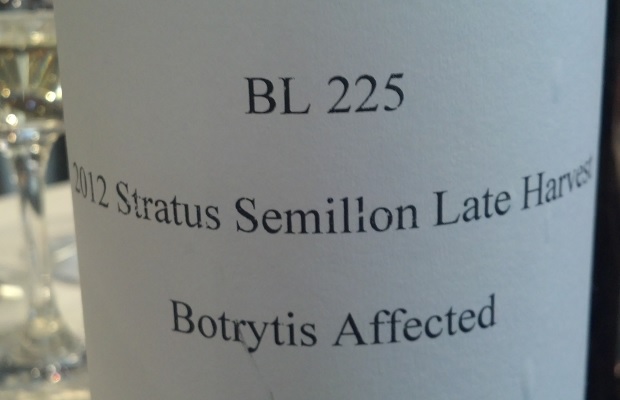
Botrytis Affected Sémillon Late Harvest 2012

Botrytis Affected Sémillon Late Harvest 2012

Following the single-varietal tasting, Momofuku Daisho rolled out eight signature dishes.

Spring Radish Salad, sherry vinegar, chive, crispy yuba
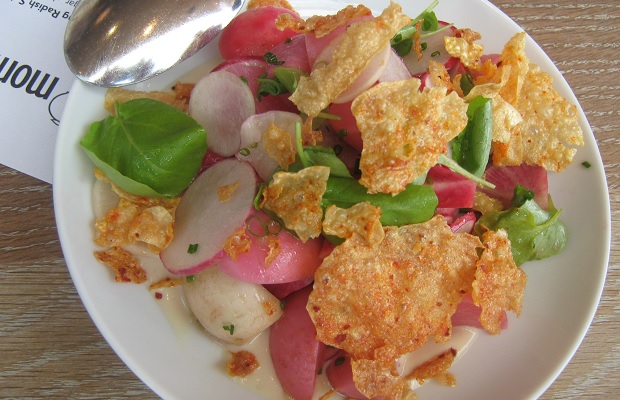
Spring Radish Salad, sherry vinegar, chive, crispy yuba

Spring Radish Salad, sherry vinegar, chive, crispy yuba

Snap Pea Salad, horseradish, jowl bacon, lily bulbs

Agnolotti, asparagus, ricotta, black truffle

Whole Speckled Trout (Kolapore, ON), morels, ramps, smoked buttermilk
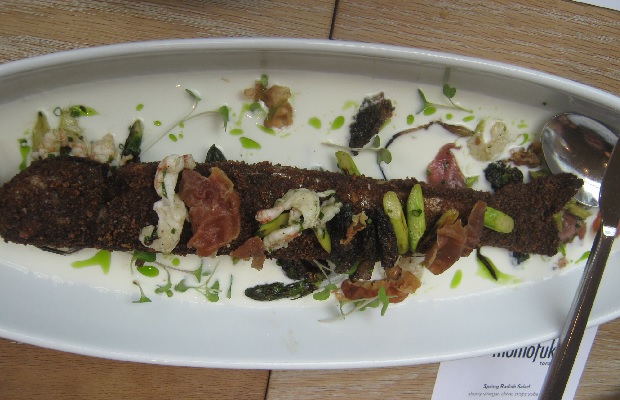
Whole Speckled Trout (Kolapore, ON)

Whole Speckled Trout (Kolapore, ON)

Stratus White 2010, VQA Niagara On The Lake, Niagara Peninsula, Ontario, (660704, $44.00, WineAlign)

From my September 2013 note: “Sends me immediately towards Bordeaux, in neo-marmalade, but also buoyed in perfume and body by 25 percent Viognier. “This variety worked so well in the vineyard in 2010,” notes Groux. Niagara honey and near-botrytis via Semillon and Sauvignon Blanc void of grass, full of vigor. A sharp note, neither metallic nor mineral, but a combination of the two is present in this so very concentrated ’10. Of a warm vintage (self-explanatory) fully picked by October 23. Though loaded with early Spring maple sap, foie gras and appley terpines, its sharp and framed by “tannic” tang and protracted length.”  Last tasted May 2014

Beef Brisket (McGee Farms, ON), steamed buns, crab mayonnaise, green papaya slaw

Broccoli, lap cheong, black vinegar, tea egg

Nugget Potatoes, togarashi, kewpie, spiced ham

Stratus Red 2010, VQA Niagara On The Lake, Niagara Peninsula, Ontario, (131037, $44.00, WineAlign)

Tasted again, I do declare this to be the reigning bomb of Ontario red blends. Showing even better than I judged it two weeks ago. Intense ruby meets claret in every facet of its make-up. Rouge tomate, fresh and racy at the same time, with just enough chalk to lengthen the chain. You can actually imagine the hum in the clang and rhythm of its magic. Fleet of foot, mac-nanimously rendered red blend. “Chain keep us together, running in the shadow.” From my earlier note: “A study in restrained, gilt-edged use of only 15 per cent new oak during assemblage, especially with Cabernet Sauvignon in the lead and so prudent considering the extreme warmth of the vintage. Cabernet Franc imparts simple but intense spice. Red talented, fresh finesse, the oak in support as a James Dean, cherry stained leather jacket. De facto fresh, with just enough trenchant acidity.”  Last tasted May 2014

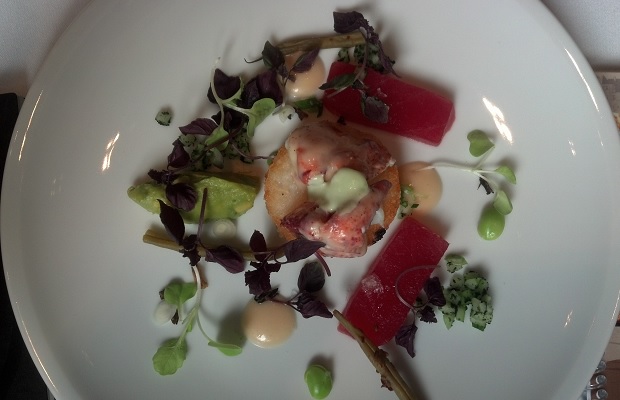
Tart, ricotta, honey apricots


Good to go!


Get your red hots

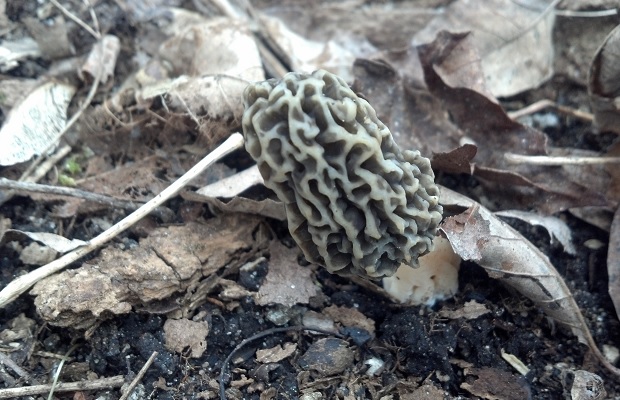
Leaning Morel

Leaning Morel

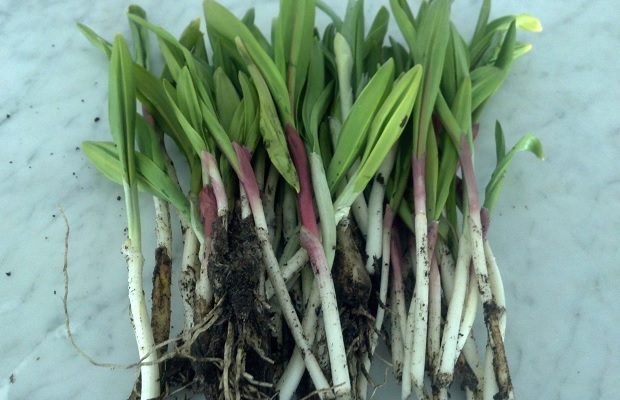
These are some of my favourite things. Wild edibles foraged from the duff in spring. Earthy red wines cultivated from healthy vines. Protein grilled on an open flame. Layered dishes baked in the oven. Baseball.

Gather them all together, add in some warm weather and the recipe is dressed for success. This past weekend VINTAGES rolled out the May 24, 2014 release. I touched on some good value whites last week so now it’s time to roll out some full-bodied, protein friendly reds. Get these four red hots in stores now.

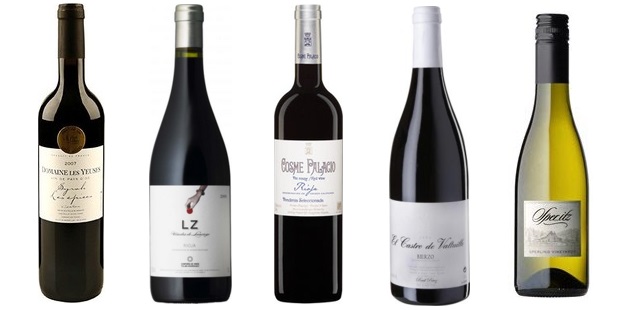
From left to right: Domaine Les Yeuses Les Épices Syrah 2011, Telmo Rodriguez Lz 2012, Cosme Palacio Y Hermanos Reserva 2007, Castro Ventosa El Castro De Valtuille 2010, Sperling Vineyards Sper...Itz 2011

From left to right: Domaine Les Yeuses Les Épices Syrah 2011, Telmo Rodriguez Lz 2012, Cosme Palacio Y Hermanos Reserva 2007, Castro Ventosa El Castro De Valtuille 2010, Sperling Vineyards Sper…Itz 2011

Domaine Les Yeuses Les Épices Syrah 2011, Igp Pays D’oc, Languedoc-Roussillon, France (177584, $14.95, WineAlign)

This perfectly tidy Syrah hails from the area near Mèze in the Languedoc region. The name borrows from a species of oak, the holly, the holm, or the evergreen. Dusty aromas blow quickly away into the savoury foliage of the Yeuse. What is then revealed is a rich, velvety Syrah of considerable stuffing, with a note of semi-sweet chocolate, smoky bacon and plenty of tang. Repeats the value shared by both the 2010 and the 2009. Make this your summer house red, when times are hot, when times are cool.  Tasted May 2014

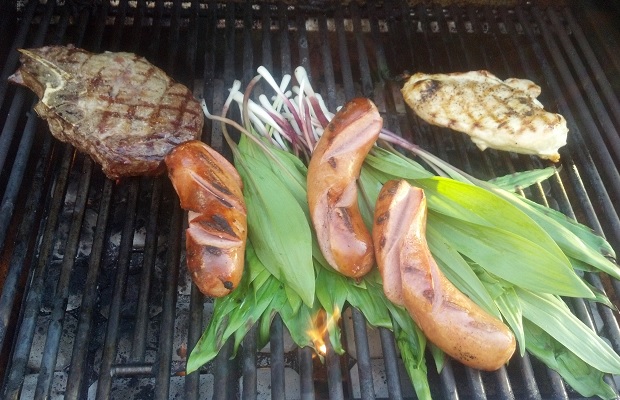
Knuckers, Rib Eye and Ramps

Knuckers, Rib Eye and Ramps

Telmo Rodriguez Lz 2012, Doca Rioja, Spain  (172361, $15.95, WineAlign)

This is the most basic and affordable red in the Telmo Rodríguez line. From the outspoken winemaker who said, “In Canada you have been drinking the worst Riojas, the undrinkable Riojas.” So Rodríguez has decided to make wines without the suffocating slings and arrows of outrageous, appellative fortune. Notice this label notes no Crianza, no Reserva, no Gran Reserva. Fresh and juicy, with new history and tradition written in its code. Modern and forward while relaxed and old school at the same time. Great fruit and acidity, length is just fine and overall it’s a pleasurable, confident, compact wine and without crisis.  Tasted May 2014  @liffordwine

Chicken Parmesan

Chicken Parmesan

Cosme Palacio Y Hermanos Reserva 2007, Rioja, Spain (14662, $23.95, WineAlign)

A traffic jam of thick, rich and figgy fruit, accompanied by a tempering of chocolate. This Rioja is “good ole fashion medicated goo.” Though somewhat simple juice it bangs the right keys and solicits a stretched and bent weeping guitar accent. Dark as night with the stuffing to carry an album side. “So follow me, it’s good for you.”  Tasted May 2014  @Hannanealwines

Castro Ventosa El Castro De Valtuille 2010, Do Bierzo, Spain (366930, $27.95, WineAlign)

Owning a family-run estate for 252 years and farming Mencía vineyards in Bierzo from generation to generation has to count for something. Five parcels are gathered from pre-phyloxeric vineyards in Valtuille de Abajo. The estate manages the only sandy soils in Bierzo, mixed in with quartzite and slate. A solid Mencía, high on phenolic ripeness, verdigris and general stuffing. Rich, chewy, tarry and viscous. Can see this slowly smouldering, smoking, offering wamth and pleasure for 10-15 years. In that sense of longevity it represents excellent value.  Tasted May 2014  @HalpernWine

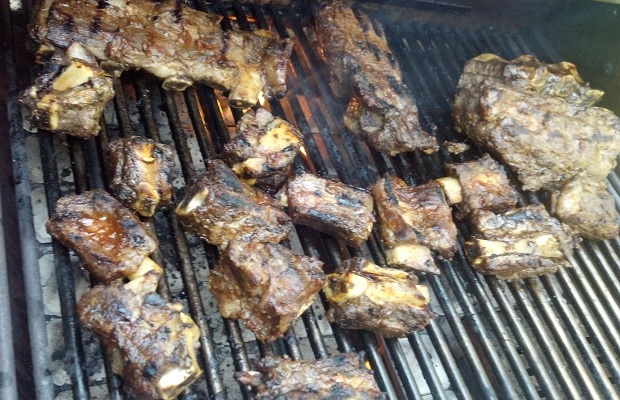
Beef Ribs

Beef Ribs

Sperling Vineyards Sper…Itz 2011, Okanagan Valley, British Columbia, Canada (364166, 375ml, $13.00, WineAlign)

A very pretty, quite sweet though not overly spritzy Moscato, with nary a waxy or medicinal note. Not exactly true to old world form but what a terrific palate cleanser it makes, like a lemon-lime granita or white pomegranate gelato. The half-bottle format for a big group will work just fine as just a thimbleful is all that’s needed before main course to liven up the palate and ready it for flesh and blood. On the card at Barque. Tasted twice, November 2013 and May 2014

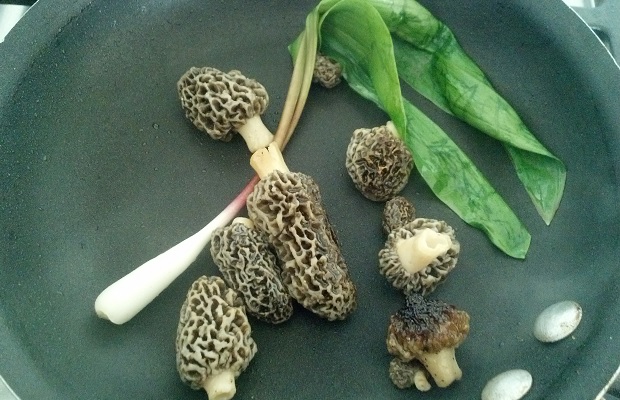
Morels and Ramp

Morels and Ramp

Good to go!
 

The pearls of Morissette’s wisdom

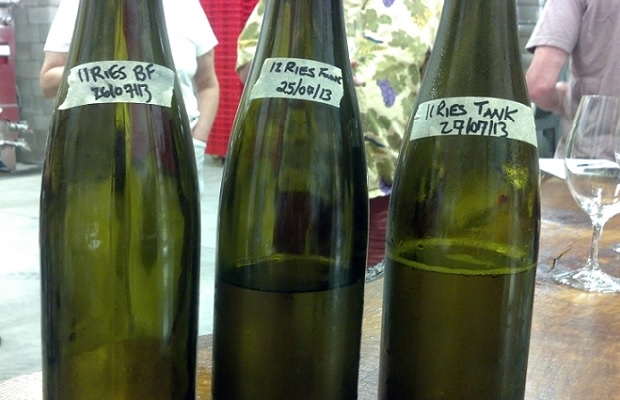
Pearl Morissette Riesling samples

Pearl Morissette Riesling samples

So you make wine from Ontario-grown grapes and it fails VQA inspection. The economic impact is potentially crippling. Here’s the short story. The sale of an Ontario VQA-certified bottle of wine sends approximately 15-20 per cent of the profit to the province. Without the stamp the tax cost is upwards of 50. There is no money to be made if your wine has not been blessed by VQA. Here is the long version:

The total Landed Cost (what the winery keeps) is calculated based on this:
Basic Price (retail price)  
minus Environmental Tax fee (same for VQA and non-VQA)
minus Bottle Tax/Levy (same for VQA and non-VQA)  
minus LCBO Wine Levy (applied to non-VQA only, yet minimal – $1.15 for $26btl)
minus LCBO mark-up (which is completely different between VQA and non-VQA – $0 for VQA, $8.5039 for a non-VQA wine based on a $26)
For a $25.20 ($25 + bottle deposit) bottle of wine, this is what the winery (Total Landed Cost in VQA language) keeps:
VQA retail: $20.56
VQA licensee: $20.56
non-VQA licensee: $12.44
These numbers come from a calculator, designed by VQA and the LCBO themselves that gives you the breakdown, once you enter the retail price.

François Morissette has that crazed look in his eye. The Quebec native faces the professional fight of his young winemaking life and has no intention of backing down. There will be no compromise of the viniculture oeuvre. Morissette’s day in, day out plight has been instigated by the Vintners Quality Alliance (VQA), the regulatory board that determines whether or not a wine made in Ontario gets its stamp of approval. It has already happened four times. VQA has rejected his Rieslings.

The pearl Morissette Cuvée Blackball Riesling 2011 is a $26 (retail price including bottle deposit) non-VQA bottle of wine and so the winery’s profit (before operating and production costs) is $12.98. Do the math. Sounds like a loss leader to me.

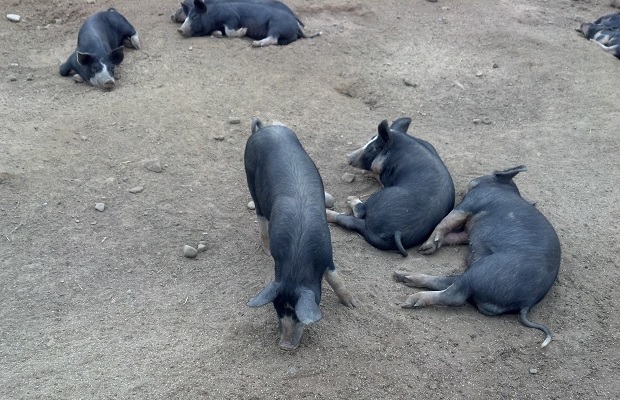
Pearl Morissette pigs

Pearl Morissette pigs

Morissette makes the wines at Pearl Morissette out of the Twenty Mile Bench in Jordan, Ontario. He’s opinionated and sometimes just plain pissed off. There are those who surely consider him a rogue, a dissident and an SD but at the end of the day, just how is he so different from his Niagara brethren and sistren? He is a farmer and a purveyor of fermented grapes. Granted his methods are progressive and experimental but the goal is the same as any honest and passionate winemaker. François Morissette wants to make memorable wine. Last July François Morissette told me “it’s not that we don’t want to make natural wines. We want to make wines with the least amount of impact.”

In July of 2013 at the i4C Cool Chardonnay Conference in Niagara, Francois expounded on some of the more important facets of making wine in Ontario. “Climate is the number one terroir driven aspect. The clone is nothing without the rootstock. They are inextricably linked.” He is a man who believes wholeheartedly in natural acidity. “You will have riper fruit on dry matter.” These are the ideas of a “rebel,” of a winemaker willing and ready to push the envelope. “I cannot ever apply what I learned in Burgundy as a farmer to Niagara. It’s a totally different animal.” These are the words of “pot-stirrer” Francois Morissette.

Foudre at Pearl Morissette

Foudre at Pearl Morissette

Today, Monday, May 26th, François and his girl Friday Svetlana Atcheva will once again go before the powers that be at VQA.  In their meeting with Executive Director Laurie Macdonald they will argue that their four-time rejected Riesling is bio-chemically sound, that it is a wine with no technical faults. The question of penalizing innovation will be raised, albeit in the spirit of cooperation. They will assert that the level of residual sugar (which the VQA panel seems to feel is “atypically” too low) and perceived sense of dryness must not be the focus. Morissette and Atcheva will explain to the panel that their Riesling is not oxidized but that the use of wood foudres (in addition to typically employed stainless steel tanks) allows for a gentle yet natural, controlled oxygen transfer. Ms. Macdonald will be asked the question on everyone’s mind. “How can an organization that reigns over such a young wine region be so sure what is correct and what is not?” What they should really say is “who are you to play God with wine?”

The sensory evaluation panel and decision makers maintain the necessity that “VQA wine grapes meet standards such as minimum ripeness levels (degrees brix) attained through careful viticultural practices.” This statement suggests that the Pearl Morissette Riesling fails to meet the criteria laid out by the decided governance. Does the system not sound like it is seeking conformity in the name of typicity? I spoke with Atcheva last Monday at the Generation Riesling tasting and she adamantly refutes the VQA position on Pearl Morissette’s wines. Skin ripeness, not sugar levels, indigenous yeasts, minimal interventionist winemaking and most of all quality should be the determining factors to passing their Ontario wine to VQA status. François just wants to be free to sell his wines to whoever he pleases without being shackled to taxes and bureaucracy. “My preference would be for 1,000 people to buy one bottle. But that takes time.”

Atcheva spoke at length this past weekend with a senior LCBO product consultant who elaborated on the selection process for the VQA panel. Up until a few years ago panel members were chosen based on their tasting experience. Today seniority lands spots on the tribunal. Work an LCBO cash for fifteen years and you too can decide the financial future of an Ontario winery.

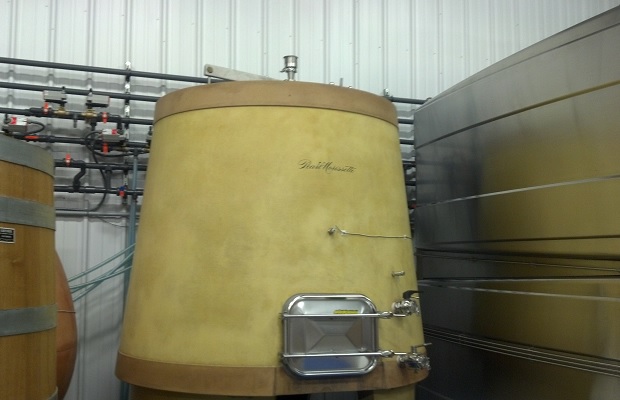
Conrete Egg Fermenter

Conrete Egg Fermenter

For a full account on VQA evaluation processes and the rejection of Morissette’s wines, read Rick VanSickle’s article, The ‘black-balled’ Riesling from Pearl Morissette in Niagara and the storm that’s brewing over VQA rejection: Let’s talk about it. Another response by Tim Reed Manessy brings the VQA system’s shortcomings into proper focus. Behind the ‘Black Ball’ is Manessy’s take on his blog, Somm on the Run.

Hinterland's Jonas Newman, François Morissette, Montreal Gazette and Chacun Son Vin's Bill Zacharkiw, WineAlign's John Szabo M.S. , Wine Country Ontario's Magdalena Kaiser Smit and Assistant Winemaker Ryan Corrigan tasting Cabernet Franc

Hinterland’s Jonas Newman, François Morissette, Montreal Gazette and Chacun Son Vin’s Bill Zacharkiw, WineAlign’s John Szabo M.S. , Wine Country Ontario’s Magdalena Kaiser Smit and Assistant Winemaker Ryan Corrigan tasting Cabernet Franc

Through the generosity of François Morissette, Naomi Laurie, Ryan Corrigan, Cameron MacDonald and Svetlana Atcheva I have had the opportunity to taste, consider and assess the wines of Pearl Morissette out of tank, barrel, concrete egg fermenter and bottle on several occasions in the past year. Here are my notes on many of those moments.

Riesling Cuvée Blackball 2010, Niagara Peninsula, Ontario ($26)

This introduction to the experimental oeuvre of François Morissette holds attention and water. The delve into texture shaping by way of progressive malolactic fermentation during primary fermentation is a stirring exercise in character building. The ’10 is a conjoined cuvée of two, one of which contained 20% botrytis affected grapes. It spent eight months on fine lees in stainless steel and finished so very dry, at 1.27 g/L residual sugar. Biochemically correct, reeking and bleeding of the Peninsula’s veins, Blackball was submitted for VQA approval four times and rejected because it “lacked varietal typicity.” Perhaps it was the lack of human intervention, the anti-Bonzai approach, that doomed this diffident Riesling. Perhaps the texture should take it on the cheek for its brilliant disguise, for changing the subject and forcing the taster to open their mind and act innocent for a moment in time. The Blackball has that effect. Sadly, it too will be typical one day.  Tasted July 2013

Riesling Cuvée Blackball 2011, Niagara Peninsula, Ontario ($26)

The 2011 Cuvée Blackball picks up where the ’10 left off. When tasted from a stainless steel, not yet labeled sample in bottle back in July of 2013 it showed high acidity and citrus but also a bottle-shock musky note. Nearly one year later the wine has fleshed into that sought after experimental texture, as if it were aged in foudres. It’s flexibility was encouraged by three months of aging on its fine lees. The ’11 is the jumping off point and the bridge towards understanding where the Riesling program is heading. Others will follow. “There’s no real reference for these wines,” admits Morissette and that’s the clue to understanding why haste judgments are passed. Fear of the unknown empowers tradition to stagnate and end up getting left behind.  Tasted July 2013 and May 2014

Riesling Cuvée Blackball Barrique 2011, Niagara Peninsula, Ontario ($29)

The craving for texture led François Morissette to employ small barrels to ferment a small (68 case) amount of 2011 Riesling, in this instance eight year-old neutral barriques. Close-minded, new world wine geeks might fear anarchy but ask any winemaker from Pfalz and they would say, “tell me something new.” The succor is so benign and simultaneously, subtly huge. The increased lees contact on small volumes of wine promotes corpulence and viscidity. The methodology results in more fruit presence; in pear and yellow plum, not to mention that unmistakable Niagara citrus. This ’11 has the most levels of expression. There is nothing revelatory or regulatory about it, beyond the fact that it works and that it would stand out as an excellent example in a flight of Trocken Riesling. The ’11 exemplifies the flesh versus acid continuum. The freshness of this Riesling has emerged, thanks to meticulous sorting, ne0-liberal winemaking and the use of a -1°C fridge. François Morissette does not like to race against time. His Riesling speaks volumes about that.  Tasted July 2013 and May 2014

Riesling Cuvée Blackball Barrique 2012, Niagara Peninsula, Ontario ($29, WineAlign)

When tasted in July of 2013 the ’12 Barrique had only been in bottle for three days so the musk was quite front and centre. Aged in foudres (neutral, old wood casks) it held much latitude at such a young age with notes of herbiage (mint, tarragon), nary a drop of residual sugar and a wholly unique type of dry acidity. “It will not always show this way,” commented Morissette. Tasted 10 months later I can say this. The ’12 Riesling Barrique avoids excessive malic and tartaric acid, not to mention any amount of volatile acidity. It is viable, vital and technically sound. “This is a wine that will take time,” pleads François . “I care about texture, not about varietal character.” Though perplexing and untamed, the wine has undeniable body and that noble bitterness in its unsung tang. It is the anti-Riesling hero, full of experiential conceit and needs to be revisited often, to see where it will go.  Tasted July 2013 and May 2014

Riesling and The Lamb Lies Down on Broadway

Riesling and The Lamb Lies Down on Broadway

Rosé Cuvée LPR 2012, Niagara Peninsula, Ontario (Sold out, $25)

Stylistically speaking, the bottles (and kegs) that emerged from the 225L hemorrhaging of Cabernet Franc from both oak and concrete vessels have no reference point. In fact, the advertence is one created by Francois Morissette. The flexible disposition is difficult to pinpoint and without trying to sound blowsy in assessment, this goes places yet visited by bone-dry Rosé. If it were the only wine made on premises the barn doors would always be banged upon. A most current wine, exigently red and almost indiscernible as Cabernet Franc. It suffers no stenosis and does not live a single green day. Another VQA rejected wine, the LPR walks down a boulevard of broken dreams and it sings, “I walk a lonely road, the only one that I have ever known.”  Last tasted November 2013

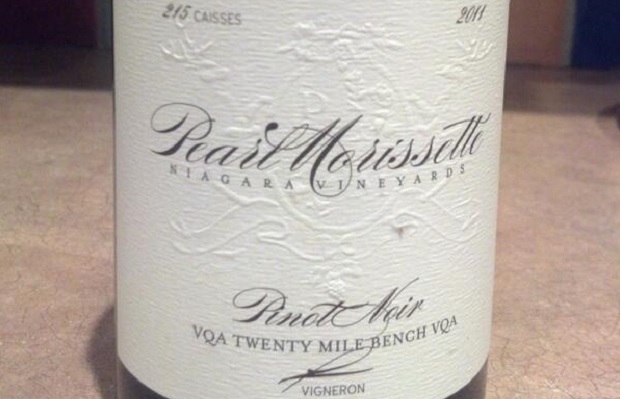
Pinot Noir 2011, Niagara Peninsula, Ontario (Sold out, $36)

With utmost integrity Pearl Morissette chose not to vinify Pinot Noir from the fruit of the 2008, 2009 and 2010 vintages due to unacceptable levels of sour rot. With the 2011 harvest came inspiration. It was noted that local tree fruit farmers make use of the practice of storing their harvested fruit at 1° Celsius in a large refrigerator. This pseudo-cryogenic cooling practicum worked to halt the progression of the dreaded rot. Buying time allowed the crew to clean sort without having to worry about a single berry contaminating the lot. So what? So a pure, clean Pinot Noir was the result. Tasted four months after bottling, the modest (12.7 per cent alcohol) and vinified so dry (2 g/L residual sugar) ’11 held barking fruit on a tight leash and a moonscape of dusty, grainy tannin. Nine months later (to the day) the sensory evolution became as if cherries, strawberries and the tension in seeking ripe perfection were wine.  Tasted July 2013 and April 2014

Pearl Morissette Pinot Noir 2011

Pearl Morissette Pinot Noir 2011

Cuvée Madeline Cabernet Franc 2010, VQA Twenty Mile Bench, Niagara Peninsula, Ontario  (winery, $38, WineAlign)

François Morissette’s 2010 is a pioneering example towards defining Bench appellation Cabernet Franc isomeric reactions. Relationships between grapes of a growing area and their ultimate destination in bottle. An affair of veraison, leaf drop, frost, hand harvesting, whole cluster sorting and berry oak fermenting. Indigenous yeast, punch downs and overs for phenolic skin extraction and polymerization. Neutral oak and sulfur dioxide to provide antimicrobial and antioxidant protection. An eighteen month somniac’s rest, fine lees and no filtration. The structural arrangement in cohabitation of radicals and ions leads to such a Cabernet Franc. Fully expressive of an endemic, very ripe, vegetal varietal vicissitude that is both inbred and necessary. Currants and peppered berries of power and grit. Dry (2 g/L residual sugar), plump (13.7 per cent alcohol) and scarce (618 cases made). Reflective of the warm 2010 vintage and will always act in stark contrast to the elegant 2011. Tasted July 2013 and March 2014

19th Street Cabernet Franc 2011, VQA Twenty Mile Bench, Niagara Peninsula, Ontario  (winery, $38, WineAlign)

First tasted from a barrel sample in July 2013. “From what is turning out to be a very elegant vintage, the 2011 Cabernet Franc is early proof that on the Twenty Mile Bench “we can turn a vineyard very quickly, in three years we can turn a vine.” This is significant in consideration that in Europe, vine age is always key.” Now in bottle the aromatics are hyper-pronounced and though the tannins are less rigid, less exerting and less demanding, they are not nearly ready to throw in the towel. Longevity will define ’11 and it will be the genesis of Pearl Morissette’s CF program used to compare future vintages. “The day of judgement’s come,” and you can bet that the wine’s been “resting, for this testing, digesting every word the experts say.” With the ambient transition of a hairless heart, the 2011 Cabernet Franc segues from anxiety to counting out time.  Tasted May 2014

Chardonnay ‘Dix-Neuvième’ 2009, VQA Twenty Mile Bench, Niagara Peninsula, Ontario (limited library, $40, WineAlign)

Was the ’09 DN this lush and so pretty last summer? Was it bronzing as if sun-kissed and so delicate? Tasted alongside Chef Cameron MacDonald’s White Bean Cassoulet, duck and pork neck wrapped pate it sings in a Lindley-esque falsetto. From my earlier, July 2013 note: “Tragically singular in expression, regardless and in spite of the terroir, mixes metaphors and pulls it off. “Takes arms against a sea of troubles,” by convincing ADHD fruit of an uncertain vintage to settle, play nice and “by opposing, end them.” Now entering the load out zone, this Hamlet cuvée is “the first to come and the last to leave, working for that minimum wage.” A sentimental ballad here to stay, be remembered and to set the stage for all dix-neuvième to come.”  Last tasted May 2014

Chardonnay ‘Dix-Neuvième’ 2010, VQA Twenty Mile Bench, Niagara Peninsula, Ontario (sold out, $35, WineAlign)

Having had the opportunity to taste the 2010 Cuvée Dix Neuvieme on several occasions over the past 10 months, every layer and fibre of its being has ingratiated itself to me. The tropical, solar 2010 vintage required that steps were taken to preserve freshness for when the final blend was to be assembled. A small portion of the juice was fermented separately in stainless steel tank and then injected into the 18-month, neutral barrel mass. The ’10 is full of verve, rigor and grinning elegance. It speaks of a salinity so typical for PM Chardonnay which comes from the usage of lees. This is what could be referred to as a “tannic” white. While it lacks the intensity of the bookending vintages on either side, as a middle sibling it is the glue and the rock that speaks diplomatically and most eloquently for the family.  Last tasted May 2014

Chardonnay ‘Dix-Neuvième’ 2011, VQA Twenty Mile Bench, Niagara Peninsula, Ontario (303602, $35, WineAlign)

A child of a hot and dry summer, a stress-free winter slumber and a non-invasive spring awakening.  Sets out lean, tight and mean, but the dry extract invites spicy, stone fruit and an emergence of tropical lushness. Can there be another specimen that so rightfully defines Pearl Morissette, the top of the Bench or Niagara as a whole in 2011?   Tasted July 2013

Barrel and Tank Samples tasted July 2013 and May 2014

19th Street Cabernet Franc 2012

Tasted in July 2013 from one of two barrels, it’s not so (amazingly reductive) and redolent of the most earthly currants. From a very immense year, in primary quality, barely evolved. Blessed with such ripe tannins this will have even bigger structure. Francois declares “I’m now a believer that Cabernet Franc is the most important grape to grow in Ontario (on this side of St. Catherines). Nine months later, with the wine still sitting on its primary lees and not yet racked “it’s so torqued,” notes John Szabo. “We made a monster CF without cream,” adds François . Pure, énorme, immovable yet so stable. There was a nearly volatile spike during fermentation and malo but it’s done. A death metal beast.  Tasted July 2013 and May 2014

19th Street Cabernet Franc 2013

From juice housed in concrete, wood and open top fermenters this occupies impossible Cabernet Franc colour territory. Sweaty, chalky and bloody, it’s a bit reductive in extract and intensity. Lifted florally and very savoury, this is quintessentially Cabernet Franc in character. Crunchy tannins come late in magnanimous fashion.  Tasted May 2014

Chardonnay 2013

Tighter than it looks, sitting on its lees, pushing the envelope. In a German 2,500L barrel it’s rounder and softer. In second fill Alsatian Foudre it gains tang, spirit and backbone. From the Koscis Vineyard’s heavy red clay there is less texture and mid-palate. Out of a smaller (228L) barrel the wood is felt in fluidity, structure and creamier, clearer fruit. The largest barrel adds (10 per cent) new oak and finishes the ferment the earliest. It brings textural tack and a chewy finish. “New oak doesn’t make it better. It energizes the wine,” says Morissette. Overall this will be a rich, ripe-fruit based opulent Chardonnay, high in potential (13+ per cent) alcohol with a remarkable sweetness despite little or no residual sugar.  Tasted May 2014

Chardonnay from barrel with Ryan Corrigan, Jonas Newman, Francois Morissette and John Szabo

Chardonnay from barrel with Ryan Corrigan, Jonas Newman, Francois Morissette and John Szabo

Rosé 2013

If this Cabernet Franc is flirting with an acetic danger it is not enough to scare me away. Certainly edgy and there is a chance it may be pushed to the fringe, hippest markets but that also may just be a necessity if it is once again rejected as VQA. And it should not be.  Tasted May 2014

Bill Zacharkiw making notes at Pearl Morissette

Bill Zacharkiw making notes at Pearl Morissette

Gamay 2013

In July 2013 Francois Morissette made this statement. “If we can’t make Gamay in a Cru Beaujolais Style, I’m not interested.” In May 2014 his ’13 Gamay causes Bill Zacharkiw to comment with blatant honesty, “just line up at the tank. Forget the bottle.” From 100 per cent whole clusters sent to cement fermenters. Once again the hue is just impossible. Sulphur-free, this walks a fine and perfect line of Cru banana Gamay. Pushes the Gamay envelope in that it’s gulpable but with a duress to remind you not to overdo it. A Gamay with a chamber of 32 doors. In it “I’d rather trust a man who doesn’t shout what he’s found.” François Morissette.   Tasted May 2014


Good to go!

Hot red Rhônes and real May two-four whites

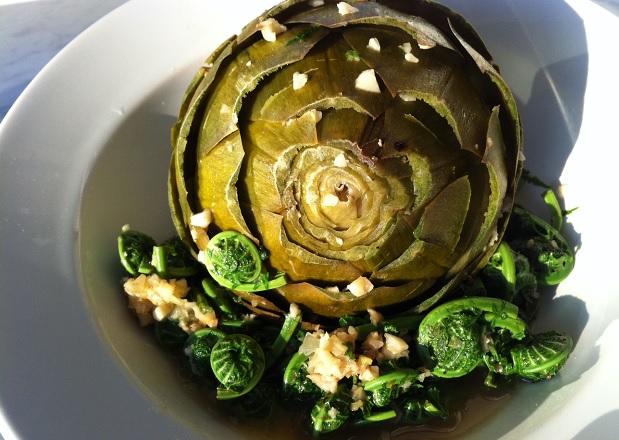
Artichoke and Fiddleheads PHOTO: Michael Godel

Artichoke and Fiddleheads
PHOTO: Michael Godel

More often than not the Canadian May long weekend does not fall on the anniversary date of May 24, in remembrance of the 1819 birthday of Queen Victoria. In fact the last time the holiday Monday fell on the 24th was back in 2010. The not so phenomenal phenomenon happens every five or six years and the 24th never occurs before the Monday. So what? So, VINTAGES gets it right. The latest stop on the release calendar axis falls on the true May two-four, this coming Saturday.

Related – Wines over Two-Fours on Victoria’s Weekend

The May 24, 2014 release puts a heavy emphasis on the southern Rhône, a region that regrettably has lost its balanced way; to heat, extraction, high alcohol and sugar. Sure that may sound like an agglomerated generalization but it is not just the bulk of the 15 plus reds on this release that are guilty as charged. The issue is endemic and has been rising with impunity since the 2007 vintage, arguably even before. What was once a Rhône induced infatuation has rusted and faded away. Cellar stockpiling of once beloved Vacqueyras, Gigondas and Châteauneuf-du-Pape has grounded to a halt. How can the love supreme return?

There are diamonds in every rough and it is through relentless tasting that the wheat rises, the chaff settles and recommendations make themselves known. I am including a couple of reviews on wines weighed down by the encumbrance of over-ripeness and alcohol, if only to back up the rant and the theory. Where have all the good Rhônes gone? My guess is that it’s time to cross the sea and pay a visit, to find the producers who pick early, resist oak-bullying temptation and make honest, balanced wines. I know they’re out there.

So behold the Rhônes, some good, some not so much and other necessary May two-four whites to seek out this weekend.

From left to right: Beauvignac Picpoul De Pinet 2013, La Joya Viognier Reserve 2013, Calamus Riesling 2012, Vineland Estates Chardonnay Musqué 2011, Château Saint Estève Massif D'uchaux 2010

From left to right: Beauvignac Picpoul De Pinet 2013, La Joya Viognier Reserve 2013, Calamus Riesling 2012, Vineland Estates Chardonnay Musqué 2011, Château Saint Estève Massif D’uchaux 2010

Beauvignac Picpoul De Pinet 2013, Ac Coteaux De Languedoc, Sud De France, (350124, $13.95, WineAlign)

Capital, principled and tidy, tide-in Picpoul. Like Touraine meets Melon de Bourgogne with a bit of shell and a touch of green. Steamed ocean whitefish and fresh herbs meets raw bar. Begs for a Camaron Taco or Camarones en Salsa Verde. Would pair well on a soft beach with a traditional Oaxacan seafood spread.  Tasted May 2014

La Joya Viognier Reserve 2013, Colchagua Valley, Chile (168542, $14.95, WineAlign)

Personal preferences aside, here is the right kind of value in other world Viognier. I much admire the restraint, keeping the alcohol and the residual at mostly acceptable levels, allowing what rocks there are in the Colchagua terroir to speak along with bright fruit. A heavy soil accent comes by way of tang and lift, it’s floral as needed and walks a line of good length. Well done.  Tasted May 2014

Calamus Riesling 2012, VQA Vinemount Ridge, Niagara Peninsula, Ontario (158642, $16.95, WineAlign)

It is never wise to hide from the vintage and winemaker Arthur Harder is careful to work with the given lot. This ’12 is no doubt warm but the juicy acidity trumps any humidity that might want to creep in and set up shop. The profile here is more Germanic, more Trocken than was seen in the 2011. The winemaker’s history with Nahe, Rüdesheim and Geisenheim speaks in this vintage. Continues the Calamus roll of offering really good value and impresses the notion that you can take a Riesling out of the Vinemount Ridge but you can’t take the Vinemount Ridge out of the Riesling.  Tasted May 2014  @calamuswinery

Vineland Estates Chardonnay Musqué 2011, VQA Niagara Escarpment, Ontario, Canada (996793, $17.95, WineAlign)

A highly aromatic Musqué, one step up from its Escarpment brethren, with more viscosity and density. Mathematically calculated for the demurred vintage with conscientious risk. Crispy and crunchy, with a touch a waxy fruit, like biting into a buffed and polished green apple.  Tasted May 2014  @VinelandEstates  @BenchWineGuy

Château Saint Estève Massif D’uchaux 2010, Côtes Du Rhône Villages, Rhône, France (370189, $18.95, WineAlign)

Casting aside initial hot and bothered, massive attacks of baked cherry pie and predictable extraction disabling thoughts, this caresses with a really soft mouthfeel. Work with its phenolic ripe charm and let it build with meaty notes and finish smothered in a Bovril gravy textured by chalk and grain. Ultimately it’s quite sophisticated for the appellation and a more than commendably good effort.  Tasted May 2014  @chsaintesteve  @ProfileWineGrp

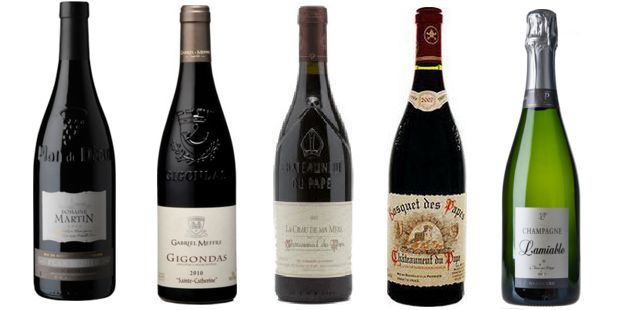
From left to right: Domaine Martin Plan De Dieu Côtes Du Rhône Villages 2011, Gabriel Meffre Sainte Catherine Gigondas 2011, La Crau De Ma Mère Châteauneuf Du Pape 2011, Bosquet Des Papes Cuvée Tradition Châteauneuf Du Pape 2011, Lamiable Brut Grand Cru Champagne

From left to right: Domaine Martin Plan De Dieu Côtes Du Rhône Villages 2011, Gabriel Meffre Sainte Catherine Gigondas 2011, La Crau De Ma Mère Châteauneuf Du Pape 2011, Bosquet Des Papes Cuvée Tradition Châteauneuf Du Pape 2011, Lamiable Brut Grand Cru Champagne

Domaine Martin Plan De Dieu Côtes Du Rhône Villages 2011, Unfiltered, Ac, Rhône, France (370197, $19.95, WineAlign)

Here presents a Côtes Du Rhône acting the epitome of elegance lost. A wasteland lays forth in charred sinew, vineyard stink, buff, scorched earth, funk, baked shriveled berries, toughness and grit. That said it is possessive of flavours, endearing or not, that last. Like a funky, highly seasoned sweetmeat-flavoured gobstopper dissolving in highly tannic tea. Might be your thing. Tasted May 2014

Gabriel Meffre Sainte Catherine Gigondas 2011, Ap, Rhône, France (370270, $29.95, WineAlign)

From a vintage that just can’t seem to hide from itself, this is typically, egregia cum laude commonly rich, extracted and juicy but it’s also got angst and verve. The 2011 Châteauneuf-du-Pape to a wine are categorically, excruciatingly huge and this is why such a Gigondas is a breath of fresh, alternative air. A molten raspberry ooze paints a boulder-strewn Vaucluse crush of good Rhône things. Solid as a rock.  Tasted May 2014  @GabrielMeffre  @DiamondEstates

La Crau De Ma Mère Châteauneuf Du Pape 2011, Ac, Rhône, France (941740, $49.95, WineAlign)

This wine has been referred to as a “Provençal fruit bomb” and a red with “tannins enrobed in the finest chocolate.” Those compliments are as kind as any that should be given. As expected and to stereotype 2011 Châteauneuf Du Pape, this is a blind faith traffic jam of hyper-ripe, over-extracted, baked and sickly sweet liqueur. A Negroni imbalanced by the free pour of Red Vermouth from a tap. This is the kind of Rhône that needs to hear “come down off your throne and leave your body alone, somebody must change.” Wayward, wandering Grenache along with its Mourvèdre and Syrah apostles who are wasted and can’t find their way home.  Tasted May 2014

Bosquet Des Papes Cuvée Tradition Châteauneuf Du Pape 2011, Ac Rhône, France (726687, $50.95, WineAlign)

First off, three words for you babe: 16 per cent. One can only hope the rising tide of hot Rhône wines ends with this penultimate vintage. The licentiousness and quiver of extracted desperation is here in every grain of sugar. Smells like a candy factory in the heat of July and tastes like a fruit roll up mired in pectin quicksand. Big, big wine. So baked, so hot, so rich, so sweet. When did Bosquet Des Papes become the Belle Glos of the Rhône?  Tasted May 2014

Lamiable Brut Grand Cru Champagne, Ac, Champagne, France (374298, $53.95, WineAlign)

A $54 Grand Cru you say? Can it be? A most minor radian, de facto bruised apple, oxidized moment is quickly pardoned because this Champagne is really pushing boundaries. The verve, tang and 120 degree plus angles are simply sparkling. The white fig, sour peach, apricot and bitter almond aromas exceptional and tied together by the pith of all. Has that necessary mineral patina and wet stones, the platinum sting and the toast of nuts and bolts. Length is on top, not hiding below.  Tasted May 2014  @LAMIABLE
Good to go!
 

Tasting the village heart and regional soul of Burgundy

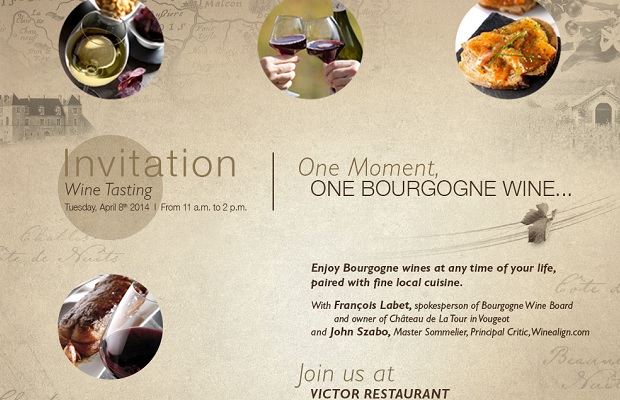
One Moment, One Bourgogne Wine... www.bourgogne-wines.com

One Moment, One Bourgogne Wine…www.bourgogne-wines.com

I would never turn down an invitation to taste des Grands Crus de Bourgogne. I would not hesitate to partake in a free for all of Premiers Crus. If the call came to experience the village heart and the regional soul of Burgundy’s Appellation wines, I would run, not walk to the show.

One Moment, One Bourgogne Wine... www.bourgogne-wines.com

Bourgognes

So, that’s what I did. At the gracious invitation of The Siren Group and Sopexa Canada Ltée I attended the One Bourgogne Wine event at Hôtel Le Germain, along with François Labet, Burgundy viticulture pioneer and chairman of the Bourgogne Wine Board (BIVB) and Communication Commission. Mr. Labet expounded on terroir; from climats to lieux-dits. Burgundy is a geographical and geological landscape of Jurassic age and proportion. Its heritage is ancestral and has been shaped by twenty centuries of activity. The appellation d’origine contrôlée (AOC) acts as its guarantor of quality, of terroir, production methods and what typifies the most famous Chardonnay and Pinot Noir anywhere on the planet.

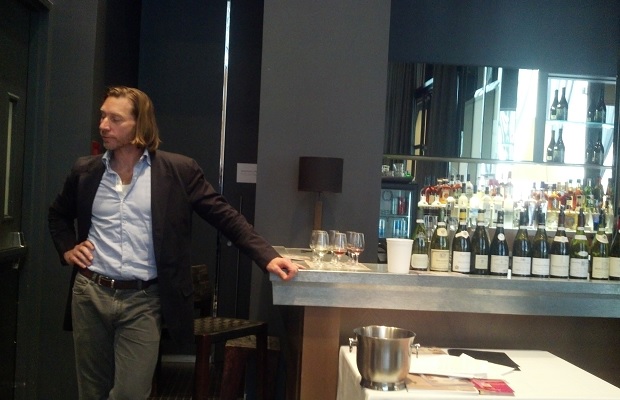
John Szabo presents 15 wines from Burgundy at Hôtel Le Germain's Victor Restaurant on April 8, 2014

Master Sommelier John Szabo of WineAlign presents 15 wines from Burgundy at Toronto’s Hôtel Le Germain Victor Restaurant on April 8, 2014

The Bourgogne event was presented and moderated by Master Sommelier and WineAlign principal critic John Szabo. At the heart of the presentation was the regional diversity that defines real and affordable Burgundy. Mr. Szabo’s chosen wines delved deeper into the soul of the village and regional appellations beyond the Côte de Nuits and the most iconic parts of the Côte de Beaune. Textbook examples from Chablis to the Côte Chalonnaise and the Mâconnais were chosen to offer a true representation of the immensity that is the region.

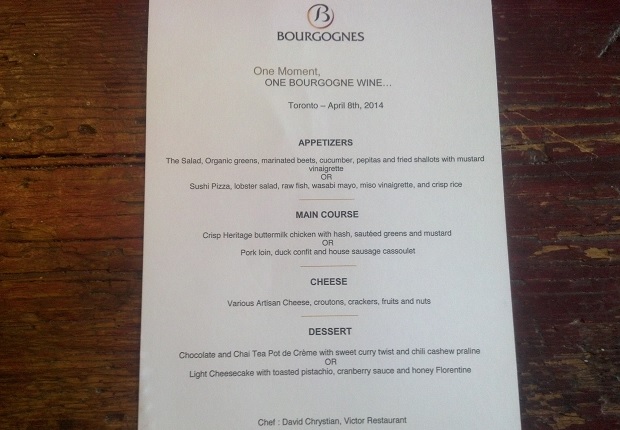
Bourgogne Menu, Victor Restaurant

Bourgogne Menu, Victor Restaurant

The lunch that followed by way of Hôtel Le Germain’s Victor Restaurant was a reconnect for me and the cuisine of Chef David Chrystian. I first encountered chef’s raw and rooted flavours when he assuaged the Garlands at Café Societa on College Street. I remember with fond confusion his earthly layering foiled by the sterile mall, futuristic canvas of the Colonnade (Patriot). After Chef Anthony Rose left the Drake it was dead to me so mistakenly missed Chrystian’s lauded stint. Thanks to the Siren Group for luring me to Victor to reconnect with Chef David Chrystian once again.

Chef David Chrystian's  Sushi Pizza

Chef David Chrystian’s Sushi Pizza

Here are notes on the 15 wines poured and discussed at One moment, one Bourgogne wine.

Domaine Gautheron Chablis 2012, Burgundy, France (207902, $24.95, WineAlign) From the VINTAGES February 15, 2014 release

Canonical Chablis by the hands of independents. Family farmed and fruit fastidiously judged in timely picking and traditional vinification methods. Produced in allegiance to regional typicity, its nose is pierced by limestone’s necessary metallic tang. Apple tart yet ripe and balanced by plumbic weight. Proper, enjoy it all summer long, Chablis.  @ProfileWineGrp

La Chablisienne Montmains Chablis 1er Cru 2010, Ac, Burgundy, France (265090, $28.95, WineAlign) From the VINTAGES November 23, 2013 release

La Chablisienne alone represents nearly 25 per cent of the region’s plantings. The orchard’s juicy fruit brings expression to this Chablis though it’s more savoury than many and it’s document is read in an angular accent. That and patina transposing into aroma, like the smell of a wet, platinum pipe breaching the fruit’s ability to flesh out. Lubricant at the pipe’s elbow and a moment of quince, even melon, offer weight. This is very good but lacks heft and only shows fossilized mineral on the back palate. Good length but a bit carbonic and needs more flesh and bone to elevate its stratus.  Tasted twice, October 2013 and April 2014   @purechablis

Louis Jadot Chardonnay Bourgogne 2013, Ac, Burgundy, France (933077, $20.95, WineAlign)

Jadot’s Bourgogne Blanc is so essential it calls itself Chardonnay. From a vintage in which weather wreaked some havoc and fruit maturity was anything but consistent, the Jadot enterprise found a continued way to get it right, no small feat considering the quantity of triage required for a wine of such quantity. This entry-level white made full use of the warm summer heat, picking was clearly done in advance of the October chill and sorting found the right mix. It’s buttery, nut-browned and figuratively bubbly. The thick and rich texture is key to romancing the fruit into a riper realm than it likely really is. Commendable success from Jadot.   @ljadot

Joseph Drouhin Mâcon Villages 2012, Burgundy, France (356956, $17.95, WineAlign) From the VINTAGES February 15, 2014 release

Simple, pleasant, solid and effective Chardonnay. A true and literal portrayal of the Bourgogne goût de terroir. Warm, gently expressed fruit along with requisite mineral, chalk and lime. Made of a quick resolve to satisfy, quench and move on. An open door to true Chardonnay with nothing shocking, striking or problematic.  @JDrouhin

Domaine Jaeger Defaix Rully 1er Cru, Mont-Palais 2011, Burgundy, France (Agent, $41.99, WineAlign)

From the holdings of Chablis specialist Bernard Defaix, the domain’s variegated clay/chalk vineyards are located in the south of Côte de Beaune. The Mont-Palais vineyard comes from the Niepce family, winegrowers since the 16th century. Now managed by Hélène Jaeger-Defaix, this Rully is utterly unique to Chardonnay. There is a steely, patina Chablis quality to it, but also a concentration in magnetic aroma, whirling in an unstoppable centrifuge, not yet ready to spill those aromas forth. Screams both southern and cool climate, new world Chardonnay, in forward ways like South Africa and like Niagara on the Lake. Not to mention a silty, white salinity. Roger Wilco that. “There’s a light, what light. There’s a light, white light.”  @liffordnicole

Château Vitallis Vieilles Vignes Pouilly Fuissé 2010, Burgundy, France (360495, $27.95, WineAlign)

From 45-70 year old vines, from clay and limestone (Marls). Really, really smart, succulent and mathematical Chardonnay. A stony example who’s tangent space is complexified by a vector of gritty, spiked leaden aromas, like lime, ginger and lemon zest but also by a second vector of herbiage, as in torn, sweet basil leaf. Length stretched by a scalar multiplication, engaging another consideration. Would such a fine example not benefit, at least in theory, from a Premier Cru classification? Surely the winemaker and the vintner would abide.

Château De Beauregard Vers Cras Pouilly Fuissé 2010, Burgundy, France (agent, $48.99, WineAlign)

The famous “Cras” climat on the windy and chalky plateau of Beauregard means “chalk” in the local dialect. Not surprisingly, the chalky mineral impart takes centre stage and the oak treatment fleshes the fruit out in the early stages of the wine’s life. This Pouilly Fuissé solicits attention, love and engagement. An example in clarity of débourbage, the strict sorting technique employed before pressing. Exuberant fruit acts as if it were of a higher caste, a higher Cru. This is a testament to treatment, to extreme minerality. This makes the expression. A very good vintage, ready to consider and expect it to keep on seducing to at least 2020.

Vincent Girardin Vieilles Vignes Chassagne Montrachet 2011, Burgundy, France  (364141, $55.95, WineAlign)

The quality of Girardin’s Chassagne Montrachet is clear, the age and maturity of the vines explicitly noted. There is an increased sense of depth and density that clearly required attention and coaxing. The 14-month, scaled down (15 percent) new oak barrel concept pushes substance to the forefront and wood to the rear. This is rich without being fat, textured but not splintered. The stirred lees add layers to the essentia, accruing a woven tapestry of phenols, lunar-driven gravity and anaerobic activity.  Tasted twice, January and April 2014  @HalpernWine

From left to right: Domaine Gautheron Chablis 2012, La Chablisienne Montmains Chablis 1er Cru 2010, Louis Jadot Chardonnay Bourgogne 2013, Joseph Drouhin Mâcon Villages 2012, Château Vitallis Vieilles Vignes Pouilly Fuissé 2010, Château De Beauregard Vers Cras Pouilly Fuissé 2010, Vincent Girardin Vieilles Vignes Chassagne Montrachet 2011

From left to right: Domaine Gautheron Chablis 2012, La Chablisienne Montmains Chablis 1er Cru 2010, Louis Jadot Chardonnay Bourgogne 2013, Joseph Drouhin Mâcon Villages 2012, Château Vitallis Vieilles Vignes Pouilly Fuissé 2010, Château De Beauregard Vers Cras Pouilly Fuissé 2010, Vincent Girardin Vieilles Vignes Chassagne Montrachet 2011

André Delorme Bourgogne Pinot Noir 2010, Burgundy, France (366427, $20.95, WineAlign)

The thought here is catholic Burgundy, entry-level, old-school, from antiquity and for the people. Smells like and tastes like grand-père’s Bourgogne Rouge. Cherry fruity, dare I say, Gamay like and marked by tannin that doubles the astringency on the drying finish. Nothing scandalous and well-plundered.

Domaine Thénard Givry 1er Cru Cellier aux Moines 2008, Burgundy, France (Agent, $32.50, WineAlign)

The Thénard family has owned land in Givry since 1760 and this Cellier aux Moines vineyard dates to 1258, named by the Cistercian Monks of the Abbey of Ferte. This is iconic 1er Cru for Givry, from relatively old vines (35-40 years) on a single plot, in mid-slope of southern exposure. Straight out notes of sinew, stem and savour. Esses all around. A vegetal and rustic infirmity comes across and travels through the wine as you work with it. Smells oddly like…hemp. Or perhaps it’s a more delectable weed than that, like rapini, or dandelion. The charred back-end scent reminds of a just extinguished joint. The flavours are dubious, maritime and of the antediluvian earth. For the brave Burgundy heart. Perhaps five to 10 years will soften its edges, peel away the foreign matter and allow a hidden fruit purity to shine.

Bouchard Père & Fils Beaune Du Chateau Rouge 2009, Burgundy, France (325142, $36.90, WineAlign)

If today is the day to splurge on red Burgundy but crossing to the dark side of the VINTAGES section is not going to happen, take comfort in this LCBO general (Signature) listing. Dictionary entry actually, but also something funky this way Beaunes. Produced from a whole whack (17 parcels) of Premier Cru, the animal is strong but decidedly feminine. Clear, precise, distinct perfume with each swirl and replayed with every sip. Like raspberries and the sweet smell of the trodden earth after the dew subsides. Could drink this for breakfast with organic bacon post morning stroll and before a dreamy nap.

Maison Roche De Bellene Beaune 1er Cru Les Grèves 2010, Burgundy, France  (Agent, $46.95, WineAlign)

So very primary, this Beaune, from the work of Nicholas Potel and winemaker Matt Chittick. Some of Les Grèves vines are nearly 110 years-old and there is clear wisdom beyond the edgy, masculine fruit. Those vines are selected for selection massale, a propagation technique that breeds perpetual health and consistency of style for present and future wines. A different sort of animal resides in this one, of musk, and mineral. Like the Beaune equivalent to traditional Brunello. Yet this Beaune from a very desirable vintage is nimble, moves with quick steps and cat-like reflexes.  @RochedeBellene

Albert Bichot Domaine Du Pavillon Clos Des Ursulines Pommard 2011, Burgundy, France (23820, was $49.95, now $40.75, WineAlign)

The funk in this Pommard is unflappable, modish, flirting and so elevated in stained high-acid and tone. Incredibly tight and sour upon sour. A strenuous Pinot Noir to ponder and even harder to ignore. If the tasting were to last for hours into the afternoon I could imagine a resurgence but often the old adage is true. If it isn’t there to begin with, it will never be. Would like to look ahead and say “it’s not what it was before,” but this is either lacking fruit or it’s just so far away. The texture is plush, the mouthfeel aching, breaking hearts. Mineral, astringent long finish. Tough as nails.  Tasted twice, November 2013 and April 2014

Aurélien Verdet Morey Saint Denis ‘En La Rue De Vergy’ 2010, Burgundy, France  (353416, was $44.95, now $36.25, WineAlign) From a storied vineyard just above the very famous Clos Du Tart in the Côte de Nuits. This producer may not be a household name for its holdings in this Burgundy plot but step aside Bruno Clair, Lignier-Michelot and Pascal Marchand. Verdet can handle the terroir of Morey-St.-Denis. Was and still is an unexpected gem. Rich, textured, layered cran-raspberry and earthy flavours. Persistent though sweet and engaging tannins. From my earlier, September 2013 note. “Noses my kind of MSD aromatics. Soft vanilla, black cherry, smoke and obdurate limestone toughness. Coated in fine, tinny tannin and stretchy length, this represents big value for the appellation.”  Last tasted April 2014

Daniel Rion & Fils Vieilles Vignes Nuits St Georges 2011, Burgundy, France  (356600, $53.95, WineAlign) Classic and as representative as it gets for the appellation, this is firm, time-honoured Burgundy. The old vines, the earth beneath its tendrils and the medieval forest are all in the glass. Though terse and tense, this Pinot Noir will come around to fill glasses with humanistic pours 10 to 15 years down the road. That extended wait will be needed to integrate the earthiness into the formidable tannins so that the lurking red fruit can rise to the top. A fine example with a model, lengthy finish.

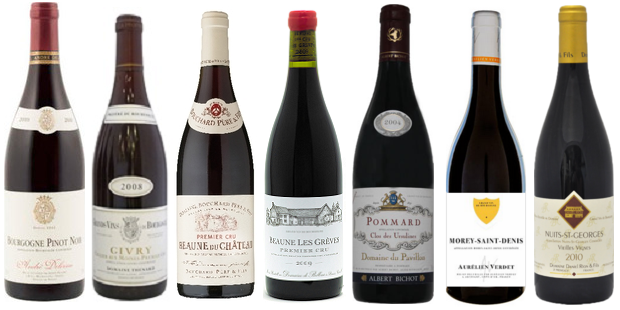
From left to right: André Delorme Bourgogne Pinot Noir 2010, Domaine Thénard Givry 1er Cru Cellier aux Moines 2008, Bouchard Père & Fils Beaune Du Chateau Rouge 2009, Maison Roche De Bellene Beaune 1er Cru Les Grèves 2010, Maison Roche De Bellene Beaune 1er Cru Les Grèves 2010, Aurélien Verdet Morey Saint Denis ‘En La Rue De Vergy’ 2010, Daniel Rion & Fils Vieilles Vignes Nuits St Georges 2011

From left to right: André Delorme Bourgogne Pinot Noir 2010, Domaine Thénard Givry 1er Cru Cellier aux Moines 2008, Bouchard Père & Fils Beaune Du Chateau Rouge 2009, Maison Roche De Bellene Beaune 1er Cru Les Grèves 2010, Maison Roche De Bellene Beaune 1er Cru Les Grèves 2010, Aurélien Verdet Morey Saint Denis ‘En La Rue De Vergy’ 2010, Daniel Rion & Fils Vieilles Vignes Nuits St Georges 2011


Good to go!
A ramp to Austrian wine

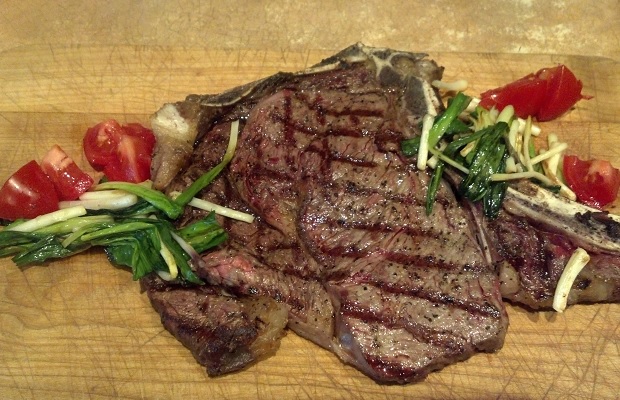
Rib Steak and Ramps PHOTO: Michael Godel

Rib Steak and Ramps
PHOTO: Michael Godel

‘Tis the season to partake of two things denied opportunity the rest of the calendar year. Wild leeks and Austrian wine. The first is just a seasonal thing. The second, entirely my fault. The forest and my backyard provide the ramps. Two most excellent wine agents, Bernard Stramswasser of Le Sommelier and Mark Cuff of The Living Vine are the messianic purveyors of the wine.

Mark came to Barque Smokehouse last month to share his wares, talk organics, biodynamics and to teach a staff what honest wine is all about. More on that extensive tasting coming soon. Bernard brought top estates from Austria with Andreas Wickhoff, MW to Toronto’s Fine Wine Reserve on April 16th, 2014 for a special portfolio tasting. The Master of Wine is deeply passionate and terroir obsessed when it comes to the Austrian landscape. The presented set of whites and reds rose up to incline an exemplary ramp to the nature of that country’s fine wine tradition.

The whites, mainly centered around the signature variety Grüner Veltliner, showed the mineral and salinity so necessary to the grape’s success. Reds made from Zweigelt and Blaufränkisch are Austria’s trump card, ready and willing to take on the world’s reds imbued of elegance and finesse. Here are notes on the 12 Austrian wines tasted.

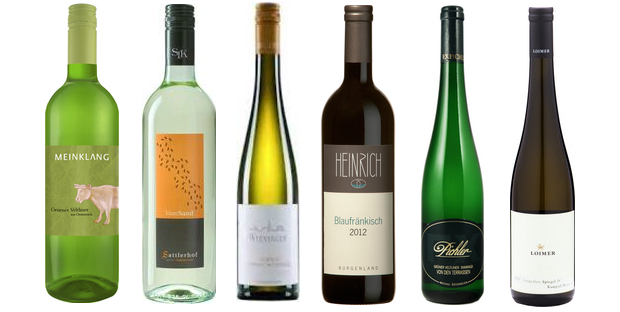
From left: Meinklang Grüner Veltliner 2013, Burgenland, Sattlerhof Sauvignon Blanc Vom Sand 2013, Südsteiermark, Wieninger Gemischter Satz 2013, Vienna, Weingut Heinrich Blaufränkisch 2012, Burgenland, F.X. Pichler Federspiel Loibner Klostersatz Grüner Veltliner 2012, Loimer Spiegel Grüner Veltliner 2012

From left: Meinklang Grüner Veltliner 2013, Burgenland, Sattlerhof Sauvignon Blanc Vom Sand 2013, Südsteiermark, Wieninger Gemischter Satz 2013, Vienna, Weingut Heinrich Blaufränkisch 2012, Burgenland, F.X. Pichler Federspiel Loibner Klostersatz Grüner Veltliner 2012, Loimer Spiegel Grüner Veltliner 2012

Meinklang Grüner Veltliner 2013, Burgenland, (Agent, $15.95, WineAlign)

Meinklang is a passionate, biodynamic (Demeter farming) producer in eastern Austria, south of Vienna. Their practices include abstaining from the pruning of vines, called “graupert” and maturation in concrete egg-shaped containers. The vineyard is their biotope and they make compost from animal dung, pomace, plant cuttings and ground quartz. Their entry-level Grüner is so mineral dominant and saline it’s as if the stones are bleeding. Extreme tang, with that salinity that never lets go and so much lime. Then makes quick work of itself.

Weingut Loimer, Grüner Vetliner ‘Lois’ 2013, Niederösterreich, Austria ($18.95, WineAlign)

From Niederösterreich in the Kamptal region, from soil compositions of bedrock and loess, this is straightforward Grüner Vetliner made in 200,000 bottle loads. That it succeeds in spite of the quantity and the work with contract growers is a testament to Fred Loimer’s sense of quality control. A bit shy aromatically but really tangy on the palate. Clear, crisp, clean and appreciably pure. Lithe in body and with some salinity on the back-end. Versatile mingler.

Sattlerhof Sauvignon Blanc Vom Sand 2013, Südsteiermark, Austria ($19.95, WineAlign)

This is bewusst territory for the Südsteiermark producer, from organically farmed vineyards. An elegant Southern Styrian Sauvignon Blanc made from grapes previously destined to get lost with other traditional varieties. Most striking is the salinity on the nose, often abstruse for Sauvignon Blanc but most obviously explained by the land; sand, gravel and shell limestone. Estimable restraint in the whispered aromas of herbs, green vegetable and tangy tree fruit. Dewy finish that lasts well into the morning.

Wieninger Gemischter Satz 2013, Vienna, Kamptal, Austria ($20.95, WineAlign)

Though Grüner Veltliner, Weissburgunder, Welschriesling and Chardonnay make up most of the formidable aspects of this blend from the Vienna Hills, there are bit but integral parts played by 11 others. From bio-certified Bisamberg and Nussberg vineyard sites, this is antithetically seamless, the varieties drawing all possible logical relations woven by their finite collection. Approachable, gritless, effortless, integrated and bound together by a solid core of juicy acidity. Even if only because it agglomerates 15 grapes, this beats white Châteauneuf-du-Pape (by at least six varieties) at its own game.

Nigl Gartling Grüner Veltliner 2012, Kremstal, Austria ($21.95, WineAlign)

The locus point of Nigl’s single vineyard Grüner Veltliner is sharp and stinging in 2012. Although that chemically reactive laser pinning takes control, it is extremely refreshing to not have to talk about flat and flabby fruit. Mind you the fruit here is under stress so balance needs to be questioned. Ultimately there is a palpable sense of grapefruit, flowers and a finish marked by the scraping of stones.

Loimer Langenlois Grüner Veltliner 2013, Kamptal Dac, Kamptal, Austria ($23.95, WineAlign)

Increased hang time has put this Kamptal in a deeper state of focus and understanding concerning the intricacies of Langenlois Grüner Veltliner. Continues the pure, clean and crisp axiom of the basic Lois but here the aromatics are spoken in acroamatic terms, obvious to disciples and yet available for all to comprehend. Though five per cent big wood barrel aging does not seem significant, that practice along with four months of aging on the fine lees has had a textural impact. The added weight is a questionable thing, though arguably just splitting hairs. Will help carry this vintage through five to seven years of graceful settling.

Dirty Ramps

Dirty Ramps

Weingut Heinrich Pinot Noir Dorflagen 2013 (Tank Sample), Burgenland, Austria ($24.95)

From two sites in Gols, one being the gravelly Riede Goldberg on the Parndorf Plateau, the other a sand and loam slope of the Salzburg. Short-ish ferment in large-ish barrels. Marked by bright cherry of the upstanding young fruit kind and only a brushstroke of paint. Very linear in that a Rube-Goldberg Pinot machining ensues, as the dominoes fall into each other. One action creates another, mostly due to a fine-grained chain of tannin. As delicate and approachable as Pinot Noir ever was from this far east.

Weingut Heinrich Blaufränkisch 2012, Burgenland, Austria ($24.95, WineAlign)

From a combination of vineyards on both the eastern and western sides of steppe Lake Neusiedl, situated between the easternmost parts of the Alps and the western part of the Small Hungarian Plain. A Blaufränkisch with so much geological and climatic history behind it, with Alpine, Pannonic, Asian, Mediterranean, and Nordic influences. The inclination is to express this unique, later ripening red with terms of bright endearment but it’s much more serious than that. Deeper, earthier and entrenched in the limestone and slate vineyards on Burgenland’s Leithaberg slopes of the Parndorf Plateau. The terroir amplifies and cloaks the fathomage of what is ostensibly tangy, effulgent fruit. More tannin than one would expect, this is a complex organism from a variegated landscape.

Heinrich Zweigelt 2012, Burgenland, Austria ($24.95, WineAlign)

Though 2011 was the best vintage of the last three and Blaufränkisch is the estate’s signature red, this 2012 is a real charmer. The vines for this Zweigelt lay lower, on the flats east of the alpine, steppe lake. They benefit from gravel Heideboden soils and from a nurturing microclimate. The aromatic profile is of spice and dried fruit; licorice, tar, carob and even more specifically, Bokser. All the right pods. Hydrates to sweet cherry fruit and begs for slow-cooked, smoky protein.

F.X. Pichler Federspiel Loibner Klostersatz Grüner Veltliner 2012, Wachau, Austria ($37.95, WineAlign)

From the Loiben basin where eroding, rocky Danube sands mix with gravel to produce lacey and textured Grüner Veltliner. This Federspiel (classified as wines between 11.5–12.5 per cent with a minimum must-weight of 17 degrees) shows more richness, viscosity and body than many with a pronounced spicy edge on top of the highly floral citrus zest. It gives the strange sensation of chewing spicy gum. A Grüner of good temperament beseeching the imbiber to have more than just one taste.

Loimer Langenlois Terrassen Grüner Veltliner 2012, Kamptal, Austria (149674, $39.95, WineAlign)

Loimer’s Terrassen is a Kamptal four vineyard Premier Cru (“Erste Lage”) schmear that is fermented in big wood barrels. The increased weight and body is helped along by extended time on the lees. The ligneous weave is underscored by wood spice and a waft of buff, calcareous Aeolian sediment. The character is as if this Langenlois is scenting a barrel ferment aura in a Chardonnay vein. Classic Grüner Veltliner that is all about texture. Will last for 10 or more years without shedding its baby fat.

Loimer Spiegel Grüner Veltliner 2012, Kamptal, Austria (agent, $64.95, WineAlign)

A site-specific Grüner Veltliner from the Speigel “Erste Lage” vineyard site, this is exemplary and definitive stuff. The 2012 vintage saw a two-day (May 16 and 17) frost that meant a 30 per cent loss in fruit. Not all vintages are profitable but ’12 is showing what top quality wines it was able to produce. A 12-month lay in Acacia barrels, natural vineyard yeasts and five months of aging on the fine lees have conspired for a climb to great Grüner heights. Blooming flowers, mellifluous honey and the freshest, most natural acidity abounds, elevating the aromatics and the buoyant flavours of just picked and bitten into apples. Tremendously wise and elegant wine.

Good to go!

Cleaned Ramps

Cleaned Ramps


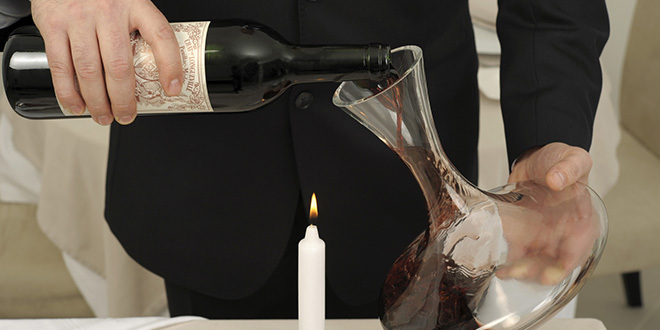
Just say no? Deconstructing decanting

Does decanting eliminate the natural oxidative curve of a bottle of wine? Does it make a wine taste $20 better? Photo: FOOD-pictures/Fotolia.com

Does decanting eliminate the natural oxidative curve of a bottle of wine? Does it make a wine taste $20 better?
Photo: FOOD-pictures/Fotolia.com

The wine drinking experience is afforded more pleasure by decanting a bottle of wine. Decanting means aeration and separation of liquid from sediment. Plain and simple. Most wine drinkers have always bought into this belief. Does that still hold true today?

The debate rages high. Eric Asimov from the New York Times suggests he’s of the camp that takes the middle ground. “Many good red wines are not and continue to produce sediment, so once they reach middle age, decanting these wines, very carefully, remains advisable. I like to decant young reds that might be tannic or tight, like those made from Nebbiolo or Cabernet Sauvignon. Even young red Burgundies can benefit from decanting, though Burgundians might roll their eyes.” True middle ground comes by way of, ironically, Decanter Magazine. “Most modern-day wines do not require decanting, though even young wines may benefit from aeration.”

The famous Bordeaux house of Château Margaux states that “the main reason for decanting red wines is to separate the wine from the sediment that may have formed in the bottle over the years. This sediment consists mainly of the tannins that have been made insoluble by the chemical reactions responsible for the ageing process.” They, like so many other Bordeaux stalwarts, remain entrenched in the world of decanting.

Will Lyons of the Wall Street Journal concurs. “All wine that will throw sediment should be decanted; this includes red Bordeaux, Rhône, Rioja, vintage Port and heavy grape varieties such as Cabernet Sauvignon and Syrah. Also—and this is open to discussion—young wines. In my experience, exposure to air unfurls the complex layers of flavor in young fine wine.” Chris Kissack fervently believes in the decanting process. “Decanting wines is not just for show, and even in this modern age of industrial, fined and filtered wines, some will still benefit from spending some time in a decanter.”

Consider these questions. Does decanting eliminate the natural oxidative curve of a bottle of wine? Does it make a wine taste $20 better? Is decanting elitist, obnoxious and unreachable for the average consumer? Cerebral decanting is another matter. Don’t hate a bottle of wine because it’s not been decanted. Hate it because it’s a bad bottle of wine.

And then there is hyper-decanting. This by way of Digital Deconstruction:

Gerardo Diaz is the Manager and Sommelier at Barque Smokehouse in Toronto. He is adamantly anti-decanting. Here is his well-thought out take:

Decanters come in various shapes and sizes, from functional to ornate to downright ugly. Decanters have played a role within the wine world for thousands of years. They have had many uses over time but for me, they have simply fallen out of practice and are representative of an archaic time, when wine was not made to be drunk immediately. This magnified by the fact that the technology of making wine back then was sub par in comparison.

Wine was held in amphorae, then in glass, metals or earthenware. These were the holding compartments for the fermented grape juice, then transferred off to decanters in order to minimize the amount of sediment within in the decanter/glass. It was used to aerate tighter wines and soften the tannins. Time has changed.

Decanters have become nothing more than a symbol of the past. With modern-making techniques and current trends, people want to be able to drink their choices immediately, and winemakers are following suit.

Wine is not what it used to be. Often over oxidized, aged for many years, with more vintage variation, etc… Nowadays when wine is bottled, it is what it is and does not change that much. As a matter of fact, aeration tends to do worse than better. People seem to believe that decanting hours prior benefits the wine. Quite the contrary. With modern wine techniques and just common sense, the aromatic compounds can only go far, that is to say that with time they will diminish as the minutes/hours go by. Decanting can be used for only two things, well aged wine and natural wines. But more now than ever, wines are not being made to age. They are being made to feed the immediate masses, the ever-growing population, but more so an ever-growing wine drinking population.

Tannins have a bad rep when speaking about wine, some say yay, other say nay. They provide structure, the very backbone to a wine. The added texture is the single most important thing in wine for me and acts as a natural preservative. Decantation is believed to soften these tannins that can be gripping, ever so drying, and to some, a turn off. This popular belief is misconstrued. Softening of the tannins takes place in the winery, with the winemaker. Decanting will only alter perception, kind of like a placebo effect. Yeah, decanters are a placebo effect.

I personally dislike decanters except for the two stated reasons, and even then, natural wines that almost exclusively lack preservations (sulphites), never need more aeration. The wine is what it is and will last a long time opened in bottle.

Good to go!
Reds for a blood moon

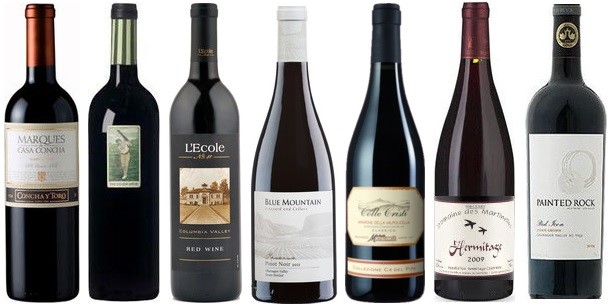
Reds for a blood moon

From left to right: Concha Y Toro Marques De Casa Concha Carmenère 2008, Jim Barry The Cover Drive Cabernet Sauvignon 2010, L’ecole No. 41 Red Wine 2011, Blue Mountain Reserve Pinot Noir 2011, Michele Castellani Colle Cristi Collezione Ca’ Del Pipa Amarone Della Valpolicella Classico 2008, Domaine Des Martinelles Hermitage 2009, Painted Rock Red Icon 2011

That the ‘Blood Moon” tetrad of 2014-2015 fall on Passover and Sukkot should come as no surprise. That it’s snowing again on April 15th while the Moon meets the Earth’s shadow for a total lunar eclipse is a cosmic connection that requires red wine. Big reds.

Last weekend’s VINTAGES April 12th release had some beauties and a recent tasting at WineAlign of B.C. wines showed that power and finesse can co-exist on the Left Coast. Who knew they would come in handy with the mercury again dipping below zero and people everywhere howling at a moon they can’t see. Crazy times.

Thanks to Dave Dickinson, the lunar phenomenon is broken down into laymen’s terms, in shades of red. “Does the eclipsed Moon appear reddish to you? What you’re seeing is the sunlight of a thousand sunsets worldwide, streaming through the Earth’s atmosphere into the shadow. This color can vary considerably from eclipse to eclipse, causing it to appear anywhere from a dark tea-stained color to a bright cherry red. This variation is due to the amount of dust currently in the Earth’s atmosphere, and is measured on what is known as the Danjon scale.”

Here are seven immense red wines, from three continents, each with their own unique style, to match with a blood moon.

Concha Y Toro Marques De Casa Concha Carmenère 2008, Peumo Vineyard, Rapel Valley, Chile (169862, $19.95, WineAlign)

A trifecta of regard makes this worth looking at, the least of which, at first thought, is the effect of some age. The Concha y Toro Carmenère examination, in Carmín de Peumo, in Terrunyo and in Marques de Casa Concha is the Chilean reference point for the variety. The impart of deep, clay soils and the expectation of gentle tannins make for a curiosity call when considering an ’08 specimen. Tough and gritty, on one hand, on the other soapy, sandalwood and waxy. The third hand has smouldering wood, berries and tannins. Very much like its Cab and Merlot brethren, the fruit is just starting to be outrun. Try it now and see what Carmenère can bring.  Tasted March 2014  @conchaytoro

Jim Barry The Cover Drive Cabernet Sauvignon 2010, Coonawarra, South Australia (677476, $26.95, WineAlign)

Young-ish vines on the site of the old Coonawarra Penola cricket ground receive perpetual hydro-mineral support from porous limestone under rich terra rossa soil. That fruit is then blended with extract from estate vineyards in the Clare Valley. Smashes the cover off the grapes towards a full on gain of flavour. Charred peppers and lush black berries are smothered and splintered by a 50/50 split of French and American oak in no less than a crush of conceit. Tannin, grit, joy, flesh, full on deep fruit and mineral. Obviously over-swung and with too much club (switching sports), like using Driver used when a long iron would have sufficed. But you drive for show and this Barry can putt for dough.  Tasted March 2014  @Jimbarrywines

L’ecole No. 41 Red Wine 2011, Columbia Valley, Washington, USA (366237, $29.95, WineAlign)

A really good, high-octane red blend if blatantly massive. Like the smell of a shiny, varnished, fresh wood cabin glazed by highly aromatic and resinous epoxy extract. That’s the simple tasting note. The more complex version includes a perfume potpourri of Bougainvillea, violet, orange peel, cinnamon, dark chocolate and a lumber factory. The electric, fully plugged in blend is Syrah, Merlot, Cabernet Sauvignon, Malbec, Cabernet Franc and Grenache (38, 36, 15, 6, 4 and 1). The quotient seeks learned Nirvana and with a little luck, some power chords, a bit of screaming and historical, retro-cult exoneration, it may just get there. Right now it just feels like High School. Impulsive and uncomfortable. Wouldn’t you believe it, it’s just my luck. No recess.”  Tasted March 2014  @lecole41

Blue Mountain Reserve Pinot Noir 2011, Okanagan Valley, British Columbia, Canada (Winery, $36.00, WineAlign)

The Reserve Pinot is intoxicating to say the list. Some whole clusters in the fermentation process add mouth feel, cure and needed grit but how this can not be viewed overall in the shiniest west coast light would be confounding. The reserve ’11 is both “sky as I kite, sticky as lips” and “as licky as trips.” If there was ever an Okanagan Pinot Noir to get you high, this would be the one. What a boisterous effort out of a less than scorching vintage and considering the modest to riches price, no shame in visiting with flavourful fare, imbued with spice, any day of the week.  Tasted April 2014  @BlueMtnWinery

Michele Castellani Colle Cristi Collezione Ca’ Del Pipa Amarone Della Valpolicella Classico 2008, Veneto, Italy (222109, $45.95, WineAlign)

The magic of age is a friend to Amarone and funk trumps fruit. In a nutshell the axiom describes the old-school Colle Cristi. A brooding Amarone, cut by zest that’s citrus-like and savoury/earthy in pine needles, juniper and a Venetian forest in autumn. Inviatura and Chiaroscuro. Caravaggio meets Giorgione. The most complex Valpolicella in the April 12th VINTAGES line-up.  Tasted March 2014

Domaine Des Martinelles Hermitage 2009, Rhone, France (112268, $54.95, WineAlign)

Clearly modern and style-heavy though not out-of-place in the world of Hermitage. From steep slopes of stony brown sand, a high level of grit might be expected but this Syrah is refined, lush and smooth as silk. At 14.5 percent it’s no shrinking violet, honest and futuristically traditional. At $55 it’s a mandatory, appellative Northern Rhone steal. Matter-of-fact acidity, verve and mineral content are all in, with elegance and balance. Really fine Syrah with a five to ten-year fruit-tannin power struggle ahead.  Tasted March 2014  @LeSommelierWine

Painted Rock Red Icon 2011, VQA Okanagan Valley, British Columbia, Canada (Agent, $55.00, WineAlign)

Painted Rock’s red icon could be considered more black than red, as exemplified by the layering of grapes, their pitchy extracts and the fruit associated with their gathering. If the man should ask, “tell him what we said ’bout ‘Paint It Black.’ Rock ‘n Roll is here to stay.” Yes, the Icon will be a big star someday and perhaps this ’11, despite the cooler vintage, will be the first. Might have to wait 13 years or more to find out because the tannic structure is in beast mode and will remain so for likely that much time. The wine plays memorable chords and its song lingers on the brain.  Tasted April 2014  @liffordwine  @PaintedRockJohn

Good to go!
 

Up on Creekside Estates

Creekside Estate Wines Photo: Eric Vellend

Creekside Estate Wines
 Photo: Eric Vellend

It was the weekend of Godello’s excellent Cuvée adventure, a Niagara winepalooza that included the Brock University Cool Climate Oenology and Viticulture Institute’s Expert’s Tasting. On the road to The Falls there happened an extensive tank, barrel and vertical go round at Flat Rock Cellars and then, with chef riding shotgun, the next essential stop came up on Creekside Estates, a seventeen year-old Jordan winery on 4th Avenue.

Creekside Estate Winery
2170 4 Ave. Jordan Station, ON L0R 1S0
1 (877) 262-9463 or (905) 562-0035

@CreeksideWine

Creekside was founded in 1997 by owner Laura McCain on a 15-acre vineyard at the 4th Ave. site. The early days of the winery saw an attitude towards varietal antidisestablishmentarianism, with Sauvignon Blanc and Shiraz at the forefront of production. Daring to be different from the start, Creekside has carved an antithetical, Niagara Peninsula religious wine belief, slightly devious, with a manifesto towards creating wickedly good wines.

Creekside Estate winemaker Rob Power Photo: http://www.creeksidewine.com/

Creekside Estate winemaker Rob Power
Photo: http://www.creeksidewine.com/

In the early days there was winemaker Rob Power and mad scientist partner in crime Craig McDonald, now the chief of what happens in bottle at Trius. Powers graduated in the first oenology class out of CCOVI and began his vinous stirring with Creekside, a post he continues to develop, never-resting on earlier laurels. Back then the two cubs fermented and blended together, with caution swirling tohu vavohu in the wind. Some of those Meritage blends from the early 2000’s were brilliant strokes of luck, or as winemaker’s like to call it, hard work. Or destiny, or god’s favour. The Creekside credo has never wavered. Being overly serious is not an option. Having made decisions such as purchasing the unparalleled Queenston Road Vineyard on the St. David’s Bench on its side, Creekside thrives by an exhibition of capricious behaviour, adroit winemaking and the rope savvy marketing of veracious and affordable wines.

Assistant winemaker Yvonne “Cellar Monkey” Irvine and Director of Sales, Marketing and Necessary Evil Matt “Semi-Illustrious Career” Loney ushered a tasting of 12 Creekside wines. Here are the notes.

Creekside Estates Winery Photo: http://www.creeksidewine.com/

Creekside Estates Winery
Photo: http://www.creeksidewine.com/

Sauvignon Blanc 2012, VQA Niagara Peninsula, Ontario (620724, $13.95, WineAlign)

Leans and veers to the tropical side, no doubt as a result of a record-setting sugar vintage, but this ’12 manages to finish very dry. The arid descent follows a warm and fuzzy peach feeling, set about by some skin contact and buoyed by citrus and zest. Front yard value.

Backyard Sauvignon Blanc 2013 (Tank Sample), VQA Niagara Peninsula, Ontario (341792, $17.95, WineAlign)

A Creek Shores SB that bridges the gap between spring and summer fruit. From a year in which the choice was made to not blend off into the estate bottling. Recognizable Creekside aromatics stand out in a more than obvious mineral deposit and grapefruit zest way. Here the band plays across The Great Divide so “just grab your hat, and take that ride.” Will be a VINTAGES August 30 release.

Sauvignon Blanc Reserve 2012, VQA Niagara Peninsula, Ontario (142570, $26.95, WineAlign)

Seven barrels make up the Reserve, ferments new (four) and old (three), leading to a richer, fatter and spicier style. Dreamy really, as matchstick and flint join the fray in a Pouilly-Fumé way. That pierre à fusil is exaggerated by the warmth of 2012, with an elevated tang, rendering the flavours even more akin to Old World, Loire Sauvignon Blanc. Close your eyes and when you awake, “when you believe, you will relieve the only soul that you were born with, to grow old and never know.” The Creekside band created an old SB soul in ’12.

Laura’s White 2012, VQA Niagara Peninsula, Ontario (121764, $18.95, WineAlign)

Laura’s White combines Sauvignon Blanc, Pinot Gris, Chardonnay, Riesling and Gewürztraminer in a kitchen sink blend that sees a bit of oak. What’s notable about the ’12 is the omission of two highly aromatic components, the previously employed stalwarts Viognier and Chardonnay Musqué. The adage is justified in that you take what the vintage gives you. If it gives you lemons, (shift tangents) you let the busy aromatics of more flavourful grapes (like Chardonnay) do the floral work. Laura’s ’12 will be a standout for the concept, a revivalist blend to help bring back some religion to the region’s renditions. Coming to VINTAGES in June.

Viognier Estate Reserve 2011, VQA Niagara Peninsula, Ontario (22058, $29.95, WineAlign)

A 60-80 cases annual production from the Queenston Road Vineyard is not nothing because “ya take what ya need and ya leave the rest.” Aside from a miniscule addition out of stainless steel tank, this is all neutral barrel fermented fruit. Reigned in, less boozy and subordinate in oleaginous slide than in the sweaty years. Translation? A superlative vintage. The night they drove a whopping six rows of old ’11 Dixie Viognier fruit down for crushing the band began to play. This, knowing full well there would be no dirty peach martini, but rather a perfumed dropper distilling flowers, wildflower honey and wild tarragon. Rises and falls to verse like a Richard Manuel keyboard march with length to match the Queenston Road.

Rosé 2013 (Tank Sample), VQA Niagara Peninsula, Ontario (winery, $15.95)

A Cabernet Sauvignon (71 per cent) and Cabernet Franc (29) full-on saignée Rosé with colour balance given by way of the CF bleed. An arid entry creeps to sweet with a pause amongst the whispering pines, finishing tinny and with a breath of fresh herbs. Niagara Rosé can get lost sometimes, in extract, hue and a candied, sinking feeling. This is a scaled back vintage which is more than a good thing, so there’s no waiting, “until it all goes round…the lost are found.”

Syrah 2012, VQA Niagara Peninsula, Ontario (121764, $15.95, WineAlign)

A healthy 3,200 cases are managed and executed with ease from mostly estate fruit. Certainly warm in this vintage, dare I say, like McLaren Vale. If it must not be said, too bad, but it’s also a bowl of fresh berries with a rocky Rhône intent. Terrific tar and ash finish.

Cabernet Shiraz Estate 2011, VQA Niagara Peninsula, Ontario (305300, $16.95, WineAlign)

A traditional Oz combination of Cabernet Sauvignon (55 per cent) and Shiraz (45), clearly new world in style, as Yvonne Irvine says, like “trying to make a big, rich, unctuous Shiraz.” The question could be posed, “temptation stands just behind the door, so what you want to go and open it for?” This one goes right to the jawbone with serious backbone and streak of acidity. Not to mention chalk, grain and a Shiraz solo. The American oak accent is clear and the tannins say wait two to three years, please. The fruit may, or may not comply.

Laura’s Red 2010, Queenston Road Vineyard, VQA St. David’s Bench, Niagara Peninsula, Ontario (117906, $19.95, WineAlign)

It’s funny, more than any other wine tasted, this Laura has that Niagara varnish other Creekside reds seem not to possess. “Stock up in the big years” suggests Matt Loney, and “consolidate in the tougher ones.” It could be argued that you can make more interesting wines in the lean years but this blend of Cabernet Sauvignon, Merlot, Syrah, Malbec and Petit Verdot lays a claim to seriousness, if needing at least three years to settle down. There is much cassis, sweet oak, iodine and a milk/dark chocolate swirl. Complexity for sure if just a bit huge within its own skin.

Merlot Reserve 2008, VQA St. Davids Bench, Niagara Peninsula (winery, $34.95, WineAlign)

Here is a wine that is aging gracefully, works with and fits into the vintage, Merlot as objet d’art, grown in stature as if by wizened verdigris. Smells like Goulash or Côte de boeuf à la Bordelaise, even cured meat. Might also be considered in terms of funk, a note sometimes brought on by Hungarian oak. Tons of red fruit, pencil, anise and “the smell of the leaves, from the magnolia trees in the meadow. King Harvest has surely come.” Few Ontario reds succeeded in ’08 like this Queenston Road stunner and few will live as long. Another classic by the band.

Cabernet Sauvignon Reserve Queenston Road Vineyard 2010, VQA St. David’s Bench, Niagara Peninsula (winery, $34.95, WineAlign)

Impeccable correctness in terms of the variety from a year where the heat giveth and the heat taketh away. Works Cabernet properties properly, embracing and minimizing oak without pretending it’s not there. This red is expressly lush and oak driven, as it should be, it being Cabernet and all. Leaves its appendages out for a Mediterranean pedicure, a glaze of Cassis, black olive and black cherry dug in a chair entrenched in the warm confines of the St. David’s Bench.

Lost Barrel Red 2007, VQA Niagara Peninsula (46470, $65.00, WineAlign)

Just 60-80 cases are made from the tips of the best barrels through a process that takes 56 months to complete. The secret ingredient is Sangiovese and bless the band‘s soul if the ferric, iron and animal musk is not attributed to the addition. This is a different kind of wine, with lees in the bottle, not unlike some big, bad Spanish wines. It’s ’07 and still reductive which makes it seem peculiarly modern (note, Spanish) but it’s really not. Despite the monster tannins, it “just gave my heart a throb to the bottom of my feet and I swore as I took another pull,” the Lost Barrel can’t be beat. Up on Creekside Estates.

Good to go!
Release the wines, catch an Ontario phrase


Pinot Noir from the Mountainview Road on the Beamsville Bench.  Photo: William Roman, http://www.rosewoodwine.com/

Pinot Noir from the Mountainview Road Vineyard on the Beamsville Bench.
Photo: William Roman, http://www.rosewoodwine.com/

In the past 10 days there have been opportunities to taste the Ontario wine industry’s state of the union. Tawse Winery rolled out the red carpet, the Key Keg and a must check ’em out set of new wines in a sister brand known as Redstone Wines. County in the City presented a major introspective of Prince Edward County at the Berkeley Church and Somewhereness, the definitive Ontario goût de terroir on display April 9th at St. James Cathedral has the local wine community abuzz with new catch phrases.

Full reports on those three events will be coming out over the next couple of weeks. In the meantime, Ontario wines and winemakers are well represented in this week’s VINTAGES April 12th release. That and a mess of catch phrases, idioms, colloquialisms and overall word play.

A sundry type of tasting note composition can theoretically make cause to “burn one’s boats” though the phrase “crossing the Rubicon” holds more water and instills greater confidence. Before feeling the need to act on a Mr. Bursian attack and screaming “release the hounds,” it is highly recommended to read between the lines, click on the pop culture references but refrain from and “don’t look the gift-horse in the mouth.”

Ontario wines have come so far and in such a short period of time. Sure there are some outfits that might be considered a “flash in the pan” and specific examples weighted down by “feet of clay.” Who does not hope that as a group, wines from Niagara, Prince Edward County and Lake Erie North Shore avoid a “hoist with one’s own petard’ or go “sailing under false colours.” There should be no fear. Ontario wines are no longer merely improving. They are “throwing down the gauntlet.” There is no reason to reject the idea of spending $38 on an Ontario red or white. Quality is officially and incontestably in the bottle.

Here are six wines in stores now, five from Ontario, the other made by an Ontario winemaker, to have a go at this weekend.

From left to right:

From left to right: Pondview Riesling 2012, Fielding Estate Sauvignon Blanc 2013, 13th Street June’s Vineyard Riesling 2011, 13th Street June’s Vineyard Riesling 2012, Bachelder Oregon Chardonnay 2011, Rosewood Estates Reserve Pinot Noir 2010

Pondview Riesling 2012, VQA Four Mile Creek, Niagara Peninsula, Ontario (271148, $15.95, WineAlign)

While winemaker Fred di Profio’s ’12 remains true to the Pondview idea of mineral-driven Riesling, the vintage dictates the course and this one simply carries four miles of juicy fruit, accented by green herbs and a spread of lime jam. It’s dry, vinous and cidery with a slight sour aftertaste. A lamb Riesling, lambic, iambic and pedantic. Good value. Tasted March 2014  @Pondviewwinery

Fielding Estate Sauvignon Blanc 2013, VQA Beamsville Bench, Niagara Peninsula, Ontario (131235, $18.95, WineAlign)

Ever orchard fruit bearing, omnipresent juicy Sauvignon Blanc. Pliable and informal, typical in itself and for the local marl. Kept on its toes by a wailing, sharp green peppercorn cut by caper line that runs through, then gracefully descends towards a grassy, song of freedom refrain. Tang is the final act of its redemption. Well-structured and proper. Does a Fielding wine ever not abide and chant “we forward in this generation, triumphantly?” Tasted March 2014  @FieldingWinery

13th Street June’s Vineyard Riesling 2011, VQA Creek Shores, Niagara Peninsula, Ontario (147512, $19.95, WineAlign)

June’s vineyard, now in its (correct me if I’m wrong) 12th year is both nascent and senescent, increasingly producing a blatant expression of Creek Shores Riesling. Today’s fleeting study faces a direct, anti-diminutive aridity and more dried herbs. In 2011, the austere vineyard speaks but the Riesling realizes atonement through a corpulence of flesh and bone down by the sheltered shores. A much tougher assignment than the gilded platinum hand dealt to vineyards upon the upper reaches of the Escarpment.  Tasted September 2013  @13thStreetWines

From my September 2013 note: “from Niagara’s Creek Shores and built of the classic Alsatian Clone 49 inordinately defines place and time in an agglomerated manner. Maximum floral intensity, zero petrol tolerance and an arid accumulation speak volumes about the appellation. To taste you will note it just barely believes it’s off-dry. Unique and unambiguous, plosive Riesling.”  Tasted March 2014

Tawse Sketches Of Niagara Cabernet/Merlot 2011, VQA Niagara Peninsula, Ontario (130252, $20.95, WineAlign)

Call it whatever you like; house red, Bistro red, un verre de vin rouge maison. All phrases to describe a refreshing and wholly compatible glass of red wine. The Tawse is crafted for such purpose, combining Cabernet Sauvignon, Cabernet Franc and Merlot in a Médoc state of mind. Aromatically it spews tobacco, tea, currants and white pepper, all wrapped in a tight, food-friendly package and demanding to be paired this way. Solid red.  Tasted March 2014  @Tawse_Winery

Bachelder Oregon Chardonnay 2011, Willamette Valley, Oregon (273334, $29.95, WineAlign)

The citrus stands out today. If the base and necessary oak treatment is your kryptonite, by all means, walk away from the Oregon Bachelder Project. But that decision deprives that part of your brain that processes progress and reason. This is not the oak-driven Chardonnay of your 1985. This is the future. Embrace the angles, the quotients and the variables. Fruit as function, rock as relation and barrel as the algebraic cauldron that allows the wine to come to conclusion. Sure there’s oak but it drives the equation. Deal with it. Tasted April 2014  @Bachelder_wines

From my earlier February 2014 note: “Yet another three months later re-taste to show Bachelder’s Oregon terroir may be the most difficult to assess in its infancy. This short slumber has changed everything. Oregon distinction, smell it, commit it to memory and you’ll never forget it. “Picture yourself staring at a loved one in a restaurant,” says Thomas. “Would you be able to pick this out as Chardonnay?” Some ciderish activity, from sedimentary and volcanic soils that used to mingle with ocean waters, give this a sea salt and fossilized lava stillness. More buttery (dare I say, popcorn) goodness than the rest. And restrained tang. And length. Wow.

From my earlier November 2013 note: “While Burgundian in hopes and dreams, this is very much a $29 Oregon white. No mask, no hidden altruism, simply the right Chardonnay for the right price. Bone dry, orchard driven, high acid, void of harmful terpenes. There is a salinity and piquancy not influenced by PH, perhaps by the ocean, by sandstone, but regardless it’s unique to place, unlike Niagara, Prince Edward County, or for that matter Burgundy.”

Rosewood Estates Reserve Pinot Noir 2010, VQA Twenty Mile Bench, Niagara Peninsula, Ontario (318345, $39.95, WineAlign)

Prettier in 2010 the Rosewood is, the aromas a precise glowing arcade of earthy, warm, peppery fire. April redolent of a burgeoning, sweet cranberry marsh. Present, accounted for though not tough tannins. Glazed by an unobtrusive candy shell. A fine, inviting, sweet and soft Rosewood Pinot, true to vintage and neighborhood. “Then I’ll dig a tunnel, from my window to yours.”  Tasted March 2014  @Rosewoodwine

Good to Go!