Chilling with the bad boy of Chianti Classico

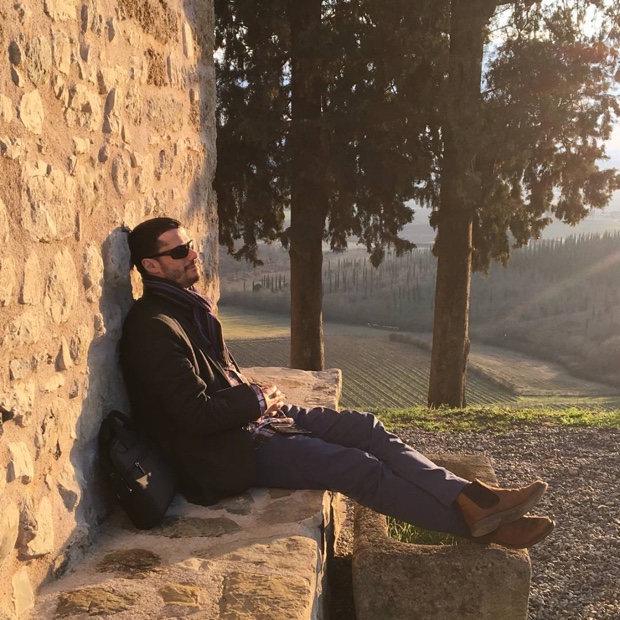
Journalist hard at work, Photo (c) Christine Lechner

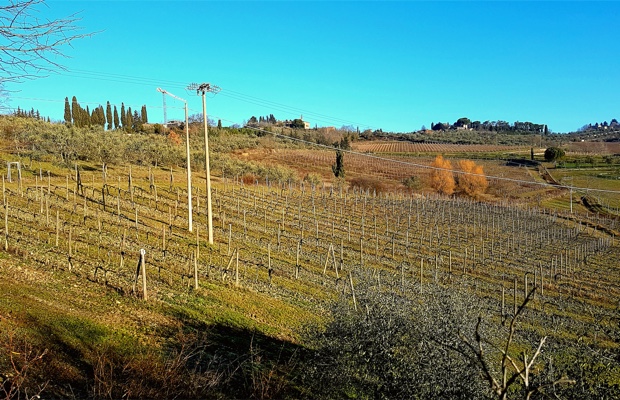
On a glorious February afternoon in between Anteprime days I exited the car at Bibbiano and noticed this most beautiful stone wall bathed in Chianti Classico light. Castellina in Chianti light to be precise, overlooking the Elsa Valley towards the castle of Monteriggioni and I laid my body down for a quick rest. Here in Bibbiano with Montornello on the northwestern side and on the southwestern, Vigna del Capannino. A stillness filled the air. Minutes later, refreshed and ready, I sat down to taste Bibbiano’s wines.

Bibbianaccio. It means bad boy, not literally but this is what it means all the same. Cattivo Ragazzo would be the literal translation of bad boy but an avant-garde IGT from Tommaso Marocchesi Marzi called Bibbianaccio is the elucidation we are going with. A wine that breaks from current ranks by metaphrasing ancient tradition in order to dwell on the past and pour with current modernity.

Tommaso Marocchesi Marzi and his brother Federico are responsible for crafting such a devilish IGT Toscana and it’s a most unusual departure from the rest of their classic renderings of Chianti Classico. Their Annata, Riserva and Gran Selezione sangiovese are steeped in praxis and birthright, adhere to a deeply soulful, local Castellina in Chianti style and the thread run through all three DOCG levels is both obvious and uncanny. What stands further apart with glaring clarity is the determinate or indeterminate Bibbiano slope each wine draws their fruit from. In some cases one or the other and in others, a combination of the two. Montornello and Vigna del Capannino. The descending vineyards on either side of the Bibbiano plateau offer up an incredible study in contrasting Chianti Classico geology.
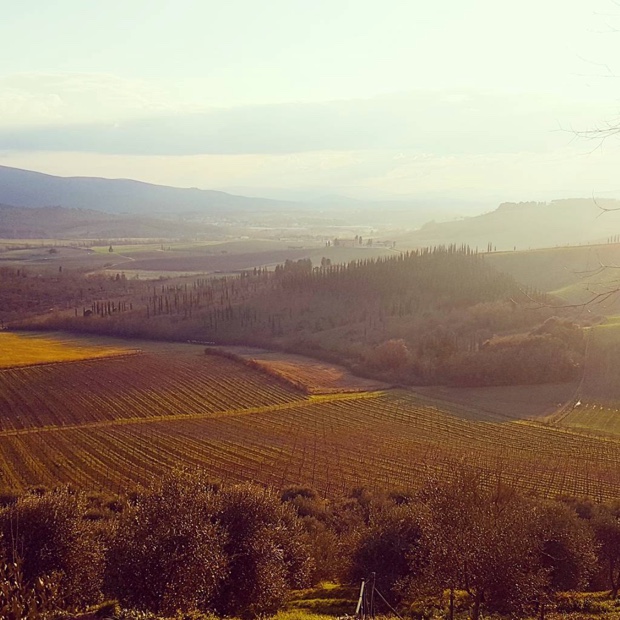
February? #chianticlassico has no issue with #february nor Godello neither.

“The name Bibbiano is of late Latin origin (circa 200 A.C.) and the first historical reference to the name is dated 1089, preserved in a parchment currently preserved in the Abbey of Passignano. It is a record of the deed of donation of the “curte” (court) and of the “castello de Bibiune cum ecclesia, cum casis, (…) viteis (…)” (castle of Bibbiano with church, farms, and grapevines) from Mingarda di Morando to Giovanni di Benzo.” In 1498, Bibbiano is registered in the Cadastre of the Decima Repubblicana as being owned by Matteo di Piero di Francesco Squarcialupi.”

In 1880 Antonio Marzi, son of Pietro, expanded the property of Bibbiano by adding other plots such as Gagliano, Gaglianuzzo and Padule. In November 1942, together with Giulio Gambelli, Pier Tommaso Marzi started producing Chianti Classico wines at Bibbiano. After World War Two Pier Tommaso Marzi and his son-in-law Alfredo Marrocchesi began major renovations, with the help of Gambelli. The work started in 1950 and ended in 1970 with the completion of a large wine cellar, the planting of 20 hectares of specialized vineyards. The family has been a member of the Consorzio di Vino Chianti Classico since 1948.

A study of the district of Castellina in Chianti and geomorphological Bibbiano is paradigmatic to the variety of the appellation. The estate is placed at the southwestern side of the area with altitudes varying from 250m to 600m. It’s plateau is perched on two slopes, on a late Miocene and early Pliocene seabed platform aged 5-10 million years. On one side the highest and eastern is based on primary boulder platforms; the lowest and western on silt sediments. More specifically it is broken down as calcareous silt and sediments of diverse kinds of clay mixed with round pebbles, rare sands, rare chalk veins on the NE estate side; pure gray clay with fragmented limestones, shattered schists on the SW estate side.

A river of adroit style runs through the wines of Bibbiano. They are uncluttered, ingenious, precise and successive sangiovese (and sangiovese grosso) wines of tradition and modernity. I tasted Chianti Classico Annata, Riserva, Gran Selezione and IGT. Here are the notes.

A river of adroit style runs through it @bibbianowines #ingenuity #uncluttered #succession #precision #chianticlassico #chianticlassicoriserva #granselezione #bibbianaccio #tomassomarocchezimarzi

Bibbiano Chianti Classico 2014, DOCG Tuscany, Italy (168286, $23.95, WineAlign)

Taken out of both the north and south vineyards (the estate sits on the ridge of Bibbiano at 310m) from the difficult, rainy vintage. Tommaso Marocchesi Marzi notes that “being organic you have to be very careful with your farming” but despite the adversity the fruit came clean. You get freshness, acidity, florals of a wide range, fennel-liquorice, mint and savour, taut sapidity, but not wound so tight you can’t gain access. The vintage solicited a careful selection, more so than usual but not so out of the ordinary. Yields were low as result. This is very sturdy, essential sangiovese of tradition, proper description of its dual terroir and what it means to be in this wine. From calcareous pebbles in variegated clay and sharp schist in red clay. Smells like the slopes and its natural growth, with just a touch of colorino, raised all in concrete and no wood. Is what it is, perfect and imperfect. Drink 2017-2021.  Tasted February 2017  @bibbianowines  @chianticlassico  @ChiantiClassUSA

VineWhys Wine Experts

Bibbiano Chianti Classico 2013, DOCG Tuscany, Italy (168286, $23.95, WineAlign)

A rich liquere, weight and warmth define this sangiovese from Castellina in Chianti by Tommaso and Federico Marrocchesi Marzi. While the old school leather, cherries and steeping liquor are in line with many Brunello this is pure Chianti Classico and not Riserva. The clarity and purity of fruit make that determination even if the wine is warm to mulled in feeling. Will settle a bit and develop its mushroom, truffle and forest floor nuances sooner rather than later. For fans of bold CC and the way it can be thought as has to be. Drink 2018-2022.  Tasted January 2017

Bibbiano Chianti Classico Riserva Montornello 2013, DOCG Tuscany, Italy (AgentWineAlign)

Montornello is 100 per cent sangiovese grown on the eponymous northern slope, the one with the variegated soil. Montornello is the (five million years) younger of Bibbiano’s two geologies, a platform of several types of partly calcareous, loose clay; red, yellow, amber and white. As floral as the ’14 annata but more mellow, serious and of a noted confidence. Some barriques are employed but the fruit is not shrouded in any way. Scents of liquorice again, plus graphite, a toasty char, warm tar and some beneficial bitters. Finishes strong, seamless and cool. Drink 2018-2023.  Tasted February 2017

Bibbiano Chianti Classico Gran Selezione Vigna Del Capannino 2011, DOCG Tuscany, Italy (AgentWineAlign)

The vineyard “Del Capannino” was planted in the 1950’s by the late great Giulio Gambelli, assistant to Tancredi Biondi-Santi. Not surprisingly and in connection to Brunello di Montalcino it is a clonal planting of sangiovese grosso, with further propagation done in the 1990s. The rich Albarese soil of Del Capannino enjoys the finest exposure and microclimate on the estate and is considered the best expression of Bibbiano’s “genius loci,” the spirit of the place. The first single vineyard vintage was 1998 and the Riserva designation switched to Gran Selezione in 2014, retroactive to the 2010 vintage. Today Bibbiano uses Botti (di rovere) Grande and Tonneaux (beginning in 2008) after barriques had been used for years. Still and always has been 100 per cent grosso, the only producer to do so in Chianti Classico. And so theirs is a liqueur that of course takes your mind to Brunello but this is purely Castellina and Chianti Classico so don’t be confused or tempted to settle for idyll comparisons. This has freshness, purity and that enticing meets teasing acidity, certainly consistent with and of no divergence to Bibbiano style. Ties to CC and CCR are blatant, necessary and so very pleasing. There is great structure but you can think about drinking this in its youth. It wont let out all its secrets but it will begin to tell its story. A story of territory. Drink 2019-2028.  Tasted February 2017

Bibbiano Bibbianaccio 2011, Igt Toscana, Italy (AgentWineAlign)

Bibbianaccio comes to light in its inaugural vintage, “the bad boy of Bibbiano.” Who is this bad boy, wine or man, referring to Tommaso Marocchesi Marzi perhaps, or is it something other? The 50 per cent sangiovese, (40) colorino and mixed varietal (including malvasia bianca) blend is an ode to a time before, when Chianti Classico regional wines were blends filled with whatever grew in the fields and men were men. This (mere production of 2,000 bottles) one is forged with extended battonage, malolactic is done in tonneaux and then the blend is assembled and sent to Slavonian oak. The bad more likely refers to a departure, a break from the stylistic and the the territorial approach. His purpose is “to show that we are capable of anything,” insists Tomasso. His rebel is floral and it reminds me of a northern Rhône syrah-viognier, in a sangiovese-colorino with white grape addendum body. Colorino brings the colour, but texture is also ushered in. The punch downs, the stalks mined in, the wood and the compression all give this a vivid, fleshy reality. It’s also much more tannic than the straight-shooting sangiovese. Bibbiannacio is yet another wine tasted in Chianti Classico with no frame of reference, or certainly not one that I have ever tasted before. It is drawn fruit on down from both sides of the Bibbiano plateau but I really taste the calcaire, liquid chalky and mixed with that tannin showing that some further bottle time is needed. Drink 2019-2025.  Tasted February 2017

Two sides of Bibbiano: Montornello and Vigna del Capannino

Good to go!

Godello

Twitter: @mgodello

Instagram: mgodello
WineAlign

Fifteen ahead of VINTAGES April 15th

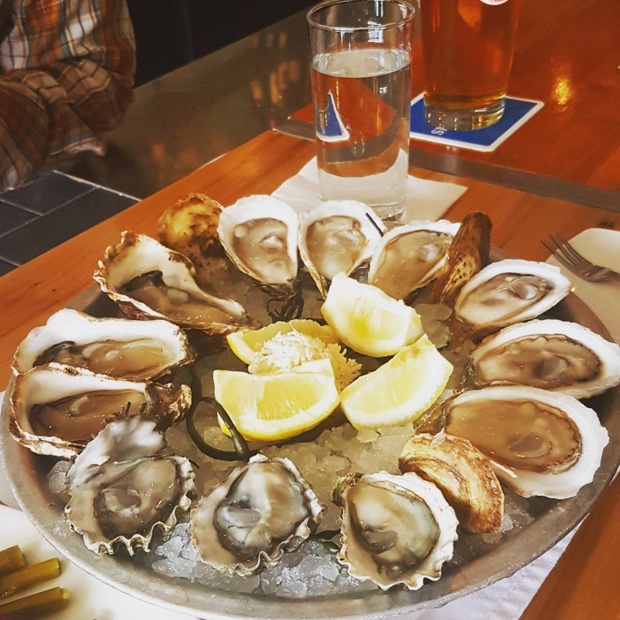
Yes we did. Who shucks’em cleaner anywhere close to the headwaters? #nobody @TideandVine

The VINTAGES April 15th release is all about value. I tasted through close to 100 over these past few weeks and wines under $20 are what stood out from the pack. My recommendations include four under $15 and six more under $18. Everything needed to get you through five months of impending warm weather is right here, right now. Enjoy.

Animus 2014, Doc Douro, Portugal (385302, $12.95, WineAlign)

@VFvinhos  @ProfileWineGrp  @winesportugalCA

Boutari Naoussa Xinomavro 2014, Pdo Naoussa, Greece (23218, $13.95, WineAlign)

@boutari  @KolonakiGroup  @DrinkGreekWine

Casal De Ventozela Espadeiro Rosé 2016, Vinho Verde, Portugal (450841, $13.95, WineAlign)

  @vinhosverdes  @winesportugalCA  @LeSommelierWine

Chateau D’aigueville Côte Du Rhône Villages 2015, Ac Rhône, France (479683, $14.95, WineAlign)

  @Eurovintage  @VINSRHONE

Lorca Selección Monastrell 2008, Do Bullas, Spain (380238, $15.95, WineAlign)

@BodegasRosario  @TheCaseForWine  @DOP_Bullas

Heartland Spice Trader Shiraz/Cabernet Sauvignon 2014, Langhorne Creek, South Australia, Australia (429241, $16.95, WineAlign)

From Langhorne Creek and reeking of exoticsim, the aptly-named Spice Trader is a glass of full-bodied shiraz-cabernet sauvignon savour. The seasonings are zesty, spirited, piquant and then finally, settled into a mulled warmth. Red peppercorn, cardamom and allspice bring a Malabar-Zanzibar, dhow-drift sail through the red fleshy fruit. No kernel is left uncracked and the spiked liquere leaves a lingering lift. More Langhorne than cabernet or shiraz but full of flavour. Drink 2017-2018.  Tasted January 2017  @heartlandwines  @TheVine_RobGroh

La Griffe Bernard Chéreau Muscadet Sèvre & Maine 2015, Sur Lie, Ap Loire, France (948182, $16.95, WineAlign)

@HHDImports_Wine  @LoireValleyWine

Alkoomi White Label Semillon/Sauvignon Blanc 2016, Frankland River, Western Australia, Australia (428383, $16.95, WineAlign)

@Alkoomi  @TFBrands

Château La Verrière 2014, Ac Bordeaux Supérieur, Bordeaux, France (349274, $17.95, WineAlign)

@MajesticWineInc  @BordeauxWines

Jaspi Negre 2013, Montsant, Spain (481085, $17.95, WineAlign)

@cocaifito  Grape Brands Fine Wine & Spirits

Tornatore Nerello Mascalese/Nerello Cappuccio 2014, Doc Etna Rosso, Sicily, Italy (487090, $21.95, WineAlign)

Domaine De Riaux Pouilly Fumé 2015, Ac Loire, France (200063, $25.95, WineAlign)

@LoireValleyWine  Old Cellar Collection

Closson Chase Closson Chase Vineyard Pinot Noir 2014, VQA Prince Edward County, Ontario (145888, $29.95, WineAlign)

@ClossonChase

Fontodi Chianti Classico 2013, Docg Tuscany, Italy (933317, $36.95, WineAlign)

    @rogcowines

Muga Prado Enea Gran Reserva 2009, Doca Rioja, Spain (743310, $57.95, WineAlign)

@bodegasmuga  @Vinexxpert  @RiojaWine  @Wines_fromSpain

Good to go!

Godello

Twitter: @mgodello

Instagram: mgodello

WineAlign

Caro Carobbio

Peaceful afternoon in February light at #carrobio #chianticlassico #panzano

Few wanderlust statements sound better than “I returned to Tuscany” and with the greatest of fortune smiling upon me I am able to utter the phrase again. Not just Toscana mind you, but Chianti Classico, in and out of February Anteprime tastings, to a pin on the map south from Firenze along the Chiantigiana, sidestepping for the Florentine view from Impruneta, then through Greve and into Panzano. The reason for my return begins as it always does, to adduce a lifelong pursuit deep into the meaning of sangiovese. It also fosters a fixation dug into the variegated soils of Chianti Classico and even further still, to the nurturing, sub-appellative specificity of sangiovese’s intaglio secrets. With each return it also ingrains a feeling of coming home.

Related – Grace in Chianti Classico

The most recent visit brought me back to Panzano, first to Il Molino di Grace and then to Tenuta Carobbio. Panzano in Chianti lies at the heart of Chianti Classico and below the hilltop town sits the “golden basin” of the Conca d’Oro, once a prized wheat producing area interspersed with grape vineyards and olive groves. Carobbio is not so easy to find. The tight twisting road from Panzano climbs and descends before turning off-road for the descent into the valley where tucked away and recondite Carobbio lies. It is no stretch to call Carobbio a hidden gem.

Conca d’Oro

Forza e Passione

E la sua passione describes the vision of Carlo Novarese’s decision to create Tenuta Carobbio. The Como silk king was born into a family from Monferrato and the childhood memories of wine production at Sannazaro Castle conspired to transfer passion into the estate’s Panzano ways. At 60, Novarese handed over the family textile company to his son and returned to Tuscany. “A spontaneous return, perhaps atavistic, which marked a new beginning.” With a “desire was to return to his roots and begin living close to the soil.” During a magical evening in June 1986, in a moment frozen in time, Carlo Novarese felt the certainty of having found “un angolo di paradiso in Toscana, “a little corner of paradise.”

Capiteto

A little slice of Eden in Tuscany

The southern facing Carobbio set between 350 and 400 metres of elevation stretches over 50 hectares, mostly forested, 10 of which are specialized vineyards and two are dedicated to olive cultivation. The Panzano hill and its houses protect the southern Conca d’Oro valley from the cold Apennine winds. The peaks of Monte Domini, Poggio Convento, Monte San Michele and Monte Querciabella in the east shelter the vineyards of Carobbio from the winds and damp air from the Arno.

The soils are characterized by a significant proportion of deep clay, sandstone, siltstone strata, marl and Alberese, the latter two most typical of Chianti Classico. The land is simply and emphatically “un territorio che vive graze alla forza e passione delle persone,” a land that lives through the strength and passion of its people. The 150 year-old farmhouse, ‘Capiteto’ is a great symbol of the estate’s history, a home at the edge of the Conca d’Oro, with views stretching from Rignana in San Donato to Tavarnelle.

Silvia Fiorentini and Dario Faccin

After walking the estate I sat down with Carobbio’s Director of Winemaking Dario Faccin and the Consorzio di Vino Chianti Classico’s Silvia Fiorentini for a tasting of current vintages and indelible memory etching bottles from the past. Dear Carobbio, thank you for taking me in, for sustaining me and for introducing me to the mysteries of the Conca d’Oro. Here are my notes on the nine wines tasted, with thanks to Dario, including selections from 1997, 1995 and 1991.

Single-vineyard, 100 per cent sangiovese, so mineral-spiced you would think it came from barrel #notachance #carrobio #toscana #panzano #terrarossa #rosato #rosé

Tenuta Carobbio Rosato Terrarossa 2015, Igt Toscana, Tuscany, Italy (Agent, $32.95, WineAlign)

Carobbio’s is different, a rosato of its own accord from a hasty (24-28 hours) fermentation descried of 100 per cent sangiovese. After four to five months in stainless steel it asks to show the world what it has to offer from a specific, steep-terraced red clay soil vineyard, thus the moniker and only used for this wine. A mineral-saline aroma sears ahead of the fruit which is bright of light cherry and convincingly of an intent to celebrate sangiovese in a form not so often noted. Like a cross between Coonawarra of terra rossa for cabernet sauvignon and Swartland of schist for syrah but here with sangioivese, for Rosé. Much more fruit on the palate but still the light and lithe cherry. There is more colour from sangiovese, naturally, but not from pressing. A very distinguished and elegant Rosato. Drink 2017-2020.  Tasted February 2017  @Tenuta_Carobbio  @apparitionwines  @chianticlassico  @ChiantiClassUSA

Tenuta Carobbio Chianti Classico 2014, Tuscany, Italy (Agent, $37.95, WineAlign)

Chianti Classico 2014 is a Panzano in Chianti, Conca d’Oro sangiovese with five per cent merlot that takes just one whiff to gain an understanding of what’s going on with wine director Dario Faccin, Carobbio and where these wines are heading. From the start I would ask to leave vintage concern or controversy out of the equation and simply concentrate on the purity from a variegated sangiovese that is entirely specific to the vineyards here. The red to purple sangiovese, transversing a line from a classic to ultra modern without ever veering from what sangiovese must have been and quintessentially is, off of vines tendered into Carobbio’s soils. The only comparison thus far is the Radda in Chianti Colle Bereto from Bernardo Bianchi, here of course so different, but with perfect hue, avoidance of massive structure and bullish tannin, in a word or two, “molto elegante.” Precise. Drink 2017-2025.  Tasted February 2017

Tenuta Carobbio Chianti Classico Riserva 2013, Tuscany, Italy (Agent, $58.95, WineAlign)

For Chianti Classico Riserva the solo performance is 100 per cent sangiovese and just as 2013 must be this grabs you by the olfactory senses with elegant inhalant immediacy. You are immersed straight away into a wine without reserve in the way that the only the purest of Riserva can be. Philanthropic, generous and kind. Even more so and because it is Carobbio, there is no fence to jump over, hoop to hurl through or great wall to climb. Not in aroma and then what follows is palate texture and finally fine-grained tannin. Not even acidity will lash out but rather support, with more kindness. Everything is presented from the start with a wisdom that doesn’t rely on oxidative or cured character. Just elegance. Rich and affirming, for sangiovese and life. Humour this CCR ’13 and wait just one more year, per il rispetto. Drink 2018-2027.  Tasted February 2017.

Tenuta Carobbio Leone 2013, IGT Toscana, Italy (Agent, $119.95, WineAlign)

Leone is Chianti Classico incarnate, a single-vineyard sangiovese and perhaps the artist of the future known as Gran Selezione. The aromatics are a force from fruit raised in front of the river (Pesa) on the border between Florence and Siena, a high-density (5,000-5,500 plants per hectare) vineyard. In the first week of June Dario says “I take all the leaves off of the stems,” executed with risk-reward abandon but on second thought, as a factual matter of personal volition and intuition. Then two weeks later the smaller leaves begin to grow. This allows the early phenolic process to work on the young skins and increase the early offerings of photosynthesis. The skins carry a natural protection against the sun (in June) but not in August. Voila, wine begins in the vineyard. Leone is incredibly young and perfumed with so much restraint. It gets neither more precise, elegant or wise, or even more important, as a vineyard representative or as such a mindful and consistently right expression as this. The tannins are the finest of any you are likely to taste in sangiovese. The fruit is so perfect, red and purple, living and loving together, and you don’t need to name them. Dario insists on the simple and the obvious. That you taste the grapes every day at harvest and when the bottom of the skins do not attack you with aggressive tannin and the brown seeds crunch, you are ready to pick. “If you want to produce a great wine, you have to walk in the vineyard every day.” Leone’s got soul and only 4,000 bottles are produced. Drink 2020-2033.  Tasted February 2017

Tenuta Carobbio Pietraforte 2013, IGT Toscana, Italy (Agent, $119.95, WineAlign)

Pietraforte is the Carobbio diversion into 95 per cent cabernet sauvignon (plus five cabernet franc) out of a 30 year-old vineyard that generally yields 3,500 kg per hectare or what Dario Faccin deems “niente.” Only 2,000 bottles are produced and 2013 is still a bambino, with wood more apparent on the nose than the sangiovese, quite spiced and then even spicier on the palate. Nothing vegetal takes any place at this international varietal table but the franc lends its must give current, of currants and even a little espresso. This has cool red soil savour that the cabs will inherit from the wind and the earth. But I have to say and say it with conviction, this is more varietally correct and obvious than most. More cabernet than Toscana. Needs five years, minimum. 2022-2030.  Tasted February 2017

What are you tasting right now? #carrobio @chianticlassico #1991 #1997

Tenuta Carobbio Chianti Classico 1997, Tuscany, Italy (AgentWineAlign)

Chianti Classico 1997 was made by then oenologist Gabriella Tani, the first pupil of Vittorio Fiore. With 20 beautiful years of slow development now in the past this has drifted into the smoky, opaque and cloudy future, elegant and elongated though its best days have only recently receded out of view. Plums mingle with raisins while the original cherries are now dehydrating sweet and turning to leather. There is this delicate acidity and silky mouthfeel that reminds you of what Chianti Classico once was (and for some continue to make), that curative, always knew what it was going to be in disposition for two years even before it has taken its first steps. In glass 15 minutes it now changes and becomes even more like its original self, minus the tannin. The old funk is in, quietly slipping into the room, lingering and taking a seat at the table. It is most welcome. Drink 2017-2020.  Tasted February 2017

Tenuta Carobbio Chianti Classico Riserva 1991, Tuscany, Italy (AgentWineAlign)

Ranging back further to 1991, now this is something else, 26 year-old Chianti Classico (Riserva), but surely so like the normale, alive, singing and oh I bet it can tell some stories. From a Carobbio golden age, at a time when the wines were at one with grandfather’s pipe, when I and so many other children would sit on his lap and as the pipe-cleaner came out, we would take in a deep breath and this was the smell. He wasn’t Tuscan, never walked the Conca d’Oro, knew nothing of Panzano, but does it matter? Chianti Classico of no guru, no method, no teacher. Now the wine morphs into delicate, fine-spice, a moment’s travel on a magic carpet to somewhere exotic. Than back to sangiovese reality, with lavender, rosemary and wild cherry. The acidity in 1991 is kept, preserved alive so there will easily be five years left to repeatedly find this in a sound and gifting place. “We’ve got to go back. For the healing. Go on with the dreamers.” Drink 2017-2023.  Tasted February 2017

Tenuta Carobbio Leone 1995, IGT Toscana, Italy (Agent, $119.95, WineAlign)

Leone 1995 was made under the auspices of the Vittorio Fiore-Gabriella Tani oenology stylistic for Carlo Novarese. To say that this single-vineyard sangiovese is youthful would be the biggest IGT understatement of the century. From vines that at the time were 25 years-old, Leone is not just a survivor of a universally-declared incredible vintage, it is a singular expression from 1990’s Tuscany, in Chianti Classico and for Panzano. The violets, dried espresso and plum-amaretti semifreddo (savoury, not sweet) mixes with fennel frond, fresh rosemary and the 20-plus years lingering Carobbio tobacco. The acidity is fully intact, still travelling up and down the sides of the tongue, repeatedly and soliciting so much savour, sapidity, a desire for a mouthful of hematic, rare sear of Claudia’s beef filet and then more and more sipping. After 20 minutes the aromatics deliver a raspberry purée and even a black olive and mineral-saline, short of briny caper into the fray by stroke of some aromatic brush and bush in the light afternoon wind. That’s enough. I’m not sure my heart can take any more. Time for Vin Santo. Drink 2017-2029.  Tasted February 2017

A great honour to taste this 1995 #carobbio #leone and in memory of #carlonovarese Thank you Dario and Silvia. Would like the chance to do it again in 22 years #toscana #sangiovese

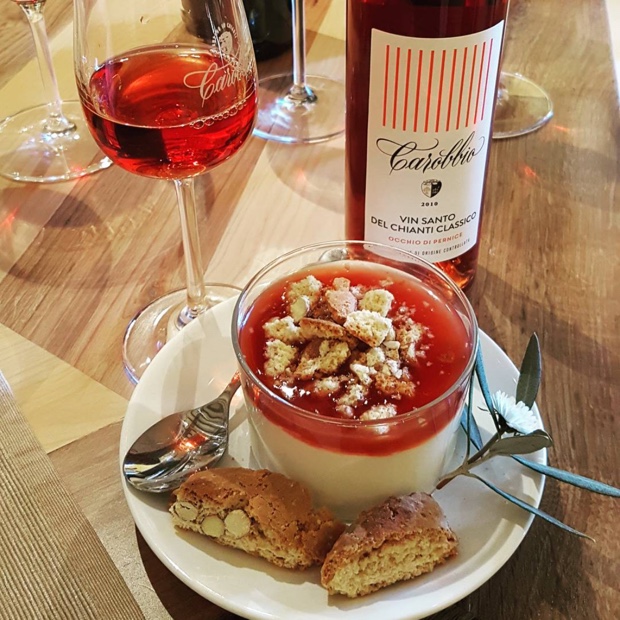
Tenuta Carobbio Vin Santo del Chianti Classico Occhio di Pernice 2010, Tuscany, Italy (Agent, $49.95, WineAlign)

Vin Santo del Chianti Classico Occhio di Pernice, “The eyes of the partridge,” called as such because it adheres to the credo of Vin Santo, made from at least 80 per cent sangiovese. Here the number is 90, with (five) trebbiano and (five) malvasia bianca, a completely different take, with so much more fruit, red fruit, away from the stone-peach/apricot vein and grounded, back down to the earth. Long, created by time in barrel spice, with the accent in cinnamon and there is this lemon peel and ripe crabapple aroma too. The palate is all cherry blossom liqueur, soft, creamy, downy, silky and nearly gelid. But it’s warm and comfortable. The gentlest and most ethereal Vin Santo in which acidity tempers sweetness, connecting with each other and neither bleeding ego or control. Drink 2017-2035.  Tasted February 2017

#vinsantophilia #carobbio #pannacotta

Good to go!

Godello

Twitter: @mgodello

Instagram: mgodello

WineAlign

VINTAGES preview April 1st

When you see one grand cru you’ve seen another grand cru #nierstein #rheinhessen #rhein

Globe-trekking critics, be a fool for value, plug in to musical Ontario and align with new world pioneers

as seen on WineAlign

Last Thursday I flew home from Germany after attending Prowein 2017, a massive wine fair in Düsseldorf that has to be seen to be believed. Picture nine immense convention halls each the size, depth and breadth of a Canadian football field, connected to one another and circling a courtyard like hangars in surround of incoming and outgoing flights at a major airport. The sheer quantity of human power and logistical planning required to facilitate and execute such a congress is in fact not unlike what happens every day at Frankfurt International. There may not be 100,000 employed to run Prowein, but at least that many wine stems are engaged.

It’s also hard to believe that this time yesterday I was standing on the crest of the red sandstone Grand Cru Neirstein vineyards overlooking the Rhein River. In advance of my trip to Germany I had the chance to taste through next weekend’s VINTAGES April 1st release and you will be pleased to find no shortage of quality wines under $20, many of which will solve your in advance of Easter needs. A token pinot noir with an anything but token twist and two hopping chardonnays are included for classic holiday food and wine association but I dig deeper into soils, varietal diversification and terroir for holiday pairing perfection.

There is no secret that Spain and Portugal sit at or near the pinnacle of Ontario consumer go to picks in the genre occupied by bargain reds. While the two recommendations below will certainly pair well with a feast of festive proportions, they also resurrect some grape varieties you might not automatically consider. Alentejo in Portugal and Castilla Y Léon in Spain offer great opportunities to discover local, endemic, world-class red wines. This early spring Ontario cold snap will soon be a thing of 2017’s winter past so I would suggest to get that BBQ tune-up completed because these wines are perfect foils for anything you can throw on the grill.

Travelling brings us together with the leaders and pioneers of fast-tracking and emerging wine regions and it is the global nature of this industry that through their own travels, they are brought to us. In September of 2015 I had the great fortune to spend a night and better part of a day with South Africa’s Ken Forrester. You will have noticed that Western Cape chenin blanc has taken the world by value storm over the last three to four years. There are several reasons for the varietal explosion, two of which are geology and climate. The third worth mentioning is Ken Forrester himself. When I tasted with Ken in Stellenbosch we travelled through half a dozen or more blocks, plots, vineyards and stylistically framed steen. Each and every year his Old Vines Reserve passes through VINTAGES. It is perfectly consistent and sets the benchmark for inexpensive and excellent South African chenin blanc genius.

Nicolás Zapata Catena and his daughter Dr. Laura Catena have pioneered similar if even deeper industry-leading work in Mendoza, Argentina. The father-daughter dream team have crafted terroir-focused Malbec and other well suited to time and place varietal wines. Over the past few years the Catena brand has expanded their portfolio by narrowing their focus into micro-terroirs in highly specific spots all over Mendoza. It’s not just Catena that has taken this brilliant South American approach to branding and this April 1st VINTAGES release is chock full of such precise varietal wines. Though I of course would be thrilled to offer up credit to the power brokers and buyers that be I’m not sure I’d give in to the idea that the grouping was executed with any preconceived plan. The patterning, by coincidence or not is nevertheless highly welcomed and I’m pleased to share these wines with you.

The Ontario presence is strong, as it should be, on the heels of a terrific Taste Ontario that was as promising as it was not surprisingly expected. Stratus hits the riesling mark with Wildass abandon, Flat Rock plays its annual MTV chardonnay tune and Thirty Bench does a varietal two-step that may just blow your mind. We should all be thankful for our local talent and in constant awe of Ontario’s wine ability to step out of its comfort zone, consistently improve on what it already does best and find ways to re-invent the wheel.

With the incantevole @chianticlassico hills fading from view, thank you #toscana #anteprime2017 #anteprimeditoscana #chianticlassico #vinonobiledimontepulciano #brunellodimontalcino

Speaking of Ontario, David Lawrason and I are still reeling from three days spent with an impressive Canadian ambassadorship contingent stationed in Düsseldorf’s Messe Prowein centre, sent there to spread the cool climate wine gospel to the world. The enthusiastic demands on our collective time were great. We will expand on the success of Canada’s presence on this important world stage in the coming weeks. John and Sara have also been on the road, globetrotting to the far reaches of the wine diaspora. It’s getting hard to track who might be where at any given time but in the first three months of 2017 we’ve had at least California, Oregon, Uruguay, Chianti Classico, Montepulciano, Montalcino, Lazio, The Ahr Valley, The Rheinhessen and every corner of New Zealand covered.

Through the course of our travels we are granted the opportunity to meet producers and winemakers, taste their wines and we often come across exciting products not seen before in Ontario. These discoveries are becoming increasingly important because the agents in Ontario receive an assisted head start on finding new wines. With the WineAlign Exchange inching closer and closer to bringing the reality of expert curation to wine buying and purchasing in Ontario, the connections we forge to these values and gems may soon see to finding their way into your cellars and your glass.

Godello’s Buyer’s Guide to VINTAGES April 1st:

Musical Ontario

Stratus Vineyards Riesling Wildass 2015, VQA Niagara Peninsula, Ontario (129700, $16.95, WineAlign)

It’s really hard to say whether Stratus Vineyards’ J.L Groux is more adept as a varietal impresario or as a master of assemblage so we’ll just call it a tie. Here into the riesling game he goes in the mere mortal affordable Wildass range and in 2015 he plays a smart varietal tune. You’ve just got to get some Wildass.  @StratusWines

Flat Rock Chardonnay Unplugged 2015, VQA Niagara Peninsula, Ontario (68015, $16.95, WineAlign)

The record keeps playing in rotation and the string remains unbroken with yet another quality vintage for the unoaked from Flat Rock. The crunchy apple and righteous waves of pertinence make this perennial best buy a required spin without any wonder why.  @Winemakersboots  @brightlighter1  @UnfilteredEd  @wine_gems

Thirty Bench Winemaker’s Blend Double Noir 2015, VQA Niagara Peninsula, Ontario (493973, $18.95, WineAlign)

The nomenclature is just so perfectly chosen and as you will find, this is a seamless joint between pinot and gamay noir. Double Noir performs the passe tout grains oeuvre from Ontario in combining two expatriate Burgundy grapes. I’ve long ago agreed these two make anything but strange bedfellows and the two grapes work seamlessly in Emma Garner’s new and idealistic red. Well done Thirty Bench. Pass the two grapes over, SVP.  @ThirtyBench

Align with new world pioneers

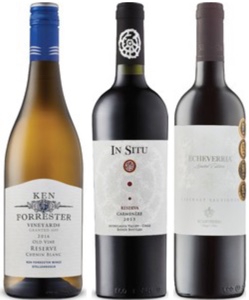
Ken Forrester Chenin Blanc Old Vine Reserve 2016, WO Stellenbosch, South Africa (231282, $17.95, WineAlign)

Reserve is a funny term for wines like this because it speaks to the idea that it should be put aside fore further use. I don’t think that is Ken Forrester’s plan and here he once again raises his old vines game with the 2016 chenin blanc. Stellenbosch continues to dole out some of the planet’s most striking and finest whites with chenin blanc at the centre of it’s value universe. With major thanks to Ken Forrester.  @KFwines  @WOSACanada  @WOSA_ZA  @Noble_Estates

In Situ Reserva Carmenère 2015, Aconcagua Valley, Chile (37952, $16.95, WineAlign)

In case you were wondering too, “In Situ is crafted from grapes that ripen on steep slopes alongside mysterious rock drawings from ages past.” The only expansion on that bit of ambiguity I can share is the purity and clarity levels of carmenère are fully explained in this Reserva. Another fine BBQ wine for April flowers and showers.  @InSituWine  @WinesOfChile_CA  @WinesofChile

Echeverria Cabernet Sauvignon Limited Edition 2011, Central Valley, Chile (389221, $24.95, WineAlign)

Though labeled as cabernet sauvignon the Limited Edition is generously supported by syrah and carmenère, resulting in a layered and grossly rich red blend. The individual varieties don’t really stake any obvious claim and while their integration is not exactly seamless, the layering back and forth over one another does work some Central Valley magic. Complexity wins points.  @VinaEcheverria  @LiffordON  @WinesOfChile_CA  @WinesofChile

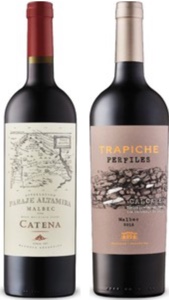
Catena Malbec Appellation Paraje 2014, Mendoza, Argentina (492413, $22.95, WineAlign)

Last November Dr. Laura Catena told a small Ontario press audience “it’s a fact. Different soils give different flavours.” The WineAlign team had previously sat down with winemaker Ernesto Badja for a full-on, wide-scale investigation into a climat-precise and compendious look at the proselytism of Catena culture. Paraje Altamira was one of these such looks into single-vineyard terroir.  @CatenaMalbec  @LauraCatena  @Noble_Estates  @ArgentinaWineCA  @winesofarg

Trapiche Malbec Perfiles Calcareous 2015, Mendoza, Argentina (482083, $18.95, WineAlign)

The savvy marketed Trapiche foray into soil matters with malbec divines the intention that calcaire (calcareo) brings speciality to these Uco Valley vines. It’s not a huge stretch to sense some limestone in this malbec’s make-up and I am wholly impressed by its countenance, its continuity from nose to tail and yes, its mineral feeling. So glad Trapiche is onside. @TrapicheWines  @Dandurandwines  @ArgentinaWineCA  @winesofarg

The best of the rest

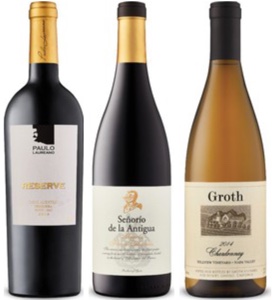
Paulo Laureano Reserve Tinto 2014, Vidigueira, DOC Alentejo, Portugal (488775, $19.95, WineAlign)

From the still somewhat unheralded and rising to stardom Alentejo the grape expectation here from vidigueira is no shrinking Reserve. This would make for a curious consumer side step into something different but at the same time so obvious and comfortable. At this price you can’t afford to do neither.    @winesportugalCA  @wines_portugal  @Nicholaspearce_

Senorio de la Antigua Mencía 2012, IGP Castilla y Léon, Spain (481549, $13.95, WineAlign)

Some solid and in some circles, very old estate vines (30-50 years) in Villafranca del Bierzo gift mencia for a pittance. Rarely does a $14 old world red give so much for so little. Great round acidity and length off the cuff of a vibrant tune. Simply great value. One of the best you will find all year.  @WinesofSpainSL  @Wines_fromSpain

Groth Chardonnay Hillview Vineyard 2014, Napa Valley, California (225672, $57.95, WineAlign)

From a 44-acre Yountville vineyard founded in 1982 and (mostly) re-planted in 1996. This is a perfect and prime example of all the right directions Napa Chardonnay has taken in the last 10 years, with kudos to Suzanne Groth for embracing the ideal, from restraint, for elegance and in balance.  @GrothWines  @suzgroth  @CalifWines_CA  @CalifWines_US  @NapaVintners  @TheVine_RobGroh

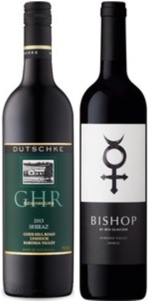
Dutschke Shiraz GHR Neigbours 2013, Lyndoch, Barossa Valley, South Australia (247296, $26.95, WineAlign)

You just have to let go and find the fun in this Gods Hill Road shiraz, a wine of deep-rooted flavour. The utter deliciousness and unctuousness of Barossa is capitulated and catapulted into Lyndoch space. To say that charred meats hot of the grill would work perfectly right now would be utterly correct. To see this age for up to 10 years and eke out more elegance is also true. I would suggest endeavouring in both.  @DutschkeWines  @Wine_Australia

Glaetzer Shiraz Bishop 2015, Barossa Valley, South Australia (627869, $39.95, WineAlign)

Ben Glaetzer’s incredible value Heartland cabernet sauvignon from this same release is not to be missed but I’ve chosen to focus on his flagship shiraz. From son Ben in ode to mother Judith, Bishop the maternal maiden name is the rock of the estate’s Barossa Valley reds. Bishop is a serious wine to be sure and this really leaves so much behind in the mouth long after it’s been sipped.  @GlaetzerWines  @Wine_Australia  @TheVine_RobGroh

Louis Moreau Chablis Domaine de Biéville 2015, Burgundy, France (106161, $27.95, WineAlign)

Just last week I stood in Moreau’s booth at Prowein and I talked with Frédérique Chamoy. She noted how excited buyers are about the 2015 Chablis. If you were ever to take the kimmeridgian plunge this quintessential Moreau and this vintage are the place to start, Pure, classic mineral Chablis with more fruit than I’ve ever seen.  @MoreauLouis1  @vinsdechablis  

Brancaia Chianti Classico Riserva 2013, DOCG Tuscany, Italy (260802, $36.95, WineAlign)

Brancaia goes all in to exploit sangiovese and the for broke style solicits some patience to wait out in extra time. Though 16 months in barrel is nothing to call nothing it is not the wood that dominates these gregarious 2013 grapes. With time this swirls into a grosso sangiovese like liqueur with plums, cherries and spice. Really Riserva in style but not of the recent past, more like the older ways but translated to modern times.  @CasaBrancaia  @chianticlassico  @ChiantiClassUSA  @Noble_Estates

La Lecciaia Brunello di Montalcino Riserva 2010, DOCG Tuscany, Italy (241307, $69.95, WineAlign)

From the giving 2010 vintage and so beautifully so gifted here with La Lecciaia’s 2010 Riserva. Sangiovese that rests in such an ethereal nether-land will evolve with decades long grace. Classic would be one way of looking at it, heart-warming another and it’s remarkably ready to drink.      

It’s been a whirlwind of a start to 2017 and I am personally glad to be home, for now, even if it’s only for a short time. After all, there are too many wine discoveries out there and if were to let them pass me by I would not be Godello. So before too long I will head back out on the road, join the fairs, searches, digs and bring some love back home. As for now it is the April 1st release that deserves our full attention. Sara will bring best buys and new finds next week. Looking forward to April 15th David and John will return with your first in line VINTAGES picks. Until then, good luck with the hunt, have a Happy Easter and an equally happy Passover.

Good to go!

Godello

Twitter: @mgodello

Instagram: mgodello
WineAlign

Quick link to Michael’s WineAlign Mix

The heart and the hearth of Podere La Cappella

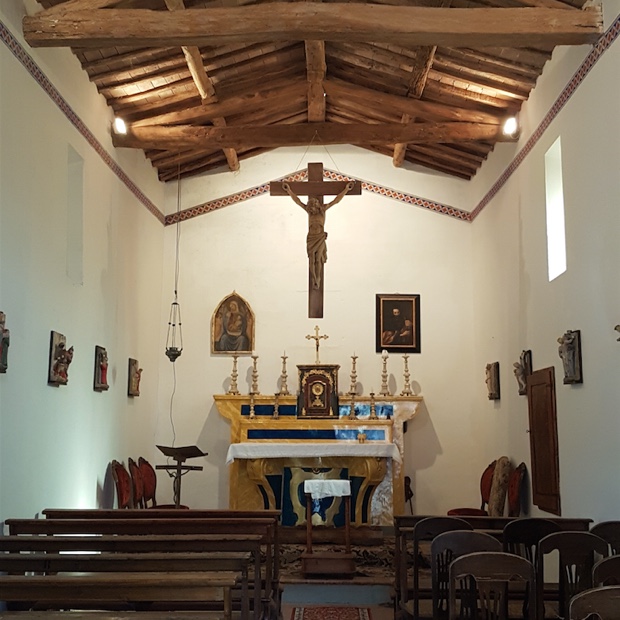
La Cappella S. Maria a Cerbaia circa 11th century

Two weeks ago I stepped back into Chianti Classico time for an all in, taste as many sangiovese as is humanly possible two-day inculcation at Anteprima 2017. The uninitiated will wonder and ask how this is accomplished. How do taste so many wines of the same ilk and differentiate from one to the next? The answer is really quite simple and straightforward. The sangiovese of Chianti Classico are like children. They are all different. They are snowflakes.

You will have noted my penchant for lengthy tasting notes and excessive use of adjectives. You’re likely privy to a certain infatuation with obscure and insignificant pop culture references and music lyrics. Have you paid attention to my running obsession with geology, climat and terroir? In Chianti Classico there is this ridge, an escarpment really that works its way from Tavernelle and across to San Donato in Poggio. The intendment of this geology and geography and its unique aspects play a vital role in determining some of the most complex sangiovese. The significance is not lost on my mission.

To a world who considers all sangiovese to be cut from the same cloth, from a fichu always woven of volatile acidity, fresh cherry and old leather, there are some things worth knowing. Like for instance did you know that both the Ricasoli and Carobbio estates are variegated with five unique and distinct soil types? Did you know that in Chianti Classico marl and limestone come in many variations, three of which are called Galèstro, Albarese and Colombino? Soil matters for what differentiates hundreds of contrastive sangiovese.

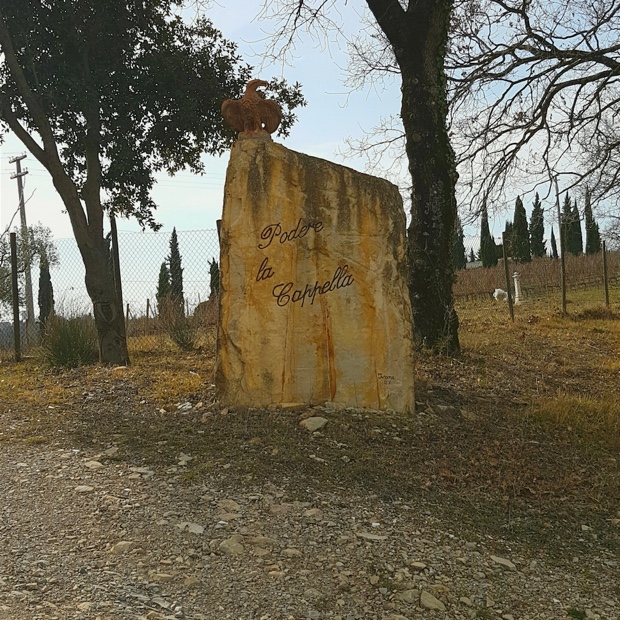
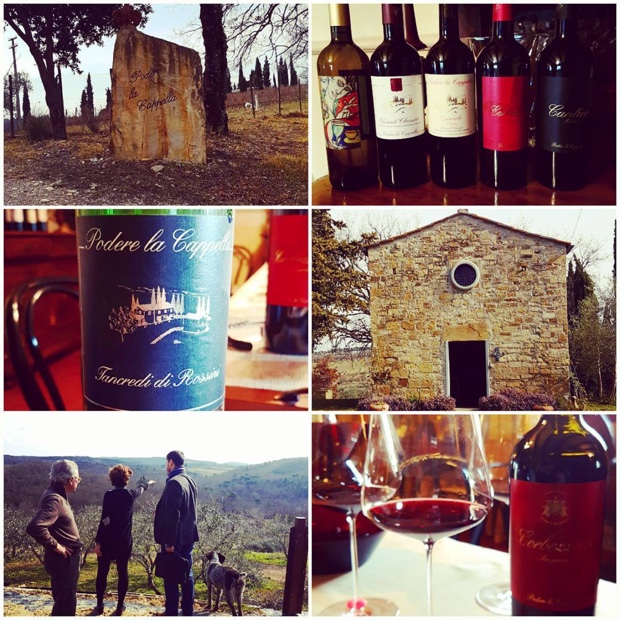
Which brings me to this very special visit I made to see Bruno and Natascia Rossini at Podere La Cappella. You do your best to breathe in and with eyes wide open examine to commit to memory the simple and extraordinary truths that you see around a property such as this. You see it as beatific, elysian, baronial and devout, as a small piece of paradise in a sea of paradisical estates in Chianti Classico, but here unequivocal to San Donato in Poggio.

Bruno and Natascia Rossini with Godello

The estate has been in the possession of the Rossini family since 1979, when Mr. Rossini, a native of Veneto, integrated the growing of vines and olives with the cultivation of apple and pear trees. In the early days Rossini sold off his grapes but in the subsequent years he was drawn to the temptation of self-guided expression and became a producer of Chianti Classico. A re-planting (and re-grafting) scheme took place between 1981 and 1985 and again in the 1990’s. Some varieties were removed and others moved in to take their place. Sangiovese was elevated to top-tier status and merlot was planted, grafted to chardonnay and vermentino rootstock.

Beginning with the 1995 vintage Podere la Cappella started producing its own wines, of Chianti Classico and Corbezzolo, a sangiovese IGT Toscana. Then in 1996 the company released their first merlot called Cantico and it was at this time that Bruno’s daughter Natascia joined in the family’s organically farmed and produced vinous endeavours.

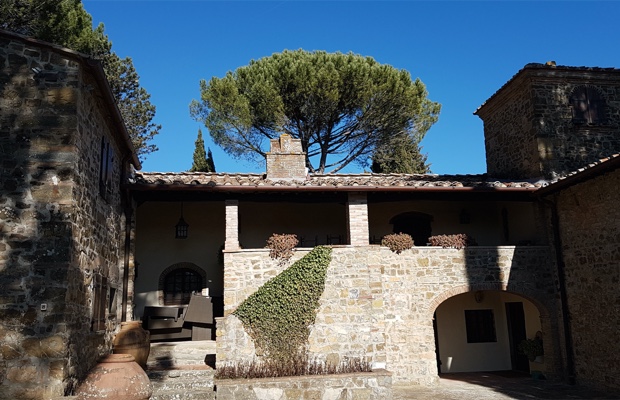
Just across from the house and adjacent the winery in the park of the estate you can visit the small church of S. Maria a Cerbaia, mentioned for the first time in 1043. The church hosts some very precious artistic works, like a painting of a Madonna with the infant Jesus on her lap, which experts date back to the end of the 13th century. Also inside the tiny chapel you will note high relief works representing the stations of the cross.

Bruno and Natascia Rossini are what you might refer to as the most gracious of hosts. From the extraordinary hearth in the kitchen to their sublime and highly personal wines, my visit with them and the Consorzio del Chianti Classico’s Christine Lechner was not so much memorable as it was like going home. At Podere La Cappella, home is where the hearth and the heart can be found. The Rossini’s poured 12 wines for me to taste, before and with a Tuscan lunch for the ages. Here are the notes.

Podere La Cappella Oriana 2014, Tuscany, Italy (Agent, Winery, WineAlign)

There were very early plantings of vermentino on the property but a decision was made to graft those vines and re-plant them between 2010 and 2012. Oriana is the modern day estate’s 100 per cent varietal white, named after Bruno Rossini’s wife. The grapes are harvested when their colour turns to a mature gold, then left to sit in the cold cellar for 20 days so the perfume concentrates straight to the core. A very mineral vermentino, telescoped, structured, with spice but there is no oak. Non-filtered, precise, unctuous and incomparable. Needs time, but there is no frame of reference here, not for Tuscany, not for the verdant hills of Chianti Classico. Doesn’t make it unusual but makes it extraordinary. The specific galestro marl and columbino here is influenced by the sea, more than in Panzano and that mineral runs through, with the fantasy of fossilized shells, like Chablis. There was a sea here at one time after all. What else should it be compared to? Drink 2019-2027. Tasted February 2017

Podere La Cappella Vermentino Tancredi di Rossini 1998, Tuscany, Italy (AgentWineryWineAlign)

Bruno Rossini’s vermentino 1998 is still very much alive, with some must on the nose, running along a parallel line to TCA but it’s really just a matter of age and the cellar. Acidity is very much intact, the aromas are notable in lemon purée and gelée, some orange peel and to the palate with great viscosity. Really quite amazing when you think about it, 19 year-old Tuscan vermentino, of salinity and shells. Bring on the oysters. Drink 2017-2018.  Tasted February 2017

Podere La Cappella Chianti Classico 2015, Tuscany, Italy (Agent, $28.95, WineAlign)

Every Chianti Classico tasting should begin with a 2015 and Podere La Cappella’s is the ideal portal. Breaks it consistently down with 90 sangiovese and 10 merlot because, as we are informed by Natascia Rossini, “if you want to make Chianti Classico and drink it (relatively) young, you need to blend in a little bit of merlot or cabernet.” This is the wise sangiovese, from vines seven to 10 years old and still the mineral gives, even from young vines. Important in that it is raised with no new oak and in which richness is balanced by the sort of acidity that tries to remain out of focus, out of the spotlight. The fruit is dark and broods in youth, so a comparison to ’14 will be smart. The contrast reminds us of a more getable, dare it be said commercial vintage in this two sides of the moon sangiovese. Robust, consolidated, sober and gorgeous. Still, a year will make a difference. Drink 2018-2025.  Tasted February 2017

Podere La Cappella Chianti Classico 2014, Tuscany, Italy (Agent, $28.95, WineAlign)

As with the coming unrestricted vintage, the 2014 get together is 90 per cent sangiovese and (10) merlot but such a different animal. The acidity needed to be stronger for deferential (but classic) fruit squeezed from minuscule yields after so much rain. It all called for the requiem of very strict selection and there is this rusticity in ’14 along with so much more herbology and perfume. Roses and fennel, less fruit, more perfume. There is structure in 2014 and it is a wine that will develop secondary character because of the umami that is necessary without as much fruit due to sun deprivation. Frutti di bosco sharing equal aromatic time with frutti di conifere. Walks a more traditional, taut, direct and unconsolidated sedimentary line for Chianti Classico, with time travel ability to a future blooming with Angiosperms. It’s simple really. The sangiovese usually reserved for Corbezzolo went to Riserva and for Riserva relegated to Chianti Classico. Structure is not compromised. Drink 2018-2026. Tasted February 2017

Podere La Cappella Chianti Classico Riserva Querciolo 2014, Tuscany, Italy (Agent, $46.95, WineAlign)

The most recent release of Podere La Cappella’s “small oak tree” is a vintage success, as always a sangiovese (90 per cent) and merlot configuration and no other Riserva will ever give such defined perfume and richesse. In this smaller than small crop of a vintage the under-rock current is the galestro and the savoury, here with some spice from increased barrel, though of course no new oak. There is some fine chocolate and there is this sweet defined acidity and tannin. When you taste this side by side by each with the 2012 and the 2013 you begin to note these recurrent themes. The smell of orange skin (and in 2013 it was persimmon) is specific to Querciolo. In the pantheon of CCR this is very refined. Drink 2019-2025.  Tasted February 2017

Podere La Cappella Chianti Classico Riserva Querciolo 2013, Tuscany, Italy (Agent, $46.95, WineAlign)

The 100 per cent, “small oak tree” sangiovese is showing some reductive funk in ’13 though purely and surely reasoned of a sangiovese seasoning, melted into liquid, like fennel simple syrup. From what is generally considered a high quality vintage, confirmed by Bruno and Natascia, warm, balanced, not too hot, with some rain in the middle of harvest. Picking and selection required greater focus than 2012 though not as serious as 2014 so there is so much more terroir (than ’12) in here and tannic structure similar, though a step down from 2014. Not quite ready, actually, not even close, but gains potential complexity because it is youthful and spirited. Then a different note makes an appearance, one that is hard to define, a red or orange citrus. Wait for it…persimmon! What a finish this stretches towards, forever and intense to Riserva. Drink 2019-2031.  Tasted February 2017

Podere La Cappella Chianti Classico Riserva Querciolo 2012, Tuscany, Italy (Agent, $46.95, WineAlign)

Querciolo is 100 sangiovese (as always for the Riserva),”the small oak tree.” Time is of course the catalyst but who would deny for whatever reasons chosen that it is the most beautiful of the (2012-2014) vertical’s three, the only one with the first stages of its developmental life already complete. Come away with its pure fruit aromas and still the structure dominates the mathematical mind, demanding attention. What makes the difference I ask Natascha Rossini? “The extra year,” she shrugs and adds, philosophically, “for my father each wine is a son, or a daughter.” There is a liqueur in here that reminds of what happens with structured sangiovese, regardless of clone and irregardless to place, be it Brunello, Gran Selezione or Riserva. What defines this ’12 is inherent to the specifics of galestro marl from the hallowed grounds of San Donato in Poggio. Drink 2017-2029. Tasted February 2017

Podere La Cappella Corbezzolo 2013, IGT Toscana, Italy (Agent, $84.95, WineAlign)

The Corbezzolo from vine and into bottle is 100 per cent sangiovese and in name “the fruit tree that produces a very tart berry for making jam.” This comes straight from the heart of the Rossini matter, out of the oldest vineyard planted in 1990-1991. It would be hard not too think on Podere La Cappella’s sangiovese as untethered to family, to meals and the kitchen’s hearth. The demi-glacé in Corbezzolo is deeper, richer, slower developing, of graceful, elegant and ethereal aromatics, even a bit exotic verging on quixotic. There is this far eastern temperament because the fruit seems to simmer with cool, jasmine-floral savour in a galestro clay pot. The acumen is variegated in the singular Corbezzolo concentration but this is not a factor of extract or density. Depth is sangiovese light, dancing from 2013, a gorgeous vintage that everyone will want a piece of. Drink 2020-2035.  Tasted February 2017

Podere La Cappella Corbezzolo 2012, IGT Toscana, Italy (Agent, $84.95, WineAlign)

Corbezzolo in 2012 comes by way of 22 year-old vines and it carries a similar quality in deep, exotic and mysterious fruit. The rich get richer in such a very tannic vintage, taking this top-tier, 100 per cent sangiovese to a place up on a pedestal where it can be really heard. There is a chew to this 2012 and a meaty grip but always ushered along by the spirit guide of sangiovese. There seems to be this relationship between Querciolo and Corbezzolo whereby the current vintage of the former shares a kinship with the subsequent vintage of the former. Though Natascia Rossini will remind me that one extra year in bottle for her sangiovese will both trick and explain, I’m still convinced there is something to the counterintuitive duality. Only retrospective tastings like can reveal the truth. Drink 2020-2032.  Tasted February 2017

Podere La Cappella Corbezzolo 2011, IGT Toscana, Italy (Agent, $84.95, WineAlign)

The Corbezzolo in 2011 is another matter altogether as compared to what comes after, beginning with the 2012 vintage. The fruit is from 1981-1984 planted vineyards and if 2012 in (Querciolo) Riserva showed the most terroir it is the 2011 that does so for Corbezzolo. The older vines do just the opposite of what the 90’s planted vines do for Corbezzolo going forward. Here there is less exoticism and more mineral meets local terroir and with some time there emits this great ulterior perfume. But it’s a sangiovese perfume you can recognize, a fennel-liquorice aroma noted in other parts of Chianti Classico. What separates this ’11 from the rest is that Cappella acidity that is second to none. It’s also chewy, then crunchy with just a side note of chocolate, something that clearly dissipates with time. The structure in 2011 is also remarkable, but singular and with such fine pearls and grains of acidity, leading to the conclusion this will be so long lived. Drink 2018-2034.  Tasted February 2017

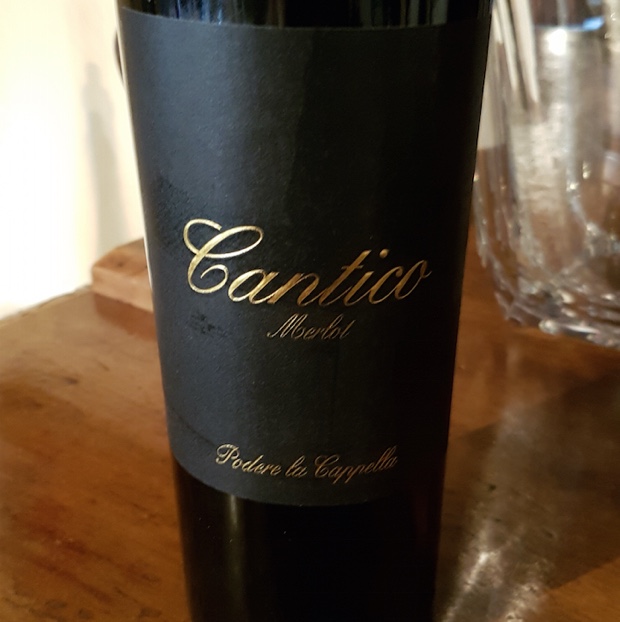
Podere La Cappella Cantico 2009, IGT Toscana, Italy (Agent, $123.95, WineAlign)

Cantico is hard to define, laying decanted tracks somewhere between a poem and a song, as in the form created by Dante. This is 100 per cent merlot from the oldest vineyard planted between 1981-1985 and grafted on the old vermentino and chardonnay rootstock. Rich in pure fruit and exoticism, steeped, of black cherry, graphite and more cherries, vivid and wild. This is very grown-up, mature IGT but still that Cappella acidity keeps it round and alive. The intensity and wisdom in this merlot is of its own accord but if you want to make comparisons to the likes of Galatrona, Masseto or Ricasoli’s Casalferro, be my guest. You won’t have much to say after you’re done. There is some still nearly hidden, secondary activity here that hints to truffle, porcini and balsamic but these are mere aromatic accents in a centrifuge of veal demi-glacé that has been simmering for days. Remarkable merlot. Wait two more years. Drink 2019-2029.  Tasted February 2017

Podere La Cappella Cantico 1998, IGT Toscana, Italy (Agent, $123.95, WineAlign)

“The canto is a principal form of division in a long poem,” and yet this 1998 has yet to sub-divide. The nearly 20 year-old Cantico is not as hard to figure as a precocious 2009 but a dante refrain is still the reference, at least with respect to nomenclature. The vines for Podere La Cappella’s 100 per cent merlot were but a mere but established 18-22 years old at the time and I truly believe the old vermentino and chardonnay rootstock had more effect on this particular wine. You can feel it in the Cappella acidity and this is what has kept it sailing along virtually unchanged and certainly unfazed. Few Toscana IGT tasted in 2017 could possibly show such youthful aromatics, barley perceivable yet replete with must be said are loyal and allegiant secondary mineral notes. Seek the mushroom and the truffle and they are not yet there. Wonder aloud that you feel a deep sense of the marl and you will still just be convincing yourself because you happen to know what lays under foot and under vine. The gioventù of the 1998 Canto is extraordinary and tells us so much about what to expect from not only 2009 but the Cantos to come. Drink 2017-2022.  Tasted February 2017

Soulful family wines of territory from #poderelacappella @chianticlassico #sandonatoinpoggio #chianticlassico #querciolo #chianticlassicoriserva #corbezzolo #cantico #brunorossini #natas

Good to go!

Godello

Twitter: @mgodello

Instagram: mgodello

WineAlign

Mannella from heaven

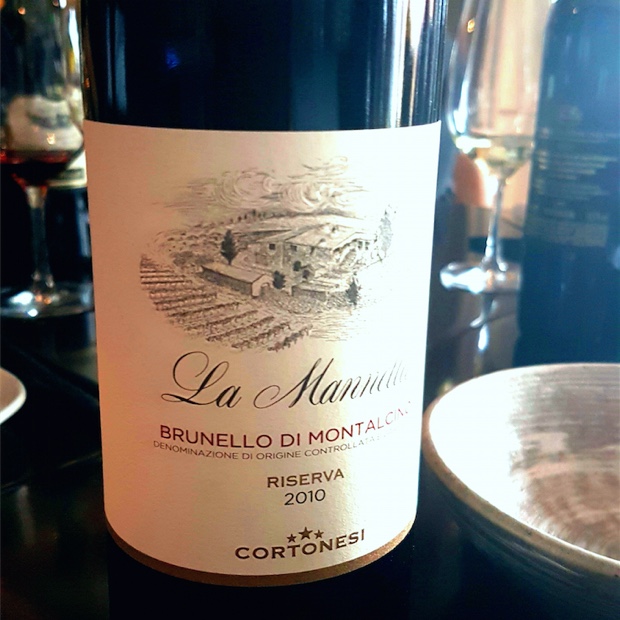
la-mannella-riserva-2010

Cortonesi La Mannella Brunello di Montalcino Riserva 2010

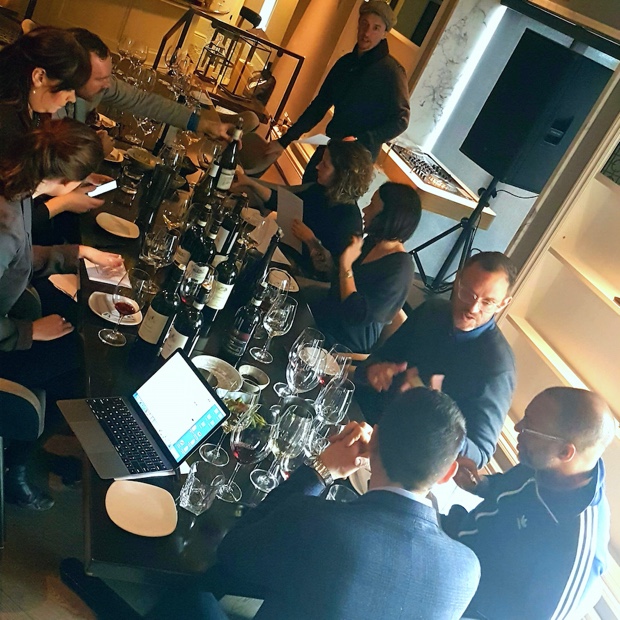
Having just recently (two weeks ago) participated in Benveunto Brunello 2017 held at the Chiostro del Museo di Montalcino from the 17th to the 20th of February, I’m feeling the sangiovese groove, in multiple clones and tones. Less than a week after my return to Canada one of the prodigal sons of Montalcino arrived in Toronto for a presentation of his wines with local omnipresent agent/négoce Nicholas Pearce. Jonathan MacCalder hosted the get together at the cozy Yorkville haunt he calls work, affectionately known as Kasa Moto.

tommaso-crtonesi-holds-brunello-court-at-kasa-moto

Tommaso Crtonesi holds Brunello court at Kasa Moto

A team of over-achieving and wild bunch sommeliers gave up the better part of a morning and early afternoon to talk sangiovese, Rosso di Toscana and the Rosso-Brunello idiom with the precocious and serenely wise Tommaso, a winemaker from Montalcino with an old soul, uncanny slash conscious ability and powers of concentration to bely his youth. With Nicholas Pearce, Michelle Ratzlaff, Krystina Roman, Christopher Sealy, Ian Thresher, Madeleine Hayles, Courtney Stebbings, Lauren Hall and the aforementioned Lenny Bruce of wine, we delved deep into the heart of the Montalcino matter. Sometime soon I will publish 100-plus tasting notes from the Benvenuto tasting but for now it’s all Mannella from heaven.

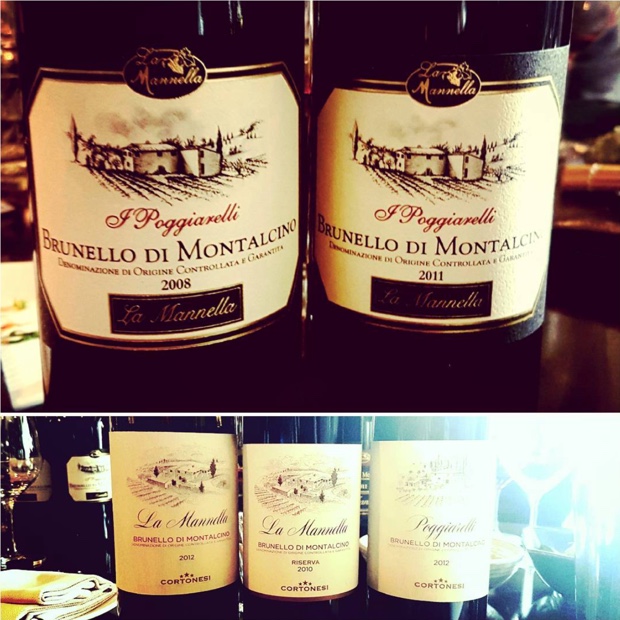
the-future-of-montalcino-is-in-good-hands-lamannella-cortonesi-nicholaspearce_-tommasocortonesi-ilpoggiarelli-sangiovese-brunellodimontalcino

The future of Montalcino is in good hands @LaMannella #cortonesi @nicholaspearce_ #tommasocortonesi #ilpoggiarelli #sangiovese #brunellodimontalcino

Cortonesi La Mannella Lèonus Igt Toscana Rosso 2015, Docg Tuscany, Italy (Agent, $22.95, WineAlign)

Lèonus is sangiovese of natural and effortless appeal. With pocketed thoughts of Rosso and Brunello di Montalcino in mind you can extrapolate with elastic, proverbial stretch and easily wind up here. It’s simple really, straightforward and noted as a gulpable mouthful of rocks tumbling in wet concrete. The great round acidity equalizer acts for mostly northern Montalcino fruit plus 20 percent from the south. Tommaso Cortonesi comes at it with a threefold selection; at harvest, in fermentation and from élevage. It’s entry level so just drink it. The fruit is darker and deprived of firm astringency, spent four months in 3000L Slavonian oak and three months in bottle. For every day, especially with antipasti. Drink 2017-2019.  Tasted February 2017

Cortonesi La Mannella Rosso Di Montalcino 2015, Docg Tuscany, Italy (Agent, $29.95, WineAlign)

The advance is a young winemaker’s approach, using fruit from the youngest vines but from the same vineyards used for Brunello production. Clonal selection permits early success from the fourth to fifth leaf for precocious wines off vines so young. Others may use vineyards dedicated to Rosso, so farmed with ulterior motive and expectation, neither better nor worse, but different. The old way was simply a matter in selection of grapes, something young winemakers are abandoning for now one or the other ways of making Rosso. Tommaso Cortonesi’s is luminous and bright within a frame of ascension in reference to the darker cherry sangiovese point spectrum, with three levels of variegated hue and aromatic profile. Char, fennel and fruit. Great structure, agreeable and yes, drinkable now Rosso. Drink 2017-2021.  Tasted February 2017

Cortonesi La Mannella Brunello Di Montalcino 2012, Docg Tuscany, Italy (Agent, $70.95, WineAlign)

La Mannella, meaning the manna from heaven is a five hectare, five block vineyard in surround of the winery at the centre of the Cortonesi universe. A vineyard that is used exclusively for the production of the estate’s Rosso and La Mannella Brunelli. La Mannella (as opposed to I Poggiarelli) is a single block Brunello but not a “single-vineyard,” planted in 1985 and 1998 in a relative Montalcino colder northern clime. This emits and represents the epitome for floral sangiovese, a bouquet that speaks to violets and elegant, light purple fruit. The penetrability and explicability of purlieu is an act of focus and the cynosure of assessment. Brunello should be exacting, something you get and it must define itself in clear sangiovese-speak. Large slavonian oak for 36 months maintains and celebrates the perfume. The wood shows up late, in white peppery spice and that just have to lay on your tongue and swallow with sublime delight, liquid chalky finish. Drink 2019-2027.  Tasted February 2017

Cortonesi La Mannella Brunello Di Montalcino I Poggiarelli 2012, Docg Tuscany, Italy (Agent, $95.95, WineAlign)

This is Cortonesi’s single-vineyard sangiovese from the warmer, southern part of Montalcino at 420m of elevation. Expectation allows for deeper, and darker yet the display comes without the La Mannella block crimson and cimmerian variegation, perhaps instead more like the single-brushstroke, dark side of dusk angle created by a fuzzy, warm blend of fiery colours. More Galestro soil influence here as opposed to clay at La Mannella and two years in part new French tonneaux followed by stainless steel vats. A deferential élevage to the one exercised with La Mannella and one to encourage depth and structure without too much power. Classic, modern, elegant and an apple to La Mannella’s orange. Drink 2019-2025.  Tasted February 2017

Cortonesi La Mannella Brunello Di Montalcino I Poggiarelli 2011, Docg Tuscany, Italy (Agent, $95.95, WineAlign)

Looking rearward into the recent past what comes into near focus is the combination of liqueur and firmness, a handful for sure and yet it seems that time (even just an extra year or two in bottle) brings out that specific Cortonesi perfume. The tang and richness of concentrated acidity really elevates at this stage so that tannin begin its resultion so young and impressively so. This is not the big, bad Brunello but the one to make enjoyment haste. The length is exceptional with pretty tonic and bitter moments that pop in and out. Drink 2018-2029.  Tasted February 2017

Cortonesi La Mannella Brunello Di Montalcino I Poggiarelli 2008, Docg Tuscany, Italy (Agent, $95.95, WineAlign)

If the argument was ever made to sway in the “yes it was and is” direction, this Cortonesi example from the exceptional vintage leads the parade with aromatics that go exotic and then return domestic. A spirit of the east, of bougainvillea and hibiscus plus a Montalcino gustatory aromatic spice. Then that return to fennel, a walk through flora Montalcino brush and sweet French tonneau spice. The liquorice is one bred out of aromatic acidity, like a fine chalky dusting of red crimson and ochre to purple powder on a plate next to a perfect charred slice of beef. Elegant sangiovese cuisine in a glass, deconstructed and all obvious in their parts but when you taste you pause and it all comes together. The flavours mingle and weave, of cherries and fruit leather, more mellowed spice, still lingering fresh, persistent and remarkably bright. Southern vineyard be damned, this is a cool, elegant and lithe drop. Harkens back to a mind’s eye and nose in memory of Brunello 1998, maybe a bit of 1999, but more like 1998. Drink 2018-2030.  Tasted February 2017

Cortonesi La Mannella Brunello Di Montalcino Riserva 2010, Docg Tuscany, Italy (Agent, $202.95, WineAlign)

There are few Brunello vintages afforded more attention in the last 10-plus, certainly ’04 and ’06, increasingly better even from ’08 and looking forward towards what greatness will come in 2015. Yes but not solely magnified through the lens of patience and bottle time, from 2010 La Mannella has coupled upon and layered over itself like compressed fruit and puff pastry. Though it begs for drink now attention, another seven years will be needed before it can safely be labeled as uncoiled and to reveal all that is wrapped so tight. Rich is not the operative but unmistakeable as Cortonesi it is; that natural clay soil funk of resolution and fully hydrated chalk. This is to sangiovese as Les Preuses Grand Cru Chablis or Rangen Grand Cru Alsace are to Riesling. It carries in its pocket the absolute meaning and genetic responsibility of where it comes from, with a curative and restorative ability to get you lost. Drink 2019-2031.  Tasted February 2017

Good to go!

Godello

Twitter: @mgodello

Instagram: mgodello

WineAlign

Grace in Chianti Classico

Panzano, Toscana

Panzano, Toscana

I first visited Il Molino di Grace in May 2016 and was graciously welcomed into the family’s estate by Director Iacopo Morganti. In the months leading up to that first visit I had opportunities to assess Chianti Classico, Chianti Classico Riserva and Chianti Classico Gran Selezione at LCBO media lab tastings in Toronto. I became an instant convert and a buyer even before I stepped foot onto Il Molino di Grace’s sloping Galèstro soil-driven vineyards in Panzano. After that May visit I was transformed into a life-long friend.

Later that May I was handed the keys to Chianti Classico’s Gran Selezione Masterclass presentation at The Four Seasons Hotel in Toronto. My role was to open the door to sangiovese perception before a crowd of Toronto sommeliers, agents, buyers and media. It was the Gallo Nero’s 300 year anniversary and its Ontario reputation was entrusted to me by the consorzio braintrust of President Sergio Zingarelli, Director Giuseppe Liberatore, Silvia Fiorentini and Christine Lechner. At that Toronto event I had the pleasure to meet and sit on the panel with Tim Grace. Last week I followed that up and made my way back to Tuscany to have a go at 400-plus Chianti Classico at Anteprima 2017.  When the two-day sangiovese adventure was done I returned with Iacopo back to Il Molino di Grace.

the-vineyard-at-il-molino-di-grace

The vineyard at Il Molino di Grace

Frank and Judy Grace purchased the vineyards in the mid 1990’s and restored an abandoned 19th century ruin into what is now the cantina of Il Molino di Grace, named for the centuries-old historic water-mill. The first vintage out of the new winery was in 1999. MdG became a certified organic winery in 2013, something they and indeed the entire 20 viticultural Panzano-in-Chianti producers are extremely proud of, all together as one. It took 20 years to get this way, with no spraying and even the workers who work the roads will cut, but never spray.

Related – Three days, eight estates, Chianti Classico

Tim Grace runs Il Molino di Grace along with Iacopo Morganti. Their consulting oenologist is none other than Franco Bernabei. To say that Il Molino di Grace is an authentic producer of terroir-driven Chianti Classico would be an understatement. Their vineyards are set upon some of the finest Galèstro soil in all of Chianti Classico. The permeations and permutations from that soil have separated this estate from so many others with a portfolio of wines constructed with power, finesse and yes, grace.

Related – The most important red wine from Italy

Iacopo poured a very strategic retrospective of the estate’s wines in an artfully designed schematic so that I was able to literally pick up where I left off last May. We travelled retrospectively astern through CC’14, CCR ’13, GS ’12 and IGT ’11 with prudent stops at intervals to re-visit previously tasted wines. The exercise never wavered from the safekeeping of sangiovese as the heart of the matter and the vintage interval play showed both the progression and the consistency of the estate. Here are the notes.

my-valentines-chianticlassico-of-ilmolinodigrace-and-of-course-iacopo

My valentines, @chianticlassico of @ilmolinodigrace and of course, Iacopo

Il Molino Di Grace Chianti Classico 2014, Docg Tuscany, Italy (85209, $19.95, WineAlign)

Incidentally the first vintage on which the label reads organic, 2014 captures the freshness and the true Chianti Classico, its nature and its truth. No mask, nothing to hide behind, nowhere to run. “In some ways 2014 is more typical a vintage,” suggests Iacopo Morganti, because like other passed over and quickly assessed ones of the recent past (such as 1996, 1998 and 2008) the intrepid purity of sangiovese is decisive and built to last. This is deeply hued Chianti Classico, refreshing, spirited and crafted with a very specific type of actionable drinkability. With pasta, with filetto, with friends. Will not change course for four years and drink comfortably for four more. Sangiovese accented with canaiolo, colorino and malvasia nero. Drink 2017-2025.  Tasted February 2017  @Ilmolinodigrace

Il Molino Di Grace Chianti Classico 2013, Docg Tuscany, Italy (85209, $19.95, WineAlign)

Nine months later so provocative and round, still imbued of the deep pulpier purple Il Molino di Grace hue with ruby tinges. Floral but not bursting, warm, in control and easy. Manages fruit purity and then by extension, the grip from 100 per cent sangiovese. Now gelling into a liqueur typical of ’13, smooth and rapidly developing into a multi-faceted sip. A drink earlier in full enjoyment vintage.  Last tasted February 2017

The 2013 point blank sangiovese Chianti Classico is a softer, rounder version of its normale self, with less spice and dust and as a matter of course, from double the output. A dreamy downy growing season saw to 100,000 bottles and each are so eminently drinkable. There is a soil in there that seeps through because of the vintage, that combination of marl and limestone known locally as galestro and so while the concentration is wontedly in measure to 2012, it is ultimately just a matter of differing result. One wine’s pale is another one’s edge. This ’13 will present for immediate pleasure while ’12 spends one more year coming into view. Drink 2016-2019.  Tasted May 2016

Il Molino Di Grace Chianti Classico Riserva 2014, Docg Tuscany, Italy (382945, $23.95, WineAlign)

Riserva 2014 is certainly positioned further down that democratic line from the Chianti Classico, its hue more variegated with three to four variations of shade and fruit still popping fresh. These two pronto pieces of personality are the hallmarks of the Il Molino di Grace style and singularity. To employ such darker fruit without any compromise to freshness, this is the magic of this place. Iacopo Morganti says there is no magic. “I like to see the colour of the vintage.” It is true, 2014 is one of purple violet fruit so it speaks of a time. As a Riserva it demonstrates guts and creates a shell of protection for itself, sufferable to whoever thinks it may fail to validate the idea of a classic vintage, which it most certainly will turn out to be. Drink 2019-2029.  Tasted February 2017

2013-and-2014

Il Molino Di Grace Chianti Classico Riserva 2013, Docg Tuscany, Italy (382945, $23.95, WineAlign)

A better vintage for Riserva (as it is in Chianti Classico for merlot) because of the warmth and highest available poly-phenolic qualities. A return here to deep purple, Il Molino di Grace’s ’13 Riserva is akin to 2009 (though seemingly more in control of its fruit) and also with thanks somewhat like ’14 Chianti Classico, popping, fresh and with its stark moments. It is necessary to stick around, keep checking the glass and it too will lead you down a sexy, sultry, sumptuous road. Shows signs of 2010 in these flaunting ways, with a forward and upwards trajectory through the notions drawn from its very specific Panzano territory. There is chocolatey richness mixed with driving acidity, because “this is the vintage.” Will live long enough, perhaps developing some exoticism and balsamic and/or mushroom notes after seven or eight years time. Drink 2019-2027.  Tasted February 2017

Il Molino Di Grace Chianti Classico Gran Selezione Il Margone 2012, Docg Tuscany, Italy (435115, $39.95, WineAlign)

Chianti Classico Gran Selezione Il Margone 2012 comes structured from a vintage with frost in May that compromised 50 per cent of the crop and as a result, bestowed lowest of low yields and concentrated berries. After that happenstance of natural selection the vintage turned to hot and dry, with great weather at harvest. This is and could only have developed into a fleshy and magnanimous Gran Selezione with acidity equivocal and anti-acrimonious to bones draped with the ripest of fruit. And it’s a good thing the acidity is set to high because that fruit and richness will need it going forward. Such a GS had to be crafted this way, with compound aggression and aggressive behaviour. Ultimately defines what it means to be affirmative action Gran Selezione. Drink 2021-2030.  Tasted February 2017

Il Molino Di Grace Gratius 2011, Docg Tuscany, Italy (Agent, $49.95, WineAlign)

“The ’11 Gratius is like a bomb,” says Iacopo Morganti with a shrug and a gesture of hands. The vintage parlays sangiovese that clocks in cresting and swimmingly close to breaching 15 degrees in alcohol, because it just had to be, like 2000, heavy and brooding. The aromatics are distended, bloated, full of over-exceptional life. Sangiovese in warm, mediterranean tones, black olive, sun-dried tomato and surfeited with bloody good chocolate. Sangiovese so big and youthfully musty-dusty must be accompanyed by and is in fact supported by the Il Molino di Grace acidity to carry this Gratius forward five years but not necessarily much more. In 2011 the composition is 95 per cent sangiovese with stabilizing colorino and canaiolo. Tasting this in 2017 is a gift that never stops giving. Drink 2018-2022.  Tasted February 2017

Il Molino Di Grace Gratius 2010, Docg Tuscany, Italy (Agent, $49.95, WineAlign)

Again, as before and going forward, Gratius is 95 per cent sangiovese with the supporting bits of canaiolo and colorino, In contrast to ’11 all the weight falls away with wistful pleasure. “Here you have fantasy,” smiles Iacopo Morganti. Your mind is taken places by the exotica and the clouds of perfume. Elegance derived from sangiovese so deep is possible when balance is struck and at 13.5 per cent alcohol, just what you want from such a wine. Contemplate the blades of acidity sharpening their teeth on the back sides of your tongue and know that the subsidies won’t begin their wane until 2022 or beyond. Yes Gratius, you are indeed elegant and long. Last tasted February 2017.

Gratius, meaning more pleasing, the author of a poem on hunting, opponent of the poet Archias and a contemporary of Ovid. The other sangiovese from Il Molino di Grace whose first vintage was 1999, of “a nose incredible,” says a wistful Iacopo Morganti and he is not wrong. From the Panzano-Greve in Chianti slopes of Montefili, at 500 meters, a 2.2 hectare single vineyard of old vines (70 years) co-planted with some colorino and canaiolo. So in that sense it’s a field blend but essentially sangiovese. Tuscan climat of rock and poor soil, where the wind blows and grapes whose fate is two weeks later maturation. Aromatics and elegance are in a calm struggle and like two brothers, rolling but not fighting. Such a wine of clean, pristine purity does not exist just anywhere. The inviting perfume solicits readiness and a willingness to be generous. No need to wait. Drink 2016-2022.  Tasted May 2016

Il Molino Di Grace Gratius 2005, Docg Tuscany, Italy (Agent, $49.95, WineAlign)

A next look nine months later confirms what Iacopo insists. “The acidity’s finished for me. It’s ready to drink now.” At this juncture Gratius 2005 has abandoned its fantasy in concession to a drink now reality. Last tasted February 2017

The Gratius 2005 shares DNA with 2009 aromatically speaking but in texture and expression the litheness is pinot noir like, with a bit of bretty volatility as an impression that is vineyard funk derived. Just now beginning a drinking window in performance for the art of perfect timing but why not imagine the installation persisting for 10-12 more years? Here the Montefili Galestro vineyard is clearly iterated in a funk-soil-chalk-liquid rubies way. A brilliant peek back because the tart is just so right. Ask the question, “what was the old wine like?” The answer is “it was like old wine, that is to say, like all old wines.” Drink 2016-2022.  Tasted May 2016

Good to go!

Godello

Twitter: @mgodello

Instagram: mgodello

WineAlign

Seventeen in VINTAGES February 4th, 2017

breakfast

as seen on WineAlign

Familiar and not so familiar Europe, always cool chardonnay, seeing South African red (and a white)

These past two weeks have been difficult, bizarre and disturbing to say the least. No one is immune to thinking about the twists, turns and horrors of recent world events. With no disrespect to activism, especially on a personal level, at WineAlign our job as critics is to find ways to keep the machine running, in other words, to focus on wine. In 1975 Saturday Night Live did a skit in which Paul Simon played one-on-one basketball against one-time Harlem Globetrotter and NBA legend Connie Hawkins. Just before the game sports reporter Marv Albert asks Simon about his strategy in going up against The Hawk. “Uh, but I’ll just have to play my game, as I usually play it,” says Simon. “I mean, I’m not gonna change anything, I’ve gotta stay with my strengths… basically, singing and songwriting.” At WineAlign we’ll simply do the same.

Wines across the Mediterranean are a primary focus of the VINTAGES February 4th release. A great number of them will coax a feeling of familiarity and there are others that may not ring a bell. In any particular wine purchasing scheme it is always best to strike a balance between the poles of available options so best approached by looking to one and then the other. While France, Spain and Italy will always deliver the tried and true, a gem of a geeky or otherwise deferential varietal can be unearthed if your mind and your heart are open. Get into the corners and alleys of habituated Europe but also a place like Greece. You will marvel at how it can change your outlook to usher in the most interesting of times, in life and in wine.

Related – Only one in VINTAGES January 21st, a writer’s defence and nine more

A view through Vouraikos Canyon from Mega Spileo Vineyard

A view through Vouraikos Canyon from Mega Spileo Vineyard

Don’t worry. I’m not going to run off and wax rhapsodic about wines found “off the beaten path,” argue on the semantics of what exactly that means or how it should be defined. But I will tell you a little story. In July of 2016 I visited one of Europe’s most extraordinary vineyards, found in Achaia, located in the northern Peloponnese. At the top of this incredible canyon you stand at the foot of another even more imposing and massive rock face that is home to the 11th century Mega Spileo monastery. Gazing north through the cracks in the mountain cragges you can see the azure blue waters of the Gulf of Corinth. Looking straight down you see the greenery of the healthy Mega Spileo vineyard. The entire footage leaves an indelible mark. What’s the point? The point is to get out there and make discoveries. This also applies to what can be found in the VINTAGES catalogue.

Related – Seventeen for January 7, 2017

#cool

Chardonnay is always in the spotlight so why should February 4th be any different? This past summer at Niagara’s Cool Chardonnay conference I found out that we have to look at organoleptics and ask a very important question. Is your expectation of a Chablis going to be the same as chardonnay made from anywhere else? More important, who are we putting this wine in front of? Ian D’agata’s take struck a Canadian chord. He talked of “a welcome astringency characterized by piercing flavours. These are cool-climate wines. Cool climate chardonnay is not about a long litany of fruit descriptors. If you have a cool-climate viticultural area it behooves you to give the people what they are looking for.” More cool chardonnay examples available on this release are worthy of your time and your dollars.

Bush vines, Groot Drakenstein Mountains @AnthonijRupert Wyne @WOSACanada #lormarins #franschhoek #southafrica #winesofsouthafrica #mesmerizing

Bush vines, Groot Drakenstein Mountains @AnthonijRupert Wyne @WOSACanada #lormarins #franschhoek #southafrica #winesofsouthafrica #mesmerizing

South Africa is a geographical and geological land of wonder, of ancient soils and picturesque intrusions. Extreme examples include the shale and schist of Swartland that turns into dust and the granite domes of Paarl, which are 30 million years old. We are talking about beginning of time stuff, but how does it impart into wine? Taste more than just a few South African reds and you will get a sense.

I’ve said it before and will repeat myself. South African wine is not what we thought it was. This mantra can’t be repeated often enough. Ventures into the Cape wine lands, tastings and zealous immersion into Stellenbosch, Paarl, Franschhoek, Swartland and Hemel-En-Aarde see to that. If you’ve not visited you can’t possibly know what revelations lurk but you can get a glimpse by drinking South African wines here in Ontario.

Familiar Europe

sierra

Sierra Cantabria Selección 2014, Doca Rioja, Spain (Agent190520$14.95, WineAlign)
@RiojaWine  @azureau

nimes

Château d’Or et de Gueules Les Cimels 2013, AC Costières de Nîmes, France (Agent480301, $15.95, WineAlign)
  @RhoneWine  @VINSRHONE  @NaturalVines

Grand Cru Riesling, Alsace

Grand Cru Riesling, Alsace

Jean Biecher & Fils Schoenenbourg Riesling 2014, AC Alsace Grand Cru, France (Agent, 469767, $23.95, WineAlign)
  @AlsaceWines  @drinkAlsace  @VinsAlsace

not-all-terroir-is-created-equal-cinque-cru-barone_ricasoli-granselezione-castellodibrolio-chianticlassico-massimilianobiagi-francescoricasoli-stefanocapurso

Five terroirs of Ricasoli

Barone Ricasoli Castello di Brolio Gran Selezione Chianti Classico 2013, DOCG Tuscany, Italy (Agent, 942607, $59.95, WineAlign)
@barone_ricasoli  @chianticlassico  @imbibersreport

Not-so familiar Europe

There's a new obsession in town- #campania @vinalois #falanghina #greco #fiano #aglianico #pallagrello #pallagrellonero #palagrellobianco #cassavecchia #pontepellegrino #therealcampania #massimoalois #vinialois #brandnewdaywines #bndwines

There’s a new obsession in town- #campania @vinalois #falanghina #greco #fiano #aglianico #pallagrello #pallagrellonero #palagrellobianco #cassavecchia #pontepellegrino #therealcampania #massimoalois #vinialois #brandnewdaywines #bndwines

Ponte Pellegrino Greco di Tufo 2015, IGT Campania, Italy (Agent477760, $13.95, WineAlign)
@vinialois

prunotto

Prunotto Mompertone 2015, DOC Monferrato, Piedmont, Italy (Agent, 388587, $18.95, WineAlign)
  @HalpernWine  

alicante

Tommasi Poggio Al Tufo Alicante 2013, IGT Toscana, Italy (Agent, 70797, $22.95, WineAlign)
@UNIVINS  @Tommasiwine

Mega Spileo Monastery

Mega Spileo Monastery

Domain Mega Spileo Red 2010, Peloponnese, Greece (Agent, 466110, $29.95, WineAlign)
@DrinkGreekWine  

chenin

Domaine F L Savennières Chenin 2012, AC Loire, France (Agent470971, $33.95, WineAlign)
@DomaineFL  @vinsdeloire

spatlese

Maximin Grünhäuser Abtsberg Riesling Spätlese 2014, Pradikätswein, Germany (Agent, 481374, $39.95, WineAlign)
  @germanwineca  @WinesofGermany

More cool chardonnay

citry

Simonnet Febvre Bourgogne Chitry 2014, AC Bourgogne, France (Agent, 479667, $19.95, WineAlign)
@SimonnetFebvre  @LouisLatour1797  @ImportWineMAFWM  @BourgogneWines  @vinsdebourgogne

Blue Mountain Vineyards Phoo: (c) www.bluemountainwinery.com

Blue Mountain Vineyards
Phoo: (c) http://www.bluemountainwinery.com

Blue Mountain Gold Label Brut Sparkling, Traditional Method, Okanagan Valley, British Columbia (Agent, 206326, $28.95, WineAlign)
@BlueMtnWinery @rogcowines  @winebcdotcom

Time to taste at Domaine Queylus

Time to taste at Domaine Queylus

Domaine Queylus Tradition Chardonnay 2014, VQA Niagara Peninsula, Ontario (Agent, 489591, $24.95, WineAlign)
@QueylusVin  @Dandurandwines

luminous

Beringer Luminus Chardonnay 2014, Oak Knoll District, Napa Valley (Agent, 395699, $39.95, WineAlign)
@beringervyds    @NapaVintners

South African reds (and a white)

Rustenberg R.M. Nicholson 2013

Rustenberg RM Nicholson 2014, Wo Stellenbosch, South Africa (Agent, 278390, $19.95, WineAlign)
@RustenbergWines  @WoodmanWS  @WOSACanada  @WOSA_ZA

mentors

The Mentors Shiraz 2012, Wo Paarl, South Africa (Agent, 403618, $29.95, WineAlign)
@KWVwines  @Dandurandwines  @WOSACanada  @WOSA_ZA

Avondale_Wines_Jonty_s_Ducks_Pekin_White_web

Avondale Jonty’s Ducks Pekin White 2015, Wo Paarl, South Africa (Agent, 439554, $15.95, WineAlign)
@Avondalewine  @RareEarth_Wines  @WOSACanada  @WOSA_ZA


I would like to wish you all great February release wine hunting and gathering. The WineAlign team is in travel mode these days but rest assured the reviews from upcoming VINTAGES releases will be dutifully covered. I’m off to Antiprime Toscane next week and will be back in time for everything March. The February 18th release will find a focus on Australia and March 4th, well, it’s anyone’s guess!

Good to go!

Godello

Twitter: @mgodello

Instagram: mgodello

WineAlign

Only one in VINTAGES January 21st, a writer’s defence and nine more

soft-smoky-fusible-fiorentina-at-noce-queenstreet-mcgeefarms-canadianbeef

Soft, smoky, fusible #fiorentina at #noce #queenstreet #mcgeefarms #canadianbeef

Every VINTAGES release we dig deep at WineAlign to pick a wine in response to the question “were we faced with buying only one, what would it be?” David, John, Sara and I do not take this responsibility lightly, nor do we approach the description of said wine without carefully scripting, editing and then publishing our thoughts. Most of our readers are pleased with the content. But you can’t please everyone. As a subscriber or passer-by, if there is something you don’t like, why wouldn’t you just keep moving on and choose to align with another?

Here is my preamble to my Only One from the VINTAGES, January 21st release:

“I am always on the lookout for wine off the beaten path. The term could actually be considered a metaphor for “authentic” and this is what winemakers and consumers, even if they need to be enlightened, really want. Winemaker Patricia Tóth’s Planeta Noto Nero D’avola 2012 is such a wine, grown on the white Sicilian soils of Noto and please do think about this. The mineral is salinity and that saline infiltration tears into bright bred red fruit, fragments it like the rock it came from and brings a brightness of being to otherwise dense and cimmerian nd’a. Today, the production from lesser, even totally unknown grape varieties, despite the zealous search for them by hipsters and geeks, is still considered a marginal pastime and a financial risk. Terrific wines like these are not inexpensive to produce. All sorts of meat clinging to and wishing to fall or be teeth-torn off the smoked bone will work wonders alongside this varietal-defiant, return to how things going forward must be Planeta nero d’avola.”

Is there anything in this section that is unclear? Is the term “beaten path” not obvious as the one I am referring to? Does the passage indicate that authentic wines MUST only be sought out in unusual locations or that seeking wines in unusual places is a metaphor for authentic wines? No. First off, I write “could actually” so I don’t make a blanket statement and secondly, the point I make is that authentic (or honest, if you will) wines are what we want. If they happen to be found off the beaten path than the interest level is increased.

The mineral discussion is always a heated one and like global warming, will always be challenged by those in denial and/or those who find it gets in the way of what they spend and what they earn. Grammatically and theoretically speaking, the words mineral and salinity can be interchangeable. Last I checked, both are nouns. I’ll even concede that the equation is predicated on perception, in aromatics, taste, texture or however else you wish to describe the sensation. Am I saying that the mineral one can detect in the wine is “saline” in quality? To some extent, yes. That much is obvious. But I am also saying that whatever trace minerals are found in soils do find their way into the grapes. And yes, salt, salty, saline and salinity are all ways of bringing the idea to the use of descriptors in a tasting note.

Writing is a tricky slope to navigate and there will be some who will read one’s words and it simply will not speak to them. To refer to something you don’t quite get as crap or someone who’s work you don’t like as a “slap in the face” is an opinion, not a fact. Or perhaps an alternative fact. We can all be judges and critics. Some of us do it better than others and those of us who do it for a living, work and stick together. “It is the difference of opinion that makes horse-races.” Thank you Pudden’head Wilson for that. And Mark Twain. And Samuel Clemens.

That Planeta wine, the preamble I penned in its support and more are the subject of my recommendations for the VINTAGES January 21st release. As always, please jump over to WineAlign to read the full reviews. You will also see a link to the presentation of our new wine revolution. Click on it. You are going to want to be a part of it. Thanks for coming and for reading. Your patronage is appreciated. Best regards, Godello.

evia

Pop Art Red 2014, Pgi Evia, Greece (468686, $12.95, WineAlign)

@eviagreece_gr  @DrinkGreekWine

Beyra Vinhos De Altitude Red 2014, Doc Beira Interior, Portugal (408120, $12.95, WineAlign)

@WineInPortugal  @winesportugalCA  @wines_portugal

vernaccia

Guicciardini Strozzi Villa Cusona Vernaccia Di San Gimignano 2015, Docg Tuscany, Italy (172726, $14.95, WineAlign)

@TGStrozzi  @LeSommelierWine

Album Reserva Red 2013, Alentejo, Portugal (477711, $14.95, WineAlign)

@WineInPortugal  @winesportugalCA  @wines_portugal  @TheVine_RobGroh

colome

Colomé Torrontés 2015, Calchaquí Valley, Salta, Argentina (357913, $15.95, WineAlign)

@BodegaColome  @LiffordON  @winesofarg

ferraton

Ferraton Père & Fils Samorëns Côtes Du Rhône 2014, Ac Rhône, France (168708, $15.95, WineAlign)

  @VINSRHONE  @FWMCan

Château Des Charmes St. David’s Bench Vineyard Gamay Noir Droit 2015, VQA St. David’s Bench, Niagara On The Lake, Ontario (346742, $17.95, WineAlign)

@MBosc   

mojo

Mojo Cabernet Sauvignon 2013, Coonawarra, South Australia, Australia (383539, $17.95, WineAlign)

@MojoWine  @CoonawarraWine  @Wine_Australia  @StemWineGroup

planeta

Planeta Noto Nero D’avola 2012, Doc Sicily, Italy (477190, $26.95, WineAlign)

@PlanetaWinery  @VinidiSicilia  @WinesOfSicily  @Noble_Estates

catena

Catena Alta Cabernet Sauvignon 2013, Mendoza, Argentina (959965, $47.95, WineAlign)

@LauraCatena  @CatenaMalbec  @Noble_Estates  @ArgentinaWineCA

Good to go!

Twitter: @mgodello

Instagram: mgodello

WineAlign

Seventeen for January 7, 2017

its-only-love-when-french-and-danish-friends-do-dinner-michaelwuertz-herring-foiegras

It’s only love when #french and #danish friends do dinner @michaelwuertz #herring #foiegras

I do like symmetrical things and prefer the irregular approach to writing and life. Method to madness is all in the perception and only really figured out when you learn to let your emotions run wild. You have to want to believe Godello as a writer knows what he’s talking about but you also need to trust the facts when you find them flooded into the seemingly unconnected mess of musical and multicultural references, veins and streams of consciousness.

Do you remember this commercial?

“You worked too hard and ate too much,

The cheesesteak made you green.

Let your aching head and stomach hear this message from old Speedy.”

Speedy here is voiced by the same guy (Dick Beals) that voiced Davey of “Davey and Goliath” and Ralph Phillips of “Looney Tunes.” Here we move forward, away from the mess and sting and sighs and slings of 2016, past the littering deaths of loved ones and icons, into the future that begins (in wine anyway), with the VINTAGES January 7th release. Forget the Alka Seltzer and listen up.

Drinking sparkling wine in January is a contagious and contiguous must for any self-respecting wine geek but who can afford Champagne after the bank-rolling of the holiday season? Fear not for alternative fizz is coming your way. So are tidy values for chenin blanc, viognier, grüner veltliner, malbec, negroamaro, tannat, graciano, sangiovese, garnacha, cabernet franc and syrah. You can also choose from five splendid blends from Dealu Mare, Valpolicella, Langhorne Creek, and Côtes Du Roussillon Villages. Please visit WineAlign for full reviews of these 17 in VINTAGES January 7th.

romania

Budureasca Feteasca Regala 2015, Doc Dealu Mare, Romania (416800, $11.95, WineAlign)

@Budureasca  @WinesofRomania

Pisari Negroamaro 2014, Igt Salento Rosso, Puglia, Italy (473199, $13.95, WineAlign)

man

Man Vintners Free Run Steen Chenin Blanc 2015, Wo Coastal Region, South Africa (126847, $13.95, WineAlign)

@MANVintners  @WOSACanada  @WOSA_ZA  @vonterrabev

Heartland Stickleback Red 2013, Langhorne Creek, South Australia (116574, $14.95, WineAlign)

@heartlandwines  @TheVine_RobGroh

viognier

Laurent Miquel Nord Sud Viognier 2014, Vin De Pays D’oc, Languedoc-Roussillon, France (673236, $14.95, WineAlign)

@LaurentMiquel  @VinsPaysdOcIGP  @LiffordON

limoux

Cuvée Jean Philippe Blanquette De Limoux 2014, Traditional Method, Ac Southwest, France (467217, $14.95, WineAlign)

@AOCLIMOUX

Rio Madre Graciano 2014, Doca Rioja, Spain (354753, $14.95, WineAlign)

@CSWS_BC  @RiojaWine

garnatxa

Baronia Del Montsant Flor D’englora Garnatxa 2011, Montsant, Spain (481333, $15.95, WineAlign)

@cellersCBM  @domontsant  @spain

malbec

Piattelli Premium Reserve Malbec 2013, Mendoza, Argentina (455808, $16.95, WineAlign)

@piattelliUSA  @ArgentinaWineCA

cc

San Vincenti Chianti Classico 2012, Docg Tuscany, Italy (399907, $17.95, WineAlign)

Organized Crime Cabernet Franc 2013, VQA Beamsville Beench, Ontario (472530, $18.95, WineAlign)

gb

Gérard Bertrand Grand Terroir Tautavel Grenache/Syrah/Carignan 2013, Ap Côtes Du Roussillon Villages, Languedoc-Roussillon, France (272575, $18.95, WineAlign)

@GBvins  @FWMCan  @LanguedocWines

Ca’ Del Monte Valpolicella Ripasso Classico Superiore 2011, Doc Veneto, Italy (475624, $19.95, WineAlign)

@Nicholaspearce_ @C_Valpolicella

gv

Nikolaihof Wachau Terrassen Grüner Veltliner 2014, Wachau, Austria (85274, $20.95, WineAlign)


madiran

Château Bouscassé Madiran 2009, Southwest, France (743385, $21.95, WineAlign)

@LaurenceBrumont  @ImportWineMAFWM

sj

Marquis De Montferrat Saint Joseph 2012, Ac Rhone, France (470443, $29.95, WineAlign)

@VINSRHONE  @RhoneWine

Soprasasso Amarone Della Valpolicella 2012, Docg Veneto, Italy (473124, $34.95, WineAlign)

  @C_Valpolicella  @Select_Wines

Good to go!

Twitter: @mgodello

Instagram: mgodello

WineAlign