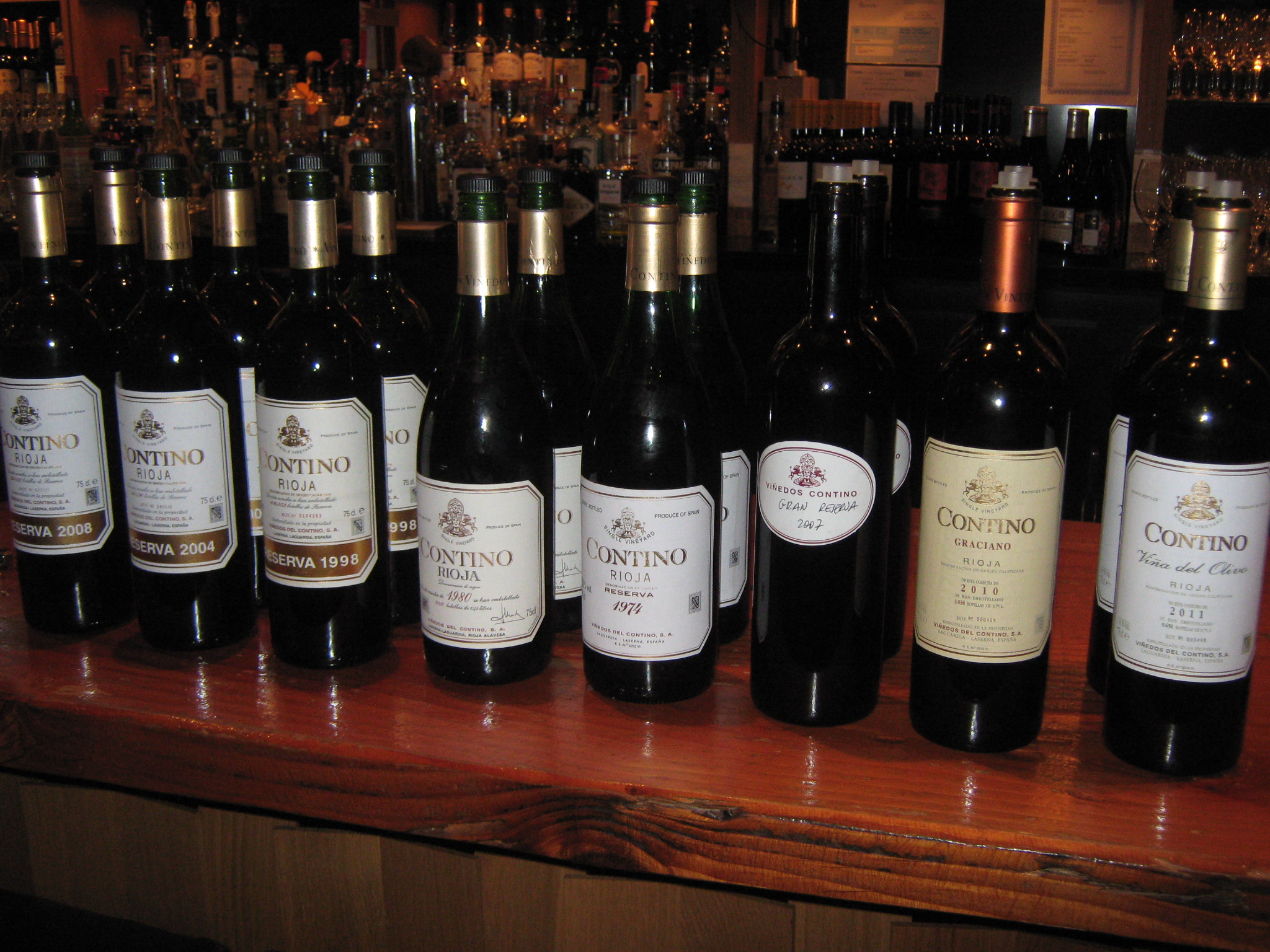
Near the end of September, at the invite of two exceptionally grounded wine men, Rob Groh and Derek Kranenborg of The Vine Wine Agency, I attended a tasting at Cava Restaurant with Technical Director Jesús Madrazo of Rioja’s Bodega Viñedos del Contino. With former Cava Chef Chris McDonald providing the worthy and soulful snacks, Madrazo poured eight wines. Eight to leave lasting memories in impression. Edibles to boot, complex concentrations by Chef McDonald with his last Cava days coming near. Everything about the tasting, in both wine and food, was intense. I hope all were paying attention.
Two of chef’s hors d’oeuvre-style compositions were Foie gras and partridge Croquetas and Frogsicles with Pimento Alioli. Both unique, both instrumental in elevating the old and wise Riojas upwards atop a rightful pedestal. The wines of Contino are very classic Rioja, at times understated and at others overwhelming. Contino’s Rioja buzz with energy and verve. They are very alive. They ooze earth and soil.
Bodega Viñedos del Contino is a part of the Cvne (Compañía Vinícola del Norte de España) stable. Founded in 1879, Cvne today is three distinct wineries; Cune, Viña Real and Viñedos del Contino. Contino was born in 1974.
In 2006 Madrazo began producing the white wine experience. The challenge was in getting approval from the board of directors. After much experimentation, the first vintage came in 2010. Grown on calcium carbonate soils, the white Viura draws energy from stones, some larger than the solar collecting galets of Châteauneuf-du-Pape. The rocks are the heliacal conductors to the vines, creating a paradox, of water loss and energy giving life. This, accomplished through dry, organic farming. “That’s how we play the game,” notes Madrazo.
At the Cava tasting, the ageability of the Riojas was the concept under investigation, but it was the three others wines poured, the flotilla leaders Blanco, Graciano and Viña del Olivo that really drove the point across. Longevity is the key to the Rioja heart. The Rioja Reservas are the soul. “In Spain,” says Madrazo, “we (continue to) fix everything. We release our Rioja in the 5th year.” Here are notes on the eight wines tasted.
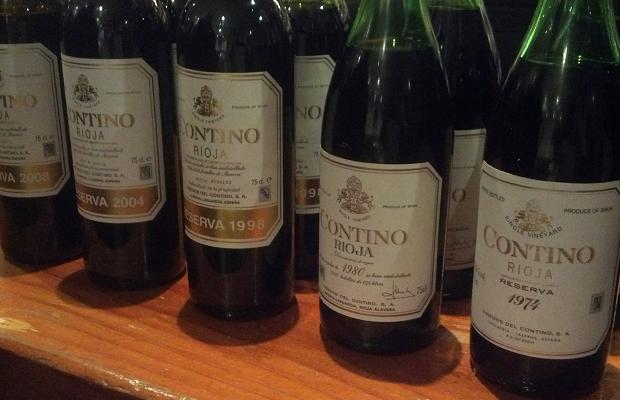
The line-up at Cava Restaurant: Bodega Viñedos del Contino
The third vintage of Contino’s crown jewel white is (80 per cent) Viura with Malvasia (five per cent) and Garnacha Blanca (15). The latter will bull its way into future vintage mix with incremental proportion as a result of increased plantings. “The Queen” gets right up into the face and nose, indicating success for its primary goal. To seek a capacity for aging. “Viura can age,” insists winemaker Jesús Madrazo. “Here I can see at least six years of life, maybe ten.” The Blanco has a meddling mid-palate metal and creamy sensibility. Big (90 per cent new oak) barrels housed the wine for six months to seek its second goal; fruit spiciness. This effect is magnified by the south-facing, down to the river slopes, one of the warmest areas in Rioja. The third objective is acidity but with the malic tendency well-managed, to seek equilibrium. The single block Garnacha and Malvasia elevate and balance out the estate’s omnipresent, all over the map Viura. The paradox lies in the terroir, where hot, solar conduit stones cause evaporation and yet give energy in simultaneous activity. Old vines (some as much as 70 years) draw and release, draw and release. The ebb and flow in ardor gives this Blanco verve and it is showing with style right now. It will live as Jesús said it would but it’s life will be hard and fast. Drink now and for three or four years. Tasted September 2014
From a late harvest (two to four weeks behind the norm), the ’08 is an example of the philosophy yet entrenched in the past, with a desire for pure quality, regardless of the picking time. The conditions meant no single-varietal Graciano bottling and only a small case load of the Viña del Olivo. Quality was essentially earmarked for the Reserva, scoured from 62 hectares of Estate Tempranillo. The vintage is defined by straight up red fruit with some spice and a warm-climate, tree bark/resin effect. The wine’s personality come from out of the nerve centre’s tangy inflection. Though it’s a touch warm and zealous of alcohol (14.5 per cent), it speaks in cants of the Contino chateau style. Tasted September 2014
“If it’s not broke, we fix it,” admits Jesús Madrazo of Contino. The estate’s ’04 says exactly what it should and it must. Old barrels (50-50 French and American) plus two years in bottle bring out the hard vine life heartbreak and hyperbole in fruit grown on calcium carbonate soils with stones bigger than Les Galets of Châteauneuf-du-Pape. Stones that heat up from the sun, acting as solar conductors to the vines. Acidity may have been compromised but not structure. There is Rioja Alvesa sweetness, set against a whiskey town backdrop. There are plums, prunes and Phở. Yes, this is a quixotic and exotic Contino, ripe, spicy, floral, meaty but not gamy. Roast pork, Vietnamese style. Immaculate of youth, of original energy and of garrigue. The 2004 Reserva tells the Contino story like Ryan Adams sings about a broken heart. “Some things are born too strong, have to learn how to fight.” So, the Tempranillo will say, “you’ll have to excuse me if I break my own heart.” Tasted September 2014
Bodega Viñedos del Contino Rioja Reserva 1998, Rioja, Spain (Agent)
Not unlike the book that wrote ’08, the vintage challenged with cold weather during harvest, this coming on the fits meets stops on heels and tiptoe starts that defined the overall growing season. A first flawed bottle aside, a second one opened is musty in its own ancient and charming way. With only 10 per cent Graciano in the blend, this here is essential, old-school Tempranillo. Beyond the dust is a round and smooth elixir with a ferric vein of animal funk. There is liquorice and there is chalk. The grain of this Contino is like liquified barley or bulgur, with an earthy faro aroma, a creamy texture and long on glutinous structure. Earth keeps fruit in subterranean submission, though there will always be hints of dried plums and flowers to sustain life. Tasted September 2014
Bodega Viñedos del Contino Rioja Reserva 1980, Rioja, Spain (Agent)
Here the Tempranillo has walked the sands, survived the winds of time and has arrived at the sultanate’s tent, exhausted, somewhat delirious yet basking in the accomplishment. The tapestry woven by 34 years of development has laid on a platter a veritable feast of dried fruits; prune, apricot and date, all chewy and densely concentrated. A diesel fume aroma indicates a modernity evolved and the oiled track shows the way out of Damascus (or in this case, Álava). The ’80 is a bit funkified too, with great acidity and length that lingers for a most amazing amount of mouth time. Dried flowers, namely violets define the perfumed finish. A Tempranillo possessive of exceptional survival skills. Tasted September 2014
Bodega Viñedos del Contino Rioja Reserva 1974, Rioja, Spain (Agent)
An impossibly youthful 40 year-old Tempranillo, even surpassing the more evolved ’80 in that regard, with aniseed, coconut and beeswax in its current aromatic state. Less gamy and animal funky, yet persistent in earthy beats. The vegetal scents act as conduit to the light bulb shining brightly of circuitous flavours and resolved textures. Lingers in mouth feel, its layers of time slowly peeling back, revealing in length, a slide show of the wine’s life. With many year’s still ahead, this is a Tempranillo revelation and from one going back this far that gained no support from Graciano (because it was planted in 1979). Its apostle following instead comes by way of the white Viura. Pair with Chef Chris McDonald’s Foie Gras and Partridge Croquetas. Tasted September 2014
Contino’s SV Graciano is the estate’s portent into the portal of ageability, beyond Tempranillo. Such formidable aromatics are on display, a result of low pH and high polyphenolic compounds. Has got something, but what it is, I can’t seem to place. It’s neither flora nor fauna, not rock, nor fruit. A combination of them all and a piercing streak of acidity leads to the expanse of a broad mouth texture. Sense perhaps black fruit, currants and berries. A toast, macerations, citrus even. This Graciano, the soul of Contino. Crème de cassis, eucalyptus, camphor, menthol and aniseed are all seemingly there, in colour, natural acidity, alive and dancing. Or are they? I looked at this Graciano, “from both sides now, from up and down, and still somehow,” it’s a challenge to see through the clouds. It’s so very large, exceeding the ministrations of other alterior SV examples, like that of Petit Verdot, Malbec or Cabernet Franc. In here it’s Graciano’s illusions I recall so I suppose I really don’t know Graciano at all. Imagine drinking this for 20 plus years. Tasted September 2014
Bodega Viñedos del Contino Viña del Olivo 2011, Rioja, Spain (Agent)
The flagship wine from Contino has an uncanny braised pork belly in spirited wines reduction nose, spiced with star anise. The aromas then go straight to the back of the brain, bypassing the frontal lobes and acute senses of nose and tongue. A wine that drives a stake directly into the nervous system, leaves one twitching and paralyzed. From arid, calcareous clay, the 34 year-old vines are just deadly, direct and make for some seriously demonstrative fruit. The mineral expression can’t be denied; this represents the most in the estate’s terroir driven directive. The blend is Tempranillo (80 per cent), Graciano (10) and Garnacha (10). New oak (100 per cent) is split between French (70), American (20) and various other European wood. A wine that will need a minimum five years to reach adulthood and perhaps 10 more to enlightenment. Though it is marked and baked by chalk and cake the mineral keeps it so ver real. Tasted September 2014.
Bouteilles de la collection Méquillet de Kientzheim, Confrérie Saint-Etienne
In January it began with A resolution to drink honest wine, “juice that conveys the salient facts of a grape’s life.” It continued with New year. Try new wines, where the goal was “the resolve to drink outside the comfort zone.” If the issue was Feeling under the weather? Drink wine, success was had. “Wine is your friend. When approached, integrated and embraced in the right way it can help to promote a healthy lifestyle. The defence rests.”
A 5500 km trek to the tip of Cape Breton and back yielding poetic and prophetic expression in The tides that bind: East Coast swing. “The tractive is a thing to and of itself. The pauses to gather at points along the process remember lobsters roasting over an open fire, a cottage visit with new-found friends, a hike into the cavern of a waterfall and a swim in a tidal river. Memories are made in rites of passage, though in the end, like the photographs, they too will be demurred by time. Indelible stamps they are, cemented in commitment to reaching and by necessity, descending summits. A road trip to the eastern part of Canada realizes the bigger plan. The key is making it safely home, before the tide rolls in.”
Local wines, notably Niagara delivers everbearing quality in November releases and in direct contrast, I went Off the beaten Italian path to discover endemic varietals. The Bloody vivid 2011 Vintage Ports had me reeling. “The 2011 Vintage Ports have balance, well, the best do, but they are, and I speak in very general terms, collectively over the top. Though it may seem an oxymoron to put Vintage Port and elegance in the same sentence, what is a great wine without a sense of humility and restraint?”
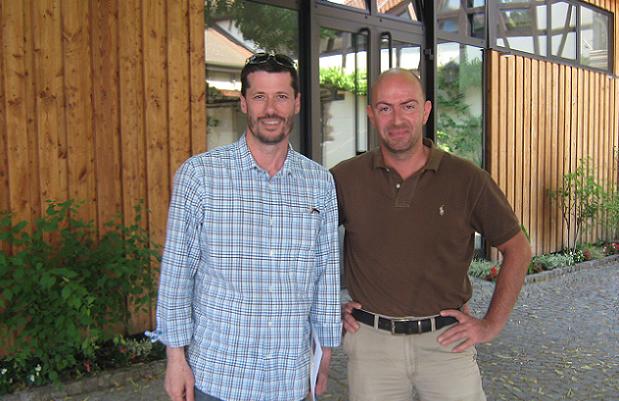
Godello and Christophe Ehrhart, Domaine Josmeyer, Kientzenheim
This is the third in the trilogy of best of reports for 2014. The first, 14 Canadian wines that rocked in 2014 was about “wines that are extensions of their maker’s personality, philosophy and temperament. Wines that are indicative of their terroir.” The second, Top 15 under-$25 wines of 2014 was meant to to “create the sociological, world of wine equivalent of splitting the atom. To celebrate the triumph of laic heterodoxy and the arrogance of modernity. To seek purity from beneath the massacre caused by an avalanche of contrived wines.” The third instalment is meant purely to celebrate and to thank those who shared their bottles with me. Here are 16 wines tasted in 2014 that simply blew me away.
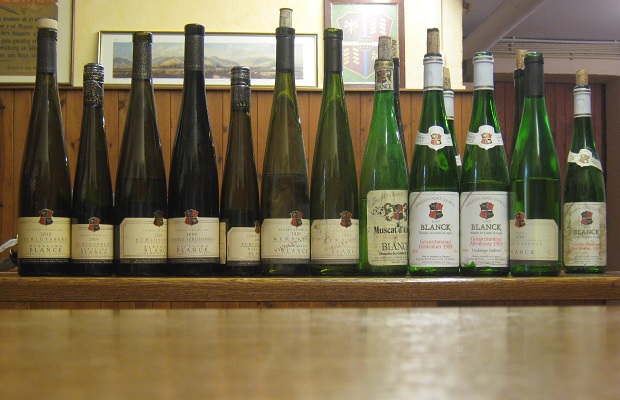
Tasting with Philippe Blanck, Domaine Paul Blanck
Domaine Paul Blanck et Fils Muscat d’Alsace Réserve Spéciale 1983, Alsace, France (From A Blanck slate in Alsace, December 1, 2014)
From Altenbourg, a lieu-dit located at the base of the Furstentum vineyard. Here is Blanck’s “fairy tale,” a wine you would have always heard about but never had a chance to taste or likely ever seen. The terroir is limestone mixed with clay and you will have to excuse my Alsatian, but a single sniff and taste releases the expression, “are you fucking kidding me?” This 31-year old Muscat is an impossibility, a first time feeling, a never before nosed perfume. Speaks in a limestone vernacular, of grapes given every chance to survive long after their innocence had been lost. A forest herb, tree sap, evergreen resin, lemongrass and bitter orange coagulation rises from its viscous mist. The acidity has lost nothing on the fruit, acts in perfect foil and leaves you with a sense of loneliness that is just beautiful. Tasted June 2014 @DomaineBlanck
In July 2013 Francois Morissette made this statement. “If we can’t make Gamay in a Cru Beaujolais Style, I’m not interested.” In May 2014 his ’13 Gamay causes Bill Zacharkiw to comment with blatant honesty, “just line up at the tank. Forget the bottle.” From 100 per cent whole clusters sent to cement fermenters. Once again the hue is just impossible. Sulphur-free, this walks a fine and perfect line of Cru banana Gamay. Pushes the Gamay envelope in that it’s gulpable but with a duress to remind you not to overdo it. A Gamay with a chamber of 32 doors. In it “I’d rather trust a man who doesn’t shout what he’s found.” François Morissette. Tasted May 2014 @PearlMorissette@3050imports
Here blends one-third each Viognier, Rousanne and Marsanne, a veritable Rhône orgy in wild fermentation, aged on the skins in terra-cotta and amphorae. While I would not go so far as to call it an “orange wine,” I will use the “N” word to describe its agrarian ways. As natural as anything you are likely to taste out of B.C., this is a most untamed experiment and should not be missed. It verges on oxidation but refuses to climb over the edge. It’s floral, spicy and crowded. The texture is chalky and so full of rusty, clay rubbed streaks. Everything about this is unkempt and exotic, including the never cease and desist fermenting lychee and longan feel. Hard not to be wowed by this blend’s presence. Tasted August 2014 @lfngwine@liffordretail
Only Charles can follow Charles, as only Jimi could follow Jimi. Just ask Peter Townshend. The combined forces of vintage, off-dry level of residual sugar (23.9 g/L) and age have ushered this Picone into a realm of adipose, butyraceous, chewy texture. The ’06 is emblematic of its time, stunning, psychedelic, experienced. It speaks clearly and with conceit. Tasting it eight years on you can hear Baker’s 2006 voice saying “if you can just get your mind together uh-then come on across to me.” We have and continue to follow Charles, and we are paying close attention to every vintage along the ride.Tasted March 2014 @cbriesling@StratusWines
A lifelong search for great Sémillon is fraught with peaks and valleys. Finding greatness is so rare it’s blue. The Hunter Valley in New South Wales beckons for a rush to strike gold. Many roads lead nowhere and others, like the dusty lane up to Brokenwood’s Maxwell Vineyard, lead to OZ. This young one has barely broken bread, or even a sweat. Sémillon of primary concern, like a tank sample. Varietal beauty as a cryogenically frozen specimen inundated by the table, the whole periodic table and nothing but the table. Guided by a laser beam of focus, great intent and expectations. Bob’s your uncle this David to the world’s white wine Goliaths. Son of racing studs and mares. Wow Sémillon. Not a faint moment about or in it. Tasted May 2014 @Brokenwood
The Hess Collection Cabernet Sauvignon 1990, Mount Veeder, Napa Valley, California, USA (662015, $59.00, WineAlign) From The death of wine scores?, March 26, 2014
A seminal bottling from a game-changing year, for two all important reasons. One, it was a great vintage for Napa reds and two, the Mount Veeder sub-appellation was established. While only 24 years ago, a mere five wineries existed there at the time, including Mayacamas, Mt. Veeder and Hess. No hyperbole to say this is tasting a piece of history. Despite my “shouting all about love,” this splendidly aged Cabernet is not so much about resilience as it is persistence and infinite wisdom. All those years ago there were Napa reds made at a mere 12.5 per cent alcohol, with finesse and a sense of George-like calm. With little aeration there is fig, prune and toffee gently weeping but with air the aged fruit is swept away by a wave of gob stopping Cassis before its time. Preconceived notions of banausic, early days Cabernet are smothered by the magic dust of this Hess religion, a Dharma of licorice, ash and enlightenment. A wine to make you forget where you are. Depth, length and up to a half decade yet of reserved life lay ahead. Tasted March 2014 @HessCollection @liffordretail
The Fèvre take on Les Clos is the cradle of all the domain’s wines, in every respect. Intensely concentrated, this is Chardonnay expressive in every facet of its surroundings. The impart from compressed white limestone, ancient fossils and Jurassic minerals in distillate may seem abstract in description but how else can the feeling of a mouth full of rocks be conveyed? The remarkably complex Les Clos and its structured palate that goes on forever has come out of its Chablis vineyard cradle and will live on as one of the best ever. “It’s not a place, it’s a yearning. It’s not a race, it’s a journey.” There is no rush to drink it up. It will offer immense pleasure for 20-25 years. @WoodmanWS@BourgogneWines
From a golden vintage, this ’97 is crazy good. A fixed, double-edged blade fighting knife dipped into a warm pool of developed liqueur-like sweetness. Seventeen years of languorous modulation and wood-fruit integration had resulted in a gracious Brunello, intrinsically delicious and living large in senescence. Life for the Col D’orcia ’97 is a bowl of cherries. Open one now and for the next three to five years and you’ll know exactly what you’re going to get. Me, “I’ll stick with you baby for a thousand years. Nothing’s gonna touch you in these golden years.” Tasted April 2014 @Coldorcia@ConsBrunello
The blend of the 2001 Rosso Superiore is Cabernet Sauvignon (65 per cent), Merlot (30) and Cabernet Franc (5). Though strange to say and admittedly a retrospective comment, the minute quantity of Cabernet Franc and not yet inclusion of Petit Verdot result in a more straightforward and not as heavily layered Ornellaia. The structure is more linear and understandable, the fruit not as variegated. Complexity and Tuscan spiritualism are not compromised by the Cabernet Sauvignon and Merlot dominant line, in fact, assessing the evolution at 13 years on reveals the Bolgheri terroir in ways the magnanimous and opulent more recent vintages just don’t reach. There is a refreshing acidity in this young and developing ’01 in a streak that again, the baby Superiore do not seem to possess. This is a striking Ornellaia, a wine that would work with exceptional cuisine of varied cultures. It can be enjoyed now and will respond with grace and thanks for 30 plus years more. Tasted June 2014 @Ornellaia@AuthenticWineON@sherry_naylor
Château Léoville Las Cases 1995, Ac St Julien, Bordeaux, Left Bank, France (402529, $599.00, WineAlign) From A Bordeaux family of wines, September 29, 2014
This 2nd Growth, Grand Vin is a product of nurturing and environment, a study in 12 superb soil subsets, from sand to clay to stone. From mature, edified vines split between Cabernet Sauvignon (70 per cent), Cabernet Franc (16) and Merlot (14). The LLC ’95 is grounded and centered on its highly confident axis while swirling within a centrifuge of inwardly concentrated, ripe but not ripest fruit. Merlot here is the anchor, Cabernet Sauvignon the mast. This is a relationship of pure linear fruit meets acidity. The full and fresh attack is refined with soft-pedaled tannins. It’s neither St. Julien nor Paulliac. It is Las Cases. No other Bordeaux is such an island, a distinctly personal expression, an event of its own. This is a window to the greatest vintages, a portal to extend to the benchmarks of 1996, 2000, 2005 and 2009, but also to step into the history of physiological cortex, to gain insight into previous legendary vintages, like 90, 89 and 82. The ’95 is silky, caressing, rapturous enveloping in a reverse osmosis of fruit and acidity, acidity and tannin. Another sip notices the layering, the grain left in tannin, the lingering richness of the fruit. The absolute sweet caress. Tasted September 2014 @Noble_Estates
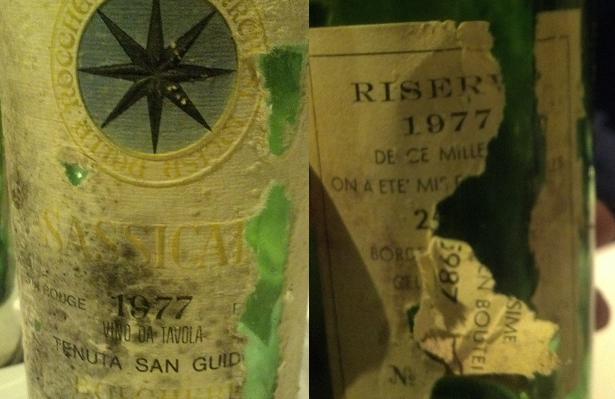
Tenuta San Guido Sassicaia 1977 at Splendido Restaurant, September 2014
Tenuta San Guido Sassicaia 1977, Doc Bolgheri, Tuscany, Italy
Though the vintage was reported to be less than exceptional, the chance to taste this 37 years in/on and the longevity it displays combines for full, blow me away effect. The first vintage of Sassicaia was 1968 and this 10th try hits the mark of experience. A blend of Cabernet Sauvignon (85 per cent) and (15) Cabernet Franc, the fruit came from vines over top soils of clay and limestone. The wine spent 20 months in Yugoslavian oak barrels (half of it being new, and half used once or twice before), while for the remaining 60 per cent, French oak was used (2/3 new and 1/3 used once or twice before. Tasted blind, the swirling and searching thoughts of Genesis retrospection assimilate aromas of truffle and mushroom, but at first there is no reply at all. Landing on a plot of excellence somewhere between Bordeaux and Piedmont, Tuscany rises from its hills. A silent conversation ask the Sassicaia “I get the feelin’ you’re tryin’ to tell me;
Is there somethin’ that I should know?” Its condition is near perfect, its body full, its nature pristine and finally, so obviously in balance. After 30 minutes it begins to slide, to no surprise, but you can’t believe the expression it gives and the impression it leaves. And so, it is confirmed. 1977 was a fine vintage for Sassicaia. Tasted September 2014 @Smarent@Splendido_TO
Bodega Viñedos del Contino Rioja Reserva 1974 at XocoCava, with Chef Chris McDonald and Rob Groh of the Vine Agency, October 2014
Bodega Viñedos del Contino Rioja Reserva 1974, Rioja, Spain (Agent)
An impossibly youthful 40 year-old Tempranillo, even surpassing the more evolved ’80 in that regard, with aniseed, coconut and beeswax in its current aromatic state. Less gamy and animal funky, yet persistent in earthy beats. The vegetal scents act as conduit to the light bulb shining brightly of circuitous flavours and resolved textures. Lingers in mouth feel, its layers of time slowly peeling back, revealing in length, a slide show of the wine’s life. With many year’s still ahead, this is a Tempranillo revelation and from one going back this far that gained no support from Graciano (because it was planted in 1979). Its apostle following instead comes by way of the white Viura. Pair with Chef Chris McDonald’s Foie Gras and Partridge Croquetas. Tasted September 2014 @TheVine_RobGroh@Cvne
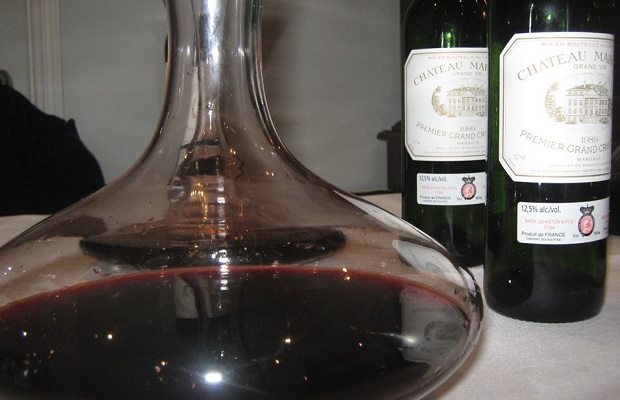
Decanted Château Margaux 1989, The National Club, Toronto, May 1, 2014 PHOTO: Michael Godel
The 1989 Château Margaux wears the response to a mondo Bordeaux axiom on its sleeve. Are First Growth wines made for people who want darts of instant pleasure?” Twenty years earlier and now like the 2009, here is a quintessential and exemplary vintage, from day one of bud break to the last day of harvest. Its appraisal as anything but incredible is to assassinate it as if it were the Franz Ferdinand of Bordeaux. The examination 25 years later sees a mellow funk meet a peerless and sublime perfume. A wine cast in utmost density, complexity and length. It noses strength, warmth verging on heat but only for a fleeting moment, to gain attention. The iconic wine has reached the first major peak, up a ways from base camp. In this second phase of young adulthood it looks with conceit to the top of the mountain, seeing 25 to 50 more years on the climb. Mr. Pontallier regrets he won’t be around to taste this wine at full maturity. Moi aussi. The fruit lingers in its full, original state, from the moment it passes lips and for minutes onward. Violets trump roses. Château Margaux 1989 is from a vintage that offers the blessing of ethereal balance. Hear her sing, “Ich heisse Superfantastisch!” Tasted April 2014 @Noble_Estates
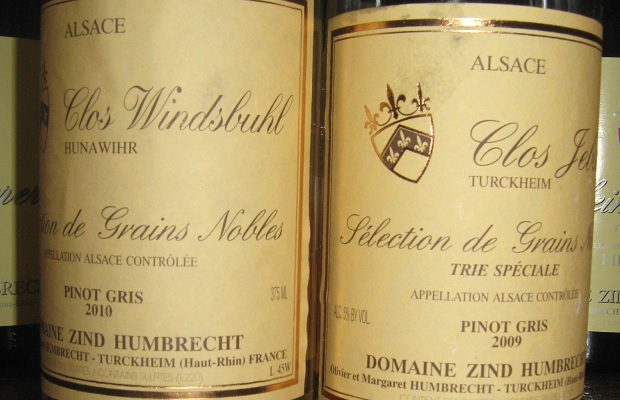
A south-facing, very steep slope of grey marls and gypsum. A vineyard that yielded a miniscule 10 hl/H. A stratospheric residual sugar quotient (in the realm of 500 g/L) and incredulous acidity to prevent the development of the yeasts. A fermentation that finally finished in the late winter of 2012. A wine aged in demi-guid. Selection of grapes of a botrytis so pure and dry. These are the specs of a wine I may never taste again. Olivier concedes he “really tries not to obtain the highest sugar concentration possible” but this 2009 is a “monster of a wine.” It will take forever to assimilate and digest the sugar. Unctuous, lush, rich and gorgeous does not do it justice. Pure distillation of fruit and stone, accented by spice, wild herbs and flowers. Like an injection of pure, Pinot Gris adrenaline. All this from dry extract, slowly rehydrated with magic pixie dust and the wonders of the natural world. Will live for a century and then some. Tasted June 2014 @olivier_dzh@TrialtoON
Domaines Schlumberger Riesling Grand Cru Kitterlé 1945
From an area of sandstone soil that predates the appellation. “This is an old story,” says Sommelière Caroline Furstoss by way of introduction at a Millésime master class. “This is a wine of God,” in allusion to the success of a vintage immediately following the end of World War Two. So emotional to taste, of a Riesling with 20-25 g/L of residual sugar and a recondite, balancing level of acidity. Complete and clean, persistent in its power and vitality. There is orange peel and spice, cinnamon and spike. Must have been a warm yet somehow perfect vintage. Sixty-nine years on there is the slightest hint of toffee and nougat with a whispered promise to age for at least 30 more effortless and graceful years. The length lasts for minutes. The heart and the hearth. Just the thought of producing this wine at that time is unfathomable and mystifying. There are no superlatives to do it justice. Tasted June 2014 @VinexxWine
Taylor Fladgate Single Harvest Porto 1863
Taylor Fladgate Single Harvest Porto 1863, Douro, Portugal (Agent, $3,995.00, WineAlign) From Taylor made Port, September 2, 2014
The two casks of 1863 reached the Taylor family in pristine condition, from one of the last great pre-Phylloxera vintages of the 20th century. This wine came from the cool and damp Port lodges of Oporto, “the cathedrals of wine.” This was a once in a lifetime chance to taste a piece of history, a most natural and organic fluid encased for 151 years in its integument of time. The year 1863 was significant in many respects, including being the birth year of Henry Ford and Franz Ferdinand. This is Port that creates the future and yet dwells on the past. The hue is both progressive and fathomless in subterranean fantasy. Its many shades of warm, advancing colours resemble the faux brown rings of Mars. The aromas are built around toffee and with accents of many mints; spearmint, chocolate and pepper. You can smell the 1863 from rooms and world’s away. It conjures up many songs. “When you’re half way from a dream, is it hard to work out what is real?” That is its love illumination. It has the strange advance “of killing time and dreams.” The flavours are extreme and exotic, with South-Asian spices highlighting its deep, late night humidity. The finish is endless. Is this brilliance or a stroke of incredible luck? It is certainly pristine and wondrous. It has to be considered a perfect wine, for its niche and genre, by its makers, David Guimaraens and Adrian Bridge. Having let the days of 151 years go by, this is not a wine to compare with others, it is not the same as it ever was. In the end, “you may ask yourself, well…how did I get here?” Thanks to Stephen Marentette of Sylvestre Wines and Spirits. Tasted August 2014 @TaylorsPortWine@Smarent





 Godello