From Cinquante to wine with Canada-U.S. hockey

Canada\'s Marie-Philip Poulin (L) celebrates with Canada\'s Meghan Agosta-Marciano.

Canada’s Marie-Philip Poulin (L) celebrates with Canada’s Meghan Agosta-Marciano.
Photo: ANDREJ ISAKOVIC/AFP/Getty Images

as seen on canada.com

I hope the Canadian men’s hockey team watched the women this afternoon. Lesson number one: Play to the last friggin’ millisecond. Canada versus the United States is hockey incarnate. The games are always exciting.

When we gathered for that first historic Salt Lake City Gold Medal game in 2002, we drank cinquante. Mario would have wanted it that way. For the 2010 Vancouver golden goal win we convened with Steam Whistle. That historic Sunday in February was my first time out of the house after a right AC (acromioclavicular) joint shoulder rebuild. Hockey injury, of course. Wine did not factor into those generation defining Olympic hockey games. Back in 2002 names like Lemieux, Sakic, Fleury, Brodeur, Hull, Leetch, Modano and Roenick were toasted with beer, though back then the brands were not so craft related. In 2010 it was all Sidney Crosby and had I been acquainted at the time with the wonders of Sparkling wine from Nova Scotia, Benjamin Bridge would surely have been flowing.

Meanwhile, Super Mario turned out to be a serious wine collector so I wonder what Le Magnifique will be opening this Friday at noon. Team Canada architect Steve Yzerman is also known to follow the way of the grape and though he won’t be sipping Napa Cabernet with the other brass during the game, I’ve a feeling there’s a ’97 waiting in his hotel room should Canada prevail over their arch rivals.

Hockey stick and wine bottles

Hockey stick and wine bottles

The great Rhône wine scribe George Heretier posed the all-important debate, ”who says wine and hockey don’t make a good match?” If you want to exercise the powers of superstition, pulling out those two winning vintages will call upon the hockey gods to carry our Canadian men to gold. That and a Loonie buried beneath the surface at centre ice.

Here are eight great Canadian 2002 and 2010 wines to crack open and sip along with another Canada-U.S. classic hockey meeting.

Clockwise from left: Southbrook Vineyards Cabernet Franc ‘Watson Vineyard’ 2002, Henry of Pelham Family Estate Winery Speck Family Reserve Cabernet Merlot 2002, Rosewood Estates Winery Sémillon 2010, Southbrook Triomphe Cabernet Sauvignon 2010, Burrowing Owl Syrah 2010, Huff Estates Cuvée Janine Sparkling Rosé 2010, and Stratus White 2010

Clockwise from left: Southbrook Vineyards Cabernet Franc ‘Watson Vineyard’ 2002, Henry of Pelham Family Estate Winery Speck Family Reserve Cabernet Merlot 2002, Rosewood Estates Winery Sémillon 2010, Southbrook Triomphe Cabernet Sauvignon 2010, Burrowing Owl Syrah 2010, Huff Estates Cuvée Janine Sparkling Rosé 2010, and Stratus White 2010

Southbrook Vineyards Cabernet Franc ‘Watson Vineyard’ 2002 ($30, winery) From A long and ‘wine-ding’ tasting road

Shows amazing longevity and freshness. Proof of the Peninsula’s magic to state ”you will never never never know me.” Simply solid red.  91  Tasted March 2013  @SouthbrookWine

Stratus White 2002, VQA Niagara Peninsula (660704, $44.20, WineAlign)  From Select tasting through years of the Stratus Red and White

Performs a demi-sec act which is not such a stretch, considering the late harvest actualities of the Gewürztraminer and the Riesling within. Could pass for dessert-like, cool-climate French (Jura) though after the chimerical declension it’s still nothing but a Chardonnay-galvanized meritage. Like warm honeycomb buttering steamed crustaceous matter. That Stratus White medicine, in rose potpourri and honey completes the classic scene within the portal.  93  Tasted September 2013  @Stratuswines

Stratus White 2002

PHOTO: Michael Godel
Stratus White 2002

Henry of Pelham Family Estate Winery Speck Family Reserve Cabernet Merlot 2002 ($50, wineryWineAlign) From A long and ‘wine-ding’ tasting road

From the Niagara Peninsula shows toffee and concentrated, oxidized fruit. That said, it has aged well and still offers intellectual spirit in dried fruit and potpourri. Great old tune to Dance, Dance, Dance along to.  89  Tasted March 2013  @SpeckBros

Rosewood Estates Winery Sémillon 2010 (177758, $17.95, WineAlign) From Showcase Showdown: Rosewood Sémillon

Shows little procrastination with a superfluity of lemon, lime and paraffin but like all great Sémillon, the wine needs time. A block of wax keeps the honey down but look for a mellifluous ooze three years on. Glittering sheen, diamond-like focus and crusted by an accent of lemon zest. Krystina Roman will lead this grape to stardom. “Come on you stranger, you legend, you martyr, and shine!” Top white. Shine on you crazy Sémillon.  90  Tasted October 2012 and May 2013  @RosewoodWine

Southbrook Triomphe Cabernet Sauvignon 2010, VQA Niagara On The Lake, Ontario (ON, VINTAGES Essential, 193573, $22.95, WineAlign) From: Good Look Ahead at Canadian Wines For Thanksgiving

Drifts effortlessly along in an extreme brightness and lightness of being. A perfumed exotic beauty that displays definitive Cabernet Sauvignon character. Tea, tobacco, Cassis, vanilla, dark berries, proper acidity, good grip and length. Dictionary entry for the vintage, the Niagara-on-the-Lake appellation and the genre. No other sub-$25 Ontario Cab does the warm vintages (’02. ’05, ’07 and ’10) with this kind of grace and power. From and kudos to winemaker Ann Sperling.  91  Tasted September 2013  @SouthbrookWine

Burrowing Owl Syrah 2010 (73072, $41.95, B.C. $39.99, Alberta $44.99, WineAlign) From: Nine big November best buy wines

This Syrah will cure so many ails. Vouchsafe for a pepper-laced, plasmic mouthfeel, a maroon liquid pewter party of rocks and stones in the mouth. Playful and childlike, digs a pony, playing and offering really good fun. Does its own Okanagan thing becuase “ev’rything has got to be just like you want it to.”  92  Tasted October 2013  @BurrowingOwlBC

Huff Estates Cuvée Janine Sparkling Rosé 2010 ($29.95, winery only, WineAlign) From: You can lead a county to the city

100 per cent Pinot Noir grapes is a phenomenal, inaugural genesis effort. More sanguine in colour than one would imagine, this sparkler is wonderfully sweet but also ”turns sweat, turns sour.” Pinot Noir is always potentially so dramatic but who knew it could be like this, like blood swirling in the glass. “Bottled in a strong compression,” with black raspberry, noticeable yeast and impressive finesse.  Out of the cage.  91  Tasted May 2013  @HuffEstatesWine

Stratus White 2010, VQA Niagara Peninsula (660704, $44.20, WineAlign)  From Select tasting through years of the Stratus Red and White

sends me immediately towards Bordeaux, in neo-marmalade, but also buoyed in perfume and body by 25 percent Viognier. “This variety worked so well in the vineyard in 2010,” notes Groux. Niagara honey and near-botrytis via Semillon and Sauvignon Blanc void of grass, full of vigor. A sharp note, neither metallic nor mineral, but a combination of the two is present in this so very concentrated ’10. Of a warm vintage (self-explanatory) fully picked by October 23. Though loaded with early Spring maple sap, foie gras and appley terpines, its sharp and framed by “tannic” tang and protracted length.  92  Tasted September 2013

Good to go!

Three-chord wines, hold the rants

Wine on the rocks

Here are six rock ‘n’ roll wines, in four-four time, ready and willing to ease your mind.
Photo: Pavel Drozda/Fotolia.com

as seen on canada.com

The world’s most famous wine critic is not happy. His claim of “wannabe” scribes hell-bent to focus on obscure wines most consumers can never find has raised a maelstrom of retort. Robert Parker published a diatribe last month about “a vociferous minority” of “euro-elitists” vying for journalistic market share “perpetrating nothing short of absolute sham on wine consumers.”

Them’s fightin’ words. No, not that rant by Robert Parker about Robert Griffin III. Wine critic Robert Parker Jr. railed against a bevy of unnamed bloggers on the natural, honest and low-alcohol wine supporting bandwagon. His claim? Natural wines will be exposed as fraud. Parker’s would-be assailants are an outspoken generation who would seek to bring down those classic grapes capable of ripe extraction and elevated levels of sugar and alcohol, namely Cabernet Sauvignon, Pinot Noir and Chardonnay. The intensity-loving reviewer has positioned himself as the establishment, a victim agonizing over the sanctification of “godforsaken grapes,” like Blaufränkisch and Trousseau.

Alder Yarrow of Vinography took exception and proposed a cage match. His column: Debating Robert Parker At His Invitation. Rebecca Gibb’s take: Should Robert Parker Have Listened to Disraeli? Jamie Goode put in his ever-wry two cents: Novelty at the expense of quality? This after Jancis Robinson chimed in with Bottle fight: Novelty v classic wines. Talia Baiocchi had this to say: The Robert Parker Tirade, Continued. Eric Asimov brought it down to a New York state of mind with Why Can’t You Find That Wine? Meanwhile, Steve Heimoff took the other side: There are some kinds of blogs we just don’t need.

There isn’t a writer in the bunch I wouldn’t read, can’t learn from or don’t find funny, but the need to chime in on what is obvious and already understood leaves me dumbfounded. In wine, as in life, there are some things that just are what they are, like them or not. Mr. Parker, you carved your niche. Those who lay with you ate cake. The model worked. It held water and was extremely successful for a long time. You are this week’s Napa Wine Writers Symposium keynote speaker, where you will feel the love. No one will ask, what have you done for me lately? You created the establishment and are of course trying to protect the status quo. You’ve been ridiculously prolific. Integral to the high-frequency, high-end wine buyer. And you are just a writer. Really. So what if the dogs are seeing signs of Queegish dotage. You named no names in your rant, so who exactly did you mean to insult? The world is your oyster. What’s with the bitching?

https://twitter.com/KortvB/status/436175029676421120

Perhaps Parker touched an insecure spot, the one where self-doubt creeps in. The one that drives writers to defend themselves, even if the attack is not a personal one. The need to tear him down is strange at best. It smells of poli-campaign slander. If he’s no longer relevant, as a vehement bunch seem to scream and shout, why bother? Why is the wine writing community one where sides desperately need to be taken? To both sides I caution the high road. Let writers write and if you think they are wrong or have nothing to say, ignore them. Like a tree falling in the forest, is an unread writer ever really heard?

It’s understood that controversy sells and lively discourse is healthy. In this case it has produced more than a novella of interesting reads. The current generation of critics, bloggers and reviewers is replete with some stupidly smart writers who have chosen wine as their raison d’écrire. That they chime in and offer their take on everything from varietal obsessions to tasting bans and producer/journalist relationships is certainly fascinating. Arguing the merits of varietal worthiness is fine. Discussing the pros and cons of esoteric versus classic wines on restaurant cards is relevant. Throwing sticks onto the ice, choosing teams and starting fights simultaneous to the debate loses sight of the original topic. I am not suggesting a wine writer’s love in but would more levity and space not foster an environment where the wines themselves matter more than the people who talk about them?

Tasting, talking about and writing up wines seems the course to stay, whether it be reviews on varieties never heard of or an obnoxiously fat glass of buttery Chardonnay. Richard Auffrey fights the good fight but still takes a stab at the beast. The always dry W. Blake Gray floats on in his singular, ethereal way, and by doing so, gets it right. He wants you to know I’ll have some Roussillon, hold the Rivesaltes. With Tuba and Alto Sax. Perhaps Gray would agree with me. If I need a dose of scathing criticism or irony I’ll turn on Bill Maher, or put on a Bill Hicks Rant in E-Minor.

Music and wine can work magic when paired together. Jamie Goode has been exploring the possibilities. Sometimes it’s just a matter of breaking wine down to the base, choosing grapes from places where they are made in straightforward and simply powerful ways. Likewise, clicking an uncomplicated, three-chord arrangement on YouTube or the I-pod can really change the outlook of a day. Here are six rock ‘n’ roll wines, in four-four time, ready and willing to ease your mind.

Clockwise from left: Alamos Torrontés 2013, Lar De Paula Crianza Tempranillo 2008, Sophora Sparkling Cuvée, Grant Burge 5th Generation Shiraz 2012, Thorn Clarke William Randell Shiraz 2010, and Poderi Colla Dardi Le Rose Bussia Barolo 2008

Clockwise from left: Alamos Torrontés 2013, Lar De Paula Crianza Tempranillo 2008, Sophora Sparkling Cuvée, Grant Burge 5th Generation Shiraz 2012, Thorn Clarke William Randell Shiraz 2010, and Poderi Colla Dardi Le Rose Bussia Barolo 2008

Alamos Torrontés 2013, Salta, Argentina (81539, $13.95, WineAlign)

From Salta in north west Argentina, what is so appealing about this well-priced bottling is the salinity and outright humidity it always displays. Torrontés gives so much away aromatically, by way of flowers and the verdigris of mountain ferns. This Catena entry-level wine achieves all of the above and for a song. This Alamos is medicinal, reeks of orchids sweating in a greenhouse and teases with white pepper. It’s short and quick but efficient. Excellent value.  88  Tasted January 2014  @CatenaMalbec  @MalbecLife

Lar De Paula Crianza Tempranillo 2008, Rioja, Spain (358770, $16.95, WineAlign) From the VINTAGES Feb. 15, 2014 Release

Entry-level Rioja was nothing but a house party. Was surely rocking a year ago but now a fading, dry cake of rusticity, with the slightest hydration of charred sour cherry. Solid Crianza, though short-lived, with some bitter notes and good acidity in tight corners. Where once it “said move it, groove it,” now it laments “baby, don’t you lose it.”  87  Tasted February 2014  @HHDImports_Wine

Sophora Sparkling Cuvée, New Zealand (353656, $19.95, WineAlign) From the VINTAGES Feb. 15, 2014 Release

Frothy, gregarious sparkler from New Zealand with extraordinarily large bubbles, a soft downy texture and a cottony nose. Gentle spice, sweet easy bake brioche and juicy grapefruit is inviting, if advanced by mechanical means. Mellow, smooth, pure and clean with no obvious toast, soap or bitters. Well-priced, drink now fizz.  89  Tasted February 2014  @Select_Wines

Grant Burge 5th Generation Shiraz 2012, Barossa, South Australia, Australia (Agent, $20.00, WineAlign)

High powered, ocean size aromas here, expressing the power and pomp inflection of the Barossan attitude. Very berry and not alcohol shy though it’s a gathered heat and nothing shocking. Swirl this wave of big juice for long enough and though it will feel “like a tooth aching a jawbone,” it’s fleeting and releases to a softer finish. Still, a Shiraz more John than Jane.  88  Tasted January 2014  @GrantBurgeWines  @TrialtoON

Thorn Clarke William Randell Shiraz 2010, Barossa, South Australia, Australia (922773, $43.95, WineAlign) From the VINTAGES Feb. 15, 2014 Release

Surreal, impossibly dense and terrifically complex Barossa Shiraz, full of dark fruit blues and hard-rocking rhythms. Metallic zinc tincture, causing heavy breathing, steaming like a locomotive with “no way to slow down.” Steals words and all sensitivity from teeth and gums. Such a big expression but certainly not one of the all-time one-dimensional losers. So much more than jammy fruit. To put aside and revisit in 20 years.  91  Tasted February 2014  @pontewine

Poderi Colla Dardi Le Rose Bussia Barolo 2008, Piedmont, Italy (596890, $49.95, WineAlign) From the VINTAGES Feb. 15, 2014 Release

Pure Nebbiolo currency, bankable Barolo. This ’08 confirms the old-school austerity of the Colla caste and genre. Parlous handsome perfume, stark, raving Barolo, exact and definitive in angular tannin. Racy, deep and unctuous, nowhere even close to settled or responsive.  There is a lurking depth of flavour not yet willing to cooperate. My kingdom for your Bussia graces.  92  Tasted February 2014  @glencairnwines

Good to go!

Synchronicity in three terroirs

Grapes

On Bachelder’s choice of grapes: “The great thing about making Pinot and Chardonnay is they take 16 months so you have to leave them alone, go away and let them be.”
Photo: PAO joke/Fotolia.com

as seen on canada.com

Thomas Bachelder is a quote sprinkler. Like this: “It’s not because you can’t tell something blind that it doesn’t exist.” On Monday, February 10th, the Quebec native courted and mesmerized a room of 50 Ontario Wine Society members, guests and wine writers at the University of Toronto’s Faculty Club. If there is another winemaker’s brain that can dish out dissertations with gifted, hypnotic babble like Bachelder, I’ve yet to hear it. All so unbelievable and believable at the same time. Whatever the former Le Clos Jordanne and Lemelson winemaker is selling, I’m buying.

I would crawl up any staircase, rearrange busy schedules and mobilize the troops to taste the wines of Thomas Bachelder. So, when the call came from OWS President Ken Burford to join Bachelder and partner Mary Delaney for another tasting of the Bachelder Project, mobilize I did.

For a brief history on the Burgundy, Oregon and Niagara terroirist, check out my November 2013 tasting report, with thanks again to Tony Aspler.

Related – Vineyards, winemakers and their sense of place: Bachelder and Leaning Post

The nine-deep tasting focused on the 2011 vintage, with one (2010) exception. While it was not a perfect storm of the entire (15 wine) Bachelder portfolio, it was a pretty damn good attempt. It’s hard to believe that a Canadian citizen who happens to make wine in three countries is forbidden to hoard enough of his own wines to conduct tastings at his leisure. Canadian cross-border restrictions meant Bachelder had to deliver his Oregons to a New York post office box and then carry them across at Fort Erie. Imagine the scenario. Customs officer: “What are the wines for?” Bachelder: “I am the winemaker and they are for a tasting in Toronto and for my cellar.” Beyond absurd. The rest were sourced from SAQ and LCBO stores scattered about the two provinces.

The serendipity and synchronicity of the three winemaking regions has meant the stars have aligned in Bachelder’s favour. These tastings simply write themselves. The year 2010 was warm in Burgundy, Oregon and Niagara, classic in 2011 and in 2012 warm again. The 2013 vintage looks to be another trifecta classic. “If the wines are all of a similar weight, you can really see each country’s terroir for what it is.”

Ontario Wine Society Bachelder Tasting

Ontario Wine Society Bachelder Tasting

“Burgundy is my favourite place to make wine,” admits the flying vintner. ”I’m not ashamed to say that (in a room full of Ontario Wine Society members) it’s exciting to be tasting wines from other places.”

On Pinot Noir: “If you push too hard and try to make that darker Pinot, you lose elegance.  You can’t try to make a hot vintage an elegant one. You have to live with it.”

On Niagara: “Are we still prejudiced against Ontario wines? If you are standing in a store with Oregon, Niagara and Burgundy in front of you and $50 in your pocket, what are you going to choose? No one ever passes a $50 Burgundy my way because I look like a nice guy.”

On barrel aging: “It’s not about the oak flavour, it’s about the texture. That’s aging Chardonnay in oak. What’s happening in the barrel is a reduction sauce, a demi-glace, sucking the moisture out of the wine. Humidity leaves the wine and the alcohol stays. It’s a permeability stage, in the fight against residual sugar and low acids, which are poison to balance.”

On his choice of grapes: “The great thing about making Pinot and Chardonnay is they take 16 months so you have to leave them alone, go away and let them be.”

On Stelvin (screwcap) vs cork, he avoids the question and says it’s the bottle with the thick neck he wants, the one that pours with ceremony.

1,500 cases is just about the maximum Bachelder intends to make in each of the three regions. On expansion: “There’s only so much you can do in a person’s cellar without them saying what the hell are you doing here.” These refreshed tasting notes are transcribed in the prescribed order poured by Bachelder and though I’m still not sure of the method behind the line-up’s madness, call me crazy if I wasn’t transfixed.

From left: Chardonnay Classique Niagara 2011, Pinot Noir Oregon 2011, and Chardonnay Oregon 2011

Chardonnay Classique Niagara 2011, VQA Niagara Peninsula, Ontario (302083, $29.95, SAQ 11873721, $29.95, WineAlign)

From three blocks, Wismer, Saunders and Wismer-Foxcroft. Has gained fleshy weight and waxy polish in three short months, despite the tightness of the vintage. Juicier now, with zest akin to Clementine. Should this upward trend continue, cool down often and always with this exemplary Niagara Chardonnay. From my earlier November 2013 note: “Lean and mean Niagaran, in a hue and a style that brings Burgundy to mind. Comblanchien layers of limestone salinity, like a villages from Côte de Beaune. Tang, pine forest, Warheads sour candy and just a hint of the barrel but you know it’s there. A simple, Chuck Berry three chord arrangement. “I was anxious to tell her the way I feel,” even if I had no particular place to go.”  90

Pinot Noir Oregon 2011, Willamette Valley, Oregon, USA  (333278, $34.95, WineAlign)

On a night like this Bachelder’s recently gravelly Oregon Pinot ’11 seems to have shed its tough outer layer. Signals the evolutionary advance with a Parliament Cordell Boogie Mosson space bass note, which then blows quickly away. The wine exudes spirited cherries, Barbarescish tar and duly scented rose. Thomas notes that Burgundy should be the reference point though it does not specifically emulate Chambolle-Musigny. Built of a specific Oregon mindset but with a broad inter-connectivity to Bachelder’s other terroirs, especially considering the 2011 vintage kismet between the mothership convention of Niagara, Oregon and Burgundy. Thomas describes this Pinot as, “just shy of perfect ripeness, but not green, which is a perfect indicator of terroir.” She is perhaps advancing quickly. Is she too beautiful.? From my earlier September 2013 note:  “Bleeds Willamette terroir. Punctiliously phenolic from marine sediment and seemingly obvious early-ripening. Provocative in ruby, sugar-sour cranberry meets redolent raspberry. Chalky, tannic and serious. It’s tough on me right now. Come on Thomas, would ya please lighten up? I don’t want to have to wait to drink the first case.” 90

Pernand Vergelesses 1er Cru ‘La Creux De La Net’ 2011, Burgundy, France (SAQ 12089524, $38.50, WineAlign)

A metallurgical slant this time around and iodine, though sweet, like a geologist’s preferred cocktail. The palette is Rothko maroon and in cohorts with what is ascertained by the palate, scheme fruits and hearts both red and black.  From my earlier November 2013 note: “Has the sense to be subtle, effortless and akin to Chambolle. Not so much openly ripe fruit but more the flowers that come before. Cherries dabbed by a citrus fragrance, or the spritz of squeezed zest and an unusually smoky musk. Insinuates new world (think Oregon) though it tells a rubble tale of its limestone slope climat.” 90 

Pinot Noir Lowrey Vineyard 2011, VQA St. David’s Bench, Niagara Peninsula, Ontario (361816, $44.95, WineAlign)

Legerdemain from what must be posited as a parcel capable of proliferating the richest and most structured Niagara Pinot Noir. Remarkable purity out of this magic vineyard, lissome tannins and an unmistakeable blooming rose note here now, fragrant like never before. Yet unknown but very known vineyard, especially if you have also made the acquaintance of Five Rows and Leaning Post. Peerless local Valentine’s Pinot. From my earlier October 2013 note: ”Springs eternal from an ocean of cranberry and an island of spice. The somewhereness of this St. David’s vineyard can’t be denied, and in the hands of Thomas Bachelder the extraordinary happens. I am simply blinded by the light, by the weight and the weightless gravity. By a sweetness that just isn’t sweet, like exotic red fruit that knocks you sideways upside the cerebral cortex. Not to mention an iron madness that “plays that song with the funky break.”  94

Pinot Noir Johnson Vineyard 2011, Willamette Valley, Oregon, USA (SAQ, 12065338, $44.25, WineAlign)

Devastating underestimation on my part when first sampled back in November. How could I have been so blind to the depth, density and irresistible pastry chef layering. The Bachelder Chardonnay may be the stuff of demi-glace but the Pinot is so much more a thing of chemistry. A wall of sound, of no moving parts, with no separation and if an astringency was ever there, it has since departed.  Since November, this has improved more than any other wine in the room. From my earlier November 2013 note: “Here there wafts an increased “blister in the sun,” more terroir from a tight vintage full of pumped over tannins. An accented aromatic membrane envelops this Johnson, of orange zest and studded rind, in violet tendency, with more flesh. Even if she speaks in Frainc-Comtou dialect when she walks through the door, she walks out distinctly Oregonian singing as a Violent Femme. Pure and clean up front, she builds, then leaves a trail of tangy fruit behind. Tangled web of Pinot.  93 

Chardonnay Oregon 2011, Willamette Valley, Oregon, USA (273334, $29.95,  SAQ, 11845359, $29.95, WineAlign)

Yet another three months later re-taste to show Bachelder’s Oregon terroir may be the most difficult to assess in its infancy. This short slumber has changed everything. Oregon distinction, smell it, commit it to memory and you’ll never forget it. “Picture yourself staring at a loved one in a restaurant,” says Thomas. “Would you be able to pick this out as Chardonnay?” Some ciderish activity, from sedimentary and volcanic soils that used to mingle with ocean waters, give this a sea salt and fossilized lava stillness. More buttery (dare I say, popcorn) goodness than the rest. And restrained tang. And length. Wow.  From my earlier November 2013 note: While Burgundian in hopes and dreams, this is very much a $29 Oregon white.  No mask, no hidden altruism, simply the right Chardonnay for the right price. Bone dry, orchard driven, high acid, void of harmful terpenes. There is a salinity and piquancy not influenced by PH, perhaps by the ocean, by sandstone, but regardless it’s unique to place, unlike Niagara, Prince Edward County, or for that matter Burgundy.”  91

 From left: Chardonnay Saunders Vineyard 2011, Chardonnay Wismer Vineyard 2011, and Bourgogne Chardonnay 2010

Chardonnay Saunders Vineyard 2011, VQA Beamsville Bench, Niagara Peninsula, Ontario  (324103, $44.95, WineAlign)

Saunders is quiet right now, in cool waiting and in display of the most elegance I’ve encountered from any Bachelder Chard, at anytime, anywhere. Background spice, backing vocals are in the isolated spotlight. This I am keying on as much as any note, in any wine here tonight. Not giving it up as easy as before. Extra swirl time required. Will re-visit in the summer. Right, Thomas? From my earlier July and November 2013 notes: “From Beamsville, right beside 30 bench, has a texture, a depth and a mouth feel  in ’11 that bounds and leaps towards the ethereal. A dancing stag, displaying, performing a mating ritual dance.  Melons, ripe and fleshy are in this Saunders. “What’s carrying this wine is site, site and site.” A great clay slice of the Beamsville Bench. From my earlier note: ”Takes the baton from Wismer ’10 in a transfer of power, tension and excitement. Clarity of textural fruit is driven by Beamsville Bench clay-silt soil. Highly dependent on yeast chains, sticking, spreading and expanding. Savoury, buttered stones show negligible encumbrance due to vines that will not carry an excess of new oak.”  93

Chardonnay Wismer Vineyard 2011, VQA Twenty Mile Bench, Niagara Peninsula, Ontario (345819, $44.95, SAQ 12089591, $44.95, WineAlign)

Increased richesse and oomph and though I continue to hesitate to admit it, Saunders is the (Jackson Browne) elegant bottling in ’11. Wismer the (Warren Zevon) gregarious, mineral character werewolf of Niagara, what with its a touch of anxiety, fuller texture and “bite down…draw blood!” From my earlier November 2013 note: “From the Wingfield Block within the 20 Mile Bench grand cru vineyard, ’11 Wismer is greener, in apple and sapid behaviour. The tension is palpable, quarryful, querulous, more calciferous. Fruit here is picked at an altitude as high as the lowest part of Flat Rock’s vineyard. Can a spot be pinpointed, anywhere on the peninsula that produces more piercing Chardonnay in 2011 as this Wismer micro-block?”  91 

Bourgogne Chardonnay 2010, Burgundy, France (272005, $29.95, WineAlign)

Bathed in medicinal permeate, a white rose mingling with marigold floral tone. Waves the hot flag of the vintage draped like a humid blanket over the wholly palatable, imbued netherweave, mineral tang. Still the omnipresent Bachelder acidity tempers the heat. It’s not oxygen on the nose, it’s more carbonic, oleaginous too, with a solar aromatic, malolactic presentation that gives this Chardonnay soft, stable, holistic age. Qualities unique to Puligny and Mâconnais.  90  

Good to go!

You can kiss my sweet pink wine, Valentine

Pink lipstick

Here are five wines that say “you can kiss my sweet pink wine, Valentine.”
Photo: VILevi/Fotolia.com

as seen on canada.com

Friday is Valentine’s Day, again. May as well be Groundhog Day, only the movies aren’t as good. You do know that songs about Valentine’s Day rarely look at the bright side of life. Case in point David Bowie, Linkin Park, Marilyn Manson and even JewelLast year I played the cruel card against a worthy Valentine’s adversary, the wine in the pink pajamas, Rosé. Like it or not, I’m sticking to the 2013 pronouncement, “just say no to pink wine for Valentine’s.”

I can and will pick wines for any and every occasion, from the Ice Storm to the Super Bowl, from Halloween to sipping along with Rock and Roll. Valentine’s Day receives no exemption but there can be no sugar coating cupid’s get in the mood juice by way of the pink stuff. Blush and bride do not connect as the greatest Valentine’s Day pairing.  A real man will drink Rosé any day of the year, just not tomorrow. February 14th is so hyper-candied that ingredients like salinity, minerality, positive bitterness, animale and tannin are essential in the name of balance. Just don’t pair your dry red wine with chocolate.

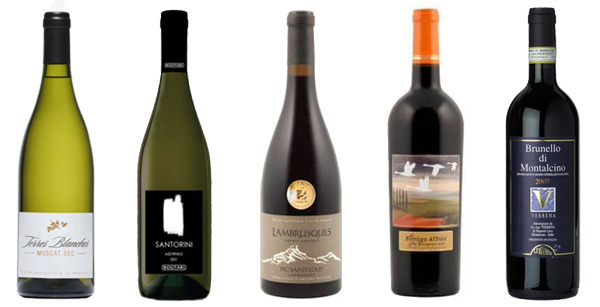
The wines I’ve picked out for her, for him and for each other all exhibit at least a few complex characteristics. They also hail from nooks in the world a patron saint of lovers might find a respite away from the demands on his match-making time. Here are five wines that say “you can kiss my sweet pink wine, Valentine.”

From left: Terres Blanches Muscat Sec 2012, Boutari Santorini 2012, Domaine Lambrusques Esprit Sauvage 2011, The Foreign Affair The Conspiracy 2012, and Verbena Brunello Di Montalcino 2008

From left: Terres Blanches Muscat Sec 2012, Boutari Santorini 2012, Domaine Lambrusques Esprit Sauvage 2011, The Foreign Affair The Conspiracy 2012, and Verbena Brunello Di Montalcino 2008

White for her

Terres Blanches Muscat Sec 2012, Pays D’oc, Languedoc-Roussillon (Midi), France (653188, $13.95 WineAlign) From the VINTAGES Feb. 15, 2014 Release

Dry Muscat can be dull as paint drying and though this entry-level rarity (for Canada) is a bit aromatically quiet for the species, the palate really shines. This must be the place to explore the dry example of the variety. A naïve melody with “feet on the ground, head in the sky.” Will appeal to fans of Unoaked Chardonnay and white Rhône blend rangers. Tasty bits of clementine, nougat and anise. The good bitters of a cocktail coming up to room temperature. Good tangy finish that goes on for quite some time. We’re talking head of the class.  88  Tasted February 2014

White for him

Boutari Santorini 2012, Santorini, Greece  (47985, $15.95, WineAlign) From the VINTAGES Feb. 15, 2014 Release

The soda, stones and salinity of Assyrtiko from Santorini can be a trifecta of allegorical wonderment. This one has all that but it is the lemon drop nose that leads so in that sense it’s more basic than others. That said it is a perfect pale-bronzing entry into Thira’s Cycladic, Aegean world. At this price there is more pith and bitter nut oils but the wine remains lively. Add to that the savoury garrigue of the island’s low-bush vineyards and a slow-flowing note of warm lava. Not surprising given the above average temperatures of 2012, leading to a reductive note. Still, Assyrtiko always thrills.  89  Tasted February 2014  @Boutari  @DrinkGreekWine

Red for her

Domaine Lambrusques Esprit Sauvage 2011, Pic Saint Loup, Languedoc-Roussillon (Midi), France (354142, $17.95, WineAlign) From the VINTAGES Feb. 15, 2014 Release

This Languedoc-Roussillon red blend wheels out a quirky beat but is so generous of flavour it will have great appeal, if not to the masses. Unmasked by wood or cane, it almost seems to apologize for being so tasty. Pic St. Loup may not be a household name and though it “started off with nothing,” this village might tell the Esprit Sauvage  “you’re proud that you’re a self-made man.” Confident in bracing tannin and acidity though they steal away like a Xeroxed, three-minute George Harrison pop song. At the end of the day I’m happy to be stuck in Midi with a Pic St. Loup.  89  Tasted February 2014

Red for him

The Foreign Affair The Conspiracy 2012, VQA Niagara Peninsula, Ontario, Canada (149237, $19.95, WineAlign) From the VINTAGES Feb. 15, 2014 Release

Quickly reminiscent of its 2011 predecessor but also different, in a basking, vintage-related warmth and reductive currency. This could not have been an easy wine to temper in 2012 considering the ripasso methodology. Just softened plum is painted all over its sheen with the poaching aromas steaming away. Grilled, melting licorice, caramelizing and disapparating before your eyes. Not to mention a French vanilla creamy garagiste waft, like nuts and bolts ice cream. But I will admit the tang, acidity and tenacity increases with each sip and swirl. Such a unique bottling to Ontario. Is there anything else like it not from Lake Erie North Shore?  89  @wineaffair  Tasted February 2014

Red for each other

Verbena Brunello Di Montalcino 2008, Tuscany, Italy (165126, $39.95, WineAlign) From the VINTAGES Feb. 15, 2014 Release

A conundrum here. On one hand this Verbena is ready to take up residence in the modern world. On the other, there are hallmark ancient Sangiovese Grosso varietal and Montalcino cellar smells. Leather, game, seeping, weeping cherries, dried flowers, cave must and animale. The game really stands out and though it’s neither mutton nor bretty funk, it’s got musk. Angular yet sweet tannins envelop flavours of roasted plum and licorice. Copiously endowed with intense, dense, chewy fruit so expect this to last for 10-15 years. Makes for great value in Brunello out of a trying but thankfully not flamboyant vintage.  92  Tasted February 2014  @ConsBrunello

Good to Go!

Big houses, bigger wines, big-ish prices

Canadian money

The earnest call across the country to free my grapes continues though regrettably, stiff resistance stifles the cause.
Photo: ulga/Fotolia.com

as seen on canada.com

If you live in Canada, purchasing wine ties you directly to a monopoly. There are exceptions, though still imperfect ones, like the free market culture of Alberta and the developing tiered system in British Columbia. The earnest call across the country to free my grapes continues though regrettably, stiff resistance stifles the cause.

Manitoba and BC allow direct to consumer inter-provincial wine imports. Consumers can order from out of province and receive direct shipments so long as the wine  is 100 per cent Canadian. Nova Scotia has passed enabling legislation that will follow a similar path. If you reside in Quebec or a fortiori, in Ontario, having wine shipped to you remains taboo. The alternate recourse of consignment wines available for purchase through local importers is an irregular option and having to buy by the case designs no compass of mass appeal.

Spend even a fraction of the time I do in trying to seek out the best values, at the best prices and in the categories that cater specifically to personal tastes and you will understand how difficult it is to be satiated in such a constricting climate. I am not the only one seeking out red wines made in the vineyard, through minimalist oak intervention, unhindered by residual sugar, produced by passionate and honest winemakers who are vigilant with the softest of hands.

Who does not want their wine to have mass in it, as in life? Who would reject an elixir drawn from iron-rich earth, boiled through limestone and warmed to a rosy madder? Who can deny the pure joy culled from a wine that might steal the words from the mouths of poets?

In Canada, unearthing such gems requires intestinal fortitude, especially considering the search is mapped out in government-controlled stores. Stock norms do not include wines made from lesser-known grapes, from regions and appellations less frequented. It takes time, effort and most of all, patience. Life can get in the way of the endless and unavailing chase; work that pays, kids, weather, fatigue. Sometimes it just makes sense to abide and even embrace the easier, well-worn path. This is where the bigger wineries step in, toting larger case loads and a middle-of-the-road, radio bathos experience.

There are varietal vicissitudes to ferret out from varieties you might have chosen to avoid. New World Pinot Noir and Chardonnay. Zinfandel. Rhône blends. Sangiovese blended with Cabernet Sauvignon. Tempranillo. All these grapes are often mistreated, modernized, smothered in oak and homogenized so that their indigenous origins are blurred into a bar of mass-produced chocolate. Occasionally they are done right by their makers.

In what has been such relentless cold, snow and ice, now into the oppressive dog days of winter, don’t think of drinking commercial wine as copping out. The big houses can be your friend, so loosen up and trust me when I tell you I’ve worked very hard to weed out the chaff and promise only to recommend the whole wheat. Here are seven current releases that made the pecuniary cut.

From left: Mission Hill Reserve Pinot Noir 2011, Clos Du Val Zinfandel 2011, and Robert Mondavi Chardonnay 2011

From left: Mission Hill Reserve Pinot Noir 2011, Clos Du Val Zinfandel 2011, and Robert Mondavi Chardonnay 2011

Mission Hill Reserve Pinot Noir 2011, VQA Okanagan Valley British Columbia (545012, $24.95, WineAlign) From the VINTAGES Feb. 15, 2014 Release

Here’s a juicy plum wine with noticeable warm alcohol that goes subterranean and won’t make you homesick for alien Pinot Noir. Athletic red with a quick first step and nerve, running a west coast offence, scoring points.  Char in licorice and a grid-iron, “uptight, uptight” bitter tendency but is a most saucy rendition. Extra point from clean, easy sweet tannins. Good length. Pinot on the radio. Really attractive price puts it at the head of its class.  90  Tasted February 2014  @MissionHillWine

Clos Du Val Zinfandel 2011, Napa Valley California, USA (590216, $24.95, WineAlign) From the VINTAGES Feb. 15, 2014 Release

Every so often a grape variety confounds and astounds, like this pretty in zinc Zinfandel. Almost mute as far as Zin goes, this CdV ”set out on the heels of the unknown.” Times like these normally produce lumbering, high-octane interpretations but this radical face is the Simon and Garfunkel of the variety. Singing with soft harmonies and composed as if by a deft balladeer. Flair comes from Spanish-like modernity – a good thing for Zin. Less bramble, more Ribera. Less reduction, more Montsant. Smooth as silk, reeking in vanilla, raspberry and symptomatic by a kiss of mineral. If but for one hollow mid-verse this would truly sing but that really is no big thing.  90  Tasted February 2014  @ClosDuValNapa

Robert Mondavi Chardonnay 2011, Napa Valley, California, USA (310409, $25.95, WineAlign)

One of the more quintessential, mid-range, rich and opulent Napa Chardonnays that steps out of the lobster butter dish in 2011. Apple-tinged terpenes show their presence, along with tarragon and a bag of just opened good and plenty. Piquant, poignant vintage, peppery and acting cooler than I ever remember it to be. Whether by chance or by choice, this is a welcome direction though I doubt its kind will soon be seen again.  89  Tasted January 2014  @RobertMondavi

From left: Umberto Cesari Liano Sangiovese/Cabernet Sauvignon 2009, Wairau River Reserve Pinot Noir 2010, Grant Burge The Holy Trinity Grenache/Shiraz/Mourvédre 2011, and Beronia Viñas Viejas 2010

From left: Umberto Cesari Liano Sangiovese/Cabernet Sauvignon 2009, Wairau River Reserve Pinot Noir 2010, Grant Burge The Holy Trinity Grenache/Shiraz/Mourvédre 2011, and Beronia Viñas Viejas 2010

Umberto Cesari Liano Sangiovese/Cabernet Sauvignon 2009, Igt Rubicone Emilia-Romagna, Italy (225086, $29.95)

Decidedly modern in many ways; oak impart, varietal alliance and braggadocio. The nose speaks highly of unsettled alcohol and alchemy. Big on black cherry and earthy with a welcoming and necessary roasted rare and still kicking game component. The mellow support of Cabernet Sauvignon is kicked upside the head by full throttle, oak-laden Sangiovese. Though hot and bothered, there is a keen sense of acumen on display by the Emilia-Romagna team at Umberto Cesari.  89   Tasted January 2014  @UmbertoCesari

Wairau River Reserve Pinot Noir 2010, Marlborough, New Zealand (361253, $29.95, WineAlign) From the VINTAGES Feb. 15, 2014 Release

Wonderful value in premium Marlborough Pinot Noir. Alluring sylvan aromatics, in a potpourri of violet, rose, plum and strawberry. Sharp, cranberry-pomegranate-cherry fruit flavours, the grain of red fife, and eye-popping acidity. An earthy terroirist, layered and delicious. Warm but not alcohol driven, touched by oak but not shaken and with just one coat of paint.  91  Tasted February 2014  @wairauriver

Grant Burge The Holy Trinity Grenache/Shiraz/Mourvédre 2011, Barossa, South Australia (Agent, 236257, $29.95, WineAlign)

The right Rhône immediacy of the 2011 Barossa vintage gets its hooks right in. Snapping with a direct blow uppercut to the jaw, this Grenache, Shiraz and Mourvédre blend goes right for the jugular with passion, not sugar. It’s a tricky mix, angular yet smooth, floating like a butterfly and stinging like a bee. Terrific charred, meaty flavours mixed with juniper and black raspberry, savoury spice and a chain of tannic length. Will age with metronome precision over a period of 10-15 years.  91  Tasted January 2014  @GrantBurgeWines

Beronia Viñas Viejas 2010, Rioja, Spain  (Agent, $30.00, WineAlign)

This 100% Tempranillo is Beronia’s enigma. Sourced from 40-plus year-old vines and housed for 14 months in new French oak. The Van Morrison bottling, if you will. Forget thoughts of a gnarly, tar and brambly red. This one is compliant and inviting. Cherry cheesecake gives it a dessert-like funk, with a baking spice and savoury plum pudding chaser. Vanilla is the unifying factor, the glaze, the icing on the cake, thanks to those new barrels. “You say “France” and I’ll whistle.” This is a pleasure to taste and ready for consumption.  90  Tasted January 2014  @BodegasBeronia

Good to go!

What’s in a wine vintage?

What\'s in a wine vintage?

The question is always being asked, what’s in a wine vintage?
Photo: Rostislav Glinsky/Fotolia.com

as seen on canada.com

There was a time when Ontario wine held no candle to my thoughts, filled no glass in my tasting regimen and occupied no place in my cellar. My how time and five years of enlightenment have changed me. Rarely does a day go by when that holy trinity of wine attention does not focus on something from Ontario.

My current obsession lies in the white wines from the 2012 vintage. The two previous years were so different, 2010 at first seemingly hot and bothered, then having emerged from its shell it has since clearly spoken in a language of elegance. The 2011 that followed gave wines of piercing acidity, verve and even austerity. Chardonnay, Riesling and Semillon all grabbed my acidulated attention.

First encounters with 2012 provided great skepticism. I continue the journey of ’12 discovery and the doors of perception are beginning to open. As a white wine vintage in Ontario, 2012 is shaping up to be a classic. Candour and acidity are there, but it is the rich, fullness of the wines that have taken the industry’s prowess to a whole new level. Riesling is brilliant. Pinot Gris the best ever. Though conditions may have not produced the coolest Chardonnay, winemakers who exercised restraint made beautiful wines. White blends that made use of highly aromatic varieties made their best wines to date. Reach out and touch Ontario’s 2012 whites.

The question is always being asked, what’s in a wine vintage? Not long ago I was emphatic to state there are no longer bad vintages in Ontario. The wisdom, experience and winemaking acumen has rendered that notion obsolete. There are challenging years for sure and this harshest of 2014 winters will certainly test the mettle of winemakers. Vintage variation is real and yes, there are no bad vintages, only different ones.

The new Kew Vineyards in Beamsville is on to something and 2011 was a terrific vintage to sidle up to their unique production of red wines. While appassimento remains an Ontario enigma, not quite like growing and producing a southern Italian grape like Aglianico, but the method is still a bit of a side-show. Kew reigns in the practice and matches it to the parameters of the Ontario vineyard and the climate. Kew the new red in Ontario.

Here are six new releases, a new Kew, a Prince Edward County classic Sparkling and four definitive whites from the 2012 vintage in Niagara.

From left: FLAT ROCK TWISTED 2012, TAWSE SKETCHES OF NIAGARA RIESLING 2012, KEW VINEYARDS SOLDIER'S GRANT 2011, FLAT ROCK NADJA'S VINEYARD RIESLING 2012, SOUTHBROOK VINEYARDS TRIOMPHE CHARDONNAY 2012, and HUFF ESTATES CUVÉE PETER F. HUFF 2007

From left: FLAT ROCK TWISTED 2012, TAWSE SKETCHES OF NIAGARA RIESLING 2012, KEW VINEYARDS SOLDIER’S GRANT 2011, FLAT ROCK NADJA’S VINEYARD RIESLING 2012, SOUTHBROOK VINEYARDS TRIOMPHE CHARDONNAY 2012, and HUFF ESTATES CUVÉE PETER F. HUFF 2007

FLAT ROCK TWISTED 2012, VQA Niagara Peninsula (1578, $16.95, WineAlign) VINTAGES ESSENTIAL

Though the warmth of the 2012 vintage could have suffocated a blend such as this Twisted, to the contrary, this harmonious white unfolds as a cold play. Cool, crisp, wonderfully tart and full of citrus zest. Plenty of sunshine but no burn. Waxy and rich like excellent Moscato along with the creamy confection of mango and the tang of what pale, trenchant pineapple used to be, before it went golden. The blend of Riesling, Gewurztraminer and Chardonnay magnetizes the opposing forces of residual sugar and modest alcohol. “And you are not wrong to ask who does this belong to? It belongs to all of us.” Best Twisted to date.  89  @brightlighter1  Tasted January 2014

TAWSE SKETCHES OF NIAGARA RIESLING 2012, VQA Niagara Peninsula, Ontario (89029, $17.95, WineAlign) From the VINTAGES, February 15th, 2014 Release

Frothing at the glass, full on soda aromatic entry, verging to off-dry white peach and yellow plum flavours. Full of tang and zest, enriching flavours that render the soda irrelevant. All in, vigorous ’12, most ever perhaps. From my earlier note: “s’got quite the tropical warmth for Bench Riesling. When considered in terms of the vintage, this is nearly a Riesling in the service of a Pinot Gris. Very juicy fruit, dry but bursting in fricative verve. Extreme quality, low-cost. Now on tap at Barque Smokehouse.  89  Tasted August 2013 and January 2014  @Tawse_Winery  @Paul_Pender

KEW VINEYARDS SOLDIER’S GRANT 2011, VQA Niagara Peninsula  (367318, $18.95, WineAlign) From the VINTAGES, February 1st, 2014 Release

Winemaker Philip Dowell draws upon his Aussie roots, delves into a northern Italian technique (appassimento) and along with Beamsville grower Graham Rennie, does the practice proud. Vineland Research Institute has been working towards developing a Niagara appassimento thing, already embraced by the likes of Foreign Affair, Pillitteri and Colaneri. Now Kew takes the torch but with an altered finesse and restraint. Raspberry and the wet warmth of spring sun, saturated earth give way to dusty, sour cherry with an accent of peppery, herbaceous Loire-style Cabernet Franc. The dust ultimately trumps the sharp and then submits towards a metallurgical length. Would work with eclectic flavours, like Buffalo Chicken Nachos. It’s true.  88  @kewvineyards  Tasted November 2013 and January 2014

FLAT ROCK NADJA’S VINEYARD RIESLING 2012, VQA Twenty Mile Bench, Niagara Peninsula (578625, $19.95, WineAlign)  From the VINTAGES, February 1st, 2014 Release

A champion cyclone of forces combined to elevate the already incumbent position of this Twenty Mile Bench Riesling. An ideal growing season magnified transmission upon a paradigmatic two and a half-acre block. This southern-most and highest altitude section of Flat Rock’s vineyard rests aboard a solid bed of limestone and wake me up if that rock was not drawn up into the vines in this stellar Riesling vintage. Sure its warm and nearly off-dry but such an effortless squeeze of lemon hydrates and elevates orchard fruit and honey out of the year of the lemon. After each sip its “every time you kiss me, lemon crush.” Love this prince of a Twenty Mile white in 2012, the dynamism smiling on the tart, succulent fruit. The length is one of outright bravado. This will develop for 20 years, of that I am convinced. There is just so much fruit. A Nadja for the ages.  92  @Winemakersboots  @UnfilteredEd  Tasted January 2014

SOUTHBROOK VINEYARDS TRIOMPHE CHARDONNAY 2012, VQA Niagara On The Lake (172338, $22.95, WineAlign) From the VINTAGES, February 15th, 2014 Release

A sachet of fiendish raising agent and scotch kindled toast seem initially atypical for the vintage but are kept in check and work alongside one another to great effect. Halfway in there are notes of lemon butter, saltwater-marked wooden ship, pine forest on a warm morning and organic smells of the world outside. The glow and ardor of what Chardonnay can rightfully be in 2012 take the lead at the mid-point and carry Triomphe through to an eco-rich, full-bodied good glass. “On the water, very free, and easy.”  89  Tasted February 2014  @SouthbrookWine

HUFF ESTATES CUVÉE PETER F. HUFF 2007, Traditional Method, VQA Prince Edward County, Ontario (198754, $39.95, WineAlign) From the VINTAGES, February 15th, 2014 Release

This is a glorious vintage for the classic Chardonnay and Pinot Noir flagship Huff bubbles. Lees affected in waves of chewy, fernetty, lime sherbet, ginger, coriander seed and apical almond butter. The humidity of the vintage plunges this complex sparkler into the brewing smells of a late fall apple orchard. Bronzing in attitude to middle age, a kind of medieval bubbles, hard on you, not letting go of its barbaric hold. The colour speaks of age but there is a huge amount of verve and life left yet. Your full attention is required to gather Huff’s traditional thoughts and this is quite possibly the most rambunctious PEC fizz I’ve ever encountered.  So different from the 2008 ”austere, dry, flinty wine of slate.”  92  Tasted February 2014  @HuffEstatesWine

Good to go!

A taste of New Zealand’s Villa Maria

Villa Maria Auckland grapevine

Villa Maria Auckland grapevine
Photo: villamaria.co.nz

as seen on canada.com

Villa Maria Production Winemaker Josh Hammond had to be on the verge of exhaustion when he sat down with John Szabo and I at the WineAlign office last week. Hammond was a Montreal stop away from a near coast-to-coast, Canadian jaunt to promote the wines of the New Zealand Sauvignon Blanc and Pinot Noir pundit. I will assume that Hammond is usually more animated than he was that afternoon and will hedge my bets he is customarily content to let the wines speak for themselves. After 52 pioneering years, Villa Maria has earned the latitude.

Josh Hammond could pass for the second coming or be the separated at birth doppelgänger to The Who lead vocalist Roger Daltrey. I am very familiar with those kind of piercing blue eyes, having gazed into them repeatedly from my 9th row floors Maple Leaf Gardens seat at the December 16, 1982 iconic band’s “final” concert. Hammond has that Face Dances, You Better You Bet, maturing British glam look, marked by rock-star tussle, salt & pepper hair. Petite too and always behind blue eyes. OK, I hear you. Godello digresses.

Villa Maria Tasting with Josh Hammond

PHOTO: Michael Godel
Villa Maria Tasting with Josh Hammond

The 27 year-old wine facilitator’s globe-trotting efforts are in support of an amazing, sustainable journey, aka the vision of Villa Maria founder Sir George Fistonich. Villa Maria is a Kiwi leader in organic grape farming and carbon footprint reduction. Sir George and team are keen to peddle the concept in their literature, employing buzz phrases like, “there is no end point,” “leave something for the next generation” and “overriding business objective.”

Worm farms, vineyard rows wildflowers and snaffling flocks of sheep are all a part of the Villa Maria world. And yet, the discussion and tasting with John, Josh and I virtually ignored the notion of sustainability. No hidden agenda or bad intent was meant to label the Fistonich organic principles as Milquetoast, but this tasting concentrated solely on vintages, terroir diversity and the bottles at the table. Good wine is good wine, no matter the virtuous or commendable maker’s actions.

I got the feeling that Josh cares most about the finished product. Though he’s a child prodigy of the land he now juices to fashion Villa Maria’s large yet manageable output, the peculiarities of the process did not steal the tasting’s limelight. That worked to great effect. We talked about how the 2013 vintage shone on Sauvignon Blanc. We were introduced to the ways of Villa Maria’s unshakable, panoptic Pinot Noir. Here are notes on the six wines tasted.

From left: PRIVATE BIN SAUVIGNON BLANC MARLBOROUGH 2013, CELLAR SELECTION SAUVIGNON BLANC 2012, PRIVATE BIN PINOT NOIR 2011, CELLAR SELECTION PINOT NOIR 2009, and SOUTHERN CLAYS SINGLE VINEYARD PINOT NOIR 2010

From left: PRIVATE BIN SAUVIGNON BLANC MARLBOROUGH 2013, CELLAR SELECTION SAUVIGNON BLANC 2012, PRIVATE BIN PINOT NOIR 2011, CELLAR SELECTION PINOT NOIR 2009, and SOUTHERN CLAYS SINGLE VINEYARD PINOT NOIR 2010

PRIVATE BIN SAUVIGNON BLANC MARLBOROUGH 2013, Marlborough, New Zealand (426601, $16.95, WineAlign)

Ferly opening wine with winemaker Josh Hammond and surely not anticipated. Opulence upon first aromatic gather, pure and spirited from cold fermented, stainless steel treated 50/50 Wairau and Awatere Valley fruit. The latter adds typical herbaceous and inimical character. Plugged in stellar 2013 vintage, yet with grass uncut, low on mow, left to grow. Still, the herbiage is exaggerated so thanks is owed to the lemon, paraffin and lanolin. Juicy, fresh, crisp value SB.  88  Tasted January 2014

CELLAR SELECTION SAUVIGNON BLANC 2012, Marlborough, New Zealand (974527, $21.95, WineAlign)

The 2012 season was not Sauvignon Blanc philanthropic so extended time on lees pays off towards supplemental body and texture. What speaks loudest is the odiousness of capsicum and even more obvious green cubanelle pepper. More green runs amok, in peppercorn, green tea ice cream and lime sherbet. Unique and conspicuous expression. A cooler year so some residual sugar accords the balancing act. Not able to shake that omnipresent layering of all things pepper.  87  Tasted January 2014

PRIVATE BIN EAST COAST GEWÜRZTRAMINER 2012, New Zealand (357509, $14.95, WineAlign)

Grapes sourced from three growing areas; Auckland, Gisborne and Waipara. Warm, aesculapian tonic, with a coursing note like the spiked heat of a drop of venom in neutral alcohol. Ethereal, jazz/R&B Gew, tropical, unctuous but not chewy, angled by wood sealant spice. At this price, in comparison to other North Island renditions, with a good bitterness, it does the variety proud. Gewurztraminer a world away might say I “see your eyes in mine, leave the rest behind.” Though it may hit the ground running, it makes quick work of itself.  87  Tasted January 2014

PRIVATE BIN PINOT NOIR 2011, Marlborough, New Zealand (146548, $21.95, WineAlign)

That Villa Maria can make 80,000 cases of Pinot Noir this proper is nothing short of remarkable. Aged in French oak for 8-10 months. As Pinot like as could be hoped for considering the case amount. Every drop must go through Malolactic fermentation. Winemaker Josh Hammond and crew insist upon it, though it’s nothing but painstaking cellar/lab work. The Pinot character initially shines, with loads of plum and black cherry, but there is a momentary lapse. But, “if you’re standing in the middle, ain’t no way you’re gonna stop.” So, the definitive Marlborough ectodermal line painted through the in door speaks quickly and leaves by the out-door. From a smoking gun, rising like a Zeppelin. Large volume, big production, drinkable in the evening Pinot Noir.  88  Tasted January 2014

CELLAR SELECTION PINOT NOIR 2009, Marlborough, New Zealand (285361, $32.95, WineAlign)

A selection of Villa Maria’s best fruit is siphoned out of 12-month aged, 30 per cent new French oak barrels. Seemingly entering or hinting at an oxidizing, metallurgical time coming soon. The current holding pattern is a beautiful one, behind blue eyes, very floral and prompts thoughts of the same 2009 vintage in Ontario. From a who’s who of Awatere and Wairau Valley vineyards, sites chosen to qualify for the Reserve wines. From ultra-healthy, crop-thinned vines, the Cellar Selection gives a scent of candied flowers and a taste of rosewater molasses. Fine and warming. Keeps me warm, let’s me wear its coat. Could be confused for $50 Sonoma it’s just so pretty, sweet and fruit forward. The time in glass breathes life back upon itself. Flourishes and finishes with a touch of pipe smoke, signalling quality.  91  Tasted January 2014

SOUTHERN CLAYS SINGLE VINEYARD PINOT NOIR 2010, Marlborough, New Zealand (Agent, $59.95, WineAlign)

From Villa Maria’s Rutherford Vineyard, a gentle north facing slope set upon heavier clays. An SV whose world is a flood…one with the mud.” A heavier style, a jar of clay, yet not overtly varnished by any particular coat. Small berry, dark fruit concentration, in some ways anti-Pinot or rather Pinot of a new religion. The spice is classic Marlborough, vanilla sneaks in and the texture is grainier and loamier than the Cellar Selection. Big, ripe and communicative of a confected sensibility. As far as New Zealand goes, this one floods piously of Adventist Pinot Noir. Leap of faith.  90  Tasted January 2014

Good to go!

Super Bowl XLVIII wine odds

Denver Broncos quarterback Peyton Manning

Denver Broncos quarterback Peyton Manning
Photo: AP Photo

as seen on canada.com

As a Super Bowl libation of choice do you consider wine a foray into the arena of the absurd? If so, you may be right, but you may be wrong. The Super Bowl is absurd. So, what are the odds that wine figures into your Super Bowl gathering? You might just be surprised.

I have participated in the same season-long NFL pool for the past 27 years. It was a “fax” pool in the 90′s and persists as an early days of the internet, send your picks in by e-mail endeavour. I’m still waiting for our administrator to make use of a free internet betting site but then again, there is a certain kind of comfort in the naiveté of low stakes, old-school pool participation. Meanwhile, I wouldn’t watch a single snap without something riding on the games. With apologies to my Peyton Manning-worshipping son, the NFL is just not that interesting and it’s a brutal sport.

Think about it. The game itself is a barbaric testosterone display of gladiator proportions, a war waged by freak of nature behemoths intent on killing one another between the blow of every whistle. Watch an NFL game and you’ll see that a player remains down and hurting after almost every play from scrimmage. When an elite athlete stays down, trust me, he’s hurt. Something has pulled, torn or broken nearly every time you see it.

Then there are the costs; production, hosting, advertising and tickets. According to the Philadelphia Business Journal, “At $4M for Super Bowl ad, it’s ‘almost impossible’ to see return on investment.” The cost to Jersey City for hosting “is a tax on our resources to some degree,” said Mayor Steve Fulop. According to NewJersey.com, “the police presence alone will cost city taxpayers several hundred thousand dollars.” The market for ticket prices opened at $4,000 but now they are just giving them away, with $3,088 being the current average price as of Tuesday afternoon, this according to the Bleacher Report. If you think the prices are too high, you have no business going to the Super Bowl. In 2013 Beyoncé was not paid for performing at the halftime show, though she was awarded $600,000 for “production costs.”

Is this shaping up to be the saddest Super Bowl ever? Joshua M. Brown sure thinks so. “This Sunday, Super Bowl XLVIII (48) will be played in an open-air stadium, built atop a New Jersey swamp, in 2 degree weather, while pretending it’s actually taking place in New York.” So, now does it seem like such a far-fetched idea to drink wine while watching the Super Bowl? Sure, 99 per cent of the American Football hypnotized viewers will have a beer or 12 on Sunday. Hopefully a few thousand will be creative enough to get up from the couch and source something local and craft-related. I will be bringing fine-ish wine to the grid iron festivities. There are well thought out, dedicated and purposed reasons for my choices.

The original elite athletes on this planet were from ancient Greece. Though they may not have tossed around or beat each other silly over an oblong-shaped ball covered in pigskin, they personify the term ‘forbearer’ for real sport. Besides, real men drink Greek red wine.

Wine produced in a region defined by its volcano is also a must. Nowhere does the vinous world bequeath an emphatic lava flow of energy and verve like Etna. Football is a mob mentality game of raw and pure emotion, much like the terroir-driven Nerello Mascalese and Nerello Cappuccio from Sicily.

Zinfandel is a natural for the Super Bowl. Bold, deep, dark, rich and striking. The brambly flavours scream rough and tough. Zinfandel always lives on the edge. It will also stand up to and support the fatty, greasy and cheesy gamut of flavours on the SB coffee table.

A classic Cabernet-Merlot blend is a must for all the red meat that will be consumed on Sunday. Don’t bother with the modernity or overpricing of soft, voluptuous and velvety Bordeaux or Napa.  This game and your aged beef require some grit. If you live in Canada, go local, as in Okanagan Valley or Niagara Peninsula.

For the sensitive and cerebral man, the Peyton Manning armchair quarterback if you will, look for a well-aged and thoughtful white wine. Hunter Valley Semillon comes to mind. The last time the Seattle Seahawks played in the Super Bowl was 2006. That strikes me as a good vintage to help settle the score.

Here are my five wine picks for Super Bowl 2014 and some music to match.

From left: NICOSIA FONDO FILARA ETNA ROSSO 2010, THYMIOPOULOS VINEYARDS YN KAI OUPAVÓS XINOMAVRO 2010, MCWILLIAM'S MOUNT PLEASANT ELIZABETH SEMILLON 2006, RAVENSWOOD OLD VINE ZINFANDEL 2010, and MALIVOIRE 'STOUCK' CABERNET/MERLOT 2010

From left: NICOSIA FONDO FILARA ETNA ROSSO 2010, THYMIOPOULOS VINEYARDS YN KAI OUPAVÓS XINOMAVRO 2010, MCWILLIAM’S MOUNT PLEASANT ELIZABETH SEMILLON 2006, RAVENSWOOD OLD VINE ZINFANDEL 2010, and MALIVOIRE ‘STOUCK’ CABERNET/MERLOT 2010

NICOSIA FONDO FILARA ETNA ROSSO 2010, Sicily, Italy (362129, $19.95, WineAlign)

Wines from Sicily’s Mt. Etna region and the indigenous variety known as Nerello Cappuccio may seem like a space oddity to many but those who have opened their hearts and minds to the volcanic wonders float “in a most peculiar way.” This Rosso carves a bowie-knife line of lava mineral and Mediterranean salinity right through with bang on acidity and vitality of red fruit. A minor detractor in that it’s a bit saturated, muddled and earthy for Etna, but it brings the mountain down to the tasting room. Licorice, cirasu, plum and the dried grape feeling of zibbibbu. Contagious in spirit.  90  Tasted January 2014

THYMIOPOULOS VINEYARDS YN KAI OUPAVÓS XINOMAVRO 2010, Unfiltered, Naoussa, Greece (360750, $19.95, WineAlign)

Magnificent Macedonian, built upon the unheralded yet stalwart variety Xinomavro. Pure, sweet-smelling gardenia and the refuse of ancient rolling stones express every bit of sun and wind-swept, low bush vines goodness. Purposefully and thankfully unfiltered, so that all the delicious sweet and sour cherry and great biting but sweet tannin are left in. Purity, good sugar/alcohol heights without oak corruption. Earth possessive of mythic undercurrent, sage, wealth of  knowledge, sweet anise and hyssop. Scents of game on the grill. Amazing complexity and length. While tasting this Xinomavro it made me “feel so hypnotized, can’t describe the scene.” Get your rocks off to the Greek 91  Tasted January 2014  @thymiopoulosvin

MCWILLIAM’S MOUNT PLEASANT ELIZABETH SEMILLON 2006, Hunter Valley, New South Wales, Australia  (724492, $19.95, WineAlign)

Such a rare occasion to peer into the portal of aged Hunter Valley Semillon so expectations run high along the lines of gain the ridge and peer out over the great expanse. Emerging classic secondary notes, in tropical low-bush, caramelizing tangy fruit meets sweet hive sticky fashion but, and I take care to be sure, the fruit suffers under a yoke of petrol and a scraping of rocks. The lemon is faint, the fruit disappointingly fading. Listen closely to her voice, “I can’t sing, I ain’t pretty and my legs are thin.” Sure, acidity steals the show but at what cost? Still, a study in Semillon is always a positive so the cellar aging and delayed release must be appreciated. Oh, well89  Tasted January 2014   @McWilliamsWines

RAVENSWOOD OLD VINE ZINFANDEL 2010, Sonoma County, California, U.S.A. (673798, $21.95, WineAlign)

Consistency thy name is Ravenswood in the key of Zinfandel. From typically gnarly old vines scattered around Sonoma County and so young at heart. As solid as a wine can be when blending from so many sites. Vanilla is its calling card, flavouring the pool of berry syrup along with a tobacco-like smokey accent. Good tartness balances the rich fruit. At only 5g/L of residual sugar, this Zinfandel reaches sugar mountain with natural sweetness so, “ain’t it funny how you feel when you’re finding out it’s real.” Bring on the big game chili and beef stew.  89  Tasted January 2014

MALIVOIRE ’STOUCK’ CABERNET/MERLOT 2010, VQA Lincoln Lakeshore, Ontario (321836, was $29.95, now $24.25, WineAlign)

This Niagara Bordeaux-inspired blend comes from a legendary vineyard in the making. Cabernet Sauvignon, Cabernet Franc and Merlot all ripen and develop phenolic pitch with Findhorn-like, remarkable quality. How and why it ended up on the VINTAGES Bin-End list is beyond explanation. It was a must buy before, now it’s a steal. From A long and ‘wine-ding’ tasting road:  ”From down on the Lincoln Lakeshore is a pitchy rendition with a pronounced roasted espresso note. Seems to me the motherly, Cabernet Franc’s genes have imparted their wisdom into this (63%) Cabernet Sauvignon dominant beauty with big Cassis fruit. Chic, juicy, with a filled in mid-palate and stiff structure. Grab a glass, “leave your cares behind, these are the good times.”  91  Tasted March 2013  @MalivoireWine

Good to go!

Gripping wines from Spain and Italy

Europe

How can winemaking trump terroir?
Photo: 1xpert/Fotolia.com

as seen on canada.com

Winemakers in the most famous regions of Spain and Italy have gone pro in the practicum of wine that speaks loud and clear. If there is a downside it is the blurring of lines and overlapping of circles, where regions set far apart show similar, if near identical characteristics in their wines. How does this happen? How can winemaking trump terroir?

The simple answer is wood. Barrel usage is a global affair, with wineries scouring oak forests the world over to age their wine. French oak is most used and whether you make wine in central Italy or northern Spain, the oak you employ may result in more than just the commonality of wood. If your processes are tied by similar or even identical ties, your wines may taste eerily like one another, if not outright like kissing cousins.

Despite the oligopoly of technique and the lack of winemaking individuality gone viral in this generation, there are three things that continue to work in favour of regional character. The first is obvious. Soil. Or, more importantly, the components, the rocks and minerals that fleck the earth. Secondly, attitude. Call it conceit if you like but when a winemaker has the guts to make wines we like to call grippy, you can’t help but stand up and take notice. Third and so important to the consumer, is price. Spending $15-30 on wines from the most historic locales such as Burgundy and Bordeaux is almost always nonsensical and a waste. No where else in the world offers grip, pomp and pride like Spain and Italy and in that go to mid-price range.

A pentavalent and benevolent group fits this requiem for commercial gain. Rioja, Ribera del Duero and Priorat from Spain. Chianti and Abruzzo in Italy. A Venn diagram of commonality can be agglomerated from their proclivities. It is in these fab five Old World wine regions where a twain of ancient and state of the art collide. Here are seven gripping wines from Spain and Italy.

From left: CEPA 21 HITO 2010, ÉBANO CRIANZA 2008, and RESALTE DE PEÑAFIEL PEÑA ROBLE RESERVA 2004

From left: CEPA 21 HITO 2010, ÉBANO CRIANZA 2008, and RESALTE DE PEÑAFIEL PEÑA ROBLE RESERVA 2004

Ribera Del Duero

The history: Located in north-central Spain, on a plateau, 90 minutes from Madrid. Ribera, or “river bank,” extends from both sides of the Duero. The Denominación de Origen (D.O.) of Ribera del Duero dates back to 1982.

The lowdown: Highest average elevation in Europe for growing red wine grapes. Summers are hot, winters are cold, rainfall is minimal. Lower vineyards are alluvial with sand and reddish clay. Higher ones built of limestone, marl and chalk. Tempranillo in the main grape. Finest recent vintages include 2004, 2009 and 2012.

CEPA 21 HITO 2010, Ribera Del Duero, Spain (360503, $17.95, WineAlign)

Oh the shaken, modern humanity. Nothing shocking here, this 100 per cent Tempranillo parfait of silky chocolate, mixed berries, vanilla and wood chips. Finds parity in biting red cherry flavour. Though it may as well be any ambiguous, heterogeneous or hermaphroditic $30 IGT, its price puts it at the front of the line. Fun to drink, high-toned, textured and structured, though its origins are not at once obvious. Will evolve felicitously for five to seven years.  89  Tasted December 2013  @DrinkRibera

ÉBANO CRIANZA 2008, Ribera Del Duero, Spain (355099, $21.95, WineAlign)

Amid a sea of Spanish reds, this Ribera stands alone as the most modern on the table. Dusty, trenchant dark chocolate, mocha crema, thick, syrupy, rehydrated plum fruit. Accented by both white and black pepper, anise and a late lash of astringent tannin. Abrasive as a pleading Waits croon, this Crianza is “better than a cup of gold. See only a chocolate Jesus can satisfy my soul.” Another Ribera with qualities akin to present day, Sangiovese dominated Chianti Classico. Immaculate confection.  89  Tasted December 2013  @EuroVinatage

RESALTE DE PEÑAFIEL PEÑA ROBLE RESERVA 2004, Ribera Del Duero, Spain  (355107, $31.95, WineAlign)

Typically modern version with just the right amount of age. Interesting to see nearly 10 year-old Ribera, with so much obvious oak and modernity retain its fruit lushness and presence after such a chunk of time could have stripped away its freshness. Candied violets and pansy, peppery nasturtium and marble slab, rocky road ice cream. Oak nearly integrated but persistent in chalky texture. Confounding bareback ride on a wild 100 per cent Tempranillo horse that bucks as if Bordeaux or Rhône varieties would seem to bolster the whole.  90  Tasted December 2013

From left: CIRELLI MONTEPULCIANO D'ABRUZZO 2012, CASTELLO DI QUERCETO CHIANTI CLASSICO 2011, PLANETS DE PRIOR PONS 2009, and ONTAÑÓN RESERVA 2004

From left: CIRELLI MONTEPULCIANO D’ABRUZZO 2012, CASTELLO DI QUERCETO CHIANTI CLASSICO 2011, PLANETS DE PRIOR PONS 2009, and ONTAÑÓN RESERVA 2004

Abruzzo

The history: Central Italy, stretching from the heart of the Apennines to the Adriatic Sea.

The lowdown: Mostly mountainous and wild terrain. The four DOC produced in Abruzzo are the Contro Guerra, Trebbiano d’Abruzzo, Montepulciano d’Abruzzo and Montepulciano d’Abruzzo Colline Teramane. Montepulciano is the most planted red variety. Finest recent vintages include 2006, 2009 and 2010.

CIRELLI MONTEPULCIANO D’ABRUZZO 2012, Abruzzo, Italy (663939, $17.95, WineAlign)

Winemaker superstar to be Francesco Cirelli does what more should do. Age organic grapes of purity and pristine quality in clay Amphore. The natural empathy and wisdom of crop rotation (for more than just grapevines) drives the logic and proportion of Cirelli’s wines. This Md’A smirks and balks at thoughts of it as entry-level, though it concedes to the moniker ’poster child’. From 15 year-old vines set in sandy clay soils near Atri in the Colline Teramane zone. The fruit is like raspberry felt, lifted, spritely, gregarious and inviting. The wine never plunges into bitterness, nor does it depend on any crutch to remain upright and weightless.  90  Tasted September 2013 and January 2014  @TheLivingVine

Chianti

The history: In central Tuscany. The two Chianti zones, Denominazione di origine controllata (DOC) and Denominazione di Origine Controllata e Garantita (DOCG), produce the largest volume of DOC/G wines in Italy.

The lowdown: Chainti Classico must have a minimum 80 per cent Sangiovese, the main variety of the region. Other indigenous grapes include Canaiolo and Colorino, bur Cabernet Sauvignon and Merlot are also used. Soils vary from marl of layered sandstone, to chalk and clay, blue-grey sandstone and clay-limestone. Finest recent vintages include 2006, 2007 and 2011.

CASTELLO DI QUERCETO CHIANTI CLASSICO 2011, Tuscany, Italy  (680496, $22.95, WineAlign)

Heather meadow Sangiovese, emotive of old school Chianti Classico aromas, notably tea, new leather and sour cherry. Texturally succulent and lush, like mini-modern Sangiovese Grosso. Nearly syrupy and 90′s-styled by a heavy-handed, wood-soaked guilty conscience. The kind of CC to “waste away the weekend with perfect regard for how cavalier we used to be.”  89  Tasted December 2013  @ChiantiClassico  @ProfileWineGrp

Priorat

The history: In Catalunya, northeast Spain. The most recent regulations of the DOQ were defined in 2006.

The lowdown: Dominated by hillside vineyards with poor soils, the dark slate called Licorella and low-fielding old vines. Garnacha and Carinena are the most planted, but also international varieties such as Cabernet Sauvignon, Merlot and Syrah. Finest recent vintages include 2004, 2009 and 2012.

PLANETS DE PRIOR PONS 2009, Priorat, Spain, (314559, $24.95, WineAlign)

Clearly contemporary, voluptuous Garnacha blend, in symmetry with foil Carinena, In support are small amounts of Cabernet Sauvignon (10 per cent), Merlot (five) and Syrah (five). Chalk, grain and chocolate intensity, scents of dusty mulberry, menthol tobacco, eucalyptus and licorice. Works its international styling to great effect, if a bit heavy, woody and hollow up the middle. Lags just behind the stellar 2008 and yet this ’09 will have many a follower. Just a bit more structure would make it a prize.  89  Tasted December 2013

Rioja

The history: In northern Spain, on both sides of the River Ebro. The oldest Designation of Origin in Spain (DOCA), established in 1926.

The lowdown: Confluence of Atlantic and Mediterranean climates, with soils ranging from chalky-clay, to ferrous-clay and alluvial. Tempranillo is the most planted (red) grape. Finest recent vintages include 2005, 2005, 2010 and 2011.

ONTAÑÓN RESERVA 2004, Rioja, Spain (725895, $25.95, WineAlign)

The animal that is an ’04 Rioja Reserva is a VINTAGES darling. Here is yet another example in a long line-up spread out over several months of releases. 2004 palate fatigue should certainly have set in but for this youthful yet learned Ontañón. The dichotomy is not lost with much wood to be nosed though it’s neither abstruse nor resinous. More like a smoking cedar plank beneath the rendering weight of a slow-roasting porcine slab. Tangy cherry, sour plum and really stretched length. Mineral finish. Brillo Tempranillo with a touch of Graciano.  91  Tasted December 2013  @TandemSelection

Good to go!

Deep freeze: Controversies, polar vortex and icewine

Extreme Lows, Niagara Peninsula, December 2013 and January 2014

Extreme Lows, Niagara Peninsula, December 2013 and January 2014
Photo: Weather INnovations Consulting LP (WIN)

as seen on canada.com

The physiological and emotional roller coaster heaped upon grapes and growers these past 55 days has been nothing short of exhilarating, frightening and exhausting. First this monster climatic Dementor known as the Polar Vortex. Along with the demonic weather came the devastation of an ice storm, followed by record low temperatures. More recently, thaw and re-freeze. Consequences and challenges have abounded. Also, a silver lining. Freezing temperatures can kill grape buds on vines unprepared and left to fend for themselves. Those little vine kinder can also just be unlucky enough to grow up in the wrong place at the wrong time. Some Niagara growers are reporting heavy losses to Riesling, Cabernet Franc and Chardonnay vines. Here are the numbers as reported by Wines In Niagara’s Rick VanSickle.

I spoke with winemaker Paul Pender of Tawse Winery in Vineland, Ontario yesterday. Paul is both unconcerned and not yet ready to make any sort of call on damage to his crops. “It’s still too early to tell,” he notes, “I won’t really head out to assess any potential damage until early March.” While Beamsville vineyards are reportedly hard hit, Pender is confident that his team’s strident and prudent vineyard management will see the vines through.

Balanced pruning means leaving a specific number of buds during the winter on a dormant cane for this year’s crop, the number based on the amount the vine grew the previous season. Tawse’s canes are cut back to two feet, the dead wood removed before winter’s freeze can hit. Buds this season were thinned from 12 to six, giving those tender bits a fighter’s chance to survive. And while Pender will not enter into an unequivocal conversation with respect to the heartiness of his vineyards as a consequence of 100 per cent organic and biodynamic farming, I can hear the surety in his voice and imagine the twinkle in his eye at the thought.

Other growers concern themselves with what may happen inside the many parts of the vine when there are freezes, thaws and re-freezes. Again, Pender is not concerned. Proper pruning should prepare a vine for a harsh winter, whether or not they are protected by a warm blanket of snow. In New York’s Finger Lakes region, Lenn Thompson is reporting “some minor bud damage to vinifera vines, but little to no vine death.” Steve Shaw of Shaw Vineyards on Seneca Lake had this to say. “Yes, this winter is definitely presenting itself in a rather volatile manner. As far as I can tell from checking a number of varieties and many buds, there does not seem to be any catastrophic primary bud kill. There is damage, but not too bad so far. I do not think that with things being this wacky that we can really rest easy until most of the winter has passed.” Brock University’s Cool Climate and Viticulture Institute in St. Catherines helps local growers with much needed information and infrastructure to deal with damaging weather. Their VineAlert program helps protect vineyards during frigid temperatures.

Icewine Hours 2013

PHOTO: Weather INnovations Consulting LP (WIN)
Icewine Hours 2013

The news is not all bad. According to many icewine makers in Niagara, 2013 will shape up to be what many are forecasting the best ever vintage for the province. Temperatures dipped to the requiem in late December and most picked their shriveled, sugary berries before the new year. That is unprecedented, allowing this season’s icewine to remain high in necessary balancing acidity and well ahead of the fermentation arresting challenges from most years. Wine Country Ontario reported that “early icewine harvest in Wine Country Ontario starts the festival fever.” Look for the most balanced icewines out of 2013. Not to mention the Grape Grower’s of Ontario reporting the province’s grape growers gathered a record 79,756 tonnes of grapes in 2013 valued at nearly $100 million.

The Niagara Icewine Festival encompasses three weekends in January dedicated to the region’s beloved ambrosial elixir, wines that have become the calling card beyond the broader confines of Canadian borders. Icewine has been made since 1981 and in that short span of 33 years, Ontario and B.C. winemakers have challenged, and in many cases lapped their counterparts in Germany and Austria. Canadian icewine is globally renowned, even if it is not the most important wine resource bequeathed upon the rest of the world.

Icewine 101. Simply put, made from grapes that have been left to freeze naturally on the vine. Ontario’s stringent Bolshevik Initial Decrees-like laws insist that icewine must be made from approved grape varieties; the most popular are Vidal Blanc, Riesling and Cabernet Franc. Some small lots include Gewürztraminer, Chardonnay and Cabernet Sauvignon.  Grapes are left on the vine until a sustained temperature of -8°C or lower is reached and then picked from those vines encapsulated in nets to protect them from birds possessive of a sweet tooth.

A national icewine debate is ongoing, inflamed by a recent Macleans Magazine article discussing the ideological differences between the VQA law preventing vine and grape separation before pressing and the Quebec practice of letting the grapes freeze in nets. Quebec growers do this out of necessity for fear of their fruit being smothered by excessive snowfall. Ontario’s old guard vehemently oppose the practice. The irony of VQA Ontario’s website low volume statistic, “with average yields of 500 litres for each acre netted,” is not lost on the curious. Two questions arise. How many grapes in Ontario nets end up in bottles of VQA labelled icewine and how can a culture of Canadian icewine be brought together without some form of compromise and collaboration? Yet again, is togetherness integral to the success of Canadian icewine, or more specifically, Ontario’s industry?

According to Klaus W. Reif of Reif Estate, apparently there are 3,750 berries needed for one bottle of 375ml icewine. Just consider the concentration for a moment, the hand-picked (though not all) labour involved and the specificity of the practice. The sweetest wine known to Canadians can indeed be re-worked as a palindrome for Niagara Ice Wine Festival.

A wet vial is fine nice agar

PHOTO: Michael Godel
Rick James Ice Sculpture, Niagara Icewine Festival

On Friday, January 10th, 2014 I was a most elated guest at the Xerox Icewine Gala: A Bacchus Evening of Icewine and Revelry. For a list of continuing events this weekend and next, here is a link to the festival site. More information here. With kind thanks to Magdalena KaiserSmit and Wine Country Ontario, I had the good fortune to taste a host of Niagara’s finest renditions, along with some very special bottles of sparkling and still wines. Here are notes on six wines sampled at the Fallsview Casino Grand Ballroom last Friday night.
From left: PELLER ESTATES SIGNATURE SERIES ICE CUVÉE, CREEKSIDE ESTATES WINERY SYRAH RESERVE BROKEN PRESS 2010, RAVINE VINEYARD RESERVE RED 2008, PILLITTERI ESTATES CABERNET SAUVIGNON ICEWINE 2011, and VINELAND ESTATES RIESLING VIDAL ICEWINE 2012

From left: PELLER ESTATES SIGNATURE SERIES ICE CUVÉE, CREEKSIDE ESTATES WINERY SYRAH RESERVE BROKEN PRESS 2010, RAVINE VINEYARD RESERVE RED 2008, PILLITTERI ESTATES CABERNET SAUVIGNON ICEWINE 2011, and VINELAND ESTATES RIESLING VIDAL ICEWINE 2012

PELLER ESTATES SIGNATURE SERIES ICE CUVÉE, VQA Niagara Peninsula, Onatrio (284547, $31.95, WineAlign)

This is Peller’s most versatile fizz, a blend of traditional method Chardonnay and Pinot Noir sweetened by a dosage of Vidal icewine post disgorgement of its lees. The lees has been left to linger in the bottle, in spirit. Sapid, savoury bubbles tingle the senses to the bone and will offer the most comforting and proper pleasures to those discriminating and otherwise. Appealing to a large common denominator, this Peller Sparkling can really do no wrong.  90  Tasted January 2014  @PellerVQA

CREEKSIDE ESTATES WINERY SYRAH RESERVE BROKEN PRESS 2010 (202127, $39.95, WineAlign)

The floral lift from three to four percent Viognier gives notice to bend the brawny, savoury black olive and blistered Ancho fruit into balance. Syrah in a sunshine state but not from concentrate. Would accept a glass of this Brokenpress at any beck and call. “Grab your wine, take me where you been, with the violin time and the moon gettin’ thin.” From my earlier note: “Offers up gorgeous pine and pepper-laced correctness and so much juicy, fresh warmth from a terrific Syrah vintage in Ontario and even more parochial so on the St. David’s Bench. This Queenston Road Vineyard red is winemaker Rob Power’s secret weapon, absolutely freakin’ delicious stuff and the epitome of what Syrah should be like from Niagara. Verve, rigor and yet also flirtatious with expertly judged wood and tannin to re-fresh its spirit and lengthen its life. Love it.”  91  Tasted twice, October 2013 and January 2014  @CreeksideWine

PILLITTERI ESTATES MERLOT FAMILY RESERVE 2002, VQA Niagara Peninsula, Ontario (71753, $39.95, WineAlign)

Served from Jeroboam, one of 23 produced and a testament to the precocious, facile touch of then winemaker Sue-Ann Staff. The extreme five litre format has certainly been kind to the hermetic 11-year slumber of this Merlot, as has the above average red Niagara growing season. Charlie pulled out this rare behemoth “for the special occasion” and despite and with thanks to the perfect vintage meets size storm, it has held up with dramatic fortitude. Unmistakably predicated Pillitteri chocolate perfume, brushed violet, mulberry and oven-warmed baking spice. Holding in sustained concentration, the toffee, caramel and umami of wizened, oxidized fruit not yet a twinkle in its soapy sandalwood eye. How could Sun-Ann have known what time-cheating lengths her Merlot would see to?  93  Tasted January 2014  @Pillitteriwines

RAVINE VINEYARD RESERVE RED 2008, St Davids Bench, Niagara Peninsula (20483, $55.00, WineAlign)

This Bordeaux style blend (40 per cent Merlot, 33.3 Cabernet Sauvignon and 26.7 Cabernet Franc) is clothed in a coat of arms all about texture. A drawn and raised relief of dried, candied bramble fruit and charcoal lines of savoury, earthy hickory and herbs. Hearty warmth from a cool vintage, meat on a stick in a glass, charred, roasted and smoking. A spit of gamey goodness. Holding strong but drink now.  90  Tasted January 2014  @RavineVineyard

PILLITTERI ESTATES CABERNET SAUVIGNON ICEWINE 2011, Niagara On The Lake (46557, 375 ml, $60.00, WineAlign)

A most unique and striking rendition, wearer of many hats, confounding and curious. There is a funk about him that stands apart from the rest. Like a really well-aged, superb piece of washed rind cheese, then turning unabashedly sweet, with verve and symphonic tone. An orange sky of an icewine, anti-bittersweet, accented by mace and anise, carob even. “Here is what I know now brother. Here is what I know now sister.” Cabernet Sauvignon, in a vintage equipped with striking acidity, can turn into something to look forward to. One of the more interesting icewines to date.  91  Tasted January 2014  @Pillitteriwines

VINELAND ESTATES RIESLING VIDAL ICEWINE 2012, VQA Niagara Peninsula, Ontario (163018, 375 mL, $60.00, WineAlign)

This represents the icewine revolution, for the first time adding 15 percent Vidal juice into the Riesling mix. In 2012, the normally stand alone Riesling needed a shot in the arm, provided by the Vidal, a dose of icewine magic by winemaker Brian Schmidt. Lifted tree fruit blossom and added weight are the result, without hyper-sweet flavours. Riesling is the rock, Vidal the roll as this RV crashes into me. The pit orchard fruit is reduced and recognizable to taste, yet reserved and in phonic harmony. “Sweet like candy to my soul, sweet you rock and sweet you roll.” Brotherly love icewine, full of Schmidt wisdom.  93  Tasted January 2014  @benchwineguy

Good to go!