De Rigueur Sicilia en Primeur 2025

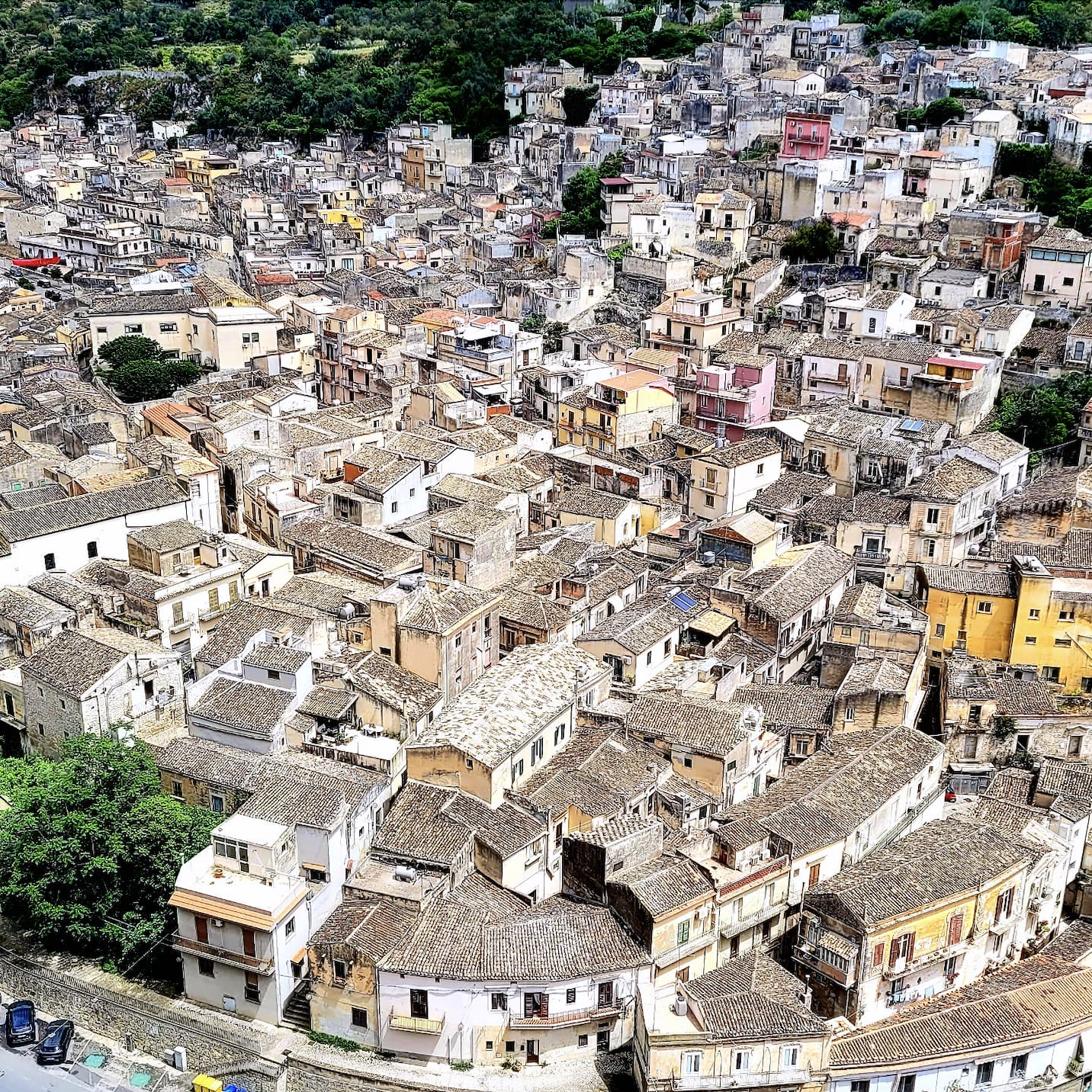
Modica

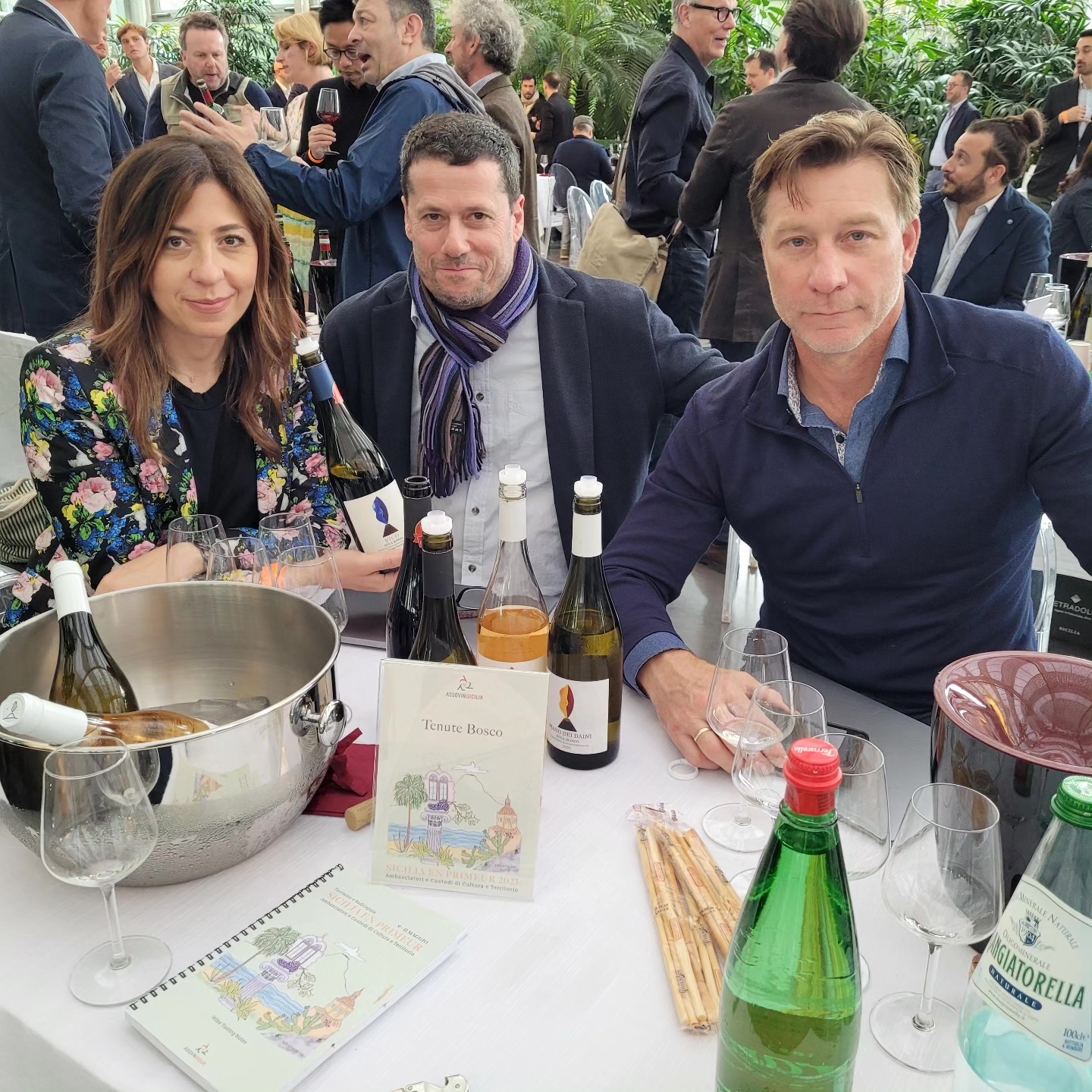
From May 6th through 10th, 2025, the 21st Sicilia en Primeur signalled the annual return of Assovini Sicilia’s proper, correct and yes, also decorous event. Journalists from all over the world arrived by invitation only for a week during which de rigueur was encouraged and for best results, most definitely required. A strict precision needed in adhering to the dictates of weather, cultural fashion, tasting and taking in the final night gala at a luxurious palazzo. The 21st edition’s title “The Culture of Wine in Sicily: A Thousand-year Story that Looks to the Future,” was defined by Mariangela Cambria, President of Assovini Sicilia as “the culture of wine today also translates into a culture of travel.” This is why the abiding delegation of 100 journalists were focused on this essential part of this journey, with their charge to bring the message back home. They came from Italy and many parts of Europe (France, Poland, Sweden, Germany, Norway), also from non-EU countries (Canada, USA, Japan, China, South Korea, Israel, Brazil, and the United Kingdom). Together they engaged in a collective etiquette to celebrate Sicilian wine, food and culture, inclusive of gorging on piping hot finger foods between en primuer tastings at lunch under a hot Modica sun because in Sicily, eating Arancini with your hands is de rigueur.
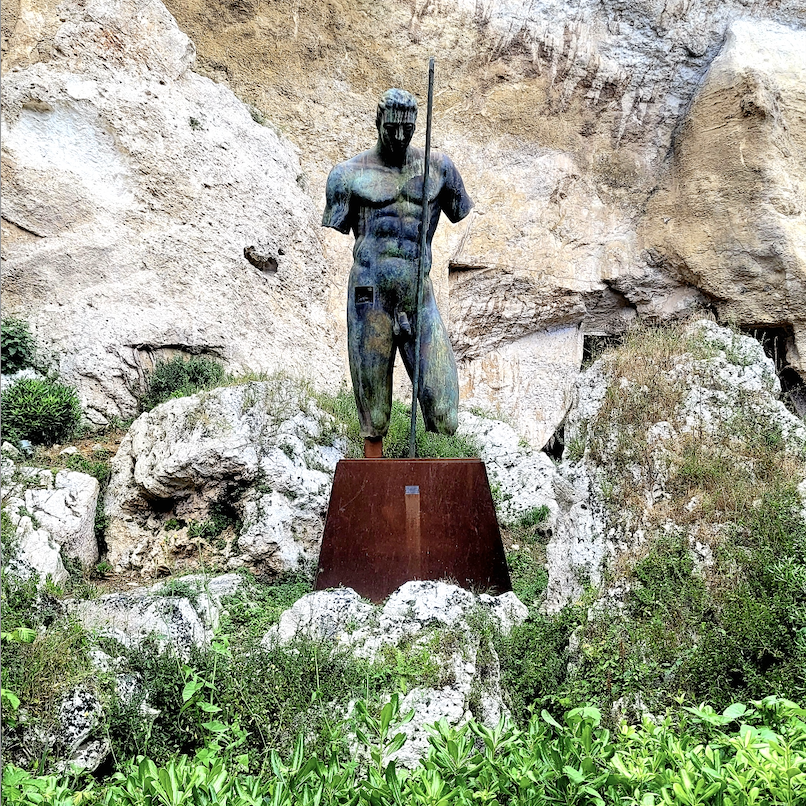
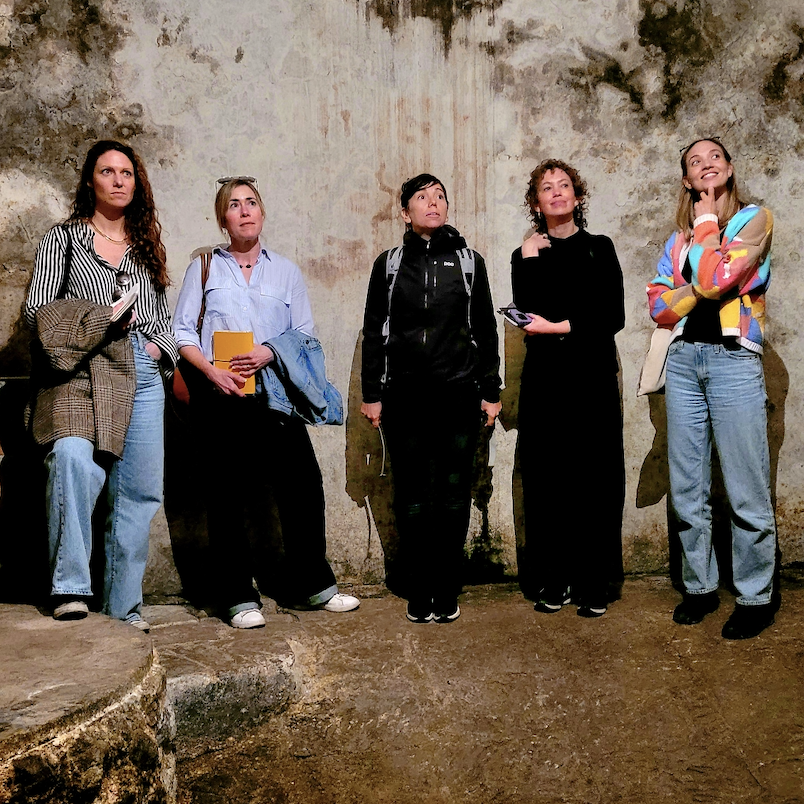
Neapolis Archaeological Park

As always the Sicilian Ante-Antreprima sees groups of international journalists making pilgrimages to wineries geographically positioned within a particular quadrant on the largest Mediterranean island. In 2025 Godello joined Zedcomm’s Lucia Boarini and JustSicily’s Marcos del Rio, along with journalists Fernanda Roggero (Sole 24 Ore), Christer Byklum (Mywinesandmore), Giuseppe Lauria (Weinwisser), David Ransom (The Connected Table) and Matthias Stelzig (Weinwelt) for an Enotour around the area of Noto. The group took in the ancient urban ruins of the Neapolis Archaeological Park, the seaside village of Marzamemi, Noto city (Including a caffè and dolce at Corrado Assenza’s Caffè Sicilia) and a stay at the beautifully charming and calming Villa Giulia Hotel. Visits were paid at Zisola, La Giasira, Ramaddini, Feudo Maccari and Planeta. When all was said, tasted, travelled, assessed, satiated and done, the group then joined the rest of the journalists fresh off of their own tours for the two-day Sicilia en Primeur at the Castello dei Conti di Modica.

Godello in Noto

Assovini Sicilia was founded in 1998 by Giacomo Rallo, Diego Planeta and Lucio Tasca and today has 101 member companies producing approximately 900 labels. After a day of technical tasting everyone convened at the Teatro Garibaldi in Modica for more de rigueur talks, including a discussion about “the culture of wine understood as informed and conscious drinking,” led by Dr. Sara Farnetti, Ph.D in Pathophysiology of Metabolism and Nutrition. Master of Wine Andrea Lonardi spoke on the “S factor: The uniqueness of the Sicilian wine continent.” Words from Dario Stefàno, President of the Wine and Oil Tourism Centre (Lumsa University) and Antonello Maruotti, Professor of Statistics (Lumsa University) concerned “The south innovating through events, e-commerce and new hospitality models for wine tourism.” Then finally it was Alessio Planeta, President of the SOStain Sicilia Foundation, speaking about “the sustainable future of Sicilian wine.”
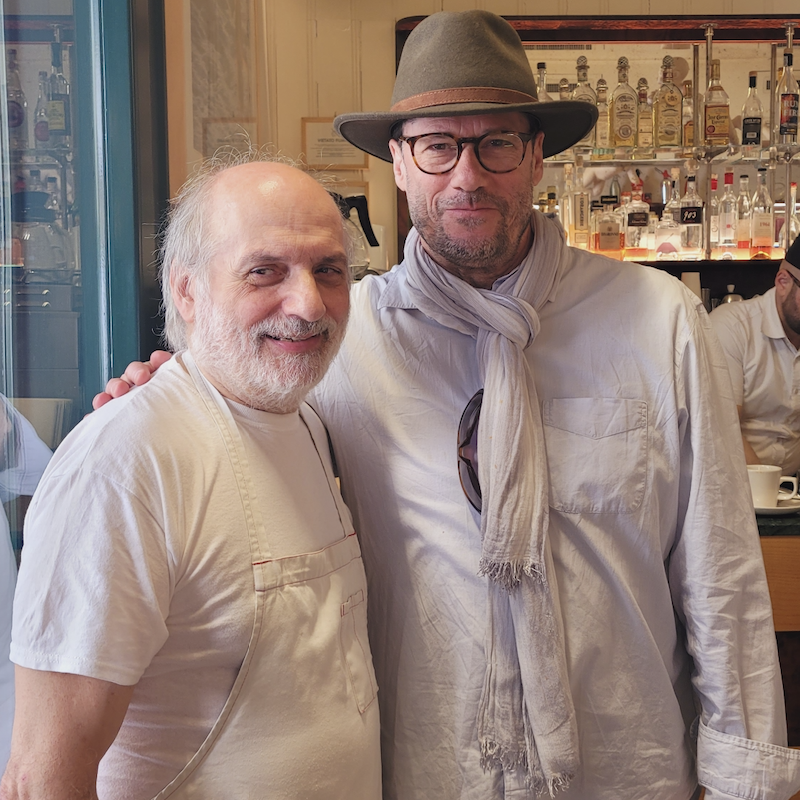
With Corrado Assenza – Caffè Sicilia, Noto

The event concluded on the 10th of May, again at the Castello dei Conti, with tastings of wines from the 57 Assovini Sicilia producers. As always Godello wishes to thank the professional and gracious organization of Zedcomm’s Cecilia Zanasi, Delia Demma, Martina Romeo, Lucia Boarini and Michele Marmino; JustSicily’s Giusi Macchiarella, Giuliana Palazzolo, Giuliana Licata di Baucina, Silvia Mantegna, Marcos del Rio and Federica Matranga; Assovini Sicilia’s Liliana Rosano. These are Godello’s 188 tasting notes from Noto visits at Zisola, La Giasira, Ramaddini, Feudo Maccari and Planeta, along with the wines tasted at Castello dei Conti.
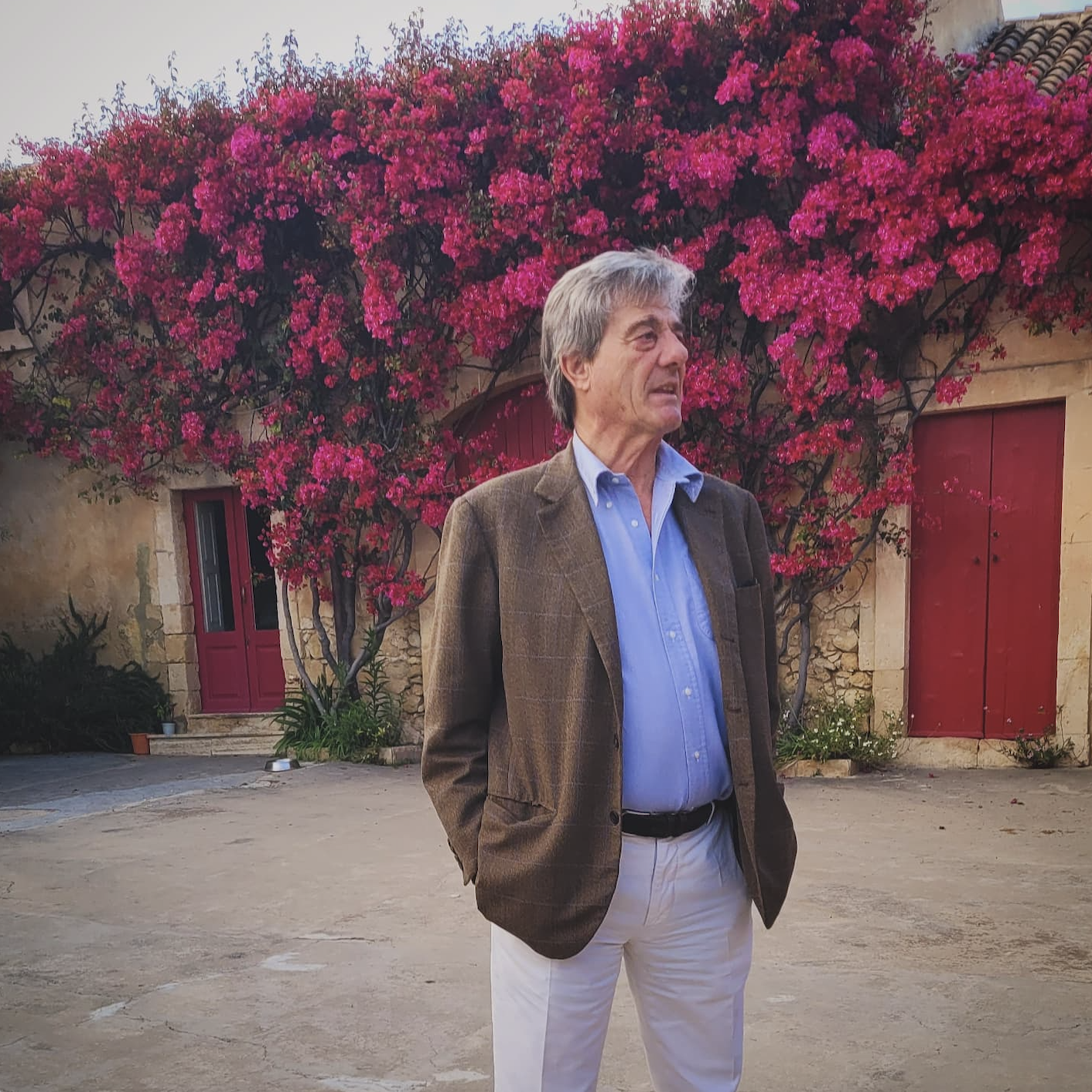
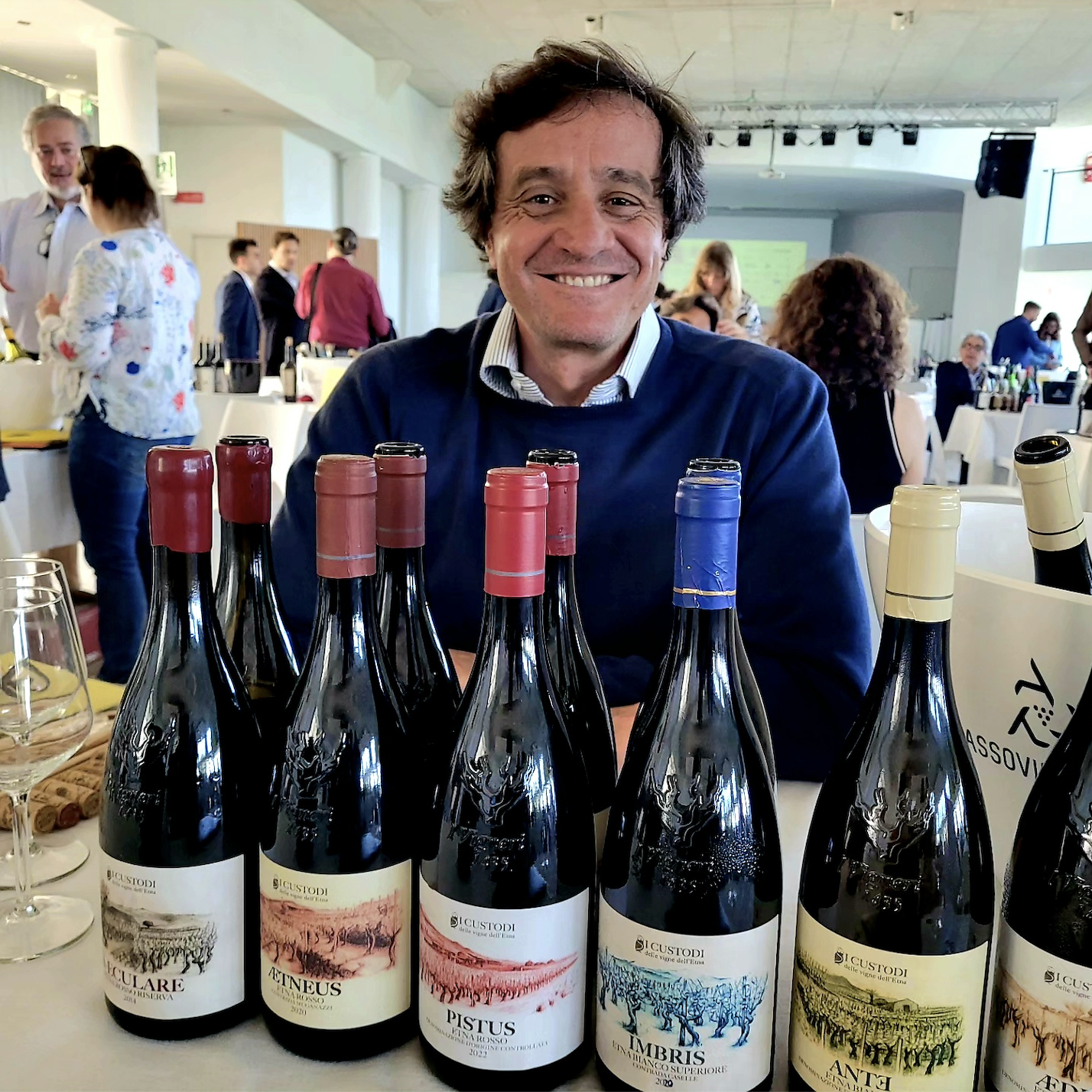
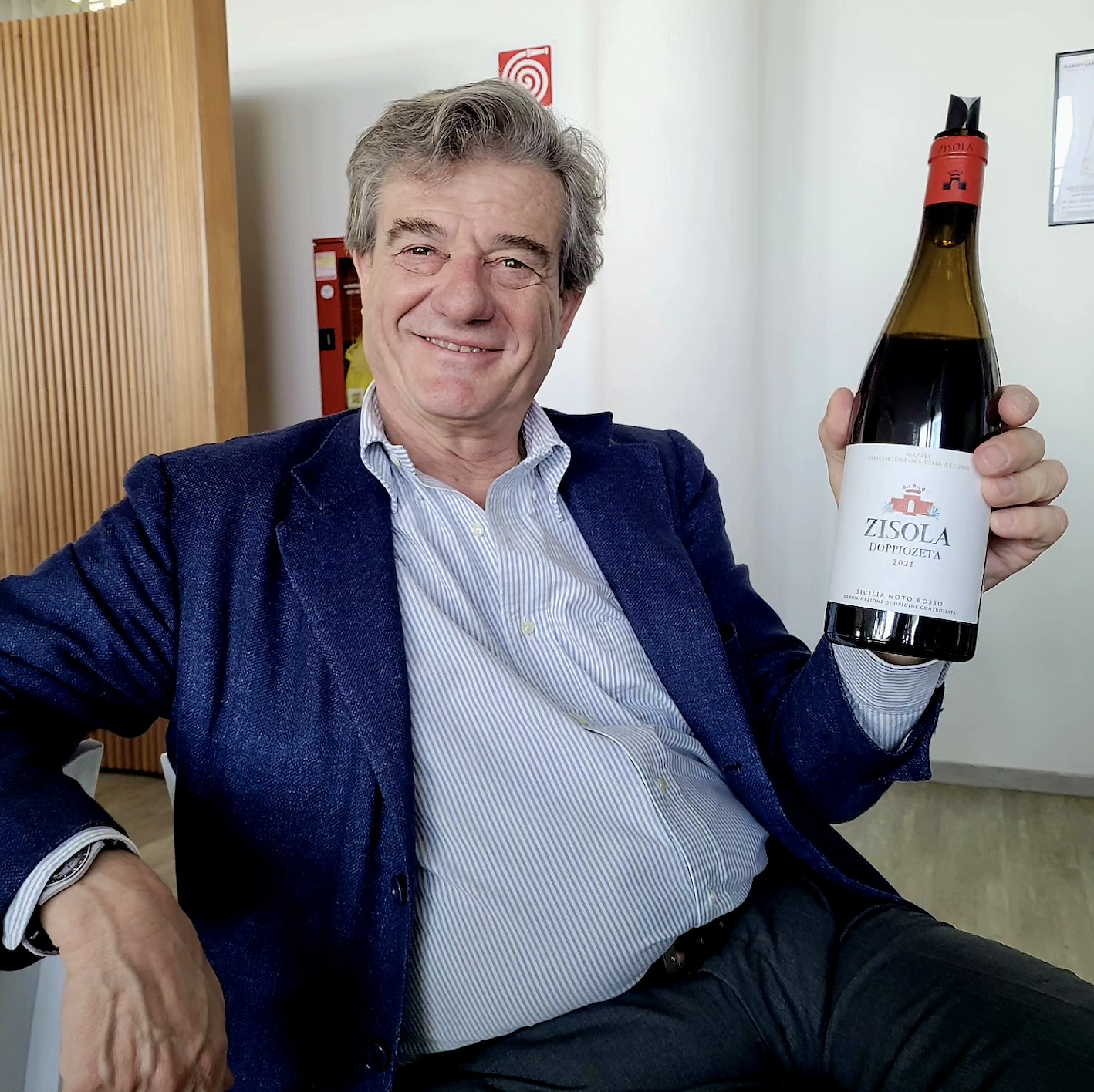
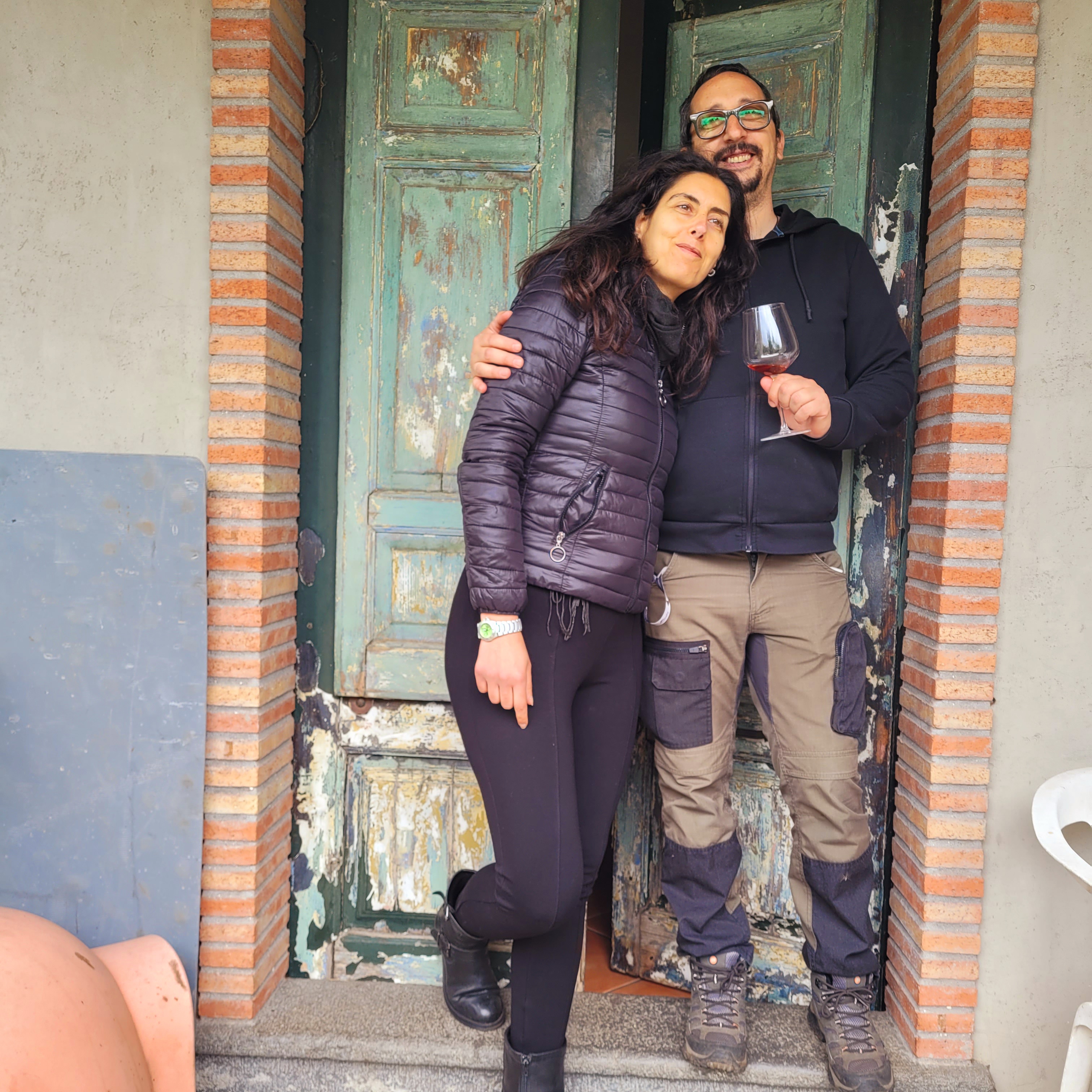
Filippo Mazzei at Zisola

Zisola

Filippo Mazzei and family have spent 20 years managing the biodiversity of Zisola, where lemon, pink grapefruit, clementine and almond trees line the vineyard. These are white soils though in Sicily they do not reflect the sun and raise temperatures, as they do in Tuscany. “This kind of soil can keep humidity for a long time,” explains Mazzei. “Even in July and August we don’t have A/C at Zisola.” The first plantings were 20 hectares of nero d’Avola plus one each of  syrah and petit verdot. Later on grillo and catarratto, all within six to seven kms of the sea and three to Noto. There are now 25 total hectares of vines and the fermentation cellar was built in 2004.
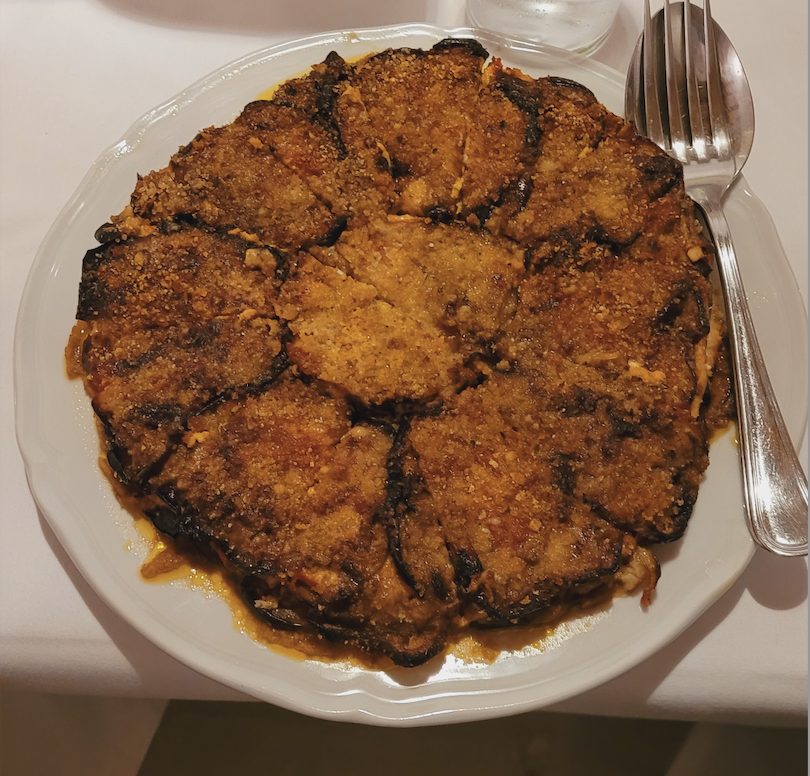
Zisola’s Parmigiana di Pesce Spada

A visit to Zisola will surely include a walk through one of Sicily’s great vineyard blocks followed by a tasting of highest calibre wines. A word of encouragement will say that three dishes might also show up on the table. Parmigiana di Pesce Spada, Penne con Finnochietto and Gelo di Limone. Should you be so lucky, karma would not be a b@%&h. Karma would be calm, neutral, reasonable and generous.

Zisola Azisa Grillo Sicilia DOC 2024

Zisola is not a place where there is a tradition for white wine and there is just one hectare of grillo planted. The name is an extension from Azisa which can translate as “beautiful.” A small percentage is fermented on skins for 36 hours, “to increase body” says Filippo Mazzei. Balances well with the freshness and waxy-aerosol style for a white that screams citrus with a combination of lemon and especially clementine. Surely owing to the plethora of fruit trees growing about the vines. A rarity for Zisola, not only Sicilia and truly a saisfying wine. Drink 2025-2026.   Tasted May 2025

Mazzei Zisola Bianco Contrada Zisola 2023, Terre Siciliane IGT

The most unique of the Zisola wines is this white catarratto made like a red, fermented on skins for three months in “cocciopesto” (as opposed to calling it what we know as amphora), a medium specific to the area. The third vintage for a sku started with the purchase of the vessels in 2021 and each are completely different, a matter of happenstance and not conscious changes or alterations. The 2023 is bloody delicious, suggestively salty, in delivery of an agreed upon “guarantee” of verticality, crazy complexity and something peculiar. Hard to describe and yet also a factor of Alberello (bush) vine training. The grillo is so very clementine but catarratto is more lemon, pink grapefruit and a finishing kiss of almond. Aging should bring about real curious transformations. Drink 2025-2029.   Tasted May 2025

Mazzei Zisola Bianco Contrada Zisola 2022, Terre Siciliane IGT

A glimpse into how catarratto can begin to age and truthfully (yet also technically) nothing has yet happened. A citrus explosion, lemon first and last with great freshness and intensity. Clean and though it may be a new breed of Noto white wine it already shows an ensconced maturity with a precocious character belying its years.  Last tasted May 2025

The second vintage of a 100 percent catarratto from plants that went in back in 2015 on white calcareous soils. Only bush vines and at first made into a blend with grillo. The change was made to do some skin contact and aging in amphora. Really that simple and that is the advantage, no overdoing or distraction in trying to impress. But this does just that, with vibrancy and succulence. Really taut, lemon tight, nearly but not quite piercing. Will change after three years and get honeyed. Reminds of really young Hunter valley sémillon. Top echelon decisions and so bravo Filippo Mazzei and team. Drink 2024-2028.  Tasted May 2024

Zisola Sicilia Noto Rosso DOC 2022

The flagship, calling and business card from 80 percent of Zisiola’s 25 planted hectares, a nero d’avola made in the freshest of Sicilian styles. Clocks in at 12.5 percent, picked early (September 8th) for brightness and well-captured high(ish) acidity. You can feel a bit of wood (from one-third new) and there is no doubt that 20 years into this Mazzei tenure what now matters has been figured out to make nero in the way it should be made. Climbs to the current peak and while better wines are sure to come, this 2022 hits the proverbial and varietal nail on the head.  Last tasted May 2025

Zisola is a project for Filippo Mazzei that began with a 700 km drive around Sicily accompanied by Diego and Alessio Planeta. Noto was chosen because of the biodiversity of the flora, to Filippo not unlike Tuscany. He also fell in love with the old Baroque town and could see a comparison between nero d’avola and sangiovese. “The decision was made based on a feeling.” The 2022 is so much fresher than the nero of 15 years ago, not to mention the balance accrued by way of alberello trained vines. Open up the dictionary and here it is. Drink 2024-2027.  Tasted May 2024

Mazzei Zisola Sicilia DOC Noto Rosso 2016

Seven years later and keep in mind that Zisola is the nero d’Avola made in the largest quantity and not the Rosso destined for extended aging. But in can and 2016 is a perfect example of potential. The lustre and energy are waning though there is little secondary character, just now softening with amiable pleasantries on offer.  Last tasted May 2025

Tasted with Filippo Mazzei in Palermo, Noto Rosso is nero d’avola from the Cantina in Sicily owned and operated by the Castellina in Chianti estate that produces Fonterutoli. A stainless ferment is followed by 50 per cent aging in stainless and 50 in 2nd and 3rd passage oak barrels, It’s a perfectly rich and plummy nero with great red liquorice tang and a distinction to celebrate pure, honest commerce. Very nero, very Noto. Drink 2018-2021.  Tasted May 2018
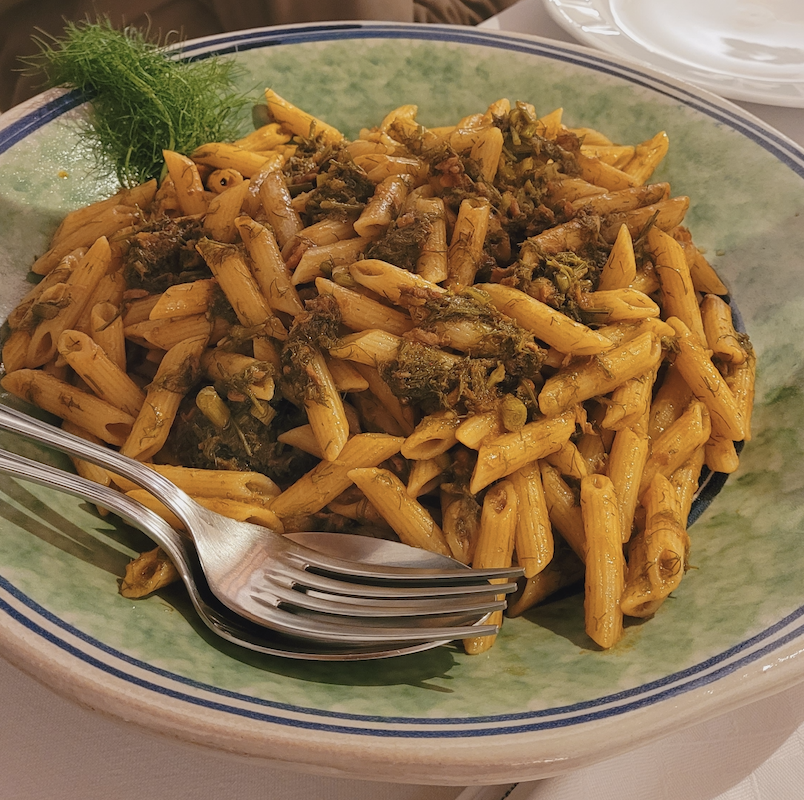
Zisola’s Penne con Finnochietto

Zisola Effe Emme Petit Verdot Sicilia DOC 2021

Effe Emme is varietal petit verdot from just one hectare planted, the album rock radio red of Zisola and monogram for Filippo Mazzei. He might prefer to see this PV stitched as if by tailored cloth but the spicy aromas, exotic bouquet and volatility suggested frankly indicate something more progressively oriented. The wood is generously, suggestively and importunely employed to exaggerate notes for extended play. Requires some further aging to settle the barrel and finish the score.  Last tasted May 2025

Varietal petit verdot planted in 2004, only 1.5 hectares, just about at the very beginning of Zisola. Incredibly chalky to say that it really speaks for the calcaire but time has come to effect changed so that the vines have come into balance. As petit verdot Effe Emme is not as dark and concentrated as it once was. Really showing its colours, what it is, a child of limestone soils. “Effe Emme,” F.M., long-play radio, well-spoken, one who tells things as they are, Filippo Mazzei. Drink 2024-2027.   Tasted May 2024

Zisola Effe Emme Petit Verdot Sicilia DOC 2014

Second look ten-plus years forward for petit verdot that would have come off of not yet 10 year-old vines at Zisola. Showing most of its age, a smoky varietal red with truffle and a held reserve of concentration and persistent local Balsamico. Violet aromas as well, they are the beauty of perfume while the wine drifts into liquid chalkiness. On the decline but interest still holds and will do so for another 12-18 months.  Last tasted May 2025

A 100 per cent petit verdot, 4,000 bottles made, big structure and at 15 per cent a massive wine. Needed to be held back an extra year and still needs two more years in bottle to soften, release and re-integrate. Big boned, spicy, wood massive and intense. Hematic with welling black fruit. Drink 2020-2027.  Tasted May 2018
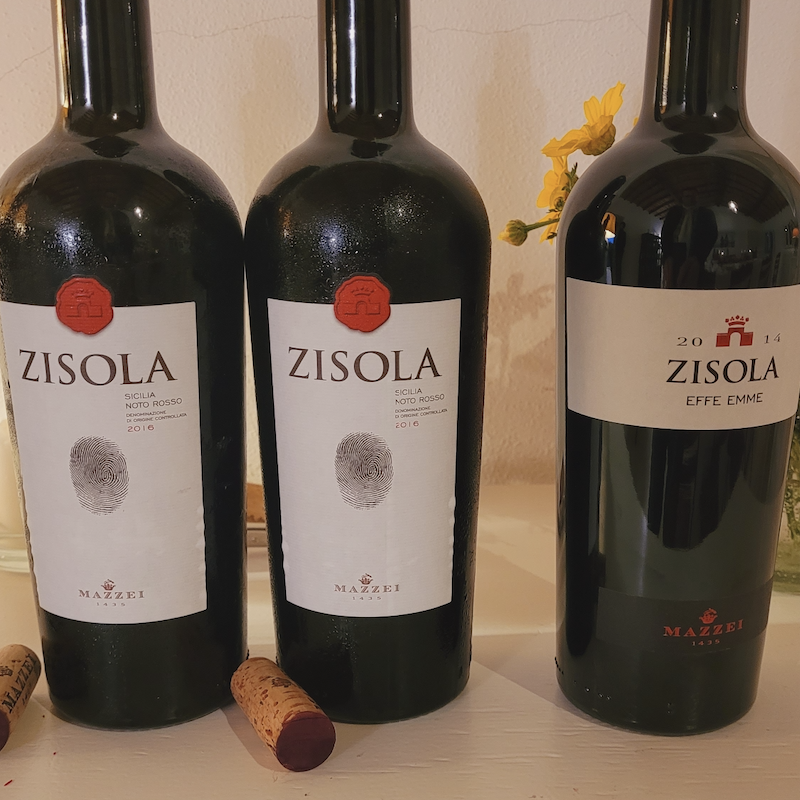
Zisola Doppiozeta Sicilia Noto Rosso DOC 2021

Doppiozeta is at least twice as concentrated and focused as compared to the nero d’Avola “classico,” Cru in origin on the more calcareous soils of the estate, picked just two days after the bulk of the nero and yet acidity is not insignificantly higher. Owing to the limestone but also 50m higher in elevation which surely brings just that extra amount of wind. The style of Doppiozeta is ever evolving and this 2021 marks a height of freshness and drinkability, but with a seriousness and focus to share space with top quality nerello mascalese, sangiovese and nebbiolo. Would give the ’21 another year to realize its true potential.  Last tasted May 2025

Yes another fine Doppiozeta nero d’avola from the Mazzei family and their Sicilian estate. Crispy exterior, chewy interior, spice and herbs as accents, salt and pepper seasoning, chalky tannic, reasoned and knowably fine. Consistently well raised, made and delivered, signed and sealed as a really good wine. The freshness is always there and the acidity so ideally suited to grape and style. Drink 2025-2030.  Tasted May 2024

Zisola Doppiozeta Sicilia Noto Rosso DOC 2017

Many hot vintages have powered through Italy as of late, including 2017 and yet Sicily was not that way, not in Noto, not anywhere. And so there is a fine and persistent freshness to Doppiozeta for ’17. A seductive sweetness from a time when the nero d’Avola was made in a more extracted, concentrated and barrel-aged way. Nevertheless in 2025 the wine is showing with distinction. Drink 2025-2027.  Tasted May 2025

Mazzei Zisola Achilles 2021, Terre Siciliane IGP

Just one hectare of syrah as part of the original plantings at Zisola for one of three ultra distinct varietal reds. The most hematic meets sanguine is in a way the closest cousin to all that famous Mazzei sangiovese made way up yonder in Tuscany. In other words the syrah here seems to take on a mineral-elemental feel as notable as any red wine in Sicily. Deeply serious, concentrated and in 2021 also structured, namely because of the season. Also uniquely southeastern Sicilian and yes a few years having passed in bottle has resulted in some movement, though barrel and secondary notes are both just barely detectable. Drink 2026-2031.  Tasted May 2025
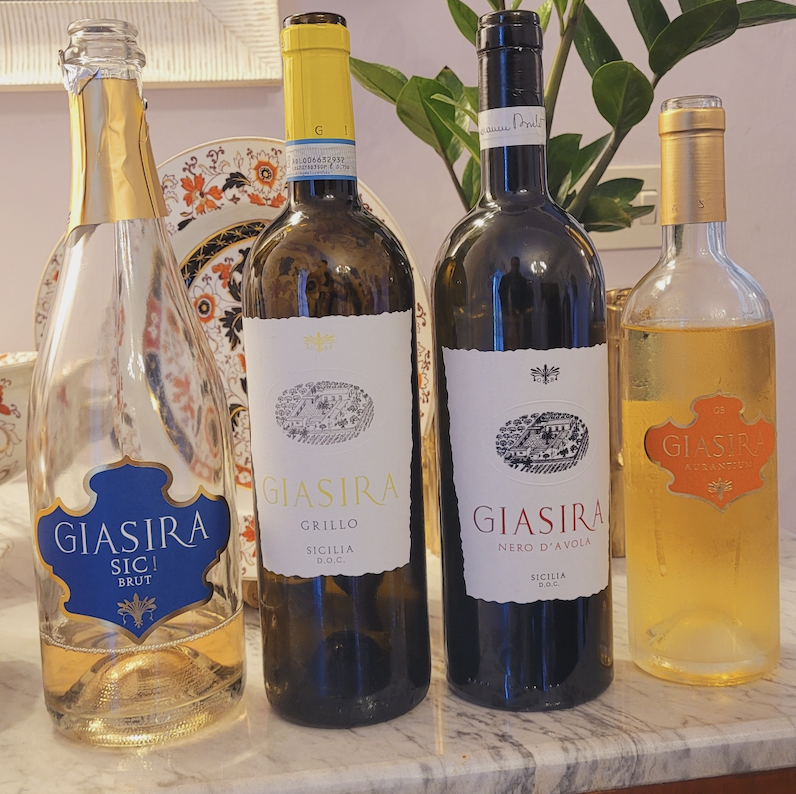
La Giasira

La Giasira is Piedmontese Giovanni Boroli and his wife Veneta Isabella dating back to to 2004. The estate is 130 hectares with 13.5 under vines, of grillo, moscato, catarratto, nero d’Avola and nerello mascalese. They produce 60,000-70,000 bottles annually from vines grwoing in 10-30 cm of soil atop pure limestone bedrock. Tilling happens maybe once a year on this site at 250m above the Telaro Valley (within the Noto Valley), 20 km to both Noto and Modica, equidistant between the Ionian Sea and Sicilian Channel.

La Giasira Bianco 2024, Terre Siciliane IGT

A blend of chardonnay, moscato bianco and catarratto, picked earlier than just about ever, begun in the last week of July. From serious calcareous soils for just 5,000 bottles of Noto area clarity fermented and aged in just Inox tank. Aromatic, all in citrus and freshness captured despite or maybe thanks to the early pick. Bit of almond both floral and raw, the scents of roses and blossoms from clean start to salty finish. Drink 2025-2027.  Tasted May 2025

La Giasira Grillo Sicilia DOC 2023

The grillo stands apart and alone in style when tasted side by each with the catarratto and bianco blend. Here the focus is all fruit, lemon and stone fruit, ripe and fleshy, juices running for a very full and refreshing expression. A capture of southeastern Sicilian sunshine, many heat days accumulating in this juicy grillo. Pour it cold and drink it long. Drink 2025-2027.  Tasted May 2025

La Giasira Keration 2023, Terre Siciliane IGT

Varietal catarratto made with specifically catarratto lucido, just 8.000 bottles (of 60,000-ish total) from the thin soils above limestone bedrock at Giasara. Just stainless steel for six months and three in bottle ahead of release. Noticeably different to the Bianco blend, a decrease in floral citrus and jasmine, an increase in fruit (including the smell of spun sugar) and accompanying viscosity. Immediate level of gratification from a wine with luxe mouthfeel. Drink 2025-2028.  Tasted May 2025

La Giasira Keration 2022, Terre Siciliane IGT

Tasted side by side with the 2023 and the consistency is more than obvious, namely by mouthfeel and viscous feel. A citrus yet reminding of bergamot in curd or granita form. Really persistent white, lingering for a minute with a moment of almond at the finish. More sapid than salty, even more so than the still truly fresh 2023. Drink 2025-2027.  Tasted May 2025

La Giasira Rosato 2024, Terre Siciliane IGT

Made with 100 percent nerello mascalese from the early pick of vines planted back in 2006. If it smells and tastes like mascalese than it must be mascalese, of roses and tart red berries, here salted and finishing at rhubarb. Rosé that quenches by doing what it should for a simple and specific purpose. Ends on a sapid botanical note. Drink 2025-2027.  Tasted May 2025
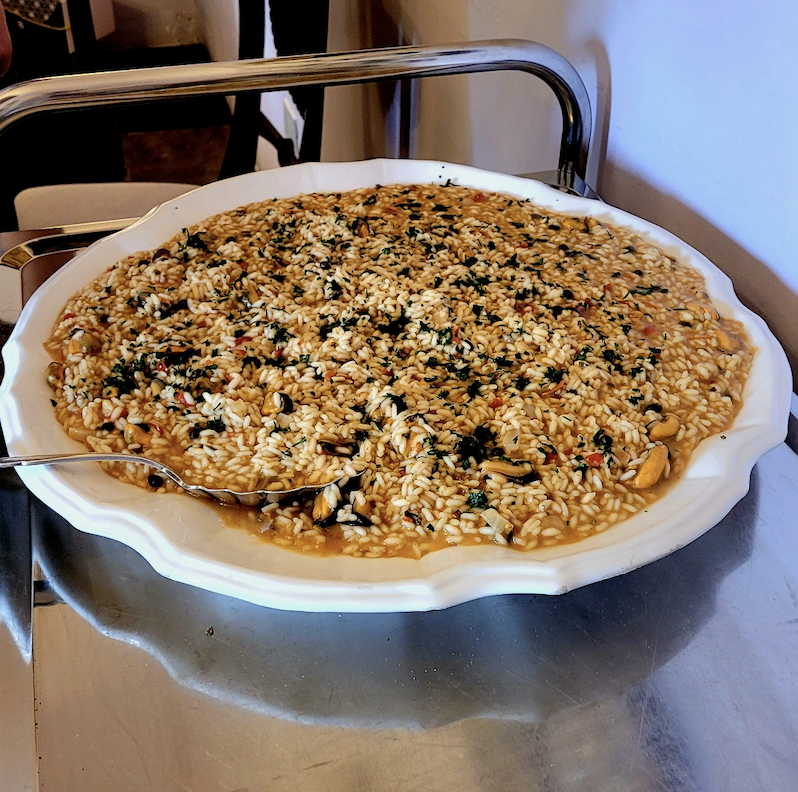
Unbelievable Risotto con Pesce at La Giasira

La Giasira Morhum 2023, Terre Siciliane IGT

Morhum is 100 percent nerello msacalese off of hybrid Cordone Speronato/Guyot trellised vines planted in 2006, aged nine months in (25 hL) botte grande. Several intensities noted, first floral and then an implosive tart palate style with more than impressive controlling acidity. Surely picked early extending forth to fineness and a finesse wound up in the tension. Tannins are fine and also wound tight for a light yet currently aggressive nerello mascalese. Drink 2026-2029.  Tasted May 2025

La Giasira Nero d’Avola Sicilia DOC 2021

One of ten small production skus, here at 6,000 bottles of nero d’Avola raised on Cordone Speronato trellising and the serious calcareous geology at Giasira. Spends 12 months in botte grande, followed by six months in bottle ahead of release. Current vintage and so six months is more like 30 to mature a tannic nero d’avola ready and drinking in balance, just as its 13.5 percent alcohol frame would want. Forget the big, wooded and thick nero you may know and see the nebbiolo meets pinot noir forest for the Noto nero trees. The conceptual origin is kind of obvious, that being Piemonte so that here you might almost believe this to be a cool climate red. For Giasira the pick is later than most of the rest of the farm, in the last 10 days of September. There is some verdancy but it works and in all the right ways, finishing with good and proper tension. Drink 2025-2028.  Tasted May 2025

La Giasira Nero d’Avola Sicilia DOC 2018

More than a notable amount of persistent freshness yet now a whole lot of exotic spice going on. Getting cardamom and cinnamon (but no clove) from a nero d’avola now at the epitome of “morbido,” in this case smooth as opposed to soft. The nose shows development if not age in terms of oxidation or secondary character. More maturity on the palate with dried bokser pod and carob. In other words classic for nero d’Avola from a warm climate made just six years ago with more wood and concentration, though nothing like some other very wooded peer examples. Drink 2025-2027.  Tasted May 2025

La Giasira SIC! Spumante Metodo Classico Brut Rosato, Terre Siciliane IGT

Just nerello mascalese aged 24 months and finished below Brut with what feels like just a few grams of residual sugar. Quenching and not so serious while in delivery of great satisfaction. The clarity is palpable for such a clean sparkling wine. Taste this nerello bubble with a risotto blessed with fresh mussels and capers for a true gustatory experience. Drink 2025-2027.  Tasted May 2025

La Giasira Passito di Noto Sicilia DOC 2022

A passito from grillo not produced in every vintage, citrus zesty and aerosol though teasingly dry on the nose before unveiling its sweetness and tang on the palate. Lemon gelée with the bite of granita and truth be told the limestone of Giasira’s soils surely effect the dessert wine as much as the dry whites and reds. Nice botanical edgy finish too. Drink 2025-2030.  Tasted May 2025
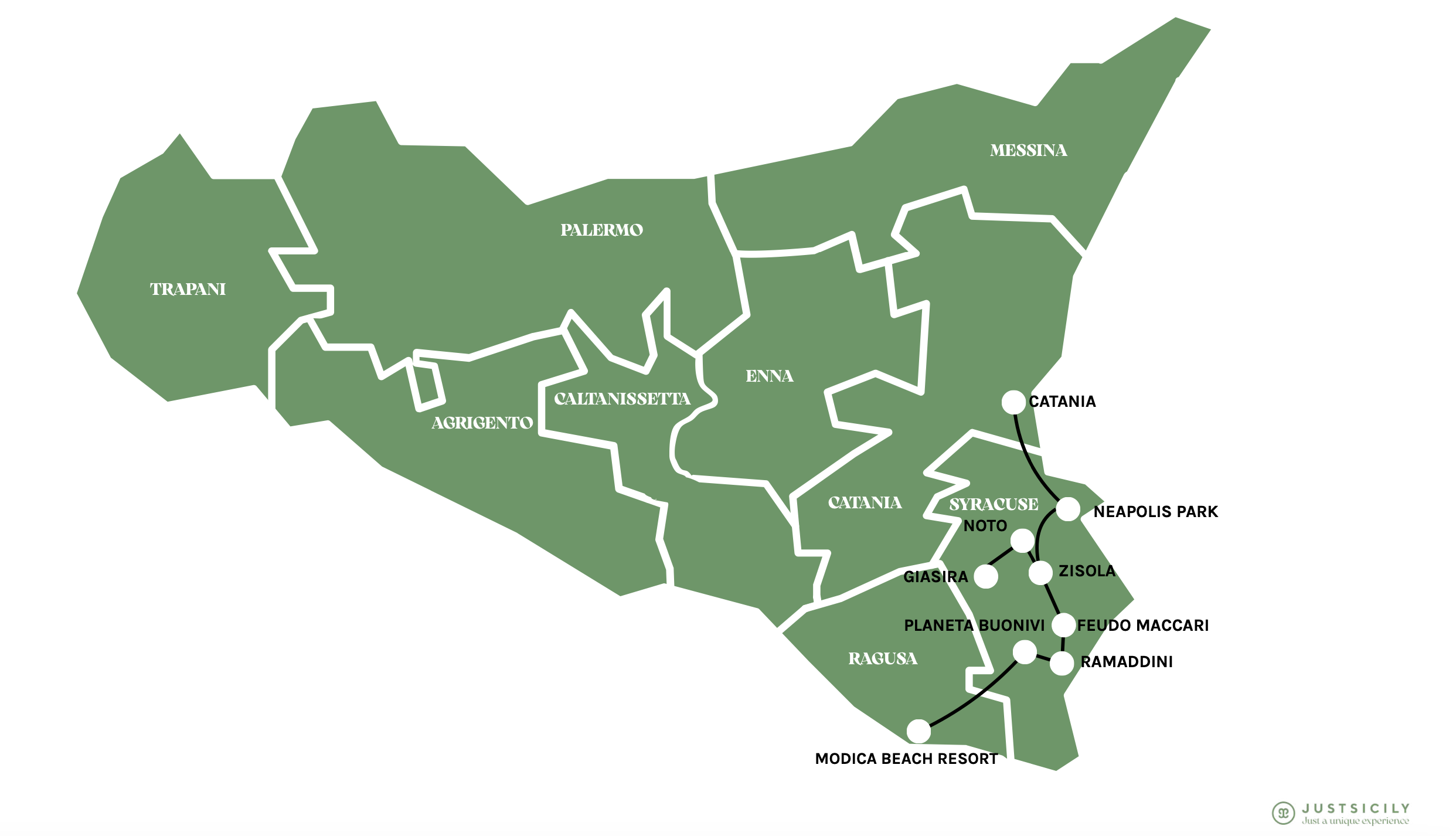
Sicilia en Primeur Enotour 11 – Noto

Ramaddini Perla Marina Vino Spumante Brut, Terre Siciliane Bianco IGT

Charmat method sparkling wine made with the local moscato di noto, soup sugary, neutral and vague selvatica meets macchia aromas. Sweet but in a typical Brut way and number with more than vague bitters at the finish.  Tasted May 2025

Ramaddini Grillo Nassa Sicilia DOC 2024

Nassa, a fishing reference for the catching of fish (owing to the nearby seaside), a 100 percent grillo grown in the Rammadini Contrada up in the hills four kilometres away from the cantina and five from the sea at Marzamemi. Lemon through and through, pith and seeds included for a bitter tonic of grillo, yellow and also green. High vigour and yields make for an insipid, vapid and diluted white wine.  Tasted May 2025

Ramaddini QuattroVenti 2024, Terre Siciliane Bianco IGT

A blend of chardonnay and catarratto aged in wood and the notes waft out immediately, like smoke from a chimney. The aromas are problematic, as a baked potato which indicates the challenge of diethyl acetate. The palate does not improve much and the vanilla overpowers the fruit.  Tasted May 2025

Ramaddini Nero d’Avola Sicilia DOC Noto Nere 2022

A varietal nero d’Avola aged in 70 percent steel and (30) barriques as smoky and vanilla-toasty as the whites. Surely some residual sugar fills in the holes and mellows the greenness in the wine. Waxy, sappy and syrupy.  Tasted May 2025

Team JustSicily

Ramaddini Syrah Sicilia DOC Noto Nere 2022

Purely syrah as smoky and toasted as the nero d’Avola to a point where distinguishing one from the other is like trying to identify the difference between identical twins Richard and Geoff Saunders back in high school. I wonder if the syrah can write nero d’avola’s Math exam and nero can go sub in for a date with syrah’s girlfriend? But seriously there is nothing to distinguish this as Sicilian syrah, nor is their any charm, or joy to be found.  Tasted May 2025

Ramaddini Patrono Nero d’Avola Riserva Sicilia DOC 2021

Longer wood aging and the signature varietal nero d’avola that takes Rammadini’s work to the next level. Not necessarily a wine that speaks to more attentive farming but instead to more attention in the cellar. The philosophy concentrates on how the wines are made and aged with the most focus on Patrono and it shows. The notes of vanilla, lavender, red berry and white chocolate shake exert themselves with impunity. You can age this for a few years and see it mellow into a soft, creamy, thickened and emulsified red. Drink 2026-2028.  Tasted May 2025

Ramaddini Al Hamen Passito di Noto Sicilia DOC

Strange mix of marmalade and diesel in a moscato passito as botanical as it is gaseous. If apricot was a metal and orange slices were urinal pucks. Flawed.Can’t fathom what happened here.  Tasted May 2025

Feudo Maccari

Feudo Maccari

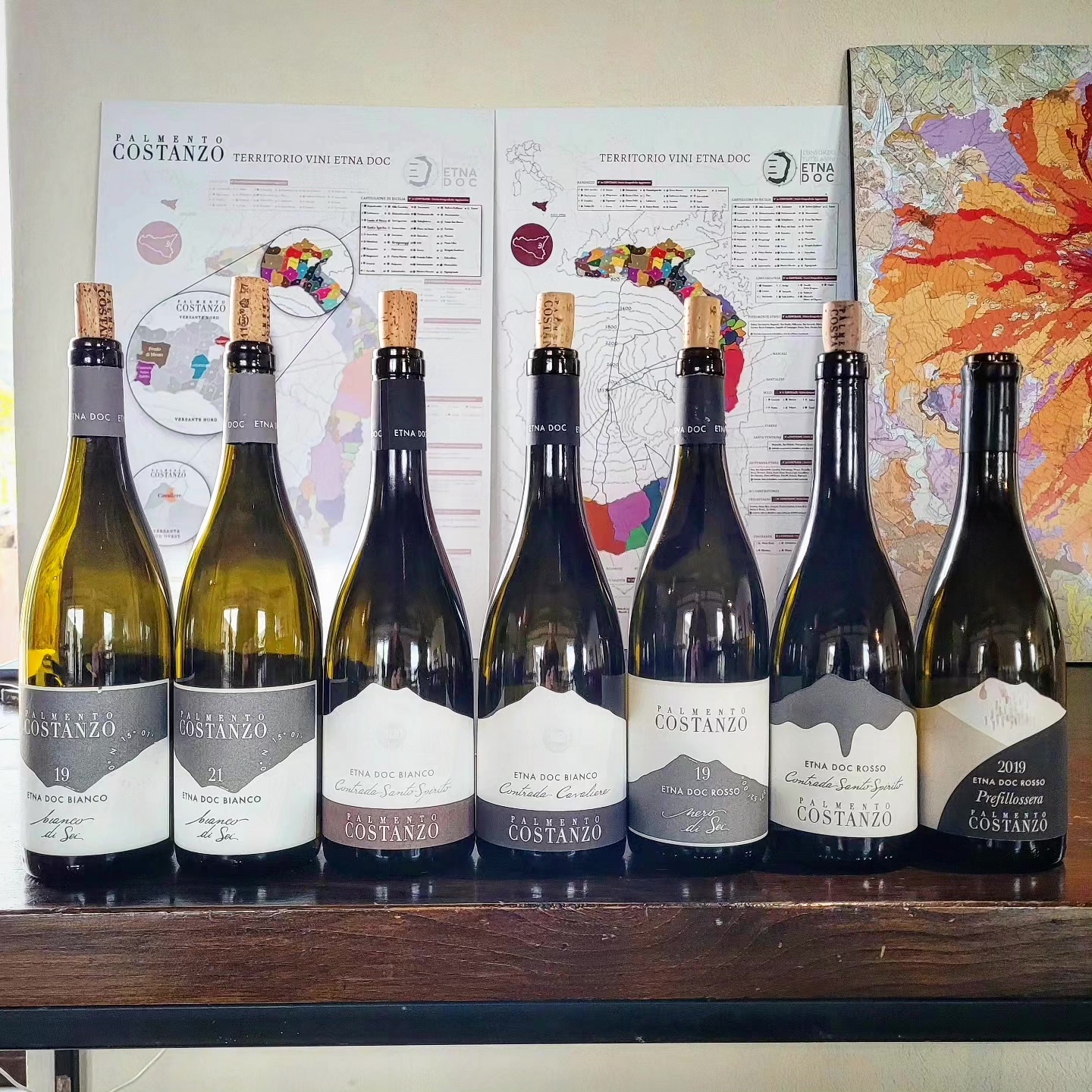
The Sicilian exploration of Tuscany’s Moretti family of Tenuta Sette Ponti. As with several other Noto area estates, Maccari was set up 25 years ago  on 200 hectares with 65 planted to vines, most trained to Alberello (medio).  Much like the others the location is heavily influenced by limestone soils set halfway between the Ionian and Mediterranean seas. There are predominantly nero d’Avola and grillo, but also seven hectares of syrah. The company also farms 11 hectares on L’Etna (called Etnae), namely in the Contrada Santo Spirito.

Feudo Maccari Anima Lucente Etna Bianco DOC Contrada Santo Spirito 2024

Anima Lucente is the only Maccari Etna Bianco, made with 85 percent carricante and (15) minella grown in a 700m, 60-plus year-old “garden vineyard,” on Passopisciaro bush vines. Natural ferment, half in steel and half in ”blanched” second passage French wood. Just bottled a few weeks ago and already the wood is easily integrated, subtly specialized without so much as a toasty, vanillin or buttery trace. Racy Etna Bianco from head to tail, judged, interpreted and translated as a garden blend should. Quite edenic for the ilk and of dreams realized. Not the most complex, nor does it need to be but it’s so hard not to be seduced through to the mineral-metal finish. 10,000 bottles produced. Drink 2025-2029.  Tasted May 2025

Feudo Maccari Anima Vulcano Etna Rosso DOC Contrada Santo Spirito 2022

Red counterpart to the white Anima Lucente, moving from luminescent to charcoal volcanic in Rosso that spends only a reasonable and amply fortifying eight months time in barrel. Perfectly professional, seasoned, stylized and straight up the middle road taken for the DOC and more importantly but also specifically the contrada of Santo Spirito. Speaks in the clearest double “S” vernacular, explains and delivers just what is expected and frankly wanted from a contrada-specified Etna Rosso. Acids are in synch with the rusty grit split between fresh and dried elements. Stamp of guarantee. 3,000 bottles. Drink 2025-2029.  Tasted May 2025

Feudo Maccari Animardente Etna Rosso DOC Contrada Santo Spirito 2022

Slightly higher elevation also from the Passopisciaro contrada of Santo Spirito, here at 750m and same vine age in and around 60 years. This time the qualifying suffix “ardente” refers to passion or a burning for something, that surely being the raising of impressive Rosso from out of the Etna lava stone flows. The reference also elicits the heat and colour of the magma fused with the current orange-hued basalt. A more serious Etna Rosso of depth and tannic intensity, doubly structured and needing time. The botanical feels mixed with structural elements more than grip the palate, hold on tight and show no immediate sign of letting go. Give this two more years. 3,000 bottles. Drink 2027-2032.  Tasted May 2025

Feudo Maccari Animantica Etna Rosso DOC Contrada Santo Spirito 2022

From the owners of Tuscany’s Tenuta Sette Ponti. Animantica, a compounded abbreviation of anima and mantica, i.e. “soul and divination.” A spiritual combination for the smallest of Etna Rosso productions from Contrada Santo Spirito. Exhibits the freshness and accessibility of Anima Vulcano juxtaposed against the tannic frame and freight of Animardente but the expression is subtle, restrained and without the ardent flaunt of necessity. The vines here are 100-plus years pre-phylloxera grown in the “garden vineyard,” inclusive of some (white) minella. Rosso as graceful as any on the Etna and therefore fully qualifying as mountain wine. The tannins are suave and fluid to see a “divinazione” of 10 years or more. Just 800 bottles. Drink 2027-2036.  Tasted May 2025
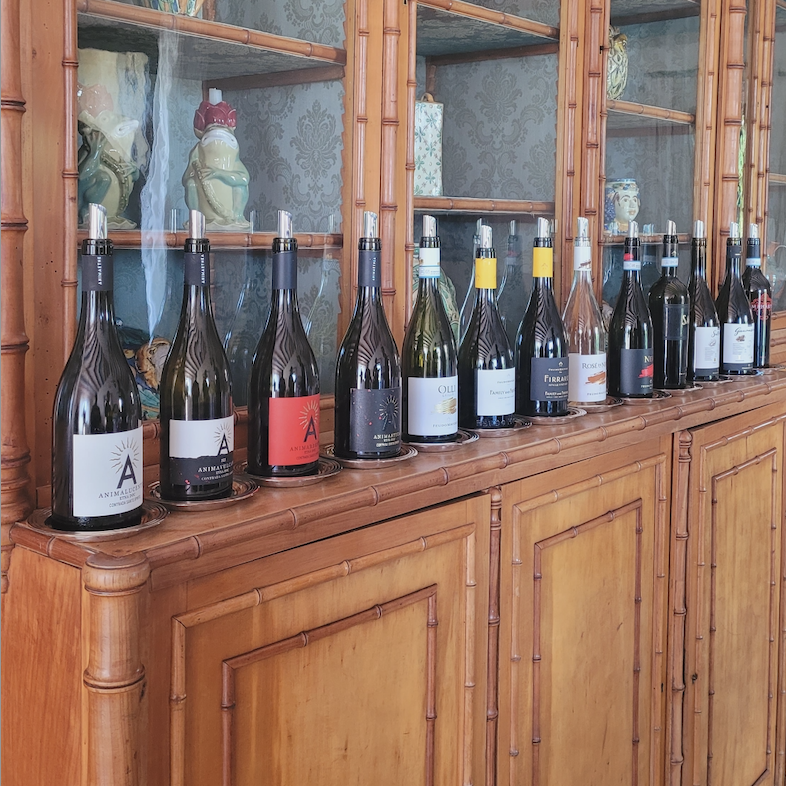
Feudo Maccari Grillo Sicilia DOC Olli 2024

Olli, part of grillo read backwards and a local name for the grape. A reminder how it arrived as a cross between catarratto and zibibbo, developed by Baron Antonio Mendola of Favara. Clean, fresh, ripe and accessible to all, for all the correct reasons and any time at all. Yellow fruit and flowers, some sapidity and the easiest drinking white anywhere from Sicily. Vines averaging 20 years bring the knowhow and concentration. Drink 2025-2026.  Tasted May 2025

Feudo Maccari Family and Friends 2023, Terre Siciliane Bianco IGP

The wine once made for, you guessed it, family and friends that first became a commercial label with the 2012 vintage. Vineyard is now more than 20 years old with grillo vines growing in sand and limestone. The label advocates “only the best grapes” and the amenability meets style of this varietal wine suggests that to be the honest truth. A lemon intensity in concentration and bursting fleshy segments are juicing through the entirety of the wine. Again a sapid (as opposed to salty) element, not quite botany or “macchia” but savoury nonetheless. Hides the 14.5 percent alcohol frame with ease. Drink 2025-2027.  Tasted May 2025

Feudo Maccari Vigna Firraru Family and Friends 2023, Terre Siciliane Bianco IGP

The most important grillo comes from the black-soiled clay vineyard above the cantina, a.k.a. Fabbro, from Sicilian dialect the name Firraru describes the colour of that terroir. Alberello vines are 20 years of age (as with all the grillo plantings) and now having come into their zone. A ferric element emerges as per the soil to separate this grillo from the other Family and Friends varietal white. Even more sapid, metallic surely and length increases. The French wood, richness and generous alcohol all impress while doing their part in well rehearsed integration. Drink 2025-2028.  Tasted May 2025

Feudo Maccari Rosé di Neré Sicilia DOC 2024

More than obviously stuck to Provençal style guns with a Rosato made with nero d’Avola softly hued, pale and simple. Just two hours of skin contact plus five months of aging in steel. A lees effect, however soft and in restraint though consistently designed and presented with the Feudo Maccari sapidity up front. Showing some true to from nero notes, of ripe berries and sweet herbal savour. Well made and reachable for all. Drink 2025-2026.  Tasted May 2025

Feudo Maccari Sicilia DOC Neré 2022

A mix of nero d’avola vines young and old, of 10 and over 30 for the signature varietal business card of a red wine. Dusty and notable Balsamico with a local nickname for the most important variety, not only for Noto but all of Sicily. Neré is more restrained and quaffable than ever before, with crusted, skin musky fruit and high acidity. A wine to chill and spill without thinking too much on anything at all. Drink 2025-2026.  Tasted May 2025

Feudo Maccari Sicilia DOC Saia 2022

Saia comes from Arabic, a word making reference to centuries old rainwater collecting irrigation canals and the first label produced by Feudo Maccari in 2002. These are the oldest estate bush vines, now more than 30 years of age with the eyes, canes and fruit of experience. More obvious depth and layers to nero d’Avola as Saia, a treasure trove and trough filled with fruit and accompaniments in complexity. A nero adorned but also soft with some pruning of the fruit while still amply structured. Not grippy or with tension per se but in control and able to age. Drink 2025-2029.  Tasted May 2025

Feudo Maccari Nero d’Avola Sicilia DOC Sultana 2022

A single vineyard nero d’avola from white limestone soils of 20-plus years that sees 10 months in tonneaux, coming out in the 15 percent alcohol range. Just one hectare like Guarnaschelli and aromatically speaking the most mineral-elemental and therefore salty nero d’avola for Feudo Maccari. Genuine depth and ideal push-pull posit tug between fresh and dried elements with a chalky understreak that speaks to the brown skeletal soil and its limestone content. A wine made in the vineyard, as they say, exaggerating and celebrating the local Balsamico and singular savoury improvisations. “Autentico.” Just 1,000 bottles made. Drink 2026-2033.  Tasted May 2025

Feudo Maccari Nero d’Avola Sicilia DOC Guarnaschelli 2022

A single vineyard nero from black volcanic soils of some 60 years that sees 10 months in tonneaux, coming out in the 15 percent alcohol range. Just one hectare like Sultana and the terroir directs the result. Greater intensity and grip but also a converse style due to the ulterior elements that come from basalt as opposed to limestone. There is a richness to the mix of dried and fresh fruit, Balsamico and macchia, a layering that continually delivers more and more. The clarity and finesse from Guarnaschelli do well to balance and smoothen both the new wood and elevated level of alcohol. Just 1,000 bottles made. Drink 2027-2035.  Tasted May 2025

Feudo Maccari Syrah Sicilia DOC Mahâris 2022

From seven hectares of syrah, the second label produced at Feudo Maccari, first vintage 2005. The name refers to Arab watch towers along the sea coast and it is the wine “that symbolizes the meeting of different styles and cultures.” In other words syrah brought to Sicily and how it has prospered, with FM being one of the pioneers in terms of scale and time having worked with the French variety. Then again the legend of Marcus Aurelius, Syracusa and the variety have by now become one to make this one of the island’s own. The 2022 is full and wooded, seasoned to the hilt and within good reason because this is what the grape wants from Noto. Fruit and structure are tied by sweet acidity as much as they are by tannic freight. Full wine and one to impress. Drink 2026-2032.  Tasted May 2025

With Santi and Alessio Planeta in Noto

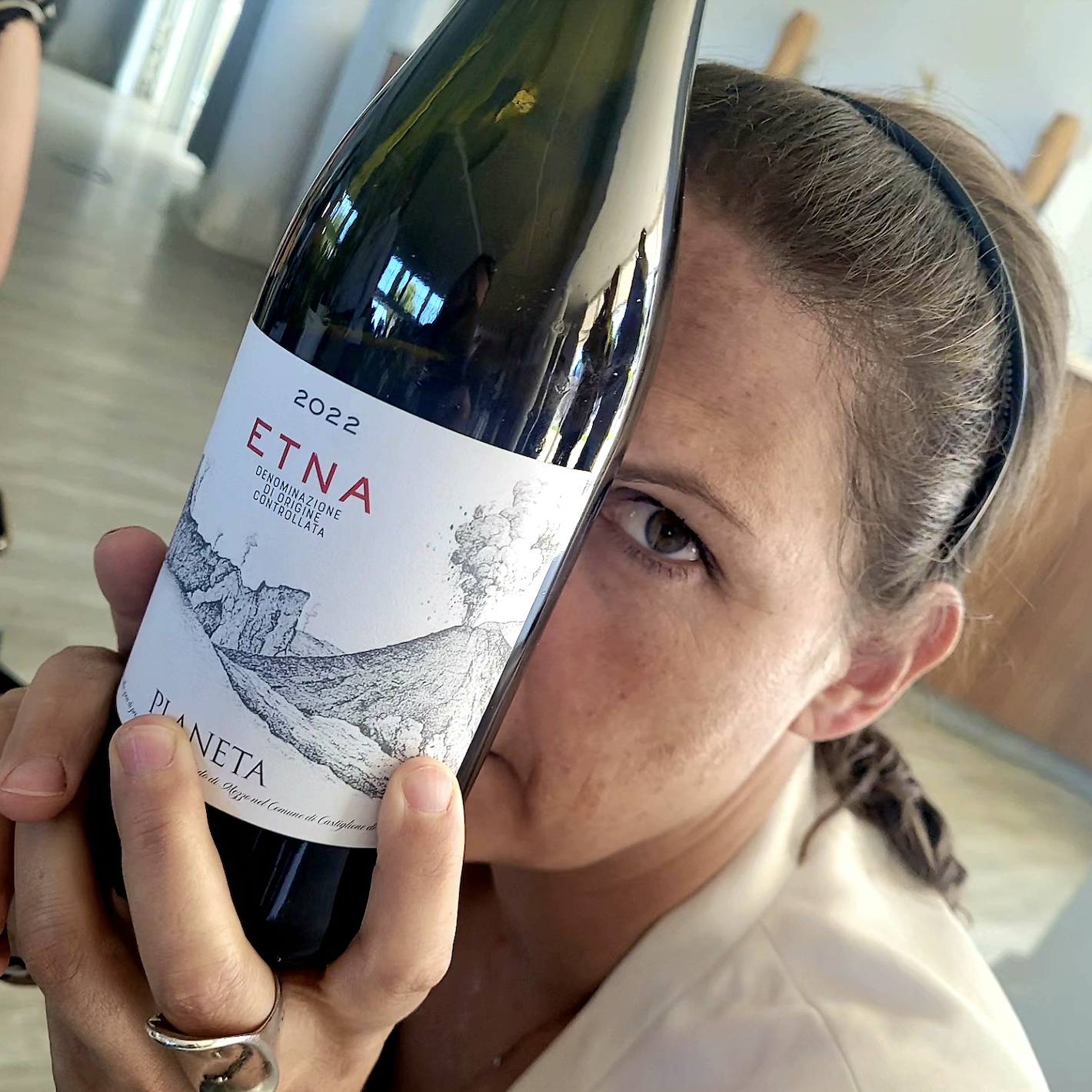
Planeta

Diego Planeta. Pioneer, visionary and a man who considered the entire island an agricultural playground where anything was possible. The Planeta family has Spanish origins and roots dating back five hundred years. Diego Planeta was the former president of the Settesoli Cooperative and founder of Planeta winery. His passing in 2020 left an irreplaceable hole but 15 cousins, including Alessio, Francesca and Santi Planeta are the beneficiaries of their uncle’s plans and legacy. Five family members run the day-to day operation and more than 200 vinicultural, viticultural, administrative and marketing artisans share in the collective vision. Today they work, farm sustainably and reap the benefits of five distinct estates but more than that they bring the fruits of these locations to the world. No other producer in Sicilia does this, not with the scope and breadth they do.

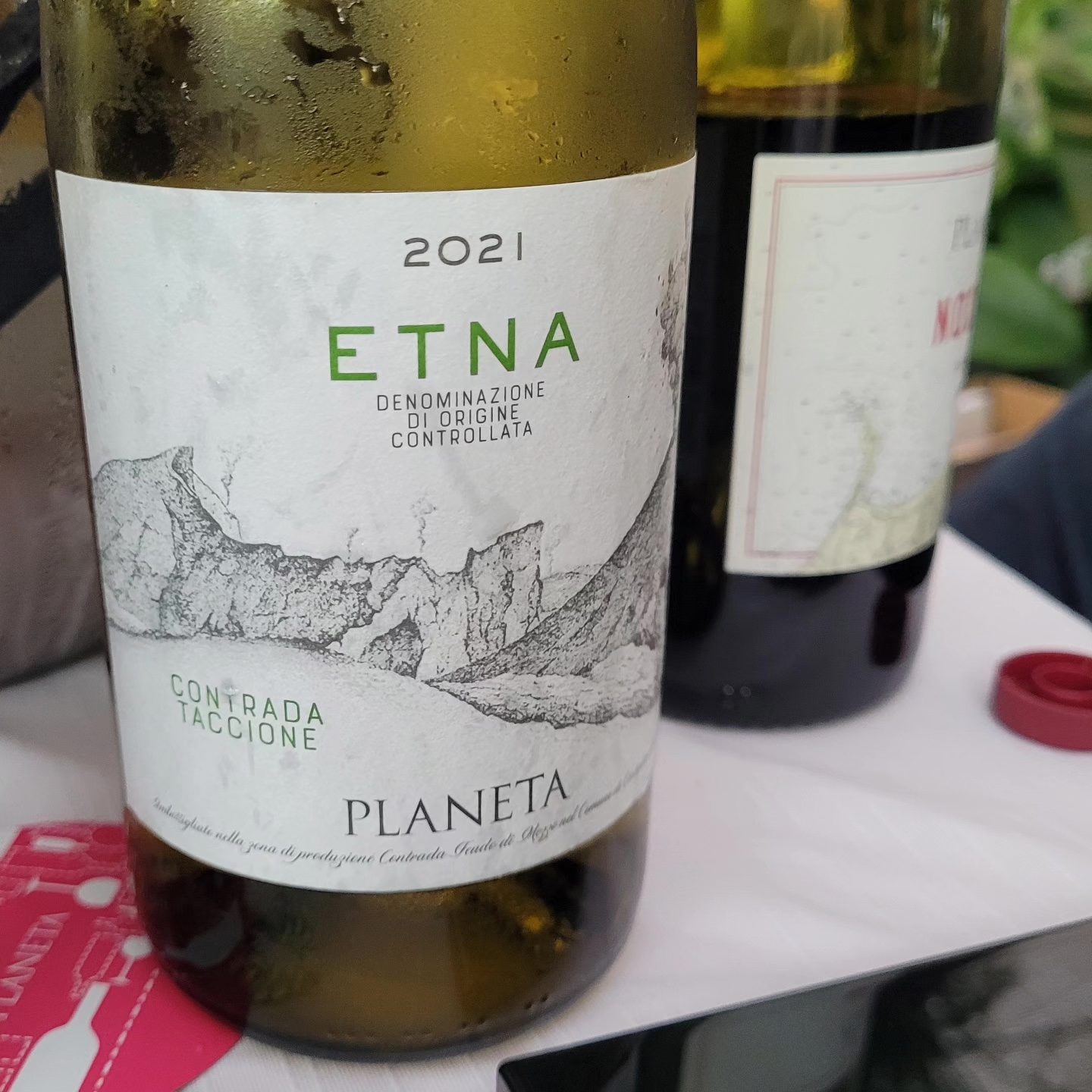
Noto is the birthplace of nero d’Avola, graced with calcareous soils like Jerez and Champagne, not really comparable to anywhere else. Noto is close to Vittoria in how the wines come to be but it’s a mobile texture, silken and with velvety tannins. The soft hills of Buonivini are blessed by soft breezes arising from the meeting of two seas, ideal for nero d’Avola and moscato, but also almonds, carobs and olives, symbolic plants of the Mediterranean location. The three vineyards are agliastro, buonvini and zuppardo on 45 hectares, acquired piece by piece, today producing the DOC wines Santa Cecilia, Moscato di Noto and Passito di Noto.
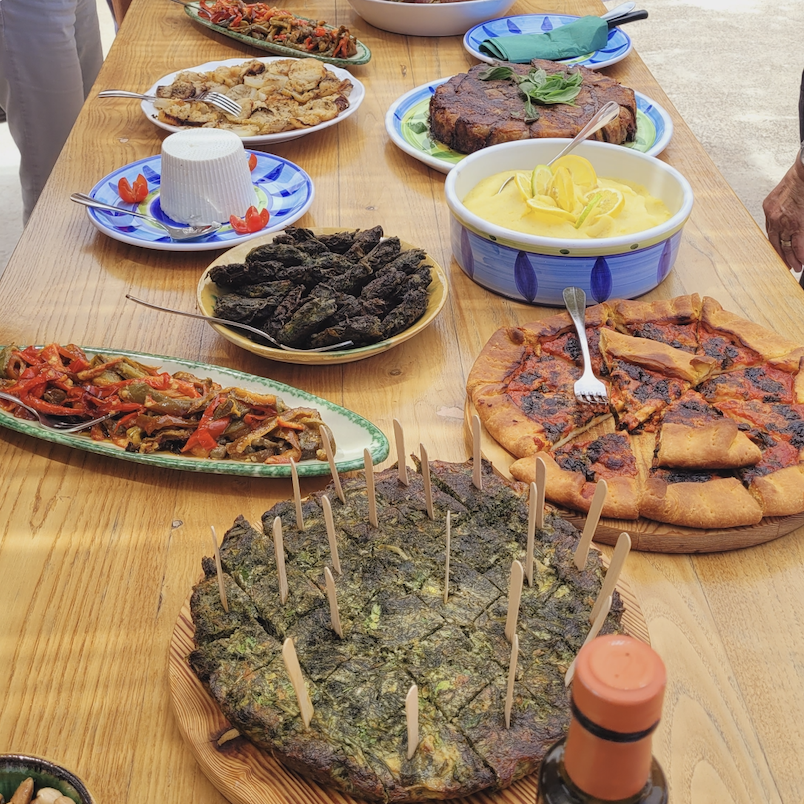
Country lunch at Planeta, Noto

Planeta Noto DOC Allemanda 2024

Always the (totally) dry moscato from Noto, white grape that has been a focus for Planeta not quite but almost since the beginning. From the Bounivini – Agliastro vineyards built of lime, soy marl and whitest of white chalk. A low production vintage because of drought and small berries though the aromatic variety translates as high and expressive as ever. Freshness and botanicals meet at the middle where citrus predominates. No questioning the quality and intensity for what must be viewed as a singular style and effect of white wine. Never searing and of a sapid notion that seems too bely the calcari, but that is exactly why this moscato works as a dry white wine. If you like top echelon dry palomino then this will induce interest along a similar line. Drink 2025-2029.  Tasted May 2025

Planeta Noto DOC Allemanda 2020

A fine Sicilian vintage with ideal climatic conditions and looking back four years you get some evolution in the way you might think about what happens with dry sémillon or riesling. Now an arriving mix of honey and petrol to compliment the concentrating mandarin and lime blossom notes. In a way it feels like a sweetness is developing but that is a faux reality because there is literally no sugar in this moscato. Testing 2020 in 2025 seems just about right – another year and things will really go secondary. Drink 2025-2027.  Tasted May 2025

In the Noto cellar with Alessio Planeta

Planeta Noto DOC Allemanda 2014

More than 10 years have passed and forget secondary because tertiary has come to town. Fully developed maturity between the honey and petrol, sapidity strong and metal savoury, everything having coalesced into a finished and now finishing wine. This is where moscato will go, here with distinction because of how clean and competent it bagged character all those years ago. Drink 2025.  Tasted May 2025

Planeta Nero d’Avola Noto DOC Controdanza 2021

The first vintage of this specialized dance in Noto was 2016 and here five years later we begin to see the balance and personality really showing forth. Also from where and how the heavy presence of white limestone grabs ahold of nero d’Avola’s soul and hauls it straight down to the ground. All the carob and some liquorice define the flavours of Controdanza for a full and satisfying experience, replete with fine acidity and elastic intensity. Drink 2025-2028.  Tasted May 2025
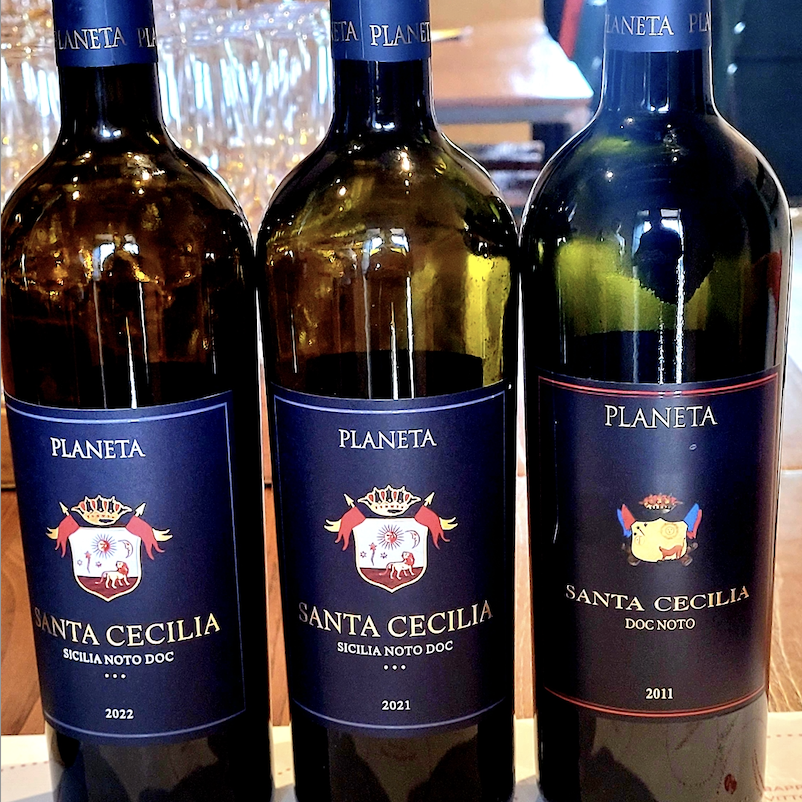
Planeta Santa Cecilia Noto DOC 2022

A preview yet to be released but a finished wine bottled a year ago. The first vintage (as a reminder) was 1997 and 50 percent is aged (12 months) in new wood, the rest of the nero d’Avola in used barrel. Two parcels of the Zuppardo and Agliastro they are, both contributing to the mille-feuille layers that deliver wave after wave of varietal flavour, character and soul. They are the most importantly identified white (calcareous) soils chosen for this flagship varietal red in the Planeta world. Santa Cecilia owns a chalkiness in its tannic profile that feels singular, non-inimitable and willing to take 10-15 years to fully transform. The 2022 is a prime example of a latest vintage produced serving as its best. Drink 2027-2035.  Tasted May 2025

Planeta Santa Cecilia Noto DOC 2021

Not much movement as of yet, save for a moment of carob, naturally honeyed with caramel and earthiness. Speaks to ripeness as much as maturity. The acids from 2021 are at the fore right now, loudest of clamour and opening the window for clarity and the complex fruit component coming into focus. Yes there is a minor feeling off secondary character but just in infancy to suggest three more years in this stage.  Last tasted May 2025

Such a fine iteration of nero d’avola as Santa Cecilia, a 2021 more mature and open than before but is that not what it should be? Fruit so naturally curated, sweet and generous to speak of a great potential and long future. Fine acidity as well while also necessary and yet as the wine sits on the palate those credible and knowable quality of nero tannins remind of Cecilia’s past. Anyway this is both handsome and beautiful, vulnerable and strong. Fluid and confident, loving and powerful, with a spoonful of Noto nourishment to last a very good long time. Drink 2025-2034.  Tasted May 2024

Planeta Santa Cecilia Noto DOC 2011

Now well into secondary with plenty of tertiary having come to take over the personality of Santa Cecilia 2011. Still there is some freshness of fruit and especially how acidity affects the development of original elements transforming into later life pleasure. Now showing as a perfectly gorgeous 13-14 year-old nero d’Avola from a second stage understanding within the overall Planeta idiom.  Last tasted May 2025

Santa Cecilia from 2011 is a special nero d’avola, balanced in silent but sweetly deadly acquiescence of Noto’s white chalky soils. Her tannins are abundant and smooth, running in one direction and so it’s a wonder how un-evolved and yet so involved this nero d’avola is equipped to believe about and with great kindred spirit with itself. That it presents this youthful and yet to advance is a thing magical and sincere. Inner strength is one thing but outward beauty is the real deal. Or is it the other way around? Either way they combine for one of Cecilia’s greatest acuity and remainder of structure. Drink 2018-2026.  Tasted May 2018 and April 2022
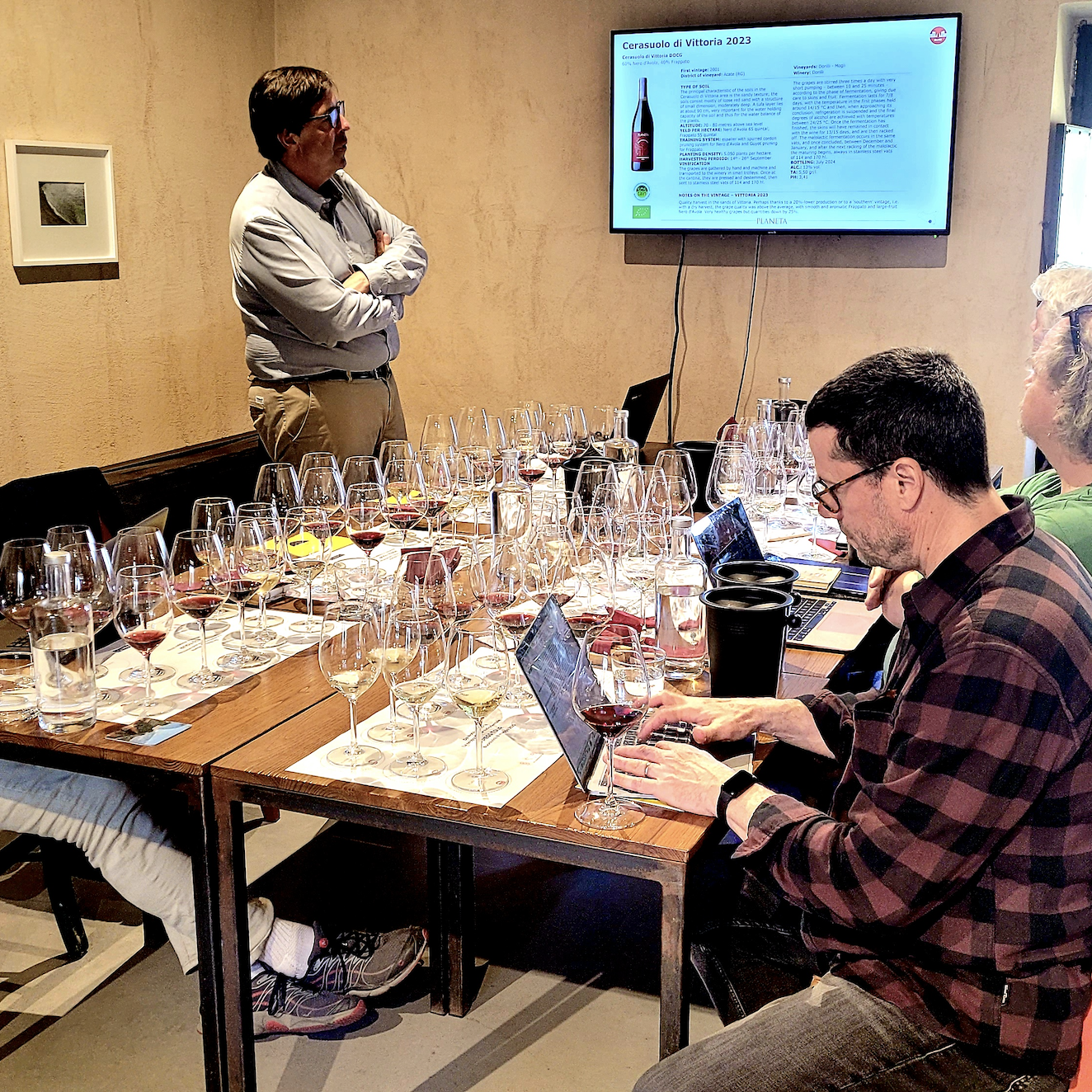
Tasting at Planeta, Noto


Planeta Frappato Vittoria DOC 2024

Great freshness and red berry fruit define frappato for Vittoria, “a grape that is magic and if you plant it outside of Vittoria it is not so interesting,” explains Alessio Planeta. “In my opinion.” The aromas and flavours of the grape are expertly preserved, here bursting and the herbal or savoury aspect is so much sweeter from Vittoria, noting like basil or chervil. What matters is the soil’s origin, that being marine and when the grape is frappato the handling simplifies so that the freshness, fleshiness and simple beauty is exulted. This may be simple but it’s also brilliant. Low alcohol (12.5 percent) and above average pH matched by just below tart acidity to result in fragrance and balance. Drink 2025-2028.  Tasted May 2025

Planeta Frappato Vittoria DOC 2023

The first vintage of Planeta’s Cerasuolo Di Vittoria was 2001 from the area of Acate and vineyards of Dorilli and Mogli. Acidity just a bit higher than varietal frappato and pH conversely lesser. The effect of nero d’avola leads to this wine’s balance between fresh fruit and linear structure. Quantity was down 20-ish percent in 2023 and concentration feels elevated, corresponding to healthier levels of quality and tannic structure. Not always a 60-40 nero d’avola to frappato but that does seem to be the comfort zone, although Alessio Planeta is not adverse to a much higher number for the nero. I mean this is just perfectly balanced, juicier than ever and subtly structured for a five-plus year run. Drink 2025-2030.  Tasted May 2025

Planeta Cerasuolo di Vittoria Classico DOCG Dorilli 2022

Dorilli is the single-vineyard nero d’Avola residing at the pinnacle of Cerasuolo for Planeta. Brighter and upwardly airy to ethereal than ever before, here with a 10 percent increase of the nero d’Avola from the classico Cerasuolo and yet alcohol, acidity and pH are almost always aligned within a tightly defined spectrum. This regardless of how much of each grape are employed which tells us that soils and place, clay-limestone soil and Vittoria are the greatest determining factors for results. That being lithe, fresh and frankly also exciting. Cru Beaujolais lovers must not turn away from Cerasuolo, not when it is made in this style. Drink 2026-2032.  Tasted May 2025
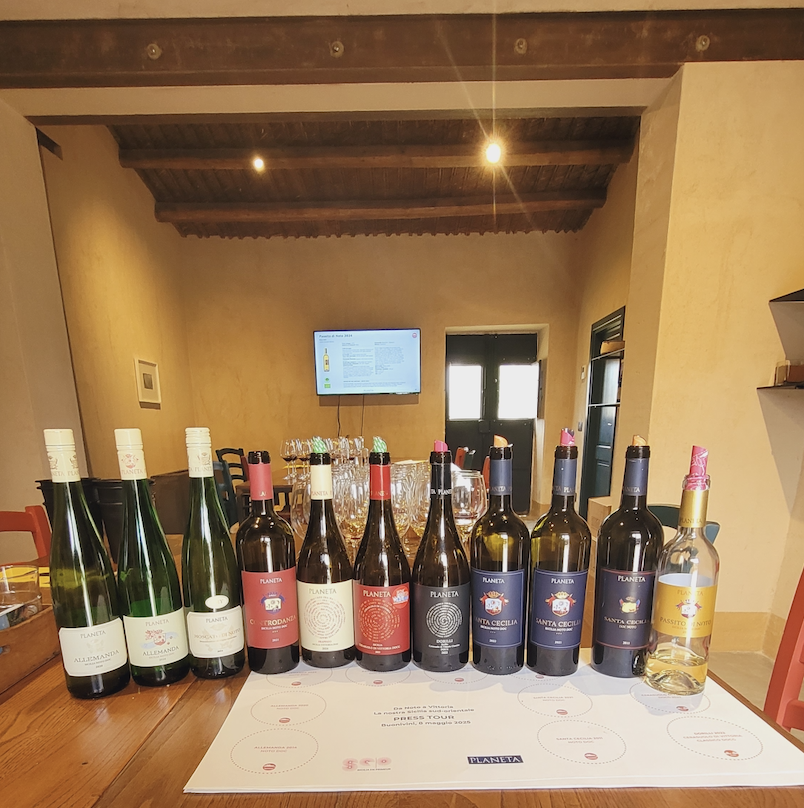
Planeta Passito di Noto DOC 2024

From Noto’s Buonavini winery/vineyard and also that of Agliastro and their whitest of white limestone terroir. Lemon and mandarin incarnate in any way your imagination can conjure, from curd through gelée to granita. Pure and focused, clean and all about the fruit. The best thing you could do is put a glass of this Passito next to a plate of Sicily’s finest master pastries made by Corrado Assenza at Café Sicilia. Drink 2025-2032.  Tasted May 2025

Planeta Nocera Sicilia DOC 2023

A world unto itself with few peers making the yeoman work of nocera production and yet this grape holds plenty of potential. It may be ancient and perceived as rustic but in the hands of Planeta it’s tamed and gifted as something easy, satisfying and quite complex. You can drink this with ease and without tension, its fruit more musky and leathery than say frappato but with nary a meant of drying, tough chew or earthiness. This 2024 is youthful and got right for a varietal teaching moment that also delivers a true sense of pleasure matched by pace.  Last tasted May 2025

One of the very few pleasantly made varietal nocera on the island and the only one presented here at the ’24 Anteprima. Surely found to exist along similar lines to nero d’Avola, with a touch more rusticity, also chewy liquorice and leathery fruit character. The 2023 is a good if not high acid nor rather tannic vintage, assembled and delivered for earlier drinking than some. Drink 2024-2026.  Tasted May 2024
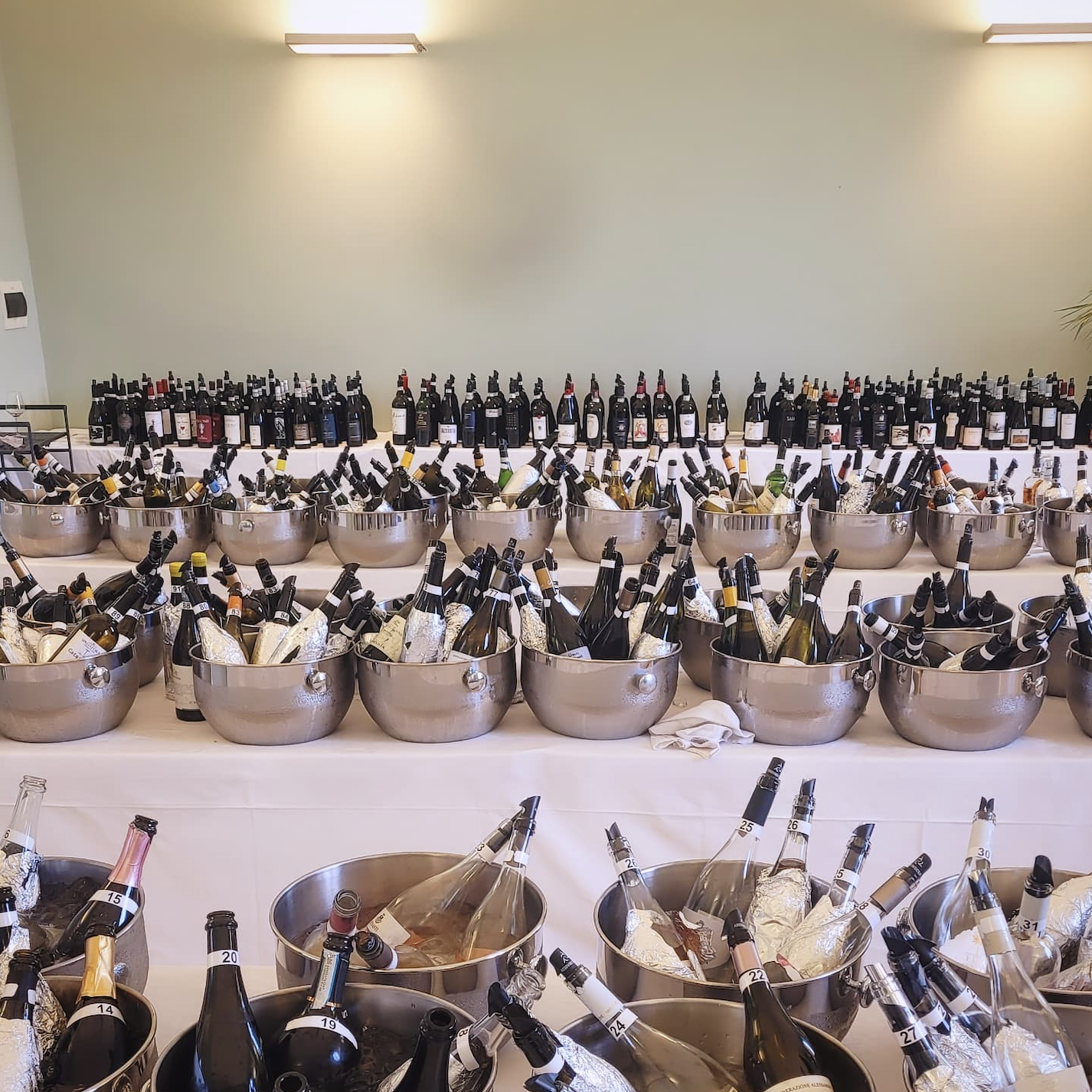
All the wines of Sicilia en Primeur

Sparkling

Alessandro di Camporeale Método Classico 2020

Solo catarratto, vibrant, exciting, exploding, 36 months on the lees. Crazy flavours on your palate. Ginger and smoulder. Drink 2025-2026.  Tasted May 2025

Alessandro di Camporeale Método Classico 2017

This is the second vintage and for a catarratto that spent 72 months on the lees it’s actually mind-blowing. The wine is crisp, crunchy, salty, expansive, vertical and frankly exceptional. Next up 96 months? Drink 2025-2030.  Tasted May 2025

Cantine Fina Pas Dosé 2019

A proper smoulder leads off for this 70 percent chardonnay and (30) pinot noir blend finished clean and unadulterated. No dosage? No problem because of the toasty, umami-savoury, macchia-laden, of plants identified and also those not. Palate exhibits some peanut shell which speaks to a momentary temperature drag in the processing but with all the exotics running amok there is terrific interest nonetheless.  Last tasted May 2025

A mix of chardonnay and pinot noir, 70 and 30. Toasty style, sharp and focused, 36 months on the lees to give it aromatic volume from the get go. Certainly not an oxidative style, far from it and the middle ground for Bruno Fina’s sparkling program that began with 24 months and has progressed to 60 on yeast time. More volume on the palate and even fleshiness than expected to suggest that Fina is a natural at making sparkling wines. No wood – only stainless steel. Experimentation has come thus far and perhaps wood aging is coming in the future. Wishing for more length but the linger is full and positive. Drink 2024-2027.  Tasted May 2024
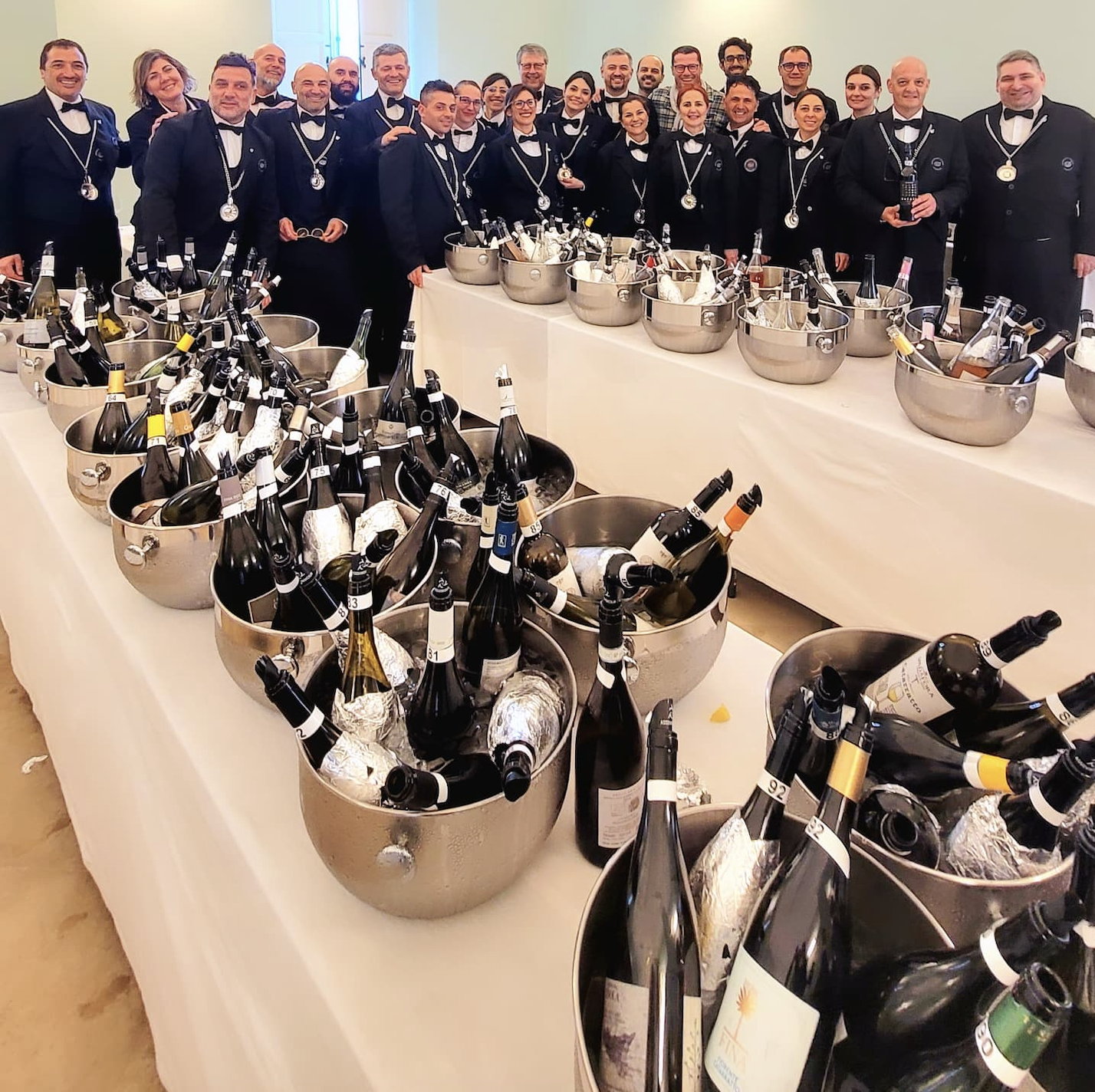
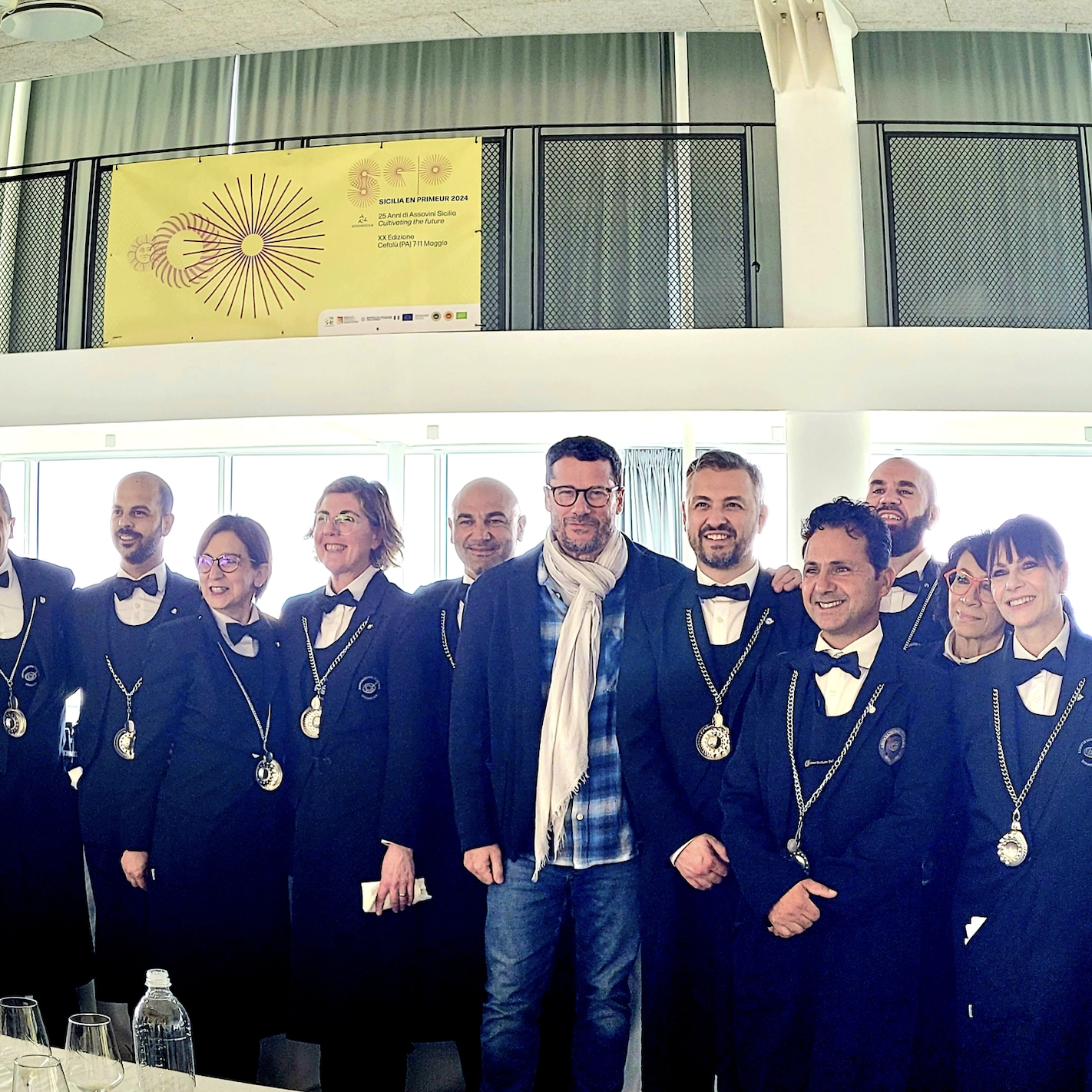
With the Sommeliers of AIS Sicilia

Fazio Brut Blanc de Blancs Erice DOC

Concentrated and pulpy fruit forward fizz from chardonnay picked at higher ripeness than most. Feels like Cuvé Close style, big fruit and carbonation doing their best to get together. Simple and juicy-frothy with neither issue nor complexity. Drink 2025-2026.  Tasted May 2025

Feudo Dsisa Rene’ Sicilia DOC 2017

Über reductive and reactive chardonnay sparkling not perfectly clean. Not quite bitterness in the flavours but more like toasted almond skin. Medium toast and mid-level persistence. No excitement or positive linger neither. Drink 2025-2026.  Tasted May 2025

Principe di Butera Metodo Classico Nero d’Avola Pas Dosé 2019

A classic method sparkling wine 36 months on the lees, charged and excited, rich and buttressed for full mouthfeel with bubbles that elevate the game. Harvested in the second part of August also off of plants that were first planted 27 years ago. The higher parts richer in limestone are used for the Pas Dosé and those in the valley clays more for Brut. Drink 2025-2028.  Tasted May 2025

Principe di Butera Metodo Classico Nero d’Avola Rosato Extra Brut 2019

A 24 months on lees after a couple of hours on the skins for Extra Brut with some sugar but nothing gratuitous and vines growing in the lower parts where limestone gives way to clay. Smooth, really with uplifting acidity and rusty red fruit character. Professionalism incarnate and ideal stylish personality for Sicilian sparkling wine. Drink 2025-2028.  Last tasted May 2025

Not labeled as such and this is the first vintage release but the vintage is in fact 2019. Twenty four months on the lees and this being the beginning to introduce the wine but subsequent vintages that will likely age longer. Extra Brut so right around 6-7 g/L with explosive acidity so the balance is spot on. Orange and lemon, no pith and less bitters to speak of. Really clean and good length.  Tasted May 2023
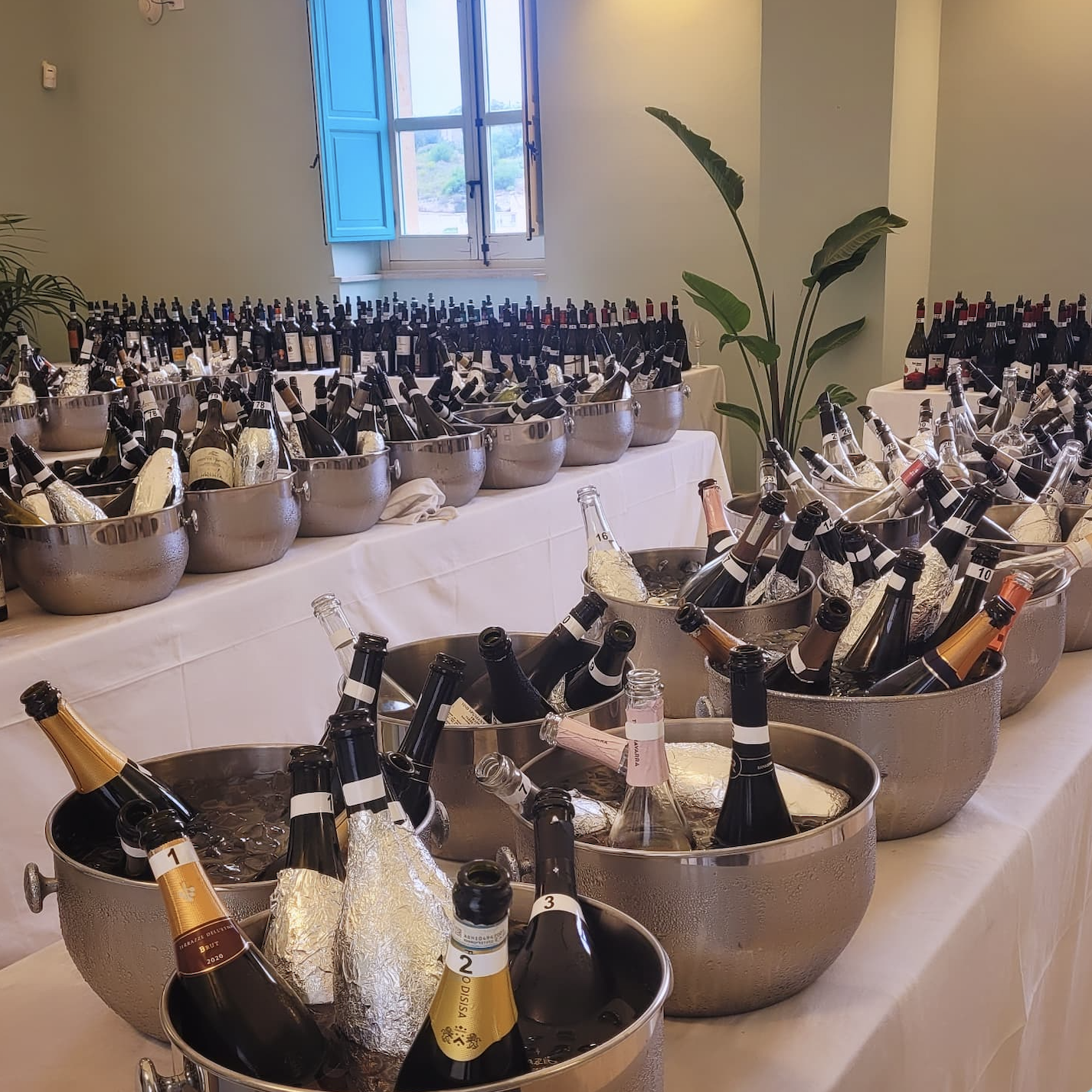
Tenuta Ferrata Etna DOC Spumante 2021

Fine fizz work with the local nerello mascalese stripped of skin muskiness and replaced with a volcanic savour so distinctly if discreetly basaltic in nature. What should sparkling wine from L’Etna do? This actually, with linger and persistence. Grows on the palate and finishes with edible fungi, umami in nature, all in all a positive result for those who are carriers of that “other” positive sensory gene. Drink 2025-2028.  Tasted May 2025

Tenute Nicosia Sosta Tre Santi Etna Brut DOP “Sessantasei” Método Classico 2018

Quiet, admittedly demure entry, of nerello mascalese and the trenchant intention to develop all three essential tenets of sparkling wine. Aromas, textures and flavours are all slowly and incrementally enhanced by serving a long time period upon the lees. In the vicinity of six years for this bubble and dio mio, man how things have come to a combination of curiosity and softness. Spicing yes, but texture is key, mouth-filling, reaching all corners and edges through a lengthy journey resulting in rolling waves, oscillations and blanketing couverture. Substantial sparkling with grace. Drink 2025-2028.  Tasted May 2025

Terrazze Dell’Etna Blanc Brut 2020

Reductive and flinty bubble unique to Etna with a can’t miss the chardonnay character. A sharp and crunchy bite into a just picked yellow apple. Balanced and softening on the palate for one of the most tenable blanc sparkling wines ever to try from a mountain producer. Drink 2025-2027.  Tasted May 2025
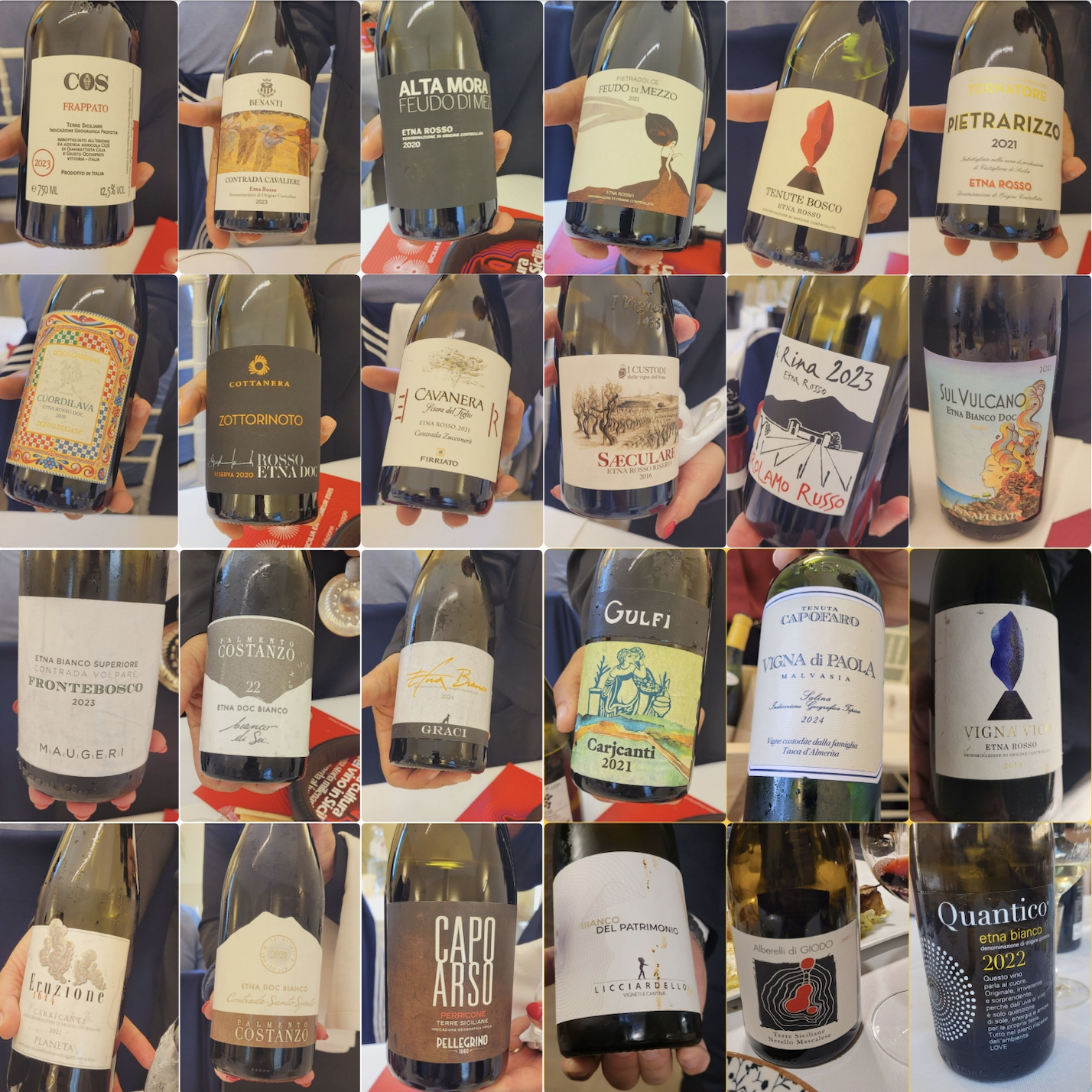
Rosato

Benanti Etna Rosato DOC 2024

High aromatic substance, tree fruit blossoms, fruit forward with concentration. Stone fruit, nerello mascalese skin muskiness, though never pungent. Caught at reputable ripeness for Rosato, its verdancy a matter of natural extension, acidity never sharp, nor failing. Palate luxe and soft though the savour persists and it all falls into place for the category. Drink 2025-2026.  Tasted May 2025

Cantine Fina Rosato Hanami 2024, Terre Siciliane IGT

Rosé of merlot and syrah, lithe and salty, a vague earthy funk that comes from a mix of soil and how these grapes interact as such. First vintage was 2019 and the path is getting clearer. The tang is extremely high which makes for a slightly vivid example out of this vintage. Drink 2025-2026.  Tasted May 2025

Cottanera Etna Rosato DOC 2024

As straightforward, generous and fruit-centric as Etna Rosato can be, open for all blush needs. Summer is a glass as they say and no, Etna Rosé was not like this just 10, or perhaps even five years ago. Yet here they are and come to the world with all the fulfillments the genre could offer. Plenty good and good for plenty of reasons. Drink 2025-2026.  Tasted May 2025

Feudo Montoni Rosé di Adele Nerello Mascalese 2024, Terre Siciliane IGT

Intense nerello mascalese aromatics, of floral red berry bloom perfume and into savoury flavours, of all that lives and breathes in a natural Sicilian world. Perhaps a smaller crop and size of berry is the reason for these results but regardless the concentration alters the ’24 course of a Montoni Rosato. Would love to sip this alongside any of the many eggplant preparations by Montoni’s Melissa Muller. Drink 2025-2027.  Tasted May 2025

Girolamo Russo Etna Rosato DOC 2024

Finely composed and balanced Rosato from Giuseppe Russo, ideally mixing ripe nerello mascalese with sweetly captured acidity. You can sip his 2024 and feel the composure straight away, plus enough generosity and grace befitting of all the wines in the strongest of portfolios. Here Rosé is a gift because the fruit is precious in that it should rightly have become Rosso. Drink 2025-2027.  Tasted May 2025

Planeta Rosé Sicilia DOC 2024

A mix of nero d’Avola with syrah and sauvignon blanc for more spark and sharpness which Rosato by Planeta most definitely has. Crisp bites, herbal, some macchia and provider of thirst quenching abilities. Drink 2025-2026.  Tasted May 2025
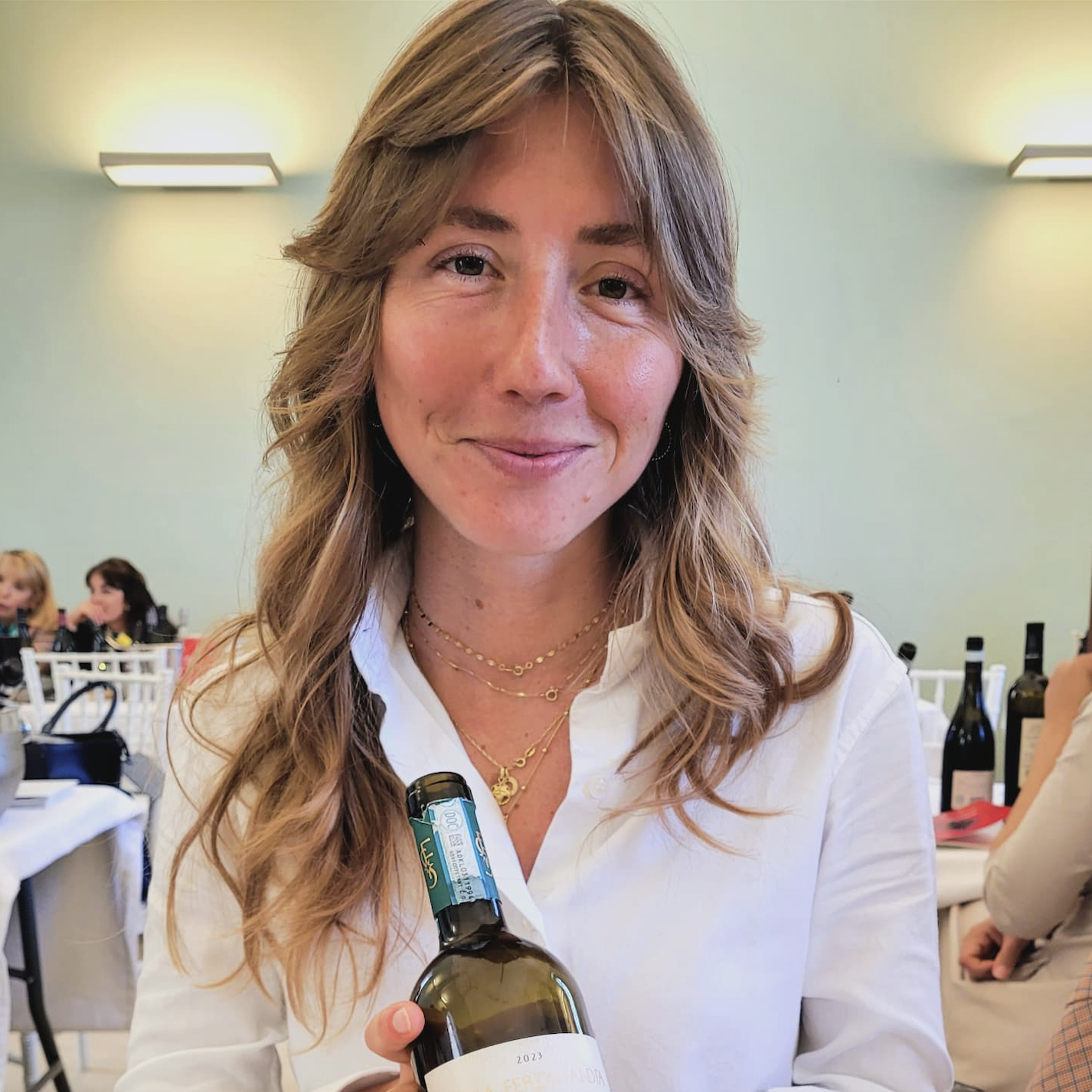
Cecilia Carbone – Serra Ferdinandea

Serra Fernandinea Rosato Sicilia DOC 2024

It rained on the 9th of May and then not again until the 19th of August. Picked between the 11th and 14th of August (with Ferragosto in between) and with this in glass most will have no idea it’s even Rosé. Vin gris is the look but not the intention because when you press nero d’Avola it’s a matter of minutes between this and colour. Remember the owners are Provençal and in southern Sicily the same effect is desired. That would be lithe, salty, fresh and with unlimited spirit. The spirit and nature of the place. As this does and is just that. First scent speaks to Rosato of a distinct and singular nature, like a marine breeze blowing in and through the macchia-mediated and reconciled fruit of the vine. Of nero d’avola used for all essential Rosé purposes under the southwestern Sicilian sun. Not entirely sure if the yields were lower in 2024 (they likely were) but the high levels of concentration and sneaky controlled energy put this in a new echelon for a Serra Ferdinandea Rosé. Would make for both a curiosity and a scientific test to age this two years and see what new impact comes about. Only the independent variable of time changes and the conclusion should rightly seek and mount higher ground. Drink 2025-2027.  Tasted twice, May 2025

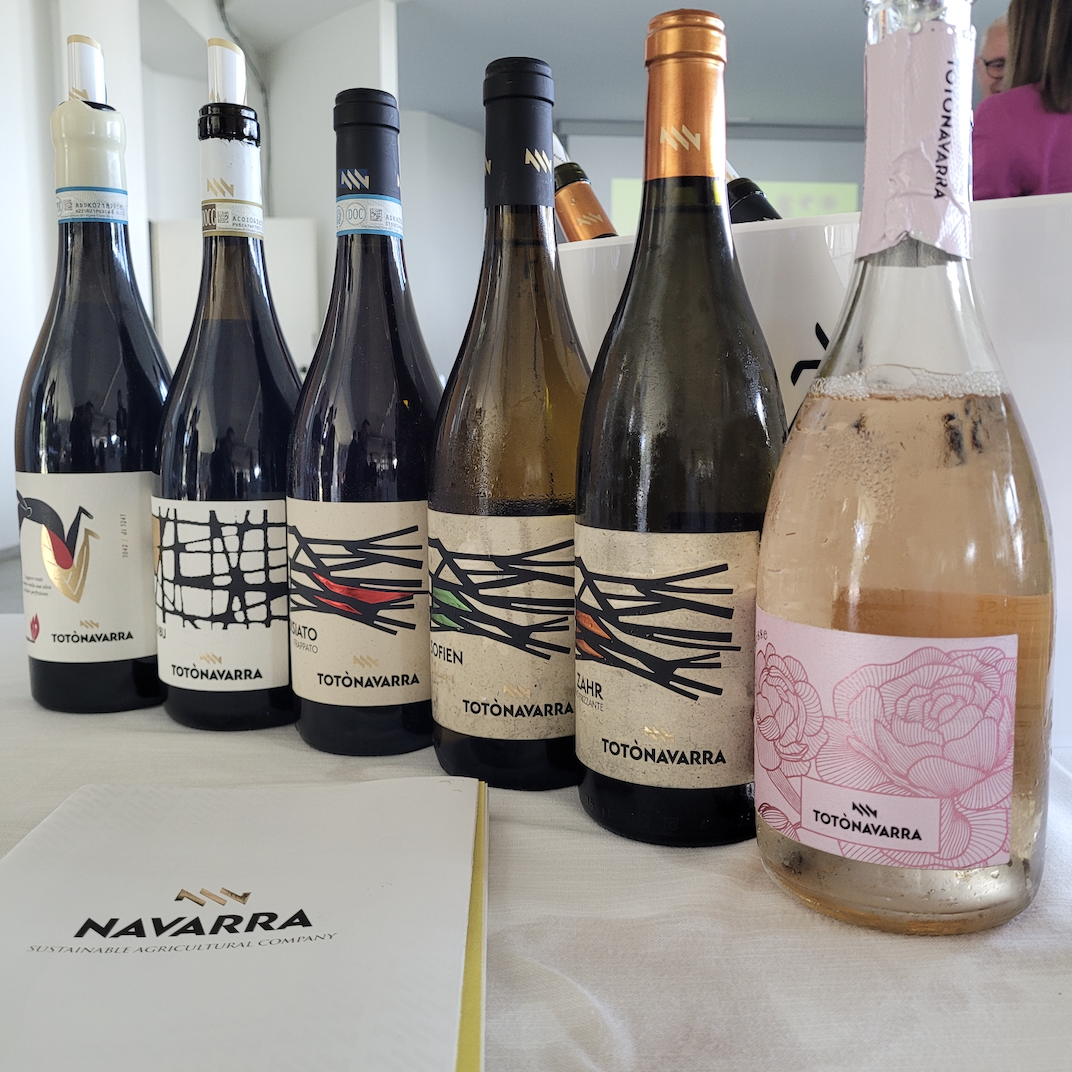
Tenute Navarra Rosemosse 2024, Terre Siciliane IGT

Full outward wave of red berry fruit, a capture of frappato in fizz, its mousse creamy and soft. Strawberries in cream, a shortcake because of some faux autolysis and pretty much just really simple. Holds a place for reasons like Valentine hearts and others that represent an amenability to all. Drink 2025-2026.  Tasted May 2025

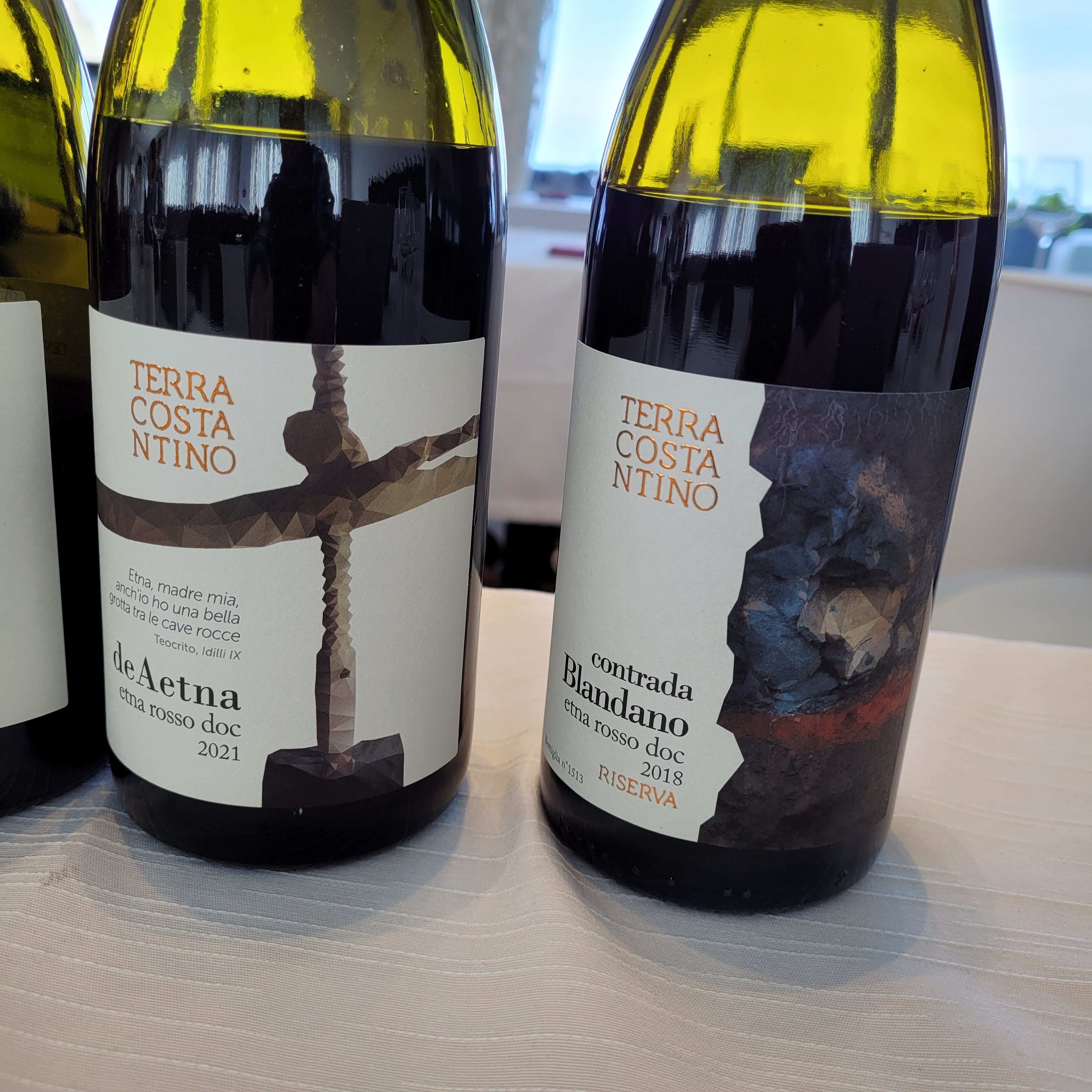
Terra Costantino Etna Rosato DOC deAetna 2024

Fine mix of fruity and also savoury elements, all understated and trickling forward, low and slow. If a fruit were needed to be invoked it would be white cherries, conjured from a quick soak and maceration before stripping away nerello mascalese skins while capturing both their perfumes and a modicum of their structure. For Etna this is the Provençal style albeit with volcanic properties instilled and made whole by natural processes. Come for the fruit, stay for the minerals. Drink 2025-2027.  Tasted May 2025
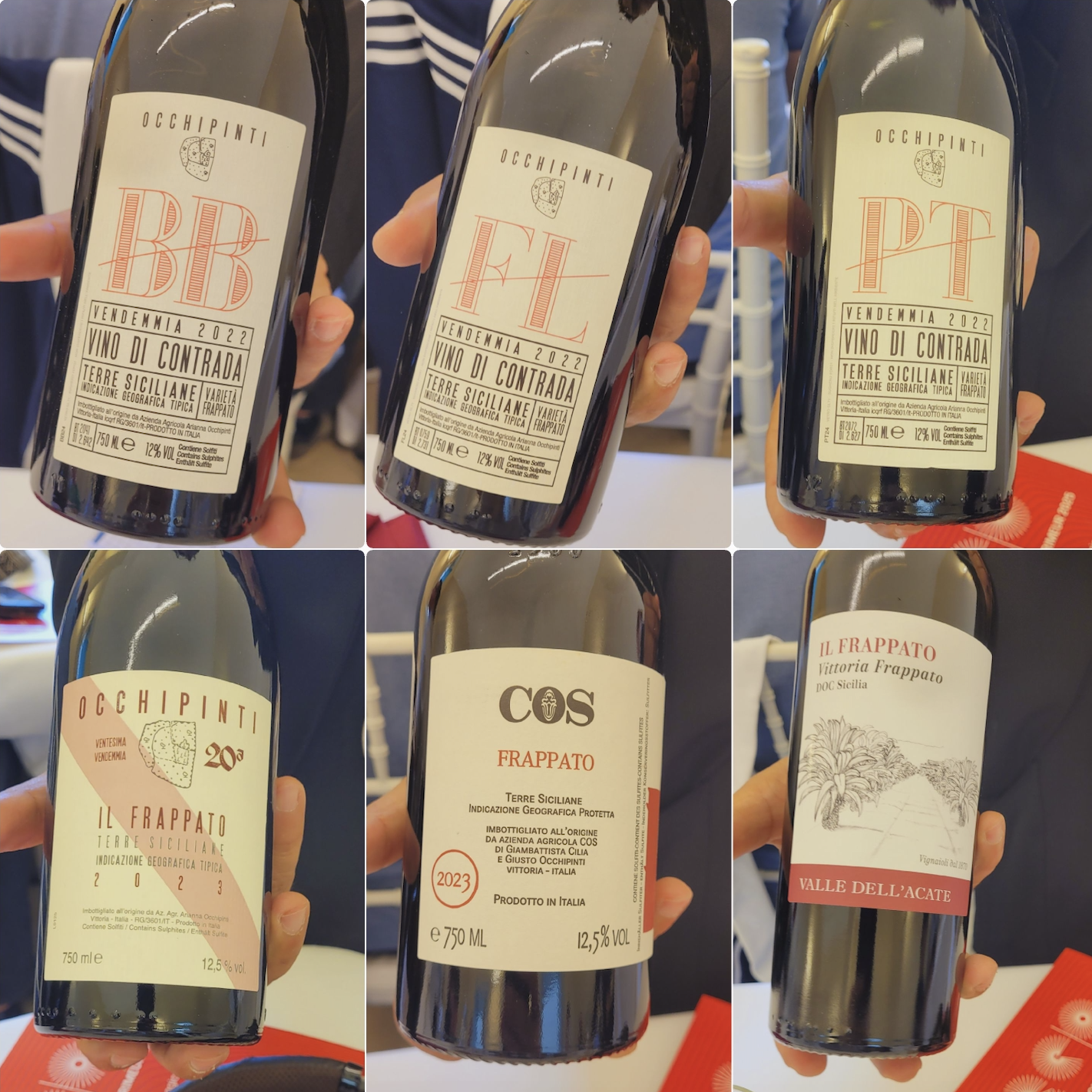
Rosso

Arianna Occhipinti BB Frappato Vino di Contrada 2022, Terre Siciliane IGT

BB, a.k.a Bomboliere feels like the OG for a contrada-designate frappato in the Vittoria occupied Occhipinti world, a varietal expression from the home front with more experience and acumen to treat all things equal, they being available and worthy of leaning against and leading towards ultimate balance. As here from a fine and rocking 2022, crunchy exterior and chewy interior, a Balsamico crust and mix of fruits captured within. Though the Villages frappato is the most accessible it is this BB that ranks as the most well-rounded and if there is any austerity it won’t cause any psychosocial pain. Yet BB is tannic enough to age, stirs up emotion and is truly representative as a best of all worlds wine, more so than either the FL or PT. Drink 2025-2033.  Tasted May 2025

Arianna Occhipinti FL Vino di Contrada Frappato 2022, Terre Siciliane IGT

Not all of Arianna Occhipinti’s three contrada originating frappato are created equal and FL (Fossa di Lupo) is the one with most up front and forward extending fruit. The fruit comes from just 15 year-old alberello frappato out of Arianna’s original six hectare vineyard. This from the outstretched arm of generosity, more like the Villages label than either the BB or the PT. More obvious as frappato and still there is some structure, high acid pulse, saltiness and earthy to funky beats. Likely owing to this soils of brown sand over limestone rock. Then again FL is cleaner and more understandable with varietal clarity, that which speaks to terroir, obviously and without equivocation. Drink 2026-2030.  Tasted May 2025

Arianna Occhipinti PT Vino di Contrada Frappato 2022, Terre Siciliane IGT

One of three contrada frappato for Occhipinti and immediately obvious how different (at least this PT, or Pettineo) is from the Villages label. Structured with impunity and its immunity keeps maturity at bay. Hard to believe how tight an expression this is when you consider the grape, but this contrada means serious terroir business. Of crucial significance is the fact that the less than one hectare parcel is home to the oldest (60-plus years) frappato vines in all of Vittoria. The vines grown on fine orange sand over tufa (a porous limestone) and the grapes are harvested ahead of both BB (Bombolieri) and FL (Fossa di Lupo). There is a volatility in PT that for some will be challenging to understand, though should patience be exercised than all will eventually be resolved and subsequently revealed. Drink 2027-2032.  Tasted May 2025

Arianna Occhipinti Frappato 2023, Terre Siciliane IGT

Frappato the solo artist is Arianna Occhipinti’s “Villages” red, a mix of contrada fruit for her classic or classico expression marking the entry point into her multifarious varietal world. The most crunchy and yet juicy frappato imaginable, high in intensity come to the world with open arms and in turn the world should embrace this wine. If your goal is either to introduce this most getable of grapes and/or a keen desire to enter the varietal gates then Occhipinti’s is the one. Come on in. Drink 2025-2029.  Tasted May 2025

Arianna Occhipinti Grotte Alte 2020, Cerasuolo di Vittoria Classico DOCG

Were Grotte Alte tasting blind you would not be judged for thinking you might have Brunello di Montalcino in your glass and from a producer with ancient wisdom crossed and forward thinking. A true terroir-driven Balsamico marks the entry and the construction is a bit severe which means the tannins are austere. Volatility swirls like sangiovese but here are nero d’Avola and frappato co-mingling in their rarefied air. Some will find the grip and the volatile elements severe and yet others will check their egos to wait and allow these grapes to be ratified and conjoined after years of settling and care. Choose the latter and great reward will follow. Drink 2027-2033.  Tasted May 2025

Cantine Fina Vitraolo Vino Rosso 2023, Terre Siciliane IGT

A purely Sicilian red wine, something of history, culture and remembrance, of freshness and sheer drink-ability. Tart for certain, that and a chewy character but without weight or density. The fiercest passion in an authentic, austere and rustic red. This despite a challenging vintage of heat, humidity and low yields. Drink 2026-2029.  Tasted May 2025
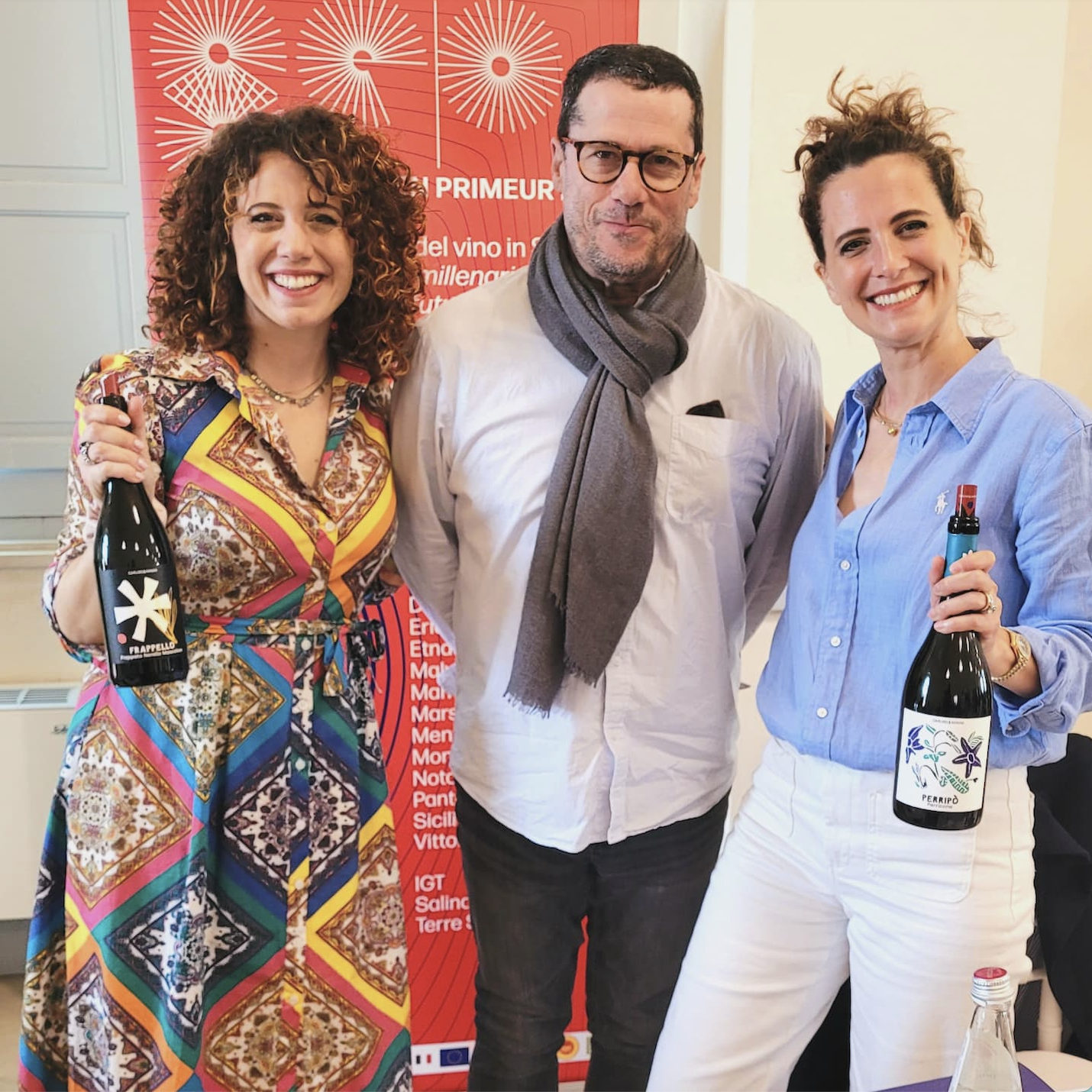
With Giovanna and Rosanna Caruso – Caruso e Minini

Caruso & Minini Perricone Perripo’ 2022, Terre Siciliane IGP

The pretty dabs of perricone perfume come easy out of the dialectical sounding and expressive Perripo’ because, well clarity and purity. Plump and juicy raisin to plum with more freshness than leathery feels and sneaky structure partially shrouded beneath. Proper varietal effort, vintage fun, in and out, especially with fine and gifting 2022 as the source. Really something unique, finishing at a local Balsamico, especially like mint. Drink 2025-2028.  Tasted May 2025

Caruso E Minini Frappello 2023, Terre Siciliane IGT

A blend of frappato and nerello mascalese, first vintage was 2004, now 20 years later, same strong colour contrast from the first to less out of the last. Tannins are the opposite and so the wine has remained the same. Gustatory in every way, “the wine for everybody,” says Giovanna Caruso. From a vintage “non facilisimo,” she says because of heat but Caruso E Minini’s growing zone sees strong winds to help maintain freshness in spite of the temperatures. Full and satisfying with really sweet acidity. Drink 2025-2027.  Tasted May 2025
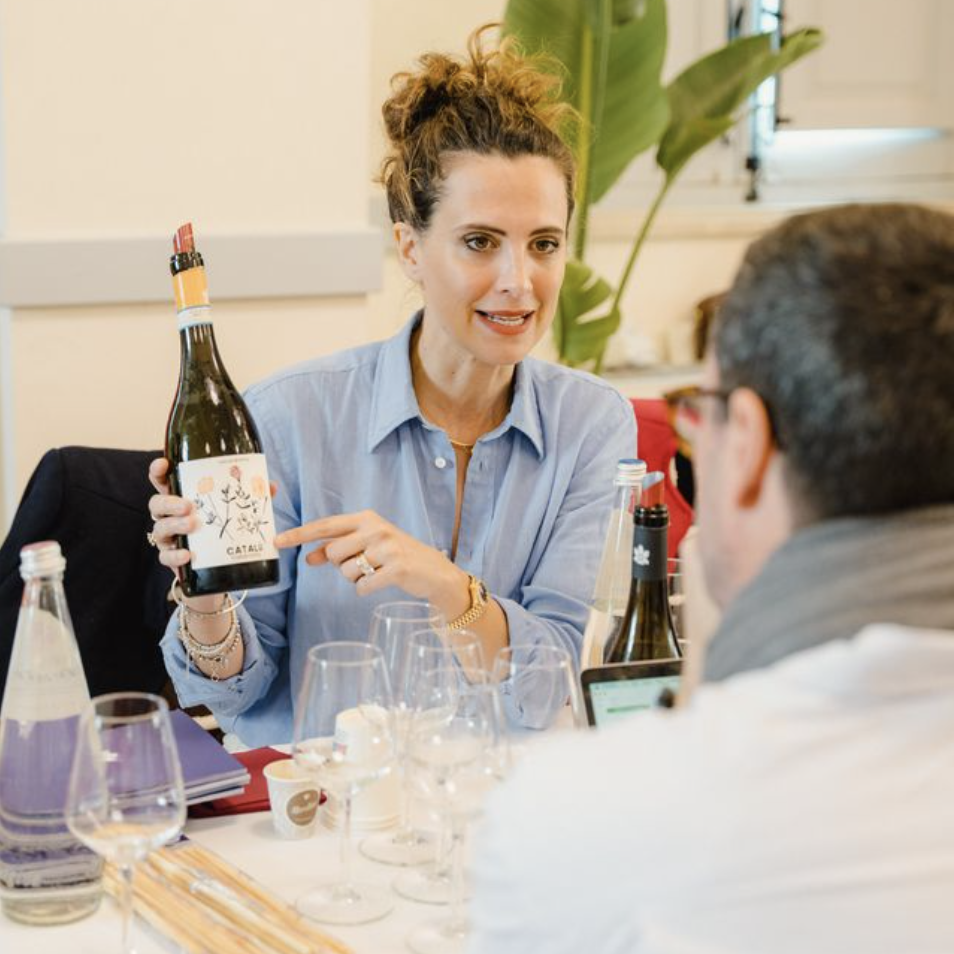
Tasting with Giovanna Caruso – Caruso e Minini

Caruso E Minini Nero d’Avola Sicilia DOC Vuvalà 2022

The solo nero d’avola from western Sicily where strong winds and sea air make for some of the saltiest on the island. Persistent keeper of faith and fruit freshness when it really wants to dry out and head into the local Balsamico. It does not but stays a most hospitable marine airy course. The vines also grow in round stones (very similar to Rhône Galets) which keep the soils cool. Delicious and dreamy for nero. Drink 2025-2027.  Tasted May 2025

Caruso E Minini Nino Rosso 2015, Terre Siciliane IGT

Four grape blend made in appassimento, a.k.a Amarone style in honour of grandfather and his red suspenders. Persistent and somehow still showing some fresh fruit despite the austerity and aridity created by the methodology. A juicy explanation to remind just how fine things can be when attention to detail and passion put collective hearts into making a wine. The mix is nerello mascalese, perricone, frappato and nero d’avola for just 7,636 bottles produced. Drink 2025-2030.  Tasted May 2025

Cos Frappato 2024, Terre Siciliane IGT

Beautifully clean, fragrant and fruit blossom perfumed frappato of immediate and seductive engagement. A whirl of controlled volatility, sweet acidity and carry over to palate flavours in mimic of the florals up front. All the fruit that could be desired, of a focus and a finesse to bely any pre-conceptualized DOC limitations and simply a varietal red you will want to taste and drink on a consistent basis, by the glass, to share with others and as a varietal teaching moment for what is possible. Drink 2025-2028.  Tasted May 2025

Cos Cerasuolo di Vittoria Classico DOCG 2022

Unexpectedly, remarkably and acceptingly fruit forward Cos Cerasuolo for which 60 percent nero d’Avola and (40) frappato occupy the same place and time. Sharing the stage of open generosity and to elicit immediate gratification. Welling with fruit (as opposed to bursting), expressive of skin muskiness and layered for notable purpose. That is to gift the DOCG by way of introduction and without challenge, neither by grip nor out of austerity. Drink 2025-2027.  Tasted May 2025
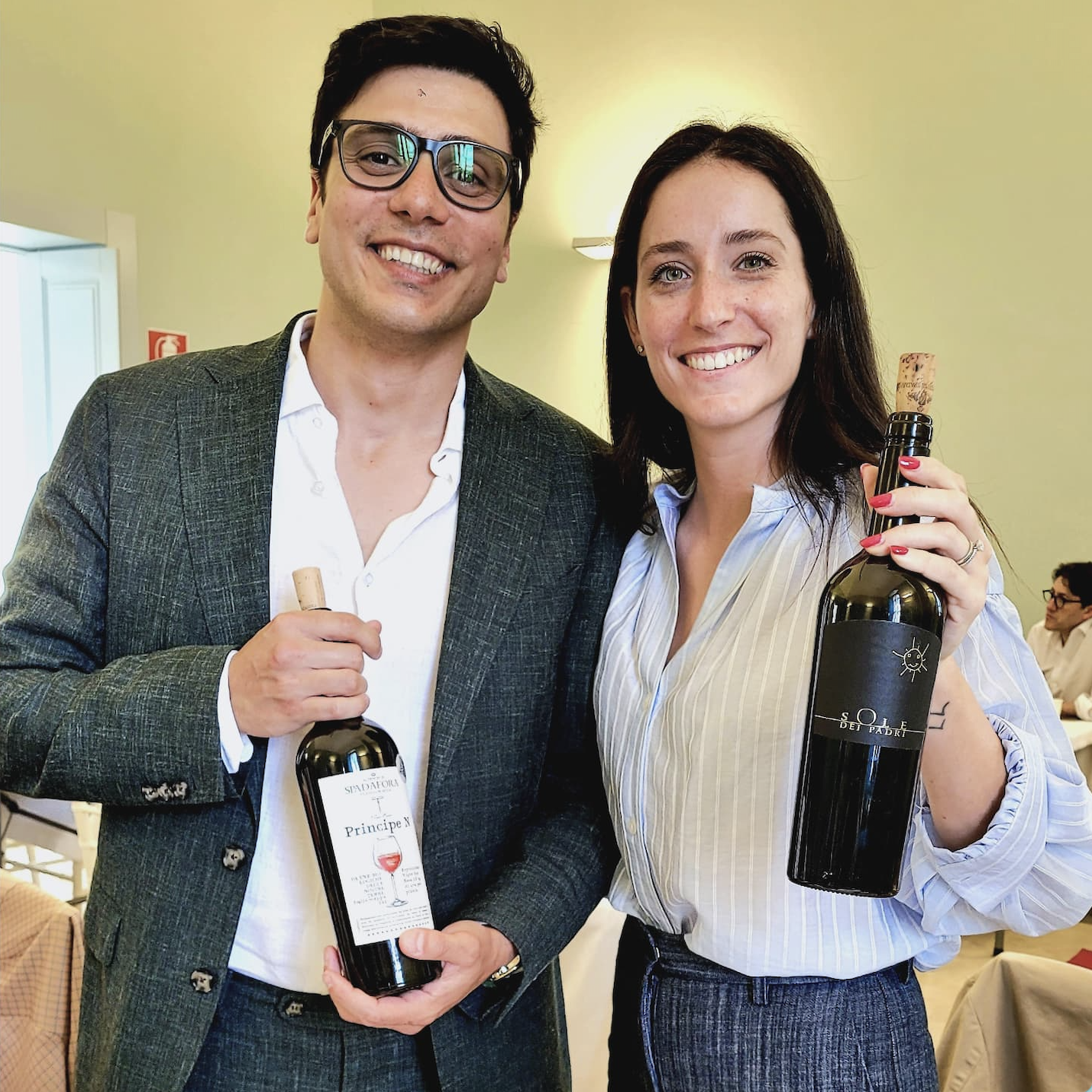
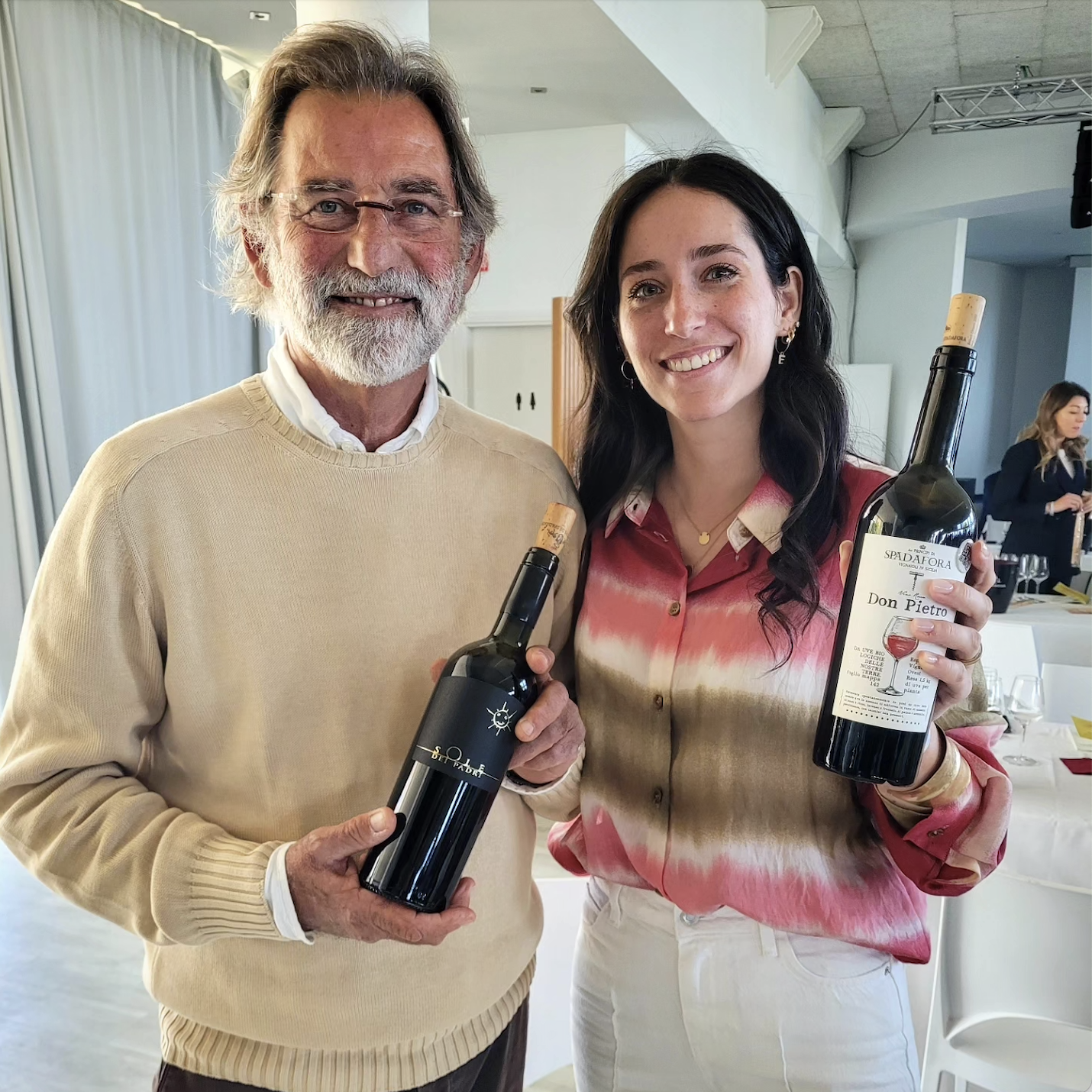
Gabriele Di Paola and Enrica Spadafora – dei Principi di Spadafora

Dei Principi Di Spadafora Vignaioli In Sicilia Principe N 2022, Terre Siciliane IGT

Only nero d’avola from concrete followed by steel though still not quite as expressive as it should be because of having just being bottled. From Spadafora’s central location towards the western half of Sicily of classic nero fruit from red through black, high acidity, intensity and spirit. Can’t wait to see what happens after another year (and even better two-plus) in bottle. Drink 2027-2031.  Tasted May 2025

Dei Principi Di Spadafora Sole dei Padri 2012, Terre Siciliane IGT

The first vintage of a signature red one year in bottle, only syrah from the highest vineyard on top of the hill at 450m. Very exposed with direct sun which would have been a challenge for nero and so, syrah. Richness at the height for grape and style, woody still and this is 2012 but freshness will persist and the wine will integrate. This may sound absurd but truth is truth and Spadafora likes old wines. As will you.  Last tasted May 2025

Sees one year in barriques and the rest in tank, bottled in July of 2022. Lengthy aging but just a short wood stay so don’t come expecting heavy vanilla, lavender or other French barrel notes. Come instead for the florals, spices, spiciness, liquid pepper, but no smoke. Chalky, tannic and all soil-related, created and driven. Can last for another 10 years. Clean and varietally obvious though not the iodine-meaty syrah kind. Perfume and texture are everything. Balsamico and mint at the finish. ”La terra,” shrugs Francesco Spadafora. Drink 2024-2034.  Tasted May 2024

Firriato Perricone Ribeca Sicilia DOC 2019

Singular styled perricone, about face and in complete opposition to those from both central and western Sicilia. Here more related to macchia and Balsamico, brushy, herbal, botanical, verdant and dusty. A stand alone and idisosyncratic varietal red that teaches so much about the triad of place, style and effect. You only need to taste to believe and be aware that this is the sort of Sicilian red to surely show up in masterclasses through time. Drink 2026-2029.  Tasted May 2025

Gulfi Cerasuolo di Vittoria Classico DOCG 2020

The aromas are all fruit skins, of 70 percent nero d’Avola and (30) frappato musky and dried fruit grippy. The aging time in bottle has done the work to bring this Cerasuolo into the initial stages of secondary character which means the ideal drinking window is right where you stand with bottle in hand. With thanks to steel and neutral oak there is just enough freshness and vibrancy to make it work. Drink 2025-2027.  Tasted May 2025
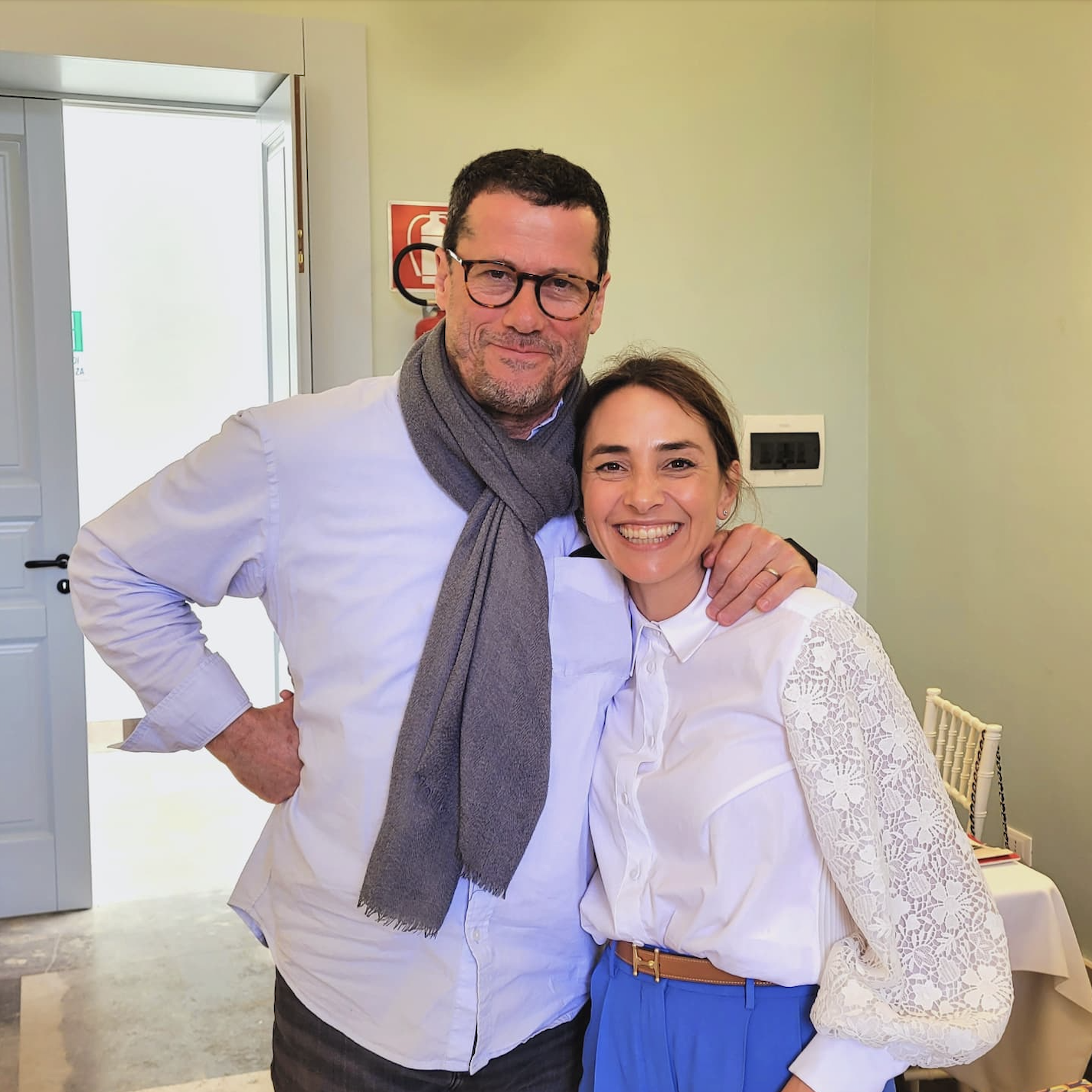
With Anna Ruini – Pellegrino 1860

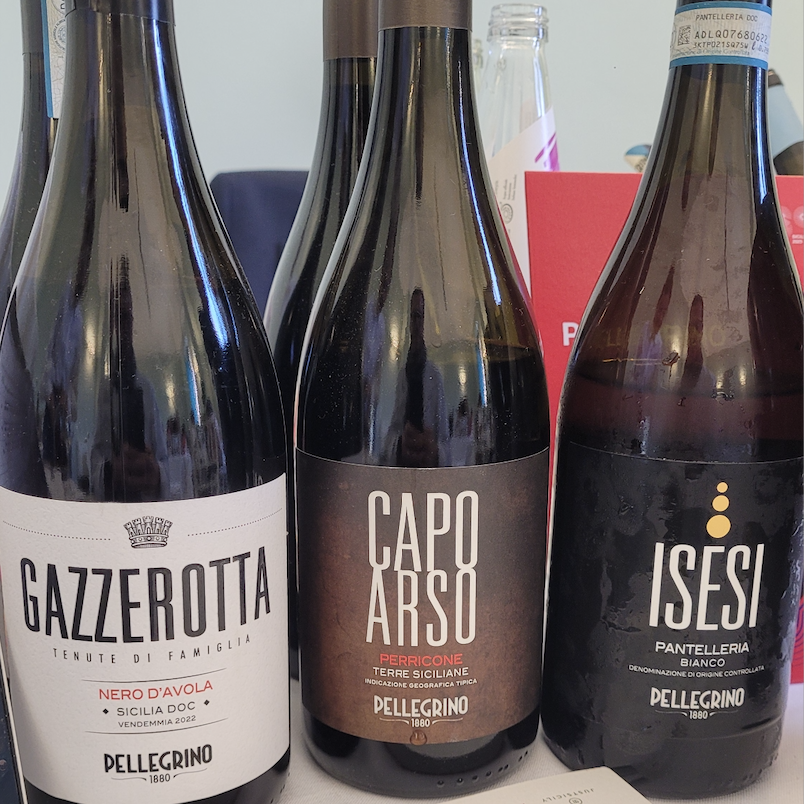
Pellegrino 1880 Perricone Capoarso 2022, Terre Siciliane IGT

And then, and now welcome to perricone from western Sicily at the hands of a producer with a long and winding history of research, development and investigation into varietal wines. Here this combination of spice masala and richness, low and slow developed flavours and macchia. A savoury event run through and many complexities to discover.  Last tasted May 2025

A varietal perricone, a.k.a pignatello, always strong and spicy, best raised in richer soils. Pellegrino’s is simply, unequivocally and unmistakably true to the variety, of a rustic edge and yet here undeniably pure as it not only should, but will be. Not a tannic example, nor is it particularly long, but it does what wants and needs. Drink 2024-2026.  Tasted May 2024

Pellegrino 1880 Nero d’Avola Sicilia DOC Gazzerotta 2022

From Pellegrino’s main estate near to Mazara del Vallo and Campobello di Mazara with views across the sea to Pantelleria. Rich, chalky and seriously spicy nero at the height of intense heights. A wine that needs time to settle into its skin and be good to itself. One made for good times ahead. And BBQ. Just sayin’. Drink 2026-2029.  Tasted May 2025

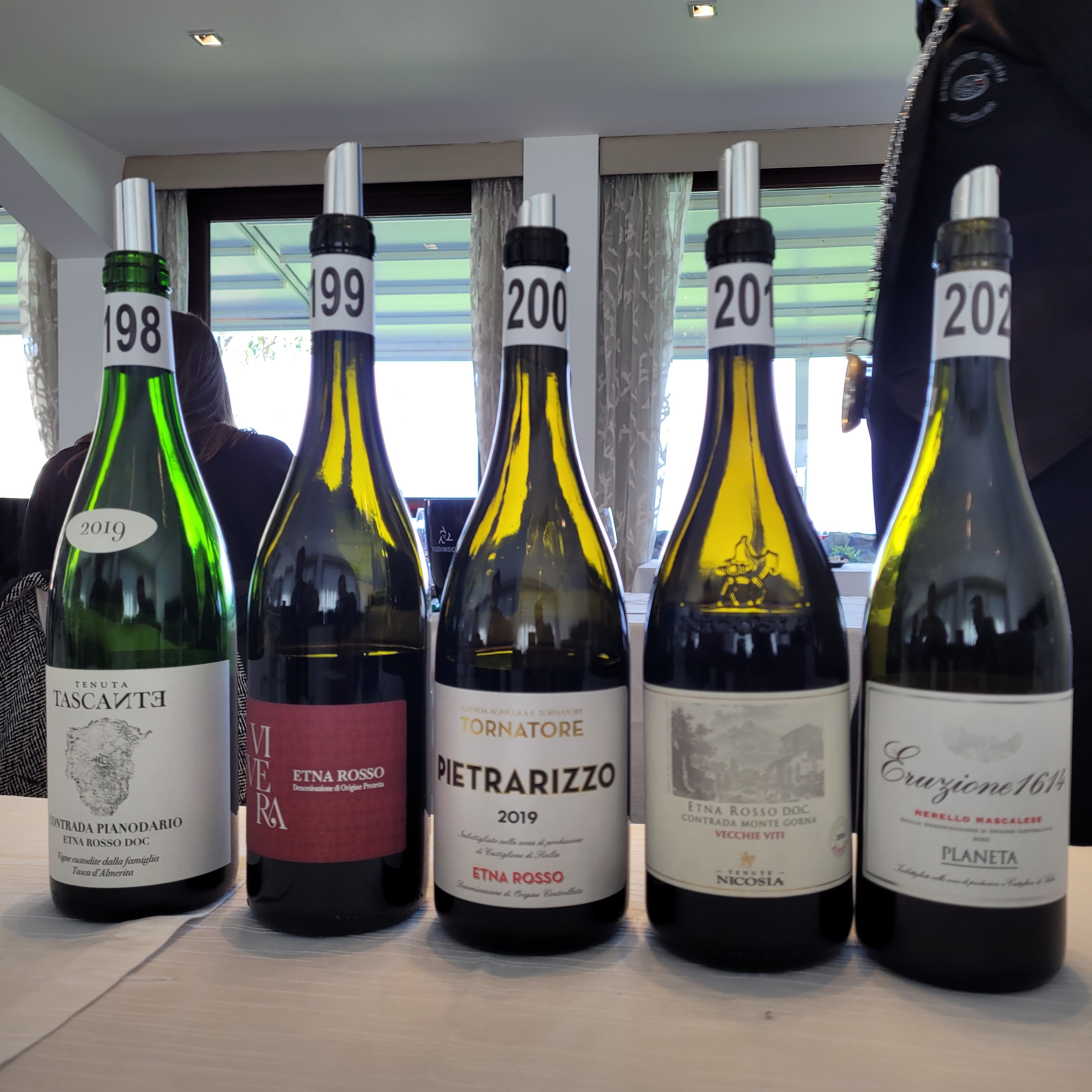
Planeta Eruzione 1614 Nerello Mascalese 2021, Terre Siciliane IGT

To be sure a different vintage than Feudo di Mezzo 2023, with two years in bottle and yet elevation (between 840 and 890m) does everything to create, install and define freshness for nerello mascalese aboard L’Etna. Time, barrel and place have come together and the volcanic sense of earth and rock is inseparable from the varietal fruit, even from a 2021 that in some other cases is having a time maintaining its distinction. Eruzione is a lone wolf, a nerello as if by blood dripping from the animal’s mouth. Drink this with iron-rich meat – Fegato, either as Pâté or skewered and grilled. Drink 2025-2031.  Tasted May 2025

Planeta Nero d’Avola Sicilia Menfi DOC Plumbago 2022

If only because tasting with the team at Planeta is equal parts revelation and comedy, it’d hard not to think about and invoke finning things. Like “I want you to cut down the mightiest Plumbago in the forest…with a herring!” But not too big. But this is the biggest of the Plumbago because the vintage gave great heat and therefore the Plumbago shrubbery could not help but take over the entirety of the savoury elements in this nero d’Avola. Full on Menfi Balsamico, or an otherwise named local macchia, like fragrant hay, a.k.a. Plumbago. Drink 2025-2031.  Tasted May 2025

Principi di Butera Inzolia Serò Sicilia DOC 2018

Varietal insolia and from the central Sicilian producer having long ago made the decision to see a white variety that should and can age. Made in a reductive way, now into full on flint and smoulder, a lit paraffin note meeting something petrol-like in the wild ways of sémillon. Surely as curious as it is inviting and while by itself there is this feeling of curiosity it’s all in fine and helpful fun to enjoy when the timing is right. Which can be said for 2018 right now and so a good choice to pour at Sicilia en Primeur 2025.  Last tasted May 2025

A new soil which is both a blessing and a curse, a pain and a joy to work with. Quality comes from lower yields and specific soils. Here insolia grazes into hyper-metallic and mineral territory, protected from the heat of the sun, in avoidance of saturated copper, sunflower and gilded gold. Very short skin-contact and nurturing care turn insolia into this, sapid and even salty, expressive of the calcareous soil and the sea breezes coming from a mere eight kilometres away. Drink 2019-2023.  Tasted May 2019
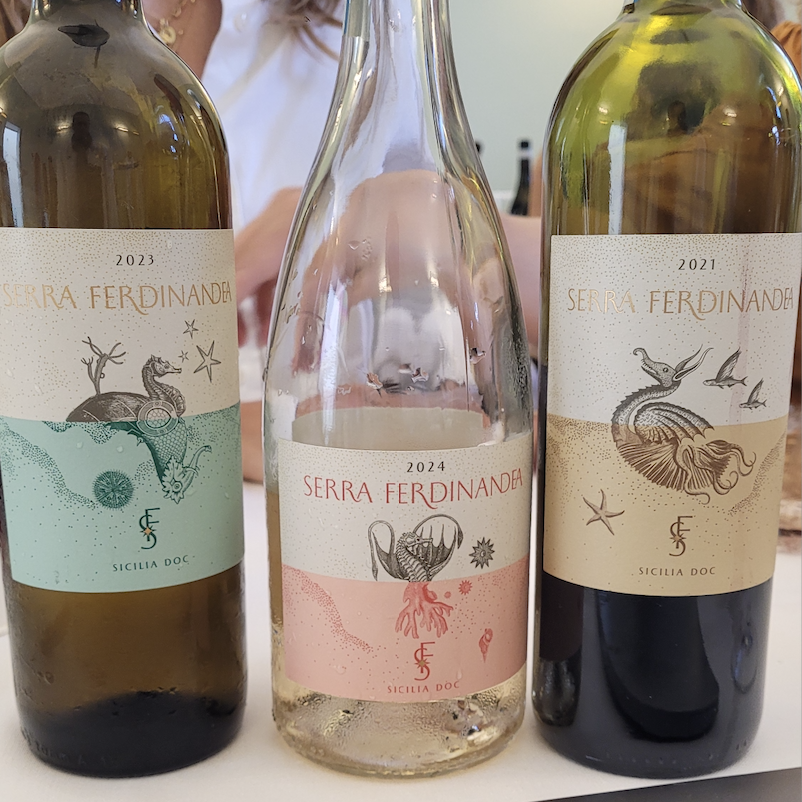
Serra Ferdinandea Rosso Sicilia DOC 2021

Still from a time when the team was working with young vines and not yet having reached the point where they could express the true nature of Serra Ferdinandea. Of syrah set to elevation and nero d’Avola, the latter planted in the windiest and driest place. This for fruit meeting backbone and the hope they will find each other, layer, integrate and create spemthing special in their shared space. The style is invoked even if the full finesse is not yet found. Oh so close to what really matters and whole bunches used in 2022 will help encourage this next level of reality. Rosso at stage one is primary, a work in progress and a harbinger for what is to come. Just a bit woody and chalky-grainy at this time. Drink 2026-2028.  Tasted May 2025

Tasca d’Almerita Tenuta Regaleali Rosso Del Conte 2020, Sicilia Contea Di Sclafani DOC

One of Sicily’s most famous red blends with a track record for aging, of nero d’Avola and perricone out of Tasca’s grand Vigna San Lucio. The large block was first identified and isolated in 1959, now 60 years into its tenure. Aging is multifold, in chestnut barrels, Slavonian cask and small French wood. This 2020 is officially the 50th anniversary of the Rosso del Conte label with one of the most developed richness of them all, all the while maintaining its recognizable grace and every subtle aspect its always meant to express. Poise and focus but also impressive fitness. Will age two decades. Drink 2026-2036.  Tasted May 2025
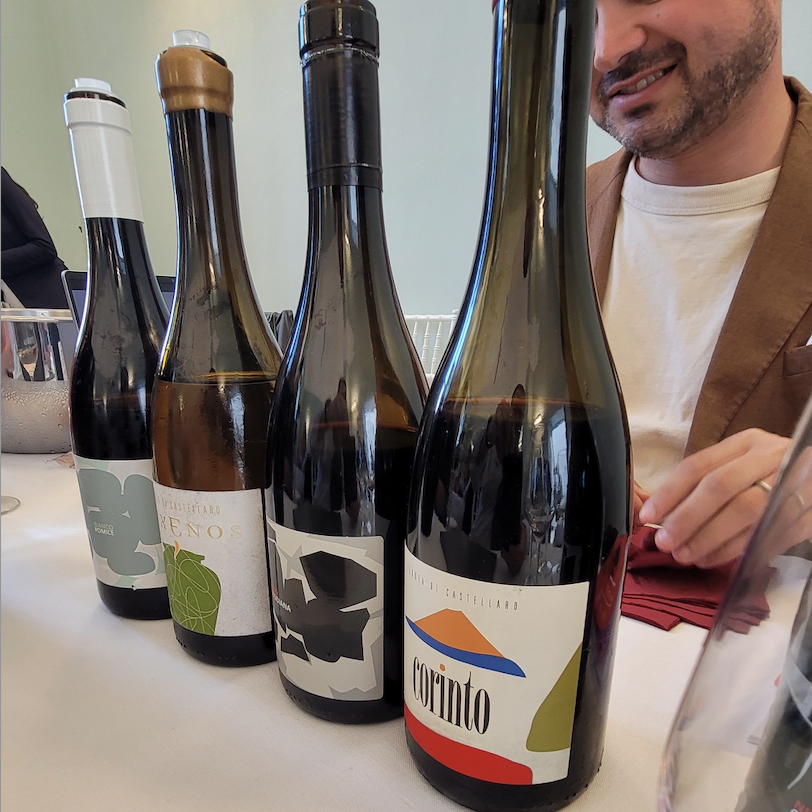
Tenuta di Castellaro Nero Ossidiana 2022, Terre Siciliane Rosso IGT

From Massimo Lentsch’s Lipari Island winery with the seedless grape corinto (well actually one central seed) which means high acidity, low pH and also tannin. Not to mention lessening of alcohol that barely reaches 13 percent. A spoonful of nero d’avola augments but changes the sharp and basaltic obsidian nature of the wine. Sees 18 months in cask and you can serve this lightly chilled. This due to the relative low tannic profile and elevated acidity which also means juicy, summery and fresh. Don’t let the colour fool you. Drink 2025-2028.  Tasted May 2025

Tenuta di Castellaro Corinto 2021, Terre Siciliane Rosso IGT

Pure corinto, seedless and more straightforward than Ossidiana but both are made for drinking cool, fresh and long. A bit more rusticity and also richness because there is some (third passage) tonneaux aging involved in the maturation. More tannin but still nothing austere or causing any real tension. Just 3,000 bottles made of this unique Lipari red. Drink 2026-2029.  Tasted May 2025

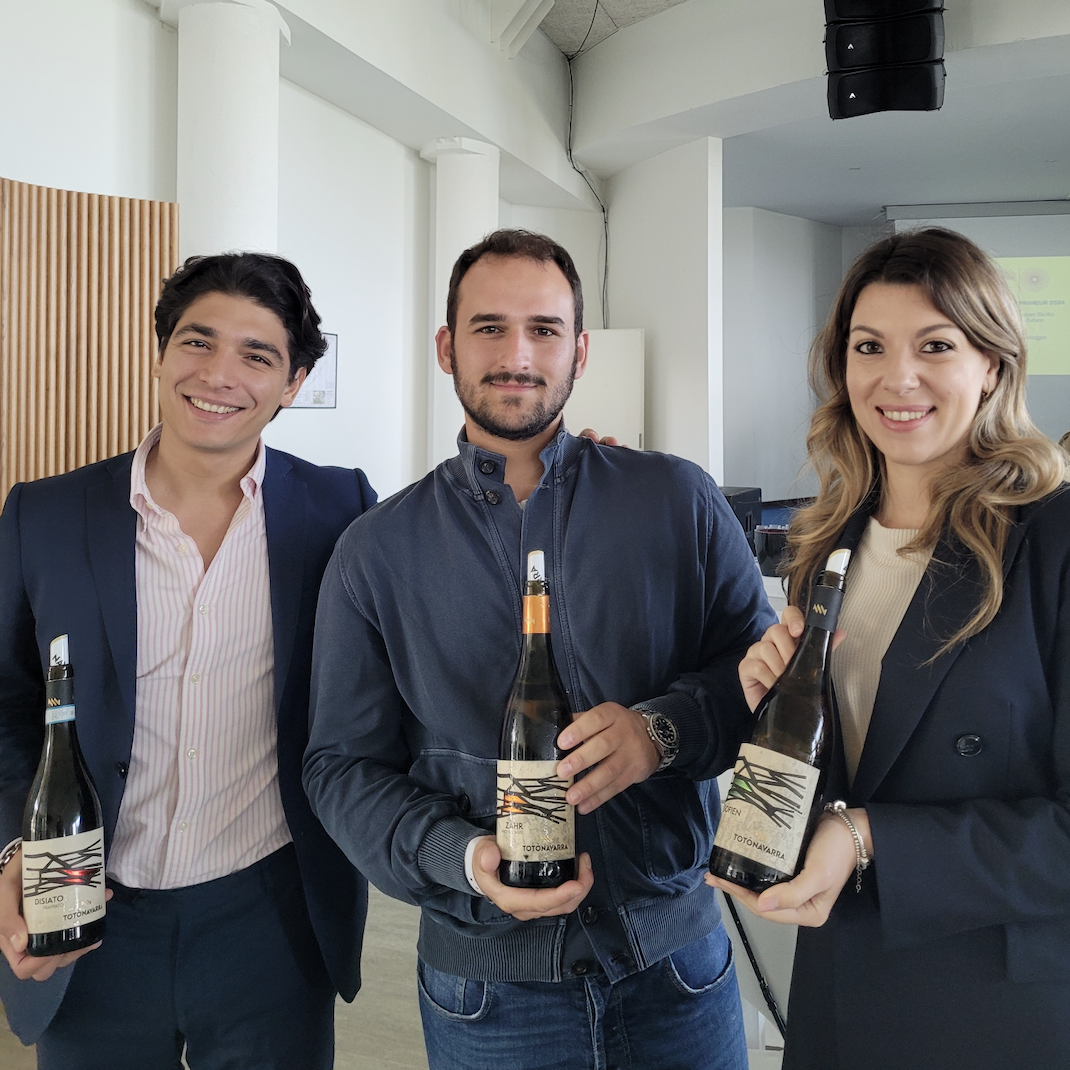
Tenute Navarra Disiato Frappato Sicilia DOC 2024

Riper fruit, dark and later picked, rusty edging for black cherry style. Easy style of frappato but surely readied sooner and with more colour needs than fruit substance as compared to many. No sense holding onto any of these bottles. Drink up. Drink 2025-2026.  Tasted May 2025

Vall Dell’Acate Frappato di Vittoria Frappato 2024, Sicilia DOC

Extremely fruit evident and forward, distinctly frappato as its varietal source, a dictionary entry and open window into its Vittoria world. Crunchy red, of pomegranate, cranberry and red crabapple, tart and juices flowing for thirst quenching activities. Open the wine glossary to “F,” scroll down to frappato and this wine may very well be there to explain what it is you are tasting. Drink 2025-2027.  Tasted May 2025

Vall Dell’Acate Frappato Vigna Bidone Sottana – Vino di Contrada Vittoria Frappato DOC 2024

The single vineyard slash contrada wine is a different beast as compared to the Vittoria DOC “Villages” label because it really is a tannic beast. The fruit chosen must surely be blessed with a certain ability to work with austerity and depth in its tannins. Vigna Bidone Sottana is both harder to approach and currently unclear to comprehend. A crusted exterior holds importance within, of fruit and acidity in layered composure and intendment, each working through machinations together and for a later, greater purpose. Needs a year, better yet two to come together and begin to express itself. Drink 2027-2032.  Tasted May 2025
Bianco

Alessandro di Camporeale Catarratto Monreale DOC Mandranova 2020

From the cru called Mandranova in Monreale and a a little portion of tonneaux used to induce flesh but also texture and expand the possibility for some time in bottle. Ambitious to a degree but there is no taking the place out of the wine. Stone fruit pulpy, sapid, sweetly herbal and with citrus meandering through lemon, lime and mandarin. Check back in two years. Drink 2025-2028.  Tasted May 2025

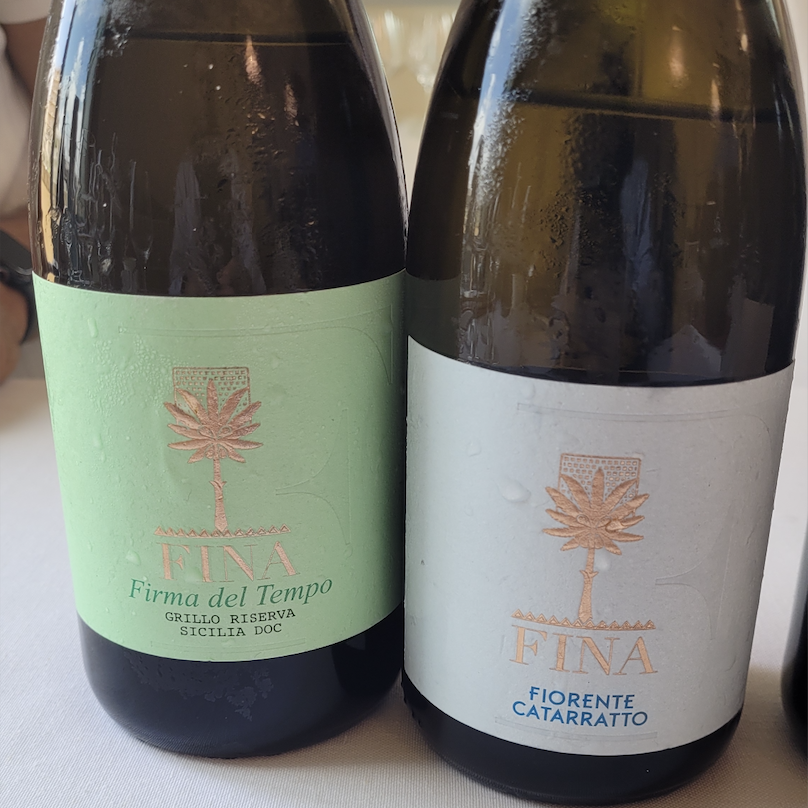
Cantine Fina Catarratto Fiorente 2024, Terre Siciliane IGT

From the most northern zone for Fina and yet distinctly western Sicilian in origin, style and effect. A bounce back vintage for the winery and ideal for the grape to express its sense of place. Crunchy and salty, mineral and satisfying. Drink 2025-2028.  Tasted May 2025

Tasting with Sergio Fina – Cantine Fina

Cantine Fina Grillo Firma del Tempo Sicilia Riserva DOC 2023

A stand out and alone grillo because Riserva and therefore we intuit part of the ferment being sent to wood. An ambitious way to approach the variety, to give it the chardonnay touch for a fuller, richer and even buttery expression. French barrel but still there is the marine saltiness and sandy soil inscriptred sapid character. You can take grillo out of Trapani but you can’t take Trapani out of the grillo. Drink 2025-2029.  Tasted May 2025
Cantine Fina Grillo Kebrilla Sicilia DOC 2024

The second of two grillo, also raised partially in steel and part in French wood. The younger and fresher one, with green apple bite, more sapidity, less wood and similar styling. Crunchy and with green Chile capsicum bite on the back end. Just a bit overdone yet without the concentration of Riserva. Drink 2025-2027.  Tasted May 2025

Caruso e Minini Grillo Lillo Sicilia DOC 2024

Hard not to see this as vehemently Western Sicilian grillo, from the sea and the winds for a slice of experience but also one that assimilates some skin musky aromatics to enhance the grillo fruit. Ideal mix of salinity and sapidity with some metal at the finish. Never a wrong time for a sip of Lillo. Drink 2025-2027.  Tasted May 2025

Giovanna and Rosanna Caruso – Caruso e Minini

Caruso e Minini Catarratto Catalù Sicilia DOC 2024

Not only unique for catarratto but authentic and existing right at the heart of the concept of ARCA, “associazione regionale catarratto autentico.” The story of grape coming from place with its marine airy and salty entry morphing through rusty fruit, citrus, fennel and finally into a sapid, botanical finish. Drink 2025-2028.  Tasted May 2025

Dei Principi di Spadafora Vignaioli in Sicilia Catarratto 2024, Terre Siciliane IGT

The catarratto is timeless and you can drink it any time of the day. Literally and expalins Enrica Spadafora, “in our area the freshness of the land is what determines what comes from the grape and place.” A bit tannic however, sneakily so and things will change if you allow them to. Drink 2025-2028.  Tasted May 2025

Dei Principi di Spadafora Vignaioli in Sicilia Don Pietro Monreale Bianco 2024

Only catarratto which qualifies as a varietal wine for the Monreale denomination, no longer inclusive of grillo, from concrete to steel in terms of fermentation and maturation. The feeling of skin contact is palpable even though it is just four days because a salve texture and tannic profile settle into the palate. Still the acidity and freshness are preserved for a balanced varietal wine. Drink 2026-2029.  Tasted twice, May and June 2025

Dei Principi di Spadafora Vignaioli in Sicilia Principe G 2021, Terre Siciliane IGT

Just grillo and six months on lees for body and spirit with time having brought about some maturing notes to create great varietal curiosity, like preserved pears or peaches and a settling on the palate. Persistent but not of a waxing energy per se. Plenty of texture and flavour to mull over, on and about. Drink 2026-2029.  Tasted May 2025

Feudo Montoni Inzolia Sicilia DOC Fornelli 2024

A rebound vintage but at Feudo Montoni consistency is king because Fabio Sireci will never force a square peg into a round hole. The 2024 season was an easier fit to produce varietal wines as he sees fit, here with that great mix of the salty and the sapid. Just spot on and poured at the right temperature inzolia is just so, so good. Drink 2025-2028.  Tasted May 2025

Feudo Montoni Catarratto Sicilia DOC Masso 2024

Sharp catarratto, cut through fruit and palates like a knife, a specific mineral that of course is a bit saline but in catarratto it’s really all about sapidity. Fabio like his whites with some austerity and this is the white that has the most, with bitter almond notes come out in the aroma, as marzipan at the finish. This can age, you better believe it. Drink 2026-2031.  Tasted May 2025

Feudo Montoni Grillo Sicilia DOC Timpa 2024

More aromatic than catarratto, not quite moscato floral but scenting yellows and whites, a honeysuckle imagined with lemon citrus blooms. Still ’24 grillo is taut with vague austerity (thought not catarratto austerity) and as with all the Montoni whites the grillo too is so very linear and vertical. Drink 2025-2029.  Tasted May 2025

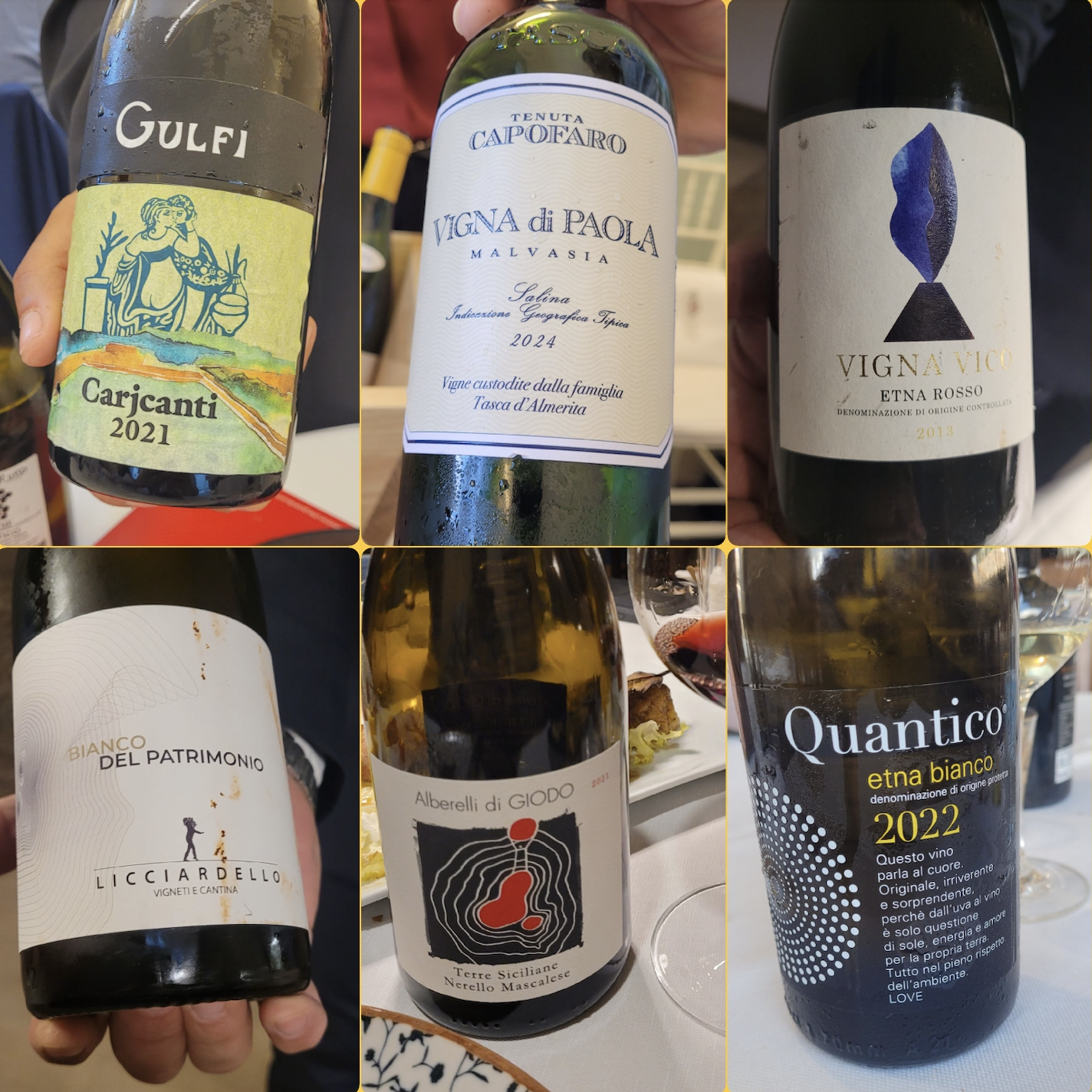
Gulfi Carjcanti 2021, Terre Siciliane IGT

From the wine with the dialectical name for carricante and a beautifully bittered tincture that speaks to sunshine for fruit first and volcanic feels second. They come together but will only improve their relationship with tome in bottle. Drink 2026-2029.  Tasted May 2025
Pellegrino 1880 Grillo Sicilia Superiore DOC Senarià 2023

Senarìa means “cold” for a clone of grillo planted in 1980 ’s since been propagated by Pellegrino for more hectarage. The only grillo produced as a superior in Sicily with age and clonal specificity creating the identifiable DOC. Almost like serious chardonnay in style and effect, a Burgundian bite and crispy character that’s part unexpected and part intense. The richness comes from the palate, as it should for a two-part experience growing and will continue to grow in stature. Drink 2025-2028.  Tasted May 2025

Pellegrino 1880 Isesi Pantelleria Bianco DOC 2022

A Bianco in which zibbibo is the key with altitude and exposition to the winds being the catalyst. Different plots in several contrada are chosen as contributors of their varietal fruit expressed as a white wine that should and will age for years. Falls into the semi-aromatic, cousin in style to moscato sort of way and the tannins lay really low. They are the underscore, the horizontal backbone that fruit but also acidity glide over and develop their motion. This is a wine of journey, never static and one to look forward to tasting when it passes five to ten years of age.  Last tasted May 2025

Pellegrino 1880 Vergine Marsala Riserva DOC Single Barrel Nº 018 2005

Vergine means marsala fortified with soy alcohol and as Riserva (2005) it means more than 20 years of aging. Mainly grillo with (30 percent) catarratto and inzolia, limited production, 2,163 bottles and finished at 19.5 percent alcohol. The sugars developed could imagine honey, brown sugar or maple syrup but they are so much more complicated and therefore unnamed. Also fruit like apricot and pineapple but think moire exotically or better still just admit that something unusual and ethereal is happening. The palate is dry as the desert, the flavours, brown butter nutty, intense and spicy. This is not a dessert wine by any stretch of the imagination but something much more gustatory and ready to receive culinary inspiration. Drink 2025-2040.  Tasted May 2025

With Planeta winemaker Patricia Tóth

Planeta Eruzione 1614 Carricante 2022, Sicilia DOC

At a time it was the high elevation and now it’s really more about the established appellative functionality that dictates the specific DOC labelling of Eruzione 1614. There are varietal carricante on L”Etna and there is Eruzione, a Bianco as definitive to tell an old story and relay the message of soil, stone and place. The 2022 is exceptional, rising and seemingly hovering above the ground, something very hard to do for fruit grown on volcanic terroir! Yet here is this levitating Etnese, a Bianco of weightlessness and incredible acidity. Will drink well for five years, in another terrific alternate state for five more and then who knows what magic through five more after that. Drink 2027-2037.  Tasted May 2025

Planeta La Segreta Bianco Sicilia DOC 2024

Ninety percent of the blend is three-fold, of grillo, grecanico and chardonnay, plus 10 percent “others” which includes the aromatic viognier. All adds up to one of Sicily’s most drinkable whites and there can be no argument there. Cool, chill, kick back, sip and relax. Here, there and everywhere. Put on the Beatles or whatever makes you tick. Just drink it. Drink 2025-2027.  Tasted May 2025

Planeta Chardonnay Sicilia Menfi DOC 2023

Warmth begets riches and yet 2023 is not the warmest of Ulmo vintages but chardonnay has so much experience, developed vine age and proven track record to get into this full and substantial place. Without fail and the fans of this large production Sicilian pioneer will again be granted their wish. Chardonnay is big and it is grand, with the benefits of barrel and sun, all in balance. Drink 2026-2029.  Tasted May 2025
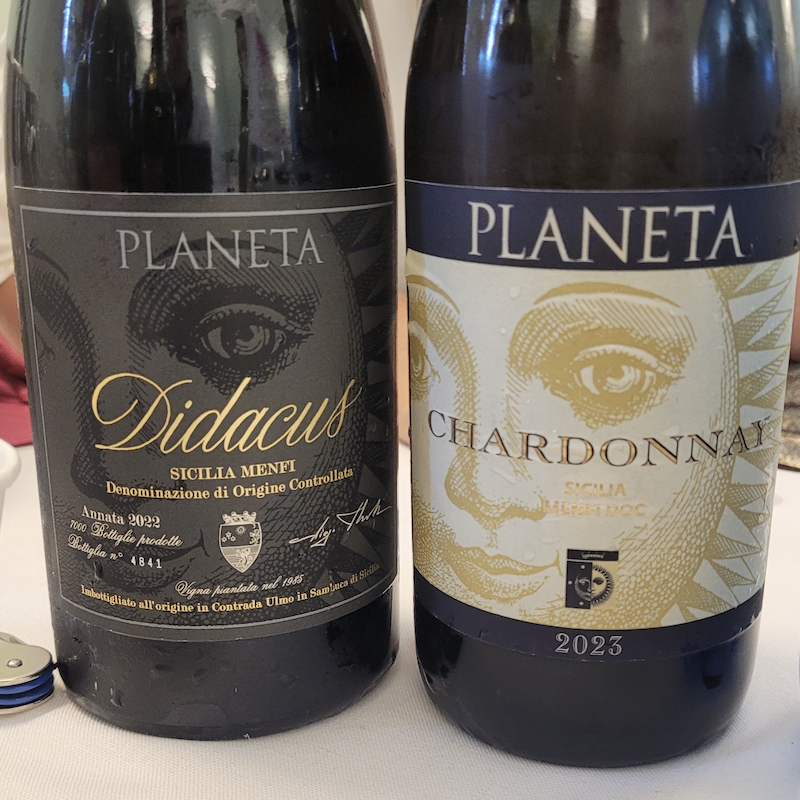
Planeta Chardonnay Sicilia Menfi DOC Didacus 2022

For Didacus chardonnay rises to the island’s highest level because it receives the respect and elévage it so deserves. Hard to find a vintage as firm and as tight as 2022, weather related of course with heat units having come fast and intense, but also elongated through to the earliest pf picking times. That would be the first week of September and thankfully so because acidity keeps the dream alive. Didacus is drinking at peak right now – do not sleep on it’s power or potential and find a way to get there now.  Last tasted May 2025

Production began in 1995 while the vines are now nearly 45 years of age. In the southwest part of Sicily, in the Ulmo area around the village of Menfi where a corridor of wind, “our favourite friend,” tells Santi Planeta, blowing through between the lake and the sea. Through vines growing between 100 and 450m, breathing cool life, especially in the summer. The 2022 vintage saw plenty of rain though not concentrated at any particular time and so the constant events of moderation were something remarkable considering how often extreme climate events are increasingly more prevalent. The coming vintage of 2023 and 2024 will be affected by them, mostly because there was no rain. This chardonnay is impeccably balanced between fruit and acidity, acidity and texture, texture and tannin. The progression is seamless, the result precise and anyone who does not the recognize the experience and continued work put in may not be paying close attention. That’s fine but know just how special a (relatively) large production, semi-cool climate chardonnay this truly is. Planeta’s year-to-year consistency is truly impressive. Drink 2024-2028.  Tasted at i4C, July 2024

Serra Ferdinandea Bianco Sicilia DOC 2023

A 50-50 split between grillo and sauvignon blanc from a season with drama because of early heavy rains and yet there no Perenospera (mildew) developed up on the vineyard’s hills. In this vintage the directness and linearity of the sauvignon takes control but this is also the style, from clean maceration for a capture of saline intensity to keep fleshy and golden maturity at bay. The grillo plays along but never speaks up or steps out of place. Drink 2025-2027.  Tasted May 2025

Tasca d’Almerita Tascante Chardonnay C’Eragià 2022, Sicilia DOC

Etna chardonnay made with French wood completely un-toasted out of Rampante where a chardonnay vineyard already existed when Alberto Tasca bought the estate. The wood is virtually unnoticeable, lemon attacks the palate and the energy is simply great. Graceful while volcanic spirit adds the intangible pizzazz. Drink 2026-2029.  Tasted May 2025

Tasca d’Almerita Fondazione Whitaker Grillo Mozia 2024, Sicilia DOC

Grillo from Mozia island off the coast of Trapani and Marsala, the only important variety and 40 year-old vines for the most unique expression of the grape. An ancient expression if you will and quite possibly the saltiest of them all. Some will find this sharp and austere but there is sneaky richness and intensity that belies the sear and strike of the grillo. Drink 2026-2029.  Tasted May 2025
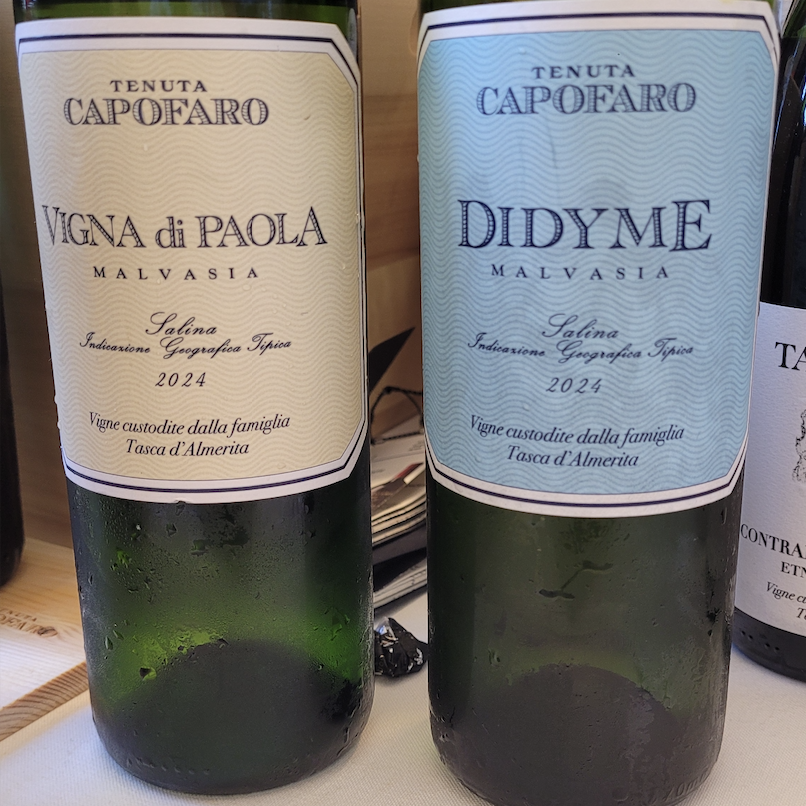
Tasca d’Almerita Tenuta Capofaro Malvasia Vigna di Paola 2024, Salina IGT

Saltier and more vertical of the two Salina malvasia, less fleshy but also juicy character, instead a more briny caper measure and mix of marine elements. Volcanics come into the soul of this malvasia with impunity and the mineral austerity is nothing short of intense. If Didyme intoxicates it is this Vigna di Paola that takes full control of your senses. Drink 2026-2029.  Tasted May 2025

Tasca d’Almerita Tenuta Capofaro Malvasia Didyme 2024, Salina IGT

Iron volcanic sands make for vines and grapes that develop a relationship only Salina will own, different even than Lipari and in terms of malvasia there is nowhere else in the varietal diaspora where it comes way like this. A mineral that gets in you, an intoxicant that runs through the veins and causes a true stoning. Imagine capers and ricotta, shrimp and lime. It’s all there in sweet, salty and semi-aromatic intensity. Drink 2026-2029.  Tasted May 2025

Tenuta di Castellaro Bianco Pomice 2024, Terre Siciliane Bianco IGT

A blend of malvasia (della Lipari) and carricante as an extremely youthful and so in certain ways playing the part of a 2024 preview although it’s a finished wine. There really is nothing like this, nine months on lees with bâttonage every month. Consider this as “Etna Bianco plus” with more marine influence, a spirited buzz about it and a fleshiness matched by this mix of flint and isle mineral feel. Just bloody delicious. Drink 2026-2029.  Tasted May 2025

Tenuta di Castellano Eúxenos 2022, Terre Siciliane IGT

Just malvasia di Lipari, ”lightly” fermented on skins in one cacciopesto amphora, a lightly permeable type for just 1,800 bottles. Simulates an imagining of a history of sunken greek amphora and so a message is felt and transmitted for making a wine that just needed to be made in reference to the lore. Ultra textural and a fascination with fate that requires one to abandon a perspective firmly embedded within a knowable methodology of winemaking culture. Drink 2026-2029.  Tasted May 2025

Tenuta Regaleali Catarratto Sicilia DOC Buonsenso 2024

Intensity and concentration of sweetly herbal and salty fruit with persistence as much as any varietal wine in Sicliy. Happens to be catarratto, one so full, expansive and linear. Drink 2025-2028.  Tasted May 2025
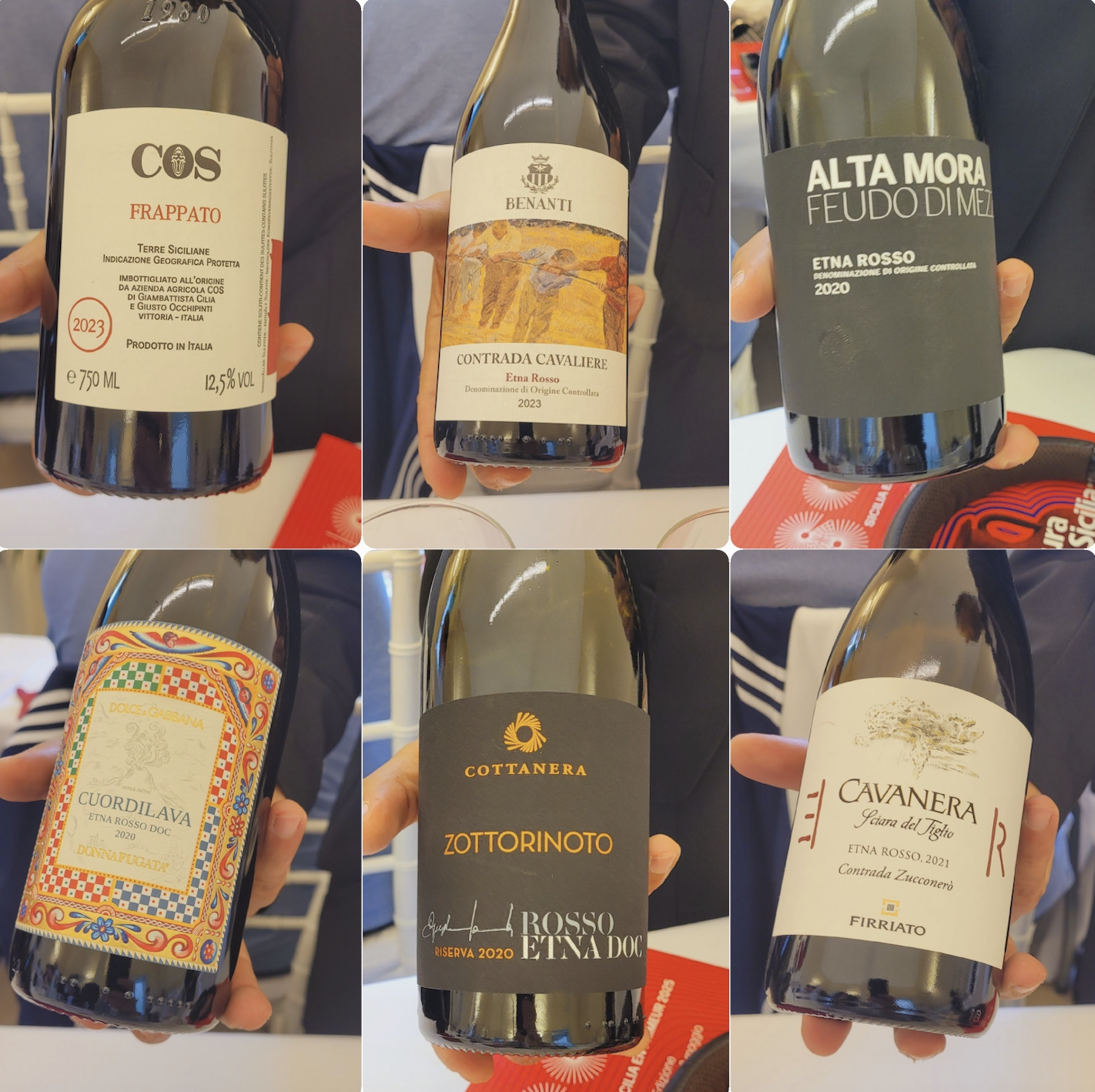
Etna Bianco

Benanti Etna Bianco DOC Contrada Cavaliere 2023

Cavaliere as a contrada white is getable and found in mid course for carricante of middle weight, fleshiness and structure. In other words a balanced Etna Bianco that has arrived early and readied for consumption ahead of the other single place wines. The metallic notes are purely basaltic and while fruit is plenty pleasant it’s not really the lead driving factor. Cavaliere is specific and noted for that. Drink 2025-2028.  Tasted May 2025

Benanti Etna Bianco DOC Contrada Rinazzo 2023

Rinazzo as a contrada Etna Bianco is surely more reserved and stoic especially as compared to (Cavaliere), as if it were let’s say Vaucopins and Cavaliere were Beauroy. Unnecessary wine region comparisons aside there is a richesse and a golden sun meets volcanic mineral accumulation to set Rinazzo aside. Definitely its own Bianco, at once structured and then feeling mature. Feels like a wine having arrived and yet not quite there. Makes for another great and curious Etna Bianco study in contrada-designed peculiarities. Drink 2025-2030.  Tasted May 2025

Benanti Etna Bianco DOC Contrada Monte Serra 2023

There is Cavaliere, Rinazzo and then there is Monte Serra. Hard to imagine three Etna Bianco from the same producer could each act so different. Monte Serra is the reductive and hard to access carricante, stuck in the basalt, shut tight and currently immovable. Not exactly expressive nor seemingly looking to act so any time soon. Would give this a year to sort out its thoughts and reconcile its differences between parts. That said the distribution of weight in Monte Serra’s design creates a sense of stability and harmony in its architecture. Thinking further we’d all consider waiting two years to see a release of the magic and fantasy. Drink 2026-2031.  Tasted May 2025

With JustSicily’s Federica Matranga

Cottanera Etna Bianco DOC 2024

First ’24 out of the gates, clean, open, fragrant and fresh. Apple juiced and as readied in simplicity without fuss, obfuscation or muss, in as much as it seems possible from Etna Bianco. The time to drink is now. Drink 2025-2026.  Tasted May 2025

Cottanera Etna Bianco DOC Contrada Calderara 2023

Next level interest and complexity comes from this Etna Bianco out of the Contrada Calderara where reds shine and whites like this are golden proud. Equanimous mix of stone fruit and volcanic savour come together and do so with seamless ease. For someone who wishes to experience the next level above and beyond regional or say “Villages” Etna Bianco it is this carricante that will help show the way. Drink 2025-2029.  Tasted May 2025

Cusumano Alta Mora Etna Bianco DOC 2023

Rich, luxe et volupté carricante for the sort to seduce and reel in hundreds of new varietal consumers. Also that which should surely please many who have already attended the party. More than ample freshness, crisp bites, orchard fruit, mineral sparks and finishing bitters. Drink 2025-2027.  Tasted May 2025

Donnafugata Etna Bianco DOC Sul Vulcano 2022

Oh so specific style of Etna Bianco from carricante tucked into the volcano and scenting like a garden wet with rain. As if petrichor soaked into basalt, effusive and smelling like nothing ever before, especially when the Ginestra joins the mix. Crunch and sway, crisp apple bites and varietal oscillations. Top vintage for this Donnafugata Etnese white, clean and yet leesy, complex and inviting. Drink 2025-2029.  Tasted May 2025

The team of Generazione Alessandrio

Generazione Alessandro Etna Bianco DOC Trainara 2023

Of 85 percent carricante and (15) catarratto near Lingualossa which being on the eastern slope increases the marine influence. Push-pull posit tug between the volcanic and the botanical or perhaps they are actually one in the same. Clean and focused Etna Bianco in any case. Drink 2025-2028.  Tasted May 2025

Girolamo Russo Etna Bianco DOC Nerina 2024

Rich and fulsome, as concentrated as Nerina will ever be and surely a factor of tight, small and low yielding bunches. These as a sub-factor from a condensed vintage of heat units and less water accumulated in each berry. Nerina as Etna Bianco 2024 travels right up the rising angles of the palate, gets into that nook at the top of the jaw before receding into full golden fleshiness. Drink 2025-2028.  Tasted May 2025

Girolamo Russo Etna Bianco DOC Feudo 2023

Feudo as the cleanest of Russo’s carricante, crisp and of a contrada clarity for whole rounded expressiveness. Good clean lees living from 2023 Feudo with segments of lemon and white grapefruit providing a plethora of fresh citrus flavour. Nothing herbal or savoury about it, just the facts, of fruit and mineral.  Last tasted May 2025

New Bianco for Giuseppe Russo, a selection of 100 percent carricante from three hectares within the Feudo di Mezzo vineyard and contrada. Feudo is not San Lorenzo but it is something remarkable in its own right. More botanical and phenolic but also a level of citrus preserve not noted anywhere but Feudo. Crazy level of implosive citric intensity and taut character. The behaviour is so different to San Lorenzo with flavours that mean business in the most impressive way imaginable. Intensity off the charts, concentration so impressive, energy that builds and builds. Drink 2024-2029.  Tasted May and September 2024

With Giuseppe Russo and Alberto Graci

Graci Etna Bianco DOC Muganazzi 2023

Graci’s Muganazzi is a true blue contrada Bianco from stone, of mountain reduction by way of its processes. The palate gets past the wall of aromatic sound to tell us what we need to know, or at least part of what the future holds. This is serious and protractive carricante, cased in a hard protective shell, waiting to be released. Crispy and encrusted but time will do what’s necessary. There is a great an substantial amount of fruit which is what matters most. And of course the volcano. Drink 2027-2033.  Tasted May 2025

Graci Etna Bianco DOC Arcurìa 2023

Apposite to Muganazzi is Arcurìa, a contrada carricante with more immediate flesh and plenty of backbone in support. Arcurìa is also the truly leesy Etna Bianco, built on the yeasty stuff and more akin to wooded Chablis than almost any other. This reminds of Fourchaume if such a comparison could be tolerated, but either way the wine is built to last. Drink 2026-2031.  Tasted May 2025

I Custodi delle Vigne dell’Etna Bianco DOC Ante 2021

Smoky from its reductive and flint stone struck moments, the fruit not only behind but well back with volcanic sand after a rain wedged expressively in between. Everything about Ante screams volcanic Etna, in stone, rock, sand, mineral and elemental style. A must try to begin believing. Drink 2027-2032.  Tasted May 2025

I Custodi delle Vigne dell’Etna Bianco DOC Imbris 2020

I Custodi is the kind of place to raise cariccante and Imbris the kind of label to speak in Etna Bianco clarity. The cool-climate factor and style might make you think the area is cold as hell but oh,no,no,no and Imbris is a kind of rocket man. The 2020 holds such a beautiful combination of lees driven fruit and volcanic mineral so there is no doubt a new age is upon this estate. The wines have been working towards this moment and here they are. Beautiful and inviting, welcoming and fine.  Last tasted May 2025

Varietal carricante at 800m fermented in steel, put to barrel and then one year in bottle. So much corporeal flesh on the body of a seriously developed Bianco. Has come into a fine place but my goodness so much texture, citrus and length. Drink 2024-2027.  Tasted May and September 2024
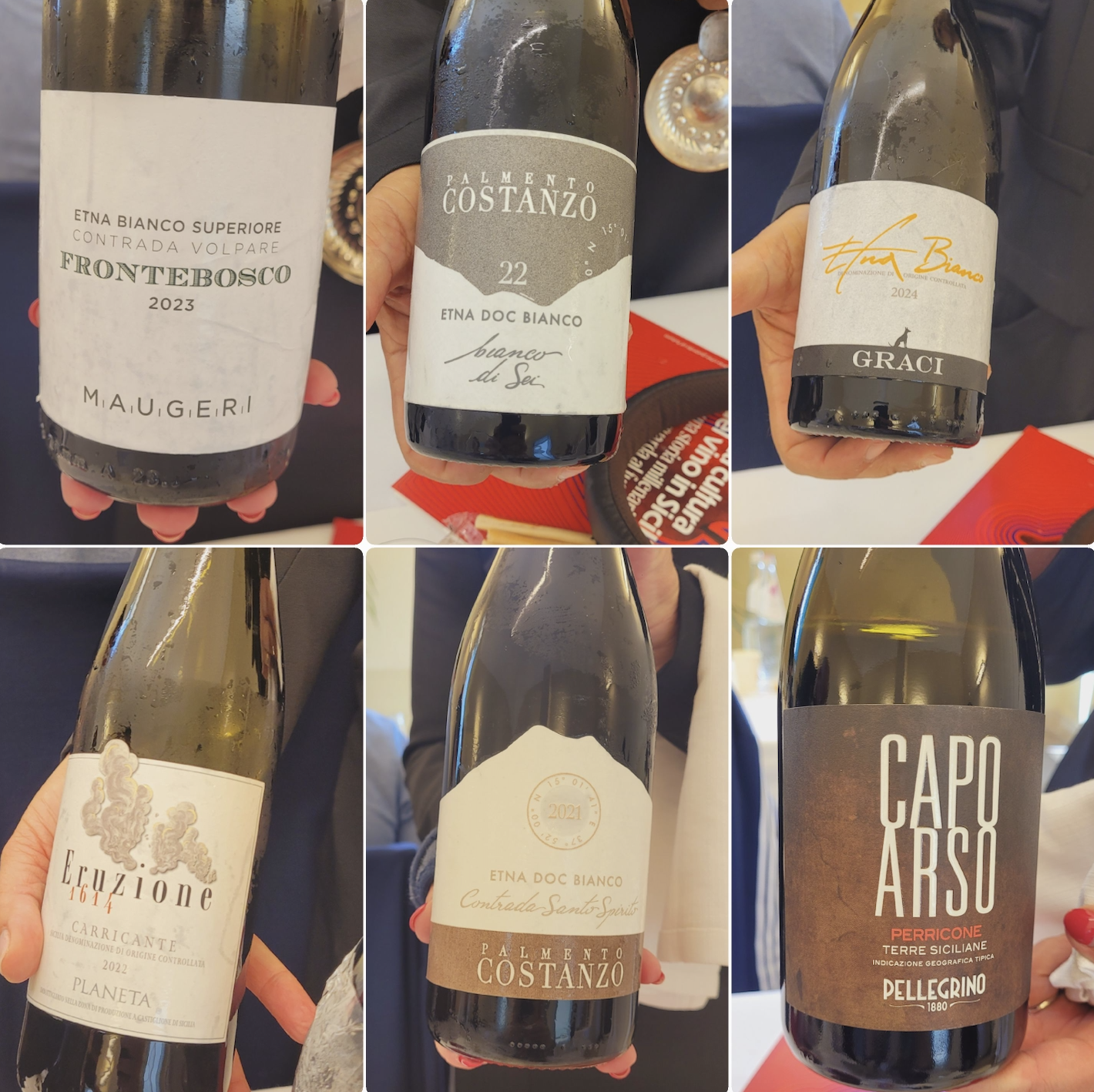
Maugeri Etna Bianco DOC Superiore Contrada Volpare 2023

Confident, cool and still presently stoic holding on to a controlled, yet to open the gates and be released intensity. Perfectly clean lees living within a structure of carricante built for pleasure and also aging. Really fine work from Contrada Volpare with many years of expressive reveal still to come.  Last tasted May 2025

Youthful is the understatement and Volpare the name, so say it loud. This is indeed singular Etna Bianco, as they should be but some are in a league of their own, as Mugeri’s eastern wines clearly are. The estate has taken it to the next level with an ascension of elevated mountain fortuity but also depth determined by terroir which can only be transmitted when agriculture abides. Abides because the maker makes it happen and Volpare delivers generously while also with precision and finesse. Leave this for 18 months or more to settle the relationship between rocks and acidity. After tasting Frontebosco and also Frontemare you realize the latter is the true catalyst to propel this cuvée selection. Drink 2026-2032.  Tasted September 2024

Maugeri Etna Bianco DOC Superiore Contrada Volpare Frontebosco 2023

Seemingly an understatement made but its only by the music this Etna Bianco will be free. No doubting more finesse, focus and precision from the carricante out of the vineyard facing the forest, an herbal cooling coming in, upping the botanical feels, its development low, slow and perhaps still far away. The taut nature of Frontebosco means the requiem to await what’s coming should be at least a year. Last tasted May 2025.

Versante est which separates Mugeri from not just the north but also the south and the future will surely look to this area for greatness. Not only Volpare contrada but a section within, here called Frontebosco, as in facing or in front off the forest and so the herbals here within are assumed to be elected by the nearby woods. Makes for freshness but also a fruit fleshiness that the more general Volpare does not show. A full, substantial and impressive Etna Bianco that might just appeal to everyone. Superiore indeed. Drink 2025-2033. Tasted September 2024.

Maugeri Etna Bianco DOC Superiore Contrada Praino Frontemare 2023

From the first to the sea we now receive the carricante out of the vineyard facing the Ionian, a stiff breeze blowing through, keeping the sails taut and the speed up, all the while a finish line yet far away. More lees coming from Frontemare mixing with sea spray for an Etna Bianco tight as they come, yet airy and rising. Would wait two more years for parts to come together and waves to calm down. There will be smooth sailing ahead.  Last tasted May 2025

Frontemare, “facing the sea,”as opposed to Frontebosco, “facing the wood.” As such this would be east facing from Etna’s east sector and so the block with the view creates a unicorn of an Etna Bianco as fascinating as it seemingly gets. The most crisp, crunchy, fresh and intense of Mugeri’s whites, citrus squeezed throughout and long as the zig-zagging wind of a single road down to Catania and into the sea. Just wow, with layers upon layers to unreel, unfurl and unroll for a long aging period ahead. Drink 2026-2034.  Tasted September 2024
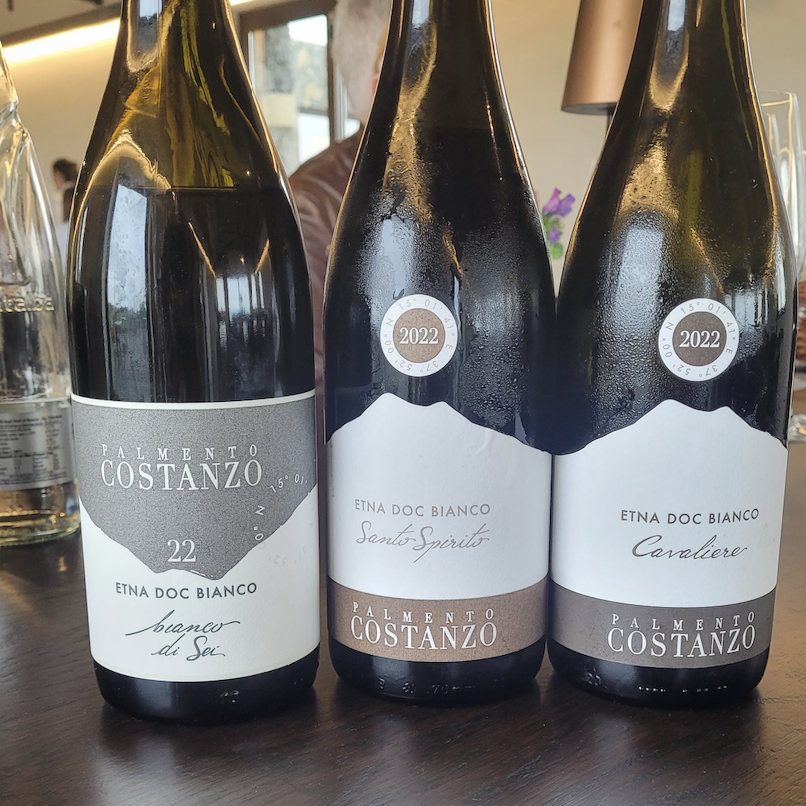
Palmento Costanzo Etna Bianco DOC Bianco di Sei 2022

Perfectly expressive carricante from 2022 for a vintage not always caught at optimum, however the Costanzo team’s relentless.  Last tasted May 2025

A cuvée of all parcels from different contrade, including the homefront Santo Spirito, along with Cavaliere. On average 90 percent carricante with (10) catarratto. Only raised in stainless steel, persistently fresh and if any region in the world might be compared with it would be Chablis AOC, direct, salty, smart and widely purposed.  Tasted September 2024

Just have to say wow because Bianco di Sei comes equipped with a level of intensity that was not quite expected from 2022. Not so much a volume or an explosion aromatically speaking but an extreme set of eccentricities that crash aboard the palate. Likely needing some rest and down time to integrate because the level of extract here (including volcanic activity) is simply off the charts. Etna incarnate, pointed and exciting. Drink 2025-2029.  Tasted May 2024

Palmento Costanzo Etna Bianco DOC Contrada Santo Spirito 2022

In reality these last three or four years have always been warm but ’22 was frankly very good, warm yet without any real challenges. What drives this carricante is an unwavering focus and persistence, a balance from start to finish without dips or oscillations. The relationship between Costanzo and Santo Spirito in Bianco is seamless, now seven years into their partnership.  Last tasted May 2025

High level aromatic volume and concentration from Santo Spirito ’22 and we know right away that this wine knows exactly who it is, where it comes from and where it wants to go. Volcanic salts are also present on the nose from a Bianco of great stage presence and such a smart textural weave that gains every bit of the palate’s confidence. The connection is prescient, reaction calming and conclusion poignant. This is how you make and present Contrada-specific Etna Bianco. Drink 2025-2033.  Tasted September 2024

Palmento Costanzo Etna Bianco DOC Contrada Santo Spirito 2021

High spirit from the Contrada specific blocks to speak on behalf of local saints and soils. Volcanic vernacular, citrus and herbal, gelid cool, leesy clean and indefatigably healthy. Fine carricante for 2021 and a vintage that is sometimes confounding. Not here in an expressive and beautifully made example. So very 1879 in terms of volcanics and therefore Santo Spirito tells the story.  Last tasted May 2025

Note the colour of the lava soil on the label, lighter brown for Santo Spirito, from the contrada vineyard at 700m on the northern slope that comprises one out of three “islands within the island” of L’Etna. Still just an infant, implosive and insular, wound so tight, yet to explode. Give this another year, just as the first taste had indicated for months prior.  Tasted September 2024

A fine vintage and and even finer Contrada, that being Santo Spirito where carricante (and 10 percent cattarrato) are given every soil, geological and micro-climatic advantage. There is an accumulation of ripeness and stone cool mineral groove from location and acumen that make this move with incremental ability. It will slowly define itself over along period of time that will be fascinating to watch every step of the way. Drink 2025-2032.  Tasted May 2024

Palmento Costanzo Etna Bianco DOC Contrada Cavaliere 2022

The most recent bottling for the cru Bianci and this out the contrada vineyard down slope from Palmento Costanzo. Perhaps not the tension of Santo Spirito and surely more richness yet still the balance between fruit and the structural parts. Cavaliere is remarkable for its quality consistency year in and year out. Unwavering Bianco. Drink 2025-2028.  Tasted May 2025

Palmento Costanzo Etna Bianco DOC Contrada Cavaliere 2021

Very different to Santo Spirito, riper and richer, more cumulate golden sun, lees still a major factor in the overall expression. Just a touch of reduction, tart with tight lines and increased juxtaposition between stylistic parts. Not as focused as Santo Spirito but surely seductive and generous.  Last tasted May 2025

Note the colour of the lava soil on the label, darker brown for Cavaliere, from the contrada vineyard at 700m in the southwest “island” of L’Etna. A different expression to that of Santo Spirito, volumetric in terms of aromatics and less austere or rather locked tight. Here more sapid and botanical, less basaltic salinity and fleshier early on. More fruit forward, pulpy stone fruit like, amenability run higher and the Contrada-designate Bianco to drink while waiting for Santo Spirito to mature. Drink 2024-2027.  Tasted September 2024

Pietradolce Etna Bianco DOC Archineri 2023

Archineri as a Bianco is really open and expressive, delicious and generous from the word go and ready to please. Clean lees, a cool basaltic factor and white peachy stone fruit. The citrus is a bit neutral yet surely supportive and helpful in the overall feel of the wine. Really good quality and clean winemaking results in a wholly accessible and aiming to please white from L’Etna. Drink 2025-2027.  Tasted May 2025
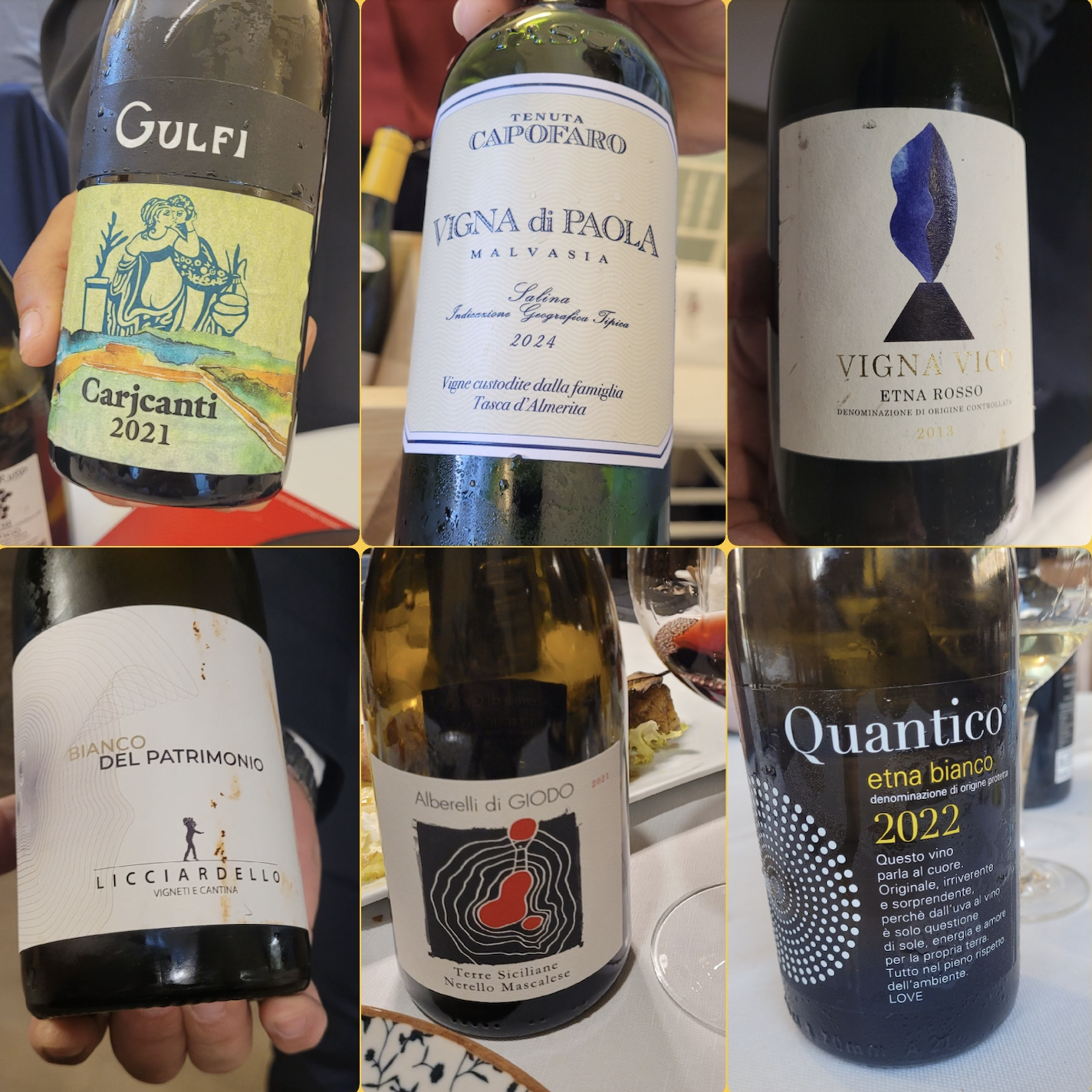
Tasca d’Almerita Tascante Etna Bianco DOC Contrada Sciaranuova 2022

Lees shows to be so integral and essential in the early development of Tascante’s Etna Bianco 2022 from the very important Contrada Sciaranuova. There is a play of current confusion while this youthful because the parts inside are bigger than the house that fits them. Expanding from within and needing more room to grow, to shed its weight even after eight months time.  Last tasted May 2025

Vinified and aged in Slavonian Grandi Botti, “to preserve the verticality and freshness of the carricante” explains Tasca d’Almerita agronomist Michele Brusaferri. Plays hard to get and acts demure inside the halls of its aromatic silence but you know that the elevation and fine basaltic soil are the portents of Tascante’s main Contrada Sciaranuova that will see to conditions for change. Though soft you feel the wood, present with confidence yet the thread of cool, herbal and botanical rins from Buonora into this Bianco. Fruit will soon peek through and announce a scintillant’s arrival, blossoms too, namely orange and then to salty lime later on. Just takes some air, agitation and swirl to coax out the excitement and up into the stratosphere. Turns out to be crunchy and seriously salty Etna Bianco, like flakes of Maldon or Slovenian platinum for what can best be described as living the high seasoned life of Etna Bianco. Structure is there and so this should age quite well. Drink 2025-2031.  Tasted September 2024

Tasca d’Almerita Tascante Etna Bianco DOC Buonora 2024

Both the good hour and bonaire as from the French and carricante just about as fresh as you will ever experience. Fresh and fleshy, fleshy and delicious, delicious and satisfying. Just what you desire on the 12th of May at 650m above sea level aboard L’Etna. Drink 2025-2028.  Tasted May 2025

Terra Costantino Etna Bianco DOC deAetna 2023

The term “deEetna” comes from a Latin pamphlet dated to 1494 expressing the sacredness of the oenological universe. Terra Costantino’s is one of the finer examples for 2023 by way of a blend led by carricante plus (15 percent) catarratto and (5) minnella. Ripening to fruition happened in the last ten days of September off of vines averaging 20 years. Yes to the palpable feeling of gainful concentration in juxtaposition to a fine and chiseled example with more wiry flesh hanging tuat on the mineral frame. Really well composed. Drink 2025-2029.  Tasted May 2025

Tornatore Etna Bianco DOC 2024

The straightest and fullest of Etna Bianco expressions with all in clean lees bulking up the substantial aspects of the wine. This is the entry point, the gate for which to walk through into the ever expanding idiom that is Etna Bianco. Start here and then explore the rest.  Last tasted May 2025

The vintage is represented in a most viscous way. Almost an oily character to 2024, indicative of the variable vintage with September having delivered some much needed warmth and sunshine for full phenolic grape development. A sapid iteration, botanical notes pervading and in the end it is texture that drives this Bianco machine. Drink 2025-2028.  Tasted March 2025

Tornatore Etna Bianco DOC Pietrarizzo 2022

Full on sun cumulate carricante from Pietrarizzo for what is surely as ripe and calculated an expression as they come. Full advantage taken of 2022 fruit for all that can be wanted from a Contrada Bianco example.  Last tasted May 2025

Pietrarizzo is both available and confident, not idiosyncratic like Zottorinotto and also richer of fruit. There is an herbal and botanical way about this cru Bianco with splashes of catarratto bringing seasoning to the carricante. A bit spicy and even humid though the fruit is the thing and the volcanics an accent making for even more spice entertained. Such a solid Contrada based Bianco. Drink 2024-2028. Tasted and September 2024

Tenute Tornatore Etna Bianco DOC Zottorinotto 2021

No comparison between Pietrarizzo and Zotorinotto, first of course because of location but in this case also dramatically caused by vintage. The 2021s are not holding up with the same stage presence as wished for last year and the year before. In fact they’ve transformed into this idiosyncratic space. No different here with a carricante of reductive meeting wet stony elements. Feels like some diesel creeping in, not petrol per se (akin to TDN) and smoky rather than smouldering. A bit of a strange advance with likely something new again on the horizon.  Last tasted May 2025

Of Tornatore’s cru-designated Bianci it is Zottorinotto that acts the most reductive and hard to crack. Great shell of protection and disguise, needing agitation and better still time. That said the 2021 is also fully formed, developed and very much ready to get at – make sure to aerate, decant if you can and allow the pleasures to be released. Drink 2024-2026.  Tasted May 2024
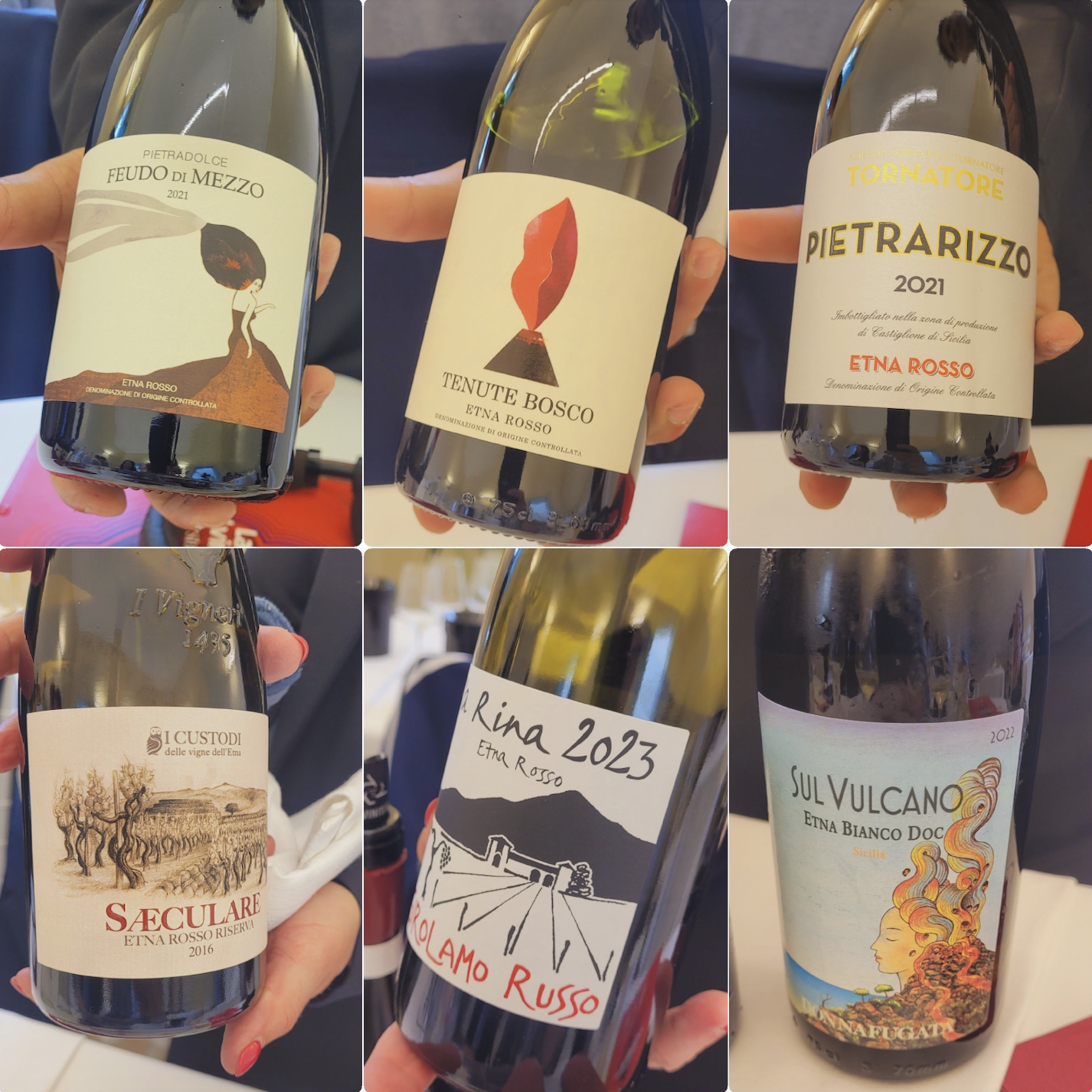
Etna Rosso

Benanti Etna Rosso DOC Contrada Monte Serra 2023

Strong aromatic presence and pulse for Monte Serra 2023, mildly and effectively reductive holding parts known and unknown. Not to say the aromas are stifled because they burst if within a bubble and yet to explode without. The epitome of nerello macalese filling our hopes, thoughts and dreams with anticipation. Cuts from stone some dreams of its own and though restrained it keeps a watch over the distance with a look to the future. Monte Serra is always an Etna Rosso with the grip and structure to look farther on, to hold back the fruit and preserve it for later days. The 2023 is balanced and prepared for longevity – that much is clearly true and in view. Drink 2027-2032.  Tasted May 2025

Benanti Etna Rosso DOC Contrada Cavaliere 2023

Tasting Monte Serra and Cavaliere 2023 side by side reveals much about place of origin because while the former looks farther on, the former engages today. A nerello masaclese that makes us see where we’ve both been, reaches us with immediacy and in turn we pay close attention. So much fruit interned so early, so little time to realize just how much is right there in this glass. It’s just that not opening and consuming bottles in the present will be hard to avoid. Drink 2025-2029.  Tasted May 2025

Cottanera Etna Rosso DOC 2023

Knowable bricks and mortar nerello mascalese as Etna Rosso and dictionary entry for the DOC. Sweet vintage fruit, competently concentrated, simply and effectively structure. Does what needs and does it very well. Drink 2025-2027.  Tasted May 2025

Cottanera Etna Rosso Contrada Feudo di Mezzo DOC 2021

Feudo di Mezzo of clout, expressiveness of largesse from the fullness of its old vines nerello mascalese fruit. Still a bit of a reductive nut to crack, a force field to break through, a softening needed to find full pleasure in the wine. A 2021 neither too hard nor to soft, the Goldilocks vintage as they say though the pressure is still applied. This FdM should come into its best years in six months or so. Drink 2026-2031.  Tasted May 2025

Cottanera Etna Rosso DOC Contrada Zottorinoto 2020

Give Zottorinoto an extra year an it will express itself with utmost generosity and here the Contrada’s Rosso is more than ready to go. Fruit sweeping and swelling across the plate, acids mellowed and tannins as well. As drink now a Rosso for the Contrada, as compared to any or all of this ilk on the mountain. Drink 2025-2027.  Tasted May 2025

Cusumano Alta Mora Etna Rosso DOC Feudo di Mezzo 2020

Dusty and Balsamic terroir expression, especially for Etna Rosso and also Feudo di Mezzo. A high acid style to compliment and even more so extenuate the circumstance of nerello mascalese. A specific style as well and one that garners attention, namely because its persistence and length are really quite outstanding.  Last tasted May 2025

Middle ground traveled and promise delivered for the large Feudo di Mezzo as Contrada sizes come, with fruit able to defend itself against generous wood though all parts launch a collective attack on the senses and palate. Big Rosso for Etna, strong boned and willed with the intention to impress. Drink 2025-2028.  Tasted September 2024

Donnafugata Etna Rosso Courdilava Dolce & Gabbana DOC 2020

Red stone fruit skin’s aromatic musk, pulpy to chewy within and fresh enough to keep a leathery character at bay. More tannin than expected and in fact they build quickly – this despite some four plus years having had the chance to settle the score. Still quite grippy and with a level of tension needing to subside. Impressive Etna Rosso. Drink 2026-2029.  Tasted May 2025

Donnafugata Etna Rosso DOC Fragore Contrada Montelaguardia 2021

Noticeable ulterior as an expression of Etna Rosso in comparison to the Dolce & Gabbana Donnafugata label. A fullness of nerello mascalese pressed, dressed and prepared for success. Clearly one to serve up and explain the nature but also importance of a single contrada wine, lacking for nothing and of layers far from being shed. Give time because otherwise this wine will attack with impunity and not let go. Drink 2026-2030.  Tasted May 2025

Firriato Cavanera Etna Rosso DOC Contrada Zucconerò Sciara del Tiglio 2021

Grainy if fine in that respect from specialized and decomposed volcanic sands that lend a very specific profile to Etna Rosso. Also quite ripe and so the palate holds a liquorice, leathery fruit chew character which speaks to drinking sooner rather than later. No doubt a singular wine and one that screams for best food accompaniment. The duck at Cavanera Wine Resort is ideal. Drink 2025-2028.  Tasted May 2025
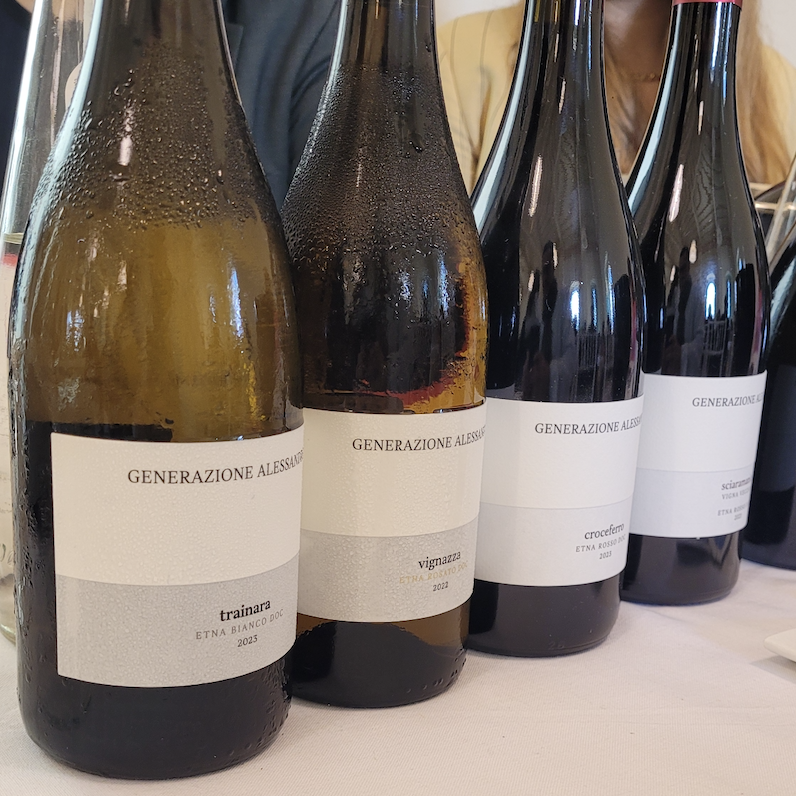
Generazione Alessandro Etna Rosso DOC Croceferro 2023

Only nerello mascalese off of the northeastern slope of Etna and the place where the iron cross, therefore Croceferro sits in the vineyard. A rich and tannic nerello with a tease of immediate gratification but the austerity in this tannins reminds that time will be the operative and necessity for best results. Drink 2026-2029.  Tasted May 2025

Generazione Alessandro Etna Rosso DOC Scaramantica Vigna Vecchia 2021

Oldest vines are 80 years of age and nerello macacesle is joined by several others for a true Etnese field blend. Increases the fruit immediacy with concentration but even more so the tonic profile with fine-grained ruling and austerity that requests time, plenty of time. Seriously structured Etna Rosso no matter how you slice it. Drink 2026-2029.  Tasted May 2025

Girolamo Russo Etna Rosso DOC San Lorenzo 2022

Open for business, fruit and acids intertwined at their combined sweet heights. Good palate spiciness and a riveting sense of energy. Liquid chalky tannins still in transformation, likely to finish their movements in another year or so. But don’t hesitate as San Lorenzo is drinking beautifully right now.  Last tasted May 2025

The gifts of San Lorenzo are of a slow release ilk the other cru and vineyards of Girolamo Russo are not, but this from 2022 is so full of riches it brings early joy. A great pleasure to have a glass even now with gregarious perfume and readied flavours, of red berries, liquid chalky to candied palate swaths and immediacy from this bottle of wine. San Lorenzo shows off the most glyercol and silken texture – it’s almost candied but of course it’s not. Spicy on the back side, sneakily structured and all the while with a glass we’re feeling fine. Can only improve and integrate with a couple of years time. Drink 2025-2030.  Tasted May and September 2024

Girolamo Russo Etna Rosso DOC San Lorenzo Piano delle Colombe 2022

If San Lorenzo is drinking at early peak right now then Piano delle Colombe should rightly be close behind. Yes in one sense and that would be more intensity of fruit concentration but then again no, because of this landslide of grippier tannin. There is no argument about seeing 2022 as a top Etna Rosso vintage and still the wood on 2022 Piano delle Colombe persists without melting or dissolving in. Some might find a bit too much while others will beg to strongly differ. The 2022 is right there where elements should rightly want to connect, intersect and layer. Perhaps not right away but in time, which will only embolden this Rosso with the wisdom and grace it is destined to express. Wait and anticipate seeing its reflection in the snow covered mountain. Drink 2026-2032.  Tasted May 2025

Girolamo Russo Etna Rosso DOC A Rina 2023

Put a ring around A Rina because no other Russo Rosso comes into view any sooner. None exhibit this level of juicy, luxe and getable richness and none shall pass, not for any reason at all. A Rina is a full and substantial nerello mascalese out of 2023, with the most liquidity come after dissolving grains of tannin for earliest drinking. No reason to wait. Drink 2025-2028.  Tasted May 2025

Graci Etna Rosso DOC 2023

A reminder about origin, they being estate vineyards at 650-750m and aging of 18 months in concrete though this ’23 feels as though at least one big barrel was involved. Not quite as linear and serious an Etna Rosso as the previous 2022 surely was and still is. Youthful yes but more chew than crispiness in 2023, ripeness and sweetness in acidity. No reduction, open for business and read to rock. Drink 2025-2028.  Tasted May 2025

Graci Etna Rosso DOC Arcurìa 2022

Spicing, spacing and perfume define Arcurìa with equal an opposing reflections for signs of Etna Rosso perfections and imperfections. Arcurìa from 2022 is showing quite the amount of barrel at this early stage, notes indicative of spice and challenge. Fruit is up to the task, metered, rising and falling in waves, there to speak of the open and closed spaces. All this to say the journey will end up in reflection in regards to a Rosso drinking forward for eventual gratitude. Drink 2026-2031.  Tasted May 2025

Graci Etna Rosso DOC Arcurìa Sopra Il Pozzo 2020

The piece of Arcurìa needing two extra years of aging and settling time is Sopra Il Pozzo, ad esempio a me piace il sud. Or the north as it applies to this slope of L’Etna and this piece is expressive of the sweetest spicing over fruit as any on the mountain. Yes the southern section is also liked but here Pozzo is an Etna Rosso of wood that needs to melt in, puddle below and allow a rising of fruit. That it will with the nerello mascalese climbing the firm backbone of this 2020 with fine and upstanding repose. Impressive and structured for a very long life still laid out ahead. Drink 2026-2034.  Tasted May 2025

I Custodi delle Vigne dell’Etna Rosso DOC Aetneus 2020

Fascinating study in Etna Rosso because these from I Custodi are different, stand out and alone nerello mascalese with (20 percent) nerello cappuccio. More than just the cappuccio but soil and location add up and amount to what’s in this glass. A certain kind of dried fruit, rich and leathery, studied and mature, weighty but without density. Now a settled wine with heavy mineral presence, a volcanic factor specific to I Custodi and when mixed with the winemaking style it all comes out a very certain way. Do you like it? Try it and find out. Drink 2025-2028.  Tasted May 2025

I Custodi delle Vigne dell’Etna Rosso DOC Saeculare 2016

The consistency of style from one I Custodi Etna Rosso to another is remarkable, to a wine, in all the wine. Yes the 20 percent nerello cappuccino is partly responsible for the semi-rustic, chewy dried fruit character but look further, or rather deeper into fine decomposition of basaltic soil. Location of course but whether you have 2020 or this 2016 in glass they all seem to be at nearly the same maturity. As here with Saeculare although it’s particular grip and structure see it age longer than Aetneus and this is prime time for tasting and in turn drinking this label. It will seem mature to some but know that this is the way and style of the house. Drink 2025-2027.  Tasted May 2025

Palmento Costanzo Etna Rosso DOC Nero di Sei 2021

Fine verticality even from Rosso di Sei because, well 2021 and also the lava. Feels firmer than eight months ago and as a result may live even longer.  Last tasted May 2025

Nero di Sei 2021 comes quicker to the point with near-immediate gratification because of vintage and also by way of the team allowig and even encouaging this to happen. Or abided more like it, with red berry fruit aromas that nerello mascalese can gift when the conditions are right. This is not to say that 2021 will fade into early light because it is in fact equipped with volume, concentration and backbone. A truly exceptional vintage that will appeal to all. Drink 2025-2030.  Tasted September 2024

Palmento Costanzo Etna Rosso Doc Contrada Santo Spirito Pre Phylloxera 2021

Not that the wine isn’t tight but my goodness how the tension is matched by fine verticality from Rosso with an intensity of volcanic chalkiness so specific to Santo Spirito’s 1870 lava. When vines are pre-phylloxera they have a true connection to the actual eruption and basalt because the lava had barely cooled when the first grapes appeared on the vines. A “no lo so” factor in this nerello mascalese character cools the Rosso so that herbal and stony notes prevail and persist, long after the wine has passed over the palate. A remarkable wine (isn’t it always) and another near perfect vintage. Drink 2027-2037.  Tasted May 2025

With Fosca Tortorelli

Pietradolce Etna Rosso DOC Barbagalli 2020

Grand and expressive, epically proportioned, factor of a remarkable vineyard brought to life through the coursing of its nerello mascalese. Hard to imagine an Etna Rosso so fine and linear could be considered crushable but this is Barbagalli and its vines more experienced than just about any aboard L’Etna. Crushable as a fleeting feeling but everything is truly in place, all parts inclusive of fruit, minerals, elements and constructions right where they should formulate. The last of the wine is no such thing because the weights, measures and taciturn moments linger for seemingly ever. Wowed and energized by Barbagalli. Drink 2027-2039.  Tasted May 2025

Pietradolce Etna Rosso DOC Archineri 2021

A different and singular animal for Pietradolce is Archineri, chewier and more palate workable than the rest of the Rosso portfolio. Lots of wood still noted on the 2021, changes yet to take effect, not here, not anywhere. Not tight as much as unable to come to be on the other side. Remains to be seen where this road will lead. To be honest it’s a bit resinous but youth is rebellion and maturity will come to experience.  Drink 2027-2030. Tasted May 2025

Pietradolce Etna Rosso DOC Rampante 2021

Effusive perfume from Rampante 2021, more floral than Pietradolce’s other reds, tannins sweeter and less austere. An approachable character though we know that structure is built for a long and full experience. The most immediately recognizable balance and still time will be kind to this Rosso. Air is on side now, time as well for 10 years forward. Drink 2025-2033.  Tasted May 2025

Pietradolce Etna Rosso DOC Feudo di Mezzo 2021

Some dried fruit and a maturity in the feels of Feudo di Mezzo 2021 but oh my goodness what a charming, graceful and lovely bit of nerello mascalese love in this bottle. Opens slowly and I also feel like their is some sort of obfuscation but the truth is the truth and FdM ’21 is in a very good and right place. Drink this while Rampante and Archineri work through their challenges. Drink 2025-2029.  Tasted May 2025

Pietradolce Etna Rosso DOC Santo Spirito 2021

From the opening salvo Santo Spirito is notable for its restraint and a closed aromatic tilt still very much a factor involved. Like Archineri, floral along with Rampante and so residing either in-between or as a combination of the two. A Rosso of layers, stepping stones taken up towards its eventual plateau. The barrel is melting here so slowly, the fruit fills full and substantial, the power less than intense and the energy still rising, Wait some more and then some more after that. Drink 2027-2031.  Tasted May 2025

Planeta Etna Rosso DOC Feudo di Mezzo 2023

First vintage as a solo Feudo di Mezzo and labeled this way. Not that this Contrada ever creates the darkest nerello mascalese but 2023 is at the peak of lithe, airy and transparent. The vintage takes over from the Contrada with ever-persistent and linear consistency controlling its volcanic destiny. Without density or extravagance, not in any shape or form but instead a fineness that seeks no desperate gratification. Will it age? Of course it will. These are really old vines growing in volcanic rocks, though if perhaps not for decades.  Tasted a second time, May 2025

Full and substantial Etna Rosso for Planeta and 2023, a challenge accepted and met, the effect positive and gaining. Spicing is essential, cumulative macchia also a matter of great importance with layers yet to be peeled away. The reveal is coming, let’s say after another 12-18 months, at which time we will speak of fruit leading and tannin trailing. Grande. Drink 2026-2030.  Tasted May 2025

Tasca d’Almerita Tascante Etna Rosso DOC Contrada Pianodario 2020

Varietal nerello mascalese only grown at 790m in Contrada Pianodario raised for one year in large Slavonian cask. This Etna Rosso is exactly what nerello mascalese is today. It may take a consumer three of four times and vintages before they get it but once they do they will never go back. High acid, transparency, brightest of red fruit, no rusticity and refined tannins. Delicate and at the same time serious. Just keeps getting better each time.  Last tasted May 2025

Lighter of body but not aroma as it now enters with the volume turned up, a feeling of idiosyncrasy and high-level curiosity. Wild and exotic spicing owing to a 17th century lava flow now in a state of degradation to make certain the nerello mascalese growing in its sands are the recipient of its mineral profile.  Tasted September 2024

High-toned, spirited and transparent nerello mascalese from Tasca’s L’Etna Tascante out of Contrada Pianodario. Red berry shine, acids excited and fruit a willing participant. Tarragon and Basil herbal, so very basaltic stony and truly a wine of place. Crunchy and ever so slightly resinous with balsamico mixing into the sweetness of fruit and acidity. Drink 2024-2029.  Tasted May 2024

With Sofia Ponzini – Tenute Bosco

Tenute Bosco Etna Rosso DOC 2022

Spiced and lifted aromatics create an effect to deliver Etna Rosso with linearity, grace and stature. Scan a room and you will not miss this nerello mascalese because its confidence, poise and presence stand out in a crowd. Beautiful in a post classic way, part demure and beyond a doubt unmissable. Barrel that needs to settle down and in will do so in two years time and see five-plus years of ideal drinking after that. Brava Sofia, as always. Drink 2027-2032.  Tasted May 2025

Tornatore Etna Rosso DOC 2022

Straight shooter this Etna Rosso, accessible and amenable to all, now and for all the right reasons. Fruit first, ripe and delicious, aromatically charged and energizing the entirety of the wine. Rosso for Rosso’s sake, crunchy and palatable with great toothsome character, A guarantee and stamp of quality in the most professional of Etna Rosso ways. Unwavering consistency from Tornatore. Drink 2025-2028.  Tasted May 2025

Tornatore Etna Rosso DOC Pietrarizzo 2021

Etna Rosso as Pietrarizzo is nothing short of expressive, energetic and impressive. Fruit comes in waves, in and out of every pore and this “etichetta” exhibits finer and sweeter acidity than so many peers. Commercially viable for a lifted Etna Rosso to explain much about the mountain’s nerello mascalese. Quite fine, true substantial and very composed.  Last tasted May 2025

If Tornatore’s classico Etna Rosso is the most understandable and straightforward 2021 DOC entry point there could be than we should expect Pietrarizzo to hyperbolize that idea. Exaggerate and also exist in a vacuum where great acidity and sneaky formidable structure combine for all that could be wanted and needed. Such is the case and with the estate’s glide into maturity because ripeness happens and getting to the point always in season. Fine work, as always, expected and desired. Should be ready, fully and completely in the late winter months. Drink 2025-2029.  Tasted October 2024

Tornatore Etna Rosso DOC Trimarchisa 2018

A cumulative experience in Etna Rosso, fruit three ways, acids and tannins in and out off every layer, a wine to imagine all the mountain can deliver. Tart, tight and substantial, all the nooks filled with elements fruity and minerally volcanic. As they should be. Drink 2026-2029.  Tasted May 2025

Good to go!

godello

Modica

Instagram

Facebook

Harvest report 2024: Retro Chianti Classico

Sangiovese 2024, Chianti Classico

In Bernardo Bertolucci’s 1976 film 1900, an epic tale of class struggle in twentieth century northern Italy is told through the relationship between two childhood friends. One is of a proletariat family, the other born into the bourgeois and through their friendship the movie explores the struggle between socialism and capitalism. Sitting in a pub, Alfredo Berlinghieri (played by Robert de Niro) says to to Ada Fiastri Paulhan (Dominique Sanda), “November is the cruelest month of the year.” This may have been true for farmers struggling to survive in post-war Italy and through the era that saw the collapse of the mezzadria system. A climatic evolution over the last 50 years might just alter the argument to say that November is no longer the most troubling month. Take Chianti Classico as an example. In frost years there is April and the rains of May to June bring downy mildew, both potentially devastating issues that attack vines and reduce yields – very bad for business. Easter time can be cruel and the late Spring Perenospera an umitigated Oomycetes disaster, but when it rains heavily in September and October, an entirely new set of adversarial circumstances can occur. Grape rot becomes a real factor, grapes swell to increase their volume and the harvest can last forever. Welcome to la vendemmia 2024.

Related – 100 Years of Chianti Classico and Collection Previews 2024

Sangiovese fermentation 2024 – Terreno

The age of freezing cold winters is but a memory now for growers in the territory where the Gallo Nero are produced and 2024 saw another stretch of new age warmth. Even if January and February nights drew temperatures dropping near zero, the daytime highs were often pushing into double digits. Milder days in the latter half of February meant you could bask in the sunlight of a Sunday afternoon, on the terrace with a glass of Rosato or in the thermal baths just outside Castelnuovo Berardenga’s southern border. You could count the coldest days with temperatures typical of winter seasons’ past “on the fingers of two hands,” so said Marco Ricasoli Firidolfi. Rainfall was ample and so 2024 would see no repetition in terms of drought, nor would frost become an issue, as was seen in 2017 and 2021. Precipitation was intermittently constant, upwards or more of 70 millilitres fell in January, 180 in February and 120 during March, which meant for saturated forests and vineyards across the whole of the Classico region.

Related – Chianti Classico 2023: A year in review

Sangiovese – Lamole

What to expect from 2024 Chianti Classico?

The summer of ’24 was typically hot and dry but all that changed after September 7th because in some parts of the region nearly 400 ml of rain fell over the following seven weeks. Unprecedented amounts of water, well at least if you look back at the previous 30 years. August of 1995 saw rain like that and previous to that there was plenty of precipitation and cool harvest temperatures in 1991 and 1993. Fast forward again to 2024 and the the constant deluge of mid-September through to late October ends up becoming the cruelest stretch. Days on end when tractors are unable to enter the vineyards, harvest crews repeatedly pause on stand by because picking wet grapes is a cardinal sin and prayers are made for two straight days of sunshine to happen anytime and anywhere. From Greve to Castellina, San Donato in Poggio to Castelnuovo Berardenga, Vagliagli to Gaiole, San Casciano to Radda, in Montefioralle, Panzano and Lamole. Bunches are dropped because tight sangiovese clusters encourage the development of mold from within and the waiting game is excruciating for many. Patience is the greatest virtue and yet sugars are developing slowly, like the old days, piano-piano, as they like to say. In the end a classic vintage in the ways of days of old is declared, with phenolic ripeness achieved because of the longest hang-time since 1993, the same year Juventus’ Roberto Baggio scores five goals in seven international matches for Italy. Drinkable sangiovese, elegant, ripe, low alcohol and a good number blessed with sneaky structure. Producers are pleased with the freshness and ethereal beauty. The tank samples are bloody delicious. Pure sangiovese. Retro Chianti Classico.

La Squadra Canadese in Firenze

First and foremost on so many producers minds are the alcohol levels topping out at 13.5 percent. If you see 14.0 abv on a bottle in 2026 or beyond you can bet the actual number is just above that 13.5 Mason-Dixon line and in some cases 13.5 could in actuality be just a shade above 13.0. Lighter wines as a general rule, but age-worthy because of phenolic ripeness, at least in cases where producers waited, waited some more and picked as late as possible. Expect to see straight through the transparent hues of Chianti Classico sangiovese for 2024, to sense, taste and feel the brightest and potentially sweetest acidities, then finally the silkiest if also most elastic tannins. The 2024 acids will be the catalyst for aging these sangiovese. Anyone under the age of 50 will have likely never experienced a Chianti Classico vintage like 2024 and potentially never will again.

La Squadra Canadese – Piazza del Campo, Siena

Just two months ago La Squadra Canadese of seven sommeliers and Godello as their chaperone went all in for a mid-October excursion through the 11 UGAs with estate visits, tastings and round-table discussions in classic Chianti Classico boot-camp fashion. The theme could not help but concentrate on the 2024 harvest because first timing, but also its omnipresence as an all-consuming affair, on the minds and in the daily planning of every producer. The group’s seven members: Christian Perreault Hamel – Harbour60, Toronto, Lauren Hall – Scale Hospitality, Toronto, Ashleigh Forster – DaNico, Toronto, Jessamyn Box – Major Tom, Calgary, Lisa Baran – Savio Volpe, Vancouver, Heather Rankin – Obladee Wine Bar, Halifax and Montréal’s Elyse Lambert M.S. – Ritz-Carlton, Toronto. A tradition initiated by the legend Jeremy Bonia was carried on, to play a game aboard Enzo’s bus with music themes chosen by the leader (Godello) and each sommelier picking songs to be played throughout the course of a travelling day. Please feel free to peruse and listen to La Squadra Canadese Radio:

La Squadra Canadese Radio – First song you remember singing along to

La Squadra Canadese Radio – Pre-2000 Hip-Hop

La Squadra Canadese Radio – Country

La Squadra Canadese Radio – 80s and 90s jams

La Squadra Canadese Radio – Headphones on a beach

La Squadra Canadese Radio – Wedding Songs

La Squadra Canadese Radio – Dancing by Myself

La Squadra Canadese Radio – When you have a Hangover 

La Squadra Canadese Radio – Non North American artists

La Squadra Canadese Radio – Favourite movie soundtrack song

La Squadra Canadese Radio – To play at your Celebration of Life

La Squadra Canadese Radio – Pairs with Chianti Classico

La Squadra Canadese – Panzano

There was an extensive Gran Selezione UGA Tasting at Casa Chianti Classico in Radda, 15 estate visits, an aperitivo with President Giovanni Manetti at Enoteca Baldi in Panzano, unforgettable dinners at Panzano’s Antica Macelleria Cecchini, in Siena and also Florence. As always, the planning and support from the Consorzio Vino Chianti Classico’s Carlotta Gori, Silvia Fiorentini, Christine Lechner, Caterina Mori, Laura Cavalleri and Simone Fabbrini. La Squadra came, they conquered and the Gallo Nero left an indelible stamp on their collective emozioni – forever. As for Godello, here are his 125 tasting notes from the trip – expected and as per usual, abided.
Gran Selezione Tasting – Casa Chianti Classico, Radda

Gran Selezione tasting at Casa Chianti Classico

Marchesi Antinori Chianti Classico Gran Selezione DOCG Badia A Passignano 2021, San Casciano

If it looks like, smells like and tastes like Badia a Passignano, well then it must be Badia a Passignano. Then again as a 2021 the fullness, generosity and natural phenolic grip meeting sweetness is unparalleled. Yes the underlying verdant savour is always there, always the Badia’s corner of San Donato in Poggio, but honestly the pulchritude of substance feels extant, furthered and extra level for Passignano. For Antinori. Drink 2025-2030.   Tasted February and October 2024

Arillo In Terrabianca Chianti Classico Gran Selezione DOCG Terrabianca 2019, Radda
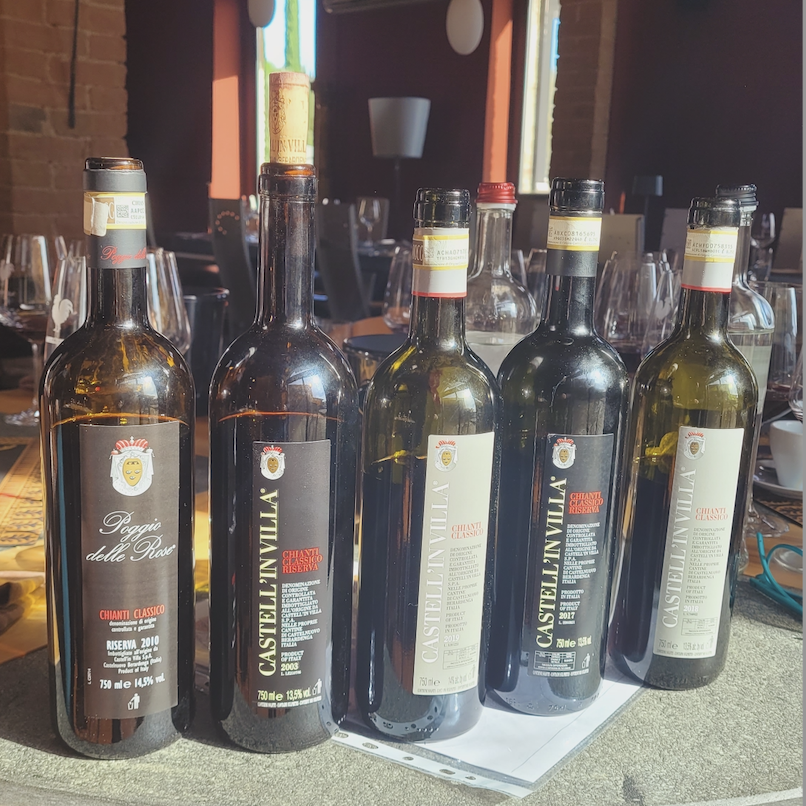
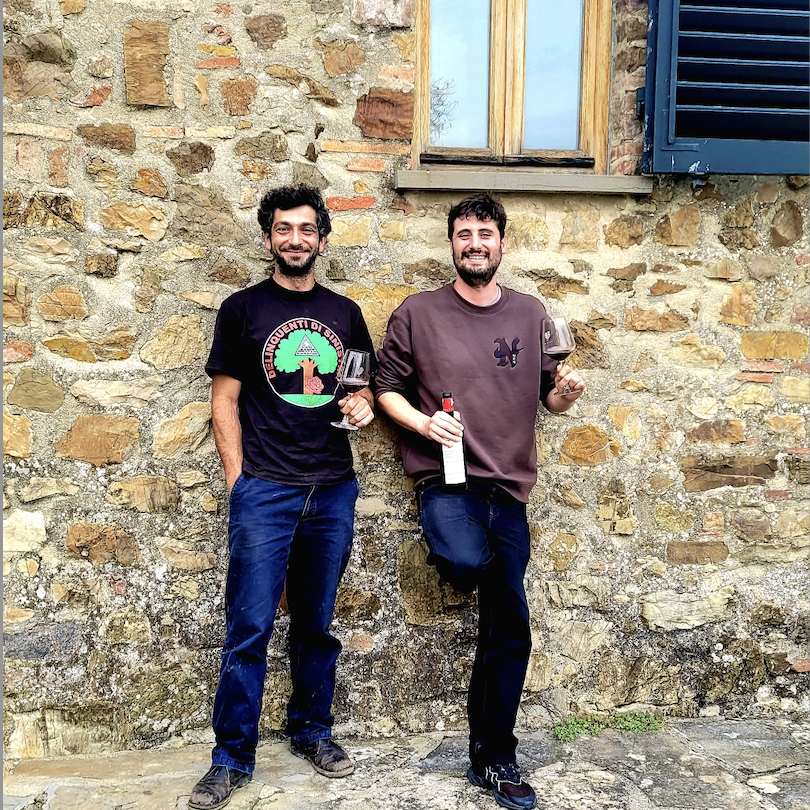
All sangiovese and nothing but the sangiovese in one of the first iterations of Gran Selezione under the guidance of new and improved ownership. Brightest of red fruit for a concept and work in progress that seeks to deliver utter transparency for lower (relatively speaking) elevation out of Radda. Firm enough though the tannins are anything but austere. Drink early GS, again, relatively speaking. Drink 2024-2027.  Tasted October 2023, February and October 2024

Banfi Chianti Classico Gran Selezione Fonte alla Selva 2020, Castellina

Fonte Alla Selva, “fountain in the forest,” though there is less bosco influence in Castellina than say Radda, Gaiole or Panzano. That said the clay and Alberese soils of alluvial origin breathe freshness into a Gran Selezione with 40 hectares of vineyards from which to choose from. The 2020 is a big wine from a warm season though here cool, liquid smoky and glycerin textured sangiovese with the smooth consistency made whole by the “other” non-specifically declared varieties. Though by rule as of next vintage they must be local and make up no more than 10 percent of the whole. Tight, tart and chalky, surprisingly tannic, not sharp mind you but with a noted pointillism in its brush. The vanilla and lavender may be distracting but as far from over the top. Drink 2024-2027.  Tasted October 2024

Bindi Sergardi Chianti Classico Gran Selezione DOCG Mocenni ’89 2019, Vagliagli

Mocenni 89 is a special Gran Selezione, open, ethereal and generous. And it is just now entering its window of beauty with new surprise at every turn.  Last tasted October 2024

Tenuta Mocenni presides at one of the higher points in the Vagliagli UGA at 500m with vineyard blocks impounded with great Alberese stones and outcroppings of Galestro. The south facing amphitheater is one of Chianti Classico’s most impressive sites and sights. The latest vintage is not yet released and there is no shock how youthful and tightly wound you will find this 2019 to be. The one that follows will proudly display the UGA on the front label. More than just a few years of time in more than one kind of vessel has equipped this major potion of fruit with ample layers of structure in a Gran Selezione so bloody big, substantial and beautiful. Will most definitely require five to seven years of unwinding. Drink 2025-2034.  Tasted October 2023 and February 2024

Borgo Salcetino Chianti Classico Gran Selezione DOCG I Salci 2016, Radda

Wildly perfumed and built upon a foundation of aromatic volume for a 2016 that needed all the time it has been given to come and express itself this way. Still tannic by way of a combination of chalky and austere, a crisp Gran Selezione and one needing food alongside to tame its drying second half. When will it fully resolve and what will the fruit be up to at that time? Remains to be seen but waiting two more two years will not make for the best result, or joy. Drink 2025-2027.  Tasted October 2024

Borgo Scopeto Chianti Classico Gran Selezione DOCG 2017, Vagliagli

Settling in, arriving near to its fruition and frankly this represents the most elegant side of 2017. A surprising vintage considering what was expected and Borgo Scopeto’s is much brighter and fluid than many. Surely a Gran Selezione that needed time, to soften the edges and allow freshness to shine through. This is the time to drink a ’17 that will work for its dinner. Hard to fathom how it came to be but this works at 13.5 percent abv. Drink 2024-2027.  Tasted October 2024

Brancaia Chianti Classico Gran Selezione DOCG 2021, Castellina

Fine, fine Brancaia, luxe and stylish while restrained in any needed way. The epitome of modern Gran Selezione, understated and always giving, with confidence and the understanding of why the appellation was conceived. Crunchy and savoury, still highly tannic and so make sure to concentrate on the beauty of perfume in this early stage of its tenure.  Last tasted October 2024

The aromas and perfumes are so much more prevalent and open for 2021 with stoniness and Castellina as the instigator for how this Gran Selezione is want to express itself. Crispy, savoury and the sort to really bite down and sink your teeth into.  Tasted April 2024

New label not yet printed that likely indicated this has not been in bottle long and as a 2021 Gran Selezione that must surely be the case. Keep this in mind when you feel just how implosive and locked in the fruit is kept behind the wall of tannic sound. The freight is loaded in the compartments but the train has yet to leave the station – though as a 2021 there will be joy at the end of the line. With stops along the way because the vintage does not demand too much nor will it crash and burn. Brancaia’s 2021 is a ripe and primed GS to live out the decade and then for a few more years in the next. Drink 2026-2032.  Tasted February 2024

Cantina Castelvecchi Chianti Classico Gran Selezione DOCG Madonnino Della Pieve 2017, Radda

Well-aged (and held back two to three years) Gran Selezione from Castelvecchi out of mid-elevation Radda and a sangiovese paying tribute to La Madonna of her church. From the warm and veritably dry 2017 season but there is both flesh and also acidity riding high in this Gran Selezione. A top vintage for this appellative category because the healthiest fruit destined for the top wine did well to create promise. Still a bit austere and this was pressed just a bit heavy so the wine will always show a certain level of verdancy and tightness. Drink 2023-2026.  Tasted October 2023 and 2024

Capannelle Chianti Classico Gran Selezione DOCG 2019, Gaiole

Seriously rich and liquid chalky sangiovese, concentrated as a Gran Selezione level example should be expected to be. Full and layering vintage, ripe in terzetto respect, including tannins and so this says drink sooner rather than later. Not quite yet mind you but the coming winter and a long-simmered stew will benefit well alongside. Drink 2025-2028.  Tasted October 2024

Carpineta Fontalpino Chianti Classico Gran Selezione DOCG Vigna Dofana 2019, Vagliagli

A preview of 2019 that will shown at the Chianti Classico Collection in February of 2024 that are now finished wines “but to me they are young,” shrugs Filippo Cresti. The dried balsamic quality of 2018 is here replaced but more freshness and spirit. A richer wine in 2019 as compared to Montaperto with the wood more involved – while the wine this young is trying to figure out its way through adolescence. The clay is fully involved in just how textured and fruity Dofana acts in this inimitably generous vintage. Flesh will come, with time. Drink 2025-2032.  Tasted October 2023, February and October 2024

With Dario Cecchini – Panzano

Carpineto Gran Selezione Chianti Classico DOCG 2020, Greve

There is nothing about this Gran Selezione that is not Carpineto and so kudos to the Greve estate for unyielding consistency, no matter the time or place. In fact this also represents a look through the mirror of a vintage, never overbearing or overpowering and just a snapshot of cool, herbal and brushy, like taking a long walk though a dry forest, air crisp with fresh air. The 2020 GS has matured some already so drink this while some others work through their issues. Drink 2023-2027.  Tasted February 2023 and October 2024

Carus Vini Chianti Classico Gran Selezione DOCG Gaudio 2018, San Casciano

Proper austerity and the yet to fully descry intention are what define this style of the Carus San Casciano Gran Selezione. The fruit combines that pitch of red and sway to speak of savour but as of yet never the twain shall yet meet. Two or three more years are needed, to get them together but tension needs to subside before anything meaningful can happen. Drink 2026-2032.  Tasted October 2024

Casale dello Sparviero Chianti Classico Gran Selezione Paronza 2019, Castellina

Unique example with aromatics unlike any other but for now they are mostly caused by the stay in wood. Vanilla yes but also what feels like the effects of American oak. Coconut like Rioja mixed with Napa Valley but sangiovese is rendered “different” because, well sangiovese. Needs two years to come fully together and will outlive many, darkening and thickening as it matures. Drink 2026-2032.  Tasted October 2024

Castelli Del Grevepesa Chianti Classico Gran Selezione DOCG 2019, Panzano

The Grevepesa cooperative (out of San Casciano) grabs and works with fruit from Panzano and they have chosen to put the UGA front and centre on their label. This they do with Lamole as well. In both cases the Gran Selezione is written vertically, boxed and smaller in font. Celebrating an adjunctive location is most curious and when you think about it, quite clever. Their 2019 is clearly Panzano in origin with that notable combination of glycerin fruit matched by Galestro-Pietraforte mineral swirls. There is some astringency here – yet more importantly bright red fruit. Needs a year to further settle in. Drink 2024-2027.  Tasted October 2023 and 2024

Castello Della Paneretta Chianti Classico Gran Selezione DOCG Torre A Destra 2016, San Donato In Poggio

Unbelievable how tannic and unrelenting this persists as a 2016 Gran Selezione. Crisp, crunchy, savoury and spicy, wood still a major factor and fruit continues to be hold back. How long will this take? At last two more years it seems. Drink 2026-2030.  Tasted October 2024

Castello Di Ama Gran Selezione Chianti Classico DOCG San Lorenzo 2019, Gaiole

A reminder and to be clear – San Lorenzo comes from the San Lorenzo vineyard and also Montebuoni but not only. The Gran Selezione is both a name of fantasy but also connected to the vineyard that lends this top tier appellative wine its name. The step up in quality and precision from Montebuoni Riserva is really quite obvious though each are wines respective of their appellation and style. A very important vintage because there are times when Gran Selezione must be accessible early with unequivocal structure allowing it to age. This is 2019 from Ama as a personification of its maker. Marco Pallanti as Gran Selezione. Has a nice ring to it don’t you think? Drink 2024-2032.  Tasted October 2023 and 2024

Castello Di Bossi Chianti Classico Gran Selezione DOCG 2019

Ultra professional, concentrated and fruit layered example of Gran Selezione, all parts sweet and tanned, from fruit through acid to tannin. A paced and measured 2020, plenty of warmth and wood seasoning, though all is liquid, elastic and fluid. Drink 2024-2028.  Tasted October 2024

Castello Di Fonterutoli Chianti Classico Gran Selezione DOCG 2020, Castellina

Clean, advanced to a finer point and really showing the sweetness of fruit at this stage. Open whenever you are ready yet can also be kept for four-plus years.  Last tasted February and October 2024

Castello di Fonterutoli’s 2020 is Gran Selezione like looking in the Castellina mirror because the purity of red, red, red fruit is the crux and at the core of what this wine wants to say. Hyper indicative of the vintage, clear and transparent, never too weighty or adamant and Fonterutoli puts everything in its rightful place. Drink 2024-2027.  Tasted February and October 2023

Castello Di Monsanto Chianti Classico Gran Selezione DOCG Vigneto Il Poggio 2019, San Donato In Poggio

The arrival of an Il Poggio is greeted with great anticipation because luxury and fortune have beget tastings of several recent and also older vintages. So imagine what Monsanto’s 2019 will surely bring to the table out of San Donato in Poggio. No ordinary moment, but one likely to get frozen into time. Open heart and mind, dig into deeper understanding and intuitive possibility. Gran Selezione 2019 from the Bianchi family’s hilltop vineyard is sublime. Concentrated, understated, refined, precise and giving. Nurturing if edgy but always gracious and unselfish. A touch reductive, protected and of course stylish. A moment so vivid it causes ache, awe and longing. Too much waxing for a bottle of wine? Actually no but another Il Poggio for the ages. Drink 2026-2039.  Tasted October 2023, February and October 2024

Castello Di Querceto Chianti Classico Gran Selezione DOCG La Corte 2020, Greve

La Corte is “the court,” second of two Gran Selezione out of The Dudda Valley by Greve’s Castello di Querceto. The one with more precision and refinement (as compared to Il Picchio) and it is this warm vintage 2020 that really captures the sunshine as manifested in true sangiovese concentration. The complexity comes from liquorice and resinous evergreen oils, a note of graphite, creosote and something unknown, or unnamed. Nevertheless there is a lot happening here and the wine should unwind with great intersect over a ten year period of time. Drink 2025-2031.  Tasted October 2023 and 2024

Galestro – Panzano

Castello Di Radda Chianti Classico Gran Selezione Il Corno DOCG 2018, Radda

Juicy Gran Selezione, integrating and resolving, coming into its own with fruit still at fresh peak performance, These are really fine Raddese acids, helpful and supportive, propping up the fruit. Drink 2024-2028.  Tasted October 2024

Castello Di Verrazzano Chianti Classico Gran Selezione DOCG Sassello Vigneto Querciolina 2018, Montefioralle

Not yet released and will have at lest three more months in bottle before that can happen. A strong vintage and normally the release would be the fall but both wood and fruit need to time to find each other. The substance in Sassello 2018 is, well substantial, in fact something more than that. Richness at the height of Verrazzano’s abilities but my goodness this packs a punch while also showing off the modernity and harmony that define this estate today. Bravissimo. Drink 2026-2033.  Tasted February and October 2024

Castello Di Volpaia Chianti Classico Gran Selezione DOCG Coltassala 2021, Radda

Always a concentrated sangiovese, from high elevation, solar radiated and night cooled vineyards. Still a five percent mixing in of ultra specific mammolo, spice bringer and catalyst to create this unique interaction with sangiovese. A fulsome vintage, fruit and tannins thick as thieves, luxe behaviour guaranteed and time on side for one of the longest runs to be had in Chianti Classico. The palate and mouthfeel are already showing signs of great activity and you could actually drink this now with the correct salty protein alongside. Drink 2025-2032.  Tasted October 2024

Castello La Leccia Chianti Classico Gran Selezione DOCG Bruciagna 2020, Castellina

Quality sangiovese comes in many ways with this being the kind of fit concentration matched equally by conscious and confident full use of wood. A tight, tart, tannic and intense example showing both its strengths and also constraints. Give this two more to shed some new light.  Last tasted October 2024

Here a Castellina Gran Selezione called Bruciagna, pure sangiovese sleek and hot-blooded. A 2020 of agility, speed, and spirit, well designed, fruit at the height of its powers and a sprinter as opposed to a long track runner. Structure is more power than endurance so drink in the near term for the win, place and show. Drink 2023-2026.  Tasted October 2023

UGA Tasting – Casa Chianti Classico, Radda

Castello di Vicchiomaggio Chianti Classico Gran Selezione DOCG Le Bolle 2021, Greve

Le Bolle, the name of the cluster of houses in a specific locality and therefore in the register inside the “frazione” of Greti within the commune of Greve. A Gran Selezione single vineyard of just sangiovese, initially made in 2006 and first presented as a GS at VinItaly in 2019. More aromatic volume and power than La Prima but also a smooth as silk sensation on the nose and also on the palate. Stylish, certainly more woodiness and perceived sweetness because the tannins are in fact ripe and the mouthfeel classically “scorrevole.” Longer and more persistent from a GS that represents the house style. Drink 2025-2033.  Tasted October 2024

Cecchi Chianti Classico Gran Selezione DOCG Valore Di Famiglia 2018, Castellina

Solid, weighty, tense and taut sangiovese here from Cecchi in the highest level on the appellative pyramid. Wound tight and will take five years to unwind, just as it has already been nearly five to wind up into this intense present character. Might dry out a bit and the seasoning will be peppery strong as the fruit subsides. The next few years will see the best moments for this Gran Selezione. Drink 2024-2027.  Tasted February 2023 and October 2024

Cinciano Chianti Classico Gran Selezione DOCG 2019, San Donato In Poggio

Still tightly wound and somewhat reductive with a skin to pulp ratio resinous effect in place. Still much to wait for and to receive from what will surely be a giving and abiding Gran Selezione that acts out a distinguished and defined San Donato in Poggio sangiovese style. Comes from relatively low elevation vineyards at 250m of medium textured soils, Alberese based, stony with some low-lying clay. Drink 2025-2029.  Tasted October 2024

Conte Capponi/Villa Calcinaia Chianti Classico Gran Selezione DOCG Vigna Bastignano 2020, Montefioralle

Have waited just eight months and not only has nothing changed but the wine has gone into full slumber. Revisit no less than a year from now.  Last tasted October 2024

Campione: A sample but one at the three and a half year mark so let’s take it at face value. One of the baller and brazen Gran Selezione in Conti Capponi’s work, doubled down by a vintage of similar character. Intense minerals and elementals streaking through chalky fruit that mimic and speak to the terroir – an Alberese stone that will not be denied. This is indeed serious and structured. Wait a minimum four years people. Please. Drink 2027-2035.  Tasted February 2024

Dievole Chianti Classico Gran Selezione DOCG Vigna Sessina 2019, Vagliagli

A 6.4 hectare vineyard at 450m which qualifies as the highest point of Dievole. A south exposure with Macigno and outcroppings of clay to deliver more power than any other estate sangiovese. The aromatics are expressly consistent with Riserva (and also Casanova) but the musculature is taut and developed. That which Riserva commits to is magnified in this fourth vintage of the Gran Selezione, none more so than the tannins which grab, grip, secure and hold on tight. They compound and reside in the arena of the austere at the finish of this profound wine. Drink 2026-2033.  Tasted February and October 2024

Fattoria Della Aiola Chianti Classico Gran Selezione DOCG Cancello Rosso 2018, Vagliagli

The red gate is a definitive Vagliagli sangiovese with its tell-take evergreen and pine forest aromatic crush. A warmest vintage means concentration, early picked jammy fruit and highest acidity captured. A proverbial food wine if ever there was because the acid cards accumulate for layers of sweet and sour edginess. Still needs time and in this case the fruit can hang around until the wine integrates to near fruition, if never quiet getting fully there. Drink 2026-2030.  Tasted October 2024

La Squadra Canadese – Casa Chianti Classico, Radda

Fattoria Di Corsignano Chianti Classico Gran Selezione DOCG L’imperatrice 2019, Vagliagli

High-toned, tannic and mid-season volatile behaviour, showing experience and location, or rather wearing these things on its sleeves. Just a bit of squeezing or pressing to bring out the natural fruit and along with it some verdancy quite savoury in nature though surely within character for Vagliagli. Curious or in other words unique Gran Selezione that after another two years will reveal much more. Drink 2025-2029.  Tasted October 2024

Fattoria di Valiano Chianti Classico Gran Selezione DOCG “6.38” 2019, Vagliagli

Notably wooded example of Gran Selezione from another warm vintage with years still needed to integrate though fruit freshness is nearing its peak. Tannins are near severe to speak of the season, spicing and intent. The goal here is structure and longevity, two ideals that are surely part of this 6.38’s DNA though by the time it gets to Vagliagli there will and should be tartufi and porcini on the table. Classically styled for a Piccini 1882 CC-GS. Drink 2026-2029.  Tasted October 2024

Fattoria Montecchio Chianti Classico DOCG Pasquino 2019, San Donato In Poggio

Gelid and glycerol red fruit, into the San Donato in Poggio blood orange spectrum, naturally sweet and pulpy, a squeeze of omnipresent red citrus and something so very well understood. Fine work, likely showing at best if not quite integrated peak at this stage.  Last tasted October 2024

Seductive Gran Selezione here from Montecchio, not atypical for 2019 yet Pasquino takes the style to another level entirely. Blood orange, glycerol, silken texture and just as it has been said, seductive. Chic and classy without pretension or precious personality. Little maintenance required, only a glass, some salumi and fine cheeses, good people with which to share. Drink 2023-2027.  Tasted October 2023

Fèlsina Chianti Classico Gran Selezione DOCG Rancia 2021, Castelnuovo Berardenga

Inaugural vintage of the Rancia Gran Selezione, for many years the bigger Riserva from the grand southwest facing hill, now ready for top-level prime time in the eyes of Giovanni Poggiali. Took its time to make this grand change and no shock to find the cedar-cypress-evergreen component running ultra high. A hyperbole of who it was, now under the magnifying glass, full, heady and intense. A Gran Selezione of stature, structure and at this stage, immovability. Drink 2026-2033.  Tasted October 2024

Fontodi Chianti Classico Gran Selezione DOCG Terrazze San Leolino 2020, Panzano

How much does the human factor effect a wine like San Leolino? The answer lies in the relationship between the land, weather, vintage and in how the people who work the fields to maximize the gifts made available to them. From 2020 the quotient is high, above 2019 and ready to pass the torch to 2021. At least in these first three vintage the incline is palpable, the progression linear and more importantly vertical. This is great and 2021 will take it further. Allow the wood to settle for two more years.  Last tasted February and October 2024

From the vineyards surrounding the 9th century Pieve and you know what they say. “Sangiovese is planted, consequences follow.” A 15th century drawing found in a Florence museum proves that monks cultivated grapes on this property at that time. More perfume than the Classico level Panzano and so there is proof that this terraced land with high level Alberese soils provides aromatics and great structure in the way a Lamole plus Panzano might hypothetically get together for a similar result. Leolino is not a go between but something unique, something other. Special and of an aging potential that may just be more promising than that of Vigna del Sorbo, but let’s wait 10-15 years to see if that will come to be true. Drink 2026-2034.  Tasted October 2023

I Fabbri Chianti Classico Gran Selezione DOCG 2019, Lamole

From the oldest vines, including those planted back in 1965 and aged for two years in large cask, a.k.a. grandi botti. The old vines show what can be done from lowest of yields, highest of concentration and by way of a contract that seeks and attains the necessity of elegance. Everything about Susanna Grassi’s Gran Selezione speaks to the Lamole UGA, in sweetly herbal and savoury perfume, a floral note connected to the botany and grace under the pressure of structure so well defined. Drink 2025-2034. Tasted October 2023, February and October 2024

Il Molino Di Grace Chianti Classico Gran Selezione DOCG Il Margone 2021, Panzano

An important selection, in 2021 mainly from the Al Sole vineyard but also some fruit coming out of Francesca. “A great vintage for us,” says Iacopo Morganti. Unfortunately the Easter frosts reduced quantity by 40 percent. No matter because Il Margone’s position is to offer a calm respite away from wines too big for their own good, pivoted towards elegance in a sangiovese so right and so pure. Puts this in the finest Panzano light as a wholesome Margone by Morganti and Il Molino di Grace that will slowly evolve over a near 15 year period with kept freshness and slow development.  Last tasted May and October 2024

Campione: Take a little trip forward along a linear and precisely drawn line from Riserva to Gran Selezione and see what will be. Not as aggressive or intense as Riserva but its own kind of powerful and grippy while also more charming. I believe its elegance will begin to show sooner rather than later, say in the first few weeks of 2021. The wood is more noticeable on the nose and the sangiovese needs time – but charm and grace is there. This you can count on. Smaller production of 8,000 bottles. Drink 2026-2038.  Tasted October 2023

Il Poggiolino Chianti Classico Gran Selezione DOCG Le Balze 2021, San Donato In Poggio

Another perfumed and expressive Le Balze comes with as much if not more pulp and flesh a la mode than those San Donato in Poggio Gran Selezione that have come before. The depeche florals are Spring bloom fresh, the volume set at ideal pitch and you just need to keep putting glass to nose because, well you just can’t get enough. Richness is never compromised but it is belied by the beauty of a tannic caress about as graceful and gracious as there are. This is Il Poggiolino’s finest GS to date and that is saying a lot. “Just like a rainbow.” Drink 2025-2034.  Tasted October 2024

Isole E Olena Chianti Classico Gran Selezione DOCG 2016

“I did not like Gran Selezione, I did not have anything against Gran Selezione but the discussion about UGA (sub-zones) was already underway so why not wait for this next change to the appellation?” The thinking for Paolo de Marchi was more about the wines that did not qualify for the appellation becoming wines that now qualified, the issue being a new rule could not apply to only 30 or so producers. So what is needed for that to happen? “All grapes born here should be able to travel with a passport.” If it is more complicated than that then there is much more to discuss. A Chianti Classico from a long, linear and fortifying vintage delivers equally appropriate and extending tannins, gripping the composition while proposing to become elegant and fine. The seamlessness and never wavering focus keeps on keeping on, in the ways of emotion in motion. Will remain in bottle one year more before being released to the market. Drink 2023-2027.  Tasted February 2022

Istine Chianti Classico Gran Selezione DOCG Vigna Casanova Dell’Aia 2021, Radda

From Angela Front’s (relatively) newer Radda planting and one to deliver sangiovese with a vineyard’s determination, not to mention the winemaker’s imprint. Will come across as lighter, brighter and less concentrated to some but they would not be paying attention to nuance, precision, stealth mystery and the many still to be revealed hidden meanings. Vigna Casanova dell’Aia 2021 is a restrained tour de force of a Gran Selezione, knowing full well its full intention is yet to be announced. Drink 2026-2033.  Tasted October 2024

La Squadra Canadese – Chianti Classico Headquarters – Sambuca

La Croce Chianti Classico Gran Selezione DOCG La Croce 2020, Castellina

High aromatic swirl and flush of floral fruit to draw us in and come looking for more. Many splendored and substantial quality in that regard. Were we to stay there the wine would continue to please. The palate whoever is sappy and gratuitous with its wood-effected vanilla and berry ice cream soft serve. Softens quickly and then trails away. Drink 2024-2026.  Tasted October 2024

La Sala del Torriano Chianti Classico Gran Selezione DOCG Il Torriano 2020, San Casciano

When San Casciano brings aromatic wealth twofold between red fruit and sweet savour then you know you have really got something special in your glass. High chances it will be Torriano from La Sala. Warmth of vintage, expertly considered and arranged picking schedules, then finally winemaking respect has all fused to come to this. Amplitude meets tranquility and fullness transcribes as pleasure. Lovely spices and spicy piques arrive at the back and length is outstanding. Drink 2025-2031.  Tasted October 2024

Lamole di Lamole Chianti Classico Gran Selezione DOCG Vigneto di Campolungo 2019, Lamole

As you would expect the Gran Selezione is a crunchy sangiovese, as only Lamole can deliver with more freshness and verdant character than just about anywhere in the territory. A different green than Gaiole or Radda, an almost humid rainforest breath of air, like running spring water through the canopy that expands the aromatics. Brings out the Lamole perfume more than the Riserva and five times that of the Annata. Also sanguine form the iron-laced Macigno sandstone and its own kind of char, like a seasoned cast iron on low heat. Up until three years ago there was some cabernet but now it is solo sangiovese. First vintage of this wine was 1985 and then transformed as Gran Selezione in 2010. Drink 2025-2031.  Tasted October 2024

Le Cinciole Chianti Classico Gran Selezione DOCG Aluigi Campo Ai Peri 2020, Panzano

Panzano expression incarnate, red fruit ripe and silken without glycerol gratuity and flirting with untethered gravity. A richness while also barrel work lending a creamy mouthfeel that still needs to soften further, integrate the associated spice and see this become a Gran Selezione of parts develop into the whole. Just some austerity in the structure stands in the way. Drink 2026-2032.  Tasted October 2024

Le Fonti Di Panzano Chianti Classico Gran Selezione DOCG 2019, Panzano

As always at this appellative level Le Fonti’s is 100 percent sangioivese and as with Annata but also Riserva the house style chooses fruit over wood and seasoning over toast. The warm vintage finished with late season daytime highs juxtaposed against nighttime lows and this Gran Selezione emerged with glaring clarity, instrumental precision and parts on point. From fruit through structure round fits into round and square into square, nothing awkward, sharp or out of place. An aromatic sangiovese while the palate provides an experience and a half. Selezione ’19 is a prepared one, to withstand oxidation and develop supplementary character so that it may age well into the next decade. Drink 2024-2032.  Tasted February and October 2023 and 2024

Livernano Chianti Classico Gran Selezione DOCG Purosangue 2016, Radda

Yet another aging Gran Selezione wound tight, austere tannins yet to relent and fruit in a remarkably fresh state. The level of concentration will not live to the fullest along with the wine’s longevity and yet wood is not an issue. Used and resulting in good gastronomical seasoning but never obtrusive. So reminds of nebbiolo, if more light, bright and austere like Barbaresco in style. Very old school Radda. Drink 2026-2030.  Tasted October 2024

Lornano Gran Selezione Chianti Classico DOCG 2017, Castellina

Always stiff, reductive and vertical in youth which still includes 2017. Cedar and pine mulch, great savour all-around, fine-grained tannins and an aromatic thirst yet to be quenched. On the palate there is some incoming joy and so we see that the belt is loosening and the wine beginning to offer up some pleasure. Some will see too much wood and that opinion is perfectly valid but understand how Lornano’s wines at every level need time, The tannins are in fact fine and everything will make more sense after another year of time.  Last tasted October 2024

The last Lornano Gran Selezione tasted was 2012, absence makes the heart grow fonder and five vintages later expectations run high. Their’s are the most austere in youth, especially for Castellina because the bright red fruit of the UGA does not always ring the bells of structural alarm. But Lornano’s position and high Alberese content make them immovable when young and so three extra years is warranted for seeing them open up to the world. As with this 2017 which has indeed done so and yet maturity still seems far away. Great and luxe, juicy and even fresh fruit considering the vintage and so Bravo to the team for coaxing this kind of elegance. Drink 2023-2030.  Tasted October 2023

Marchesi Frescobaldi Tenuta Perano Chianti Classico Gran Selezione DOCG Tenuta Perano Rialzi 2020, Gaiole

In Gran Selezione terms for Chianti Classico Rialzi is about as singular as it gets. Just drive up the road from La Villa in Radda, into Gaiole and through to Perano to know what you are dealing with. Olive trees, cypress, pine, other evergreens, rosemary, sage and brushy greens on your left give away to the single Rialzi Vineyard on your right. All that verdancy translates into these 25 year-old, cordone speronato vines for a very specific balsamico, drawn from the greens, through the experienced vines and into the fruit. The vineyard was called “I Rialzi,” literally “the lifted up,” or now “the steps, or terraces. Lamberto Frescobaldi always insists “the vineyard matters most,” and in this case that is simply true. Aromatic confusion in a way but more so volume, palate tension and also vintage. Incidentally warmer than 2019, lending more volumetric credence and tending towards a bigger iteration of Gran Selezione. Feels more like the Rialzi of expectation and the kind of structure to go on and on. Drink 2026-2033.  Tasted October 2024

Nittardi Chianti Classico Gran Selezione DOCG Nittardi 2020, Castellina

Über Castellina sangiovese, full fruit compliment at Gran Selezione level and already openly generous. Crunchy fruit mixed with equally toothsome tannin make for a good appellative combination. Fine work out of the variable 2020 vintage. Drink 2025-2031.  Tasted October 2024

Villa Le Corti Principe Corsini Chianti Classico Gran Selezione DOCG Don Tommaso 2020, San Casciano

The original Gran Selezione for Villa Le Corti, that being Don Tommaso, incidentally labeled with its UGA while “Zac” adds the Val di Pesa suffix, as per the commune. Quite the fleshy and substantially concentrated 2020, impressively so, rich, luxe and jam-packed with flavour. A mix of 80 percent sangiovese with merlot (that will not be available in 2023 due to no production because of downy mildew). A bit woody on the palate at this youthful stage but this will pass and Don Tommaso will drink dutifully if also effortlessly through the latter stages of this one and into the first stretches of the next decade. Drink 2024-2032.  Tasted October 2023, February and October 2024

Radda in Chianti

Querceto Di Castellina Chianti Classico Gran Selezione DOCG Sei 2021, Castellina

Really pretty and voluminous sangiovese from Castellina’s Querceto, as bright and red fruit excitable as they come. Not edgy or twitchy though, but even paced and moving from strength to strength. Length is forever and tannins are present if never too demanding. Sei is a 2021 Gran Selezione that will go on and on, potentially through to the middle of the next decade. Drink 2025-2034.  Tasted October 2024

Querciabella Chianti Classico Gran Selezione DOCG 2019, Greve

The first commercially available vintage was 2017, from the highest reaches out of Querciabella’s vineyard parcels between 450 and 530m aboard the Ruffoli hill. Picked four weeks ahead of same altitude vines in Lamole because of exposure and well, Ruffoli. Treated to a submerged cap, i.e. capello sommerso methodology, a simmer of skins kept wet just as they have been doing forever in Barolo. This means a quality of tannin that comes out by infusion as opposed to extraction and with such an ideal vintage the result is uncompromising. Freshness captured, instinct incarnate, tannic freight compact, though the layers have breezes blowing through. Precise and focused as expected and the finale lingers forever. Drink 2027-2038.  Tasted February and October 2024

Rocca Delle Macìe Chianti Classico Gran Selezione DOCG Sergio Zingarelli 2019, Castellina

It just feels as though a Famiglia Zingarelli sangiovese will always act, emit and taste this way, that were this wine poured blind we would know the origin and the appellation. That being Gran Selezione and with 2019 the glare and obvious beautiful red mess of Castellina fruit is right there. The tops for substantial fruit as far as this GS is concerned and possessive an aging potential long and great. Should become one of Zingarelli’s finest. Drink 2025-2033.  Tasted February 2023 and October 2024

San Fabiano Calcinaia Chianti Classico Gran Selezione DOCG Cellole 2019, Castellina

Mainly Sangiovese with some colorino and a few splashes of merlot “that speaks Chiantigiana.” Also a 500m elevation for most of these grapes, the sangiovese planted in the 80s and converted to organic in the 90s. A stony Galestro soil opposite to the sandy clay and calcari, i.e Calcinaia around the borgo and winery. Only Cellole delivers this cool, liquid peppery swarthiness that the Classico does not show and also a combination of verdant but also distinct minerals notes. Tannins are exceptionally taut with at least two to three years remaining before they begin to truly integrate. Drink 2025-2033.  Tasted February 2023, February and October 2024

San Felice Chianti Classico Gran Selezione DOCG Poggiorosso 2019, Castelnuovo Berardenga

If you could close your eyes and sip Poggiorosso you would almost certainly realize that San Felice was in the glass because this is the result of their sangiovese. Tight, tart, youthful, unresolved and yet to realize its potential. This is a bit of a dumb phase, not fully expressive and seemingly light stage of its tenure. Need to refit and see what comes next.  Last tasted October 2024

Almost hard to believe but 2019 seems bigger, broader and in a way wilder than the 2020 Poggiorosso and yet this single vineyard Gran Selezione is a force to reckoned with, no matter the vintage. The vibrancy and especially the acidity is the wild aspect of a sangiovese that acts a bit the rebel, with cause. Quality here is tops in every respect, fruit is ripe on both ends and that acidity is really quite sweet. Splitting hairs compared to 2020 but this is something special. Amazing work from all new 500L tonneaux. Drink 2024-2037.  Tasted October 2023 and February 2024

Tenuta Cappellina Chianti Classico Gran Selezione DOCG Canto Dieci 2018, Vagliagli

A massive Chianti Classico Gran Selezione in so many respects, vintage being the impetus and catalyst for how this reached 15.5 percent alcohol. In spite of the spike the acids are raging high as well, the high tonality of the sangiovese also spiking with sharp and pointed style. The heat is like white light, or lightning rather and sometimes it’s hard to fathom how a grape from a UGA like Vagliagli can get this way. A hot season with big temperatures in late September but unavoidable is the truth of the matter. Does well to express place and style in the face of this adversity. Drink 2024-2027.  Tasted October 2024

Tenuta Casenuove Chianti Classico Gran Selezione DOCG 2019, Panzano

Serious, experienced, structured and vertical example of Gran Selezione. Maturity of fruit but also layered acids and most impressively developed tannins. This walks with great stature, sure of its meaning and intent. As a Panzano sangiovese it knows exactly what it wants to be. Drink 2024-2028. Tasted October 2024

Tenuta Di Nozzole Chianti Classico Gran Selezione DOCG Giovanni Folonari 2019, Greve

Western Greve brushy and herbal style of sangiovese with a dusty and evergreen feel. Aromatically exuberant, open-knit, bright and with just a hint of proper volatility. So bloody sangiovese and concentrated for a point to consider a specific style of Gran Selezione. Another proper vintage with fine work put in to factor for a well made Chianti Classico. Drink 2024-2027.  Tasted October 2024

Terra Di Seta Chianti Classico Gran Selezione DOCG Vendemmia Assai 2018, Vagliagli

Ha taken its time to arrive at what is now a truly drinkable moment, the generous wood styling and aging now integrated, smoothened and in delivery of silky texture. High in glycerol, some wood char still in the background but now more like liquid smoke, neither smouldering nor ignited to any developed flame. Relatively dark fruit, very black cherry, tannic and just ever so slightly oxidative. Drink 2024-2026.  Tasted October 2024

Tolaini Chianti Classico Gran Selezione DOCG Vigna Montebello Sette 2020, Castelnuovo Berardenga

Youthful still and showing no signs of growing up, moving forward or coming away released from its wood and tannic shackles. A big Montebello Sette from a vintage that determined this course, with impressive bones, silken red cherry fruit and potential of the highest Castelnuovo Berardenga order. An important wine for Tolaini and the culmination of hard agricultural work put in to play. Drink 2026-2032.  Tasted October 2024

La Squadra Canadese with Giovanni Manetti and Christine Lechner – Enoteca Baldi, Panzano

Vallepicciola Chianti Classico Gran Selezione DOCG Lapina 2021, Vagliagli

Red stone fruit, aromatically fleshy while also expressed through high tones. Acid-driven vintage, ultra believable as coming from Vagliagli and at a refined concentration level that clearly indicates Gran Selezione. A 2021 to pay attention to, cellar and take in the results five to seven years after vintage. Drink 2024-2028.  Tasted October 2024

Vecchie Terre di Montefili Chianti Classico Gran Selezione DOCG 2019, Panzano

The most amenable and accessible vintage there could be but ’19 is already beginning to show its fruit sliding into dried and dusty territory. Granted it was still relatively early in Serena’s tenure and understanding of the vineyards and even more so the appellation but at five years past vintage this is the Gran Selezione to drink straight away. Still some tannic austerity but otherwise a sangiovese in resolution. Drink 2024-2026.  Tasted October 2024

Cecchi Chianti Classico Gran Selezione DOCG Villa Rosa 2019, Castellina

Single vineyard sangiovese from Casteto at the highest eastern heights of the Western Castellina vineyard. Most freshness and elegance of all the Cecchi sangiovese and from 2019 a wine so ready to drink you will find it hard to keep any bottles in the cellar. Not that structure is an issue because Villa Rosa will mature slowly over a five year run. Drink 2024-2028.  Tasted May and October 2024

Viticcio Gran Selezione Chianti Classico DOCG Prunaio 2019, Montefioralle

Prunaio is beginning to resolve, to see a next level of integration and a drinkability not too far away. Fruit is persistently fresh, acids sweet and fattening, structural parts in play though without any austerity or great tannin. There is some mind you, but in good control and working well alongside the pleasurable parts of this Gran Selezione. Fine work here in 2019 from Vitticio. Drink 2024-2028.  Tasted October 2024

Valentino Davaz – Poggio al Sole

October 2024 Estate visits

Poggio Al Sole Sangiovese Bianco 2023, Toscana IGT

From relatively older plantings (1997 and 1998), harvested on average two weeks before the sangiovese used for reds. First commercial availability was 2019 but it has been experienced and played around with for 15 years. Quite phenolic, pH influenced, a sapid bianco of tonic and grip. Finishing with a lemon saltiness that ties it all together. Has grown from 1,200 to 17,000 bottles from 2019 to now. The ’22 was just a bit saltier and higher in energy. Drink 2024-2026.  Tasted October 2024

Poggio Al Sole Chianti Classico DOCG 2022, San Donato In Poggio

Organic, 90 percent sangiovese with (10) canaiolo, 12 days of maceration, one year in mainly large cask. The canaiolo helps to soften the tannic austerity of sangiovese and “make it more accessible earlier,” explains Valentino Davaz. The “business card” of Poggio al Sole, notable acidity yet cut and texturized by the blending and style. This ’22 is substantial, full and filled in when you consider the mid-palate, just about ready as we speak and should be consumed in its first three years. Drink 2024-2026.  Tasted October 2024

Poggio al Sole Chianti Classico Gran Selezione DOCG Casasilia 2021, San Donato In Poggio

Casasilia was the name of the estate before it became Poggio al Sole, opposite hill to the estate that owned Poggio al Vento on the other side. A Gran Selezione that transferred from Riserva and has been pure sangiovese since 2007. From plantings between 1992 and 1997, high acidity vintage and dry extract off the proverbial charts. Basically the best looking bunches that can then macerate longer and the result is a mix of fruit and acidity that travel the sides of the palate, up and down, unrelenting and working with the structural components of the wine. Intriguing, woody and inviting. The grandest wine that falls into the sweet spot between elegant and bold, lithe and massive. Drink 2025-2030.  Tasted October 2024

Serena Gusmeri – Vecchie Terre di Montefili

Vecchie Terre di Montefili Chianti Classico DOCG 2020, Panzano

Just 50 percent of production from a warm vintage with low juice to skin ratio. Aged only in 30 hL casks for approximately 15 months before release. “The bottle you open must be of the place,” explains winemaker and agronomist Serena Gusmeri, “with the purity and freshness of the crunchy sangiovese.” Spicy and musky aromatics, not surprising because of the skins’ effect. Powerful vintage with bones, dry extract (more than 36 g/L!) and a purposeful saltiness. Puckering finish.  Last tasted October 2024

Tasted side by each with the 2019 there can be no missing the darker hue, stronger fruit and bolder notes sung by Vecchie Terre di Montefili’s 2020. It’s the vintage and also Panzano that create the unavoidable, each as forceful and imposing as the other. Then agin the trilogy of terroir, weather and place are intrinsic to the sangiovese that arrive each and every season. Big wine, tannins equal to the task and yet evolution will happen faster than 2019. Drink 2025-2028.  Tasted February 2024

Vecchie Terre di Montefili Chianti Classico Gran Selezione DOCG 2020, Panzano

A selection from Vigna del Bosco from Montefioralle and also with some Vigna Vecchia Panzano fruit. In the next vintage the two will each make up their own, one labeled as Montefioralle and the other with the Panzano UGA. Depth and volume in so many ways, of hue, extract, aromas and concentration. Truly floral with Panzano’s Pietraforte ingrained within. Drink 2024-2029.  Tasted October 2024

Vecchie Terre di Montefili Chianti Classico Gran Selezione DOCG 2019, Panzano

The most amenable and accessible vintage there could be but ’19 is already beginning to show its fruit sliding into dried and dusty territory. Granted it was still relatively early in Serena’s tenure and understanding of the vineyards and even more so the appellation but at five years past vintage this is the Gran Selezione to drink straight away. Still some tannic austerity but otherwise a sangiovese in resolution. Drink 2024-2026.  Tasted October 2024

Vecchie Terre di Montefili Chianti Classico Gran Selezione DOCG 2016, Panzano

Serena Gusmeri’s second vintage at Montefili, harvested exactly one week after her daughter was born. In so many ways the perfect Chianti Classico vintage and even more so for Panzano and this corner of the UGA. Understated and far from powerful elements, especially tannins, like the sound from a cornet. That said this ’16 Gran Selezione is so persistently young and fresh. Almost no movement as of yet, still a sanguine and mineral quality set that keeps this sangiovese crunchy and pure. Drink 2024-2029.  Tasted October 2024

Vecchie Terre di Montefili Vigna Vecchia 2019, Toscana IGT

Less than half a hectare planted in 1981, Panzano side at Montefili, the last year as an IGT ahead of its inaugural Gran Selezione labelling in 2020. High level of spicy savour, bloody quality and more tannic austerity than what comes from Panzano. This seems opposite to what would be expected but welcome to Chianti Classico where producer and location are everything. Richness meets structure, Alberese and Pietraforte conspiring for a muscular style. Salty conclusion and should age forever. Drink 2025-2034.  Tasted October 2024

Vecchie Terre di Montefili Vigna del Bosco 2019, Toscana IGT

From Montefioralle and the highest elevation for Montefili at 540m, now an IGT but will be presented, labeled and introduced as Gran Selezione (DOCG) in the 2021 vintage. There are no neighbours to Vigna del Bosco, only the forest surrounding the vines and 62 different types of wildflowers right there. This is the sanguine part of the 2020 blend with a juiciness, a sweetly savoury note that makes for the freshest style. So crunchy, with currants, corbezzolo and pomegranate in such a red citrus way. Drink 2024-2029.  Tasted October 2024

Le Fonti Chianti Classico DOCG 2021, Panzano

Always 90 percent sangiovese with up to 10 percent (mix of merlot and cabernet sauvignon), now settled into its languidly structured skin. The spices have braised in to create a dual effect, of seasoning and emulsification.  Last tasted October 2024

This is truly a preview of the Le Fonti Chianti Classico 2021 because this is the vintage that will be poured at the Chianti Classico Collection held in Florence on February 15th and 16th. When frost struck the area on April 6th and 7th, 2021 Vicky Schmitt-Vitali said “Le Fonti is positioned quite open to the winds so most vineyards fared OK with the frost. Only one small patch protected by trees and bamboo at the bottom of the valley got freeze-burned. The other side of the valley got hit worse so we have to be grateful. Lucarelli (the small village in Radda just below Panzano) is always very cold and our tractor driver lives there and said that his house was minus six the past few nights. All fruit trees burned but his vines had not been out yet so he was lucky.” The result here is a top notch, clean, fresh and harmonious Annata that also happens to be a sangiovese of higher quantity than many out of the vintage. The acids here are just about perfect and the flavours are as enticing as they are diverse. Without a doubt one of the finest Chianti Classico ever made by Guido and Vicky at this appellative level. Drink 2025-2030.  Tasted January and February 2024

Le Fonti Fontissimo 2019, Alta Valle Della Greve IGT

One of only seven wineries with high enough elevation vineyards along this section of the Greve River between the Panzano and Greve villages, but also the only Panzano winery labelling with this “elevated” Alta Valle Della Greve IGT. A smack exciting vintage of acidity and wow does this Fortissimo attack the palate with the best of intentions. You are captured, captivated and ready for the fruit strafe that follows. Varietal obviousness, fortitude and pleasure to be had for seven years more. Easily. Drink 2024-2030.  Tasted October 2024

La Squadra Canadese with Victoria and John Matta, Vicchiomaggio

Vicchiomaggio Chianti Classico DOCG Guado Alto 2022, Greve

Short-ish maceration, five to seven days, finishes in large cask. Never barriques for sangiovese. Leaves the austerity of the past well behind, forging the present and the future for easy-accessible, fresh, bright and refreshing Annata. Warm vintage brings high brim and mature fruit for truly early term drinking – but you can hold and see what will come.  Tasted October 2024

Campione: Perfectly balanced sample of 2022 sangiovese, Greve and Vicchiomaggio, red fruit captured with as much perfumed ripeness as could be desired while also fulfilling palate needs. This is what should be expected and gifted from a Campione – a window to the drinking window and potential of the wine. No need for wonder or worry – you know you will get the right stuff from Guado Alto ’22. Drink 2025-2030.  Tasted February 2024

Vicchiomaggio Chianti Classico Riserva DOCG Agostino Petri 2021, Greve

The Petri family were owners of Castello di Vicchiomaggio between 1850 and 1910 and today their name graces the label for sangiovese with a small (more or less 10 percent) of cabernet sauvignon. Mix of small and large wood for the sangiovese with the cabernet staying in barriques. Refines in 50 hL grandi botti for a couple of months. Dictionary entry for what is perceived as Riserva, rich and mouth-filling though from 2021 the acidity really works the room. So much so the length on Petri ’21 is of the finest Vicchiomaggio ilk. More fulsome and also well-rounded vintage with extending structure than those of the bookending vintages from ’20 and ’22. Drink 2024-2028.  Tasted October 2024

Vicchiomaggio Chianti Classico Gran Selezione DOCG La Prima 2021, Greve

Bottled in April 2023, now 18 months fully settled, seasoned with a bit of merlot though under the new rules of Gran Selezione this will no longer be the case going forward. Of the two Vicchiomaggio GS this is the one with the earlier integration, higher acidity and less demanding tannin. Nearly drinkable, maybe anther six months away from the open window. Drink 2025-2030.  Tasted October 2024

Vicchiomaggio Chianti Classico Gran Selezione DOCG Le Bolle 2021, Greve

Le Bolle, the name of the cluster of houses in a specific locality and therefore in the register inside the “frazione” of Greti within the commune of Greve. A Gran Selezione single vineyard of just sangiovese, initially made in 2006 and first presented as a GS at VinItaly in 2019. More aromatic volume and power than La Prima but also a smooth as silk sensation on the nose and also on the palate. Stylish, certainly more woodiness and perceived sweetness because the tannins are in fact ripe and the mouthfeel classically “scorrevole.” Longer and more persistent from a GS that represents the house style. Drink 2025-2033.  Tasted October 2024

Lamole di Lamole Chianti Classico DOCG Duelame 2021, Lamole

“Two blades,” a technically sound and silky smooth 100 percent sangiovese Chianti Classico of violet aromatic fruit and glycerol texture unequivocally polished above all else. A blend of the lowest and highest vineyards, wood more about spice than whatever other ideas there might be for its generous use. Might have been a bit spicy and woody a year ago but now settled and balanced. Ultra professional Annata.  Last tasted October 2024

Full and substantial which is pretty much what we have come to expect from a Lamole (di Lamole) sangiovese and to a degree much higher than any other from that UGA. Perfumes yes but fruit and texture are the base ingredients to make this wine swell forth. Lots of love and deep space in L de L’s 2021 with a sleek Macigno feel throughout. Drink 2024-2026.   Tasted February 2024

Lamole di Lamole Chianti Classico DOCG Maggiolo 2022, Lamole

Warmer vintage and for Lamole yet Maggiolo is expressive of more youthful freshness and also herbaceous character with a note of wood char more than spice. There are 10 percent combined merlot and cabernet sauvignon mixed in, along with their smaller barrel textures and flavours. Thicker, jammier and less glycerin, warm and freshness supplied by its youth. Some green tannin at the finish. Drink 2024-2026.  Tasted October 2024

Rankin, Godello and Forster – Lamole

Lamole di Lamole Chianti Classico Riserva DOCG Lareale 2020, Lamole

Lareale is the real sangiovese for Lamole di Lamole, a selection of two vineyards in Il Prato, lower at (relative for Lamole) elevation, set between 400 and 500 meters and this level, quality and concentration of fruit handles the wood with ease, accepts the spice and comes away as it seems like it should. A truly positive result, rich, fresh and ideally seasoned. Drink 2025-2028.  Tasted October 2024

Lamole di Lamole Chianti Classico Gran Selezione DOCG Vigneto di Campolungo 2019, Lamole

As you would expect the Gran Selezione is a crunchy sangiovese, as only Lamole can deliver with more freshness and verdant character than just about anywhere in the territory. A different green than Gaiole or Radda, an almost humid rainforest breath of air, like running spring water through the canopy that expands the aromatics. Brings out the Lamole perfume more than the Riserva and five times that of the Annata. Also sanguine form the iron-laced Macigno sandstone and its own kind of char, like a seasoned cast iron on low heat. Up until three years ago there was some cabernet but now it is solo sangiovese. First vintage of this wine was 1985 and then transformed as Gran Selezione in 2010. Drink 2025-2031.  Tasted October 2024

Lamole di Lamole Chianti Classico Gran Selezione DOCG Vigna Grospoli 2019, Lamole

For Lamole di Lamole Gran Selezione means single vineyard. This vineyard section is two hectares of Alberello trellised sangiovese in a modern way on sandy Galestro soil. A block purchased from Fattoria di Lamole by Lamole di Lamole. More traditional feel, a gentle rusticity and a glide of fruit across the palate, but ultimately a truly tannic wine. Grainy and yet the texture really sells the sangiovese. Needs two years easy. Drink 2026-2033.  Tasted October 2024

Terreno Método Classico Pas Dosé “Quatro Sorelle” 2016, Greve

Named for the four Ruhne sisters, Anna, Victoria, Kajsa and Sofia for a special classic method sparkling wine spent seven years on the lees. Real acidity captured is also preserved from a program conceived in 2012 with Federico Staderini using pinot noir. This however is sangiovese, as it so rightly should be, perfectly gemstone golden and oxidative, every aspect of the wine done on the premises by hand. The natural sweetness from a pied du cuve exemption comes out with about as pure, floral and precise a result as the team and we could possibly hoped it might be. One of the best sangiovese bubbles in the whole of Chianti Classico. Drink 2024-2027.  Tasted October 2024

Terreno Chianti Classico DOCG Tre Vigne 2020, Greve

The three vineyards are Greve next to the winery, across the ridge’s rift at Solano (also in Greve) and then Greve west bank in the UGA of Montefioralle. A mix of three soils, they being Monte Morello, Pietraforte and Alberese. Called “Tre Vigne,” because it comes from the three plots for a layered sangiovese bottled in the fall after two years in cask plus six months in bottle. Quite impressive persistence in terms of both freshness and length. Drink 2024-2027.  Tasted October 2024

Terreno Chianti Classico Riserva DOCG 2019, Greve

A blend, of 85 percent sangiovese, (10) cabernet sauvignon and (5) colorino, the small amount of the latter bringing colour and structure. A mix of vineyards again but here the youngest vines are driven to the Classico while more experience and potential for structure come Riserva’s way. They do what is necessary which tells us to wait another year before knowing this ’19 is ready to go. Drink 2025-2028.  Tasted October 2024

Terreno Chianti Classico Gran Selezione DOCG Asofia 2019, Greve

Asofia is only from the oldest vines planted in 1980 and 2019 i the first vintage labeled as Gran Selezione. Previous it was a single-vineyard slash cru-designate, 100 percent Chianti Classico. A much more pinpointed and focused wine as compared to the Classico, aromatically charged with Alberese and clay as the soil source abutting the Chianti Mountains. A maturity and concentration of fruit as per the old vines that lend experience and fullness. Picked on the 4th of October and it shows in the phenolic quality, upwards of let’s say 8.5, pushing nine out of 10 on that hypothetic scale. Brush and cooler climate from the surrounding woods lends a savoury element to this wine and in Greve terms there is an almost Lamole at elevation and perfumed aspect of this hyper specific sangiovese. Drink 2023-2028.  Tasted February 2023 and October 2024

Terreno Chianti Classico Gran Selezione DOCG Sillano 2019, Montefioralle

One of two Gran Selezione and harvested almost a week later on October 10th, referring to the place and little church near the village of Montefioralle. From 500m on calcareous soils (Essentially Alberese), not Formazione di Sillano as might have once been supposed because of the name of the place. No barriques or tonneaux, aged 24 months in 12 and 24 hL oak, finishing at 13.5 percent, much apposite to 2018 that finished at 15 percent. This is purely Montefioralle, exquisitely so, cool and fresh, elegant and if this isn’t an ideal vintage for the UGA then I for one will have no idea what is. Purity of parochial red fruit and a temperate state of being, calm and relaxed. The tension lies hidden in the shadows of this wine, non-explicit and as a result the sangiovese seems non-plussed. The tannins are upright, timely yet taut. All this to say that Sillano will be ready just a bit later than Asofia and will also live just that much longer. Drink 2024-2030.  Tasted February and October 2023, and October 2024

Perano

Marchesi Frescobaldi Tenuta Perano Chianti Classico DOCG 2021, Gaiole

Clearly driven by its acidity made whole by the elevation, which means high solar radiation and day for night temperature fluctuations. Wood now leaving the building and fruit singing. Great drinking sangiovese with canaiolo providing a sapid edge and cabernet sauvignon the black fruit spice. Aromatics are in top shape. The 2022 Annata will be released on November 21st.  Last tasted October 2024

Today Tenuta Perano has a distinct advantage and that is elevation. Ten years ago that would not have been said but 550m is no longer considered a cold altitude and so critics and consumers alike should no longer dismiss this place. At Perano the sangiovese matures on both ripeness fronts and does so at a markedly reduced crop per plant. Results are more than simply a matter and meter of concentration. Lamberto Frescobaldi notes how the Chianti Classico from this part of Gaiole are those of “severity and specificity, and it can be tasted in the wines.” It comes from agriculture and can’t be missed. That is if the winemaking is expressed with humility. The verdancy and freshness by elevation are Gaiole and they foil the substantial elements, namely fruit and tannin. All of this is raised to the highest degree in the Annata 2021. “Especially when the plantings are on cooler sites but you really have to be careful, to push the harvest later.” The conclusions are captured acidity and a lovely expression on the nose. “You may not like sangiovese,” concludes Frescobaldi, “but you will always be intrigued by it.” Drink 2023-2028.  Tasted December 2023

Marchesi Frescobaldi Tenuta Perano Chianti Classico Riserva DOCG 2020, Gaiole

Ten months have done little to see any wane of freshness or juicy character though there is the first note of sappy frostiness. Unique Riserva, obviously Perano and as an appellative wine still a work in progress. The 2021 will be released on November 21st.  Last tasted October 2024

The 2020 Perano has arrived, showing know what it was once shy to do. Perano is at its juiciest and gifted height, crunchy of fruit still fresh, poised and in control, now into the best the two three years to express its Gaiole character. Tasted February 2024. You can always feel the white soil of Tenuta Perano and nowhere more so than from Annata level Chianti Classico. More than sangiovese with 10 percent merlot and (5) cabernet sauvignon for a silky smooth 2020 that wants to share its impression as early as it can. Cool and sappy, easy to understand and professional as they come. Drink 2023-2025.  Tasted February 2023

Marchesi Frescobaldi Tenuta Perano Chianti Classico Gran Selezione DOCG 2020, Gaiole

In Gran Selezione terms for Chianti Classico Rialzi is about as singular as it gets. Just drive up the road from La Villa in Radda, into Gaiole and through to Perano to know what you are dealing with. Olive trees, cypress, pine, other evergreens, rosemary, sage and brushy greens on your left give away to the single Rialzi Vineyard on your right. All that verdancy translates into these 25 year-old, cordone speronato vines for a very specific balsamico, drawn from the greens, through the experienced vines and into the fruit. The vineyard was called “I Rialzi,” literally “the lifted up,” or now “the steps, or terraces. Lamberto Frescobaldi always insists “the vineyard matters most,” and in this case that is simply true. Aromatic confusion in a way but more so volume, palate tension and also vintage. Incidentally warmer than 2019, lending more volumetric credence and tending towards a bigger iteration of Gran Selezione. Feels more like the Rialzi of expectation and the kind of structure to go on and on. Drink 2026-2033.  Tasted October 2024

Villa a Sesta Chianti Classico DOCG Il Palei 2022, Castelnuovo Berardenga

Polished like few other Annata, liquid black forest cake, height of ripeness.  Last tasted October 2024

Campione: Strong willed, boned and still in a state of reserve for a 2022 that not only needs to find the bottle but also further in bottle aging to open up any cracks in the structure. Rich and caky, wood a serious factor at this stage with a structural comport that will see a ’22 follow the sun towards a good long life ahead. Drink 2026-2031.  Tasted February 2024

Villa a Sesta Chianti Classico Riserva DOCG Il Palei 2019, Castelnuovo Berardenga

Acid bomb, classic as Chianti Classico is known to be, acetone in control yet present and stylistically such a persistent Riserva.  Last tasted October 2024

Riserva is expressive of some more warmth and also spice as compared to both Annata and Gran Selezione. In this respect it’s truly Riserva, the concept made even more notable due to the aromatic richness in layers of seductive perfume. If the others are crunchy wines with energy and freshness than this is the chewy one, with a different energy and style. More ruffiano, the kind of sangiovese you eat slowly and savour every bit of the sauce. Gonna need a few pieces of bread to get every last drop. 70,000 to 80,000 bottles produced. The 2018 sold like crazy and so this ’19 is out at the same time as the 2019 Annata. Drink 2024-2027.  Tasted February 2024

Chiara Leonini – Felsina

Fèlsina Vino Spumante di Qualita Brut Millésimato Método Classico 2018

Sangiovese (60 percent) with (20 each) pinot nero and chardonnay, 48 months on the lees. Labeled Brut but comes away with what only feels like 3-ish g/L of residual sugar. Indelibly stamped and toasty, seemingly autolytic but stoic to stark and serious. Spumante of character and personality, gingered, full of zest and life. Drink 2024-2027.  Tasted October 2024

Fèlsina Chianti Classico DOCG 2022, Castelnuovo Berardenga

The thing about a Fèlsina Chianti Classico is you know exactly what you are going to receive. A full, herbal, fruity, cedar and floral sangiovese. The hyperbole of this comes from 2022, warm as they come for vintages that wrap the fruit up in a great flannel blanket. Typical can be brilliant.  Last tasted October 2024

Surprisingly forthright and open knit for such a young and impressionable Annata from Fèlsina. Calm and relatively settled so soon after going to bottle. The acidity is both sneaky and essential with tannins so similar in their design and style. A full and complete Berardenga for Castelnuovo in 2022, getable earlier than ever before yet in no rush to mature. As clean and generous as ever from the estate. Drink 2024-2027.  Tasted February 2024

Fèlsina Chianti Classico Riserva DOCG 2021, Castelnuovo Berardenga

Tough frosty start in April at flowering but what remained for the Riserva’s top selection of vines gave ample stuffing towards developing, bottling, waiting and now drinking the quality at this level of appellation. Crisp, herbaceous, stony and with just that fine stamp of Fèlsina that adds up to 55 years of charm. Wild herbs growing between cracks of Galestro and veins in Alberese soils, of clay, sand and stone. Right proper stuff and in fact the 30 percent loss because of frost hit the Annata quantity most. Drink 2024-2028.  Tasted October 2024

Fèlsina Chianti Classico Gran Selezione DOCG Rancia 2021, Castelnuovo Berardenga

Inaugural vintage of the Rancia Gran Selezione, for many years the bigger Riserva from the grand southwest facing hill, now ready for top-level prime time in the eyes of Giovanni Poggiali. Took its time to make this grand change and no shock to find the cedar-cypress-evergreen component running ultra high. A hyperbole of who it was, now under the magnifying glass, full, heady and intense. A Gran Selezione of stature, structure and at this stage, immovability. Drink 2026-2033.  Tasted October 2024

Fèlsina Chianti Classico Gran Selezione DOCG Colonia 2019, Castelnuovo Berardenga

Settling calmer still, another six months or so into the first mature days of its tenure. And yet the tannins remain austere, the wine’s communion and reunion still a ways away from happening.  Last tasted October 2024

The Colonia vineyard is an important tract for many reasons. It was where Domenico Poggiali tried to clear and prepare but had to abandon back in the late 1960s because it was too difficult. Giovanni Poggiali succeeded in 1993 and then in 2009 this Chianti Classico became Gran Selezione. Colonia meant heliotherapy because this is the place people with diseases came to heal. “Helioteapica” it was, a sunny place at a tme when things were dire, including politically. Today Colonia may be a stone and a half’s throw up from Rancia but aromatically the sangiovese coming from its Alberese soils still result in a wine that is so obviously that of Fèlsinà. A diesel and pine note, charcoal, tar and evergreen resin, all rolled up with great red fruit that’s just so pure and substantial. Rich but no overtly so and luxe if always tempered by acids, wood and tannins exhumed from the depths of the grape’s must. So young, so fay away and so not ready to express its long-term goals. Drink 2025-2033.  Tasted October 2023

Cinzia Manca – Complicità

Complicità Chianti Classico DOCG Asolo 2021, Vagliagli

Aged in concrete, only sangiovese, no wood, only freshness and elegance, restrained power, naked to the world. Beautifully aromatic, perfumed, floral and unadulterated. This is what it’s all about, or at least en route, this being only the fifth vintage and in the midst of a winemaker (Cinzia Manca) transforming her vines from Cordone Speronato to Guyot. The future is wide open.  Last tasted October 2024

A small and protective amount of reduction which helps in dramatic ways because this Vagliagli Annata comes at the palate in waves. Fruit for the most part with underlying spice but do not sleep on the sneaky structure of this Assolo by upstart Complicità. Complicated in the ways of complexity and variegation, aromatically stunning and then intricately woven with flavours and palate textures. A discovery of the highest order. Terrific work for sangiovese that feels like sangiovese born of a family and their land. Drink 2024-2027.  Tasted February 2024

Complicità Chianti Classico Riserva DOCG Asolo 2020, Vagliagli

Riserva also as Asoslo, “the one,” referencing the solo varietal philosophy of winemaker Cinzia Manca, aged two years in tonneaux and six months in bottle, made at the facility of her business partner Sandro Bandini di Oliveira. As crunchy and fresh as Riserva could ever be, tonneaux or not and so the clay-limestone stony terroir is in the good hands of a young winemaker’s deft touch. Purity incarnate. Drink 2024-2028.  Tasted October 2024

Complicità Chianti Classico Gran Selezione DOCG Asolo 2018, Vagliagli

Asolo as well, like the Annata and Riserva. “I’m sorry it’s my fantasy,” smiles Cinzia Manca. Philosophy more like it, again only sangiovese, 30 months in fourth or fith passage tonneaux, followed by one extra year in bottle. An intense vintage with extreme heat in Vagliagli, some dried grapes as a result which were stringently eliminated in the field at harvest. These are the best vines, healthiest and most concentrated berries, chosen after fermentation for Gran Selezione. Vintages change but the middle section of the vineyard ripens the best and consistently produces the finest wine. Silky without gratuity, pure and just about as honest and delicious as it gets. Drink 2024-2030.  Tasted October 2024

La Squadra Canadese – Campomaggio

Tenuta Di Campomaggio Chianti Classico DOCG 2022, Radda

Youthful the understatement for a slightly reductive and pure Radda expression, created with berries destined to explain Radda, Raddese acidity and a freshness that can only come from this UGA. Red fruit that is Radda, simply and unequivocally, much in common with nearby Monterinaldi but also the southeastern corner of Panzano. Spice on the second half of this wine, just a mere 13.5 percent alcohol, remarkable considering the vintage but once again – Radda. Drink 2024-2027.  Tasted October 2024

Tenuta Di Campomaggio Chianti Classico Riserva DOCG 2020, Radda

Repeat concrete use, before and then again after the middle aging in barrel. Once again the purity is pulled from above the curve in the Radda road at high elevation vineyards littered with a Macigno, Alberese and Pietraforte mix of soils, all layering for this slow release of sangiovese complexity. Another warm vintage and it shows at Riserva level, especially in mouthfeel, fluid and gelid, cool, salt-licked and ethereal. Bigger wine for Campomaggio but elongated and balanced. Drink 2025-2030.  Tasted October 2024

Old-School Chianto Classico?

Tenuta Di Campomaggio Chianti Classico Gran Selezione DOCG Santa Teresa 2019, Radda

From a two and a half hectare site, a heart-shaped vineyard from which the best selection is chosen for this first Gran Selezione. Santa Teresa is built from Macigno and Pietraforte, sandy soils both but with calcareous factors within that bolster and structure the sangiovese. Still that omnipresent Raddese acidity and this time the tannins are grainy, fine in that way but grainy nonetheless. Still something held back, not reductive per se but restrained and closed. The five percent whole cluster use has something to do with that. No barriques, just large casks (15, 25 and 50 HL) that are 25-plus years old. Really just released a few days ago so just in bottle a bit more than a few months, a baby now and yet perfectly clean, crisp, pure and beautiful. Amazing when fruit can be so shaped and emulsified without any sense of jam, overt sweetness or thickened texture. Drink 2024-2030.  Tasted October 2024

La Squadra Canadese with Sophie Conte – Tregole

Tregole Chianti Classico DOCG 2022, Castellina

A bright vintage following a darker one and high in acid. Still very tight, opening slowly and says Sophie Conte, “in a hay moment.” Dry, suspended in time, reflected in the light. All full berries, spontaneous ferment, simultaneously inoculated malolactic, the DNA of Tregole really coming through with cool-coloured intensity. Bottled January 2024.  Last tasted October 2024

The latest from Sophie Conte (also tasted from barrel on December 4th, 2023) is her first crowing moment, at least to date and in terms of her young career in making Chianti Classico Annata. De-stemmed and no pressing, fermentation at 24 degrees (celsius), 10-12 days, saturated with nitrogen, taste every day, separated when the skins release no more. Made with three vineyards’ fruit; Vigna del Bosco, Vigna del Strada and Casa, right by the house. “I’m pretty happy (we hit the point) in 2022,” admits Sophie. Brightness and freshness found, the goal achieved and bitterness kept not only at bay, but fully away. An aromatic swirl of pinpointed Castellina intensity that draws from the winds and the slopes to translate soil as best and purposed as any. You can feel the energy waiting and wanting to be released. No lack for structure from Conte’s 2022, young and yet to evolve into the polished solo sangiovese it is destined to become. Drink 2025-2032.  Tasted February 2024

Sophie Conte – Tregole

Tregole Chianti Classico DOCG 2021, Castellina

For Sophie Conte this is a dark-hued vintage (as opposed to Panzano whien this happened in 2020) in between two with much more light. Inoculated on both fermentations with some whole berry inclusion. A sweeter tomato note as compared to 2020, running sanguine dark and a saltiness that does not appear in the bookending vintages. A matter of thick skins that only Tregole grows, a savoury-salty finish with vibrant tannin and equally invigorating acidity.  Last tasted October 2024

The Classico may be Castellina but the feeling is just as akin to Radda, because this is the border, in the vineyards above the river and a micro climate that brings swirling winds in from Montevarchi and the Apennines beyond. No frost here because of 500-600m of elevation (incredible for Castellina), one of two best harvests because again, cool climate, elevation and Macigno soils are all ideal to create this kind of mineral and glycerin sangiovese. Spent 10-12 days in fermentation at 23-24 degrees, a matter of whole berries (because tannins can be austere at Tregole) and then under hydrogen for 5-10 days and skin maceration 18-28 days, longer with the Riserva and GS. So bloody lovely, walking a tightrope line, at first volatile but the fruit swells and vertically elevates up to the level you wish for in the Annata. In fact there is more structure in Annata then most Chianti Classico. Drink 2024-2028.  Tasted December 2023

The Band at Tregole

Tregole Chianti Classico DOCG 2020, Castellina

Lighter vintage, certainly for Tregole as compared to 2021 and also more than 2022. Evergreen on the nose, tomato leaf and paste. A charred cherry and toasted element mix that feels specific to these ravines and valleys where sangiovese grows surrounding by heavy woods. A Chianti Classico no doubt influenced by the oxygenation provided by its full forests. Drink 2024-2026.  Tasted October 2024

La Squadra Canadese – Tregole

Tregole Chianti Classico Riserva DOCG 2021, Castellina

When you step up into Riserva 2021 you bring the DNA of Tregole into hyperbole or better said, more intense light. The beautiful rusticity of Annata and its tomato-rosemary savoury quality is not just magnified but also refined. Now the true balsamico of the place comes through but only now after more time in bottle does the purity of the refinement come across with this level of finesse. Spices are green and they are what the surrounding woods breathe into sangiovese with added layers because of the higher quality fruit. Just beginning its trajectory into the finest of days.  Last tasted October 2024

Bottled in November of 2023 and slated for imminent release. Floral yet reserved aromas and unequivocally sangiovese. La Riserva ages in (old) tonneaux of 700L and barriques. More brightness and freshness than the lion’s share of this appellative level in Chianti Classico, crisp and crunchy for Riserva but ultimately a matter of a specific vineyard, planted in 1985, as in the lower part beneath the younger vines. The warmest location where Ginestra blooms earlier and the fruit is saucy, a salsa of sangiovese sucoso, the juices running from rare roast beef. But also blood orange and so a pulpy sensation. Drink 2026-2034.  Tasted May 2024

Belvedere Campòli Guicciardini Campoli Chianti Classico DOCG 2022, San Casciano

Solo sangiovese from “a normal vintage,” fruit from young vines not yet come into their own, aged for one year in large 25 hL French cask. Grapes are harvested at Belvedere Campòli, delivered to be processed and vinified at Castello di Poppiano and coming soon is a cellar project to the Chianti Classico property. Quite pure and yet savoury with the finest grainy structure laying below the pulpy red fruit. Missing a point of acidity to say that ripeness comes first. A factor of vintage and therefore necessity. Drink 2024-2026.  Tasted October 2024

Belvedere Campóli Guicciardini Campoli Chianti Classico Riserva DOCG 2020, San Casciano

A mix of higher tones and also acidity for a Riserva that seems clear to have been given the best available fruit from the vintage. Fruit grown on stony Pietraforte soil derived from this unique lingua or “tongue” of Formazione di Silano. The savoury elements are consistent with all of Belvedere Campóli’s wines that have been tasted since the purchase of the estate in 2015. You can surely feel the lack of intervention, the respect for allowing the place to speak for itself and the thread of DNA running through all three levels of the wines. Drink 2024-2027.  Tasted October 2024

Belvedere Campóli Guicciardini Campoli Chianti Classico Gran Selezione DOCG 2020, San Casciano

Belvedere Campóli’s ownership is Guicciardini of Castello di Poppiano – Chianti Colli Fiorentini and Massi di Mandorlaia – Maremma – Morello di Scanzano. Francesco Guicciardini was an Italian historian and statesman, a contemporary and critic of Niccolò Machiavelli and considered one of the major political writers of the Italian Renaissance. The Belvedere Campóli estate dates to 1915, was abandoned after the end of the mezzadrie system and purchased by Italian historian and mathematician Niccolò Guicciardini and family in 2015. They have been restoring and replanting vineyards since 2020. From the single vineyard called Tabernocolo, set just below the large forest above and indicative of the chapel on the estate. Identifying the vineyard as the one to define Chianti Classico as Gran Selezione was paramount while the aromas and palate notes remain so perfectly consistent with both the Classico and Riserva. Steps up the concentration, the mineral and elemental aspects drawn from the Pietraforte and the cool, almost minty savour in the flavours. Drink 2024-2028.  Tasted October 2024

La Squadra Canadese – Cigliano di Sopra

Cigliano Di Sopra Nuvola Del Cigliano 2022, Toscana IGT

Picked earlier to preserve acidity (5-ish g/L of TA) and says Matteo Vaccari, “we work with the lees for a good resolution. You can make mistakes with sangiovese but not with trebbiano.” Texture is of a terrific natural coarseness while energy improvises, improvise upon and rights the fabric of this white. Last tasted February 2024. A mix of 75 percent trebbiano and (25) malvasia, five days whole bunches for a quick syringe of carbonic and then a short, old wood stay. Comes away with just that quick strike of matchstick and a finish at 11 percent alcohol. Citrus is very lemon, juiced and gelid like curd but what stands out is the dry extract and sweet tannins. This can and will age – there is no doubt. Picked on September 17th, 2023 – a week later than previously – on the 24th. Less than 1,000 bottles made. Drink 2023-2027.  Tasted October 2023 and 2024

Giampaolo Chiettini – La Vigna di San Martino Ad Argiano

La Vigna di San Martino Ad Argiano Chianti Classico Riserva DOCG 2022, San Casciano

“For us it’s important to have ripe grapes,” insists Giampaolo Chiettini, “and a balance from the vineyard.” Good thing because, well 25 days of maceration, with soft pump-overs, sometimes just with a bucket, meaning no punchdowns “that would violate the skins.” Infusion, not extraction until dryness and then put to 1000L casks and 500L tonneaux. The ’22 is ultra ripe with sweet acidity and unmistakable structure. All that could be wanted and needed. What a bloody hematic example of sangiovese.  Last tasted October 2024

Campione: The tiniest of properties (one hectare) and smallest of productions (2,000 bottles) in San Casciano from Chiettini. A sample but one nose into this 100 percent sangiovese and you know you’ve found something meaningful. A wisdom in the wine born of great terroir and an agronomist’s acumen. The winemaker seems inconsequential or at least respectful to everything else. There is calm demeanour and a presence of freshness, soulful savour and weight without compression. Hard to know what it’s all about, but knowing more will be a next pursuit. Drink 2024-2028.  Tasted February 2024

La Vigna di San Martino Ad Argiano Chianti Classico Riserva DOCG 2021, San Casciano

Perhaps not quite as ripe as 2022 but close without any deficiency, also less dark of fruit and very red cherry. Elevated acidity and a year make a difference – you can feel the first sign of maturity but just as grippy and underscored by structure with sweeter tannins than those in the ’22. The most classic sangiovese, lithe and conversely deep, pinning in the only direction it can and should, looking toward a future that will be long. Drink 2024-2029.  Tasted October 2024

La Vigna Di San Martino Ad Argiano Chianti Classico DOCG 2017, San Casciano

Just the third vintage of the newly re-planted, one hectare vineyard when only 800 bottles were produced. No doubt what vintage this comes from because fruit is already acting dried into secondary character with frutta di bosco and dried porcini notes having already begun. A bit volatile, not unusual for 2017, a truffled element and while complex there is some trouble. The acidity captured is persistent which acts as the driver for the pleasure in mouthfeel and upon the palate. Drink 2024-2026.  Tasted October 2024

La Vigna di San Martino Ad Argiano Vinsanto del Chianti Classico DOCG 2017, San Casciano

A Vinsanto that must be made with ripe grapes, the sort that would arrive at 24 degrees alcohol and then in Giampaolo’s world the drying is longer than most Vinsanto. This ’17 reached 300 g/L of residual suar, at the highest end for the appellation. Has been dried in the Pieve (though not 2017) and 400 bottles were made. So very caramel orange, almost maple syrup in its style of sweetness, crazy good acidity, a wholly deserving and respectful dessert wine made from 50-50 trebbiano and malvasia. Turns nutty toasty, keeps changing and changing again. Drink 2024-2033.  Tasted October 2024

Castell’in Villa Chianti Classico DOCG 2019, Castelnuovo Berardenga

Indelibly stamped vintage for Castell’In Villa, richness incarnate, fully formed at the height of heights for Castelnuovo Berardenga Chianti Classico Annata. Then again you know with a year plus one more in bottle the sangiovese will adjust, morph and change into some thing more closely resembling the previous two vintages. The palate weight is further layered but it too will see a release into its next stage. Finally there is the length that indicates the quietest power structure to disassemble and then glide over a 15 years period of time.  Last tasted October 2024

Imagine the baseline and then the ceiling for Chianti Classico. Draw from as much experience as you have and then extrapolate towards the greatest of a vintage’s potential. Then put your nose into Castell’In Villa 2019. Everything rises to the surface and presents itself to be noticed. Note the calm, the precision and finesse, reach out and touch the fruit, recognize the quality and fitness of the acidity and realize potential, compounded in understanding after allowing the purity of the sangiovese to rest upon the palate. As near perfect and essential as it gets for Castell’In Villa without boundaries or limitations.  Last tasted February 2024

Leave to Castell’in Villa to do not just the right thing but carry the weight of necessity and hold back Annata to a point where it can be tasted and assessed with the respect it so richly deserves. Though this Castelnuovo Berardenga estate and their historic vineyards are equipped to create magic in the most challenging of vintages, well when a season like 2019 is gifted then the magic turns to the supernatural. Fruit is everything, as it must be and the aspects of climate, fermentation, maturation and all the accruements of seasoning add up to a speciality as no other Chianti Classico will create. This is a very special vintage of Castell’in Villa and one to rival any Riserva or Gran Selezione made in this vintage. Will live in infamy. Drink 2025-2038.  Tasted February 2023

Castell’in Villa Chianti Classico DOCG 2018, Castelnuovo Berardenga

The 2018 weather conditions at Castell’In Villa’s location in Castelnuovo Berardenga were an anomaly for a vintage where so many parts of the Chianti Classico territory experienced late September heat, which sent wines upwards of 15 percent alcohol. Not out of this micro-climate with an Annata labeled at 13.5 and a good bet would say it’s actually closer to 13. Luminous, bright, dualistically and optimally ripe, void of confiture, ideally aged and ready to please. This is Annata made exactly as it was not only meant, but also expected to be. Drink 2024-2031.  Tasted October 2024

Castell’in Villa Chianti Classico DOCG 2017, Castelnuovo Berardenga

If 2018 is singularly light and ethereal, so goes the solo artist trajectory of 2017, if in a most different way. More direct fruit, volume of aroma and surely colour, then finally a bit of salumi cure to indicate the finest if smallest advancement towards maturity. Crunchier in a way, but also with acids that bely the vintage, carry the tune and extend the life of a sku connecting this Annata to Riserva. To that next appellative level Classico Berardenga the Principessa Coralia Pignatelli della Leonessa only wanted to make a maximum number amounting to 7,000 bottles. Drink 2024-2029.  Tasted October 2024

Castell’In Villa Chianti Classico Riserva DOCG Poggio delle Rose 2010, Castelnuovo Berardenga

The top Riserva from the plot on the south begins slow and with 20 minutes of airtime it begins to open. An incredible sweetness of fruit is released to seduce the senses in every respect.  Last tasted October 2024

A nearly two hectare single vineyard or if you like the Castell’In Villa cru and really just a fraction of what is made in the “other” Riserva. Similar aging profile but with more depth and also complexity, here in the 15th vintage (first in 1996) from a vineyard created by the cuttings of the best vines identified around the estate. Getting the the iron mineral in addition to the brush and herbs which make this feel younger and more alive. These tannins are impressively resolute and trenchant, trading blows with your palate but en route to their soft moment in the sun. Extraordinary really, a wine about a place within a place within a place. The proverbial enigma, wrapped, shrouded, etc., etc.  Last tasted March 2022

From the hill parcel planted in 1990 to the old selezoine massale clones, from the original property, not the current “Chianti Classico” clones. “And there is a difference,” insists Principessa Coralia. Three or four years in grandi botti and older tonneaux so no, it’s not even close to ready. Yet the fact that you don’t explicitly notice the tonneaux is its magic. A big and complex vintage with variability in temperature and precipitation but at the crucial moments it gave what was needed. There is a special presence about this sangiovese, because of the source but also how alive, bright-eyed and expressive it is. This pulses, vibrates and reverberates with ancient seabed salinity. No loss to finesse but more time will be required, to turn back time and back pages, for the true clarity and calm disposition to settle in. Extraordinary wine of restrained power and exceptional sangiovese. Has always been Riserva and “will never be Gran Selezione.” Drink 2021-2035.  Tasted November 2018 and February 2019

Castell’In Villa Chianti Classico Riserva DOCG 2003, Castelnuovo Berardenga

A library release of 20-plus years that realizes the future as we would have seen it, but are now afraid to admit. A Riserva from a warm vintage with the uncanny ability to steal longevity because the way wines were and continue to be made at Castell’In Villa. Sangiovese of a structure that must respect the diversity of 54 hectares distilled into two or three for a Riserva such as this. The aromas are just a bit muted, whether because of the particular bottle or the kind of tasting day. Either way it is not really known but the wine acts a bit shy. Still there are answers and they tell us the wine has plenty of life left to live. Drink 2024-2027.  Tasted October 2024

Federico Pini and Riccardo Bucciolini – Torcobrencoli, Greve

Torcibrencoli Lo Stinto 2023, Toscana IGT

Only sangiovese picked two weeks ahead of the Chianti Classico, not Rosé but a light, refreshing, high acid and crushable example. Lo Stinco from the Tuscan meaning “the faded one,” yet ample, aged only in steel, textural because of the sangiovese skins and ultra phenolic. Kind of like green peaches. Drink 2024-2026.  Tasted October 2024

Torcibrencoli Il Matan Orange 2022, Toscana IGT

Campione: More chamomile, less honey perhaps but to be honest the mellifluous quality runs high if also silken, especially for skin macerated trebbiano. Extra phenolic grip at this early stage but again, this will resolve and settle faster than 2021. Proper and you can tell the acumen meets experience of the work and the understanding for how to make a natural, orange and accessible wine. Drink 2024-2026.  Tasted October 2024

Torcibrencoli Il Matan Orange 2021, Toscana IGT

First trebbiano vintage was 2016 for this skin contact, one year in acacia barrels orange wine. A most interesting take, phenolic and grippy but also graceful and clearly able to age. Peaches and green fig, iced tea savour and persistent which speaks to the winemaking out of which a pure and consistent maceration resolves. Drink 2024-2026.  Tasted October 2024

Torcibrencoli Il Torci 2020, Toscana IGT

The sangiovese that rides along on par with Chianti Classico (Annata), here from 2020 and the following vintage will be skipped. All the lots are kept separate and after 12-18 months they are tasted and destined towards their final blends and labels. Natural fermentations, a “for the market” wine of fresh cherries and glycerol in the mouthfeel. Anywhere from 3,000 to 4,000 bottles are produced, the grapes either sold off or blended into the Maria Giaconda label. Drink 2024-2026.  Tasted October 2024

Torcibrencoli Chianti Classico DOCG Maria Giaconda 2020

Still a sample because it won’t released until next year but it is a finished wine. A vintage of quality though not completely there in terms of quantity. Unfortunately the next three years will be even smaller but things will turn around in 2024. Les flesh as compared to 2019 but the linear quality seems highly appropriate and the backbone will serve this wine well. Some austerity in the tannins to resolve but they are part of the trenchant plan. A masala of spice defines the finish. Drink 2025-2030.  Tasted October 2024

Torcibrencoli Chianti Classico DOCG Maria Giaconda 2019

Classico has been made from the start and Federico’s grandmother Maria Giaconda has and always will be on the label. Natural fermentation, aging in 1,000L Croatian cask, tonneaux and barriques, finished with an extra year in bottle. The oldest plants bring high level extract and concentration. Terrific balance between that extract and the sweetness of acidity. Light structure but sneaky and lengthy nonetheless. Drink 2024-2027.  Tasted October 2024

Torcibrencoli Chianti Classico Riserva DOCG Maria Giaconda 2018

Federico Pini is the grandson of Maria Giaconda Bucciolini, today making the wines on her family farm where she sold grapes. He attended agriculture and landscape architecture school in Florence before at 24 deciding to start bottling himself. Now 11 years later he produces 10,000 bottles between six skus. Federico’s father Raimondo Pini sold silk and textiles and so Torcibrencoli is from torchere e brenccioli, “twisting the fibres of silk.” Claudio Buccolini was Pini’s great-grandfather, a famous vernacular historian. The company started in 2012 and the first commercial wines were released in ’13. Five years later comes this 2018 Riserva of high level perfume for Greve, a testament to the quality of the plants and without even taking a sip the pretty quality of the fruit is obvious. Picked at the beginning of October after the heat wave and so 15 percent is perfectly accurate, but this is a truly balanced Riserva. And it is very much a Riserva. Drink 2024-2028.  Tasted October 2024

Good to go!

godello

Sangiovese 2024, Chianti Classico

Instagram

Facebook

The contempo pull of Sicilia en Primeur

A journey through the wine-lands of Sicilia is fluid and casual, yet timeless. The island’s contempo rhythms are their own and while each and every region is characterized, in fact stamped by a distinguishing mark or feature, there is a kinship that connects, especially through its people. A nearness of relations from east to west, an imperturbable sense of self-possession juxtaposed against the unspoken rule of being collectively Sicilian. The wine community acts exactly this way, feels irrefutable defined by characteristics of the present period and its modernity shines. People of poise, assurance, self-confidence, culturally and mosaically grouped together through a historic parade of travellers, occupiers, settlers and traders through time, yet belonging to the same contemporary age, living in the same period of time. Behold the contempo pull of Sicilia en Primeur.

Eastern slope on Etna, in the town of Milo where only here the Etna Bianco can be labeled with the addendum “Superiore.” From young five year-old carricante vines grown on Alberello at 650m by Fabio Stantino and his family where the conditions are more humid, namely because of the closer proximity to the sea. Cool, gelid and stylish. The kind of Etna Bianco with that mineral, gemstone quality while also one of the more yellow-fleshed fruit pulpy examples juiced by Sicilian orange. Gets white pepper and mango powder exotic at the humid finish. Drink 2024-2028. Tasted May 2024

Tenuta Di Fessina Etna Bianco DOC A’Puddara 2021

From Biancavilla at 900m just at the upper limit of the DOC. Sands, rocks, all volcanic for 100 percent carricante. Quite herbal, of thyme and bay laurel, but also the local Ginestra. Intense tang and thick acidity – creating great salivation and yet the palate lightens in the second half of the wine. You can feel the 12 months in cask because of lees and oxidative movement, for complex notions and preservation. Drink 2024-2027.  Tasted May 2024

Le Casematte Grillo Pharis 2022, Sicilia DOC

From Faro on the northeastern part of Sicily where the humidity concentrates and the breezes blow higher. A varietal grillo, quite peachy and freshness important because acidity more than keeps pace. Clean and an afternoon delight of a Sicilian white wine. The tonneaux adds texture and extends the fruit while never adding compaction. Very well rounded and made. Drink 2024-2026.  Tasted May 2024

Tenuta di Castellaro Eùxenos 2021, Terre Siciliane IGT

In the territory of Lipari in the (active) volcanic Aeolian where malvasia rules acroos the 160 hectares of the islands. Fertile soils, like a mix of Etna and Pantelleria. All malvasia (delle Lipari) grown at 350m on sandy basalt soils, of a natural fermentation and a deep golden hue because of a healthy maceration, followed by 10 months in amphora. Delicate perfume, orange blossom, dried white fig, dried and candied citrus before finishing at white pepper. A smoulder and easy character from beyond primary aromas mixing with the volcanics that not only characterize, but define this wine. Length is outstanding. Drink 2024-2027.  Tasted May 2024

Tenuta Ferrata Etna Rosso DOC Frevi 2020

From the area of Castiglione at 680m with 100 percent nerello mascalese. Aging in grandi botti for two years and then 10 months in bottle before release. A richness of style, liquorice and dried tree pod fruit, the wood very much in play and acidity less intense than many. A liquid chalky presence on the palate, still needing another year to resolve. Chewy example, confident and a slow delay of fruit, which is never really all that fresh. Drink 2024-2026.  Tasted May 2024

Tenute Bosco’s Sofia Ponzini and Godello together again

Tenute Bosco Etna Rosso DOC Vigna Vico Pre Phylloxera 2017

From Sofia Ponzini in the area of Passopisciaro and her cru vineyard called Vico. Own-rooted, pre-phylloxera vines, more than 100 years old, nerello mascalese and also cappuccio. A reminder that 2017 was cooler than most of Italy, especially the centre and north, but still generally sunny and warm on Sicily, including aboard L’Etna. Just now beginning to open and emit its magnificent perfumes, followed by a textural weave of vinous fabrics and finally the much expected, energizing and aligning archetypal volcanic saltiness. Drink 2024-2030.  Tasted May 2024

Mario Paoluzi – I Custodi Delle Vigne Dell’Etna

I Custodi delle Vigne dell’Etna Etna Rosso DOC Aetnus 2011

From Castiglione di Sicilia and specifically Muganazzi where 80 percent nerello mascalese and (20) nerello cappuccio are grown in volcanics but also tufo and pumice. Gamey aroma mixed with the threefold mix for a highly particular balsamico. Ample new (one-third to be precise ) tonneaux which gives this Etna Rosso full on spice meets smoulder to leather-weatherize fruit and finish at drying tannins. Though nearly 13 years of age the wine has not fully resolved, though the fruit is now past peak. Drink 2024-2026. Tasted May 2024

Valle dell’Acate Vittoria Frappato DOC Vigna Bidone Sottana 2023

From the dry black silt and sandy/stony soils of southern Sicily in Acate at sea level. Perfumed, clean, soft tannins and all about its fruit. The single vineyard designation gives focus and direction because this really ancient Sicilian grape owns true potential. Vigna Bidone Sottana comes from old plant material, a 1.88 hectare plot that will only improve and instruct its vines to offer up complexity with more time. A launching point frappato for anyone who wants to know what pleasure can be had from this grape. Drink 2024-2026.  Tasted May 2024

Feudi Del Pisciotto Versace Nero d’Avola 2021, Terre Siciliane IGT

The territory is Niscemi at 200m on red sandy soils for nero d’Avola that sees a healthy 20 days of maceration. Chewy, an inward and implosive turn of fruit and acidity intertwined. Barrique aged, archetypal nero d’avola that’s quite expected, of lifted aromas, dark fruit and peppery piques. Classic liquorice and a herbaceousness that the grape often shows, ot unlike cabernet franc. Layers of tannin equop this ’21 with a decent potential for aging. Drink 2024-2027.  Tasted May 2024

Candido Nero d’Avola 2021, Sicilia DOC

From Camporeale in the western side of Sicily, of nero d’Avola at 400m with no wood aging, only stainless steel. Openly fragrant and varietally obvious, a bit pressed which brings some greenness, pine resin and rosemary with natural tannins. Mix of ripenesses in the tannins which can feel austere and rustic. Honest and real continental example of nero d’avola. Dries out at the finish. Drink 2024-2026.  Tasted May 2024

Duca di Salaparuta Triskelè 2021, Sicilia DOC

A unique area for nero d’Avola, from Riesi and Butera heading into Western Sicily. Specifically from the The Suor Marchesa Estate, of clay and calcareous soils at 350m with aging in new and second passage barriques. The wood is very much involved, of grainy texture, waves and layers of spice, toasty and salty. Rich and high acid as well to keep the energy up. This must resolve and integrate further, which will happen in two-plus years though after five it will surely arrive into mushroom and truffle. Drink 2025-2028.  Tasted May 2024

Tenuta Gorghi Tondi Grillodoro Late Harvest “Noble Rot” 2018, Sicilia DOC

A rare botrytis-affected dessert wine for modern day Sicilia, a grillo allowed to reman on the vines longer than any other in southwestern Sicily. Mid-October through early November, a few bunches at a time picked and brought in over at least a two week period. Not a Passito, more Sauternes as an example and finishing at 140 g/L of residual sugar. Late harvest berries sent to wood, acidity more than perceived and in fact preserved, persevered and prepared to lead the fruit. Pineapple and apricot, quite fresh considering the agricultural method and also the aging style. Perfectly clean, honeyed, a touch waxy on the palate with corresponding saltiness, gently tannic with lemon iced tea. Will age really well. Drink 2024-2032.  Tasted May 2024

Tableside tasting at Sicilia en Primeur

Related – Notes from 2019 Sicilia en Primeur

Related – L’Etna and Parco Statella saved my Sicilian quarantine

Godello with the AIS Sicila Sommeliers

Related – All the wines of Sicily

Related – Sicily’s varietal concentration: Measuring an island’s wealth in grape varieties, a journey through its winelands and tasting Sicilia en Primeur

Tableside tasting at Sicilia en Primeur

En Primeur Sommelier Tastings

Spumante

Castellucci Miano Brut 2023, Terre Siciliane IGT 

Distinctly catarratto with a lime twist and boundless energy. Scintillant style, high tempo, treble off the charts and length to boot. Just a lovely ceremonial bubble for happy occasions. Drink 2024-2026.  Tasted May 2024

Firriato Gaudensius Metodo Classico Pas Dosé, Terre Siciliane IGT

So very curious and suggestive of glorious sparkling which is about as light in colour as any found anywhere this style is made. Not just Sicily and the near absence of skin contact time puts this is a singular space amongst peers, especially on Sicily with nerello mascalese. Drinks with ease yet also a controlled intensity of emotion. Drink 2024-2026.  Tasted May 20244

Principe Di Corleone San Loé Brut 2018, Terre Siciliane IGP

Quiet and demure, crunchy and mounting momentum after first sips. Gains traction and stars to presume a great stage presence before lingering effortlessly. Just a bit of sweetness distracts but this is both a well made sparkling and consumer rounding one. Drink 2024-2026.  Tasted May 2024

Spadafora Brut Nature Metodo Classico Enrica Spadafora 2018, Vino Spumante Di Qualità
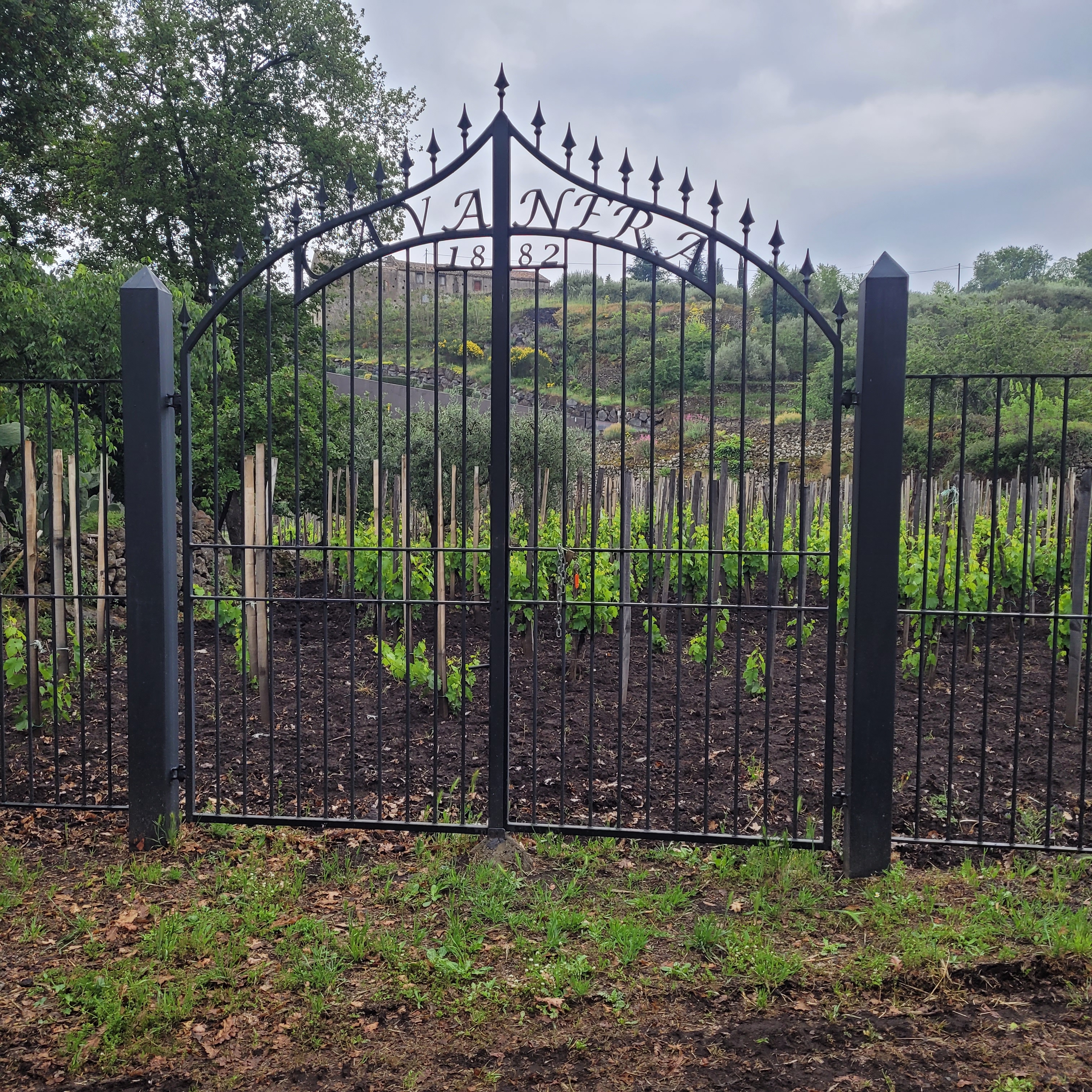
Stays on lees for 36 months, Pas Dosé because all the wines are dry and that is the estate’s firm direction. Freshness yes but grape and slight gingery-oxidative character are the complexities urged forth by the grillo grape. Calming sparkling wine, all in order, pleasing and yes also complex. Drink 2024-2027.  Tasted May 2024

Tenute Navarra Frappato Spumante Rosemosse 2023, Terre Siciliane IGP

Located in Butera within Caltinasetta, started in 2019 on an estate that had been abandoned for 30 years. Of 175 hectares, 18.5 are planted, 15 in production. Almonds, olives also part of production. Charmat method, soft press and after five months it spends two months on lees. Straight frappato, extra brut style and so 4 g/L of RS, tart, very strawberry, big energy groove and patterning on repeat. Tends and trends to the higher level on the Brut scale in terms of residual sugar yet early picked varietal acids keep the pace and faith. Drink 2024-2025.  Tasted May 2024

Tenute Navarra Zahr Bianco Frizzante 2023, Terre Siciliane IGP

Zahr the flower from Arabic, a sparkling wine using grillo and chardonnay made at low pressure (max. 2.7 bars) and so not exactly by Charmat style, finishing at 12 percent alcohol and low residual sugar. Floral in every way, citrus is lime and the persistence very high for how this is made. Light bubble, easy and enjoyable. Spritz it up! Drink 2024-2025.  Tasted May 2024

Tenute Nicosia Sosta Tre Santi Etna Brut Sessantamesi Metodo Classico 2016, Etna DOP

Reductive style, maturing, now in the middle road in terms of fruit and energy, high acidity yet also sugars running that way. A big and openly gregarious expression for a consumer who likes it sweet, sour, intense and wild.  Last tasted May 202

Tenute Nicosia Sosta Tre Santi Brut Rosato Metodo Classico 2021, Etna DOP 

Quite a dry, rusty and rosy Rosé sparkling, clean and fresh. Drink 2024-2026.   Tasted May 2024

The view from Splendid Hotel La Torre, Mondello

Rosato

Alessandro Di Camporeale Etna Rosato DOC Vignazza 2023

Funky, earthy and cheese rind, herbal and acidulated roasted peppers. Notable onion skin and red apples. Not the most balanced work with nerello mascalese. Drink 2024.  Tasted May 2024

Baglio Di Pianetto Viafrancia Rosé 2023, Terre Siciliane IGT

Full, rich and substantial Rosé for those who wish for some pulp and flesh. An excess of red berry riches, proper acidity, only a pinch of residual sugar and persistence to satisfy in the end. Drink 2024-2026.  Tasted May 2024

Cottanera Etna Rosato DOC 2023

From Rosso vineyards, looking for freshness and very little sugar but also low alcohol. Only steel, three months, bottled in February. Rich of fruit, salty, crunchy and for Rosato also complex. Tons of flavour, strawberry and some leafy savour. Drink 2024-2025.  Tasted May 2024

Feudo Montoni Nerello Mascalese Rosé Di Adele 2023, Terre Siciliane IGT

The ripest vintage and so picking early was necessary but Montoni is in the enviable position of elevation and also ventilation where crosswinds from Africa and the Mediterranean meet. In this place and of a warm vintage there is early ripeness but also thankfully phenolic development so that fleshy fruit, sweet and ripe acidity, then finally phenolic maturity all come into place. This bodes well for nerello mascalese as Rosé. There will be no one who does not find this delicious. Drink 2024-2026.  Tasted May 2024

Le Casematte Etna Rosato DOC Rosematte 2023, Terre Siciliane IGT

There is this style of Rosé made with nerello mascalese that just says light, dry, breezy an easy – this would define that to a “T.” The plus of all the fruit imagined and needed, a touch of sweetness and simplicity from start to finish. Drink 2024-2025.  Tasted May 2024

Palmento Costanzo Etna Rosato DOC Mofete Rosato 2023

Equally fruity and vegetal, of red berries and peppers, a tartness and also lactic cheese note. Herbal as well and so complexity as Rosato if on the acquired taste side of style. Crunchy and salty, briny to a degree, naturally wild and free. Drink 2024-2025.  Tasted May 2024

Serra Ferdinandea Rosato 2023, Sicilia DOC

Next step taken for Rosé on the south coast at Menfi with this upright and linear ’23 inching towards the profound. A balance and a confidence with 100 percent nero d’Avola that defines the idiom and begins to perfect the workmanship. Satisfying and also delicious, inciting the salivary glands and asking for more. Will gain interest and intersect with further complexities after 18 months further time in bottle. Drink 2024-2027.  Tasted May 2024

Spadafora Il Nostro Rosato 2023, Terre Siciliane IGP

Colour, which is quite dark is just from the skins, no pressing, fermented in concrete and aged in steel. A Tavel hue, natural and appreciated, without pith, tonics or bitters. Top quality mix of the salty and the sapid, the rich and the stony. Could drink a bucket full because of its 100 percent nero d’Avola flavour, honestly and balance. Drink 2024-2026.  Tasted May 2024

Torre Mora Etna Rosato DOC Scalunera 2023

About as light and airy as it gets for Rosato, crunchy and salty, simple, easy and available. Chill, get at it and enjoy the fullness of a day. Drink 2024-2026.  Tasted May 2024

From Mangia Pollina Beach Resort

Etna Bianco DOC

Alta Mora Etna Bianco DOC 2022

Nice and smoky Etna Bianco from Alta Mora though the fruit is equally adamant about gaining your trust. The smoulder equalized by the pulpy flesh of fresh bites into orchard fruit and a touch of finishing spice. Not the most complex but surely robust for the category.  Last tasted May 2024

Solid and well made Etna Bianco in the ways of respect and tradition, ample, fulsome, substantial and structured for a wine that will drink well three-plus years forward. Citrus mainly, both lemon and lime, cool, not quite minty but surely like fresh summer basil and then a pinch of salt at the finish. Drink 2023-2026.  Tasted May 2023

Benanti Etna Bianco DOC Contrada Cavaliere 2022

Reserved, not reductive but neither open nor gregarious. A smoulder of volcanics and wood aging, just an aromatic wisp of flint and notable verdancy. The greens are also driven by the place and Cavaliere gives in just this way. Low, slow and with a time lapse release of controlled power. Really quite remarkable Etna Bianco from this contrada. Drink 2025-2032.  Tasted May 2024

Benanti Etna Bianco Superiore DOC Contrada Rinazzo 2022

The Bianco carricante of Rinazzo are so very different to (especially) Cavaliere, namely because of humidity but also due to closer proximity to the sea. Here is a Superiore example, allowed to be labeled this way in the eastern area (of the village of Milo) and Bennati’s is richer, fuller and also more textural. Not just a case of lees but the aforementioned micro-climate really makes the case. A fine and impressive iteration indeed. Drink 2024-2028.  Tasted May 2024

Cottanerà Etna Bianco DOC 2023

Campione: From three Contrada, carricante 100 percent, no issues with mildew because of an agronomist’s intensity of focus to root it out. Harvest in the first week of October and this comes away rich and full, so very developed and quite fruit explosive. Seven months of lees and stirring is very much in play this way. Fresh and full – just the way so many will find their love for this Etna Bianco. Drink 2024-2026.  Tasted May 2024

Cottanerà Etna Bianco DOC Calderara 2022

Calderara vineyards are 40-45 years of age and the harvest happens a week later, in the second week of October. Cement and large casks, 60-40, 10-12 months, brought back together and bottled. Saltier than the Bianco because the vineyard is so full of lava stone, a 100-plus year old eruption with brown basaltic stone. Very focused and precise though more power than 2021. Drink 2025-2029.  Tasted May 2024

Donnafugata Etna Bianco DOC Isolano 2021

About as curious and unique as it gets for Etna Bianco with this by Donnafugata at impressive elevation from a place called Isolano. The vintage delivers great sunshine and therefore ripeness for a maximum amount of fruit development that because of an extra year in bottle has now come to a place of generosity. More tang than saltiness and very ready to drink. Drink 2024-2026.  Tasted May 2024

Firriato Cavanera Etna Bianco DOC Balza Delle Poiane, Contrada Zottorinotto 2022

Some reduction from a specific cru and designation, that being Cavanera Balza delle Poiane within the northerly contrada of Zottorinotto. Herbal as well, fresh sprung spring glade of ferns and wild allium, trillium and the local Ginestra. Plenty of substantial fruit and truthfully so much going on. As far as Etna Bianco is concerned this should be considered a big wine, the kind that can be enjoyed by lovers of full-bodied chardonnay. Drink 2024-2029.  Tasted May 2024

Godello and Giuseppe Russo

Girolamo Russo Etna Bianco DOC Nerina 2023

Only Nerina, San Lorenzo and Feudo were made in 2023 due to a challenge from rain, mildew and less fruit availability. No worries about quality however and Nerina is about as full pulp-fleshy and developed as it has ever been. The acids travel up and down the sides of the palate in the ways of striking Etna Bianco and here Russo finds the road back, each and every time. Drink 2024-2029.  Tasted May 2024

Girolamo Russo Etna Bianco DOC Feudo 2023

New Bianco for Giuseppe Russo, a selection of 100 percent carricante from three hectares within the Feudo di Mezzo vineyard and contrada. Feudo is not San Lorenzo but it is something remarkable in its own right. More botanical and phenolic but also a level of citrus preserve not noted anywhere but Feudo. Crazy level of implosive citric intensity and taut character. The behaviour is so different to San Lorenzo with flavours that mean business in the most impressive way imaginable. Intensity off the charts, concentration so impressive, energy that builds and builds. Drink 2024-2029.  Tasted May 2024

Girolamo Russo Etna Bianco DOC San Lorenzo 2023

San Lorenzo as Bianco from Giuseppe Russo is not like other Etna Bianco because well, San Lorenzo. Wow is the operative because no other EB gives like this. Beyond flesh and stone but something that defines what the two can effect, layered so invisibly and magically together. It seems impossible to believe that extract and conversions could come together this way, urged and supported buy some of the mountain’s finest quality of acidity and white grape tannins. This must be the place, eh? Carricante with 10 percent catarratto and grecanico makes it happen. Drink 2025-2033.  Tasted May 2024

Graci Etna Bianco DOC 2023

A mix of all four contradas; Muganazzi, Arcurìa, Feudo di Mezzo and Santo Spirito. A mix of Mediterranean scrub and vibrancy, looking for that balance between and finding it. Really fine precision and salinity, length is outstanding for villages level Bianco. Drink 2024-2027.  Tasted May 2024

Graci Etna Bianco DOC Arcurìa 2022

Some wood on Arcurìa that the Classico Etna Bianco does not receive and so this is not as lean, nor is it vertically the same. Citrus mixes with mineral, some austerity and magic that makes this more complex. Crisp however, but fleshy because the concentration and the contrada want this wine to end up this way. Drink 2025-2030.  Tasted May 2024

Graci Etna Bianco DOC Muganazzi 2022

“A wine of mystery,” says Alberto Graci, “very intriguing for me.” Flinty and scrubby at the same time, energy and vibrancy laying in waiting, a buzz behind the curtain and a soil purposed into the 100 percent carricante that Graci’s team and now also we know the wine will want to explode with flavours a year, or more rightly two from now. So tight but you can feel it, the linear nature looking ahead and time will bring about something social form that mystery. Unquestionably one of L’Etna’s finest ’22s. Drink 2026-2035.  Tasted May 2024

I Custodi Delle Vigne Dell’Etna Etna Bianco Superiore DOC Imbris Contrada Caselle 2020

Varietal carricante at 800m fermented in steel, put to barrel and then one year in bottle. So much corporeal flesh on the body of a seriously developed Bianco. Has come into a fine place but my goodness so much texture, citrus and length. Drink 2024-2027.  Tasted May 2024

Nicosia Etna Bianco DOC Contrada Monte Gorna Biologico 2023

Quite rich and developed considering the youth and also a minor cheese rind lactic note in what feels like Etna Bianco working through its machinations. A bit awkward to be honest and a little bit of time should see some coming together. Then again the window is tight and so the time is just a bit ahead of now. Drink 2024-2026.  Tasted May 2024

Palmento Costanzo Etna Bianco DOC Bianco Di Sei 2022

Just have to say wow because Bianco di Sei comes equipped with a level of intensity that was not quite expected from 2022. Not so much a volume or an explosion aromatically speaking but an extreme set of eccentricities that crash aboard the palate. Likely needing some rest and down time to integrate because the level of extract here (including volcanic activity) is simply off the charts. Etna incarnate, pointed and exciting. Drink 2025-2029.  Tasted May 2024

Palmento Costanzo Etna Bianco DOC Contrada Santo Spirito 2021

A fine vintage and and even finer Contrada, that being Santo Spirito where carricante (and 10 percent cattarrato) are given every soil, geological and micro-climatic advantage. There is an accumulation of ripeness and stone cool mineral groove from location and acumen that make this move with incremental ability. It will slowly define itself over along period of time that will be fascinating to watch every step of the way. Drink 2025-2032.  Tasted May 2024

Pietradolce Etna Bianco DOC Archineri 2022

Archinieri comes at us with that Pietradolce mix of confidence and generosity because well, vineyards and expertise. A Bianco that must be great because the makers demand top quality from field to table and all the markers here are present, defined and accounted for. Ideal reasoning, seasoning and style. Drink 2024-2028.  Tasted May 2024

La leggenda Patricia Tóth – Planeta

Planeta Eruzione 1614 Carricante 2021, Terre Siciliane IGT

New label alert for Planeta’s 100 percent Passopisciaro carricante that celebrates, codifies and contemporizes the Etna eruption of 1614. Incredible intensity and roll in the hay of varietal beauty with striking acidity for what may just be the most brilliant shine ever noted in this emotional wine. Emozione indeed, of a respect for plants and place, of volcanic flows and their craggy rocks, of florals, herbals and all that lives and loves. The extra year in bottle intensifies, stratifies and solidifies both experience and intent. So fucking bon. Drink 2024-2033.  Tasted May 2024

Tenute Bosco Etna Bianco DOC 2023

The ’23 Etna Bianco artist formerly known as Piano Dei Daini comes out of a hard vintage because of rain in June with some Perenospera issues, “but the carricante can handle the attack” explains Sofia Ponzini. No loss of fruit, harvest and vinification all together very much in a field blend way. The ten percent endemic varieties settle the carricante, neutralize its power and make for a most wholesome but always elegant Etna Bianco. A rinse of salty sea air meets Macchia Mediterranea. Sofia ends up happy but admits the wine needs bottle time, to sleep a bit, calm the energy and the power. Vibrancy is needy, crunchiness too, feel of the volcano so crucial and so all that is great but the drippy phenolic presence needs taming. That’s what time will effect. Drink 2025-2032.  Tasted May 2024

Terra Costantino Etna Bianco DOC Contrada Blandano 2019

A few years now in bottle and so this 2019 has developed next level style, further character and stage presence. Honeyed and luxe, acids sweetened with a lively if sour edge and then comes that extract that urged the totality from the start. A fine and confident wine with time on its side and a healthy perspective for Etna Bianco as the kind to serve at dinners and tastings all over the world. Drink 2024-2026.  Tasted May 2024

Tornatore Etna Bianco DOC 2022

Classic Etna Bianco style that has come to be defined as “mountain wines” driven by volcanic soils. Here a rounded example with no sharp points, edges or spikes, fruit quotient run higher than most, riper and developed for immediate gratification. Substantial to every degree, acidity as sweet as it comes and everything so very up front. As good an introduction to the genre, idiom and place as there can be.  Last tasted May 2024

Extreme unction and notable lees usage though keep in mind this is 2022. As young, impressionable and not quite out of the gangly stage as an Etna Bianco can act. Laden with lemon, much of it fresh squeezed, some unresolved phenolics (and aldehydes) and a shield of early structure or elastic membrane that is yet to slide away and reveal the full nature of what will surely be a cracker wine. Would much prefer to taste this a year from now. Drink 2024-2028.  Tasted May 2023

Tornatore Etna Bianco DOC Pietrarizzo 2022

Pietrarizzo is both available and confident, not idiosyncratic like Zottorinotto and also richer of fruit. There is an herbal and botanical way about this cru Bianco with splashes of catarratto bringing seasoning to the carricante. A bit spicy and even humid though the fruit is the thing and the volcanics an accent making for even more spice entertained. Such a solid Contrada based Bianco. Drink 2024-2028.  Tasted May 2024

Tornatore Etna Bianco DOC Zottorinotto 2021

Of Tornatore’s cru-designated Bianci it is Zottorinotto that acts the most reductive and hard to crack. Great shell of protection and disguise, needing agitation and better still time. That said the 2021 is also fully formed, developed and very much ready to get at – make sure to aerate, decant if you can and allow the pleasures to be released. Drink 2024-2026.  Tasted May 2024

Torre Mora Etna Bianco DOC Chiuse Vidalba 2022

An Etna Bianco on the extreme volcanic side because the aromas and flavours just feel like sucking on a mouthful of basaltic lozenges. Cool, gelid and distinctly mineral on the outside, liquid ethereal and almost mentholated within. Don’t come looking for a burst of fruit, not by citrus, stone nor orchard though there is this green melon note coming late. Nor is this a high acid example, but also not so very botanical. Just bloody volcanic – which speaks to Chiuse Vidalba. Drink 2024-2028.  Tasted May 2024 

Torre Mora Etna Bianco DOC Scalunera 2023

Varietal carricante from Etna’s northern slope with just about as knowable and definable an Etna Bianco as there can be. This is Scalunera, of perfumes and fruit flavours yellow and green, crunchy and caught at the peak of freshness. What you call a dictionary entry that will be enjoyed by all – to great satisfaction. Drink 2024-2027.  Tasted May 2024


Other DOC and IGT Whites

Donnafugata Passiperduti 2023, Sicilia DOC

Only grillo from Sicily’s west-central hinterland surrounded by hills and then the seas. Freshness and phenolics, lemon, grapefruit and botanicals, the things that grow around vineyards and up through the slopes. A crispy and lemon zested grillo like no other, made to order for grilled fish. Drink 2024-2026.  Tasted May 2024

Feudo Montoni Catarratto Masso 2023, Terre Siciliane IGT

What catarratto will do when a grower and winemaker like Fabio Sireci gets it into his hands – to offer perfumes of white flowers and flavours of green fruits, always fresh and delicate. Persistence and linger, the way it should and wants to be. One of Sicily’s most honest and consistent white wines. Drink 2024-2027.  Tasted May 2024

Feudo Montoni Inzolia Dei Fornelli 2023, Terre Siciliane IGT

Feudo Montoni’s will always be one of the most harmonic, restrained and yet phenolic-gripped meets mutli-floral/fruity inzolia of the island. The citrus intensity, a zesting of lemon and lime made liquid to seal the cracks puts this ’23 in a state of grace. Must try varietal wine if not the ideal vintage because of warmth that begot early ripening. Drink 2024-2026.  Tasted May 2024

Feudo Montoni Grillo Timpa 2023, Sicilia DOC 

Only Fabio Sireci’s grillo comes forward this way, with an equal combination of full fruit determination and linear capacity. The mix of Sicilian exoticism and knowable character puts this at a varietal level to bely the island capabilities of the lion’s share. Not surprising considering the pick begins in late August and finishes early in September. Freshness yes but so much more, first from natural matter and then because skipping past the noise to arrive here confirms Sireci’s intelligence to make a grillo understood in the hands of instinctive tasters and consumers. Drink 2024-2027.  Tasted May 2024

Masseria Del Feudo Grillo Hermosa 2022, Sicilia DOC

Ideal middle of the road grillo example, white and yellow florals, lemon segmented and juiced, herbal and direct. A good chill on a warm day, some fried calamari and all will be right in the world. Drink 2024-2026.  Tasted May 2024

Mazzei Zisola Bianco Contrada Zisola 2022, Terre Siciliane IGT

The second vintage of a 100 percent catarratto from plants that went in back in 2015 on white calcareous soils. Only bush vines and at first made into a blend with grillo. The change was made to do some skin contact and aging in amphora. Really that simple and that is the advantage, no overdoing or distraction in trying to impress. But this does just that, with vibrancy and succulence. Really taut, lemon tight, nearly but not quite piercing. Will change after three years and get honeyed. Reminds of really young Hunter valley sémillon. Top echelon decisions and so bravo Filippo Mazzei and team. Drink 2024-2028.  Tasted May 2024

Mazzei Zisola Azisa 2023, Sicilia DOC

Only stainless steel, short contact with the skins, made in a very traditional way. Perfectly arranged, straightforward and simple, of lemon citrus and white flowers by grillo that by now presses the idiom into Sicily’s concept of island time. Crunchy and just ever so slightly pith bitter, lemon again and again, unrelenting in style and quick by design. Drink 2024-2025.  Tasted May 2024

Planeta Terebinto Grillo 2023, Sicilia Menfi DOC

Ripeness, juicy forthright quality and all in interface with what feels like every pore for both aromas and with the palate. The Terebinto, a.k.a Cyprus Turpentine never takes a break nor moves absently around. There is purpose in every aroma and flavour, not as an attack, but as a dance. This grillo gets better and better every year. Shiny happy leaves and people. Never out of time for this grillo. “Put it in the ground. where the flowers grow, gold and silver shine.” Drink 2024-2027.  Tasted May 2024

Planeta Bianco Alastro 2023, Menfi DOC

Varietal sauvignon blanc and not just any but from a southern Sicilian shore where the sea winds and scrublands are simply different to the Mediterranean side. All that matters conjoins for a whole new way to see the grape. Crispy and crunchy, salinity running amok and oysters or crunchy fried fishes (hopefully) waiting on the table. Drink 2024-2026.  Tasted May 2024

With the legend, Alessio Planeta

Planeta Allemanda 2023, Sicilia Noto DOC

It’s a moscato bianco but not the kind you think, in fact it’s not only bubbles that are missing from Planeta’s Noto example. Extract and tannin rise above sweetness and fruit though there is plenty of ripeness noted in the latter. Ripe vintage, perhaps less quantity, but quality fruit makes for a balanced moscato. Drink 2024-2026.  Tasted May 2024

Planeta Fiano Cometa 2022, Sicilia Menfi DOC

The sole varietal fiano at Anteprima Siciliane 2024 and of course it is Cometa by Planeta which stands the test of island time. Alas and always the subtle smoulder, struck flint but a moment in time and a crunchy quality to supersede the herbs and the lime. Full vintage, well-developed for a fiano that will ready itself a year ahead of its average time. Cometa cometh with palates standing by the ready. Drink 2024-2028.  Tasted May 2024

Planeta Didacus 2021, Sicilia Menfi DOC

Always the richest example of chardonnay with most honeyed flavours, spice cupboard and savoury eccentricities. The selection considers only the best, they being the ripest bunches with that uncanny ability to collect as mature, almost evolved feeling from its fruit to be converted into a magical example of Menfi. So much sunshine, luxe and refulgence, almost so bright you gotta wear shades sort of chardonnay. A top vintage because acidity, extract and tannin all layer in heaps. Drink 2024-2028.  Tasted May 2024

Principe Di Corleone Ridente Angelica 2023, Sicilia DOC

Cool, ethereal, minty, salt-licked and kissed, stoic and proud. Herbal and botanical, of bay laurel and thyme, lemon preserve and the morning juice. Some may find the tonic a bit gin-washed but who should not love these flavours and the style all the same? Drink 2024-2027.  Tasted May 2024

Francesco and Enrica Spadafora

Spadafora Bianco 2023, Terre Siciliane IGP

From vineyards Between 200-400m, a place of sandy soils where freshness is the order for catarratto and yet there is some tropical fleshiness about the ’23 by Spadafora. Would not exactly say salty but more so a split between salinity and sapidity because there are some phenolic moments in this wine. Harmonious and just complex enough to rise above the norm. Drink 2024-2026.  Tasted May 2024

Spadafora Don Pietro Bianco 2023, Terre Siciliane IGP

Named after Francesco Spadafora’s father (and Enrica’s grandfather) who started the winery in 1993. A bit higher in acidity than the straight catarratto because of the inclusion of grillo and so a higher saltiness, succulence and energy. This is expressive of attitude in such a good way. Will gain interest after a couple of years. Drink 2024-2027.  Tasted May 2024

Spadafora Grillo Principe G 2023, Terre Sicilane IGP

For the grillo the plants are kept to a relative minimum vigour but cutting away the “moustache and the tail” while keeping the interno. Ferments in concrete, ages in steel and just a few months on lees. Remarkably if subtly flinty, smouldering and textural, simply from land and grape, coming together for a really unique effect. It’s truly Spadafora, their place and how they allow this quality to speak. Drink 2024-2028.  Tasted May 2024

Spadafora Siriki Orange 2017, Terre Siciliane IGP

Grillo on skins for 30 days, now nearly seven years of age yet freshness somehow persists. Surely owing to clean lees and how they lay to present themselves as they continue to ready their host. Enrica Spadafora explains how she and her father were wanting to have a different style of orange and also this is grillo, not your every day average variety for the style. Was structured and has now settled, though there are some tannic moments drying the palate in the end. Impressive all in all, seemingly ambitious, but the result is there. Drink 2024-2026.  Tasted May 2024

Tenute Navarra Sofien 2023, Terre Siciliane IGT

Half and half grillo and chardonnay, as with all the wines they are called “Totò Navarra,” first and last name of the owner and you can’t just use Navarra because well, Spain. Totò, as in Salvatore. Fruit, flowers, simple, sunshine and some chardonnay backbone, but just clean and fresh which is just what is needed. Fine and easy yet acidity and persistence are essential and the finish more sapid than salty. Drink 2023-2025.  Tasted May 2024

Etna Rosso DOC

Cottanerà Etna Rosso DOC Diciassettesalme 2022

Solo nerello mascalese, made with the grapes from all three Contradas, 10 months in steel, followed by six months in bottle. Dictionary entry though it’s just the first vintage of this specific Rosso without Cappuccio. These are nerello plants grafted onto the old cappuccio and to be honest there is more purity and focus this way. Spicier, in a way and more energy. Will take a few vintages to find its solo artist stride. Drink 2024-2027.  Tasted May 2024

Cottanerà Etna Rosso DOC Contrada Feudo Di Mezzo 2020

Only nerello mascalese from 35 year-old vines, big barrel for 14 months. Even though Feudo di Mezzo is the largest Etna Nord contrada there is such consistency and a thread of wine effect that runs through the 20-plus producers. Cottanerà heeds and abides by the vineyard to produce a balanced FdM worthy of the name. Drink 2024-2027.  Tasted May 2024

Cottanerà Etna Rosso Riserva DOC Zottorinoto 2019

Plants are 85 years of age on four hectares but this wine is a selection from three tonnes of grapes to make only 1,800-2,000 bottles. Riserva, so it remained in cask for two years plus two more in bottle. Depth, breadth, spices and richness, the most full bodied and textural Rosso, tannins sweet and long-chained with time still needed to resolve all that is here. Drink 2026-2032.  Tasted May 2024

Girolamo Russo Etna Rosso DOC ‘A Rina 2022

A very warm and dry vintage making for a taut, chalky and savoury nerello mascalese (with 10 percent cappuccino). This next ‘a Rina takes off where 2021 left off and only Feudo is as consistent an Etna Rosso as this. Chalky red cherry, a leathery aspect and drying tannins that speak about 2022 in both toasty and positive ways. Crisp ’22, of bay and liquorice, salty volcanics and good length, though not in the league of Feudo and San Lorenzo. Drink 2025-2030.  Tasted May 2024

Girolamo Russo Etna Rosso DOC Calderara Sottana 2022

The juiciest of all the ‘22s for Giuseppe Russo and if also the least structured there can and should be no complaints. Reeking of and oozing nerello mascalese flavours so cherry red, fresh, clean and particular. There are no others like this – the level of energy without unnecessary heated intensity is remarkable. Drink 2024-2029.  Tasted May 2024

Girolamo Russo Etna Rosso DOC San Lorenzo 2022

The gifts of San Lorenzo are of a slow release ilk the other cru and vineyards of Girolamo Russo are not, but this from 2022 is so full of riches it brings early joy. A great pleasure to have a glass even now with gregarious perfume and readied flavours, of red berries, liquid chalky to candied palate swaths and immediacy from this bottle of wine. San Lorenzo shows off the most glyercol and silken texture – it’s almost candied but of course it’s not. Spicy on the back side, sneakily structured and all the while with a glass we’re feeling fine. Can only improve and integrate with a couple of years time. Drink 2025-2030.  Tasted May 2024

Girolamo Russo Etna Rosso DOC Feudo Di Mezzo 2022

The allure of Feudo is real, the consistency of its fuxed expression divine and the work in Giuseppe Russo’s world a conduit to access the sublime. Sure there is a quiet restraint at this early stage of 2022’s tenure but how could we miss the high levels of fruit and structure combining for purpose and potential? A big and full Feudo from the variable vintage, chewy and layered, stratified volcanics making sure that when maturity comes there will always be mineral. What a Feudo indeed. Peak of Feudo freshness out of the embers and smoulder of a warm season. The secret is Etna and this section of the vineyard. Drink 2026-2036.  Tasted May 2024

Girolamo Russo Etna Rosso DOC Feudo 2022

From the highest section in the Feudo di Mezzo vineyard, bush vines, very old. Delivers ultra light and conversely powerful di Mezzo freshness, but from this elevation at a much higher rate and with an extension of vibrancy plus energy. More verticality and sweetness of nerello fruit like almost no other. Resides in a state of grace upon the palate and though it hovers just a millimetre above, there still feels like the fruit, acidity and finest tannin are collectively making full contact. Remarkable. Drink 2026-2036.  Tasted May 2024

Girolamo Russo Etna Rosso DOC San Lorenzo Piano Delle Colombe 2021

Laying down expectation can be a dangerous thing, but can’t be helped some times. Knowing Giuseppe Russo and the Piano delle Colombe block of the San Lorenzo vineyard will induce and send thoughts down such a path from a 2021 that not only matches but exceeds what was thought to be possible. Aromatically positive signs and the deliverance of a fleet of nearly perfected ripenesses come to such a consummated fruition are come upon by way of unconscious results. Optimal not optimum, because there is no such thing, but only the attainable which in this case is superlative balance. Harmonies of all parts, out of field to bottle, through every rise, depression and plateau, from start to finish and everything in between. The critical moments are found, like cooking a perfect steak, pushing your finger into its soft middle fleshy belly and feeling the exact spring back desired. A greta or pearl of a nerello mascalese, a highway tune, “so sweet, so fine, so nice, all mine. “I prefer ’21,” admits Russo. Smart man. Drink 2024-2036.  Tasted May 2024

Alberto Graci

Graci Etna Rosso DOC 2022

From estate vineyards at 650-750m, fermented and aged for 18 months in concrete though once in a while a little bit of big barrel is used. Linear, stoic, restrained and serious Etna Rosso for Rosso’s sake but also trenchant intention. Crispy and crunchy, vertical and youthful. Fresh, even a bit reductive , so peppery and a year away from that open window. Drink 2025-2029.  Tasted May 2024

Graci Etna Rosso DOC Arcurìa 2021

The home vineyard, great vintage and that should not be questioned because frankly it simply can’t be denied. If nothing else the intensity of purpose comes through from the start. More depth and crunch, further concentration and breadth, still austere and working through its tasks, machinations and intentions. Big wine from 2021. Drink 2026-2033.  Tasted May 2024

Graci Etna Rosso DOC Arcurìa Sopra Il Pozzo 2019

Longer maceration because these are stems that ripen better than anywhere else and so Alberto Graci tastes and decides how long to go. Usually 60 days and 2019 was right around that number. You can feel them, mostly though not 100 percent ripe and yet that savoury-verdant note works so well to create a spice mix and seasoning that extends the breadth of the fruit. Do not come here for heavy concentration or weight because there is restraint but also expect some austerity. Really needs time and will eventually settle into it’s technicolor skin. A compact wine that will deliver a slow release of energy. Drink 2026-2035.  Tasted May 2024

I Custodi Delle Vigne Dell’Etna Etna Rosso DOC Pistus 2022

From L’Etna’s northern side at Contrada Muganazzi, only stainless aging, no wood and thank you very much. I Custodi Delle Vigne Dell’Etna have been working with this contrada since the beginning (2007) though Pistus the label dates to 2012. Some volatility though just a hint and not too distracting, Amaro herbal and very complex. Big wine though fresh, crispy and crunchy, with good freshness. Serious lift to this Etna Rosso. Drink 2024-2027.  Tasted May 2024

Palmento Costanzo DOC Etna Rosso Nero Di Sei 2020

Spicy and floral, aromatically crisp and taut, wood a factor with plenty of seasoning. A bit sappy and edging into tang with flavours quite sharp and also dense but time will settle the score for all parts involved. A big and inky version of Nero di Sei and one to really sink your teeth into. Wait two years to do so. Drink 2025-2028.  Tasted May 2024

Palmento Costanzo Etna Rosso DOC Contrada Santo Spirito

Evolving nicely, now nearly ready to go, fruit still fresh enough and structure beginning to subside. A full bodied Etna Rosso from Santo Spirito in delivery of what the contrada and the vintage held in hand. Drink 2024-2027.  Tasted May 2024

A vintage out of which the pre-phylloxera was produced from the contrada so just imagine the possibilities as they come from this all in for the vintage nerello mascalese. Feels like an extended maceration because the glycerol and unctuous textural pool are both at the crest of Etna Rosso heights. Oranges and cherries but more than anything old vines spirit and what just happened from out of these volcanic sands carried through to century and a half vines is something wholly and unequivocally other. Hints at balsamic reduction but the tannins and also acids are so fresh and so years is what it will take to take this anywhere new. The finest chalkiness imitates the soil and puts this in a league with some of Italy’s most important red wines. Up to you too decide which they are or don’t bother at all. Drink 2025-2034.  Tasted May 2023

Pietradolce Etna Rosso DOC Rampante 2020

The most developed for Rampante with a spicy 2020 aromatic entry, concentrated and refined while residing on the darker red fruit side of the line. Lift, balsamico gariga, bay laurel, crunchy and herbal. So very complex and as far as Etna nerello mascalese goes there is more savoury depth from this by Pietradolce. Full-bodied in all these regards, breadth and volume guaranteed. Drink 2024-2030.  Tasted May 2024

Pietradolce Etna Rosso DOC Santo Spirito 2020

The 2020 nerello mascalese from Contrada Santo Spirito is a meaty and gamy bruiser, sanguine and yet lifted with some fine volatility to nose. The right amount because the aromatic volume, palate depth and tannic freight are all equal partners working towards a common goal. That would be a full-bodied Etna Rosso with the stuffing and planning to age very well. Drink 2025-2031.  Tasted May 2024

Pietradolce Etna Rosso DOC Barbagalli 2019

A unicorn Etna Rosso and here from 2019 there has been some development though the wine is still ways away from full integration. Talking formidable structure, inclusive of tannins of a tight and variegated grain, running crosswise and painless because they usher fruit and urge acidity to always be a part of the fray. A total weave of Rosso sentiment, bringing emotion and pleasure without fail, to exult a vineyard as special as any in the world. One only need to stand over it to understand its power, insistence on restraint and the keys to unlock potential. Will turn heads and remain in light for a good long time. “Facts are nothing on the face of things. “Still waiting, still waiting, still waiting, still waiting.” Drink 2026-2037.  Tasted May 2024

Planeta Etna Rosso DOC 2022

Not a contrada specific Etna Rosso but more than 70 percent comes from Feudo di Mezzo in Passopiciaro. As juicy and glycol notable Rosso as there has ever been and silken would best describe the quality felt aboard the more than pleased and nurtured palate. Another wine that improves each vintage under the guidance of Patricia Tòth, in part because her favourite dogs hang around that winery next to the vineyard. Also because her experience and abilities have come to a most profound place. Love the spice masala on the finish. Drink 2025-2033. Tasted  May 2024

Planeta Eruzione 1614 Nerello Mascalese 2020, Terre Siciliane IGT

From the single vineyard in Passopisciaro, site of some of the oldest lava flows on Etna, the 1614 volcanic spill. Another high glycerol event as nerello mascalese because this is what this vineyard must effect upon fruit and 2020 abides. Of course it does but also delivers the kind of Rosso that does not beg for years of waiting. The tannins are sneaky but not austere, the acidity so sweet you would like to spoil it as dessert. More precise than the Etna Rosso (mainly from Feudo) but clearly nella famiglia.  Last tasted May 2024

Brightest and highest of scintillant nerello mascalese at impressive elevation on soils developed from the mountain’s 1614 eruption, in other words ancient but still young by world standards. Each and every lava flow resulting in volcanic soils is different on Etna and this 406 year-old tract is unequivocally responsible for Planeta’s 2020 style. Sure the winemaker might have a say but her job is to let the vineyard speak which she does as well as any artista/professionalista on the mountain. Buon lavoro PT. Stupendo. Drink 2024-2032.  Tasted May 2023

Tasca d’Almerita Tascante Etna Rosso DOC Contrada Pianodario

High-toned, spirited and transparent nerello mascalese from Tasca’s L’Etna Tascante out of Contrada Pianodario. Red berry shine, acids excited and fruit a willing participant. Tarragon and Basil herbal, so very basaltic stony and truly a wine of place. Crunchy and ever so slightly resinous with balsamico mixing into the sweetness of fruit and acidity. Drink 2024-2029.  Tasted May 2024

Tenute Bosco Etna Rosso DOC 2021

Big French tonneaux, second passage and older for eight months. No recipe but that is this vintage, not as powerful as 2022 and Sofia sees it like 2016, but perhaps a different kind of balance, though not as ideal as 2016. The restrained power of the volcano runs throughout and you really feel it. Remarkable Etna Rosso in balance and of a grace that speaks to all there can be. What these wines are want to express and how they carry themselves, non-plussed, confident and free. The ripeness factor at the top of what is normal and beautiful without excess or greed. Sweetness of acidity and form-fitting structure but neither curves nor angles are exaggerated, nor drawn with any concentric circles or sharp lines. The wine flows and reaches the limits of what is right and proper. Just that much and no more. And we say thank you. Drink 2024-2030.  Tasted May 2024

Tornatore Etna Rosso DOC 2021

The most understandable and straightforward Etna Rosso there could be, mature and layered, of riches and earth, fruit and soil all in the mix. A volcanic paint by numbers canvas of realism and beauty, easily accessible and generous to a perfectly reasonable degree. Entry point for the DOC and once in, never to look back. Drink 2024-2026.  Tasted May 2024

Tornatore Etna Rosso DOC Pietrarizzo 2020

Some very ripe fruit here from Tonatore’s Pietrarizzo Rosso in the ways of late picking and good solid pressing. Makes for a chewy nerello mascalese that will ready itself for consumption quite a bit earlier than quite a bunch of its peers. Plenty of flavour and attraction for a wine that should be consumed over the next three years.  Last tasted May 2024

North slope of Etna cru of nerello mascalese put to 50hl foudres, blended and then settled in concrete ahead of bottling. Consistently one of the finer Rosso values in Contrada-specific Etna and here the fruit ripeness and maturity is as fulsome as it ever gets. Makes for a drink really early proposition and provided that advice is followed there will be perfume, heady flavours and good acidity in your glass. A wine to lead off high-end tastings and dinners here, there and everywhere. Drink 2023-2025.  Tasted November 2023

Other DOC and IGT Reds

Arianna Occhipinti Il Frappato 2021, Terre Siciliane IGT

Candied floral aromas, of pansies and nasturtium namely with a lift so very suggestive. There is a note of Brettanomyces yet at a subtle level and while the effect is slight the palate trails into a momentary lapse of brittle tannin. Still the beauty and the natural smile of this frappato are intoxicating and we simply will not turn away. Drink 2024-2027.  Tasted May 2024

Castellucci Miano Frappato 2022, Terre Siciliane IGT

Not the most openly fragrant frappato with red berries the most notable entry but no real overt sense of florals. Sweetly herbal, cherry drop and then sweet basil before the palate feels the full true nature of the wine. Cool and gelid with a mint to bay layer herbal feel for a wine well made if pressed just a smidgen past prime. Drink 2024-2025.  Tasted May 2024

Donnafugata Frappato Bell’Assai 2022, Vittoria DOC

Straight ahead Vittoria frappato, floral and striking, citrus up front part green and part red, like cranberry and pomegranate with a chiffonade of tarragon. Some chewy quality here, of liquorice and fruit leather, flavour profile high and acidity cool, tart and fine. Gets better with each subsequent sniff and sip. Drink 2024-2027.  Tasted May 2024

Donnafugata Floramundi 2022, Cerasuolo Di Vittoria DOCG

Lifted, high spirit and tone, herbal, juicy and citrusy for the frappato-nero d’Avola Cerasuolo di Vittoria blend. On the light and transparent side of such an appellative joint which suggests more frappato and also choice of style. Light and linear, suggestively tannic and a great food wine for that meat to fish overlapping. Liquid chalky and lengthy. Drink 2024-2027.  Tasted May 2024

Feudo Montoni Sandwich – Between Fabio Sireci and Melissa Muller

Feudo Montoni Nero d’Avola Terre Di Elio 2022, Terre Siciliane IGT

A very good vintage for the variety though her recent tasting from tank causes Melissa Muller to say that ‘23 “will be even more vertical.” That said the ’22 is not your average, every day nerello mascalese, not by any stretch of the Sicilian imagination. Fully formed, attractive and finding no obstacle to hinder leaving its impression. Balanced throughout, without equivocation, fruit followed by acidity, stepping back to fruit before than fast forwarding two steps to really fine tannins. Lightens as it moves and finishes pretty much where it started. Drink 2024-2028.  Tasted May 2024

Feudo Montoni Perricone Core 2022, Terre Siciliane IGT

A perricone from Fabio Sireci of as much substantial fruit up front as the winemaker has ever put together. Aromatic volume gives way to palate and mouthfeel where depth and breadth really take centre stage. Big in terms of fruit presence though not the most structured ever. Drink 2024-2027.  Tasted May 2024

Feudo Montoni Nero d’Avola Lagnusa 2022, Sicilia DOC

Lagnusa may be hard to say but it is never hard to drink and enjoy to fullest extent of Sicilian nero d’Avola law. Or joy because its mix of local savoir faire, freshness and understated structure make it as ideal a five to seven year wine as any on the island. One of those crunchy exterior, chewy interior neros that remain constant from start to finish. Grace, charm and honesty incarnate. Drink 2025-2030.  Tasted May 2024

Feudo Montoni Nero d’Avola Vrucara 2020, Sicilia DOC

Increasingly the use of sun-dried stems are added back in after some time, like sweet wood notes that alter Vrucara’s physiology for the best. The number is 20-25 percent in 2020. If there are weak vintages of Feudo Montoni’s Vrucara they are yet to be revealed and this 2020 resides near the top of the island’s nero d’Avola chain. Just walk the vineyard, in fact just hear the history and explanations from Fabio Sireci’s mouth and you will understand. Richness meets structure for balance at the vanishing point as if we sit at the bottom of the hill looking upwards from the vineyard, up to the Baglio and then the sky. The fruit is special from 2020, already showing the first subtle hints of maturity and the tannins are perhaps the sweetest ever designed. When Vrucara hits the five year mark it will entrench itself as one of Sicily’s finest drinking red wines for five more. It’s abilities transcend grape and island to last for five more after that before starting its slow five to ten year declension. Is there better value in top grade nero d’Avola from Sicilia? Drink 2025-2035.  Tasted May 2024

Zisola definitely suits Filippo Mazzei

Mazzei Zisola 2022, Noto Rosso DOC

Zisola is a project for Filippo Mazzei that began with a 700 km drive around Sicily accompanied by Diego and Alessio Planeta. Noto was chosen because of the biodiversity of the flora, to Filippo not unlike Tuscany. He also fell in love with the old Baroque town and could see a comparison between nero d’avola and sangiovese. “The decision was made based on a feeling.” The 2022 is so much fresher than the nero of 15 years ago, not to mention the balance accrued by way of alberello trained vines. Open up the dictionary and here it is. Drink 2024-2027.  Tasted May 2024

Mazzei Zisola Achilles 2020, Terre Siciliane IGP

Just a 5,000 bottle production, not released until it sees an extra year in bottle. “Planted from the very the beginning,” because explains Fiippo Mazzei, “syrah was fashionable at the time, but then the Bordeaux varieties went in.” A very structured wine, also showing the wood more than the nero but concentration is so full and the wine just as grippy that it needs the fortification. A solid construct that will unfold after five to 10 years of time. Befitting its name. Drink 2025-2030.  Tasted May 2024

Mazzei Zisola Doppiozeta 2021, Noto DOC

Yes another fine Doppiozeta nero d’avola from the Mazzei family and their Sicilian estate. Crispy exterior, chewy interior, spice and herbs as accents, salt and pepper seasoning, chalky tannic, reasoned and knowably fine. Consistently well raised, made and delivered, signed and sealed as a really good wine. The freshness is always there and the acidity so ideally suited to grape and style. Drink 2025-2030.  Tasted May 2024

Mazzei Zisola Effe Emme 2021, Sicilia DOC

Varietal petit verdot planted in 2004, only 1.5 hectares, just about at the very beginning of Zisola. Incredibly chalky to say that it really speaks for the calcaire but time has come to effect changed so that the vines have come into balance. As petit verdot Effe Emme is not as dark and concentrated as it once was. Really showing its colours, what it is, a child of limestone soils. “Effe Emme,” F.M., long-play radio, well-spoken, one who tells things as they are, Filippo Mazzei. Drink 2024-2027.  Tasted May 2024

Planeta Frappato 2023, Vittoria DOC

About as fruity and openly floral as frappato will be to say that the style continues to evolve in the most positive way. Without distraction and encumbrance, set to aim, be received and please, without biting or striking back. There is some lift in Planeta’s 2023, in part because youth is a rebellious time to be frappato, but we know this too shall pass and the wine will settle without struggle. The fruit will remain and the song continue to play the same. Drink 2025-2029.  Tasted May 2024

Planeta Nocera 2023, Sicilia DOC

One of the very few pleasantly made varietal nocera on the island and the only one presented here at the ’24 Anteprima. Surely found to exist along similar lines to nero d’Avola, with a touch more rusticity, also chewy liquorice and leathery fruit character. The 2023 is a good if not high acid nor rather tannic vintage, assembled and delivered for earlier drinking than some. Drink 2024-2026.  Tasted May 2024

Planeta Santa Cecilia 2021, Noto DOC

Such a fine iteration of nero d’avola as Santa Cecilia, a 2021 more mature and open than before but is that not what it should be? Fruit so naturally curated, sweet and generous to speak of a great potential and long future. Fine acidity as well while also necessary and yet as the wine sits on the palate those credible and knowable quality of nero tannins remind of Cecilia’s past. Anyway this is both handsome and beautiful, vulnerable and strong. Fluid and confident, loving and powerful, with a spoonful of Noto nourishment to last a very good long time. Drink 2025-2034.  Tasted May 2024

Planeta Didacus Cabernet Franc 2018, Sicilia Menfi DOC

Now in release mode at near six years past vintage and believe when you hear that six more are needed to fully develop the structural intensity so that all parts get to working as one. For now feel the positivity of varietal fruit so obvious and layered, concentrated and confident, but in truth there is a submission to the tannins. They are grainy and chalky, not austere, but yes aggressive. Be patient – this Didacus is a 20 year wine. Drink 2026-2036.  Tasted May 2024

Spadafora Vignaioli In Sicilia Principe G 2023, Terre Sicilane IGP

The freshest of Spadafora’s nero d’Avola where acidity runs high, tannins lower and lighter wines are produced (in an area considered best for syrah). Fresh yes but there is a mild amount of Brettanomyces here, nothing striking but present. Natural wine lovers may just find this to their liking. Drink 2024-2025.  Tasted May 2024

Spadafora Vignaioli In Sicilia Don Pietro 2020, Terre Siciliane IGP

A blend of nero d’Avola, merlot and cabernet sauvignon (40,30,30), aged in only concrete and steel for freshness first. Chalkiness arrives second with thanks surely to soil and here some Brett but also volatility that is a bit distracting. Again it’s just a fractional amount but it is there, however less so than the solo nero d’avola. Drink 2024-2026.  Tasted May 2024

Spadafora Vignaioli In Sicilia Syrah 2021, Terre Siciliane IGP

Fermented in concrete and aged in steel, the freshest syrah that can be made to drink quickly, easily and without hesitation. Cleaner and fresher than the entry nero d’Avola with meatiness and mild peppery grip, though no real density to speak of. Great classic example for all red wine needs. You can chill this one. Drink 2024-2026.  Tasted May 2024

Spadafora Vignaioli In Sicilia Syrah Sole Dei Padri 2012, Terre Siciliane IGP

Sees one year in barriques and the rest in tank, bottled in July of 2022. Lengthy aging but just a short wood stay so don’t come expecting heavy vanilla, lavender or other French barrel notes. Come instead for the florals, spices, spiciness, liquid pepper, but no smoke. Chalky, tannic and all soil-related, created and driven. Can last for another 10 years. Clean and varietally obvious though not the iodine-meaty syrah kind. Perfume and texture are everything. Balsamico and mint at the finish. ”La terra,” shrugs Francesco Spadafora. Drink 2024-2034.  Tasted May 2024

Spadafora Vignaioli In Sicilia Merlot Schietto Selezione Limitada 2016, Terre Siciliane IGP

First vintage though merlot has been growing for many years and so after many trials it has been decided to make a solo effort. Proper, merlot-ness straight away, fruity and verdant. Clean and the land gives the life, breathes of fresh air and soil earthiness that runs complex if dry through the wine. Fine merlot, chic, suave and rewarding. Drink 2024-2029.  Tasted May 2024

Spadafora Vignaioli In Sicilia Nero d’Avola Schietto Selezione Limitada 2016, Terre Siciliane IGP

Ferments in concrete, ages in steel and 50 percent goes to barrel before going back to tank. Pretty much seven-plus years in total. Maturing and while there are some drying oxidative notes in dried fruit and herbs there is also freshness, acidity and energy. True nero d’Avola locution imagined as Riserva comparable with many other Italian wines, while harmony and style really tell the story. Very, very well made wine with great further potential for aging. Drink 2024-2030.  Tasted May 2024

The team at Totò Navarra

Tenute Navarra Disiato 2023, Sicilia DOC

Dark sandy soils and also light clay to effect frappato more towards the lighter side. Raised only in stainless steel, maintaining ultra freshness, clarity and my goodness this is so drinkable. Top acidity with simple tannin, far from grippy though it’s there, “to wash the mouth.” Crunchy and easy. Drink 2024-2026.  Tasted May 2024

Tenute Navarra Maribu 2022, Cerasuolo Di Vittoria DOCG

The classic mix of nero d’avola and frappato, here in 2022 the blend is 50-50 when sometimes it can be 70-30 or 60-40. A vintage where the two work seamlessly together and frappato carries more meaning than it often will. All sorts of berries, one after another, an apothem of a Cerasuola from which drinkability meets structure pretty much halfway there. A linear blend that travels from its centre to the midpoint of one of its sides. Really fine, of top quality freshness and clarity. Tonnino Guzzo is a winemaker who obviously keeps an immaculate cellar and makes the cleanest wines. Drink 2024-2028.  Tasted May 2024

Tenute Navarra Battichié 2021, Sicilia DOC

Battichié, a lullaby that Totò’s mother Maria used to sing to him when he was a child. One year in French barriques, one in steel and then followed by another in bottle. Truth is the grape and soils do show through, even while this remains so youthful, once again proving a winemaker’s acumen and ability. No over use of wood, still clear and fresh with more pieces to the varietal puzzle already there yet still to develop. Ten year nero d’avola for sure. Drink 2025-2032.  Tasted May 2024

Good to go!

godello

The view from Mangia Pollina Beach Resort

Instagram

Facebook

The sparkling rise of Alta Langa

Godello, Alta Langa blind tasting (c) Anastasia Florea and Consorzio Alta Langa DOCG

This is the story of Alta Langa, Alte Bollicine Piemontesi. A portrait of proposal for a clearly defined class and style of sparkling wines led by a young, energetic and promising 20-year old Consorzio. An organization led by President MariaCristina Castelletta of Tosti1820 and Vice-President Giovanni Carlo Bussi of San Marzano Oliveto charged with the valourization of Alta Langa DOCG, a dry, vintage-dated Spumante obtained through the traditional method from pinot noir and chardonnay grapes grown on the Piedmontese hills. Their work carries forward from past Consorzio Alta Langa presidents Giulio Bava (Giulio Cocchi, 2013-2022), Lamberto Vallarino Gancia (F.lli Gancia, 2010-2013), Giovanni Carlo Bussi (Viticoltore di San Marzano Oliveto, 2004-2010) and Giorgio Giusiana (Martini & Rossi, 2001-2004). The date was June 15, 2001 in Asti, after more than 10 years of in-depth and methodical research and studies on the suitability of the area, to bring together winegrowers and producers involved in the development of a wine, an appellation and a territory. The common link was the steadfast adherence to classic Champenoise method sparkling wines made with grapes six years after planting. Il Consorzio Alta Langa protects and promotes the ideals of like-minded producers in search of the finest bubbles that can be made.

For the last two years the wine and also social media narrative has been played annoyingly on repeat, of grave reports concerning the decline of global wine consumption and yet there is an essential category on the rise. Sparkling wines are doing fine, with thanks of course in great part to bottles of Italian method examples produced in the hundreds of millions. A skewed graph perhaps but as long as there are bubbles we can’t really complain and yet we know that traditional method styles are what matter most. This is why news of the acclivity and proliferation of classic method effervescent wines is of the best kind. The question is how many are aware about production out of the northwestern part of Italy? For there is Piemonte, from the word piedmont, meaning “at the foot of a mountain,” an alpine arc of a vineterland surrounded to the south, west, and north by the vast Ligurian Apennines. Best known for growing red grape varieties, namely nebbiolo, barbera and dolcetto, also the whites of cortese and arneis, but in Piedmont there is this great affinity with the expatriate grapes from Champagne. The affair is nearly 175 years old, but what has been occurring over the last two decades will act as the impetus for shaping the future.

Where in Piemonte?

The Alta Langa DOCG area of production of grapes intended for the production of Alta Langa sparkling wines consists of the parcels on hillsides in the provinces of Cuneo, Asti and Alessandria, in the territories of the following municipalities:

Province of Alessandria: Acqui Terme, Alice Bel Colle, Belforte Monferrato, Bistagno, Bosio, Capriata d’Orba, Carpeneto, Cartosio, Casaleggio Boiro, Castelnuovo Bormida, Castelletto d’Erro, Castelletto d’Orba, Cassine, Cassinelle, Cavatore, Cremolino, Denice, Grognardo, Lerma, Malvicino, Melazzo, Merana, Molare, Montaldeo, Montaldo Bormida, Montechiaro d’Acqui, Morbello, Mornese, Morsasco, Orsara Bormida, Ovada, Pareto, Parodi Ligure, Ponti, Ponzone, Prasco, Predosa, Ricaldone, Rivalta Bormida, Rocca Grimalda, San Cris toforo, Sezzadio, Silvano d’Orba, Spigno Monferrato, Strevi, Tagliolo Monferrato, Terzo, Trisobbio and Visone.

Province of Asti: Bubbio, Calamandrana, Calosso, Canelli, Cassinasco, Castel Boglione, Castelletto Molina, Castelrocchero, Cessole, Coazzolo, Fontanile, Loazzolo, Maranzana, Monastero Bormida, Mombaldone, Mombaruzzo, Montabone, Olmo Gentile, Quaranti, Roccaverano, Rocchetta Palafea, San Giorgio Scarampi, San Marzano Oliveto, Serole, Sessame and Vesime.

Province of Cuneo: Alba (territori alla destra orografica del fiume Tanaro), Albaretto Torre, Arguello, Bastia, Belvedere Langhe, Benevello, Bergolo, Bonvicino, Borgomale, Bosia, Bossolasco, Briaglia, Camerana, Camo, Carrù, Castellino Tanaro, Castelletto Uzzone, Castiglione Tinella, Castino, Cerretto Langhe, Ceva (territori alla destra orografica del torrente Cevetta fino alla confluenza nel Tanaro, da qui i territori alla destra orografica del fiume Tanaro), Cigliè, Clavesana, Cortemilia, Cossano Belbo, Cravanzana, Diano d’Alba, Dogliani, Farigliano, Feisoglio, Cissone, Gorzegno, Gottasecca, Grinzane Cavour, Igliano, Lequio Berria, Levice, Mango, Marsaglia, Mombarcaro, Monchiero, Mondovi’ (territori alla destra orografica del torrente Ellero fino a raggiungere da sud l’abitato di Mondovi, quindi proseguendo verso nord-est i territori a destra della s.s. 28 per Fossano, fino al confine comunale con Magliano Alpi), Monesiglio, Monforte d’Alba, Montelupo Albese, Murazzano, Neviglie, Niella Belbo, Niella Tanaro, Novello, Paroldo, Perletto, Pezzolo Valle Uzzone, Piozzo, Prunetto, Roascio, Rocca di Cigliè, Rocchetta Belbo, Roddino, Rodello, Sale Langhe, Sale San Giovanni, Saliceto, San Benedetto Belbo, Santo Stefano Belbo, Serralunga d’Alba, Serravalle Langhe, Sinio, Somano, Torre Bormida, Torresina, Treiso, Trezzo Tinella and Vicoforte.

Alba truffles

The goods on geology

Two agronomy experts, Edmondo Bonelli (soils) and Maurizio Gily (viticulture) present Alta Langa to a group of local and foreign journalists. It begins with the sedimentary origin of crystalline rocks from two geological areas, first the firmer central and then the outer areas of alpine rocks. Currently there are no vineyards in this area yet but likely will be so in the future. Challenging terroir, but it’s coming. Sedimentary soils are of marine origin, silty or sandy, on hillsides and usually calcareous, most relatively high in water retention capacity. The calcaire is not the same as chalk but it is calcium carbonate. Layered rocks with marls, sand, conglomerates or gypsum, 30-2.5 million years in origin (Oligocene-Miocene-Pliocene), again sand-silt-clay-calcium carbonate. Sandstones are Pietra di Langhe and can be as deep as six kms of stratified rocks down into the earth. The descriptor “Langhe” comes from Langiano or Langian – a geological epoch named after this area. There are the Molare Formation, Cassinasco Formation and sandstones of Diano. Monseglio Formation, Cortemilla Formation, Cessole Formation, Lequio Formation, Murazzano Formation, each named after a village in the Langhe area (of sandy and silty layers and high calcium carbonate). Rochetta Formation, Marls of Parolo, Sant’Agata Marls (silty medium calcium carbonate).

Tajarin con Tartufo Alba Bianco

The Carta Geologica dell’Alta Lange is spilt into eight formations, of eight colours, highlighted by La Malora Beppe Fenoglio, famous Romanzo from San Benedetto Belbo. If we compare Winkler zones, the area is ccooler than Barolo yet quite a bit warmer than Champagne. Biodiversity of the hills is always considered, as are the forests, animals and rivers, they being the Tanaro, Bello, Bormida and Orba. Light soils “dip,” darker soils “anti-dip.” Truth is they are relatively young geologically speaking with lots of erosion and soil movement. Their retention and release of water depends on soil structure and this is also what determines vine (and canopy) growth more than any other factor. But it is the type of soil that deals in different water dynamics. The vines adapt their metabolism  by following their soil conditions. A lot of research has gone into picking the right clone of pinot nero for making Alta Langa.

Alta Langa journalists with President Mariacristina Castelletta of Tosti1820 (c) Anastasia Florea and Consorzio Alta Langa DOCG

Disciplinare

Alta Langa DOCG regulations say that pinot noir and/or chardonnay vines account for 90 to 100 percent of the wines and grapes from non-aromatic varieties suitable for cultivation in Piedmont and may contribute the remaining 10 percent. In the vineyards minimum elevation is set at 250 masl, planting density not less than 4,000 vines per hectare, training forms and pruning systems need be traditional, of low espalier with traditional Guyot or spurred cordon pruning. Maximum grape yields are 11 tonnes per hectare and minimum alcohol is set at 11.5 percent abv. Minimum total acidity is 5 g/l and minimum non-reducing extract is 15 g/l. Yields are subject to change, by approval, in circumstances of favourable and also challenging vintages. Vinification, bottling, processing and aging operations of “Alta Langa” wines must be carried out in Piedmont. From vintage to vintage the maximum addition is 15 percent, of younger “Alta Langa” to older “Alta Langa.”

With the AIS Piemonte Sommeliers

The use of the simple term “bottle fermentation” is prohibited in the designation of Alta Langa DOCG. Allowable definitions and descriptions are  “bottle fermentation according to the traditional method,” or “traditional method,” or “classic method,” or “traditional classic method.” Lees aging rules are no  less than thirty months for Alta Langa Spumante DOCG and Alta Langa Spumante Rosé DOCG. Wines labelled as Riserva require 36 months of lees aging.

Godello at the Masterclass given by Bonelli and Gily (c) Anastasia Florea and Consorzio Alta Langa DOCG

History

It was around 1850 when Marquis Leopoldo Incisa included several French grape varieties in his ampelographic collection located in the vineyards of Rocchetta Tanaro, in what was then the province of Alessandria (which also included Asti). At that time these grape varieties did not meet with much favour, especially among winegrowers. However Gancia created the first Italian Spumante with a Muscat base, in 1865, at a time when farmers held an aversion to foreign vines. This was still witnessed toward the end of the century by the complaints of the owner who succeeded Marquis Incisa, who could find no farmers willing to grow them. In fact, by the mid-19th century, there was no shortage of pinot noir plantings in Piedmont. As early as the first decades of the 1800s, the Counts of Sambuy had begun to introduce some renowned French grape varieties with the specific aim of improving local wine production.

Blind tasting Alta Langa DOCG wines (c) Anastasia Florea and Consorzio Alta Langa

Carlo Gancia was the pioneer who favoured the spread of pinot noir and chardonnay among the winegrowers in the Canelli district. Gancia saw the possibilities for having a certain quantity to use in the production of his sparkling wines. With the Spumante Metodo Classico Project in Piedmont, of which the “Alta Langa” appellation was born, the Piedmont sparkling wine industry made a valuable contribution of economic and technological commitment to a vocation that had remained unexpressed for decades outside the mere scientific sphere. It was shown that the hills of Piedmont, where vines had over time settled a significant and enduring presence, could work very well with the French grape varieties.

With Gancia oenologist Dr. Donato Lanati

The wines of Gancia today

Gancia is the forerunner of today’s experimental innovation that acts as the basis for the production of the Brut Alta Langa. In 1931 the company contributed to the creation of the denomination Asti for sweet sparkling wines made from muscat and also the first white vermouth made from the moscato. In 1980 they launched the first sparkling wine “pinot di pinot,” using three varieties of that family of grapes. The most important work has come with lees aging using a mix of Champagne grapes. “Whether or not you like a particular aroma in a wine is a subjective fact,” explains renowned Oenologist Dr. Donato Lanati. “It’s all about the amino acids coming together over time – they make the aromas.” Dr. Lanati believes the wines plateau after a 60-70 months stay on lees. After that they will not continues to develop enough favourable nuance and complexity. He recommends that after 10 years you have to turn the bottles nose down in storage to avoid unwanted excess oxidation.

Gancia Vino Base Pinot Nero 36 Mesi Rosé Alta Langa (Campione Da Vasca) 2023

A base wine destined for Alta Langa, still turbid with a high content of yeast activity using amino acids to get somewhere intentional over a long period of time. Salty entry and salty finish with intensities through the middle, grapefruit standing out and unrefined acids – rough for now. Comes from vineyards at 450m and the breeze does blow through this striking base wine. Dr. Donato Lanati explains that it is ”kept cloudy on purpose to avoid having to sulphur because the yeasts are a thousand times more effective as a protector against oxidation then sulphur dioxide.” Just a part of a cuvée and the process that sees an opaque sample mix with other cloudy base wines to create clarity in its final housing.  Tasted December 2023

Gancia Cuvée Gancia 36 Mesi Alta Langa Rosé DOCG 2018

Minor reduction which is in fact something that is important because “things would be a lot more serious if drinking a glass would make you want to drink a glass of water,” kids Dr. Donato Lanati. Sounds like a joke but in these climate change and extreme times you can taste what would not have been tasted before and Gancia knows, with 150 years of experience in crafting sparkling wines. Aging some of the base wines in wood goes a long way to control the reduction and yet some reduction is a good thing. There is some sweetness in the perfume which is a result of a portion having been aged in a “sweet” wood. This sulphur dioxide character mixed with some acetates that have yet to fully dissipate are what drive aromatic pulchritude and it is the esters (within reason) which will bind with amino acids to eliminate any semblance of confection. There is a small dosage here but it in fact under wonderful control and while Rosé by nature is rounder than Bianco, well no matter or judgement because the mix of tension and elasticity is really well managed. Drink 2024-2029.  Tasted December 2023

Gancia Cuvée Gancia 36 Mesi Brut Alta Langa DOCG 2015

Same amount of time on the yeasts and yet three years further bottle time although Bianco (Brut) is always different than Rosé with this Gancia Alta Langa immediately caught with more tension and overall taut behaviour. Freshness incarnate and scintillant intensity without compromise and all intentions are exercised for good and proper reason. Impressive balance and stage presence here from a master sparkling wine producer that is not just the original but currently under the supervisor of a master scientist, that being Dr. Donato Lanati who is one with the chemistry and physiology of these sparkling wines. Drink 2025-2032.  Tasted December 2023

Gancia Cuvée Gancia Riserva 60 Mesi Brut Alta Langa DOCG 2012

Wild to taste this just about five years to the day after the 24 month-ages 2012 back in December of 2019. All the scientific tenets of sulphur dioxide, amino acids, yeasts and esters come to their development line at 60 months of aging on the less and this Brut has passed over by leaving any awkwardness of unresolved notes behind. It is now in fine linear verticality and drinks with Bianco distinction. Crisp, fresh, crunchy and fraught with important if profound tension, citrus and herbs, length and just that right amount of finishing bitters. Scientific does not begin to explain how precise and well designed this acts and delivers as Alta Langa sparkling wine. That said another year will only serve to solidify the evolution and set this up for all we, they and everyone else could hope it could be. Drink 2024-2034.  Tasted December 2023

Cuvée Gancia Riserva 170 Mesi Brut Alta Langa DOCG 2005

From a wine made by previous illustrious oenologist Piergiorgio Cane and found by Dr. Donato Lanati who resisted any temptation to change, delete or add anything to the wine. That it has aged between 14 and 15 years on the lees begs the question of how long is too long or more to the point where is the line at which the wine no longer changes to develop more nuances for positive results. Intuitively, if also extrospectively in its maturation to arrive at this dried porcino mushroom and oxidative state. It’s a museum wine in every respect and while it does not deliver freshness or pretty pleasure it does deliver a most fascinating tasting experience. The palate is really in fine shape and that is where some excitement and freshness persists. Twenty minutes does not kill the wine and it continues to evolve, so in the end this does what it surely was intended and wanted to do. Drink 2023-2025.  Tasted December 2023

Enrico Serafino

The innovation of Enrico Serafino

In a word, a visionary. Cavaliere Enrico Serafino (of the Romano Cavanese) is considered to be one of the “wise men of oenology” that defines Italian wine. He sold wine in China as far bak as 1910 and the winery is one of the first producers of Alta Langa to invest in concrete vats.  Today the company led by President & CEO Nico Conta produces eight different sparkling wines from 56 parcels in 41 vineyards found in 16 villages. In 1994 Enrico Serafino joined the (1990 established) Piedmont Sparkling Wine Project, the year of the first experimental vintage, with the aim of identifying the best areas to plant pinot noir and chardonnay. The 2023 harvest marked their 145th and the annual sparkling production is approximately 200,000 (of 360,000 total) bottles. Serafino ws acquired in 2014 by Kyle Krause Gentile and the current ownership recently purchased Elena Penna and Luca Corrado’s Vietti.

The company practices sustainable viticulture, biodiversity protection and the promotion of social initiatives. It actively works to reduce water consumption and uses 100 percent electricity from renewable sources. Bottles are made from at least 65 percent recycled glass, packaging from 70 percent natural paper (International Forest Certification System and corks are 100 percent recyclable. In 2021 Serafino obtained the renewal of VIVA Certification of Organization as well as product for Alta Langa Oudeis, the only Alta Langa certified. VIVA is a protocol of the Italian Ministry of Environment and Land and Sea Protection designed to assess sustainability performance and communicate it to consumers.

Enrico Serafino Alta Langa Riserva DOCG Zero Pas Dosé 2012

The no dosage metodo classico is known as Sboccatura Tardiva, meaning late disgorgement and a wine first made in 2004. Poured from magnum which is well known to deliver a markedly fresher and youthful sparkling wine when the traditional method is involved. The ’12 is the first to be a solo pinot noir, here with zero residual sugar and a disgorgment from 2018. Extreme level of toast and a pH under 3.0, wondrous and excitable because the total acidity runs higher than 8.5 g/L, yet comfortably under 9.0. Makes for a salty bubble compounded by the silty, calcareous soils of marine origin. Citrus zesty, both lemon and orange, with more spiced accents to this dry Martini of a sparkling wine. Lip-smacking, briny and effortlessly saline, chalky-dry and so well arranged from 100 months on its lees. Drink 2024-2028.  Tasted December 2023

Enrico Serafino Alta Langa Riserva DOCG Zero 140 Pas Dosé 2012

“140,” as in that number of months “potentially” spent on lees which in many cases runs past the vanishing point of increased returns, but with Serafino the extra 40 (or more) seems plenty justified. A 20,000-30,000 bottle production that acts so much more demure and soft than the (100 – 2012) with aromatics spoken in a seductive whisper. Everything changes with a dynamic paradigm shift onto the explosive palate where the 85 percent pinot noir (and 15 chardonnay) begins to quiver with nervous tension and excitement before complex flavours emerge. This bottle was disgorged this year and so took the full 140 advantage. The longest level of aging suggests this should be left open to evolve in the glass as long as any sparkling wine on the planet. That is if you are looking for an aromatic emergence, with an awakening forest, pencil shavings and poached pear. Subtle at first, many layers to unfold, a toasty quality, acidity and chalky earth, less obvious than the ’12 but with more mystery, fantasy and possibility. Drink 2024-2030.  Tasted December 2023

Alta Langa dinner at

Some dinner wines

Bera Alta Langa DOCG Brut 2018

Also labeled as DOP because “dad always believed that DOP stood for quality,” tells oenologist Umberto Bera. He was also one of the first 10 to join the Consorzio Alta Langa. The mix is 70 percent chardonnay and (30) pinot noir, 15 months on lees. A mix of toasty and autolytic notes, 5 g/L of RS, well beneath the Brut threshold. Disgorged in May, 2023 and so the aging time is nearly three times that 15 months and Bera disgorges three times per year. Showing some secondary level maturity with ample freshness preserved and a persistence of energy.  Last tasted December 2023

Nothing overt but yes there is a phenolic and also metallic presence within the aromas. Lemon drop and also herbs, not quite sweet but like basil or better yet slightly more resinous like tarragon. Good crunch in palate texture with stuffing and a mouthful to be had before moving sideways into more metals and botanicals. A periodic wave of elements and emotions form this Extra Brut mix of chardonnay and pinot noir, likely close to half and half. Drink 2023-2026.  Tasted Blind with the Consorzio Alta Langa in Asti, December 2023

Cocchi Alta Langa DOCG Blanc De Noirs Pas Dosé 2017

Under the ownership of Giulio Bava, created in 1981 and has always produced Alta Langa in Piemonte. “Alta Langa has a soul of its own,” tells Roberto Bava, “and a personality reflective of just two varieties, pinot noir and chardonnay.” The B de N is 100 percent pinot, five years spent on lees and Bava notes the sapidity of this wine. “next to (minerality), which all Alta Langa wines must have, played out in different ways.” Truly stoic and direct with dried herbal notes, pencil lead, sage and dry, dry, dry. Who needs sugar in such wines? Drink 2023-2026.  Tasted December 2023

Deltetto Alta Langa DOCG Blanc de Blancs Pas Dosé 2016

“A great passion of my father was Spumante Método Classico, first made in 1980,” tells Carlo Deltetto. “The business card of the winery is the Alta Langa.” This despite the winery being primarily a Roero producer. The ’16 is the inaugural Riserva, pas dosé style which for Alta Langa incidentally is done incredibly well as a sparkling wine region. The key here is elevation, of vineyards averaging 470m, directing the sapid nature of this bubble. Who needs sugar when you have an arc of both richness and flavour, developed of natural sweetness, all leading to captured balance. Impressive acids help the wine be direct and precise, already now with good age in pocket. Drink 2023-2027.  Tasted December 2023

Enrico Serafino Alta Langa Rosato Riserva DOCG Pas Dosé Zero De Saignée 2016

Ripe, high level fruit and mature, advancing and settling into a secondary state. Scents of lemon iced tea and this from a wine no longer part of the Serafino portfolio. Simple, 100 percent pinot nero, pas dosé, disgorged in 2022. Demure on the nose yet explosively expressive on the palate. Labeled saignée but like much of Alta Langa Rosato it’s really just a matter of a quick maceration to bring out the rusty hue. A curious acidity to make this seem as dry as any of the no dosage style. Drink 2023-2025.  Tasted December 2023

Ettore Germano Alta Langa Riserva DOCG Pas Dosé Blanc De Blanc 65 Mesi 2016

If at first this seems to be par for the no dosage course well think again because with chardonnay the fruit stands out so very expressive. Germano’s dream was to make Bianco and so 1988 was the year to exploit riesling and chardonnay at 500-600m of vineyard elevation in the Tanaro River valley. In 2000 the sparkling journey began and the first cuvée was made in 2003. This ’16 marks the second vintage of the blanc de blanc, 65 months on lees, an equal mix of salinity and sapidity for gastronomy in a bottle. Three essential pillars of Alta Lang that give the sessantacinque its credibility and promise of top quality. Precise, chiseled and full of class. Fabulous traditional method sparkling white. Drink 2023-2029.  Tasted December 2023

Gancia Cuvée Gancia 60 Mesi Brut Riserva Alta Langa DOCG 2011

Clarity of a blue sky with some density to it and the smoothest, most polished Gancia Alta Langa there ever was. For the entire denomination in fact, or any style of sparkling wine. Obviously vintage related but also the extra time allotted, above and beyond 60 months on lees. Luxe aromas and flavours, rich polyphenolic moments and the sweetset sapidity ever. Polyphonic, multi tonal, melodic lines melting into and becoming one another. Tonic, lemon preserve and the finest of bitters. Serious simultaneity and seamless presence. Drink 2023-2026.  Tasted December 2023

Tosti1820 Alta Langa Riserva DOCG Bicentenario Pas Dosé 2010

Tosti has spent 200 years of making this 100 percent pinot noir, pas dosé cuvée, not always but this anniversary edition saw some wood aging. Just 2-3 g/L of (inconsequential) residual sugar an 105 months of lees aging, disgorged in 2020. From two plots in Canelli and Alba, estate and grower fruit. Rich, a mellow golden toast, intensity of flavour, fleshy and lengthy. Very all-purpose sparkling wine, well formed, formulated and generous. Quintessentially Alta Langa. Drink 2023-2026.  Tasted December 2023

Alta Langa seminar

The blind tasting (69 wines)

Bianco

San Silvestro Alta Langa DOCG Albarè Pas Dosé 2020

Blanc de Blancs, only chardonnay as per the disciplinare and pas dosé so just the natural fruit facts. Subtlety and therefore what should be noted as a light toast and once again the fruity notes continue to press the theory that chardonnay performs more in this way with no dosage as compared to pinot noir. The sharpness and lightning strike on the palate is consistent with the theoretical style. Finishes with neutral citrus pith and minor bitters. Drink 2023-2026.  Tasted Blind with the Consorzio Alta Langa in Asti, December 2023

Coppo Alta Langa DOCG Brut Luigi Coppo 2020

Strikes out at a higher aromatic tone, less subtle and demure as a chardonnay and so the terroir feels heavier, of more density in the soil structure and a weightier result comes out. Palate presence is sturdy and strong, flavours wild and exotic, lemongrass namely and also a guava to lemon curd connection. Great flavour intensity and length. Drink 2023-2027.  Tasted Blind with the Consorzio Alta Langa in Asti, December 2023

Deltetto Alta Langa DOCG Brut 2020

A heavy aromatic inhalant, weighty and not easily induced with little to no aerosol quality. An oxidative style with lemongrass, ginger and cardamom, neither herbal nor particularly fruity. Quite tart, citrus namely and quite chardonnay of nature, though a bit gangly and awkward overall. Drink 2023-2024.  Tasted Blind with the Consorzio Alta Langa in Asti, December 2023

Ferraris Agricola Alta Langa DOCG Brut Tenuta Santa Chiara 2020

Leaning oxidative with maturing notes up front. Complex and exotic, gingered, toasty and very expressive with a wide range of fruit, herb and mineral flavours. Textural as well to add another dimension and potentially three of them from this curious and crafty chardonnay. That early note of oxidation will serve it well. Not long on the lees, yet really well made. Drink 2023-2026.  Tasted Blind with the Consorzio Alta Langa in Asti, December 2023

Terrabianca Alta Langa DOCG Brut 2021

Young specimen, a Bianco (therefore 100 percent chardonnay) not long, if likely the bare minimum on its lees. Tight, I mean really taut and wound around like a winch tightening a spindle. There is citrus but not really any other fruit to speak largely of. Lighting strike of Alta Langa without autolysis, bready-yeasty quality of density. Power is all up front and neutrality follows. Just too young to see through the trees but not certain much else will follow. Drink 2023-2024.  Tasted Blind with the Consorzio Alta Langa in Asti, December 2023

Vite Colte Alta Langa DOCG Brut Cinquecento 2020

Quite the complex nose for a young Alta Langa Bianco with that nice little note of fresh cheese that should develop some nuttiness, compound butter flavour and receive its structure after some time in bottle. Even more so than other cuvées of similar vintage and ilk that have yet to be disgorged. Brut so there is some sugar but hardly noticeable because acids and intensity are both in charge. Drink 2024-2027.  Tasted Blind with the Consorzio Alta Langa in Asti, December 2023

Cerrino Alta Langa DOCG Pas Dosé 2019

Nothing but chardonnay and a few years on lease for a yeasty, autolytic and on autopilot example. A bit too much autolytic behaviour and so some odd flavours have crept in. Not a pristine pour to be sure.  Tasted Blind with the Consorzio Alta Langa in Asti, December 2023

Contratto Alta Langa DOCG Pas Dosé Blanc de Blancs 2019

Brilliant beginning to this 100 percent chardonnay without dosage. Power yet a restrained one and seamless transitions throughout. Fine balance between acidity and texture, intention and complexity. True deal in the Alta Langa style that delivers fruit from chardonnay while also a matter of soil and place. Drink 2024-2029.  Tasted Blind with the Consorzio Alta Langa in Asti, December 2023

Fabio Perrone Alta Langa DOCG Pas Dosé 2019

Chardonnay and no dosage with that ever consistent play of fruit first on the nose and then replayed with lovely swirls as the palate presence and flavours march on. Good density and purity here with fine acid structure though either a bit young or not necessarily the most complex example. Perfect right now and will stay this way for another year – after that it will likely soften and the bitters expand upon. Drink 2023-2024.  Tasted Blind with the Consorzio Alta Langa in Asti, December 2023

Mauro Sebaste Alta Langa DOCG Pas Dosé Avremo 2019

Some foraged fungi on the nose, not unusual for chardonnay however it replaces the fruit to a good degree. Good and fine bitters with lemon in many respects. A bit of preserve but mostly the juiced fruit if not the one most perfectly fresh. Drink 2023-2024.  Tasted Blind with the Consorzio Alta Langa in Asti, December 2023

Alta Langa blind tasting revealed

Contratto Alta Langa DOCG Pas Dosé For England Blanc de Noirs 2019

Maturing and oxidative example, noted first in golden hue and then the bronzing, sun-tanned feeling on the aromatics. Gingered and orange scraped palate notes yet dry as the desert and caught up in taut intensity. Really complex, very “Cap Classique” in style or Champagne that leans notably oxidative. A specific way of doing things for sure and one done very well. Drink 2023-2026.  Tasted Blind with the Consorzio Alta Langa in Asti, December 2023

Pianbello Alta Langa DOCG Pas Dosé Orme 2019

Quite classic, stoic, taut and yet highly tonal pronounced iteration of untreated chardonnay without dosage. Straightforward, unabashed, running hither and thither with just about everything Alta Langa will offer in this dry, untamed and free to be style. Very well made in all these knowable respects. Drink 2023-2027.  Tasted Blind with the Consorzio Alta Langa in Asti, December 2023

Rizzi Alta Langa DOCG Pas Dosé 2019

Aromatic, more than many, especially considering the style, that being Blanc de Blancs without any dosage. The flavours and textures follow suit though the autolysis takes charge in notes of cheese rind plus bitters. A bit overdone in this regard and so the finish falls off as a result though there is certainly character and charm for short term drinking. Drink 2023-2024.  Tasted Blind with the Consorzio Alta Langa in Asti, December 2023

Tenuta Carretta Alta Langa DOCG Pas Dosé Airali 2019

Quite phenolic and reserved aromatically speaking. True aridity in the pas dosé idiom and the palate changes nothing about that in this way. Crunchy Alta Langa and it does begin to change and become something other with some time in glass. Next level flavours and also texture comes out to finish with that pencil lead and bitter tincture drops of chardonnay God. Give this some time. Drink 2024-2028.  Tasted Blind with the Consorzio Alta Langa in Asti, December 2023

Banfi Alta Langa DOCG Extra Brut Cuvée Aurora 2019

Another phenolic entry and so one of those sapid style of Alta Langa chardonnay is expected. And so it is with dry botanical aromatic notes followed by great flesh, lemon and lime in all their parts and extended play for a very important and lengthy example. Holds all the necessary tenets and stuffing to see this age well, but also evolve to become something special. Drink 2024-2028.  Tasted Blind with the Consorzio Alta Langa in Asti, December 2023

Daffara & Grasso Alta Langa DOCG Extra Brut 2019

Very lemon up front, bigger aromatic thrust than many but we’re out of Pas Dosé and into Extra Brut with this Blanc de Blancs. Fine lines and pretty good purity with quite a notable level of bitters though we are aware of how well they integrate into the fabric and framework of a properly executed and structured sparkling wine. Drink 2023-2027.  Tasted Blind with the Consorzio Alta Langa in Asti, December 2023

Ettore Germano Alta Langa DOCG Extra Brut 2019

Extra Brut accommodation and you feel the juxtaposition of sugars and acids in the aromatics. Feels riper and fleshier but only the palate can confirm or confound that idea. Does the first and then goes into full citrus juice squeeze, though it’s manifold, of lemon, lime and also grapefruit. The destiny of this wine is to see some cheese and funk in the future but so many will see the love and the beats in that next stage. Drink 2023-2026.  Tasted Blind with the Consorzio Alta Langa in Asti, December 2023

Alta Langa at Relais San Maurizio, Santo Stefano Belbo

Ivaldi Alta Langa DOCG Extra Brut Andrea Blanc de Blancs 2019

Quite phenolic, plenty of citrus flesh but also custardy orchard fruit. Extra Brut and you note the sweetness, nothing simple here and it does elevate the style. This will have wide appeal for its easy, if earlier drinking ability. Drink 2023-2024.  Tasted Blind with the Consorzio Alta Langa in Asti, December 2023

Marcalberto Alta Langa DOCG Extra Brut Millesimo2mila19 2019

Truly proper in the Extra Brut Bianco ways of Alta Langa are extracted, exerted and extrapolated upon with a fine 2019. Lemons and apples, tart and tight on the palate, great acidity moving all ways including sideways, all parts together, linear, vertical and powerfully restrained. A very fine example from a warm and yet promising vintage. Drink 2024-2029.  Tasted Blind with the Consorzio Alta Langa in Asti, December 2023

Marziano Abbona Alta Langa DOCG Extra Brut 2019

The sapidity spoken of by agronomists and producers is here on the phenolic front in this Bianco Extra Brut. Captures a certain side of Chardonnay and does so with stoic, reserved, complicated and trenchant nature. This wine has purpose and feels so very serious. It will need a few years to settle and hopefully prepare some flesh for a more pronounced Alta Langa experience. Drink 2025-2030.  Tasted Blind with the Consorzio Alta Langa in Asti, December 2023

Massimo Rivetti Alta Langa DOCG Extra Brut 2019

More juiciness and terpene action up front as compared to many and so a slightly later harvest from a warm vintage seems to be the fruit matter on order. Some maturity and a bruised apple note in the flavour profile confirms this and while acidity is spot on there is this feeling of flattening out at the finish. Drink 2023-2024.  Tasted Blind with the Consorzio Alta Langa in Asti, December 2023

Roberto Garbarino Alta Langa DOCG Extra Brut Le Rapide 2019

The Extra Brut Alta Langa as Bianco seem to act tart in one of the three ways. Sharp and restrained, maturing or as it does here which is phenolic to imagine a sapid sparkling wine. Not exactly the opposite of salty but a different sort of mineral style, that is to say a sparkling wine that is a direct result or at least one that speaks with true correlative nature to the place. That being a terroir surely sandstone based with some slit, minor calcareous parts and older soils, geologically speaking. A vertical wine with great apposite if transferring and complimentary fleshy texture and a wine as long as is gets. Drink 2024-2029.  Tasted Blind with the Consorzio Alta Langa in Asti, December 2023

Roccasanta Alta Langa DOCG Extra Brut 2019

Phenolic, for the most part with some green notes and plenty of terpene as well. A bit overdone, likely picked a bit tardy and so acidity is more dense and botanical than the team probably wished it to be. Drink 2023-2024.  Tasted Blind with the Consorzio Alta Langa in Asti, December 2023

Tenuta Rocca Alta Langa DOCG Extra Brut 2019

Expressive and quite tightly wound example of Extra Brut for chardonnay as a Bianco or Blanc de Blancs style. Lemon in every respect, more juice and zest than pith but it’s all truly represented. Fine work in a very specific, taut, direct and scintillant way. Drink 2023-2026.  Tasted Blind with the Consorzio Alta Langa in Asti, December 2023

Roberto Garbarino Alta Langa DOCG Extra Brut Il Viaggio 2019

Still in the Extra Brut conceptualization for (chardonnay) Bianco and of the three styles this comes out phenolic and well extracted. An example that transfers really well onto the palate with tart juiciness and true blue varietal acidity that travels up and down the sides of the palate. Not the most complex sparkling wine and lacks some depth but it’s solid, well made and serves great purpose. Drink 2023-2026.  Tasted Blind with the Consorzio Alta Langa in Asti, December 2023

Agricola Brandini Alta Langa DOCG Brut 2019

The first true reductive Alta Langa in flight of 69 with this being the 26th pour. Agitation does blow off some steam and allow fruit to rise like cream to the surface. What is next is great purity and a creaminess to the mousse unlike any other thus far. These flavours are rich and frankly delicious though that reduction will be a detraction for some. The finish is long and nurturing. Stick with this wine if you want the right kind of reward. Drink 2023-2027.  Tasted Blind with the Consorzio Alta Langa in Asti, December 2023

Blind tasting Alta Langa (c) Anastasia Florea and Consorzio Alta Langa DOCG

Bosca Alta Langa DOCG Brut Ispiro 2019

As quiet as it gets aromatically speaking from a Brut for chardonnay out of a warm and promising vintage. Though the entry was a reserved and yet giving one there is much more happening on the palate. Heavy dose of lemon, fresh squeezed and ready to integrate with the sapid-mineral wealth of this wishing to be serious example. Here is an Alta Langa with true karst from bones that stand upright with great skeletal verticality that suggests poor soils and plenty of calcium carbonate for a result that could only be like this. This winemaking team paid great respect to the terroir. Drink 2024-2029.  Tasted Blind with the Consorzio Alta Langa in Asti, December 2023

Cascina Cerutti Alta Langa DOCG Brut Enrico Cerutti 2019

Well made, simple, straightforward, a bit bitter and creamy iteration of chardonnay in the local ways of Brut sparkling wine. Short and to the point. Drink 2023-2024.  Tasted Blind with the Consorzio Alta Langa in Asti, December 2023

Fontanafredda Alta Langa DOCG Brut Blanc de Blancs 2019

Quite the phenolic lift as opposed to that aromatic ripeness style that can sometimes weigh down Alta Langa sparkling. A botanical example with replay on the palate that confirms the suspicion. Good integration of parts with acidity more than well and good but the phenols outweigh all else and take back power in the end. An herbal example, possibly because of heavier and more organic soils that deliver some increased vigour and therefore likely yields iin the vines. Drink 2023-2024.  Tasted Blind with the Consorzio Alta Langa in Asti, December 2023

Il Cascinone Alta Langa Riserva DOCG Brut Alasia 2019

The first Alta Langa Riserva at pour number 30 in a flight of 69 and a stoic one at that, with must reserve in the tank. High ranking parts, namely substantial if notably compact fruit that puts this is a place of yet unresolved business. The acidity is similar of nature meaning its not of scintillant action but rather one of weight as well. This could use some time to see if it will open up and rise up as it likely wants to, after being interred by too much gravity. Drink 2024-2027.  Tasted Blind with the Consorzio Alta Langa in Asti, December 2023

Paolo Berutti Alta Langa DOCG Brut 2019

High terpene level and so orchard fruit (namely apples) are front and centre for this chardonnay of Brut categorization. Crisp enough and acidity is elevated though the parts are a bit disparate and there is some bruising of the fruit. Drink 2023-2024.  Tasted Blind with the Consorzio Alta Langa in Asti, December 2023

Pecchenino Alta Langa DOCG Brut Ecole 2019

Cheese funky and bruised. Not a good bottle or perhaps past prime.  Tasted Blind with the Consorzio Alta Langa in Asti, December 2023

With Alta Langa Consorzio President Mariacristina Castelletta and Journalist Åsa Johansson (c) Anastasia Florea and Consorzio Alta Langa DOCG

Piazzo Comm. Armando Alta Langa DOCG Brut Ritorno in 2019

Reduction released by agitation quite quickly so note to self and to others be sure to give this sparkling Alta Langa a swish and a swirl. Grippy example, fully fleshed and giving much aromatic fruit, palate presence, fleshiness, some creamy texture and finally that local sapidity so often talked about. There is much going on in this Brut though it does not soften in the end. Drink 2023-2026.  Tasted Blind with the Consorzio Alta Langa in Asti, December 2023

Sara Vezza Alta Langa DOCG Brut 2019

The kind of aromatic entry that causes a raise of one eyebrow because it’s a combination of maturity and intrigue. A very young wine in one respect and on the other also one of experience. Rich at first and then repeated, but also a matter of fine acidity before rising and then settling with tonic and bitters. Seriously complex activity here and if perhaps a polarizing Bianco then so be it because the chardonnay and pinot noir each do so much to variegate the blend. They make this work. Drink 2023-2028.  Tasted Blind with the Consorzio Alta Langa in Asti, December 2023

Vinchio Vaglio Alta Langa DOCG Brut 2019

Cool, sapid, salt-licked, rising to meet the ethereal and the first notably mint-savoury Alta Langa noted in this long flight of 69. Tart and full on tang, fleshy, ripe and chewy – sure more than 95 percent of what can be tasted. This will have great appeal for its generosity and acumen.  Tasted Blind with the Consorzio Alta Langa in Asti, December 2023

Ravasini Alta Langa Riserva DOCG Pas Dosé 2019

Mature, oxidative and not perfectly clean. Very natural feel, pas dosé and obvious for a style that was intended to be played out. Does not quite function as we, or at least some might have wished it to. Not convinced Alta Langa can yet do this style consistenly well, at least not this early in its tenure. Drink 2023-2026.  Tasted Blind with the Consorzio Alta Langa in Asti, December 2023

Enrico Serafino Alta Langa DOCG Extra Brut Parcellaire 2019

An Extra Brut Bianco with some extra lees aging time, here from a cooler and wetter vintage which is duly noted on the aromatic entry of the wine. Part reduction and part reserve, a tight and grippy wine that shows its strength through structure overarching above all else. A sapidity that its maker surely wanted and a holding back so that it can continue to develop, morph and become something next or at at the very least, other. The palate delivers the full experience and there is some great flesh hanging taut on these solid bones. A fine Alta Langa in this specific style – there can be no arguing this as a fact. Drink 2024-2028.  Tasted Blind with the Consorzio Alta Langa in Asti, December 2023

Terre del Barolo Alta Langa DOCG Extra Brut Vinum Vita Est 2019

Firm iteration of an Extra Brut stylistic that could use some generous aeration so that the aromas can be released. They will and do, though it would seem acting less effusive then some. This goes more at a line that is tight and the end of Alta Langa predicated on intensity and drive. Plenty of spirit here and a finish dotted by fine bitters, of pith and tubers. Drink 2023-2027.  Tasted Blind with the Consorzio Alta Langa in Asti, December 2023

Bera Alta Langa DOCG Brut 2018

Also labeled as DOP because “dad always believed that DOP stood for quality,” tells oenologist Umberto Bera. He was also one of the first 10 to join the Consorzio Alta Langa. The mix is 70 percent chardonnay and (30) pinot noir, 15 months on lees. A mix of toasty and autolytic notes, 5 g/L of RS, well beneath the Brut threshold. Disgorged in May, 2023 and so the aging time is nearly three times that 15 months and Bera disgorges three times per year. Showing some secondary level maturity with ample freshness preserved and a persistence of energy.  Last tasted December 2023

Nothing overt but yes there is a phenolic and also metallic presence within the aromas. Lemon drop and also herbs, not quite sweet but like basil or better yet slightly more resinous like tarragon. Good crunch in palate texture with stuffing and a mouthful to be had before moving sideways into more metals and botanicals. A periodic wave of elements and emotions form this Extra Brut mix of chardonnay and pinot noir, likely close to half and half. Drink 2023-2026.  Tasted Blind with the Consorzio Alta Langa in Asti, December 2023

Ravasini Alta Langa DOCG Brut Cuvée Leonora 2018

Maturing aromas and so the vintage plus lees aging have come to a place where the wine is moving into secondary stage. Just that hint of fungi, basic like a meadow variety, horse or commercial button, but with no sign of truffle. That will likely happen soon enough so get at this Brut styled Bianco sooner rather than later. Flavour profile is open and strong though again evolution is in full movement forward. Drink 2023-2024.  Tasted Blind with the Consorzio Alta Langa in Asti, December 2023

Cocchi Alta Langa DOCG Pas Dosé 2017

Now heading back a few years with a warm and dry vintage of little worry for a producer and their pas dosé methodology. The nose is quiet and comforting, the perfumes more demure and beautiful than many of similar ilk. This Alta Langa may not scream of its intentions nor will it appeal to a mass audience but it’s character is quietly impressive and its style something worth repeating. Consistently reserved, never demanding and always in complete control. Fine and proper if again not the most gregarious sparkling wine you are likely to encounter. Drink 2023-2027.  Tasted Blind with the Consorzio Alta Langa in Asti, December 2023

Tosti1820 Alta Langa DOCG Brut Giulio I 2017

Truly unique nose on this 2017 Brut which seems to put pinot noir first though not convinced its percentage exceeds that of chardonnay. A clean funk or better said classic Langhe earthiness involved and so this seems to be an Alta Langa true to terroir. Plenty of textural chew and citrus preserve but also this cool, gelid and slightly bitter feeling to the fruit. The lees are a major part of this exercise and while they are not 100 percent clean they are the kind that lend and promote great character. Drink 2023-2026.  Tasted Blind with the Consorzio Alta Langa in Asti, December 2023

Cocchi Alta Langa DOCG Brut Bianc’d Bianc 2017

Plenty of lees aging and effect here for a 2017 Alta Langa of a warm and extremely dry vintage. Seems to have really settled into its skin with softening aroma and creaming textures that are seamlessly integrated at this advanced stage. If getting to know and understand aged Alta Langa and its potential is on your wish list then this Brut is a very solid place to start that journey. Drink 2023-2025.  Tasted Blind with the Consorzio Alta Langa in Asti, December 2023

Banfi Alta Langa DOCG Pas Dosé Cuvée Aurora Blanc de Noirs 2016

Truly toasty and piquant example of pas dosé Alta Langa with a curious cotton candy or slightly caramelized peachy note to begin. Really well aged with clean lees and a fine gem-metal aspect to join the maturing fruit notes. This holds its line and maintains its composure to great length and effect. Drink 2023-2027.  Tasted Blind with the Consorzio Alta Langa in Asti, December 2023

Tenute Rade Alta Langa DOCG Pas Dosé 2016

No dosage and a very restrained example that whiffs of neutral or virgin concrete, dry and severe. Not a sound bottle perhaps though a second bottle delivers much of the same. The palate is improved with fleshy citrus flavours yet that musty note prevails.  Tasted Blind with the Consorzio Alta Langa in Asti, December 2023

Ettore Germano Alta Langa Riserva DOCG Pas Dosé Blanc de Noir 65 Mesi 2016

It seems that Riserva is not just a matter of longer aging time but also a product of greater fruit quality. This 2016 from a powerful and tannic vintage brings the goods in ways few others seem want to deliver. Crisp and in charge, an intensity of parts that begin with quality fruit never letting up or seemingly willing to relent. Carries items with dignity and confidence for a wine or great Alta Langa respect, of its heritage and place. Feels like the clear juice from pinot noir stands above the chardonnay in this cuvée of great purpose and interest. Drink 2023-2030.  Tasted Blind with the Consorzio Alta Langa in Asti, December 2023

Roccasanta Alta Langa Riserva DOCG Pas Dosé 2016

Not overly expressive in fact this holds back despite its age and lees aging time as per the Riserva style. The palate is appsoite, mature, of slight caramel and notably soft. This has done its time and the time is now to drink up. Has developed a minor cider note to confer that suggestion.  Tasted Blind with the Consorzio Alta Langa in Asti, December 2023

Tenute Rade Alta Langa Riserva DOCG Pas Dosé 2015

From 2015 and a no dosage Bianco iteration of volatility, maturity and a mix of caramelization meets oxidation. A lovely old drop in one respect and because the acidity rises high it’s well preserved and so should be well perceived and received as a sparkling wine of age. Flattens after the initial weak palate display before fading off into the proverbial Alta Langa sunset.  Tasted Blind with the Consorzio Alta Langa in Asti, December 2023

Daffara & Grasso Alta Langa Riserva DOCG Pas Dosé 290 mesi 2014

Alta Langa in Riserva form with that extension from extra Lees aging and no dosage for that magical combination. This has truly developed next level character while staying level on its legs and staying a course that will allow even further aging excellence. Labels Bianco though tasted blind it can be nothing but Blanc de Blancs because the chardonnay stands out like a hitchhiker with an extra large thump. A guide to the Alta Langa galaxy right here in the glass, heady, steady and grippy with a real plan, even if the world may not think that this place and these wines have this fully entrenched in mind. The real deal will reveal itself and this 2014 has done just that. Drink 2023-2027.   Tasted Blind with the Consorzio Alta Langa in Asti, December 2023

Fontanafredda Alta Langa Riserva DOCG Pas Dosé Vigna Gatinera 96 mesi Blanc Noir 2014

Only Alta Langa it seems can effect this intricate mix of long lees aging time and no dosage for such great and curious effect. As here though this 2014 Bianco is showing some oxidative maturity even even while it persists as a reductive example by way of its pinot noir and chardonnay cuvée. Still crunchy and truly flavourful with both yellow citrus and small red berry fruit in combinative affair. Finds its groove late and accumulates more and more pleasantries as you taste through a few sips. You need to hang in with this nine year-old Alta Langa and if you do there will be greater reward. Drink 2023-2026.  Tasted Blind with the Consorzio Alta Langa in Asti, December 2023. asted December 2023

Gancia Alta Langa DOCG Pas Dosé Cuvée 36 mesi 2014

A Bianco long on its lees and showing maturity though also a stoic nature to begin. Still crunchy and like a mouthful of citrus and stones. This would have been singing with its finest voice just a year ore two ago though still does so dutifully and truthfully today. Drink 2023-2025.  Tasted Blind with the Consorzio Alta Langa in Asti, December 2023

Bera Alta Langa DOCG Brut (90 mesi) 2013

A mildly oxidative and advancing example though having strong 10 years in. Plenty of experience, of creamy fruit, almost a custard of the orchards and while pinot noir makes a play it is the Chardonnay making the bigger statement. Shows off heritage and good planning to exact more emotion for what kind of potential Alta Langa holds for wines to age this length of time. Drink 2023-2025.  Tasted Blind with the Consorzio Alta Langa in Asti, December 2023

Coppo Alta Langa Riserva DOCG Brut Riserva Piero Coppo 2013

A Riserva of Bianco that reeks at least as much of pinot noir as it does so from chardonnay. At ten years of age it have proven to have lasted and lingered as well as could be expected with the best times presented right here and now. Feels like a wine of age and drinks with nurturing comfort at this stage, like a blanket or a parent. Drink up and savour every last moment.  Last tasted blind with the Consorzio Alta Langa in Asti, December 2023

The 2013 vintage is the turning point to this 60 percent pinot noir and (40) chardonnay becoming and being labeled Alta Langa, recently disgorged in 2022. Previous disgorgements were labelled Vino Spumante di Qualità. Now into wildly vivid and famous complexity, toasty yes but there’s a crème frâiche and an almost strawberries and cream component. Eonologists GianMario Cerrutti, Guiliermo Grasso and Vittorio Pescarmona conspired to see this age 85 to 90 months on the lees, almost unprecedented around Asti. Has hit its stride, in the right place between crunchy and the kind of sparkling wine that you begin to ruminate with in the mouth. Cerebral wine in every respect. Drink 2023-2027.  Tasted January 2023

Tosti1820 Alta Langa Riserva DOCG Riserva Giulio I 100 Mesi 2012

More than 10 years old and still a quietly demure and not overtly philanthropic example of Alta Langa Riserva. Getting as much red fruit pinot noir as citrus chardonnay on the nose though together they combine and accumulate for a very fruity sparkling wine. Also toasty and even just flinty enough to consider the calcari, the argilla and the arenaria in the earth from whence this once emerged and has now arrived. A beautiful ALR after all these years and I for one would relish a pour anytime it might be forthcoming. Drink 2023-2026.  Tasted Blind with the Consorzio Alta Langa in Asti, December 2023

Enrico Serafino Alta Langa Riserva DOCG Pas Dosé Zero 140 2010

No sugar added at tirage and yet you will not find more natural fruit in an Alta Langa Bianco or Riserva, especially in this style. Magnificently organized and perfumed of all the fruit blossoms and then the ripeness of that fruit as it arrived at fruition. Toasty, even still slightly reductive and almost no signs of true maturity – certainly limited oxidation. The truth is alive and these bubbles prove that Alta Langa ages really, really well. Drink 2023-2027.  Tasted Blind with the Consorzio Alta Langa in Asti, December 2023

Gancia Alta Langa Riserva DOCG Brut Cuvée 120 mesi 2010

Nearly 13 years of age and a wine doing well, thank you very much. Many years (upwards of 140 months) on its lees and using every bit of those clean yeasts to conduct a current and fully realize the fruit for dramatic effect. Just a bit toasty and over excited (as it must have always been) to rise above the fruit but acidity is fine, racy and its charge well executed to make this work as well as it should. Drink 2023-2026.  Tasted Blind with the Consorzio Alta Langa in Asti, December 2023

Blind tasting Alta Langa (c) Anastasia Florea and Consorzio Alta Langa DOCG

Rosato

Colombo Alta Langa Rosato DOCG Brut 2020

Just a wee youthful one, of maximum 24 months on lees for a Rosato (namely Blanc de Noirs) that modernizes Alta Langa with ever increasingly utilized pinot noir. Well short of saignée and just a few hours run off with clean juice that came from pure fruit of a well timed sparkling pick. The clarity puts this in spot on territory for the idiom. Creates a dictionary entry Rosato for the denomination. Drink 2023-2027.  Tasted Blind with the Consorzio Alta Langa in Asti, December 2023

Ivaldi Alta Langa Rosato DOCG Extra Brut Andrea 2020

Extra Brut with a bit more dosage that foils if not perfectly aligns with the fruit and acidity for what collates as a slightly rustic example. Well and substantial fruit and complimentary savour if just off-putting because the combinations create some mismatching and misappropriated flavours. More than serviceable if not truly representative of potential. Drink 2023-2025.  Tasted Blind with the Consorzio Alta Langa in Asti, December 2023

Banfi Alta Langa Rosato DOCG Extra Brut Cuvée Aurora 2019

A few years of lees aging has done well to set this Extra Brut Rosato up for rusty copper Alta Langa success. More than ample richness, orchard fruit that involves crab apple and then a turn to more savoury elements with low-creeping vines that deliver leaf and red fruit in elastic flavours. Carries with nimble ability, without distraction and only purity. Very well made with the capability to age at least a few if not five-plus years. Drink 2023-2028.  Tasted Blind with the Consorzio Alta Langa in Asti, December 2023

Massimo Rivetti Alta Langa Rosato DOCG Extra Brut 2019

Quite pale for Alta Langa Rosato and so though a factor of pinot noir and blanc de noirs it is noted how the maceration was quick and oh so gentle. Not as overtly aromatic as some though there is a yeasty autolytic note involved to tell us quite a bit about the style and also the intention. Pay attention to the stage presence and the seriousness with which this intends to capture your palate. Succeeds for the most part though does not hold on as long as some deeper and more impressive examples. Drink 2023-2026.  Tasted Blind with the Consorzio Alta Langa in Asti, December 2023

Il Cascinone Alta Langa Rosato DOCG Brut Alasia 2019

Quiet aromas, a bit of citrus tablet dissolve and more dosage noted than many. Simpler, easy and getable ahead of the game. Lacks the complexity and drive of more serious examples in the Brut Rosato category. Drink 2023-2025.  Tasted Blind with the Consorzio Alta Langa in Asti, December 2023

Ravasini Alta Langa Rosato DOCG Brut Cuvée Leonora Rosé 2019

Cider notes, of terpene and juiced orchard fruit that suggests more than pinot noir but is likely just a matter of how this was pressed. Acetic and volatile more than anything else. Something went wrong in this case.  Tasted Blind with the Consorzio Alta Langa in Asti, December 2023

Tosti1820 Alta Langa Rosato DOCG Brut Rachele Rosè 2019

A funky cheese rind note mixes with a rusty and rustic red fruit style anchored by strawberry then accepted by rhubarb, baking spices and earth. A savoury kind of Brut Rosato that’s not so much a matter of overripe fruit bit more so terroir and then winemaking. An is what it is Alta Langa that succeeds because it is unique. Sweetness comes out at the finish to mix and merge with tonics and bitters. Drink 2023-2025.  Tasted Blind with the Consorzio Alta Langa in Asti, December 2023

Agricola Brandini Alta Langa Rosato DOCG Brut 2018

Crisp, earthy and crunchy Rosato, savoury and with some strawberry sweetness across the board. Begins savoury and finishes on a sweeter if also earthier note. An interesting Rosato that will likely morph and change into something of greater interest because the yeasts are clean, the fruit pure and the potential quite good. Drink 2024-2027.  Tasted Blind with the Consorzio Alta Langa in Asti, December 2023

Gancia Alta Langa Rosato DOCG Brut Cuvée 36 Mesi Rosé 2018

Rusty, savoury and cheese rind aromatic with plenty of yeasty lees notes that likely need more time to integrate. That said the rusticity can’t be ignored nor denied so keep in mind how parochial and local this will always purport to be. It’s really quite comforting and with some excited energy on the palate their is a true affinity with growers’ Rosé Champagne. That’s a compliment because authenticity and respect for terroir are more than half the battle and reason to appreciate an Alta Langa sparkling wine.  Last tasted Blind with the Consorzio Alta Langa in Asti, December 2023

Minor reduction which is in fact something that is important because “things would be a lot more serious if drinking a glass would make you want to drink a glass of water,” kids Dr. Donato Lanati. Sounds like a joke but in these climate change and extreme times you can taste what would not have been tasted before and Gancia knows, with 150 years of experience in crafting sparkling wines. Aging some of the base wines in wood goes a long way to control the reduction and yet some reduction is a good thing. There is some sweetness in the perfume which is a result of a portion having been aged in a “sweet” wood. This sulphur dioxide character mixed with some acetates that have yet to fully dissipate are what drive aromatic pulchritude and it is the esters (within reason) which will bind with amino acids to eliminate any semblance of confection. There is a small dosage here but it in fact under wonderful control and while Rosé by nature is rounder than Bianco, well no matter or judgement because the mix of tension and elasticity is really well managed. Drink 2024-2029.  Tasted December 2023

Enrico Serafino Alta Langa Rosato Riserva DOCG Pas Dosé Zero Rosé 2017

This Rosato may be pas dosé but screams form the glass with a wealth of ripe fruit captured to be put to great use. Richness and energy combine from start to finish, exert upon the palate and continue to rise through every moment of this fine Alta Langa sparkling wine. No let up, time off, sick days, stops or starts. Continuous and righteous. The potential is still great and the faint bitterness on the palate is just so appropriate. Drink 2023-2026.  Tasted Blind with the Consorzio Alta Langa in Asti, December 2023

Cocchi Alta Langa Rosato DOCG Brut Rösa 2017

Good aromatic presence, a nose into Orange Pekoe tea and earth before the leafy red fruit notes become involved. Tight and bracing on the palate with piercing acidity, never acetic nor volatile but very much in charge. An intense example that still needs time to flesh out even if it’s a wine from back in 2017. Not sure it will ever really change but if you like this excitable style than this is the Alta Langa Rosato for you. Drink 2023-2026.  Tasted Blind with the Consorzio Alta Langa in Asti, December 2023

Fontanafredda Alta Langa Rosato DOCG Brut Contessa Rosa Rosè 2017

Notable extra fruit substance and also yeasty notes determine the Riserva designation and set this Rosato up for plenty of slow maturing, unfolding and unraveling days ahead. Rusty, earthy, gingered and tonic-botanical notes but also evergreen so quite a variegate composition from pinot noir. Complex tones for sure if just that ever so slight disadvantage as a wine that will act and therefore be an acquired taste. Drink 2023-2026.  Tasted Blind with the Consorzio Alta Langa in Asti, December 2023

Roberto Garbarino Alta Langa Rosato DOCG Extra Brut L’Istinto 2016

The oldest of the Roasto and the only one defined as Extra Brut in a flight of 13 Alta Langa examples. The most fruit blossom forward on the nose, rich and expressive, sweetness so well incorporated and the fruit comes away so finely crossed between citrus and berries. Really well delineated and defined, of accords struck and alliances formed. This will live a great long iife. Drink 2023-2028. Tasted Blind with the Consorzio Alta Langa in Asti, December 2023

Good to go!

godello

Godello, Alta Langa blind tasting

Twitter: @mgodello

Instagram: mgodello

WineAlign

Sicilia en Primeur 2023 Part One: L’Etna

L’Etna at 3,357m

L’Etna has caused its share of destruction, yet the volcano has also created beauty and in so many ways. This past May the opportunity arose to ascend and stand near the tip of the volcano’s 3,357m of elevation. After Kilimanjaro and Bromo, walking the ice and screes of this third volcano has now been crossed off of the bucket list. To see the awe, walk across its basalt sand, breathe in its gassy air, trace the paths of wrath caused by its powerful magma flows, including that of 2002, its most recent from 2,900 metres above sea level – it kind of puts life and all the incredible Etna wines into perspective.

Cottanerà

Related – Notes from 2019 Sicilia en Primeur

The Etna wine story is nothing short of incredible because its modern day rise to major wine prominence is less than three decades old. Just 25 years ago there were a mere 400 hectares and today more than 1,300 planted on the muntagna. Yet at the end of the 19th century records tell us there were more than 50,000 hectares of vines. The market for wines made on these basalt slopes collapsed over the next 150-plus years as there was neither profit nor foresight in the promise of grape growing. The end of Italy’s mezzadrira system of land ownership and farming spread from north to south and by the 1970s and 1980s there became a renewed interest in Mount Etna. Today there are vineyards located on ancient lava flows and also those of eruptions having occurred in the last 100 years. There are estates risen from the ruins of the historical palmento and natural wonderlands like Parco Naturale dell’Etna and Parco Statella.

Sicilia en Primeur

Related – L’Etna and Parco Statella saved my Sicilian quarantine

“Etna is and island within an island,” explains Valeria Agosta Constanzo, “because of its particular micro climate.” While most of Italy suffered beneath an unprecedented heat wave with no rain in 2017, Etna’s weather was anything but hot. Costanzo’s position in Contrada Santo Spirito is unique and the soils are of the finest volcanic sands from the 1879 eruption. An island within an island, within an island. The same might be said for Firriato’s pre-phylloxera vines in fine basalt at Cavanera Etnea but also those of Tenuta delle Tere Nere’s La Vigna di Don Peppino; the gnarly vines growing on solid rock in Feudo di Mezzo, Giuseppe Russo’s San Lorenzo, the grand cru amphitheatre that is Pietradolce’s Barbagalli and Planeta’s 1614 eruption soils at Sciaranuova; Cottanerà’s new cru vineyard called “Scalette” and the incredulity of growing up to and beyond 1000m of elevation at Guardiola.

Federico Lombardo in the Firriato experimental vineyard explaining the science of staving off Phylloxera

Related – All the wines of Sicily

The 2010 introduction of an MGA (menzione geografiche aggiuntive) system for reds followed in the footsteps of Barolo and Barbaresco in Piemonte. Then in 2011 the whites followed with Alberto Graci’s Arcurìa acting as the first to carry the recognition. This haute positioning was a far cry from the pistemutta wines that used to be made for the local market, light, of less maceration, lower structure and made for quick selling. Wines made by the contadino using old-school winemaking techniques. It’s revival is in the hands of Frank Cornelissen. But on L’Etna the new wine scene is more about electric energy and life. “Etna is a place of paradox,” tells Graci. “Part Africa and part Europe, with cold climate flowers and cacti.”

Related – Sicily’s varietal concentration: Measuring an island’s wealth in grape varieties, a journey through its winelands and tasting Sicilia en Primeur

“Sustainability is not about the vines and leaves,” Graci continues, “it’s about the forests.” The Alcantara Valley is a place of sustainability because it is home to so much biodiversity. Not a cultivated one but a wild one. Wild herbs like fennel, chamomile, calendula, allium and oxeye daisy. Flowers, dominated by the ginestra but especially fruit trees like apricot, chestnut and apple. This is all related to and essential for what diversity is created in the vineyard. In fact on Etna North there is almost too much wild competition., for water and nutrients, yet nothing has really been removed or destroyed. The need for biodynamics has never been great because this is not a territory that needs to be restored. Life has always flourished and the use of chemicals was much lower as compared to most other wine growing regions of Italy.

Etna Wine Map

The task of mapping Etna’s communes, villages, contrade and vineyards has been a complicated and formidable one but a Taiwanese journalist named Xiaowen Huang spent several years assembling the information and the substance for this great cartographic endeavour. The first edition of the first comprehensive map of the Etna Contrada was established in 2019 and recently published in 2022. Huang’s efforts have not been recognized by the entirety of the Etna cognoscenti but those who know are aware of its significance. The exercise was made even more difficult because geographical lines are a contentious matter and not all of L’Etna’s estate owners agree along contrada lines, nor to a producer do they harbour the same opinion on where elevation lines should be revised as it pertains to DOC status. Traditionally these were drawn based on existing roads and natural barriers such as rivers and streams. It would be foolish to dismiss each and every claim and also hard to ignore the liberties taken by some producers whose vineyard holdings straddle recognized demarcations and so there are some DOC wines that take their home field advantage. Still there are others labeled as Terre Siciliane IGT when their claims are likely as valid as some DOC wines. The stakes are high and challenging for such a young region. As it stands, these are the facts, rules and numbers.

  • Established as a DOC in 1968
  • 1,184 ha
  • 33,750 hl / 375,000 cases of production
  • 133 contrade

Disciplinare: Minimum and maximum elevation: 400-1000m

Bianco: Minimum 60 percent carricante; maximum 40 percent catarratto; maximum 15 percent other allowable non aromatic white grapes

Superiore: Minimum 80 percent carricante plus other allowable non aromatic white grapes and can be produced only in the commune of Milo

Rosso: Minimum 80 percent nerello mascalese, maximum 20 percent nerello cappuccio; maximum 10 percent other allowable non aromatic white grapes

Rosato: Minimum 80 percent nerello mascalese, maximum 20 percent nerello cappuccio; maximum 10 percent other allowable non aromatic white grapes

Contrada Rampante

Communes

South Slope: Biancavilla, Santa Maria di Licodia, Ragalna, Bel Passo, Nicolosi, Mascalucia, Pedara, Trecastagni, Acireale, Aci Sant’Antonio and Viagrande

East Slope: Zafferana Etnea, Milo, Giarre, Mascali, Sant’Alfio and Santa Venerina

North Slope: Linguaglossa, Castiglione di Sicilia, Randazzo, Bronte and Piedimonte Etneo

  • List of contrade: Acquafredda, Airone, Alboretto–Chiuse del Signore, Algerazzi, Allegracore, Arcuria, Arena, Arrigo, Baldazza, Barbabecchi, Blandano, Bocca d’Orzo, Bragaseggi, Calderara, Calderara Sottana, Campo Rè, Cancelliere–Spuligni, Cannarozzo, Canne, Caristia, Carpene, Carranco, Caselle, Cavaliere, Cavotta (Treccastagni), Cavotta (Zafferana), Chiusa Politi, Ciarambella, Città Vecchia, Civita, Collabbasso, Cottanera, Croce Monaci, Crocittà, Dafara Galluzzo, Diciasettesalme, Dragala Gualtieri, Eremo di S. Emilia, Feudo, Feudo di Mezzo, Fleri, Fornazzo, Fossa Gelata, Fossa San Marco, Friera, Giunta, Grasà, Grotta Comune, Grotta della Paglia, Guardiola, Imbischi, Imboscamento, Iriti, Lavina, Maiorca, Malpasso, Mantra Murata, Marchesa, Martinella, Mille Cocchita, Monaci, Monte Gorna, Monte Ilice, Monte Rosso, Monte S. Nicolò, Monte Serra, Montedolce, Montelaguardia, Moscamento, Muganazzi, Muri Antichi, Palmellata, Panella–Petto Dragone, Passo Chianche, Passo Pomo, Paternostro, Petrulli, Pettinociarelle, Piano dei Daini, Piano dell’Acqua, Piano Filici, Pianodario, Pianogrande, Picciolo, Pietra Marina, Pietralunga, Pietrarizzo, Pignatone, Pignatuni, Pino, Piricoco, Pisanello, Pisano, Pomiciaro, Pontale Palino, Praino, Primoti, Rampante, Rapilli, Rinazzo, Rocca d’Api, Ronzini, Salice, San Giovannello, San Lorenzo, San Teodoro, Santo Spirito, Sarro, Scacchieri, Schigliatore, Sciambro, Sciara Nuova, Sciarelle, Scimonetta, Spadatrappo, Statella, Stella, Taccione, Torreguarino, Torretta, Tre Monti, Trimarchisa, Vaccarile, Valle Galfina, Valle San Giacomo, Vena, Verzella, Vignagrande, Villagrande, Viscalori, Volpare, Zottorinotto, Zucconerò.

The 2023 edition of Sicilia en Primeur was held in the second week of May, culminating with tastings, masterclasses and dinners in the extraordinary seaside hilltop village of Taormina. The annual event is made possible by Sicilia DOC, Assovini Sicilia and AB Comunicazione. I spent the better part of five days visiting producers aboard L’Etna, followed by tasting through many more of the mountain’s wines by way of the Assovini and AIS Sommelier assisted table-side service. Visits on this particular trip were made to Alta Mora, Calcagno, Cottanerà, Firriato, Girolamo Russo, Graci, I Custodi delle Vigne dell’Etna, Quantico, Palmento Costanzo, Pietradolce, Tenuta delle Terre Nere and Vini Scirto. These are my notes on the 150 Etna wines tasted and it is the cumulative assessment that offers a Godello’s eye view of the current state of Etna wines.

Alta Mora

Alta Mora Etna Bianco DOC 2022

Solid and well made Etna Bianco in the ways of respect and tradition, ample, fulsome, substantial and structured for a wine that will drink well three-plus years forward. Citrus mainly, both lemon and lime, cool, not quite minty but surely like fresh summer basil and then a pinch of salt at the finish. Drink 2023-2026.  Tasted May 2023

Alta Mora Etna Bianco DOC 2021

Nothing but carricante from three fruit sources, Contrada Arrigo in Linguaglossa plus Pietramarina and Verzella in Castiglione di Sicilia. No shortage of fully ripened varietal character for a Bianco of fruity ambition and most everything else secondary to that ideal. While other traditional examples express as much salinity and austerity as fruit you can’t really say that about this modern iteration. More delicacy than that which describes a delicate wine. A tour de force of magnanimous behaviour upon the palate, verging on Bianco ostentatious. Fine work from the Cusumano property. Drink 2023-2025.  Tasted May 2023

Alta Mora Etna Bianco DOC 2015

Back in 2015 there was no Arrigo fruit so just the two contrade in Castiglione di Sicilia at 600m of elevation. Without the higher Linguaglossa sourcing there is that reason plus age that puts this in higher richness, ripening and sun-drenched character. Holding well and the vintage acidity does well to manage the excess of full, substantial and near over the top fruit. Freshness is still there and fruit is everything. Neither croccante nor scorrevole but something other. Gelido I would say. Would have been just perfect in its secondary window about a year ago. Drink 2023.  Tasted May 2023

Alta Mora Etna Rosato DOC 2021

Straight ahead nerello mascalese from the Contrada of Solicchiata in Castiglione di Sicilia where Alta Mora also uses this fruit for the Etna Rosso. While this and some other Etna Rosato are southern French “styled” there is always the hyper specific mountain umami that puts these wines in a place of their own. More than crunchy as an example and the length leaves quite a Rosé impression. It’s an extremely well made and satisfying Rosato. Drink 2023-2025.  Tasted May 2023

Alta Mora Etna Rosso DOC 2021

Only nerello mascalese with fruit from all the contrada sources; Solicchiata, Feudo di Mezzo, Verzella and Guardiola, all the young vines and what they together can effect for the most modernized example of a traditional wine. Feels like layers upon layers of mascalese delicasse, not compressed or compact but like many textiles fallen upon one another to create a many layered fabric. Once again it is ripeness that directs the whole and this is something in the Etna Rosso idiom that explains what the mountain will be for red wines but in the most direct, clean, correct and obvious way. Not a Rosso of fantasy but basic reality. Drink 2023-2026.  Tasted May 2023

Alta Mora Etna Rosso DOC 2016

Four years in bottle has ushered a next era of character but not one customized by earth or basaltic soil per se, no it’s still a matter off fruit layered upon fruit, over more fruit. Some dried notes now, like wild strawberry, currants and pomegranate. Showing dusty and high in acidity, with a drift of ripeness away from the original state of freshness. In very good condition and the vintage was clearly top quality though the wine would have been in an ideal state just a year ago. Still it will offer tasty and moderately complex drinking qualities for another year or two. Drink 2023-2025.  Tasted May 2023

Alta Mora Etna Rosso DOC Feudo di Mezzo 2019

As with all of Alta Mora’s Etna Rosso the only grape in all the wines is the one and only delicate beauty that comes from nerello mascalese and here off of 100-plus year-old vines in the Castiglione di Sicilia contrada of Feudo di Mezzo. In many ways this 2019 is closer to the 2015 tasted side by side, more so than any vintage in between (including 2016) and looking forward to 2021. The is all about warmth, fruit in consistently variegate layers and immediate gratification. That said these three to four years of aging have brought this Rosso into what must be its perfect drinking window. You will not find more cherries in an Etna Rosso to see it drink like so many other important Italian reds; nebbiolo and sangiovese namely and yet the dusty, crunchy and candied roses mix just put this in Feudo di Mezzo. That is the consistency of the most repeatable cru on Etna Nord. Some austerity in the tannins will help the 2019 to age well. Drink 2024-2028.  Tasted May 2023

Alta Mora Etna Rosso DOC Feudo di Mezzo 2017

Quite mature and having arrived at a soft and amenable place it is this Feudo di Mezzo that drinks with well-aged distinction. Fruit was no doubt ripe and macerated for full effect, matched by wood ageing to emerge seasoned as baked goods should. The style is in the vein of fruit-filled dark chocolate, impressive and giving the feeling of a super healthy, full-bodied red wine. Drink 2023-2025.  Tasted May 2023

Alta Mora Etna Rosso DOC Feudo di Mezzo 2016

Going back another four vintages brings this Feudo di Mezzo four plus four forward because the ripeness of vintage and capture of exceptional fruit can’t help but double down on expediency. This has in fact passed over to stage two but remains early in that epoch for a nerello mascalese really aiming to please two camps; those who love it as youthful as possible and also those who wants some developed delicasse. The new fruit aromas are quite perfumed, like scraped blood orange skin and ginger-spiked dark chocolate., The wood is noticeable still though the tannins have softened and sweetened. This will have great appeal to a crowd wanting substance and body, but also the caché of age. Drink 2023-2026.  Tasted May 2023

Alta Mora Etna Rosso DOC Guardiola 2019

Then along comes Guardiola, the awe-inspiring contrada at the high point out over Castiglione di Sicilia, vineyards set above 800m upwards of 900-plus though still qualifying for consortia delineated Rosso DOC status. The cooler climate is juxtaposed against full-factored solar radiation collection and transmitted to nerello mascalese so that a wine from these heights still comes away ripe and rich. It must achieve its numbers to qualify as an Alta Mora Rosso, regardless of cru or how high up the volcano it lays. Make no mistake that this is a volcanic wine, muscular, dusty and taut, ripped even, as opposed to a mountain example, fit, in shape and beautiful. Drink 2024-2030.  Tasted May 2023

Alta Mora Etna Rosso DOC Guardiola 2016

Quite mature yet holding strong though the warmth and fruit cumulate substance makes for a big mouthful of nerello mascalese. This is is fine shape though it has done quite a bit of living already and these next two to three years will express full on secondary character. Drink 2023-2026.  Tasted May 2023

Giusy and Franco Calcagno

Calcagno

Calcagno Etna Bianco DOC Ginestra 2021

“Mountain wine,” says Giusy Calcagno. Not volcanic because the Italian montagna is the correct correllation. The feminine as opposed to the masculine power of the volcano. Giusi, Franco and grandfather Vicenzo. The late Andrea Franchetti was intrinsically connected to Giusy uncle the winery and the formation of Etna DOC. From Contrada Volpare, mostly carricante with some grecanico in a Bianco considered a Calcagno classic, aged only in stainless steel tanks. Equal parts salty mineral and phenols but more than anything fruit perfumes as effusive and aromatic as any of the Etna Nord ilk. Still no matter what other characters would like to join and take turns leading the dance, well it is the terroir that wins out in the end. The finish is just so salty. Drink 2023-2026.  Tasted May 2023

Calcagno Etna Bianco Superiore DOC Primazappa 2019

Primazappa, the first movements, moving the soil, rifondare. The name refers to the knowledge of how to cultivate the vineyard (with a hoe) which is Calcagno’s expertise and their contiguous sustainability for making wines on L’Etna. Sees stainless steel tank and also barriques, barrels that were once used for reds but deemed not ideal for nerello mascalese. Same fruit source and batch as Ginestra but with wood involved. The perfumes are still intact no matter the barrel and though there is clearly more richness than Ginestra there is also freshness and the presence of gregarious aromatics that are so high level specific to Calcagno. The scents of local herbs and perennials are part of the mix and these scents never relent. The flavours are fresh as the day they were bottled and time has only served to accentuate and spice up the character. And there is a boatload of mountain personality.  Last tasted May 2023

Primazappa comes from the commune of Milo, incidentally the only Etna area where it is allowed to bottle as Etna Bianco Superiore. A varietal carricante off of 30-40 year-old vines grown on both alberello and spalliera at 850m, picked in late September. The volcanic soils are quite weathered, decomposed and sandy, with a decided micro-mineral effect on this wood-aged and seriously flinty Bianco. Takes on a whole new appellative and stylistic meaning, clearly designed to age and enter another new Bianco world apart. Simultaneously smouldering and buzzing with mineral salts, fleshing if not yet quite fleshy. The curiosity and potentiality factors in this Bianco are developing and climbing off the charts. A bit wild now, it should settle into something really special. Drink 2024-2028.  Tasted April 2022

Calcagno Etna Bianco Superiore DOC Primazappa 2017

The first vintage of Primazappa made with the carricante that is indeed superior from a local grower and here aged half in barriques once used for nerello mascalese. No hue of flavours transferred in this first vintage and there is some maturity, especially as compared to 2019. Part vintage variation and part better understanding of how to make wood-aged carricante by the time the third vintage came about. Advancing but so much fruit and a long, long finish. Drink 2023-2025.  Tasted May 2023

Calcagno Riterza Bianco 2019, Terre Siciliane IGT

Bianco mazzerata, 10 days skin contact but made from the same carricante grapes dealt with so differently and yet there is so much mouthfeel and the flavour profile is eccentric, if well under control. Not exactly spooky yet there is a true piquancy and texturally speaking this makes hay while touching every part of the palate. Don’t sleep on the open aromatics because they are special, of beeswax, honey, mandarin orange and fennel. Complexity is special and clarity like looking through glass. Drink 2023-2026.  Tasted May 2023

Calcagno Rifunniri Bianco Da Nerello 2018, Terre Siciliane IGT

The experimental white as a revolutionary idea that Giusy Calcagno’s uncle wished for and made happen. Just as it sounds, a white wine vinified by red grapes (nerello mascalese) and surely more phenolic than the carricante-based wines – but also sapid. The acidity is a bit lower and pH higher to result in this mimicry of the orange wine concept yet harvest is a couple of weeks earlier than nerello for Rosso. There are some sharp edges to this Bianco and with a few more vintages under service this will round and smooth further. Drink 2023-2025.  Tasted May 2023

Calcagno Etna Rosato DOC Romice Delle Sciare 2021

Rosato that only sees steel and the name refers to Etna flowers that grow upwards to the Ginestra. Rosato of healthy platinum rose colour and a high level of aromatics, expressly floral and saline. A very good vintage of Rosato and made for pizza in the al forno oven at Calcagno. Delicious pink stuff that is bloody difficult, well actually impossible to resist. Irresistible, said in Italian. Drink 2023-2025.  Tasted May 2023

Calcagno Etna Rosso DOC Arcurìa 2019

One of three single Etna Contrada Rosso from Calcagno and the smallest on Etna Nord. Spends one year in big barrel followed by six months in bottle before release. This 2019 is the current release. Arcurìa is a sandy soil with some of the oldest vines, from 70-100 years old. Only Calcagno and Graci make a Rosso from this contrada. So glycerin and an almost oily character but my is this a salt, sandy soil driven nerello, with mostly mascalese but also colour advancing (10 percent) cappuccio. There is a tar and roses element here which is akin to another great Italian but the comparison ends there. Still a sharpness here and a tightly would Rosso so I would personally wait another two years to allow this highly specific compassion acid plus tannic structure to settle in.  Last tasted May 2023

Arcurìa contrada is a late October harvested cru for nerello mascalese grown at elevations between 600 and 700m, on five types of multi-layered volcanic soils associated with the village of Passopisciaro. The Calcagno profile is consistent with Calderara in red fruit as if cherries especially are prominent and yet sour-savoury and botanical tonic elements change the complexion of this particular Rosso. Less generous and effusive if more serious and even structured results. No, not the same wine at all, even if it is distinguished as being from Calcagno. Drink 2024-2028.  Tasted April 2022

Calcagno Etna Rosso DOC Arcurìa 2016

The first vintage for a cru Rosso for Calcagno aged in Botti Grandi, now seven years old and showing remarkably well. Still some energy and pulse here despite the full on maturity. Acids are special and there are some faint droplets or hints of porcini jus involved but my goodness this impresses above and beyond expectation. Right where you might want it to be. Drink 2023-2025.  Tasted May 2023

Calcagno Etna Rosso DOC Feudo Di Mezzo 2019

All three contradas are built upon different epochs and therefore colours of lava stone with Feudo di Mezzo being the whitest of the three. Same vinification and if I thought that Arcurìa was sharp, taut and edgy then get a load of this FdM. More tar, less roses, even more structure and heavy on the stoniness. More tannins but not as austere and so there is perhaps more potential but clearly in a different way. Big wine with endless potential.  Last tasted May 2023

Feudo di Mezzo is neither Calderara nor Arcurìa, here much smaller plots of alberello vineyards with their twisted and ancient vines 60, 70 even 80 years or more growing at 600m.The nerello msacalese often shares space with less dominant and texture thickening cappuccio but most notable is the salumi and red fruit skin musk aromatics of these Rosso. There is nothing like Feudo di Mezzo, characterful, distinct, knowable and just plain funky. In a 70s bass beat way, not quite G.Q. but perhaps Love Train style. Calcagno’s is really special FdM, reaching for greatness and making itself noticed. Don’t sleep on this cru “‘cause if you miss it, I feel sorry, sorry for you, well.” Drink 2023-2028.  Tasted April 2022

Calcagno Etna Rosso DOC Calderara 2019

Calderera are the oldest soils of the three Contrada Rosso and Calcagno farms just one hectare of essentially all century vines. The experience of these plants and their abilities make for less aggressive if still very powerful tannins. The mouthfeel is not quite as velvety as Arcurìa but it is its one character and the overal effect is extreme elegance.  Last tasted May 2023

Calcagno is the life work of Franco, Gianni and Giusy Calcagno, two brothers and a daughter, first vintage being 2006, now a full grown concern. From the Contrada Calderara the mixed soil consists of black pumice and basalt. Perhaps made most famous by Cottanera but never sleep on the passion and torch passing into this generation of Calcagno hands. Cherries and red fruit in concentration could never be dismissed and in fact must be celebrated in a nerello mascalese of sweet intoxication. I really wanna know this Rosso, I really wanna go with this mascalese, my sweet Calderara. Fresh and grounded, “effusive” and “espansivo,” meeting at both poles, one mission gained. Implosive Rosso from the famiglia and one to savour after many other wannabes have walked heavy in their soles and commercialized their souls. Drink 2023-2027.  Tasted April 2022

Godello at Cottanerà

Cottanerà

Cottanerà Etna Bianco DOC 2022

Über freshness for the arch classic Etna Bianco ideal, citrus and stone fruit through also unique for the juicy bite into a fresh pear. Pristine harvest and premium classicism as a balanced ballet between fruit and acidity. A joy to drink, no matter the moment or occasion. Drink 2023-2026.  Tasted May 2023

Cottanerà Etna Bianco DOC Calderara 2021

Contrada specific Etna Bianco, a matter of specializing carricante from a zone of old vines with some catarratto involved for a much more intense and taut iteration. Thinking of Calderara in terms of fruit is not the order of assessment because concentration goes above and beyond, into basaltic stoniness and the other nutrient elements that vines seek for their character and complexity. A much different kind of freshness to the Classico, here more about many energies fusing for a Bianco that buzzes and invigorates. The said there are stylish qualities and also a fine-streaked polish to this Calderara. Drink 2023-2027.  Tasted May 2023

Francesco Cambria, Cottanerà

Cottanerà Etna Rosso DOC Diciassettesalme 2021

Truthfully and veritably Etna Rosso classicism, classy and stylish, just about the pinnacle of what an ethereal Classico can be. An accumulation of 17 places within a place that layer, integrate and fuse like the tightest 17-piece orchestra. How else to describe an Etna red that could and should be in display of so many moving pieces. Not the case, in fact like clay soils there is compaction and a sponginess that presses harder, yet with enough give for elastic texture. That is the nature off this Rosso, generous and built upon more fruit layers than most in the area. Drink 2023-2026.  Tasted May 2023

Cottanerà Etna Rosso DOC Feudo di Mezzo 2019

Uncanny how Feudo di Mezzo is so able and capable of such a consistent style, softer as things go, relatively speaking and all the while generous as any. Feudo di Mezzo is expressive of fruit and earth perfumes but more than anything it is mouthfeel and length that give the contrada its high level exceptionalities. The nerello mascalese may not be the most typical of all the Versante Nord vineyards but it is easier to qualify and conceptualize the source, from producer to producer. There are 10 of them (I do believe) and Cottanerà’s is expressive of more up front fruit than most. Also a piquancy and spice cupboard set of accents that determine style within style and character. Drink 2024-2030.  Tasted May 2023

Cottanerà Etna Rosso Riserva DOC Zottorinoto 2017

So curious to taste 2017 after 2013, especially considering how a vintage might sku expectation to see this as equally mature. Far from it because acids are spectacular, like certain parts of other Italian wine-growing areas but Etna is its very own incomparable climate entity. As such the vintage persists as a strange yet beautiful and pitch perfect one. It seems the Cottanerà team deduced that highest of high caste fruit was on order from the cru to define the producer and so there was no holding back, thus creating a structured wine that should very likely glide through the ages. The length on this wine is equalled only by its stylish grace. Serious yet generous, ambitious and confident, but tension creates something exceptional. Acids as mentioned are the catalyst and yet we don’t always talk about Etna Rosso in such terms. And we should.  Last tasted May 2023

Arguably the estate’s finest parcel of nerello mascalese grown at 800m in the commune of Randazzo, Lavico. A 2017 of weight, density, or as it may be called importante. An Etna Rosso of ruby-orange bellocio hue, passione di legno, exotically spiced by the barrel, warm and very vintage driven. Closed, più giovani then many, needing years to blossom. Tannins are thick and seemingly esculent but resist the temptation and let them rest. A coalescence of red fruits, skins included, macerated at 28 degrees for 30 days. Circles back to the florals, in violet plus spices, caper and brush. Inevaso Rosso. Drink 2023-2031.  Tasted October 2021

Cottanerà

Cottanerà Etna Rosso Riserva DOC Zottorinoto 2013

A most important contrada/cru for Cottanerà, as much as any and thus the decision to bottle it as Riserva, not the most common appellative add-on for Etna wines. Low yielding and a Rosso of extra-level concentration with as much glycerol as likely to be found anywhere in the territory. Funny vintage in certain ways, considered truly warm and one clearly age-worthy. Showing some maturity with a moment of blood orange and also what feels like saffron, though as an aromatic note the former is far greater than the latter. Touch of residual vanilla and creamy dark chocolate linger with the most minor tannic austerity and a shot of late expressed espresso. Complex Zottorinotto no matter how you assess it. Drink 2023-2025.  Tasted May 2023

Firriato

Firriato Gaudensius Rosé Etna DOC 2019

From the Latin gaudeo, the feeling of “deep pleasure or satisfaction.” From the warm and generous 2019 vintage, harvested on October 9th, later than most would imagine, The expectation of complex aromatics is warranted and fulfilled. The colour of lightly pressed fruit and florals most importantly captured. From lemon to orange, scraped skin mostly, then the self-professed pomegranate to be sure. Taut and compact though happily never bracing with high level extract and therefore freshness. Between 7 and 8 g/L of residual sugar and therefore Brut in style/classification. Hides every bit of that sugar with equal, opposite and supportive acid. There were 20,000 bottles produced. Drink 2023-2025.  Tasted May 2023

Firriato Gaudensius Blanc De Noir Etna DOC

Has been four years since last tasting this traditional method sparkling made from nerello mascalese and still the fresh green nasturtium seed is right there with the oranges and lemons on the nose. The palate finds that star anise and yeasty notes to raise the level and flavour intensity for a white made from red grapes so bloody satisfying to sip. Gastronomy in a glass as well, insalata mista, peppery and with so many vegetal notes that pique the palate. Drink 2023-2026.  Tasted May 2023

Mount Etna, nerello mascalese and downright intensity are the triad of notation from a sparkling wine of great freshness and drive. The lime notes are there from start to finish and there’s a reductive and peppery green apple bite, with an amazing note of green nasturtium seed. This would pair so well with a salad augmented by salty chèvre or feta with nuts, seeds and fresh nasturtium. Like a Brut Zero from Franciacorta, in a way, with great length and potential right here.  Tasted May 2019

Firriato Gaudensius Metodo Classico Pas Dosé 2017, Terre Siciliane IGT

Does not classify as Etna DOC because when the regulations were written there was no inclusion of the style that is Pas Dosé. Ages a minimum 60 months on the lees and fruit is taken from a single vineyard. Some top quality base wines from previous vintages are added but the percentage is moot because regulations or lack thereof do not effect the wine philosophy. Certainly a more stark, taut and austere sparkling wine but one that proves dosage is less than necessary to make quality sparkling wine from nerello mascalese grown on Etna’s volcanic soils. In fact the grape is exposed for everything it is and can be. Floral and here the mix of red fruit, florals, yeasty brioche and blanched nuts is a matter of full expression. The most toasty and botanically herbal of the three bollicini. Drink 2023-2027.  Tasted May 2023

Firriato Cavanera Etna Bianco DOC Ripa Di Scorciavacca Contrada Verzella 2021

Reductive for Bianco and even more so phenolic so give the glass some agitation to break down walls and shed light on the carricante situation. Melon and citrus, almost a star anise plus star fruit character, in fact the latter is very much in play. Acids are just fine enough to keep the spirit alive. Drink 2023-2024.  Tasted May 2023

Firriato Cavanera Etna Rosso DOC 2018

Cavanera Etnea is the most elevated and active volcano in the EU. At Cavanera the soil is what is called Sabia Volcanica – literally volcanic sand. Like black earth but texturally it’s more a matter of fine sandy pebbles. The first vintage of Etna DOC was 1994 and Firriato farms 90 hectares, 78 in production, north and northeast on the mountain. Castiglione Sicilia, Passopisciaro and Randazzo are the locales, spreading across 12 contradas. Firriato explores nerello mascalese in so many different ways, always capitalizing on its aromatic diversity. Leaf thinning is completed ahead of blooming to maximize energy and sugar transitions to the bunches. The 2018 is a well pressed, macerated and expressed nerello mascalese, of full on black cherry styled with pulp and stones sharing aromatic space. Suave texture and silky tannins, full flavoured with citrus of multi origins, including blood orange and that which imagines red citrus; currants and pomegranate. Candied roses, peppery piques and baking spices, Christmas cake in a glass, with boozy raisins and plum. Wildly flavourful, well-wooded and finishing with charred herbs, eggplant and red peppers. Drink 2024-2027.  Tasted May 2023

Firriato Cavanera Etna Rosso DOC Rovo della Coturnie 2018

Right proper red fruit, funk impacting the nature and style of this Rosso in which wood is more a spice element than anything else. A Rosso of piques and energy, tang and the right kind of tart. “Rovo della Coturnie” refers to the brambles of a plant and yes there is some of that brambly character, not unlike certain zinfandel. Curious and particular Rosso in any case and one to have a look at. Pretty much ready to go. Drink 2023-2026.  Tasted May 2023

Firriato Cavanera Etna Rosso Riserva DOC Signum Aetne 2014

Named for Firriato’s pre-phylloxera vines project with which human interaction with the vineyard are limited as much as possible, essentially zero vineyard handling. As for phylloxera there were conditions in the Verzella vineyard that nullified the attacks and allowed the vines to survive. Only one of the louse’s 18 cycles attacks vine roots. Because the elliptical volcanic soil acts more like sand than soil (because that is what it is) it does not allow the phylloxera to efficiently develop the radicultural ananocycle (parthenogenesis). Also because between 600 and 1000m it faces climatic obstacles. Above 1000m it fails. This example of nerello mascalese is much more naked and transparent but it is tobacco smoky and multi-spiced, with no lack for cocoa and espresso. Any wood aging hyperbolizes because of the nature of this ancient DNA’s fruit. Like chewing on fresh liquorice root for minutes and the 24 months spent in 700L tonneaux has only acted to fortify and bring so much spice of life. Spent six years further in bottle to bring it to this place today. Fascinating, an Etna Rosso of great depth, macerated black cherry and the finest Amaro. Rich and deep with a feeling that the fine volcanic sand that looks just like black earth high in composted organic matter would. Just 3,500 bottles produced. Drink 2023-2026.   Tasted May 2023

Godello and Giuseppe Russo

Girolamo Russo

Girolamo Russo Etna Bianco DOC Nerina 2022

For Bianco it is the single vineyard of Nerina that gives not just carricante but also the allowable varieties of grecanico, catarratto, inzolia and minella. This is important because it creates a field blend style of Etna Bianco, even if these other varieties only add up to a maximum 15 percent of the whole. A much more wholesome, fulsome and layered example because of what the vineyard delivers, so far away from some of the lean, salty and linear Bianci of the area. Yet there are moments of all those aspects and then viscosity, generosity and even a bit of extra balancing weight. Length and greatness, actually. Drink 2023-2027.  Tasted May 2023

Girolamo Russo Etna Bianco DOC San Lorenzo 2022

Apposite to Nerina is the Etna Bianco reality of San Lorenzo, leaner and more direct but more so flinty, stone struck, taut and intense. Here cariccante really takes charge in a truly scintillant Bianco of style. All of San Lorenzo goes into tonneaux, which gives it an unmistakable note of fumé. The Etna version of growth-level Bordeaux Blanc in which sémillon is the star. Austere when this youthful, immovable but with dry extract and white lightning tannin literally crawling off the proverbial charts. Citrus is the main thing as far as fruits are considered while San Lorenzo’s stone and trace elements are the profound parts that take full control. The most croccante of all Etna Versante Nord whites and one to surely develop flinty and potentially petrol-like notes. Drink 2024-2032.   Tasted May 2023

Girolamo Russo Etna Rosato DOC 2022

Rosato from nerello mascalese is sale e salasso, pale and purposed, of acids in charge without the necessity for sapidity aboard the palate. These acids work the side of the mouth, zigzagging from the walls to the sides of the palate and back again, up and down, never seeming to stop. An incredible feign of sweetness even though the mind knows this to be dry and even austere. Part of us wants to admit this Rosato to be as important as the Bianco and the Rosso but know full well it is instead a perfect compromise of the two. Delicious and satisfying is what it is. Will age well. Drink 2023-2026.   Tasted May 2023

Godello and Giuseppe Russo

Girolamo Russo Etna Rosso DOC ‘A Rina 2021

‘A Rina is Giuseppe Russo’s Classico, that is to say a blend of vineyards and vinifications, as traditional a followed concept as it gets for the zone. Shows through generosity and acts as far from austere as it gets while vintage surely has as much to say as anything else. Scents of roses and the sweet sapidity of wild herbs that dominate the landscape. Barriques and tonneaux play equal parts toward the eventual chosen assemblage. There may have never been and while it can’t be speculated what future ‘A Rina will bring – but this is the most getable of them all. `I could drink A’Rina every day of the week. Drink 2023-2027.  Tasted May 2023

Girolamo Russo Etna Rosso DOC ‘A Rina 2020

My what a difference a year and a vintage both make, even in Giuseppe Russo’s Classico Rosso called ‘A Rina. The aromatics are wildly floral, expressive and complex, not to mention stylish and said again (about the right sort of Etna Rosso), definitively elegant. The mouthfeel takes no time off nor does it divert from what are fine and classic nerello mascalese (inclusive of 10 percent, unseparated cappuccio) aromas at an almost unparalleled appellative level. Hard to believe this 2020 is not the work of a single vineyard Etna Rosso. Drink 2023-2026.   Tasted May 2023

Girolamo Russo Etna Rosso DOC Feudo Di Mezzo 2021

The most identifiable cru is in fact (IMHO) Feudo di Mezzo but that which Giuseppe Russo makes is the one by which all others are calibrated. That includes Cottanera, Graci, Alta Mora, Planeta and Marc de Grazia (Terre Nere) though they are all perfectly excellent iterations in their own right. Though the large contrada is known for diversity there is just something about the glycerol, viscosity and unctuousness of its rich and ripe fruit that sets it apart. Like Toscana’s Panzano or Canalicchio but in Russo’s hands it’s more cru specific, like Vigna del Sorbo or Vigna Casaccia. Perfumed and also generous, especially from 2021. The fullness of flesh and body with silken texture and the streak of balsamic acidity is dramatic, yet never vivid. The levels of control and balance can be quantified as so much more than merely exemplary. Drink 2025-2032.   Tasted May 2023

Girolamo Russo Etna Rosso DOC Feudo Di Mezzo 2020

The virtues of Feudo di Mezzo contrada have been extolled and exulted but they should be doubled as it pertains to the 2020 vintage. Perhaps not the same generosity of 2021 but the perfumes are special and my do they capture attention before inciting fantasy through imagination. Once again the balance in the context of highest level nerello mascalese (and 10 percent cappuccio) is just about perfect, certainly ideal and harmonious, but 2020 is less overstated, bordering on understated Etna Rosso. Keep returning to the brilliance of the aromatics – they are the heart of this wonderful wine. Drink 2023-2032.   Tasted May 2023

Girolamo Russo Etna Rosso DOC Feudo Di Mezzo 2013

First vintage was 2005 and Giuseppe Russo is now farming 50 hectares. The old vineyards are refurbished with massal selections from the vineyard’s material. The alberello planted around the house in this contrada is cappuccio, planted in 2006 and 2007. Feudo as an Etna Rosso is considerably fresher than San Lorenzo when it comes to 2013 but that wine’s bright light is from different sources. This Feudo is still very fruit forward and blessed of that which seems recently picked. The lack of evolution in 2013 Feudo is remarkable, bordering on impossible. Traction and trenchant focus are fully engaged, never having released grip and if there was ever closed phase it can’t really be speculated but it’s doubtful this ever occurred. Impressive and delicious in every respect, in fact this ’13 Feudo is about as special as it gets for a 10 year-old Etna Rosso. Drink 2023-2028.  Tasted May 2023

Girolamo Russo Etna Rosso DOC Calderara Sottana 2021

Giuseppe Russo’s part of Contrada Calderara Sottana is at the upper reaches and the kind of fruit he pulls sees both barriques and tonneaux. Makes for a recently forged traditional sort of Etna Rosso of all parts elevated, stood up to be noticed and counted. More so than Feudo di Mezzo – if surely less so than San Lorenzo. The fruit is darker, almost into the proverbial black cherry style and yet the stone of the vineyard streaks straight on through. Easily the most dichotomous of Russo’s reds, like a line of truffle cutting through a semi-hard cheese. Chewy vintage though, again full of fruit and there could be no lover of fine Italian reds that would not drool over this wine. Ready earlier than the others though these sneaky tannins will creep up silent and stealth. Drink 2024-2029.   Tasted May 2023

Girolamo Russo Etna Rosso DOC Calderara Sottana 2020

Tighter than 2021, of course but even Calderara Sottana succumbs to earlier gratification. No Feudo di Mezzo however but the 2021 vintage will breach the 15 percent alcohol mark. As for 2020 well that streak of salinity called mineral or not runs through with fine filament bridges connecting top and bottom palate fruit. The ’20 is stellar, in finer balance than ’21, harmonious because tension and even a moment or two of austerity reign in the potential for over exuberant fruit. More brilliance from Giuseppe Russo. Drink 2024-2031.   Tasted May 2023

Girolamo Russo Etna Rosso DOC Feudo 2021

Solo Feudo, the oldest vineyard block, without the addendum of the “di Mezzo” and so a more specific piece of the Contrada which only Giuseppe Russo (who planted back in 2006/2007) can lay claim to such focus. Feudo (and even from 2021) is a Rosso of finer chained tannins, sharper acidity and more linear structure than the others, save perhaps for San Lorenzo. A chalkiness pervades and a dry extract meeting of the mineral mind means that a Russo exposée is expressed, spoken in tongues, of determinate focus throughout the experience. Dry and even austere, structured to age for seemingly ever. Once again, even from this vintage. Drink 2025-2035.   Tasted May 2023

Girolamo Russo Etna Rosso DOC Feudo 2020

No matter the contrada or the pinpointed place within the place there is a marked difference between the 2021s and these taut 2020s. No more is that notion explained and received than by this Feudo (minus the di Mezzo) what with its massive accumulation of structural parts. That said there is something more appealing about the 2021 because this vintage surprisingly acts a bit backward as compared to Calderara Sottana and Feudo di Mezzo. The solo artist known as Feudo is a tough guy, masculine of temperament and presents a tasting challenge. There is more fruit than most however, so give it an extra year and drink 2021 first. Drink 2025-2033.   Tasted May 2023

Girolamo Russo Etna Rosso DOC San Lorenzo 2021

From the cru as elevated as any in Versante Nord and surely the one closest to not only Giuseppe Russo’s heart but also that which captures his imagination. The vines are also the oldest (up there with some that are in Feudo di Mezzo) and what can you say? The complete package for a Girolamo Russo Etna Rosso that speaks of a mind it has developed and one that is its very own. A voice of experience and never relenting determination. The purest red fruit, not one thing or another, not one to elicit memories of tasting or eating anything specific but instead all about fantasy or perhaps hyper-focused reality. Carries the acid of the climate that envelops this place and while 2021 delivers so much fruit – well too bad because the acid will not be denied. There is balsamic here but not a deep, dark, cimmerian and cloying one. This is purity and focus, not to mention finesse and finally, generosity. This is everything. Drink 2025-2034.   Tasted May 2023

Girolamo Russo Etna Rosso DOC San Lorenzo 2020

First vintage for Russo was 2005 and Giuseppe is now farming 50 hectares, The old vineyards are continuing to be  refurbished with massal selections from the vineyard’s material. The alberello planted around the house in this contrada is cappuccio, planted in 2006 and 2007. As for 2020 the snapshot is a different one, angles and lightning not the same as 2021. For the first time the fruit is finer and more focused toward a vanishing point as it pertains to a 2020, something that could not be said for Feudo. San Lorenzo as a cru is triumphant for Etna Rosso because its freshness is only equalled by its structure and the purity of nerello mascalese (with the small amount of cappuccio) that can be exulted as something truly special. San Lorenzo is nothing if not consistent because of the rustic and high red citrus qualities noted from its fruit. Can’t look away, will not look or turn away from 2020. Has my heart. Drink 2024-2036.   Tasted May 2023

Girolamo Russo Etna Rosso DOC San Lorenzo 2013

Warmer vintage than many in the way that Etna does the opposite of the rest of Italy and also Sicily. Though the fruit has passed over into a liquorice, bokser, cacchi persimmon and even tamarind sort of place there are other freshening aspects that continue to breath light and freshness into this 2013 Rosso. Earthy to a degree and the oak has rendered to emerge as sweet baking spice with a shot of red berry mocha. Fully fleshed Rosso, smooth and lingering for one of Giuseppe Russo’s Rosso of longer than life finishes. Longer than the road that leads from Passopiciaro. Drink 2023-2026.   Tasted May 2023

Girolamo Russo Etna Rosso DOC Piano Delle Colombe 2020

Piano delle Colombe is a single block (or vineyard if you like) identified within San Lorenzo aged in tonneaux and barriques. Not a different take on the contrada but one that considers some rows of nerello mascalese whose separated vinifications have consistently performed well (and more often than not better) in many consecutive vintages. Concentration and hyper purity is incredulous, encouraged to the point of hyperbole by the vintage. Would say yet another Girolamo Russo ’20 that opens the floodgates of Etna Rosso fruit potential so that this waterfall of beauty crashes over the palate. Which in turn abides if only because it has no choice or else be drowned in fruit. Submit and be graced with a fineness of structure that can only feel the condition of greatness. Texture and finish are tops. Drink 2025-2038.   Tasted May 2023

Girolamo Russo Etna Rosso DOC Piano Delle Colombe 2019

The single block within larger San Lorenzo is Giuseppe Russo’s prized piece of Etna Rosso real estate. There is a sharpness from 2019 that is not noted from 2020, part early maturing fruit and balsamic dustiness that speaks to a warmer vintage with some fruit edging to the precipice. Acids are spectacular and overall there is a fine architectural design. Freshness persists though this will likely advance quite a bit quicker than the following vintage. Drink the ‘19s while 2020 takes its sweet Piano delle Colombe time. Drink 2024-2032.   Tasted May 2023

Alberto Graci, Feudo di Mezzo Vineyard

Graci

Graci Etna Rosso DOC 2021

Conceptualize all of Graci’s Rosso and imagine how they might act, nose and taste like in one layered package and voila, the Classico is conceived. Not that the same fruit from Arcurìa and Feudo di Mezzo will find its way into such a wine but a kinship and a thread is clearly woven into this level. Crisp, crunchy, middle ground of tonality and more amenable nature though still viewed as a structured Rosso that will show its best in a couple of years. Graci’s normale is many others’ best. Drink 2025-2031.  Tasted May 2023

Graci Etna Rosso DOC Arcurìa Sopra Il Pozzo 2018

The southwest corner of Graci’s Arcurìa cru is Vigna Sopra Il Pozzo, identified as a most important block within a larger vineyard already qualified as something of great Etna Versante Nord value. Challenging season and every iota of energy captured and encapsulated inside a nerello mascalese of supreme freshness. The palate is the profound matter of this wine’s supreme expressive nature, with soft, graceful and subtly powerful tannins. An Etna Rosso that lays in waiting, not to pounce but to slowly and persistently keep hold of our attention. No density from Sopra Il Pozzo ’18 but compact layers of slow-release tension – and also energy. Drink 2024-2035.  Tasted May 2023

Graci Etna Rosso DOC Arcurìa Sopra Il Pozzo 2017

A warm vintage in its own right and compared to 2018 the difference is north versus south, night and day, light against dark side of the moon. If 2018 is a nerello mascalese of chiaroscuro then 2017 is blazing light. And yet this section within a sector, that being Arcurìa is the captain of a nerello mascalese, no matter the vintage, to breath light into a pure and vibrant expression. Just an iota more density and nebbiolo-like tar drifting into austerity appeals from this ’17, however it does well to maintain vitality and life affirming, but also extending grace. Ready now and though not one of or for generations, some vintages do need to sacrifice for the greater good. Last tasted May 2023.

Sopra il Pozzo describes a special portion of the signature Arcurìa vineyard (and contrada of the same name), a block “above the well,” 100 per cent nerello mascalese picked in the last week of October. Treated to the same maceration and elévage as the Rosso for the same spontaneous style and time as Feudo di Mezzo. However Sopra il Pozzo’s “refuse” soil composition is different and requires patience in the name of time, due to its alternating layers of decomposed volcanics in stone and coarse sand. This is a section of recast material and the corresponding mascalese is both emasculated and chivalrous. The degree to which layers of fruit, mineral and umami incorporare and completare is finite and contiguous yet also lengthy, scorrevole and endless. There is rare Etna glycerin texture and perfectly timed acid tang. Tempismo perfetto. Grande. Drink 2024-2032.  Tasted April 2022

Godello and Alberto Graci

Graci Etna Rosso DOC Arcurìa Sopra Il Pozzo 2016

Not sure if this had not not been tasted in a vertical between 2015-2018 that any maturity would have been noted but especially as compared to the most recent ’18 there is some perceived evolution. Also a wine of depth, more compact flavours and the wood is duly noted, part vintage and partially what feels like the end of an era before a stylistic change was made. There is some chocolate on this vintage, a depth of fruit and soil that receive spice for accents towards accumulating a full-bodied nerello mascalese. Suave and silky tannins here, just about resolved. Drink 2023-2026.  Tasted May 2023

Graci Etna Rosso DOC Arcurìa Sopra Il Pozzo 2015

Increasingly, with each new tasting of 2015 Versant Nord Etna it is becoming clear that this is a great and age-worthy vintage. Warmth and particularities of climate captured in time are resulting in the slowest and most graceful release of energy with aid and abet by finest tannins. Graci’s is running strong, high in energy and persistent heart beating acids, time tested, keeping time and strong. Great heart and love from this wine, similar oak styling to 2016 but the energy and vibrancy are the thing, at the crux and delivered by a season that could not help but beat the infinite drum. Etna incarnate and one to emulate for generations to come.  Drink 2023-2033. Tasted May 2023

Graci Etna Rosso DOC Arcurìa 2020

Tasting a Graci Rosso five to six years after vintage is the prudent course of action – this much we know to be true. Case in point the open window that is the 2018 which tells us that 2020 is still in need of two further years in bottle. A tight one here with some grippy if also austere tannins but sweet fruit, earth and acids are all there, waiting, but we know them to be present. Much like nebbiolo this is the way of correct and proper, not to mention hugely promising nerello mascalese. A 15-20 year Rosso no doubt. Drink 2025-2036.  Tasted May 2023

Graci Estate

Graci Etna Rosso DOC Arcurìa 2012

A vintage of great conditioning and showing with exceptional delicasse this far forward. Near eleven years have done less to advance this cru-designate nerello mascalese in the early years of its classification, surely less than what comes four years forward from the quickly softening 2016. This is a look back at a wine so capable of hanging with and also being considered with the likes of Cru Bourgogne and/or MGA descried Barolo. The perfumes rise with trenchant intendment and the earth elevates alongside, complimenting and spicing, along with the long ago softened wood. Yet there is no downside or grace failing moments, only energy and vibrancy, traits Alberto Graci insists upon from every wine he makes these days. Drink 2023-2028.   Tasted May 2023

Graci Etna Rosso DOC “Quota 600” 2007

Warm vintage that will happen again 10 years later and though 15-plus years have passed there is no retreat of structure or desire to take only a quick look at this wine. A handsome and well aged example, soft and caressing for a most willing recipient that happens to double as a submissive palate. Lovely and in a state of grace, wistful look back at another era and time when Etna Rosso was something most of the world knew very little about. A dream to taste such an example. Drink 2023-2025.   Tasted May 2023

Graci Etna Bianco DOC 2022

So young and for the vintage, so promising from Alberto Graci. The pioneer for Etna Bianco DOC Contrada declared wine has advanced into modern day winemaking for exclusivity in Bianco and this Classic represents one of the most avant-garde steps. Clean, clean lease livivg still very much alive and in charge with some of the finer extract and tannin in non-cru Bianco across the northern slope. Revisit in 12-18 months for further disclosures. Drink 2024-2030.  Tasted May 2023

Graci Etna Bianco DOC 2021

Ten years after this first of the white Etna crus was declared is a Bianco that shines and shows exactly zero maturity with über freshness captured. Transparent, translucent and what can best be described as carricante purity is what comes from this taut and energetic white. Alberto Graci has built a separate facility for white wines, to ensure provenance and make sure every step is taken to concentrate on making whites without red distraction. High citrus aspect and yet a mark of stone fruit because the vintage was easier and allowed for a next level of ripeness. Still there is basalt stoniness and that extra edge of complexity by white grapes grown (inclusive of some cattarrato) and used here from the primarily red Feudo di Mezzo vineyard.  Last tasted May 2023

Graci’s viticultural epicentre is Contrada Arcurìa but they also grow in four other Etna north communes. The all-purpose Bianco is 85 per cent carricante with (15) catarratto harvested mid-October (on average) and raised in only stainless steel for nine months, on the lees. My how those lovely lees drive this wine, texturizing the local grapes and directing all the traffic. Rarely does an Etna Bianco recall Chablis but here is one in all glory and reminiscence. Fresh, luxe fruit round and abounding, mild yogurt to crème frâiche character derived by the infiltrations of those positive yeasts. Just salty enough to remind of the place in a generalized and beneficial way. Drink 2022-2024.  Tasted April 2022

Graci Etna Bianco DOC 2011

The inaugural vintage for Arcurìa as a vino Bianco is this 2011 and in fact it was the first such cru-declared white wine for Etna Nord. Graci is the pioneer of this menzione conceptualization for Etna Bianco and not by any simple or off the cup (lack of) planning. The shape of this Arcurìa is still a structured entity, with flesh hanging taut on bones and a malleability or elasticity that expresses the adaptability of fruit from this very particular place. Yes the wine has softened but freshness persists and energy refuses to wane. Remarkable length and longevity for Etna Bianco. Does 11-plus years old get any better than this? Drink 2023-2026.   Tasted May 2023

Graci Etna Rosato DOC Arcurìa 2021

Comes mainly out of Arcurìa’s bottom vineyard where it is predominately sandy, better for salty, high acid and energetic Rosato. All nerello mascalese, quickest of presses, extracting negligible colour and the nose indicates the warmer vintage. Sells out immediately but with oxygen and time this can develop patisserie and bicarbonate smells, like sparkling wine or even something like Loire Chenin grown on Caillotes. Notable extract and tannin involved, really special.  Last tasted May 2023

Etna Rosato comes from 100 per cent mascalese and the only grapes harvested in September. Just a soft press, no skin contact maceration and ultimately a salty, easy, light and rustic rose coloured meeting flavoured mingling with texture Rosato. Just what you want to drink in the sun, anytime after 11:00 am, preferably with the volcano looming above. Or anywhere the sun might hit in your place of living. Meets the non-plussed demands of delicious and satisfying, two most important blush ideals. Drink 2022-2023.  Tasted April 2022

Graci Etna Bianco DOC Muganazzi 2021

Precision and intensity rarely come together in Etna Bianco as they do in Alberto Graci’s Muganazzi to tell us something fantastic about this contrada’s capability. With carricante that is and Graci takes full advantage, listens to the winds and creates this near masterpiece as it pertains to 2021. A vintage that could be too easy and simpatico as they say but Graci makes the most of the benign situation. Sharper and more phenolic than Arcurìa yet high caste in its own right. Drink 2023-2029.  Tasted May 2023

Graci Bianco Buscemi 2021, Terre Siciliane IGT

From a zone outside of Etna, Mirella Buscemi and for Alberto a very interesting place, that being colder and drier which means later but also well maturing, high caste, kept acidity. Only sulphured at bottling and less treatment needed in the vines because of the micro-climate and the fact the elevation is 980m, on Etna’s northwest slope, past Randazzo. This is different, more into stone fruit but lean, taut and curiously fit with some kind of Bianco sauvage. Drink 2023-2026.  Tasted May 2023

Graci Tartaric 2021, Terre Siciliane IGT

A blend of nerello mascalese and (30 percent) garnacha, referred to locally as granacco and a most unique expression of an Etna red grown outside of the territory. Same vineyard as the Bianco, at 980m of elevation in Mirella Buscemi. Chewy and nicely tart, hinting at balsamic but the garnacha changes the overall ideal, bringing juicy red fruit and a doubly red macerated cherry with a note of tar into the mix. Some stems (just a few percentage points) add a third dimension, part savoury and part a thing of plant-based energy. Another truly interesting Etna diversion away from the oft repeated classic norm. Really important to taste something beyond the mantra; Bianco,  Rosato, Rosso. Bianco, Rosato, Rosso. Something new and refreshing without trying to copy other famous wines. Still very Etna. Drink 2024-2027.   Tasted May 2023

I Custodi delle Vigne dell’Etna

I Custodi delle Vigne dell’Etna

I Custodi Delle Vigne Dell’Etna Etna Bianco DOC AEDES 2022

A blend led by carricante with other white varieties, grecanico and minella included. As much citrus as any from Versante Nord and not only lemon but an almost lime squeeze over avocado. Also an inert gas, eventually to emit petrol, persistent in repeat for a lightly tart and ultimately pleasant feel for the palate. Simple, effective and very well made. Drink 2023-2025.   Tasted May 2023

I Custodi Delle Vigne Dell’Etna Etna Bianco DOC AEDES 2021

A Bianco of its own accord, high in all parts well connected, including but not restricted to fruit both brim ripe and also phenolic. Some botanicals and metals here, for complexity and range. Four-poster blend and the three supporting varieties (catarratto, grecanico and minnella) do a lot to support and change the sharp nature of carricante. Intensifying the aromatics is what stands out above anything else. Drink 2023-2027.  Tasted May 2023

I Custodi Delle Vigne Dell’Etna Etna Bianco DOC ANTE 2020

Varietal carricante from the east side of Etna, perhaps the new frontier for 100 percent solo Etna Bianco. Will see what the future holds but this example from Contrada Puntarazzo is both curious and intriguing, complex at all parts in between and of aromatics seriously inviting. Of oh my goodness intensity, the spirit of citrus and a new slang of Etna acidity. This travels all over the palate and hovers over the surface like a combination of unoaked chardonnay (namely Chablis) and assyrtiko from Santorini. More of that latter it feels, volcanically speaking. Drink 2023-2027.  Tasted May 2023

I Custodi Delle Vigne Dell’Etna Etna Bianco DOC ANTE 2013

This must be the third or fourth 2013 Etna poured in three days because producers are obviously proud to share this special and longer lasting vintage. This is exactly that, a terrific showing for a near 10 year-old Etna Bianco, still racing with fruit and alcohol but also that sense of place, that being Contrada Puntarazzo in Etna East that is always hoped for in a place specific wine. Sure there is maturity and the wine shows some petrol but freshness and original character is still very much alive. Drink 2023-2025.   Tasted May 2023

I Custodi Delle Vigne Dell’Etna Etna Bianco Superiore DOC Imbris Contrada Caselle 2019

Imbris changes gears from Ante because wood aging is involved and a return to blending other varieties with the local carricante. Not so much a flinty Bianco but more so a phenolic one, quite botanical and herbal, less citric and rounder. Softer as well, already showing some maturity and drift into secondary character. Warm season increases the chances of all this personality coming out early and moving a bit quicker forward than the cooler vintages are want to do. Drink 2023-2026.   Tasted May 2023

I Custodi Delle Vigne Dell’Etna Etna Rosato DOC Alnus 2022

A Rosato made with nerello mascalese (and cappuccio) well bled (pressatura method) for generous colour in an almost rusty version of Tavel – but Etna style. Full express of aromas and flavours, nothing held back and in the Rosato idiom this is what we would call all in. Like blood orange iced tea, sweet basil and some soil mineral for good local savour faire and measure. More of a food Rosato it would seem. Drink 2023-2024.   Tasted May 2023

I Custodi Delle Vigne Dell’Etna Nerello Cappuccio 2020, Terre Siciliane IGT

Won’t find nerello cappuccio from Etna darker and fruit richer than this, nor will the aromatics brood and compact as they do in this 2020. That said it is obviously a very good vintage for a varietal wine from young vines aching to express their youthful rebellion. Plenty of teen spirit here, sharp and gangly, ready for anything, action and a good fight with any structure exhibited its way. Fruit is the matter and maturity will come rather quickly. No wood means this is worked in just the right way. Drink 2023-2024.   Tasted May 2023

I Custodi Delle Vigne Dell’Etna Etna Rosso DOC Pistus 2021

Pictus is the Classico for the company, made with both nerello mascalese and cappuccio grown around the winery. Older vines obviously as compared to the mascalese label, wood aging in 500L tonneaux of mostly light toast. Notable blood orange, pomegranate and red curramt, sharply defined by their collective citrus and a lifted example of Etna Rosso. Chewy with liquorice and more red citrus on the palate. The volatility is just a bit elevated. Drink 2023-2025.   Tasted May 2023

I Custodi Delle Vigne Dell’Etna Etna Rosso DOC Aetnus 2018

A nicely settled Etna Rosso from 2018, clearly steps above the Pictus and from a selection more stringent with some oldest vines a part of the mix. This is a Rosso of texture, wood generosity yet to fully melt and meld with the fruit. Black cherry and liquorice, more chew than juicing, no smoulder or toast but the palate is very much affected by the tonneaux. The faintest note of astringency comes across at the finish. One more year should quell any rebellion and yet the chocolate will increase with ganache fervour. Drink 2023-2026.   Tasted May 2023

I Custodi Delle Vigne Dell’Etna Etna Rosso Riserva DOC Saeculare 2013

Yet another impressive 2013, this time from a Rosso by I Custodi delle Vigne dell’Etna made from pre-Phylloxera wines which puts them in the 140-ish year-old range. Vines that give to massal selection so that their DNA may be passed on to create new plants (in a facility in the north of Italy). This is the dream vintage as far as tasting older wines are concerned, now number five in three days from four Etna producers and no duds in the lot. The longevity of 2013, in Bianco and also Rosso is not a matter of fantasy. This 10 year-old proves its trenchant ability to exist in an Etna reality. Dark and perfectly mature fruit but should and will continue to gain interest for a few more years. Drink 2023-2027.   Tasted May 2023

Palmento Costanzo, Contrada Santa Spririto

Palmento Costanzo

Palmento Costanzo Etna Bianco DOC Bianco di Sei 2021

Old vines, just about 100 percent carricante because the new vineyard has only that variety though there are no old plants in the original vineyard so the cattaratto can be anywhere from one to ten percent in the mix. From the blocks to the right (east) of the winery, nine months in steel and no malo. Smart scintillant of Bianco with a juicy squeeze of lime and beautifully fine bitters. Clarity and pristine fruit. If you are warm for steely Chablis then switch to Palmetto Constanzo Etna Bianco. You may never go back. Drink 2023-2027.  Tasted May 2023

Palmento Costanzo Etna Bianco DOC Bianco di Sei 2019

The steely one, essentially carricante with smatterings of cattaratto vine fruit in the scintillant mix. Hard to believe this is two years older than the current release, from warm 2019 and at the Classico level of Etna Bianco. Freshness is everything and a wine with four years of age exhibiting this kind of youth would fool just about anyone as to its vintage. The harvest in a bottle, not a genie because time does not trick away upon its release into the air. Keep wishing and living your best life with a glass or three of Bianco di Sei ’19. Drink 2023-2026.  Tasted May 2023

Palmento Costanza

Palmento Costanzo Etna Bianco DOC Contrada Santo Spirito 2020

The first contrada-designate Bianco from and for Santo Spirito is in fact that of Palmetto Costanzo and here the vintage exultation is welcomed with the most appreciative embrace. Moving away from steely purity and into an entirely next level of clarity, finesse and ultimately spirit. A most important and structured vintage because fruit harmony meets cool elongation for top results. Crisp and fleshy, layered of citrus, stone and melon fruit but always lined by basaltic stoniness. Unique Bianco, quite studiously Santo Spirito, forever and forever. Drink 2023-2029.  Tasted May 2023

Palmento Costanzo Etna Bianco DOC Contrada Santo Spirito 2019

A beautifully dusty, balsamic and herbal example of Rosso, so very Santo Spirito of elevation that cools and breathes great life into a wine. So powdery as per the contrada, exulted and when this fully liquifies it will show the saints’ true spirit indeed. Drink 2025-2032.  Tasted May 2023

Palmento Costanzo Etna Bianco DOC Contrada Cavaliere 2020

Different soils in Contrada Cavaliere, of sandier volcanic fineness as compared to Santo Spirito and as such 20 percent goes into 500L tonneaux. A finer grain of carricante tannin and more viscosity against a backdrop of even finer dry extract. Leans into the melon and macerating stone fruit spectrum, not quite a cordial but something more shall we say, distilled. Increase of flavour, salty streak but not as glaring in terms of searing volcanics and in the end a really smooth, gelid and silky Bianco. Not as much structure as Santo Spirito as well but surely an important vintage for this wine. Drink 2023-2026.  Tasted May 2023

Palmento Costanzo Etna Rosso DOC Nero di Sei 2019

Bottle tasted at the winery: Slightest amount of TCA. Only nerello mascalese from the vines around the winery including the contrada of Santo Spirito. Aromatics just ever so slightly muted but no lack of spirit and a lovely palate if also just ever so slightly muted.  Tasted May 2023

Tasted for the second time in two days and this from a sound bottle at Siclia en Primeur, in fact the fruit is so luxe and naturally sweet you have to take a moment to savour its generosity. From several sources including Contrade Santo Spirito and Cavaliere for a full and substantial Classico that everyone should know. The Etna equivalent of a Piu Communì nebbiolo that does everything it needs to connect, interweave and layer nerello mascalese for maximum satisfaction. Not that immediate gratification is the order but this is a Rosso to drink now and easily up to 10 years more. Drink 2024-2032.  Tasted May 2023

Palmento Costanzo Etna Rosso DOC Contrada Santo Spirito 2019

A vintage out of which the pre-phylloxera was produced from the contrada so just imagine the possibilities as they come from this all in for the vintage nerello mascalese. Feels like an extended maceration because the glycerol and unctuous textural pool are both at the crest of Etna Rosso heights. Oranges and cherries but more than anything old vines spirit and what just happened from out of these volcanic sands carried through to century and a half vines is something wholly and unequivocally other. Hints at balsamic reduction but the tannins and also acids are so fresh and so years is what it will take to take this anywhere new. The finest chalkiness imitates the soil and puts this in a league with some of Italy’s most important red wines. Up to you too decide which they are or don’t bother at all. Drink 2025-2034.  Tasted May 2023

Palmento Costanzo Etna Rosso DOC Contrada Santo Spirito Pre-Phylloxera 2019

As the name suggests this is indeed nerello mascalese taken from vines equipped with pre-phylloxera DNA and the experience of the ages. Vines that were either around or planted not long after the 1879 eruption passed across the western boundary of what is today’s property. Yes all this makes a difference and this is an extraordinary wine. It breathes Ginestra (the herbal plant with the beautiful yellow flowers growing out of the black lava stone) and silkens in texture no doubt because of the fine powdery volcanic sand this vineyard thrives upon. Extreme purity, focus and finesse, not a moment too soon or late, all parts in union, seamless and in group understanding. Yet there is mystery, fantasy and spirit and it must be said, no matter the clarity and polish, it is a Rosso with soul. We thank Costanzo for that. Drink 2025-2039.   Tasted May 2023

Michele Faro, Pietradolce

Pietradolce

Pietradolce Etna Bianco DOC Archineri 2021

Steely Bianco, of a clarity that even the great whites of Etna somehow seem challenged to acquiesce and yet this is the one destined to appeal to those whose imagination is captured by such an uncompromising kind of purity. Very much a matter of how Pietradolce sees what Bianco should be, without distraction or creativity beyond total control. Pristine is what this is and there is no other way to frame it. Drink 2023-2026.  Tasted May 2023

Pietradolce Etna Rosso DOC Archineri 2019

Aromatic freshness is preserved by fermentation in conical cement tanks, state of the art in modern design. The perfume is fruit first and also the character of that cement. Would not say Archinieri is lighter than Rampante though it does show its upbringing in a brighter, more effusive and also cured salumi way. It’s power is also more reserved or should we say less obvious. One is not the other and each are their own Etna Rosso. Shows what terroir and especially volcanics are want to say. Archinieri is mountain nerello mascalese. Drink 2023-2029.  Tasted May 2023

Pietradolce Etna Rosso DOC Rampante 2019

If the lady is on the label, the vines are pre-phylloxera. From the Albarello raised nerello mascalese above and to the northeast of the winery, vines in and around 95 years of age, a special and small parcel with a micro-climate and geological meets flora structure all of its own. Same contrada as Archinieri and the vineyards are close to one another yet they are located on different lava flows. Vinified the same way, in concrete, with Archinieri being a quantity at 4,000 and here Rampante at 7,000 bottles on average per year. Sees barrel for 14 months, first vintage was 2014, same year that the land was purchased. Indeed so apposite and here a deeper, more perfumed and darker fruited wine. Says something about the colour, mineral and elemental make-up of the particular basalt. Rampante is volcanic nerello mascalese. Drink 2025-2032.  Tasted May 2023

Pietradolce’s Rampante Vineyard

Pietradolce Etna Rosso DOC Santo Spirito 2019

A fresher nerello mascalese from a cooler and windier cru, once abandoned when it was found and covered by wild weeds. Cleaning the vineyards revealed some pre-phylloxera vines and now that part of the vineyard is one hectare of the four total. Same vinification in concrete followed by 14 months in 70 HL barrel. The chalkiest and most spirited of the Rosso cru yet not without proper grounding. Perhaps not as easily understood as Feudo di Mezzo when young but certainly more direct and transparent in its make-up as compared to Rampante. Santo Spirito seems to have and hold a little bit of everything. It is a complete nerello mascalese, a package where all part are present and fit. Drink 2024-2029.  Tasted May 2023

Pietradolce Etna Rosso DOC Feudo Di Mezzo 2019

Just 1,400 bottles are made of Feudo di Mezzo in the cru just below the village of Passopisciaro. This ’19 is the first vintage because the team was not satisfied with what was supposed to be the first out of 2018. Yet another example that somehow or perhaps its should be said must be this cru because it speaks with consistent understated power no matter the handling. As long as respect is given – though it seems no one can use this fruit without following the unwritten code. No change in how this is raised after harvest, from concrete to 70 HL barrels. There are few as powerful while so very in control and in the hands of Pietradolce that aspect from this cru is exemplified to the highest degree. Drink 2023-2027.  Tasted May 2023

Pietradolce Etna Rosso DOC Barbagalli 2018

For Pietradolce it is Barbagalli that is THE Grand Cru of nerello mascalese, first made in 2010, only 2,000 bottles today, the most concentrated of them all from which only half to three-quarters of a kilo of fruit is picked per plant. Ups the aging in 70 HL botti to 20 months and here we find everything elevated and that means everything, A phenom of perfume and a powerful wine that never flaunts its impressiveness. Barbagalli is no peacock (though they are magnificent creatures) and it knows what excellence its holds. The vineyard proves to be one of Etna Nord’s greatest assets and with 2018 the combination is one of both expression and impression. Exotic in ways no other Pietradolce Rosso can think of but truth is there are few Etna Rosso that deliver this mix of perfume and power. A difficult vintage that challenged because of humidity (mainly) and the come the spices and acids covering the palate. The wood brings an exotic spice to the finish and droplets of infusing Amaro. Unrelenting. Freshness. Elegance. So young. Drink 2025-2036.  Tasted May 2023

Barbagalli Vineyard

Pietradolce Etna Rosso DOC Barbagalli 2015

Far less of a humid vintage as compared to 2018 and a wine so perfectly in the window of its prime – so in a way all Barbagalli can be assessed in relation to this 2015. Nothing passive about this nerello mascalese while conversely no aggressive actions or furtive movements neither. Powerful and yet incrementally structured so that time moves slowly and will be on side with the freshness of the fruit for a good long time. All the wines show great precision, polish and promise with this 2015 as a beacon and experienced adult from which to learn, follow and determine their own paths.  Last tasted May 2023

Barbagalli is not merely just a year older than Santo Spirito but it is a contrada to deliver the most fruit in the Piertradolce stable. There’s also an earthy underbelly impression, plus a richness and an unctuous stability that breeds sour edging over the sweetness of its fruit. Does not fool around in fact it’s structured to last a short lifetime, or 15 years at the very least.  Tasted May 2019

The estate flagship Etna Rosso Barbagalli is taken from Contrada Rampante in the area that is known as “Barbagalli” in Solicchiata. This northern Etna 80 to 100 year-old pre-phylloxera vineyard delivers the most naturally earth-crusted, umami-laden expression in hyperbole, concentration and peak spiciness. There is a buzz about this nerello mascalese that the rest of the portfolio does not pulse with, neither outward through expressionistic energy nor inward, retracted and self-effacing by implosive feeling. The texture separates itself with multi-faceted tenor and a tremor of explosive potential that might strike at any time, anywhere, any place. This will turn into something ethereal, of that there can be little doubt. Drink 2022-2032.  Tasted May 2018

Pietradolce Sant’Andrea Bianco 2018, Terre Siciliane IGT

Poured after the Rosso which is not a big surprise considered the name Bourgogne has been mentioned several times, in the vineyard, cantina and at this tasting. Pre-phylloxera vines are always ready for the longest of skin contact times, for months on end. The colour is the first cue, as golden hued as it gets and the aromas are so compactly concentrated there seems little room for light and bright moments. Yet there are with freshness an essential matter and sapid persistence the real result of a Bianco’s complexion. Very small production, first vintage being 2015 and now considered the Bianco Grand Cru, just as Barbagalli is for the Rosso. Highly polished, silky and without any parts out of place and despite the persistent freshness there is no doubt that the wine has evolved though not out of a hot vintage. Will continue without advancing too far for another two or three years and then will taste like older Bourgogne before too long. Drink 2023-2026.  Tasted May 2023

Pietradolce Sant’Andrea Bianco 2017, Terre Siciliane IGT

From 140 year-old cariccante vines near the village of Milo on the eastern slopes of Etna. Between 8-10 months of skin contact. High elevation and volcanic soils maintain acidity and freshness, but most important this is arguably the finest area on the mountain to make white wines. This has nothing to do with appellation but a wine that maintains the soul and character of Etna with something more, meaning through skin contact style. The white “Grand Cru,” as opposed to Barbagalli for the red. Full on gold in the most luxe example and truth is spoken with clarity, energy, spiritual individuality and what we must consider as Etna mineral. Volcanic and you could drink three glasses of this without tiring for a moment. Clocks in at 13.5, light and forever. Will age like fine Bourgogne but you feel the volcano inside this wine. Drink 2023-2028.  Tasted May 2023

Quantico Estate

Quantico

Quantico Etna Bianco DOC 2020

From 2.2 hectares, mainly carricante with smaller amounts of grillo, grecanico and trebbiano within the allowable amounts within the DOC. Lean and soda biscuit at first but also herbal aromatique with acacia flower. Some 10 months spent in stainless steel only with a plan going forward to do two years with some skin contact. Highly aromatic Bianco, complex to a great degree but taut and intense. Intriguing and from lower elevation than many but also heavier soil with plenty of clay. At the end of the day this Bianco is expressly Etna, no matter the pinpoint of location. Drink 2023-2027.  Tasted May 2023

Quantico Etna Bianco DOC 2018

Just two years older than the ’20 and a marked difference, especially in aromatics. Much warmer year but the exotica and tropical fruit really stand out in this 2018. Cherry blossom, lime cordial and a litchi or longan effect, almost feeling boozy but the alcohol (at 13 percent) is the same as 2020. That said the palate is much more similar, less advanced and feeling fresher. Lots of fruit here, full of energy with a long lasting impression. Drink 2023-2025.  Tasted May 2023

Quantico Etna Rosso DOC 2020

A week of maceration and stainless fermentation though going forward chestnut wood will be used, it being far more traditional a vessel then that of French. Extreme lightness of Etna Rosso being in fact this is at the head of that stylistic class. No wood of distraction, nor colour neither. Lean, tight, implosive, rising with some acetic notions and then this underlying feeling of liquorice. Pretty much the most unadulterated Rosso with airy and also minor volatile character. Drink 2023-2025.  Tasted May 2023

Tenuta Delle Terre Nere

Tenuta Delle Terre Nere Etna Rosato DOC 2022

Newer bottling, approximately two months ago, give or take. Early harvest of nerello mascalese with the full intention to make Rosato. Keep in mind that Etna producers are well ahead of this Italian game and Terre Nere was the first. It was Elenea, daughter to Marco who asked when she was two, “daddy are you making a pink wine for me.” Sometimes being a pioneer for a place is simply a matter of love. Perfectly basaltic saline while conversely balanced with sapid notions, flavours and responsibility. Phenolic too and closer to Provence than many of the area. Will age a few years as well. Drink 2023-2026.  Tasted May 2023

Tenuta Delle Terre Nere Etna Rosso DOC 2022

The “Villages” Rosso, blending youngest vines fruit from the various 50-plus parcels comprising half of the total production, including some cappuccio. There could be some montellado and other smallest quantities of red grape varieties involved. Interesting in that this effects a richer and naturally sweeter character than most Contrada or Cru wines. So getable and crushable, also a dictionary entry and teaching moment for what it means to be and taste like Etna Rosso. Drink 2023-2026.  Tasted May 2023

Tenuta Delle Terre Nere Etna Rosso DOC Feudo Di Mezzo Il Quadro Delle Rose 2021

A bit more than a hectare from the relatively large cru but one of greatest Etna consistency, of ripening time year after year (beginning of October) and also character, even from producer to producer. Shows its wood more than any off the other wines, not quite chocolate, white or dark, but texturally speaking this is the feeling gained. There is a tang for lack of a better word that defines FdM, an intensity of liquid chalkiness and the most blood orange of any, especially in the hands of Terre Nere. Considered a Premier Cru in Terre Nere terms. Drink 2023-2026.  Tasted May 2023

Tenuta Delle Terre Nere Etna Rosso DOC Santo Spirito 2021

One of the OG defining Etna Rosso now nearly 25 years after the pioneers began to bring these basaltic red gems to by the world. This is the Santo Spirito contrada world created Marco de Grazia, a single vineyard Etna just about 100 percent nerello mascalese off of nearly 50 and 100-plus year old vines. A contrada specific nerello mascalese, deep dark and hematic while in this sense and today’s Etna it creates a broader spectrum of style. Depending on the size of the cru of course. Here as mentioned truly deeper and layered, fixating on or in mimic of basaltic layers where the Ginestra and the nerello thrive. Drink 2023-2028.  Tasted May 2023

Godello, Guardiola, Etna Nord

Tenuta Delle Terre Nere Etna Rosso DOC Guardiola 2021

Guardiola is the genesis of Tenuta delle Terre Nere for Marc De Grazia, the reason why he came to Etna and everything extends into the present from its high elevation origins. Simply put Guardiola marks the beginning of his Etna adventure. In 2001 there were no more than 10 wineries bottling commercially on Etna Nord. The vineyard rises from 870-950m of elevation, “La Casa della Guardiola,” literally the guards’ or guarding house. A fresh and cool place whereas Calderara is now too hot in the summer. Here the volcanics are from the 1873 eruption, therefore a relatively “newer” soil. The personality of this wine is unlike any other, the elegance factor just about as prescient as they come. Gentle, calming and blessed of a reserved, almost hidden and yet to be unleashed while singular kind of power. Drink 2025-2031.  Tasted May 2023

Tenuta Delle Terre Nere Etna Rosso Doc San Lorenzo 2021

The über specific San Lorenzo elevates Terre Nere up to Grand Cru status, just about at the border of Randazzo, close to the 1981 lava flow, Randazzo side. A beautiful wine because it stands upright yet without rigidity. Domenico quips that “I’ve never found anyone who says San Lorenzo is not my wine.” Both rich and linear, more flesh on these bones than any other and handling the wood as easily and suggestively as any of the crus, Premier or Grand. Drink 2025-2032.  Tasted May 2023

Tenuta Delle Terre Nere Etna Rosso DOC Prephylloxera La Vigna Di Don Peppino Calderara Sottana 2021

The contrada is Calderara Sottana and within this part of the estate are the Prephylloxera vines of La Vigna di Don Peppino, ode to a grower who created these oldest of vines for this lower elevated cru. The sweetest natural fruit but also the most intensely wound, tannic spooling like wire on a winch pulled tight. As taut as the winding is we can imagine the unwinding to take years, perhaps even decades to achieve any semblance of loose consistency. The acumen, experience and wisdom of century vines predating the nasty European louse puts this Etna Rosso in a world of its own, even within a world that is already so hyper-specific. You feel the wood upon the finish and its tannic spice, so even more reason why time is the requiem above and beyond. Drink 2026-2039.  Tasted May 2023

Tenuta Delle Terre Nere Etna Rosso DOC Dagala di Bocca D’orzo 2021

First the monopole vineyard Dagala, “the islands saved by God,” within the contrada Bocca d’Orzo. Another singular Rosso expression, like the rest and yet it can only be Terre Nere that quips with trenchant purpose on how to create a block within a cru for something like this. Less compact and taut than the professed Grand Crus while returning to amenability and elegance. There are some chiaroscuro and shadowy qualities involved, not yet known and two years should shed the chalky tannin so that flesh can emerge. Harder to understand this wine but when it comes out of the shell many things shall be revealed. Drink 2025-2033.  Tasted May 2023

Tenuta Delle Terre Nere Etna Bianco DOC 2022

The entry level though is there really such a thing in Terre Nere’s world? A beautifully premeditated, coordinated and concluded Bianco blend that exults planting white grapes on the north slopes. Equal parts salinity and sapidity with some of the mountains finest extract and tannin at this Bianco “Villages” level. Crunchy and what they call croccante. Drink 2023-2027.  Tasted May 2023

Tenuta Delle Terre Nere Etna Bianco DOC Montalto 2022

First vintage was 2018 and beginning in 2020 it sees no wood, only steel. “High mountain” is from the south slope at 950m, highest of that side. On the north the slopes begin at 600m and on the south you have to go much higher to make fine wine. The vineyard is 70-plus years old and it was in great shape from the first for Terre Nere. Just a bit more than. One hectare and it’s a good distance to trek back to Calderara Sottana. Richness here, definitely a place of high solar radiation so that there is a platinum effect, not a bronzing but definitely something extra in terms of extract, concentration and slight hue, however inconsequential that might be. Metallic to a small but significant degree and delectable for Etna Bianco.

Giuseppe Scirto and Valeria Franco

Vini Scirto

Vini Scirto All’Antica 2020, Terre Siciliane IGT

Giuseppe’s grandfather made bulk wine like everyone else on Etna. Hi father Alfio did other work but returned to the land in 2010 to bottle his one wine. Located in Passopiscaro, now it is the turn of Giuseppe and Valeria. All’Antica is the “traditional” wine, which is a much better way of expression, leaving words like normale and “entry-level” to others who do not live by their ancestry. An IGT of 100 percent nerello mascalese and truth is other Etna Rosso do not exude these kinds of aromatics. Not quite blood orange but certainly this mix of scraped red citrus and salumi skin yet so fresh, natural and effusive. The definition of that word in wine speak because brightness is not the right way to communicate one’s thoughts and feelings. All the herbs and wild plants od the vineyard are in. The way nonno used to make wine but with today’s most important grape as it may choose to write its solo poetry. Simple stanzas, understood but you know there is hidden, maybe ironic and potentially revelation inducing meaning. All this from the “traditional” level. Drink 2023-2028.  Tasted May 2023

Vini Scirto Don Pippinu Rosso Nerello Mascalese 2019, Terre Siciliane IGT

An extra year in bottle has transformed Don Pippinu Rosso, now in recognizably secondary position, some porcini or at least Fungi di Ferla in its earthy aromas. The perfumes have grounded and yet the palate is eye-popping expressive, at the height of sapid pings, spices piquing and of an intensity running hither and thither, heading towards the amok. Brings or travels back to the aromas that now figure away tar, red citrus and liquorice. Fascinating Rosso that may strike some as oxidative and not wholly under control. Serious tannins here that will need a few more years to resolve.  Last tasted May 2023

Scirto is the work of Giuseppe Scirto and Valeria Franco near Passopisciaro, with grapes since 2010 and from vineyards inherited from their grandparents. They have vines in Feudo di Mezzo and Porcaria, mainly nerello mascalese. Don Pippinu comes from a tiny plot of ungrafted 80-100 year old nerello mascalese and nothing off of the north slope of Mount Etna resembles what’s in this glass. Throws a light sediment, its hue is orange sky pastel at dawn and a flirtatious volatility marks the nose. Opens to an earthy if wild berry fragrance and then the salty-geological basaltic rock energy alights, if of a purpose to wake up the palate. Do not be fooled into any commercial space or domain for this is a natural expression of the Feud di Mezzo zone. Not on purpose mind you but a Rosso that is precise and as was unintentionally intended. So much beauty in the complexion of its flaws, a taste into the mirror of what is necessary and also possible. Wouldn’t age this too long but can think of many, many wine geeks who could crush the bottles of such a quietly provocative Rosso. Drink 2022-2026.  Tasted April 2022

Vini Scirto A’Culonna Rosso Nerello Mascalese 2019, Terre Siciliane IGT

Like the others this is a 13 percent wine that never tries to be anything but exactly what it is. Again IGT and not Etna Rosso because there is no necessity for Giuseppe and Valeria to follow rules of a Consorzio’s “disciplinare” but instead the traditions and to listen to the terroir of the place where they were born and grew up. A’Culonna shares these affinities with Don Pippinu but this is a different nerello mascalese space, occupying its own column of Etna Rosso authenticity. Richer and furthered in texture, closer to Feudo di Mezzo in style, expressive of more wood and with that early sense of maturity not unusual for a Scirto Rosso. An example that gets somewhere quickly and acts with experience though you know it will remain in a holding pattern for several years without any haste into tertiary character. Chewy Rosso and again, markedly tannic. Drink 2024-2030.  Tasted May 2023

Tasted in Taormina at Sicilia en Primeur

Planeta

Planeta Etna Bianco DOC Contrada Taccione 2021

Has always been from Contrada Taccione but this is the first vintage to show it on the label. Not that this changes anything but winemaker Patricia Tóth and team surely understand this fruit after the trials and errors of ten-plus years of working towards figuring out its nuances. Fantastic super high quality waxiness, citrus and a Bianco from which the Ginestra is showing for an arch-floral iteration of what Etna Bianco must mean. Essential Etna Bianco. Drink 2023-2028.  Tasted May 2023

Planeta Etna Rosso DOC 2021

Warm vintage for the Rosso and so there is no avoiding the extra layers of aromatic intensity. A solo nerello mascalese effort from the gnarly old vines of Feudo di Mezzo and for this final installation, still some fruit out of Pietramarina. There is no mistaking the crunchy, basaltic stony and at moments gritty tannins so always remember that place on Etna will not be denied. Drink 2025-2031.  Tasted May 2023

Planeta Eruzione 1614 Nerello Mascalese 2020, Terre Siciliane IGT

Brightest and highest of scintillant nerello mascalese at impressive elevation on soils developed from the mountain’s 1614 eruption, in other words ancient but still young by world standards. Each and every lava flow resulting in volcanic soils is different on Etna and this 406 year-old tract is unequivocally responsible for Planeta’s 2020 style. Sure the winemaker might have a say but her job is to let the vineyard speak which she does as well as any artista/professionalista on the mountain. Buon lavoro PT. Stupendo. Drink 2024-2032.  Tasted May 2023

With Sofia Ponzii, Tenute Bosco and John Szabo MS

Tenute Bosco

Tenute Bosco Etna Bianco DOC Piano Dei Daini 2021

Ah the handsome beauty an stylish aromatic presence of a Bosco Bianco, so perfumed yet subtly so of just a whisper that pervades, left to linger in the air after it has left the room. The four complimentary varieties are catarratto, grecanico, inzolia and minella adding up to 10 percent and their presence makes this carricante shine, freshening at every moment and turn. Maturing vines around 25 years are in that moment of time for Bianco that speaks in the cleanest and more importantly the clearest vernacular. No need for wood for the idea is to keep the volcanic character front, obvious and centred. Indelibly stamped mountain wine from Sofia Ponzini and team but also as classy and finessed as any Classico there is. “Mountain” as opposed to “Volcanic” because of the aforementioned bellezza and because the wine is both linear and demure. Not soft but its power comes from confidence and attention to detail. And place. Drink 2023-2030.  Tasted May 2023

Tenute Bosco Etna Rosato DOC 2020

Only nerello mascalese from the lower and most vigorous part of the vineyard and grapes are chosen specifically for the Rosato. No wood like the white, once again to preserve the volcano’s effect on the wine, which is essential and when Rosato is made like this, also profound. This is a specific kind of salty, to Bosco’s vineyard and the mascalese that grows. Just three hours or less skin contact, quick maceration, no thought to colour, as with every wine in this portfolio, the place on Versante Nord is the heart of each and every matter. Already two years old, evolving very slowly and there is no reason to think it will not continue this way for another two or three more. Tranquility but also energy. Drink 2023-2027.   Tasted May 2023

Tenute Bosco Etna Rosso DOC Pian dei Daini 2020

Rosso sees Botti Grandi for up to two years of time, depending on the vintage. A most amazing vintage, especially after two really challenging ones and here a connection with 2016 – though there are likely more connections between that and the coming 2021. Sometimes it feels as though we are waiting for a particular vintage of a wine we think we know so well and along comes Tenuta Bosco’s super fine 2020 Pian dei Daini. Here is what we need to know and even a suggestion on what to feel about tasting such a specimen of Rosso that makes everything alright. Classico incarnate, neither too warm or cool, hard or soft, heavy or light. Just right in fact, on all fronts, measured, seasoned and silky but also generous and clean. This wine is more than just a Rosso connected to Versante Nord but one that defines Bosco’s nook and how nerello mascalese is transforming itself to become a biotype specific to the vineyard. Exemplary and a wine possessive of its very own kind of soul. Tannins are just bit drying so be sure to sit on your bottles for another two years. Drink 2025-2032.  Tasted May 2023

Tenute Bosco Etna Rosso DOC Vigna Vico Pre-Phylloxera 2016

Single parcel and a selection of that block within the Contrada of Santo Spirito. There is nothing like Tenute Bosco’s Vico and you must spend some time to allow the wine to open. It is both tight and demure from the beginning, like cured artiganale salumi, not quite ready to slice but you can sense through its concentrated musky scent that something remarkable is developing, maturing and taking place. Verdant savoury bits, sultry smoulder, lean yet fleshy at moments and handsomely muscular in certain parts. Nothing showy but surely sophisticated. Finesse and while there may be nothing else like Vico in Rosso terms aboard Etna, it is a beautiful thing indeed. Drink 2026-2036.  Tasted May 2023

Sicilia en Primeur

Etna Bianco

Alessandro Di Camporeale Etna Bianco DOC Trainara (Generazione Alessandro) 2022

Fine, precise and focused example of mainly Etna carricante with (10 percent) catarratto, a variety that Alessandro di Camporeale makes great use of in their single vineyard Vigna Di Mandranova in Agro di Camporeale. Crisp and croccante, vibrant and succulent, acids and minerals creating a quotient where fruit simply abides. Drink 2023-2026.  Tasted May 2023

Benanti Etna Bianco DOC Contrada Cavaliere 2021

Cool, almost minty, certainly phenolic, direct and ready. Traditional yet of a clarity that shows no lees nor solidifying textures neither. Lemon and lime, gelid and tart if also very focused. Drink 2023-2025.  Tasted May 2023

Benanti Etna Bianco Superiore DOC Contrada Rinazzo 2021

Different sort of Bianco for Benanti, openly phenolic and after some complex oscillations, ultimately peppery upon the finish. In between the waves roll in with a full compliment of herbals, botanicals and stone fruit. A layered and textural wine, predicated on clean lees and what feels like a bit of tart sharpness. The peppery kick is either cumin or mirto – or both. Feel the wood and the bâtonnage for real interest here. Drink 2024-2028.  Tasted May 2023

Barone Di Villagrande Etna Bianco Superiore DOC 2021

Versante Est and one of the OG’s if not the OG producer for Bianco Superiore. Here the old indigenous varieties of (10 percent each) minnella bianca and visparola are essential for sparking and spicing up carricante. Volcanics and the grapes that thrive on these basaltic flows make for a ballistic missile of minerals, acids and elements for a striking white such as this. About as taut, linear and intense as it gets, all adding up to arch classic, don’t even think about fruit Etna Bianco. Cracker stuff! Drink 2024-2029.  Tasted May 2023

Barone Di Villagrande Etna Bianco DOC Superiore Contrada Villagrande 2019

From the Contrada named with, by and for one of the oldest Etna estates and the original for the eastern slopes. If the Classico is one thing then this more specific iteration is a hyperbole of that taut, linear and intense and broader sourced Bianco. The true definition and respect for how things have come to pass out this in reverential and biblical light. Hard to find an equal level of attention to and completion of detail from an arch classic producer. Drink 2024-2032.  Tasted May 2023

Donnafugata Etna Bianco DOC Isolano 2020

Lees and phenols, preserved citrus and some rustic bitters in the ways of limoncello. Curious, different and unique for Etna Bianco. Drink 2023-2024.  Tasted May 2023

Gruppo Duca Etna Bianco DOC Lavico 2021

Waxy aromatics, like lemon-scented candle and quite the lees effect for an Etna Bianco made with (100 percent declared) carricante. Yet it feels like some other percentage of white grapes involved if only because of the weight and also lees major as noted in the type of yeasty notes found in this wine. Full on citrus tang, sweet/salty/sour mix and a wine that must be consumed fresh. A bit rustic. Drink 2023-2024.  Tasted May 2023

Maugeri Etna Bianco Superiore DOC Contrada Volpare 2021

Light side of the Etna Bianco spectrum, stretched and linear, mostly predicated on citrus. Not getting much wood or lees here, certainly no stirring in the vessels. Clean, taut and lime the number one noted fruit. Simplicity with tonic and fine bitters at the finish. Drink 2023-2025.  Tasted May 2023

Maugeri Etna Bianco Superiore DOC Contrada Volpare Frontebosco 2021

From Etna’s eastern slope (as per the Superiore designation) and pure carricante. The Contrada “in front of the woods” and a Bianco of more earth and soil as compared to the Volpare. More texture, extract, tannin and overall structure with white pepper (in the way of grüner veltliner) and lime dousing over the finish. Good energy. Drink 2023-2026.  Tasted May 2023

Cantina Nicosia Etna Bianco DOC Contrada Monte Gorna Biologico 2022

Nicosia’ Bianco is cooled and made more accessible by 10 percent catarratto to enliven and even flesh out volcanically salty carricante. Notable lees usage and stirring with or without a little bit of wood. Tang, tart and edgy. Tins of citrus so it’s ultimately piqued and sharp. Bitter and hard at the finish. Drink 2023-2025.  Tasted May 2023

Sicilia en Primeur on Ice


Serafica Etna Bianco DOC Grotta Della Neve 2019

Notably barrel aged straight from the flinty and ready aromas but it’s also a pretty phenolic example of Etna Bianco. Green herbs and ham, gelid in a way and more fruit than many. Lots going on in here though not all parts either mesh or follow one another. Preserved lemon, melon and lime. Doused in lime. Drink 2023-2025.  Tasted May 2023

Terra Costantino Etna Bianco DOC Contrada Blandano 2018

Age apparent and the 2018s can go two ways with this Etna Bianco showing a bit more maturity than others of its ilk. Golden and beginning to express some honey though acidity and energy are quite special. Great presence and persistence though secondary character is involved and the best years will be from the last through to the next. Drink 2023-2025.  Tasted May 2023

Terra Costantino Etna Bianco DOC DeAetna 2021

Of Etna (in Latin) and a Bianco made with carricante, catarratto and minnella that rises with fruit and also acidity like few others. Crisp and croccante while youthful though there can be little doubt the effect of ripeness, barrel aging and lees will all conspire to see this mature to next stage open heartedness approximately three years from now. Possibly earlier and so the best window will be a year from now through to three-plus after that. Some fine bitters, funky lees and piquing tang all need to settle. Drink 2024-2027.  Tasted May 2023

Tornatore Etna Bianco DOC 2022

Extreme unction and notable lees usage though keep in mind this is 2022. As young, impressionable and not quite out of the gangly stage as an Etna Bianco can act. Laden with lemon, much of it fresh squeezed, some unresolved phenolics (and aldehydes) and a shield of early structure or elastic membrane that is yet to slide away and reveal the full nature of what will surely be a cracker wine. Would much prefer to taste this a year from now. Drink 2024-2028.  Tasted May 2023

Tornatore Etna Bianco DOC Pietrarizzo 2021

Tornatore’s Pietrarizzo always means serious Etna Bianco business because first off their carricante is chosen and is then thickened (so to speak) by the smallest (three percent) amount of catarratto). A most gelid white that gets into glycerol in ways that pretty much no other Bianco of this ilk will achieve. Singular wine and one to really solicit great opinion if only because it’s do darn textural and delicious. Those who don’t like are missing the point. Drink 2023-2027.  Tasted twice, May and June 2023

Torre Mora Etna Bianco DOC Scalunera 2021

Still very young and tight, aromatically closed but aching to get out. Crunchy and ever so knowably leesy, then chewy as those yeast solids bind with the tang of acid and kick of structure. A bit phenolic at the end though all in all the high level character comes close to meshing seamlessly together. Could use another six months in bottle. Drink 2024-2027.  Tasted May 2023

Vivera Etna Bianco DOP 2022

Salisire is a magnificent Etna Bianco and so when Vivera’s Classico also comes along with high hopes it does not disappoint. Perhaps not the silky yellows and greens in florals and herbs of the Contrada-designate wine but as this is a 2022 there will be a future filled with unimpeded excellence for certain. Too young for bottle and for clarity though so much stuffing and impression should and will be available down the road. Need to revisit to truly get a sense of this wine. Drink 2024-2027.  Tasted May 2023

Vivera Etna Bianco DOC Salisire Contrada Martinella 2018

High caste, fully-formed, substantial in all respects with the ripe phenols still very much at the head. Lovely fresh greens, in fiddleheads and avocado, fresh from a warm climate’s Spring. Good acid persistence and ample fruit put this is a fine place, just now into secondary character. Fun Etna Bianco for sipping and discussing, but most of all with a mess of local greens, either on their own or puréed over fresh pasta. Purely local and traditional. Drink 2023-2026.  Tasted May 2023

Vivera A’mama 2021, Terre Siciliane Bianco IGP

Richly aromatic, phenolic and more middle of the road taken, appealing for its broad flavours and smooth textures. A blend of equally declared parts in carricante and chardonnay, at once sharp and then just creamy enough to create good harmony. Really effective work and a delicious mouthful for the 50-50 styling. Drink 2023-2025.  Tasted May 2023

Etna Rosso

Etna Rosso

Alessandro Di Camporeale Etna Rosso DOC Croceferro (Generazione Alessandro) 2020

Rustic and dusty aromatically speaking in a balsamic-toned Rosso with clear and present ties to tradition. Fruit gels a bit sweeter in naturally earthy ways and quite a savoury wine is the result. Classic caponata and antipasti course Rosso in all its glory. Drink 2023-2025.  Tasted May 2023

Barone Di Villagrande Etna Rosso DOC 2020

Authentic is the first thought and yet there is more upfront fruit in the Barone’s 2020 profile to put it in an earlier drinking window than many of the classic producer’s wines. Very black cherry, dusty to a degree, macerate of plums and some drying if also austere tannins. A very good mid term Rosso to begin drinking a year from now. Drink 2024-2028.  Tasted May 2023

Barone Di Villagrande Etna Rosso DOC Contrada Villagrande 2018

No doubt the Villagrande means more serious business and two years extra aging is simply not enough as compared to the Classico bottling. Tannins remain fierce while an earthy grouting persists and keeps the wine from coming together. Not the most ideal vintage for fruit or longevity but time will be an ally. The classicism and acumen are a guarantee even if we still do not clearly see the finish. Needs to shed some fat and overtly sour-edged chewy fruit for character more integrated and softened. Drink 2024-2027.  Tasted May 2023

Benanti Etna Rosso DOC Contrada Cavaliere 2021

Dark skinned fruit well pressed to compress this Rosso into the depths of varietal and appellative style. Deep example of nerello mascalese and with respect to Contrada there is nothing cavalier about the character of this wine. Bones are strong and grip is tight for a structured Rosso that will take time to shed its dusty ways while balsamic, espresso and intensity will always be in the display. Drink 2024-2028.  Tasted May 2023

Benanti Etna Rosso DOC Contrada Monte Serra 2021

Much brighter and higher tonality as compared to Cavaliere, less dusty but even more lifted than that of the lower elevated contrada. My this reminds of high elevation sangiovee, like Radda per se but it is the sandy volcanics that give this Rosso its breath and life. Also needs another years, preferably two to settle in and open like a rose. Drink 2025-2029.  Tasted May 2023

Benanti Etna Rosso DOC Contrada Dafara Galluzzo 2021

Of the three Contrada specified Rosso from Benanti it is this Dafara Galluzzo that marks the twain between the others, they being Cavaliere and Monte Serra. All the red fruits are represented, starting with raspberry but then come pomegranate and red currant. More fruit than many Etna wines, including the Rosso, with liquorice, a natural sweetness, fine acids, tannins and length. Drink 2025-2031.  Tasted May 2023

Benanti Etna Rosso DOC Contrada Calderara Sottana 2021

Earthy and soil driven Rosso, immediately notable for its liquorice chew and a wine of its place. Here in Calderara Sottana the vines see the sun and take it all in, develop alcohol with ease and turn out darker fruit moving from red into a black spectrum. There is a natural sweetness and a clarity but the tight wind of tannin around flesh makes this a bit hard in the present tense. Drink 2025-2030.  Tasted May 2023

Donnafugata Etna Rosso DOC Contrada Marchesa 2019

The Marchesa delivers the reddest of dusty ochre, high-toned, tart citrus intensity of just about any Etna Rosso in the DOC. Scrapes of orange as well and a wood component that will need a few years to fully integrate. Drink 2025-2029.  Tasted May 2023

Gruppo Duca Etna Rosso DOC Lavico 2021

Here flies nerello mascalese from the glass, sweetly, naturally and effectively. Bit of a seducer this one, wild strawberry at the fore, chewy and succulent, acids in tow. Simpler than many and also accessible so get at ‘er. Drink 2023-2025.  Tasted May 2023

Cantine Nicosia Etna Rosso Superiore DOC Contrada Fonte San Nicolò 2016

Buggy as a result of high stem inclusion and therefore both reactive and reductive. A tough act for these old vines to find peace and tranquility when so much green savour is induced. Acids and tannins are fine, astringency is kept at bay and then herbals take over control. Rosemary, laurel and sage. Time will heal some wounds but not all of them. Drink 2024-2027.  Tasted May 2023

Tasca D’almerita Etna Rosso DOC Tenute Taccante Contrada Piandario 2019

High elevation vineyard, well above the Alacantra valley floor up top the edge of the DOC limit and it shows. Some of the brightest and most red lightning scintillant fruit of them all, lifted yet beautifully judged and therefore squeaky clean. Perhaps just a bit too much wood but my if this is not the finest and purest Etna Rosso from Tasca. Delicate, chiseled, saline and really, really fine. Drink 2025-2035.  Tasted May 2023

Terra Costantino Etna Rosso DOC d’Aetna Contrada 2021

A really fine fruit source, at once dusty but clearly juicy fruit mixed with acids of a medium therefore just ever so slightly lifted intensity. A sweet structural profile and the balsamic is just this way. Well made Rosso. Drink 2024-2028.  Tasted May 2023

Terra Costantino Etna Rosso Riserva DOC Contrada Blandano 2018

Tougher Rosso from Blandano, fruit a bit baked and wood coming away a bit heavy on the side of vanilla and inky clayey. Nothing egregious but the flavours are souring and the texture notably liquid chalky. Will settle in and integrate to a degree. Drink 2024-2026.  Tasted May 2023

Torre Mora Etna Rosso DOC Scalunera 2020

Good vintage to work with and so juicy fruit meets plenty of wood to find harmony halfway for a proper Etna Rosso. Add a Contrada cru effect and things rise up to a crescendo of singularity whereby the place is able to speak and do so in a clear tone. Solid and professional wine, aged to a good moment with a tannic hill built upon some austerity still to climb. Drink 2024-2028.  Tasted May 2023

Tornatore Etna Rosso DOC 2019

Crunchy Rosso, cherry red fruit with some dusty plum and tannin, mostly salt and pepper seasoning to put this in a fine state of Rosso line. Chewy now, liquorice and carob, juiced by blood orange and one of those wines that’s quite sanguine, needing just a little bit more time. Drink 2024-2027.  Tasted May 2023

Tornatore Etna Rosso DOC Pietrarizzo 2019

Tight, fulsome and lifted, here the 2019 vintage delivers a structured Pietrarizzo from a healthy does of wood for grippy, seasoned, starchy and as yet unresolved tannins. Still needs more time to come together, shed some fat, tighten the relationships and drink with its intended distinction.  Last tasted May 2023

Pietrarizzo is a truly historical contrada and the northern Etna cru where Tornatore makes both their (catarratto) Bianco and this varietal (nerello mascalese) Rosso. The vintage is in a word stellar, long and drawn out, as close to phenolic perfection as it exists and the kind of fruit that’s like sweet adult crack in Rosso form. More to the point and crux of the situation are the aspects of purity, seamless transitions and physical attraction to a really beautiful wine. Essence of l’Etna in the most modern of ways. Drink 2023-2027.  Tasted November 2022

Tornatore Etna Rosso DOC Calderara 2019

Fine work from 2019 for Calderara, fruit at the fore and still in its freshest of formation. A beautiful example of the contrada and one to share for a decade to come. That said it’s almost ready so do not hesitate! Drink 2024-2028.  Tasted May 2023

Tornatore Etna Rosso DOC Trimarchisa 2017

Warm vintage for the Trimarchisa Contrada delegate, they of 40-plus year-old vines on volcanics and degrading calcaire in Verzella, Castiglione di Sicilia. Mostly nerello mascalese though a few cappuccio vines here and there mixed in to create a smashing example of Etna Rosso defined by a sense of earth and place. A basaltic feel to be sure, balanced between saline and sapid, fruity and earthy, amenable and fortified. Juicy indeed with more acid than might be expected from 2017 but those who picked right were able to capture this must needed bit of catalyst acting magic. Not one for the ages necessarily but real, good and proper. Drink 2023-2026.  Tasted March and May 2023

Vivera Etna Rosso DOP 2020

Well captured, pressed, macerated, concentrated and fortified fruit here from the fine 2020 vintage for Vivera. A nerello mascalese of obvious amenability and one to gift immediate gratification. There is a bit of stewed berry confiture aspect but it drinks easy for the present tense. Drink 2023-2024.  Tasted May 2023

Vivera Etna Rosso DOC Martinella 2016

Martinella 2016 is reductive, locked in tight, not ready for its destined prime time. Cherries are light, bright and so very nerello red, mainly mascalese with (10 percent) cappuccio. Structure is solid and the parts of this wine are trying to fall into line, though perhaps will always be in the trying stage, even if given enough time. Drink if you must but please decant, regardless of how old this happens to be. Drink 2023-2025.  Tasted May 2023

Good to go!

godello

L’Etna at 3,374m

Twitter: @mgodello

Instagram: mgodello

WineAlign

We are all Asti

    Moscato vineyard, Castiglione Tinella

We search the world’s most famous regions for the most profound and moving wines but are caught up by a mix of pedigree and marketing, so often not truly making the connections. We are bought and sold, invested in the attractive and oft times the austere. Beauty is everywhere and sometimes right under our noses, yet are we not blinded or at the very least distracted by confidence and power? These thoughts can be applied to many things but as it pertains to wine there is a clear message. Open your heart, mind and palate to seek what others pass over, to experience what is real. And so en route to Alba for Nebbiolo Prima I first made way to the land of moscato. There and for the third time in four years I visited with seven prominent producers to further an education and understanding about a most important wine. Moscato d’Asti. Why? Simply because we are all Asti.

Moscato, Castiglione Tinella

Related – Asti DOCG 2022 – Special Report

In October of 2022 I hosted three events in Toronto to pour, speak about and celebrate the precocious joy of Moscato d’Asti. A sommelier lunch and consumer event, both held at Barque Smokehouse shared 18 examples of the lightly sparkling, low alcohol, impeccably balanced, multi-styled, food-friendly and Piedmontese heritage wines. More than 100 professionals and wine lovers chose to experience the wonders of these refreshing wines. Why? Once again the answer is the same. We are all Asti.

Monferrato Hills, Piemonte

I visited the region in December of 2018 and also 2019, then returned again this past January, to reconnect with the land and the people who share an imperative to keep heritage alive, but today growers and producers do so much more than merely follow tradition. New vinification and filtration techniques not only create the cleanest Moscato d’Asti ever made but also equip the wines with better aging potential than before. Moscato d’Asti does age well, in fact I tasted several examples of three to four year-old wines mired in a dumb phase but also seven to 10 year old wines that having now re-emerged, were drinking with giddy delight.

Filtration system, Matteo Sorìa

These moscato producers are 100 per cent all in. Many may make other wines but when it comes to Moscato d’Asti there are no distractions from any other grapes; not barbera, dolcetto, nebbiolo, chardonnay, etc. Some are experimenting with dry iterations while others are practicing long lees aging to craft complex moscato as traditional method sparkling wine. The permutations are endless and while promise is everywhere there is no deviation from the original. Every producer makes one because they could not imagine abandoning their heritage.

Ristorante Curia, Acqui Terme

With moscato one needs to avoid bacteria and fermentative aromas at all costs. Allows the machinery and modern technology to purify, cleanse and determine the purity of these wines though they are all made from hand-picked grapes. They are the cleanest wines in the territory but also expressive of their place, from Canelli to Castiglione Tinella to Strevi. In some cases each year a percentage of the last year’s must is integrated into the current vintage and so in the case of Matteo Soria, each time there is 15 per cent from two years previous, and three, and so on. It’s like a Solera in effect with a decreasing percentage of a previous vintage within the whole of current must amounts.

Carciofi Fritti at Ristorante Curia, Acqui Terme

The following are tasting notes on 18 Moscato d’Asti tasted in Piemonte back in January, 2023. The producers did of course share other wines and so those 28 reviews are included at the bottom of this report. A huge thank you to the Consorzio dell’Asti, to Direttore Giacomo Pondini, Martina Bukavec and my chaperone Paola Baldi. Ci vediamo.

Azienda Agricola Ghiga Enrico Moscato d’Asti DOCG 2022

Davide Ghiga finished oenology school in Alba 2014, his brother in 2009. They are really the only young winemakers making a go of it in Castiglione, the first generation to make wines here, since 2012. Their uncle’s grapes were sold off to cooperatives before then and while barbera, dolcetto and nebbiolo have gained importance, the true heritage is still moscato. Freshness and high aromatic intensity are on full open display, as it must be with a varietal wine that bleeds this place, that being Castiglione Tinella. There are several exposures available, starting with the northern grapes and moving around the exposure wheel, east and west picked next and south the last, where sugars are high and acidity low. Pressed, three musts chosen from, kept at 0-1 degrees celsius, unfermented at this time. Blended, filtered, natural yeasts eliminated, back to zero degree holding tanks. Now in late October early November the vinification starts, selected yeasts are used, for 10-12 days, honing in on and fixing the aromatics and CO2. Done at 14-15 degrees with pressure at one bar. Followed by filtering again and tartaric stabilization at negative four or five degrees. Ready to bottle. Sugar at 120 g\L, acidity between 5.5 and 6, alcohol at five per cent. Tough work but someone has to do it. Spot on moscato in low alcohol, light fizz style with stone fruit and citrus aromatics on full display and in utmost control. Labour of love sets up true Ghiga success. Drink 2023-2026.  Tasted January 2023

Cantina Alice Bel Colle Moscato d’Asti DOCG Le Casette di Alice 2022

A truly airy, frothy and easy moscato and yet the tannins of 2022 are there, as always across the board in this vintage. High acidity matches to the 120 g\L of sugar and 5.5 per cent alcohol. So much pear, soft and broken down by citrus with fresh white flowers. This is the straightforward and getable Md’A in all respects. Drink 2023-2024.  Tasted January 2023

Cantina Alice Bel Colle Moscato d’Asti DOCG Paiè 2020

The cooperative of Alice bel Colle comprises 350 hectares spilt between 200 moscato, 100 brachetto, 50 barbera plus small amounts of dolcetto and chardonnay. There are approx. 100 members and more than 2,000,000 annual bottles are produced. “Our idea is not to grow too much, otherwise we will lose quality” says President Claudio Negrino who oversees the Cantina along with Vice President Bruno Roffredo. Moscato d’Asti as Paiè is a contra style to the normale, a bit of age added on and yet shy of the dumb phase that is sure to follow. There is more concentration and density on the nose with fresh herbs, sage mainly and even white balsamic. Paiè is a small valley with a warmer micro-climate and the potential for over ripeness. This brings more sugar (140 g\L of RS here), body and stage presence. Stylistically this will attract a different consumer who wants to think about things a bit and also appreciates a bigger wine that matches to more specific cuisine. The suggestion here is of course dessert but also spicy coconut curries. Drink 2023-2026.  Tasted January 2023

Cantina Alice Bel Colle Asti DOCG Dolce Metodo Classico

Disgorged in 2015, seven-plus years on the lees and unmistakably white balsamic in aroma. The flowers and orange skin are now candied, the fennel slowly braised with Vidalia to bring out the sweetness. One of the most curious examples of using the moscato grape variety for a style of wine never really having been afforded the opportunity to try. Now a toasty expression fuelled by linalool that has turned to smouldering paraffin and camphor oil. Fine bitters though the sweetness still triumphs in the end. Nothing like this at all, a wine of experience and to experience, wholly unique. Drink 2023-2025.  Tasted January 2023

Bera Moscato d’Asti DOCG 2022

Walter Bera started the company in the 1970s with moscato grapes and it has always been a very important wine. His son Riccardo Bera tells that “this is pretty much the history of the winery when only a few guys were making moscato.” This is about the 1970s, along with Roman Dogliotti and others making this style of wine without the help of current technologies to keep the wines clean and safe from spoilage. Here in 2022 the wine is fresh off the charts and announcing its charm without equivocation. Approximately 130 g/L of RS, 6 of tA and five per cent alcohol. Again from 2022 tannin is involved, calling card of the vintage, not common but not impossible. Age some. They will drink well after four years and up to at least 10. Approximately 70,000 bottles made, half of what is made at Bera. Drink 2023-2028.  Tasted January 2023

Bera Moscato d’Asti DOCG Su Reimond 2022

Not a cru but a lieu-dit and literally below “Reimond’s house.” More concentration, doubling down on dry extract and also tannin because this is 2022. Aromatics are also intensified and yet so are the sugars but also the herbals in a soapy cilantro way. More idiosyncratic behaviour and specialized style. Not better than the classica, just different. Great curiosity and potential in any case. Drink 2023-2026.  Tasted January 2023

Coppo 1892 Moscato d’Asti DOCG Moncalvina “Canelli” 2022

The name Canelli is the key because going forward it may be the only name on the label. In a short time “Moscato d’Asti” could very likely be stricken from the front of the bottle. A wine of heritage and the hardest to produce, here at 2.5 bars of pressure and topped with specially designed Diam corks. The naturally occurring sugar is 245 g/L with upwards of 6 g/L of TA and 5 percent alcohol. Perfectly balanced, true, precise and honest moscato. Or shall we say, “Canelli.” Drink for a year, pause for the next three and then for five to six more after that. Drink 2023-2029.  Tasted January 2023

L’Armangia Moscato d’Asti DOCG Canelli 2017

Behold the moscato art meets science of Ignazio Giovine. Aromatics that temporarily disappeared into the Moscato d’Asti black hole are just now beginning to reemerge. The primary linalool beauty of years one and two went away and hid in the next 24-30 months but here they are again, albeit with new found interest and the beginnings of what naturally sweet moscato design is magically renowned to do. Now the peaches, apricots and nectarines, all them stone fruits and lemon segments are gelled, candied and crystallized. Renewed interest is the spark and imagination takes over, wonderment towards what might happen next. Will it be lemongrass tea, diesel emissions, petrol trails, strong scented terpenoids or cyclic ketones? Guesses are premium and another two years should answer the questions with real answers. Drink 2023-2027.  Tasted January 2023

L’Armangia Moscato d’Asti DOCG Canelli 2015

Ignazio Giovine’s 2015 has entered the zone where all great aged moscato from Canelli lands are want to go, that is to say their aromatics have re-emerged, been re-invented and replace or rather re-imagine what they were to begin with. The lemon factor runs high from this vintage, more verbena herbal than grassy and the green plant matter is exotic evergreen, oily and strong-scented, to touch and nose. Lots of petrol fuelling and vapour trailing in this ’15 and in many ways the secondary aromas are just the beginning. Still the best years are now up towards the nearing horizon. Drink 2023-2024.  Tasted January 2023

L’Armangia Moscato d’Asti DOCG Canelli 1998

Perhaps not the finest 1998 bottle version of what was surely a stellar vintage for Canelli moscato with full on oxidative notes, caramelization and all the lemon tisane that can be imagined on a naturally sweetened fizzy Asti white wine. Noting the excellence of the acidity and the gingered-apple-lemon crème brûlée tells much about what a perfectly sound bottle would offer. If ever the chance might arise again but alas not because Ignazio Giovine says this is it. Ah well, a great showing nonetheless. Drink 2023.  Tasted January 2023

L’Armangia Mesicaseu Vino Da Uve Stramature Bianco (375ml)

Aromatic perfume is a floral wave far exceeding that of Moscato d’Asti to little surprise considering the later harvest and serious fruit concentration. Lemon and rose hip tea, mandarin orange, cranberry and dried fruit, namely persimmon and apricot. Tannins, boozy flavours, more lemon and spices, spicy if crisp bite, herbals running like Amaro through veins. Tar and roses. Major curio dessert wine this one. Drink 2023-2027.  Tasted January 2023

Marenco Moscato d’Asti DOCG Scrapona 2022

Andrea Costa sets the table. “Strevi is always different from the rest of the Moscato d’Asti areas. You can really see the difference.” Leaner aromatics while conversely bolder in mouthfeel and fatter of structure. Limestone soil makes for fine acidity that is characteristic of this southern area, closer to the Appenines. The palate is full, wide and of a breadth impressive indeed that acts as a great distraction from the level of sweetness. And then comes that 2022 tannin, because of Strevi more forceful than most. Drink 2023-2025.  Tasted January 2023

Marenco Moscato d’Asti DOCG Scrapona 2017

Now going back five years and the winemaking no different then, just as it is still today. Though some 2017s are not yet showing a return to aging and development this from Strevi is just beginning its next level evolution and the fascination is upon us. Evergreen and petrol in cohorts, dried lemongrass and some sort of sweet and sour solvent. Grassy and chamomile plus the aromatic skin of “cedro,” aka fine strips of cedar bark. Great mouthfeel and persistence from what may be a vintage that will age quicker than some but for the next three-plus years it will do what we hope from aging moscato. Drink 2023-2026.  Tasted January 2023

Marenco Moscato d’Asti DOCG Scrapona 2012

Now we are really getting somewhere with an older moscato that is not only holding well but just a few minutes in the glass and everything begins to change. This bottle is in great shape, the hue of moscato brilliant golden yellow and the aromatics shining just like the wine’s hue. Sweet straw and lemon curd, like aged Icewine from riesling and the vintage just must have provided great balance. Acidity remains perfectly in tact and the tact of this wine is it’s seamlessness, unwavering, still holding a perfect line. Bravo. Buonissimo. Life yet to live. Drink 2023-2026.  Tasted January 2023

Matteo Sorìa Asti Brut DOCG NV Bric Prima Bella Sparkling Wine

Actually Extra Brut because there is only 1 g/L of residual sugar and in fact Matteo Sorìa is the only one making Asti Sparkling as bone dry. Maintains the aromatic profile of moscato from here in Castiglione Tinella but the profile is wholly, utterly and distinctly unique. A balanced Asti with slightly higher alcohol at 12 per cent though this is in reality 12.7 and yes, dry as the desert. Fennel seed, rosemary and yet never tart at all. Sees six to eight months on the lees with higher acidity at 6.3 g/L and this is what Sorìa is looking for. First disgorgement of this style and it has my attention. The only change going forward will be to keep extending the lees aging, albeit slowly, slowly. A reminder that it’s a tank method sparkling wine. Drink 2023-2025.  Tasted January 2023

Matteo Sorìa Cascinetta Asti DOCG Cascinetta NV

The area was called Cascinetta and also the name of one of Matteo Sorìa’s brands. This is the sweeter sparkler at 140 g\L with 7 g\L of total acidity and 7.0 percent alcohol. Also non-vintage so therefore a mix of at least (but up to 15 per cent) two or three older vintages. All for the purpose of consistency in style and a consumers’ taste. Sugar is quite hidden, flavours are very stone fruit and acidity rules the day. Looong finish, so clean and quite precise for this style of fizzy wine. Drink 2023-2025.  Tasted January 2023

Matteo Sorià

Matteo Sorìa Cascinetta Moscato d’Asti DOP

Bottled last week so yes this is about the freshest moscato you will ever find. Intensity of florals and aromatics off the charts and also here lower sulphites than most, with thanks to the newest of filtering technology used in the winery. Passes though 1.0, 0.65 and 0.45 micron filters and finishes with just 150 g\L of sulphites. The flowers and the stone fruit on the nose are matched by the white chalky-clay soil that determine what kind of moscato comes from Matteo Sorìa. Perfectly executed sweeter style. Drink 2023-2025.  Tasted January 2023

Matteo Soria Moscato d’Asti DOCG Soria 2012

Ten years old and bottled February 2013. A warm vintage with a great deal of rain and wow has this wine stood the test of time. The bubbles are preserved, it feels drier and the appearance is of a wine only a year or two old. Drier because the acidity is high and after 10 years that acidity hasn’t changed. Probably 120 g\L of sugar and the aromas are so beautifully preserved as well, though they have certainly morphed with some crème frâiche now, but also lemongrass, Vietnamese herbs and the beginning of petrol. Yet to express any solvents or waxiness. That may be coming, not soon but down the road. Incredible freshness. Magic. For now and it remains to be seen what can be gained from 10 more years of aging. Drink 2023-2028.  Tasted January 2023

Cantina Alice Bel Colle Cuvée Tresessanta Blanc De Blancs Pas Dosé 2018, Alta Langa DOCG

The alcohol is a bit high (at 13.5 per cent) due to “a bureaucratic problem,” explains President President Claudio Negrino, having obtained the appellative status a bit tardy and so the harvest was delayed, otherwise it would not have been called Alta Langa DOCG. Makes for more gastronomy in a few ways, even it it’s not perfectly suitable to be drunk own its own. All moscato, aged 36 months on the lees in the richest of possible moscato employed ways, like candied ginger, salty kewpie mayo and seasoned sushi rice in a bottle. Carries a metallic note as well, like viognier, but the acidity is really good. Also a golden hue and beneficial bitters. Drink 2023-2025.  Tasted January 2023

Cantina Alice Bel Colle Moscato Secco 360 degrees Collezione Filarej, DOC Piemonte

The label depicts a description, of standing at the top of the unnamed hill though it may be affectionately called “Belvedere,” a beautiful panoramic view, 360 degrees, overlooking the village itself. Here a dry moscato that has been made at Alice bel Colle for more than 10 years, well before the DOC was created. Still perfumed with more linalool than a dry example would usually emit and the sugar here is 3-4 g\L, essentially insignificant as it pertains to this grape. Once again there is as much a viognier feeling gained as there is moscato and that is fully attributed to a strong aromatic profile predicated on phenolics which masks the alcohol (at 14 per cent). Clearly a wine that benefitted from expert temperature control during fermentation to capture perfumes and avoid bitterness. A style of wine on the rise, modern and contemporary. Drink 2023-2025.  Tasted January 2023

Acqui Secco DOCG Monte Ridolfi Lupus Glorioso 2020

A dry version of brachetto and so an agreement they would be called simply “Acqui,” as opposed to “Brachetto d’Acqui,” which is the sweet version. Not a rule but a marketing choice made by the members of the Consorzio. Avoids consumer misconception. Again the aromatics are captured despite the dry factor and like the moscato concept there is a modernity and a sense of innovation involved. Red fruit with all the right moves, black cherry and just that fine little bit of bitterness from the stone. Fineness of tannin and long on the finish with good natural sweetness and impressive balance. Simple and not complex but quite satisfying. All stainless and some concrete tanks for a good level of freshness though interesting in that there is no real salumi or meaty skin muskiness. Really clean and focused. Drink 2023-2024.  Tasted January 2023

Cantina Alice Bel Colle Dolcetto d’Acqui DOC 360 Degrees Collezione Coste Di Muiran 2021

Not a wine of a single vineyard dolcetto but from a specific area out of which grapes are chosen. Bit of a funny barnyard aroma mixed with very ripe strawberry with some musky fruit skin leatheriness. Much lighter than Dogliani versions and yet also fruitier than those from the Monferrato Hills further west from Alice bel Colle. Smells like pizza dough in action, still a bit raw yet getting somewhere. Also mulberry bush, Ribena and yet good acidity keeping the grip and also balance in play. Solid and characterful, yet another wine of gastronomy. Fine bitterness upon the chewy finish. Drink 2023-2025.  Tasted January 2023

With Claudio Negrini, President – Cantina Alice bel Colle

Cantina Alice Bel Colle Barbera d’Asti DOCG 360 Degrees Collezione Al Casò 2021

Al Casò faces south-southeast heading from Alice bel Colle towards Nizza, very close, on the right, of vineyards somewhere between young and old, right in the sweet spot. Lions of cherry here, a variegation of ripenesses, in reds and green but mostly concentration. Selected from many small parcels, 95 per cent collected by hand. Fermentations are kept separate and blended after. Expressive of barbera’s acidity but also stringent behaviour, kept in check though surely present in this wine. There is a real presence and persistence and so the wine improves with time spent getting to know its grippy charms. Drink 2024-2026.  Tasted January 2023

Cantina Alice Bel Colle Barbera d’Asti Superiore DOCG Alix 2019

The flagship red for the cooperative Cantina Alice be Colle and almost counterintuitive because there is immediate brightness and effusive behaviour straight away. Alix was the ancient name of the village and there were at the time two roads running up and down the hill that formed an “X.” As in going to the X, to the village, now called Alice bel Colle. Now up to 15 per cent alcohol though it wears it well and the aromatics are surprisingly open-knit. Intensely or more so the kind of tart that is truly implosive, reflexive and recoiling. Wood is all about spice and structure, not overwhelming though unavoidably in charge. Ample purity which bequeathes originality and in the end a thank you to the calcareous-quartz soils. Drink 2024-2027.  Tasted January 2023

Cantina Alice Bel Colle Brachetto d’Acqui DOCG Le Casette Di Alice NV

The cousin of Moscato Casette, like-minded in sweetness and purpose though brachetto’s key ingredient is more particular, from strawberry to rose, depending on the vintage. An herbal vintage which doesn’t necessarily choose one over the other but brings in the leaves of both. Acidity is maintained and freshness guaranteed. This is quite open and lively with a scrape of orange zest that brightens the finish. Drink 2023-2025.  Tasted January 2023

Bera Brut Alta Langa DOCG And DOP 2016

Disgorged in late November from a wine that has been made the same way since the 1980s, 70 per cent chardonnay and (30). Walter Bera’s father Sisto had been growing pinot noir and chardonnay going back even further so he was one of the pioneers, like Carlo Gancia. The ’16 spent 48 months on the lees and this is the last bottle of this disgorgement. Grown on white chalk in the Langhe so yes there is some lightning in here with just 4 g/L of dosage, vintage related but that’s the median point overall. So much flavour, with mid-palate and structure, yet round and so getable. Drink 2023-2026.  Tasted January 2023

Bera Dolcetto d’Alba DOC 2021

“Dolcetto has been in our roots for a very long time, on a very historical piece of our land,” tells Riccardo Bera, from a Neive vineyard, once planted as the king of the Langhe as the most important grape. It fetched more money than nebbiolo. It was currency. Today it’s the easiest wine, low in structure and acidity, but also austerity and it’s the perfect match for local food. This ’21 smells so primary, as if it were from the tank and yet it’s more than a year old. Incredibly fresh, bursting with red fruit of every ilk, flesh and size. Supremely aromatic and Riccardo’s brother Umberto is the new gen oenologist keeping the old traditions alive. A week on skins, stainless steel only, some tannin that is Neive but not nebbiolo austerity at all. Perfect mid-weight dolcetto. Drink 2023-2026.  Tasted January 2023

Bera Barbera d’Alba Superiore DOCG La Lena 2019

Lena was the name of Riccardo Bera’s great-grandmother, as in Sisto’s mother. Aged in 25 hL casks, the fruit coming from Neive, same area as the dolcetto. Actually Gaia Principe, halfway between the villages of Neive and Barbaresco. Just fresh enough to stay happy and healthy even while temperatures rise and fruit concentrates exponentially. The structure here separates this from other barbera while the wood never dominates. Well thought out, considered, never hastily conceptualized or actualized but made well to deliver persistence and more than ample amenability. Drink 2023-2028.  Tasted January 2023

With Riccardo Bera

Bera Barbaresco DOCG Serraboella 2019

The western cru close to Neive village, exposition to the west, from the lower section at 350m. Planted 15 years ago with the intention to make classic “Villages” Barbaresco but the fruit from 2016 changed the family’s perspective. That vintage was the first cru label and here from the fourth consecutive the refinement time is 24 months in grandi botti, part Slovenian and part Austrian oak. Tannic to be sure yet not quite what you’d call austere. Greatly structured wine and still far from readiness. “That’s the young baby we’re talking about,” says Riccardo. “It’s the cru that surprises me.” Great aromatic presence and fine chalky liquidity running through. Drink 2025-2032.  Tasted January 2023

Bera Barbaresco Riserva DOCG Rabajà 2015

Rabajà faces southwest and this fruit comes right from the heart, only bottled as Riserva. Vines in and around 40 years of age and three years spent in Grandi Botti. Aromatically you intuit glycerin and as a Barbaresco there is clearly more acumen and experience from plants that first gave this wine life out of the 2011 vintage. Tannins are even more compact than Seraboella, trying to expand but they just keep weighing down and won’t fully relent. Layering of red fruit and they are beautiful layers but each one carries tannin of ilk upon ilk. This is Barbaresco of sapidity as a quotient of acids and pH working in cohorts. The palate attack is quite fantastical. Give this another year. Drink 2024-2033.  Tasted January 2023

Bera Barbaresco Riserva DOCG Basarin 2012

Basarin is home to much older vines, upwards of 65 years-old and is one of the steepest vineyards in Barbaresco. A snake of a vineyard and very challenging to work. South exposure, warm for sure and a soil composition higher in chalk than clay but not too dissimilar to Rabajà. Herbaceous notes come from Basarin and “when I was young, every time I went to the tank I had this feeling,” tells Riccardo Bera. The first vintage out of which the tannins are nearly resolved and yet the fruit persists in near whole and perfect freshness. A nebbiolo in wonderful condition and while the vintage was hot there might have been a different result. This is almost, not quite but nearly ready, as far as optimum or perfect windows are concerned. Liquorice here, a touch of tar and well, “most of this job for us is to start with the best grapes you can. The quality is in the vineyard. A good winemaker can keep the 10. A five you cannot fix.” Ten it is. Drink 2023-2032.  Tasted January 2023

Bera Barolo DOCG Mosconi 2017

From this vintage the fruit is not 100 per cent Bera and just shortly thereafter the Bera family purchased a portion of the famous Monforte cru. This is the first and only trial vintage before the purchase but the focus was on acquiring a piece. Straight away the dry and brushy vintage while some red fruit freshness persists. Some austerity yet starting, to advance, mature and soften. The reconciliation and full recovery may be a year or two away but this nebbiolo is showing the signs. Quality precursor to what is coming form the new plantation and Bera’s full control of their own Mosconi Barolo destiny. Drink 2024-2028.  Tasted January 2023

Coppo 1892 Brut Rosé Clelia Coppo Metodo Classico Vino Spumante Di Qualità 2019

Assemblage of chardonnay with only five per cent pinot noir in a cuvée named for Luigi Coppo’s grandmother. Just five per cent but red fruit really defines this traditional method sparkling wine. Red currants and a hint of strawberry, sweetly leafy and mildly tart. Drink 2023-2025.  Tasted January 2023

Coppo 1892 Piero Coppo Riserva Del Fondatore 2013, Alta Langa Riserva DOCG

The 2013 vintage is the turning point to this 60 percent pinot noir and (40) chardonnay becoming and being labeled Alta Langa, recently disgorged in 2022. Previous disgorgements were labelled Vino Spumante di Qualità. Now into wildly vivid and famous complexity, toasty yes but there’s a crème frâiche and an almost strawberries and cream component. Eonologists GianMario Cerrutti, Guiliermo Grasso and Vittorio Pescarmona conspired to see this age 85 to 90 months on the lees, almost unprecedented around Asti. Has hit its stride, in the right place between crunchy and the kind of sparkling wine that you begin to ruminate with in the mouth. Cerebral wine in every respect. Drink 2023-2027.  Tasted January 2023

Coppo 1892 Monteriolo 2020, DOC Piemonte

Mainly stainless steel with 10 per cent barriques. Reductive and yet wildly exotic, so much so the protective shell can’t seem to hold back the aromatics. Of minerals and elements, tropical fruit and wet stone. Turns flinty or rather encourages this note, followed by lit paraffin and finally a hit of lemon pith plus fine bitters. Everything in moderation, subtlety and restraint. The dream of generations continues. Drink 2023-2026.  Tasted January 2023

Coppo 1892 Monteriolo 2015, DOC Piemonte

Chardonnay at seven years is extraordinary, from the limestone and clay of Castelnuovo Calcea with all the hints of the early days now emerging into the secondary machinations so wished for in Nizza-Monferatto area chardonnay. Of solvents and camphor, paraffin and flintiness stretched elastic for miles and miles. Structured wine of sapidity which is once again the correct and beautiful way for chardonnay to complete its raison d’être. That and freshness so persistent. Drink 2023-2025.  Tasted January 2023

Coppo 1892 Chardonnay Monteriolo Riserva Della Famiglia 2017, DOC Piemonte

A warm and dry vintage for concentration to be guaranteed but looking forward to 2022 the lack of winter snow and spring/summer rain will make for a much more difficult proposition. This is not only beautiful as an aged chardonnay but also impressive in its Riserva style concentration. Takes the waxiness, phenolic meets solvent tonic and citrus to an entirely next level. Chardonnay and 2017 make for an ideal and lasting marriage in Nizza Monferrato. Drink 2023-2026.  Tasted January 2023

Coppo Barbera d’Asti Nizza DOCG Pomorosso 2019

A Barbera d’Asti from the highest level from Nizza where the soils are key, of fine and friable clay with sparkling mineral content above a layer of nearly pure though porous limestone to raise barbera no other Asti area is able to procure. Castelnuovo Calcea and Vinchio bring the grip and stage presence, mainly from old vineyards. The Pomorosso is a cuvée and while structurally speaking this is a very serious wine, there is a portion from near Agliano Terme that brings a roundness and ultimately balance. The components of acidity and tannin are strongest but they do not dominate as might be expected. There is a juiciness and fine if sharp red fruit presence part plum and part red berry plume. Pomegranate shares the spotlight and this is a very generous vintage. Surprisingly accessible. Agreeable and yet age worthy to. Drink 2023-2028.  Tasted January 2023

Coppo Barbera d’Asti Superiore Nizza DOCG Riserva Di Famiglia 2015

Notably evolved yet right in that secondary zone where things have become really interesting. Pine forest, limestone and espresso, a veritable caffè of barbera with juicy black cherries and finishing dark chocolate. A vintage where the wood is really felt and these are the final days of excellence. Thank goodness for top barbera acidity. Drink 2023-2025.  Tasted January 2023

With Davide Ghiga

Azienda Agricola Ghiga Enrico Dolcetto 2021, Monferrato DOC

The first of the Ghiga red grapes to be harvested and here from Monferrato the alcohol is still coming in at 13 per cent. Meat scented, a salumi skin but mostly freshness because this zone is still one of the lucky ones. Fruit is fleshy but again the skins are so much a part of determining style; musky plum and minerals cut by an almost raspberry tang. Lovely but complex dolcetto. Liking the length here. Production is approximately 2,000 bottles per year. Drink 2023-2024.  Tasted January 2023

Azienda Agricola Ghiga Enrico Barbera d’Asti DOCG 2021

Barbera from a very particular terroir that manages freshness really well because the soils of Costigiole and the winds that come in from the mountains create temperature wings and a maintenance of cooling acidity. A world away from barbera raised in Alba, here at 13.5 percent alcohol and no wood involved in the aging process. Fruit at the centre with great Scott acidity in the range of six to 6.5 g\L. Drinks in many ways like the dolcetto but there is more depth and even some tarry character involved. The vines are 40-50 years of age and it is both concentration and intensity that are provided. Also herbal, like Amaro and in the end a balanced effort. This is the wine for Bollito Misto. Truly. Drink 2023-2026.  Tasted January 2023

Azienda Agricola Ghiga Enrico Barbera d’Asti Superiore DOCG Dodici Lune 2019

In Superiore barbera gets special wood treatment, now and since 2016 with two foudres, two barriques and one tonneaux sitting like little Buddhas in a small aging room dedicated to this wine. The rest in those vessels is for one year and another in bottle. The wines are racked in tank to make the blend, usually in June or July. Fruit from the zone (località) of San Michele in Costigiole d’Asti, as always and one of the coolest barbera zones pretty much anywhere in Piemonte. Superiore is a 20-25 per cent selection of the best barbera grapes and the quality in terms of concentration but also purity is evident in this fine vintage of this fine wine. Acidity always high, especially from this place and “this is our style right now,” tells Davide Ghiga. Around 2,000-2,300 bottles annually. Drink 2023-2028.  Tasted January 2023

Marenco Rosato Acqui DOCG Ma Ré 2021

Ma Ré as in Marenco and also “Ro-Sé.” An experimental Rosé (third try) labeled Acqui which under the new understanding puts it on the drier side and spends a maximum of 48 hours on the skins. This puts it in similar vinification methodology to the sweeter Brachetto d’Acqui. That said fermentative temperatures don’t need to be cold because immediate gratification is the point of the exercise. Dry and salty, 2-3 g\L of RS, very tisane, namely bergamot, then pomegranate, orange and rose petal. Really nice Rosato. Drink 2023-2025.  Tasted January 2023

Moscato Secco Ma Mù 2021, DOC Piemonte

Ma Mù (which carries a Champagne story), is local dialect to speak about the grape moscato and this is also experimental in that dry iterations are neither traditional nor normal. Yet here we are with the grape and the sugar fermented away to finish at 13 per cent alcohol. Barrel fermented on the lees for six months, made to last, to age a few years. Able to capture and maintain the origins of varietal aromatics and so the result is almost pinot gris in temperament, a little bit salty and simultaneously white floral. Citrus is all juice and the terpenes stay in control. This is the second vintage though the first was problematic due to reduction. This 2021 is clean and precise. Drink 2023-2025.  Tasted January 2023

Marenco Barbera d’Asti DOCG Bassina 2021

Classic and traditional, never a thought of barriques, not even botti but only stainless steel and concrete. Modern and yet big enough to speak the language of red wine that thinks on its feet and walks a confident walk. “We have two advantages that makes better barbera than 10 years ago,” tells Andrea Costa. “One is climate which maintains acidity and the second is how we think better in both the vineyard and in the cellar.” Expressively juicy and bright, with roundness and mouth filling qualities. What we like to call generous and perfectly without astringencies. Clean as a whistle. Drink 2023-2026.  Tasted January 2023

Marenco Barbera d’Asti Superiore DOCG Ciresa 2019

The Superiore ages in botti for 18 months and the expression is much bolder, sanguine, accented by a number of herbs and spices. Caper and dill, tobacco, pine tree, balsamico, black cherry and persistent in its intensity. Needs air and agitation because the wood and the time have conspired for a bit of reduction that must be encouraged to leave the glass. It will if you have the patience and you will because there are charms and structural components worth waiting for. Drink 2024-2027.  Tasted January 2023

Marenco Barbera d’Asti Nizza Riserva DOCG Zana

Zana is a cru in Castiglione (recently mapped out by Alesssandro Masnaghetti), high in elevation and the barbera here from Nizza ages 18 months in barriques and tonneaux. Does not show its wood so readily and in fact the fruit aromatics are quite pronounced. The air and breathability from elevation definitely help to keep the windows open in a barbera that should by all accounts be closed and unwilling. Not the case as this sky brightens and the wine shares its charms. Good structure here because of high ranking acidity leaning part sweet and part sour into the tannins. More singularity from Marenco, this time for Nizza. Drink 2024-2028.  Tasted January 2023

Marenco Albrarossa Piemonte DOC 2019

Aged in the larger (15 hL) barrel, this time from a variety that has just one or two biotypes. Bottom line is that albarossa is dark matter, tarry, like heavy fuel and the wood only serves to accent what’s already there. Like petit sirah but in Piemonte, or perhaps malbec/tannat from Cahors but truthfully it’s what it is, of its own accord. But acidity here is all Monferrato meets Strevi and this kind of cimmerian red wine is an own character and style. Great acidity here that gives barbera a run for its money. A bit dill pickle and peppery reductive so give it some air. Drink 2024-2027.  Tasted January 2023

Marenco Brachetto d’Acqui DOCG Pineto 2022

Pineto, the name of the church across the way. “This wine just needs people to open the bottle and drink it,” not to compare or think about anything else in the world. “It’s so unique” says Andrea Costa. Less muscle as compared to moscato, some tannin aka tisane from a day on skins and just the way of the grape. The grapes were heavier in 2022 because of the skins and thus the tannic sensation is gained. Strawberry and orange zest, cranberry and basilico. An ideal brachetto right here. Drink 2023-2026.  Tasted January 2023

Good to go!

godello

Moscato vineyard, Castiglione Tinella

Twitter: @mgodello

Instagram: mgodello

WineAlign

Asti DOCG 2022 – Special Report


Asti’s ascent from authenticity to sustainability and unmistakable wines

as seen on WineAlign

The northwestern Italian territory of Asti DOCG covers the area of Langhe, Roero and Monferrato and together they form the first Italian wine landscape to be recognized as a UNESCO heritage site. The grape variety moscato bianco grows in vineyards in all three to cover the counties of Cuneo, Asti and Alessandria. The area is a cultural and modern gem in the heart of Piedmont (Piemonte, in Italian), about 55 kilometres east of Turin in the plain of the Tanaro River. A sense of spirit, community and great heart echoes and reverberates through wines voracious in their appetite to capture both traditions and also the new and forward thinking Asti stories. Asti Spumante and Moscato d’Asti are challenging wines to produce but these folkloric producers have to do it. It Is their heritage, imperative and pleasure.

Asti Spumante DOCG and Moscato d’Asti DOCG are considered as the two most authentically aromatic Italian white wines and rank among the great wines of Piedmont. Asti Spumante is undoubtedly the world’s best-known aromatic sparkling wine and Moscato d’Asti are among the few wines in which the sensory qualities of the grapes remain unaltered as a result of soft pressing and incomplete alcoholic fermentation. Asti Spumante and Moscato d’Asti are declinations of the same grape variety, made from 100 per cent moscato bianco grapes that grow on limestone soils in the UNESCO World Heritage hills between Asti, Alessandria and Cuneo. Asti Spumante can be tasted in different versions, from Extra Dry, Dry, Brut and the most popular Dolce, but also in the classic method or “Metodo Classico” version.

Asti DOCG Aromas

Asti Spumante DOCG

Asti Spumante DOCG is made entirely from moscato bianco grapes, gaining benefit from chalky soils and microclimates typical of hilly areas. It has a characteristic musky flavour, well-balanced sweetness, acidity and moderate alcohol content. In recent years Asti producers have set an important new course, paving the way to expanding the range of Asti styles, based on different residual sugar levels from Demi-Sec through Extra-Brut.

The concentration of the precious aromatic substances (called linalool) produced by the moscato bianco berries peaks in the last few weeks before the grapes are harvested in early September. Harvesting is still accomplished by hand to keep the bunches whole and preserve the characteristic aroma of the grapes – factors that contribute to making Asti Spumante the most widely consumed aromatic sparkling wine in the world.

Characterized by particularly fine and persistent beading, Asti offers a fresh mouthfeel that makes it suitable as a full-meal wine. On the nose, one can appreciate a delicate floral (acacia, lavender, sage) and fruity (apple, pear, banana) bouquet.

  • DOCG Status since: 1993
  • Grape variety: moscato bianco
  • Maximum grape yield: 10 tons/ha
  • Color: straw to pale gold
  • Foam: fine and persistent
  • Nose: fragrant, floral, with hints of linden and acacia
  • Taste: delicately sweet, aromatic, well-balanced
  • Clarity: brilliant
  • Minimum potential alcohol content: 11.5 per cent by volume; minimum actual alcohol seven per cent by volume for Asti Dolce and approximately 11 per cent for the other styles from Demi-Sec to Pas Dosé

Moscato d’Asti

Moscato d’Asti DOCG

Following the recognition of the Asti Controlled and Guaranteed Designation of Origin (DOCG) status in 1993, Asti Spumante and Moscato d’Asti were identified as two different historical expressions of the same varietal. Moscato d’Asti DOCG is one of the most characteristic products of the Piedmontese wine tradition. The wine has a distinctively intense musky aroma of the grapes it is made from, a delicate flavour that is reminiscent of wisteria and linden, peach and apricot, with hints of sage, lemon and orange blossom. It has some residual sugar and a low alcohol content.

Moscato d’Asti DOCG is not technically or ostensibly a sparkling wine, as it only undergoes partial fermentation in pressure tanks. Fermentation is terminated when an alcohol content of about five per cent alcohol by volume is reached. The use of cold chain technology in the production process means the aromas and flavours of the grapes are preserved and the product can be stabilized, ready for storage and transportation.

  • DOCG Status since: 1993
  • Grape variety: moscato bianco
  • Maximum grape yield: 10 tons/ha
  • Colour: straw yellow
  • Foam: fine and persistent
  • Nose: fragrant, floral, with hints of sage
  • Taste: delicately sweet, aromatic, characteristic
  • Clarity: brilliant
  • Minimum potential alcohol content: 11 per cent by volume; minimum actual alcohol 4.5 per cent by volume

For Moscato d’Asti it begins, as it must, with weight and measurements. The math is straightforward: 100 kilograms of grapes is equal to 86 of must. The first press of moscato yields 15 per cent of that 86, or 13 kg. Often only a small percentage is used for the top cuvée. The rest of the must is kept at freezing temperature (approximately -2 degrees celsius) and there are producers that keep past vintages (generally up to four) for the production of their Moscato d’Asti wines. The DOCG rule says that a vintage dated wine must consist of 75 per cent must from that year’s production.

As for recent vintages, 2021 is certainly close to the top while 2020 is widely considered to be la crème de la crème. That said 2019 was not the most aromatic, like 2016, very hot and the moscato grape does not need too much sun. The grapes will dry out, burn, lose freshness and perfumes. From tasting the must you smell honey which proves the grapes are not perfectly mature. This is where the vision of using 25 per cent must from the three preceding vintages works to great advantage. Phenolic holes are filled, absent aromas are engaged and layers of intricacy are cast. Smell an example of 17 and note the exaggerated development, rich and full of glycerin, nearly cloying. The 2016s are certainly sweet and somewhat out of balance, but there is delicacy, floral notes and it’s never cloying. The ’18s are clearer, easier to comprehend, showing nary a trace of honey. The presence of white flowers and apricot in a wine lighter in hue and more delicate in mien speaks exactly to what producers are after. When fermentation happens those aromas increase by 80 per cent. There’s the rub and the magic. Special terroirs like Castiglione Tinella are the kind that breed some of the highest acidity for moscato. A pH that averages out at 3.4 when bottled will lower to 3.1, because this is when the acidity rises.

Consorzio dell’Asti

The Consorzio coordinates and promotes the area of origin of moscato bianco grapes, whose cultivation covers approximately 10,000 hectares across 51 municipalities of the provinces of Alessandria, Asti and Cuneo. There are 10,000 hectares of vineyards for these lightly sparkling, off-dry to sweet Asti white wines and the Consorzio is entrusted to promote and protect the wines in the appellation. They are widely imitated and so undertaking legal action and registering trademarks in every country is a necessary side-hustle of the job. In terms of producer requests, all changes and modifications applied for must be approved by the consortium. An integral aspect of the work involves field, vineyard as well as laboratory research. More than 1,400 ha have a gradient over 40 per cent, with 330 hectares of this area over 50 per cent. These are vineyards historically named sorì, where no mechanical equipment can be used and vines are tended exclusively by hand. The Asti DOCG hills were the first vineyard landscape to be included in the UNESCO World Heritage list.

Born in 1932, the Consortium for the Promotion of Asti has a clear mission: to perform all the necessary actions to protect, promote and enhance the value of Asti and Moscato d’Asti, in Italy and the world. The sustainable manifesto is clear and one day spent inside the offices of the Consortium will instruct and explain all you need to know about economic, social, environmental, export, security and what Italians refer to as disciplinare policies. Regulations regarding vineyard yields, levels of alcohol, sugar, extract and bars of pressure are so defined as to ensure current production and sales viability but also explicitly what the next generation will need to carry the work forward.

Moscato Bianco

The Consortium carries out technical assistance, draws up research proposals and economic assessments aimed at enhancing the value of the designation. It is there to protect and safeguard from improper use, unfair competition and counterfeiting, Asti’s officers carry out, on behalf of all those who are subject to the designation-related checks, the functions of protection, promotion and valourization, as well as informing consumers and generally looking after special interests. Policies are adopted regulating supply in order to contribute to improved coordination of the designation’s distribution on the market, through consultations with sector representatives. The consorzio plans for improving the quality of the products that must appear before judicial and administrative authorities, in Italy and abroad, in order to safeguard and protect the designation and defend the interests and rights of the producers. Surveillance actions are carried out, mainly in the distribution stage.

The Hills

The hills of the Langhe are elongated, with extended crests and steeper slopes, while those of the Monferrato are rounder and gentler to look upon. Two different landscapes, with infinite variations. Where life prospers among the orderly rows of grapevines, tended by hand as they have always been. Where the seasons bring new colors against the majestic crown of the Alps, where the horizon stretches out to infinity. Where every detail amazes and warms the heart, to be treasured forever. Un territorio Patrimonio dell’Umanità. Sedimentary soils that date back 10-15 million years predominate. One is the Pliocenic basin of Asti to the northeast. The to the west around Canelli there are Serravallian (Middle Miocene) soils, stratified layers of blue clay, sand and lime. Many believe this to be the best composition for Moscato d’Asti. To the east in the area of Strevi the ground is Tortonian (late Miocene), younger at five to 10 million years, with more clay and more lime in deeper layers and colour.

The crux of the varietal situation is twofold, at once for vineyards subsisting at the foot of the Alps and also drawing energy being proximate to the sea. Seventy-five per cent of the vineyards are directly protected by the mountains. As seemingly everywhere, climate is changing here too. In the last 15 years average temperatures have increased by one degree. In the past 58 years the average increase has been by two. More important are temperature abnormalities. The centrepiece moscato bianco is a very sensitive grape and easily subjected to diseases.

Guyot training is appropriate for poor quality soils and lower yields. Broken down by altitude, 44 per cent of the vineyards are at 250-300m and 30 per cent at 300-450m. In terms of slope, 2,770 of 9,700ha have a gradient higher than 30 per cent, 336 ha with a gradient of more than 50. “Heroic agriculture” is the moniker bestowed. “The Sorì vineyards.” No mechanization is employed and a certain crucial must is picking times, especially in terms of the preservation of moscato bianco’s aromatic compounds.  Yields per hectare are set at 9.5 tonnes for Asti and Moscato d’Asti.

Moscato Vineyard

The Consortium’s Laboratorio Analisi for the Tutela dell’Asti DOCG is one of the most advanced and technologically impressive anywhere, with the mechanization capable of carrying out a diverse set of analyses. Under the guise of Guido Bezzo, who incidentally also happens to be a virtuoso trumpeter, the lab exerts its expertise far beyond pedestrian testing of alcohol, sugar and varietal purity. It delves deeper than mere organoleptic conclusions. The lab’s research works to investigate the impact analysis results for one 750 mL bottle of Asti wine covering categories that includes a mind-boggling set of parameters: Climate change; Reduction of the ozone layer; Toxicity and carcinogenic effects on humans; Particulate/smog caused by emissions of inorganic substances; Ionizing radiation effects on human inorganic health; Photochemical ozone formation; Acidification; Terrestrial, aquatic and marine eutrophication; Ecotoxicity in freshwater aquatic environments; Soil transformation; Resource depletion in water, minerals and fossils. Heady stuff indeed.

The 60,000 tonnes kept at negative four degrees in summer costs dearly in equipment and energy. It is widely believed that juice can stay in tank for up to two years without losing aromatic concentration. Fermentation takes place at 20 degrees in pressure tanks developed by Italian sparkling wine pioneer Dr. Federico Martinotti, director of the Research Institute for the Wine of Asti, who patented the method in 1895. Martinotti is credited with creating the method of developing the bubbles inside of tanks. The juice can stand pressures of more than 10 bars. Yeasts must be stopped abruptly (in a matter of a few hours) to avoid off odours and flavours, i.e rotten egg and cooked cabbage. Centrifuge and filters are used. In the past pasteurization at 50 degrees was the norm but now micro filtration screens out the yeast (at 0.2 microns) and stabilizes the wines. Agronomist/viticuilturalist Daniele Eberle also explains how Fratelli Gancia used the same techniques that the French used here in Piemonte in the late 1800s. The city of Canelli, cultural home of Asti holds the highest concentration of companies that make all the equipment necessary for bottling Spumante wines.

The association soon yielded positive results. Production gradually increased from two million bottles in the 1940s to forty million in the 1970s. A figure more than doubled nowadays. The history of the Consortium is all Piedmontese and begins from the town that is considered the capital par excellence of spumante: Canelli. It was in its cellars that, day after day, with dedication and affection, techniques were refined that nowadays give us a fine, delicate and unmistakeable sparkling wine like Asti DOCG. The know-how handed down for generations, together with the latest scientific discoveries, have led to the optimization of the production process and the definition of important procedures indispensable to guarantee the high quality of Asti DOCG.

Good to go!

godello

Twitter: @mgodello

Instagram: mgodello

WineAlign

Yearning for the Langhe

Godello in Cherasco

My kingdom for an Albese plate of Tajarin at Osteria dei Sognatori or a platter of Plin at Ristorante La Libera. What a wine writer would not do for a Langhe reprise, a Piedmontese redux, a tasting of any Barolo, Barbaresco, Roero, Dogliani, Alba or Langhe Barbera and Nebbiolo, Langhe Roero Arneis, Na’Scetta e Favorita. Were things normal and they most certainly are not, but were life being lived now as it was one year ago we would be convening in Alba in two weeks time. What I would not give to break bread with a winemaker, colleague or friend in Piemonte.

Related – Barolo DOCG previews and retrospectives: 2016, Riserva 2014, 2006 and Riserva 2004

Mark these words. The two specialized and specific DOCs of Nebbiolo d’Alba and Langhe Nebbiolo will gain prominence and become a two-headed beast in 2021. The world will gather to exult, raise up and drink these fine and vastly underrated examples of classified nebbiolo. Of this I became truly privy to one year ago but also throughout 2020 as more and more nebbiolo came to be assessed across my desk. Yes it was back in January 2020 when I travelled to Alba in Piemonte for Nebbiolo Prima 2020 and Grandi Langhe. I tasted more than 600 nebbiolo, dolcetto, barbera, arneis, freisa, chardonnay, pelaverga and even riesling during the eight day work staycation. Grande.

Grandi Langhe 2020

Related – Barbaresco DOCG previews and retrospectives: 2017, Riserva 2015, 2007 and 2005

Nebbiolo Prima and Grandi Langhe Trade Fair are a back-to-back cumulative by the work of many, not the least of which are organizations such as Consorzio Albeisa, a.k.a Unione Produttori Vini Albesi, Consorzio di Tutela Barolo Barbaresco Alba Langhe e Dogliani, Consorzio Tutela del Roero and Regione Piemonte. During that trip I tasted and reviewed 230 Barolo: DOCG 2016 (197), Riserva DOCG 2014 (6), DOCG 2006 (20) and Riserva DOCG 2004 (7). For Barbaresco the number was 92: DOCG 2017 (59), DOCG 2015 (15), DOCG 2015, 2007, 2009 and 2005 (18). As for Roero DOCG, 38 notes: DOCG 2017 and 2016 (33) and DOCG 2006 and 2007 (5).

Related – Roero DOCG Previews and Retrospectives: 2017, Riserva 2016, 2007 and Riserva 2006

Here’s to hoping for a return at any point in 2021, or in 2022 for the 25th Nebbiolo Prima followed by Grandi Langhe, if that’s how it will be. In the meantime here are 44 further reviews of wines tasted in and around Alba back in January, 2020. Langhe Nebbiolo DOC, Nebbiolo d’Alba DOC, Barolo DOCG, Barbaresco DOCG, Barbera d’Alba DOCG, Verduno Pelaverga DOC, Langhe Nascetta Del Comune Di Novello DOC, Langhe Favorita DOC, Roero Arneis DOC, Langhe Rosato DOC, Vino Rosso and Birbét. Care Langhe, spero di tornare presto.

Nebbiolo d’Alba DOC

Diego Morra Nebbiolo d’Alba DOC 2016

F.rom northern facing vineyards that receive no direct sun so essentially a cool Langhe climate. Nebbiolo that sees a short maceration and French wood. Not your everyday or expected nebbiolo in a really light and transparent style. Extremely fresh and refreshing, taut, high-toned and yet this creamy texture. Richer than half-and-half, perhaps like 20 per cent fat though lactose free and not enough to be whipped. So different. Drink 2020-2023.  Tasted January 2020

Malabaila Di Canale 1362 Nebbiolo d’Alba Doc Bric Merli 2017

From the vineyard directly in front of Bric Volta. A lighter, but far from unstructured nebbiolo with a new and certain grace and still unmistakeable Canale DNA. Here you can mark another reference point, not to mention the genetic and torch passing material provided by 650 years of history, information and accumulation in experience. The demeanour is confident and gracious. Who would not want a glass every night? Drink 2020-2024.  Tasted January 2020

Mauro Sebaste Nebbiolo d’Alba DOC Parigi 2017

Comes from the same type of marly soil as the barbera, here out of vineyards located in the villages of Alba and Diano d’Alba. The vines are around 20 years of age and the wine sees one year in (30 per cent new) American 40L and French 30L barrels. The idea is to draw out soft and elegant tannins, especially by the American oak. That much is true in a nebbiolo heading towards that direction though not quite yet there. A return in two to three years should do the trick. Drink 2021-2024.  Tasted January 2020

Nebbiolo Langhe DOC

Elvio Cogno Nebbiolo Langhe DOC Montegrilli’ 2018

A name taken from Valter Fissore’s grandfather’s vineyard in the Roero, not Barolo and yes this is a nebbiolo and a wine to drink. Immediately gratifying in so many ways. From vineyards on the other side of Novello, southwest exposure and very sandy soil with just a minor amount of sandstone. Fragolina di bosco and white raspberry, a juicy wine that can quench your thirst. Just a minor grip and chalk of tannin. Hardly causes any confusion and allows you to sip and sip and sip. Grill some fish and Montegrilli’s your friend. Drink 2020-2025.  Tasted January 2020

Mauro Molino Nebbiolo Langhe DOC 2018 ($27.95, Le Sommelier Inc.)

From two vineyards, one in La Morra (estate) and one in Roero. Less than a year in old, large barrels and a purposeful one, for early and often drinking enjoyment. Bright fruit, easy, forward and will surely solicit many a happy palate for dual-drawn, doubling down pleasure. Floral, well made and proper. Drink 2020-2023.  Tasted January 2020

Bollito Misto, Sinio

Azienda Agricola Taverna Langhe Nebbiolo DOC 2018

Declassified nebbiolo from Barbaresco with mildly candied fruit, slightly oxidative, but charming. Only been in bottle maximum one month. Drink 2020.  Tasted February 2020

Sottimano Langhe Nebbiolo DOC 2018 (454017, $32.95, Le Maitre de Chai)

Youngest vines in the Basarin Vineyard at 18 years old grown in sand and clay at the foot of Neive. The Langhe nebbiolo sees 20-30 days on skins (as opposed to 30-40 for the Barbaresco), ferments naturally and at low temperatures. Glaring as a vintage with a big grin on its face, unprecedented concentration, healthy extraction and completed by elevated dry extract. Incredible intensity for the appellation, something already noted in 2015 but bears repeating, like a mantra, for kicks, compliments, giggles and kudos. The Piedmontese maceration brings so much texture and chromatic accents; tangerine, vermillion, sorrel and umber. Longer maceration, less wood (four months) and no love lost for aging, not to mention waxing rhapsodically on. Drink 2021-2026.  Tasted January 2020

Osteria dei Sognotori, Alba

Barolo DOCG

Agricola Marrone Barolo DOCG Pichemej 2015

Pichmej is a combination of two vineyards, Bussia and Santa Maria, what Valentina and sister’s Serena and Denise Marrone call “our grandfather’s wine.” Who happened to be Carlo. A nebbiolo that you really can drink now but then again that’s the thing about young Marrone Barolo. They and this ’15 Pichmej display a sense of the ethereal in their youth. Nature in conjunction with nurture, a delicate touch and phenolic regulation to near perfection. If you would like to access the portal into the reality of how nebbiolo needs to be made in modern times then begin right here and know what’s what in 2020. Drink 2020-2026.  Tasted January 2020

Agricola Marrone Barolo DOCG Bussia 2015

Compared to Pichmej this nebbiolo from Bussia is a step up in concentration and also structure, the latter being in kinship with Bussia 2016. That said there is absolutely zero compromise to the stylistic execution that makes for a Marrone Barolo. Simulates the phenolic beauty of Pichmej and of ’16 but the fullest, deepest and most complete journey happens here. Enologist Donato Lanati has coaxed the fruit but not the bitters while the sisters Marrone find excellence in completing Bussia and all the rest. Lightness of being is also accrued while the wine clocks in at a hidden 15 per cent alcohol. Magic happens and success follows. Drink 2021-2029.  Tasted January 2020

Cascina Adelaide Barolo DOCG Baudana 2015

From Serralunga d’Alba and the apposite Barolo cru, forceful, grippy, demanding, always mired in posit tension tug. That alone explains no differing opinion but pay attention to the kind of “tensione” Adelaide’s creates. The numbered beats are off, out of time, or at least not understood in fours, yet orchestrated and aligned as they should be. As in five or taking the fifth, with a spoonful of notes, lines, vocalizations and structural arrangements feeling like they are unanswered. A vintage that men are dumbfounded by but girls can tell. Baudana is a hyper real get together of brushy aromas, dedicated flavours and highly functional architecture. This one stretches and creates an elastic musculature, flexible and persistent. Wouldn’t mess with Baudana. Drink 2020-2031.  Tasted January 2020

Simone Ortale and Giuliana Drocco, Cascina Adelaide

Cascina Adelaide Barolo Riserva DOCG “Per Elen” 2014

A blend of two cru and says Simone Ortale “we choose the best to make Riserva. It’s our jewel.” The same grandi botti (as per Preda and Cannubi) but here 62 months of aging time. The most mouthfeel, filling and the silkiest chalky liquidity, tannins and layering of multifarious, mille-feuille multiplicity. A nebbiolo for the decades. Drink 2022-2035.  Tasted January 2020

Cascina Boschetti Barolo DOCG Gomba 2015

A smooth, elastic, stretched and elongated nebbiolo from the Commune of Barolo and Boschetti’s estate fruit. Drawn off of the higher reaches and also some that is sold to Marchesi di Barolo. Drink 2020-2025.  Tasted January 2020

Cascina Boschetti Barolo Riserva DOCG Sernìe 2015

Sernìe is the cru inside the cru, a selection within the selection and a word in Piedmontese dialect that essentially means just that. Surely the richer, more concentrated, fully stretched, entirely elastic and truly elongated nebbiolo. Has the violets, purple fruit, foie gras and decadence. Drink 2021-2032.  Tasted January 2020

Cascina Boschetti Barolo Riserva DOCG Sernìe 2012

This older version of the cru within the cru comes from a very select parcel and as an estate flagship nebbiolo is only produced in select vintages. The formidable 2012 season made a request that winemakers (in this case Maurizio Delpero) did not try to extract too much fruit which would also mean an excess of tannin. Yet Boschetti’s Sernìe was subjected to a Piedmontese 40-day maceration (a cappello sommerso), a classic technique that eight years later establishes an exaggeration of nebbiolo riches. Was also a generous vintage that saw to healthy fruit and quantity. Serious Barolo right here. Drink 2020-2030.  Tasted January 2020

Crudo – La Libera, Alba

Diego Morra Barolo DOCG 2015

From the river between La Morra and Verduno, two plots with separate soils and expositions to combine for a double cru cause and effect. Balanced and dynamic, a nose of power meeting finesse. No winding or cinching but more a zig-zagging, ying versus yang, AC-DC, nebbiolo going both ways. Lovely spice. Drink 2021-2026.  Tasted January 2020

Diego Morra Barolo DCOG Monvigliero 2015

From four hectares in the Verduno cru and the three Ms, Mosca, La Morra and Monvigliero. The V in the middle is for Verduno. The 2015 nebbiolo is a really pretty one, floral and understated but of obvious power. Near formidable in its restraint with bursting a real possibility at any near moment. Not quite there yet but it’s coming, it’s real, leaving meaning. “In a room made of stone your future was made.” Wait for it. Drink 2022-2029.  Tasted January 2020

Elvio Cogno Barolo DOCG Bricco Pernice 2015

Ages three years in wood, one year further in barrel. One hundred per cent Lampia clone. A little bit more classic in terms of what is Barolo. The partridge is a special hill and a place that gives away these highly specialized nebbioli and 2015 is on the border between a red and a black vintage. More black then red. A vintage that will be so right and so joyous in middle age and ideal for salty (aged) cheese and meat. Splendido nebbiolo. Drink 2022-2029.  Tasted January 2020

With Valter Fissore

Elvio Cogno Barolo Ravera DOCG Vigna Elena 2014

Rosa clone of Ravera, not quite yet released (will be in three months), dedicated to daughter Elena. A registered menzione geografica named many years ago so the size on the label is set above the DOCG. More of a Bourgogne style. Rose petals and potpourri. Red fruit and red citrus so obviously a red year. Cured like salumi, bresaola maybe or at least eat some alongside. A touch vegetal and that is ’14, sun-dried vegetable and yes, like pinot noir. The first vintage was 1997. Drink 2024-2036.  Tasted January 2020

The quality of the wines gives everyone at Mauro Sebaste every reason to smile

Mauro Sebaste Barolo DOCG Cerretta 2015

Less weight and density in 2015, both in Serralunga fruit and also tannin. Much interest here in how it intimates the richesse of ’16 but not the youthful aggression of the tannin. More freshness, linearity and understanding. No hard edges, really easy to like and enjoy and enough grip to see it develop nicely over the next seven plus years. Might even last longer than imagined. Drink 2020-2027.  Tasted January 2020

Mauro Sebaste Barolo Riserva DOCG Ghè 2014

Ghè is the Riserva of Cerretta fruit but only the smallest berries are chosen. A mega clonal version per se, a Cerretta of Ceretta. Celebrates and argues the merits of a challenging vintage, spends 36 months in tonneaux and like the Cerretta there is pure and substantial fruit. Acidity and tannin too, more than you might imagine considering the wood. Tension and grace live side by side and this is just beginning to act like it will for its essential and optimum 10 year window. Drink 2020-2029.  Tasted January 2020

Palladino Barolo Del Commune Di Serralunga d’Alba DOCG 2016

A true commune Barolo drawn off of a scattering of vineyards, a Serralunga liqueur warming, comforting and reliable, plus a vintage tannin more stringent and yet to crack. Spent two years in grandi botti plus six further months in bottle. Of roses and tar, youthfulness and tension aboard a nicely balanced and upright frame. Drink 2021-2029.  Tasted January 2020

Palladino Barolo Riserva DOCG San Bernardo 2013

The “oriental plot,” from the other side of the Ornato cru and a nebbiolo to speak of extended elévage just as it should. Now into a balsamico cadence and a tartufo lilt. A matter of funghi, acciuga and back to that truffled sensibility. So much umami, the anchovy sitting like a salty and briny slice of maritime butter on toasted crostini with shavings both pencil and earthen nuggets in origin. Oh how the feeling of the block and the greater Piedmontese emanates from one glass of Barolo that only San Bernardo seems capable of gifting. The secondary nature of this nebbiolo is astonishing, if like Christmas come early but why not celebrate now? Should keep developing, morphing, giving again and again. Drink 2020-2030.  Tasted January 2020

Renato Ratti Barolo DOCG Marcenasco 2004 (713479, Halpern Enterprises)

Has quite obviously rounded into form, now beautifully rich and preserved. Poured from magnum yet showing all of its age, fruit sweetly hanging in the balance and as a whole an elegant nebbiolo worthy of the reference. Drink 2020-2024.  Last tasted January 2020

Of the famiglie Pola e Ferro is polar as compared to the non of the Burdin. AM and D nose “car exhaust.” I am tricked by its charm and think New World Syrah, but am reminded that the colour lacks gloom. Hugely muscular, girded by plastron and decades ahead of itself. “Leave it open all night and it’ll be amazing” says Dr. C.  Tasted April 2012

Cherasco

Barbaresco DOCG

Azienda Agricola Taverna Barbaresco DOCG 2017

Comes from one vineyard, the top part of the hill, Gaia Principe it’s called, one of four that make Barbaresco in the MGA. Quick maceration, only seven days, not very Piedmontese and because the house tradition is to make wines to drink and drink now. A very fresh nebbiolo, sweetly perfumed, clear, pure and precise. Drink this most days. No good reason not to. Drink 2020-2025.  Last tasted February 2020

Very ripe and organized, developed and heading forward with great haste. Acids are brighter than some so there is light streaking through the Neive vintage darkness. Another example that speaks to the great variability in 2017. Drink 2020-2024.  Barrel Sample tasted January 2020

Barbera d’Alba DOCG

Cascina Adelaide Vigna Preda Barbera d’Alba 2016

Same vineyard as the nebbiolo for the Preda Barolo but here the barbera fruit is notable deeper and darker. Spends up to 18 months in big barrel and high acidity for Alba with just the right and deft touch of necessary volatile acidity. Rich, luxurious and lovely. Drink 2020-2024.  Tasted January 2020

Cascina Adelaide Barbera D’alba Superiore Docg Amabilin 2016

Named after the creator himself Amabile Drocco who as a child was called Amabilin. The name chosen for the wine pays homage to the family’s origins. The yields are ridiculously low (half a kilo per vine) from 3,000 kg per hectare that represents half of the consorzio’s disciplanare rule. So concentrated and a true gem in the Adelaide portfolio, in fact this is truly one of the tops in all of what is labeled Superiore. Includes eight to ten per cent Barolo fruit but not that which might end up as DOC Nebbiolo. High acidity again (as with the Preda) and ultra special tannins. Only 2000-2300 bottles are produced. Drink 2021-2029.  Tasted January 2020

Diego Morra Barbera d’Alba DOCG 2016

Roddi is the source and direct sun exposure provided for a terroir-varietal relationship that is necessary when you consider acidity rates, ripeness measurements and structural assets. Here barbera gets into beneficial bitters, speaks with assuring alacrity and extolls the virtue of a mainly steely exterior. Really spirited, fresh and alive. Drink 2020-2024. Tasted January 2020

Elvio Cogno Barbera d’Alba DOC Bricco Dei Merli 2017

Single vineyard, aged for one year in wood. The hilltop of the blackbird and a wine nosing succinctly of black cherry. No way this is simply the wine of the osteria or the honky tonk bar. The maturation here is set so high on both fronts, first sugar and then phenolic. Acidity is supportive and there is no burn. There is no jam. What shows is body strength, spirit and a soft finish. Comes from elevation where the wind blows and you can feel the cool breeze running in the veins, like cool water. Picked late September and we are thankful for that. Drink 2021-2026.  Tasted January 2020

The view from Elvio Cogno

Elvio Cogno Barbera d’Alba DOC Pre Phylloxera 2018

Pre-Phylloxera because of these barbera vines’ ability to survive with thanks to sandy soil and 500m of elevation. A red soil that was not inhabitable to the louse. The vineyard is rented from Marcarini and Valter likes to farm it to to keep the history of his family’s work alive. Lower acidity, higher concentration and an affinity with northern Rhône syrah. Cool, smooth, silky, crystal clear and the pinnacle of barbera beauty. Incredible texture. Only 2,000 bottles made. Drink 2021-2029.  Barrel Sample tasted January 2020

Lucrezia Carrega Malabaila

Malabaila Di Canale 1362 Barbera d’Alba DOC Giardono 2018

From a single vineyard, eight yearsold and aged in concrete, for a reductive environment and more important a low, natural and slow ferment. A rich deep cherry barbera to be fair, sure and completely honest with a modernity of acidity that belies the reasons why barbera fell out of favour and became hard to sell. This will do the yeoman work to continue the resurrection. A spice market from a time gone by connects Giardino to a loyal and traditional wine. Drink 2020-2025.  Tasted January 2020

Malabaila Di Canale 1362 Barbera D’alba DOC Mezzavilla 2015

From 75 year-old vines in the Mezzavilla Vineyard, located between the villages of Cisterna (towards Asti) and Canale. Just a few percentage points of oak because the fruit demands it and concrete will keep freshness but doesn’t quite do enough for this fruit. Such a soothing acidity and a presence that speaks to the sand and the clay of the land from whence it came. Taste this fruit and you will understand. Drink 2020-2022.  Tasted January 2020

Mauro Molino Barbera d’Alba Doc “Legattere®”‎ 2017 ($24.95, Le Sommelier Inc.)

A selection of barbera vineyards of soils calcareous/clayey, maceration of six days, fermented in steel, aged in French oak. Just a classic, pure red fruit, high acid and smooth texture/tannins. Round flavours, big yet somehow understated. Drink 2020-2023.  Tasted January 2020

Mauro Sebaste Barbera d’Alba Superiore DOCG Centobricchi 2016

On the hill just above Alba on the way to Serralunga, of low yields that produce just about one bunch per vine. Spends one year in new French oak to gift spice, savour, silk and palate fineness. High acidity, at times too high but necessary to foil the hedonism. A piqued and plentiful barbera that in the end comes down to farming. Drink 2021-2026.  Tasted January 2020

Palladino Barbera d’Alba Superiore DOCG Bricco delle Olive 2017

Big barbera, 15 months in (50 per cent new) tonneaux with violets and spice smothering all else. Despite the enormity of it all this is barbera in a balanced varietal world and Bricco delle Viole is clearly a Superiore terroir from which to approach with great ambition. All assets are encouraged and flaunted  within the grand scale of this particular Alba spectrum. Will improve with some further wood integration. Drink 2021-2025.  Tasted January 2020

Azienda Agricola Taverna Barbera d’Alba DOC 2018

The red fruit juiciest and most succulent Barbera d’Alba with great acids. Make you wish more varietal wines like this would align, draft and glide alongside. Fresh and just lovely. Drink 2020-2023.  Tasted February 2020

Verduno Pelaverga DOC

Diego Morra Pelaverga DOC 2018

Diego Morra’s pelaverga ’18 is clear, concise and pure, lying with a varietal heart at its most effusive. Prim as is imaginable while a big expression for a light and silken grape. From a “normal,” manageable and consistent vintage. A wine executed with molecular gastronomy to an end forged by a grape-wine relationship. Social, artistic and technical pelaverga, investigating the physical and chemical transformations of ingredients that occur in farming and then, winemaking. Drink 2020-2024.  Tasted January 2020

Vino Rosso

Malabaila Di Canale 1362 Donna Costanza Cardunaj Vino Rosso 2017

A digestif wine, a Brachetto vinified dry and so curious. A dessert wine with no fizz and just a touch of sweetness. A moment’s Amaro bitters but no sense of liqueur. Odd to be sure. Drink 2020-2022.  Tasted January 2020

Método Classico Vino Spumante Di Qualita

Malabaila Di Canale 1362 Pas Dosè Método Classico Vino Spumante Di Qualita

A 50-50 nebbiolo and arneis mix, seven years on the lees, from the 2012 vintage and disgorged in October 2019. Yes you read this properly, seven years on lees. The Malabaila connection to the Esterhazy royalty in Austrian indirectly bridges two estates and you can’t help but think about the Blanc de Blancs made in the Burgenland. Zero dosage means lean, direct, sharp and energetic bubbles with remarkable precision. These are Grandi Langhe bubbles from Roero, not to be missed. First vintage was 2010. Can’t be Millesimato because it’s a blend. Drink 2020-2025.  Tasted January 2020

Langhe Rosato DOC

Malabaila Di Canale 1362 Langhe Rosato DOC 2018

From Lucrezia Carrega Malabaila with perfectly typical Rosato colour for nebbiolo taken from Roero lands. ’Tis a coppery hue, sexy rusty, mimicked in flavours with a note like lemon tisane. Steep in some currants and sweet herbs and you get the picture. Poured from magnum and good thing because a table of six would have otherwise gone very thirsty. Drink 2020-2022.  Tasted January 2020

Langhe Nascetta Del Comune Di Novello DOC

Elvio Cogno Langhe Nascetta Del Comune Di Novello DOC Anas Cëtta 2019

Cold stabilization and some wood aging but in botti, no longer in barriques. I have yet to put the nose to my glass and the aromatics are coming out. A semi-aromatic grape with here in 2019 from peach, elderflowers and high level acidity. I would imagine it’s most akin to chenin but even that is a stretch. The drinkability meeting complexity is off the charts. Once you go tactile-textile nascetta like this you may never go back. Approximately 16,000 bottles produced. One of now 30-plus producers in the Langhe. Barrel Sample tasted January 2020.  Drink 2020-2023

Le Strette Nas-cëtta Langhe DOC Pasinot 2018

Nascetta, or Nas-cëtta, as they say in the commune of Novello with fruit out of Pasinotti, Bergera, Pezzole and Tarditi at altitudes of 350 to 420m. Planted over many decades, in 1948, 1983, 2009, 2014 and 2016. The Piedmontese grape rarity likes the sandy, calcareous clay and its emission is semi-aromatic. This example sits somewhere between riesling and gewürztraminer though truth be told seems closer to friulano what with its glycerin and off-dry sentimentality. Novello is the place and the heights help bring about the oiliness and preserved citrus notes from the grape. Needs another year to fully bloom. Drink 2021-2025.  Tasted January 2020

Langhe Favorita DOC

Malabaila Di Canale 1362 Langhe Favorita DOC Donna Costanza 2018

A label made by Lucrezia’s father (who passed away in 2010) for his wife and her mother. Endemic, full of drive, a touch of a sweetness and in a way a cool, northern example that is linked to inzolia, or even zibbibo. More texture here and alloy notation. Lingers with herbs and sweet citrus. Drink 2020-2022.  Tasted January 2020

Roero Arneis DOC

Malabaila Di Canale 1362 Roero Arneis DOC Pradaj 2018

Pradaj in Piedmontese is “A valley with grass and flowers” and clearly a reference to the aromatics in the grape variety from this place. A perfectly correct and referenced arneis indeed and an ideal match to the local Plin agnolotti filled with herbs. When the arneis from Roero speaks clearly it does so like this, unadorned, floral and calm. Drink 2020-2022.  Tasted January 2020

Birbét

Malabaila Di Canale 1362 Birbét Donna Costanza 2018

Mosta d’Uva parzialmente fermentato or, grape must partially fermented to five point five per cent alcohol. Served traditionally as dessert though it could certainly be employed in aperitivo format, as Brachetrto d’Acqui often is. Very cherry, lightly carbonated and sweetly herbal. Simple pleasure. Drink 2020-2021.  Tasted January 2020

Good to go!

godello

Godello in Cherasco

Twitter: @mgodello

Instagram: mgodello

WineAlign

Roero DOCG Previews and Retrospectives: 2017, Riserva 2016, 2007 and Riserva 2006

Across the Tanaro River to Roero

Nebbiolo, arbiter of Piedmontese taste, far from existing in a vacuum or holed up in a one horse town. Nebbiolo’s web casts complex, wide, untethered, unconfined and spread out across a connected set of earthly Albeisa vineyard constellations. The varietal lands umbrellaed and managed in trust to a multi-tasking Consorzio belong to a greater set of regions occupied by Barolo, Barbaresco, Alba, Dogliani and Roero. To follow Piemonte’s nebbiolo simply map out the wine route “di Langa e Roero,” to trace out hundreds of cru sites in dozens of communes within a territory that includes hot spots defined as Barolo DOCG, Barbaresco DOCG, Nebbiolo d’Alba DOC, Langhe Nebbiolo DOC and Roero DOCG. For the latter orient one’s self at the village of Canale and radiate outwards to take in the world that encapsulates nebbiolo grown in zones to produce a unique set of wines. The nebbiolo from vineyards in Roero are special and they are beholden to their makers.

Related – Barolo DOCG previews and retrospectives: 2016, Riserva 2014, 2006 and Riserva 2004

Albeisa President Marina Marcarino introduces Roero Consorzio President Francesco Monchiero

La Bottiglia Albeisa

All the nebbiolo rest in one bottle shape, the “Albeisa bottle” and rest assured all glass etched “Albeisa” contains nebbiolo grown only in these Langhe and Roero lands. It was Renato Ratti who first suggested the project seek this defining characteristic, way back in 1973. Shape, location, provenance, tradition and excellence. Bordeaux, Bourgogne, Albeisa. Recognizable for all these aforementioned reasons and a parochial prejudice in the collective attention to detail.

Roero is an area in Cuneo Province of Regione Piemonte and on the left bank of the Tanaro River, between the plain of Carmagnola and the low hills of Astigiano. Roero’s geographical parameters and topographical stretching northwards from Alba towards Torino are protected within an invisibly drawn membrane or fence enveloping a set of municipalities/villages/communes that mark its outskirts, from the southwest moving clockwise; Pocapaglia, Sommariva Perno, Baldissero d’Alba, Montaldo Roero, Monteu Roero, Santo Stefano Roero, Montà d’Alba, Canale, Priocca, Govone, Castellinaldo, Magliano Alfieri, Castagnito, Guarene, Vezza d’Alba, Piobesi d’Alba, Corneliano d’Alba, Monticello d’Alba and Santa Vittorio d’Alba. These 19 administrative entities then beget 175 recognized cru for raising Roero nebbiolo.

Related – Barbaresco DOCG previews and retrospectives: 2017, Riserva 2015, 2007 and 2005

Dressed to prune ~ Lessons in Alba with the maestro, Dottore Edoardo Monticelli ~ @albeisawines #nebbioloprima2020 #guyot #nebbiolo #barbera

What’s going on, under the ground?

From a geological point of view it is quite a young land, despite resting on a very ancient crystalline base. Up until 130 million years ago it was part of the bottom of an inland sea, called the Golfo Padano. Its terrain was formed by the sedimentation of debris of various lithological origins transported by marine currents that eroded the surrounding mountains, layering them through various stages of drying up and immersion. Roero remained a shallow gulf until the Pliocene, as shown by the sandy sediments and marine clays. The emergence and formation of the Roero hills took place two to three million years ago. This drift also brought various types of soil to the surface: the deeper layers shifted uphill, whereas those more recent remained at the bottom of the valley.

After the final surfacing the soil was covered once again by sediments of alluvial and wind origin. In that period Langhe and Roero formed a single plateau with the Tanaro and the Stura in the direction Bra – Carmagnola. The great friability of this marine-origin soil led to a progressive erosion. This shift occurred between 220.000 and 150.000 years ago along the path of the Tanaro in the direction Alba – Asti, separating Langhe and Roero. The erosion of the river had a significant effect on the sandy soil of Roero, creating the Rocche, craggy mountain peaks that mark the watershed between the old and new Tanaro valley. They cut the territory from south-west to north-east, from Pocapaglia to Montà, dividing the continental gravel and fluvial clay soils from those of marine origin, providing ideal vine-growing conditions.

The formation of Roero’s geological composition sheds light on why it evolved into an important territory for nebbiolo and in particular arneis but the Consorzio’s current President Francesco Monchiero reminds us that it is quite difficult in terms of menzioni geografica, at least with respect to labelling, much more so than the geographical mentions for Barolo and Barbaresco. This complicated and complex issue is attributed to the area’s many hills and tributaries, varied soils and geological compositions. The nebbiolo from Roero is so closely related to its sabbia, sandy soils that transfer and translate in the perfume, “as violet and a certain elegance.”

At the Roero Producers’ Consortium on March 4th, 2014 a decree was published in the Official Gazette “with the objective to perform the functions of protection, advancement, promotion, consumer information and general care of the interests related to the “Roero” DOCG.” In Alba on January 21st, 2020 Monchiero makes mention of 1797, the year to which the first inventories and notebooks of the Roero are found in the historic cellars of Roero di Vezza and Guareno, speaking of “Brente di Arneis, Vigna Costa in Castagnito and “Vermout made with Arneis”. Then into the 1800s traces of Arneis are found in the writings of Gallesio, who lists it among the most typical varieties of Roero and later the Rovasenda confirm its liaison with the city of Corneliano d’Alba. Finally, the 1879 bulletins indicate that 40 per cent of the Monteu Roero vineyards are dedicated to Arneis. Today there are more than 300 consortium members made up of producers and growers, and more than 1,000 hectares of Roero Denominazione (Designation) vineyards, with a total of about 6 million bottles produced, of which more than 60% are exported. Arneis and nebbiolo are the two base grapes of the DOCG: native grapes, typical of this territory, cultivated for centuries and interpreted with great care by the Roero producers.

Lucrezia Carrega Malabaila

The language of Roero

The dynamic and symbiotic relationship between a Roero winegrower to vine, winemaker to wine and nebbiolo as the conduit is actually a transference of information from one set of species to another. That is because the world, as per the words of authors we read and producers we cherish, is made of language. The links and associations are centuries old and through time it is the sampling of flavours, the charting of ripples and the passing of generational torches that ensures a ceaseless linking of knowledge. Case in point the house of Azienda Agricola Malabaila Di Canale.

The @malabaila.wines from Lucrezia Carrega Malabaila. Pas Dosé Metodo Classico seven years on lees, Roero Arneis, Favorita, Roero Nebbiolo, Barbera d”Alba and Birbét. 658 years in. Their time begins now.

Lucrezia Carrega Malabaila is at the helm of Canale’s most historic estate brought into modern eminence by her father before he passed away in 2010. Though Langhe Rosato, Pas Dosè Método Classico Vino Spumante, Mosta d’Uva Parzialmente Fermentato, Dessert Brachetto, Langhe Favorita, Roero Arneis, Barbera d’Alba, Barbera d’Alba Cru and Nebbiolo d’Alba are all purposefully and successfully produced, it is the nebbiolo from estate crus that tell a most profound Malabaila story. Then there is the Malabaila connection to Austrian Esterhazy royalty but that is for another story and another time. This old vines Castelletto brings Canale into prominent nebbiolo focus to ride along with the greats of Barbaresco.

Malabaila Di Canale 1362 Roero Riserva DOCG Castelletto 2015

From Canale vines 50 years old and the most historical vineyard for Malabaila, as documents show. Riserva here means two years in two, three and four year-old barrels. Yet another silky Roero and example of nebbiolo that could not have been born anywhere else. The “little castle” is a charming nebbiolo, fine of all its constructive parts with an ease of sensuality that just shows how confident, casual and natural life as it is just happens to be. Castelletto knows what it is. Drink 2020-2028.  Tasted January 2020

The chef, the plates and the art ~ @ventuno.1 in Alba

The Roero experience is one that requires so much further investigation so here’s to hoping and planning with great intention to make a return for that very purpose. In the meantime here are 38 reviews in total covering the January of 2020 Nebbiolo Prima tastings for Roero DOCG Previews and Retrospectives: 2017, Riserva 2016, 2007 and Riserva 2006.

Tags

Roero DOCG 2017 and Riserva DOCG 2016

Roero DOCG Retrospective 2006 and 2007

Michael’s Nebbiolo Prima 2020

Roero DOCG 2017

The alcohol is felt and noted with syrupy fruit and a glycerin that comes straight off the aromatic top. Here a big Vezza d’Alba nebbiolo with some Bretty volatility and true blue natural feel. Structured with grippy tannins and all of the above combine to impress even while you wonder if some will find it a bit over the top. It may be found to be heavy but there is no doubting the acumen and the potential. Drink 2022-2029.  Tasted January 2020

Bric Castelvej Roero DOCG 2017

Slight volatility, thin and also some oxidative notes. Like cool climate pinot noir in Canale without much substance or structure. Drink 2020-2021.  Tasted January 2020

Demure, elegance, cherry and simplicity from Baldissero d’Alba. Light and feathery, quiet and pretty. A fine, slight chalky grain to the tannic structure. Really fine drinkability. Drink 2020-2022.  Tasted January 2020

Cascina Val Del Prete Roero DOCG 2017

The twain is accessed in a Priocca Roero nebbiolo neither light nor heavy, neither bright nor mired in darkness. A medium-bodied, somewhere between easy and very ripe so balance is the answer. Soft, pliable and yet notable tannin supports very fine acidity and blood orange fruit. Drink 2021-2025.  Tasted January 2020

Cornarea Roero DOCG 2017

From go the feeling is bones, Canale karst intuition and structure. It is in here that nebbiolo takes on another level and layer of possibility. That said the fruit is caught between the posit poles of ripe and rustic. Very close to an exceptional wine. Just needs a bit earlier preserved acidity and passion. Drink 2020-2022.  Tasted January 2020

La Libera

Deltetto 1953 Roero DOCG 2017

Quite near the top of the bright factor though some warmth and weight keep this on the right side of density and extraction. Tannins are bigger and grippier than expected so really, ostensibly steal the show. Let this settle though when it does the S. Stefano Roero fruit will be tighter and drying into further floral crispness. Drink 2022-2024.  Tasted January 2020

Enrico Serafino Roero DOCG 2017

The brightest nebbiolo from Canale Roero gives straight-shooting cherry aroma and flavour. Floral in a dried rose potpourri way with fine acidity and a liquid chalkiness though more from an almost neutral beeswax feel, rather than true blue tannin. Interesting wine that seems to come from limestone, even if it does not. Drink 2020-2023.  Tasted January 2020

Light, bright, effusive and effulgent. Smells a bit like coffee and tobacco which is in great contrast to the transparency of hue and texture. Quite floral, intense and structured. This is serious nebbiolo from Montà and surely a harbinger for the commune in terms of its soils, abilities and wealthy forward thinking possibilities. Drink 2022-2029.  Tasted January 2020

Malabaila Di Canale Roero DOCG 2017

Bright and effusive Canale nebbiolo with cherry transparency and notable tannins. Hovering in between beats in terms of fruit pectin substance though the keel is balanced and proper. All the parts are there and in line if just a step shy of giving away a step up dance party impression. Drink 2021-2024.  Tasted January 2020

A vineyard monople and 100 per cent Canale nebbiolo with sand and minerals in the soil at the top of the hill. Makes for smooth and sweet tannins. Everything about this nebbiolo is just that. Silk threaded through cashmere and there is no mistaking the origin. This is not Barolo or Barbaresco. It’s purely Roero and at the haute heights of chic and beauty. And it has a minor volatile flaw in funk that adds character and complexity. After all we wouldn’t want it to be perfect. Drink 2020-2029.  Tasted January 2020

Mario Costa Roero DOCG 2017

Ripe and very developed fruit, a touch of figgy raisin character. Feel the sandy Canale soil and the development then takes over completely. Drink 2020.  Barrel Sample tasted January 2020

Marsaglia Roero DOCG 2017

Darker hued and ripe beyond so many, this is the nebbiolo from Roero to entice, induce and seduce with its inviting and substantial fleshiness. Also tannic with a late arriving bitter-sour edging that suggests a heavier pressing and bigger ambition. Chewy and filling with plenty of weight, almost to the precipice of warmth and distraction. From Castellinaldo. Drink 2021-2025.  Tasted January 2020

Some great initial interest on this Roero nebbiolo nose, distinctly violet floral mixed with a waft of fresh tobacco. You note the wood here, lightly vanilla, mildly spiced and a touch of sandalwood coming in late. Right proper structure and Canale possibilities intact. Drink 2021-2025.  Tasted January 2020

Rabino F.Lli Di Rabino Andrea Roero DOCG 2017

A nearly searing S. Vittoria d’Alba nebbiolo with a dried fruit quality and quite demanding tannins. Notably woody and the seeds of tannic thrush take over to render the fruit almost sterile and unavailable. Hard to see it returning, like overtly demanding Gattinara. Drink 2022-2024.  Tasted January 2020

Osteria dei Sognatori

Roero Riserva DOCG 2016

Bric Castelvej Roero Riserva DOCG Selezione Panera Alta 2016

A higher toned and also ripe 2016 Canale Riserva for nebbiolo that makes one think of North American pinot noir. The strawberry is nearly candied (west coast) and there’s an evergreen note (eastern cool climate) so the juxtaposition is a candid one. Drink 2020-2023.  Tasted January 2020

Spiked juiced is this aromatic Montà nebbiolo, he of sharp acids and grippy tannin. Not the morbido and supple Roero Riserva that many are and so many others aspire to be but when you encounter such structure you just know the soils are responsible. You also figure the winemaker made the wine that had to be made. This will be very long lived. Drink 2022-2030.  Tasted January 2020

Cascina Ca Rossa Roero Riserva DOCG Mompissano 2016

Cool and just hinting at a mentholated note in a very transparent Canale nebbiolo. The barrel is clearly a factor and melted nicely in for good integration and balance. Makes for a sweet fruit profile and perfectly great ubiquitous Roero Riserva. Drink 2020-2023.  Tasted January 2020

Cascina Chicco Roero Riserva DOCG Valmaggiore 2016

Here Vezza d’Alba Roero Riserva does nebbiolo less like the side of the river where it resides and more like Barbaresco. That may sound like a good idea but the resemblance is not one in a mirror but instead a look that tries a bit too hard. Well made but out of context and place. Drink 2020-2023.  Tasted January 2020

Quiet if cool and savoury to the edge of verdancy. Nebbiolo from Roero can go this route, delicate when chilled and refreshing even while in Castellinaldo Riserva form. Warming the glass releases the volatile notes in a what is ostensibly a cool-climate condition. This drinks like frappato meeting cabernet franc and that’s a delicious combination with the added specificity of a cru named Serra Zoanni. Drink 2020-2023.  Tasted January 2020

Cascina Lanzarotti Roero Riserva DOCG Carlinot 2016

So much vanilla emits from this wooden ship of a Canale nebbiolo for Roero Riserva. Cool palate feels go herbal and then the vanilla continues to creep. One-dimensional nebbiolo. Drink 2020-2021.  Tasted January 2020

Deltetto 1953 Roero Riserva DOCG Braja 2016

High level example of chic style and prominent wood clothing. Smooth and in the vanilla, not to mention so much spice. Tannic structure ruins through every pore. Big nebbiolo from S. Stefano Roero and Braja cru. Drink 2021-2026.  Tasted January 2020

Filippo Gallino Roero Riserva DOCG Sorano 2016

Lovely excess of volatility and ripeness matched by verdancy for Roero Riserva of dedication to tradition. The intensity of the Canale-Sorano fruit-acid compendium is a bit strained and forced. Has worked very hard and the time is now to drink up. Drink 2020-2021.  Tasted January 2020

Lorenzo Negro Roero Riserva DOCG S. Francesco 2016

A bright red and white lighting nebbiolo from Monteu Roero here speaks to younger vines and sandier soils. Bright red fruit is less Riserva and more Annata with sharp and tang-riddled acidity. Prominent food wine with some wood spice and warmth at the finish. Drink 2020-2022.  Tasted January 2020

Earthy and wild fruit aromatic Canale nebbiolo with a real case of the reds and the blues. The guess of Vigna Renesio would be blue clay soil in this particular case as per the way it wells with curiosity. Lots of barrel influence but the bones are supported by a chalkiness that is just starting to liquify, though several years will allow for a slow recline. Drink 2020-2026.  Tasted January 2020

Proper emittance, high-toned and regaling, going in many directions, mostly to culminate at a vortex where complexity lives. Rich and vigorous Pinti cru nebbiolo in Canale, complicit with all parts, fruit very much alive and texture rampant in waves and variegation. Top example of Riserva and not yet at the peak. Drink 2021-2028. Tasted January 2020

Simple, light, airy and delicate Sudisfà Roero of lovely disposition, namely finesse. Such integration and seamlessness is to be lauded, not to mention how drinkable and pleasurable it truly is. Not the most structured (though it is blessed with enough) but that matters little when all other parts do so much to please. Drink 2020-2024.  Tasted January 2020

Pace Roero Riserva DOCG 2016

On the light and delicate Canale side, even for Roero Riserva with a full compliment of barrel incline while the wine already shows signs of decline. It’s quiet and lovely but no stuffing remains. Just some spice and soaked woody notes. Drink 2020.  Barrel Sample tasted January 2020

Pelassa Roero Riserva DOCG Antaniolo 2016

Tones set to high and wood bringing things back down in a topsy-turvy example that wafts so much creamy vanilla. Just too much wood and very little integration, not to mention a hot finish. From Montà. Drink 2020-2021.  Tasted January 2020

Ponchione Maurizio Roero DOCG 2017

Oxidative and nearly prune in aromas. Spice and blood orange, quite astringent. Expressive from hard pressing and replete with green tannins. From Govone. Drink 2020-2021.  Tasted January 2020

Porello Marco Roero Riserva DOCG San Michele 2016

Elegantly soft Canale nebbiolo in Riserva clothing from the San Michele cru for Roero with little effort needed to find prime and simple joy while needing little to no structure in the mix. At least from this point going forward. Drink 2020-2022.  Tasted January 2020

Trees of Cherasco, Piemonte

Renato Buganza Radici E Filari Roero Riserva DOCG 2016

Fromm Guarene, a simplified nebbiolo with no shortage of red and ropey fruit at peak sugar ripeness unmatched by phenolics just a touch short. Makes for high acid, tart and taut tannins with a green edge. Drink 2020-2021.  Barrel Sample tasted January 2020

Taliano Michele Roero Riserva DOCG Roche Dra Bossora 2016

Lots going on from the top with a multifarious aromatic Montà drift. Tons of red fruit, a spike of volatility and a touch of Brettanomyces. Plenty of palate flavour and texture, finishing with a creamy if cool pool created by the time in wood. Drink 2020-2023.  Tasted January 2020

Valdinera Roero Riserva DOCG San Carlo 2016

From Corneliano d’Alba and one of the ripest examples at the height of sweet strawberry. Almost all and only about fruit with very little barrel influence though the tannins are a bit astringent. Close but just a bit tightly pressed and wound. Drink 2020-2022.  Tasted January 2020

Roero DOCG 2007 and Riserva DOCG 2006

Filippo Gallino Roero DOCG 2007

Near tertiary 13 year-old Roero nebbiolo from Canale with a lovely disposition and acidity that will not and perhaps never relent. Showing beautifully and with sweet fruit still intact. Drink 2020-2022.  Tasted January 2020

Cascina Chicco Roero Riserva DOCG Valmaggiore 2006

Perhaps the richest of the retrospective Roero nebbioli is this from Cascina Chicco in Vezza d’Alba, all wood, chocolate, high acids and crunchy spice. A very oaky wine with plenty of drive that will not relent as a result of its strong-willed ambition. Wow, apropos for the Valmaggiore moniker. Drink 2020-2023.  Tasted January 2020

Lorenzo Negro Roero Riserva DOCG S. Francesco 2006

Was a deeper, richer and riper nebbiolo from Monteu Roero-Roero for sure so now it has really rendered and deepened to wet earth. Still full of acidity and the trend is starting to appear with the obviousness of the grape-place-age relationship. Serious if pressing S. Francesco stuff here from Negro Lorenzo. Drink 2020-2022.  Tasted January 2020

Monchiero Carbone Roero Riserva DOCG Printi 2006

Quite advanced and deservedly so for Roero nebbiolo with yet another look at the aging capabilities from the lesser appreciated Canale lands. Acids are quite striking here and the tannins surprisingly alive. Everything is. That’s nothing short of remarkable and surely far from lactic, Good site this Printi. Drink 2020-2023.  Tasted January 2020

Taliano Michele Roero Riserva DOCG Roche Dra Bossora 2006

Taliano’s Montà nebbiolo is really showing its age and missing the classic Roero acidity. Actually comes through late along with the really drying tannins. Fruit vacated house a while back. Drink 2020.  Tasted January 2020

Good to go!

godello

Across the Tanaro River to Roero

Twitter: @mgodello

Instagram: mgodello

WineAlign

Twenty white and sparkling wines of the Veneto

Ponte Pietra, Verona

My trip to Verona and its surrounding hills in September of 2016 was clearly destined to reveal the charms and intricacies of Valpolicella, Ripasso and Amarone. That much I made clear in a report published last week and though it included 64 tasting notes, I’ve yet to make public those on Amarone, in part because a July Masterclass in Barolo at Collisioni will need to join the party. Sooner rather than later all of those reviews are sure to follow.

Related – Valpolicella, Ripasso Valpolicella

I had been travelling with a Canadian contingent tighter than Spoon the Band and a 2014 Chablis Grand Cru. We were a group on the same page, collectively in knowledge and agreement of where we stood on the 100-plus wines we tasted and in how we viewed the 18 producers who poured them. Six of those Valpolicella wineries also presented some white and sparkling wines because they hold estate plots, farm or purchase grapes from Venezia, Soave and Prosecco area vineyards. Some grow garganega and chardonnay on Valpolicella lands. These are the twenty wines tasted.

Sparkling wines

Ca’ Rugate Fulvio Beo Spumante Metodo Classico, Italy (Winery, WineAlign)

Fulvio Beo Spumante Metodo Classico opens the portal to sparkling enriched by Brognoligo di Monteforte d’Alpone volcanic soils and the magic intendment clause it backs with second fermentation in bottle. Beo’s 100 per cent garganega spends 24 months on its lees, developing mid-range texture that will not use ego to steal from the flighty and haute-citrus aromatics. That said the broad palate welcomes plenty of acidity, seemingly equal and opposing to the (6-7 g/L) of sugar. Drink 2016-2019.  Tasted September 2017  carugatevini  oeno2   @oenophilia1  @carugate.aziendaagricola  @ConnexionOenophilia

Ca’ Rugate Amedeo Lessini Durello Riserva Doc Spumante Metodo Classico Pas Dosè, Italy (Winery, WineAlign)

The near solo 90 per cent durello particular sparkling takes on 10 per cent garganega for grounding. The elevated acidity (more than 9 g/L TA) can’t help but deliver this searing lemon nose, reminiscent of an early-picked Franciacorta Blanc de Blancs or generally speaking of a northern Italian chardonnay pierce. A patient 42 months on the lees makes for quite an extraordinary palate, yeasty and plush with plenty of fleshy texture. This is bubble tart and so very to the volcanic point replete with a green streak of mineral-herbal business. Very busy, wound tight and immediately satisfying. It may be taut but its amassed parts mean that it’s ultimately not overly acidic. Drink 2016-2020.  Tasted September 2017

Emilio Fidora

Fidora Tenuta Civranetta Prosecco Spumante Brut, Veneto, Italy (Agent, $19.95, WineAlign)

Fidora’s Tenuta Civranetta Spumante Brut comes from the estate close to Venezia and is composed of one hundred per cent glera. The base wine spends its time in stainless steel, followed by the addition of fresh must and (the 9 g/L RS) collects no extra sugar in dosage. Longer fermentation (six to eight weeks) is completed for a finer pelage, starting out at a low alcohol and then brought up to 11 per cent. The richness is an ulterior one, fruit-driven, must-augmented, double-juiced if you will. A mix of vines of many ages are used, up to 30 and as young as just a few years. Flavours are complex enough to pause at pears and delve into peach, even mango. It’s not creamy and the acidity has a directness to it. Quaffable but also for under $20 Prosecco, a step taken forward. Drink 2016-2017.  Tasted September 2016

Fidora Tenuta Civranetta Prosecco Spumante Extra Dry, Veneto, Italy (Agent, $18.95, WineAlign)

From the Venezia estate known as Tenuta Civranetta the Prosecco qualified as Extra Dry holds 14 g/L of RS but comes across as quite arid despite the healthy must dosage and curiously less aromatic than the Brut. Returns to straight pear and wet concrete, ginger, salinity and pinpoint accurate Prosecco rendering. There is more drinkablilty if less flavour compound complexity and this because the acidity is more direct and directed. A conundrum for sure if you can’t decide, so why not choose both? Drink 2016-2019.  Tasted September 2016  fidorawines  thelivingvine  @eugeniatorelli    @TheLivingVine  @fidorawines  The Living Vine inc.

Sneak label preview of Camilla’s @massimago pét-nat sparkling. Così grande, così perfetto

Massimago Zurlie, IGT Verona, Italy (Agent, $21.95, WineAlign)

Zurlie is Massimago’s newest product, a 100 per cent confondere corvina made in the sur lie Vino Rifermentato In Bottiglia style. The fruit is 100 per cent 2015 and until now, no one in Valpolicella has tried to make sparkling wine in this confounding style. Passes through secondary fermentation with sugar added into the bottle and then a seal under crown cap. Extreme acidity abounds because it’s accomplished sur lie, a wine to clean your mouth at the end of a wine tasting. Delicately raises a perfume almost after the fact from an easy drinking picnic wine stolen straight from the fridge. So much fun and just extreme freshness, in a way cider does but also cannot do. This speaks at the highest level of simple brillance. A four year dream in the making. Drink 2016-2018.   Tasted September 2016  massimago  @Massimago  Massimago

Magò Brut Rosé

Massimago Spumante Brut Rosé Millésime Magò 2014, Veneto, Italy (Agent, $34.95, WineAlign)

Magò is Camilla Rossi Chauvenet’s Charmat Method, 100 per cent corvina blush sparkler and another Massimago wine born of dreams and initiative. We climb to the top of the exposed white limestone ridge to sample this unmitigated refreshing fizz, light, aromatic and ethereal. To say it does wonders for grape, method and place would be the correct way to explain the situation. Magò sees 10 hours of maceration and eight months of lees aging. Though intentionally sweet (10.4 g/L RS) it is expertly balanced by acidity and even more so by exceptionally dry, limestone-conditioned extract. This is the key and the kicker, that and elevation, on a windswept, exposed geological place of wonder. The setting and presentation notwithstanding this is an impressive effort from the simplest of technologies at the hands of the soft-spoken and the kind. So yes, do enjoy this with “an elegant dress, the magic of waiting and the taste of freedom.” Or whatever romantic notion you prefer to call your own. Drink 2016-2019.  Tasted September 2016

https://youtu.be/WxB4weCzqGE

Pasqua Prosecco Doc Treviso Brut Romeo & Juliet, Veneto, Italy (Agent, WineAlign)

Pasqua’s Prosecco is made with 100 per cent glera, from the hills around Conegliano and dosed with approximately 10 g/L of sugar. It’s semi-sweet and fresh tanky, of pears quite ripe, basic as basic gets. Some citrus slips in to taste and a pastry note pipes commercial grade. Would likely retail in Ontario at $14-15. Drink 2016.  Tasted September 2016  pasquawines #ChartonHobbs  @PasquaWinery  @ChartonHobbs  @pasquawinesitaly

Pasqua Prosecco Superiore Conegliano Valdobbiadene Brut Millesimato 2015, Veneto, Italy (Agent, WineAlign)

Like the Romeo and Juliet, this is again 100 per cent glera and much more substantial, with lees contributing to aroma and texture, some yeast into the citrus, much greater persistence and presence. A slice of lemon meringue pie with some positive bitterness. Just a hair less at 9 g/L RS dosage. Should gain a biscuity flavour or two as time passes. Drink 2016-2018.  Tasted September 2016

Tenuta Ca’ Bolani Prosecco, Veneto, Italy (Winery, WineAlign)

A Zonin property, from an estate with 600 hectares of vines, much of it planted to glera for Prosecco, while here there is the inclusion of must from other producers. Very frothy, airy, light and made round by acidity. Dry and just a touch concrete-earthy. Technically sound. Drink 2016-2017.  Tasted September 2016  zonin1821  @Zonin_USA  @zonin

Antica Osteria Paverno

Whites

Ca’ Rugate San Michele Soave Classico 2015, Doc Veneto, Italy (Winery, WineAlign)

The tender young vines take on great responsibility for this 100 per cent garganega, wines from all over the hills, Brognolino and Monte Forte, all Classico, all hillsides. Soave fresh, crisp, crunchy white and yellow fleshed, of really corporeal fruit. The clean, gulpable, cool and minty Soave with a firm finish. Drink 2016-2017.  Tasted September 2016

Ca’ Rugate Soave Classico Monte Fiorentine 2015, Doc Veneto, Italy (Winery, SAQ 12469375 $20.85, WineAlign)

Monte Fiorentine Soave is fully and completely a single cru garganega that was picked over three days late in September (22-24), off of black basalt volcanic soils. It’s rich and mouth filling, variegated in all sorts of lemon; curd spooned atop and with meringue, fleshy and zesty, without pith. Quite amenable and ready to please though by nature it will likely develop some sémillon like honey and gaseous character with a few years. May not be as long lived as some of its more recent vintages so let’s say five plus years to be safe. Drink 2017-2022.  Tasted September 2016

Ca’ Rugate Soave Classico Monte Alto 2014, Doc Veneto, Italy (Winery, SAQ 10775061 $25.85, WineAlign)

Monte Alto is the barrel aged volcanic garganega, subtle in aromatics but much more pronounced on the palate. Spent eight to ten months in big barrels (60 per cent) plus first, second and third fill barriques (40). Even more striking than the wood impart is the flinty, gassy, basalt interference, a static electric push-pull into wood out of soil with a whack of acid on the fruit. It was a very good year 2014. Finishes with another lightning strike. Drink 2017-2024.  Tasted September 2016

Ca’ Rugate Soave Classico Monte Alto 2015, Doc Veneto, Italy (Winery, SAQ 10775061 $25.85, WineAlign)

In a year that saw fruit ripen and develop with both abundance and ease the Monte Alto needed to be less the barrel aged volcanic garganega and more the incredibly fresh, fleshy step up Soave. The scent of scratched peach skin and the multi-vitamin flavours of many a stone fruit abound. Less subtle in aromatics but equally pronounced on the palate, the big barrels and barriques weigh in and reduce the effect of flint, basalt and acidity on the fruit. It was a very warm year so look for flesh in the fantasy. Drink 2016-2024.  Tasted September 2016

Fidora Pinot Grigio Tenuta Civranetta 2015, Doc Venezia, Italy (Agent, $17.95, WineAlign)

This estate’s (near Venezia) organic, mildly (and would hazard a guess nearly unsulphured) pinot grigio is actually dosed at 40 mg/L. A mineral direct articulation and posit tug by association transcends from a second calcareous layer of soil below the fertility line. This layer is replete with sea creature and shell fossilized dirt, appearing in this wine in terms of salinity and funky muscadet-like mustiness. Yet its clean and of a purity borne out of an order delivered by a Venice moment in pinot grigio. Timeless, of clarity and via precision.  Drink 2016-2017.  Tasted September 2016

Fidora Pinot Grigio Tenuta Civranetta 2015, Doc Venezia, Italy

The Tenuta Civranetta experimentation changes gears with pinot grigio and increases the sulphur dose to 90 mg/L. Nothing is lost in terms of salty-mineral-calcareous-fossil shell notes but here we are involved in a game played more alive, an increase of flint and without any noticeable oxidative properties.  Might live to drink fresher one year longer. Drink 2016-2019.  Tasted September 2016

Fidora Pinot Grigio Tenuta Civranetta 2014, Doc Venezia, Italy (Agent, $17.95, WineAlign)

Already a touch oxidative and losing flesh but the mineral is as strong as ever. Lemon and herbs on the back drop of the tart oyster shell and waning moon of acidity. Drink 2016-2017.  Tasted September 2016

Pasqua Pinot Grigio Delle Venezie 2015, Veneto, Italy (213496, $11.95, WineAlign)

Similitude never had it so easy in what is the most generic and unassuming white wine there can be. Fresh as it can and needs to be, kind of terpenic, non-descript multi-apples juice with determined acidity major and sulphur minor. The choice to grow pinot grigio on expensive Valpolicella land is curious but the market demands more so the economy of scale makes the plantings worth the while. Drink 2016-2017.  Tasted September 2016

Tenuta Santa Maria Soave Lepia 2015, Doc Verona, Italy (WineryWineAlign)

Lepia is 100 per cent garganega Soave from the Illasi Valley, rich but with an important mineral influx, not so much a streak but more like a cloud. Leesy, akin to chenin aromatics, almost flinty, with 150 years of Bertani Soave experience behind it, at least in spirit and from 40-45 year old vines. Still acts reductive so shake it up, listen to the Cars and nod in agreement. “Don’t let nobody pick your fun,” step outside the volcano and see how limestone can also perform for Soave, as such a garganega will abide. Drink 2016-2020.  Tasted September 2016  tenutasantamaria  @TenutaPieve  @tenutapieve

Tenuta Santa Maria Chardonnay Torrepieve 2013, Veronese, Italy (WineryWineAlign)

Cool, savoury, flinty and like the garganega, reductive as per the house style and for chardonnay in Italy. Immediately noted as an exceptionality. There is barrel used to great effect and considering there is some age here it is strikinglky youthful and not yet unhinged. Certainly caramel and vanilla aromas and flavours but plenty of lime and spice. The first vintage for the TSM di Gaetano Bertani chardonnay was 2004. Drink 2017-2021.  Tasted September 2016

Zonin Garganega De Gambellara 2015, Veneto, Italy (WineryWineAlign)

Estate grown, from a vineyard 150m above the church in the Classico area (of Prosecco). Though simple and straightforward, the terroir of basalt volcanic delivers a distinct mineral edge. Strikes as chenin like, really chenin like, full of major citrus and minor lees. Perfect vintage, with notes of yellow plum, glade, a touch balmy but plenty of acidity boiling down to sapidity. Hard not to like this a lot with thank you to the dry extract. Keep it chilled and drink to sooth and quench. Drink 2016-2017.  Tasted September 2016

Fall at Fidora

Good to go!

Godello

Twitter: @mgodello

Instagram: mgodello

WineAlign