Pirates on a picnic

Salmon Amuse Bouche

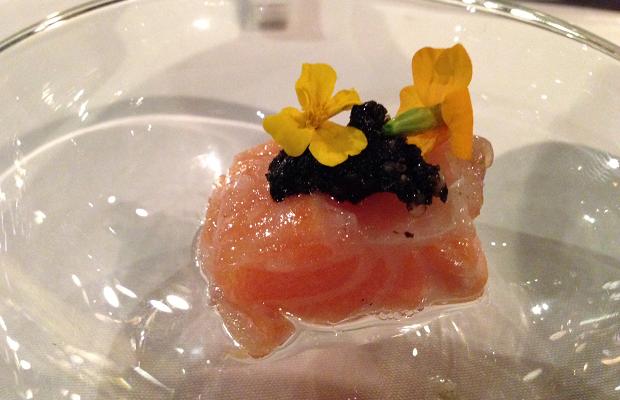
Chef Victor Barry’s Salmon Amuse

The privacy, intimacy and relaxed atmosphere of a subterranean hashery is something we should all experience at least once in a gustatory lifetime. We should also be afforded the opportunity of a salubrious 12-course tasting menu designed by a reluctant superstar. Why ought we not be handled with extreme Sommelier care by the caress of a total professional? Give me a reason to not spend three hours locked in a room with eight others, all of generous wine and spirit?

The location was Splendido‘s downstairs dining room. The chef was Victor Barry. The Sommelier was Ellen Jakobsmeier. The company a group of friends and friends of friends with a common goal. Eat, drink and be merry. Maybe trash talk a little. Trade a few thousand e-mails ahead of time to fire the vinous juices. Get down to business. Taste fourteen wines blind, poured from paper bags, discuss and be humbled by knowing everything and yet nothing at all.

Chef Barry’s selections and his staff’s execution were beyond flawless, culled from trial, error and perfection, bobbing up into the ethereal. Ms. Jakobsmeier had less than 20 minutes to receive, prepare and pour in order, with timely precision, the agglomerated and cumulative progression of the wines. Like Euro rail time. Not a hair out-of-place. Big props Ellen.

One dinner companion said this. “Thank you so much for inviting me to join your Pirate festivities! The food was incredible, thanks for hosting us Victor. The wines were exciting, generous and delicious! Thanks to all of you for sharing the gems from your cellars. And thank you Ellen for doing such a great job pairing all the wines. A feast worthy of Pirates!”

Victor added his own words. “Thanks everyone. I had a blast. I really enjoyed sitting down stairs it made it much more enjoyable for me. Looking forward to the next event. PS that Tokai was fucking delicious. And the Premier Cru from that “Niagara appellation.”

I wrote this to the group. “Laid in bed last night thinking about every course. Too many details to comprehend. And then it was morning and my kids wanted their lunches packed. Good thing there was this pumpkin in my wine sleeve…generosity in wine just amazing. All thoughtful and just fucking generous. Fortunate to have met new faces. Looking forward to this again, and again. Great work JB and Victor, stars all around.”

And to you JB, you sure do know how to throw a party.

Champagne begins the pirates on a picnic dinner in the downstairs private dining space at Splendido Toronto

Champagne begins the pirates on a picnic dinner in the downstairs private dining vineyard at Splendido Toronto

Champagne Larmandier-Bernier Rosé de Saignée Premier Cru NV, Champagne, France

Just a wee coppery this rusty blush, savoury to solecism and uprooted by a tremendous fault that forces metamorphic salinity, no check that, bleeds from rock into the bottle. If Champagne could commandeer the senses to stop and take note, this LB is the one. Stoic, purposed, frank and blushing like a winter Olympic athlete after a gruelling race. This Rosé is as confident and masculine as can be for the genre. It opens the eyes, pores and heart for a long haul ahead of pulls, in corks, sips and gulps.  @LarmandierB

Larmandier-Bernier Champagne Rosé de Saignée Premier Cru NV and Domaine Dauvissat Chablis Premier Cru "Séchet" 2009

Larmandier-Bernier Champagne Rosé de Saignée Premier Cru NV and Domaine Dauvissat Chablis Premier Cru “Séchet” 2009

Vincent Dauvissat Chablis Premier Cru “Séchet” 2009, Burgundy, France

To be blinded by rocks is to taste such a wine without knowing what it is, slicing like Silex, cutting with a jagged edge of mineral take, yet gripping of aridity that must come from singular Chablis. Something whips like paraffin but again, the missing wood, the fennel talc, the absolute purity just says Chardonnay. With levity requested, gotta borrow from Burghound on this one because he was spot on, “way beyond the shadow of a doubt, yeah.” After 30 minutes the Sechet left the quarry to enter a sweat lodge of smoke and toast with an eventual pause at the charred Shishito capsicum station. The coarse wail is the young Dauvissat crooning but with fear set aside, the wine will soften in time, like the fashion poet, the prince of thieves. This Séchet, mythological in name, is Chablis brightly lit and accepts another sung substitute for yes. “Oh it cuts like a knife , yeah but it feels so right.”  @BIVBChablis

Oysters, popcorn, scallop dust

Oysters, popcorn, scallop dust

Popcorn dusted with dehydrated scallop dust? Damn straight.

Trout roe, maple, ice cream cone
Trout roe, maple, ice cream cone

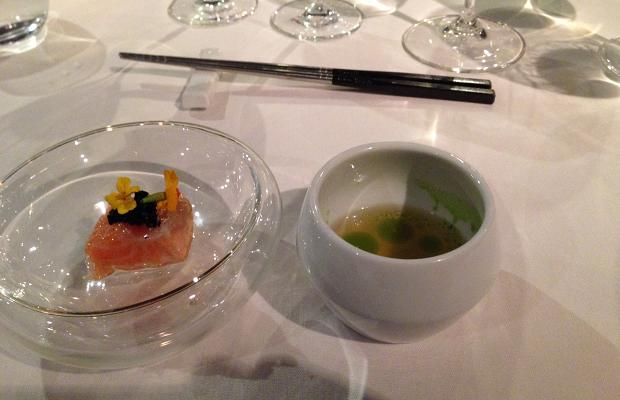
Salmon, skin, consommé

Salmon, skin, consommé

Nikolaihof Im Weingebirge Grüner Veltliner Smaragd 2007, Wachau, Austria (AgentWineAlign)

Something grand is brewing, of that there is no doubt, despite the skinny, indehiscent first moments. A petrol that comes with age, a suckling piggy with melifluous honeycomb in its mouth roasting away, tinned fruit cup of a jellied, agar-agar mandarin orange type; these are the bold scents of what must be Austria, possibly Riesling, certainly Wachau. Tannin and stone drip Alsace Grand Cru, of Riesling again, like Rangen, but the reveal of Grüner Veltliner makes so much sense. Crazy, mind-blowing example, as good as it gets, a bench and high-water mark from which a free fall off the high springboard makes a perfect splash into the glass. Ninety minutes later only a word is needed to stem the waves of petulant emotion. Unbelievable.  @TheLivingVine  @AustrianWine
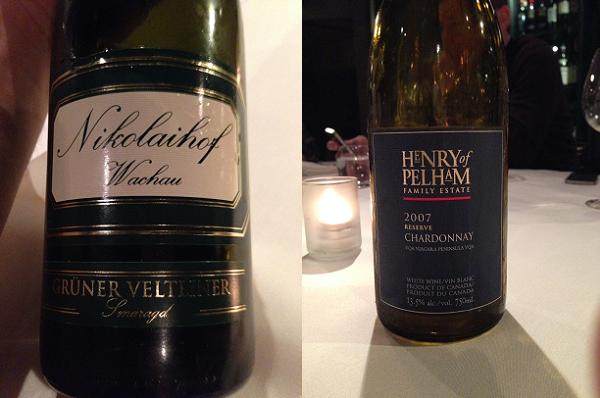
Nikolaihof Im Weingebirge Grüner Veltliner Smaragd 2007 and Henry of Pelham Reserve Chardonnay 2007

Nikolaihof Im Weingebirge Grüner Veltliner Smaragd 2007 and Henry of Pelham Reserve Chardonnay 2007

Henry of Pelham Reserve Chardonnay 2007, VQA Niagara Peninsula (2013 268342WineAlign)

French oak kicks at the door, feeling young, dirty and fine though synchronicity is absent in most respects. This is certainly not Chassagne, definitely not Meursault, not even St. Aubin. Yet it is delicate and delectable despite its unkempt ways, selfless and if left to be, might settle into a relationship. To discover it’s the hot vintage of 2007 version of today’s Estate Chardonnay is nothing short of astounding and at the same time, disappointing, at odds, disassembled. After 20 minutes it falls apart, “in little pieces on the floor, too wild to keep together.” The wine’s inclusion was necessary, gave perspective and bent to receive the Uni, “and now the end has come.” The 2012 and 2013 will offer much more pleasure.  @HenryofPelham  @SpeckBros
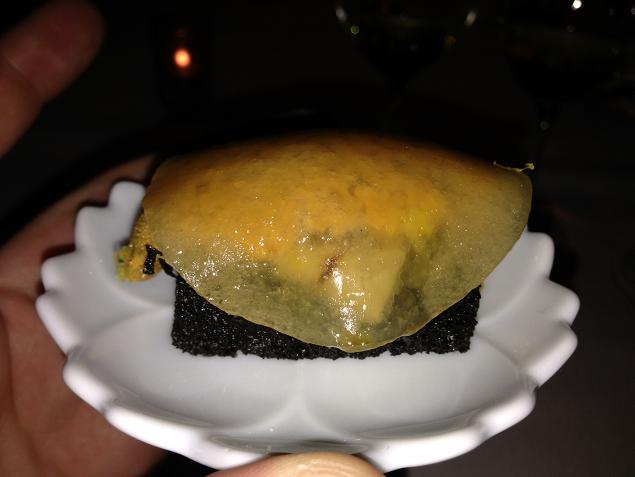
Sea urchin, toast, squid ink, lobster

Sea urchin, toast, squid ink, lobster

Domaine Valette Pouilly-Fuissé ‘Clos de Monsieur Noly’ 2002, Mâconnais, Burgundy, France

May as well be Josko Gravner Ribollo Gialla, or Ann Sperling’s Whimsy! Orange and yet in contempt of the oxidized and underripe cantaloupe be damned, Jura should be the call. But then there is the question of messing with the man acidity and a trippy delicacy as per the cook’s butcher. It is certainly not faulty, nor should it be faulted for developing au natural, on top of the sheets, on the bare side of the beach. OK, so really old Chenin Blanc and a very natural Outback white blend would make for good conversation, or not. Like mushrooms for toffee. Like mulled apples for cider done wrong. Dirty in the most righteous 12 year-old Sherry way. Love it with Lobster on a rock, octopus and some kind of sea cucumber.

Domaine Valette Pouilly-Fuissé 'Clos de Monsieur Noly' 2002 and Louis Latour Corton-Charlemagne Grand Cru 2009

Domaine Valette Pouilly-Fuissé ‘Clos de Monsieur Noly’ 2002 and Louis Latour Corton-Charlemagne Grand Cru 2009

Louis Latour Corton-Charlemagne Grand Cru 2009, Côte de Beaune, France (AgentWineAlign)

Can anything really be known from a fleeting moment spent with this? Classic, viscous, rich Burgundy and nothing but, with more mineral than should be gained from just a pass. The maker had the unconscious intent of remembering generations. When told that hey, it’s a Latour, in Beaune, of Corton Charlemagne, by Grand Cru, it’s hard to gather your inner we’re not worthy but focus and intent need be the outward act. You can really taste the limestone, imagine walking the Corton hillside, feeling the maximum exposure of the sun. When you know what it is you know to take a slice of humble pie and remember the soil, the soil, the soil. In Burgundy since 1797.  @LouisLatour1797  @LouisLatourInc

Equipo Navazos La Bota de Manzanilla Pasada 2011 nº 30 Capataz Rivas

Equipo Navazos La Bota de Manzanilla Pasada 2011 nº 30 Capataz Rivas

Equipo Navazos La Bota de Manzanilla Pasada 2011, nº 30 Capataz Rivas, D.O. Manzanilla Sanlúcar de Barrameda, Spain

Tasted blind this pours as a glass of briny capers, sea peas, vetches and liquid basalt. It speaks a language that contains the ancient loneliness of ruins. Thoughts easily lean Manzanilla or Old Fino. Great nuts, bitters, horseradish, dry tang, daikon and like a dirty martini. Not to mention orange rind and lime rind, zest and akin to a Vin Doux. It’s origins are at the hands of capataz master Rafael Rivas, from juice originally preserved to add kick to more commercial releases but the decision instead was made to “touch” the 15 solera butts with “testimonial sacas” of only four or five arrobas (roughly 5 x 16 = 80 litres), to make a wine such as this. This is old school Manzanilla, the third saca, with a reductive flor, uniquely oxidative and an average age of around 15 years.  @EquipoNavazos  @SherryWines  @JerezXrsSherry

Pop can seafood

Pop can seafood

Intermezzo of smoked oyster and foam…

Carrot

Splendido’s Five-hour carrot

“Friends – ridiculous dinner last night, in the best way. Great wines with great friends is my favourite way to spend a night. Already looking forward to the next one – at which I will bring more than one wine.”
Hamachi collar, black bean paste

Hamachi collar, black bean paste

Podere Rocche dei Manzoni Barolo Vigna Cappella Santo Stefano 1997, Piedmont, Italy

Here the soprano sings, in bold, rich, deep tones, with a sense of entitlement and a swagger. It’s a royal, goodfella, masculine depth. The notes are sung, even danced in bourrée, crescendo, sostenuto and ritardando. The luscious bing cherry richesse gives it youth, intimating Sangiovese but true hematic Toscana can’t be this dark. The modernity of Nebbiolo it must be. Seamless, tireless and impossibly rose petal delicate with the omnipresent tar. Would be willing to go back to 1999 but for the black forest layering, though to find out it’s ’97 shatters myths, confidence and legend. Still dusty and tannic, with more years needed to shed the grains of sand chain. After 20 minutes it goes to candied flowers, oranges and Alba truffles. Bring on the soft scrambled eggs.

Podere Rocche dei Manzoni Barolo Vigna Cappella Santo Stefano 1997 and Marchesi di Barolo Sarmassa 1997

Podere Rocche dei Manzoni Barolo Vigna Cappella Santo Stefano 1997 and Marchesi di Barolo Sarmassa 1997

Marchesi di Barolo Sarmassa 1997, Piedmont, Italy

Smells like spirited, youthful, though decidedly modern Nebbiolo. Rich, chalky, dense, viscous, unctuous and yet the opposite of the Manzoni grit. More feminine, of more voices, in fugue, at times in tarantella, then into arpeggio. The notes play from a radio in my head. “In the deepest ocean, the bottom of the sea, your eyes, they turn me.” That it’s my contribution, this weird fish of a Nebbiolo, makes me amazed at the complex world of Piemonte and the absurdity of knowledge. Sensory appreciation rocks, spoken through this Sarmassa, like a chant from an ancient tribe, sitting cross-legged upon the clays of Lugagnano. It seems there may be 20 years left on the Marchesi’s Nebbiolo. I can’t believe how well it showed.


Venison loin, heart, mushroom, beet, pig's blood chocolate sauce

Venison loin, heart, mushroom, beet, pig’s blood chocolate sauce

“Amazing night! Everything was spot on, from the food to the wines to the company. Thanks to all, looking forward to the next one.”
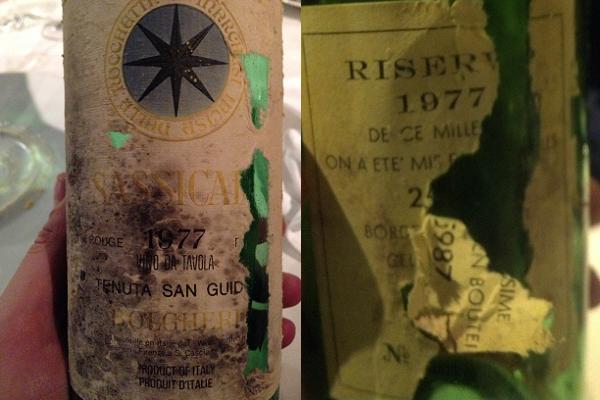
Tenuta San Guido Sassicaia 1977

Tenuta San Guido Sassicaia 1977

Tenuta San Guido Sassicaia 1977, Doc Bolgheri, Tuscany, Italy (2011 480533, WineAlign)

Though the vintage was reported to be less than exceptional, the chance to taste this 37 years in/on and the longevity it displays combines for full, blow me away effect. The first vintage of Sassicaia was 1968 and this 10th try hits the mark of experience. A blend of Cabernet Sauvignon (85 per cent) and (15) Cabernet Franc, the fruit came from vines over top soils of clay and limestone. The wine spent 20 months in Yugoslavian oak barrels (half of it being new, and half used once or twice before), while for the remaining 60 per cent, French oak was used (2/3 new and 1/3 used once or twice before. Tasted blind, the swirling and searching thoughts of Genesis retrospection assimilate aromas of truffle and mushroom, but at first there is no reply at all. Landing on a plot of excellence somewhere between Bordeaux and Piedmont, Tuscany rises from its hills. A silent conversation ask the Sassicaia “I get the feelin’ you’re tryin’ to tell me; Is there somethin’ that I should know?” Its condition is near perfect, its body full, its nature pristine and finally, so obviously in balance. After 30 minutes it begins to slide, to no surprise, but you can’t believe the expression it gives and the impression it leaves. And so, it is confirmed. 1977 was a fine vintage for Sassicaia.  @Smarent
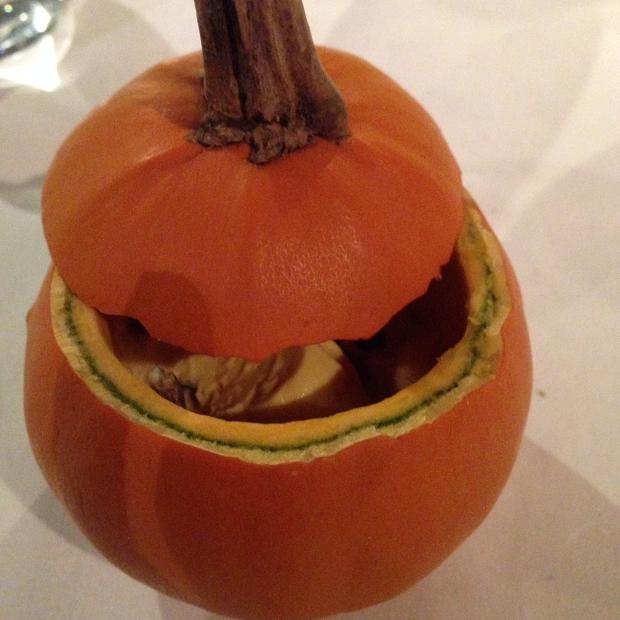
 

Pumpkin in a pumpkin

Pumpkin in a pumpkin

Marchesi Antinori Solaia Toscana IGT 2003, Tuscany, Italy (2010 987586WineAlign)

The crowd leans modern, young, New World Cabernet Franc or Bordeaux blend. Can’t help but concur. Turns out to be a blend, of Cabernet Sauvignon (75 per cent), Sangiovese (20) and Cabernet Franc (5). First produced in 1978, the Sangiovese was only introduced to Solaia in 1980. In 2003, the weather could be described with a single word. Hot. Limited rainfall and a record total of 2400° in daytime heat summation has brought this Solaia to its full on gain, 12 years in evolution. The vintage caused a full draw from stony calcareous soil of marl and friable albarese rock. The collective soul can appreciate its charms but the heavy aspect ratio can’t be denied. We sipped and “the punches came fast and hard.” Warm smacks to the face, rushes of heat and an ensanguined rush of chocolate fruit through the system. For now there is no caramel, no brûlée, no denoument. In the present there are caverns of tannin, the ‘sunny one’ playing the crowd, on a sunset strip. Soon and in the end, times fades away.  @AntinoriFamily  @HalpernWine

Marchesi Antinori Solaia Toscana IGT 2003 and Royal Tokaji Aszú 5 Puttonyos 1993

Marchesi Antinori Solaia Toscana IGT 2003 and Royal Tokaji Aszú 5 Puttonyos 1993

Royal Tokaji Aszú 5 Puttonyos 1993, Tokaj-Hegyalja, Hungary (2008 972836,, WineAlign)

Here the caramel unctuousness and apricot in chains of liquid gold is the work of a legendary purveyor, the Royal Tokaji company. With sweetness upwards of 150 g/L and acidity pushing the 10 g/L mark, this is no shrinking violet of a dessert wine. With 12 years of road under its belt, the blend of predominantly Furmint and Hárslevelú grape varieties (with a small percentage of Muscat) is firing on all cylinders. Racy and intense, this captures the essence of the 1st growth Nyulászó vineyard and brings it to the world. Bullies the desserts a bit, but all is forgiven considering the range of flavours within and complimented from without.  @Royal_Tokaji  @HHDImports_Wine
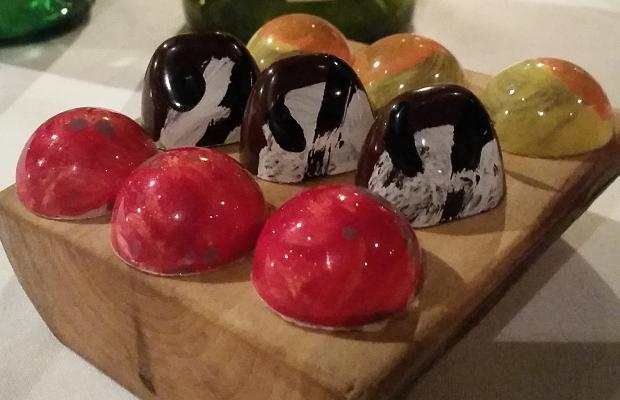
Then one more dessert course…”Milk and Cereal,” chamomile and maple tea gel, buttermilk quenelle, flaxseed granola.
Final treats

Final treats

Is writing making a mess of wine?

Rave Review

Rave Review

Wine today is suffocated by an industrial and disproportionate number of writers, critics, reviewers and judges. There are so many voices vying for airtime, filling up virtual white pages with their comments, feelings and dissertations. There are homers and there are curmudgeons. When in balance, both keep the ship afloat, but more often than not the questions begs. Which ones are causing the wreck? The answer is both. The problem is not the intent but rather the execution.

You may have noticed that when I write about wine, which is pretty much all of the time, I use a whole lot of words. A mess of vocabulary. An inordinate amount of adjectives. A boundless number of references to music, song and pop culture. It’s how I roll. And it has got me thinking, again.

Tis’ about that time of year. A period for reflection and review, not on what was so great in the previous vintage but about the things that will be critical going forward in this new one. Please excuse the interlude while I hang suspended within the interval of hermeneutic, contemplation and debate. Reading books on anthropology, art world shenanigans and a post-holocaust personal journey are seeping into my thoughts like Sémillon into Sauvignon Blanc and the varietal blend is coming up complicated.

Related – Wine: It’s a matter of tasting notes

Old guard tasting notes are losing their relevance and not because they are wrong or inaccurate. They just don’t speak to wine in the 21st century. They don’t tell a story and they surely don’t have any fun. So what? Imagine taking a video of yourself working on your computer, browsing the internet, reading and interacting on social media. What would you see? A world of links and associations. A world where thoughts and comments bounce around like children in a jumpy castle. This is the realm of the new tasting note. This is what wine can do for you in the 21st century. It can lead you forward and take you back. Most of all it can really tie your life together.

Related – Three-chord wines, hold the rants

Then the whining. The constant shrill voice of conceit mixed with complaint. The words minced to poison with a hunger to attack. Paragraphs penned to warn of apocalypse and to relegate decent writers to the scrap heap and back to the depressing nine to five. Writers reacting only to what others do without creating anything of their own. Comedians of the wine world lashing out, ranting, shouting “got ’em, need ’em, hate ’em.”

These attitudes and still the truth is not to be ignored. Reading a wine through a tasting note is like kissing a woman through a veil. “Translation is a kind of transubstantiation,” where one wine becomes another and another. You can choose your philosophy of critiquing just as you choose how to live. The freedom to personalize or substantiate thoughts on structure sacrifices the detail to meaning and meaning to preciseness. The winemaker is the writer or poet, moving from vines to vinous language. The critic moves in the opposite direction, or should, by attempting to read between the lines, to identify what can’t be seen, to interpret the mysterious implications of smell, taste and texture.

The lede firmly and flatly backs the headline, states, if asks, “is writing making a mess of wine?” Yes, that is a double entendre, a loaded gun of meaning and hypothesis, a million dollar question. While we want to know who’ll stop the rain, we also desperately need to understand the meaning of wine. So we put it down in words. We explain how wonderful life is with wine in the world. We also break it down, grape by grape, to a point where it often lies broken, disassembled, deconstructed, left for naked. What is it for? Are wine writers leaving behind a city of ruins?

Have they decided and determined that the winemaker’s works can be used to make a point? A point that belongs to the critic? Has the wine writer taken away the artist’s right to be, has the intent been obscured, or worse, the opposite and turned it into a curator’s right?

There are wines that claim you and wines that warn you away. Maybe the writers are just looking for wine that would teach them everything, like searching for one language, just as some would look for one woman’s face. The combined fugitive pieces of wine and its critics pose “questions without answers.” They must be asked very slowly.

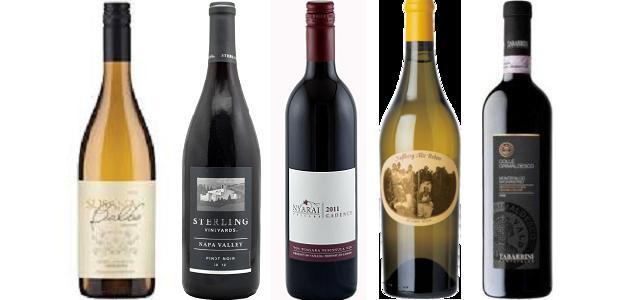
To the beleaguered point five wines are here venerated and disfigured, assessed and cut to size. They are sniffed and sipped, thought of in song and regurgitated on the page. Do they lift or bury their maker’s plan? You be the judge.

From left to right: Susana Balbo Signature Barrel Fermented Torrontés 2014, Sterling Vineyards Pinot Noir 2012, Nyarai Cellars Cadence 2011, Wieninger Nußberg Alte Reben Gemischter Satz 2012, Tabarrini Colle Grimaldesco Montefalco Sagrantino 2009

From left to right: Susana Balbo Signature Barrel Fermented Torrontés 2014, Sterling Vineyards Pinot Noir 2012, Nyarai Cellars Cadence 2011, Wieninger Nußberg Alte Reben Gemischter Satz 2012, Tabarrini Colle Grimaldesco Montefalco Sagrantino 2009

Susana Balbo Signature Barrel Fermented Torrontés 2014, Uco Valley, Mendoza, Argentina (384339, $17.95, WineAlign)

Here, from Dominio del Plata, an experiment with clear merit. The attributes are so sizeable, with weight depth and no compromise. The dramatic effect works to ignore the “clouds of mystery pourin’ confusion on the ground.” The floral aromatic integrity of Torrontés is upheld within the leaden shackles of the wood, as is the savour. This is a honeyed white, suckling and mellifluous, like fully extracted ripe Sémillon, from and with the benefit of a warm vintage. Puts the fun back into varietal revival by way of a giant leap up from the thin, medicinal water clogging the arteries of South American white wines so often put to market. Here is a Torrontés to stop the rain.  Tasted January 2015  @ddpwinery  @ProfileWineGrp

Sterling Vineyards Pinot Noir 2012, Napa Valley, California (424179, $19.95, WineAlign)

There are so many reasons not to find a thrill in this regional blend of Pinot Noir fruit but none of them stick. Sweetness, simple syrup silky fruit, brown sugar, every red and purple berry in all varieties of fields (plus ripe plums) and warm to temperate alcohol (14.5 per cent declared) all combine for full California sunshine effect. All this and I just can’t turn away. With all the excess fruit, texture and multiplicity in good times, how can I? I ask this Pinot, “how come you, how come you dance so good?” The answer lies in the feel and the ability to turn a Noir trick or two. Not to mention a rolling of barrels and Napa Valley stones through its very core. Well done.  Tasted January 2015  @sterlingwines  @Diageo_News

Nyarai Cellars Cadence 2011, VQ Niagara Peninsula, Ontario (Winery, $21.95, WineAlign)

Steve Byfield’s crimson blend of Cabernet Franc (42 per cent), Merlot (33), Cabernet Sauvignon (20) and Syrah (5) is at once so very Niagara while acting out anomalously in the 2011 vintage. Ripe, extracted fruit appears warm-vintage drawn, with its coated layers of primer, brushstroke and plummy stone fruit. The warmth is tempered by savour, oranges, figs and psalms. Its ability to find cadence and cascade keeps it “cool in the shade.” The varietal combining is delineated in balance, “sliding mystify, on the wine of the tide.” This effort, with its new name, could become one of the king’s amongst Ontario blends.  Tasted January 2015  @NyaraiCellars

Wieninger Nußberg Alte Reben Gemischter Satz 2012, Vienna, Austria (Agent, $40.00, WineAlign)

Here, the intensity of multi-varietal wine defined. From next to the Danube, out of the Ulm Vineyard, on a very steep southern slope on the eastern part of the Nussberg. The composition is nine-fold; Weissburgunder, Neuburger, Welschriesling, Grüner Veltliner, Sylvaner, Zierfandler, Rotgipfler, Traminer and Riesling. The aridity (1.3 g/L RS) is visionary. Beneath the vineyard there is coral from the tertiary period and in this wine you can hear the Geiger counter amplifying the faint eupnea of fossilized shells, thousands of years ago. Its resinous, sappy and majestic floating flowers are like “potions in a traveling show.” The layering is heavy (14.5 per cent ABV) and variegated, like sands and snails in a bottle or a vessel filled with an alcohol made from nature’s natural and fermenting bounty; carboniferous forest cosmology and the unpronounceable names of exotic fruit. Then there is the wooden smoulder, the white rock solder, the pine and the scene where “I sat on the roof and kicked off the moss.” The Gemischter Satz is granular but in liquid form, marbled and with a lovely wisp of oxidation. It exudes lemon custard and tonic in a wild yet beautiful breath of sauvage. It is your song. Tasted January 2015

Tabarrini Colle Grimaldesco Montefalco Sagrantino 2009, Docg Umbria, Italy (403139, $49.95, WineAlign)

Here thickness is applied in every way imaginable. Sagrantino from the maw of the beast; raw, big-boned, musky, chewing sinew and spitting out teeth. Though fierce and ancient, eliciting vegetal scents as if Pliny’s natural history were scoured for every trace of pungent plants grown in iron rich earth, it is also the most modern expression of Umbria, or all of Italy even. In so many ways it’s pretty Gestanko, composted and of an incomparable spume. But it also desensitizes and endears in a soulful, ethereal way “like scattered leaves,” blowing in a stiff breeze. It folds back the skin of time, in waves of heat and at times is so very sweet. Bring this to the apocalyptic marshmallow roast. Leaves the red wine city in ruins and in the dust. Sagrantino at 16.5 %. Burn, baby burn.  Tasted January 2015  @TrialtoON  @TABARRINI

Good to go!

Bouillabaisse, paella and 32 wines

Chiado's Bouillabaisse

Chiado’s Bouillabaisse

No words. No tasting notes. Just the wines. What happens at WineAlign‘s #waxmas14 stays at Waxmas14. I will say this. There was music.

Waxmas Whites

Domaine Long-Depaquit Chablis Grand Cru La Moutonne 1996, Burgundy, France

Vergelegen G.V.B. White 2012, Stellenbosch, South Africa

René Muré Riesling Clos Saint-Landelin 2008, Alsace, France

R. López de Heredia Viña Tondoni Reserva 1999, Rioja, Spain

Waxmas Whites

Waxmas Whites

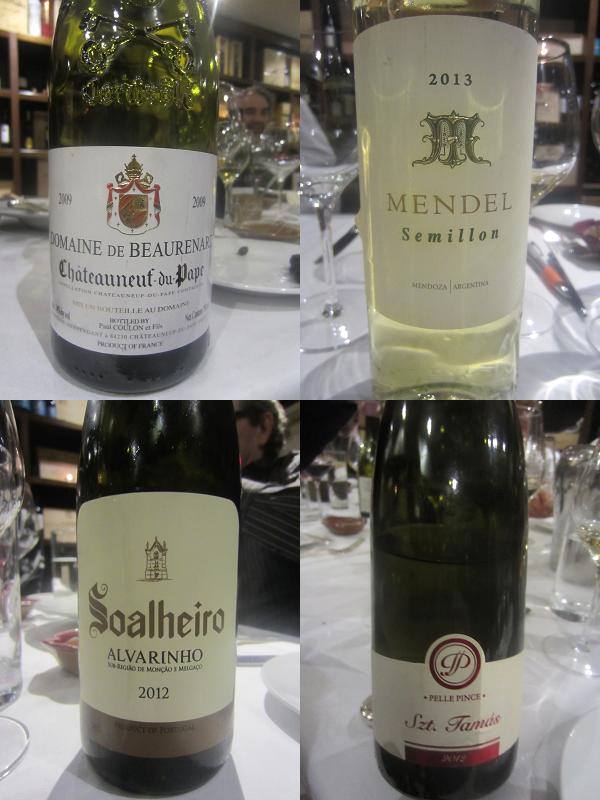
Four More Whites

Domaine de Beaurenard Châteauneuf-du-Pape Blanc 2009, Rhône Valley, France

Mendel Sémillon 2013, Mendoza, Argentina

Quinta de Soalheiro Alvarinho 2012, Vinho Verde, Portugal

Pelle Pince Szt. Tamás Furmint 2012, Hungary

Four More Whites

Four More Whites

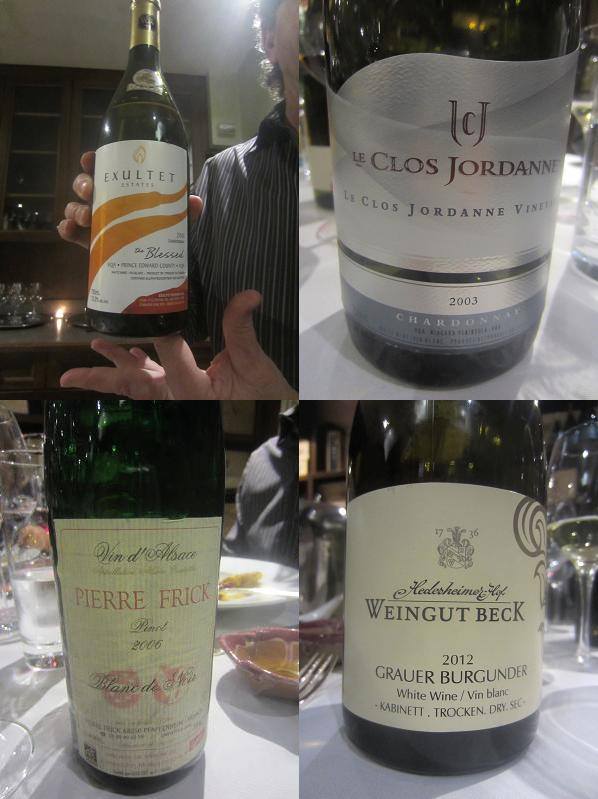
Eclectic Blancs

Exultet Estates The Blessed 2009, VQA Prince Edward County, Ontario

Le Clos Jordanne Le Clos Jordanne Vineyard 2003, VQA Niagara Peninsula, Ontario

Pierre Frick Pinot Blanc de Noir 2006, Alsace, France

Hedesheimer Hof Weingut Beck Grauer Burgunder Kabinett Trocken 2012, Prädikatswein, Germany

Eclectic Blancs

Eclectic Blancs

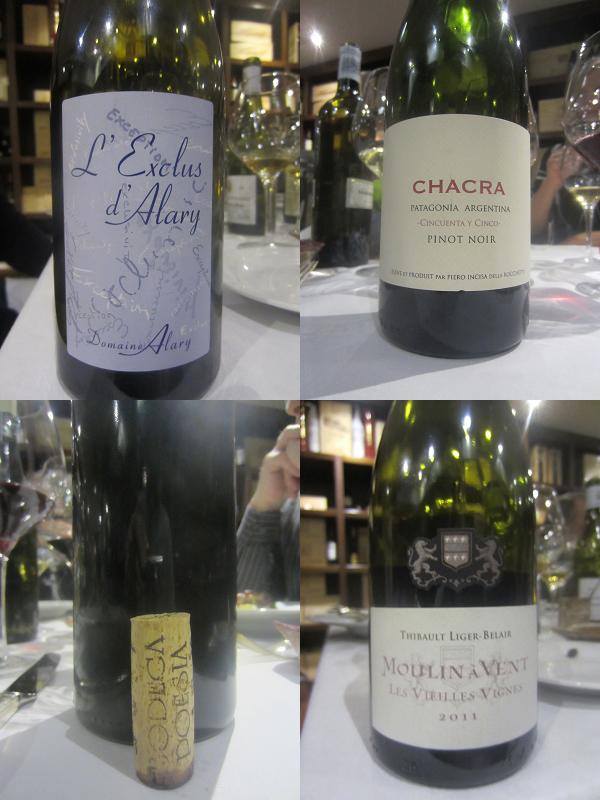
The Stealth Reds

Domaine Alary, Cairanne L’Exclus d’Alary 2012, Cairanne, Rhône Valley, France

Bodega Chacra Pinot Noir Cincuenta y Cinco 2012, Patagonia, Argentina

Bodegas Poesia 2010, Mendoza, Argentina

Thibault Liger-Belair Moulin a Vent, Vieilles Vignes 2011, Beaujolais, Burgundy, France

The Stealth Reds

The Stealth Reds

Big Red Movements

Colinas De São Lourenço Principal Reserva 2007, Bairrada, Portugal

Brodie Estate Pinot Noir 2010, Martinborough, New Zealand

Re Manfredi Aglianico Del Vulture 2000, Campania, Italy

Domaine Jean Foillard Morgon Côte de Py 2011, Beaujolais, Burgundy, France

Big Red Movements

Big Red Movements

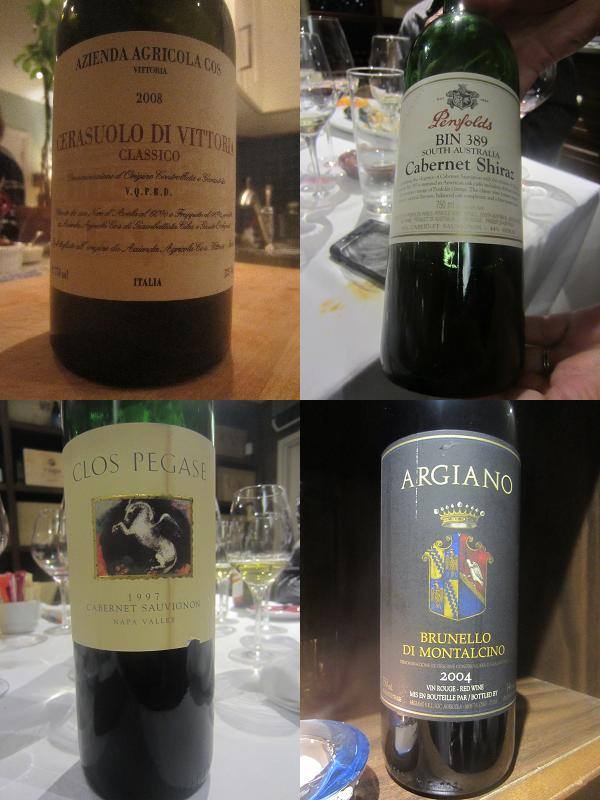
Seriously Red

Azienda Agricola Cos Cerasuolo Di Vittorio Classico 2008, DOCG Sicily, Italy

Penfolds Cabernet Shiraz Bin 389 1995, South Australia, Australia

Clos Pegase Cabernet Sauvignon 1997, Napa Valley, California

Argiano Brunello Di Montalcino 2004, Tuscany, Italy

Seriously Red

Seriously Red

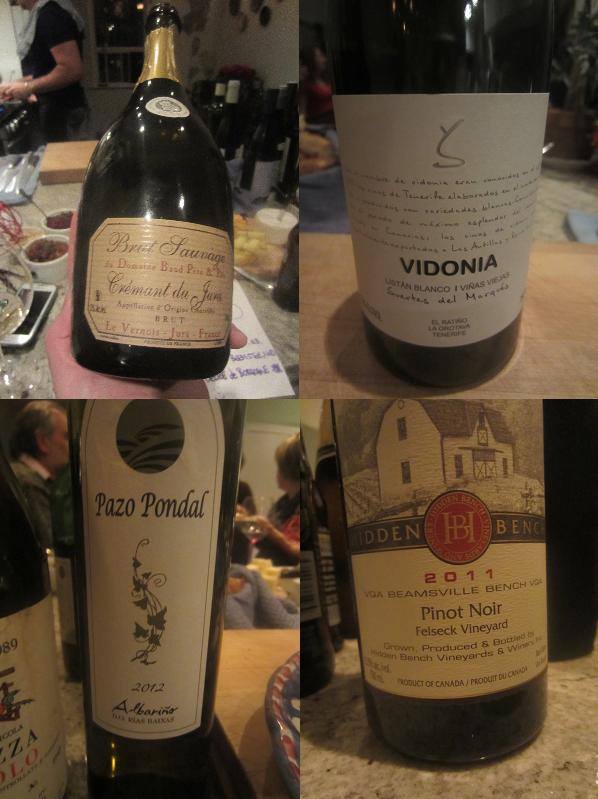
The Grace of Transition

Domaine Baud Crémant du Jura Brut Sauvage, Jura, France

Vidonia Listan Blanco Vinas Viejas 2012, Valle de la Orotava, Spain

Pazo Pondal Albariño 2012, D.O. Rias Baixas, Spain

Hidden Bench Pinot Noir Felseck Vineyard 2011, VQA Beamsville Bench, Ontario

The Grace of Transition

The Grace of Transition

Chef Michael Pataran’s Paella

Chef Michael Pataran's Paella

Chef Michael Pataran’s Paella

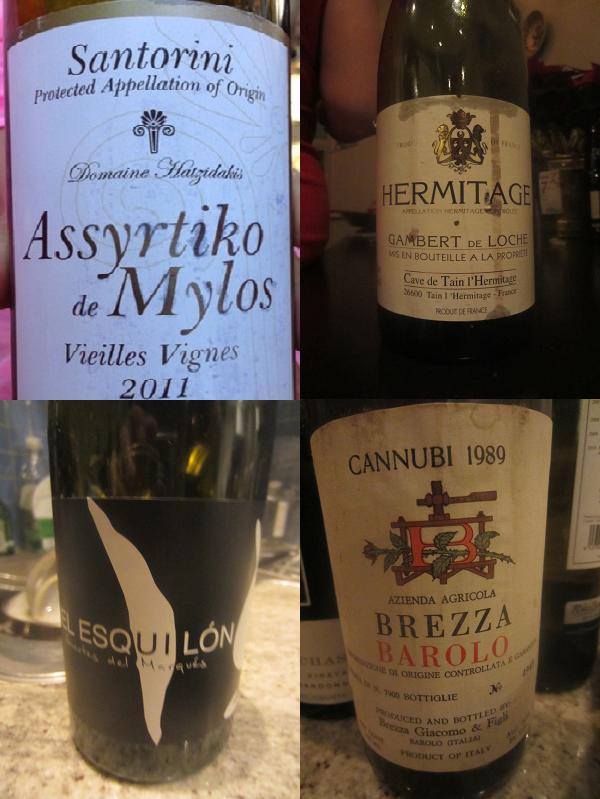
And in the End

Domaine Hatzidakis Assyrtiko de Mylos Vieilles Vignes 2011, Santorini, Greece

Cave de Tain l’Hermitage Hermitage Gambert de Loche 1998, Northern Rhône, France

Suertes del Marques El Esquilon 2012, Valle de la Orotava, Spain

Azienda Agricola Brezza Giacomo & Figli Cannubi 1989, Piedmont, Italy

And in the End

The love you take is equal to the love you make.”

Good to go!

Recently tasted here, there and everywhere

Wihr au Val, Alsace (c) Cassidy Havens, http://teuwen.com/

Wihr au Val, Alsace
(c) Cassidy Havens, http://teuwen.com/

During my week-long visit to Alsace in June I tasted more than 300 different wines. Over the course of the four months that followed that most amazing journey to the heart of a great wine region, I published more than 50 tasting notes. I also told stories about the winemakers, the Grand Crus and lieu-dits. I will continue to write and publish equal or more amounts about Alsace.

Related – Giving Grand Cru Pinot Noir d’Alsace its due

The British wine writer Jamie Goode recently published two articles on the subject of wine criticism versus wine journalism. His first, Whatever happened to wine journalism, appeared on the website run by Tim Atkin MW. The second, Wine critics and wine writers on his own blog, Wine Anorak. Goode is a man on the pulse of what it real and what needs to be said. He is correct in telling us that the most engaging wine writing comes from scribes who visit vineyards and tell their stories. There can be no disputing this to be true.

Jamie hopes that the future of wine writing is not fraught with short reviews and inflated scores. He sees the Utopian model in experiential travel, in meeting hard-working people, wandering over variegated soils and terroir, tasting at the source. Jamie fears that his wine writer self will go the way of the wine critic, tapping away on a computer while tasting wine in an air-conditioned office. His version of wine hell. Riesling specialist Stuart Martin Piggot agrees.

But Jamie is not entirely right either. At least in the context of the Ontario model (and those of other Canadian provinces), along with I would imagine, many wine markets in other countries. Much of what wine writers taste on globetrotting journeys is not to be found on shelves back home. While that may be pathetic and certainly a pity worthy of some kind of wine crime, it is the brass tacks of the global wine industry. I agree with Goode that we should do everything in our power to change it and we should publish stories, not just tasting notes and scores.

The problem for the reader is that most, if not 95-plus percent of the wines that are reviewed from a region like Alsace are not available for purchase in Ontario. While that is just a crying shame, it is a reality. If you purchase wine in Ontario and look for critical voices to help you separate the wheat from the chaff, you require notes on available wines. That is why writers must spend so much time tasting samples in the sterile LCBO laboratory, at our dining room tables, in restaurants and with the hard-working for not enough reward Ontario wine agents. And we must write-up the tasting notes and publish them on websites like WineAlign. This is the fact of Ontario wine importing, purchasing and consumer life. Would it be any different if there was no provincial monopoly? Yes, but it wouldn’t help in the telling of better vineyard stories.

I taste wines here, there and everywhere. Here are 16 recent samples that gave me cause to raise an eyebrow, pause, ruminate and formulate a response to the spoken sentiments of the ferment. All 16 are available for purchase in Ontario.

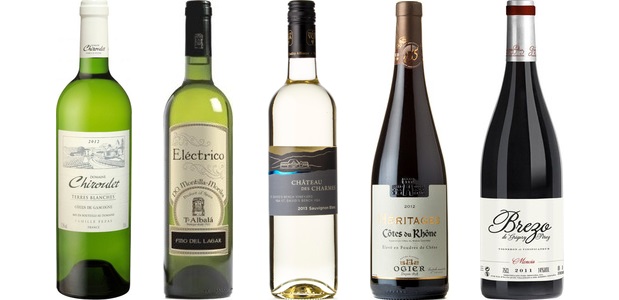
From left to right: Domaine Chiroulet Les Terres Blanches 2013, Toro Albalá Fino Del Lagar Electrico, Château des Charmes Sauvignon Blanc 2013, Ogier Héritages Côtes Du Rhône 2012, Bodegas Mengoba Brezo Grégory Pérez 2012

From left to right: Domaine Chiroulet Les Terres Blanches 2013, Toro Albalá Fino Del Lagar Electrico, Château des Charmes Sauvignon Blanc 2013, Ogier Héritages Côtes Du Rhône 2012, Bodegas Mengoba Brezo Grégory Pérez 2012

Domaine Chiroulet Les Terres Blanches 2013, Vins De Pays Côtes De Gascogne, France (Agent 223222, $13.95, WineAlign)

This is a Gros Manseng and Sauvignon Blanc that whistles boldly like a howling wind. While the nose is high-toned and full of herbal complexities, it’s also indiscreetly alarming. The aromas are quite massive; pine needles decomposing on a wet forest floor. Kefir, cloudy and enzymatic, curdling and churning into itself. Petrol spills on asphalt, baking in the midday sun. To taste it is tangy and juicy, but also very mineral, intensified by the outcroppings of retzine in the vineyard’s limestone. The overall composition punches way above its weight but the heightened sense of reality is also a bit hard to take. Terrific effort but comes with a warning sign.  Tasted November 2014  @CotesdeGascogne  @TrialtoON

Toro Albalá Fino Del Lagar Electrico, Do Montilla Moriles, Spain (Agent, $14.95, 500ml, WineAlign)

The winery was founded in 1844 and in 1970 Toro Albalá became the first commercial Montilla producer in the classic Solera method, from (estate-grown) Pedro Ximénez vines. This is unfortified Fino, at a naturally achieved alcohol of 15 per cent, from an average age of 10 years. It’s so dry, like a desert you could walk for astral weeks, as if it should be measured in negative residual sugar. Like pure almond extract paste, bones in the sand and the essence of pulverized, powdered nuts, void of moisture. The chalky-white Albariza soils of the Moriles Alto subzone are hardwired into its Akashic, astral Electrico plane. This Fino ventures in the slipstream, between viaducts of dreams, “where immobile steel rims crack.” Impossibly long finish.  Tasted November 2014  @toroalbala  @MontillaMoriles  @LeSommelierWine

Château des Charmes Sauvignon Blanc 2013, VQA St. David’s Bench, Niagara Peninsula, Ontario (391300, $14.95, WineAlign)

Sets a (St. David’s) benchmark for how to reign in and then release the charmes of Sauvignon Blanc from the Niagara Peninsula. Done in a decidedly fresh and lively style, this gathers up a bunches and conservative yield-managed vineyard’s warmest, ripe fruit for the purpose of bonhomie potation. Smells of vitality, of fresh herbs and citrus just cut, of a salt spring, of things zoetic. Cream elevates the texture, albeit pellucid and unobtrusive. The triad coming together of Sauvignon Blanc, St. David’s Bench and 2013 is the new CdC yardstick. The price only cements the offer.  Tasted November 2014  @MBosc

Ogier Héritages Côtes Du Rhône 2012, Rhône, France (535849, $15.95, WineAlign)

The Ogier self-professed traits of patience, savoir-faire, observation and intuition are on tidy display in this piquant, spiced-note, olive branch and indigo traditional Rhône blend. So very Mediterranean, warm and herbal by day, cool and minty by night. One stage short of lush, one notch comfortably above thin, this slots into all right moves; pleasant, value-driven and so effective for so many purposes. Stand alone or with classically prepared fare, this is all you need. Bring on the roast chicken.  Tasted November 2014  @MaisonOgier  @Select_Wines

Bodegas Mengoba Brezo Grégory Pérez 2012, Bierzo, Spain (Agent, $16.95)

Mencia as it once must have demanded of itself, iron clad, funky and gamey. This Bierzo is no antiseptic perfumed bottle of modern, manufactured violet Febreeze, though it’s so very vanilla and rich as a Porchetta sandwich with the porcine cure and fat driven right in to every nook and cranny. Or a taste sensation like bacon wrapped cherries. High toned with formidable tannins. A chew of sinew both in faux-wood and as the conceptual result of a roasted animal’s tension. Value gained vicariously through complexity.  Tasted April 2014  @TheLivingVine

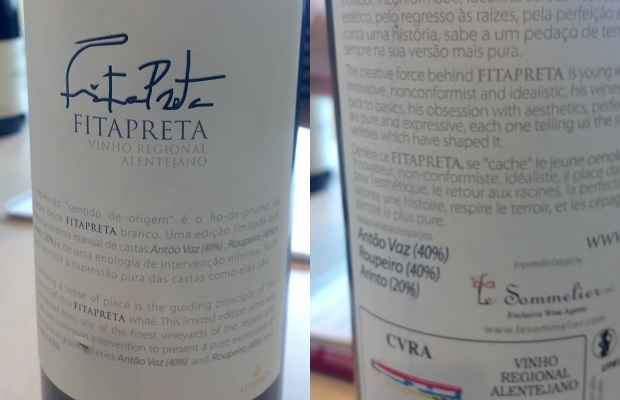
Fita Preta 2013

Fita Preta 2013

Fita Preta White Reserve Alentejano 2013, Alentejo, Portugal (Agent, $16.95)

An endemic blend of Antão Vaz (40 per cent), Roupeiro (40) and Arinto (20) from infertile rocky schist soils in southern Portugal’s Alentejo region. Ostensibly a field blend, like the Alsace cépage a terroir of Marcel Deiss, the Fita Preta or “black tape” comes from an extreme and arid land. Portuguese winemaker António Maçanita and resident English viticulturist consultant David Booth usher out flint and mineral to capture a host of synapses from a wine region that had failed to fire in years. The landscape described  as “Portugal’s Australia” gives a white like a cross between simple, flinty Chablis and aged Hunter Valley Sémillon. The acidity is in abject anti-congruence to the region’s usual heavy-leaded output, mimicking cool-climate Chardonnay in tight and bracing stonker fashion.  Tasted November 2014  @fitapretavinhos    @LeSommelierWine

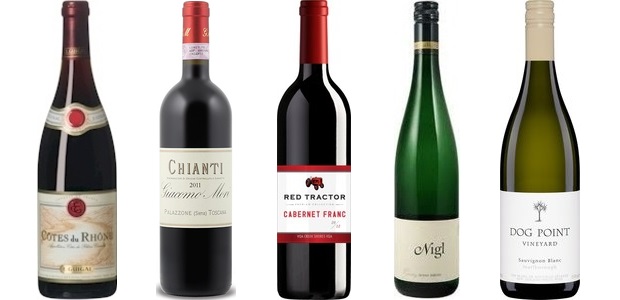
From left to right: E. Guigal Côtes Du Rhône 2011, Giacomo Mori Chianti 2011, Red Tractor Cabernet Franc 2012, Nigl Gartling Grüner Veltliner 2013, Dog Point Vineyard Sauvignon Blanc 2014

From left to right: E. Guigal Côtes Du Rhône 2011, Giacomo Mori Chianti 2011, Red Tractor Cabernet Franc 2012, Nigl Gartling Grüner Veltliner 2013, Dog Point Vineyard Sauvignon Blanc 2014

E. Guigal Côtes Du Rhône 2011, Southern Rhône, France 2011 (259721, $18.95, WineAlign)

In a world where anything is possible, the Guigal Côtes Du Rhône effect is predictable, trenchant and essential. The vintage specific focus in alacrity drives the savoury, rich black fruit to domesticated compliance, easy on the eyes, nose and palate. This just smells like a good meal; as if a game bird were roasting in the oven, surrounded by a rough and large kerf of mirepoix, of caramelizing root vegetables baptized by dried herbs and spices. Do not be fooled. This is a warm CdR with generous alcohol (14 per cent disclosed) and an even warmer, though not uncomfortably tannic or acidity riddled finish. It is a whack of Rhône grapes within grasp of a mere mortal’s budget. Drink now and for two years forward.  Tasted November 2014  @DOMAINEGUIGAL  @VinexxWine

Giacomo Mori Chianti 2011, Docg, Tuscany, Italy (68858, $19.95, WineAlign) From the VINTAGES November 8, 2014 release

A modern take on Sangiovese to be certain with a penchant for the authenticity extracted from the best parts of history. Siena red dirt dredged, cherry macerated, fined, filtered and spiked with a crush of Brandy soaked Amaretti cookies. Clean and with Spring plum blossom in the air. Il Palio dirt for appetizer, Fiore di Zucca pie for dinner and sweet, nutty Panforte for dessert. So modern but so proper. Makes no bones about its made-up face but has plenty of solid ossein in its body. Good piquancy and a rush of verve on the back palate. Oaky but not creamy, bitter yes, but not woody.  Tasted November 2014  @oenophilia1

Red Tractor Cabernet Franc 2012, VQA Creek Shores, Ontario (Winery, $19.99, WineAlign)

The savoury aspect of this Cabernet Franc steals the show out of what is just an ideal vintage. The fruit was sourced from the Dim Vineyard in the Creek Shores appellation, a piece of the Peninsula ideally suited to the sharp and earthy aspects of Cabernet Franc. Despite 20 months of seasoning in barrel, the Tractor has maintained its red fruit character, accented by currants, spice and a deep-rooted sense of licorice. There is enough grain in its texture to carry it for three or four more years but it will never be bigger than it is now, nor will its length grow any longer.  Tasted November 2014  @SideroadTwenty

Nigl Gartling Grüner Veltliner 2013, Kremstal, Austria (453281, $21.95, WineAlign)

The ever-present, front loaded, laser sharp attack may feign spritz amid hushed whispers of CO2, but not from any chemical alteration. It’s actually a post fermentation, double negative breath of residual covalent bonding. The fast action bottling captures pressure to act as catalyst for freshness, especially in such a lean, high acidity vintage. A sway of tall grasses and that gas smothers whatever residual sugar might try to weigh down this low (11.5 per cent) alcohol stunner. Very much alive though the depth is challenged by all that forward thinking expression. Still a very good showing for this classic Grüner.  Tasted November 2014  @AustrianWine  @LeSommelierWine

Dog Point Vineyard Sauvignon Blanc 2014, Marlborough, South Island, New Zealand (677450, $21.95, WineAlign) From the VINTAGES October 25, 2014 release

The prototypical Marlborough Sauvignon Blanc hitting all the classic numbers is right here in the Dog Point 2014. Low pH, high acidity, minuscule residual sugar and elevated aromatics. It’s ripe but ripped by citrus juice and zest. Like cubes of honeydew, bitter winter melon and dried lemongrass soaking in and flavouring a dish of briny scallop carpaccio with coarse sea salt and capers. The sapidity is palpable, the excesses vivid. I would avoid too much variegated gastronomy when sipping this wine. Opt for simpler fare because its talents would otherwise be mimicked and suppressed.  Tasted November 2014  @DogPointWines  @TrialtoON

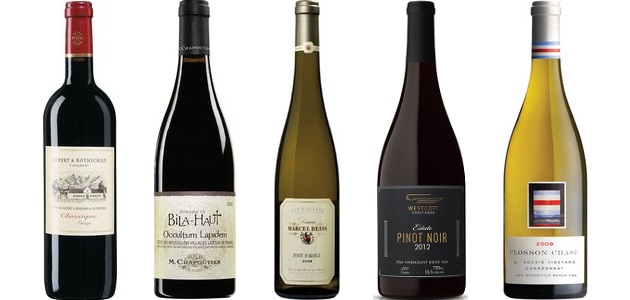
From left to right: Rupert & Rothschild Classique 2011, Domaine De Bila Haut Occultum Lapidem 2012, Marcel Deiss Pinot d'Alsace 2012, Westcott Vineyards Pinot Noir Estate 2012, Closson Chase S. Kocsis Vineyard Chardonnay 2011

From left to right: Rupert & Rothschild Classique 2011, Domaine De Bila Haut Occultum Lapidem 2012, Marcel Deiss Pinot d’Alsace 2012, Westcott Vineyards Pinot Noir Estate 2012, Closson Chase S. Kocsis Vineyard Chardonnay 2011

Rupert & Rothschild Classique 2011, Wo Coastal Region, Western Cape, South Africa (Agent, $23.95, WineAlign)

Iconic Bordeaux partners with South Africa for a red that is a surprising saunter into fair Cabernet-Merlot territory. Ripeness, extraction and alcohol are all exercised with restraint. The South African gauze is wound but of a thin wrapping, thanks to the allowance for fruit to shine in bright, red cherry tones. Western Cape is a terrific place to express Bordeaux-styled reds, especially when done with such hands off ability. A bit sapid and even sour edged, this would be a fine example to share when partaking in a little R & R. Wait a year and drink up to 2018.  Tasted November 2014  @Dandurandwines  @WOSACanada

Domaine De Bila Haut Occultum Lapidem 2012, Ac Côtes De Roussillon Villages Latour De France (643239, $24.95, WineAlign)

From vineyards composed of Devonian Period gneiss and schist soils and Kimmeridgian period limestone. A blend of Syrah, Grenache and Carignan. The heft of this craggy, cultured terroir in a Côtes De Roussillon’s bottle is never in question, nor is the puritanical excellence of its harvested fruit. Some years just heat up to a point of no return, like this 2012. Chapoutier is fully cognizant of the warmth and savagery from the soils and the climate. Finding even temperament and balance is the challenge. This vintage comes across as over the scabrous edge, cooked by the sun and dredged in the particulate. Classic Mediterranean notes of brine, brush and lavender keep it grounded, not to mention graphite and grilled meat, but for the sappy and life-sapping heat, this would be a candidate for 10 years in the cellar. As it is, drink this with quality warm-blooded protein over the next year or two.  Tasted November 2014  @M_Chapoutier  @Dandurandwines

Marcel Deiss Pinot d’Alsace 2012, Alsace, France (Agent, $24.95, WineAlign)

This Pinot d’Alsace is what Jean-Michel Deiss refers to as “du cépage a terroir” or “tous les cépages.” Though there can be as many as 13 grape varieties in the field blend, most of the content comes from the Pinot family. Though likely in Blanc, Gris and Auxerrois predominance, this is a co-planted field blend so if Jean-Michel were to change his tune from talking terroir to varietal percentages, even he would not know the true make-up. Regardless, this is a (vintage) rich and balanced white blend, an avatar for the Alsace idiom. A wanderer in angles, an adventurer into corners and a wearer of many aromatic costumes; sweet, sour, citrus, flint and spice. Indicates orange, lemon and grapefruit but it’s never that straightforward. More like Jincheng, Lemongrass and Pomello. An exemplary introduction to Deiss, Alsace and the dry summation of many white parts. Tasted twice, June and November 2014  @marceldeiss  @AlsaceWines

Westcott Vineyards Pinot Noir Estate 2012, VQA Niagara Peninsula, Ontario (Winery, $30.00)

Carries and buffets an unmistakable aromatic conveyance that comes from a grouping to include Le Clos Jordanne, Bachelder, Queylus and The Farm. Where the cherry tree digs its roots into the earth, where the fruit rolls in the clay dust, where the tension in fruit meets tannin, intersecting at acidity. Just a touch of funk in a non-reductive, vineyard sense and the fruit does flirt with right of centre cherry, inching towards the black side. Chalk and tangy dust, and finally, tannin that holds court. This is quite big for Niagara Pinot Noir and it will age righteously for three to five years. Though it is not yet ready to lay claim to greatness, Westcott is a vineyard to keep a wide and watchful eye.  Tasted October 2014  @WestcottWines

Closson Chase S. Kocsis Vineyard Chardonnay 2011, VQA Beamsville Bench, Niagara Peninsula (Winery, $34.95, WineAlign)

The real deal in Bench gain from out of the most enigmatic and occult vintage, the primitive vineyard giving life and lesson to Chardonnay. Austerity in second and third fill barrels sends butter in search of toast, imagined through pendular churning. A reckoning follows, connecting round fruit to linear acidity in character, oomph and excellence. Aromas indicate spirited confiture choices at the breakfast table to garnish flaky pastry. Biting and demanding yet sweet as a cool summer’s night.  Tasted October 2014  @ClossonChase

Good to go!
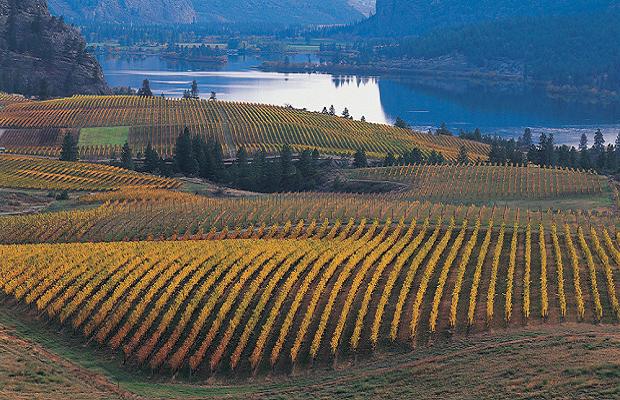
Australian rules VINTAGES

Competition Chicken on Yellow Noodles, Grilled Turkey Paillard, Local Asparagus, Cucumber Tomato Salad

Competition Chicken on Yellow Noodles, Grilled Turkey Paillard, Local Asparagus, Cucumber Tomato Salad

“Don’t you wonder sometimes
‘Bout sound and vision”

It has been quite some time since the provincial monopoly has assembled a set of Australian wines as impressive as what will hit shelves tomorrow and through the coming weekend. In fact, it has been years since any gathering from down under has wooed me in ways to make me wax with such vinous adoration.

Australia is blessed with so many wine growing regions and variances of style, far more than most give credit for or will admit to. If, hypothetically speaking, the country as a whole had temporarily lost its way and sense of purpose, if this release is any indication, the ship has been righted with precision and balance. With sound and vision.

Here are six wines to look out for over the next few days and in the VINTAGES stock dwindling weeks to come. Four awesome Aussies, a sparkling gem from the Loire and a piquant white from Austria.

From left to right: Haselgrove First Cut Shiraz 2010, Domaine Tournon Mathilda Shiraz 2011, Nugan King Valley Frasca's Lane Chardonnay 2012, Langlois Château Brut Crémant De Loire, Winzer Krems Edition Chremisa Grüner Veltliner 2012, Wynns Coonawarra Estate Black Label Cabernet Sauvignon 2010

From left to right: Haselgrove First Cut Shiraz 2010, Domaine Tournon Mathilda Shiraz 2011, Nugan King Valley Frasca’s Lane Chardonnay 2012, Langlois Château Brut Crémant De Loire, Winzer Krems Edition Chremisa Grüner Veltliner 2012, Wynns Coonawarra Estate Black Label Cabernet Sauvignon 2010

Haselgrove First Cut Shiraz 2010, Mclaren Vale, South Australia, Australia (367425, $18.95, WineAlign)

This has a great vineyard (four corners of McLaren Vale) funk to it, along with warm, highly-extracted fruit that is just beginning to raisin and caramelize. Friable from McLaren Flat’s sandy loam, chalky in gravel with pockets of Bay of Biscay, but also dense from Willunga’s heavy clay. This shares an affinity with the Queenston Road’s Creekside Estates Syrah, but here there is more grit, firm tannin and mineral. Formative and serious, it’s just about in its right place. Give it two more years but don’t hesitate after that. Some Rhôneish boy madness too.  Tasted May 2014  @HaselgroveWines

Domaine Tournon Mathilda Shiraz 2011, Victoria, Australia (327395, $19.95, WineAlign)

Victoria Shiraz has an (Australian rules) 19th man element, a sense of umami that is unique to the region. I believe it is this ghost player that enables Victorian reds with an ability to age longer and with more grace than many opponents. The ’11 Mathilda is similar yet cooler as compared to the Malakoff, with a savoury toasted edge and less porky, both in weight and in mouth feel. A bit reductive and musty at present, with sweeter and more forgiving tannins, though still older in world outlook and should not be pigeonholed as a fruit bomb. Gotta appreciate the Chapoutier intent.  Tasted May 2014  @Dandurandwines

Nugan King Valley Frasca’s Lane Chardonnay 2012, King Valley, Victoria, Australia (288191, $19.95, WineAlign)

The toast in this Victorian charmer comes across in a mild-mannered, spoken word way with a simmering, buttery bass line. The fruit is high but the rhythms are delicate and even-keeled. More white flowers than your average Australian Chardonnay, brighter, with more grace and more beauty. She’s a girl with a short skirt and a long jacket eating angel cake. Still firm towards the back-end with citrus zest and mouth-watering acidity, she’s “fast and thorough and sharp as a tack.” Finishes with a long and persistent held trumpeting line. “Na,na,na,na,na,na.” Tasted May 2014  @PMA_int

Langlois Château Brut Crémant De Loire, Ap, Loire, France (996272, $21.95, WineAlign)

Conventional yet anything but commonplace Crémant. Chenin (with help from friends Chardonnay and Cabernet Franc) to drive one athirst with mind-altering high acidity and a nasty temper. Mighty, mighty metallic aromas, bathed in concrete. The palate is coated by a lemon zest skittish and skittle-sweet coquettish play. If this fizz were a music style it would be Ska. The impression that I get  is of “a strength most don’t possess,” this Langlois has so much lime and stone. Have a sip and imagine a bass drum’s accent on the 3rd beat of a four-triplet, boss tone phrase. Tasted May 2014  @LANGLOISCHATEAU

Winzer Krems Edition Chremisa Grüner Veltliner 2012, Niederösterreich, Austria (368803, $24.95, WineAlign)

A textured and floral Grüner Veltliner, a child of more clay, less stone, more juicy fruit and less gas-driven angles. Really well-judged with a pinch of baby fat but certainly not oily. The concrete tang is endearing, as is the bitter pith tinged but welcoming fruit. Unique and not exactly a style addressed to every palate but it has a long, tingling and lingering finish.  Tasted May 2014  @AustrianWine

Wynns Coonawarra Estate Black Label Cabernet Sauvignon 2010, Coonawarra, South Australia, Australia (84996, $27.95, WineAlign)

One of the most polished and finest examples of Cabernet Sauvignon tasted out of Australia in quite some time. I have made the statement before that Coonawarra is the top location for the variety anywhere on the vast continent. The 2010 is rich, lush and expressive of so much bright fruit to nose, so much so you might not need even require a taste for to feel her charms. The 56th vintage of this Coonicon, it is possessive of a solid, dusty structure throughout, consistent and on a fine floral line. Some firm tannins though they are sentimentally sweet. Really fine and at this price this is a case purchase, to open one every year or two for the next twenty. Tasted May 2014  @Wine_Ambassador   #wynnsday   


Good to go!


A ramp to Austrian wine

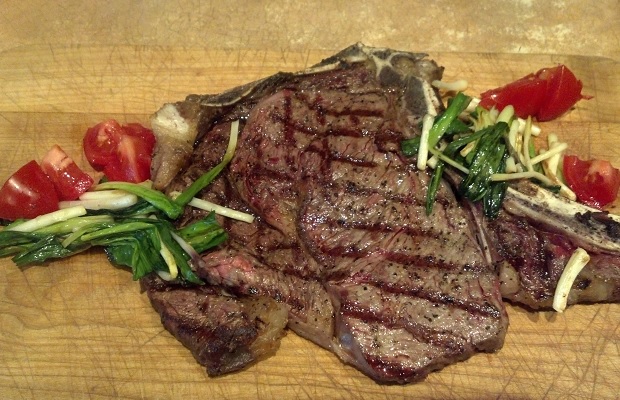
Rib Steak and Ramps PHOTO: Michael Godel

Rib Steak and Ramps
PHOTO: Michael Godel

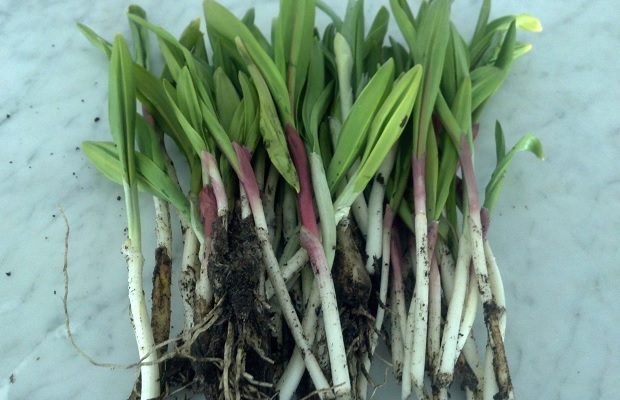
‘Tis the season to partake of two things denied opportunity the rest of the calendar year. Wild leeks and Austrian wine. The first is just a seasonal thing. The second, entirely my fault. The forest and my backyard provide the ramps. Two most excellent wine agents, Bernard Stramswasser of Le Sommelier and Mark Cuff of The Living Vine are the messianic purveyors of the wine.

Mark came to Barque Smokehouse last month to share his wares, talk organics, biodynamics and to teach a staff what honest wine is all about. More on that extensive tasting coming soon. Bernard brought top estates from Austria with Andreas Wickhoff, MW to Toronto’s Fine Wine Reserve on April 16th, 2014 for a special portfolio tasting. The Master of Wine is deeply passionate and terroir obsessed when it comes to the Austrian landscape. The presented set of whites and reds rose up to incline an exemplary ramp to the nature of that country’s fine wine tradition.

The whites, mainly centered around the signature variety Grüner Veltliner, showed the mineral and salinity so necessary to the grape’s success. Reds made from Zweigelt and Blaufränkisch are Austria’s trump card, ready and willing to take on the world’s reds imbued of elegance and finesse. Here are notes on the 12 Austrian wines tasted.

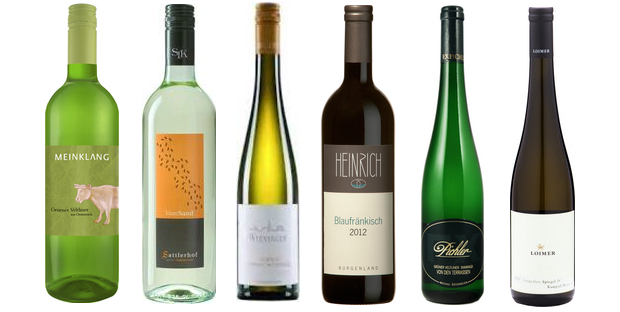
From left: Meinklang Grüner Veltliner 2013, Burgenland, Sattlerhof Sauvignon Blanc Vom Sand 2013, Südsteiermark, Wieninger Gemischter Satz 2013, Vienna, Weingut Heinrich Blaufränkisch 2012, Burgenland, F.X. Pichler Federspiel Loibner Klostersatz Grüner Veltliner 2012, Loimer Spiegel Grüner Veltliner 2012

From left: Meinklang Grüner Veltliner 2013, Burgenland, Sattlerhof Sauvignon Blanc Vom Sand 2013, Südsteiermark, Wieninger Gemischter Satz 2013, Vienna, Weingut Heinrich Blaufränkisch 2012, Burgenland, F.X. Pichler Federspiel Loibner Klostersatz Grüner Veltliner 2012, Loimer Spiegel Grüner Veltliner 2012

Meinklang Grüner Veltliner 2013, Burgenland, (Agent, $15.95, WineAlign)

Meinklang is a passionate, biodynamic (Demeter farming) producer in eastern Austria, south of Vienna. Their practices include abstaining from the pruning of vines, called “graupert” and maturation in concrete egg-shaped containers. The vineyard is their biotope and they make compost from animal dung, pomace, plant cuttings and ground quartz. Their entry-level Grüner is so mineral dominant and saline it’s as if the stones are bleeding. Extreme tang, with that salinity that never lets go and so much lime. Then makes quick work of itself.

Weingut Loimer, Grüner Vetliner ‘Lois’ 2013, Niederösterreich, Austria ($18.95, WineAlign)

From Niederösterreich in the Kamptal region, from soil compositions of bedrock and loess, this is straightforward Grüner Vetliner made in 200,000 bottle loads. That it succeeds in spite of the quantity and the work with contract growers is a testament to Fred Loimer’s sense of quality control. A bit shy aromatically but really tangy on the palate. Clear, crisp, clean and appreciably pure. Lithe in body and with some salinity on the back-end. Versatile mingler.

Sattlerhof Sauvignon Blanc Vom Sand 2013, Südsteiermark, Austria ($19.95, WineAlign)

This is bewusst territory for the Südsteiermark producer, from organically farmed vineyards. An elegant Southern Styrian Sauvignon Blanc made from grapes previously destined to get lost with other traditional varieties. Most striking is the salinity on the nose, often abstruse for Sauvignon Blanc but most obviously explained by the land; sand, gravel and shell limestone. Estimable restraint in the whispered aromas of herbs, green vegetable and tangy tree fruit. Dewy finish that lasts well into the morning.

Wieninger Gemischter Satz 2013, Vienna, Kamptal, Austria ($20.95, WineAlign)

Though Grüner Veltliner, Weissburgunder, Welschriesling and Chardonnay make up most of the formidable aspects of this blend from the Vienna Hills, there are bit but integral parts played by 11 others. From bio-certified Bisamberg and Nussberg vineyard sites, this is antithetically seamless, the varieties drawing all possible logical relations woven by their finite collection. Approachable, gritless, effortless, integrated and bound together by a solid core of juicy acidity. Even if only because it agglomerates 15 grapes, this beats white Châteauneuf-du-Pape (by at least six varieties) at its own game.

Nigl Gartling Grüner Veltliner 2012, Kremstal, Austria ($21.95, WineAlign)

The locus point of Nigl’s single vineyard Grüner Veltliner is sharp and stinging in 2012. Although that chemically reactive laser pinning takes control, it is extremely refreshing to not have to talk about flat and flabby fruit. Mind you the fruit here is under stress so balance needs to be questioned. Ultimately there is a palpable sense of grapefruit, flowers and a finish marked by the scraping of stones.

Loimer Langenlois Grüner Veltliner 2013, Kamptal Dac, Kamptal, Austria ($23.95, WineAlign)

Increased hang time has put this Kamptal in a deeper state of focus and understanding concerning the intricacies of Langenlois Grüner Veltliner. Continues the pure, clean and crisp axiom of the basic Lois but here the aromatics are spoken in acroamatic terms, obvious to disciples and yet available for all to comprehend. Though five per cent big wood barrel aging does not seem significant, that practice along with four months of aging on the fine lees has had a textural impact. The added weight is a questionable thing, though arguably just splitting hairs. Will help carry this vintage through five to seven years of graceful settling.

Dirty Ramps

Dirty Ramps

Weingut Heinrich Pinot Noir Dorflagen 2013 (Tank Sample), Burgenland, Austria ($24.95)

From two sites in Gols, one being the gravelly Riede Goldberg on the Parndorf Plateau, the other a sand and loam slope of the Salzburg. Short-ish ferment in large-ish barrels. Marked by bright cherry of the upstanding young fruit kind and only a brushstroke of paint. Very linear in that a Rube-Goldberg Pinot machining ensues, as the dominoes fall into each other. One action creates another, mostly due to a fine-grained chain of tannin. As delicate and approachable as Pinot Noir ever was from this far east.

Weingut Heinrich Blaufränkisch 2012, Burgenland, Austria ($24.95, WineAlign)

From a combination of vineyards on both the eastern and western sides of steppe Lake Neusiedl, situated between the easternmost parts of the Alps and the western part of the Small Hungarian Plain. A Blaufränkisch with so much geological and climatic history behind it, with Alpine, Pannonic, Asian, Mediterranean, and Nordic influences. The inclination is to express this unique, later ripening red with terms of bright endearment but it’s much more serious than that. Deeper, earthier and entrenched in the limestone and slate vineyards on Burgenland’s Leithaberg slopes of the Parndorf Plateau. The terroir amplifies and cloaks the fathomage of what is ostensibly tangy, effulgent fruit. More tannin than one would expect, this is a complex organism from a variegated landscape.

Heinrich Zweigelt 2012, Burgenland, Austria ($24.95, WineAlign)

Though 2011 was the best vintage of the last three and Blaufränkisch is the estate’s signature red, this 2012 is a real charmer. The vines for this Zweigelt lay lower, on the flats east of the alpine, steppe lake. They benefit from gravel Heideboden soils and from a nurturing microclimate. The aromatic profile is of spice and dried fruit; licorice, tar, carob and even more specifically, Bokser. All the right pods. Hydrates to sweet cherry fruit and begs for slow-cooked, smoky protein.

F.X. Pichler Federspiel Loibner Klostersatz Grüner Veltliner 2012, Wachau, Austria ($37.95, WineAlign)

From the Loiben basin where eroding, rocky Danube sands mix with gravel to produce lacey and textured Grüner Veltliner. This Federspiel (classified as wines between 11.5–12.5 per cent with a minimum must-weight of 17 degrees) shows more richness, viscosity and body than many with a pronounced spicy edge on top of the highly floral citrus zest. It gives the strange sensation of chewing spicy gum. A Grüner of good temperament beseeching the imbiber to have more than just one taste.

Loimer Langenlois Terrassen Grüner Veltliner 2012, Kamptal, Austria (149674, $39.95, WineAlign)

Loimer’s Terrassen is a Kamptal four vineyard Premier Cru (“Erste Lage”) schmear that is fermented in big wood barrels. The increased weight and body is helped along by extended time on the lees. The ligneous weave is underscored by wood spice and a waft of buff, calcareous Aeolian sediment. The character is as if this Langenlois is scenting a barrel ferment aura in a Chardonnay vein. Classic Grüner Veltliner that is all about texture. Will last for 10 or more years without shedding its baby fat.

Loimer Spiegel Grüner Veltliner 2012, Kamptal, Austria (agent, $64.95, WineAlign)

A site-specific Grüner Veltliner from the Speigel “Erste Lage” vineyard site, this is exemplary and definitive stuff. The 2012 vintage saw a two-day (May 16 and 17) frost that meant a 30 per cent loss in fruit. Not all vintages are profitable but ’12 is showing what top quality wines it was able to produce. A 12-month lay in Acacia barrels, natural vineyard yeasts and five months of aging on the fine lees have conspired for a climb to great Grüner heights. Blooming flowers, mellifluous honey and the freshest, most natural acidity abounds, elevating the aromatics and the buoyant flavours of just picked and bitten into apples. Tremendously wise and elegant wine.

Good to go!

Cleaned Ramps

Cleaned Ramps


Video and selling wine online

PHOTO: STRIXCODE/FOTOLIA.COM

as seen on canada.com

When Ontario Finance Minister Dwight Duncan announced on New Year’s Eve the government plans to open 10 wine/liquor stores in select supermarkets, the Twitter chiming and column-riling was heard loud and clear. My take was a relatively benign one, having visited many a supermarket and trailer hitch “LCBO” in the smallest of Ontario’s northern hamlets. Nothing to see here folks, move along.

The proposal is misleading and really has little to do with Tim Hudak’s variety store beer and wine plan. The NP’s Chris Selley was clear in noting that LCBO, small town “Agency” stores have been employing private citizens in the business of peddling alcohol for decades. If Mindemoya, Ontario adds a few mass market wines and VINTAGES Essentials to its roped-off cubby within the local Foodland, how does that change anything?

The announcement that the VINTAGES cache of wine will soon be available for purchase online, now that would be something. Even I would have to be a fool today to argue against private wine stores, an issue the Wine Council of Ontario has addressed with mywineshop.ca. That movement continues to generate interest and support and needs to be taken to the next level. But what about wine online? The VINTAGES model has seen very little to modest success. There have been some very good wines available (though few and far between) but other than a few thousand (maybe) wine geeks, who even knows how and when they are released? This gorgeous Spanish red from Priorat is available right now through the VINTAGES Online website’s January 10th, 2013 release.

VINTAGES release
Cesca Vicent Lo Piot 2006; Nigl Grüner Veltliner Gärtling 2011; Bodegas Briego Reserva 2004

Cesca Vicent Lo Piot 2006 (243493, $29) is sweet, sweet Garnacha. Hugely concentrated but hangs on to a thread of mineral decency and resists going over the top. That rocky earth will extend its life by two to three years but the quarry of recklessness means drink up. Modernity thy name is Priorat.  91

Many have argued against slaughtering trees and think the VINTAGES Classics Catalogue should become an exclusive, online only direct sale. I would agree but this too misses the big point. If nothing else, why shouldn’t Ontario consumers be able to buy all available VINTAGES wines online? Simply set a realistic minimum order and charge for delivery. Social responsibility being compromised I imagine would be the argument put forth by the Hudsucker Proxy. All those under age teenagers signing for UPS delivered $75 Napa Cabernets would surely lead to anarchy.

A good number of Ontario wine agents and some specialist online e-tailers sell by the case, which they have to, but that niche is directed at wines not available for purchase at the LCBO. Dial-A-Bottle outfits can deliver single bottles but the strict rules and delivery charges make it cost prohibitive. Bordeaux Futures must be purchased in minimum sets of three. It’s time to change the playing field. Consumers want to shop online. We’re not talking about a non-starter here. VINTAGES, I have an idea for you. Put up some video to increase interest in the wines you sell. I recently filmed such a video:

Here are my tasting notes on the two wines:

Nigl Grüner Veltliner Gärtling 2011 ($22.54) is a strange animal to many, mistakenly considered a Riesling follower but, “something inside reveals you’re magical.” This one goes Niederösterreich green apple and even more parochial with Kremstal’s, micro-climate mineral and floral salinity. Built of solid weight and body but Grüner’s subtlety is certainly the fulcrum of its appeal. Please don’t let it be misunderstood. On the card at Barque.  88

Bodegas Briego Reserva 2004 ($32.95) the gregarious Ribera Del Duero trips the purple light fantastic. Rigorous, vibrant fruit for a Tempranillo caged four years in barrel and a further four in bottle. Currently dances in a cool, complex, mineral-rich, vanilla and plum wheelhouse of optimum fruit excellence. Modern for Ribera and very young at heart.  90

Good to go!
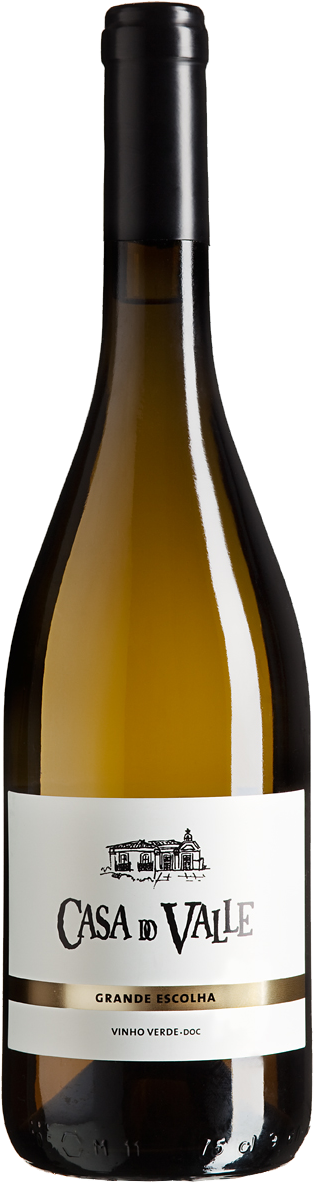
The year of drinking better wine

PHOTO: ONDREICKA/FOTOLIA.COM

as seen on canada.com

“I don’t mind the red wine or the pick-up line as long as it’s cheap.”

Only two days into the New Year and already the familiar refrain replays. So much talking up the wrong vine. That heinous recurrent smoke and mirror theme blurring the path to righteous wine.

VINTAGES January 5th, 2013 Release

In December caution gyrates in tossed abandon, swirling figure eights in the wind. Industry folk bear witness to a wild meritage month of over-spending and reckless wine activity. Then New Year’s is followed by a hangover that causes a confused, annual parade of resolutions. So many swear away indulgence and when it comes to wine, personal restocking gets stymied by rigid, penny-wise action. Know this ‘smart buys’ buyers and beware. You should never drink bad wine. Life really is too short.

Try drinking outside the box. Look to varietals and regions never before considered. Return to old favourites dissed for years. Broaden your wine mind. Take chances. Live a little. Your goal for 2013 must be to drink better wine. Here are five current releases under $20 to re-shuffle and reconsider in the New Year.

The grapes: Chardonnay and Viognier

The history: A South African twist on traditional Burgundy made unusual with the 5+% addition of a Northern Rhône white grape

The lowdown: Remarkably rich and robust for the price and at 14% abv it defies logic. And seriously, what’s in a name anyway?

The food match: Chinese-Style Steamed Tilapia

Bellingham Chardonnay With A Splash Of Viognier 2010 (295345, $13.95) is a chewy white, at first like bubble gum, with juicy fruit flavours that don’t quit. Melds butter into batter, slowly caramelizes and pops out toasty, seeking roast turkey. No Tom foolery here, this plugged in Wellington bruiser, Skinny Legs and All, sports a Jet Airstream design equipped with a battery that lasts and lasts.  87

The grapes: Tempranillo and Cabernet Sauvignon

The history: Stainless Steel fermented juice grown out of La Viña Cooperative in Valencia, at a range of altitudes from 300 to nearly 900 meters above sea level

The lowdown: 10% Cab elevates the Molet to mini, Super-Tempranillo status

The food match: Potato, Bacon and Gruyère Soup

El  Molet Tinto 2009 (305904, $14.95) goes optimum in freshness, ripeness and balance. A full complement of fruit; purple to red to black to blue. Vibrant, piquant, chalky and contused. Presses all the right Tempranillo buttons.  89

The grape: Pinot Grigio

The history: Euro trash wine often so hard to distinguish one from another

The lowdown: Hillebrand’s winemaker Craig MacDonald has come out and rolled a natural

The food match: BBQ Shrimp Grits, preserved lemon rouille

Trius Pinot Grigio 2011 (316414, $15.95) burnishes patina copper and works an unprecedented, osphretic angle for the Niagara Peninsula. Diced pear, lemon pepper, herbs and honey roll prodigally from the glass, pausing to allow for analysis and lingering longer than would be thought. Wholly unique and satisfying. Out of the shell Ontario white.  88

The grape: St. Laurent

The history: Varietal from Alsace, having made a stop in Germany before settling comfortably in Austria

The lowdown: Like Pinot Noir, this varietal sheens best by the light of day

The food match: Loaded Sweet Potatoes, roasted garlic

Rabl St-Laurent 2009 (301960, $15.95) is flat-out delicious, peppy, peppery and buoyed by bright flavours . The kind of wine that makes you wonder if it’s red or white, makes you “not sure if you’re a boy or a girl.” A rebel, pretty in a volcanic way, in full make-up, fresh yet firm. “Hot tramp, I love you so!”  88

The grapes: Sangiovese, Sagrantino and Merlot

The history: Sagrantino of Montefalco produces Umbria’s most iconic red. When blended (typically with Sangiovese), the result is the Rosso di Montefalco

The lowdown: Though Sangiovese leads with 70% in the blend, the Sagrantino’s blackberry and deep earth character cannot be held down

The food match: Smoked Paprika Braised Beef

Arnaldo Caprai Rosso Montefalco 2009 (303065, $19.95) simply has the ‘it’ factor. I’d walk over the hills and far away for this super-Umbrian. A high-flying Zeppelin of pencil lead and animale perfume balanced by ultra-ripe red berries, verging to rapturous black. “Hey lady you got the love I need.”  90

Good to go!

Eight big time value wines

PHOTO: SHOCK, FOTOLIA.COM

as seen on canada.com

Anyone who has dared to venture into wine stores within a week of Christmas knows that the pickings accelerate quickly from slim to none.

Related – VINTAGES, December 8th, 2012 release

Sure, January will bring new releases, but a paucity of good value wine at any time, let alone late December is tantamount to scandal. Staring forlornly into barren cubicles and languishing in long cash-out lines is no way to go through the holiday season. There will be no excuse for getting caught having to serve sickly-sweet, mass-produced plonk to hopeful party guests. As my friend Bob repeatedly reminds me, “it’s not an option.”

The plenitude on wine shelves over the next four days will make the other 361 pale by comparison. Get out there and stock up on the year’s last wine offer. Here are eight big time values to seek out from the final December release of 2012.

Eight big time value wines

The grape: Viognier

The history: Hails from the Northern Rhône in the wines of Condrieu

The lowdown: Alamos is the high-altitude, value offspring line from Argentina’s Laura (@MalbecLife) Catena

The food match: Mahi-Mahi with Blood Orange, Avocado, and Red Onion Salsa

Alamos Viognier 2011 (507830, $13.95) is pretty fly for a white guy. I get Acacia blossom, nectarine and sweet cream. A Viognier to fool as to its origin and sure it sets out to “do that brand new thing” but this is no wannabe. Huge value from winemaker Felipe Stahlschmidt and brand manager Jimena Turner.  Pleased to tout the value for both its phrenic and copacetic manner.  87

The grape: Grüner Veltliner

The history: White Austrian varietal known for its crisp, bright character

The lowdown: One of the most magnetic white wine producers anywhere

The food match: Potato Rösti, horseradish cream

Domaene Gobelsburg Grüner Veltliner 2011 (965368, $13.95) is bar none, the best value in its class. Buffet of exotics; mandarin orange, longan, rambutan. Simmering acidity, no bitter nut, pith or endgame. Not necessarily long, yet satisfying .  88

The grapes: Xarello and Riesling

The history: Traditional varietal from Catalonia, often used in the production of  Cava

The lowdown: Blended with 15% Riesling, the Xarello comes alive

The food match: Seared and Slow Roasted Salmon, crumbled chorizo, salsa verde drizzle

Terraprima White 2011 (303552, $17.95) shows off a pastel but vivid colour, sidled by scents of spring almond tree blossom and autumn arbequina olive. Riesling injection adds more verve in the mouth, indicated by lemon and lime concentrate. Will work all seasons for a Penedes siesta chill.  88

The grape: Chenin Blanc

The history: From dry to sweet, the Loire’s expression of Chenin seems limitless

The lowdown: This one leans far left, sapless, not socialist

The food match: Roasted Kabocha Squash Soup, caramelized apple, spiced pumpkin seeds

Marc Brédif Vouvray 2010 (685362, $19.95) perches high atop a parched, molecular hilltop. Bread starter nip promises stuffed pastry filled with friable, early harvest apples. Wonderful, classic and dehumidified Vouvray.  91

The grapes: Negroamaro and Malvasia Nera

The history: Salice Salentino tends sun-dried, caramelized and sometimes even burnt, but in a good way

The lowdown: Puglia has turned Salice Salentino into an international sensation

The food match: Smoked and Braised Beef Short Rib, dried fruit, carrots, thyme

Leone De Castris Maiana Salice Salentino 2009 (717959, $13.95) is full-bodied like its brethren and definitive of the dark-skinned Negroamaro. Appasimento-like raisin, Amarone quality, peppered by anise and finishing near oxy by sun-ripened tomato, black plums and stewed prunes. If long and slow braised beef convinces it to relax, it will work just fine.  87

The grape: Gamay

The history: From the vineyard of Les Vins Aujoux in the Côte Du Py

The lowdown: Cru Beaujolais, especially from Morgon, can be exhilarating stuff

The food match: Gamay Risotto, candy beets, white truffle oil

Jacques Depagneux Côte De Py Morgon 2011 (299925, $18.95) parlays Gamay in the prettiest purple package. Violaceous, like young and approachable Nebbiolo, or even Montsant. Hawkish and snappy in its play calling with a volcanic, mineral feel that elevates its game. “I’m glad I know you” Beaujolais, from it’s a wonderful life of Py.  89

The grape: Pinot Noir

The history: Unheralded (until now) winemaker Paul Battilana does his best Beaune impression

The history: Burgundy emerges as a limestone-influenced, light-bodied red in Prince Edward County

The food match: Turkey and Cranberry Pie with Sweet Potato Crust

Casa-Dea Pinot Noir 2009 (296210, $19.95) has won me over two years in a row as a top value Pinot Noir, not just in PEC, but in Ontario. Plush ruby robe, expertly extracted though it is so light on its feet. Less earth and clay than cousin Rosehall but this smells exactly as Pinot should. There is a minor note of fromagerie so consider pairing it so.  89

The Splurge

The grape: Petite Sirah

The history: Not to be confused with Syrah, this is the French varietal Durif

The lowdown: There is nothing remotely petite about this grape or this wine. Durif=énorme

The food match: Grilled Venison Loin, blackberry compote

Trentadue La Storia Petite Sirah 2010 (291047, $23.95) is massively concentrated out of the Alexander Valley in Sonoma County, as if it were packed with five centuries of the Italian American experience. Manages 14.9% alcohol with George Bailey-esque, heady grace. Tasted blind I commented, “if this is under $30 it’s an outrageous deal.” “Well whaddya know about that!!!. ” 92

Good to go!

The Wine Diaries: Around the world in 20 whites

Photo Credit: bespokewinecompany.com

http://blogs.canada.com/2012/06/22/the-wine-diaries-around-the-world-in-20-whites/

In sweltering times like these the refreshing vigor of white wine is irrefutable and necessary. I would steer you to just about any global example from this list. Standing tall above is a 20th choice, the Terredora Greco di Tufo that I reviewed the other day. The Iberians too are all solid selections.

Stag’s Leap Winery Viognier 2011 (597369, $34.95) tasted twice tarried true to type. Velvety proof found in the pudding, the Viognier’s a Napa squall of plum flowering white in the wind. Apples baking and an Indonesian spice market with the citrus spray of a fresh squeezed grapefruit. Then the wine goes underground, into a heated, peppery lair. “Aww she surely do moves me,” she must be illegal stuff.  89

Ferngrove Cossack Riesling 2010 (275206, $24.95) adventures into herbal grass, spinifex and mangrove musk. Some petrol and shucked mollusk shell join the omnipresent lemon and lime of Aussie Riesling. Like rice pudding wine. The Cossack’s twain marks not in Ukraine. “Few things are harder to put up with than the annoyance of a good example.”   87

Astrolabe Province Sauvignon Blanc 2011 (10421, $21.95) formerly known as Voyage, formerly, formerly just Astrolabe. Kiwi non-starter in search of an identity in a sea of Marlborough Sauvignon Blanc. Vegetal asparagus and blanched beans lift a dead bale but a kicking caboose shakes that thing on the finale88

Blind River Sauvignon Blanc 2011 (141499, $19.95) does not run with Marlborough’s reliably charitable gooseberry, grass and acidity. “Well it was back in Blind River” when I last saw this SB alive. Young but long on decline.  84

Seifried Riesling 2011 (989541, $17.95) is a robotically off-dry, stone fruit and cold Steve Austin reeking of A16. Blanched, bionic, bitter, sweet and sour gooseberagus. Would fare better as Cantonese chicken balls. Wrestles with identity. Could pass for Chenin Blanc, Sauvignon Blanc, Cyborg or Steve Andersen. No matter the Riesling.  85

Vrede en Lust White Mischief 2011 (280156, $16.95) is bees-waxy, dank and yet juicy South African Vin Gris. A kitchen sink of protractive, not so floral smells. Five blended varietals cancel each other out. Pinot Grigio always wins. 87

Meinklang Grüner Veltliner 2010 (219014, $15.95) is some kind of Mostellian edible oil product. S, green herbs and Pam. A snail minus the butter and garlic. Zero acidity, humourless, see that “S” car go.  84

Domaine Gresser Duttenberg Riesling 2009 (283523, $21.95) fights the Alsatian fight. Light and expressive of primeval stone, caraway and Sommer Special Amer. Bucketmouth watering salinity.  87

Lucien Albrecht Réserve Pinot Gris 2010 (281394, $17.95) is pungent in a dry rub ginger, zeotar and galangal sort of way. To taste it is sweet and to mouth viscous like Muskateler. Rustic and ready for porky burnt ends roasted over felled Linden.  86

Château Haut Bertinerie 2009 (422220, $23.95) of old vines from the woods of the Blye has been “down on the rock for so long.” Marl, barley and Fuissé-esque peach toast. Allen’s Apple Juice too. Talking White Bordeaux with 100% Sauvignon Blanc Blues.  87

Domaine De La Tourlaudière Muscadet Sèvre Et Maine 2010 (171694, $13.95) shows off more weight and depth for the appellation, if less acidity so fish matches ahead of seafood. A peppery kick and tangy melon rind remind me of Verdejo or Albarinho. A Melon de Bourgogne à la Loire easy to get along with.  I think Norm might agree.  87

Masion Foucher La Vigne Aux Sandres Pouilly Fumé 2010 (277350, $20.95) seems to act green with Kiwi envy. How else to explain the extreme grassy and goosey behaviour?   86

Reichsgraf Von Kesselstatt Ockfener Bockstein Riesling Kabinett 2008 (606202, $16.95) hails from less than 1er Cru Vineyard stock,  fumes odiferously of orange peel and Mandarin sauce reduction. This passes and leads to a cleaner Gardenia scent. To taste much more confected than expected with spiced honey. Got a lot going on here but the focus is not on the trolley.  87

Darting Riesling Kabinett 2009 (950212, $15.95) is guarded, a mastiff in protection mode. Bawdy lime and not much else. Almost always enjoy this Michelsberg. Funny bottle.  NR

Tiefenbrunner Pinot Grigio 2011 (954024, $17.95) the Gallo of Alto Adige effervesces yeast meets western volcanic and dolomitic crust and sea. Peaches and cream, nectarine with length but campestral like Beck’s melancholy. “Keep your lamplight trimmed and burning.”  87

Michele Chiarlo Le Marne Gavi 2011 (228528, $14.95) is a salt lick of crustaceous shells and dripping stone fruit goodness. A simple and fun summer quaffer.  87

Casa Do Valle Grande Escolha 2011 (276220, $14.95) while unmistakably Portuguese Vinho Verde, this could be a ringer for Greco di Tufo or Viognier. The long visit to the haberdashery at once wears baking spice, Mezzogiorno mangia cake at Christmas and then white rose, honeysuckle Hermitage. Lofty comparisons for sure but this exceptional IVR* treacle is a chef mastered sweetbread of a double “V.”  89


Nessa Albariño 2010 (282558, $15.95) maybe pale but a gale of vinous expression abounds. Lemon, wax and citrus along with the bitter roots of Wormwood and Horseradish. Would work well with Fried clams and donuts.  88

Domaine Des Chouans 2010 (278945, $15.95) chassays over all pretty and sallow. Dry, sweet at first, then turns bitter. A Blue Podded Blauwschokker Garden Pea. Ornamental but inedible.  85

More notes from the VINTAGES, June 23, 2012 release:

The Wine Diaries:  Chardonnay close to the edge

The Wine Diaries: MMVA’s sparkling wine showers

IVR* – Vintage Direct Intrigue-to-Value Ratio

CVR* – Vintage Direct Curiosity-to-Value Ratio

Good to go!