These are some of my favourite things. Wild edibles foraged from the duff in spring. Earthy red wines cultivated from healthy vines. Protein grilled on an open flame. Layered dishes baked in the oven. Baseball.
Gather them all together, add in some warm weather and the recipe is dressed for success. This past weekend VINTAGES rolled out the May 24, 2014 release. I touched on some good value whites last week so now it’s time to roll out some full-bodied, protein friendly reds. Get these four red hots in stores now.
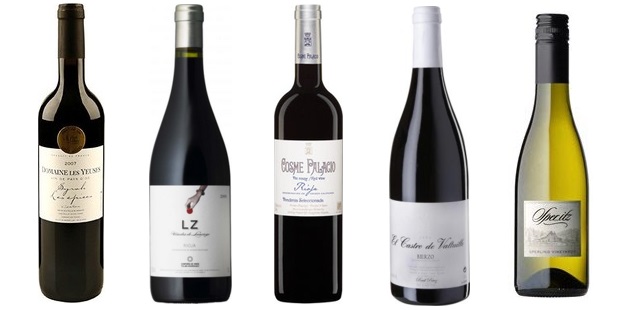
From left to right: Domaine Les Yeuses Les Épices Syrah 2011, Telmo Rodriguez Lz 2012, Cosme Palacio Y Hermanos Reserva 2007, Castro Ventosa El Castro De Valtuille 2010, Sperling Vineyards Sper…Itz 2011
Domaine Les Yeuses Les Épices Syrah 2011, Igp Pays D’oc, Languedoc-Roussillon, France (177584, $14.95, WineAlign)
This perfectly tidy Syrah hails from the area near Mèze in the Languedoc region. The name borrows from a species of oak, the holly, the holm, or the evergreen. Dusty aromas blow quickly away into the savoury foliage of the Yeuse. What is then revealed is a rich, velvety Syrah of considerable stuffing, with a note of semi-sweet chocolate, smoky bacon and plenty of tang. Repeats the value shared by both the 2010 and the 2009. Make this your summer house red, when times are hot, when times are cool. Tasted May 2014
This is the most basic and affordable red in the Telmo Rodríguez line. From the outspoken winemaker who said, “In Canada you have been drinking the worst Riojas, the undrinkable Riojas.” So Rodríguez has decided to make wines without the suffocating slings and arrows of outrageous, appellative fortune. Notice this label notes no Crianza, no Reserva, no Gran Reserva. Fresh and juicy, with new history and tradition written in its code. Modern and forward while relaxed and old school at the same time. Great fruit and acidity, length is just fine and overall it’s a pleasurable, confident, compact wine and without crisis. Tasted May 2014 @liffordwine
A traffic jam of thick, rich and figgy fruit, accompanied by a tempering of chocolate. This Rioja is “good ole fashion medicated goo.” Though somewhat simple juice it bangs the right keys and solicits a stretched and bent weeping guitar accent. Dark as night with the stuffing to carry an album side. “So follow me, it’s good for you.” Tasted May 2014 @Hannanealwines
Castro Ventosa El Castro De Valtuille 2010, Do Bierzo, Spain (366930, $27.95, WineAlign)
Owning a family-run estate for 252 years and farming Mencía vineyards in Bierzo from generation to generation has to count for something. Five parcels are gathered from pre-phyloxeric vineyards in Valtuille de Abajo. The estate manages the only sandy soils in Bierzo, mixed in with quartzite and slate. A solid Mencía, high on phenolic ripeness, verdigris and general stuffing. Rich, chewy, tarry and viscous. Can see this slowly smouldering, smoking, offering wamth and pleasure for 10-15 years. In that sense of longevity it represents excellent value. Tasted May 2014 @HalpernWine
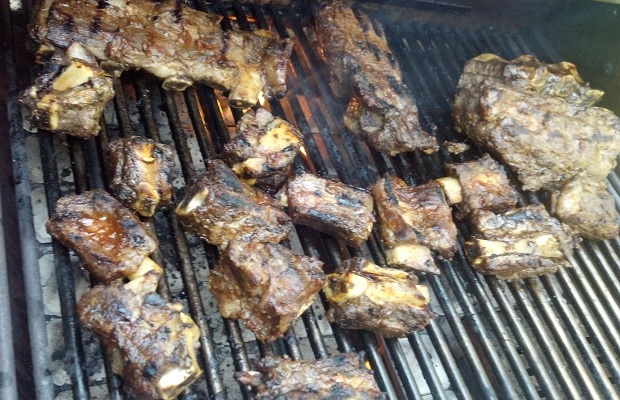
Beef Ribs
Sperling Vineyards Sper…Itz 2011, Okanagan Valley, British Columbia, Canada (364166, 375ml, $13.00, WineAlign)
A very pretty, quite sweet though not overly spritzy Moscato, with nary a waxy or medicinal note. Not exactly true to old world form but what a terrific palate cleanser it makes, like a lemon-lime granita or white pomegranate gelato. The half-bottle format for a big group will work just fine as just a thimbleful is all that’s needed before main course to liven up the palate and ready it for flesh and blood. On the card at Barque. Tasted twice, November 2013 and May 2014
Tawse winery is growing and gaining weight but just like its vineyards, the pursuit is wagered in natural and holistic ways. The Tawse effect distills a biodynamic appropinquation, in the acquisition of new vineyards, in the gathering of tonnage from Niagara and Prince Edward County growers, in the farming and production of estate grapes. I have been making regular visits to the Vineland, Ontario winery for the past three years. The natural, self-sustaining processes remain open, obvious, front and centre.
Chardonnay fruit might travel across the 401 and down the QEW from South Bay at Huff Estates. It may skip across King Street and skirt up Cherry Avenue from Daniel Lenko. It may come to early fruition from young Tintern Vineyard Pinot Noir vines out of the Vinemount Ridge. Whatever the source, the approach is simple. Let winemaker Paul Pender get his mind and his mitts on that fruit. Then let him work his magic. Seek biodiversity, soil fertility, crop nutrition, and chemical-free pest, weed and disease control. Fight the good fight against the harshest of winters with vines of deeper roots and stronger canes.
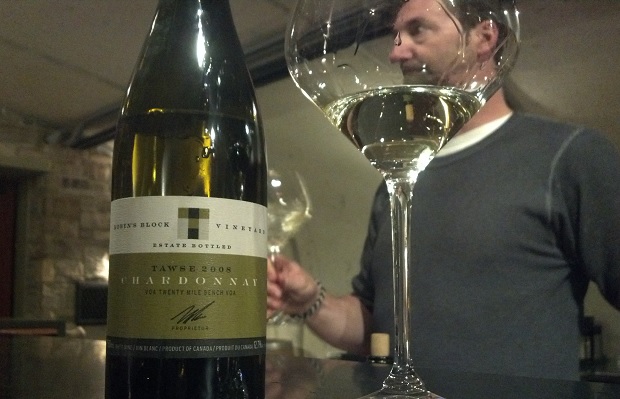
Paul Pender and Tawse Robyn’s Block Chardonnay 2008
The Tawse portfolio may now seem hyper-varied and even massive. Nothing and everything has changed. The lots remain small to manageable, the choice of varieties consistent and the wines, ever increasingly impressive. Whatever faults, idiosyncrasies or misunderstood characteristics there may have been in some older wines, they are no more. There are now purer and more vibrant aromas and flavours. Wait until you get a load of 2012 and 2013. Paul Pender’s acumen and winemaking professionalism has reached a whole new level of Rock ‘N Roll.
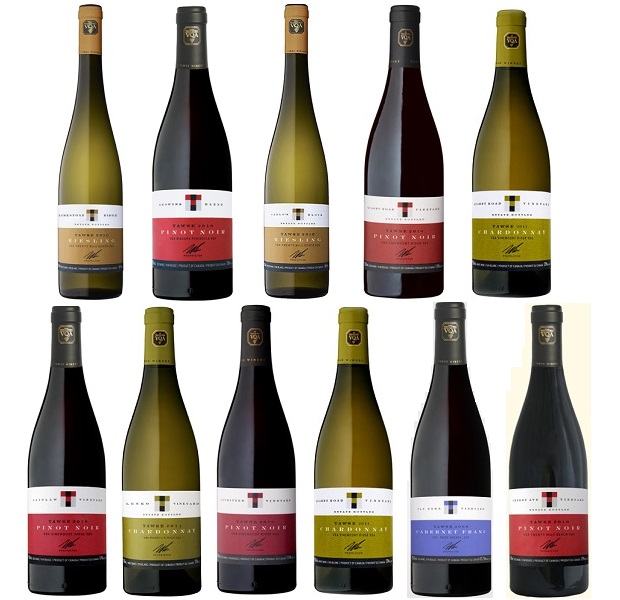
Paul Pender is a big picture guy. He is the Niagara renaissance man; songwriter, vocalist, lead guitar, producer and engineer. He’s Cuddy, Cripps and Chris Shreenan-Dyck rolled into one. Pender’s handling of growing, picking, fermenting, aging and bottling is nothing short of impossible and yet he does it with a conceit of ease. At last count I noted three Sparklings, three Rosé, two Dessert Wines, six Chardonnay, five Riesling, two Gewurztraminer, one Pinot Gris, one Sauvignon Blanc, six Pinot Noir, three Cabernet Franc, one Cabernet Sauvignon, one Merlot, one Cabernet-Merlot, one Meritage and one Gamay. Thirty-seven wines. One goal. Getting better all the time.
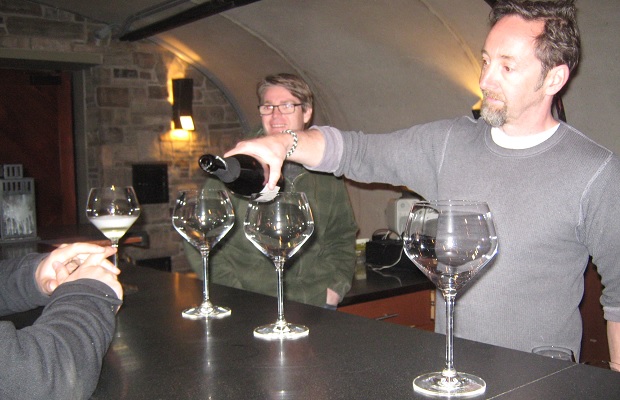
Tawse winemakers Rene Van Ede and Paul Pender
The winter and early spring of 2014 has found me cozying up to the wines of Tawse. On a frigid January evening on my way to Ice Wine Fest I spent time with winemaker Pender in the cellars, speed investigating my way through the barrels of Chardonnay and Pinot Noir. Not to mention Cabernet Franc, Merlot, Cabernet Sauvignon, Riesling and even Sauvignon Blanc. I’ve tasted Tawse with Daniel Lafleur at Somewhereness, with Vinifera’sDaniel Beiles at Barque Smokehouse and at the winery’s portfolio tasting at The Spoke Club.
Tawse Spark Blend 2011 and Quarry Road Chardonnay 2008
Here are notes on 14 Tawse wines tasted from bottle in April and May 2014.
From the newest estate vineyard, the single-vineyard Limestone Ridge exteriorizes its name in a rubric of pressed rock, struck flint and chalky density. Paul Pender has coaxed a multiplicity of linear character, with major notes of lime zest and juice, persistent from start to finish. A mid-pause of oozing, residual sinensis is the determinant towards the wine’s matrix of longevity. A longer, leaner, meaner and mightier Riesling charged by a different sort of power. Kinetic, frenetic and electric. Tasted twice, April and May 2014
This introductory release is a blend of 65 per cent Chardonnay, 22 Pinot Noir and 13 Pinot Gris. A linear, straight shooting star, a sparkler that is so “surprising it goes so fast.” Bright, flashy, attention grabbing and fleeting. These are bubbles with a plan, anything but bad company and quite remarkable for the price. Lemon, lime and ginger strum in wound tension and the wine gets on top very quickly, then disappears into the starry night. Exhilarating while it lasts. Tasted April 2014
From fruit (east of Beamsville) next to Puddicombe, which is essentially Winona on the eastern edge of the Niagara Escarpment appellation. Some parcels of disparate Niagara fruit joins this inaugural effort, a rich, viscous and warming Chardonnay. Layered and expertly balanced, it carries the best of both the Quarry (mineral) and Robyn (approachable) worlds. The spicy accent gives the blend its singular personality. Tasted May 2014
Though it’s a blend of several sites, this Tawse Pinot stands alone and of itself as a grower; it grows on you after multiple tastings. The first go ’round seems simple, vintage warm and tight. Taste again and the sappy wood seeps mineral, the phenolic red cherry ripeness turns black and the tempering is led by a sweet earth kind. Earth that smoulders in a rising Zeppelin kept afloat by tobacco and the swirling spores of pungent mushroom. Pinot Noir truth and value from a Niagara house of the holy kind. “You know-whoa, that’s right.” Tasted twice, April and May 2014
Boasts classic flint and citrus Twenty Mile Bench aromatics. In 2012 it’s also lush, rich and so very pear and longan fruity. Whorls like a wind turbine blowing the polar aspects against each other’s walls. Forms a bridge and meets the twain, from atomic to tropic. High tang and flavour. Big yet classic Riesling. Tasted May 2014
This is the second Pinot Noir made from the Vinemount Ridge vineyard, a place where the rock can’t help but tyrannize the fruit. The 2010 Quarry Road gains positive proportion in that it is painted and coated by the ripeness of the vintage. Of a tougher mind and shell than the other Tawse Pinots, a bird on the wire just trying to be free. Not as easy to approach or love, it might plead “if I, if I have been unkind, I hope that you can just let it go by.” Sings in a wise, raspy and rusty way, despite the youthfulness of the vineyard, but it shines. So in the end “hey, why not ask for more?” Tasted May 2014
At this stage the 2008 Quarry Road is fully resolved, integrated and as soft as full malolactic Chardonnay can be. The unmistakable note of creamed corn lingers longer, as does the look on the winemaker’s face, but air brings it around. Returns to a fresh beginning, “from a year that might not have turned into anything,” admits Paul Pender. Now standing firm, the wine benefits six years on from clean, rotless fruit and pure, angular acidity, holding steady to the admirable finish. Tasted April 2014
The pinpoint accuracy and gemstone capture of the Quarry is exaggerated in ’11, amplified and fully plugged in. From my earlier, October 2013 note: “Carries that classic Paul Pender perfume; rocks and stones, flaxen, refulgent toast and the verdure Vinemount terroir. A free flying, linear, atmospheric smear of thermal fortitude and backbone. A polemic Bowie Chardonnay to make you believe “the strangest things, loving the alien.” From my earlier March 2012 (barrel tasting) note: “Resides on the mineral, slate and lime side of the tracks. The calcareous quality imparted by its eponymous SV terroir makes it the antithesis of David. Creamy, 24-karat fruit.” Last tasted May 2014
From the Vinemount Ridge sub-Appellation of the Niagara Peninsula, the Tawse Laidlaw Pinot 2010 is the least gregarious, the quiet sibling, the most feminine, the sleeper. Laidlaw may play hardest to get and is the least obvious when considering perfume but her palate is the sweetest of the line-up. Strawberry macerates sous-bois for an authentic Burgundian experience. Patient, focused and structured. Tasted May 2014
The speed and the steel have slowed to yellow caution and the now honey-toned flesh has added more weight. There’s just something about Daniel Lenko at this juncture. From my earlier (tasted three times) July 2013 note: “From wiser men who’ve been through it all” is the kind of one-off we should all wish to re-visit in 10 years time. The study: Daniel Lenko’s fruit in the hands of winemaker Paul Pender out of a most confounding vintage. That 2011 in terms of Ontario Chardonnay strikes and speaks to me in tongues is no secret, so the Tawse treatment fascinates in ways to make me giddy. Tension and elasticity are present here in super-hyper Beamsville Bench concentration. Apples pile upon apples, in magnetic purée and layered maceration. A full-on body attack and phenolic structure will see this Lenko to a future (five to seven years) in grace and gorgeous line. A Chardonnay to “scheme the schemes, face the face.” Last tasted April 2014
A year in bottle has elevated the perfume, concentrated the cherry flavour and placed a crown on its regal head. The sweet tannic quotient resonates from its very core. Showing great at this time. From my earlier April 2013 note: “From the Vinemount Ridge is dry and cut with spice, a favourite for winemaker Paul Pender. The sour acidity from fruit such as cranberry and pomegranate are here in deep, concentrated and naturally sweet tones. Niagara limestone casts a Burgundy mineral shadow and the wine is iron tough yet silky due to the warmth of the vintage.” Last tasted April and May 2014
The 2008 Robyn’s Block neither matches the roundness nor the tempering acidity of the Quarry but what it lacks in those areas it makes up for in critical mass and balance. The creamed corn effect is here, as are apples in ciderish activity, from a wine that “was on a starved diet,” says Paul Pender. Though currently a bit reductive and funky, it’s not gun-flinty reduction, like the “smell of a battlefield on the morning after a civil war fight.” Swirling brings out cane sugar to replace the creamy silage and the rest is history. Calm, quiet and approachable inactivity. Tasted April 2014
Cabernet Franc Van Bers Vineyard 2009, VQA Creek Shores, Ontario (355867, $49.95, WineAlign)
What a wonderful vintage for Creek Shores Cabernet Franc and what a difference a year makes. Ripeness, development, rich layering, absence of chalk. Extreme elegance and void of an overbearing currant and bell pepper greening. Tannins are toned and fit. From my earlier, April 2013 note: “From the Creek Shores Appellation is proof that a well-rounded grape has no point. The Van Bers is winemaker Paul Pender’s purlieu, edgy, outlying, unconcerned with the norm or the banal. Makes full use of a cool vintage with heart-stopping acidity and eye-popping verve but not without delivering Soul, in the form of flowers and a fruit basket to your doorstep. “It’s like thunder and lightning.” Capers, camphor and a knock on wood add R & B complexity.” Last tasted May 2014
From two acres of Pinot Noir planted in 2005 known as David’s Block within the Cherry Road Vineyard. A clash of hot and dry weather encouraged the young fruit to find ripeness, in flesh and in tannin. There is an elegance about this Cherry, in part no doubt to wine technique in acumen. The Paul Pender perfume, a combative interplay between cherries and earth, is here. “The in crowd say it’s cool” but it has yet to Rock the Casbah. Cherry 2010 is only offering a glimpse of greatness, so hold out for what will surely develop when the vines reach their next level of maturity. Tasted April 2014
History may one day remember them as the group of twelve, or perhaps, “The Ontario School.” They are the 12 wineries who have banded together to ensconce a strange but beautiful word on the tongue, in the dictionary and out in the world. Somewhereness.
They are purveyors of the land from which their grapes grow and ferment into wine. Facilitators of terroir, working a canvas forged by millions of years of geological and climatic evolution. Their assembly is based on both exigency and on Moira; destiny, share, fate.
Like that other famous group, “collectively they agree.” Ontario’s cool-climate wine regions need to qualify and certify a distinctive winemaking style. In juxtaposition to old world, European tradition, the intensity of Somewhereness needs to reflect an increasingly Ontario-centric partiality.
These are the members. 13th Street, Bachelder, Cave Spring, Flat Rock, Hidden Bench, Hinterland, Malivoire, Charles Baker, Norman Hardie, Southbrook, Stratus and Tawse. Matt Kramer of Wine Spectator used the term and now it defines an enterprise. “As a group of 12 wineries growing small lots of site-specific vines in Ontario’s ancient glacial soils, we’ve invoked Somewhereness as a word enabling us to articulate in one collective voice.”
How do you get to Somewhereness? As related to wine that is like asking, Who am I? Why do we exist? What is the meaning of life? The Somewhereness movement, the notion, comes to light through this statement. “Somewhereness is revealed in the mysterious time capsules we know as bottles of wine. As ethereal gifts of a carefully tended location and a moment in time, each is imprinted with a vineyard’s sense of place,
its soil, climate, seasons, vintage variations — and its maker’s methods.”
In 2013 I wrote about Somewhereness over the Canadian wine rainbow. “Above all else, the rainbow’s fulcrum is the “somewhereness” of Canada’s wine regions. Terroir is the great catch word for wine. A vine’s home determines its potential, its structure, its sense of place. Micro-climates, soil, geology, altitude, slope and vegetation all contribute to the make-up of a wine forged from that specific parcel, lot or locale.”
In Come together, over wine I continued the discussion. “Intensity is in the air. The artists are at work, blessed with a geographical, geological and climatic canvas unique to the planet. They share arts and letters, compare and contrast methods, style and results. The sense of community is palpable, obvious and quite frankly awesome. They are Ontario winemakers and they are coming together. Right now.”
At the end of last year my column 13 Canadian wines that rocked in 2013 reviewed what Canadian winemakers do best. “That is producing unique, cutting edge and brilliant takes on cool climate grapes. They also match beautifully with the songs referenced in their tasting notes. When the wines are assessed and considered in part or as a whole, who would dare to say there are no great wines being produced?”
On Wednesday April 9th, Somewhereness brought the band to St. James Cathedral for a full-on tasting that is rapidly being recognized as a must not miss Ontario event. Here are notes on some of the wines I sampled.
From left to right: Malivoire M2 Small Lot Gamay 2012, Flat Rock Nadja’s Vineyard Riesling 2012, 13th Street Sandstone Old Vines Gamay Noir 2012, Southbrook Whimsy! Cabernet Sauvignon 2009, Tawse Laundry Vineyard Cabernet Franc 2011, Charles Baker Picone Vineyard Riesling 2008 and Norman Hardie County Unfiltered Pinot Noir 2012
13th Street Pinot Gris 2012, VQA Creek Shores, Niagara Peninsula, Ontario (Winery, $19.95, WineAlign)
Here you have an honest, 100 per cent stainless steel treated Pinot Gris from an estate vineyard located adjacent the market on Fourth Avenue in the Creek Shores appellation. So very dry and really fine fruit, crisp, neoteric, rising and falling in waves of tempered acidity. Made in a comfortable, country-twanged, folk-rock style, like a Cowboy Junkie. Juicy, mouth-watering work and very easy to fall for. An angel mine, this 13th Street, “and I know that your skin is as warm and as real as that smile in your eyes.” This effort by Jean-Pierre Colas is as good as it gets, a tally for Creek Shores and its kinship with the variety.
Malivoire M2 Small Lot Gamay 2012, VQA Niagara Escarpment, Niagara Peninsula, Ontario (Winery, $19.95, WineAlign)
A six-month lay in French oak for 60 per cent of the Gamay fruit sourced exclusively from Malivoire’s Beamsville Bench estate vineyard is just what the go doctor ordered. Only Malivoire’s Gamay smells specifically like this; of tart and savoury capers, of small, earthy gemstones, of peppery currants, of meaty braising Bouille. A striking wine from a fortuitous Gamay vintage and great value that puts me in mind of how special the Courtney will be. Though the soils may differ, proximity wise they are close cousins.
Just add three months and witness a new evolution, a density, from a honeyed thing. Entering a pre-adolescence with a new bounce in its step. From my earlier, January 2014 note: “A champion cyclone of forces combined to elevate the already incumbent position of this Twenty Mile Bench Riesling. An ideal growing season magnified transmission upon a paradigmatic two and a half-acre block. This southern-most and highest altitude section of Flat Rock’s vineyard rests aboard a solid bed of limestone and wake me up if that rock was not drawn up into the vines in this stellar Riesling vintage. Sure its warm and nearly off-dry but such an effortless squeeze of lemon hydrates and elevates orchard fruit and honey out of the year of the lemon. After each sip its “every time you kiss me, lemon crush.” Love this prince of a Twenty Mile white in 2012, the dynamism smiling on the tart, succulent fruit. The length is one of outright bravado. This will develop for 20 years, of that I am convinced. There is just so much fruit. A Nadja for the ages.”
Part Beamsville Bench (70 per cent), part Twenty Mile Bench (30), this best of both worlds Pinot is full of calcium magnesium carbonate, Jurassic bark. Playful as opposed to angry, this is not so much Snoop Dogg’s Dolomite but more like an animated Futurama. Seduces with a sweet red berry entry and bound by a really fine acid/tannin/fruit balance. Admittedly not overly complex but for the price it shows good structure. As far as Pinot goes, this one is a made for beef or rack of veal.
The most versatile fizz in the Hinterland portfolio, what winemaker Jonas Newman refers to as his “chameleon.” As aromatically floral as this Charmat method bubbles (secondary fermentation in tank) ever gets, the ’13 brings out the garden under the mist of a sprinkler, late on a summer evening. It’s not so much about fruit as it is about texture, pollen and wet rocks. Try it at Barque.
This binary vineyard symbiosis will be bottled as the Niagara Pinot. Just filtered a few days ago it strides out with the utmost confidence in swagger, with a purity of fruit is spite of Thomas’ shock, awe and reductive apology. A bright sway of terroir gives rapture to a peaking raspberry bush imagined forward into a cooled pie. A renewed elegance abides with an absence of humidity and with a fully ameliorated knowing that a fleshing will happen. Really fine.
Gamay may be winemaker Shiraz Mottiar’s decisive resource but Chardonnay is his thing. The Moira’s ranks as one of Niagara’s best, vintage in, vintage out and this Mottiar, from the winemaker’s home vineyard is the trump card. This Malivoire special agent is set in 2 – 5 year old 300 L French oak hogsheads and aged on the lees in barrel for 10 months. The result? Texture. With the use, or lack thereof in new oak, Mottiar’s Chardonnay becomes a study in compages, with strong abilities and the accents of green orchard fruit and a faint sensation of blanched nut. Nothing toasty mind you because it’s all about density and girth; a Shiraz thing. I find his Chardonnay is all about texture.
13th Street Sandstone Old Vines Gamay Noir 2012, VQA Four Mile Creek, Niagara Peninsula, Ontario (130195, $29.95, WineAlign)
If roses were stones they would produce an aroma that only 13th Street’s Sandstone Gamay would recall. Some previous vintages have pushed the boundary to sky-high excess and a subterranean ferrous burrowing but in 2012 the perfume is both grounded and ethereal. The sandy tuff rock is so in that glass, like the smell of a rugged beach, mist and salinity spraying and rising off the rocks. The ’12 now knows “I don’t have to sell my soul.” Wholly singular Gamay and with hopes it will always be this going forward. Where as before it said “I want to be adored,” it now confirms “you adore me.”
Tawse Laundry Vineyard Cabernet Franc 2011, VQA Lincoln Lakeshore, Niagara Peninsula, Ontario (130997, $34.95, WineAlign)
A lean Laundry with as much finesse as winemaker Paul Pender has ever shown in his poignant Cabernet Franc realm. When a vintage deals you calm and scale you sit back and relax. The Lincoln Lakeshore advancing in years vines bring yet unseen front end red berry, licorice and red currant softness in 2011. There is elegance but also a refusal to yield its back-end bite. A level of enveloping grain and chalk is unique to this bottle and should be seen as a very good effort with the possibility ahead for movement and a gaining of flesh. A graceful, gently pressed Laundry.
Southbrook Whimsy! Cabernet Sauvignon 2009, VQA Niagara On The Lake, Niagara Peninsula, Ontario (260281, $34.95, WineAlign)
A 100 per cent Cabernet Sauvignon whose barrel aging specs are integral to discussing its unfolding. This Whimsy is a seven barrel (172 case) lot of which 86 per cent was aged for 13 months in (71 per cent) French oak. Plain and simple, a wood-heavy decision that has provided allied excellence five years after that demanding vintage. The agglomeration is one of steroidal currants, rocket red berries and an assiduous savoury edge. Just now are the beginnings of a caramel oozing from out of the centre of a dark chocolate house. Really quite an amazing, rich cake example from the vintage. Showing so right and so strong now, in its territory and wheelhouse.
Norman Hardie County Unfiltered Pinot Noir 2012, VQA Prince Edward County, Ontario (125310, $35.20, WineAlign)
Hardie’s 2012 County Pinot Noir is a beacon, a flashing light on the shore, an invitation to copycats because this is what making red wine from limestone foundations is all about. To taste this ’12 is to experience Hardie’s purest berry maceration and distillation to date. It’s as if there was no alcohol present and in fact, at 11.5 per cent it is a modest and transparent pronouncement. Longevity may not bless the ’12 as in other vintages but this is certainly the most groomed and coiffed County Pinot Noir.
Tasted at Somewhereness 2014 as part of a vertical retrospective going back to 2007. The Vinemount Ridge’s now famous Picone Vineyard is set within a 10-acre estate on the Niagara Escarpment. Planted to the Weis 21 clone, the Riesling grown here digs in for complexity from sectional moieties of clay and sandy soil atop a unique base of limestone bedrock. Charles Baker began working with these grapes in 2005 and it is this 2008 where the learning curve took a turn for the Riesling stratosphere. The ’06 found luck in the stars but this vintage lays the framework and foundation for a master plan. At this stage in the ’08 evolution there is a prodigious and viscous honeyed textured. Ripening tree fruit juices run like maple sap in spring and the run off is beginning to think syrup. A cutting ridge of acidity arrests the sugaring, allowing citrus and flinty rock to recall the wine’s first, fresh steps. Baker’s Riesling time travels in circles with no real beginning and no real end. From my earlier, September 2012 note: ““Whoo-ahhh” Mojito, green apple skin scent of a Riesling. Seductive to sip, a bodacious body of influence, then back-end bite. A wolf pack in sheep’s clothing.”
No other Niagara red and for sure no alternative Peninsula Bordeaux blend exists in such a vacuum of dichotomous behaviour. Act one is an out-and-out boastful, opulent show of Rococo. Act two a gnawing and gnashing by beasts. The pitch and pull of the Terroir Caché 2010 optates and culls the extraordinary through the practice of extended délestage, what Hidden Bench notes as “a traditional method of gently draining the wine and returning it to tank with its skins during fermentation.” The ’10 is about as huge as it gets, highly ferric and tannic. Still chemically reactive, you can almost imagine its once small molecules fitfully growing into long chains. Berries of the darkest night and he who should not be named black fruit are confounded by minerals forcing the juice into a cold sweat. Will require a minimum of 10 years to soften its all-powerful grip. From my earlier March 2013 note: “has rich, voluptuous Napa Valley written all over it. Sister Merlot dominant, Beamsville Bench sledge monster. Plumbago, mineral, blackberry and coffee in a wine that will be the ringer in a blind tasting 10 years on. Harald may be saying “this is our family jewel.” Mr. Thiel, you make good wine”
Patient as ever with the cool-climate, slow and low ripening Cabernet Franc, winemaker J-L Groux stuck with belief, regardless of the warm 2010 vintage. The Stratus single varietal space and time continuum of let it hang (though not to December), 20ish months of aging, nearly half in French oak barrels, has brought forth the most dense and luxe Cabernet Franc to date. “It’s never old school, all brand new,” with Groux so this red swells in wholly pure black currant fruit and is as big as it gets for J-L, which is saying something. This beastie boy will age over a 20-year period. Style is the thing, and yes, the aromatics.
The Locust Lane Vineyard, originally planted in 1998, was Hidden Bench’s first acquisition, in 2003. It has a unique perpendicular cross-slope effect, undulating in all four directions, gathering sun hours in its own special way. The vineyard produces the richest and warmest Pinot Noir with fruit flavours more akin to ripe plum and black cherry than almost anywhere on the Beamsville Bench, certainly as any from the Hidden Bench stable. While the ’11 is not the biggest beast nor the Bordeaux bully of the Terroir Caché, it is surprisingly tannic and strong. It’s anything but hot, though it attacks with fervor. Big berry fruit, macerated strawberry, rich pie notes and spice. A great Locust vintage.
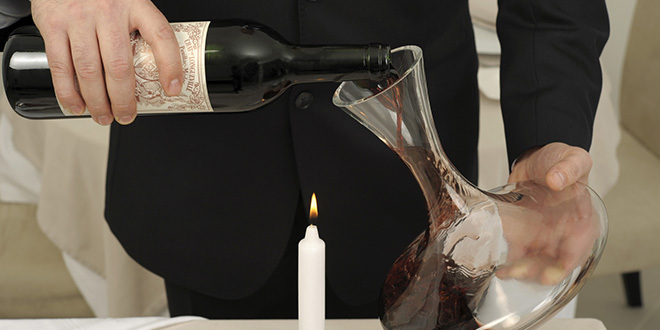
Does decanting eliminate the natural oxidative curve of a bottle of wine? Does it make a wine taste $20 better? Photo: FOOD-pictures/Fotolia.com
The wine drinking experience is afforded more pleasure by decanting a bottle of wine. Decanting means aeration and separation of liquid from sediment. Plain and simple. Most wine drinkers have always bought into this belief. Does that still hold true today?
The debate rages high. Eric Asimov from the New York Times suggests he’s of the camp that takes the middle ground. “Many good red wines are not and continue to produce sediment, so once they reach middle age, decanting these wines, very carefully, remains advisable. I like to decant young reds that might be tannic or tight, like those made from Nebbiolo or Cabernet Sauvignon. Even young red Burgundies can benefit from decanting, though Burgundians might roll their eyes.” True middle ground comes by way of, ironically, Decanter Magazine. “Most modern-day wines do not require decanting, though even young wines may benefit from aeration.”
The famous Bordeaux house of Château Margaux states that “the main reason for decanting red wines is to separate the wine from the sediment that may have formed in the bottle over the years. This sediment consists mainly of the tannins that have been made insoluble by the chemical reactions responsible for the ageing process.” They, like so many other Bordeaux stalwarts, remain entrenched in the world of decanting.
Will Lyons of the Wall Street Journal concurs. “All wine that will throw sediment should be decanted; this includes red Bordeaux, Rhône, Rioja, vintage Port and heavy grape varieties such as Cabernet Sauvignon and Syrah. Also—and this is open to discussion—young wines. In my experience, exposure to air unfurls the complex layers of flavor in young fine wine.” Chris Kissack fervently believes in the decanting process. “Decanting wines is not just for show, and even in this modern age of industrial, fined and filtered wines, some will still benefit from spending some time in a decanter.”
Consider these questions. Does decanting eliminate the natural oxidative curve of a bottle of wine? Does it make a wine taste $20 better? Is decanting elitist, obnoxious and unreachable for the average consumer? Cerebral decanting is another matter. Don’t hate a bottle of wine because it’s not been decanted. Hate it because it’s a bad bottle of wine.
Gerardo Diaz is the Manager and Sommelier at Barque Smokehouse in Toronto. He is adamantly anti-decanting. Here is his well-thought out take:
Decanters come in various shapes and sizes, from functional to ornate to downright ugly. Decanters have played a role within the wine world for thousands of years. They have had many uses over time but for me, they have simply fallen out of practice and are representative of an archaic time, when wine was not made to be drunk immediately. This magnified by the fact that the technology of making wine back then was sub par in comparison.
Wine was held in amphorae, then in glass, metals or earthenware. These were the holding compartments for the fermented grape juice, then transferred off to decanters in order to minimize the amount of sediment within in the decanter/glass. It was used to aerate tighter wines and soften the tannins. Time has changed.
Decanters have become nothing more than a symbol of the past. With modern-making techniques and current trends, people want to be able to drink their choices immediately, and winemakers are following suit.
Wine is not what it used to be. Often over oxidized, aged for many years, with more vintage variation, etc… Nowadays when wine is bottled, it is what it is and does not change that much. As a matter of fact, aeration tends to do worse than better. People seem to believe that decanting hours prior benefits the wine. Quite the contrary. With modern wine techniques and just common sense, the aromatic compounds can only go far, that is to say that with time they will diminish as the minutes/hours go by. Decanting can be used for only two things, well aged wine and natural wines. But more now than ever, wines are not being made to age. They are being made to feed the immediate masses, the ever-growing population, but more so an ever-growing wine drinking population.
Tannins have a bad rep when speaking about wine, some say yay, other say nay. They provide structure, the very backbone to a wine. The added texture is the single most important thing in wine for me and acts as a natural preservative. Decantation is believed to soften these tannins that can be gripping, ever so drying, and to some, a turn off. This popular belief is misconstrued. Softening of the tannins takes place in the winery, with the winemaker. Decanting will only alter perception, kind of like a placebo effect. Yeah, decanters are a placebo effect.
I personally dislike decanters except for the two stated reasons, and even then, natural wines that almost exclusively lack preservations (sulphites), never need more aeration. The wine is what it is and will last a long time opened in bottle.
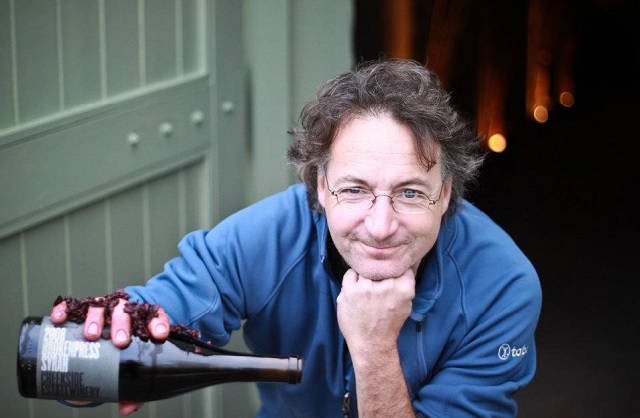
It was the weekend of Godello’s excellent Cuvée adventure, a Niagara winepalooza that included the Brock University Cool Climate Oenology and Viticulture Institute’s Expert’s Tasting. On the road to The Falls there happened an extensive tank, barrel and vertical go round at Flat Rock Cellars and then, with chef riding shotgun, the next essential stop came up on Creekside Estates, a seventeen year-old Jordan winery on 4th Avenue.
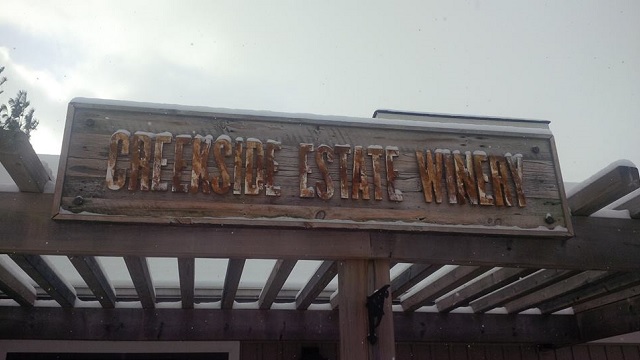
Creekside Estate Winery
2170 4 Ave. Jordan Station, ON L0R 1S0
1 (877) 262-9463 or (905) 562-0035
Creekside was founded in 1997 by owner Laura McCain on a 15-acre vineyard at the 4th Ave. site. The early days of the winery saw an attitude towards varietal antidisestablishmentarianism, with Sauvignon Blanc and Shiraz at the forefront of production. Daring to be different from the start, Creekside has carved an antithetical, Niagara Peninsula religious wine belief, slightly devious, with a manifesto towards creating wickedly good wines.
In the early days there was winemaker Rob Power and mad scientist partner in crime Craig McDonald, now the chief of what happens in bottle at Trius. Powers graduated in the first oenology class out of CCOVI and began his vinous stirring with Creekside, a post he continues to develop, never-resting on earlier laurels. Back then the two cubs fermented and blended together, with caution swirling tohuvavohu in the wind. Some of those Meritage blends from the early 2000’s were brilliant strokes of luck, or as winemaker’s like to call it, hard work. Or destiny, or god’s favour. The Creekside credo has never wavered. Being overly serious is not an option. Having made decisions such as purchasing the unparalleled Queenston Road Vineyard on the St. David’s Bench on its side, Creekside thrives by an exhibition of capricious behaviour, adroit winemaking and the rope savvy marketing of veracious and affordable wines.
Leans and veers to the tropical side, no doubt as a result of a record-setting sugar vintage, but this ’12 manages to finish very dry. The arid descent follows a warm and fuzzy peach feeling, set about by some skin contact and buoyed by citrus and zest. Front yard value.
A Creek Shores SB that bridges the gap between spring and summer fruit. From a year in which the choice was made to not blend off into the estate bottling. Recognizable Creekside aromatics stand out in a more than obvious mineral deposit and grapefruit zest way. Here the band plays across The Great Divide so “just grab your hat, and take that ride.” Will be a VINTAGES August 30 release.
Seven barrels make up the Reserve, ferments new (four) and old (three), leading to a richer, fatter and spicier style. Dreamy really, as matchstick and flint join the fray in a Pouilly-Fumé way. That pierre à fusil is exaggerated by the warmth of 2012, with an elevated tang, rendering the flavours even more akin to Old World, Loire Sauvignon Blanc. Close your eyes and when you awake, “when you believe, you will relieve the only soul that you were born with, to grow old and never know.” The Creekside band created an old SB soul in ’12.
Laura’s White 2012, VQA Niagara Peninsula, Ontario (121764, $18.95, WineAlign)
Laura’s White combines Sauvignon Blanc, Pinot Gris, Chardonnay, Riesling and Gewürztraminer in a kitchen sink blend that sees a bit of oak. What’s notable about the ’12 is the omission of two highly aromatic components, the previously employed stalwarts Viognier and Chardonnay Musqué. The adage is justified in that you take what the vintage gives you. If it gives you lemons, (shift tangents) you let the busy aromatics of more flavourful grapes (like Chardonnay) do the floral work. Laura’s ’12 will be a standout for the concept, a revivalist blend to help bring back some religion to the region’s renditions. Coming to VINTAGES in June.
A 60-80 cases annual production from the Queenston Road Vineyard is not nothing because “ya take what ya need and ya leave the rest.” Aside from a miniscule addition out of stainless steel tank, this is all neutral barrel fermented fruit. Reigned in, less boozy and subordinate in oleaginous slide than in the sweaty years. Translation? A superlative vintage. The night they drove a whopping six rows of old ’11 Dixie Viognier fruit down for crushing the band began to play. This, knowing full well there would be no dirty peach martini, but rather a perfumed dropper distilling flowers, wildflower honey and wild tarragon. Rises and falls to verse like a Richard Manuel keyboard march with length to match the Queenston Road.
A Cabernet Sauvignon (71 per cent) and Cabernet Franc (29) full-on saignée Rosé with colour balancegiven by way of the CF bleed. An arid entry creeps to sweet with a pause amongst the whispering pines, finishing tinny and with a breath of fresh herbs. Niagara Rosé can get lost sometimes, in extract, hue and a candied, sinking feeling. This is a scaled back vintage which is more than a good thing, so there’s no waiting, “until it all goes round…the lost are found.”
A healthy 3,200 cases are managed and executed with ease from mostly estate fruit. Certainly warm in this vintage, dare I say, like McLaren Vale. If it must not be said, too bad, but it’s also a bowl of fresh berries with a rocky Rhône intent. Terrific tar and ash finish.
A traditional Oz combination of Cabernet Sauvignon (55 per cent) and Shiraz (45), clearly new world in style, as Yvonne Irvine says, like “trying to make a big, rich, unctuous Shiraz.” The question could be posed, “temptation stands just behind the door, so what you want to go and open it for?” This one goes right to the jawbone with serious backbone and streak of acidity. Not to mention chalk, grain and a Shiraz solo. The American oak accent is clear and the tannins say wait two to three years, please. The fruit may, or may not comply.
Laura’s Red 2010, Queenston Road Vineyard, VQA St. David’s Bench, Niagara Peninsula, Ontario (117906, $19.95, WineAlign)
It’s funny, more than any other wine tasted, this Laura has that Niagara varnish other Creekside reds seem not to possess. “Stock up in the big years” suggests Matt Loney, and “consolidate in the tougher ones.” It could be argued that you can make more interesting wines in the lean years but this blend of Cabernet Sauvignon, Merlot, Syrah, Malbec and Petit Verdot lays a claim to seriousness, if needing at least three years to settle down. There is much cassis, sweet oak, iodine and a milk/dark chocolate swirl. Complexity for sure if just a bit huge within its own skin.
Here is a wine that is aging gracefully, works with and fits into the vintage, Merlot as objet d’art, grown in stature as if by wizened verdigris. Smells like Goulash or Côte de boeuf à la Bordelaise, even cured meat. Might also be considered in terms of funk, a note sometimes brought on by Hungarian oak. Tons of red fruit, pencil, anise and “the smell of the leaves, from the magnolia trees in the meadow. King Harvest has surely come.” Few Ontario reds succeeded in ’08 like this Queenston Road stunner and few will live as long. Another classic by the band.
Impeccable correctness in terms of the variety from a year where the heat giveth and the heat taketh away. Works Cabernet properties properly, embracing and minimizing oak without pretending it’s not there. This red is expressly lush and oak driven, as it should be, it being Cabernet and all. Leaves its appendages out for a Mediterranean pedicure, a glaze of Cassis, black olive and black cherry dug in a chair entrenched in the warm confines of the St. David’s Bench.
Lost Barrel Red 2007, VQA Niagara Peninsula (46470, $65.00, WineAlign)
Just 60-80 cases are made from the tips of the best barrels through a process that takes 56 months to complete. The secret ingredient is Sangiovese and bless the band‘s soul if the ferric, iron and animal musk is not attributed to the addition. This is a different kind of wine, with lees in the bottle, not unlike some big, bad Spanish wines. It’s ’07 and still reductive which makes it seem peculiarly modern (note, Spanish) but it’s really not. Despite the monster tannins, it “just gave my heart a throb to the bottom of my feet and I swore as I took another pull,” the Lost Barrel can’t be beat. Up on Creekside Estates.
The Torah says, “Guard the month of the spring, and make [then] the Passover offering.” Meaning, Jews need to ensure that Passover is celebrated in the spring. In Canada that proclamation was in danger. Had Passover fallen in March, 2014 may just have seen the coming of the apocalypse.
An understanding of the rules and laws that govern wine on Passover is on a need to know basis. There are really just three key variants of information essential to purchasing and consuming on Pesach. This applies to Jews and non-Jews alike.
Number one. Passover wine is specific to a Jew’s level of Kosher. From Reform, to Conservative, to Orthodox, all Jews have different variances of belief. A Reform Jew will likely drink any wine on Passover and then again, may not. But, he or she will almost certainly not require the bottle to be Mevushal. A Conservative may only drink Mevushal but in more cases than not, Kosher is good enough. An Orthodox Jew goes it only one way, or the highway. Strictly Mevushal KFP, do not pass go, do not collect Afikoman (the broken Matzah) money.
I covered the gory and bitter (herb) details in last year’s Passover wine column. “All wines labelled “Kosher for Passover” are kosher, but not all kosher wines are kosher for Passover.”
In 2012 I spent some time on the limiting, frustrating and constipating food component of the ancient Jewish holiday. “Try cooking with and having to eat nothing but Matzo, eggs and oil for eight days.”
Kosher wines migrate bigger and bigger with each passing Lunisolar calendar year and their not so arbitrary inclusion or not of an intercalary month (shanah meuberet – Adar I) added in the 3rd, 6th, 8th, 11th, 14th, 17th and 19th years of the 19 year lunar cycle. Israel continues to race towards big, lush, often high alcohol reds. This trend could be seen as a masking or a compensating/mitigating strategy to oppose the rigors and past failings of making Kosher wine. It can also be viewed as a stylistic choice, to mirror what has taken place in Bordeaux, in California and in Australia for the past 20 years.
In Canada, Kosher wine selections are extremely limited. There are smaller, garagiste producers in Israel, especially in the hills surrounding Jerusalem, that are making fresher, less oaked reds, but good luck seeing them on shelves on this side of the ponds. It was refreshing, however, to find the Kosher contingent on the VINTAGES March 1st release to be Israel-focused. In past years the group was dominated by Australia, Italy, France and California. Israel is making the best Kosher wines on the planet. Go figure.
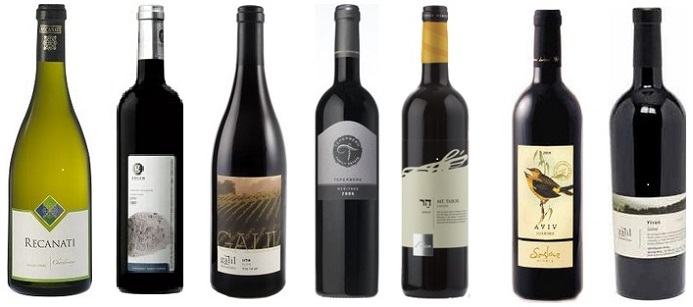
Barque Events offers a full Passover catering menu. View the selections. Here are six big reds and a token white tasted and recommended for the Passover table.
From left to right: Recanati Chardonnay 2012, Kosher For Passover, Non Mevushal, Upper Galilee, Golan Cabernet Sauvignon 2011, Galilee, Galil Mountain Alon 2010, Kosher For Passover, Upper Galilee, Teperberg Family Estate Meritage 2011, Kosher For Passover, Elah Valley, Tabor Earth Series Shiraz 2011, Kosher For Passover, Upper Galilee, Saslove Aviv Marriage 2011, Kosher For Passover, Upper Galilee, Galil Mountain Yiron Kp 2009, Upper Galilee
Recanati Chardonnay 2012, Kosher For Passover, Non Mevushal, Upper Galilee, Israel (128322, $19.95, WineAlign)
Rich, unctuous and viscous. Soft and discreet, more like a modern, New World sketch of a Grenache Rhône-blend than a warm climate Chardonnay. There is little or no affront to this clement and polite Israeli of scant tension or acidity. Tasted February 2014
From winemaker Victor Schoenfeld, the stylish “G” will answer the pecuniary call for just about any Passover feast. Well-rounded, worldly, soft-spoken and generous of fruit. A 100 per cent Cabernet that knows its way around a blackberry, a ripe plum, a bouquet of violets and a chamber of faint tobacco smoke. Lush but not heavy, the only detractor is a slight caramel, oxidative note that indicates near-term consumption, which is basically a given anyway. The finish hints at a lava flow in the direction of the fourth cup, but because this G is so easy to drink, it should be enjoyed while still at the table. Tasted April 2014
Galil Mountain Alon 2010, Kosher For Passover, Upper Galilee, Israel (354522, $20.95, WineAlign)
Alon makes use of Syrah to create its party mix, to work with 41 per cent Cabernet Sauvignon, 6 Petit Verdot and 6 Cabernet Franc. Another monster red blend, coming in hot and huge at 15.5 per cent alcohol. For the price, what more can you ask for? Passover may be a four glass exercise but two through four are top ups so it’s really a two glass night. This wine will not ruin your 2nd Seder morning wake-up after consuming a maximum two glasses at the 1st Seder. Rich, mocha berry driven shake, spicy and with non-invasive meaty aromas. Hot, sweet and bothered. Tasted February 2014 @azureau
Teperberg Family Estate Meritage 2011, Kosher For Passover, Elah Valley, Israel (157016, $23.95, WineAlign)
Proper Bordeaux aromatics, of tobacco, tea, black currant and grilled meat. Nothing gritty going on here, all four varieties playing a role and hanging together. With good tannins, sweet sinuous and slinky, this is a very versatile Passover red that will also benefit from a year or two in bottle. Better than average value. Tasted February 2014
Tabor Earth Series Shiraz 2011, Kosher For Passover, Upper Galilee, Israel (356709, $23.95, WineAlign)
In an unusual turn of the earth, this smells like someone dropped a piece of Emmental to melt in the heat upon the must of this Shiraz. It does swirl away and a solid core of red berry remains, though for just a spell. Simple, semi-structured and proper, without hard edges or tannins, but falls quickly. Will work well with many Passover flavours but drink it up in 2014. Tasted February 2014
Saslove Aviv Marriage 2011, Kosher For Passover, Upper Galilee, Israel (354514, $29.95, WineAlign)
This Aviv consolidates Bordeaux, Piedmont and the Rhône into one complex and perplexing blend within the confines of a single bottle. The Northern Rhône meatiness of the Shiraz stands out firm and at attention, essentially suppressing the Meritage marriage intent and thus renders the wine monochromatic. Still its lively and spicy, ready for the bigger and more pungent foods on the Passover table. The Shiraz might say, “this is a crisis I knew had to come, destroying the balance I’d kept.” The other varieties, meaning Merlot, Cabernet Sauvignon, Petit Verdot, Cabernet Franc and Nebbiolo are the silent partners in this polygamy of a wine marriage. They play their parts despite the joy division. Tasted February 2014
The Yiron is a beast but because I am so pleased to see the Kosher feature composed of all Israeli wines (as opposed to Australia, France, Italy, Argentina and Chile) I am focused and ready to work with anything on this table. Despite the 15.5 per cent alcohol and plethora of oak treatment, this blend shines in rich, meaty and anise-spiked flavours. The mix of Cabernet Sauvignon (60 per cent), Merlot (35) and Petit Verdot (5) may seem monstrous but it is not stupidly expensive now and in relation to what it cost in previous vintages ($50). Though certainly not a wine of elegance, grace and restraint, the Yiron pulls no punches and remains true to its warm climate conditions. It is what it is. Tasted February 2014
As time goes by, I am hearing less comments like, “well that one got a 95,” and “that one is better value because it got a 90.” Wine ratings may increasingly becoming maligned and less frequently employed but that does not mean they don’t have their place. Scores continue to be necessary as a way to evaluate wines that lack a certain level of honesty. Wines on the edge of being dodgily made, encumbered by heavy-handed, industry-fed, mass marketing machines. Scores separate and differentiate the wheat from the chaff when dealing with over the top residual sugar, hyper-acidification, bloated alcohol and (lack of fruit) masking. Embrocating one Malbec an 85 over another’s 84 makes a comment on the relative validities of those two sweetened confections.
Attaching a rating to a tasting note is not a question of right versus wrong. Ratings measure a bottle of wine against its peers. That is the simple answer. The problem is that the tasting experience is a subjective one and each reviewer has personal preferences, so in order to align with one (or more), the consumer must self-calibrate alongside a critic whose palate they’ve figured out. Very difficult to do, so relying on scores has always been the easiest road to travel.
Part of the problem is that tasting notes, on their own, are often fleeting and impossible to grasp. Guilty as charged. Fred Swan put this is the most eloquent terms. “Tasting notes are like photographs, portraying a subject at one brief moment in time and without a back story.” If tasting notes are just snapshots, is that not compelling testimony as to the need for an accompanying score? Or is the rating simply a tool understood within the context of marketing?
Jamie Goode’s take. “I find myself in a tricky position: I use points even though I don’t like to because readers find them useful. And I have to calibrate my scale with the major critics. This pushes me into a corner.”
Still the debate is growing and for good reason. The wine community is tiring of seeing scores, especially those tabulated using the Robert Parker Jr. anointed 100-point scale, attached to a critic’s wine tasting note. The question has always been this. Why would you need scores to sell wine?
Mr. Parker feels so strongly about the entrenched longevity of his system that he’s announced the launch of a new lifestyle magazine called “100 Points by Robert Parker.” Does this sound like a last gasp fling from a captain going down with his ship? Bill Zacharkiw seems to intimate the idea, but the Montreal Gazette wine critic is smarter than to lash out and drag anyone through the mud. Taking a high road, Zacharkiw writes, “from grapes to wine styles, there is truly a wine for everyone. I have my taste, you have yours, and Parker has his.” No, nor scores neither. Nor scores neither.
The fervor and sometimes rage in the argument reminds me of the (second) most famous of Hamlet soliloquys. “Why it appeareth nothing to me but a foul and pestilent congregation of vapours. What a piece of work is a man!” Most of the voices chiming in on this hot topic only see the ratings world in black and white. There are more shades of grey than many would freely admit. Scores have their place.
Meanwhile, Decanter is reporting that Château Pontet-Canet made a bold decision to test (more than 20 years) of uncharted waters by setting their en Primeur pricing in advance of the taste and ratings levies by the major critics. Since the nineties the likes of Parker, Decanter and Wine Spectator have all but determined Bordeaux Futures pricing. Pontet-Canet’s move is being seen as another nail in the 100-point coffin. One Bordeaux négociant commented, “If other chateaux follow this same pricing model, we might as well go home now.”
The real issue is the bottle itself. In the new world of wine, who has not thrown new stock and a vested interest into wines made naturally, in sustainable, biodynamic or organic ways? Who has not made a resolution to drink more honest wine? Producing good wine still trumps the natural theatre of viticulture and viniculture but honesty is the new order. Honest wines should go forth and be free of wine ratings.
Wine scores can be ignored if we concentrate on what matters. Like apiculate yeast, fermentative vigor, microflora, clonal selection and soil. We also need to talk more about and mention flaws, like chlorinated compounds, hydrogen sulphide and volatile acidity. These are things that are too often brushed under the rug.
I will continue to post ratings of the wines I review on WineAlign because as a community of critics we offer a round table of opinions that allow the wine buyer to make gathered, educated and informed decisions. In consideration that this forum is a singular expression of opinions, this column will no longer attach scores to tasting notes. It’s quite obvious, plain and simple. I only write about honest wines for canada.com. The prose speaks for itself.
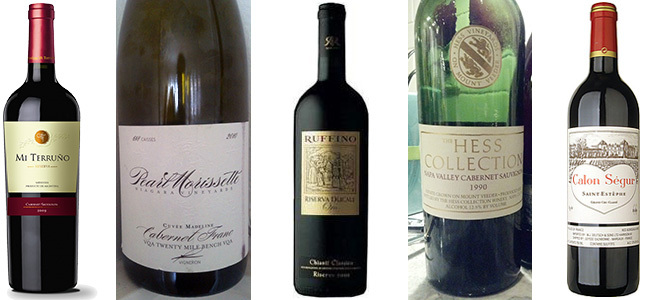
With spring beginning this Friday, no joke, here are the last of the great big winter reds. Five wines recently tasted that thrilled by way of their fairness, their honor and their virtue. Wines that need no score.
From left: Mi Terruño Reserve Cabernet Sauvignon 2010, Pearl Morissette Cabernet Franc Cuvée Madeline 2010, Ruffino Ducale Oro Riserva Chianti Classico 2008, The Hess Collection Cabernet Sauvignon 1990, and Château Calon Ségur 2010, Ac Saint Estèphe
Mi Terruño Reserve Cabernet Sauvignon 2010, Mendoza, Argentina (364133, $15.95, WineAlign) From the VINTAGES March 29, 2014 Release
Stands out for its honest fruit, this Mendozan from San Roque district in Maipú county. Qualified by an admirable level of restraint, low in residual sugar and alcohol, straightforward, unencumbered. Winemakers María Eugenia Baigorria and Sergio Giménez have let the fruit speak in clean, level tones, in red berries, licorice red and black, a dusting of spice, red cherry and even strawberry. This is textbook hands off winemaking with nearly exceptional length and simply solid from start to finish. Mi sueno, mi terruño. Tasted March 2014
Pearl Morissette Cabernet Franc Cuvée Madeline 2010, VQA Twenty Mile Bench, Niagara Peninsula (winery, $38, WineAlign)
Francois Morissette’s 2010 is a pioneering example towards defining Bench appellation Cabernet Franc isomeric reactions. Relationships between grapes of a growing area and their ultimate destination in bottle. An affair of veraison, leaf drop, frost, hand harvesting, whole cluster sorting and berry oak fermenting. Indigenous yeast, punch downs and overs for phenolic skin extraction and polymerization. Neutral oak and sulfur dioxide to provide antimicrobial and antioxidant protection. An eighteen month somniac’s rest, fine lees and no filtration. The structural arrangement in cohabitation of radicals and ions leads to such a Cabernet Franc. Fully expressive of an endemic, very ripe, vegetal varietal vicissitude that is both inbred and necessary. Currants and peppered berries of power and grit. Dry (2 g/L residual sugar), plump (13.7 per cent alcohol) and scarce (618 cases made). Reflective of the warm 2010 vintage and will always act in stark contrast to the elegant 2011. Tasted July 2013 and March 2014 @PearlMorissette On the card at Barque Smokehouse
Ruffino Ducale Oro Riserva Chianti Classico 2008, Tuscany, Italy (353201, $43.95, WineAlign) From the VINTAGES March 29, 2014 Release
A re-release showing an exuberance of advanced character. Now acting out the strikingly rich and golden vintage, in Lamé and gilded iron. Speaking a most Tuscan, elite vernacular, already recognizable and evolving into its own skin, with a notion towards herbaceous, dried fruit. A classic pasta and roasted meats red wine. Nonna’s Trattoria kitchen in a glass. Drying just a touch, so drink up. Earlier note: “Slight earthy funk, imparted by the vineyard floor and in part from the wood. Sappy, resinous, distinctively warm-blooded, plummy fruit. Tuscan tang though light on pucker.” Tasted October 2013 and March 2014
The Hess Collection Cabernet Sauvignon 1990, Mount Veeder, Napa Valley, California, USA (662015, $59.00, WineAlign)
A seminal bottling from a game-changing year, for two all important reasons. One, it was a great vintage for Napa reds and two, the Mount Veeder sub-appellation was established. While only 24 years ago, a mere five wineries existed there at the time, including Mayacamas, Mt. Veeder and Hess. No hyperbole to say this is tasting a piece of history. Despite my “shouting all about love,” this splendidly aged Cabernet is not so much about resilience as it is persistence and infinite wisdom. All those years ago there were Napa reds made at a mere 12.5 per cent alcohol, with finesse and a sense of George-like calm. With little aeration there is fig, prune and toffee gently weeping but with air the aged fruit is swept away by a wave of gob stopping Cassis before its time. Preconceived notions of banausic, early days Cabernet are smothered by the magic dust of this Hess religion, a Dharma of licorice, ash and enlightenment. A wine to make you forget where you are. Depth, length and up to a half decade yet of reserved life lay ahead. Tasted March 2014 @HessCollection
Château Calon Ségur 2010, Ac Saint Estèphe, Bordeaux, France (259010, $149.85, WineAlign) An In-Store Discovery from the VINTAGES March 29, 2014 Release
A blend that in 2010 is extremely high in Cabernet Sauvignon (86 per cent), with support from Merlot (12) and Petit Verdot (2). Immaculate hue in blue jasmine meets red ochre, echoed by blue and red fruit aromas. A purity of freshness and an exotic perfume distracts from the absurdity of the price, if just long enough to become intoxicated by its qualifications. It really does have it all. Red velvet layer cake made of the finest chocolate, the world’s least refined and highest quality sugar, spices only found in places reached and hand-picked by agile, primate-like humans. So approachable and marked by sweet tannins that will carry this Saint Estèphe for three decades. Tasted March 2014
If you missed or would like to be reminded of last year’s top ten list, care to tempt a fate of Sisyphean dread or comedic retribution, then click here:
Halloween candidly breaks down continence as the most pagan, gluttonous and sickly-sweet, over indulgent night of the year. Sure, self-restraint takes a baseless plunge into holiday abysses; Christmas, Eid al-Fitr, Easter, Thanksgiving, Hanukkah, Hari Raya Puasa, Sukkot and the list goes on around the world. But a night of candy? Don’t kid yourself. Your not the only one. One Mars bar for the cute seven year-old in the Smurfette costume, two Oh Henry’s for you.
PHOTO: Michael Godel Cute seven year-old in a Smurfette costume
A few weeks post liminal to the Halloween hangover of 2012 I penned the entry, A toast to the endangered Twinkie. This Twinkie posturing was not only met with cries of “WTF?” but lambasted in the outright anger of many a hipster and political cognoscente who felt insulted and damaged by the hideous notion. The raillery between the lines in my faux ode to the extinct snack was clearly lost, despite a reference to the “Twinkieapocalypse.” So, I swear on the vinocratic oath and please, no wine and peanut butter cup pairings this year. No bubbles and sour candies, no port and milk chocolate bars. If it were available, I might however, have recommended this wine:
I’m no stranger in being an advocate as to the health benefits that can be enjoyed from a glass or two of wine. My column, A wine prescription for cold and flu was met with much love and even more sniggering. Yet the fact remains that a balanced meal and a glass or two of good quality (read: non-chaptalized, honest, light-handed) wine is good for the mind, body and soul.
My suggestion? Eat that early meal, pour yourself and your better half a glass and keep that bottle open for the neighbours and their begging to be topped up travellers. Do be careful what you wish for – you might be the popular, go to house. Just don’t forget to stock up on extra treats. Here are another top 10 reasons to pour a glass of wine and the three bottles I plan to open and dole out on Halloween.
So you will consider the phrase “trick or treat, smell my feet” as a compliment
To build up immunity to better brave the cold and show off your sexy Halloween costume.
So you have a proper excuse to turn down a creepy Blood Hemorrhage or Martha Stewart Blood Orange cocktail
To help forget about traffic infuriating October construction, Ford more years, Miley Cyrus, Senate cheques and work for at least for one night
To reduce the chances of having a heart attack or stroke at the sudden comeuppance of the neighbour’s $10,000 Halloween movie set
Nothing says “thank you neighbour” like a good glass of wine on Halloween
If you are not already, you just might become more tolerable of gay and lesbian rights and of children dressed up as Kathleen Wynne
A person with a candy bag full of vodka is an alcoholic. A person with a candy bag full of wine is classy
A good man can make the hot witch costume you are wearing make you feel sexy, wanted, desired…oh, wait… that’s a bottle of wine
Nothing like a glass of wine on Halloween puts you in the mood to have another glass of wine on Halloween
From left: Château Des Charmes Old Vines Cabernet/Merlot 2010, Rosewood Estates Pinot Noir 2011, and Bodegas La Val Orballo Albariño 2011
Château Des Charmes Old Vines Cabernet/Merlot 2010 (222372, $19.95) from two Cabs and Merlot picked out of select estate vineyards, is aged for nine months in French oak. Sanguine, sweat and sweet-smelling, racing, pulsating red. Liquid adult candy, chewy licorice, a walk in the dark weald. Hallow wine, a thriller, “for no mere mortal can resist.” 88 @Mbosc
Rosewood Estates Pinot Noir 2011 (winery, $20) and her libidinous solid core of red fruit habituated by a fencing of skin-tight acidity will see prolonging returns. Will run on like a Dave Matthews jam, in wine years scads longer than the temperate Rosewood ’10 . An Escarpment’s native flint rocky note whispers “hey little dreamer’s eyes open and staring up at me…wait until I come I’ll take your soul.” Halloween wine indeed. 89 @RosewoodWine
Bodegas La Val Orballo Albariño 2011 (Profile Wine Group, $19.95) from the estate’s Pexegueiro vineyard in Spain’s Rías Baixas region is a brazenly, stony straight, sharpshooting white. Rock star sniper with a retinue of advising. aromatic angles, including citrus and green, tropical tree fruit . “Cold dry stone” granitic smile, nearly discernible effervescence and long, salivating freshness. Albariño in chains. On the card at Barque. 89 @BodegaslaVal@ProfileWineGrp
October is a very busy month in the world of fermented grapes. The local harvest will (almost) entirely see to its conclusion and winemakers will breathe a communal and proverbial sigh of collected relief. They will gaze up into the blue sky and engage in salutary acts of gratitude. They will thank mother nature for allowing their babies to hang long enough for the purpose of achieving phenolic ripeness in varietal maturity.
Appreciation will be shown in spades this week when we wine geeks convene to taste recent years’ wares at Taste Ontario. The event is hosted in Ottawa (The Westin Hotel) today and in Toronto (ROM) on Thursday by VINTAGES and Wine Country Ontario. The grand tasting coincides with the LCBO “SHINE {ON}” campaign that runs from September 15 through October 12.
The lead up week to Canadian Thanksgiving also means the Wines of Chile are coming to the ROM. Chilean wines have lately been blowing my mind in ways not previously perceived. Case in point a recent WineAlign session with winemaker Francisco Baettig of Errazuriz. Later this month there will be stupefying opportunities to sample wines from Napa Valley, Champagne and the Loire Valley.
Ah, there’s the rub. The Loire. Can there be a region anywhere in the world with more varied and obvious wines to match the wealth and richness of foods at the Thanksgiving table? Chenin Blanc, Cabernet Franc and Sauvignon Blanc. A holy trinity of Silex mineral, peppery goodness and piercing acidity to cut through the utterly gluttonous and hoggish Thanksgiving feast. I have already delved into Canadian wines for the coming weekend. Here I add an Argentine Chardonnay, a Nebbiolo from Piedmont, a Pinot Noir from Burgundy and a couple of stupidly good and expensive Cabernets from Napa Valley. Most of all I am so proud to recommend the most altruistic Sauvignon Blanc I’ve tasted in a long time.
So, happy Thanksgiving Canada. I offer up Sancerre thanks, Escondida that emotion and hope to be blessed with a Cabernet on the Corison. Ugh. Sigh.
From left: Finca La Escondida Reserva Chardonnay 2012, Paul Prieur et Fils Sancerre 2011, Pertinace Vigneto Nervo Barbaresco 2009, Aurélien Verdet Moray Saint Denis ‘En La Rue De Vergy’ 2010, Corison Cabernet Sauvignon 2005, and Phillip Togni Cabernet Sauvignon 2010
The grape: Chardonnay
The history: From 100 year-old Bodega La Rosa’s San Juan Andean vineyards, under the much larger ownership of Argentina’s Grupo Peñaflor
Finca La Escondida Reserva Chardonnay 2012 (270207, $14.95) has the Zonda lemon drop I love and look for in Argentinian Chardonnay. Attitude from altitude, the faintest smokey char and terrific restraint. Cool climate rendition and nearly as lovely as Chile’s Le Cordillera. Tight and a bit tingling. There’s a soulful, quiescent component too, if a bit stunted by a stannic cedilla. Never mind the stops and starts. “If you got the notion” buy a boatload of this elegant Chardonnay. Escondida that emotion. 90@fincalaescondid@winesofarg
PHOTO: Jill Chen/FreestyleFarm.ca Barque Smokehouse Baby Back Ribs
The grape: Sauvignon Blanc
The history: Eleven generations have been making Sancerre on this 18-hectare vineyard at the foot of the Monts Damnés
Paul Prieur et Fils Sancerre 2011 (350421, $25.95, SAQ, 11953245, $22.95) has that je ne Sancerrais quoi, first in a fountainhead of Verdingy geology and then in plating everything that is Sancerre; verve, attack, the faintest herbiage and rustling, brushing grass. Tittilating and galvanizing in the most golden, autumnal way. To quote the canonical David Lawrason, if I may, “you can always use a good Sancerre.” Damn straight. 92 @LoireValleyWine
The grape: Nebbiolo
The history: A single-vineyard bottling from Cantina Vignaioli (Elvio Pertinace) in Piedmont, Italy
The lowdown: Patience or a good two hour decant is necessary to seek reward from this generously VINTAGES priced red. It’s generally a $50-60 dollar bottle south of the border
Pertinace Vigneto Nervo Barbaresco 2009 (344705, $39.95) is a tight, saliva-sucking, bone dry, ossified, ferric Nebbiolo. Just two sips and my tongue and gums feel like a lorry has run over them. That and the crimson smell of climbing roses. Classic really. 92
The grape: Pinot Noir
The history: A storied vineyard just above the very famous Clos Du Tart in the Côte de Nuits
The lowdown: This producer may not be a household name for its holdings in this Burgundy plot but step aside Bruno Clair, Lignier-Michelot and Pascal Marchand. Verdet can handle the terroirof Morey-St.-Denis
The food match: Grilled Arctic Char, za-atar crust, nasturtiums
AurélienVerdet Morey Saint Denis ‘En La Rue De Vergy’ 2010 (353416, $44.95) noses my kind of MSD aromatics. Soft vanilla, black cherry, smoke and obdurate limestone toughness. Coated in fine, tinny tannin and stretchy length, this represents big value for the appellation. 92@BadDogWine
The grape: Cabernet Sauvignon
The history: Cathy Corison holds a Master’s in Enology from U.C. Davis, made wine for Chappellet Vineyard, Staglin Family Vineyard, York Creek Vineyards and Long Meadow Ranch and produced her first Corison in 1987.
The lowdown: From Corison, “time on the vine allowed the development of the full range of flavors that Cabernet can achieve (red and blue fruits grading into the darker, purple and black notes) at moderate alcohol. Cold nights promoted great natural acidity.” Some Napa Cabernet is built upon smoke and mirrors. They cause fires. The honesty of Corison’s wines induce irrigation and germination
The food match: Duck Confit, potato galette, berry jus
Corison Cabernet Sauvignon 2005(333328, $113.95) is certainly in its wheelhouse, offering up sweet, Napa plaisir. Not as fleshy as expected but open-handed and magnanimous in behaviour. Ceanothus, blue and perfumed. Berries, red and ever bearing. A (Geraldine) Brooksian wine that allows you “to fall down a rabbit hole, where the rest of the world disappears.” 93@cathycorison
The grape: Cabernet Sauvignon
The history: Napa icon, from a vineyard at 2000 feet, near the top of Spring Mountain
The lowdown: Togni’s Cabernet has oft been compared to the wines of the Medoc, specifically Margaux
The food match: Grilled Beef Tenderloin
Philip Togni Cabernet Sauvignon 2010 (31351, $137.95) may brood and bark but it is not over the top, in alcohol or extract. Imbued of mellifluous perfume, great grain and lay of the land. The 2010 is big on elemental design for Napa, cool in the middle, iron and sanguine at the end. This is serious stuff. 94








 Godello