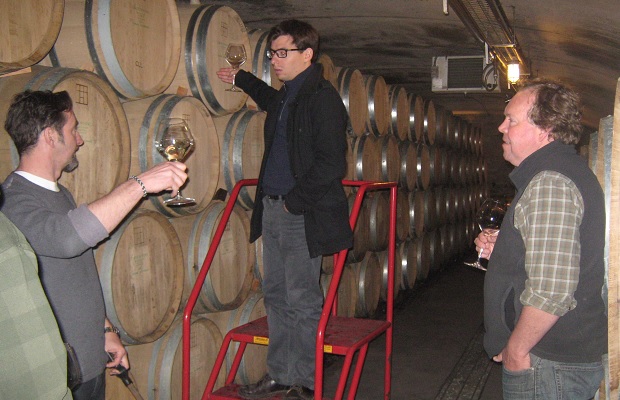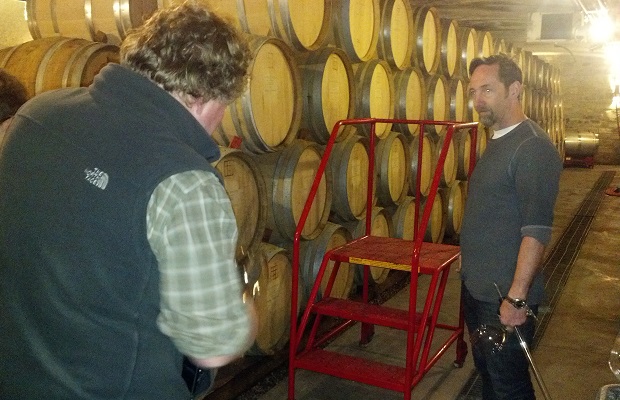
Master classes of Terroir

A Gamay Masterclass, Terroir Hospitality Symposium, May 11, 2015, Arcadian Court

A Gamay Masterclass, Terroir Hospitality Symposium, May 11, 2015, Arcadian Court

The Terroir Hospitality Symposium took place on May 11, 2015 at Arcadian Court in downtown Toronto. The one day food and wine colloquium was a massive simmering feast set in sprawling fashion within an undersized, intricate urban labyrinth. Despite the frenzied and condensed action in the downtown venue, that congress merely offered a look at the tip of the proverbial Terroir iceberg. With upwards of 3o team members leading the charge, the movement left the big fat city address and trekked to set up shop at a local farm and out to the rock at the eastern outermost edge of the country. Terroir moves outwards, onwards and upwards, taking it to the fields and the oceans.

The Terroir Best Practice Culinary Mission went to St. John’s, Newfoundland from May 14th to 17th. The One Fish expedition travelled “to meet fishing industry experts, to explore and examine both the history and the current realities of an Atlantic community built on an economy of the fishing industry.” There was also “the feast that keeps on giving,” at which the Feast Ontario team was hosted at Grandview Farms in Thornbury, Ontario

Led by Founder & Chair Arlene Stein, Vice Chair & Awards Rebecca Leheup, Terroir Talk the dextrosinistral/sinistrodextral enterprise is an undertaking of the extreme variety.

A look at #Terroir2015 in images

Terroir is an event, a series of gatherings, a notion, a philosophy and a way of life. Its mandate is this: “Terroir Hospitality brings together innovative and creative influencers from the field of hospitality, including chefs, food and beverage experts, writers and business leaders.” It’s also not without detractors. There are some who feel it is a negative representation of the culinary and cultural scene in Toronto. That it’s “white, urban, Euro-centric. It ain’t Canada, or 2015. Not funny.”

If the list of participating speakers, chefs and winemakers had been correlated with shortsighted discrimination, ill-curated and preordained with exclusive, malice prepense, you would have been hard-pressed to get an interview with any guest who would have chosen to speak about the called-out lack of representation or narrow-minded decision-making. If the culture and the colour of the event needs to change it will do so with holistic bias and sympathy, with the right sort of urging from the global culinary and vinicultural community. If the pundits are correct, future sessions will reflect the will of the people. In 2015, the atmosphere was wholly copacetic.

The 2015 Terroir wine sessions were marshalled with “an effort to raise the academic standards of the wine side of our symposium,” in three assemblies, to educate and entertain. These Masterclass jams, Gamay, Terroir, and Clone Wars were coordinated by Good Food Revolution’s Jamie Drummond and Magdalena Kaiser with great support from Wine Country Ontario.

The connection between food and wine is an intrinsic one. They are like chicken and egg, contrary to reason in electing which comes first. Chefs and winemakers, purveyors of the land from which their produce grows, transmuted into cuisine and fermented into wine. Facilitators of terroir, harvesting at optimum ripeness and then initiating the transmogrification with immediate haste, in urgency, to capture, lock in and bottle aroma, flavour and texture, before any chance of deterioration or spoilage.

But what the fuck is terroir? The most used word in the language of wine is in fact, terroir. Nothing else compares, comes even remotely close, or causes as much debate. Except for minerality, but those who concern themselves in the matters of ridicule, dismissal and denial ignore the fact that the opposite of fruit is simply, unequivocally and finally, incontestably, mineral.

Were the notion of terroir to be a belief as simple as “what happens in the vineyard, through environment, by geology, geography and topology, from naturally occurring elements and microbes in the soil, by air and of climate. Were it just a matter concerning “the impossible creator of perfect storms, from out of riddle and enigma,” well, then, we could all just go home. It’s much more complicated than that and real.

Most winemakers will agree, in principle, to this. “The final goal is to make the finest wines that express terroir.” Organic and biodynamic are important. Terroir is more important. But winemakers are no fools. They know that “during the grape’s life cycle, genealogy and climate shape its development. But even after it is plucked from the vine it still carries no true identity, in so far as what it will become as a wine. This is the point where nature gives way to nurture. Environment now acts as the catalyst to shape the wine’s life. Wine does not evolve because of natural selection. It evolves at the hands of the winemaker.” Anti-terroir?

At this year’s Terroir Talk Symposium, Gamay was chosen as the first wine session’s go to grape variety, to investigate both the serious and not-so serious sides of its existential weightlessness. To revel in its lithe, brightness of being and to unearth its deep roots. That we have come to a time in history where both aspects can be studied in Burgundy and in Ontario is fortuitous indeed. As a Gamay groupie, I feel blessed to be born under a good sign, at the right time.

As a reminder, it’s always the right time to be with the Gamay you love. I have been urging Ontario farmers to plant, cultivate and nurture Gamay; for winemakers to make it more and more. I made “a proclamation in favour of a great grape and one that forges signature wines out of Canadian soils. I am an ardent supporter of and a willing rider on the Gamay bandwagon, in the name of connaitre and savoirkennen and wissen, recognition and understanding.”

Related – Go Gamay Go

It’s working. Rosewood Estates just planted it for the first time. Gamay is poured at the cellar door, at tasting events and in private gatherings all the time now. Bottom line is Gamay costs half of the price compared to Pinot Noir and Syrah and it thrives in Ontario. It can make serious Cru quality reds and even at the highest end, sell for less than $30. It has been, continues to be and will always be #GoGamayGo time in Ontario.

Related – It’s go Gamay go time
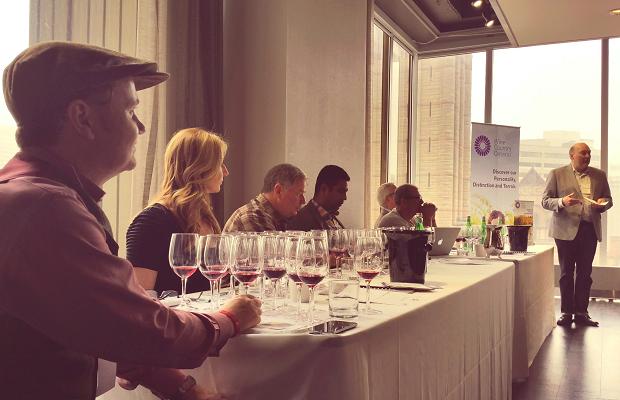
Moderator Chris Waters and the Gamay Masterclass panel: Jamie Drummond, Magdalena Kaiser, Martin Malivoire, Shiraz Mottiar, Bill Zacharkiw and Guillaume de Castelnau

Moderator Chris Waters and the Gamay Masterclass panel: Jamie Drummond, Magdalena Kaiser, Martin Malivoire, Shiraz Mottiar, Bill Zacharkiw and Guillaume de Castelnau

The first Masterclass: Gamay The Next Little Thing

“The intent of the first of the three wine sessions, was meant to investigate how it performs in Ontario and elsewhere in the world.”

The Panelists:

  • Winemaker Guillaume de Castelnau, Chief Winemaker/Director, Château des Jacques, Louis Jadot Beaujolais (Beaujolais, France)
  • Vigneron Martin Malivoire (Malivore, Beamsville Bench, Ontario, Canada)
  • Winemaker Shiraz Mottiar (Malivoire)
  • Wine writer/Sommelier Bill Zacharkiw (Montreal Gazette/Wine Align, Montreal, Quebec, Canada)

The Moderator: Wine writer Chris Waters (Vines Magazine/Intervin, Ontario, Canada)

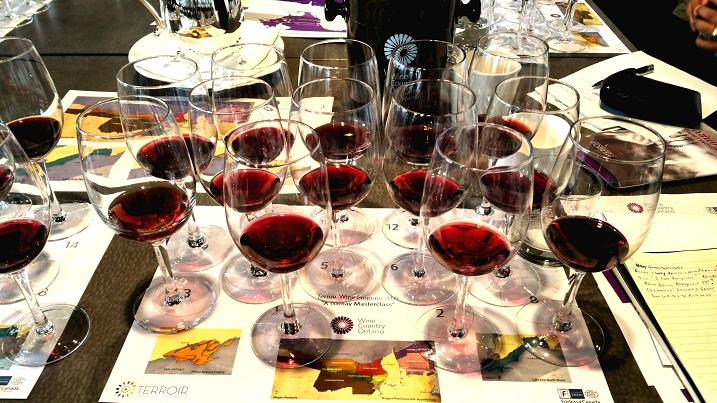
To many, Gamay is a wonderful drug and though much maligned, its suitors and supporters can never tire of its freshness and its lightness of being. Moderator Chris Waters refers to Gamay as “a gateway grape, to transition drinkers from white to red wine.” In a world according to Guillaume de Castelnau, “Gamay is lazy, generous and fragile.” Bill Zacharkiw minces nothing, not words, nor feelings. “I love Beaujolais.” In the Terroir Master Class, there were 13 variations on Gamay, from semi-carbonic to old and baked, with many shades, hues, intensities and variations in between. Here are my notes.

Ontario Masterclass Gamay

Ontario Masterclass Gamay

Malivoire “Le Coeur” Gamay 2014, VQA Niagara Escarpment, Niagara Peninsula, Ontario (Winery)

Shiraz Mottiar refers to the young, Beaujolais impressionist as “Sammy Carbono,” a semi-carbonically macerated Gamay, with one foot in Nouveau and the other in a dusty, freshly spirited aromatic whirl. The tanky feel makes it accesibly gulpable. Like a leaping horse it is also twitchy, hopping in dressage, popping in the mouth. Fun if beside the point. Drink 2015.  Tasted May 2015

Malivoire M2 Small Lot Gamay 2013, VQA Niagara Escarpment, Niagara Peninsula, Ontario (Winery, $19.95, WineAlign)

A month later the pepper runs from white to black, by way of red. Terrific sour edged fruit. Strawberry and cranberry tied together by citrus. Will need two years minimum to fully integrate.
From my earlier note of April 2015:
The profundity of tart, keen, briny berries dilates in its own very useful layers of citrus, tannin and concentration, beyond even what was observed in 2012. The zesty, spritely argot resonates from the unfurling of floral essentia out of a Gamay in desperate need of time. The flavours and overlay are somewhat impenetrable and yet leave quite an impression. While patience might be the virtue and the reward, if #gogamaygo is the modus operandi, a swig from the bottle like gentlemen of the road is certainly not out of the question. Drink 2016-2021.

Last tasted May 2015

Leaning Post Gamay 2013, VQA Niagara Peninsula, Ontario (Winery, $25.00)

A year has clarified the must into a venerable, beneficial decay, like effulgent, liquid rust. The shine of antiquity and then a blast of cinnamon dominates for the first major swirl. So lithe and profound like wise Pinot Noir, minus the Niagara coat of arms and lacquered veneer. Whatever anxiety may have held down the brightness has eased to deliver this current, optimum drinking window. Drink 2015-2016.  Tasted May 2015
 
From my earlier (tank sample) note of May 2014:

Guiltless and virtuous straight out of stainless, the meaty side of Gamay game boldly goes where few from the Bench have gone before. Like a rare venison steak sitting in a silky pool of lavender-scented demi-glace. Floral like Fleurie and despite zero new oak, vanilla joins the gravy. A Senchuk steal of quality Wismer (McLeary…sort of) fruit sets this Gamay up for easy sell success.

Fielding Gamay 2013, Niagara Peninsula, Ontario (Winery, $19.95, WineAlign)

Time has been a friend to the ’13 Fielding Gamay, a wine who’s elevated tones of floral fruit and acidity have settled in the name of structure. Dusty ground nubbins and mint swirl with layered if yet rigid fruit. Low-cropped vines are on display, in single-vineyard like attention to specific detail, akin to Malivoire’s Courtney. This is in fact sourced from a single-vineyard up on the cool Vinemount Ridge sub-appellation. The site is a couple of kilometres south of Peninsula Ridge’s McNally Vineyard, the source of Ilya Senchuk’s terrific Leaning Post 2012 Pinot Noir. The Procyshyn family has been farming this plot (without fanfare) for decades in Beamsville. The pristine fruit that Theo and Shelley Procyshyn grow, along with their three sons, Nolan, Dalton and Brayden, yield as low as 1.5 tonnes and up to 3.5 tonnes per acre, depending on the year. The ’13 was around 3 t/a. Fielding has never labelled this Gamay ‘single vineyard’ because they have always hoped to bring in new Gamay blocks on as part of that wine, but that’s not yet worked out. The ’13 is very, very red raspberry, with a craggy, spiked point of liqueur, like a weeping peak upon that Vinemount Ridge in the afternoon sun. Has Beamsville’s upper reaches written all over its corporeal self. Drink 2015-2017.  Tasted May 2015

13th Street “Sandstone” Gamay 2013, VQA Four Mile Creek, Niagara Peninsula, Ontario (Winery, $19.95, WineAlign)

May just be the first Gamay with a simulacrum towards a style best described as appassimento, what with the overripe fruit, aromatic cure, baked and sun-dried flavours. Sniff the confluence of black raspberry, scorched earth and roasting game bones, its sinew crackling over humid old growth wood. Gets rich into the vanilla, reeking of late harvest lavender and then a mutton funk. Could easily pass for a wealthy, unforgiving style of Cru Beaujolais, like Chénas from Christophe Pacalet. Or it could just be acting older than its age, by seven or eight years. Most prepossessing and confounding Gamay. Drink 2015-2018. Tasted May 2015

Stratus Gamay 2012, VQA Niagara On The Lake, Ontario (Winery, $29.00, WineAlign)

Esteem elevated by structure, matched in poise and presence mottled in smears of darker, richer black cherry. If a slight absence of brightness is sensed due to the syrupy compression, like New World, west coast Pinot Noir, the gleaning from acidity and tannin times perfectly the effluent escape.

From my earlier note of April 2015:

It may not be the most idiosyncratic Gamay in Niagara but the Stratus 2012 is without a doubt the most advanced and complex. Gamay fusion is on display, at once a bottle of Niagara’s finest pulchritudinous veneer and then a charcuterie board laid ample with cured bovine parts and sun-dried grapes. Maximum ripeness and then even later picking, to no one’s surprise, have led to this. Two years of ageing in neutral oak barrels has brought about a humid roundness and yet the centre is controlled by Oz-like mint and eucalyptus notes. The jam is gelid, as opposed to temperate. Rarely does Gamay go to such depths, of blackberry, chalk and grain, with an overlord of tannin. Quite serious stuff. Drink 2017-2020.

Last tasted May 2015
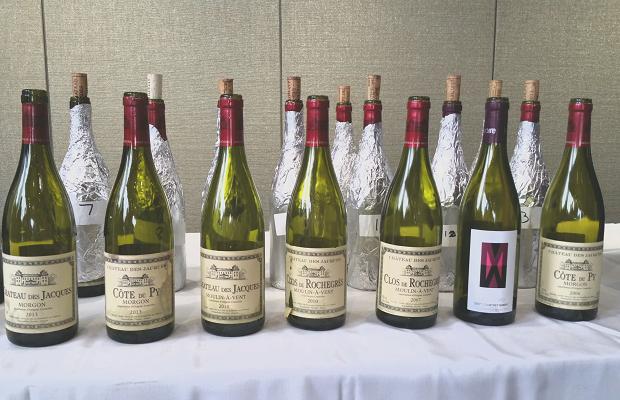
Château-De-Jacques and Malivoire Courtney in the Gamay Masterclass

Château-De-Jacques and Malivoire Courtney in the Gamay Masterclass

Château-De-Jacques Morgon 2013, Ac Beaujolais, France (653584, $24.95, WineAlign)

The flushed scarlet animation is active and astir, like a soft serve swirl of dusty, cherry molasses, bathing in its own natural acidity. Has the presence of wine to integrate chalk, grain and Morgon tannin, in equal, opposite and variegated layers. Nothing shy about this gateway Cru Beaujolais. Drink 2015-2019.  Tasted May 2015

Château-De-Jacques Morgon Côte du Py 2013, Ac Beaujolais, France (Agent, $53.95)
In this rigid and stoic Morgon, the south-facing, blue volcanic slopes of the Côte du Py have provided a measure of firm fruit that will require a minimum two to three years to crack. The gears of the Gamay machinery may be grinding but the windows are yet open, the doors locked tight. This is the least forward, most inwardly introspective and least gregarious of the CdJ Beaujolais. Sharp sapidity, biting tang and piercing penetrating tannin deny immediate or even short-term access. Even the middle palate seems lifeless, devoid of cherry fruit and seamless layering, medicinal even. Judgement should be reserved, with knowledge of pedigree and how a bottle such as this will suddenly, effortlessly spring to life with time. Drink 2018-2022.  Tasted May 2015

Château-De-Jacques Moulin a Vent 2010, Ac Beaujolais, France (Agent, $36.95)

The undergraduate’s blend comes from the appellation’s Château des Jacques parcels; Carquelin, Rochegrès, Champ de Cour, Thorins and La Roche. Granite soils from each spice with symptomatic diversification and combine for a flippant funk that hitches straightforward out of the gate. Here Gamay leaves dusty behind with an urging away from humble and towards nobility. Richly aromatic, amplifying into palate. Such acidity and such grain. For this MaV the time is now, the arrival already announced. A late sense of veneer on the lengthy bitter finish indicates more good times ahead. Drink 2015-2020.  Tasted May 2015<

Château-De-Jacques Moulin a Vent Clos de Rochegres 2010, Ac Beaujolais, France (Agent, $44.95, WineAlign)

From the appellation’s highest parcel, the red sandstone soils of the Clos de Rochegrès are gently sloping and fed by underground streams. I always sense salinity and an effusive, stony energy in wines blessed with subterranean irrigation. The drinking window for this 2010 is wide open and the funk meets age introduction has been made. Already in display of a dried fruit shrivel, the ’10 acts like Sangiovese of a similar senescence, like CCR or Vino Nobile with three to five years of age. The liqueur of roses, the earth and the cherries are culpable and yet the varnish and the baking spice crusting ensure that no one conclusion can yet be made. This is highly seasoned and not quite unfurled Gamay. Two more years should complete its conditioning. Drink 2017-2020.  Tasted May 2015

Château-De-Jacques Moulin a Vent Clos de Rochegres 2007, Ac Beaujolais, France (Agent, $43.95, WineAlign)

Poured from a magnum, the 2007 Clos de Rochgeres is the portal in which to peer, to see what can happen with Gamay. Baked, caked, figgy, funky and oxidative, more than ample fruit was present and persists, with the savoury edges now integrated throughout. Strawberry rhubarb pie comes to mind, with eyes closed and sniffing senses heightened. A bit indelicate, the humidity in tomato leaf and garrigue add to the idea of age though the citric punch and lactic texture are reminders of Gamay’s fun side. There is no shortage of complexity and evolution here. That said, consumption time is now. Drink 2015-2016.  Tasted May 2015

Malivoire Gamay Courtney 2007, VQA Beamsville Bench, Ontario (Winery, $29.95, WineAlign)

The wow aromatics can’t be denied, fully explained nor perfunctorily taken for granted. Age has educated the fruit, stratified and fully saturated this Gamay. Strawberries have shot from an adrenaline cannon and structure has been fully realized with (non-Gamay) Old World confidence. A note of orange blossom, like an early evening Sevilla garden, is rousing. The natural evolve of such a Gamay, with wood, yeast and fruit in expert harmony, recalls the impossible acts of red wines like those made by Emidio Pepe. If the stretch is considered a conceit of poetic licence, so be it. The yet beating heart of raging acidity circling plenteous fruit and so much savour is nothing short of a Gamay miracle. Power and masculinity, by way of a conduit in oak, have been used to great advantage. This has life yet to live. Drink 2015-2020.  Tasted May 2015

Château-De-Jacques Morgon Côte du Py 2006, Ac Beaujolais, France (Agent, $53.95)

Seamless and eminently structured, developed low and slow. The blue volcanic soil has procured an evolutionary subsumption, a roasted, developed personality. The seeping liquor oozes, of earthy cherries, again like Sangiovese, but inelastic and close-grained, as per the Côte du Py idiom. This ’06 offers clarity and gives reason to forgive the brutal ’13, to abstain for commenting further. This wine is quite ferric and still tannic. The oak remains a factor. Through the walls the Gamay fruit does transude and so the master plan is coming into effect, perhaps not immediately but will be very soon. Just around the corner. Drink 2016-2020.  Tasted May 2015
Moderator Sara d'Amato and the Terroir Masterclass panel: Magdalena Kaiser, Dr. Jim Willwerth, Emma Garner, Stuart Piggott and Dr. Kevin Pogue

Moderator Sara d’Amato and the Terroir Masterclass panel: Magdalena Kaiser, Dr. Jim Willwerth, Emma Garner, Stuart Piggott and Dr. Kevin Pogue

The second Masterclass: A Different Look At Terroir: How Much Do Soils Actually Matter?

“In this seminar/tasting we ask what the term really means, and how much do its many different elements actually influence the character of the finished wine?”

The Panelists:

  • Dr. Kevin Pogue Phd. Geology, Whitman College, Walla Walla, Washington State, USA
  • Dr. Jim Willwerth Phd. Biological Sciences: Plant Sciences; Oenology and Viticulture (CCOVI, Brock University, Niagara, Canada)
  • Winemaker Emma Garner (Thirty Bench, Beamsville Bench, Ontario, Canada)
  • Winewriter Stuart Pigott (Author of Riesling: Best White Wine On Earth, Berlin, Germany)

The Moderator: Wine writer/Sommelier Sara d’Amato (Wine Align, Toronto, Canada)

Dr. Willwerth offered up his opinion on how minerality is achieved in Riesling. “If you don’t get maturity in the variety at the end of the growing season, you won’t get the full expression of minerality. Overripe will eliminate minerality.” In Ontario, “The Bench is home to a mineral wealth of local Riesling, singular in composition not only by way of a global comparison, but also from plot to plot, soil to soil and vineyard to vineyard.” That persuasion has spread, down to the shores of Lake Ontario, by Niagara-on-the-Lake and in Prince Edward County. “Riesling brokers the nescient consumer with the gift of grape enlightenment.”

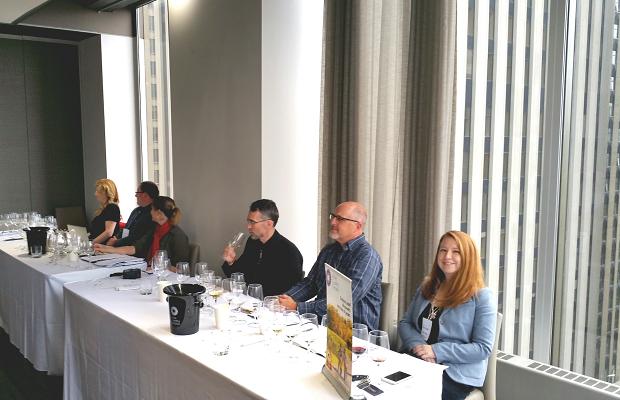
Seven Ontario Rieslings were tasted in the Masterclass. The notes.
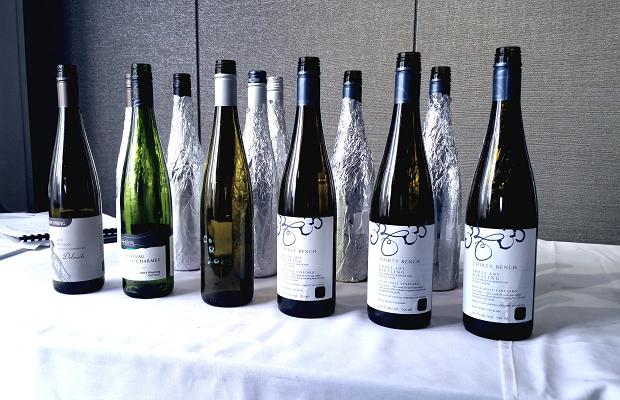
Riesling Masterclass

Riesling Masterclass

Cave Spring Riesling Dolomite 2013, VQA Niagara Escarpment, Ontario (Winery, $16.95, WineAlign)

This is Cave Spring’s bridge, offering safe passage from Estate to CSV Riesling. Vinified with consistency in a quasi-Kabinett style, its elevated though classic numbers steadfast in sugar (17.55 g/L) and acidity (7.2 g/L TA). The dolomite limestone of the Escarpment means business in this calm, fit, chiseled and consumer-lissome Riesling. Palate is really the thing, seamless to attraction, from fruit to stone. Orchards and citrus groves alight to rock. Phenolically ripe yet shy of the tropical planet. Is there transference here? Absolutely. Drink 2015-2018.  Tasted May 2015

Château Des Charmes Old Vines Riesling 2013, VQA Niagara On The Lake, Ontario (277228, $16.95, WineAlign)

The happy place effect by age in the Château Des Charmes’ vines coupled with location is usually enough to carry this Riesling through an obvious and readily identifiable tunnel but 2013 confounds. The elemental ratio, derived from multiplying reduction by altitude leans thoughts to the Vinemount Ridge or the Cave Spring Escarpment Vineyard. The compound aromatic waft, or more succinctly, the deconstructed stone, the breaking down of periodic Hollywood squares is a force to reckon. That this arrives from such close proximity to the lake is nothing short of amazing. It’s as if this Riesling is the product of stressed vines and the pierce is just so pinpointed. Less accessible than ’12 for sure, so drink up previous vintages going back at least three before even thinking about getting to know 2013. Drink 2018-2022.  Tasted May 2015

Norman Hardie Riesling 2014, Prince Edward County, Ontario (Tank Sample)

At this prepossessed stage the terpenic fruit might fail in competition but succeed in the marketplace. Easy access, smelling of perfumed must, juicy, with citrus and burgeoning acidity. Low alcohol and good length stretch out an endless lemon summer. The wine will reverse itself within a year and beat impossible odds. A Hardie always does.  Tasted May 2015

Thirty Bench Riesling Small Lot Triangle Vineyard 2009, VQA Beamsville Bench, Niagara Peninsula, Ontario (Winery, $30.00, WineAlign)
The brilliant hue slides through patina and heads for gold. Some fumes have emerged with age, part petrol, part pure mineral, but of what kind and more importantly how, or why? Viscous, near oily, waxy and the most Glück of the three Thirty Bench single-vineyard Rieslings. Tossed with spice, pepper, lemon and honey that is more molasses than clover. The mineral is a result of the lowest water retentive soil as compared to Steel Post and Wood Post. The transmission for (orchard or tropical) fruit is minimized, the vigour low. The result is mineral. Drink 2015-2020.  Tasted May 2015

Thirty Bench Riesling Small Lot Steel Post Vineyard 2009, VQA Beamsville Bench, Niagara Peninsula, Ontario (Winery, $30.00, WineAlign)

Balance is and therefore always was struck. The match percusses flint for a mere nano-second, with just a brush on cymbal, the rock bleeds but is quickly clotted because the fruit shines still, like around the clock light. The steely aspect is a posterior one, antithetical and yet purposed, from this vineyard. Youth tells common sense to think 2011. The Riesling behaviour seems to play that part, of a chalky, piercing acidity, so typical of that vintage and so distinctly Thirty Bench. That the wine is older is not a big surprise because 2009 is the bomb. It may just be the best Riesling vintage, from on that Bench, in the last 10. Drink 2015-2025.  Tasted May 2015

Thirty Bench Riesling Small Lot Wood Post Vineyard 2009, VQA Beamsville Bench, Niagara Peninsula, Ontario (Winery, $30.00, WineAlign)

Age is a factor but less so than its Bench sisters due to a fine sense of calm. Showing less evolution, less viscosity, less wax and honey. More than that, the periodic table has yet to fill in. The Wood Post exhibits more warmth, savour and balm. A taste offers a sapidity that combines toasted fennel and candied lemon. Poised and yet incomplete, the vineyard fetters this Riesling to breath slowly and take its (will get to) sweet time. Drink 2017-2027.  Tasted May 2015

Flat Rock Cellars Riesling Nadja’s Vineyard 2009, VQA Twenty Mile Bench, Niagara Peninsula, Ontario (578625, $19.95, WineAlign)
Going back a few years, this Flat Rock Weis 21 clone Riesling from atop the Niagara Escarpment was made by former winemaker Ross Wise. Six years has concentrated both aromas and flavours while concurrently reducing the cutting drill. The hyperbole is read by tablet, of etchings in stone, immortalizing the terroir (not so) long before it was truly known how this could happen. What sticks out the most is the bleeding limestone texture and the striking aridity. Later vintages of Nadja improve on the flesh. Drink 2015-2017. Tasted May 2015
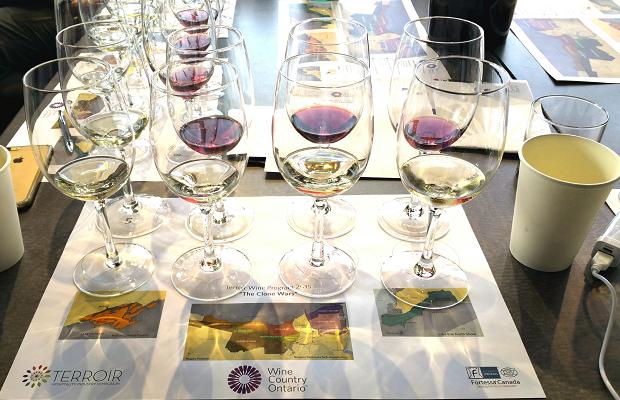
Clone Wars Masterclass

Clone Wars Masterclass

The third Masterclass: “The Clone Wars”: What Do Different Clones Bring To The Glass & Why?

“Looks at Riesling, Cabernet Franc and Pinot Noir. The varying clones utilized are a point of pride for some winemakers, and yet not even mentioned by others. Over the course of this detailed seminar/tasting we hope to answer why this is the case.”

The Panelists:

  • Dr. Kevin Pogue Phd. Geology Whitman College, Walla Walla, Washington State, USA
  • Dr. Jim Willwerth Phd. Biological Sciences: Plant Sciences; Oenology and Viticulture (CCOVI, Brock University, Niagara, Canada)
  • Winemaker Angelo Pavan (Cave Spring, Jordan, Ontario, Canada)
  • Winemaker Jay Johnston (Flat Rock, Beamsville Bench, Ontario, Canada)

The Moderator: Sommelier Katy Moore (Langdon Hall, Cambridge, Ontario, Canada)

Dr. Jim Willwerth asserts that “clones are essential for viticulture, propagated asexually, through cuttings.” Angelo Pavan notes “clonal research to cold heartiness is very important for Niagara and also for yields.” Clones no doubt drive the industry, at least behind the scenes, but when it comes to making great wine, is it the be all, end all? “I still believe plot trumps clone,” says Jay Johnston. The defence rests. Here are the wines tasted in the final Masterclass.
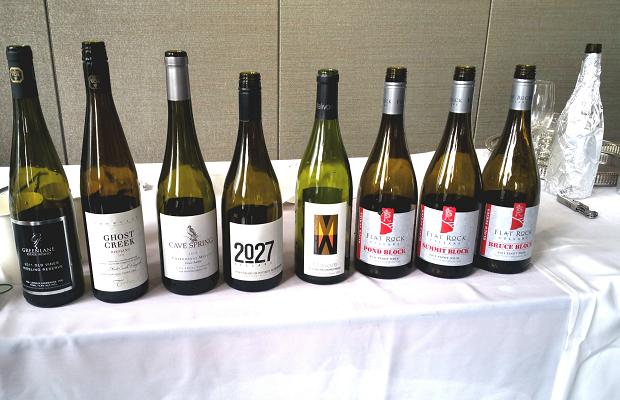
Clone Wars Masterclass line-up

Clone Wars Masterclass line-up

Greenlane Riesling Old Vines 2011, VQA Lincoln Lakeshore, Niagara Peninsula, Ontario (351486, $21.95, WineAlign)

While aridity suggests Alsace Clone 49, this is actually Weiss 21, made saline and arid out of Lincoln Lakeshore soil. The herbal aspect has propagated to combine with Twenty Bench like distinction and with less citrus than Vinemount Ridge or Beamsville Bench. The Mosel density has developed with time in bottle. Drink 2015-2019.

From my earlier note of October 2013:

Cracks the mineral whip, froths lime into foam and atomizes stone fruit into sweet and sour heaven. Wants to be semi-dry but never quite goes there. Walks a fine line, a tightrope actually. Up there with Charles Baker and Thirty Bench for sheer madness.

Last tasted May 2015

Trius Winery At Hillebrand Showcase Riesling Ghost Creek Vineyard 2013, VQA Four Mile Creek, Ontario (Winery, $25.00, WineAlign)

The Ghost Creek Riesling comes from the shadow of a river bed vineyard planted to the Alsace clone 49. The fruit is much richer than most, coupled with the aridity and salinity that former stony wadi plots and this particular clone will conspire to effect. The citrus intensity is however tempered by a humidity that comes from seemingly sunburnt fruit, tanned and wet down by the revenant reservoir. Drink 2015-2017.  Tasted May 2015

Cave Spring Estate Bottled Chardonnay Musqué 2013, VQA Beamsville Bench, Niagara Peninsula, Ontario (246579, $15.95, WineAlign)

Produced from the 77 clone, the vintage has heightened the high herbal and feigned sweetness aromatic pastis. The palate is extraordinarily viscous, with Yellow Muscat and Gewürztraminer attributes, not so out of the ordinary considering Cave Spring’s older world execution. Drives from lemon to mandarin, through almond pit and into peach. Always solid Musqué. Drink 2015-2017.  Tasted May 2015

2027 Cellars Chardonnay Wismer Vineyard Fox Croft Block 2012, VQA Twenty Mile Bench, Ontario (Winery, $30.00, WineAlign)

In the hands of winemaker Kevin Panagapka, Craig Wismer’s fruit retains un underlay of power not recognized in other Foxcroft Chardonnays. Neither Thomas Bachelder nor Ross Wise (Keint-He) make anything near spirited as this 2027 take. Chardonnay loves the sun in the Foxcroft Block and Panagapka loves to see that sun hook up with the inside of a barrel. This ’12 makes a nice date for a wood wedding. A product of the Dijon 96 clone, the reduction in this Chardonnay drives its fresh, spritely if mettlesome nature, with a bark and a barrel bellow, but longevity will not suffer as a result. This could take 30 years to oxidize, it’s that audacious and also courageous. Let it and its buttered popcorn rest a while. Drink 2017-2025.  Tasted May 2015

Malivoire Chardonnay Moira 2011, VQA Niagara Peninsula, Beamsville Bench, Ontario (243113, $39.95, WineAlign)

When it comes to clones, winemaker Shiraz Mottiar distills the Moira Vineyard into the realm of “field selection.” Not to be confused with field blend though I suppose that’s what it is, of sorts. The ’13 is the dictionary entry for Moira, typically balanced, from pedigree, in warmth, amiability, gathered and distributed, from acumen and confidence, to customary placement. Fruit and acidity relax on a sofa of equilibrium, taking little in the way of risks, making no mistakes. Reduction isn’t even a twinkle in its fresh versus oxidative eye. The vintage and the handling purports to throw infantile, developed and matured into one big machine for a readout that grants immediate gratification. Exemplary take on cool-climate, Niagara Peninsula, slightly warmer Beamsville Bench Chardonnay proper. Not for the long-term. Drink 2015-2019.  Tasted May 2015

Flat Rock Pinot Noir Pond Block 2011, VQA Twenty Mile Bench, Ontario (Winery, $29.95, WineAlign)

Assessed blind it smells just like the Flat Rock’s Gravity Pinot Noir yet singled out in fractions. Here the mellifluent block, of sweet crooning fruit, careening and submissive to Siamese brother triplet Summit’s tension.

From my earlier note of October 2013:

Crosses the twain between Bruce and Summit. A cottony touch, most pronounced perfume and of the three, the lowest acidity. Mellow, easy, J.J. Cale peaceful, void of chalk, grain or angst. Speaks in a cherry voice, smells like cherry and returns that cherry to taste. Ripe and soft. “Sweet as a morning sunrise, fresh as a mountain dew.”

Last tasted May 2015

Flat Rock Pinot Noir Summit Block 2011, VQA Twenty Mile Bench, Ontario (Winery, $29.95, WineAlign)

The most perfumed and yes, Burgundian of the three blocks, the Pommard in the group. Still limestone chalky and gaining weight. This is a single-block wine to me made again.From my earlier note of October 2013:This block’s base is slightly deeper, spreading over dolomite limestone. Diminished average temperatures mean berries develop lower and slower, hang longer (up to three weeks) resulting in higher phenolic ripeness. Summit may be the caveman of the three, seemingly in dire straits, covered in leaves, snapped twigs, truffles and porcini mushroom but damn if impossible Burgundy does not come to mind. This is one to ask where do you think you’re going? It will surely reply, “if you ain’t with me girl, you’re gonna be without me.”Last tasted May 2015

Flat Rock Pinot Noir Bruce Block 2011, VQA Twenty Mile Bench, Ontario (Winery, $29.95, WineAlign)

The light and delicate place translates to hue, texture and ultimately elegance. Yet there persists an underlying anxiety, essential for gravity.

From my earlier note of October 2013:

From the northern most block, up at the Escarpment/Bruce trail. Thin, one foot deep soil meshes flaky limestone at this elevation. Smallish berries predominate and an earthly mote accents the flowers, cherries, strawberry and classic purity of this bonny Bruce. A Oregonian lightness of being, if you will. From one of the few south-facing slopes in Niagara (because of 20 Mile Creek), where the limestone chalk imparts fine-grained tannin so apparent to taste.

Last tasted May 2015

Good to go!
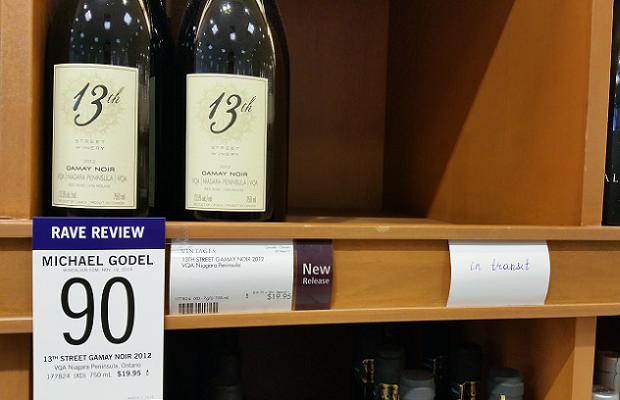
http://www.winealign.com/profile/2058-mjg

I shall be Riesling

13th Street June's Vineyard Riesling 2013 - VINTAGES March 21, 2015 release

13th Street June’s Vineyard Riesling 2013 – VINTAGES March 21, 2015 release

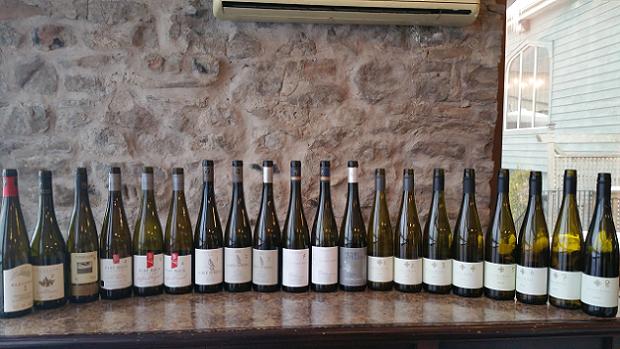
Last weekend, in a packed Carriage House at Vineland Estates Winery I tasted through 19 Rieslings from the Escarpment, Vinemount Ridge and Twenty Mile Bench sub-appellations of the Niagara Peninsula. It got me thinking, again. Thinking about Riesling. Thinking about drinking more Riesling. Thinking about how my life is not complete, without Riesling.

Riesling at the Carriage House, Vineland Estates Winery - March 7, 2015

Riesling at the Carriage House, Vineland Estates Winery – March 7, 2015

More about that #CAPSCAN15 and Wine Country Ontario tasting at a later date. For now the delve need be into the history of Riesling and how it has had a profound effect on the world of fine wine. I have written about Riesling as much or more than on any other grape variety. In March of 2013 my column, 100 kilometre wine for spring stated firmly “can there be a more versatile white grape? From natural, mineral spring, bone-dry to concentrated, candied sweet, this grape runs the diversity gamut like no other.” In Niagara, “‘The Bench’ is home to a mineral wealth of local Riesling, singular in composition not only by way of a global comparison, but also from plot to plot, soil to soil and vineyard to vineyard.”

I see my light come shining
From the west unto the east.
Any day now, any day now,
I shall be released.

In June of 2013 Are you wine experienced? was a post written about the Brock University Cool Climate Oenology and Viticulture Institute’s Riesling Experience 2013, an international celebration of style, structure and purity. At that time Mike Di Caro and I talked about Ontario Riesling and we agreed that sugar levels are both arbitrary and unpredictable so Niagara’s best is and should be of the dry variety.

In June of 2014 I wrote about Germany in Talkin’ ’bout my Generation Riesling. The theme of the show was the ever elusive Trocken Riesling and how “the new German wine label no longer feels the need to inform the consumer of every aspect contained within the wine’s birth certificate.” In August of that same year I penned Walking an Alsace mile in their Riesling shoes, a full-on summary of a June visit to Alsace with 31 tasting notes on, wait for it, Riesling.

So, with the VINTAGES March 21st, 2015 release just over a week away, I shall be Riesling.

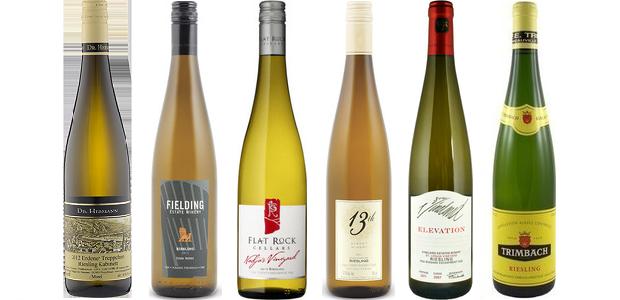
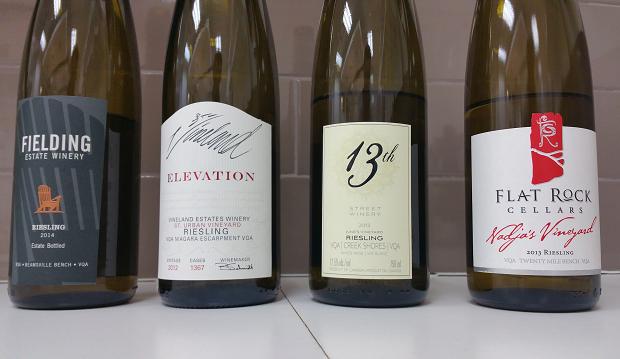
From left to right: Dr. Hermann Erdener Treppchen Riesling Kabinett 2010, Fielding Estate Riesling 2014, Flat Rock Cellars Nadja’s Vineyard Riesling 2013, 13th Street June's Vineyard Riesling 2013, Vineland Estates Elevation St. Urban Vineyard Riesling 2012 and Trimbach Riesling 2012

From left to right: Dr. Hermann Erdener Treppchen Riesling Kabinett 2010, Fielding Estate Riesling 2014, Flat Rock Cellars Nadja’s Vineyard Riesling 2013, 13th Street June’s Vineyard Riesling 2013, Vineland Estates Elevation St. Urban Vineyard Riesling 2012 and Trimbach Riesling 2012

Dr. Hermann Erdener Treppchen Riesling Kabinett 2010, Pradikätswein, Mosel, Germany (402420, $17.95, WineAlign)

Here the wild, out there, cosmic side of Mosel Riesling is on display, amplifying peach and lemon notes through aromatic grunge filters, like a medicative tonic. The palate is sweet and spritzy, even oxidative and this is textured with heavy, monumental levels of pure Riesling noise. The acidity is marked by citrus in every incantation. Though this may be the kind of Mosel you’ve “just never tried, it’s still the place.” Not so much a dinosaur but a junior, a wild Kabinett for very little cost and from an increasingly endearing vintage. Tasted March 2015  @WinesofGermany

Fielding Estate Riesling 2014, Estate Bottled, VQA Beamsville Bench, Niagara Peninsula, Ontario (251439, $18.95, WineAlign)

The Richie Roberts take on Riesling brings Beamsville to the populace, combining the natural acidity of the variety with the micro-saddle-plot-climat ipseity that the sub-appellation provides. This early to market ’14 is quite tropical, offering an en primeur portal into what invariably will follow. Fresh, juicy, accessible and in near-perfect balance. Slate, calcareous bleed and fruit generosity make for one tidy, markedly gratifying Riesling.  Tasted March 2015  @FieldingWinery  @RichieWine

Niagara Riesling Royalty at the LCBO Lab - March 6, 2015

Niagara Riesling Royalty at the LCBO Lab – March 6, 2015

Flat Rock Cellars Nadja’s Vineyard Riesling 2013, VQA Twenty Mile Bench, Niagara Peninsula  (578625, $19.95, WineAlign)

A year has turned a once frantic Nadja into a yet excited but in control Twenty Mile bencher. Acidity has circled the flock of juices; the sweet and the stony, to graze together. While ’12 expressed a texture to see it grace ages, here the up front verve makes for a more direct impression. There is no immediate hurry but the ginger on the lime indicates can earlier finality.

From my earlier note of February 2014: From a sample just pulled from the tank. Jay Johnston’s concept for Nadja is to create many fermentations together, using 2000L tanks and some barrels. The ferments are arrested when they achieve balance and then blended. Nadja still has her young fizz on and she’s exaggerated in Metallica meets a wondrous kind of sour. Already showing an unfurling of (mostly citrus) fruit but also spice and hurried depth. Frantic Riesling, will she “stop to warm at karmas burning, or look ahead, but keep on turning?”

Lasted tasted March 2015  @Winemakersboots  @UnfilteredEd  @brightlighter1

13th Street June’s Vineyard Riesling 2013, VQA Creek Shores, Niagara Peninsula, Ontario (147512, $19.95, WineAlign)

Continues to throw its weight about and has now engaged a phase of typical J-P Colas redolence and pungency. Strict adherence to Creek Shores citrus minerality injects the June for future time-lapse release, an internal ooze that will take years to push its way upwards to the surface.

From my earlier note of December 2014: 2013 was a perfect follow-up for Niagara Riesling, after a vintage where so many exceptional wines were made. The ’12 June’s by Jean-Pierre Colas was his best and with this repeat performance in ’13, the consistency of June’s vineyard is further cemented. Once again, the citrus injection is a Creek Shores thing, a vehemence not matched by other sub appellations. Where ’13 differs is its weight. There is a textural density improved upon and at the same time dragging on the freshness of the fruit. The trade-off will mean less immediate gratification in lieu of more flesh and bone for a longer period of aging. Given at least five years rest, the 2013 June’s Riesling will discover a Ribeauvillé like future.  @13thStreetWines

Last tasted March 2015

Vineland Estates Elevation St. Urban Vineyard Riesling 2012, VQA Niagara Peninsula, Ontario (38117, $19.95, WineAlign)

The layering is nothing short of remarkable, like the rings that tell the history of a tree. In its youth the upper vertex where effluvium and concentration meet is painfully obvious but when it comes to Riesling, breath is meant to be taken away. The prose is already written, running on adrenaline, unparalleled, if not yet understood.

From my earlier note of November 2014: Who has not waited for Elevation to hit out of the 2012 vintage? Straight up it must be noted that this will rank over and above the best from the St. Urban Vineyard. The ’12 Elevation will not only find long-term success among the great values in Bench Riesling, it will go down as one of the best ever, at any price. The vintage impart is a natural for this wine. At the moment it is the most primary of all because of the layers that texture bring. The Elevation will go thirty years and climb higher and higher into the stratosphere, gaining flesh and personality. The already seamless gathering of fruit and mineral is palpable. And still a reminder, the price is $20. This is a Schmidt gift to Ontario, for anyone and everyone to be one of the lucky ones. To purchase in increments any less than a case may be considered a crime against Riesling.  @VinelandEstates  @benchwineguy

Last tasted March 2015

Trimbach Riesling 2012, Ac Alsace, France (734517, $21.95, WineAlign)

To Jean and Anne Trimbach and most Alsatians, this Riesling from their ‘Classic’ range may represent the best that basic can be but when it travels oversees it gains a stature well beyond its humble roots. Here is another one of the those dictionary entry wines meant to depict and define. Quite simply emblematic Alsace. Built with acidity to envelop sweetness, marked by herbiage that is alive and fresh. Weight and density draw from Ribeauvillé rocks. Parity is realized in osmosis by fruit and mineral. As always, there is the tannic underlay, the length and the purposed bitter finish.  Tasted March 2015  @trimbach  @WoodmanWS

Good to Go!

http://www.winealign.com/profile/2058-mjg

Top 15 under-$25 wines of 2014

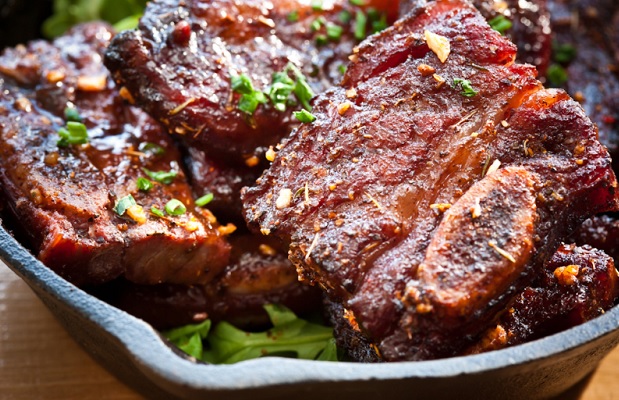
Barque Smokehouse Miami Ribs PHOTO: Kevin Hewitt and Jill Chen (http://www.freestylefarm.ca/)

Barque Smokehouse Miami Ribs
PHOTO: Kevin Hewitt and Jill Chen (http://www.freestylefarm.ca/)

The year-end list. Why? To “free the individual from the collective.” To ponder, speculate and formulate a narrative. To create the sociological, world of wine equivalent of splitting the atom. To celebrate the triumph of laic heterodoxy and the arrogance of modernity.  To seek purity from beneath the massacre caused by an avalanche of contrived wines. In anthropological terms, “to make a housecleaning of belief.”

For the great majority, $25 is the threshold rarely exceeded when shopping for a bottle of wine. If a solid, honest to good bottle can’t be had for less, grape dismissal rears its ugly head and the switch turns to beer, or worse, rail booze mixed with sugar and/or chemical bitters. Oh, the drab humanity of it all.

But a great wine can be had for less than $25 and once found should be exalted and purchased by the case. The category of reds and in less instances whites, need company. This is where Sparkling, Sherry and even Dessert wines seek the embrace of an open mind and a willing palate. Spread the wealth, into glasses filled, from methods and styles unknown.

You will note that this list is filled with such rare animals and not just from the calculations in ferment, but from places unexpected, far off, of gestalt, historical significance and of the ancients. Places like Naoussa and Santorini in Greece, Montilla Moriles from Spain and Alsace, France.

These 15 wines are (almost all) culled from VINTAGES releases. I tasted countless other terrific under-$25 examples in 2014; local, parochial, from beyond Ontario’s borders and abroad. For the purposes of what the Ontario consumer needs to know and for what serves them best, restricting the bulk of the list to what is available in LCBO stores (or in many cases, what was and will again, as a newer vintage, be released), these 15 wines are not hard to find.

So yes, this is an ode, a nod, shout out and props to our faithful and loyal provider, the LCBO and truer to the point, VINTAGES, the fine wine and spirits division of the Ontario monopoly. The supply chain for great wine is alive and well, despite the efforts required to sift through the chaff, to separate it from the proverbial wheat. The gems, though oft-times hidden, can be unearthed. The diamonds will time and again be scooped from the rough and the cream will also rise to the top. Cliché is a by-product of wine life in Ontario.

What stands out and above is the contribution made and presented by the winemakers and vintners in this province. Six out of my 15 choices are from Ontario. The attitude that Ontario wines are too expensive and do not offer good value as compared to similar wines from Chile, Argentina, Spain, Italy, France, Portugal, Germany, South Africa, Australia and New Zealand is rubbish. My decision to include six such beasts drives the point. Many excellent wines are available at the u-$25 price point.

Here are my wines of the year that came in under $25. Some are sold out, many are not. Find them before the year is out.

Toro Albalá Fino Del Lagar Electrico, Do Montilla Moriles, Spain (Agent, $14.95, 500ml, WineAlign) From Recently tasted here, there and everywhere, November 24, 2014

The winery was founded in 1844 and in 1970 Toro Albalá became the first commercial Montilla producer in the classic Solera method, from (estate-grown) Pedro Ximénez vines. This is unfortified Fino, at a naturally achieved alcohol of 15 per cent, from an average age of 10 years. It’s so dry, like a desert you could walk for astral weeks, as if it should be measured in negative residual sugar. Like pure almond extract paste, bones in the sand and the essence of pulverized, powdered nuts, void of moisture. The chalky-white Albariza soils of the Moriles Alto subzone are hardwired into its Akashic, astral Electrico plane. This Fino ventures in the slipstream, between viaducts of dreams, “where immobile steel rims crack.” Impossibly long finish.  Tasted November 2014  @toroalbala  @MontillaMoriles  @LeSommelierWine

Ken Forrester Reserve Chenin Blanc 2012, Stellenbosch, South Africa (231282, $17.95, WineAlign) From the VINTAGES June 21, 2014 Release

Always a diamond cut above its like-minded and similarly priced peers. Ken Forrester’s Chenin Blanc has the most wonderful smell of bleeding, oozing metal and the bitten into stones of many tree fruits, in bittering nobility. Not to mention the pith of citrus and the pits of tree nuts. Though currently in a sulphurous, reductive state, with age this will seek and find an earthen, honey bronzed gorgeousness, in say five to seven years and live in sweet CB infamy until 2025. For a wine that crosses oceans to arrive in your tasting glass, at $18 it represents the finest value in Chenin just about anywhere on the planet. Terrific length. Chenin meets Montrachet.  Tasted May 2014  @KFwines  @WOSACanada

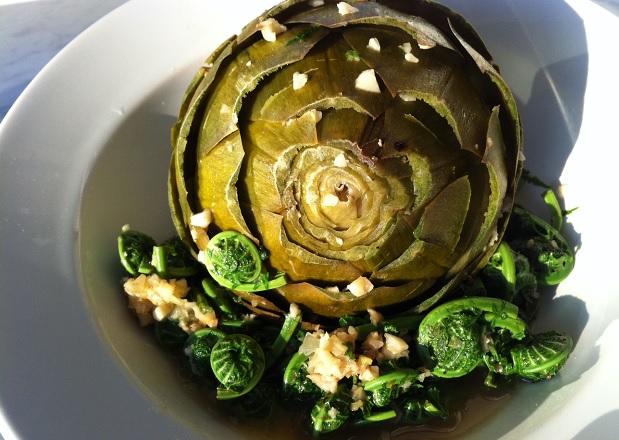
Artichoke and Fiddleheads PHOTO: Michael Godel

Artichoke and Fiddleheads
PHOTO: Michael Godel

Boeckel Brandluft Riesling 2012, Alsace, France (392928, $17.95, WineAlign) From the VINTAGES November 8, 2014 Release, Big release, bigger wines, November 7, 2014

From a northern part of Alsace, southwest of Strasbourg comes this epitome of Dry Alsace Riesling, stone cold stoic and bereft. The impossibility of this style is what Alsace does with impunity and propriety; gaseous and aerified without petrol or vitriol. But it will condense and go there after five years time. The quality is excellent for the price, from a limestone and silica lieu-dit just this side short of Grand Cru. Citrus would be the wrong descriptor but it does act like an exuding of citric acid. So stark and beautiful. Such a mineral expression in every fighting sense of the argument. Like chewing on rock salts and dehydrated limestone, the second tablet then dropped into the glass. A famous wine merchant in London sells this for $25 CAN. In Ontario, this is a must purchase by the case.  Tasted October 2014  @HHDImports_Wine  @drinkAlsace

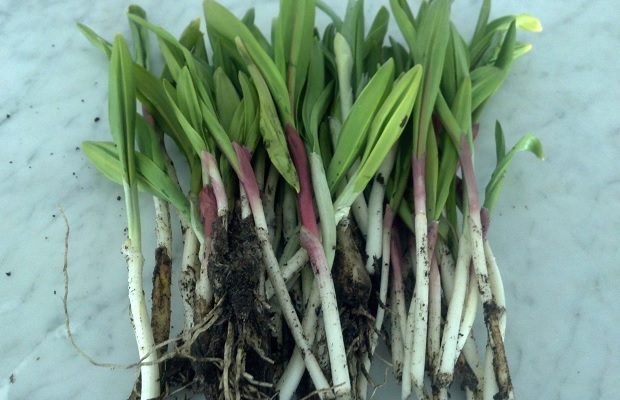
Dirty Ramps

Dirty Ramps

Rosewood Select Sémillon 2013, VQA Beamsville Bench, Ontario (winery, $18.00,WineAlign) From Taste Ontario’s polarity of personality, October 8, 2014

After tasting Rosewood’s ’12, I urged the region’s cultivation of the great white wolf variety. Then the winter of 2014 happened. Rosewood’s vines were wiped clean off the map, erased like a child of parents who never met. The ’13 Sem is the last Mohican and its 12.5 per cent alcohol (down two from ’12) is a fitting, subdued and graceful epitaph to an amazing Beamsville run. This final cut is lean, stark, raving mad. So very savoury, tannic and built to linger for longer than most. The Rosewood honey is in hiding,”far from flying high in clear blue skies,” but like all memorable vintages of this wine, it will emerge in time. This Sémillon asks, “and if I show you my dark side, will you still hold me tonight?” Yes is the answer, and not just because she is the last one. Terrific curtain call.  Tasted October 2014  @Rosewoodwine

Rockway Small Lot Block 12 150 Riesling 2012, VQA Twenty Mile Bench, Niagara Peninsula, Ontario, Canada (372441, $18.95, WineAlign) From the VINTAGES July 19, 2014 Release, Release the summer wine, July 17, 2014

Noticeably dry but also earthy/funky. Struck match and plowed earth. As it settles into its skin and your consciousness it develops body, depth and acidity. Grows and expands, reaches heights you thought it would not. The vintage works wonders for the Twenty Mile Bench and this block has expansive stuffing to take it long, not to mention the earthy complexity to see it change and evolve. It may go through a disturbing, unusual phase but be patient and set one aside for 15 years from now. You will be amazed what honey and deep geology it discovers and uncovers.  Tasted June 2014  @RockwayVineyard

Vineland Estates Elevation St. Urban Vineyard Riesling 2012, VQA Niagara Peninsula, Ontario (38117, $19.95, WineAlign) From the VINTAGES December 6, 2014 Release, The final 14 bargains of 2014, December 5, 2014

Who has not waited for Elevation to hit out of the 2012 vintage? Straight up it must be noted that this will rank over and above the best from the St. Urban Vineyard. The ’12 Elevation will not only find long-term success among the great values in Bench Riesling, it will go down as one of the best ever, at any price. The vintage impart is a natural for this wine. At the moment it is the most primary of all because of the layers that texture bring. The Elevation will go thirty years and climb higher and higher into the stratosphere, gaining flesh and personality. The already seamless gathering of fruit and mineral is palpable. And still a reminder, the price is $20. This is a Schmidt gift to Ontario, for anyone and everyone to be one of the lucky ones. To purchase in increments any less than a case may be considered a crime against Riesling.  Tasted November 2014  @VinelandEstates  @benchwineguy

Maine Lobsters

Maine Lobsters

Nugan King Valley Frasca’s Lane Chardonnay 2012, King Valley, Victoria, Australia (288191, $19.95, WineAlign) From the VINTAGES June 7, 2014 Release, Australian rules VINTAGES, June 4, 2014

The toast in this Victorian charmer comes across in a mild-mannered, spoken word way with a simmering, buttery bass line. The fruit is high but the rhythms are delicate and even-keeled. More white flowers than your average Australian Chardonnay, brighter, with more grace and more beauty. She’s a girl with a short skirt and a long jacket eating angel cake. Still firm towards the back-end with citrus zest and mouth-watering acidity, she’s “fast and thorough and sharp as a tack.” Finishes with a long and persistent held trumpeting line. “Na,na,na,na,na,na.”  Tasted May 2014  @PMA_int

Katogi & Strofilia Averoff Xinomavro 2008, Pdo Naoussa, Greece (249615, $19.95, WineAlign) From the VINTAGES October 11, 2014 Release, From VINTAGES for Thanksgiving, in wine and with song, October 10, 2014

It’s not that every Xinomavro is infallible but every Xinomavro is worth exploring. The Averoff is classic; smoky, rich plum meets cherry intensity, tannic and textured, layered, like old school Pinot Noir. Liqueur of Naoussa terra firma, rocks and sweet beets. Balance of earth, wind and fire, fun funky and moving. Shares the spice of life so “let this groove, light up your fuse, alright. Let this groove, set in your shoes.” Parts unknown gather to subvert the uninitiated and make them move to Greece.  Tasted October 2014  @katogistrofilia

Thymiopoulos Vineyards Yn Kai Oupavós Xinomavro 2010, Unfiltered, Naoussa, Greece (360750, $19.95, WineAlign) From the VINTAGES January 20, 2014 Release, From Super Bowl XLVIII wine odds, January 30, 2014

Magnificent Macedonian, built upon the unheralded yet stalwart variety Xinomavro. Pure, sweet-smelling gardenia and the refuse of ancient rolling stones express every bit of sun and wind-swept, low bush vines goodness. Purposefully and thankfully unfiltered, so that all the delicious sweet and sour cherry and great biting but sweet tannin are left in. Purity, good sugar/alcohol heights without oak corruption. Earth possessive of mythic undercurrent, sage, wealth of  knowledge, sweet anise and hyssop. Scents of game on the grill. Amazing complexity and length. While tasting this Xinomavro it made me “feel so hypnotized, can’t describe the scene.” Get your rocks off to the Greek Tasted January 2014  @thymiopoulosvin

Huff Estates South Bay Vineyards Unoaked Chardonnay 2012, VQA Prince Edward County, Ontario (Winery, $21.95, WineAlign) From Take them home, County wines, May 20, 2014

The Huff Chardonnay bent has seen a shift as strong as South Bay’s prevailing winds, away from the weight of barrel ferment to a clean, Chablis-like style. The ’10 might just have been the turning point and though they now make two versions, this ’12 is the cementing of the attitude. What is most amazing is that the texture, aromas and feel remain those of an oak-influenced wine. Huff manages the linear consistency without the need to encumber, toast or char the purity of its glade, glycerin and citrus fruit. Only Prince Edward County’s limestone soil can effect this kind of nine inch nails drive into Chardonnay without oak and only Huff can do it with this kind of elegance. A wine “less concerned about fitting into the world.” Do not miss this singular effort. @HuffEstatesWine

Estate Argyros Assyrtiko 2011, Santorini, Greece (366450, $22.95, SAQ 11901091, $24.50, WineAlign) From the VINTAGES March 29, 2014 Release, On a wine and a prayer, March 24, 2014

A 100 per cent Assyrtiko from a 150 year-old, Cycladic Phylloxera sanctuary vineyard. Separates itself from other Santorini adelphoi by ageing 20 per cent of the inoxydable, ancient-minded grapes in French barrels. An Assyrtiko that can’t help be anything but stony, atomic driven goodness. Volcano flow and spew, with more texture than most, its elevated price a necessary reflection of a tertiary expertise. Elevated aromatics, locked in tight by the barrel and matched by extreme flavours, so primary, raw, powerful, relentless and grippy. A remarkable white wine that impresses with a sensation of mouth rope burn full of complex, seafaring knots, this Assytiko will age for 15 years in the cellar and develop into something ethereal. Will melt away in dreamy waves when it settles together. Myth will beget legend, legend will beget truth.  Tasted March 2014 @KolonakiGroup

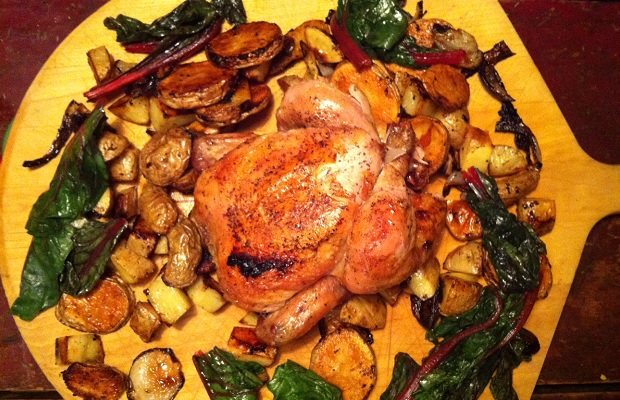
Roast Chicken, Potatoes, Swiss Chard Photo: Michael Godel

Roast Chicken, Potatoes, Swiss Chard
Photo: Michael Godel

Bordón Gran Reserva 2005, Doca Rioja, Spain (114454, $22.95, WineAlign) From the VINTAGES October 25, 2014 Release, Wine on company time, October 23, 2014

If it were so because of cryogenic preserved must or an accidental tipping and topping up into an unused barrel by recent vintage juice I would not be left hanging with mouth fully agape. Considering the amount of time this flat out delicious Gran Reserva saw in barrel, the mystery must somehow be explained, how it came to be so surprisingly modern and bright (for its age), especially at $23. But it has been seen many times before, with no greater example than the Montecillo 1991 GR that drank fortuitously well into the last years of the previous decade. This is the magic of Rioja. That said, there is some sinew and some raw character here as well – that’s the old school treatment and style talking. Red cherry fruit. Ripe fruit roasted, rested and now sliced, showing its perfectly cooked rare cut. Juicy and with sanguine notes still running through its grain. Wonderful old school yet bright Rioja. Riotous red wine with a calming aura of quietude.  Tasted October 2014  @RiojaBordon  @Eurovintage  @RiojaWine

Il Molino Di Grace Chianti Classico Riserva 2006, Docg, Tuscany, Italy (382945, $23.95, WineAlign) From the VINTAGES December 6, 2014 Release, The final 14 bargains of 2014, December 5, 2014

An ’06 Chianti Classico Riserva you say, pre-aged, delivered to the Ontario market and presented here in 2014, all in for $24? You can’t fool us. We’ve been duped too many times before. This must fall into the “too good to be true” category. The answer depends on which style of Chianti you prefer. This walks all the halls, plies the trades and hits the marks of the CCR ancients. Comes from a remarkable vintage, holding on but in true advanced, oxidizing and fruit diminishing character. Mushrooms and truffles abound, as does game in the early roasting stage. A note of Brett is here too, not over the top but its presence can’t be denied. Acidity speaks, as does bitter chocolate. This is not for all but all should have a go.  Tasted November 2014  @Ilmolinodigrace  @chianticlassico

Riesling and The Lamb Lies Down on Broadway

Riesling and The Lamb Lies Down on Broadway

Pearl Morissette Riesling Cuvée Blackball Barrique 2012, Niagara Peninsula, Ontario ($25, WineAlign) From The pearls of Morisstte’s wisdom, May 26, 2014

When tasted in July of 2013 the ’12 Barrique had only been in bottle for three days so the musk was quite front and centre. Aged in foudres (neutral, old wood casks) it held much latitude at such a young age with notes of herbiage (mint, tarragon), nary a drop of residual sugar and a wholly unique type of dry acidity. “It will not always show this way,” commented Morissette. Tasted 10 months later I can say this. The ’12 Riesling Barrique avoids excessive malic and tartaric acid, not to mention any amount of volatile acidity. It is viable, vital and technically sound. “This is a wine that will take time,” pleads François . “I care about texture, not about varietal character.” Though perplexing and untamed, the wine has undeniable body and that noble bitterness in its unsung tang. It is the anti-Riesling hero, full of experiential conceit and needs to be revisited often, to see where it will go.  Tasted July 2013 and May 2014  @PearlMorissette

Hinterland Ancestral 2014, Prince Edward County, Ontario (Winery, $25,00, WineAlign) From Godello’s guide to holiday effervescence

Just released today, the anterior sniff and first sip procure a sense of immediacy in declaration: This is Jonas Newman’s finest Ancestral to date. Amethyst methustos bled from Prince Edward County Gamay. If a continuing study on such sparkling wine were to be conducted in the méthode ancestrale diaspora, the anthropologist would lose time in the County. Say what you must about the method and the New World place, this elevates an old game, in fact it creates a new one. Strawberry is again at the helm with the sugar number high and balanced by three necessary portents of chemistry; low alcohol, savor and acidity. The finish is conspicuously dry, conditioning the palate to activate the phenotypic sensors. Hits all the right bells, traits, whistles and behaviour. Careful, it will make you want to go out and make babies.  Tasted November 2014  @hinterlandwine  on the card at @barquebbq

Good to go!
Gold Medal Plates Toronto 2014

Gold Medal Plate, Toronto 2014: Canoe's Chef John Horne Grandview Short Ribs Glazd with Tree Syrups (c) Ronald Ng Photography

Gold Medal winning plate, Gold Medal Plates, Toronto 2014: Canoe’s Chef John Horne’s Grandview Short Ribs Glazed with Tree Syrups
(c) Ronald Ng Photography

When head judge David Lawrason asked me to join him and fellow WineAlign colleague Sara d’Amato to preside over the wines at Gold Medal Plates Toronto, I paused for a brief moment. I knew right away the answer was an emphatic yes but I had to breathe in the possibilities. One: Sample 10 wondrous culinary creations by 10 sacrosanct chefs. Two: Spend an evening with Canadian Olympic medallists and recording artists. Three: Taste and judge the sagacious efforts by some of Ontario’s most venerated winemakers.

Gold Medal Plates was founded in 2003 and is so much more than an organization. It is a Canadian institution. The primary goal of the coast to coast galas are to “celebrate Canadian excellence in food, wine, athletic achievement and entertainment.” The tour makes stops in 11 Canadian cities and raises funds for the Canadian Olympic Foundation to support Olympic athletes. Net proceeds are donated to support high performance programs such as Own The Podium. To date over $8.2 million has been raised. (Update: Gold Medal Plates tweeted on December 10th that the number is now $9.5 million).

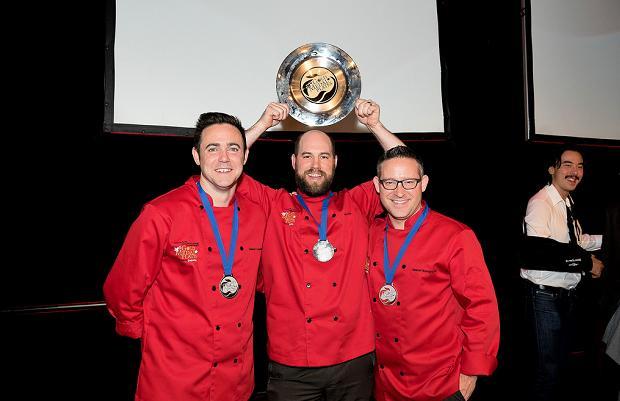
Gold Medal Plates Toronto 2014 bronze, gold and silver medal winning chefs Damon Campbell, John Horne and Jason Bangerter<br />  (c) Ronald Ng Photography

Gold Medal Plates Toronto 2014 bronze, gold and silver medal winning chefs Damon Campbell, John Horne and Jason Bangerter
(c) Ronald Ng Photography

In each city the invited chefs prepare a regional dish and in Toronto, more than 700 people tasted through a complex variety of creations. The gold medal chef in each city goes on to compete at the Gold Medal Plates Finale at the Canadian Culinary Championships. In 2015 the host will be Kelowna, British Columbia on February 6 and 7. The term “career changer” is used to describe the chef who is crowned tops in Canada.

With unprecedented support from the event’s title sponsor Deloitte, the Toronto event was held at the Metro Toronto Convention Centre on Wednesday, November 12, 2014. The culinary judging was headed up by former Toronto Life Magazine food critic James Chatto. Joining Mr. Chatto were chef/author Sasha Chapman, chef/TV personality Christine Cushing, author/CBC radio host Anita Stewart, George Brown chef school’s John Higgins and the 2013 Canadian Culinary Champion Lorenzo Loseto of George Restaurant.

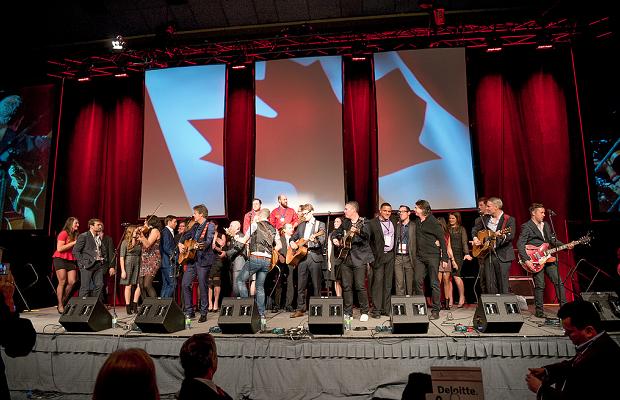
Candian musicians and atheletes sing O Canada at Gold Medal Plates Toronto 2014 (c) Ronald Ng Photography

Candian musicians and atheletes sing O Canada at Gold Medal Plates Toronto 2014
(c) Ronald Ng Photography

At the Toronto event, emcee skaters Tessa Virtue and Scott Moir were joined by dozens of Olympic medallists and future hopefuls. The entertainment on stage was an all-star Canadian band led by Blue Rodeo’s Jim Cuddy. Cuddy was joined by The Barenaked Ladies’ Ed Roberstson, Barney Bentall, 5440’s Neil OsborneDanny Michel, Anne Lindsay and the astoundingly soulful guitarist Colin Cripps.

Slient auction signed guitar

Slient auction signed guitar

The plates in Toronto were really quite incredible. Canoe’s Chef John Horne was the gold medal winner. His Grandview Farms Short Ribs glazed with tree syrups was a ground breaker, an original composition of intrigue, a wild sequestered spot of gastronomy. The other plates were exceptional, each in their own right, but chef Horne travelled to a zone alone. Congratulations Chef.

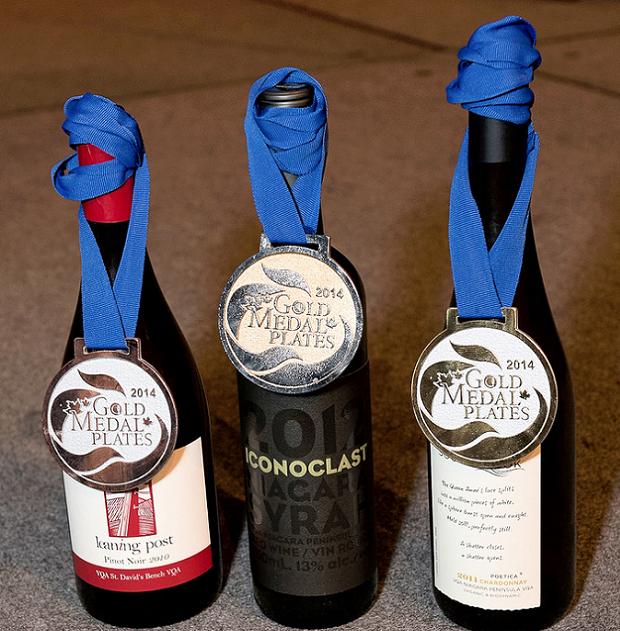
Gold Medal Plates wines (c) Ronald Ng Photography

Gold Medal Plates wines
(c) Ronald Ng Photography

In David Lawrason’s recap to the audience, he noted how close the wine judging really was. “It was the highest quality level from bottle to bottle I have seen in the country this year, making the judging of the Best of Show Award rather tough. But when each judged ranked their top five, the same five wines showed up. It was then the ordering that became difficult, and only two points separated first and second place.” In the end we chose Norman Hardie‘s Niagara Unfiltered Pinot Noir 2011 as the Gold Medal winning wine. Hardie’s take on Twenty Mile Bench Pinot Noir is pure, complex and made with a deft, hands-off approach.

The wines ware all impressive, each and every one. The Hidden Bench approach on a Bordeaux-styled white is as impressive as any that have come before it, which is why the Nuit Blanche Rosomel Vineyard 2012 finished a very close second, taking home the Silver Medal. Syrah in the hands of winemaker Rob Power is a beautiful thing indeed. Creekside Estate‘s Iconoclast Syrah 2012 was the Bronze Medal winner. Pinot Noir by Leaning Post and Cabernet Franc by Rosewood Estates were fractional points behind.

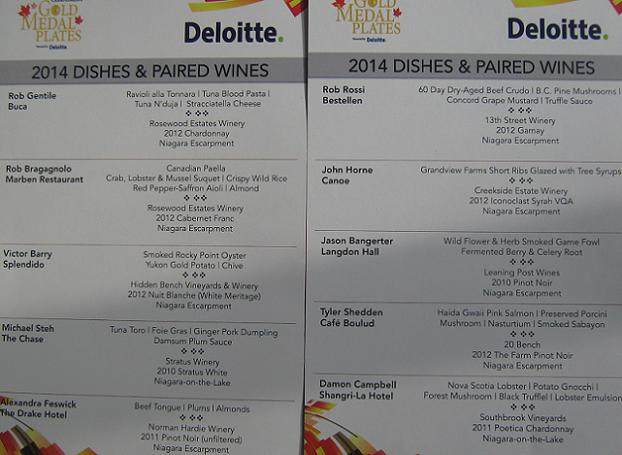
David, Sara and I tasted and judged 12 wines, 10 of which were paired to the 10 chef’s plates. Here are the tasting notes and pairings.

Gold Medal Plates Toronto 2014 dishes and paired wines

Gold Medal Plates Toronto 2014 dishes and paired wines

Peller Estates Baco Noir Private Reserve 2013, VQA Niagara Peninsula, Ontario  (Winery, $17.95)

High acidity, negligible tannin and no surprise, the black burn of charcoal crushed, tarry fruit. A wallop of pepper for accented measure stings as per the effect of a Rhône, so like Syrah this is a good example of Baco. An airplane taxiing down a tobacco road. “But it’s home, the only life (its) ever known.” Definitely Baco.  Tasted at Gold Medal Plates Toronto, November 2014  @PellerVQA

Peller Estates Chardonnay Private Reserve  2012, VQA Niagara Peninsula, Ontario (Winery, $18.95, WineAlign)

Like bottled pastry, sweet, soft apples baking. Warm wafting aromatics, mild toast and caramelizing butter, effectively creamy and palate coating. Evolved to the point of full integration and absolute oak resolution. Drink now.  Tasted at Gold Medal Plates Toronto, November 2014  @PellerVQA

Creekside Estates Syrah Iconoclast 2012, VQA Niagara Peninsula, Ontario  (Winery, $18.05) Paired with Canoe’s Chef John Horne’s Grandview Farms Short Ribs Glazed with Tree Syrups

Winemaker Rob Power is on the fast track (if he is not there already) at becoming the King of Syrah in Ontario. The Queenston Road vineyard helps. Years of acumen development is key. Passion for the Rhône and Niagara’s climatic and stylistic kinship wraps the package. A ton of effort goes into the production of this $19 wine. The methodology here differs greatly from the co-fermented two-clone meets Viognier (and twice the price) Brokenpress Syrah. Here the fruit from three vineyards (including the Queenston Road) were fermented separately in stainless steel tanks and 1 tonne fruit bins. Malolactic fermentation took place in barrel where the wine aged for 12 months. The (30 percent new) barrel mix is (53 per cent) American, (42) French and (five) Hungarian. The result? In Rob Power’s hands, you can take Syrah out of the Rhône and Australia but you can’t take the cool climate out of the Syrah. Meat, pepper and smoke pique, pinch and pop. Pow! A totem in proclivity for the variety. The water is at times dishy but the fruit swells and fills in every gap.  Tasted at Gold Medal Plates Toronto, November 2014  @CreeksideWine

13th Street Gamay Noir 2012, VQA Niagara Peninsula, Ontario (177824, $19.95, WineAlign) Paired with Bestellen’s Chef Rob Rossi’s 60 Day Dry-Aged Beef Crudo, B.C. Pine Mushrooms, Concord Grape Mustard and Truffle Sauce

Spice and rich fruit head straight to Gamay welkin derived direct from the soil’s core, of Sandstone, Schwenker and the winery’s home vineyard at Fourth Avenue. Swirl away the gathered must and moss to reveal more Cru fruit than you can shake a stirring rod at. Such verve, said grit, such persistence. The thing about Gamay is, “if you want inside of her, well boy you better make her a raspberry swirl.” 13th Street has certainly made the raspberry sing in the ’12 Gamay so “raspberry swirl, mmm let’s go.”  Tasted at Gold Medal Plates Toronto, November 2014  @13thStreetWines

Hidden Bench Nuit Blanche Rosomel Vineyard 2012, VQA Beamsville Bench, Ontario (Winery, $20.00, WineAlign) Paired with Splendido’s Chef Victor Barry’s Smoked Rocky Point Oyster, Yukon Gold Potato and Chive

Less than six weeks after my first introduction to the NB ’12 complexity shines anew. Such a delicate and elegant take on the Bordeaux white axiom. Void of all the gangly G’s; grasses, gooseberry and green vegetable. Leans to custards and curds with a savoury accent and a limestone tang. Willing to be paired with a multitude of gastronomy. Long finish. From my earlier, September 2014 note: “Taking what the vintage gives, Rosomel’s Sauvignon Blanc was king in 2012, dominating at a 95 per cent share of the Bordeaux-styled blend with Sémillon. Barrels were stirred weekly during fermentation and the creamy texture thanks that regimen, as does the tannic fullness of the round back-end. It rocks out bracing, formidable and nobly bitter, in pear and its pith, in lemon, of rind and in curd. The SB lounges in tall grasses but avoids goose feathers and blanching veg. So very savoury, in gorse tension, thistle and nettle. These notes all cut through the roundness and are finally tied together by the flinty rock of Rosomel.”  Last tasted at Gold Medal Plates Toronto November 2014  @HiddenBench

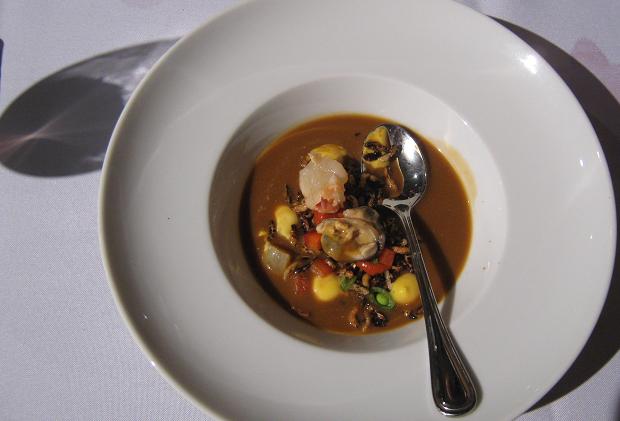
Marben Restaurant's Chef Rob Bragagnolo's Canadian Paella, Crab, Lobster & Mussel Suquet, Crispy Wild Rice, Red Pepper-Saffron Aioli and Almond (c) Michael Godel

Marben Restaurant’s Chef Rob Bragagnolo’s Canadian Paella, Crab, Lobster & Mussel Suquet, Crispy Wild Rice, Red Pepper-Saffron Aioli and Almond
(c) Michael Godel

Rosewood Estates Cabernet Franc Origin Series 2012, VQA Beamsville Bench, Ontario (Winery, $26.20, WineAlign) Paired with Marben Restaurant’s Chef Rob Bragagnolo’s Canadian Paella, Crab, Lobster & Mussel Suquet, Crispy Wild Rice, Red Pepper-Saffron Aioli and Almond

From fruit grown on the Estate’s Beamsville Bench (Renaceau) vineyard. As per the house directive, this is not oak shy. So as the house finds collective varietal success from inside a barrel, the Origin Cabernet Franc 2012 falls into line. Fruit is bright and sour-edged, softened, filled in and tempered by wood. Lush berries and plums, herbs and did I mention oak? A roasted kind of sweetness comes wafting and pan-dripping in, with currants, mint and eucalyptus with a far away look. Intensely modish CF, with a swath of chocolate, springy and extensible length.  Tasted at Gold Medal Plates Toronto, November 2014  @Rosewoodwine

Rosewood Estates Chardonnay Origin Series 2012, VQA Beamsville Bench, Ontario (Winery, $28.20) Paired with Buca’s Chef Rob Gentile’s Ravioli alla Tonnara, Tuna Blood Pasta, Tuna N’duja and Stracciatella Cheese

The Chardonnay formerly known as Renaceau Estate Vineyard, followed by Reserve and now Origin continues to hail from the Beamsville locale and persists as one of the most viscous and rich of its ilk. The glaring mismatch in sugar (20.8 g/L) and acidity (1.8 g/L) could spell disaster but to the contrary, this finds its tongue. Quite drawn, in a southern sort of lobster dipped in butter drawl. Unrequited malo fermentative linguistics suppress any tension that might distract from the bounty of warm vintage, perfectly ripe fruit smothered in a creamy lather of French oak (nine months in 50% new and 50% seasoned).  Tasted at Gold Medal Plates Toronto, November 2014  @Rosewoodwine

The Farm Pinot Noir 2012, VQA Twenty Mile Bench, Ontario (Winery) Paired with Café Boulud’s Chef Tyler Shedden’s Haida Gwaii Pink Salmon, Preserved Porcini Mushroom, Nasturtium and Smoked Sabayon

Those familiar with the Neudorf farm fruit know it well because of the single vineyard Pinot Noir “La Petite Colline” made by then Le Clos Jordanne winemaker Thomas Bachelder and carried forth by Sébastien Jacquey. Most of the harvest was then scooped up by Bachelder’s newest Niagara venture with some Quebec buddies at Domaine Queylus. In 2012 the Neudorf family decided to allocate a small commercial gifting of their own minuscule production of Estate Pinot Noir. Eleven restaurants in Southern Ontario carry this luxurious and humid red. The aromatics are pure Neudorf; a blackberry-rapt silt and clay-earth mingle with a sideshow of coated limestone primer. Just a smidgen past ripe, this blood pedigree redaction has plenty of charm if less earnest finesse than the Bachelder siphoned bottles.  Tasted at Gold Medal Plates Toronto, November 2014

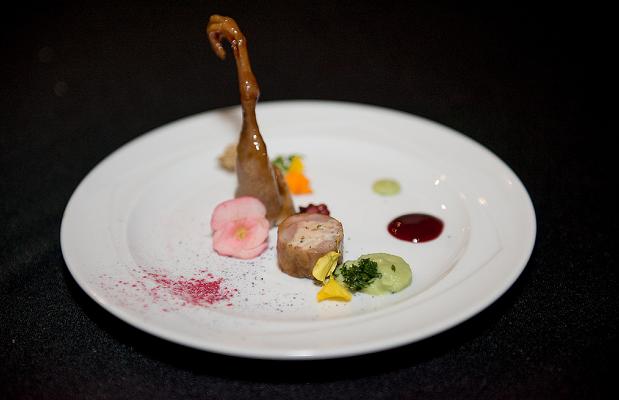
Langdon Hall's Chef Jason Bangerter's Wild Flower & Herb Smoked Game Fowl, Fermented Berry & Celery Root (c) Ronald Ng Photography

Langdon Hall’s Chef Jason Bangerter’s Wild Flower & Herb Smoked Game Fowl, Fermented Berry & Celery Root
(c) Ronald Ng Photography

Leaning Post Pinot Noir Lowrey Vineyard 2010, VQA St. David’s Bench, Niagara Peninsula, Ontario (Winery, $38.20, WineAlign) Paired with Langdon Hall’s Chef Jason Bangerter’s Wild Flower & Herb Smoked Game Fowl, Fermented Berry & Celery Root

One year later and in conjunction with stopping to think about them (other vintages and other reds at #GMP2014), the most terroir and aromatic focus comes from Ilya Senchuk’s ’10. Cherry, pomegranate and earth. Only Lowrey goes deep like this. Such a palate refresher. From my earlier, November 2013 note: “Can’t say I’m all that surprised but this is so much more approachable, pretty and glamorous. From an unrelenting hot vintage (picked Sept. 11th), a full six weeks earlier than ’09 and from the same vineyard. This was necessary as a means to preserve freshness. More sunshine, less earth but still there’s a cure and metal tendency that really defines Lowrey. Could of course be considered more of a crowd pleaser but it’s not as simple as that. That I can taste these two mano a mano, in my life is a rubber soul stamp. “All these places have their moments.” 125 cases.”  Last tasted at Gold Medal Plates Toronto, November 2014  @LeaningPostWine

http://vimeo.com/81371452

Norman Hardie Unfiltered Niagara Pinot Noir 2011, VQA Niagara Peninsula, Ontario (208702, $39.20, WineAlign) Paired with The Drake Hotel’s Chef Alexandra Feswick’s Beef Tongue, Plums and Almonds

The tension in the ’11 Niagara Pinot is palpable, ongoing and yet, as noted previously, not like it used to be. Expertly judged in a major key of complexity. Like candied nuts strung along a chain of tannin. Layers of depth and active ingredients. From my earlier, August 2014 note: “Hardie’s 2011 Pinot Noir comes out of deep clay, 20 Mile Bench soil, an impart not lost in the rich though dusty character of the wine. The flesh is both corporeal and marbled and a chalky grain runs through, with thanks to what feels like smithereens of limestone blasted through. “It was long ago, seems like yesterday,” that Norm’s Niagara Pinot carried an unwieldy level of anxiety but here the tannins have settled, the volatility has relented and there is a curious combination now, of blood and roses. Though meaty, the ’11 Pinot’s juices are concentrated, contained, not running out. The aromas are floral, heightened and intoxicating. Once again, classic comes by way of low alcohol and minimalist intervention. Last tasted at Gold Medal Plates Toronto, November 2014  @normhardie

The Chase's Chef Michael Steh's Tuna Toro, Foie Gras, Ginger Pork Dumpling and Damsum Plum Sauce (c) Michael Godel

The Chase’s Chef Michael Steh’s Tuna Toro, Foie Gras, Ginger Pork Dumpling and Damsum Plum Sauce
(c) Michael Godel

Stratus White 2010, VQA Niagara On The Lake, Ontario (660704, $44.20, WineAlign) Paired with The Chase’s Chef Michael Steh’s Tuna Toro, Foie Gras, Ginger Pork Dumpling and Damsum Plum Sauce

Tropical notes are currently blanketing the radar on the long flight to future decades. From my earlier, October 2013 note: “Quite possibly the most textured yet. A casted mass, like ingot or sélection de grains nobles, where viscosity meets candied fruit, apricot, quince and acacia flowers. A white moon with a medicinal and peaty tang that shows so much verve, earth floor even. This cracker jack ’10 will continue to add heft and flesh to earn its white stripes. Could be a classic for 20 years plus.” From my earlier, September 2013 note: “Sends me immediately towards Bordeaux, in neo-marmalade, but also buoyed in perfume and body by 25 percent Viognier. “This variety worked so well in the vineyard in 2010,” notes Groux. Niagara honey and near-botrytis via Semillon and Sauvignon Blanc void of grass, full of vigor. A sharp note, neither metallic nor mineral, but a combination of the two is present in this so very concentrated ’10. Of a warm vintage (self-explanatory) fully picked by October 23. Though loaded with early Spring maple sap, foie gras and appley terpines, its sharp and framed by “tannic” tang and protracted length.” Last tasted at Gold Medal Plates Toronto, November 2014

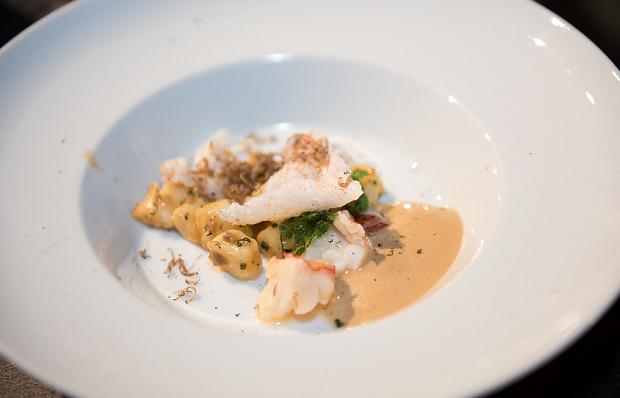
The Shangri-La Hotel's Damon Campbell Nova Scotia Lobster, Potato Gnocchi, Forest Mushroom, Black Truffle and Lobster Emulsion (c) Ronald Ng Photography

The Shangri-La Hotel’s Damon Campbell Nova Scotia Lobster, Potato Gnocchi, Forest Mushroom, Black Truffle and Lobster Emulsion
(c) Ronald Ng Photography

Southbrook Poetica Chardonnay 2011, VQA Niagara Peninsula, Ontario (366500, $50.20, WineAlign) Paired with The Shangri-La Hotel’s Chef Damon Campbell’s Nova Scotia Lobster, Potato Gnocchi, Forest Mushroom, Black Truffle and Lobster Emulsion

There is still a tough outer layer to crack. A poem of many stanzas has only just begun. Mute yet delicate, the stratified vineyard is the Poetica’s poetry; tight, yet forwardly futuristic towards the ephemeral and the aerified. From my earlier July 2014 note: “Has integrated nicely though certainly persists as a big, lush Chardonnay. If there were splinters or sinewy bits they have melted away.” From my earlier, May 2014 note: “The Poetica underwhelms at the present time, or perhaps hides in her youth. She’s a calm, buttery, mildly toasted, supportive softie and more accessible than her Sperling west coast sistren. Like a cool Chardonnay soffit hiding beneath a warm bench, the Poetica speaks not for the vintage but more for the current vineyard, a warm and hip spot in the Four Mile Creek appellation. The site remains (at least to me) understood but the unctuous aspect in texture and gathering sweetness with time in the glass will realize a richesse yet unseen. Poetica’s refrain is like “wind on the weathervane,” her tragically subdued fruit quiet, but able to travel long. Time will be the reveal, so be patient.”  Last tasted at Gold Medal Plates Toronto, November 2014  @SouthbrookWine  @thesirengroup

Niagara delivers everbearing quality in November releases

Ontario Everbearing Strawberries

Ontario Everbearing Strawberries

Like the strawberry, yet on countless further levels, Ontario wines have elevated in quality with exponential consistency in recent times. I can remember rushing out to Simcoe County to pick strawberries in late June at Visser and Barrie Hill farms, only to see the season end as abruptly as it began, after just a few weeks of plump, flame-red, succulence. Times have changed. Like the plant belonging to the family of Fragaria genus, Ontario wines, across the board, have evolved. The Everbearing Strawberry can be picked well into the Fall. Was it not so long ago the consumer chose Ontario wines with sporadic indifference? To Japan, exports of Canadian wine have doubled in the last five years. This is no small feat and with thanks to an all Canadian wine store owned by Jamie Paquin called Heavenly Vines. Domestically speaking, purchases of local wine are as strong in October as they are in July. Times has changed.

Ontario winemakers have figured it out. The “world-class” comparative humanities of aging and longevity aside, the comprehensive and widespread phenomenon of excellence, regardless of vintage, is now an Ontario reality. I would not make the call that 2013 was a vintage of the decade but very good wines were made. There are no bad vintages in Ontario. That concept is mired in the pessimistic rhetoric of the past. The winemaking camaraderie excogitates to mature as one big happy guild in pursuit of the common good. Vintners are focused and intense; on terroir, micro-climate, canopy management, picking times, pure and clean fruit, élevage and on honest wine.

The industry is currently fixated on making great product. Whatever beefs critics and consumers have with varietal choices, marketing failures or suffocating consumer systems, what is happening in bottle is nothing short of brilliance. Morale is at an all-time high. How else to explain the ability to weather the storm of a brutal winter in 2014? Enzo Barresi of Colio Estates told me yesterday that he does not bemoan the loss of vines. Less Merlot? So what? The ability to make polished wines from other grape varieties replaces fear, dread and loathing. The same goes for Rosewood Estates. No more Sémillon? “What can you do.”  says Krystina Roman. Concentrate on excellence elsewhere. Soldier on.

The November 8th VINTAGES release coming up this weekend is a prime example of the strawberry in the room that is Niagara wine. I count no fewer than eight examples of an eminence front in output. From Riesling and Sauvignon Blanc to Chardonnay and from Pinot Noir to a Bordeaux-styled blend, these eight wines are elephantine examples of what Ontario does best.

From left to right: Hidden Bench Chardonnay 2012

From left to right: Featherstone Black Sheep Riesling 2013, The Foreign Affair Sauvignon Blanc Enchanted 2013, Tawse Spark Limestone Ridge Riesling Sparkling Wine 2012, Hidden Bench Chardonnay 2012

Featherstone Black Sheep Riesling 2013, VQA Niagara Peninsula, Ontario (80234, $16.95, WineAlign)

The vintage delves into older school territory, elemental and elevated skywards, to atmosphere the Sheep has not recently climbed to. This airy void allows the Vineland rocks beneath to grind their way into all aspects of this Riesling. “Three bags full.” The lime rind and overall citrus circumvention brings the typical back to earth. This is a lean but fine Featherstone. Exemplary of the vintage, with plenty of wool.  Tasted October 2014  @featherstonewne

The Foreign Affair Sauvignon Blanc Enchanted 2013, VQA Niagara Peninsula, Ontario (389767, $19.95, WineAlign)

Appassimento-style Sauvignon Blanc is both curious and an open target for accusations of vivid excesses. The detractor will look for swift “walls of insincerity,” the complimenter will say “I was enchanted to meet you.” Foreign Affair’s take has been injected with a cocktail of intensity; steroidal, hormonal and from concentrate. All the juicy orchard fruits are there; plum, apple, pear, nectarine, lemon, lime and grapefruit. This passes the appassimento SB test, if only and commodiously because it spreads fruit like confiture on warm toast.  Tasted October 2014  @wineaffair

Tawse Spark Limestone Ridge Riesling Sparkling Wine 2012, Twenty Mile Bench, Ontario (370361, $19.95, WineAlign)

The Spark’s fermented in the bottle, cheesy, leesy warm ’12 turn, like melted Fontina on Formica, does dissipate following a moment or two and a bubble-bursting swirl. To taste there is much to delight in this inaugural release. Like the days leading up to ripe picked pears and a squeeze of striking, tart lemon. Good persistence is crackling, misty and even mysterious. Sparks squeezed from frenetic rhythm.  Tasted October 2014  @Tawse_Winery  @Paul_Pender

Hidden Bench Chardonnay 2012, VQA Beamsville Bench, Ontario (68817, $28.95, WineAlign)

Shows its finesse from the start. Though today I sense a slightly candied nose it’s wrapped in a warm and fuzzy coat, gifted by the vintage but without heat. This may be the prettiest of Marlize’s (Estate) Chardonnay; enchanting, honeyed, floral. Yet there is a pulsating note, portending the time needed to bring this to an intended fruition. Stretches for conscious movement length. From my earlier, July 2014 note: “Yet rigid in its youth, the wood is not yet settled. Bottled in September of 2012, the ’12 will need every day of its first year to be ready, willing and able to please upon release. From my earlier, May 2014 note: “Always aromatically embossed and texturally creamy, the Estate Chardonnay finds a way to elevate its game with each passing vintage. The uplifting elegance factor acquiesces the poise needed to battle the effects of ultra-ripe fruit out of a warm vintage. In ’12 the middle ground exchanges more pleasantries though the finale speaks in terse, toasted nut and piquant daikon terms. Not harshly or witchy, mind you, but effectively and within reason of the season. When you look in the window at Harald (proprietor Thiel) and Marlize’s (winemaker Beyers) Chardonnay, “you’ve got to pick up every stitch.”   Last tasted October 2014  @HiddenBench  @BenchVigneron

From left to right: Flat Rock Gravity Pinot Noir 2012, Le Clos Jordanne Village Reserve Pinot Noir 2011, Hidden Bench Terroir Caché Meritage 2010, Le Clos Jordanne Le Grand Clos Chardonnay 2011

From left to right: Flat Rock Gravity Pinot Noir 2012, Le Clos Jordanne Village Reserve Pinot Noir 2011, Hidden Bench Terroir Caché Meritage 2010, Le Clos Jordanne Le Grand Clos Chardonnay 2011

Flat Rock Gravity Pinot Noir 2012, VQA Twenty Mile Bench, Ontario (1560, $29.95, WineAlign)

Seven months have softened and mothered Gravity’s adolescence in ways to now see it as the most feminine, certainly of the last four vintages. Pretty dabs, perfumes of natural conditioning, warm days and warm nights in the bottle. More accessible than previous takes and of a new modernity perceived. Sweet dreams and sweet fragrances, roses and cinnamon, nothing fancy here mind you, with no bite and no gathering moss. Cherries and vanilla, lavender and simple pleasures. Straight up Gravity, no pull down, no drag and no excess weight. At $30 and from the best barrels, this trumps $40-50 most locales not called Lowery, La Petite Vineyard, Central Otago, Hengst or Pfinstberg. From my earlier, March 2014 note: “In a vintage potentially muddled by warmth and a humidor of radio frequency, duplicating berry phenolics, Flat Rock’s Gravity remains a definitive, signature house Pinot Noir. In 2011, the head of the FR class from its most expressive barrels shared the limelight (and top juice) with the Pond, Bruce and Summit one-offs. In ’12, Gravity’s sandbox was its own. The style is surely dark, extracted, black cherry bent, as per the vintage. Yet only the Rock’s soil does earth in this variegate, borne and elevated by the barrel’s grain. There are no fake plastic trees in a Flat Rock Pinot. “Gravity always wins.”  Last tasted October 2014  @Winemakersboots  @UnfilteredEd  @brightlighter1

Le Clos Jordanne Village Reserve Pinot Noir 2011, VQA Niagara Peninsula, Ontario (33894, $30.00, WineAlign)

A refined ’11 Pinot Noir, of combined vineyard fruit or not, this shows attention to clean, precise winemaking detail. Punches suffered during fermentation mean a fully healed wine in bottle. Good structure and grain in tannin with just a minor fleeting paint is only a fleeting reminder of previous VR’s. Sweet plum fruit, just ripe, skin cracking, flesh oozing and dripping of pure juice. From my earlier, February 2014 note: “Something’s missing, or rather something is happening here. The LCJ omnipresent warm Pinot coat of harm is conspicuous in its absence, or has it been reigned in? This 2011 is so much more friendly, more soft-spoken, expertly judged and picked ripe fruit richer than before. Plenty of tang and tannin but the pronouncement is in a savoury basil/chervil kind of way. Not just another high made by just another crazy guy. A most excellent, bright, roxy Village Reserve, full of atmosphere and ambient music.”  Last tasted October 2014  @LeClosJordanne

Hidden Bench Terroir Caché Meritage 2010, VQA Beamsville Bench, Niagara Peninsula, Ontario (505610, $38.00, WineAlign)

Has shifted ever so slightly, as if injected by a bolus to effectively level off the intensity in concentration. With another summer beneath its brooding belt, the aromatics are now in full flight. From my earlier, June 2014 note: “The richest Terroir Caché to date, making use of its barrel in judicious but never obnoxious ways. Huge Bench wine, needs 10 years for sure. From my earlier, April 2014 note: “No other Niagara red and for sure no alternative Peninsula Bordeaux blend exists in such a vacuum of dichotomous behaviour. Act one is an out-and-out boastful, opulent show of Rococo. Act two a gnawing and gnashing by beasts. The pitch and pull of the Terroir Caché 2010 optates and culls the extraordinary through the practice of extended délestage, what Hidden Bench notes as “a traditional method of gently draining the wine and returning it to tank with its skins during fermentation.” The ’10 is about as huge as it gets, highly ferric and tannic. Still chemically reactive, you can almost imagine its once small molecules fitfully growing into long chains. Berries of the darkest night and he who should not be named black fruit are confounded by minerals forcing the juice into a cold sweat. Will require a minimum of 10 years to soften its all-powerful grip. From my earlier March 2013 note: “Has rich, voluptuous Napa Valley written all over it. Sister Merlot dominant, Beamsville Bench sledge monster. Plumbago, mineral, blackberry and coffee in a wine that will be the ringer in a blind tasting 10 years on. Harald may be saying “this is our family jewel.” Mr. Thiel, you make good wine.”  Last tasted October 2014

Le Clos Jordanne Le Grand Clos Chardonnay 2011, VQA Niagara Peninsula, Twenty Mile Bench, Ontario (34561, $65.00, WineAlign)

Certainly plays the most hard to get of the ’11 Chardonnays of fruit so fine and pure. Layered like Phyllo or Puff pastry, gathered and set back upon itself. Gains traction and intensity through developed flavours and overlays of texture, both solid like shale and lacy like organza. From my earlier, July 2014 note: “From sandy loam and limestone soils, here is a Chardonnay that winemaker Sébastien Jacquey is looking to fashion with low PH and elevated tannin. A most commendable effort in the enigmatic ’11 vintage, clean, anything but lean and un-gassed by a jet engine’s aerified stream. Chardonnay running instead on the vineyard’s biofuel, a chalky lees and lime texture that turns green in a savoury way towards the back end. Full, rich, gaining in stature as it breathes, thinks and feels. Atop the green there is an ambrosial aroma and a honeyed sense of flesh. A wine of great respect and biodynamic energy.”  Last tasted October 2014

Good to go!
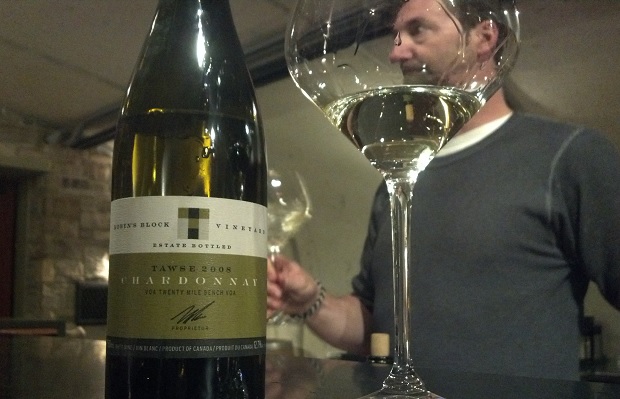
Every barrel tells a story

Tawse Barrel Cellar PHOTO: www.tawsewinery.ca

Tawse Barrel Cellar
PHOTO: http://www.tawsewinery.ca

If you have never had the pleasure of visiting Tawse winery in Vineland and more specifically, the cool serenity of their barrel rooms, then you still have some wine living to do.

Related – Paul Pender’s Tawse and effect

Last month I was invited to work through the barrels once again with Pender, Norman Hardie, Redstone winemaker Rene Van Ede and the visiting Gautier Roussille of Tonnellerie de Mercurey. Hardie is instrumental in bringing the cooperage’s barrels to Ontario and Tawse employs them with coadjuvant good fortune. Pender gathered this group together to assess the sundry effects on his developing 2013’s, by tasting the wines out of particular barrels, from specific oak forests and with different levels of toast. Twenty-one or so passes of the thief later, the picture had been drawn. Every barrel tells a story.

Paul Pender, Gautier Roussile and Norm Hardie discuss a Mercurey barrel

Paul Pender, Gautier Roussile and Norm Hardie discuss a Mercurey barrel

Tawse makes use of wood from more than one cooperage so the comparisons of various barrels housing identical blocks of Chardonnay or Pinot Noir is a study in algebraic proportion. The reveal in such company is the real deal. What is abstruse to most lay palates is piously obvious to these major leaguers. When the going gets wooden, the wooden turn pro.

Stealing sips from a wine’s temporary wood house makes allowances to peer behind the scenes. The possibility exists to note the accentuating fruit effect of Eric Fourthon’s Okanagan-manufactured, 100% French oak from mineral forests ‘Céres’ barrels. There is the wine-tightening advance by another barrel from the Forêt de la Bertrange. To that antithesis there is the diametrically opposed impart of Tonnellerie de Mercurey’s CLL toasted oak. The precocious corollary of Billion’s Vosges or the curating texture of Jupilles. It’s all too fascinating. At the end of the day it’s about matching barrel to fruit, to fashioning better barrels, to make the best, most consistent wines, year after year.

When it comes to Chardonnay and choosing the forest from the trees, both Norm and Paul agree. Early picking and the right use of barrel leads to higher malolactic fermentation. Tastes from the Quarry Road Vineyard taught the most about barrel usage. The Quarry site was purchased by owner Moray Tawse from the holdings of Vineland Estates. “Best deal he ever made,” says Pender. All the early year’s bitterness is now mineral. “This is the County in Niagara,” he says.

Norm Hardie and Paul Pender in the Tawse Barrel Cellar

Norm Hardie and Paul Pender in the Tawse Barrel Cellar

Here are very brief notes on 21 wines, quickly run through out of barrel, many of which were tasted twice. Once on January 10th and again on April 23rd. A 21-oak salute to the work of Master Coopers, Norm Hardie, Rene Van Ede and Paul Pender.

Quarry Road Chardonnay 2013, Mercurey (Neutral) Three year-old vines, density, tang, tropical melon in aroma and flavour.

Quarry Road Chardonnay 2013, Ceres (Mineral) This is very pretty, the most gem-like, the most like Burgundy. Will go to stainless on the lees in September for six more months before going into bottle. The purest expression from the best vineyard.

Quarry Road Chardonnay 2013, Mercurey (CLL toast) The wood tightens this wine up considerably, mainly on the finish. High citrus notes and even if it is splitting hairs, the oak really impacts the finish.

Quarry Road Chardonnay 2013, Mercurey (Large barrel, CLL toast) Reveals a fresher, more reductive, less oak feel.

Robyn’s Block Chardonnay 2013, Mercurey (One year-old, CLL toast) From the oldest (32 years) vines, the richest site, working best in tandem with new oak, here showing very primary, fermenting notes. A most restrained Robyn, reigned in.

Robyn’s Block Chardonnay 20123 Mercurey (New) Same old vines, increased tang and girth into which the barrel disappears. Sappy toast on the back end, quite young in its evolution. Rich, thick and the most density. Aromatically lime. Will function expertly as a foil to the Fourthon barrel in the final blend.

Robyn’s Block Chardonnay 2013, Céres (Mineral) Exclamatory fruit and this stage, this is the wine (barrel) to drink.

Lenko Chardonnay 2013, Céres (One year-old) From the oldest (1959) vineyard in Canada. Can handle the most oak. This is creamy, full and reminiscent of Robyn in 2008 and before. Anything but a lean style. Ain’t nothin’ but a house party. “Dig that crazy soul.”

Lenko Chardonnay 2013, Céres (Bertrange, new) Oak tightens up the wine, which has a tendency to be large, or blowsy. “I don’t like Chardonnay at two tons per acre,” notes Pender. “It’s too fat.”

Lenko Chardonnay 2013, Mercurey (New) More sappiness and the tightest yet. Showing the most oak but three to four months should settle its issues.

Huff (South Bay, Prince Edward County) Chardonnay 2013, Mercurey (Large CLL toast) The fat one, the tenor, with high lemon and lime notes. There is orange zest, lots of fruit and mineral, like licking a steel pipe. A citrus-bitter finish, the most yet, likely due to the very low (1/2 ton) per acre yield.

Huff (South Bay, Prince Edward County) Chardonnay 2013, Ceres (Mineral) Turns woody on County fruit. There’s a separation in this one and very ripe lemons and limes. “I almost think I should have picked this earlier.”

Pinot Noir Cherry Avenue 2013, Mercurey (Old barrel) Reductive, mineral, weighty, intense, firm, taut tannic structure.

Pinot Noir Cherry Avenue 2013, Céres (Bertrange) More richness but still firm and quite tannic. More painted layers, cherries, toasty, the wood a bit green.

Pinot Noir Cherry Avenue 2013, Billion (Jupilles, medium toast) Has the most elegance yet the toast is still very apparent but there is more sweetness, in how the fruit reacts with the tannins. Here is that curation of texture.

Pinot Noir Cherry Avenue 2013, Billion (Toasted head barrel) Brings out the black cherry nose but the tannin is green and drying. “It will rally, ” says Van Ede.

Pinot Noir Tintern 2013, Billion (Vosges, medium toast) From only three year-old vines on a site Pender likens to “reclaiming the swamps,” or “the Golan Heights project.” The site is next door to John Howard and the wine is already showing colour, freshness and drive.

Pinot Noir Tintern 2013, Billion (Vosges, medium plus toast) A bit reductive, more tannin, more sappy wood.

Pinot Noir Quarry Road 2013, Billion (Old barrel) High limestone content means harder tannins. This is edgy and mean. Would work better with a lighter toast.

Pinot Noir Quarry Road 2013, Billion (Vosges, medium plus toast) Tarry, edgy, walking on the blade. The middle palate has more fill. “There’s a roughness in that vineyard,” explains Pender.

Pinot Noir Quarry Road 2013, Billion (Toasted head) Less edgy, rounder, fleshier, fresher. The gaps here are filled in.

Good to go!
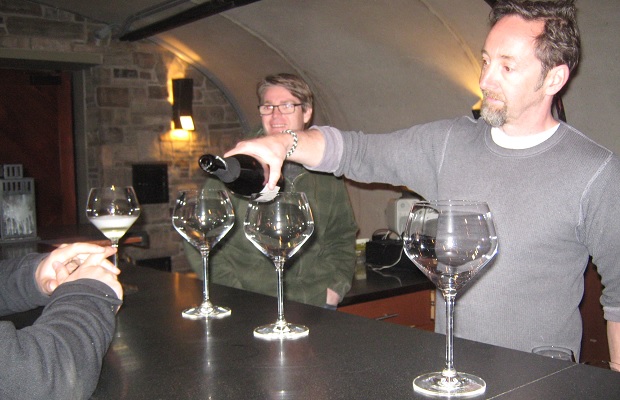
 

Paul Pender’s Tawse and effect

Pinot Noir Cherry Avenue 2010

From left and clockwise: Riesling Limestone Ridge 2012, Pinot Noir Growers Blend 2010, Riesling Carly’s Block 2012, Pinot Noir Quarry Road Estate 2010, Chardonnay Quarry Road 2011, Pinot Noir Cherry Avenue 2010, Pinot Noir Cherry Avenue 2010, Chardonnay Robyn’s Block 2008, Pinot Noir Lauritzen 2010, Chardonnay Lenko Vineyard 2011, Pinot Noir Laidlaw 2010

Tawse winery is growing and gaining weight but just like its vineyards, the pursuit is wagered in natural and holistic ways. The Tawse effect distills a biodynamic appropinquation, in the acquisition of new vineyards, in the gathering of tonnage from Niagara and Prince Edward County growers, in the farming and production of estate grapes. I have been making regular visits to the Vineland, Ontario winery for the past three years. The natural, self-sustaining processes remain open, obvious, front and centre.

Related – Every barrel tells a story

Chardonnay fruit might travel across the 401 and down the QEW from South Bay at Huff Estates. It may skip across King Street and skirt up Cherry Avenue from Daniel Lenko. It may come to early fruition from young Tintern Vineyard Pinot Noir vines out of the Vinemount Ridge. Whatever the source, the approach is simple. Let winemaker Paul Pender get his mind and his mitts on that fruit. Then let him work his magic. Seek biodiversity, soil fertility, crop nutrition, and chemical-free pest, weed and disease control. Fight the good fight against the harshest of winters with vines of deeper roots and stronger canes.

Paul Pender and Tawse Robyn's Block Chardonnay 2008

Paul Pender and Tawse Robyn’s Block Chardonnay 2008

The Tawse portfolio may now seem hyper-varied and even massive. Nothing and everything has changed. The lots remain small to manageable, the choice of varieties consistent and the wines, ever increasingly impressive. Whatever faults, idiosyncrasies or misunderstood characteristics there may have been in some older wines, they are no more. There are now purer and more vibrant aromas and flavours. Wait until you get a load of 2012 and 2013. Paul Pender’s acumen and winemaking professionalism has reached a whole new level of Rock ‘N Roll.

Paul Pender is a big picture guy. He is the Niagara renaissance man; songwriter, vocalist, lead guitar, producer and engineer. He’s Cuddy, Cripps and Chris Shreenan-Dyck rolled into one. Pender’s handling of growing, picking, fermenting, aging and bottling is nothing short of impossible and yet he does it with a conceit of ease. At last count I noted three Sparklings, three Rosé, two Dessert Wines, six Chardonnay, five Riesling, two Gewurztraminer, one Pinot Gris, one Sauvignon Blanc, six Pinot Noir, three Cabernet Franc, one Cabernet Sauvignon, one Merlot, one Cabernet-Merlot, one Meritage and one Gamay. Thirty-seven wines. One goal. Getting better all the time.

Tawse winemakers Rene Van Ede and Paul Pender

Tawse winemakers Rene Van Ede and Paul Pender

The winter and early spring of 2014 has found me cozying up to the wines of Tawse. On a frigid January evening on my way to Ice Wine Fest I spent time with winemaker Pender in the cellars, speed investigating my way through the barrels of Chardonnay and Pinot Noir. Not to mention Cabernet Franc, Merlot, Cabernet Sauvignon, Riesling and even Sauvignon Blanc. I’ve tasted Tawse with Daniel Lafleur at Somewhereness, with Vinifera’s Daniel Beiles at Barque Smokehouse and at the winery’s portfolio tasting at The Spoke Club.

Tawse Spark Blend 2011 and Quarry Road Chardonnay 2008

Tawse Spark Blend 2011 and Quarry Road Chardonnay 2008

Here are notes on 14 Tawse wines tasted from bottle in April and May 2014.

Riesling Limestone Ridge 2012, VQA Twenty Mile Bench, Ontario (Winery, $21.95, WineAlign)

From the newest estate vineyard, the single-vineyard Limestone Ridge exteriorizes its name in a rubric of pressed rock, struck flint and chalky density. Paul Pender has coaxed a multiplicity of linear character, with major notes of lime zest and juice, persistent from start to finish. A mid-pause of oozing, residual sinensis is the determinant towards the wine’s matrix of longevity. A longer, leaner, meaner and mightier Riesling charged by a different sort of power. Kinetic, frenetic and electric. Tasted twice, April and May 2014

Spark Blend 2011, VQA Niagara Peninsula, Ontario (winery, $24.95)

This introductory release is a blend of 65 per cent Chardonnay, 22 Pinot Noir and 13 Pinot Gris. A linear, straight shooting star, a sparkler that is so “surprising it goes so fast.” Bright, flashy, attention grabbing and fleeting. These are bubbles with a plan, anything but bad company and quite remarkable for the price. Lemon, lime and ginger strum in wound tension and the wine gets on top very quickly, then disappears into the starry night. Exhilarating while it lasts.  Tasted April 2014

Chardonnay Grower’s Blend 2011, VQA Niagara Peninsula, Ontario ($24.95)

From fruit (east of Beamsville) next to Puddicombe, which is essentially Winona on the eastern edge of the Niagara Escarpment appellation. Some parcels of disparate Niagara fruit joins this inaugural effort, a rich, viscous and warming Chardonnay. Layered and expertly balanced, it carries the best of both the Quarry (mineral) and Robyn (approachable) worlds. The spicy accent gives the blend its singular personality.  Tasted May 2014

Pinot Noir Growers Blend 2010, VQA Niagara Peninsula, Ontario (284570, $26.95, WineAlign)

Though it’s a blend of several sites, this Tawse Pinot stands alone and of itself as a grower; it grows on you after multiple tastings. The first go ’round seems simple, vintage warm and tight. Taste again and the sappy wood seeps mineral, the phenolic red cherry ripeness turns black and the tempering is led by a sweet earth kind. Earth that smoulders in a rising Zeppelin kept afloat by tobacco and the swirling spores of pungent mushroom. Pinot Noir truth and value from a Niagara house of the holy kind. “You know-whoa, that’s right.” Tasted twice, April and May 2014

Riesling Carly’s Block 2012, VQA Twenty Mile Bench, Ontario (Winery, $31.95, WineAlign)

Boasts classic flint and citrus Twenty Mile Bench aromatics. In 2012 it’s also lush, rich and so very pear and longan fruity. Whorls like a wind turbine blowing the polar aspects against each other’s walls. Forms a bridge and meets the twain, from atomic to tropic. High tang and flavour. Big yet classic Riesling.  Tasted May 2014

Pinot Noir Quarry Road Estate 2010, VQA Vinemount Ridge, Niagara Peninsula, Ontario (winery, $34.95, WineAlign)

This is the second Pinot Noir made from the Vinemount Ridge vineyard, a place where the rock can’t help but tyrannize the fruit. The 2010 Quarry Road gains positive proportion in that it is painted and coated by the ripeness of the vintage. Of a tougher mind and shell than the other Tawse Pinots, a bird on the wire just trying to be free. Not as easy to approach or love, it might plead “if I, if I have been unkind, I hope that you can just let it go by.” Sings in a wise, raspy and rusty way, despite the youthfulness of the vineyard, but it shines. So in the end “hey, why not ask for more?” Tasted May 2014

Chardonnay Quarry Road 2008, Vinemount Ridge, Niagara Peninsula, Ontario (111989, $34.95, WineAlign)

At this stage the 2008 Quarry Road is fully resolved, integrated and as soft as full malolactic Chardonnay can be. The unmistakable note of creamed corn lingers longer, as does the look on the winemaker’s face, but air brings it around. Returns to a fresh beginning, “from a year that might not have turned into anything,” admits Paul Pender. Now standing firm, the wine benefits six years on from clean, rotless fruit and pure, angular acidity, holding steady to the admirable finish. Tasted April 2014

Chardonnay Quarry Road 2011, Vinemount Ridge, Niagara Peninsula, Ontario (111989, $34.95, WineAlign)

The pinpoint accuracy and gemstone capture of the Quarry is exaggerated in ’11, amplified and fully plugged in. From my earlier, October 2013 note: “Carries that classic Paul Pender perfume; rocks and stones, flaxen, refulgent toast and the verdure Vinemount terroir. A free flying, linear, atmospheric smear of thermal fortitude and backbone. A polemic Bowie Chardonnay to make you believe “the strangest things, loving the alien.” From my earlier March 2012 (barrel tasting) note: “Resides on the mineral, slate and lime side of the tracks. The calcareous quality imparted by its eponymous SV terroir makes it the antithesis of David. Creamy, 24-karat fruit.” Last tasted May 2014

Pinot Noir Laidlaw 2010, VQA Vinemount Ridge, Niagara Peninsula, Ontario (winery, $44.95, WineAlign)

From the Vinemount Ridge sub-Appellation of the Niagara Peninsula, the Tawse Laidlaw Pinot 2010 is the least gregarious, the quiet sibling, the most feminine, the sleeper. Laidlaw may play hardest to get and is the least obvious when considering perfume but her palate is the sweetest of the line-up. Strawberry macerates sous-bois for an authentic Burgundian experience. Patient, focused and structured. Tasted May 2014

Chardonnay Lenko Vineyard 2011, VQA Beamsville Bench, Niagara Peninsula, Ontario (winery, $44.95, WineAlign)

The speed and the steel have slowed to yellow caution and the now honey-toned flesh has added more weight. There’s just something about Daniel Lenko at this juncture. From my earlier (tasted three times) July 2013 note: “From wiser men who’ve been through it all” is the kind of one-off we should all wish to re-visit in 10 years time. The study: Daniel Lenko’s fruit in the hands of winemaker Paul Pender out of a most confounding vintage. That 2011 in terms of Ontario Chardonnay strikes and speaks to me in tongues is no secret, so the Tawse treatment fascinates in ways to make me giddy. Tension and elasticity are present here in super-hyper Beamsville Bench concentration. Apples pile upon apples, in magnetic purée and layered maceration. A full-on body attack and phenolic structure will see this Lenko to a future (five to seven years) in grace and gorgeous line. A Chardonnay to “scheme the schemes, face the face.” Last tasted April 2014

Pinot Noir Lauritzen 2010, VQA Vinemount Ridge, Niagara Peninsula, Ontario (winery, $44.95, WineAlign)

A year in bottle has elevated the perfume, concentrated the cherry flavour and placed a crown on its regal head. The sweet tannic quotient resonates from its very core. Showing great at this time. From my earlier April 2013 note: “From the Vinemount Ridge is dry and cut with spice, a favourite for winemaker Paul Pender. The sour acidity from fruit such as cranberry and pomegranate are here in deep, concentrated and naturally sweet tones. Niagara limestone casts a Burgundy mineral shadow and the wine is iron tough yet silky due to the warmth of the vintage.” Last tasted April and May 2014

Chardonnay Robyn’s Block 2008, VQA Twenty Mile Bench, Ontario (662841, $45.95, WineAlign)

The 2008 Robyn’s Block neither matches the roundness nor the tempering acidity of the Quarry but what it lacks in those areas it makes up for in critical mass and balance. The creamed corn effect is here, as are apples in ciderish activity, from a wine that “was on a starved diet,” says Paul Pender. Though currently a bit reductive and funky, it’s not gun-flinty reduction, like the “smell of a battlefield on the morning after a civil war fight.” Swirling brings out cane sugar to replace the creamy silage and the rest is history. Calm, quiet and approachable inactivity. Tasted April 2014

Cabernet Franc Van Bers Vineyard 2009, VQA Creek Shores, Ontario (355867, $49.95, WineAlign)

What a wonderful vintage for Creek Shores Cabernet Franc and what a difference a year makes. Ripeness, development, rich layering, absence of chalk. Extreme elegance and void of an overbearing currant and bell pepper greening. Tannins are toned and fit. From my earlier, April 2013 note: “From the Creek Shores Appellation is proof that a well-rounded grape has no point. The Van Bers is winemaker Paul Pender’s purlieu, edgy, outlying, unconcerned with the norm or the banal. Makes full use of a cool vintage with heart-stopping acidity and eye-popping verve but not without delivering Soul, in the form of flowers and a fruit basket to your doorstep. “It’s like thunder and lightning.” Capers, camphor and a knock on wood add R & B complexity.” Last tasted May 2014

Pinot Noir Cherry Avenue 2010, VQA Twenty Mile Bench, Ontario (winery, $57.95, WineAlign)

From two acres of Pinot Noir planted in 2005 known as David’s Block within the Cherry Road Vineyard. A clash of hot and dry weather encouraged the young fruit to find ripeness, in flesh and in tannin. There is an elegance about this Cherry, in part no doubt to wine technique in acumen. The Paul Pender perfume, a combative interplay between cherries and earth, is here. “The in crowd say it’s cool” but it has yet to Rock the Casbah. Cherry 2010 is only offering a glimpse of greatness, so hold out for what will surely develop when the vines reach their next level of maturity. Tasted April 2014

Good to go!


The group of twelve

History may one day remember them as the group of twelve, or perhaps, “The Ontario School.” They are the 12 wineries who have banded together to ensconce a strange but beautiful word on the tongue, in the dictionary and out in the world. Somewhereness.

They are purveyors of the land from which their grapes grow and ferment into wine. Facilitators of terroir, working a canvas forged by millions of years of geological and climatic evolution. Their assembly is based on both exigency and on Moira; destiny, share, fate.

Like that other famous group, “collectively they agree.” Ontario’s cool-climate wine regions need to qualify and certify a distinctive winemaking style. In juxtaposition to old world, European tradition, the intensity of Somewhereness needs to reflect an increasingly Ontario-centric partiality.

These are the members. 13th Street, Bachelder, Cave Spring, Flat Rock, Hidden Bench, Hinterland, Malivoire, Charles Baker, Norman Hardie, Southbrook, Stratus and Tawse. Matt Kramer of Wine Spectator used the term and now it defines an enterprise. “As a group of 12 wineries growing small lots of site-specific vines in Ontario’s ancient glacial soils, we’ve invoked Somewhereness as a word enabling us to articulate in one collective voice.”

How do you get to Somewhereness? As related to wine that is like asking, Who am I? Why do we exist? What is the meaning of life? The Somewhereness movement, the notion, comes to light through this statement. “Somewhereness is revealed in the mysterious time capsules we know as bottles of wine. As ethereal gifts of a carefully tended location and a moment in time, each is imprinted with a vineyard’s sense of place,
its soil, climate, seasons, vintage variations — and its maker’s methods.”

In 2013 I wrote about Somewhereness over the Canadian wine rainbow. “Above all else, the rainbow’s fulcrum is the “somewhereness” of Canada’s wine regions. Terroir is the great catch word for wine. A vine’s home determines its potential, its structure, its sense of place. Micro-climates, soil, geology, altitude, slope and vegetation all contribute to the make-up of a wine forged from that specific parcel, lot or locale.”

In Come together, over wine I continued the discussion. “Intensity is in the air. The artists are at work, blessed with a geographical, geological and climatic canvas unique to the planet. They share arts and letters, compare and contrast methods, style and results. The sense of community is palpable, obvious and quite frankly awesome. They are Ontario winemakers and they are coming together. Right now.”

At the end of last year my column 13 Canadian wines that rocked in 2013 reviewed what Canadian winemakers do best. “That is producing unique, cutting edge and brilliant takes on cool climate grapes. They also match beautifully with the songs referenced in their tasting notes. When the wines are assessed and considered in part or as a whole, who would dare to say there are no great wines being produced?”

On Wednesday April 9th, Somewhereness brought the band to St. James Cathedral for a full-on tasting that is rapidly being recognized as a must not miss Ontario event. Here are notes on some of the wines I sampled.

From left to right:

From left to right: Malivoire M2 Small Lot Gamay 2012, Flat Rock Nadja’s Vineyard Riesling 2012, 13th Street Sandstone Old Vines Gamay Noir 2012, Southbrook Whimsy! Cabernet Sauvignon 2009, Tawse Laundry Vineyard Cabernet Franc 2011, Charles Baker Picone Vineyard Riesling 2008 and Norman Hardie County Unfiltered Pinot Noir 2012

13th Street Pinot Gris 2012, VQA Creek Shores, Niagara Peninsula, Ontario (Winery, $19.95, WineAlign)

Here you have an honest, 100 per cent stainless steel treated Pinot Gris from an estate vineyard located adjacent the market on Fourth Avenue in the Creek Shores appellation. So very dry and really fine fruit, crisp, neoteric, rising and falling in waves of tempered acidity. Made in a comfortable, country-twanged, folk-rock style, like a Cowboy Junkie. Juicy, mouth-watering work and very easy to fall for. An angel mine, this 13th Street, “and I know that your skin is as warm and as real as that smile in your eyes.” This effort by Jean-Pierre Colas is as good as it gets, a tally for Creek Shores and its kinship with the variety.

Malivoire M2 Small Lot Gamay 2012, VQA Niagara Escarpment, Niagara Peninsula, Ontario (Winery, $19.95, WineAlign)

A six-month lay in French oak for 60 per cent of the Gamay fruit sourced exclusively from Malivoire’s Beamsville Bench estate vineyard is just what the go doctor ordered. Only Malivoire’s Gamay smells specifically like this; of tart and savoury capers, of small, earthy gemstones, of peppery currants, of meaty braising Bouille. A striking wine from a fortuitous Gamay vintage and great value that puts me in mind of how special the Courtney will be. Though the soils may differ, proximity wise they are close cousins.

Flat Rock Nadja’s Vineyard Riesling 2012, VQA Twenty Mile Bench, Niagara Peninsula, Ontario (578625, $19.95, WineAlign)

Just add three months and witness a new evolution, a density, from a honeyed thing. Entering a pre-adolescence with a new bounce in its step. From my earlier, January 2014 note: “A champion cyclone of forces combined to elevate the already incumbent position of this Twenty Mile Bench Riesling. An ideal growing season magnified transmission upon a paradigmatic two and a half-acre block. This southern-most and highest altitude section of Flat Rock’s vineyard rests aboard a solid bed of limestone and wake me up if that rock was not drawn up into the vines in this stellar Riesling vintage. Sure its warm and nearly off-dry but such an effortless squeeze of lemon hydrates and elevates orchard fruit and honey out of the year of the lemon. After each sip its “every time you kiss me, lemon crush.” Love this prince of a Twenty Mile white in 2012, the dynamism smiling on the tart, succulent fruit. The length is one of outright bravado. This will develop for 20 years, of that I am convinced. There is just so much fruit. A Nadja for the ages.”

Cave Spring Dolomite Pinot Noir 2011, VQA Niagara Escarpment, Niagara Peninsula, Ontario (winery, $21.95, WineAlign)

Part Beamsville Bench (70 per cent), part Twenty Mile Bench (30), this best of both worlds Pinot is full of calcium magnesium carbonate, Jurassic bark. Playful as opposed to angry, this is not so much Snoop Dogg’s Dolomite but more like an animated Futurama. Seduces with a sweet red berry entry and bound by a really fine acid/tannin/fruit balance. Admittedly not overly complex but for the price it shows good structure. As far as Pinot goes, this one is a made for beef or rack of veal.

Hinterland Whitecap 2013, VQA Ontario, Charmat Method, Ontario (332809, $22.00, WineAlign)

The most versatile fizz in the Hinterland portfolio, what winemaker Jonas Newman refers to as his “chameleon.” As aromatically floral as this Charmat method bubbles (secondary fermentation in tank) ever gets, the ’13 brings out the garden under the mist of a sprinkler, late on a summer evening. It’s not so much about fruit as it is about texture, pollen and wet rocks. Try it at Barque.

Bachelder Niagara Pinot Noir Wismer Park/Lowrey (Tank Sample) 2013, Niagara Peninsula, Ontario (146985, $29.95, WineAlign)

This binary vineyard symbiosis will be bottled as the Niagara Pinot. Just filtered a few days ago it strides out with the utmost confidence in swagger, with a purity of fruit is spite of Thomas’ shock, awe and reductive apology. A bright sway of terroir gives rapture to a peaking raspberry bush imagined forward into a cooled pie. A renewed elegance abides with an absence of humidity and with a fully ameliorated knowing that a fleshing will happen. Really fine.

Malivoire Mottiar Chardonnay 2011, VQA Beamsville Bench, Niagara Peninsula, Ontario (146985, $29.95, WineAlign)

Gamay may be winemaker Shiraz Mottiar’s decisive resource but Chardonnay is his thing. The Moira’s ranks as one of Niagara’s best, vintage in, vintage out and this Mottiar, from the winemaker’s home vineyard is the trump card. This Malivoire special agent is set in 2 – 5 year old 300 L French oak hogsheads and aged on the lees in barrel for 10 months. The result? Texture. With the use, or lack thereof in new oak, Mottiar’s Chardonnay becomes a study in compages, with strong abilities and the accents of green orchard fruit and a faint sensation of blanched nut. Nothing toasty mind you because it’s all about density and girth; a Shiraz thing. I find his Chardonnay is all about texture.

13th Street Sandstone Old Vines Gamay Noir 2012, VQA Four Mile Creek, Niagara Peninsula, Ontario (130195, $29.95, WineAlign)

If roses were stones they would produce an aroma that only 13th Street’s Sandstone Gamay would recall. Some previous vintages have pushed the boundary to sky-high excess and a subterranean ferrous burrowing but in 2012 the perfume is both grounded and ethereal. The sandy tuff rock is so in that glass, like the smell of a rugged beach, mist and salinity spraying and rising off the rocks. The ’12 now knows “I don’t have to sell my soul.” Wholly singular Gamay and with hopes it will always be this going forward. Where as before it said “I want to be adored,” it now confirms “you adore me.”

Tawse Laundry Vineyard Cabernet Franc 2011, VQA Lincoln Lakeshore, Niagara Peninsula, Ontario (130997, $34.95, WineAlign)

A lean Laundry with as much finesse as winemaker Paul Pender has ever shown in his poignant Cabernet Franc realm. When a vintage deals you calm and scale you sit back and relax. The Lincoln Lakeshore advancing in years vines bring yet unseen front end red berry, licorice and red currant softness in 2011. There is elegance but also a refusal to yield its back-end bite. A level of enveloping grain and chalk is unique to this bottle and should be seen as a very good effort with the possibility ahead for movement and a gaining of flesh. A graceful, gently pressed Laundry.

Southbrook Whimsy! Cabernet Sauvignon 2009, VQA Niagara On The Lake, Niagara Peninsula, Ontario (260281, $34.95, WineAlign)

A 100 per cent Cabernet Sauvignon whose barrel aging specs are integral to discussing its unfolding. This Whimsy is a seven barrel (172 case) lot of which 86 per cent was aged for 13 months in (71 per cent) French oak. Plain and simple, a wood-heavy decision that has provided allied excellence five years after that demanding vintage. The agglomeration is one of steroidal currants, rocket red berries and an assiduous savoury edge. Just now are the beginnings of a caramel oozing from out of the centre of a dark chocolate house. Really quite an amazing, rich cake example from the vintage. Showing so right and so strong now, in its territory and wheelhouse.

Norman Hardie County Unfiltered Pinot Noir 2012, VQA Prince Edward County, Ontario (125310, $35.20, WineAlign)

Hardie’s 2012 County Pinot Noir is a beacon, a flashing light on the shore, an invitation to copycats because this is what making red wine from limestone foundations is all about. To taste this ’12 is to experience Hardie’s purest berry maceration and distillation to date. It’s as if there was no alcohol present and in fact, at 11.5 per cent it is a modest and transparent pronouncement. Longevity may not bless the ’12 as in other vintages but this is certainly the most groomed and coiffed County Pinot Noir.

Charles Baker Picone Vineyard Riesling 2008, VQA Vinemount Ridge, Niagara Peninsula, Ontario (241182, $35.20, WineAlign)

Tasted at Somewhereness 2014 as part of a vertical retrospective going back to 2007. The Vinemount Ridge’s now famous Picone Vineyard is set within a 10-acre estate on the Niagara Escarpment. Planted to the Weis 21 clone, the Riesling grown here digs in for complexity from sectional moieties of clay and sandy soil atop a unique base of limestone bedrock. Charles Baker began working with these grapes in 2005 and it is this 2008 where the learning curve took a turn for the Riesling stratosphere. The ’06 found luck in the stars but this vintage lays the framework and foundation for a master plan. At this stage in the ’08 evolution there is a prodigious and viscous honeyed textured. Ripening tree fruit juices run like maple sap in spring and the run off is beginning to think syrup. A cutting ridge of acidity arrests the sugaring, allowing citrus and flinty rock to recall the wine’s first, fresh steps. Baker’s Riesling time travels in circles with no real beginning and no real end. From my earlier, September 2012 note: ““Whoo-ahhh” Mojito, green apple skin scent of a Riesling. Seductive to sip, a bodacious body of influence, then back-end bite. A wolf pack in sheep’s clothing.”

Hidden Bench Terroir Caché 2010, VQA Beamsville Bench, Niagara Peninsula, Ontario (505610, $38.20, WineAlign)

No other Niagara red and for sure no alternative Peninsula Bordeaux blend exists in such a vacuum of dichotomous behaviour. Act one is an out-and-out boastful, opulent show of Rococo. Act two a gnawing and gnashing by beasts. The pitch and pull of the Terroir Caché 2010 optates and culls the extraordinary through the practice of extended délestage, what Hidden Bench notes as “a traditional method of gently draining the wine and returning it to tank with its skins during fermentation.” The ’10 is about as huge as it gets, highly ferric and tannic. Still chemically reactive, you can almost imagine its once small molecules fitfully growing into long chains. Berries of the darkest night and he who should not be named black fruit are confounded by minerals forcing the juice into a cold sweat. Will require a minimum of 10 years to soften its all-powerful grip. From my earlier March 2013 note: “has rich, voluptuous Napa Valley written all over it. Sister Merlot dominant, Beamsville Bench sledge monster. Plumbago, mineral, blackberry and coffee in a wine that will be the ringer in a blind tasting 10 years on. Harald may be saying “this is our family jewel.” Mr. Thiel, you make good wine”

Stratus Cabernet Franc 2010, VQA Niagara Peninsula, Ontario (winery, $38.20, WineAlign)

Patient as ever with the cool-climate, slow and low ripening Cabernet Franc, winemaker J-L Groux stuck with belief, regardless of the warm 2010 vintage. The Stratus single varietal space and time continuum of let it hang (though not to December), 20ish months of aging, nearly half in French oak barrels, has brought forth the most dense and luxe Cabernet Franc to date. “It’s never old school, all brand new,” with Groux so this red swells in wholly pure black currant fruit and is as big as it gets for J-L, which is saying something. This beastie boy will age over a 20-year period. Style is the thing, and yes, the aromatics.

Hidden Bench Locust Lane Vineyard Pinot Noir 2011, VQA Beamsville Bench, Niagara Peninsula, Ontario (winery, $48.00, WineAlign)

The Locust Lane Vineyard, originally planted in 1998, was Hidden Bench’s first acquisition, in 2003. It has a unique perpendicular cross-slope effect, undulating in all four directions, gathering sun hours in its own special way. The vineyard produces the richest and warmest Pinot Noir with fruit flavours more akin to ripe plum and black cherry than almost anywhere on the Beamsville Bench, certainly as any from the Hidden Bench stable. While the ’11 is not the biggest beast nor the Bordeaux bully of the Terroir Caché, it is surprisingly tannic and strong. It’s anything but hot, though it attacks with fervor. Big berry fruit, macerated strawberry, rich pie notes and spice. A great Locust vintage.

Good to go!

 

Godello’s excellent Cuvée adventure

Frozen Niagara Falls

As frozen Niagara Falls, so frozen Niagara Falls
Photo: yobab/Fotolia.com

as seen on canada.com

Doesn’t every local wine writer’s pilgrimage begin this way? There’s 130 kilometres to Niagara Falls, we’ve got a full tank of gas, half a pack of cigarettes (not really – the only thing we smoke is BBQ), it’s blinding winter morning light out and we’re wearing sunglasses. Well, one of us is.

Related – When expert’s break wine together

With Jake riding shotgun to Elwood we hit the QEW, pause for bench land visits to Flat Rock, Zooma Zooma and Creekside Estates, then make the frozen Falls by dusk. Two slackers we are, Bill and Ted, ponces submissive to wine, travelling through Niagara assembling a library of tasting notes to condign for memory in lieu of history missed and as practice for futures to come.

Canadian Food and Wine Institute at Niagara College Salmon and Scallops

PHOTO: Michael Godel
Canadian Food and Wine Institute at Niagara College Salmon and Scallops

Niagara’s annual Cuvée rolls out the red carpet for a black-tie gala at Fallsview Casino’s Grand Ballroom. Touted as a celebration of excellence in Ontario winemaking, the event gathers more than 50 wineries and asks that they pour their winemakers’ favourite wines alongside a room full of esculent Niagara eats. Local chefs set lavish food stations and guests are treated to comestible ruminations composed by students from the Canadian Food and Wine Institute at Niagara College. The Sun Media Après Cuvée party features Icewine, sparkling wine and craft beer bars, not to mention a repeat performance by the impolitic, patent, I want you to be moved sound of Jonesy.

Zagat and Spotlight Toronto's Suresh Doss and Wine Country Ontario's Magdalena KaiserSmit

PHOTO: Michael Godel
Zagat and Spotlight Toronto’s Suresh Doss and Wine Country Ontario’s Magdalena KaiserSmit

Proceeds from the Cuvée Weekend go to the Niagara Community Foundation. Created in 2000, the Niagara Community Foundation has raised more than $23 million in endowment funds and has granted in excess of $5.5 million to charities working in the arts, heritage, environment, social services, health, education and community development. In 2015, the event will leave the very capable hands of the NCF and fall into the most capable hands of Brock University.

The word cuvée can mean many things in the world of wine. The Champagne tradition carries the most recognizable weight, the practice dictating that the best grapes be used and gently pressed to ultimately produce a sparkling wine of superior quality. In the end any cuvée is a blend no matter how you slice, interpret or break it down. It really comes down to the question of quality. Did Cuvée 2014 put its best foot forward? Were the ace grapes on display?

Pulling candy from sugar, Canadian Food and Wine Institute at Niagara College

PHOTO: Michael Godel
Pulling candy from sugar, Canadian Food and Wine Institute at Niagara College

The Cuvée gala, at one time an awards showcase ceremony, has welled to the point of a brimming kitchen sink, perhaps in danger of overflowing. Those who know and have been there agree the change in structure has been for the better. Growing pains are natural, inevitable side effects of growth. It’s more party than oenophile wine think tank, a cultural mosaic and for some, a melting pot. Speeches, awards, thank yous and acknowledgements are barely audible above the revelling din.

VQA Promoter Award At Large winner Shawn McCormick and Michael Godel

PHOTO: Dan Trcka/grapeselections.com
VQA Promoter Award At Large winner Shawn McCormick and Michael Godel

In 2013, to a wine, the pours were best of the best. My take was put into these words. Top juice flows at Cuvée 25th anniversary. In 2014 many vintners poured either their best (Domaine Queylus, Five Rows, Coyote’s Run, Rennie Estate, Stratus, Thirty Bench) or their most unique (Peninsula Ridge, Trius, Southbrook, Riverview, 13th Street, Malivoire). The event and the following morning’s Expert’s Tasting would not be diluted by a few more shots of Prince Edward County and Lake Erie North Shore in the arm.

The real adventure lies in the attempt to taste everything in the room. Time and excessive schmoozing gets in the way so getting to more than half is a win, win. Here are notes on 10 wines tasted at Cuvée 2014 and the reasons for singling them out as separating themselves from their peers.

Riverview Gewurztraminer Angelina’s Reserve 2012, VQA Niagara River (368092, $18.95, WineAlign)

A creamy, corpulent expression with a stinging enzymatic yogurt texture. Would swear there was extended lees contact. Furthest thing from the truth says winemaker Angela Kasimos. That striking salve gives way to a vacuous aridity without conceding to nuts and residual sugar. Well-made and without interference. Thanks to Riverview, Gewürztraminer has found a home in the pliable, silty loam of Niagara River.  88  Tasted February 2014  @RiverviewWinery

Peninsula Ridge Sauvignon Blanc Wismer 2013

PHOTO: Michael Godel
Peninsula Ridge Sauvignon Blanc Wismer 2013

Peninsula Ridge Wismer Vineyard Sauvignon Blanc 2013, VQA Twenty Mile Bench, Niagara Peninsula (Winery, $19.95, WineAlign)

Winemaker Jamie Evans and Sauvignon Blanc share a kinesis. When kissed by the wise and wistful fruit that Wismer cedes, compounded by the vintage, this Peninsula Sauvignon Blanc inclines to aeaeae. All parts contribute to a stretched length, from fresh beginning to mouth-watering end. In between there is lees-stirred spice, dry and toasty points but the grass is never overgrown and the berries are golden. A kickstarter sour note propels the wine forward for an even longer taxi onward. What a vineyard, what a wine.  90  Tasted February 2014  @PeninsulaRidge

Westcott Vineyards Chardonnay Reserve 2012, VQA Vinemount Ridge, Niagara Peninsula, Ontario (winery, $29, WineAlign)

From vineyards planted in 2005, this new kid on the Jordan block spent 12 months in oak, half of it new. To a taster, you would never know it. In clone cousin to Le Clos Jordanne’s Chardonnay, this special project is the nephew of a set aside, four-barrel selection. Winemaker Arthur Harder (Calamus) has fashioned a head-turning clean, pure and most mineral-driven Chardonnay from impossibly young Vinemount Ridge vines. A quartz chord runs through it and with just two or three more years of vine age the fruit and adjoining texture will catch up to the rock. That integrated, subtle oak impart is of a Granny Smith apple kind, crisp and taut. Such a memorable inauguration with so much promise that lays ahead.  90  Tasted February 2014

Trius Sauvignon Blanc Wild Ferment 2012, VQA Niagara On The Lake (Winery, $32.00, WineAlign)

Less than 300 cases were produced of this, you guessed it, natural grape skin, wild yeast fermented unique Sauvignon Blanc. Cold bunch pressed and 11 months on the lees lend a fruit/wood spice and gregarious character that is impossible to miss. Winemaker Craig MacDonald shows a savvy Savvy love in his carefully considered treatment of this wine. This ’12 WF steals the show at Cuvée in the category of most compelling and thought-provoking.  91  Tasted February 2014  @TriusWines

Hidden Bench Estate Pinot Noir 2011, VQA Beamsville Bench, Niagara Peninsula (274753, $32.95, WineAlign)

Five months more in bottle has come to this, a Bench perfumed state of mind. On a red raspberry road to absolution. The international coat has now begun to surrender to the maturity and wisdom of the local vine’s intellect, its maker and overseer acting as artificers in planned execution. Earlier note: Deeper, earthier, decreased propriety and more pelage than the previous two vintages. I sense longer hang time, more redress and slower slumber. In Hidden Bench I thought I knew and would always associate with a specific Pinot Noir feel but this ’11 confounds. In a way, that is a large compliment. Fruit reminiscent of a top Central Otago in that it grips my Pinot interest if not my Ontario heart.  91  Tasted October 2013 and February 2014  @HiddenBench

Southbrook Vineyards Whimsy! Winemaker's White 2011

PHOTO: Michael Godel
Southbrook Vineyards Whimsy! Winemaker’s White 2011

Southbrook Vineyards Whimsy! Winemaker’s White 2011, VQA Niagara Peninsula (Winery, $34.95, WineAlign)

While the triple W represents neither traditional alchemy nor screaming value it begs to be considered for sheer shock and awe. A co-fermented, low brix, who varietal blend of 58 per cent Chardonnay, 27 Semillon and 15 Muscat, winemaker Ann Sperling’s capricious fancy white and nerdy captures the vintage to alight and delight effect. Spice, texture, florality and acidity really work the room. Though the varieties seem to sing ”we don’t move in any ‘ticular direction and we don’t make no collections,” they somehow join together.  White wine of whimsy, not shallow, like a Wes Anderson film.  88  Tasted February 2014  @SouthbrookWine

Bachelder Chardonnay Wismer Vineyard 2011, VQA Twenty Mile Bench, Niagara Peninsula, Ontario (345819, $44.95, SAQ 12089591, $44.95, WineAlign)

Got game tonight, in auxiliary moxie, magisterial atmosphere and long strides up and down the ice. Earlier notes: “Increased richesse and oomph and though I continue to hesitate to admit it, Saunders is the (Jackson Browne) elegant bottling in ’11. Wismer the (Warren Zevon) gregarious, mineral character werewolf of Niagara, what with its a touch of anxiety, fuller texture and “bite down…draw blood!” From my earlier November 2013 note: “From the Wingfield Block within the 20 Mile Bench grand cru vineyard, ’11 Wismer is greener, in apple and sapid behaviour. The tension is palpable, quarryful, querulous, more calciferous. Fruit here is picked at an altitude as high as the lowest part of Flat Rock’s vineyard. Can a spot be pinpointed, anywhere on the peninsula that produces more piercing Chardonnay in 2011 as this Wismer micro-block?”  91  Tasted November 2013 and twice February 2014  @Bachelder_wines

Five Rows Craft Wine Pinot Noir 2010, VQA St. David’s Bench, Niagara Peninsula, Ontario (winery, $50, WineAlign)

Gimme soft and sage treatment of a vineyard’s wondrous, pure fruit transcends most previous notions of Niagara Pinot Noir. That Lowrey vineyard in the hands of its first family drives spice into red fruit direct from soil and vine. Winemaker Wes Lowrey handles his family vineyard fruit like it were a baby and from this comes a promiscuous perfume. The ’10 is so youthful but coming into the springtime of his voodoo, having now been in bottle for a year. Though thoughts were that “he was going to show me spring,” the wine should clearly be left to flesh for a few more seasons.  92  Tasted February 2014

Thirty Bench Small Lot Benchmark Red 2010, VQA Beamsville Bench, Niagara Peninsula (winery, $60)

Indoctrinated Right Bank agglomerate built on 62 per cent Merlot, supported by equal parts Cabernet Franc and Sauvignon. Impressively warm and dusty, large, bursting berry dominated with a peppering dredge all around. So much flavour abounds, blanketed by a shaker full of vanilla spice, like “an endless ocean landing on an endless desert.” Still the Benchmark is modest, oaked (18 months) but not overly soaked, pure and in balance. The berry concentration renders it as a resident of the dark centre of the Niagara red blend universe.  92  Tasted February 2014  @ThirtyBench

Queylus Pinot Noir Reserve Du Domaine 2011

PHOTO: Michael Godel
Queylus Pinot Noir Reserve Du Domaine 2011

Domaine Queylus Pinot Noir ‘Le Grande Reserve’ 2011, VQA Niagara Peninsula (winery, $65, WineAlign)

The Thomas Bachelder mentored, two-vineyard assemblage Grande Reserve Pinot Noir grinds more cracked pepper than any predecessor. Every barrel from the Twenty Mile Bench (formerly Le Clos Jordanne’s, Neudorf Family La Petite Colline Vineyard) and Mountainview vineyard were scrutinized to determine the final blend.Bachelder sees black fruit in the early life yet despite the ebullient seasoning, the LGR’s genes are intrinsically feminine. Red cherry, tellus fertility and a mother’s strength hold the family of barrel children together. This is an ambitious and hard to read Pinot Noir. Judgement reserved for five years before the word classic will be used.  92  Tasted March 2014  @QueylusVin

Good to go!

Wine experts Brock and roll, Brock on

Wine tasting

The Expert’s Tasting is more than just a study on Niagara wine.
Photo: JEAN-PIERRE MULLER/AFP/Getty Images

as seen on canada.com

Part two: 25th anniversary of the Cuvée 2014 Expert’s Tasting at Brock University

Flights three, four and five: Pinot Noir, Red Blends and Wine Options.

Related – When experts break wine together

The Expert’s Tasting is more than just a study on Niagara wine. It eulogizes what came before, reflects back on what is lost and ultimately asks the questions, “Where do we go from here? Which is the way that’s clear?” Grow grapes, make wine. Rock on.

The Brock University Cool Climate Oenology and Viticulture Institute now lays claim to being the central hub of information and guidance for Niagara’s wine industry. In partnership and in sharing expertise with Wine Country Ontario, the Grape Growers of Ontario, the Vineland Research and Innovation Centre, VQA Ontario and Niagara Culinary College, Brock’s CCOVI is the go to rock, central to Niagara’s world-class wine growing soil.

In 2015, the annual Cuvée gala weekend, one of the most prestigious celebrations of Ontario wine and food, will now be organized by Brock University’s Cool Climate Oenology and Viticulture Institute (CCOVI). The theme will be a look forward to Ontario’s significant wine styles and emerging varieties. Props to that.

The #CCOVI event continued the task of celebrating the annual VQA Promoters awards, handed out to the individuals who supported and promoted the industry through media, the LCBO, at large and over the course of a lifetime.  The 2014 awards were handed out to William Mancini, Lloyd Schmidt, Erik Peacock, Shawn McCormick, David Lawrason and posthumously, care of his wife Rose Lamas-Churchill, to David Churchill.

#CCOVI Expert's Tasting Pinot Noir Flight

PHOTO: Michael Godel
#CCOVI Expert’s Tasting Pinot Noir Flight

At the Expert’s Tasting wines were poured blind. The third and fourth flights (Pinot Noir and Red blends respectively) showcased just how far Niagara has travelled in fashioning quality reds. The Pinot Flight was all about balance and elegance. Bench Pinot stands out like a beacon on the Escarpment’s shelves. Blends centred around Merlot, Cabernet Sauvignon and Cabernet Franc are excelling with each passing vintage, in kind to the ever-increasing wine acumen of the growers and winemakers. That and the macro-intense studies of Niagara’s micro-terroirs.

This final flight of five wines (in order, Chardonnay, Pinot Noir, Syrah, Riesling and Cabernet Sauvignon-based blend) made for a less confounding competitive round, which was not the case in 2013. I clearly found vicarious fortune through the mates at my table. It’s not just who you know, but who’s palate you draft behind.

Here are my notes on the final 19 wines poured at the Expert’s Tasting 2014.

FLIGHT #3 – YOU’VE BEEN PINOT’D!!

From left: Devil’s Corner Pinot Noir 2012, Flat Rock Gravity Pinot Noir 2012, Inniskillin Pinot Noir Reserve 2011, 13th Street Essence Pinot Noir 2010, and Fielding Estate Pinot Noir Jackrabbit Flats Vineyard 2010

From left: Devil’s Corner Pinot Noir 2012, Flat Rock Gravity Pinot Noir 2012, Inniskillin Pinot Noir Reserve 2011, 13th Street Essence Pinot Noir 2010, and Fielding Estate Pinot Noir Jackrabbit Flats Vineyard 2010

Presented by Dr. Belinda Kemp, CCOVI Scientist, Oenology. “There is nothing funny about Pinot Noir,” she complains in deadpan humour, “it’s the unfunny grape. Fascinating, but nothing to laugh at. It’s not funny at all.”

Devil’s Corner Pinot Noir 2012, Tamar Ridge, Tasmania, Australia (317966, $23.95, WineAlign) From the VINTAGES March 1, 2014 Release

A good fresh start to the flight. At first earthless, weightless, cran-raspberry scented. Feminine, warm, inviting and then turning temperamental, difficult, evolving. Ultimately maternal, clay-influenced, brought down to mother earth. Vanilla ringer.  87  Tasted March 2014  @BrownBrothers

Un bon nouveau départ à la (troisième de l’expert de dégustation) vol. Au début Earthless, en apesanteur, cran-framboise parfumée. Féminine, chaleureuse, accueillante et puis, se tournant capricieux, difficile, en constante évolution. En fin de compte maternelle, argile influencé, ramené à la terre mère. Vanille sonnerie.  Dégusté Mars 2014

Flat Rock Gravity Pinot Noir 2012, VQA Twenty Mile Bench, Niagara Peninsula (1560, $29.95, WineAlign)

In a vintage potentially muddled by warmth and a humidor of radio frequency, duplicating berry phenolics, Flat Rock’s Gravity remains a definitive, signature house Pinot Noir. In 2011, the head of the FR class from its most expressive barrels shared the limelight (and top juice) with the Pond, Bruce and Summit one-offs. In ’12, Gravity’s sandbox was its own. The style is surely dark, extracted, black cherry bent, as per the vintage. Yet only the Rock’s soil does earth in this variegate, borne and elevated by the barrel’s grain. There are no fake plastic trees in a Flat Rock Pinot. “Gravity always wins.”  90  Tasted March 2014  @Brighlighter1

Dans un millésime potentiellement confus par la chaleur et une cave de la fréquence de la radio, la duplication des composés phénoliques des baies, la gravité de Flat Rock reste un définitif, maison de signature Pinot Noir. En 2011, la tête de la classe FR de ses barils les plus expressifs partage la vedette (et le jus dessus) avec les mesures ponctuelles Pond, Bruce et Summit. En ’12, bac à sable de gravité était son propre. Le style est certainement foncé, extrait, pliée de cerise noire, selon le millésime. Pourtant, seulement le sol de la roche ne terre dans ce variegata, porté et élevé par le grain du baril. Il n’y a pas d’arbres en plastique faux dans un Flat Rock Pinot. “Gravity gagne toujours.”  Dégusté Mars 2014

Inniskillin Pinot Noir Reserve 2011, VQA Niagara Peninsula (winery, $24.95, WineAlign)

A by-product of a rain-heat-rain, cold soak-warm ferment-16 month French barrel childhood. The ’11 Reserve Pinot is impressively floral while simultaneously brooding and serious. The middle palate binds citrus and savoury, gilded, dulcet rose, Langhe-like. Breakdown happens late, in syrupy alcohol and charred pulp. “In that case I’ll have a rum and coca-cola.” Complex Pinot for the common people88  Tasted March 2014  @InniskillinWine

Un sous-produit d’une pluie-chaleur-pluie, le froid tremper-chaud ferment-16 mois baril français enfance. Le ’11 Réserve Pinot est alors impressionnante floral simultanément couvaison et grave. Le milieu de bouche se lie d’agrumes et salé, doré, rose suave, Langhe-comme. Répartition arrive en retard, dans l’alcool sirupeux et pâte carbonisée. “Dans ce cas, je vais avoir un rhum et de coca-cola.” Pinot complexe pour les gens ordinaires.  Dégusté Mars 2014

Domaine Queylus Pinot Noir ‘Le Grande Reserve’ 2011, VQA Niagara Peninsula (winery, $65, WineAlign)

The Thomas Bachelder mentored, two-vineyard assemblage Grande Reserve Pinot Noir grinds more cracked pepper than any predecessor. Every barrel from the Twenty Mile Bench (formerly Le Clos Jordanne’s, Neudorf Family La Petite Colline Vineyard) and Mountainview vineyard were scrutinized to determine the final blend. Bachelder sees black fruit in the early life yet despite the ebullient seasoning, the LGR’s genes are intrinsically feminine. Red cherry, tellus fertility and a mother’s strength hold the family of barrel children together. This is an ambitious and hard to read Pinot Noir. Judgement reserved for five years before the word classic will be used.  92  Tasted March 2014  @QueylusVin

Le Thomas Bachelder mentor, l’assemblage de deux vignoble Grande Réserve Pinot Noir broie poivre craqué plus que ses prédécesseurs. Chaque baril de Lincoln Lakeshore (anciennement Le Clos Jordanne de, Neudorf famille La Petite Colline Vineyard) et le Twenty Mile Bench (Mountainview) appellations ont été examinées attentivement afin de déterminer l’assemblage final. Bachelder voit fruits noirs dans le début de la vie et pourtant, malgré l’assaisonnement bouillante, les gènes de la LGR sont intrinsèquement féminin. Rouge cerise, tellus la fertilité et la force de la mère détiennent la famille des enfants de baril ensemble. Il s’agit d’un Pinot Noir ambitieux et difficile à lire. Jugement réservé pendant cinq ans avant le mot classique sera utilisé.  Dégusté Mars 2014

13th Street Essence Pinot Noir 2010, VQA Niagara Peninsula, Ontario (237222, $44.95, WineAlign)

Five months have aged the Essence with more bronzing minerality and core strength. Imagine the old-world chemistry it will enumerate after five more years. Previous note: “Only the second coming of The Essence. Lucid, willing and able Pinot Noir from an assemblage of fruit sourced across the region. Atypical in that sense, speaking to a broader range of terroir and to a wider audience. Breadth and depth much like a Côte de Beaune, earthy of serious dirt layered over top a cherry core. Attention now and for five plus years is needed because though to taste it’s currently confounding, time will see more complexity, development and emerging emotion. It will then solicit a cry of  ”baby, sweet baby, you’re my drug. Come on and let me taste your stuff.”  91  Tasted October 2013 and March 2014  @13thStreetWines

Cinq mois ont vieilli l’essence avec plus de minéralité de bronzage et la force de base. Imaginez la chimie du vieux monde, il va énumérer après cinq années de plus. Note précédente:… “Seule la seconde venue de l’Essence Lucid, désireux et capables Pinot Noir à partir d’un assemblage de fruits provenant de toute la région atypique en ce sens, parler à un plus large éventail de terroir et à un public plus large étendue et la profondeur un peu comme un Côte de Beaune, terreuse de terre grave posés sur le dessus une cerise noyau. attention maintenant et pour cinq ans et est nécessaire parce que le goûter est actuellement confondre, le temps voir plus de complexité, le développement et l’émotion émergents. Elle sera ensuite solliciter un cri de “bébé, bébé doux, tu es ma drogue. Venez et laissez-moi goûter vos trucs.”  Testé Octobre 2013 et Mars 2014

Fielding Estate Pinot Noir Jackrabbit Flats Vineyard 2010, VQA Lincoln Lakeshore (winery, $24.95, WineAlign)

Though a recent phenomenon, a Bench area winemaker’s keen interest in the Lincoln Lakeshore as a unicorn Pinot growing locale has come out of the forest’s shadows. From dual-vineyard plots and specific barrel choosing, the JRF expressly microwaves its agminate gathering, that is, 14 months on lees in barrel, a warm vintage and virtually unfiltered ferment. Completely free of its closet, there is coffee, toffee and strong tea overtop rufescent fruit close to its earthly roots. An austere, tough and gritty Pinot Noir, from the Burgundy side of the pond, echoing the presenter’s choice of words. “It’s fascinating but nothing to laugh about.”  89  Tasted March 2014  @RichieWine

Bien que d’un phénomène récent, le vif intérêt d’un vigneron de la zone du Banc de la Lincoln Lakeshore comme un Pinot locale croissante licorne est sorti de l’ombre de la forêt. Des parcelles à double vignoble et choix de canon spécifique, la JRF tout micro-ondes expressément sa collecte de agminate, soit 14 mois sur lies en barriques, un millésime chaud et ferment pratiquement non filtré. Complètement libre de son placard, il ya du café, caramel et thé fort overtop Rufescent fruit proche de ses racines terrestres. Un austère, dur et graveleux Pinot Noir, du côté de l’étang de Bourgogne, en écho le choix du présentateur de mots. «C’est fascinant, mais pas de quoi rire.”  Dégusté Mars 2014

The Foreign Affair Pinot Noir 2009, VQA Niagara Peninsula (winery, $43.95, WineAlign)

An ambitious and in retrospect streetwise project now in the golden age of its life. From fruit grown both on the estate’s Crispino Vineyard and at the Vineland Research Centre. Then winemaker Ilya Senchuk dried 40% of the grapes which subsequently spent 15 months in French and Hungarian oak. The modest 13.1 per cent alcohol has realized a resolved, gentle and effortless balance of figgy/raisin-driven fruit and clear spirit. The beaver is not so different from a Tawny meets Reserve Port, Pinot-style. Appassimento, you’ve been Pinot’d.  ‘Ciao’ for hello and goodbye because now is the time to drink.  88  Tasted March 2014  @wineaffair

Un projet ambitieux et débrouillard, rétrospectivement, maintenant dans l’âge d’or de sa vie. De fruits cultivés à la fois sur Crispino Vignoble de la succession et au Centre de recherche de Vineland. Puis vigneron Ilya Senchuk séché 40% des raisins qui a ensuite passé 15 mois en fûts de chêne français et hongrois. Le modeste alcool 13.1 pour cent a réalisé une résolu, équilibre doux et sans effort de figgy / fruités raisins secs et l’esprit clair. Le castor n’est pas si différent d’un Tawny Port répond Réserve Pinot style. Appassimento, vous avez été Pinot’d. «Ciao» pour bonjour et au revoir parce que c’est maintenant le temps de boire.  Dégusté Mars 2014

FLIGHT #4 – RED ROAD TEST – ARE WE ON THE RIGHT TRACK?

From left: Konzelmann Estate Winery Heritage Reserve 2012, Hillebrand Trius Red 2011, Fielding Estate Winery Cabernet Merlot 2010, Trius Grand Red 2010, Stratus Red 2007, Creekside Estates Reserve Meritage 2004, and Henry Of Pelham Estate Cabernet/Merlot 2002

From left: Konzelmann Estate Winery Heritage Reserve 2012, Hillebrand Trius Red 2011, Fielding Estate Winery Cabernet Merlot 2010, Trius Grand Red 2010, Stratus Red 2007, Creekside Estates Reserve Meritage 2004, and Henry Of Pelham Estate Cabernet/Merlot 2002

Presented by Trius Winery at Hillebrand winemaker Craig McDonald. McDonald makes one of Niagara’s now flagship red blends, the Trius Grand Red. He brings red blend experience to the table in spades and hearts, particularly from his work at Penfolds in the Barossa Valley, but McDonald is an ardent voice for the relationship between varietal and land. He wants you to decide for yourself, are red wines working and excelling in Niagara? In this flight, Craig’s advice is “I want you to think about the dominant varietal.” Not as easy as you might think.

Konzelmann Estate Winery Heritage Reserve 2012, VQA Niagara Peninsula (149179, $30, WineAlign)

A Merlot-based blend with support from Cabernet Sauvignon and Cabernet Franc. The dominant varietal is the blend’s soft presence, lifting up an otherwise ground espresso, black pepper, currant and verdigris paste in its 14 per cent frame. Yet so young and unsettled, with Franz drive, chalky extract and hard bite. In this Heritage’s “edges and lines your engine’s alive,” so as a first red road-test, it sets a solid course.  88  Tasted March 2014  @KonzelmannWines

Un mélange à base de Merlot avec le soutien de Cabernet Sauvignon et Cabernet Franc. Le cépage dominant est la présence douce du mélange, soulevant un espresso moulu contraire, de poivre noir, de cassis et vert de gris coller dans son cadre de 14 pour cent. Pourtant, si jeune et instable, avec Franz entraînement, extrait calcaire et morsure dur. Dans ce patrimoine “des bords et des lignes en vie, de votre moteur” de manière un premier rouge route-test, il établit un plan solide.  Dégusté Mars 2014

Hillebrand Trius Red 2011, VQA Niagara Peninsula  (303800, $22.95, WineAlign) VINTAGES ESSENTIAL

Most of the 47 per cent Merlot, 40 Cabernet Franc and 13 Cabernet Sauvignon fruit was sourced from the Clark and Carlton Vineyards in Four Mile Creek. From the outset age is the focus point. Is this already showing wear and tear or is the sinewy, cassis, toffee, sweet balsamic and emulous acidity congregation preparing a long road ahead for this Niagara exhibit? Crisis? What crisis? It’s just a normal day and this Meritage will say, “maybe I’ll find my way.”  87  Tasted March 2014  @TriusWines

La plupart des 47 pour cent Merlot, Cabernet Franc 40 et 13 Cabernet Sauvignon fruits provenait de les Clark et Carlton Vignobles à Four Mile Creek. Dès l’âge de départ est le point de mise au point. Est-ce montre déjà l’usure ou est le nerveux, de cassis, de caramel, balsamique doux et jaloux acidité congrégation prépare un long chemin à parcourir pour cette exposition Niagara? Crise? Quelle crise? C’est juste une journée normale et ce Meritage dira, «peut-être que je vais trouver mon chemin.”  Dégusté Mars 2014

Fielding Estate Winery Cabernet Merlot 2010, VQA Niagara Peninsula (winery, $35.20, WineAlign)

Does anybody really know what wine this is? Does anybody really care? The experts do, as do I. Chosen for back-to-back Expert’s Tastings by a panel of Niagara’s finest palates? AYFKM? What does that say? Today Richie Robert’s CF (42), Merlot (33) and CS (25) master stroke from Lincoln Lakeshore (warm), Beamsville Bench (warmer) and St. David’s (Lowrey Vineyard – warmest) is singing. Charred cherries, animale game and soft funk like top IGT. Raises its own bar. Previous note: “Alights in lithe tendrils before adding coffee, meritage mid-weight. Currants, nasturtium and red fruit compote buoy this cooler Niagara blend that combines fruit from the Lincoln Lakeshore, St. David’s and Beamsville Benches. A good dancer with “the kind of body that would shame Adonis.” Expertly balanced with the spine to age.”  90  Tasted March 2013 and 2014  @FieldingWinery

Quelqu’un sait-il vraiment ce vin ce que c’est? Est-ce que quelqu’un se soucie vraiment? Les experts font, comme moi Chosen pour Dégustations Expertises dos-à-dos par un panel des meilleurs palais du Niagara? AYFKM? Qu’est-ce que cela veut dire? Aujourd’hui Richie FC Robert (42), Merlot (33) et CS (25) coup de maître de Lincoln Lakeshore (chaud), Beamsville (plus chaud) et Saint-David (Lowrey Vineyard – le plus chaud) chante. Cerises carbonisés, jeu animale et funk doux comme haut IGT. Déclenche son propre bar. Note précédente: “. Descend en vrilles agiles avant d’ajouter le café, meritage mi-poids Groseilles, capucine et compote de fruits rouges bouée ce refroidisseur mélange Niagara qui combine les fruits de la Lincoln Lakeshore, Saint-David et Beamsville Bancs Un bon danseur.” L’ type de corps qui honte Adonis. “experte en balance avec la colonne vertébrale de l’âge.”  Dégusté Mars 2013 et 2014

Trius Grand Red 2010, VQA Niagara Peninsula (winery, $55.00, WineAlign)

Roll out the best barrels from the same Four Mile Creek Clark and Carlton Vineyards. Gravity drip freshly-pressed juice directly into barrel, wait 18 months and voilà, the flagship red from winemaker Craig McDonald. The 45/33/22 Merlot/Cabernet Franc/Cabernet Sauvignon blend radiates of everything under the sun. It’s rich and lush, marked by huge extract and yet it’s also graced by sweet, limber tannins. The middle ground gives faint notes of soy and dill though it can be imagined they will be smothered as the chain lengthens and the flesh becomes more pliable. I’ve one put aside for a visit in 2018.  89  Tasted March 2014

Etaler les meilleurs fûts de les mêmes Four Mile Creek Clark et Carlton Vineyards. goutte à goutte par gravité jus de fruits fraîchement pressés directement dans le cylindre, attendre 18 mois et voilà, le rouge phare de vigneron Craig McDonald. Le 45/33/22 Merlot / Cabernet Franc / Cabernet Sauvignon mélange rayonne de tout sous le soleil. Il est riche et luxuriante, marqué par d’énormes extrait et encore il est également honoré par des tanins doux et souple. Le terrain d’entente donne des notes faibles de soja et aneth si on peut imaginer qu’ils seront étouffées comme la chaîne s’allonge et la chair devient plus souple. J’ai un mets de côté pour une visite en 2018.  Dégusté Mars 2014

Stratus Red 2007, VQA Niagara On The Lake, Niagara Peninsula (winery, $44.20, WineAlign)

On a day like today, the 2007 Stratus Red’s long, long sleep (644 days in mostly new French Oak) seems particularly magnified. Today the moody tincture is a cocktail shaker filled with peat, clay, iodine, strawberry compote, sangria and divaricated tannin. No other red blend today is as complex, shows more road rage or tries to speed off the track. Previous note: “Puts a twinkle in Groux’s eye. “Still very enjoyable, agreeable and ageable,” he smiles and I note it’s not candied like it may have once been perceived.  A healthy and high 88 per cent dose of new oak but it’s not the encumbrance you might expect. Still quite tight, eking strawberry and plum, and indubitably a unique amalgamation. Will offer up five more years of pleasure.”  91  Tasted September 2013 and March 2014  @Stratuswines

En un jour comme aujourd’hui, long, long sommeil de 2007 Stratus Rouge (644 jours dans la plupart neufs de chêne français) semble particulièrement agrandie. Aujourd’hui, la teinture de mauvaise humeur est un shaker rempli de tourbe, de l’argile, de l’iode, compote de fraises, sangria et les tannins divaricated. Aucune autre mélange de rouge aujourd’hui est aussi complexe, montre plus de rage au volant ou tente d’accélérer la piste. Note précédente: “. Met une étincelle dans l’oeil de Groux” Toujours très agréable, agréable et gérable “, il sourit et je constate que ce n’est pas confits comme il peut avoir été une fois perçu une saine et haute 88 par dose cent de chêne neuf, mais il est. pas la charge que vous pourriez vous attendre. toujours très serré, eking fraise et de prune, et sans aucun doute une fusion unique. offrira jusqu’à cinq années de plaisir “.  Dégusté Septembre 2013 et Mars 2014

Creekside Estates Reserve Meritage 2004, VQA Niagara Peninsula (sold out, $45, WineAlign)

A straight up self-starter, 55/45 Cabernet Sauvignon/Merlot, Left Bank galvanized blend. Craig McDonald noted that he and Rob Power “had no idea what we were doing.” What they had was a four year-old vineyard on the Queenston Road, St. David’s Bench in Four Mile Creek. They made this Bordeaux in a challenging vintage when there might not have been a sound mind around (who was paying them any attention) for guidance or encouragement. Though it has crossed the threshold into resinous mannerisms and elements of an armamentarium, the two mad scientists found a way to take 12 per cent alcohol and real fruit on a 10-year journey to the museum. Shows what potential there has always been and where the distinction of the 2014 Niagara reds will be in 2024.  89  Tasted March 2014  @CreeksideWine

A vous auto-démarreur droite, 55/45 Cabernet Sauvignon / Merlot, Rive Gauche galvanisé mélange. Craig McDonald admis que lui et Rob Power “n’avait aucune idée de ce que nous faisions.” Ce qu’ils ont trouvé un vignoble de quatre ans sur la route de Queenston, la Cour du Banc de Saint-David à Four Mile Creek. Ils ont fait ce Bordeaux dans un millésime difficile quand il pourrait ne pas avoir été un esprit sain autour (qui les paie aucune attention) pour obtenir des conseils ou des encouragements. Bien qu’il a franchi le seuil de tics et éléments d’un arsenal résineux, les deux savants fous ont trouvé un moyen de prendre 12 pour cent d’alcool et de vrais fruits sur un voyage de 10 ans pour le musée. Montre ce potentiel, il a toujours été et où la distinction de 2014 rouges Niagara sera en 2024.  Dégusté Mars 2014

Henry Of Pelham Estate Cabernet/Merlot 2002, VQA Short Hills Bench, Niagara Peninsula (winery, $34.95)

A Cabernet Sauvignon and Merlot split with 12 per cent support from Cabernet Franc. Right up there with other classic H of P blends, in ’98, ’05 and ’07. All three levels, the basic Cab/Merlot, this Reserve and the Speck Family Reserve have stood the test of time, perhaps better than any other Bordeaux blends from the region. You can tell this was an enormous wine at one time. Has gently and slowly evolved into its comfortable skin yet the tannin and grit are still in working order. He’s a crooner this CM2, with a soulful Roy Orbison voice. There aren’t many like him. “That’s why I sigh and sip my lonely wine.” If anything has been learned and if anyone had been paying attention to Ron Giesbrecht while he made his wines, there should be many more to come.  91  Tasted March 2014  @HenryofPelham

FLIGHT #5 – WINE OPTIONS

From left: Stratus Chardonnay 2009, Rosewood Estates Pinot Noir 2011, North Shore Project Syrah 2012, and The Foreign Affair ‘The Conspiracy’ 2012

From left: Stratus Chardonnay 2009, Rosewood Estates Pinot Noir 2011, North Shore Project Syrah 2012, and The Foreign Affair ‘The Conspiracy’ 2012

Presented by Peter Bodnar Rod Sommelier and member of the Brock WSET Team. After four serious and wind-sapping flights, the ice was again broken by the jocose Bodnar Rod when he made comment to the hand coverings of a wine pourer. “Maybe Jamie and I can go out tonight with black latex gloves?” Not a word in response from Mr. Drummond but if I were a betting man I’d say he just might join in that fun.

Stratus Chardonnay 2009, VQA Niagara Peninsula (winery, $55)

Comes off like a white blend, aka Stratus White but this is the outright, unchaste vintage talking. Winemaker J-L Groux crafted three wines with viticulturist Paul Hobbs. Here they split the project 50/50 with Hobbs including wild yeast fermentation and whole bunch pressing and J-L adding short skin contact, controlled yeasts and no whole bunch pressing. From extreme low yields, this one puts on a show after only 10 months in barrel. High on aroma, brazen in texture, ambient in flavour bites. Very Niagara if inexactly Chardonnay.  Tasted March 2014  91  Tasted March 2014

Se détache comme un mélange blanc, aka Stratus Blanc mais c’est la pure et simple, parler cru impudique. Oenologue JL Groux conçu trois vins viticulteur avec Paul Hobbs. Ici, ils partagent le projet 50/50 avec Hobbs y compris sauvage fermentation de la levure et le groupe entier urgent et JL ajoutant un bref contact de la peau, des levures contrôlées et pas toute la bande de pressage. De rendements extrêmement faibles, celui-ci met sur un spectacle après seulement 10 mois en barrique. Haute sur l’arôme, la texture d’airain, ambiant dans les piqûres de saveur. Très Niagara si inexacte Chardonnay.  Dégusté Mars 2014

Rosewood Estates Pinot Noir 2011, VQA Beamsville Bench (112177, $21.95)

What an arid specimen, tasted blind so distinctly Bench Pinot though the earthy, cranberry and cherry dust had me leaning Short Hills. The Rosewood reveal reminds of “little lonely eyes open and radiant,” berries from acidity victorious Wismer blocks on the Twenty Mile Bench. Previous note: “…and her libidinous solid core of red fruit habituated by a fencing of skin-tight acidity will see prolonging returns. Will run on like a Dave Matthews jam, in wine years scads longer than the temperate Rosewood ’10. An Escarpment’s native flint rocky note whispers “hey little dreamer’s eyes open and staring up at me…wait until I come I’ll take your soul.” Halloween wine indeed.”  89  Tasted September 2013 and March 2014  @RosewoodWine

Quel spécimen aride, dégustés à l’aveugle Banc si distinctement Pinot bien terrestre, la canneberge et de cerise poussière m’avait appuyé Short Hills. Le Rosewood révéler rappelle “petits yeux solitaires ouverts et rayonnants,” baies de l’acidité victorieux blocs Wismer sur le banc Twenty Mile. Note précédente: “… et son noyau solide libidineux de fruits rouges habitués par une clôture de l’acidité de la peau étanche verront rendements prolongeant sera exécuté sur une confiture comme Dave Matthews, dans les années à vin scads plus long que le tempéré Rosewood ’10.. silex natif notes rocheux chuchotements d’un escarpement “hey les yeux du petit rêveur ouverte et les yeux fixés sur moi … attendre jusqu’à ce que je viens je vais prendre votre âme.” vin de Halloween en effet. ”  Dégusté Septembre 2013 et Mars 2014

North Shore Project Syrah 2012, VQA Lake Erie North Shore (sold out, $22)

A project part Will Predhomme (off the charts Sommelier), Hinterland Wine Company (head of the class Sparkling Wine producer) and Colio Estates (top of the heap Lake Erie North Shore red wine maker). More than impressive first outing with a burst of pretty flowers, varietal perspicuity and articulation. As Predomme notes, this is “pure, naked Syrah.” Farmed at Colio, crushed in LENS and fermented at Hinterland. There is a hint (what can best be described as) carbonic maceration in banana sweetness but it does not linger and the lightness of being meets intensity shows adventure and promise.  87  Tasted March 2014  @northshoreproj

Cave Spring Cellars Riesling ‘CSV’ Estate Bottled 2010, VQA Beamsville Bench, Niagara Peninsula (566026, $29.95, WineAlign)

Was not so easy to return to Riesling 25 wines and three hours later but thanks goodness it was this old (35 years give or take) vines CSV. From the east Bench where limestone rules and rocks, there are apples upon apples in this vintage in waves of luxurious fruit. While Bench Riesling can be so tragically austere, racy and piercing, often in a state of hip “melancholy wine-soaked tenderness,” this CSV ’10 is bathed in luxury and pure pleasure. It’s so much more Germanic in an off-dry way and never forgets its limestone roots. Not necessarily classic Beamsville but not to be missed.  90  Tasted March 2014  @CaveSpring

N’était pas si facile de revenir à 25 Riesling vins et trois heures plus tard, mais Dieu merci, c’était ce vieux (35 ans donner ou prendre) vignes CSV. De la magistrature est, où les règles et les roches calcaires, il ya des pommes sur les pommes dans ce millésime dans les vagues de fruits de luxe. Bien Banc Riesling peut être si tragiquement austère, racé et perçant, souvent dans un état de hanche “mélancolique tendresse de vin trempé,” ce CSV ’10 est baigné dans le luxe et le plaisir pur. C’est tellement plus germanique de manière demi-sec et n’oublie jamais ses racines de calcaire. Pas nécessairement classique Beamsville mais à ne pas manquer.  Dégusté Mars 2014

The Foreign Affair ‘The Conspiracy’ 2012, VQA Niagara Peninsula (149237, $19.95, WineAlign) From the VINTAGES Feb. 15, 2014 Release

Young, huge, rich and oozing in oak soaked spice. Currants, pepper, whole grain, berries and chalk. All in for $20. Previous Note: Quickly reminiscent of its 2011 predecessor but also different, in a basking, vintage-related warmth and reductive currency. This could not have been an easy wine to temper in 2012 considering the ripasso methodology. Just softened plum is painted all over its sheen with the poaching aromas steaming away. Grilled, melting licorice, caramelizing and disapparating before your eyes. Not to mention a French vanilla creamy garagiste waft, like nuts and bolts ice cream. But I will admit the tang, acidity and tenacity increases with each sip and swirl. Such a unique bottling to Ontario. Is there anything else like it not from Lake Erie North Shore?  89  @wineaffair  Tasted February and March 2014

Jeune, grand, riche et suintant en chêne imbibé d’épices. Groseilles, poivre, grains entiers, fruits et craie. All-in pour 20 $. Note précédente:. “Vite rappelle de son prédécesseur 2011, mais également différente, dans un pèlerin, de la chaleur vintage liés et monnaie réductrice Cela n’aurait pas été un vin facile à tempérament en 2012 compte tenu de la méthodologie de ripasso prune juste ramolli est peint partout. son lustre avec les arômes de braconnage vapeur loin. grillé, fondant réglisse, caraméliser et disapparating devant vos yeux. Sans oublier une vanille française crémeuse garagiste bouffée, comme les écrous et boulons de la crème glacée. Mais je vais admettre la saveur, l’acidité et la ténacité augmente avec chaque gorgée et remous. telle une bouteille unique à l’Ontario. Y at-il quelque chose de semblable pas du lac Érié Côte-Nord? ”  Dégusté Février et Mars 2014

Good to go!