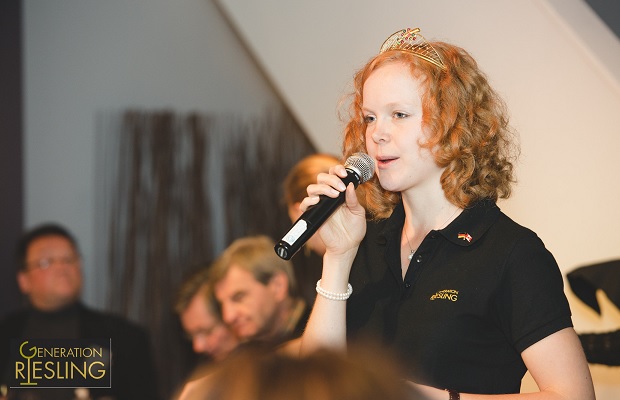
Nadine Poss from Windesheim in the Nahe region was elected 65th German Wine Queen back in September, 2013. That is a much bigger deal than you might think. Being chosen for the distinction is like winning the Miss America pageant and winemaker of the year at the same time, wrapped into one title. Ms. Poss travels the world to promote German wine. She represents 20,000 German wine growers nationally and internationally.
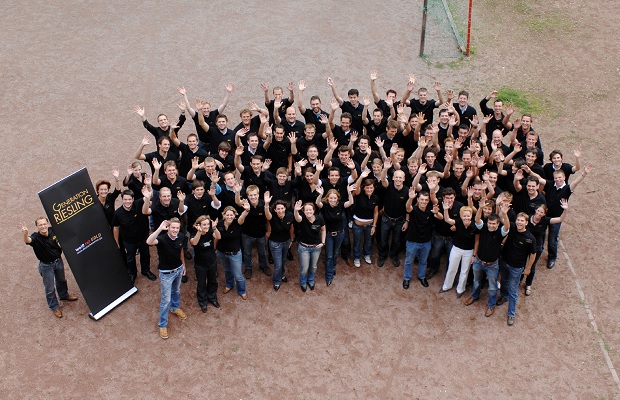
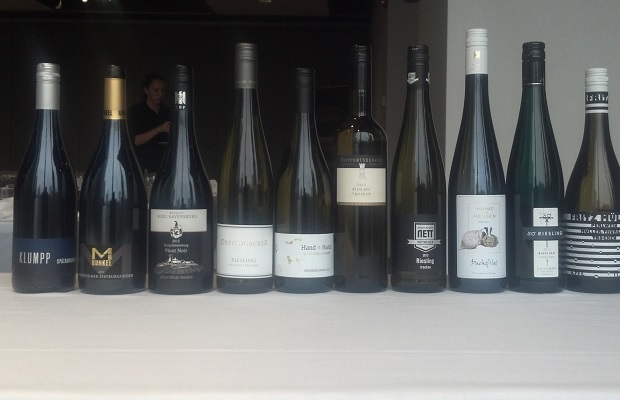
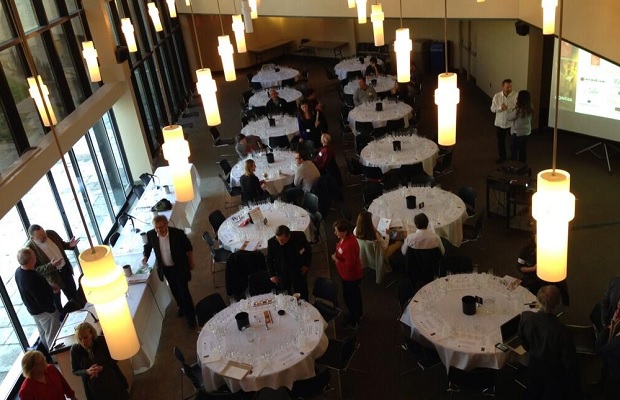
The 23 year-old Poss and Toronto Sommelier Will Predhomme presented Generation Riesling to a Toronto audience of writers, sommeliers, restaurant buyers and LCBO product consultants at Arcadian Court on May 20th, 2014. A walk around tasting followed with many a young face in the crowd. The concept and the intent is simple. Generation Riesling is all about bringing German wine to young people, to the millennial, to an “innovative, open-minded, well-educated, internationally oriented, and ambitious younger generation.”
With the queen in tow, the marketing and appeal is clear. Bring on the young people, teach them to drink dry (trocken, halbtrocken, classic or selection) wine. They will concentrate on what they like and they are not afraid to try new things. The new German wine label no longer feels the need to inform the consumer of every aspect contained within the wine’s birth certificate. While the wine name’s estate, the grape variety and the vintage are all likely to be there, arbitrary listings like style, quality level, the region, the town, grower or cooperative indication and quality control numbers may become label distinctions of the past.
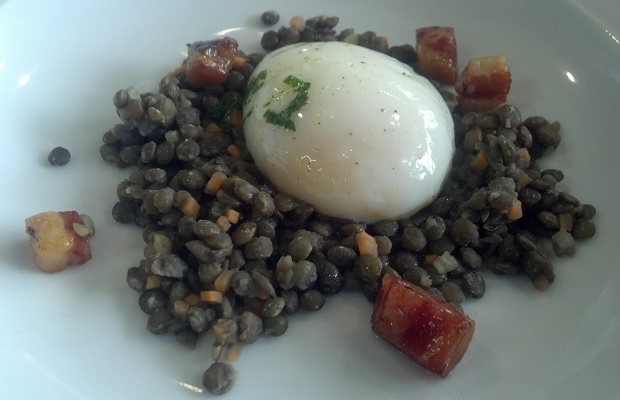
According to Predhomme, Generation Riesling is about highlighting the dry wines coming to market. “The important thing is that people are having the conversation.” It had been difficult to sell German wines, but this has changed, in the appeal to and with thanks to the aforementioned millennials. Riesling also pairs with hard to figure foods. “For egg yolks, turn to Riesling,” insists Predhomme. He means it.
Generation Riesling Tasting
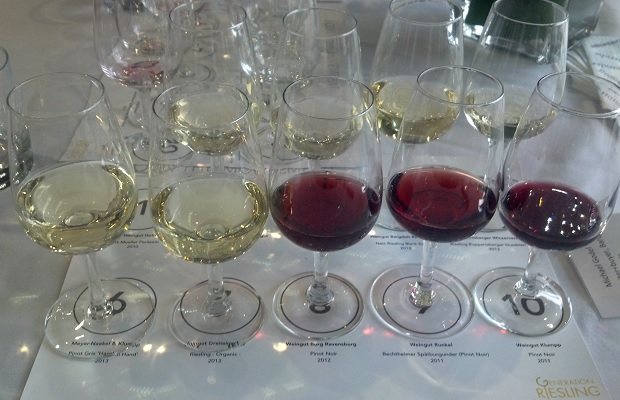
The 10 wines poured were anything but household names with each sample drier than the next. Not a single wine presented at the lunch seminar are available in VINTAGES or at the LCBO. These are wines that any progressive wine retailer must make available on their shelves. The choice of introducing new and under the radar producers to the Ontario market is brilliant as far as I am concerned. Now let’s see the style and vanguard approach gain market share. That ambiguity remains to achieve fruition and to be seen.
Tongue and cheek play on the Müller Thurgau grape, Prosecco style. On the fruity side, straightforward, compact and with good persistence. Aromas of pear, tarragon and a smooth, pale streak of concrete. @LeSommelierWine
G.H. von Mumm’sches Weingut Riesling 50 Degrees 2013, Rheingau ($14.95)
Dry to be sure though the aridity is not furthered by the breakdown of elemental particles and the peach intent never drifts into off-dry territory. Though this lacks the acidity necessary for lift there’s a clean slate and atomically, soil-driven bent. Later on there’s a note of Muscat-like grapey reduction. Simple and effective.
Weingut Prinz von Hessen Riesling Dachsfilet 2012, Rheingau (agent, $41.95)
A step up for sure, with a bag of mineral tricks, aromatic heights, some tropical notes but only in zest and rind. Like a hybrid of watermelon and papaya. There’s an intensity here in the dry-fresh continuum but also balm viscidity and textural tiling. Named one of Wines of Germany’s top 50 wines for 2014. @KylixWines
From a winery just south of Frankfurt blessed with a Mediterranean climate. Here this Riesling helped along with a cure of 20 per cent barrel ferment, “goes deep, it goes deeper still,” in golden, sun spot, citrus activity. Comes to it early, waxy, polishing, in a Semillon-like, dry, tight, mouth-watering well of deprivation. It’s not petrol but gas-driven. Something unnamed gives it air, this helium voiced, weightless, gravity defying Riesling. Could certainly drink this on a night like this, or any other.
This has a stable periodic table of balance and concrete interference of the stellar kind. Layered and textural must in grape spirits moving through black forests. Tight and imbued of great tang. More intensity from Pfalz. Lime finish. Great match to the soubise.
A touch of laundry stink in this Pinot Gris is neither off-putting nor should it be ignored. It is one of intelligent character and intriguing interest. PG also quivering on the fruity, peachy and approachable spectrum, low on spark and pepper, low on spice accent. A clean vernacular, a quiet approach. The palate is another story. Alive, kicking, the spark is there, as is the push to greater, future moments. @VonTeichman
From winery’s name that means “30 acre,” here gifts a sour patch note and because of the arid profile, the lack of residual sends it into sundry territory. With air it climbs out of the tart and into straight dry, pauses and finishes in the desert. To the sour note it simply says “we used to be friends.” There is something textured about it that speaks of a barrel but it’s too dandy and riveting to be like the Nett. It seems to say “it was a greeting I send to you, short and sweet to the soul I intend.” The winemaker is not worried about roundness and though this has fermentative smells, that’s just fine. @kswineimports
Burg Ravensburg Pinot Noir 2012, Baden (agent, $27.95)
Feminine and so very pretty for German Pinot Noir. A veritable potpourri of violets, orange skins and ripe cherries. The lack of paint is almost impossible. Just barely beyond 12 months of age on this wine. Not a lot of pop, but it’s softness is endearing. A palate that is expressive of strawberry. Not about power. Thoughts need not go there. @TheLivingVine
Bright and earthy cherry and a really great bit of vineyard funk. Reminds me of Niagara’s 13th Street in style. There’s a fuzzy berry feel to it but it’s clear and precise, like a Bruce Cockburn instrumental. Vanilla in pods and juice from the middle onwards. Fresh scraped vanilla in sugar syrup extract. So very vanilla. Paint and vanilla, repeat. It’s a bit of imbalance but it carries the notes for great and with conviction. This is the most cerebral of the three Pinot Noirs. Spätburgunder at the end of all rivers. @Matthias_Runkel
A much deeper, must and musky animal, earth-driven, black cherry Pinot Noir. More of a modern expression, higher in extract and seemingly longer hang time. The fruit has further development on it which will make for immediate gratification but not necessarily a longevity of gratitude. Strikes as coming from a hot vintage. SA citrus and persimmon vintage. Simply delicious, fleeting, now necessary Pinot. @TheLivingVine
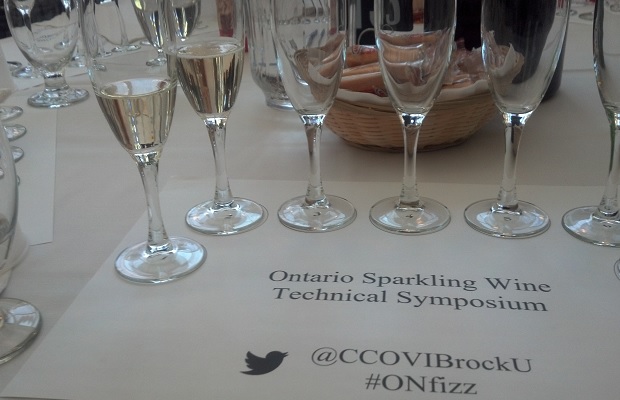
The Ontario Sparkling Wine Technical Symposium. Like a Trekkie convention for oenophiles. To a wine geek it was eight hours spent searching for the meaning of life. To a consumer who just likes to drink it would have been time lost forever with no chance to get it back. The Brock University Cool Climate Oenology & Viticulture Institute’s Pond Inlet was the setting. The presentations were very technical, that is until Dr. Jamie Goode took the podium and breathed context into the room.
According to the LCBO, in 2013, sales in Vintages of VQA sparkling wine were up 59.2 per cent from 2012 sales data. In Canada there are 36 wineries producing sparkling wine and that number is growing. As it should.
The abstruse conditions of the #ONfizz event set the table as a vocational assurance draw for Ontario winemakers, viticulture and viniculture research specialists. Seated at my table were a butcher, a baker and a candlestick maker. That should be loosely translated as a scientist (Dr. Jim Willwerth), a product manager (LCBO’s Ontario expert Astrid Brummer) and two winemakers (Hinterland’s Jonas Newman and Gaspereau Vineyards’ Gina Haverstock).
Brock’s Dr. Debbie Inglis introduced Bertrand Robillard, Ph.d., Director of Research and Development at the Institut Oenologique de Champagne. Before getting to the subject at hand, on disgorging, gushing and foaming, he first laid an open attack on beer. “The form is always better in a crystal glass,” insisted Robillard. For Champagne. Not beer. “That’s just false. It’s just appearance. People in Champagne do not appreciate this kind of resolute,” comparing the pouring of Champagne to beer.
Then on to Sparkling wine’s integral and necessary marketing draw. Bubbles. “No dishwashing,” begged Robillard. “It’s a very efficient way to kill the foam.” By principle, to have foam you need bubbles. It’s all about stabilizing the foam. High ethanol (five per cent) in fizz is good content for foam stabilization. CO2 (protein concentration and polysaccharides) all contribute to stability.
So why do the bubbles collapse? Why do they not make it from the centre to the wall of the glass? Why is a hole in the middle created and the bubbles fall into the hole and disappear? The answer is gushing. A “shameful disease” that can be considered as a disequilibrium between foam formation and foam collapse. Bubbles cannot exist if their radius are less than 0.1 microns, or they will dissolve into the wine. Bubbles are detached when gravity forces are higher than capillary forces.
The conclusion? Surface area and CO2 are the driving force behind gushing. Contaminations inside the wall of the bottle must be eliminated. Oxygen heterogeneity is essential, even more so more than CO2 and sugar. The news that there is no relationship between wine composition and gushing means winemakers can make the Sparkling wine style of their choosing. The representative from Champagne said so.
Next up was Ed Carr, Sparkling winemaker, Accolade wines in Australia. Carr plies his trade in Tasmania. Not the Tasmania of The English Passengers full of exiled convicts, invading Brits, sinister men like Dr. Thomas Potter and his thesis about the races of men. No, Carr makes bubbles on an island quickly becoming a (vinous) garden of Eden, known to a heroic aboriginal and envisioned by Reverend Geoffrey Wilson. Carr explained the company’s choice of locale. “These (cold and mostly maritime influenced climate) numbers are a gross simplification of what the world is really like, but this is why we went to Tasmania, looking at that 1000 number for heat degree days.”
On spacing: “The guy growing your vines is likely using the same tractor to grow spuds.” On vineyard management: “Lots of leaf plucking done, bunch thinning…canopy management is key. Supplemental irrigation a must.” On Sparkling wine stylistic choices: “Oxidation is a big thing, a real style choice. Chilling picked fruit reduces phenolic extraction and oxidation but also reduces fruit.”
On flaws: “Brettanomyces I refer to the ‘black death of Europe’ for wine. The little buggers love sulphur dioxide conditions. Residual sugar left in the bottle on the way to second fermentation helps the yeasts on their way. Rapid ferment and as dry as possible is the way to go.”
On closures: “I don’t really think you apply screw cap closure trials from still wines to sparkling. It does not translate to the reductive character of sparkling. We primarily believe in the use of traditional cork, with some agglomerate closure usage.”
Third speaker was Larry Mawby of Michigan’s Leelanau Peninsula L. Mawby Vineyards. “The thing that I realized was negatively impacting on my ability to make good sparkling wine was the fact that I wasn’t just making sparkling wine.” The response from Hinterland’s (Prince Edward County Sparkling wine maker) Jonas Newman. “I like his style.” I can hear you thinking, Sparkling wine in Michigan? More than this. Mawby makes 21 different renditions, with the usual suspects, Chardonnay and Pinot Noir, in traditional ways. He also goes at it Charmat-style with Riesling, Pinot Gris and Vignoles. Not to mention Cayuga, Vidal, Regent, Marechal Foch and Muscat in the Cuve Close method.
Continued Mawby, “in this century we’ve made nothing but sparkling wines.” During the terrible winter of 2003 there were temperatures of 45 degrees (Fahrenheit) and below. “Killed any vine not beneath the snow. I panicked.” So Mawby added his ‘Cuve Closed’ a bulk production, Charmat-style sparkling wine. On the technicalities of making fizz: “I don’t believe the chemistry of fruit should be your guideline. What does the fruit taste like?” On varietal integrity: “Almost nobody on the planet buys Sparkling wine based on grape variety.”
Jamie Goode, Ph.D., London-based wine writer (www.wineanorak.com) and wine columnist, The Sunday Express talked on wine closures and purchaser perception of local, national and international sparkling wines. Mostly he spoke about incontestable truths.
On closures: “Traditional is best but the Mytik in an excellent alternative.” It now closes 192 million of 6 billion bottles. The Crown Cap? “Yes, why not? It’s recognizable, like beer and comfortable. With the right liner it’s OTR transmission is very acceptable.” Dr. Goode’s closure talk resulted in some wine writer comedy.
@BillZacharkiw@jamiegoode can you saber crown capped sparkling? Author Jamie Goode about to demonstrate @WineCouncilOnt
On the world’s most famous fizz: “Champagne can be wonderful, but there’s some ropey stuff coming to the UK. With Champagne, your expectation is everything.” On Cava, “People don’t really like it. It’s made in the traditional method and it should be a really good product but it’s trying to be something it’s not.”
On vintage dated bubbles, Goode spoke from an unequivocal marketing perspective. “People don’t really care about vintage.” On the emerging Canadian and British sparkling wine industries. “Do English or Canadian wines need a special name?” No.”
On the now-universal nomenclature: “Sparkling wine has become an accepted one, not a pejorative one.” Goode’s perspective is always fresh, nearly cynical and full of truth. On leaving the country he bade farewell with thanks.
Goodbye canada. You exceeded my already high expectations. See you again in June
Participants also had the opportunity to taste two sparkling wine research trials that are currently underway at local wineries as well as a comparative blind tasting. The blind tasting presented a selection of local and international Sparkling wines and Champagnes and was moderated by Jamie Goode. The three flights featured Blanc de Blancs, Cuvée/blends and alternative varieties. Thank you can never be said too many times to Barbara Tatarnic, Magdalena Kaiser-Smit and Trisha Molokach for their generosity in invitation and unwavering hospitality. I am always humbled to be included in their warm world of wine.
I will admit that I would have liked to see more Ontario representation in the flights, as well as at least one example from both British Columbia and especially Nova Scotia’s Gaspereau Valley. With that emerging region and vintners like Benjamin Bridge and Gaspereau Vineyards on the Sparkling stardom stage/horizon, including their wines would have upped the complexity factor tenfold. Not to mention something British. New York State’s Finger Lakes (Chateau Frank Célèbre) and North Fork of Long Island’s (Sparkling Pointe Brut Seduction) should definitely be players in the next #ONfizz symposium.
Brock University CCOVI Sparkling Wine Technical Symposium
Sparkling Wine Trial Tasting – Unfinished samples from Trius Wines
Trius Base on lees two years. Chardonnay (70 per cent), Pinot Noir (25), Pinot Meunier (5). Each (cane sugar) dosage was 20 mL towards an end of 8 g/L of residual sugar. Barrel fermentation and barrel aging leans this towards an oxidixed style. Arid, high in citrus and high-toned oak character.
Blanc de Noirs 2009. Left on the lees for four years. Use of cane sugar. Less giving and resolute in micro-wood spice. This sample is from the oldest (sparkling) wine in their cellar.
From the Trius Brut wine. Dosage again with cane sugar. Acts the most polished and finished, the most accomplished. This is the rock and the anchor.
Comparative Blind Tasting – Flight 1: Blanc de Blanc
Family Estate Cuvée No. 1Blanc De Blancs NV, Méthode Traditionelle, Marlborough, New Zealand (56358, $34.95, WineAlign)
The sample poured at the OSWTS was unfortunately corked but here was my previous review: “Aromatic rhetoric would argue this Marlborough bottle of bubbles is a ringer for classic Blanc de Blancs. Promises pleasure and class from the first whiff. Decidedly lemon citrus tight and stony until an herbal, splintered, stemmy tarragon balm takes over, rendering the wine more of its place than what it tries to emulate. Still, a really terrific effort.” Tasted November 2013 @oenophilia1
From left to right: L. Mawby Vineyards Blanc de Blanc Chardonnay NV, Cave Spring Blanc De Blancs Brut, Henry Of Pelham Cuvée Catharine Carte Blanche Blanc De Blanc 2008, Drappier Signature Blanc De Blancs Brut Champagne, House of Arras Blanc de Blancs 2004
L. Mawby Vineyards Blanc de Blanc Chardonnay NV, Michigan, USA (winery, US $23)
Like distilled white Swedish berries high on acidity. Herbal, tight, gainful simplicity. Pear ciderish and clear as a cool climate bell. @mibubbly
A not so dry (9.8 g/L residual sugar) stylistic choice leads this angel to sparkling late harvest territory with ripe orchard fruit that buzzes with terpenes, surface bruises and slight oxidized notes. The archangel rolls over a knife’s edge and sits too long in the sun but it’s neither cut nor cooked. There is beauty in its 90’s big hair, big sound and you might tell her that “tears drop like diamonds from your golden eyes.” There’s yet a spring in her step and a hay note from afield. Tasted May 2014 @angelsgatewines
House of Arras Blanc de Blancs 2004, Tasmania, Australia (winery, $80 AUS)
Big barrel oak influence leaves splinters in the mouth, albeit gentle and dissolvable ones. Creamy and chalky like ice cream made from tea. Not much yeast and biscuit activity as it’s all about fruit and barrel. @AccoladeWinesAU
Cave Spring Blanc De Blancs Brut, VQA Niagara Escarpment, Ontario (213983, $29.95, WineAlign)
The freshest style of the #ONfizz B de B flight. Fruit, escarpment bench stone layering, richesse, biscuits and toast are all in. Acidity meets complexity. From my earlier, December 2012 note: “Sees no malolactic fermentation and sits at the top end of dry (12-14 dosage). Most of the fruit is 2008, despite the NV designation. A soda fountain of argon and nitrogen bunsens forth through clean lines and carries an entire cider house orchard of Spartan apple. This one certainly hints at Champagne-like characteristics, of brioche and toast. The apples never relent.” Last tasted May 2014 @CaveSpring
Drappier Signature Blanc De Blancs Brut Champagne, Ac, Champagne, France (599860, $46.95, WineAlign)
Here showing a bruised apple note with the lees and PH on steroids. Fruit seems to be in from a less than stellar vintage and so the lack of consistency is disappointing. “It’s a style,” says Jonas Newman. “He’s a natural wine guy.” NV Champagne needs aggregate scoring so my 90 comes down. From my earlier, April 2013 note: “Continues a VINTAGES string of excellent value in Champagne releases. Made from 100% Chardonnay, this BdB is pronounced in , yeasty dough definition, hinting at agave and unwashed cheese rind. Where there’s bubbles there’s a way and I like where this one is going. The agave replays in sweet waves, as does the sour in faint yet discernible sloshes. Much to contemplate in this NV sparkler.” Last Tasted May 2014
Henry Of Pelham Cuvée Catharine Carte Blanche Blanc De Blanc 2008, VQA Short Hills Bench, Niagara Peninsula, Méthode Traditionnelle, Ontario (315200, $44.95, WineAlign)
Rocks the driest end of the free world Blanc de Blanc spectrum. Lets carte blanche reign in a taut style and reeks of a minimum four years of autolytic lees activity. In that sense it loses some of its sense of place, in Catherine’s case that Short Hills Bench clay-silt-loam-gravel agglomeration. The soil composition usually brings vigor and richness to Chardonnay but here as a sparkling wine the sensation is of citrus soaked concrete. Racy bubbles of intensity that do not quite match the weight and elegance of the 2007. @HenryofPelham
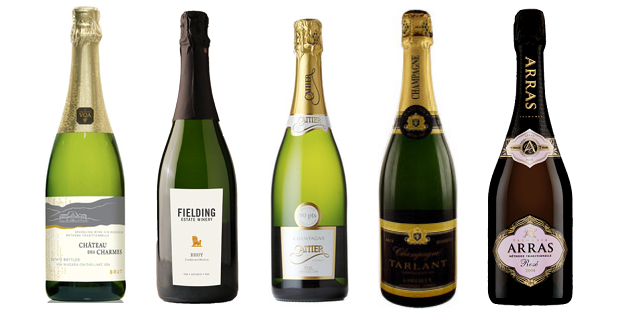
From left to right: Château Des Charmes Brut Méthode Traditionnelle, Fielding Estate Brut NV, Cattier Brut Premier Cru, Tarlant Brut Reserve Champagne, House of Arras Rosé 2005
An impressive debut for winemaker Richie Roberts and team. This is a classic Chardonnay (55 per cent) and Pinot Noir (45) cuvée from Fielding’s Tufford Road vineyard. A surprisingly rich example, toasty and with a sweet meets sweaty, minty-herbiage. A primer for even greater vintages (this is essentially 2009) to come, where the focus will be more on yeast fielding to citrus and less about yielding to a non-metallic elemental finish. @FieldingWinery
L. Mawby Vineyards Talismon NV, Michigan, USA (winery, US $37)
Tasted blind this strikes out as heteromorphic fizz from less than charted territory (like Michigan) with juicy, hybrid acting histrionics. Though it’s actually a blend of Pinot Noir, Pinot Gris and Chardonnay it lacks vinifera varietal complexity. The fruit is clear and fair but the méthode champenoise brings no enzymatic or citric display.
Tarlant Brut Reserve Champagne, France (325167, $43.95, WineAlign)
Here is a cuvée of égalité that combines one-third each Chardonnay, Pinot Noir and Pinot Meunier. Like the varietal make-up, these slightly reductive yet elegant bubbles offer up thirds of brioche, toast and demi-glacé. Fashioned from the 2006 harvest with reserve wine added and aged in oak. Chic and affordable but in no shape or form a knock off of the real deal. There’s a theoretical Champagne void within filled with citrus, sharp ginger and pungent spice. Blessed with unmatched length as compared to the others in the #ONfizz cuvée flight.
House of Arras Grand Vintage 2004, Tasmania, Australia (winery, $60 AUS)
“A polarizing wine,” notes winemaker Ed Carr. Full of savoury, herbal notes but also the unmistakable scent of that other white meat. The cure is indeed a porcine one, sweating in a hung game way, which gives this fizz such an old-world, old cellar quality. A slow (spring) malolactic evolution in barrel gives this (65.9 percent) Chardonnay and (34.1) Pinot Noir its silky, milky feel. Good to even better than good length.
Cattier Brut Premier Cru, Champagne, France (325720, $44.60, WineAlign)
This is really bitter, in a really good way. The nobility in brine is likely a result of whole (non-separated) bunch pressing, the Pinot Noir skins impart giving the fruity must its resident bitterness. A highly distinctive style of high caste and longevity, composed of Pinot Meunier (45 per cent), Pinot Noir (35) and Chardonnay (25). As deep as any tasted at #ONfizz 2014.
Château Des Charmes Brut Méthode Traditionnelle, VQA Niagara On The Lake, Ontario (224766, $22.95, WineAlign)
Chardonnay (75 per cent) and Pinot Noir (25) at an attractive price. Attacks with a gently cloying, weeping sweetness, string-bending terpenes and fades out with a savoury, bitter finish. Light, approachable and wide-reaching style. Bubbles with broad appeal. @MBosc
House of Arras Rosé 2005, Tasmania, Australia (winery, $60 AUS)
The composition here is Pinot Noir (62.5 per cent) and Chardonnay (37.5) from pickings in Lower Derwent, Upper Derwent and the Houn Valley. Emerges out of a year where warmer temperatures coaxed an increase of richer fruit from the rounder and fatter white grape. Good lees effect (seven years) in 2005 and also a balmy tarragon accent atop strawberry, verging to cherry fruit. Finishes with expert balancing acidity, this fizz trumps its Blanc de Blanc and Grand Vintage sistren at this tasting.
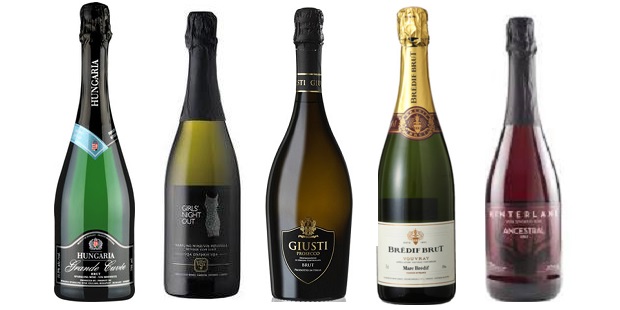
From left to right: Hungaria Grande Cuvée Brut, Girls’ Night Out Sparkling, Giusti Brut Prosecco Asolo, Brédif Brut Vouvray NV, Hinterland Ancestral 2013
Comparative Blind Tasting – Flight 3: Alternative Varieties
Spent 12 months ageing ‘sur lie’ in the estate’s underground sparkling caves. Winemaker Craig McDonald comments to the negative effect of light on bubbles. “Light strike causes a serious reaction on sparkling wine.” Here a mephitic aroma should likely be attributed to reduction or the beam of sunlight blanketing the room. There is a resinous salinity to this SB that does not want to blow off. Needs to be revisited from 2015 to 2018.
Green Extra-Sec by M. Lawrence, Michigan, USA (winery, $15)
The Green is part of Larry Mawby’s colourful, sexy and artfully named M. Lawrence investigation into the diversity of Sparkling wine. Absurdly dry, this put together Vidal and Cayuga concept is all about musky grape dehydration. Its cool climate constitution rescues the fruit to rehydrate and act like an orange picked straight from the greenhouse tree. There’s a malic medicinal tone that buries the sweet (17 g/L residual), resulting in a tart, low in alcohol, unwoven bottle of slim bubble.
Girls’ Night Out Sparkling, Ontario VQA, Ontario, Canada (215632, $14.95, WineAlign)
Here is a modest and useful 100% Riesling, Charmat Method, Cuve Close bottle of fizz from Lake Erie North Shore producer Colio Estates. With a residual remainder of nearly 20 g/L it falls into the off-dry category with aromatic notes that stroll directly through Ontario orchards. Tasty, easy to enjoy and smelling peculiarly like bubble gum. Well-made, good quality bubbles nouveau.
A 100 per cent Glera, from Veneto’s Montello and the Asolo hills. As per Giusti’s description, this definitive Prosecco is “appropriately evanescent, with fine and lingering perlage.” Though reserved on the nose, the palate is very lively. A case in point for any aridity-driven examples to follow.
Brédif Brut Vouvray NV, Loire, France (352179, $20.95, WineAlign)
A touch yeasty, with citrus and large bubbles. Good verve, complex palate with a Champagne bent, or at least a toasted sentiment. From my earlier, November 2013 note: “Arid, frothy and fitful, atomically speaking. White peach and preceding spring flowers. Charcoal rubbed, also clean and fine. Sparkling Chenin Blanc done right.” Last tasted May 2014
Hungaria Grande Cuvée Brut, Hungary (619288, $12.25, WineAlign)
A more than interesting set of aromatics define and drive this blend of Királyleányka Rizling (Rhine Riesling), Pinot Noir and Chardonnay. A stinky, reductive twang is joined by peach, rubber, pencil, duff and sandy sediment. Although the palate is a bit dullish with a taste of wet concrete there thickens a liqueur-like viscous texture to win sweet hearts. Would win even more were the residual (9 g/L) even higher.
Hinterland Ancestral 2013, Prince Edward County (winery, $25, WineAlign)
Released back in October of 2013, the Ancestral is what Hinterland’s Vicky Samaras refers to as the “unicorn” or the “babymaker.” This is Gamay Noir in postal service of the ancient process known as méthode ancestrale. Fermentation, which produces the carbon dioxide, occurs in the bottle and lees disgorgement is skipped. Hinterland’s Ancrestral brings sweet currant jelly, strawberry and mint notes (36 g/L residual sugar) to a wine low in alcohol (8 per cent) yet high in balancing (7.8 g/L) natural acidity. The components are all lifted to such great heights. A babymaker because the aromatics, palate, texture and finish “are mirror images and when we kiss they’re perfectly aligned.”
It has been quite some time since the provincial monopoly has assembled a set of Australian wines as impressive as what will hit shelves tomorrow and through the coming weekend. In fact, it has been years since any gathering from down under has wooed me in ways to make me wax with such vinous adoration.
Australia is blessed with so many wine growing regions and variances of style, far more than most give credit for or will admit to. If, hypothetically speaking, the country as a whole had temporarily lost its way and sense of purpose, if this release is any indication, the ship has been righted with precision and balance. With sound and vision.
Here are six wines to look out for over the next few days and in the VINTAGES stock dwindling weeks to come. Four awesome Aussies, a sparkling gem from the Loire and a piquant white from Austria.
From left to right: Haselgrove First Cut Shiraz 2010, Domaine Tournon Mathilda Shiraz 2011, Nugan King Valley Frasca’s Lane Chardonnay 2012, Langlois Château Brut Crémant De Loire, Winzer Krems Edition Chremisa Grüner Veltliner 2012, Wynns Coonawarra Estate Black Label Cabernet Sauvignon 2010
Haselgrove First Cut Shiraz 2010, Mclaren Vale, South Australia, Australia (367425, $18.95, WineAlign)
This has a great vineyard (four corners of McLaren Vale) funk to it, along with warm, highly-extracted fruit that is just beginning to raisin and caramelize. Friable from McLaren Flat’s sandy loam, chalky in gravel with pockets of Bay of Biscay, but also dense from Willunga’s heavy clay. This shares an affinity with the Queenston Road’s Creekside Estates Syrah, but here there is more grit, firm tannin and mineral. Formative and serious, it’s just about in its right place. Give it two more years but don’t hesitate after that. Some Rhôneish boy madness too. Tasted May 2014 @HaselgroveWines
Domaine Tournon Mathilda Shiraz 2011, Victoria, Australia (327395, $19.95, WineAlign)
Victoria Shiraz has an (Australian rules) 19th man element, a sense of umami that is unique to the region. I believe it is this ghost player that enables Victorian reds with an ability to age longer and with more grace than many opponents. The ’11 Mathilda is similar yet cooler as compared to the Malakoff, with a savoury toasted edge and less porky, both in weight and in mouth feel. A bit reductive and musty at present, with sweeter and more forgiving tannins, though still older in world outlook and should not be pigeonholed as a fruit bomb. Gotta appreciate the Chapoutier intent. Tasted May 2014 @Dandurandwines
Nugan King Valley Frasca’s Lane Chardonnay 2012, King Valley, Victoria, Australia (288191, $19.95, WineAlign)
The toast in this Victorian charmer comes across in a mild-mannered, spoken word way with a simmering, buttery bass line. The fruit is high but the rhythms are delicate and even-keeled. More white flowers than your average Australian Chardonnay, brighter, with more grace and more beauty. She’s a girl with a short skirt and a long jacket eating angel cake. Still firm towards the back-end with citrus zest and mouth-watering acidity, she’s “fast and thorough and sharp as a tack.” Finishes with a long and persistent held trumpeting line. “Na,na,na,na,na,na.” Tasted May 2014 @PMA_int
Langlois Château Brut Crémant De Loire, Ap, Loire, France (996272, $21.95, WineAlign)
Conventional yet anything but commonplace Crémant. Chenin (with help from friends Chardonnay and Cabernet Franc) to drive one athirst with mind-altering high acidity and a nasty temper. Mighty, mighty metallic aromas, bathed in concrete. The palate is coated by a lemon zest skittish and skittle-sweet coquettish play. If this fizz were a music style it would be Ska. The impression that I get is of “a strength most don’t possess,” this Langlois has so much lime and stone. Have a sip and imagine a bass drum’s accent on the 3rd beat of a four-triplet, boss tone phrase. Tasted May 2014 @LANGLOISCHATEAU
A textured and floral Grüner Veltliner, a child of more clay, less stone, more juicy fruit and less gas-driven angles. Really well-judged with a pinch of baby fat but certainly not oily. The concrete tang is endearing, as is the bitter pith tinged but welcoming fruit. Unique and not exactly a style addressed to every palate but it has a long, tingling and lingering finish. Tasted May 2014 @AustrianWine
Wynns Coonawarra Estate Black Label Cabernet Sauvignon 2010, Coonawarra, South Australia, Australia (84996, $27.95, WineAlign)
One of the most polished and finest examples of Cabernet Sauvignon tasted out of Australia in quite some time. I have made the statement before that Coonawarra is the top location for the variety anywhere on the vast continent. The 2010 is rich, lush and expressive of so much bright fruit to nose, so much so you might not need even require a taste for to feel her charms. The 56th vintage of this Coonicon, it is possessive of a solid, dusty structure throughout, consistent and on a fine floral line. Some firm tannins though they are sentimentally sweet. Really fine and at this price this is a case purchase, to open one every year or two for the next twenty. Tasted May 2014 @Wine_Ambassador#wynnsday
The génial wines of Jura are a peculiar bunch. Nothing else in France, or the world for that matter, resembles them. They are specific, unique, idiosyncratic, and rare. Specific because virtually every producer makes the same set of wines. Unique for their varietal distinction and the élevage methods that lead them to market. Idiosyncratic due to their oxidized versus non-oxidized styles. Rare because at any given moment in time only four are available in the LCBO. There are currently 58 available at the SAQ.
Jura is what Wink Lorch describes as a “bijou” wine region located in eastern France, east of Burgundy and within a stone’s throw over the Alps to Geneva in Switzerland. Mountains are everywhere, soils give vineyards a variegation of clay, marl, fossils and plenty of limestone. Napoleonic cold and harsh winters, serious frost issues and complex methodologies challenge vines and winemakers in ways empathetic vintners in Ontario have no problem understanding. Could Ontario be the kismet New World wine region to foster Jura, the strange and beautiful? Savagnin produced by Ontario South CoastBurning Kiln Winery is a remarkable rendition and the most interesting wine recently tasted in Norfolk County.
But I digress. Back to Jura. Bresse chickens are a most delicious and famous commodity. Saucisses morteau the pork sausage is a most righteous banger. Comté (serious) and La vache qui rit (not so much) are its most famous cheeses.
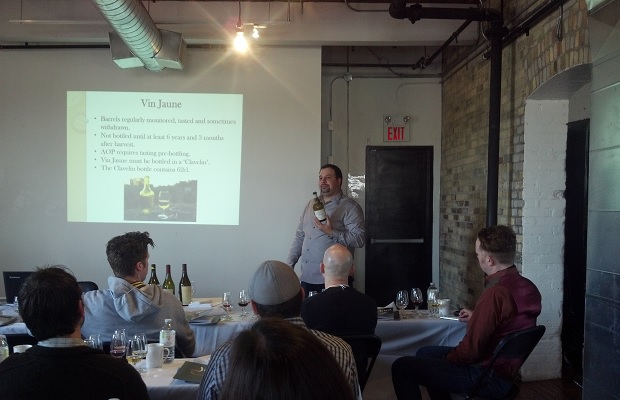
The seminar was presented by Jura expert Saviolidis with an overview of the region’s history, pertinent facts and winemaking styles. A select tasting of its wines followed, running the gamut from dry whites through to its most unusual and singular oxidized rarities.
Whites are made from Chardonnay, Savagnin and (most-planted) Poulsard, reds from Trousseau and Pinot Noir. Easy-drinking wines come from clay, Pinot Noir from limestone, the top examples from marl. The anti-tannic and low-pigmented Trousseau (Bastardo) prefers clay or marl. Savagnin (also called Melon D’arbois, Gamay Blanc and the rare variation Melon a Quere Rouge) demands rugged, steep slopes and grey marl soil.
The styles of ouille (topped up, “filled to the eye”) vs non-ouille, oxidative or not conundrum can confuse, even distort sensibilities and previous frames of reference. Some typical Jura whites (vins types) like Savagnin can make both near-oxidative, Fino Sherry-like wine and a highly oxidative vin jaune (yellow wine), most famously from Château-Chalon. The latter is aged in barrel for six years and three month with its air protective layer of yeast. It is only made in great vintages. No specific appellation is tied to its magic pixie yeast and volatile acidity.
The region is divided into four AOC, Arbois, Cote de Jura, L’Etoile, Chateau-Chalon. Jura is the only (AOP) wine region to make Macvin de Jura, a traditional blend of non-ouille Savagnin and Chardonnay. The wine is fortified with a neutral (pomace, or marc) spirit added. The vin de paille, (straw wine) is made from dried grapes then turned into wine. These are examples of the joys of Jurassic idiosyncrasy.
Crémant de Jura is produced all over the region and can use all five varieties. Arbois is the oldest and most prolific production. Cotes de Jura comes in red, white, and rosé. L’etoile whites are famed after fossils that look like stars, the wines made from Chardonnay, a blend of Chardonnay and Savagnin and Poulsard.
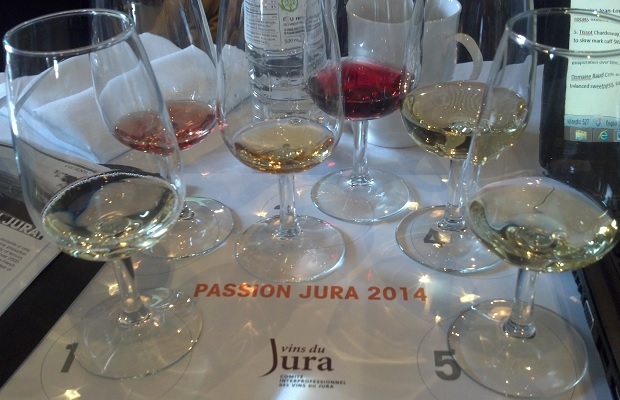
Hue is not necessarily a key to wine colour. The reds can look like Rosé, some oxidized whites like oranges or very light reds. Red and white grapes mix to make dessert wines. What’s on the label is the map to use as a guide to what’s inside. Saviolidis offered his insight and moderated the discussion on the following six wines poured at the seminar.
Passion Jura Seminar Wines
Domaine Désiré Petit Crémant du Jura NV (winery, 8,70 EUR)
A blend of Chardonnay (dominant) with Chambourcin and Pinot Noir from the Revermont in Jura, the sweetness is perceivable (8 g/L residual) and the texture palpable (15 months on lees). Acts like autolytic champagne, with noticeable terpenic pith in a low dosage, near-Brut style.
Domaine Rolet Père et Fils Arbois Poulsard Vieilles Vignes 2011, (SAQ 11537090, $22.45)
From vines that grow in native, red, rich and heavy marl soils. Here the minimum is 35 years for those vines, the fruit in requiem of big barrels, (foudres) for 15 months. Smells like a cave and its hanging cure, but also red currants, white berries and a sweaty red onion straight from the fridge. To taste it attacks in tart, dusty pepper tones. Akin to some Loire Cabernet Franc albeit much more interesting.
From red marl and gravel soils, the yield was 4L per hectare for this vintage only. Vinified in cement vats with 15 days of maceration and 18 months of aging in old foudres. A death-cab cute Trousseau that avoids intensity though it is marked by cracked pepper, blue fruit, cacao and reducing, wet, oxidized earth. Cherry and ash palate, long and very pure. A wonderful wine of soul meets body, “like a melody softly soaring through my atmosphere.” Trousseau is certainly indie, emo even but this example shows the talent of the winemaker.
Domaine André Et Mireille Tissot Chardonnay ‘En Barberon’ 2011 (Agent, $45)
From old vines 20 km south of Arbois, this is one of seven Chardonnays produced by Stéphane and Bénédicte Tissot. Organic and biodynamic since 2004, this argillaceous mineral-laced and calcareous-driven wholly unique Chardonnay has that atomic, soda-driven petrol usually reserved for Mosel Riesling. Climb the rock and cover it with tropically coated apple caramel and toasted nuts. An old school, baby of the barrel that will age slowly and surely for 20 years.
Of a very small appellation (4.5 hectares from an area totalling 40-45) this Vin Jaune is produced from the best parcels of land at Gaillardon (in the parish of Domblans), Beaumont (in the parish of Ménétru le Vignoble) and Sous-Roche (in the parish of Chateau-Chalon). Savagnin aged the necessary six years and three months in oak barrels with native yeasts. A non-fortified, non-ouille Jura, natural with oxidation and evaporation over time. Explicit in dried fruit and nuts and an underlying pink salinity, likening it to Sherry. Rich and both sweet/sour to taste. Like Fino, at five times the price. An eccentric wine to be sure, intended for rubber-necking and curiosity thrill seekers. Oxidized but not eclipsed by bruised fruit and dry as the desert. Is there any life in this strange and not so beautiful elixir? “There is no dark side of the moon really. Matter of fact its all dark.”
Domaine Baud Cote de Jura Vin de Paille 2009, (winery, Approx. $40-50)
Made from a third of each variety, Poulsard, Chardonnay and Savagnin. A dessert wine pressed in January from 100 kilos, resulting in 20 litres final product. Best served with chocolate, cake, foie gras and aged cheeses, this rendition holds of balanced (30 g/L residual ) sweetness. The aromatic balance comes from salinity, raisins and candied fruit, along with brown sugar and dried apricots to taste. There is nothing overly sweet about it save for a lingering hazelnut purée. Certainly drying but without an attack on the salivary glands.
After the seminar the 17 Jura producers poured their wines to a larger audience. Here are notes on five.
Domaine Jacques Tissot
Arbois Chardonnay 2010 – Unoaked, lemon-lime fresh and tangy.
Arbois Nature 2013 – Savagnin with a bounce in its step. Waxy with a citrus squeeze over just crushed grapes and approachably fruity.
Arbois Savagnin 2009 – From vines out of marnes grises du lias. At this stage it’s just developing a butterscotch and nut brown colour meets flavour sequence. The citrus here is in pith.
Arbois Trousseau 2010 – The soil for this is argiles à chailles (clay-with-flints). Earthy, lithe, ripe, dusted with dried cherry and white pepper.
Crémant Du Jura Blanc Brut NV – From 100 per cent Chardonnay this is like lime cream soda without the sugar. Perfectly dry expression.
Arbois Poulsard 2010 – Grown out of marnesirisees du trias the stone imparts a seafood character. So natural, uncultivated, sea salinity and fish funky.
Arbois Vin de Paille 2008 – The juice is kept four months and then aged four years. On the sweet side of the style, with less nuts and more marmalade, particularly apricot.
Arbois Vin Jaune 2006 – Down by law aged for six years and three months. As Sherry-like as it gest with added lemon, wax, piquancy and blanched nuts.
Macvin Du Jura Blanc NV – A sweety that finishes concrete dry. Like nut-crusted white flowers. Would last in the fridge for six months.
Arbois Chardonnay Les Corvees Sous Caron – Smooth, linear, calm, safe and easy-going.
Domaine Berthet-Bondet
Côtes du Jura Rubis 2012 – From vines 20-30 years of age, this is a pragmatic and necessary blend of Trousseau (45 per cent), Poulsard (45) and Pinot Noir (10). Currants, red bell pepper, charcuterie and potpourri aromas. Tart and delicious.
Côtes du Jura Chardonnay 2012 – Ouille from a wine aged in five to 10 per cent, one-year old oak. Fresh with lemon and grapefruit. Polished, zest and more zest.
Côtes du Jura Naturé 2012 – A year in stainless, this is modernized but not unnatural. Scents of lime and its pith and a cemented sense of concrete.
Côtes du Jura Tradition 2010 – A combination of Chardonnay (70 per cent) and Savagnin (30), each oxidized separately. Has a minty, cool piquancy and a thin to win attitude.
Château-Chalon 2007 – See above.
Vin de Paille Cotes du Jura 2009 – Such fine balance in this example. Parity for the nuts, dried fruit and never cloying marmalade. Top dessert example.
Domaine Rolet Père et Fils
Arbois Blanc Harmonie 2011 – Spent 12 months in small barrels. Well-judged blend that is waxy, high on lemonade and a piercing acidity. Reminds of young Sémillon.
Côtes Du Jura Expression Du Terroir 2008 – Though this spent three years in oak it’s impossibly fresh. A wine topped up by Savagnin, the minerality is of a largesse and the wax-tang quotient crazy in length like no other white in the room.
Arbois Rouge Trousseau 2009 – The palest red, still fresh for its age.
Arbois Rouge Tradition 2010 – Poulsard, Trousseau and Pinot Noir. Spent 15 months in Foudres. Flinty and sulphurous. Of the earth. Long finish.
Crémant Du Jura Blanc Brut 2008 – Vintage dated, striking, pulsating, lemon soda. Chardonnay (70 per cent) with Pinot Noir and Poulsard.
Arbois Rouge Poulsard 2011 – Red onion skin, concrete, earth, tar and ash.
Vin de Paille 2006 – From Chardonnay (40 per cent), Savagnin (40) and Poulsard (20). Dry, cheesey, leesy, yeasty nose. A sweet marmalade palate ensues, with a pith bite into orange peel.
Domaine André Et Mireille Tissot
Crémant Du Jura Blanc NV – Chardonnay (55 percent), Pinot Noir (35), Poulsard (5) and Trousseau (5). Quite elegant, very fresh, high-toned fruit.
Arbois Chardonnay Les Bruyères 2011 – From terroir argileux du Trias clay soils, there is density, less abstruse character than others and high citrus.
Arbois Trousseau Singulier 2012 – The smell of fresh concrete and a coat of varnish. Very peppery and distinctive.
Arbois Chardonnay Les Graviers 2011 – A more serious and brooding rendition from limestone this has an oxidative quality.
Arbois Vin Jaune Les Bruyères 2007 – From terroir argileux du Trias clay soils, there is density, less abstruse character than others and high citrus.
Château-Chalon 2007 – Unique to this genre, here there is less brawn, more citrus pith and oyster shell, Most of all there are crazy acids. This version shows the greatest potential for longevity.
Chardonnay ‘En Barberon’ 2011 – see above.
Domaine Jean-Louis Tissott
Arbois Savagnin 2009 – A three-year aged white that results in a dovetailing of dry, nutty and tart.
Arbois Poulsard 2010 – Spent 10 days in cement and six months in large foudres. Good freshness, some earth and straightforward painted flavours.
Arbois Trousseau 2010 – see above.
Chardonnay 2011 – Out of calcareous soil there is a soft, dreamy, mouth filling creamy character. Delicate until the angle of citrus, in pith and zest takes over. A viscous, or gras Chardonnay.
Arbois Vin Jaune 2006 – Slightly lower alcohol (14.5 per cent) makes for a brighter nose. Fresher than the other ’06’s, with lifted floral aromatics, less heavy in liqueur and more clarity.
Crémant Du Jura NV – From 100 per cent Chardonnay this is bright. fresh and lively.
Macvin Du Jura NV – From two thirds Savagnin and 1/3 Eau de Vivre de Marl this is all about sweet smeling white flowers.
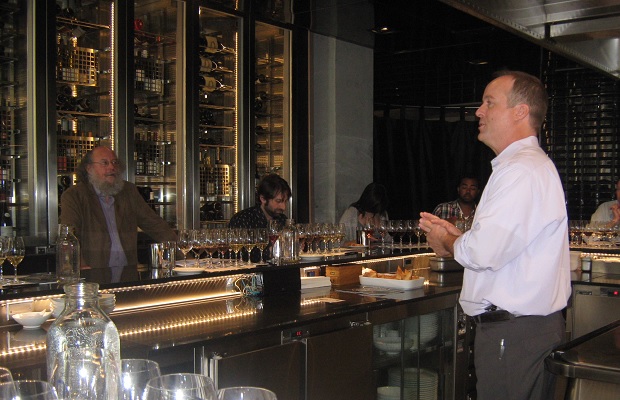
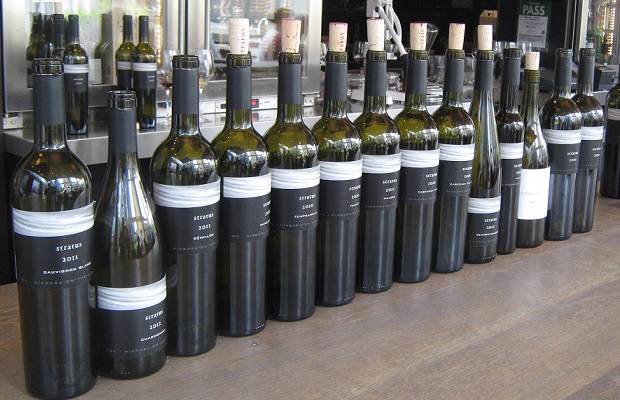
The wines of Stratus Vineyards and the cuisine of Momofuku Toronto. On Monday, May 26th and for the second straight year they conspired together in a beautiful collision of mutual beneficence. The single varietal mad science of winemaker J-L Groux and the singular, multifarious snacks of Momofuku Daishō. The food and wine play leaves wine writers satiated, thankful and speechless.
Stratus Single Varietal Tasting at Momofuku Daisho
This 2014 media lunch dubbed Stratus, the right to free assemblage forged yet another treat of the highest order, once again with the necessity in participation of Charles Baker, Suzanne Janke and Sarah Walker of Stratus, along with Momofuku Beverage Director Jonathan Gosenhauser, Service Director Steve De Sousa, Assistant FOH Manager Nicholas Papadatos and the Daishō team.
An introduction by Charles Baker of Stratus Wines
Wildass Rosé 2013, Niagara On The Lake, Ontario (Winery, $16.95, WineAlign)
At 13.9 per cent the kitchen sink blend is unwittingly light on its feet, with uplifting floral and stony scents. The patronage seems as though it could be a shot (or more) of an aromatic white addition like Viognier. This ’13 is a new approach to the Wildass Rosé, a metallic meets orange and berry citrus flavour explosion. Will be an August VINTAGES release at this modest and honest tag, certainly more accessible than in years past.
Stratus at Momofuku Daisho
The single varietals
Sauvignon Blanc 2011, Niagara On The Lake, Ontario (Winery, $29.00, WineAlign)
Technically Niagara Lakeshore but labeled Niagara on the Lake, winemaker J-L Groux insists this is the anti-New Zealand Sauvignon Blanc, a truism to get behind in this ’11’s more tropical style. “Depending on the year we adapt to the climate,” so here J-L’s classic boxwood seeking stands out. The combination of picking time and barrel aging on the lees has everything to do with style. The Stratus hangs (picked October 11th) and hangs out (641 days in French oak). Shows off the most metal mineral that Niagara can give to the variety, from a season with a totally rainy spring and fall but a torrid summer in between. “On whites it was certainly a better year to work with,” though the lack of acidity is due to a wet fall. It’s high-octane, “I’m not running after alcohol. I’m picking on aromatics. If I’m making barrel aged Sauvignon, I have to be patient, otherwise it’s not worth putting in barrel.” Nutty, toasty and full. The middle reaches for the end in an elastic and stretched full chain and connection. Rounder as opposed to acidic, it’s character comes by way of a periodic, numbers game in aromas. Zero hay, high phenols, very ripe.
Chardonnay 2012, Niagara On The Lake, Ontario, (Winery, $48.00, WineAlign)
A change in direction is duly noted with J-L Groux’s 2012 Chardonnay, from fruit picked six weeks earlier than in 2010. The program is scaled back and the wine is more “typical” of the region, in weight, in barrel effect and in alcohol. Still quite defined by natural yeasts that “sometimes go a bit wild, but I’m getting better at it,” concedes the clinician of vinous letters. Those feisty microbes are difficult to work with, like dealing with a wine that lacks natural clarity. “You have to shut down the bacteria, teach the yeast to stop stealing the lees. In 2013 I really got it.” The ’12’s altered course is welcome and encouraged and the world should wait with bated breath for what ’13 will bring. Here the complexity of aromatics is matched only by the intensity of tropical fruit. Has balance and a soft, round feel. Again, more texture and aromatics than natural acidity. Classic J-L style. “It’s not about trying to imitate anyone. It’s about making the most interesting and most complex Chardonnay in Niagara.”
Sémillon 2011, VQA Niagara On The Lake, Ontario, (Winery, $32.00, WineAlign)
The warmth of those July and August days has brought a combination of grapefruit and honey to the 2011 Sémillon, a highly aromatic vintage. Typically you don’t have very high acidity with this variety and though this was a difficult vintage to work with, here it teases late harvest, straight from the hip. The in-glass progression scales back and walks the wire with semi-high (6.9) acidity. “With illusions of someday, cast in a golden light,” the ’11 Sémillon will need time to marshal the erudition of (627 days) in barrel. At present the tragically declared fact that 24.6 brix equates to 11.6 per cent alcohol might just be lauded as another conversion rate, ahead by a century.
Sangiovese 2010, Niagara On The Lake, Ontario, (Winery, $42.00, WineAlign)
A variety that can be picked much earlier than others, like Cabernet Sauvignon and Cabernet Franc. Do the aromatics do Sangiovese? Yes, but in a mutated, concentrated and highly floral, expressive way. Clean, clear and embossed by surprising freshness and purity. The notes of typicity involve red fruits and a scorch of the earth. Handsome Sangiovese actually, anything but rustic and of a middle fleshing that threshes to mulct a citrus note on the end. This effort shows the most promise of the three expatriates (along with Tempranillo and Tannat) vying for J-L Groux’s new slang, varietal attention.
Tempranillo 2010, Niagara On The Lake, Ontario, (Winery, $42.00, WineAlign)
Were Rioja to come and take over Niagara this introduction would succeed in fulfilling expectations but not necessarily dreams. I will confess that it functions in ways California (where it’s simply too warm in places like Paso Robles and Santa Barbara) does not. Likewise Australian takes (“cool” Victoria and New South Wales) have yet to convince. Niagara’s climate is not such a stretch (though in most vintages too wet), but in 2010 the conditions were ripe for this experiment. The wine is admittedly lumbering, backward and chunky. It has that dusty, nearly funky nose, but it should be extolled in the name of character. High on vineyard aromatics and the density of wood, in ways so much more defined than the Sangiovese. Strangely Riojan and tasted blind would make for a curious ringer. Not huge by any stretch and blessed with good acidity and persistence.
Tannat 2010, Niagara On The Lake, Ontario, (Winery, $42.00, WineAlign)
The wooden slumber (555 days) in 50 per cent new oak is just what the dark-skinned grape doctor ordered for the Niagara debut. You know it will be pitchy and tannic but the goal is to be looking for some striking acidity and balance of concentration. Violets are prominent in the highly floral aromatics. There is certain density and fine structure and so while Tannat is an integral Stratus assemblage variety it shows here that it can be very expressive and long on its own. Perhaps the equal of Malbec for Niagara and with great potential.
Malbec 2011, Niagara On The Lake, Ontario, (Winery, $42.00, WineAlign)
If the Stratus 2010 Malbec’s blue note belted out Philly Soul, the delicacy and structure of the ’11 plays a softer sound, a Stax, Memphis Soul. Stylish, funky and uptown without conceding to pop. Active but with less brawn and higher acidity than previous years. An and now aromatic session of so much tobacco and even more cigar box, in wafts, waves, puffs, billows and club clouds of smoke. A soul jam of black fruit, Booker T. finger roll acidity and tannin.
Cabernet Franc 2010, Niagara On The Lake, Ontario, (Winery, $42.00, WineAlign)
Some white pepper dust, not too much mind you, works with the sun “and that’s what makes Cabernet Franc find its ripeness.” That it has in spades here in ’10, giving it fullness without raisins, density without being plugged in. A rich and near berry chalk sample but finely judged. This is one of the best SV’s J-L has made. Incredible aromatics. From my earlier April 2014 note: “Patient as ever with the cool-climate, slow and low ripening Cabernet Franc, winemaker J-L Groux stuck with belief, regardless of the warm 2010 vintage. The Stratus single varietal space and time continuum of let it hang (though not to December), 20ish months of aging, nearly half in French oak barrels, has brought forth the most dense and luxe Cabernet Franc to date. “It’s never old school, all brand new,” with Groux so this red swells in wholly pure black currant fruit and is as big as it gets for J-L, which is saying something. This beastie boy will age over a 20-year period. Style is the thing, and yes, the aromatics.”
Cabernet Sauvignon 2010, Niagara On The Lake, Ontario, (Winery, $55.00, WineAlign)
The declared alcohol on this is 14.6 per cent but to all of me, that is really hard to believe. Really elegant, 100 per cent Cabernet Sauvignon, perfectly unabridged in phenolic ripeness but in such fine rhythm and blues. Were it a score it would be euphonious without encumbrance and void of splinters. The most subtle and gentle J-L Groux crafted red wine I’ve yet to encounter, with a back palate combination of mushroom and citrus to follow pure red fruit. Resoundingly circular with curves, no hard edges and “perfect imperfections.” This Cabernet goes at it with Graves character and poise. It will be a Niagara legend.
Gewürztraminer 2012, Niagara On The Lake, Ontario, (Winery, $29.95, WineAlign)
Early harvested and vinified with the least amount of winemaker intervention, this is Gewürztraminer left to find its own way. In 2012 the natural sugars speak in clear and clean tones without needing too much attention. Has the most off-dry sensibility yet. It’s very floral, nearly medicinal and tacking. A zigging and zagging Gewürz, wavering, weaving, oscillating between its personalities, on one hand new and progressive, on the other, a nod to Alsace. There is really nothing dry about it. Dense on the palate, this Stratus single white varietal is textured and quickly making friends.
The 2010 was the first and only one made at the time. When asked if he would make one again, J-L Groux replied “perhaps.” Well, three years later the 2013 enters considerably drier than that ’10 but full of stone tree fruit. The profile here is so different, now Gewürztraminer (78 per cent) dominated, with less residual assistance from Riesling (17) and Sémillon (5). The aromatics are medicinal and ashen before the attack turns so palate sweet, in marmalade and with a finish of noble bitterness.
Mystery Pour
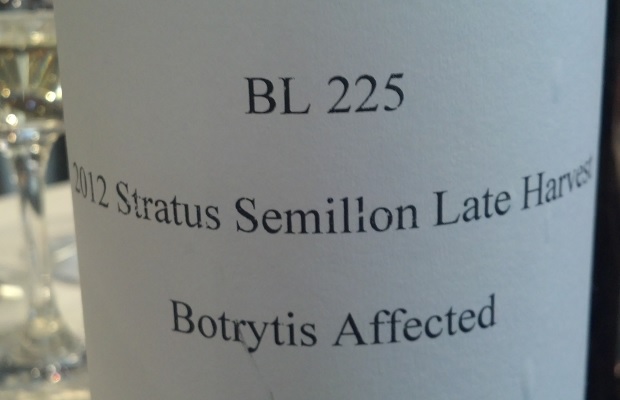
Botrytis Affected Sémillon Late Harvest 2012, Niagara On The Lake, Ontario
Tasted blind this non-clarified sticky is high on grapefruit for sure, smells (for a fleeting moment) a bit like cat pee, is decidedly smoky and once again, is grapefruit all in. Stony sauternes, Niagara style. This can be used to great advantage. With 70 plus g/L of residual sugar and 7.9 of total acidity the sugar-acid continuum is expertly lucky. The grapes were picked on December 14th, causing another exclamation of WTF? Really delicious. Really.
Botrytis Affected Sémillon Late Harvest 2012
Following the single-varietal tasting, Momofuku Daisho rolled out eight signature dishes.
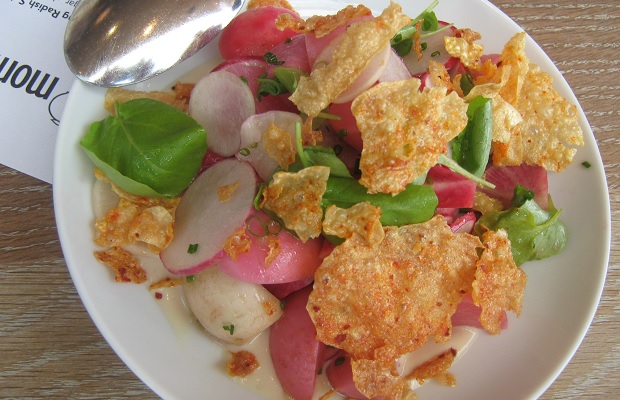
Spring Radish Salad, sherry vinegar, chive, crispy yuba
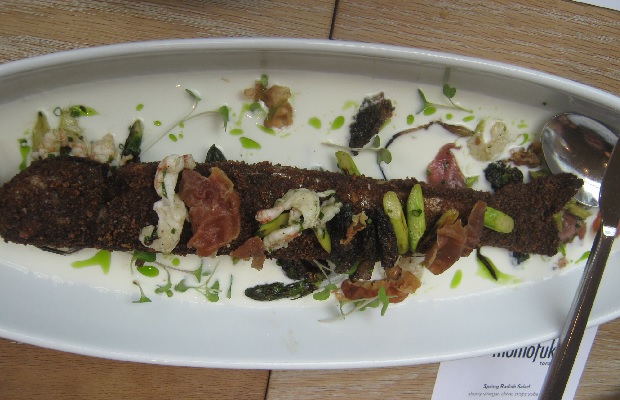
Snap Pea Salad, horseradish, jowl bacon, lily bulbs
Stratus White 2010, VQA Niagara On The Lake, Niagara Peninsula, Ontario, (660704, $44.00, WineAlign)
From my September 2013 note: “Sends me immediately towards Bordeaux, in neo-marmalade, but also buoyed in perfume and body by 25 percent Viognier. “This variety worked so well in the vineyard in 2010,” notes Groux. Niagara honey and near-botrytis via Semillon and Sauvignon Blanc void of grass, full of vigor. A sharp note, neither metallic nor mineral, but a combination of the two is present in this so very concentrated ’10. Of a warm vintage (self-explanatory) fully picked by October 23. Though loaded with early Spring maple sap, foie gras and appley terpines, its sharp and framed by “tannic” tang and protracted length.” Last tasted May 2014
Stratus Red 2010, VQA Niagara On The Lake, Niagara Peninsula, Ontario, (131037, $44.00, WineAlign)
Tasted again, I do declare this to be the reigning bomb of Ontario red blends. Showing even better than I judged it two weeks ago. Intense ruby meets claret in every facet of its make-up. Rouge tomate, fresh and racy at the same time, with just enough chalk to lengthen the chain. You can actually imagine the hum in the clang and rhythm of its magic. Fleet of foot, mac-nanimously rendered red blend. “Chain keep us together, running in the shadow.” From my earlier note: “A study in restrained, gilt-edged use of only 15 per cent new oak during assemblage, especially with Cabernet Sauvignon in the lead and so prudent considering the extreme warmth of the vintage. Cabernet Franc imparts simple but intense spice. Red talented, fresh finesse, the oak in support as a James Dean, cherry stained leather jacket. De facto fresh, with just enough trenchant acidity.” Last tasted May 2014
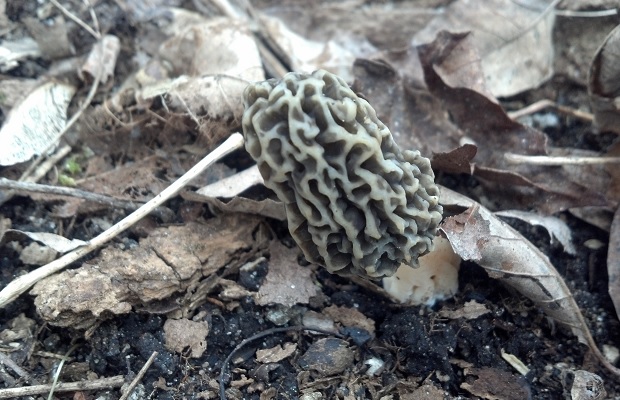
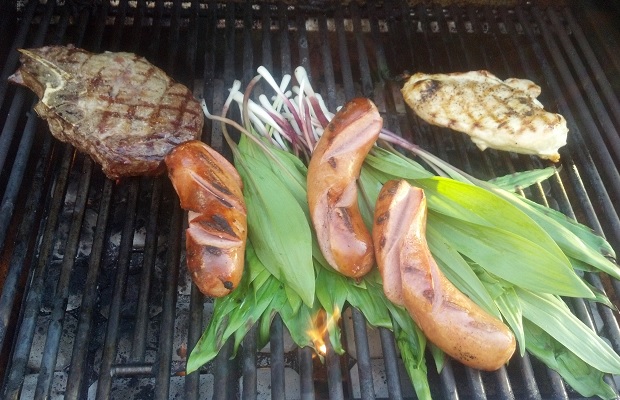
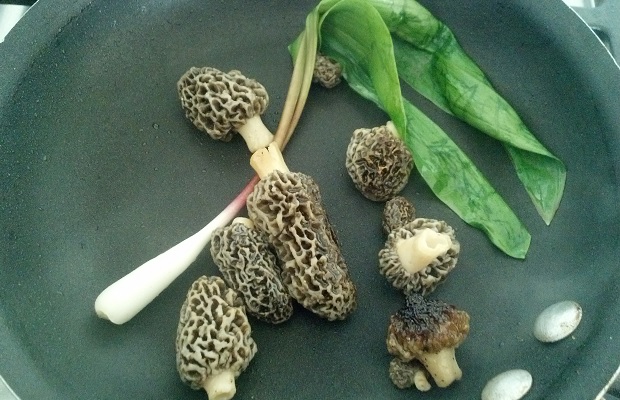
These are some of my favourite things. Wild edibles foraged from the duff in spring. Earthy red wines cultivated from healthy vines. Protein grilled on an open flame. Layered dishes baked in the oven. Baseball.
Gather them all together, add in some warm weather and the recipe is dressed for success. This past weekend VINTAGES rolled out the May 24, 2014 release. I touched on some good value whites last week so now it’s time to roll out some full-bodied, protein friendly reds. Get these four red hots in stores now.
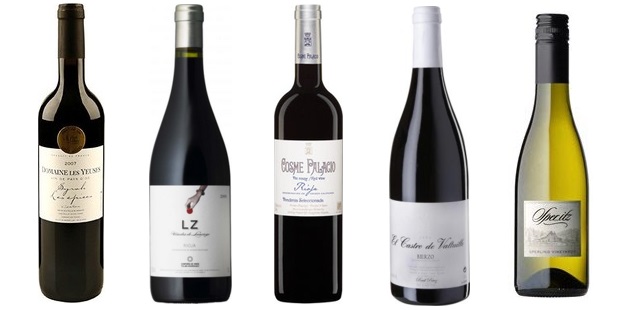
From left to right: Domaine Les Yeuses Les Épices Syrah 2011, Telmo Rodriguez Lz 2012, Cosme Palacio Y Hermanos Reserva 2007, Castro Ventosa El Castro De Valtuille 2010, Sperling Vineyards Sper…Itz 2011
Domaine Les Yeuses Les Épices Syrah 2011, Igp Pays D’oc, Languedoc-Roussillon, France (177584, $14.95, WineAlign)
This perfectly tidy Syrah hails from the area near Mèze in the Languedoc region. The name borrows from a species of oak, the holly, the holm, or the evergreen. Dusty aromas blow quickly away into the savoury foliage of the Yeuse. What is then revealed is a rich, velvety Syrah of considerable stuffing, with a note of semi-sweet chocolate, smoky bacon and plenty of tang. Repeats the value shared by both the 2010 and the 2009. Make this your summer house red, when times are hot, when times are cool. Tasted May 2014
This is the most basic and affordable red in the Telmo Rodríguez line. From the outspoken winemaker who said, “In Canada you have been drinking the worst Riojas, the undrinkable Riojas.” So Rodríguez has decided to make wines without the suffocating slings and arrows of outrageous, appellative fortune. Notice this label notes no Crianza, no Reserva, no Gran Reserva. Fresh and juicy, with new history and tradition written in its code. Modern and forward while relaxed and old school at the same time. Great fruit and acidity, length is just fine and overall it’s a pleasurable, confident, compact wine and without crisis. Tasted May 2014 @liffordwine
A traffic jam of thick, rich and figgy fruit, accompanied by a tempering of chocolate. This Rioja is “good ole fashion medicated goo.” Though somewhat simple juice it bangs the right keys and solicits a stretched and bent weeping guitar accent. Dark as night with the stuffing to carry an album side. “So follow me, it’s good for you.” Tasted May 2014 @Hannanealwines
Castro Ventosa El Castro De Valtuille 2010, Do Bierzo, Spain (366930, $27.95, WineAlign)
Owning a family-run estate for 252 years and farming Mencía vineyards in Bierzo from generation to generation has to count for something. Five parcels are gathered from pre-phyloxeric vineyards in Valtuille de Abajo. The estate manages the only sandy soils in Bierzo, mixed in with quartzite and slate. A solid Mencía, high on phenolic ripeness, verdigris and general stuffing. Rich, chewy, tarry and viscous. Can see this slowly smouldering, smoking, offering wamth and pleasure for 10-15 years. In that sense of longevity it represents excellent value. Tasted May 2014 @HalpernWine
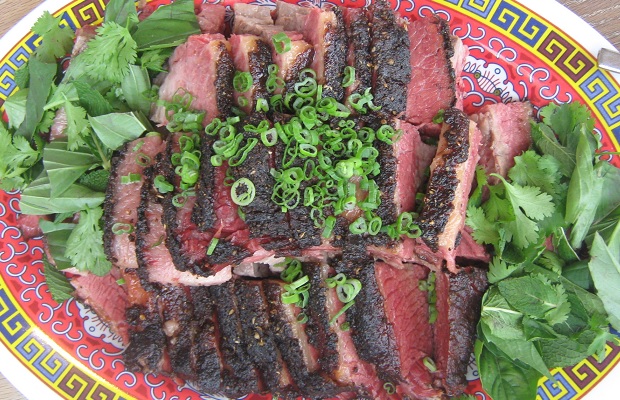
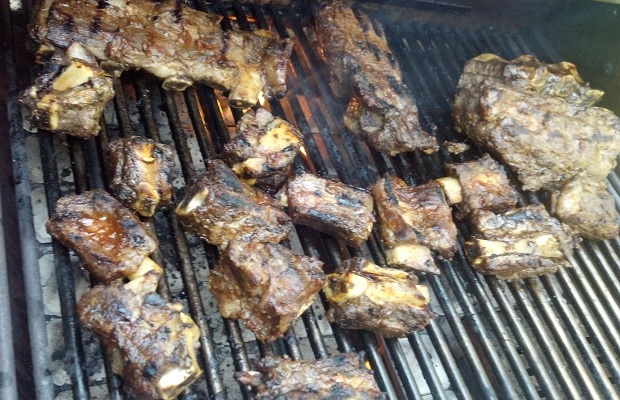
Beef Ribs
Sperling Vineyards Sper…Itz 2011, Okanagan Valley, British Columbia, Canada (364166, 375ml, $13.00, WineAlign)
A very pretty, quite sweet though not overly spritzy Moscato, with nary a waxy or medicinal note. Not exactly true to old world form but what a terrific palate cleanser it makes, like a lemon-lime granita or white pomegranate gelato. The half-bottle format for a big group will work just fine as just a thimbleful is all that’s needed before main course to liven up the palate and ready it for flesh and blood. On the card at Barque. Tasted twice, November 2013 and May 2014
So you make wine from Ontario-grown grapes and it fails VQA inspection. The economic impact is potentially crippling. Here’s the short story. The sale of an Ontario VQA-certified bottle of wine sends approximately 15-20 per cent of the profit to the province. Without the stamp the tax cost is upwards of 50. There is no money to be made if your wine has not been blessed by VQA. Here is the long version:
The total Landed Cost (what the winery keeps) is calculated based on this:
Basic Price (retail price)
minus Environmental Tax fee (same for VQA and non-VQA)
minus Bottle Tax/Levy (same for VQA and non-VQA)
minus LCBO Wine Levy (applied to non-VQA only, yet minimal – $1.15 for $26btl)
minus LCBO mark-up (which is completely different between VQA and non-VQA – $0 for VQA, $8.5039 for a non-VQA wine based on a $26)
For a $25.20 ($25 + bottle deposit) bottle of wine, this is what the winery (Total Landed Cost in VQA language) keeps:
VQA retail: $20.56
VQA licensee: $20.56
non-VQA licensee: $12.44
These numbers come from a calculator, designed by VQA and the LCBO themselves that gives you the breakdown, once you enter the retail price.
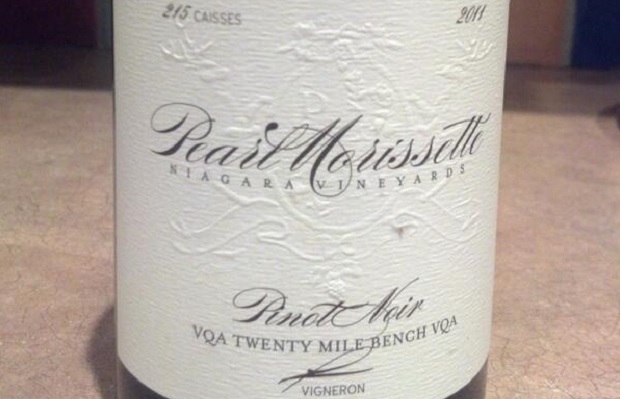
François Morissette has that crazed look in his eye. The Quebec native faces the professional fight of his young winemaking life and has no intention of backing down. There will be no compromise of the viniculture oeuvre. Morissette’s day in, day out plight has been instigated by the Vintners Quality Alliance (VQA), the regulatory board that determines whether or not a wine made in Ontario gets its stamp of approval. It has already happened four times. VQA has rejected his Rieslings.
The pearl Morissette Cuvée Blackball Riesling 2011 is a $26 (retail price including bottle deposit) non-VQA bottle of wine and so the winery’s profit (before operating and production costs) is $12.98. Do the math. Sounds like a loss leader to me.
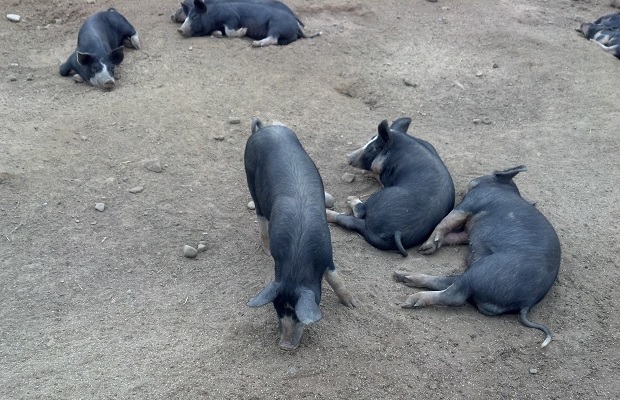
Pearl Morissette pigs
Morissette makes the wines at Pearl Morissette out of the Twenty Mile Bench in Jordan, Ontario. He’s opinionated and sometimes just plain pissed off. There are those who surely consider him a rogue, a dissident and an SD but at the end of the day, just how is he so different from his Niagara brethren and sistren? He is a farmer and a purveyor of fermented grapes. Granted his methods are progressive and experimental but the goal is the same as any honest and passionate winemaker. François Morissette wants to make memorable wine. Last July François Morissette told me “it’s not that we don’t want to make natural wines. We want to make wines with the least amount of impact.”
Talking about being different and distinct and staying the course – for a reason. pic.twitter.com/wxsYiwGVry
— Pearl Morissette (@PearlMorissette) May 23, 2014
In July of 2013 at the i4CCool Chardonnay Conference in Niagara, Francois expounded on some of the more important facets of making wine in Ontario. “Climate is the number one terroir driven aspect. The clone is nothing without the rootstock. They are inextricably linked.” He is a man who believes wholeheartedly in natural acidity. “You will have riper fruit on dry matter.” These are the ideas of a “rebel,” of a winemaker willing and ready to push the envelope. “I cannot ever apply what I learned in Burgundy as a farmer to Niagara. It’s a totally different animal.” These are the words of “pot-stirrer” Francois Morissette.
Foudre at Pearl Morissette
Today, Monday, May 26th, François and his girl Friday Svetlana Atcheva will once again go before the powers that be at VQA. In their meeting with Executive Director Laurie Macdonald they will argue that their four-time rejected Riesling is bio-chemically sound, that it is a wine with no technical faults. The question of penalizing innovation will be raised, albeit in the spirit of cooperation. They will assert that the level of residual sugar (which the VQA panel seems to feel is “atypically” too low) and perceived sense of dryness must not be the focus. Morissette and Atcheva will explain to the panel that their Riesling is not oxidized but that the use of wood foudres (in addition to typically employed stainless steel tanks) allows for a gentle yet natural, controlled oxygen transfer. Ms. Macdonald will be asked the question on everyone’s mind. “How can an organization that reigns over such a young wine region be so sure what is correct and what is not?” What they should really say is “who are you to play God with wine?”
The sensory evaluation panel and decision makers maintain the necessity that “VQA wine grapes meet standards such as minimum ripeness levels (degrees brix) attained through careful viticultural practices.” This statement suggests that the Pearl Morissette Riesling fails to meet the criteria laid out by the decided governance. Does the system not sound like it is seeking conformity in the name of typicity? I spoke with Atcheva last Monday at the Generation Riesling tasting and she adamantly refutes the VQA position on Pearl Morissette’s wines. Skin ripeness, not sugar levels, indigenous yeasts, minimal interventionist winemaking and most of all quality should be the determining factors to passing their Ontario wine to VQA status. François just wants to be free to sell his wines to whoever he pleases without being shackled to taxes and bureaucracy. “My preference would be for 1,000 people to buy one bottle. But that takes time.”
Atcheva spoke at length this past weekend with a senior LCBO product consultant who elaborated on the selection process for the VQA panel. Up until a few years ago panel members were chosen based on their tasting experience. Today seniority lands spots on the tribunal. Work an LCBO cash for fifteen years and you too can decide the financial future of an Ontario winery.
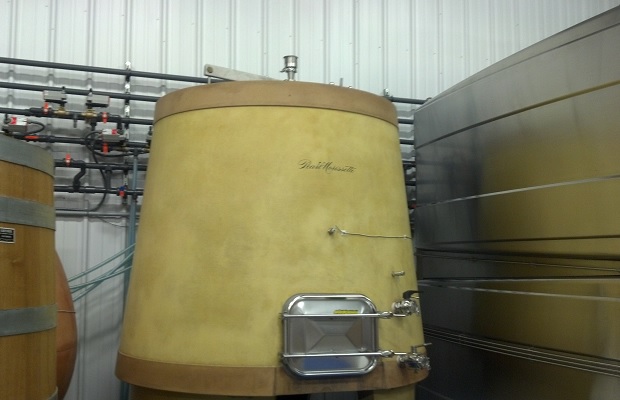
Conrete Egg Fermenter
For a full account on VQA evaluation processes and the rejection of Morissette’s wines, read Rick VanSickle’s article, The ‘black-balled’ Riesling from Pearl Morissette in Niagara and the storm that’s brewing over VQA rejection: Let’s talk about it. Another response by Tim Reed Manessy brings the VQA system’s shortcomings into proper focus. Behind the ‘Black Ball’ is Manessy’s take on his blog, Somm on the Run.
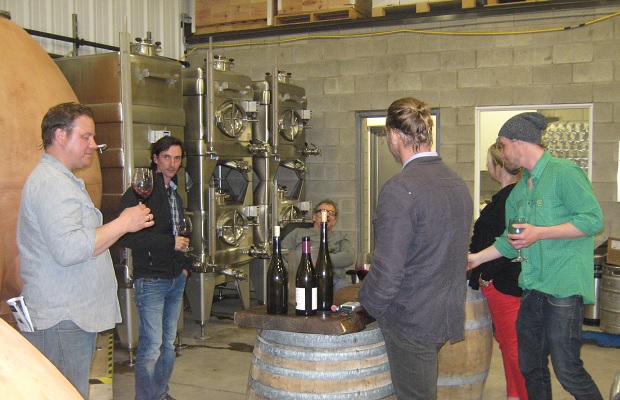
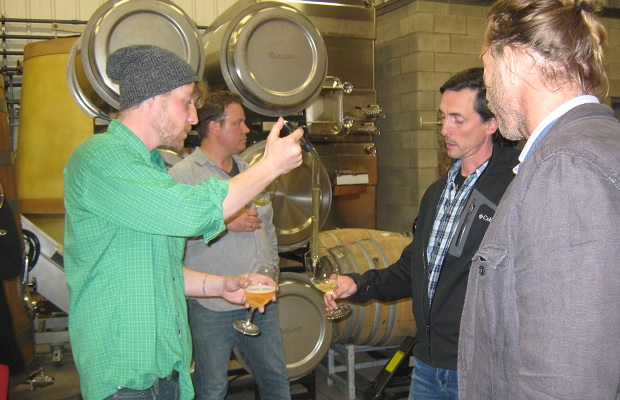
Hinterland’s Jonas Newman, François Morissette, Montreal Gazette and Chacun Son Vin’s Bill Zacharkiw, WineAlign’s John Szabo M.S. , Wine Country Ontario’s Magdalena Kaiser Smit and Assistant Winemaker Ryan Corrigan tasting Cabernet Franc
Through the generosity of François Morissette, Naomi Laurie, Ryan Corrigan, Cameron MacDonald and Svetlana Atcheva I have had the opportunity to taste, consider and assess the wines of Pearl Morissette out of tank, barrel, concrete egg fermenter and bottle on several occasions in the past year. Here are my notes on many of those moments.
This introduction to the experimental oeuvre of François Morissette holds attention and water. The delve into texture shaping by way of progressive malolactic fermentation during primary fermentation is a stirring exercise in character building. The ’10 is a conjoined cuvée of two, one of which contained 20% botrytis affected grapes. It spent eight months on fine lees in stainless steel and finished so very dry, at 1.27 g/L residual sugar. Biochemically correct, reeking and bleeding of the Peninsula’s veins, Blackball was submitted for VQA approval four times and rejected because it “lacked varietal typicity.” Perhaps it was the lack of human intervention, the anti-Bonzai approach, that doomed this diffident Riesling. Perhaps the texture should take it on the cheek for its brilliant disguise, for changing the subject and forcing the taster to open their mind and act innocent for a moment in time. The Blackball has that effect. Sadly, it too will be typical one day. Tasted July 2013
The 2011 Cuvée Blackball picks up where the ’10 left off. When tasted from a stainless steel, not yet labeled sample in bottle back in July of 2013 it showed high acidity and citrus but also a bottle-shock musky note. Nearly one year later the wine has fleshed into that sought after experimental texture, as if it were aged in foudres. It’s flexibility was encouraged by three months of aging on its fine lees. The ’11 is the jumping off point and the bridge towards understanding where the Riesling program is heading. Others will follow. “There’s no real reference for these wines,” admits Morissette and that’s the clue to understanding why haste judgments are passed. Fear of the unknown empowers tradition to stagnate and end up getting left behind.Tasted July 2013 and May 2014
The craving for texture led François Morissette to employ small barrels to ferment a small (68 case) amount of 2011 Riesling, in this instance eight year-old neutral barriques. Close-minded, new world wine geeks might fear anarchy but ask any winemaker from Pfalz and they would say, “tell me something new.” The succor is so benign and simultaneously, subtly huge. The increased lees contact on small volumes of wine promotes corpulence and viscidity. The methodology results in more fruit presence; in pear and yellow plum, not to mention that unmistakable Niagara citrus. This ’11 has the most levels of expression. There is nothing revelatory or regulatory about it, beyond the fact that it works and that it would stand out as an excellent example in a flight of Trocken Riesling. The ’11 exemplifies the flesh versus acid continuum. The freshness of this Riesling has emerged, thanks to meticulous sorting, ne0-liberal winemaking and the use of a -1°C fridge. François Morissette does not like to race against time. His Riesling speaks volumes about that. Tasted July 2013 and May 2014
When tasted in July of 2013 the ’12 Barrique had only been in bottle for three days so the musk was quite front and centre. Aged in foudres (neutral, old wood casks) it held much latitude at such a young age with notes of herbiage (mint, tarragon), nary a drop of residual sugar and a wholly unique type of dry acidity. “It will not always show this way,” commented Morissette. Tasted 10 months later I can say this. The ’12 Riesling Barrique avoids excessive malic and tartaric acid, not to mention any amount of volatile acidity. It is viable, vital and technically sound. “This is a wine that will take time,” pleads François . “I care about texture, not about varietal character.” Though perplexing and untamed, the wine has undeniable body and that noble bitterness in its unsung tang. It is the anti-Riesling hero, full of experiential conceit and needs to be revisited often, to see where it will go. Tasted July 2013 and May 2014
Stylistically speaking, the bottles (and kegs) that emerged from the 225L hemorrhaging of Cabernet Franc from both oak and concrete vessels have no reference point. In fact, the advertence is one created by Francois Morissette. The flexible disposition is difficult to pinpoint and without trying to sound blowsy in assessment, this goes places yet visited by bone-dry Rosé. If it were the only wine made on premises the barn doors would always be banged upon. A most current wine, exigently red and almost indiscernible as Cabernet Franc. It suffers no stenosis and does not live a single green day. Another VQA rejected wine, the LPR walks down a boulevard of broken dreams and it sings, “I walk a lonely road, the only one that I have ever known.” Last tasted November 2013
With utmost integrity Pearl Morissette chose not to vinify Pinot Noir from the fruit of the 2008, 2009 and 2010 vintages due to unacceptable levels of sour rot. With the 2011 harvest came inspiration. It was noted that local tree fruit farmers make use of the practice of storing their harvested fruit at 1° Celsius in a large refrigerator. This pseudo-cryogenic cooling practicum worked to halt the progression of the dreaded rot. Buying time allowed the crew to clean sort without having to worry about a single berry contaminating the lot. So what? So a pure, clean Pinot Noir was the result. Tasted four months after bottling, the modest (12.7 per cent alcohol) and vinified so dry (2 g/L residual sugar) ’11 held barking fruit on a tight leash and a moonscape of dusty, grainy tannin. Nine months later (to the day) the sensory evolution became as if cherries, strawberries and the tension in seeking ripe perfection were wine. Tasted July 2013 and April 2014
François Morissette’s 2010 is a pioneering example towards defining Bench appellation Cabernet Franc isomeric reactions. Relationships between grapes of a growing area and their ultimate destination in bottle. An affair of veraison, leaf drop, frost, hand harvesting, whole cluster sorting and berry oak fermenting. Indigenous yeast, punch downs and overs for phenolic skin extraction and polymerization. Neutral oak and sulfur dioxide to provide antimicrobial and antioxidant protection. An eighteen month somniac’s rest, fine lees and no filtration. The structural arrangement in cohabitation of radicals and ions leads to such a Cabernet Franc. Fully expressive of an endemic, very ripe, vegetal varietal vicissitude that is both inbred and necessary. Currants and peppered berries of power and grit. Dry (2 g/L residual sugar), plump (13.7 per cent alcohol) and scarce (618 cases made). Reflective of the warm 2010 vintage and will always act in stark contrast to the elegant 2011. Tasted July 2013 and March 2014
19th Street Cabernet Franc 2011, VQA Twenty Mile Bench, Niagara Peninsula, Ontario (winery, $38, WineAlign)
First tasted from a barrel sample in July 2013. “From what is turning out to be a very elegant vintage, the 2011 Cabernet Franc is early proof that on the Twenty Mile Bench “we can turn a vineyard very quickly, in three years we can turn a vine.” This is significant in consideration that in Europe, vine age is always key.” Now in bottle the aromatics are hyper-pronounced and though the tannins are less rigid, less exerting and less demanding, they are not nearly ready to throw in the towel. Longevity will define ’11 and it will be the genesis of Pearl Morissette’s CF program used to compare future vintages. “The day of judgement’s come,” and you can bet that the wine’s been “resting, for this testing, digesting every word the experts say.” With the ambient transition of a hairless heart, the 2011 Cabernet Franc segues from anxiety to counting out time. Tasted May 2014
Was the ’09 DN this lush and so pretty last summer? Was it bronzing as if sun-kissed and so delicate? Tasted alongside Chef Cameron MacDonald’s White Bean Cassoulet, duck and pork neck wrapped pate it sings in a Lindley-esque falsetto. From my earlier, July 2013 note: “Tragically singular in expression, regardless and in spite of the terroir, mixes metaphors and pulls it off. “Takes arms against a sea of troubles,” by convincing ADHD fruit of an uncertain vintage to settle, play nice and “by opposing, end them.” Now entering the load out zone, this Hamlet cuvée is “the first to come and the last to leave, working for that minimum wage.” A sentimental ballad here to stay, be remembered and to set the stage for all dix-neuvième to come.” Last tasted May 2014
Having had the opportunity to taste the 2010 Cuvée Dix Neuvieme on several occasions over the past 10 months, every layer and fibre of its being has ingratiated itself to me. The tropical, solar 2010 vintage required that steps were taken to preserve freshness for when the final blend was to be assembled. A small portion of the juice was fermented separately in stainless steel tank and then injected into the 18-month, neutral barrel mass. The ’10 is full of verve, rigor and grinning elegance. It speaks of a salinity so typical for PM Chardonnay which comes from the usage of lees. This is what could be referred to as a “tannic” white. While it lacks the intensity of the bookending vintages on either side, as a middle sibling it is the glue and the rock that speaks diplomatically and most eloquently for the family. Last tasted May 2014
A child of a hot and dry summer, a stress-free winter slumber and a non-invasive spring awakening. Sets out lean, tight and mean, but the dry extract invites spicy, stone fruit and an emergence of tropical lushness. Can there be another specimen that so rightfully defines Pearl Morissette, the top of the Bench or Niagara as a whole in 2011? Tasted July 2013
Barrel and Tank Samples tasted July 2013 and May 2014
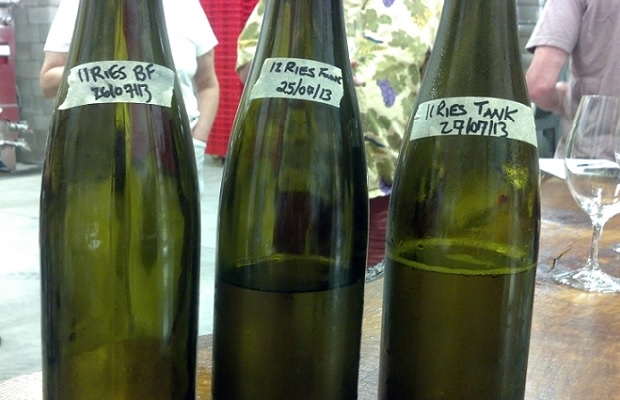
19th Street Cabernet Franc 2012
Tasted in July 2013 from one of two barrels, it’s not so (amazingly reductive) and redolent of the most earthly currants. From a very immense year, in primary quality, barely evolved. Blessed with such ripe tannins this will have even bigger structure. Francois declares “I’m now a believer that Cabernet Franc is the most important grape to grow in Ontario (on this side of St. Catherines). Nine months later, with the wine still sitting on its primary lees and not yet racked “it’s so torqued,” notes John Szabo. “We made a monster CF without cream,” adds François . Pure, énorme, immovable yet so stable. There was a nearly volatile spike during fermentation and malo but it’s done. A death metal beast. Tasted July 2013 and May 2014
19th Street Cabernet Franc 2013
From juice housed in concrete, wood and open top fermenters this occupies impossible Cabernet Franc colour territory. Sweaty, chalky and bloody, it’s a bit reductive in extract and intensity. Lifted florally and very savoury, this is quintessentially Cabernet Franc in character. Crunchy tannins come late in magnanimous fashion. Tasted May 2014
Chardonnay 2013
Tighter than it looks, sitting on its lees, pushing the envelope. In a German 2,500L barrel it’s rounder and softer. In second fill Alsatian Foudre it gains tang, spirit and backbone. From the Koscis Vineyard’s heavy red clay there is less texture and mid-palate. Out of a smaller (228L) barrel the wood is felt in fluidity, structure and creamier, clearer fruit. The largest barrel adds (10 per cent) new oak and finishes the ferment the earliest. It brings textural tack and a chewy finish. “New oak doesn’t make it better. It energizes the wine,” says Morissette. Overall this will be a rich, ripe-fruit based opulent Chardonnay, high in potential (13+ per cent) alcohol with a remarkable sweetness despite little or no residual sugar. Tasted May 2014
Chardonnay from barrel with Ryan Corrigan, Jonas Newman, Francois Morissette and John Szabo
Rosé 2013
If this Cabernet Franc is flirting with an acetic danger it is not enough to scare me away. Certainly edgy and there is a chance it may be pushed to the fringe, hippest markets but that also may just be a necessity if it is once again rejected as VQA. And it should not be. Tasted May 2014
Bill Zacharkiw making notes at Pearl Morissette
Gamay 2013
In July 2013 Francois Morissette made this statement. “If we can’t make Gamay in a Cru Beaujolais Style, I’m not interested.” In May 2014 his ’13 Gamay causes Bill Zacharkiw to comment with blatant honesty, “just line up at the tank. Forget the bottle.” From 100 per cent whole clusters sent to cement fermenters. Once again the hue is just impossible. Sulphur-free, this walks a fine and perfect line of Cru banana Gamay. Pushes the Gamay envelope in that it’s gulpable but with a duress to remind you not to overdo it. A Gamay with a chamber of 32 doors. In it “I’d rather trust a man who doesn’t shout what he’s found.” François Morissette. Tasted May 2014
More often than not the Canadian May long weekend does not fall on the anniversary date of May 24, in remembrance of the 1819 birthday of Queen Victoria. In fact the last time the holiday Monday fell on the 24th was back in 2010. The not so phenomenal phenomenon happens every five or six years and the 24th never occurs before the Monday. So what? So, VINTAGES gets it right. The latest stop on the release calendar axis falls on the true May two-four, this coming Saturday.
The May 24, 2014 release puts a heavy emphasis on the southern Rhône, a region that regrettably has lost its balanced way; to heat, extraction, high alcohol and sugar. Sure that may sound like an agglomerated generalization but it is not just the bulk of the 15 plus reds on this release that are guilty as charged. The issue is endemic and has been rising with impunity since the 2007 vintage, arguably even before. What was once a Rhône induced infatuation has rusted and faded away. Cellar stockpiling of once beloved Vacqueyras, Gigondas and Châteauneuf-du-Pape has grounded to a halt. How can the love supreme return?
There are diamonds in every rough and it is through relentless tasting that the wheat rises, the chaff settles and recommendations make themselves known. I am including a couple of reviews on wines weighed down by the encumbrance of over-ripeness and alcohol, if only to back up the rant and the theory. Where have all the good Rhônes gone? My guess is that it’s time to cross the sea and pay a visit, to find the producers who pick early, resist oak-bullying temptation and make honest, balanced wines. I know they’re out there.
So behold the Rhônes, some good, some not so much and other necessary May two-four whites to seek out this weekend.
From left to right: Beauvignac Picpoul De Pinet 2013, La Joya Viognier Reserve 2013, Calamus Riesling 2012, Vineland Estates Chardonnay Musqué 2011, Château Saint Estève Massif D’uchaux 2010
Beauvignac Picpoul De Pinet 2013, Ac Coteaux De Languedoc, Sud De France, (350124, $13.95, WineAlign)
Capital, principled and tidy, tide-in Picpoul. Like Touraine meets Melon de Bourgogne with a bit of shell and a touch of green. Steamed ocean whitefish and fresh herbs meets raw bar. Begs for a Camaron Taco or Camarones en Salsa Verde. Would pair well on a soft beach with a traditional Oaxacan seafood spread. Tasted May 2014
La Joya Viognier Reserve 2013, Colchagua Valley, Chile (168542, $14.95, WineAlign)
Personal preferences aside, here is the right kind of value in other world Viognier. I much admire the restraint, keeping the alcohol and the residual at mostly acceptable levels, allowing what rocks there are in the Colchagua terroir to speak along with bright fruit. A heavy soil accent comes by way of tang and lift, it’s floral as needed and walks a line of good length. Well done. Tasted May 2014
It is never wise to hide from the vintage and winemaker Arthur Harder is careful to work with the given lot. This ’12 is no doubt warm but the juicy acidity trumps any humidity that might want to creep in and set up shop. The profile here is more Germanic, more Trocken than was seen in the 2011. The winemaker’s history with Nahe, Rüdesheim and Geisenheim speaks in this vintage. Continues the Calamus roll of offering really good value and impresses the notion that you can take a Riesling out of the Vinemount Ridge but you can’t take the Vinemount Ridge out of the Riesling. Tasted May 2014 @calamuswinery
A highly aromatic Musqué, one step up from its Escarpment brethren, with more viscosity and density. Mathematically calculated for the demurred vintage with conscientious risk. Crispy and crunchy, with a touch a waxy fruit, like biting into a buffed and polished green apple. Tasted May 2014 @VinelandEstates @BenchWineGuy
Château Saint Estève Massif D’uchaux 2010, Côtes Du Rhône Villages, Rhône, France (370189, $18.95, WineAlign)
Casting aside initial hot and bothered, massive attacks of baked cherry pie and predictable extraction disabling thoughts, this caresses with a really soft mouthfeel. Work with its phenolic ripe charm and let it build with meaty notes and finish smothered in a Bovril gravy textured by chalk and grain. Ultimately it’s quite sophisticated for the appellation and a more than commendably good effort. Tasted May 2014 @chsaintesteve@ProfileWineGrp
From left to right: Domaine Martin Plan De Dieu Côtes Du Rhône Villages 2011, Gabriel Meffre Sainte Catherine Gigondas 2011, La Crau De Ma Mère Châteauneuf Du Pape 2011, Bosquet Des Papes Cuvée Tradition Châteauneuf Du Pape 2011, Lamiable Brut Grand Cru Champagne
Domaine Martin Plan De Dieu Côtes Du Rhône Villages 2011, Unfiltered, Ac, Rhône, France (370197, $19.95, WineAlign)
Here presents a Côtes Du Rhône acting the epitome of elegance lost. A wasteland lays forth in charred sinew, vineyard stink, buff, scorched earth, funk, baked shriveled berries, toughness and grit. That said it is possessive of flavours, endearing or not, that last. Like a funky, highly seasoned sweetmeat-flavoured gobstopper dissolving in highly tannic tea. Might be your thing. Tasted May 2014
Gabriel Meffre Sainte Catherine Gigondas 2011, Ap, Rhône, France (370270, $29.95, WineAlign)
From a vintage that just can’t seem to hide from itself, this is typically, egregia cum laude commonly rich, extracted and juicy but it’s also got angst and verve. The 2011 Châteauneuf-du-Pape to a wine are categorically, excruciatingly huge and this is why such a Gigondas is a breath of fresh, alternative air. A molten raspberry ooze paints a boulder-strewn Vaucluse crush of good Rhône things. Solid as a rock. Tasted May 2014 @GabrielMeffre@DiamondEstates
La Crau De Ma Mère Châteauneuf Du Pape 2011, Ac, Rhône, France (941740, $49.95, WineAlign)
This wine has been referred to as a “Provençal fruit bomb” and a red with “tannins enrobed in the finest chocolate.” Those compliments are as kind as any that should be given. As expected and to stereotype 2011 Châteauneuf Du Pape, this is a blind faith traffic jam of hyper-ripe, over-extracted, baked and sickly sweet liqueur. A Negroni imbalanced by the free pour of Red Vermouth from a tap. This is the kind of Rhône that needs to hear “come down off your throne and leave your body alone, somebody must change.” Wayward, wandering Grenache along with its Mourvèdre and Syrah apostles who are wasted and can’t find their way home. Tasted May 2014
Bosquet Des Papes Cuvée Tradition Châteauneuf Du Pape 2011, Ac Rhône, France (726687, $50.95, WineAlign)
First off, three words for you babe: 16 per cent. One can only hope the rising tide of hot Rhône wines ends with this penultimate vintage. The licentiousness and quiver of extracted desperation is here in every grain of sugar. Smells like a candy factory in the heat of July and tastes like a fruit roll up mired in pectin quicksand. Big, big wine. So baked, so hot, so rich, so sweet. When did Bosquet Des Papes become the Belle Glos of the Rhône? Tasted May 2014
Lamiable Brut Grand Cru Champagne, Ac, Champagne, France (374298, $53.95, WineAlign)
A $54 Grand Cru you say? Can it be? A most minor radian, de facto bruised apple, oxidized moment is quickly pardoned because this Champagne is really pushing boundaries. The verve, tang and 120 degree plus angles are simply sparkling. The white fig, sour peach, apricot and bitter almond aromas exceptional and tied together by the pith of all. Has that necessary mineral patina and wet stones, the platinum sting and the toast of nuts and bolts. Length is on top, not hiding below. Tasted May 2014 @LAMIABLE
One Moment, One Bourgogne Wine…www.bourgogne-wines.com
I would never turn down an invitation to taste des Grands Crus de Bourgogne. I would not hesitate to partake in a free for all of Premiers Crus. If the call came to experience the village heart and the regional soul of Burgundy’s Appellation wines, I would run, not walk to the show.
Bourgognes
So, that’s what I did. At the gracious invitation of The Siren Group and Sopexa Canada Ltée I attended the One Bourgogne Wine event at Hôtel Le Germain, along with François Labet, Burgundy viticulture pioneer and chairman of the Bourgogne Wine Board (BIVB) and Communication Commission. Mr. Labet expounded on terroir; from climats to lieux-dits. Burgundy is a geographical and geological landscape of Jurassic age and proportion. Its heritage is ancestral and has been shaped by twenty centuries of activity. The appellation d’origine contrôlée (AOC) acts as its guarantor of quality, of terroir, production methods and what typifies the most famous Chardonnay and Pinot Noir anywhere on the planet.
Master Sommelier John Szabo of WineAlign presents 15 wines from Burgundy at Toronto’s Hôtel Le Germain Victor Restaurant on April 8, 2014
The Bourgogne event was presented and moderated by Master Sommelier and WineAlign principal critic John Szabo. At the heart of the presentation was the regional diversity that defines real and affordable Burgundy. Mr. Szabo’s chosen wines delved deeper into the soul of the village and regional appellations beyond the Côte de Nuits and the most iconic parts of the Côte de Beaune. Textbook examples from Chablis to the Côte Chalonnaise and the Mâconnais were chosen to offer a true representation of the immensity that is the region.
Bourgogne Menu, Victor Restaurant
The lunch that followed by way of Hôtel Le Germain’s Victor Restaurant was a reconnect for me and the cuisine of Chef David Chrystian. I first encountered chef’s raw and rooted flavours when he assuaged the Garlands at Café Societa on College Street. I remember with fond confusion his earthly layering foiled by the sterile mall, futuristic canvas of the Colonnade (Patriot). After Chef Anthony Rose left the Drake it was dead to me so mistakenly missed Chrystian’s lauded stint. Thanks to the Siren Group for luring me to Victor to reconnect with Chef David Chrystian once again.
Chef David Chrystian’s Sushi Pizza
Here are notes on the 15 wines poured and discussed at One moment, one Bourgogne wine.
Domaine Gautheron Chablis 2012, Burgundy, France (207902, $24.95, WineAlign) From the VINTAGES February 15, 2014 release
Canonical Chablis by the hands of independents. Family farmed and fruit fastidiously judged in timely picking and traditional vinification methods. Produced in allegiance to regional typicity, its nose is pierced by limestone’s necessary metallic tang. Apple tart yet ripe and balanced by plumbic weight. Proper, enjoy it all summer long, Chablis. @ProfileWineGrp
La Chablisienne Montmains Chablis 1er Cru 2010, Ac, Burgundy, France (265090, $28.95, WineAlign) From the VINTAGES November 23, 2013 release
La Chablisienne alone represents nearly 25 per cent of the region’s plantings. The orchard’s juicy fruit brings expression to this Chablis though it’s more savoury than many and it’s document is read in an angular accent. That and patina transposing into aroma, like the smell of a wet, platinum pipe breaching the fruit’s ability to flesh out. Lubricant at the pipe’s elbow and a moment of quince, even melon, offer weight. This is very good but lacks heft and only shows fossilized mineral on the back palate. Good length but a bit carbonic and needs more flesh and bone to elevate its stratus. Tasted twice, October 2013 and April 2014 @purechablis
Louis Jadot Chardonnay Bourgogne 2013, Ac, Burgundy, France (933077, $20.95, WineAlign)
Jadot’s Bourgogne Blanc is so essential it calls itself Chardonnay. From a vintage in which weather wreaked some havoc and fruit maturity was anything but consistent, the Jadot enterprise found a continued way to get it right, no small feat considering the quantity of triage required for a wine of such quantity. This entry-level white made full use of the warm summer heat, picking was clearly done in advance of the October chill and sorting found the right mix. It’s buttery, nut-browned and figuratively bubbly. The thick and rich texture is key to romancing the fruit into a riper realm than it likely really is. Commendable success from Jadot. @ljadot
Joseph Drouhin Mâcon Villages 2012, Burgundy, France (356956, $17.95, WineAlign) From the VINTAGES February 15, 2014 release
Simple, pleasant, solid and effective Chardonnay. A true and literal portrayal of the Bourgogne goût de terroir. Warm, gently expressed fruit along with requisite mineral, chalk and lime. Made of a quick resolve to satisfy, quench and move on. An open door to true Chardonnay with nothing shocking, striking or problematic. @JDrouhin
From the holdings of Chablis specialist Bernard Defaix, the domain’s variegated clay/chalk vineyards are located in the south of Côte de Beaune. The Mont-Palais vineyard comes from the Niepce family, winegrowers since the 16th century. Now managed by Hélène Jaeger-Defaix, this Rully is utterly unique to Chardonnay. There is a steely, patina Chablis quality to it, but also a concentration in magnetic aroma, whirling in an unstoppable centrifuge, not yet ready to spill those aromas forth. Screams both southern and cool climate, new world Chardonnay, in forward ways like South Africa and like Niagara on the Lake. Not to mention a silty, white salinity. Roger Wilco that. “There’s a light, what light. There’s a light, white light.” @liffordnicole
Château Vitallis Vieilles Vignes Pouilly Fuissé 2010, Burgundy, France (360495, $27.95, WineAlign)
From 45-70 year old vines, from clay and limestone (Marls). Really, really smart, succulent and mathematical Chardonnay. A stony example who’s tangent space is complexified by a vector of gritty, spiked leaden aromas, like lime, ginger and lemon zest but also by a second vector of herbiage, as in torn, sweet basil leaf. Length stretched by a scalar multiplication, engaging another consideration. Would such a fine example not benefit, at least in theory, from a Premier Cru classification? Surely the winemaker and the vintner would abide.
Château De Beauregard Vers Cras Pouilly Fuissé 2010, Burgundy, France (agent, $48.99, WineAlign)
The famous “Cras” climat on the windy and chalky plateau of Beauregard means “chalk” in the local dialect. Not surprisingly, the chalky mineral impart takes centre stage and the oak treatment fleshes the fruit out in the early stages of the wine’s life. This Pouilly Fuissé solicits attention, love and engagement. An example in clarity of débourbage, the strict sorting technique employed before pressing. Exuberant fruit acts as if it were of a higher caste, a higher Cru. This is a testament to treatment, to extreme minerality. This makes the expression. A very good vintage, ready to consider and expect it to keep on seducing to at least 2020.
Vincent Girardin Vieilles Vignes Chassagne Montrachet 2011, Burgundy, France (364141, $55.95, WineAlign)
The quality of Girardin’s Chassagne Montrachet is clear, the age and maturity of the vines explicitly noted. There is an increased sense of depth and density that clearly required attention and coaxing. The 14-month, scaled down (15 percent) new oak barrel concept pushes substance to the forefront and wood to the rear. This is rich without being fat, textured but not splintered. The stirred lees add layers to the essentia, accruing a woven tapestry of phenols, lunar-driven gravity and anaerobic activity. Tasted twice, January and April 2014 @HalpernWine
From left to right: Domaine Gautheron Chablis 2012, La Chablisienne Montmains Chablis 1er Cru 2010, Louis Jadot Chardonnay Bourgogne 2013, Joseph Drouhin Mâcon Villages 2012, Château Vitallis Vieilles Vignes Pouilly Fuissé 2010, Château De Beauregard Vers Cras Pouilly Fuissé 2010, Vincent Girardin Vieilles Vignes Chassagne Montrachet 2011
André Delorme Bourgogne Pinot Noir 2010, Burgundy, France (366427, $20.95, WineAlign)
The thought here is catholic Burgundy, entry-level, old-school, from antiquity and for the people. Smells like and tastes like grand-père’s Bourgogne Rouge. Cherry fruity, dare I say, Gamay like and marked by tannin that doubles the astringency on the drying finish. Nothing scandalous and well-plundered.
Domaine Thénard Givry 1er Cru Cellier aux Moines 2008, Burgundy, France (Agent, $32.50, WineAlign)
The Thénard family has owned land in Givry since 1760 and this Cellier aux Moines vineyard dates to 1258, named by the Cistercian Monks of the Abbey of Ferte. This is iconic 1er Cru for Givry, from relatively old vines (35-40 years) on a single plot, in mid-slope of southern exposure. Straight out notes of sinew, stem and savour. Esses all around. A vegetal and rustic infirmity comes across and travels through the wine as you work with it. Smells oddly like…hemp. Or perhaps it’s a more delectable weed than that, like rapini, or dandelion. The charred back-end scent reminds of a just extinguished joint. The flavours are dubious, maritime and of the antediluvian earth. For the brave Burgundy heart. Perhaps five to 10 years will soften its edges, peel away the foreign matter and allow a hidden fruit purity to shine.
Bouchard Père & Fils Beaune Du Chateau Rouge 2009, Burgundy, France (325142, $36.90, WineAlign)
If today is the day to splurge on red Burgundy but crossing to the dark side of the VINTAGES section is not going to happen, take comfort in this LCBO general (Signature) listing. Dictionary entry actually, but also something funky this way Beaunes. Produced from a whole whack (17 parcels) of Premier Cru, the animal is strong but decidedly feminine. Clear, precise, distinct perfume with each swirl and replayed with every sip. Like raspberries and the sweet smell of the trodden earth after the dew subsides. Could drink this for breakfast with organic bacon post morning stroll and before a dreamy nap.
Maison Roche De Bellene Beaune 1er Cru Les Grèves 2010, Burgundy, France (Agent, $46.95, WineAlign)
So very primary, this Beaune, from the work of Nicholas Potel and winemaker Matt Chittick. Some of Les Grèves vines are nearly 110 years-old and there is clear wisdom beyond the edgy, masculine fruit. Those vines are selected for selection massale, a propagation technique that breeds perpetual health and consistency of style for present and future wines. A different sort of animal resides in this one, of musk, and mineral. Like the Beaune equivalent to traditional Brunello. Yet this Beaune from a very desirable vintage is nimble, moves with quick steps and cat-like reflexes. @RochedeBellene
Albert Bichot Domaine Du Pavillon Clos Des Ursulines Pommard 2011, Burgundy, France (23820, was $49.95, now $40.75, WineAlign)
The funk in this Pommard is unflappable, modish, flirting and so elevated in stained high-acid and tone. Incredibly tight and sour upon sour. A strenuous Pinot Noir to ponder and even harder to ignore. If the tasting were to last for hours into the afternoon I could imagine a resurgence but often the old adage is true. If it isn’t there to begin with, it will never be. Would like to look ahead and say “it’s not what it was before,” but this is either lacking fruit or it’s just so far away. The texture is plush, the mouthfeel aching, breaking hearts. Mineral, astringent long finish. Tough as nails. Tasted twice, November 2013 and April 2014
AurélienVerdet Morey Saint Denis ‘En La Rue De Vergy’ 2010, Burgundy, France (353416, was $44.95, now $36.25, WineAlign) From a storied vineyard just above the very famous Clos Du Tart in the Côte de Nuits. This producer may not be a household name for its holdings in this Burgundy plot but step aside Bruno Clair, Lignier-Michelot and Pascal Marchand. Verdet can handle the terroir of Morey-St.-Denis. Was and still is an unexpected gem. Rich, textured, layered cran-raspberry and earthy flavours. Persistent though sweet and engaging tannins. From my earlier, September 2013 note. “Noses my kind of MSD aromatics. Soft vanilla, black cherry, smoke and obdurate limestone toughness. Coated in fine, tinny tannin and stretchy length, this represents big value for the appellation.” Last tasted April 2014
Daniel Rion & Fils Vieilles Vignes Nuits St Georges 2011, Burgundy, France (356600, $53.95, WineAlign) Classic and as representative as it gets for the appellation, this is firm, time-honoured Burgundy. The old vines, the earth beneath its tendrils and the medieval forest are all in the glass. Though terse and tense, this Pinot Noir will come around to fill glasses with humanistic pours 10 to 15 years down the road. That extended wait will be needed to integrate the earthiness into the formidable tannins so that the lurking red fruit can rise to the top. A fine example with a model, lengthy finish.
From left to right: André Delorme Bourgogne Pinot Noir 2010, Domaine Thénard Givry 1er Cru Cellier aux Moines 2008, Bouchard Père & Fils Beaune Du Chateau Rouge 2009, Maison Roche De Bellene Beaune 1er Cru Les Grèves 2010, Maison Roche De Bellene Beaune 1er Cru Les Grèves 2010, Aurélien Verdet Morey Saint Denis ‘En La Rue De Vergy’ 2010, Daniel Rion & Fils Vieilles Vignes Nuits St Georges 2011
Can you think of an island (leaving Australia, Tasmania and New Zealand out of the discussion) of greater interest anywhere for growing grapes and making world-class wine? Prince Edward County’s just a shade more than 1000 square kilometers, 800 kilometers of shoreline and tiny 22,000 population is that place. It’s geology and climate eerily mimics that of Burgundy. A superficial layer of limestone peppered clay loam hovers above penetrable layers of larger limestone. Fissures in that bedrock allow vines to reach deep into its crevices. It’s a veritable mineral wonderland.
More than 30 wineries dot the land and water interspersed honeycomb of a wine trail. Pinot Noir and Chardonnay are the obvious cornerstone varieties but unique Riesling, Cabernet Franc and Pinot Gris have joined the attention gaining fray. Ontario’s finest Sparkling wine is being made at Hinterland. Vintners like Rosehall Run and Keint-He Winery exemplify top to bottom consistency. They and others like Lacey Estates are involved in the yeoman’s ambassador work, in the field, at tastings or through social media. Smaller production houses like The Old Third Vineyard, Hubbs Creek and Exultet Estates are sought after by those who know.
Stanners
The County returned to the city on April 3, 2014 to showcase a cross-section of their wares at Toronto’s Berkeley Church. The usual suspects continued to impress, yet the collective needs to embrace the Sparkling example set by Jonas Newman and Vicky Samaras at Hinterland. If White Cap and Ancestral are any beacon to be drawn towards, plantings of Vidal, Riesling and Gamay should be employed in earnest in the turning towards pressure in the bottle. Lighthall’s Glen Symons gets it, as does Frédéric Picard, with his Cuvées, not to mention Bill Turnbull and his 3630 Bubbles. True, Casa Dea has the shy Dea’s Cuvée and the Grange makes a Sparkling Brut and a Riesling (346726, $24.95). But the questions begs, is fizz just another word for everything to lose in the County?
Here are notes on 23 wines tasted. The soundtrack to these PEC Wines includes Foo Fighters, Cracker, Nine Inch Nails, Modest Mouse, REM, Sufjan Stevens, The Beatles and Dire Straits.
From left to right: Casa Dea Riesling 2011, Huff Estates Winery Off Dry Riesling 2012, Harwood Estate Pinot Gris 2012, Lighthall Progression Sparkling Vidal 2012, Norman Hardie Riesling 2012, Huff Estates South Bay Vineyards Unoaked Chardonnay 2012, Karlo Estates Lake On The Mountain Riesling 2012
Casa Dea Riesling 2011, VQA Prince Edward County, Ontario (winery, $16.95, WineAlign)
Pours and perches in the glass dry and stoic, as if bled from concrete or amphora. Swirled or not this fighter begins to rumble in a growing momentum of tang and acidity, as if it were being fed by sugar and feeding on yeast. So primary, like a sample in thief, yet already circling in complexity. A spike of spicy sweetness, a delicate dressing of aglio e olio, a chiffonade of basil on top. The County does this style of dry Riesling at this price in ways no one in Niagara can. This is no foo but rather a “blessing in disguise. Believe it or not, hands on a miracle.” @casadeawinery
Note the VQA Ontario designation, meaning the fruit is a combination of PEC and Niagara. The former brings limestone to the table while the latter weight and substance. Typically soda-driven and spatially atomic in maximum thrust. Turns towards the lake with sweet emotion and sails off into the sunset. Multi-purposed, works to great summer afternoon effect, especially with the waves of the bay lapping at the shore. @HuffEstatesWine
Harwood Estate Pinot Gris 2012, VQA Prince Edward County, Ontario (Winery, $18.00, WineAlign)
Light, airy, delicate and nearly ethereal Pinot Gris that takes few chances, instead choosing an acquiescence with life’s simple pleasures. The vanilla of Gris, malleable, agreeable and ready to pair with whatever comes its way. A minor spike of Hillier minerality gives accent to pears and its blossoms.
A most non-pretentious sparkler that holds a pertinacious attitude towards anything but serious fun. From estate Vidal grapes that has seen a second fermentation using the Charmat Method, Lighthall’s ’12 picks up right where its solid ’11 left off. Picked early to preserve freshness and acidity, the Progression is big on tart green apple preserved by a squeeze of lemon. Chill it, refresh with it, serve it up and bring the house down.
Norman Hardie Riesling 2012, VQA Ontario (131169, $21.00, WineAlign)
Twenty Mile Bench in Niagara borrows 30 per cent County fruit to complete Hardie’s cracker Riesling. Low in alcohol (9.1 per cent) and residual, bound by jacked up acidity and tension. Pale platinum with an old-school aromatic sentiment that “fruit is rusting on the vine,” and flavours recalling that “the fruit is calling from the trees.” A masonic force of winemaking, “like being low, hey hey hey like being stoned.” @normhardie
Huff Estates South Bay Vineyards Unoaked Chardonnay 2012, VQA Prince Edward County, Ontario (Winery, $21.95, WineAlign)
The Huff Chardonnay bent has seen a shift as strong as South Bay’s prevailing winds, away from the weight of barrel ferment to a clean, Chablis-like style. The ’10 might just have been the turning point and though they now make two versions, this ’12 is the cementing of the attitude. What is most amazing is that the texture, aromas and feel remain those of an oak-influenced wine. Huff manages the linear consistency without the need to encumber, toast or char the purity of its glade, glycerin and citrus fruit. Only Prince Edward County’s limestone soil can effect this kind of nine inch nails drive into Chardonnay without oak and only Huff can do it with this kind of elegance. A wine “less concerned about fitting into the world.” Do not miss this singular effort. @HuffEstatesWine
Karlo Estates Lake On The Mountain Riesling 2012, VQA Prince Edward County, Ontario (Winery, $22.00, WineAlign)
Karlo’s take is Riesling in torsion, barrel fermented & aged in older (six-year) French Oak. The program adds wax and herbal mucilage to what otherwise would have been a frenetic study in bone chilling acidity. This unique and neo-progressive intuit invites a global Riesling symposium to the County to learn something old and something new within this single bottling. Riesling with attitude that’s got glycerin and a medicinal meets floral, pear extract meets candied lilac viscidity. Though so young, it seems wise, with an anamnesis for old Mosel, a coolant aroma and a taste that recalls white sangria. Yes, it’s different and eclectic. Anti-bracing stuff, not for everyone, but everyone should be for it.
From left to right: Stanners Vineyard Riesling 2011, Closson Chase The Brock Chardonnay Unfiltered 2011, Lighthall Vineyards Gewurztraminer 2012, Karlo Estates Chardonnay C.H.O.A. 2012, Norman Hardie County Cabernet Franc 2012, Huff Estates South Bay Vineyards Chardonnay 2010, Closson Chase Vineyard The Loyalist Chardonnay 2012
This is the inaugural Riesling release for Stanners, from a single Vinemount Ridge plot. If it were not so winged-footed it might gain more positive repute from the appellation’s quarry effect, but in time and with experience, Colin Stanners will settle the grassy aromas into the limestone demand. For now it remains effortless and balanced with a dismounting of acidity and well provided apple and lemon flavours. @StannersWines
Closson Chase The Brock Chardonnay, Unfiltered 2011, Niagara River, VQA Ontario (Winery, $24.95, WineAlign)
The 2011 Brock has settled into its Niagara River appellative skin, having now been in bottle 18 months. Working with fruit from 300 kilometres away increases the unknown quotient, magnifying the adage that you have “one chance to get everything right,” Closson’s ’11 is neither modest nor is it a mouse but it is less frenetic than it acted when tasted repeatedly last year. The hard deposits have oozed into liquid metal gold and the ripe orchard fruit has mellowed into a creamy pudding with a hint of spice. I don’t see the Brock as a very public wine, but more from a maker, for friends, from habit, for family. A wine that you need to get to know, to patronize with repeated listening’s, to accept. @ClossonChase
Closson Chase The Brock Chardonnay, Unfiltered 2012, VQA Niagara River, Ontario (Winery, $24.95, WineAlign)
The 2012 Brock was only sulphured and bottled a month ago so it’s quite shocky and shaky. Still in the REM sleep stage, the ’12 is not quite ready to reveal the warmth so generously granted by the Niagara River appellation’s extending growing season. The ripe tropical fruit notes are there, if subdued and the omnipresent minerality will rear its rocky head before too long. This Brock will see a lifting “but gravity is holding” it down for now. Look to see the weights fall away late in 2014 “and in review,” you will have noted “the air was singing,” all the way to 2020.
Huff Estates Gamay 2012, VQA Prince Edward County, Ontario (winery, $25, WineAlign)
If $25 seems a premium to pay for Ontario Gamay, consider all that is on offer in winemaker Frédéric Picard’s take on the friendly French grape. Picard caddies for 13th Street (Niagara) fruit, vinifies it bone-dry with the minimalist edge of 14 months in 15 per cent new French oak. The fruit is so very ripe, in raspberry and gritless, creamy blueberry. Like savoury adult ice cream, silky smooth and with nary a hint of chalky grain. Well-designed and consumer-friendly as any Gamay has ever graced the Ontario consciousness. So you’ve “got that going for you, which is nice.” Shack up with Huff’s Gamay treat.
Proprietor Glen Symons sources his fruit for this unctuous Gewürztraminer from Vineland at the base of the Escarpment’s steps. Highly tropical and exaggerated by the warm summer of 2012 to the point of candied, but with an edge. Just restless enough to divine temptation for further sips which when multiplied, relax the palate rather than excite it. The flavours turn nutty, waxy, even and calm. A mistral wind blows through in a breezy finish.
Karlo Estates Chardonnay C.H.O.A. 2012, VQA Prince Edward County, Ontario (Winery, $25.00, WineAlign)
It should be assumed that the four types of wood used to house this warm and inferential Choa (cherry, hickory, oak and ash) would smother and smoulder other aromatic suitors but those woods are actually quite subtle. The other woods, as in forest, backyard and compost are the acute players. The Choa goes from fromage to funky, from an enzymatic leesy feeling to inner, inward innards. It barks of a dogged persistence, I will give it that. Most definitely singular of style to be sure and will need a few years to settle down.
Norman Hardie County Cabernet Franc 2012, VQA Prince Edward County, Ontario (winery, $25.00, WineAlign)
Hardie’s 2012 Cabernet Franc comes of age out of a preternatural and ontological perfect storm. Casts odds into the river of ideal weather, procures phenolic grape ripeness out of the vineyard, avoids the green and embraces the brown stems. Ferments under the natural eye of indigenous yeasts and settles into its silky skin at a low, low 10.8 per cent (give or take a lab sample) alcohol. Cabernet Franc of impossible soul, its “burden is the weight of a feather.” Pepper and currants are noted, tobacco and tomato are not. Comes “bearing a sword” but seduces with primal proclamations. Radical County red.
Huff Estates South Bay Vineyards Chardonnay 2010, VQA Prince Edward County, Ontario (Winery, $29.95, WineAlign)
The oak repeal in decreased new barrel impact allows the County to speak in the clearest of voice. As it should, from a South Bay landscape and terroir as rugged and dramatic that can be found anywhere Chardonnay is made in Ontario. There is a honeyed unctuous and viscous feel to the South Bay ’10, no doubt a result of its middle filled in by a meritorious and pure lees. Limestone wraps up the fruit in a clean, crisp and pure package.
Closson Chase Vineyard The Loyalist Chardonnay 2012, VQA Prince Edward County, Ontario (Winery, $29.95, WineAlign)
The licensee only Loyalist is the micro-embodiment of the Deborah Paskus style. Rich, compact and built to satisfy a need for lush, nearly tropical Chardonnay. From a vintage that saw bud reducing spring frosts and resulting yields of only one tonne per acre. The oak influence comes to it with a scaled back embracing, allowing the County’s rock bent to connect and form a bond with the acidity’s bracing intent. Perhaps the profits will suffer from the year’s miniscule crop, but the level of quality will making it all right.
From left to right: Stanners Vineyard Pinot Noir 2011, Karlo Estates The Fifth Element Petit Verdot 2010, Closson Chase Pinot Noir K.J. Watson Vineyard 2011, Norman Hardie County Unfiltered Pinot Noir 2012, Norman Hardie Unfiltered Niagara Pinot Noir 2010, Norman Hardie Unfiltered County Chardonnay 2012
A year later has softened considerable and thinking of laying down in softer pastures. From my earlier, April 2014 note: “Combines 60% (horizontal) County fruit with 40 per cent (vertical) Niagara (Lincoln Lakeshore) grapes in balance and with finesse. Simply apply the distance formula to figure out the length of the hypotenuse. Bridging the kilometres that lie between, though inadmissible to some, comes by way of a deft winemaker’s vision and touch. Plum good, mineral rich and perceptibly tannic without breaching a threshold of varnish. Cherry toffee speaks of the sunshine and indicates time is of the essence. Will look forward to full-on County issue for 2013 in the hands of Cliff and Colin Stanners.” Last tasted April 2014
Stanners Vineyard Pinot Noir 2011, VQA Prince Edward County (winery, $30, WineAlign)
After wetting their Pinot Noir feet with a few vintages that coalesced Niagara and County fruit, this is the first go it alone release for Stanners. It’s yet another effortless and quiet handed response to impressionist County fruit. A noticeable step up from what came before, this has primary balance, secondary (floral) aromatics and tertiary brightness. Like Hillier lavender, drying on the rocks in the waning afternoon sun.
Karlo Estates The Fifth Element Petit Verdot 2010, VQA Ontario (Winery, $33.00, WineAlign)
Mounds of respect are due any Ontario winemaker that decides to tackle single-varietal Petit Verdot, especially in a climate-forsaken locale like the County. Richard Karlo tackles such a struggle between good and evil, looking to elevate this fifth most important Bordeaux grape (not Malbec?) to great PEC heights. His dark, brooding wine of massive extraction starts off into the toffee, the after dinner mints and a suck of coffee cream through a wood straw. Twiggy, angular, resinous and wired, the wine then turns incredibly floral, in violets, from boron to aether and then returns to its roots. The rebound is to acidity, freshness and tang. An intriguing wine that “used to be angry young man” but the evolution it shows in glass bodes well for its future. Give it three to five years to achieve quintessence. “I’ve got to admit it’s getting better, a little better all the time.”
Only 165 cases were produced of this Niagara born Pinot Noir. Discreet and unpretentious in every facet of its being. Like the colour of beautiful Rosé, the Watson causes such small-scale tannic pain. Though elegant and lithe, don’t be fooled. It’s not Burgundy. It’s Deborah Paskus. It’s Closson Chase. Profoundly appointed, in mind of those who mind. A signal to the understanding and knowledge of what the variety is and from this place. Clarity comes from an intensity in flowers, quality from a high sense of purpose. Really fine.
Norman Hardie County Unfiltered Pinot Noir 2012, VQA Prince Edward County, Ontario (125310, $35.00, WineAlign)
Hardie’s 2012 County Pinot Noir is a beacon, a flashing light on the shore, an invitation to copycats because this is what making red wine from limestone foundations is all about. To taste this ’12 is to experience Hardie’s purest berry maceration and distillation to date. It’s as if there was no alcohol present and in fact, at 11.5 per cent it is a modest and transparent pronouncement. Longevity may not bless the ’12 as in other vintages but this is certainly the most groomed and coiffed County Pinot Noir.
The calcareous clay, the edgy stone, the molt of the earth. Dense, cluttered and clamorous fruit. A different animal then what walks the County. Magnanimous Pinot Noir full of fruity flesh and medieval attitude. From my earlier, October 2013 note: “That Norman Hardie can make Pinot Noir in Prince Edward County that could never be confused with any other makes it that much more incredulous to nose this Niagara cousin and know it can only be his. A barb on the very verge of ripe, tart cranberry and as smoky a nose as Hardie’s Pinot wants to be. Strawberry and raspberry red beret. Ashes to ashes but not funk to funky, we know Hardie is a Pinot junkie. Still, this is a warm and melodious example with only one coat of primer. Impressive.
Norman Hardie Unfiltered County Chardonnay 2012, VQA Prince Edward County, Ontario (184432, $39.00, WineAlign)
Norman Hardie’s uncanny ability to coax hyperbole at the lowest alcohol levels is again blatantly apparent in this climatically epochal, yet restlessly cool County Chardonnay. Recalling and expanding on the exceptional ’08, the tonality, texture and motion are achieved by way of a) early picking, b) indigenous yeasts, c) arrested fermentation, d) lees and e) moxie. The dire straits of the vintage wants to exaggerate the fricassee, the roasted nuts and the chemical flow but who might argue against the gape at Burgundian reduction? She’s a roller girl this ’10, taking chances. She skates away, “making movies on location,” all in the name of learning ahead of the curve.