Presenting the Pieve of Vino Nobile di Montepulciano

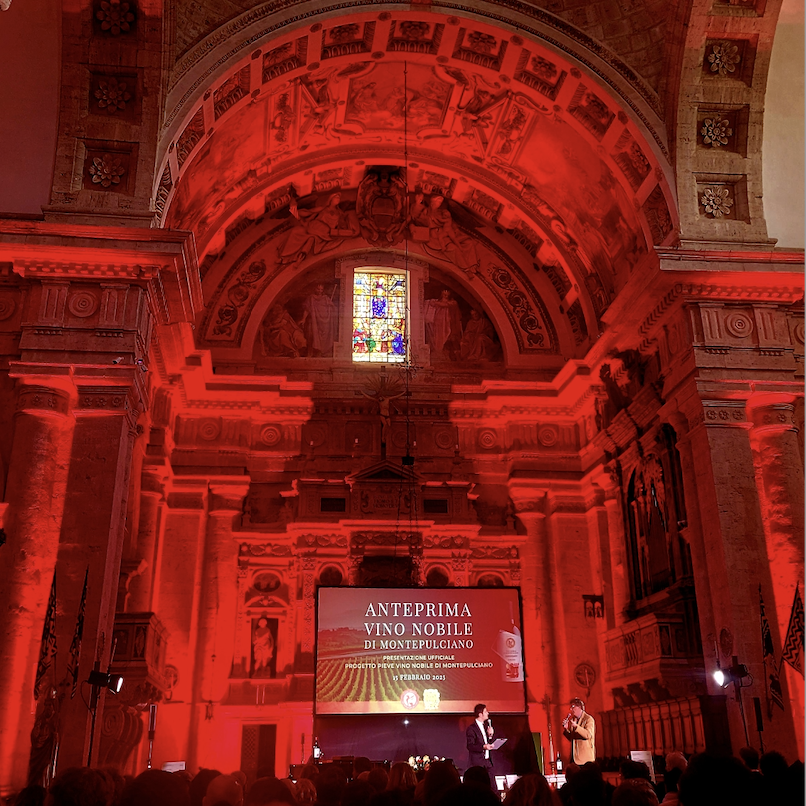
Anteprima Vino Nobile di Montepulciano Pieve presentation in the Sanctuary of the Madonna di San Biagio

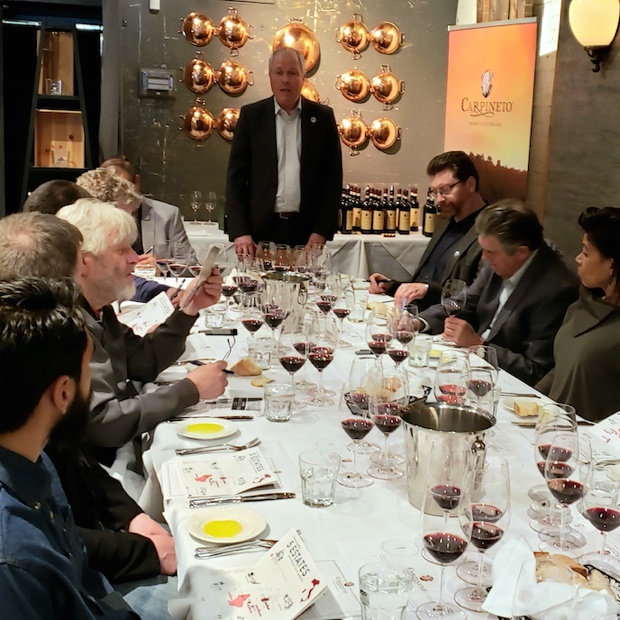
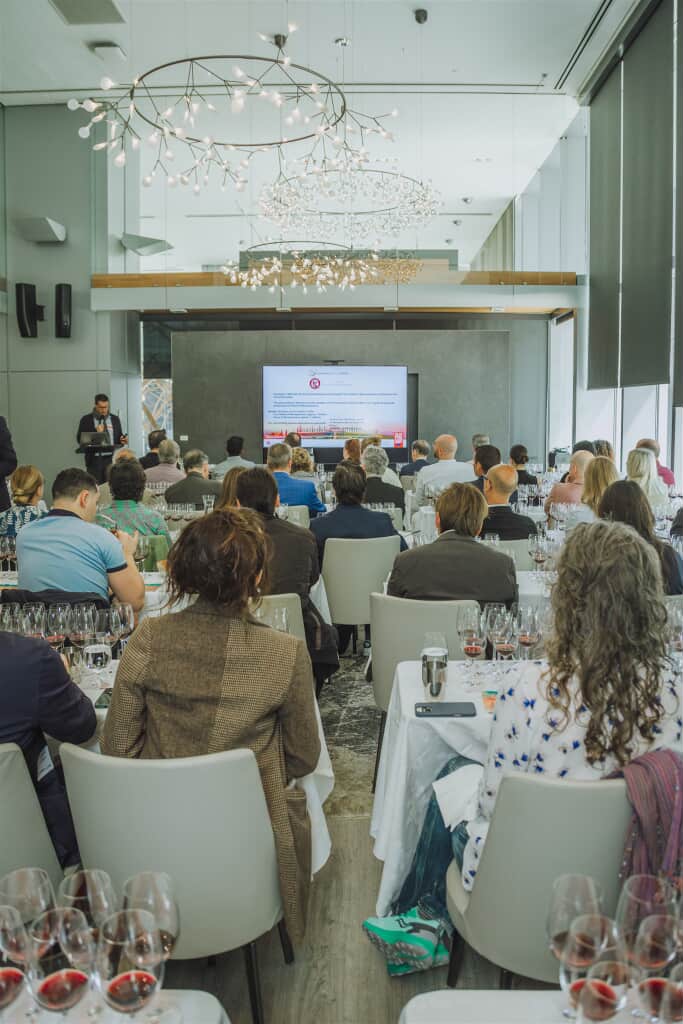
On May 26th, 2025 Godello was honoured and indeed privileged to act as messenger to present the Vino Nobile wines of Tuscany’s Montepulciano to a full house at Toronto’s Aria Ristorante. A Nobile event of this scope is a big deal and it’s important to mention the people in Montepulciano who were largely responsible for making this tasting happen.
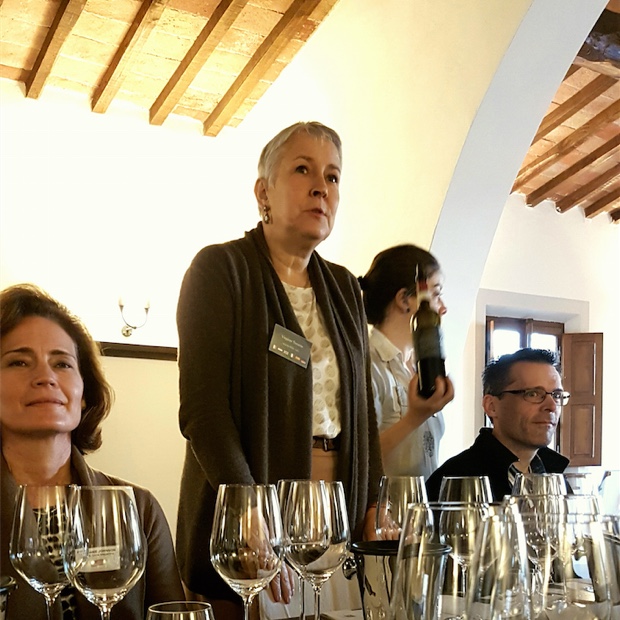
Masterclass

That would be the Consorzio del Vino Nobile di Montepulciano President Andrea Rossi and Silvia Loriga who is the Communication and Event Manager. Anyone who knows her is quite aware of just how much she does for Montepulciano. We were all overjoyed that Andrea and Sylvia flew in from Italy to be here with us on that day. Their tireless contributions have played a large part in the evolution we have been seeing from the Vino Nobile over these last 10 years.

Montepulciano Area

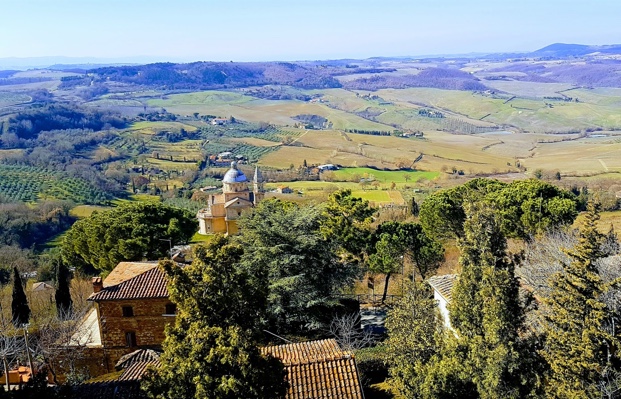
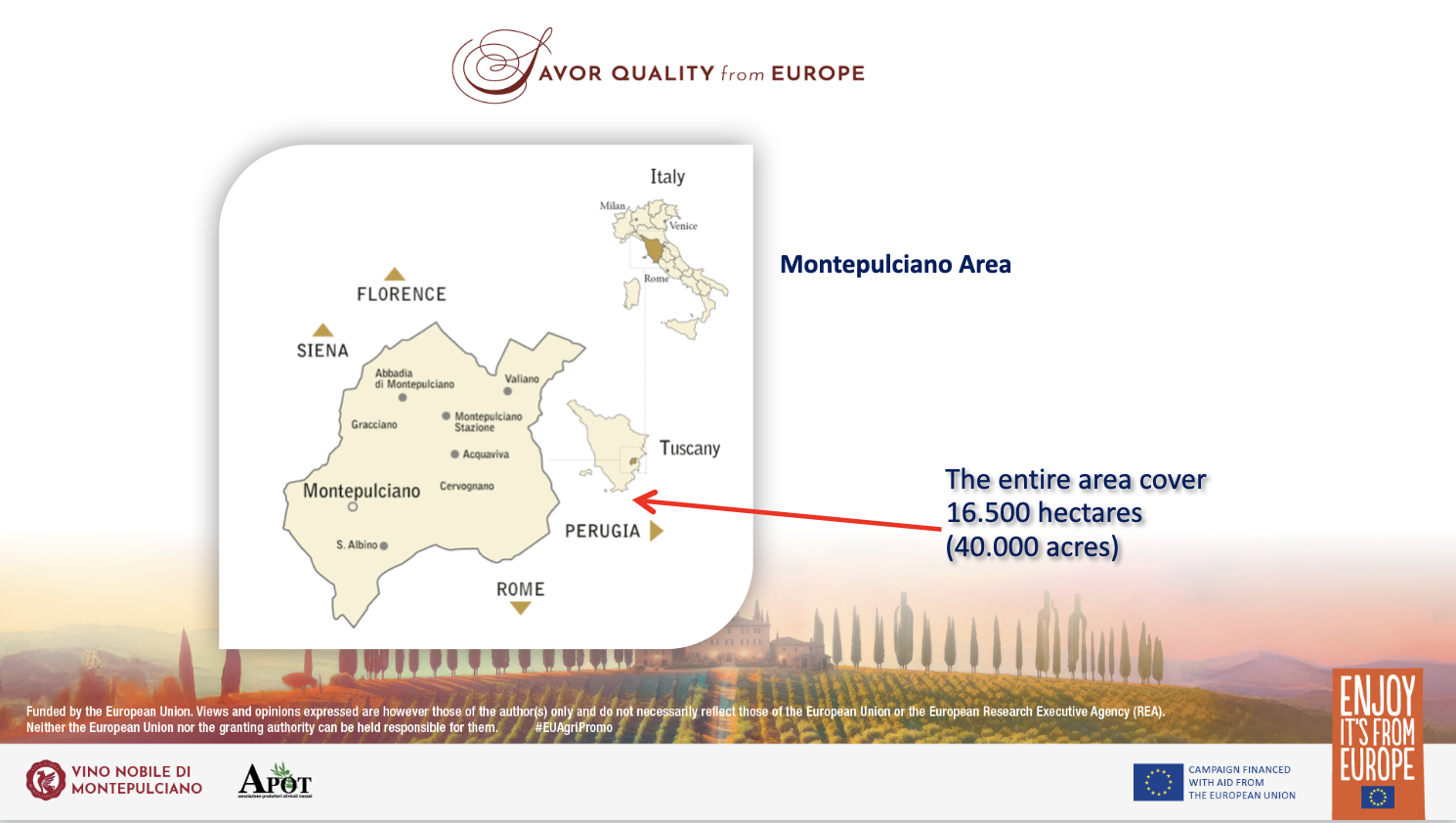
Godello’s most recent trip to Montepulciano was just this past February when the weather was much fresher and accommodating than it has been here in Ontario as of late. After one of the tasting days he stepped out from Enoliteca and Consortium headquarters in the Fortezza di Montepulciano to take in the sunshine in the main square. Even though he’d walked the Piazza many times it’s just something you do because these are the moments captured that remind us just how special a place like Montepulciano really is.
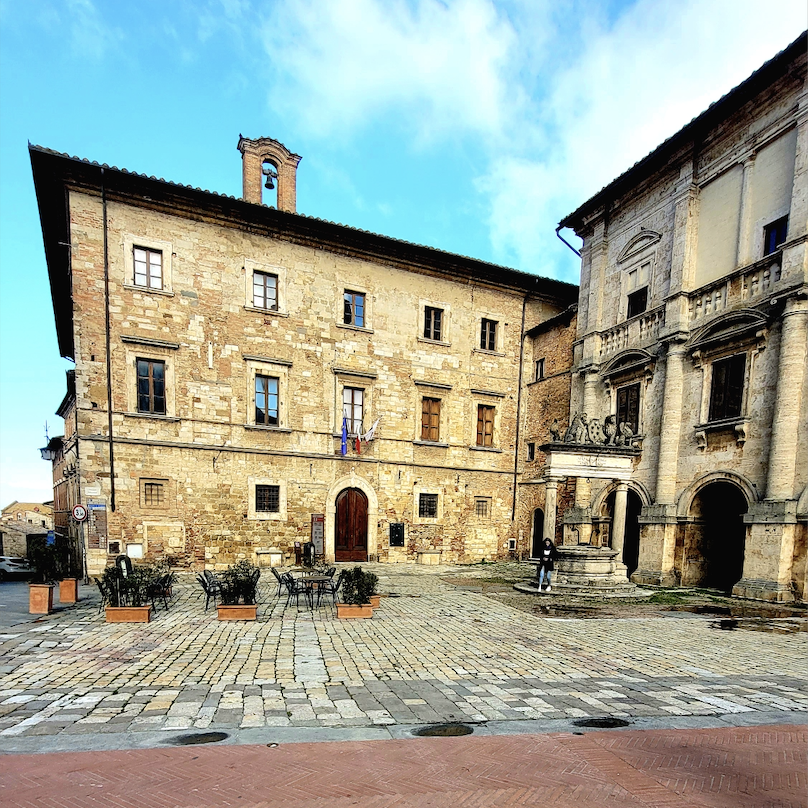
Piazza Grande, Montepulciano

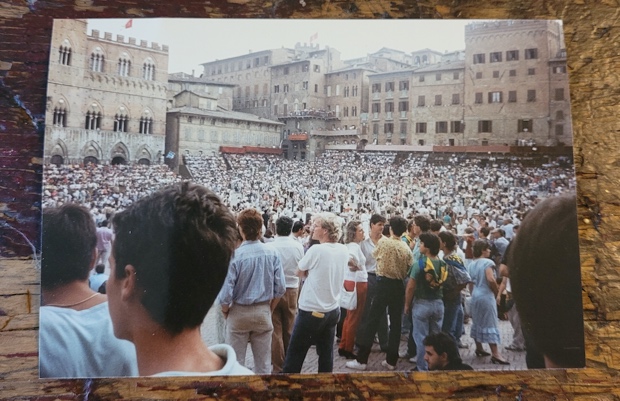
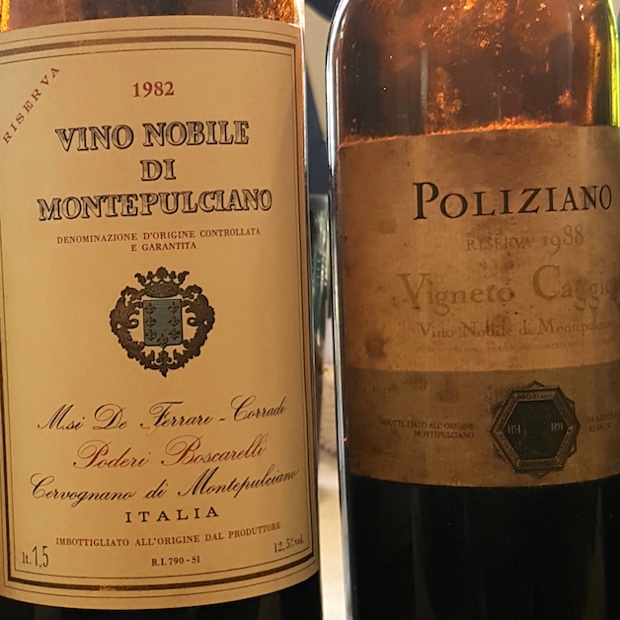
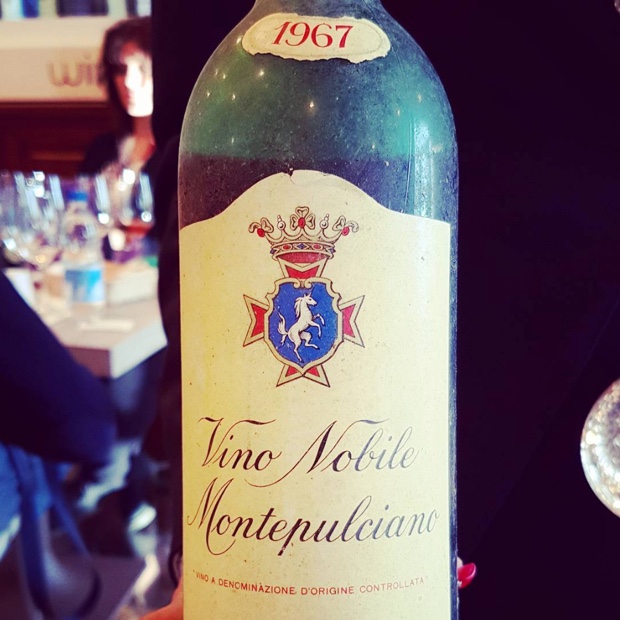
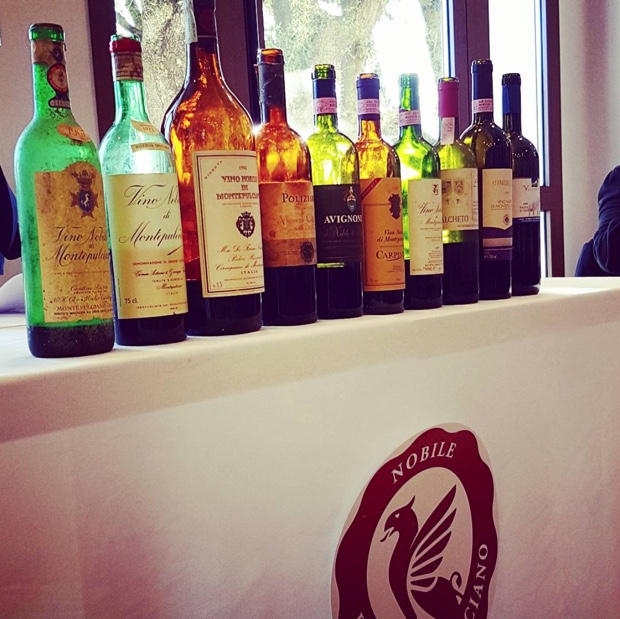
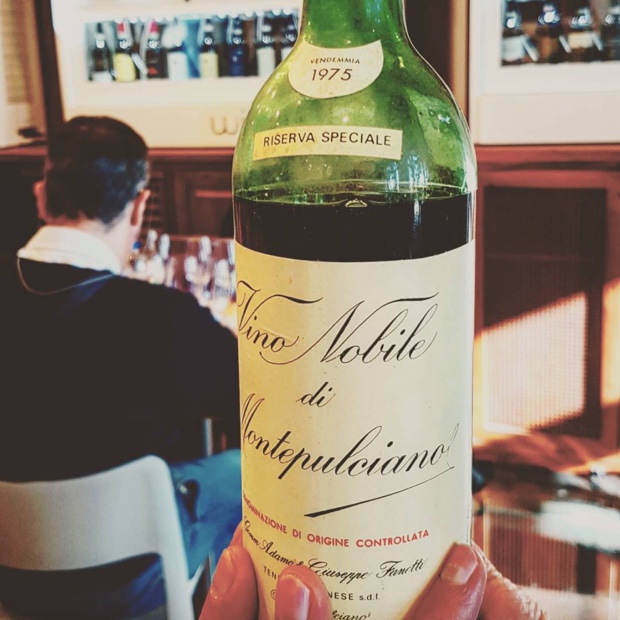
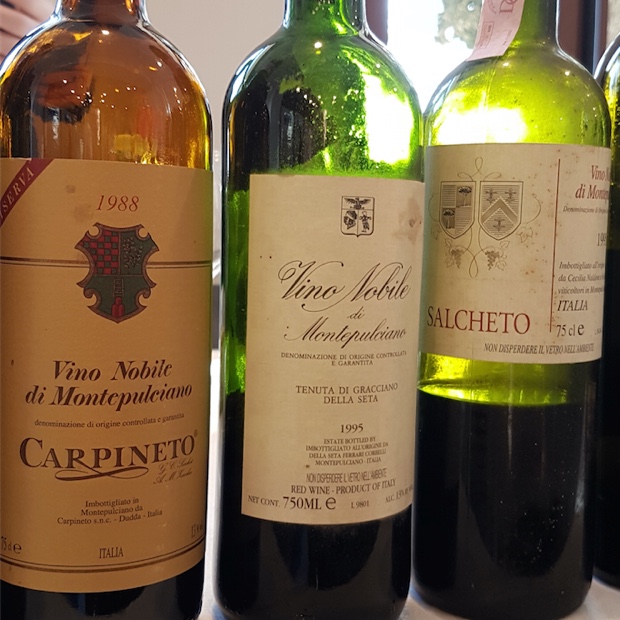
Godello’s personal history with the wines and the village of Montepulciano date back 38 years. In 1987 he was a student at the University of Siena and visited the area as part of his studies, returning again in 1990 and 1995. It was 30 years after that first connection was forged before he returned once again, this time during the February Anteprima of 2017. That edition was a special one because the powers that be at the Consorzio del Vino Nobile di Montepulciano thought to amass ten wines spanning four decades, pour and present them as a 50 year retrospective Montepulciano masterclass, launching with the Contucci 1967. The tasting was more than a stroke of regional genius. It was both a major risk to take and a gift of great generosity. There was no way of knowing how those early wines of DOC origin would show, or if in fact that any life would still be left in them.

Related – 50 years of Vino Nobile di Montepulciano
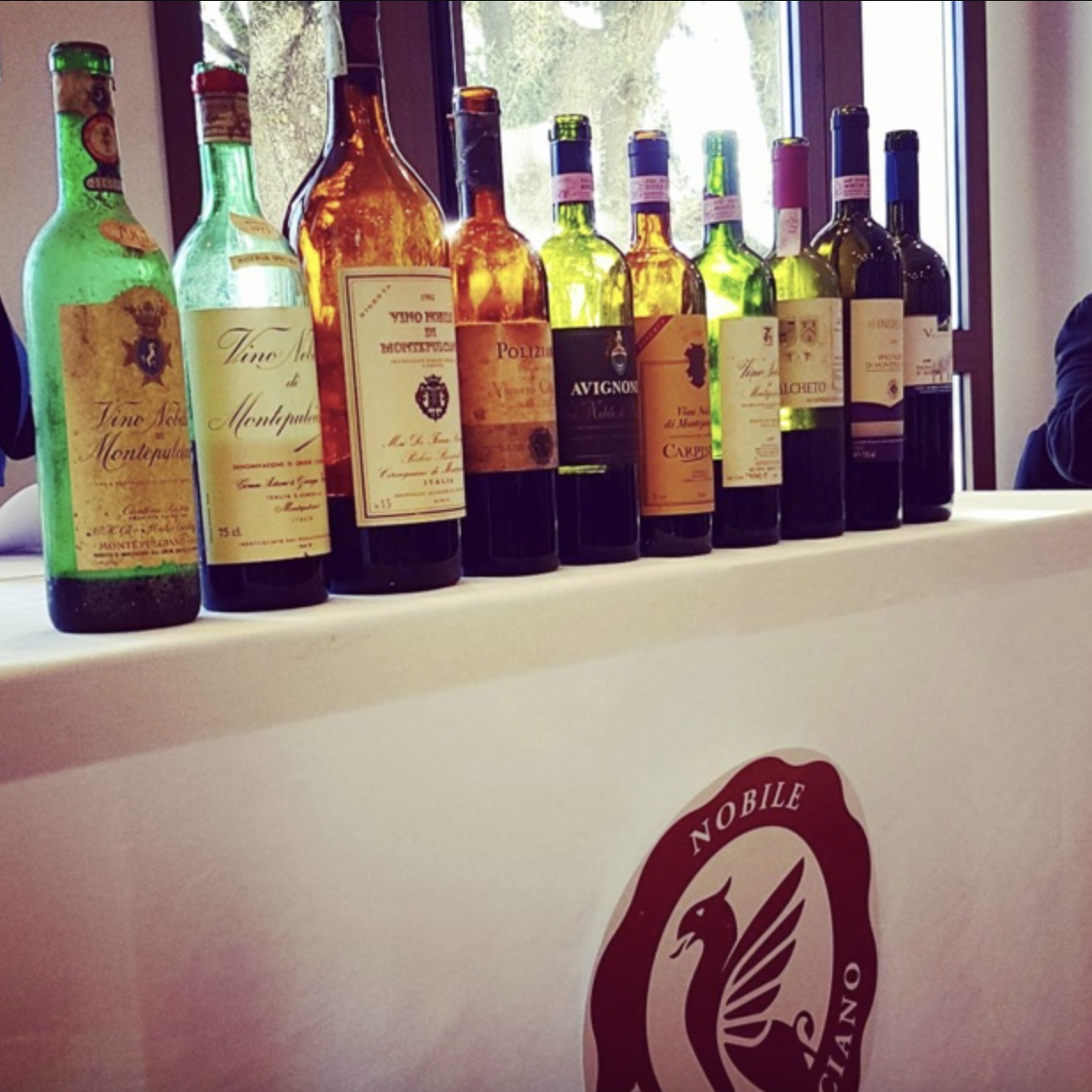
50 years of Vino Nobile di Montepulciano

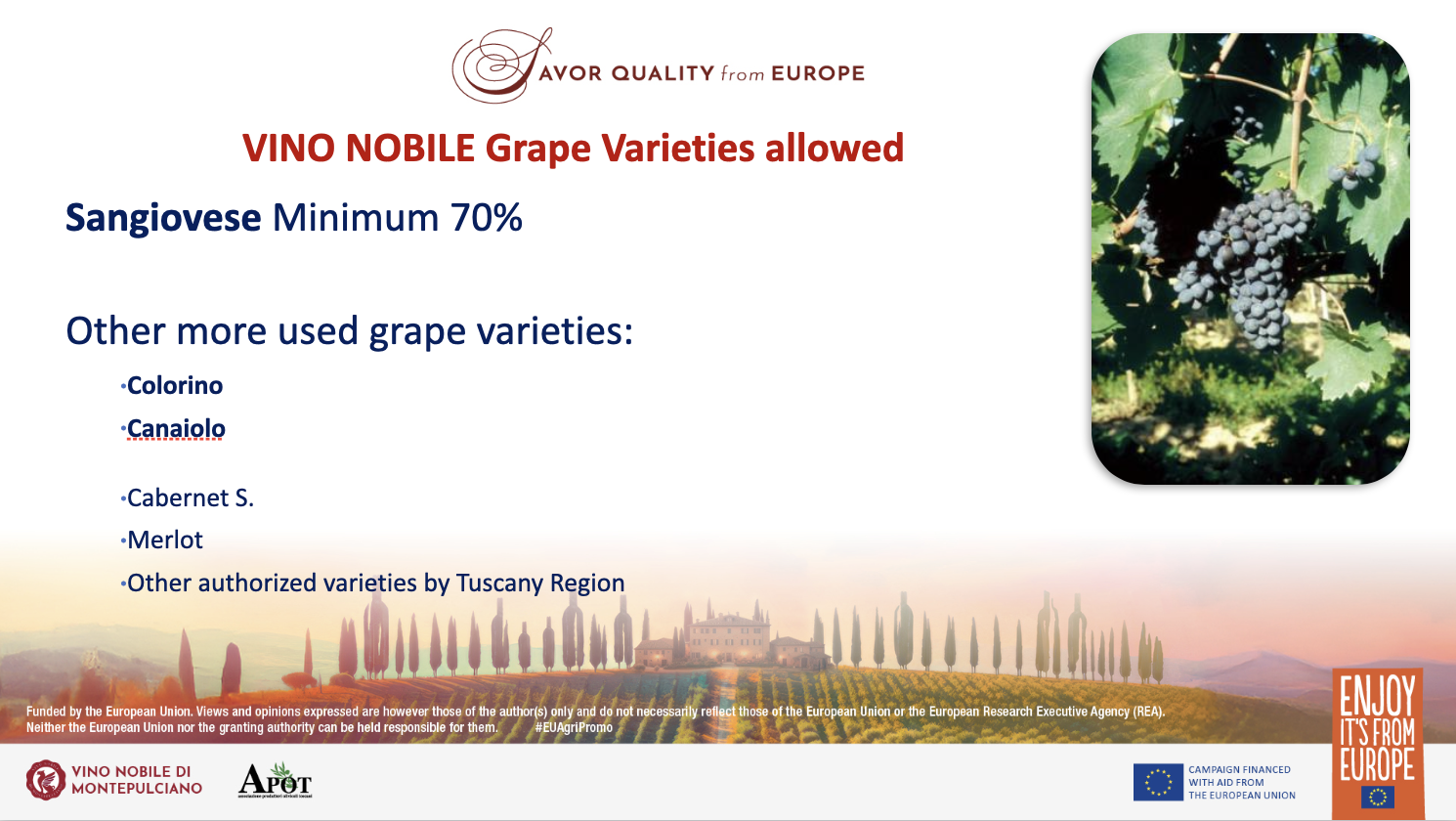
While some examples expressed themselves with more spirit and vitality than others, any doubt cast on the structure of the Montepulciano sangiovese had been vehemently cast aside. At the time it was still fashionable to qualify the wines as prugnolo gentile but today we are comfortable to say sangiovese as an essential varietal distinction that encompasses the many clonal variations used. Sangiovese is the beating heart of Vino Nobile and by now well beyond reproach.
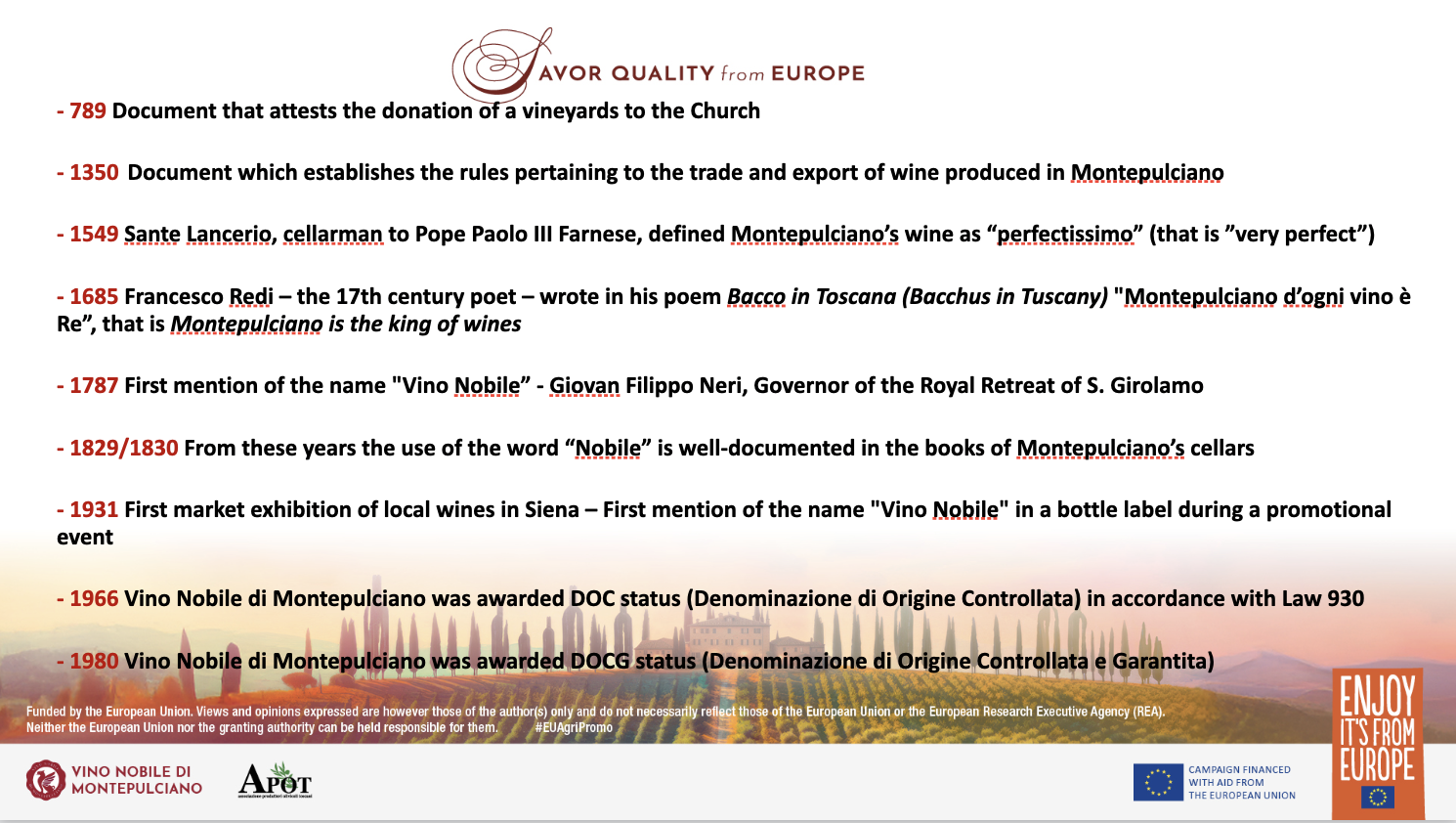
That event celebrated 50 years but the territory’s history obviously goes back much further. “The oldest documented reference to the wine of Montepulciano is from 789 in which the cleric Arnipert offered the church of San Silvestro or San Salvatore at Lanciniano on Monte Amiata a plot of land cultivated with vineyards in the estate of the castle of Policiano. Later, Repetti mentions a document in 1350 (in his “Historical and Geographical dictionary of Tuscany”) which drew up the terms for trade and exportation of Vino Nobile di Montepulciano.”

“The Sixties brought a reawakening in winegrowing geared principally towards the production of Vino Nobile rather than Chianti. State and EU funds used by the wineries to convert their vineyards into conformity with the requirements of the DOC (1966), enabled new wineries to enter the market. Recognition of DOCG status came in 1980 and Vino Nobile began a new life.”
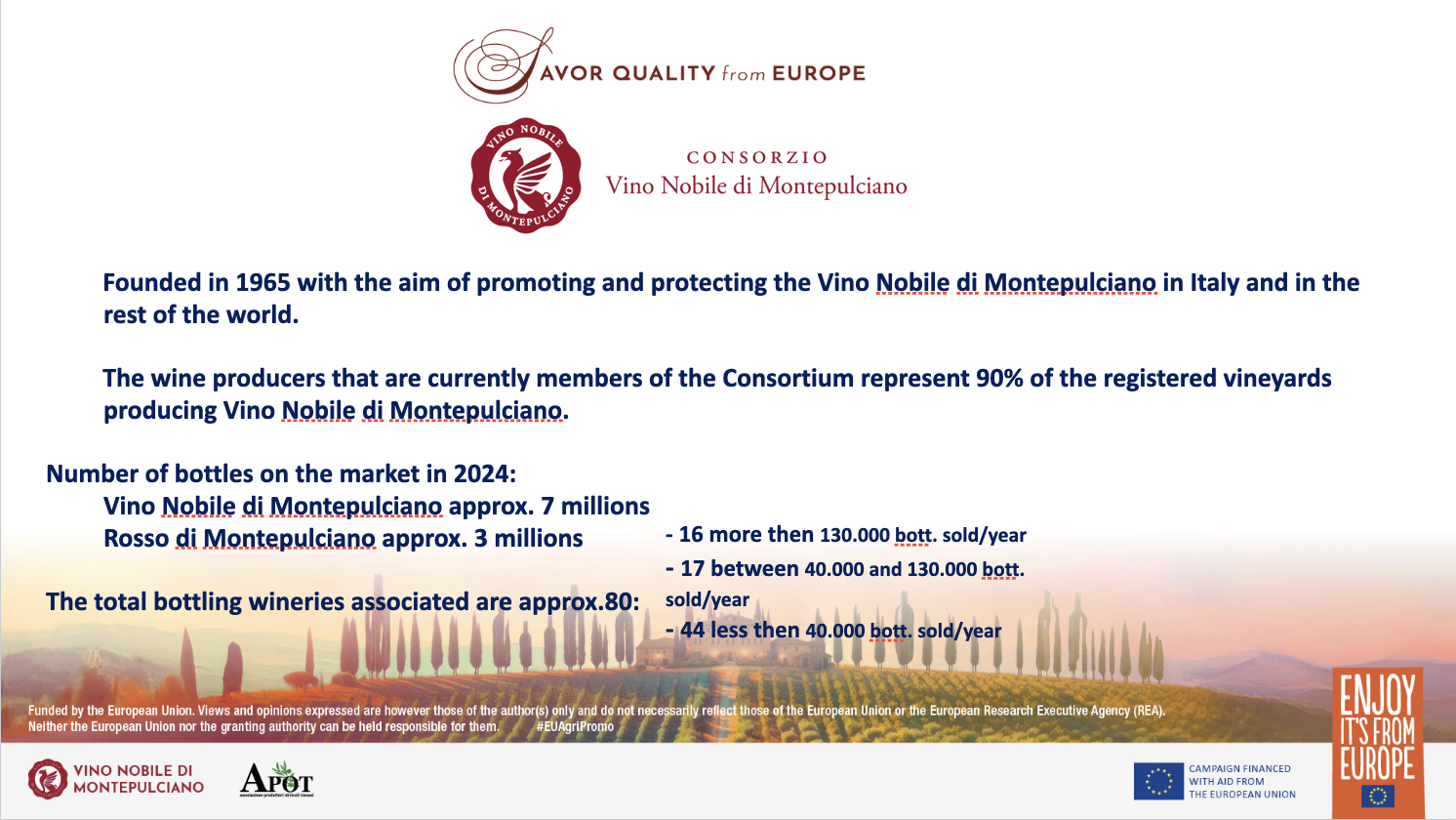
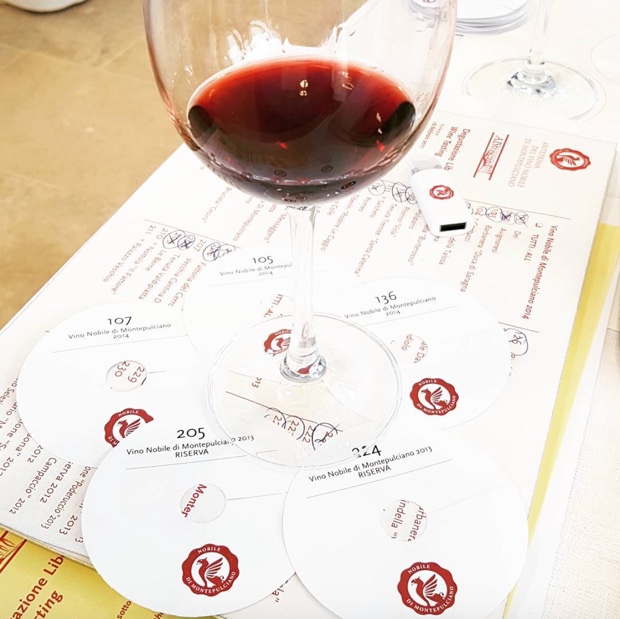
Back in 2017 in advance of the 50-year seminar the Annata 2014 and Riserva 2013 vintages were presented. The challenge of that time in history’s growing seasons showed the fortitude and persistence of Montepulciano’s producers. You can throw a difficult set of weather patterns at the Vino Nobile but you can’t break their spirit. The ’14s were different, that much is clear, but more than enough quality, firm grip and structure was available to send these wines well into the next decade. Look for ‘13s and ‘14s now – you will be surprised by their longevity. For the most part the ‘14s were a grounded bunch, the 2013 Riserva more of an elegant crew and as representatives of the multiplicity of sangiovese they are classic snowflakes, each different, as sangiovese always are. They are also wines that do not swing their arms, an indication of a secretiveness of character. Which smarted into contradiction a connection to the ten Vino Nobile wines in that 50 year study. It explained how exciting it was to spend time with them in 2017. This to say to all of you how special it will be to spend time with the wines you have in front of you today. And also looking 10-15 years forward. Even more so because the quality and diversity of Vino Nobile sangiovese have never been greater.
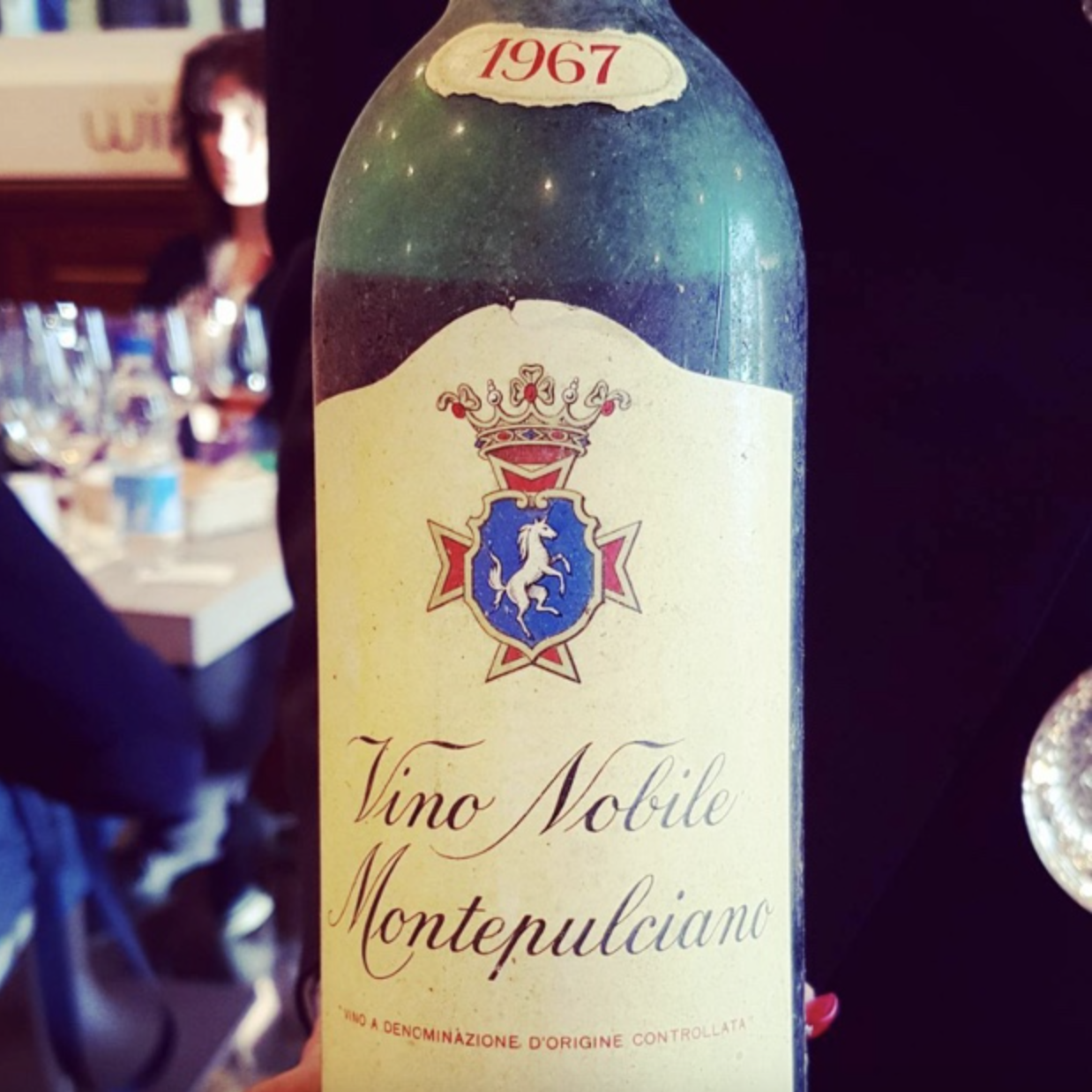
Contucci 1967

Contucci’s Vino Nobile di Montepulciano ’67 was produced during a significant year in world history. The first heart transplant, the Six-Day War, the Monterey Pop Festival, The World Exposition in Montreal, The first Super Bowl and the release of the Beatles’ Sgt. Peppers Lonely Heart Club Band. It was also the year Celtic beat Internazionale in the European Cup Final. Contucci’s Vino Nobile is from a time when there were maximum seven commercially organized producers in Montepulciano and only the second vintage as a denominational wine.
About the Boscarelli 1982 Godello wrote “The Boscarelli acts like a much younger Nobile, from an exceptional vintage and a producer way ahead of its time. The key is to decide which side of the evolutionary fence we’re on, closer to that 1967 from Contucci or to what is happening today. This may actually be the turning point for Vino Nobile because it really has one foot entrenched in each world.”
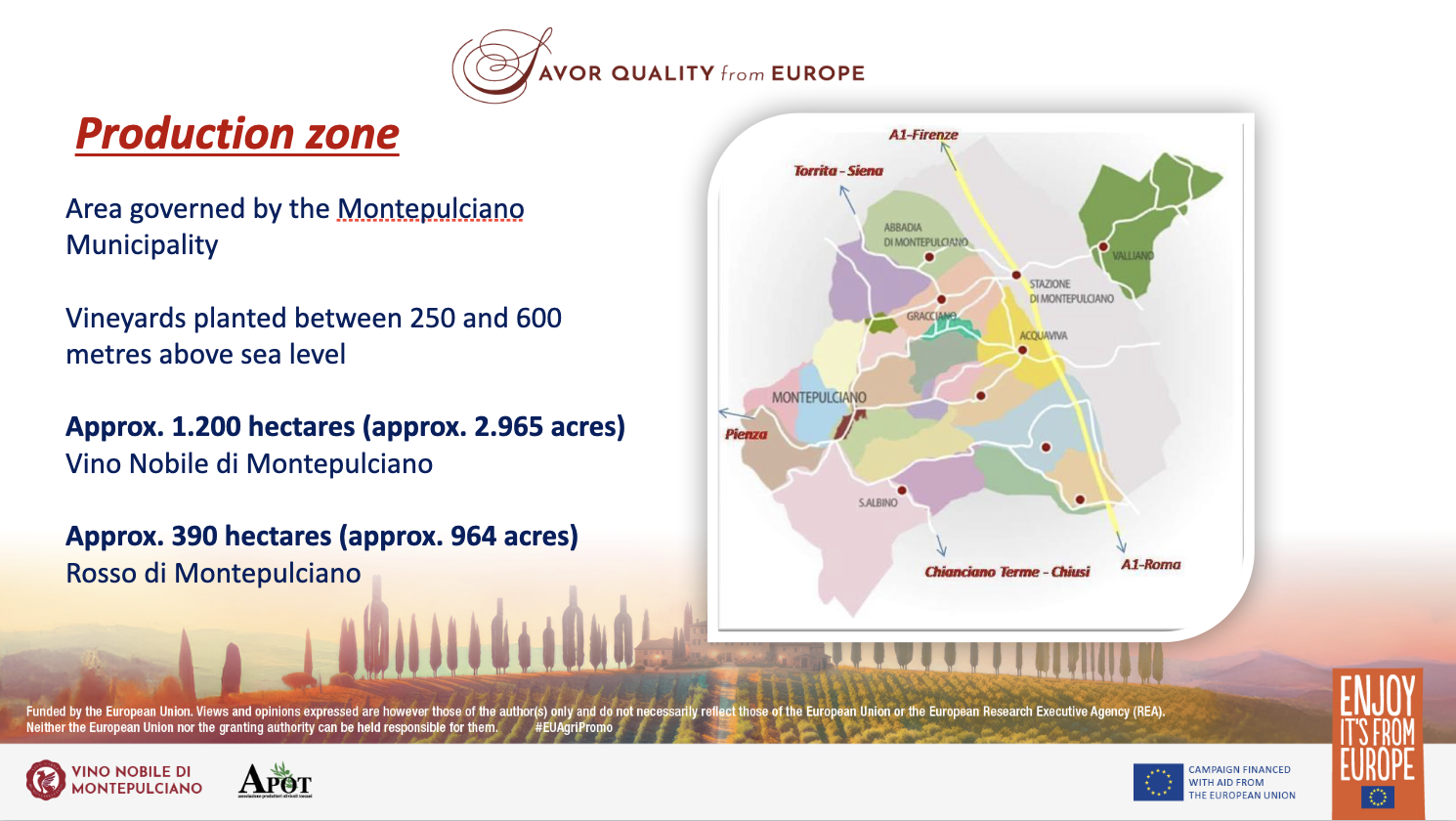
The Pieve

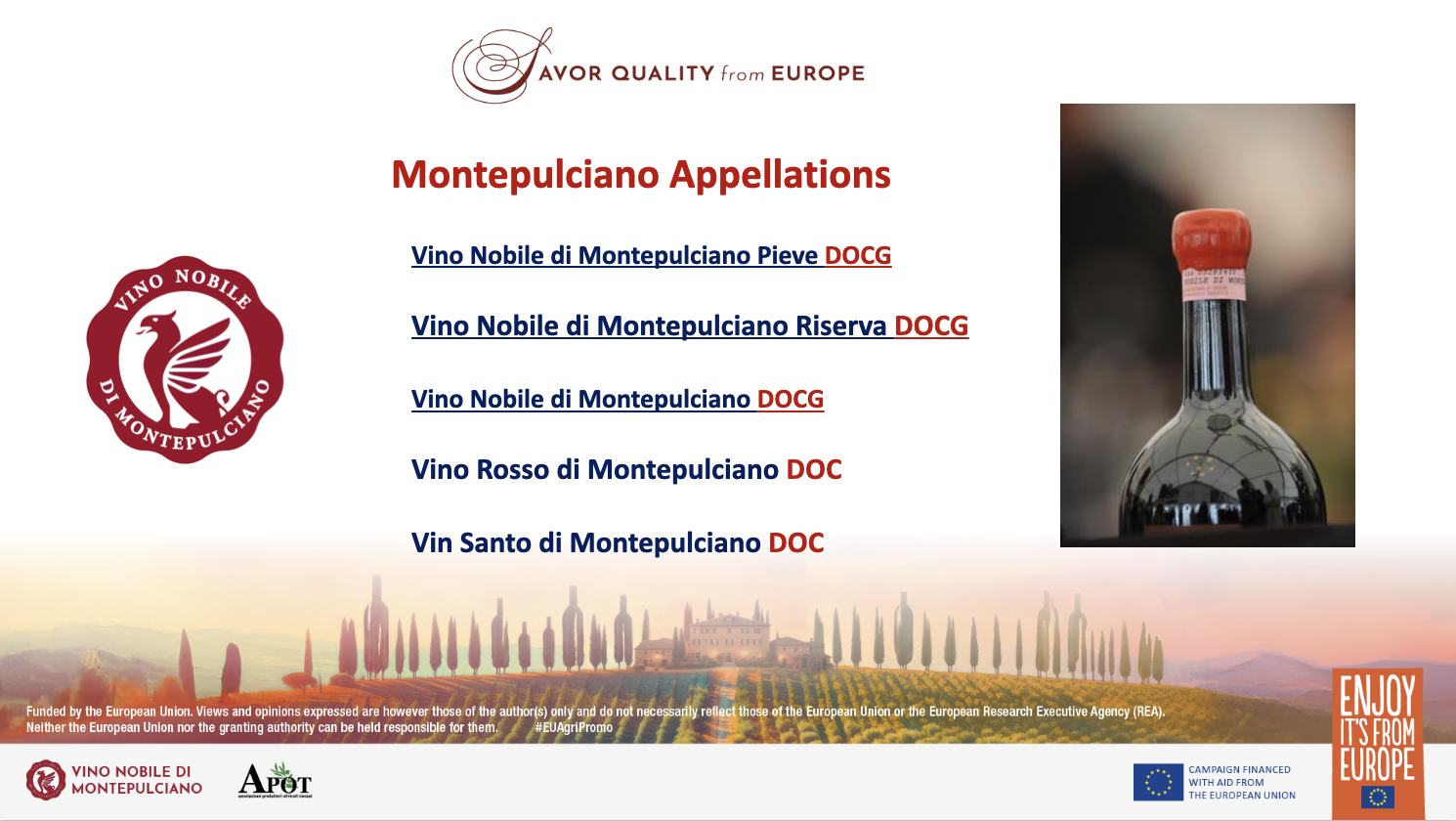
The Pieve Project marks a new era for Vino Nobile di Montepulciano as a new classification system within the Vino Nobile di Montepulciano DOCG

designed to emphasize terroir and regional identity.
This photogralh was taken in February while the President was conducting an on camera interview. It’s still worth wondering if the post production crew edited out Godello’s “mi scusi dottore. Posso?”
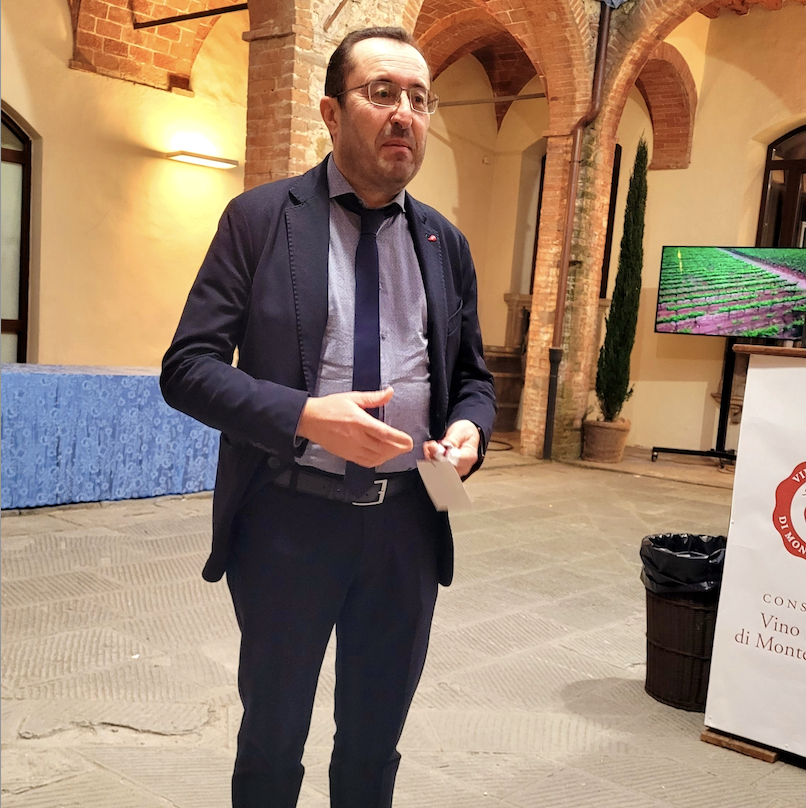
Consorzio President Andrea Rossi

Let’s lay out what the Pieve Project is all about:

– Why and how Pieve Project was developed

– The rules of Pieve Production

– The aim and ambitions of the Producers and Appellation

– The History of the Area

– The Geological Landscape

– The Evolution of Wine Expression across the different sub-zones

– The Future of Communicating the Pieve Project.
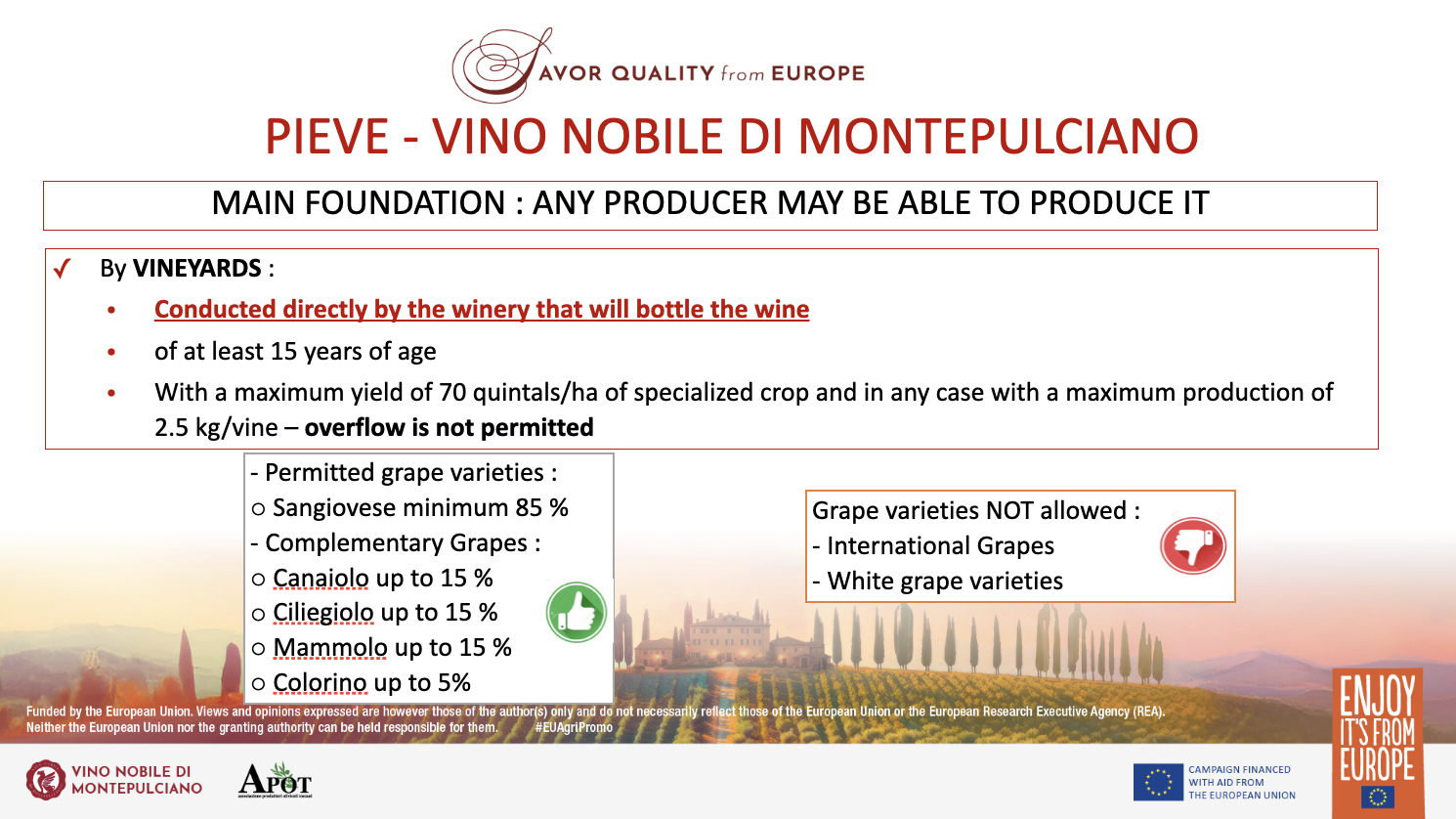
The Pieve initiative aligns Vino Nobile with other terroir-driven classifications like Chianti Classico UGAs, Barolo MGAs and Burgundy climats. This is really worth talking about. Yes it is true that the Pieve resembles these initiatives pursued by other denominations but for Vino Nobile the connection to heritage and religious history is undeniably strong. It also takes the most important aspects of each of those other three distinctions and combines them to create a strong and particular ownership for Montepulciano. In Italian we would say “proprio.” As with the Chianti Classico UGAs the Pieve develop strong inter-personal relationships between like-minded producers making wines form estate vineyards in close proximity to one another. Like the Barolo MGAs the whole of the territory is defined by two distinct terroirs with a line drawn between them. We will touch upon that in a moment. And like Burgundy’s Climats the lineage travels through geography-geology-topography-landscape-position-relief-aspect-exposure-slant-elevation-slope-soil-vegetation-weather-microclimate-humankind-heritage-history-tradition-knowhow and temperament. It all adds up to Pieve. In Burgundy each Climat is a place with its own microclimate and specific geological conditions which have been carefully marked out and named many centuries ago. But Climat must include the human interaction with the place. Each has its own story, produces wines with a distinct character and maintains its place in the hierarchy of crus. Again, Pieve, though time and the market will sort out the pecking order.
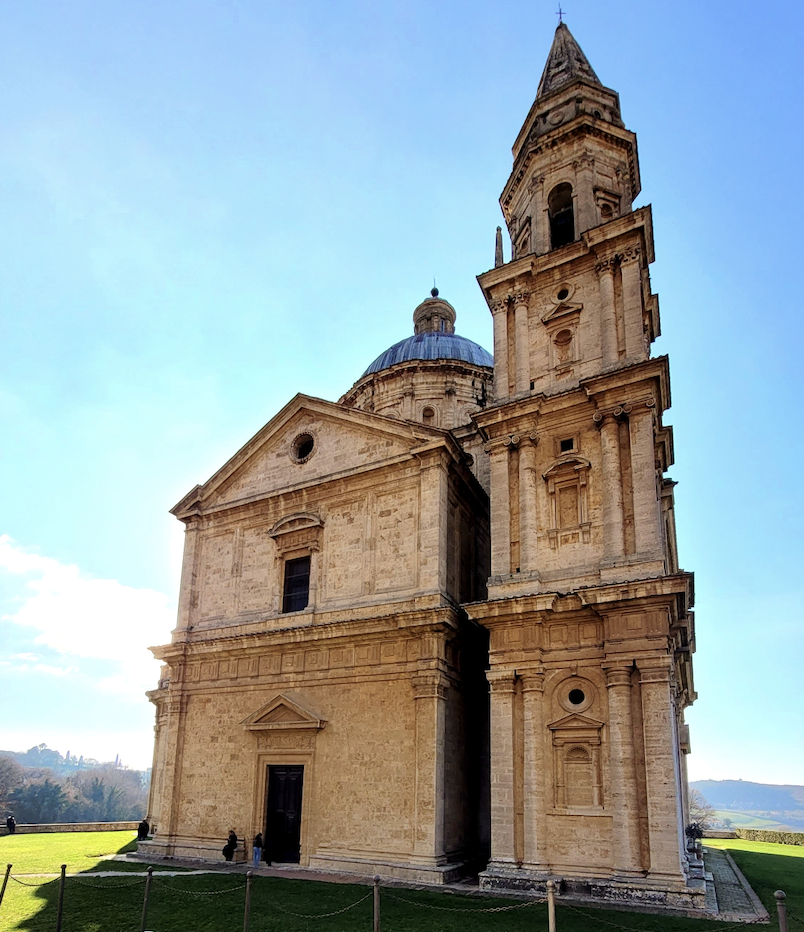
Sanctuary of the Madonna di San Biagio

In February the Pieve project was introduced for the first time in Montepulciano’s Sanctuary (or Tempio) of the Madonna di San Biagio. Developed over four years, the project enhances transparency, quality and consumer understanding of Montepulciano’s wines. The word Pieve comes from the Latin plebs, meaning “common people.” Historically that referred to rural parish churches in Tuscany which served as spiritual, social, and administrative centres. I Pievi were crucial in shaping Montepulciano’s cultural identity, dating back to the medieval era.
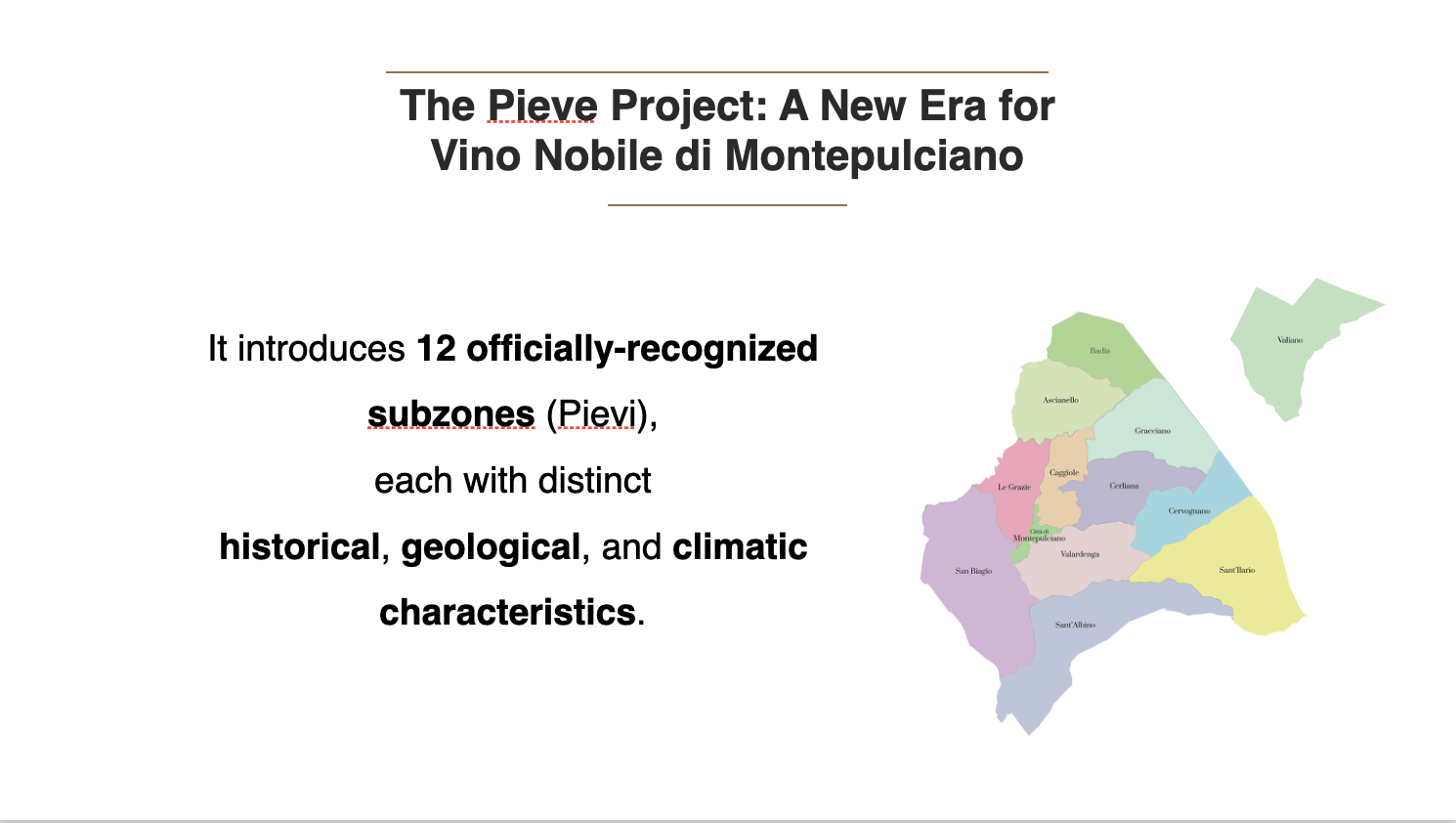
The new classification pays homage to these historical divisions, connecting wine to the centuries-old traditions of land and community.

Three Pillars of the Pieve Project

The classification is based on three core aspects that define Montepulciano’s terroir:

   1.  Historical Cadastral System (The Pievi)

The project follows historical territorial divisions, reinforcing regional identity.

   2.  Geology & Soil Composition

A mix of Pliocene marine-origin soils, Pleistocene sands, clay, and limestone defines the wines’ structure and aromatics.

   3. Landscape Morphology (Climate & Terrain)

Elevation (250-600m), exposure, and climate influence grape ripening and wine style.
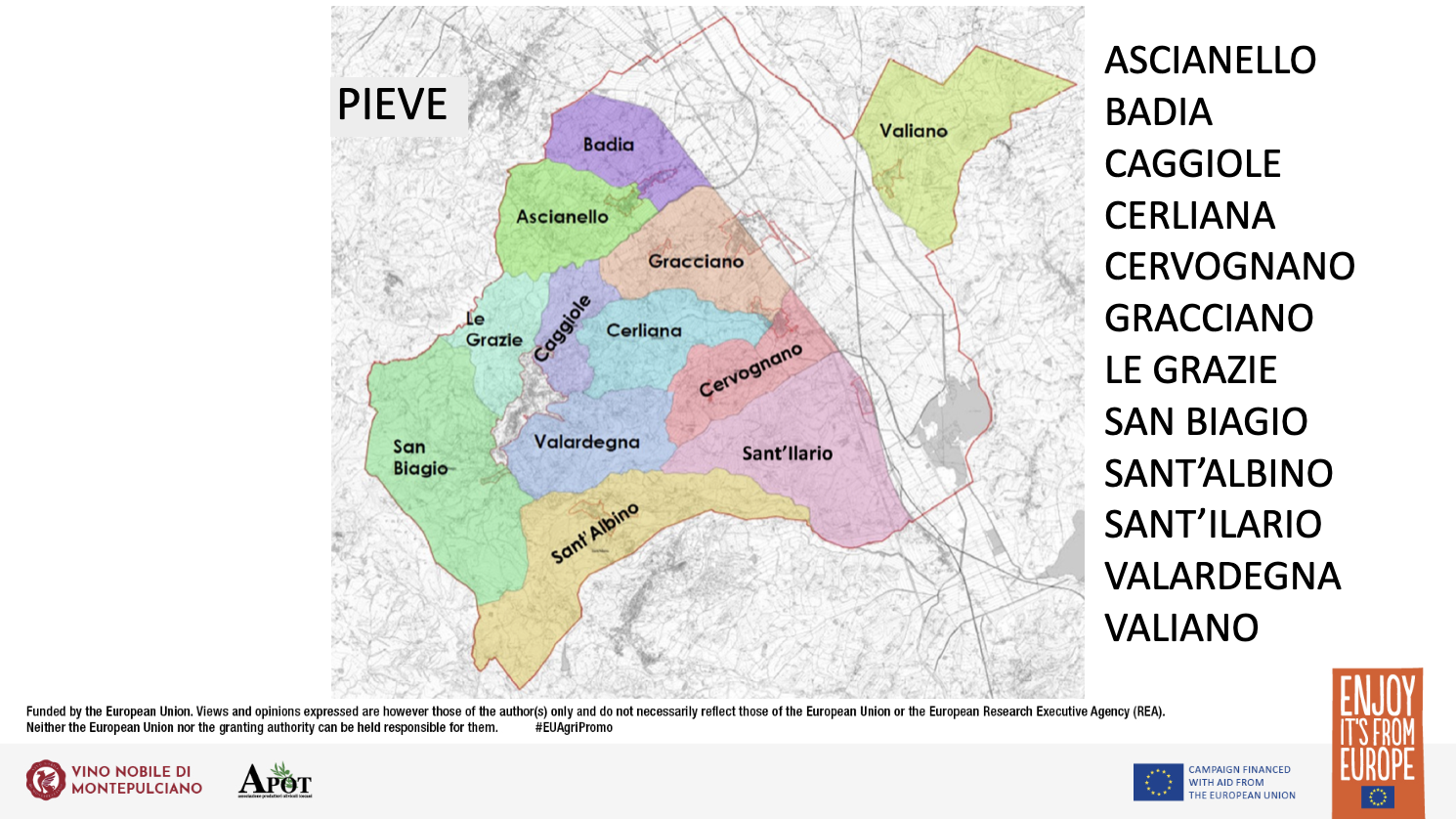
The Consorzio organized a major tasting held to validate the Pieve Project featuring submissions from nearly all Pieve subzones to analyze distinct regional characteristics. Key Insights from the tasting evaluation confirmed that each Pieve expresses unique traits directly tied to its soil composition and growing conditions. Producers demonstrated the ability to craft wines with a clear sense of place, reinforcing the importance of terroir-driven winemaking.

This comes from having tasted nearly 30 examples in February and in my opinion when I assessed five Vino Nobile from the same Pieve a thread was certainly there. The characteristics shared between wines were less challenging to recognize than the sangiovese from Chianti Classico or Montalcino. This feature will be a great positive for the messaging of the Vino Nobile.

And so this leads to the Pieve Message:

That as keepers of the Pieve the Consortium will manage the rules to produce wines combining classicism with the contemporary Pieve Style.

   1. To the Producers this is an invitation to communicate the distinctiveness of the subzones.

   2. To the Journalists this is a way to understand and express the values of the territory, pushing towards continuous improvement.

   3. To the Wine Trade the chance to expand the reach of the appellation and cultivate global Pieve ambassadors.

   4. To The Local Montepulciano Community an opportunity to capitalize on the ways to develop the wine economy and tourism in the region.

We should all be looking forward to reading the manual assembled by Master of Wine Andrea Lonardi and American journalist Jessica Dupuy who have been tasked with delving deeply into the soils, geology, culture and tradition behind each. All of which will help us figure out what’s in our glass.
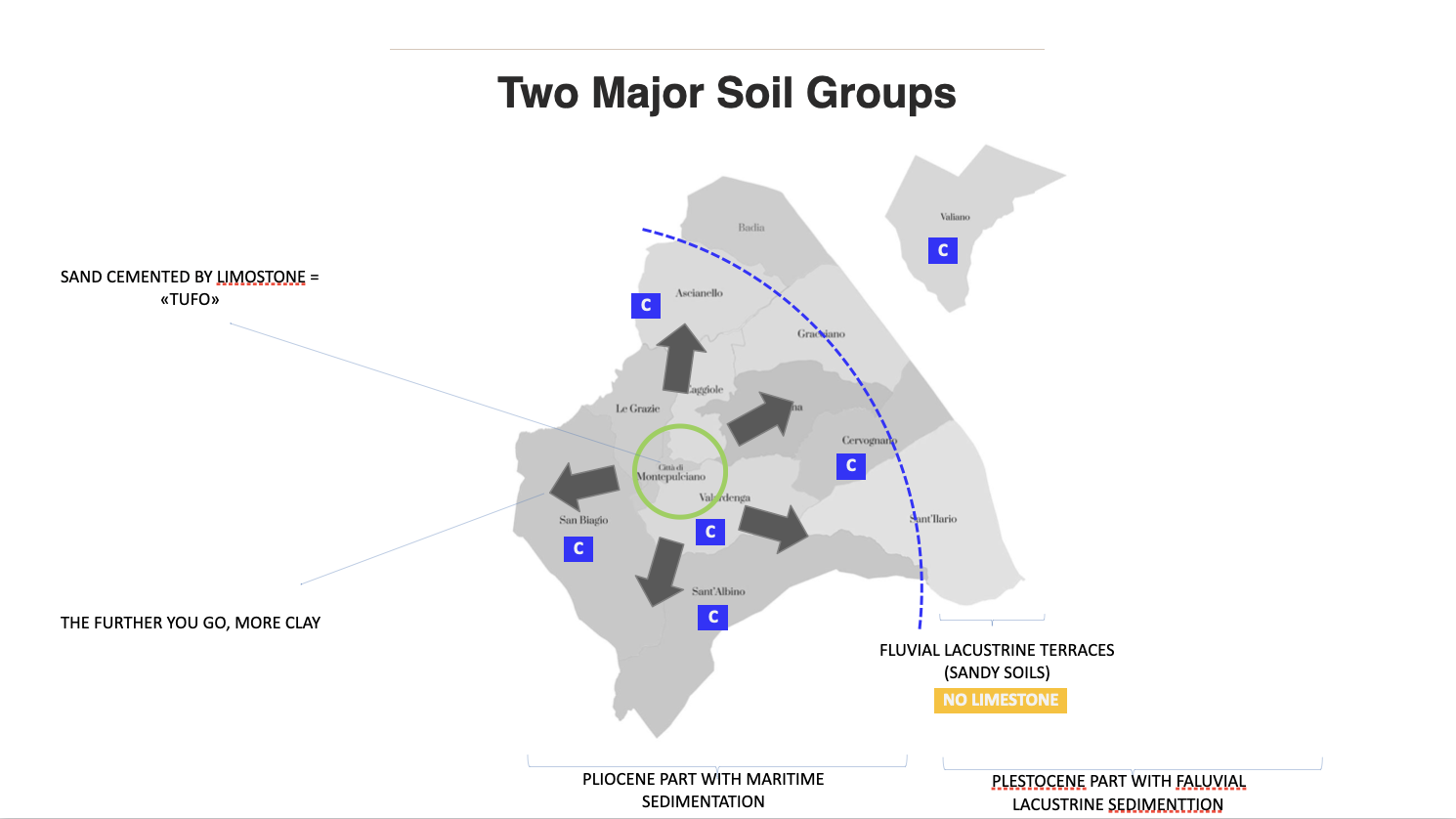
  1. Pliocene part with maritime sedimentation
  2. Pleistocene part with fluvial lacustrine sedimentation


Notice the arch that separates the two. Notice it’s like the line in Barolo that separates the Seravallian from The Tortonian terroirs
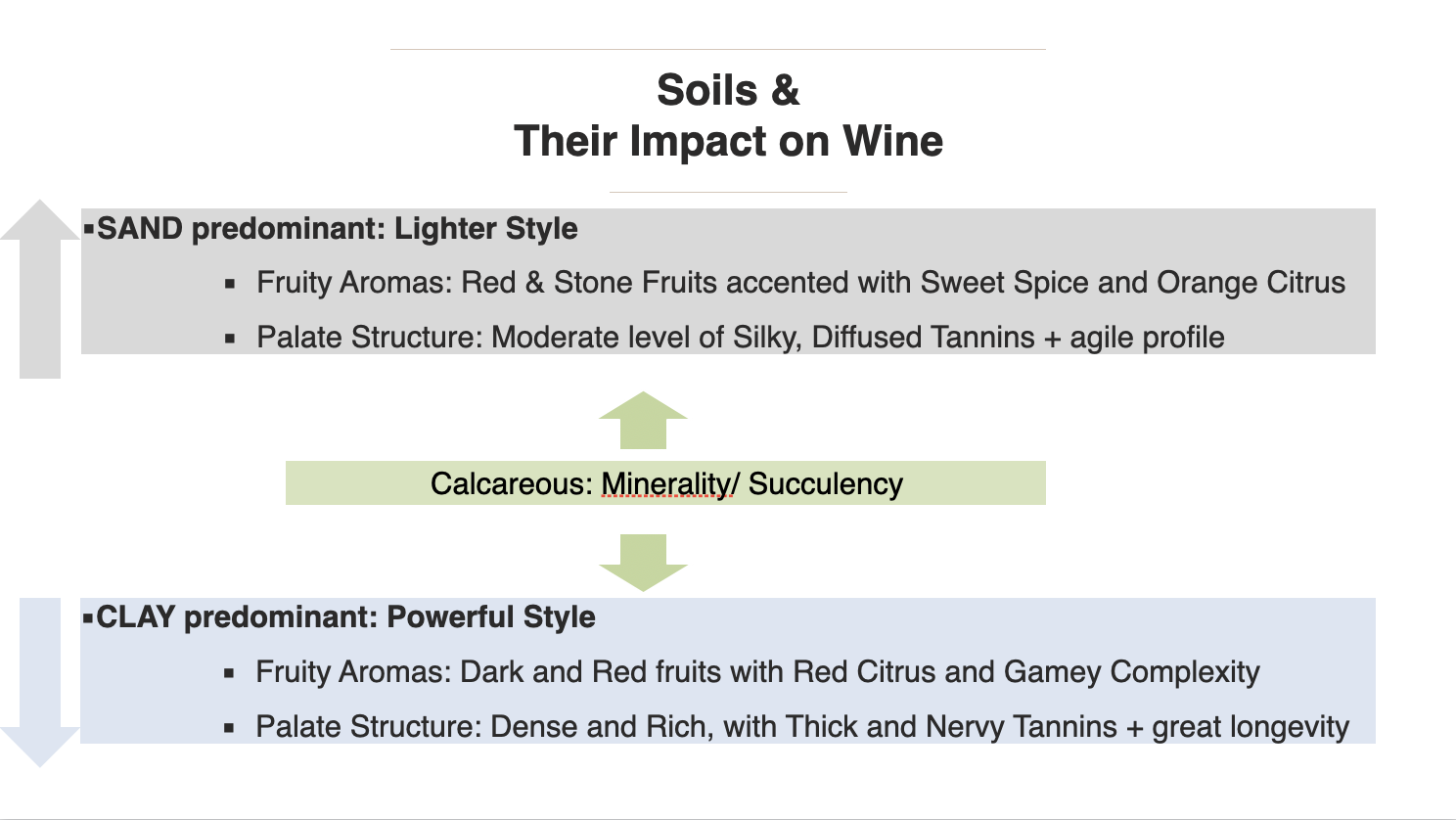
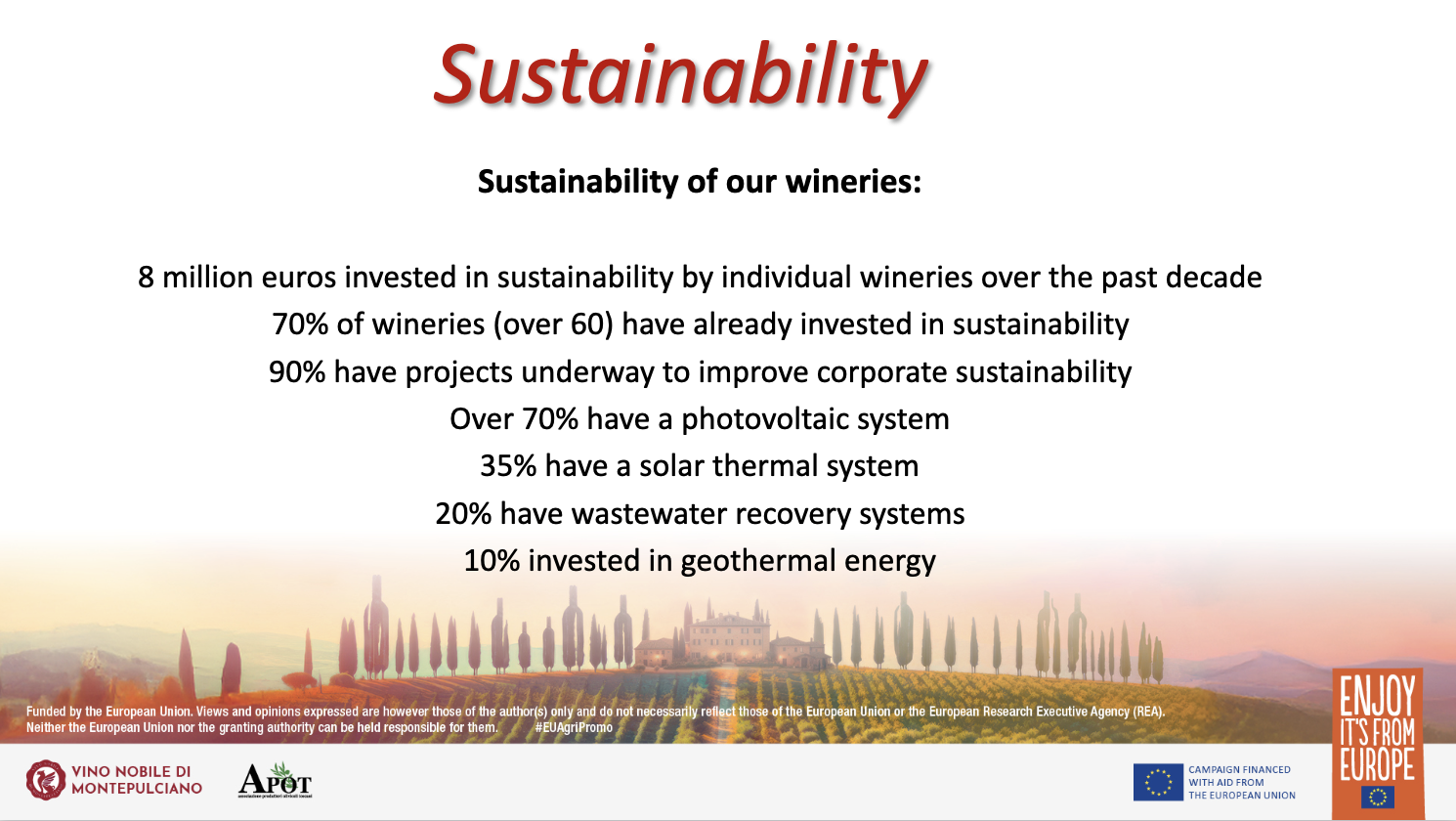
From May 2022, the Consortium of Vino Nobile di Montepulciano is the first Consortium in Italy to be certified sustainable with 70 percent of wineries (over 60) having already invested in sustainability projects.
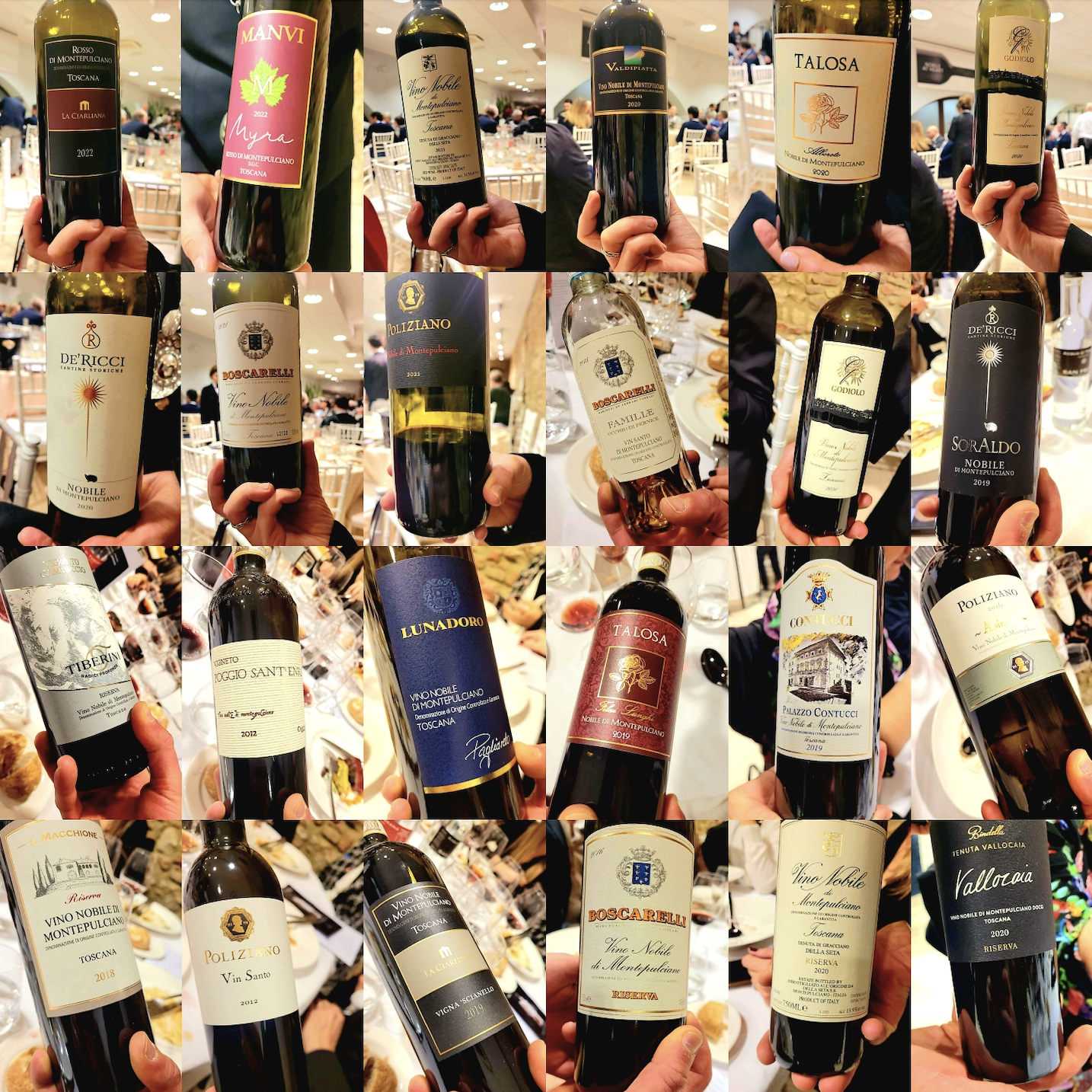
The 12 wines poured at the Masterclass

Tenuta di Gracciano della Seta Vino Nobile di Montepulciano 2022

This is the only 2022 tasted and when these wines arrive on our market they are truly from a five-star vintage and arguably the strongest lot of the last 10-15 years. The Gracciano Estate is one of the oldest wineries in the Montepulciano region. In the beginning of the 19th century, Gracciano was owned by the Svetoni family who built the Villa and created the Italian-style gardens that surround it. The property was inherited by the current owners, Marco, Vannozza and Galdina della Seta Ferrari Corbelli Greco, through their father Giorgio.

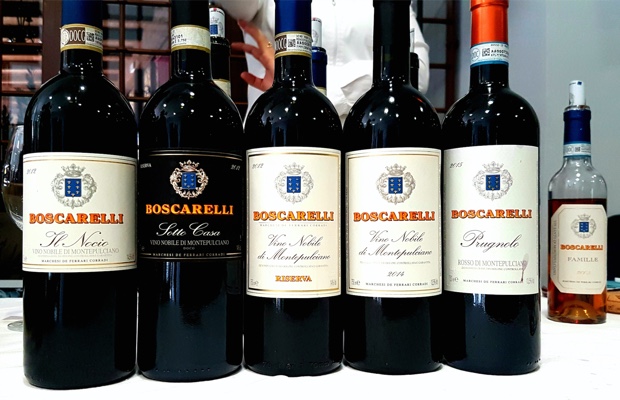
Boscarelli Vino Nobile di Montepulciano 2021

The estate dates back to 1962, founded in Cervognano by Egidio Corradi and is now at 63 years of production. It then passed into the hands of daughter Paola Corradi and her husband Ippolito De Ferrari. Then came Luca and Nicolò De Ferrari.

Fattoria Svetoni Vino Nobile di Montepulciano 2021

Fattoria Svetoni was commissioned by Pietro Leopoldo at the end of the 18th century and ended in the mid-19th century. In 1865 the Svetoni family began producing wine. Its 23 hectares of vineyards in Gracciano were acquired by Podere Rubino in 2017.

La Ciarliana Vino Nobile di Montepulciano 2020

The current epoch began in 1996 with agronomist Luigi Pellegrino and his first vintage of Vino Nobile. His father Santo Pellegrino had started the estate in Cerliana with grandfather Luigi back in 1960.

Tenuta di Gracciano della Seta Vino Nobile di Montepulciano Riserva 2021

Boscarelli Vino Nobile di Montepulciano Riserva Sotto Casa 2020
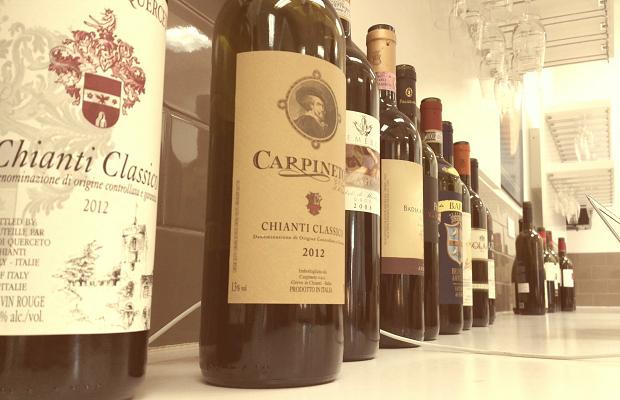
Carpineto Vino Nobile di Montepulciano Riserva 2020

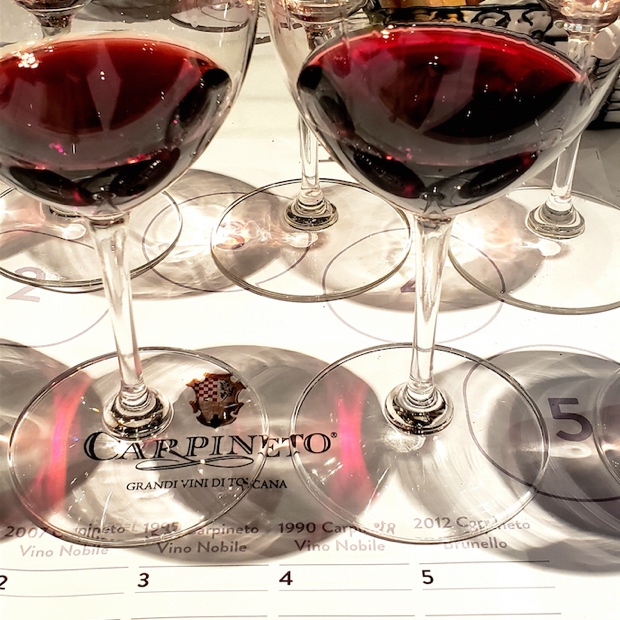
On several occasions Godello has had the opportunity to taste the Chianti Classico, Montalcino and Vino Nobile di Montepulciano sangiovese of Tuscany’s Carpineto winery with Antonio Michael Zaccheo Jr. Carpineto Appodati comprises five Tuscan estates; Dudda and Gaville in Greve in Chianti, Montepulciano, Montalcino and Gavorrano in Maremma. No less than 28 different wines are produced off of the five properties and while Dudda in the Chianti Classico appellation is the epicentre of the operation it is the storied Vino Nobile sangiovese from Montepulciano that have garnered the most international accolades.

Vecchia Cantina di Montepulciano Vino Nobile di Montepulciano Riserva 2018

Carpineto Vino Nobile di Montepulciano Pieve Sant’Albino 2021

La Ciarliana Vino Nobile di Montepulciano Pieve Cerliana 2021

Fattoria Svetoni Vino Nobile di Montepulciano Pieve Cervognano 2021

Vecchia Cantina di Montepulciano Vino Nobile di Montepulciano Pieve Cervognano 2021

Founded in 1937, thanks to the initiative of 14 pioneering producers, it is the oldest wine growing and wine producing cooperative in Tuscany. For almost 80 years they have been a driving force in the region…almost single-handedly sustaining the DOC following the Second World War. Today it remains a cornerstone in the region…widely recognized as being a key promoter of Montepulciano wine, culture and tradition.
 

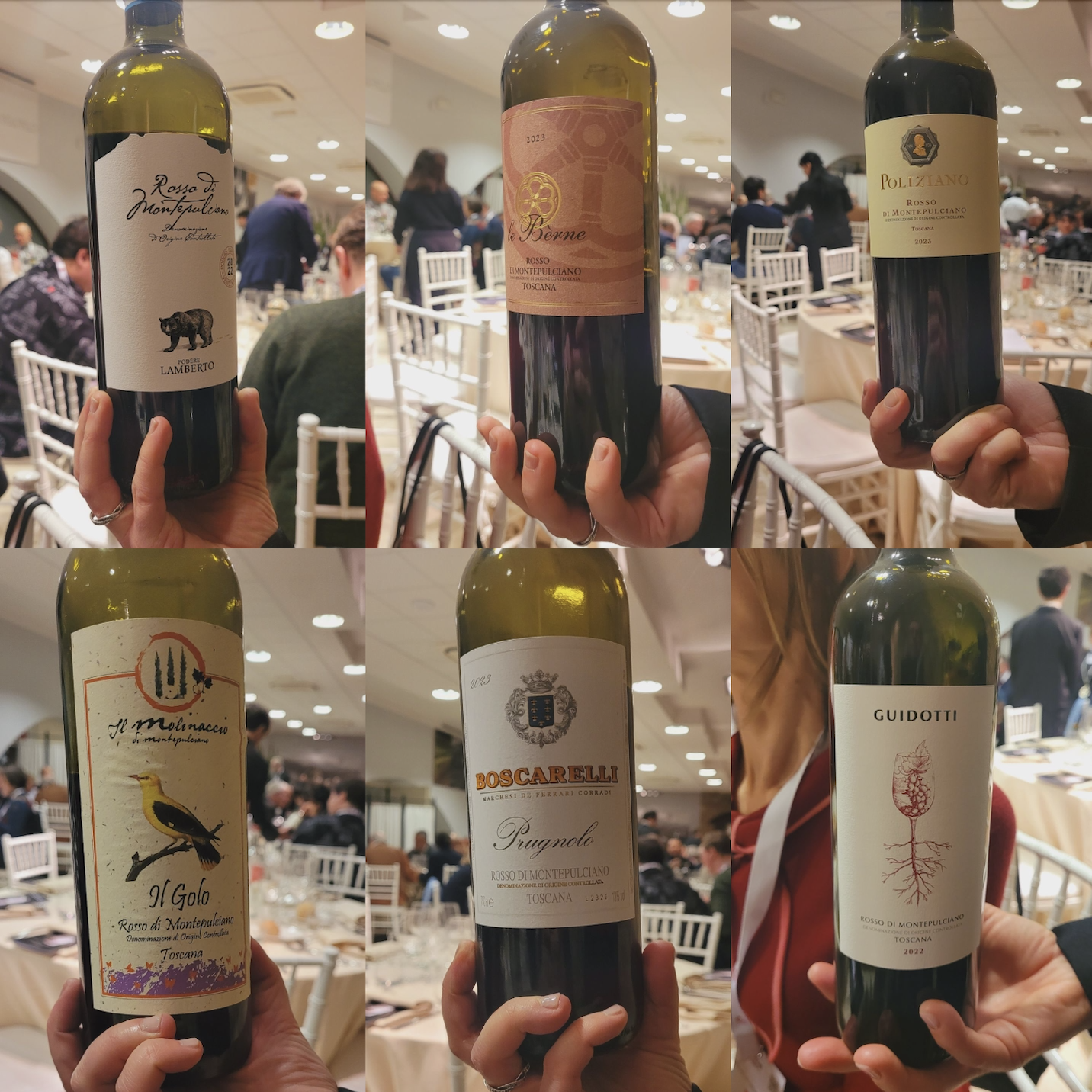
The following wines were tasted in Montepulciano, February 2025

Pieve

De’ Ricci Cantina Storiche Vino Nobile Di Montepulciano DOCG Pieve Ascianello 2022

Once again the ancient place and Cantina Storiche of De’ Ricci takes on the newly defined Pieve distinction with, well true distinction. If 2022 seems to well with fruit concentration then 2023 takes the luxe sentiment one step further. Perhaps just because of its unresolved rebellious youth but this follow-up seems almost too deep in nature. Perhaps just a bit pressed and caught up in the revelry of the new UGA-esque notion but judgement can be reserved, at least in part to allow for another year of settling. No doubt a wine that should not be released this early – here is to planning for an assessment one year forward to find this wine in a more nurturing state.  Tasted at Anteprima del Vino Di Montepulciano, February 2025

De’ Ricci Cantina Storiche Vino Nobile Di Montepulciano DOCG Pieve Ascianello 2022

The Pieve work from one of Montepulciano’s most historical estates where a 3,000 year-old grotto houses the ancient cellars. One of 12 designated parishes, Ascianello, extending south from Badia and home to an identified terror of silty clay sediments overlying fine-grained sand. De’ Ricci’s “Classico” is so very Villages like pinot noir and the Pieve shows more like a Premier Cru because of its luxe concentration. The località meets frazione at the intersection of geography enhanced by the vortices of geology provides for this truly special sangiovese. Rolling with waves of varietal acidity that only Montepulciano can provide and even more succinctly as Ascianello. The definition of succulenza. Drink 2027-2033.  Tasted at Anteprima del Vino Di Montepulciano, February 2025

Podere Tiberini Vino Nobile Di Montepulciano DOCG Pieve Caggiole 2021

The Pieve designation is Caggiole and the style that comes from that parish seems to be one of more density (in relative terms) with clay soils surely the origin. This would put Caggiole in a Santenay-like category, responsible for wines of weightier texture and fuller mouthfeel. Acidity does well though the pH feels higher and so salty protein would really aid and abet alongside. Drink 2025-2027.  Tasted at Anteprima del Vino Di Montepulciano, February 2025

Az. Agr. Crociani Vino Nobile Di Montepulciano DOCG Pieve Caggiole 2021

A second Caggiole design brings the clay into play for a Pieve-level Nobile sangiovese with weight affected by gravity. There is a low rumble to this sangiovee, a baritone effect and some oxidation already noted as being out of a warm and quicker to mature 2021. Drink up. Drink 2025-2026.  Tasted at Anteprima del Vino Di Montepulciano, February 2025

Poliziano Vino Nobile Di Montepulciano DOCG Pieve Caggiole 2022

There is more energy and intensity in the Caggiole from Poliziano but youth is surely involved in the determination and understanding of the feeling. The acidity is consistent with 2021 though this Pieve sangiovese just feels brighter and effusive in relation to that very promising sister. To be honest they are as close in age, style and sentiment as any consecutive Pieve wines and so the consistency of the house style is recognized, appreciated and celebrated. Drink 2026-2033.  Tasted at Anteprima del Vino Di Montepulciano, February 2025

Poliziano Vino Nobile Di Montepulciano DOCG Pieve Caggiole 2021

Poliziano’s Pieve is Caggiole, of tuff, clay, stone and Pliocene sands and while there is some weight to the 2021 it’s not fully affected by gravity. Not quite lithe and weightless but it does hover above the ground with a relative lightness of being. Indelible stamp of place and such ideal acidity will see this live as long as any of the entirety of the ‘21s. Drink 2025-2032.  Tasted at Anteprima del Vino Di Montepulciano, February 2025

Antico Colle Vino Nobile di Montepulciano DOCG Pieve Cerliana 2021

Pieve Cerlina delivers a sound and solid sangiovese for Antico Colle with medium weight and density across its notes and mouthfeel. You can sense the sapidity in the fruity aromas, like minerals cut through stone and berry before transitioning to palate intensity. Truly black cherry flesh and stone, not quite, but edging to the typical bitter finish. A style for house and from place. Drink 2026-2030.  Tasted at Anteprima del Vino Di Montepulciano, February 2025

La Ciarliana Vino Nobile di Montepulciano DOCG Pieve Cerliana 2021

Bravo to the producers of Vino Nobile di Montepulciano because from the get go there are examples of one Pieve or another that show immediate commonalities. As here from Cerliana and its eponymous estate La Cerliana. Hard not to notice the thread from Antica Colle and through to Valdipiatta. Darker fruit, a mix of succulence and stone, from black cherry to minerals and back. A chalky tannin underneath finishes what adds up to a specific style, here more pressed and pronounced than the others, within and without the parish. Drink 2026-2029.  Tasted at Anteprima del Vino Di Montepulciano, February 2025
 

Tenuta Valdipiatta Vino Nobile di Montepulciano DOCG Pieve Cerliana 2022

Of the three sangiovese tasted from the Pieve Cerliana it is Valdipiatta’s that is expressive of the most fruit and also restraint. Truly floral aromas are cut through by aggregate streaks that enhance without breaking the flow. Also a minor note of elevated volatility but this is a young, tannic and chalky (as per the Pieve) Nobile. Really needs time to settle in. Drink 2027-2030.  Tasted at Anteprima del Vino Di Montepulciano, February 2025

Fattoria Svetoni Vino Nobile di Montepulciano DOCG Pieve Cervognano 2021

Serious acidity and a transference from tart to tang then back again with most of this Pieve’s personality defined by that aspect of its structure. A Cervognano of fullness, also in the tannin and in this case a well-pressed and extracted example. Just a bit over the top in that regard, with some austere moments and hard times in the tannin. Drink 2026-2029.  Tasted at Anteprima del Vino Di Montepulciano, February 2025

Guidotti Vino Nobile Di Montepulciano DOCG Pieve Cervognano 2021

From the Pieve Cervognano where what feel like the darkest red through black fruit sangiovese rising and come to the fore. A crisp, crunchy and bears repeating croccante iteration with the black cherry flesh and stone so dominant throughout its character. Another pressed and here also woody Vino Nobile needing time to get to its intended destination. Drink 2027-2030.  Tasted at Anteprima del Vino Di Montepulciano, February 2025

Le Bèrne Vino Nobile di Montepulciano DOCG Pieve Cervognano 2021

While other Pieve-designate Vino Nobile from Cervognano reside at the darker fruit end of the spectrum it is this by Le Bèrne that dials it back a couple of notches with noted levels of restraint. A longer and softer maceration must be the reason, perhaps as long as 60 days and that is the impetus to abide by this specialize terroir. A solid composition categorized as proverbially elegant and it translates unequivocally into this sangiovese of mind-bending intensity. The push-pull posit tug between salinity and sapidity is doubly and dubiously palpable, at once filling the mouth with elements and then conversely minerals. The age-worthiness of this 2021 will be as long as any in the parish and indeed the appellation. Drink 2025-2036.  Tasted at Anteprima del Vino Di Montepulciano, February 2025

Marchesi Frescobaldi Vino Nobile Di Montepulciano DOCG Pieve Cervognano 2021

A true blue mouthful of Cervognano intensity with dark fruit yet smartly held back just enough as far as pressing is concerned. The team is smart, savvy and in a short time has already begun to learn the nuances of the parish. A professional wine in every regard, high in acidity, serious of tannin and something to be regarded as a Nobile that will see through to its longevity. An auspicious and impressive entry to be sure. Drink 2026-2031.  Tasted at Anteprima del Vino Di Montepulciano, February 2025

Vecchia Cantina Di Montepulciano Vino Nobile Di Montepulciano DOCG Pieve Cervognano 2021

Full and substantial, of maximum fruit set upon a traditional and classic frame. Far less austere and tannic than expected which suggests the estate wished to do something modern with their Pieve Nobile. Gracciano is the origin and if this is any indication the parish is one to produce straightforward and luxe fruited sangiovese. Drink 2025-2028.  Tasted at Anteprima del Vino Di Montepulciano, February 2025

Tenuta Di Gracciano Della Seta Vino Nobile Di Montepulciano DOCG Pieve Gracciano 2021

The eponymous estate for the Gracciano Pieve follows suit with as much aromatic waft and palate coating fruit as any in all of Montepulciano. A sangiovese that mixes the reds, blues and blacks for a stirring rendition to bring great flavour and texture upon the palate. Not the most tannic or structured example in this view and one to drink ahead of the rest. Drink 2025-2027.  Tasted at Anteprima del Vino Di Montepulciano, February 2025

Fassati Vino Nobile di Montepulciano DOCG Pieve Gracciano 2022

Slightly problematic nose on the Pieve Gracciano 2022 with more than a mere note of Brettanomyces. Plenty of substantial fruit as per the parish but the microbes are a distraction and carry over to the palate, The tannins are rendered brittle and the wine fades away.  Tasted at Anteprima del Vino Di Montepulciano, February 2025

Talosa Vino Nobile Di Montepulciano DOCG Pieve Le Grazie 2021

Another Pieve in delivery of Vino Nobile as a dark and handsome sangiovese, this being Le Grazie, with thanks to its soil and climate. Good fortune smiles on this by Taloso because acidity and backbone are equal to the task, to exult that fruit and result in a big yet balanced wine. Impressive stature and potential indeed. Drink 2027-2032.  Tasted at Anteprima del Vino Di Montepulciano, February 2025
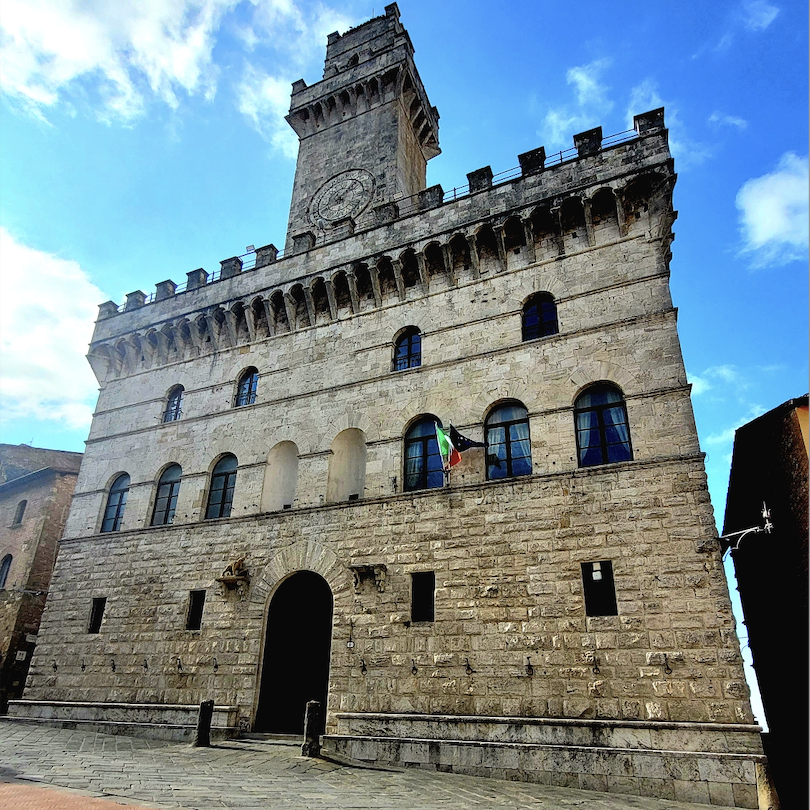
Palazzo Comunale, Montepulciano

Le Bertille Vino Nobile Di Montepulciano DOCG Pieve San Biagio 2021

First bottle TCA. Second is sound. Now from Pieve San Biagio, one of 12 Montepulciano parishes delineated, designed and delivered for identified styles of sangiovese. Or that is at least the hope, idea and plan to present 12 different expressions that speak of their origins. There is a skin muskiness that speaks to both maceration style and time, but also the soil it would seem. Also a late mustiness noted, not to the point of total distraction and certainly not egregious but the wine is not perfectly clean. Drink 2025-2026.  Tasted at Anteprima del Vino Di Montepulciano, February 2025

Carpineto Vino Nobile Di Montepulciano DOCG Pieve Sant’Albino 2021

High tonality and acidity combine for a specific style of Vino Nobile, here from the Pieve of Sant’Albino. These are lighter sangiovese with an eye to the sky and mixed feelings, from brightness and lightning. Also (and clearly) a house style, dusty, excitable and high flying, notably marked by Balsamico and ready for action. Drink 2026-2028.  Tasted at Anteprima del Vino Di Montepulciano, February 2025

Carpineto Vino Nobile Di Montepulciano DOCG Pieve Sant’Albino 2022

A repetition of estate style runs from 2021 through to this 2022 though the fruit quality and quantity is undoubtedly higher this time around. More extraction and what feels like longer hang time which brings about some early maturity, even in the face and with thanks to seriously high and spicy acidity. Again it’s a factor of place but also house. Drink 2025-2026.  Tasted at Anteprima del Vino Di Montepulciano, February 2025

Fattoria Del Cerro Vino Nobile Di Montepulciano DOCG Pieve Sant’ilario 2021

Moving on to the next parish, that being Pieve Sant’Ilario and a Vino Nobile of powerful restraint. Somewhat reserved and demure but still you can’t help note the tannic intensity in all its seriousness plus austerity. Drying with herbals and all the Macchia Mediterranea meets barrel that could be captured in a bottle of Montepulciano sangiovese. Drink 2027-2030. Tasted at Anteprima del Vino Di Montepulciano, February 2025

Tenuta Poggio alla Sala Soc. Agr. Srl Vino Nobile di Montepulciano DOCG Pieve Sant’Ilario 2022

As far as the Nobile from Pieve Sant’Ilario are concerned it is this 2022 that is expressive of the darkest set of fruit. A black cherry cut by mineral stone that bears resemblance to the Pieve wines of Cervognano. Yet different because there is a lack of finishing bitterness. This goes in a another direction, acting smooth and gelid, almost metallic at the finish. Drink 2026-2029.  Tasted at Anteprima del Vino Di Montepulciano, February 2025

Tenuta Poggio alla Sala Soc. Agr. Srl Vino Nobile di Montepulciano DOCG Pieve Sant’Ilario 2021

The continuity already threads from one Pieve Sant’Ilario to another with sangiovese marked by their high intensity matched by proper restraint. They just don’t seem to give too much away too soon. Still they accumulate fruit, mineral and muskiness noted on the palate, juicy and succulent, without high glycerol and in this case a natural if not entirely spic and span profile. No matter and some will surely note the rusticity while others, will like it all the same. Drink 2026-2029.  Tasted at Anteprima del Vino Di Montepulciano, February 2025

Vecchia Cantina Di Montepulciano Vino Nobile Di Montepulciano DOCG Pieve Sant’ilario 2021

From a storied estate with holdings in more than one parish, in this case Pieve Sant’Ilario where the dichotomies between aromas and flavours are duly noted. Restraint followed by a deep wheeling of musky churned fruit, first one and then the other. The old cellar does bring old school style and austerity, more so than others and of their two Pieve Nobile tasted this is the charming Vecchia. Hard not to be seduced by its ancient grace and charm. Drink 2026-2030. Tasted at Anteprima del Vino Di Montepulciano, February 2025

Il Molinaccio Di Montepulciano Vino Nobile Di Montepulciano DOCG Pieve Valardegna 2021

Pieve Valardegna brings a whole new or ulterior set of Vino Nobile parameters to the table. Il Molinaccio’s is less austere, more modern and gainfully expressive of style. Not exactly luxe or rich but certifiably ample and beautifully balanced, if not a high acid sangiovese style. Stay with this wine for some time and you will realize the structure is more pronounced than at first thought, which tells us the wine will live well and long. Drink 2027-2033.  Tasted at Anteprima del Vino Di Montepulciano, February 2025

Godiolo Vino Nobile Di Montepulciano DOCG Pieve Valardegna 2023

A different expression for Pieve designate Montepulciano altogether, here light and with a feel of carbonic maceration. It’s a lovely, glou-glou style of sangovese, fresh and spirited but one will wonder how it stacks up as a representation of a specific Pieve. A touch reductive, feeling like an unfinished sample with time the reality holding its meaning for what will eventually be revealed.  Tasted at Anteprima del Vino Di Montepulciano, February 2025

Tenuta Trerose Vino Nobile di Montepulciano DOCG Pieve Valiano 2021

The only example of Pieve Valiano presented is this quite composed and restrained sangiovese. Floral to a degree and kinder as well but fruit is of highest importance. Not particularly structured as a result or more to the point a factor of style and so drink this early to gain entry into and make some sense of the Pieve ideal. Drink 2025-2027.  Tasted at Anteprima del Vino Di Montepulciano, February 2025
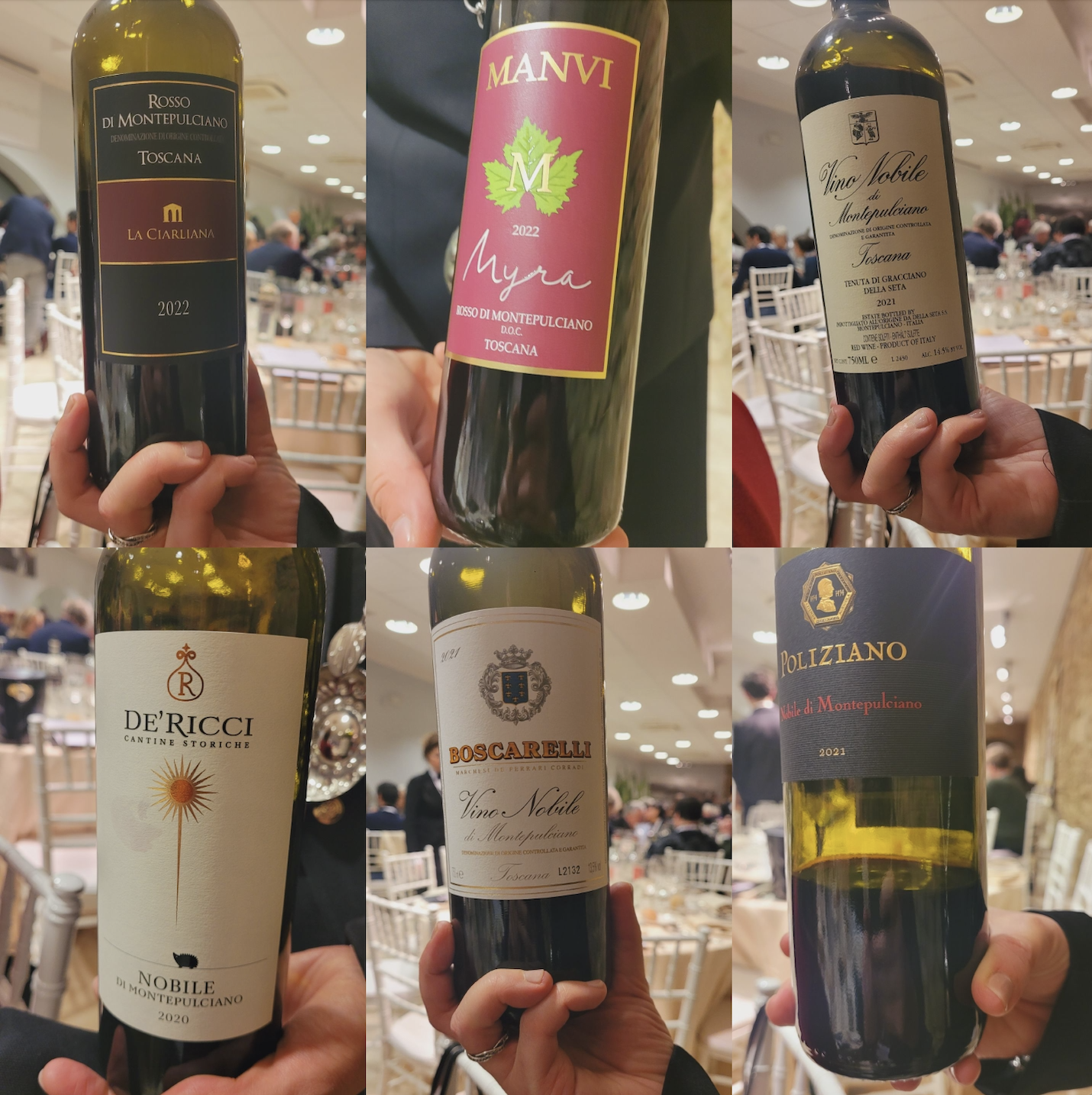
Vino Nobile 2022

Le Bèrne Vino Nobile Di Montepulciano DOCG 2022

Should the wish to experience Vino Nobile and 2022 in the way nature and climate would ask of you, well then take this right proper sangiovese as the wine to try. Luxe as fruit could be and though more site specific wines will surely elevate the game, with this Nobile there is no drop off in terms of a classico level wine. Wood is perfectly judged so that the braid of acidity and tannin do what is necessary and more importantly what is just. Giusto Vino Nobile, compact and structured with the potential to soften, unwind and release for a promising future. Drink 2026-2031.  Tasted at Anteprima del Vino Di Montepulciano, February 2025

Fattoria Svetoni Vino Nobile Di Montepulciano DOCG 2022

High-toned and snappy, lighting red fruit heavy in citrus and matched by the grippy determination from wood. Pomegranate and corbezzolo with spices run amok. A bit awkward at this stage, of an older school in style and a sangiovese surely needing time. Drink 2027-2029.  Tasted at Anteprima del Vino Di Montepulciano, February 2025

Lunadoro Vino Nobile Di Montepulciano DOCG Pagliareto 2022

Dark fruit, dusty, Balsamico and edgy. A touch higher in VA than what should be necessary and yet you can feel terroir in this sangiovese. Also some overripe moments which means you do need to drink this Nobile sooner rather than later. Drink 2025-2026.  Tasted at Anteprima del Vino Di Montepulciano, February 2025

Guidotti Vino Nobile Di Montepulciano DOCG 2022

A most unique if unusual aromatic style for 2022 Nobile. Floral while expressive of a mix between white and dark chocolate. Not so common for the nose of a sangiovese and the flavours follow suit. Tia Maria but also foxy and just lacking truth, or pleasure.  Tasted at Anteprima del Vino Di Montepulciano, February 2025

Podere Lamberto Vino Nobile di Montepulciano DOCG 2022

Well ripened and also pressed fruit brings the florals, minerals and volatile notes to the fore. A full and substantial entry that is nothing if not impressive. The continuation takes the wine to another level and it sails comfortably through a soft, creamy and modern lactic sea. The wood is very much a part of the character but it’s done well and integrates with ease. Drink 2025-2028.  Tasted at Anteprima del Vino Di Montepulciano, February 2025

Il Molinaccio Di Montepulciano Vino Nobile Di Montepulciano DOCG La Spinosa 2022

There are two styles of Vino Nobile di Montepulciano that express a vintage, one being the luxe and concentrated sangiovese of darker fruit and then there is this. Lighter and transparent yet certain not lacking in its own kind of concentration, or character. The purity, honesty and beauty of sangiovese is real and frankly also seductive. The integration of elements puts this in a great state for a wine that will drink with grace and makes some dreams come true. Drink 2026-2032.  Tasted at Anteprima del Vino Di Montepulciano, February 2025

La Braccesca Vino Nobile di Montepulciano DOCG 2022

Not the easiest vintage to capture all the available florals but such is the case with this aromatic 2022. The garden in all its blooming glory and who could not be seduced by the beauty. Nor is it a fleeting moment because the palate seems to experience more of that seduction and acids follow suit. No relent right through to a finish that lingers, wrapped around fingers and hearts. Well that was something. Drink 2025-2028.  Tasted at Anteprima del Vino Di Montepulciano, February 2025

Le Bertille Vino Nobile di Montepulciano DOCG 2022

High tonality, in other words a string of volatile compounds strong and in command. Tart and then tannic with a hard shell so very tough to crack. Give time as requested though the bitter finish with a shot of espresso tells the barrel story. Drink 2026-2028.  Tasted at Anteprima del Vino Di Montepulciano, February 2025

Manvi Vino Nobile Di Montepulciano DOCG “Arya” 2022

A Nobile more taut and closed than most from 2022, more like vintages past, say 2016 for example. A fortressed sangiovese surrounded by a wall of structural construct that will not open unless time is granted. Just feels like a wine coming from warm days and cool nights, tart in just the correct way, fruit hidden yet aching to be set free. There is great potential in this Vino Nobile. Great potential. Drink 2026-2031.  Tasted at Anteprima del Vino Di Montepulciano, February 2025

Vecchia Cantina di Montepulciano Vino Nobile di Montepulciano DOCG Linea Redi 2022

A sangiovese of place where the evergreen and brushy flora predominate the landscape for a Nobile of vertu Macchia Mediterranea style. A sangiovese that simply can’t help be savoury, expressive of its Balsamico, but also taut and austere. These are the combined effects of terroir, old wood and a warm vintage. Drink 2026-2029. Tasted at Anteprima del Vino Di Montepulciano, February 2025

Marchesi Frescobaldi Vino Nobile di Montepulciano DOCG Tenuta Calimaia 2022

Au contrast and contraire with Vino Nobile ushered into the modernity of today for all the fruit that money can raise, determine and buy. Lush and luxe with all the advantages of a warm vintage extracted and effected. Crisp acidity, exterior crunch and interior chew. Soft and creamy in that way, like black plums swimming in a single syrup of merlot. An amazingly professional Vino Nobile, just about ready to roll and solid as a rock. Drink 2025-2028.  Tasted at Anteprima del Vino Di Montepulciano, February 2025

Vannutelli Vino Nobile di Montepulciano DOCG Signore del Greppo 2022

Highest of volatile tones dominate the aromas and admonish the fruit. A mix of verbena and ribena, pine evergreen and then wood. Lots of wood. Too much wood, finishing at lavender and vanilla extract. As if by French wood. Drink 2025-2026.  Tasted at Anteprima del Vino Di Montepulciano, February 2025

Az. Agr. Crociani Vino Nobile di Montepulciano DOCG 2022

A mix of fruit, part fleshy and part desiccated to indicate multiple harvest passes before, at and after the optimum moment. Combines to create a layered Nobile of true Nobile sangiovese-ness. Tart and tannic, within reason on both fronts and well made if a bit rambling and rustic. Drink 2026-2029.  Tasted at Anteprima del Vino Di Montepulciano, February 2025

Poliziano Vino Nobile di Montepulciano DOCG 2022

There are some Vino Nobile houses that just know what’s what, have figured out the formula and get things correct out of every season. That is to say the wine that is made is a true reflection of vintage with this Poliziano being the answer to a warm and developed 2022. All parts are captured, preserved and presented at peak. Fruit is musky floral and effusive, acidity sweet and energizing, tannins there with just enough grip to see the wine age well for five, seven, potentially even eight years. Where or what could be the argument against such a total declaration? Drink 2026-2032.  Tasted at Anteprima del Vino Di Montepulciano, February 2025

Talosa Vino Nobile di Montepulciano DOCG Alboreto 2022

Hard to find a Nobile with more upfront fruit in all its naturally sweet wonder as here with a fortuitously ripe sangiovese. Acids are on the soft yet supportive side to match the semi-tart berries stride for stride. Truly like a bowl of summer fruit picked at just the right time and left to macerate in its own juices. Plenty of immediate gratification on order here. Drink 2025-2028.  Tasted at Anteprima del Vino Di Montepulciano, February 2025

Boscarelli Vino Nobile di Montepulciano DOCG 2022

Truly floral and expressive sangiovese at the heart and core of what Nobile is meant to be. More than just style to emulate but something intrinsic, of value and restraint while maintaining heritage, loyalty and composure. Ripe and supportive acids keep fruit buoyed and presented to please. Just enough fine tannin will see to a wine capable of aging more than ten years. Drink 2026-2032.  Tasted at Anteprima del Vino Di Montepulciano, February 2025

Tenuta di Gracciano della Seta Vino Nobile di Montepulciano DOCG 2022

What could be considered a “Villages” example from vineyards located within the local parish of Gracciano, home to its most famous tenant at Della Seta. Crunchy sangiovese in every way, coolly herbal and focused. Though expressive of a learned maturity this ’23 is not quite settled, aching and edgy for now, a year away from drinking the way it was clearly intended.  Last tasted March 2025

Knowable Vino Nobile style, expression and effect. A child of a warm season, developed through experience, already showing its maturity and ready to please. A concept that depicts character seen and tasted many times, repeated here for a sangiovese that has already arrived at its destination. Drink 2026-2028.  Tasted at Anteprima del Vino Di Montepulciano, February 2025

Antico Colle Vino Nobile di Montepulciano DOCG 2022

Earthy, terroir-driven and chewy sangiovese, old-school, woody and rustic. Substantial concentration with the barrel effect doubling down and the end result being a Nobile of hard tannic qualities. Somewhat overdone and challenging. Drink 2027-2029.  Tasted at Anteprima del Vino Di Montepulciano, February 2025

Tenuta Poggio Alla Sala Vino Nobile Di Montepulciano DOCG 2022

Above average grip in the aromas suggestive of a sapid sangiovese built on botanicals and an Amaro-like tonic. Good richness and concentration, sweet acidity and well-developed texture to cause the wine to coat the palate. Pleasant and lingering, never abandoning its cause to result in a truly positive effect. Drink 2026-2030.  Tasted at Anteprima del Vino Di Montepulciano, February 2025

Tenuta Trerose Vino Nobile Di Montepulciano DOCG Santa Caterina 2022

Correct, of dried petals in rosewater and a pomegranate to currant fruit style. Well-pressed, neither too light nor to dark, not soft, nor hard but somewhere safely in between. Solid construct predicated on acidity over tannin for mid-term aging ability. Drink 2025-2028.  Tasted at Anteprima del Vino Di Montepulciano, February 2025

La Ciarliana Vino Nobile di Montepulciano DOCG 2022

Truth delivered through an estate’s particular Balsamico for a Nobile with an extra layer of volatile acidity, caught at a moment within reason if just a shade higher than the wine would wish it were found to be. Just a shade overripe as well with fruit already showing some prune matched awkwardly by the acidity noted at the first. Drink 2025-2026.  Tasted at Anteprima del Vino Di Montepulciano, February 2025

Tenuta Valdipiatta Vino Nobile di Montepulciano DOCG 2022

Floral, effusive and expressive, of a light-handed touch in the face of a warm vintage. Surely harvested at peak with the savvy of knowing and then capturing the right moment ahead of a potential turn towards the overripe. Acidity preserved as well and well suited to ready for drinking. Drink 2025-2027.  Tasted at Anteprima del Vino Di Montepulciano, February 2025

Il Macchione Vino Nobile Di Montepulciano DOCG 2021

A year forward and a return to the great Nobile vintage for which time has begun to do what’s needed to soften a sangiovese. Plenty of wood on this 2021 now melting and integrating for readying the wine. With aeration you could consider drinking ’21 right here and now and because the amplitude and texture are so fine you might see no reason to wait another day. That said another year will really bring this Macchione into a great place. Drink 2026-2029.  Tasted at Anteprima del Vino Di Montepulciano, February 2025

De’ Ricci Cantine Storiche Vino Nobile Di Montepulciano DOCG 2021

Sharp red fruit though now relaxed a bit because of the extra year in bottle. Fruit shed tannic oppression and next level of concentration to represent the appellation with proper distinction. Like a bowl of fresh berries with acidity present though never intrusive. Tannins having resolved mean these next two-plus years will be joyous. Drink 2025-2028.  Tasted at Anteprima del Vino Di Montepulciano, February 2025

Fassati Vino Nobile di Montepulciano DOCG Pasiteo 2021

The decision to hold back this Vino Nobile was a wise one because bigger bones made the requiem a necessity to unleash expressive character. Then again the fruit would have been just that much fresher six months ago, but the structure and wood would have both been greater distractions. Now together the union is simpatico though the window won’t stay open long, not before secondary character arriving unabated. Drink up because the chocolate and coffee will only get stronger. Drink 2025-2026.  Tasted at Anteprima del Vino Di Montepulciano, February 2025

Villa S. Anna Vino Nobile di Montepulciano DOCG 2021

The extra year off aging has not done this sangiovese any favours with its decline arriving soon and coming on fast. Acidity and tannin are still present but the fruit is oxidizing as we taste and speak.  Tasted at Anteprima del Vino Di Montepulciano, February 2025

Contucci Vino Nobile di Montepulciano DOCG 2020

Old-school does not begin to describe this wine of the ancients. Volatility thy name is sangiovese while oxidation and sweet fruit get together for a very specific type of Vino Nobile charm. No doubt the sort of Montepulciano sangiovese you have to take time to get to know. You may (or may not) be seduced. Drink 2026-2029.  Tasted at Anteprima del Vino Di Montepulciano, February 2025

Casa Vinicola Triacca – Fattoria Santavenere Vino Nobile di Montepulciano DOCG Santavenere 2020

Here comes the saint, the patron of Vino Nobile that looks out over sangiovese and expresses the local literati of the variety in this ultra specific way. That would be to age longer in wood and release the wine later than some other eager estates. A creamy and soft sangiovese results though one that feels like it could be imagined as being augmented by a grape such as merlot. Not really but you get the drift. Ready to go. Drink 2025-2026.  Tasted at Anteprima del Vino Di Montepulciano, February 2025

Icario Vino Nobile di Montepulciano DOCG 2020

Dark fruit, hung longer than some to concentrate sugars and create this naturally sweet, soft, plummy and full-flavoured Nobile. A good and proper construct, not particularly grippy or tannic and certainly not drying at the end. Still has some quality life left to live. Drink 2025-2028.  Tasted at Anteprima del Vino Di Montepulciano, February 2025

Cantina Luteraia Vino Nobile Di Montepulciano DOCG 2019

The smell of red crayon and wood all over the aromatics. Taut, tart, brittle, hard and drying tannins. Bit of a dirty wine.  Tasted at Anteprima del Vino Di Montepulciano, February 2025
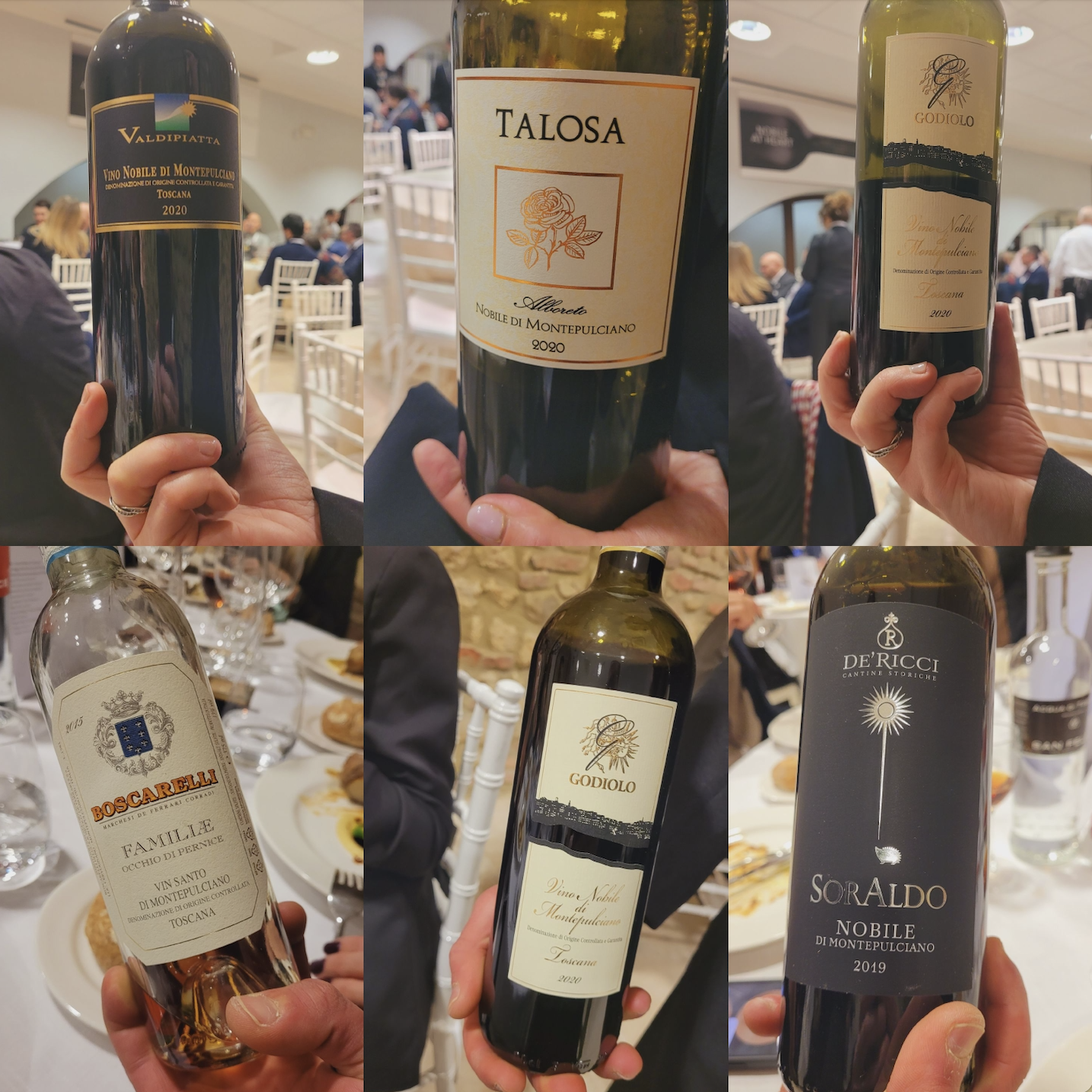
Selezione

Tenuta Valdipiatta Vino Nobile Di Montepulciano DOCG Vigna d’Alfiero 2022

Vegan-designate Vino Nobile and to no surprise a luxe and concentrated, elevated and characterized example. Exaggerates fruit and acidity, treads towards near dangerous territory and yet the amount of fruit available on hand stands up to the volatility. Equips the wine with the sure-fire ability to travel, age and drink in a good way some years ahead. The tannins are currently grippy, austere and drying but they will soften, negotiate and dissipate. Wait three years. Drink 2027-2033.  Tasted at Anteprima del Vino Di Montepulciano, February 2025

Bindella Tenuta Vallocaia Vino Nobile Di Montepulciano DOCG I Quadri 2022

The exaggeration of concentrated rusticity and sweet acidity get together for a most interesting example of Vigna Vino Nobile. A single vineyard expression where solar radiation develops fruit and its associated compounds for a chewy and musky sangiovese. A good wine, not particulate complex but well made and prepared to drink this way for up to five years. Drink 2025-2029.  Tasted at Anteprima del Vino Di Montepulciano, February 2025

La Braccesca Vino Nobile di Montepulciano DOCG Vigneto Santa Pia 2021

A Vino Nobile of a single vineyard or selection and there can be no doubt this comes from a very Mediterranean place. Macchia notes dominate the aromas, of hillside tea, rosemary and even an olive tapenade. That said the wine is not entirely clean as confirmed by the brittle and hard tannins. Drink 2026-2028.  Tasted at Anteprima del Vino Di Montepulciano, February 2025

De’ Ricci Cantine Storiche Vino Nobile Di Montepulciano DOCG Soraldo 2020

Somewhat luxurious sangiovese though on the naturally fruit sweet and sour heart side of things to express Vino Nobile in a particular way. Not exactly tart and no oxidation has crept in from this unique expression. Length is good and the wine’s linger is a positive one. Drink 2025-2027.  Tasted at Anteprima del Vino Di Montepulciano, February 2025

La Ciarliana Vino Nobile Di Montepulciano DOCG Vigna Scianello 2020

Single vineyard Vino Nobile, still quite tannic and yet to advance beyond its structured beginnings. There is a slight oxidative lean on the nose yet the wine stays linear, upright and sturdy. Still plenty of barrel to shed, melt and integrate should the fruit this wish to allow. Dries out at the finish though not without some developing character and complexity. Drink 2026-2029.  Tasted at Anteprima del Vino Di Montepulciano, February 2025

Contucci Vino Nobile Di Montepulciano DOCG Mulinvecchio 2020

A mix of red fruit, waxy crayon and raw dough on the nose for a confounding start to this sangiovese. Some grace and charm no doubt but also a level of volatility that may be distracting but surely this is the house style. No missing the substance, character, complexity and experience. As a Selezione this shines for the appellation and the future is bright, while also long. Drink 2026-2032.  Tasted at Anteprima del Vino Di Montepulciano

Icario Vino Nobile Di Montepulciano DOCG Sansasìa 2019

Problematic – volatile and woody to an uncomfortable degree. Faulted example – Brettanomyces taking over the palate and the tannins.  Tasted at Anteprima del Vino Di Montepulciano, February 2025

Podere Tiberini Vino Nobile di Montepulciano DOCG Vigne Vecchie di Famiglia 2019

Old vines make for sangiovese of high-level concentration and when the structural parts follow suit then here you have a Vino Nobile of great promise. Such is the case with this luxe, fleshy and at times severely tannic example but this shall pass and all with come to act and be together as one. Top quality and effect for 2019 and a wine that should live very well into the next decade. Drink 2026-2032.  Tasted at Anteprima del Vino Di Montepulciano, February 2025

Fattoria Del Cerro Vino Nobile Di Montepulciano DOCG Antica Chiusina 2019

Red fruit tang like few others and a level of volatility edging upwards towards the threshold of acceptance, but also understanding, Treads figuratively and hangs in the balance but there is no doubt that the concentration puts this in Selezione territory. Softens towards the back of the palate and calms right down. Needs food to tame the early distraction. Drink 2025-2027.  Tasted at Anteprima del Vino Di Montepulciano, February 2025

Montemercurio Vino Nobile Di Montepulciano DOCG Damo 2016

A maturing and resolved sangiovese that has seen its share of wood and gentle oxidation to arrive at this stage of its tenure. A Selezione of ample substance and chewy texture, some drying tannin and with air some airing in a decanter the wine should be ready to go. Drink 2025-2028.  Tasted at Anteprima del Vino Di Montepulciano, February 2025

Carpineto Vino Nobile di Montepulciano DOCG Poggio S.Enrico 2015

Here now a lovey settled and mature sangiovese with its dusty Balsamico character aged into a secondary state of grace. A Vino Nobile in Selezione form now caught in a tidy place with all its parts having come together. Chocolate all over the finish which speaks to the heavy use of wood but this has come to be a lovely drop. Drink 2025-2026.  Tasted at Anteprima del Vino Di Montepulciano, February 2025
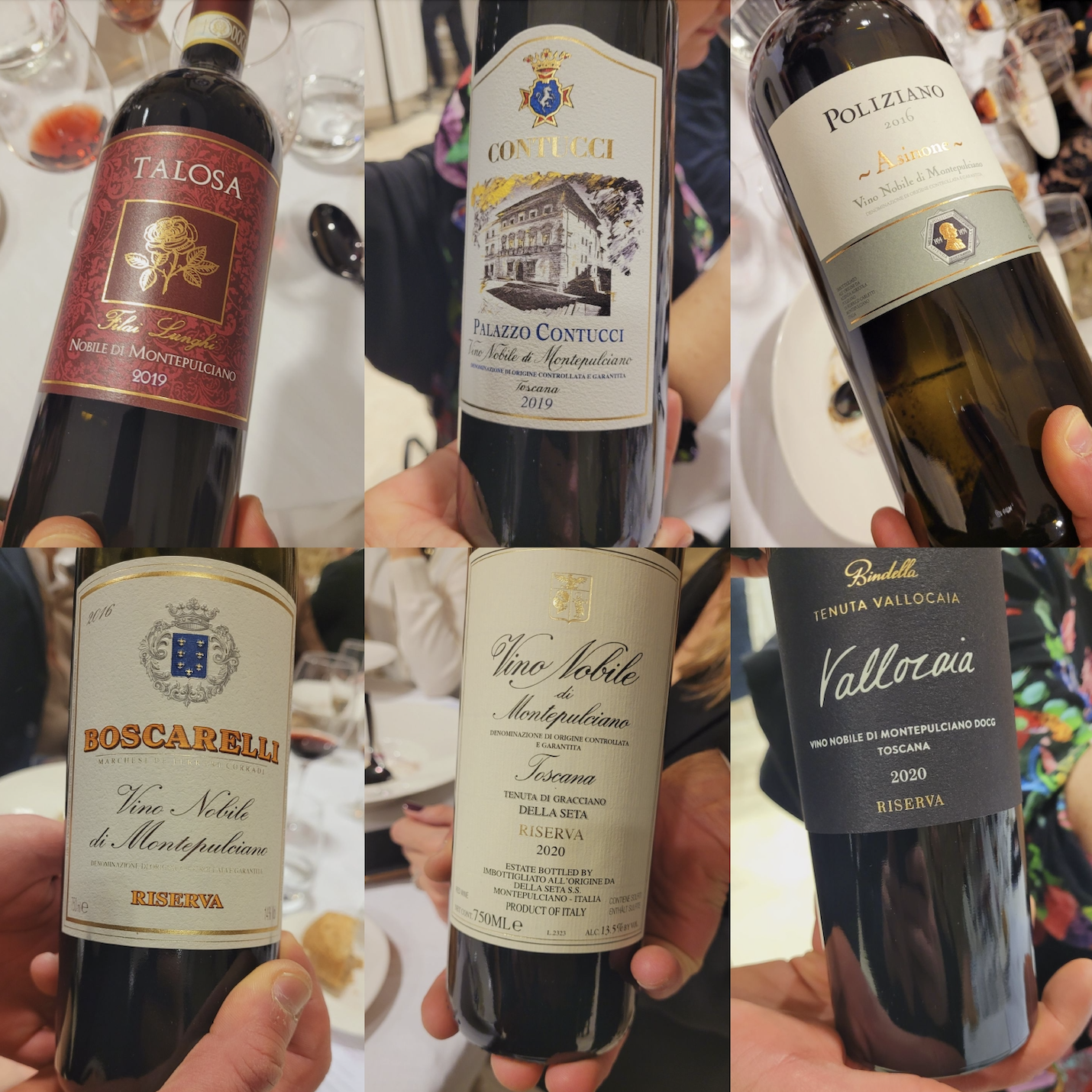
Riserva

Boscarelli Vino Nobile di Montepulciano Riserva DOCG 2021

Added layers and extra concentration define the aromatic proposal of a Riserva that to a producer is from la crème de la crème of Vino Nobile vintages. An ideal time to declare, select, age and bottle Riserva for the ages. This because of unlimited potential qualified by fruit substance, ideal acids and finest tannins drawn from the soils and success of a season. The balance and expressive character are simply tops. Drink 2027-2035.  Tasted at Anteprima del Vino Di Montepulciano, February 2025

Manvi Vino Nobile Di Montepulciano Riserva DOCG Ojas 2021

High level expressiveness delivers fruits studded by herbs and spice but also wood with trenchant intention. Dark Riserva for Vino Nobile and the concentration works to a degree. With thanks to the proper structure of the wine it is the generosity of maceration and pressing that result in a rich and layered sangiovese of depth and deep colour. Will turn to truffle and earth before too long. Drink 2026-2030.  Tasted at Anteprima del Vino Di Montepulciano, February 2025

Lunadoro Vino Nobile Di Montepulciano Riserva DOCG Quercione 2021

A reductive example of Vino Nobile Riserva but also one with an evergreen character in its aromas. This is followed by palate sweetness in a creamy, wood effected style. A bit gratuitous and sappy in the end. Drink 2025-2026.  Tasted at Anteprima del Vino Di Montepulciano, February 2025

Le Bèrne Vino Nobile di Montepulciano Riserva DOCG 2021

In a similar vein and style expressed by the estate’s ’22 Vino Nobile there is this undeniable connection to Riserva ’21. From a set of vineyards from which a selection of Riserva quality grapes, but even more importantly the kind of bunches that represent this appellation. Though the ’21 Riserva is blessed with veritable concentration it also delivers the minerals out of the diamonds in the rough and the structure to age as it should. Well thought out, considered, put together and consummated. Drink 2027-2034.  Tasted at Anteprima del Vino Di Montepulciano, February 2025

Carpineto Vino Nobile Di Montepulciano Riserva DOCG 2021

An incredible concentration of an estate’s climatic Mediterranean experience transcribed as Balsamico of località to define Vino Nobile as Riserva. Luxe of dark fruit, espresso and the cask’s effect brings a seasoning of liquid to fill the cracks. Professional extrovert of a sangiovese for mid-term drinking, or longer term if you wish for secondary and even tertiary character. Drink 2025-2029.  Tasted at Anteprima del Vino Di Montepulciano, February 2025

Tenuta Di Gracciano Della Seta Vino Nobile Di Montepulciano Riserva DOCG 2021

TCA. The top two wines for Tenuta Di Gracciano Della Seta are the newly minted “Pieve” label, a sangiovese that represents the parish of origin, one of twelve in Montepulciano, in this case Gracciano for which this estate is both pioneer and leader. The other is this Riserva, not a question of better or more important but instead a matter of using highest quality fruit in the representative way for an historic level of appellation. Using a highly touted vintage is key but again of greater importance is an estate’s view of what they are working with in any given year. A previously tasted sound bottle of this 2021 revealed a sangiovese stimulant, stellar and seductive, with fruit and acidity intertwined in a layering so rich it feeds the palate with a fullness not seen in the other wines. More wood as well, yet to integrate and so potential is high.  Last tasted March 2025

Relatively high-toned Vino Nobile, especially within the idiom at Riserva level and yet the wine feels just a bit hard to get Not a closed nose but just the slightest apprehension to open. The palate is more generous and giving, fruit sweeter and creamy, easy to assimilate and enjoy. Dark sangiovese, yet joyous and abiding. Drink 2025-2027.  Tasted at Anteprima del Vino Di Montepulciano, February 2025

Bindella Vino Nobile di Montepulciano Riserva DOCG Tenuta Vallocaia 2021

Quite a sweet set of aromas, rose floral, Ribena and effusive. Nothing dark or dangerous about this sangiovese, but rather a full and substantial concentration of red fruit with a connection between its constituent parts. Sneaky tannins come late and take charge with their grippy and austere notion. This is definitely the sort of Riserva you need to stay with, give time to release and better yet wait three years to allow for a coming together. Drink 2027-2032.  Tasted at Anteprima del Vino Di Montepulciano, February 2025

Marchesi Frescobaldi Vino Nobile di Montepulciano Riserva DOCG Tenuta Calimaia 2021

Truly similar and connected with the Tenuta’s ’22 Vino Nobile, of dark and luxe fruit caught at optimum ripeness and translated into a silky smooth elixir. A sangiovese that could only come from Montepulciano and more specifically this part of the region. Über professional work and surprisingly tannic which means the aging potential is quite good. Truffle, fungi and a reduction of Tuscan terroir, a.k.a, Balsamico are not far away. Drink 2026-2030.  Tasted at Anteprima del Vino Di Montepulciano, February 2025

Tenuta Poggio alla Sala Soc. Agr srl Vino Nobile di Montepulciano Riserva DOCG 2020

If at first there seems to be a sense of oxidation and a density that obfuscates what charm there should be – do not fear the worst. Things brighten on the palate with a richness of fruit mixed with wood thick as thieves for good times in juicy sangiovese. Continues to improvce as it rests and the best feels yet to come. In the end we get this seriously structured Vino Nobile as Riserva that will change, morph and improve with further age. Drink 2027-2031.  Tasted at Anteprima del Vino Di Montepulciano, February 2025

Tenuta Trerose Vino Nobile di Montepulciano Riserva DOCG Simposio 2020

Red fruit and florals, simple and effective, not particularly fleshy or substantial. Easy and ready, willing to please and time to get onside. Drink away. Drink 2025-2026.  Tasted at Anteprima del Vino Di Montepulciano, February 2025

Vecchia Cantina di Montepulciano Vino Nobile di Montepulciano Riserva DOCG 2020

Experienced, dare it be said antediluvian style of Vino Nobile expression. Taut and tart, an intensity not always noted and time still needed to soften the construction. Not a big wine per se but a tight one, spiced and not yet forgiving. Drink 2026-2029.  Tasted at Anteprima del Vino Di Montepulciano, February 2025

Cantina Luteraia Vino Nobile di Montepulciano Riserva DOCG 2016

A tired and oxidative Vino Nobile with acidity still flying high but fruit getting into raisin territory. There would have been pleasure two years ago but the time has past. Drink 2025-2026.  Tasted at Anteprima del Vino Di Montepulciano, February 2025
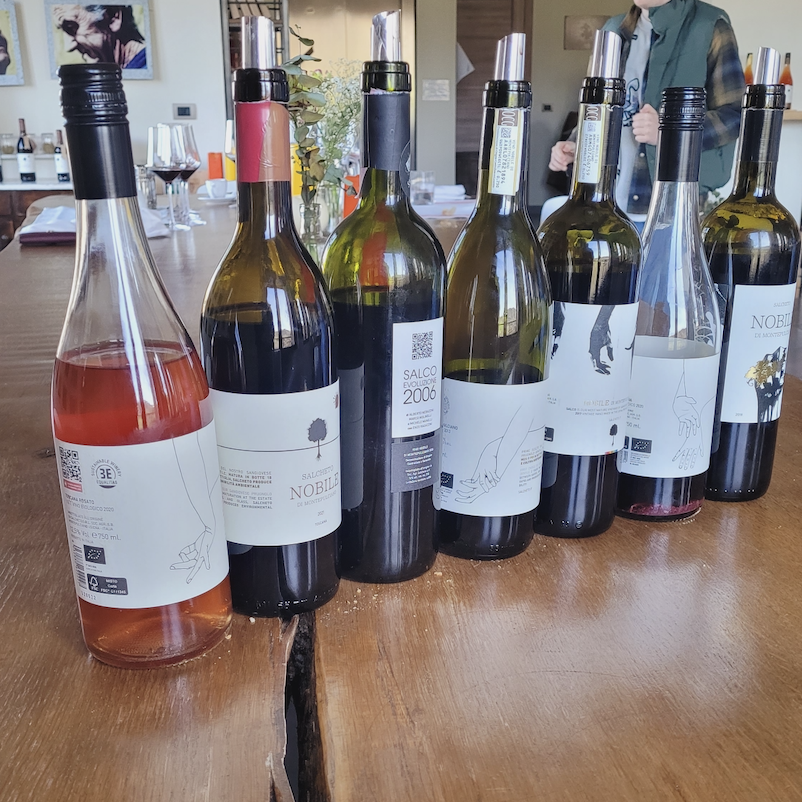
A visit at Salcheto

Salcheto Obvius Sensa Filtri 2020, Toscana Rosato IGT

The only Rosé in production is called Obvius, bottled without sulphites, made from sangiovese with (10 percent combined) canaiolo, mammolo and merlot. Just steel and not produced in every vintage, this being the latter stages of 2020 still being on the market and with 2022 coming next. The cleanest Rosato in this style possible, mimicking an Orange wine without ever being one, but natural it is and natural it acts. Drink 2025-2027.  Tasted February 2025

Salcheto Obvius Sensa Filtri 2020, Toscana Rosso IGT

Explosive fruit from the 2020 Obvius as Rosso in the series’ natural form, by design and of trenchant intention. As with the Rosato and Bianco these are all free thinking, formed and flowing wines of definition and purpose. Rosso joins the colloquy to take part in the re-writing of relationships between grapes and denomination. In Montepulciano the various forms of DOCG (Annata, Riserva, Selezione and Pieve) take care of the yeoman work and Obvius by Salcheto alters the conversation. Seems to be the point and Rosso makes a real statement. Drink 2025-2027.  Tasted February 2025
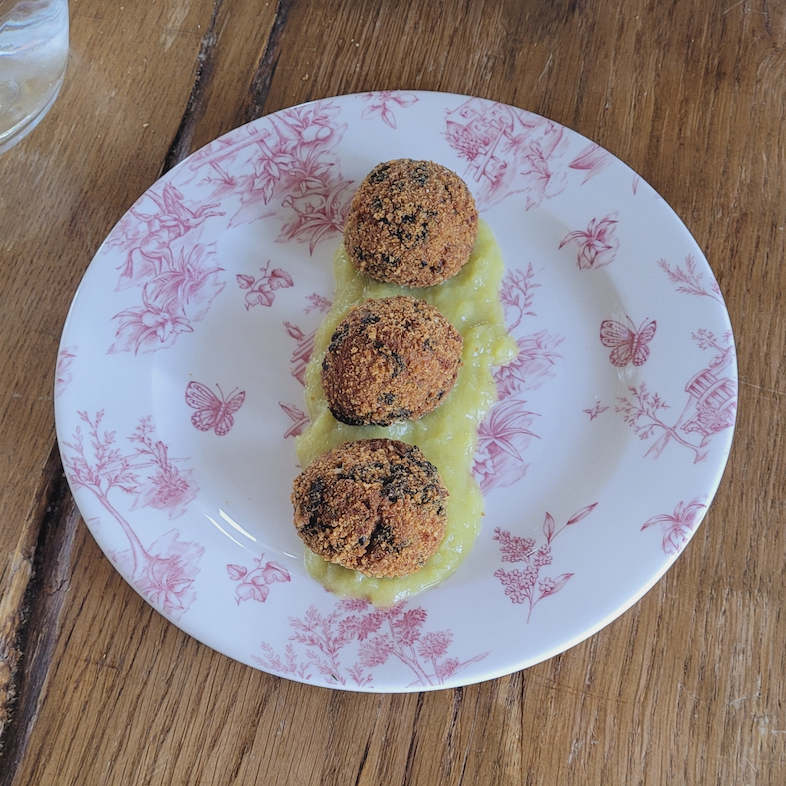
Salcheto Vino Nobile di Montepulciano DOCG 2021

Just sangiovese aged up to four years, split between cask and bottle, this being the vintage at the end of its run currently on the market. Wild of ferment and style, rich of texture and just that devilishly dangerous hint of game that speaks to the how and why, but also the what in terms of food pairing. The small deer of Tuscany done up in Ragù come to mind. Vino Nobile is almost never quite like this, predicated on texture and mystery that peaks curiosity, all the while there is wonder about how it came to be this way. Now softening from a vintage specific to Montepulciano where acidity was not all that exceptional. Drink 2025-2028.  Tasted February 2025

Salcheto Nobile di Montepulciano DOCG Vecchie Viti del Salcò 2018

The signature sangiovese and only made in select vintages from the oldest vines on the estate in vineyards surrounding the cellar. Notably concentrated and with that feeling of a Nobile at the height of experience. Silky, creamy and smooth and still toned. To be honest this is the kind of Vino Nobile that leads a style to be found out of the parish of Le Grazie. Drink 2025-2027.  Tasted February 2025
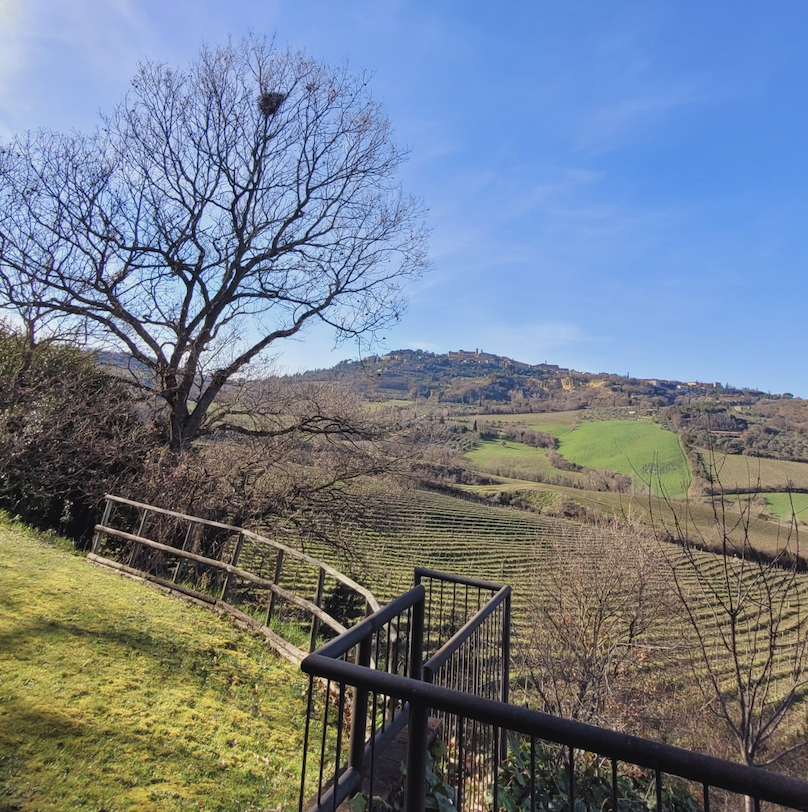
Salcheto Nobile di Montepulciano DOCG Salcò 2017

From the oldest vineyards up to 35 years of age located around the cantina, 100 percent sangiovese with a minimum aging of five years in 400L tonneaux plus three in bottle. From a certified hot vintage and now into its late years of primary maturity with secondary notes are on arrival. Violets on the nose, mulberry and faux mocha with flavours ranging, rising an falling into soft textures, creamy and settled on the palate. A sangiovese of experience, charm and grace though things will change again before too long. Drink 2025-2027.  Tasted February 2025

Salcheto Nobile di Montepulciano DOCG Toscano Vino Biologico 2013

A sangiovese from another era out of a less than usual vintage and the result being a maturity matched by an acidity surely specific to that season. Secondary notes have fully arrived, of Bokser pod, carob and leathery plum. Not a particularly Balsamico vintage but more so fruit and what feels like saffron. A bit of botrytis perhaps? Or not, though fig and liquorice too are all over the palate and the wine is, or at least was not too long ago surely seductive. Drink 2025-2026. Tasted February 2025

Salcheto Nobile di Montepulciano DOCG Salcò Evoluzione 2006

Remarkable longevity from a 2006 as a sangiovese coming from 18-plus years ago and with thanks to top quality vintage acidity. Sparks fly from the palate on this signature Vino Nobile in reference to the stream that flows around the valley and the willow trees that populate the terroir. Wow factor impression delivered from a wine designed in another era so persistent and a season for which the scent of Macchia Mediterranea is so pronounced. Some tannin still alive will allow this to stay focused for a few years yet. Drink 2025-2027. Tasted February 2025.

Good to go!

godello

Anteprima Vino Nobile di Montepulciano Pieve presentation in the Sanctuary of the Madonna di San Biagio

 

Instagram

Facebook

Always tasting Italian wines, doin’ allright

Toscana

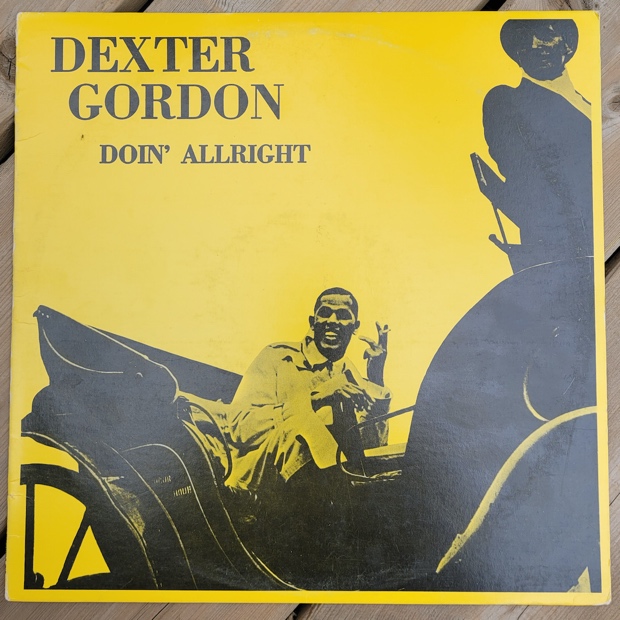
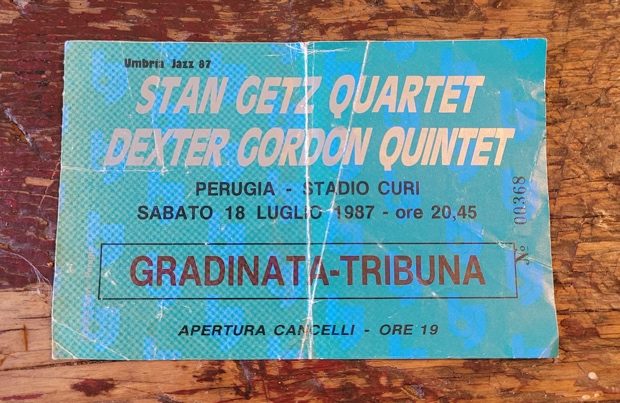
Back in the summer of 1987 I attended the Umbria Jazz Festival in Perugia. This was considered “the benchmark year for Umbria Jazz in terms of the Festival’s appeal, its quality, its ability to combine popularity with exclusivity, with mass concerts in the football stadium and the fantastic evenings inside St. Francis’ church.” The memories of that July 16th to 18th weekend are strong, persistently vivid and what happened there was clearly transformational in my life. Sting had played the weekend previous and though my crew could not stay long enough to see Miles Davis on Sunday the 18th still there were grand moments indelibly stamped upon our lives. Walking the Piazza IV Novembre up to Nicola and Giovanni Pisano’s Fontana Maggiore, drinking in the cafés, Sly and Robbie sitting at the next table. But the highlight happened at the Stadio Renato Curi where Dexter Gordon blew his horn and our minds. The saxophonist was fresh off of a revivalist’s record and hit movie. He was Doin’ Allright, as were we.


Jazz and wine. Two inextricably linked subjects and emotions in the summer of 1987. Now 35 years later I’m listening to Gordon’s seminal record and tasting wine. Time spent Far Niente. Tasting Italian wines from a wide ranging group of producers while paraphrasing from thoughts about the music of the OG big man, with no disrespect intended to Clarence Clemons. Dexter’s life and this group of wines are representative of that kind of size. Their rhythm section plays for the grape, seeming to sense what it wants, following the varietal lead and never falling out of balance. Full toned manner of wines, loping in medium tempo, solos unhurried, logical, warming and full of Italian melodies.

Umbria, July 1987

There are white wines that play beautifully and pensively while others pick up the mood by spinning out solos, staying texturally relaxed and thoughtful, ending with some perfumed chords. There are short bits and interludes but ultimately the way these wines handle their ballads is an indication of their length and depth. They know what it’s all about. The reds are at times wines of catchy and contrasting themes but they truly know how to build a solo. In today’s warming climate they climb up in temperature, chorus after chorus, until finally they satisfy at their apex. There are moments when the reds seem to be skipping and marching, alternating between funky riffs, leaping rhythmic figures and brightly lit burning flames of fruit and acidities. They build more slowly to climax while expanding in tones and for longer periods of time. There are chordal explorations in reds, blacks and of course blues. What connects them all is underlying substance in waves and weaves throughout each ensemble. Tasted consecutively or together theses wines all prove to be mutually significant. Thank you to Ira Gitler for the inspirational notes, to Stefania Tacconi and the prodcuers for sharing their wines.

Inama Vin Soave Classico DOC 2020, Veneto

Anything but entry-level from the grape garganega once known as Graecanicum grown in the basaltic lava, volcanic tuffs and orizzonti rossi. About as correct and defining as it gets for Soave, yellow and green floral, fruit recall more of the same and then the volcanic rock alterations that give the mineral-salty feel. While there might be a wish for a little bit more complexity and grape spirit there is some gelid to viscous texture in this 2020. In any case Inama’s is well made, educational and right on the varietal money. Drink 2022-2024.  Tasted March 2022

Abrigo Giovanni Favorita DOC 2020, Piedmont

As for white wines from Italy’s northern climes there are those that speak to many and then there is the “favorita” of others, the varietal Piedmontese white for the dreamers and the romantics. This from Abrigo out of Diano d’Alba avoids the bitters, pith and boozy thiol moments to instead capture all the white flowers and more. The scents are fruity over metallic and clean instead of waxy. There is precision and most importantly a toothsome grace over the palate that brings you back for more and more. A picnic in the hills, a chilled glass after the day’s movement and the scent of dusk. That is favorita when it’s right. Drink 2022-2024.  Tasted March 2022

Terra Costantino Etna Bianco DOC Deaetna 2019, Sicily

Terra Costantino’s is from Contrada Blandano in the Comune Viagrande, on soils sabbie di matrice vulcanica, a blend of carricante and catarratto, three to one, at 500m, part bush vine and part spurred cordon. Were the flinty smoulder the only beautiful thing going for this Etna Bianco it might almost be enough but the gelid and sweetly ripened fruit takes every moment to a higher caste and level. The thought of these wines being honeyed is not all that common and yet he we are, aromatically speaking, lemon meringue and curd, angel food cake, with the barrel impart knowable in vanilla and light caramel terms. A metallic feel as well, pure platinum gold, texture and some age already put behind. Not so typical but curious and highly enjoyable nonetheless. A drink now chardonnay or chenin blanc alternative that will begin to oxidize in a couple of years time. Drink 2022-2024.  Tasted May 2022

Poggio Argentiera Morellino Di Scansano DOCG Bellamarsilia 2020, Tuscany

High-toned in 2020 with a marked level of volatile acidity and good if not maximum ripeness from sangiovese grown either in a (relatively) cooler year near the (Maremma) Tuscan coast. It would seem the winemaker is also looking for restraint and maintaining positive acidity because at this low level (13.5 per cent) of alcohol the resinous and stemmy nature of sangiovese is duly noted, if also accentuated. Texture is a bit chalky, almost grainy and the tannins throw a touch of green. Drink 2022-2023.  Tasted May 2022

Usiglian Del Vescovo Il Barbiglione 2015, Terre Di Pisa DOC, Tuscany

From estate grapes in the Pisa DOC and from a winery also producing wines both coastal and in Chianti appellations. Centred around syrah with small percentages of cabernet grown in greyish, dry, shallow, sandy soil with some clay, lime and fossils. A bright, currants and other red fruit syrah with notable tang and wood resins. A touch pectin sappy while satisfying and complete. Held back to tame its wild side and drink upon purchase. Drink 2022-2024.  Tasted June 2022

La Regola 2018, Toscana Rosso IGT

A place of Etruscan origin just five kms from the Tyrrhenian Sea at Riparbella in the Cecina Valley. The vineyard lays within the Montescudaio DOC at 150-200m with soils described as Mediterranean with an abundance of stones. La Regola’s (the rule) is varietal cabernet franc, abundant, heady and as compared to the blended reds, so unfettered and uncluttered. The varietal purity is expressly coastal, of saltiness, algae, seaweed, tar and fruit so much more than a plenty. This is truly a stylistic and a place that makes wines just like this here screaming with clarity and truth. There seems to be little doubt that cabernet franc fits, unlike sangiovese, syrah or cabernet sauvignon. Franc is the signature red and 2018 announces its success. The structure, unimpeded drive and length confirm the pronouncement. Drink 2024-2029.  Tasted June 2022

Boscarelli Vino Nobile De Montepulciano DOCG 2019, Tuscany

Boscarelli is a name to conjure with, a producer from Montepulciano as direct and exciting as a communicator of sangiovese emotion as any, consistently declarative in attack. Case in point this 2019 though with the added advantage of a most generous and unselfish vintage. Fruit comes from estate vineyards in the parish or pieve of Cervognano, one of 12 newly minted UGAs, a.k.a. unità geografiche aggiuntive. These additional mentions for the overall appellation give us the consumer a more pinpointed sense of place and in Boscarelli’s world the vines were planted in the late 1990s. Depth burrows in an endless seeking of mineral wealth while highlights rise unencumbered, defying gravity and setting this local sangiovese free. When sangiovese does both it’s a bit of a revelation and in Montepulciano the truth is not always easy to come by. The wines can make you work for your pleasure and this 2019 gifts it freely. Drink now and for the next 10 years. Drink 2022-2028.  Tasted May 2022

Il Bocale Montefalco Rosso DOC 2018, Umbria

The Umbrian work of i famiglia Valentini based around sangiovese accented by the local sagrantino, then merlot and colorino. Unequivocally balanced if not quite the increasingly generous vintage that will follow in 2019. The succulence and juiciness of the Montefalco Rosso appellation is captured with precise and succinct advantage and done so without any due stress or adversity. The fruit spreads with ripples into fine acidity and supple tannins like a large rock dropped into a pool of water. The rock disappears but the fluidity and gentle set of wakes linger on, ever so slowly decreasing their size and intensity. Bocale’s ’18 is an effortless Rosso, aromatic, flavourful and elastic. This is just what a top producer knows how to do. Drink 2022-2025.  Tasted June 2022

Il Bocale Montefalco Sagrantino DOCG 2016, Umbria

From the Valentini family dating back to 2002 and a varietal sagrantino of the highest selection. “Bocale is the dialect word that indicates the two litre mug of wine or oil, but, above all, the name with which this family from Montefalco has always been identified.” From the most democratic of Montefalco vintages, long, studious and just, indeed a wine giusto e completo, time having settled the once formidable tannin and connecting the early unconnected parts. A wholly unique profile, indicative of tar, dark chocolate and espresso yet subtly so, with an allowance of many complexities to join the parade. Quite special in so many regards. Drink 2022-2026.  Tasted April 2022

Il Palio, Siena, July 1987

Riecine Chianti Classico DOCG 2019, Tuscany

Grande Gaiole compass, cinch and girth in naturally swarthy sangiovese from Riecine in 2019, crunchy and tart. Inching up towards the volatile but such is the word in pace for the vintage. The fruit can handle the stark reality and veritable truth, equipped with grip and ready for the inevitable circumstance. Maybe wait a year for further resolution. Drink 2023-2027.  Tasted February 2022

Villa Di Capezzana Carmignano DOCG 2017, Tuscany

Consistently presents with an evolved aromatic tendency as it breathes maturity into every phrase it plays. The jazzy mix of violet, spice cupboard and freshly baked earthenware speaks in open and knowable truth for a wine so upwardly representative of a DOCG with roots dating back to 1716. That is when Cosimo III de’ Medici, Grand Duke of Tuscany granted exclusive status to Carmignano at the same time he did so for the Classico territory of Chianti. Was not the easiest vintage to deal with and yet this is one of the Tuscan stars what with the piquant yet elastic spice condition rolling off of the palate with sage, fresh tobacco, finnocchi and tartufo. Deals with 14.5 per cent alcohol without adversity while modelling symbiosis between sangiovese and cabernet sauvignon. Hard to do much better with the aridity and warmth, breathe life and plan for five-plus more years of pleasure. Drink 2022-2026.  Tasted June 2022

Azienda Agricola Reassi Sparviere 2018, Colli Euganei Cabernet DOC, Veneto

Reassi’s two-thirds cabernet sauvignon and one-third cabernet franc comes from the Padova area in the Veneto, famously home to some of Giotto’s most profound and important 13th/14th century frescoes housed in the Cappella degli Scrovegni. The estate’s 1997 planted wines are located in the zone of Carbonara di Rovolon, harvested near the end of September and only 3,500 bottles are produced. This is a cheeky cabernet at the lead for the Colli Euganei DOC, full of sweet tar and tobacco, petrol in cars, wood resins, fruit from pods that grown on trees and really quite bright in disposition. How can you not adore the vitality and low alcohol proposition (12.5 per cent) plus this genteel pectin and glycerol feel. “Oh, it’s magic, Uh oh, it’s magic. Just a little magic, you know it’s true.” Drink 2022-2025.  Tasted May 2022

Abrigo Giovanni Barbera d’Alba DOC Marminela 2019, Piedmont

At the DOC Barbera level it would be hard to find another example so open, forthright, up front, bright, getable and delicious than this Marminela by Abrigo. Classic interpretation indeed yet without rustic strings tethering it to the past, instead expressive of a freedom to explore. Here barbera throws aside traditions in a spirit of experimentation. This is a blend of grapes from two vineyards in the municipalities of Grinzane Cavour and Diano d’Alba and aging takes place for nine months in concrete vats. Freshness is dutifully captured, preserved and the barbera perseveres. Will drink this way for two, maybe even three full years ahead. Drink 2022-2025.  Tasted June 2022

Rocche dei Frisu is Abrigo’s top end, purest expression of barbera, from vineyards in Diano d’Alba and also nearby. The sites range in elevation between 230-360m, on clay-based soils mixed with sand and limestone, depending on the block. The name could mean “cones of frieze” in the literal sense but probably a name given to a hill of natural architecture that when looked at from afar there would be some sort of illusory effect. As in art, whereby a trompe l’oeuil or trick of the eye is created by a broad horizontal band of sculpted or painted decoration. In any case the barbera in this bottle does the exact opposite with its openly blatant and striking set of ripe fruit, varietal acidity and full throttle potency. Not shy to be sure, nor heavy neither but there is power contained within this bottle. Even after nearly four years the Frisu does not relent and as a member of the Alba Superiore fraternity the representation is bang on. Plenty of stuffing will see this through to the end of this decade. Drink 2022-2028.  Tasted May 2022

Abrigo Giovanni Nebbiolo d’Alba DOC 2019, Piedmont

Marked valuation in animal musk through the masculine scent of Abrigo’s nebbiolo from Diano d’Alba, a parochial example equally rich in classic DOC notes. Only the nebbiolo from Alba’s territory smells and tastes like this, accentuated by wood with spice infiltration inside and out. The animal magnetism is captivating, as much as the barrel accents are condiments to the fruit and earth that fill up this nebbiolo. Quite tight for 2019, needing some time, acids equally taut and being open three days helped immensely. Be patient with this Alba, it will reward those who are. Drink 2024-2028.  Tasted June 2022

Abrigo Giovanni Barolo DOCG Ravera 2017, Piedmont

Diano d’Alba producer of a Barolo in the municipality/cru/MGA of Novello. Meets the specs of Tortonian soil, laminated Sant’Agata fossil marl, in other words calcareous clay, deeply entrenched, at 400m, vine age ranging 20 to 35 years. Fifty per cent is treated to long skin maceration i.e. cappello sommerso and despite the aridity and heat of 2017 there is freshness captured in Abrigo’s Ravera. Luminous and immediately spicy, a piquancy of pure nebbiolo spiked by time, vintage and lastly barrel. Amazingly persistent Barolo, full, substantial and in charge. Must give this three more years to integrate and allow us to grow as tasters, eventually to be ready and willing to enjoy this wine. Drink 2025-2032.  Tasted June 2022

Tenuta Di Pietrafusa Villa Matilde Avallone Fusonero 2015, Taurasi DOCG, Campania

Varietal aglianico from the Taurasi DOCG and a producer that also fashions top quality wines at IGT Campania prices coming in at under $20 CDN. This top drop comes from the production zone of Montemarano e Paternopoli off of vines planted in 1968 and 1985. The first commercial vintage was 2004 and so here in the 12th iteration is a most generous vintage from which the best of all worlds is accessed. The world of aglianico is reached earlier than that which hesitantly emerges out of some hard, at times sufferable and surely tannic vintages. Here the fruit is nearly up front, artistically open and and even playing with musical swagger. There is room for all the aglianico because they provide the opportunity to enjoy the standards, originals and forward thinking examples. Fusonero is a delightful combination of all three and for that we are grateful. Drink 2023-2029.  Tasted June 2022

Good to go!

godello

Tuscany

Twitter: @mgodello

Instagram: mgodello

WineAlign

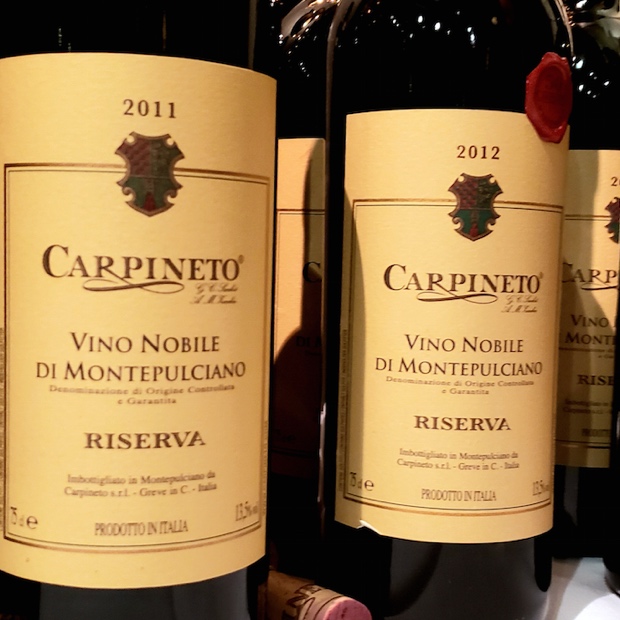
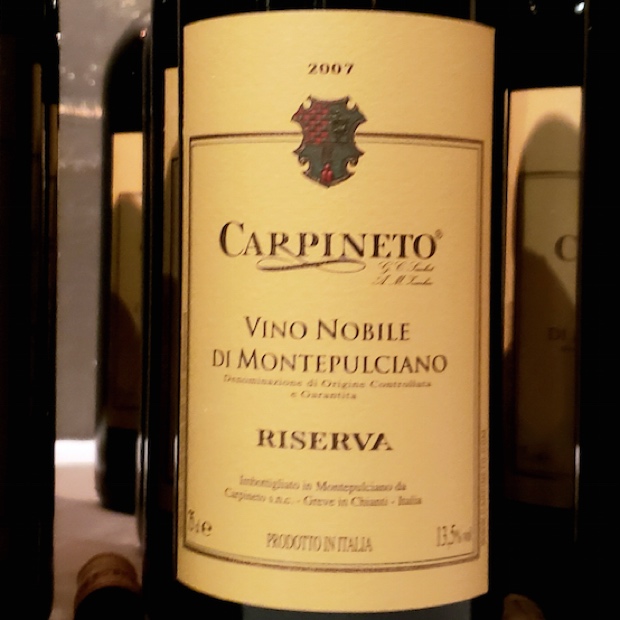
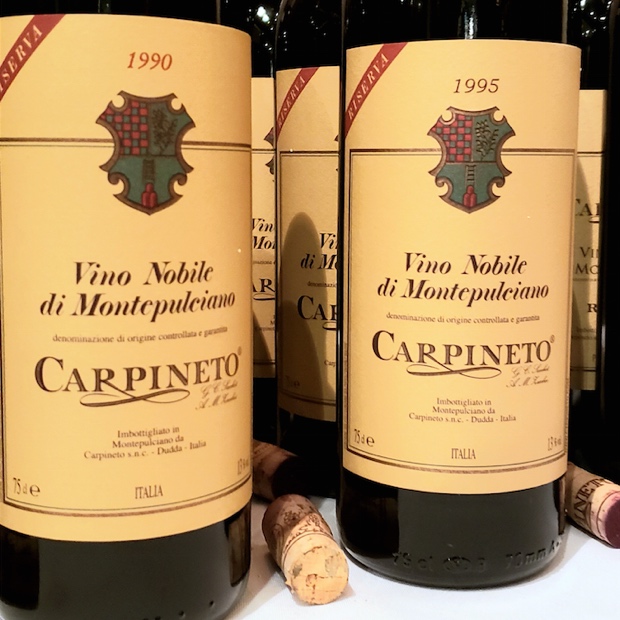
Vertical Carpineto

On a few separate occasions early in 2019 I have had the opportunity to taste the Chianti Classico and Vino Nobile di Montepulciano sangiovese of Tuscany’s Carpineto winery.  Carpineto Appodati comprises five Tuscan estates; Dudda and Gaville (Greve in Chianti), Montepulciano, Montalcino and Gavorrano (Maremma). No less than 28 different wines are produced off of the five properties and while Dudda in the Chianti Classico appellation is the epicentre of the operation it is the storied Vino Nobile sangiovese from Montepulciano that have garnered the most international accolades.

Related – A traditional afternoon with the wines of Carpineto

During February’s Anteprime di Toscana Chianti Classico Collection in Firenze I had the pleasure of having dinner with proprietor Antonio Zaccheo Jr. and the most recent sit-down happened when Zaccheo came to Toronto on April 16th. A group sat down to lunch with Antonio and tasted through an eye-opening vertical that included Vino Nobile going back to 1990. Here are my notes on 12 recent assessments.

Carpineto Chianti Classico DOCG 2015, Tuscany, Italy (356048, $19.95, WineAlign)

Rich and unctuous Greve in Chianti Annata with classic savour and raging acidity. Still in tense command and not ready to uproot to advance any time soon. Cool, minty and understood. Much improved since first tasting this 26 months prior or more likely a case a not perfectly sound first bottle. Improved score as a result. Drink 2019-2023.  Last tasted April 2019

Carpineto’s is no shrinking 2015 sangiovese violet with its extracted fruit, soil funk and carob-chewy flavour. After a year further in bottle the extremities are exposed so that secondary notes are emerging, in tempered chocolate, funghi and dried leather. It’s more evolved than expected and while curious it shows the complexity of Greve in Chianti soil. Drink 2018-2019.  Tasted February 2018

Carpineto Chianti Classico DOCG 2016, Tuscany, Italy (356048, $19.95, WineAlign)

Much further along the road to expression is the way I’d have to announce the immediacy from Carpineto’s quick to gratify Annata ’16. The fruit aches to be pounced upon and used as quickly as you can make this happen. And yet there is a moment of microbial grounding to keep it honest and traditional. In the end it’s a really full and gregarious expression for sangiovese with true red limestone liquidity. Drink 2018-2021.  Tasted February 2018

Carpineto

Carpineto Chianti Classico DOCG 2017, Tuscany, Italy (356048, $19.95, WineAlign)

Tough reductive nut to crack though a swirl, some agitation and air releases some classic Greve in Chianti Carpineto aromatics. Chewy sangiovese, after that initial rock solid wall broken through and full of rendered fruit, some leathery, very cherry and quick to speak. Such a mouthful with bones and a verdant streak run right through. Drink 2019-2022.  Tasted February 2019

Carpineto Chianti Classico Gran Selezione DOCG 2015, Tuscany, Italy (WineAlign)

Packed in suitcase from Greve by Antonio M. Zaccheo for this Toronto tasting. True to the Carpineto, Greve in Chianti, Classico style in that there is no real departure in stretch to the Gran Selezione, at least in terms of a thickening to syrup or shaken consistency. The cool, minty, dusty, high-toned and big red fruit personality are on headlights display, front, centre and all in. Here is the highest quality acidity that ’15 can gift and the fruit takes full advantage. Great cupboard spice and length. Really well done. Drink 2021-2028.  Tasted April 2019

Carpineto Vino Nobile Di Montepulciano Riserva DOCG 2015, Tuscany, Italy (368910, $32.95, WineAlign)

True to character for sangiovese exclusive to Vino Nobile, dusty, high-toned, dark fruited and also to Carpineto. More than the average amount of hectares bring a healthy dollop of the syrupy fruit, especially and in waves. The clone of prugnolo gentile is traditional to the estate for the appellation, incidentally Italy’s first in terms of red wine. And yes the prune quality is inherent here, with freshness by fruit off of young vines. More fruit abounds than Montepulciano is readily willing to gift and it seems two great things will happen. Consumers will enjoy this now and those with modest cellars can look to 2022 and maybe beyond for another credible layer of pleasure. Drink 2019-2024. Tasted April 2019

Carpineto Vino Nobile Di Montepulciano Riserva DOCG 2013, Tuscany, Italy (368910, $32.95, WineAlign)

The development in the 2013 Vino Nobile is multiple for reasons obvious and also obfuscating. The cool and demanding vintage adds dusty tension while extract brings more grip and power. What’s less obvious is the earthiness that crusts through and over dried fruit because of a vintage that simply can’t run away and hide. A characterful wine here, complex and a bit feral but still connected to its primary fruit, though not for long. Drink 2019-2022.  Tasted April 2019

Carpineto Vino Nobile Di Montepulciano Riserva DOCG 2012, Tuscany, Italy (368910, WineAlign)

The 2012 has passed over into next epoch territory, found initially with balsamico on the nose. The strong, grip gifting vintage brings the tension and the depth with darker fruit and some brooding personality. What ’12 also delivers and still does so with notable tonality is acidity. Fine Montepulciano, wind-ushered and assisted acidity. Further proof that this will live longer than 2013.  Last tasted April 2019

There is no missing the amount of big, old and sheathing barrel in the Carpineto ’12 Riserva but there too is no mistaking the Vino Nobile style. There is a lot of structure in such a handling and rendering, from a vintage with maximum fruit that can handle this sort of big-time wood addendum. That is because acidity, sapidity and edgy volatility work in cohorts, not in ante-productivity. This will age into umami, funghi and figgy-balsamic bliss over a 10-plus year period. Drink 2017-2025.  Tasted October 2017

Carpineto Vino Nobile Di Montepulciano Riserva DOCG 2011, Tuscany, Italy (368910, WineAlign)

It’s more than merely interesting to taste this in a flight with ’12-’15. It’s both as evolved or more but also deeper in tones, just as grippy as ’12 and perhaps even tighter, finer and further into structure. All the parts moving or otherwise are accentuated and exaggerated, not the least of which are the toasty earth and the aforementioned architecture. This will dive deep into the old school, mushroom and umami well. Drink 2019-2023.  Tasted April 2019

Carpineto Vino Nobile Di Montepulciano Riserva DOCG 2010, Tuscany, Italy (368910, WineAlign)

Still amazingly youthful with what was clearly some of this estate’s best prugnolo gentile fruit of all time. Secondary character is but a whisper or a faint idea though the umami hints are always in the conversation. Just a terrific execution from this great vintage. Great complexity developed over the past three years warrants an extra bit of scoring love. Drink 2019-2024.  Last tasted April 2019

Carpineto’s Riservas travel to such gossamer and spiritual territory, taking the normale freshness and turning it into plausible hyperbole. The soil is inherent and complicated into the big star Nobile’s soul. Liquorice and tobacco, purity and sangiovese classicism. Oh, my soul “we’re going to get on up and drink till we drop.” Drink 2017-2021.  Tasted May 2016

Carpineto Vino Nobile Di Montepulciano Riserva DOCG 2007, Tuscany, Italy (368910, WineAlign)

Impressive in the way this Vino Nobile is hanging in early secondary character development, still showing more fruit, albeit into the prune but not far along in terms of mushroom, tar and forest floor. A bit scorched but that was the vintage and even more reason to appreciate the slow movement and the length.  Last tasted April 2019

Carpineto’s Vino Nobile hails from further inland, where the climate is more continental and the dry-farmed clay soils help carry the grapes through warm summers like 2007. Has an intense grapey, raisin and resin character. Really big fruit yet still old school enough to remind us all of the Carpineto oeuvre. This has stuffing, with nary an advancing moment towards a premature future. Blessed with a seamless nose to palate to tannins structure. This is really fine Vino Nobile, “scelto,” a chosen mocker. It’s thick and full but not from oak in any shaken or splintered way. This Prugnolo Gentile comes by its substance naturally, with minimal effort or need of applause.  Tasted September 2014

Carpineto Vino Nobile Di Montepulciano DOCG 1995, Tuscany, Italy (WineAlign)

The 1995 is immediately notable for being the most floral of all the Carpineto Vino Nobile and that’s saying something in a vertical that includes ’15, ’13, 12’ 11, 10, ’07 and ’90. It’s also blessed with the most acidity of them all. That said there is more earthy character down low and volatile-acetic personality up high. The violets, ultra-violet light and string violin musicality make for a tension filled journey through sangiovese in the clonal hands of prugno gentile that is anything but when you take the two words at their endemic and etymological sources. Neither prune nor gentle but something completely off the charts. What kills it in the end is texture, ahead of the curve and in charge. Drink 2019-2022.  Tasted April 2019

Carpineto Vino Nobile Di Montepulciano DOCG 1990, Tuscany, Italy (WineAlign)

The impossibility of three decades grace comes out of Carpineto’s 1990, still youthfully dark and brooding, kept in place with all three eras intact; primary, secondary and tertiary all play together in this Montepulciano sandbox. Plums beget prunes, begetting raisins and then dug into the funghi and truffle of the earth. It’s a porcini bend but also a tartufo shaved over red wine soaked risotto, starchy, creamy and silky smooth. Acidity still rules and if I were to compare this to the 1988 tasted in Montepulciano in 2017 I’d say this is easily five or perhaps even 10 years behind in its development. Hard to imagine a vintage getting better than this. I’d say 2010 and 2015 are closest. Drink 2019-2021.  Tasted April 2019

Good to go!

godello

Twitter: @mgodello

Instagram: mgodello

WineAlign

Seventeen mind-blowing wines of 2017

No, wines do not have to be old to blow your mind but there is just something so mysterious, magical and hypnotizing about the experience of age in preservation. When we use the cliché “tasting history” it distracts from what is most poignant about tasting older wines. It’s the humbling and how wisdom, acumen and meteorological circumstance conspire to take us away from our troubles, to forget about life for a while and to realize that forces greater than us are truly in charge.

There are also young wines so precocious and wise beyond their years that they somehow intuit the future. These too can blow our minds, addle us as if lovestruck and disoriented so that only this confluence of smell, taste, texture and structure are what we know. It takes all kinds to populate a list that separates greatness from the rest, but that does not means only 17 wines were tasted to be extraordinary in 2017.  It means that some struck a vein while others grazed on the skin. Most important is that all were experienced because someone chose to share them. Thank you to the producers and the benefactors for bringing these bottles to light.

Related – 16 mind-blowing wines of 2016

Honourable Mentions

Château Haut-Brion 1986, Saffredi 2004, Brokenwood Sémillon 2007, Domaine Gros Frères Clos Voguent Musigni 2013, M. Lapierre Morgon 2010, Domaine G. Roumier Bonnes-Mares Grand Cru 1996, Domaine Jamet Côte-Rôtie 2006, Coppo Barbera d’Asti Nizza Riserva della Famiglia 2009, Le Fraghe Bardolino 2015, Sordo Barolo Riserva Gabutti 2006, Carobbio Chianti Classico 1990, J & J Eger Kékfrankos 2006, Château Léoville Las Cases 2001, François Cotat Chavignol Sancerre Rosé 2009, Domaine La Vieux Télégraphe Châteauneuf du Pâpe La Crau 2005, D’Arie Syrah 2012, Julia Bertram Handwerk Spätburgunder 2015, Planeta Carricante Eruzione 1614 2015, Dominus 1994, Château Lafite Rothschild 1998 and Esmonin Gevrey-Chambertin Clos Saint-Jacques 1993.

Several times a years I gather with groups of like-minded, wine-spirited folks, to break bread and to pop established icons, singular archetypes, varietal rarities and supernumerary misfits. Many of the wines on this 2017 list are a result of having been fortunate enough to be included in repeated repasts with pirates on picnics and doctors at dinner.  Most of the rest are travel related, in fact this year alone I tasted approximately 700 sangiovese, 200 barbera, 200 corvina and 100 nebbiolo. So many more of those praiseworthy reds and rosés deserved spots on this docket but alas, the list is short. I do not fulminate them, nor you neither. Here are Godello’s 17 mind-blowing wines of 2017.

It began like this and I got 15 dollars hid above the stove.

Möet & Chandon Dom Pérignon Vintage Brut Champagne 1990, Champagne, France (280461, AgentWineAlign)

Tasted blind the hue immediately leads the mind in one of two directions; hot vintage or decades of age. I’m tempted to consider a combination of the two, so the decision is warm vintage and a minimum of twenty years age. Further introspection takes me back to 1990 and when the reveal confirms this and in the abide of Dom Pérignon it means one thing. Start the process of thinking again. This wine has done its work, having accumulated a diverse set of developmental traits and processed them so that the language it now speaks is clear and pure. At 27 years of age it’s delicate, smooth, soft-spoken and settled. The finest golden toast (again in hue and more importantly in aroma) glows into the creamy texture, like preserved lemon transformed into gelid curd. The mouthfeel is exceptional with baking bread rising, puffy and satiny glazed across the palate. The seamlessness of this Champagne seeks, solicits and makes rendezvous with no peer or challenger its equivalent, not should any comparison be made. Kudos to a wine that stands on its own and makes you feel this good. It will continue to do so up to and perhaps beyond its 40th birthday. Drink 2017-2030.  Tasted March 2017  moetchandon  @chartonhobbs  @MoetUSA  @ChartonHobbs  @Champagne  Moët & Chandon  Charton Hobbs Canada  Champagne

Famille Picard Saint Aubin Premier Cru Le Charmois 2014, AOC Bourgogne (522078, $57.95, WineAlign)

This is a chardonnay to place the village of Saint Aubin in a remarkable light if only because it’s the most stony, flinty and tightly wound example just about ever. The Charmois is the elevator that carries the appellation into a purity of climat for Bourgogne Premier Cru. In this case terroir delivers the idea of Climat but it is the interaction of the maker that defines the notion simply because there is no mess and no fuss. It just feels like drinking straight from a bleed of the calcareous land, as might happen in a limestone goblet filled with Montrachet. You have no idea how good a deal this is from the most excellent 2014 vintage. Drink 2019-2028.  Tasted October 2017  domainesfamillepicard  profilewinegroup  #bourgognewines #FamillePicard  @ProfileWineGrp  @BourgogneWines  Domaines Famille Picard  Profile Wine Group  Bourgogne Wines

Domaine Bouchard Père & Fils Chevalier Montrachet Grand Cru 2015, AOC Bourgogne (Agent, $480.00 WineAlign)

Chevalier-Montrachet is a matter of aromatics, of the finest of the finest, preserved, reserved, impressionable and of quietly powerful impression. The deistic and the parrhesiastic are reached in this Grand Cru, “one who speaks the truth to power.” Elysium in chardonnay is captured for the perfectly ripe orchard and crushed stones. The young palate is almost severe but takes its first steps down the most ethereal path, with the finest drawn lines and rendered streaks of energy lit, sparked and smouldering. This is Bourgogne of intrinsic value, slowly rising to a crescendo where a flame flickers but within the sheltered lamp of a hurricane. How is such harnessed power even possible? Only like this, in Chevalier-Montrachet . Drink 2021-2037.  Tasted April 2017  bouchardpereetfils  woodmanws  vinsdebourgogne  @BouchardPere  @WoodmanWS  @VinsdeBourgogne  Bouchard Père & Fils  Woodman Wines & Spirits  Vins de Bourgogne / Burgundy wines

Domaine Sigalas Kavalieros 2015, Santorini, Greece (SAQ 11814421WineAlign)

I’ve not yet tasted the Kavalieros 2014, so this single-vineyard, 18 months on lees done in stainless steel Kavalieros 2015 made by “Mr. George” is the benchmark for Santorini, assrytiko and salty white wines everywhere. The first release was 2009. Straight up and turning the world on its head, like the old man on the label and upside down against Apollo’s Aegean Cyclades. This ’15 richer still, more than the seven villages wines and a hyperbole as compared to the entry-level assyrtiko, of deeper mineral, compressed, layered and fantastic. Crushed rocks permeate in aggregate, it’s quixotically saline and textured, of intense presence and finally, structured. For 15 years at least. A late shot of natural Santorini tonic swirls in centrifuge with assyrtiko so wound up. This will need 10 years to unwind and allow for cracks to form in the mineral shell, followed by the birth of its fruit. It should never be forgotten that assyrtiko can and will show fruit but with Kavalieros you’ll have to be patient. Drink 2020-2031.  Tasted March 2017  @DomaineSigalas  @MajesticWineInc  winesofgreece  domainesigalas  @MajesticWineInc  @DrinkGreekWine  @DomaineSigalas  Panayiota Kalogeropoulou  Wines of Greece

Penfolds Grange 2011, South Australia (356121, $750.00, WineAlign)

There is just something about cool, rainy and irreconcilably regarded vintages that brings out the best in wines made by winemakers of elite acumen. Deliver your best from the greatest of harvests but also “give me your tired, your poor, your huddled masses yearning to breathe free. The wretched refuse of your teeming shore.” Leave the middle of the road to someone else. This Grange faced adversity and won. The yields and output may only be 50 per cent of normal but what gives is the silky texture of Grand Cru Bourgogne. This chosen one of singular vision to represent the multi-tiered and faceted Penfolds Estate tells us about the world inhabited by the instinctual and the ethereal. It combines tannin, structure and aesthetic deeply engrossed in the shadow of its own looming destruction, but is designed from the first with an eye to its later existence as a ruin, forever preserved. If a perfect plum and a magical olive were crossed they would welcome this collective spice of no equal. The quality of bite and chew lead to rumination and the savour rests on a chart clearly defined but in high contrast and only to itself. An analgeisc meets hypnotic cooling is mentholated though if not specific in origin it is only and highly natural. Legendary vintage? Why not. This calm, cool and collected 2011 may just outlast some of the more recently considered top vintages of ’06, ’08 and ’10. Drink 2019-2035.  Tasted May 2017  penfolds  markanthonyon  wineaustralia  @penfolds  @MarkAnthonyWine  @Wine_Australia  Penfolds  @MarkAnthonyWine  Wine Australia

A deep #eredichiappone vertical delve with Daniele for perspective and a release of endorphins @ilNizza possibilities #progrettovini #collisionimonferrato

Erede Di Chiappone Armando Barbera D’asti Superiore Nizza DOC RU 2006, Piedmont, Italy (WineAlign)

RU by Daniele Chiappone is this, at first something altogether inexplicable but when tasted alongside his 2005, 2010 and 2011 it makes such perfect sense. Sense in where this fits in his evolution and to speak on behalf of the age-worthy ability of Nizza barbera. In a world where barbera perfume so often performs with perfunctory brevity this goes on and on. It is a unique combination of fennel frond, incense, hibiscus and violet to create an intoxicant and an anaesthetic. Yet another exceptional vintage is revealed, traditional and so alive, spun from earth crusting over cherry and then this smooth leather. The portal backwards 10 years allows for looks forward 10 more, especially into what’s coming from 2015 and 2016. To say the match with a prodigiously spiced in aromatic ragu over linguine was agreeable would be the understatement of the Monferrato century. Perfectly timed acidity seals the deal. This is barbera folks, of wit, age and history. Drink 2017-2021.  Tasted July 2017  erededi  ilnizza  @erededi  @ilNizza  Erede Di Chiappone Armando  IlNizza

Robert Mondavi Reserve Cabernet Sauvignon To Kalon Vineyard 1999, Napa Valley, California (WineAlign)

This from a time when Mondavi labeled the reserve cabernet sauvignon as “To Kalon Vineyard,” a moniker of essential meaning that would return 14 years later on the 2013 bottle. If this were what Mark de Vere referred to as “a confusing moment in history” I could not say but “this strange bottling” provided an unequivocal and seminal turning point in this wine’s storied past, present and future. It was in fact a small, special cuvée, a little bit different than the ’99 Reserve. “The coolest vintage on record, until it wasn’t,” because of a warm period at the end of summer and early fall that ushered forth a certain, singular sort of ripeness. Regardless of memories, characterizations and twists of fate, this single-vineyard cabernet is as finessed, focused and precise as any Mondavi Reserve. It persists chalky, fine and gritty in tannin running amok, dragging the acidity forward and around. The workout is something to behold, a dispatch of late Napa fashion and never more successful than right here. The dépêche mode of To Kalon is by now famous but culminated with this ’99 for everything to follow, with consistency and a guarantee of modern quality. Listen to it croon “try walking in my shoes.” Many have and many continue to pay homage to this Napa Valley originator and pioneer. It’s a cabernet sauvignon of faith and devotion. Drink 2017-2029.  Tasted May 2017  robertmondavi  @RobertMondavi  Robert Mondavi Winery

Quilceda Creek Cabernet Sauvignon 2003, Columbia Valley, Washington (Agent, WineAlign)

A truly remarkable nose, notably violets and peregrine species of spices. There is so much perfume and beauty, an Aishwarya Rai Bachchan nose and then there is the fruit. Blackberry, Cassis then into vanilla, scented happiness like ruby red grapefruit and bergamot. If it should have aged I can’t say but it’s still a voluminous and voluptuous thing to sip. It blinds like first Growth Bordeaux with its perfect extraction. Thoughts keep at it, to blueberries, cigar box and Kirsch. The tannins are sweet and gritty, not fully resolved and imagine Margaux. You could consider taking out a mortgage on yours and your neighbour’s house for this one. It was one of many great reds tonight but I’ve just tasted this. And I wept. Drink 2017-2024.  Tasted March 2017  @QuilCreekWinery  @thevineagency  winesofwashington  wa_state_wine  @QuilCreekWinery  @TheVine_RobGroh  Quilceda Creek Vintners  @WINESofWA  The Vine – Robert Groh Agency  Washington State Wine

A great honour to taste this 1995 #carobbio #leone and in memory of #carlonovarese Thank you Dario and Silvia. Would like the chance to do it again in 22 years #toscana #sangiovese

Tenuta Carobbio Leone 1995, IGT Toscana, Italy (WineAlign)

Leone 1995 was made under the auspices of the Vittorio Fiore-Gabriella Tani oenology stylistic for Carlo Novarese. To say that this single-vineyard sangiovese is youthful would be the biggest IGT understatement of the century. From vines that at the time were 25 years-old, Leone is not just a survivor of a universally-declared incredible vintage, it is a singular expression from 1990’s Tuscany, in Chianti Classico and for Panzano. The violets, dried espresso and plum-amaretti semifreddo (savoury, not sweet) mixes with fennel frond, fresh rosemary and the 20-plus years lingering Carobbio tobacco. The acidity is fully intact, still travelling up and down the sides of the tongue, repeatedly and soliciting so much savour, sapidity, a desire for a mouthful of hematic, rare sear of Claudia’s beef filet and then more and more sipping. After 20 minutes the aromatics deliver a raspberry purée and even a black olive and mineral-saline, short of briny caper into the fray by stroke of some aromatic brush and bush in the light afternoon wind. That’s enough. I’m not sure my heart can take any more. Time for Vin Santo. Drink 2017-2029.  Tasted February 2017  carobbio_wine  chianticlassico  @Tenuta_Carobbio  @chianticlassico  Tenuta Carobbio  Chianti Classico

In @chianticlassico mano nella mano 1986, @fontodi #vignadelsorbo & #flaccianello thank you Giovanni Manetti for sharing these two opposing forces of the Tuscan paradox #chianticlassico

Fontodi Flaccianello della Pieve 1986, Tuscany, Italy (WineAlign)

Flaccianello in 1986 is actually though not surprisingly so different from Vigna del Sorbo, more than any other reason because of the cabernet sauvignon, but in a more philosophical way, because they have built a paradox, from the Super Tuscan ideal in revolution. Now the sangiovese going forward will be the most important and also the best wine, like looking back at this 1986, OK, not better than Sorbo but purer, honest, a clearer picture from which to learn from and ultimately a model for the future. Beautiful power, restraint, structure and yes, the kind of wine that deserves to be praised with the term elegance, overused, or not. Perfectly rustic, earthy and full of fruit with its accompanying complimentary, enervating and necessary acidity. Drink 2017-2023.  Tasted September 2017  Fontodi  chianticlassico    @chianticlassico  Chianti Classico  Az. Agr. Fontodi

Cortonesi La Mannella Brunello Di Montalcino Riserva 2010, Docg Tuscany, Italy (Agent, $202.95, WineAlign)

There are few Brunello vintages afforded more attention in the last 10-plus, certainly ’04 and ’06, increasingly better even from ’08 and looking forward towards what greatness will come in 2015. Yes but not solely magnified through the lens of patience and bottle time, from 2010 La Mannella has coupled upon and layered over itself like compressed fruit and puff pastry. Though it begs for drink now attention, another seven years will be needed before it can safely be labeled as uncoiled and to reveal all that is wrapped so tight. Rich is not the operative but unmistakeable as Cortonesi it is; that natural clay soil funk of resolution and fully hydrated chalk. This is to sangiovese as Les Preuses Grand Cru Chablis or Rangen Grand Cru Alsace are to Riesling. It carries in its pocket the absolute meaning and genetic responsibility of where it comes from, with a curative and restorative ability to get you lost. Drink 2019-2031.  Tasted February 2017  marcora85  nicholaspearcewines  brunellodimontalcino  @LaMannella  @Nicholaspearce_  @ConsBrunello  Tommaso Cortonesi  Nicholas Pearce  Consorzio del Vino Brunello di Montalcino

Maison Roche De Bellene “Collection Bellenum” Grand Cru Clos De La Roche 1998, AOC Bourgogne, France (Agent, $364.95, WineAlign)

Clos de La Roche 1998 may be 19 years old but you have to swirl the britches out of this Grand Cru because reduction persists in its make-up. Once you work your way over the wall a field of wildflowers and a roses bouquet lays out as far as the nose can mind’s eye. This is pure candy in its most arid, blessed and gout de terroir way. It is as charming as Burgundy can be and yet so fine of tannin, tight and duplicitously-grained in clone upon itself. One of those wines so difficult to put to words because it teaches and you can do nothing but listen. I’d still want to wait two more years, maybe more, before knowing I’ve waited long enough. Close de la Roche speaks to me but to answer with any real credibility and respect I will need to think some more. Drink 2019-2035.  Tasted February 2017  domaine_de_bellene  nicholaspearcewines  vinsdebourgogne  @RochedeBellene  @Nicholaspearce_  @VinsdeBourgogne  Bellene  Nicholas Pearce  Vins de Bourgogne / Burgundy wines

Not just #meerlust more like major lust. Thank you for the sexy time travel @meerlustwine Laurel Keenan and The South African Wine Society.

Meerlust Rubicon 1984, Wo Stellenbosch, South Africa (WineAlign)

Meerlust dates back to 1693, the house that is “love or pleasure of the sea.” Less than five kms south from the Atlantic Ocean, the property was purchased in 1756 and to this day remains family owned, now in its eighth generation with 260 years of continuity. Rubicon 1984 is poured (with brilliant decision making) from magnum and is therefore fresher than the 1996 with an incredibly controlled level of fineness in tannin, from acidity and at the threshold of understood volatility. “Perhaps one did not want to be loved so much as to be understood,” like this early Rubicon. The future of Meerlust is foretold with Orwellian transparency, bold honesty and expert ability. “Who controls the past controls the future.” Drink 2017-2019.  Tasted September 2017  meerlustwine  wosa_za  wosa_ca  liffordgram  @MeerlustWine  @LiffordON  @WOSA_ZA  @WOSACanada  MEERLUST ESTATE  Lifford Wine and Spirits  Wines of South Africa

Boscarelli Vino Nobile Di Montepulciano Riserva 1982, Tuscany, Italy (WineAlign)

The Boscarelli acts like a much younger Nobile, from an exceptional vintage and a producer way ahead of its time. The key is to decide which side of the evolutionary fence we’re on, closer to that 1967 from Contucci or to what is happening today. This may actually be the turning point for Vino Nobile because it really has one foot entrenched in each world. Very much in the mushroom and truffle aromatic atmosphere, where sangiovese should feel free and comfortable to travel in the twilight of its golden years. This is beautiful, with some dark fruit persisting and acidity still in charge. You can imagine the old tannins but they no longer make any demands. Drink 2017-2020.  Tasted at Anteprima del Vino Nobile di Montepulciano 2017, February 2017  #PoderiBoscarelli  lucadeferrarildf  artisanal_wine_imports  consorzionobile  #poderiboscarelli  Nicolò De Ferrari   Luca De Ferrari  @artisanalwineimports

Antichi Poderi Dei Marchesi Di Barolo Gia’ Opera Pia Barolo 1958, Piedmont, Italy (WineAlign)

Poured by Ernesto Abbona on his wife Anna’s birthday, a ’58 at the ripe old age of 58 (though it will turn 59 later this year). Simply, in the words of the Abbona family, “a special evening, special friends, special vintage,” with a cork that looks as good as new, though Ernesto takes great time and care in its extraction. The aromas are blessed of a collective umami but would better be served by a new descriptor because they are antediluvian and impossibly preserved. Forget mushrooms and truffles. These scents are brand new, with no truly identifiable frame of reference, as if plucked from some guise of Eden where never before tasted dark berries fall effortlessly into the hand off of gariga savoury-scented bushes, brambly and crawling intertwined with nasturtium on a composting forest floor. The 1958 was and still is a nebbiolo of struttura, of a fibra morale that tells a story of consistency and longevity. With air it became more complex if deeper and turbido. That this magical nebbiolo from another era hovered in the lasting air of a 30 minute long ethereal says that you could open a few more but perhaps not much beyond its 60th birthday. Drink 2017-2018.  Tasted July 2017  marchesibarolo  majesticwinesinc  @MarchesiBarolo  @MajesticWineInc  @marchesibarolo  Majestic Wine Cellars

The mythology of #thorle #riesling in Beerenauslese and Trockenbetenauslese #weingutthörle #gabsheim #rheinhessen #holle

Thörle Riesling Trockenbeerenauslese Hölle 2011, Rheinhessen, Germany (WineAlign)

The Hölle TBA 2011 is a minuscule 180 bottle single-vineyard production and the vintage was simply perfect for the effort. The process involved the collection of a few berries at a time over the course of three weeks, started in the fridge and was then pressed when the amount of approximately 100L could be obtained. “This is the king’s discipline for creating such a riesling” explains Christoph Thörle. Thick like honey, full of unctuousness and viscosity. It is expressly noticed how the colour and the development have not advanced considering the six year mean. The exoticism is what separates this, with fruits far east, creamy and perfectly easy to assimilate, in flavour, consistency and understanding. Sweet herbology, of thai basil and thyme and candied mandarin rind. Here, a piece of history and legacy from Christoph and Johannes. Drink 2021-2041.  Tasted March 2017  thorle_c  thorleestatewinery  univinscanada  @thoerle  @UNIVINS  @germanwineca  @gen_riesling

Will be a top ’17 from 2017 #louisguntrum #1976 @weininstitut #rieslingauslese #niersteiner #heiligen #nierstein #niersteinamrhein #roterhang

Weingut Louis Guntrum Riesling Auslese Niersteiner Heilibengaum 1976, Rheinhessen, Germany (WineAlign)

“Roter Hang is a geological statement” says Louis Konstantin Guntrum. If you want to hang around and try to understand its red soils and friable limestone fettle it requires a focused state of mind. Guntrum introduces this 1976 by saying “it’s a young guy, 40 years old,” the same thing he could have said years ago about a 1917 Roter Hang Riesling. The comparative studies is a matter of perspective, a theory of relativity, in reduction, colour, drama, florality and fabulousness. While certain vintages and specific wines will blow you away more than others there is something to be said about older just being more interesting, whether 1917, 1976 or whatever back vintage you want to try your luck with. It’s simply remarkable and crazy how sugar and acidity can preserve riesling like this, especially and/or truly withstanding the Roter Hang. The honey and candied orange blossom are so prevalent but it almost seems dry (relatively speaking) even though 100 grams or more of sugar have driven this wine. Beauty from bitter phenols blend with lanolin, paraffin, ginger and ginseng. Keep returning for 15 more years. Drink 2017-2031.  Tasted March 2017  #louisguntrum  @weininstitut  wines_of_germany  @LouisGuntrum  @WinesofGermany  Weingut Louis Guntrum  German Wine Institute i.e. Wines of Germany

\

Good to go!

Godello

Twitter: @mgodello

Instagram: mgodello

WineAlign


50 years of Vino Nobile di Montepulciano

Missed it by that much. #oldwine #vinonobile #sangiovese #vinonobiledimontepulciano #cantineriunite

During the eight-day locomotive migration through Anteprime Toscane in February 2017 there were nearly 1000 wines to try, mostly sangiovese in all its various genetic, clonal and stylistic fluctuations.  The aberration was in San Gimignano, a stop on the tour that I regrettably missed due to a deeper delve into Chianti Classico’s (even in) February verdant hills. One checkpoint and more specifically one tasting stood out from the rest. Fifty years of Vino Nobile di Montepulciano.

That the powers that be at the Consorzio del Vino Nobile di Montepulciano thought to amass ten wines spanning four decades and launching with that fateful year of 1967 was more than a stroke of regional genius. It was both a major risk to take and a gift of great generosity. There was no way of knowing how those early virgin wines of DOC origin would show or if in fact that life would still be left in them. Perhaps another shortlisted vintage or two was waiting in the wings just in case a 1967 or a 1975 failed to survive but regardless, some serious props, high-fives and sincerest thanks go out to the producers and decision makers of this most storied consorzio.

While some examples expressed themselves with more spirit and vitality than others, any doubt cast on the structure of the Montepulciano sangiovese has been vehemently cast aside. The prugnolo gentile and other (increasingly employed) varietal variants cultivated in the Valdichiana and Val d’ Orcia are more than a 50-year-old project. “The oldest documented reference to the wine of Montepulciano is from 789 in which the cleric Arnipert offered the church of San Silvestro or San Salvatore at Lanciniano on Mt Amiata, a plot of land cultivated with vineyards in the estate of the castle of Policiano. Later, Repetti mentions a document in 1350 (in his “Historical and Geographical dictionary of Tuscany”) which drew up the terms for trade and exportation of Vino Nobile di Montepulciano.”

“The Sixties brought a reawakening in winegrowing geared principally towards the production of Vino Nobile rather than Chianti. State and EU funds used by the wineries to convert their vineyards into conformity with the requirements of the DOC (1966), enabled new wineries to enter the market. Recognition of DOCG status came in 1980 and Vino Nobile began a new life.”

In advance of the 50-year seminar the Annata 2014 and Riserva 2013 vintages were presented. The challenge of the growing season showed the fortitude and the persistence of Montepulciano’s producers. You can throw a difficult set of weather patterns at the Vino Nobile but you can’t break their spirit. The ’14s are different, that much is clear, but more than enough quality, firm grip and structure is available to send these wines well into the next decade. They are a grounded bunch. The 2013 Riserva are more of an elegant crew, for the most part and as representatives of the multiplicity of sangiovese they are as falling snow, like the endless repetition of winter’s everyday miracle. They are also wines that do not swing their arms, an indication of a secretiveness of character. Which smarts into contradiction a connection to the ten 50 years of Vino Nobile wines. It explains how exciting it is to spend time with them in 2017.

Post Anteprima Vino Nobile we paid a visit to Avignonesi. Two extraordinary vertical tastings were held with proprietor Virginie Saverys, Max Zarobe and winemaker Ashleigh Seymour; Vino Nobile di Montepulciano 2014-2010 and Desiderio Merlot 2013-2010-2001-1998. “When I purchased Avignonesi in 2009 it was Mars, or Venus,” began Virginie, “it was not planet earth.” Today it is a model of Montepulciano consistency. Here are my notes on those Avignonesi vintages along with some Anteprima prugnolo and those 50 years of Vino Nobile di Montepulciano.

50 years of #vinonobile @consorzionobile #50anni #sangiovese #vinonobiledimontepulciano

Contucci Vino Nobile Di Montepulciano 1967, Vino Nobile Di Montepulciano, Tuscany, Italy (486068, Agent, WineAlign)

Contucci’s Vino Nobile di Montepulciano ’67 was produced during a significant year in world history. The first heart transplant, the Six-Day War, the Monterey Pop Festival, The World Exposition in Montreal, The first Super Bowl and the release of the Beatles’ Sgt. Peppers Lonely Heart Club Band. It was also the year Celtic beat Internazionale in the European Cup Final. Contucci’s Vino Nobile is from a time when there were maximum seven producers in Montepulciano and only the second vintage as a denominazione wine. A primitive wine from a primitive stage in the history of the area. If it’s not totally oxidized, it’s certainly most of the way there. Smells like a nearly petrified orange, fermenting lemons and toasted meringue. Certainly many white grape varieties in here. Old and chestnut barrels were used for a seven to eight month period of aging. Much more life shows on the palate, with lemon, orange, caramel and lanolin or paraffin. Lingers for a bit. More than interesting. Drink 2017.  Tasted at Anteprima del Vino Nobile di Montepulciano 2017, February 2017  andreacontucci  #contucciwinery  kylixwines  #cantinacontucci  @KylixWines  Contucci  Andrea Contucci  @KylixWines

Tramps like us. @consorzionobile #borntorun #1975 #vinonobile #fanneti #sangiovese #vinonobiledimontepulciano #toscana

Fanetti Vino Nobile Di Montepulciano 1975, Tuscany, Italy (WineAlign)

Fanetti’s Vino Nobile di Montepulciano almost defies 40 plus years having passed since 1975. The higher acidity may not exactly scream at this time but you can imagine it having done so for a long time in its harkening back to having been raised at a higher elevation. Fruit is completely gone (of course) but we’re still in forest floor, faint mushroom and compost. The acidity still kind of rages, incredibly and this smells like lemon wood polish but also musty leather. Twenty years ago would have been really nice. I like the mouthfeel, like old Rioja, really old, with a creamy and silken texture. Quite alive, despite the off-putting nose. This was worth the visit. Drink 2017.  Tasted at Anteprima del Vino Nobile di Montepulciano 2017, February 2017  #fanetti

Boscarelli Vino Nobile Di Montepulciano Riserva 1982, Tuscany, Italy (AgentWineAlign)

The Boscarelli acts like a much younger Nobile, from an exceptional vintage and a producer way ahead of its time. The key is to decide which side of the evolutionary fence we’re on, closer to that 1967 from Contucci or to what is happening today. This may actually be the turning point for Vino Nobile because it really has one foot entrenched in each world. Very much in the mushroom and truffle aromatic atmosphere, where sangiovese should feel free and comfortable to travel in the twilight of its golden years. This is beautiful, with some dark fruit persisting and acidity still in charge. You can imagine the old tannins but they no longer make any demands. Drink 2017-2020.  Tasted at Anteprima del Vino Nobile di Montepulciano 2017, February 2017  #PoderiBoscarelli  lucadeferrarildf  artisanal_wine_imports  #poderiboscarelli  Nicolò De Ferrari   Luca De Ferrari  @artisanalwineimports

Avignonesi Vino Nobile Di Montepulciano DOCG 1988, Tuscany, Italy (Agent, 943670, WineAlign)

Avignonesi’s Vino Nobile di Montepulciano 1988 picks up where its most excellent peers left off but also leads back into a quality level of parity tasted after Boscarelli’s 1982. This nearly 30 year-old sangiovese is not alone in its walk through the woods, leading to the autumnal mushrooms, unearthing the truffles and yet its trudge though the forest floor is even more prevalent. And then the intense pungency of porcini comes flying out of the glass. Good acidity still travels up and down the tongue and then it retreats so very drying on the finish. Wonderful look back. Drink 2017-2019. Tasted at Anteprima del Vino Nobile di Montepulciano 2017, February 2017  avignonesi  rogersandcompanywines  mdzbtz  @avignonesi  @rogcowines  @mdzbtz  @avignonesi  @rogcowines 

Poliziano Vino Nobile Di Montepulciano “Vigneto La Caggiole” 1988, Tuscany, Italy (AgentWineAlign)

Back in 1988 Poliziano’s Riserva style Vino Nobile di Montepulciano came from this single vineyard, the “Vigneto La Caggiole.” Named after an ancient farm and/or St. Mustiola’s “Caggiole” Parish, it comes from Cagio, a word in the middle ages meaning “a forest or a bounded area by forests.” When tasted side by side by each with the ’82 Boscarelli and the ’88 Avignonesi this Poliziano is much more reserved and muted aromatically so I’ll hedge a bet that the tannins are still in charge. Indeed this is the case but they are sweet and copacetic to fruit that persists, though only reveals its fleshy charms on the palate. A Vino Nobile yet very drinkable to date. Drink 2017-2020.  Tasted at Anteprima del Vino Nobile di Montepulciano 2017, February 2017  polizianowinery  noble_estates  @PolizianoAzAgr  @Noble_Estates  @PolizianoAz.Agr  @NobleEstates

Carpineto Vino Nobile Di Montepulciano 1988, Tuscany, Italy (AgentWineAlign)

Carpineto’s Nobile dating back 29 years is now wholly and totally volatile, of the vinyl curtain as carpeting on the forest’s floor. Some mushroom and lots of wood on the palate. Smoky and smouldering to a tart and still persistent, tannic finish. Still waiting for the settling though after three decades if it hasn’t happened yet it’s not ever going to. Would have offered serious and substantial pleasure when the fruit was still active but that finest moment was in the last decade. Drink 2017.  Tasted at Anteprima del Vino Nobile di Montepulciano 2017, February 2017  @CarpinetoWines  @UNIVINS  Carpineto Wines  @agence.UNIVINS  carpinetowines  univinscanada

Tenuta Di Gracciano Della Seta Vino Nobile Di Montepulciano 1995, Tuscany, Italy (Agent, 487074, WineAlign)

The Della Seta ’95 hosts and boasts an aromatic combination of forest earthy and floral pretty and so is this most interesting 22 year-old Vino Nobile, with dried wild strawberry (fragaria vesca = fragola di bosco), fruit, leaves, mulch and all. Quite tart and with some real texture, more structure and remarkable considering this was produced at the beginning of the house’s history. Well preserved and if it holds no candle to Chianti Classico or Sienese/Florentine Hills IGT sangiovese from the same excellent vintage, it surely lives to tell a similar tale. Drink 2017-2020.  Tasted at Anteprima del Vino Nobile di Montepulciano 2017, February 2017  tenutadigraccianodellaseta  @GradellaSeta  @GraccianodellaSeta

Salcheto Vino Nobile Di Montepulciano 1995, Docg Tuscany, Italy (Agent, 685180, WineAlign)

The volatility and Bretty quality is there but I don’t imagine it so much more aggressive than it may have been at the start. Dried fruit is full on and in with very little in the way of mushroom and truffle. The small French oak barriques have certainly given this some preserve so that the fruit can turn to preserves on the palate. Good acidity persists as does so much residual spice from the wood. Drink 2017-2018.  Tasted at Anteprima del Vino Nobile di Montepulciano 2017, February 2017   #salchetowinery  hobbsandcompany  @SalchetoWinery  @AMH_hobbsandco  @Salcheto  @HobbsandCo

Bindella Vino Nobile Di Montepulciano 1999, Docg Tuscany, Italy (WineAlign)

The wood used at the time is clearly in full view though in a settled, creamy and gently spicy aromatic way. This has evolved quite quickly and efficiently, now into a sangiovese turned to balsamic, five spice and soy wax. Was and still is a rich wine though I would bet that 1998 has fared better. The acidity is still quite prevalent, the tannins not so much. Two shots of doppio espresso mark the tail and it lingers long enough to suggest a couple of more years at this stage. Melts away like chocolate on the tongue. Drink 2017-2018.  Tasted at Anteprima del Vino Nobile di Montepulciano 2017, February 2017  #bindella  #tenutavallocaia    @bindellavallocaia

Tenuta Valdipiatta “Vigna d’Alfiero” Vino Nobile Di Montepulciano 1999, Docg Tuscany, Italy (AgentWineAlign)

Valdipiatta’s Vigna d’Alfiero is not quite as evolved a 1999 as the Bindella with some more presentable and viable fruit life available, though the wood is very sheathing and in full couverture. Balance is better though because the acidity is finer and still persistent. Tannic and drying, this is exactly what I would expect for 18 year-old Vino Nobile. Drink 2017-2020.  Tasted at Anteprima del Vino Nobile di Montepulciano 2017, February 2017  #tenutavaldipiatta   rogersandcompanywines  @TenValdipiatta  @rogcowines  @TenutaValdipiatta  @rogcowines

Poderi Boscarelli

Boscarelli Prugnolo Rosso De Montepulciano DOC 2015, Tuscany, Italy (Agent, $27.95, WineAlign)

Boscarelli’s use of varietal alias for the local sangiovese is both obvious and modern in approach. Their’s is a fresh and vibrant Rosso, lithe and unencumbered. Fragrant, sweet smelling roses lift the spirit and second the motion for needing no ornamentation. This completely self-adorned prugnolo is gentile but just firm enough a foil for the antipasti. Drink 2017-20219.  Tasted at Anteprima del Vino Nobile di Montepulciano 2017, February 2017

Boscarelli Vino Nobile De Montepulciano DOCG 2014, Tuscany, Italy (Agent, $51.00, WineAlign)

A firm ’14, not so unusual in itself and yet just ripe enough, with fragrant roses as indicated in the prugnolo ’15. Yet here the flowers also deliver a dried and saline line while everything seems to soften and emancipate on the palate. Notes of a future with tar and tabby developed red fruit comes dreamy yet clear with spice notes by barrel and varietal keeping the youthful spirit alive.  Drink 2018-2022.  Tasted at Anteprima del Vino Nobile di Montepulciano 2017, February 2017

Boscarelli Vino Nobile De Montepulciano Riserva DOCG 2012, Tuscany, Italy (Agent, $63.95, WineAlign)

In accord of time under its belt and meltable structure afforded by the barrel it is the Riserva that strikes a now balance between ripe fruit and the firm grip of Vino Nobile tannin. I Boscarelli reference the least amount of volatility but the particular acidity is quite fastening as it works in cohorts with the tannin. These are musical wines of ligature and kedging anchors. While the Annata 2014 may have more bob in its sailing drift the Riserva is the stable schooner. It’s just a question of approach. Drink 2018-2024.  Tasted at Anteprima del Vino Nobile di Montepulciano 2017, February 2017

Boscarelli Vino Nobile De Montepulciano Riserva Sotto Casa DOCG 2012, Tuscany, Italy (Agent, $86.95, WineAlign)

Sotto Casa is a single-vineyard prugnolo from “beneath or below the home,” as the nomenclature suggests and is the house Vino Nobile paved with 15 per cent cabernet sauvignon and five merlot. I don’t take huge stock in the need to discuss Bordeaux varietal addendum versus the endemic though in this case the floral lift and forgiving nature is worth a word or two. The 20 per cent expatriate accents make for a prugnolo of inclusion, in this case bringing the best out of that local sangiovese. Richness goes above and beyond, with nary a shrinking or chocolate shaken moment. The freshness here in such Riserva clothing is to be lauded. Really fine. Drink 2018-2024.  Tasted at Anteprima del Vino Nobile di Montepulciano 2017, February 2017

Boscarelli Vino Nobile De Montepulciano Riserva Il Nocio DOCG 2012, Tuscany, Italy (Agent, $148.95, WineAlign)

With some variegation in the alluvial soil to include sand and clay this 100 per cent sangiovese is drawn from the east side of the estate. The four hectare, 280 to 350 metres of altitude Vigna del Nocio has been owned by Poderi Boscarelli since 1988. It is here where terroir, aspect and existential vine placement changes everything. More than four and less than 5,000 bottles of the vineyard’s finest produce are gifted in this wine, “the nuts,” but also the bolts of Boscarelli’s noble fruit. Yes there is this bifurcate character about it, at once roasted nuts meets frutta seca and then this depth, seriousness and structure. The forked Vino Nobile is both blessed by that Boscarelli grip and lifted into noble elegance. Three years will pass and little will change. I’d expect it to linger for 15 more. Drink 2019-2027.  Tasted at Anteprima del Vino Nobile di Montepulciano 2017, February 2017

Tenuta Valdipiatta

Tenuta Valdipiatta Pinot Nero Rosso Di Montepulciano IGT 2008, Tuscany, Italy (AgentWineAlign)

This small lot production is one of the most unique wines made in the Montepulciano hills, from just half a hectare on sand and clay. The vineyard was planted in 2000 to what must have been some whispers, giggles and closet envy, at the base of the hill beneath the winery. Dark berries, red ropey, ruby yet firm pinot nero fruit leads a wine of amazing toughness and grit. This must have really been something to behold in its first two or three years. All terroir and the hardest of nuts to crack. It has now softened somewhat but I wonder if in 2000 they could have known what might happen. The vines should hit their elegant stride beginning with perhaps the 2015 vintage, would be my best guess. Drink 2017-2019.  Tasted at Anteprima del Vino Nobile di Montepulciano 2017, February 2017

Tenuta Valdipiatta Rosso Di Montepulciano DOC 2015, Tuscany, Italy (AgentWineAlign)

Valdipiatta’s Rosso was just recently bottled, with 10 per cent mamaiolo and canaiolo in support of the prugnolo. It spent only three months in (20 per cent) used barriques and like the pinot nero is truly a terroir driven wine. While certainly dusty, firm, deeply clay fruit deepened its musicality plays anything but an astringent tune. Drink 2017-2019.  Tasted at Anteprima del Vino Nobile di Montepulciano 2017, February 2017

Tenuta Valdipiatta Vino Nobile Di Montepulciano DOCG 2014, Tuscany, Italy (AgentWineAlign)

A multi-barrel slumber of six months in small barriques and 12 months in 500L Slavonian casks has ushered this firm sangiovese (with five per cent canaiolo) through the world of the traditional and the historically noble. In spite of its old school charm in upbringing it’s quite the amenable one with a wide reaching, outstretched arm of generosity marked by a salty-sweetness of candied-savoury accents. It’s quite the minty cool and fruit prosperous Vino Nobile that while tending to grippy is almost always open for business. Drink 2018-2022.  Tasted at Anteprima del Vino Nobile di Montepulciano 2017, February 2017

Tenuta Valdipiatta Vino Nobile Di Montepulciano DOCG 2013, Tuscany, Italy (AgentWineAlign)

The 2013 Vino Nobile is a softer, understated in grip version of the ’14, still terroir-driven but from a less demanding albeit singular vintage. What’s different, aside from an extra year beneath its legs is the presence of sweeter and finer-grained tannins but also a wider, open door of invitation and possibility. The Valdipiatta acidity is quite consistent, as is the traditional way of styling. A pattern is forming, of the ideal out of which an intrinsic understanding is able to cogitate the links in these wines of place. Strong genes run through the lineage of the Valdipiatta family. Drink 2018-2023.  Tasted at Anteprima del Vino Nobile di Montepulciano 2017, February 2017

Tenuta Valdipiatta Vino Nobile Di Montepulciano Riserva DOCG 2013, Tuscany, Italy (AgentWineAlign)

Unlike the allure into a smiling reception offered up by the Annata 2013 the Riserva is conversely closed and not yet in a forgiving mood. The firmness of fruit, tart shrill of acidity and fineness of tannin all combine in procurement of one seriously intense Vino Nobile. The orotund voice and dramatic attitude follow the company line and in the Riserva do so with great hyperbole. It’s quiet remarkable actually. Unmistakable Valdipiatta. Drink 2019-2025. Tasted at Anteprima del Vino Nobile di Montepulciano 2017, February 2017

Avignonesi’s Virginie Saverys with Wine & Spirits Magazine’s Stephanie Johnson, on her right and The Reverse Wine Snob Jon Thorsen, on her left

Avignonesi

Avignonesi Vino Nobile Di Montepulciano DOCG 2014, Tuscany, Italy (Agent, 943670, $41.95, WineAlign)

Quite relaxed for sangiovese from the demanding coincidences of implausibility that arose out of the 2014 vintage, clearly directed as such to drink well while others have to wait. Tannins are certainly ripe and whatever agitative spearing or sparking that seems to be going on is given a healthy and humid oak bathing. Not so much found in the elegant oasis occupied by either or both ’12 or ’13 but a very grounded and centred Vino Nobile nonetheless. Drink 2017-2021.  Tasted at Avignonesi February 2017

Avignonesi Vino Nobile Di Montepulciano DOCG 2013, Tuscany, Italy (Agent, 943670, $41.95, WineAlign)

Like so many 2013s the fruit is quite plussed, pure and distinctly raw, dusty, cured and naturally craft sangiovese. The wood also seems to be in a diminutive position and so distinguishes the fruit though when all is said and done this equivocation can only be from Avignonesi. Terrific spice elements rub in and out of every crevice. Long like 2012, elegant in of itself and it’s quite possible the better or best is yet to come. The elusiveness of development means that we can’t yet really know. Drink 2019-2024.  Tasted at Avignonesi February 2017

Avignonesi Vino Nobile Di Montepulciano DOCG 2012, Tuscany, Italy (Agent, 943670, WineAlign)

The vintage is the one with the reductive “lamentala,” but merely just a fraction of that idea and is quick to blow off into the Val di Chiana. “We have to be careful with sangiovese,” cautions owner Virginie Saverys, “it has a very thick skin.” Extraction must be a delicate process and so a gentle délestage is performed, plus from the bottom up, “not a very physical pump over from the top.” This leads to big fruit, well endowed by barriques and tonneaux towards and always elegant result. Drink 2018-2023.  Tasted at Avignonesi February 2017

Avignonesi Vino Nobile Di Montepulciano DOCG 2011, Tuscany, Italy (Agent, 943670, WineAlign)

The 2011 was augmented by late August into September warmth so late phenolic ripeness made for an adjustment to picking and a new wine was born. Though less floral and perhaps not quite as elegant as 2010 the slower developed will and power were a perfect fit for an Aussie winemaker’s roots. You can’t help but note the shiraz-like attitude in this ’11 but balance is afforded by a more extreme acidity. With thanks to prudent picking passes the greens were avoided and all was gifted by the reds and the blacks in one massive but now mellowing coexistence. Drink 2017-2021.  Tasted at Avignonesi February 2017

Avignonesi Vino Nobile Di Montepulciano DOCG 2010, Tuscany, Italy (Agent, 943670, WineAlign)

This first year production under the transfer of full ownership to Virginie Saverys was marked by a long, cool growing season and as a result, a lovely, long-developed ripeness. The 2010 Vino Nobile is one of alcoholic meets polyphenolic balance. Though quite young yet there is a triumvirate fineness of fruit, acidity and tannin in a sangiovese where richness and elegance meet at the intersection of texture. This is a wine of shoulders lowered, at ease and at peace. Ripeness is the virtue on a road that flows like a river. Drink 2017-2021. Tasted at Avignonesi February 2017

Avignonesi Desiderio Merlot Toscana IGT 2013, Tuscany, Italy (Agent, SAQ 10993456, $72.00, WineAlign)

Desiderio is Avignonesi’s wine of “desire,” an IGT usually made with 15 per cent cabernet sauvignon though it’s as much a varietal wine as any sangiovese, or perhaps better as a comparison to Napa Valley merlot. From the Val di Chiana, a wine looking for Chianina beef. Proprietor Virginie Saverys explains the terroir is “the southern most limit of making a decent merlot in Tuscany.” Any further south and “you can lose your whole crop to the heat over the course of three days.” Concentration due to clay rich soils and a consumption of oak by healthy fruit like there is no tomorrow. It’s quite remarkable how little heat spiked spice is found on the nose. Smells as merlot should with just a touch less than obvious jamminess, a dusty and complex emulsion of fruit and herbs. The bite, spice and concentration well up on the palate. Desiderio is intense and implosive merlot. Drink 2019-2031.  Tasted at Avignonesi February 2017

Avignonesi Desiderio Merlot Toscana IGT 2010, Tuscany, Italy (AgentWineAlign)

From a selection off of 32 hectares of merlot with 15 per cent cabernet sauvignon, the 2010 Desiderio is not unlike ’13 but with more elegance, softness and demure. The spice is again hidden and here in ’10 it’s really a full case of fruit and what seems at first like nothing else. Time and the effects of that vintage have already conspired to soften a bring about this creamy mouthfeel and texture. Vanilla, chocolate ganache and a restrained sense of power. It’s quite pretty, ready to drink and yet there is this feeling that it’s not quintessential Desiderio. It’s beautiful nonetheless. Drink 2019-2031.  Tasted at Avignonesi February 2017

Avignonesi Desiderio Merlot Toscana IGT 2001, Tuscany, Italy (AgentWineAlign)

From a classic, important and proven Tuscan vintage and for merlot, very good, if not wholly and unequivocally exceptional. The wood on 2001 carries more weight and massive couverture and at 16 years of age the rendered effect is dripping in chocolate and fine espresso. There is this sense of exotic spice in airy accents, like five-spice and liquorice, but then a swirling descent into demi-glacé. Tannin and acidity are both a bit lower here, a reminder of time and evolution, not the most lashing in any shape or form. Paolo Trappolini was the winemaker for this 2001, a powerful merlot with plenty of glory. Drink 2017-2023.  Tasted at Avignonesi February 2017

Avignonesi Desiderio Merlot Toscana IGT 1989, Tuscany, Italy (AgentWineAlign)

Proof is in the varietal pudding that merlot is much more forgiving than sangiovese and also more adaptive in its longevity. This ’89 is from a time when the winemaker could not have truly known what would happen or have the varietal expertise to provide the tools for making exceptional merlot. That was Ettore, one of the two brothers (along with Alberto Falvo) who procured a merlot of structure and this passive commitment to time. It’s more welled up with chocolate but there is this tension that obviously never wavered nor has oxidation really crept in. Incredible really. Drink 2017-2021.  Tasted at Avignonesi February 2017

The Valdichiana from the terrace of the Enoliteca del Consorzio del Vino Nobile di Montepulciano

Good to go!

Godello

Twitter: @mgodello

Instagram: mgodello

WineAlign

Got August, go cottage, get wine

Fiore di Zucca Fritti (Fried Zucchini Flowers)

Fiore di Zucca Fritti (Fried Zucchini Flowers)

Let’s just cut to the chase. It has been more than three weeks since I’ve posted to Godello, thanks to a trip to Greece, Cool Chardonnay and my #eastcoastswing15. Let’s face it, I’ve left you hanging, waiting, wondering and perchance, livid at not having received a recommendation for summer wines since, well, since July 15th. As my Achaian friend Dimos is like to say, on repeat, “sorry about that.”

VINTAGES rolls out the smallest (by quantity) release of the calendar but I’ve got to say that per wine offer capita, the quality level is set to high. There is much to choose, from refreshing whites to grill worthy reds. Got, go, get.

From left to right: Espelt Viticultors Old Vines Garnacha 2013, Rosewood Süssreserve Riesling 2014, Domaine Lafage Côté Est 2013, Lone Birch Syrah 2013 and The Foreign Affair Sauvignon Blanc Enchanted 2013

From left to right: Espelt Viticultors Old Vines Garnacha 2013, Rosewood Süssreserve Riesling 2014, Domaine Lafage Côté Est 2013, Lone Birch Syrah 2013 and The Foreign Affair Sauvignon Blanc Enchanted 2013

Espelt Viticultors Old Vines Garnacha 2013, Do Empordà, Spain (422469, $14.95, WineAlign)

Such a formidable and concentrated liqueur dominates the nose on this heavily-textured Garnacha from maritime-influenced vines grown on decomposed granitic soils. Minor yet judicious oak works minor magic on the fruit for a feeling that is organza in sentiment if like fruit-roll up in reality. The couverture is quite natural and free-flowing, like waves lapping up a windless shore. Though flavours like liquorice, pomegranate and morello cherry are thought intrusive, the actuality here is simply Garnacha in pure, unadulterated form. This should be a late summer, early fall go to for BBQ, barbecue and grilling by all means possible. Gritty, grippy finish. Drink 2015-2020.  Tasted August 2015  @CellerEspelt  @DOEmporda  @EmpordaWine  @ChartonHobbs

Rosewood Süssreserve Riesling 2014, VQA Niagara Escarpment, Ontario (258806, $14.95, WineAlign)

If you have never sussed out the Rosewood adaptation on the deutsches sweetness enhancement technique for Riesling, it’s honey time you did. The vintage brings out the best in and of all worlds; texture, high-rising graceful aromatics, burgeoning acidity and wait for it…honey. Mellifluous honey. This vintage seems to throw a gallon of juice at the charge in ways previous vintages did not seem to do. This is very easy and yet direct on the palate. Look at this Riesling and note there is nothing to hide. “She is good to me and there’s nothing she doesn’t see,” so in ’14, “honey, I want you.” Drink 2015-2018.  Tasted August 2015  @Rosewoodwine

Domaine Lafage Côté Est 2013, Igp Côtes Catalanes, Languedoc-Roussillon, France (179838, $24.95, WineAlign)

Combines Grenache Blanc with Vermentino for an identity crisis of Italo-French proportions and in the end it reminds so much of a southern French take on Viognier. Aromatically precious, from white flowers and tropical fruit. Has a cool metal stir to keep it alive, punchy, vibrant and then acidity up the back side, flip-flopping about and turning “cartwheels ‘cross the floor.” A harum of flavours follows suit, as per the modern protocol. Though it’s merely a whiter shade of pale there is more than ample personality and whip to work up a frenzy, to mingle and to sit down with dinner. Drink 2015-2017.  Tasted August 2015  @DomaineLafage  @LaRegionLR

Lone Birch Syrah 2013, Yakima Valley, Washington (420695, $19.95, WineAlign)

A good, inexpensive, once upon a time in the west Syrah is hard to locate so when one like the Lone Birch comes along, it’s time to saddle up. The spice, pure fruit and smoky meat aromas are of an outdoor intoxicant kind, joined by notions of mesquite, lavender, creosote and thyme. The verbiage here is not so much green but more like the purple flowers that emerge late in the season. The chalky edge to the bright acidity makes for a fun texture to finish interplay. This is a great change in Syrah gears with horsepower and grace. Drink 2015-2019.  Tasted August 2015  @LoneBirchWines  @WINESofWA  @HHDImports_Wine

The Foreign Affair Sauvignon Blanc Enchanted 2013, VQA Niagara Peninsula, Ontario (389767, $19.95, WineAlign)

Appassimento-style Sauvignon Blanc is both curious and an open target for accusations of vivid excesses. The detractor will look for swift “walls of insincerity,” the complimenter will say “I was enchanted to meet you.” Foreign Affair’s take has been injected with a cocktail of intensity; steroidal, hormonal and from concentrate. All the juicy orchard fruits are there; plum, apple, pear, nectarine, lemon, lime and grapefruit. This passes the appassimento SB test, if only and commodiously because it spreads fruit like confiture on warm toast.  Tasted October 2014  @wineaffair

From left to right: L’école No 41 Semillon 2013, Rieflé Pinot Gris Steinert Grand Cru 2010, Dei Vino Nobile Di Montepulciano 2011, Easton Zinfandel 2012 and Domaine Pavelot Savigny Les Beaune Aux Grains 1er Cru 2012

From left to right: L’école No 41 Semillon 2013, Rieflé Pinot Gris Steinert Grand Cru 2010, Dei Vino Nobile Di Montepulciano 2011, Easton Zinfandel 2012 and Domaine Pavelot Savigny Les Beaune Aux Grains 1er Cru 2012

L’école No 41 Semillon 2013, Columbia Valley, Washington (982157, $24.95, WineAlign)

Sauvignon Blanc (13 per cent) adds buoyancy to the main attraction in this vanguard and reputable Columbia Valley pioneer. Quite toasty and marked by early nose-hair splitting and splintering barrel notes. Dare say reductive but not in a rubber sap run way. More like Sémillon-dominated Bordeaux, of big bones, cut through soluble rock, created a sinkhole that swallows up flavours, only to release them in geyser like fashion in later years. So with patience and age-time in mind, this Sem will have better years ahead, when the heavy (14.5 per cent) alcohol integrates and the lemon drop-butterscotch flavours mellow. Generous pH (3.2) and high Brix (24.2) were the product of a very warm vintage. Rounded by concentric circles of acidity and bitter pith tannin, this is very tropical, like Gewürztraminer, but more in mango than lychee. Needs five years minimum because the oak is overdone. Tasted March 2015  @lecole41  @WINESofWA  @TrialtoON

Rieflé Pinot Gris Steinert Grand Cru 2010, Ac Alsace, France (408229, $24.95, WineAlign)

Annick, Jean-Claude, Paul et Thomas Rieflé make their highly affordable Grand Cru Pinot Gris near Pfaffenheim in the southern stretch of the Vosges Mountains, on soils composed in limestone of marine origin intercalated with marls. This is rich, layered and spicy Pinot Gris, full on calculated with ripe, sunshine-laced fruit, orchards upon orchards of variegation and some, though not excessive tropical intentions. Has that distinct calcaire inflection that reminds of struck rocks, petrol and gardens giving off pretty smells at dusk. The finish is really long here so look for this to work well into the next decade. Drink 2016-2024.  Tasted August 2015  @RiefleLandmann  @TandemSelection     @AlsaceWines

Easton Zinfandel 2012, Amador County, California (328377, $27.95, WineAlign)

A ripe, buoyant and near flashy example of Zinfandel without any necessity for speed, heat or mountain jam. Fruit is steamy but you can touch it. Aromas can cut through what Zinfandel often hides, which is freshness. There is spice on the nose for sure but it’s an accent, not a deterrent for disguise. The palate is racy and alive and while there is some cure and dried fruit in the mix it stops well short of confiture. The tailing trail of minor exhaust propels, not halts the length. Really good vintage for the Amador Zinfandel. Drink 2015-2020.  Tasted August 2015  @rhonist  @TheZinfandelOrg  @bwwines

Dei Vino Nobile Di Montepulciano 2011, Docg Tuscany, Italy (285510, $27.95, WineAlign)

In terms of the modern Vino Nobile vernacular and even grander to a wider Tuscan vicissitude, Dei takes the reigns and offers zero apology for the way in which the wines talk their turkey. Clean, pure and plenty are the words to describe this Prugnolo Gentile, but also graceful and slender. Spoons out copious quantities of fruit and is yet chewy enough you might think of eating it with a fork. Has aromas that recall concepts both fresh and dry. Vino Nobile to gimme fiction, history and tradition. “Comes when you pirouette,” dances light and treading across the tongue, never hot and heavy, but stylish and pliantly balletic. Drink 2016-2021.  Tasted August 2015  @LeSommelierWine  @consorzionobile  @Strada_Nobile

Domaine Pavelot Savigny Les Beaune Aux Gravains 1er Cru 2012, Ac Burgundy, France (206136, $53.95, WineAlign)

Even in Burgundy there is a scarcity and rarity with which a particular bottle can please, impress and instruct, vintage after vintage. Pavelot’s Aux Gravains is pure Beaune, even if it is on the showy side of Pinot Noir. This is just plain and simple perfectly ripe and at the same time grippy with the grandest ‘G” that can be drawn. The cherry, earth and roots are smouldering and yet not remotely smoky. It smells like a cigar as it’s being rolled, with nary a green moment. The palate is chewy, cranky, pure again and racked by veraciously munching acidity. Naturally cured as well. Such a Pinot Noir is to be lauded. Drink 2017-2025.  Tasted August 2015  Vinifera Wine Services @DanielBeiles

Good to go!

http://www.winealign.com/profile/2058-mjg

More red less green

Italian sausage and dumplings

Italian sausage and dumplings

What matters most when choosing a bottle of wine? Is the top spot on the criteria scale occupied by a need for value, to spend as little as possible and get the most for the dollar? Are ripeness, extraction and full-bodied the distractions necessary to gain pleasure from bottle? Are location, plot and soil a part of the equation? When the question is posed, “do you believe in terroir?” the answers come from both sides. Cathy Corison wrote this on Saturday.

With yet another stretch of inclement and less than soul-warming weather upon us, red wine is back in fashion (does it ever fall from?) and thus the opportunity is afforded to throw a few more bottles into the “ever on the mind” search. More real possibilities offering up increased positives on the probability factor scale. Wines just released on Saturday via the perpetual wheel that is the VINTAGES program.

Italian wines at VINTAGES April 18th, 2015

Italian wines at VINTAGES April 18th, 2015

Wine buying can be as much about humouring the exercitation of the intellect as it can be about the derivation of simple pleasure. With today already having caused a reflection on how rain and water went dripping down the back of the neck on a long promenade from A to B, a craving for deep red has begun. Wines that cause an opine in spiritual meets historical allegory ideation, reds to yearn for in desperate immediacy. Spain and Italy occupy this narcissistic niche, what with their attention to mid-palate, to filling voids, holes, vacuums and structural chasms. On Saturday the following six reds were made available. They are all highly recommended.

From left to right: Brigaldara Valpolicella 2013, Torres Celeste Crianza 2011, Carpineto Chianti Classico 2012, Poliziano Vino Nobile Di Montepulciano 2011, Fattoria Dei Barbi Brunello Di Montalcino 2009 and Alión 2011

From left to right: Brigaldara Valpolicella 2013, Torres Celeste Crianza 2011, Carpineto Chianti Classico 2012, Poliziano Vino Nobile Di Montepulciano 2011, Fattoria Dei Barbi Brunello Di Montalcino 2009 and Alión 2011

Brigaldara Valpolicella 2013, Doc, Veneto, Italy (917864, $14.95, WineAlign)

Fresh, juicy, ripe, succulent and straightforward Valpolicella. Like Chianti to Classico, this is the star of the less heralded appellative group. Unencumbered fruit prosperity with just a touch of tension on the finish in the forms of earth and citrus. What more could you want and why pay more than this $15 from the Veneto? Elegance, diplomacy, delicatesse and time-honoured elucidation. Drink 2015-2018.  Tasted April 2015  @Brigaldarawines  @rogcowines  @TurismoVeneto  @RegioneVeneto

Torres Celeste Crianza 2011, Do Ribera Del Duero, Spain (210872, $20.95, WineAlign)

Tempranillo modernity arrives with 2011 in as much as Celeste has ever shown. Drunken fruit, big bones and high tones lay lashings on the olfactory senses. Full on drupe, tightly turned wires and sparking electrical tacks with a rhythm “that makes your fingers snap crackle pop pop fizz fizz.” Like a jayou, “to knock someone out, or render them unconscious or senseless.” Jurassic Tempranillo with retro hip hop chalky oak overlapping plum, strawberry and cherry. A super fruit group that strikes it rich and raps long. Drink 2015-2020.  Tasted April 2015  @TorresWines  @FwmWine  @DORibera

Carpineto Chianti Classico 2012, Tuscany, Italy (356048, $21.95, WineAlign)

For Chianti Classico, 2012 was a good year, not too warm yet ripening occurred early, with the quality set to high, but the quantities were low. A winemaker’s vintage. Carpineto’s CC comes from the northern aspect of the appellation, from a conca (amphitheater) seven km’s east of Greve, by the piccolo hamlet of Dudda. It’s cooler in this part of Chianti, with more rock imparting flavour and textured sensations into the reds. The ’12 is essentially 90 percent Sangiovese and 10 per cent Canaiolo, give or take 10 per cent. Aromas of roses and wet rocks, fresh ripe plums mashed into tomatoes, herbs and a spicy side note. Old school and precisely what CC should be, minus the funk (which it does not have or need). Ultimate pasta wine right here. Traditional style in an up to date way with temperature control and all the tools of a modern facility. No VA, no barnyard, but really natural. This explains the axiom of maintaining tradition. With so many story lines already spoken for in sectarian Chianti, maybe that is the only thing Carpineto has left to hang their Zuccotto on. David Lawrason hits the nail head on. A Chianti that “resets the compass.” Drink 2015-2020.  Tasted September 2014 and April 2015.  @CarpinetoWines  @chianticlassico  @TandemSelection

Carpineto

Carpineto

Poliziano Vino Nobile Di Montepulciano 2011, Docg Tuscany, Italy (988055, $29.95, WineAlign)

Consistently the most accessible and moreover well structured Vino Nobile in this market, never wavering or straying from its style. The 2011 perpetuates the credibility card, in avoidance of trends or fashion. The vintage offers the ever-present multitude of red and black fruits, baking spices and percolating, though never drenching, of wood. The fruit seeps, steeps and the familiarity breeds weeps, with bittersweet thanks to a wine that tastes like home.The 11’s warmth means less tension than some other, grittier years but as always, this is a stellar take on the local strain of Sangiovese known as Prugnolo Gentile. Still, this needs three to four years to come to the right place. Drink 2018-2022.  Tasted April 2015  @PolizianoAzAgr  @Noble_Estates  @consorzionobile

Fattoria Dei Barbi Brunello Di Montalcino 2009, Docg Tuscany, Italy (928028, $49.95, WineAlign)

As Fattoria dei Barbi continues to evolve and esteem its rustic self within the context of modern Brunello, the quality increases with each vintage, regardless it seems, of the weather. If 2008 was the true turning point, 2009 cements the current inclination, in that Barbi combines antique with state-of-the-art as well as any Montalcino house. This ’09 is as accessible as the classic norm of firm, sylvan Barbi can be. More so than even the forward ’07 and yet in many respects unlike any that have come before. Has savoury syrup and earthy concentration, seeped tea and a hint of sweet-scented game. Strawberry in the heat of an early July morning ripening on dewy wet pine straw. The evergreen notes are strong, like a vapour rub and the direct, tart, firm finish brings the wine back to the barometer’s median point. Really fine Brunello offering the best of two worlds. Drink 2018-2024.  Tasted April 2015  @FATTORIABARBI  @Noble_Estates  @ConsBrunello

Alión 2011, Do Ribera Del Duero, Spain (199331, $89.95, WineAlign)

Here in 2011, Ribera all in, with it all going on. The smoky, rich hue, replayed in aroma, with full-on red berries, massively extracted, warm, lush and luscious. Rhubarb, yet picked ripe and sunlit initiates the savoury intent, followed by spice arbor, in vanilla and lavender, clean, brackish, creamy, dense and of a pure sweetness. Acidity, power and tannin beset the back palate environs, laying dominion to a permanent 20-year placard. How can such a wine have it all? Should it be all of these things? How can such a sexy beast exist, strutting, sultry and yet so demanding and occupied with tension? The 2011 Alión is more than impressive, it’s a wine deserving to endure for a very long time. Drink 2018-2031.  Tasted April 2015  @DORibera  @HalpernWine

Good to go!

http://www.winealign.com/profile/2058-mjg

Italian wines of the week

Wines of the week

Wines of the week

Fear not dear reader. This is not a top ten list or a call to promote the best of the worst. It is not, most thankfully, a post on what wines are being released at the LCBO through VINTAGES. No, a one or two-day break is being granted, mercifully, to explore some wines over at the SAQ in Quebec and others available, by the case, in consignment by way of Ontario agents.

WineAlign is ever so surely becoming the tasting office of choice. It offers the opportunity to explore that critic’s dream realm of “so many wines and so little time.” The home office checks in a close second, with samples ready and carefully kept under temperature control.  I tasted and scribbled with much verve last week and over the weekend. There will be more to follow, but for now, the Italian notes.


Torraccia Di Presura Leneo 2013, Chianti, Tuscany, Italy (Ontario Agent, $18.95, WineAlign)

Leneo is 100 per cent Sangiovese, half of which is matured in small oak French barrels for approximately six months. From vineyards near Greve in Chianti, this is the epitome of fresh. The strawberry and raspberry aromas are so very height of summer, the tension having long left the ferment. Fruit and buoyant acidity remain to lift and cut spirit. A late flavour of rosemary and olive adds a nice Mediterranean touch.  Tasted March 2015  @TorracciaPresur  @TheVine_RobGroh

Capoverso Cortona Syrah 2013, Tuscany, Italy (Ontario Agent, $18.95, WineAlign)

There is noticeable volatility in this Syrah though it strikes a congenial balance between fruit and alcohol. The wine is not hot but is currently unsettled. That comes through in the sooty sinew and tree sap aromas. Black raspberry fruit abounds, as does liquorice and black tea. The overall accord works the parts but some time will be required for reconciliation. Sweet and sour is accented by a savoury, though moderately lengthened finish.  Tasted March 2015  @TheVine_RobGroh

Cantina Roccafiore Rosato 2014, Umbria, Italy (Ontario Agent, $20.95, WineAlign)

A Sangiovese blush made from organic grapes, arid as the Corso Vannucci is long, linear and direct as la strada centrale leads to the Fontana Maggiore. Has a savoury flex and a salinity that central Italian Rosé almost always displays, a pull from two seas not hard to reach heading either east or west. The glycerin texture and tangy, just this side shy of reductive aromas are a propriety of pure yet driven fruit. Has the slant of Sangiovese, even in the absence of its sour edge and devitalizing tannin. A very fine example of Umbrian Rosé.  Tasted March 2015  @roccafiorewines  @TheVine_RobGroh

Cantina Roccafiore Fiordaliso Grechetto 2014, Umbria, Italy (Ontario Agent, $20.95, WineAlign)

Fashioned from organic (and specialized clones of) Grechetto di Todi and Trebbiano Spoletino. The ordinary is abutted with prejudice in this Roccafiore take, in full mineral action out of Umbria. This one speaks to me, never mind the current reductive accent. The organic vines exude healthy fruit and this fleur-de-lis is regal, royal and full of life. Wet stones, not flinty but certainly crouching on the rocky forefront. The balance between orchard fruit, the rocks and the load carrying acidity is spot on. This is an expertly crafted, intelligent and gratifying white.  Tasted March 2015  @roccafiorewines  @TheVine_RobGroh

Cantina Roccafiore ‘Melograno’ 2013, IGT Umbria, Italy (Ontario Agent, $20.95, WineAlign)

Sangiovese and Montepulciano combine forces in this organic Umbrian, the punica granatum or pomegranate. Like the uniquely variegated, sour, sweet and highly mineral fruit, this red mimics the savoury pleasures. It’s dry, possessive of natural salts and fruity, but not in a sugary way. The acids are citrusy, much like pomegranate, but void of true citrus. Very pure, penitent, clean and crisp, with mild tannins and a ferric touch. Very Umbrian, regal, Franciscan, Friars Minor to bigger, bolder Sangiovese. Tasted March 2015  @roccafiorewines  @TheVine_RobGroh

Brancaia Il Bianco 2013, Tuscany, Italy (SAQ 11797174,$21.35, WineAlign)

Sauvignon Blanc stands soprattutto to Viognier, Gewürztraminer and Sémillon in this tannic white wine from Castellina in Chianti, in the far south-east corner of Chianti Classico. Five months on yeasts has not only built breadth but also compensated for no oak or malolactic. The repercussion is a curtailment and a feigning of qualitative casting, as if from sea stones and ancient feelings. Pretty pleasures are a supraliminal by-product of the effect, in a leavening of lime and rock. This reminds me of a young, petite Stratus White, in which a mélange of grape varieties combine and effectively cancel one another out, with nary a dominant, alpha varietal limelight steal. This Bianco would create even more buzz with a 10-20 per cent barrel influence.  Tasted March 2015  Brancaia

Capoverso Rosso Di Montepulciano 2012, Montepulciano, Tuscany, Italy (Ontario Agent, $22.95, WineAlign)

Here is Prugnolo Gentile with a swagger and quite the attitude. Don’t be fooled by the new adventist-adventurist, retro-romantic label. This Rosso has a mean streak. Funky aromas of the barn and the compost heap may be secondary to red fruit but they are definitely there. High iron content, less so in botany and rich like a long braise of dark veal shank ragu. Complexity is in, basics are out and there is much to dwell on in this Rosso, event if its intent is to induce simple pleasures. This needs salty protein, like the aforementioned idea of ragu.  Tasted March 2015   @TheVine_RobGroh

Argiano Non Confunditur 2012, IGT Toscana, Tuscany, Italy (Ontario Agent 72397, $24.95, WineAlign)

The Argiano NC-IGT must be awarded points and applause for the sheer felicity it affords the discerning drinker who knows when they have been pleased. This is juicy stuff from a terrific vintage. A latin lover of voluptuous body and luscious-laden lips. A flirtatious Tuscan ragazza, outgoing, friendly, hand-holding and demonstrative. Liquid freshness, with layers of red fruit and circulating acidity. Very modern, in an Aussie Rhône-blend way, with liquorice, cocktail beginnings and Tawny Port ends. Quite a swirl of flavours and pulsations. Drink now and for another two years.  Tasted March 2015  @Argianowinery  @TrialtoON

Fontanafredda Barolo 2010, Piedmont, Italy (Ontario Agent 20214, $30.00, WineAlign)

Traditional Nebbiolo that is neither austere nor of such a hard shell to crack. Roses and street cover in summer give sweet and fume aromas. Has an elemental scent, like a science lab but with experiments that broadcast harmony, synthesis and balance. Glycerin and tannin revolve around in the Nebbiolo oscillator. Some late funk creeps in, indicating some time (five years) needed to see a proper fruition. Represents very good value at $30.  Tasted March 2015  @Fontanafredda_  @Noble_Estates

Tolaini Al Passo 2011, Tuscany, Italy (Ontario Agent $37.99, SAQ 11794344, $28.40, Manitoba Banville and Jones $34.99, WineAlign)

This IGT from Castelnuovo Berardenga blends Merlot into Sangiovese, a push and pull varietal relationship if ever there was one. The Sangiovese is Mary while the Merlot whispers. The sacred and the profane. The ancient and the modern. “Uh-will the wind ever remember the (Tuscan wine) names it has blown in the past?” A red house of aromas, a gypsy’s soul and balance are found in this whirling, flavour-filled glass of noise. This is wild Tuscan magic, if a bit disjointed and occupied by strange, though harmonious bedfellows. Rippling red wine, tannic and in need of a few years to soften. “After all the jacks are in their boxes and the clowns have all gone to bed.”  Tasted March 2015  @TolainiWines  @BanvilleJones  @bwwines

Capoverso Vino Nobile Di Montepulciano 2011, Montepulciano, Tuscany, Italy (Ontario Agent, $39.95, WineAlign)

In antithesis to the angular ’12 Rosso, this ’11 Vino Nobile is Prugnolo Gentile at its liquor-like most. This is a painted Sangiovese, with impasto, with style that is strong of colour and meaning. With very plush, oak-managed Caciotti brush stroke and thick creamy flavours. Intensely glycerin, polished and agreeable, especially considering the often tannic and ferric side of Vino Nobile. This will not be a 20-year Tuscan as it already exhibits signs of age, in dried fruit, velutinous toffee and baking blackberry pie. Oh but it will go beautifully with a rare slice of roast and a side of truffled spuds. Tasted March 2015   @TheVine_RobGroh

Tolaini Valdisanti Tenuta S. Giovanni 2009, Tuscany, Italy (Ontario Agent 137786, $49.00, Manitoba Banville and Jones $54.99, WineAlign)

The opposite, the antithesis, the polar paradox of to egregious IGT Tuscan blending is here in this delightful blend of Cabernet Sauvignon, Sangiovese and Cabernet Franc. Oak plays a prominent, spicy and sandalwood barmy role, as does the (mere five per cent) CF, giving currant energy and savoury plug-in to the softer CS. The middle notes and flavours are all Sangiovese, which is a good thing and a wise winemaking decision. The request begs for more Cabernet Franc in Tuscan composites, please. The Castelnuovo Bereardenga and Tuscan climate as a whole agrees with the variety, fleshes it, embraces it, encourages it to support Sangiovese and the less animale Cabernet Sauvignon and Merlot. Here squares off a total package, in substance and in familiarity. Tasted March 2015  TolainiWines  @BanvilleJones  @bwwines

Good to Go!

http://www.winealign.com/profile/2058-mjg

Snow whites and the seven reds

The seven reds from left to right: Resta Salice Salentino 2011, Mocali Morellino Di Scansano 2012, Rustenberg Shiraz 2011, Coyote's Run Red Paw Vineyard Pinot Noir 2012, Salcheto Vino Nobile Di Montepulciano 2011, Beni Di Batasiolo Riserva Barolo 2006, Fattoi Brunello Di Montalcino 2009

The seven reds from left to right: Resta Salice Salentino 2011, Mocali Morellino Di Scansano 2012, Rustenberg Shiraz 2011, Coyote’s Run Red Paw Vineyard Pinot Noir 2012, Salcheto Vino Nobile Di Montepulciano 2011, Beni Di Batasiolo Riserva Barolo 2006, Fattoi Brunello Di Montalcino 2009

Just as a child will willfully accept the naive and basic truth in a fairy tale, most of us will search for wines deeply buried within their simplicity. Then we have a sip. When we begin to think about that sip we delve deeper into the story and the mythology of the wine. This is where things begin to get complicated.

Maybe we invent comparative mythologies from tales and into wine just to play with the unconscious expressions of ourselves, or perhaps we just need to have some fun. Wine is not our yesteryear’s religion, nor is it something, once consumed, that can be held onto. It is fleeting and ever-changing. It is conceivable to think that wine drinkers of past eras were more childlike and held wine in more fairy-tale like hands. Today we act as though modern wines speak religiously, as if they each belong to one sect or another. Strange, but true.

On Saturday VINTAGES will roll out another lengthy tale of new releases, with a major focus on Italian reds. Like the analysis of the most famous of fairy tales, meaning is derived, not unlike an assessment of Italians and their wines, imagined as a desperate need to rule their own kingdom. The ferric, mineral and tannic nature of the group require that their rage be danced away with time, to re-gain control of their beauty and their lives.

For more recommendations from the VINTAGES February 7th, 2015 release:

Related – Is writing making a mess of wine

Here are the winter snow whites and seven Italian reds to look for, in stores now.

The snow whites from left to right: Poulet Et Fils Brut Crémant De Die, Simonsig Chenin Avec Chêne Chenin Blanc 2012, Domaine De Saint Pierre Sancerre 2013, Girard Chardonnay 2012, Poplar Grove Chardonnay 2012, Taittinger Prestige Brut Rosé Champagne

The snow whites from left to right: Poulet Et Fils Brut Crémant De Die, Simonsig Chenin Avec Chêne Chenin Blanc 2012, Domaine De Saint Pierre Sancerre 2013, Girard Chardonnay 2012, Poplar Grove Chardonnay 2012, Taittinger Prestige Brut Rosé Champagne

Resta Salice Salentino 2011, Doc Puglia, Italy (324731, $15.95, WineAlign)

Negroamaro (80 per cent) and Malvasia Nero combine for a mess of tar, composted earth, density in chewy dates, figs and ground funk drawn from dark, dank places. A Salice suspended, after the bruise of fermentation, like a charcoal tracing, like shadow with just an osculant of faint light. A cheesy note hangs, of a salinity out of cultures and wet vats. This may not be everyman’s cup of spume, peat and sedge, with its rough tannin too, but its value lies in complexity and value under $16.  Tasted January 2015  @winesofpuglia  @puglia

Mocali Morellino Di Scansano 2012, Docg Tuscany, Italy (317115, $16.95, WineAlign)

Morellino that is briery, earthy and with a soaked, cedar chip overlay on dark fruit. Brambly, purple pitchy and almost but not quite flamboyant. Slow as geology seeping, tile weeping, liqueur steeping then turning gritty with drying tannins. Good persistence and a bitter finish. Good value.  Tasted January 2015  @InfoMorellino  @liffordwine

Poulet Et Fils Brut Crémant De Die, Rhône, France (392555, $17.95, WineAlign)

The unique sparklers from the Die, made from (mostly) Clairette are somewhat of a rarity in Ontario waters. The bitter pith nose, ranging tangy palate and slightly oxidative style is a bit touchy but the length is nearly exceptional for the Euro. In the realm of Crémants, this Rhône dips pear slices past cracker nasturtium pods bobbing in a bowl of beneficial bitters. With a Mediterranean climate and altitude-influenced elemental aroma as if burnished pewter, the bird is anything but fowl. The case is made for these bubbles.  Tasted January 2015  @VINSRHONE  @WineandFood_RA  @TheCaseForWine

Rustenberg Shiraz 2011, Wo Stellenbosch, South Africa (399246, $19.95, WineAlign)

As per the Stellenbosch Shiraz stratagem, this may lean to sweetness but it’s all about rich, ripe fruit running wild and free. Savoury support comes from green tea, smoking branches and fulminating esters. Neither heavy nor burning, the ’11 is warm, clean and highly accessible. Impressive density and at 14.5 degrees alcohol, really quite soft, unwavering in its ability to suppress the demands of the octane push. Drink in the near term.  Tasted January 2015  @RustenbergWines  @StellWineRoute

Coyote’s Run Red Paw Vineyard Pinot Noir 2012, VQA Four Mile Creek, Niagara Peninsula, Ontario (79228, $24.95, WineAlign)

This is an intense and vexing vintage for the Red Paw, a Pinot Noir of delicacy in constant search for the right dancing partner. In 2012 the soil seems to have been magnetized with a gravity of ferric density, causing juicy and spontaneous fits of revelry and a painting of the Paw red. Cherries, stones and figs are in, along with ether, earth and peat. The longevity quotient comes into question as the tenure already seems quite evolved but in its current state it is quite fun to drink.  Tasted January 2015  @coyotesrun

Simonsig Chenin Avec Chêne Chenin Blanc 2012, Wo Stellenbosch, South Africa (282772, $25.95, WineAlign)

This barrel-aged Chenin Blanc is toasty, reductive and stratified, scaling heights few whites reach for, to seek other worldly atmospheres. I don’t find anything remotely tropical about it, on the contrary, it’s way out of the equatorial zone and into the upper reaches of the ozone. This has the Loire imprint of longing and distance. It will need time to come back down to earth, what with its hyper fruit meet mineral nuances. When it does it will walk through rain forests and dry flood plains with those extreme noisome notes in tow, to settle amongst the stones by the river. For some, this will be a rare find.  Tasted January 2015  @Simonsig_Estate  @WOSACanada  @WoSA_USA  @StellWineRoute

Domaine De Saint Pierre Sancerre 2013, Loire Valley, France (170258, $26.95, WineAlign)

A most promising and textured Sauvignon Blanc, full of chalky fruit and a lamina of minerality, like a strudel of stone fruit spread between layers of Phyllo pastry greased by pulverulant butter. Though this Sancerre does not and will not travel the longest route for the Loire, it is a seamless wine and one that is well-designed. Has a modernity about it while yet keeping a finger on and an ear to the radiocarbon chronometer.  Tasted January 2015  @LoireValleyWine

Girard Chardonnay 2012, Russian River Valley, Sonoma County, California (338434, $26.95, WineAlign)

Quite a different sort of California Chardonnay, cooler and in avoidance of the sub-equatorial fruit of the tropics. With a wisp of woodsmoke and a toothpick poke or two of smokey spice, this RRV bottling puts foggy Sonoma first in line, ahead of warm Cali sunshine. The one warm aspect is a vanilla overlay on creamy mango, a texture that is present but not over the top. The ripeness gathers moss and little stones, gets going, gains steam and fleshes out across a length that steers forward towards a future of nice value.  Tasted January 2015  @GirardWinery  @imbibersrepotr  @sonomavintners

Salcheto Vino Nobile Di Montepulciano 2011, Docg, Tuscany, Italy (685180, $29.95, WineAlign)

Here a most modern Vino Nobile from Salcheto, through its forward and public fruit to its fine designed label. Retains a sensible and loyal texture, wearing its coat of arms in reverence of its past. Argumentative tannin and acidity speak loud, over the voices of tar, ferrous vernacular, black and blue bruises and rolling stones. Like rusty blood seeping into the cracked earth of a water-starved forest, this Sangiovese gets inside and under the skin. “Come si chiama, what’s your game?” She will answer, Vino Nobile, that’s my name.  Tasted January 2015  @SalchetoWinery  @AMH_hobbsandco

Poplar Grove Chardonnay 2012, VQA Okanagan Valley, British Columbia (276675, $29.95, WineAlign)

The vintage does not strike so much a new direction for the Poplar Grove Chardonnay as much as a blip on the cool climate radar. Before extrapolating on that comment it must be said that this is a well-made wine. It’s riper, with more gregarious character, an increase in topicality and into a nearly candied buttercup feel. Rich in glück and circumstance. Where in ’11 there were many notes in ripe coconut and green tones, they are a merely a suggestion in ’12, not a composition. A brûlée of lemon and ginger with a sprinkle of cinnamon finds the palate in think mode moving forwards in slurry strides towards a cemented and fixed positional finish. This is for the here and now.  Tasted January 2015  @poplargrovewine

Beni Di Batasiolo Riserva Barolo 2006, Doc Piedmont, Italy (330704, $39.95, WineAlign)

Time yet remains on the diminishing side of this Barolo of necessity, regaling and expressive of tea, tannin and flowers, dried and crumbled over fine earth. A modern and high-toned La Morra that is representative of very good value. The tannins persist in clenched chops and will need up to five years to resolve. The BdB Riserva ’06 may not be the Nebbiolo to mortgage the cellar on, but it does have the ability to be a wine to arouse the longing of one who waits.  Tasted January 2015  @ChartonHobbs  @MikeAikins1

Fattoi Brunello Di Montalcino 2009, Tuscany, Italy (33498, $39.95, WineAlign)

The porcine cure of a Fattoi Brunello is a thing of mesmerism, here alongside a gamey note of soft, braised heart of beef. In ’09 the aromatics are a bit closed at present, atypical for the vintage but likely more a product of the curated, house style. Leather and some judicious oak spice offer up characteristic Grosso sentiments, dug into sweet earth and a feign of candied fruits and flowers. Sumptuous and terrific stuff. Here Brunello that effects the blinding potency of vines screaming of their fruit.  Tasted January 2015  @BrunelloImports  @ConsBrunello

Taittinger Prestige Brut Rosé Champagne, Ac Champagne, France (993113, $67.95, WineAlign)

A sweeping scopic range of bitters, soft tonics and savoury Polygonaceae circulate in the vacuum of this point beleaguering Champagne. She plies a rough trade, with a flinty, smouldering gun effect that simulates a toasted barrel blowing smoke upwards a riotous Rosé’s crystal glass. With citrus acidity off the charts, a pampered and churned pamplemousse ever expanding, the Taittinger excites and jointly strikes the heart with elegance and beauty. Her style is both chic and confidential, “she’s a combination Anita Eckberg, Mamie van Doren.” A Champagne that avoids freud and “drives a candy pink Cadillac,” that will “make you want to give up high school.”  For immediate pleasure and years of future memories.  Tasted January 2015  @Taittinger_News  @TaittingerUSA

Good to go!

http://www.winealign.com/profile/2058-mjg

A traditional afternoon with the wines of Carpineto

Carpineto Molin Vecchio 2004

Carpineto Molin Vecchio 2004

Carpineto brings “la Toscana e i suoi vini magliori” to the world. The producer near Greve in Chianti fashions wines from most of the better, best, requisite and constituent locales of Tuscany. The Carpineto library has been laid down from foundations in the DOC and DOCGs of Montereggio, Chianti Classico, Vino Nobile di Montepulciano and Brunello di Montalcino. Were the Bolgheri on the Maremma coast a part of their portfolio their reputation would surely be further cemented amongst the elite agricole of the region.

What dials Carpineto’s wines in to the natural and honest zone, especially when compared to so many modern peers, is their attention to simple detail. The wines across the board are restrained in alcohol, low in residual sugar and unencumbered by an excess of new oak. The wines are pure Tuscany distilled with seamless though mitigated texture. To a bottle they are a pleasure to taste.

Last Thursday Antonio Michael Zaccheo Jr. of Carpineto came to the WineAlign offices, along with eight of his wines. Together with Tandem Selections, WineAlign principals David Lawrason and Steve Thurlow we tasted through this noteworthy cross section of the Carpineto registry.

From left to right: Rosato 2013, Dogajolo Rosso 2012, Chianti Classico 2012, Chianti Classico Riserva 2008, Vino Nobile Di Montepulciano Riserva 2007, Farnito Cabernet Sauvignon 2009, Molin Vechio 2004

From left to right: Rosato 2013, Dogajolo Rosso 2012, Chianti Classico 2012, Chianti Classico Riserva 2008, Vino Nobile Di Montepulciano Riserva 2007, Farnito Cabernet Sauvignon 2009, Molin Vechio 2004 Photos: Jason Dziver, Photographer (http://www.jasondziver.com/)

Rosato 2013, Tuscany, Italy (699934, $15.95, WineAlign)

The Dogajolo Rosato is a right proper and serviceable Rosé, made from 90 per cent Sangiovese and 10 Canaiolo from holdings in both Chianti Classico and Vino Nobile. Sells quite well at the LCBO and even better at the SAQ where there is a different “attitude towards Rosé.” A gaseous medicine with exceptional salinity. Very dry saigneé, savoury and approachable. The freshly pickled strawberry is a nice touch.

Farnito White 2012, Tuscany, Italy ($24.95, WineAlign)

The Carpineto “White” is made from 100 per cent Chardonnay. Though the intent may be Burgundy, the Tuscan take here is very Italian; tight and forthright in flexure and focus. It is quite amazing how very primary it shows, with its whisper of a kiss by just a chip off the old barrel. Fresh, bone dry and bestowed the angle of Tuscan herbiage. So young that it offers the sensation of just having left the tanks and the wood. Like a leaner and cleaner version of the Cervaro della Sella. Can you say Linguine con le Vongole?

Dogajolo Rosso 2012, Igt Toscana, Tuscany, Italy (361501, $14.95, WineAlign)

Maybe it’s just a marketing term but Carpineto’s Antonio Michael Zaccheo Jr. refers to this as a “baby Super Tuscan,” because that is what it is. To pay $15 for a quarter century of winemaking acumen is anything but a hardship. Lithesome of fruit as opposed to sweet, it’s actually bone-dry (one g/L residual sugar), and artfully crafted for both the primi and secondi piatti. “Now we are in the Sangiovese camp, so good to go.” Well said, Antonio.

Chianti Classico 2012, Tuscany, Italy (356048, $21.95, WineAlign)

For Chianti Classico, 2012 was a good year, not too warm yet ripening occurred early, with the quality set to high, but the quantities were low. A winemaker’s vintage. Carpineto’s CC comes from the northern aspect of the appellation, from a conca (amphitheater) seven km’s east of Greve, by the piccolo hamlet of Dudda. It’s cooler in this part of Chianti, with more rock imparting flavour and textured sensations into the reds. The ’12 is essentially 90 percent Sangiovese and 10 per cent Canaiolo, give or take 10 per cent. Aromas of roses and wet rocks, fresh ripe plums mashed into tomatoes, herbs and a spicy side note. Old school and precisely what CC should be, minus the funk (which it does not have or need). Ultimate pasta wine right here. Traditional style in an up to date way with temperature control and all the tools of a modern facility. No VA, no barnyard, but really natural. This explains the axiom of maintaining tradition. With so many story lines already spoken for in sectarian Chianti, maybe that is the only thing Carpineto has left to hang their Zuccotto on. David Lawrason hits the nail head on. A Chianti that “resets the compass.”  Coming to VINTAGES April 18, 2015

Chianti Classico Riserva 2008, Tuscany, Italy (47118, $29.95, WineAlign)

A wine that is “already performing at purchase time,” like the Chianti Classico but turned up to 11. This has a more than a touch of funk, not exactly barnyard, but surely an earthy forest carpeting. Attribute this to the extra concentration and the élevage – time spent soaking up the barrel. The added marinade works to opposite effect as compared to the CC normale and in my opinion it’s an adverse one. Lost is the freshness and spirit. Still a wine of great Tuscan antiquity, in maintenance of its acidity and full of dark, iron and sanguine pulsing fruit.

Carpineto line-up at www.winealign.com

Carpineto line-up at http://www.winealign.com

Vino Nobile Di Montepulciano Riserva 2007, Tuscany, Italy (368910, $29.95, WineAlign)

Carpineto’s Vino Nobile hails from further inland, where the climate is more continental and the dry-farmed clay soils help carry the grapes through warm summers like 2007. Has an intense grapey, raisin and resin character. Really big fruit yet still old school enough to remind us all of the Carpineto oeuvre. This has stuffing, with nary an advancing moment towards a premature future. Blessed with a seamless nose to palate to tannins structure. This is really fine Vino Nobile, “scelto,” a chosen mocker. It’s thick and full but not from oak in any shaken or splintered way. This Prugnolo Gentile comes by its substance naturally, with minimal effort or need of applause.

Farnito Cabernet Sauvignon 2009, Igt Toscana, Tuscany, Italy (996553, $29.95 WineAlign)

Cabernet planted as 8,000 vines per hectare in Montepulciano resulting in the production of one bottle per vine. Love that equation. Eight tons per hectare is low but not an economically impossible yield. Antonio Michael Zaccheo Jr. insists the single vineyard plot is the largest contiguous vineyard in all of Italy. The vineyard was 15 years old at the time this wine was made, so we’re talking prime time for making world class wine. Spent one year in one third new French and American oak and then a few years in bottle. Not quite as ready to pop and pour like the CCR, this has beast mode written all over its expatriate face. Juicy, chalky and dusty which puts it in contrast to the Sangiovese. This is much more internationally styled and “needs cholesterol of any kind, “ says Antonio Michael. It’s more floral than the Chiantis and the Vino Nobile. Ripe but not overripe, international but unmistakably Tuscany.

Molin Vechio 2004, I.G.T. Toscana, Tuscany, Italy (995308, $59.00, WineAlign)

This vintage is from a single, five hectare vineyard (the wine moves around through vineyards, depending on an assessment of which shows best from year to year). Spent one year in new oak and was bottled in spring 2006. The “Old Mill” is a Tuscan-Bordeaux-Rhône gathering of Sangiovese (70 per cent), Cabernet Sauvignon (20) and Syrah (10). This has a Boschetto al Tartufo (shaved white truffles in cheese) note that is intoxicating. From sandy clay soils, southerly facing with marine sediments planted in the early nineties so the marine impart is just starting to show. Recent vintages should give increased salinity and minerality. Has the aroma of roasting game and savoury, Mediterranean bushes – this is akin to some southern Rhône big wines but the texture is stretched and seamless, not cake-baked and chalky. Great acidity and length. Still quite edgy. Needs at least five more years to come around. Released as part of the VINTAGES September Classics.

Good to go!