Twelve stars align

Star shrouded downtown Toronto

Star shrouded downtown Toronto

Only on the rarest of occasions do I consider the Zodiac. Same goes for the constellations though if you slump my tired body into the comfort fitting contours of a Thermarest on a Killarney campsite I’ll happily, dreamily stare up into a near-northern sky. Or on a dock in cottage country if the Aurora Borealis happens to make a magical appearance.

In September I spent some time scanning a South African, southern hemisphere sky with Ken Forrester. Ever the romantic, Ken offered up a short dissertation on one of the special treats afforded a stay in Stellenbosch. I have seen the Southern Cross several times before and yet standing there at 10:30 pm with the South African vigneron-poet, taking in the twinkling balls of time travel, something struck me anew.

I like to line things up. Wine tasting notes with music; a lyric or an artist. You may have noticed. I also find ways to forge bonds, synaesthetic perceptions and Chaldean correlations, regardless of whether they are there for the connecting. Sometimes you just need to fulfill the urge to divide the ecliptic into 12 equal, 30 degree pieces of a pie. Perhaps it’s just the M.O.T. in me.

This coming weekend VINTAGES rolls out the first major release in preparation for the looming holiday addiction. The headlines of “stars of the season,” and “star-studded” can mean only one thing. Expensive and iconic wines will dominate LCBO shelves from now through Christmas. And most of these high ticket items will sell through. Why is that you ask? Mainly because many of them are really good wines. Mostly because desperate people will buy anything when faced with holiday gift-giving deadlines.

My job is to separate the exciting from the boring, the exceptional from the drab. I’ve chosen 12 bottles, each with their own horoscopic identity, wines that illustrate their own idiosyncratic hook-up with a sign of the zodiac. It’s a stretch to be sure but it’s my stretch, so deal with it. If you connect and agree with just one, it may change your perception too.

From left to right: J. Fritsch Riesling 2014, Closson Chase Chardonnay Closson Chase Vineyard 2013, Segura Viudas Brut Reserva Heredad Cava, La Chablisienne Montmains Chablis 1er Cru 2012, Hidden Bench Terroir Caché Meritage 2011 and Stratus White 2012

From left to right: J. Fritsch Riesling 2014, Closson Chase Chardonnay Closson Chase Vineyard 2013, Segura Viudas Brut Reserva Heredad Cava, La Chablisienne Montmains Chablis 1er Cru 2012, Hidden Bench Terroir Caché Meritage 2011 and Stratus White 2012

Capricorn (The Goat)

Sure-footed, hard worker, self-disciplined, over-achiever

J. Fritsch Riesling 2014, Ac Alsace, France (430520, $19.95, WineAlign)

Kientzheim Riesling, full, fleshy, opulent but not tropical in style, aromatically fleshy and full of orange rind, lemon zest and tonic. Has that necessary mineral bleed and rock tang. Schlossberg like but not as tannic and certainly ready for prime time at a much younger age. Hints at sweetness but acidity by way of early picked fruit is key. Granite feel. Drink 2015-2019.  Tasted October 2015  @VinsAlsace  @Alsace_info  @AlsaceWines  @drinkAlsace

Virgo (The Virgin)

Gentle, creative, generous and sympathetic

Closson Chase Chardonnay Closson Chase Vineyard 2013, VQA Prince Edward County, Ontario (Winery, $27.95, WineAlign)

This CCV Chardonnay is one of departed winemaker Deborah Paskus’ final acts at Closson Chase. It will forever be noted as a legacy-cementing, swan song of career excellence. Crafted by Paskus and bottled by the next one, current winemaker Keith Tyers, the 2013 CCV is simply a tour de force. No such combination of richness, tropicality and pure grape tannin has ever infiltrated this Chardonnay, from this vineyard. I’m not sure there is a comparison in Ontario, at this level of excellence and at this price. A wine of pure impression, with Montrachet-like structure and Folatières-like precision. Seemingly capacious, its facile legerity is hypnotizing, quantitatively escalating in assembly of aromas, flavours, through texture and finally to longevity. The wine spent 16 months in a mere (17.25 per cent new) oak. That it notes 12.5 per cent alcohol on the label is next to impossible. The substance is just too buttressed to be so tender and effete. Impeccable balance, refinement and mineral finish. This is Chardonnay to confuse the world’s fine white collectors, to wreak havoc at international tastings for five to 10 years. Only 712 cases are available and at $27.95, is down $2 in price from the 2012. Best ever, hands down. Drink 2017-2023.  Tasted March 2015  @ClossonChase

Cancer (The Crab)

Sideways, subtle, sensitive and protective

Segura Viudas Brut Reserva Heredad Cava, Méthode Traditionnelle, Do, Spain (558825, $29.95, WineAlign)

An intricate and elaborate Reserva elevation of Cava, even a bit skunky in the most endearing of ways, like a 55 day dry-aged steak cooked rare. A waft of yet blown sulphur is managed and tempered by smartly sweet yeast. At once clunky and disjointed, then heavy in citrus and the shells of molluscs. Citrus climbs all over the finish, from lime to lemon and into pomello. Complex Cava with the taste of acquired affection in requiem of a very open mind. Drink 2015-2019.  Tasted October 2015  @hseguraviudas  @imbibersreport  @cavaswine

Aquarius (The Water Carrier)

Friendly, generous, thoughtful and humanitarian

La Chablisienne Montmains Chablis 1er Cru 2012, Ac Burgundy, France (265090, $32.95, WineAlign)

In a word, yes. Beautiful girl this Montmains, layered of delicate aromas, from flowers through kimmeridgian soil and into fresh forest glade. A child of the cooler, Butteaux sub-climat in which the citrus melds into the soft wooden (228L barriques) notes and all is elevated by such pinpoint-posted acidity. The oak lends cream, the lees fine spun silky texture and the talc a grape tannic ingrained sense of fullness. Terrific wine. Drink 2015-2022.  Tasted October 2015  @VinexxCanada  @chablisienne  @BourgogneWines  @BIVBChablis

Aries (The Ram)

Energy, life, vitality and courage

Hidden Bench Terroir Caché Meritage 2011, VQA Beamsville Bench, Niagara Peninsula, Ontario (505610, $38.20, WineAlign)

There is so much floral presence in 2011, a showy perfume that parades the relative elegance of Niagara’s Bordeaux reds in the vintage. Structure is comparable to 2010, not in beast mode but rather with a delicacy derived from less burning, high-toned fruit. Still here lays a wine so young, of social encumbrance that might be passed off as a mark of impertinence. This faintly embarrassing condition can be suppressed in a dark cellar, in which the foundation can be laid for the beginning of a cure. The Terroir Caché 2011 will show its best between 2017 and 2020, then develop, slow down, suspend animation and age further, effortlessly and exceptionally. Drink 2017-2024.  Tasted April 2015  @HiddenBench  @BenchVigneron  @LeSommelierWine

Taurus (The Bull)

Plodding, peaceful and deliberate

Stratus White 2012, VQA Niagara Peninsula, Ontario (660704, $44.20, WineAlign)

In magnified aromatic persistence, on and over top of even two months earlier, in such a hyper-grapey way with terrific dry extract chained to tannin and humid minerality. The many months of leave in gentle oak is stating its technically procured, quote unquote de-classified case.

From my earlier note of April 2015:

In 2012 the blend is Chardonnay, Sauvignon Blanc and Riesling. Viognier was left out because according to winemaker J-L Groux “it did not work in blending trials.” The vintage has laid the foundation for the most density and unctuous fruit for the Stratus White in what must be, ever. At the high aromatic end there is peppery beeswax, reverberating and echoing in scales and arpeggios. Like an open string singing warmly, the vintage, extraction and residuum combine for texture in mottled unction. Sapid lemon, more beeswax and lanolin mark the palate and then the White drifts into spaces occupied by smoky back beats and bites. This has great pitch with a knowledge of the path to pleasure. Drink 2017-2025

Last tasted June 2015  @StratusWines

From left to right: Stratus Red 2012, Bachelder wines Niagara Chardonnay Saunders Vineyard 2012, Ca'marcanda Promis 2013, Versado Malbec Reserva 2011, Flowers Sonoma Coast Chardonnay 2013 and J. Christopher Bella Vida Vineyard Pinot Noir 2011

From left to right: Stratus Red 2012, Bachelder wines Niagara Chardonnay Saunders Vineyard 2012, Ca’marcanda Promis 2013, Versado Malbec Reserva 2011, Flowers Sonoma Coast Chardonnay 2013 and J. Christopher Bella Vida Vineyard Pinot Noir 2011

Libra (The Scales)

Indecisive, solicitous, harmonious and balanced

Stratus Red 2012, VQA Niagara On The Lake, Ontario (131037, $44.20, WineAlign)

The Stratus Red 2012 resides both in a virtuoso’s hollow and in a pantheon inhabited by some of Niagara’s great reds. The fact that such ripe phenology can anticipate and foretell to balance and freedom in the byplace of the blending process is nothing short of amazing. Sinuous and exact, of berries so indefatigable, layering raspberry over blackberry atop strawberry. Cedar and red citrus compound, without jamming the fluidity, but certainly accentuating the Fragaria vesca. Confident and fluid in movement, the ’12 neither shakes nor stirs and its acidity is flat out terrific. At this early point in its evolution it is showing as well as could be expected, or hoped for. Its core of fraises du bois will always be there. Time will be kind, gentle and patient. Drink 2015-2024.   Tasted April and June 2015

Gemeni (The Twins)

Curious, generous and communicative

Bachelder Wines Niagara Chardonnay Saunders Vineyard 2012, VQA Niagara Peninsula, Ontario (324103, $44.95, WineAlign)

From a site 2.5 km’s from the lake, right on the highway at 30 Bench. Derives its plushness from mere proximity so “serve it first,” pleads Thomas. So much lush, more richesse and yet today, Saunders is a bit closed, primary even. Will yet need some time to find its way. Drink 2015-2021.

From my earlier note of May 2014:

Though presently showing a bit inferential, no amount of Bachelder reduction can keep good fruit down nor can it dismantle the mastery of mineral impart. An arras of texture conceals the portal to both vineyard and barrel with streaks of salinity, charcoal and chalk. The 2012 rendition is a canvas laden with pure golden paint, concealing “hidden forms and shifting states.” Thomas has found a rhythm in Saunders through thick brush strokes, full and advancing. This warm vintage is not a receding one, its flavours and its texture do the opposite. They jump out at you in waves. For Thomas, the sublime is now.

Last tasted December 2014  @Bachelder_wines

Leo (The Lion)

Leader, lover, dignified, relaxed and proud

Ca’marcanda Promis 2013, Igt Toscana, Italy (745638, $55.95, WineAlign)

In the only vintage for which such a trial was performed (2003), the chance was had to taste this 2013 under cork side by side with that vintage under screw cap. The difference was vividly palpable, for good or bad, better or worse. Under cork the young wine is like a perfectly shone lump of cool, refulgent coal with so much spice and accent in permeate of an aromatic fruitcake wheel. Under Stelvin the 12 year-old Promis’s freshness is amplified, of early immortality, with the ripest of tannins. The acidity is markedly formidable and yet both wines display a cured nature in undercurrent. Two 10 years separated Promis of spine, spirit and grounded in earth. Leave this 2013 be for two more years, screw cap or not. Drink 2016-2024. Tasted October 2015  @StemWineGroup

Sagittarius (The Centaur)

Adventurous traveller, mythological and experiential

Versado Malbec Reserva 2011, Luján De Cuyo, Mendoza, Argentina (316984, $59.95, WineAlign)

Peter Gamble describes the ’11 Reserva as “integrated right out of the gate” and blessed with “a little more fruit component.” That is can show such freshness this early in its life span (especially in consideration of the beasts that are 2009 and 2010) is nothing short of a Malbec miracle. This is a wine that saw spontaneous fermentation, which made for very nervous times in the winemaking hands of Roberto de la Mota. Stems were used and their participation lends a Mediterranean feel, in the aromatic impart of sea salinity and kelp. The oak is scaled back a touch so the chalk push, while present, integrates in finer grain within the gritty, iron structure. This is the softest (hyper-relatively speaking) Reserva to date with a newly defined massive attack. The temperature fluctuations of the vineyard are integral in its structure and the question needs to be asked, “how can you have a day without a night?” In the Versado Reserva 2011 you have both. It is a Malbec of unfinished sympathy. Drink this sooner, starting in 2017 and for longer, to 2030.  Tasted September 2014 and October 2015  @VersadoWine  @winesofarg

Pisces (The Fishes)

Graceful, passionate, religious, daydreamer

Flowers Sonoma Coast Chardonnay 2013, Sonoma Coast, California (215210, $64.95, WineAlign)

If 2013 is turning out to be the first truly great Chardonnay vintage of the century out of Sonoma, the Flowers SC is categorically up front and centre in that discussion. The epic’s lead paragraph initializes here in a wine that is severely accurate, a blinding and gorgeous expression that brings the flowers in its game. A wield of pulchritude and balance by acidity spot on. Pure flavour extract expands and the components zing on the finish. Could there lurk a Meursault notion in its lace? You know what, forget that. Strike comparisons from the record. The Flowers is extraordinary of Chardonnay, by Chardonnay and for Chardonnay. Drink 2016-2025.  Tasted July 2015  @FlowersWinery  @rogcowines  @sonomavintners

Scorpio (The Scorpion)

Secretive, perceptive, intense, insightful, with a strength of will

J. Christopher Bella Vida Vineyard Pinot Noir 2011, Dundee Hills, Willamette Valley, Oregon  (432823, $64.95, WineAlign)

Lithe and extremely pretty Pinot Noir, reeking of that ancient underground, saline Willamette stream and above ground, Dundee Hills fresh summer berries. Has the best tense intentions, readily available sultry, soluble tannins and just pitch perfect, happy helping acidity. This has the svelte cure and the natural tug of positivity. Sanguine, hematic, volcanic. Great stuff. Drink 2016-2022.  Tasted October 2015  @BellaVidaWine  @Oregon_Wine  @Select_Wines

Good to go!

Twitter: @mgodello

Instagram: mgodello

WineAlign: Michael Godel

Facebook

Chase food pairings with Stratus

The Chase Restaurant's Pom-pom Mushrooms, braised bacon and peppery greens

The Chase Restaurant’s Pom-Pom Mushrooms, braised bacon and peppery greens

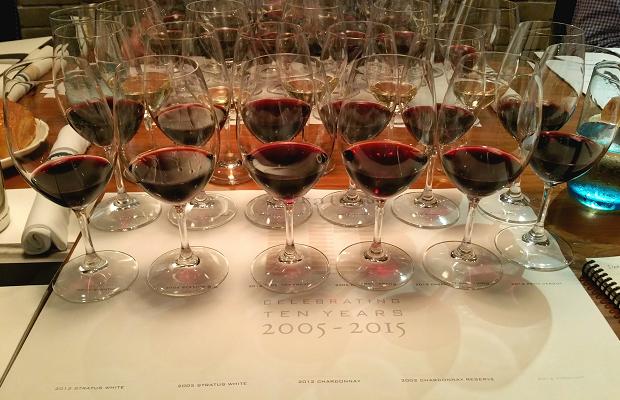
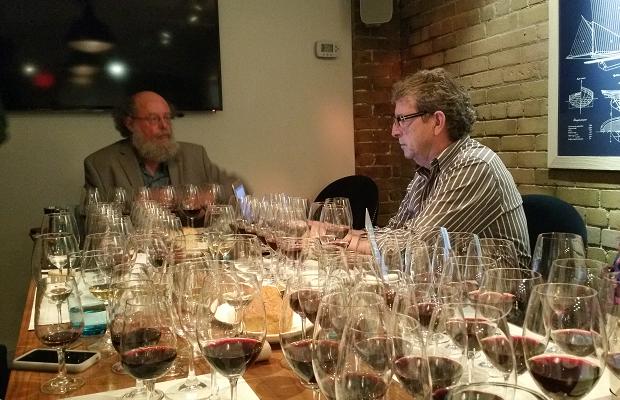
Master of assemblage and varietal maître J-L Groux sits at the head of the underground table while a busy lunch crowd fills in overhead at The Chase Restaurant in Toronto. Highly apropos not just because the Stratus winemaker is over-qualified to preside over the Niagara winery’s 10th anniversary tasting and dissertation on his wines. No, it’s because the posit perfectly illustrates the writer’s yet unspoken epiphany. Groux’s work under the Stratus Vineyards and its offshoot labels have made for some of Ontario’s great food matching wines.

Stratus 10-year anniversary tasting

Stratus 10-year anniversary tasting

Related – The Stratus-Momofuku continuum

It may not be obvious to most but Godello is not much of a food and wine pairing guy. Chef is a fan of great wine and food compatibility but not when generalities need define the directive and the prose. When it comes to the wines of Stratus, a pattern is emerging with incredible clarity. Momofuku, Select Bistro, The Chase. Three Toronto food destinations with high quotients of quality and progressive gastronomy. Three connections with Stratus. Three hits.

Stratus winemaker J-L Groux and WineAlign's David Lawrason

Stratus winemaker J-L Groux and WineAlign’s David Lawrason

Related – Select tasting through years of the Stratus Red and White

The wines are repeatedly discussed and assessed with assemblage and varietal tendency in mind. I have worked through the portfolio or a representative cross-section no fewer than six times in the past three years and yet for the first time the sound was one of a culinary vernacular, a voice heard out of ingredient and mise en place, a dawning of purpose.

The Chase Octopus, harissa, spiced merguez sausage, sauteed red onions

The Chase Octopus, harissa, spiced merguez sausage, sautéed red onions

Related – Stratus and Momofuku: Modernity incarnate

The Chase tasting was presented by the Stratus team of Groux, Charles Baker, Suzanne Janke and Nadia Skorupski. The exceptional lunch was prepared at the hands of Nigel Finley. Here are the notes on 18 wines poured.

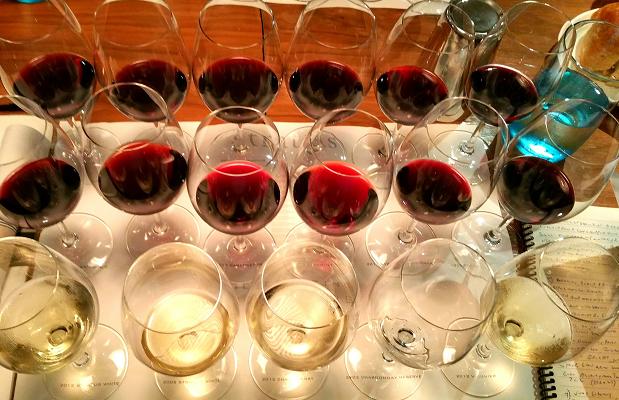
Stratus assemblage and varietals

Stratus assemblage and varietals

Stratus White 2012, VQA Niagara Peninsula, Ontario (660704, $44.20, WineAlign)

In magnified aromatic persistence, on and over top of even two months earlier, in such a hyper-grapey way with terrific dry extract chained to tannin and humid minerality. The many months of leave in gentle oak is stating its technically procured, quote unquote de-classified case.

From my earlier note of April 2015:

In 2012 the blend is Chardonnay, Sauvignon Blanc and Riesling. Viognier was left out because according to winemaker J-L Groux “it did not work in blending trials.” The vintage has laid the foundation for the most density, and unctuous fruit for the Stratus White in what must be, ever. At the high aromatic end there is peppery beeswax, reverberating and echoing in scales and arpeggios. Like an open string singing warmly, the vintage, extraction and residuum combine for texture in mottled unction. Sapid lemon, more beeswax and lanolin mark the palate and then the White drifts into spaces occupied by smoky, back beats and bites. This has great pitch with a knowledge of the path to pleasure. Drink 2017-2025

Last tasted June 2015

Stratus White 2005, VQA Niagara Peninsula, Ontario (660704, $44.20, WineAlign)

The blend of Chardonnay, Riesling, Sauvignon Blanc, Gewürztraminer, and Sémillon with a not necessarily before announced whisper of Viognier was culled from vines “getting older, staying true to our technique,” recalls J-L Groux. The grapes were growing at the bottom of the vines which “made for a challenging wine.” The Gewurz acts in upwards accent to the others, its far-easter flavours speaking with scrunch. Concentration is in compression without density to soft spoken. The most unusual bunch location certainly had something to do with my aforementioned “whiff of terroir that blew away” and according to Groux “the year was very nice.” The Stratus White 2005, tasted again, as well.

From my earlier note of September 2013:

‘Twas a deadly vintage (worst frost in Niagara on the Lake) and the only one with smacking aromas from the vineyard floor. “A zoo growing season,” notes Groux, “with grapes hanging high and low.” Chardonnay leads the troops in ’05, in elevated acidity and earthiness from grapes picked “in a different type of environment, near to the earth.” Highly textured and mature, leggy fruit. Though its best years are behind (because the fruit will no longer support the oak), the Groux seven-year ageing goal has easily been reached. The whiff of terroir does blow away and the honey liniment and rose emerges. So much consistency, so rapidly developed. Amazing. Witness here the winemaking acumen out of an atypical vintage and confounding result.

Last tasted June 2015

Stratus Chardonnay 2012, VQA Niagara Peninsula, Ontario (Winery, $48.00, WineAlign)

As per the house promulgation, in Chardonnay, “still an assemblage process,” insists Groux, “no matter what we do.” Some grapes grown for Sparkling were added back in, for acidity, complexity and ultimately balance. That and though notably barrel burdened (a good, hard burden to bare) leading to a bargain, “the best I ever had.” Major key of whose who of Niagara fruit, power acoustic chords and 12-string harmonics. Drink 2015-2022.

From my earlier note of May 2014:

A change in direction is duly noted with J-L Groux’s 2012 Chardonnay, from fruit picked six weeks earlier than in 2010. The program is scaled back and the wine is more “typical” of the region, in weight, in barrel effect and in alcohol. Still quite defined by natural yeasts that “sometimes go a bit wild, but I’m getting better at it,” concedes the clinician of vinous letters. Those feisty microbes are difficult to work with, like dealing with a wine that lacks natural clarity. “You have to shut down the bacteria, teach the yeast to stop stealing the lees. In 2013 I really got it.” The ’12’s altered course is welcome and encouraged and the world should wait with bated breath for what ’13 will bring. Here the complexity of aromatics is matched only by the intensity of tropical fruit. Has balance and a soft, round feel. Again, more texture and aromatics than natural acidity. Classic J-L style. “It’s not about trying to imitate anyone. It’s about making the most interesting and most complex Chardonnay in Niagara.”

Las tasted June 2015

Stratus Chardonnay Reserve 2002, VQA Niagara Peninsula, Ontario (Winery, $48.00, WineAlign)

Even now its wick seems lit, a febrile wicker thatch of reed, bamboo and rattan, a little wicked even. Versatile like vin jaune, of oxidative rushwork, a product of a time when the regimen was all new oak. Preserved lemon and wax, late bitters within reason and with thanks, surprising freshness. Though the oak was overdone at the time, the slow food preservation has rendered the fat and left behind sharpness, even at 13 years of age.  Drink 2015-2017.  Tasted June 2015

Stratus Viognier 2012, VQA Niagara Peninsula, Ontario (Winery, $48.00)

The most tropical unction of seemingly all Viognier known to human kind, Stratus issue or not, at the hands of J-L Groux or any other aromatic junkie in the winemaking world. Hung like an ancient painting on a modernist gallery’s bright white walls. A pepper-laced, creamy white paste cuts through the similarly positioned texture. A quench of peach, apricot and nectarine sits on the palate, like an August fruit cup from Ontario trees, with a cut of nut pith. And lemon too. Drink 2015-2019.  Tasted June 2015

Stratus Red 2012, VQA Niagara On The Lake, Ontario (131037, $44.20, WineAlign)

The Stratus Red 2012 resides both in a virtuoso’s hollow and in a pantheon inhabited by some of Niagara’s great reds. The fact that such ripe phenology can anticipate and foretell to balance and freedom in the byplace of the blending process is nothing short of amazing. Sinuous and exact, of berries so indefatigable, layering raspberry over blackberry atop strawberry. Cedar and red citrus compound, without jamming the fluidity, but certainly accentuating the Fragaria vesca. Confident and fluid in movement, the ’12 neither shakes nor stirs and its acidity is flat out terrific. At this early point in its evolution it is showing as well as could be expected, or hoped for. Its core of fraises du bois will always be there. Time will be kind, gentle and patient. Drink 2015-2024.   Tasted April and June 2015

Stratus Red 2002, VQA Niagara On The Lake, Ontario (131037, $44.20, WineAlign)

Tasted from two bottles. The blend was Cabernet Franc (40 per cent), Merlot (37), Cabernet Sauvignon (16) and Gamay (5)…roughly. Gremlins from a closet in a funky way, in causation by time though for every thought of flaw there are 10 in depth and layering. The second pour is brighter and popping but if a master of time, partially, arguably so is considered, then the years have had their say. Both palates are alive, tense, terse and resonant in deep horns, where fog meets contrabass. The specs are interesting to note; 7.2 total acidity, pH at 3.19 and sugar (brix), 22.3. Says J-L Groux “we would never pick at that number today.” High acidity keeps it alive, this mix of fruit that is oxidized, nearing the suggestion of maderized and whiffing like 55-day, dry-aged beef. Only the second bottle offers up true savour and cooler instincts. Fascinating. Drink 2015-2016.  Tasted June 2015

Stratus Cabernet Franc 2012, VQA Niagara Peninsula, Ontario (Winery, $38.00, WineAlign)

A Cabernet Franc of settled, harmonious tones, of oak that sets sights and heights to heah, now integrated at such an early age. The grape succeeds and bleeds an exemplary, stalwart varietal suspension within the Stratus pantheon, a sanctuary where fiddles are yet played by other outfits across the region. Cabernet Franc will increase in the Stratus Red, for good measure and reason. This ’12 is simply smothered in an embarrasment of red fruit, smoky from raspy reds to plugged in currants. It is of a favour in flavour that reminds of Swedish berries, in modulated hög, though not in sweetness. Drink 2015-2021.  Tasted June 2015

Stratus Cabernet Franc 2005, VQA Niagara Peninsula, Ontario (Winery, $38.00, WineAlign)

Of a bygone era, an older style. Thicket or copse, but of a green, verdant, newby character. Like a shell, membrane or rim of shellac on an expressly full-bodied corpse. Smells like a grandfather’s old pipe, comforting and parched. Flavours have left piquant behind, settling with senectitude into orange and clove. Alive if well-aged and evolved. A push-pull of warmth and cool elasticity, humidity and savour. Drink 2015-2016.  Tasted June 2015

Stratus Cabernet Sauvignon 2012, VQA Niagara On The Lake, Ontario, (Winery, $55.00, WineAlign)

Few varietal Cabernet Sauvignon in Niagara stand out, firm and yet back from the pack. The Stratus is anything but “six and one, half dozen the other.” This prochaine exit strategy to the NSOR 2010 is an admirable follow, of dusty fill and grind of pepper, a touch of brine and “a cup of rhyme.” Structurally it is like a swan, elongated, muscular and elastic. It is elegant within a markedly rigid frame. It also flies freely, like a hummingbird. “You can crop it higher and it’s going to make good quality,” notes J-L. Hurrah. Another varietal success for Life’s Rich Paegent. Let it catch some R.E.M. to settle its tannins. Drink 2017-2022.  Tasted June 2015

Stratus Petit Verdot 2012, VQA Niagara Peninsula, Ontario (142638), $30.75, WineAlign)

Picked at nearly the same time as the ’12 Gamay and with prudent acidity preserving fashion – early. A variety that travels with happy expedience into sugar (26 brix) and maintains that aforesaid acidity without intrusion. A tightly spun PV, in need of five years easy to unwind and hopefully recoil. The wall of rigidity is woven in chalk and grain, the lift round, all-in, immediate and lingering. Then it comes back around again, ever-increasing the high tones of the wine. So very metagrobilizing genera, this ’12 Petit Verdot. Drink 2019-2024.  Tasted June 2015

Stratus Gamay 2012, VQA Niagara On The Lake, Ontario (Winery, $29.00, WineAlign)

“We try to treat Gamay as a noble variety,” says J-L Groux. This is the child of a short (three weeks) Stratus maceration. Today the nose indicates concentrated strawberry compote. Gamay of the most hue, tone and texture. “We don’t want to go back to the light years of Gamay.” This futuristic vintage (of two years in oak and high, high brix) sees to that concern. Subsequent vintages will scale back but won’t be “light, easy and breezy,” though they will shed the weight of raisin and fig.

From my earlier note of May 2015:

Esteem elevated by structure, matched in poise and presence mottled in smears of darker, richer black cherry. If a slight absence of brightness is sensed due to the syrupy compression, like New World, west coast Pinot Noir, the gleaning from acidity and tannin times perfectly the effluent escape.

From my earlier note of April 2015:

It may not be the most idiosyncratic Gamay in Niagara but the Stratus 2012 is without a doubt the most advanced and complex. Gamay fusion is on display, at once a bottle of Niagara’s finest pulchritudinous veneer and then a charcuterie board laid ample with cured bovine parts and sun-dried grapes. Maximum ripeness and then even later picking, to no one’s surprise, have led to this. Two years of ageing in neutral oak barrels has brought about a humid roundness and yet the centre is controlled by Oz-like mint and eucalyptus notes. The jam is gelid, as opposed to temperate. Rarely does Gamay go to such depths, of blackberry, chalk and grain, with an overlord of tannin. Quite serious stuff. Drink 2017-2020.

Last tasted April 2015

Stratus Sangiovese 2012, VQA Niagara On The Lake, Ontario (Winery, $42.00, WineAlign)

With no true recognition of, for or in cohort conscious decision to align with a clone, of Montalcino, Montepulciano or Chianti, this Stratus take on Sangiovese must go it alone. That said, so much modernity links it to some Tuscan brethren. “We have Italian winters that tell us our Sangiovese is not a crazy one,” explains J-L Groux. Nothing in this ’12 speaks of lightness, beets or simple, red fruit. Two years in French oak, blah, blah, blah leads to a Riserva style. This is not about making CC, simulating CCR, mimicking Gentile or copying Grosso. It’s about leaving a wine for two years to develop aromatic complexity and structure. “It’s a curiosity,” adds Suzanne Janke. Nail’s head, hit. Drink 2016-2019.  Tasted June 2015

Stratus Tempranillo 2012, VQA Niagara On The Lake, Ontario (Winery, $42.00, WineAlign)

In 2012 the J-L Groux take on the expatriate Spaniard is warm, rich, cake-driven and yet balanced in ways the 2010 was unable to exhort. This vintage appeases Groux’s ends of the earth search for aromatics, picking on them, executing vinification to encourage them and barrel-aging for the purpose of cementing them. The 2012 is an aromatic success. It exudes red fruit, flowers, baker’s kitchens and wet Niagara on the Lake earth. This is a clean and jerk Tempranillo, a bouquet to success. The palate, mouthfeel and mellow finish return the favour of 2010 when it was noted that the variety in this place is a stretch, overweening perhaps, certainly self-effacing if admittedly short of contumelious behaviour. Drink 2015-2019.  Tasted June 2015

Stratus Tannat 2012, VQA Niagara On The Lake, Ontario (Winery, $42.00, WineAlign)

“To me this is one of the most successful new varieties we are planting,” exclaims J-L Groux. In similar ways with Stratus varietal cousin Petit Verdot, acidity rules the roost. Smells like a just sliced open bag of organic earth, freshly neutral, funkless and emptying into a (first use) terra cotta pot. A rich, looking straight ahead expression. What it hides in fruit is lost to the brilliance of balance though plum is the operative hidden flesh and it will make a clearer impression when it steps clear of the tar and the tannin. This is pitchy sagacity, with poise and length. Drink 2016-2022.  Tasted June 2015

Stratus Syrah 2012, VQA Niagara On The Lake, Ontario (Winery, $48.00, WineAlign)

Once again, the tone climbs and hangs in the upper reaches, where structure lurks, preceded with intent by four plus weeks of maceration, followed by (sic) two years in oak. Some new, some old, to be technical and precise. Will be some time before this is able to shed the bathetic, syrupy aromatics and meaty, eat that soup with a fork texture. The concentration it treated and tempered with a pantomime shred of elegance. Not as Rhoneish as some other vintages (contemporarily not a bad thing) but this combines worlds in copacetic ways. Tomato and herbs crisped in good olive oil make for good gastronomy in this consumer-friendly, balanced Syrah. Drink 2016-2019. Tasted June 2015.

Stratus Malbec 2012, VQA Niagara On The Lake, Ontario (Winery, $42.00, WineAlign)

Unexpectedly floral, perhaps more than any other Stratus varietal red. That aroma bite strikes me as cool. Just a hint of fennel and coriander seed offer up an herbal hand of complexity. The texture advances to integrated, coming about with a softer red in tow, with less severe acidity than the others. More bitters on the finish as well. Less attitude, more fat, though decidedly rich. Drink 2015-2017.  Tasted June 2015

Stratus Wildass Rosé 2014, VQA Niagara Peninsula, Ontario (71712, $17.95, WineAlign)

A blend of Cabernet Franc and Merlot with some Sauvignon Blanc and Riesling added for lift and what J-L Groux admits is rendered “for the consumer.” This essentially marks the twain between sweet and dry, if not quite halfway then pretty darn close. Plenty of herbs and citrus nail the aromas on the proverbial head with more than a grapefruit or two on the half circle. A highly approachable, end-user friendly blush. Drink 2015-2016.  Tasted April and June 2015

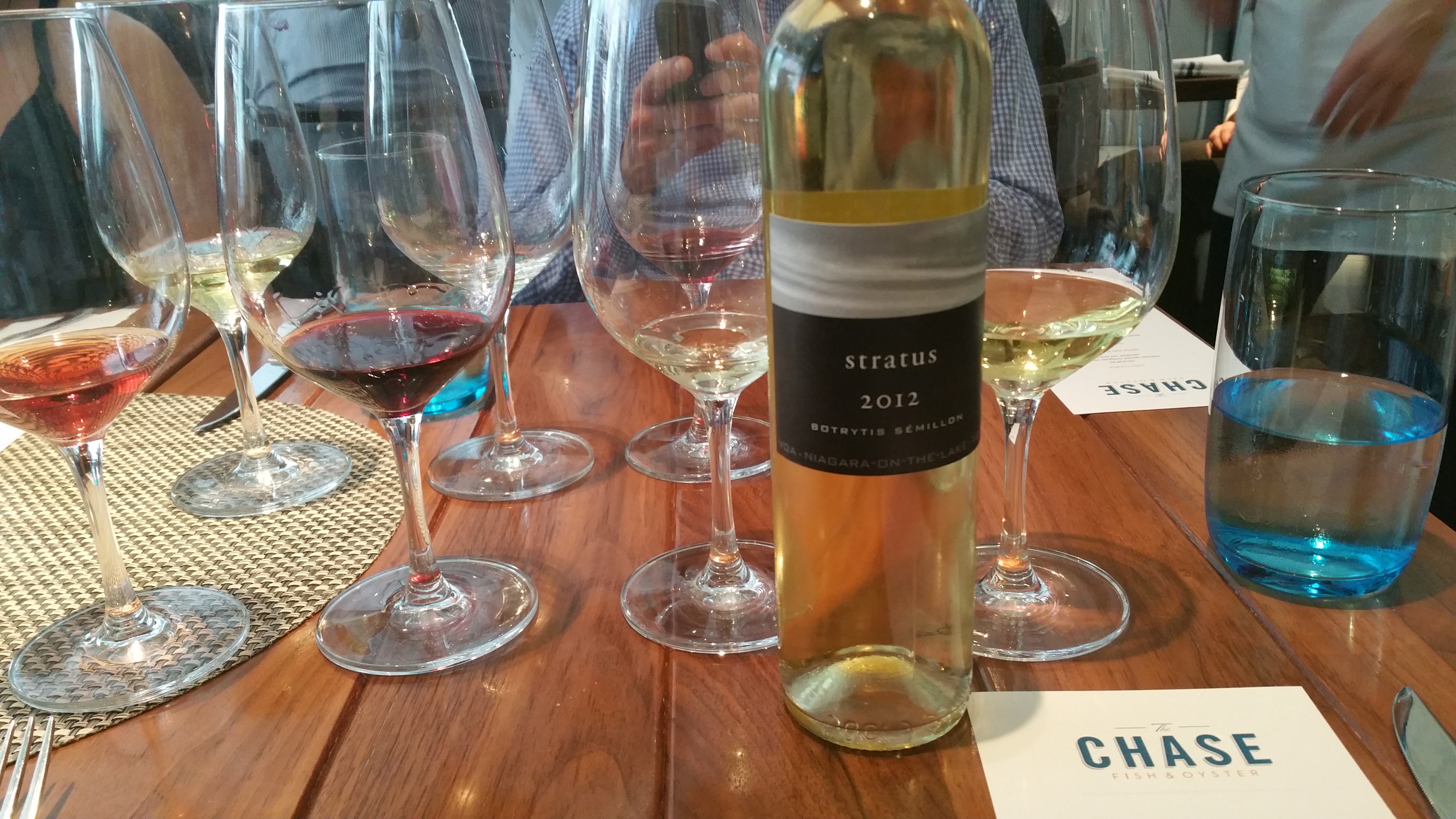
Stratus Botrytis Affected Semillon 2012 at The Chase

Stratus Botrytis Affected Semillon 2012 at The Chase

Good to go!

http://www.winealign.com/profile/2058-mjg

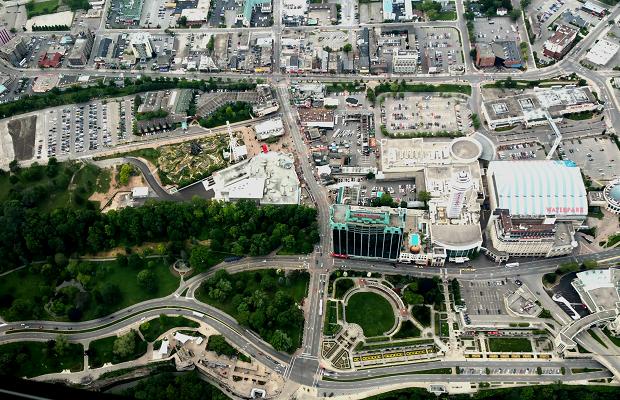
To Trius, by air

Niagara Falls from aboard Niagara Helicopters

Niagara Falls from aboard Niagara Helicopters

After the final day of preliminary round judging was wrapped and tied with a computer algorithm’s bow at the WineAlign National Wine Awards of Canada it was time to take to the skies. The judges and WineAlign cognoscenti embussed into autogiro cabins at Niagara Helicopters. With a quick and nearly non-discernible thrust we rose like knives through butter up into the Niagara sky. A zig over the cartoon city adjacent the horseshoe and American cascades and then a zag across the Whirlpool Golf Course later, the choppers headed for the Falls.

Flying to Trius with fellow #NWAC15 judges Nadia Fournier and John Szabo

Flying to Trius with fellow #NWAC15 judges Nadia Fournier and John Szabo

Viewing the tumbling wonders from this vantage point is a thing of extraordinary exhilaration. The two-dimensional flatness of the river careening towards a three-dimensional, 90-degree downward fall into the gorge below is a trompe l’oeil for the eyes. With nothing but a thin glass veil acting in separation, I would have thought that a Dolly Zoom effect might occur. On the contrary, from within there would be no semblance of Hitchcock technique in recession to simulate vertigo. The weightlessness and effortless glide is a situation akin to being a kid in a candy store. I highly recommend the experience.

Niagara Helicopter

Niagara Helicopter

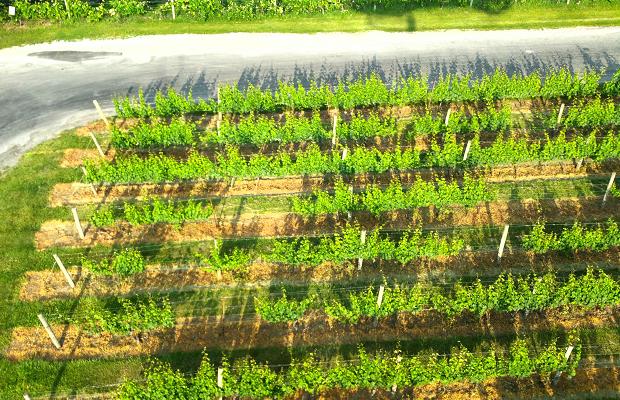
Minutes later the helicopter did soar, headed east and descended upon the agricultural and viticultural wonder of Niagara-on-the-Lake. From high above, the acreage of vines looked like tiny peas all in a row. As the land crept up into view the dots came into focus and to see the canes and their early summer foliage as such a magnanimous maze from above is a perspective all should experience.

Niagara Falls, Ontario

Niagara Falls, Ontario

The elapsed time between landing at Trius and diving head first into a glass of Marco Piccoli‘s Jackson Triggs Entourage Grand Reserve Brut 2011, Méthode Traditionnelle, VQA Niagara Peninsula, Ontario (234161, $24.95, WineAlign) happened in the blink of a transmogrifying eye. A Sparkler or four, Chardonnay, Sauvignon Blanc and Pinot Noir or six and some quick tasting note scribbles later we were seated at a ridiculously long harvest table beneath the arbour and ready for dinner.

The vines of Trius Estates at Hillebrand

The vines of Trius Estates at Hillebrand

Winemakers and from several Niagara wineries were on hand to join us at Trius. J-L Groux (Stratus), Arthur Harder (Westcott), Adam Pearce (Two Sisters), Ann Sperling (Southbrook), Kent Macdonald (Henry of Pelham) and Marco Piccoli (Jackson Triggs) extrapolated on the passion of their work, in their wines and for Niagara as a community. Four courses and fourteen wines were touched, nosed, tasted and assessed. But for the Trius and by extension Peller staff, ushered by the grace of uncompromising and unparalleled generosity at the hands of Magdalena Kaiser and Joanna Muratori from Wine Country Ontario, this was an event to commit to heart and to memory. On a very personal note that night now belongs and rests in reminiscence within this log.

WineAlign team at Trius

WineAlign team at Trius

Peller Estates

Signature Series Sauvignon Blanc 2013, VQA Niagara On The Lake, Ontario (405043, $24.95, WineAlign)

The 2013 Signature Sauvignon Blanc carries forth from the ripe, mature, oxidative and intensely flavourful 2012. This next vintage cements the full-on style, even while it candies the fruit, seemingly in reaction to temperatures and precipitation that came and went with inconsistent extremes. There is a kid in a candy store, multi-coloured ribbon of taffy sensation, curiously antithetical to the rusty, yeasty, platinum scenting elixir. The effects of barrel fermentation (80 per cent) and concrete egg fermenter (20) dispatch has this Sauvignon stretching, pulling and elastically boomeranging about the glass. Magnetic to be sure, not always a success, but encouraged. Drink 2015-2018.  Tasted June 2015  @PellerVQA

Soubrook Whimsy! Orange 2014 and Westcott Vineyards Violette Sparkling

Soubrook Whimsy! Orange 2014 and Westcott Vineyards Violette Sparkling

Westcott Vineyards

Lillias Unoaked Chardonnay 2013, VQA Vinemount Ridge, Ontario (Winery, $20.00, WineAlign)

Winemaker Arthur Harder makes no bones, excuses or sets the goals too lofty in this second Lillia’s unplugged. “What you get is what you get,” from seven year-old estate, pristine fruit in 2013. Infrequent but texture stirring lees has mottled the nose with glycerin and avoirdupois while bottling early in the spring in advance of warm days has locked in freshness. Expression arrives by way of herbiage and lime. Continues where ’12 left off, further akin of Chablis. Drink 2015-2017.  Tasted June 2015  @WestcottWines

Sparkling Wine ‘Violette’, VQA Niagara Peninsula, Ontario (Winery, $24.95)

Like the aviatrix muse Violette, the inaugural Westcott sparkler is pioneering and flies out of the glass. Made in the Charmat method at Vieni Estate where bubbles are quickly becoming a thing, this is from the 2012 vintage, though it is not noted on the bottle. Come down from the high horse and embrace the nascent, lambent breezes of Violette. After all, texture is rarely negotiated in Charmat as it is in this lemon concentrated fizz. It finishes with a dash of good bitters. In these respects the Violette has earned her wings. Drink 2015-2018.  Tasted June 2015

Estate Chardonnay 2013, VQA Vinemount Ridge, Ontario (Winery, $26.00, WineAlign)

The barrel fermented and aged Estate Chardonnay spent 12 months in two-thirds new and one-third second fill wood. Lees stirring is slightly increased as compared to the unplugged. Again, it’s about aromatic intensity leading the way to palate density. By the sounds of Westcott’s comments “we’re pleased with its remarkable irony — dry and sturdy, yet creamy and rather curvy,” you might think the team was stirring with impunity. Not so. The Estate Chard does the dance of mild spice and butter on toast to reach a texture that would appease savages. Unavoidable and typical low yields from the Vinemount Ridge picked at the right moment and handled with caring tabula rasa are the spirit in this wine. Delightful and charming. Drink 2015-2020.  Tasted June 2015

Estate Pinot Noir 2012, VQA Vinemount Ridge, Ontario (Winery, $30.00)

Once again, from the challenging and commercially impaired soils of the Vinemount Ridge, a wine of richness, layering, intellect and intrigue. Riesling and Cabernet Franc are the axiomatic varieties to speak of the Ridge’s terroir but this Westcott reinforces the Pinot habitation, defined by Tawse (Quarry Road, Lauritzen and Laidlaw), now complimented by Big Head, Le Clos Jordanne, Vieni and Westcott. Natural soil given tendencies to ferric aridity, spice and limestone silk fill this Harder composition, softened by the warmth of the vintage. Concentration talks, a touch of VA walks and expected tannic grip secures the lustrous, dark cherry fruit. This is a stygian version of a VR Pinot Noir with tones that go for big and structure that supports the hyperbole. It should not be ignored. Drink 2016-2020.  Tasted June 2015

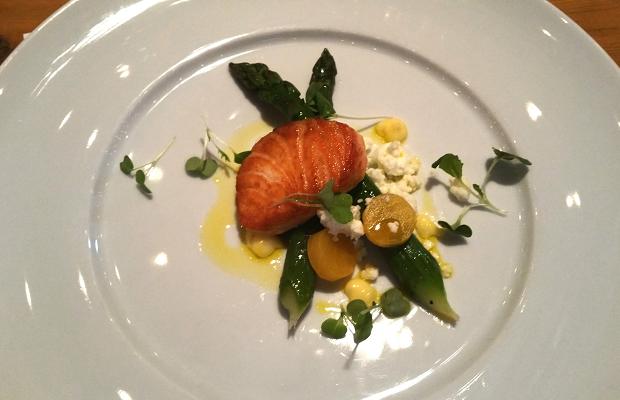
Ontario asparagus and hot smoked salmon

Ontario asparagus and hot smoked salmon

Stratus Vineyards

Tempranillo 2012, Niagara On The Lake, Ontario (Winery, $42.00, WineAlign)

In 2012 the J-L Groux take on the expatriate Spaniard is warm, rich, cake-driven and yet balanced in ways the 2010 was unable to exhort. This vintage appeases Groux’s ends of the earth search for aromatics, picking on them, executing vinification to encourage them and barrel-aging for the purpose of cementing them. The 2012 is an aromatic success. It exudes red fruit, flowers, baker’s kitchens and wet Niagara on the Lake earth. This is a clean and jerk Tempranillo, a bouquet to success. The palate, mouthfeel and mellow finish return the favour of 2010 when it was noted that the variety in this place is a stretch, overweening perhaps, certainly self-effacing if admittedly short of contumelious behaviour. Drink 2015-2019.  Tasted June 2015  @StratusWines

Cabernet Franc 2012, Niagara On The Lake, Ontario (Winery, $38.00, WineAlign)

A Cabernet Franc of settled, harmonious tones, of oak that sets sights and heights to heah, now integrated at such an early age. The grape succeeds and bleeds an exemplary, stalwart varietal suspension within the Stratus pantheon, a sanctuary where fiddles are yet played by other outfits across the region. Cabernet Franc will increase in the Stratus red, for good measure and reason. This ’12 is simply smothered in an embarrasment of red fruit, smoky from raspy reds to plugged in currants. It is of a favour in flavour that reminds of Swedish berries, in modulated hög, though not in sweetness. Drink 2015-2021.  Tasted June 2015

Beef Rib-eye and Pastrami beef shortrib

Beef Rib-eye and Pastrami beef shortrib

Two Sisters

Merlot 2012, VQA Niagara River, Ontario (Winery, $48.00, WineAlign)

“The river man runs, the river man runs.” With this turn a phrase and changing of a guard Merlot, winemaker Adam Pearce ushers in the new Two Sisters oeuvre, for the betterment of all. No longer over-produced yet still ambient, the ’12 sets the turntable for less oaky Sisters’ reds to come. With new barrels on the way out and older and ductile wood coming in, Bordeaux varieties in Pearce’s hands echo and play notes within notes, strum electric in mature chords, then finish with strings and saxophone brass. The 2012 is a true Niagara Riverman, adhering to intrinsic warmth and carrying with it the deep clay rich earth and a wild raspberry luxuriance. It will take seven to ten years to peel back the layers of uberty in this Noel cake Merlot from Niagara River. Drink 2017-2022.  Tasted June 2015  @2SistersVine  @KVH_Wine

Southbrook Vineyards

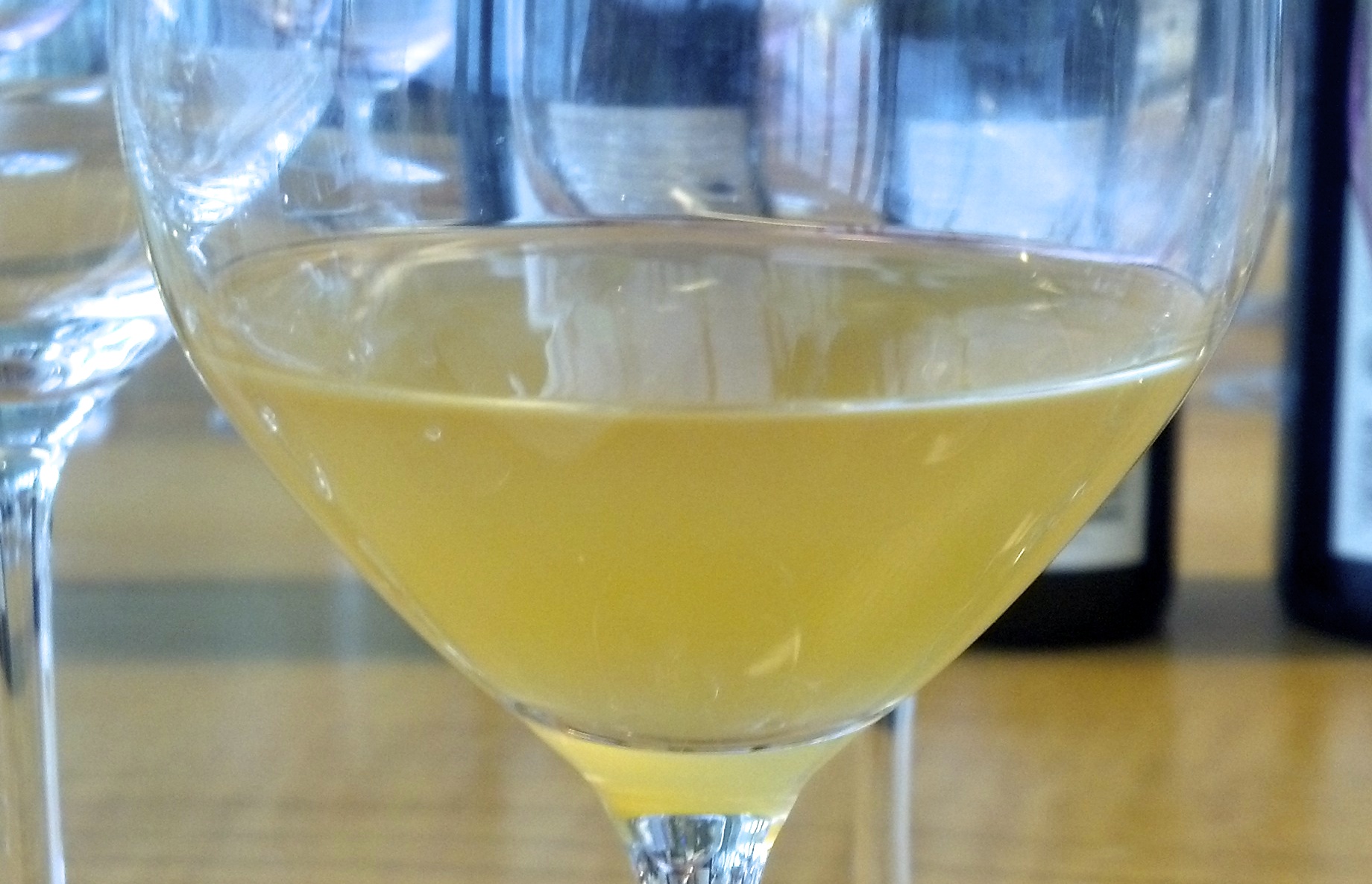
Whimsy! Orange Wine 2014, Niagara On The Lake, Ontario (Winery, $34.95, WineAlign)

The post blind-tasted discovery that Ann Sperling’s Orange was in fact a 100 per cent Vidal made perfect regional sense, something expertly opined at the time by Rick Van Sickle. Having poured the natural saffronage on tap at Barque Smokehouse for two months I was curious to view it through another lens, to see it tipped from bottle. It has settled now, the acidity squeegeed and rolled out a TA point or two. What was grapefruit in demand is now grape in fruit cup. Still viably fresh, it is now pretty, accessible, settled comfortably into its skin. The verve will yet persist through this temperate time in the temporal lobe. Drink 2015-2016.

From my earlier note of December 2014:

“We’ve been waiting to do small batch, stem fermentation,” Ann Sperling tells us as we have a good look at the lustrous, foggy glass of orange-yellow colour more micro-described as either croceate or gamboge. “Now we have the infrastructure to do so.” Stems add architecture (and a preservative effect), something that is otherwise compromised in a sulphite-free wine. This nameless natural wine was biodynamically-raised, indigenously-yeasted and freed from the constraints of temperature control. No wood was used, only stainless steel and glass carboys. The orange and natural classification comes by way of the complex ebullition (closest in style to the Collio hills wines of Josko Gravner), in colour, weight, elegance and the dichotomy of skin fermentation. Sperling used acumen derived from the concept at Argentina’s Versado, where skins are employed in a similar way when making Malbec with husband Peter Gamble. This young wine is filled with terpenes and is highly, desperately aromatic. Lemon curd is up front and centre. It’s got a tart tang and at (approximately) 11.8 per cent alcohol, the gravity is impossibly beautiful. Sperling’s take is “a fair reflection on the vintage” and it’s the mouthfeel that sets it apart. What’s the varietal make up, single or a blend? If the latter, was it co-fermented? Ann will only tell us that it was harvested over a two week period in October. The big question is will it receive VQA approval. Viognier and Pinot Gris should certainly be options but I’m not aware of Southbrook ever having employed their use. Sperling’s Whimsy! Winemaker’s White uses Muscat so perhaps we could go that direction but the aromatics don’t jive. Riesling is the simplest road to take and if the Southbrook Connect Organic White 2013 is any indication, the combined effect with Vidal could certainly steer this Orange ship. But If I were made to guess, to have some fun with concept, I would suggest that it’s a blend of white and red grapes, but Southbrook does not grow Pinot Noir so that should rule out Chardonnay as well. So I conjure up a song. “Well I had a dream I stood beneath an orange sky.” With a union of grape varieties standing by. Cabernet Franc and Sauvignon Blanc feed my Spidey senses, so under the auspices of that marriage, what we might have here is an offspring, a Cabernet Sauvignon. A very natural one. An orange one.

Last tasted June 2015

Poetica Chardonnay 2011, VQA Niagara On The Lake, Ontario (Winery, $49.95, WineAlign)

The 2011 has entered an uncommunicative phase though the soft tones and whispering harmony offer faint prefaces to honey and burgeoning viscocity. The next flip of the calendar will tell a story. Drink 2016-2021.

From my earlier note at Gold Medal Plates, Toronto, November 2014:

There is still a tough outer layer to crack. A poem of many stanzas has only just begun. Mute yet delicate, the stratified vineyard is the Poetica’s poetry; tight, yet forwardly futuristic towards the ephemeral and the aerified.

From my earlier note of July 2014 note:

Has integrated nicely though certainly persists as a big, lush Chardonnay. If there were splinters or sinewy bits they have melted away.

From my earlier note of May 2014:

The Poetica underwhelms at the present time, or perhaps hides in her youth. She’s a calm, buttery, mildly toasted, supportive softie and more accessible than her Sperling west coast sistren. Like a cool Chardonnay soffit hiding beneath a warm bench, the Poetica speaks not for the vintage but more for the current vineyard, a warm and hip spot in the Four Mile Creek appellation. The site remains (at least to me) understood but the unctuous aspect in texture and gathering sweetness with time in the glass will realize a richesse yet unseen. Poetica’s refrain is like “wind on the weathervane,” her tragically subdued fruit quiet, but able to travel long. Time will be the reveal, so be patient.

Last tasted June 2015

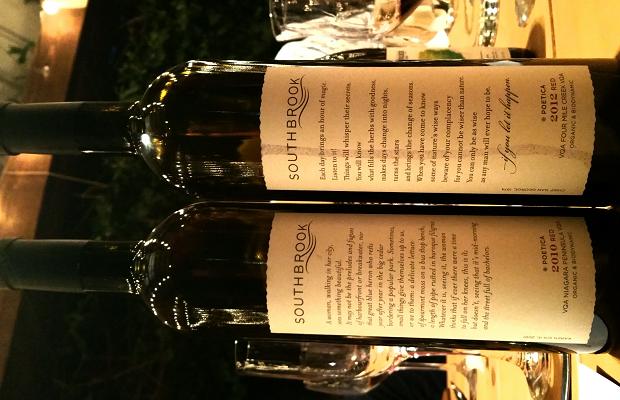
Poetica Red 2010, VQA Niagara On The Lake, Ontario (Winery, $54.95, WineAlign)

At the young adult age of five the Poetica ’10 has retreated and redacted from the heat of that scorching vintage, centred itself and found balance. Gravity no longer shackles the gathering, shaped from Cabernet Sauvignon (51 per cent), Cabernet Franc (31), Merlot (15) and Petit Verdot (3). The next Poetica (2012) used PV as an adjuvant, something the 2010 would now be singing along with were they to have known then what they know now. The ’10 now heli-glides, as if hovering in kind to a set of blades on high whirl, up to where energy is effortless and tension keeps the craft afloat. More of that intensity will continue for 18 months to two years, after which the blades will loiter and wind down for a five to seven years further finale. Drink 2016-2022.  Tasted June 2015  @SouthbrookWine  @AnnSperling

Southbrook Vineyards Poetica Red 2010 and 2012

Southbrook Vineyards Poetica Red 2010 and 2012

Poetica Red 2012, VQA Niagara On The Lake, Ontario (Winery, $54.95, WineAlign)

Now that the Poetica ’12 has seen release, it of course ironically submerges into slumber. The natural palate funk, chalk, talc and clay condensed grain are the gravity while pepper-savoury aromatics catalyze the supply. Credit time with future comings out. Drink 2020-2027.

From my earlier more of December 2014:

The Poetica Red ’12, slated for a Spring 2015 release, is amazing and intriguing on many levels. But for the fact that Petit Verdot (26.5 per cent) plays such a major varietal role, what must first be declared is the disseminated learning applied to this application. The dos and don’ts of previous (only produced in) warm vintage Poetica Reds will see a shedding of those don’ts in this 2012. Ann Sperling ushers in a new era for Niagara Bordeaux assemblage and if this wine is any harbinger, others will follow suit. Here celebrates a love for the land (environment), poetry and more specifically, Canadian poets. Chief Dan George, he of North Vancouver and the Hollywood screen, penned “Words to a Grandchild.” In it he wrote, “in the midst of a land without silence, you have to make a place for yourself.” Poetica Red ’12 will have done that when viewed retrospectively, 10-15 years from now. It will have grown old, but also wise. As for now it’s brooding, melancholy even. It’s all of that and this; endemic, entrenched, crenellated, ensconced and indoctrinated with Niagara knowledge. Has a dusty, earthy, even funky poetry. More depth than many, much realized acumen and will live long. Given 30 minutes of air it showed the ribbons of classic Niagara reds. All these concepts combine to see Poetica Red ’12 not so much as huge, but with depth and complexity.

Last tasted June 2015

Thirty Bench

Small Lot Benchmark Red 2010, VQA Beamsville Bench, Niagara Peninsula (winery, $60)

The landmark red from grit inducing Bench soils has added a splenetic pitch to its already peppery temper. Like “dry and wet ice, they both melt,” the modest Merlot plus two Cabs mix is in a frenetic, edgy place. Allow for three more years before having a new listen and taste. Drink 2018-2023.

From my earlier note of February 2014:

Indoctrinated Right Bank agglomerate built on 62 per cent Merlot, supported by equal parts Cabernet Franc and Sauvignon. Impressively warm and dusty, large, bursting berry dominated with a peppering dredge all around. So much flavour abounds, blanketed by a shaker full of vanilla spice, like “an endless ocean landing on an endless desert.” Still the Benchmark is modest, oaked (18 months) but not overly soaked, pure and in balance. The berry concentration renders it as a resident of the dark centre of the Niagara red blend universe.  Last tasted June 2015  @ThirtyBench

Trius Winery at Hillebrand

Trius Showcase 5 Blanc De Noirs 2009, VQA Niagara Peninsula, Ontario (420521, $55.00, WineAlign)

Auspicious opening for the top end, new Trius Sparkling wine, based on Pinot Noir (70 per cent) from Four-Mile Creek (Lawrie Vineyard), with support from Pinot Meunier (30). Five is the number of years slumbering on lees, a voyage into triage to transport this singular Niagaran into the stratosphere of the region’s pantheon. Arid, toasty and slightly oxidative as per the wild ferment, Craig McDonald style. The toast is spread with a tapenade of (more) lightly toasted nuts, tarragon, morel and earth. There is a feeling of berries, void of pigment, slightly tart and very fragrant. Also the not so pungent but forest emergence of basidiomycete fungus. Delicate, complex, creamy and simultaneously, so very dry. A wine to sip at a large gathering around an antique harvest table or deep into the next decade. Drink 2015-2028. Tasted May and June 2015  @TriusWines

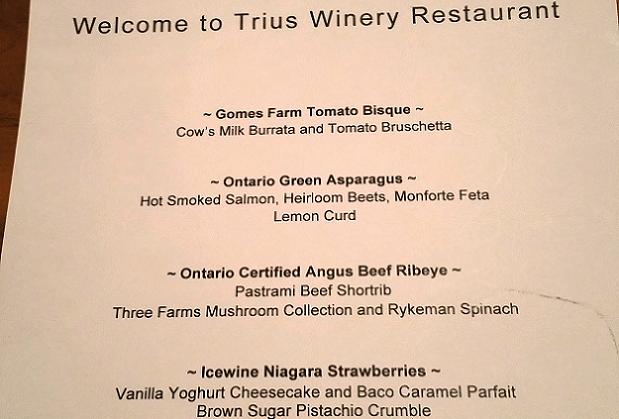
Dinner menu at Trius

Dinner menu at Trius

Good to go!

http://www.winealign.com/profile/2058-mjg

March 21 big guns

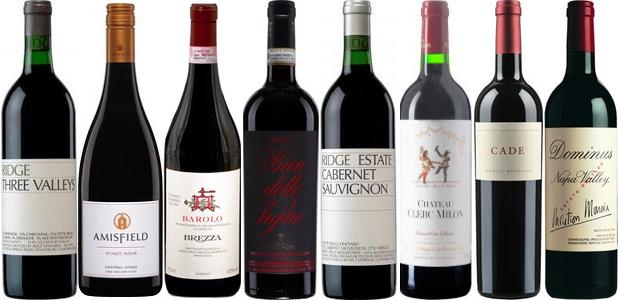
From left to right: Ridge Three Valleys 2012, Amisfield Pinot Noir 2011, Brezza Barolo 2010, Antinori Pian Delle Vigne Brunello Di Montalcino 2009, Ridge Estate Cabernet Sauvignon 2011, Château Clerc Milon 2011, Cade Cabernet Sauvignon 2011 and Dominus 2011

From left to right: Ridge Three Valleys 2012, Amisfield Pinot Noir 2011, Brezza Barolo 2010, Antinori Pian Delle Vigne Brunello Di Montalcino 2009, Ridge Estate Cabernet Sauvignon 2011, Château Clerc Milon 2011, Cade Cabernet Sauvignon 2011 and Dominus 2011

The first day of spring strikes me as a strange time to roll out a VINTAGES release full of big guns, from Cabernet Sauvignon passing by Pinot Noir to Zinfandel and from Nebbiolo to Sangiovese Grosso. A bold group in large numbers is usually reserved for the November and December offers leading up to wallet emptying Christmas shopping days. If the March 21st release is any indication, the powers that be at the LCBO must feel pretty good about the current state of Ontario’s economy.

Related – I shall be Riesling

How else to explain the laying out of the fine red wine carpet in purchasing timeline purgatory? The other alibi in justification is a concern of surplus and overcrowded warehouse shelving, caused by a back log of unsold Bordeaux futures and a consumer shift to less vivid, decreased drama and all around #GoGamayGo sentiment.

For all my reviews from the March 21, 2015 VINTAGES release, see them @WineAlign

I tasted through most of the bad boys on this release and while many are more overpriced than a $20 bucket of bullfrogs in an Algonquin Park bog, these six wines stood tall and shook their value obvious money-maker amongst a slouching and gouging crowd. Forceful wines, all meant to spend at least some slumbering time in the cellar.

Ridge Three Valleys 2012, Sonoma County, California (652875, $35.95, WineAlign)

This Sonoma County Zinfandel melting pot was first produced in 2001 and the 12th vintage contains grapes from seven different Sonoma vineyards. Many of Ridge’s wines bull the intent of single-vineyard, terroir-driven expression. The TV is more about bear assemblage, the search for differential balance and winemaking. Zinfandel (79 per cent) is joined by Carignane (12), Petite Sirah (8) and Alicante Bouchet. Approximately one fifth of the American oak is new, with the wood waft leaning to spices directed by clove, cocoa kernel and faint coconut that infiltrates the Draper perfume. The rich red fruits combine for a brawny voice, bold, peppery and so very ripe. Though not hesitant or introverted, this Zinfandel avoids excessive character and exemplifies the fine art of blending.  Tasted March 2015  @RidgeVineyards  @rogcowines

Amisfield Pinot Noir 2011, Central Otago, South Island, New Zealand (179754, $41.95, WineAlign)

The agglomeration of Central Otago wild vegetative conglomerate is in this Pinot Noir. Strawberries and their leaves, dug up clay, saturated syrup with dark cherries and braising meat make for big aromatics. This is a very meaty, terrifically cimmerian Pinot, with a replay in flavour of loamy and corpulent stock, like a reduction of mire poix and beef bones. Finishes with dried fruits, marigold, a kick of cinnamon spice and pine needles. A bit of wow from the hinterland of Central Otago.  Tasted March 2015  @Amisfield  @COPinotNoirLtd  @CentralOtago_NZ  @HalpernWine

Brezza Barolo 2010, Piedmont, Italy (711788, $46.95, WineAlign)

The gusto and earnestness of antiquity is right upfront in this Nebbiolo, the silliness of modernity left to the practices of more fickle and irresolute houses. A faint and impertinent percussion of volatility beats the near term olfaction into temporary submission, but the wine is bright and the acidity chants with proper diction. The tannic grain is sweet and savoury, well-structured and you can certainly smell the roses. The taste of Nebbiolo is succinct and the overall design is a seven to year plan, with nothing but pleasure on the next decade’s horizon.  Tasted March 2015  @NaturalVines  @jcmeli

Antinori Pian Delle Vigne Brunello Di Montalcino 2009, Docg, Tuscany, Italy (651141, $59.95, WineAlign)

Here flatters definitions of Sangiovese Grosso, of rusty and rustic pasts, big, bold beginnings and distant, slowly etched futures. A faint tease of soy in feign of premature corrosion is the product of the terroir’s liquor. This is so far from its secondary times. It’s as though it teases with an aroma and flavour of melted caramel but the mirage is tantalizing and unreal. The lack of sweetness confirms the notion and instead this Brunello offers dried flowers in dreams and fresh ones placed in vessels not yet tangible, nor yet set upon the table. Wild sauvage, sage and garriga are transubstantiated into liquorice, game and distilled amari. This is perhaps the finest Pian Delle Vigne of the (post 1990) modern age. Very exciting wine. Drink 2019 – 2029.  Tasted March 2015  @AntinoriFamily  @HalpernWine  @ConsBrunello

Ridge Estate Cabernet Sauvignon 2011, Monte Bello Vineyard, Santa Cruz Mountains, California (89284, $61.95, WineAlign)

A perennial three plus one quarter blend of Cabernet Sauvignon and Merlot, give or take a few points, that always punches well above its weight and cost. Not just in relation to similarly priced Cabernets but when looked at alone and on its own merit. There is a searing red intensity in 2011, with steroidal currants and a whiff of lodge smoke, plenty of creamy vanilla and lavender. An injection of liquid chalk, circulating acidity and in the end, some bold coffee notes. No bell pepper. None. Well made, of course and despite the cold and the wet, the omnipresent Draper perfume and very good length. My only cavil would be a degree of over-employed new oak in a vintage where less would ironically be more.  Tasted March 2015  @RidgeVineyards  @rogcowines

Château Clerc Milon 2011, Ac Pauillac, 5e Cru, Bordeaux, France (301119, $89.95, WineAlign)

The principals at Clerc Milon consider 2011 “to be ranked among the finer, or perhaps even the finest” of Bordeaux vintages. The better news is that despite that declaration the price on this classic, structured and flat-out enjoyable Médoc is relatively affordable, especially considering the astronomy of pricing since 2000. This early picked (finished by September 28th) blend of Cabernet Sauvignon (54 per cent), Merlot (37), Cabernet Franc (7), Petit Verdot and Carmenère has vintage steal written all over its painted berry face. Terrific wood spice, more fruit from plum and rapturous acidity travel great lengths to pleasure. The coffee component is in but with just a light alcohol spike. This is really fine Paulliac, elegant, refined and not outrageously priced.  Tasted March 2015  @Noble_Estates

Cade Cabernet Sauvignon 2011, Napa Valley, California (325027, $112.95, WineAlign) LCBO Inventory

Though prepped by notions of a cooler and later ripening vintage, there is even more savoury, tobacco and cool clime (altitude) aromatics than might have been imagined. This Cade is so very bright in a cherry-plum-pomegranate continuum yet in contrast to a (negatively impacting) sweet-sour-tang drupe. Tends to angles more akin to Tuscan summer savour, like lavender, rosemary, sage, and vanilla. The overall impression to palate is that of a chew of the toffee that might be made by the aromatic combination, or a pull of syrupy tea. In the end there is nothing simple about this thoughtfully crafted Cade.  Tasted October 2014  @CADEWinery  @TheVine_RobGroh

Dominus 2011, Napa Valley, California (212381, $176.95, WineAlign)

In 2011 the breakdown is Cabernet Sauvignon (86 per cent), Petit Verdot (9) and Cabernet Franc (5). From an antithetical Napa growing season, wet, cold and in requiem of acumen to deal with what the winemaker in Bordeaux faces in every vintage not hailed as best of the century. The ’11 Dominus has been in the market for just a shade under a year, just the right amount of time for a poured glass to reveal its charms. The new barrel count is approximately 40 percent, a substantial but not egregious number. We want to know what fruit the vintage gives, regardless of the conditions and in ’11 that drupe is savoury, more sage than nettle, and saliferous. That minerality is cute and key because the expression remains huge, so the cure helps to leave an indelible mark. The attributes of massive fruit, (no small feat considering the weather), smoke and phite makes for a mess of aromatic intensity. The flavours are accessible and the texture quite full. Though not the thickest Dominus to date (due to the oak not overwhelming the fruit) this will offer up seven to 10 staid years of development, followed by another five to 10 of minor decline.  Tasted March 2015  @rogcowines

Good to go!

http://www.winealign.com/profile/2058-mjg

Tasting with Power

The wines of Creekside Estates at Barque Smokehouse, March 2015

The wines of Creekside Estates at Barque Smokehouse, March 2015

Power, Rob Power. Niagara man of mystery, winemaker, barrel blender, junkie of dangerous varietal liaisons, license to chill. Power has been making the wines at Creekside Estate Winery for more than a decade. He is both the face and the enigma. Creekside is not a Peninsula vintner that rests on winemaking or marketing laurels. They change with and for the times.

Related – Up on Creekside Estates

I sat down with Rob Power and Rich Gaskin of Hobbs and Company last week at Barque Smokehouse to re-visit some wines tasted in the winter and fall of 2014, along with a couple of new issues. Here the notes, some updated and others in first time put to paper.

Creekside Estates The Trad Reserve 2011, VQA St. David’s Bench, Niagara Peninsula, Ontario (390336, $28.95, WineAlign)

From a taste five months further along in bottle and just shy of the 36 months on lees (37.5 to be precise) 2nd bottling about to be disgorged. Has chill thickened and fattened in the middle with a texture and a truffled funk like foie gras, heading backwards and upwards, like a video shot in reverse. Rises from an ocean of spume up to a slivered taste of a grapefruit moon. “Transmission’s on and up we go.” Cool and angular on the beautifully licensed, bitter finish.

From my earlier note of October 2014: The Trad ’11 has a classic toast and yeast aromatic waft and so it goes that everything that follows is embraced with curiosity and an open mind. Ginger, citrus, bronze and the sweet scents of the inside of a candy machine, its candy long gone. Creekside’s winemaker Rob Power will never be accused of dialing this sparkler in. Tasting trials help determine the necessary, final blend. The single, Queenston Road Vineyard puts 56 per cent Pinot Noir and (44) Chardonnay, aged 2 years in bottle, together for a highly effective, expansive but not explosive fizz. At 8.7 g/L of residual its dry but not quite falling off the bone. The sweetness is tempered by elevated (9.98 g/L) acidity and tension. Spent 24 months on the lees and was bottled back in February. There is balance and pleasure and a good, stretchy finish. No band-aid. Clean, precise, fizz of the day.

Last tasted March 2015

Sauvignon Blanc ‘Iconoclast’ 2013, VQA Niagara Peninsula, Ontario (Winery, $17.95, WineAlign)

The licensee SB jimmies from fruit out of a good (right at the winery) site, caught red-handed at peak ripeness on a very specific picking date and crushed immediately to coax maximum freshness. Readily identifiable as Sauvignon Blanc, perhaps more so than any other from the Niagara Peninsula. The fruit was oxidized a hair to the left, flipping this more Loire than New Zealand. A dichotomous activity from large juice tray oxygenation meeting reduction under screwcap causes initial confusion but when the hounds of Blanc are released the wine buffets into clear, crisp feelings. This is not “mean, green and pristine,” just simply clean. This one’s got “a license to chill and I believe I will.”  Tasted March 2015

Laura’s White 2012, VQA Niagara Peninsula, Ontario (121764, $18.95, WineAlign)

Winemaker Rob Power corrects previously provided information and tells me Laura’s composition is 55 per cent Sauvignon Blanc and that there is some Viognier in here, an inclusion that justifies the back-end bite (in conjunction with Gewürztraminer) of noble bitterness. They and the rest of the varieties combine to imitate Sémillon because Power is “going for white Bordeaux” in this pole to pole, here ’till Sunday blend. This has the grab, tempered by the warmth of the vintage, so look for ’13 to nail it with a hook.

From my earlier, May 2014 note: With a tilt of the head to 90 degrees the bottle is assessed and the glass contemplated. She’s a flirt, a gregarious girl this Laura, so orchard driven and with a perfumed attraction.

From my earlier, February 2014 note: Laura’s White combines Sauvignon Blanc, Pinot Gris, Chardonnay, Riesling and Gewürztraminer in a kitchen sink blend that sees a bit of oak. What’s notable about the ’12 is the omission of two highly aromatic components, the previously employed stalwarts Viognier and Chardonnay Musqué. The adage is justified in that you take what the vintage gives you. If it gives you lemons, (shift tangents) you let the busy aromatics of more flavourful grapes (like Chardonnay) do the floral work. Laura’s ’12 will be a standout for the concept, a revivalist blend to help bring back some religion to the region’s renditions. Coming to VINTAGES in June.

Last Tasted March 2015

Viognier Estate Reserve 2012, VQA Niagara Peninsula, Ontario (22058, $29.95, WineAlign)

Here free run juice gets just a little help from the press. Consistent with a very recent taste, with a density in concoction and blessed tonic on the finish.

From my earlier note of January 2015: Creekside’s small production Viognier (maximum 80 cases) from the warmer micro-climate of the Queenston Road Vineyard heads back to near-boozy and a bit hot in the sudorific vintage. Oh the viscous humanity of it all, especially when the (all French, two year-old, nine months time) ferment was performed on 100 per cent of the six barrel juice. While it may not flirt with the dangers of say, a dirty peach martini, there is plenty of seasoning, rich, spicy and opulent fruit to at least declare a cocktail of some shaken kind. The ’12 Viognier drips and sweats of a humidity as much as any cool climate rendition can (at least in the context of the Niagara Peninsula). It may not be the ideal vintage but it just may be the one with the most excess.

Last tasted March 2015

Cabernet-Merlot 2013, VQA Niagara Peninsula, Ontario (Tank Sample)

The blend is (very approximate) 35 per cent of each Cabernet (Sauvignon and Franc) with 20 per cent Merlot. “Basically a baby Laura,” says Power. Currently smelling very tanky but fresh and bullish. Sniffing past the must is not so hard to do, especially with the waft of spices coming through with thanks to the good barrel. The Franc here comes from Virgil, “no man’s land,” from Frank Serluka’s vineyard. The lack of any discernible volatile acidity speaks volumes about the clean winemaking and the gregarious personality of that Four Mile Creek Cabernet Franc fruit. This will excel out of keg in late Spring.  Tasted March 2015

Creekside Estate Winery Pinot Noir Queenston Road Vineyard 2013, VQA Niagara Peninsula, Ontario (Winery, $22.95, WineAlign)

Still the Kama Sutra Pinot Noir of inviting behaviour. Positions in aroma, taste and texture are all elastic and of an aphorism held together in intimacy. Virtuous and gracious Pinot Noir for the purpose of interaction and pleasure.

From my earlier note of January 2015: “The first made since the 2008 because of a new directional decision to hold onto and no longer forsake these exceptional Queenston Road Vineyard grapes. A wine that folds back the skyline skin of time and reveals a cloning from intimate belongings. Pinot blessed of a Dylan-esque drawl, from a comfortable and crooning time in its life. Penetrates into the QRV earth and draws out subtleties, slow food assuagement and makes no BS about its ease. Though posolutely whiffing and tasting of black cherry, it balances itself with an acerbic wit. This is what winemaker Rob Power refers to as a lay lady lay style. Partners in crime Yvonne Irving and Matt Loney concur. One sip and your partner may just lay across your “big brass bed.” You can always go back to Nashville.

Last tasted March 2015

Laura’s Red 2011, Queenston Road Vineyard, VQA St. David’s Bench, Niagara Peninsula, Ontario (117906, $19.95, WineAlign)

A combination of young and older Queenston Road Vineyard vine fruit meshes to creamy raspberry, spoken most upfront, in the absence of Franc, by the Sauvignon. Waiting for this to improve would be a calculated error so drink up by the end of the year.

From my earlier note of September 2014: The most dead red Laura to date, juicy and earthy, like a licorice, plum and pomegranate demi-glace. Really expressive of earth and fruit.  Traditional house blend of Cabernet Sauvignon, Merlot, Syrah, Malbec and Petit Verdot. A no coat unfastened Niagara, consumer-friendly but also swelling with stuffing. “The light is red. The camera’s on,” the strokes are rich in energy though the tannins dry out a touch. Drink now and for two more years.

Last tasted March 2015

Creekside Estates Broken Press Syrah Queenston Road Vineyard 2011, VQA St. David’s Bench, Niagara Peninsula (202127, $39.00, WineAlign)

At its spiciest best, alkaline and lifted by Viognier, though as the tannins mellow, the Viognier will slowly disappear. Continues the Rhône-ish tradition laid before by 2004, 2006, 2008 and 2010, yet in ’12, for the first time, in addition to the Broken Press, there will be one made from seven rows of the same block Syrah, picked about a week later, a 100 per cent Unbroken Press. From vintage to vintage, a Viognier lifted BP is the correct application but in ’12, to Power and his team, both made perfect sense.

From my earlier note of October 2014: Only Creekside Syrah smells like this, like bending down to smell black raspberries on the shores of a briny capsicum lake in the middle of a pine forest. The 2011 Syrah has fruit residing on the edge of impossibly ripe, factored inside a pipeline, while piping lavender and plum pastry cream float atop rare duck breasts. If Syrah were to ooze or drip without sticking to surfaces along the way, this would be it. If Syrah came forth from the maw of the beast it would speak in these demanding tones. Creekside’s BP talks the tense, nervous and twitching talk. It’s smeared with a coat of epoxy spread over fine grain in wood. It sweats an air of metallic cordiality. If given five years to come together it will vape and realize togetherness.

Last tasted March 2015

Good to go!

http://www.winealign.com/profile/2058-mjg

If it’s value you want, it’s South Africa you need

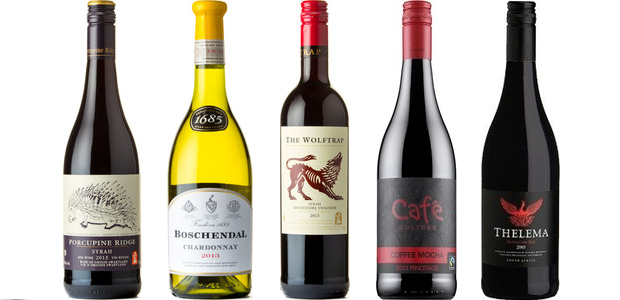
From left to right: Porcupine Ridge Syrah 2013, Boschendal 1685 Chardonnay 2013, The Wolftrap Syrah Mourvedre Viognier 2013, Café Culture Coffee Mocha Pinotage 2014, Thelema Mountain Red 2012

From left to right: Porcupine Ridge Syrah 2013, Boschendal 1685 Chardonnay 2013, The Wolftrap Syrah Mourvedre Viognier 2013, Café Culture Coffee Mocha Pinotage 2014, Thelema Mountain Red 2012

I sat down a few weeks back to taste 20 South African wines, all value-based, consumer-friendly and market-driven. With WineAlign colleagues David Lawrason, John Szabo M.S., Margaret Swaine, Steve Thurlow and Sara d’Amato on hand, the general consensus at the tasting was positive and only worked to re-enforce how competitive South African wines can be in the sub-$15 market.

While certainly not immune to flaws, some South African reds and whites can sometimes get right in your face and yet others show remarkable elegance and complexity at entry-level prices. When I taste wines such as these I imagine the catastrophe of grace. They are wines that move through history with the fluency of a spirit. Some make a house cleaning of belief, others are solid senders. The South African tasting was more than just a group of cheap wines with something to say, more than a pleasant surprise, it was in fact, a pleasure.

Porcupine Ridge Syrah 2013, Swartland, South Africa (595280, $14.95, WineAlign)

Deep dish Syrah, with meaty and cured toppings and the mordant pitch of Swartland. Tarry, olivine rampant and filled with the late summer, sorrowful berries; blackberry and black raspberry. Naturally sweet, viscous, grainy and tannic mess of texture overlaying fruit. Tons of wine for the buck and a very promising vintage to lay down. Aridity takes over on the briery finish. Wow.  Tasted January 2015  @PorcupineWines

Boschendal 1685 Chardonnay 2013, Western Cape, South Africa (367698, $14.85, WineAlign)

Here is a buttery and toasty Western Cape Chardonnay, slightly dirty and reductive. Confused, seemingly high residual avoirdupois restricts the opening notes, though they surely begin to play. The aromatics are heavy with the soaking skins of pear, apple and quince in crumbled amaretto cookie and flaky pastry boozy waters. Give this three plus years to shed its nerdy phase and integrate its tangy persistence.  Tasted January 2015  @BoschendalWines  @liffordwine

The Wolftrap Syrah Mourvedre Viognier 2013, Western Cape, South Africa (292557, $13.95, WineAlign)

Referring to Marc Kent’s blend as traditionally Rhône may seem at odds in consideration of the north-south, modish chaos, the price and the locale, but folky it is. The blend is unvarying Boekenhoutskloof, grounded by Syrah with support from Mourvèdre and Viognier. The latter, aromatic white grape variety lifts and brightens the brooding load. This is quite sweet and sour, of high-toned red and black fruits meeting a reduction of Champagne vinegar. A tannic and mineral streak divides, circles and conquers all. This will drink better in a year and for a few more after that.  Tasted January 2015  

Café Culture Coffee Mocha Pinotage 2014, Western Cape, South Africa (292466, $12.95, WineAlign)

From the KWV stable, the triad of outwardly and rhetorically spoken culture is right there on the label, in all its java glory. Café, Coffee, Mocha. The charm here is that perhaps in 2014 it has actually been scaled back a touch, the wood suffusion, to at least reveal a modicum of red fruits. Nonetheless it is the notes of smoke, tar, rubber and of course coffee that dominate. “Cause it’s the new Mother Nature takin’ over.” There are also at least two spoonfuls too many of sugar. Like the annoying Guess Who song, this can only be taken in very small doses. “Find a corner where I can hide.”  Tasted January 2015  @TheCafeCult  @Diageo_News

Thelema Mountain Red 2012, Western Cape, South Africa (222570, $12.95, WineAlign)

From fruit up on the slopes of the Simonsig Mountains, this has real, natural cherry brightness, not to mention a kitchen sink of varietal interplay. Shiraz (37 per cent), Petit Verdot (25), Cabernet Sauvignon (23), Merlot (10), Grenache (4) and Cabernet Franc (1) are coalesced by a lighter hand and the effect is less frightening than might be expected. Like similar California action (save for Zinfandel and/or Petite Sirah), this comes together nicely, even coherently, with just a few wrinkles. Represents very good value for a multitude of purposes; BBQ and barbecue being two of them.  Tasted January 2015  @ThelemaWines  @EpicW_S

From left to right: Cape Heritage Inception Deep Layered Red 2012, Cape Heights Cabernet Sauvignon 2013, Flat Roof Manor Pinot Grigio 2014, Flat Roof Manor Merlot 2013, Boschendal The Pavillion Chenin Blanc 2014

From left to right: Cape Heritage Inception Deep Layered Red 2012, Cape Heights Cabernet Sauvignon 2013, Flat Roof Manor Pinot Grigio 2014, Flat Roof Manor Merlot 2013, Boschendal The Pavillion Chenin Blanc 2014

Cape Heritage Inception Deep Layered Red 2012, Western Cape, South Africa (369967, $12.95, WineAlign)

If 2011 was sweet, this next vintage is like Carabao mango, Luohan duo and Deglet noor dates all cooked down together into a mawkish, sappy jam. Or maybe it’s much simpler than that; just deeply layered refined sugar and red dye number 40. There is almost no aromatic discernment beyond the crystalline layers. No fruit, no soil, no acidity, no tannin. Just sweetness.  Tasted January 2015

Cape Heights Cabernet Sauvignon 2013, Western Cape, South Africa (129874, $11.30, WineAlign)

The simple drawn label indicates honest design and intent. The alcohol (14.5 per cent) seems spot on and in sweetness, honestly declared. Stones of fruit, full on Cassis, vanilla and wood spice are in the glass and obviously so. Scales greater heights than most generic California counterparts and comes across as Cabernet Sauvignon, with savoury Western Cape scents closer to Sonoma than say, Central Coast. Some coal and tar come in play with a good, persistent finish.  Tasted January 2015  @liffordretail

Flat Roof Manor Pinot Grigio 2014, Western Cape, South Africa (27128, $11.25, WineAlign)

With the simple aroma of vanilla drops on cut pears and refined sugar, this is clean, crystalline and simple Pinot Grigio. Inoffensive, for a large gathering it will not hurt any feelings. The production is mindlessly prepared and contrived, until a warm cookie dough nuance takes it to another level. Nothing shocking here.  Tasted January 2015  @FlatRoofManor

Flat Roof Manor Merlot 2013, Stellenbosch, South Africa (27128, $11.25, WineAlign)

A taut and toned Merlot, varietally correct and though the label reads 13.5 per cent alcohol, shows considerable heat. Very Merlot, dusty, mulberry scented, syrupy and familiar as a Cape red. Fully garnished, varnished and a rubber stamp this side of tarnished, the thick smoke does distort the clarity. Somewhat seamless in its heavy charms and structured, if quick to finish. Tasted January 2015  @FlatRoofManor

Boschendal The Pavillion Chenin Blanc 2014, Western Cape, South Africa (365353, $10.95, WineAlign)

Though the label has forsaken the partnership with (15 per cent) Viognier, the aromatic floral lilt persists, lifts and buoys the stoic and stark Chenin to impossible heights in a sub-$11 wine. The Chenin’s sharp reserve is inwardly atomic and the relationship with the 15 percenter strictly platonic. Together they create honeyed matter, walk hand in hand and handsomely forward. The residual sugar drip may be a touch heavy-handed but laying a bottle or two down for a few years is entirely possible and save for the price, even longer than that. The acidity circulates to the end, framed by a fine tannic texture.  Tasted January 2015  @BoschendalWines  @liffordwine

From left to right: Goats Do Roam White 2013, Flagstone Poetry Cabernet Sauvignon 2012, Durbanville Hills Sauvignon Blanc 2014, Two Oceans Sauvignon Blanc Extra Dry Sparkling Wine 2013, Bellingham Big Oak Red 2013

From left to right: Goats Do Roam White 2013, Flagstone Poetry Cabernet Sauvignon 2012, Durbanville Hills Sauvignon Blanc 2014, Two Oceans Sauvignon Blanc Extra Dry Sparkling Wine 2013, Bellingham Big Oak Red 2013

Goats Do Roam White 2013, Coastal Region, South Africa (237313, $10.95, WineAlign)

The popular and successful Rhône-ish north-south blend in 2013 is Viognier (67 per cent), Roussane (19) and Grenache Blanc (14). In memory, mimic and polar fellowship of the mother land, the GdR is spic and span clean if slightly saccharine and sentimental. I find this to be a typically commercial and derivative South African white wine, with an aromatic and palate profile of sugary, viscous appliqué and rubber tree sap. Has that awkward, gummy resin sensation, along with tropical notes. It’s the pineapple expression that saves the day and makes it more fun to drink.  Tasted January 2015  @DonGoatti  @FairviewWine

Flagstone Poetry Cabernet Sauvignon 2012, Western Cape, South Africa (358754, $10.95, WineAlign)

Like flavoured, warmed to dripping chocolate, with splinters. Like overripe blackberries seeping in warm rainwater. There is some formidable tannin and acidity which could use some air time to resolve. Quite unique and fun for an inexpensive South African red with only a minute level of rubbery, volatile acidity. Some earth and plenty of spice, much of it from wood. Quite bright actually and well made.  Tasted January 2015  @flagstonewines  @CBrandsCareers

Durbanville Hills Sauvignon Blanc 2014, Durbanville, South Africa (22251, $10.95, WineAlign)

Extreme savour and notes for green vegetables are sprinkled with capsicum and dried caper dust in this piquant Sauvignon Blanc. Windswept tops of or cliff edges can be conjured at a sip, along with he dust of desert brush and spots of European gorse. Ocean mists join the notes of Ulex, contributing further green aromas and salty-based flavours. Acidity brings it all in focus. There is complexity in this SB’s drive.  Tasted January 2015  @dhillswine

Two Oceans Sauvignon Blanc Extra Dry Sparkling Wine 2013, Western Cape, South Africa (281311, $10.95, WineAlign)

Quite oxidized and based on the saccharine sugar aspect, “Extra-Dry” must be a translation from the local winemaker’s dialect. While it has some fining aridity on the back end, the early palate is coated with not so unpleasant sweetness. The capsicum captures the effectualness of the varietal, as do green vegetables and grasses. Intensity comes through in lemon curd and the finish is quite bitter.  Tasted January 2015

Bellingham Big Oak Red 2013, Western Cape, South Africa (350595, $10.80, WineAlign)

A Shiraz-Cabernet blend that’s all about the tree, the barrel and a winemaker’s loud and clear pronouncement of the way jammy Western Cape fruit should be treated. Tire tread and sappy tensor bandage smother along with all kinds of chocolate. Plenty of red fruit, grainy tannin and condensed acidity, straight out of the can. Big wine for so little.  Tasted January 2015  @DionysusWines

From left to right: Frisky Zebras From left to right: Nederburg Winemaster's Reserve Shiraz 2013, Douglas Green Sauvignon Blanc 2014, K W V Contemporary Collection Chenin Blanc 2014, Obikwa Sauvignon Blanc 2014, Frisky Zebras Sensuous Sauvignon Blanc Sauvignon Blanc

From left to right: Nederburg Winemaster’s Reserve Shiraz 2013, Douglas Green Sauvignon Blanc 2014, K W V Contemporary Collection Chenin Blanc 2014, Obikwa Sauvignon Blanc 2014, Frisky Zebras Sensuous Sauvignon Blanc

Nederburg Winemaster’s Reserve Shiraz 2013, Western Cape, South Africa (527457, $9.95, WineAlign)

Have always had a soft spot for this hard-nosed, high-alcohol (pushing the 15 per cent limit, despite the declared 14.5 on the bottle) heavy lead and plush red berry Shiraz. Especially at under $10. Graphite and mephitic barks, ferrous bits and cool bites keep it dancing under ground. It’s sweet and sour, with soy and balsamic swirls. Covers a wide ranging set of Western Cape parameters. Runs the flavour gamut and represents more than solid value. It’s the style, love it or not.  Tasted January 2015  @Nederburg  @ImportWineMAFWM

Douglas Green Sauvignon Blanc 2014, Western Cape, South Africa (367821, $9.80, WineAlign)

Mr. Green Jr. has fashioned the goods, following in the footsteps of his father. This is a cheeky little Sauvignon Blanc. Slightly oxidized, certainly pumped up by a touch of effervescent CO2 and tempered by Western Cape sentiments. Has hallmark South African flaw-ish white wine tendencies but also plenty of back-end bite meets verve. Like Scatterlings in a bottle, “in their hearts a burning hunger, beneath the copper sun,” this SB has tons of tropical flavour. Also possesses a green apple crunch and a Cleggy, cool, minty middle. Most excellent and affordable juice.  Tasted January 2015  @DionysusWines

K W V Contemporary Collection Chenin Blanc 2014, Western Cape, South Africa (18689, $9.45, WineAlign)

Despite the obvious base, elemental and flinty suggestions, it would take some yoga like stretching to pull a Chenin Blanc muscle out of the overall aromatics in a blind tasting. Yet somehow it screams Western Cape and South Africa. Reeks of gauze, sacchariferous density and homeopathic remedy. Saps moisture with anti-vivid aridity. Must overs are in vegetative tones. And, it’s all in.  Tasted January 2015  @KWVwines  @DiamondEstates

Obikwa Sauvignon Blanc 2014, Western Cape, South Africa (527465, $9.45, WineAlign)

Struts slowly out, the aromatic neck in craning position, the rotund body slightly awkward and stuck in one dimension. The sweet perfume is animal musky, in a medicinal way. The big bird is a perfectly planar white that is just and only that, hardly recognizable as Sauvignon Blanc, with no ties to any defined terroir. The ostrich abides for simple and ordinary quaffing.  Tasted January 2015  @ObikwaWines  @ImportWineMAFWM

Frisky Zebras Sensuous Sauvignon Blanc NV, Western Cape, South Africa (237685, $8.95, WineAlign)

From purchased fair-trade fruit, this non-vintage white wine is nondescript. Here brews honeydew in a bottle. Tinny, oxidized and briny, bronzing smells are also sunburnt. The mouth is the recipient of a greasy, reductive, effervescent and prickling salve. Non-Maleficence in Sauvignon Blanc.  Tasted January 2015

Good to go!

Red, white and orange at Southbrook Vineyards

Southbrook Whimsy! Reds, Whites and Orange

She says she’s making a similar wine in British Columbia, but Ann Sperling will tip no varietal hat, will offer up no hints, will not reveal the make-up in her new, all-natural Orange wine. That’s right. Orange wine.

To arrive at this (nothing rhymes with orange) juncture, a bit of background on the winemaker and her Ontario employer, Southbrook Vineyards. Sperling is from B.C., where she makes Riesling, Pinot Noir, Chardonnay and piercing Sparkling Wines at Pioneer Ranch, the family heritage farm under her eponymous Sperling Vineyards label.

Related – A cultivated tale of two Okanagan wineries

Southbrook as a winery and a vineyard is a leader in Ontario’s increasingly developing biodynamic and organic direction. Ann Sperling introduced proprietors Marilyn and Bill Redelmeier to the sprawling property in Niagara-on-the-Lake and it is there that their commitment to farming organically and biodynamically is managed in the vineyard by Scott Jones and in the winery by Brian Hamilton and Regan Kapach.

The Redelmeiers are no strangers to the concepts and the agrarian way. Who does not remember making necessary stops at their farmstead and pumpkin patch on Major Mackenzie Rd. between Dufferin and Bathurst in Richmond Hill. Southbrook defined that concept in the 80’s and 90’s, by bringing a distinctly rural Ontario feel to the edge of Toronto civilization. People came from all four directions for their farm fresh produce. Chappell Farms, Chudleighs and Whittamore’s all owe a major level of their success to Southbrook’s pioneering concept.

The Redelmeier cattle farm on the 19th century property in Richmond Hill morphed into that roadside vegetable stand in the 1980s. Winemaking came next and then in 2005, Bill and Marilyn relocated to Niagara. Having chosen to pursue certifications for both the vineyard and the winery – including LEED, biodynamic and organic certification, the Redelmeiers have been instrumental in the revolution.

Ann Sperling is a natural fit for their manifesto, to produce high quality wine from estate fruit under the strict O & B directive. The upper echelon Southbrook wines are bottled under the labels of Triomphe, Whimsy! and Poetica. That she has now decided to make an orange wine is, well, natural. I think a great deal of Ontario wine drinkers, along with those beyond these borders don’t quite get Southbrook. Gaining insight as to why the Orange wine should be made is no less difficult than acquiring an understanding as to what the Southbrook portfolio is all about. You need to spend time with the wine and the winemaker. This point is essential.

Winemakers are intensely focused individuals. Their wines live and breath. As a parent to their children, winemakers feel their every step. Their hopes and dreams rise and fall with every breath they take. Sperling had thought about it for years but the 2014 vintage allowed her to take the experimental, all natural plunge.

She is not the first to do the orange wine thing. In his May, 2014 Macleans article, Orange is the new white (wine), John Szabo reported on his involvement with making such a beast in Ontario. Together with Norman Hardie and François Morissette, they have fashioned one from Riesling in Prince Edward County. Szabo wrote, “Ontario vintners are experimenting with an ancient Georgian technique and a 500-litre qvevri. “With an imported clay vessel their wine currently rests in a 500-litre qvevri in Hardie’s cellar. Szabo had also discovered that Richie Roberts of Fielding Estate was the first orangista in Canada. Roberts made 400 bottles of skin-fermented Viognier in 2012, though not in clay. Szabo had previously referred to Stanners Vineyard Pinot Gris Cuivré 2010 as “the first orange wine made in Ontario.”

Ann Sperling in the Oak Room at Southbrook Winery

Ann Sperling in the Oak Room at Southbrook Winery

The natural/orange wine debate is hot right now and not because of the reasons you might think. The smoke and mirrors of discussing the merits of making such wines or to question whether it’s rubbish is clouding the discussion. Or as Alexandra Gill reports in her most recent Globe and Mail article, “fault-indulgent hippie juice as a major scam,” or the smell of “stale, mouth-puckering morning breath.” The technique and the practice is ancient and has been kept alive. The only questions need asking are “is it good, is it well-made and would I like to drink it?”

Then along comes the Hosemaster of Wine, Ron Washam who insists “don’t publish anything about natural wine on your blog in 2015.” Washam is right when he comments on the hypocrisy of “natural wine shipped in an ocean-polluting tanker…loaded on an exhaust-belching truck…and you feel good about it because the guy who made it didn’t spray Roundup?” This N-word wine story, however, is allowed. Here we are discussing an Orange wine made with attention to ancient detail, in our Niagara backyard, the one I travelled to the source to taste and you know something, it’s pretty fucking good? You’re a funny man and a really good writer but let me ask you something. You got a problem with that Ron?

I sat down with Ann, Wines In Niagara writer Rick VanSickle and Paul DeCampo, Southbrook’s Director of Marketing & Sales on Sunday, December 28th to taste the new or yet released Triomphe ’13’s, Whimsy! ’12’s and Poetica ’12’s. A ’13 Cabernet Franc Icewine and the mysterious, ubiquitous and enigmatic Orange wine rounded out the tasting card. The experience went a long way towards adding Southbrook Vineyards to the loftier queue’s cerebral vinous database. Going forward, I’ll surely never look at these wines in the same light.

Southbrook Whimsy! Orange wine 2014

Southbrook Whimsy! Orange wine 2014

Whimsy! Orange Wine 2014, Niagara On The Lake, Ontario

“We’ve been waiting to do small batch, stem fermentation,” Ann Sperling tells us as we have a good look at the lustrous, foggy glass of orange-yellow colour more micro-described as either croceate or gamboge. “Now we have the infrastructure to do so.” Stems add architecture (and a preservative effect), something that is otherwise compromised in a sulphite-free wine. This nameless natural wine was biodynamically-raised, indigenously-yeasted and freed from the constraints of temperature control. No wood was used, only stainless steel and glass carboys. The orange and natural classification comes by way of the complex ebullition (closest in style to the Collio hills wines of Josko Gravner), in colour, weight, elegance and the dichotomy of skin fermentation. Sperling used acumen derived from the concept at Argentina’s Versado, where skins are employed in a similar way when making Malbec with husband Peter Gamble. This young wine is filled with terpenes and is highly, desperately aromatic. Lemon curd is up front and centre. It’s got a tart tang and at (approximately) 11.8 per cent alcohol, the gravity is impossibly beautiful. Sperling’s take is “a fair reflection on the vintage” and it’s the mouthfeel that sets it apart. What’s the varietal make up, single or a blend? If the latter, was it co-fermented? Ann will only tell us that it was harvested over a two week period in October. The big question is will it receive VQA approval. Viognier and Pinot Gris should certainly be options but I’m not aware of Southbrook ever having employed their use. Sperling’s Whimsy! Winemaker’s White uses Muscat so perhaps we could go that direction but the aromatics don’t jive. Riesling is the simplest road to take and if the Southbrook Connect Organic White 2013 is any indication, the combined effect with Vidal could certainly steer this Orange ship. But If I were made to guess, to have some fun with concept, I would suggest that it’s a blend of white and red grapes, but Southbrook does not grow Pinot Noir so that should rule out Chardonnay as well. So I conjure up a song. “Well I had a dream I stood beneath an orange sky.” With a union of grape varieties standing by. Cabernet Franc and Sauvignon Blanc feed my Spidey senses, so under the auspices of that marriage, what we might have here is an offspring, a Cabernet Sauvignon. A very natural one. An orange one.  Tasted December 2014

Triomphe Merlot 2013, VQA Niagara On The Lake, Ontario (Winery, $22.95, WineAlign)

From 100 per cent estate fruit (so it’s organic and biodynamic), the accesibility here is immediate and gratifying. So ever-very raspberry, like berries and savoury flower dust rehydrated into a sweet yet tart and viscous tisane baked into a pie. That does not articulate a cooked component, but rather a concentrated vehemence. As far as Peninsula Merlot goes, this really finds both its varietal and vintage capitalized way. It’s both cool and critical, exemplary and snappy. Early thought leads towards a five to seven-year run.  Tasted December 2014

Triomphe Cabernet Franc 2013, VQA Niagara On The Lake, Ontario (Winery, $22.95, WineAlign)

Still organic through and through, despite only a small portion of estate fruit contributing to the overall design of the Triomphe Cabernet Franc ’13. Contracted growers fuel and fulfill the Southbrook ideology, to seek purity in healthy berries. The red fruit here shines on with Daliesque impunity. Its agglomeration makes a juicy, gregarious offer to sip. The vanilla-lavender streak brings elegance, more so than in ’12, along with an elevated sense of savour and really compounded red, red fruit. A natural sweetness and long finish are easy on the gustatory senses. Will be available at VINTAGES in February 2015, when the ’12 runs dry.  Tasted December 2014

Southbrook Triomphe '13's

Southbrook Triomphe ’13’s

Triomphe Cabernet Sauvignon 2013, VQA Niagara On The Lake, Ontario (Winery, $22.95, WineAlign)

The VINTAGES Essential is fashioned from mostly estate fruit (making it mostly biodynamic) save for a tonne or two grower’s supplementation. The 13’s are just beginning to hit shelves as ’12 stock depletes and in many ways the new vintage excels and exceeds the success of the split decision ’12. Where the ’13 lags is in showy complexity, though I’m not sure that is the Triomphe Cab Sauv’s most distinguishing or valuable asset. The new year brings a darker, pitchier, heavier brooder and as a second thought, a slower build to complexity. If ’12 was the rare marble, this is the braising cut. The triumph is now an impression as a sum of parts, not outwardly obvious and live. Not so easy to disseminate, the ’13 could likely have benefited from a less urgent rush to market. The drive to appease the sellers may inhibit a quick response understanding of its fruit intent so consumers should be aware of the need to exercise just a half-year or so of patience.  Tasted December 2014

Whimsy! Sémillon 2013, VQA Niagara On The Lake, Ontario ($34.95)

A getable Sémillon of plenary indulgence, of deep-seated intent, already blessed and blissful of honey. From a two-barrel lot, fermented in stainless steel with lees contact. This is an Ann Sperling special, both biodynamic and unfined, so it serves public notice as a Southbrook affiche in promotion of naturalism. And then it really begins to rock. Sulphites are present and perceptible but so are the more panegyrizing notes of salinity, mineral and rocks with ideas. Single-varietal Sémillon is an amazing thing, possessive of a clarity few can match. It ages with ease and it knows it. “When you know that your time is close at hand, maybe then you’ll begin to understand.” The ’13 Whimsy! Sémillon is an iron maiden, luminescent metal intense with even more honey on the back-end. Sémillon, hallowed be thy name.  Tasted December 2014

Whimsy! Chardonnay ‘Minerality’ 2012, VQA Niagara On The Lake, Ontario (Winery, $34.95, WineAlign)

Slated for release in January or February 2015, “Minerality” as sister to “Richness” is the wilder of the two, less weighty (though up there at 14 per cent alcohol), possessing nothing in any discernible or palpable, tropical void. This little sister is “shakin’ like a tree. rollin’ like a log, shakin’ and a rollin’ now, that ain’t all.” Minerality occupied (40 per cent new, 12 per cent one-year and 48 per cent older) French oak barrels for 12 months, then sat in bottle for 12 more. Until now. Ray of power here unleashed, like a rock ‘n roll genie, finger-picking god ranging all over the map of scales. Though her sulphur edges to watering eyes, the aqueous emulsion from barrel selections leading to tight, reductive early life tendency will one day be forgiven. In fact, Minerality was rejected by the VQA panel on her first go round, bad girl as she was, but she’s now settling into her band-aid skin. She’s now a release away from being almost famous. The rigidity in redux has stirred through, having trod beyond pyridine freshness, though you can still feel the ghosts. Acts seemingly evolved but it manifests as an aromatic nougat. “Reduction is an indication of aging potential, or verve,” says Sperling. A comparison might be made to a 2000 Mosel, which was untouchable early on, but is now a classic. Could Minerality stand the weather? It has a very particular profile, a tactile mouthfeel and great, sweet length, from soul to soul. So yes, this is 2012 Chardonnay on the Peninsula.  Tasted December 2014

Whimsy! Cabernet Franc 2012, VQA Niagara On The Lake, Ontario ($34.95, WineAlign)

Slated for a January/February 2015 release, the 100 per cent estate (organic and biodynamic) ’12 Whimsy Cabernet Franc spent time in (41 per cent) new wood. The significance of the barrel imprint is not lost on territorial influence as related to texture, more than anything else. A warming trend is balanced by a layering of savoury savoir faire and citrus (or the thought of). A repetitive drumming tang drives this tome with trepidation in reserved activity and acidity. Lacking any discernible tobacco, currant or notes of piquancy, this will request consumer patience before it comes into its own and out to the party. Though quite elegant and possessive of better than good length, I prefer the freshness and personality of the (’12 and ’13) Triomphe, for the money. Here I am reminded of some Tuscan CCR’s. Like a time-clocked, sui generis oaked and stately Chianti, this Whimsy will offer more charm when it reaches middle age, at least five years down the road and it will display plenty of caramel, wood polish and charcuterie cure at that time.  Tasted December 2014

Whimsy! Cabernet Sauvignon 2012, VQA Niagara On The Lake, Ontario ($34.95, WineAlign)

In a warm year like 2012, the perfect Southbrook synoptic storm for Cabernet Sauvignon gives cause for thought. Awash in agriculture (organic and biodynamic), of fruit (100 per cent estate) and from barrels (nearly half new and just Four Mile Creek shy of two years), this winemaker’s vagary palavers on verve, torpid integration and inevitable aging. The rich berry and earth weave is a veritable, variegated loaf of aggie layering. But it’s more than that. The centre is filled with cool runnings; mint, eucalyptus and chains of pyromorphite. All tolled you can feel the showiness of the vintage in this Whimsy’s emphatic overall statement.  Tasted December 2014

Whimsy! Petit Verdot 2012, VQA Niagara On The Lake, Ontario (Winery, $34.95)

Welcome to the new world of single-varietal junkets and Four Mile Creek Petit Verdot. Cabernet Sauvignon (13.3 per cent) and Merlot (1.3) offer up contiguous Bordeaux support for this Southbrook first (under the full varietal name – this used to be called “Who You Calling Petit”), slated for an April or May 2015 release. Culled from the estate’s biodynamic and organic vineyard. Musty, dusty and undomesticated, Sperling’s take is a swirling mistral of wild berries, sauvage, herbs, garrigue and even mushroom. It has yet to recede from its barrel play, showing nary a sign of evolution. Big tannins, high concentration and abrupt ministrations are the crux of its personality. It seems that it will stride out in two years, score early and often, then retire to the bench. The late candied flavours indicate a successful, if short career. Less than 70 cases were produced.  Tasted December 2014

Southbrook Whimsy! and Poetica decanted

Southbrook Whimsy! and Poetica decanted

Poetica Red 2012, VQA Niagara On The Lake, Ontario ($54.95, WineAlign)

The Poetica Red ’12, slated for a Spring 2015 release, is amazing and intriguing on many levels. But for the fact that Petit Verdot (26.5 per cent) plays such a major varietal role, what must first be declared is the disseminated learning applied to this application. The dos and don’ts of previous (only produced in) warm vintage Poetica Reds will see a shedding of those don’ts in this 2012. Ann Sperling ushers in a new era for Niagara Bordeaux assemblage and if this wine is any harbinger, others will follow suit. Here celebrates a love for the land (environment), poetry and more specifically, Canadian poets. Chief Dan George, he of North Vancouver and the Hollywood screen, penned “Words to a Grandchild.” In it he wrote, “in the midst of a land without silence, you have to make a place for yourself.” Poetica Red ’12 will have done that when viewed retrospectively, 10-15 years from now. It will have grown old, but also wise. As for now it’s brooding, melancholy even. It’s all of that and this; endemic, entrenched, crenellated, ensconced and indoctrinated with Niagara knowledge. Has a dusty, earthy, even funky poetry. More depth than many, much realized acumen and will live long. Given 30 minutes of air it showed the ribbons of classic Niagara reds. All these concepts combine to see Poetica Red ’12 not so much as huge, but with depth and complexity.  Tasted December 2014.

Poetica Chardonnay 2012, VQA Niagara On The Lake, Ontario ($49.95, WineAlign)

Whole cluster pressed, all estate fruit spent 18 months in only 15 per cent new (100 per cent French, mainly 300L) barrels. Indigenous yeasts saw more rotation than stirring and classic Chardonnay fermentation, which is code for “they always stick.” As a result, there was no need to impress a finish on fermentation. As per the Poetica practicum, poetry sidles up to the Estate’s flagship white, joined in ’12 by Chief Dan George, the Burrard Inlet, B.C. Tsleil-Waututh Nation chief. The Little Big Man (Old Lodge Skins) academy-award winning actor and poet penned “Keep a Few Embers From the Fire.” The final line “for a new life in a changed world” alludes to the Poetica’s destiny, affirmed by the success of this vintage. When it is released in the Spring of 2015, it will strike an immediate accord with tasters and consumers alike because it is markedly more accessible than previous vintages. Rich and unctuous, it is neither as tropical nor as misunderstood as Poeticas that have come before. Focus is laser sharp, balance is key and integration realized. The level of osmosis in its parts is just awesome. Though reductive, power will propel this Poetica to parts native and familiar, with élan in evolution. Tannins are great but certainly yet spun by sunburst. In 20 years time, words will describe this Poetica as best ever. That much is certain.  Tasted December 2014

Southbrook Cabernet Franc Icewine 2013

Southbrook Cabernet Franc Icewine 2013

Cabernet Franc Icewine 2013, VQA Niagara On The Lake, Ontario ($69.95, WineAlign)

An all estate, indigenous and inoculated Icewine, even if it were not thought possible to do so. Spoons out pure raspberry and apricot distillate, this Cabernet Franc is a product of happily fermented yeast because of a clean, natural and healthy vineyard. Bacteria neither takes a prominent seat nor dominates in the fermentation. Plenty of nutrition (or just enough, depending on the angle) is available in the fermentative state and then again in barrel. No trouble will come running. No Brettanomyces nor acetic negativity can survive. There is orange, pomegranate molasses and cinnamon stick in here. Goes straight to the cavity, with sugars and acidity set on high, along with structure and length. Really as good as Cabernet Franc gets in the idiom and finishes alternatively, distinctly dry. Will not turn Bretty like some older vintages. A thinker of clean, clean Icewine thoughts, from a desert of fermentation to realize a dessert garden of eden. I took a sip and “I got taken away, by a heavenly host, to a heavenly place.”  Tasted December 2014

Good to go!

A Chile welcome to diversity

From left to right: Montgras Sauvignon Blanc Amaral 2014, Ventisquero Sauvignon Blanc Kalfu Sampai 2013, Emiliana Signos de Origen White Blend 2013, Via Wines Chardonnay Chilcas Single Vineyard 2013, Montes Alpha Pinot Noir 2012, Errazuriz Aconcagua Costa Single Vineyard Syrah 2012, Santa Rita Cabernet Franc Floresta 2012, Calcu Cabernet Sauvignon 2012

From left to right: Montgras Sauvignon Blanc Amaral 2014, Ventisquero Sauvignon Blanc Kalfu Sampai 2013, Emiliana Signos de Origen White Blend 2013, Via Wines Chardonnay Chilcas Single Vineyard 2013, Montes Alpha Pinot Noir 2012, Errazuriz Aconcagua Costa Single Vineyard Syrah 2012, Santa Rita Cabernet Franc Floresta 2012, Calcu Cabernet Sauvignon 2012

With Chris Waters as moderator, guest speaker Hector Vergara delivering the keynote address and a Chilean panel of eight winery representatives talking up their wares, the Wines of Chile road show trekked en masse through Toronto’s ROM for the annual cavalcade in exhibition.

Related – A Chile wind is blowing

Waters is Editor of VINES Magazine and author of a weekly wine column at canoe.ca. Vergara is Latin America’s only Master Sommelier & President of the Sommelier Association in Chile. The council of eight winemakers and export managers expounded on Pacific ocean mists, soil composition, varietal trials and expansion to the new Chilean terroir.

The theme of the 2014 edition of the WOC travelling wine expo was “discover diversity.” The breath of fresh air came by way of the opportunity to taste samples of the new Chile; from emerging regions and appellations, from varieties not expected to show in Toronto and from chances being taken. Wines from Huasco, Itata and Pumanque are not household names at the LCBO or in this city’s restaurants. The successes of Chile’s (primarily central) conspicuous regions are well-documented; MaipoRapelMaule, Curicó and Cachapoal valleys. The AconcaguaCasablanca and San Antonio valleys have found their own prosperity. The 2014 Wines of Chile experience will help impress emerging regions and purchasing diversification upon both consumer and licensee habits.

The cross-section of wines poured at the seminar offered a unique perspective into the Chilean portal, even if behind the scenes back in Chile you just know there is so much more to seek, discover and uncover. Montreal Gazette wine scribe Bill Zacharkiw wrote last week, “I saw cracks in the wall…three years later I’m back, and that crack has become a deep fissure.” Zacharkiw visited Chile for the first time in three years and was privy to a Chilean wine revolution. Bill witnessed first hand the changing face of Chile: winemakers rediscovering their rich heritage. He found plantings from old vines and revitalized vineyards that had been producing nothing but cheap table wines. The ROM seminar presided over a giant leap in exhibiting aspects of that vicissitude for Toronto but missing from the tasting were some exceptional and virtually unknown producers of the New Chile.

Wines of Chile

Wines of Chile

Many of Chile’s growing areas are driven by the mist (like Sonoma fog) which might go away by 11 or 12 pm, but according to Vergara, they “create the conditions for slow ripening.” Along the coast there are granitic soils, very good for Syrah. Limestone soils add new dimension to the wines. Cold air comes down into the valleys from the Andes mountains, to maintain freshness and to add aromatic complexity. The role played by the Pacific Ocean is also extremely important. Salinity is rampant in Chile’s wines.

Eight wines were poured at the Wines of Chile seminar. Here are the notes.

Wines of Chile Line-Up

Wines of Chile Line-Up

Montgras Sauvignon Blanc Amaral 2014, Leyda Valley, Chile (48025, $14.45, WineAlign)

A jumping and hopping Sauvignon Blanc, at once spicy and then fruit fresh. The aromatics rise from the San Antonio Valley vines, cooled by the Andes run off, in irrigated mist. The piquant puissance never quite relinquishes power to the crisp orchard drupe. Capsicum and especially white pepper dominate. A chew of white flowers fills the palate though it falls away quickly, like a shooting star. More than serviceable and user-friendly. Tasted October 2014  @MontGrasChile  @TKGCanada

Ventisquero Sauvignon Blanc Kalfu Sampai 2013, Huasco Valley, Chile (Agent, $40)

High end varietal placement, in geography and in market positioning. A new project for Ventisquero and winemaker Alejandro Galaz, from Chile’s most northerly wine growing area in the Atacama Desert. An arid yet verdant Sauvignon Blanc watered by the Huasco River, 20 km’s from the sea, 700 km’s north of Santiago. The first vintage was 2012. Only 600-800 bottles are being produced, that is until they have learned more about how to manage the terroir of the desert, like making wine on the moon.The wine flaunts its chalky soil with alluvial stones and red clay. The Camanchaca (a thick fog on the coasts of Peru and Chile) comes in every morning and aids in the long ripening period. The mineral pierce is frightening in as much as can be found in Chilean SB. High salinity, from both the soil and the water. A veritable salt spring without effervescence, replaced by evanescence and fervent vigor. Kalfu means blue, Sumpai is the name the mapuches gave to the mermaids. Finishes with a roasted green pepper note in neutral citrus, with thyme and peanuts. Yes, peanuts. Approx. $40. Yes, $40.  Tasted October 2014  @vventisquero  @TandemSelection

Emiliana Signos de Origen White Blend 2013, Casablanca Valley, Chile (Agent, $19.95)

With a wine like this multi-varietal white blend, Fernando Castro explains “we’re going wide in a narrow place,” pushing boundaries, exploring new challenges. Diversity. From the western part of Casablanca, out of rocky and granitic decomposed maritime soils, the mix is (all approximations) Chardonnay (65 per cent), Rousanne (13), Viognier (12) and Marsanne (10). A healthy 33 per cent of the ferment is aged and housed in concrete egg fermenters, but also some French barriques. Imparts an oiliness on the palate. Chardonnay is more than evident, the sweetness in Rhône aromatics are ladders from which to climb, buoys from which to get lifted. A wine that does not play safe. Some spice, plenty of full palate sweetness so this needs a mess of fish and seafood in an aromatic broth. The alcohol is a generous 14.7 per cent though it has enough acidity to keep it aerified. Big wine. Really big wine.  Tasted October 2014  @VinosEmiliana

Via Wines Chardonnay Chilcas Single Vineyard 2013, Itata Valley, Chile (Agent, $18.95)

The inaugural vintage of the Chilcas Chardonnay hails from the northern most aspect of Chile’s southern most region, a cool climate 18 km’s from the Pacific coast. The granitic soils are variegated with alluvial and sandy loam aspects for complex gain in this 100 per cent single varietal wine that spent,12 months in oak. A partial malolactic fermentation means creamy but that texture is subservient to the aromatic profile. Itata is a 16th century planted vineyard (for the region) though this vineyard is only 10 years old. Average rainfall is on par with Bordeaux but the majority of the rainfall is in winter, not in the growing season. Drainage is good due to the slope of the granite soil. Has that creamed sugar brûléed sensation and is nearly vegetal, like buttered, fresh corn with salinity and spice.  Tasted October 2014  @ViaWines  

Montes Alpha Pinot Noir 2012, Do Anconcagua Coast, Casablanca Valley, Chile (143214, $19.95, WineAlign) From the VINTAGES September 13, 2014 release

This is from fruit drawn 10 km’s from the ocean. Morning fog helps with maintaining acidity, though aridity is the biggest challenge. A dry heat and a dry paint are apparent, though low yields produce a concentrated red, of dry herbs and dry ochre. Terrific mouthful – very Sonoma, in sweet raspberry, cherry and strawberry. Very Sonoma. More than decent length but not the most complex. Really approachable and lingering so it is worth several visits, in each glass, second glasses and subsequent bottles. Some new (20 per cent) oak. Cool climate Pinot Noir done in a warmer climate style.  Tasted October 2014  @MontesWines  @ProfileWineGrp

Errazuriz Aconcagua Costa Single Vineyard Syrah 2012, Aconcagua Costa, Chile (387910, $24.95, WineAlign) From the VINTAGES September 27, 2014 release

Natural and modern in every respect. From schist rock over a clay base and out of a warm vintage, “to maintain the character of the wine.” Relish of richness and quite ripe with touches of wood resin, sinew and roasted meat, though it’s more OZ than Rhone, with less smoky beats and cured meat. Good acidity and slightly sweet. Cake-reductive as to an Aconcaguan Cabernet Sauvignon but enough spice and splinters to warrant aging towards increasing value. Really spicy finish.  Tasted twice, September and October 2014  @errazurizwines  @Dandurandwines

Santa Rita Cabernet Franc Floresta 2012, Pumanque, Chile (Agent)

Pumanque is located in Chile’s Colchagua Valley and was granted Doc status in September 2012. The soil is quite granitic and the exceptionality of the new terroir is gaining traction with proponents of symbiosis for Cabernet Franc. This Cabernet squared blend is Cabernet Franc (55 per cent) and the remainder Cabernet Sauvignon. Dark and pitchy, with much aromatic mince in mint, creosote, graphite, black but not green pepper, wood resin. The rapt wrapping bristles in angles and bitters. Chalky, grainy and needing time because it is quite tannic. Blessed with the most length of the reds on the table. A question of the iron crushed red fruit may arise but five years will certainly be an aid. So very mineral.  Tasted October 2014  @SantaRitaRD  @ImportWineMAFWM

Calcu Cabernet Sauvignon 2012, Colchagua Valley, Chile (Agent, approx. $16)

Calcu means “healing doctor” in Mapuche and while this may not be the poster wine prescription for cold and flu, it will cure an ail or two. Winemaker Rodrigo Romero adds Carménère and Petit Verdot to the varietal mix, for just enough structure beyond the fresh and fruity Cabernet. It also brings together a spot on varietal tendency, in dusty, grainy tannin, bitter tonic tinge, cool in the middle, but warm in girth and all around its edges. Spiced and piquant. Young, with decent acidity and though it will settle in a year or two, that will be the limit of its range.  @CalcuWines

Good to go!

Five more impressive, cool-climate, fog-injected wines from Sonoma County

Sonoma County vines Photo (c): https://www.facebook.com/SonomaCountyVintners

Sonoma County vines
Photo (c): https://www.facebook.com/SonomaCountyVintners

Sonoma, in terms of micro-climates, reckons itself as committed to three distinct turfs;  marine, coastal cool and coastal warm. Vines grow in all three spaces but it is only in the elevated mountain reaches upwards of the fog bank that the region considers itself anti-cool. Well, that’s just some people talking. Barometrically speaking, “coastal cold” is not on the radar.

Consider the moniker “cool-climate.” Can it mean one thing only? Is it to be labeled as a universal truth? Sonoma County can’t be compared to Niagara or the Okanagan Valley. That much we know. It’s no Prince Edward County. Chilling hours (below 45ºF) average approximately 1,300 per year but winemakers in Northern California are not “hilling up” or burying their vines to protect them from sub-20 degree zero Celsius temperatures in January and February.

Related – Sonoma peaks from out of the fog

Sonoma may not be the cool-climate region its winemakers and marketers make it out to be. To a true, we the north (verb-constricted) grape grower, Sonoma does not know from cold. But it’s really not a matter of direct comparison. Sonoma has a cool-climate bent no other geography can lay claim to. A fog bank all along the coastline blows in, accompanied by cold air capable of such rapid temperature shrinkage it can be measured by swings as much as 50 ºF. The manifest vital spark that runs through all of Sonoma County’s fiords and chords, spuming with an irrepressible puissance is that fog.

Sonoma Vintners passed through Toronto last month. These three producers and five of their wines must not move on to the next town without mention. Here are the notes:

From left to right: Gundlach-Bundschu Mountain Cuvée 2012, Gundlach-Bundschu Chardonnay Estate Vineyard 2012, Ramey Syrah 2012, Thomas George Pinot Noir 2011, Thomas George Pinot Noir Cresta Ridge Vineyard 2011

From left to right: Gundlach-Bundschu Mountain Cuvée 2012, Gundlach-Bundschu Chardonnay Estate Vineyard 2012, Ramey Syrah 2012, Thomas George Pinot Noir 2011, Thomas George Pinot Noir Cresta Ridge Vineyard 2011

Gundlach-Bundschu Mountain Cuvée 2012, Sonoma County, California (397521, $30.00)

Shyness or hidden meaning are not a part of the MV’s MO. This is not brain salad surgery. What you see is what you get. Pure, unadulterated, separately vinified, last-minute blended, red and black indications of clean Sonoma fruit. Varietal barrel isolations are the key to nurturing individualistic phenolic development. The final composition’s hue shows no lack of anthocyanin and though not overtly long on tannin, the phenols have been laid bare on the same page. The first vintage of this circumstantial blend was in 2008 and by now the GB estate provides 70 per cent of the produce, helpful neighbours the remainder, though only in Cabernet and Merlot portions. Forty parts equal of those two are joined by Syrah (nine per cent), Zinfandel (eight) and smatterings of other Bordeaux grape varieties. Floral, juicy, pentose tannic and flat-out delicious is the struck chord at the hands of winemaker Keith Emerson. Not the most complex arrangement in the County, nor is it top 40, but it is certainly penned with a catchy hook. “It will work for you, it works for me.” Tasted October 2014  @gunbunwine

Gundlach-Bundschu Chardonnay Estate Vineyard 2012, Sonoma Coast, California (Agent, 0400051, $34.95) Ontario Release date: March 21, 2015

An intimately affordable Chardonnay from Sonoma Coast fashioned by a family in its 157th year of production is a rarity. Even more so from a cool-climate region oft-marred by the misperception that its Chardonnay are fat, buttery, over-oaked fruit bombs. From fruit grown on the Rhinefarm Estate Vineyard on southwest slopes of the Mayacamas Mountains, eight miles north of San Pablo Bay. Consider the antonymous solecism of zero per cent malolactic fermentation and you will see where this (20 per cent new) barrel fermented Chardonnay has come from and where it is going. Weekly battonage compresses and stirs up texture. Fog plays its part on the cool slopes of Huichica clay loam soils mixed in with gravel deposits. Acidity is preserved, hitting a classic number on top of healthy (14 plus per cent) alcohol. This is not a small Chardonnay. It stretches its legs and walks like a giant but not in 80’s or 90’s acid washed jeans or big hair ways. This is Chardonnay that leads in style and confidence of a most modern vernacular and fashion. It’s also a steal.  Tasted October 2014  @LeSommelierWine

Ramey Syrah 2012, Sonoma Coast (Agent, $47.99)

This is winemaker David Ramey’s sixth vintage composed from (91 per cent) Cole Creek Vineyard, with the rest coming from the Rodgers Creek Vineyard. Though not the first to draw roots and inspiration from a northern Rhône style, Ramey’s choice of co-planting five per cent Viognier is both curious and genius. The field blend supposition is gaining global traction and attraction, as witnessed by successes the likes we see with Marcel Deiss in Alsace. They are not just the rage; they are a philosophy and create a co-habituated/fermented energy. Though lifted by hedonism, this is a very pretty Syrah, yet it’s no timid lilac. A soft entry gives way to sharper tannins. The briny Mediterranean, smoked meat and roast pork belly notes arrive late, after the angles have softened and the integument has been cracked. There is much going on here, at once clear, other times in opaque fog, then back to blue skies. Follow this Syrah for five years to see the chains be connected by election.  Tasted October 2014  @RameyWineCellar  @BarrelSelect

Thomas George Pinot Noir 2011, Russian River Valley, Sonoma County, California (Agent, 729417, $57.95, WineAlign)

A blend of three estate vineyards; Baker Ridge (49 per cent), Cresta Ridge (30) and Starr Ridge (21). Rigorous sorting, punch downs and the use of basket pressing combine for an all-out Pinot Noir expression of RRV’s diverse terrors, albeit within a framework outlined in smouldering charcoal chalk and coated with smooth sugars of inscrutability. Ranging in ways akin to Central Otago, this Pinot is bright yet earthy, intense and piercing. It combines cherries with ash and has got all the thyme in the world. Oak is not out of focus (the wine was aged for 11 months on lees in 100 per cent, 38 of it new, French barrels) but it still needs time to integrate. Two or three years will suffice and seven to eight more will turn a trick or two.  Tasted October 2014  @TGEWinery

Thomas George Pinot Noir Cresta Ridge Vineyard 2011, Russian River Valley, Sonoma County, California (Agent, 729417, $60 US)

The Cresta Ridge is unique to the Russian River Valley and to the Thomas George Pinot execution as its soils at some of the highest elevation in the area are of the Goldridge series. Very deep and well-drained, its composition is of material weathered from weakly consolidated sandstone. Like all of their wines, the 100 per cent estate fruit from this particular ridge is a ream of pure silk, clean, pure and so much quieter on the brushstroke and basalt tendencies of the combined RRV bottling. The tannins truss the fruit to seek a low and slow rotisserie of development. Could drink a boat load of this refined Pinot Noir, now and for 10-12 more years.  Tasted October 2014  @bwwines

Good to go!

Wine on company time

Algonquin Park, October 2014

Algonquin Park, October 2014

From the Middle English octobre and the Latin October, meaning “eight,” just how the month of October became the Julian and Gregorian 10th is a matter of bad juju. The corporate bumbling by way of the insertion of January and February into the Roman calendar screwed up all available etymological kismet. Perhaps in abbreviation or acronym, October, shortened to OCT, means “On Company Time.” That might explain its delay and parlay to 10th month status.

October has made its sad and beautiful way into song, rarely in joy or rebirth, almost always in tragedy and death. What’s up with that? With leaves turning to every shade of a Tom Thomson watercolour amid Ontario’s landscape that is all pan and even more orama, why the long faces? James Mercer writes, “to hell again and back,” and Amy Winehouse “today my bird flew away.” The lyrics in these songs are anything but uplifting but the tunes themselves are scrappy.

Then there is the October as envisioned by U2, well, there’s an entire album of oppression, repression and depression. “And the trees are stripped bare, of all they wear, What do I care.” 

The good news, through tough times and innocence lost, is the availability of wine. VINTAGES is our facilitator and we are the benefactors, to concentrate on seeking solace in the living, breathing and most complex organism that genies into great bottles of grape ferment. This coming weekend one of my favourite releases on the perennial calender rolls out more value and less plonk than usual. On the heels of anything will sell for Thanksgiving and predating the shelves emptying free for all that is Christmas, October 25th is ideal and satiating. Here are 16 new releases, guaranteed to restore faith in this most troubled month.

From left to right: Andreza Reserva 2011, Flat Rock Unplugged Chardonnay 2013, Morandé Gran Reserva Cabernet Sauvignon 2011, Château Rigaud 2012, Loimer Grüner Veltliner 2013

From left to right: Andreza Reserva 2011, Flat Rock Unplugged Chardonnay 2013, Morandé Gran Reserva Cabernet Sauvignon 2011, Château Rigaud 2012, Loimer Grüner Veltliner 2013

Andreza Reserva 2011, Do Douro, Portugal (385849, $16.95, WineAlign)

This blend of Touriga Nacional, Touriga Franca and Tinta Roriz (Aragonez) from Lua Cheia em Vinhas Velhas is certainly funky and vineyard driven so that’s a bit of all right, isn’t it? Its phrasing is indelicate and slightly hot but its message is quite clear. Former winemaker for Offley Port and Technical Director for all the Sogrape Vineyards in Portugal João Silva e Sousa and consultant winemaker Francisco Baptista bring forth honest Douro red fruit, along with some mineral and righteous wood spice. Dark, deep and with a wonderful level of anxiety and tension. Gives purpose to modernity.  Tasted October 2014  @FreeHouseWine  @wines_portugal

Flat Rock Unplugged Chardonnay 2013, VQA Twenty Mile Bench, Niagara Peninsula, Ontario (68015, $16.95, WineAlign)

A stoic and fruit aplenty Unplugged, less aromatic than some, equally magnanimous as others. Juicy, orchard fruit that is ripe and then elongated, with just enough acidity to keep it honest through the middle acts of savoury balm. Late tonic pungency lines the output. A very good, if not the finest ever unoaked Chardonnay at the hands of Jay Johnston and Ed Madronich. Then again, the ’07 tasted in February 2014 was a revelation. Who knows what the future may hold for this aloof ’13.  Tasted October 2014  @brightlighter1  @Winemakersboots

Morandé Gran Reserva Cabernet Sauvignon 2011, Maipo Valley, Chile (389254, $17.00, WineAlign)

Despite the 14.5 per cent alcohol this is beautifully bright, fresh, red cherry fruity and with nary a sign of abstruse chocolate or coffee. The southern hemisphere pulsates in here like a chromosphere of massive, meaty fruit. There is a funk per se but in earth, not wood. Good grain, honest grain, de facto grain. Spice from wood but just as an accent. A romantic one. Admittedly more Maipo than Cabernet but well thought on with the texture of haptic contours. Will satisfy a hunt for October reds to drink right now.  Tasted October 2014  @MajesticWineInc

Château Rigaud 2012, Ap Faugères, Languedoc-Roussillon, France (393561, $17.95, WineAlign)

A bold and beautiful southern French rapport of 55 per cent Syrah, 26 Mourvèdre and 19 Grenache, so very modern and explicitly floral. A veritable Midi garden salad lives in the glass; chicory, acacia, iris, black cherry and lemon. Brassy blend from Languedoc-Roussillon, tangy and of the earth in cohorts for simple, if semi-hedonistic pleasure. Nothing about this screams oak and if the shed was open for a lay down it kept its splintered mits buried within the pockets of its staves. The ’12 Rigaud is meant for near-term luxury, alone or with sundry kinds of protein.  Tasted October 2014  @oenophilia1  @VinsAOPFaugeres

Loimer Grüner Veltliner 2013, Dac Kamptal, Austria (142240, $19.95, WineAlign)

Can any entry level (used with latitude) Grüner speak more clearly of varietal truth than Fred Loimer’s Kamptal? Saline, herbal, juicy and mineral all roll off the golden carpeted tongue. A ripe merging to oxidative line is straddled but acidity keeps reeling in the fruit so no harm, no foul. Flavours of citrus and white peach. Heads medicinally sweet on the finish and lasts longer than could ever be expected. From my earlier April 2014 note: “Increased hang time has put this Kamptal in a deeper state of focus and understanding concerning the intricacies of Langenlois Grüner Veltliner. Continues the pure, clean and crisp axiom of the basic Lois but here the aromatics are spoken in acroamatic terms, obvious to disciples and yet available for all to comprehend. Though five per cent big wood barrel aging does not seem significant, that practice along with four months of aging on the fine lees has had a textural impact. The added weight is a questionable thing, though arguably just splitting hairs. Will help carry this vintage through five to seven years of graceful settling. Last tasted October 2014  @FredLoimer  @LeSommelierWine

From left to right: Bordón Gran Reserva 2005, Dog Point Vineyard Sauvignon Blanc 2013, Domaine Hamelin Beauroy Chablis 1er Cru 2011, Giacosa Fratelli Bussia Barolo 2009, Giacosa Fratelli Bussia Barolo 2009, Le Clos Jordanne Claystone Terrace Chardonnay 2011, Le Clos Jordanne Claystone Terrace Pinot Noir 2011

From left to right: Bordón Gran Reserva 2005, Dog Point Vineyard Sauvignon Blanc 2013, Domaine Hamelin Beauroy Chablis 1er Cru 2011, Giacosa Fratelli Bussia Barolo 2009, Giacosa Fratelli Bussia Barolo 2009, Le Clos Jordanne Claystone Terrace Chardonnay 2011, Le Clos Jordanne Claystone Terrace Pinot Noir 2011

Bordón Gran Reserva 2005, Doca Rioja, Spain (114454, $22.95, WineAlign)

If it were so because of cryogenic preserved must or an accidental tipping and topping up into an unused barrel by recent vintage juice I would not be left hanging with mouth fully agape. Considering the amount of time this flat out delicious Gran Reserva saw in barrel, the mystery must somehow be explained, how it came to be so surprisingly modern and bright (for its age), especially at $23. But it has been seen many times before, with no greater example than the Montecillo 1991 GR that drank fortuitously well into the last years of the previous decade. This is the magic of Rioja. That said, there is some sinew and some raw character here as well – that’s the old school treatment and style talking. Red cherry fruit. Ripe fruit roasted, rested and now sliced, showing its perfectly cooked rare cut. Juicy and with sanguine notes still running through its grain. Wonderful old school yet bright Rioja. Riotous red wine with a calming aura of quietude.  Tasted October 2014  @RiojaBordon  @Eurovintage  @RiojaWine

Dog Point Vineyard Sauvignon Blanc 2013, Marlborough, South Island, New Zealand (677450, $24.95, WineAlign)

Dog Point’s principals Ivan Sutherland and James Healy know the innuendo of that ever present Marlborough SB subtlety by allowing the vineyard to show up in the glass. That sussuration is the hallmark of this most righteous bottle. The VINTAGES October 25th release indicates a 2014 debut when in fact it is the ’13 that was presented for tasting and likely that vintage will show up on shelves. This ’13 bring elegance, less weight and more fruit. Round and rippling, spiced but in spicy check. Not the finest but persistent in class and crowing achievement for the stomping ground.  Tasted October 2014  @DogPointWines  @TrialtoON

Domaine Hamelin Beauroy Chablis 1er Cru 2011, Burgundy, France (391805, $29.95, WineAlign)

Thierry Hamelin and his son Charles (no, not the Olympic Speed Skating gold medalist) are eighth generation family winemakers and their 2011 Beauroy, one of the most underrated vineyards in Chablis, or anywhere Chardonnay is made, is both an ode to tradition and an immaculately clean look at the future. Prototypical steely Chablis in every nook of its lithified being and befitting of a 1er Cru designation. Fruit comes by way of some pretty wizened vines (30-plus years) and steep, south-facing slopes. The exposition is both fresh and flinty, the logic sound and spotless. If a creamy, leesy note is felt it’s just a case of genes. In every other respect this is Chablis as both a child of the present and the future. Quality vineyard, vines and fruit given the gift of no mask. This will drink well for five plus years.  Tasted October 2014  @BIVBChablis

Giacosa Fratelli Bussia Barolo 2009, Piedmont, Italy (344721, $39.95, WineAlign)

From the hills of Monforte d’Alba in Piemonte, Bussia is laid out like an amphitheater, the soil is all clay and the Nebbiolo is rich and often austere. Now, here is what temperance and a reliability in attention to classicism is all about. Cherries and ferric earth. Roses and funky beet beats. Tannins stuck on 10, winding and unwinding, but mostly winding. Wild herbs, sweet candied flowers, tight angles, tough and beautiful. Needs many years to wind down. Exceptional value for the real deal in Nebbiolo.  Tasted October 2014  @stradadelbarolo

Le Clos Jordanne Claystone Terrace Chardonnay 2011, VQA Twenty Mile Bench, Ontario (56929, $40.00, WineAlign)

The Claystone 2005 made by Thomas Bachelder was the single-vineyard ringer that shocked the Chardonnay world when it trumped international competitors in a Montreal grand tasting. The 2011 made by Sébastien Jacquey recently won a Silver Medal at the Decanter World Wine Awards. This Jordan, Ontario vineyard is a key clay-limestone foundation for both the Claystone and Village Reserve botttlings. Yet another exemplary ’11 Chardonnay with the omnipresent Jacquey handling for aromatic freshness and layering; candied flower, fresh morning glade and lemon drop, amplified to 11 in ’11. Moreover there is a level of honey not previously witnessed. It smells like natural sugars and like a bloom of sunflower lollipops. Very little (15 per cent new) oak was used so the texture is fluid and palpable, with just a touch of stone/toast/wood spice, but ultimately it’s the top quality fruit allowed to speak its own language.  Tasted October 2014  @LeClosJordanne  @20ValleyWine

Le Clos Jordanne Claystone Terrace Pinot Noir 2011, VQA Niagara Peninsula, VQA Twenty Mile Bench, Ontario (33951, $40.00, WineAlign)

Oh so pretty Claystone. Like a butterfly, delicate and gossamer. How can you not mark the change in direction to a most inviting and positive way for the Pinot program with Sébastien at the helm? The paint fumes are dissipating with each passing vintage. These vines belong in Jacquey’s hands – they were made for his touch. He understands them and they are now speaking so clearly, sweetly, with texture that underscores their elegance. When fruit is this subtle, acidity magnified and tannins feigning dry in the early stages of development, a wine can confound and sometimes even seem to be failing. In my view, it is the obtuse that are perhaps guilty of being under appreciative of the Pinot Noir paradox. Like the rest of the ’11’s in the LCJ stable, this is a terrific Claystone with 10 years ahead in sublimity.  Tasted October 2014

From left to right: Ramey Chardonnay Sonoma Coast 2012, Besserat De Bellefon Cuvée Des Moines Brut Champagne, Jean Gagnerot Meursault 2011, Château Cantenac Brown 2010, Ornellaia 2011

From left to right: Ramey Chardonnay Sonoma Coast 2012, Besserat De Bellefon Cuvée Des Moines Brut Champagne, Jean Gagnerot Meursault 2011, Château Cantenac Brown 2010, Ornellaia 2011

Ramey Chardonnay Sonoma Coast 2012, Sonoma County, California (288035, $45.95, WineAlign)

Buttered toast and lemon meringue are clear and concise in this inner-coastal, altitudinous Chardonnay. You just know there is a pent up, wound intensity lurking. Somewhat slow to start, it not being a jump to the front of the pack, first furlong leader. Then it gathers horsepower from texture and power from acidity. While the fruit remains unreleased beneath the moving parts, it’s the spice, lime tang and bitters that propel this Sonoman from sheer wildness in complexity. Impeccable equine balance. Likes the longer track to make the most out of its endurance. Will show its best down the stretch, at the end of the decade.  Tasted twice, October 2014  @RameyWineCellar  @BarrelSelect

Besserat De Bellefon Cuvée Des Moines Brut Champagne, France (724955, $54.95, WineAlign)

This Cuvée Des Moines Brut is fashioned in a decidedly aerified yet grappling crémant style, of firm jaw and air of tragic nobility. Low pressure and dosage in this Chardonnay (35 per cent) , Pinot Noir (20) and Pinot Meunier (45) mix make cause for a new Champagne slang. More than a pinch of ginger burrows into the waft of baking apple scones, marked by sody saleratus and more (two and a half years) leesy tang than you can dip a canoe paddle into. The flavours continue with something akin to pickled apples and sweet pork, if there were such a souse. Really tangy and overtly complex, with a long, long finish, if just a shade on the oxidative side of town.  Tasted October 2014  @BesseratB  @DionysusWines

Jean Gagnerot Meursault 2011, Burgundy, France (390369, $57.95, WineAlign)

Gorgeous and subtle yet clearly spoken aromatics; just a hint of tonic piques some ripe orchard fruit, along with a crisp spike of very little citrus. Round, moving, enveloping and circling, parts unified and oscillating. Great round acidity as a membrane to a full, fleshy Chardonnay that returns again and again, to strength and from strength. The length goes on and snaps back to the beginning. Most excellent Meursault.  Tasted October 2014  @grapewines  @BourgogneWines

Château Cantenac Brown 2010, Ac Margaux, 3e Cru, Bordeaux, France (259424, $89.00, WineAlign)

Whether or not you have left the modern Bordeaux market, attention needs to be paid when an incredible wine at a fair price is made available. Not to be found for any less cash south of the border or across seas, the 2010, 3rd Growth, Margaux Cantenac Brown is the best $50-100 Bordeaux buy of the vintage. Composed of 66 per cent Cabernet Sauvignon and 34 per cent Merlot, the wine saw its fair share soak in 60 percent new oak. This classic beauty is the epitome of lush and welcoming Bordeaux from a vintage with more sun than 2005. It will make you stop to smell the adjectives. Rich red and black fruit, so very floral and void of any harsh moments about it. I don’t imagine this is to be the longest lived because of its inviting immediacy but it is no shrinking violet. The fruit is in charge and will give it five to 10 years of that parsimonious pleasure. Great late spice and line dancing energy.  Tasted October 2014  @Cantenac_Brown

Tenuta dell’Ornellaia Ornellaia 2011, Doc Bolgheri Superiore, Tuscany, Italy (722470, $189.95, WineAlign)

Hasn’t lost a moment of time through six months in bottle. This should give an indication as to its near-unprecedented longevity. Six years will cast a moment’s advancement, sixteen a fortnight. Not saying it can go 60 but half of that is in the realm of the serious and for certain. Candied yet tempered violets, rocks crushed and sprinkled on cryogenic frozen and restored heirloom berries of yesteryear. Huge tannins. From my earlier, June 2014 note: “The blend of the 2011 Rosso Superiore is Cabernet Sauvignon (51 per cent), Merlot (32), Cabernet Franc (11) and Petit Verdot (6). From a near-sweltering vintage, tempered by a cooling spell in June and July. The late August heat spike brought on early ripening which explains the intense aromatic waft that fills the AGO’s tasting room air. Though following the same (post 12-month) assemblage and return to barriques for a further six months, the richesse in fruit quality and 70 per cent new oak envelopes this ’11 with so many structured layers there remains many years to see where it will go. The rose petal meets violet florality can elicit no parochial parallel, the anxiety in hematological ooze neither. A consideration of the phenolic exceptionality follows suit. Chalky tannins follow chains in a world spinning ’round in lush circles. This is the reference point for such assemblage in Bolgheri. The breakdown will not begin for a minimum 10 years and evolution will continue comfortably, gently and effortlessly for 15-30 after that.”  Last tasted October 2014  @Ornellaia  @sherry_naylor

Good to go!

https://twitter.com/mgodello