Life is a Cabernet

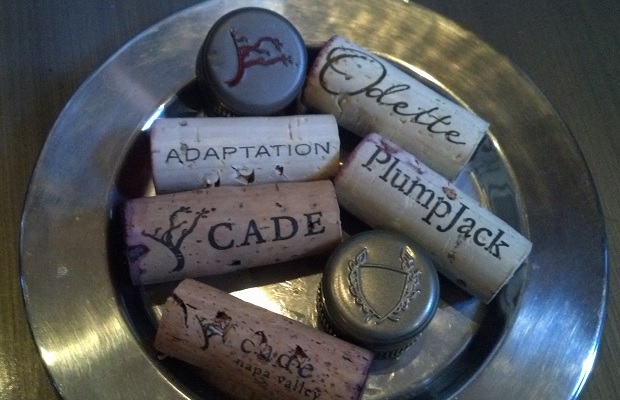
The closures of Plumpjack

The closures of Plumpjack

The wineries of Plumpjack, Cade and Odette bring three distinct Napa Valley growing areas together; Oakville, Howell Mountain and the Silverado Trail. When the unified program cascades into town it has a tremendous evangelical effect, proselytizing many. Though well-known and regarded California grape varieties like Chardonnay, Merlot and Syrah are part of the PCO output, that stalwart varietal behemoth called Cabernet Sauvignon stands alone. For this group of Napa wineries, life is a Cabernet.

Plumpjack is the heart and soul of the operation. In 2015 the Oakville outfit will celebrate 20 years of collocating wines from plots of Napa significance. In a universe steeped in the paradox of what was Bordeaux and is now California, Plumpjack makes work in fractive reflection of a vineyard’s take on that paradox. The estate’s 42 acres are nestled between the foothills of the Vaca mountain range and the Napa River flood zone. Cade works with Howell Mountain’s fog on 54 acres above the valley. The extremes of temperature and moisture do for Cade like the Petaluma Gap ushers to Sonoma but with more consistency from vintage to vintage. On Howell Mountain, balance is everything. Odette is the new, wunderkind venture, with Jeff Owens as winemaker, spiraled and sprawled across 54 acres against the Stag’s Leap Palisades knuckled down with all five Bordeaux varietals.

The Napa triumvirate of Plumpjack, Cade and Odette is represented in Ontario by The Vine Agency, a Toronto based wine bureau of authority, rebelliously in focus through the eyes of Rob Groh. Groh is an indefatigable defender of honest juice with a penchant for estate-grown, family procured, characterful wines. He and Derek Kranenborg brought General Manager John Conover to the Distillery District’s Cluny Bistro last month for an intense fixation, mostly and righteously on Cabernet Sauvignon.

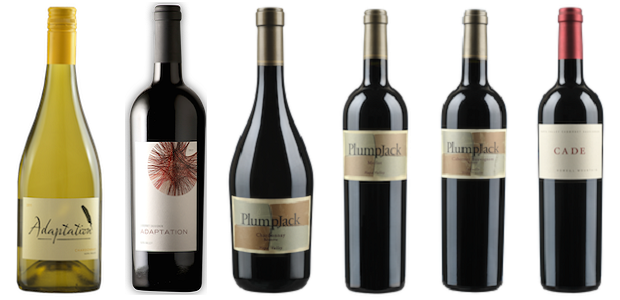
From left to right: Adaptation Chardonnay 2011, Adaptation Cabernet Sauvignon 2012, Plumpjack Chardonnay Reserve 2013, Plumpjack Merlot 2012, Plumpjack Estate Cabernet Sauvignon 2011, Cade Cabernet Sauvignon Howell Mountain 2010

From left to right: Adaptation Chardonnay 2011, Adaptation Cabernet Sauvignon 2012, Plumpjack Chardonnay Reserve 2013, Plumpjack Merlot 2012, Plumpjack Estate Cabernet Sauvignon 2011, Cade Cabernet Sauvignon Howell Mountain 2010

Adaptation Chardonnay 2011, Napa Valley, California (Agent, $32.95) Consignment

A full on crème filling feel is awash in tropical nuance. At once young and tender like hearts of palm and then again  like roasted cart nuts and a bonfire on the beach, eventually cooled by palm fronds and prevailing winds. Nothing would suit this better than a suckling pig and a mess of lobsters. Seamless in texture all the way through, finishing with dessert cream and buttery pastry.  Tasted October 2014

Plumpjack Chardonnay Reserve 2013, Napa Valley, California (325019Agent, $67.00) VINTAGES Classics December 2014

Part Carneros and part St. Helena with the former trumping the latter as this is much cooler and linear, with apples in stereo acidity, cogitated in a self-professed “alternative California style.” Definition: zero malolactic fermentation. This is the second such recent animal (along with Gundlach-Bundschu) though the first Napa to do Ontario in such dissident manner. Feathers a tickle up the olfactory passage and bounds in restless bounce within the walls of the jumpy castle. Not quite indelicate but high-toned at the present time. Such a nimbly carved ride in wild yeast serried within an expressive ferment, with a Fernet note and a request for patience. Really long finish.  Tasted October 2014

Adaptation Cabernet Sauvignon 2012, Napa Valley, California (353102, $49.95, WineAlign) VINTAGES Release November 8, 2014

As a second wine to Plumpjack, Adaptation offers a similar, if less complex mental state to the dean Cabernet. The stress-free vintage gives very ripe, lush and excelling fruit in the throes of oak and circumstance. Tones are bright, aromas defined, with patent black cherry and Cassis. As noted, oak is not unbeknownst but it infuses the fruit with just a little chalk and from a very fine grain. Somewhat savoury sweet currants bring delicate flavour, along with a mild cure in its marbled flesh. Turns devilish with spice box, a drag on a hand rolled cigar and a slice of rye toast, caramelized on the edges. Will adapt to protein, with banter and good cheer.  Tasted October 2014

Cade Cabernet Sauvignon 2011, Napa Valley, California (Agent, 325027, $112.95, WineAlign)

Though prepped by notions of a cooler and later ripening vintage, there is even more savoury, tobacco and cool clime (altitude) aromatics than might have been imagined. This Cade is so very bright in a cherry-plum-pomegranate continuum yet in contrast to a (negatively impacting) sweet-sour-tang drupe. Tends to angles more akin to Tuscan summer savour, like lavender, rosemary, sage, and vanilla. The overall impression to palate is that of a chew of the toffee that might be made by the aromatic combination, or a pull of syrupy tea. In the end there is nothing simple about this thoughtfully crafted Cade.  Tasted October 2014

Plumpjack Merlot 2012, Napa Valley, California (Agent, $78.95) Consignment

Fruit from the Oak Knoll Vineyard etched as ripe a Napa Merlot that can or would ever want to be. That it teeters on the scarp, laughing at the greens, partying with the reds and joking with the blacks, this Merlot is quite righteous in quintessential necessity. It screams fruit, picked just at THE moment. At 15.2 per cent the expectation would be intensity, like a moth with a fatal attraction to a book fire but it manages the sun and ripeness with ease. Drink this now, if you can afford it and wait five more to see where it goes.  Tasted October 2014

Plumpjack Cabernet Sauvignon Reserve Oakville 2007 (screwcap), Napa Valley, California (Winery)

There’s a dusty aromatic feel here with tar, charcoal and the ardor of wet stones roasting in a hot room. The barrel is still speaking this many years on, the fruit lurking, the wood caressing but with a strong and outstretched hand. Dark berries come out of the waft in full play and when tasted, with tobacco and many candied flowers. Very Paulliac. Full warmth, with a texture of cream, vanilla, layer cake and nuzzled by sweet tannins. In spite of the compass it is approachable (stupidly so) and still worthy of a lazy petering for 10 years forward.  Tasted October 2014

Plumpjack Cabernet Sauvignon Reserve Oakville 2007 (cork), Napa Valley, California (Winery)

Less dust but that’s splitting hairs. When making comparisons without the necessity of blind pours the minute distinctions are conjured by plotting and conjecture. Same wood up front, same sweet fruit behind. The texture of cream filled layer cake and some spice with tobacco on the back palate. This is extreme modernity incarnate. It seeks love and love it receives.  Tasted October 2014

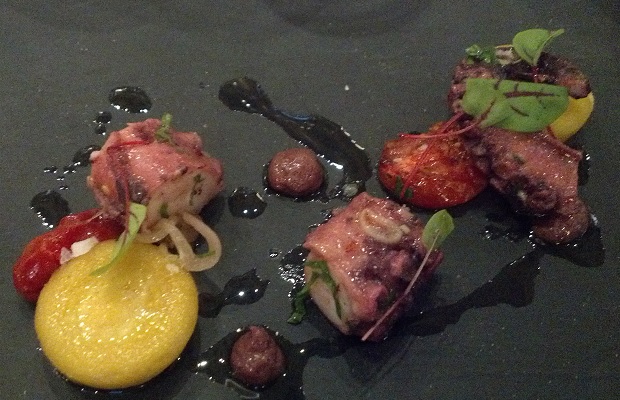
Cluny Bistro Octopus

Cluny Bistro Octopus

Plumpjack Estate Cabernet Sauvignon 2011, Oakville, Napa Valley (296483, $140.95, WineAlign) VINTAGES Release November 22, 2014

Just an incredible crack of aromatics mark what seems like 10-plus minutes of thunder Plumpjack; Spring wildflowers, black raspberry, roasted game and crushed steen as if from Gironde-banked, well-drained gravel, sandy stone and clay soils. Ripe, seamless and nonrigid. “I dare you to smell bell pepper in this,” chides General Manager John Conover. Though 2011 caused some Napa concern, Plumpjack will have had none of its woes and whimpers. The Oakville Cabernet “does this thing she calls the jump back Jack, she’s got the heart of a ballerina.” Dried and fresh herbs define its vintage-related nuance and their herbal presence, etched in balance with well-thought out barrels means “my heart’s wood, she’s a carpenter, she’s an angel in the night, what she does is alright.” Really approachable now, though it will go very long and deep.  Tasted October 2014  @PlumpJackWinery

Cade Cabernet Sauvignon Howell Mountain 2010 (cork), Napa Valley (325027, $99.95, WineAlign) VINTAGES Release March 15, 2014

As rich and hedonistic as is the animal of Oakville ‘07, this 2010 is the bomb. Pure, clear mountain fruit, unencumbered, free, card-carrying member. Spokesperson and player, cool and collected, conceited, sure, gay, straightforward, then warm and lush again. This has layers and layers of fruit, waves of feigned sweetness, grape tannins interwoven in chains, molecules tumbling over one another. Heartfelt expression creates a massive Howell Mountain impression.  Tasted October 2014

Cade Cabernet Sauvignon Howell Mountain 2010 (screwcap), Napa Valley (325027, $99.95, WineAlign)

From a second bottle tasted from screwcap: Just as the comparison of ’07’s revealed, the similarities are just what the wine expects you to find. Large and full of fruit with sweet, integrated and ingratiating tannins. There is actually another level of open window brightness in the Stelvin, but that same (cork closure) spice and high altitude conceit takes the fruit on honeymoon and sexes the hell out of it.  Tasted October 2014

Odette Cabernet Sauvignon Estate Cabernet Stag’s Leap District 2012, Napa Valley (Agent, $145.00) Consignment, February 2015

Here storms in the inaugural vintage, personally carried, delivered and poured by John Conover. The level of purity trumps the rest. The clarity and chaste structure are defined in lines of no blur and no confusion. Full of brisk, red-blooded, indelible ink of a cabaret magician’s brew. Built on axon terminals of mnemonic neurons. Sweetest dewy smells, unreal fruit, remarkable wildflowers – this reminds me of an Ornellaia, an ’01 or and ’11. Essence of just picked berries – strawberry and blackberry, leaves in an instant and an ooze of freshness. Knots of tannin will take 15-20 years to untangle but the fruit is up to every moment of engagement. “It’s only a (Cabernet), old chum. And I love a (Cabernet).”

Good to go!

The artfully applied science of Versado Malbec

Versado Vineyard Manager Sergio Rinaldi reviews the plan for the harvest with winemakers Ann Sperling and Peter Gamble Photo: (Elene Galey-Pride, www.winestains.ca)

Versado Vineyard Manager Sergio Rinaldi reviews the plan for the harvest with winemakers Ann Sperling and Peter Gamble
Photo: (Elena Galey-Pride, http://www.winestains.ca)

A popular but unconfirmed theory claims that Malbec is a mathematical acronym, “Math, Algorithms, Learning, Brains, Engineering, Computing.” The inky and tannic grape variety no doubt connects growers and winemakers in scientific ways but that hardly separates the expatriate, signature Argentinian from other varietal relationships. The learning, perception, and behaviour of the people who produce the dark wine is the crux and the rub.

Malbec’s spread may be the work of a Hungarian peasant, it was surely introduced to Argentina by French agronomist and botanist, Miguel Aimé Pouget and the natural lines differentiating modern renditions of Cahors and Argentina blur like the Clarets of Napa and Bordeaux. The homogeneity in style, mainly due to elevated quantities in production, has begun to deplete the star power of the Mendozan idol. The computative cipher jives because Malbec requires an analytically brilliant dream team to coax humanity from the quotidian grape. The wine making axiom, “is it science or art” applies to Malbec as much as any other. Making exceptional Malbec requires artfully applied science.

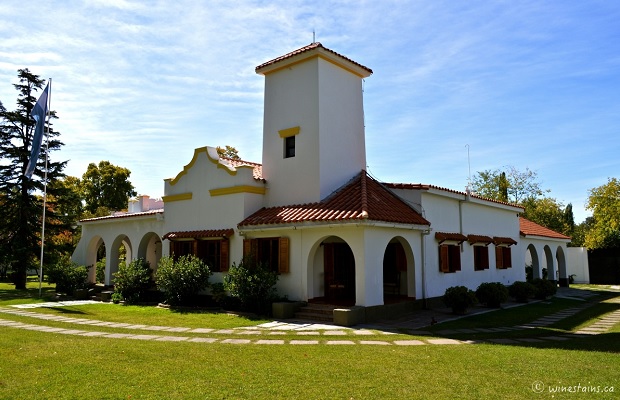
Villa Viamonte in Chacras di Coria Photo: (Elena Galey-Pride, www.winestains.ca)

Villa Viamonte in Chacras di Coria
Photo: (Elena Galey-Pride, http://www.winestains.ca)

In 2007, Peter Gamble and Ann Sperling, winemakers who may as well be endowed with the title “First Canadian Couple of Wine,” went to Argentina to seek their cerebral Malbec fortune. With the aid of investors Moray Tawse and Gerry McConnell, the two found their varietal calling in Mendoza. They settled at the estate of Villa Viamonte in the old town of Chacras de Coria, now a neighbourhood of Mendoza.

With the aid of the experienced and professional Roberto de la Mota they purchased an ancient vineyard on the legendary Cobos Road. Altitude, meso-climates, topography and ‘micro-terroirs’ became their linguistic vernacular, a royal, ancient and new Malbec their opera omnia. Vineyard Manager Sergio Rinaldi directs all the daily viticulture activities.

Versado means ‘well-versed’ and the phrase describes the Gamble-Sperling output as well as any that can be equivocated.  The Canadian dream team travels circuitously from British Columbia, to Ontario, Nova Scotia and through Argentina in mimic of the seasons for a vine’s life cycle. Through the stages of weeping, flowering, fruit set, veraison and harvesting, Peter Gamble and Ann Sperling are in constant motion, checking in at all their properties to make essential decisions. I am exhausted by the prospect.

Harvest starts early - the Versado vineyard before sunrise Photo: (Elena Galey-Pride, www.winestains.ca)

Harvest starts early – the Versado vineyard before sunrise
Photo: (Elena Galey-Pride, http://www.winestains.ca)

Versado is a unique Malbec outpost, a place of river, road and air. The ancient bed of the Rio Mendoza, the Calle Cobos and the cool air corridor of that river combine for a micro-climate to challenge all micro-climate comers in the region. Increased thermal amplitude (up to 15 to 16°C difference between day and night-time temperatures) means low pH numbers for their Malbec. The results should translate to elegance and balance. As the Versado team begins to scale back their oak program, the wines will increasingly reflect their specialized and cooler terroir.

Peter Gamble told me “we’re making them with classic tannin structures.” That statement intimates French and even Italian but with Mendoza’s already rich history, it also endorses a notion of Argentina. Versado’s Malbecs are both serious and epicurean. They are gorgeous and alone. They come from a very specific parcel of land, though Peter Gamble admits that “borders are sort of Alice in Wonderland in Argentina.” The Versado Malbec origins may participate in a Mendozan Venn Diagram but their character is utterly unique. Here are six tasted over the past 12 months.

Versado Malbec 2013, Luján De Cuyo, Mendoza, Argentina (317008, $25.95, WineAlign)

The rocks beneath the earth precede the rich, dark fruit. After the berries and the candy beets and the spices subside the flowers grow and take over the room. The vintage brings more layers than before. Malbec of character and belief, even a touch of good VA, a coat that only the Southern Hemisphere can provide. It is not usually present in Mendozan Malbec so it’s really a breath of fresh paint here in the Versado. Great purity. Protracted length. Most expansive and intriguing vintage to date. The Reserva will be killer.  Tasted September 2014

Versado Malbec 2012, Luján De Cuyo, Mendoza, Argentina (317008, $25.95, WineAlign)

Having been defined early in its development by the Mistral-esque drying eastern lee slopes Andean wind known as viento zonda, the low-yielding 2012 Malbec is berry intense and highly concentrated. The foehn or, rain shadow wind had a major effect on flowering and so 2012 may be considered a Malbec example of what happens when vines are subjected to the first law in thermodynamics. The vintage gaveth depth and structure, even as it taketh away moisture, quantity and profits. In this Malbec, earth in terroir stands firm and while the fruit is full, it must fight for early investigative attention. Though presently rigid, a time will come when that fruit will fully receive its due. Sanguine and ferric, the adiabatic Versado 2012 is a heat transfer work in progress. Its system will integrate into its surroundings after a minimum three years have passed. Drink from 2015-2022.  Tasted September 2014

Versado Malbec 2010, Luján De Cuyo, Mendoza, Argentina (317008, $25.95, WineAlign)

The sub-terra tectonic shift and uprising to firma awakening is just beginning to give after four integrated years. That said, this Malbec continues to play a ragtime roll in shades of cumulative bandwidth. When the ’10 entered bottle it may have insisted “I don’t care what mama don’t allow I’ll play my guitar anyhow.” Now settled, somewhat, it persists in saying “I don’t care what mama don’t allow, we’re all gonna play all at the same time anyhow.” The dusty fruit, the resolving tannins, the revolving door of driving blues, of crossover terroirs. “Borders are sort of Alice in Wonderland in Argentina,” notes Peter Gamble. The Venn circles include piano, rare earth, bass, big fruit and guitar.  Tasted September 2014

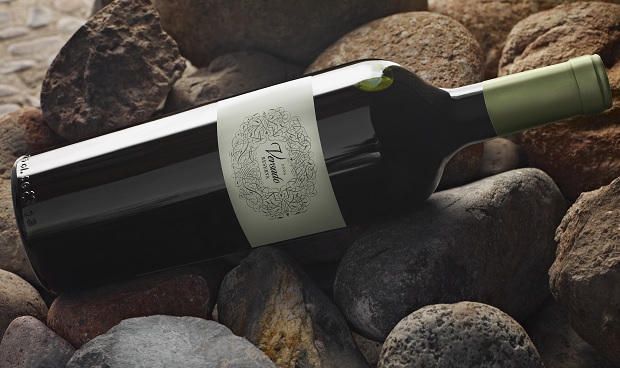
Versado Malbec Reserva 2009 Photo: (www.versado.com)

Versado Malbec Reserva 2009
Photo: (www.versado.com and http://www.stevenelphick.com/)

Versado Malbec Reserva 2011, Luján De Cuyo, Mendoza, Argentina (316984, $59.95, WineAlign)

Peter Gamble describes the ’11 Reserva as “integrated right out of the gate” and blessed with “a little more fruit component.” That is can show such freshness this early in its life span (especially in consideration of the beasts that are 2009 and 2010) is nothing short of a Malbec miracle. This is a wine that saw spontaneous fermentation, which made for very nervous times in the winemaking hands of Roberto de la Mota. Stems were used and their participation lends a Mediterranean feel, in the aromatic impart of sea salinity and kelp. The oak is scaled back a touch so the chalk push, while present, integrates in finer grain within the gritty, iron structure. This is the softest (hyper-relatively speaking) Reserva to date with a newly defined massive attack. The temperature fluctuations of the vineyard are integral in its structure and the question needs to be asked, “how can you have a day without a night?” In the Versado Reserva 2011 you have both. It is a Malbec of unfinished sympathy. Drink this sooner, starting in 2017 and for longer, to 2030.  Tasted September 2014

Versado Malbec Reserva 2010, Luján De Cuyo, Mendoza, Argentina (316984, $59.95, WineAlign)

The floral emergence is a lodestar as periscope just now peering up from the seamless cake layering in Versado’s most liberally applied oak-imbued Malbec. The 2010 adheres in sticky savour though it remains two to three years away from finding its true gliding form. From my earlier notes through tastings on Oct. 25 and Nov. 14, 2013. “This ultra-premium Mendozan from the Canadian winemaking team of Peter Gamble and Ann Sperling boasts fruit from “the finest barrels from the finest blocks.” While certainly riding a splintered and jammy horse (what fully extracted Mendozan does not), this reserve Malbec has so much else happening, I owe it my time and focus. Dances to a triple jump height in oozing berry, compacted, brick wall infrastructure and overlapping delineation. Really like the consistency here, with no hollow middle, no umlaut, no pregnant pause. Very well made.” Last tasted September 2014

Versado Malbec Reserva 2009, Luján De Cuyo, Mendoza, Argentina (316984, $59.95, WineAlign)

From a vintage the seasoned Mendozan pro knew to rank with the best, the 2009 Reserva persists as a concentrated, wild beast. On a rare occasion, such as tasting this Reserva, Malbec leans in an Italianate direction, no doubt a result from the combining forces of aridity, concentration and micro-heteroclitic terroir. The dry, slow ripening conditions sealed a vineyard funk into the shriveled, dehydrated berries. Though the wine is just now beginning to come around, that funk will take years more to play nice with the huge flavours, striking structure and resounding tannins. Fast forward to 2017 and imagine the crest over which a plateauing initiative will trigger. It may very well be 2025 before the slow decline begins.  Tasted September 2014

Good to Go!

https://twitter.com/mgodello


A Bordeaux family of wines

Château Léoville Las Cases of Domaines Delon http://www.domaines-delon.com/en/accueil.html

Château Léoville Las Cases of Domaines Delon
http://www.domaines-delon.com/en/accueil.html

Finding recherché in the classicism of a family run wine business is obscured by today’s speculative boardroom market of classified growths, futures and the wheeling of the négociant. When Bordeaux comes to town the connection is by and large a sterile one. How refreshing it is when the introduction is made in terms of kith, kin and tradition. The Delon family has been in the Bordeaux game since the middle ages. The estate of Château Potensac has been in Jean-Hubert Delon’s bloodline “since time immemorial.” The Delon holdings include Château Nenin (Pomerol), Potensac (Médoc) and Château Léoville-Las Cases (Saint-Julien).

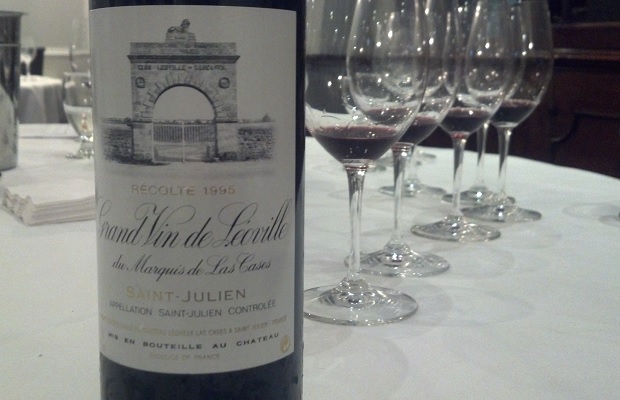
Château Léoville-Las Cases 1995

Château Léoville-Las Cases 1995

Léoville-Las Cases or “LLC,” as it is affectionately known, is one of the oldest Médoc properties and though it has always played 2nd Growth fiddle to its elite Classified Growth neighbours, Las Cases is anything but second class. The terroir, micro-climate, vines, ripening potential, history, track record and wine acumen of Léoville-Las Cases is equal to those of Lafite Rothschild, Latour, Margaux, Haut-Brion and Mouton. It might be considered the fifth major (or, in wine, the sixth), like the PGA’s Player’s Championship. Of the players, for the players. In fact, the estate is like an island green of itself, unique, accessible, of the people and for the people. LLC attracts an elite field but its success is shared and enjoyed by a level of consumer who may never afford or even come to taste a bottle of First Growth wine.

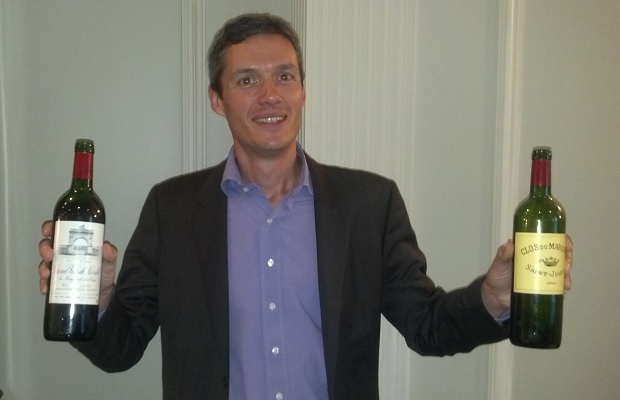
Pierre Graffeuille, Commercial Export Director, Domaines Delon

Pierre Graffeuille, Commercial Export Director, Domaines Delon

Pierre Graffeuille (Commercial Export Director) came to Toronto’s National Club on Wednesday, September 24, 2014 to present and to pour a cross-section of the Delon group of wines. Mr. Graffeuille was quick to point out “we do not want to make blockbusters.” The wines of Potensac, Clos de Marquis, Nenin and Léoville-Las Cases are meant for “lunches and dinners, not for tastings.  We focus on elegance, not concentration.”

The Delon philosophy is based on “a continual and incontestable search for excellence.” The ontology is shared and spread throughout the 550 acres of production between the three properties. VINTAGES is sharing the Delon belief with an extensive offering from the properties, including a long vertical of LLC.

Château Potensac is situated in the north Médoc, close to Saint-Estèphe and is possessed of a similar terroir. Set on 200 acres, the vines average at 40 years-old, with some plots exceeding 80. The plantings are Merlot (50 per cent),Cabernet Sauvignon (35) and Cabernet Franc (15). Soils are clay limestone/small gravel and the density of 8000 vines/ha is congruent with classified growths. Traditional Médoc élevage is 1/3 new French oak for 12-14 months.

Château Nenin is 0ne of the largest estates in the appellation of Pomerol. It comprises 80 acres on the Pomerol plateau, land of clay with gravel and more clay underneath in sub-soil. Nenin’s neighbours include Château Trotanoy and Le Pin. The vines are now at 25 years in average, young by Pomerol standards but with huge potential. The acreage was originally planted to Merlot (78 per cent) and Cabernet Franc (22), though little by little the Franc is increasing with each passing vintage. “For freshness,” notes Pierre. The Nenin élevage is generally 30 per cent new French oak for 14-18 months.

Château Léoville-Las Cases has been in the Delon family since the 19th century and represents the heart and more than 60 per cent of the former (17th century) estate. The famous walled enclosure houses the most prestigious plot just below the (Gironde) river that separates it from Château Latour in Paulliac. This geographical allusion is key to understanding the LLC oeuvre. The wines are the amalgamated embodiment of and yet are neither Saint Julien nor Paulliac. The vines grow within a plot that brings the Venn diagram circles of both appellations into play. Once again, Las Cases is the island of Bordeaux, in fact, it is the archipelago of wine estates. It draws detail, deed and qualification from without, then internalizes all within. Even the Clos de Marquis, from vines grown on soils of more sand and less clay gathers and concentrates its holdings. The Clos combines “2nd wine” conceptualization with affordability in unparalleled ways. It is a benchmark for the intellection in Bordeaux.

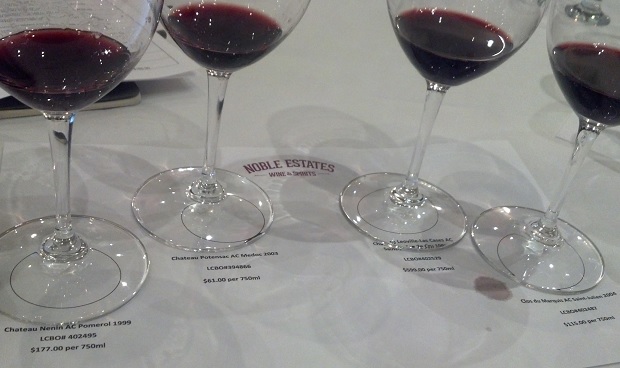
With thanks to the markedly too legit to quit Mark Coster and Noble Estates, the pleasure was had to taste four wines from the Domaines Delon. Here are the notes.

Domaines Delon: Château Nenin 1999, Château Potensac 2003, Château Léoville Las Cases 1995, Clos Du Marquis 2004

Domaines Delon: Château Nenin 1999, Château Potensac 2003, Château Léoville Las Cases 1995, Clos Du Marquis 2004

Château Potensac 2003, Ac Médoc, Bordeaux, Left Bank, France (394866, $61.00, WineAlign)

What with its congruence to Saint-Estèphe terroir amplified by the humidity of the 2003 vintage, Potensac mines the gene pool for pure, unadulterated Médoc. The breakdown in ’03 is equal parts 41 per cent Cabernet Sauvignon and Merlot with Cabernet Franc rounding out the holy Bordeaux trinity. Certainly atypically warm in vintage, it has marinated and maintained its push vs. pull of freshness and warmth. Smells of black fruit, licorice, scrub brush and is no doubt really ripe with the heat still in control. Chalk, grain and mineral layers dominate the piquant palate. Finishes with capers and olives on top of small stones. The limestone is really prominent. Has hit its cruising speed and will stay there for a projection of three more years.

Clos Du Marquis 2004, Ac St Julien, 2nd Wine Of Château Léoville Las Cases, Bordeaux, Left Bank, France (402487, $115.00, WineAlign)

Ten years have got behind this baby Château Léoville Las Cases from the estate’s vineyard silted of more sand and less clay than that of the 2nd Growth’s esteemed enclosure. Composed of Cabernet Sauvignon (57 per cent), Merlot (38) and small rounding out amounts of Cabernet Franc and Petit Verdot, the Marquis enters with quite a bass note and plucky twang. It lives on the dark side of the fruit spectrum, with notable Cassis, black currants and a funk progression in the tonic minor. A savoury spike which has Mediterranean pique, richness and wood spice ticks in rhythmic metronome and lingering cool notes. Prickly in woody funk. Cool, herbal funk. There is a late great push to stretched length. Clos de Marquis “you are young and life is long and there is time to kill today.” Drinking well at 10 and will live for 10 more.

Château Nenin 1999, Ac Pomerol, Bordeaux, Right Bank, France (402495, $177.00, WineAlign)

From one of the largest estates in the appellation, the Nenin’s terroir is clay with gravel and more clay underneath in the sub-soil. The layered richness is apparent as far back as this ’99, an early vintage fashioned from Merlot (88 per cent) and Cabernet Franc (12). These are numbers that would gradually invert in future vintages. As per the LLC practicum, this spent 14-18 months in 30 per cent new French oak. This 15 year-old Nenin is earlier generation softer in style, lush and mellow. There are plums mixed with a Right Bank truffle, which, with time and shelled terroir, has come out to play. Now that the wine is a teenager, it wears the vineyard funk as its make up. A shadow of soft red fruit and a shave of fungi are accented by some wood relish. Age is this Merlot’s best friend. The fruit has dissipated but certainly remains in the audience, just not quite at centre stage.

Château Léoville Las Cases 1995, Ac St Julien, Bordeaux, Left Bank, France (402529, $599.00, WineAlign)

This 2nd Growth, Grand Vin is a product of nurturing and environment, a study in 12 superb soil subsets, from sand to clay to stone. From mature, edified vines split between Cabernet Sauvignon (70 per cent), Cabernet Franc (16) and Merlot (14). The LLC ’95 is grounded and centered on its highly confident axis while swirling within a centrifuge of inwardly concentrated, ripe but not ripest fruit. Merlot here is the anchor, Cabernet Sauvignon the mast. This is a relationship of pure linear fruit meets acidity. The full and fresh attack is refined with soft-pedaled tannins. It’s neither St. Julien nor Paulliac. It is Las Cases. No other Bordeaux is such an island, a distinctly personal expression, an event of its own. This is a window to the greatest vintages, a portal to extend to the benchmarks of 1996, 2000, 2005 and 2009, but also to step into the history of physiological cortex, to gain insight into previous legendary vintages, like 90, 89 and 82. The ’95 is silky, caressing, rapturous enveloping in a reverse osmosis of fruit and acidity, acidity and tannin. Another sip notices the layering, the grain left in tannin, the lingering richness of the fruit. The absolute sweet caress.

Good to go!
A traditional afternoon with the wines of Carpineto

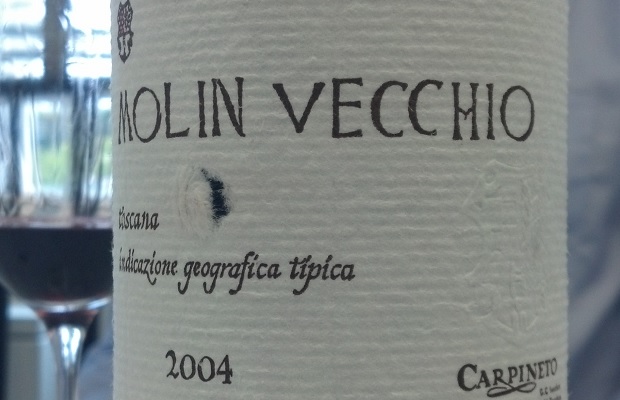
Carpineto Molin Vecchio 2004

Carpineto Molin Vecchio 2004

Carpineto brings “la Toscana e i suoi vini magliori” to the world. The producer near Greve in Chianti fashions wines from most of the better, best, requisite and constituent locales of Tuscany. The Carpineto library has been laid down from foundations in the DOC and DOCGs of Montereggio, Chianti Classico, Vino Nobile di Montepulciano and Brunello di Montalcino. Were the Bolgheri on the Maremma coast a part of their portfolio their reputation would surely be further cemented amongst the elite agricole of the region.

What dials Carpineto’s wines in to the natural and honest zone, especially when compared to so many modern peers, is their attention to simple detail. The wines across the board are restrained in alcohol, low in residual sugar and unencumbered by an excess of new oak. The wines are pure Tuscany distilled with seamless though mitigated texture. To a bottle they are a pleasure to taste.

Last Thursday Antonio Michael Zaccheo Jr. of Carpineto came to the WineAlign offices, along with eight of his wines. Together with Tandem Selections, WineAlign principals David Lawrason and Steve Thurlow we tasted through this noteworthy cross section of the Carpineto registry.

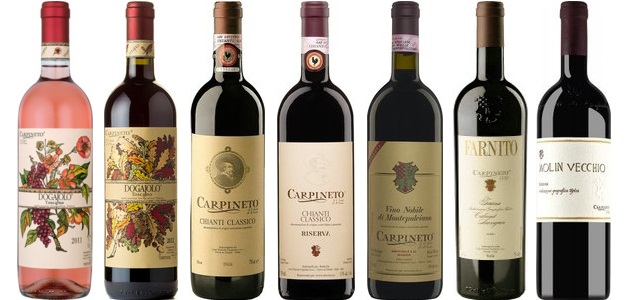
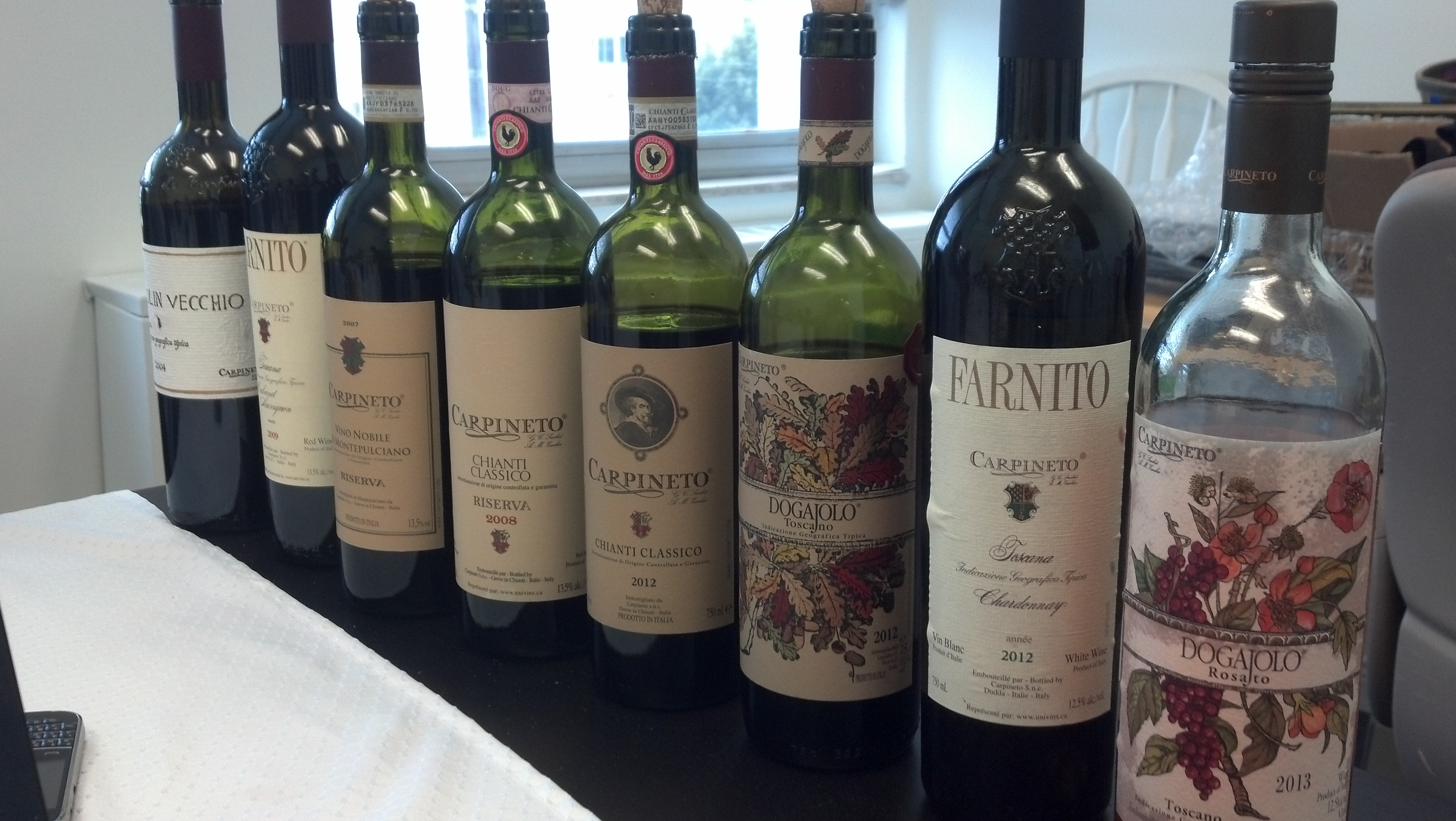
From left to right: Rosato 2013, Dogajolo Rosso 2012, Chianti Classico 2012, Chianti Classico Riserva 2008, Vino Nobile Di Montepulciano Riserva 2007, Farnito Cabernet Sauvignon 2009, Molin Vechio 2004

From left to right: Rosato 2013, Dogajolo Rosso 2012, Chianti Classico 2012, Chianti Classico Riserva 2008, Vino Nobile Di Montepulciano Riserva 2007, Farnito Cabernet Sauvignon 2009, Molin Vechio 2004 Photos: Jason Dziver, Photographer (http://www.jasondziver.com/)

Rosato 2013, Tuscany, Italy (699934, $15.95, WineAlign)

The Dogajolo Rosato is a right proper and serviceable Rosé, made from 90 per cent Sangiovese and 10 Canaiolo from holdings in both Chianti Classico and Vino Nobile. Sells quite well at the LCBO and even better at the SAQ where there is a different “attitude towards Rosé.” A gaseous medicine with exceptional salinity. Very dry saigneé, savoury and approachable. The freshly pickled strawberry is a nice touch.

Farnito White 2012, Tuscany, Italy ($24.95, WineAlign)

The Carpineto “White” is made from 100 per cent Chardonnay. Though the intent may be Burgundy, the Tuscan take here is very Italian; tight and forthright in flexure and focus. It is quite amazing how very primary it shows, with its whisper of a kiss by just a chip off the old barrel. Fresh, bone dry and bestowed the angle of Tuscan herbiage. So young that it offers the sensation of just having left the tanks and the wood. Like a leaner and cleaner version of the Cervaro della Sella. Can you say Linguine con le Vongole?

Dogajolo Rosso 2012, Igt Toscana, Tuscany, Italy (361501, $14.95, WineAlign)

Maybe it’s just a marketing term but Carpineto’s Antonio Michael Zaccheo Jr. refers to this as a “baby Super Tuscan,” because that is what it is. To pay $15 for a quarter century of winemaking acumen is anything but a hardship. Lithesome of fruit as opposed to sweet, it’s actually bone-dry (one g/L residual sugar), and artfully crafted for both the primi and secondi piatti. “Now we are in the Sangiovese camp, so good to go.” Well said, Antonio.

Chianti Classico 2012, Tuscany, Italy (356048, $21.95, WineAlign)

For Chianti Classico, 2012 was a good year, not too warm yet ripening occurred early, with the quality set to high, but the quantities were low. A winemaker’s vintage. Carpineto’s CC comes from the northern aspect of the appellation, from a conca (amphitheater) seven km’s east of Greve, by the piccolo hamlet of Dudda. It’s cooler in this part of Chianti, with more rock imparting flavour and textured sensations into the reds. The ’12 is essentially 90 percent Sangiovese and 10 per cent Canaiolo, give or take 10 per cent. Aromas of roses and wet rocks, fresh ripe plums mashed into tomatoes, herbs and a spicy side note. Old school and precisely what CC should be, minus the funk (which it does not have or need). Ultimate pasta wine right here. Traditional style in an up to date way with temperature control and all the tools of a modern facility. No VA, no barnyard, but really natural. This explains the axiom of maintaining tradition. With so many story lines already spoken for in sectarian Chianti, maybe that is the only thing Carpineto has left to hang their Zuccotto on. David Lawrason hits the nail head on. A Chianti that “resets the compass.”  Coming to VINTAGES April 18, 2015

Chianti Classico Riserva 2008, Tuscany, Italy (47118, $29.95, WineAlign)

A wine that is “already performing at purchase time,” like the Chianti Classico but turned up to 11. This has a more than a touch of funk, not exactly barnyard, but surely an earthy forest carpeting. Attribute this to the extra concentration and the élevage – time spent soaking up the barrel. The added marinade works to opposite effect as compared to the CC normale and in my opinion it’s an adverse one. Lost is the freshness and spirit. Still a wine of great Tuscan antiquity, in maintenance of its acidity and full of dark, iron and sanguine pulsing fruit.

Carpineto line-up at www.winealign.com

Carpineto line-up at http://www.winealign.com

Vino Nobile Di Montepulciano Riserva 2007, Tuscany, Italy (368910, $29.95, WineAlign)

Carpineto’s Vino Nobile hails from further inland, where the climate is more continental and the dry-farmed clay soils help carry the grapes through warm summers like 2007. Has an intense grapey, raisin and resin character. Really big fruit yet still old school enough to remind us all of the Carpineto oeuvre. This has stuffing, with nary an advancing moment towards a premature future. Blessed with a seamless nose to palate to tannins structure. This is really fine Vino Nobile, “scelto,” a chosen mocker. It’s thick and full but not from oak in any shaken or splintered way. This Prugnolo Gentile comes by its substance naturally, with minimal effort or need of applause.

Farnito Cabernet Sauvignon 2009, Igt Toscana, Tuscany, Italy (996553, $29.95 WineAlign)

Cabernet planted as 8,000 vines per hectare in Montepulciano resulting in the production of one bottle per vine. Love that equation. Eight tons per hectare is low but not an economically impossible yield. Antonio Michael Zaccheo Jr. insists the single vineyard plot is the largest contiguous vineyard in all of Italy. The vineyard was 15 years old at the time this wine was made, so we’re talking prime time for making world class wine. Spent one year in one third new French and American oak and then a few years in bottle. Not quite as ready to pop and pour like the CCR, this has beast mode written all over its expatriate face. Juicy, chalky and dusty which puts it in contrast to the Sangiovese. This is much more internationally styled and “needs cholesterol of any kind, “ says Antonio Michael. It’s more floral than the Chiantis and the Vino Nobile. Ripe but not overripe, international but unmistakably Tuscany.

Molin Vechio 2004, I.G.T. Toscana, Tuscany, Italy (995308, $59.00, WineAlign)

This vintage is from a single, five hectare vineyard (the wine moves around through vineyards, depending on an assessment of which shows best from year to year). Spent one year in new oak and was bottled in spring 2006. The “Old Mill” is a Tuscan-Bordeaux-Rhône gathering of Sangiovese (70 per cent), Cabernet Sauvignon (20) and Syrah (10). This has a Boschetto al Tartufo (shaved white truffles in cheese) note that is intoxicating. From sandy clay soils, southerly facing with marine sediments planted in the early nineties so the marine impart is just starting to show. Recent vintages should give increased salinity and minerality. Has the aroma of roasting game and savoury, Mediterranean bushes – this is akin to some southern Rhône big wines but the texture is stretched and seamless, not cake-baked and chalky. Great acidity and length. Still quite edgy. Needs at least five more years to come around. Released as part of the VINTAGES September Classics.

Good to go!

 

Got two Chardonnays, June, Ivan and Picone

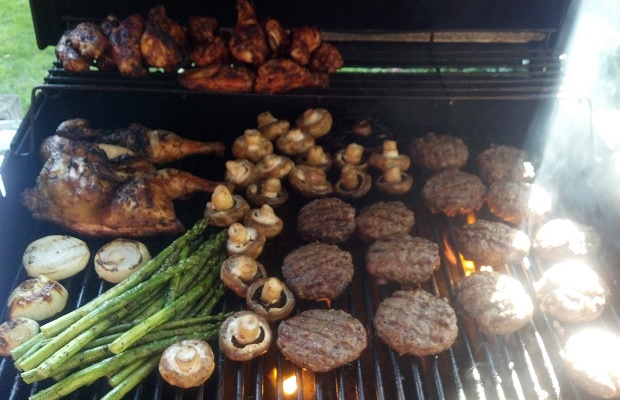
Mixed Grill

Mixed Grill

Niagara’s Cool Chardonnay Conference is but three days away so in anticipation I’ve drawn up more tasting notes for three that will be on hand at the great #i4C14 event. The wines made by Thomas Bachelder, 13th Street and Sumaridge are all extremely different, stalked from disparate soils and assembled in ways to render them disconnected by their very specific varietal vicissitudes. This is what you get when you seek Chardonnay.

Charles Baker does not make Chardonnay, but no other winemaker in Niagara does Riesling in such a focused, micro-specific way. Baker’s Ivan and Picone Vineyards are to Riesling as Wismer, Saunders, Quarry, Robyn, Mottiar and LCJ are to Chardonnay. Like Johnson in Oregon. Like the granite and quartzite ridges of South Africa’s Hemel En Aarde Valley. I’ve tasted Baker’s Rieslings going back to 2006 over the past year or so. Their evolution shows conceit extracted from limestone and a tempering from hot to cool. Riesling too is très cool.

Here we actually have three Chardonnays with one hailing from the exceptional June’s Vineyard. Yet another example of nuanced Niagara, a plot of land in the 13th Street empire that will one day be recognized for its soil and receive Cru status. The grand breakdown needs to happen, not yet, but in another 10 years time when the obvious can no longer be denied nor held down. A time when VQA, winemakers and their terroir decide to come together to celebrate individuality and progress.

Charles Baker Rieslings

Charles Baker Rieslings

13th Street June’s Vineyard Chardonnay 2012, VQA Creek Shores, Niagara Peninsula, Ontario (236745, $21.95, WineAlign)

Chardonnay should always be a product of the vineyard and this ’12 June is just that. Everything it is and more comes amplified by the vintage; the sweetness of the fruit, the peat earthy, camphoraceous terpene aroma from clay and sand loam, and the leesy, chalky texture out of yellow limestone. Depending on preference, this June may be construed as over the top or layered with all the goodness of the great 15 year-old, Fifth Avenue vineyard. Though she may exaggerate her terroir, in a toothsome, tart citrus and earthy tone,” and I know that June is true. She can be yorn too if you open up to her ways.  Tasted May 2014  @13thstreetwines

Charles Baker Riesling Ivan Vineyard 2013, Niagara Escarpment, Ontario (winery, $27.00, WineAlign)

Welcome to the cult of Charles Baker Riesling. Baker’s vehement search for new Riesling territory materialized in the (Bob) Misek vineyard, a plot of rich limestone and sandstone that sits below clay, named after the grower’s dad. The 1.1 acres of Riesling within a 12-acre mixed planting just south and up the ledge from Highway 8 is just north of Tawse and just down the hill on the eastern side of Cherry Avenue. For this 2013 vintage the vines were 16 years of age, now into that sweet spot of adolescent maturity. Baker is hell-bent on delivering solid blue material from important fruit. “This is the driest Riesling I’ve ever made,” he points out with shy conceit. At 10 percent alcohol by volume you might want to imagine practical, nearing off-dry Germany but the comparison can’t be made. This is oyster wine, from a wonky weather, under cloud cover, great Riesling vintage. When it comes to the noble variety, “seasons don’t fear the reaper, nor do the wind, the sun or the rain.” Picked on average aggregate, in early October and with so much fruit in contrast to stone-grooved Picone, this Ivan is a friend to farmers, Romeo and Juliet. A Riesling that lives above ground. There are 198 cases made. Tasted May 2014  @cbriesling

Sumaridge Chardonnay 2011, Wo Upper Hemel En Aarde Valley, South Africa (agent, $29.50, WineAlign)

Though it would be naïve to think every Chardonnay produced out of the Hemel En Aarde Valley is the stuff of grand cru, recent examples have done nothing but impress. Sumaridge joins Hamilton Russell and Creation on the Walker Bay dream team. Ocean breeze-cooled slopes and deprived soils of decomposed granite loam with quartzite manage rich fruit with cool ease. In this 2011 a most excellent trifecta of dryness (1.7 g/L), acidity (6.9 g/L) and PH (3.45) brings together texture and tannin. Though seemingly sweet it is anything but a cloying example. Buttery but mild in toast, quite piercing yet tempered by an herbal quality, not warm or balmy, but inexorably herbal. Schematically waxy, splashed by lemon and piqued by zest.  Tasted May 2014  @Sumaridge

Charles Baker Picone Vineyard Riesling 2012, VQA Vinemount Ridge, Niagara Peninsula, Ontario (241182, $35.00, WineAlign)

A vintage that begged to be protected in the vineyard, meaning no leaf plucking and no thinning. A most excellent goal of (0.691895068 kg / m2), or 2.8 tons an acre was realized, as opposed to one in 2010. Heavy vigor slowed down the ripening (leaving that kind of tonnage on the vine), to an elongated balance. Comes from terroir Baker nods to as “a barren tundra,” which you don’t get down the hill. In 2012 there was no waste, no rot, no problems. Its residual climbs to 15 g/L but you’d never know it. There is a confit of citrus, a mellifluous sensation of preserved lemon. Total count is 600 cases. From my earlier, March 2014 note: “Baker’s iconic child yet breathes in unsettled, spumous emission from out of a warm vintage. So primary and such a hard act to follow. Vanguard Vinemount Ridge, arid as the desert and citrus, carbonic tight. Treated with cool, cooler and colder methods to seek result and strike balance in an opulent, lees-appertained, tangy finish. A Picone that says I don’t live today, so it is told and canvassed, “uh, get experienced, are you experienced?”  Last tasted June 2014

Charles Baker Picone Vineyard Riesling 2007, VQA Vinemount Ridge, Niagara Peninsula, Ontario (241182, $35.00, WineAlign)

If Charles Baker got lucky, babe, or in my estimation, experienced with the outcome of his striking 2006, this follow-up suffers a sophomoric stenosis, if only because it was the hardest Niagara (hot) vintage to deal with and understand. The vintage tricked with a false front, teasing winemakers to push envelopes and many over did their wines. Had his fruit only spoken up and said “you better watch what you do to me, don’t get carried away,” the wine would show better seven years later. Yet Baker was savvy enough to manage the residual sugar by keeping it dry with tannin by way of acidity and PH. I agree this is one of the finer takes on Niagara Riesling in 2007. When stacked against other Bakers it pales because it’s evolving rapidly and it can’t be helped. The petrol quotient is sky-high, like a rumbling volcano, like bicarbonate. True to the Baker oeuvre it cuts with laser focus and linear drive.  Tasted May 2014

Bachelder Chardonnay Johnson Vineyard 2012, Willamette Valley, Oregon, USA (agent, $44.95)

More specifically a product of its ocean meets sous terre soil than Bachelder’s basic (term used loosely) Chardonnay, the Johnson nicks more richesse, around and around fullness. Not to mention the cerebral wisdom of two Scots and a Charlemagne. Johnson’s progressive and forward thinking maker works with inconspicuous wood and the science of introducing oxygen into wine in a controlled manner.  He might say “for it is wisdom that we have for sale.” Like a white-winged dove, the 2012 will trod lightly towards a long walk to a very long life. It can be imagined aging to the edge of seventeen. The earthy feel, the salinity, not from tannin but from soil, “the music there, well, it was hauntingly familiar.” This is iridescent Oregon in a Bachelder voice. No doubt.  @Bachelder_wines

Good to go!

The froth on Crémant d’Alsace

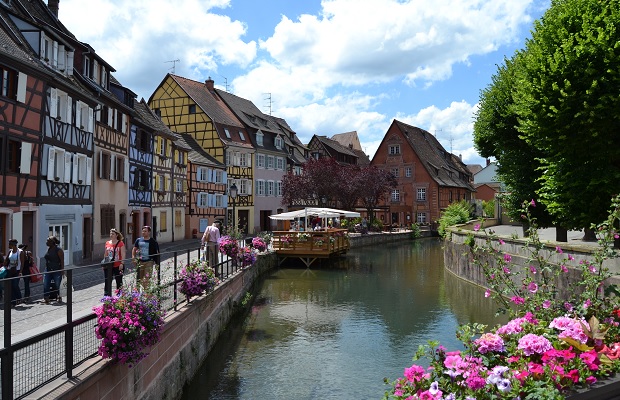
Colmar Canal PHOTO: Cassidy Havens, http://teuwen.com/

Colmar Canal
PHOTO: Cassidy Havens, http://teuwen.com/

The production of fizz by way of secondary fermentation in bottle is nothing to be ignored in Alsace. More than one in every five wines forged from the region’s vines is filled with bubbles. Most recently (in the past 18 to 24 months), certain things have come to light. A salient spike has been witnessed, with Sparkling wine increasing from 15 to more than 20 per cent of the region’s annual wine production. This means that Alsace now ranks second in France with a yearly production of more than 30 million bottles.

Six grape varieties are permitted for the production of Crémant d’Alsace; Auxerrois, Chardonnay, Pinot Blanc, Pinot Gris, Pinot Noir and Riesling. Chardonnay can only be used for Crémant and only Pinot Noir may be fermented to bottle a Rosé. More rules must be followed like grapes having to come from vines into its’ 3rd growing season and wines must rest a minimum nine months on the lees before bottling. Most lay longer, which helps to define this genre of Crémant’s creamy texture, matched in contrast by its stony, flinty and mineral style.

The effervescence of Crémant d’Alsace is known as prise de mousse. Basic wine is bottled with liqueur de tirage for second fermentation. Bottles are left to rest sur latte. Autolysis occurs and the dead yeast is removed by way of remuage. After aging on the fine lees, bottles are turned, deposits form in the collar, brought to the freezing point, evacuated by carbonic gas and replaced in volume by liqueur de dosage or liqueur d’expedition which yields a Crémant d’Alsace of three styles; Brut, Sec, or Demi-Sec. A balanced vintage for sparkling in 2012 yielded 270,000 hl of Crémant d’Alsace.

During my week in Alsace and with thanks to the Conseil Interprofessionnel des Vins d’Alsace (CIVA) I was able to taste more than 30 producer’s Crémant. Here are my notes on 14.

Crémant d'Alasace at Domaine Steuntz-Buecher

Crémant d’Alasace at Domaine Steuntz-Buecher

Jean-Marie Haag Crémant d’Alsace, tasted at Domaine Stentz-Buecher with Les diVINes d’Alsace

Exemplary bubbles from Soultzmatt in la Vallée Noble, 20 km south of Colmar, from out of clay-limestone soils. Grapes here are Pinot Blanc, Pinot Auxerrois, Riesling, Pinot Gris and Pinot Noir. A close-knit aridity and platinum tang are pronounced in an idiomatic lees-inflected language with a lightly oxidized lilt. A retaining wall of freshness and a slice of bitter honey-almond tart round out the complexity, intended or not, with elevated levels of Pinot vibrations making themselves known. Calls for a must return to see if it’s a one-off or a truly significant house style. Drink alongside a salty buffet.

Valentin Zusslin Crémant D’Alsace Sans Souffre Brut Zero, tasted at Domaine Stentz-Buecher with Les diVINes d’Alsace

The old vines blend from Clos Liebenberg is predominantly Pinot Auxerrois (95 per cent) with minor amounts of Chardonnay and Pinot Gris. It’s important to note the non-sulphur designation in that the not insignificant practice takes the wine to another level of Crémant sophistication. There is a savoury nut character to the Auxerrois but never in a fat, round or blanched way. The caryopsis are not like an almond but more like a roasted pistachio upon the mid-palate. Moving forward it’s like the smell of a nut-based, warm cereal. It’s quite intoxicating and lingers well into the finish.

Louis Hauller Crémant D’Alsace, tasted at Domaine Stentz-Buecher with Les diVINes d’Alsace

From 100 per cent Chardonnay, this is a fine, subtle, stylish, finessed and elegant interpretation that is a different sort of Alsace discrimination. Spent 11 months on the lees and sports more citrus than most others. Subtle bubbles here, with less froth and more Chardonnay character. Very good length.

Sipp Mack Crémant D’Alsace Rosé, tasted at Domaine Stentz-Buecher with Les diVINes d’Alsace

The smell of strawberry cream and the crème fraiche sapidity by way of sudoric lees. Fun and characterful if a bit of an ancestral taste.

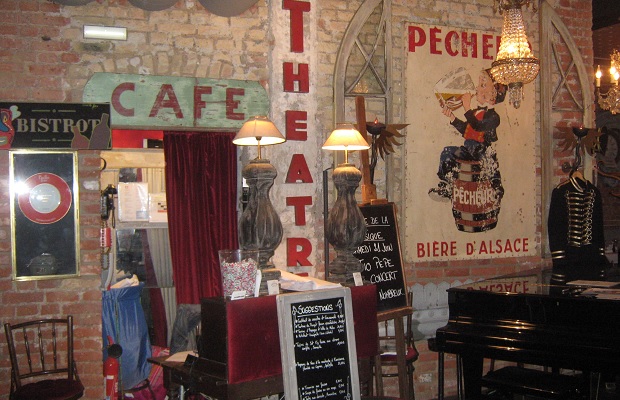
Restaurant Le Théâtre, Colmar

Restaurant Le Théâtre, Colmar

Albert Mann Crémant D’Alsace Brut 2011, tasted at Restaurant Le Théâtre, Colmar with Albert Mann’s Marie-Thérèse Barthelme

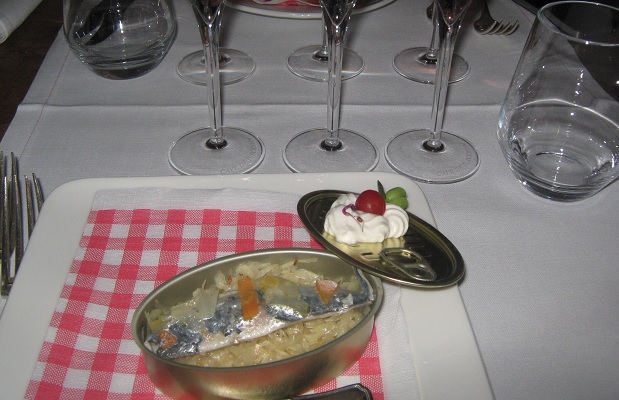
A four-squared Pinot affair, in Blanc (66 per cent), Auxerrois (16), Noir (12) and Gris (6). This from a bottle that had just been disgorged one week prior to tasting. Out of clay-limestone and sand soils in vineyards from Kientzheim and Wettolsheim. Like album art, the Mann label is a crucial, sixth sense aspect of the wine experience. The 2011 Crémant is the artwork of François Bruetschy, “like a turnstile of fireworks while projecting fine sparks.” The 2011 Mann is very fine, misty, delicate, wistful and waiting in longing for an amuse bouche of mackerel with choucroute in a can. The wine makes me long for a walk in the vines.  @albertmannwines

Mackerel and Choucroute, Restaurant Le Théâtre Colmar

Mackerel and Choucroute, Restaurant Le Théâtre Colmar

Gustave Lorentz Crémant D’Alsace, tasted at Restaurant Le Théâtre, Colmar with George Lorentz

Though the label denotes this as non-vintage, the blend of Chardonnay, Pinot Noir and Pinot Blanc is essentially from the 2011 vintage. This is what Lorentz describes as 2nd-tier house sparkling, with more ripeness in this bottle. That fruit maturity is all apple, with a minor note of oxidation and the full effect of 16 months on lees felt through texture. Once again the inclusion of Chardonnay takes the Crémant schematic condition to another level. Bring on the top-tier.

Louis Sipp Crémant D’Alsace Rosé, tasted at Restaurant Le Théâtre, Colmar with Etienne Sipp

The Sipp Crémant comes from various parcels in Ribeauvillé, from Weinbaum, Sulz and Rengelsbrunn. Etienne tells us it is made from Pinot Noir and Pinot Noir, playfully mocking the AOC’s rule that only that variety can be used for sparkling Rosé. Sipp’s Pinot is grown in mainly heavy and deep clay soils. Picked at optimum ripeness, this is fizz that has spent 18 months aging in bottle after not having gone the way of malolactic fermentation. The result is a dry, dense, savoury and layered Pinot Noir Rosé. This third Crémant in a group with Mann and Lorentz proves that though tonight is not a competition, we see that all three have won.

Hummus, La Table de Gourmet, Riquewihr<br />

Hummus, La Table de Gourmet, Riquewihr
PHOTO: Cassidy Havens, http://teuwen.com/

Paul Zinck Crémant D’Alsace, tasted at La Table du Gourmet, Riquewihr with Phillippe Zinck

An efficient, sparkling requiem for success in a blend of three vintages and varieties; Pinot Noir (60 per cent), Chardonnay (30) and Pinot Blanc (10). A soft receptive, inviting and proper amalgamation in which mousse apropos peach and soft French cream delight without needing to be tough or street savvy in any way. Crémant giving like une crème de luxe, to sip with Hummus, La Table de Gourmet style and with nary a difficult moment.

Domaine Bott-Geyl Crémant D’Alsace Cuvée Paul-Edouard Brut Millésime 2007, tasted at La Table du Gourmet, Riquewihr with Jean-Christophe Bott  @JLBrendel   

Jean-Christophe Bott’s may be the most complex and intriguing bottle of Crémant you would have a chance to taste in the course of a week in Alsace. Bott gathers top quality Pinot Blanc, Chardonnay and Pinot Noir from growers then lays the fruit low for four years on their lees. The rich and sunny vintage is vinified in what is really an Extra Brut style without any dosage whatsoever. This is small production Alsatian bubbles (2500+ bottles) disgorged in 2011 and in very early stages of development. The acidity stands in upright attention while the fruit submits to wait. The rocks and salinity raise upwards to march in extreme lengths. A sublime match to an Amuse Bouche of Cured Watermelon, pistachio, basil and mustard flower.

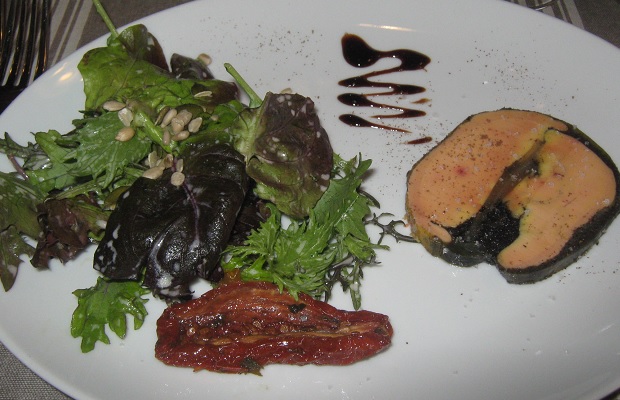
Foie Gras at Restaurant L'Épicurien, , Colmar

Foie Gras at Restaurant L’Épicurien, , Colmar

Charles Baur Crémant d’Alsace, tasted at Restaurant L’Épicurien, Colmar with Arnaud Baur

After its second ferment this blend of Pinot Blanc (40 per cent), Auxerrois (40) and Chardonnay (20) spent a compages-inducing 24 months on the lees. This is Baur’s main cuvée for Crémant, always made from two vintages, in this case 2009 and 2010. Most definitive and classic for the appellation. Falls within the aromatic white fruit/white flower spectrum with flavours that tease ripe Mirabelle, apricot and peach. Soft, elegant, feminine, demurred and clean. Baur’s take is a Catherine wheel of Alsatian bubbles with “all the things you dream while spinning ’round.”

Audrey et Christian Binner Crémant d’Alsace KB, tasted at Restaurant L’Épicurien, Colmar with Christian Binner 

Binner’s exotic-scented sparkling is from Kayserberg, “the emperor’s mountain,” next to the Schlossberg Grand Cru site. Old vines out of colder parcels more appropriate for making Crémant consist of Auxerrois, Pinot Blanc and Pinot Gris. The terroir here is granitic and poor in soil, if that is what it can be called. The house style is quite oxidative and distinctively earthy, as if the rocks were breaking down into a fine, funky soil remineralization. The most terpenes yet from bubbles tasted in Alsace, with a bruised apple hematoma, a pickle of some colonialist kind and a spice cupboard to fill a curry recipe. In the end this is unusual, yet vivid and jazzy fizz.

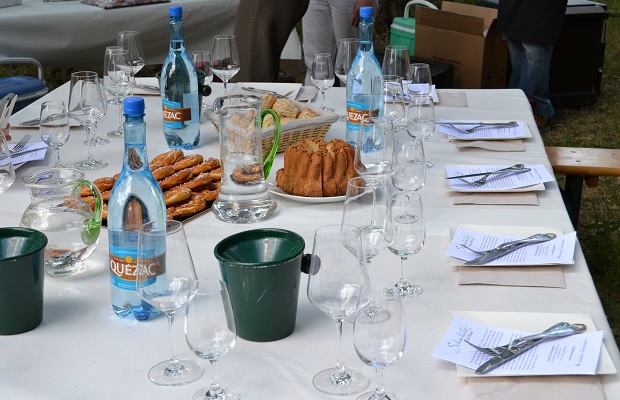
Schoenheitz Picnic<br />

Schoenheitz Picnic
PHOTO: Cassidy Havens, http://teuwen.com/

Vins Schoenheitz Crémant d’Alsace Millesimé 2007, tasted on the steep slopes of the valley of Munster with Dominique, Henri and Adrien Schoenheitz

Primarily focused upon Pinot Auxerrois and righteously so, with just a 10 per cent buoyancy from Pinot Blanc. The combination of striking Auxerrois fruit grown on the estate’s (400-500m) high altitude steep slopes and a memorable Alsace vintage is just deadly. The varietal choice in low acidity out of a vintage with character and temper here translates to aridity (1 g/L residual sugar) and long on lees texture. Like a Ron Sexsmith ballad, a listen, one look at its bronze patina, one taste and you will “see the forest for the trees,” because there’s gold in them hills. Perfect timing to break out an all-natural, no dosage ’07, marked by gratuitous acidity and mountain verve. An auspicious start to a picnic in the hills.  @VinsSchoenheitz

Pierre Frick Crémant d’Alsace 2013, tasted at Domain Pierre Frick with Jean-Pierre Frick

Jean-Pierre Frick poured two just bottled yet raw examples meant to set a perspective table for the 2013 finished wine that followed. The 50/50 Pinot Blanc et Noir (NV and 2013) were both picked ripe (nearly overripe), pressed direct and treated with nothing, nada, niente, zilch, rien. No sulphites, yeast or sugar. With zero dosage and opening too soon in evolution, these bottles were marked by arrested fermentation. The absence of the second fermentation meant for a flat, oxidative result. The experiment may have meant no Crémant but it helped to organize, define and ultimately assess the ’13. Same minimalist method but with a secondary ferment, this bottle (though warm) offered high citrus and biting, forceful, sharp acidity. When returned to an hour later and from a cold bottle, the wine was much brighter and atomically fresh. Frick’s method and style mean his sparkling must spend a minimum one year in bottle before it can be sold.

Casks at Jean-Pierre Frick

Casks at Jean-Pierre Frick

Pierre Frick Crémant d’Alsace 2012, tasted at Domaine Pierre Frick with Jean-Pierre Frick

One of JP’s “funny wines.” Once again, no sulphur but this time with natural yeasts. Notated by a slight coppery, salmon tinge and minimally oxidative, though in no way over the top. “My idea was a dry Crémant but he’s not dry. C’est la vie.” To Frick this is a wine for young and really old people. Toasted brioche, buttered toast and almond extract are joined by a late arriving, very interesting, savoury sweetness. The finish smoulders, with that ever-bearing herbiage adding another layer. This Pinot Noir and Pinot Blanc split comes in at 12.5 – 13.5 per cent alcohol. Frick doesn’t really know. “I write 13 per cent because I just have to put something on the bottle.”

Good to go!
Château Margaux hits the road

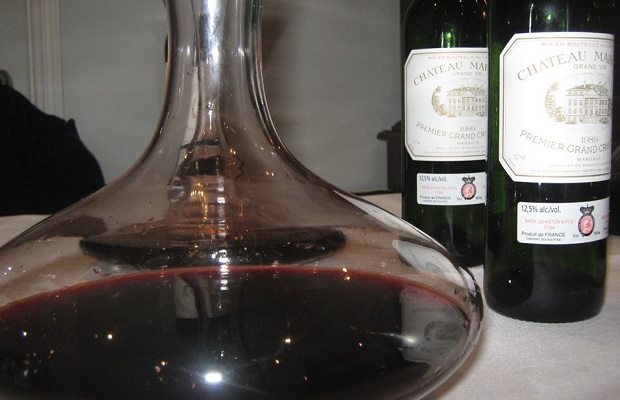
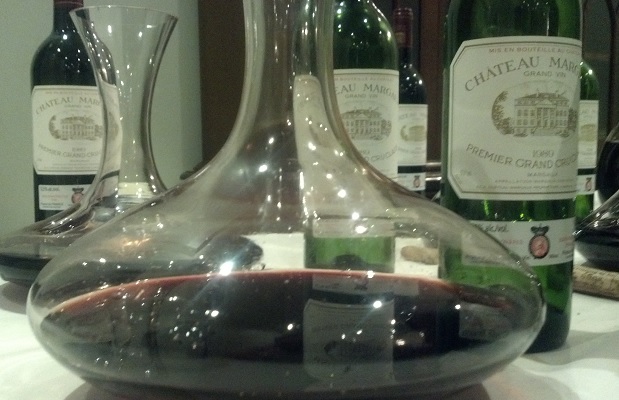
Decanted Château Margaux 1989, The National Club, Toronto, May 1, 2014 PHOTO: Michael Godel

Decanted Château Margaux 1989, The National Club, Toronto, May 1, 2014
PHOTO: Michael Godel

The wines of Château Margaux need no introduction. First Growth Bordeaux. One of the most famous brands in the world. Iconic and beyond mortal means, especially in the greatest vintages; 1953, 1961, 1982, 1989, 1996, 2000, 2009. So why is Paul Pontallier on the road to promotion? Do the wines not automatically sell themselves?

The answer is both yes, and no. Château Margaux annually produces 130,00o bottles of its Grand Vin. The 2009 is listed at nearly $1,800 in Ontario. They will sell through, if not this year, certainly eventually and inclusive of the calculated, incremental cost of inflation. The more pressing incendiary matter is a concern of distributive demand. Chinese and other south Asian markets have spent the better part of the last decade scooping up First Growths by the palette load. Mr. Pontallier clearly understands if you can’t see the forest for the trees, you risk losing touch with how you arrived here in the first place. Château Margaux needs to reconnect with North America.

Paul Pontallier is the Managing Director of Château Margaux. He joined the team of Corinne Mentzelopoulos in 1983. Along with Aurélien Valance, Senior VP Commercial Director, the most distinguished of Margaux houses came to Toronto’s The National Club at the facilitating invitation of wine agent Noble Estates on Thursday May 1, 2014. A 10:00 am start. Château Margaux for breakfast. “Probably the best time to taste wine,” quips Pontallier.

Château Margaux Tasting

Chateau Margaux Tasting

At the estate’s crux is the significance of territory. The wines are “not just a marketing ploy,” asseverates Pontallier, “they are based on the insistence of the terroir.” There exists a significant heterogeneity between the plots. “We try to protect them as much as possible. We can’t expand.” There is a sense of frustration in the director’s voice. “Château Margaux hasn’t changed since the late 17th century.”

Then there is savoir-faire. “Even three or 400 years isn’t a lot of experience. There is only one possibility, one harvest each year, for experimentation. But, the asset, the depth of experience is as important as the terroir.” Does the excellence of top Bordeaux require genius? No, contends Pontallier. He speaks of hard work, respect for history and the constant need to change, not just for its own sake, but to doubt what’s come before and to improve every gesture. Organic, though it won’t ever be noted on the label, is the end result of many years of research and development. “Our tradition in not a closed one. We are open to what science can bring us.”

On change? “How can we pretend that our tastes do not change. Language, accents, words, everything changes.” Though the accusation is of a response to market demand, the Margaux position is one that insists that it is about a natural evolution, not a response to consumer demand. Change is inevitable. “It would risk not reaching excellence. It would write off the wonderful experience we have inherited. We can adapt, we can play, within reason.”

On the 2013 (challenging) vintage from which weather during flowering affected the quantity. A wonderfully dry, hot summer gave way to damp and wet weather at the end of September. Perfect conditions were set up for rot (botrytis) to develop. Margaux rushed to pick five to six days earlier than usual. “In these conditions, the exceptionality of terroir was so important.” The conclusion? “Less complexity, less depth, less quality. In Bordeaux as a whole, the lesser terroirs were affected by the situation.” According to Pontallier the result of the mediocre conditions did not result in mediocre wines because of the technical progress achieved over the last 25-30 years.

Pontallier is a pragmatist, a funny thing to say considering the domain he oversees. “It’s not always the most impressive wines that are the most pleasurable to drink,” he admits. “Burgundy has a wonderful balance.” His thoughts on the primeur system? “It has always been efficient for some, or just a few wines. If you can find wines a few years later on the market at the same price, it doesn’t make sense.” Here are notes on the fives wines poured.

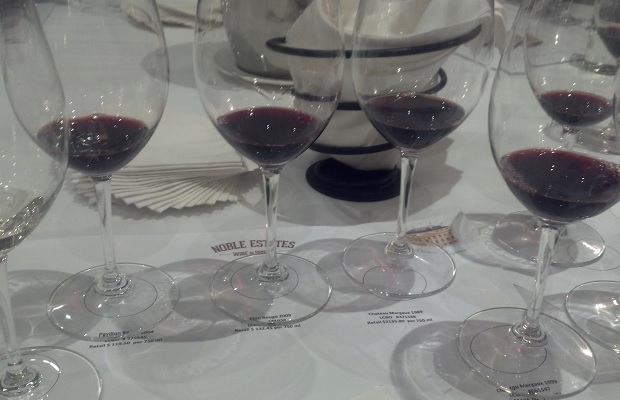
From left: Pavillon Blanc Du Château Margaux 2011, Pavillon Rouge 2004, Pavillon Rouge 2009, Château Margaux 1999, Château Margaux 1989

From left: Pavillon Blanc Du Château Margaux 2011, Pavillon Rouge 2004, Pavillon Rouge 2009, Château Margaux 1999, Château Margaux 1989

Pavillon Blanc Du Château Margaux 2011, Ac Bordeaux, France (374579, $142.40, WineAlign)

Extreme temperatures in June sent signals to convince the grapes to begin ripening in mid July. Though harvest would be the earliest since 1893, vintage imbalance was averted by cooler summer temperatures. A limited production, 100 per cent Sauvignon Blanc with 300 years of experience in its blood. Once known as Vin Blanc de Sauvignon, the Pavillon earned its modern era moniker in 1920. From a single block that was abandoned near the turn of the century because it was sensitive to frost. Re-discovered and re-planted in the 1970’s and 80’s, the plot is a haven for aromatic protection and preservation. Today’s Pavillon is made from only one-third of the estate’s Sauvignon Blanc production, the rest secretly sold off in bulk. The ’11 saw eight months in barrel, 25 per cent new oak. Sparks with intense minerality and creamy corpulence contained within an acidity enclosure. Feigns early advancement though not near ready to burst and bust open, with the sense that terroir will trump variety. A slow release of ripe fruit will be measured in decades. Tremendous concentration, density and depth. Has Sauvignon Blanc ever ingratiated itself with such poise? Will begin to open in two to three years and ripple in waves for 20-25 more.

Pavillon Rouge 2009, Ac Margaux, 2nd Wine Of Château Margaux, Bordeaux, France ($132.45, WineAlign)

From a wine that “used to be a tool,” comments Paul Pontallier to a “second wine” out of an incredible vintage “at least as good, or better than the four previous vintages of the first wine.” Them are fighting words and no sooner are they more truthfully spoken then over a swirling glass of the wine that has improved the most at Château Margaux. The Pavillon Rouge ’09 is indeed the best in modern times, in part due to immaculate selection and because it makes up just one-third of the total red grape production at Margaux. In the 1980’s it was the opposite but with a third wine now pushed to the European and Japanese restaurant market beginning in this vintage, Pavillon is now a grand brand, in a connected and assiduous way as never before. There are 100 lesser ’09 Bordeaux that fail to assimilate the wood and the crush of density, not to mention the tannin and Expressionist brushstroke. Pavillon manages a suppression of the admiral elements, including the scientific ones. The fruit is deeper, riper, with more brooding levels of pectin and anthocyanin. An earthy funk makes a late appearance on a finish of extended length to indicate where this Pavillon will range, forward 25-30 years and back to a 1989 type of history.

Pavillon Rouge 2004, Ac Margaux, 2nd Wine Of Château Margaux, Bordeaux, France ($119.50, WineAlign)

The Pavillon 2004 was and remains a “second wine,” insomuch that it predates the greatness of the modern Pavillon and because it finds itself sandwiched between two magnanimous harvests, 2003 and 2005. “We accept the fatalism of lesser vintages,” admits Mr. Pontallier, “selection is key to success.” The goal is to always make a good wine so it was necessary the Pavillon ’04 set out to benefit from “extreme” berry selection. Spent 18 months in 50 per cent new oak. Persistently young and overwhelmingly perfumed, in violet, tobacco and strawberry so ripe yet still must fight for aromatic airspace with dewy earth. Soft, velvety tannins envelop the Margaux notion of restraint and elegance. The ’04 has found success, despite the conditions, something that could not be said of the Château’s wines made 25-30 years ago. Drinking well now and will continue to do so for five to 10 more years.

Château Margaux 1999

Château Margaux 1999

Château Margaux 1999, Ac Margaux, Bordeaux, France (BCLDB 187799 $1,000.00, WineAlign)

The 1999 Château Margaux is a timeless wine. Tasted alongside the notorious 1989, its inhibitions are forced on display. Though repressed by the diluting effects of late September heavy rain, the 1999 may be subtle and modest, lack any discernible funk, but by no means is it soft. Wondrous aromatically like a hanging garden, with roses everywhere. “This is the perfume of Château Margaux,” notes Paul Pontallier. A difficult wine to describe. Its complexity, warmth and perfumed character define Margaux. Not as dense as the ’89, from grapes that benefitted from maturation conditions, from perfectly ripe if slightly diluted fruit. The proportions and shape (12.5 per cent alcohol by volume) are perfect and exacting but on a smaller scale. Smooth and resolved at a young 15 year-old, teenage age. The tenuous tranquility can be a point of deception. Beneath the lace there is body and hidden depth to give it 15 to 25 more years of growth. “Fall fall fall fall, into the walls. Jump jump out of time.” Though not the beast that is the ’89, this ’99 is a suffused bottle of remarkable concentration, of luxe, calme et volupté. A wine to help cure what ails.

Chateau Margaux 1989

Château Margaux 1989

Château Margaux 1989, Ac Bordeaux, France (176057, $1,645.00, WineAlign)

The 1989 Château Margaux wears the response to a mondo Bordeaux axiom on its sleeve. Are First Growth wines made for people who want darts of instant pleasure?” Twenty years earlier and now like the 2009, here is a quintessential and exemplary vintage, from day one of bud break to the last day of harvest. Its appraisal as anything but incredible is to assassinate it as if it were the Franz Ferdinand of Bordeaux. The examination 25 years later sees a mellow funk meet a peerless and sublime perfume. A wine cast in utmost density, complexity and length. It noses strength, warmth verging on heat but only for a fleeting moment, to gain attention. The iconic wine has reached the first major peak, up a ways from base camp. In this second phase of young adulthood it looks with conceit to the top of the mountain, seeing 25 to 50 more years on the climb. Mr. Pontallier regrets he won’t be around to taste this wine at full maturity. Moi aussi. The fruit lingers in its full, original state, from the moment it passes lips and for minutes onward. Violets trump roses. Château Margaux 1989 is from a vintage that offers the blessing of ethereal balance. Hear her sing, “Ich heisse Superfantastisch!”

Good to go!

The group of twelve

History may one day remember them as the group of twelve, or perhaps, “The Ontario School.” They are the 12 wineries who have banded together to ensconce a strange but beautiful word on the tongue, in the dictionary and out in the world. Somewhereness.

They are purveyors of the land from which their grapes grow and ferment into wine. Facilitators of terroir, working a canvas forged by millions of years of geological and climatic evolution. Their assembly is based on both exigency and on Moira; destiny, share, fate.

Like that other famous group, “collectively they agree.” Ontario’s cool-climate wine regions need to qualify and certify a distinctive winemaking style. In juxtaposition to old world, European tradition, the intensity of Somewhereness needs to reflect an increasingly Ontario-centric partiality.

These are the members. 13th Street, Bachelder, Cave Spring, Flat Rock, Hidden Bench, Hinterland, Malivoire, Charles Baker, Norman Hardie, Southbrook, Stratus and Tawse. Matt Kramer of Wine Spectator used the term and now it defines an enterprise. “As a group of 12 wineries growing small lots of site-specific vines in Ontario’s ancient glacial soils, we’ve invoked Somewhereness as a word enabling us to articulate in one collective voice.”

How do you get to Somewhereness? As related to wine that is like asking, Who am I? Why do we exist? What is the meaning of life? The Somewhereness movement, the notion, comes to light through this statement. “Somewhereness is revealed in the mysterious time capsules we know as bottles of wine. As ethereal gifts of a carefully tended location and a moment in time, each is imprinted with a vineyard’s sense of place,
its soil, climate, seasons, vintage variations — and its maker’s methods.”

In 2013 I wrote about Somewhereness over the Canadian wine rainbow. “Above all else, the rainbow’s fulcrum is the “somewhereness” of Canada’s wine regions. Terroir is the great catch word for wine. A vine’s home determines its potential, its structure, its sense of place. Micro-climates, soil, geology, altitude, slope and vegetation all contribute to the make-up of a wine forged from that specific parcel, lot or locale.”

In Come together, over wine I continued the discussion. “Intensity is in the air. The artists are at work, blessed with a geographical, geological and climatic canvas unique to the planet. They share arts and letters, compare and contrast methods, style and results. The sense of community is palpable, obvious and quite frankly awesome. They are Ontario winemakers and they are coming together. Right now.”

At the end of last year my column 13 Canadian wines that rocked in 2013 reviewed what Canadian winemakers do best. “That is producing unique, cutting edge and brilliant takes on cool climate grapes. They also match beautifully with the songs referenced in their tasting notes. When the wines are assessed and considered in part or as a whole, who would dare to say there are no great wines being produced?”

On Wednesday April 9th, Somewhereness brought the band to St. James Cathedral for a full-on tasting that is rapidly being recognized as a must not miss Ontario event. Here are notes on some of the wines I sampled.

From left to right:

From left to right: Malivoire M2 Small Lot Gamay 2012, Flat Rock Nadja’s Vineyard Riesling 2012, 13th Street Sandstone Old Vines Gamay Noir 2012, Southbrook Whimsy! Cabernet Sauvignon 2009, Tawse Laundry Vineyard Cabernet Franc 2011, Charles Baker Picone Vineyard Riesling 2008 and Norman Hardie County Unfiltered Pinot Noir 2012

13th Street Pinot Gris 2012, VQA Creek Shores, Niagara Peninsula, Ontario (Winery, $19.95, WineAlign)

Here you have an honest, 100 per cent stainless steel treated Pinot Gris from an estate vineyard located adjacent the market on Fourth Avenue in the Creek Shores appellation. So very dry and really fine fruit, crisp, neoteric, rising and falling in waves of tempered acidity. Made in a comfortable, country-twanged, folk-rock style, like a Cowboy Junkie. Juicy, mouth-watering work and very easy to fall for. An angel mine, this 13th Street, “and I know that your skin is as warm and as real as that smile in your eyes.” This effort by Jean-Pierre Colas is as good as it gets, a tally for Creek Shores and its kinship with the variety.

Malivoire M2 Small Lot Gamay 2012, VQA Niagara Escarpment, Niagara Peninsula, Ontario (Winery, $19.95, WineAlign)

A six-month lay in French oak for 60 per cent of the Gamay fruit sourced exclusively from Malivoire’s Beamsville Bench estate vineyard is just what the go doctor ordered. Only Malivoire’s Gamay smells specifically like this; of tart and savoury capers, of small, earthy gemstones, of peppery currants, of meaty braising Bouille. A striking wine from a fortuitous Gamay vintage and great value that puts me in mind of how special the Courtney will be. Though the soils may differ, proximity wise they are close cousins.

Flat Rock Nadja’s Vineyard Riesling 2012, VQA Twenty Mile Bench, Niagara Peninsula, Ontario (578625, $19.95, WineAlign)

Just add three months and witness a new evolution, a density, from a honeyed thing. Entering a pre-adolescence with a new bounce in its step. From my earlier, January 2014 note: “A champion cyclone of forces combined to elevate the already incumbent position of this Twenty Mile Bench Riesling. An ideal growing season magnified transmission upon a paradigmatic two and a half-acre block. This southern-most and highest altitude section of Flat Rock’s vineyard rests aboard a solid bed of limestone and wake me up if that rock was not drawn up into the vines in this stellar Riesling vintage. Sure its warm and nearly off-dry but such an effortless squeeze of lemon hydrates and elevates orchard fruit and honey out of the year of the lemon. After each sip its “every time you kiss me, lemon crush.” Love this prince of a Twenty Mile white in 2012, the dynamism smiling on the tart, succulent fruit. The length is one of outright bravado. This will develop for 20 years, of that I am convinced. There is just so much fruit. A Nadja for the ages.”

Cave Spring Dolomite Pinot Noir 2011, VQA Niagara Escarpment, Niagara Peninsula, Ontario (winery, $21.95, WineAlign)

Part Beamsville Bench (70 per cent), part Twenty Mile Bench (30), this best of both worlds Pinot is full of calcium magnesium carbonate, Jurassic bark. Playful as opposed to angry, this is not so much Snoop Dogg’s Dolomite but more like an animated Futurama. Seduces with a sweet red berry entry and bound by a really fine acid/tannin/fruit balance. Admittedly not overly complex but for the price it shows good structure. As far as Pinot goes, this one is a made for beef or rack of veal.

Hinterland Whitecap 2013, VQA Ontario, Charmat Method, Ontario (332809, $22.00, WineAlign)

The most versatile fizz in the Hinterland portfolio, what winemaker Jonas Newman refers to as his “chameleon.” As aromatically floral as this Charmat method bubbles (secondary fermentation in tank) ever gets, the ’13 brings out the garden under the mist of a sprinkler, late on a summer evening. It’s not so much about fruit as it is about texture, pollen and wet rocks. Try it at Barque.

Bachelder Niagara Pinot Noir Wismer Park/Lowrey (Tank Sample) 2013, Niagara Peninsula, Ontario (146985, $29.95, WineAlign)

This binary vineyard symbiosis will be bottled as the Niagara Pinot. Just filtered a few days ago it strides out with the utmost confidence in swagger, with a purity of fruit is spite of Thomas’ shock, awe and reductive apology. A bright sway of terroir gives rapture to a peaking raspberry bush imagined forward into a cooled pie. A renewed elegance abides with an absence of humidity and with a fully ameliorated knowing that a fleshing will happen. Really fine.

Malivoire Mottiar Chardonnay 2011, VQA Beamsville Bench, Niagara Peninsula, Ontario (146985, $29.95, WineAlign)

Gamay may be winemaker Shiraz Mottiar’s decisive resource but Chardonnay is his thing. The Moira’s ranks as one of Niagara’s best, vintage in, vintage out and this Mottiar, from the winemaker’s home vineyard is the trump card. This Malivoire special agent is set in 2 – 5 year old 300 L French oak hogsheads and aged on the lees in barrel for 10 months. The result? Texture. With the use, or lack thereof in new oak, Mottiar’s Chardonnay becomes a study in compages, with strong abilities and the accents of green orchard fruit and a faint sensation of blanched nut. Nothing toasty mind you because it’s all about density and girth; a Shiraz thing. I find his Chardonnay is all about texture.

13th Street Sandstone Old Vines Gamay Noir 2012, VQA Four Mile Creek, Niagara Peninsula, Ontario (130195, $29.95, WineAlign)

If roses were stones they would produce an aroma that only 13th Street’s Sandstone Gamay would recall. Some previous vintages have pushed the boundary to sky-high excess and a subterranean ferrous burrowing but in 2012 the perfume is both grounded and ethereal. The sandy tuff rock is so in that glass, like the smell of a rugged beach, mist and salinity spraying and rising off the rocks. The ’12 now knows “I don’t have to sell my soul.” Wholly singular Gamay and with hopes it will always be this going forward. Where as before it said “I want to be adored,” it now confirms “you adore me.”

Tawse Laundry Vineyard Cabernet Franc 2011, VQA Lincoln Lakeshore, Niagara Peninsula, Ontario (130997, $34.95, WineAlign)

A lean Laundry with as much finesse as winemaker Paul Pender has ever shown in his poignant Cabernet Franc realm. When a vintage deals you calm and scale you sit back and relax. The Lincoln Lakeshore advancing in years vines bring yet unseen front end red berry, licorice and red currant softness in 2011. There is elegance but also a refusal to yield its back-end bite. A level of enveloping grain and chalk is unique to this bottle and should be seen as a very good effort with the possibility ahead for movement and a gaining of flesh. A graceful, gently pressed Laundry.

Southbrook Whimsy! Cabernet Sauvignon 2009, VQA Niagara On The Lake, Niagara Peninsula, Ontario (260281, $34.95, WineAlign)

A 100 per cent Cabernet Sauvignon whose barrel aging specs are integral to discussing its unfolding. This Whimsy is a seven barrel (172 case) lot of which 86 per cent was aged for 13 months in (71 per cent) French oak. Plain and simple, a wood-heavy decision that has provided allied excellence five years after that demanding vintage. The agglomeration is one of steroidal currants, rocket red berries and an assiduous savoury edge. Just now are the beginnings of a caramel oozing from out of the centre of a dark chocolate house. Really quite an amazing, rich cake example from the vintage. Showing so right and so strong now, in its territory and wheelhouse.

Norman Hardie County Unfiltered Pinot Noir 2012, VQA Prince Edward County, Ontario (125310, $35.20, WineAlign)

Hardie’s 2012 County Pinot Noir is a beacon, a flashing light on the shore, an invitation to copycats because this is what making red wine from limestone foundations is all about. To taste this ’12 is to experience Hardie’s purest berry maceration and distillation to date. It’s as if there was no alcohol present and in fact, at 11.5 per cent it is a modest and transparent pronouncement. Longevity may not bless the ’12 as in other vintages but this is certainly the most groomed and coiffed County Pinot Noir.

Charles Baker Picone Vineyard Riesling 2008, VQA Vinemount Ridge, Niagara Peninsula, Ontario (241182, $35.20, WineAlign)

Tasted at Somewhereness 2014 as part of a vertical retrospective going back to 2007. The Vinemount Ridge’s now famous Picone Vineyard is set within a 10-acre estate on the Niagara Escarpment. Planted to the Weis 21 clone, the Riesling grown here digs in for complexity from sectional moieties of clay and sandy soil atop a unique base of limestone bedrock. Charles Baker began working with these grapes in 2005 and it is this 2008 where the learning curve took a turn for the Riesling stratosphere. The ’06 found luck in the stars but this vintage lays the framework and foundation for a master plan. At this stage in the ’08 evolution there is a prodigious and viscous honeyed textured. Ripening tree fruit juices run like maple sap in spring and the run off is beginning to think syrup. A cutting ridge of acidity arrests the sugaring, allowing citrus and flinty rock to recall the wine’s first, fresh steps. Baker’s Riesling time travels in circles with no real beginning and no real end. From my earlier, September 2012 note: ““Whoo-ahhh” Mojito, green apple skin scent of a Riesling. Seductive to sip, a bodacious body of influence, then back-end bite. A wolf pack in sheep’s clothing.”

Hidden Bench Terroir Caché 2010, VQA Beamsville Bench, Niagara Peninsula, Ontario (505610, $38.20, WineAlign)

No other Niagara red and for sure no alternative Peninsula Bordeaux blend exists in such a vacuum of dichotomous behaviour. Act one is an out-and-out boastful, opulent show of Rococo. Act two a gnawing and gnashing by beasts. The pitch and pull of the Terroir Caché 2010 optates and culls the extraordinary through the practice of extended délestage, what Hidden Bench notes as “a traditional method of gently draining the wine and returning it to tank with its skins during fermentation.” The ’10 is about as huge as it gets, highly ferric and tannic. Still chemically reactive, you can almost imagine its once small molecules fitfully growing into long chains. Berries of the darkest night and he who should not be named black fruit are confounded by minerals forcing the juice into a cold sweat. Will require a minimum of 10 years to soften its all-powerful grip. From my earlier March 2013 note: “has rich, voluptuous Napa Valley written all over it. Sister Merlot dominant, Beamsville Bench sledge monster. Plumbago, mineral, blackberry and coffee in a wine that will be the ringer in a blind tasting 10 years on. Harald may be saying “this is our family jewel.” Mr. Thiel, you make good wine”

Stratus Cabernet Franc 2010, VQA Niagara Peninsula, Ontario (winery, $38.20, WineAlign)

Patient as ever with the cool-climate, slow and low ripening Cabernet Franc, winemaker J-L Groux stuck with belief, regardless of the warm 2010 vintage. The Stratus single varietal space and time continuum of let it hang (though not to December), 20ish months of aging, nearly half in French oak barrels, has brought forth the most dense and luxe Cabernet Franc to date. “It’s never old school, all brand new,” with Groux so this red swells in wholly pure black currant fruit and is as big as it gets for J-L, which is saying something. This beastie boy will age over a 20-year period. Style is the thing, and yes, the aromatics.

Hidden Bench Locust Lane Vineyard Pinot Noir 2011, VQA Beamsville Bench, Niagara Peninsula, Ontario (winery, $48.00, WineAlign)

The Locust Lane Vineyard, originally planted in 1998, was Hidden Bench’s first acquisition, in 2003. It has a unique perpendicular cross-slope effect, undulating in all four directions, gathering sun hours in its own special way. The vineyard produces the richest and warmest Pinot Noir with fruit flavours more akin to ripe plum and black cherry than almost anywhere on the Beamsville Bench, certainly as any from the Hidden Bench stable. While the ’11 is not the biggest beast nor the Bordeaux bully of the Terroir Caché, it is surprisingly tannic and strong. It’s anything but hot, though it attacks with fervor. Big berry fruit, macerated strawberry, rich pie notes and spice. A great Locust vintage.

Good to go!


Burgundy will always be royal

Chablis Bougros Grand Cru 2012, Pommard Rugiens Premier Cru 2012, Chablis Mont De Milieu Premier Cru 2012, Beaune Grèves Premier Cru Vigne De L'enfant Jésus 2012, Meursault Genevrières Premier Cru 2012, Nuits St Georges Les Cailles Premier Cru 2012, Chablis Les Clos Grand Cru 2012, Corton Charlemagne Grand Cru 2012

Chablis Mont De Milieu Premier Cru 2012, Pommard Rugiens Premier Cru 2012, Meursault Genevrières Premier Cru 2012, Nuits St Georges Les Cailles Premier Cru 2012, Chablis Les Clos Grand Cru 2012, Beaune Grèves Premier Cru Vigne De L’enfant Jésus 2012, Corton Charlemagne Grand Cru 2012

In a geographically focused world defined by its very own diacritic caste system, in climat, in villages, premier et grand cru, the wines from Burgundy will always be royal. The Pinot Noir and Chardonnay are entrenched in such status not because of wealth or conceit, but because of “humility and unassailable references” from hills, plots, rocks, soils, sun exposure and the test of time. They are, as Woodman Wines and Spirits’ Jason Woodman notes, from a place “where history, religion and quality intersect.”

From Wine-Searcher.com “Burgundy (Bourgogne in French) is an historic and highly respected wine region in eastern France. Burgundy wines have long had devout followers throughout the world and continue to do so today. Although Bordeaux produces about four times as much wine every year, Burgundy’s estimated 74,000 acres (30,000ha) of vineyards are considered to be of equal importance, producing some of the most exclusive wines on Earth.” Equally important? We’ll see about that.

To most wine-loving mere mortals, great Burgundy is inaccessible, a prepossessing supposition that supersedes reality. The pragmatic wine buyer imagines the best Pinot Noir and Chardonnay to personify greatness, without ever owning one. Most of the rest are viewed in a light of feigned eminence. The overpriced and the under-delivered. Quality time is spent sniffing out the paragons, the most difficult of all wines to find.

The song, Royals “is about how today’s music is all about what is considered the “good life,” filled with riches and fame, but not everyone can live that life, and so the average person is desperately reaching…” The wines of Burgundy certainly gravitate into the hands of a wealthy minority but behind the dollar signs they are simply bottles of farmed and fermented grapes.

The wines of the Côte de Nuits, Côte de Beaune, Chablis, Côte Chalonnaise and the Maconnais speak more clearly of their terroir than anywhere else in the world. They need not boast nor flaunt their wares. They simply are what they are and Burgundy is what it is. Affordable to so few, disregarded as out of league and untouchable by the rest. “That kind of luxe just ain’t for us,” might be the complaint of the anti-Burgundian wino. Regardless of where you sit in the Burgundian aperçu, you are not alone. The Brannigan will always be debated.

There are more expensive Burgundies. There are bigger names. Houses like Jayer, Romanée-Conti, Leflaive, Roumier, Leroy, Faiveley, Coche-Dury, Comte Liger-Belair, Dugat-Py, Ramonet and Rousseau. Golden escarpment producers that fetch higher prices for their top wines. There are just as productive and wide-reaching Burgundy conglomerates, like Latour and Boisset. But at the end of the day, is there a producer of red and white Burgundy that combines quality and quantity like Domaine Bouchard Père & Fils? The estate stretches over 48 km from north to south and is composed of 450 different vineyards. The Bouchard family has “been telling the history of Burgundy’s wine and its great appellations for over 280 years.” In Chablis, the rock stars may be Dauvissat and Raveneau, but who can argue the aggregate éclat of Domaine William Fèvre

On March 24, 2014, Woodman Wines brought the two need no introduction Burgundy producers to the Royal Canadian Yacht Club for a very grand tasting. The “rare and miraculous” 2012’s from Domaine Bouchard Père & Fils and Domaine William Fèvre. Pinot Noir and Chardonnay of pedigree and learning. Producers with holdings in Burgundy as historic and regal as the domains of Kings and Queens. From places where winemaking is religion, where terroir is everything. The wines are expensive (in some cases frighteningly so) but they are a treat to taste.

Domaine Bouchard Père & Fils

Aligoté Ancien Domaine Carnot Bouzeron 2012, Burgundy, France ($28.00, WineAlign)

From the Côte Chalonnaise between Chagny and Rully this was a rare chance to taste Aligoté and from the first village to receive AOC status for the variety. Bouzeron sits in what Bouchard describes as a “windswept funnel,” which might explain its crazy, natural acidity and spirited character. Begins “with a low whisper, windswept on the air.” To nose it is smooth, creamy, soft and fruity. To taste it’s tight, racy and lifted by a metallic tang. For the price it ferries exceptional quality and personality. “Windswept is on the tide, a feeling only or state of mind?”

Montagny Premier Cru 2012, Burgundy, France ($79.00, WineAlign)

From the Côte Chalonnaise, the most southerly portion of the Côte d’Or. A higher amount of Marly soil mixed with White Burgundy-loving limestone imparts richness and a soft, Malo creamy texture. At present there is a sulphur presence that stretches its legs and hides beneath a level of tart fruit. The wood effect is in a spicy radish tone adding complexity to the lightly dressed salad flavours. Finishes with terrific length.

Meursault Genevrières Premier Cru 2012, Burgundy, France ($119.00, WineAlign)

Bouchard’s Genevrières speaks in a definitively, regional tone, a Côte-d’Or oriental vernacular with absolute and utter clarity. A wine this pure and at the head of its class means “time flies, doesn’t seem a minute.” From East and Southeast vine exposures above obvious and necessary limestone that vacuums a metallurgy mixed with the finest, circular centrifuge of acidity. This is the wrapping that envelopes richness, depth and fresh produce of a fruit/vegetable continuum. One night in Genevrières “makes a hard man humble.” A contemplative moment with this ’12 Bouchard may cause longing, to look east. “Don’t you know that when you play at this level there’s no ordinary venue.”

Chassagne Montrachet Morgeot Premier Cru 2012, Burgundy, France ($130.00, WineAlign)

From a plot of land that was called Morga, from the Latin margo which means edge border, in this case between the Côte d’Or and Saone-et-Loire. The soils in this mid-slope vineyard with a south-easterly exposure combine limestone and Marl and so Bouchard’s 2012 take shows an increased richesse and concentration. A Chardonnay with drive, determination and delineation. Noticeably toasty and though mostly quiet now, even it its youth it is already showing resurgent citrus and nutty tones. It will oscillate back and forth between the poles for five years or so and come together for many more beyond.

Corton Charlemagne Grand Cru 2012, Burgundy, France ($250.00, WineAlign)

The Bouchard description of “a scarce and promising vintage” will apply to this flagship Grand Cru as much as it will to any in the stable. Corton’s ode to King Charlemagne’s not to be stained white beard is the most difficult to contemplate, assess and articulate in its steely, whispering youth. This rare vineyard planted to both Pinot Noir and Chardonnay, if just by chance it “crossed the diamond with the pearl,” is no cause for concern. This Charlemagne is just a kid, yet unaware of how it will rule with purity, personality and impunity. It does not yet know this and when it matures, it might be asked “did you realize that you were a champion in their eyes?” The creamy texture, subtle toast and extraordinary flavours are all there. Lay it down for 10 years and relive its limestone treasures for 20 more.

Gevrey Chambertin 2011, Burgundy, France (661330, $49.95, WineAlign)

With the largest number of Grand Crus is the area, is it any wonder how one Gevrey Chambertin finds a way to set itself apart from the others? This 2011 Bouchard does so with this refined, restrained and cleansing Pinot Noir. Earthy and sugary beet flavours echo similar aromas. Picking time was certainly key. Foregoes grit, girth and a belt’s tannic lash for elegance and a directive to balance along a straightforward, pleasing line. Will do its best work in short-term gains, from now to 2018.

Savigny Lès Beaune Les Lavières Premier Cru 2012, Burgundy, France ($62.00, WineAlign)

From a limestone and clay vineyard in Bouchard’s control for just over 100 years. Filled with “laves,” the big flat stones that characterize the land, this 1er Cru is painted by the soil, with a charred, mineral glaze. It’s also sweeter and scented by high-toned red fruit, less refined than other Beaune vineyards but all the while offering near-immediate gratification. Could use a couple of years to settle and will drink well for five or more.

Gevrey Chambertin 2012, Burgundy, France ($66.00, WineAlign)

In this vintage the Gevrey is a magnified version of itself, seemingly drawing every atom of mineral and fossil from its Triassic limestone bed. The table of clay potassium, phosphorous and iron are all in this bottle, expressed in earthy Pinot Noir character. This might be the Bouchard blazon and secret weapon; dangereux, tight, sharp and pointed. The fruit is pure and clearly defined but will require time to shed its tough outer layer. Put the 2012 Gevrey away for five years and look to see it open up to 2022.

Chambolle Musigny 2012, Burgundy, France ($76.00, WineAlign)

From the shallowest of Côte-d’Or soils, Bouchard’s Chambolle Musigny is extracted from delicate berries that rely on its vine’s roots to crawl down into limestone’s fissures in search of nutrients. Though many a Chambolle exhibits tenderness and elegance, this Bouchard hard-working vine has produced a quilted, tactile wine of texture and contour. It opens with its own special vineyard stink, a note of subterranean terroir that dissipates with a swirl. A wildly woven combination of chalk, grain and chewy licorice makes for a varied and salubrious mouthful. As big as it gets for the appellation and surely worth a go from 2018 and for a decade more.

Volnay Ancienne Cuvée Carnot Caillerets Premier Cru 2012, Burgundy, France ($118.00, WineAlign)

Caillerets and the term tête de cuvée go back as far as 1855 and with this iconic bottling there is proof in perpetuum that Bouchard knows Volnay. This is the house’s first vineyard dating to 1775 so it goes without saying that 237 years of experience is nothing to dismiss. The 2012 Cuvée Carnot is refined in a state of heightened awareness. The aromas are smoky, meaty and the favours concentrated. Distinctively opaque like a Pensieve with a swirling torrent of tannin pushed along by centrifugal force. Will need 10 years to immobilize, then to age rhythmically for 10 more.

Pommard Rugiens Premier Cru 2012, Burgundy, France ($146.00, WineAlign)

Bouchard’s Pommard Rugiens goes at the Pinot Noir diapason from every angle. At once fibrous and rigid, it is also highly perfumed by flowers, most notably violets. The rich iron-red soil imparts a large measure of ferrous aroma but the pure fruit sustains the mineral and the wine remains a good conversationalist. A metrosexual, acting out both masculine and feminine parts. The rest of the Bouchard red Burgundies tend to choose one side or the other but the gregarious Pommard lives on the edge. A streak of char and chalky tannin shows late and lingers throughout the lengthy finish.

Nuits St Georges Les Cailles Premier Cru 2012, Burgundy, France ($146.00, WineAlign)

A gorgeously refined wine built on finesse, clarity and concentration. All its graceful parts move in synch through structured stages of class, refinement and with a goal towards a realized, long evolution. Noticeable but sweet tannins are gained by a bleeding of the terroir‘s oolithic chalk by way of hard stones. Silky and feminine perfumed red fruit never wavers from its intent, to seduce and give pleasure. No dying quail this Nuits St Georges, nor a frozen rope, the wine hangs in balance effortlessly and for a long, long time. Enjoy it for 10-15 years.

Beaune Grèves Premier Cru Vigne De L’enfant Jésus 2012, Burgundy, France ($146.00, WineAlign)

From the just a shade under four hectare, formerly owned by Carmelites vineyard within the famous 32 hectare “Roi Soleil” Grèves appellation. Like its namesake (in reference to Louis XIV), this Bouchard is the red that displays the most control and Type-A personality. A wine that draws every bit of modern terroir from the gravelly clay. A wine of great excess, state-of-the-art, jeweled, luxurious and crafted with the heaviest hand. The sun king goes for much glory, but at what price? The price of needing to be loved in its youth. The question is will that cost L’enfant Jésus 2012 long-term success? With more abundant fruit than a Versailles Trianon and the guts to soldier on, it’s hard to imagine it not aging for 20 or more years.

Domaine William Fèvre

Saint Bris 2012, Ac, Burgundy, France ($25.00, WineAlign)

From the commune of Saint-Bris-le-Vineux, this is light, cool-climate tension Sauvignon Blanc. A wine of impetuous and quick-step moments. The rush of just opened soda, the spray of a freshly bitten green apple, the knife cutting through juicy lemons and limes. A hyper-clean rendition of the Loire grape, this northern rendition will work an oyster with ease.

Chablis Les Lys Premier Cru 2012, Burgundy, France ($58.00, WineAlign)

Of the Fèvre Premier Cru designations, Les Lys exhibits the softest, downy touch and the more muted or demurred personality. The fine lees is distributed through the texture and the limestone gives way to chalk on top. Offers up more spongy fruit than Montmains or Monte de Milieu and finishes with charm.

Chablis Mont De Milieu Premier Cru 2012, Burgundy, France ($69.00, WineAlign)

The Fèvre Mont De Milieu is the smallest of the domain’s Premier Cru holdings with a struck by flint personality that is quite intense. Neither Les Lys or Montmains show such dynamic mineral effect. The most righteous of the Chablis Serein River banks brothers maintains that matchstick loving feeling, though it is temporarily relinquished to a honeyed moment. It’s “a love you don’t find every day, so don’t, don’t, don’t let it slip away.” Fear not, for the gathering is beautifully concentrated and the rocky, mineral bent never fully dissipates. A Milieu to savor from 2017 to 2025.

Chablis Bougros Grand Cru 2012, Burgundy, France ($97.00, WineAlign)

While the appellation may not be the most sought after in terms of Chablis Grand Cru, the dominant Fèvre presence, experience and dedication to making Chardonnay in Bougros can’t be ignored. A good, if not exceptional vintage, 2012 is appropriate and defining. The sensations are of precious gems and metals and the exuberance restrained, but this Chablis seems on the verge. It’s as if a match has touched the strip and is about to alight. A powdering of Kimmeridgian clay is saturated by a smack of late lashing acidity. The Fèvre Bougros rises with energy from a standstill to high-speed. It will age harmoniously into the next decade.

Chablis Les Clos Grand Cru 2012, Burgundy, France ($143.00, WineAlign)

The Fèvre take on Les Clos is the cradle of all the domain’s wines, in every respect. Intensely concentrated, this is Chardonnay expressive in every facet of its surroundings. The impart from compressed white limestone, ancient fossils and Jurassic minerals in distillate may seem abstract in description but how else can the feeling of a mouth full of rocks be conveyed? The remarkably complex Les Clos and its structured palate that goes on forever has come out of its Chablis vineyard cradle and will live on as one of the best ever. “It’s not a place, it’s a yearning. It’s not a race, it’s a journey.” There is no rush to drink it up. It will offer immense pleasure for 20-25 years.

Good to go!

When Sangiovese comes to town

Caprili Brunello Di Montalcino Riserva 2008

From left to right: Argiano Rosso Di Montalcino 2011, Banfi Poggio All’oro Brunello Di Montalcino Riserva 2007, Fattoria Dei Barbi Brunello Di Montalcino 2008, Capanne Ricci Brunello Di Montalcino 2008, Caprili Brunello Di Montalcino Riserva 2008, Col D’orcia Brunello Di Montalcino 1997, La Fiorita Brunello Di Montalcino 2007, Paradisone Brunello Di Montalcino 2007

Love comes to town I’m gonna jump that train
When love comes to town I’m gonna catch that plane

The Consortium of the Brunello of Montalcino is an “association between winemakers bent on safeguarding their wine and on accentuating its qualities.” The group organizes events in Italy and abroad, including trade fairs such as the Benvenuto Brunello. After 47 years of honing their description about one of Italy’s most famous wines, this is Brunello in the Consortium’s nutshell. “A visibly limpid, brilliant wine, with a bright garnet colour. It has an intense perfume, persistent, ample and ethereal. One can recognize scents of undergrowth, aromatic wood, berries, light vanilla and jam. To the taste the wine has an elegant harmonious body, vigorous and racy, it is dry with a lengthy aromatic persistence.”

On March 10, 2014, VINTAGES and the Conzorzio Del Vino Brunello Di Montalcino brought an impressive range of Rosso and Brunello to the Art Gallery of Ontario. Infatuation renewed. VINTAGES Shop Online added nearly 100 wines for sale on their website, many of which have no Ontario importer. For fans of Brunello, this offer is the Tuscan equivalent of the kid being given the keys to the candy store.

It was twenty years ago that B.B. King brought love to town and taught a band to play. It has also been twenty years since I last visited Montalcino. The next visit is high on the bucket list. Imagine the room full of happy tasters when Sangiovese came to town by way of Benvenuto Brunello 2014. The Grosso from Montalcino is loved by many.

Many cellars brim with Brunelli from 1997, 1999 and 2001. More than a handful from 2000, 2003 and 2004. The houses most represented chez Godello are Fuligni, Poggio Salvi, Poggio Antico, Agostini Pieri, Ciacci Piccolomini, Poggio Sotto, Siro Pacenti and Lisini. Like salting your food before knowing what it tastes like, there was a time when purchasing was done as much by habit as by probability. From the 2005 vintage forward there has been an apprehension to spend frivolously and without consent by way of tasting, assessing and determining value.

They’ve been going in and out of style
But they’re guaranteed to raise a smile

The 2006 vintage is both distressing and exciting. Simply speaking, it’s just not showing well right now and yet it may turn out to be great. Taking a flyer on the 06’s is a leap of faith. Power to those who do and win. The 2007’s are exquisite and in my mind, a short term gain. Some 2008’s are brilliant, others not so much. Picking was crucial, cliché to say, but crucial. The jury is still out on the difficult 2009’s.

So may I introduce to you 25 notes on Rosso and Brunello tasted @ConsBrunello Benvenuto Brunello.

Argiano Rosso Di Montalcino 2011, Tuscany, Italy (SAQ 10252869 $24.10, WineAlign)

When a Montalcino vintage such as 2011 offers up prolonged heat and hang time, typicity can be challenged. Enter Argiano, Sangiovese specialist in adherence to what is base and necessary. Even in such a vintage, Rosso can never be confused with Brunello, the oak just doesn’t have the time to stake its claim. So here there is sour cherry, leather, currants, licorice, anise and especially spice. In 2011 the spice is royal and ancient. The alcohol is hot but the flavours are resplendent. The cherry is tempered by chalky tannin so as a Rosso, this ’11 will give a little bit. A masculine Rosso, “take his hand, you’ll be surprised.”

Argiano Brunello Di Montalcino 2008, Tuscany, Italy (Agent $60.00, WineAlign)

A purposed, perennial powerhouse of consistency, the 2008 incarnation of Argiano keeps the streak alive in a not so perfectly certain vintage. A mess of mineral in polarizing magnetism connects red tree fruit to tilled crop soil. Tannins are not noticeably biting so long-term potential appears to be somewhat stifled. Though only one year into its young history, this Sangiovese Grosso already begs to be enjoyed, if admittedly just a few years young to be the life of the party.

Argiano Brunello Di Montalcino 2009, Tuscany, Italy (LCBO 0154609 $53.00, WineAlign)

If Argiano’s treatment of the 2009 vintage is any harbinger for the community as a whole, sparks will surely fly. Like 2007 there is a sense of flamboyance but unlike ’07 the flirting and cajoling is less about desire and more about sodden, succulent Sangiovese. A rampart of medieval, marching tannin and a keen acidity mark the territory and the terroir. A beautiful vintage, in rejection of rusticity and sure to live for a decade and a half.

Banfi Rosso Di Montalcino 2012, Tuscany, Italy (BCLDB 557967 $26.97, SAQ 864900 $25.00) Such a sneak preview at a precocious young wine can rarely do any true justice in the written assessment but Banfi’s ’12 offers more invitation than most. A wide-reaching, consumer-friendly cherry bomb this Rosso, ergo sumptuous, from a sweet fruit core to the uncritical fringes. Rosso vernacular, for the Hic et nunc.

Banfi Rosso Di Montalcino 2011, Tuscany, Italy (BCLDB 557967 $26.97, SAQ 864900 $25.00, WineAlign)

From estate vineyards in the southern part of Montalcino, clonal selection of the local Sangiovese always plays a focused and pivotal role in Banfi’s Rosso. In 2011 no single-vineyard Brunello wines were made (Poggio alle Mura and Poggio all’Oro) so this Rosso reeks of all the hallmarks of those iconic Brunelli; black fruit, violets, tobacco and the aridty of earth and spice. Most obvious is the sanguine scorched, iron fist that calls for time and as much patience as a Rosso can be afforded. Five years would be nice.

Banfi Brunello Di Montalcino 2008, Docg, Tuscany, Italy (LCBO 378257 $59.95, BCLDB 127183 $69.95, SAQ 701920 $70.00, WineAlign)

Every bit of obdurate soil and the vintage’s inflexible impart have made their way into Banfi’s extreme games ’08. The pitch is black as night, the aroma dank, expressed espresso and the texture thick as tar. Perhaps it’s the southern Montalcino hills that work severe fruit towards this kind of complex end or maybe it’s just a Banfi thing. Regardless, I can’t think of a recent Banfi normale with such verve, length and attitude. Will settle eventually, to drift off into middle age as a classic Brunello.

Banfi Brunello Di Montalcino Poggio Alle Mura 2007, Tuscany, Italy (Agent, BCLDB 127183 $69.95, SAQ 701920 $70.00, WineAlign)

Beginning with this 2007, Banfi beamed the 15 year-old single-vineyard Poggio alle Mura fruit into state of the art, Horizon hybrid stainless steel and wood tanks. The double whammy effect of a most extraordinary gregarious and flamboyant vintage coupled with the new production style fast trekked this Sangiovese to yet seen, nosed or tasted heights. An elixir of satin sheen and glycerin texture, the Mura walks with a firm iron gait and bleeds a mineral rich, hematic ooze. Fierce and delicious at the same time, it’s almost too hot to handle now. Give it five years to settle and enjoy it for five more.

Banfi Poggio All’oro Brunello Di Montalcino Riserva 2007, Tuscany, Italy (LCBO 0354571 $95.00, BCLDB 439810 $144.00, WineAlign)

The single “Poggio all’Oro” (golden knoll) vineyard released in the 6th year after harvest needed every minute of its slumber before giving away any idea of itself. An absolute brut of a Brunello at this stage and this in a very forward vintage. Risible to think you understand him, this growling animale, this swelling bruise of pure, raging Sangiovese. Earthy red, rich, reactive, forceful and 20 years from ready.

Fattoria Dei Barbi Brunello Di Montalcino 2008, Tuscany, Italy (LCBO 0372938 $49.95, WineAlign)

As expected, this is a gritty effort from Barbi, in part the impart of a testosterone-laden vintage, along with the drier and cooler climate from Barbi’s southeastern Montalcino vineyards. A low and slow ripening will surely translate to extended longevity, but the rusticity and leather/cherry continuum will never disappear. No doubt a classic example and very well-priced for such authenticity, still it can’t be helped to see Barbi’s ’08 as entrenched in an earlier period of time. The wine will need 10 years to soften its edges and reveal the refinement and elegance of a well-documented Brunello.

Capanne Ricci Rosso Di Montalcino 2012, Tuscany, Italy (LCBO 0375170, $27.00)

Sangiovese in such a primary state, A steaming, ferric soup of oxhide flavoured with wood spice. The kiss of chalk and grain confirms an aged intent that succeeds here, even if the practice is not normally recommended for the fresh and juicy Rosso and less so for the vintage. No matter, just wait a year and indulge.

Capanne Ricci Brunello Di Montalcino 2008, Tuscany, Italy (LCBO 0375162 $57.00)

An ultra modern Brunello from a vintage seeing more grit than gift. The fresh fruit fragrances and flavours, notably plum and black cherry, are hallmarks of innovation. This under 20 year-old producer dishes out gettable Brunello and this ’08 makes a clean accouch of the practice. Short term gains are on the plate so do no wait.

Caprili Brunello Di Montalcino 2008, Tuscany, Italy (SAQ 11334065 $45.00, WineAlign)

Any Brunello pushing the 15 percent alcohol by volume threshold could never be accused of resisting forward thinking. The Caprili ’08 revs its engine at the start line while the exhaust performs in a state of cathartic extravasation. Sangiovese Grosso aromas of old spew forth, like leather, tobacco smoke, salty cherry and the mineral grit of mean tannins. The car screeches forth in extravagation, leaves the old character behind and races towards a prodigal future. The zoom forward means a profile more akin to representing a superior clone’s expert ripening ability. Thankfully this Caprili resists homogeneity and sets a fine example for the new Brunello.

Caprili Brunello Di Montalcino 2009, Tuscany, Italy (LCBOQ 0305888 $55.00, WineAlign)

From estate grapes grown on the hillside which slopes down towards the Orcia and Ombrone rivers. The Bartolommei family needed a summons of their winemaker’s acumen to reign in advanced fruit from a vintage that saw soaring summer temperatures. This ’09 runs on full throttle, high-octane Grosso and yet is a remarkably, obiter dicta fresh flood of sanguine, berry chalky juice. All that and more actually and while it’s flat out fun to taste at such a young age, its ability to go long is not a sure thing. Plan to enjoy now and for three to five big years.

Caprili Brunello Di Montalcino Riserva 2008, Tuscany, Italy (LCBOQ 0372755 $65.00, WineAlign)

Caprili’s 2008 Riserva will stand as one of the success stories from a vintage that thrives as a result of where the grapes are planted, a Montalcino truth that is undeniable for all involved. While others sing the blues because of the weather (rain) the Caprili whistles in pentose-underscored Anthocyanin reds, like rooibos and cherry. A leathery Riserva in confident control, marked by great acidity and formidable tannins.

Col D’orcia Brunello Di Montalcino 1997, Tuscany, Italy (LCBO 0961714 $145.00, WineAlign)

From a golden vintage, this ’97 is crazy good. A fixed, double-edged blade fighting knife dipped into a warm pool of developed liqueur-like sweetness. Seventeen years of languorous modulation and wood-fruit integration had resulted in a gracious Brunello, intrinsically delicious and living large in senescence. Life for the Col D’orcia ’97 is a bowl of cherries. Open one now and for the next three to five years and you’ll know exactly what you’re going to get. Me, “I’ll stick with you baby for a thousand years. Nothing’s gonna touch you in these golden years.”

Col D’orcia Brunello Di Montalcino 2006, Tuscany, Italy (SAQ 403642 $46.50, WineAlign)

The Montalcino Sangiovese from 2006 will be long-lived and Col D’orcia’s normale bottling is a poster child for the notion. This wine exhibits everything you would expect from an adolescent Brunello of that vintage. Serious and contemplative, the typicity is patent; leather, cherry, smoke and hemic in texture, this is tightly wound and very real. Like so many renditions of 2006, the Col D’orcia showed well in its first year, stepped back to a gritty state and will show its best beginning in 2016. It will age gracefully for 10 more after that.

Col D’orcia Poggio Al Vento Brunello Di Montalcino Riserva 2004, Tuscany, Italy (LCBO 0965525 $129.00, WineAlign)

The juxtaposition of vintages (2004 and 2006) is both evident and stupefying. The latter is certainly one to look at in terms of 15-20 years, while the former is one of post-immediate gratification. Two extra years of age has done wonders for this Riserva’s evolution and desire to please. Lush, irresistibly delicious fruit strutting down the catwalk in smooth, leggy, creamy and linear fashion. Brunello rarely pleases in taste and refinement with modern clarity like this ’04. Enjoy now and for 10 more enchanting years.

Col D’orcia Poggio Al Vento Brunello Di Montalcino Riserva 2006, Tuscany, Italy (LCBO 0316158 $121.00, WineAlign)

Everything the ’06 Col D’orcia Brunello is, the Riserva is that and more. Densely concentrated, all is amplified; the leather, the cherry and the grit in savoury tannins. The weathered hand of rusticity and blue-collar Sangiovese ethic has a vice-tight grip on the suppressed fruit. It will take a minimum five years to see any type of true release from the natural fortifying acidity of the iron gate prison. Put this Brunello aside and forget about it. Revisit in 2020 and again five to 15 years after that.

La Fiorita Brunello Di Montalcino 2007, Tuscany, Italy (LCBO 0998195 $75.00, WineAlign)

If La Fiorita’s 2008 Brunello is thatched of pure silk then this 2007 is a metaphorical pillow quilted and dripping of the finest velvet. Pure strung Sangiovese on the softest rope from a duo of Montalcino vineyards and carried ethereally on a Tuscan wind through Slavonian casks and into bottle five plus years later. All this and still remarkably tannic for a Brunello from 2007. A reversal of vintages in aperture, aroma and taste, the ’08 acting out the convivial philandering of its mates, this ’07 metagrobolizing the notion of a repeat performance but asking for more time.

La Fiorita Brunello Di Montalcino 2008, Tuscany, Italy (LCBO 0998195 $75.00, WineAlign)

A stunning example of modern Brunello and the closest to pure silk as any at the Benvenuto. From two estate vineyards, Poggio al Sole and Pian Bossolino, one conveying strength, the other delicata. A “white” Brunello this Fiora, so fine, so fair, so beautiful. The fabric is so stylishly woven, it will never be easy to keep down in the cellar. So enjoy it if you can swing it, now and for five pleasurable years.

La Fiorita Brunello Di Montalcino Riserva 2007, Tuscany, Italy (LCBO 0372557 $129.00, WineAlign)

La Fiorita’s Riserva is full of wildflower fragrance, deeply concentrated and very much a child of a best fruit forward vintage. Precociously evolved tannins and wizened tree fruit play the a modernity card in a rustic suit. A Brunello with sweet talent, all in for pleasure. A familiar and representative ’07.

Paradisone Rosso Di Montalcino 2008, Tuscany, Italy (LCBO 0374223 $40.00, WineAlign)

Colle degli Angeli’s 2008 Rosso is a pillar of Sangiovese strength with more structure than most, in girth, density and anxiety. The debate may rage on the merits, yay or nay of such seriousness but knowing what you’re getting is half the battle. Not that this is anti-fresh (there is plenty of cherry extract and rosehip), but the layers of fruit, acidity and tannin go deeper, if a bit towards the earth’s crust. Now six years on, a full settling is not entirely likely, but kudos for the effort. Will drink best in 2015 and for two to three years after that.

Paradisone Rosso Di Montalcino 2009, Tuscany, Italy (LCBO 0374223 $40.00, WineAlign) The success of Colle degli Angeli’s Rosso 2009 lies in its attention to the details of territory. Like the 2008, it sweats the larger things, namely the tensions between soil, vine vigor and the carbolic acid activity by way of the grape’s extract. Breaking down cherry is the obvious aroma and by natural extension, the flavour. In ’09, a splintered and sinewy rusticity dominates the proportion so match it to a sauce, be it dressing up pasta or smothering a stew. The wine will benefit from the companionship.

Paradisone Brunello Di Montalcino 2007, Tuscany, Italy (LCBO 0374215 $69.00, WineAlign) Colle degli Angeli’s 2007 Brunello goes against the vintage’s grain by exerting a testosterone attitude in a chapter of predominantly feminine inclination. Butch‘s horse kicks up 15 per cent abv dust, in well-performed aggregate of high alcohol and a sugar quotient of only 1.8 g/L of rose perfumed fruit. Grips the tannic gun tight and outrides Brunello’s sacred laws of palturition. In other words, despite the grit, this ’07 gives birth to a young wine that is quite approachable. The kid performs a sun dance as per the warm vintage. New to Ontario’s market, it might be asked, “who are those guys?”

Paradisone Brunello Di Montalcino 2009, Tuscany, Italy (LCBO 0374215 $69.00, WineAlign)

Colle degli Angeli’s 2009 Brunello forges a dramatic relationship between grapes, climate and territory. When considered in relative terms to the ’07, the sugar is up a touch (2.3 g/L) and the alcohol down (14.5 per cent). Negligible numbers really but the phenolic make up results in a Sangiovese whose sink is full of funk, alcohol, suede and creamy glycerin. Like the ’07, the grapes come from young, self-willed and boisterous vines ready and willing to tackle both a modern age in Montalcino and the rigors of climate variation. While the azienda agricola may not yet be a household name, the wines are indicative of the goût du terroir as expressed in this rendition.

Good to go!