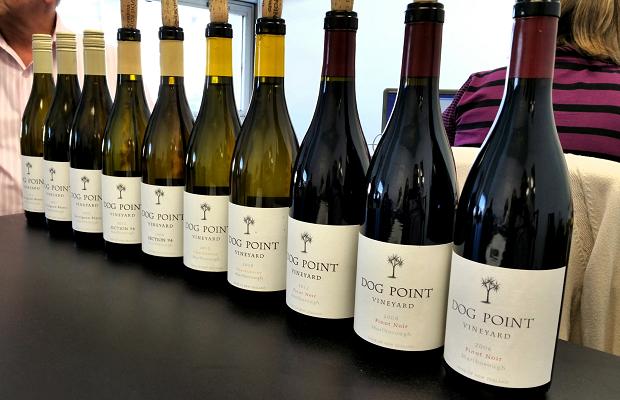
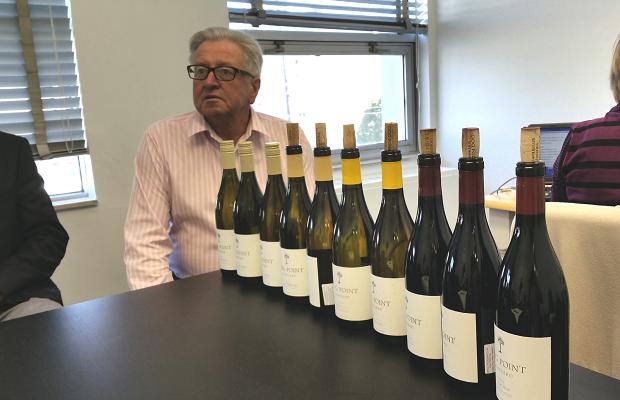
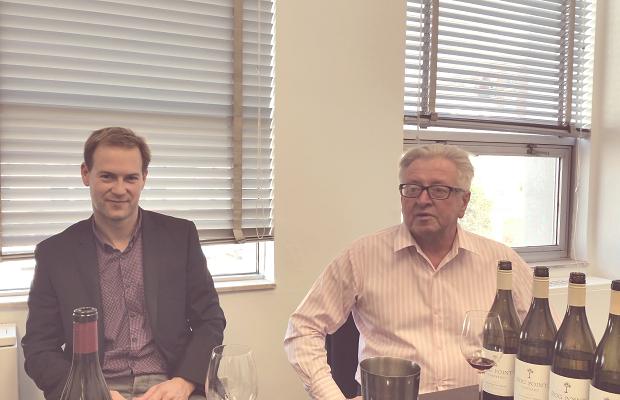
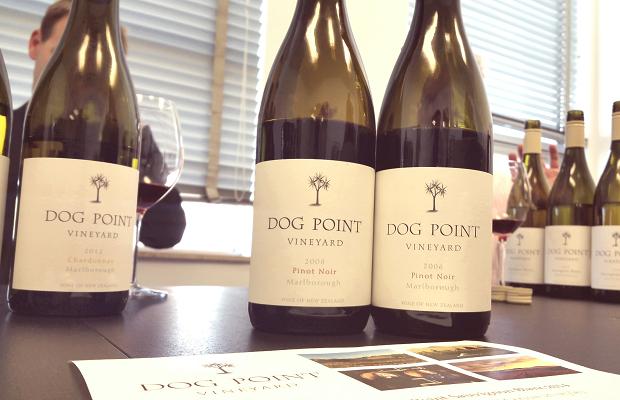
Dog Point Vineyard sits at the confluence of the Brancott and Omaka Valleys in Marlborough, New Zealand. Owned and operated by Ivan and Margaret Sutherland and James and Wendy Healy, the Wairau Valley vintners farm clay-loam soils sustainably and with organic, viticultural practices.
Sutherland and Healy are the men responsible for the success of the first iconic New Zealand brand, Cloudy Bay and together they left to form Dog Point in 2004. The name is in reference to the earliest European settlement of Marlborough, the sheep, their herders and the marauding dogs who prowled the scrub-covered hill overlooking the Wairau Plains. The early settlers called it Dog Point.
James Healy
Dog Point produces Sauvignon Blanc which ranks amongst, if not tops the long list of New Zealand’s output, for quality, ubiquity and consistency. The single-vineyard Section 94 Sauvignon Blanc takes the varietal intensity to another, barrel-influenced level. Chardonnay and Pinot Noir are made in a uniquely Dog Point style, neither emulating nor simulating Burgundy. This is the essence of the winery’s modus vivendi.
Dog Point Sauvignon Blanc 2014, Marlborough, South Island, New Zealand (677450, $24.95, WineAlign)
What James Healy calls “the generic Marlborough style,” with flint and ever-present though much faded reduction, grapefruit and lime. The vintage (2014) was not cold at all so it lacks the verdure. There is subtle, gentle clementine and palate viscosity. The acidity is all about bringing balance. So fresh, spritely, lime-juicy and always essential.
From my earlier note of March 2015:
So orderly and aligned, from ripe picked fruit with fervent acidity and all proportions in perfect working order. Four months settling in bottle has only worked to reinforce positive opinions. Grassless and flinty but no discernible elemental vagary, certainly no sulphur. This Sauvignon Blanc may just be the most consistent in every vintage, not only stylistically but also for the hedging of probability bets for guaranteed Marlborough quality. This is a superb vintage for the pied-à-terre phraseology. Like school in fall, winter and spring, the Dog Point is all class.
From my earlier note of November 2014:
The prototypical Marlborough Sauvignon Blanc hitting all the classic numbers is right here in the Dog Point 2014. Low pH, high acidity, minuscule residual sugar and elevated aromatics. It’s ripe but ripped by citrus juice and zest. Like cubes of honeydew, bitter winter melon and dried lemongrass soaking in and flavouring a dish of briny scallop carpaccio with coarse sea salt and capers. The sapidity is palpable, the excesses vivid. I would avoid too much variegated gastronomy when sipping this wine. Opt for simpler fare because its talents would otherwise be mimicked and suppressed.
Last tasted May 2015
Dog Point Sauvignon Blanc 2011, Marlborough, South Island, New Zealand (677450, $23.95, WineAlign)
Certainly showing some secondary characteristics in evolution and yet the composition is as close as a first cousin to the current 2014, with more than just thanks in part to identical yeasts. This has lees, “a feature of the 2011 wines,” notes James Healy. Time has magnified the flint but it has also stretched and elasticized it. The struck aromatic glint has passed and will continue to bob in slow motion. Dog Point in presentation of how and why Sauvignon Blanc can be enjoyed with age, over time.”Ain’t no reason to go up, ain’t no reason to go down. Ain’t no reason to go anywhere.” The late palate is lime, as per usual, but also lemon, in ’11, with a paraffin coating. “Time passes slowly and fades away.” Three to four more years for this SB. Drink 2015-2019. Tasted May 2015
Dog Point Sauvignon Blanc 2008, Marlborough, South Island, New Zealand (677450, $23.95, WineAlign)
It must be said straight out that a wine such as this wins hearts and points for its longevity, if nothing else. The kudos is warranted tenfold especially because it’s a Sauvignon Blanc and one that has emerged unscathed and even star bright. From a warmer year and extended growing season. Bigger bunches resulted, like in 2014 and this has evolved with considerable spice, as if, but not by wood, yet less developed than the petrol and lanolin slinging ’11. This is a wine that unequivocally proves that Sauvignon Blanc can age, gracefully and properly. Has an almost indiscernible flinty reduction, which means it never really had it in any concerning level in the first place. A vintage-specific white, with Chenin-like feigned sweetness and lactic feel. Marvellous to note that the final taste can be nothing but Sauvignon Blanc so in the end, the flavour profile wins out. Drink 2015-2017. Tasted May 2015
Dog Point Sauvignon Blanc Section 94 2012, Marlborough, South Island, New Zealand (325977, $42.95, WineAlign)
The Section 94 is, in the estimation of James Healy, “a particularly good Sauvignon Blanc block.” Planted in the 1990’s, the now wise old plot is churning out exceptional fruit with cold, cold acidity. Says Healy, with respect to the vintage,” we didn’t want to muck around with malolactic,” so the fruit notches naturally in barrel, with indigenous yeasts. “They won’t stop prickling for over a year,” adds Healy. Bottled at about 18 months, this is a wine given the full solids treatment and is more than obviously a major step up in Sauvignon Blanc complexity. Offers a feel like pebbles bobbing and popping around in the clot of the wine. Wood spice and so much grapefruit are the grumous layers, along with lactic, citric acidity. Time has thus far been very kind, the matchstick reduction now really subsiding in this subsidized white. Drink 2015-2019. Tasted May 2015
Dog Point Sauvignon Blanc Section 94 2008, Marlborough, South Island, New Zealand (325977, $42.95, WineAlign)
It is interesting to note that 2012, from a cold vintage, has evolved with a lactic palate and yet this ’08 seems so very fresh. Petrol and developed, thickened honey in wax are the bees knees in here. While a touch lactic in its own right, the tapestry weaves into second, third and fourth layers. A Sauvignon Blanc that really offers the best of all worlds. The leesy, lactic-secondary and flint-tertiary feel is round and in surround. This is the most Bordeaux white of all in the DP-SB continuum, with presence, savoury herbiage and pointed, sumptuous flavours. Grapefruit and bitter, beautiful tonic orbiculates the finish. The unanimous conclusion is of a wine that is very much like Champagne, without the bubbles. Drink 2015-2020. Tasted May 2015
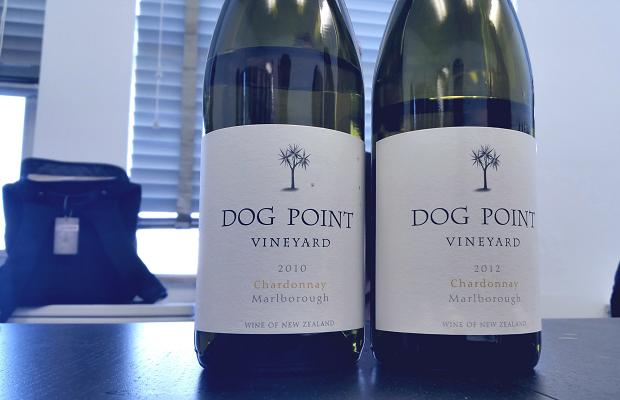
Dog Point Chardonnay 2010 and 2012
Dog Point Chardonnay 2012, Marlborough, South Island, New Zealand (238568, $39.95, WineAlign)
The barrel, in and out of reduction, defines the yet early life stage of the ’12 Chardonnay. The count is 15 per cent new with heavy toast “because we just like that heavy toast flavour, just not too much of it,” notes James Healy. Fully malolactic, but a very late one, this slow-cooked Chardonnay, with matching matchstick acidity. In expression it is of a very cool-climate style with tons of lime and emulsified to a gemstone melt, green goddess consistency. A wine that could be a cousin to, share spirit with Paul Pender’s Vinemount Ridge Quarry Road, of “emerald shine, the gemstone tannic scrape.” The Dog Point etymology is two-thirds Mendoza clone and one-third Dijon 95, the former needing sugar to get ripe, but it provides the citrus and the acidity for the palate. Drink 2017-2020. Tasted May 2015
Dog Point Chardonnay 2010, Marlborough, South Island, New Zealand (238568, $39.95, WineAlign)
Remarkably similar to the later 2012, tasted side by side, here with toast, nuts and grapefruit. It may be just a touch warmer, with more fruit yet still cool by nature. The ’10 is not as green, not as salient in polished stone feel, with less weight and girth. The sugars and bitters are increasingly integrated and push more direct, unbiased pleasure. Just a strike of flint ties it to the sibling Sauvignon Blanc. “Statues made of matchsticks, crumble into one another.” Marlborough Chardonnay is better than you think, love minus zero, no limit. It’s true if it’s been said. “She doesn’t have to say she’s faithful, yet she’s true like ice, like fire.” The Dog Point ’10 persists, bobs, rhymes, talk in and out of line. It finishes strong, in grapefruit, without sophistry or equivocation. Drink 2015-2018. Tasted May 2015
Dog Point Pinot Noir 2012, Marlborough, South Island, New Zealand (329672, $49.95, WineAlign)
From vines now coming of age (12-13 years old) and an increase in stem inclusion (20 per cent). Ripeness consistency was achieved with the aid of shoot cutting/thinning. All this to arrive at the Dog Point Pinot’s place in its necessary evolution. A wine of black cherry and roses, dark, dusty, ripe, in depth of earth, concentric circles of fruit and acidity. Great length.
From my earlier note of April 2015:
Perfectly bright Pinot Noir while simultaneously deep, dark and recondite. Energetic in spirit, ripe and packed with barbed, piquant fruit sewed in threaded badges of spice. Perfumed as if by cinnamon and displacing rose petals. Like the scent of a crystal clear summer’s night, all warm, dry and of dried strawberry juice cracked paint. Grounded and fulfilling, of its own holes, in the mouth and finishes with a feminine touch. A thoroughbred, a filly, that trots on an on, long after it has crossed the finish line. Drink 2016-2021.
Lasted tasted May 2015
Dog Point Pinot Noir 2008 and 2006
Dog Point Pinot Noir 2008, Marlborough, South Island, New Zealand (329672, $49.95, WineAlign)
Just a small amount of stem inclusion, a practice that will increase in subsequent vintages, helps to define structure and to a lesser extent, aromatics and taste. Yet the effect is has on tempering and mitigating sweetness is overt and protrusive. “That whole ripe stem thing…it’s a dog’s breakfast, ” says James Healy. Both he and vineyard manager Nigel Sowman have accepted and embraced the necessity of stem inclusion but as Sowman notes, “is there such a thing as a ripe stem, because you’re after sap, not astringency.” The stems here have balanced out the really ripe, jammy fruit. This ’08 is all about florals, of many flowers that offer invitation to then investigate the Pinot Noir morphology. This has turned to liqueur yet still cracks, pops and finishes with bitter, tangy and swelling cranberry. Drink 2015-2018. Tasted May 2015
Dog Point Pinot Noir 2006, Marlborough, South Island, New Zealand (329672, $49.95, WineAlign)
In 2006 stems were not yet part of the practicum and though the wine remains very much alive it has lost a modicum of structure and a minor key of balance. The highest degree (though certainly not over the top) of paint, varnish and veneer emanates from the edges of the jammy fruit. This youngest and lower on the amicable scale for a Dog Point Pinot Noir is both sweet and sour. The depth (mostly due to very young vines) pales in comparison with even ’08 and the flavours are disparate but what is there is fun and so very Pinot Noir. Can be nothing but and is really the most Burgundian of the three (’06, ’08 and ’12) tasted. That said, it’s not necessarily a good thing because Dog Point does and should try to avoid emulation. The final assessment and most poignant note concerns how barely evolved this nine year-old Pinot sits. Tasted blind you would be hard pressed to guess closely at its age. “If we had an ’06 vintage today we would make better wines,” admits James Healy. A touch of cola and a grapefruit note hit the finish. A Dog Point thing. Drink 2015-2020. Tasted May 2015
Somewhereness is not really a word. It’s hokum. Gibberish. Nonsense. Look it up in Merriam-Webster or Oxford. Not there. Its conceived convenience is recorded in Wiktionary, Your Dictionary and other online glossaries though, because there is always an online presence ready and willing to immortalize anything and everything.
The definition of Somewhereness, according to the online “dictionaries.”
The state or quality of being in, occurring in, or belonging to a specific place.
The state or quality of existing in a place that is unknown or cannot be pinpointed.
The unique characteristics imparted on a wine by the conditions of the place in which it was grown.
Somewhereness is not a state of mind, of being, of knowing something is intrinsically right within the parameters or context of here, there, anywhere or everywhere. Somewhereness is not merely a function of good decision-making, of exercising the ideal to expand on terroir, to create something to talk about. Yet that third so-called definition is on the right track. Belief says terroir is what happens in the vineyard, through environment, by geology, geography and topology, from naturally occurring elements and microbes in the soil, by air and of climate. Terroir is the great one. The impossible creator of perfect storms, from out of riddle and enigma. Somewhereness, by extension, is the next one.
Somewhereness exists, albeit with just as much abstruse behaviour and paradox, inside the finished bottle. That’s all you really need to know. Terroir happens before. Somewhereness happens after. The line is drawn when wine enters its final resting place. It evolves, develops and finds its somewhereness inside the bottle. In the case of Champagne (and the wines of Emidio Pepe), the first bottling is merely a temporary shelter and somewhereness knows to wait for the final call. In those cases there are the stages of terroir, disgorgement and finally, somewhereness.
In Ontario, somewhereness has been found (as opposed to “was founded”) by Norman Hardie, Jonas Newman, Vicky Samaras, Bill Redelmeier, Ann Sperling, J-L Groux, Charles Baker, Doug Witty, J.P. Colas, Ed Madronich, Jay Johnston, Tom and Len Pennachetti, Angelo Pavan, Moray Tawse, Paul Pender, Harald Thiel, Marlize Beyers, Mary Bachelder-Delaney, Thomas Bachelder, Martin Malivoire and Shiraz Mottiar.
Somewhereness may have been born to these Ontario parents but it has and will not remain exclusive to the 12 who discovered it. Somewhereness belongs to all wine with true and truthful origins in terroir. The great wines of the world share in the expression and the mystery, even if the gold inside their bottles has never been affixed with such a label. Somewhereness is found inside a bottle of Dujac Bonnes Mares. You will taste it in an Egon Müller Scharzhofberg. It can’t be missed from out of a Margaux pour by the hands of Paul Pontallier. Wines of manic manipulation will never find it. They either do or they don’t, will or they won’t. Somewhereness just happens. Don’t ask me to explain. I’m just the messenger.
Over the past few years, much godello.ca white space has been set aside for glossing in written word and the ever-evolving rumination on the spiritual effect of somewhereness.
Konrad Ejbich holding court in front of De La Terre’s breads
“For a comprehensive look at our province, make sure you read A Pocket Guide to Ontario Wines, Wineries, Vineyards, & Vines by Konrad Ejbich. The discourse concerning somewhereness in Ontario is in full swing. In October of 2012 I wrote, “character and quality has never been better. Riesling continues to impress and let us not ignore the high level of ever-evolving Chardonnay vines. Reds have made great strides, especially Pinot Noir, Gamay and Cabernet Franc. The future looks very bright for Ontario [wines].”
“Abeyance be gone, these next few years have the potential to cement an industry’s power. Only a minority has even the slightest clue that liquid gold is mined out of the peninsula’s glacial clay and limestone. The time is ripe to tell the world the story of somewhereness. The embryo is about to grow in a major way. Financial reward is within reach. So how to alert the world?”
“History may one day remember them as the group of twelve, or perhaps, “The Ontario School.” They are the 12 wineries who have banded together to ensconce a strange but beautiful word on the tongue, in the dictionary and out in the world. Somewhereness. They are purveyors of the land from which their grapes grow and ferment into wine. Facilitators of terroir, working a canvas forged by millions of years of geological and climatic evolution. Their assembly is based on both exigency and on Moira; destiny, share, fate. Like that other famous group, “collectively they agree.” Ontario’s cool-climate wine regions need to qualify and certify a distinctive winemaking style. In juxtaposition to old world, European tradition, the intensity of somewhereness needs to reflect an increasingly Ontario-centric partiality.”
“The Ontario wine industry is the best kept secret in the world. It has grown, accelerated and advanced with more success than might have been imagined as recently as five years ago. In November I wrote, “Ontario winemakers have figured it out. The “world-class” comparative humanities of aging and longevity aside, the comprehensive and widespread phenomenon of excellence, regardless of vintage, is now an Ontario reality.”
Wine Country Ontario’s Magdalena Kaiser
All wonderful hyperbole, to be sure. But for years I missed the point. Somewhereness is not about agreeing, in principle, on how to make wine from a particular place so that it can collectively result in a thing. It is something other. It’s in the bottle. It has always been there but the key lies in Ontario’s industry having matured to a point where we can now taste it, again and again, inside the bottle. The work made it happen. It is well-deserved.
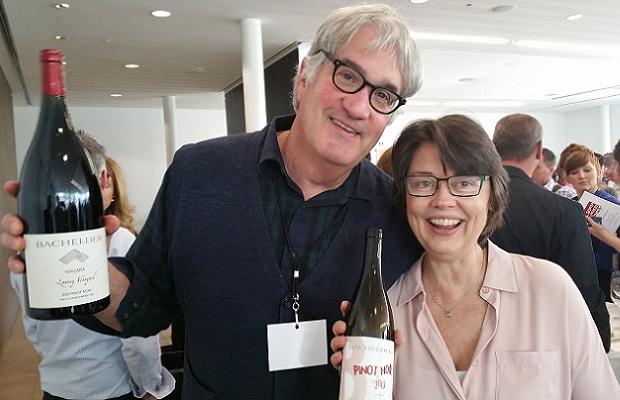
Thomas Bachelder and Mary Delaney-Bachelder
So with the assistance of Trisha Molokach, Dorian Anderson and the vintners who came to realize what happens when terroir is used to bottle divine pleasure, another Somewhereness (the event) happened, at St. James Cathedral in Toronto, on April 20, 2015. Food partners completed the stellar event; Best Baa Dairy, Monforte Dairy, Upper Canada Chees Company, Fat Chance Hand Sliced Cold Smoked Salmon Co., Chef Ryan Crawford & Beverly Hotchkiss of Backhouse, De La Terre Kitchen and Bakery and Schott Zwiesel. Hinterland was not present in 2015 and I skipped two tables, due to quite recent full portfolio tastings, at Bachelder and at Southbrook. Here are some other notes.
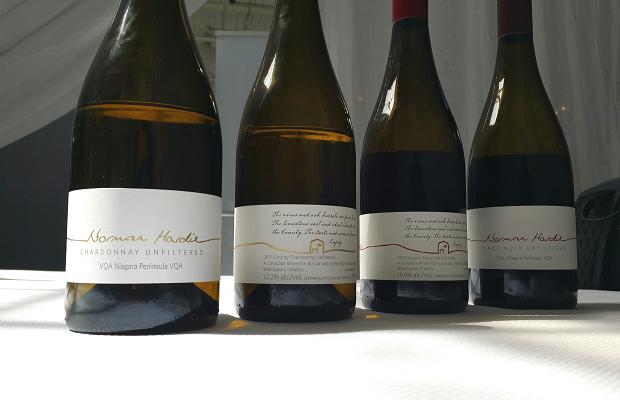
Norman Hardie Riesling 2013, VQA Ontario (Winery, $21.00, WineAlign)
With less residual sugar than in 2012 and slightly higher alcohol (the bottle says 10.1 per cent but it’s actually 9.8), the house style persists, if only as a refrain that adjusts and adheres to the vintage. A hint of oyster shell is more than significant, in working alongside Hardie’s Calcaire, effected out of lees fermentation. The minute loss of high-toned aromatics is pitched in favour of fruit, if only from one exploited tank, within the context of producing 1000 cases. The ’13 (70 Niagara/30 PEC) is like very modern Alsace, akin to Schoffit, what with its texture fitted through a tiny hole. Drink 2015-2018. Tasted April 2015
Norman Hardie Calcaire 2013, VQA Ontario (Winery, $23.00, WineAlign)
The field blend of Marcel Deiss is the starting point. Lees imparts texture and the proverbial minerality is rounder than the Riesling, though the acidity just as linear. The breakdown is Chardonnay (40 per cent), Riesling (40), Melon de Bourgogne (10) and Pinot Gris (10). It should be noted that the mid-palate is caressed by a silky cheese curd, sour milk atonement. Drink 2015-2019.
From my earlier note of August 2014:
If any wine growing and producing region not called Alsace has the right to label a wine Calcaire, Prince Edward County is that place. The irony squared of Norman Hardie’s choice of nomenclature is not lost. Olivier Humbrecht makes use of the term because some of his single-varietal wines can no longer (under the local AOC rules) be labeled with the name of the wine-growing village. Marcel Deiss produces ‘field blends’ composed of several varieties grown on Grand Cru soil but he can’t (under other regional rules) label them Grand Cru. Hardie takes Niagara and PEC Grand Cru grapes, fashions an Ontario white blend, not unlike J-L Groux and calls it Calcaire, in ode to the limestone underlay of the County. Are you following me here? This may be new, innovative, yet understood and an early impression, but this cuvée initiates the PEC march to white blend supremacy, much like Stratus White has done over the course of 10 vintages in Niagara. Norm’s Calcaire is a Chardonnay, Pinot Gris, Riesling and Melon de Bourgogne mélange, co-fermented on the lees, striking, all in limestone, full out mineral consequence. There is purified pear and white melon fruit in distillation. There is a house in Wellington, “they call the Rising Sun.” That this animal succeeds so early in its tenure shows the Norm conceit and the swagger. That it will define white blends for a millennium is an arrogance of traditional song and of scripture. So be it.
The ’12 Niagara has swapped spontaneity for coherence, licentiousness for logic. Has entered the stage of non-reductive peel, where skin is discarded, flesh is exposed and juices run free. If you like your Chardonnay settled and yet vitally fresh, now is the time to enjoy the Hardie 2012 Niagara Chardonnay. Drink 2015-2022.
From my earlier more of May 2014:
Norm’s Niagara is such a different animal to the County 2012. The warm summer and dry fall means more humidity and even more reduction. Currently cothurnal so less like Burgundy but only because there elevates the high-tones and percipience from Niagara. Texture is key but this Hardie needs time. It’s not angular but it is steroidal, injected, like a wild thing, as if the yeast were still in control, munching away even though there is no more sugar to be had. Undomesticated ’12, at heart, in spirit, out of mind. Hard to imagine there could be this much anxiety from the even-tempered vintage, but when you pick real early and keep the oak to a bare minimum, Hardie happens. Norm picked ripe fruit between September 7 and 10, six weeks ahead as compared to some years. He said the fruit had a “golden tan, ready to go.” The use of smallish 500L barrels works wonders for texture and though 40 per cent was new wood, you would never know it. Malolactic fermentation didn’t happen until late August, nearly a full year on so no sulphuring was required until that time. This is Hardie’s freshest Niagara fruit ever, from Duarte Oliveira’s farm between Victoria and Ontario Street, the same spot as Hillebrand’s Chardonnay Reserve. Terrific Beamsville Bench Chardonnay.
Hidden Bench’s ’13 Riesling is a pure, soft-spoken and balanced reflection of her maker, winemaker Marlize Beyers. Only a month or two of lees and no stirring has brought her Riesling into this current corporeal state. The citrus is all flesh, void of pith and with acidity that has already incorporated, disguised and covered the zest. If any Hidden Bench Riesling suggest tropical fruit, here it is and yet again, not. Drink 2015-2020.
From my earlier note of September 2014:
The Estate Riesling is as vigneron-defining as any wine on the Niagara Escarpment. Hidden Bench is a 100 per cent estate-fruit operation so this Riesling is spokesperson, prolocutor, mouthpiece, champion, campaigner and advocate for the concept. The estate ’13 reaches deeper for nutrient pot sweetening, into shale and in conceit of its varied, positively cultivated terroirs. Compact and jelled, this is several steps up from most other entry-level Niagara Riesling and in fact, is really anything but. The transparency here is patent. This is Riesling that simply knows what it is; pure Bench, unequivocally real and forthright. Knows what it wants to be.
Produced exclusively for licensee, the Bistro follows a very similar profile to the Estate Riesling, with exactitude in weight and alcohol 911 per cent). The flesh is less, the zest increased and overall you can sense more youth. The Bistro juice comes from Roman Block cuttings planted in Felseck Vineyard in 2008. The simmer here is a simpler, more straightforward pot of sustenance, entirely capable of acting as spokes-Riesling for the Hidden Bench house druthers. The vines will grow up and the juice will move on but other, newer, youthful cuttings will take up residence and the Bistro line will endure. Drink 2015-2017. Tasted April 2015
The (five to) six percent Sémillon speaks at present, in a waxy, bitter gourd winter melon and smoky flint tightness. In this wound moment, it is perceived that another year will be needed for the next unwind. Now vacuous, spinning and whirling as if in a processor’s bowl, an amphitheatre of expression. Drink 2016-2022.
From my earlier notes of September and (at Gold Medal Plates Toronto) November 2014:
Less than six weeks after my first introduction to the NB ’12 complexity shines anew. Such a delicate and elegant take on the Bordeaux white axiom. Void of all the gangly G’s; grasses, gooseberry and green vegetable. Leans to custards and curds with a savoury accent and a limestone tang. Willing to be paired with a multitude of gastronomy. Long finish. From my earlier, September 2014 note: “Taking what the vintage gives, Rosomel’s Sauvignon Blanc was king in 2012, dominating at a 95 per cent share of the Bordeaux-styled blend with Sémillon. Barrels were stirred weekly during fermentation and the creamy texture thanks that regimen, as does the tannic fullness of the round back-end. It rocks out bracing, formidable and nobly bitter, in pear and its pith, in lemon, of rind and in curd. The SB lounges in tall grasses but avoids goose feathers and blanching veg. So very savoury, in gorse tension, thistle and nettle. These notes all cut through the roundness and are finally tied together by the flinty rock of Rosomel.”
A meandering young blend of Pinot Noir, Malbec and Viognier that is super dry (3.2 g/L of residual sugar), “hey, hey, my, my.” The aromas suggest a succession from strawberry to green and red onion but “there’s more to the picture, than meets the eye.” The medley, interrupted by ballads and road stories is like a subtle, sweet, sour and savoury gastronomical pickle, ramps in brine, scopes in sweet alkali. Can there be a drier, more windswept crag, neal to a southern French style made anywhere on the Peninsula than from the Escarpment coliseum up on Locust Lane? Drink 2015-2018. Tasted April 2015
While persistent in aridity as a disciple to the Locust Lane, this Bordeaux blend Rosé packs a fruitier punch. Elevated residual sugar (as compared to the Double L) mans a higher rate of variability and accessibility, not to mention more chance of Ontario patio success. This licensee bottling will work for summer, across the province. Drink 2015-2016. Tasted May 2015
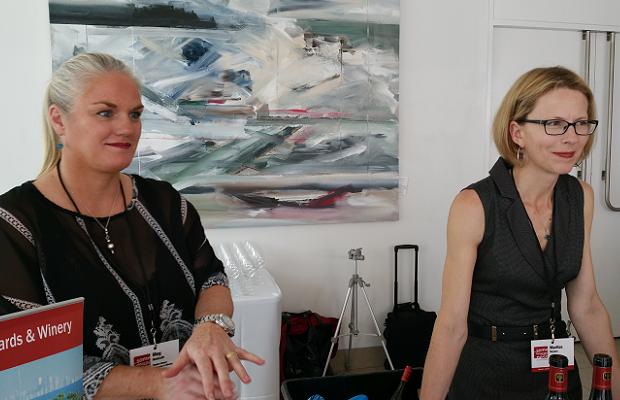
Meg McGrath and and Marlize Beyers of Hidden bench
Still tightly wound with the tannic grain criss-crossing at interstices of fruit (pomegranate/cranberry/strawberry) and acidity (sharp/pointed/direct). A fine, pointillist’s rendering; Locust as Seurat, nobly bitter, to the end. Drink 2016-2022.
From my earlier note of April 2014:
The Locust Lane Vineyard, originally planted in 1998, was Hidden Bench’s first acquisition, in 2003. It has a unique perpendicular cross-slope effect, undulating in all four directions, gathering sun hours in its own special way. The vineyard produces the richest and warmest Pinot Noir with fruit flavours more akin to ripe plum and black cherry than almost anywhere on the Beamsville Bench, certainly as any from the Hidden Bench stable. While the ’11 is not the biggest beast nor the Bordeaux bully of the Terroir Caché, it is surprisingly tannic and strong. It’s anything but hot, though it attacks with fervor. Big berry fruit, macerated strawberry, rich pie notes and spice. A great Locust vintage.
There is so much floral presence in 2011, a showy perfume that parades the relative elegance of Niagara’s Bordeaux reds in the vintage. Structure is comparable to 2010, not in beast mode but rather with a delicacy derived from less burning, high-toned fruit. Still here lays a wine so young, of social encumbrance that might be passed off as a mark of impertinence. This faintly embarrassing condition can be suppressed in a dark cellar, in which the foundation can be laid for the beginning of a cure. The Terroir Caché 2011 will show its best between 2017 and 2020, then develop, slow down, suspend animation and age further, effortlessly and exceptionally. Drink 2017-2024. Tasted April 2015
Oh, the accessibility of Quarry Road in 2012. Still totes the emerald shine, the gemstone tannic scrape and yet the flesh is rendered rich, ripe, ratcheted and riled up. This has tonality like never before, layered and strudel buttery. At this point the vines for Quarry are 17 years of age, sophic and erudite, compounded by the organic, biodynamic and prudent pruning practices that have cemented its vigour. The clay-limestone, fresh-mineral, push-pull is a veritable careening of expression. Though its longevity may not pile towards a compressed future like that of ’09 or ’11, the earlier and often response will act both as Chardonnay charming and Quarry Road magnetizing. For the next five years it will be very hard to turn away. Drink 2017-2020. Tasted April 2015
Tawse Laundry Vineyard Cabernet Franc 2011, VQA Lincoln Lakeshore, Niagara Peninsula, Ontario (130997, $34.95, WineAlign)
A year had added rich note to this ’11, furthering the inflammatory vibrations and purposefulness of Bordeaux (as opposed to Loire) red makings from the vintage. The depth of cherry merging to smoked currants is cool, collected and shaded by brushy, briny strokes. Hints at brambly, even. This is so very Cabernet Franc and even more so, Lincoln Lakeshore. Drink 2015-2019.
From my earlier note of April 2014:
A lean Laundry with as much finesse as winemaker Paul Pender has ever shown in his poignant Cabernet Franc realm. When a vintage deals you calm and scale you sit back and relax. The Lincoln Lakeshore advancing in years vines bring yet unseen front end red berry, licorice and red currant softness in 2011. There is elegance but also a refusal to yield its back end bite. A level of enveloping grain and chalk is unique to this bottle and should be seen as a very good effort with the possibility ahead
Last tasted April 2015
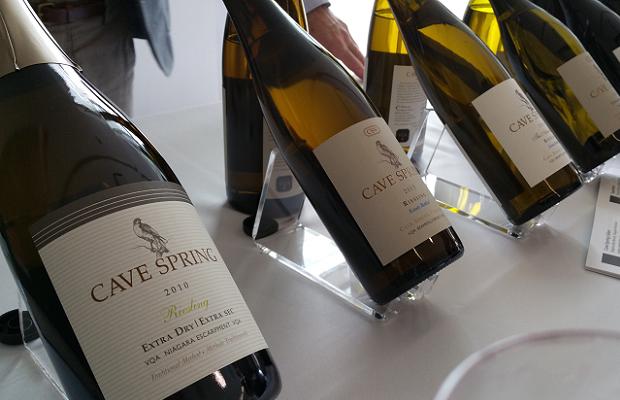
Cave Spring Cellars
Cave Spring Extra Dry Sparkling Riesling 2010, VQA Niagara Escarpment, Niagara Peninsula, Ontario (Winery, $24.95, WineAlign)
From the clay-limestone bench lands abutting the Escarpment, specifically one block of 11 year-old vines at the Beamsville Bench Cave Spring Vineyard. Traditional method fizz accessed of low brix (early picked, 19.3 degrees) and mortar (2.97 pH) numbers, then elevated under microscope magnified sugar (15.5 RS g/L) and acidity (8.4 g/L). So what? So this is a pure CS expression of Riesling, cured and curated in the house style, led to textile weave from 14 months on the lees and finalized just that side of Brut. Functions like a Blanc de Blancs suitably this side of acidity rage and with corresponding remarkable, if close to impossible aridity. Less fat than might be expected and with a swath of sauvage. There sweats ginger and the cuttings of foraged wild things. The extension on the finish is protracted even after the liquid has left the building. Finishes with dry stones, nuts and a rightful oxidative thrust. Drink 2015-2020. Tasted April 2015
Cave Spring Csv Riesling 2013, Cave Spring Vineyard, VQA Beamsville Bench, Niagara Peninsula, Ontario (566026, $29.95, WineAlign)
That flesh, that Kabinett flesh, fills the CSV in every crevice. In 2013 the residual sugar number lies between 15 and 16 g/L, and though the crop was bigger, it was still picked later than in 2012. The result is formidable corporeal concentration, consistency of house style and perhaps the only ’13 Niagara Riesling to imitate, perpetuate and extrapolate on the vintage that came before. This Cave Spring concentrates fruit and Escarpment into a powerful Riesling, streaming like charged particles through changing expressions. A lingering ascension hovers as it rises, until it slowly fades into the welkin, like a balloon that languidly gets lost into the blinding blue of a midday sky. Drink 2017-2025. Tasted April 2015
At present there are sweets, bitters and rich Adam fruit. Only the shadows of a limestone outcrop near the crest of the Niagara Escarpment know why the Adam is so juicy. A chew like no other. Drink 2015-2020.
From my earlier note of October 2014:
A classic Adam, amplified in 2013, riper and not as piercing as previously noted vintages. Still the layering is omnipresent but there is more juicy fruit and texture then ever before. This is a consumer friendly Adam, gregarious, outgoing, off-dry as never before. New slang for the bottling.
From my earlier note of July 2014:
According to Cave Spring’s website this newer Riesling from older (18 to 35 year-old plantings) is from “a single block of vines in the shadows of a limestone outcrop near the crest of the Niagara Escarpment, known as ‘The Adam Steps’. Really apropos, for this Riesling is the cantilever, the one with the outstretched arm. At 10.5 per cent alcohol and with an unmistakably stony, sweet and sour whiff the wine speaks of its off-dryness. The juiciest of all the Cave Spring Rieslings, with rounder acidity and good persistence. This is the all-around good guy, the one with an open invitation, the bridge from Estate to Dolomite to Csv. The well-adjusted one steps up its game to help win one for the team, especially out of the convivial 2013 vintage.
Last tasted April 2015
Cave Spring Cabernet Franc 2012, VQA Beamsville Bench, Niagara Peninsula, Ontario (391995, $19.95, WineAlign)
The 2012 Cabernet Franc needed six further months for the high-toned fruit to settle just enough for the spiced richness to shine. Though Dolomite-designated, this sheds Beamsville light purity, along with a grain variegated by (pomegranate) citrus and chalk. The cool centre is elongated and expansive though it seems to inuit the correct time for retraction. The aerial fruit stresses condense and accept the angles prepared by coriander and eucalyptus. Drink 2015-2018. Tasted April 2015
The Twenty Mile Bench in Jay Johnston’s hands flat out rocks. The Chardonnays “they dig a funky spiel, they’ll make some spiel.” The ’12 Estate has crossed into pretty territory, not shy to wear its thin lamina of oak make-up and not too proud to say drink me now. Drink me here, there and everywhere. Drink 2015-2017.
From my earlier note of March 2014:
Has spent some quality time and knows its way around a barrel but its attitude is young, fresh and alive. From 12 and 13 year-old estate vines and kissed by only 15 per cent new oak. “But here’s a funky fact that I know is real.” Flat Rock’s Chardonnays are red hot and this fresh-faced ’12 has “baby appeal.” Blatant, colorable value on the Twenty.
Always expressive of such manifest certitude, the 2014 can’t be anything but Nadja though there adds a fleshy dimension that pins it to the broader spectrum of Twenty Mile Bench, in as much as what the vineyard culls from its capacious diagrammatic. That broader outlook provides understanding into Nadja’s decrease of stentorian language in the fractionally stagnant vintage. There is a variegation within the sweetness lining the tunnel of aridity. Fourteen is nothing overly special and Nadja suffers as a result. It’s still a very, very good Riesling, just not one for the ages. Drink 2015-2019. Tasted April 2015
The vintage acts as a launch point for Flat Rock Pinot Noir and prepares a palate for the 20 Mile Bench by coating it with utmost approachability. Violets and Nebbiolo-like roses are raised in warmth, albeit beneath the safety net of cloud cover. You’ll find no burn, rust spots and yet you will acquire comfort, in and out of sips. Drink 2015-2018.
From my earlier note of April 2014:
As with Flat Rock’s Chardonnays, here is a vintage and an evolutionary coming of age that becomes a matter of scaling back oak. The quotient here is less than 40 per cent new, leaving the wizened vines and maker’s acumen to coax maximum character, brilliant sheen and recognizable aroma. The 2012 Pinot teases black cherry but never really goes there.
From my earlier note of February 2014:
Nearly 4000 cases will be available of this nearly-unfiltered, very established and always well-thought out Pinot Noir. A consideration of the plots and barrels micro-management that determine the crasis of this Estate wine demands an extrapolation in full-on assessment. The medium-coarse Chinois filtering lends to a tannic chain of texture thick in grain and chalk. A heavier Estate because when the weather gives you heat you make a climate appropriate wine. This monkey is not a product of arctic air and it “got too deep, but how deep is too deep?” Thermal vintage melt, ritzy ripe cherry stuff in 2012. From the Ritz to the Rubble, if you like, or the Flat Rock.
Last tasted April 2015
13th Street Pinot Gris 2012, VQA Creek Shores, Niagara Peninsula, Ontario (Winery, $19.95, WineAlign)
From two blocks on one farm in the centre of Creek Shores, one picked earlier to avoid botrytis. No malo, stainless steel tank fermentation leads to pure, crisp and clean Pinot Gris. The soil-driven funk meets faux-sulphur is typically J.P. Colas, a specificity in undertone that culminates in a dry, variegated finish. Drink 2015-2017.
From my earlier note of April 2014.
Here you have an honest, 100 per cent stainless steel treated Pinot Gris from an estate vineyard located adjacent the market on Fourth Avenue in the Creek Shores appellation. So very dry and really fine fruit, crisp, neoteric, rising and falling in waves of tempered acidity. Made in a comfortable, country-twanged, folk-rock style, like a Cowboy Junkie. Juicy, mouth watering work and very easy to fall for. An angel mine, this 13th Street, “and I know that your skin is as warm and as real as that smile in your eyes.” This effort by Jean-Pierre Colas is as good as it gets, a tally for Creek Shores and its kinship with the variety.
Four months has upped the funk in for ’13, with tar and bitters still and thick as summer air. Rich and ripe, notable for its black cherry aroma and that J.P. Colas natural truncation. Unique, as always and very Gamay. Drink 2015-2019.
From my earlier note of December 2014:
Fruit was sourced from both the Sandstone and Whitty Vineyards for 13th Street’s Gamay Noir, a focused and gritty adjunct in ode to the Cru Beaujolais approach. This ’13 raises the aromatic and texture bar and just may be the most striking from a 13th Street estate mix. All the important berries are there, as are the mineral quandaries. In a Gamay moment this will lead you to gulp and giggle with #GoGamayGo delight.
Fruit was sourced mainly from Wismer Vineyard (Vineland) and a smaller proportion from AJ Lepp (Niagara-on-the-Lake) for this dry as the desert Syrah of deep extract, warmth and density of fruit. All set upon a highly tannic frame, with every indication that longevity will be its best friend, as much as any red has ever been produced in Ontario. A formidable vulcanization marks the entry, a not so inappropriate entreaty to beg for time and lots of it. The current pavane of fruit is exhibitive of excruciating physical reticence though behind the wall there is more than enough indicators to stand the test of time. No new oak (though the Essence saw an extended slumber in three to four year old barrels) has allowed the tapestry of intertwined layers to set up shop and dig in for the long haul. If big-boned Syrah and Niagara are in your cellar plans, this 13th Street 2012 has to have a prominent place. Drink 2020-2027. Tasted April 2015
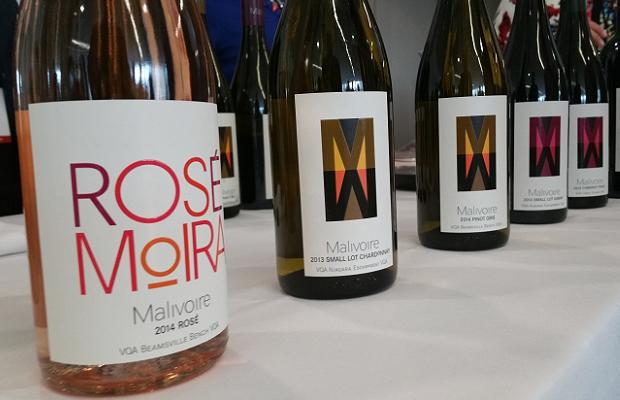
A dual block blush, from two clones in the Moira Vineyard. Made from 100 per cent Pinot Noir, this second vintage is pale as can be, dry, saline and reeking of fresh peaches and strawberries. The level of purity and intensity is nothing short of amazing. This will rise quickly into the ranks of the Peninsula’s finest Rosés. Drink 2015-2017. Tasted April 2015
The purity and fine-lines of Pinot Gris are defined, delineated and deftly prepared by Shiraz Mottiar and team in 2014. This is a calm rendition, void of tremors, certainly not taking any risks but also not a white of unfulfilled promises. Herbs, lemon, mint and fine PG tannin draws salt from stone. A perfectly dry finish is in play, as with all malivoire whites, to cement the deal. Drink 2015-2018. Tasted April 2015.
It’s hard to recall memories of so much syrup, liqueur and high tonality as coming from Stouck, from any Meritage for that matter and yet the 2011 Bordeaux varietal wines out of Niagara continue to astound. If excess or vivid character is a negative, just look away. The combination of rich extraction and explicit oak generosity dope out fruit from a dry September into wonders of dried timbre and inflection. The drupe is enriched, as is the tannin and a Beamsville buttressing that warps and wraps like never before. At this four-year juncture, the Niagara ’11 varietal compendium is officially a thing, witnessed in example through this Stouck. More than just dramatic Shiraz Mottiar foreshadowing here, but further into thoughts of what vintages co do for red wine as a Peninsula whole. The ’11 Stouck Meritage stands upright at the mirror and its reflection looks right back. Drink 2017-2021. Tasted April 2015
Malivoire M2 Small Lot Gamay 2013, VQA Niagara Escarpment, Niagara Peninsula, Ontario (Winery, $19.95, WineAlign)
The profundity of tart, keen, briny berries dilates in its own very useful layers of citrus, tannin and concentration, beyond even what was observed in 2012. The zesty, spritely argot resonates from the unfurling of floral essentia out of a Gamay in desperate need of time. The flavours and overlay are somewhat impenetrable and yet leave quite an impression. While patience might be the virtue and the reward, if #gogamaygo is the modus operandi, a swig from the bottle like gentlemen of the road is certainly not out of the question. Drink 2016-2021. Tasted April 2015
Charles Baker Riesling Ivan Vineyard 2014, VQA Niagara Escarpment, Niagara Peninsula, Ontario (Winery, $27.00, WineAlign)
From the rich limestone and sandstone beneath the clay, 1.1 acre Misek vineyard, a southerly ledge up from Highway 8 and an easterly hill down from Cherry Avenue. A very linear Ivan combs the catacombs of the Escarpment’s underpinning. A retaining wall of vintage attenuated rocks and stones, a vineyard’s low yields and the voices in Charles’ head have produced a striking Riesling. In 2014 adolescence has entered adulthood. Now before us is a grown up Ivan, mature Ivan, maybe even wise Ivan. Texture is in manifest control in this loyal, stay at home Baker, not yet running wild like free-spirited Picone. Ivan has presence, sometimes a great notion and is Baker’s longest bit of prose to date. The next great Riesling vintage will make it iconic. Drink 2016-2020. Tasted April 2015
The petrol and mighty bee’s sting have taken over, with the honey again not far behind. A lemon prepares to spill its juices as it warms above a bunsen flame. At present it is almost too elemental to define. Will change course again when midnight strikes in 2016. Then it will come into its own. Drink 2016-2020.
From my earlier note of April 2014:
Tasted at Somewhereness 2014 as part of a vertical retrospective going back to 2007. The Vinemount Ridge’s now famous Picone Vineyard is set within a 10-acre estate on the Niagara Escarpment. Planted to the Weis 21 clone, the Riesling grown here digs in for complexity from sectional moieties of clay and sandy soil atop a unique base of limestone bedrock. Charles Baker began working with these grapes in 2005 and it is this 2008 where the learning curve took a turn for the Riesling stratosphere. The ’06 found luck in the stars but this vintage lays the framework and foundation for a master plan. At this stage in the ’08 evolution there is a prodigious and viscous honeyed textured. Ripening tree fruit juices run like maple sap in spring and the run off is beginning to think syrup. A cutting ridge of acidity arrests the sugaring, allowing citrus and flinty rock to recall the wine’s first, fresh steps. Baker’s Riesling time travels in circles with no real beginning and no real end. From my earlier, September 2012 note: ““Whoo-ahhh” Mojito, green apple skin scent of a Riesling. Seductive to sip, a bodacious body of influence, then back-end bite. A wolf pack in sheep’s clothing.”
A blend of Cabernet Franc and Merlot with some Sauvignon Blanc and Riesling added for lift and what J-L Groux admits is rendered “for the consumer.” This essentially marks the twain between sweet and dry, if not quite halfway then pretty darn close. Plenty of herbs and citrus nail the aromas on the proverbial head with more than a grapefruit or two on the half circle. A highly approachable, end-user friendly blush. Drink 2015-2016. Tasted April 2015
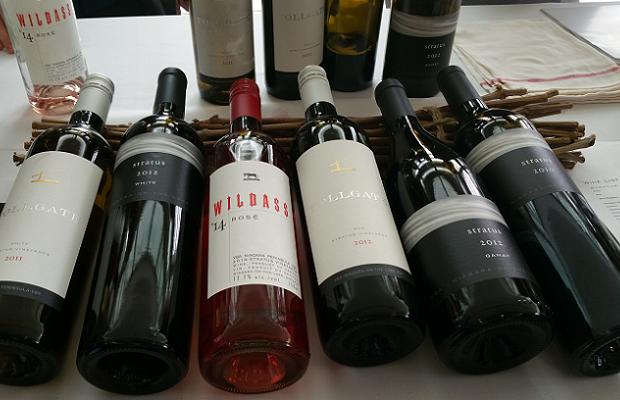
Stratus White 2012, VQA Niagara On The Lake, Ontario (660704, $44.20, WineAlign)
In 2012 the blend is Chardonnay, Sauvignon Blanc and Riesling. Viognier was left out because according to winemaker J-L Groux “it did not work in blending trials.” The vintage has laid the foundation for the most density, and unctuous fruit for the Stratus White in what must be, ever. At the high aromatic end there is peppery beeswax, reverberating and echoing in scales and arpeggios. Like an open string singing warmly, the vintage, extraction and residuum combine for texture in mottled unction. Sapid lemon, more beeswax and lanolin mark the palate and then the White drifts into spaces occupied by smoky, back beats and bites. This has great pitch with a knowledge of the path to pleasure. Drink 2017-2025. Tasted April 2015
Stratus Gamay 2012, VQA Niagara On The Lake, Ontario (Winery, $29.00, WineAlign)
t may not be the most idiosyncratic Gamay in Niagara but the Stratus 2012 is without a doubt the most advanced and complex. Gamay fusion is on display, at once a bottle of Niagara’s finest pulchritudinous veneer and then a charcuterie board laid ample with cured bovine parts and sun-dried grapes. Maximum ripeness and then even later picking, to no one’s surprise, have led to this. Two years of ageing in neutral oak barrels has brought about a humid roundness and yet the centre is controlled by Oz-like mint and eucalyptus notes. The jam is gelid, as opposed to temperate. Rarely does Gamay go to such depths, of blackberry, chalk and grain, with an overlord of tannin. Quite serious stuff. Drink 2017-2020. Tasted April 2015
Stratus Red 2012, VQA Niagara On The Lake, Ontario (131037, $44.20, WineAlign)
The Stratus Red 2012 resides both in a virtuoso’s hollow and in a pantheon inhabited by some of Niagara’s great reds. The fact that such ripe phenology can anticipate and foretell to balance and freedom in the byplace of the blending process is nothing short of amazing. Sinuous and exact, of berries so indefatigable, layering raspberry over blackberry atop strawberry. Cedar and red citrus compound, without jamming the fluidity, but certainly accentuating the Fragaria vesca. Confident and fluid in movement, the ’12 neither shakes nor stirs and its acidity is flat out terrific. At this early point in its evolution it is showing as well as could be expected, or hoped for. Its core of fraises du bois will always be there. Time will be kind, gentle and patient. Drink 2015-2024. Tasted April 2015
Long weekend ahead. Must find wine. VINTAGES concentrates on Australia and I am happy to report that the choices are more than impressive, especially in shades of Chardonnay, Sémillon and Marsanne. Three Ontario whites are released with two offering perfect sipping opportunities, from the hands of Rob Power and Richie Roberts. The third, from Craig McDonald, will blow you away in the realm of wild and crazy cool Chardonnay.
Get out there folks, said in refrain, put on some music, pour a glass and seize the day.
From left to right: Creekside Backyard Block Sauvignon Blanc 2013, Tahbilk Marsanne 2013, Kuhlmann Platz Rosé Crémant D’alsace, Méthode Traditionnelle, Fielding Pinot Gris 2014 and Howard Park Flint Rock Chardonnay 2012
The Backyard Block returns for another go around with as much Loire typicity as Niagara does in Sauvignon Blanc. Cements the Creek Shores varietal viability, in ripeness, greens and acidity.
From my earlier note of February 2014: A Creek Shores SB that bridges the gap between spring and summer fruit. From a year in which the choice was made to not blend off into the estate bottling. Recognizable Creekside aromatics stand out in a more than obvious mineral deposit and grapefruit zest way. Here the band plays across The Great Divide so “just grab your hat, and take that ride.” Tasted again in August 2014 and last tasted May 2015 @CreeksideWine@rich_hobbsandco
Tahbilk Marsanne 2013, Nagambie Lakes, Central Victoria, Australia (117945, $17.95, WineAlign)
In this Marsanne music from the big flint can be heard, with more than a wisp of woodsmoke and an aridity that hollows out the theatrical sound. Has that lean, stoic feeling, like Hunter Valley Sémillon, with a mouthful of mineral and stone. Since you asked, yes it does get to the Rhône point and lingers efficiently for longer than a band’s last waltz organ line. Though so dry it dips into the Nagambie Lakes well and seeks epic Evangeline poetic longevity. Marsanne from out of the blue that will gain weight and will age into a Riesling like future, with petrol and honey. Then it will play in refrain, its theme repeated for a good, long, lingering time. Drink 2017-2022. Tasted May 2015 @TahbilkWinery@GrapeExpects@winevic
Kuhlmann Platz Rosé Crémant D’alsace, Méthode Traditionnelle, Alsace, France (400788, $18.95, WineAlign)
Crémant cut from cloth neither chary nor coy, prompted with prejudice though in the archaic, piercing, ultra arid K-P style. Elemental my dear Rosé and cherries, struck by lightning and melting into the silky, sultry and lactic palate. Anything but oxidative with thunderous, Pinot Noir appeal. Pour this everywhere, off of fountains and into large vessels. Drink 2015-2017. Tasted May 2015 @AlsaceWines@VinsAlsace@drinkAlsace
Such a ripe and extroverted Pinot Gris, in a style created and honed by winemaker Richie Roberts, here in 2014 near its apex. Singular without feeling the pressure to induce rapture or revelation. Fleshy ripe, of peaches, plums and nectarines. Typically and expectedly fresh, juicy, industrious, vehement and good, spicy length. Always well-made, hitting essential, doctrinal Pinot Gris notes and so very food versatile. May I suggest a whole grilled fish, lemon and fresh herbs. Drink 2015-2018. Tasted May 2015 @RichieWine@FieldingWinery
Howard Park Flint Rock Chardonnay 2012, Great Southern, Western Australia, Australia (410027, $22.95, WineAlign)
Flint or sulphur, pick your poison and in the case of this Howard Park Chardonnay, it must be called good medicine. Such a lively, struck match seethe, intimating and participating in the act of cool climate performance. A Sandman, an algid atmospheric cover band to the real Metallica, with mineral, toasty notes and driving anxiety. If only there was more than this, more fruit and flesh, this would be a stunner. As it is, the value it represents can’t be denied. Drink 2016-2018. Tasted May 2015 @HowardParkWines@imbibersreport@WestAustralia
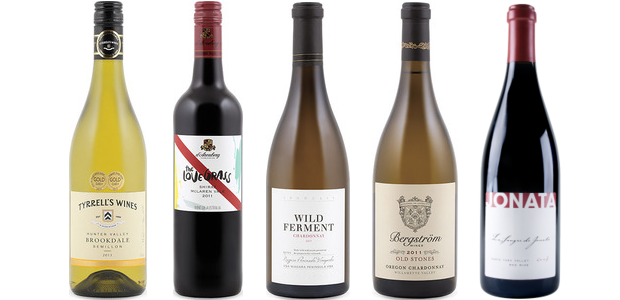
From left to right: Tyrrell’s Brookdale Sémillon 2013, D’arenberg The Love Grass Shiraz 2011, Hillebrand Showcase Series Wild Ferment Chardonnay 2011, Bergstrom Old Stones Chardonnay 2011 and Jonata La Sangre De Jonata Syrah 2008
Tyrrell’s Brookdale Sémillon 2013, Hunter Valley, New South Wales, Australia (269316, $24.95, WineAlign)
Hunter Valley Sémillon should never, ever be underestimated. The starved, crazed and raving mad personality is delirium incarnate. This Tyrrell’s ‘basic’ Brookdale is like orchard fruit on a focused and intense diet, thirsty from drought and hungry from deprivation. And it’s simply gorgeous. Wiry, angular and lean, it’s also careening and funky, actually, like a tincture made from dried roots, fruit skins and grasses, ground between two schisty stones. Like lemons left out in the sun to dry, pulverized and inculcated to a professor’s fine elemental powder. For now it knows “all I have is baking and going simple slowly.” Close your eyes and feel past the young tension, to where the body of the wine indicates expansion, to five years on where honey and sweet cold collation will lead this to a special place. Put aside the indifference engine and suck it up buttercup. This is exemplary Hunter Valley Sémillon for a pittance. Drink 2017-2025. Tasted May 2015 @TyrrellsWines@Wine_Australia@HunterValleyAUS
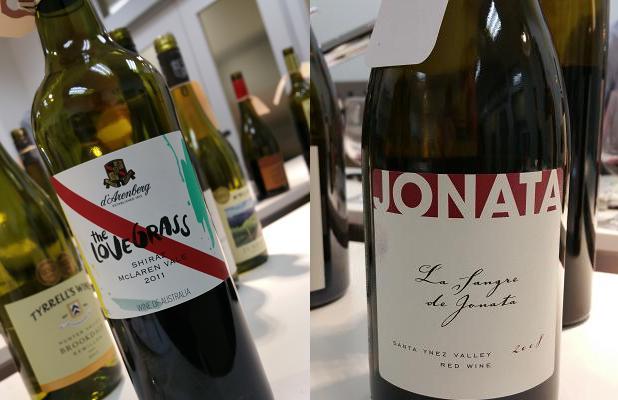
D’arenberg The Love Grass Shiraz 2011, Mclaren Vale, Australia (48785, $25.95, WineAlign)
This Love Grass is the kind of Shiraz with the right stimulants, high-toned but with a kind of resinous, dried fruit that hydrates with an intoxicating perfume. The vineyard’s weed infiltrates and adds savour, stimulating the senses with cool Mediterranean aromas mixed with the flavour of beautifully bitter chocolate. Sticky and able to attach itself across the taste buds, the wolf steps on every nerve, then attacks the teeth and the back palate. All the while you are left with a calm yet enervating feeling. Chester Osborn, “you know the dealer, the dealer is a man, with the love grass in his hand.” This D’arenberg is worth every penny of its $26, especially when the pusher is considered against many peers $20-$30 more costly. Drink 2016-2022. Tasted May 2015 @darenbergwine@mclaren_vale@imbibersreport
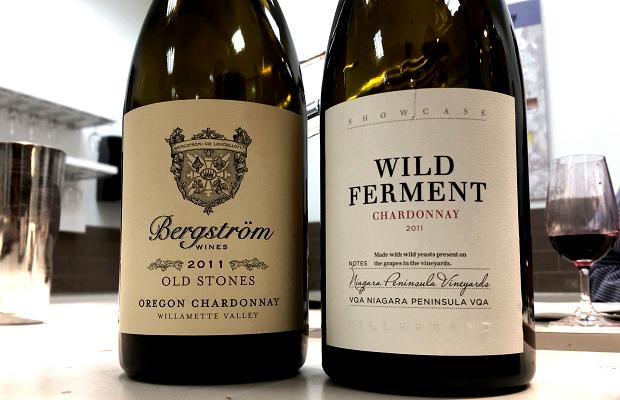
Hillebrand Showcase Series Wild Ferment Chardonnay 2011, VQA Lincoln Lakeshore, Niagara Peninsula, Ontario (199273, $36.20, WineAlign)
The ambiguity of site is of little consequence in this texturally striking Niagara Chardonnay. The bookend vintages of 2010 and 2012 list the Oliveira Vineyard on the label and not surprisingly display character akin to Norm Hardie’s Niagara Chardonnay. From Duarte Oliveira’s farm between Victoria and Ontario Street, Hardie calls it Beamsville Bench, Craig McDonald deems it Lincoln Lakeshore. Regardless, those wines of fruit with a “golden tan, ready to go” are undomesticated and wild. This Trius 2011 is different. The fruit’s source is unspecified and the bursting personality takes Peninsula Chardonnay architecture past and well right of the centre line. Rich, ripe and buttressed, from pivot to gyrate, with acidity circling the life affirming yeasts. Pear trees in spring bloom and ready to pick fruit in a dream of tenses, with personality like a Hengst Grand Cru Pinot Gris. The style and varietal take are highly unique, expertly configured, judged and primed to age. Speaks the treble language of the vintage, predicated on bold ideas looking forward towards a bright future. Ultimately it is yeast and vintage, non partisan to site, that elaborate the Wild Ferment 2011. Drink 2017-2023. Tasted May 2015 @TriusWines
Bergstrom Old Stones Chardonnay 2011 and Hillebrand Showcase Series Wild Ferment Chardonnay 2011
Bergstrom Old Stones Chardonnay 2011, Willamette Valley, Oregon (410753, $41.95, WineAlign)
Both estate and purchased fruit sources from several sites make up the Old Stones, a Willamette Chardonnay in which those stones can be imagined travelling a subterranean river, along with salt and volcanic bombs. Balance defined for Oregon, with soft and subtle fruit melded into stiff vintage-driven acidity. This is a not a heavyweight by any stretch, but rather an elegant, confident, demurred Chardonnay with lots of class. It has its popping moments, not quite eruptive but the activity can be sensed. It will evolve and slowly dissipate with time. Drink 2016-2021. Tasted May 2015 @Bergstromwines@HalpernWine@wvwines
D’arenberg The Love Grass Shiraz 2011 and Jonata La Sangre De Jonata Syrah 2008
Jonata La Sangre De Jonata Syrah 2008, Santa Ynez Valley, Santa Barbara County, California (220517, $150.00, WineAlign)
A tremendously ripe, rich and layered Syrah that has few equals or rivals in California so in that sense the price is benevolently justified. Winemaker Matt Dees is no flash in the pan. His wines are cerebrated and cogitated with no stone left unturned. They are showy, chiselled wrestlers, boxers and ultimate fighters but they are the real deal. This ’08 is a veritable protein potpourri, of wafts from the finest boucherie, all hung limbs and wrapped sheep’s cheeses, in caves, on counters and under glass. The expression is also very Côte Rôtie meets côte de bœuf rôtie, with added luxe perfume, chalk and lacy grain. The fruit boundaries are endless, the chew meaty, cured and smoky. Ultra Syrah of never wavering red fruit in a packed vessel with alcohol declared at a meagre 14.9 per cent. Even if it is really more like 15.5, the wealth of fruit, acidity, tannin and structure can handle the heat. With so much happening, this wine will age like the prized hind quarters and mother’s milk solids it smells of. Jonata La Sangre De Jonata Syrah 2008 says something and I’d love to hear what that is 15 years down the road. Drink 2018-2028. Tasted May 2015 @WoodmanWS@CalifWines_CA
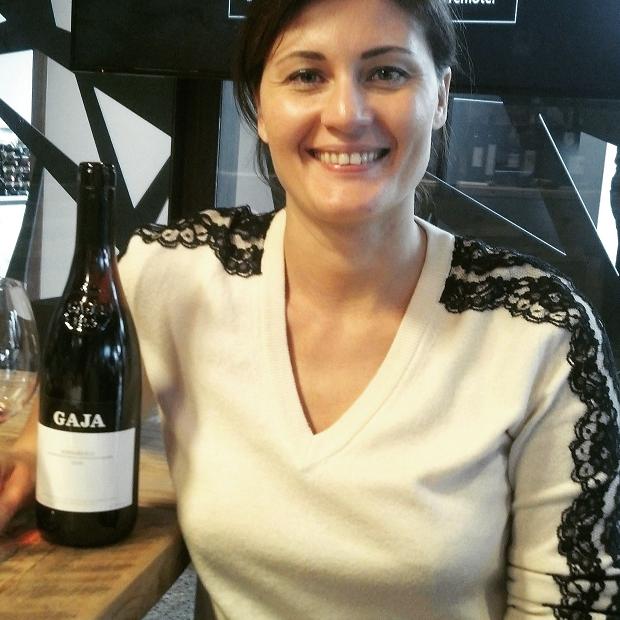
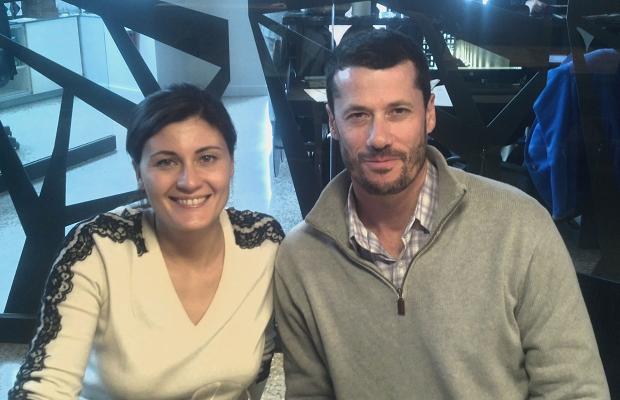
I had met Gaia Gaja twice before. The first time she was working the Gaja table at a tasting event swamped with what seemed like half the attendees in the room. Still she found a way to make a connection. The second time was with a small group at Bosk – Shangri-La Hotel
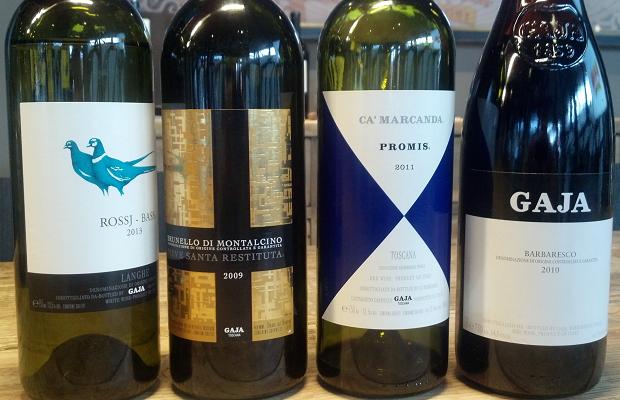
Gaja owns 250 acres of vineyards in Barbaresco and Barolo. In 1994 they acquired Pieve Santa Restituta in Montalcino, Tuscany and in 1996 they added Ca’Marcanda in Bolgheri, Tuscany on the coast. The significance of this acquisition lies in the Bordeaux varieties grown there; Merlot, Cabernet Sauvignon and especially Cabernet Franc. There will come a day, not so far away, when that Cabernet Franc will make some truly exceptional wine.
The Gaja brand, while nearly 155 years young, has recently climbed into a league of its own. To consider the wines, the estates and the aura that surrounds, you might think there was a marketing team of hundreds blanketing the earth. On the contrary. There is Gaia Gaja.
The wines made famous and expensive by Angelo Gaja define much of what the world knows and thinks about Italy and yet Gaia can talk about nothing but antiquity, historical culture, economy and social structure. She is proud of the UNESCO heritage designation for Barolo, Barbareso and Langhe. Her nostalgic, her family’s connectivity with place and her knowledge of vines is astounding. Gaia Gaja knows everything about Piemonte.
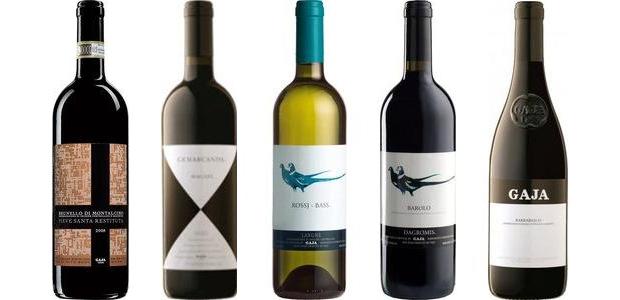
Gaja Line Up
To Gaja, it is not simply a matter of vines, it is about the land with vines growing upon it. For the wines, lees contact is essential. “Four fingers of lees,” Gaia holds up her hand, “like red mayonnaise, after half the time they become dry and bitter. They are protectors and emulsifiers of the wine.”
Gaia speaks of biodiversity in the vineyard. She is responsible for experimentation, like seaweed treatments, essences and extracts, from garlic and rosemary. She believes in using grasses to suppress disease and mildew. These are the practices of an estate that commands designer prices for their labels. This is not a contradiction, it is a way of life.
Gaia Gaja and Godello
The vineyard management is what protected Gaja from the most challenging of vintages in 2014. August temperatures of 17 degrees celsius and so much water wreaked havoc. Swelled but not diluted berries remained pure, with clarity and surprisingly good tannic structure, not to mention decent yields. “It’s all about vineyard management,” reminds Gaia Gaja.
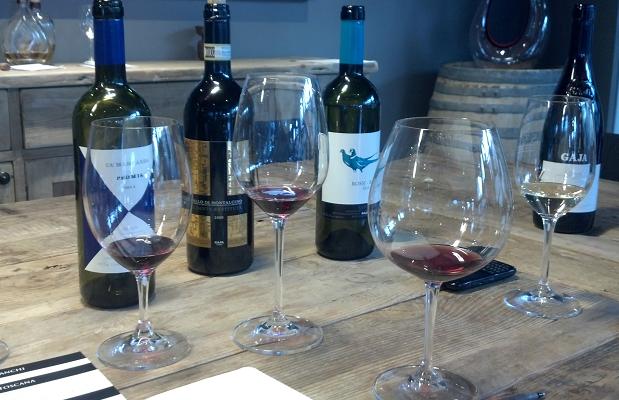
Thanks must be afforded Robert Tomé and Tony Macchione of Stem Wine Group for allowing me the one-on-one time with Gaia. It will always be one of those hours I’ll not want to give back. Here are the five wines we tasted together.
From left to right: Gaja Pieve Santa Restituta Brunello Di Montalcino 2009, Gaja Ca’marcanda Magari 2012, Gaja Rossj Bass 2013, Gaja Dagromis Barolo 2009 and Gaja Barbaresco 2010
Gaja Pieve Santa Restituta Brunello Di Montalcino 2009, Tuscany, Italy (Agent, $68.99, WineAlign)
Beginning with the 2005 vintage, the Gaja family changed direction with the production of this coalesced Brunello, made from fruit grown at Sugarille and Rennina (Santo Pietro, Castagno, and Pian dei Cerri) and Torrenieri, in the northeastern subzone of the appellation. This fifth meld in stylistic vicissitude is more relucent than the monochromatic coquette that was 2007. More than fruit, this has spice, liqueur and fennel. So much aniseed a biscotti might pour from the bottle. Smoothly textured with a middle grain fostered by more spice, out of wood and into a promising slow-simmered future. That liqueur just needs to become an aperitif. Give it five years to do so. Drink 2019-2025. Tasted October 2014
A blend of Merlot (50 per cent), Cabernet Sauvignon (25) and Cabernet Franc (25) with a bright future, a modest, diffident and anything but arrogant Bolgheri. Loam and clay-rich terre brune strike mineral, goudron and tar for a distinct Tuscan, not Bordeaux expression. Displays more earthy funk than the other Ca’marcandas (Promis and Camarcanda) and a chalkier, grainer texture. In the middle realm there is cool mint and eucalyptus, followed by more yucca grain, so in that sense this Bolgheri is tropical and exotic. Gaja encourages this wine to follow a vinous Piemontese dialect and yet speak of Maremma, all the while without conceit. In that it succeeds. Drink 2018-2024. Tasted October 2014
The Chardonnay (85 per cent) comes from the Rossj and Bass vineyards in Barbaresco and much of the Sauvignon Blanc (15 per cent) from Alteni di Brassica in Serralunga. The latter’s “little walls of yellow springtime flowers” are more than just a thought. Along with tall wind-blown grasses, the stone mineral and honey-florals are a major part of this neoteric and iconic to be white from Piedmont. Must say that Chardonnay is not the first thing that comes to mind. In terms of flesh, full-flavour and intensity of excavation, the Rossj Bass is like white Châteauneuf-du-Pape, at least in aura and attitude. This will have a long life. That much is sure. Drink 2016-2022. Tasted October 2014
Nearly 15 years after Angelo Gaja acquired two old (Serralunga next to Sperss and La Morra to Conteisa) Gromis family vineyards, the 2009 vintage takes the Nebbiolo to a new modernity. Rich, bright and so very vivid, no longer controlled by the iron-rich, Tortonian-era clay and marl. Don’t misunderstand, this is still a meaty, smoky red with massive tannins that will take years to assimilate, but the texture is more like kaolin meets terra cotta, rigid but malleable. Has a taste of fennel and a smack of sultry savour. Serious Dagromis, albeit with softer features and hands. Drink 2018-2024. Tasted October 2014
Typically sourced from 14 vineyards in and around the village of Barbaresco, the estate bottling may not be the kind of rare, single-confluence testimonies that are Sori San Lorenzo, Sori Tildin and Costa Russi but it is undoubtedly Gaja’s iconic rock. Made from 100 per cent Nebbiolo (others include a few points of Barbera), separate Barbaresco lots are aged for one year in barriques (approx. 20 per cent new, with a balance in one and two year old casks). The 14 lots are then blended and racked to large Slavonian oak casks ranging in age from five to fifteen years. The understated character, delicate perfume, kind acidity and red fruit floral flavours define the vintage. The previous year was not so kind, cooler and fuller in body. The bolstered acidity will elevate with more buoyancy than ’11 even and what makes Gaia Gaja smile is the thought that this ’10 “smells like Barbaresco in the spring.” The drifts are like stretching roots and tubers and shoots, in an ethereal way, unlike Barolo. At this juncture the wine is such a baby, contemplative, self-reflective. The Burgundy bottle with the Bordelaise neck houses a Gaja Barbaresco to stand the test of time with some of the estate’s greats; 1961, 1971, 1978, 1982, 1983, 1985, 1988, 1989, 1990, 1996, 1998 and 2005. It will be 2020 or later before the ’10 can be assessed in such terms. Drink 2020-2035. Tasted October 2014
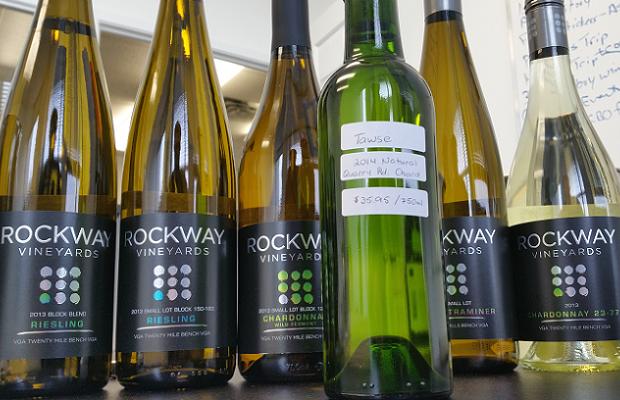
Last month, while working through a table of wines at WineAlign I tasted through five samples of Rockway Vineyards whites. All five were from the 2013 vintage. If it has not yet happened, these wines will usher the coming out party, to establish Rockway as a player in the new pantheon of Escarpment foothills whites.
The vines at Rockway Vineyards are located in the Twenty Mile Bench sub-appellation on the Niagara Peninsula. The winemaker is David Stasiuk, a veteran of heralded estates around the world, including Le Clos Jordanne, Australia’s Yarra Valley Moet Chandon and CedarCreek in the Okanagan. His wines are truly estate made; 99.9 per cent are grown, crafted and bottled at Rockway. I find the Riesling to fall into a niche straddled by Henry of Pelham and Flat Rock Cellars. Gewürztraminer is really in a class of its own, a trump card for Stasiuk and something I would encourage him to play with, into late harvest and beyond. Chardonnay is Twenty Mile Bench through and through, where place and barrel mark the twain and split the check. Here are the notes on the five tasted back in late March.
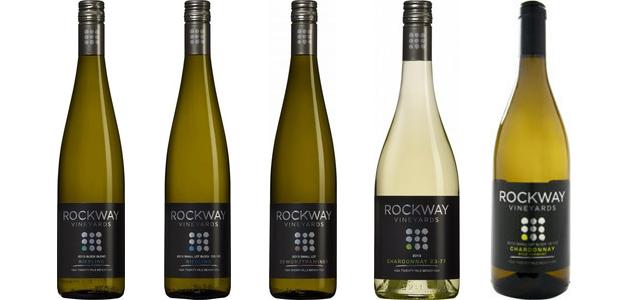
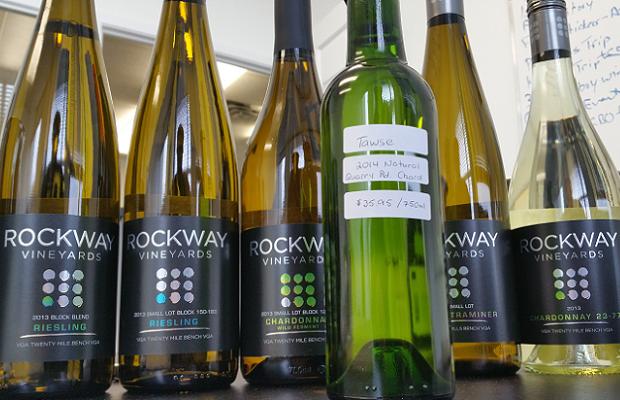
From left to right: Block Blend Riesling 2013, Small Lot Riesling Block 150 183 2013, Small Lot Gewürztraminer 2013, Chardonnay 23 77 2013 and Small Lot Block 12 110 Chardonnay Wild Ferment 2013
Middle of the road in the temple of Rockway and Riesling, making an offer to appreciate and enjoy just about every tenet there might be to gain. Lessened but generous (10.5 per cent) alcohol, one shy step this side of off-dry. Flint and petrol but just a hint and grape tannin combustion, though only shrouded by a single, thin veil of skin. Provides smithy entry into metal working, aerodynamic Peninsula Riesling. By combining blocks this sheds light on the generational varietal world of the Twenty Mile Bench. As a life story it “started with a little kiss, like this.” A very successful amalgamation rocks this way in copacetic strut and finishes well, with lime. Drink 2015-2018. Tasted March 2015
Rockway Vineyards Small Lot Riesling Block 150 183 2013, VQA Twenty Mile Bench, Ontario (Winery, $19.95, WineAlign)
The elemental surprises and flat-out rippling effect felt from this highly specialized geological, geographical and micro-climate trove stands to be taken with extreme notice. Savour and sous bois tonics provide for a deeper, richer and soil connected Riesling. The complexion and subtraction causes a cerebral dwell, investigation and a requiem for patience. This needs time to settle in, to shed the cumbersome and not entirely accessible volume. But there is simplicity in complexity, with acids lively, burgeoning and two-chord strumming. The overall canned or jarred feeling will open up once class lets out and this small parcel bottling will become a “rock, rock, rock, rock, rock ‘n’ roll” Riesling. It just wants to have fun and get some kicks so wait three years. A worthy if punkier follow-up to ’12. Drink 2018-2022. Tasted March 2015
Rockway Vineyards Small Lot Gewürztraminer 2013, VQA Short Hills Bench, Ontario (Winery, $15.95, WineAlign)
Just 299 cases were made of this unique Short Hills Bench Gewürztraminer, a warm and fuzzy (read: peach) example that draws balm and sunshine from the underexposed Niagara sub-appellation. Winemaker David Stasiuk’s Rockway Riesling fortitude translates across a lieu-dit exegesis to an end that suggests the grape variety may just be his secret weapon. The horizontal expressiveness is matched by varietal typicity, in lychee, rose-water and spring verdancy. Fine, unctuous stuff, easily consumed, with nary a bitter edge and good citrus, lactic zest on the more than laudable finish. Reminds a bit of South African Steen. Gewürztraminer to “rock away these days, rock away these nights… something to last…’til the morning light.” Drink 2015-2018. Tasted March 2015
For semantic intents and purposes this is really unbaked Chardonnay, built from (77 per cent) stainless steel and (23 per cent) neutral barrel ferments. Low in alcohol (12.7 per cent) and piqued in oak-less freshness, the light simply says go on the green. A slight screwcap compression causes early fizz, a locked in al fresco bite filled in by leesy, sweet and sour flavours and texture. Typically apple in origin, basic, old school Rockway fun. “Remember the songs used to make you rock away. Those were the days.” Classic Chardonnay jam. Beres Hammond style. Drink 2015-2016. Tasted March 2015
Rockway Vineyards Small Lot Block 12 110 Chardonnay Wild Ferment 2013, Twenty Mile Bench, Ontario (Winery, $19.95, WineAlign)
Here is another David Stasiuk composition that cements the idea of 2013 as being the turning point for Rockway to become a major player in Niagara whites. Just 215 cases were produced of this idiosyncratic block meets yeast Chardonnay. Such a cool climate sprinter whose wild ferment action hero activity seems to still be in mode, given the aromatic, speeding bullet locomotion. “Quick as a cat, in the jungle.” Quite chalky on that nose, like dust trails flung by fast-moving parts, in super limestone distillation, rocky, wedged into flint. No dummy texture, with patent tannic grip and grit, pebbles popping, crashing, testing. Sweetness is there but yet unreal. Chardonnay that can only be Twenty Mile Bench, in ways that bring Sébastien Jacquey’s LCJ Claystone Terrace and Jay Johnston’s Rusty Shed to mind. In ways that are conveyed by terroir, by barrel, not as an afterthought but in how it adds cream, not sawdust. It also adds weight, not sap. It builds texture, block by block. Drink 2016-2020. Tasted March 2015
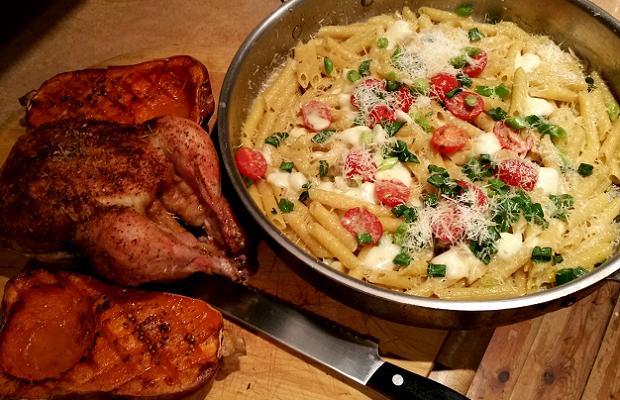
Slightly Barque dry-rubbed roast chicken, scored butternut squash with butter, agave and backyard coriander seed and penne with grape tomato, bocconcini, padano and scallion
Spring has finally sprung. The air and the psyche have found collective exosmosis, leaving the colder, thicker air of winter behind, to begin passage through the membrane into lower pressure. With the exhale and lighter sense of being comes the same in wine. We egress to ferments of lower concentration. In reds we will welcome Gamay, Pinot Noir, Zweigelt, Blaufränkisch and Cabernet Franc.
White wine has more potential in legerity and litheness of being. While Riesling, Pinot Gris and Pinot Blanc are most certainly apropos choices for spring, there are others, variations on the theme, not technically “white” per se, but fitting the bill nonetheless. Like Sparkling wine, and Sake.
Tastings of late have focused on the white stuff and there are many that have already left an indelible mark during this period of emergence, this recent transudation through conduit, out of too many months mired in ice and snow. The parameters of white wine blurred a bit, this group of twelve wines will do you no harm. In fact, any or all will help restore that healthy attitude so desperately needed in this time of rejuvenation. Spring.
From left to right: Château De La Bretesche Muscadet Sèvre Et Maine Sur Lie 2013, Emiliana Adobe Reserva Sauvignon Blanc 2014, La Joya Viognier Reserve 2014, Charles & Charles Chardonnay 2013, Hugel Gentil 2013 and Tokaj Kereskedoház Grand Selection Semi Dry Tokaji Furmint 2012
Château De La Bretesche Muscadet Sèvre Et Maine Sur Lie 2013, Ac Loire, France (412163, $12.95, WineAlign)
From the VINTAGES April 18, 2015 release
From the stable of Domaine de la Chauvinière, the Château De La Bretesche is a gneiss Melon de Bourgogne, crafted at the hands of Muscadet master Jérémie Huchet. Melon of lightness, finesse, ripe restraint, elasticity and breadth beyond the norm. Karpos of many herbs and briny berries. Capable of nurturing and buttressing intensity. Though the scent here is subtle, when it comes to Muscadet, the fresh sea and shell of Pholas dactyls is necessary. In conjunction with its length and a price of $13, in this section of the Loire, the littoral zone and the peak are reached. Drink 2015-2020. Tasted March 2015 @MyLoireValley@LoireValleyWine
It would be hard to imagine Sauvignon Blanc with wilder eyes, as much pop and nearly the zesty fortitude as the Emiliana Adobe. The clarity of organic/biodynamic health in vine and by extension fruit is on blinking display. Fresh and popping, the zest of ripe citrus circulates naturally, as acidity, in juicy squeezes and with nothing but tireless pep. This is an example of exemplary SB for Chile and one can only imagine the depths that might come from older vines and/or a wild yeast meets barrel ferment trial. Drink 2015-2016. Tasted April 2015 @VinosEmiliana
La Joya Viognier Reserve 2014, Colchagua Valley, Chile (168542, $15.95, WineAlign)
From the VINTAGES April 18, 2015 release
As impressive as this very New World take on Viognier was in 2013, the follow-up furthers the absorption. The accented matters of alcohol, residual, mineral, bright fruit and soil continue the train of thought with forward ’14 thinking. This is nothing but a feel good, “why don’t you touch me now” Viognier, a gem-filled musical box of herbs, blanched nuts, flowers and spices. It’s a round and melodic nursery rhyme that’s fun to sniff, taste and listen for its mysterious ministrations and magical charms. Drink 2015-2018. Tasted March 2015 @VBisquertt@DrinkChile@vonTeichman@vonterrabev
Charles & Charles Chardonnay 2013, Columbia Valley, Washington (394734, $15.95, WineAlign)
I would liken this Columbia Valley Chardonnay to the Fourth of July. It’s got tiny moving parts, all in motion, trying to put it all together. Cool orchard fruit, a minor kiss of barrel, a raft of lees, some sweet tropical flavours and round acidity. Needs some time. If it succeeds “it will be like fireworks blowing up in the air like a Fourth of July night sky.” For now it’s a reserved, quietly efficient and harmless Chardonnay. But it does show signs of building momentum. Drink 2016-2020. Tasted March 2015 @KVintners@Dandurandwines
Hugel Gentil 2013, Ac Alsace, France (367284, $15.95, WineAlign)
From the VINTAGES April 18, 2015 release
The five grape blend works confidently and vehemently strives with more love and sympathy than the austerely commandeered Riesling. Sylvaner and Pinot Blanc matter here, helping to negate the dominant aromatic push of the Gewürztraminer and Pinot Gris. Quite dry (3.9 g/L RS), with twitching (5.86 g/L) though steady acidity. This has ingratiating integration and unswerving tannic grain. A coherently textured Riquewihr conflation that is more than well-made. Drink 2015-2020. Tasted March 2015 @Hugelwine@HalpernWine@VinsAlsace
Hungary and more succinctly Hegyalja is on a terrific role of late. I would put many marbles into the probability basket and roll straight to the quality bank on the backs of so many Tokaji examples. This Furmint is not on the lighter, fresher side, but more so the seasoned and effluvious strand. “Regardless of the balance life has become” this Furmint is lush and conversely piercing, an acquired density, thick and profoundly cumbersome. Though it rallies and rails in many ways, “too heavy too light, too black or too white, too wrong or too right, today or tonight,” it’s also honeyed and a riot to drink. Would like to give this seven Mary three years to settle down. Drink 2017-2020. Tasted March 2015 @TokajCE@WineofHungary
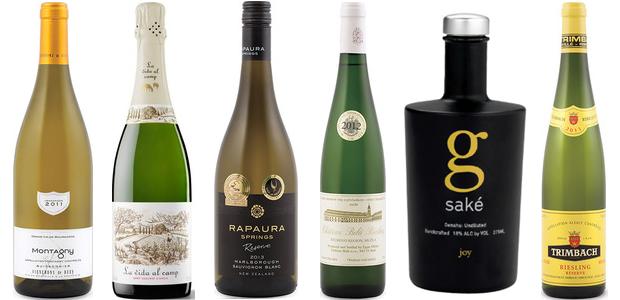
From left to right: Vignerons De Buxy Buissonnier Montagny 2011, La Vida Al Camp Cava Brut, Château Belá Riesling 2012, Rapaura Springs Reserve Sauvignon Blanc 2013, Momokawa G Joy Junmai Ginjo Genshu and Trimbach Réserve Riesling 2011
Vignerons De Buxy Buissonnier Montagny 2011, Ac Burgundy, France (382879, $19.95, WineAlign)
From the VINTAGES April 18, 2015 release
Another VINTAGES (2011) shipment of this great value in Côte Chalonnaise Chardonnay from the most southerly portion of the Côte d’Or is fortuitous because eight months has only helped to extricate the fruit from its Marly soil, variegated with White Burgundy-loving limestone shell. This is Montagny with intensity and in language of Burgundy’s essential tenets. Aromas scheme as white fruit punch and fruit that packs a punch. Might be thought of as heavy, syrupy even, in terms of Chardonnay, but the meeting of equal and opposing tannin terms balance. The clay-crusted pebbles in the marl have crawled inside the bottle. Suck on them long enough and they will reveal their inner stone. I dare you to spit them out. Drink 2015-2020. Tasted March 2015 @VinexxWine
La Vida Al Camp Cava Brut, Penedès, Spain (Agent, $19.95, WineAlign)
This blend of Macabeu, Xarel-Lo and Parellada is not only distinguished for Cava, it should be highly regarded in the pantheon of all Sparkling wine. Swelling with personality and urging in demonstrative energy that fizzes and suspends with fervent animation. The activity is one of quick reactions and accumulation. From sweet yeast in lees, from an on the line oxidative cold front and through the warmth of tropical spice. Cava like clouds combing stormy skies from equal and opposing directions and densities. Though marked by a leathery aromatic rind, it’s creamier and less lactic than outright citrus. These are fine bubbles, of twinkling titillations and striking flavours. Drink 2015-2018. Tasted March 2015 @lavidaalcamp@TheVine_RobGroh
Château Belá Riesling 2012, Muzla, Slovakia (410951, $19.95, WineAlign)
From the VINTAGES April 18, 2015 release
For something completely different and yet not, look to Slovakian Riesling at the hands of a German icon. Here from Muzla, a most elemental, atmospheric and petrol driven wine, out of Loess, with blessings beyond Riesling character. A bit reductive, funky and porcine like Baden Grauburgunder, frankly. Heads to an off-dry intersection on the palate, in Spätlese-like headiness. Returns to Trocken in angles of mineral tang and a late, ferocious bite down. Stays this way for nearly a minute. A challenging and compelling respite away from the Mosel. Drink 2016-2022. Tasted March 2015 @ChateauBela@WinesOfSlovakia
Rapaura Springs Reserve Sauvignon Blanc 2013, Marlborough, South Island, New Zealand (388421, $21.95, WineAlign)
From the VINTAGES April 18, 2015 release
Blame it on the midnight, the rain or the Wairau River, but the flow past a rocky aquifer and into the vineyard weaves through this Sauvignon Blanc to achieve an uncanny Marlborough balance. The accord is struck between high tones and mineral undertones. Between tropical lushness and direct citrus connectivity. Between herbal grounding and stratospheric elevation. Really flavourful and structured by texture. In a saturated world it is noted “everywhere is all around, comfort in the crowd,” through a sea of Sauvignon Blanc. Shame on the moon but the Rapaura Springs Reserve stands out for its gentle, meandering and crooning ways. It is highly recommended. It is possessive of an ability to braid, reticulate and evolve. Drink 2015-2020. Tasted March 2015 @Rapaurasprings@nzwine@VinexxWine
Momokawa G Joy Junmai Ginjo Genshu, Oregon (239426, $26.95, WineAlign)
From the VINTAGES April 18, 2015 release
Made from pure, Sacramento Valley Calrose rice polished to 60 per cent and undiluted. The short trek to Oregon is made for the G, a Saké with a foot in two worlds. The Koji-kin and yeast strains are from Japan and the water from Oregon. The American-Japanese arrangement will succeed in pleasing palates east and west. Sacramento soil is in here, enriching the rice with savoury tall grasses and expanding spice. Oregon water draws subterranean salinity and combined with the Japanese elements, comes out like toasted nori. This is lovely and floral, rich and finishes with a feeling of wet stones. Tasted March 2015 @SakeOne@MetroWineSake
Trimbach Réserve Riesling 2011, Ac Alsace, France (995316, $29.95, WineAlign)
From the VINTAGES April 18, 2015 release
Some old vines and a strict selection of grapes from Ribeauvillé and vicinity compose the Trimbach Réserve, another storied chapter of sharpness and focus. Builds upon the similar 2010 and with greater depth. At this price on the Riesling plain this will be a star for the vintage, even it it takes five more years to reach adjudication. With this portal to the finest fruit and handling in mind, it can only be imagined what the same vintage will convey from the terroirs of Geisberg and Osterberg for Cuvée Frédéric Émile. The standard Réserve is rich and propelled to compounding causatum. Aromas go through lemon glade and glaze, then turn the key to lime. The texture is a crackling bite of corral with salinity drawn from oceans far away. The stone cold austerity is a frozen moment of time, a long pause in which there is nothing to do but swallow and forget. Small price to pay for such a thing. Drink 2016-2022. Tasted March 2015 @trimbach@WoodmanWS@AlsaceWines
We get this sort of query all the time. “Why does Ontario wine cost so much?” Actually, it’s often more a complaint then a question. We get upset. Granted, many international wines are cheaper….but do you know why? My colleague and Man Friday Gerardo Diaz has this to say “Don’t complain. Do some research and come back.”
As many of you know, I play every day in the fortuitous role of Wine Director at Barque Smokehouse. As we speak I am in the throes of an auspicious new plan, setting the wine program with Diaz for Barque’s next venture. Coming soon. Two years ago, just after Brian Schmidt of Vineland Estates was able to initiate the keg wine revolution by overhauling VQA regulations, we convinced Jonas Newman of Hinterland Wine Company in Prince Edward County to partner with us. Wine on Tap at Barque was born. Since then we have worked with a dozen Ontario wineries.
It’s more than accessibility that drives our decision to work with and pour exclusively of Ontario wines. We had always been supporters of the local industry but the keg program allowed us to expand the portfolio and the sales. Ontario wines account for nearly 50 per cent of all wine sold at Barque.
So when guests (and I get the same questions and complaints from family and friends) wonder aloud about the necessity for Ontario to be so present, I have much to say. The Ontario wine industry is the best kept secret in the world. It has grown, accelerated and advanced with more success than might have been imagined as recently as five years ago. In November I wrote, “Ontario winemakers have figured it out. The “world-class” comparative humanities of aging and longevity aside, the comprehensive and widespread phenomenon of excellence, regardless of vintage, is now an Ontario reality.”
I also wrote this, quite some time ago. “That is producing unique, cutting edge and brilliant takes on cool climate grapes. They also match beautifully with the songs referenced in their tasting notes. When the wines are assessed and considered in part or as a whole, who would dare to say there are no great wines being produced?”
As a cool-climate viticultural entity, there are few rivals around the world. The geology and micro-climate are ideal for growing specifically chosen vinifera. The winemakers in Niagara, Prince Edward County and Lake Erie North Shore are highly educated, state-of-the-art savvy and maniacally progressive professionals. In the categories of Riesling, Chardonnay, Pinot Noir, Cabernet Franc, Gamay and Sparkling wine, Ontario crafts excellence at all price points. After the two brutal winters of 2014 and 2015, no other set of vintners could have succeeded with unfailing ability more than the women and men of Ontario’s industry.
Proof of Ontario’s acumen and price-worthiness need not be found any further away than at your local LCBO. Private VQA wine shops and independent retailers would only advance the cause. Spend a few hours at an Ontario gathering and you will be changed forever. Shawn’s Ontario Wine Chat discusses and promotes the ideal every Wednesday night. The Ontario Wine Society holds tastings and events year ’round. The Ontario Wine Awards asks many of those top scribes to sniff, taste, sip and pick the best of the best. Wine Country Ontario is out there all the time, spreading the gospel. This is one religion you need to get behind.
The Ontario wine tasting season is now in full swing. Taste Ontario just recently passed through Montreal and Ottawa. WineAlign is bringing Prince Edward County to Toronto on April 16th with County in the City. Somewhereness also arrives in Toronto on April 20th. In July the 5th annual Chardonnay i4C conference will descend upon Niagara. The best way to experience Ontario wine is to get out and visit. I can recommend plenty.
Why do I taste Ontario wine every day? I do it in the LCBO lab, in Ontario’s tasting rooms and cellars, at Barque, when I order wine in other restaurants and at home. I do not need convincing but I do have decades more learning to do. Here are the recent Ontario wines that have passed my desk and my lips. Five are coming to VINTAGES next week as part of the April 18th release. Others are available at the winery. Seek them out. You will then count yourself among the converted. I guarantee it.
Flat Rock Riesling 2014, 13th Street Merlot 2013, Burning Kiln Chardonnay Cureman’s Chard 2011, Fielding Cabernet/Syrah 2012, Flat Rock Chardonnay The Rusty Shed 2012, Closson Chase Chardonnay Closson Chase Vineyard 2013, Cave Spring Csv Riesling 2012, Norman Hardie Niagara Unfiltered Chardonnay 2013
Talk about bottled up compression. Twist the screwcap and thwop! The cap nearly popped like a Champagne cork. This baby has energy and drive. The vintage is compressed and pile-driven as nosed by the density opposed by reticulated 9.5 per cent alcohol. This has Mosel tattooed on its being, from neck to bottom. A dead ringer for fine Kabinett, the tropical fruit in apricot and dragon reaching back to join Ontario, in apple and pear. A good flinty stone and raging acidity combine forces to exaggerate a Riesling reticulum in what is not the missive’s greatest ever vintage. Will live five to seven easy and just go for soda. Go ahead and quaff the hell out of this one, from 2015-2020, from bottles one through twelve. Tasted March 2015 @Winemakersboots@UnfilteredEd@brightlighter1
13th Street Merlot 2013, VQA Creek Shores, Niagara Peninsula, Ontario (270504, $17.95, WineAlign) From the VINTAGES April 18th release
Yet another Niagara red that could only have been crafted at the hands of winemaker Jean-Pierre Colas, a wild and dubiously natural Creek Shores Merlot. In 2013 the vineyard funk reeks of an instinctive, undomesticated slur in seldom seen Merlot speak. The variety normally avoids, scatters and runs away to the hills, but not this time. The flow is a movement of dried, caked, saline silt and pine needle paint. There is woodsmoke too but the suffusive Creek Shores cespitose encompasses all and runs wild. A settling will happen, so then it’s really a matter of fruit, a thing which in ’13 is not observed as overtly generous. Drink 2017-2019. Tasted March 2015 @13thStreetWines
Burning Kiln Chardonnay Cureman’s Chard 2011, VQA Ontario (310243, $19.95, WineAlign) From the VINTAGES April 18th release
In this BK variant, Chardonnay is procured by fruit not put through any drying and so very fresh it remains. The barrel helps and yet also distracts but not in any unusual or detrimental way. Just another solid Chardonnay with nothing to set it apart from the sea. Drink 2015-2017. Tasted March 2015 @BurningKilnWine
Fielding Cabernet/Syrah 2012, VQA Niagara Peninsula, Ontario (258657, $24.95, WineAlign) From the VINTAGES April 18th release
I have always been skeptical of the Peninsula take on the OZ-styled blending of a Bordeaux and a Rhône but if there is one Niagara winemaker to trust, Richie Roberts gets the nod. High-toned, crikey warm and struth oozing. Still, the balance is struck by Mediterranean-like savoury aromatics (black olive and brine), along with beautifully integrated wood. The VA is less than minimal, the fruit rosy, plum-filled and strawberry flavoured. Either variety can play second or short and both can make the turn. Will have a long life. Drink 2016-2022. Tasted March 2015 @FieldingWinery@RichieWine
Flat Rock Chardonnay The Rusty Shed 2012, VQA Twenty Mile Bench, Ontario (Winery, $24.95, WineAlign)
Accumulated cognizance exudes from the laid back Shed, here as relaxed and user-friendly as it has ever been. If the texture is not vintage induced and made of low yield than I’ll sell my LP’s and switch outright to Songza and Neil’s PonoMusic. The herbs are basil and chervil sweet, the verbena and lemon balm redolent, the flavours beaming, bolstered by preserved lemon and candied ginger. The stuffing must be questioned, but not the elegance. This Chardonnay is porous, blessed, void of rust and of an interior with plenty of space in the shed. Let it fill.
From my earlier note of February 2014: “There will be 660 cases of this barrel cherry-picked, now iconic Bench Chardonnay. The warm vintage called for a combo-malo approach, part batch all in, part arrested development. Gravity influenced top down blending also work to seek a svelte elegance and this ’12 really straddles the humid line. Thinks to be ribald but remains chaste, only allowing a kiss from the barrel and a caress from the rocks beneath the soil. Accept immediate but know that deferred gratification is the hallmark of this bottling.
Last tasted March 2015
Closson Chase Chardonnay Closson Chase Vineyard 2013, VQA Prince Edward County, Ontario (Winery, $27.95, WineAlign)
This CCV Chardonnay is one of departed winemaker Deborah Paskus’ final acts at Closson Chase. It will forever be noted as a legacy-cementing, swan song of career excellence. Crafted by Paskus and bottled by the next one, current winemaker Keith Tyers, the 2013 CCV is simply a tour de force. No such combination of richness, tropicality and pure grape tannin has ever infiltrated this Chardonnay, from this vineyard. I’m not sure there is a comparison in Ontario, at this level of excellence and at this price. A wine of pure impression, with Montrachet-like structure and Folatières-like precision. Seemingly capacious, its facile legerity is hypnotizing, quantitatively escalating in assembly of aromas, flavours, through texture and finally to longevity. The wine spent 16 months in a mere (17.25 per cent new) oak. That it notes 12.5 per cent alcohol on the label is next to impossible. The substance is just too buttressed to be so tender and effete. Impeccable balance, refinement and mineral finish. This is Chardonnay to confuse the world’s fine white collectors, to wreak havoc at international tastings for five to 10 years. Only 712 cases are available and at $27.95, is down $2 in price from the 2012. Best ever, hands down. Drink 2017-2023. Tasted March 2015 @ClossonChase
Cave Spring Csv Riesling 2012, Cave Spring Vineyard, VQA Beamsville Bench, Niagara Peninsula, Ontario (566026, $29.95, WineAlign) From the VINTAGES April 18th release
In the pantheon of 2012 Bench-Ridge-Escarpment Riesling, the CSV is bound for glory. As expected it unfailingly draws innate wisdom from vines that understand their soil with deep intent. It can be said that every vintage rocks a Cave Spring Riesling but this one brings fruit out of a willingness to give and give. Winemaking connects with this vineyard and this specific Riesling, like mother and child. The depth of fruit lies under a shale of uncompromising, petrous funk and acidity. All tolled, this is a top CSV that begins on edge and then walks along, pointed towards a fruitful direction. It stays the furcate course, captivates and lingers, with no immediate end in sight. Drink 2017-2027. Tasted March 2015 @CaveSpring
Tasted from a sample, in bottle, not yet labeled. It’s one thing to make a natural wine in Ontario and a world away to do so with Chardonnay. The concept is simply off the charts with respect to fruit sourced out of arguably Tawse’s most important mineral site, the Quarry Road Vineyard. So, with that plot and winemaker Paul Pender’s inner vision, the progression to this point in Ontario winemaking is fascinating. “The law was never passed, but somehow all men feel they’re truly free at last. Have we really gone this far through space and time?” Pender must have shut his eyes tight, imagined the wonder and whiffed his ways through those barrels. Based on a taste through all the Quarry barrels with Pender in April 2014 (carrying 2013 fruit) I would think the Mercurey (Large barrel, CLL toast) would best suit the natural, oxidative bent of this Quarry. This plays the hallmark bass note in natural odour; funk, wondrous gentility, wood and rhythm and blues stone, as opposed to wood and rock. Something other, preposterous and gorgeous permeates the mess. Something melodic. The wine is perfectly in tact, piercing and exact. Direct, vibrant, positively wistful and wishful. Filled in by a strings mid-palate, with acidulated apple slices from a potent cocktail. The finish goes deeper, so the sum of the parts gains on the intricacies, teeing it up for much success. That said, don’t wait for it to fall apart. Drink 2015-2016. Tasted March 2015 @Tawse_Winery@Paul_Pender
Norman Hardie Chardonnay Niagara Unfiltered 2013, VQA Niagara Peninsula, Ontario (184432, $39.00, WineAlign) From the VINTAGES April 18th release
Hardie’s Niagara Chardonnay will not be recessed into the Peninsula’s everyday lexicon, nor does it draw any direct comparisons. How can this be? I will say that the 2013 exhibits less reduction, less elemental fever and a dramatic decrease in tension, so in that sense it has comes back to the norm. Yet it dances dramatically, like a blind bee in a ripe melon, in free spirited, holistic and counter-cultured ways. A wine of gold wiring, wrung out in splashes and swaths of lamé sheets. Shows a commitment to soil, full malolactic conditioning and punched down musts in its every breath. What is obvious is that 2013 is no putty in the hand. It’s moulded clay, shaped by the mitts of its maker, immortalized by the barrel’s oven and just about ready to begin being beautified by ornamentation. Time will effect its tribal markings and ultimate finish. Give it three to five so that it may add surge to its restrained power. Drink 2017-2022. Tasted March 2015 @normhardie
The idea that something veers away from or afield of the norm is almost always intriguing. Fascinations with antidisestablishmentarianism, marching to the beats of different drummers and walking lonely roads is as essential as breathing. For the curious, the hungry and the alive.
Though the concept is a sound one, it need not always be about searching for wisdom and enterprise off the beaten path. There are times when the abstruse may be lying directly underfoot. Wine is a commensurate animal, altricial such as it is, acaudal, acersous, agnostic, aculeate and allocryptic such as it is not. Wine that is not so much off the beaten path as actually growing on one.
Two of the six wines recommended here jive with the idea, a Sicilian varietal wine made from the local Nerollo Mascalese and a Venetian dessert beauty crafted from who knows which and exactly how many chthonic varieties. No wine-producing nation knows about the concept of varietal celebration and keeping a historical watch on the relationship between path and vine more than Italy. No other agglomeration crafts from indigenous or endemic varieties with as much diversity.
This summed it up. “Finally, I find the irony in the idea that for a winemaker or vine grower to step off the quotidian they need to plant, cultivate and make wine from grapes once considered the norm and the go to in their region. You can’t help but notice that modern winemakers with a wistful eye are casting reflexively into the past with a hunger for vinous resurrection. By grafting their pre-Phylloxera ancient vines onto healthy root-stock they have turned the varietal compass on its head. As they have moved through their days with an open-mind to the panoply of grape interactions, they have beget the endemic revival.”
You see, winemakers don’t always have to champion the obscure, the endangered and the forgotten. There are times when place and plot are good enough to create an aura of obscurity and adventure. The wines in this column’s conspiracy are in cahoots to drive the point.
A white Port; who drinks white Port? Sometimes you just need to walk along roads you never seem to take, take in the backstreets or sip along with something that’s always there but you just never bother. Port can be nondescript and it can also be like the Cálem Lágrima.
How about a Barossan, a Shiraz no less, but here because it is a wine from Neolithic soils, consumed and procreated on and upon itself. Then there is a South African white blend of such natural indeterminate plodding it has caused a break in critical ranks; is it sound or at fault to the point of no return? Last but certainly not musical least, a Napa Valley vintner with an infatuation for pairing wine to song. Sound familiar?
In anticipation of the first April list to hit Ontario shelves, Sara d’Amato and I have compiled what you need to know and why. Click on this link to WineAlign to see the full report.
Here are my six path straying wines from the VINTAGES April 4th release.
From left to right: Cálem Lágrima White Port, Dandelion Vineyards Lionheart Of The Barossa Shiraz 2012, Lammershoek Roulette Blanc 2011, Calcagno Feudo Di Mezzo Nerello Mascalese 2011, Monte Faustino Recioto Della Valpolicella Classico 2008 and World’s End If Six Was Nine Reserve Cabernet Sauvignon 2010
Cálem Lágrima White Port, Dop Douro, Portugal (912568, $15.95, WineAlign)
Viscous and semlessly crafted White Port. There is very frank aridity in nuts and peels on the nose, along with tempering agave and citrus. The positable tug between sweet, sour and salty harks to older times and the munificent wafts of the warm nut cart. The agave drips thick on the palate, the spiced nuts are expertly roasted. Cool mint and eucalyptus fill the middle and fine acidity comes ’round the back. Terrific value. Drink 2015-2020. Tasted March 2015 @PortoClem@WoodmanWS
Dandelion Vineyards Lionheart Of The Barossa Shiraz 2012, Barossa Valley, South Australia (167189, $19.95, WineAlign)
Tasted from the 750 mL, this old vine Barossa vineyard bottle is reminiscent of the wise and precocious 2009. Nothing can be taken for granted here, this Shiraz from ancient, gnarled vines, many over a hundred years of age. A wine from neolithic soils, consumed and procreated on and upon itself. This is brash and once opened, the aromas are “orbiting your living room.” Makes me think of fig jam on venison wurst and a sauce made from licorice, clementine and dates as big as sausage flies. Tart, tight, racy and religious. Has a fisting Reggae beat, like The Clash doing Tosh and Dub. It may not transmit the only Barossan pirate radio Shiraz but it may just be one of the better values. Drink 2016-2021. Tasted March 2015 @DandelionWines@Wine_Australia
Lammershoek Roulette Blanc 2011, Wo Swartland, South Africa (225458, $21.95, WineAlign)
Talk about the passion. Fruit and reduction. Fruit and oxidation. Contradictions and oxymorons. This reeks of upside down passion fruit, apricot, honey and almond cake. Dripping syrup, parrafin and citrus. Waxy, like Sémillon and that’s where the advance comes in. The Roulette Blanc is meant to flesh, not wane in texture. The question is “combien, combine, combien de temps” does it take for a wine such as this to travel from wild and fresh to used and confused? The 2011 exhibits all the signs of great, complex fruit and corresponding accents. It has it all going on but a current stale, R.E.M. sleepy state clouds its future. “Not everyone can carry the weight of the world.” A really interesting wine with a long, bitter and tangy finish. How much longer will it age? Long enough. Drink 2015-2020.Tasted March 2015 @Lammershoek@WOSACanada
Calcagno Feudo Di Mezzo Nerello Mascalese 2011, Igt Siciliy, Italy (408187, $34.95, WineAlign)
The Sicilian was treated to extended maceration under strict temperature control and the bleed is evident, modern, pitchy and black as a cloudless night. Then 12 months later “an improvement” is fashioned by the classic French oak “barriques” addition, followed by a minimum further four months in bottle. The result is a warm, alcohol elevated (14.5 per cent) state of the art Nerello Mascalese with a wonderful earthy grounding. Tenderly volcanic, the fruit comes from Passopisciaro between the Etna park and the Alcantara river park. Ancient lava flows leave an indelible mark on a wine without creases. Yet this is a direct, in your face expression that shares thoughts and feelings with deep clay and stray island sand. An extremely well-made wine even if it wanders away from the wonders of time. Drink 2017-2022. Tasted March 2015 @oenophilia1@VisitSicilyOP
Monte Faustino Recioto Della Valpolicella Classico 2008, Docg, Veneto, Italy (403857, 500ml, $45.95, WineAlign)
Once in a while there comes a Recioto in reserve of its own preciousness. A Recioto comfortable in its own skin, does not have to try too hard, posits only what it is safely made of. This elegant example whiffs dried fruit, strawberry, rhubarb and lovely aromatic, natural fruit tea. Licorice and fresh fennochio. A citrus poke. Good underscored, understated and under the radar personality. Great length. A real success. Drink 2018-2025. Tasted March 2015
World’s End Cabernet Sauvignon If Six Was Nine 2010, Napa Valley, California (396127, $72.95, WineAlign)
What if “six turned out to be nine?” What if 14.9 per cent alcohol was just 14.6 instead of what really must be 15.9? What if the song in your head was sung by the tender emotional voice of Todd Rungren instead of the fuzz in Jimi’s clouded world? This Cabernet Sauvignon is so much more Hendrix, a full-throttle, heavy-layered, all-in barrel and total extract package. The fruit is hulking and the tannin equally so. Look ahead eight to ten years then fire up the black top. Heave on some marbled elephantine chops and all will be fine in the centre of the dizzying universe. “Wave on, wave on. Fall mountains, just don’t fall on me.” Maybe listen to a verse or two of Todd as well. “Hello, it’s me.” Drink 2020-2027. Tasted March 2015 @ProfileWineGrp@NapaVintners
Henry of Pelham Estate 2013 amid a sea of April 4th, 2015 VINTAGES Chardonnay
You can find them from coast to coast. This coming Saturday six VINTAGES Canadian releases, four from Ontario and two from British Columbia, are wines that speak on behalf of exceptional vineyards, out of important places. These are bottles made by winemakers entrenched in their territory and from grape varieties purposed to grow there.
The Creekside Estates white blend known as Laura’s White has become a poster child for varietal blends on the Niagara Peninsula. Winemaker Rob Power has found a way to make a consistent expression in every vintage.
Shiny Apple Cider by Small Talk Vineyards
Angela Kasimos was the winemaker at Riverview Cellars and is now leading the charge at Small Talk Vineyards. The Small Talk Syrah is yet another example to speak on behalf of pushing for more plantings, especially down by the Niagara Lakeshore. But that’s not all. Kasimos is also making Cider at Small Talk. It’s called Shiny Apple Cider, made from Grey County apples and Niagara grapes. You heard me. The White Cider is augmented by 10 per cent Riesling, the Rosé with 15 per cent Pinot Noir. You should try it on tap at Barque Smokehouse.
The Cuvée Black Ball Riesling by François Morissette failed on several occasions to pass through the VQA panel’s strict discretion. The atypical one has finally broken down the barrier and it’s now your turn to decide if it pleases or causes consternation. My chance to opine is laid clear in the review below.
From B.C., Gehringer Brothers out of Oliver offers a unique, Golden Mile take on Pinot Gris. More than just coincidence to be here today as yesterday marked a new direction for British Columbia‘s wine industry. The #GoldenMileBench just became the province’s first sub-appellation.
Sandra Oldfield of Tinhorn Creek called the day momentous. She wrote this on her blog. “Something as elemental as the brown given to vineyard stones by a passing universe. In casual simplicity, I toast to you, the Golden Mile Bench, British Columbia’s first sub appellation.”
The five recognized wine regions in British Columbia are The Okanagan Valley, Similkameen Valley, Fraser Valley, Vancouver Island and the Gulf Islands. The new designation was announced by the provincial government on March 30 and will legally identify where grapes are grown. In this case, the escarpment southwest of Oliver which runs south from Fairview Road and near Highway 97.
So long as 95 per cent of the grapes were grown in the area, wineries will now legally be allowed to indicate the Golden Mile on their labels. The list includes CC Jentsche Cellars, Checkmate Artisanal Winery, Culmina Family Estate Winery, Fairview Cellars, Gehringer Brothers Estate Winery, Hester Creek Estate Winery, Inniskillin Okanagan Vineyards, Golden Mile Cellars, Rustico Farm and Cellars, Tinhorn Creek Vineyards, and Willow Hill Vineyards.
In Jauary I wrote about Burrowing Owl Winery. I talked about the extreme nature of their location and what is does for their wines. “That the winery is situated on the most northern outpost of the Sonoran desert, an arid and agriculturally inhospitable stretch of terroir that originates in Mexico, is not exactly so well-known. That the Owl can produce such wines of extraction spinning on a compass of intensity is one of the wonders of the Okanagan Valley.”
Here are notes on six new local releases coming to stores this Saturday.
From left to right: Creekside Estates Laura’s White 2013, Gehringer Brothers Private Reserve Pinot Gris 2013, Henry Of Pelham Estate Chardonnay 2013, Small Talk Vineyards Recap Syrah 2012, Pearl Morissette Cuvée Black Ball Riesling 2013 and Burrowing Owl Syrah 2011
When I tasted the 2012 Laura’s White again with winemaker Rob Power two weeks ago my last note said “this has the grab, tempered by the warmth of the vintage, so look for ’13 to nail it with a hook.” That it does, along with the most balm and herbs of the last five vintages. This blues traveller goes deeper into complexion and white varietal compilation. The fruit is very tropical in 2013, softer, easier, lighter in complexity, but it has that musical trigger, the jingle, the popper, the hook. If ’12 was the revivalist blend, then ’13 will try to be the proselytizer. “Because the hook brings you back, ain’t tellin’ you no lie. The hook brings you back, on that you can rely.” Everyone can drink this. While it may not stand up a decade or longer later, you will be able to look back on it fondly and remember it was a wine for the times. Drink 2015-2020. Tasted March 2015 @CreeksideWine
Gehringer Brothers Private Reserve Pinot Gris 2013, BC VQA Okanagan Valley, British Columbia (347203, $18.95, WineAlign)
A concrete set of aridity rules are the modus operandi here in a reserved, stoic and aerified sort of Okanagan Pinot Gris. Paler and thus less oxidative then the last vintage to pass through these parts. Very much cut into pear, less so of white peach. The grape tannin is noticeable, even obdurate. Generous alcohol contributes to the mulish attitude though with the aridity and slight citrus push you’d be hard-pressed to really notice the call. Tasted March 2015 @GB_Wines@UncorktheSun
Henry Of Pelham Estate Chardonnay 2013, VQA Short Hills Bench, Ontario (268342, $19.95, WineAlign)
Sunlight is the key to this ripe Chardonnay, snatched from vines that grow on the most easterly of the Niagara Escarpment’s sub-appellation. Here Henry of Pelham calmly puts its hegemony over Short Hills Bench Chardonnay on display. The fruit layering is very impressive, compressed even, with just a spiced spirit injection from the barrel. The Estate Chardonnay is in a mid-range class of its own, this gatherer of heat days, hoarder in spring water retention, cleanser in sand and gravel drainage. The vintage just seems perfect for this niche bottling, balanced, primed to finespun texture, stretched for length and good to age at least five years. Last tasted March 2015 @HenryofPelham@SpeckBros
Small Talk Vineyards
Small Talk Vineyards Recap Syrah 2012, VQA Niagara On The Lake, Ontario (415612, $24.95, WineAlign)
In the hands of new winemaker Angela Kasimos, Small Talk Vineyards should consider going with and increasing their plantings of Syrah. It’s clear that Kasimos has inherited good solid fruit and the Small Talk (formerly Stonechurch Wines) treatment in ’12 is a very good start towards what should become a great varietal relationship. Smokey, savoury and full of positive brine vibrations, this has body but no overripe or caramelizing denouement. Nor is it green, though it exhibits tonalities that whisper volatility and chews that say sinew. Yet it persists healthy and clean. This is Syrah of lovely curves, rounded shapes, bright peaks and gently sloping valleys. Who doesn’t like Syrah young and infectious like this? Tasted March 2015 @SmallTalkWines@AngelaKasimos
Pearl Morissette Cuvée Black Ball Riesling 2013, VQA Twenty Mile Bench, Ontario (416073, $32.20, WineAlign)
Let’s get something immediately out of the way. The wines of François Morissette are not meant to please curmudgeons, skeptics, contrarians or members of the wine media. This Riesling has no desire to kiss ass. This will not appeal to late harvest lovers, from Kabinett to Auslese. Is it ripe? Not quite. Is it different? Absolutely. This compares to almost nothing. Like a Champagne ginger, lime and bronze filings cocktail, the Blackball ’13 is so very developed and despite the colour, is a hyperbole in primary existentialism. That it has essentially no residual sugar and an achieved 11.5 per cent alcohol is a complication only the clinical doyenne has the answers to. Riesling in between dreams, “never knowing shocking but we’re nothing.” The Blackball has struck, is not yet stricken and will offer remore pleasure for another six months. Then it will deconstruct, dissolve and devolve into darkness and funk. Five years later it may emerge like a phoenix, jack up like a Rangen Riesling, into the ethereal. Will it happen. I couldn’t possibly tell you. We may never know. But I can say that then, and only then, will it truly tell its story. Drink 2020-2025.Tasted March 2015 @PearlMorissette
Burrowing Owl Syrah 2011, BC VQA Okanagan Valley, British Columbia (73072, $39.95, WineAlign)
Just when it seems that Burrowing Owl could not coax beyond the perceived maximum in ripeness and richesse out of desert sage country Syrah, the envelope pushes higher in this ripping 2011. An absolute circum whirl of dark fruit, crushed peppercorns, Cassis and candied violets draw syrupy into bottle. Big, brawny and modern, styled like Syrah from peak perches overlooking the French Riviera with a small percentage of mitigating northern Rhône sensibility. Texture is pure silk. Acids are tame but very present. Tasted March 2015 @BurrowingOwlBC@winebcdotcom@LeSommelierWine
Three vintages and producers of Brunello di Montalcino
Though it may sound absurd, it’s true. There are some who hate wine. It may seem impossible to imagine, but not everyone cares for the stuff, in fact, they say they hate it. Pretty harsh, no?
They have their reasons. Either it’s pretentious, it pales in comparison to beer, causes headaches or simply tastes like shit. The haters also hate wine drinkers and they really can’t stand people who blabber on about what they smell and taste, especially wine writers. The vile, worthless, waste of the air they breathe kind of human. The virus with shoes.
They are out there but they are not the real problem. The bigger issue is the wine geek who hates certain wines. The wine aficionado who picks on specific bottles, bullies them to the point of hatred. Slags them beyond reproach. Rants to the world about the injustice of their existence.
I will tell you why I have to say what I have to say. When I entered the LCBO tasting lab last Friday I saw three bottles sitting on the sterile counter, three Pinot Noir that made hairs all over my body stand up in horrified attention. Three Chuck Wagner Pinots. Les Belle Glos. So I tweeted this.
Three Belle Glos Pinot Noir in the lab to taste. Shoot me now.
That was a mistake and I apologize for having written that. My message is this. You may find flaws in wine. You may suss out mistakes in the way a wine is made, sniff out bacteria or mould. You may point out imbalance and general impropriety. But you should not hate.
After all, wine is made from grapes and has fermented into itself. No matter the manipulations, the heavy-handed preparations and the dismissal of varietal or territorial propriety, at the end of the day it is just a bottle of wine. It is still a card-carrying member of the heritage, the extraction and the house. The fact is that when you hate one wine, you hate all wine. Do you see, the instant that you hate a wine, then you hate the world of wine.
There is more. Every wine has a connection to the land it came from. Soft mutinies in the senescence of nature all contribute to the scarring of a wine, of an indelible truth that indicts the world it harmonizes in, like a tract of a forest long ago scorched by a fire. A vineyard shares a history, which each vine remembers, even after it has failed to survive, even after others have not survived, or have been felled or re-planted. All wine has a background, regardless of what it may have suffered during growth and fermentation.
And so, please try to be nice. Not every bottle will thrill and most will even disappoint. But do not hate. These seven examples, coming to a VINTAGES kiosk on April 4th do nothing less than restore the faith. They are all classic returns, of familiar and favourite varieties. They are wines to love.
From left to right: Muriel Reserva Vendimia Seleccionada 2008, Robert Mondavi Fumé Blanc 2013, Isole E Olena Chianti Classico 2011, Domaine Long Depaquit Chablis 1er Cru Les Vaillons 2012, Hess Allomi Vineyard Cabernet Sauvignon 2012, Fuligni Brunello Di Montalcino 2008 and Vitanza Riserva Brunello Di Montalcino 2007
Carries with it the efforts and old barrel trials of generations in its classic aromas. Cedar, dried plum, bitumen, dried anise, wood soaking in natural sugar syrup. Really seamless, flourless and austere in a running wild kind of way. Possessive of length and deserving of that oddest of wine descriptions; supple. This will age for 10-12 years with ease. A great wine for the money, right up there with the Montecillo 1991, but cleaner, juicier and with more sex appeal. A red-head, a ginger, Rita Hayworth, Julianne Moore, Emma Stone. Tasted March 2015 @bodegasmuriel@RiojaWine
Robert Mondavi Fumé Blanc 2013, Napa Valley, California (221887, $22.95, WineAlign)
The Mondavi course of intention stays on track once again in 2013 though the vintage for Sauvignon Blanc seems at its warmest and ripest in quite some time. This walks a highline of aromatics yet refrains from tragically creamy barrel notes or excessively hop toast. Fruit is the driver, “rushing by the machine revving tension.” That drupe is part fresh and part dried, whiffing citrus and potpourri. Zest is buzzing but not overbearing. Were I locked in the trunk of a car, this bottle of Fumé Blanc would keep good company. Drink 2015-2020.Tasted March 2015 @RobertMondavi@CBrandsCareers
The hue and distinguished generational character pay hommage and unconditional loyalties to the noble Sangiovese. Chianti Classico in which patience is a commendable virtue and extreme necessity. The wood and tonic inflate the near nose in screaming interface but five minutes works to soften the early edginess. Now the perfume is intoxicating, so typically IEO, from a beautiful parcel of Chanti Classico out of a very giving vintage. An alluring wine that draws you in with a flirtatious smile of depth and meaning, seamless in personality, never too rich, affected or grandiose. There is no resin and no slice of cake decadence. Though it retains some old-school properties, this CC keeps right in stride with the winemaking times. Drink 2018-2025. Tasted March 2015 @chianticlassico@HalpernWine
Domaine Long Depaquit Chablis 1er Cru Les Vaillons 2012, Burgundy, France (19364, $31.95, WineAlign)
Bring on the 2012 Chablis. Here, an early, exciting and intense look. Has a combination of spot on salinity and limestone flint from the central Vaillons Cru. Given time this eventually turns to honey, indicating great early promise. This Bichot Estate Chardonnay is ripe and extroverted. Though it won’t be the longest lived, the back-end stony merrymaking and overall exuberance is a great show. If ’12 Chablis is always this much fun, I’ll be buying front row seats. Tasted 2017-2022. Tasted March 2015 @Bichotwine@BIVBChablis@DionysusWines
Hess Allomi Vineyard Cabernet Sauvignon 2012, Napa Valley, California (906420, $39.95, WineAlign)
Here scrambles forth a high-toned yet exuberant Hess. Dark fruit, old growth bark, fresh tar in summer and natural charcoal on the BBQ. These are the perceptions on a cimmerian, Patwin-coined, single-vineyard red wine from the eastern base of Howell Mountain. This micro-climate (relative to really cold places) experieneces freezing cold winters and later bud break than most of Napa. That difference comes across in the tension of this wine, the dichotomy of hot and cold and manifests by tongue-coating tannin-crusted fruit. Tannin that may take 10 years to integrate. Good concentration of fruit, acidity and that fierce tannin menas lots of energy and stereotypically speaking, even more structure. Drink 2020-2025. Tasted March 2015 @HessCollection@liffordwine
Though the bark and bite of the vintage will try to test even the purest fruit, this Fuligni is immune, the Brunello to absorb difficulty and energe unscathed. Earth. forest, clean mushroom, plum, carob and fresh cherry band together as an admirable aromatic lot. Though the vintage worked against many Montalcino producers, those who picked, vinified and allowed the fruit to do its thing, to be its own talking head, to express itself, made good wine. Enter the house of Eredi Fuligni. This ’08 is like Heaven, talking heady, saying nothing at all. The tune is clear as a whistling from the depths of a canyon. The spice is fragrant, never biting. The oak is like an old favourite song. The Brunello “in Heaven plays my favorite song. They play it once again, they play it all night long.” Drink 2020-2030. Tasted March 2015 @ConsBrunello@HalpernWine
Here sidlles up to the counter a huge, come home and lay with me now Brunello. Displays all the flirtaious and flamboyant hallmarks of the get me vintage. Gorgeous, juicy red fruit. This wine will make you want to head straight for the bar, load up and go home with wrong woman or man. A full on seducer, asking you, are you ready for love? It’s not so much that this Grosso is bad company, it’s just that it’s so bloody dangerous. It has layered fruit, earth and lace. It has the structure to age. The issue is how could you resist it now? “I’m ready for love. Oh for your love.” Drink 2015-2025. Tasted March 2015 @TenutaV@ConsBrunello