Twenty-two Canadian wines that rocked in 2022

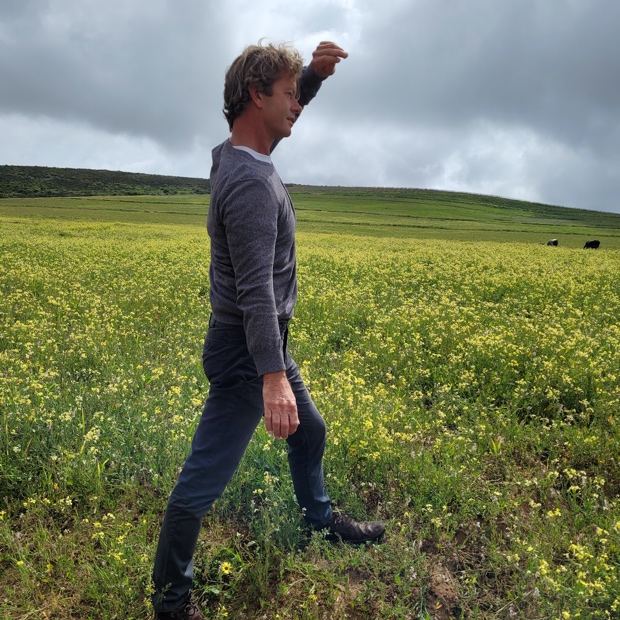
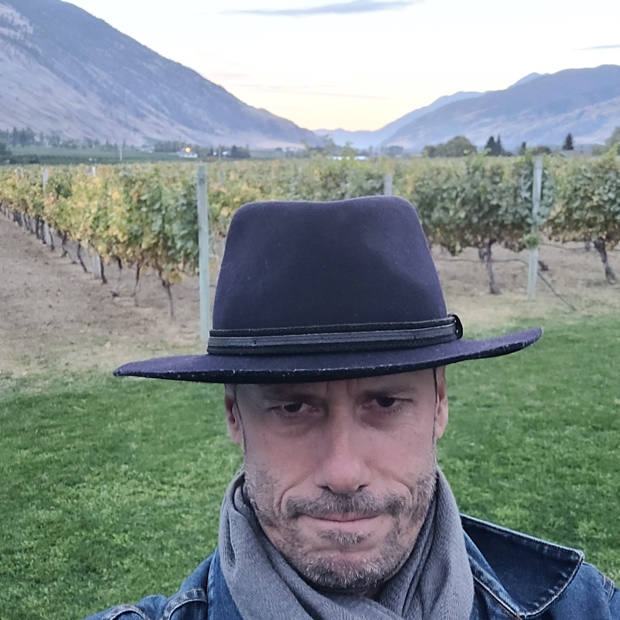
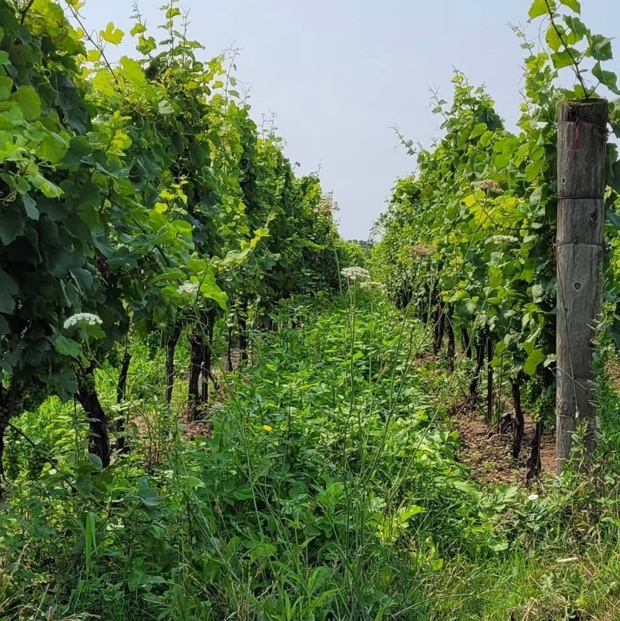
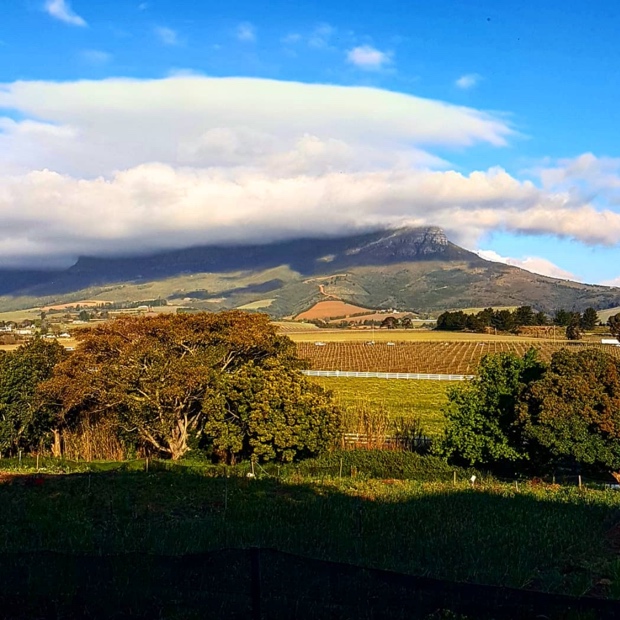
Godello taking in the spirit of Grimsby Hillside Vineyard

I am a forager. I forage in the natural world, for plants in their season, pulled from the soil, from earth to pan, for medicinal teas, to preserve by drying or pickling, whatever the most appropriate case may be. Wild herbs, allium and beneficial greens are prized but mostly I use my mycological senses by looking for signs beneath my feet as to where the mycelium below will choose to fruit as fungi above. I look for the saprobic and the decomposer but also the mushroom that works through symbiosis, to aid and abet other species while receiving something beneficial in return.

Laetiporus Sulphureus, aka Chicken of the Woods

I am a forager of wines as well, perhaps not in the same spiritual or personal way, but as I do with the forest I try my best to listen and become one with the vine, to imagine what it will beget, that being quality grapes and eventually honest wine. Vinifera success in Canadian vineyards is a recent phenomenon and there are plants more suited and native to our land but we should and will continue to pursue both realities.  This is not a manifesto about natural wine, no far from it, but it is a confession. I love great wine, well made wine, wine in balance. I am open to all wines and like the fungi I choose to eat or to ignore, I can’t be sickened by something I choose not to taste. I taste what I trust and drink what I must. Most often it take years of research and seeing the same fruiting body appear in the same location with consistent markings to make the decision to eat that mushroom. That is why wines of history, pedigree and consistency are the greatest and most exciting. They have earned the recognition. Others gain reputation much quicker and they too deserve the kudos but the choice comes down to the individual. I just want the wines I choose to rock. Canadian wines, yeah they rock.

Hypomyces Lactifluorum, the Lobster Mushroom

Nova Scotia wines at Obladee Wine Bar in Halifax

Related – Twenty-one Canadian wines that rocked in 2021

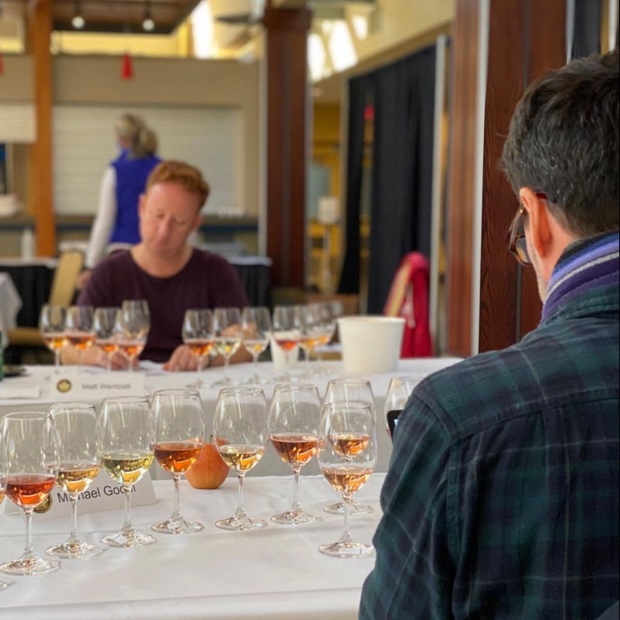
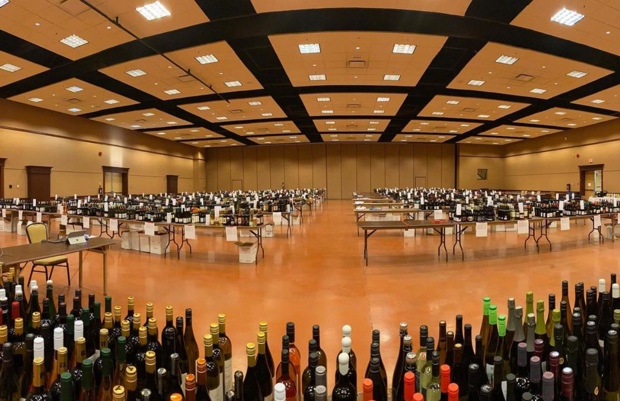
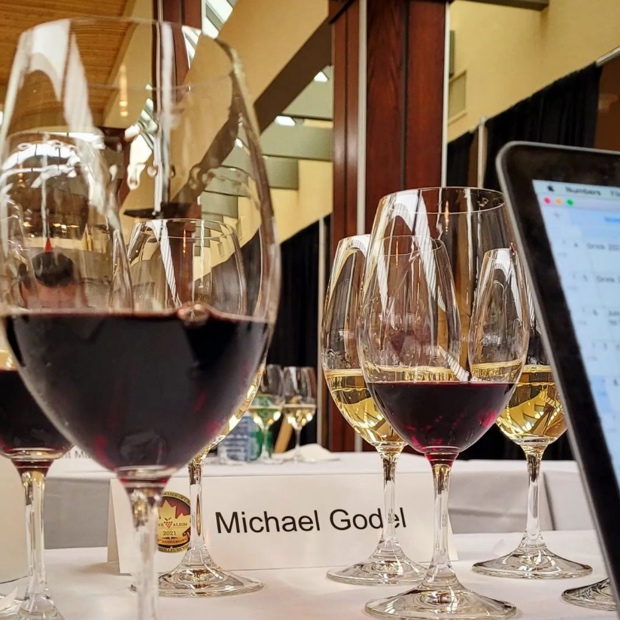
The full scale return to not only tasting but rallying around Canadian wine began in earnest back in June of 2022. In a span of less than 30 days there were judges’ panel assessments and events during the WineAlign National Wine Awards of Canada, To July and 10 days spent in Nova Scotia wine country followed by a glorious weekend in Niagara for the i4c Canadian Cool Climate Celebration. Get back to Cool Chardonnay was the impetus and the reminder how much we Canadian wine folk respect one another and truly enjoy each other’s company. How great was it to interact once again, to taste with and experience the verities of vignerons and winemakers? To gather Insights, illuminations and incidentals from illustrious voices. To enter discourse with thought provocateurs who question sense of place, who consider vines and their relationship with the land. To reconnect with old friends forging new directions, seek flights of fancy and return to places always familiar, like coming home. The road ahead may still be uncertain but onward we will go.

Godello and Pender

Related – Twenty Canadian wines that rocked in 2020

Devastating news and especially the loss of a friend takes time to process. At the time I did not know what to do but suddenly the words poured forth, in one take and so in February I penned The Walrus is Paul. I miss Paul Pender. He was not my closest bud nor was I his but there will always be a hole in our lives without him. The thing about sadness is that it never goes away, but the trick is to remember the people we loved in a way that helps us through another day. “Paul Pender humanized everything in his life and all that he touched. He never expressed any dismay at comments I may have made about wines not being perfect, nor did he exalt in high scores or praise for wines about which I may have gushed or waxed rhapsodic. He was always zen, even-keeled, grounded and humble. Paul was the personification of gravitational constant, THE universal gravitational constant, a constant of gravitation. His presence and being related force to mass and distance, and he lived his life within the law of gravitation. I hope he taught everyone to be this way and that we can all go forward with his wise, sage and calm demeanour, safely tucked into our own lives. Thank you Paul. I love you, man. You are the walrus.”

Seafood by Godello, Kejimkujik National Park, Nova Scotia

Related – Nineteen Canadian wines that rocked in 2019

This might just be the 10th annual list and another spot is in fact added each year but the process just keeps getting tougher to complete. According to WineAlign I reviewed more than 3,000 wines in 2022, which means I tasted at least 3,500, if not more. The number of Canadian wines is likely one third, say 1,500 examples tasted this past year, in great part because at least one-third of that number is tasted at the Nationals. The process of nailing down this summary comes out of a shortlist of 100-plus that were what would be considered exciting. The exercise must be one that filters, fines and refines again and again so that every wine is reviewed and re-considered on repeat. I find it near impossible to make final decisions these days and yet somehow feel compelled to continue the discipline.  Thank you to all; associates, colleagues, wine professionals and especially friends who poured, for every sip and taste, with heartfelt thanks. Especially to the WineAlign Crü; David Lawrason, John Szabo M.S., Sara d’Amato, Steve Thurlow, Megha Jandhyala, Bryan McCaw, Sarah Goddard, Miho Yamamoto, Carol-Ann Jessiman and Heather Riley. Godello gives you 22 Canadian wines that rocked in 2022.

With The Thinker, Jean-Benoit Déslauriers, Benjamin Bridge Vineyards

Benjamin Bridge Glooscap First Nation X Rosé 2021, Nova Scotia

Benjamin Bridge Glooscap First Nation X Rosé is first a wine. A lithe, 10 percent alcohol and bone-dry vision in pale pink hue, described by thinker Jean-Benoit Déslauriers as blessed “with a softness from within.” My family and I taste along and become privy to why this project means so much more. The Rosé marks a turning point for Benjamin Bridge and is crafted neither for reconciliation nor to undue the past. Instead the path leads forward, for mutualism, cooperation and respect. A harbinger towards a more balanced future. Meaning is gleaned for the team after a decade-plus of grape growing now widened to include 13,000 years of sustainable and synergetic preservation of an ecosystem. Twenty years ago the BB understanding was of vineyards producing grapes exclusively focused on the sensory profile of wines, how they reflected the terroir and stacked up against Europe. Yet the Mi’kmaq have lived in balance within this unique ecosystem for millennium and the goal is to return to this symbiosis. It may take another 13,000 years and while subsequent generations will not be obligated to complete the work, neither are they free to desist from it. This Rosé establishes a “Ni’tap,” a relationship as ally-ship and friendship between Benjamin Bridge’s McConnell-Gordon family and Glooscap First Nation; Elder Lorraine Whitman, President of the Native Women’s Association of Canada and Advocate for the rights of Indigenous women, girls & gender-diverse people; her daughter Zabrina Whitman and Chief Sidney Peters. Glooscap First Nation X Rosé is a direct product of climate change with no need to soften the sear of acidity by backsliding into residual sugar. Do not forget the effect created by the air pump that is the Bay of Fundy that allows the vines to always take their time and manage a slowly gained phenolic development. The Bay means Rosé can indeed be forged this way. Dry and bright, aligning ortega, gamay and riesling in such a pointed and profound aromatic Sikunme’katik (Gaspereau) Valley way. The connection to Nova Scotia is real but very much a singular notion. The fact that modern agriculture has erased what really happened in this valley, as it pertains to vines and this terroir it is the kind of commentary that is “by definition profoundly inaccurate.” This is the charge of Déslauriers and all who take this path forward. Indigenous plants were in fact replaced with European plants so BB makes a clear point. How can it be said that these wines capture the essence of this terroir? The argument is compelling and will eventually change again, after 13 or 13,000 more years, or perhaps somewhere in between. In any case the wine is grand and the prospects even greater. Bravo all around. Drink 2022-2025.  Tasted July 2022

Mackenzie Brisbois, Trail Estate

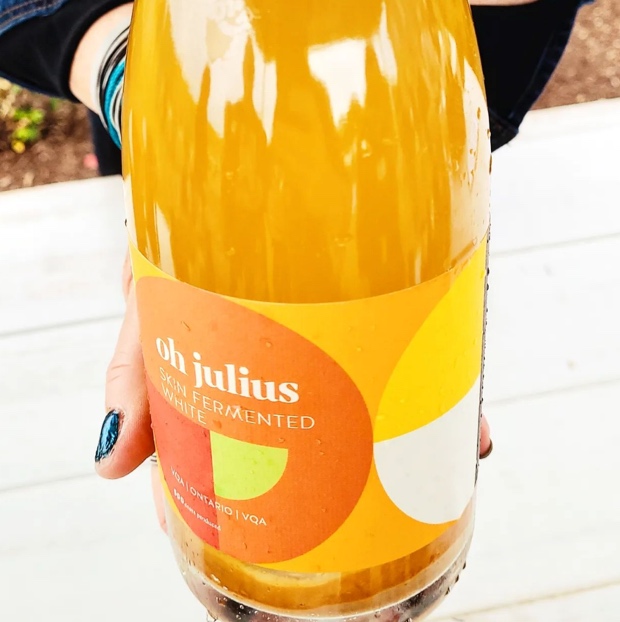
Trail Estate ‘Oh Julius’ Skin Fermented White 2021, VQA Ontario

A plus or minus 10 days skin contact for 59 per cent riesling, (35) gewürztraminer and (5) muscat that drinks with full submission, symbiotically speaking. The wine gives and our palates lay down, receive this effortless elixir and allow it to pass on through, no questions asked, no wondering why. Something like 550 cases are made of this wild-fermented, Benchlands (Wismer) fruit-sourced quencher, aka refreshing drink. Easy enough in the tart citrus vein, no lacking for energy and in turn, our interest. Weird? No not really. Cool? Ticks all the boxes for what the kids are all making these days, but this is more a case of being made by and for kids at heart who are adults with kids of their own. At 10.4 per cent alcohol, no acetic meanderings nor cider-y complications neither. Well that just about wraps it up in a big natural bow and guarantees a good time. Drink 2022-2023.  Tasted June 2022

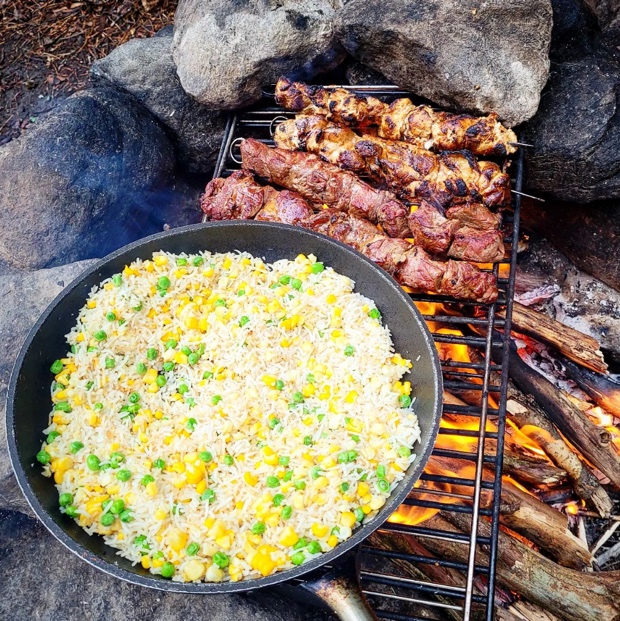
Canoe Trip cooking

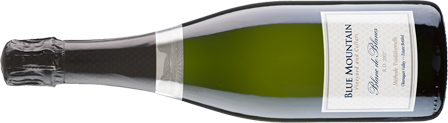
Blue Mountain Blanc De Blancs R.D. 2013, VQA Okanagan Valley, British Columbia

The research tells us chardonnay and time conspire for beauty while development reminds how years upon years upon lees directs a Blue Mountain R.D. into sublimity and profundity. A vintage to recall, reflect upon and surely celebrate, to mull over its integrated and subtle spices, controlled energy and slow time release of responsibility. A sparkling wine of nature that has become one of nurture, now a perfectly posit tug between edginess and oxidation, tension and generosity. They call this the sweet spot. Raise a glass to recently disgorged. Drink 2022-2026.  Tasted November 2022

WineAlign judges at Stratus Vineyards

Stratus X Trials Blanc De Blancs 2012, VQA Niagara-on-the-Lake, Niagara Peninsula, Ontario

Looking back two years the bar was set so very high as noted when we first began tasting the culmination of years put in towards this Sparkling program. Far be it for Stratus to regress or work in reverse but they are now grooving further back in lees cumulative time and out there comes a chardonnay spent what must be nearly 10 years on those lovely yeasts. Trials they were and fruition they have become. It’s not so much the toasty and beautifully oxidative-fino nutty character. The impression digs deeper than green olives in brine and sweet pear compote, it grabs us by the emotive heartstrings and holds us close. In fact it’s not unusual for B de Bs ’12 X Trials to be loved by anyone. There’s just something about the subtleties and the open invitation, to love and be loved. “Whoa oh, oh whoa, oh oh, oh oh!” Drink 2022-2026.  Tasted November 2022

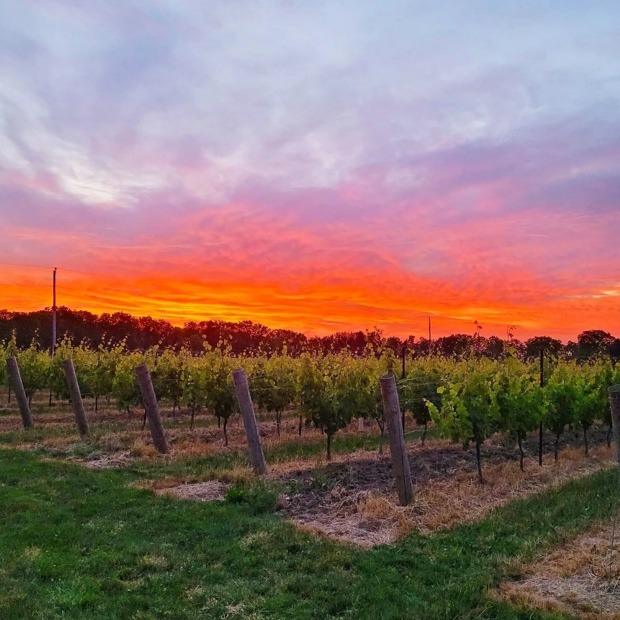
Sunset over The Twenty Mile and Beamsville Bench

Flat Rock Cellars Nadja’s Vineyard Riesling 2020, VQA Twenty Mile Bench, Niagara Peninsula, Ontario

Distinct mineral and petrol aromatic riesling rising, up into the stratosphere. in no hurry to come back down. Cracker citrus and acidity, tart and fuelled by intensity with no boundaries nor atmospheric pressures or deadlines neither. Sugars and structure are one in the same, seamlessness is the result and everything falls into its right place. The poster child, educator and pioneer. Drink 2023-2027.  Tasted blind at NWAC2022, June 2022

Felseck Vineyard

Hidden Bench Riesling Felseck Vineyard 2017, VQA Beamsville Bench

Not quite but just about 20 year-old vines as of this stellar 2017 vintage and a benchmark Bench riesling of all that has been developed, given, remains and jazz. A stoic propellant and scintillant of fineness, fruit in ample preserve, acids convergent and power releasing ever so slowly in perfect pace. Pitch is spot on, balance ideal and direction effortlessly forward. The Mario Lemieux of riesling. Drink 2023-2032.  Tasted February 2022

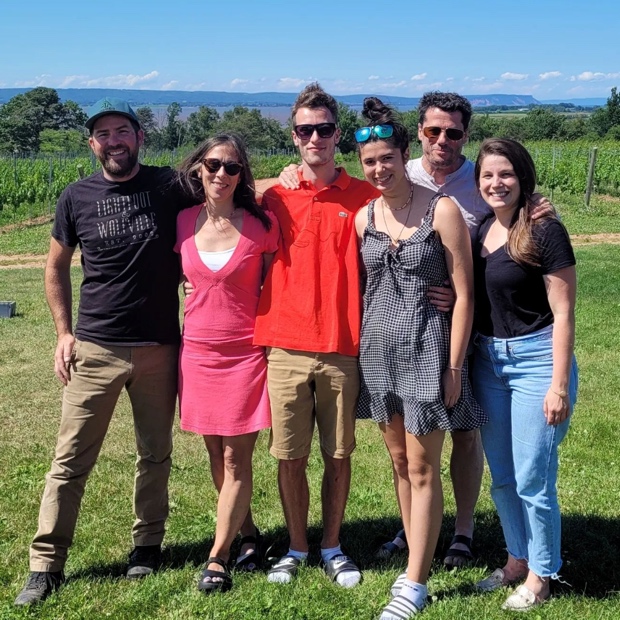
The family with Josh Horton and Rachel Lightfoot, Wolfville, Nova Scotia

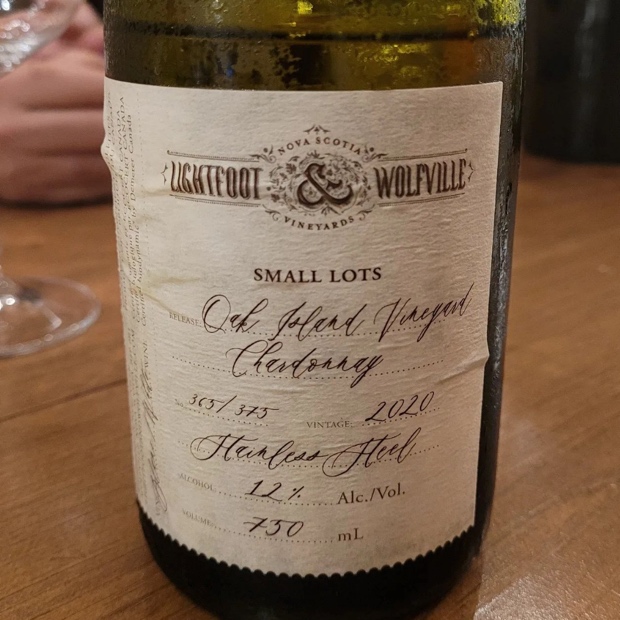
Lightfoot & Wolfville Chardonnay Small Lots Oak Knoll Vineyard Stainless Steel 2020, Nova Scotia, Canada

“People have always said we need to make a stainless steel version,” says winemaker Josh Horton, to lighten the room and the mood. This being the first go at it, protocol kept very similar to the oaked (Ancienne), by wild ferment, aka “brown” maceration. Gone to bottle quicker (eight months after pick) and this will be slowed down in the future. Absolute tightness and freshness, purity of chardonnay as expressed in a juiced lemon and almost no reduction. A chardonnay of isolated terroir, specificity and one helluva beautiful experiment. Drink 2022-2024.  Tasted July 2022

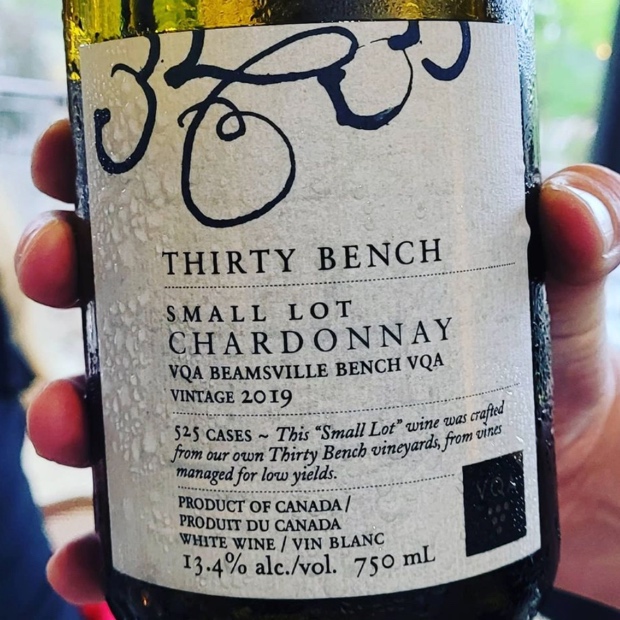
Thirty Bench Small Lot Chardonnay 2020, VQA Beamsville Bench, Niagara Peninsula, Ontario

Really quite primary, an undisclosed while pleasingly reticent chardonnay from Emma Garner of gratitude and grace. The first because it thanks the Beamsville terroir and the second because it does so with soft spoken respect. A mélange of different fermentation batches, each small and precise come together for the final sumptuous and restrained blend. The tenets of fruit, acid and what ties them together is just about as seamless and easily layered as any of a Bench ilk and idiom. Not a chardonnay of style but instead stylish, not chic but surely sung with notes held, seemingly forever. Drink 2023-2028.  Tasted July 2022

Grimsby Hillside Vineyard

Ilya and Nadia Senchuk, Leaning Post Wines

Leaning Post Chardonnay Grimsby Hillside Vineyard 2019, VQA Lincoln Lakeshore, Niagara Peninsula, Ontario

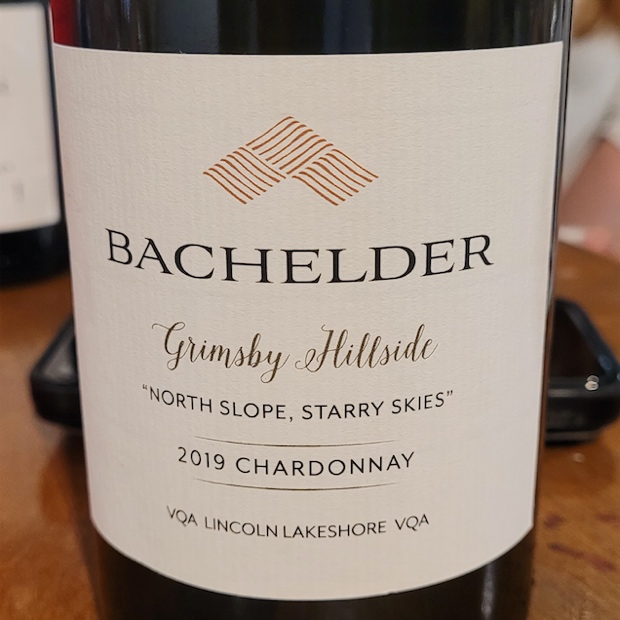
Delicate, bright and efficacious wine from a north facing nook of the Escarpment vineyard in the narrowest spit of land between the rock face and the lake. Once the viticultural labrusca home of Parkdale Wines and now owned by the Franciosa family. A special wine occupying a place in my family’s history and heart. Apposite to Wismer in that there are more piques and peaks in and out, up and down, hither and thither in this singularly focused chardonnay. Pay attention to nuance, to barrel as well as it speaks in extra density because the terroir encourages the ambition. Remarkable structure despite how short a relationship there has been between maker and farm. The instant brilliance creates an effective and then profound buzz, a desired effect and the future is WIDE open. Drink 2022-2027.  Tasted June 2022

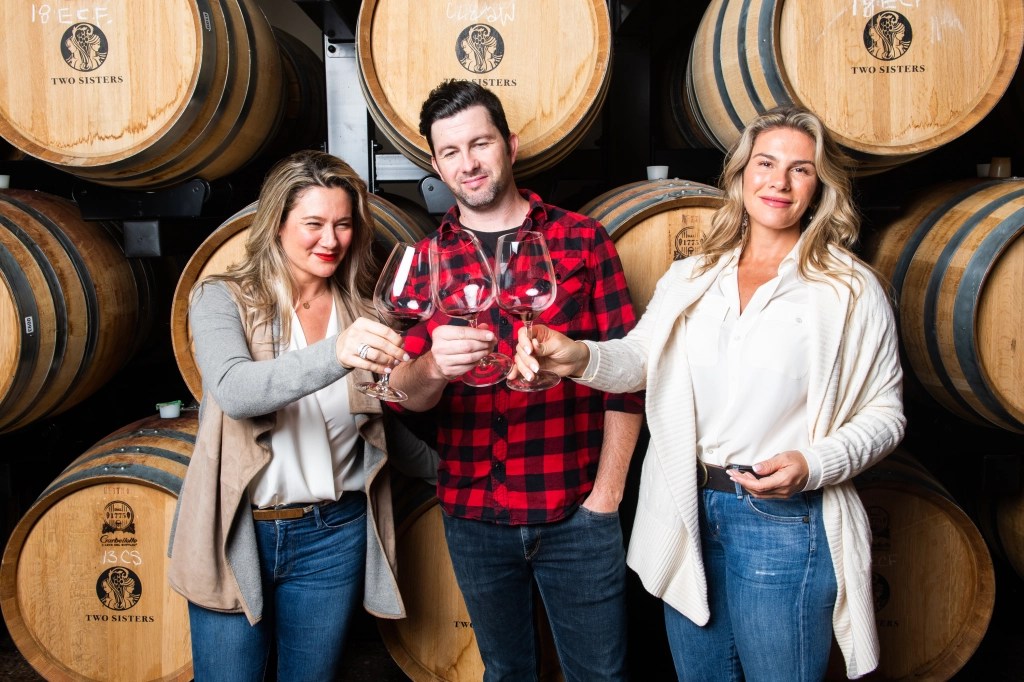
Melissa Marotta-Paolicelli, winemaker Adam Pearce and Angela Marotta

Two Sisters Chardonnay 2020, VQA Beamsville Bench, Niagara Peninsula, Ontario

With part in part thanks and a nod to the experimental minds and vineyard management acumen at (then) Parkdale Wines, back in 1959 Bill Lenko took a flyer on vinifera in the form of chardonnay. Today Two Sisters is the primary beneficiary of Niagara’s oldest chardonnay vines and this primo vintage extolls the virtues of those wise plants and their concentrated fruit. Still showing balance and tenderness, never mind the barrel beauty, bullocks or beast, in fact it all comes together in seamless fashion because the fruit is indefatigably remarkable. Winemaker Adam Pearce heeds the directive, does nothing to get in the way and what is delivered comes away with such a sheen and energetic burst it just may blow your mind. This is the finest result to date, a lightly reductive, subtly lees inflected, full fruit captured chardonnay. All of its lines run parallel, incline up the same slope, coextend in collateral company and with time will eventually relent for the great transversal. The fruit will cross over both acidity and backbone, resulting in the ultimate complex equation. Drink 2023-2028.  Tasted August 2022

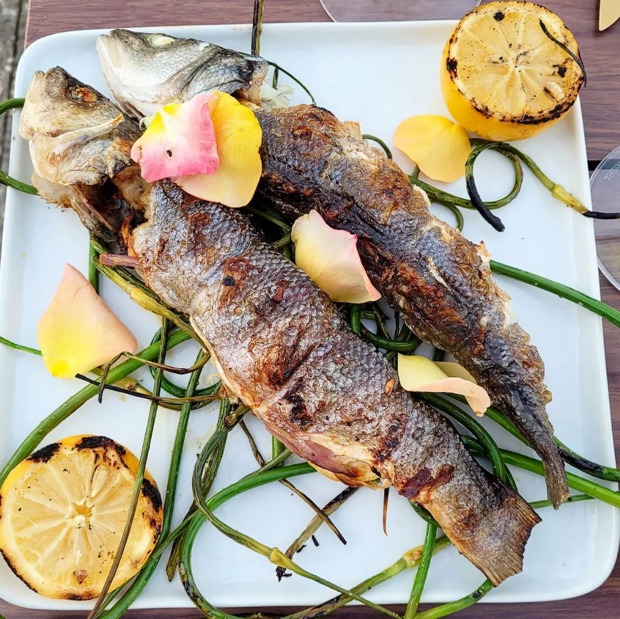
The fishy work of Ryan Crawford (Ruffino’s and Bar Bea), Raoul Duke of Chefs


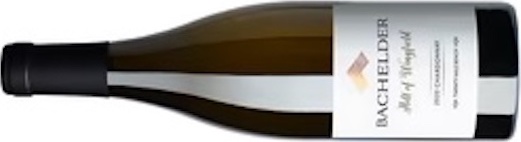
Bachelder Hill Of Wingfield Chardonnay 2020, VQA Twenty Mile Bench, Niagara Peninsula, Ontario

Hill of Wingfield, as opposed to the flatter portions of the large chardonnay expanse and one can’t help but conjure up vineyard monikers like “Hill of” Corton, or even Grace. Ancient and modern tracts can be descried by farmers and writers so with Thomas Bachelder as the guide we too can play this game, by extension and in a most semi-serious way. Everything is derivative and by association anyway so Hill of Wingfield it is. Same lush, luxe and top of the pops richness as Wismer-Wingfield yet here with some reduction and an almost candied shell of protection. Nearly impossible and yet every reason to believe that vintage, grape, block and maker can combine to execute such a phenomenon of chardonnay. No understatement or restraint here, nor were any grapes harmed in the due process. My goodness what gumption, ambition and monkified execution. You gotta believe in the truth! Drink 2023-2028.  Tasted December 2022

With Shiraz Mottiar and the uni, I mean photo bomber Anthony Gismondi

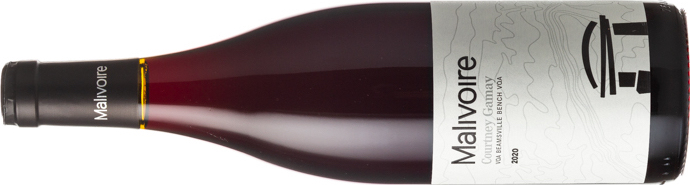
Malivoire Gamay Courtney 2020, VQA Beamsville Bench, Niagara Peninsula, Ontario

Youthful is the understatement when coming at this 2020 Courtney but my how juicy, meaty and pinpointed a gamay it truly is. There have been serious and fully formed Courtneys before but never have the assets in fruit, mouthfeel and acid-tannin structural interplay grabbed attention like this young and in charge ’20. Adds up to big, boisterous, ripe to the hilt, of zero austerity and so much possibility. Drink 2023-2027.  Tasted April 2022

Meyer Pinot Noir McLean Creek Road Vineyard Old Block 2020, BC VQA Okanagan Falls, British Columbia

Plenty of substance fills the aromatic glass in this immortality jam of substance, acid and textural intensity. Good red fruit if turning to act youthfully grainy in its unresolved structural demand, especially as it lands on and then scrapes over the palate. Dutifully solid wine, nothing to some and to others a pearl needing time. High arcing, a factor of indefinite continuation for pinot noir existence and “he who forgets will be destined to remember.” For such a delicate (aromatic) and working (palate) pinot noir it carries more than ample finishing strength, energy and power. “And I wish to hold on, too, but saw the trapdoor in the sun.” Drink 2023-2028.  Tasted blind at NWAC2022, June 2022

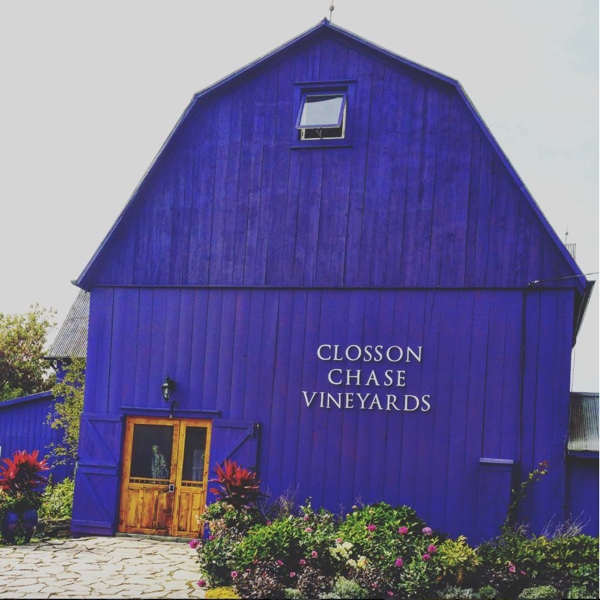
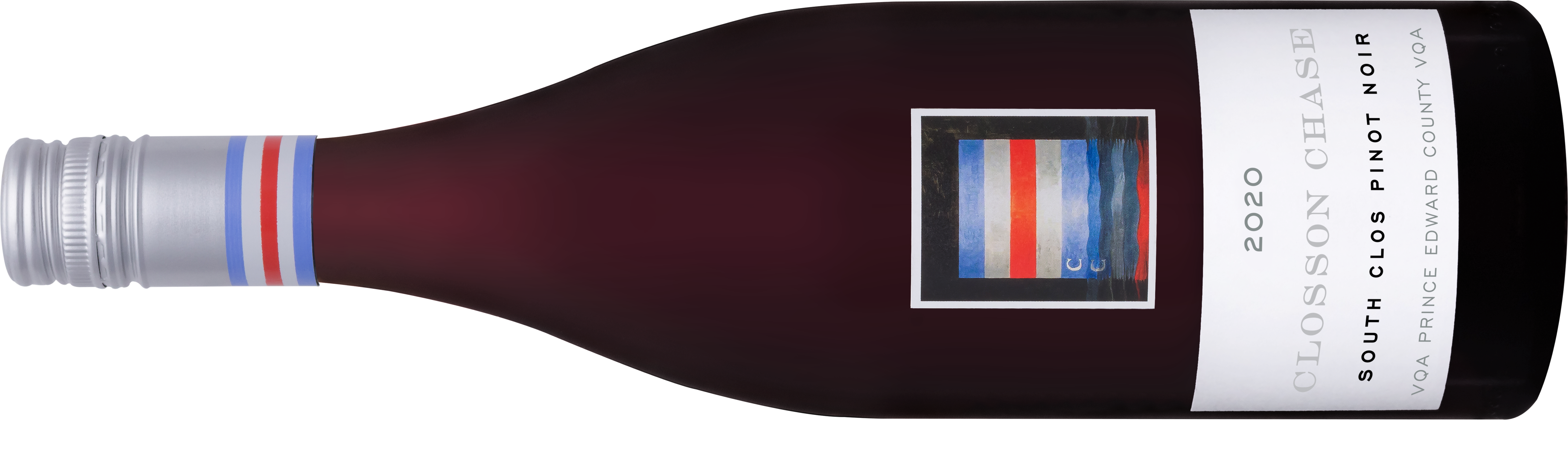
Closson Chase Pinot Noir South Clos 2020, VQA Prince Edward County, Ontario

As a reminder the South Clos Vineyard is six hectares of Prince Edward County Hillier clay loam and shallow crumbled limestone overlying fractured limestone. A top site (within the limit of vinifera capability) where chardonnay and pinot noir present as viable as any combo in Canada. Bring on a warm gift of a vintage like 2020 and the possibilities suddenly become endless. The site is always a place of high pH and allowable root penetration but 2020 just tops the show. The intensities are boundless in a most youthful and exuberant South Clos pinot noir that clearly act as the embodiment of one for the ages. Never before have acids tasted so sweet and tannins wept such tears of joy. South Clos is the culmination of decades put in, torches passed, hard work and experimentation. A victory for the 2020 season and perhaps the beginning of a Keith Tyers’ led dynasty. Drink 2024-2032.  Tasted November 2022

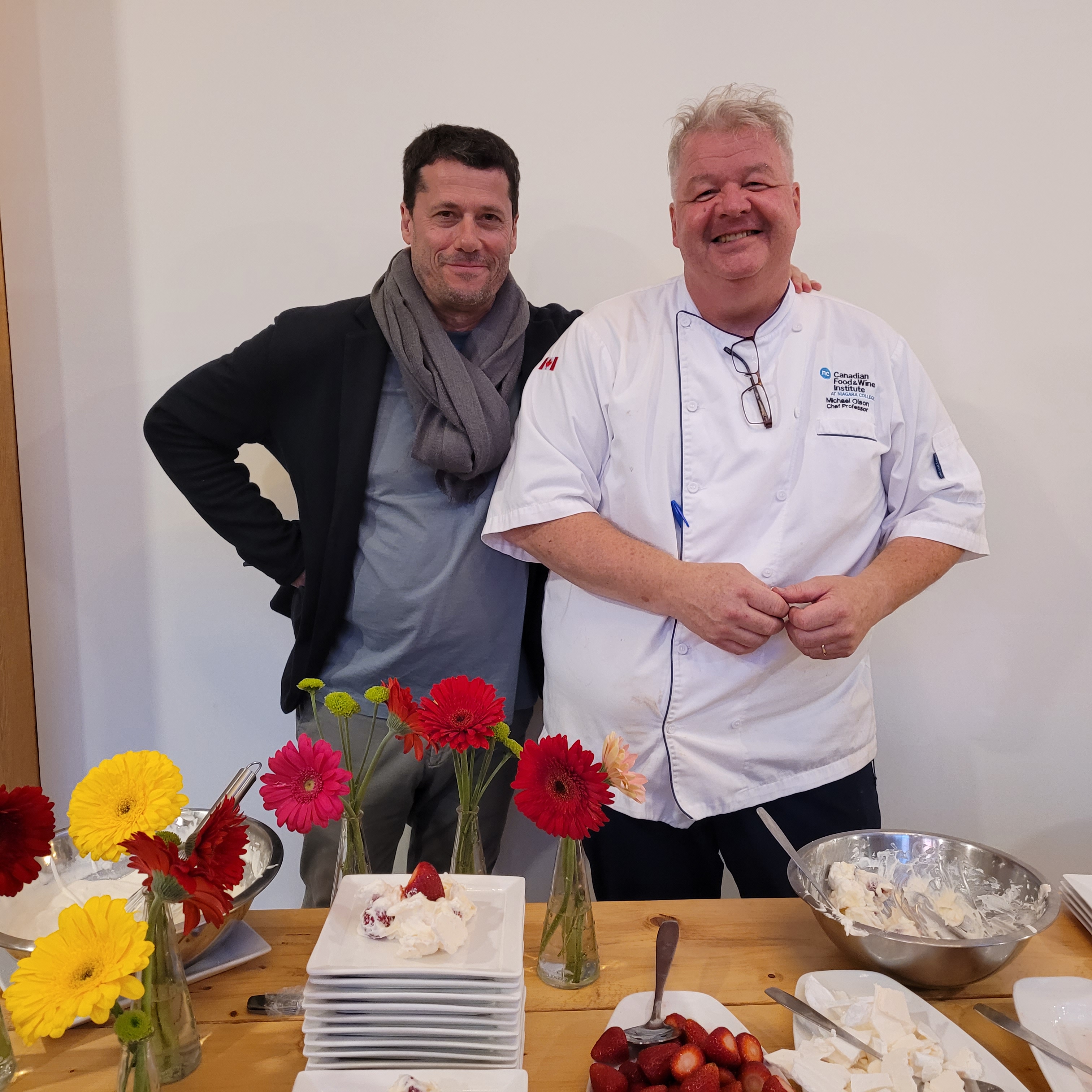
With Chef Michael Olson

Bachelder Pinot Noir Wismer Parke “Wild West End” 2020, VQA Twenty Mile Bench, Niagara Peninsula, Ontario

Wismer-Parke’s western section on Victoria Avenue just up from Highway 8 is planted to what Thomas Bachelder refers to as a mystery clone of pinot noir “whose identity is lost to the mists of time.” Twenty-one years to be exact at the meter of this vintage yet in nostalgic ways that kind of statement feels like something dating back to the 1950s or ’60s. Either way it’s long enough to make one wonder and wonder why. There’s a whole lot of “duh duh dun dun dun dah,” and “bah ah bah ah dun dun dun bah” then “beh do beh do,” followed by “bah doo doo bah,” and finally “wop, wop, wop, wop, wop” in this pinot noir. Why? Because this beast of the east is so strong-willed, immoveable and timeless with unparalleled layering and nuance. Doo Wop tannins in total control, winning out over dark fruit in black olive, fennel and tarry tones playing second fiddle. Why is there more oomph and grip to this savoury flavoured pinot noir of scrub and scorrevole across the palate?” The answer my friend is blowing in those mists and in the time you must give to see this wine come to its fruition. Wismer-Parke Wild West End may not necessarily save your soul, but it will make your soul worth saving! Drink 2024-2029.  Tasted December 2022

PEC wines

Rosehall Run Pinot Noir St. Cindy Unfiltered 2020, VQA Prince Edward County, Ontario

In 2004 and 2005 the first County Rosehall Run vineyards pinot noir fruit were given the name Cindy but between ’06 and ’19 the name JCR defined the estate’s best fruit. With a vintage as great as 2020 in vessel Cindy was anointed once again as saint of the top pinot noir. The ripeness and extract here are in fact the finest ever from these PEC lands so the choice was and remains perfectly clear. What the JCR misses in terms of tension is here fully trenchant and oblique, angles run in slants, musculature neither parallel nor perpendicular to the long axis of structure or bones. This is fascinating wine geometry and anatomy, clearly regimented yet offset and in the end, simply wondrous. Drink 2024-2030.  Tasted October 2022

Le Vieux Pin Syrah Cuvée Violette 2015, BC VQA Okanagan Valley

Five years after first tasting Cuvée Violette blind the opportunity arises for an up front and centre moment with bottle, label and glass. Though this syrah would have been more than satisfying before it must be said that its peak performance is in fact NOW. Takes an aromatic leap of faith and suspends at that Black Sage Bench/Dead Man Lake syrah apex where violets and pepper drip their eau de parfum down upon dark varietal fruit. There are many a more expensive Okanagan syrah but there are none as benchmark to combine age-worthiness with price as this Severine Pinte stunner. I for one am thankful to taste this vintage again and at its best.  Last tasted December 2022

Let’s put up our hands so we know who we are, we who expect three P’s in syrah; perfume, pepper and pulchritude. This syrah is possessive of all three. It’s quite the dark purple beauty but also savoury, reeking of black olive and brushy garrigue. The wood is exercised with admirable restraint and then there is this fineness of tannin. A very pretty, seamless and structured syrah of great length. Drink 2018-2023.  Tasted blind at #NWAC17, June 2017

Creekside Broken Press Syrah Reserve Queenston Road Vineyard 2016, VQA St. David’s Bench, Niagara Peninsula, Ontario

Good years have got behind this syrah with a touch of viognier so that five-plus in there’s an open window through which to find the heart of this wine. A democratic vintage, fruit at peak, elongated and built to last, last longer than anyone who knows not what capability is in store for this wine. The tannins are just beginning to wane and with great acumen they have melted into the karst of what is truly a special BP vintage. A minimum five years remains and quite possibly 10. Drink 2022-2028.  Tasted April 2022

CedarCreek Winemaker Taylor Whelan

CedarCreek Syrah Platinum Jagged Rock 2020, BC VQA Okanagan Valley, British Columbia

Inky and cimmerian, full syrah extraction, maceration, skin contact fermentation and finally, thankfully and for the win, concentration. All adds up to as big as it gets, with iodine, soy and yet this amazing floral indemnity that tells the whole story, but also one that celebrates a truly special site. Yes the tannins are omnipresent but they are reasonable, metered, mattering and real. So very polished. Drink 2025-2029.  Tasted blind at NWAC2022, June 2022

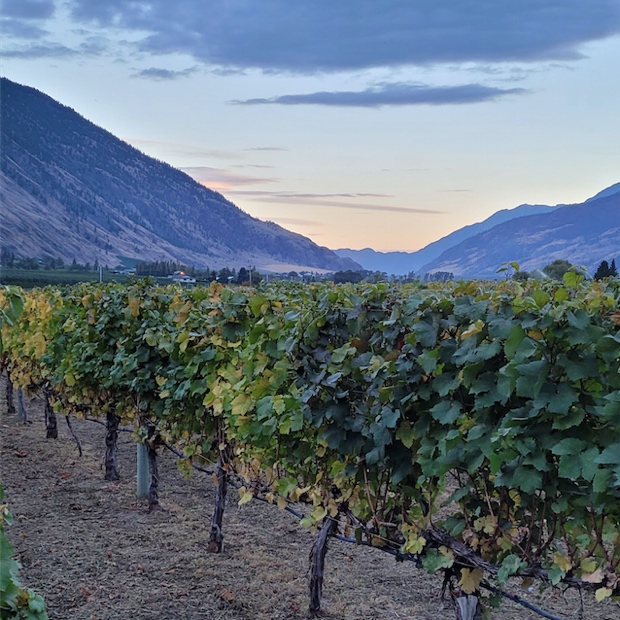
Vines in the Similkameen

Corcelettes Talus 2020, BC VQA Similkameen Valley, British Columbia

Talus makes balanced work of all fine main Bordeaux varieties, led by merlot (40 per cent) and cabernet franc (35), with (20) cabernet sauvignon, (3) malbec and (2) petit verdot. The names refers to the Talus “slides” that accentuate each mountainous side of the Similkameen Valley and the wine slides across the palate in equal, opposing and proportionate waves. Mostly a precise ripeness of fruit but also some passionate acids and truly purposed tannins. The merlot does seem to stand out with its verdant, creamy and downy character as it pertains to soaking up some barrel. There is a notable amount of quality dark chocolate here and still all parts just seem to synch up. Proper Meritage indeed. Drink 2024-2028.  Tasted September 2022

Black Hills Nota Bene 2020, BC VQA Okanagan Valley, British Columbia

The blend for the Black Hills flagship red in 2020 is 42 percent cabernet franc, (33) cabernet sauvignon, 24 (merlot) and (1) petit verdot. Merlot fared very well in 2020 and yet the team chose franc as the anchor, why, well it seems for structure over beauty and longevity over immediacy. This vintage is quite a remarkable example because all of these aspects show up, repeat, shuffle, reorganize and collectively speak a Black Sage Bench truth. Hard to imagine a more seamless set of red blend circumstances or astrological linearity. The stars do in fact align for this bright constellation of an Okanagan wine. Drink 2024-2030.  Tasted November 2022

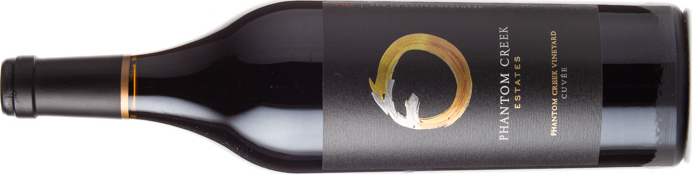
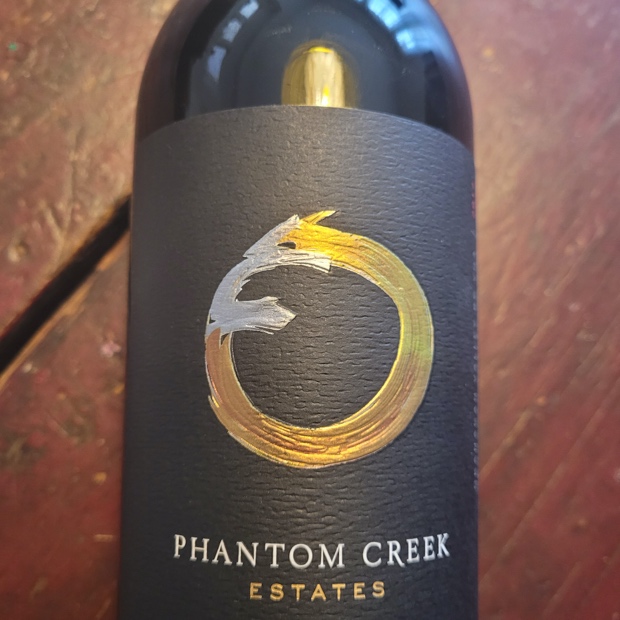
Phantom Creek Phantom Creek Vineyard Cuvée #24 2019, BC VQA Okanagan Valley, British Columbia

At the top of the heap and pops for Phantom Creek is the red blend cuvée from the homestead vineyard and a wine denied absolutely nothing. The finest of the best is grown, nurtured and gathered with equally prized vessels providing the nurturing environment. There are some silky, suave and stylish red wines in this portfolio but nothing compares to the desire in Cuvée #24. These are the richest fruit sets, sweetest acids and silkiest tannins, none more important than the other and all working towards a common goal. That being beauty and longevity which the wine surely boasts. The only question is cost and a decision to be made to decide if the extra $60-100 dollars buys more wine and age-ability. The answer is yes, it surely does but is this “perfect” style the kind you like, want, need or deserve. Only you can be the judge of these things. Drink 2024-2035.  Tasted November 2022

Good to go!

godello

Godello surveys Grimsby Hillside Vineyard

Twitter: @mgodello

Instagram: mgodello

WineAlign

Twenty-two mind-blowing wines of 2022

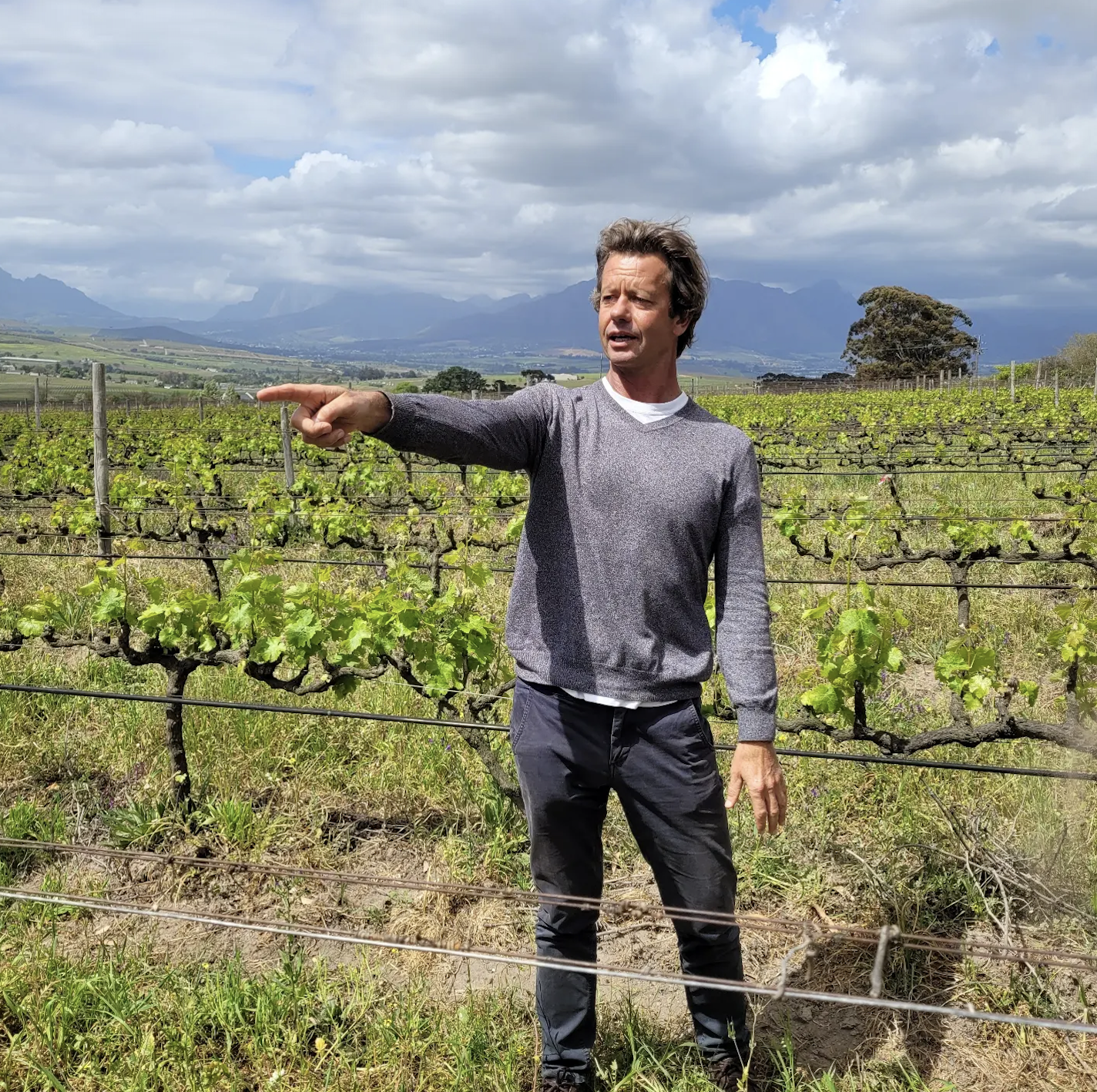
Godello in the Stellenbosch heather, Reyneke Wine Estate

We are who we are and we choose to live in a world according to wine. Within its walls are endless permutations and revelations, of the dark moments and the light, the romantic entanglements and the failures. We witness cycles of passion, highs and lows, endless accounts of quirky little episodes that reveal how grapes really live under the circumstances of a vintage. How they survive and thrive, eventually turning into the wine they become. A wine’s history is a lovely aside accompanied by a recorded and constructed account through the lens of someone who observes its transformations. We are messengers who take the land, plant and maker into consideration and always abide, recounting the story to those who would choose to listen. According to WineAlign I reviewed more than 3,000 wines in 2022, which means I tasted at least 3,500, if not more. In order to surmise this final list from a shortlist of more than 100 mind-blowing wines it meant another 2,900 are not even in the running and yet surely no less than a quarter are exceptional wines in their own right. That is how difficult, personal and stringent an exercise this annual choosing has become. I find it near impossible these days and yet somehow feel compelled to continue the drill. 

Godello in Chianti Classico

Related – Twenty-one mind-blowing wines of 2021

The year 2022 afforded multiple opportunities to get back on the road in search of great wines in places across the ponds and beyond. To Tuscany in both February and March, for the for the Chianti Classico Collection and also as chaperone to La Squadra Canadese for a week of exploration throughout the 11 UGAs of the territory. Forever in Chianti Classico included a masterclass presented by Italian wine expert Filippo Bartolotta and Consorzio President Giovanni Manetti titled Il Chianti Classico in 9 Decadi. This year-end summary includes one of those Chianti Classico wines dating back to 1949 but a few more could been here as well, including the fascinating Badia A Coltibuono Chianti Classico 1958. At Laura Bianchi’s estate the Castello Di Monsanto Sangioveto 1986 was one to blow my mind, as did Luca Martini di Cigala’s San Giusto a Rentennano Percarlo 2018 and VinSanto del Chianti Classico 1998. As a proud, card-carrying Ambasciatore there are dozens upon dozens of Classico and affiliate sangiovese that move me each and every calendar year. Il Molino Di Grace Gratius 2018 is an example and just one of many.

Related – Twenty mind-blowing wines of 2020

After that Tuscan adventure I moved on to Sicily for a five day exploration of The five estates of Planeta earth and my stay turned into two weeks. Covid-19 had caught me and yet the humanity of Alessio Planeta, Patricia Tòth and several winemakers aboard L’Etna turned a challenging test result into many days of discovery and deeper volcanic understanding. In fact L’Etna and Parco Statella saved my Sicilian quarantine. So many producers’ wines could and should be on this list: Azienda Agricola Sofia, Calcagno, Donnafugata, Eduardo Torres, Feudo Pignatone, Girolamo Russo, Graci, Scirto, Tascante, and Vigneti Vecchio. Oddly this was not a year for nebbiolo with likely the least amount of opportunities made available and yet a month from now I will spend 10 days in Piemonte to make up for the absence in 2022. That said there can be no forgetting Réva Barolo Cannubi 2018, from which impartiality is off the table because if you do not fall in love with this Barolo then you are not setting your palate free.

Travels in June and Abruzzo in four-part harmony included a bucket list visit with Emidio Pepe where I found that an unwavering commitment to land is everything that matters in making exceptional and memorable wine. It’s not only what you do but also who you are. Ahead of that trip I had tasted La Valentina Montepulciano d’Abruzzo DOC Bellovedere Riserva Terre Dei Vestini 2017, and there can be little doubt that it is a wine that resides at the top of the montepulciano food chain because this Riserva hails from a most specific and important terroir. After Abruzzo and then Rome I moved on to attend the first ever Anteprima for Simply Red: Rosso di Montalcino where the Brunello were set aside for one day only and the 2020 vintage of Rosso got directly under my skin, including Lorenzo Magnelli’s mind bending Le Chiuse Rosso Di Montalcino DOC 2020. Dieci Anni di Rosso di Montalcino (Ten Years of Rosso di Montalcino) and Selezione di Rosso di Montalcino (Rosso di Montalcino Selection) showed wines of age-ability and purpose; my if Alessandro Mori’s Il Marroneto Rosso Di Montalcino DOC Jacopo 2019 did not blow my mind. A visit with Violante Gardini Cinelli Colombini meant a pour of Donatella Cinelli Colombini Brunello Di Montalcino DOCG Io Sono Donatella 2015 for the most profound barrel expression of Le Donne’s Brunelli. 

Menfi

Related – Nineteen mind-blowing wines of 2019

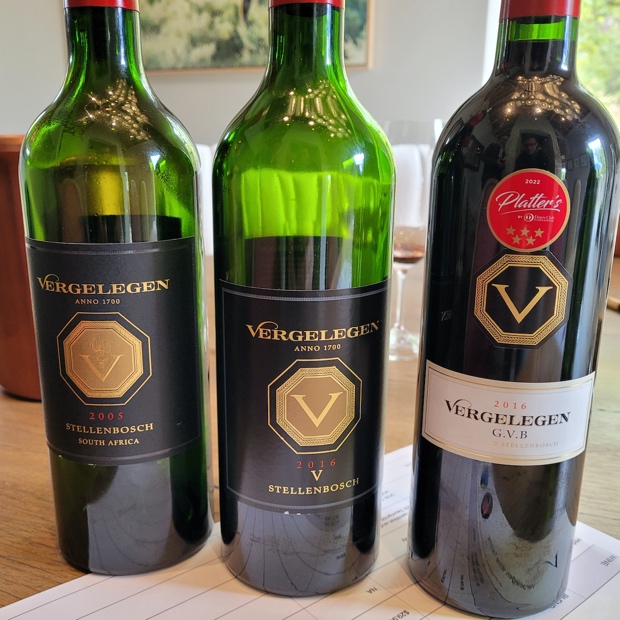
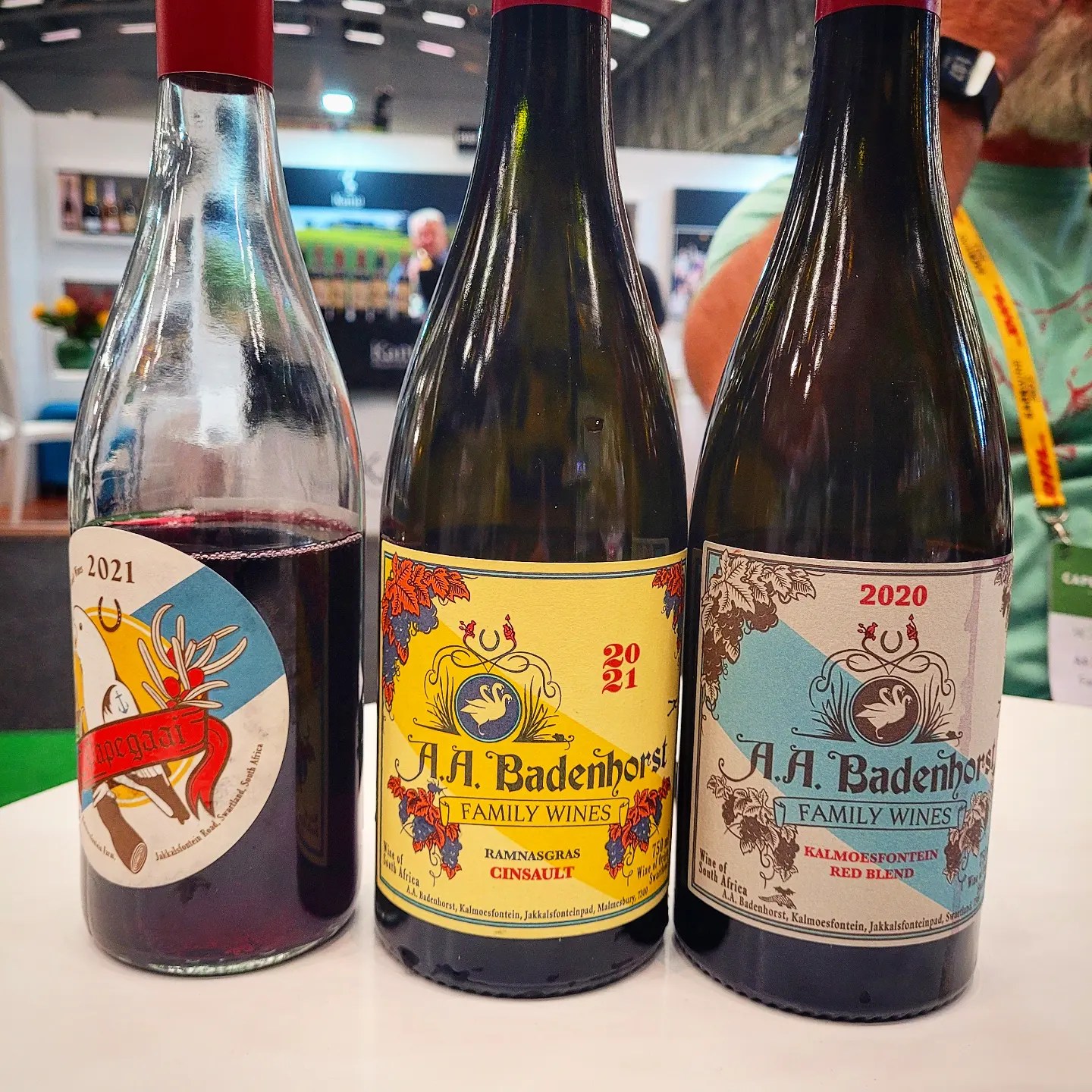
In October the Cape Wine congress resumed after a four year absence and now more than ever this is what I have to say. South Africa is the most exciting and mind-expanding wine universe alive today. There are no less than 40 Western Cape wines from two dozen or so producers tasted in 2022 that could have made this list: A.A. Badenhorst, Alheit, Beaumont, Boekenhoutskloof, Crystallum, David and Nadia Sadie, Hamiilton Russell, Huis van Chevallerie, Kanonkop, Ken Forrester, La Motte, Leeu Passant, Klein Contsantia, Meerlust, Momento, Mullineux, Old Road Wine Company, Porseleinberg, Raal, Raats, Radford Dale, Restless River, Reyneke, Savage, Sijnn, Storm and The Sadie Family. To name but a few. Other southern hemisphere wines were killer in 2022, namely Torbreck Grenache Hillside Vineyard 2019, a special Barossa block to be sure.

With John Szabo MS and Rosa Kruger at the Old Vines Project tasting

In November a return to Montalcino for Benvenuto Brunello 2022 meant a look at the 2018 vintage but also the Riserva of 2017. At Col d’Orcia the Conte Francesco Cinzano Marone and his son Santiago led yet another vertical tasting, this time on the 8s and it was Brunello Di Montalcino Riserva DOCG Poggio Al Vento 1988 that stood both out and also the test of time. From Montalcino it was on to Vienna and then a Wagram-Traisental discovery tour that was both too short and mind-expanding – A return must and will happen soon. Meanwhile a tasting at home in the WineAlign office showed this Rheingau gem to the crü. Leitz Berg Schlossberg Grosses Gewächs Riesling Trocken 2019 is grand Rüdesheim indeed. 

These are the wines that blew my mind in 2022

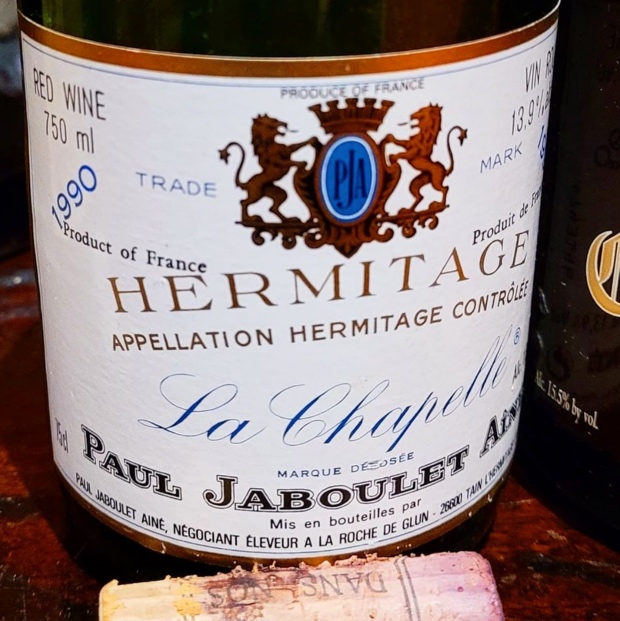
Most of all 2022 was a year when associates, colleagues, wine professionals and especially friends reunited to break bread and taste great wines together. At a birthday party I had the opportunity to taste the following in one evening; Château Lafitte 1986, Château Mouton-Rothschild 1986, Chave Hermitage 2010, Guigal Côte-Rôtie La Turque 1999, Paul Jaboulet Aîné Hermitage La Chapelle 1990, Dom Perignon 2000, Veuve Cliquot La Grand Dame 1995 to name just seven of 20-plus icons. Bordeaux made several prominent appearances in ’22; Château Margaux 1989 (and 2004), Château Haut-Brion 2012 and Château La Mission Haut-Brion 2012. More importantly in 2022 we shared bottles of all ilk, pedigree and origin, not only the expensive and famous labels but all the great wines, big and small. Thank you to every person who poured, for every sip and taste, with heartfelt thanks. These are Godello’s 22 mind-blowing wines of 2022.

Markus Huber Grüner Veltliner Berg 1ÖTW 2021, Traisental, Austria

Highest and coolest vineyard of the Traisental Erste Lage because by three or four pm the forest casts shade over the vineyard. Limestone based soil as well, upwards of 380m and the only portion that has iron rich red elements in the earth. Actually finding a richness in this, surely vintage related and that is unexpected but it’s also the most savoury, minty cool, eucalyptus accented, or the like. Curious by comparison to Alte Zetsen and Zwirch, in what is assessed as almost dark, smoky, spicy volcanic-simulate stuff. Brings whole and utter meaning to grüner veltliner at the Grand Cru level. Drink 2023-2028.  Tasted November 2022

Godello with Charla Bosman

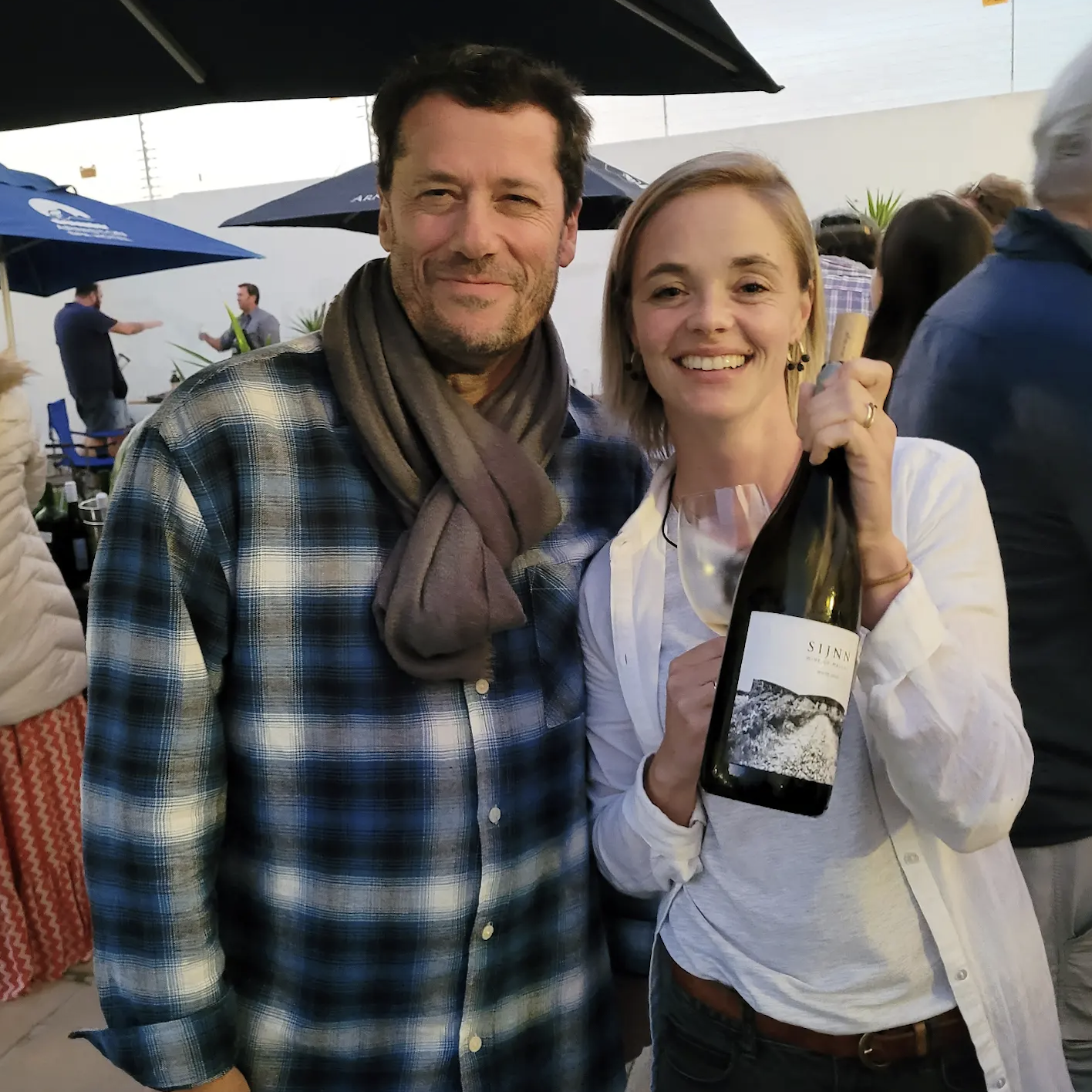
Sijnn White 2019, WO Malgas, South Africa

Up above the Breede River there are vines of chenin blanc, viognier, roussanne and verdelho, varieties that have been working towards a common goal, to eventuate at something great. Then 2019 comes along and the world changes. This is the vintage from which David Trafford, Sijnn and winemaker Charla (Hassbroek) Bosman take full reign of their collective charge. To be truthful the agriculture, winemaking and face of the brand is Bosman and were I in the market to hire someone of her passion, ability and professionalism I could not help but remunerate her like a top European footballer. But lucky we all are that she and Sijnn are together because she is at one with this impossible yet absurdly beautiful environment where wines like this White Blend are made and will blow your proverbial mind. They attach themselves and get so close to that personal part of you. Imagine Châteauneuf though I’d much rather consider Malgas because that is what this is. Rich and perfectly viscous, spicy, structured and fine. Drink 2024-2030.  Tasted October 2022

Girolamo Russo Etna Bianco DOC San Lorenzo 2020, Sicily, Italy

From the single vineyard at 730-740m of elevation and vinified in tonneaux. The 2009 was the first vintage of San Lorenzo Bianco for a wine that leads amongst the 80-90 thousand total bottles made by Giuseppe Russo from 18 hectares. A strong selection from the plants of carricante with cattaratto and grecanico. The carricante are the oldest and they provide the breadth in the mouth, the texture in unction and the presence that really makes you feel the vineyard. The difference between it and Nerina is really in the selection of the grapes. Giuseppe wants his whites to speak for his territory, here to be a bit more generous and 2020 obliges first because it was easier and second because it is such a vintage specific to the white wines. Such beauty and emotion is purity and life. No stress and a wine you want to drink. Drink 2022-2028.  Tasted March 2022

David And Nadia Sadie Wines Plat’Bos Chenin Blanc 2021, WO Swartland, South Africa

At a tasting where everything is Old Vines Project certified there must be something extraordinary about a wine to stand out from a crowd of greats. David and Nadia Sadie are in fact turning heritage vines chenin blanc (amongst other varietal explorations) into content born of context harboured though never paraded. They are rhythmic and scientific with just enough fantasy and romanticism, but never too much. Plat’Bos stands above Skaliekop and Hoë Steen because 2021 asks it to do so, not because it is better or more important, but it is surely chenin blanc profound. The 1981 Swartland planting is in the steady zone, shed of the mercurial and in ’21 so very linear yet salty of the earth in its sombre-sepulchral tone. There is reduction here because the poor soil nutrients demand that this chenin begins this way. The levels of tension and intensity are most elevated, sufficing to say as high as any from the Western Cape. Attention is paid unwavering to detail, sequencing is in order, purity incarnate, grape and place together pristinely kept. In Plat’Bos 2021 the palate is taken down to the whipping post by a wine built to endure. Given time there will be calm, healing and reward in the end. Drink 2024-2036.  Tasted October 2022

The Sadie Family Die Ouwingerdreeks Mev. Kirsten Wyn Van Oorsprong Stellenbosch Die Sadie Familie Wyne 2021, Stellenbosch, South Africa

The vines that supply Mev. Kirsten Wyn are the oldest chenin blanc in the country, out of Stellenbosch and planted in 1905. In 1947 every second row was pulled out to make room for tractors and the configuration still exists this way. “If South Africa has a true apex white Grand Cru vineyard then this is it” insists Eben Sadie. Facts are facts are you just can’t accede these levels of power, concentration, extract and tannin anywhere else. The nose communicates as an intoxicant of sublime forces and these grapes bestow chenin blanc 2021 are those that transcend fruit, deliver ethereality and a heightened sense of awareness. An awakening from necessary tension, crisis and personal freedoms, existential off the charts, poetic and epic. One hundred and sixteen stanzas recorded, in the books and the finest verse written right here in the most recent vintage. If enlightenment is to be gained from chenin blanc in the Western Cape, Mev. Kirsten would provide the fodder. “The grail. End of fucking story” concludes Sadie. All hail. Long live the queen. Drink 2025-2040.  Tasted October 2022

Iconic Bourgogne

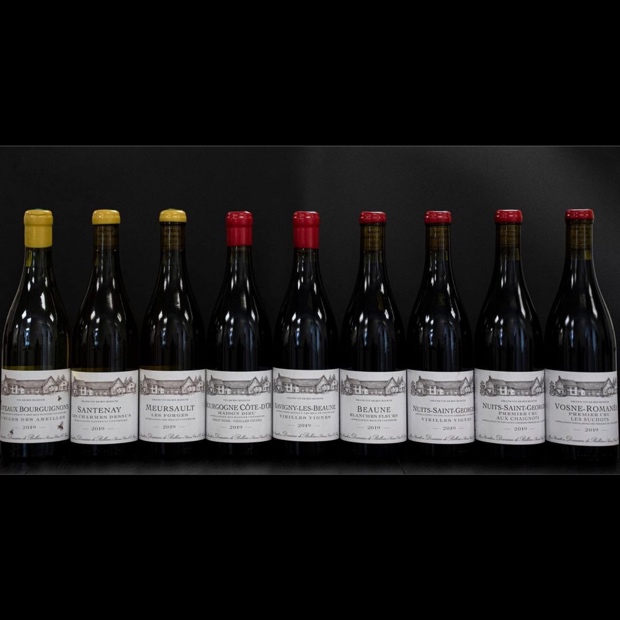
Domaine De Bellene Vosne Romanée Premier Cru Les Suchots 2020, AC Bourgogne, France

“Suchots” originates from “souches,” the name given to the woods before the land was prepared to house these vines. Les Suchots is but a small 13 hectare part of the larger 220 in total for Vosne Romanée and was first planted in 1937. La Romanée and Saint Vivant are the closest plots, south of Echezeaux, north or Richebourg and though just six per cent of the appellation it is actually the largest Premier Cru Climat therein. The vineyard is divided in two by a road. The eastern part below lays just above the cemetery and the village terroir called Hautes Maizieres. The top part is located below Les Beaux-Monts. The 2019 was a dream, crème de la crème and yet 2020 seems to embrace the powerful vintage with a most extraordinary level of perfume. That and fruit concentrated to a maximum degree without falling into any of the trappings associated with hyperbole. The concept of pinot noir reaching regional levels like this seems counterintuitive to the variety-appellation contract but the balance and harmony at the top is something the likes almost never seen. This will surely be one of the wines that explain with hyper clarity what 2020 is as a vintage. Drink 2026-2040.  Tasted May 2022

Graci Etna Rosso DOC Arcurìa Sopra Il Pozzo 2017, Sicily, Italy

Sopra il Pozzo describes a special portion of the signature Arcurìa vineyard (and contrada of the same name), a block “above the well,” 100 per cent nerello mascalese picked in the last week of October. Treated to the same maceration and elévage as the Rosso for the same spontaneous style and time as Feudo di Mezzo. However Sopra il Pozzo’s “refuse” soil composition is different and requires patience in the name of time, due to its alternating layers of decomposed volcanics in stone and coarse sand. This is a section of recast material and the corresponding mascalese is both emasculated and chivalrous. The degree to which layers of fruit, mineral and umami incorporare and completare is finite and contiguous yet also lengthy, scorrevole and endless. There is rare Etna glycerin texture and perfectly timed acid tang. Tempismo perfetto. Grande. Drink 2024-2032.  Tasted April 2022

Elisabetta Foradori

Foradori Granato Teroldego 2019, IGT Vigneti Delle Dolomiti, Trentino-Alto Adige, Italy

Granato from Elisabetta Foradori resides at or near the peak of the Trentino-Alto Adige wine chain, a Dolomite force of varietal nature, richness incarnate and cragged to gain your full attention. Fruit comes at a great premium, not by absence of the heart but because so much site, land and space speak louder than words. A static red stuck in a state of cryogenic freeze, immovable and surely able to handle immobility and also time. Will drink beautifully for a decade and a half, or possibly more. Drink 2024-2034.  Tasted February 2022

Garage Wine Co. Truquilemu Vineyard Lot 97 Dry Farmed Old Vines Field Blend Carignan 2018, DO Maule Valley, Chile

The eastern facing side of the Coastal Range where the old vines grow, in places where you had to make wines for the Catholic Church, “to save souls.” The most aromatic of Derek’s wines, a true field blend with a je ne sais quoi of varieties bursting off of dry farmed bush vines. Showy with that combination of outright juiciness juxtaposed against iron-fisted structure. A wine that comes from a place where the farmer worked to break up the “los camellones”, strange diagonal lines drawn and a framer who shows how to separate the land so that making great wine is easier. This is a remarkable example of old, bush and real. Drink 2024-2030. Tasted July 2022

Barone Ricasoli Castello Di Brolio Chianti Classico 1949, Tuscany, Italy

Tasted as part of “Il Chianti Classico in 9 Decadi” led by Filippo Bartolotta with Giovanni Manetti at Stazione Leopolda in Florence at the Chianti Classico Collection. The oldest wine in the flight. apropos and just when you consider the Ricasoli heritage and lineage. A mineral layering which instinctively mimics the compaction of argiloso, macigno and calcari from Brolio’s soils, no longer feeling the separation or mille-feuille effect but now just all morphed into one and the same. There were surely some white wines in this mix, as per the formula written decades earlier by Bettino Ricasoli. Probably helped keep the freshness for some time and while this is now all earth and stone the wine is very much alive. There’s even some sweetness and citrus showing, indicative of blood orange some 73 years later, finishing with a trebbiano and malvasia Vinsanto tang.  Tasted March 2022

Isole E Olena Chianti Classico Gran Selezione DOCG 2016, Tuscany, Italy

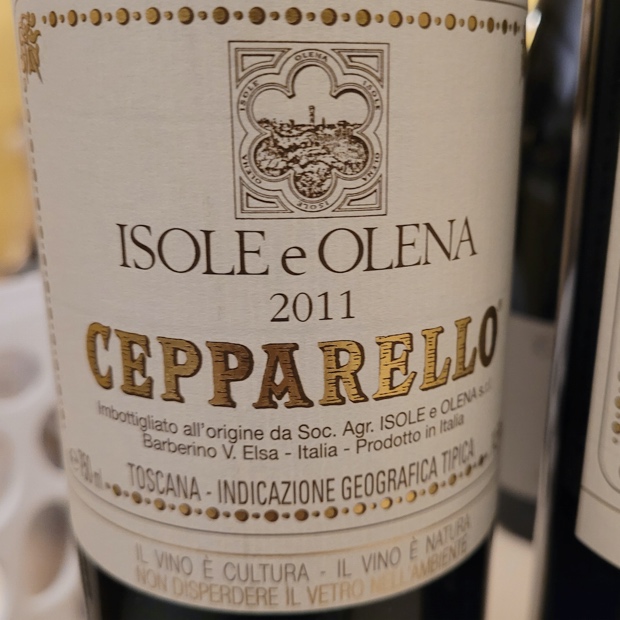
“I did not like Gran Selezione, I did not have anything against Gran Selezione but the discussion about UGA (sub-zones) was already underway so why not wait for this next change to the appellation?” The thinking for Paolo de Marchi was more about the wines that did not qualify for the appellation becoming wines that now qualified, the issue being a new rule could not apply to only 30 or so producers. So what is needed for that to happen? “All grapes born here should be able to travel with a passport.” If it is more complicated than that then there is much more to discuss. A Chianti Classico from a long, linear and fortifying vintage delivers equally appropriate and extending tannins, gripping the composition while proposing to become elegant and fine. The seamlessness and never wavering focus keeps on keeping on, in the ways of emotion in motion. Will remain in bottle one year more before being released to the market. Drink 2023-2027.  Tasted February 2022

Great anticipation to taste La Casaccia and Montosoli side by each from a vintage carrying no option but to act out the passion play through the glaring clarity of a sense of place. There are facts involved and there is no hiding the truth formed by these plots of sangiovese in this vintage. By now it is understood how 2018 exists on its own accord at one with nature though Francesco Ripaccioli will tell you there are similarities with 2013, if only because that vintage was greatly ignored and is drinking well at this time. La Casaccia in the località of Canalicchio is the wildcard of Montalcino and tasting several wines from the frazione reveals a collective affinity supplied by the year’s gifts. Nothing was portioned or taken away from the ’18 Annata and yet this Vigna sings with even more range and depth than that wine. The acids are simply out of this proverbial world, the linear aspects drawn with precise architectural or even, in Old English speak, a Cutter’s line. Remarkable reserve in concentration and forward slicing finesse. Forever long. Forever young. Drink 2025-2038.  Tasted November 2022

Biondi Santi Brunello Di Montalcino Riserva DOCG 2016, Tuscany, Italy

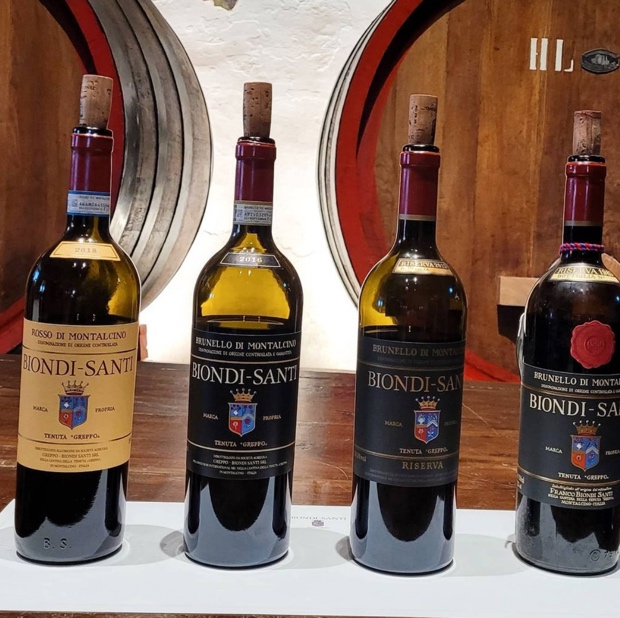
Riserva 2016 is the 42nd such vintage since 1888 from estate vineyards and the oldest parcels therein. Meanwhile olive trees and other compatible local species grow in those places and there always seems to be lower pH and higher bright acidity coming off the grapes. The Federico Radi team seeks to broaden biodiversity with unlimited scope and more vineyards would benefit by following such a plan. When Biondi-Santi gets to their next position we can expect even more refined and higher quality wines. Meanwhile the harmony and extant abilities in this ’16 Riserva are almost impossible to believe. A Riserva of fruit termed as the locus of the points drawn at an equidistant from the centre. Sangiovese of no stops and starts existing on a special kind of ellipse in which the eccentricity is zero and the two foci are coincident. Simple descriptors like crunch, chew or crust are not in the lexicon nor do service to speak about the texture of this remarkable sangiovese. Subtlety and strength, a dappling of early morning light, patterning and shimmering as if on water. The phenolics are spot on, coherent and the connection with both palate and tannins perform as an unbreakable bond. A canvas flooded with colour and while there is a level of transparency there are no white spots. Everything is filled in. Clocks in at 14 per cent abv. Drink 2025-2040.  Tasted November 2022

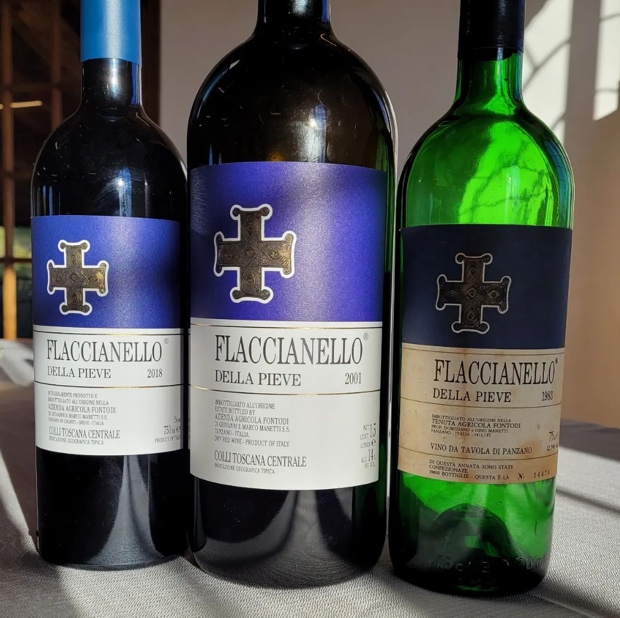
Fontodi Flaccianello Della Pieve 2001, IGT Toscana Centrale, Tuscany, Italy

Youthful is the proverbial understatement, zesty and full of Panzano life the other. A sangiovese in strike of ideal accord, freshness captured in bottle and development low, easy and slow accrued. Just like the season, stress-free, never too hot, never too wet. Stellar autumn of warm days and retentive cool nights. A late harvest and full phenolic character. It all shows in this 20-plus year-old Flaccianello, singing a ballad, verse after verse, refrain post refrain. After 20 minutes a sweet porcini perfume emits and one wishes for a 50 day dry-aged Chianina Fiorentina. What fortune! Along with the special effects of smoky rosmarino and wild fennochio. Drink 2022-2029.  Tasted February 2022

Sassicaia 2019, DOC Bolgheri, Tuscany, Italy

Priscilla Incisa’s Tenuta San Guido is located one hour south of Pisa, going back many generations. The surface area covers 2,500 hectares in a “classic Tuscan agricultural estate, of vines, olive oil, cereals including wheat and feed for thoroughbred horses. There are 500 hectares towards the seashore dedicated to a wild life refuge “paradise” free from hunting and for migrating birds coming from northern Europe and heading to Africa, especially because a good part of the land is covered by water during the winter. Before 1994 the appellation was Vino da Tavola. The grand vin Sassicaia is always a minimum 80 per cent cabernet sauvignon (as per the appellation) with cabernet franc. The youthful perfume of Sassicaia is really something other, an invitation to the plume of a great and mighty bird that will soon migrate or not be seen or heard from until another season. The fruit is both wound taut and also layered, a mix of liquids, gasses and decomposed mineral, turning on its axes, literally the earth itself. The effort put in speaks volumes about the quality and yet the seamless transitions are as if there are no transitions at all, only one contiguous entity. Will release in Ontario as an Online Exclusive by lottery on October 20th. Drink 2025-2034.  Tasted September 2022

Emidio Pepe Montepulciano d’Abruzzo DOC 2002, Abruzzo, Italy

The subtle and gentle elegance of 2002 is almost mystifying, if at least a surprise that kinda hypnotizes. Memory serves up a case of conflict and adversity, if also vintage envy for the bookends of 2001 and 2003. And yet the cool of the night prevails to elongate a montepulciano for our pleasure and make it sing 20 years later. It was also decanted to reduce the lees sediment and then re-corked for our benefit. Words cannot express what a beautiful place this 2002 EP is found to be. It is a treat to taste and also behold, exactly as of right now. Drink 2022-2026.  Tasted June 2022

Planeta Santa Cecilia 2005, DOC Noto, Sicily, Italy

Finding oneself in a state of utter disbelief upon nosing an older Santa Cecilia has just happened with thanks to this 2005 and the unthinkable aromatics it possesses. There have been some older examples like 2007, 2008 and 2011 which all showed morphological magic but this, this is something other. The state of perfumed preservation is impossible, the floral emanations and fruit continuance implausible and in suspension of belief. The 2005 is almost perfect, dark berries and red citrus alive, acids in perfect condition, wood dissolved, resolved and walked straight out the door. The life and vitality reside in the arena of the flawless, faultless and achievable. This is what nero d’avola, Santa Cecilia, Noto and Planeta can be, at its collective finest. Will drink this way (and also that) for five more years and with ease. Drink 2022-2027.  Tasted April 2022

Château Cheval Blanc 1998, Saint-Émilion Grand Cru Classé, Bordeaux, France

The 24 year-old 1998 has been argued and predominantly defended as a Right Bank vintage, especially for merlot based wines, which the 1998 Cheval Blanc happens to be. Clocks in at 65 percent plus (35) cabernet franc and the two combine for hypnotic aromatics to put mind and palate in an immediately dizzying and gratifying tizzy. Dark, dark fruit of the “cimmérienne” kind yet of a grace and genteel manner shared by other profoundly distinguished red wines. Thoughts can wander and wonder as a result of tasting this blind and considering the depth it is nebbiolo that is imagined. Only for a moment because the numerous dual-toned vibrations direct towards knowing this to be a blend and so Right Bank combinations lead by their impression. Both of ’98 Cheval Blanc’s are blessed of ripenesses, acids and structural bones all having peaked at a shared summit. The conclusion can only be a two-part perception, of balance and beauty. Drink 2022-2042.  Tasted November 2022

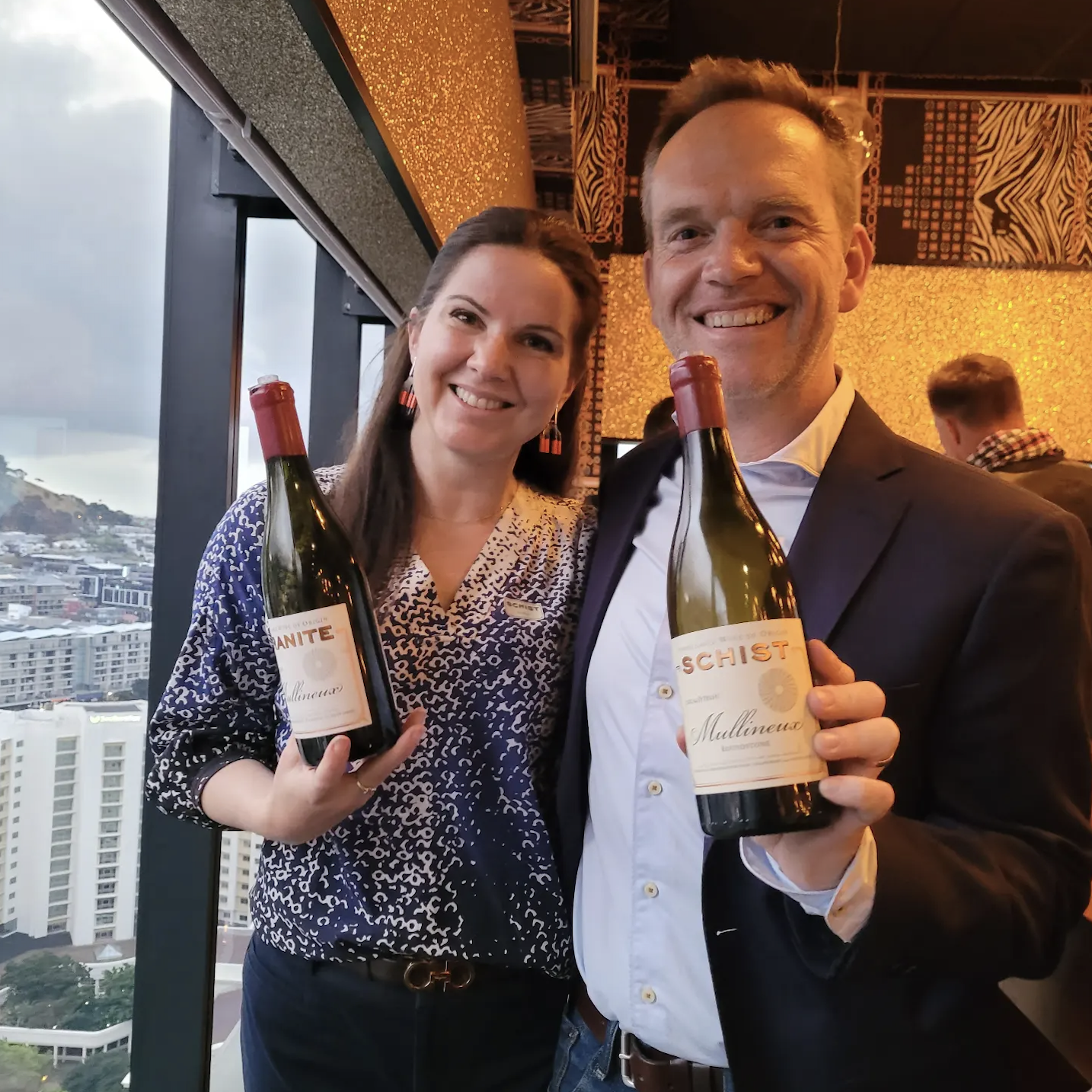
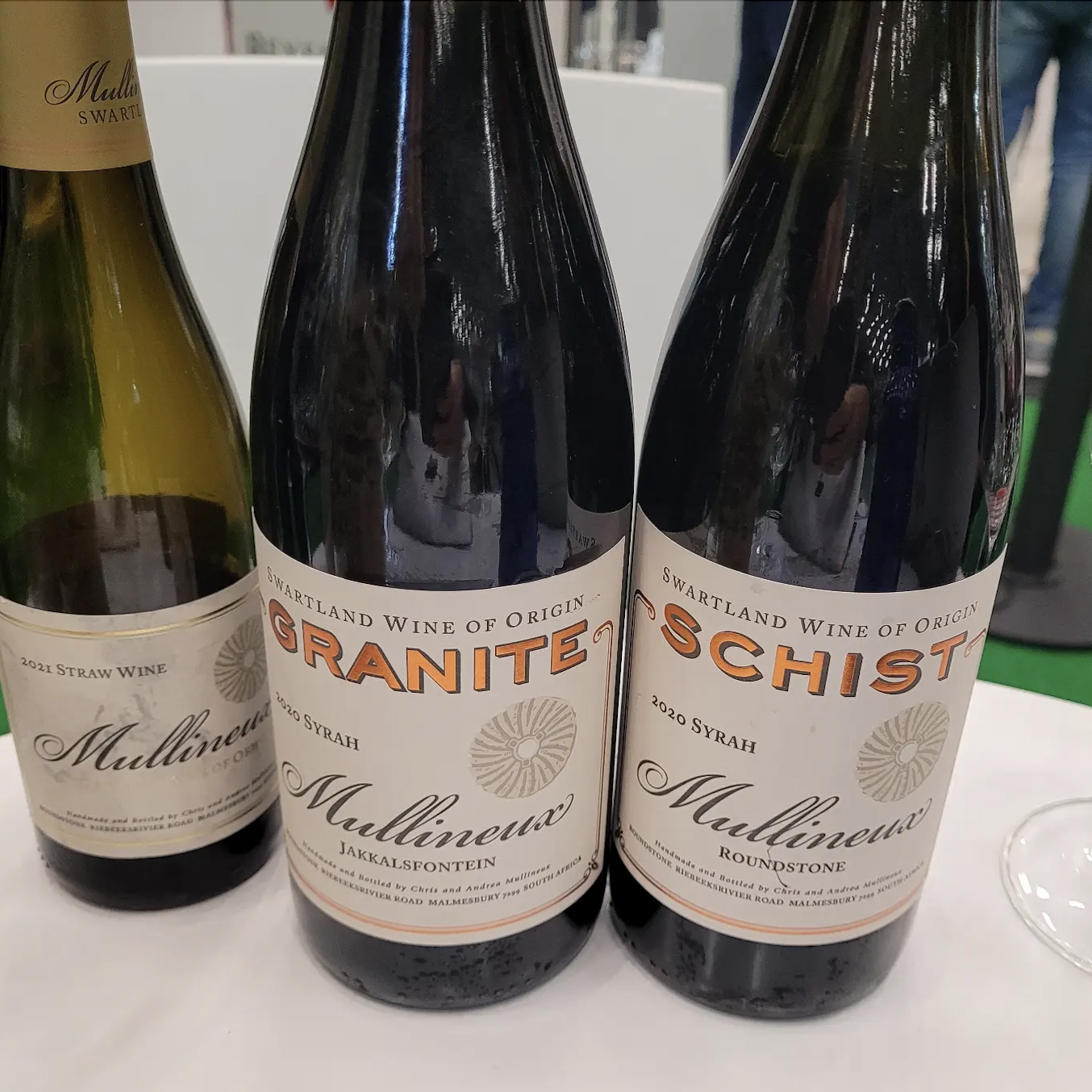
Mullineux Schist Syrah 2019, WO Swartland, South Africa

Vines planted in 1999, mature if still 12 years away from being classified as “Old Vines.” Schist is the home Brownstone Vineyard, shallow and rocky of less than 20 cm of soil. An extreme site in which vines attempt to grow, but so much comes down to the where and how. Rows are close together and planted in an almost race track configuration within an amphitheatre. The roots spread and dig deep within the stripes of schist interspersed with iron and the grapes are harvested plant by plant to create two apposite cuvées. Visually these are small vines with smaller leaves and an airiness – physically speaking. The skeletal backbone here is upright, towering and commanding, the juiciest of varietal fruit hanging as flesh, taut and muscular upon these bones. Unyielding yet never brooding nor astringent, but bountiful and beautiful. Drink 2024-2032.  Tasted July 2022

Penfolds Grange 1981, South Australia

Poured blind and easily recognized as a wine of great depth with at least two decades of maturity. Either older or hastily advanced but there are indicators to the former, namely high tones, substantial crunchy acids and full on perfume. There is a touch of Brettanomyces but only a feathery tickle and the wine still has something left to give and also to prove. Great depth is provided by wood notes, of soy, balsamic, wild fennel and all together now a reduction keeping its form, a foxy liqueur, once Cassis but now Amaro, finishing with flavours bloody and gamy. The reveal as Grange 1981 explains that while shiraz is always the game and king it had been a season for which the cabernet sauvignon portion exceeded 10 percent. Winemaker John Duval felt that ’81 was a tannic one but they left the building long ago. Both Barossa and McLaren Vale were involved and so this look back at blending expertise matters in the context of all Aussie blends being tasted today. Being present to be poured a taste of Grange represents good fortune and from 1981 there abides a full and fair suck of the sauce bottle.  Drink 2022-2025. Tasted November 2022

Donnafugata Ben Ryé 2019, Passito Di Pantelleria DOC, Sicily, Italy

Ben, as in “son of” and Ryé, a Sicilian riff on the concept of making strong mocker from the wheat grass. Think of grapes instead, in this case zibibbo (muscat of Alexandria) grown off the southwestern coast of Sicily on the Island of Pantelleria. Passito di Pantelleria DOC is one of the world’s great sweet wines, found only on this windswept promontory where the grapes concentrate, drink in the sea and express a view to which only this place commits. The warmest of vintages develops and comprises these particular sugars into something surreal. Extraordinary orange-ginger crème brûlée, perfectly embittered and made viscous in the most natural of ways. Layers of dedication and spice, health affirming herbs, respiratory fixing drops and sweetness captured, effortlessly and to gift plaisir. Apricots ripe and glazed, zen zero limone, giusto intenso. Nearly perfect. Drink 2025-2039.  Tasted April 2022

Vintage Port (c) Sarah Goddard/WineAlign

Niepoort Vintage Port 2019, DOP Douro, Portugal

Expect top concentration in Vintage Port from what Niepoort calls a “return to balance in the vineyard” type of season. Summer was unseasonably cool and the timely rainfall on the 26/27th of August was invaluable, allowing fruit maturity to go to completion. A recall to 2008, of natural, acid driven, balanced musts. Foot trodden in circular granite lagares with 100 per cent stems, racked soon after harvest, aged in “tonéis” (large oak vats) in the Douro over the winter, and then moved to the cellars in Vila Nova de Gaia in the Spring of 2020. Acid vintage indeed, fruit caught by circumfuse so as to be surrounded, ignited and eventually dispersed for decades of slow release power. The liquid chalkiness of tannin is so fine-grained you swirl and mull over just how hypnotizing it is. Truly great Vintage Port will act out this passion play. Drink 2025-2048.  Tasted October 2022

Good to go!

godello

Twitter: @mgodello

Instagram: mgodello

WineAlign

What comes next for the wines of South Africa?

A deep dive into the wine regions of the Western Cape, chenin blanc, and a Buyers’ Guide to South African wines

This feature was commissioned by Wines of South Africa, as seen on WineAlign


Several years back I commented that “the act of intense immersion into any important wine-producing nation and its diverse regional expressions can only leave a lasting impression if the follow-up takes a long, cool sip of its meaning.”

That was just the beginning of what I hoped to be a life-lasting fascination with South African wine and, seven years later, I can safely say the journey is going very well, if still only in the early stages of deep understanding. Just about exactly two months from today I will return to the Western Cape to rekindle, reconnect and extend my relationship with South African winemakers and their fascinating wines. Curiosity, anticipation and excitement have never been greater and so the questions is worth asking: What comes next for the wines of South Africa? At current the only answer forthcoming is how Cape Wine 2022 will be the most lekker experience of the year.

In all their combined iterations, the wines of South Africa are exciting communicators of heritage, history, emotions and declarative attacks. Collectively they spread with ripples like a large rock dropped into a pool of water. They are the beneficiary of effects created by two oceans and the great ancient, preeminent, decomposed and weathered soils found anywhere on this planet. Maturity is breathed into every phrase these wines are wont to play.

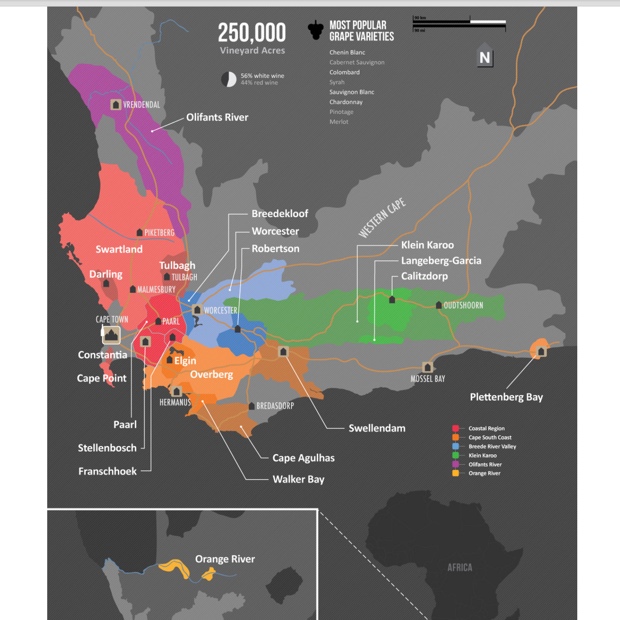
Growing regions of the Western Cape

South Africa is a medium-sized country that would fit into Canada eight times. It has a diverse population of 58 million people and is affectionately known as the ‘Rainbow Nation,’ a phrase aptly coined by Archbishop Desmond Tutu. Wine growing is limited to the southwestern region of South Africa, in the Western Cape Province, which is an area roughly the size of Greece. South Africa has been making wine for more than 360 years. The first grapes were pressed in 1659. The wines reflect the best of the old and the new; they present fruit-forward styles with elegance and finesse. The South African wine industry is one of the most technically advanced in the world of wine. There is an extremely rigorous Wine of Origin Certification Scheme, introduced in 1973, which guarantees that the wine is what it is designated or described. Each bottle carries a certification seal to guarantee that the claims regarding vintage, variety and origin on the packaging are true. South Africa has more certified Fairtrade wines than any other country. That is to say their products “guarantee a minimum price to cover the costs of sustainable production, as well as a premium to invest in social and economic initiatives in their communities.”

There are five officially demarcated regions of production — they are delineated based on the massive variations in soil, climate and location. The regions are: Breede River Valley, Coastal, Klein Karoo, Olifants River and Boberg. There is a commitment to environmentally sustainable wine production and wines can be certified by Sustainable Wine South Africa, which is part of the Wine and Spirit Board. The designation refers to grapes which are produced in harmony with nature, which allows vineyards to flourish alongside their natural habitat. The Biodiversity and Wine Initiative is a unique partnership between conservation bodies and the wine industry.

Cape Floral Kingdom – A World Heritage Site

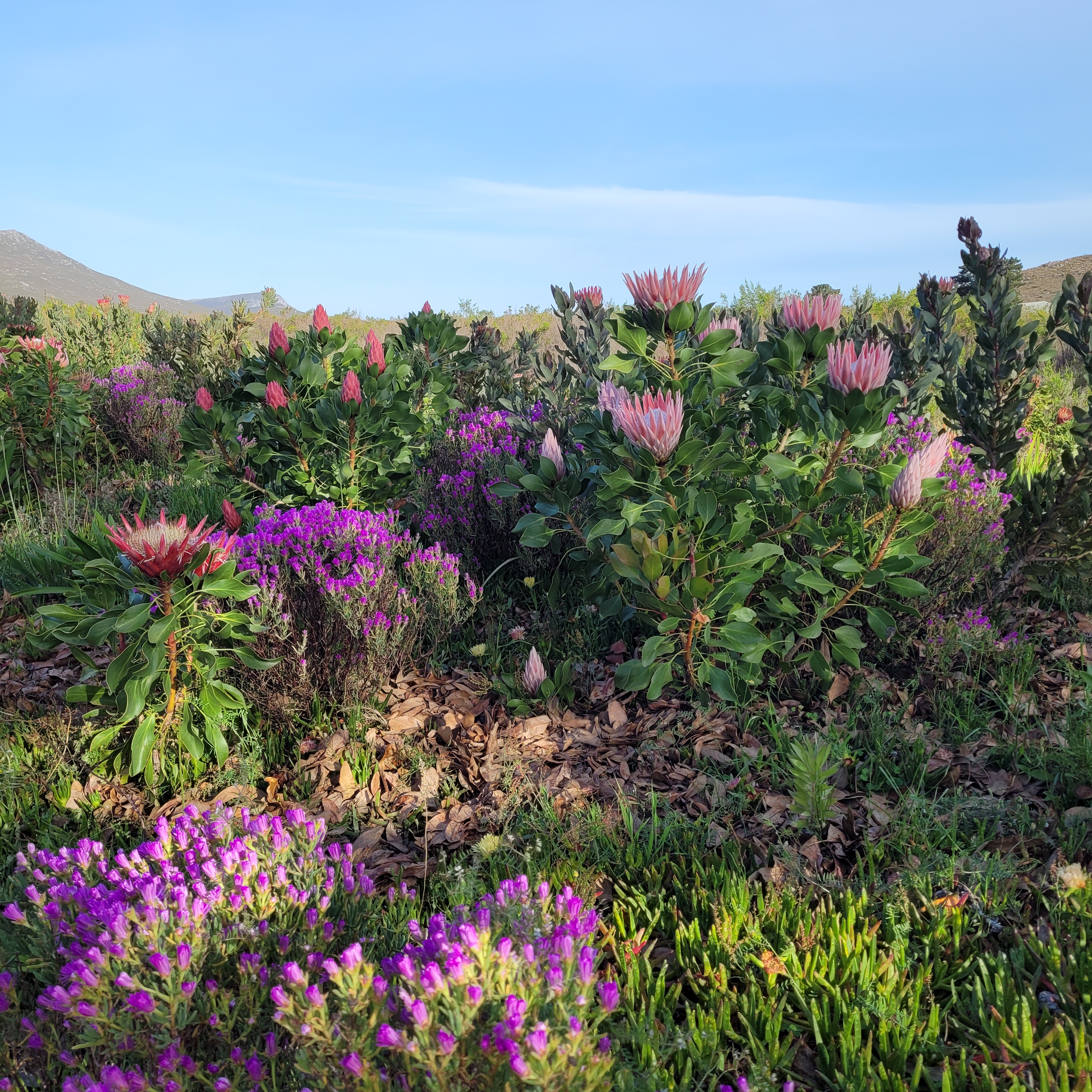
More than 95 percent of the wine is produced in the Cape Floral Kingdom, where there are more than 10,000 indigenous plant species, more than reside in the entire Northern Hemisphere. This Kingdom has been created by a diversity of soils, produced from granite, sandstone and shale; as well as a diversity of climates and geography. This, in turn, has created a treasure trove of winemaking possibilities. As a result, South African wines have a huge array of flavour and aroma profiles, which lead to wines with intriguing character and drinkability.

Chenin Blanc

Chenin Blanc

While so many grape varieties take hold with utmost promise in the Western Cape, there is but one that persists, unwavering and timeless. Yes, it is true that grape varieties such as grenache, cinsault, syrah, pinotage, sémillon and many others are apt at aligning with covenant to their old vine sources but there can be little argument against chenin blanc residing at the top of that list, Chenin is the greatest beneficiary of age, fortitude and focus as provided by the old vine experience. The list of Western Cape chenin sites from Stellenbosch, Swartland, Citrusdal Mountains, Darling, Hemel & Aarde Ridge, Breedekloof, Bot Rivier, Walker Bay, Cederberg, Paarl and Robertson, reads like a biblical scroll; Bottelary Hills, Granite Hill, Helderberg, Kapteinskloof, Kasteelberg, Paardeberg, Perdeberg, Riebeek-Kasteel and Skurfberg. The grape variety has been in the country for more the 350 years, and can perform well in warm and dry conditions. The signature grape variety is South Africa’s golden ticket to global recognition and success. No other varietal message speaks with as much clarity and consistency than that of chenin blanc.

Stellenbosch vines and heritage vines planted in the 1970s and before are now performing at their best. Johan Reyneke speaks of the illness that had been running through South African soils and how he sought to build immunity and disease resistance through a holistic farming approach. Things did not transform overnight, so fathers and neighbours may have doubted the long, arduous and yet understood process. But it is that organic and sustainable approach for which today’s health and prosperity can be thanked. When it comes to searching for chenin blanc plant material, vineyard sourcing can be quite broad, of multifarious soil types and elevations, 40 to 50 year blocks on average, sometimes also including old vine sémillon. The distance from the first to the last vineyard in a chenin blanc cuvée might be 200 kilometres or more but, when brought together well, magic often happens.

Windy places help in so many respects, allowing a larger canopy to remain in place and exaggerate the dappling effect which chenin blanc so dearly loves. Reyneke’s is South Africa’s oldest Demeter-certified biodynamic winery, with vineyards on the top of an ancient granite mound and on less weathered soils lower in the valley floors. The vine struggle is real, a positive one for the wines and ultimately for wine lovers. Granite soils further up the Stellenbosch hills are less colluvial, really old and weathered, predating microbial life. The vines produce lower yields and the weathered earth gives life to chenin blanc. For Mullineux Wines and a Cape chenin blanc assemblage, it gives meaning to the gathered idea, like an AOC Chablis made by a houses in names of Fèvre, Drouhin, Moreau or La Chablisienne. Mullineux’s twist is the back blending with some old barrel ferments to balance new and “other” fruit components. A chenin blanc may be bottled the same year it was picked though that’s easier to do so in the southern hemisphere, where harvest happens in the first quarter months. The reasons are simple. Intense investigations through schist, granite and old vines floats the boat and raises the bar for more professional and accessible chenin blanc cuvées. With older heritage vines involved, as is the case for Chris and Suzaan Alheit, the concentration and density of the vines is inherent. The use of heritage material is the South African version of Atticism; that is a return to classical methods and rhythms in making really old chenin, but also the likes of sémillon.

Chardonnay vineyards in Robertson

Cap Classique

One of the sparkling wine world’s most important and impressive categories in origin is no longer called Méthode Cap Classique (MCC), but now Cap Classique. This South African term indicates a sparkling wine made in the traditional method (the same way Champagne is made), by which a secondary fermentation takes place inside the bottle. As it stands, Cap Classique must age on the lees for a minimum 12 months to be labelled as such, though this number will surely extend once the realization sets in that more is better. Cap Classique produces some of the finest, most complex and diverse sparkling wines in the world. In Champagne the annual production is somewhere in the vicinity of 350 million bottles so compare this to South Africa where a fraction of that amount is released to the tune of seven or eight million. Méthode Cap Classique bottles are made by 100-odd producers, 73 of which are listed on the website for the Cap Classique Producers Association (CCPA), an organization established in 1992. The name was derived from the fact that the classic art of winemaking was introduced to the Cape by the French Huguenots, and the first bottle-fermented sparkling wine produced at the Cape was called Kaapse Vonkel (Cape Sparkle).

It’s also very much a wine about terroir. In Stellenbosch the sparkling is often made from early picked, old vines chenin blanc grown on Duplex soils, colluvial decomposed granite overlapping gravelly clay. Ask Ken Forrester and he will tell you the gravels allow for good draining and the clays deliver a time release of water. All this helps during drought and the restriction of water creates texture on the palate. There are pioneers like Graham Beck’s Pieter Ferreira who are attacking with Brut Zero style “based on the philosophy of grower’s Champagne.” For others, like For Christa Von La Chevallerie, it’s a matter of “how far I can go with [the combination of] chenin and lees.”

“We’re making wines that develop too quickly,” insists Paul Gerber of Le Lude. Gerber believes the minimum time on lees should be raised to 15 months. As for sugar dosage, he’s like a cook in the kitchen. “Dosage is like seasoning. If you do it properly you don’t taste it.” Ferreira has put in the time and the research over 20-plus years to really understand the category but, more importantly, the potential. “You are always looking to express terroir,” he says. As for Gerber, he will say “sparkling wine is not a terroir wine? Please. This is completely untrue.” “For Brut we have to extend [the lees aging time] to 60 months,” explains Ferreira. “So there is no lipstick or eye shadow. ”For a deeper dive into Cap Classique please read my article post Cape Wine 2018.

Bot Rivier 

Bot Rivier lies southeast of Cape Town, sandwiched from south to north between Hermanus and Stellenbosch. “From the top of the Houw Hoek Pass, one gets the first glimpse of the vast, rolling hills and big sky of the Bot River area, where real people make real wine.” This is the credo of the family of wineries that farm and produce in the area. There are 12 members of the wine-growing association, all within a 10 kilometre radius of one another. Here chenin blanc might be crafted with just a hint of residual sugar (at just above 5 g/L), to balance the effects of a long, slow, ocean-proximate Bot Rivier growing season.

Paul Cluver with Ken Forrester’s Chenin Blanc

Elgin

There is so much diversity in the Capelands. There are rock n’ roll stars in the Swartland, R & B, soul & Motown in Stellenbosch, Jazz in Elgin, Classical music wherever you want to hear it. But what there is everywhere is flow. Reggae flow, soulful Stevie Wonder flow, hip-hop flow, Stan Getz, Ahmad Jamal, Dexter Gordon flow. Elgin also has layering, in riesling, pinot noir and chardonnay. The wines glide with cool climate ease of ability, with an unconscious penning of notes coming from a place that was always there from the beginning, with a creativity that comes out of effortless style.

Elgin’s Paul Cluver seems to be the first to label his chardonnay with the Bourgogne “Villages” idea. This tells us much about what we need to know — that Elgin vineyards are the fruit source if not site specific or singularly focused. But he also finds precision with his Seven Flags and Close Encounter wines. The wines of Thelema (and Sutherland) do the same, curating classic Elgin cool savour running linear like a beam through the joist of structure.

The Helderberg, Stellenbosch, Western Cape

Stellenbosch

Stellenbosch in undoubtedly South Africa’s most well-known region and home to the eponymous town that is the country’s second-oldest town. It sits a mere 50 kilometres southeast of Cape Town, capital of the Western Cape. Stellenbosch is the lushest of the Cape’s valleys, home to more than 200 wine producers and surrounded by the Drakenstein and Stellenbosch mountains. False Bay acts as the mitigator of this Mediterranean climate, creating ideal wine-growing conditions where just about any sort of grape variety can achieve ripeness. The reds of cabernet sauvignon and shiraz predominate on the granite-based soils farther west, while chenin blanc and sauvignon blanc thrive in the sandstone soils of the east.

Swartland Independents

Swartland

The Swartland is Afrikaans for “Black Land,” so named because of the dark grey endemic renosterbos (rhinoceros bush) that covers the landscape and turns black after the rains. The region of the Western Cape begins some 50 kms north of Cape Town and consists of the area between the towns of Malmesbury to the south, Darling in the west and Piketberg in the north. Home to the Cape’s greatest of wine revolutions, followed by a swinging era — and what comes next is anybody’s guess. What we do know is that the Swartland’s decomposed shales and granites provide some of the most existential and powerful growing sites in all of South Africa.

Bush vines, Groot Drakenstein Mountains, Franschhoek, South Africa

Buyers’ Guide to Wines of South Africa

Over the past two months there have been several opportunities to taste a wide range of wines from South Africa. Andrea Mullineux came through Toronto to give a seminar on chenin blanc, VINTAGES has seen releases with a dozen various examples and the WineAlign team recently tasted a box of stunning values. Just last week I taught a seminar on South Africa and poured five seminal wines. Here is a Buyers’ Guide that includes chenin blanc, Cap Classique, Bot Rivier, Elgin, Stellenbosch, Swartland and the Western Cape.

Western Cape

Boschendal The Pavillion Chenin Blanc 2021, W.O. Western Cape
$13.35, Lifford Wine & Spirits (Select Wine Merchants)
Michael Godel – Hard to knock the consistency but even more so the varietal representation and transparency of this perennial steal of a chenin blanc. Fruit that sings, bones that stand upright and just textural enough to make you feel like chenin can do no wrong.

Spier Signature Chardonnay 2021, W.O. Western Cape
$13.35, Sylvestre Wines & Spirits
Michael Godel – Labeled as Western Cape though kind of essentially Stellenbsoch from Spier in a chardonnay of green apple, dried herbs and lime. A hint of reduction and then bitters and while not fleshy this is surely satisfying.

Franschhoek Cellar Statue De Femme Sauvignon Blanc 2020, W.O. Western Cape
$16.99, Perigon Beverage Group
Michael Godel – Franschhoek does sauvignon very well, not as cool as say Elgin but surely (on average) more complex than Stellenbosch. Note the elongated phenols and terpenes in this most stimulating and succulent sauvignon blanc. Steal of a deal.

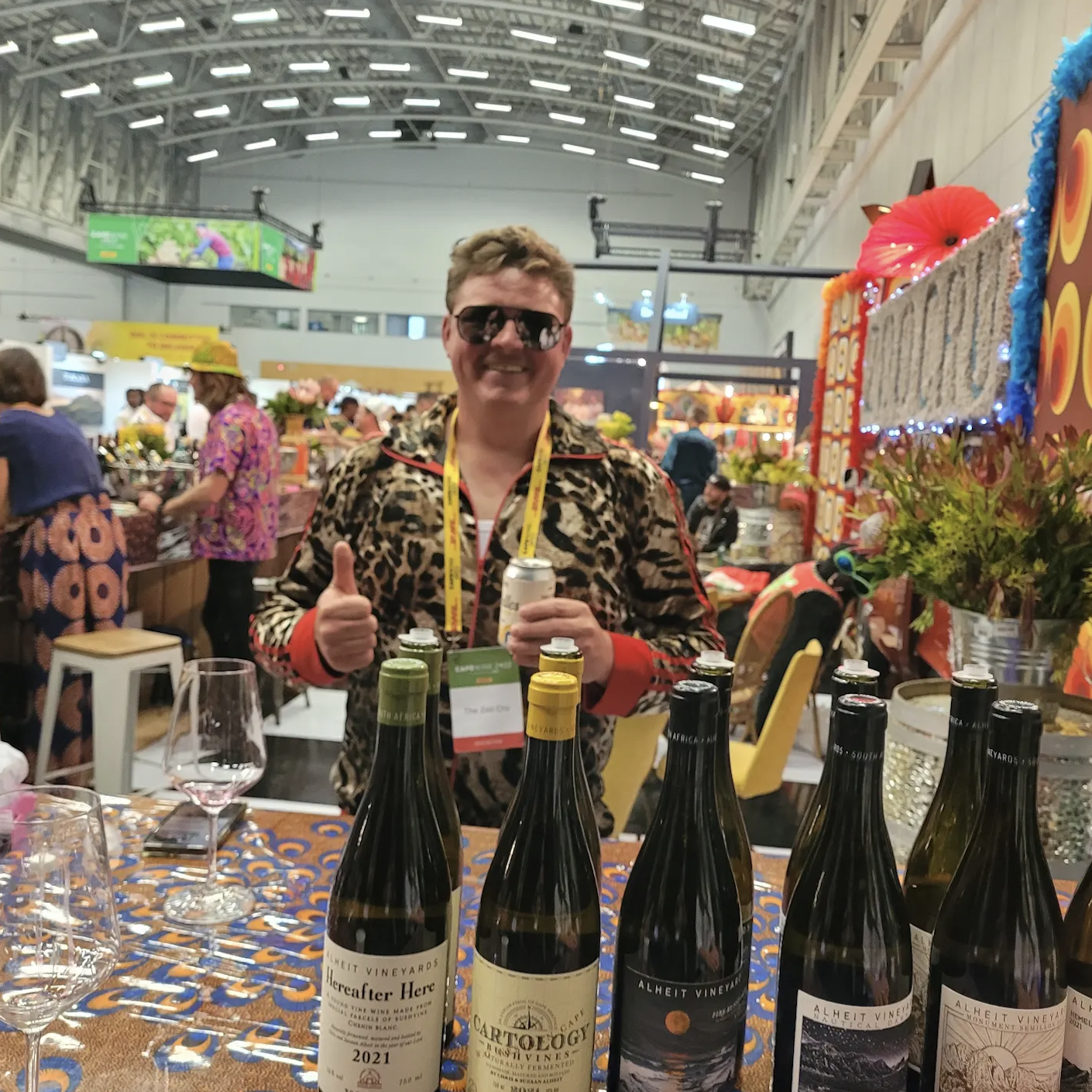
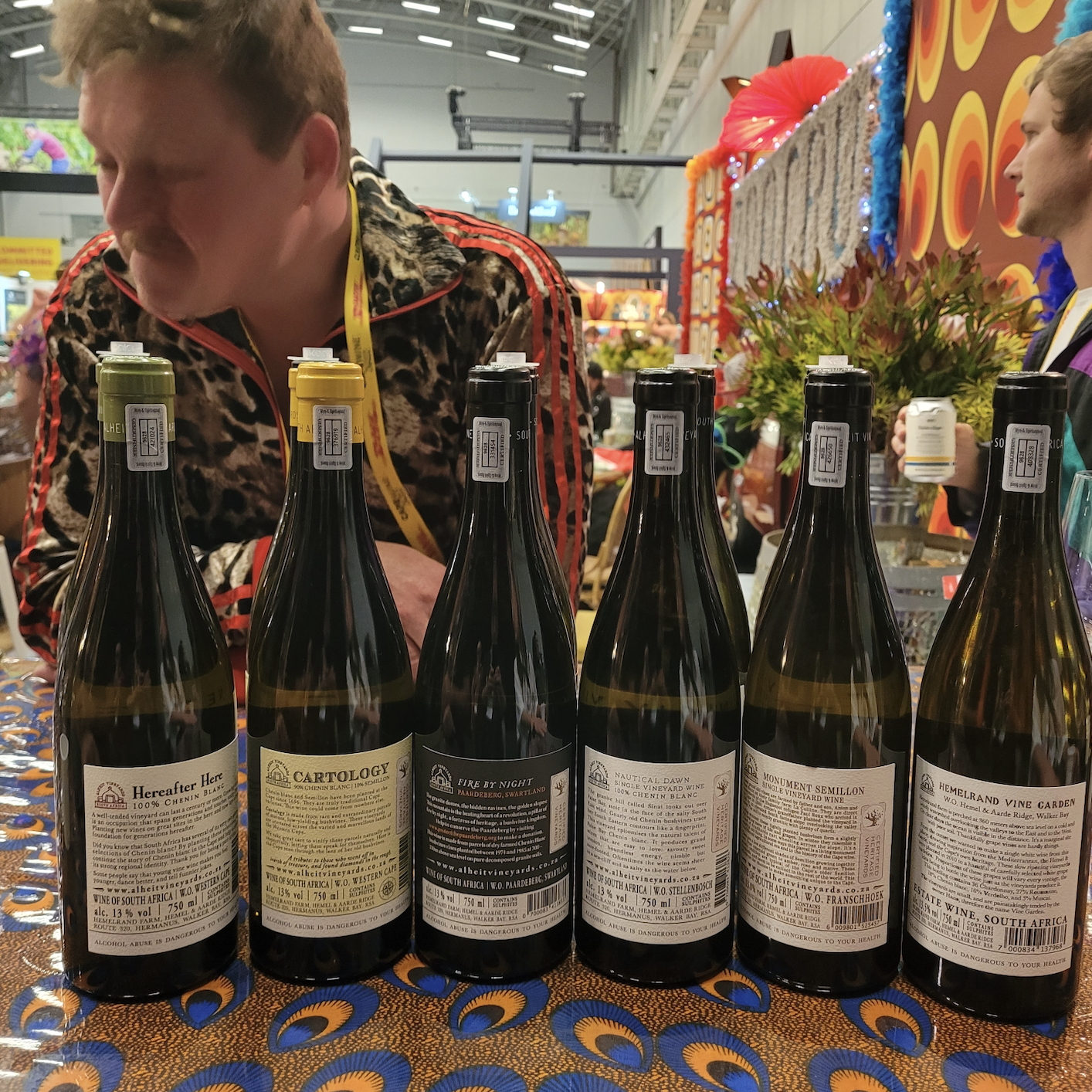
Alheit Vineyards Cartology Bush Vines 2019, W.O. Western Cape
$59.95, Groupe Soleil
Michael Godel –  Soil excellency layers in oscillations, waves and variegation in one of South Africa’s most curious to crafty blends in which chenin blanc is the focus to the core. You feel the sémillon, indeed you do because it streaks through the chenin, but not as a sprinter or a shooting star. Cartology is a correlated, traced and tabulated white blend that stands up to be counted.

Fairview Goats Do Roam Red 2021, W.O. Western Cape
$14.00, Univins (Ontario)
Michael Godel – Rhône blend based on syrah and the stylistic departure from the past to be über rich and dark is now more a matter of bright and effusive. Black fruit is now red, tar and tension given way to open and generous. Loving the modern acids, clarity, purity and simplicity.

Bot Rivier 

Beaumont Wines Chenin Blanc 2021, W.O. Bot Rivier
$29.95, The Small Winemakers Collection
Michael Godel – Hard to conceive and thus receive more aridity on the aromatics, surely flinty, part gun and part struck granite stone. Stretches this chenin blanc like the pull of elastics or fior di latte. Also herbal, sweetly so, with a chanterelle apricot note in the freshest of fungi specimens. Acids take over, spit and shine over this wise and elongated wine.

Elgin

Paul Cluver Village Elgin Chardonnay 2020, W.O. Elgin
$25.00, Buyers + Cellars Wine Purveyors
Michael Godel – Taut and tight, nicely reductive, orchard fruit focused with some bite and then a little bit of barrel smoulder. Not a smoky or toasty chardonnay but a balanced one with plenty of local, savour, savoir faire and flavour.

Stellenbosch

Ken Forrester Sparklehorse Cap Classique 2018, W.O. Stellenbosch
$29.95, Noble Estates Wines & Spirits Inc.
Michael Godel –  This may just be Ken’s most phenolic sparkling wine to date, emitting as a combination of blanched nuts and precious metals. Spent eight months in fermentation followed by 28 further on lees, in bottle. Creates orchard fruit flavours and textures while acidity retention keeps the groove and the balance.

Radford Dale Vinum Chenin Blanc 2020, W.O. Stellenbosch
$19.95, Nicholas Pearce Wines Inc.
Michael Godel – There is a feeling of warmth in Radford Dale’s 2020, not boozy per se yet the feeling is like cold sake going down. Then it’s all roundness and creamy fruit, ease and utter culpability.

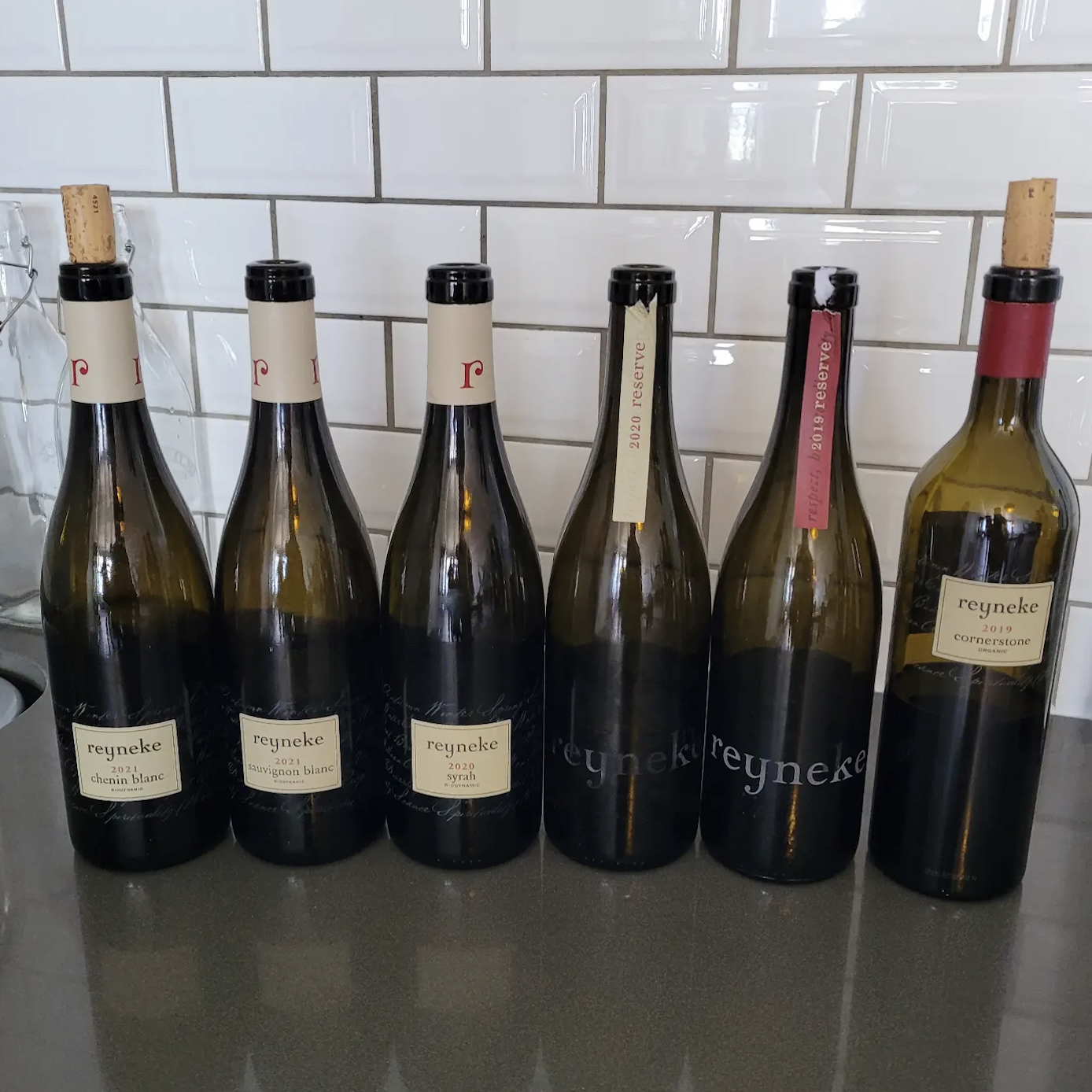
Reyneke Chenin Blanc 2020, W.O. Stellenbosch
$29.95, Univins (Ontario)
Michael Godel – Johan Reyneke’s chenin blanc is his and his alone, of South Africa’s first biodynamic winery and a level of say it as it is passion that can’t be touched. More like do as I do and Reyneke’s takes no liberties, asks no favours, gives and gives again. Spices and textural meanderings are concentrated and greater. An exotic notion as well, like ripe longan fruit and then a compound flavour profile going on forever.

De Morgenzon Reserve Chenin Blanc 2019, W.O. Stellenbosch
$49.00, Family Wine Merchants
Michael Godel – A barrel fermented style that shows in a flinty, caramel and pineapple way, part Burgundy plus California yet all South Africa. Heeds the Reserve moniker well with buttery brioche richness and full sun gathered consciousness. This one is all in with an effect to invite a wide ranging if specific consumer response.

Boschendal 1685 Cabernet Sauvignon 2017, W.O. Stellenbosch
$19.95, Lifford Wine & Spirits (Select Wine Merchants)
Michael Godel – Big, dark, brooding, as much about place as it is about grape variety.What’s special is the equally grippy and forceful fruit, exaggerated because the acidity is like a reduction of black currant syrup. Sharp and soil rich this is a serious mouthful of cabernet, firm, tannic and in charge. Roasted herbs and grilled vegetable notes, and a ferric-sanguine quality that brings the BBQ braai to mind.

Warwick Professor Black Pitch Black 2017, W.O. Stellenbosch
$19.95, NAVBEV INC
Michael Godel – Six grapes get together in Pitch Black, mostly made with cabernets with (13 per cent) cinsault, (10) merlot and then bits of malbec and petit verdot. Inky in feel if not pitch, tarry by natural nature if not by hue and also more Rhône meatiness then Bordeaux savour. A big, ferric and hematic example with strong bones and flesh all over.

Jordan Jardin The Long Fuse Cabernet Sauvignon 2019, W.O. Stellenbosch
$30.00, Kolonaki Group
Michael Godel – Straight faced and matter of fact, all things being true in a cabernet sauvignon that reeks of variety and subtlety in spite of the violence required to excavate and plant a vineyard. Don’t sleep on the tension and the structure in a wine of meaning, profound as it gets for Stellenbosch.

Aslina By Ntskiki Biyela Umsasane 2020, W.O. Stellenbosch
$35.00, Gradwell Wine Agency
Michael Godel – Ntsiki Biyela is officially recognized as South Africa’s first black female winemaker and the meaning in her Bordeaux styled Umsasane blend is local vernacular for the umbrella acacia tree. The brand is called Aslina, tribute to Ntsiki’s grandmother and one can feel the love in this richly styled, boozy in relative balance blend.

Swartland

Mullineux Kloof Street Chenin Blanc 2020, W.O. Swartland
$19.95, Nicholas Pearce Wines Inc.
Michael Godel – Essentially chenin blanc and an example that pulls the full blessings and richness of the sun into a generous and gracious wine. Kloof Street is chenin blanc of feel, touch and “tekstuur.” The old vines concentration and density is inherent, the “frâiche, agréable and couvert de rosée” all over the palate with license and privilege.

A.A. Badenhorst Family White Blend 2018, W.O. Swartland
$57.99, Lifford Wine & Spirits (Select Wine Merchants)
Michael Godel – The adage bears repeating as recited by Adi Badenhorst. “Fantastic grapes from old vineyards,” in a jazz mixtronic blend of chenin blanc, roussanne, marsanne, grenache blanc, viognier, verdehlo, grenache gris, clairette blanche, sémillon and palomino. Yet another paradigm shift in Cape white appellative white blends that seduces with its steely veneer, vine experience and turbulent soul to deliver in every way imaginable.

Mullineux Chenin Blanc Granite 2019, W.O. Swartland
$79.00, Nicholas Pearce Wines Inc.
Michael Godel – All barrel fermented in only neutral oak, full malo and with the intention to truly experience and taste chenin blanc grown on granite soils. A wine kickstarted by natural stabilization, equally expressive of tart acidity and freshness, fully reasoned by sunshine yet also seasoned with effortless and variegate ease.  Such an experienced and robust wine without solicitation, nor swagger neither. The ability, presence and precision are tops. There’s no question.

Porcupine Ridge Syrah 2021, W.O. Swartland
$16.95, Univins (Ontario)
Michael Godel – Unmistakable syrah from the Boekenhoutskloof clan, always the meatiest and meat fats dripping example for the price. That and a profile more Swartland than what comes from say Stellenbosch syrah.

Good to go!

godello

Twitter: @mgodello

Instagram: mgodello
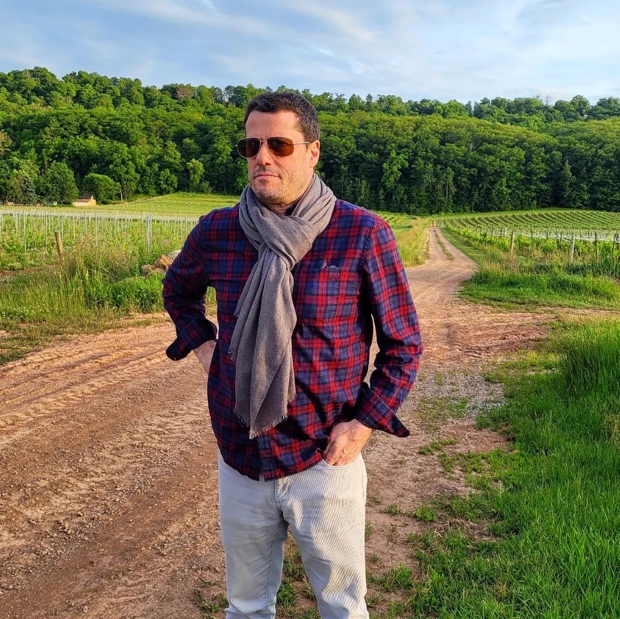
WineAlign

Always tasting Italian wines, doin’ allright

Toscana

Back in the summer of 1987 I attended the Umbria Jazz Festival in Perugia. This was considered “the benchmark year for Umbria Jazz in terms of the Festival’s appeal, its quality, its ability to combine popularity with exclusivity, with mass concerts in the football stadium and the fantastic evenings inside St. Francis’ church.” The memories of that July 16th to 18th weekend are strong, persistently vivid and what happened there was clearly transformational in my life. Sting had played the weekend previous and though my crew could not stay long enough to see Miles Davis on Sunday the 18th still there were grand moments indelibly stamped upon our lives. Walking the Piazza IV Novembre up to Nicola and Giovanni Pisano’s Fontana Maggiore, drinking in the cafés, Sly and Robbie sitting at the next table. But the highlight happened at the Stadio Renato Curi where Dexter Gordon blew his horn and our minds. The saxophonist was fresh off of a revivalist’s record and hit movie. He was Doin’ Allright, as were we.


Jazz and wine. Two inextricably linked subjects and emotions in the summer of 1987. Now 35 years later I’m listening to Gordon’s seminal record and tasting wine. Time spent Far Niente. Tasting Italian wines from a wide ranging group of producers while paraphrasing from thoughts about the music of the OG big man, with no disrespect intended to Clarence Clemons. Dexter’s life and this group of wines are representative of that kind of size. Their rhythm section plays for the grape, seeming to sense what it wants, following the varietal lead and never falling out of balance. Full toned manner of wines, loping in medium tempo, solos unhurried, logical, warming and full of Italian melodies.

Umbria, July 1987

There are white wines that play beautifully and pensively while others pick up the mood by spinning out solos, staying texturally relaxed and thoughtful, ending with some perfumed chords. There are short bits and interludes but ultimately the way these wines handle their ballads is an indication of their length and depth. They know what it’s all about. The reds are at times wines of catchy and contrasting themes but they truly know how to build a solo. In today’s warming climate they climb up in temperature, chorus after chorus, until finally they satisfy at their apex. There are moments when the reds seem to be skipping and marching, alternating between funky riffs, leaping rhythmic figures and brightly lit burning flames of fruit and acidities. They build more slowly to climax while expanding in tones and for longer periods of time. There are chordal explorations in reds, blacks and of course blues. What connects them all is underlying substance in waves and weaves throughout each ensemble. Tasted consecutively or together theses wines all prove to be mutually significant. Thank you to Ira Gitler for the inspirational notes, to Stefania Tacconi and the prodcuers for sharing their wines.

Inama Vin Soave Classico DOC 2020, Veneto

Anything but entry-level from the grape garganega once known as Graecanicum grown in the basaltic lava, volcanic tuffs and orizzonti rossi. About as correct and defining as it gets for Soave, yellow and green floral, fruit recall more of the same and then the volcanic rock alterations that give the mineral-salty feel. While there might be a wish for a little bit more complexity and grape spirit there is some gelid to viscous texture in this 2020. In any case Inama’s is well made, educational and right on the varietal money. Drink 2022-2024.  Tasted March 2022

Abrigo Giovanni Favorita DOC 2020, Piedmont

As for white wines from Italy’s northern climes there are those that speak to many and then there is the “favorita” of others, the varietal Piedmontese white for the dreamers and the romantics. This from Abrigo out of Diano d’Alba avoids the bitters, pith and boozy thiol moments to instead capture all the white flowers and more. The scents are fruity over metallic and clean instead of waxy. There is precision and most importantly a toothsome grace over the palate that brings you back for more and more. A picnic in the hills, a chilled glass after the day’s movement and the scent of dusk. That is favorita when it’s right. Drink 2022-2024.  Tasted March 2022

Terra Costantino Etna Bianco DOC Deaetna 2019, Sicily

Terra Costantino’s is from Contrada Blandano in the Comune Viagrande, on soils sabbie di matrice vulcanica, a blend of carricante and catarratto, three to one, at 500m, part bush vine and part spurred cordon. Were the flinty smoulder the only beautiful thing going for this Etna Bianco it might almost be enough but the gelid and sweetly ripened fruit takes every moment to a higher caste and level. The thought of these wines being honeyed is not all that common and yet he we are, aromatically speaking, lemon meringue and curd, angel food cake, with the barrel impart knowable in vanilla and light caramel terms. A metallic feel as well, pure platinum gold, texture and some age already put behind. Not so typical but curious and highly enjoyable nonetheless. A drink now chardonnay or chenin blanc alternative that will begin to oxidize in a couple of years time. Drink 2022-2024.  Tasted May 2022

Poggio Argentiera Morellino Di Scansano DOCG Bellamarsilia 2020, Tuscany

High-toned in 2020 with a marked level of volatile acidity and good if not maximum ripeness from sangiovese grown either in a (relatively) cooler year near the (Maremma) Tuscan coast. It would seem the winemaker is also looking for restraint and maintaining positive acidity because at this low level (13.5 per cent) of alcohol the resinous and stemmy nature of sangiovese is duly noted, if also accentuated. Texture is a bit chalky, almost grainy and the tannins throw a touch of green. Drink 2022-2023.  Tasted May 2022

Usiglian Del Vescovo Il Barbiglione 2015, Terre Di Pisa DOC, Tuscany

From estate grapes in the Pisa DOC and from a winery also producing wines both coastal and in Chianti appellations. Centred around syrah with small percentages of cabernet grown in greyish, dry, shallow, sandy soil with some clay, lime and fossils. A bright, currants and other red fruit syrah with notable tang and wood resins. A touch pectin sappy while satisfying and complete. Held back to tame its wild side and drink upon purchase. Drink 2022-2024.  Tasted June 2022

La Regola 2018, Toscana Rosso IGT

A place of Etruscan origin just five kms from the Tyrrhenian Sea at Riparbella in the Cecina Valley. The vineyard lays within the Montescudaio DOC at 150-200m with soils described as Mediterranean with an abundance of stones. La Regola’s (the rule) is varietal cabernet franc, abundant, heady and as compared to the blended reds, so unfettered and uncluttered. The varietal purity is expressly coastal, of saltiness, algae, seaweed, tar and fruit so much more than a plenty. This is truly a stylistic and a place that makes wines just like this here screaming with clarity and truth. There seems to be little doubt that cabernet franc fits, unlike sangiovese, syrah or cabernet sauvignon. Franc is the signature red and 2018 announces its success. The structure, unimpeded drive and length confirm the pronouncement. Drink 2024-2029.  Tasted June 2022

Boscarelli Vino Nobile De Montepulciano DOCG 2019, Tuscany

Boscarelli is a name to conjure with, a producer from Montepulciano as direct and exciting as a communicator of sangiovese emotion as any, consistently declarative in attack. Case in point this 2019 though with the added advantage of a most generous and unselfish vintage. Fruit comes from estate vineyards in the parish or pieve of Cervognano, one of 12 newly minted UGAs, a.k.a. unità geografiche aggiuntive. These additional mentions for the overall appellation give us the consumer a more pinpointed sense of place and in Boscarelli’s world the vines were planted in the late 1990s. Depth burrows in an endless seeking of mineral wealth while highlights rise unencumbered, defying gravity and setting this local sangiovese free. When sangiovese does both it’s a bit of a revelation and in Montepulciano the truth is not always easy to come by. The wines can make you work for your pleasure and this 2019 gifts it freely. Drink now and for the next 10 years. Drink 2022-2028.  Tasted May 2022

Il Bocale Montefalco Rosso DOC 2018, Umbria

The Umbrian work of i famiglia Valentini based around sangiovese accented by the local sagrantino, then merlot and colorino. Unequivocally balanced if not quite the increasingly generous vintage that will follow in 2019. The succulence and juiciness of the Montefalco Rosso appellation is captured with precise and succinct advantage and done so without any due stress or adversity. The fruit spreads with ripples into fine acidity and supple tannins like a large rock dropped into a pool of water. The rock disappears but the fluidity and gentle set of wakes linger on, ever so slowly decreasing their size and intensity. Bocale’s ’18 is an effortless Rosso, aromatic, flavourful and elastic. This is just what a top producer knows how to do. Drink 2022-2025.  Tasted June 2022

Il Bocale Montefalco Sagrantino DOCG 2016, Umbria

From the Valentini family dating back to 2002 and a varietal sagrantino of the highest selection. “Bocale is the dialect word that indicates the two litre mug of wine or oil, but, above all, the name with which this family from Montefalco has always been identified.” From the most democratic of Montefalco vintages, long, studious and just, indeed a wine giusto e completo, time having settled the once formidable tannin and connecting the early unconnected parts. A wholly unique profile, indicative of tar, dark chocolate and espresso yet subtly so, with an allowance of many complexities to join the parade. Quite special in so many regards. Drink 2022-2026.  Tasted April 2022

Il Palio, Siena, July 1987

Riecine Chianti Classico DOCG 2019, Tuscany

Grande Gaiole compass, cinch and girth in naturally swarthy sangiovese from Riecine in 2019, crunchy and tart. Inching up towards the volatile but such is the word in pace for the vintage. The fruit can handle the stark reality and veritable truth, equipped with grip and ready for the inevitable circumstance. Maybe wait a year for further resolution. Drink 2023-2027.  Tasted February 2022

Villa Di Capezzana Carmignano DOCG 2017, Tuscany

Consistently presents with an evolved aromatic tendency as it breathes maturity into every phrase it plays. The jazzy mix of violet, spice cupboard and freshly baked earthenware speaks in open and knowable truth for a wine so upwardly representative of a DOCG with roots dating back to 1716. That is when Cosimo III de’ Medici, Grand Duke of Tuscany granted exclusive status to Carmignano at the same time he did so for the Classico territory of Chianti. Was not the easiest vintage to deal with and yet this is one of the Tuscan stars what with the piquant yet elastic spice condition rolling off of the palate with sage, fresh tobacco, finnocchi and tartufo. Deals with 14.5 per cent alcohol without adversity while modelling symbiosis between sangiovese and cabernet sauvignon. Hard to do much better with the aridity and warmth, breathe life and plan for five-plus more years of pleasure. Drink 2022-2026.  Tasted June 2022

Azienda Agricola Reassi Sparviere 2018, Colli Euganei Cabernet DOC, Veneto

Reassi’s two-thirds cabernet sauvignon and one-third cabernet franc comes from the Padova area in the Veneto, famously home to some of Giotto’s most profound and important 13th/14th century frescoes housed in the Cappella degli Scrovegni. The estate’s 1997 planted wines are located in the zone of Carbonara di Rovolon, harvested near the end of September and only 3,500 bottles are produced. This is a cheeky cabernet at the lead for the Colli Euganei DOC, full of sweet tar and tobacco, petrol in cars, wood resins, fruit from pods that grown on trees and really quite bright in disposition. How can you not adore the vitality and low alcohol proposition (12.5 per cent) plus this genteel pectin and glycerol feel. “Oh, it’s magic, Uh oh, it’s magic. Just a little magic, you know it’s true.” Drink 2022-2025.  Tasted May 2022

Abrigo Giovanni Barbera d’Alba DOC Marminela 2019, Piedmont

At the DOC Barbera level it would be hard to find another example so open, forthright, up front, bright, getable and delicious than this Marminela by Abrigo. Classic interpretation indeed yet without rustic strings tethering it to the past, instead expressive of a freedom to explore. Here barbera throws aside traditions in a spirit of experimentation. This is a blend of grapes from two vineyards in the municipalities of Grinzane Cavour and Diano d’Alba and aging takes place for nine months in concrete vats. Freshness is dutifully captured, preserved and the barbera perseveres. Will drink this way for two, maybe even three full years ahead. Drink 2022-2025.  Tasted June 2022

Rocche dei Frisu is Abrigo’s top end, purest expression of barbera, from vineyards in Diano d’Alba and also nearby. The sites range in elevation between 230-360m, on clay-based soils mixed with sand and limestone, depending on the block. The name could mean “cones of frieze” in the literal sense but probably a name given to a hill of natural architecture that when looked at from afar there would be some sort of illusory effect. As in art, whereby a trompe l’oeuil or trick of the eye is created by a broad horizontal band of sculpted or painted decoration. In any case the barbera in this bottle does the exact opposite with its openly blatant and striking set of ripe fruit, varietal acidity and full throttle potency. Not shy to be sure, nor heavy neither but there is power contained within this bottle. Even after nearly four years the Frisu does not relent and as a member of the Alba Superiore fraternity the representation is bang on. Plenty of stuffing will see this through to the end of this decade. Drink 2022-2028.  Tasted May 2022

Abrigo Giovanni Nebbiolo d’Alba DOC 2019, Piedmont

Marked valuation in animal musk through the masculine scent of Abrigo’s nebbiolo from Diano d’Alba, a parochial example equally rich in classic DOC notes. Only the nebbiolo from Alba’s territory smells and tastes like this, accentuated by wood with spice infiltration inside and out. The animal magnetism is captivating, as much as the barrel accents are condiments to the fruit and earth that fill up this nebbiolo. Quite tight for 2019, needing some time, acids equally taut and being open three days helped immensely. Be patient with this Alba, it will reward those who are. Drink 2024-2028.  Tasted June 2022

Abrigo Giovanni Barolo DOCG Ravera 2017, Piedmont

Diano d’Alba producer of a Barolo in the municipality/cru/MGA of Novello. Meets the specs of Tortonian soil, laminated Sant’Agata fossil marl, in other words calcareous clay, deeply entrenched, at 400m, vine age ranging 20 to 35 years. Fifty per cent is treated to long skin maceration i.e. cappello sommerso and despite the aridity and heat of 2017 there is freshness captured in Abrigo’s Ravera. Luminous and immediately spicy, a piquancy of pure nebbiolo spiked by time, vintage and lastly barrel. Amazingly persistent Barolo, full, substantial and in charge. Must give this three more years to integrate and allow us to grow as tasters, eventually to be ready and willing to enjoy this wine. Drink 2025-2032.  Tasted June 2022

Tenuta Di Pietrafusa Villa Matilde Avallone Fusonero 2015, Taurasi DOCG, Campania

Varietal aglianico from the Taurasi DOCG and a producer that also fashions top quality wines at IGT Campania prices coming in at under $20 CDN. This top drop comes from the production zone of Montemarano e Paternopoli off of vines planted in 1968 and 1985. The first commercial vintage was 2004 and so here in the 12th iteration is a most generous vintage from which the best of all worlds is accessed. The world of aglianico is reached earlier than that which hesitantly emerges out of some hard, at times sufferable and surely tannic vintages. Here the fruit is nearly up front, artistically open and and even playing with musical swagger. There is room for all the aglianico because they provide the opportunity to enjoy the standards, originals and forward thinking examples. Fusonero is a delightful combination of all three and for that we are grateful. Drink 2023-2029.  Tasted June 2022

Good to go!

godello

Tuscany

Twitter: @mgodello

Instagram: mgodello

WineAlign

Twenty-one Canadian wines that rocked in 2021

Another year comes to a close, one filled with the dark moments and the light, the romantic entanglements and debacles, highs and lows. In life, love and wine, here with any reference to a gesture, gaze, smile or any other sensory reaction coming from an account of someone who witnessed it. In this particular case that would be Godello and much of what he saw and heard included odd little episodes that reveal how grapes really lived under the conditions of not only this vintage, but also the ones that came before. This ninth edition of 21 Canadian wines that rocked in 2021 comes out as a derivative, spin-off and postscript to all of this.

Godello in the Similkameen Valley

Related – Twenty Canadian wines that rocked in 2020

As a reminder, year-end lists are a matter of personal fascination and should be met with a certain level of judgement so that highly subjective descriptors such as “best” or “most” can be consumed with doubt, thoughts askance and even heated moments of disbelief. That which makes us feel moved, stirred, excited, ignited and set aflame could very well be someone else’s nothingness. Classification, indexing and charting is truly personal and as such opens up wide for criticism and hopefully, healthy debate. So keep it real but also civil, if you please.

Related – Nineteen Canadian wines that rocked in 2019

If we thought the 12 months that made up the 2020 calendar took things deep into the arena of the unfathomable and the absurd, then 2021 left the stadium and flew into the stratosphere of the preposterous. One silly year led to another but this one just seems to be concluding with some sort of level best described as fraught with “Vonnegutian violence.” Thank goodness there is Canadian wine to fall back onto and though it has been said before, this was indeed the very best year for the local stuff. A 2021 from which the highest to date level of greatness was achieved. Though these holidays are bittersweet and conditioned with some great unknowns, take solace in Canadian wine and what can be learned from their progression, evolution and continued excellence. They never give in or up but always strive forward, getting better all the time. To quote and then paraphrase from Britt Daniel and his band Spoon, “when you think your thoughts be sure that they are sweet ones. Don’t you know, love, you’re alright…don’t you know your (glass) awaits and now it’s time for (tasting).”

Related – Godello’s 24-hour Nova Scotia revival

This latest rocking roster of Canadian made wine is now the ninth annual for an exercise that first began back in 2013. When 2022 comes to a close the 10th will come to fruition in print, with 22 of Canada’s best laid to order. In 2021 Canadian wines were made available at every turn, especially at the WineAlign tasting table. In July the WineAlign critics’ crü took in Niagara for a pseudo-i4C 2021 Cool Chardonnay weekend. Godello made his own way to Nova Scotia in September to meet with and taste alongside eight of that province’s great winemaking teams. In October the WineAlign judging cartel sat through more than 2,000 entries at the National Wine Awards of Canada in the Okanagan Valley. Events such as the VQA Oyster competition, Somewhereness and Terroir Symposium were still no shows, or gos, nor walk-around tastings neither. Once again sad to miss Tony Aspler’s Ontario Wine Awards and David Lawrason’s Great Canadian Kitchen Party, the artist formerly known as Gold Medal Plates. Here’s to hoping 2022 will finally usher in a return to assessing and celebrating together.

Related – Niagara’s cool for chards

As per previous incarnations of this annual compendium, “the numbers chosen to cant, recant and decant excellence in Canadian wine continue to march ahead, as promised by the annual billing. In 2019 the list counted 19. In 2018 there were 18 and in 2017, 17 noted. In 2016 that meant 16 and 15 for 2015, just as in 2014 the filtered list showed 14, after  13 for 2013. Last year? You would be correct if you guessed 20. “Whence comes the sense of wonder we perceive when we encounter certain bottles of art?” Note that a third of the 21 most exciting Canadian wines of 2021 are in sparkling form. Does that need to be qualified? Of course not. Godello gives you twenty-one Canadian wines that rocked in 2021.

13th Street Premier Cuvée Sparkling 2015, Traditional Method, VQA Niagara Peninsula, Ontario

Racy sparkling wine of traditional ways, dry, toasty and of great vigour. Top notch autolysis, fine lees and guesses to the end would have to be in the 48-plus month arena. The real deal, richly rendered, acids in charge, instructive and carrying the fruit to the mountain’s peak. Hard to top this in Canada. Drink 2021-2027.  Tasted blind at NWAC2021, October 2021

Avondale Sky Winery Méthode Traditionelle Blanc De Noir 2013, Nova Scotia

While Ben Swetnam had wanted to dabble in sparkling going back to 2009 he can thank everyone in the Nova Scotia industry for showing him the ropes. That includes Gina Haverstock at Gaspereau, Bruce Ewart at L’Acadie, Simon Rafuse at Blomidon, Jean-Benoit Deslauriers at Benjamin Bridge and others. The 2011 would have been the first vintage of pinot noir production with the intent of making sparkling wine, of hot to cool years and all others in between. Dijon clones and a warmer edge of a ’13 season, a riper style but brought in at classic sparkling numbers, acids 11-12.5 and brix 17-19, picking in the third week of October. An early vintage. Intensity meets richness halfway there, fruit flavours are exceptional, just shy of eight years on lees, disgorged three months ago. “For the pinot I always wanted to do a minimum five years and the acidity was always there,” tells Ben. “The tertiary qualities were not out yet so the pause every six months kept the decisions at bay.” Got this apricot chanterelle fungi character, mousse and bubble are really in tact, dosage is 7.5 g/L almost fully hidden by that Nova Scotia acidity. There is something about this sight that maintains higher acidity levels while sugars rise but as an example perhaps it’s the gypsum based soil underneath the whole vineyard, or the tidal rivers and the specific diurnal fluctuations, cooler at night and “it’s something we can always rely on, in every year, that backbone of acidity.” So very Nova Scotia. Usually 500 bottles produced per year. Drink 2021-2027.  Tasted August 2021

Benjamin Bridge Méthode Classique Brut Rosé 2017, Nova Scotia

One of the first wines to come to the surface with Pascal Agrapart’s involvement with winemakers Jean-Benoit Deslauriers and Alex Morozov. When tasted the sentiment was that this particular vintage of this very particular sparkling wine was not yet there yet in terms of readiness or rather publicizing but truth be told, never have texture and acids come together as one in a BB Rosé. Crunch and chew, riff and rise, bellow and beauty, all despite the spiralling zeitgeist that underscores its urgency. Drink 2022-2027.  Tasted August 2021

Blomidon Estate Winery Méthode Traditionelle Blanc De Noirs 2016, Nova Scotia

Give or take 76 per cent pinot noir and 24 meunier, a similar vintage to 2015 (though a touch warmer) and here picked on the 17th of November. Almost all from Woodside Vineyard and some meunier off of the Blomidon estate vines, no longer here. Disgorged today, yes today and my oh my the potential here elevates to a very high ceiling. Just under 6 g/L RS so exactly extra brut, really primary but with the dosage that will arrive before you know it. The pinot delivers more fruit than the chardonnay, perhaps a counterintuitive concept but that’s Nova Scotia. And every vintage will flip the head and make you think again. Small lot, 50 cases or so. Searing succulence, a structural richness and transformative beyond the complex, curious and interesting. Assiduous if conceited blanc de noirs, pejorative to chardonnay, entangled inside enigma, mystery and riddle. Literally. Drink 2022-2027.  Tasted August 2021

Blue Mountain Blanc De Blancs R.D. 2012, VQA Okanagan Valley, British Columbia

A varietal estate grown chardonnay that spent upwards of 78 months sur lie is nothing short of dramatic, if not unconscionable. Not that no one else, anywhere else does such a thing but to do so, change so little and deliver unquestionable excellence is what dreams, expression and delivery are all about. If the Brut Reserve is Fillmore East than this Blanc de Blancs is Montreux, electric, mind-bending and so very exotique. João Gilberto, Marvin Gaye and Lou Reed wrapped into one, a sparkling wine of influence that only incidentally expands into mainstream visibility. This has stage presence and breaks fresh ground with creative sensibility, not to mention a deliciousness of flavour and mousse. That and 2012 in pocket permanently affixed to to the album cover. Drink 2021-2029.  Tasted March 2021

Henry Of Pelham Estate Winery Cuvée Catharine Centenary Estate Blanc De Blanc 2010, VQA Short Hills Bench, Ontario

As a reminder this top H of P traditional method sparkling wine is named after Catharine Smith, Henry of Pelham’s wife and this Centenary is the crème de la crème for the label. A rarity for the estate and for Canadian wine, partially (20 per cent) barrel fermented and aged for up to 100 months on the lees. All Short Hills Bench chardonnay, all in with a hyperbole of toasty development and the most brûlée of any bubble in the village. The sparkling stage presence and prescience of being so connected to grape and place make this true to itself. Not to be missed. Drink 2021-2026.  Tasted December 2021

L’Acadie Vineyards Prestige Brut Estate Méthode Traditionelle 2014, Nova Scotia

Was embargoed until September 9th after having just received the Lieutenant Governor Award. Has evolved into a seriously toasted arena, gone long with lees contact, looking for peaceful co-existence between yeast autolysis and the fruit of the wine. “You don’t want conflict, you want that harmony, tells Bruce Ewart.” Disgorged January 2021 and so spent more than the minimum five years on lees. An insignificant dosage (more than most of these wines). Bruce’s program goes at it in terms of two and five year aging and he believes that while Nova Scotia can do ten or more there is only a minor incremental increase in complexity by doing so. This at six-plus has hit such a sweet spot, still in retention of currant and white/red berry fruit but also low and slow golden, tanned and long as an August afternoon Gaspereau shadow. Drink 2021-2026.  Tasted September 2021

Two Sisters Blanc De Franc 2018, VQA Niagara River, Ontario

Stellar work here in blanc de franc, understated and effusive, lifted of black currants and sweet pepperoncini yet grounded by serious grape tannin. A sparkling wine of grape extract so full of depth and breadth. Not a wine of high autolysis but rather tart, tight and in command of all it wants to be. Last tasted blind at NWAC2021, October 2021.

The third vintage of Adam Pearce’s ground-breaking Blanc de Franc is as you would imagine a white sparkling wine made from the red cabernet franc grape. The aromas are distinct and secure, squarely wrested from the red currant and sweet peppery varietal post, expressed in a uniquely Two Sisters bubble that may once again, or rather should continue to rock one’s world. More richness and also excitement than ever before, risk taken and reward achieved. No acquiescence, no adjacent meanders but head down, goal in sight and hurdles overcome. At the end of the day this is one of the most impressive and essential wines made in Ontario. Nova Scotia is on the franc idea and others locally are beginning to follow. Autolytic and delicious, on point and regal. Drink 2021-2027.  Tasted September 2021

Malivoire Rosé Moira 2020, VQA Beamsville Bench, Niagara Escarpment, Ontario

From vines planted by proprietor Martin Malivoire “close to home” in what is the eponymous vineyard. Moira is a Beamsville Bench icon and has been for quite some time now, without question, nothing to discuss here, case closed. There is a complex and layered developed notation that Vivant does not have, not fort better or worse but Moira requires more thought and consternation. You can no longer think on it in terms of salinity, sapidity and satisfaction. Something more and other must be considered. Style. Style is what separates Moira from most other Ontario Rosé and in 2020 it exudes with prejudice and finesse. When a sip of a wine in this category stays with you for as long as Moira does, well you just know greatness is in the glass. This can saunter with the very best of Southern France. That’s the truth. Kudos to winemaker Shiraz Mottiar for this. Drink 2021-2025.  Tasted April 2021

Martin’s Lane Riesling Fritzi’s Vineyard 2018, BC VQA Okanagan Valley, British Columbia

Shane Munn’s riesling from the volcanic, clay and white quarts Fritzi’s Vineyard continues to get better, all the while with a wine he seems to do less and less to try and control. Must be the place and the fruit from this 21 year-old block (as of this 2018 vintage) seeking a 48 hour skin-contact for oxidatively handled juice. Pressed once, lightly and so softly treated, then transferred to German casks where it stays for up to eight months. Just bloody delicious, hard to not conjure a frothie for this freshest of phenolic rieslings, which incidentally was only sulphured once, four months into the trek. Walks about from grippy to lovely and back again, with silk stops along the way. Will shine brightest two years from now. Drink 2023-2029.  Tasted twice, October and December 2021

A really creative sémillon, rich, creamy and fulsome which is classic Mt. Boucherie while never abandoning the grape’s pointed and intense linearity. Hard not to be impressed by the soil intendment and how it creates a backbone in the wine, beyond acidity and into something sarsen-like, upright, timeless, forever. Plenty of grip, essential elements, minerals and metallics. Keeps the sémillon sensibility alive of an unconquerable nature, varietal invictus, solid construct but with more than ample fruit. Convincing follow-up to 2019 and really quite on par in every respect. Drink 2021-2025.  Tasted October 2021

Closson Chase South Clos Chardonnay 2019, VQA Prince Edward County, Ontario

Notable reduction marks South Clos’ youthful entry and with that first nose in the glass we are put on immediate notice that 2019 will be a structured year for winemaker Keith Tyers’ and Closson Chase’s chardonnay. This and the following vintage will trade blows for bragging rights, longevity and excellence, so pay attention to this pool of varietal estate wines. That is something CC so generously affords their customers. Here at the top level the fruit is glorious, pristine, pure and cut by diamond clarity. The reduction flies away and a nose of marzipan, lemon preserve and a fresh bitten Ida Red apple come away from the vineyard. Acids here are tight, crunchy, friable, felt from the tongue’s tip to the wisdoms. The liquidity is so finely chalky with all signs pointing to spirit and balance with that ’19 crop of South Clos fruit at the core. Does not get much better from PEC, Ontario or Canada. Anywhere. Drink 2022-2028.  Tasted October 2021

Hidden Bench Chardonnay Felseck Vineyard 2019, VQA Beamsville Bench

Tasted as part of an #14c21 seven year vertical Felseck Vineyard retrospective. No stirring, “I don’t like bâtonnage,” tells winemaker Jay Johnston, “unless I’m trying to get a wine to dry.” Never mind the lees aeration or the emulsification because texture in this ’19 is extraordinary to behold, gliding across the palate with Bench orchard fruit cleverness, penetrating perspicacity and juices running through unblemished flesh. Tighter and taut than ’18, while seemingly improbable but here yet unwound, far from the pinnacle at which point full expression will surely ache to be. The ’18 may be a beautiful thing but the ’19 is structured, manifold in destiny and ideal for those who know, or at least think they do. Drink 2023-2030.  Tasted July 2021

Lightfoot And Wolfville Ancienne Chardonnay 2018, Annapolis Valley, Nova Scotia

Frost year for the valley but again an escape by the vines at Lightfoot & Wolfville with thanks to the tidal influence to keep the chardonnay vines happy, healthy and secure. So much fruit and warm summer sunshine, a glade bathed in light and a luminescence rarely found in chardonnay. Consistent L & W elévage, increasingly into puncheons and away from 225L barriques. You can never forget and not remember what chardonnay has done for L & W, while now the richness and restraint work in optimized tandem. Less reductive than previous incantations, with new and improved connotations, consistencies and harmonic sway. Also a matter of vintage and cooperage. Stability is the key to being great. Drink 2022-2026.  Tasted September 2021

Westcott Reserve Chardonnay 2020, VQA Vinemount Ridge, Ontario

Almost seems redundant to say anything about the Reserve from 2020 because what more is there that was not already expounded upon from the Estate chardonnay. Same soft entry, slow developing charm, fruit neither richest nor gregarious but yet in Reserve truly ideal, less variegated and hinting at opulence. That is the crux and the key, hints, in shadows, speculations, possibilities and in Reserve form most surely probabilities. Elevates the crisp crunch and gets real trenchant with the pulverulent and tactile sensations. Seriously credible, professional and still emotive work here from Westcott at the pinnacle of Vinemount Ridge, but also Bench and Escarpment chardonnay. Drink 2022-2027.  Tasted October 2021

The Bachelder Vineyard Map

Bachelder Bai Xu Gamay Noir Niagara Cru 2019, VQA Four Mile Creek, Ontario

Bai Xu is unique within the Bachelder gamay domain encompassing whole cluster ferments and cru investigations. It reminds us all that time and patience are a must, an academic approach is not enough and one must follow their intuition, instinct and heart to deliver appreciated wine. In Niagara the philosophy has merged with gamay in ways the monk could never have known were possible. Here 20 per cent whole cluster may be less than the 22 and 52 crus, but this is a broader matter and one that fruits beyond the Wismer-Foxcroft Vineyard. In a sense, a villages-plus wine (think Côte d’Or) but as a conceptual one. The clarity and slow release of flavour in Bai Xu happens without power, grip or forceful intent. The acidity neither startles nor does it cry out, but instead acts as architect for the infrastructure and the mosaic. Bai (it is presumed) from a Chinese language, meaning “pure,” (depending on the dialect and vowel’s accent) and Xu, “slowly, calmly.” Thomas Bachelder is surely looking for the chaste gamay, unadulterated and one that rushes nowhere, takes the slow and winding path, feet securely on solid ground. More than anything else, this gamay cru won’t chase after what it thinks may make us happy or search for things that deliver one and done, immediate and short-lived excitement. As another one of nature’s mysterious constructs the captured poise and effect make cause for great delight. Drink 2021-2026.  Tasted June 2021

Cloudsley Cellars Cuesta Vineyard Pinot Noir 2018, VQA Twenty Mile Bench

Cuesta as a vineyard has more history behind it than one might have assumed, having been planted back in 2002. Adam Lowy has made 65 cases from Cuesta’s deeply resonant and soulful fruit, so as a consequence given it more new oak (28 per cent) than any of his other three single-vineyard pinot noirs. Clearly the brightest, most tonally effusive and transparent of the quadrangle, as Burgundian as it gets when it comes to mapping or contemplating the connectivity with the mothership. Just a lovely, elegant and sweet-scented pinot noir, classically arranged, scientifically opined and romantically delivered by Lowy’s prudent if so very hopeful elévage. The Côtes de Nuits notation is clearly defined, intuited and understood. Not quite but resembling Marsannay, or perhaps even something just a plot or three further south. Cuesta conduits as the “Robbinsian” one for which “the scientist keeps the romantic honest and the romantic keeps the scientist human.” Drink 2022-2027.  Tasted August 2021

Checkmate Silent Bishop Merlot 2015, BC VQA Okanagan Valley, British Columbia

One of four Checkmate merlots, regional expressions, here a blend of three benches, Osoyoos West, Oliver North and Golden Mile. A Silent Bishop and a merlot are more powerful than those who speak and their ordinations may also be called consecrations. Here the silent 2015 is one that is dedicated, coordinated, devoted and sacred to proprietors, winemaker and place. When a merlot is silent it moves in dynamic tactical effect and like the bishop moving on a position, does not capture or attack an enemy piece. Truth be told this is a stealth merlot, of fruit so dark and mysterious, of structure hidden, enigmatic and prepared to go the distance. Such an efficient wine and the kind to cause a ripple effect. Taste this and you too will want to pursue making profound Okanagan merlot, an endeavour as frustrating as it can be elusive. Drink 2022-2029.  Tasted June 2021

La Stella Maestoso “Solo Merlot” 2017, BC VQA Okanagan Valley, British Columbia

The decision whether to listen to Chopin’s Piano Concerto No.2 or Handel’s Allegro Maestoso (Water Music Suite 2) while tasting and sipping through La Stella’s “Solo” merlot is a difficult one. Less obvious than it might seem and the question is which piece best exemplifies “the highest peak in the crescendo, that moment of realizing you are in the presence of majesty.” Both, to be fair and so I find myself in good ears, and taste by the triad grace of Chopin, Handel and La Stella hands. Let’s revise to encompass all three, in decadence, rolling rhythm and Okanagan Valley merlot-defining precociousness come crashing onto a shore of strings. This is where the maestroso moment happens, in cumulative fruit substance joined by fine acid intensity, wrapped up in structural soundness. All this after a great deal of strong tempo variations which are prominent features in this Severine Pinte interpretation. The instruments are Glacio Fluvial and Fluvial Fan; Clay and Gravel mix, Alluvial deposit and Clay, playing in the orchestra of Osoyoos Lake District and Golden Mile. Support from the Okanagan’s best, written as a top merlot composition and executed flawlessly by the winemaking team. Bravissimo. Drink 2023-2032.  Tasted May 2021

Phantom Creek Phantom Creek Vineyard Cabernet Sauvignon 2017, BC VQA Okanagan Valley, British Columbia

Two weeks later than the usual norm defined the 2017 spring but hot and dry summer weather confirmed the intensity of Phantom Creek Vineyard’s southern Okanagan growing season. The cabernet sauvignon grows on the lower terrace of the Black Sage Bench’s Osoyoos sandy loam and it has been approximately 15 years that these vines have been fostering these wines. Magnanimously ripe and conspicuously copious fruit sees the unabashed generosity of (75 per cent new) French wood in a bone dry, healthy acidity endowed and elevated pH cabernet. This is essential edging up and into quintessential Okanagan varietal chattel, a wine of substance, grip and winched binding, oozing with expensive taste, fine dark chocolate and a depth of fruit that aches to be heard. That will have to wait and so should you because the structural parsimony will need three years or more to release and allow for stretching and breathing room. A prouheze as they say. Drink 2024-2032.  Tasted May 2021

Stag’s Hollow Syrah 2018, BC VQA Okanagan Valley, British Columbia

Roes floral, elegant, ethereal, really effusive and just lovely stuff. Nothing remotely over the top, no blow to the head nor a crashing upon the senses. Sweet acids and silky tannins are the finality in what is clearly generated to conclude upon the notion of a very great wine. Drink 2022-2026.  Tasted blind at NWAC2021, October 2021

Good to go!

godello

Twitter: @mgodello

Instagram: mgodello
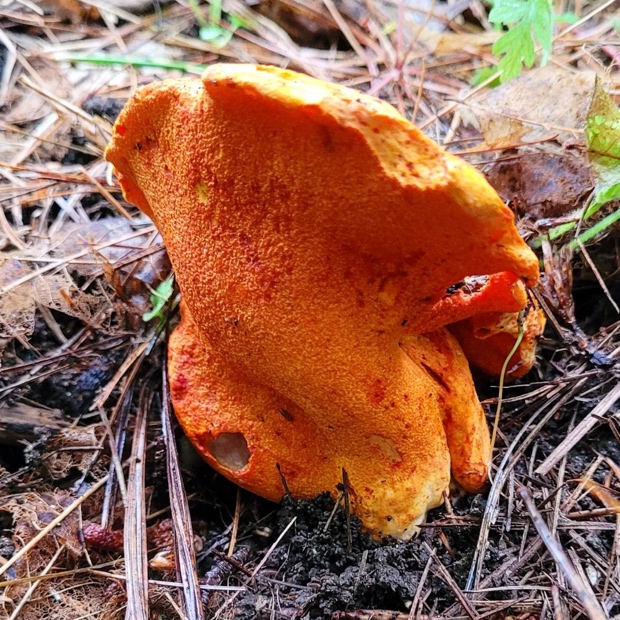
WineAlign

Twenty-one mind-blowing wines of 2021

The greatest wines are considered as the ones that talk to us, connect with that part of our being that elicits sensory and emotional responses, feelings of zeitgeist and great release. Throughout the course of a year I taste thousands in my glass, countless banal, innumerable competent, others correct and many exceptional. Then there are the rare and peerless capable of altering time and space, chosen ones that after listening we then speak directly to. The mind-blowing wines.

Related – Twenty mind-blowing wines of 2020

This is what I might say to such a splendid creature. “I look upon the flash of your sheen, you a wine of scientific strategies. Your aromatics sum up for me my educational studies in science and lifelong memories. Your flavours remind me of experiments in vinous physics, your textures of exercises in galactic mechanics. Your structure recalls infinite chemical reactions and architectural engineering. Your energy, though carefully controlled, threatens to ignite and destroy my laboratory and yet binds my existential life together. You blow my mind.

Related – Nineteen mind-blowing wines of 2019

Last year’s 20 for 20 was a much different list than ever before. Only 25 days of travel and while I did finally make a return to global discovery that number was even less in 2021. Two trips to Italy and one to B.C. in October and November. Once again just 25 days in total. A yearly schedule usually adds up to 100-plus but fortune also shines on the critics of WineAlign. Through quarantine, isolation and safe-distancing we still managed to taste through thousands of wines. I recorded well and above 4,000 tasting notes in 2021 so it would appear that palate discovery is still alive and well. For the first time ever there are three dessert wines on the list because well, stickies just don’t get enough love. And never before have I included a Canadian wine because I pen a separate list for local but a Thomas Bachelder chardonnay is wholly deserving of going global. These are Godello’s 21 mind-blowing wines of 2021.

Berlucchi Riserva Familia Ziliana Franciacorta DOCG 2001, Lombardy

A blend of chardonnay and pinot nero matured on lees for 218 months and a further 31 months after disgorgement. Zero dosage, tirage in June 2002. Tasting from “the stolen bottle,” and one would swear there is some sweetness in this wine, offset by twenty year-old persistent and rising acidity. The state of grace and ability this 2001 finds itself sitting royally in is quite something to behold. Stands firm and can stride with most any 20 year-old sparkling wine. A simple fact tells us that Arturo Ziliani’s father Franco and Guido Berlucchi decided to create sparkling wines in Franciacorta. They are the pioneers. Drink 2021-2024.  Tasted October 2021

Krug Vintage Brut Champagne 2002

The year 2002 dubbed as “ode to nature” marked the first Krug “vintage of the millennium” and was presented after Krug 2003, just as Krug 1988 left the cellars after Krug 1989. A clement year, relatively dry to make for a homogeneous harvest. The blend is 39 per cent pinot noir, (40) chardonnay and (21) pinot meunier. Disgorgement would have been in the autumn of 2015 after having spent at least 13 years in Krug’s cellars. All this tells us that the vintage is one treated to great respect with the acumen to age seemingly forever. This bottle shows some advancement but mostly in toasted and spiced notes while acting so expertly oxidative, in total control of its own and also our senses. Smells of orange skin, zesty and by citrus spray, then pickled ginger and wild fennel. Tasted blind it feels just exactly 20 years old but it’s not hard to be tricked into imagining even older. I admit to guessing 1995 with thanks to a presentation of at once wildly exotic and then exceptional bubbles. Just a matter of being hoked up with celebration. Drink 2021-2027.  Tasted November 2021

Kabola Malvazija Amfora 2017, Istria, Croatia

Kabola’s is malvazija istarska raised in traditional clay amphorae in combination with oak barrels. Kabola is found in Buje, not far from the coast and south of Trieste. While the combination of clay and wood seem to confuse or blur the game there is something wholly credible and intriguing about this wonderful aromatic mess. You can not only smell and sense but more deeply intuit the phenolic qualities inherent in here. Skins, pips and even a bit of herbaceous stem. Peach and orange tisane, exotic spice and high, high quality lees. Great winemaking here in the context of leaving your grapes to do the work but both timing and execution are spot on. Raises the varietal bar and shows what’s possible. Drink 2021-2026.  Tasted April 2021

Livio Felluga Rosazzo Terre Alte DOCG 1998, Friuli-Venezia-Giulia

A wine in which the switch has been flicked at least five times, at least three past the family’s preference but let’s be frank. This is a fascinating Friuli-Venezia-Giulia wine to taste. Oxidative in the most beautiful way, sapid and laden with 23 year-old tang. Very much a young adult of confidence and swagger borne out of phenolic fruit maturation. A long-hanging vintage, a note of botrytis, a late harvest sensation but truly salty, mineral and showing the biodiversity in clones and vineyards that one would expect a white blend of this ilk to display. Just a terrific example of friulano, sauvignon and pinot bianco in their arena of characterful array. Drink 2021.  Tasted October 2021

Bachelder Grimsby Hillside “North Slope, Starry Skies” Chardonnay 2019, VQA Lincoln Lakeshore

New in the pantheon for Bachelder and Niagara wines as an entity is this from Grimsby Hillside, the new frontier, next level up and future for the industry. In fact the time is already upon these precocious vines and their fruit specially formulated for the most wound and cinched kind of chardonnay, so precipitously witnessed in Thomas Bachelder’s “North Slope, Starry Skies” 2019. The vineyard was planted to vitis labrusca and used for Kaddish wine through the 30s, 40s, 50s and 60s and just less than 20 years ago re-purposed to vinifera. Just two decades later winemakers like Thomas and Ilya Senchuk have discovered the magic of possibility and greatness of probability. Tasted this first in July with Thomas though it had just gone to bottle. Now the textural level of this GH-N triple-S has hitherto arrived at the immaculate, sweetly viscous, gleefully gelid and just right there at the apex of sensory enjoyment. Tight and delicious is a good combination. Drink 2022-2028.  Tasted December 2021

Stellenbosch, Western Cape

Raats Family Wines Chenin Blanc Eden 2018, Stellenbosch, South Africa

A single vineyard chenin blanc and the first vintage to the Ontario market for a unique project celebrating the family farm called Eden. From their Stellenbosch ward of Polkadraai and high density plantings on dolomitic, granitic soils. Of a richness, an intensity of parts and a presence only a handful of South African blanc ever reach. A wine that achieves a level of status by its work underground (through root competition) and a clone called Montpellier that produces small berries and even smaller yields, not to mention the plot is just 0.6 hectares in size. Eden is the mothership and matriarch of this clone and for that variety in South Africa. All parts contribute to a wine of outrageous acidity that is never sharp, vivid or dominant. Fruit, mineral, focus, elements and precision. Wet stone is pure Polkadraai, vaporous, omnipresent, all over the wine. “The most successful winemakers (and wine projects) are ones that specialize,” says Bruwer Raats. This Eden follows the credo to a “T” and with a capital “E.” Really cerebral and also age-worthy chenin, in the upper echelon of the finest in the pantheon. If ever a chenin signified “Bringing it all Back Home,” the Raats Eden is it. “Discuss what’s real and what is not. It doesn’t matter inside the Gates of Eden.” Drink 2022-2030.  Tasted June 2021

With Sofia Ponzini and Vico

Tenute Bosco Etna Rosso Vigna Vico Pre-Phylloxera 2018, DOC Etna

Just another immediately memorable Piano dei Daini Etna Rosso Vico, Sofia Ponzini’s Cru-Vigna nerello mascalese (with 10 per cent nerello cappuccio) at 700m from the northern side of Mount Etna. Grown as alberello on a volcanic, sandy matrix with some stones from 100-plus-plus pre-phylloxera vines located in the town of Passopisciaro, Contrada Santo Spirito, parcels “Belvedere,” “Seimigliaia” and “Calata degli Angeli.” A tempest of steel and a feeling that runs with waves of acidity throughout, in many parallel and horizontal lines, at all levels. Spice cupboard, rich waves of red fruit, viscous wisdom, confidential and confident elegance, finishing at precision without recall. True value, scattered patterning, significant and relevant. A vintage of force, restraint and powerful lightness of being. Drink 2024-2036.  Tasted October 2021

Domaine De Bellene Nuits Saint Georges Premier Cru Aux Chaignots 2019, AOC Bourgogne

The limestone soil Climat of Chaignots lies in the northern part of Nuits-Saint-Georges, up the slope and edging in location but also feeling towards that of Vosne-Romanée. The affinity is much discussed, real and therefore puts the Premier Cru at the top of what is most desired out of Nuits-Saint-Georges. A tiny (0.14 hectare) plot and simply a coup for Nicolas Potel to be able to secure this fruit. Everything about the aromatic front speaks to the Bourgogne mind and Chaignots heart. Cola but from the root, a tuber underground rubbed, that and a cocoa nut crushed between fingers. An almost diesel waft but not gaseous, instead sapid, nut-based, a liqueur toasted and intoxicating. The fineness of structure is the sort of wiry winding by winch that could cut through limbs due to tension so taut. All that you know, love, don’t know and hope to experience is in this wine. Neither I nor Nicolas Potel will be around when it blows someone’s mind in 2074. Look forward to that day young Alphonse. Drink 2025-2045.  Tasted May 2021

Angela Fronti, Istine

Istine Chianti Classico DOCG Vigna Istine 2019, Radda in Chianti, Tuscany

One must have to look at, walk this and stand in awe of of this vineyard, the steepness at 30-50 per cent grade with a terrace in the middle to break it up. Heavy in Alberese inclusive of massive yellow calcareous boulders and also Galestro. In fact the medium stones removed were transferred to create terraces for olive trees on the other side of the cantina (by Angela Fronti’s father no less). The vineyard faces north so the freshness is off the charts, while the ripeness is so matter of purposeful vintage fact. The label represents the position of the vines in coordinates, echoed in the machicolations of a Fronti sangiovese that drops all the Radda stones on unsuspecting palates through fruit openings between supporting acid corbels of a projecting tannic parapet. Vigna Istine is at the forefront of Chianti Classico’s battle to win over the world. Follow this example. Drink 2023-2029.  Tasted October 2021

“Molto parfumato,” binds an aromatic agreement between myself and Paolo de Marchi upon sniffing this ’11 found on Locanda Pietracupa’s wine list. “Cepparello needs time,” says Paolo, understatement of the obvious for the evening, year, decade and history with respect to sangiovese grown in the Chianti Classico territory. Also truth succinctly spoken, roses and violets exhaling and a 100 per cent varietal (or so it seems) profile of succulence and one to fully draw you in. Mint to conifers, multiplicity by complexity value, not to mention vigorous acidity sent straight to a mouth with a full compliment of wisdoms able to think about the situation. A linear Cepparello seeing its wide open window at the 10 year mark. And now a Paolo de Marchi story. “One side of the vine’s grapes were burnt and so I called up (Consorzio Direttore Giuseppe) Liberatore and asked are we changing the name of the appellation? Liberatore said what? To Chianti Amarone replied de Marchi, or sangiovese Port? Joking aside, a stringent selection and a five per cent inclusion of trebbiano did for this ’11 Cepparello what viognier might do for syrah. Not a Chianti Classico so perfectly kosher. A secret until now but all above board. Totally cool. Drink 2021-2026.  Tasted October 2021

Querciabella Chianti Classico Riserva DOCG 1999

The 1999 was the last (original) Riserva produced until it was again resurrected in 2011 and what’s so cool about this vintage is how it was held to some early esteem, though paling in comparison to that “vintage of the century” that was 1997. Underestimated over the last 20 years, drinking so beautifully now, with frutta di bosca, tertiary tartufo and fungi. Just doesn’t strike as a fully mature adult reminiscing about the way things used to be but more like a wine with an outlook for more promise, good times and adventures still ahead. If you are still holding onto ‘99s from this part of Toscana you will be very pleased. Drink 2021-2026.  Tasted May 2021

Filo di Seta is Filippo Chia’s intuitive “transavanguardia” sangiovese of place, over the ancient beach where he and his father Sandro once painted the Montalcino sea. Mostly early picked fruit, all in tonneaux, at first thinking “croccante” but that’s too simple a way to describe what texture and sensation is combed in this reserve wine. Bottled on the 29th of June so just arriving at the ready, to look at if not to consume. Here there is a fineness of liquid chalkiness, a “fluido” or “scorrevole” to drive the way this sangiovese plays and also sings, a Riserva to move with the wind and musical sway. Somewhat unknown, finely tannic and clearly what could and should be described as “mountain” Brunello. Coming in late is the spice, almost cinnamon and such. Hate to refer to any wine as the best from an estate but too bad. That this is, beyond the avant-garde such as it is. Drink 2025-2038.  Tasted November 2021

Biondi Santi Brunello Di Montalcino Riserva DOCG Tenuta Greppo 1985

The longevity of this vintage is almost not to be believed. Has been in bottle for as many years as it would have matured in casks. The next year (2022) will se the re-release of this vintage (in 2021 that vintage was 1983) and the year 1985 is the one I entered university. A Biondi-Santi of resolved tannin but remarkably youthful. A wine that saw Grandi Botti more than before, seen in the gentlest of spice notes and the back to the future return of balsamic and pomegranate. Followed a winter of major snowfall, long and cold winter, a regular spring and uneventful summer. The acidity is just incredible, also youthful and so sweet, those lengthened tannins in liquid powdery-chalky form. The connection with 2016 may seem to be an uncanny one but so help me if the chain is not there. The bottle was opened one hour and forty five minutes earlier so grazie to Federico Radi and Biondi-Sandi for perfecting the timing. We can all learn so much from this wine, to be patient, calm, well-adjusted, confident and gracious. Style and temperament to live by. Should continue this way for at least 10 more years. Drink 2021-2033.  Tasted November 2021

Argiano Brunello Di Montalcino Riserva DOCG 1979, Tuscany

A cooler vintage, especially as compared to 1978 and truly a Piedmontese style because the cellar workers closed the tanks, went on strike and returned two months later. Resulted in some carbonic maceration and surely an increased amount of vim in freshness. That mixed with true porcini, fungi and fennochiona. The extended maceration makes this act 43 years forward like an older nebbiolo, rich and once demanding tannins now long since melted away, tar and roses still showing with earthly perfume. Fabulous mouthfeel, lingering and lively. Surely the mean steak astringency would have been in control during the first 10 to 15 years but the beast relents and gives way to charm. Patience breeds gentility and the story is now unfolding. Drink 2021-2026.  Tasted October 2021

With Stefano Cesari, Brigaldara

Brigaldara Amarone Della Valpolicella Classico DOCG 2016, Veneto

Stefano Cesari’s farm concerns itself with all things sustainable and while that may seem like a catch phrase, In Brigaldara’s case it most surely is not. The family supports its workers financially, culturally and in health. The young winemaking team is encouraged to study and stage abroad, to learn new oenological skills and languages. The other farm workers and their families are additionally supported by being given stake in the profits of the farm. How can this not reflect in the qualities of the wines, including this very special vintage 2016 Amarone. A magnificent wine and one you can easily drink beyond one glass. Not that it’s a light example but it speaks in soft tones, clearly and with a distinct, precise and honest weight, in vernacular and feeling. All things fruit lead to roads of sweet acidity and fine tannin. A rare Amarone of this ilk and one to savour. Drink 2023-2033.  Tasted October 2021

Errázuriz Don Maximiano Founder’s Reserve 2012, Aconcagua Valley, Chile

Don Maximiano 2012 is a blend of 75 per cent cabernet sauvignon, (12) carmenère, (8) petit verdot and (5) malbec. No cabernet franc back in 2012 and aside from the obvious notions ushered in by age there is a distinct lack of herbal notes as a result. This is just in a great place nearly nine years forward from vintage, now settling, acids still in charge but tannins having done most of their melting and rendering. This wine is far from done, in fact the next level notions have just begun to have their say and from a vintage as great as this there should very well be nine years nigh before true earthiness, umami and truffle set in. Pour this blind at dinners with old world counterparts and watch with awe as to the results. Drink 2021-2027.  Tasted November 2021

Château Pétrus 1993, Pomerol, AC Bordeaux

Never easy to live in the shadow of siblings clearly designated as mom and dad’s favourites but sometimes overlooked vintages left for dead show greatness later on in life. The 1993 Pétrus is definitely a late bloomer and from a year when only 200 cases were produced, where normally 4,000-plus is the standard. Softened to an almost Burgundian sense of calm but the richness and concentration multiplied by a Spring verdant freshness and sweetly herbal pesto can only indicate one thing and that is Right Bank Bordeaux. I tasted this blind and immediately thought of Pomerol and its close proximity at the eastern border with Saint-Émilion because of the “fromage à pâte molle” feeling gained, along with vestiges of once formidable black fruit supported by a push-pull posit tug of merlot-cabernet franc acidity. A good hunch indeed and a more than surprising set of excellent parameters come to this for a 1993 Bordeaux. All in all a really satisfying and come together wine to hush the naysayers and win in the end. Drink 2021-2025.  Tasted November 2021

Paul Jaboulet Aîné La Chapelle 1990, AC Hermitage, Rhône

Jaboulet’s 1990 La Chapelle is a kind of an echo of the year in history, an Hermitage of impeccable harmony, much like balance restored in relative peace and prosperity. In 1990 the Soviet Union fell, ending the decades-long Cold War. Hard to find more shiny opaque purple in a 30 year-old syrah plus a splendid floral nose of stone roses, pencil shavings and graphite. The combinative effect of heft and freshness elicit pleasantries from a bad boy able to play soft ballads to mellow a crowd. La Chapelle is a communicative, entertaining and business-like syrah, a link between the northern Rhône and the taster, an internet Hermitage that changes the way we think and feel. Things will never be the same after tasting Jaboulet’s 1990 and for good reason. Has 10 years left without worry of decline. Drink 2021-2029.  Tasted November 2021


Reynvaan In The Hills Syrah 2017, Walla Walla Valley, Washington

Reynvaan is a family production of Rhône-style wines from two vineyard properties in the Walla Walla Valley. “In The Rocks” is their first vineyard located in Milton-Freewater, Oregon and the second vineyard is called “In the Hills.” short for “Foothills in the Sun.” It is found at the base of the Blue Mountains on the Washington/Oregon border and is planted to syrah, viognier and a gaggle of cabernet sauvignon rows. As one of the highest elevation vineyards in Washington (at 1200ft) and in this syrah co-fermented with up to 10 per cent syrah you might get a rendering of a northern Rhône-ish picture. Sure enough the perfume is floral but more than anything a smoulder of pancetta and smoked meat. Reductive as well, different as such than any syrah, anywhere else on the planet but liquid peppery and tire on asphalt nonetheless. The credibility and accountability here is profound and while the sheer concentration and beauty of In the Rocks in captivating, this In the Hills is alternatively vivid, dramatic and powerfully restrained syrah. Which one is you? Drink 2023-2033.  Tasted January 2021

Sine Qua Non Syrah The Hated Hunter 2017, Santa Barbara County

The hated hunter is named after Austrian immigrant and Los Angeles restaurateur turned winemaker Manfred Krankl’s grandfather, depicted on the label in gear, with rifle and hound. The blend is led by 82.4 per cent syrah with (7.8) petite sirah, (5.2) mourvèdre, (2) grenache, (1.2) petit manseng and (1.4) viognier. Clocks in at 15.9 alcohol but in this regard hardly garners even one per cent of the discussion. All anyone can talk about is the infinite expanse of pretty, pretty floral capture and personally speaking it simply reeks of syrah. A game of meat juices and marbling, part smoked meat and part pancetta. The only question tasting blind is whether to imagine it as Hermitage or Central Coast California. Once the abv is disclosed the answer can only be the latter but a syrah of such reclusive exclusivity is hard to pin down. Derives from a group of prized vineyards; 32 per cent Eleven Confessions (Santa Rita Hills), (41) The Third Twin (Los Alamos), (25) Cumulus (Santa Barbara) and (2) Molly Aida (Tepusquet Canyon). Adds up to the most luxe, deluxe and ultra-fantastic instrumental of a syrah, no lyrics needed. Man, Manfred, take a bow. A hunting bow. Drink 2023-2029.  Tasted November 2021

Fèlsina Vin Santo Del Chianti Classico DOCG 2018, Tuscany

An absolutely lovely vintage for Fèlsina’s Vin Santo and for Chianti Classico Vin Santo as a rule because extract, temperament and adaptability are all in collective balance. All that you want, need and expect from this traditional and loyal dessert wine are present and accounted for. Dried and glazed fruit, low and slow developed nuttiness and a freedom of territory spoken through airiness and layering. The upside cake of life turns over to reveal a generational wine of clear standards, perfect layering and endless conversation. Nonna and Nonno would be proud. Drink 2021-2035.  Tasted June 2021

Agriturismo Hibiscus Zhabib Passito 2020, C.Da Tramontana, Sicily

From the island of Ustica in the Tyrrhenian Sea, 70 kilometres (36 nautical miles) of the coast of Sicily’s capital Palermo and the work of Margherita Longo and Vito Barbera. The vineyards for this zibibbo (moscato d’Alessandria) are grown very close to the water on volcanic soil and Hibiscus is the only winery game in town. There are other farmers that contribute grapes to this tiny production; also grillo, cataratto, inzolia to go along with the zibibbo that makes this Passito. A place where tomato, grapes and peached co-exist, in the gardens and in the wine. This carries that uncanny sweet to savoury feeling in the most specific and ethereal dessert wine both mind can conjure and emotion shall receive. Of orange, grapefruit, peach and tomato. Balanced, harmonious, silky, woollen and with a super-tonal capacity to love. Drink 2021-2032.  Tasted October 2021

Taylor Fladgate Very Old Tawny Port – Kingsman Edition, Douro, Portugal

A bottle of wine is rarely tied to a film, let alone a Douro Port but Taylor’s Very Old Tawny has been blended and bottled to coincide and be product placed in the second Kingsman film, in this case a prequel to the first, this time set in the 1920s. Head Winemaker David Guimaraens chose reserve Tawnys from 70-100 years of age, wines crafted and set aside by generational predecessors past, no stretch for the master blender because we are talking about a house with extensive stocks from which to reach back into. Guimaraens was looking for harmonic balance between concentration and elegance and just a whiff will tell you he and his team have achieved a crossing between a magical vortex and a vanishing point of complexity. Two manifest matters have developed; concentration of sweetness and in this case by association, a focus of acids as well. Together they inspissate and cling comfortably to the skeletal structure. It feels like you are nosing 100 unique aromas, with just seven of them being marzipan, red velvet hazelnut cake, candied ginger rose, rau răm, roasting banana leaf, calimyrna fig and grilled pineapple express. Step six feet away from the glass and the aromatics persist just as sharp as if the glass were in hand. As for a sip of this maraviglioso Tawny, warmth, comfort, delicadeza and forever length make just an ounce last forever. Timeless. Approximately 1000 bottles were produced and in Canada 100 will be made available next September. That is when theatre goers should likely make a return to the cinema to take in the Secret Service spy thriller and Tawny Port fantasy up on the silver screen. Drink 2021-2050.  Tasted February 2021

Good to go!

godello

Twitter: @mgodello

Instagram: mgodello
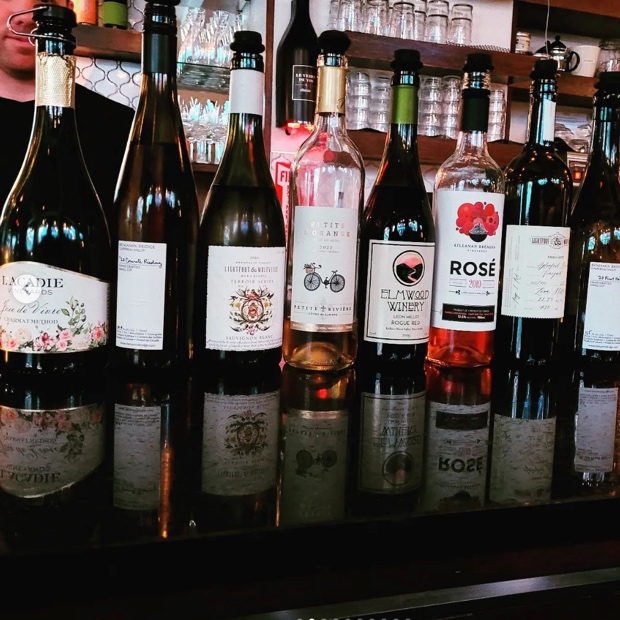
WineAlign

Wines in the Similkameen they are, sometimes they blow my mind

Ben in back, Goode standing tall

Last month the WineAlign judges spent an evening under the Similkameen Valley stars against a rugged mountain backdrop of glacial rock formation, the vineyards quiet, their fall foliage bright at dusk above stony, gravelly, and silty loam soil. The pizza oven was firing and the Similkameen growers hosted our motley crew with wines pouring all night long.

Similkameen Valley

Related – WineAlign Nationals meet the Iconic Wineries of B.C.

These are the facts. The Similkameen Valley lies west of Osoyoos with the majority of vineyards located around Cawston and Keremeos. Significant winds help naturally keep vineyards in this arid valley free of pests and disease, making this region well-suited for organic farming. Due to the steep surrounding mountains, and the reflectivity of the rock, heat remains in the valley long after the sun sets. Did I mention how beautiful a place this is?

WineAlign judges Janet Dorozynski, Michaela Morris and Michelle Bouffard

Our hosts were the owners of Crowsnest Vineyards, a Cawston property purchased by the Heinecke family in 1985 and named after the Crowsnest Highway #3. The family was an early contributor to the development of the Similkameen wine region, led by  second generation family siblings Sascha and Anna Heinecke. Here are 12 wines tasted that evening.

Clos Du Soleil Winemaker’s Series Pinot Blanc Middle Bench Vineyard 2020, BC VQA Similkameen Valley

Pointed and punchy pinot blanc, stone fruit with a verdant piquancy. Not exactly edgy but crisp, quite precise and yes, surely punchy. Early picked acids maintain freshness and this is nothing but bloody delicious. Drink 2021-2023.  Tasted October 2021

Wines in the Similkameen they are, sometimes they blow my mind

Clos Du Soleil Capella 2020, BC VQA Similkameen Valley

From the Upper Bench of the South Similkameen Valley and winemaker Michael Clarke’s signature Bordeaux-inspired white blend of sauvignon blanc and sémillon. Knowing the maker’s education and professional past one might look at this Capella as a branch of blancs that employs mathematical models and abstractions of physical objects and systems to rationalize, explain and predict natural phenomena. In other words Capella a.k.a. the brightest star in the constellation of Auriga, presents a case of two complimentary grape varieties made profound by the abstractions of soil, gently inclined land and the reflectivity of mountain rock. These building blocks of terroir and warmth may be real but it is the philosophies and methodologies of growing and winemaking that allows us to vindicate the greatness in this 2020. A virtuoso deportment of fine salinity and truffled perfume speaks in subtle Similkameen tones and a light touch is noted by both délestage and elévage restraint. This pure citrus distillate is sharp and pointed but then come the poignant flavours. Like the assyrtiko of the Similkameen with Bordeaux structure. Theoretical and physical, void of experimental tools and yes, c’est bon. Drink 2021-2025.  Tasted October 2021

Vines in the Similkameen

Corcelettes Micro Lot Series Chardonnay 2020, BC VQA Similkameen Valley

Fulsome, not bullish, cream centred and with exteriors all bite and wood spice. Almost too youthful still, previously misunderstood, not yet in full perfume bloom. Hinting at what’s coming, tree fruit part orchard and part tropical but no bloody pineapple. Chard of interest.  Last tasted October 2021

Part of the Micro Lot Series and a cool to gelid chardonnay well into the yogurt and lemon curd with finishing almond flavours. Texturally speaking there is flesh and fluidity in a Similkameen chardonnay that receives much barrel addendum. Silky and creamy, all about mouthfeel and development. Drink 2021-2023.  Tasted September 2021

Brad Royale and Crowsnest Gourd

Crowsnest Family Reserve Chardonnay Stahltank 2020, BC VQA Similkameen Valley

Stahltank as in stainless steel fermentation for full retention of freshness, which this energetic 2020 shows, but also big and substantial fruit. Crowsnest Vineyards is located near Cawston in the Similkameen Valley and chardonnay is clearly a specialty. Soft, creamy and devoted, available and amenable. Subtle spice, crafty and just crisp enough to remind of the fresh intendment and lively persistence. Drink 2021-2023.  Tasted October 2021

Hugging Tree Moonchild Merlot 2016, BC VQA Similkameen Valley

Solid merlot in many respects, rich and caky, thick and chock full of ripe fruit. Edgy as needed, split by a streak of right proper greenness and out of a quality vintage. Steeping in acids and tannins running down grain for a result that has and will continue to please for a few years yet to come.  Drink 2021-2023. Tasted October 2021

Orofino Riesling Hendsbee Vineyard 2018, BC VQA Similkameen Valley

Made from the other Alsatian Clone (as opposed to the oft employed 49) from the 2006 planted vineyard by Cheryl and Lee Hendsbee adjacent to and with great soil similarities to Orofino’s home block on the Cawston Bench. A place of rich caky soil atop gravel and river rock for 100 feet. Prudent to experience this with some but not too much age and the hope is to have an experiential moment, say one or two years forward to do so again. Just now moving into some development, a secondary dance step, trip of the tongue, coupling fruit and mineral salts. Quite dry with elevated but knowing and promising acidity. At present a true matter of delight mixed with complex notions in this time of emerging secondary emotions. The appendages work together, in rhythm and forward motion. Drink 2021-2025.  Tasted October 2021

Orofino Gamay 2020, BC VQA Similkameen Valley

So bloody primary, a fresh smack of Similkameen juice, a touch turbid and seemingly not quite at the curtain call of its final act towards being a finished wine. Still swimming in carbonic waters, openly fragrant and inviting. A squeeze of blood orange and tart edging while in full control to effect positively on the palate. You think it might turn botanical or volatile but it never does, instead staying a fruit persistent course. Can see this being underestimated when in fact it is simply a joy to drink. Drink 2021-2024.  Tasted October 2021

Orofino Wild Ferment Syrah 2014, BC VQA Similkameen Valley

A well developed smoulder, purely be variety and place, not by wood. Still persistently and openly fragrant, earth, brush, flora and fruit intertwined as one in a syrah of end game integration. What was once folds, waves and shadows is now seamlessness, inertia and assimilation. Orofino’s WFS resides in a place of great comfort and equally important regard. Drink 2021-2023.  Tasted October 2021

Robin Ridge Winery Gamay 2016, BC VQA Similkameen Valley

Has advanced well into the denouement of its life with fruit persistently black of cherry and what tannins there ever were have melted into a glass darkly. Even the acids wane, effecting little to no meaning at this stage. Drinks quite well actually if showing signs of imminence. Nothing wrong about a glass with a good slice of pizza on a cool Similkameen night. Drink 2021-2022.  Tasted October 2021

Seven Stones Speaking Rock Estate Chardonnay 2015, BC VQA Similkameen Valley

Reductive even after all this time, spicy chardonnay chai and wasabi spiced though still some juicy fruit. Showing well for its age, far from oxidative, of clotted cream and some drying to desiccating flavours. Lemon namely and a dollop of that cream. Fully developed and soon to finish all the softening. A lovely drop at this moment. Drink 2021-2022.  Tasted October 2021

Vanessa Vineyard Syrah 2018, BC VQA Similkameen Valley

Quite a big syrah expression while balanced and showing an ease with which it carries itself this way. Maintains composure and control in the face of a deep and hematic meatiness, high-toned culture, level, pulse and pace of play. Clearly a wine of site, revealing in a meaningful style because it just seems to be the kind of weighty wine it needs to be. No two ways around it. Drink 2021-2026.  Tasted October 2021

Vanessa Vineyard Cabernet Franc 2018, BC VQA Similkameen Valley

A whopping 16 per cent alcohol but truth is you’d not really fully feel or know it. The level of fruit and the flesh it expounds hangs snugly, fitted and tied to the bone. The chalky and peppery liquidity want to be about juiciness and freshness, some way, somehow. The cigarillo smoulders still and the wine finds those realistic and honest moments. Suffers and survives, delivers the varietal goods. Well perhaps there is a moment of shock and awe but ultimately the wine is the wine, for its time and place. Drink 2021-2024.  Tasted October 2021

Good to go!

godello

Ben in back, Goode standing tall

vvv

WineAlign Nationals meet the Iconic Wineries of B.C.

Judging Rosé at the 2021 WineAligjn National Wine Awards of Canada – Photo (c) WineAlign

Back in the first week of October a special anniversary took place in Penticton, British Columbia. Special because it was the 20th running of Canada’s greatest wine show on wheels, now and for the past 10 years known as the WineAlign National Wine Awards of Canada. Remarkable because the week of judging Canada’s finest wines and ciders brought together a group of erudite and beautiful people for the first time in nearly 28 months. It was in June of 2019 the last time a 50-plus strong NWAC gaggle assembled, of back room volunteers, behind the scenes technical wizards, scoring junkies and FOH judging professionals. The 2021 results are beginning to roll out, including the first four categories last week; Sparkling, Gamay, Pinot Gris and Rosé. Today you can read up on chardonnay and pinot noir. I was entrusted the Rosé category write-up and you can view it here:

Related – A record medal haul for Canadian Rosé

A record-setting number of wines were entered from coast to coast. The two-decade journey has been worth every moment for this most respected and important Canadian wine competition. I have been at these judging tables since 2013, to capture this most essential snapshot of Canadian wine and by now have witnessed a great change and evolution, as have mentors Anthony Gismondi and David Lawrason over two decades. The inaugural competition in 2001 drew 528 wines from 71 wineries and in 2021, 26 judges tasted 2,075 entries from more than 260 wineries.

Backroom at NWAC2021, photo (c) WineAlign

I have now published more than 270 wines tasted at the competition that can be viewed on WineAlign. Most have only been tasted the one time, that being during blind varietal and stylistic flights in Penticton and those reviews have only been edited for spelling, grammar, syntax and in a few instances musical reference fact checking. No information, estate history, principals’ stories or winemaking data have been added to those notes. In cases where wines had been previously reviewed or tasted in Kelowna just prior to the awards then the blind notes are added in.

Day one judging @winealign #NWAC2021 ~ With the inimitable @trevering and @bryantmao ~ Only 2,000 more to go ~ #canadianwine #winejudging #thenationals #wineawards

Upon arrival in the Okanagan on the eve of day one at the awards we were privileged to be guests at a walk-around tasting hosted by Anthony Von Mandl’s Iconic Wineries of British Columbia at Checkmate Artisanal Winery in Oliver. All seven estates were present and pouring some of their top tier bottles; CedarCreek Estate Winery (Kelowna), Checkmate (Oliver), Liquidity Wines (Okanagan Falls), Martin’s Lane Winery (Kelowna), Mission Hill Family Estate Winery (West Kelowna), Red Barn Winery (Oliver) and Road 13 Vineyards (Oliver). The following 19 tasting notes are from the bottles poured by all seven members of the IWBC.

CedarCreek Platinum Block 3 Riesling 2020, BC VQA Okanagan Valley

From the Kelowna home vineyard and the oldest block of riesling vines at 30 years of age. A wild ferment, kept on the skins for 12 hours and aged half in stainless, half in German oak (not to be confused with the 1970s prog. rock/psychedelic band). “It’s very easy to make lime juice from this block,” is a reminder from winemaker Taylor Whelan to take great care, find focus and another gear. “We’re aiming for GG (Grosses Gewächs) numbers,” here emerging at 8 g/L RS, but the intensity and grip make the wine seem much drier. No detention or detection of wood whatsoever in a currently bracing riesling but one set up for a readied future of full embrace. Drink 2022-2028.  Tasted October 2021

Cedar Creek Platinum Jagged Rock Vineyard Chardonnay 2020, BC VQA Okanagan Valley

A 100 per cent wild and in barrel though with truncated malolactic fermentation, “because we’re CedarCreek, not Checkmate,” quips winemaker Taylor Whelan. Some banana emits in this moment of estimable youth and we both admit the wine is “not yet quite ready.” From the vineyard down in the valley below Checkmate Winery, a contributor to the freshness in a chardonnay straddling the line between reduction and flesh, flintiness and splendored expression. Tropical fruit hints, nary a creamy plasticity and zero gratuity, but plenty of gravitas. To say they are on to something would be a gross understatement in this a vintage readying to unroll later on in 2022. Drink 2022-2026.  Tasted October 2021

CedarCreek Winemaker Taylor Whelan

CedarCreek Platinum Simes Vineyard Natural Pinot Noir 2020, BC VQA Okanagan Valley

Dark as a syrah night, pressed, full on violet to balsamic, rich beyond the pinot pale and fully into a film noir genre. A bit Wagner north, with gritty tannins and hidden greens.  Last tasted blind at NWAC2021, October 2021

Approximately 55 per cent (Clone 115) whole bunch concrete fermentation. A crunchy red in the guise of Beaujolais and the reference point is not such a stretch. Recently planted gamay vines will do the same or take the torch when they come to their fruition. Some pretty serious pitch and tannin, a cru on steroids, wild man, far from reductive and big. Drink 2022-2027.  Tasted October 2021

Looking out from Checkmate Winery

Checkmate Queen Taken Chardonnay 2018, BC VQA Golden Mile Bench

From the unknown 1975 planted clone, same one used by Mission Hill going back to 1994 with a musqué intonation. The Vineyard is called Dekleva, coolish spot on the Golden Mile Bench. Lower slope soils are patch sandy, with fragmented rocks aboard a fluvial fan. The 2018 is a preview of what the vintage can be for chardonnay or perhaps better described in prologue as to what it has already shown to be. Layers upon layers, alternating chew and crunch, great freshness matching the buttery croissant and if you drop your guard this chardonnay will crush you. It has the game. Drink 2021-2027.  Tasted October 2021

Checkmate Opening Gambit Merlot 2017, BC VQA Okanagan Valley

From the Osoyoos Bench with 100 per cent merlot, a wild ferment and 21 months in new wood. Truly, ostensibly varietal Okanagan realism. Could be nothing but and anything at all, a merlot so cured, verdantly specialized and toasty because the growth cycle and viticultural handling all lead down a path where grape and place walk cane and shoot. Bramble, fully loaded spice masala, a modicum of intensity fleshing out the layers of brush, underbrush and ultimately a silken merlot style. Structured but not overtly so, best in the mid term though it will linger well into the latter stages of the decade. Drink 2022-2027.  Tasted October 2021

Liquidity Reserve Chardonnay 2019, BC VQA Okanagan Valley

Poured by winemaker Amy Paynter, a Reserve chardonnay so aptly named as it submits to the ease with which assets of fruit and structural security are converted into ready to drink pleasure, without affecting cost, value or age worthiness. No searching for richness, nor unction neither, not to mention mille-feuille layering. Chewy enough, fleshy for certain and textural throughout, but always this ease of transitions, conversions and fluidity. Drink 2021-2025.  Tasted October 2021

Liquidity winemaker Amy Paynter

Liquidity Viognier 2020, BC VQA Okanagan Valley

Golden hue, ripeness at the top, surely only B.C. can effect. Not nearly as unctuous as expected yet there is some sweetness and spice to be sure. Spicy too, tart, tincture of tang and all the while circumstantially evident.  Last tasted blind at NWAC2021, October 2021

Part estate with fruit from Oliver and Osoyoos. Very apricot in a chanterelle way so it’s scents is like the idea of a mushroom that smells like the memory of a ripe apricot. What else does one need. Drink 2021-2024.  Tasted October 2021

Liquidity Estate Pinot Noir 2019, BC VQA Okanagan Valley

Made with one hundred per cent Okanagan Falls fruit, picked in lots, each small batch fermented, 14-15 months in (25 per cent new) wood. The decision as to what qualifies as Reserve is made at the time of bottling. A true OK Falls Liquidity Reserve in such regard, much in the way sangiovese is dealt with in Chianti Classico or Montalcino. But this is pinot noir, an animal all to itself, fickle and choosy, hard to get and yet Liquidity has their fruit down with proof right in this glass. Smooth, supple, strong and sure, a confident if simply delicious pinot noir of balance, harmony and grace. Tasted with incumbent winemaker Amy Paynter who’s first full vintage will be 2021 and look for her work ethic (and measured risks) to take this wine to a whole new level. Drink 2021-2023.  Tasted October 2021

Martin’s Lane Riesling Fritzi’s Vineyard 2018, BC VQA Okanagan Valley

Shane Munn’s riesling from the volcanic, clay and white quarts Fritzi’s Vineyard continues to get better, all the while with a wine he seems to do less and less to try and control. Must be the place and the fruit from this 21 year-old block (as of this 2018 vintage) seeks a 48 hour skin-contact for oxidatively handled juice. Pressed once, lightly and so softly treated, then transferred to German casks where it stays for up to eight months. Just bloody delicious, hard to not conjure a frothie for this freshest of phenolic rieslings, which incidentally was only sulphured once, four months into the trek. Walks about from grippy to lovely and back again, with silk stops along the way. Will shine brightest two years from now. Drink 2023-2029.  Tasted October 2021

Martin’s Lane Riesling Fritzi’s Vineyard 2017, BC VQA Okanagan Valley

Fritzi’s Vineyard on Mission Hill Road is a volcanic block on dry yet rich clay, with white quartz below, planted in 1997. The winemaking is consistent from year to year and as time passes forward what’s done to this wine “is very little, less and less” tells Shane Munn. Such a phenolic riesling and irrefutably circulating in a floating balloon of immaculate freshness. Yes there is some creamy richness but it can’t hold a candle to the level of “frische und enger” in a riesling interfacing the land at the base of Boucherie. Fritzbox and very cool cat. Drink 2022-2028.  Tasted October 2021

Martin’s Lane Pinot Noir Fritzi’s Vineyard Missing Ear 2018, BC VQA Okanagan Valley

Some changes in 2018, nothing earth shattering but alterations nonetheless. This time around a 70 per cent whole bunch natural ferment for 42 days (and nearly Piedmontese cappello sommerso as such). No punch-downs nor pump-overs neither, instead a “semi-délestage,” notes winemaker Shane Munn, a fanning over the cap two or three times a day, to polymerize the tannins. Call this the Munn manifesto, unique to pinot noir, Fritzi’s Vineyard and the Okanagan, an infusion rather than a maceration. Fanning acts out so very gently, allowing for an elegant transfer of fruit through structure all the while in retention of some of the noble elements found in the skins. Surely an old-school reference point, a consciousness at the very least and a way to make a big but not dense wine, fulsome yet far from heavy, with great finesse and emotive wakefulness. Munn’s pinot noir is alert and at the ready, as should we all be, from the get go and with the slow moving current that will see aging take place over a six to eight year period. Drink 2024-2029.  Tasted October 2021

Martin’s Lane Pinot Noir Fritzi’s Vineyard Missing Ear 2017, BC VQA Okanagan Valley

Tasted with winemaker Shane Munn, a 50 per cent whole bunch natural fermentation in concrete for 32 days, in this vintage quicker to resolve (five to seven days earlier) than the average. Polymers culminated, “melted” and melded with the richness of tannic volcanic thrush. The optimum if classic Fritzi’s pinot noir fruit at first precipitously gliding down so easy but the stem inclusion thankfully graduates the incline and slows the consumption process down to a much necessitated trickle. Also keeps the wine from lunging or lurching into its immediate future, ahead of promise and proper compulsion for brilliance. No comeuppance or envy here, only pinot mercy and possibility. Log life ahead, breezes in sails, drifts and finally, sandy shores. Drink 2022-2028.  Tasted October 2021

Mission Hill Perpetua 2019, BC VQA Okanagan Valley

Top of the flinty pops, super reductive and oh so tight, taut and implosive. The fruit rolls on through, states a territorial claim and give thanks for all the right reasons. The includes a high level of quality salt, pepper and wood seasoning, which it submits to and willfully accepts. Fine work in chardonnay all around. Drink 2021-2025.  Tasted October 2021

Mission Hill Terroir Collection Vista’s Edge Cabernet Franc 2019, BC VQA Okanagan Valley

Tasted with Graham Nordin, General Manager for Iconic Wineries of B.C. and a man passionate for cabernet franc, especially this fifth vintage of Vista’s Edge for Mission Hill. A wine that began in 2015 after winemaker Darryl Brooker took over from John Simes and the first full vintage for Aussie Ben Bryant who in 2018 succeeded Brooker as chief winemaker. The vineyard can be seen looking out from Checkmate Winery and just past Phantom Creek. The 2019 cabernet franc was fermented in concrete and then aged in Bourgogne wood. My this packs a punch, of fruit so primary, succulent acids secondary and bones tertiary, the latter only because so much flesh and antioxidant donation hangs upon the very backbone of the wine. A cabernet construct like this is neither common nor fully understood in such youth. Will exude charm and captivate to the fullest in two to three years time. Drink 2023-2028.  Tasted October 2021

Red Barn Jagged Rock Vineyard Lost Art Sémillon 2020, BC VQA Okanagan Valley

Red Barn is the newest Black Sage Bench project for Anthony Von Mandl’s Iconic Wineries of British Columbia (IWBC). The seventh member joins Mission Hill, Cedar Creek, CheckMate, Road 13, Liquidity and Martin’s Lane. The winery should be ready to open its doors in 2022. The sèmillon is raised in both stainless steel and concrete, coming across with esteemed richness of fruit so very tropical, nearing a stylistic that usually comes from Okanagan viognier. Viscous with a lovely salt line running through, keeping the varietal faith and boding well for future renditions of this wine. Drink 2021-2023.  Tasted October 2021

Red Barn Jagged Rock Vineyard Silent Partner Cabernet Franc 2019, BC VQA Okanagan Valley

The newest kid on the Black Sage Bench for the Iconic Wineries of B.C. is Red Barn and this cabernet franc from Jagged Rock Vineyard of 30 per cent whole bunch fermentation was aged in concrete. Only 165 cases were produced for an all in, full varietal monty of great transparency, wonderful red fruit and perfect simplicity. A terrific entry point for vineyard and new order outfit. “I know, you know, we believe in a land of love,” that being this institution of an Okanagan bench, a pleasure zone for fun, ripe fruit and the sun’s perfect kiss. All the distractions are kept at bay in a cabernet franc well on its way. Drink 2021-2024.  Tasted October 2021

Road 13 Vineyards Sparkling Chenin Blanc 2017, BC VQA Golden Mile Bench, Okanagan Valley

Lots of fun here, funk too, western richness, sunshine and fulsome palate flavours and texture. Lots of lees and layers.  Last tasted blind at NWAC2021, October 2021

From some of the oldest chenin planting in the Okanagan (1968) and North America for that matter, used exclusively for the sparkling wine program. Vinous yet sleek, rich and intense. Mineral fascination in bubble form, loaded with character. Spent 36 months on the secondary lees. Drink 2021-2025.  Tasted October 2021

Road 13 Winemaker Barclay Robinson

Road 13 Vineyards Sparkling Chenin Blanc 2012, BC VQA Golden Mile Bench, Okanagan Valley

Spent eight years on the lees, still now vibrant and acting as a solemn totem to what distance and time can do for chenin blanc in sparkling significance. Now a wine of fully developed character at the peak of complexities possible. Will linger in this lovely suspended state for a few more years. Drink 2021-2024.  Tasted October 2021

Road 13 5th Element Jackpot 2019, BC VQA Okanagan Valley

The intensity of blue fruit is something to behold, with imminent proposal and one’s imagination trends towards a high percentage of petit verdot (when in fact the number is only in the three to five range). Winemaker Barclay Robinson smiles a wry smile because he knows he’s onto something great and perhaps he too imagines a jackpot at the end of this rainbow. The merlot and malbec offer up interwoven waves of red and black fruit, all the while bespoken to chocolate and goji berry. Then the perfume hits, violet and hibiscus, followed by a return of that beautiful blue fruit. Onto something indeed. Drink 2022-2026.  Tasted October 2021

Good to go!

godello

Judging Rosé at the 2021 WineAligjn National Wine Awards of Canada

Twitter: @mgodello

Instagram: mgodello
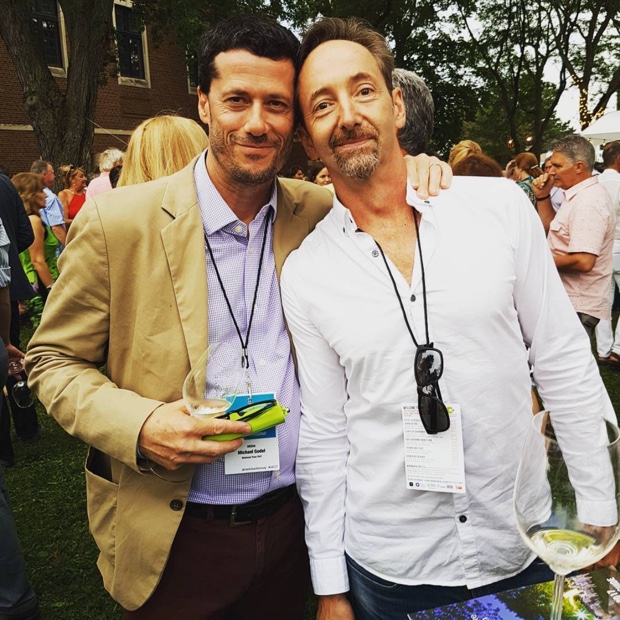
WineAlign

Niagara’s cool for chards


Niagara chardonnay, cornerstone of an industry, another one of nature’s mysterious constants, long-time member of both local and globally recognized greatness. A pandemic be damned the time had finally come to glide on down the QEW, inch by inch, to arrive in Niagara’s wine-lands and taste recently bottled vineyard bounty, plus some older surprises. At the behest, felicitations and facilitations of WMAO we the crü at WineAlign abided by the invitation. The visits included Le Clos Jordanne, On Seven Estate Winery, Stratus Vineyards, Trius Winery and Restaurant, Hidden Bench Estate Winery, Tawse Winery, Redstone Winery and Restaurant and the Bat Caves at Bachelder Wines. The next trip will take in at least seven more and after that, no less than seven again. And so on. Niagara is not conquered in a day, or a weekend.

And everybody tells me that it’s cool to be a cat
Cool for cats (cool for cats)

Related – A Chardonnay toast to Cool and the gang

The steamy and canicular July varietal sally coincided with the physical return, if only in part and to limited display, of the region’s annual i4c Cool Climate Chardonnay Celebration. Ontario’s most famous annual gathering inclusive of international winemaking stars is one that so many media, sommeliers, producers, importers, marketers and consumers have come to know, embrace and love. With a commitment for more arms to get jabbed and further progress towards community safety be made in these next 11 months, there should be every reason for optimism that i4c 2022 will return in full force next July.

Thomas Bachelder between Hanck East and West

Related – David Lawrason’s Canadian Wine Insider – Niagara’s Regeneration

In addition to chardonnay (that cool refreshing drink) there too were touring pours of sparkling wines, riesling, pinot gris, skin contact whites, rosé, pinot noir, cabernet franc and gamay. Those tasting notes are included in this report because quite frankly Niagara’s varietal diversity and inclusivity on full display should be duly noted. The festivities concluded on Sunday afternoon with not one but two Bat Cave barrel tastings with the stupefied, hyper-hypnotized and monkified winemaking tour de force himself, the other tall and thin white duke, Thomas Bachelder. No I did not make any formal notes on the dozens of chardonnay and gamay thieved from his barrels because frenetics and focus do not jive, not when Bachelder, barrels and argumentative discourse are involved. Bachelder began with some re-visits of finished “Villages” wines in the guise of Mineralité de Niagara and L’Ardoise, same same but for different markets (Ontario and Québec), both from the 2019 vintage. Then the surprise of the tasting emerged, two unmarked magnums, as of that very moment yet untasted and very special. “From the Heart Cuvée Number 1” is a project with fellow enlightened, philanthropic aiding and abetting abbot Steven Campbell. Their chardonnay crushes the concept with its dynamic and lush configuration. Why because of the very notion of being figuratively layered, blessed with a frictional vitality burnished into its collective heart and chardonnay soul. I had to stop after each sip to reassemble my nervous system and scrape my mind of the cosmos, not to mention the universe, galaxies and stars.

Crazy eyes in the throes of a four-hour Bachelder barrel tasting

The concept began as an annual Canadian Charity Wine Auction in support of the battle against climate change and then further developed into the Rescue the Grapes auction in NYC in partnership with Christie’s. Campbell and Bachelder convinced dozens of winemakers to donate small-ish lots of unfinished wines to be gathered and vinified as a single wine, an Ontario supergroup-cuvée if you will and finished by Thomas, acting as lead singer and songwriter. In Canada he and Steven are asking wineries to sponsor winemakers dinners in their home province and if they do host a dinner also support our auctions in the other two provinces. For the other province they donate a six pack of wine and will include  VIP “Passport” to the winery to promote interprovincial wine tourism. So far in Ontario Trail Estate, Malivoire, Southbrook, The Farm, Trius, Cave Spring, Pearl Morissette, Bachelder, Henry of Pehlam, Tawse and Rosehall run have all stepped up with a few more in the wings. In British Columbia Black Hills, Stag Hollow, Burrowing Owl, Okanagan Crush Pad, Tin Horn Creek, Tantalus, Quails Gate, Mission Hill and an Arterra winery are in with more to come.

The Bachelder Vineyard Map

The chardonnays were pulled from Willms Vineyard, Wismer-Wingfield est and ouest, Wismer-Foxcroft, Saunders Organic and Bio and Grimsby Hillside Escarpment Red Clay Barn Block. The gamay barrels tasted were Bator, Jackson-Bai “Bai Xu,” Wismer-Parke, Hanck est and ouest. Thomas did reveal the first ever bottle of Grimsby Hillside Chardonnay. The personal connection to that storied plot along the Lincoln Lakeshore in Winona will be investigated to the fullest extent of Godello law in a report coming soon.

Godello with Hidden Bench winemaker Jay Johnston

Has one really taken full advantage of a cool chardonnay weekend if one has not gone nose, palate, heart and mind deep into a seven year Hidden Bench Marlize Beyers to Jay Johnston Felseck Vineyard Chardonnay vertical? Methinks not. Not to mention a viticultural tour with J.J. and Joel Williams, Brut 2014, Rachis & Derma skin-contact and of course, Gamay. Thanks to proprietor Harald Thiel and congrats on being bestowed with the honour of “Champion Chardonnay of the year!” Couldn’t have happened to a more deserving and industry leading partner. 👏 👏 👏

Hidden Bench Winemaker Jay Johnston and Viticulturist Joel Williams

New to the Niagara Peninsula scene is On Seven Estate Winery, headed up by Vittorio de Stefano and with the charge in the hands of Canada’s most accomplished consulting winemaker Peter Gamble. Just as he has made giant viticultural and vinicultural strides with the likes of Stratus, Benjamin Bridge and Lightfoot & Wolfville, in typical, ambitious and big picture defining fashion it is Gamble who sees unlimited qualitative potential in the mineral-rich soils of OSEW’s Niagara-on-the-Lake soils. 

The sit-down at Stratus Vineyards titled “To lees or not to lees? That is the tasting” explained from the word go about the new direction concerns all things lees. To see two winemakers, they being J.L. Groux and Dean Stoyka existing on the same mad scientist solids page is something all Ontario wine pursuers should choose to follow. The pursuit is being played out in chardonnays and multifarious sparkling wines, in Blanc de Blancs, Brut Nature Zero Dosage and “Field Blend” Ancestral. For Ontario this means serious sparkling wine business.

Panko-Crusted Pork Rilette, poached plum & charred fennel salad, toasted hazelnuts, honey dressing, pickled mustard seeds – Executive Chef Steve Sperling, Tide and Vine Oyster House

“Lunch and Launch in Le Clos Jordanne Vineyard” moved us in many ways, first through distant Upper and immediate Lower Jordan Bench views, of Le Clos, Talon Ridge and Claystone Terrace. Tide and Vine Oyster House was responsible for feeding us to the breaking point, by oysters, yellow fin tuna tartar, cold smoked salmon, vichyssoise, pork rillete, surf & turf and olive oil cake. The chardonnay flowed, with Village and Grand Clos examples by hosts LCJ, but also international stars; Tasmania, Australia’s Dalrymple, Hemel-en-Aarde, South Africa’s Hamilton Russell and Russian River Valley, Sonoma County, California’s Gary Farrell. Here are my notes on those three wines.

Dalrymple Cave Block Chardonnay 2018, Tasmania, Australia ($70.95, Noble Estates)

A steely year with the vineyard’s hallmark acidity in a cracker Tazzy chardonnay with lip-smacking energy, intensity and drive. Soil, site and place in relentless pursuit of a focus at the head of body and game. Crunchy, crisp, indelibly fresh and piqued with the finest wisp of white peppery kicks. Nuts, complexity, bolts and length. All in. Drink 2021-2026.  Tasted July 2021

Hamilton Russel Vineyard Chardonnay 2018, Hemel-en-Aarde Valley, South Africa ($47.95, Noble Estates)

From the air-conditioned, cool breeze motivated vineyards (52 hectares) 100 miles from the ocean. Wet vintage, cool and long-hanging. Concentrated flavours in chardonnay that draws from all parcels which is more than just the Hamilton Russell way but in fact the only way. No fruit is wasted, all parts commit and contribute to the whole. A vintage like this is special, restrained, understated and one should not be misled by the shadowy depth and layering. Fruit is but a conduit for all else happening in this streamlined chardonnay. The alcohol and opulence are subtle, the pleasure calming, the capitulations promising. Methinks time will be long, slow and kind to HRV ’18. Drink 2021-2027.  Tasted July 2021

Garry Farrell Chardonnay Olivet Lane 2018, Russian River Valley, Sonoma County, California ($69.00, Noble Estates)

Pellegrini’s 1975 planted Olivet Lane Vineyard sits on 65 acres of sloping benchland in the Santa Rosa Plain, in between the warmer Westside Road region and the cooler Green Valley. If taking a step up from Gary Farrell’s estate label is even a possibility then yes Olivet Lane is just such an animal. Threefold (or ten times) more expressive, from jump started to flying ahead, in freshness, vitality and tightly wound intensity. Flesh and opulence submit to energy, motion and emotion. Captivated and caught up in a bold embrace. Forget bracing but surely feel the fineness and the purpose towards effecting satisfaction. Top, right, fine. Drink 2022-2027.  Tasted July 2021

Tres Cool Chardonnay

We’ve called on many estates over the last 10 years but truth is the visits were epic this time around, with thanks to the talent involved; Thomas Bachelder, Elsa MacDonald MW, Eugene Mlynczyk MW and the Arterra Wines Canada crew; Tide and Vine’s Mike Langley, Chef Steve Sperling and team; On Seven Estate Winery’s Vittorio de Stefano and Consulting Winemaker Peter Gamble; Stratus Vineyards Assistant Winemaker Dean Stoyka and Estate Director Suzanne Janke; Trius Winery and Restaurant’s Executive Chef Frank Dodd and team; Hidden Bench Estate Winery’s Winemaker Jay Johnston and Viticulturalist Joel Williams; Tawse Winery Winemakers Paul Pender and Jessica Otting; The Restaurant at Redstone Executive Chef Dave Sider and team; Thomas Bachelder and Mary Delaney. These are the 40 finished wines tasted over a near 30-hour period on July 24th and 25th, 2021.

Felseck Vertical

Hidden Bench Chardonnay Felseck Vineyard 2019, VQA Beamsville Bench ($42.20)

Tasted as part of an #14c21 seven year vertical Felseck Vineyard retrospective. No stirring, “I don’t like bâtonnage,” tells winemaker Jay Johnston, “unless I’m trying to get a wine to dry.” Never mind the lees aeration or the emulsification because texture in this ’19 is extraordinary to behold, gliding across the palate with Bench orchard fruit cleverness, penetrating perspicacity and juices running through unblemished flesh. Tighter and taut than ’18, while seemingly improbable but here yet unwound, far from the pinnacle at which point full expression will surely ache to be. The ’18 may be a beautiful thing but the ’19 is structured, manifold in destiny and ideal for those who know, or at least think they do. Drink 2023-2030.  Tasted July 2021

Hidden Bench Chardonnay Felseck Vineyard 2018, VQA Beamsville Bench

First a walk through the Felseck Vineyard and then a tasting with winemaker Jay Johnston and viticulturist Joel Williams as part of an #14c21 seven year vertical retrospective. Very warm season, much like 2016 though not quite as scorching and sun-filled. Would not call this stoic but would say that concentration, grace and all things stretched are in optimum balance this time around. Pretty quick turn around for Johnston to exact an ideal Felseck chardonnay just a year and a bit into his tenure at Hidden Bench. Just crunchy enough, more than ample and most importantly understated within the context of a great richness inherent in its varietal meets plantation DNA. There is no denying how enticing, invigorating and attractive this chardonnay is and will be to many who showed buyer’s foresight, but also those now lucky enough to come across its terroir-motivated beauty. Drink 2022-2028.  Tasted July 2021

Hidden Bench Chardonnay Felseck Vineyard 2017, VQA Beamsville Bench

Tasted as part of an #14c21 seven year vertical Felseck Vineyard retrospective. A vintage of survival, saved by a glorious September and into October. Looks like the richness made it with thanks to the fall weather and yet the elongation, length, elasticity and texture are all what matters to speak, walk, talk and tow the Felseck line. Solid, mid-weight, mid-acid and structure chardonnay that acts with perfectly middling emotion between the warm ’16 and ’18.  Last tasted July 2021

Felseck gifts what chardonnay needs with fruit equipped to start out subtle, gain traction and then commit to gliding into grace. That state of delicasse is now, with a natural orchard-stone-melon sweetness and an integration seamless, layered and eternal. Drinking this now makes great sense and the honey notes that may follow will only add to the mystique. The Ontario epitome of intelligent and refined chardonnay. Drink 2020-2025.  Tasted May 2020

Felseck Vineyard

Hidden Bench Chardonnay Felseck Vineyard 2016, VQA Beamsville Bench

Tasted as part of an #14c21 seven year vertical Felseck Vineyard retrospective. Smoking hot season, much like 2018. No other vintage will impress and woo a more general if elevated palate than this ’16 (save perhaps the high award winning ’18) because both concentration and grace reside in the arena of the beautiful, together, side by side. Not the tightest grain in the vertical retrospective Felseck ship. Can’t say this will live as long as the ’13 and ’14 but there is plenty of life in this gorgeous and not so alone 2016. Drink 2021-2026.  Tasted July 2021

Hidden Bench Chardonnay Felseck Vineyard 2015, VQA Beamsville Bench

Tasted as part of an #14c21 seven year vertical Felseck Vineyard retrospective. A short crop year, “we got slammed,” says winemaker Jay Johnstone, “but a wine of definite concentration.” Showing evolution and age in tones, developed richesse and caramelization well beyond both that of ’13 and ’14. No corn however, despite what the initial nose might have indicated. A faux creamed presentation that ended up more peach to apricot in drupe, not niblet. Nutty too, again idiosyncratic and a unique Felseck as such.  Last tasted July 2021

Sometimes I’m “walking down the street, minding my own business” when a taste of a chardonnay makes my eyes go wide. Like this lovely thing of really compelling and nuanced aromatics, diverting, bright and effusive. Intoxicating really, “must have been the sun beating down on me.” A soulful chardonnay, Darondo luscious, strutting at you, with golden fruit, layers of slaty under-vein, a bit of ancient bivalve fossil shell, piqued and long. Gets its texture from a pinpointed cru for sure and is very cool-climate Canadian, almost certainly Bench Niagara, more than likely in Beamsville. Drink 2019-2025.  Tasted blind at NWAC18, June 2018

Hidden Bench Chardonnay Felseck Vineyard 2014, VQA Beamsville Bench

Tasted as part of an #14c21 seven year vertical Felseck Vineyard retrospective. A short crop year but a solid year. Now expressive with croccante and cracker sensibility. Aromatically touched by croissant to brioche biscuit richness, with still pulsing acids and mouthfeel second to none. This is a next era Hidden Bench Felseck and the launch point from off of the work put in through the previous five or six vintages. Tasted blind four years previous to now was a completely different experience. Drink 2021-2026.  Last tasted July 2021

Unction and creaminess, lost in a chardonnay dream because to nose it’s a sweet, floral, demure thing. Lees apparent so you can smell the work in progress and feel the texture. But it’s wound loosely tight with just enough give to make it so readily available. Beautiful little wine though I can’t help but imagine there’s more single-focus structure than a blind taste wants to give. Hope to come across this hard to get beauty again someday soon.  Tasted blind at NWAC17, June 2017

Hidden Bench Chardonnay Felseck Vineyard 2013, VQA Beamsville Bench

Tasted with incumbent winemaker Jay Johnston as part of an #14c21 seven year vertical Felseck Vineyard retrospective. The vintage may very well be considered much like 2021 is shaping up to be, wet and humid, culminating in a late season. A short crop year but surely one of the Bench’s best dating back to 2009. Persistently flinty and aromatic, holding the citrus and stone fruit line, still quite tight and yet to evolve with any considerable haste. Not one to think on as a specific Bourguignons terroir per se but definitely Hidden Bench, amphitheatric Beamsville of origin, expression and conclusion. Drink 2021-2025.  Tasted July 2021

Le Clos Jordanne Jordan Village Chardonnay 2019, VQA Niagara Peninsula ($24.95)

The first attempt and rather obvious pronouncement towards creating a Bourguignons Villages wine is this over-delivering for the price chardonnay from Thomas Bachelder and the re-invented spirit of Le Clos Jordanne. Jordan Village as in grapes gathered from the lower and upper Jordan benches. When warmed in the glass and were it drawn from a warmer vintage there might be even more fleshy opulence but with 2019 and this collection of LCJ single vineyards there is fresh magnification and edgy dance moves, shimmer and glitter, not to mention of glimmer of what this commercially viable brand will ultimately bring to the collective entity that is cool climate Ontario chardonnay. Drink 2021-2024.  Tasted July 2021

Le Clos Jordanne Le Grand Clos Chardonnay 2018, VQA Twenty Mile Bench ($44.95)

Le Grand Clos signals the return of the lower Jordan Bench and “I’m very happen it’s back in the (Escarpment) lexicon,” says winemaker Thomas Bachelder for a chardonnay of origins truly different than the upper benches in Beamsville, Vineland and Jordan. A svelte vintage, not lean by any stretch but surely tight and what some might say restrained. That may or may not include fine white caramel, liqueur glazed fennel and a mild sense of grilling. A chardonnay from vines in a season that needed not shut down to either hydric nor heat stress. Funny how both 2018 in Niagara and Hermanus produced similar results. The big “E,” fine-tuning, chiseled features and sneaky structure.  Last tasted July 2021

Thomas Bachelder’s second vintage since the reprise of Le Clos Jordanne’s chardonnay and pinot noir is perhaps the most nurtured (and nurturing) because he and team treated this varietal fruit through all the early stages; newborn, infant, toddler and child. The attention to detail, from choosing cooperage, forests, barrels and in elévage design is both mathematical and surgical. After 22 months the result is just so imperfectly perfect. Unequivocally noted as a high acid vintage and rather then fatten up this fruit the monk chose the direction of vintage seasoning and identity. Drills down into the Clos and where it fits within the Twenty Mile Bench. The exiguity and heretical transparency makes this a great ’18 Le Clos because ambiguity is the enemy of accountability and also progress. As a forward thinking chardonnay it represents itself, the maker and proffers a sense of place. Perfectly easy to drink right now and imperfectly set up for aging, but that’s just not the point. Drink 2020-2025.  Tasted November 2020

On Seven Estate Winery The Pursuit On Seven Chardonnay 2018, VQA Niagara-on-the-Lake ($45.00)

Seven acres, thus the name, in the hands of Vittorio de Stefano, “and a project paramount to wanting something sustainable that can compete at the international level and standard.” The vineyard is five acres and the property now 15.5. Planted half each to chardonnay and pinot noir, all organic. Bourgogne is the impetus, Niagara the goal. The genesis of planting decisions dates back to 2009, high vigour rootball SO4 rootstocks and clones finally acquired in 2014. Now at seven years of age the vines are ready to rock. A place of science, with oenological consultant/winemaker Peter Gamble at the fore and wines of minimalist approach starting out in reductive tendency, then finishing with longevity defining acidity. Richness and intensity meet at a general Côte d’Or vortex but in the end Niagara lake-proximate flesh and tension are the true meeting point. There is a distinct flintiness (and unlike other flinty chardonnays) but also a caramelization of high delectability and flavour. Vim and vigour, vivid and 20 per cent new oak over three years to gain such favour. Exotic too, with wood contributing to the extract, but surely essential trace elements; manganese, iron and calcium of causation allowing the minerals to make themselves heard. Intriguing wine if only at the beginning of a long story yet to be told. Only 82 cases made. The goal as the vines mature will be 800. Drink 2021-2024.  Tasted July 2021

On Seven Estate Winery The Pursuit On Seven Chardonnay 2017, VQA Niagara-on-the-Lake ($45.00)

Perhaps not the highest of knowable excellence yet clearly the most intriguing chardonnay that may never be emulated any time soon, certainly not out of 2019 or 2020. Singular stylistic wine, reductive and opulent, more Pouilly-Fuissé (with thanks to 2017) and a warmth that creates such a textural buzz. More fat in spite of that 8 g/L acidity, but such energy and considering the age at this point it almost seems the wine is going a bit backwards. That said the vanilla and caramel comes in wafts and waves, the flavours and textures in layers, long, lingering, forever. Only 108 cases made.  Last tasted July 2021

The newest Peter Gamble consulting joint is this from upstart The Pursuit of Seven. The chardonnay fruit is Niagara-on-the-Lake and the concentration suggest established vines (of at least 15 years-old it would seem) and no holds barred in terms of extraction and wood support. The density and fruit bang for buck are impressive and there is some volatility in distraction. Ambitious to be sure and the acumen employed true to form, not to mention distinctly clear. Drink 2020-2023.  Tasted March 2020

Vittorio de Stefano of @onsevenwinery with consulting oenologist Peter Gamble

On Seven Estate Winery The Devotion On Seven Chardonnay 2018, VQA Niagara-on-the-Lake ($65.00)

Imagine the minerals from these Niagara-on-the-Lake soils (manganese, iron and calcium) and the highest intensity fruit getting together in a tiny lot chardonnay case load. Then consider going against the grain with harder (elevated) turbidity in the ferments for more skin feel and purposed pulp for upfront loaded flavour intensity. That’s the direction and hyperbole of pursuit in The Devotion on Seven, an (only) 31 cases made chardonnay. Doubles (or perhaps triples) down on reduction, fulsome flesh and yet the warner vintage has as much to say as the inherent processes involved. Also a tannic chardonnay, in dramatic sensory extract as compared to the Pursuit on Seven ’18, though it can’t help but express more of everything as compared to the Pursuit of Seven. The acidity number of 8 g/L might seem extraordinary when considering the warmth and the ripeness of the vintage, however, and this matters most, ultimately it is the terroir that drives both the texture and the acidity of this special, barrel selection wine. Drink 2021-2025.  Tasted July 2021

Peller Estates Signature Series Chardonnay Sur Lie 2019, VQA Niagara-on-the-Lake

Yet another cracker 2019 chardonnay with the coolest of vintages meeting varietal bones and a karst of energy to drive the lees machine. Spent 10 months sur lie to be exact in a fully malolactic confirmed textural tang that benefits from a certain restraint only such a season can affirm. That being particularly cool and elongated for a chardonnay just crunchy enough to support the promise and extend enjoyment for a good, long and fruitful spree. Expect a future filled with a soft and creamy centre, eventuating in some creamed Niagara corn. Drink 2021-2024.  Tasted July 2021

Stratus Chardonnay ‘Unfiltered’ & Bottled With Lees 2019, VQA Niagara-on-the-Lake ($49.20)

“It’s not that we’re trying to change something every year,” explains assistant winemaker Dean Stoyka, which means that the R and D projects are in constant motion and take four to five years to come to fruition. The October 18-26 stretch is the latest harvest in quite some time (since 2009), fermented in various clay vessels and French oak, 76 per cent in neutral barrels and (24) in stainless steel. Great naturally developed acidity and just enough ripeness to gain favour with the fully-completely accessed, utilized and kept in the bottle lees. So lemon, so balanced and very fine. There is a combinative effect of mad scientist acumen for a wine that needs to be explained to a consumer mixed with absolute pleasure and amenability. One of the finest chardonnay peaks conquered nut just in Ontario but anywhere cool varietal mountains are meant to be climbed.  Last tasted July 2021

Tight one this 2019 chardonnay, seductively reductive and unwilling to relent this early in life. Knowable richness is optimized by being associated with green orchard fruit bite. Though so youthful and shrink wrapped at this time there are some ways to pair with potential and eek out enough charm. Boy do you feel the lees but the freshness really shines. Prosciutto comes to mind, as does mortadella, especially if it’s from Faenza. Drink 2022-2027.  Tasted October 2020

Stratus Chardonnay ‘Unfiltered’ & Bottled With Lees 2017, VQA Niagara-on-the-Lake

Warm and ripe vintage if only because of a gorgeous September into October, more lees than ever before, no new wood and an extended elévage nearing a year in length. Alcohol has risen, as has the pH though neither are what you might call vivid. The palate is actually tightly strung, the texture fulfilling and a cloudiness so perfect for what the winemaking team had long wanted to achieve. Hard not to see 2017 as the teaching wine where lees usage is concerned, the (after the fact) ah-hah moment whereby knowing what to do and how deep to go was learned by how 2017 turned out. In this case fulsome of stone fruit, opaque clarity, an oxymoronic ying-yang of positives in apposite attractions. A Monet vintage, modernized and so very J-L Groux. A Stratus, unlike any other. Drink 2021-2025.  Tasted July 2021

Stratus Chardonnay 2015, VQA Niagara-on-the-Lake

The 2014 vintage was essentially the first year when barrel lees would be left in the bottle and my how conservative this ’15 really was as compared to an evolution that culminates (currently) with the full on lees filed chardonnay vintage. Quite the opulent vintage mixed with aromatics still morphing, developing lees, brash and blushing by 40 per cent new oak, complimented by generous acidity. Showing with controlled drama and though the yields were low (only 88 tonnes) there is something quite special about this emotionally charged, vivid, scarce and remarkable chardonnay.  Last tasted July 2021

Stratus Chardonnay 2012, VQA Niagara-on-the-Lake

Tasting with assistant winemaker Dean Stoyka as part of a vertical exercise in “to lees or not to lees.” Neither hue nor aromatics suggest much evolution though the low-ish acidity and tropical fruit tell an emerging secondary story. Creamy and centred, gregarious of flavour, nothing left unsaid, hidden or kept hidden away. Up front and talking vintage warmth, opulence and ripeness. Was housed in only 18 per cent new wood. For a good time, drink up.  Last tasted July 2021

As per the house promulgation, in chardonnay, “still an assemblage process,” insists Groux, “no matter what we do.” Some grapes grown for Sparkling were added back in, for acidity, complexity and ultimately balance. That and though notably barrel burdened (a good, hard burden to bare) leading to a bargain, “the best I ever had.” Major key of whose who of Niagara fruit, power acoustic chords and 12-string harmonics. Drink 2015-2022.  Tasted June 2015

A change in direction is duly noted with J-L Groux’s 2012 chardonnay, from fruit picked six weeks earlier than in 2010. The program is scaled back and the wine is more “typical” of the region, in weight, in barrel effect and in alcohol. Still quite defined by natural yeasts that “sometimes go a bit wild, but I’m getting better at it,” concedes the clinician of vinous letters. Those feisty microbes are difficult to work with, like dealing with a wine that lacks natural clarity. “You have to shut down the bacteria, teach the yeast to stop stealing the lees. In 2013 I really got it.” The ’12’s altered course is welcome and encouraged and the world should wait with bated breath for what ’13 will bring. Here the complexity of aromatics is matched only by the intensity of tropical fruit. Has balance and a soft, round feel. Again, more texture and aromatics than natural acidity. Classic J-L style. “It’s not about trying to imitate anyone. It’s about making the most interesting and most complex chardonnay in Niagara.”  Tasted March 2014

Tawse Chardonnay Quarry Road 2018, VQA Vinemount Ridge ($35.95)

Definitely a warm vintage, picked on the early side, bite still clamped down, a bit of pesto and far from reductive as noted in Quarry Roads of the recent past (i.e 2011 and 2013). Pine nut pronunciation, no malic residual transformations (there will never me) and just bloody good freshness. Last tasted July 2021

No shocker that Quarry Road always finds a way to morph and change gears, meaning every so often, a year and up to two years later there will be some significant movement in this wine. Something about the Vinemount Ridge and how its players are in constant flux, adjusting sentiments and character to keep things curious, interesting and alive. Still the unencumbered and free-flowing expression it set out to be, free to be Quarry Road and as for me, I am always enamoured by how it marries personality with age. Natural (not unlike the Natural version of itself), enigmatic and very personal. Let it be. Drink 2021-2026.  Tasted May 2021

Tawse winemakers Paul Pender and Jessica Otting

Tawse Quarry Road Chardonnay 2011, VQA Vinemount Ridge

Fantastic ten years after flinty reduction from arguably the most cracking vintage of the previous decade. As it is said, “you’ve got to feed the beauty, it doth not come cheap.” And that is what Paul Pender went for in 2011. At 10 Quarry is light on its feet, fresh, spirited jumping rope and spinning in concentric chardonnay circles. It simply reeks of beautiful Vinemount Ridge stone.  Last tasted July 2021

The pinpoint accuracy and gemstone capture of the Quarry is exaggerated in ’11, amplified and fully plugged in. From my earlier, October 2013 note: “Carries that classic Paul Pender perfume; rocks and stones, flaxen, refulgent toast and the verdure Vinemount terroir. A free flying, linear, atmospheric smear of thermal fortitude and backbone. A polemic Bowie Chardonnay to make you believe “the strangest things, loving the alien.”  Tasted May 2014

Resides on the mineral, slate and lime side of the tracks. The calcareous quality imparted by its eponymous SV terroir makes it the antithesis of David. Creamy, 24-karat fruit.  Tasted March 2012 (barrel sample)

Thirty Bench Small Lot Chardonnay 2019, VQA Beamsville Bench ($34.95)

Prick, punch and torque from the conceptual vintage get-go, a classic 2019 in the making, if by so many yet to be understood standards. A chardonnay so cool it causes a brain freeze while simultaneously moving the soul. In fact put on some vinyl Gaye, get in on, or even disco foreshadowing Temptations, echoing the chardonnay law of the land. Don’t sleep on the high level fruit, not quite fleshy but surely potent and dynamic to match the season’s verve in acidity. Fine lees, better texture and all-around vitality so essential to chardonnay. Will improve with six more months in bottle. Drink 2022-2026.  Tasted July 2021

Trius Showcase Chardonnay Wild Ferment 2019, VQA Lincoln Lakeshore ($36.75)

A single-vineyard chardonnay once labelled Oliveira and then watching Tree Vineyard but no longer, though the source remains the same. Embraces a cool 2019 vintage played out through rewards in the guise of reduction, toast, flint and drive. In cool climate varietal terms this ’19 reminds of 2011 though to be clear and certain there is more focus where by the quantity and quality of ripenesses meet at the essential points of acidity and tannin. Here is a vintage to end a decade in the most poised and poignant way. Spot on, striking and graceful chardonnay. Drink 2021-2026.  Tasted July 2021

Remarkable finesse, flavours and design @triuswines and Restaurant by Chef Frank Dodd with @coolchardonnay accompaniments.

Beyond Chardonnay

Hidden Bench Blanc De Blanc Zero Dosage 2014, VQA Beamsville Bench ($48.00)

Second vintage from a tightly contested and smaller crop, initiated by then winemaker Marlize Beyers and subsequently disgorged by Jay Johnston, following five years on the lees. Moves from the practice of poetics to the anticipatory embracing of tomorrow’s science. Full disclosure this was tasted while walking the Hidden Bench chardonnay vineyards with a traditional method sparkling wine in hand first disgorged in the summer of 2019, when the yeasts were removed and the bottle was topped with the same wine. This tasting featured a January 2021 disgorgement and the term “Brut Nature Zero Dosage used when no sugar is added to the finished wine, which provides the most authentic expression of (the Hidden Bench) terroir.” Truth and synchronicity, grace, striking engagement, pure citrus and pleasure. Who could not anticipate and wait on subsequent vintages of this wine? The best is yet to come. Drink 2021-2027.  Tasted July 2021

Stratus Brut Nature Zero Dosage 2013, VQA Niagara-on-the-Lake ($100.00)

Comes across a bit cloudy, at least as compared to the B de B with thanks to the natural, lees left intact style. The citrus component is so pronounced, as is the taut, direct, lean and intense manifold destiny of what is truly a singular Sparkling wine. That being a living, breathing, inhaling and exhaling wine, slowly releasing proteins, acids and realizing its B de B Nature dream. Just amazing what lees can do for sparkling wine.  Last tasted July 2021

Released side by each with the Stratus Blanc de Blanc 2013 and while vintage and grape are the same, the similarities almost seemingly, ostensibly and allegedly end there. Yes in fact this 100 per cent chardonnay is a child of the most excellent varietal vintage and like the B de B spent six years on the lees. Comparisons cast aside it is the very fact that because much of the lees were transferred to bottle by a minimalist’s disgorging that this cloudy bubble with a Canadian artist’s series set of labels can’t help but elicit another memory. The Lilies of Monet and their clouds represent neither the horizon, nor the top or the bottom. Nor does a bottle of this Zéro Dosage Brut. The elements of water, air, sky and earth become intertwined in a composition without perspective, or so it goes in this hazy, opaque and dry as the desert sparkling wine. So many layers of lemon can be peeled, juiced and scraped away. If a Stratus wine could be a a riddle, wrapped in a mystery, inside an enigma then here it is. The texture here is palpable and the intrigue factor surely high, so it should be imagined that longevity will be this wine’s calling card. It’s more austere than the Blanc de Blanc but I think in fact it will. Drink 2022-2029.  Tasted November 2020

Stratus Blanc De Blancs 2013, VQA Niagara-on-the-Lake ($75.00)

One gram of dosage, disgorged in January 2020. Nearly six years on the lees based on the first R & D trials done in 2006 and 2007. High level autolytic entity, a toasted affair and an idea long time coming for the Stratus team. Fine tonic and bitters. With 15 minutes of air the blooming happens, floral, expressive and complex. This wine has really developed more layers, emotions and complexity.  Last tasted July 2021

The first (commercial) J-L Groux foray into traditional method Sparkling wine has been six plus years in the making, or in this case, senescence as the lees fly and his Blanc de Blanc has finally arrived. A notable moment in the Stratus continuum as they too now own a program of development, time, investment, research and acumen. The nose on this bubble tells a pensive story, or as fantasy goes like dipping your face into a tale-spun pensieve as it takes you back in time. In 2013 chardonnay excelled on the Niagara Peninsula and still today in 2020 we are drinking vintage examples persistent in their freshness and durability of construct. That this reeks of varietal lore is a hallmark moment, that and a conscientious adherence to reverence for solids and the focus on rotational detail. Speaks a Blanc de Blanc vernacular as a chardonnay should, with a bite out of a sharp fall apple, a pesto of verdant aromatics and a crunch of texture before drifting saline, briny and fine. Pretty good work J-L. Kudos for getting from there to here with intelligence and humility. Drink 2020-2026.  Tasted November 2020

Stratus Vineyards “Field Blend” Ancestral 2020, VQA Niagara-on-the-Lake ($35.00)

The inaugural Stratus commercially labelled release is what winemaker Dean Stoyka refers to as “in the mindset of monks.” A field blend of sémillon, chardonnay, riesling and viognier. Pressed all together, fermented dry and then re-fermented in the bottle with no sugar added. Dry enough, or so it seems, non-disgorged, under crown cap and so very fruity. Floral, allspice and spiciness overtop apricot, pear and black walnuts conceptually turning into Vin de Noix or Nocino. A natural testament to assemblage and a great use of varieties without a home. 100 cases produced. Drink 2021-2024.  Tasted July 2021

Tawse Spark Laundry Vineyard Blanc De Noirs 2013, VQA Lincoln Lakeshore

Actually quite shocked I’ve never tasted this wine before, a Spark about which winemaker Paul Pender exults by saying “2013 is my favourite vintage for all our sparklings.” Traditional method, pinot noir from Heather Laundry’s double L vineyard and a fizz that fits and sparks. Gingered and toasty, crunchy, wave cresting and fulsome by six years on the lees. The dosage was five to six g/L, in that Pender sweet spot all around, just right, so well and good. A little romanticism goes a long way where science is concerned, especially in this medium and in Spark Blanc De Noirs 2013 one is simply good for the other. Drink 2021-2025.  Tasted July 2021

Tawse David’s Block Estate Vineyard Spark 2014, VQA Twenty Mile Bench

Tasted side by side with the 2013 Blanc de Noirs, making for a striking if surprisingly antithetical contrasting contract with this Blanc de Blancs. Aged three years on the lees and finished with the same 5-6 g/L of dosage yet here so upfront, centred and personal. More immediate richness than what pinot seems to do from Laundry Vineyard and so even in sparkling it is David’s Block and chardonnay that gift quicker satisfaction. Likely vintage driven (again, even in sparkling), very pear and shortbread, a savoury dessert of a sparkling wine. Like olive oil cake, all about the simple pleasures. Drink 2021-2023.  Tasted July 2021

Trius Showcase Brut Nature NV Méthode Traditionelle, VQA Niagara Peninsula ($55.00)

The dry as the desert Brut nature initiates with a yeasty faradism of excitement from what strikes as a minimum four to five years spent sitting on those fascinating lees. While the wine does not exactly smoulder with a toasty salutation that is no matter because textural acidity and blooming aromatics also arrive to an applause of immediate gratification. There is an exceptional level of “croccante” satisfaction that parlays that “texture” into a lasting display of bits and bites. The make up is 50 per cent chardonnay and (45) pinot noir with (5) pinot meunier and 2014 being the primary vintage source, though there is some 2013 involved. Zero dosage, top tier, notch and drop. Drink 2021-2027.  Tasted July 2021

Tawse Rosé Limestone Vineyard 2020, VQA Twenty Mile Bench ($27.95)

Tawse began crafting Rosé from (Vinemount Ridge) Quarry Road Vineyard fruit in 2017 and now here they come with Twenty Mile Bench pinot noir. From Limestone Vineyard this represents a heads and tails Rosé, meaning 40 per cent is used for Spark traditional method bubbles and the bookends is destined for this salty, straight-shooting and crisp-freckled single-vineyard blush. Double-redheaded wow! Grape, place and style all on side for so many good reasons. 1000 bottles made. Drink 2021-2023.  Tasted July 2021

Tawse Pinot Gris Lawrie Vineyard 2019, VQA Niagara-on-the-Lake ($27.15)

Not to be confused with the Lowrey Vineyard on St. David’s Bench and a best varietal vintage for Paul Pender. Far from being a “Miller-Lite or Corona” pinot gris, instead creamy, fulsome, well-versed and elastic. The furthest away from metallic and/or turbid, low on phenols, no bitters, nor tonics neither.  Last tasted July 2021

Fresh and while this young is full of its original fruit, which is the biggest plus for pinot gris because dry varietal wines have a hard time after enough time has passed on by. Sulphur is not really an issue so this delivers the varietal and stylistic goods with fruit at the lead. Good acids, persistence and balance. Drink 2020-2022.  Tasted October 2020

Tawse Winery Carly’s Block Riesling 2015, VQA Twenty Mile Bench

A sleeper vintage, not necessarily exacting out of the blocks, not heavy cropped, middle of the road in so many respects. If I tasted this before memory fails to draw any retrospective conclusions) but Carly’s ’15 has already turned towards the petrol sun, “let the shadows fall behind you, don’t look back, just carry on.” This perhaps began more than a year or two ago and today acts Rihanna outspokenly so. Lime and almost cordial by now, warm and friendly as a riesling liqueur. Quite stable, animated, holding its patterning, likely to do so for an additional three or fours years. Drink before it returns home. Drink 2021-2024.  Tasted July 2021

Tawse Limestone Ridge Riesling 2012, VQA Twenty Mile Bench

Unlike the Carly’s ’15 (tasted at the same time) this Limestone ’12 has not moved forward with any vehement haste. The lack of advancing towards petrol is curious but the softening is surely comforting. Still resplendent with a particular 2012 meets Twenty Mile Bench acidity, now oscillating while integrating with waning fruit. Drinking beautifully.  Last tasted July 2021

From the newest estate vineyard, the single-vineyard Limestone Ridge exteriorizes its name in a rubric of pressed rock, struck flint and chalky density. Paul Pender has coaxed a multiplicity oft linear character, with major notes of lime zest and juice, persistent from start to finish. A mid-pause of oozing, residual sinensis is the determinant towards the wine’s matrix of longevity. A longer, leaner, meaner and mightier Riesling charged by a different sort of power. Kinetic, frenetic and electric.  Tasted twice, April and May 2014

Hidden Bench Rachis & Derma Aromatiq! Skin Fermented White 2020, VQA Niagara Peninsula ($35.00)

Whole cluster sauvignon blanc, viognier and riesling, layered atop one another, full on hilt in spice, a hit of gingerbread, light in talc and salve. Good-natured and textured when well chilled, oxidative for sure, drinkable, pleasurable, done in one puncheon. Simple really. Drink 2021-2023.  Tasted July 2021

Hidden Bench Rachis & Derma Chardonnay Skin Fermented White 2020, VQA Niagara Peninsula ($35.00)

Whole cluster chardonnay, more spirited than the Aromatiq!, crunchy even, definitely with more spice and plenty of bite. More tannin too, structurally sound to allow more secondary character and time spent developing cooler, more energetic waves of spirit. Wild ride yet just sound and subtle enough to attract the right kind of attention. Drink 2021-2024.  Tasted July 2021

Hidden Bench Gamay Unfiltered 2019, VQA Lincoln Lakeshore ($29.95)

The inaugural gamay release from Hidden Bench is eight years in the planning and making, from 2013 through planting in 2017 and with third leaf fruit for this game changing 2019. That is because the grape and the maker were made for each other so the question begs, what took so long to take the plunge? No matter because such an auspicious start can never come too late. A wine of native yeasts, a properly prolonged, 24-day maceration, an eighth of new wood and the Lincoln Lakeshore being the ideal appellation for what wants and surely needs. More than impressive for such young vine fruit, of a light smoulder lending an essence of jasmine and by argan to red, red fruit, tightly winding acids and such gamay crunch, the likes of which are attributed to expectation, hopes and dreams. When the vineyard grows up there will be further anticipations, exegeses further afield to include cru and reserve concepts. That is a countable fact based on current evidence and credible speculation.  Drink 2021-2023. Tasted April and July 2021

Hidden Bench Rachis & Derma Gamay 2019, VQA Niagara Peninsula

Naturally refined, welcoming, open-knit and my oh my, juicy as a basket of Niagara plums and peaches blended into rooibos kombucha. Rachis, “main axis or shaft, a stem of a plant, bearing flower stalks at short intervals.” Derma, or Dermis, “the inner layer of the two main layers of the skin.” In R & D the inner workings of gamay are accessed at the natural axis between light to fruity and joyful to dark, before sous serious and after vide structured. Middle ground, believable and exhibiting intrinsic purity. Drink 2021-2024.  Tasted July 2021

Tawse Pinot Noir Tintern Vineyard 2013, VQA Vinemount Ridge ($50.15)

This July 2021 tasting is my first for Pinot Noir Tintern 2013 in bottle but I did run through two different barrels with Paul Pender back in March of 2014. The vines were only three years old at the time, on a site (next door to John Howard) Pender likens to “reclaiming the swamps,” or “the Golan Heights project.” From the Vosges medium toast the wine was already showing colour, freshness and drive. From the Vosges, medium plus toast it was a bit reductive, with more tannin and more sappy wood. This look back reveals not a vintage of varietal exhilaration but a malic one with credit due the high levels of potassium in the soil. A cherry generosity a la Central Otago by way of the Vinemount Ridge. Almost a volcanic presence, but not and yes a pinot from young vines come about as a result of winemaking. Up front, in motion, drinking really well. Drink 2021-2023.  Tasted July 2021

Redstone Restaurant

Tawse Pinot Noir Cherry Avenue Vineyard 2017, VQA Twenty Mile Bench ($49.15)

Another high-toned pinot noir from an inverted vintage, in cherry spirit, a hit of fennel and enough lingering energy while there is a meld and morph towards darker black fruit. Broad shouldered, now tannic, settling in as a pretty big wine.  Last tasted July 2021

As for Cherry Avenue the twain is met, somewhere between Tintern and Quarry, in the middle of vintage and classic Tawse styling. Both firm and bright, the fruit a cherry but a darkening black one and then the grip of place though well within vintage reason. Less structured than Quarry but not as hematic and brooding as Tintern. Solid pinot noir. Drink 2021-2025.  Tasted June 2020

Tawse Cabernet Franc Growers Blend 2010, VQA Niagara Peninsula

How remarkably fresh, inviting, enticing and that is just the aromatic front. Effusive, the greater good of burgeoning, smelling like Bourgeuil in uncanny resemblance. Nothing leafy here, just the smell of youth, post-adolescence and from a notably warm vintage. A freshness that just may be a foreshadowing of what’s to come from 2021. Heat and water, humidity and rain, yet no vine stress nor disease pressure neither. A product of great agriculture and an example of 2010’s longevity. “On the riper side but not overly ripe,” tells Paul Pender with a pragmatically raised brow. Indeed. Drink 2021-2024.  Tasted July 2021

Tawse David’s Block Cabernet Franc 2013, VQA Niagara Peninsula

Whole-souled, benevolent and keyed up though that’s the vineyard, persistent and in perpetuity. Red to charcoal fruit, quite firm and tannic for the Tawse-varietal relationship and in that sense mostly related to vintage. Was not picked until November 15th and stayed in barrel for 18 months. Not showy really, not the ripest vintage after all but surely one to promote variegation, fruit/acid layers and particularities. Wait long enough (as in seven-plus years) and these things become complexities. Drink 2021-2023.  Tasted July 2021

Good to go!

godello


Twitter: @mgodello

Instagram: mgodello
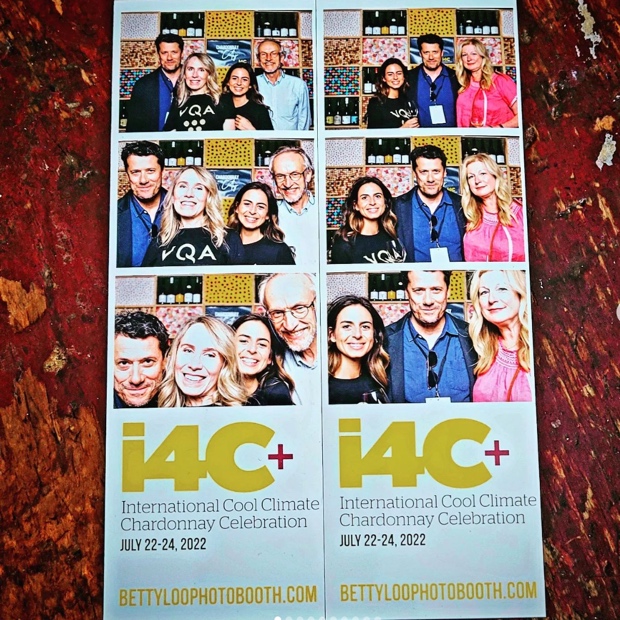
WineAlign

Quality virtual time spent tasting with Querciabella

A few years back I made my first visit to Querciabella, in September 2017, to be exact. Their position in Ruffoli east of the Greve hamlet and the eponymous river is one of the most distinct and perhaps least travelled of Greve’s frazioni. With stunning views towards the Val di Greve, the Colle di Panzano and the amphitheatre of Lamole, Ruffoli carries its very own perspective, one that is unlike any other perch where the Classico are made in Chianti. Several weeks ago I caught up with Querciabella’s n groot winemaker Manfred Ing for a virtual session, replete with a ten-deep taste through of his (and their) lekker wines.

Ruffoli, Greve in Chiani

Related – A river runs through Greve

The Ruffoli hill may not qualify for Chianti Classico’s newly minted UGA (Ùnita Geografiche Aggiuntive), but make no mistake. Ruffoli is the definition of a communal sub-zone in requiem of introspective investigation for its distinct soils, elevation, singularities and peculiarities. It is, as I have said before, “the Chianti Classico poster child for seeing the vineyards through the trees.” Along with Jurji Fiore’s Poggio Scalette and Il Tagliato by Marco e Elena Kupfer there forms a special bond for Ruffoli’s combination of elevation, thick forests and conglomerate soils that have been excavated from beneath those heavy woods. If Querciabella’s decisive resource and secret weapon are vineyard holdings in two other Classico communes, those being Radda and Gaiole, Ruffoli remains the epicentre and the wines can be imagined as residing at the rooftop and pinnacle of Chianti Classico.

Querciabella was founded in 1974 by Giuseppe (Pepito) Castiglioni. His son Sebastiano Cossia Castiglioni, investor and entrepreneur, converted the estate to organic viticulture in 1988, making Querciabella one of the first wineries in Italy to employ this practice. In 2000 Sebastiano introduced a 100 per cent plant‑based approach to biodynamics that forbids the use of animal products in both the vineyards and in the cellars. The Chianti Classico estate that means “beautiful oak” has always been one that lives for today while always imagining and thinking about tomorrow. The wines arguably act as the most Bourguignons of any in the territory whilst always and unequivocally speaking for the land that gives them life.

In April of this year I asked Ing to assess the damage caused by uncharacteristic mid-Spring frosts. His response: “Unfortunately the cold weather that swiped through Tuscany on the April 6th and 7th caused us some frost damage, having hit especially those vineyards which were ahead in their development. Our team lead by Dales is still assessing the damage and it’s early to say how the affected vineyards will recuperate. We will know better in the coming weeks as the vines develop. In Chianti Classico, where our vineyard holdings are spread in different locations and altitude, isolated pockets of lower lying vineyards were affected, especially those around and below our cellar in Ruffoli. At a first glance, it appears that the frost bite hit some of the early budding Chardonnay and the young Sangiovese vines that were first out the blocks. Most of the higher altitude vineyards buds haven’t fully burst yet, so we are fortunate and remain hopeful. In Maremma, temperatures dipped to record lows in some areas, especially in the early hours of April 8th. The Sangiovese vines had an early start this year so were particularly exposed. Vines are an extraordinary plants which are known for bouncing back. At this stage we can only wait and see. It’s already clear, though, that we are among many other producers concerned about losing some crop to frost damage.”

It remains to be seen how pandemic and travel will play out over these next several weeks but I have every intention of climbing the Ruffoli hill this coming September (or anytime such an endeavour is possible) to see Manfred and team for a walk in the vineyards and a sit-down to taste more from their most excellent portfolio; Vineyard Operations Manager & Master Beekeeper Catiuscia Minori, Agronomist Chiara Capecci, Agronomist & Technical Director Dales D’Alessandro, Direct Sales & Visits Coordinator Daniela Krystyna Cappuccio, Head of Marketing and Communications Emilia Marinig, Global Sales Director Giorgio Fragiacomo, Winemaker Guido De Santi, Winemaking Director Luca Currado, Agronomist & Operations Manager Marco Torriti, CEO & Domestic Sales Director Roberto Lasorte, Marketing Assistant Manager Valentina Bertoli and of course Owner and Honorary Chairman Sebastiano Cossia Castiglioni. In the meantime here are the 10 wines we tasted and discussed back on May 31, 2021.

Felt quite real to be talking Ruffoli, Greve, Maremma, Gaiole and Radda with Tuscany’s groot South African winemaker @bottleofgrapes ~ A virtual session with @querciabella maintains the ties that bind with @chianticlassico

Querciabella Mongrana 2019, Marermma Toscana DOC (13653, $23.95)

From 31 hectares south of Grosseto, divided into two re-planted parcels purchased in 1998-1999 near to Alberese, a village and frazione of the commune. Wines are crushed and fermented in Maremma and then transferred to Greve just before or just after malo takes place. The style comes from cement and stainless steel, of fruit purity kept intact and a coastal influence developing some muscle. Picked ahead of Chianti Classico with harvest always beginning two to two and a half weeks ahead of Greve. So much Tuscan coastal bushy and dusty herbology, of fennel and rosemary primarily. Managed by Agronomist & Operations Manager Marco Torriti and team who are responsible for this 50-25-25, sangiovese led blend with cabernet sauvignon and merlot. Drink this by the glass everywhere you go, matching the pasta shape on the bottle, if you are so inclined, wherever possible. Mongrana goes as does L, Maquis shrubland ingrained into an easy drinking, fun, juicy and exuberant blend. Will never mess with any course, nor wine that comes before or after. Has been labelled DOC Maremma since 2017. Drink 2021-2024.  Tasted May 2021

Querciabella Chianti Classico DOCG 2018 (728816, $45.95)

Remains 100 per cent sangiovese, as it has been since 2012, as a three-commune collection; Ruffoli in Greve (40 per cent), on the Volpaia side and across the valley to Radda (20) and San Polo in Rosso from Gaiole (20), across the ravine from Ama. The totality of the Gaiole fruit is raised on Alberese, the Radda in schisty Galestro and Ruffoli, well Ruffoli is really about elevation. A no extremities vintage following a very cold winter and no climate spikes save for the early August heat. The Querciabella richness is foiled but also optimized by a three-part mineral harmony that does not so much cut but adds three district notes to the wine. The epiphany may or not begin with this 2018 but the textural perception has undergone a transformational alteration, now in defence against the drying effect of sangiovese’s tannin. The winemaking team has moved forward from the experimental stage into a full-on working contract with Piedmontese cappello sommerso, keeping the cap submerged for extended periods (up to 45 days). The high elevation fruit is particularly promising, forging true connectivity with the process. You get it completely, intuit the polish and this Annata just melts straight into inherit structure, again with thanks for a portion that has settled early. The wheel is constantly turning for Querciabella’s wines. Stupendo. Drink 2022-2032.  Tasted May 2021

Querciabella Chianti Classico Riserva DOCG 2017 ($79.95)

Riserva, like most Riservas in Chianti Classico is usually more serious, often blended with cabernet sauvignon and/or merlot, subjected to more wood. Since 2011 Querciabella’s has been 100 per cent sangiovese but still a three commune (Greve, Radda and Gaiole) cuvée, a vibrant varietal wine, lush as it needs to be and what stands apart is its simple purity. The picking decisions are made throughout the season, not just at harvest and certain blocks are given the attention of dramatic foreshadowing. Riserva by Querciabella is a wine of evolution, including monthly tastings along the way (with 20 per cent new wood involved). Riserva is a factor of a trajectory, of sangiovese that is always rising, gaining character, fortitude and fruit in vessel that winemaker Manfred Ing knows in his heart is meant for Riserva. The tannins tell the story, croccante is how he describes or the flavour and texture he looks for, in my mind like crunchy and caramelized almonds and dried wild strawberries of a concentrated yet developing sweetness. A wine to age, surely, though not quite like ’16, but do sleep on this because the efficacy, youthful binding and wound intensity show the promise of great ability. Drink 2023-2030.  Tasted May 2021

Querciabella Turpino 2017, IGT Toscana ($59.95)

First commercial vintage was 2010 when at the time it was 50-50 Maremma and Greve. Since 2015 it identifies as 100 per cent Tuscan coast with more barrel exercise and power than Mongrana, now a cuvée of approximately 12,000 bottles. “Turpino,” as in a character from Sebastiano Cossia Castiglioni’s favourite poem, like his son Orlando (and also for the names Mongrana and Palafreno). Frost was a major problem in 2017, followed by heat, no rain and vines that just went crazy. Small pickings were done in the first week of September and then the rain came. The vines dropped in alcohol potential by a degree but the vines were tired and so the fruit could not hang in there like it could (better so) in Ruffoli. A blend of 40 per cent each cabernet franc and syrah with (20) merlot. Spiciness but not in a traditionally Tuscan syrah (Cortona) way and so the franc is to thank for the pique, sharpness and pointed directive of this ripe wine agitative of pricks and sway. In the end this is truly Tuscan coast, carrying the dried and bushy herbs but with an extended olive branch, muscular arm and structured savour. Only 10,000 bottles were made of this succulent, strange bedfellows (for Tuscany) red wine. House wine, Querciabella style. Drink 2023-2028.  Tasted May 2021

Querciabella Camartina 2016, IGT Toscana

The first vintage for Camartina was 1981, originally mostly sangiovese, then in and around 2001-2003 turning towards becoming mostly cabernet sauvignon. Now at 70 per cent with (30) sangiovese since that 2003. With the most spectacular vintage in pocket the possibility and even more so the probability from 2016 is endless. A Vino da Tavola concept that has evolved to make for the most mature, wise and complex IGT from Ruffoli hillsides, but this vintage shows a special energy, liveliness and vim from acidity that gives the wine, regardless of grape varieties, so much youth and life. Another one of nature’s and Greve’s mysterious constants. So Querciabella, of pinpointed DNA. vibrancy and length. Drink 2023-2033.  Tasted May 2021

Querciabella Palafreno 2016, IGT Toscana ($214.95)

Since 2004 has always been 100 per cent merlot, before that being a 50-50 sangiovese and merlot joint. Has to be an ideal vintage for Sebastiano and Manfred to bottle this idealistic wine because it has to, must smell like Tuscany and Ruffoli. Places home to poetic settings which suggest inner meaning and invisible connections. With that essence of 2016, of high priority acidity, sapidity and vibrancy in mind, this drinks so well and truth is shows how merlot has been domesticated upon the Ruffoli hill. The vines average 20 years of age, with some vines nearly at 30, planted in 1995 and/or 1996. Sweet, verdant and grippy tannins with a little bit of grit are surely involved. This will show off some swarthy secondary character and essenza di tartufo in 10 years time. Only 3,000 bottles are made. Drink 2021-2031.  Tasted May 2021

Querciabella Chianti Classico DOCG 1998 (728816, Price at release: $31.95)

Twenty plus years later and not by any means over the hill. Drinking with captured and preserved youth from a vintage that was passed over for being one to not give any sort of great attention or consideration. Fermented in 225L (some new wood) barrels, some big tanks, picked later than most Chianti Classico of the time and would not have been pure sangiovese. You can feel the botrytis induced blood orange and saffron from a vintage with pioggia, pioggio, pioggia, a.k.a. so much rain. Also liquorice, bokser pod and a smell of wet tar. Really textural Classico, holding firm and strong, with a few years of interest and more complexity developing potential left to seek out. Charm begets pleasure which leads to unadulterated enjoyment. Drink 2021-2024.  Tasted May 2021

Querciabella Chianti Classico Riserva DOCG 1999

The 1999 was the last (original) Riserva produced until it was again resurrected in 2011 and what’s so cool about this vintage is how it was held to some early esteem, though paling in comparison to that “vintage of the century” that was 1997. Underestimated over the last 20 years, drinking so beautifully now, with frutta di bosca, tertiary tartufo and fungi. Just doesn’t strike as a fully mature adult reminiscing about the way things used to be but more like a wine with an outlook for more promise, good times and adventures still ahead. If you are still holding onto ‘99s from this part of Toscana you will be very pleased. Drink 2021-2026.  Tasted May 2021

Querciabella Batàr 2018, Toscana IGT ($149.95)

A joint between pinot blanc and chardonnay, whole bunch pressed, with furthered finer attention to detail, picked early in the morning and a decreased amount of new oak over the last 10 years. Now at about 20 per cent and less bâtonnage as well, keeping the strings tight and the backbone straight in the wine. “We don’t need to worry about getting richness in our wines,” tells Manfred Ing, and yes, the creaminess is automatic. There’s more bite to Batàr now, along with focus and precision, with an intention to allow for five (minimum) years ahead for energy to develop, flesh to increase and textural richness to become something naturally orchestrated over time. Batàr is a wine that defies flamboyance, deflates extroversion and muffles the most exultant cry. It knows what it is and what’s up. Terrific vintage for this singular, dual-focused and one goal achieved Querciabella bianco. Drink 2024-2029.  Tasted May 2021

Querciabella Batàr 2017, Toscana IGT ($149.95)

The effect of 2017 on white grapes meant a 40 per cent reduction in quantity and chardonnay surely suffered. Certainly true at 350m (south-facing) but also at 600m (on sandstone soils) where it thrives. The pinot bianco faces north so it did well in the season. The flinty reduction comes from the high elevation vineyard and you really notice it more in 2017, but also a fruit sweetness, like biting into a perfectly ripe apple, and also a peach. You still need to exercise patience with this wine because what it really shows you is how this particular cuvée will morph, oscillate and change, for sure and at least in its first five years. Definitely buttery, rich and creamy but let’s not sit on those laurels for too long because herbs, sapidity and a new kind of vim and vigour are just around the corner. A concentrated effort and one with many tricks up its Ruffoli sleeve. Drink 2022-2027.  Tasted May 2021

Good to go!

godello

Twitter: @mgodello

Instagram: mgodello

WineAlign